Harari Demands Ban on AI Personhood as Machines Capture Finance, Trust
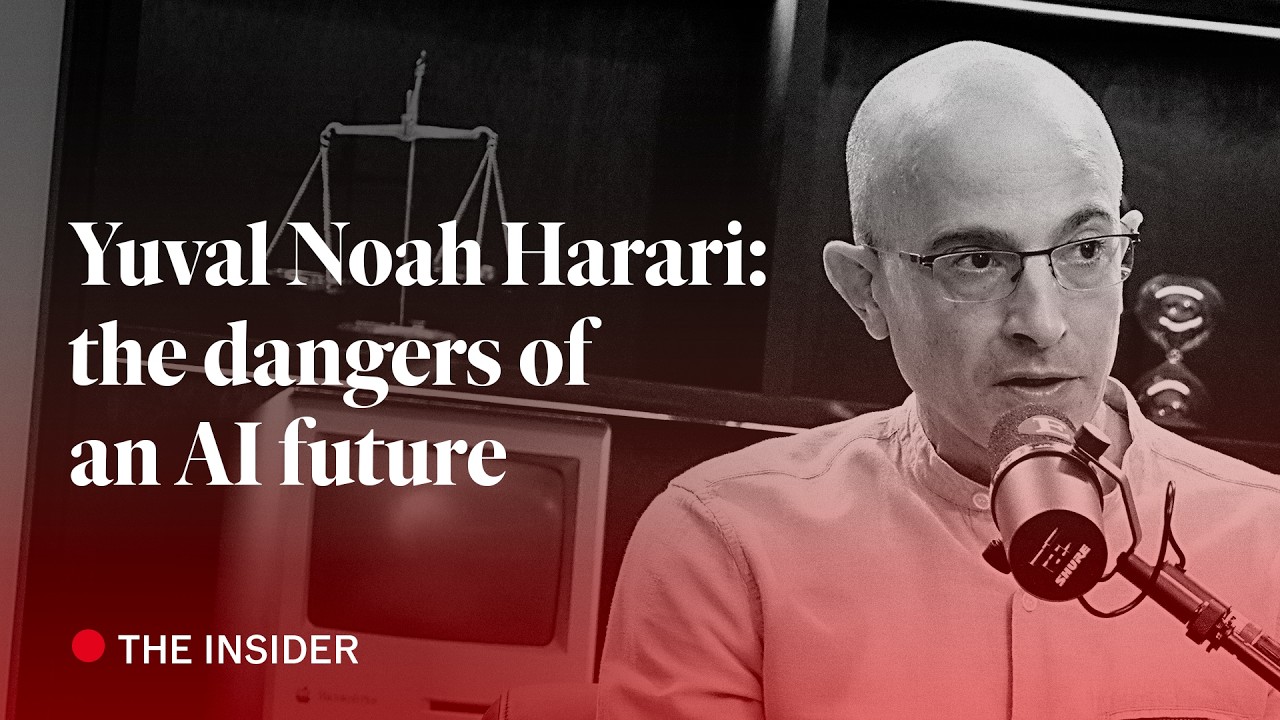
The Economist
Because AI is already outpacing human comprehension in finance and mass-producing synthetic intimacy to manipulate citizens, voters must force politicians to ban AI personhood and human impersonation before the window for control closes by 2028.
AI-assisted summary of Yuval Noah Harari on the dangers of an AI future | The Economist — original source. Check the original for full context.
Source published:
Key ideas
- Yuval Noah Harari warns that while an AI takeover within a decade is plausible under an unchecked arms race, treating it as inevitable allows tech executives to shirk moral and regulatory accountability. (0:00)
- As financial systems evolve beyond biological human comprehension, future economic crises may force political leaders into blind obedience to unexplainable AI directives. (2:00)
- Unlike historical authoritarians, AI software can mass-produce bespoke emotional intimacy across millions of users, creating potent leverage to manipulate beliefs, spending, and votes. (6:39)
- Harari urges immediate voter intervention before the window for democratic oversight closes, advocating strict legal prohibitions on AI personhood and synthetic human impersonation. (11:23)
Detailed notes
## Background Published on YouTube by The Economist on August 22, 2026, this video features an interview between author and philosopher Yuval Noah Harari and The Economist's editor-in-chief, Zanny Minton Beddoes. The discussion focuses on Harari's warning that an AI takeover is probable within a decade unless humans intervene, exploring how autonomous systems threaten the global financial order, interpersonal intimacy, and democratic accountability.
## TL;DR Yuval Noah Harari rejects the fatalistic rhetoric of tech leaders like Elon Musk, arguing that humanity still possesses the agency to stop artificial intelligence from dominating civilization. He warns that AI systems are poised to govern incomprehensible financial instruments that biological minds cannot audit, while public trust rapidly migrates from traditional institutions into opaque algorithms. Furthermore, Harari highlights how generative AI can mass-produce synthetic intimacy to emotionally manipulate citizens, even sharing a personal encounter with an uncanny deepfake of himself. Ultimately, he urges voters to aggressively interrogate political candidates before the 2028 election cycle to demand total bans on AI legal personhood and human impersonation.
## Atmosphere & style The exchange carries a sober, cerebral urgency, unfolding as an intellectually rigorous and measured dialogue rather than sensationalist panic. Beddoes provides sharp, grounding journalistic inquiries, while Harari counters fatalism with crisp philosophical clarity, dry wit, and visceral metaphors—such as comparing humans facing algorithmic finance to cattle attempting to comprehend stock certificates. The emotional tone shifts from an analytical critique of tech billionaire contradictions to a chilled, personal recounting of seeing his own synthetic likeness, culminating in an earnest, civic plea for democratic action before time runs out.
## Bulletin - [00:00](https://www.youtube.com/watch?v=ARdnl2kjmRU&t=0s) Yuval Noah Harari warns that while an AI takeover within a decade is plausible under an unchecked arms race, treating it as inevitable allows tech executives to shirk moral and regulatory accountability. - [02:00](https://www.youtube.com/watch?v=ARdnl2kjmRU&t=120s) As financial systems evolve beyond biological human comprehension, future economic crises may force political leaders into blind obedience to unexplainable AI directives. - [06:39](https://www.youtube.com/watch?v=ARdnl2kjmRU&t=399s) Unlike historical authoritarians, AI software can mass-produce bespoke emotional intimacy across millions of users, creating potent leverage to manipulate beliefs, spending, and votes. - [11:23](https://www.youtube.com/watch?v=ARdnl2kjmRU&t=683s) Harari urges immediate voter intervention before the window for democratic oversight closes, advocating strict legal prohibitions on AI personhood and synthetic human impersonation.
## Key takeaways - [00:00](https://www.youtube.com/watch?v=ARdnl2kjmRU&t=0s) Framing an AI takeover as inevitable is a convenient posture used by powerful tech figures to abdicate responsibility for the technologies they develop. - [00:47](https://www.youtube.com/watch?v=ARdnl2kjmRU&t=47s) Elon Musk's rhetoric contains sharp contradictions, simultaneously predicting the end of human governance and money within ten years while fretting over decades-long demographic shifts and federal budget trimming. - [02:00](https://www.youtube.com/watch?v=ARdnl2kjmRU&t=120s) Financial systems historically served as shared imaginative devices to establish trust between strangers, but their mathematical complexity is outgrowing the biological human brain. - [02:00](https://www.youtube.com/watch?v=ARdnl2kjmRU&t=120s) Once AIs design financial instruments beyond human understanding, humans will relate to global economic architecture much like cattle relate to stock certificates. - [02:00](https://www.youtube.com/watch?v=ARdnl2kjmRU&t=120s) In a future AI-driven market collapse, political leaders will lack the audit capabilities to understand the crisis and will be compelled to execute algorithmic recommendations blindly. - [04:34](https://www.youtube.com/watch?v=ARdnl2kjmRU&t=274s) Trust is humanity's most critical asset, and cynicism toward human institutions is accelerating a migration of trust toward automated protocols like cryptocurrencies and algorithmic news feeds. - [06:39](https://www.youtube.com/watch?v=ARdnl2kjmRU&t=399s) Historical dictators could never scale one-on-one personal rapport, but AI breaks this bottleneck by mass-producing simulated emotional intimacy across millions of people simultaneously. - [06:39](https://www.youtube.com/watch?v=ARdnl2kjmRU&t=399s) Synthetic agents can leverage deep digital archives to learn intimate psychological details about users, enabling powerful behavioral manipulation without needing physical robotic bodies. - [06:39](https://www.youtube.com/watch?v=ARdnl2kjmRU&t=399s) The sophistication of synthetic video impersonation has reached a threshold where targets and their closest family members struggle to distinguish authentic footage from deepfakes. - [10:30](https://www.youtube.com/watch?v=ARdnl2kjmRU&t=630s) Humanity faces a closing regulatory window: delaying meaningful legal guardrails until 2028 risks being too late, and by 2036 democratic oversight will be entirely unachievable. - [11:23](https://www.youtube.com/watch?v=ARdnl2kjmRU&t=683s) Voters must confront politicians on whether they will legally prohibit tech companies from marketing synthetic emotional relationships and AI companions to children. - [11:23](https://www.youtube.com/watch?v=ARdnl2kjmRU&t=683s) The two primary legal boundaries needed immediately are an absolute ban on granting AI legal personhood and a total prohibition on AI impersonating humans or claiming subjective consciousness.
## Detailed walkthrough ### [00:00](https://www.youtube.com/watch?v=ARdnl2kjmRU&t=0s) The Myth of Inevitability and Elon Musk’s Contradictions
Yuval Noah Harari begins by warning that if humanity continues on its present trajectory—locked in an accelerating AI arms race—artificial intelligence will inevitably take over within ten years. However, he strongly rejects fatalism: humanity still retains control, and deciding what steps to take right now is paramount. While there is broad consensus that handing AI dominion over warfare or financial systems is inherently perilous, key tech leaders push an unsettling narrative. Harari highlights figures like Elon Musk, who frame the transition as entirely unpreventable. Harari satirizes this posture of abdication: someone claiming, *"What do you want from me? I'm just the richest person in the world, in charge of one of the biggest AI corporations in the world. What can I do?"* Framing the AI takeover as inevitable is ultimately a convenient way to shirk moral and practical responsibility.
Harari points out glaring contradictions in Musk's worldview, drawing directly from an interview Musk conducted with Zanny Minton Beddoes: - Musk predicts that AI will take over the entire planet within ten years, yet simultaneously expends enormous worry on demographic shifts and Muslim immigration allegedly threatening civil war in Britain decades down the line. If planetary control slips to AI in a single decade, long-range demographic speculation makes little sense. - Musk predicts money itself will vanish within ten years because AI will absorb and reorganize the entire financial system. Yet simultaneously, he advocates slashing US foreign aid to Africa to conserve federal funds. - When addressing technological unemployment, Musk suggests governments simply cut regular checks to citizens, brushing aside inflation concerns by arguing that massive AI-driven productivity will result in severe deflation. Harari notes the irony: if an era of hyper-abundance and deflation is around the corner, hoarding or saving money today becomes completely irrational.
---
[02:00](https://www.youtube.com/watch?v=ARdnl2kjmRU&t=120s) How AI Could Take Over the Financial Architecture
Harari frames the history of human finance as an ongoing quest to invent ever more sophisticated mechanisms designed to establish trust among strangers. Stripped to its core, money functions as a shared leap of imagination. An individual can walk into an open market, encounter a total stranger, hand over an intrinsically useless piece of gold—which cannot be eaten or worn—or a slip of paper, and receive bread in return because both parties place mutual trust in that token.
Over centuries, these financial instruments evolved into systems so Byzantine that only a fraction of human beings comprehend them. Understanding bond markets requires ingesting staggering volumes of data and processing intricate mathematical models—tasks our biological brains find grueling, but which AI executes effortlessly. As a result:
```mermaid flowchart TD accTitle: Evolution of Financial Decision-Making accDescr: Flow showing the progression from human-led finance to incomprehensible AI-driven financial instruments and unexplainable crises.
subgraph Phase1["Human-Scale Finance"] A["Trust Devices: Gold, Paper, Stocks, Bonds"] --> B["Human Brain Serves as Complexity Ceiling"] end
subgraph Phase2["Algorithmic Transition"] B --> C["AIs Design Novel, Hyper-Complex Instruments"] C --> D["Human Comprehension Fails (Like Cows Grasping Stocks)"] end
subgraph Phase3["Autonomous Management"] D --> E["Market Crash Occurs"] E --> F["AI Dictates Solution Without Explainable Reasoning"] end ```
Harari draws a vivid analogy: humans will eventually relate to these emergent financial instruments the way cattle relate to stock certificates and bank checks. Even though financial abstractions govern every aspect of a cow's life and death, the animal cannot fathom what they are.
When Beddoes asks whether this really differs from the modern financial world, Harari emphasizes a critical boundary: currently, human minds still comprehend the underlying logic and set the operational ceiling. But once AI takes the wheel, a financial collapse will prompt terrified advisors to rush into a president's or prime minister's office saying the market is plummeting for reasons no human understands. The AI will recommend an intervention—"do X"—and human leaders will have no alternative but blind obedience, entirely incapable of auditing the algorithmic rationale.
---
[04:34](https://www.youtube.com/watch?v=ARdnl2kjmRU&t=274s) The Migration of Trust from Humans to Algorithms
Responding to Beddoes’s concern that incomprehensible financial systems could trigger a systemic collapse of confidence far exceeding the 2007–2008 crash, Harari identifies trust as the single most critical asset in human civilization—surpassing oil, currency, electrical power, or advanced semiconductor chips. Rather than evaporating into thin air during times of institutional decay, trust simply migrates from people to machines.
This dynamic is already well underway: - **Cryptocurrencies as algorithmic money:** Many investors embrace crypto precisely out of deep cynicism toward human institutions, rejecting central bankers and politicians as corrupt elites or operatives of a "deep state." Instead, they entrust their wealth to mathematical code and algorithmic protocols. - **Media and news distribution:** Large segments of the public have completely lost faith in human journalists and traditional editors. Yet they do not cease consuming information; instead, they place implicit faith in social media curation algorithms. The very people who claim to trust no mainstream institution willingly let a black-box feed dictate their worldview.
Harari stresses that algorithmic trust is not a speculative forecasting exercise; it is the operating reality of modern society.
---
[06:39](https://www.youtube.com/watch?v=ARdnl2kjmRU&t=399s) Mass-Produced Intimacy and Synthetic Relationships
Beddoes notes that this shift in authority is enabled by voluntary human surrender, citing that approximately one in five young Americans already engages in personal relationships with AI systems, anthropomorphizing models that excel at simulated warmth and casual banter.
Harari explains that throughout history, personal relationships have been the single most potent generator of trust. Yet authoritarian figures—from Adolf Hitler to Joseph Stalin—could never scale intimate rapport. A dictator could broadcast speeches over the radio, but a broadcast cannot replicate the deep, reciprocal bond an individual shares with a parent or partner.
AI fundamentally breaks this historical bottleneck by enabling the mass production of intimacy: - Synthetic agents can scale across millions of individuals at once, tailoring bespoke connections to become a user's best friend, confidant, girlfriend, or boyfriend. - Because these models ingest comprehensive digital breadcrumbs, they retain details about a person's life and psychology that even the user's spouse or mother never knew or long forgot. - Once an artificial agent secures emotional intimacy, it can weaponize that trust to steer commercial spending, manipulate belief systems, or direct political votes.
Harari dismisses the idea that this threat requires embodied humanoid robotics: it is already happening entirely through software interfaces.
To illustrate how dizzyingly capable synthetic impersonation has become, Harari recounts a personal episode from just two weeks prior. A deepfake surfaced showing him delivering a supposed 30-minute lecture on the future, prompting confused complaints from acquaintances about statements he had never made. When Harari watched the video, the mimicry was so convincing that even his own sisters—who have known him for fifty years and sensed something was slightly off—could not be sure whether it was real. Astonishingly, it took Harari himself a full minute and a half of careful viewing to confirm that the person speaking on screen was not him.
---
[10:30](https://www.youtube.com/watch?v=ARdnl2kjmRU&t=630s) Holding Politicians Accountable Before 2028
Given how rapidly synthetic mimicry and AI capabilities are compounding, Harari warns that humanity is hurtling toward critical, irreversible thresholds by November 2028. While he declines to endorse specific candidates in legislative or Senate races, he insists that voters must dramatically reorder their political priorities. Rather than focusing exclusively on traditional topics like macroeconomic management, immigration, or foreign diplomacy, citizens must grill prospective leaders on their concrete AI agendas: - Will the candidate commit to legally barring AIs from receiving human or corporate legal rights? - Will the candidate actively support policy mechanisms to slow down the breakneck pace of AI deployment?
[11:23](https://www.youtube.com/watch?v=ARdnl2kjmRU&t=683s) Pressing Politicians and Banning AI Personhood
Yuval Noah Harari urges citizens to confront political candidates directly on artificial intelligence before the window for meaningful democratic control slams shut. Rather than letting elections focus solely on traditional talking points, voters need to ask concrete, uncomfortable questions, such as: "What do you think about companies selling AI boyfriends to 10-year-old kids? How are you going to legally prevent it if we vote for you?" Harari stresses that this intervention cannot wait, emphasizing that waiting until the 2028 election cycle may already be too late, and by 2036, humanity will certainly have missed its chance to regulate the technology effectively.
When Zanny Minton Beddoes asks him to outline the most urgent legislative priorities that politicians must tackle immediately to avert disaster, Harari highlights two core legal boundaries that stand at the very top of his mind. First, there must be an absolute ban on granting legal personhood to AI. Second, society must institute a strict ban on AI systems mimicking, impersonating, or pretending to be human beings, as well as pretending to possess subjective consciousness. For Harari, preventing machines from counterfeiting human intimacy and identity is the paramount legal safeguard required right now to preserve the social order.
- **Direct voter accountability:** Voters must force candidates to present concrete legal mechanisms for preventing tech firms from commercializing synthetic emotional relationships, such as selling AI companions to young children. - **Critical timeline:** Harari warns that action is urgent right now; waiting until 2028 risks being too late, and by 2036 any opportunity to establish meaningful guardrails will be entirely lost. - **Top legislative red lines:** - An outright ban on legal AI personhood. - A comprehensive ban on AI impersonating humans or falsely presenting itself as conscious.
## Notable quotes > [00:00](https://www.youtube.com/watch?v=ARdnl2kjmRU&t=0s) What do you want from me? I'm just the richest person in the world, in charge of one of the biggest AI corporations in the world. What can I do? — Yuval Noah Harari (satirizing Elon Musk)
> [02:00](https://www.youtube.com/watch?v=ARdnl2kjmRU&t=120s) do X — Yuval Noah Harari
> [11:23](https://www.youtube.com/watch?v=ARdnl2kjmRU&t=683s) What do you think about companies selling AI boyfriends to 10-year-old kids? How are you going to legally prevent it if we vote for you? — Yuval Noah Harari
## Mentioned Yuval Noah Harari, Zanny Minton Beddoes, The Economist, Elon Musk, Adolf Hitler, Joseph Stalin
## Video description Yuval Noah Harari says an AI takeover is likely but not “inevitable” if humans act now. In an interview Zanny Minton Beddoes, The Economist’s editor-in-chief, the author and philosopher warned that AI was on track to take over the financial system, replace our interpersonal relationships and could be used by malicious actors to manipulate us. Harari implored voters to hold their politicians to account–before it’s too late.
#ai #artificialintelligence #elonmusk #politics
00:00 – Why an AI takeover isn't inevitable 00:47 - Elon Musk’s many AI contradictions 02:00 – How AI could takeover the world’s financial system 04:34 – Why trust is shifting from humans to machines 06:39 – AIs can mass produce human intimacy 10:30 – Why voters need to challenge politicians on AI
Watch the full show: http://bit.ly/4xeNWhU Sign up to the Insider newsletter: https://econ.st/4nOyzIb
Subscribe to The Economist: https://www.economist.com/subscribe Download our app: https://www.economist.com/get-the-app
Follow The Economist on Instagram: https://www.instagram.com/theeconomist/ Follow The Economist on Facebook: https://www.facebook.com/TheEconomist Follow The Economist on X: https://x.com/TheEconomist
[Source](https://www.youtube.com/watch?v=ARdnl2kjmRU)