Sweden PM Touts Nordic Ties, Saab Jets to Buffer US Volatility
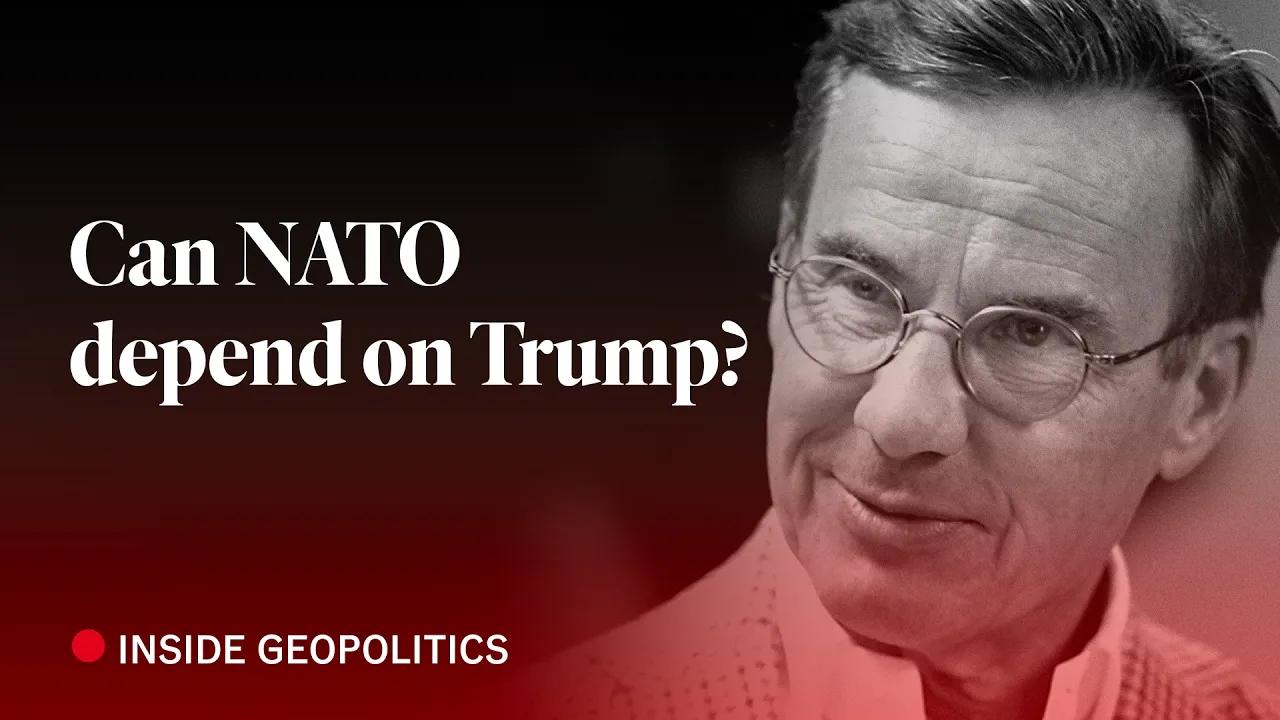
The Economist
NATO membership shields Sweden from American political volatility by replacing covert bilateral dependence with regional Nordic defense integration while opening opportunities for domestic arms makers like Saab.
AI-assisted summary of Sweden’s PM on whether NATO can depend on Trump | The Economist — original source. Check the original for full context.
Source published:
Key ideas
- Swedish Prime Minister Ulf Kristersson pushed back on the premise that NATO accession introduced new reliance on Washington, revealing that Sweden maintained unacknowledged, secret defense ties to the US since the 1940s and 1950s. (0:00)
- Stockholm approaches US relations through pragmatism rather than public confrontation, reserving blunt pushback only for direct sovereignty challenges like American rhetoric targeting Greenland. (1:40)
- Allied anxieties regarding US political reliability and export dependencies are inadvertently boosting European interest in Swedish arms like the Saab JAS 39 Gripen over American platforms like the F-35. (3:34)
- European capitals are prioritizing sovereign supply chains and regional production capabilities to eliminate single points of failure in defense procurement. (4:26)
Detailed notes
## Background Published by The Economist on YouTube on September 2, 2026, this interview features Swedish Prime Minister Ulf Kristersson speaking with geopolitics editor David Rennie. The program examines Sweden's historic turnaround from decades of neutrality to joining NATO following Russia's invasion of Ukraine, addressing transatlantic strain, European security uncertainties, middle-power diplomacy, and how to handle Donald Trump.
## TL;DR Swedish Prime Minister Ulf Kristersson defends Sweden's accession to NATO against concerns of American political volatility by revealing that Sweden secretly relied on the United States throughout the Cold War, arguing that NATO now actually diversifies its defense through deep Nordic and Baltic integration. Addressing how middle powers should navigate Donald Trump, Kristersson advocates for quiet pragmatism over vocal confrontation, drawing strict red lines around core sovereign issues while protecting crucial commercial and tech partnerships. He also highlights Europe's structural push toward defense self-reliance, noting with dry humor that anxieties over American arms reliability have inadvertently bolstered international interest in domestic Swedish platforms like the Saab Gripen.
## Atmosphere & style The exchange carries a measured, cerebral, and distinctly diplomatic tone, pairing sharp, probing inquiries from Rennie with calm, unvarnished pragmatism from Kristersson. Rather than slipping into defensive posturing, the dialogue feels like a candid masterclass in small-state realpolitik, enlivened by flashes of dry Nordic wit—particularly when Kristersson smiles at the suggestion that Donald Trump is functioning as an accidental arms salesman for Swedish fighter jets. The overall mood is cool-headed, analytical, and grounded in long-term strategic realities rather than rhetorical panic.
## Bulletin - [00:00](https://www.youtube.com/watch?v=NhzWFLSOCGc&t=0s) Swedish Prime Minister Ulf Kristersson pushed back on the premise that NATO accession introduced new reliance on Washington, revealing that Sweden maintained unacknowledged, secret defense ties to the US since the 1940s and 1950s. - [01:40](https://www.youtube.com/watch?v=NhzWFLSOCGc&t=100s) Stockholm approaches US relations through pragmatism rather than public confrontation, reserving blunt pushback only for direct sovereignty challenges like American rhetoric targeting Greenland. - [03:34](https://www.youtube.com/watch?v=NhzWFLSOCGc&t=214s) Allied anxieties regarding US political reliability and export dependencies are inadvertently boosting European interest in Swedish arms like the Saab JAS 39 Gripen over American platforms like the F-35. - [04:26](https://www.youtube.com/watch?v=NhzWFLSOCGc&t=266s) European capitals are prioritizing sovereign supply chains and regional production capabilities to eliminate single points of failure in defense procurement.
## Key takeaways - [00:00](https://www.youtube.com/watch?v=NhzWFLSOCGc&t=0s) Sweden's historic Cold War neutrality was paired with covert, bilateral US defense dependencies hidden from the Swedish public. - [00:48](https://www.youtube.com/watch?v=NhzWFLSOCGc&t=48s) NATO membership diversifies Sweden's defense architecture across Nordic and Baltic neighbors rather than resting on isolated bilateral ties with Washington. - [01:22](https://www.youtube.com/watch?v=NhzWFLSOCGc&t=82s) Kristersson endorses an increased European defense burden provided the transatlantic transition follows an orderly process. - [01:40](https://www.youtube.com/watch?v=NhzWFLSOCGc&t=100s) Middle powers like Sweden and Canada maintain close consultations, but Sweden opts for practical engagement over vocal confrontation with unpredictable superpowers. - [02:22](https://www.youtube.com/watch?v=NhzWFLSOCGc&t=142s) Sweden establishes clear red lines on core democratic principles and territorial sovereignty, as demonstrated during US discussions on purchasing Greenland. - [03:00](https://www.youtube.com/watch?v=NhzWFLSOCGc&t=180s) Economic diplomacy and safeguarding access to the US market for Swedish tech and industrial firms remain a cornerstone of Stockholm's strategy. - [03:34](https://www.youtube.com/watch?v=NhzWFLSOCGc&t=214s) Sweden is marketing defense platforms, including Saab Gripen fighters and surveillance aircraft, to allies reassessing reliance on American manufacturers. - [04:02](https://www.youtube.com/watch?v=NhzWFLSOCGc&t=242s) Allied concerns over potential technical dependencies and operational control have made former President Trump an inadvertent salesman for non-US military hardware. - [04:26](https://www.youtube.com/watch?v=NhzWFLSOCGc&t=266s) Sweden has maintained an independent domestic defense industry since the 1930s, positioning it as a strategic asset amid Europe's push for industrial autonomy. - [05:12](https://www.youtube.com/watch?v=NhzWFLSOCGc&t=312s) European nations are actively building out regional defense capabilities to ensure guaranteed readiness and avoid single-source reliance on US defense exports.
## Detailed walkthrough ### [00:00](https://www.youtube.com/watch?v=NhzWFLSOCGc&t=0s) From Secret Cold War Reliance to Open NATO Alliances
David Rennie challenges Swedish Prime Minister Ulf Kristersson on Sweden's historic pivot away from neutrality, pointing out that joining NATO is fundamentally a bet on the transatlantic link and the reliability of the United States. Given growing political volatility in Washington, Rennie asks whether anchoring Sweden’s national security to America now feels like a much riskier wager than when the country first applied.
Kristersson counters this premise by re-evaluating Sweden's modern history. Ever since the 1940s and 1950s, he explains, Sweden was already heavily reliant on the United States behind closed doors. The country maintained a public posture of formal non-alignment while secretly cultivating deep Western defense ties that were deliberately hidden from the Swedish public—a covert legacy Kristersson admits he is "not that proud of." From his vantage point, accession to NATO does not heighten Swedish vulnerability to American whims; instead, it broadens Sweden's collective security net by tying its defense directly to its immediate Nordic and Baltic neighbors. Sweden has never collaborated as intimately with its regional partners as it does today, creating a diversified regional structure rather than a purely bilateral American dependence.
While acknowledging that a continued American presence remains vital and calling for an "orderly process" in transatlantic defense burden-sharing, Kristersson stresses that Sweden is now far less exposed to singular American bilateral decisions because its closest operational integration is rooted right across Northern Europe.
```mermaid flowchart TD accTitle: Evolution of Swedish Security Posture accDescr: Diagram tracing Sweden's shift from covert bilateral Cold War reliance to multilateral NATO and regional Nordic integration.
subgraph ColdWar["Cold War to Pre-NATO Era"] A["Formal Neutrality"] --> B["Secret Bilateral Ties with US"] B --> C["Heavy, Unacknowledged US Dependency"] end
subgraph ModernNATO["NATO Membership Era"] D["Open Transatlantic Alliance"] --> E["Deep Integration with Nordic & Baltic Allies"] E --> F["Diversified Defense & Shared Regional Burden"] end
C -.->|"2022-2024 Strategic Shift"| D ```
- **Cold War secrecy**: Sweden maintained formal diplomatic neutrality while establishing secret, high-level defense dependencies with the US dating back to the 1940s and 1950s. - **Neighborhood reliance**: NATO membership has catalyzed unprecedented defense coordination between Sweden, the Nordic nations, and the Baltic states, reducing isolated reliance on Washington. - **Burden-sharing**: Kristersson agrees that Europe taking on more defense responsibility is fair, but insists the transition must be handled through an orderly process.
---
[01:40](https://www.youtube.com/watch?v=NhzWFLSOCGc&t=100s) Pragmatism, Middle Powers, and Standing up to Trump
Rennie shifts the discussion to how "middle powers" ought to navigate a world dominated by unpredictable superpowers and political strongmen. He contrasts the aggressive rhetoric of Canadian leadership—citing warnings delivered at Davos urging middle powers to push back against "big bullies," including the US—with the markedly more reserved posture adopted by the Nordic and Baltic states toward Donald Trump. Rennie asks whether Kristersson believes confrontational approaches are a tactical mistake.
Declining to pass judgment on Canadian domestic choices, Kristersson warmly characterizes Canada as "the most Nordic country outside the Nordics" and highlights close working relationships. However, he distinguishes Sweden’s diplomatic playbook: rather than picking public fights, Sweden practices firm, case-by-case pragmatism. When core democratic principles or territorial sovereignty are threatened—such as previous rhetoric surrounding the purchase or annexation of Greenland from Denmark—Sweden is completely unambiguous: "no American doubts our opinion on that."
Outside of those red lines, Kristersson maintains that Swedish foreign policy must remain intensely practical. It makes little sense to alienate Washington when Swedish tech enterprises, defense manufacturers, and commercial industries depend on unrestricted access to the American market. The governing principle for Stockholm is to speak out firmly when core values are challenged while quietly protecting vital economic and defense interests.
- **Middle power coordination**: Sweden maintains routine high-level consultations with Canada and fellow Nordic-Baltic partners to coordinate foreign policy. - **Red lines on sovereignty**: Sweden was outspoken and uncompromising in defending Danish sovereignty when American rhetoric targeted Greenland. - **Commercial pragmatism**: Stockholm pairs firm principled boundaries with active economic diplomacy to assist Swedish technology firms expanding into the United States.
---
[03:34](https://www.youtube.com/watch?v=NhzWFLSOCGc&t=214s) Gripen, the F-35, and Selling Arms in a Risk-Averse Europe
Rennie probes whether Sweden’s diplomatic restraint masks a sharper commercial calculation: positioning itself as a reliable defense contractor for nations spooked by Washington. When Sweden pitches Saab surveillance aircraft or JAS 39 Gripen multirole fighters to countries like Canada, Rennie argues, it is quietly selling itself as an insurance policy against an unreliable United States that might one day exploit technical dependencies or export "kill switches."
Kristersson responds with dry candor, acknowledging that while Sweden has pitched the Gripen to Canada, no agreement has been concluded. When Rennie points out that international anxiety over Trump has turned the former president into a formidable inadvertent salesman for Swedish hardware—prompting allies to consider the Gripen over Lockheed Martin's F-35—Kristersson smiles: "I don't mind the reasons for them to buy Gripen. I will help Saab to sell Gripen anyway."
Moving past the humor, Kristersson emphasizes a profound structural transformation across European defense thinking. Since the 1930s, Sweden deliberately maintained an independent domestic arms manufacturing industry to ensure baseline self-sufficiency. In a volatile geopolitical environment, European nations have realized that military readiness requires absolute certainty of access and diversified supply chains. While the United States remains the world's preeminent weapons supplier, European capitals are aggressively building out domestic and regional production capabilities to eliminate single points of failure, turning Sweden's legacy of defense autonomy into a major strategic asset.
- **Saab Gripen marketing**: Sweden is actively pursuing major foreign defense contracts, including pitches to Canada for Gripen fighters and Saab airborne early warning platforms. - **Sovereign supply chains**: European partners are re-evaluating military purchases like the F-35 due to anxieties over availability, operational autonomy, and potential software "kill switches." - **Indigenous industrial base**: Sweden's defense manufacturing ecosystem has been purposefully built and maintained since the 1930s to secure self-reliance and diversify international suppliers.
## Notable quotes > [00:00](https://www.youtube.com/watch?v=NhzWFLSOCGc&t=0s) not that proud of — Ulf Kristersson
> [00:00](https://www.youtube.com/watch?v=NhzWFLSOCGc&t=0s) orderly process — Ulf Kristersson
> [01:40](https://www.youtube.com/watch?v=NhzWFLSOCGc&t=100s) middle powers — David Rennie
> [01:40](https://www.youtube.com/watch?v=NhzWFLSOCGc&t=100s) big bullies — David Rennie
> [01:40](https://www.youtube.com/watch?v=NhzWFLSOCGc&t=100s) the most Nordic country outside the Nordics — Ulf Kristersson
> [01:40](https://www.youtube.com/watch?v=NhzWFLSOCGc&t=100s) no American doubts our opinion on that. — Ulf Kristersson
> [03:34](https://www.youtube.com/watch?v=NhzWFLSOCGc&t=214s) kill switches — David Rennie
> [03:34](https://www.youtube.com/watch?v=NhzWFLSOCGc&t=214s) I don't mind the reasons for them to buy Gripen. I will help Saab to sell Gripen anyway. — Ulf Kristersson
## Mentioned Canada, David Rennie, Denmark, Donald Trump, F-35, Greenland, JAS 39 Gripen, Lockheed Martin, NATO, Russia, Saab, Sweden, The Economist, Ukraine, Ulf Kristersson, United States
## Video description Sweden's decision to join NATO was a remarkable turnaround after decades of neutrality. The country was left with little choice after Russia invaded Ukraine; it became a staunch supporter of Kyiv and raised defence spending. But with the transatlantic alliance under strain is the security of Sweden—and Europe—more uncertain than ever?
Ulf Kristersson, Sweden’s prime minister, spoke to David Rennie, The Economist’s geopolitics editor, about American dependence, the plight of the middle powers and how countries should deal with Donald Trump.
#sweden #europe #trump #usa #politics
00:00 - Why Sweden has traded neutrality for NATO 01:40 - How should the “middle powers” deal with Donald Trump? 03:34 - Could Swedish jets tempt buyers away from America? 04:26 - Has Trump shattered Europe's trust in American arms?
Watch the full show: http://bit.ly/4x6S16T Sign up to the Insider newsletter: https://econ.st/4nOyzIb
Subscribe to The Economist: https://www.economist.com/subscribe Download our app: https://www.economist.com/get-the-app
Follow The Economist on Instagram: https://www.instagram.com/theeconomist/ Follow The Economist on Facebook: https://www.facebook.com/TheEconomist Follow The Economist on X: https://x.com/TheEconomist
[Source](https://www.youtube.com/watch?v=NhzWFLSOCGc)