AfD Gains Fuel Anti-Islam Backlash as European Data Refutes Takeover
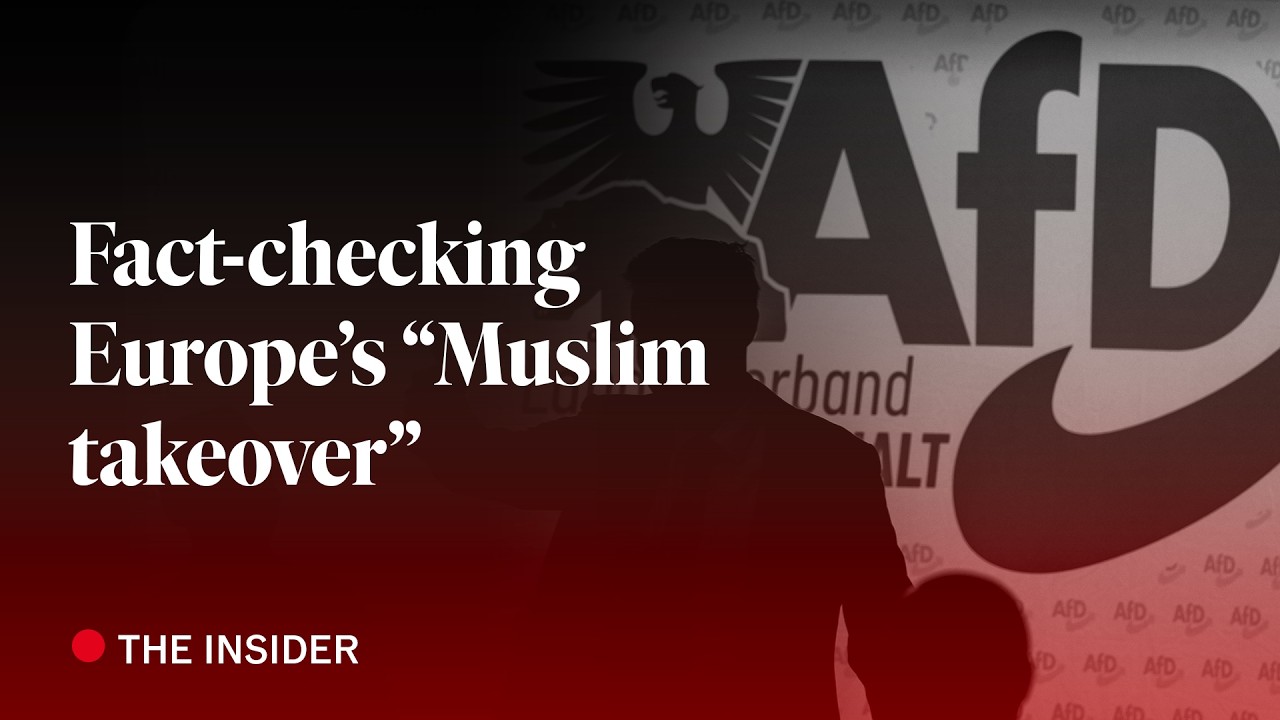
The Economist
Europe's far right and Islamists operate in a symbiotic cycle that manufactures fear and isolates minorities, even as demographic data shows Muslims make up just 6% of the continent's population.
AI-assisted summary of Is Europe facing a "Muslim takeover"? The data says otherwise | The Economist — original source. Check the original for full context.
Source published:
Key ideas
- Official demographic data contradicts fears of a 'Muslim takeover': Muslims make up only about 6% of Europe's population, no country exceeds 10%, and immigrant fertility rates converge to native baselines within two generations. (2:37)
- Anti-Islam sentiment has shifted from the political fringes into the mainstream, with over 50% of Britons now viewing Islam as incompatible with British values. (2:37)
- Far-right political factions and Islamist agitators act as symbiotic 'evil twins,' each leveraging the other's rhetoric to justify hostility and mobilize supporters. (8:05)
- Despite significant socioeconomic integration gains—such as young British Bangladeshis entering university at twice the rate of white working-class peers—mainstream politicians fail to present an effective counter-narrative to populist panic. (10:28)
Detailed notes
## Background Published by The Economist on YouTube on September 12, 2026, the video addresses widespread European anxieties about Islam. Hosted by deputy editor Edward Carr alongside a panel of expert journalists, it explores why anti-Islam sentiment is rising despite data showing Muslims comprise only a small percentage of Europe's population with attitudes largely resembling their fellow citizens.
## TL;DR The panel refutes the narrative of an impending 'Islamic takeover,' highlighting that Muslims represent only about 6% of Europe's population and that immigrant fertility rates rapidly normalize to native baselines within two generations. While acknowledging genuine localized tensions around segregated enclaves and social conservatism, the journalists carefully differentiate between Islam, political Islamism, and violent jihadism. They identify a toxic symbiosis between far-right political parties and Islamist agitators, who act as 'evil twins' by amplifying each other's rhetoric to alienate minority communities. Ultimately, the discussion stresses that tangible integration successes—such as high educational attainment and civic leadership among British Muslims—are routinely overshadowed because mainstream politicians lack the vocabulary to articulate them against populist panic.
## Atmosphere & style The discussion carries a measured, analytical, and distinctly sober journalistic tone, characteristic of an expert editorial roundtable. It contrasts the breathless, shock-driven hysteria of social media algorithms and far-right campaign platforms with calm, empirical demographic reality. Listening to the panel feels like stepping out of a polarized media storm into an intellectual debrief, moving from initial alarmism to a thoughtful, reflective critique of mainstream political communication.
## Bulletin - [02:37](https://www.youtube.com/watch?v=To8r_IWYhZ0&t=157s) Official demographic data contradicts fears of a 'Muslim takeover': Muslims make up only about 6% of Europe's population, no country exceeds 10%, and immigrant fertility rates converge to native baselines within two generations. - [02:37](https://www.youtube.com/watch?v=To8r_IWYhZ0&t=157s) Anti-Islam sentiment has shifted from the political fringes into the mainstream, with over 50% of Britons now viewing Islam as incompatible with British values. - [08:05](https://www.youtube.com/watch?v=To8r_IWYhZ0&t=485s) Far-right political factions and Islamist agitators act as symbiotic 'evil twins,' each leveraging the other's rhetoric to justify hostility and mobilize supporters. - [10:28](https://www.youtube.com/watch?v=To8r_IWYhZ0&t=628s) Despite significant socioeconomic integration gains—such as young British Bangladeshis entering university at twice the rate of white working-class peers—mainstream politicians fail to present an effective counter-narrative to populist panic.
## Key takeaways - [00:00](https://www.youtube.com/watch?v=To8r_IWYhZ0&t=0s) The AfD's regional manifesto explicitly pledges to use all legal means to restrict Islam, defining it as a 'culturally alien religion.' - [00:00](https://www.youtube.com/watch?v=To8r_IWYhZ0&t=0s) American right-wing commentators and tech figures such as Elon Musk amplify narratives portraying Europe as a cautionary tale ruined by unchecked migration and liberal elites. - [02:37](https://www.youtube.com/watch?v=To8r_IWYhZ0&t=157s) Anti-immigrant sentiment has moved into mainstream European politics, reflected in British polling and the electoral dominance of Marine Le Pen in France. - [02:37](https://www.youtube.com/watch?v=To8r_IWYhZ0&t=157s) Demographic statistics show that Europe's Muslim population stands at roughly 6%, with no nation surpassing 10%, directly refuting demographic replacement claims. - [02:37](https://www.youtube.com/watch?v=To8r_IWYhZ0&t=157s) While UK Muslim population growth accelerated post-2021, higher newcomer fertility rates reliably normalize toward host-country baselines within two generations. - [05:42](https://www.youtube.com/watch?v=To8r_IWYhZ0&t=342s) Localized residential polarization has created hyper-segregated neighborhoods where Muslim residents comprise 70% to 80% of the community. - [05:42](https://www.youtube.com/watch?v=To8r_IWYhZ0&t=342s) Practices such as wearing the hijab reveal a liberal dilemma between safeguarding personal autonomy and addressing potential community coercion in insular enclaves. - [05:42](https://www.youtube.com/watch?v=To8r_IWYhZ0&t=342s) Public debates frequently conflate three distinct categories: Islam as a religion, Islamism as a political movement, and jihadism as violent militancy. - [08:05](https://www.youtube.com/watch?v=To8r_IWYhZ0&t=485s) The far right and Islamists operate in a mutually beneficial symbiosis, exploiting each other's rhetoric to alienate moderate Muslims and justify radical positions. - [08:05](https://www.youtube.com/watch?v=To8r_IWYhZ0&t=485s) The far right poses an immediate systemic threat to democratic governance because it commands millions of votes and viable pathways to executive power. - [08:05](https://www.youtube.com/watch?v=To8r_IWYhZ0&t=485s) Surging far-right support leads moderate Muslims in places like eastern Germany to question whether they have a future in their home country. - [10:28](https://www.youtube.com/watch?v=To8r_IWYhZ0&t=628s) British Muslims have achieved prominent civic representation, including holding the office of Mayor of London. - [10:28](https://www.youtube.com/watch?v=To8r_IWYhZ0&t=628s) Young British Bangladeshis enter university at roughly twice the rate of their white working-class counterparts, demonstrating strong upward educational mobility. - [10:28](https://www.youtube.com/watch?v=To8r_IWYhZ0&t=628s) Mainstream European political parties lack the narrative tools and vocabulary to communicate positive integration outcomes against populist alarmism.
## Detailed walkthrough ### [00:00](https://www.youtube.com/watch?v=To8r_IWYhZ0&t=0s) The Rise of the AfD and Transatlantic Perceptions of Europe
The discussion opens with the Alternative für Deutschland (AfD) securing a striking election result in eastern Germany. While an explicitly anti-Islam platform was not front and center of every campaign speech, the AfD's manifesto for the election contains uncompromising, harsh rhetoric directed at the faith. Specifically, the party pledge states that an AfD government will "exhaust all possibilities to limit the influence of this culturally alien religion in Saxony-Anhalt to the extent allowed by law." Reporting from the ground across recent weeks indicates that this framing is not a fringe view within the party; it is a sentiment that most AfD voters in Saxony-Anhalt and throughout Germany would readily endorse.
Across the Atlantic, this political shift reinforces a rapidly hardening narrative among conservative and right-wing Americans who view Europe with mounting alarm. Interviews with people in the United States reveal two dominant perceptions: first, that Europe has been physically and culturally "overrun by Islamic invaders," and second, that European societies have been fundamentally betrayed by a "woke liberal elite." To these observers, European developments serve as an apocalyptic cautionary tale of what could soon happen to America—even though the Muslim demographic in the United States remains comparatively very small.
This worldview is significantly amplified by high-profile, wealthy figures like Elon Musk, who has openly engaged in European political debates and voiced support for the AfD. Many Americans consuming this narrative have not visited Britain or continental Europe in years. Instead, they rely almost exclusively on X (formerly Twitter) for their news. Feeds on the platform are saturated with sensationalized, high-shock video clips depicting migrant crime or dramatic border breaches—such as recent footage from the Spanish enclave of Ceuta—framing immigration not merely as an administrative challenge, but as an existential civilizational collapse.
- **AfD Manifesto Stance:** Pledges legal efforts to suppress the presence of Islam as a "culturally alien religion." - **American Right-Wing Framing:** Views Europe as a cautionary tale ruined by liberal elites and unchecked migration. - **Role of Social Media:** Algorithms on X curating alarming, viral clips of migrant unrest shape skewed international views of European everyday life.
---
[02:37](https://www.youtube.com/watch?v=To8r_IWYhZ0&t=157s) Anti-Islam Sentiment, French Politics, and the Demographics of "Takeover"
Anxiety over Islam is no longer confined to the far-right margins; it has steadily expanded into mainstream European public opinion. Over the last two decades, public concern regarding immigration and Islam has surged significantly. In Britain, over half of the population now believes that Islam is incompatible with British values. A similar dynamic grips France, where Marine Le Pen leads presidential polling. Meanwhile, on the French far left, Jean-Luc Mélenchon actively gathers votes among those alarmed by rising Islamophobia, cultivating deep support in the diverse *banlieues* on the outskirts of major cities. While the far right excels at seizing a tiny kernel of fact and blowing it completely out of proportion, the underlying political discourse across Europe has grown deeply polarized.
Despite the pervasive panic surrounding an impending "Islamic takeover" or demographic replacement, official statistical data completely contradicts the narrative. Muslims currently account for roughly 6% of Europe's total population—a modest rise of only about one to one-and-a-half percentage points over recent decades. France holds the largest Muslim community within Europe, yet no European nation has a Muslim population exceeding 10%, with most hovering near the continental average of around 6%.
While the demographic trajectory is far from an invasion, growth rates have accelerated in specific areas. In the United Kingdom, census data indicates the Muslim population has expanded since 2021 twice as fast as its historical ten-year pace. Furthermore, the counter-argument that Muslim birth rates will inevitably overwhelm host populations ignores established demographic reality: newcomer families do initially average higher fertility rates—with British Muslim growth driven roughly equally by ongoing migration and local births—yet immigrant fertility rates consistently converge toward the local population average within just two generations.
```mermaid flowchart TD accTitle: Realities of European Muslim Demographics accDescr: Diagram illustrating the gap between demographic takeover claims and actual statistical trends.
subgraph Claims["Political Claims"] C1["Narrative of rapid 'Muslim takeover'"] C2["Fears of permanent fertility imbalances"] end
subgraph Reality["Demographic Realities"] R1["Average European Muslim population is ~6%"] R2["No European nation exceeds 10% Muslim share"] R3["Fertility rates converge to native norms within 2 generations"] end
Claims -.->|"Refuted by data"| Reality ```
- **British Public Opinion:** Over 50% of Britons consider Islam incompatible with British values. - **European Population Share:** Muslims represent approximately 6% of Europe overall, with no country topping 10%. - **Growth Dynamics:** In Britain, post-2021 growth occurred twice as fast as the prior decadal rate, split roughly 50/50 between fresh arrivals and domestic births. - **Fertility Convergence:** High fertility rates among incoming populations normalize to host-country baselines within two generations.
---
[05:42](https://www.youtube.com/watch?v=To8r_IWYhZ0&t=342s) Segregated Enclaves and the Tension Over Social Conservatism
While broad population indicators show rising integration across Britain and Europe as a whole, a counter-trend of localized residential polarization has emerged. The absolute number of hyper-segregated neighborhoods—areas where 70% to 80% of residents are Muslim—has grown. It is within these concentrated social enclaves that anxieties about coercive social conservatism gain traction, sparking fierce debates over where personal freedom ends and community pressure begins.
In France, a specialized interior ministry investigation examined this exact dilemma, attempting to parse whether practices like young girls donning the hijab stem from voluntary family norms or coercive community pressure. Liberal European values champion personal autonomy and absolute equality between men and women; consequently, public officials worry that conservative group expectations breach the individual rights of young women. Yet the issue remains nuanced: many Gen Z Muslim women actively choose to wear the hijab as a proud assertion of their hybrid identity and personal expression. This creates an acute internal conflict for liberals, torn between defending an individual's right to dress freely without state interference and worrying about whether young women in tightly knit enclaves are genuinely acting out of unconstrained free will.
To navigate these social tensions rationally, the panel emphasizes the absolute necessity of separating three concepts that public discourse routinely conflates:
1. **Islam:** The global personal religion and theological faith. 2. **Islamism:** A distinct political movement seeking to institutionalize Islamic values and laws across state and civil society. 3. **Jihadism:** The violent, armed struggle to force political and religious change.
---
[08:05](https://www.youtube.com/watch?v=To8r_IWYhZ0&t=485s) The "Evil Twins": How Islamism and the Far Right Feed Each Other
A recurring conclusion across on-the-ground reporting in Germany, France, and neighboring states is that Islamism and the far right operate in a toxic, mutually beneficial symbiosis. Described as "evil twins," both extremes require each other to manufacture fear, mobilize their base, and justify their rhetoric. If one faction ceased to exist, the other would struggle to rally popular crowds. While both present serious risks, the far right represents an immediate systemic threat to democratic governance simply because it commands millions of votes and holds a realistic path toward executive power, whereas Islamist entryism commands no comparable institutional clout.
In Germany, Islamist propaganda online mirrors the AfD's rhetoric almost point for point to drive alienation among well-integrated German Muslims. Islamist agitators tell young believers that Germany has no space for their identity and that their religion will never be permitted to flourish, urging them to separate themselves from German society. This separatist message gains immense credibility when those same individuals watch Saxony-Anhalt deliver massive vote tallies to an AfD whose platform is openly Islamophobic, or when they see the party soaring in federal polls nationwide.
Interviews with ordinary, non-extremist Muslims in eastern Germany reveal a palpable chill: many openly admit they are questioning whether they can remain in a state governed by political forces that reject their existence. By driving minority communities into defensive withdrawal and validation of extremist narratives, the rise of the far right directly sabotages the very mechanism required to solve social friction over the long term: gradual integration and mutual civic assimilation.
[10:28](https://www.youtube.com/watch?v=To8r_IWYhZ0&t=628s) The Integration Success Story and Mainstream Politics' Missing Narrative
The discussion concludes by highlighting that beneath the political alarmism, there is actually a remarkably positive integration story unfolding across Europe—most visibly in the United Kingdom. British Muslims increasingly occupy prominent positions of power and public authority, including elected mayors in major cities such as London. Educational and social mobility trends reveal similar strides; for instance, young British Bangladeshis attend university at roughly twice the rate of their white working-class counterparts. Rather than representing an insular or parallel society, large segments of the Muslim population are actively climbing academic and civic ladders.
The central paradox, however, is why this reality fails to resonate across the broader political landscape. The panel observes that despite having a genuinely compelling record of social and economic integration to showcase, the political mainstream struggles to communicate it effectively. Lacking the confidence, the right tools, or the necessary vocabulary, mainstream politicians repeatedly fail to construct a counter-narrative against populist panic, allowing fears over social conservatism and cultural incompatibility to dominate public debate unchecked.
- **Civic and political representation:** British Muslims have steadily advanced into prominent civic roles and positions of political authority, including high-profile offices such as the Mayor of London. - **Educational advancement:** British Bangladeshis now progress into higher education at approximately double the rate of their native peers. - **The political messaging gap:** Mainstream politicians struggle to counter anti-Muslim populist rhetoric because they lack the framing and narrative tools to articulate the tangible successes of immigrant integration.
## Notable quotes > [00:00](https://www.youtube.com/watch?v=To8r_IWYhZ0&t=0s) exhaust all possibilities to limit the influence of this culturally alien religion in Saxony-Anhalt to the extent allowed by law. — Alternative für Deutschland (AfD) Manifesto
> [00:00](https://www.youtube.com/watch?v=To8r_IWYhZ0&t=0s) overrun by Islamic invaders
> [00:00](https://www.youtube.com/watch?v=To8r_IWYhZ0&t=0s) woke liberal elite
> [00:00](https://www.youtube.com/watch?v=To8r_IWYhZ0&t=0s) culturally alien religion — Alternative für Deutschland (AfD) Manifesto
> [02:37](https://www.youtube.com/watch?v=To8r_IWYhZ0&t=157s) Islamic takeover
> [02:37](https://www.youtube.com/watch?v=To8r_IWYhZ0&t=157s) Muslim takeover
> [03:43](https://www.youtube.com/watch?v=To8r_IWYhZ0&t=223s) Islamic invasion
> [08:05](https://www.youtube.com/watch?v=To8r_IWYhZ0&t=485s) evil twins
## Mentioned The Economist, Edward Carr, Alternative für Deutschland (AfD), Saxony-Anhalt, Germany, United States, Elon Musk, Britain / United Kingdom, X (Twitter), Ceuta, France, Marine Le Pen, Jean-Luc Mélenchon, London, Instagram, Facebook
## Video description Panic about Islam in Europe is spreading. In several European countries around half the population believe that Islam is incompatible with Western values. But in reality Muslims make up only a small percentage of Europe’s people, and their attitudes largely resemble their compatriots. Why, then, are so many Europeans against Islam?
Edward Carr, The Economist’s deputy editor, and a panel of our expert journalists attempt to answer this question. They assess the real extent of the threat from Islamism—or political Islam—in Europe today.
#Europe #Germany #France #UK #politics
01:09 - Anti-muslim sentiment in European politics 03:43 - Is Europe really facing an “Islamic invasion?” 05:55 - How worrying is the spread of social conservatism? 07:46 - The difference between Islam, Islamism and jihadism 08:05 - How the far right and Islamists are feeding off each other
Watch the full show: http://bit.ly/4yxapXE Sign up to the Insider newsletter: https://econ.st/4nOyzIb
Subscribe to The Economist: https://www.economist.com/subscribe Download our app: https://www.economist.com/get-the-app
Follow The Economist on Instagram: https://www.instagram.com/theeconomist/ Follow The Economist on Facebook: https://www.facebook.com/TheEconomist Follow The Economist on X: https://x.com/TheEconomist
[Source](https://www.youtube.com/watch?v=To8r_IWYhZ0)