Unexpected Discovery: Life on Earth Had Two Origins, Scientists Find
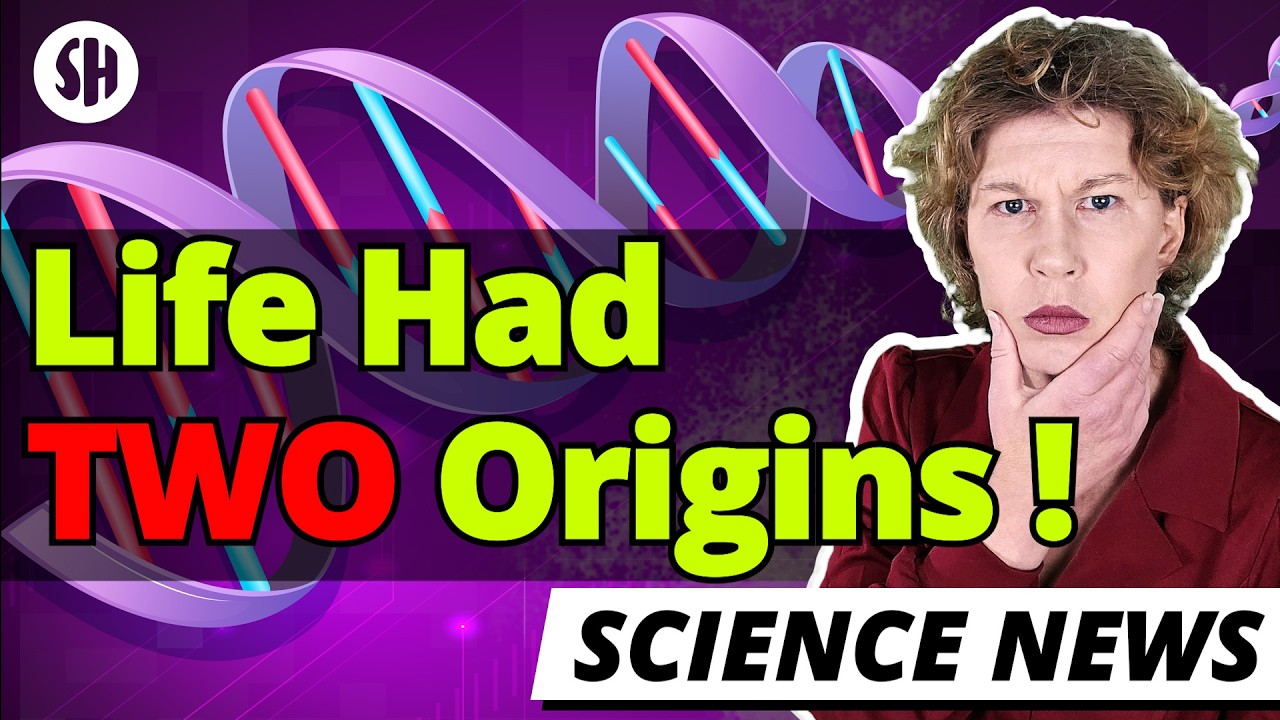
Sabine Hossenfelder
AI-assisted summary of Unexpected Discovery: Life on Earth Had Two Origins, Scientists Find — original source. Check the original for full context.
Source published:
Key ideas
- A study by German researchers suggests life had two distinct origins, arguing that bacteria and archaea independently developed metabolic independence from hydrothermal vents. (0:00)
- Sabine Hossenfelder rates the 'two origins' paper a 7 out of 10 on her 'bullshit meter' due to alternative explanations involving gene divergence in a common ancestor. (0:00)
- Rejecting John Horgan's assertion that the origin of life is permanently unsolvable, Hossenfelder compares the field's modern progress to the evolution of observational cosmology over the past forty years. (2:12)
- The European Research Council is funding Project MiniLife with nearly €13 million through 2030 to build an artificial living system completely from elementary chemicals. (3:42)
Detailed notes
## Background Published on YouTube by Sabine Hossenfelder on August 16, 2026, this video examines recent scientific claims that life on Earth had two origins. According to the page description, Hossenfelder explores the research behind this hypothesis and explains why she remains optimistic that science will ultimately uncover how life began despite deep time.
## TL;DR A recent study by German researchers suggests life originated twice, arguing that ancestral bacteria and archaea independently evolved self-sufficient metabolic pathways after splitting from a hydrothermal vent-bound ancestor. Sabine critiques this interpretation with a seven out of ten on her 'bullshit meter,' noting that the protein comparative data cannot rule out standard gene divergence from a single ancestor. Dismissing John Horgan's assertion that the origin of life is permanently unsolvable, she likens modern abiogenesis research to the empirical transformation of cosmology four decades ago. She points to active laboratory breakthroughs—such as Cambridge's self-replicating RNA experiments and the multi-million-euro Project MiniLife synthetic cell initiative—as proof that experimental chemistry can chart viable physical paths from non-living matter to Darwinian evolution.
## Atmosphere & style The presentation carries Hossenfelder’s signature blend of razor-sharp analytical scrutiny, deadpan humor, and conversational clarity, punctuated by witty touches like her 'bullshit meter' and coining synthetic biology projects 'Frankencell.' The tone transitions smoothly from a grounded, skeptical deconstruction of flashy scientific headlines to an inspiring, forward-looking defense of empirical laboratory research. It feels brisk, intellectually invigorating, and refreshingly pragmatic, replacing deep-time defeatism with grounded scientific enthusiasm.
## Bulletin - [00:00](https://www.youtube.com/watch?v=6edAuSPGao8&t=0s) A study by German researchers suggests life had two distinct origins, arguing that bacteria and archaea independently developed metabolic independence from hydrothermal vents. - [00:00](https://www.youtube.com/watch?v=6edAuSPGao8&t=0s) Sabine Hossenfelder rates the 'two origins' paper a 7 out of 10 on her 'bullshit meter' due to alternative explanations involving gene divergence in a common ancestor. - [02:12](https://www.youtube.com/watch?v=6edAuSPGao8&t=132s) Rejecting John Horgan's assertion that the origin of life is permanently unsolvable, Hossenfelder compares the field's modern progress to the evolution of observational cosmology over the past forty years. - [03:42](https://www.youtube.com/watch?v=6edAuSPGao8&t=222s) The European Research Council is funding Project MiniLife with nearly €13 million through 2030 to build an artificial living system completely from elementary chemicals.
## Key takeaways - [00:00](https://www.youtube.com/watch?v=6edAuSPGao8&t=0s) A new paper proposes that life had two origins based on the independent development of autonomous metabolism away from hydrothermal vents. - [00:00](https://www.youtube.com/watch?v=6edAuSPGao8&t=0s) The standard scientific view posits that the universal common ancestor of all life was dependent on minerals from hydrothermal seafloor vents. - [00:00](https://www.youtube.com/watch?v=6edAuSPGao8&t=0s) According to the new hypothesis, bacteria and archaea each independently evolved the metabolic mechanisms needed for mineral-free survival. - [00:00](https://www.youtube.com/watch?v=6edAuSPGao8&t=0s) Complex eukaryotic life later emerged when an archaeon engulfed a bacterium, giving rise to plants, animals, and modern organisms. - [00:00](https://www.youtube.com/watch?v=6edAuSPGao8&t=0s) The study's conclusions, based on protein comparisons across nearly 1,000 microorganisms, fail to rule out gene divergence from a single common ancestor. - [02:12](https://www.youtube.com/watch?v=6edAuSPGao8&t=132s) Science writer John Horgan argued in 'The End of Science' that the origin of life is fundamentally unsolvable because competing hypotheses cannot be tested. - [03:42](https://www.youtube.com/watch?v=6edAuSPGao8&t=222s) Origin-of-life research mirrors cosmology forty years ago, shifting from speculative models to empirical, precision science that eliminates implausible theories. - [03:42](https://www.youtube.com/watch?v=6edAuSPGao8&t=222s) Rather than relying solely on the sparse geological fossil record, scientists are testing prebiotic pathways by synthesizing components in the laboratory. - [03:42](https://www.youtube.com/watch?v=6edAuSPGao8&t=222s) A Cambridge team recently identified a small RNA segment capable of driving the fundamental reactions needed for replication, bolstering the RNA world hypothesis. - [03:42](https://www.youtube.com/watch?v=6edAuSPGao8&t=222s) Project MiniLife aims to construct an artificial cell capable of metabolism, replication, information storage, and Darwinian evolution from scratch. - [03:42](https://www.youtube.com/watch?v=6edAuSPGao8&t=222s) While lab-created life will not prove the exact path taken on early Earth, it will validate that physical pathways from chemistry to life are genuinely possible. - [03:42](https://www.youtube.com/watch?v=6edAuSPGao8&t=222s) Origin-of-life chemistry holds a practical experimental advantage over cosmology: it is easier to create a living cell in a lab than an entire universe.
## Detailed walkthrough ### [00:00](https://www.youtube.com/watch?v=6edAuSPGao8&t=0s) A New Theory: Did Life Have Two Origins?
The origin of life remains one of science's grandest puzzles, yet a group of researchers in Germany has introduced a surprising twist: they claim that life on Earth actually had two origins. Their paper focuses on the evolutionary transition where the precursors of modern complex life learned how to survive and reproduce independently. The prevailing and widely accepted theory posits that the universal common ancestor of all life was originally tethered to hot hydrothermal seafloor vents, depending entirely on the minerals spewing from those vents to sustain itself.
```mermaid flowchart TD accTitle: Two Origins of Life Hypothesis accDescr: Flowchart illustrating the split from vent-dependent ancestors to independent modern life forms.
subgraph VentDep ["Hydrothermal Vent Dependent"] A["Common Ancestor<br/>(Dependent on vent minerals)"] A --> B["Ancestral Bacteria"] A --> C["Ancestral Archaea"] end
subgraph Independence ["Separate Origins of Self-Sufficiency"] B -->|"Evolved independent metabolism"| D["Free-Living Bacteria"] C -->|"Evolved independent metabolism"| E["Free-Living Archaea"] end
subgraph Endosymbiosis ["Complex Life Emergence"] E -.->|"Engulfs bacterium"| F["Eukaryotic Cell<br/>(Mitochondria / Chloroplasts)"] D -.-> F F --> G["Plants, Animals, and YouTubers"] end ```
The authors argue that this original ancestor split into two primary branches of microbial life—bacteria and archaea—both of which remained tied to vent minerals. Crucially, each lineage then independently developed the metabolic pathways needed to survive away from those hydrothermal fields. Much later in evolutionary history, a descendant of the archaea absorbed a bacterium, which became the internal energy-producing machinery of complex cells—giving rise to eukaryotes and eventually leading to "plants, animals and YouTubers." Because both groups had to solve the puzzle of mineral-free self-sufficiency on their own, the researchers define the emergence of an autonomous metabolism as two distinct origins of life.
Sabine rates this proposal a "seven out of 10 on the bullshit meter." The conclusions were reached by analyzing and comparing proteins across nearly 1,000 modern microorganisms. However, the study cannot entirely rule out an alternative explanation: the genes responsible for self-sufficiency might have evolved once in a shared common ancestor and subsequently diverged or mutated within one branch. For now, more empirical work is needed before rewriting textbooks.
[02:12](https://www.youtube.com/watch?v=6edAuSPGao8&t=132s) John Horgan's Skepticism and the Sponsor Interlude
The core philosophical question is whether humanity will ever truly reconstruct the precise chemical steps, reactions, and mutations that birthed life, or if the vast expanse of deep time has wiped the evidence clean. Science writer John Horgan famously argued in his book *The End of Science* that the origin of life is a permanently unsolvable mystery where competing hypotheses can never truly be differentiated. Sabine firmly rejects Horgan's pessimism.
Before detailing why, the discussion turns to video sponsor FarmKind, an animal welfare non-profit. The context highlights that roughly 13 farmed animals exist for every person on Earth, with the vast majority subjected to horrific, unnecessary suffering under factory farming conditions. While only 3% of total animal donations typically reach farmed animals, FarmKind directs 100% of donor funding to vetted high-impact charities working to eliminate battery cages for hens, free breeding sows from farrowing crates, and reform industrial agriculture. A modest recurring gift of 50 cents a day (€15 a month) spares approximately 350 animals each year from factory farm abuse.
[03:42](https://www.youtube.com/watch?v=6edAuSPGao8&t=222s) Why the Origin of Life Can Be Solved: Laboratory Synthesis
The current state of origin-of-life research mirrors the field of cosmology forty years ago. Studying the dawn of the universe was once considered pure mathematical speculation, but the field transformed into a precision science through dramatic observational breakthroughs—including detailed mappings of the cosmic microwave background, large galaxy surveys, and high-precision spectral analysis. Improved analytical methods did not yield a universally accepted consensus overnight, but they steadily eliminated implausible theories and refined the accepted picture. A similar empirical narrowing is occurring in abiogenesis studies.
```mermaid flowchart LR accTitle: Comparison of Cosmological and Abiogenesis Research Pathways accDescr: Flowchart illustrating how both cosmology and origin-of-life research transition from speculation to empirical verification.
subgraph Cosmology ["Cosmological Evolution (1980s–Present)"] C1["Speculative Models"] --> C2["CMB & Galaxy Surveys"] C2 --> C3["Refined Standard Model"] end
subgraph Abiogenesis ["Origin of Life Research (Current)"] A1["Fossil Record Speculation"] --> A2["Lab Synthesis & Ribozymes"] A2 --> A3["Engineered Synthetic Life<br/>(MiniLife / Frankencell)"] end ```
Rather than being trapped trying to extract ancient biochemistry out of worn geological fossils, modern researchers are actively recreating prebiotic pathways from scratch in the laboratory:
- **Self-Replicating RNA:** Earlier in the year, a Cambridge team identified a small RNA segment capable of driving the fundamental chemical reactions required for replication. Although the RNA chain still required specialized chemical coaxing to complete the cycle, it represents a substantial step forward for the viability of the RNA world hypothesis. - **Project MiniLife:** Backed by nearly €13 million from the European Research Council running through 2030, this initiative aims to assemble an artificial living system completely from elementary chemicals. The benchmark goal is an entity possessing a physical boundary that sustains itself, metabolizes, replicates, transmits genetic information, and evolves via natural selection.
Sabine jokes that the project ought to be christened "Frankencell." Even if MiniLife achieves full self-replication, it won't prove Earth life originated via identical chemistry; however, it will establish at least one proven physical path from raw chemistry to Darwinian evolution. Ultimately, abiogenesis possesses one enormous advantage over cosmological physics: "It's easier to create a cell in a laboratory than a universe."
## Notable quotes > The origin of life is one of the biggest mysteries left in science. — Sabine Hossenfelder
> Now a group of researchers says there wasn't just one origin, there were two. — Sabine Hossenfelder
> despite how impossibly long ago it all happened, I'm actually optimistic that we'll one day work out how life began. — Sabine Hossenfelder
> [00:00](https://www.youtube.com/watch?v=6edAuSPGao8&t=0s) plants, animals and YouTubers — Sabine Hossenfelder
> [00:00](https://www.youtube.com/watch?v=6edAuSPGao8&t=0s) seven out of 10 on the bullshit meter — Sabine Hossenfelder
> If you sign up for just 50 cents a day, that's $15 a month, you'll save 350 animals in a year from unnecessary suffering. — Sabine Hossenfelder
> [03:42](https://www.youtube.com/watch?v=6edAuSPGao8&t=222s) Frankencell — Sabine Hossenfelder
> [03:42](https://www.youtube.com/watch?v=6edAuSPGao8&t=222s) It's easier to create a cell in a laboratory than a universe. — Sabine Hossenfelder
## Mentioned Sabine Hossenfelder, John Horgan, The End of Science, FarmKind, European Research Council, MiniLife, Science Advances
## Video description If you sign up for just 50 cents a day, that's $15 a month, you'll save 350 animals in a year from unnecessary suffering. Use my code "sabine" for a 50% boost on monthly donations https://farmkind.giving/sabine
The origin of life is one of the biggest mysteries left in science. Now a group of researchers says there wasn't just one origin, there were two. And I want to explain why, despite how impossibly long ago it all happened, I'm actually optimistic that we'll one day work out how life began. Let's take a look.
#science #sciencenews #biology #evolution
Paper here: https://www.science.org/doi/10.1126/sciadv.aef3128
👕T-shirts, mugs, posters and more: ➜ https://sabines-store.dashery.com/ 💌 Support me on Donorbox ➜ https://donorbox.org/swtg 👉 Transcript with links to references on Patreon ➜ https://www.patreon.com/Sabine 📝 Transcripts and written news on Substack ➜ https://sciencewtg.substack.com/ 📩 Free weekly science newsletter ➜ https://sabinehossenfelder.com/newsletter/ 👂 Audio only podcast ➜ https://open.spotify.com/show/0MkNfXlKnMPEUMEeKQYmYC 🔗 Join this channel to get access to perks ➜ https://www.youtube.com/channel/UC1yNl2E66ZzKApQdRuTQ4tw/join 📚 Buy my book ➜ https://amzn.to/3HSAWJW
#science #sciencenews #originoflife
[Source](https://www.youtube.com/watch?v=6edAuSPGao8)