Physicist Adds Second Time Dimension to Resolve Quantum Entanglement
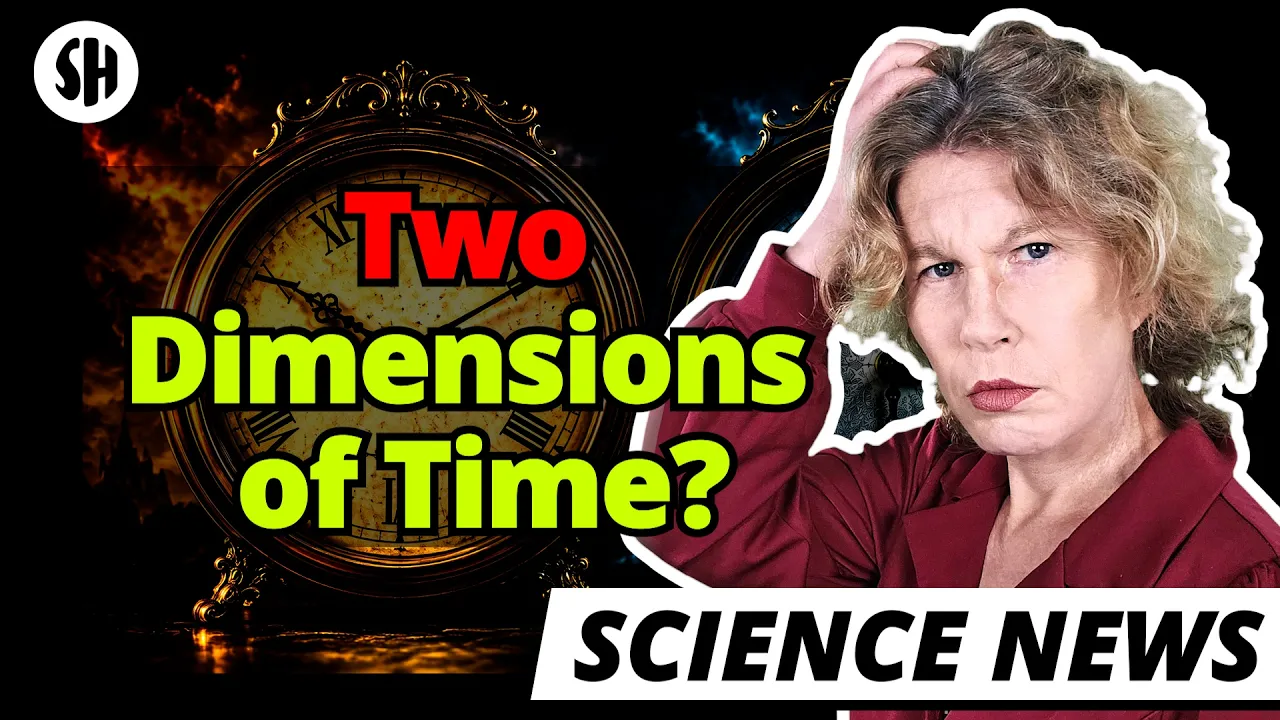
Sabine Hossenfelder
A five-dimensional spacetime model explains instantaneous quantum state updates via a hidden field without permitting faster-than-light signaling, but risks vacuum instability and relativity violations.
AI-assisted summary of Two Dimensions of Time Explain Quantum Physics, Physicist Argues — original source. Check the original for full context.
Source published:
Key ideas
- A new theoretical paper proposes that the universe contains five dimensions—three of space and two of time—providing a geometric explanation for the instantaneous correlations of quantum entanglement. (0:00)
- The model introduces a five-dimensional hidden field coupled exclusively to entangled particles, allowing instantaneous state updates across the second time dimension while preserving quantum mechanics' strict no-signaling limit. (2:33)
- The theory is empirically testable, predicting a subtle, distance-dependent cross-correlation between two completely independent sources of entangled photon pairs that standard quantum mechanics rules out. (2:33)
- Sabine Hossenfelder rates the paper a 7 out of 10 on her skepticism meter, citing severe unaddressed theoretical hurdles traditionally associated with extra time dimensions, including vacuum instability and general relativity conflicts. (4:10)
Detailed notes
## Background Published on YouTube by Sabine Hossenfelder on August 17, 2026, this video examines a research paper that attempts to explain quantum mechanics' 'spooky action at a distance' by proposing the universe possesses two dimensions of time instead of one. The video description questions whether the author's mathematical framework and proposed experimental test represent genius or nonsense, while also recommending Robert Nemiroff's book, Faster Than Light.
## TL;DR Sabine Hossenfelder breaks down a novel proposal that attempts to explain quantum entanglement by expanding spacetime into five dimensions containing three spatial and two temporal coordinates. In this model, a hidden field transmits state updates across the second time dimension, making interactions appear instantaneous from our standard four-dimensional perspective while preserving the prohibition against faster-than-light signaling. Although the hypothesis outlines a testable prediction involving cross-correlations between independent entangled photon sources, it faces major theoretical obstacles such as vacuum instability, causality paradoxes, and clashes with general relativity. Ultimately, Sabine awards the paper a 7 out of 10 on her skepticism meter, appreciating its ambition as an exploratory post-quantum model before recommending Robert Nemiroff's book on superluminal phenomena.
## Atmosphere & style The presentation carries Sabine's trademark blend of deadpan skepticism, intellectual rigor, and dry, self-deprecating wit. Complex theoretical physics concepts are unpacked with crisp, accessible clarity, shifting smoothly from fundamental quantum paradoxes to sharp-eyed critique. The tone feels grounded, candid, and refreshingly unsensational, puncturing hype with playful observations while remaining open to unconventional ideas that challenge scientific dogma.
## Bulletin - [00:00](https://www.youtube.com/watch?v=8e_JSOxaEVQ&t=0s) A new theoretical paper proposes that the universe contains five dimensions—three of space and two of time—providing a geometric explanation for the instantaneous correlations of quantum entanglement. - [02:33](https://www.youtube.com/watch?v=8e_JSOxaEVQ&t=153s) The model introduces a five-dimensional hidden field coupled exclusively to entangled particles, allowing instantaneous state updates across the second time dimension while preserving quantum mechanics' strict no-signaling limit. - [02:33](https://www.youtube.com/watch?v=8e_JSOxaEVQ&t=153s) The theory is empirically testable, predicting a subtle, distance-dependent cross-correlation between two completely independent sources of entangled photon pairs that standard quantum mechanics rules out. - [04:10](https://www.youtube.com/watch?v=8e_JSOxaEVQ&t=250s) Sabine Hossenfelder rates the paper a 7 out of 10 on her skepticism meter, citing severe unaddressed theoretical hurdles traditionally associated with extra time dimensions, including vacuum instability and general relativity conflicts.
## Key takeaways - [00:00](https://www.youtube.com/watch?v=8e_JSOxaEVQ&t=0s) Quantum entanglement fundamentally differs from classical correlation because entangled particles have no definite physical values prior to measurement. - [00:00](https://www.youtube.com/watch?v=8e_JSOxaEVQ&t=0s) The true 'spooky action' in quantum mechanics is not the correlation itself, but the instantaneous, faster-than-light update of a distant particle's state once measured. - [00:00](https://www.youtube.com/watch?v=8e_JSOxaEVQ&t=0s) Even though state updates appear instantaneous, quantum randomness enforces the no-signaling rule, preventing observers from using entanglement to transmit information faster than light. - [02:33](https://www.youtube.com/watch?v=8e_JSOxaEVQ&t=153s) By adding a second time dimension, particle travel across the extra temporal coordinate can register as completely instantaneous within standard 4D spacetime. - [02:33](https://www.youtube.com/watch?v=8e_JSOxaEVQ&t=153s) A hypothetical hidden field in 5D spacetime mediates the remote state update but cannot be manipulated by experimental apparatuses to transmit custom signals. - [02:33](https://www.youtube.com/watch?v=8e_JSOxaEVQ&t=153s) The paper distinguishes itself from pure mathematical reinterpretation by proposing an experiment measuring cross-correlations between two separate entangled photon systems. - [04:10](https://www.youtube.com/watch?v=8e_JSOxaEVQ&t=250s) Theories incorporating multiple time dimensions historically suffer from severe theoretical defects, including vacuum instability and causality or time-travel paradoxes. - [04:10](https://www.youtube.com/watch?v=8e_JSOxaEVQ&t=250s) Adding a second time dimension disrupts the mathematical framework of Einstein's general relativity, an issue left unresolved in the proposed model. - [04:10](https://www.youtube.com/watch?v=8e_JSOxaEVQ&t=250s) Sabine evaluates the paper at 7/10 on the skepticism meter, noting that while it is an imaginative 'beyond quantum' attempt, a simpler physical foundation is far more probable. - [05:07](https://www.youtube.com/watch?v=8e_JSOxaEVQ&t=307s) Physicist Robert Nemiroff's book 'Faster Than Light' details how non-communicative physical phenomena, such as sweeping shadows, can move superluminally without breaking relativity.
## Detailed walkthrough ### [00:00](https://www.youtube.com/watch?v=8e_JSOxaEVQ&t=0s) Entanglement and the "Spooky Action" Paradox
Many have heard the familiar refrain that quantum mechanics makes no sense because it relies on "spooky action at a distance." While this is often treated as an inescapable paradox of the quantum world, a physicist has now mathematically demonstrated that the perceived strangeness might arise because the universe actually possesses two dimensions of time alongside three dimensions of space. In this five-dimensional framework, the apparent faster-than-light behavior of quantum physics is given a concrete geometric explanation.
At the core of this puzzle lies quantum entanglement, a distinct type of correlation between the physical properties of quantum particles. Correlation in itself is mundane: the clock on your smartphone and the clock on someone else's phone are strongly correlated simply because both are set to show the same time. Quantum entanglement is fundamentally different because, prior to a measurement being performed, the particles do not possess definite values at all. It is only when an experimenter measures one particle that the distant particle instantaneously adopts a complementary value, seemingly outracing light. Assuming particles held predetermined properties before being observed directly contradicts physical experiments.
Einstein famously branded this post-measurement update as "spooky action at a distance." As Sabine emphasizes, entanglement itself is not the spooky action; entanglement merely sets the stage to reveal it. The truly spooky element is the instantaneous, faster-than-light update of the remote particle's state. While one could simply accept that faster-than-light mechanisms exist, doing so introduces an immediate conundrum: if this update happens faster than light, why is it impossible to use it to transmit human-controlled information? In quantum mechanics, measurement outcomes are fundamentally probabilistic. An observer cannot dictate what outcome will appear; they can only guarantee that once an outcome is measured, the distant outcome will correlate with it. Consequently, no signal can be forced through the measurement process.
- **Entanglement vs. Classical Correlation:** Classical systems (like synchronized phone clocks) carry pre-existing information; entangled quantum particles possess no definite values prior to measurement. - **The True "Spooky Action":** The instant state update across spatial distance is what violates classical intuition, not the mere existence of correlated pairs. - **The No-Signaling Constraint:** Even though the quantum state updates instantaneously, the unpredictability of measurement outcomes prevents observers from transmitting messages faster than light.
---
[02:33](https://www.youtube.com/watch?v=8e_JSOxaEVQ&t=153s) A Second Dimension of Time and the Hidden Field
To explain why this instantaneous connection exists without enabling faster-than-light signaling, the author introduces a second temporal dimension into physics. While standard general relativity operates within Einstein's four-dimensional spacetime (three spatial dimensions and one temporal dimension), this proposal expands spacetime into five dimensions by adding an extra time coordinate. A particle traversing this second time dimension might not progress through our conventional dimension of time whatsoever. From the vantage point of our ordinary four-dimensional perspective, its travel through that extra coordinate would look entirely instantaneous.
```mermaid flowchart TD accTitle: Five-Dimensional Spacetime and Quantum Entanglement accDescr: Diagram illustrating how a hidden field in a five-dimensional spacetime connects entangled particles to cause instant correlations without allowing faster-than-light signaling. subgraph FiveD ["5D Spacetime (3 Space + 2 Time)"] HF["Hidden Field"] P1["Entangled Particle A"] P2["Entangled Particle B"] HF --- P1 HF --- P2 end subgraph FourD ["Standard 4D Perspective (3 Space + 1 Time)"] M1["Measurement on A"] -->|"State update across 2nd time"| M2["Instantaneous Outcome on B"] NS["Measurement cannot inject data"] -.->|"Preserves No-Signaling"| HF end ```
To prevent this additional temporal dimension from spilling into unobserved phenomena outside of quantum experiments, the author introduces a "hidden field" residing in the five-dimensional spacetime. This field couples exclusively to entangled particles. When an observer measures one particle, the interaction updates the state of the entangled partner via the hidden field. However, because the measuring apparatus cannot inject external information into the field, experimenters cannot hijack the mechanism to send arbitrary signals. The only observable outcome in our familiar dimensions is the standard quantum correlation between the two particles.
Crucially, this model is not just an untestable mathematical reinterpretation; it makes predictions that diverge from standard quantum mechanics. The paper outlines an experiment using two completely independent sources of entangled photon pairs. Under standard quantum theory, measurements taken from the first source should show zero correlation with measurements from the second source. However, if this five-dimensional hidden field truly exists, it should introduce a faint, distance-dependent cross-correlation between the two independent experimental setups.
---
[04:10](https://www.youtube.com/watch?v=8e_JSOxaEVQ&t=250s) Theoretical Roadblocks and the Paper's Rating
Proposing extra dimensions of time is not entirely new, but such models have historically encountered severe theoretical hurdles. Introducing additional time dimensions often destabilizes the quantum vacuum, invites catastrophic paradoxes related to time travel, and severely disrupts Einstein’s general relativity—consequences that "Albert doesn't like at all." Furthermore, entanglement represents only one aspect of quantum phenomena; any viable model must be scrutinized to ensure it does not contradict the vast catalog of existing precision tests in quantum mechanics.
Sabine evaluates the paper with a rating of "7 out of 10 on the [bullshit] meter," characterizing it as somewhat sketchy and noting that it leaves many deep theoretical problems unaddressed. While Sabine maintains that there is likely a simpler foundational explanation for the apparent strangeness of quantum mechanics, she praises the proposal for being a genuinely novel entry into the field of "beyond quantum physics"—the pursuit of deeper physical mechanisms beneath quantum behavior. With characteristic deadpan humor, she remarks that if the author turns out to be correct, "maybe in 10 years I can waste two times."
- **Known hazards of extra time dimensions:** Vacuum instability, causality/time-travel paradoxes, and mathematical incompatibility with general relativity. - **Experimental test proposed:** Looking for small, distance-dependent cross-correlations between two separate entangled photon systems. - **Assessment:** Rated 7/10 on the meter due to unaddressed theoretical complications, yet recognized as an innovative attempt at post-quantum theory.
---
[05:07](https://www.youtube.com/watch?v=8e_JSOxaEVQ&t=307s) Exploring FTL Physics with Robert Nemiroff
For viewers left confused by the paradoxes of cosmic speed limits, Sabine points to a book written by her friend and colleague, Robert Nemiroff, titled *Faster Than Light*. Nemiroff is a professor of physics at Michigan Technological University and co-creator and editor of NASA's popular *Astronomy Picture of the Day* (APOD) website. With an extensive record of published research in astrophysics, Nemiroff brings genuine scientific rigor rather than casual speculation to the topic.
Nemiroff's book synthesizes what modern physics understands about faster-than-light phenomena. It explores counterintuitive physics puzzles, such as why a cast shadow can legally sweep across a surface faster than light, what special relativity truly permits and forbids regarding superluminal speeds, and how quantum mechanics gives the illusion of beating the speed-of-light barrier while strictly adhering to physical causality. Sabine emphasizes that the book is written accessibly for non-physicists, is engaging from start to finish, and is "100% AI free," before concluding with her customary sign-off: "See you tomorrow."
## Notable quotes > [00:00](https://www.youtube.com/watch?v=8e_JSOxaEVQ&t=0s) spooky action at a distance — Sabine Hossenfelder
> [00:00](https://www.youtube.com/watch?v=8e_JSOxaEVQ&t=0s) entanglement itself is not the spooky action; entanglement merely sets the stage to reveal it — Sabine Hossenfelder
> [00:00](https://www.youtube.com/watch?v=8e_JSOxaEVQ&t=0s) The truly spooky element is the instantaneous, faster-than-light update of the remote particle's state. — Sabine Hossenfelder
> [02:33](https://www.youtube.com/watch?v=8e_JSOxaEVQ&t=153s) hidden field — Sabine Hossenfelder
> [04:10](https://www.youtube.com/watch?v=8e_JSOxaEVQ&t=250s) Albert doesn't like at all — Sabine Hossenfelder
> [04:10](https://www.youtube.com/watch?v=8e_JSOxaEVQ&t=250s) 7 out of 10 on the [bullshit] meter — Sabine Hossenfelder
> [04:10](https://www.youtube.com/watch?v=8e_JSOxaEVQ&t=250s) beyond quantum physics — Sabine Hossenfelder
> [04:10](https://www.youtube.com/watch?v=8e_JSOxaEVQ&t=250s) maybe in 10 years I can waste two times — Sabine Hossenfelder
> [05:07](https://www.youtube.com/watch?v=8e_JSOxaEVQ&t=307s) 100% AI free — Sabine Hossenfelder
> [05:07](https://www.youtube.com/watch?v=8e_JSOxaEVQ&t=307s) See you tomorrow — Sabine Hossenfelder
## Mentioned Albert Einstein, Astronomy Picture of the Day (APOD), Faster Than Light, Michigan Technological University, NASA, Robert Nemiroff, Sabine Hossenfelder
## Video description "Check out Robert's book ""Faster Than Light"" ➜ https://www.amazon.com/Faster-than-Light-Your-Shadow/dp/1662933843/ Kindle: https://amzn.to/3SfamjO
You've probably heard that quantum mechanics is spooky, that measuring one particle instantly affects another across any distance. A physicist now says there's a reason: the universe doesn't have one dimension of time, but two. It sounds absurd, but he's got the maths and even a way to test it. Genius or nonsense? Let's take a look.
Paper: https://doi.org/10.48550/arXiv.2606.12457
#science #sciencenews #physics #quantumphysics
👕T-shirts, mugs, posters and more: ➜ https://sabines-store.dashery.com/ 💌 Support me on Donorbox ➜ https://donorbox.org/swtg 👉 Transcript with links to references on Patreon ➜ https://www.patreon.com/Sabine 📝 Transcripts and written news on Substack ➜ https://sciencewtg.substack.com/ 📩 Free weekly science newsletter ➜ https://sabinehossenfelder.com/newsletter/ 👂 Audio only podcast ➜ https://open.spotify.com/show/0MkNfXlKnMPEUMEeKQYmYC 🔗 Join this channel to get access to perks ➜ https://www.youtube.com/channel/UC1yNl2E66ZzKApQdRuTQ4tw/join 📚 Buy my book ➜ https://amzn.to/3HSAWJW
[Source](https://www.youtube.com/watch?v=8e_JSOxaEVQ)