Physicists Discover Rewritable 3D Crystal Weave at Room Temperature
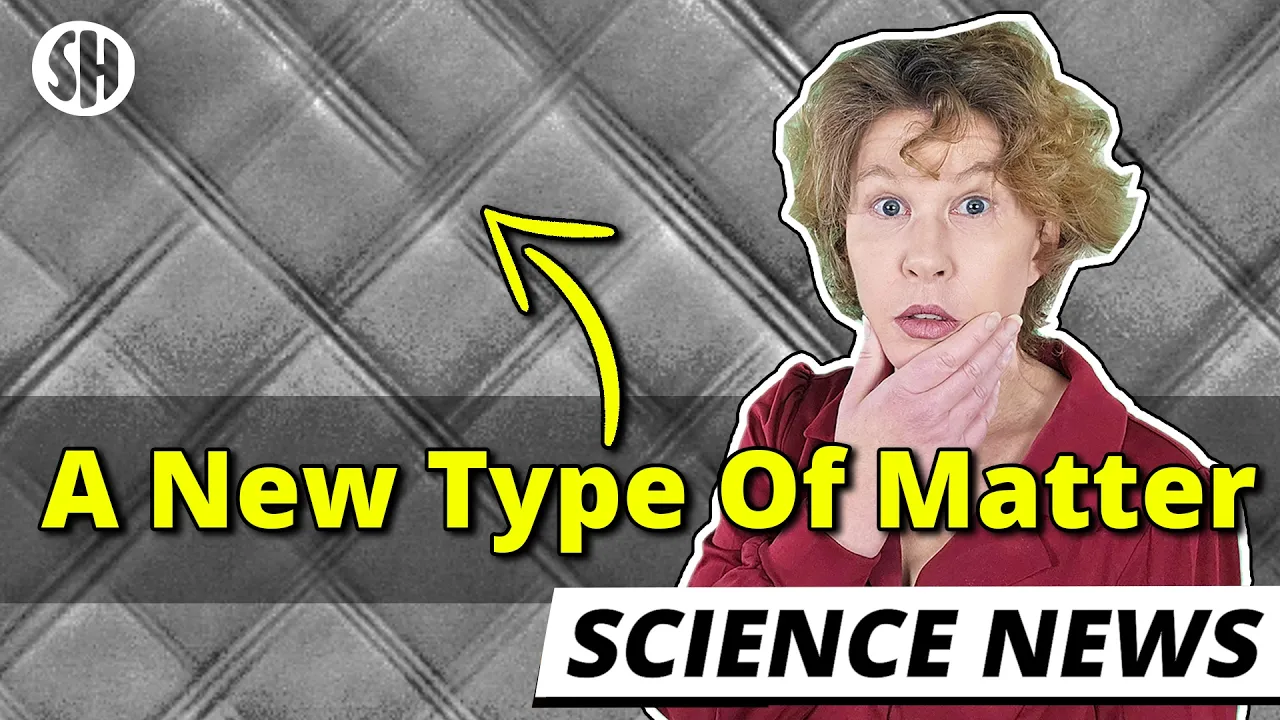
Sabine Hossenfelder
While the spontaneously woven ferroelectric domains hold potential for optical memory and neuromorphic computing, practical deployment remains distant because researchers cannot yet control the exact rewritten patterns.
AI-assisted summary of Breakthrough: New Type of Matter Discovered — original source. Check the original for full context.
Source published:
Key ideas
- Researchers have observed ferroelectric domains spontaneously self-assembling into a genuine three-dimensional woven strand pattern at roughly 17°C. (0:00)
- The 3D weave structure can be optically modified using a green laser, while an infrared laser produces no effect, proving the modification mechanism is not simple thermal heating. (0:00)
- Potential future applications include optical data storage and neuromorphic computing architectures, though precise deterministic control over rewritten patterns remains unresolved. (3:10)
- Hossenfelder scores the study a 0 out of 10 on her 'bullshit meter' and highlights materials science as a historically defining discipline now targeted by AI discovery startups. (3:10)
Detailed notes
## Background Published on YouTube by physicist Sabine Hossenfelder on August 20, 2026, this video highlights a recent study detailing a novel phase of matter. According to the description, scientists observed structures inside a cooled crystal spontaneously arranging into a three-dimensional weave near room temperature that can be optically rewritten using a laser.
## TL;DR Researchers have discovered that cooling a ferroelectric crystal to around 17°C causes its polarized electric domains to self-assemble into an intricate, physical three-dimensional weave of overlapping strands. Evaluated with polarized light microscopy, this structure proves stable at steady temperatures and can be modified non-thermally using green laser light, though fine control over the rewritten patterns is not yet possible. While practical applications in optical memory and neuromorphic computing remain early-stage, Sabine gives the study top marks on credibility and suggests it holds future Nobel Prize potential. She frames the breakthrough within the broader, often-underappreciated history of materials science, which historically defines the ages of human civilization.
## Atmosphere & style The presentation carries Sabine Hossenfelder's signature deadpan wit and crisp scientific skepticism, blending technical condensed-matter physics with playful observations about marital room-temperature debates and an overlooked 'excellent soup age.' The narrative moves with brisk authority, alternating between precise experimental evaluation and a genuine, almost philosophical appreciation for material innovation. Watching it feels intellectually invigorating and grounded, tempering awe for a rare laboratory discovery with a healthy refusal to indulge premature commercial hype.
## Bulletin - [00:00](https://www.youtube.com/watch?v=NzQQXQK_Ngk&t=0s) Researchers have observed ferroelectric domains spontaneously self-assembling into a genuine three-dimensional woven strand pattern at roughly 17°C. - [00:00](https://www.youtube.com/watch?v=NzQQXQK_Ngk&t=0s) The 3D weave structure can be optically modified using a green laser, while an infrared laser produces no effect, proving the modification mechanism is not simple thermal heating. - [03:10](https://www.youtube.com/watch?v=NzQQXQK_Ngk&t=190s) Potential future applications include optical data storage and neuromorphic computing architectures, though precise deterministic control over rewritten patterns remains unresolved. - [03:10](https://www.youtube.com/watch?v=NzQQXQK_Ngk&t=190s) Hossenfelder scores the study a 0 out of 10 on her 'bullshit meter' and highlights materials science as a historically defining discipline now targeted by AI discovery startups.
## Key takeaways - [00:00](https://www.youtube.com/watch?v=NzQQXQK_Ngk&t=0s) Crystalline structures underlie key modern technologies, including semiconductors, atomic clocks, laser components, and metal-organic frameworks. - [00:00](https://www.youtube.com/watch?v=NzQQXQK_Ngk&t=0s) In ferroelectric materials, domains possess net electric polarizations that can be switched by an electric field and retained. - [00:00](https://www.youtube.com/watch?v=NzQQXQK_Ngk&t=0s) Cooling the ferroelectric crystal down to roughly 17°C caused near-surface domains to form an interwoven, over-and-under 3D strand weave. - [00:00](https://www.youtube.com/watch?v=NzQQXQK_Ngk&t=0s) Polarized light microscopy at varying focal depths verified that the woven lattice is a true physical 3D weave rather than a 2D optical illusion. - [00:00](https://www.youtube.com/watch?v=NzQQXQK_Ngk&t=0s) The woven pattern remains stable at consistent temperatures, but reheating and recooling spontaneously generates a distinct new weave configuration. - [00:00](https://www.youtube.com/watch?v=NzQQXQK_Ngk&t=0s) Targeting the material with a green laser altered and rearranged the strands, whereas infrared light had no effect, ruling out generic heat-induced restructuring. - [03:10](https://www.youtube.com/watch?v=NzQQXQK_Ngk&t=190s) Self-organizing nanoscale patterns offer long-term potential for optical memory and brain-inspired neuromorphic computing architectures. - [03:10](https://www.youtube.com/watch?v=NzQQXQK_Ngk&t=190s) Practical data applications remain early-stage because researchers cannot yet dictate or control the exact pattern produced after laser writing. - [03:10](https://www.youtube.com/watch?v=NzQQXQK_Ngk&t=190s) The discovery is framed as having Nobel Prize potential, mirroring the historical rise of once-obscure discoveries like quasicrystals. - [03:10](https://www.youtube.com/watch?v=NzQQXQK_Ngk&t=190s) Human historical eras are defined by materials like stone, bronze, iron, and steel, underscoring the foundational role of materials science in human advancement.
## Detailed walkthrough ### [00:00](https://www.youtube.com/watch?v=NzQQXQK_Ngk&t=0s) The Discovery of a Three-Dimensional Ferroelectric Weave
Crystals are highly regular, periodic arrangements of matter that come in diverse forms. Beyond their aesthetic appeal, their structured lattice geometries grant them valuable functional properties. Familiar examples include crystalline silicon in solar panels and computer chips, crystal components in lasers and atomic precision clocks, ultra-hard diamond saws and cutters, durable single-crystal turbine blades, and metal-organic frameworks (MOFs) that selectively trap molecules and catalyze industrial chemical reactions.
```mermaid flowchart TD accTitle: Phase Behavior of the Ferroelectric Crystal accDescr: Diagram illustrating cooling of the crystal lattice into ferroelectric domains and then into a 3D woven strand structure.
subgraph CoolingProcess["Thermal Transitions"] A["Crystal Precursor Material"] -->|"Initial Cooling"| B["Standard Ferroelectric Phase"] B -->|"Cooled further to ~17°C"| C["Surface 3D Weave Phase"] end
subgraph Characteristics["Properties of the Weave"] C --> D["Domains form over-and-under woven strands"] C --> E["Pattern stable at constant temp; resets on reheat"] C --> F["Altered by green laser light (not infrared)"] end ```
The researchers behind the featured study investigated a ferroelectric crystal. In a ferroelectric material, electric charges are slightly displaced within local regions called domains, giving each domain an internal net electric polarization direction analogous to magnetic domains in ferromagnets. These domain orientations can typically be switched with an applied electric field and retain that state once the field is removed. In this experiment, the scientists cooled a material into its ferroelectric state and observed the expected domain formation. However, when cooled down further to approximately 17°C (about 63°F)—which Sabine jokes "counts as room temperature" according to her husband—the domains near the crystal's surface unexpectedly wove themselves into strands that looped over and under one another, creating an intricate three-dimensional woven lattice.
Using polarized light and optical microscopy sliced at varying depths, the team proved that these strands do not merely look like overlapping lines from above, but genuinely form a physical 3D weave. The woven structure remains remarkably stable as long as the temperature stays roughly steady. When heated up and cooled down again, a new 3D weave forms spontaneously, though with a different specific woven configuration. Furthermore, researchers discovered they could modify sections of the pattern using a green laser; the targeted strands vanished and reorganized, while an infrared laser had no such effect, proving the transformation was not triggered simply by generic thermal heating.
- Ferroelectric domains spontaneously self-assembled into regular, interwoven 3D strands at ~17°C. - Probed and verified via polarized light microscopy evaluated at varying focal depths. - Optical rewriting was successful using a green laser, but unresponsive to infrared light, confirming a non-thermal optical interaction.
---
[03:10](https://www.youtube.com/watch?v=NzQQXQK_Ngk&t=190s) Applications, Nobel Potential, and the Impact of Materials Science
A material that spontaneously organizes into stable, rewritable nanoscale patterns holds promise for advanced technologies. Proposed applications include novel optical memory storage systems and neuromorphic computing, where computer architectures mirror biological neural network architectures. However, Sabine emphasizes that this remains an early-stage laboratory discovery: practical applications are still distant. A notable current limitation is control; while the green laser alters the weave, researchers cannot yet dictate the exact resulting pattern. As Sabine quips regarding data storage, "You might just remember that you were supposed to remember something, but not what."
Despite these early hurdles, Sabine rates the paper a "0 out of 10 on the bullshit meter" and considers it potential material for a future Nobel Prize. While domain strands have been observed in other materials before, they have never exhibited this level of regularity or spontaneous 3D weaving. She compares its trajectory to earlier exotic findings like quasicrystals and metal-organic frameworks, which moved from niche academic curiosities to high-impact industrial applications and Nobel honors.
She argues that materials science remains drastically undervalued, noting the current boom in AI startups focused purely on discovering new materials: - Human history is classified by materials rather than cuisine or art: the Stone Age, the Bronze Age, the Iron Age, and the Steel Age—"Nobody talks about the excellent soup age. Though maybe that's still to come." - A time traveler from 10,000 years ago would not be most shocked by smartphones or automobiles, but by synthetic materials: concrete, glass, mirrors, plastics, microfiber, optical fiber, Teflon, anodized aluminum, and brilliant pigments. - "And then we give them a plastic fork that snaps in the potato salad. Welcome to civilization."
---
[05:36](https://www.youtube.com/watch?v=NzQQXQK_Ngk&t=336s) Evaluating Media Coverage with Ground News
Sabine concludes by presenting video sponsor Ground News, a platform designed to aggregate news globally, reduce duplicate headlines, and present comparative bias data. Navigating media manually can be exhausting, but the platform provides fact-checking assessments, media ownership transparency, and concise story summaries at a glance.
She illustrates this utility with recent news coverage on Canadian wildfires and their links to climate change. The platform highlighted that the story saw strong interest on the center-left but very little on the political right. A bias comparison revealed that while both sides acknowledged the severity of the fires and the statistical contribution of climate change, left-leaning outlets framed the events as an urgent climate crisis warning, whereas right-leaning outlets shifted focus toward Donald Trump's tariff threats. The platform's "Blindspot" feature specifically highlights stories that receive unilateral coverage from only one side of the political spectrum. Viewers are offered a 40% discount on the Ground News Vantage plan via `ground.news/sabine`.
## Notable quotes > Scientists have discovered a new type of matter. — Sabine Hossenfelder
> Inside a cooled crystal, structures spontaneously arranged themselves into a three dimensional weave, and they did it at around room temperature. — Sabine Hossenfelder
> The researchers can even rewrite parts of the pattern with a laser. — Sabine Hossenfelder
> News like this doesn't come every day. Let's take a look. — Sabine Hossenfelder
> [00:00](https://www.youtube.com/watch?v=NzQQXQK_Ngk&t=0s) counts as room temperature — Sabine Hossenfelder
> [03:10](https://www.youtube.com/watch?v=NzQQXQK_Ngk&t=190s) You might just remember that you were supposed to remember something, but not what. — Sabine Hossenfelder
> [03:10](https://www.youtube.com/watch?v=NzQQXQK_Ngk&t=190s) 0 out of 10 on the bullshit meter — Sabine Hossenfelder
> [03:10](https://www.youtube.com/watch?v=NzQQXQK_Ngk&t=190s) Nobody talks about the excellent soup age. Though maybe that's still to come. — Sabine Hossenfelder
> [03:10](https://www.youtube.com/watch?v=NzQQXQK_Ngk&t=190s) And then we give them a plastic fork that snaps in the potato salad. Welcome to civilization. — Sabine Hossenfelder
## Mentioned Sabine Hossenfelder, Ground News, Donald Trump, Paper: https://doi.org/10.1038/s41377-026-02374-7, Metal-organic frameworks (MOFs), Quasicrystals, Ground News Vantage, Blindspot
## Video description Go to https://ground.news/sabine to get 40% off the Vantage plan and see through sensationalized reporting. Stay fully informed on events around the world with Ground News.
Scientists have discovered a new type of matter. Inside a cooled crystal, structures spontaneously arranged themselves into a three dimensional weave, and they did it at around room temperature. The researchers can even rewrite parts of the pattern with a laser. News like this doesn't come every day. Let's take a look.
Paper: https://doi.org/10.1038/s41377-026-02374-7
#physics #science #material #chemistry #sciencenews
👕T-shirts, mugs, posters and more: ➜ https://sabines-store.dashery.com/ 💌 Support me on Donorbox ➜ https://donorbox.org/swtg 👉 Transcript with links to references on Patreon ➜ https://www.patreon.com/Sabine 📝 Transcripts and written news on Substack ➜ https://sciencewtg.substack.com/ 📩 Free weekly science newsletter ➜ https://sabinehossenfelder.com/newsletter/ 👂 Audio only podcast ➜ https://open.spotify.com/show/0MkNfXlKnMPEUMEeKQYmYC 🔗 Join this channel to get access to perks ➜ https://www.youtube.com/channel/UC1yNl2E66ZzKApQdRuTQ4tw/join 📚 Buy my book ➜ https://amzn.to/3HSAWJW
[Source](https://www.youtube.com/watch?v=NzQQXQK_Ngk)