Lua Creator Rejects Native Compilers for Unrestricted Dynamic Code
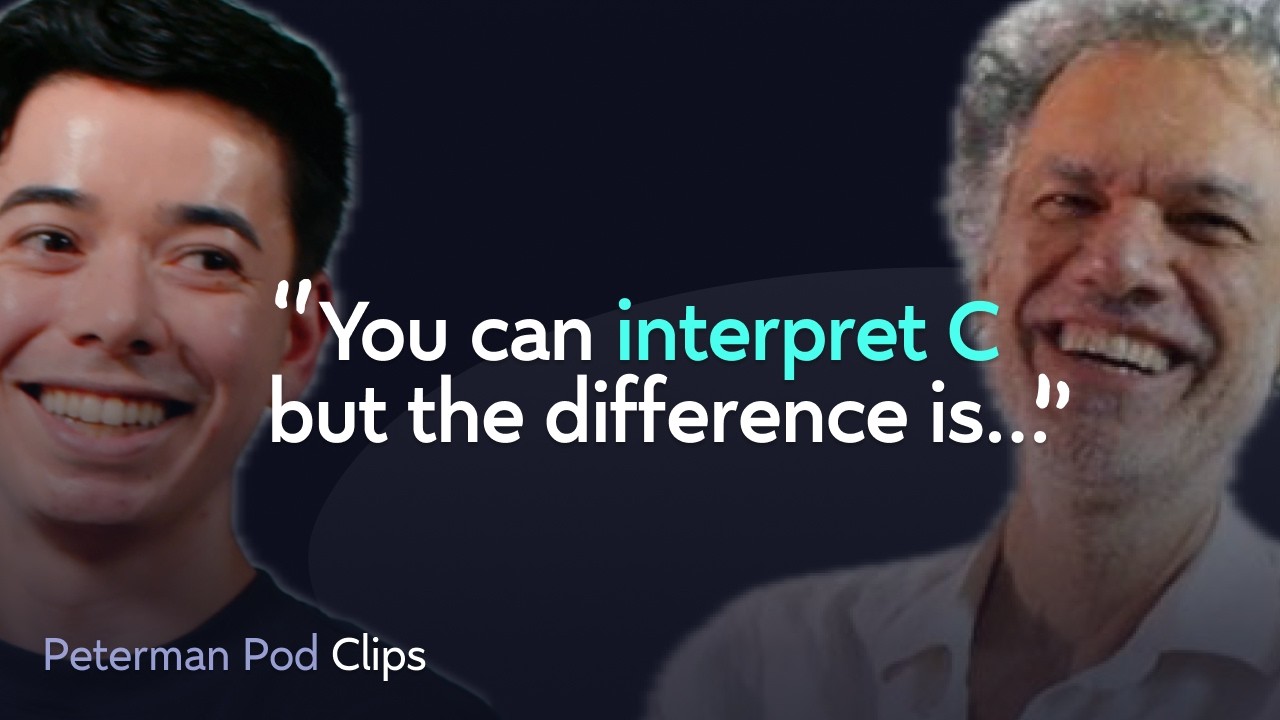
Ryan Peterman
Dynamic languages cannot compile to fast machine code through automated type inference because engines achieve optimization only when developers manually follow strict static-type discipline.
AI-assisted summary of Creator of Lua: You Can Interpret C And Compile Python | Roberto Ierusalimschy — original source. Check the original for full context.
Source published:
Key ideas
- The boundary between compiled and interpreted languages is determined by toolchains and feature sets rather than syntax, as Python can technically be compiled to machine code and C can be run via an interpreter. (0:00)
- True support for dynamic features like eval requires embedding the full compiler as a runtime library, creating substantial architectural overhead that typically discourages ahead-of-time compilation for dynamic languages. (0:00)
- Static type systems like C's are purpose-built to enable efficient native compilation by allowing direct CPU register allocation and emitting single-instruction operations, whereas dynamic languages require runtime tag checking and heap memory allocations. (1:40)
- General-purpose type inference cannot resolve dynamic performance bottlenecks because unrestricted code degenerates into generic types; high-performance JIT compilers like LuaJIT depend on developers maintaining strict, monomorphic coding discipline. (4:24)
Detailed notes
## Background This interview segment was published on YouTube by Ryan Peterman on September 2, 2026. According to the video description, the excerpt features Roberto Ierusalimschy, the creator of the Lua programming language, discussing language design, Lua's strengths, and the impact of AI as part of a longer conversation.
## TL;DR Roberto Ierusalimschy breaks down the practical distinctions between compiled and interpreted languages, explaining that dynamic features like `eval` create substantial architectural overhead by requiring a compiler to be embedded into the runtime. He illustrates how sound static type systems enable critical performance optimizations—such as direct register allocation and single-instruction operations—which languages without strict runtime guarantees cannot exploit. Finally, Ierusalimschy dismisses whole-program type inference as an intractable magic bullet for dynamic languages, arguing that JIT engines like LuaJIT only achieve peak performance when programmers discipline themselves to write dynamic code with predictable, static-like types.
## Atmosphere & style The discussion carries the thoughtful, pragmatic atmosphere of an expert computer science seminar unburdened by academic pretension. Host Ryan Peterman serves as a curious, technically adept sounding board, asking incisive questions that prompt Ierusalimschy to methodically dismantle common compiler misconceptions with calm authority. Listening to the conversation feels intellectually clarifying, marked by the steady, experienced voice of a veteran language designer cutting through theoretical ideals to reveal the mechanical realities of runtime systems.
## Bulletin - [00:00](https://www.youtube.com/watch?v=4cWFOQQjLvk&t=0s) The boundary between compiled and interpreted languages is determined by toolchains and feature sets rather than syntax, as Python can technically be compiled to machine code and C can be run via an interpreter. - [00:00](https://www.youtube.com/watch?v=4cWFOQQjLvk&t=0s) True support for dynamic features like eval requires embedding the full compiler as a runtime library, creating substantial architectural overhead that typically discourages ahead-of-time compilation for dynamic languages. - [01:40](https://www.youtube.com/watch?v=4cWFOQQjLvk&t=100s) Static type systems like C's are purpose-built to enable efficient native compilation by allowing direct CPU register allocation and emitting single-instruction operations, whereas dynamic languages require runtime tag checking and heap memory allocations. - [04:24](https://www.youtube.com/watch?v=4cWFOQQjLvk&t=264s) General-purpose type inference cannot resolve dynamic performance bottlenecks because unrestricted code degenerates into generic types; high-performance JIT compilers like LuaJIT depend on developers maintaining strict, monomorphic coding discipline.
## Key takeaways - [00:00](https://www.youtube.com/watch?v=4cWFOQQjLvk&t=0s) The distinction between compiled and interpreted languages resides in the implementation toolchain rather than the language syntax itself. - [00:00](https://www.youtube.com/watch?v=4cWFOQQjLvk&t=0s) While it is technically possible to build an interpreter for C, the resulting execution suffers from extremely poor performance. - [00:00](https://www.youtube.com/watch?v=4cWFOQQjLvk&t=0s) The eval operation represents the defining feature of dynamic languages by allowing brand-new code generation and execution at runtime. - [00:00](https://www.youtube.com/watch?v=4cWFOQQjLvk&t=0s) Natively compiling a language with eval support forces implementations to package an entire compiler inside the runtime environment as a library. - [00:00](https://www.youtube.com/watch?v=4cWFOQQjLvk&t=0s) Compilers designed for dynamic languages frequently work around runtime overhead by restricting or forbidding the use of eval. - [01:40](https://www.youtube.com/watch?v=4cWFOQQjLvk&t=100s) Languages like C intentionally construct their type systems to make ahead-of-time machine code compilation straightforward and efficient. - [01:40](https://www.youtube.com/watch?v=4cWFOQQjLvk&t=100s) Knowing variable types ahead of time lets compilers allocate fixed space on the stack or in CPU registers rather than allocating dynamically on the heap. - [01:40](https://www.youtube.com/watch?v=4cWFOQQjLvk&t=100s) Basic operations like A + B can emit single machine instructions in static languages, whereas dynamic engines must inspect operand tags, coerce types, and evaluate metamethods at runtime. - [01:40](https://www.youtube.com/watch?v=4cWFOQQjLvk&t=100s) TypeScript's type system cannot facilitate native machine code compilation because its annotations do not provide hard, machine-level runtime guarantees. - [04:24](https://www.youtube.com/watch?v=4cWFOQQjLvk&t=264s) Whole-program type inference across unrestricted dynamic languages is practically intractable and tends to degenerate into broad, unoptimizable types like any. - [04:24](https://www.youtube.com/watch?v=4cWFOQQjLvk&t=264s) Type inference only succeeds in dynamic languages when programmers adopt self-imposed constraints and write code using static-typing mental models. - [04:24](https://www.youtube.com/watch?v=4cWFOQQjLvk&t=264s) Just-in-time compilers like LuaJIT achieve extreme performance primarily when developers avoid polymorphic variable reuse and maintain uniform data structure types.
## Detailed walkthrough ### [00:00](https://www.youtube.com/watch?v=4cWFOQQjLvk&t=0s) Compiled vs. Interpreted: Toolchains, `eval`, and Dynamic Execution
The conversation opens with a discussion on the traditional divide between compiled and interpreted languages. Ryan Peterman points out that the distinction often lives within the toolchain rather than the source code's syntax itself—noting that someone could conceivably write a compiler that translates Python directly into machine code. Roberto Ierusalimschy readily agrees, pointing out the reverse: "And you can interpret C code, too. You can write an interpreter for C."
However, Roberto explains that the practical dividing line comes down to what language features are easy to support. Chief among them is `eval`, which he identifies as the definitive hallmark of dynamic languages: the ability to generate and execute brand-new code while the program is already running. If an implementation aims to compile a language to native code while fully supporting `eval`, it must embed the entire compiler as a library within its runtime environment. Because of this architectural overhead, dynamic languages are far more frequently interpreted. When compilers do target dynamic languages, they often impose strict limitations, essentially telling developers, "Oh, you can compile as long as your program doesn't have evals." Conversely, while an interpreter for C can easily be constructed, running C through an interpreter yields extremely poor performance.
```mermaid flowchart TD accTitle: Static Compilation vs Dynamic Runtime Execution accDescr: Flow diagram showing how static C-like languages compile directly to machine code versus dynamic languages requiring an embedded compiler for eval.
subgraph Static ["Static Compilation (e.g., C)"] S_Src["Source Code"] --> S_Comp["Ahead-of-Time Compiler"] S_Comp --> S_Bin["Standalone Machine Code"] end
subgraph Dynamic ["Dynamic Language Execution (e.g., Python / Lua)"] D_Src["Source Code"] --> D_Run["Runtime Engine"] D_Eval["Runtime Code / eval()"] --> D_Lib["Compiler-as-Library"] D_Lib --> D_Run end ```
[01:40](https://www.youtube.com/watch?v=4cWFOQQjLvk&t=100s) How Type Systems Dictate Compilation Efficiency
Turning to the mechanics of compilation, Ryan asks about the role of static type systems and type annotations. Roberto clarifies that the utility of a type system depends heavily on how it was designed; languages like C deliberately structure their type systems to serve as a cornerstone of the compilation pipeline, making the creation of an efficient compiler vastly simpler.
Roberto illustrates this with two fundamental examples: 1. **Memory Allocation:** When a compiler knows upfront whether a variable is an integer, a float, or a double, it knows the exact byte size needed and can assign it directly to stack space or CPU registers. Without that knowledge, implementations are often forced to allocate memory dynamically on the heap, incurring massive performance penalties. 2. **Operation Specialization:** In an expression like `A + B`, a statically typed compiler inspects the types at compile time. If both operands are integers, it emits a single machine instruction for integer addition. In contrast, a dynamic language merely compiles the expression to an abstract virtual opcode. At runtime, the engine must inspect the tags of both operands, handle implicit coercions (such as converting an integer to a float), check whether the language treats `+` as string concatenation, or invoke custom operator metamethods.
Roberto adds a crucial caveat regarding modern languages like TypeScript. TypeScript provides static typing, but its types do not provide hard runtime guarantees. Because a variable typed as an integer cannot be definitively guaranteed at the machine level, the compiler cannot safely assign it to a fixed integer register, limiting the type system's usefulness for native machine code compilation. For types to enable aggressive native compilation, the type system must guarantee complete type soundness.
[04:24](https://www.youtube.com/watch?v=4cWFOQQjLvk&t=264s) The Limits of Type Inference and Dynamic JITs
Ryan asks whether whole-program type inference could bridge the gap: could a compiler run type inference over a dynamic language like Lua, derive an unambiguous set of concrete types, and compile it directly to fast machine code? Roberto answers with an immediate and definitive "No."
While many researchers and engineers have attempted type inference for dynamic languages, Roberto explains that doing so in a general-purpose, high-performance way is an intractable problem. In practice, type inference over unrestricted dynamic code either fails outright or degrades into inferring overly broad, generic types (effectively `any`), which completely defeats optimization. The only scenarios where type inference succeeds are those where programmers adhere to heavily restricted coding conventions—essentially writing dynamic code while strictly thinking in static types.
Roberto observes that this same principle governs the performance of just-in-time compilers like LuaJIT. JIT engines achieve dramatic speedups primarily when programmers exercise internal type discipline: - Avoiding polymorphic variables (e.g., never reusing the same local variable to hold both an integer and a string). - Designing data structures and loops with predictable, uniform types throughout their lifetime. - Adhering to implicit typing rules that match the assumptions of the JIT optimizer, even when the base language does not explicitly enforce them.
## Notable quotes > [00:00](https://www.youtube.com/watch?v=4cWFOQQjLvk&t=0s) And you can interpret C code, too. You can write an interpreter for C. — Roberto Ierusalimschy
> [00:00](https://www.youtube.com/watch?v=4cWFOQQjLvk&t=0s) Oh, you can compile as long as your program doesn't have evals. — Roberto Ierusalimschy
> [04:24](https://www.youtube.com/watch?v=4cWFOQQjLvk&t=264s) No. — Roberto Ierusalimschy
## Mentioned Roberto Ierusalimschy, Ryan Peterman, Lua, Python, C, TypeScript, LuaJIT
## Video description Roberto Ierusalimschy is the creator of the Lua programming language. I interviewed him about Lua's unique strengths, programming language design and predictions for how AI will impact programming languages.
This is a segment from the full video here: https://www.youtube.com/watch?v=jCZnFKk6M9A
[Source](https://www.youtube.com/watch?v=4cWFOQQjLvk)