Hejlsberg Warns Handing Keys to AI Leaves Developers Liable
Ryan Peterman
Generative models cannot invent novel software architectures because they only extrapolate from memorized training data, leaving human developers fully liable when unreviewed code fails.
AI-assisted summary of Creator of TypeScript & C#: AI Software Engineering Predictions | Anders Hejlsberg — original source. Check the original for full context.
Source published:
Key ideas
- Anders Hejlsberg challenges predictions that AI will soon write 90% of all code, arguing that while gross boilerplate volume is exploding, AI repeatedly fails at novel architectures like the TypeScript compiler. (0:00)
- Hejlsberg warns against 'handing AI the keys' and abandoning source code review, emphasizing that legal liability and catastrophic failures fall squarely on developers rather than the models. (2:32)
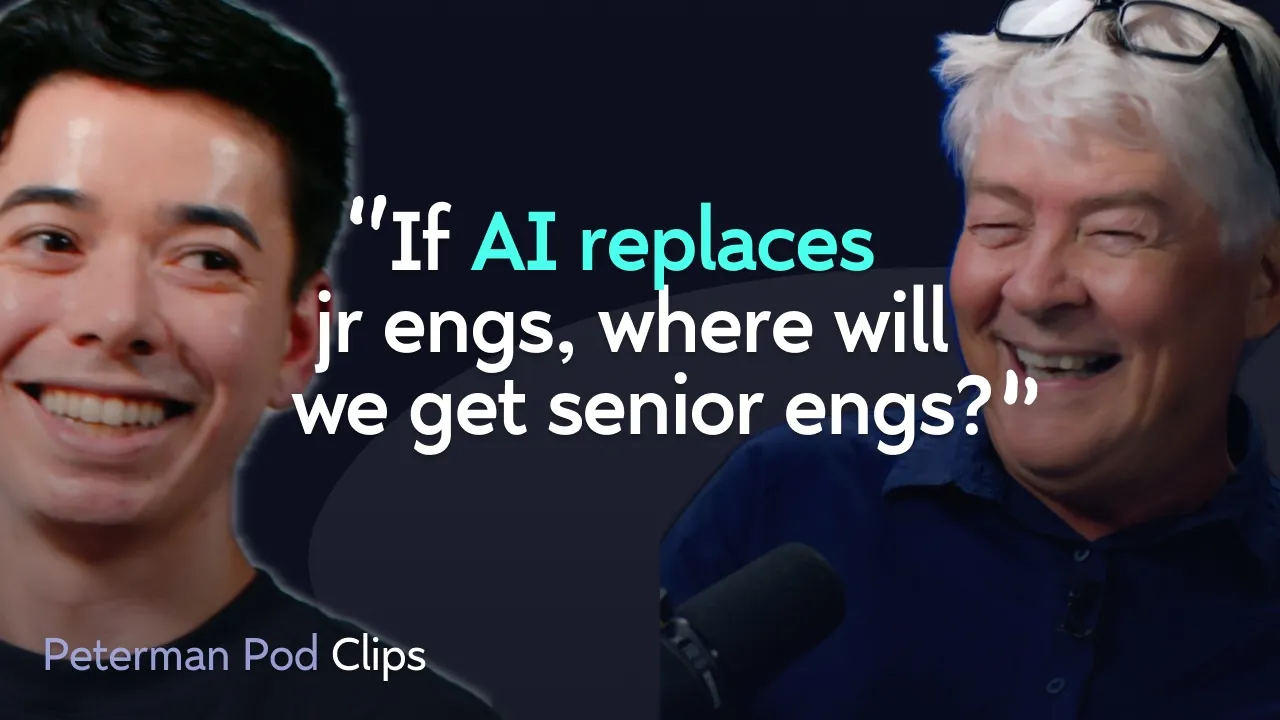
- The junior developer hiring pipeline is narrowing rather than disappearing, because cutting off entry-level hiring eliminates future senior engineers. (4:27)
- Software development is shifting from direct syntax authoring to agent supervision and code review, though Hejlsberg notes reviewing AI diffs is often more mentally exhausting than writing code directly. (4:27)
Detailed notes
## Background Published on YouTube by Ryan Peterman on September 9, 2026, this video features an interview with Anders Hejlsberg, the creator of TypeScript and C#. According to the video description, the conversation explores Hejlsberg's perspective on how AI has impacted software engineering, as well as the TypeScript compiler's performance improvements.
## TL;DR Anders Hejlsberg offers a grounded critique of common AI hype, distinguishing the massive gross volume of boilerplate code generated by AI from truly novel, bespoke software architectures that stochastic models cannot invent. He strongly cautions developers against abandoning IDEs and code comprehension, underscoring that human engineers retain full legal and professional liability when software fails. Hejlsberg also dismantles predictions that junior engineers will be phased out, noting that cutting entry-level roles eliminates the pipeline for future senior engineers. Ultimately, he portrays the future of software development not as human obsolescence, but as a shift from manual syntax authoring to supervising and reviewing AI output.
## Atmosphere & style The conversation has a calm, pragmatic, and deeply seasoned tone that stands in stark contrast to prevailing tech industry hyperbole. Peterman acts as an engaged interlocutor presenting prominent AI predictions, giving Hejlsberg room to dissect extreme claims with measured realism, veteran wisdom, and dry humor. The exchange feels like a grounded masterclass from an industry veteran who happily embraces tools that eliminate rote drudgery while steadfastly defending craftsmanship, critical thinking, and human accountability.
## Bulletin - [00:00](https://www.youtube.com/watch?v=qEDMAPpl_O4&t=0s) Anders Hejlsberg challenges predictions that AI will soon write 90% of all code, arguing that while gross boilerplate volume is exploding, AI repeatedly fails at novel architectures like the TypeScript compiler. - [02:32](https://www.youtube.com/watch?v=qEDMAPpl_O4&t=152s) Hejlsberg warns against 'handing AI the keys' and abandoning source code review, emphasizing that legal liability and catastrophic failures fall squarely on developers rather than the models. - [04:27](https://www.youtube.com/watch?v=qEDMAPpl_O4&t=267s) The junior developer hiring pipeline is narrowing rather than disappearing, because cutting off entry-level hiring eliminates future senior engineers. - [04:27](https://www.youtube.com/watch?v=qEDMAPpl_O4&t=267s) Software development is shifting from direct syntax authoring to agent supervision and code review, though Hejlsberg notes reviewing AI diffs is often more mentally exhausting than writing code directly.
## Key takeaways - [00:00](https://www.youtube.com/watch?v=qEDMAPpl_O4&t=0s) High output volume from generative tools makes 'AI writing 90% of code' a misleading, self-fulfilling metric driven by boilerplate rather than novel engineering. - [00:00](https://www.youtube.com/watch?v=qEDMAPpl_O4&t=0s) AI models are fundamentally stochastic systems extrapolating over memorized internet data, leaving them ill-equipped to invent unseen algorithmic concepts. - [00:00](https://www.youtube.com/watch?v=qEDMAPpl_O4&t=0s) The TypeScript compiler cannot be written by AI because its custom architecture and specialized implementation paradigms lack training corpus precedents. - [02:32](https://www.youtube.com/watch?v=qEDMAPpl_O4&t=152s) Abandoning IDEs and source code comprehension leaves developers stranded when AI refuses or fails to solve nuanced edge cases and bugs. - [02:32](https://www.youtube.com/watch?v=qEDMAPpl_O4&t=152s) Legal accountability and business liability rest entirely on human engineers when software fails, meaning developers must fully understand what they vouch for. - [02:32](https://www.youtube.com/watch?v=qEDMAPpl_O4&t=152s) Frontier AI lab predictions often err by linearly projecting productivity gains into a theoretical 100% replacement rate, ignoring business context and human judgment. - [04:27](https://www.youtube.com/watch?v=qEDMAPpl_O4&t=267s) Eliminating junior engineering roles is an industry failure mode because organizations cannot produce senior engineers without an entry-level developmental pipeline. - [04:27](https://www.youtube.com/watch?v=qEDMAPpl_O4&t=267s) The engineering pyramid is narrowing at the base, requiring fewer entry-level hires who must advance faster into architectural and supervisory responsibilities. - [04:27](https://www.youtube.com/watch?v=qEDMAPpl_O4&t=267s) Reviewing external pull requests and AI-generated code diffs is often more mentally taxing for senior developers than authoring solutions from scratch. - [04:27](https://www.youtube.com/watch?v=qEDMAPpl_O4&t=267s) Delegating repetitive tasks like boilerplate test suites and rigid framework mechanics to AI provides genuine, high-leverage productivity benefits. - [04:27](https://www.youtube.com/watch?v=qEDMAPpl_O4&t=267s) The code review workflow needs AI integration to summarize intent and explain structural deltas rather than forcing engineers to parse raw file diffs.
## Detailed walkthrough ### [00:00](https://www.youtube.com/watch?v=qEDMAPpl_O4&t=0s) AI Writing 90% of Code: Volume vs. Novelty
Ryan Peterman raises a common prediction from late 2023 and early 2024: that AI will write over 90% of all code within a year. Anders Hejlsberg nuances the claim by separating sheer volume from high-value engineering. He points out that for certain classes of software, such as apps entirely built using AI scaffolding tools, machines are already producing 100% of the code. Because AI generates immense amounts of text effortlessly, the gross volume of written code is skyrocketing, making the "90% of all code" metric somewhat of a self-fulfilling prophecy. However, Hejlsberg questions whether AI will ever write 90% of the truly novel, high-quality code across the industry.
When asked what defines code AI cannot write, Hejlsberg cites bespoke architectures and algorithms that have never been seen before. As a concrete example, he explains that AI could not write the TypeScript compiler. The team has tried, and AI repeatedly fails because the compiler relies on unique concepts and implementation paradigms absent from training corpora:
> "AI we can't forget that AI is at heart a big stochastic machine that has memorized the entire internet, right? And has an ability to extrapolate somewhat over what it's memorized... but if it hasn't seen it before, it's not necessarily going to be all that good at doing it."
While acknowledging that AI's capabilities are wildly impressive and continually improving, Hejlsberg maintains that there is a vast gulf between assisting with existing patterns and independently creating unprecedented software architectures. He adds with a laugh that he hopes AI never completely takes over, asking, "then what's the point of humans anymore?"
- AI code generation skews gross output statistics because generative tools emit massive volumes of boilerplate code. - Unique problem domains—such as the TypeScript compiler's specific architecture and design choices—lack sufficient representation in training datasets, preventing AI from generating working implementations. - Fundamental limitation: LLMs extrapolate over memorized internet data rather than inventing entirely novel algorithmic paradigms from scratch.
---
[02:32](https://www.youtube.com/watch?v=qEDMAPpl_O4&t=152s) "Handing AI the Keys": Liability, IDEs, and Responsibility
Peterman notes another prevailing hot take: that developers will no longer need IDEs or even need to read source code within a year. Hejlsberg offers a blunt warning to anyone willing to abandon the code level: "Well, good luck to you. I mean, if you're going to hand AI the keys... all bets are off." When an AI model refuses or fails to implement a nuanced feature or fix an elusive bug, an engineer who does not understand the underlying system is completely stranded.
Beyond developer ergonomics, Hejlsberg highlights the critical problem of legal and organizational accountability. If an application malfunctions—such as inadvertently compromising a user's bank account—the liability lands entirely on the human creators, not the model:
> "Well, they're going to sue you, not the AI. I mean, it's like at the end of the day, someone has to take responsibility for what AI is doing. And if you're giving it the keys, well, it's on you... I personally would not feel comfortable. I wouldn't be able to go to sleep at night if I didn't understand what it is that I am vouching for."
When Peterman asks why Hejlsberg's grounded perspective differs so sharply from the breathless projections coming out of frontier AI research labs like Anthropic, Hejlsberg explains that people tend to project trends to a hypothetical 100% completion rate. While AI can take on higher percentages of rote work, software engineering inherently demands human judgment to contextualize business logic, organizational constraints, and end-to-end responsibility.
```mermaid flowchart TD accTitle: Accountability and Understanding in AI-Assisted Engineering accDescr: Diagram contrasting uncritical AI delegation with grounded engineering oversight and legal responsibility.
subgraph Abdication["Handing AI the Keys (High Risk)"] A["Blind AI Code Generation"] --> B["Unreviewed Architecture / Obscured Internals"] B --> C{"Bug or Catastrophic Failure"} C --> D["Engineering Paralysis: Cannot Prompt a Fix"] C --> E["Full Legal & Business Liability on Developer"] end
subgraph Engineering["Grounded Engineering (Human in the Loop)"] F["AI as Productivity Tool"] --> G["Human Inspection & Business Context"] G --> H["Clear Understanding of System Invariants"] H --> I["Accountable, Verifiable Releases"] end ```
---
[04:27](https://www.youtube.com/watch?v=qEDMAPpl_O4&t=267s) The Junior Engineer Dilemma and the Evolution of the Craft
Addressing the claim that AI will replace junior software engineers within three years, Hejlsberg exposes the obvious flaw in that logic: without junior engineers, the industry cuts off the pipeline required to create future senior engineers. Unless an organization believes it can operate indefinitely without senior staff, junior engineers must continue to be hired and trained.
Hejlsberg notes that the hiring pipeline is already morphing. The traditional employment pyramid has narrowed at the base, meaning fewer entry-level engineers are hired, but those who are must advance much faster into supervisory capacities. The fundamental craft of programming is shifting from manually typing lines of syntax to directing and reviewing AI agents:
- **From Authoring to Reviewing**: The day-to-day role moves toward reviewing agentic output, verifying logic, and ensuring architectural cohesion. - **The Toll of Code Review**: Hejlsberg admits that after 40 to 50 years of writing software, he still genuinely loves typing out core code and finds reviewing other people's—or an AI's—diffs significantly more mentally taxing than authoring solutions directly. - **Offloading the Tedium**: He embraces delegating mundane chores to AI, noting he is thrilled to avoid writing boilerplate test suites and conforming to rigid testing framework mechanics: "Heck no, if I can farm that out to AI, happy me." - **Improving Review Ergonomics**: Modern code reviews often consist of dumping raw file diffs for a human to decipher. Hejlsberg envisions AI transforming this workflow by explaining architectural deltas, synthesizing intent, and making oversight far more ergonomic.
## Notable quotes > [00:00](https://www.youtube.com/watch?v=qEDMAPpl_O4&t=0s) AI we can't forget that AI is at heart a big stochastic machine that has memorized the entire internet, right? — Anders Hejlsberg
> [00:00](https://www.youtube.com/watch?v=qEDMAPpl_O4&t=0s) And has an ability to extrapolate somewhat over what it's memorized... but if it hasn't seen it before, it's not necessarily going to be all that good at doing it. — Anders Hejlsberg
> [00:00](https://www.youtube.com/watch?v=qEDMAPpl_O4&t=0s) then what's the point of humans anymore? — Anders Hejlsberg
> [02:32](https://www.youtube.com/watch?v=qEDMAPpl_O4&t=152s) Well, good luck to you. I mean, if you're going to hand AI the keys... all bets are off. — Anders Hejlsberg
> [02:32](https://www.youtube.com/watch?v=qEDMAPpl_O4&t=152s) Well, they're going to sue you, not the AI. — Anders Hejlsberg
> [02:32](https://www.youtube.com/watch?v=qEDMAPpl_O4&t=152s) I mean, it's like at the end of the day, someone has to take responsibility for what AI is doing. And if you're giving it the keys, well, it's on you... — Anders Hejlsberg
> [02:32](https://www.youtube.com/watch?v=qEDMAPpl_O4&t=152s) I personally would not feel comfortable. I wouldn't be able to go to sleep at night if I didn't understand what it is that I am vouching for. — Anders Hejlsberg
> [04:27](https://www.youtube.com/watch?v=qEDMAPpl_O4&t=267s) Heck no, if I can farm that out to AI, happy me. — Anders Hejlsberg
## Mentioned Anders Hejlsberg, Ryan Peterman, TypeScript, C#, Go, Anthropic, YouTube
## Video description Anders Hejlsberg is the creator of TypeScript and C#, and I asked him about how the TypeScript compiler got 10x faster through a rewrite in Go and his thoughts on how AI has impacted software engineering.
Watch the full episode: https://www.youtube.com/watch?v=cywK3XYYJ2o
[Source](https://www.youtube.com/watch?v=qEDMAPpl_O4)