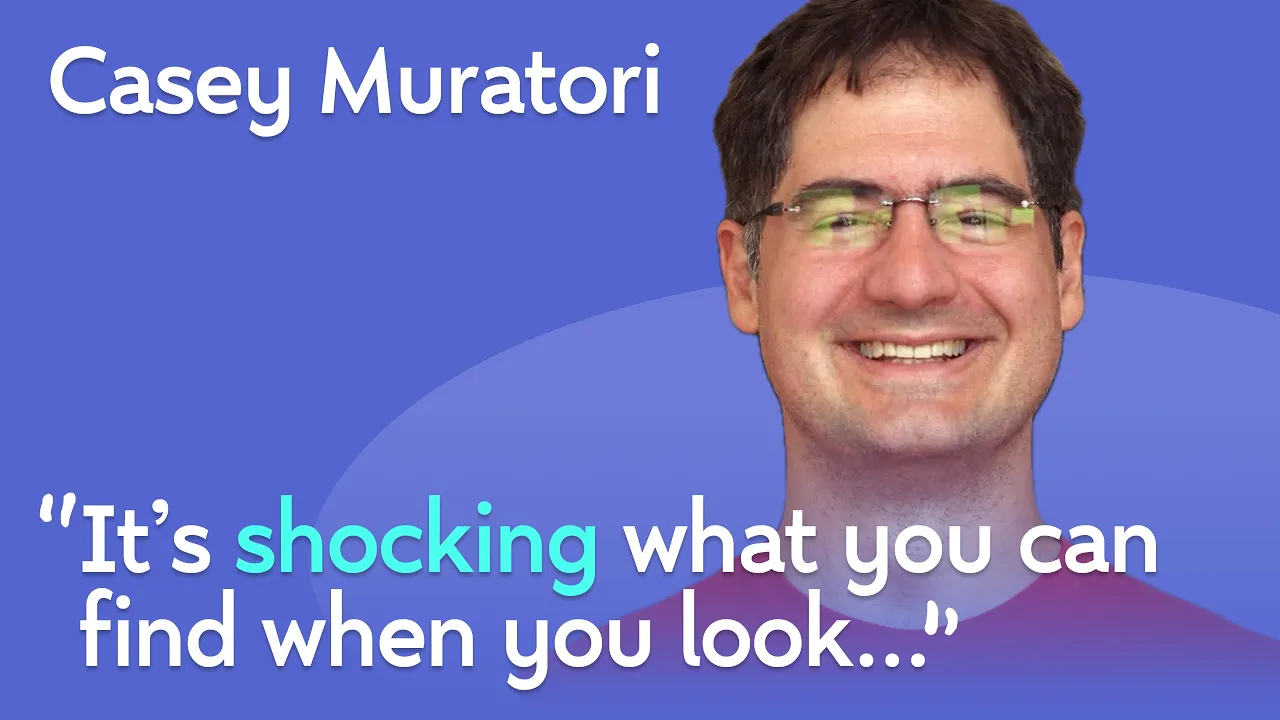
Casey Muratori Blames 35-Year Software Flaw on Object Inheritance
Ryan Peterman
Object-oriented programming creates severe compiler optimization barriers and architectural failures because class hierarchies ignore concrete hardware memory layouts.
Donald Knuth's 1974 maxim that premature optimization is the root of all evil was formulated as a balanced heuristic before optimizing compilers existed, but modern engineering culture has inverted it into an excuse to ignore hardware realities entirely. (8:04)
The foundational mistake of object-oriented programming was abstracting Ivan Sutherland's 1963 Sketchpad into domain inheritance hierarchies rather than adopting its underlying component- and handle-based data architecture. (35:09)
Robert C. Martin's 'Clean Code' dogma of pervasive dynamic dispatch and tiny 4-to-5-line functions creates severe compiler optimization barriers, disabling inlining, register allocation, and SIMD vectorization. (52:05)
Casey Muratori identifies Conway's Law as software engineering's only immutable rule, driven by the unavoidable physical bandwidth and latency bottleneck between separate communicating workers or agents. (69:20)
Detailed notes
## Background
Published by Ryan Peterman on YouTube on September 14, 2026, this episode features video game developer and educator Casey Muratori. The discussion centers on surprising discoveries from early computer science history, the origins of inefficient software, Muratori's career in game engine development, and critiques of prevailing modern programming paradigms.
## TL;DR
Casey Muratori unpacks the historical context behind famous computing maxims, examining how Donald Knuth's warning on premature optimization and Edsger Dijkstra's critique of goto statements have been misinterpreted across decades of software engineering. He dissects the structural pitfalls of object-oriented domain hierarchies and dogmatic 'Clean Code' rules, explaining how pervasive dynamic dispatch creates optimization barriers for compilers and degrades performance. Drawing on his experience developing Granny 3D and low-level game systems, Muratori advocates for hardware awareness, bottom-up API design, and empirical prototyping over speculative upfront design documents. The conversation concludes with practical advice on career trade-offs, navigating academic research papers, and critically assessing industry hype around generative AI and 'vibe coding'.
## Atmosphere & style
The conversation carries an intellectually curious, candid, and deeply pragmatic tone that blends detailed historical excavation with no-nonsense systems engineering critique. Muratori speaks with passionate, opinionated clarity and sharp wit, recounting the personal human drama behind early computing papers alongside blunt war stories from 1990s game development. Peterman provides an engaged, grounding presence, allowing the dialogue to move seamlessly between low-level architectural mechanics and reflective philosophical reflections on craft, career choices, and engineering culture.
## Bulletin
- [08:04](https://www.youtube.com/watch?v=jHLbL1Eg4gM&t=484s) Donald Knuth's 1974 maxim that premature optimization is the root of all evil was formulated as a balanced heuristic before optimizing compilers existed, but modern engineering culture has inverted it into an excuse to ignore hardware realities entirely.
- [35:09](https://www.youtube.com/watch?v=jHLbL1Eg4gM&t=2109s) The foundational mistake of object-oriented programming was abstracting Ivan Sutherland's 1963 Sketchpad into domain inheritance hierarchies rather than adopting its underlying component- and handle-based data architecture.
- [52:05](https://www.youtube.com/watch?v=jHLbL1Eg4gM&t=3125s) Robert C. Martin's 'Clean Code' dogma of pervasive dynamic dispatch and tiny 4-to-5-line functions creates severe compiler optimization barriers, disabling inlining, register allocation, and SIMD vectorization.
- [01:09:20](https://www.youtube.com/watch?v=jHLbL1Eg4gM&t=4160s) Casey Muratori identifies Conway's Law as software engineering's only immutable rule, driven by the unavoidable physical bandwidth and latency bottleneck between separate communicating workers or agents.
## Key takeaways
- [01:08](https://www.youtube.com/watch?v=jHLbL1Eg4gM&t=68s) Donald Knuth's warning against premature optimization was an empirical observation about profiling and balancing cognitive load, not a mandate to defer performance considerations until the end of a project.
- [16:23](https://www.youtube.com/watch?v=jHLbL1Eg4gM&t=983s) Pioneering computer science papers frequently emerged from personal turmoil, including Edsger Dijkstra writing 'Notes on Structured Programming' while experiencing severe depression after his multiprogramming project was dismissed by colleagues.
- [26:28](https://www.youtube.com/watch?v=jHLbL1Eg4gM&t=1588s) Niklaus Wirth bypassed the academic peer review process to publish Dijkstra's critique of goto as an editorial letter, adding the sensationalized title 'Go To Statement Considered Harmful' that sparked decades of postal disputes.
- [35:09](https://www.youtube.com/watch?v=jHLbL1Eg4gM&t=2109s) Early OOP advocates made a 35-year mistake by modeling systems after Ivan Sutherland's user-facing Sketchpad domain instead of its high-performance, table-driven data structure, resulting in brittle inheritance trees and the 'fat base class' anti-pattern.
- [48:02](https://www.youtube.com/watch?v=jHLbL1Eg4gM&t=2882s) Handle-based composition and data-oriented structures model real-world cross-cutting operations far better than rigid domain class hierarchies.
- [52:05](https://www.youtube.com/watch?v=jHLbL1Eg4gM&t=3125s) Prescriptive Clean Code rules that enforce pervasive virtual dispatch and 4-to-5-line functions undermine compiler optimization, whereas 30-to-50-line functions with concrete types enable aggressive compiler inlining and vectorization.
- [58:34](https://www.youtube.com/watch?v=jHLbL1Eg4gM&t=3514s) Developing basic hardware awareness—such as memory layout and network latency trade-offs—delivers massive performance benefits early without requiring premature assembly-level micro-optimizations.
- [01:01:18](https://www.youtube.com/watch?v=jHLbL1Eg4gM&t=3678s) Bad software architecture consistently stems from speculative, top-down design documents authored without concrete code, which inevitably fail to account for machine realities and edge cases.
- [01:04:45](https://www.youtube.com/watch?v=jHLbL1Eg4gM&t=3885s) Effective abstractions must be derived bottom-up by writing core mechanics first and validating the proposed API against two to three concrete use cases simultaneously.
- [01:09:20](https://www.youtube.com/watch?v=jHLbL1Eg4gM&t=4160s) Conway's Law is an unbreakable rule because intra-node computational bandwidth will always exceed inter-worker communication channels, forcing software architecture to reflect team communication structures.
- [01:34:52](https://www.youtube.com/watch?v=jHLbL1Eg4gM&t=5692s) Unlike standard business applications that idle waiting for user input, game engines operate in continuous simulated time and must continuously run synchronized world updates, physics, and rendering pipelines.
- [01:39:57](https://www.youtube.com/watch?v=jHLbL1Eg4gM&t=5997s) Mission-critical environments like NASA ban recursion because compiler-managed stack frames introduce non-deterministic memory consumption and unpredictable stack overflow risks.
- [01:47:21](https://www.youtube.com/watch?v=jHLbL1Eg4gM&t=6441s) Corporate mandates forcing unvetted, prompt-driven AI code directly into production threaten code quality unless paired with empirical ROI benchmarking and rigorous technical verification.
- [01:50:17](https://www.youtube.com/watch?v=jHLbL1Eg4gM&t=6617s) Software engineers can sharpen their technical intuition more effectively by regularly reading primary conference papers, such as USENIX proceedings, rather than relying solely on secondary programming books.
## Detailed walkthrough
### [00:00](https://www.youtube.com/watch?v=jHLbL1Eg4gM&t=0s) Introduction and Avoiding the AI Doom Trap
The episode opens with highlights teasing the deep historical and technical discussions to come, from Edsger Dijkstra's bouts of depression and the fiery paper correspondence of early computer scientists who lacked modern social media for their disputes, to Casey Muratori's journey into video games. Ryan Peterman opens the full conversation by establishing ground rules: with tech media saturated by apocalyptic narratives claiming software engineers have only two years left before artificial intelligence makes them obsolete, he wants to bypass the "AI Doom" discourse entirely and focus on the deep, enduring realities of software engineering. Muratori eagerly agrees, joking that he will happily keep AI mentions to an absolute minimum.
[01:08](https://www.youtube.com/watch?v=jHLbL1Eg4gM&t=68s) "Premature Optimization Is the Root of All Evil" and Computer History Dumpster Diving
Peterman introduces one of computer science's most famous adages, Donald Knuth's maxim that "premature optimization is the root of all evil," and asks about the full history and lasting significance behind it. Muratori breaks the question down into its impact and its origin. The significance, he explains, is primarily an accident of historical momentum: the phrase stuck in the collective consciousness of software engineering, where it has been repeated, interpreted, and reinterpreted for over fifty years. While some engineers understand the subtle nuance Knuth originally intended, many take a blunt, dismissive approach, using it as an excuse to avoid thinking about code performance altogether until the very end of a project under the flawed assumption that any early consideration of efficiency is a waste of time.
This enduring misinterpretation drove Muratori to research the phrase for a presentation at the Better Software Conference. Having given a well-received computer history talk at the conference's inaugural event, he decided to do a second one centered on uncovering how Knuth's phrase actually made it into print, what worked examples accompanied it, and what the computing landscape looked like at that exact moment. Muratori affectionately describes this research process as "dumpster diving" through historical records—clarifying that it is an immensely enjoyable, eye-opening pursuit rather than something derogatory.
[04:08](https://www.youtube.com/watch?v=jHLbL1Eg4gM&t=248s) Uncovering History: The Software Crisis and Changing Abstractions
Even when relying purely on publicly available documents without full academic access to researchers' private archives, Muratori found the historical reality staggering compared to modern folklore. To understand how Knuth arrived at his famous statement, Muratori traces two distinct historical threads that converged in the late 1960s and early 1970s.
```mermaid
flowchart TD
accTitle: Two Threads Leading to Knuth's Dictum
accDescr: Diagram showing the convergence of the software crisis and early profiling tools into Knuth's perspective.
subgraph S1["Thread 1: Architectural Scaling"]
A["Simplistic Early Hardware<br/>(Hand-Optimized Assembly)"] --> B["Growing Machine Capabilities<br/>(Payroll, Big Data, Graphics)"]
B --> C["The Software Crisis<br/>(Need for Modular Abstractions)"]
end
subgraph S2["Thread 2: Empirical Measurement"]
D["Primitive Execution Timing"] --> E["Emergence of Profiling Tools<br/>(Sampling, Instrumentation)"]
E --> F["Data-Driven Optimization<br/>(Profiling Before Refactoring)"]
end
C --> G["Knuth's Worked Examples<br/>& Structured Programming"]
F --> G
```
The first thread is the historical phenomenon known as the "software crisis," a term famously discussed by early computing pioneers such as Barbara Liskov. In computing's earliest days, hardware was so primitive that program requirements could be described straightforwardly; software development was practically synonymous with translating logical formulas into machine instructions by hand, much like hand-optimizing assembly language today. However, by the 1960s, machines became powerful enough to process business payrolls, analyze complex data sets, and handle interactive graphical systems like Ivan Sutherland's pioneering 1963 Sketchpad system.
The industry experienced a jarring culture shock because programmers lacked the mental models, abstractions, and modular tools taken for granted today—such as dropping in a pre-built library with a simple function call. The established methods of programming completely failed to scale to these ambitious systems, sparking an industry-wide crisis to discover how complex software could be broken down into manageable abstractions.
- **The Software Crisis**: Emerged in the late 1960s and early 1970s when expanding hardware capacity outpaced developers' procedural methods.
- **Early Programming Paradigms**: Originally centered on direct manual translation of mathematical logic into machine code.
- **Ivan Sutherland's Sketchpad**: An early 1960s breakthrough illustrating the rapid shift toward complex, interactive graphical software.
[08:04](https://www.youtube.com/watch?v=jHLbL1Eg4gM&t=484s) Profiling at Stanford: Knuth and the Measurement of Execution Time
The second thread centers directly on Donald Knuth during his time at Stanford University. As the computing community grappled with structured programming and software scale, Knuth was exploring the revolutionary concept of execution profiling: empirically measuring running software to pinpoint exactly where CPU time was being spent rather than guessing.
Muratori highlights that while concepts like flame graphs, network profiling tabs in web browsers, sampling profilers, block-based profilers, and binary instrumentation tools are commonplace today, they were brand-new, experimental breakthroughs at that time. Knuth sought to ground software engineering decisions in empirical runtime data, directly shaping the context in which his famous statement about premature optimization was written.
[09:30](https://www.youtube.com/watch?v=jHLbL1Eg4gM&t=570s) Donald Knuth, Execution Profilers, and the 1974 Convergence
In the early 1970s, basic profiling and performance measurement tools were not ubiquitous utilities that developers could take for granted; many programmers had never even encountered execution profiling or considered it a possibility. Around 1974, two major historical threads converged: the emergence of early profiling data and Donald Knuth’s deep engagement with "structured programming," an evolving set of ideas proposed to tackle the industry-wide "software crisis." Knuth recognized that software engineering could not simply consist of developers spending all their hours hand-crafting tightly optimized assembly language routines. Without modern optimizing compilers like LLVM, optimizations taken for granted today—such as unrolling loops or hoisting loop invariants—had to be manually coded by the programmer. Knuth argued that developers needed to look at the bigger picture, pick their battles, and make deliberate concessions to maintainability, avoiding obfuscated code when a routine consumed virtually none of the program's actual runtime.
Knuth’s thinking was directly informed by empirical work he conducted at Stanford in 1970. Working alongside students, he instrumented Fortran programs to observe where runtime was actually spent. Though not executed with modern scientific rigor, the exercise demonstrated that programmers needed to be far more deliberate about deciding what to optimize. Knuth articulated this nuanced stance in his landmark 1974 paper, *"Structured Programming with go to Statements"* (and touched upon it in his ACM Turing Award lecture). While he may have shared the sentiment informally in lectures prior to publication, committing it to paper gave birth to one of computing's most famous aphorisms: "premature optimization is the root of all evil." In its original context, the statement was never an excuse to ignore efficiency; Knuth cared deeply about performance and argued against leaving speed on the table when it mattered. Rather, it served as a personal heuristic to balance efficiency against the steep cognitive burden, debugging difficulty, and maintenance debt imposed by unnecessary optimization.
```mermaid
flowchart TD
accTitle: Historical Forces Leading to Knuth's 1974 Statement
accDescr: Diagram illustrating how the software crisis, manual assembly optimization, and early profiling at Stanford converged into Knuth's famous warning on premature optimization.
subgraph Context["Early 1970s Development Context"]
SC["Software Crisis<br>(maintainability & complexity)"]
AO["Manual Optimization<br>(no LLVM; hand-unrolled loops)"]
EP["Early Profilers<br>(1970 Stanford Fortran study)"]
end
subgraph Knuth1974["Donald Knuth (1974)"]
SP["Structured Programming with go to Statements"]
Quote["'Premature optimization is the root of all evil'"]
end
SC --> SP
AO --> SP
EP --> SP
SP --> Quote
```
- In 1970, Knuth and his Stanford students instrumented Fortran programs to measure runtime profiles, revealing that only small fractions of code accounted for the vast majority of execution time.
- Compilers of the era lacked modern optimization passes, meaning loop unrolling, invariant hoisting, and cycle shaving had to be manually hand-written in source or assembly.
- Knuth's manuscript for *"Structured Programming with go to Statements"* was submitted prior to his ACM Turing Award lecture, marking the earliest formal written appearance of the phrase.
- The phrase functioned as a cognitive checkpoint to weigh performance against readability, composability, and long-term maintainability.
---
[14:00](https://www.youtube.com/watch?v=jHLbL1Eg4gM&t=840s) The Pendulum Swing: Why Context Defines "The Root of All Evil"
Evaluating software design maxims requires understanding the specific audience being addressed. When Knuth issued his warning, programming culture leaned heavily toward obsessive, micro-level optimizations, with developers routinely inventing elaborate assembly tricks just to shave off single cycles. In an auditorium filled with engineers who were already hyper-fixated on micro-efficiency while larger systems collapsed under maintainability burdens, Knuth calling premature optimization the "root of all evil" was a sensible counterweight. It was hyperbolic, but it directly countered an industry that had pushed the pendulum entirely too far toward micro-tuning at the expense of coherent architecture.
Fast-forwarding to modern software engineering reveals an inverted landscape. Today, large swaths of the industry barely consider performance or hardware realities at all. To a contemporary engineer accustomed to sluggish, bloated software, reciting "premature optimization is the root of all evil" sounds counterproductive, often serving as an excuse to avoid thinking about program efficiency altogether. What was originally an engineering trade-off intended to rein in obsessive cycle-pinching has been stripped of its historical backdrop, morphing into a blanket dismissal of high-performance design.
- **The 1970s audience:** Developers obsessed with shaving single machine cycles in assembly, creating unmaintainable spaghetti code during the software crisis.
- **The modern audience:** Developers who frequently ignore hardware costs and execution performance entirely, misinterpreting Knuth's warning as permission to write inefficient software.
- Engineering maxims represent pendulum swings; taking a maxim out of its historical epoch distorts its trade-offs.
---
[16:23](https://www.youtube.com/watch?v=jHLbL1Eg4gM&t=983s) The Human Side of Computing History: Dijkstra's Depression
When digging through historical manuscripts and archival records, one is struck by the deeply personal, messy human relationships that underpin foundational computer science. Technical history often sterilizes pioneers into abstract names in textbooks, obscuring the fact that figures like Edsger Dijkstra and Donald Knuth were friends, rivals, and individuals navigating profound personal struggles. Dijkstra, who largely initiated the structured programming movement with his typewritten monograph *"Notes on Structured Programming"* (EWD249), was writing from a state of severe personal depression and professional disillusionment.
Prior to formulating his ideas on structured programming, Dijkstra and a small team had completed what is now universally recognized as foundational, pioneering work on distributed computing and operating systems (the THE multiprogramming system) at Eindhoven University of Technology. Despite the brilliance of the breakthrough, it was produced with a part-time team inside a mathematics department that failed to see its value. The department dismissed the research as "not real math" and subsequently disbanded Dijkstra's group. Left adrift, feeling unappreciated, and questioning his purpose and the direction of his life, Dijkstra channeled his frustration into the manuscripts that ultimately redefined program structure and launched computing's most famous debates.
- Edsger Dijkstra's *"Notes on Structured Programming"* originated as a typewritten monograph (EWD249) during an intense personal and professional low point.
- His foundational work on distributed systems at Eindhoven University of Technology was accomplished with a part-time team rather than a dedicated computer science department.
- The university's mathematics department lacked appreciation for software research, viewing it as non-mathematical and abruptly dissolving his team.
- Dijkstra’s personal sense of defeat and search for a new direction directly preceded his influential writings on programming methodology and structured design.
[19:01](https://www.youtube.com/watch?v=jHLbL1Eg4gM&t=1141s) Discovering the Human Stories Behind Computer Science History
Casey shares how rewarding it is to look into computer history by reading the actual writings of historical figures outside of their formal technical papers. Rather than viewing computer science as abstract computations written down by random mathematicians, exploring their personal notes makes the history deeply relatable and emotional because you can feel their real struggles. He notes that academics produced a voluminous amount of material compared to the private sector—where companies like Lockheed had classified or restricted work—meaning computer science academics had no prohibition on writing up everything they did, allowing us to examine their raw thoughts and reflections today.
[20:45](https://www.youtube.com/watch?v=jHLbL1Eg4gM&t=1245s) Tony Hoare, Peter Naur, and Static Single Assignment
Reviewing piles of historical documents, Casey found a note from Tony Hoare where he described an idea he ultimately decided not to pursue after talking about it at a conference. Hoare recalled discussing his concept with Peter Naur—famous for Backus-Naur Form (BNF) and his work standardizing Algol—who dismissed it by saying making multipass compilers is easy and that he had just written a nine-pass one. Looking back with hindsight, Casey realizes Hoare had essentially described Static Single Assignment (SSA) form, a standard compiler technique developed in the 1980s, leading him to wonder if Naur's dismissal accidentally set back compiler science by 15 or 20 years.
[22:42](https://www.youtube.com/watch?v=jHLbL1Eg4gM&t=1362s) Margaret Hamilton and the Defense of Apollo 11
Casey discusses another fascinating historical parallel involving Margaret Hamilton, who managed the real-time operating system software for the Apollo missions—a massive achievement in real-time systems. Hamilton had to write a public defense (such as in communications of the ACM or Datamation) because people at the time criticized the Apollo computer for tripping alarms during the lunar landing. Critics failed to understand the context that the computer was used in an unpredicted configuration, and rather than crashing, it successfully went into backup modes and safely landed. Casey points out how "the more things change, the more they stay the same," noting that this kind of misunderstanding and subsequent flame war mirrors modern social media backlash against successful engineering achievements.
[24:32](https://www.youtube.com/watch?v=jHLbL1Eg4gM&t=1472s) Edsger Dijkstra's Depression and Academic Openness
When Ryan asks how he knew Edsger Dijkstra was depressed during that period, Casey explains that he didn't have to interpret much because Dijkstra was a "straight shooter" who explicitly wrote about his depression in a handwritten retrospective later in life. While Dijkstra might have been mistaken about the exact source of his depression, the sheer volume of personal and academic documentation left behind allows historians to understand these figures on a deeply human level. Academics benefited from being as forthcoming as possible about their accomplishments without facing the corporate secrecy or classification hurdles found in private industries.
[26:28](https://www.youtube.com/watch?v=jHLbL1Eg4gM&t=1588s) The Personal Backstory of "Go To Statement Considered Harmful"
Moving to Dijkstra's famous "Go To Statement Considered Harmful" letter, Casey recounts the simple personal story behind its publication, which began outside a conference in Tennessee while chatting with Brian Randell and others over drinks—mirroring how modern conference discussions happen at the bar. Dijkstra was explaining his criticisms of the goto statement, specifically focusing on the problem of enumeration, when Randell and others encouraged him to publish it because debates over goto had been brewing since around 1959. Dijkstra returned to Eindhoven, wrote up his thoughts, and submitted them to the Communications of the ACM, where Niklaus Wirth—the creator of Pascal and a prominent language designer involved in Algol—served as the responsible editor.
[28:43](https://www.youtube.com/watch?v=jHLbL1Eg4gM&t=1723s) The Fast-Tracked Letter: How Niklaus Wirth Re-Titled Dijkstra's Paper
Casey details the editorial maneuvering that turned Edsger Dijkstra’s thoughts on the `goto` statement into an infamous piece of computing lore. When the submission arrived at the *Communications of the ACM*, the editor—computer scientist Niklaus Wirth (who would later create Pascal)—did not want to wait around for the traditional, drawn-out academic referee process. Regardless of standard procedure, Wirth decided to bypass peer review altogether by running it as a letter to the editor, where editorial discretion ruled and regular referee procedures were unnecessary.
In doing so, Wirth took Dijkstra’s original, comparatively measured submission title—*"A Case Against the GO TO Statement"*—and recast it as *"Go To Statement Considered Harmful"*. Casey observes that Dijkstra had not necessarily set out to make the publication headline that overtly aggressive or confrontational. Wirth's catchy, polemical retitling acted as early computer science "clickbait," guaranteeing an explosive reaction across the computing community.
[30:13](https://www.youtube.com/watch?v=jHLbL1Eg4gM&t=1813s) Pre-Internet Flame Wars: Backlash, Knuth's Letters, and the EWD Archive
The fallout from Wirth's editorial re-titling was immediate and vitriolic. According to Donald Knuth, Dijkstra privately recounted receiving abusive, threatening letters from enraged programmers, mirroring the kind of backlash typically seen on modern social media. Dijkstra’s own prickly reputation likely poured fuel on the fire. Alan Kay often remarked that Dijkstra relished being provocative and leaning into a brash public persona. The `goto` letter proved to be the ultimate flashpoint in an already simmering architectural dispute.
Without platforms like Twitter for instant retorts, 1960s and 1970s computer scientists waged their flame wars via physical post and softbound, perfect-bound periodicals:
- **Dijkstra vs. Functional Programmers:** Digitations of Dijkstra's private archives reveal contentious, argumentative postal correspondences between him and early functional programming advocates.
- **Donald Knuth's Open Letters:** When reviewing Dijkstra and Ole-Johan Dahl’s foundational work on structured programming, Knuth took a measured path, publishing respectful open letters systematically dissecting the concepts he found unconvincing.
- **The EWD Papers:** Dijkstra meticulously serialized almost everything he wrote under his initials—such as "EWD 937"—cataloging not only mathematical proofs and technical treatises, but also mundane personal trip reports describing dinners and guest stays at colleagues' homes.
Casey laments that while unearthing these archival gems is deeply fascinating, "computer historian" is not a funded profession. Were it a viable career path, he admits he would gladly spend his days crawling through personal papers and unearthing the human side of software history.
```mermaid
flowchart TD
accTitle: The Publication and Backlash of Dijkstra's Goto Paper
accDescr: Flowchart illustrating how Niklaus Wirth bypassed the ACM review process to publish Dijkstra's manuscript as a letter to the editor, sparking widespread backlash.
subgraph Submission ["Original Submission"]
A["Edsger Dijkstra writes<br>'A Case Against the GO TO Statement'"]
end
subgraph Editorial ["Editorial Shortcut (CACM)"]
B["Niklaus Wirth bypasses<br>referee & review process"]
C["Retitled: 'Go To Statement<br>Considered Harmful'"]
end
subgraph Reception ["Community Reaction"]
D["Published as Letter to the Editor"]
E["Hostile responses & threatening physical mail"]
F["Decades-long postal debates<br>& open letters (e.g., Knuth)"]
end
A --> B
B --> C
C --> D
D --> E
D --> F
```
[35:09](https://www.youtube.com/watch?v=jHLbL1Eg4gM&t=2109s) The Anatomy of a 35-Year Mistake: Architectural Problems in Graphical Editors
The conversation shifts to Casey's celebrated lecture, *"The Big OOPS: Anatomy of a 35-Year Mistake"*, which stems from his work building interactive graphics software. In 3D graphics tools and drawing programs, developers constantly face a core architectural dilemma: handling cross-cutting property modifications across heterogeneous objects.
To illustrate, Casey describes an editor containing mixed canvas elements—text boxes, geometric vector shapes, and freehand brush strokes. If a user selects a diverse group of these items simultaneously, the application UI should intuitively surface common mutable properties, such as fill color, and batch-apply changes cleanly across the entire selection. Poorly architected programs fail to solve this, leaving users frustrated by an inability to edit shared properties across disparate objects. Solving this multi-selection synchronization problem requires a resilient underlying architecture that traditional object-oriented hierarchies notoriously struggle to accommodate.
[36:38](https://www.youtube.com/watch?v=jHLbL1Eg4gM&t=2198s) Ivan Sutherland's Sketchpad and the Unintentional Invention of ECS
While watching archival footage of computing pioneers, Casey revisited Ivan Sutherland’s 1963 demonstration of *Sketchpad*. Operating on the Lincoln TX-2 with a light pen, Sutherland demonstrated CAD capabilities that rivaled or exceeded modern software—including geometric constraint solvers that forced lines to stay perpendicular regardless of how a user altered the drawing. As Casey points out, commercial applications like AutoCAD took until roughly 2007 to incorporate constraint solvers of that sophistication.
Perplexed by how Sutherland could build such an advanced interactive system in assembly language on punch-card-era machinery without debuggers or modern editors, Casey went directly to Sutherland’s doctoral thesis. Reviewing the documented code structures, Casey realized that Sutherland had solved the cross-cutting selection problem by inventing what game developers now call an Entity Component System (ECS). Rather than boxing behaviors inside deep object-oriented inheritance trees, Sutherland organized data so that independent properties could cut across diverse entities—achieving what modern systems consider state-of-the-art real-time architecture more than three decades before the industry realized it needed it.
[38:41](https://www.youtube.com/watch?v=jHLbL1Eg4gM&t=2321s) The "35-Year Mistake" and the Misinterpretation of Sketchpad
Casey acknowledges that he is about to editorialize and anticipate pushback, but he firmly stands by his critique of object-oriented programming (OOP) pedagogy. For decades, traditional OOP instruction insisted that software design must begin by constructing an intuitive "domain model" that mirrors real-world conceptual hierarchies—for instance, creating a base `Employee` class and subclassing it into `Contractor`, `FullTimeEmployee`, and `PartTimeEmployee`. Casey argues that he extensively documented in his talk (*The Big OOPS: Anatomy of a 35-Year Mistake*) how this modeling strategy completely breaks down when applied to the actual operations computers must perform. In contrast, "rotated" architectures—such as entity-component systems (ECS)—handle real-world data processing cleanly and effectively.
The central irony of what Casey terms the "35-year mistake" is that Ivan Sutherland's 1963 program Sketchpad had already demonstrated the correct architectural solution right at the dawn of interactive computing. Sketchpad contained the DNA for solving these structural problems in a way that could even be interpreted as object-oriented if viewed through the right lens. However, when early OOP pioneers like Alan Kay analyzed Sketchpad, they extracted what Casey views as the least useful architectural lesson: the idea of message-passing polymorphism, where an opaque shape could simply receive a method call like `draw_circle()` without the caller knowing its concrete type.
Instead of adopting Sutherland's underlying structural insights, the software industry ran with rigid inheritance hierarchies wrapped in aggressive encapsulation boundaries. While Casey clarifies that thinking about systems in a high-level, Smalltalk-esque way is not inherently evil in every context, treating deep domain hierarchies as the foundational law of software architecture was a misapplication that misled developers through the 1980s, 1990s, and beyond.
```mermaid
flowchart TD
accTitle: Traditional OOP vs Rotated Architecture
accDescr: Comparison of traditional OOP class hierarchy versus rotated system-oriented architecture.
subgraph Traditional["Traditional OOP Domain Hierarchy"]
Base["Base Class: Shape"]
Circle["Derived: Circle<br/>(Encapsulates Radius)"]
Triangle["Derived: Triangle<br/>(Encapsulates Vertices)"]
Base --> Circle
Base --> Triangle
end
subgraph Rotated["Rotated / ECS Architecture"]
ID["Entity Handle / ID"]
SysR["Render System<br/>(Owns Draw Data)"]
SysP["Physics System<br/>(Owns Velocity, Colliders)"]
ID -.->|"Indexed by Handle"| SysR
ID -.->|"Indexed by Handle"| SysP
end
```
[41:29](https://www.youtube.com/watch?v=jHLbL1Eg4gM&t=2489s) The Failure of Deep Hierarchies for Cross-Cutting Operations
When Ryan asks why the classic class hierarchy fails for these problems, Casey explains that real-world programs inevitably require cross-cutting operations that clash with leaf-node encapsulation. In textbooks and standard OOP literature popularized by figures like Bjarne Stroustrup and Smalltalk creators, the canonical example is defining an abstract `Shape` base class, with derived classes like `Triangle` or `Circle`. Under this model, encapsulation boundaries are drawn around the most derived leaf: a `Circle` holds a `radius`, but the abstract `Shape` has no concept of what a radius is.
This model rapidly falls apart the moment a program needs to implement real-world operations that cut across many heterogeneous objects—such as uniformly modifying scales, transforming geometry, or updating color palettes across an entire scene. Because the leaf objects aggressively hide their internal state, the caller cannot directly inspect or manipulate the necessary attributes. Developers then face a frustrating dilemma: to get anything done, they are forced to tear down the very encapsulation they just built, puncturing the abstraction by adding extensive accessor, iterator, and inspection methods at the base class level just to probe into derived instances. In doing so, programmers end up awkwardly reconstructing Sutherland's original Sketchpad model on top of a bloated inheritance hierarchy that actively works against them.
Casey emphasizes that the fundamental flaw lies in teaching developers that software architecture is merely a matter of mapping visible nouns into classes. In actual practice, the primary task of a program is managing data across transformations:
> "Most of the time what we need to do is create cross-cutting operations that work with a lot of the data that's inside these derived classes... and it's really cumbersome and typically a bad fit for the problem space to put that into some virtual functions that are sitting at the top of this very sort of tall hierarchy."
Rather than modeling the high-level objects seen on a screen (like `Circle` or `Triangle`), developers are far better off treating the constituent parts—such as a radius property, a center coordinate, or transform data—as the first-class architectural citizens.
[45:28](https://www.youtube.com/watch?v=jHLbL1Eg4gM&t=2728s) Fat Base Classes and the Rotated Alternative (ECS)
Ryan asks whether the standard OOP instinct to solve this problem is simply pulling shared fields up into the base class—assuming that if every item is a `Shape`, the base class should just own properties like color. Casey confirms that this is precisely what happens in production code, leading to an infamous architectural anti-pattern known as the "fat base class" (or "fatty base class").
In a system plagued by fat base classes, derived classes become hollow shells because every property that any subsystem needs to inspect or edit gets hoisted straight to the root:
- The base class accumulates dozens of speculative getters and setters—such as `get_primary_color()`, `get_secondary_color()`, and `get_tertiary_color()`—to accommodate edge cases where a single derived entity needs multiple colors.
- Most derived classes never use these properties, yet every subclass inherits the overhead and surface area.
- Encapsulation is rendered meaningless because the entire data layout is centralized at the top level anyway. Casey notes that if an architecture reaches this point, the developer should discard the hierarchy altogether and simply make a single struct or class called `Shape`.
As an alternative, Casey highlights the approach taken by entity-component systems (ECS) and data-oriented design. While Casey notes that he does not personally write ECS frameworks in his own work, he explains that their conceptual strength lies in turning traditional OOP on its side. Instead of grouping all properties belonging to an entity inside a derived class, encapsulation is drawn around the *systems* that execute domain logic. For example, the physics engine maintains exclusive knowledge and storage layouts for physical simulation data. Entities are reduced to simple handles or integer IDs that remain valid across all subsystems. When a physics update runs, the physics system processes its own contiguous buffers; when an entity needs to interact with another domain, systems query the handle. By decoupling identity from domain-specific data, software avoids fat hierarchies and naturally accommodates cross-cutting engine operations.
[48:02](https://www.youtube.com/watch?v=jHLbL1Eg4gM&t=2882s) Composition Over Inheritance: Flexible Handles vs. Domain Hierarchies
Wrapping up his critique of rigid object-oriented architectures, Casey contrasts inheritance-heavy designs with lightweight, composition-based systems built around handles. In a composable model, components do not need to inherit from an artificial hierarchy. If an entity requires multiple physics interactions, it can simply hold multiple physics handles; if an entity requires no physics simulation at all, the developer simply refrains from requesting or allocating a valid handle from the physics system.
Casey emphasizes that while he is not necessarily claiming handle-based composition is universally the single greatest architecture ever conceived, it avoids the crippling traps of inheritance. As he sums it up: "Whether that's the world's best architecture or not, I'm not going to argue for it or against it. It's just it's a lot better than domain model hierarchies. That I will say, right?"
[48:34](https://www.youtube.com/watch?v=jHLbL1Eg4gM&t=2914s) Sponsor Break: WorkOS and Jira by Atlassian
Ryan takes a brief interlude to highlight the podcast's sponsors, starting with WorkOS. Used by companies like OpenAI, Anthropic, Cursor, and Vercel, WorkOS provides an API layer to solve the complex enterprise compliance hurdles that B2B SaaS and AI products face when selling to large companies:
- **WorkOS**: Quickly integrates Single Sign-On (SSO), Directory Sync via SCIM, Role-Based Access Control (RBAC), and audit logs in a few lines of code so developers do not have to divert time from core application features (`workos.com`).
- **Jira by Atlassian**: Modernizes work tracking by allowing engineering teams to assign tasks directly to AI agents. These agents tap into Jira's rich project context and automatically surface completed work as pull requests (`jira.dev`).
[49:47](https://www.youtube.com/watch?v=jHLbL1Eg4gM&t=2987s) "Clean Code" in Quotes: The Specific Rules of the Dogma
Ryan pivots back to the tension between performant software and maintainable code, referencing Casey's widely circulated essay and video titled *"Clean Code, Horrible Performance."* He asks why Casey felt compelled to wrap the phrase "clean code" in quotation marks. Casey explains that phrases like "clean code" and "object-oriented programming" have become amorphous buzzwords with no objective consensus: "It's pretty hard to find two programmers who will agree on exactly whether it is or not, right? They all have different ideas about what is clean and what is not."
The quotation marks were deliberate because Casey was not attacking the abstract ideal of clean, readable code; rather, he was targeting the dogmatic, prescriptive rule set popularized by Robert C. Martin's book *Clean Code*. In that literature, specific tenets are elevated to universal mandates:
1. **Pervasive Dynamic Dispatch / Type Erasure**: Code should rarely, if ever, know the concrete types it operates on, relying instead on base-class interfaces and polymorphism.
2. **Micro-Functions**: Functions should be aggressively decomposed until they are only four or five lines long.
Casey notes that when developers take these rules as gospel in compiled languages like C++, they walk straight into an architectural and performance catastrophe.
[52:05](https://www.youtube.com/watch?v=jHLbL1Eg4gM&t=3125s) Why Compilers Choke on Virtual Dispatch and Micro-Functions
Casey clarifies a widespread misunderstanding about his critique. Many developers assumed his video was merely complaining about the micro-overhead of CPU indirect branch instructions during virtual function calls. While virtual calls do incur execution overhead, branch predictors often soften that blow. The actual damage is vastly worse: virtual function boundaries erect an impenetrable wall for the compiler's optimization pipeline.
```mermaid
flowchart TD
accTitle: Compiler Optimization with Concrete Types vs Virtual Abstraction
accDescr: Diagram contrasting how a compiler inlines and optimizes concrete types versus hitting an optimization barrier with virtual dispatch.
subgraph DirectPath["Concrete / Known Types (High Optimization)"]
D1["Direct Function Call (30-50 lines)"]
D2["Compiler sees full implementation"]
D3["Inlines code & eliminates redundancy"]
D4["Unrolls loops & vectorizes with SIMD"]
D1 --> D2 --> D3 --> D4
end
subgraph VirtualPath["Virtual Dispatch / Micro-Functions (Clean Code Dogma)"]
V1["Virtual Method Call (4-5 lines)"]
V2["Compile-time type unknown / dynamic dispatch"]
V3["Optimization Barrier: Cannot inline across modules"]
V4["Missed optimizations: No unrolling, no SIMD widening"]
V1 --> V2 --> V3 --> V4
end
```
When a compiler can inspect concrete types and implementation details at compile time, it can trivially inline small functions, eliminate intermediate register spills, unroll loops, and widen operations using SIMD vector instructions. But when functions are reduced to four-line stubs hidden behind dynamic dispatch, the compiler has no idea what code will execute at the other end. It cannot merge logic or optimize data access across the call site. Casey remarks that the dogma solves a problem that does not actually exist:
> "I don't have trouble maintaining functions that are 30 lines long or 50 lines long. I don't find that five is a magic number or something or that has to be really short. And also I find that it's usually pretty easy to write code where I know what the types are... I don't think that results in code that's particularly hard to read."
[54:48](https://www.youtube.com/watch?v=jHLbL1Eg4gM&t=3288s) The Literature's Blind Spot: Dismissing Performance as an Afterthought
When Ryan asks whether Casey would discourage early-career software engineers from reading *Clean Code*, Casey calls the book a "mixed bag." He acknowledges that it contains genuinely practical advice—such as giving variables descriptive, intuitive names—which he practices himself. The danger lies in how the literature treats system resources and execution cost.
Casey takes aim at the pervasive industry habit of weaponizing Donald Knuth's quote ("premature optimization is the root of all evil") to justify complete ignorance of mechanical reality. Both *Clean Code* and Martin Fowler's influential book *Refactoring* essentially brush performance aside in their introductions, reassuring readers that performance rarely matters or can be easily addressed later. Casey strongly disputes this premise, arguing that architectural books have a duty to educate engineers on the severe costs their patterns inflict:
- Industry literature often promotes architectural rules of thumb while remaining entirely silent on the massive performance degradation they introduce.
- High-level design choices are fundamental trade-offs; hiding the trade-off prevents developers from making informed engineering decisions.
- Understanding performance implications does not mean one can never use an abstraction, but engineers must know when a decision risks creating an intractable bottleneck.
[57:13](https://www.youtube.com/watch?v=jHLbL1Eg4gM&t=3433s) Integrating Performance Analysis and the AI Landscape
There is a fundamental divide between making a deliberate engineering compromise—accepting that performance may drop somewhat without degrading the product experience—and simply kicking the can down the road by assuming performance can be ignored until the very end. Casey Muratori emphasizes that these represent two completely opposed engineering philosophies. His goal is to encourage developers to reintroduce rigorous analysis into their work: understanding the performance trade-offs inherent in their decisions and recognizing how expensive it might be to untangle and fix those decisions down the line.
Even without directly working on AI tools, Muratori observes that performance awareness is becoming more crucial than ever. When developers instruct AI models to generate and structure software, omitting performance constraints from those instructions leaves the AI to make arbitrary, often detrimental choices. If an AI is tasked with architecting systems, providing explicit performance guidelines within the prompts and specifications is a natural and necessary engineering practice. Bringing performance trade-offs back into the regular engineering conversation remains as vital now as it has ever been.
[58:34](https://www.youtube.com/watch?v=jHLbL1Eg4gM&t=3514s) Hardware Awareness as High-Value, Low-Cost Performance
When asked about the highest-value, lowest-cost performance practices, Muratori identifies basic hardware awareness as the single most critical factor. Developers do not need to memorize every microarchitectural detail immediately, but they must grasp the fundamental physical characteristics of the target hardware and runtime environments, such as how network latency differs from network throughput. Understanding that distinction early allows an engineer to structure code to batch requests effectively. Without that baseline knowledge, an engineer might build an entire system around serialized dependencies, only to discover deep into development that the design physically cannot be accelerated over a network.
```mermaid
flowchart TD
accTitle: Awareness Driven Optimization Architecture
accDescr: Diagram showing how hardware awareness informs software architecture to preserve an optimization path versus leading to a rewrite.
subgraph Knowledge["Foundation"]
A["Hardware & Network Awareness"]
end
subgraph Decision["Design Phase"]
B["Architecture Informed by Physics"]
C["Clear Optimization Path Visible"]
end
Educating oneself on how machines work—what makes them fast, what causes them to stall, and what operations hardware struggles with—is an investment made once that pays dividends indefinitely. With that mental model active, an engineer is far less likely to make rigid architectural missteps that are impossible to undo. Optimization work itself can be safely deferred so long as the developer can clearly visualize the path toward making it run well. As long as that path exists, you avoid painting the project into a corner where the only remaining remedy is a complete rewrite.
- Hardware awareness informs batching decisions, preventing latency bottlenecks before code is written.
- Knowing the limits of the physical machine triggers an internal alarm bell when an architecture risks becoming unfixable.
- Optimization can be safely delayed as long as an unblocked path to performance remains intact.
[01:01:18](https://www.youtube.com/watch?v=jHLbL1Eg4gM&t=3678s) Where Bad Code Comes From: Upfront Design Detached from Reality
Addressing his talk title "Where Does Bad Code Come From?", Muratori asserts that bad code consistently originates from a single source: failing to engage with the actual reality of what the computer is doing. Computer science frequently promotes heavy upfront design, urging developers to settle on broad architectural patterns, class hierarchies, and interfaces before writing a single line of working code. In practice, this approach consistently yields brittle, over-complicated software.
Muratori notes that except for trivial problems, human working memory cannot track all the low-level interactions that occur when instructions actually execute on a CPU. When architects attempt to design systems purely in the abstract, they inevitably overlook critical operational constraints. The result is the emergence of bewildering, over-engineered APIs where simple operations require massive ceremony:
> "All I wanted to do was call this one thing that said like 'low-pass filter this buffer.' It could have been one function call, right? It's like, how did you get there? And the answer is because you weren't actually like dealing with the actual problem and looking at what the actual code looks like when you actually want to solve the problem in practice."
Outside of strictly defined, narrow mathematical transformations with fixed inputs and outputs, attempting to blueprint large, complex systems like web browsers entirely on paper collapses under real-world complexity.
[01:04:45](https://www.youtube.com/watch?v=jHLbL1Eg4gM&t=3885s) Bottom-Up Programming and Grounding Abstractions
To avoid producing convoluted, unusable code, Muratori advocates for a bottom-up approach to software development rather than pushing rigid abstractions downward from an architectural ivory tower. Instead of trying to invent an all-encompassing interface first, development should begin with the concrete implementation of the core mechanic that actually solves the problem.
For example, when building a system that requires a rasterizer:
- First, write a working rasterizer directly to see what operations it actually performs and determine the most straightforward way to call it.
- Derive the API cleanly from that concrete usage pattern, letting the abstraction emerge naturally from functional code.
- To create a reusable abstraction across multiple consumers, implement two or three distinct use cases against the concrete code simultaneously, shaping the shared API to fit all three realities.
Muratori warns against trying to design a generalized API for others without implementing the underlying engine first. Unless an engineer has already implemented that specific type of system dozens of times before and knows every edge case intimately, designing the abstraction before the implementation virtually guarantees a dysfunctional interface.
[01:06:37](https://www.youtube.com/watch?v=jHLbL1Eg4gM&t=3997s) Why Design Docs Before Code Is a Bad Idea
Ryan brings up a ubiquitous corporate practice, especially inside large tech companies: requiring engineers to draft an extensive design document, detail everything in advance, and present it for approval before writing a single line of implementation code. Casey responds unequivocally that treating design documents as purely theoretical planning before writing code is "an absolutely terrible idea." However, he clarifies that he has no issue with upfront design docs if the underlying process is slightly modified into an empirical one.
If the time allocated for design documentation involves actually writing exploratory prototype code—such as hacking together a quick experimental rasterizer or building rough test implementations—then Casey views it as completely valid. In that model, the resulting document serves as a report detailing an API design discovered and validated through concrete experimentation, rather than an abstract guess. Because Casey typically works on smaller teams, he rarely needs upfront documents to coordinate with an organization of a thousand engineers. Even so, he considers documentation reasonable for large organizations, provided it communicates real research rather than armchair theorizing.
The critical danger of purely speculative design documents is overlooking essential edge cases. Casey emphasizes that designers must test decisions against real usage code and functional prototypes to verify that all practical details are accounted for. When people claim "we thought it through," Casey remains skeptical:
> "Did you think it all the way through? Because I've seen a lot of times where people thought they did and they didn't, including myself... this comes from a personal place of: I forgot the thing. Like I forgot this important thing and I made a really stupid design."
```mermaid
flowchart TD
accTitle: Empirical Design Process
accDescr: Flowchart illustrating the empirical prototyping cycle leading to an informed design document versus a speculative upfront spec.
subgraph BAD["Speculative Design (Anti-Pattern)"]
A["Pure Theory & Whiteboarding"] --> B["Upfront Design Doc"]
B --> C["First Code Implementation"]
C -.-> D["Hidden Flaws & Oversight Discovered"]
end
subgraph GOOD["Empirical Prototyping (Muratori's Approach)"]
E["Write Usage Code & Rough Experiments"] --> F["Build Exploratory Prototypes"]
F --> G["Observe Concrete Edge Cases"]
G --> H["Synthesize Documented API Spec"]
end
```
---
[01:09:20](https://www.youtube.com/watch?v=jHLbL1Eg4gM&t=4160s) The Only Unbreakable Law in Software Engineering
Ryan brings up Casey's lecture titled *The Only Unbreakable Law*, asking what law in software engineering can truly be considered unbreakable. Casey explains that when reflecting on architectural guidance, almost every standard principle is an observation that might prove wrong or fall out of favor within a decade. While a physicist would dismiss software concepts as mere hypotheses rather than fundamental laws of the universe, Casey argues that Melvin Conway's formulation—Conway's Law—comes closest to being an immutable rule of engineering systems.
```mermaid
flowchart LR
accTitle: Conway's Law Communication and Iteration Boundaries
accDescr: Diagram showing how fast internal iteration within worker nodes contrasts with slower communication across organizational boundaries.
subgraph Worker1["Worker / Agent A (e.g., Body Design)"]
W1_Compute["Fast Internal Iteration<br/>High-Bandwidth Computation"]
end
subgraph Worker2["Worker / Agent B (e.g., Wheel Design)"]
W2_Compute["Fast Internal Iteration<br/>High-Bandwidth Computation"]
end
Worker1 <-->|"Slower Communication Channel<br/>Lower Bandwidth Interface"| Worker2
```
Casey frames the principle in terms of general systems and workers—applying equally to human teams or autonomous AI agents:
- **Internal Bandwidth vs. External Latency:** Any individual processing node (whether a human brain or a local GPU processing an AI model) computes internally at far higher bandwidth and lower latency than the communication channel linking it to an external peer.
- **The Cost of Parallelization:** Partitioning work to achieve parallelism inherently imposes boundaries. For example, if two engineers divide the task of building a car so that one designs the body and the other designs the wheels, each person can iterate and optimize their respective component far faster than they can negotiate the shared interface between them.
- **Harmony Deficits Across Interfaces:** Because inter-worker communication is inherently slower, the degree of harmony, trade-off optimization, and cohesive integration between separate components will always lag behind the internal coherence of each individual part.
Consequently, any manufactured product or software system inevitably mirrors the structure of the organization that produced it. Ryan points out the common industry grievance of "shipping your org chart," where disjointed features reveal organizational boundaries. Casey notes that this dynamic is virtually unavoidable. Rather than pretending it can be ignored, engineering leaders must intentionally draw team and agent boundaries where the inevitable communication seam will inflict the least damage on the final product. When an end user encounters two adjacent features that lack integration and wonders why they feel disconnected, the straightforward reality is almost always organizational: "because they were two different teams."
[01:15:57](https://www.youtube.com/watch?v=jHLbL1Eg4gM&t=4557s) Early Beginnings, DEC, and Entering Game Tech
Casey Muratori’s entry into programming was heavily influenced by his upbringing on the East Coast. His father worked at Digital Equipment Corporation (DEC)—a computing giant responsible for legendary architectures like the PDP-11 and the VAX. DEC serves as a textbook historical case study in what happens when a dominant company fails to adapt to shifting technological paradigms; parts of it were eventually absorbed by Intel and Compaq, and the company ceased to exist. Because of his father's career, computers were always around the house. Muratori took to coding at a very young age, knowing early on that it was what he wanted to spend his life doing.
Muratori landed an internship at Microsoft at a young age, leading him to move out to the West Coast in roughly 1995. At the time, arriving in 1995 felt relatively late in computing history, though in retrospect it was right at the dawn of the public web. After meeting people out west, he transitioned into the video game industry, focusing exclusively on game technology and engine systems. Muratori openly admits he is "famously like absolutely terrible at understanding game design," remarking that whenever he has attempted to design games himself, he struggled. In contrast, low-level engine architecture suited him naturally, allowing him to build high-performance foundations for numerous major titles.
[01:18:17](https://www.youtube.com/watch?v=jHLbL1Eg4gM&t=4697s) Granny 3D and Engineering Game Systems
The most prominent example of Muratori's engine work was at RAD Game Tools, where he built a pioneering 3D character animation system known as Granny 3D. Except for an export pipeline texture compressor written by Jeff Roberts, Muratori wrote the entire system himself. When the initial release dropped in 1999, prevailing industry wisdom held that licensing third-party 3D character animation runtime middleware was impossible because the performance overhead and integration hurdles were simply too high. While Muratori considered the first version rough, he overhauled the architecture for version 2 around 2001:
- **Longevity and reach:** The core architecture from that 2001 overhaul remained largely intact decades later. Muratori recently discovered that Larian Studios’ critically acclaimed *Baldur's Gate 3* still relied on his runtime animation code inside their engine.
- **Shift in the game industry:** Standalone animation middleware is effectively obsolete today because the landscape moved away from modular libraries toward monolithic engines like Unreal Engine and Unity, which bundle character animation into their core suites.
- **Work on *The Witness*:** Muratori also contributed to Jonathan Blow's acclaimed puzzle game *The Witness*, designing and implementing its character walk system—a mechanic whose high-level design he was proud of, even if he jokes that parts of the concrete implementation ended up a bit janky.
[01:21:16](https://www.youtube.com/watch?v=jHLbL1Eg4gM&t=4876s) Why Big Tech and Microsoft Didn't Stick
When asked why he chose game engineering over climbing the corporate ladder at a Big Tech giant like Microsoft, Muratori reflects that his trajectory was shaped far more by immediate social circumstances and mentors than by a calculated master plan. He notes that in an alternate reality, had he been placed under engineers who showed him how to write assembly device drivers and inspect microarchitectures, he might have stayed at Microsoft for decades. Instead, his internship was derailed by corporate chaos the moment he walked through the door.
```mermaid
flowchart TD
accTitle: Casey Muratori Microsoft Internship Breakdown
accDescr: Diagram showing how a manager walkout led to Casey Muratori receiving busywork and abandoning big tech.
subgraph Incident["Management Disruption"]
A["Assigned Manager"] -->|"Massive flameout with leadership"| B["Walks out of building; vanishes"]
end
subgraph Abandonment["Intern Handoff"]
B -.-> C["Incoming Interns: Casey, Rudy, Rajiv"]
C --> D["Scrambled reassignment to SDETs: Scott Latham & Bruce Johnson"]
end
subgraph Outcome["Trivial Tasks & Industry Pivot"]
D --> E["Assigned busywork: Windows.ani animated cursor file loader"]
E --> F["Muratori leaves Big Tech for low-level game technology"]
end
```
The manager assigned to oversee Muratori and his fellow interns (including interns named Rudy and Rajiv) had a massive flameout with upper management the week before they arrived, abruptly walked out of the building, and vanished completely. When the interns arrived, test engineers Scott Latham and Bruce Johnson had to step in with no clear agenda or real software engineering project prepared for them:
- **Trivial assignments:** To keep Muratori occupied, Johnson had him write a file parser for Windows animated cursors (`.ani` files)—the legacy format behind novelty animations like the little walking dinosaur.
- **Missed technical spark:** Writing trivial cursor loaders left Muratori feeling that the work was uninspiring and "pretty lame."
- **Nascent low-level knowledge:** At that point in his life, Muratori's only exposure to assembly had been a routine written in DOS to poll joystick inputs. Without senior mentors at Microsoft pulling him into low-level systems, he walked away from Big Tech and threw himself into games.
[01:25:03](https://www.youtube.com/watch?v=jHLbL1Eg4gM&t=5103s) Leaving Microsoft for a Scrappy Startup
Casey reflects on his younger mindset, admitting that even though he was a "very brash youngster" who viewed himself as fiercely independent, he naturally gravitated toward people doing impressive and technologically fascinating work. That was something he simply didn't experience within his immediate group at Microsoft. However, there was a group of talented engineers elsewhere in the company who decided to leave to start their own startup. Looking back, Casey realizes that had those specific people stayed at Microsoft, he might very well have stayed too.
Instead, he took a major leap and moved across the country to join them. Ryan notes that moving across the country for an unproven venture sounds exceptionally risky. Casey agrees, underscoring how different the word "startup" was back then compared to modern venture-backed tech culture. Modern startups often launch with $10 million in venture capital, free sodas in stocked break rooms, and visiting masseuses; back then, a startup was literally just "scrappy people in like a crappy office doing stuff." Casey was eager to avoid college and formal education because his experiences with schooling had been frustrating. He simply wanted to get straight to work, and tagging along with this startup seemed like the most direct path forward.
```mermaid
flowchart LR
accTitle: Casey Muratori Career Transition
accDescr: Diagram showing Casey's journey from Microsoft to early game development studios.
A["Microsoft (Intern/Junior)"] -->|"Follows admired engineers"| B["Early Startup (Scrappy, unfunded)"]
B -->|"Transition"| C["Gas Powered Games"]
C -->|"Transition"| D["RAD Game Tools (Long-term tenure)"]
```
[01:26:59](https://www.youtube.com/watch?v=jHLbL1Eg4gM&t=5219s) Gaining Academic Rigor Without Higher Education
Casey doesn't regret skipping university or higher degrees because his professional career ended up granting him the exact deep-dive experiences typically reserved for master's or PhD programs. He was fortunate enough to work in positions where he could take several months to focus entirely on deep, isolated technical challenges—such as implementing a linear least-squares solver or the complex codebases he contributed to later on (such as *The Witness*). In standard tech jobs, engineers rarely get the luxury to read academic papers, run deep experiments, and make novel contributions to a domain without doing a thesis, so he considers himself very lucky to have had that intellectual fulfillment without being saddled by academia.
The startup itself lacked funding, barely paid anything, and proved short-lived. Casey quickly transitioned into the mainstream video game industry, joining Gas Powered Games before moving on to RAD Game Tools, where he stayed for an extended period developing core technology like character animation systems.
- Working on high-level problems provided the equivalent of a thesis experience, like implementing specialized mathematical solvers.
- The startup lacked financial stability and folded quickly, forcing an early pivot into established game studios.
- At RAD Game Tools, Casey found long-term stability and worked on high-impact middleware, including 3D animation runtimes.
[01:28:54](https://www.youtube.com/watch?v=jHLbL1Eg4gM&t=5334s) Learning How to Read Research from Chris Hecker
Despite the financial roughness of that first startup, Casey views it as a crucial turning point because of his colleague Chris Hecker. Casey gives Hecker full credit for opening his eyes to the world of computer science research and mathematics. Prior to working with Hecker, Casey viewed math as merely an annoying chore forced on students in school, and while he was nominally aware of SIGGRAPH, he had no idea how to interpret its proceedings or do anything useful with the papers.
Hecker taught Casey how to read technical papers, parse academic arguments, appreciate advanced math, and use citation tools like CiteSeer (the precursor to Google Scholar) to trace reference trails. Casey emphasizes that without Hecker's mentorship, his famous deep-dive historical lectures—such as *The Anatomy of a 35-Year Mistake* and *The Root of the Root of All Evil*—would never have happened. Those presentations rely entirely on crawling citations backwards across decades of literature.
- Chris Hecker mentored Casey on how to dissect complex technical literature and appreciate academic math.
- Casey learned citation-crawling workflows using tools like CiteSeer, which predated modern indexers like Google Scholar.
- This paper-reading discipline became the foundation for his historical analyses of computing paradigms later in his career.
[01:30:44](https://www.youtube.com/watch?v=jHLbL1Eg4gM&t=5444s) Advice on Big Tech vs. Early Startups: Optimizing for the Daily Experience
Ryan asks how young engineers should choose between the standard corporate track at a large tech company versus taking a high-risk gamble on a startup with a few friends. Casey cautions that giving one-size-fits-all career advice is impossible, but he urges people to avoid motivated reasoning and focus honestly on the actual day-to-day experience:
> "The things I regret are the times when I've had to do things or chosen to do things that I wasn't really that happy doing every day... You kind of have to optimize for what do you want your day-to-day to be like."
Casey advises anyone making this choice to mentally simulate their everyday reality. A startup might fail, and a big company might be dull or unexpectedly rewarding—both paths are gambles. If an engineer is genuinely thrilled by the stress of building something from scratch, working on the knife-edge of failure, and collecting "war stories" about what it took to get a demo out the door, they should pursue the startup regardless of the financial outcome. Casey compares taking a flyer on a startup to backpacking across Europe or playing guitar in nightclubs: even if it turns out not to be profitable, you won't regret it if it's the life experience you actually wanted to have. Conversely, if you enter an environment and realize after six months that you dread the day-to-day routine, you need to leave.
[01:34:00](https://www.youtube.com/watch?v=jHLbL1Eg4gM&t=5640s) Choosing Stability vs. Startups and Personal Fulfillment
Casey concludes his thoughts on early-career tradeoffs by pointing out that personal priorities outside of software often dictate what kind of work environment makes sense. A startup might look exciting or offer the lottery ticket of greater financial upside if it succeeds, but true stability can be vastly more beneficial if your fulfilling life goals lie outside computing.
For instance, an engineer starting out might want to dedicate significant time to dating, finding a life partner, building a relationship, and starting a family. Casey advises engineers to give themselves the mental space to reflect on what they genuinely want rather than engaging in motivated reasoning to justify following industry hype. Making career choices with clear self-awareness about life outside work leads to far better decisions.
[01:34:52](https://www.youtube.com/watch?v=jHLbL1Eg4gM&t=5692s) The Core Architecture of Video Game Engineering
Ryan shifts the conversation to game development, asking Casey to break down the primary software building blocks required to build a video game. Casey explains that the fundamental hurdle is an entirely different mental model from typical software engineering. In standard application programming, developers are taught standard I/O: wait for user input, process it, and return output. A video game or simulation operates under the inverse rule: time is continuous, and the engine must constantly update and tick forward regardless of whether input arrives.
```mermaid
flowchart TD
accTitle: Core Game Architecture Flow
accDescr: Diagram illustrating how world state, simulation updates, rendering, and background systems interact in a continuous real-time loop.
subgraph SimulationLoop ["Core Continuous Loop"]
WS["World State (Entities)"] -->|"Reads current state"| UPD["Update Step (Physics & AI)"]
UPD -->|"Mutates positions & state"| WS
end
To support this real-time loop, games are built around several foundational pieces:
- **World State (Entities):** The data structures that model what exists in the world, where objects are positioned, their internal variables, and what they are doing at any given instant.
- **Update Step:** The systems responsible for advancing that world state forward in time. This includes physical simulations and game AI—not modern generative AI or LLMs, but classic deterministic mechanics such as pathfinding and behavioral decision trees determining whether an enemy attacks the player.
- **Presentation (Renderer):** The pipeline responsible for drawing the world state on screen. In AAA game development, rendering has traditionally been a dominant engineering focus because visual fidelity, complex lighting, and graphical spectacle are primary marketing drivers for trailers, whereas in an indie pixel-art game, the rendering architecture can remain far more lightweight.
[01:37:38](https://www.youtube.com/watch?v=jHLbL1Eg4gM&t=5858s) Modern Systems: Asset Streaming, Audio, and Network Prediction
Beyond the fundamental update-and-render loop, modern game engines require several secondary subsystems to handle data scale and multiplayer coordination. Because game worlds, textures, geometry, and collision meshes are far too massive to hold entirely in memory or load in a single upfront pause, modern engines rely heavily on background asset streaming. An asset streaming system continuously reads data from disk, populating and eviction-managing an in-memory cache shared by the physics engine and the renderer.
Audio and music engines run alongside this pipeline, reading from the entity state to trigger positional sound effects, manage ambient environmental audio, transition music tracks, and pull audio assets on the fly from the streaming system. Finally, modern networked multiplayer fundamentally alters the nature of the world state itself. Instead of storing ground truth locally, the client's world state becomes provisional:
- **Authoritative Server:** The real, definitive simulation runs remotely on a server.
- **Client Prediction:** To avoid waiting for network round-trip latency, the local client predicts entity movements forward in time based on the most recent packets.
- **Reconciliation & Snapping:** Ryan notes that this explains the common multiplayer phenomenon in games like MMORPGs where network lag causes other players to keep running in straight lines, only to rubber-band or teleport into their true authoritative locations once the connection catches up.
[01:39:57](https://www.youtube.com/watch?v=jHLbL1Eg4gM&t=5997s) Why NASA Banning Recursion Is "Not Even Slightly Crazy"
Ryan brings up a viral tweet where someone expressed disbelief that NASA strictly forbids recursion in safety-critical flight code, to which Casey had responded that the rule was "not even slightly crazy." Casey walks through the systems-level realities that make recursion a dangerous gamble in mission-critical environments. When writing in procedural languages, function calls rely on the compiler-managed call stack to allocate local variables and record return addresses so execution knows where to resume.
```mermaid
flowchart LR
accTitle: Stack Allocation vs Explicit State Machine
accDescr: Comparison showing recursion using an unverified hidden stack versus an explicit loop with a bounded, deterministically allocated stack.
While recursion leverages built-in compiler mechanics for convenience, it performs no magic that an engineer cannot write explicitly. Using recursion means trusting the runtime environment with stack space:
- **Blind Stack Consumption:** Relying on recursion means you are essentially "yolo swagging that there's room on the stack for whatever it was that you were doing."
- **Unverifiable Limits:** Attempting to dynamically inspect remaining stack headroom before recursing is brittle; if the compiler changes optimization passes, calling conventions, or frame layouts, previous depth assumptions break immediately.
- **The Engineered Alternative:** A safety-critical codebase can turn any recursive algorithm into an iterative loop that pushes onto an explicitly allocated, bounded buffer coupled with a finite state machine.
- **Deterministic Guarantees:** By writing an explicit loop, engineers know exact maximum execution times, precisely bounded memory footprints, and identical behavior regardless of compiler choices.
When lives and spacecraft worth hundreds of millions of dollars depend on flight code—where software failure literally means "astronauts to crash into the moon"—preventing stack overflow crashes by outlawing recursion is a completely sensible, disciplined engineering decision.
[01:43:11](https://www.youtube.com/watch?v=jHLbL1Eg4gM&t=6191s) Vibe Coding, Andrej Karpathy's Tweet, and the AI Capability Race
Ryan brings up Andrej Karpathy's viral tweet from February 2025 that popularized the term "vibe coding," recalling Casey's immediate, ominous reaction at the time: "if you thought software was bad today buckle up because it's about to get a whole lot worse." Looking back from roughly a year and a half later, Ryan asks whether that grim forecast turned out to be accurate. Casey clarifies that his warning about things getting "a whole lot worse" was explicitly predicated on a specific operating mode taking over the industry: people simply typing casual prompts into a machine, blindly asking "Hey, could you make me a thing?", and immediately shipping the uninspected results straight into production.
```mermaid
flowchart TD
accTitle: The Software Quality Foot Race
accDescr: Diagram illustrating the tension between the AI capability curve and the unvetted adoption curve.
Casey emphasizes that there is an enormous gulf between who is holding the tools. A disciplined, formally trained computer scientist leveraging an AI can generate substantially better code than someone with zero foundational knowledge typing into an interface. The nightmare scenario he envisioned was a reality where non-technical operators—like "some random person in marketing somewhere who has no idea what programming is"—prompt a model, cross their fingers, and push to production without a qualified engineer ever looking under the hood.
He frames the current state of software as teetering on a knife's edge in a literal foot race between two divergent curves:
* **The AI Capability Curve:** How fast models can improve in autonomy and sound decision-making so human intervention is less critical.
* **The Adoption and Oversight Curve:** How quickly organizations deploy AI code relative to the technical competence of the users and how closely they scrutinize its output.
While Casey admits he is personally no fan of AI and fully understands why many software purists want the technology to fail, he argues that wishing for AI to stall right now is dangerous. Given that vast numbers of people and companies are already aggressively using it, a sudden plateau would lock the world into relying on flawed tools. The only viable path to preventing software from becoming utterly disastrous is to actively hope that six months from now, the models are significantly more capable and robust than they are today.
[01:47:21](https://www.youtube.com/watch?v=jHLbL1Eg4gM&t=6441s) "Slopify", Corporate FOMO, and Sane Technology Adoption
Ryan pivots to another of Casey's viral posts, pointing to his blunt one-word reply—"slopify"—to an internal Shopify memo that mandated aggressive, company-wide AI usage. Ryan observes that this was a textbook example of leadership forcing the adoption curve far ahead of what the underlying capabilities could actually support. Casey agrees, calling out the sheer corporate panic driving modern tech executives. Rather than treating AI like any other emerging tool, leadership teams operate under an existential dread that failing to jump in early will guarantee their demise. They refuse to wait until the technology demonstrates clear utility, demanding instead that everyone across the entire organization adopt it instantly before its true costs and failure modes are understood.
Casey contrasts this frantic top-down push with what a rational, engineering-driven adoption process should look like:
- **Empirically evaluate capabilities:** Systematically benchmark what the new technology can and cannot solve reliably.
- **Compare against existing workflows:** Determine whether it genuinely solves concrete problems faster and better than existing methods.
- **Measure net ROI:** Integrate the tool into active production workflows only after proving it delivers a clear, positive net benefit.
- **Confine raw experimentation to specialized teams:** Let a dedicated R&D evaluation team go wild—"out there yolo swagging it" with 3,000 autonomous agents communicating in a cluster—rather than ordering every single employee across the company to burn tokens indiscriminately.
Despite his sharp critique of corporate AI mania, Casey tempers his criticism by noting that software engineering was hardly a pristine discipline before LLMs arrived. The tech sector was never operating as a "five nines" industry with near-perfect reliability; code quality was already notoriously poor across the board. The popular narrative that software was once elegant and pristine until AI showed up and ruined everything is, in Casey's view, "completely ridiculous" and entirely detached from reality.
[01:50:17](https://www.youtube.com/watch?v=jHLbL1Eg4gM&t=6617s) Skipping the Bookshelf: The Case for Reading Technical Papers
When Ryan asks Casey for his top technical book recommendations for practicing engineers, Casey surprisingly turns the question down. Instead of recommending books, he uses the moment to make an impassioned pitch for reading primary technical papers—both foundational historical works and modern academic literature. In his view, software developers suffer from a pervasive lack of awareness about the actual research happening within and around their own disciplines.
He acknowledges that cracking open computer science papers is intimidating at the start. Beginners often feel overwhelmed: they do not know which repositories or conferences to search, struggle with academic prose, and lack the intuition to quickly skim a paper to decide whether an individual section warrants a deep dive. However, Casey insists that breaking through that barrier does not take years; it just takes a couple of months of steady habit:
- **Build a low-friction routine:** Spend just 20 to 30 minutes reading or skimming a paper during a lunch break or in the evening.
- **Learn the publication landscape:** Over a few months of casual exposure, you naturally learn which journals, conferences, and authors consistently produce rigorous work in your domain.
- **Develop skimming intuition:** Practice identifying core contributions quickly, allowing you to bypass dense filler and zero in on the relevant mathematical models or data structures.
To illustrate how valuable paper reading can be, Casey shares that he frequently reads security research papers purely for the intellectual payoff. Even though video game development runs largely inside sandboxed client runtimes and rarely touches things like web server authentication protocols, exploring foreign disciplines sharpens his general engineering intuition. Rather than buying another programming book, Casey urges engineers to find a single technical paper and simply start reading. Ryan follows up by asking how an engineer with zero academic background can actually track down that very first valuable paper to begin with.
[01:52:31](https://www.youtube.com/watch?v=jHLbL1Eg4gM&t=6751s) How to Start Reading Technical Papers: USENIX and Google Scholar
Tailoring his technical reading advice to the majority of viewers—who might be generalists, web developers, or engineers in a general tech organization at a big tech company—Casey suggests pulling up the proceedings of USENIX. A great way to start is to browse for an interesting title or look for the conference's "best paper" award winners and see what you think. Because USENIX papers generally focus on operating systems and systems design, the material is relatable to most practicing engineers. He contrasts this with opening up the proceedings of a specialized conference like SIGGRAPH, where a generalist might immediately run into an esoteric paper on "neural networks for cloth simulation" and bounce off it because they don't work in computer graphics.
As a second strategy, Casey recommends visiting `scholar.google.com`, Google's specialized search engine for academic papers, and searching for a specific topic that piqued your curiosity or came up at work. For example, if you have heard people mention consensus algorithms like Paxos but have never actually looked into what it is, typing "Paxos" into Google Scholar will return a list of papers accompanied by a "Cited by" metric. That citation count serves as a useful proxy, to a certain extent, for how influential a given paper was. While he acknowledges that reading papers won't be for everyone and some people may bounce right off it, he encourages engineers to give it a shot.
- **USENIX Proceedings:** Focuses on operating systems and systems design; checking the "Best Paper" winners is an accessible entry point for generalists.
- **SIGGRAPH Proceedings:** Highly specialized around graphics (e.g., neural networks for cloth simulation), making it harder to relate to outside that domain.
- **Google Scholar (`scholar.google.com`):** Useful for targeted searches on workplace concepts (such as Paxos), using the "Cited by" count to gauge a paper's historical influence.
[01:54:27](https://www.youtube.com/watch?v=jHLbL1Eg4gM&t=6867s) Advice for His Younger Self: Learn Assembly Early and Ask Questions
When Ryan asks what advice Casey would give himself at the very beginning of his career, Casey immediately answers that he would tell himself to get into low-level programming much earlier. Even though he always wanted to understand how it worked, he admits he didn't really learn how to properly analyze or write assembly language code until around 2014 or 2015—only about ten years ago, relatively recent given the length of his career.
Looking back, Casey wishes he had simply walked down the hall when he was interested in low-level code, grabbed a colleague, and said, "Show me how the heck you write this, just show it to me." He points out that young engineers in particular are often afraid of appearing like they don't know things, and that fear becomes a major impediment to learning. Overcoming that hesitation and saying, "I don't understand this, please explain it to me," is one of the most useful habits an engineer can develop. As long as the colleague isn't a jerk, most people are happy to oblige. Casey caveats that plenty of engineers are brilliant at what they do yet terrible at explaining how they do it, so you won't always get a good explanation on the first try. However, if you keep asking around, you will eventually find someone who can explain their craft clearly. He adds that if he were starting out today, he wouldn't even need that exact advice because the internet now has enough great information that he could have taught himself—a resource that simply did not exist when he entered the industry.
[01:56:46](https://www.youtube.com/watch?v=jHLbL1Eg4gM&t=7006s) Outro: Community Guest Suggestions and the Ergonomic Keyboard Project
Ryan wraps up the conversation by thanking Casey for his time, and Casey warmly replies that he loves the show and felt honored to be invited on. Addressing the audience, Ryan asks viewers to support the podcast's growth with a like or a comment, and invites suggestions for future guests—noting that past guests such as Barbara Liskov, Mike Stonebraker, and Marc Brooker were all brought onto the show specifically because viewers suggested them in the comments.
Finally, Ryan shares an update on a hardware project he has been building alongside the podcast: the ergonomic keyboard he always wished existed. Holding up the two-piece split keyboard prototype in its case, he shares that the project launched on Kickstarter and hit its funding goal within eight hours. After thanking the early backers who picked up the initial units, he notes that they are now embarking on the long journey of building out the manufacturing tooling, and that late pledges remain open on Kickstarter via the link in the episode description.
## Notable quotes
> [41:29](https://www.youtube.com/watch?v=jHLbL1Eg4gM&t=2489s) Most of the time what we need to do is create cross-cutting operations that work with a lot of the data that's inside these derived classes... and it's really cumbersome and typically a bad fit for the problem space to put that into some virtual functions that are sitting at the top of this very sort of tall hierarchy. — Casey Muratori
> [48:02](https://www.youtube.com/watch?v=jHLbL1Eg4gM&t=2882s) Whether that's the world's best architecture or not, I'm not going to argue for it or against it. It's just it's a lot better than domain model hierarchies. That I will say, right? — Casey Muratori
> [49:47](https://www.youtube.com/watch?v=jHLbL1Eg4gM&t=2987s) It's pretty hard to find two programmers who will agree on exactly whether it is or not, right? They all have different ideas about what is clean and what is not. — Casey Muratori
> [52:05](https://www.youtube.com/watch?v=jHLbL1Eg4gM&t=3125s) I don't have trouble maintaining functions that are 30 lines long or 50 lines long. I don't find that five is a magic number or something or that has to be really short. And also I find that it's usually pretty easy to write code where I know what the types are... I don't think that results in code that's particularly hard to read. — Casey Muratori
> [01:01:18](https://www.youtube.com/watch?v=jHLbL1Eg4gM&t=3678s) All I wanted to do was call this one thing that said like 'low-pass filter this buffer.' It could have been one function call, right? It's like, how did you get there? And the answer is because you weren't actually like dealing with the actual problem and looking at what the actual code looks like when you actually want to solve the problem in practice. — Casey Muratori
> [01:06:37](https://www.youtube.com/watch?v=jHLbL1Eg4gM&t=3997s) an absolutely terrible idea. — Casey Muratori
> [01:06:37](https://www.youtube.com/watch?v=jHLbL1Eg4gM&t=3997s) Did you think it all the way through? Because I've seen a lot of times where people thought they did and they didn't, including myself... this comes from a personal place of: I forgot the thing. Like I forgot this important thing and I made a really stupid design. — Casey Muratori
> [01:30:44](https://www.youtube.com/watch?v=jHLbL1Eg4gM&t=5444s) The things I regret are the times when I've had to do things or chosen to do things that I wasn't really that happy doing every day... You kind of have to optimize for what do you want your day-to-day to be like. — Casey Muratori
> [01:39:57](https://www.youtube.com/watch?v=jHLbL1Eg4gM&t=5997s) yolo swagging that there's room on the stack for whatever it was that you were doing. — Casey Muratori
> [01:43:11](https://www.youtube.com/watch?v=jHLbL1Eg4gM&t=6191s) if you thought software was bad today buckle up because it's about to get a whole lot worse. — Casey Muratori
> [01:54:27](https://www.youtube.com/watch?v=jHLbL1Eg4gM&t=6867s) Show me how the heck you write this, just show it to me. — Casey Muratori
## Mentioned
Alan Kay, Andrej Karpathy, AutoCAD, Baldur's Gate 3, Barbara Liskov, Bjarne Stroustrup, Brian Randell, Bruce Johnson, Casey Muratori, Chris Hecker, CiteSeer, Clean Code, Communications of the ACM, Digital Equipment Corporation (DEC), Donald Knuth, Edsger Dijkstra, Eindhoven University of Technology, Gas Powered Games, Google Scholar, Granny 3D, Ivan Sutherland, Jeff Roberts, Jira by Atlassian, Jonathan Blow, Kickstarter, Larian Studios, Lincoln TX-2, Margaret Hamilton, Marc Brooker, Martin Fowler, Melvin Conway, Microsoft, Mike Stonebraker, NASA, Niklaus Wirth, Paxos, PDP-11, Peter Naur, RAD Game Tools, Refactoring, Robert C. Martin, Ryan Peterman, Scott Latham, Shopify, SIGGRAPH, Sketchpad, Stanford University, THE multiprogramming system, The Anatomy of a 35-Year Mistake, The Root of the Root of All Evil, The Witness, Tony Hoare, Unity, Unreal Engine, USENIX, VAX, WorkOS
## Video description
Casey Muratori is a video game developer and programming creator also known for his talks about the history of software and computing. We talked about surprising parts he found while digging through computer history, where bad code comes from, and his career story.
• My ergonomic keyboard project I mentioned, you can follow along here: https://read.compose.llc/
• The Kickstarter page for it: https://www.kickstarter.com/projects/ryanlpeterman/compose-simple-ergonomics-beautifully-done
• Jira by Atlassian: Get more work done with your favorite agents and models all in one place, check them out at https://jira.dev/
• WorkOS: makes your app Enterprise Ready with easy to use APIs to add SSO, SCIM, RBAC, and more in just a few lines of code, check them out at https://workos.com/
𝗧𝗶𝗺𝗲𝘀𝘁𝗮𝗺𝗽𝘀:
00:00 Intro
01:08 Digging into computer science history
04:08 What shocked him
16:23 Dijkstra was depressed
26:17 The personal side of goto considered harmful
35:09 The anatomy of a 35 year mistake
50:12 Clean code horrible performance
58:33 How to write high performance code
01:01:18 Where bad code comes from
01:06:37 Why design docs before code is a bad idea
01:09:20 The only unbreakable law in software engineering
01:15:57 How he got into programming
01:21:16 Why he didnt work in big tech
01:30:44 Should you work at a startup early on
01:34:52 What video game engineering is like
01:39:57 Why preventing recursion is reasonable
01:43:24 Is vibe coding bad for the industry
01:50:17 Technical reading recommendation
01:54:27 Advice for his younger self
01:56:54 Outro
• The Root of the Root of All Evil: https://computerenhance.com/theroot
• The Big OOPS: Anatomy of a 35-Year Mistake: https://www.youtube.com/watch?v=wo84LFzx5nI
• Edsger Dijkstra's "Notes on Structured Programming": https://www.cs.utexas.edu/~EWD/transcriptions/EWD02xx/EWD249/EWD249.html
• Donald Knuth's "Structured Programming with go to Statements": https://doi.org/10.1145/356635.356640
• Edsger Dijkstra's "Go To Statement Considered Harmful": https://www.cs.utexas.edu/~EWD/transcriptions/EWD02xx/EWD215.html
• Ivan Sutherland's Sketchpad thesis: https://www.cl.cam.ac.uk/techreports/UCAM-CL-TR-574.html
• Clean Code, Horrible Performance: https://www.computerenhance.com/p/clean-code-horrible-performance
• Where Does Bad Code Come From?: https://www.youtube.com/watch?v=7YpFGkG-u1w
• The Only Unbreakable Law: https://www.youtube.com/watch?v=5IUj1EZwpJY
• Dijkstra letter's reference: https://medium.com/@acidflask/this-guys-arrogance-takes-your-breath-away-5b903624ca5f#.1rdj838x6
Casey Muratori将35年软件缺陷归咎于对象继承
面向对象编程造成严重的编译器优化障碍与架构失败,因为类继承体系忽视了具体的硬件内存布局。
Casey Muratori深入剖析了著名计算名言背后的历史背景,审视了Donald Knuth关于过早优化的警示以及Edsger Dijkstra对goto语句的批评如何在数十年的软件工程实践中被曲解。他剖析了面向对象领域层次结构与教条式“整洁代码”(Clean Code)规则的结构性缺陷,阐明了泛滥的动态分派如何为编译器设置优化障碍并降低性能。结合开发Granny 3D及底层游戏系统的经验,Muratori主张应具备硬件感知意识、采用自底向上的API设计,并坚持以实证原型替代前期的推测性设计文档。对话最后就职业权衡、学术研究论文阅读,以及批判性审视围绕生成式AI和“氛围编码”(vibe coding)的行业炒作提供了实用建议。
Donald Knuth在1974年提出的“过早优化是万恶之源”这一格言,是在优化编译器出现前作为一种权衡性启发法则提出的,但现代工程文化却将其反转为完全忽视硬件现实的借口。 (8:04)
面向对象编程的根本错误在于,将Ivan Sutherland 1963年提出的Sketchpad抽象为领域继承体系,而非采纳其底层的基于组件和句柄的数据架构。 (35:09)
Robert C. Martin推崇的无处不在的动态分派和4到5行极小函数的“整洁代码”教条,造成了严重的编译器优化障碍,使内联、寄存器分配以及SIMD向量化无法生效。 (52:05)
Casey Muratori认为康威定律(Conway's Law)是软件工程中唯一不可变的法则,其根源在于独立通信的工作人员或代理之间不可避免的物理带宽和延迟瓶颈。 (69:20)
Reading summary
Software engineer Casey Muratori argues that modern software quality suffers from dogmatic abstractions, misplaced historical maxims, and a widening detachment from underlying machine realities. He contends that durable software requires bottom-up implementation, empirical measurement, and hardware awareness rather than rigid architectural patterns and unvetted dogma.
Re-Evaluating Knuth and Historical Optimization Folklore (1:08)
Muratori traces Donald Knuth’s 1974 maxim that "premature optimization is the root of all evil" back to the software crisis of the late 1960s and early 1970s. In an era lacking modern optimizing compilers like LLVM, developers routinely hand-crafted assembly routines to save single cycles while overall systems collapsed under maintainability burdens. Knuth’s empirical 1970 Fortran profiling experiments at Stanford showed that execution time was concentrated in small portions of code, prompting him to urge developers to balance efficiency with structured programming rather than obfuscating routines that consumed negligible runtime.
According to Muratori, modern software culture has inverted this historical context. Rather than acting as a check on obsessive micro-optimization, the quote is widely misused as a blanket justification for ignoring performance until the end of a project. He argues that dismissing hardware realities early often introduces structural architectural flaws that cannot be easily remedied later.
Deep Hierarchies versus Data-Oriented Composition (35:09)
Drawing from his presentation "The Big OOPS: Anatomy of a 35-Year Mistake," Muratori details how classical object-oriented programming (OOP) breaks down when handling cross-cutting operations across heterogeneous elements, such as multi-object selections in graphical editors. Because leaf encapsulation hides concrete attributes like color or geometry within derived classes, systems are forced into the "fat base class" anti-pattern—accumulating speculative getters and setters at the root and nullifying encapsulation.
As an alternative, Muratori points to Ivan Sutherland’s 1963 Sketchpad system, which resolved cross-cutting constraints on punch-card era hardware by organizing data in structures that anticipated Entity Component Systems (ECS). While Muratori notes he does not personally write ECS frameworks, he emphasizes that composition based on lightweight handles avoids the rigid traps and operational friction inherent in deep inheritance hierarchies.
The Performance Cost of "Clean Code" Dogma (49:47)
In his critique "Clean Code, Horrible Performance," Muratori challenges the dogmatic rules popularized by Robert C. Martin's literature, specifically pervasive dynamic dispatch and four-to-five-line micro-functions. Muratori explains that the primary performance penalty is not simply the CPU indirect branch instruction, which hardware branch predictors often mitigate, but the optimization barrier that virtual boundaries impose on compilers.
When concrete types and full implementations are visible at compile time, compilers can inline routines, eliminate redundancies, unroll loops, and vectorize operations via SIMD. Pervasive virtual dispatch prevents these optimizations across module boundaries. Muratori stresses that adopting such rules as universal mandates in compiled languages like C++ results in severe performance penalties, urging developers to treat code aesthetics as a trade-off against hardware execution costs.
Bottom-Up Design, Hardware Limits, and AI (61:18)
Muratori asserts that bad code stems from upfront designs detached from real machine execution. Because human working memory cannot track how instructions execute across hardware subsystems, top-down architectural abstractions typically yield convoluted, ceremony-heavy APIs. Instead, he advocates bottom-up development: building the concrete core first—such as writing a functional rasterizer—and letting reusable abstractions emerge naturally after validating against multiple real use cases. He views upfront design documents as counterproductive unless they report on empirical exploratory prototypes.
This principle of physical grounding extends across systems engineering and emerging workflows. Muratori defends NASA’s strict ban on recursion as an engineering necessity to avoid unverified call-stack exhaustion, substituting provably bounded, explicit loops. Turning to generative AI and "vibe coding," he warns that shipping uninspected prompts straight to production threatens software reliability. He cautions organizations against panicked, top-down AI adoption, recommending systematic benchmarking, return-on-investment measurement, and explicit performance constraints.
Muratori highlights Conway's Law as computing's closest equivalent to an immutable rule, cautioning that most architectural guidelines are temporary hypotheses rather than fundamental laws. Across historical structured programming, graphics architecture, and modern automated code generation, he maintains that software resilience requires developers to actively engage with machine realities rather than relying on unexamined abstractions.
Source quotes
[41:29] Casey Muratori: Most of the time what we need to do is create cross-cutting operations that work with a lot of the data that's inside these derived classes... and it's really cumbersome and typically a bad fit for the problem space to put that into some virtual functions that are sitting at the top of this very sort of tall hierarchy.
[48:02] Casey Muratori: Whether that's the world's best architecture or not, I'm not going to argue for it or against it. It's just it's a lot better than domain model hierarchies. That I will say, right?
[49:47] Casey Muratori: It's pretty hard to find two programmers who will agree on exactly whether it is or not, right? They all have different ideas about what is clean and what is not.
[52:05] Casey Muratori: I don't have trouble maintaining functions that are 30 lines long or 50 lines long. I don't find that five is a magic number or something or that has to be really short. And also I find that it's usually pretty easy to write code where I know what the types are... I don't think that results in code that's particularly hard to read.
[61:18] Casey Muratori: All I wanted to do was call this one thing that said like 'low-pass filter this buffer.' It could have been one function call, right? It's like, how did you get there? And the answer is because you weren't actually like dealing with the actual problem and looking at what the actual code looks like when you actually want to solve the problem in practice.
[66:37] Casey Muratori: an absolutely terrible idea.
[66:37] Casey Muratori: Did you think it all the way through? Because I've seen a lot of times where people thought they did and they didn't, including myself... this comes from a personal place of: I forgot the thing. Like I forgot this important thing and I made a really stupid design.
[90:44] Casey Muratori: The things I regret are the times when I've had to do things or chosen to do things that I wasn't really that happy doing every day... You kind of have to optimize for what do you want your day-to-day to be like.
[99:57] Casey Muratori: yolo swagging that there's room on the stack for whatever it was that you were doing.
[103:11] Casey Muratori: if you thought software was bad today buckle up because it's about to get a whole lot worse.
[107:21] Casey Muratori: slopify
[114:27] Casey Muratori: Show me how the heck you write this, just show it to me.
Original transcript
[0:00] The amount of stuff that you learn about
[0:02] what was going on at that time is just
[0:04] mind-boggling.
[0:06] >> This is Casey Muratori, video game
[0:08] developer and sometimes computer
[0:10] historian through his popular talks and
[0:12] I asked them all about the stories in
[0:14] computing he uncovered.
[0:15] >> Dystro was depressed at that time.
[0:18] >> He literally says like in this period I
[0:20] was very depressed because of these
[0:23] reasons. Look at the correspondence.
[0:25] They didn't have the ability to do like
[0:27] piffy Twitter replies, so it was just on
[0:29] paper.
[0:31] >> What drew you towards video gaming?
[0:33] >> There's a bunch of things I could say
[0:36] about that, but they're probably all BS.
[0:38] Here's the full episode.
[0:44] There's so much, you know, AI Doom
[0:47] content out there. I'm hoping that we
[0:50] can just talk about interesting things
[0:52] in software engineering and just see
[0:54] where it goes. So I'm not going to ask
[0:57] anything that's uh you know all this AI
[0:59] doom you're gonna you have two years
[1:01] left to be a software engineer. So
[1:04] >> fantastic. I will try to keep the AI
[1:06] mentions to a minimum. [laughter]
[1:08] >> There's this famous quote by Donald
[1:10] Kuth. The big part of it is premature
[1:14] optimization is the root of all evil.
[1:16] And I remember I've I've heard that
[1:18] before, but I I don't think I know the
[1:20] full history behind it. And you know,
[1:23] why is that significant?
[1:26] So I guess we can split that into two
[1:27] parts. Like what's the history behind it
[1:28] and why is this significant? The
[1:30] significant part is probably the easiest
[1:32] to answer because it's, you know, for
[1:36] whatever accident of history, it's
[1:38] something that people really remembered
[1:40] like it's stuck. And so the reason that
[1:42] it ended up being significant is people
[1:44] keep repeating it and they keep
[1:46] interpreting it or reinterpreting it. So
[1:49] the effects of that phrase far beyond
[1:53] what anyone may have done with it in
[1:55] context at the time or what they meant
[1:56] or any of those things or the history,
[1:59] the effects of it are like still felt to
[2:01] this day. Some people uh I think
[2:04] probably correctly you might say
[2:07] interpret the term with a fair bit of
[2:09] nuance and and say like oh well you know
[2:12] it can mean a number of different things
[2:13] or it's trying to capture something
[2:14] subtle or whatever. Other people are
[2:17] very blunt about it and just think like
[2:18] oh it just means I don't have to think
[2:20] about the performance of my code till
[2:21] like the end of the project right like
[2:23] like premature just means any
[2:25] consideration of performance is not
[2:27] worth it. eventually we'll see where the
[2:29] code is slow and we'll fix it or
[2:30] something, right? And so, uh, it's it's
[2:33] a significant phrase for that reason, at
[2:35] least to me. You still hear it to this
[2:38] day and it's at least, you know,
[2:39] depending on how, uh, you want to
[2:41] account for it, it's at least something
[2:44] that's 50 years old now. Uh, and so
[2:48] that's an incredibly lasting impact for
[2:50] a rule of thumb or however you want to
[2:53] look at it. So uh on the history side,
[2:56] this was really uh when I decided to to
[2:58] to do a talk on this, I knew I wanted to
[3:00] do another computer history talk um
[3:02] because I had given one before at at
[3:04] this was at something called the better
[3:05] software conference. It's you know
[3:07] there's been two of them so far and at
[3:10] the first one I did a history talk and I
[3:12] wanted to do another history talk and
[3:13] this was going to be like probably only
[3:15] going to do two of these and this second
[3:16] one. I wanted to do it on the history of
[3:19] this phrase because when I started
[3:21] looking into the history of this phrase
[3:22] a while back, I found that there was
[3:24] just a lot of stuff there that I didn't
[3:26] know. And this is true. I mean, I guess
[3:29] I would say every time I've ever looked
[3:31] at computer history, every every time
[3:33] I've go I I refer to it as dumpster
[3:35] diving, but it's not it's not like that
[3:37] makes it sound derogatory. I just think
[3:39] but I think of that as kind of what I'm
[3:40] doing but it's not really like it's
[3:42] actually a very enjoyable experience uh
[3:45] to go back through history and try to
[3:46] pick pick through what happened. But um
[3:49] so to do this talk I basically went and
[3:51] tried to do a a pretty detailed you know
[3:53] analysis of like how did this phrase end
[3:56] up being put in print? You know what
[3:58] were the worked examples at the time?
[3:59] What were they thinking about? Why might
[4:01] it have been said?
[4:02] >> What did you learn in doing all that
[4:04] research about these famous computer
[4:06] science phrases? The thing that shocks
[4:09] me, it shock it both times, even though
[4:11] I've now done it twice, the amount of
[4:13] stuff that you learn about what was
[4:15] going on at that time that you just had
[4:17] no idea is is just mind-boggling. And
[4:20] and I would point out that this is for a
[4:23] talk. You know, I'm not a historian. I
[4:25] don't do this for a living. I'm not at a
[4:28] university somewhere doing computer
[4:29] history research. So what I think of as
[4:34] a pretty thorough read for the history
[4:35] that I did for the talk is actually
[4:37] somewhat shallow. Like if you had time
[4:40] and the resources, you could go access
[4:41] some of these people's personal papers,
[4:43] make appointments to see things that are
[4:45] not really in the public record so much
[4:46] and so on. So even just with publicly
[4:50] available things that you can get, the
[4:52] amount of stuff that I found was just
[4:54] really kind of uh intriguing to me. And
[4:58] so um I'll give like a kind of a brief
[5:01] overview of sort of what what I thought
[5:03] was the story of this kind of phrase in
[5:06] a way. Um I think there are kind of two
[5:10] I guess I would say there there are sort
[5:11] of two threads that are good to
[5:14] understand that come together and this
[5:16] is what I tried to portray in the talk
[5:17] as well.
[5:19] The first thread is this idea um of a
[5:22] thing and you know we didn't really do
[5:25] an intro to this to this podcast but um
[5:28] so I'll just I'll say it now. I'm a big
[5:29] fan of your show. When when you said do
[5:32] you want to be on the podcast you didn't
[5:33] have to tell me what the show was. Like
[5:34] I've already watched it. I I love it. Uh
[5:36] and one of the people you had on for
[5:37] example was Barbara Liskoff. And in that
[5:40] interview she actually refers to
[5:43] something called the software crisis.
[5:45] Right. Um and I think you prompted or a
[5:48] question about this as well. Right? So,
[5:51] a lot of people don't really know about
[5:54] the software crisis. They don't know
[5:55] that that was a term. They don't know
[5:56] this something that happened because
[5:57] it's kind of ancient history now. It was
[5:59] in the sort of late 60s, early 70s. This
[6:01] was a thing. And what this was is
[6:06] originally, you know, computer hardware
[6:09] in a sense that you or I can't really
[6:11] conceive of it in practice because it
[6:13] was so far before our time, right?
[6:15] um that basically computer hardware
[6:19] originally was very simplistic. And so
[6:21] the things that you were going to do
[6:22] with it could be described very easily
[6:25] and really all you were trying to do
[6:27] when you programmed a computer was just
[6:30] translate a fairly straightforward
[6:31] definition of some computation into like
[6:34] machine instructions.
[6:36] The kind of thing that we would kind of
[6:38] think about today as like hand
[6:40] optimizing assembly code was really just
[6:43] all computer programming kind of was,
[6:45] right? It was just like, okay, we're
[6:46] going to we're going to take this
[6:47] problem description and and translate it
[6:48] in.
[6:50] But during the 60s, computing power was
[6:52] advancing to the point where people
[6:54] could consider doing much more
[6:56] significant things with it. They could
[6:57] run payroll systems. They could do
[6:59] analysis of of data sets. and they would
[7:01] want to be able to be flexible and
[7:03] change the sorts of computations they
[7:04] were doing and all these other sorts of
[7:06] things. They were starting to have
[7:07] graphical displays. Uh you know um Ivan
[7:10] Southerntherland sketchpad is like in
[7:12] the early 1960s, right? And so what they
[7:15] found was at that time programmers were
[7:18] not really ready to make that
[7:20] transition. They didn't think about
[7:22] things the way we kind of all now take
[7:24] for granted where it's like, oh yeah,
[7:25] you know, I built this library for
[7:27] loading JPEG images and now when I want
[7:29] to load a JPEG, I just call load JPEG
[7:31] and it's done. And you know, all of
[7:33] these things that we take for granted,
[7:35] that all had to that all had to be a
[7:37] cultural shift. The idea that there were
[7:39] going to be these um abstractions and
[7:42] these ways of of sort of breaking down a
[7:44] much more complex system into parts that
[7:46] we could manage, that actually was a
[7:48] transition that had to happen. And so
[7:49] the software crisis was kind of this
[7:51] period where people were starting to say
[7:53] the methods that we're using for
[7:54] programming will not scale to these
[7:56] larger problems that we want to do.
[7:59] We've got to figure out something uh to
[8:01] do about it. So that's one thread of
[8:04] history that's coming. Another thread of
[8:07] history that's coming that's you know
[8:09] it's a little bit more specific to
[8:11] Donald Kuth who was the first person to
[8:13] really put this into a worked example.
[8:15] like he's kind of who I would credit
[8:17] with the origin of this phrase, even if
[8:19] there are people who might debate that
[8:20] fact. And to me, it doesn't really
[8:22] matter who said the phrase, like the
[8:23] phrase lives on in on its own. So, you
[8:25] know, I I I wouldn't I wouldn't even
[8:27] argue with someone if they wanted to
[8:29] sort of uh make other claims about it.
[8:32] But just in general,
[8:34] he was going like like at Stanford at
[8:38] this time, he was sort of learning about
[8:40] the fact that you could do these
[8:43] profiles like taking actual execution
[8:46] profiles, figuring out where time was
[8:47] spent in the execution of a program and
[8:51] using that to guide your decision-m
[8:52] about how where are you going to spend
[8:54] time developing the software. Again,
[8:56] something that even today today
[8:58] performance is maybe not as much of an
[9:00] emphasis as it maybe should be in
[9:01] software, but even today with that in
[9:04] mind, most people understand the concept
[9:06] of an execution profile. They understand
[9:08] that you could go into Chrome and see
[9:10] like a network profile of how that's
[9:11] working. You could uh see a flame graph
[9:13] of of you know where time is being spent
[9:15] or all these sorts of things.
[9:18] Again, you have to remember if you
[9:19] rewind the clock back far enough, these
[9:21] were all brand new concepts, right? a
[9:24] sampling profiler, a block brace
[9:26] profiler, uh you know, a a binary
[9:28] instrumentation profiler. All these
[9:30] sorts of things were not just tools that
[9:32] everyone assumed that they could just go
[9:34] have and and had seen at some point.
[9:36] Some people may never have even realized
[9:38] that was was a thing, right?
[9:41] So that's another thread that's
[9:42] happening. And those two things converge
[9:45] effectively in 1974 roughly to get us
[9:49] this statement. Can is very much into
[9:54] this idea of structured programming
[9:56] which is sort of a a solution a proposed
[9:59] solution to the software crisis.
[10:03] Maybe a proposed solution is the wrong
[10:04] way to say it. It's a certain set of
[10:06] ideas that are trying to be employed to
[10:09] improve the situation. Let's say he's
[10:12] very much in into this and we can talk
[10:14] about what that is uh sort of a separate
[10:16] tangent if we want to later. He's very
[10:19] much into that. He's thinking about
[10:20] that. He's um he's thinking about this
[10:23] idea that programmers can't just be
[10:26] about writing all of this very tightly
[10:29] optimized assembly language code and
[10:31] that's all we're going to spend all our
[10:32] time doing. We have to be thinking
[10:33] bigger picture. We have to be picking
[10:35] and choosing our battles. We have to
[10:37] make concessions to maintainability. Uh
[10:40] you know if this particular routine is
[10:43] not really accounting for hardly any of
[10:44] our runtime, we should not be obuscating
[10:46] it with all of these like hand unrolling
[10:48] the loops and all these things. Remember
[10:50] again underlying all this they don't
[10:52] have like massive optimizing compiler
[10:55] kind of passes like we have with LLVM
[10:57] now right they don't have all of this
[10:59] extra stuff so if you wanted something
[11:00] unrolled you were going to unroll it
[11:01] yourself if you wanted some kind of loop
[11:03] hoist a loop invariant out you probably
[11:05] had to do that yourself like a lot of
[11:06] that stuff that we take for granted
[11:08] again not in there so um that sort of
[11:12] this he's very unstructured programming
[11:14] he's starting to see these execution
[11:16] time profiles they do a thing at
[11:17] Stanford in the n in in 1970 and he
[11:19] actually he does it with some students
[11:20] where they take a look at uh forrren
[11:23] programs and they instrument them to see
[11:24] where the time is being spent. Not in
[11:26] exactly the most rigorous way that you
[11:28] might imagine. That's another thing for
[11:29] my talk that I kind of go into. Um but
[11:32] he's sort of saying like look
[11:34] we we as programmers need to start
[11:37] taking the decision about what to
[11:39] optimize more seriously.
[11:42] And he kind of has a fairly nuanced take
[11:44] on it. If you actually read the section
[11:46] um of his 1974 paper uh structured
[11:49] programming with go-to statements where
[11:51] kind of the first time this was really
[11:52] put to print that I know of he he does
[11:55] he does say it in an ACM touring lecture
[11:57] a little earlier but he would have
[11:59] submitted like based on my timeline he
[12:02] would have submitted the manuscript for
[12:04] this publication prior to the lecture.
[12:07] So it was the first time that I know of
[12:09] that he actually committed it to paper
[12:10] would have been there but he may have
[12:12] said this a lot in lectures. He kind of
[12:14] obliquely refers to that in the touring
[12:16] lecture that maybe he had said this
[12:18] around you know around town so to speak.
[12:20] So you know where this was first uttered
[12:23] I don't think anyone knows but point
[12:25] being uh when he says that phrase kind
[12:28] of it's in this context of saying look
[12:30] we we need to be very concerned about
[12:32] efficiency. We shouldn't be leaving
[12:34] performance on the table when it
[12:36] matters. But at the same time, we need
[12:38] to know that it matters. If we don't
[12:40] know that it matters that we're going to
[12:41] apply this optimization, then you know
[12:44] that's a premature optimization and it
[12:47] has real costs. It it's going to make
[12:49] our maintenance and debugging of this
[12:51] program worse for all the same reasons
[12:53] that it would make it worse today. Like
[12:54] if we go into something and we start
[12:56] applying these like optimizations to it
[12:59] that are above and beyond the kind of
[13:01] structural things that we might be doing
[13:02] to that code otherwise that's creating a
[13:05] cognitive burden right um that other
[13:07] people are now going to have to deal
[13:08] with and you're going to have to deal
[13:10] with in the future. So I don't want to
[13:12] put too many words in Canuth's mouth
[13:14] certainly, but in general that's sort of
[13:17] the way that this comes together is
[13:19] those two things. This idea that we need
[13:20] to be more, you know, be doing things to
[13:22] solve the software crisis, have a more
[13:24] structured appro approach to
[13:25] programming, care about maintainability
[13:27] and debugability, composability,
[13:28] abstraction, all that stuff. But also at
[13:31] the same time, we do care about
[13:33] optimization. So how do you dovtail
[13:34] those things? Premature optimization is
[13:36] the root of all evil is kind of like
[13:37] this phrase he uses. I I would I would
[13:40] say if I had if I had to imagine his way
[13:43] of sort of reminding himself, think
[13:45] about all this before you make a
[13:48] decision, right? Um
[13:52] that would be kind of my take on it,
[13:53] right? And and where it comes from. So
[13:54] hopefully, I don't know, that's very
[13:56] long, but it's a very expansive
[13:57] question. So hopefully I've kind of
[13:58] wrangled most of the stuff into there.
[14:00] It sounds like this is really a
[14:02] engineering trade-off where the software
[14:06] crisis is about the maintainability and
[14:10] uh the the complexity for people to
[14:12] actually write and handle their code and
[14:16] then the trade-off between performance
[14:19] and I guess you know code that is
[14:20] maintainable and it sounds like this new
[14:23] quote is
[14:25] you know be mindful of where you pay
[14:28] that cost. Yes. And it's always
[14:31] important to understand the context in
[14:33] which this was said historically. It's
[14:35] why I want it to be a historical talk
[14:38] because who your audience is is a large
[14:42] determiner of what the root of all evil
[14:44] is. Right? If you talking if you're
[14:47] talking to a bunch of people who don't
[14:48] think about optimization at all, then
[14:50] you don't really need to say this phrase
[14:52] to them, right?
[14:54] And so if you fast forward to today when
[14:56] a lot of people don't really take
[14:57] optimization into account at all during
[14:59] their programming um or very very little
[15:03] uh this phrase doesn't make very much
[15:05] sense to someone who does care about
[15:06] performance because like why would you
[15:07] ever say that? It just kind of seems
[15:08] like it encourages people to not be
[15:11] mindful of the performance of their
[15:12] program.
[15:14] But if you rewind to that time
[15:17] and you understand that well a lot of
[15:20] the program you know they had the
[15:22] opposite problem. A lot of the programs
[15:24] at that time what what programming was
[15:27] was coming up with all these crazy
[15:29] little assembly tricks to like shave a
[15:31] cycle off here or there, right? And if
[15:34] you're talking to an auditorium full of
[15:35] people who are really into that sort of
[15:37] thing,
[15:39] uh then it really can be the root of all
[15:41] evil, right? It's like you guys are
[15:42] spending all your time on this, but we
[15:45] have this really big other problem and
[15:47] that is not the right trade-off, right?
[15:49] That is you've you've swung, you know,
[15:51] like calling it trade-offs is a great
[15:53] way to say it. You've swung the pendulum
[15:55] way too far in one of those directions
[15:57] at some point. And and so, you know, to
[15:59] some degree, while I wouldn't while I
[16:01] would highly dispute the the description
[16:03] root of all evil today as a good thing
[16:06] to say to somebody or or that it leaves
[16:08] a good impression, when we rewind to
[16:10] that time period, I think it makes a lot
[16:11] more sense because when you look at what
[16:13] people were actually spending their time
[16:14] doing, where their priorities were, I
[16:17] think that maybe that wasn't so much of
[16:19] an exaggeration. I mean, obviously, it's
[16:20] a hyperbole, but it's less of one. in
[16:23] your slides, there were so many quotes
[16:26] and snippets of really kind of digging
[16:28] into the true history. Was there
[16:30] anything you found that surprised you
[16:31] when you were doing the research?
[16:33] >> I mean, constantly. Uh, absolutely,
[16:36] constantly. And I mean, first of all,
[16:39] I'll just say that there's
[16:42] as a meta point, I'll I'll give you a
[16:44] specific thing that surprised me that's
[16:46] kind of funny. Um, that's that's more
[16:49] about like a technical thing. But first
[16:51] I want to talk about a broader picture
[16:53] which is one of the things that really
[16:57] hits home for me whenever I do these is
[16:59] the personal aspects of it like these
[17:03] people were like friends and competitors
[17:06] and like all these sorts of things and
[17:08] it's all kind of lost to us in a way
[17:12] when we think about computing history in
[17:14] like a sterile way like you know when I
[17:18] read up on what Dystra Dyster was the
[17:20] person who kind of kicked off the
[17:23] structured programming.
[17:25] I don't want to call it a revolution.
[17:26] That's a bit too probably grandiose, but
[17:29] kicked off that train of thought. Say uh
[17:32] he wrote a a thing called notes on
[17:34] structured programming. It was a
[17:35] manuscript or monograph. I don't I don't
[17:38] remember what they called, you know, got
[17:40] like a typewritten like it looks like
[17:41] exactly like a typewriter written thing,
[17:43] right? Um he when he wrote that he was
[17:48] like very depressed like he was having a
[17:51] lot of trouble in his life at that time.
[17:52] He had he had gone through this this
[17:54] situation where uh they had done what
[17:58] people today now recognize as like
[18:00] pioneering work in distributed computing
[18:02] like he and these other uh people at the
[18:05] Einhovven Technological University. I
[18:07] don't I apologize I can't say the proper
[18:09] name for it. It's it's you know it's
[18:11] well beyond my pronunciation
[18:12] capabilities. But point being um he had
[18:15] done this really foundational work in uh
[18:19] distributed computing and published it
[18:21] and people today now recognize it as
[18:24] that it is like undisputedly a massive
[18:26] contribution to distributed computing.
[18:28] He did it with a part-time team of
[18:30] people at the university who this wasn't
[18:31] their job. it was a mathematics
[18:33] department they were in and you know as
[18:36] a result of that uh basically they sort
[18:38] of just got dissolved like the the
[18:40] department of mathematics I guess like
[18:42] he wasn't really specific about it but
[18:43] in his notes like the department of
[18:45] maths was just like they disbanded the
[18:46] team he was like this you know this
[18:47] isn't math or whatever I don't know they
[18:49] just had a a pessimist view of it so um
[18:52] and he was really depressed about that
[18:53] and he wasn't sure what he should do
[18:54] with his life and like you know what's
[18:56] what what's the deal here right and he
[18:57] was having this sort of um I don't want
[18:59] to call it an existential crisis because
[19:01] I don't want again put words in his
[19:03] mouth. These are historical figures and
[19:05] you know I can that's why I try to use
[19:06] quotes to try to show you like what they
[19:08] said. Um but like that's it's just so
[19:12] relatable when you go through the
[19:13] history this way. It it's not just some
[19:15] random guy who wrote some math down in a
[19:17] paper. It's like people were really
[19:18] struggling with this and some of the
[19:21] most important aspects of computer
[19:22] history come out of these amazing human
[19:24] stories. And I found that absolutely
[19:26] fascinating. So, I'll just put that out
[19:29] there as one of the biggest rewarding
[19:31] things about looking into this history
[19:32] if you ever do it is if you can go find
[19:35] the actual writings of the people,
[19:38] like things outside of just their
[19:40] technical papers, it's just fascinating
[19:42] and it's so much more relatable and
[19:46] fascinating because you feel the story.
[19:48] It's not just this abstract computation
[19:50] uh computer science thing that happened.
[19:52] So that's one thing.
[19:54] But the other thing I was going to say
[19:55] is like when you read through this
[19:57] stuff, I'm just I just go through piles
[19:59] of documents and I'm just reading them
[20:00] and seeing, you know, does this fit into
[20:04] this story? You know, should it be part
[20:05] of what I'm telling or is it extraneous?
[20:07] Is it something that, you know, uh is
[20:10] interesting perhaps, but not actually
[20:11] part of it? And one thing that I found I
[20:14] when the VOD of this lecture uh or talk
[20:17] goes up I'm going to uh include this in
[20:20] the notes because I thought it was so if
[20:22] it didn't make it into the talk I found
[20:24] a thing
[20:26] uh like a a uh thing from Tony
[20:30] So, so Charles, Anthony, Richard
[20:32] uh, who again is another massive figure
[20:34] in computer science, right? Hora,
[20:35] Dystra, and Canuth are like, you know,
[20:37] the three amigos and like they they all
[20:39] write to each other, right? And they're
[20:41] very important people in computer
[20:42] science history. So, um, I found a thing
[20:45] by him that was like a a thing he did
[20:49] not decide to pursue. It's like this
[20:51] note where he's talking about, you know,
[20:53] he's talking about this thing that he's
[20:54] thinking of doing. And there's just a
[20:57] handwritten thing on him from later on
[20:58] in his life when he was I guess
[21:00] categorizing these documents. And he
[21:02] just writes down like I decided not to
[21:04] pursue this because you know I I talked
[21:07] about it at this conference that I was
[21:09] at and Peter Nauer who's like again
[21:12] another famous figure in computer
[21:14] science history. If you've ever heard
[21:15] the if you ever looked at um like
[21:16] contextfree grammarss and parsing you've
[21:19] probably heard Bakasau form. He's the
[21:21] ner in Bakasnau form. If you ever heard
[21:23] of the language Al Gallal, he was like a
[21:25] major, you know, figure in in
[21:27] standardizing that and writing up the
[21:28] standard and all this stuff, right? So
[21:31] anyway, Horus like yeah, I I proposed
[21:34] this thing. I went through I said it and
[21:36] like and Peter now was like ah making
[21:38] multipass compilers is easy. I I just
[21:40] wrote a nine pass one. So I was you know
[21:43] I decided not to pursue this, right? So
[21:45] what's the thing? I read through the
[21:47] thing and like maybe I'm just
[21:50] overreading it with the benefit of
[21:54] hindsight, but he pretty much describes
[21:57] static single assignment form like like
[21:59] SSA
[22:00] uh which is a very standard compiler
[22:02] technique developed in the 80s but this
[22:04] note is from the 60s. So it's like in my
[22:07] head I'm like did Peter Nau accidentally
[22:10] set back like computer like like
[22:14] compiler science by 20 years by like
[22:17] telling Tony well 15 let's say by
[22:19] telling Tony like this is not
[22:21] important when actually was would have
[22:24] been like very very important. So uh you
[22:27] find stuff like that all the time where
[22:28] you're like whoa what is this? I I saw
[22:30] another one too. Uh just one more I'll
[22:32] mention.
[22:34] Uh I I can't remember now. I'm sorry. Uh
[22:36] again, your brain kind of turns to mush
[22:38] when you try to dump this many documents
[22:40] into it for a talk. Uh uh there was a a
[22:43] pretty interesting thing I thought where
[22:45] uh uh Margaret Hamilton so the the
[22:48] person who you know managed the Apollo
[22:51] she was she was you know one of the core
[22:53] programmers originally on the project
[22:55] and then then was like the man like the
[22:57] manager of the whole OS like the whole
[22:59] like real-time software that ran the
[23:02] Apollo 11 well all the Apollo uh flight
[23:05] computer stuff right
[23:07] which I mean most people today herald is
[23:10] like a very very significant like
[23:12] real-time systems like achievement in
[23:14] that era, right? Like everyone pretty
[23:15] much agrees uh with that
[23:18] she had to write like a defense. I think
[23:21] it was in the AC the communication to
[23:23] the ACM maybe it was in data like they
[23:24] say apologize I can't remember the venue
[23:28] because like it had been pointed out as
[23:31] like a failure because people didn't
[23:34] understand the context that like the
[23:36] reason that the Apollo computer had to
[23:37] like trip those alarms was because that
[23:39] it had been used improperly like it was
[23:41] used in a configuration it wasn't
[23:42] supposed to and it actually rather than
[23:44] crashing went into backup modes and
[23:47] successfully landed like it it worked
[23:49] like it it actually was a triumph of
[23:51] like fault tolerant engineering and she
[23:53] had to write like a defense of this
[23:54] because people at the time were saying
[23:56] like oh that they screwed up like this
[23:58] is an example of of how why you wouldn't
[24:00] want to do engineering this way or like
[24:01] you know don't write the code this way
[24:03] and so um again stuff like that always
[24:06] makes me think like the more things
[24:08] change the more they stay the same
[24:09] exactly what would happen on Twitter now
[24:11] right like like some very successful
[24:13] thing that people did right they would
[24:14] just get like slandered and say that it
[24:17] was done wrong and there would be like a
[24:18] flame war and then they'd have to come
[24:19] out and have a thing, you know. So,
[24:21] anyway, uh those are just some examples,
[24:23] but there's so much great stuff in
[24:26] there. I highly recommend anyone who
[24:27] likes this kind of thing, you won't be
[24:28] disappointed if you go if you go
[24:30] dumpster diving, as I call it.
[24:32] >> When you said that you saw the human
[24:34] stories and that Dystra was depressed at
[24:37] that time, what did you see that made
[24:40] you realize that?
[24:42] >> One of the nice things about Dystra is
[24:44] that he's kind of a pretty straight
[24:46] shooter. And so I didn't actually have
[24:49] to do any interpretation. He literally
[24:52] talks about like being depressed. And
[24:55] like he has like a there's a paper uh
[24:57] not a paper like a thing that he did
[25:00] that's like a retrospective
[25:02] um on that's like handwritten by him
[25:05] later on in life and he literally says
[25:07] like in this period I was very depressed
[25:10] because of these reasons. Now he could
[25:13] be wrong about the source of his
[25:14] depression, right? Uh, so I don't want
[25:16] to claim that that just because he said
[25:18] it it's ne necessarily true or something
[25:20] like that. But one of the amazing things
[25:23] I I think one of the the really cool
[25:26] things about academics
[25:29] uh especially that era is they just
[25:31] produced a voluminous amount of material
[25:34] and so we don't have to guess that much
[25:36] in the private sector. I think it'd be a
[25:38] lot harder like if you wanted to know uh
[25:40] what people at you know maybe
[25:44] you know Lockheed or something were
[25:46] thinking or doing at that time I imagine
[25:47] it's much more difficult just because
[25:49] you know things are classified or
[25:51] they're not academics so they're not
[25:52] necessarily going to write them all up
[25:53] uh you know so a lot of the internal
[25:55] stuff when we read up academics don't
[25:56] really have that they don't have an
[25:57] incentive or a prohibition on writing up
[26:00] everything they do so they don't just
[26:02] have to have like a public-f facing
[26:04] statement of what they did or a public
[26:06] facing paper of what they and then oh
[26:07] there's this extra secret stuff. The
[26:09] academics don't have that restriction.
[26:11] They're sort of they benefit from being
[26:14] as forthcoming as possible about what
[26:16] they've accomplished. Usually
[26:17] >> I saw in the in the slides that you
[26:20] looked at go to considered harmful that
[26:22] FEMA. Do you have any sense of the the
[26:25] personal or people side of that?
[26:27] [laughter]
[26:28] Uh, so you're talking about the original
[26:30] like Dystra letter to the editor that's
[26:32] like Ed's Gdystra go-to cons uh
[26:35] statement considered harmful. This okay
[26:38] um the complete story is actually
[26:40] relatively simple. He according to him
[26:44] he was at a uh at a conference um uh in
[26:49] Tennessee
[26:50] where he was talking to Brian Randelle
[26:54] who's another computer science guy. um
[26:56] he he doesn't quite get the same level
[26:58] of uh name recognition as a canth or
[27:01] something like that. Uh but he has a lot
[27:03] of papers at that time. Like you can go
[27:04] find him. He's not an obscure he's not
[27:06] an obscure figure. I wouldn't say uh to
[27:08] anyone who reads the history. You'll see
[27:10] him come up. He's talking to Brian
[27:11] Randell and some other people outside.
[27:13] This is exactly like the same thing that
[27:15] happens at modern conferences. There's
[27:17] like the talks and then there's all the
[27:20] stuff that goes down at the bar, right?
[27:21] It's it's very much that they're
[27:23] outside. talking
[27:25] and according to him he's basically
[27:28] giving the same sort of example of a
[27:32] problem with the goto that he gives in
[27:34] the paper right this idea of enumeration
[27:37] we can talk about that later if but um
[27:39] but the sort of a side note
[27:42] he's sort of saying like here this is
[27:44] kind of a problem with with goto and one
[27:47] of the reasons that maybe it's not such
[27:48] a good idea and the people who are
[27:51] listening to him were like you know
[27:53] Brian and the others were like you
[27:54] should p like you should publish that
[27:56] that would be helpful because you know
[27:58] there's these arguments going on about
[27:59] whether goto is good or bad like that
[28:01] was kind of happening at the time
[28:02] already uh since since around 1959 even
[28:05] I think there'd kind of been a little
[28:06] bit of that had been kind of growing
[28:09] this idea that maybe go-to statements
[28:10] weren't weren't um the best idea
[28:14] uh as a way to structure your programs
[28:16] and so he does he goes back to Einhovven
[28:20] and he writes up this same thing he
[28:23] saying basically and he sends it to to
[28:25] communications of the ACM for
[28:26] publication.
[28:28] uh Nicholas Worth who is like the
[28:31] creator of Pascal right a very prominent
[28:33] figure also uh was very heavily involved
[28:35] in alol and all this sort of stuff like
[28:37] you know language designer guy he is the
[28:40] editor uh who is in charge of like
[28:43] getting this getting this thing
[28:45] published I guess I'm not exactly sure
[28:46] how things work at at the communications
[28:48] of the ACM
[28:50] he doesn't want to wait to have it
[28:52] published he doesn't want to take the
[28:55] time to like go through the referee
[28:57] process or whatever. I don't know like
[28:59] at that time what the requirements were
[29:01] for publishing a article in
[29:03] communications with the ACM but I'm sure
[29:05] that it involved a lot of procedure.
[29:08] wasn't just like, "Oh, hey, I'm, you
[29:09] know, I'm the creator of Pascal."
[29:11] Although that that time he wouldn't have
[29:13] been the creator of Pascal yet because
[29:14] Pascal comes later, I think, but but
[29:15] either way, he's like, "Hey, I'm this
[29:17] important guy. I'm just going to put
[29:18] this whatever I want communication."
[29:20] That's not how it worked. And so he
[29:22] decides that in order to get it
[29:24] published more quickly, he's just going
[29:25] to publish it as a letter to the editor
[29:27] because then there's no pro like any,
[29:29] you know, anything goes there as long as
[29:31] the editors are fine with the content, I
[29:32] assume. Like it doesn't have to be
[29:33] refereed, doesn't have to have any kind
[29:34] of review, it doesn't have to uh etc,
[29:36] etc.
[29:38] So, he turns it into a letter to the
[29:40] editor and he takes the name of the
[29:43] thing that Dystra sent, which was a case
[29:46] against the go-to statement. That was
[29:48] what Dyster wrote at the top of the
[29:50] thing as the title. He changes it for
[29:53] letters to the editor to Edgar Dystra
[29:57] go-to statement considered harm or
[29:59] considered harmful. Right?
[30:02] So, it wasn't it wasn't even Dyster's
[30:05] plan to like have it maybe be that
[30:08] confrontational,
[30:09] but that's what happens. Um, now this is
[30:13] not
[30:14] wellreceived to say the least. Uh, the
[30:19] according to can
[30:21] uh again I'm just trying to say who said
[30:23] what here. According to Canuth, Dystra
[30:26] said he got letters like like angry like
[30:30] threatening letters like uh in much the
[30:32] same way you would today, right? Like he
[30:34] got got people who were uh very abusive
[30:36] and at you know telling him off
[30:39] and I'm sure part of that is because by
[30:42] all accounts Dystra himself was also
[30:44] somebody who liked to push people's
[30:45] buttons. That's well acknowledged. Um I
[30:47] think Alan Kay is probably the best
[30:49] source for this. He talks about uh this
[30:51] uh he liked Dystra and they apparently
[30:53] got along well, but you know he he's
[30:56] often said that Dystra was someone who
[30:57] kind of leaned into the being uh sort of
[31:01] brash about stating things about
[31:03] programming and uh and kind of relished
[31:06] that position. So it probably didn't
[31:08] help that he was already sort of known a
[31:10] little bit in that way. But in general
[31:12] that's that's how it went down. And
[31:15] [clears throat]
[31:16] like I said, that wasn't the initial
[31:20] foray against goto statements by any
[31:22] stretch of the imagination, but it it
[31:25] just kind of
[31:27] maybe you call it the straw that broke
[31:28] the camel's back. It was like a it was
[31:30] like a flash point might be the way to
[31:32] say it. And so, and then the title of
[31:34] course be that Nicholas Berth picked uh
[31:38] is quite the doozy and kind of
[31:40] clickbaited everyone, you know, as I
[31:41] call it into that.
[31:43] It's funny. Yeah. Cuz I mean your social
[31:45] media, it's similar patterns, right?
[31:47] People have very explosive first lines
[31:50] and then the comments are full of all
[31:52] this [laughter] hate and stuff. In in
[31:55] their case, I'm guessing this is all
[31:57] papers. So you submit a letter to that.
[32:00] It's a physical thing and people are
[32:02] reading uh
[32:03] >> maybe a newspaper or something. I don't
[32:05] know what.
[32:05] >> Yeah, it's like a periodical like it
[32:06] comes, you know, as a bound. I mean, I
[32:08] guess there's all the things around us
[32:10] here are hard bound, but it's like
[32:11] usually was soft. It was a you know
[32:13] maybe a perfect binding uh kind of bound
[32:17] thing that has you you open it up table
[32:19] of contents and letters editor right and
[32:22] uh yeah like you can go find there are
[32:26] there are a few if you go look at
[32:28] people's personal papers which like like
[32:29] I said if I did this full-time I'm sure
[32:32] I could find out way more stuff than I
[32:34] did right
[32:36] but some people have gone and looked at
[32:37] the personal papers and occasionally
[32:39] some of them have been able to digitize
[32:41] some of those and put them online that
[32:42] we can look at and you can find for
[32:45] example online right now if you search
[32:47] for it uh
[32:50] there's a there's a back and forth
[32:52] letters personal letters between Dystra
[32:55] and a guy who is kind of into functional
[32:57] programming and promoting that and like
[32:59] you can look at the correspondence and
[33:01] it's kind of it's a little it's a little
[33:05] flame worry like like it it really like
[33:08] that's what they did they they didn't
[33:09] have the ability to do like pathy
[33:11] Twitter replies So it was just on paper.
[33:15] Uh and yeah and Canuth did something
[33:18] similar. It wasn't really a flame
[33:19] because he had a at least when reading
[33:22] it comes through as a tremendous amount
[33:24] of respect for the authors of the book
[33:26] structured programming which is uh
[33:28] Dystra and doll. Um he you know
[33:32] one of the things that he published was
[33:33] a series of open letters to them
[33:36] reviewing the book and talking about the
[33:38] things that he didn't find compelling in
[33:39] it. Right? like very respectful. So, it
[33:43] wasn't that one wasn't a a flame war.
[33:45] But that's what they Yeah, that's what
[33:46] they had to do because they didn't have
[33:48] social media. So, you know, Edgar
[33:51] Dystra's uh he wrote like all these
[33:53] things called EWD with a number. It was
[33:56] it was his initials basically. Um and
[33:59] then a number and that's like this like
[34:01] serialized list of all the things he
[34:03] wrote. And he like labels them this way.
[34:05] Like it's not like some historian
[34:06] characterized it after the fact. just
[34:08] like, "Oh, I'm doing a He's like, "I'm
[34:10] doing EWD 937 now." or whatever, right?
[34:12] It's hilarious. Uh, but anyway,
[34:17] several of those have been put online
[34:19] that are not necessarily technical.
[34:21] Like, for example, his trip reports. You
[34:24] can go read those and you can read about
[34:25] like, oh, like I went and I went and
[34:27] stayed at like such and such's house and
[34:29] like we went to dinner or whatever,
[34:31] right? So, you can find like some nice
[34:33] personal anecdotes in even the publicly
[34:35] available stuff. But in terms of like a
[34:37] real like heart-to-heart conversation, I
[34:39] didn't have access to anything like that
[34:41] that wouldn't have just been in a paper
[34:43] more or less normally. Um, so, you know,
[34:47] it's it's a shame. One of the problems
[34:49] with this stuff, it's so interesting,
[34:52] but it's not a job to do. Like, it's
[34:55] like if somehow it was a job, I probably
[34:57] would almost take that job. like like
[34:59] being the person who crawls through and
[35:00] tries to like redo this whole thing.
[35:03] But, you know, computer historian, no
[35:05] one's no one's hiring. Like that's not
[35:07] no one's interested in paying for that.
[35:08] So,
[35:10] >> you have this other talk and the title
[35:12] was just so catching. It was the big
[35:14] oops anatomy of a 35-year mistake.
[35:18] >> Yes.
[35:18] >> What is that 35-year mistake?
[35:21] >> Um, so this was a this was a kind of
[35:24] funny thing that happened to me that I
[35:26] uh then did a historical lecture on I
[35:32] I had worked on systems in the past that
[35:35] were basically like editors like you
[35:37] know you have to m like three 3D
[35:39] graphics editors like you have to multi
[35:41] select things and move them around and
[35:43] there's a bunch of like architecture
[35:44] things you have to learn to be able to
[35:46] write that kind of code and and certain
[35:47] kinds of problems you have to solve like
[35:49] a a very basic one that I would point
[35:51] out that hopefully most people can
[35:53] relate to would be if I have a bunch of
[35:57] things on the screen. Uh some of which
[35:59] have a color. So maybe maybe this is a
[36:01] drawing program and I've got some text
[36:03] and I've got some shapes and I've got um
[36:05] some uh strokes, you know, some some
[36:08] handdrawn stuff, whatever. And I want to
[36:10] be able to to select a bunch of them and
[36:13] I want the user interface to present to
[36:15] me which things I could edit on these
[36:18] shapes. So I want to be able to edit the
[36:19] color and I want it to apply to all of
[36:21] them. Right? This is just a basic
[36:23] architectural problem that you have to
[36:24] solve if you're going to write one of
[36:25] these programs and you want it to be any
[36:26] good. oftentimes you will see programs
[36:29] where the person didn't solve this
[36:30] problem and you can't do that. It's very
[36:32] frustrating, right? So a good program
[36:34] someone has solved that architectural
[36:35] problem in some way
[36:38] and I was watching um I just happened to
[36:41] be watching because sometimes I do like
[36:42] I like to watch old videos of computer
[36:45] science pioneer stuff and I was watching
[36:48] a a demo of Sketchpad. I'd seen it
[36:50] before, but I was watching a de demo of
[36:52] Ivan Southern Sketchpad. And Sketchpad,
[36:54] for those who don't know, is a
[36:55] groundbreaking computer graphics
[36:57] program. It's done with a light pen. Uh,
[37:01] and it was done in the early 60s. And
[37:03] you could draw things like you do in a
[37:05] modern CAD program and you could do
[37:08] stuff that even a lot of modern CAD
[37:10] programs don't really offer or only
[37:13] offered recently. I think in the talk I
[37:14] said in 2007 was the first time that
[37:16] like AutoCAD got some of these features.
[37:19] You could do stuff like say these two
[37:21] shapes like this line has to be
[37:22] perpendicular to that line, constrain
[37:24] it, and you could just do whatever you
[37:26] want with the drawing and it would like
[37:27] resolve for like making that happen. And
[37:29] these are very rare in programs even to
[37:31] this day. Like that's just not a common
[37:33] operation you would see in a drawing
[37:34] package today. So [clears throat]
[37:38] I was looking at this and I was like,
[37:40] how the heck did he solve this
[37:43] architectural problem? like how did he
[37:47] do this stuff in the early 1960s like in
[37:51] assembly language with no editing tools,
[37:55] no debugging tools. I mean, this would
[37:57] have been like, you know, either punch
[38:00] cards or one step away from punch cards.
[38:02] Like, it it would have been hard to
[38:05] develop this stuff.
[38:07] And when I went back and I went through
[38:09] his thesis and I looked at the code,
[38:11] it's actually documented how he did it.
[38:13] And I realized like, oh crap, this is
[38:16] actually like an entity component system
[38:18] basically like what we would now
[38:21] consider sort of stateofthe-art
[38:24] of real time architecture for doing
[38:28] these kind of operations meaning
[38:30] crosscutting like operating on this kind
[38:33] of property across many things at once
[38:36] that are all kind of different.
[38:39] And this was something that
[38:41] object-oriented programming, I'm
[38:42] editorializing now. Bunch of people will
[38:44] complain that I'm saying this, but this
[38:46] is just my opinion. Object-oriented
[38:48] programming and the pedagogy around it
[38:50] really struggled with that problem for a
[38:52] long time because there were teaching
[38:54] despite people who will now claim
[38:56] otherwise. I document it very completely
[38:58] in the talk. So I I don't think they
[39:00] have any leg to stand on. But the
[39:01] pedagogy at the time was all about build
[39:03] a domain model. The domain model looks
[39:06] like your hierarchy basically like I've
[39:08] got employees and employees I've got
[39:10] contractors and I've got derived like is
[39:13] this a full-time employee or a part-time
[39:15] employee like that was how they
[39:17] suggested these things should be
[39:19] implemented right and that kind of
[39:21] architecture doesn't work for these
[39:24] kinds of operations that I'm talking
[39:26] about identity component systems do and
[39:28] generally that kind of sort of uh
[39:31] rotated architecture I might call it uh
[39:33] does work for these.
[39:36] And so what I call the 35 mistake is the
[39:38] fact that
[39:41] I very ironically in my opinion
[39:44] sketchpad sort of showed in its
[39:46] architecture how you could solve this
[39:48] problem and how you could solve it in
[39:50] arguably an object-oriented way. I think
[39:52] if you squint at it, a person who does
[39:54] object-oriented programming could easily
[39:56] make an argument that you could do an
[39:57] object-oriented version of this. You
[39:59] don't have to violate any particular
[40:00] principles to do it. It's just not the
[40:03] hierarchy domain model way that people
[40:07] were conceptualizing it through a lot of
[40:09] the, you know, 80s and 90s, let's say,
[40:12] and even unfortunately to this day, but,
[40:14] you know, I think a lot of object
[40:15] ordering programs don't do that anymore.
[40:18] Ironically, that was in Sketchpad. The
[40:20] DNA was there and we could have had it
[40:22] right away because Ivan Sutherland
[40:24] figured it out. But weirdly enough, the
[40:27] whole idea of this sort of uh
[40:29] inheritance hierarchy with lots of
[40:31] encapsulation around it
[40:34] grew in part out of Sketchpad because
[40:37] like Alan K looked at it and said like,
[40:39] "Oh, the interesting part of this is the
[40:42] fact that you could take a a shape and
[40:44] not know what it was and just have this
[40:46] like draw a circle call on it or
[40:48] something." That was the part they took
[40:50] away from it, which is much less
[40:51] interesting in my opinion and not that
[40:52] architecturally useful in most cases.
[40:55] So in kind of this amusing way,
[40:57] Sketchpad contained in if if you know
[41:00] I'm editorializing it contained what I
[41:03] consider to be a good architectural
[41:05] idea, but the takeaway from it was a bad
[41:07] architectural idea is is how I would say
[41:09] it. And saying bad architectural idea is
[41:11] a little bit strong because as I say in
[41:13] the talk, I think there are times when
[41:15] you do want to think like a very high
[41:17] level, you might want to think about
[41:18] things in kind of the way that you know
[41:20] small talk thinks about them. Um, so I
[41:23] don't want to say bad idea in the
[41:24] absolute sense, but bad in the way it
[41:26] ended up being uh, you know, applied,
[41:28] let's say.
[41:29] >> Why is that class hierarchy not work for
[41:32] this problem?
[41:33] >> It's it's pretty easy to understand
[41:34] actually. So when you think through an
[41:38] inheritance hierarchy that's based on
[41:39] sort of what you see in the real world
[41:42] or what you're trying to model. So you
[41:44] say like uh the typical example and it's
[41:46] brought up tons of times by uh people
[41:49] who wrote the oop literature like be
[41:51] true strip uh like the small talk people
[41:54] is the idea is uh keeping it with a
[41:57] sketch pad example I'm going to have a
[41:58] shape from the shape I'm going to derive
[42:00] like triangle or circle and the
[42:04] encapsulation is around that thing. So a
[42:07] circle has a radius but shapes don't
[42:10] have radiuses. shapes don't necessarily
[42:13] know what that is, right? So, it tends
[42:15] to get deferred down and the
[42:16] encapsulation boundary is drawn around
[42:19] that sort of derived class that's like
[42:21] the most derived version of whatever
[42:23] this thing is, right?
[42:25] The problem is that creates a lot of
[42:29] headaches when now something that wants
[42:31] to work across a lot of shapes needs to
[42:34] actually do something intelligent with
[42:37] modifying say the scale of something or
[42:41] wanting to change its color because it
[42:43] doesn't really have a way to know what's
[42:45] going on in these highly encapsulated
[42:47] things.
[42:49] So typically what you end up having to
[42:51] do in those sit in those situations is
[42:53] you then have to take this inheritance
[42:54] hierarchy and kind of in a sense throw
[42:56] away the benefits of it. you end up
[42:58] having to make at the top all of these
[43:00] accessor iterator things that allow you
[43:03] to probe into that like lower class and
[43:07] say tell me all of the colors that you
[43:09] might be using and a name for them,
[43:11] right? Or and so in a sense what you end
[43:14] up having to do when you want the
[43:16] architecture to work is you have to
[43:17] rebuild the sketchpad version on top of
[43:21] the inheritance hierarchy version which
[43:22] doesn't really do anything for you,
[43:24] right? And it's not to say that there
[43:25] isn't some benefit that you can derive
[43:28] from having derived is kind of a pun
[43:30] here I guess that you can derive from
[43:32] having this idea of saying this thing is
[43:35] like this other thing. Please give me
[43:37] some of the implementation of it. That's
[43:39] not necessarily a bad thing in practice.
[43:41] The problem is when you teach people
[43:43] that this is how it's going to work.
[43:45] Like you just make this hierarchy and
[43:46] then your architecture is just supposed
[43:47] to work. it really illprepares them for
[43:50] the reality that like that's actually
[43:52] not going to solve most of most of the
[43:53] problems that you have are not going to
[43:54] be solved that way. Um and again it just
[43:57] comes from this fact that typically when
[43:58] we're working with computer programs
[44:01] most of the time what we need to do is
[44:03] create crosscutting operations that work
[44:06] with a lot of the data that's inside
[44:08] these derived classes. that's actually
[44:10] the thing that we want to do and it's
[44:13] really cumbersome and typically a bad
[44:15] fit for the problem space to put that
[44:17] into some virtual functions that are
[44:20] sitting at the top of this very uh sort
[44:22] of tall hierarchy. It's usually much
[44:24] better to do uh again even if you're
[44:27] doing object programming you don't have
[44:28] to stop doing objecting program you just
[44:30] have to think about it differently you
[44:32] have to think about what the objects are
[44:34] differently uh where you're drawing the
[44:35] encapsulation boundaries it just helps
[44:37] to think about it differently and say
[44:39] actually the more important things to
[44:40] model are what are the things that stuff
[44:42] is built out of how do I build a circle
[44:46] out of objects right what are those
[44:48] things a radius property a center
[44:51] property those maybe should be the
[44:53] objects that I'm thinking of as more
[44:55] first class citizens and this
[44:57] inheritance hierarchy stuff about what
[44:58] the objects are that I see on the screen
[45:00] like triangle and circle that's a
[45:02] distraction that's not the proper way to
[45:03] model the problem um and again I don't
[45:06] think I would be pissing off any
[45:08] object-oriented programmers by saying
[45:09] that today because I think a lot of them
[45:12] use architectures that do think about
[45:15] objects in that sort of rotated sense
[45:17] and not in the domain model hierarchy
[45:19] sense not that there aren't still people
[45:21] who are doing that but you know It's
[45:22] it's not the only way to to go nowadays.
[45:25] It's not the only way it's promulgated.
[45:28] Yeah, because I guess my immediate
[45:29] thought would have been in in that case
[45:32] the the base class has the notion of a
[45:35] color or some shared thing and we just
[45:38] operate if you're a shape then we assume
[45:40] you have a color and we but you're
[45:42] saying refactoring and putting up in
[45:45] there's suboptimal and there's you want
[45:48] all these uh subasses to have some
[45:51] handle to some radius property or
[45:54] something like that. is that
[45:55] >> what you just described is what tends to
[45:57] happen in systems that are architected
[45:59] this way. you end up with your derived
[46:01] class not really being very much of
[46:03] anything because in order to edit stuff
[46:05] you had to migrate it all up to the top
[46:08] and that there was actually terms for
[46:09] this uh in the old days I don't still
[46:11] use like fatty base classes right are
[46:13] things like that's like it just ends up
[46:14] your base class has like every type of
[46:16] property that any derived class might
[46:18] ever have like you have like get primary
[46:20] color get secondary color get tertiary
[46:22] color get right because it's like
[46:23] something needed three different colors
[46:24] or whatever uh and most things don't use
[46:27] those colors and all these other sorts
[46:28] of things
[46:29] And so um there's certainly nothing
[46:32] wrong with running a program that way.
[46:33] It's just again why did you bother with
[46:35] the hierarchy? Like you're not getting
[46:36] any actual encapsulation benefits from
[46:38] it because you just forced everything to
[46:40] the base class anyway. So why didn't you
[46:42] just make that be your thing? Just make
[46:43] one class called shape and be done.
[46:46] Right? So uh in terms of the the ECS
[46:50] style of implementation and I don't
[46:51] necessarily want to advocate for it or
[46:53] not because uh I I don't actually
[46:55] personally use ECS's or anything like
[46:57] that but they are very common. Now
[47:00] the idea there is to just turn it on its
[47:02] side and say look typically what we want
[47:04] to do is do things like okay there's
[47:07] stuff that has like physics on it like
[47:09] you know I'm I'm doing this thing and
[47:10] and I want to have like physical
[47:12] simulation of of entities. Well, the
[47:14] physics system is the thing that
[47:15] probably knows how that should be
[47:17] stored. So rather than having that be
[47:19] data in my derived class that is
[47:22] encapsulated around the derived class.
[47:24] Instead, why don't I just have the
[47:25] physics system knows what physics is.
[47:28] And then if you want to make something
[47:30] that participates in physics, you just
[47:32] have a handle for whatever this thing
[47:34] is, like a handle for my shape. That
[47:36] handle is valid in all the systems. So I
[47:38] can go look up the physics properties of
[47:41] the shape and gather it when I want to
[47:43] actually do something with it. But
[47:45] generally speaking, the encapsulation
[47:47] stays around the system. So physics
[47:49] properties are defined by the physics
[47:51] system because hey, that's who knows how
[47:53] physics should work and I just ask about
[47:57] my physics when I need to do something
[47:58] with it. And this kind of gets you out
[48:00] of that problem. And then now you can
[48:02] just compose things. Oh, I want to make
[48:04] something that has several physics
[48:05] elements in it. Fine. I can just have
[48:07] multiple physics handles if that's what
[48:08] I need or something like this. I can
[48:10] very flexibly like merge these things
[48:11] together. I want something to not have
[48:13] physics. I just don't ever insert the,
[48:15] you know, I don't ever ask the physics
[48:17] system to have a valid, you know, piece
[48:19] of data for this handle in it and it
[48:21] won't simulate any physics for it.
[48:22] Right? Whether that's the world's best
[48:26] architecture or not, I'm not going to
[48:27] argue for it or against it. It's just
[48:29] it's a lot better than domain model
[48:31] hierarchies. That I will say, right?
[48:34] OpenAI, Enthropic, Cursor, and Verscell
[48:38] all use this product to make their lives
[48:40] better. And the problem it solves is
[48:42] when you're building SAS or an AI
[48:44] product and you want to sell to other
[48:46] companies, there's all these
[48:47] requirements you need to meet. There's
[48:49] SSO, there's skim, there's arbback,
[48:53] there's audit logs. These are all things
[48:54] that take time to integrate but aren't
[48:57] the main focus of your app. Work OS is
[48:59] an API layer that lets you meet all of
[49:01] these requirements in just a few lines
[49:03] of code. So let's say you have a new SAS
[49:05] product and you want to sell to other
[49:07] companies. Work OS will solve all of
[49:09] these critical feature gaps for you. You
[49:12] can check them out at workos.com to
[49:14] learn more and get started. And I
[49:17] appreciate them for supporting my work
[49:18] and sponsoring this podcast. Jira
[49:21] byatlassian isn't just for tracking work
[49:23] anymore. Now you can pick your favorite
[49:25] AI agent to assign tasks to and they'll
[49:28] get access to the rich context that's
[49:30] already in Jira. When the agent is done,
[49:32] it surfaces a poll request. That way you
[49:34] can get more done with your favorite
[49:36] agents all in one place. Learn more at
[49:39] jira.dev. That's jir.dev.
[49:44] Appreciate them for sponsoring the
[49:45] podcast. And back to the show. [snorts]
[49:47] Earlier we talked about the the
[49:49] trade-off between I guess performant
[49:52] code and maintainable code and I saw you
[49:56] had this one video said you know in
[49:59] quotes clean code horrible performance
[50:03] I feel like this is on the same topic.
[50:05] What's your your take there on you know
[50:08] because you also put clean code in
[50:10] quotes. What does that mean?
[50:12] >> So it's a it's a fairly subtle topic
[50:14] right? Uh, and that's why the the quotes
[50:16] are there because um the first thing
[50:18] that I you have to point out is that
[50:20] clean code is clean code,
[50:23] object-oriented programming, a lot of
[50:25] these phrases, they mean different
[50:27] things to different people. And so if
[50:29] you're going to say that you're, you
[50:30] know, this code is clean, it's pretty
[50:33] hard to find two programmers who will
[50:36] agree on exactly whether it is or not,
[50:38] right? Like like they all have like
[50:40] different ideas about what is clean and
[50:42] what is not,
[50:43] >> right?
[50:44] So the reason I put that in quotes is I
[50:46] was talking about a very specific thing
[50:47] which is like literally like the book
[50:49] clean code like the thing where there's
[50:51] like here are the things that we would
[50:52] recommend that you do right so in that
[50:55] particular case what I was talking about
[50:56] is there's a certain set of ideas that
[51:00] is advocated in clean code as like these
[51:02] are the things you should do and they
[51:05] are like you should have uh everything
[51:07] should be kind of um I guess I would say
[51:11] dynamic dispatch or at least You
[51:13] shouldn't code shouldn't know the types
[51:15] it's operating on. Right? Saying it's
[51:17] dynamic dispatch is maybe it depends on
[51:19] the language whether that's going to be
[51:20] true or not. But when I write code I
[51:22] don't know what types I have. It's just
[51:24] I don't know like some base classes is
[51:26] what I'm operating on and they could be
[51:27] anything. Right? That's thing one. Thing
[51:29] two is functions should be very small.
[51:31] Uh in fact the the numbers are kind of
[51:33] weird. They're like four lines or five
[51:36] line. Like when you go look at the
[51:37] actual things that are claimed in some
[51:38] of the this literature it's it's really
[51:40] strange. you're just like, gosh, that's
[51:42] very small, right? Um, and I go through
[51:46] some of those things and I say, look, if
[51:48] we were to actually follow these, we get
[51:51] into a really bad state because a lot of
[51:53] the languages that people are going to
[51:55] be using to implement this stuff, like
[51:56] C++ for example, um, which even would be
[51:59] a fairly good case in a lot of because
[52:01] at least it's a compiled language and so
[52:03] on.
[52:05] In a a lot of cases, these things are
[52:07] kind of a recipe for disaster if you're
[52:10] if you're handing out types where you
[52:12] can't know the type at compile time or
[52:14] you can't know the type uh or it's or
[52:16] it's you know going to be in a different
[52:17] module. So, you know, unless you have
[52:19] like a really aggressive link time code
[52:20] generation, it's not going to be likely
[52:21] that you could figure this out and
[52:23] you're saying all the functions should
[52:24] be very small and of course they're
[52:25] going to be virtual because they're on
[52:26] these sort of types that you don't know
[52:28] what they are.
[52:29] This creates a really uh toxic
[52:32] combination for the compiler. Normally
[52:36] you can have I mean you can have small
[52:39] functions if you want them only four
[52:40] lines long. If the compiler can know
[52:42] that it can just inline that, right? If
[52:44] it can see clearly what you're doing and
[52:46] it can just merge those things in, we
[52:48] don't have a problem. If they're behind
[52:49] a virtual function, so it doesn't know
[52:51] like it can't guarantee that it is that
[52:54] type. Um it can't do that. And so when
[52:58] you talk about all this stuff, what
[52:59] you're what you're giving up people I
[53:01] think also because the video I mean the
[53:03] video was a very short video as part of
[53:04] like a series
[53:06] I think people sometimes get the wrong
[53:07] idea that I think that virtual function
[53:09] calls cost a lot. They do cost something
[53:11] but you know depending on how you want
[53:13] to look at it they actually don't cost
[53:14] that much. Uh because you know it
[53:17] depends on whether it's predicted
[53:18] correctly or not but in general like the
[53:20] cost of virtual function is less than
[53:21] you would think. A lot of times
[53:24] the actual reason that it slows things
[53:25] down is because the compiler cannot
[53:27] merge the code together, right? It can't
[53:29] inline stuff and remove and reduce the
[53:31] waste. Like that's the actual problem.
[53:34] So if you just want to call a virtual
[53:35] function, yeah, it if it was a really
[53:38] really uh hardcore optimization
[53:40] scenario, then you don't want anything
[53:42] probably calling a virtual function in
[53:44] general because there is some cost to
[53:45] that. Just calling a function has cost.
[53:48] But that wasn't the really bad part of
[53:50] it, right? So, it's that plus there's an
[53:53] additional thing which is that it can't
[53:55] unroll and go wide on things. If the
[53:57] compiler can see everything you're
[53:58] doing, it can use SIMD. It can like
[54:01] widen loops to operate on multiple
[54:02] things at once. It can unroll those
[54:04] loops. There's all these things it can
[54:05] do. If it's got these virtual functions,
[54:06] it's just like that's it. I don't know.
[54:09] I I can't make decisions about that. I
[54:11] have no idea what this thing on the
[54:12] other end is doing. Right? So, uh that
[54:14] was kind of my point on that. And uh
[54:17] again I it's not meant to be uh
[54:19] assailing the idea that your code should
[54:21] be easy to read or easy to maintain.
[54:23] It's just more like these guidelines
[54:25] seem really bad. And also I don't think
[54:27] we need them for code to be
[54:29] maintainable. I I don't have trouble
[54:31] maintaining functions that are 30 lines
[54:32] long or 50 lines long. I don't find that
[54:34] five is a magic number or something or
[54:36] that has to be really short. Uh and also
[54:38] I find that it's usually pretty easy to
[54:39] write code where I know what the types
[54:41] are. Um that those can be determined at
[54:42] compile time. Like I don't think that
[54:44] results in code that's particularly hard
[54:47] to read.
[54:48] >> When I was in college very and very
[54:51] early I remember people recommend that
[54:53] book say oh you should read clean code.
[54:56] >> So my understanding that you wouldn't
[54:57] recommend people who are software
[54:59] engineers to read that.
[55:01] >> I guess the way I would categorize it's
[55:03] a mixed bag. So I would I wouldn't
[55:05] actually say that I disagree with all
[55:07] all of the things in the book though. I
[55:09] mean some of the things are things that
[55:10] I definitely do myself like giving um
[55:14] variables like easy to understand names
[55:17] uh is something that I think would be
[55:19] and that's in that book uh is good
[55:21] advice right and so kind of more I
[55:24] wouldn't I wouldn't necessarily say do
[55:26] or don't read a book what I would say is
[55:28] like I think there's some things in this
[55:30] book that don't that aren't addressed
[55:32] properly like I don't think you want to
[55:34] tell people these rules of thumb and not
[55:36] tell them about these other problems
[55:38] That was exactly what I was uh pointing
[55:40] out there. And so usually it's more that
[55:43] it's like
[55:45] I find that often times there is this
[55:49] tendency
[55:51] um I guess I'll say to pretend
[55:54] that
[55:55] we don't have to talk about performance
[55:57] and we can just say like in fact
[55:59] premature optimization is root all evil.
[56:01] Bringing it back to there. I feel like
[56:03] there's this uh temptation and very
[56:06] prevalent practice of sort of taking
[56:09] that idea to mean we don't have to talk
[56:12] about performance when we're teaching
[56:13] people things at all. Or like when you
[56:15] write the book clean code, you don't
[56:16] have to talk about performance at all.
[56:17] can just include a thing that's
[56:19] basically like hey um you know there's
[56:23] performance issues but most of the time
[56:25] it's not a problem or something like
[56:26] that which is you know or if you look at
[56:28] uh refactoring the book refactoring very
[56:32] popular it literally says exactly that
[56:33] in like the opening thing it's like you
[56:34] know there there might be performance
[56:35] concerns but you know they're usually
[56:37] okay or something right and it's like
[56:39] that is not true I just think that's
[56:41] fundamentally not true I think these
[56:43] books should include detailed
[56:46] discussions of the actual performance
[56:48] problems that you are very likely to hit
[56:50] if you take some of their advice. Um
[56:52] because it's not that it means you can't
[56:56] do those things, but I'll quote you back
[56:59] to you. It's about trade-offs. There is
[57:02] always a trade-off that you're making.
[57:04] And sometimes if you understand the
[57:06] trade-off, you will make it. You'll say,
[57:09] I know this is going to cost this may be
[57:11] a serious performance problem for us,
[57:13] but I think that's okay. Like I think
[57:15] it's not like our performance won't
[57:17] suffer to the point where it's a problem
[57:19] for the product. I understand what
[57:22] that's is. There's a huge difference
[57:24] between that and just going like ah we
[57:26] don't worry about performance till the
[57:28] end, right? Like there's it's completely
[57:29] different, right? Those are two
[57:30] different engineering approaches. Uh and
[57:33] so what I try to do is encourage people
[57:36] to put that analysis back in, understand
[57:39] the performance trade-offs you're
[57:40] making, understand how much it might
[57:42] cost in the future to like make these
[57:45] fixes. And I I don't really do any AI
[57:48] stuff, but my sort of feeling is more so
[57:52] now than ever, I feel like that's got to
[57:54] be pretty important because you're
[57:55] instructing these AIs to do what they're
[57:57] going to do. And I feel like it would be
[58:01] a bad idea to not know about performance
[58:04] trade-offs because especially if an AI
[58:07] is going to be doing your bidding and
[58:09] structuring the code the way you want to
[58:10] structure it or doing whatever. It seems
[58:12] like a very straightforward part of the
[58:14] process to include performance stuff in
[58:16] those instructions, right? Like that
[58:18] would be a natural thing that we would
[58:19] want to understand and do, right? So I
[58:21] feel like
[58:23] really I've been just trying to get that
[58:25] more into the conversation. Uh, and I
[58:27] feel like it's it's as relevant now as
[58:29] it ever was, and arguably maybe more so.
[58:31] I don't know, but I could be wrong about
[58:32] that.
[58:34] >> What are some things that are in your
[58:36] mind, they're those high value
[58:39] performance things to consider that
[58:41] don't cost a whole lot to think about?
[58:43] >> So, to me, awareness is the number one
[58:46] thing, right? Understanding roughly the
[58:49] performance characteristics of the
[58:51] hardware that you're working on. Uh,
[58:53] which includes things like, you know, if
[58:54] there's a network, like what does that
[58:55] look like? and so on. Um, it's really
[58:59] about awareness more than anything else
[59:01] because a little bit of awareness can go
[59:05] a very long way. If you understand the
[59:08] basic concept that like you know a that
[59:12] network latency versus network
[59:14] throughput are different things, you can
[59:16] make upfront decisions about structuring
[59:18] code such that you batch things properly
[59:21] uh and so on and so forth. If you don't
[59:23] understand those things, you could get
[59:24] very far down a project only to realize
[59:27] that everything you designed and all the
[59:29] way it works is all very serial and
[59:31] really just cannot be accelerated over a
[59:33] network at all. Like it's never going to
[59:34] run uh reasonably or something like
[59:36] this, right? Uh and so I think the the
[59:40] lowest hanging fruit is just to get some
[59:42] education in performance. like get some
[59:45] education in how to think about the way
[59:49] a machine works and what makes it fast
[59:51] or slow, what it struggles with and what
[59:53] it doesn't and just to keep that in the
[59:55] back of your head because at the end of
[59:58] the day, if you have that knowledge, I
[60:00] think you're very unlikely to make the
[60:02] kinds of architectural decisions that
[60:04] will be hard to undo later, right?
[60:08] Um, and so that's really that's really
[60:10] the majority of it I think and that is
[60:13] by far the highest impact lowest cost
[60:16] thing you can do is just do that
[60:17] training once because once you have it
[60:19] it's with you forever once you
[60:20] understand how to think about
[60:22] performance it can always be there and
[60:26] at any time you can sort of have that
[60:28] alarm bell of like this I don't see you
[60:32] know you're always kind of looking like
[60:33] I don't see the path towards this
[60:35] running well and then So that's that
[60:37] your key to stop and go like uh maybe we
[60:39] need to rethink like how we were making
[60:41] some of these decisions. As long as you
[60:43] can see that path, you're pretty you can
[60:46] you can delay most like optimization
[60:49] work. As long as you can see the path
[60:51] like here is how we will optimize this.
[60:54] You're in pretty good shape because um
[60:57] if you're making those trade-offs
[60:58] correctly, you're not going to paint
[61:00] yourself into a corner where there's
[61:02] nothing that you can do other than scrap
[61:04] and rewrite. Right. you had this one
[61:06] video title. It said, you know, where
[61:09] does bad code come from? And so, yeah,
[61:11] [laughter] you know, I guess, yeah, my
[61:12] question to you is, you know, what's the
[61:14] answer to that? Where where does bad
[61:15] code come from?
[61:18] Yeah, that's a good question. Um, my
[61:20] feeling on where bad code comes from is
[61:23] that for everything that I've seen on
[61:26] projects in the past, the bad code all
[61:29] seems to come from roughly the same
[61:31] source. And that is not dealing with the
[61:36] actual thing that's happening, right? Um
[61:41] there's a lot of ideas in computer
[61:44] science about sort of doing upfront
[61:47] design and making a lot of decisions
[61:49] without ever really implementing
[61:52] anything, right?
[61:54] And I have found that universally that
[61:57] leads to the worst kind of code. And the
[62:00] reason for that is, you know, uh I hate
[62:04] to be pessimistic and I hate to be
[62:06] pessimistic about my own ability, but
[62:08] I'll just say for me personally,
[62:11] I am not able to correctly hold all of
[62:16] the details for most complex software in
[62:19] my head at once. There's just a lot of
[62:22] stuff going on at like when when the
[62:26] actual, you know, instructions hit the
[62:28] CPU. There's a lot going on down there
[62:31] that's very hard to keep all in your
[62:33] head. And so when you approach an
[62:35] upfront design, typically unless the
[62:38] problem is very is like stupidly simple,
[62:40] right?
[62:42] When you approach something with upfront
[62:44] design and you think you're going to get
[62:45] all of this architecture worked out
[62:47] ahead of time, you forget some important
[62:51] things. You make decisions without
[62:53] realizing, oh wait, there's this thing
[62:55] that has to happen there that means that
[62:57] this isn't really the right way for
[63:00] these pieces of code to interoperate.
[63:03] And so then you, you know, you end up
[63:05] seeing these hilarious APIs or something
[63:08] where it's like you're just like, how
[63:09] did this end up being the way that you
[63:12] do this, right? Like I have to create
[63:13] all these objects and I have to connect
[63:15] them together with these things and I
[63:16] have to create this weird like filter
[63:18] graph thing and then I have to call
[63:19] compile on it. but only like you end up
[63:21] with these like insane things. You're
[63:22] like all I wanted to do was call this
[63:24] one thing that said like low pass filter
[63:26] this buffer. It could have been one
[63:27] function call, right? It's like how did
[63:29] you get there? And the answer is because
[63:31] you weren't actually like dealing with
[63:33] the actual problem and looking at what
[63:35] the actual code looks like uh when you
[63:37] want to actually uh when you actually
[63:39] want to solve the problem in practice.
[63:42] And so my idea of where bad code comes
[63:44] from is usually just it's that it's this
[63:46] failure to engage with the actual
[63:48] reality of the situation.
[63:50] Um
[63:52] maybe there are people out there I
[63:54] certainly have never met any but maybe
[63:56] there are people out there whose brains
[63:57] are so expansive that they can actually
[63:59] hold all that in there and they can
[64:01] therefore just do it upfront. Um, but
[64:04] other than for very sort of constrained
[64:06] problem spaces, I've never seen that
[64:08] work. And and you know there, like I
[64:11] said, there are sometimes when that's
[64:12] the case with the trans like if you're
[64:13] just doing like I'm trying to do this
[64:15] particular mathematical operation, that
[64:18] might be a case where you can work it
[64:19] all out on paper because it's very
[64:20] specific like what it is. It takes these
[64:22] n inputs, produces this output, and I
[64:23] can work right. But when you're talking
[64:25] about architecture like, hey, it's a web
[64:27] browser, right? Some complicated thing.
[64:29] The details are all that matter to me,
[64:32] right? It's like it's where all the
[64:34] complexity lies and if you try to do the
[64:36] design without reckoning with them, it
[64:39] just leads to bad results in my
[64:40] experience. So,
[64:41] >> so how do you avoid writing bad code in
[64:44] that case?
[64:45] >> I I try to start with the actual
[64:48] solutions to the problems and work up
[64:50] from there. So, um
[64:54] one way to say it would be instead of
[64:56] top down programming, bottom up
[64:57] programming, right? Uh as much as
[64:59] possible. And top down programming isn't
[65:00] really the same as designing up front,
[65:01] but you know, I'm just saying like as a
[65:03] contrast there, try to start with the
[65:06] things that you know you need. Like it's
[65:08] like, okay, if I'm if I'm building this
[65:09] thing, it's got to have a rasterizer.
[65:10] All right, I'm going to start making a
[65:11] rasterizer. I'm going to see what kinds
[65:13] of stuff that does and how I would like
[65:15] what's the most uh straightforward way
[65:17] to call this and use it. Okay, let's
[65:19] make an API out of that, right?
[65:21] build it out of steps where the
[65:23] abstraction comes from actual working
[65:27] code that gets abstracted rather than
[65:29] pushing the abstraction down from the
[65:31] top where I say this is how I will
[65:34] abstract the rasterizer and now I go
[65:37] write the rasterizer in the thing that
[65:39] uses the rasterizer only to find that
[65:41] that is not a very good way to use a
[65:43] rasterizer right like so to me starting
[65:46] with that and working upwards is the
[65:48] best way to ensure that you will get an
[65:50] architecture uh that is at least good
[65:53] for one thing. Now, if you want it to be
[65:55] good for multiple things, you probably
[65:57] need a couple different like I want a
[65:59] few different varied things that would
[66:01] use this rasterizer that I will kind of
[66:02] work on together and I'll make
[66:04] abstraction decisions that work across
[66:06] all three of them. That's a good way to
[66:08] make a more reusable API that works for,
[66:10] you know, a lot of things. But I never
[66:12] want to just sit down and say, "How will
[66:15] I design an API for lots of people to
[66:17] use a rasterizer without actually
[66:19] writing any of it?" It's like, "No, no,
[66:21] no." Like, and I definitely can't do it.
[66:23] And I I question I I would question
[66:25] someone who says that they can, unless
[66:28] one caveat, they've written a lot of
[66:29] them before, right? If you've written
[66:30] tons before, then you've sort of done
[66:32] the thing that I'm talking about already
[66:33] and you might remember, oh, it's this
[66:35] way, right?
[66:37] I think there's a lot of common advice,
[66:40] especially at these these larger
[66:41] companies where there's this processes
[66:45] to, you know, write a design doc and
[66:48] kind of uh, you know, put together
[66:50] everything in advance, present it before
[66:53] you write any code. And sounds like
[66:56] you're saying that that's a terrible
[66:57] idea.
[66:57] >> I think that's an absolutely terrible
[66:59] idea. Now, that doesn't mean that I
[67:01] wouldn't be okay with that process with
[67:03] like a slight modification, right? If
[67:05] what you're doing during that time is
[67:07] writing test code in the way that I'm
[67:09] saying, so we're going to write a little
[67:10] experimental rasterizer. We're going to
[67:12] do those things. We're going to start
[67:13] and then our document that we're
[67:14] producing is here is what we have
[67:17] determined is a good API based on these
[67:19] experiments. I have no problem with
[67:21] that. That's really that's following my
[67:24] procedure pretty much to a tea. And you
[67:27] know, I don't tend to produce
[67:28] documentation because I work you know in
[67:30] on smaller teams. I don't have to have a
[67:34] thousand person org know exactly what it
[67:36] what I'm doing there or whatever.
[67:39] So I wouldn't produce upfront
[67:40] documentation normally in a in a case
[67:42] like that. But if you if you wanted to
[67:44] that seems totally reasonable, right?
[67:45] And that like is communicating our
[67:47] research into how this should be
[67:49] structured uh out to a wider audience.
[67:52] But we still did the due diligence of
[67:53] determining that it really does work in
[67:55] practice. It's not just our guess about
[67:57] what it will be.
[67:59] >> I see. Okay. So you're saying kind of
[68:01] this u pair design, pair prototype kind
[68:04] of, you know, like you just build as you
[68:06] go, but it's just so you get a sense of
[68:08] the reality of the design.
[68:10] >> Yeah. And I think I would be very
[68:11] comfortable with the team that wanted to
[68:13] work that way if they're like, look, we
[68:14] want to produce, we want to document
[68:15] this thing before we start developing
[68:17] it. That's just how we feel more
[68:19] comfortable, you know, with how we're
[68:20] going to do it. Maybe it's a very large
[68:22] org. Maybe we have some very good
[68:24] reasons for that. Um, then I would say
[68:27] totally fine. It's just I want I want to
[68:30] hear you know if I'm going to be
[68:31] comfortable with it I want to hear that
[68:32] that process is not we're just typing on
[68:34] paper. We are actually testing these API
[68:37] uh design decisions and they come from
[68:39] looking at actual usage code that we
[68:42] have made and that we have implemented
[68:44] at least uh experimental versions of so
[68:47] that we know they really do account for
[68:49] all the details that we're likely to
[68:51] encounter in practice. That's what I
[68:54] want to hear, right? I don't want to
[68:55] hear like ah we thought it through. Like
[68:57] I'm like did you did you think it all
[69:00] the way through? Because I've seen a lot
[69:01] of times where people thought they did
[69:02] and they didn't including myself. Like
[69:04] that is not that is not a I always think
[69:06] it all the way through. So it's like no
[69:07] this comes from a personal place of I
[69:09] forgot the thing. Like I forgot this
[69:10] important thing and I made a really
[69:12] stupid design. Right.
[69:14] >> There's another video you had. It was it
[69:15] was titled the only unbreakable law.
[69:19] >> Oh yeah.
[69:19] >> And you know what is the only
[69:22] unbreakable law in software engineering?
[69:24] So yeah, that was that was a a lecture I
[69:26] did um where I was trying to think of
[69:30] like if I was going to say one thing
[69:32] about architecture to people, right? If
[69:33] I was going to say one thing about
[69:34] architecture,
[69:36] what could I say that isn't probably
[69:39] wrong? Because you think about a lot of
[69:41] our ideas about architecture, it's like
[69:42] even the stuff I just said to you, who
[69:45] knows what we're going to be thinking 10
[69:46] years from now. It's like they're not
[69:48] really laws. They're just
[69:52] they're observations that we've had that
[69:54] maybe this is a good way to do things,
[69:55] but it's not really a law. Right? So, uh
[69:59] the only thing I've seen that feels like
[70:01] a real law to me is the thing I cover in
[70:03] this lecture, which is Conway's law. Uh
[70:06] and this is a a it's not a real law in
[70:10] the sense of like the laws of gravity or
[70:13] so like it's not a physics law like a a
[70:15] physicist would laugh at calling it a
[70:16] law. um you know, it's probably not even
[70:20] a theory. It's more like a hypothesis at
[70:23] this point, right? But in terms of
[70:25] things that I would place money on
[70:30] being validated as a law at some point
[70:32] if we ever had the means to do so. This
[70:35] would be one of the only software
[70:37] engineering things that I think uh would
[70:40] qualify and it is
[70:43] that if you would like to organize
[70:49] a series of like a set of people to work
[70:52] on something or in the modern parliament
[70:54] let's say agents. So it could be, it
[70:56] doesn't have to be a human. It's any
[70:59] system that has sort of its own internal
[71:02] processing like a human brain does or
[71:04] like a computer does.
[71:06] If you need to partition a problem into
[71:10] a set of workers in this way
[71:14] where the communication between those
[71:16] workers is slower than their own
[71:18] internal computation ability, which we
[71:20] would all agree is true about humans.
[71:22] It's true about two computers running an
[71:24] AI model as well, right? the amount of
[71:26] time it takes to send information back
[71:27] and forth to them is is significantly
[71:29] slower than what like the GPU can be
[71:31] processing directly on it on its own.
[71:32] Right? In systems that look like that,
[71:35] when you start to tackle a problem, in
[71:38] order to get the benefits of that
[71:39] parallelization,
[71:41] you will have to make decisions about
[71:42] who is working on what. At least some
[71:44] decision. For example, if we're making a
[71:47] car and you and I are the two people are
[71:49] going to make the car, I'm going to
[71:51] design the body of the car. you're gonna
[71:52] design the wheels,
[71:54] right? Just a decision someone could
[71:56] make.
[71:58] Once you've made that decision,
[72:01] you have now locked in the fact that the
[72:06] iteration
[72:08] on the design
[72:10] will be slower across that boundary than
[72:13] it is interior to either of the two
[72:15] parts. So for example, your ability to
[72:18] improve the design of the wheels on
[72:21] their own and my design ability to
[72:24] design the body of the car uh and
[72:26] improve that on its own will be much
[72:28] faster than our ability to design the
[72:30] interface between the wheels and the
[72:31] tire like or or it's not even just the
[72:33] interface. The
[72:36] degree of harmony between the designs.
[72:38] So the degree to which your wheels
[72:40] complement my body design and my body
[72:42] design complements your wheels that they
[72:44] there's that they all are considering
[72:45] the trade-offs together right
[72:48] and Melvin Conway's paper which lays
[72:50] this out uh this is a very early paper
[72:53] it's you know it's in the 60s at least
[72:56] was it in the 50s it's it's way back
[72:58] when that lays this out points out the
[73:02] consequence of this is that products
[73:06] or any and when I say product I mean
[73:08] anything that comes out of one of these
[73:09] design processes or development
[73:10] processes. Products will will have a
[73:14] similar structure to the organization
[73:16] that produced them. You will be able to
[73:19] see in the product evidence of this
[73:23] because the degree to which things are
[73:26] able to harmonize is restricted across
[73:28] that boundary. So when you look at the
[73:30] object, it will have that boundary
[73:32] visible in some way, right? It won't be
[73:35] quite as good at the interface between
[73:38] these two things or in the way that they
[73:41] work together as the things are
[73:43] themselves in inside like to themselves,
[73:46] right?
[73:48] And it gets sort of flattened like one
[73:50] way the the rule is pithly stated is
[73:52] like products look like the org chart,
[73:54] right? But that's not exactly what it
[73:57] says, but that's kind of a downstream
[73:59] consequence. And boy, do you ever see it
[74:02] in the real world. So, you know,
[74:06] >> I've heard that in in the context of
[74:08] these big tech companies, like almost
[74:10] like it's a like a bad thing to quote
[74:12] unquote ship your org chart or
[74:14] basically, you know, the product you put
[74:17] out there is has these uh inorganic
[74:21] >> Yes.
[74:22] >> You know, things. So, it sounds similar
[74:23] to what you're saying.
[74:25] >> Yeah. It's And I think like part of the
[74:27] reason I think it is kind of an
[74:28] unbreakable law is I think it's somewhat
[74:30] unavoidable. uh it's more something that
[74:32] you just have to be aware of and
[74:34] mitigate to the degree that you can like
[74:36] you just have to understand look that
[74:39] lower communication time uh whether it's
[74:42] humans or computers or whoever is doing
[74:45] this work that lower communication time
[74:49] uh or I should say that uh that lower
[74:51] communication bandwidth is what um that
[74:55] just means that we will like where we
[74:58] draw these lines has consequences for
[75:00] what we ship And so we really want to
[75:03] try over time to align those boundary
[75:06] drawings
[75:08] to places where it will have the least
[75:11] bad impact on the result of the product.
[75:14] And you know that's true for org charts.
[75:16] Like I said, I suspect it will also
[75:18] become true for AIs and things like that
[75:20] where it's like you will want to
[75:22] partition these problems in ways that
[75:24] respect that um that line drawing
[75:27] because that will be less good than the
[75:30] thing that can be wholly solved um you
[75:33] know by one one unit whatever that unit
[75:35] is. And so to me uh it's a very helpful
[75:39] construct for thinking about things.
[75:40] It's also a very good explanation for
[75:42] why you see some things somewhere you're
[75:43] like why isn't this just integrated in
[75:45] this? It's like because they were two
[75:46] different teams,
[75:48] >> you know? It's like I'm sorry. Like I'm
[75:49] so like I'm sorry that's just the
[75:50] answer. And you know, it costs a lot
[75:52] more for those two teams to have
[75:54] integrated this. That's not how we work,
[75:56] right?
[75:57] >> I I'd love to hear more about I guess
[76:00] your career and how you got into
[76:03] programming.
[76:04] >> I started programming when I was really
[76:06] little because my father worked at
[76:07] Digital Equipment Corporation, which is
[76:10] actually a very important company in
[76:13] that era. no longer exist, right? This
[76:15] was the they would they would be sort of
[76:17] like almost like a case study in how not
[76:21] adapting to a change in technology uh
[76:25] leads to your demise. They were one of
[76:28] the most important companies in the
[76:30] world for computing. If you ever heard
[76:31] of a PDP11 or a vax in computing
[76:34] history, that's them, right? They made
[76:36] these things that were foundational
[76:38] computers in computing history gone
[76:40] today, right? they were uh part of them
[76:42] got absorbed by Intel, part of them got
[76:44] absorbed by Compact, but they're they
[76:46] don't exist.
[76:48] So he worked for that company
[76:50] and so we always had computers in the
[76:52] home and I learned to program when I was
[76:54] little and that's just sort of always
[76:56] what I wanted to do. I really enjoyed it
[76:59] and so I ended up uh getting an
[77:02] internship at Microsoft when I was
[77:04] pretty young and I met some people
[77:07] there. I came out to I I should say I
[77:11] grew up on the east coast so nowhere
[77:13] near Microsoft. Um I met some people
[77:15] there. I ended up coming out to the west
[77:17] coast really early on. This would be in
[77:18] like 95. Uh so what didn't feel early at
[77:22] the time. It felt late in the computer
[77:23] history but nowadays it's like oh wait
[77:26] 95. Oh my god. Like before before
[77:28] everything was on the web, right? Uh I
[77:31] ended up there was a web though. It was
[77:32] it was nent. Um, I ended up uh coming
[77:36] out and and working sort of in the game
[77:38] industry and that's what I did ever
[77:41] since. And I've mostly always worked on
[77:44] game technology. I'm famously like
[77:47] absolutely terrible at understanding
[77:49] game design. Uh, people who watch my
[77:51] stuff know this about me. Like I'm very
[77:53] very bad at I've tried to make games a
[77:54] couple times and I'm just I just cannot
[77:56] do the design side. I'm awful at it. Uh,
[77:59] but I really enjoy the engine stuff and
[78:01] I've I've uh feel like I I'm o okay at
[78:04] it and I've been able to contribute to
[78:06] projects. Um, so in general, most of the
[78:09] time if you've used code that was
[78:11] written by me, you probably uh used it
[78:13] in the context of like a video game that
[78:15] was using technology that I wrote. And
[78:17] so, you know, an example would be um I
[78:20] worked at Rad Game Tools on a character
[78:22] animation system. Uh, I wrote the entire
[78:24] thing myself that is used well, that's
[78:26] not entirely true. I really think myself
[78:28] except for the texture compressor which
[78:29] uh Jeff Roberts wrote. There was like
[78:31] this texture compressor that you could
[78:32] use um as part of the pipeline for the
[78:35] exporting and stuff like that.
[78:37] And it was a pretty cool project at the
[78:39] time. Um I'm really proud of it. The
[78:41] first version was awful uh as it is
[78:43] because I was pretty new at the time.
[78:44] The second version I thought we did a
[78:46] really nice job. And it was made at a
[78:48] time when people didn't think you could
[78:50] do licensable game technology of that
[78:53] kind because it was too hard to
[78:55] integrate into things like you couldn't
[78:56] get the performance or whatever. And we
[78:58] did a lot of things that I think were
[78:59] pretty innovative at the time and we
[79:01] were able to make something that was
[79:02] very successful. And it's uh I mean we
[79:05] released the first version of that in
[79:07] 99. It's still in use today, largely
[79:12] unchanged from the architecture that I
[79:14] guess was the second version I did in
[79:15] like 2001 or something. Um, there are a
[79:18] few changes to architecture that people
[79:19] have made over the times, but it's
[79:20] largely unchanged. And I mean like I
[79:23] found out recently Balders's Gate 3,
[79:24] which was a big game um from Larian came
[79:27] out. I had no idea. It turns out they
[79:29] still use they use it, right? It's in
[79:30] their engine or whatever. So, I'm very
[79:32] proud of that product because I think it
[79:34] it it was in tons of games and was a
[79:38] very hard problem to solve and I think
[79:39] we solved it pretty well. It's largely
[79:41] irrelevant today. I would say it's still
[79:43] in some people's like engines over time,
[79:45] but like it's not the kind of product
[79:46] you would make today because nowadays
[79:49] engines are monolithic and you license
[79:51] them as a whole typically, right? Like
[79:53] you you wouldn't be getting like a
[79:56] character animation library. it's going
[79:58] to be something that's like built into
[79:59] Unreal Engine or built into Unity,
[80:01] right? So, it's not the kind of product
[80:03] you would probably consider making
[80:04] today. So, that that was mostly um like
[80:07] in terms of things that I've done that
[80:08] people might have actually have
[80:09] experienced or used.
[80:12] Uh like folks at home, if you've played
[80:14] games, you may have played something
[80:15] that I had a hand in at some point, but
[80:18] only the technology, not the design. Uh
[80:21] I also worked uh a little bit on The
[80:22] Witness um which was a game by Jonathan
[80:25] Blow uh and and team uh that I thought
[80:28] was absolutely fantastic and I did some
[80:30] work on uh I did some work on the walk
[80:32] system there that I was I was pretty
[80:34] proud of. I thought it came out pretty
[80:35] well. There's there's some parts of it
[80:36] that are really janky. I I don't think I
[80:38] did a very good job of the actual
[80:39] implementation of it, but the design was
[80:41] pretty good. Let's put it that way.
[80:44] >> Early in your career, so you worked at
[80:45] Microsoft and then and then you went to
[80:48] go
[80:48] >> I I was only ever an intern. I never
[80:50] actually like I mean I guess that's
[80:51] technically working there but I I didn't
[80:53] ever work there as like an employee
[80:54] employee right
[80:55] >> as a someone who's writing code. I mean
[80:58] there's a lot of different paths but
[81:00] there's one one path I imagine is you go
[81:03] and you work at one of these big tech
[81:05] companies and create their tech products
[81:08] I guess and then video gaming seems like
[81:10] another path and I think there's other
[81:12] paths as well of course. Um, what drew
[81:15] you to, you know, going towards video
[81:18] gaming and, you know, not continuing
[81:21] down a Microsoft path or something like
[81:24] that?
[81:25] >> I think that there's a bunch of things I
[81:29] could say about that, but they're
[81:30] probably all BS.
[81:33] The truth is probably that I'm probably
[81:37] more uh affected by the people around me
[81:41] than I would like to admit. I mean, I
[81:43] guess I don't have a problem aditting it
[81:44] now, but I mean, at the time, I probably
[81:46] wouldn't have have said that, right? I
[81:49] could envision a alternate past where I
[81:52] did stay at Microsoft and, you know, try
[81:54] to get a job there and work there
[81:55] instead of being just an intern and then
[81:57] going off and working at a different
[81:58] place.
[82:00] The reason that didn't happen was
[82:02] because of the people who I worked with
[82:05] there when I was an intern. I
[82:08] fundamentally really like like nowadays
[82:11] I fundamentally really love doing things
[82:14] like you know analyzing assembly code or
[82:18] looking at exactly how a micro
[82:19] architecture is working and these sorts
[82:21] of things. If I had gone to Microsoft
[82:24] and had just happened to be under some
[82:28] people who were doing that kind of work
[82:29] and had like taught me how to write like
[82:31] device drivers in assembly language or
[82:33] something like that, I I might still be
[82:34] there today. Right? That's not what
[82:37] happened. The capsule summary is the
[82:40] group that I was supposed to be in. The
[82:42] way that they did internships at that
[82:43] time was that a set of interns, say uh
[82:47] three or four of them would be uh
[82:50] underneath a particular manager who was
[82:52] going to like be managing those interns.
[82:54] So there were a couple of us who were
[82:57] supposed to be reporting to to this guy
[82:59] whose name I won't mention just in case
[83:01] for some reason. It's ancient. He
[83:03] probably wouldn't care at this point,
[83:04] but we're supposed to be reporting to
[83:05] this particular person
[83:07] and literally the week before we arrive,
[83:11] he has this massive flame out with upper
[83:15] management,
[83:16] leaves like just walks out of the
[83:20] building and has not been heard from
[83:23] since.
[83:25] So we show up and it's me um there was
[83:29] like uh me this a guy named Rudy a guy
[83:33] named Rajie uh and we're just interns
[83:36] show up we're like hey how's it going
[83:39] and we we report to this test guy this
[83:42] an SD uh guy named um Scott Leam really
[83:46] nice guy
[83:48] and we're like we're supposed to be like
[83:49] reporting to like a like a program like
[83:51] a you know a software or like what's
[83:53] going on like this one of the guys in
[83:55] the test or he's like, "Yeah, that that
[83:57] [laughter] guy's gone, right?" Like,
[84:00] he's out of here, right? Uh and and me
[84:03] and this other guy, Bruce Johnson, are
[84:04] going to like take care of the interns
[84:07] because
[84:09] right, we don't really know what you're
[84:12] going to do. Uh the first thing I think
[84:14] Bruce Bruce had me do was like an ANI
[84:16] cursor loader. There was there's this
[84:18] format I don't know uh ancient history
[84:20] now, but there's this format for
[84:21] animated cursors on Windows. If you ever
[84:23] see the stupid little walking dinosaur
[84:25] or the like this is no one uses these
[84:27] anymore, I don't think, but they were
[84:28] this thing that were in was in there. He
[84:30] had me write a parser for loading ANI
[84:32] files, right? Like it's just meaningless
[84:35] stuff. Uh, so my experience there was
[84:37] pretty lame. Like I was like, this is
[84:39] kind of dumb. Like I don't really want
[84:41] to work here, right? But it could have
[84:43] been totally different. Like if I had
[84:45] been on some team that had like really
[84:47] inspired me to like learn the stuff that
[84:49] I didn't know. I didn't know assembly
[84:51] language at that time really at all. I
[84:53] think the only thing I'd ever written
[84:54] assembly language was a joystick pulling
[84:55] routine for DOSs because the only way
[84:57] you could pull the joy joystick in DOSs,
[84:59] right? And I think that's really it. If
[85:01] I'm honest about it, I think most of it
[85:03] is that I think when you're even if
[85:05] you're a very brash youngster, which I
[85:07] was, and even if you think that you're
[85:09] very independent,
[85:11] um I think you definitely
[85:14] gravitate towards people who you see
[85:16] doing things you think are impressive
[85:19] or, you know, technologically
[85:21] interesting.
[85:23] And that is just not the experience I
[85:25] had at Microsoft. Now, there were some
[85:26] people who I like the people I went out
[85:28] to go work with were people in other
[85:30] parts of Microsoft who were leaving
[85:31] Microsoft to do like a startup company,
[85:33] right? And those were the people that I
[85:36] was really like impressed with. Like
[85:37] those were the people that I wanted to
[85:38] hang out with. So like if I just look at
[85:40] it in a rears like if those people had
[85:42] just been staying at Microsoft and doing
[85:44] something maybe I would have gone,
[85:46] right? And I think that's the truth of
[85:48] it as best I can determine at this
[85:50] point. Anyway,
[85:51] >> so you moved across the country to go
[85:54] and work with those people at a startup.
[85:56] >> Yes.
[85:56] >> That's feels pretty risky uh to do. You
[86:00] know,
[86:00] >> it it was especially because at that
[86:02] time a startup is not really what you
[86:04] think of as a startup today. Like
[86:06] startup is just like some scrappy people
[86:08] in like a crappy office doing stuff.
[86:10] Like nowadays you think startup it's
[86:11] like well we've got $10 million in VC
[86:13] funding and we you know like have free
[86:16] sodas and what like in the break room
[86:18] and a massage uh a masseuse comes in
[86:21] periodically or something like this
[86:22] right like I don't know what the what
[86:24] the now version of a startup is but it's
[86:26] very different right um so yeah it was
[86:30] it was pretty risky and I don't really
[86:33] know why I did it it was mostly just
[86:35] because I hadn't had really good
[86:36] experiences with education like I didn't
[86:39] really want to to do um like college or
[86:44] like I I didn't want to do any more
[86:47] education. Like I wanted to actually
[86:48] work for whatever reason and this seemed
[86:51] like a this was just the easiest way to
[86:54] do that. And I don't really regret it
[86:56] honestly. Um,
[86:59] I've been able to learn most of the
[87:00] things that I would have needed to like
[87:02] if I was going to go do a PhD or
[87:04] something like I've ended up doing work
[87:06] that I that is the sorts of stuff like
[87:08] I've I've been lucky enough to be in
[87:10] positions where I could go spend, you
[87:12] know, a few months writing like this,
[87:15] you know, uh, this particular like
[87:18] linear lease squares solver or something
[87:19] like that like the kinds of things you
[87:21] might have done as like a thesis or
[87:22] something. uh or or you know that that
[87:26] walks somebody might have done the
[87:27] witness those sorts of things are the
[87:29] kinds of things you would have done had
[87:30] you decided to get a master's degree or
[87:32] something like that so I'm fortunate
[87:34] enough that I've kind of been able to
[87:36] have that part of the education um
[87:39] because not everyone gets that
[87:40] opportunity like you may never get you
[87:42] know if you if you don't do a master's
[87:44] thesis or you don't do a PhD thesis you
[87:46] may never really get the chance to like
[87:48] really do a deep like work on a on one
[87:51] problem and like learn a lot about it,
[87:53] read a lot of papers, do you know may
[87:55] maybe make some novel contribution in in
[87:58] some very small way usually, right? But
[88:00] um and so that that I was just lucky
[88:03] enough to do. So I don't really regret
[88:05] not doing something like that. But I
[88:07] think you know had I not had that those
[88:10] opportunities and subsequently I could
[88:12] see being I could see being regretful
[88:14] about that because that is something
[88:15] that I do enjoy doing and if id never
[88:17] had the chance I would have been sad. So
[88:19] you you went and you traveled to this
[88:21] startup
[88:22] because there's there's no there's no
[88:24] funding it sounds like. So yeah, what
[88:26] did you So it's just a group of guys
[88:28] just was there pay or it's just
[88:30] >> not really no it was it was pretty
[88:32] rough. Uh and I it didn't last very
[88:34] long, right? Um I ended up going to work
[88:37] at an actual game company shortly after
[88:38] that called Gaspired Games. And then
[88:40] shortly after that I started work at Rad
[88:42] Game Tools which I stayed at for quite
[88:43] some time uh and where I did like that
[88:46] character animation system and stuff. So
[88:47] it was it was pretty quick into not
[88:50] doing that. But um it was still a pretty
[88:52] educational experience for me. And also
[88:54] uh what I will say is um at the time so
[88:58] uh I worked with there a guy named Chris
[89:00] Hecker who uh I have to give like
[89:03] basically complete credit to for
[89:06] teaching me basically about like reading
[89:09] technical papers.
[89:11] Like before that time, I just thought
[89:14] math was kind of stupid and an annoying
[89:16] thing you had to do like in class,
[89:17] right? And I I definitely didn't know
[89:20] anything about like
[89:22] reading a sigraph's proceedings really,
[89:24] right? Um and I may have been like aware
[89:27] I mean I was aware of sigraph. I knew
[89:28] what it was, but I don't think if you'd
[89:30] handed me, you know, that binder, I
[89:33] would have known what that was or what
[89:35] to do with it. like, you know, I think
[89:38] like the biggest takeaway that I got
[89:40] from that other than startups are hard
[89:42] and maybe don't do them uh unless you
[89:44] have a lot of people and a lot of
[89:45] funding and aren't really that much on
[89:47] the line like maybe uh but uh the
[89:52] biggest takeaway that I got from that
[89:53] that was positive was just a a a much
[89:57] deeper appreciation for math, a much
[90:00] deeper appreciation for research, how to
[90:02] read it. Um, that's where I learned to
[90:04] use like Sightseer, which would be like
[90:06] kind of the precursor to like Google
[90:07] Scholar or whatever, crawling references
[90:09] and all that stuff. In a lot of ways,
[90:11] you could say, uh, if I hadn't had that
[90:13] experience, I bet I wouldn't have given
[90:14] the two talks that we've talked about
[90:16] for most of the interview because what
[90:18] are those talks? They're me crawling
[90:20] every reference, right? They're just me
[90:22] going back and back and back and back
[90:23] and looking at everything that I can
[90:25] find. Um, and that's something that if
[90:29] you if no one ever conveys to you the
[90:33] importance of reading the scholarship
[90:35] and being aware of what's being done and
[90:37] also teaches you how to read a tech
[90:38] paper and how to parse through it. I I
[90:41] don't know that you get that, you know,
[90:42] I don't know that you get that.
[90:44] >> I remember early in my career, I think
[90:46] there's this, I guess, common path of
[90:48] like these, you know, big companies and
[90:50] then there's this thought of, oh, me and
[90:53] a couple buddies, let's go, let's go
[90:54] build [laughter] something. Now, now
[90:56] with your experience looking back, if
[90:59] you someone out there's uh young and
[91:02] thinking about starting, would you say
[91:04] go that common path or would you say
[91:08] take the the chance?
[91:11] >> You know, uh it's a really tough
[91:14] question and I think that the advice
[91:17] like the advice is that you have to
[91:20] think about what it is that you want to
[91:23] do every day. Like, so in my mind, the
[91:28] things I regret are the times when I've
[91:31] had to do things or chosen to do things
[91:34] that I wasn't really that happy doing
[91:36] every day, right?
[91:39] And so I think you just have to optimize
[91:41] for the experience you want to have
[91:42] because a startup might work out, it
[91:44] might not. It's always a risk, right?
[91:47] You may go to the big company um and you
[91:50] know it may be cool, there may be
[91:52] interesting things there or there might
[91:53] not be. like who know like you don't
[91:54] really know you're making a kind of
[91:56] blind decision
[91:59] and so I think you kind of have to
[92:00] optimize for what do you want your
[92:02] dayto-day to be like like what do you
[92:04] want the experience to be and you want
[92:08] to like keep a running t like you want
[92:11] to be aware of it like if you make a
[92:13] decision and six months in you are not
[92:16] liking what you're doing every day then
[92:18] you need to get out of that right like
[92:20] that's my opinion
[92:22] so I don't know I I think most people
[92:24] probably if they sit down and actually
[92:28] like clear their mind and aren't aren't
[92:32] engaging in too motivated a reasoning
[92:33] but just for themselves go what do I
[92:36] envision working at the startup will be
[92:38] like what will I actually be doing every
[92:40] day like am I going to like that is this
[92:42] going to be thrilling like trying to
[92:44] make this thing work and like being kind
[92:46] of on the edge um and you know uh do I
[92:50] want the the kind of war stories of like
[92:53] the things we had to do to pull off the
[92:55] demo or whatever, right? If all that
[92:58] sounds exciting to you and you want to
[92:59] have that experience, then you should do
[93:00] that thing. And and and I would say like
[93:03] really I really mean that like I don't
[93:06] even think you should take into account
[93:07] like even like let's say you know the
[93:08] startup's going to fail. If that's if
[93:11] you want to have that experience then
[93:12] you need to do it, right? It's just like
[93:13] anything else. It's like going and um
[93:17] backpacking across Europe or playing
[93:19] guitar at a nightclub. It's like you may
[93:22] know that these things are not
[93:23] profitable.
[93:24] It's just is that the experience you
[93:26] want to have? Are you going to look back
[93:27] on that six months or a year or five
[93:29] years or whatever the amount of time
[93:30] you're thinking of committing to it? Are
[93:32] you going to look back and say I'm glad
[93:33] I did that or are you going to be like
[93:36] that was the you know those that's time
[93:38] that I would have rather have spent some
[93:39] other way, right? And so I think most
[93:42] people can probably if they're honest
[93:43] with themselves at least make a pretty
[93:45] good guess. And that guess if they're
[93:47] honest with themselves is going to be
[93:48] better than any advice I'm going to give
[93:49] them. like my guess about what you
[93:51] should do is going to be worse than
[93:52] yours. So, you should just make that uh
[93:54] determination because another way to
[93:56] look at it is like you know that the big
[93:57] company side is like maybe you just want
[94:00] to have some security like maybe when
[94:02] you're starting out like I mean I'll
[94:04] just give some examples like maybe you
[94:05] want to uh spend a lot of time dating.
[94:08] You want to you want to uh find a
[94:10] partner and you want to have a
[94:11] relationship and you want to have a
[94:12] family.
[94:14] Maybe that's more important to you.
[94:16] Maybe the startup yeah might be fun.
[94:18] Maybe it would be more money if it
[94:20] worked out or whatever, but like maybe
[94:21] the stability is is actually going to be
[94:23] something that that you would that that
[94:25] you would really benefit from because
[94:27] the sorts of things that you imagine
[94:29] being fulfilling in your life are not
[94:30] all around what you're going to be doing
[94:33] in computing. I think you can know have
[94:36] some guess about those things when you
[94:39] if you just let yourself have some space
[94:41] to think about it and don't engage in
[94:42] too much motivated reasoning about it.
[94:44] Right?
[94:46] And uh and I think that would be the
[94:47] best way to make a decision if you're
[94:48] going to make one. That's my that's my
[94:50] feeling about it. Anyway,
[94:52] >> if we talked a lot about video game
[94:54] engineering, and I have no idea what
[94:57] goes into video games, if you were to
[94:59] just boil it down to the the big pieces
[95:02] that you need for a video game, what are
[95:04] those software components?
[95:07] So the biggest thing that's different
[95:10] about a video game is that the sort of
[95:14] original mental model that you're talked
[95:16] that you're taught in programming which
[95:18] is like the uh standard IO like I get
[95:21] some input in I process it I put some
[95:24] input out is like not how it works right
[95:27] so the biggest mental shift is just like
[95:29] oh the way that a video game or a
[95:32] simulation of any kind right works is I
[95:35] need to have some world state and I'm
[95:38] constantly updating that world state on
[95:40] a regular interval. Everything is always
[95:42] happening. There's no I wait for input
[95:44] and then I do something, right?
[95:46] Everything is always going because it is
[95:48] real time like the time is going um
[95:51] forward. So the components tend to be
[95:54] built around this idea and it depends on
[95:56] what level of sophistication you end up
[95:58] getting into but in general you need a
[96:01] way of storing that world state. So some
[96:03] kind of we usually call these entities.
[96:06] um like the things that make up a world,
[96:08] right? So, some way of modeling what is
[96:10] in the world, where are things in the
[96:12] world, what is their state, what are
[96:15] they doing right now. So, you need
[96:17] something that does that, something that
[96:19] is in charge of advancing that state.
[96:22] This is a mixture of several things. Uh
[96:24] it could involve physical simulation. It
[96:27] could involve AI. Uh not necessarily
[96:30] like large language model like the
[96:31] modern notion of AI, but like path
[96:33] finding. uh making a decision between
[96:36] whether I should attack the player or
[96:37] not like that sort of AI, right?
[96:40] Um
[96:42] so we have the the world some way of
[96:44] showing the world state, some way of
[96:45] advancing the world state, like an
[96:46] update step that may involve lots of
[96:48] things like that.
[96:50] Then some way of presenting the world
[96:52] state. So a renderer, right? And this is
[96:54] something that typically uh has
[96:58] uh I guess I would say it's it's
[97:00] traditionally been a very important part
[97:03] of a game because the visuals are often
[97:08] something that is a selling point for
[97:10] games.
[97:12] People produce trailers certainly in the
[97:15] AAA space. We're trying to show you how
[97:17] cool the new lighting looks and the
[97:19] whatever. So that is a pretty big
[97:22] component of games. Often times you go
[97:24] look at an indie pixel art game, it
[97:26] might be much smaller, right? Because
[97:27] that's a much smaller part of the
[97:29] problem. Now that's generally what what
[97:33] you know the shape looks like. There's a
[97:35] lot of little pieces there. Typically
[97:38] nowadays we would have some way of asset
[97:40] streaming, right? The the renderer needs
[97:42] to have things like textures loaded,
[97:43] models loaded, things like that. We need
[97:45] world data, physics, collision models,
[97:47] these sorts of things. they might be too
[97:49] big to fit in memory or we don't want to
[97:50] spend a lot of load time to load them up
[97:52] front. We want to stream them in as
[97:53] they're necessary. So there's typically
[97:55] like this thing that's sitting there
[97:57] constantly grabbing things off of disk,
[97:59] caching things, pulling them in and out
[98:00] of a cache that's being used uh by the
[98:02] renderer, by the physics, so on. So
[98:04] that's another common component that's
[98:06] new, didn't used to be there. Um there's
[98:10] going to be an audio and music system
[98:11] obviously that's in charge of like you
[98:14] know when sounds are triggered in the
[98:15] world ambient sound effects that are
[98:17] happening in the world music that's
[98:18] playing continuity again all of that's
[98:21] interacting with the entity with you
[98:23] know the world state to know which ones
[98:25] of those things are happening the update
[98:26] step which will be triggering things in
[98:28] that sound system and of course this the
[98:30] asset streaming to load what sounds are
[98:31] being played or load the music. So we
[98:34] typically have that and then um you know
[98:37] I'm trying to think not I'm trying not
[98:38] to leave out any major components. In a
[98:41] modern uh context there's often
[98:43] networking. So we want to have a way for
[98:46] multiple of these game clients to
[98:47] communicate with a server. So typically
[98:49] what that means is that world that uh
[98:51] state of the world is now might be
[98:55] provisional. It might be sort of a
[98:57] predicted model of the world that's not
[99:00] the real model of the world. the the
[99:02] simulator is actually the authoritative
[99:05] simulator is actually running on a
[99:06] server somewhere and I am merely
[99:08] communicating with it to find out what
[99:10] the world state is and then because I
[99:13] don't want to wait the late I don't want
[99:15] the latency of like going all the way
[99:17] around I am predicting the motion of
[99:21] things forward in time based on the last
[99:23] information I have right so that's
[99:25] another kind of way that things tie in
[99:27] if you want to start doing things like
[99:29] competitive multiplayer and all these
[99:30] sorts of things Right. That makes a lot
[99:32] of sense because like I I used to play
[99:34] video games and then like these MMO RP,
[99:38] you know, online games and when I start
[99:41] to lag, everyone continues forward.
[99:43] >> Yes.
[99:44] >> And then my internet catches up and then
[99:46] everyone jumps to where they actually
[99:48] supposed to be. Uh, okay. That makes a
[99:51] lot of sense. I pulled some of your top
[99:53] tweets. I thought it might be
[99:55] interesting to kind of discuss.
[99:57] >> I'm sorry. So [laughter]
[99:59] you someone said NASA does not allow
[100:01] recursion in their code. How crazy is
[100:03] that? And then you said not even
[100:06] slightly crazy. And it went really
[100:08] viral. Can you explain why that's not
[100:10] even slightly crazy?
[100:12] >> When you're writing functions in a
[100:14] programming in a procedural programming
[100:16] language like we have uh and that like
[100:19] NASA is probably using,
[100:22] you are able to use the program stack
[100:25] for storage. I mean, that's what it's
[100:27] there for. That's what local variables
[100:29] are. I call a function, I get some
[100:30] storage space on the stack. The compiler
[100:32] did that for me.
[100:34] It also saves the return address. So,
[100:37] when I make a function call, that
[100:39] program stack is keeping track of where
[100:41] in my code I was. So that when the thing
[100:44] that I called is finished, I get back
[100:46] there, not some other point. Right?
[100:50] Neither of those two things are things
[100:52] you couldn't implement yourself. Right?
[100:54] They're both things you could do. You
[100:55] could break the thing up into pieces.
[100:57] You could have ways of remembering what
[101:00] they were like a state machine. You can
[101:02] have your own stack that you push data
[101:03] on and access it. Right?
[101:06] So the only thing recursion really does
[101:09] is it allows you to leverage the fact
[101:12] that someone already wrote that code for
[101:15] you and it may be more convenient to use
[101:16] because it's built into the language.
[101:18] Now there are some things if you really
[101:19] want to get super technical about it.
[101:21] There are some things that happen at a
[101:24] CPU level when functions are called but
[101:28] we can put those aside for now. If you
[101:29] want to talk about them after we totally
[101:31] could. So the reason that I don't think
[101:32] it's crazy to go like we're not going to
[101:34] use recursion to implement an algorithm
[101:36] is because if you're doing that you're
[101:39] kind of just yolo swagging that there's
[101:41] room on the stack for whatever it was
[101:43] that you were doing, right? And you
[101:45] can't even really check unless you're
[101:47] going to do some kind of weird like we
[101:50] could sort of do a thing where we go
[101:52] like okay let's try to determine how
[101:54] many more iterations how many more
[101:55] recursion depths we have before we hit
[101:58] the end of our stack. We can do those
[102:00] calculations but it's like eh like and
[102:03] also if the compiler changed something
[102:04] about the layout it wouldn't be true
[102:06] anymore and so on and so forth. So it's
[102:08] like, so if I'm NASA and I'm like, hey,
[102:11] I don't want my astronauts to crash into
[102:14] the moon. It seems much more logical to
[102:16] say like, don't use recursion. Just
[102:18] figure out whatever this thing was that
[102:19] you're going to do, turn it into a loop,
[102:21] keep a stack, and make a state machine
[102:23] for it. We can reason about that much
[102:24] more clearly. We know exactly how long
[102:26] it's going to take. It doesn't matter
[102:27] what compiler gets. So it work the same
[102:28] way every time, and we'll know the
[102:31] bounds precisely, right? Very sensible
[102:34] to me, right? And again, you assume at
[102:37] NASA that they're not doing it for their
[102:39] health. They're doing it because they
[102:42] have, you know, hard constraints on the
[102:44] problem domain where someone's life is
[102:46] at risk. Um, and at or at a minimum many
[102:50] millions of dollars in equipment is at
[102:53] risk if you screw up. If if you stack
[102:55] fall like if you if you get something
[102:57] where you'd recursed too many times and
[102:59] hit the end of the stack that is not
[103:02] just a uh oh I rebooted the computer or
[103:05] the re or restarted the software right
[103:07] so so I don't know hopefully that makes
[103:09] sense
[103:11] >> Karpathy had this famous tweet that kind
[103:14] of coined the phrase vibe coding
[103:16] >> yes
[103:17] >> and then you said if you thought
[103:19] software was bad today buckle up because
[103:22] it's about to get a whole lot worse.
[103:24] Yes.
[103:24] >> It's been about a year and a half since
[103:27] that tweet came out. The tweet came out
[103:29] February of 2025. Would you say that
[103:33] that was an accurate prediction?
[103:35] To be clear, I think
[103:39] it the whole lot worse part is
[103:41] predicated on something that may not
[103:44] happen and that is that the idea that we
[103:48] just kind of type some stuff into a
[103:49] computer and ship it to prod, right?
[103:51] Basically like, "Hey, could you make me
[103:53] a thing?" and then publish it becomes a
[103:55] common way of doing things, right? For
[103:58] example, also done by people who maybe
[104:01] don't have a computer science
[104:02] background. I think it's fair to say and
[104:05] that I wouldn't be uh being sort of
[104:08] overly dismissive of AI at this point to
[104:10] say that a person who is well-trained in
[104:14] computer science using an AI to make
[104:16] code right now can make substantially
[104:20] better code than someone who doesn't
[104:21] know anything about computer science who
[104:23] is just given you know fable and types
[104:26] some stuff in right the difference is
[104:29] rather dramatic I would say from
[104:31] everything that I've seen
[104:33] So part part of my uh concern that I was
[104:37] trying to express at that tweet was like
[104:39] if the idea is like we're just going to
[104:41] type stuff in and we're not going to
[104:42] really be checking the code, you know,
[104:44] someone who knows computer science is
[104:46] not really going to be looking at it. Um
[104:48] worst case scenario, it's literally just
[104:49] like some random person in marketing
[104:53] somewhere who has no idea what
[104:54] programming is just types in and hits
[104:56] crosses their fingers, right? I think
[104:58] we're in for a world of hurt right now.
[105:02] It's a race. So, it's hard to say
[105:05] because it's basically a race of how
[105:07] good can you make the AI versus how much
[105:10] adoption does it get, right? It's a
[105:12] curve, right? It's like if you can make
[105:14] the AI good enough that the people who
[105:16] are adopting it at a particular rate are
[105:18] always using an AI that's good enough
[105:20] for what they're adopting it for, we
[105:22] wouldn't expect software to get
[105:23] significantly worse. If those curves go
[105:25] the other way, we're in a lot of
[105:27] trouble, right? So, we're I feel like
[105:28] right now we're we're almost kind of
[105:30] teetering on this knife's edge. It's
[105:32] it's really to me it feels like a foot
[105:34] race of like improving AI so it can be
[105:38] more autonomous and make better
[105:40] decisions without your without you
[105:41] needing to make them for it versus the
[105:45] capability level of people who are using
[105:47] it and the degree to which they're
[105:48] paying attention to its output. It's
[105:50] like these two curves that are just like
[105:51] ah, you know, like what's [laughter]
[105:53] what's gonna happen? I don't have a
[105:56] prediction. I don't know where we'll be
[105:58] in a year. Uh obviously for all of our
[106:01] sake, I'm hoping that the AI curve wins.
[106:04] Uh because I agree like I understand
[106:09] certainly the perspective of people who
[106:12] maybe just don't like AI and don't want
[106:14] there to be AI. I can understand the uh
[106:18] wanting it to fail. I I understand that,
[106:21] right? Um and I'm no fan of AI myself,
[106:25] so it's not like I like I'm going to
[106:27] criticize someone for taking that
[106:29] position.
[106:30] But at the end of the day, if you're
[106:32] talking about something that tons of
[106:33] people are using,
[106:36] you're gonna kind of want it to be good.
[106:38] Like I think at this point given the
[106:40] level of adoption of AI, I really don't
[106:42] think it's would be great if it stopped
[106:45] getting any better right now. Like if
[106:47] this was as good as it was going to get,
[106:48] I think that might be bad. Um certainly
[106:52] six months ago, I think that was true.
[106:55] Uh and I think it's probably still true
[106:56] today. So I think ideally if you want
[107:00] software to not be terrible, you have to
[107:04] kind of still be hoping that six months
[107:05] from now the AIs are again significantly
[107:08] better than they were, right? Like that
[107:10] that is the only way out of the current
[107:13] situation as I see it, right? Uh I don't
[107:17] know if that's fair, but that's my
[107:19] that's my sort of feeling on that. One
[107:21] of your other top tweets it was, you
[107:24] know, Shopify put out this internal memo
[107:27] and you just, you know, you replied, you
[107:29] know, slopify. Yes. [laughter]
[107:30] >> So, I guess it's cuz in this tweet, it's
[107:33] leadership pushing the adoption curve
[107:35] maybe harder than the capabilities of
[107:38] the AI in this case.
[107:39] >> Yeah. Uh, although I also just like the
[107:41] bot. One of the things that I think is
[107:44] most unfortunate about the AI adoption
[107:47] as I've seen it is just the because
[107:52] people think that it's going to be this
[107:54] major um I guess if I had to categorize
[107:57] the way it appears that companies are
[107:59] reasoning about it. They're assuming
[108:01] that if they don't get in early, it will
[108:03] be a big disaster for them, right? like
[108:06] like there's a tremendous like they
[108:08] don't just think oh well we can just
[108:09] wait until the AI does what we need it
[108:11] to do and then start using it. They're
[108:12] like, "No, we have to do it now." Like
[108:14] even before we know whether it can
[108:16] really do the thing that we want it to
[108:17] do or whether we know whether the
[108:18] outcomes will be good, everyone has to
[108:20] do it right now. Let's do this. Right.
[108:22] Um and I understand why they want why
[108:24] they're going about it that way because
[108:25] they think that that that is critical,
[108:27] right? They obviously believe that's
[108:28] very important.
[108:30] Um, and to me that's just that's just
[108:32] kind of terrifying because as with any
[108:35] technology, the sane way to do it is to
[108:39] measure its capabilities, see how well
[108:42] it is able to solve problems that you
[108:43] have, see if it solves them faster than
[108:45] the way that you were do doing it, and
[108:48] put it into a workflow at such a time as
[108:51] you've determined that it is a net
[108:53] positive. That's just the same like
[108:54] that's what you do with any technology,
[108:56] right? And you'd probably have like your
[108:58] team of people whose job it is to assess
[109:00] this thing and they're out there yolo
[109:02] swagging it, right? They've got 3,000
[109:05] agents working on this cluster talking
[109:07] to each other and doing, you know, god
[109:09] knows what, right? And uh so there's
[109:12] going to be that and someone's going to
[109:13] be doing that, but that is should not be
[109:15] every or right like you wouldn't just be
[109:16] like everyone needs to use a ton of
[109:18] tokens, right? Um
[109:21] so yeah, like I I do have concerns about
[109:23] that. I don't think that that the way AI
[109:26] adoption was done was was the best way
[109:30] for quality in software. But I would
[109:34] temper that statement with just the
[109:36] obvious fact that like we were not
[109:38] exactly a 59's uh industry to start out
[109:42] with. Like software quality was really
[109:45] pretty low rolling into the AI era. So I
[109:49] always try to just also caveat most of
[109:52] the things that I have to say that might
[109:54] be critical of a particular thing
[109:55] happening with AI with just the fact
[109:57] that like look it wasn't particularly
[109:59] great beforehand either. Uh a lot of
[110:02] this software was pretty low quality and
[110:04] so you can't
[110:06] some AI things may may make things worse
[110:09] but it's not like software was amazing
[110:11] and the AI showed up and ruined
[110:13] everything. That is completely
[110:14] ridiculous narrative that that is not
[110:16] true at all. Do you have any top
[110:19] technical book recommendations for any
[110:21] engineers that might be listening?
[110:24] >> Uh, no. I would probably use this
[110:27] opportunity to try to pitch reading
[110:30] technical papers. I think something that
[110:33] uh really the industry could use more of
[110:35] is people being more aware of what's
[110:38] happening um both like the historical
[110:41] papers but also just current papers. Uh
[110:45] it's daunting at first to be sure if you
[110:48] don't tend to read technical papers in
[110:50] your field. You will probably find it
[110:54] confusing. You won't know where to find
[110:56] them. You won't know how how to approach
[110:59] them. Um it will seem to take too long
[111:01] to read them because you don't know how
[111:02] to like skim them properly and determine
[111:04] whether it's worth your time to
[111:05] investigate a particular section of a
[111:06] paper and all that stuff. But if you're
[111:08] willing to spend uh a few months of just
[111:13] like I at night I look at a paper, you
[111:16] know, or on my lunch break I look at a
[111:18] paper, you know, if you're willing to
[111:20] spend a few months of just doing that,
[111:22] you will get your bearings and you will
[111:23] start to know where the good papers are
[111:25] in your field. You'll know how to find
[111:26] them. You'll know what where they tend
[111:28] to be published. Uh you'll be able to
[111:31] read them much more effectively. You'll
[111:32] be able to know how to spend your time
[111:33] on them. And I think in all but probably
[111:37] a few small fields that probably exist
[111:40] somewhere that maybe people don't tend
[111:42] to write much papers in or something
[111:43] like that, it's tremendously valuable.
[111:45] And I think it's so valuable that I read
[111:48] papers in disciplines I don't even do
[111:50] and I find it extremely rewarding. I I
[111:53] read security research papers all the
[111:55] time. I don't even work in a field where
[111:57] there are security research
[111:59] implications. Like games don't really do
[112:01] much of that. that they tend to be run
[112:03] like very sandboxed and they don't, you
[112:04] know, sometimes there are, but they're
[112:06] not that kind of thing. They're not like
[112:07] a, you know, web server authentication
[112:10] protocol or something like this.
[112:13] Uh, and I just find it incredibly
[112:14] rewarding because there's just so much
[112:16] good stuff out there that you can learn.
[112:17] So, I would say that would be it instead
[112:20] of a book wreck. I would say find a
[112:22] paper. Try reading a paper. How do I go
[112:25] and find that, you know, first paper or
[112:28] some place to get started that will be
[112:30] valuable
[112:31] >> for most people who are watching because
[112:33] they they might be like generalists or,
[112:35] you know, work work in in webdev or in
[112:38] just a a tech general tech org at a at a
[112:41] big tech company or something like that.
[112:43] I would say like pull up the proceedings
[112:46] of USNIX uh US NIX. Um
[112:51] look through it for a paper that sounds
[112:53] interesting to you and try reading that
[112:54] paper or uh oftentimes there's a awards
[112:57] I think USNIX has them where it's like
[112:59] best paper of the conference. Try
[113:00] reading the best paper conference. See
[113:02] what you think. Um because that's like a
[113:04] that's a collection of papers that's
[113:06] usually about like operating system
[113:07] stuff and you know systems design stuff.
[113:09] So it's going to be something that most
[113:11] people can relate to. It's not going to
[113:13] be really esoteric like if you were to
[113:15] open up the proceedings of sigraph for
[113:17] example it'd be like oh uh you know
[113:21] neural networks for cloth simulation or
[113:24] something you're like okay like
[113:27] this is not I can't relate to this
[113:29] because I don't do graphics or whatever
[113:31] right uh so usix might be a good place
[113:34] to start um but in general yeah like if
[113:38] you had another option would be to go to
[113:41] scholar.google google.com
[113:44] which is their search that just
[113:45] specializes in like papers and type in a
[113:48] topic description that you find
[113:50] interesting. So like um if you wanted to
[113:53] learn you know maybe maybe you were very
[113:56] interested in consensus algor Paxos or
[113:58] something and I don't know what that is
[113:59] or I it came up at work and I haven't
[114:02] really ever looked at it. You can just
[114:03] type that in Paxos and it'll just be a
[114:05] list of papers and they'll say a thing
[114:06] like cited by you can see how many
[114:08] citations they have. That's usually how
[114:10] influential that paper was. Like I mean
[114:12] to a certain extent. Um so you know
[114:16] those are some ways you could get
[114:17] started and find something that might
[114:18] interest you. Uh and you know it won't
[114:21] be for everyone. You may bounce off it
[114:23] but it be that'd be my recommendation is
[114:25] something to try. You you might you
[114:26] might find it interesting.
[114:28] >> And then yeah last question for you is
[114:30] if you could go back to the beginning of
[114:31] your career when you just entered the
[114:34] industry and give yourself some advice
[114:35] what would you say?
[114:38] So I think the advice I would have given
[114:39] to myself was to get into low-level
[114:42] programming earlier.
[114:45] Uh, I didn't really learn how to like
[114:49] properly analyze and or even really
[114:52] write assembly language code until
[114:55] probably like
[114:58] gosh 201 or 15 or like I mean it's
[115:03] recent um because I'm pretty old and you
[115:07] know it it's like last 10 years or so or
[115:10] something, right?
[115:12] And uh and I feel like I always
[115:17] I always wanted to know how to do it and
[115:20] just never seemed to. And like the the
[115:23] advice I would have given to myself that
[115:25] was like just just go like down the hall
[115:28] like what I was interested like go down
[115:30] the hall and like be like grab some be
[115:32] like show me how the heck you write this
[115:34] like just just show it to me. like
[115:36] right. I think one of the problems is uh
[115:39] a lot of people especially when they're
[115:40] young they are afraid of appearing like
[115:43] they don't know things and I think that
[115:46] can be a real impediment to learning.
[115:48] I'm sure it was for me and I probably
[115:50] like just didn't want to like literally
[115:52] say like I don't know I don't understand
[115:53] any of this stuff like can you explain
[115:54] it to me and uh and I think that's one
[115:59] of the most useful things you can do
[116:00] like I don't understand this please
[116:02] explain it to me is very useful and most
[116:05] people will be very happy to do that if
[116:07] they're not a dick like most people will
[116:09] be like oh sure like here you know um
[116:12] now they might not be good at explaining
[116:13] it there are plenty of engineers who are
[116:16] like really good at something and suck
[116:18] suck at like telling you how they do
[116:20] what they do. So you won't always get a
[116:23] great explanation, but sometimes you
[116:26] will. Sometimes you'll find the type of
[116:28] person who can explain very clearly how
[116:30] it is they do what they do. So if just
[116:32] keep asking, you'll get you'll get the
[116:33] good explanation. Nowadays,
[116:36] I wouldn't really need to give myself
[116:38] exactly that advice because the internet
[116:40] has so much great information on it. I
[116:42] could have taught myself. That did not
[116:44] exist at the time.
[116:46] >> Awesome. Well, thank you so much for
[116:47] your time, Casey. I really appreciate
[116:48] it.
[116:49] >> Thank you so much for having me. Like I
[116:50] said, I love the show. It was it was an
[116:52] honor to be invited on. So, thank you
[116:53] very much.
[116:54] >> Hey, thank you for watching this
[116:55] podcast. If you liked it and you want to
[116:57] see the show grow, please support with a
[116:59] comment or a like. Also, if you have any
[117:02] recommendations for people you want me
[117:04] to bring on, please drop a comment.
[117:06] Guests like Barbara Liskov, Mike
[117:09] Stonereaker, Mark Brooker, these were
[117:11] all people that I brought on because
[117:13] someone left a comment. On another note,
[117:15] aside from the podcast, I'm working on
[117:17] building the ergonomic keyboard that I
[117:19] wish existed. Here's a glance at the
[117:21] prototype. It's a split keyboard, so
[117:24] there's two sides. Um, this is in the
[117:26] case, but yeah, we launched on
[117:27] Kickstarter and we hit our goal within
[117:29] eight hours of launching. I really
[117:31] appreciate it if you were one of the
[117:32] people who grabbed one of the early
[117:34] units. Um, we're now working on the long
[117:36] journey of building the tooling now. And
[117:38] so, if you still want to pick one up,
[117:40] I've left the late pledges open on
[117:42] Kickstarter, so you can grab one there.
[117:44] I'll put a link in the description.