Stonebraker Warns Postgres Lags Rivals 10x at Scale, Rejects GPUs
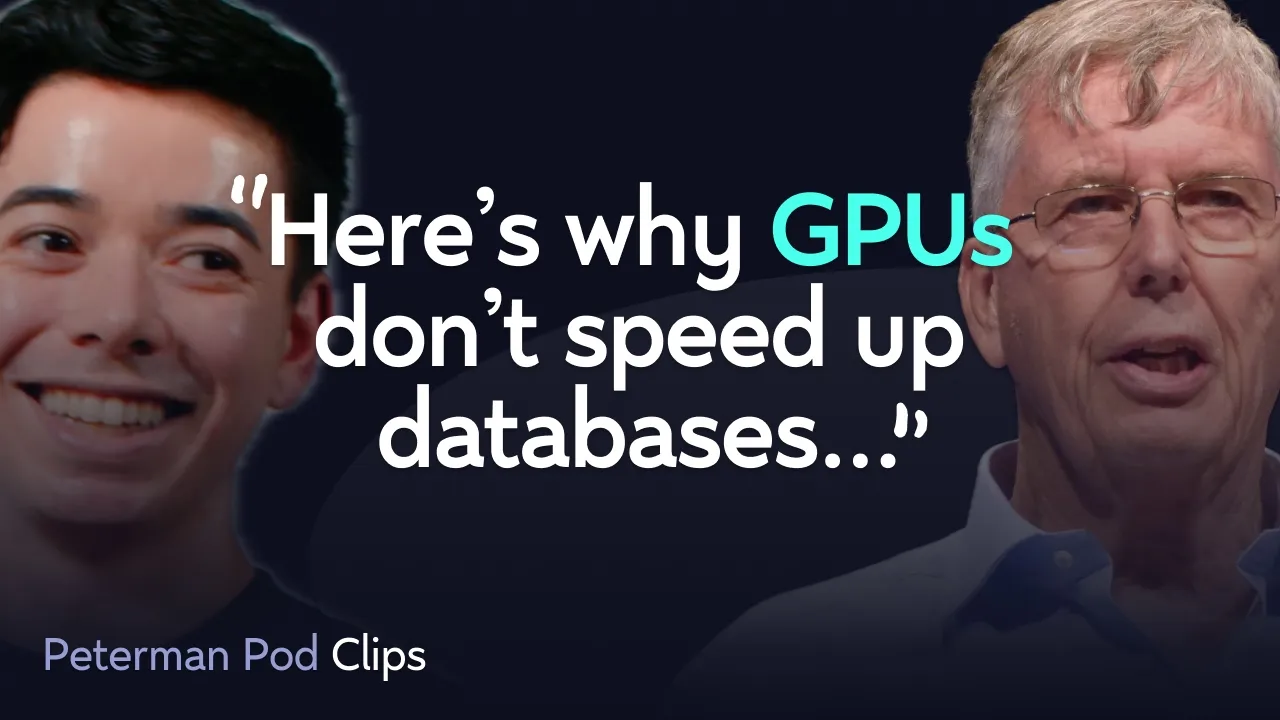
Ryan Peterman
General-purpose databases surrender an order-of-magnitude performance edge to specialized engines on heavy workloads, while GPU acceleration fails because pointer-chasing index traversals break SIMD architecture.
AI-assisted summary of Creator of Postgres (Turing Award): "One Size Fits None", Leveraging GPUs, Difficult Implementations — original source. Check the original for full context.
Source published:
Key ideas
- Specialized database architectures consistently outperform general-purpose relational engines by an order of magnitude (10×) on targeted workloads such as stream processing, columnar analytics, and vector search. (0:00)
- Postgres functions as an ideal default for initial development due to its rich ecosystem and talent pool, but it breaks down at high thresholds like 1,000,000 transactions per second or petabyte-scale data warehousing. (0:00)
- GPUs struggle with standard database indexing because their SIMD architecture is incompatible with sequential pointer-chasing across B-tree levels, and they face severe interconnect bus bottlenecks. (3:18)
- When building Ingres from the ground up, the query optimizer proved to be the single most difficult engineering challenge due to its inherent algorithmic complexity. (5:00)
Detailed notes
## Background Published on YouTube by Ryan Peterman on September 16, 2026, this clip is drawn from an extended interview with Turing Award recipient and Postgres creator Mike Stonebraker. The video description notes that the segment focuses on Stonebraker's architectural philosophy of database design, the viability of leveraging GPUs, and the hardest components to implement from scratch.
## TL;DR Mike Stonebraker argues that 'one size fits none' in data management, noting that specialized engines like column stores and vector databases routinely beat general-purpose row stores by an order of magnitude. While acknowledging Postgres as the unrivaled, cost-effective default for low-to-mid-tier workloads, he highlights its scaling limits in large data warehouses lacking native columnar storage or built-in clustering. He also pushes back on GPU database acceleration, explaining that B-tree indexing relies on sequential pointer chasing that is fundamentally incompatible with SIMD parallelism and choked by interconnect bottlenecks. Concluding with his work on Ingres, Stonebraker singles out the query optimizer as the most algorithmically difficult component to build from scratch.
## Atmosphere & style The discussion has the measured, no-nonsense weight of a seasoned systems pioneer dismantling modern software hype with core architectural reality. Stonebraker delivers his insights with direct, unvarnished pragmatism, casually breaking down abstract performance debates into tactile hardware realities like bus bottlenecks and pointer traversals. Hosted in a concise, interview-driven format, the exchange feels like an intimate masterclass in computer systems engineering where practical experience decisively trumps prevailing industry trends.
## Bulletin - [00:00](https://www.youtube.com/watch?v=qCKgWsexY6c&t=0s) Specialized database architectures consistently outperform general-purpose relational engines by an order of magnitude (10×) on targeted workloads such as stream processing, columnar analytics, and vector search. - [00:00](https://www.youtube.com/watch?v=qCKgWsexY6c&t=0s) Postgres functions as an ideal default for initial development due to its rich ecosystem and talent pool, but it breaks down at high thresholds like 1,000,000 transactions per second or petabyte-scale data warehousing. - [03:18](https://www.youtube.com/watch?v=qCKgWsexY6c&t=198s) GPUs struggle with standard database indexing because their SIMD architecture is incompatible with sequential pointer-chasing across B-tree levels, and they face severe interconnect bus bottlenecks. - [05:00](https://www.youtube.com/watch?v=qCKgWsexY6c&t=300s) When building Ingres from the ground up, the query optimizer proved to be the single most difficult engineering challenge due to its inherent algorithmic complexity.
## Key takeaways - [00:00](https://www.youtube.com/watch?v=qCKgWsexY6c&t=0s) The premise that 'one size fits all' in database architecture is fundamentally flawed; in practice, general-purpose designs sacrifice an order of magnitude in performance. - [00:00](https://www.youtube.com/watch?v=qCKgWsexY6c&t=0s) Historical architectures like StreamBase for stream processing and Vertica for column-based data warehousing demonstrated 10× speedups over standard relational row stores. - [00:00](https://www.youtube.com/watch?v=qCKgWsexY6c&t=0s) Modern engines like ClickHouse and Pinecone continue to outperform traditional relational databases retrofitted with user-defined types (UDTs). - [00:00](https://www.youtube.com/watch?v=qCKgWsexY6c&t=0s) Native column storage and built-in multi-node distributed clustering are minimum requirements for data warehousing that Postgres lacks. - [00:00](https://www.youtube.com/watch?v=qCKgWsexY6c&t=0s) Postgres is the undisputed default starter database because it is free, widely supported, and easy to hire engineers for. - [00:00](https://www.youtube.com/watch?v=qCKgWsexY6c&t=0s) The viability of Postgres as a general-purpose solution ends when hitting massive scale, such as petabyte-scale analytics or one million transactions per second. - [03:18](https://www.youtube.com/watch?v=qCKgWsexY6c&t=198s) GPU SIMD execution models are fundamentally ill-suited for database indexing, which relies on avoiding scans rather than uniform bulk compute. - [03:18](https://www.youtube.com/watch?v=qCKgWsexY6c&t=198s) Transferring data across the interconnect bus between storage, host CPUs, and GPUs creates a major hardware bottleneck that undermines GPU acceleration. - [03:18](https://www.youtube.com/watch?v=qCKgWsexY6c&t=198s) B-tree traversal relies on sequential, non-contiguous pointer chasing three to four levels deep, making it impossible to effectively parallelize across SIMD lanes. - [05:00](https://www.youtube.com/watch?v=qCKgWsexY6c&t=300s) The original Ingres relational database was implemented entirely from scratch without modern pre-existing data structure libraries. - [05:00](https://www.youtube.com/watch?v=qCKgWsexY6c&t=300s) Developing the query optimizer was the most difficult part of Ingres due to the algorithmic complexity of join orders, execution paths, and query trees.
## Detailed walkthrough ### [00:00](https://www.youtube.com/watch?v=qCKgWsexY6c&t=0s) "One Size Fits None": Specialized Engines vs. Postgres as the Baseline
The discussion opens around the philosophy behind Mike Stonebraker’s seminal 2005 paper, which argued that "one size fits all" database systems are fundamentally sub-optimal—in reality, "one size actually fits none." Recalling the state of research around 2004, Stonebraker points out that his team was running an academic project building what eventually became StreamBase. A dedicated stream processing engine looks absolutely nothing like a classic relational row store. At the very same time, they were developing the core ideas behind column stores for data warehouses, which was later commercialized as Vertica. Column stores and row stores share virtually no architectural DNA. In every category, these purpose-built engines were an entire order of magnitude faster than traditional general-purpose relational engines attempting to handle the same workloads.
Stonebraker stresses that this architectural reality has not changed at all today: running a system that was not designed for your specific workload forces you to sacrifice an order of magnitude in performance. Modern architectures prove the rule: ClickHouse dominates analytics as a purpose-built column store, while dedicated vector databases like Pinecone dramatically outperform user-defined types (UDTs) retrofitted into relational engines for vector processing. While it is technically straightforward to place a single unified parser on top of multiple distinct underlying engine implementations, Postgres has historically chosen not to do this. Because Postgres does not implement a native column store or built-in multi-node distributed clustering—capabilities Stonebraker calls simple "table stakes" for sizable data warehouses—it cannot compete at massive warehouse scale.
Nonetheless, Stonebraker readily concedes the unmatched utility of Postgres at the low end. For developers who simply need to get a project off the ground, Postgres remains the obvious default choice. It is free, backed by a massive global developer ecosystem with endless custom data type extensions, and finding engineering talent who know Postgres is trivial. It serves as an exceptional lowest common denominator that works seamlessly until an application pushes boundaries—such as demanding a million transactions per second or handling a petabyte-scale data warehouse. At that lower end, Postgres genuinely acts as an effective one-size-fits-all solution; at the high end, that claim completely breaks down.
- **Historical Precedents (circa 2004):** StreamBase (stream processing) and Vertica (C-Store column-oriented warehousing) proved specialized designs deliver a 10× (order of magnitude) speed advantage over standard row stores. - **Modern Counterparts:** ClickHouse (columnar analytics) and Pinecone (dedicated vector search) outperform general relational databases and custom UDTs on their respective tasks. - **Postgres Limitations at Scale:** Lacks a native column store and built-in multi-node clustering, disqualifying it from large enterprise data warehousing. - **The Postgres Sweet Spot:** Unbeatable as a starter system due to zero cost, deep talent pools, and wide data type support, functioning well until hitting thresholds like 1,000,000 transactions per second or petabyte-scale datasets.
---
[03:18](https://www.youtube.com/watch?v=qCKgWsexY6c&t=198s) GPUs in Databases: SIMD Bottlenecks and the Anathema of Indexing
When asked whether GPUs offer fresh opportunities to accelerate and optimize databases, Stonebraker responds cautiously. While there may be niche applications, the fundamental architectural mismatch is that GPUs are built around SIMD (Single Instruction, Multiple Data) execution models, which he describes as "the anathema of indexing." Whenever database performance relies on indexes to avoid scanning whole tables, GPU acceleration typically ceases to be a good design choice. Furthermore, deploying GPUs as accelerators attached to host CPUs creates severe hardware bottlenecks, as storage throughput and the interconnect bus (such as PCIe) between the CPU and GPU frequently choke data flow before the compute cores can even be utilized.
To illustrate why SIMD execution fails when indexing, Stonebraker uses the concrete example of searching for Ryan’s salary in a B-tree index. To locate a record, the database begins at the root of the B-tree, evaluates keys to find the divider containing the search target, and follows a pointer to the next child node. Following that pointer requires an unpredictable, non-contiguous memory access. The engine repeats this traversal three or four levels down the tree until reaching the leaf node. Because tree traversal consists of dependent, sequential pointer chasing rather than uniform operations across large contiguous blocks of data, it cannot be effectively parallelized across wide SIMD lanes.
```mermaid flowchart TD accTitle: B-Tree Pointer Chasing vs SIMD Parallelism accDescr: Flow diagram showing how sequential B-tree pointer traversals conflict with GPU SIMD execution.
subgraph Traversal["B-Tree Traversal: Pointer Chasing"] Root["Root Node: Evaluate Dividers"] -->|"Follow Pointer (Memory Jump)"| L1["Level 1 Node"] L1 -->|"Follow Pointer (Memory Jump)"| L2["Level 2 Node"] L2 -->|"Follow Pointer (Memory Jump)"| Leaf["Leaf Node: Target Record"] end
subgraph GPU["GPU Execution Profile"] SIMD["SIMD Cores: Require uniform, contiguous operations"] Bus["Interconnect Bus: Storage-to-GPU transfer bottleneck"] end
Traversal -.->|"Incompatible with"| SIMD ```
- **GPU Hardware Constraints:** SIMD hardware excels at identical instructions across uniform memory blocks, whereas tree indexing requires branchy, scalar pointer jumps. - **Bandwidth Limitations:** Moving data across the system bus connecting storage, CPU, and GPU often becomes the primary performance bottleneck. - **Pointer Chasing Mechanics:** B-tree lookups require three to four dependent memory accesses in sequence, inherently resisting SIMD vectorization.
---
[05:00](https://www.youtube.com/watch?v=qCKgWsexY6c&t=300s) Building Ingres from Scratch and the Query Optimizer Challenge
Reflecting on the early era of relational database research, Ryan Peterman asks whether the original implementation of Ingres required writing every single component by hand—including fundamental data structures like B-trees—given the lack of modern pre-packaged libraries. Stonebraker confirms that the original Ingres system was built entirely from scratch from the ground up.
When asked what proved to be the single hardest part of that entire implementation, Stonebraker answers without hesitation: the query optimizer. Developing an optimizer that could accurately evaluate query trees, project join orders, and select execution paths proved exceptionally demanding because the problem is fundamentally and "algorithmically difficult."
## Notable quotes > [00:00](https://www.youtube.com/watch?v=qCKgWsexY6c&t=0s) one size actually fits none — Mike Stonebraker
> [00:00](https://www.youtube.com/watch?v=qCKgWsexY6c&t=0s) running a system that was not designed for your specific workload forces you to sacrifice an order of magnitude in performance — Mike Stonebraker
> [00:00](https://www.youtube.com/watch?v=qCKgWsexY6c&t=0s) table stakes — Mike Stonebraker
> [03:18](https://www.youtube.com/watch?v=qCKgWsexY6c&t=198s) the anathema of indexing — Mike Stonebraker
> [05:00](https://www.youtube.com/watch?v=qCKgWsexY6c&t=300s) algorithmically difficult — Mike Stonebraker
## Mentioned Mike Stonebraker, Ryan Peterman, Postgres, StreamBase, Vertica, C-Store, ClickHouse, Pinecone, Ingres
## Video description This is a clip from the full conversation with Mike Stonebraker (Creator of Postgres, Turing Award Winner for work in databases): https://www.youtube.com/watch?v=YPObBOwIrHk
[Source](https://www.youtube.com/watch?v=qCKgWsexY6c)