Spirit Airlines Liquidation Shocks US Aviation Market After DOJ Merger Block
Wendover Productions
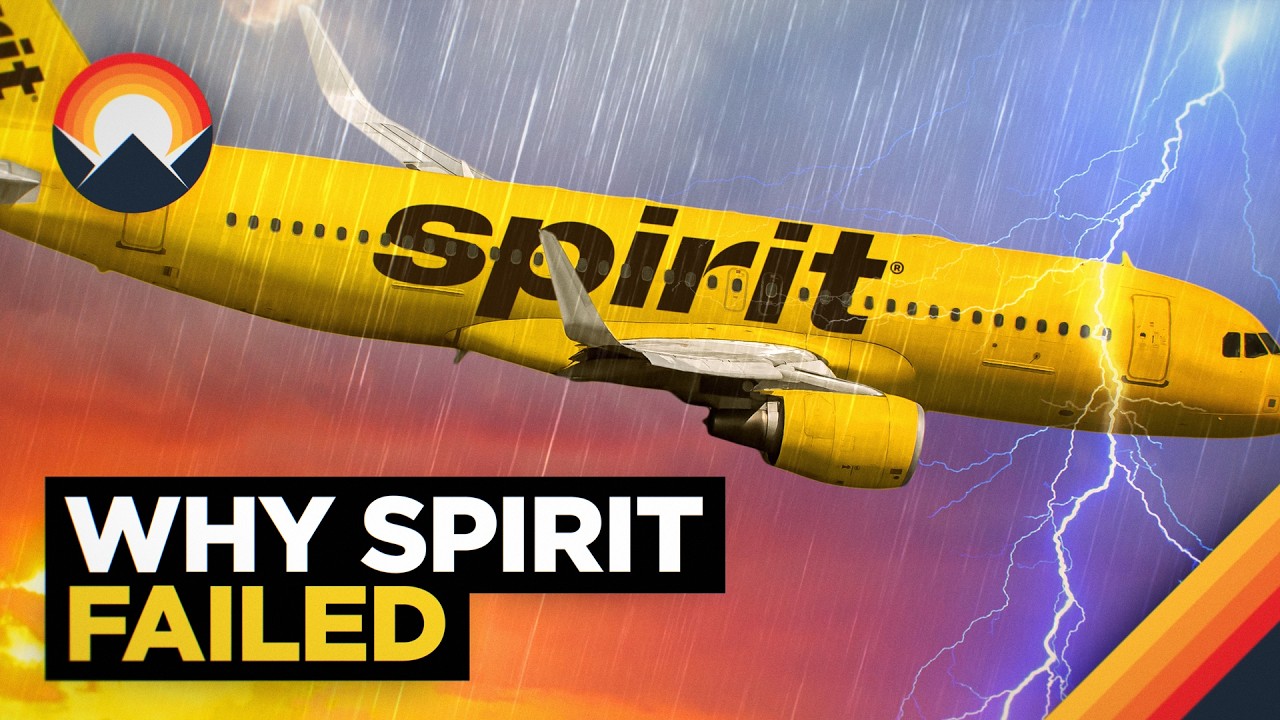
The carrier's sudden collapse on May 2, 2026, proves that the Biden administration's aggressive antitrust strategy backfired, liquidating an independent low-cost competitor rather than preserving price competition.
AI-assisted summary of Why Spirit Airlines Failed — original source. Check the original for full context.
Source published:
Detailed notes
## Background Published on YouTube by the channel Wendover Productions on June 16, 2026, this video examines the collapse of Spirit Airlines. The page description encourages viewers to spot media bias and avoid algorithms by trying Ground News, offering a 40% subscription discount through a promotional link.
## TL;DR Despite its reputation as America's most complained-about airline, Spirit Airlines filled a crucial market niche by pioneering the unbundled, ultra-low-cost carrier model in the United States. However, a post-COVID shift toward premium travel preferences and the introduction of 'Basic Economy' by legacy competitors severely eroded Spirit's market share. Compounded by catastrophic Pratt & Whitney engine recalls and a Department of Justice lawsuit that blocked a lifesaving merger with JetBlue, the airline's financial spiral culminated in a sudden liquidation following a geopolitical oil shock in 2026. Ultimately, Spirit leaves behind a complex legacy of democratizing domestic air travel for budget-conscious Americans.
## Atmosphere & style The presentation carries a deeply analytical yet melancholy tone, shifting from the stark irony of Spirit's simultaneous growth and unpopularity to a nostalgic reflection on its demise. The narrative style feels like a sobering post-mortem, balancing objective financial breakdown with an empathetic acknowledgment of the human impact, such as the sudden job losses of 17,000 employees. Watching the piece evokes a sense of inevitable tragedy, tracing how a revolutionary business model was systematically choked out by a mix of corporate warfare, regulatory strictness, and unpredictable global crises.
## Key takeaways - Spirit Airlines paradoxically achieved massive domestic growth and became the seventh largest North American carrier while simultaneously remaining America's most complained-about airline with abysmal customer satisfaction metrics. - The final flight of Spirit Airlines on May 2, 2026, was met with unexpected melancholy and nostalgia, proving that its bare-bones model successfully filled a massive, previously unserved niche for ultra-low-cost domestic leisure travel. - The appointment of Ben Baldanza in 2005 and investment from Indigo Partners in 2006 catalyzed a radical "unbundling" strategy, where the base fare covered only a spot on the plane and every single amenity carried a separate fee. - Spirit's pre-pandemic business model thrived heavily on ancillary fees, which made up 30% of its total revenue by its 2011 IPO and helped fuel a massive surge to nearly 34 million annual passengers by 2019. - The post-COVID recovery revealed a massive shift toward "premiumization" in American consumer behavior, led by Millennials and Gen Z who willingly spent more for upgraded travel experiences over physical goods. - Because legacy airlines successfully weaponized "Basic Economy" to match Spirit's low pricing, everyday travelers overwhelmingly shifted back to major carriers due to a perception of superior reliability and service. - A massive 2023 manufacturing recall on Pratt & Whitney engines forced Spirit to ground up to 40 of its A320neo aircraft simultaneously, choking off cash flow as planes sat idle for up to 250 days per engine for inspection. - Spirit's board initially rejected a hostile merger offer from JetBlue, warning that the Biden administration's aggressively anti-consolidation Department of Justice (DOJ) would likely block the deal on antitrust grounds. - [15:48](https://www.youtube.com/watch?v=ABRjwGo6Usg&t=948s) The DOJ successfully blocked the JetBlue-Spirit merger in a trial where JetBlue's own internal data revealed that average consumer fares skyrocket by 30% on routes where Spirit stops flying. - [15:48](https://www.youtube.com/watch?v=ABRjwGo6Usg&t=948s) Following the failed merger, Spirit entered a severe financial downward spiral, attempting to shrink to profitability before bleeding into multiple rounds of Chapter 11 bankruptcy as daily cash losses reached $7.5 million by 2025. - [17:32](https://www.youtube.com/watch?v=ABRjwGo6Usg&t=1052s) A sudden geopolitical conflict involving an attack on Iran and the closure of the Strait of Hormuz doubled oil prices overnight, dealing a fatal blow to Spirit's already fragile financial viability. - [17:32](https://www.youtube.com/watch?v=ABRjwGo6Usg&t=1052s) Spirit permanently ceased operations in the early hours of May 2, 2026, ending a 34-year legacy of safe operations and resulting in the immediate loss of 17,000 jobs. - [18:17](https://www.youtube.com/watch?v=ABRjwGo6Usg&t=1097s) Industry observers critique the DOJ's block of the JetBlue merger, arguing that allowing the consolidation would have been a superior outcome to the total liquidation that ultimately cost thousands of jobs. - [20:10](https://www.youtube.com/watch?v=ABRjwGo6Usg&t=1210s) Spirit's enduring positive legacy is that it democratized air travel for lower-income Americans, allowing them to attend major life events that would have otherwise been entirely cost-prohibitive. - [20:10](https://www.youtube.com/watch?v=ABRjwGo6Usg&t=1210s) Media coverage of the shutdown highlights extreme political polarization, with right-wing outlets blaming the Biden DOJ's regulatory overreach and left-wing outlets focusing on Trump-era geopolitical oil shocks. - [21:13](https://www.youtube.com/watch?v=ABRjwGo6Usg&t=1273s) To counter media polarization and echo chambers, tools like Ground News use corporate transparency data and a "blind spot feed" to help critical thinkers isolate objective facts from political spin.
## Detailed walkthrough ### The Melancholy End of America's Most Complained-About Airline
At its absolute biggest, Spirit Airlines was famously considered the worst. In the very same year it was celebrated as one of the fastest-growing domestic carriers in the United States—expanding its fleet with seven new Airbus A320s, bumping its available seat miles by 17.9%, and launching more than 20 new non-stop routes—it was simultaneously breaking records for how much people detested it. Over a four-year period, data tracking flight issues like cancellations and delays showed Spirit’s complaint frequency tripling that of most other airlines and trending steadily upward. A decade later, the paradox remained intact: Spirit had climbed the ranks to become the seventh largest North American carrier by total passengers, while stubbornly landing second to last in JD Power’s customer satisfaction metrics.
Yet, when the final Spirit Airlines flight, NK1833, touched down at Dallas Fort Worth in the early morning hours of May 2, 2026, the carrier vanished entirely from the skies. Instead of widespread celebration over the demise of an airline infamous for nickel-and-diming passengers, running late, and delivering a thoroughly unpleasant flying experience, its exit was met with a wave of melancholy nostalgia. The public reaction served as a final proof that while the bare-bones product wasn't pretty, it successfully filled a massive, previously unserved corner of the market. Spirit mastered a highly specific niche—the ultra-low-cost, entirely unbundled domestic leisure market—managing a fleet that maxed out at over 200 planes and employing nearly 20,000 people.
---
From Gambling Charters to the North-South Vacation Corridor
Refining this hyper-budget model took decades. Spirit was never built for the wealthy or the business traveler with an expense account; it belonged entirely to the budget-conscious vacationer. The company trace its roots back to 1983, starting as "Charter 1"—a spin-off of a trucking company that had begun dipping its toes into air shipping. Charter 1 didn't even operate its own flights initially. Instead, it functioned as a tour operator, coordinating specific gambling itineraries out of Detroit, Boston, and Providence to Atlantic City, and later expanding to the Bahamas and Las Vegas.
By 1992, these leisure routes had become popular enough to justify a massive transition. The company filed with the Department of Transportation to run scheduled passenger services, officially birthing a new budget-friendly leisure carrier. It retired its aging Convair 580 turborops, acquired 13 DC-9s, and renamed itself Spirit Airlines.
* **1992 Network:** Began with just three scheduled routes out of its Detroit base. * **1996 Network:** Expanded to connect the Northeast and Midwest to sun-soaked destinations like Florida, Myrtle Beach, and Atlantic City. * **1999 Milestones:** Added its first true long-haul domestic route from Detroit to Los Angeles, alongside its first international flight connecting Fort Lauderdale to Cancun, Mexico.
---
The Predatory Pricing Battle and the "Unbundling" Revolution
Throughout the 1990s, Spirit operated as a traditional low-cost carrier, utilizing older DC-9s and slightly larger MD-80s. The service was admittedly hit-or-miss—highlighted by a massive 1994 blunder where the airline accidentally overbooked 1,400 tickets—but a ticket still got you a standard budget experience. Much like Southwest Airlines at the time, your cheap fare still included a complimentary drink, a snack, a checked bag, and your choice of seat. However, this model wasn't sustainable against legacy airlines.
In 1999, Spirit launched a landmark lawsuit against Northwest Airlines, claiming the legacy giant was engaging in predatory pricing by flooding the Detroit market with artificially cheap tickets to deliberately price Spirit out of existence. While Northwest claimed it stayed profitable and Spirit eventually settled the suit, the pressure forced Spirit to pack up its headquarters and relocate to Fort Lauderdale. By the early 2000s, the airline was hemorrhaging money and floundering.
The turning point came in 2005 with the appointment of Ben Baldanza as president, who recognized the glaring absence of a true, European-style ultra-low-cost carrier in the US. A year later, Baldanza found his financial engine when private equity firm Indigo Partners bought a controlling stake in the airline. Armed with global experience in budget aviation, the new leadership went all-in on a radical strategy called "unbundling." The concept was simple: the base price of a ticket guaranteed you absolutely nothing but a physical spot on the aircraft. Every single amenity would now carry a separate fee, rolled out aggressively over the next few years.
| Year | Unbundled Fee Introduced | |---|---| | **2007** | A $10 fee for a second checked bag; elimination of free drinks and snacks; removal of free seat selection. | | **2008** | Introduction of a fee for the *first* checked bag; implementation of a fee just to print a boarding pass at the airport. | | **2010** | An industry-first $45 fee for overhead bin storage for carry-on items. |
> This unprecedented $45 carry-on fee caused such a massive public uproar that US Senators actually introduced legislation to stop it. Yet, the strategy worked beautifully. For cash-strapped college students desperate to get south for spring break, the base fares were simply too low to resist.
* **Fleet Streamlining:** Spirit completely overhauled its fleet to exclusively fly the Airbus A320 family, maximizing seat density and slashing maintenance costs. * **2011 IPO:** Spirit went public, revealing that a staggering 30% of its total revenue came purely from ancillary fees. * **Passenger Growth:** Total passengers ballooned from under 7 million in 2010 to nearly 34 million in 2019, turning a consistent profit every single year.
---
The Post-COVID Premiumization Trend
While the COVID-19 pandemic caused a catastrophic, near-total loss of revenue for every global airline, Spirit's true crisis emerged during the recovery years. As legacy US airlines marched back toward profitability, Spirit remained trapped in the red. The pre-pandemic industry-leading business model simply refused to snap back to life. A profound shift in American consumer behavior was underway: travelers were actively choosing to spend more money to fly.
Post-pandemic earnings releases from major legacy carriers continually noted that standard economy cabins were flat or down, while premium economy and business class were entirely driving revenue growth. This was fueled heavily by Millennials and Gen Z representing a massive chunk of American spending power. Because these younger generations historically prioritize spending on experiences rather than physical goods, they willingly allocated larger portions of their income to treat themselves to extra legroom, premium economy, or business class upgrades.
Historically, domestic premium seats were bought by business travelers using corporate expense accounts, meaning budget leisure airlines never had to bother offering them. Once this "premiumization" wave took over the consumer market, Spirit's strictly economy-dense fleet was fundamentally incapable of capturing high-margin revenue. Worse, everyday travelers began opting to pay extra for a full-service legacy carrier rather than endure Spirit's bare-bones experience, severely eroding the ultra-low-cost market.
---
Basic Economy and the Pratt & Whitney Engine Crisis
Compounding the problem, major network carriers aggressively weaponized a new tool to destroy Spirit's market share: "Basic Economy." Progressively rolled out by Delta, American, and United in the late 2010s, Basic Economy copied Spirit's exact playbook by offering rock-bottom prices with zero bags, zero seat selection, and zero refunds included. Backed by highly sophisticated pricing algorithms, the major carriers could match Spirit’s fares directly. Given the choice between identical prices, consumers overwhelmingly chose the big legacy brands due to a perception of better reliability and service. Spirit's operating margins, which sat comfortably in the mid-20s in 2015, collapsed into the low tens right before the virus emerged in Wuhan, eventually leading to United reporting by 2024 that basic economy made up 16% of its entire domestic passenger base.
Then came the catastrophic hardware failures. Back in 2016, Spirit had proudly been the first US carrier to adopt the brand-new Airbus A320neo, featuring innovative Pratt & Whitney PW1100G geared turbofan engines that burned 16% less fuel. But in the summer of 2023, Pratt & Whitney dropped a bombshell recall notice. They discovered that for six years, their factory in New York had used contaminated powdered metal to manufacture the engine core's blades.
While the engines initially passed standard inspections, microscopic cracks were forming under operational stress far earlier than expected. Though it only ever caused a single actual aircraft incident—resulting in an aborted takeoff—regulators ordered immediate inspections for 1,200 affected engines.
The inspection process was an operational nightmare. Airlines had to completely ground their planes, physically wrench the engines off, and ship them to one of only 20 qualified shops globally. The engines had to be entirely disassembled, ultrasonically tested blade by blade, and rebuilt. Hampered by a severe shortage of shop capacity and replacement parts, the process took upwards of 250 days per engine. At the absolute worst point of the crisis, Spirit was forced to ground 40 of its A320neo aircraft simultaneously while still paying their incredibly expensive monthly lease costs. Short on planes, Spirit had to entirely abandon its operations in Boston and Cleveland, while heavily scaling back flights in Dallas, choking off any opportunity to claw its way out of debt.
---
The Hostile JetBlue Merger War
Desperate for a lifeline as cash reserves dwindled, Spirit turned to the ultimate airline survival mechanism: consolidation. On February 7, 2022, Spirit announced a friendly agreement to merge with Frontier Airlines. It looked like a perfect match on paper: both airlines flew identical Airbus fleets, shared a bare-bones business model, and had minimal network overlap. Frontier was strong in the West, while Spirit dominated the East, the Caribbean, and South America. With only 18% of their routes overlapping, a merger would create a massive, nationwide ultra-low-cost mega-carrier—the fifth largest airline in the United States.
The deal seemed like a guaranteed certainty, but leadership completely underestimated JetBlue Airways. Sneaking into the picture, JetBlue hijacked the negotiations by launching a massive counter-offer, bidding a stunning $33 per share compared to the roughly $25 per share value implied by the Frontier deal.
Spirit’s board initially fought back fiercely, unanimously rejecting JetBlue's proposal. They argued that a combination with JetBlue had a significantly lower probability of securing antitrust clearance from the government. Spirit's leadership knew that the Biden administration's Department of Justice (DOJ) had cultivated a fierce reputation as the most aggressively anti-consolidation administration of the 21st century—having already sued JetBlue to break up its "Northeast Alliance" partnership with American Airlines.
> The core of the board's warning was structural: JetBlue was not an ultra-low-cost carrier. It operated a hybrid model featuring premium business class cabins, free Wi-Fi, and transatlantic flights. If JetBlue bought Spirit, they planned to completely dissolve the Spirit brand and retrofitted the planes to JetBlue standards. This meant the US market would permanently lose the aggressive price competition that Spirit provided. A Frontier merger, by contrast, would simply combine two struggling low-cost carriers into a single, highly efficient national competitor.
However, Spirit's shareholders cared strictly about the immediate payout. The board found itself lacking the votes to pass the Frontier deal, forcing them into a grueling, multi-month cycle of delaying the vote, tweaking terms with Frontier, and delaying again. The writing was on the wall: the $33 per share JetBlue offer was simply too tantalizing for investors to walk away from. Eventually, Spirit's board capitulated and approved the JetBlue merger, and shareholders quickly followed suit. Yet, exactly as Spirit's board had originally foretold, the Department of Justice stepped in and filed a massive lawsuit to block the deal on antitrust grounds. In a twist of legal irony, the DOJ's official complaint explicitly weaponized Spirit’s own words against them, pointing out that this was a case of a "high-cost, high-fare airline buying a low-cost, low-fare airline" to kill off competition.
[15:48](https://www.youtube.com/watch?v=ABRjwGo6Usg&t=948s) The Blocked Merger and Spirit's Financial Spiral
The Department of Justice's (DOJ) antitrust case against the JetBlue acquisition of Spirit was essentially a "slam dunk" from the start due to a "clear objective reduction of competition." During the trial, the airlines tried to bargain, offering to divest key assets like slots and gates. They argued that creating a more robust, non-budget competitor to major airlines like Delta, United, and American would ultimately benefit consumers. However, the objective facts were devastating: JetBlue's own internal estimates revealed that when Spirit exits a route, average fares skyrocket by 30%. Once the DOJ decided to block the merger, the odds were heavily stacked against the airlines, and the government ultimately won, leaving Spirit right back where it started—having wasted two years and hundreds of millions of dollars.
Following the failed merger, Spirit floundered through desperate, half-hearted restructuring strategies. The airline tried to "shrink to profitability" by slashing its fleet down to fewer than 100 aircraft, abandoning most of its operations in the American West, and pivoting toward short-distance, north-south vacation routes along the East Coast. This strategy failed to stop the bleeding. The company's daily financial losses ballooned at a terrifying pace over the next few years, forcing the airline into multiple rounds of Chapter 11 bankruptcy. Even as it sat perpetually on the brink of total collapse throughout 2025—having rejected a much weaker merger proposal from Frontier—Spirit somehow managed to repeatedly find temporary financial lifelines to scrap together a few more months of operations.
- **JetBlue internal data:** Average fares increase by 30% on routes where Spirit stops flying. - **Fleet reduction:** Spirit cut its active fleet down to fewer than 100 aircraft during its restructuring attempt. - **Daily cash burn progression:** - 2023: Burning approximately $1.2 million per day. - 2024: Losses ramped up to $3.4 million per day. - 2025: Spiraled down to a loss of $7.5 million per day.
[17:32](https://www.youtube.com/watch?v=ABRjwGo6Usg&t=1052s) The Geopolitical Beheading and the Final Touchdown
The slow financial bleed of the airline was abruptly halted by an unpredictable geopolitical shock. Following an attack on Iran by the Trump administration, Iran retaliated by shutting down the critical Strait of Hormuz. This conflict triggered a massive, sudden spike in global oil prices, effectively doubling the airline's single largest operational expense overnight. With costs soaring completely out of control, the business model was rendered entirely unviable. Investors had no choice but to face reality and salvage whatever remaining assets they could from the sinking company.
The final chapter of Spirit Airlines closed unceremoniously in the early hours of May 2, 2026, with the distribution of its last press release. The abrupt shutdown resulted in 17,000 employees losing their livelihoods. This sudden collapse brought an end to a 34-year legacy of safe operations, during which the airline had transported nearly half a billion passengers. The company's history concluded quietly as its last iconic bright yellow Airbus touched down at Dallas/Fort Worth International Airport (DFW).
- **Shutdown Date:** Early morning of May 2, 2026. - **Human Impact:** 17,000 individuals lost their jobs. - **Historical Legacy:** 34 years of operation and safe transport of nearly half a billion passengers. - **The Final Flight:** Ended with the touchdown of a yellow Airbus at DFW.
[18:17](https://www.youtube.com/watch?v=ABRjwGo6Usg&t=1097s) Retrospective Debates and the Death of Ultra-Low-Cost Travel
Industry observers actively debate exactly when Spirit's demise became inevitable, and whether alternative decisions could have spared the carrier. Some look back at the original Frontier merger proposal, but given that Frontier has also struggled to regain long-term profitability post-COVID, a combined Spirit-Frontier entity may have simply dragged both airlines under. Frontier continues to cycle through business model adjustments without clear signs of financial stability. Because nearly every American ultra-low-cost carrier is currently losing money, the idea that a merged Frontier-Spirit could have easily competed its way back to health is highly doubtful.
A more compelling critique is directed at the Biden administration's DOJ. While the antitrust case was legally sound, observers as early as 2023 recognized that blocking the deal would likely push Spirit into bankruptcy rather than preserve it as an independent competitor. In hindsight, allowing Spirit to consolidate into JetBlue would have been the superior outcome, preserving thousands of jobs and establishing a stronger counterweight to the legacy "Big Four" airlines. Ultimately, the DOJ took a major gamble that backfired. Regardless of government intervention or oil spikes, the "spirit that people love to hate"—defined by rock-bottom fares and "buzzball peddling"—could not survive in the modified post-pandemic aviation landscape. Spirit's specific ultra-low-cost formula was functionally dead anyway.
- **Industry status:** Almost every American low-cost airline is currently unprofitable, undermining the argument that a Frontier-Spirit merger would have thrived. - **The DOJ's miscalculation:** The DOJ operated under the assumption that Spirit would remain a viable independent competitor, whereas the true alternative to the merger was total liquidation.
[20:10](https://www.youtube.com/watch?v=ABRjwGo6Usg&t=1210s) Spirit's True Legacy and Media Bias Identification
Despite its polarizing reputation and endless passenger complaints, Spirit Airlines provided an undeniable public good. In a massive country lacking comprehensive passenger rail or public transit, Spirit democratized air travel by "asking for less" money. It allowed lower-income Americans to attend milestone life events—weddings, funerals, births, and family gatherings—that would have otherwise been completely cost-prohibitive. In the end, Spirit's enduring legacy is the realization that while the American traveling public "loved to hate it, they also hated to love it."
The broader media coverage surrounding the airline's collapse highlights the deeply polarized nature of modern news reporting. Right-leaning media platforms aggressively blamed the shutdown on the Biden administration's strict antitrust stance and the blocked JetBlue merger. Conversely, left-leaning outlets minimized the merger block and focused almost entirely on the external fuel shock brought on by the Trump administration's military escalations with Iran. Navigating this sea of partisan analysis requires tools that break down narrative framing to isolate objective reality from political messaging.
- **Mainstream media volume:** Nearly 600 distinct news sources reported on the Spirit Airlines shutdown. - **Polarized framing:** Right-wing outlets focused on the Biden DOJ's regulatory overreach; left-wing outlets focused on Trump-era geopolitical oil shocks.
[21:13](https://www.youtube.com/watch?v=ABRjwGo6Usg&t=1273s) Sponsoring the Narrative: Ground News and Media Polarization
To sort through the skewed media narratives surrounding the airline's demise, the creator highlights their long-term partnership with the media literacy platform Ground News, a relationship active since 2023. Ground News functions as a specialized news aggregator that evaluates coverage based on the political leanings of various media corporations and publishers. By explicitly showing consumer ownership transparency and narrative distribution, the tool helps readers distinguish between objective fact and corporate or political spin, counteracting the natural human tendency to seek out comforting echo chambers that merely validate existing biases.
One particularly valuable feature highlighted is the "blind spot feed," which exposes users to critical news stories that are being entirely ignored by one side of the political spectrum. Incorporating these varied perspectives is more than just an intellectual exercise; it has documented behavioral benefits. A cited Duke University study on media polarization confirmed that regular exposure to these media blind spots effectively moderates partisan biases and reduces overall social polarization. Ground News operates as a completely independent, subscriber-funded service designed for critical thinkers, offering a 40% discount on their comprehensive Vantage plan via the promotional link ground.wendover to support the channel's ongoing documentary work.
## Notable quotes > high-cost, high-fare airline buying a low-cost, low-fare airline
> [15:48](https://www.youtube.com/watch?v=ABRjwGo6Usg&t=948s) clear objective reduction of competition
> [15:48](https://www.youtube.com/watch?v=ABRjwGo6Usg&t=948s) shrink to profitability
> [18:17](https://www.youtube.com/watch?v=ABRjwGo6Usg&t=1097s) spirit that people love to hate
> [18:17](https://www.youtube.com/watch?v=ABRjwGo6Usg&t=1097s) buzzball peddling
> [20:10](https://www.youtube.com/watch?v=ABRjwGo6Usg&t=1210s) asking for less
> [20:10](https://www.youtube.com/watch?v=ABRjwGo6Usg&t=1210s) loved to hate it, they also hated to love it
> [21:13](https://www.youtube.com/watch?v=ABRjwGo6Usg&t=1273s) blind spot feed
## Mentioned Spirit Airlines, Wendover Productions, Ground News, Sam Denby, Tristan Purdy, Christine Benedetti, Alexander Williard, Sara Stoltman, Gabriel Ferreras, Austin Glass, Kate Ermolenkko, Manni Simon, Dony Bullen, Simon Buckmaster, Airbus A320, JD Power, Charter 1, Department of Transportation, Convair 580, DC-9, MD-80, Southwest Airlines, Northwest Airlines, Ben Baldanza, Indigo Partners, Millennials, Gen Z, Basic Economy, Delta Air Lines, American Airlines, United Airlines, Airbus A320neo, Pratt & Whitney, PW1100G, JetBlue Airways, Frontier Airlines, Department of Justice, Northeast Alliance, Trump administration, Biden administration, Strait of Hormuz, Dallas/Fort Worth International Airport, Duke University
[Source](https://www.youtube.com/watch?v=ABRjwGo6Usg)