RST Cuts AI Agent Task Costs to 5 Cents via Recursive Proof Growth
Xiaol.x
AI agent training avoids recursive data collapse when pipelines expand verified executable solutions before generating prompts rather than mutating text descriptions.
AI-assisted summary of How AI Training Tasks Learn to Grow | Recursive Synthesis (RST) Explained — original source. Check the original for full context.
Source published:
Key ideas
- Recursive Synthesis (RST) introduces a framework to grow verified terminal-agent tasks at approximately five cents each, compared to hundreds or thousands of dollars for manual authoring. (0:00)
- Across 15 recursive rounds, 639 initial seeds expanded into 37,484 verified tasks while reference solution lengths increased from 67 to 374 lines and DeepSeek-V4-Pro pass@4 dropped from 90% to 2.5%, proving genuine difficulty growth. (3:41)
- Training Qwen3.5-27B with agentic PPO using RST environments produced substantial downstream gains, including a 41.16% relative improvement on Terminal-Bench Hard. (6:48)
- The core methodology shifts synthetic data generation from prompt mutation to expanding executable proofs first, aligning the environment, verifier, and public instruction afterward. (1:29)
Detailed notes
## Background Published by Xiaol.x on YouTube on August 12, 2026, this explainer examines the paper on Recursive Synthesis (RST), an automated method that generates verified terminal-agent training tasks for roughly five cents each. The video breaks down how RST recursively scales complete executable task bundles across 15 rounds while maintaining strict synchronization between public instructions, environments, reference solutions, and verifiers.
## TL;DR Conventional agent task generation struggles with desynchronized components and expensive human authoring, but RST overcomes this by expanding the executable reference solution before updating the prompt and verifier. By enforcing dual-gated oracle and contract validity alongside strict diversity quotas, the framework grew 639 seeds into 37,484 verified tasks across 15 rounds without suffering validation yield decay. The synthetic tasks proved genuinely harder, causing frozen DeepSeek-V4-Pro pass@4 rates to fall from 90% down to 2.5% as median solution length surged from 67 to 374 lines. Downstream training validated the curriculum's real-world utility, delivering strong supervised fine-tuning improvements and up to a 41.16% relative gain on Terminal-Bench Hard via agentic PPO.
## Atmosphere & style The presentation is disciplined, analytical, and highly structured, carrying the precise and crisp rhythm characteristic of Lean/Leanim-style technical breakdowns. Rather than relying on superficial AI hype, the narrative builds a compelling engineering argument through concrete metrics, lineage traces, and architectural diagrams. Watching the breakdown feels like sitting in an elite computer science seminar that methodically deconstructs an intricate distributed systems problem before demonstrating verified empirical results.
## Bulletin - [00:00](https://www.youtube.com/watch?v=zAeJwDdM6OE&t=0s) Recursive Synthesis (RST) introduces a framework to grow verified terminal-agent tasks at approximately five cents each, compared to hundreds or thousands of dollars for manual authoring. - [03:41](https://www.youtube.com/watch?v=zAeJwDdM6OE&t=221s) Across 15 recursive rounds, 639 initial seeds expanded into 37,484 verified tasks while reference solution lengths increased from 67 to 374 lines and DeepSeek-V4-Pro pass@4 dropped from 90% to 2.5%, proving genuine difficulty growth. - [06:48](https://www.youtube.com/watch?v=zAeJwDdM6OE&t=408s) Training Qwen3.5-27B with agentic PPO using RST environments produced substantial downstream gains, including a 41.16% relative improvement on Terminal-Bench Hard. - [01:29](https://www.youtube.com/watch?v=zAeJwDdM6OE&t=89s) The core methodology shifts synthetic data generation from prompt mutation to expanding executable proofs first, aligning the environment, verifier, and public instruction afterward.
## Key takeaways - [00:44](https://www.youtube.com/watch?v=zAeJwDdM6OE&t=44s) Terminal tasks consist of four coupled gears—public instruction, runnable environment, reference solution, and private verifier—which must stay strictly synchronized to avoid corrupted training feedback. - [00:44](https://www.youtube.com/watch?v=zAeJwDdM6OE&t=44s) Conventional task generation fails by mutating prompts in isolation, leading to unrunnable environments, missing tool dependencies, or misaligned test assertions. - [01:29](https://www.youtube.com/watch?v=zAeJwDdM6OE&t=89s) RST adopts the principle of growing the reference solution and state dependencies first before updating the environment, verifier, and public prompt. - [02:13](https://www.youtube.com/watch?v=zAeJwDdM6OE&t=133s) Dual validation gates enforce Oracle Validity (the reference solution passes the verifier in a clean sandbox) and Contract Validity (all checked requirements are either disclosed in the prompt or discoverable in the workspace). - [02:13](https://www.youtube.com/watch?v=zAeJwDdM6OE&t=133s) Contract validity prevents teacher cheating by rejecting tasks where private tests evaluate unstated requirements that only the oracle knows. - [02:52](https://www.youtube.com/watch?v=zAeJwDdM6OE&t=172s) A traced JSON lineage illustrates how complexity compounds over 15 rounds from a simple 10-line diff script into a 347-line diagnostic and configuration reconciliation workflow. - [03:41](https://www.youtube.com/watch?v=zAeJwDdM6OE&t=221s) Synthesis yield remained stable between 498 and 572 accepted tasks per 1,000 attempts, with sandbox pass rates consistently between 74.5% and 81.5% across 15 rounds. - [04:27](https://www.youtube.com/watch?v=zAeJwDdM6OE&t=267s) A fixed DeepSeek-V4-Pro baseline demonstrated monotonic performance degradation from 90% pass@4 down to 2.5%, confirming that task difficulty stems from real operational depth rather than superficial verbosity. - [05:17](https://www.youtube.com/watch?v=zAeJwDdM6OE&t=317s) To prevent recursive data collapse, RST enforces strict diversity quotas across rewrite operators and lineage families, keeping 36 of 40 discrete operators active through round 15. - [05:17](https://www.youtube.com/watch?v=zAeJwDdM6OE&t=317s) Semantic similarity between tasks creeps upward across recursive rounds, indicating that deduplication and diversity quotas are essential safeguards against homogenization. - [06:05](https://www.youtube.com/watch?v=zAeJwDdM6OE&t=365s) Supervised fine-tuning on rollout trajectories improved Qwen3.5 27B and 122B models across benchmarks, with zero 13-token n-gram overlap against test evaluation sets. - [06:48](https://www.youtube.com/watch?v=zAeJwDdM6OE&t=408s) Agentic PPO training yielded significant improvements across benchmarks, highlighted by a jump from 22.67% to 32.00% on Terminal-Bench Hard. - [07:36](https://www.youtube.com/watch?v=zAeJwDdM6OE&t=456s) The framework establishes an automated, self-sustaining curriculum that reuses validated executable bundles as seeds for subsequent generation rounds. - [08:16](https://www.youtube.com/watch?v=zAeJwDdM6OE&t=496s) Current limitations include reliance on initial verifier correctness, unproven transfer to GUI and general OS settings, and lack of guarantees for infinite recursion without quality degradation.
## Detailed walkthrough ### [00:00](https://www.youtube.com/watch?v=zAeJwDdM6OE&t=0s) The Five-Cent Paradox and the Four-Gear Contract
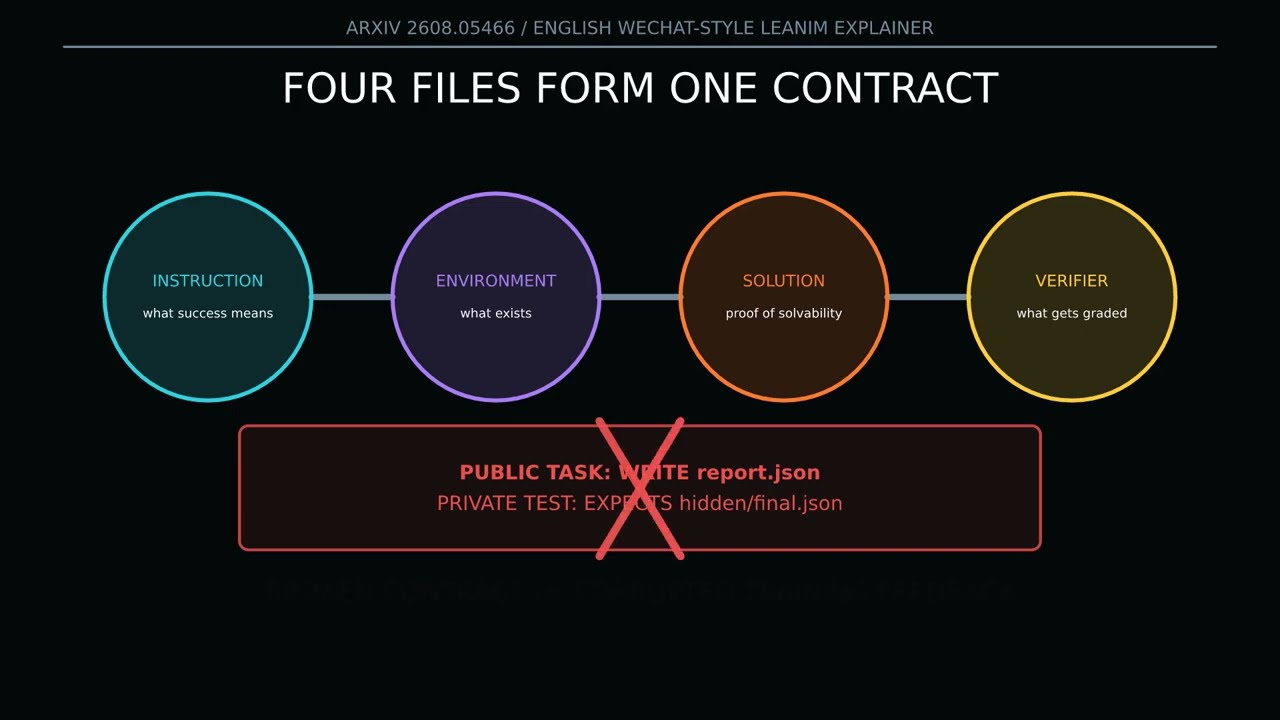
Authoring serious, long-horizon terminal-agent tasks traditionally requires substantial human engineering, routinely costing hundreds or even thousands of dollars per verified instance. Against this backdrop, Recursive Synthesis (RST) reports an astonishing figure: roughly five cents per accepted, verified task. The bottleneck in authoring long-horizon tasks has never been prompt writing—it is the grueling challenge of maintaining strict alignment across four tightly coupled components over dozens of dependent operations: the public instruction, the runnable sandbox environment, the reference solution, and the private verifier. If even a single link desynchronizes, the agent ends up training against nonsense. RST bypasses this failure mode not by manufacturing cheap text prompts, but by producing cheap, verified, executable work with genuinely rising difficulty.
```mermaid flowchart TD accTitle: The Four-Gear Task Bundle Contract accDescr: Diagram showing how instruction, environment, reference solution, and verifier must stay synchronized.
subgraph TaskContract["Executable Task Bundle"] direction TB INST["Public Instruction<br/>(Specifies success)"] ENV["Runnable Environment<br/>(Tools & system state)"] SOL["Reference Solution<br/>(Executable ground-truth proof)"] VER["Private Verifier<br/>(Validates final state)"] end
INST <--> ENV ENV <--> SOL SOL <--> VER VER <--> INST ```
To understand the core problem, picture a terminal task as four interconnected gears. The instruction communicates what success looks like to the agent; the environment specifies available tools and workspace state; the reference solution proves that the task can actually be completed end-to-end; and the verifier evaluates the final workspace condition. Conventional direct task generation turns one gear while leaving the others frozen. A model might invent a new hidden configuration file name inside a test suite without declaring it in the prompt, demand a third-party tool that was never installed in the environment container, or stretch an instruction into paragraphs while leaving the underlying bash commands completely trivial. The immediate symptom is an unrunnable task, but the hidden killer is corrupted training feedback injected directly into agent loops.
---
[01:29](https://www.youtube.com/watch?v=zAeJwDdM6OE&t=89s) Grow the Proof First: Dual-Gated Synthesis
RST introduces an unusually disciplined design principle: it grows the reference solution before touching the prompt. Instead of hallucinating a complex task description and hoping an automated solver can satisfy it, RST begins with an already-verified seed task. The synthesis generator chooses an explicit rewrite target, appends real operations, and introduces new state dependencies into the executable workflow script. Only after the execution trace has expanded does the framework synchronize the environment configuration, private verifier tests, and public instruction to reflect those new requirements.
```mermaid flowchart LR accTitle: RST Recursive Synthesis and Verification Pipeline accDescr: Pipeline showing task expansion from seed to static filtering, dual-gated sandbox verification, and pool ingestion.
subgraph GrowStage["1. Proof Expansion"] SEED["Verified Seed Task"] --> REWRITE["Expand Solution<br/>& State Dependencies"] REWRITE --> ALIGN["Update Env, Verifier,<br/>& Public Prompt"] end
subgraph FilterStage["2. Validation Gates"] ALIGN --> STATIC["Static Filters<br/>(Drop leaks & no-ops)"] STATIC --> SANDBOX["Fresh Sandbox Exec"] SANDBOX --> GATES{"Dual Gates:<br/>Oracle & Contract"} end
subgraph PoolStage["3. Yield & Reuse"] GATES -->|"Pass"| POOL["Verified Task Pool<br/>(RL Env & Next-Round Seeds)"] GATES -->|"Fail"| DROP["Discarded Candidate"] end ```
Before an expanded candidate can join the pool, it must survive both static filters and a clean sandbox execution. Static filters prune malformed syntax, information-leaking prompts, or trivial cosmetic mutations. Surviving candidates are then spun up in an isolated execution sandbox where the augmented reference solution must pass the verifier. To guarantee training integrity, RST enforces two distinct validation gates: - **Oracle Validity:** The trusted reference solution must run in a clean environment and successfully pass every assertion in the private verifier. - **Contract Validity:** Every single requirement, assertion, and check performed by the verifier must be either explicitly stated in the public prompt or discoverable via the sandbox workspace.
If a private test silently checks an undisclosed file path that the oracle hardcodes but the public prompt never reveals, the task is strictly rejected. This dual gate prevents "teacher cheating" and ensures difficulty grows from genuine work rather than "adjectives" or missing specifications.
---
[02:52](https://www.youtube.com/watch?v=zAeJwDdM6OE&t=172s) Lineage Tracing: 15 Rounds of Executable Expansion
To demonstrate that complexity compounds without drifting into incoherence, the paper documents an exact task lineage starting from a minimal seed across 15 recursive rounds:
| Round | Stage Description | Reference Solution Length | |:--- |:--- |:--- | | **Seed** | Generates 6 JSON diff reports | 10 non-empty lines | | **Round 1** | Moves comparison matrix into configuration files | 66 lines | | **Round 5** | Introduces invalid configuration diagnosis and reporting | 219 lines | | **Round 10** | Adds release-note-driven regression testing cases | 264 lines | | **Round 15** | Repairs broken configs and fixtures, regenerates reports, reconciles counts, and passes tests | 347 lines |
Across these 15 generations, the core domain objective survives, but the required dependency chain deepens substantially. The agent cannot skate by on shallow pattern matching; it must carry out deep multi-step diagnostics, configuration edits, reconciliation runs, and validation sweeps.
---
[03:41](https://www.youtube.com/watch?v=zAeJwDdM6OE&t=221s) Scaling Without Collapse: Yield, Effort, and Difficulty Growth
Starting from an initial set of 639 human-verified bootstrap seeds, RST synthesized 37,484 accepted tasks across 15 generations at approximately five cents per validated task. Crucially, validation yield did not decay as task depth increased: - Yield of passed tasks remained remarkably steady between roughly 498 and 572 per 1,000 synthesis attempts. - Candidate pass rates inside the sandbox stayed consistently between 74.5% and 81.5%.
```mermaid flowchart TD accTitle: Synthesized Task Complexity vs Solver Performance accDescr: Comparing the increase in code/command lines against the steep collapse in DeepSeek-V4-Pro pass rates across 15 rounds.
subgraph Growth["Executable Complexity (Rounds 1 to 15)"] L["Median Solution Lines:<br/>67 ➔ 374 lines"] C["Terminal Commands:<br/>40 ➔ 244 commands"] end
subgraph Difficulty["DeepSeek-V4-Pro Performance"] P["pass@4 Rate:<br/>90.0% ➔ 2.5%"] SC["Mean Partial Credit:<br/>0.97 ➔ 0.17"] end
Growth -.->|"Induces Genuine Difficulty"| Difficulty ```
To verify that these accepted tasks were not accumulating cosmetic bloat, the authors evaluated them with a frozen frontier baseline: - **Solution Length:** Median reference solution code expanded from 67 lines in round 1 to 374 lines in round 15. - **Command Volume:** Executed bash commands grew from 40 to 244. - **Solver Performance Drop:** DeepSeek-V4-Pro pass@4 plummeted monotonically from 90.0% down to 2.5%. - **Partial Credit:** Mean partial credit fell from 0.97 to 0.17.
Because the evaluator model remained fixed, the steep drop in pass rate proves that the tasks became genuinely harder execution problems rather than superficially verbose prompts.
---
[05:17](https://www.youtube.com/watch?v=zAeJwDdM6OE&t=317s) Guarding Against Recursive Diversity Collapse
Recursive generation pipelines notoriously suffer from mode collapse, degenerating into narrow clusters of near-identical rewrites. To forestall this, RST enforces strict diversity quotas across lineage domains, rewrite families, operators, and generation cohorts: - By round 15, 36 out of 40 discrete rewrite operators remained actively represented in the pool. - No single rewrite family comprised more than 29% of the overall distribution. - No individual seed task from the initial 639 bootstrap instances accounted for more than 0.77% of the total dataset.
Nevertheless, synthesis boundaries do emerge under close inspection. Median nearest-neighbor semantic similarity increased over recursion rounds to 0.464, with a high-similarity tail stretching to 0.703. While diversity remains healthy enough to drive downstream learning, aggressive deduplication and boundary monitoring remain critical safeguards against late-stage homogenization.
---
[06:05](https://www.youtube.com/watch?v=zAeJwDdM6OE&t=365s) Downstream Transfer: SFT and Agentic PPO Benchmarks
Hard synthesis tasks are useless if they fail to teach models generalizable skills. To measure downstream transfer, successful rollout trajectories collected across the verified RST environments were formatted into supervised fine-tuning (SFT) data for Qwen3.5 models (evaluating both the 27B parameter dense model and the 122B mixture-of-experts model). Evaluated across Terminal-Bench 2, Terminal-Bench Hard, and Long-Horizon Terminal-Bench: - Both model sizes showed progressive performance gains through three consecutive fine-tuning stages. - The 122B model achieved its largest absolute improvement on Terminal-Bench Hard, picking up 10 full percentage points. - A strict n-gram overlap audit confirmed zero exact 13-token matches against the test benchmarks, ruling out test set contamination or memorized task descriptions.
The task corpus was subsequently deployed as an active training ground for agentic Reinforcement Learning via PPO starting from Qwen3.5-27B:
| Benchmark | Baseline Pass Rate | Agentic PPO (RST) | Relative Gain | |:--- |:--- |:--- |:--- | | **Terminal-Bench 2** | 41.20% | 49.44% | +20.00% | | **Terminal-Bench Hard** | 22.67% | 32.00% | +41.16% | | **Long-Horizon Terminal-Bench** | 18.10% | 22.07% | +21.93% |
*(Note: The dedicated reinforcement learning results table reports 49.44% on Terminal-Bench 2, though the paper's conclusion section includes a conflicting value of 46.07%.)*
The standout result is the massive 41.16% relative surge on Terminal-Bench Hard—an independently curated, out-of-distribution evaluation set that underscores genuine reasoning transfer rather than narrow benchmark gaming.
---
[07:36](https://www.youtube.com/watch?v=zAeJwDdM6OE&t=456s) Limits and the Core Mental Model
Conventional agent data generation relies on naive prompt mutation paired with rejection filtering, hoping downstream heuristics catch broken setups. RST redefines the fundamental unit of synthesis: every newly minted child is an executable, proof-carrying task bundle complete with runnable environment assets, contract validation receipts, and explicit provenance. This transforms synthetic data generation into an automated, self-sustaining curriculum. As models become more capable, the system autonomously expands dependency chains and verifier rigor without waiting for manual human authoring.
However, several clear caveats bound the claims: - Demonstrating 15 stable generations proves there was no immediate collapse ceiling, but it does not guarantee unbounded scaling to infinity. - Synthesis integrity depends entirely on verifier quality; flawed test assertions propagate down the lineage. - The high-similarity tail is measurably expanding. - Empirical results apply to terminal environments; generalizability to graphical user interface (GUI) or arbitrary OS interactions remains unproven.
The lasting takeaway of the work is straightforward: "Do not recursively mutate prompts. Recursively grow executable work, and let every accepted task carry its own proof."
## Notable quotes > [00:00](https://www.youtube.com/watch?v=zAeJwDdM6OE&t=0s) A serious terminal-agent task can cost hundreds or even thousands of dollars to author. RST reports roughly five cents per verified task.
> [00:00](https://www.youtube.com/watch?v=zAeJwDdM6OE&t=0s) The bottleneck in authoring long-horizon tasks has never been prompt writing—it is the grueling challenge of maintaining strict alignment across four tightly coupled components
> [00:00](https://www.youtube.com/watch?v=zAeJwDdM6OE&t=0s) RST bypasses this failure mode not by manufacturing cheap text prompts, but by producing cheap, verified, executable work with genuinely rising difficulty.
> [00:00](https://www.youtube.com/watch?v=zAeJwDdM6OE&t=0s) Conventional direct task generation turns one gear while leaving the others frozen.
> [01:29](https://www.youtube.com/watch?v=zAeJwDdM6OE&t=89s) it grows the reference solution before touching the prompt.
> [01:29](https://www.youtube.com/watch?v=zAeJwDdM6OE&t=89s) This dual gate prevents "teacher cheating" and ensures difficulty grows from genuine work rather than "adjectives" or missing specifications.
> [03:41](https://www.youtube.com/watch?v=zAeJwDdM6OE&t=221s) Because the evaluator model remained fixed, the steep drop in pass rate proves that the tasks became genuinely harder execution problems rather than superficially verbose prompts.
> [05:17](https://www.youtube.com/watch?v=zAeJwDdM6OE&t=317s) By round 15, 36 out of 40 discrete rewrite operators remained actively represented in the pool.
> [06:05](https://www.youtube.com/watch?v=zAeJwDdM6OE&t=365s) A strict n-gram overlap audit confirmed zero exact 13-token matches against the test benchmarks, ruling out test set contamination or memorized task descriptions.
> [06:48](https://www.youtube.com/watch?v=zAeJwDdM6OE&t=408s) The standout result is the massive 41.16% relative surge on Terminal-Bench Hard—an independently curated, out-of-distribution evaluation set that underscores genuine reasoning transfer rather than narrow benchmark gaming.
> [07:36](https://www.youtube.com/watch?v=zAeJwDdM6OE&t=456s) every newly minted child is an executable, proof-carrying task bundle complete with runnable environment assets, contract validation receipts, and explicit provenance.
> [08:16](https://www.youtube.com/watch?v=zAeJwDdM6OE&t=496s) Do not recursively mutate prompts. Recursively grow executable work, and let every accepted task carry its own proof.
## Mentioned Xiaol.x, Recursive Synthesis, RST, DeepSeek-V4-Pro, Qwen3.5, Qwen3.5-27B, Qwen3.5-122B, Terminal-Bench 2, Terminal-Bench Hard, Long-Horizon Terminal-Bench, PPO, Lean, Leanim, Hugging Face, arXiv
## Video description A serious terminal-agent task can cost hundreds or even thousands of dollars to author. RST reports roughly five cents per verified task.
The breakthrough is not cheaper prompt generation. RST recursively grows the executable solution, realigns the verifier and public instruction, validates everything in a fresh sandbox, and reuses accepted tasks as seeds. The result is a proof-carrying curriculum for training increasingly capable terminal agents.
In this English Lean/Leanim explainer:
- 639 verified seeds become 37,484 tasks across 15 rounds. - Median solution length grows from 67 to 374 lines. - Command count rises from 40 to 244. - DeepSeek-V4-Pro pass@4 falls from 90% to 2.5%, showing genuine difficulty growth. - SFT improves two Qwen3.5 model sizes across three terminal benchmarks. - Agentic PPO delivers its largest relative gain—41.16%—on Terminal-Bench Hard.
Why this matters: conventional task-generation pipelines produce and filter isolated examples. RST recursively reuses complete, validated task bundles while keeping the environment, solution, verifier, and public contract aligned.
Chapters
00:00 The five-cent paradox 00:44 Four files, one executable contract 01:29 Grow the proof before the prompt 02:13 Solvability versus fairness 02:52 A JSON task grows through 15 rounds 03:41 Scaling without losing validation yield 04:27 Proving the tasks become harder 05:17 Avoiding recursive data collapse 06:05 Supervised fine-tuning results 06:48 Agentic PPO results 07:36 Why this work is important 08:16 Limits and the final mental model
Sources
Paper: https://arxiv.org/abs/2608.05466 Hugging Face: https://huggingface.co/papers/2608.05466 Project page: https://zhongzhi660.github.io/recursive-verified-synthesis-site/
Note: the video follows the dedicated RL table’s 49.44 Terminal-Bench 2 result; the paper’s conclusion contains a conflicting 46.07 value.
#AIResearch #AIAgents #MachineLearning
[Source](https://www.youtube.com/watch?v=zAeJwDdM6OE)