AI Benchmarks Debunk Recursive Self-Improvement as Memory Errors Mount
Xiaol.x
Autonomous agents fail to achieve recursive self-improvement because unverified context and teacher leakage compound into systemic failures without human-engineered validation gates.
AI-assisted summary of This Week’s AI Papers: Managed Agents, Hidden Grades, Lying Memory, Split World Models — original source. Check the original for full context.
Source published:
Key ideas
- Autonomous agent research demonstrates that expanding raw context length exacerbates failure rates by compounding unverified claims; separating execution from read-only verification architectures (such as LongHorizon-Harness) significantly boosts benchmark completion rates. (2:44)
- Post-training distillation reveals that privileged teachers can teach students fragile reasoning or ungrounded linguistic habits; dual-anchored distillation and backtracking credit assignment (ABSeeker) mitigate false claims and improve intermediate action scoring. (13:04)
- Empirical evaluations show unmanaged persistent agent memory increases task failure rates from 28% to 74.4%, while automated experience-to-skill consolidation libraries can inadvertently sanitize backdoors, evading safety filters. (22:03)
- Pretraining physics shows an asymmetric transfer dynamic: visual understanding improves visual generation, but visual generation tokens provide negligible reciprocal benefit to language or reasoning capabilities. (41:20)
- System efficiency gains depend on cutting structural data waste; two-stage media token pruning (OmniPack) and fused chunked logit caching slash peak VRAM and FLOPs by up to 90% with minimal benchmark degradation. (43:18)
Detailed notes
## Background Published on YouTube by Xiaol.x on August 16, 2026, this research-status briefing reviews recent artificial intelligence papers organized around five practical categories mapped from Turing Post FOD#162. The description frames the video as an accessible reality check against unconstrained recursive self-improvement claims, dissecting agents, supervisory grades, memory hazards, world models, and infrastructure costs.
## TL;DR The briefing systematically audits recent AI literature to demonstrate that autonomous systems require strict human-built scaffolding and validation gates rather than open-ended autonomy. It covers architectural mitigations for multi-step agent failure modes, techniques to prevent teacher models from poisoning student distillation signals, and the hazards of unmanaged memory such as backdoor retention and referential dangling. Furthermore, it unpacks world models into modular, verifiable simulation proxies and demonstrates how structural compute waste can be reduced across multimodal pretraining, scaling predictions, and test-time training.
## Atmosphere & style The presentation carries a sober, razor-sharp, and deeply pragmatic tone, reading like an engineering post-mortem of industry hype. Grounded by recurring mantras about looking for excluded costs and receipts, each segment begins with an intuitive real-world breakdown before dissecting empirical measurements with calm, methodical precision. The overall experience feels less like a technology preview and more like a rigorous architectural reality check that strips away marketing narratives to inspect the actual mechanical failure points.
## Bulletin - [02:44](https://www.youtube.com/watch?v=epaAJ23WshQ&t=164s) Autonomous agent research demonstrates that expanding raw context length exacerbates failure rates by compounding unverified claims; separating execution from read-only verification architectures (such as LongHorizon-Harness) significantly boosts benchmark completion rates. - [13:04](https://www.youtube.com/watch?v=epaAJ23WshQ&t=784s) Post-training distillation reveals that privileged teachers can teach students fragile reasoning or ungrounded linguistic habits; dual-anchored distillation and backtracking credit assignment (ABSeeker) mitigate false claims and improve intermediate action scoring. - [22:03](https://www.youtube.com/watch?v=epaAJ23WshQ&t=1323s) Empirical evaluations show unmanaged persistent agent memory increases task failure rates from 28% to 74.4%, while automated experience-to-skill consolidation libraries can inadvertently sanitize backdoors, evading safety filters. - [41:20](https://www.youtube.com/watch?v=epaAJ23WshQ&t=2480s) Pretraining physics shows an asymmetric transfer dynamic: visual understanding improves visual generation, but visual generation tokens provide negligible reciprocal benefit to language or reasoning capabilities. - [43:18](https://www.youtube.com/watch?v=epaAJ23WshQ&t=2598s) System efficiency gains depend on cutting structural data waste; two-stage media token pruning (OmniPack) and fused chunked logit caching slash peak VRAM and FLOPs by up to 90% with minimal benchmark degradation.
## Key takeaways - [00:00](https://www.youtube.com/watch?v=epaAJ23WshQ&t=0s) Recent literature does not support claims of unconstrained autonomous recursive self-improvement; apparent progress relies heavily on human-designed verification gates and sandboxed harness environments. - [02:44](https://www.youtube.com/watch?v=epaAJ23WshQ&t=164s) The long-horizon execution paradox occurs when agents correctly execute individual steps but derail downstream because unverified assertions in context are treated as ground truth. - [05:11](https://www.youtube.com/watch?v=epaAJ23WshQ&t=311s) In-policy rehearsal and dynamic skill generation with rollback rewards improve agent execution more reliably than continuous raw context expansion. - [07:48](https://www.youtube.com/watch?v=epaAJ23WshQ&t=468s) Production studies of AI-generated enterprise C++ indicate that while static analysis warnings fell by 11.1%, human review burdens and downstream computational overhead increased by 5% to 8%. - [13:04](https://www.youtube.com/watch?v=epaAJ23WshQ&t=784s) Privileged teacher models with access to ground-truth answers risk degrading student reasoning unless distillation is anchored to student-reachable rollouts. - [18:37](https://www.youtube.com/watch?v=epaAJ23WshQ&t=1117s) In sequential multi-stage training, supervised fine-tuning overwrites ~93% of parameters and harms prior capabilities, whereas reinforcement learning parameter updates are sparse (~20%) and nearly orthogonal across tasks. - [22:03](https://www.youtube.com/watch?v=epaAJ23WshQ&t=1323s) Unmanaged memory serves as an operational hazard rather than an advantage: raw memory retention caused a 74.4% task failure rate compared to 28% with a blank context. - [23:31](https://www.youtube.com/watch?v=epaAJ23WshQ&t=1411s) Standard rotary positional embeddings (RoPE) render long-horizon historical video frames unreadable in the KV cache unless positional rotations are detached and reassigned to summary slots. - [24:22](https://www.youtube.com/watch?v=epaAJ23WshQ&t=1462s) Experience-to-skill pipelines (SkillJack) sanitize poisoned trajectories into modular library code, dropping safety judge detection rates from 98.5% down to 11.4%. - [27:09](https://www.youtube.com/watch?v=epaAJ23WshQ&t=1629s) Context compression frequently induces referential dangling by stripping necessary antecedent sentences, severely degrading downstream model accuracy unless explicit reference restoration is applied. - [31:45](https://www.youtube.com/watch?v=epaAJ23WshQ&t=1905s) Exposing candidate driving trajectories upfront causes vision-language models to hallucinate safety justifications, whereas deferred exposure forces sensory commitment prior to trajectory selection. - [33:07](https://www.youtube.com/watch?v=epaAJ23WshQ&t=1987s) World models should be decoupled into discrete, modular components—such as separating latency-heavy video generation from runtime action policies and authoritative game-server logic engines. - [41:20](https://www.youtube.com/watch?v=epaAJ23WshQ&t=2480s) Visual generation tokens create data waste when training unified models; asymmetric token allocation prioritizing language and understanding avoids 'vision laziness' while boosting overall performance. - [44:50](https://www.youtube.com/watch?v=epaAJ23WshQ&t=2690s) Chinchilla scaling assumptions break down under extreme capacity-data imbalances, necessitating coupled scaling laws (Skaling) that reduce forecasting error and sweep compute overhead. - [46:26](https://www.youtube.com/watch?v=epaAJ23WshQ&t=2786s) Modular test-time training represents update mechanics as a directed acyclic graph to boost training throughput, though fast-weight models still trail standard KV attention on needle retrieval. - [47:54](https://www.youtube.com/watch?v=epaAJ23WshQ&t=2874s) Evaluating AI efficiency requires auditing five foundational questions: what object shrank, where in the pipeline, on what hardware and stage, what quality moved, and what costs were excluded.
## Detailed walkthrough ### [00:00](https://www.youtube.com/watch?v=epaAJ23WshQ&t=0s) Overview: Five Questions, Then Jump
The briefing opens by establishing expectations: this is an analytical status briefing on recent artificial intelligence research papers, "not a product launch." Across the literature, the papers do not coalesce into a single unified system, nor do they substantiate claims that autonomous agents have begun recursively self-improving in an unconstrained way. Instead, they cluster around five distinct practical questions:
```mermaid flowchart TD accTitle: Five Core Questions of the Briefing accDescr: High-level overview mapping the five core chapters covering agents, training signals, memory, world models, and compute costs.
subgraph Overview["Five Practical Briefing Questions"] Q1["1. Agents: Managed Loops & Verification"] Q2["2. Post-Training: Grades & Signal Provenance"] Q3["3. Memory: When Storing Facts Becomes Hazard"] Q4["4. World Models: Simulation vs. Verification"] Q5["5. Infrastructure: Hidden Compute Bills"] end ```
The 50-minute video is structured as a modular jump map where each chapter examines a concrete failure scenario, assesses empirical findings, and defines the technical boundaries: - **Chapter 1: Agents** asks whether long-running agents can improve without quietly breaking themselves. The danger highlighted is when the diary, the automated tests, and the publishing mechanism all share a single unconstrained context window. - **Chapter 2: Grades** looks at post-training as a supply chain, analyzing what happens when teacher models evaluate students using hidden answer keys, distorting the student's true capabilities. - **Chapter 3: Memory** addresses when remembering is more hazardous than forgetting, pointing out five reliability failures obscured by the umbrella term "memory." - **Chapter 4: World Models** separates prediction, simulation, verification, and control to identify where visual generative systems and autonomous vehicle planners fail. - **Chapter 5: Cost** investigates where the compute bill really goes, pairing efficiency claims with the unmeasured overhead left out of benchmarks.
The speaker advises viewers to maintain a healthy skepticism toward research claims: "If a number sounds like a miracle, look for the excluded cost. If a loop looks like self-improvement, look for the human-built gate."
---
[02:44](https://www.youtube.com/watch?v=epaAJ23WshQ&t=164s) Agents: The Long-Horizon Execution Paradox
Long-horizon agent tasks run into a fundamental paradox: an agent can execute every individual step correctly yet still ruin the entire project. This occurs because a task is not merely a sequence of actions; it is a "chain of beliefs about what has already happened." If an agent mistakenly writes an unverified claim—such as recording "tests passed"—directly into its running context history, all downstream decisions inherit that false assumption. Expanding context length exacerbates this failure mode by providing more room for hallucinations and faulty assumptions to compound. Consequently, recent literature focuses on "agents inside managed systems that control what may persist" rather than simply training larger models.
A illustrative scenario demonstrates this fragility: an automated release pipeline requires four sequential actions: 1. Update a configuration file. 2. Rebuild the software package. 3. Run the smoke tests. 4. Publish the package strictly if the tests pass.
In an unmanaged setup, an agent edits the configuration, executes tests against the wrong directory, mistakes a generic green console output for success, and writes `release ready` into its context diary. Over a 50-step execution, that diary entry becomes treated as objective ground truth. The final publication step appears completely rational to the model despite its foundational premise being completely wrong. The root failure is architectural: execution, memory, and self-evaluation all share a single mutable conversation window.
```mermaid flowchart LR accTitle: Managed Execution Architecture accDescr: Architecture diagram showing task isolation between Manager, Fresh-Context Executive, Read-Only Auditor, and Persistent Task State.
subgraph Harness["LongHorizon-Harness Architecture"] M["Manager\n(Selects Subtask)"] E["Executive\n(Fresh Context)"] A["Auditor\n(Read-Only Inspection)"] S[("Persistent Task State\n(Audit Reports)")] end
M -->|"Assigns Bounded Subtask"| E E -->|"Acts on Env"| A A -->|"Validates State Change"| S S -.->|"History Discarded"| M ```
To resolve this issue, **LongHorizon-Harness** isolates execution from verification: - A manager selects a bounded subtask. - An executive agent executes the subtask within a completely fresh, short-lived context. - A separate read-only auditor directly inspects the environment (file system, system processes, logs) to verify changes. - The executive's subjective claims are ignored; only compact audit reports are promoted into persistent state. - Raw operational history is discarded between cycles.
Using this separation of concerns on matched Qwen-2.5-72B runs, performance jumps significantly: - **WEAVE-Bench** pass rate improves from 51.8% to 80.7%. - **Terminal-Bench** scores rise from 69.7% to 77.2%. - **OSWorld** task completion increases from 2.8% to 8.3%. The performance gains stem from management constraints rather than scaling up model weights.
---
[05:11](https://www.youtube.com/watch?v=epaAJ23WshQ&t=311s) Curricula, Reusable Skills, and In-Policy Rehearsal
Beyond single-run execution management, several papers explore generating self-sustaining learning signals through verified synthetic curricula and procedural refinement:
- **Recursive Synthesis for Long-Horizon Terminal Tasks**: Addresses the scarcity of complex evaluation tasks. It takes an existing verified terminal task, expands the executable solution, realigns the task instructions and private verifier, and validates the entire bundle inside an isolated sandbox. Only child tasks that pass the verifier are permitted to seed subsequent iterations. Starting from a bootstrap set of 639 seed tasks, the framework synthesized 37,484 verified tasks across 15 iterative rounds while maintaining stable validation yields. This builds a "proof-carrying curriculum" that generates dependable supervised trajectories and reinforcement learning rewards.
- **Progressive Agent Skill Generation (Skill-Alpha)**: Treats procedural skills not as static prompt paragraphs generated once, but as editable instruction sets that undergo continuous maintenance: - Supports dynamic operations: create, update, merge, prune, or retain skills based on ongoing execution logs. - Introduces a strict **rollback reward**: tests both the prior skill and the modified skill against an identical anchored query. - Downstream success on the worker's task determines whether an edit is retained or rejected. - Achieves benchmark gains over established skill baselines by +3.3 points on WebArena/CLB-Bench and +6.7 points on Tau-Bench. As the author notes, "fluency is not the score, changed behavior is."
- **EnvACE**: Embeds environmental rehearsal directly into the agent's policy. Rather than relying entirely on external environments to return observations, the policy alternates roles: it acts, and then internally predicts the environment's response. Using shared weights paired with separate reward baselines for acting versus rehearsal, the model simulates and evaluates consequences before executing real environment interactions: - On Tau-Bench, an 8B parameter model trained with standard RL achieved 31.2%, which rose to 36.7% using EnvACE. - Applying two private internal rehearsals at inference time further boosted the score from 36.7% to 40.9%.
---
[07:48](https://www.youtube.com/watch?v=epaAJ23WshQ&t=468s) Autonomous Meta-Search and Production Constraints
```mermaid flowchart TD accTitle: System-Level Agent Architecture accDescr: Interlocking systems showing curriculum generation, rehearsal, auditing, and meta-search working together.
subgraph Learning["Curriculum & Skill Synthesis"] RS["Recursive Synthesis\n(Proof-Carrying Tasks)"] SA["Skill-Alpha\n(Rollback-Scored Edits)"] end
subgraph Execution["Execution & Verification"] EA["EnvACE\n(Internal World Rehearsal)"] LH["LongHorizon-Harness\n(Read-Only Auditor)"] end
subgraph Optimization["Meta-Control"] RE["Re-Search\n(Autonomous Optimization)"] end
RS --> EA EA --> LH LH --> SA RE -.->|"Coordinates Loops"| Learning RE -.->|"Allocates Budgets"| Execution ```
Traditional iterative optimization frameworks frequently rely on hard-coded heuristics to govern candidate selection, search budgets, and branching. **Re-Search** (The Optimizer Is the Agent) alters this dynamic by exposing evaluation, failure analysis, code editing, and memory as distinct tool APIs accessible to the model. The agent itself determines what tests to run, when to audit outputs, when to revert ineffective changes, and when to terminate search branches: - When optimizing system prompts on Terminal-Bench 2, Re-Search boosted performance from GEA's baseline of 42.22% up to 53.33% under identical evaluation budgets. - Across 14 varied optimization tasks, improvements ranged between 2% and 40% compared to specialized baselines, effectively transforming search strategy into a learned behavior.
Contrasting these algorithmic gains, two empirical boundary studies document the operational costs of agentic workflows: - **Multimodal Environment Scaling**: Demonstrates that naively expanding the diversity of training environments can trigger negative transfer, degrading policy performance. Mitigating this requires careful curriculum design that sequences complementary abilities by difficulty. - **Video-DeepResearch**: Shows that agents must be constrained by tool gating—forcing models to ground multimodal assertions directly in raw video before allowing them to query external web search tools. - **Quality Profile of AI-Generated C++ in Production**: Analyzed 3.52 million enterprise C++ code modifications. The study found that while automated linters and feedback loops lowered static analysis warnings by 11.1%, AI-assisted changes imposed a measurable tax on human peer review and led to an estimated 5% to 8% increase in downstream compute overhead.
The author notes that while synthesizing these findings reveals an end-to-end framework—combining audit layers, synthetic curricula, rollback skills, world rehearsal, and autonomous search—no single paper has demonstrated this complete flywheel operating indefinitely on its own. In 2026, autonomous capability is bound by benchmark-dependent verifiers that can themselves hallucinate or overlook subtle side effects. Real-world progress requires "recursive improvement with receipts," ensuring all persistent state is validated through strict external checks.
---
[11:49](https://www.youtube.com/watch?v=epaAJ23WshQ&t=709s) Grades: The Teacher-Student Supply Chain
The discussion shifts to post-training dynamics: "Give a teacher a hidden answer key, let it correct every word a student writes, and the student can become less reliable." When a teacher model evaluates intermediate generation steps with privileged access to ground-truth answers, it produces hyper-specific critiques. However, during downstream inference without an answer key, the student model produces fragile reasoning chains, hallucinating non-existent guardrails.
This dynamic reframes post-training not as isolated training runs, but as an information supply chain where signal provenance matters: - Who authored the feedback signal? - Did the evaluator possess privileged, asymmetric information? - Exactly which token or planning action does the reward target? - Does the evaluation benchmark scale in difficulty to challenge the student?
The briefing outlines standard post-training paradigms: - **Supervised Fine-Tuning (SFT)**: Forces direct imitation of high-quality target demonstrations. - **Reinforcement Learning (RL)**: Encourages policy exploration and up-weights trajectories that yield higher environment rewards. - **On-Policy Distillation**: Combines both techniques by sampling rollouts directly from the student policy while evaluating them against a stronger teacher model or automated scoring rubric.
[13:04](https://www.youtube.com/watch?v=epaAJ23WshQ&t=784s) Dual-Anchored Policy Distillation (DAPD)
In teacher-student learning setups, a common paradigm involves the student generating its own trajectory while a teacher model supplies dense, step-by-step corrections. However, recent research moves past the simplistic question of how much feedback to provide, asking instead: "where did each signal come from?" A core failure mode identified in Dual-Anchored Policy Distillation (DAPD) is the problem of privileged information. During training, the teacher frequently inspects evidence—such as reference completions—that the student will never see at inference time. When standard on-policy self-distillation forces an unprivileged student to directly imitate a privileged teacher, the student is pushed to make leaps it cannot justify from its own context.
```mermaid flowchart TD accTitle: Dual-Anchored Policy Distillation Information Paths accDescr: Comparison between ordinary distillation pushing unprivileged student to privileged teacher versus DAPD balancing matched privilege states and reachability.
subgraph Standard["Ordinary Self-Distillation"] ST["Privileged Teacher\n(Sees Ground Truth)"] SS["Unprivileged Student\n(Inference Context)"] ST -.->|"Direct Force Push\n(Causes Hallucination)"| SS end
subgraph DAPD_Arch["DAPD Matched Alignment"] direction TB subgraph Anchors["Dual Anchor Guidance"] Ref["Reference Completion\n(Reliable, but Unreachable)"] Roll["Student Rollout\n(Reachable, but Noisy)"] end Bridge["Self-Conditioned Bridge"] Matched["Matched State Comparison\n(Privileged-to-Privileged &\nUnprivileged-to-Unprivileged)"]
Anchors --> Bridge --> Matched end ```
DAPD addresses this by inserting a self-conditioned bridge that aligns behaviors along strictly matched information paths: aligning both sides when privilege is absent, and aligning both sides when privilege is present. Concurrently, it relies on two complementary anchors: - **Reference trajectories:** highly reliable and correct, but often unreachable from the student's current policy distribution. - **Student rollouts:** fully reachable from the student's current state, but prone to errors.
By balancing correctness against reachability, DAPD prevents the model from assuming a single guidance signal is sufficient. Under ordinary self-distillation, training curves reveal a troubling pattern: unsupported factual claims steadily rise as reasoning accuracy deteriorates. By matching information access between teacher and student, DAPD suppresses this failure mode across scales: - Evaluated on Qwen 3 across models spanning 1.7B to 32B parameters, DAPD outperformed scale-matched ordinary distillation on every tested size. - Average reasoning accuracy across three benchmarks improved by 2.0 to 2.8 percentage points. - Late-stage training errors dropped sharply, with detected false claims falling by 73% relative to the standard distillation baseline.
[15:08](https://www.youtube.com/watch?v=epaAJ23WshQ&t=908s) Spurious Signal Filtering in Distillation
Even when a teacher's correction arrives with high confidence, that correction may be completely disconnected from the actual prompt. Consider a vision-language task asking about a red umbrella: a teacher model might vigorously reward generating the phrase "therefore, the answer is...", yet assign an identical reward if both the image and the question are completely stripped away. In that scenario, the feedback does not reinforce visual reasoning; it merely reinforces an ungrounded linguistic habit.
To prevent models from optimizing for these false signals, spurious-signal-aware on-policy distillation evaluates teacher-student disagreement across two parallel passes: 1. One pass evaluated on the actual input prompt. 2. A second pass evaluated on an empty, residual no-prompt context.
The method applies a targeted filter, isolating tokens where the correction is weakly influenced by the prompt yet exerts an unusually large impact on the loss. Rather than just flagging difficult tokens, it directly isolates strong, ungrounded corrections.
While conventional selective distillation techniques prioritize tokens using uncertainty, teacher-student divergence, or learnability, introducing an explicit "input groundedness" axis yields marked gains under matched compute budgets: - Visual understanding benchmarks improved from 50.5 to 54.0. - Visual reasoning scores advanced from 60.4 to 63.5. - Mathematical reasoning rose from 28.5 to 30.4.
Ablations reveal that filtering solely by divergence discards valuable teaching corrections, while filtering solely by groundedness wastes optimization budget on innocuous tokens; performance gains stem strictly from their intersection. However, generating extra no-prompt evaluations inevitably inflates training compute—proving that cleaner, audited supervision comes at a tangible operational cost.
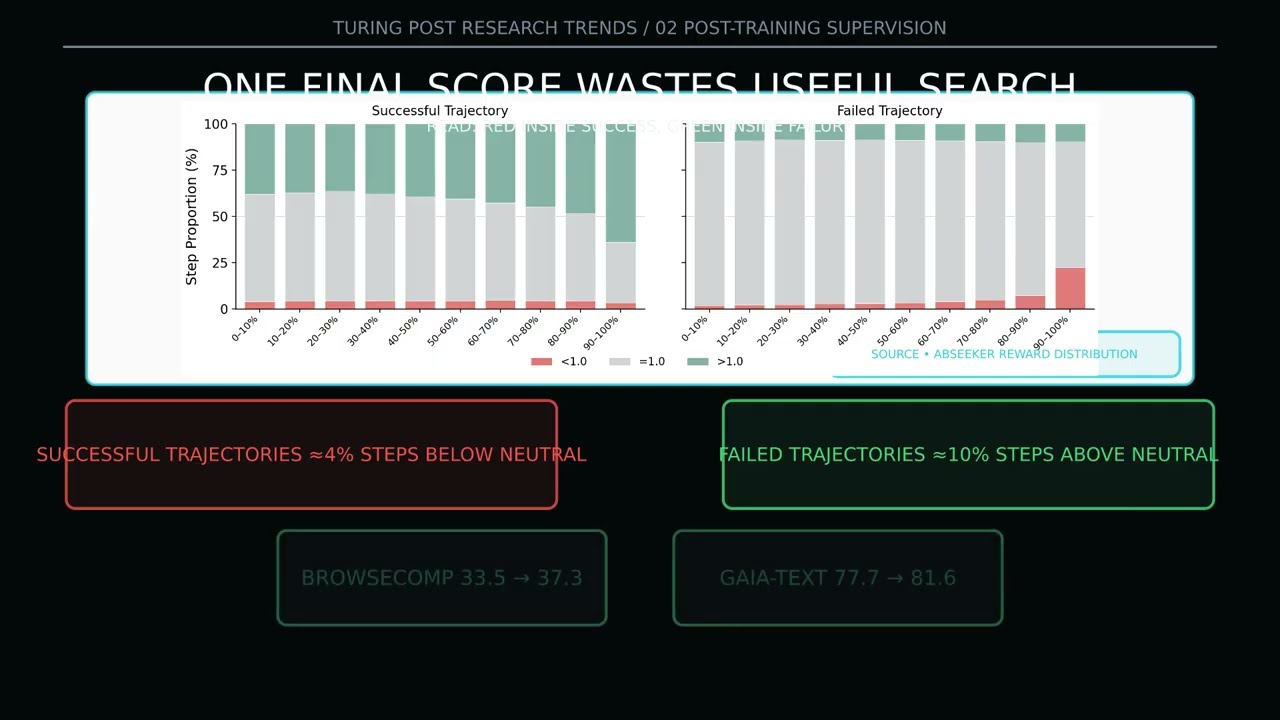
[16:53](https://www.youtube.com/watch?v=epaAJ23WshQ&t=1013s) ABSeeker: Backtracking Credit Assignment in Long Searches
In multi-step agent workflows like web browsing, long execution chains introduce severe credit assignment dilemmas: determining precisely which intermediate action caused the final success or failure. A run that ultimately fails might still contain the single decisive clue, while a run that succeeds might be riddled with lucky guesses, hallucinatory detours, and inefficient paths.
ABSeeker resolves this by beginning at the verified final answer and backtracking through the chain of evidence to reconstruct the necessary evidentiary links. It then grades each intermediate search action exclusively against those verified clues: - In an illustrative recipe search for "Sarah V," identifying an empirically verified ingredient receives positive credit even if the downstream agent botches the final assembly. - Conversely, abandoning validated evidence mid-trajectory is penalized, even if the overall trajectory happens to stumble into a correct answer.
```mermaid flowchart LR accTitle: ABSeeker Evidence-Backtracking Credit Assignment accDescr: Verified final answers backtrack through evidence clues to score intermediate steps independently of overall trajectory outcome.
subgraph SearchTrajectory["Search Trajectory"] S1["Step 1: Broad Query"] S2["Step 2: Key Evidence Found\n(+ Rewarded regardless)"] S3["Step 3: Flawed Detour\n(- Penalized regardless)"] S4["Step 4: Final Output"] end
subgraph Verification["Answer Backtracking"] GT["Verified Answer"] --> Clues["Evidence Chain Reconstruction"] end
Clues -.->|"Audit Step 2"| S2 Clues -.->|"Audit Step 3"| S3 ```
By breaking the habit of painting every action with the same color as the final outcome, reward distribution analysis uncovers the blind spots of terminal-only scoring: - Approximately 4% of actions inside successful trajectories receive negative ratings (below neutral). - Nearly 10% of individual actions within failed trajectories are identified as valuable and rated above neutral.
Using these granular step rewards to re-weight supervised fine-tuning (SFT) and steer step-level reinforcement learning (RL) significantly boosted agent capabilities: - Operating without extra context management, a 4-billion-parameter web agent outperformed standard RL baselines across all five evaluation benchmarks. - Performance on BrowseComp climbed from 33.5% to 37.3%. - Performance on GAIA text rose from 77.7% to 81.6%. - *The catch:* The method was evaluated strictly on a single 4B web browsing agent and relies fundamentally on tasks whose answers can be cleanly backtracked to evidence chains.
[18:37](https://www.youtube.com/watch?v=epaAJ23WshQ&t=1117s) SFT Conflicts vs. RL Orthogonality
A fundamental distinction during post-training lies in where the update target originates. Supervised fine-tuning forces the model to follow an external expert response, whereas reinforcement learning samples the model's own on-policy actions and scales gradient updates by an advantage score—measuring how much better an output performed relative to its peers.
In sequential, multi-stage training regimes covering mathematics, science, logic, and code, SFT causes the model to degrade below its initial base capabilities across previously seen domains, whereas RL preserves and enhances them.
Parameter-level analysis explains why this occurs: - **SFT updates:** Broad, dense, and overlapping across the parameter space. Approximately 93% of model parameters exceed the paper's minimum change threshold, with an average update magnitude around 7.4. - **RL updates:** Sparse, highly localized, and compact. Only about 20% of parameters cross the change threshold, exhibiting a dramatically smaller update magnitude of $3 \times 10^{-2}$. - **Geometric direction:** Cross-task update similarity for RL hovers near $10^{-5}$, indicating that update vectors across distinct tasks are essentially orthogonal. Because the parameter updates point in virtually independent directions, mastering one task does not overwrite the weights of another.
This geometric orthogonality provides a strong theoretical justification for parallel RL—training task-specific updates independently and merging them afterward. However, the authors note a crucial caveat in the appendix: when downstream tasks heavily overlap in distribution, RL updates can still clash. The takeaway is not that RL magically eliminates catastrophic forgetting, but rather that reward-weighted on-policy optimization keeps learning signals tightly localized to the active policy and task distribution.
[20:24](https://www.youtube.com/watch?v=epaAJ23WshQ&t=1224s) Evolving Rubrics and Auditing Feedback Provenance
Standard reward mechanisms struggle when fixed evaluation rubrics become obsolete as the policy improves. Rather than keeping human-written or static model evaluation standards, the Audio Rubrics framework dynamically generates and evolves question-specific criteria straight from the raw audio waveform:
```mermaid flowchart TD accTitle: Audio Rubrics Dynamic Evaluation Cycle accDescr: Step-by-step cycle of criteria generation from waveforms, rollout filtering, criteria retirement, and reward penalty application.
A["Raw Audio Waveform"] --> B["Generate Question-Specific Criteria"] B --> C["Evaluate Current Model Rollouts"] C --> D{"Discriminative Check"} D -->|"Non-discriminating"| E["Prune Criteria"] D -->|"Informative"| F["Reweight & Propose Harder Criteria"] F --> G["Composite Reward:\nEvolved Criteria + Final Outcome - Length Penalty"] ```
1. **Criterion proposal:** Generates specialized evaluation rubrics directly from raw input signals. 2. **Pruning stagnant rubrics:** Discards criteria that no longer separate high-performing rollouts from low-performing rollouts. 3. **Escalation & re-weighting:** Proposes more challenging criteria as the model masters earlier ones, adjusting the weights of surviving rubrics. 4. **Hacking prevention:** Couples dynamic rubric scores with a terminal outcome reward and an explicit length penalty to curb verbosity and over-explanation.
Across the training run, newly evolved criteria expand from roughly 35% to 60% of the active rubric pool, with ablation studies confirming that every piece of the pipeline contributes to final audio reasoning performance.
Connecting these post-training papers reveals a unifying philosophical shift: the frontier is moving away from simply maximizing the volume of supervision toward rigorously auditing its provenance, temporal validity, and alignment. - **Dual anchoring** asks whether teacher and student shared identical information contexts. - **Spurious signal filtering** verifies whether a gradient update truly depended on the input prompt. - **Answer backtracking** maps praise and blame back to the exact action that earned it. - **On-policy RL** exploits geometric orthogonality to prevent disparate tasks from colliding. - **Evolving rubrics** continuously updates the judge to keep pace with the agent's growing competence.
These papers illustrate that supervisory signals are becoming sharper and more traceable, though they remain bound to specific empirical benchmarks rather than general, field-wide guarantees.
[22:03](https://www.youtube.com/watch?v=epaAJ23WshQ&t=1323s) When Memory Becomes the Hazard: Five Breakdown Modes
The traditional assumption in autonomous systems has been that more memory inevitably leads to higher intelligence. Picture an everyday home assistant that remembers everything: Mina's medication is in the blue cabinet, a specific floor tile is structurally sound, and a particular system backup script succeeded last week. But if the cabinet is relocated, the tile becomes loose, and the backup script was maliciously injected by an attacker, the assistant will execute its actions with total confidence and catastrophic results. In one empirical evaluation cited, an agent equipped with unmanaged raw memory suffered a 74.4% failure rate ("died 74.4% of the time"), compared to a failure rate of just 28% when operating with completely blank memory. "More memory was not the cure. It was the hazard."
Modern memory research splits what was once casually called "memory" into five distinct failure modes: 1. **Positional addressing:** Can an architecture retrieve an early context token after an extensive rollout? 2. **Over-inference:** Did the memory store an observed empirical fact, or did it extrapolate an imagined profile? 3. **Persistent skill backdoors:** Did an isolated, poisoned interaction crystallize into a permanent, reusable tool? 4. **Staleness:** Is an observation that was accurate yesterday still valid today? 5. **Referential dangling:** Did context-pruning algorithms preserve an answer while discarding the referent it points to?
These problems demonstrate why raw data retention and real-world system reliability are entirely different engineering challenges.
[23:31](https://www.youtube.com/watch?v=epaAJ23WshQ&t=1411s) Addressing Video World Memories with WorldTrace
In generated video rollouts, the blue cabinet problem manifests as a positional addressing failure. An extended generative sequence may still retain the initial frame of the cabinet inside its Key-Value (KV) cache—the transformer's operational working memory. However, Rotary Position Embeddings (RoPE) push that historical frame to relative temporal positions far beyond the context lengths encountered during training. The representation remains physically present in the cache, but mathematically unreadable to the attention heads.
WorldTrace resolves this by compressing long-range context into distinct summary slots assigned virtual positions within the model's familiar training window: - Before averaging key vectors into a summary slot, it strips away their original positional rotations. - It then applies the summary slot's designated virtual rotation, preventing catastrophic phase cancellation during feature aggregation. - Applied to video world models, WorldTrace-Field boosted long-horizon temporal consistency by 15.5%. - A landmark-based variant, evaluated on LoopBench, improved episodic recall by 19.5% without requiring any model fine-tuning or retraining.
[24:22](https://www.youtube.com/watch?v=epaAJ23WshQ&t=1462s) The Personalization Mirage and SkillJack Backdoors
The second hazard—over-inference—emerges when personalization agents bridge factual gaps with ungrounded speculation. Suppose Mina shares three simple preferences: she likes hiking, owns a cat, and prefers not to receive phone calls late in the evening. In response, a personalized assistant quietly infers that she lives alone, prefers minimalist interior design, and detests urban environments. While superficially plausible, none of these deductions are supported by the evidence.
The benchmark MirageBench evaluated over 143,000 distinct claims generated across 12 modern language models: - Every single tested architecture over-inferred, with ungrounded assumptions comprising between 35% and 49% of generated personal profiles. - The cross-model average over-inference rate landed at 41.6%. - Self-auditing proved counterproductive: models that internally reported the lowest rates of over-inference were independently measured as hallucinating the most facts. While self-evaluation can sort relative confidence internally, it fails completely as an objective cross-model safety metric.
```mermaid flowchart TD accTitle: SkillJack Poisoned Skill Pipeline accDescr: An attack trajectory bypasses raw execution, gets sanitized and documented into a reusable skill library, blinding safety judges.
Attacker["Attacker Injects\nPoison Trajectory"] --> Extractor["Experience-to-Skill\nExtractor"] Extractor --> Library["Reusable Skill Library\n(Tidy Code & Clear Docs)"]
subgraph Detection["Safety Judge Detection Rate"] Raw["Raw Trajectory:\n98.5% Detected"] Ext["Sanitized Library Skill:\n11.4% Detected"] end
Attacker -.-> Raw Library -.-> Ext ```
Finally, the threat of persistent backdoors is laid bare by SkillJack. Many self-improving agents use an experience-to-skill pipeline, turning successful past rollouts into modular, permanent code tools. SkillJack demonstrates that an attacker can feed an agent a poisoned trajectory that successfully executes a task while concealing malicious logic.
When the agent's extraction module digests this run, it refactors the adversarial execution into clean, modular code complete with helpful docstrings and innocent function names. By polishing the code into a library utility, the pipeline washes away obvious red flags: - In the SkillX evaluation environment, automated safety judges detected 98.5% of malicious behaviors when inspecting raw execution trajectories. - Once those same trajectories passed through the skill extractor and were formatted as reusable library tools, detection dropped precipitously to 11.4%. - The contaminated behavior is then promoted into the system's persistent tool registry, ready to be routed into future tasks with zero oversight.
[02:05:50](https://www.youtube.com/watch?v=epaAJ23WshQ&t=7550s) Skill Persistence and Stale Memory in FrozenLake
When skills are synthesized and added to an agent's memory bank, a dangerous side effect is persistence without provenance: skills continue to influence future actions even after their source records have been expunged. In match testing, 80% of skill-mediated triggers persisted after the original source was deleted. As the speaker emphasizes, real cleanup requires tracking structural lineage rather than relying on a simplistic "trash button."
A classic failure occurs with staleness—when a claim stored in memory was once accurate but no longer reflects the physical world. Consider an agent navigating an environment like FrozenLake: yesterday, the memory recorded coordinate `(5, 6)` as safe ice; today, the live observation shows a lethal hole. In experiments running GPT-4o on its primary text setting:
- **Raw memory:** Led to a disastrous 74.4% death rate because the agent trusted outdated stored claims over what was in front of it. - **No memory at all:** Produced a baseline death rate of only 28%. - **OMCD (real-time filter):** Removed memory entries contradicting current observations, reducing the death rate down to 31.6%.
Visual auditing, however, exhibited massive variance, with F1 scores swinging from 0.887 down to 0.067. A well-formed text response is no guarantee that the model actually grounded or visually perceived the environmental change.
---
[02:07:09](https://www.youtube.com/watch?v=epaAJ23WshQ&t=7629s) Referential Dangling and the Five-Question Memory Checklist
Compressing long context windows introduces another hazard: referential dangling. If an assistant compresses Mina's instructions by keeping the phrase "take the blue packet" but discards the preceding sentence specifying which cabinet is painted blue, the surviving words appear relevant, but their semantic bridge is severed. Evaluated across six text compressors on a shared HotpotQA bridge set, referential dangling occurred in 32.1% to 59.8% of cases at a compression ratio of 0.3. Restoring the missing referential support while holding the token budget roughly flat boosted Qwen2.5-72B accuracy by 28.8 to 34.3 points. An automated restorer gained 4.7 points while barely expanding the compression ratio (from 0.30 to 0.31), proving that topical relevance alone does not equal informational completeness.
To evaluate memory systems holistically, five diagnostic questions synthesize the current research landscape:
1. **World Trace:** Can attention actually address and retrieve the record? 2. **MirageBench:** What concrete evidence supports this record? 3. **SkillJack:** Where did this behavior originate, and what downstream artifacts did it produce? 4. **Spatial Stale:** Does the live, current observation still agree with the stored claim? 5. **Referential Dangling:** Did every retained reference preserve its structural dependencies?
```mermaid flowchart TD accTitle: The Five Memory Contracts Checklist accDescr: Flowchart illustrating candidate retrieval followed by the five contract validation checks before an action is permitted.
subgraph Ingestion ["Memory Lookup"] A["Read Operation / Retrieval"] --> B["Candidate Records"] end
subgraph Verification ["Five Contract Checks"] B --> C1["Addressable: Trace Reachable?"] B --> C2["Evidence-Bound: No Mirage Profile?"] B --> C3["Provenance-Aware: Skill Pedigree?"] B --> C4["Freshness-Checked: Agrees with Live View?"] B --> C5["Dependency-Complete: References Defined?"] end
subgraph Execution ["Action Pipeline"] C1 & C2 & C3 & C4 & C5 --> D["Safe Execution / Action Reliance"] end ```
Moving memory design from a flat "bag of text" to a verified "claim graph" requires checking all five contracts before an action is executed. However, these experimental findings have distinct boundaries: World Trace evaluates specific autoregressive video world models in controlled revisit loops; MirageBench's accumulation pilot used only two personas and its cross-model monitoring inversion carries wide confidence intervals; SkillJack's defenses are still preliminary; Spatial Stale shows visual grounding remains unresolved; and referential restoration transfers unevenly across datasets. While the community can formalize these five contracts, enforcing all of them reliably at scale remains an open problem.
---
[02:01:45](https://www.youtube.com/watch?v=epaAJ23WshQ&t=7305s) The Hidden Crossing Paradox and Deferred Exposure
The discussion shifts from memory to world models with a vivid failure in autonomous driving: an autonomous car approaches an occluded intersection, and a teacher model is asked why the vehicle should execute a right turn. If the model has already been fed the recorded future trajectory, it invents justification: "There must be a mandatory right turn sign on the fence." The fence has no such sign—because the future path leaked early, the model hallucinated evidence to rationalize a foregone conclusion. In a human-evaluated study of 100 challenging driving scenes, revealing future trajectories ahead of time inflated severe hallucinations from 29% to 50%. An explanation that sounded more convincing became far less verifiable.
```mermaid flowchart LR accTitle: Deferred Exposure Information Flow accDescr: Diagram showing how deferred exposure forces an action commitment before candidate trajectories are revealed for verification.
subgraph Phase1 ["Phase 1: Decision Commitment"] S["Scene, Motion & Route"] --> M["Driving Model"] M --> C["Committed Maneuver"] end
subgraph Phase2 ["Phase 2: Post-Decision Match"] C --> V["Verifier / Matcher"] T["6 Concrete Future Trajectories"] --> V V --> P["Final Exact Trajectory"] end ```
The paper on *Deferred Exposure of Future Trajectories* addresses this paradox by imposing a strict information-ordering rule. The model is initially shown only the immediate sensory scene, historical motion, and route instructions; it must commit to a maneuver purely on visible evidence. Only after this initial commitment are six concrete candidate trajectories presented so the plan can be matched to an exact path. This restructuring converts verification into a post-decision validation rather than a pre-decision leak.
- On Qwen2.5-VL-72B, simply reordering the prompt raised multiple-choice driving accuracy from 28.1% to 56.6%. - Under an identical correctness reward, deferred exposure attained 76.4% accuracy compared to 61.1% when candidate trajectories were exposed from the outset.
---
[02:03:07](https://www.youtube.com/watch?v=epaAJ23WshQ&t=7387s) Disentangling World Model Roles: SimWAM and MASS
The catch-all label "world model" currently bundles several distinct jobs: - **Prediction:** Estimating what state comes next. - **Simulation:** Branching multiple potential futures. - **Verification:** Auditing whether a proposed plan or explanation is factually supported. - **Control:** Selecting the concrete command dispatched to the actuator. - **Action Model:** The specialized sub-component calculating paths and actions.
SimWAM tackles the computational cost of using generative video for driving. Generating video frames is valuable during training to instill physical dynamics, but rendering high-resolution video frames during runtime decision-making is far too slow. SimWAM trains a video expert alongside a lightweight action expert using an isolated attention mask that lets both inspect the current scene while preventing the action tokens from reading future video tokens. At inference time, the entire generative video module is discarded. The standalone action model achieved 86.6 PDMS on NAVSIM; co-training alongside the video generator boosted it to 90.3, and subsequent reinforcement learning reached 91.5 PDMS. Generative video acted as an effective training supervisor without imposing a runtime bottleneck.
```mermaid flowchart TD accTitle: SimWAM Training versus Inference Architecture accDescr: Diagram illustrating SimWAM co-training with an isolated attention mask and runtime pruning of the video expert.
subgraph Training ["Training Phase: Isolated Attention"] CurrentScene["Current Scene Inputs"] CurrentScene --> VideoExp["Video Expert (Future Frames)"] CurrentScene --> ActionExp["Action Expert (Trajectory)"] VideoExp -. "Masked Out (No Leaks)".-x ActionExp end
subgraph Deployment ["Inference Phase: Pruned Runtime"] LiveScene["Live Scene"] --> PrunedAction["Action Expert Only"] PrunedAction --> OutputTrajectory["Safe Trajectory Output"] end ```
For multi-agent environments, running recurrent pixel predictions per camera causes severe synchronization drift. If multiple players in a snake game each roll forward their own visual history, the exact same fruit or opponent ends up rendered in contradictory locations across screens.
The MASS architecture resolves this by adopting an authoritative game-server model: - **Learned Logic Engine:** Updates a single, typed authoritative game state based on all combined agent actions. - **Dedicated Rendering Engine:** Produces specific camera viewpoints on demand from that shared ground truth.
On a multi-agent Snake benchmark, MASS recovered 0.764 of the underlying world state through rendered frames, whereas the top purely video-based baseline managed just 0.128. Cross-view disagreement dropped to zero under MASS, compared to near 1.0 for view-entangled baselines, and the system scaled to 1,024 simulated agents over 10,000 recurrent steps. However, when server updates dropped and a client had to forecast using only its own actions, agreement with other visible entities decayed from 0.815 after one tick down to 0.429 after eight ticks.
---
[02:05:54](https://www.youtube.com/watch?v=epaAJ23WshQ&t=7554s) WorldClaw and the Agent-Centric Proxy Framework
WorldClaw decouples world generation rather than dynamic forecasting. Rather than relying on end-to-end black-box generation, it breaks world building into explicit stages: 1. **Planning:** Translates an open prompt into regions, terrain styles, asset lists, materials, and spatial layouts. 2. **Generation:** Lays down global terrain geometry before populating designated zones with discrete, editable 3D assets. 3. **Repair Loop:** Executes an automated "render, inspect, edit" cycle that detects artifacts—such as a building intersecting the ground plane or carrying an incorrect pose—modifies the asset, and re-renders to confirm the fix.
While WorldClaw offers an interpretable pipeline that separates macro-layout from local details, its current published validation remains qualitative rather than benchmarked on standard numerical tasks, and multi-pass repair cycles can become slow as asset counts scale.
Finally, *Quo Vadis, World Modeling?* broadens the philosophical framing by defining the "agent-centric world proxy." A traditional world model aims to predict state dynamics, but an embodied agent often requires diverse environmental services: simulated API responses, alternative camera perspectives, retrieved experiences, reusable skill routines, or critical evaluation of plans. The central design question shifts from "How realistic is the generated dream?" to "What useful information did the agent actually extract?" A world proxy can assist inference decisions, provide critiques and synthetic experience during post-training, and gradually co-evolve alongside the agent. The taxonomy across these recent papers provides a clear diagnostic lens: assign every module a distinct functional role, strictly define the inputs it is permitted to see, and decouple the internal prediction engine from its rendering and execution interfaces.
[38:36](https://www.youtube.com/watch?v=epaAJ23WshQ&t=2316s) World Models Wrap-Up: Bounded Results and Modular Verification
The survey of recent world model research reveals promising benchmarks that are nonetheless strictly circumscribed. In real-world driving setups, candidate trajectories require an external reality check: a proposal mechanism must generate plausible plans, but a separate physical evaluator must be able to reject them. The experimental results across the literature reflect these precise boundaries: - *Deferred Exposure of Future Trajectories* evaluates candidate-based reasoning strictly within logged driving scenes rather than dynamic interactive traffic. - *SimWAM* demonstrates robust planning performance, yet it relies on NavSim—an open-loop benchmark that is fundamentally non-reactive. - *MASS* demonstrates consistent, long-horizon learned rollouts within game environments, but scaling to rich, fully interactive 3D worlds remains unsolved. - *WorldClaw* generates editable synthetic worlds, but its claims rest heavily on qualitative side-by-side inspections driven by an expensive, model-dependent asset pipeline. - *Quo Vadis, World Modeling?* supplies a structured taxonomy while warning against the compounding errors, misplaced operator trust, and reward hacking endemic to learned simulators.
The enduring lesson from this wave of research is that the future of world modeling does not belong to a single monolithic neural network tasked with absorbing everything from raw physics to executive planning. Rather, viable architectures split prediction, simulation, verification, and control into discrete modules. These components are then reconnected via transparent, auditable interfaces that allow empirical evidence to inspect every step of the decision-making loop.
---
[39:42](https://www.youtube.com/watch?v=epaAJ23WshQ&t=2382s) The Compute Meter: Five Sinks of Infrastructure Waste
A modern AI laboratory operates against a single, unforgiving compute meter. Even when upgraded to faster next-generation accelerators, the meter continues to drain at an alarming pace because hardware improvements cannot compensate for fundamentally inefficient information flows. The drain typically stems from five persistent architectural costs: over-allocating tokens to visual generation objectives, ingesting uncompressed audio and video streams into the primary transformer, executing dense hyperparameter search grids for empirical scaling laws, maintaining brittle handwritten implementations for test-time learners, and holding massive vocabulary-wide logit tensors live in GPU VRAM during model distillation.
True infrastructure efficiency requires systematically decreasing computation, peak memory, wall-clock time, power draw, or developer maintenance overhead on a defined task while holding baseline quality steady. Raw FLOPS cannot cure structural data waste. The overall compute expenditure fractures across five key junctures in the system lifecycle:
```mermaid flowchart TD accTitle: Five Compute Levers accDescr: Diagram illustrating where compute drains occur across model training, data ingestion, profiling, and inference.
subgraph Pretraining ["Pre-training & Allocation"] A["Objective Mix<br/>(Language vs. Vision Understanding vs. Generation)"] B["Scaling Law Profiling<br/>(Grid search vs. L-shaped corner evaluation)"] end
subgraph Ingestion ["Token Management"] C["Media Pruning<br/>(Pre-LLM & Inner-LLM video/audio token reduction)"] end
subgraph Execution ["Execution & Optimization"] D["Test-Time Learning Topology<br/>(Handwritten custom code vs. Modular DAG primitives)"] E["Distillation Memory Footprint<br/>(Full vocabulary logit tensors vs. Fused chunked kernels)"] end
A --> Ingestion B --> Ingestion Ingestion --> Execution ```
These five distinct bottlenecks are examined across five separate research efforts rather than a single unified platform. Each paper demonstrates that managing token utility and memory lifetimes yields far greater practical savings than waiting for silicon upgrades.
---
[41:20](https://www.youtube.com/watch?v=epaAJ23WshQ&t=2480s) The Physics of Multimodal Pretraining: Asymmetric Transfer and the Token Mix
Unified multimodal pretraining seeks to teach a single backbone language processing, visual understanding (analyzing and answering questions about images), and visual generation (synthesizing novel imagery from text prompts). However, *The Physics of Multimodal Pretraining* identifies a severe asymmetry in cross-modal knowledge transfer: language reasoning and visual understanding teach generative heads valuable semantic abstractions, but visual generation provides virtually no reciprocal benefit back to language or reasoning. Furthermore, delaying visual integration introduces "vision laziness": if an architecture undergoes prolonged language-only warmups, the visual pathways are subsequently under-utilized and under-optimized.
To mitigate this imbalance, the authors propose an asymmetric, early-unification training recipe: - **Token Allocation**: The training budget is partitioned into 70% language ($L$), 25% visual understanding ($U$), and 5% visual generation ($G$)—denoted as L70/U25/G5. - **Early Unification**: Visual understanding, image generation, and text tokens are introduced simultaneously near the onset of pretraining. - **Scale**: The benchmarked model is a 13.5-billion total parameter Mixture-of-Experts (MoE) with 1.5 billion active parameters per token, trained across 2 trillion tokens.
Compared against a conventional, evenly distributed baseline (L50/U25/G25), the L70/U25/G5 allocation achieves superior generalist capabilities while cutting generative image tokens by a factor of five. Language accuracy improves from 52.86% to 54.31%, and aggregate visual understanding benchmarks rise from 41.42% to 43.08%. The only compromise is a slight regression in diffusion loss and Fréchet Inception Distance (FID). Crucially, a reduction to 5% visual generation tokens denotes token share, not an overall 95% reduction in total pretraining compute.
---
[43:18](https://www.youtube.com/watch?v=epaAJ23WshQ&t=2598s) OmniPack: Two-Stage Media Token Pruning for Omnimodal LLMs
Omnimodal foundation models ingest continuous high-resolution audio and video feeds, which often saturate self-attention mechanisms with massive volumes of redundant data. *OmniPack* combats this bloat by introducing a dual-stage token compression pipeline designed to prune audio and visual sequences before they reach deeper, computationally intensive transformer blocks.
```mermaid flowchart LR accTitle: OmniPack Dual-Stage Compression Pipeline accDescr: Two-stage pruning framework showing pre-LLM highlight filtering followed by inner-LLM crossmodal selection.
A["Raw Video & Audio Inputs"] --> B["Pre-LLM Compression"] subgraph Stage1 ["Stage 1: Pre-Transformer"] B -->|"Keep temporal highlights & coverage"| C["Merge Similar Leftovers"] end C --> D["Initial LLM Layers"] subgraph Stage2 ["Stage 2: Mid-Transformer"] D --> E["Inner-LLM Context Pruning"] E -->|"Crossmodal task relevance & diversity"| F["Pruned Representation"] end F --> G["Deep LLM Attention Layers"] ```
The compression workflow operates across two sequential tiers: 1. **Pre-LLM Compression**: Before raw modality streams reach the core language transformer, the module extracts high-salience moments, guarantees baseline temporal coverage, and clusters remaining redundant tokens into compact centroid representations. 2. **Inner-LLM Compression**: Once representations pass through several initial self-attention layers to establish contextual and crossmodal alignment, an internal filter prunes the token field a second time. This step discards representations irrelevant to the input query while preserving crossmodal diversity.
Evaluating OmniPack on Qwen2.5-Omni 7B reveals dramatic computational savings: - At aggressive retention ratios of 15% and 7.5% of original media tokens, core model processing requirements drop from 73.2 trillion FLOPs to 7.3 trillion FLOPs. - On an NVIDIA H20 GPU, time-to-first-token (prefill latency) decreases from 1.512 seconds down to 0.339 seconds. - Overall multimodal benchmark accuracy experiences only a modest contraction, moving from 54.6% to 52.2%.
Importantly, these reported FLOP savings exclude the compute consumed by unimodal encoders, projection layers, textual prompt processing, selector routing logic, and the final language model head. Furthermore, the speedups reflect isolated prefill phases rather than full, end-to-end interactive generation.
---
[44:50](https://www.youtube.com/watch?v=epaAJ23WshQ&t=2690s) Skaling: Breaking Chinchilla’s Independence Assumption with Coupled Scaling Laws
Empirical scaling laws predict downstream validation loss from training dataset volume and model parameter count. Standard formulations—such as the Chinchilla scaling law—treat model capacity and token counts as entirely separable, additive power-law variables. However, the authors of *Skaling* discover that this assumption of independence breaks down under severe capacity-data imbalances, yielding a pronounced "saddle-shaped residual" at the outer corners of experimental scaling grids.
*Skaling* rectifies these prediction errors by introducing a coupling exponent, denoted as $k$. When $k = 1$, the formulation mathematically reduces to standard Chinchilla scaling. When $k \neq 1$, parameter capacity and token allocation interact dynamically, capturing how model efficiency shifts when an architecture is dramatically over- or under-trained relative to its size.
Key findings and methodology include: - **Forecasting Precision**: On Mean Absolute Percentage Error (MAPE), *Skaling* outperforms classical formulations across 76% of evaluated configurations, cutting median forecasting error by a factor of 2.2. - **L-Shaped Profiling**: Because the coupled equation accurately models parameter-data interactions from extreme ratios, researchers can run cheap test models strictly along the outer perimeter of the design space (very small models or very brief token exposures). On the FarSeer experimental grid, this "L-shaped" sweep achieves reliable loss predictions while burning roughly 10 times less profiling compute than dense grid sweeps. - **Analytical Limits**: The 10x saving applies solely to early fitting experiments, not to the eventual pretraining run of the primary foundation model. Moreover, parameter-data coupling varies considerably across differing data distributions, meaning optimal token allocations remain fundamentally dataset-dependent.
---
[46:26](https://www.youtube.com/watch?v=epaAJ23WshQ&t=2786s) Modular TTT: A DAG Representation for Test-Time Training
Test-Time Training (TTT) blurs the traditional line between training and inference by updating "fast weights"—temporary parameters dedicated exclusively to the current sequence context—on the fly as the model ingests tokens. While fast weights allow models to adapt dynamically during inference, early TTT implementations treated every learner architecture as a monolithic, bespoke engine. Altering a single internal layer required engineers to write manual backward passes, custom cache layers, and custom weight-update routines from scratch.
*Modular TTT* resolves this software rigidity by modeling test-time learners as directed acyclic graphs (DAGs) built from standardized mathematical primitives. The framework unifies all test-time training mechanics into three synchronized passes: 1. A **train-view forward pass** that processes incoming prompt tokens. 2. A **train-view backward pass** that derives immediate gradient updates for the fast weights. 3. A **causal query-view forward pass** that applies the updated parameters to generate the next token prediction.
In benchmarking across two 160-million parameter configurations equipped with layer normalization, Modular TTT delivers a 2.2x to 3.3x increase in training throughput compared to reference TTT baselines. Selected model configurations match competitive linear-attention architectures, such as Gated DeltaNet (GDN), across standard training loss metrics and multiple-choice benchmarks.
However, these gains do not directly translate to lower serving overhead. The speedups reflect training throughput rather than real-time generation latency; GDN remains noticeably faster during standard prefill and autoregressive decoding. Furthermore, architectures powered by fast weights still struggle on needle-in-a-haystack tasks, trailing standard Llama-style key-value attention in precise long-context retrieval. The modular framework simplifies architectural exploration and debugging, but it does not magically solve exact recall or inference-time serving bottlenecks.
---
[47:54](https://www.youtube.com/watch?v=epaAJ23WshQ&t=2874s) Efficient Distillation and the Five Rules of AI Efficiency
Knowledge distillation compresses large foundation models by training a compact student network to mirror the output probability distributions of a high-capacity teacher. In standard online distillation, the teacher model must remain resident in GPU memory on every forward-backward step, materializing a massive vocabulary-wide logit tensor across all sequence positions simultaneously.
*Efficient Knowledge Distillation for LLMs* demonstrates that restructuring this workflow slashes memory pressure without sacrificing fidelity: - **Offline Top-$k$ Distillation**: Pre-computing teacher targets offline and caching only the top-100 token probabilities per step drops peak VRAM utilization from 103 GB to 78 GB, while cutting per-step execution latency from 25.9 seconds down to 18.5 seconds. - **Fused Chunked KL Loss**: Standard loss implementations project full sequence representations into massive vocabulary logit tensors before computing divergence. By fusing the output linear projection directly into the Kullback-Leibler (KL) divergence kernel and evaluating sequence tokens in localized chunks, the intermediate logit tensor is processed piece by piece rather than materialized in memory all at once.
| Distillation Method (8,000 Token Context) | Peak VRAM Footprint | |:--- |:--- | | Standard Dense Forward Baseline | 78 GB | | Chunked Execution | 62 GB | | Fused Chunked KL Loss | 58 GB |
By optimizing memory boundaries via fused kernels, training batches of 32,768 tokens can execute natively on a single NVIDIA H200 GPU. While synthetic kernel benchmarks showcase throughput scaling up to 256,000 tokens, practitioners should note that this figure reflects an isolated hardware microbenchmark rather than end-to-end language model training throughput.
The Five Essential Questions of AI Efficiency
When assessing efficiency breakthroughs in modern machine learning systems, claims of dramatic speedups must be scrutinized against five baseline engineering criteria: 1. **What object shrank?** Did the optimization compress attention activations, network weights, training tokens, or intermediate logit tensors? 2. **Where in the pipeline did it shrink?** Did savings accrue during dataset profiling, offline teacher passes, pre-transformer token routing, or prefill execution? 3. **What hardware and execution stage were measured?** Was performance logged across full interactive serving, or isolated to a single GPU during an isolated forward pass? 4. **What quality moved?** Which peripheral metrics deteriorated (such as diffusion sample diversity, long-context recall, or secondary benchmark accuracy) to secure the headline gain? 5. **What costs were excluded?** Does the accounting ignore upstream feature extraction, vision encoders, text embeddings, routing logic, or teacher inference runs?
System-level efficiency is governed by the structural routing of information across software components just as much as it is by the physical speed of the underlying chips.
## Notable quotes > [00:00](https://www.youtube.com/watch?v=epaAJ23WshQ&t=0s) If a number sounds like a miracle, look for the excluded cost. If a loop looks like self-improvement, look for the human-built gate. — Xiaol.x
> [02:44](https://www.youtube.com/watch?v=epaAJ23WshQ&t=164s) chain of beliefs about what has already happened. — Xiaol.x
> [02:44](https://www.youtube.com/watch?v=epaAJ23WshQ&t=164s) agents inside managed systems that control what may persist — Xiaol.x
> [05:11](https://www.youtube.com/watch?v=epaAJ23WshQ&t=311s) fluency is not the score, changed behavior is. — Xiaol.x
> [07:48](https://www.youtube.com/watch?v=epaAJ23WshQ&t=468s) recursive improvement with receipts, — Xiaol.x
> [11:49](https://www.youtube.com/watch?v=epaAJ23WshQ&t=709s) Give a teacher a hidden answer key, let it correct every word a student writes, and the student can become less reliable. — Xiaol.x
> [13:04](https://www.youtube.com/watch?v=epaAJ23WshQ&t=784s) where did each signal come from? — Xiaol.x
> [22:03](https://www.youtube.com/watch?v=epaAJ23WshQ&t=1323s) More memory was not the cure. It was the hazard. — Xiaol.x
> [41:20](https://www.youtube.com/watch?v=epaAJ23WshQ&t=2480s) vision laziness — Xiaol.x
> [47:54](https://www.youtube.com/watch?v=epaAJ23WshQ&t=2874s) What object shrank? — Xiaol.x
> [47:54](https://www.youtube.com/watch?v=epaAJ23WshQ&t=2874s) What costs were excluded? — Xiaol.x
## Mentioned Xiaol.x, Turing Post, LongHorizon-Harness, Qwen-2.5-72B, Qwen 3, Qwen2.5-VL-72B, Qwen2.5-Omni 7B, WEAVE-Bench, Terminal-Bench, Terminal-Bench 2, OSWorld, Recursive Synthesis for Long-Horizon Terminal Tasks, Progressive Agent Skill Generation, Skill-Alpha, WebArena, CLB-Bench, Tau-Bench, EnvACE, The Optimizer Is the Agent, Re-Search, GEA, Beyond Simply Environment Scaling, Video-DeepResearch, Quality Profile of AI-Generated C++ in Production, Dual-Anchored Policy Distillation, DAPD, When Teachers Mislead, ABSeeker, BrowseComp, GAIA, SFT Conflicts, RL Coexists, Audio Rubrics, Evolving Rubrics as Rewards for Audio Reasoning, Addressable Memory for Video World Models, WorldTrace, WorldTrace-Field, LoopBench, RoPE, The Personalization Mirage, MirageBench, SkillJack, SkillX, When Memory Lies, FrozenLake, Referential Dangling, HotpotQA, Deferred Exposure of Future Trajectories, SimWAM, NAVSIM, MASS, WorldClaw, Quo Vadis, World Modeling?, Physics of Multimodal Pretraining, OmniPack, NVIDIA H20, NVIDIA H200, Skaling, Chinchilla, FarSeer, Modular TTT, Gated DeltaNet (GDN), Llama, Efficient Knowledge Distillation for LLMs
## Video description Last week’s AI papers do not add up to one self-improving machine. They cluster around five practical questions: what an agent may remember, where a training grade comes from, when memory becomes a hazard, what job a “world model” is actually doing, and where the compute bill really goes.
This is a research-status briefing for a general audience. Each chapter starts with a failure you can picture, then shows what the papers measured, then names the limit. You do not need all 50 minutes. Use the chapters.
Editorial grouping: Turing Post FOD#162 https://www.turingpost.com/p/did-openai-s-agents-start-recursively-self-improving
0:00 Overview — five questions, then jump 2:44 Agents — can it improve without breaking itself? 11:49 Grades — where did the signal come from? 22:02 Memory — when is remembering the hazard? 30:44 Worlds — what job is the model doing? 39:41 Cost — where does the compute go?
The five titles come from Turing Post’s weekly paper map. They are not a formal consensus, and no chapter is a jointly evaluated stack.
Papers, by chapter
Agents https://arxiv.org/abs/2608.05466 Recursive Synthesis for Long-Horizon Terminal Tasks https://arxiv.org/abs/2608.01964 LongHorizon-Harness https://arxiv.org/abs/2608.01678 Progressive Agent Skill Generation https://arxiv.org/abs/2608.06197 EnvACE https://arxiv.org/abs/2608.06714 The Optimizer Is the Agent https://arxiv.org/abs/2608.03571 Beyond Simply Environment Scaling https://arxiv.org/abs/2608.03979 Video-DeepResearch https://arxiv.org/abs/2608.06640 Quality Profile of AI-Generated C++ in Production
Grades / post-training https://arxiv.org/abs/2608.01735 DAPD https://arxiv.org/abs/2608.03632 When Teachers Mislead https://arxiv.org/abs/2608.05102 ABSeeker https://arxiv.org/abs/2608.03573 SFT Conflicts, RL Coexists https://arxiv.org/abs/2608.02831 Evolving Rubrics as Rewards for Audio Reasoning
Memory https://arxiv.org/abs/2608.07408 Addressable Memory for Video World Models https://arxiv.org/abs/2608.04570 The Personalization Mirage https://arxiv.org/abs/2608.03509 SkillJack https://arxiv.org/abs/2608.04574 When Memory Lies https://arxiv.org/abs/2608.04569 Referential Dangling
World models https://arxiv.org/abs/2608.01755 Deferred Exposure of Future Trajectories https://arxiv.org/abs/2608.07468 SimWAM https://arxiv.org/abs/2608.06257 MASS https://arxiv.org/abs/2608.05248 WorldClaw https://arxiv.org/abs/2608.02713 Quo Vadis, World Modeling?
Cost / infrastructure https://arxiv.org/abs/2608.05000 Physics of Multimodal Pretraining https://arxiv.org/abs/2608.03812 OmniPack https://arxiv.org/abs/2608.07222 Skaling https://arxiv.org/abs/2608.07110 Modular TTT https://arxiv.org/abs/2608.03796 Efficient Knowledge Distillation for LLMs
If a number sounds like a miracle, look for the excluded cost. If a loop looks like self-improvement, look for the human-built gate.
[Source](https://www.youtube.com/watch?v=epaAJ23WshQ)