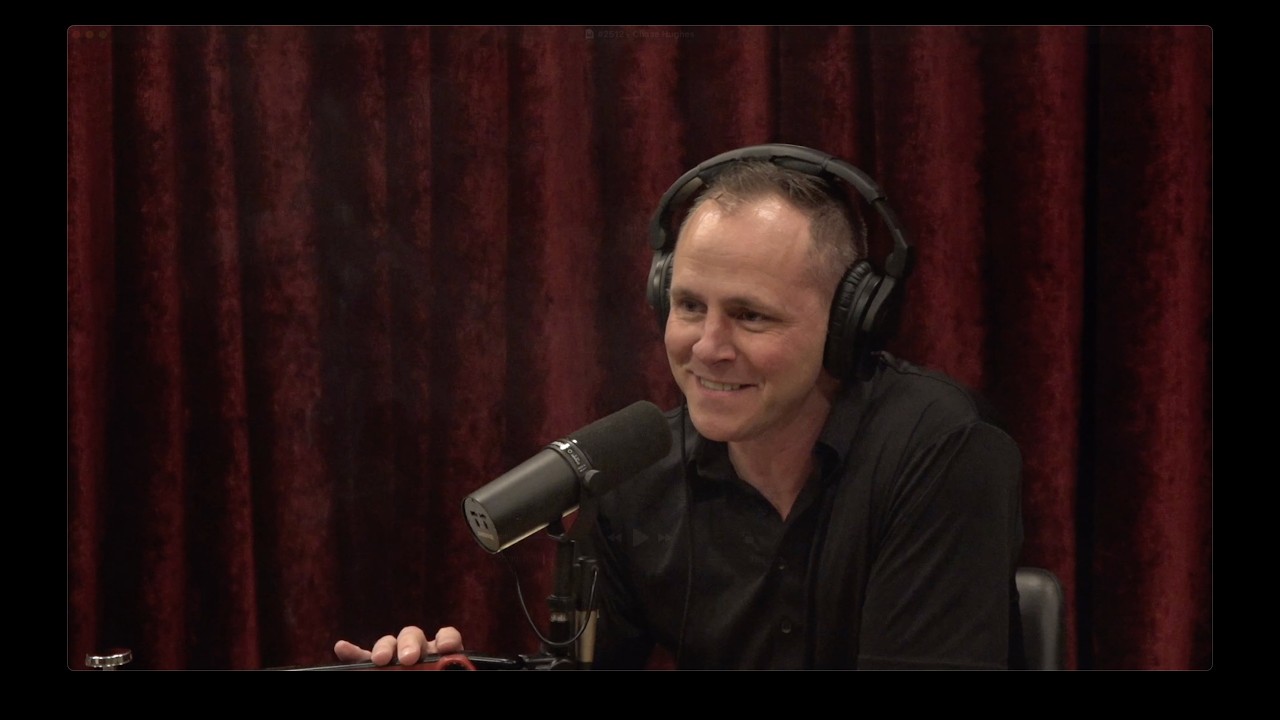
CHASE HUGHES EXPOSES GOVERNMENT PSYCHOPS, ALTERS CELLULAR COGNITION
PowerfulJRE
Psychedelic-induced ego dissolution serves as the ultimate behavioral disruptor to dismantle establishment-driven media narrative manipulation and systemic psychological operations.
## Background
Published on June 17, 2026, by the PowerfulJRE channel on YouTube, this episode of the Joe Rogan Experience features Chase Hughes, an expert in behavioral profiling, influence, and persuasion. The page description highlights Hughes as the creator of the Neuro-Cognitive Intelligence system, founder of the 'Station One' YouTube channel, and author of several behavioral manuals.
## TL;DR
In this extensive conversation, Chase Hughes recounts a profound 5.5-hour intravenous DMT experience, exploring its psychological impact, potential medical benefits for brain conditions, and architectural parallels in ancient history. The discussion bridges into sports with a recap of the historic all-knockout UFC event at the White House, before transitioning into a deep dive on societal issues like algorithmic polarization, the 'loneliness pandemic,' and modern psychological operations. Finally, Hughes breaks down behavioral counterintelligence tactics, including the CIA art of elicitation and the evolutionary mechanics of human memory and perspective.
## Atmosphere & style
The conversation carries an intense, mind-expanding, and deeply cerebral vibe, seamlessly blending esoteric psychedelic exploration with grounded military profiling tactics. Joe Rogan acts as an engaged, fascinated facilitator, matching Hughes's analytical yet awe-stricken delivery with his own signature skepticism and cultural commentary. The narrative arc moves from vulnerable, highly personal accounts of ego dissolution and medical vulnerability to a sharp, intellectually rigorous critique of mainstream media and institutional control. It ultimately feels like a thought-provoking, late-night masterclass that challenges the listener to question the boundaries of consciousness, human connection, and perceived reality.
## Key takeaways
- [00:01](https://www.youtube.com/watch?v=OVXli9YkY0o&t=1s) Chase Hughes recounts his 5.5-hour intravenous DMT breakthrough experience managed via a custom-engineered pump setup that allowed real-time dosage modifications.
- [00:21](https://www.youtube.com/watch?v=OVXli9YkY0o&t=21s) The difficulty of retaining memories from DMT trips is compared to a fading dream, prompting the guest to plan using Alzheimer's medication to bypass memory barriers in future sessions.
- [00:47](https://www.youtube.com/watch?v=OVXli9YkY0o&t=47s) The intense emotional crash following an ego dissolution experience is described as 'Avatar depression times a million,' stemming from the painful psychological return to regular reality.
- [00:52](https://www.youtube.com/watch?v=OVXli9YkY0o&t=52s) The guest details a profound 'psychic surgery' experience involving alien-like entities during his trip that uniquely mirrored his wife's private prayers regarding his mesial temporal sclerosis diagnosis.
- [12:00](https://www.youtube.com/watch?v=OVXli9YkY0o&t=720s) The striking visual resemblances found across nature, such as the cosmic web mirroring human neural tissue, suggest the universe may operate as an infinite fractal.
- [15:00](https://www.youtube.com/watch?v=OVXli9YkY0o&t=900s) Human language and rigid ideological systems are characterized as protective security blankets constructed out of a deep psychological terror of the vastness of existence.
- [18:30](https://www.youtube.com/watch?v=OVXli9YkY0o&t=1110s) Joe Rogan recaps a historic outdoor UFC event held on the White House lawn, marking it as the greatest night of fights in UFC history after every scheduled bout ended in a knockout.
- [33:25](https://www.youtube.com/watch?v=OVXli9YkY0o&t=2005s) A modern 'loneliness pandemic' and heightened social anxiety in youth are fueled by increasingly performative digital lives and the looming threat of online judgment by millions.
- [36:45](https://www.youtube.com/watch?v=OVXli9YkY0o&t=2205s) The inevitable convergence of humanity and AI through technologies like Neuralink is framed as an evolutionary transition toward a postbiological existence.
- [44:07](https://www.youtube.com/watch?v=OVXli9YkY0o&t=2647s) A major cultural shift toward validating therapeutic psychedelics is being championed by military veterans, elite operators, and conservative figures treating trauma and brain atrophy.
- [53:02](https://www.youtube.com/watch?v=OVXli9YkY0o&t=3182s) Rogan warns against 'spiritual narcissism' where individuals emerge from profound psychedelic ego dissolutions with an intact ego, seeking to exploit others as cult leaders or gurus.
- [01:04:46](https://www.youtube.com/watch?v=OVXli9YkY0o&t=3886s) Historical associations trace modern Christmas iconography, including Santa Claus and flying reindeer, back to Siberian shamanic traditions centered on the Amanita muscaria mushroom.
- [01:08:24](https://www.youtube.com/watch?v=OVXli9YkY0o&t=4104s) Mushrooms and specific fungi show profound therapeutic promise for reversing neurodegenerative conditions, supporting historical theories like Terence McKenna's 'stoned ape' hypothesis.
- [01:12:44](https://www.youtube.com/watch?v=OVXli9YkY0o&t=4364s) The guest details a hypnotic memory editing protocol utilizing a theta brainwave state around seven hertz to help clients reprocess past traumas through perspective shifting.
- [01:22:18](https://www.youtube.com/watch?v=OVXli9YkY0o&t=4938s) Methylene Blue is highlighted for its medical utility in treating cyanide poisoning and its ability to act as a light MAO inhibitor that deepens psychedelic experiences.
- [01:33:32](https://www.youtube.com/watch?v=OVXli9YkY0o&t=5612s) The guest outlines the operational layers of psychological operations (psyops), noting that the complete eradication of nuance and enforcement of binary dynamics are primary indicators of media manipulation.
- [01:41:19](https://www.youtube.com/watch?v=OVXli9YkY0o&t=6079s) Mainstream media coverage of COVID-19 treatments and the curation of public health narratives are described as massive psychological operations heavily influenced by pharmaceutical advertising revenue.
- [01:58:29](https://www.youtube.com/watch?v=OVXli9YkY0o&t=7109s) Establishment authorities utilize 'category warfare' and derogatory labels to leverage social punishment, tribal ostracization, and fear to enforce compliance.
- [02:20:30](https://www.youtube.com/watch?v=OVXli9YkY0o&t=8430s) The CIA technique of 'elicitation' relies on strategic statements, record-correction traps, and specific personas to extract sensitive information rather than asking direct questions.
- [02:27:00](https://www.youtube.com/watch?v=OVXli9YkY0o&t=8820s) Mastering the 'game of Earth' requires looking past mundane daily anxieties, shifting perspective through profound experiences, and studying the documented regrets of dying people.
## Detailed walkthrough
### [00:01](https://www.youtube.com/watch?v=OVXli9YkY0o&t=1s) The Intravenous DMT Breakthrough
The conversation opens with standard podcast intro banter as the guest mentions arriving in Austin the previous night. He immediately steers the topic toward Joe Rogan's online videos describing an intravenous DMT experience, calling it "one of the most insane descriptions of anything that anybody's ever experienced." The guest explains that the process utilizes a custom-engineered pump, similar to an anesthesia pump found in a hospital operating room, which allows administrators to precisely adjust the dosage in milliliters per hour.
The experience takes place in a carefully curated, peaceful environment where the user lies on a soft pillow in the center of a room with excellent music playing. The administrators are described as remarkably calm and good human beings who "hold the space really well." The defining characteristic of this pump setup is the ability to adjust the user's "altitude" in real-time. If the participant wants to go deeper or pull back, the dose is adjusted. This even allows for a temporary "pee break" where the user is brought down to the "runway" to use the restroom before immediately launching back up as high and fast as they desire.
- **Total Experience Duration:** 5.5 hours, with only one bathroom break taken.
- **Intensity:** Reaches the absolute highest thresholds of sensation and visual data possible on DMT, but sustained over hours rather than minutes.
[00:21](https://www.youtube.com/watch?v=OVXli9YkY0o&t=21s) Dreams, Memory Barriers, and the Visual Cortex
The guest reveals a radical plan for his next session: mixing Alzheimer's drugs with DMT. He explains that while inside the DMT space, users feel they have access to infinite information and desperately want to bring it back, but "it seems like we're protected from bringing it back." Rogan strongly agrees, comparing the phenomenon to a profound or bizarre dream that is crystal clear upon waking but completely slides through one's fingers after merely grabbing a cup of coffee. Rogan notes that if an experience that profound happened in a regular conscious state, it would be drilled into the brain forever—citing how he vividly remembers every detail of a UFC fight—yet the mind struggles to grip DMT memories.
The two debate how DMT is classified. The guest points out that he has never met anyone who has actually done DMT who dismisses it as a mere hallucination. Rogan counters by mentioning an academic paper he read by a serious scholar who had completed around 100 DMT trips and concluded the experience is entirely concocted by the brain's imagination and visual cortex. The guest humorously scoffs at this contrarian view, asking, "Why wouldn't you go to Walmart on a DMT trip then?" or a Target or 7-Eleven, noting that actual dreams comfortably conjure mundane commercial realities, whereas DMT takes you somewhere entirely unearthly.
- **Academic Counter-Theory:** A researcher completed roughly 100 trips to argue the brain's visual cortex generates the entire experience.
- **Brain Mechanics:** Reference made to a previous podcast guest, Andrew Gallimore, who discussed the "world-making part of our brain."
[00:47](https://www.youtube.com/watch?v=OVXli9YkY0o&t=47s) Ego Dissolution and "Avatar Depression"
Reflecting on his six-hour journey, the guest describes the absolute shattering of normal reality. The experience was so absolute that he caught himself on camera asking if he was dead 39 separate times, completely unconcerned with what the actual answer was. As the trip wound down, he found himself crying and bawling, overwhelmed by a deep sadness because he realized he had to "wrap myself in some kind of ego" just to return to regular waking reality. He confesses he simply did not want to come back.
Rogan perfectly validates this emotional crash, comparing it to "Avatar depression times a million." He explains that when the movie *Avatar* originally premiered, the fictional forest life of the characters seemed so righteous and peaceful that audiences experienced a genuine psychological condition, returning home severely depressed that they did not live in that world. The guest enthusiastically agrees with the comparison, noting how incredible it is for a piece of media to create a recognized psychological phenomenon where people reject reality.
- **The Truman Show Syndrome:** Rogan highlights a similar historical psychological phenomenon from the 1990s triggered by cinema.
- **On-Camera Metric:** The guest asked "Am I dead?" 39 times during his session.
[00:52](https://www.youtube.com/watch?v=OVXli9YkY0o&t=52s) The Psychic Surgery and Medical Miracles
The guest shares a profound, unexplainable story involving his wife, Michelle. The night before the session, the chemist allowed Michelle to choose the vial of DMT. While the guest was in another room, the chemist asked Michelle if she wanted to pray over the compound, which she did privately. The next day, without knowing his wife had prayed over the drug, the guest experienced a terrifying yet painless sequence immediately upon injection. Alien-like beings pinned him to a table and ripped him entirely open from his pelvis to his neck, allowing him to hear his internal organs shifting. Next, they pushed his head back and ran a massive drill bit up his nose to the back of his head for roughly 45 minutes in a state of freezing cold.
When he recounted this to Michelle afterward, she revealed that those were her exact prayer requests: she had asked the entities to fix his heart and his brain. The guest explicitly clarifies he is not claiming definitive causation, but notes that he sought out this alternative treatment specifically because he suffers from severe, documented health issues. When Rogan asks if he received follow-up imaging to check for physical changes, the guest explains he hasn't due to the extreme radiation associated with a PET scan, which requires 48 hours of total isolation from his wife and two-year-old child.
- **Guest's Brain Diagnosis:** Mesial temporal sclerosis.
- **The Methylene Blue Factor:** The guest notes that if he stops taking methylene blue for a couple of days, he quickly reverts into "seizure territory." He laughs about how companies have ripped clips of him discussing this from Rogan's show to make unauthorized commercials, a frustration Rogan shares regarding ads featuring his own likeness selling everything from coffee makers to erectile dysfunction pills.
[00:09](https://www.youtube.com/watch?v=OVXli9YkY0o&t=9s) The Illusory Nature of Distance and Consciousness
To explain the mechanics of reality, the guest walks Rogan through a thought experiment regarding a hypothetical dream. He posits that if they were hanging out in a dream and spotted a UFO flying saucer, the dreamer would instinctively perceive it as being about eight feet away and made of aluminum. However, under close scrutiny, there is no physical aluminum or actual eight-foot clearance inside the human brain. Ultimately, the dreamer must admit that the object, the zero-inch physical distance, the colors, the photons, and even the fabricated eyeballs used to see them are entirely made out of consciousness.
Rogan finds the logic deeply compelling, acknowledging that humans mistakenly assume the world is strictly defined by the biological senses and physical measurement tools we possess. The guest jokes about "dream logic," where riding a rhinoceros to a pizza factory feels completely normal while it's happening. He then bridges this to the ancient hermetic axiom "as above, so below," highlighting startling structural patterns found throughout nature.
- **Visual Synchronicities in Nature:**
- A galaxy matches the shape of DNA.
- The toroidal shape of gravitational fields mirrors a red blood cell.
- A close-up image of a human eyeball looks exactly like a nebula.
[00:12](https://www.youtube.com/watch?v=OVXli9YkY0o&t=12s) The Fractal Universe and Supermassive Black Holes
The conversation reaches a peak of existential wonder as Rogan brings up the striking visual comparison between the known universe and human neural tissue, calling the resemblance "bananas" and "identical." Looking at side-by-side images of a brain cell and the cosmic web, the two wonder if existence is simply an infinite, repeating fractal. Rogan challenges the traditional concept of infinity—which people usually imagine as an endless highway of empty space—suggesting instead that our entire boundless universe might just be a single cell inside an entirely different giant being, which itself resides in an endless universe that is just a cell to something larger.
Rogan grounds this mind-bending theory in modern astrophysics, mentioning a recent conversation with astrophysicist Michelle Fowler. He explains that the James Webb telescope keeps looking deeper into space only to find complex structures that "are not supposed to be there." Furthermore, physicists seriously consider the possibility that every supermassive black hole—which sits at the center of every one of the hundreds of billions of galaxies—acts as a passageway containing a completely unique, brand-new universe. This means going into a black hole leads to billions of new galaxies, filled with creatures whose brain cells look like universes, which in turn contain black holes, stretching on infinitely with no final destination.
[00:15](https://www.youtube.com/watch?v=OVXli9YkY0o&t=15s) The Danger of Certainty and the Limits of Language
The walkthrough concludes with a philosophical critique of human dogmatism. The guest echoes Rogan's cosmic breakdown, emphasizing that humanity desperately needs far less certainty. He ties this back to his post-DMT return, arguing that human beings cling so aggressively to rigid ideologies, political parties, ethics, and religions because they are profoundly terrified of the vastness of existence. Pretending to be absolutely sure about reality functions as a psychological security blanket.
Rogan laments that people don't preface their proclamations with the phrase "as far as we know" before asserting sciency-sounding claims. While acknowledging that DMT could ultimately just be a trick of the mind, Rogan invokes the legendary words of Terence McKenna, who famously described the experience as "death by astonishment." The segment finishes on the fundamental inadequacy of communication: the exact moment a person attempts to label or categorize something witnessed within the DMT space, it acts as a destructive distortion, because human words are merely physical sounds created by our faces to describe an already known reality.
[16:53](https://www.youtube.com/watch?v=OVXli9YkY0o&t=1013s) Language, Quantum Entanglement, and the White House UFC Fight
The speakers reflect briefly on the limitations of language, noting with a laugh that humans originally invented language for basic tasks like "trading chickens and and spices." They ponder quantum entanglement, suggesting that its seemingly faster-than-light nature could make sense if one thinks of it like a dream where distance is not real. The conversation then abruptly shifts gears away from "Super Woo" as a speaker eagerly brings up the recent UFC fight held at the White House.
The episode features a promotional segment for BlueChew Gold, a brand focused on male sexual enhancement. The speaker highlights that while standard options focus solely on blood flow, BlueChew Gold introduces a single tablet combining four ingredients designed to increase both blood flow and arousal. A special promotional offer is detailed for listeners.
- **Special Deal:** Buying two months of BlueChew Gold yields the third month free using the promo code **Rogan**.
- **Additional Perks:** Listeners also receive 10% off plus free overnight shipping on their first order at bluechew.com.
---
[18:36](https://www.youtube.com/watch?v=OVXli9YkY0o&t=1116s) Weathering the Storm at the White House
The discussion turns back to the outdoor UFC event at the White House. Despite severe weather warnings and initial concerns that the fighters would have to compete in grueling heat, the temperature turned out to be a perfect 70-something degrees. A major storm miraculously bypassed the White House grounds. The speaker notes that weather experts originally wanted to push the start time from 8:00 p.m. to 10:30 p.m. to avoid the storm, which would have been a disaster for a five-hour show. Ultimately, the weather cleared, ceremonial jets flew over, and the fights took place in perfect nighttime conditions.
---
[20:08](https://www.youtube.com/watch?v=OVXli9YkY0o&t=1208s) The Massive Scale of the Event
The magnitude of the live event was staggering. On the actual lawn of the White House, there was a crowd of over 4,000 people, including 1,000 standing military personnel in the back and over 3,000 seated guests. Beyond that, roughly 300 yards away at the Ellipse, an additional 85,000 fans gathered for free. Giant screens and massive speakers were set up so the crowd at the Ellipse could watch the live broadcast and commentary, creating a surreal environment where the roar of the 85,000 fans could be heard echoing from a distance.
- **White House Lawn Attendance:** 4,000+ total (approx. 1,000 standing military, 3,000+ seated).
- **The Ellipse Attendance:** 85,000 fans who admitted for free.
---
[21:44](https://www.youtube.com/watch?v=OVXli9YkY0o&t=1304s) An Unprecedented Night of Knockouts
Joe Rogan calls the event the wildest experience of his 20-plus years of commentating combat sports, declaring it "the greatest night of fights of all time." It marked an unprecedented milestone in the history of the sport, as every single one of the seven scheduled fights ended by knockout. It was a perfect introduction for anyone who had never watched the UFC before, and videos showed the massive crowd at the Ellipse drinking, cheering, and having an absolute blast.
- **Total Fights:** 7 fights, with a 100% knockout rate.
- **Historic Milestone:** The only night in UFC history where every single fight ended in a knockout.
---
[22:58](https://www.youtube.com/watch?v=OVXli9YkY0o&t=1378s) From Banned Sport to 150 Million Views
The speakers marvel at how far the sport has come since being banned more than 20 years ago. Rogan recalls starting with the UFC in 1997 when it could only be watched on DirecTV. After quitting in 1998, he returned in 2001 when Zuffa (the Fertitta brothers and Dana White) purchased the organization. At the time, it was banned from cable. They gradually worked their way back, starting with a special introductory show called *UFC 37.5* on Fox Sports Net. Back then, working for a cage fighting organization was viewed as a career-damaging move akin to doing adult films. Twenty-five years later, it is one of the most-watched sporting events globally, pulling in massive viewership numbers over the weekend.
- **Views by Monday:** Over 150 million views accumulated by the Monday following the fight.
- **Estimated Extended Views:** An additional 50 to 60 million people watched the replays by Tuesday.
- **Platform Mention:** One speaker mentions purchasing Paramount Plus for $13 just to watch the event on YouTube.
---
[25:11](https://www.youtube.com/watch?v=OVXli9YkY0o&t=1511s) The Epic Main Event: Gaethje vs. Topuria
The main event is hailed as the greatest fight of all time, featuring a massive upset. Justin Gaethje, a 37-year-old veteran who has fought a "who's who" of all-time greats, entered the cage as a 6-to-1 underdog against Ilia Topuria, who many consider the most skilled fighter of the new generation. Topuria nearly finished Gaethje in the second round, but Gaethje rallied in the third and fourth, landing heavy shots. Topuria slowed down, having spent too much energy attempting the finish, and ultimately quit on his stool at the end of the fourth round due to severe eye and facial swelling.
- **Betting Odds:** Justin Gaethje was a 6-to-1 underdog.
- **Fight Outcome:** Gaethje won after Topuria retired on his stool at the end of the fourth round.
- **Injuries:** Topuria suffered severe facial swelling, closed eyes, a damaged nose, and a suspected fractured orbital bone, alongside a brutal knee to the ribs while on the ground.
---
[28:25](https://www.youtube.com/watch?v=OVXli9YkY0o&t=1705s) The Mindset of the Most Violent Man
When asked what separates an underdog winner from their opponent mentally, Rogan points to Gaethje's legendary durability and lack of quit. Gaethje possesses "hard ass skin" and bones that rarely cut—something he jokes science needs to study. Though he has been stopped before, including a last-second knockout by Max Holloway in a past BMF title fight, Gaethje thrives in five-round chaotic battles. Known for years as "the most violent man in the most violent sport" since his UFC debut against Michael Johnson, Gaethje overcame Topuria's superior technical skills through sheer perseverance, shocking the world in what was supposed to be his retirement fight.
---
[30:23](https://www.youtube.com/watch?v=OVXli9YkY0o&t=1823s) Transcending Politics and the Illusion of Separation
Rogan notes that he urged people like comedian Shane Gillis to attend because it was a "once ever" historic event. He criticizes those trying to turn the event into a partisan political issue, stating that attending a fight at the White House does not mean you endorse a administration's foreign policy. While the right celebrated it as a win for patriotism and masculinity, Rogan urges everyone to settle down and unite. He mentions that during his visit to the White House, his goal was to advocate for psychedelic therapy for veterans and first responders dealing with PTSD.
The conversation flows into the therapeutic benefits of psychedelics, referencing Michael Pollan’s book *How to Change Your Mind*. Rogan describes the experience as a "control alt delete" for the brain, where the ego temporarily dissolves. Upon rebooting, a person can look objectively at their "old shit" and realize they are not trapped by who they thought they were, like a decorator crab shedding accumulated clutter. They conclude that the idea of separation is the greatest deception of all time, and that therapeutic psychedelics reveal that everyone is fundamentally connected.
[33:25](https://www.youtube.com/watch?v=OVXli9YkY0o&t=2005s) The Loneliness Pandemic and the Disease of Specialness
The conversation centers around a shared sense of human disconnection, with the speakers pointing out that society is collective denying a deeper connection—whether it is called consciousness or a soul. This denial has contributed to what they agree is a rampant "loneliness pandemic" sweeping the globe, where people can stand in a room full of others and still feel utterly isolated. This stems from daily life becoming increasingly performative, fake, and artificial. People act out personas based on how they want to be perceived rather than who they actually are. Chase reflects that even when his best friends put a hand on his back and call him a great guy, a voice in his mind whispers that they only love the performance, meaning "probably not even my spouse has ever seen me."
The speakers contrast this modern isolation with the experiences of previous generations, noting that they are perhaps eight or nine years apart in age. When they were in elementary or middle school, doing something stupid meant worrying about 20 people making fun of them; today’s youth have to worry about 20 million people. This existential leap forces individuals to become experts at hiding their shame. Chase labels this isolation "the disease of specialness"—the false belief that "I'm the only one here pretending and everybody else has got their [__] figured out." This fear of being kicked out of the tribe keeps people from being real, though they acknowledge that in tightly enclosed ideological groups, the threat of real-world ostracization for deviating from the narrative is a genuine problem fueled by social media.
* Modern social anxiety has scaled up exponentially from worrying about the opinions of 20 peers to facing potential judgment from 20 million people online.
* "The disease of specialness" isolates individuals by tricking them into believing they are uniquely flawed while everyone else is secure.
[36:38](https://www.youtube.com/watch?v=OVXli9YkY0o&t=2198s) AI Bots, Narrative Control, and the Postbiological Future
Reflecting on the past, the speaker jokes about sounding like an old person saying "back in my day," but recalls a time when having different opinions was normal. Friends with conservative views and friends with liberal views routinely made fun of each other without any pressure to sever ties or declarations that "silence is violence." While past generations were less informed about the world, the modern digital landscape presents a far more insidious challenge: a massive portion of online interactions are entirely fabricated. Beyond standard AI bots, organizations can be hired to push specific narratives, artificially manufacturing popular movements to support politicians, attack enemies, or destroy projects.
This technological integration is not viewed by the speaker as a perversion of nature, but rather as a natural progression of nature itself. The idea that human ingenuity or technological creativity can bypass nature is dismissed as "horshit." Instead, nature is driving a bizarre convergence of humans and artificial intelligence through devices that are nearly impossible to resist, with children regularly spending seven to nine hours a day on them. The speaker predicts this deep connection will inevitably escalate into a "human AI hive mind." They tie this evolution to contemporary shifts, such as the discrediting of traditional masculinity and femininity, alongside the disruption of human endocrine systems and dropping testosterone levels caused by microplastics. Rather than a crisis, they view this environmental and cultural shift as a natural mechanism designed to transition humanity out of "territorial primate bodies" and into a "postbiological" stage of existence.
* **Online Manipulation:** Users can hire companies to artificially simulate organic grassroots movements to manipulate public perception of people or ideas.
* **Screen Time:** Children frequently spend 7 to 9 hours a day on devices, an usage rate that would be labeled a severe addiction in any other context.
* **Postbiological Evolution:** The combination of digital convergence and endocrine disruption from microplastics is framed as a transition toward a non-biological existence.
[41:18](https://www.youtube.com/watch?v=OVXli9YkY0o&t=2478s) Neuralink, Telepathy, and Alien Speculation
The conversation turns toward Elon Musk's work, confirming that Musk anticipates this human-machine convergence. The speaker points out that Musk is "literally cutting holes in people's heads and shoving [__] circuits in there." They recall having the first Neuralink patient—a paralyzed man—on their own podcast. The patient described the implant as a "cheat code" for video games like *Fortnite*, allowing him to aim and shoot flawlessly simply by looking where he wants the cursor to go. Ultimately, tools like this are expected to restore bodily movement and eventually allow humans to "talk without words," achieving the predicted hive mind.
This concept of wordless communication bridges into a discussion about UAP (Unidentified Anomalous Phenomena) and alien experiences. The speaker ponders whether these entities are mass hallucinations, time travelers from the past or future, or an advanced species shepherding humanity. Notably, if humanity keeps evolving away from physical strength toward larger brains, we may end up resembling the classic alien archetype: spindly creatures with no muscles, giant heads, and universal telepathic communication. This exact style of telepathic interaction is mirrored during DMT experiences, which the speaker describes as a "test drive" for this future state of consciousness.
* The first human Neuralink patient described the brain-computer interface as an in-game "cheat code" that maps a digital cursor directly to his eye line.
* Anthropologists studying Ayahuasca in the Amazon originally intended to name the active alkaloid harmine "telepathine" due to the intense telepathic moments experienced by users, but were blocked by existing scientific nomenclature rules.
* Evolutionary trends show human bodies growing weaker pound-for-pound than other primates while brains grow larger, pointing toward a physical future that resembles reported alien entities.
[44:07](https://www.youtube.com/watch?v=OVXli9YkY0o&t=2647s) Curiosity, Ignaz Semmelweis, and the Ibogaine Breakthrough
The speakers critique the modern sense of intellectual certainty around consciousness, calling it "adorable" that a generation of "little hairless monkeys" always assumes they finally have the universe figured out. They note that outside of politics, public curiosity has become dangerous because people are terrified to question established norms. To illustrate this, they cite the historical example of Ignaz Semmelweis, an early doctor who suggested that physicians wash the blood off their hands between operating room patients, only to be laughed out of his profession and sent to an insane asylum where he died. A similar resistance is felt in psychedelic research; despite mountains of documentation proving their efficacy for PTSD, anxiety, depression, and addiction, these substances remain tightly restricted as Schedule I drugs.
However, a cultural shift is occurring, driven largely by the conservative right and military veterans. Elite operators—such as Navy SEALs and Army Rangers—are returning home from combat, experiencing profound healing through psychedelics, and spreading the word. Media figures like Sean Ryan and high-profile individuals like Marcus Latrell have championed the cause. Most surprisingly, Rick Perry, the former Republican governor of Texas who famously despised marijuana and drug culture, turned to Ibogaine to treat age-related brain atrophy. After his first session, scans showed a 25% improvement, and six months after a subsequent scan, his brain atrophy was completely gone. Perry has since made promoting psychedelics his "life's mission."
* **Ignaz Semmelweis:** The historical medical pioneer who was institutionalized and died after suggesting doctors wash their hands between surgeries to prevent patient death.
* **Rick Perry's Treatment:** The former Texas Governor reversed his age-related brain atrophy using Ibogaine, validating the drug's deep neuro-regenerative properties.
* **Ibogaine's Traits:** Ibogaine has zero recreational value; the 24-hour experience involves severe vomiting, physical distress, and intense fear, but effectively terminates deeply carved addictive behaviors like alcoholism and gambling by dismantling the ego.
[50:16](https://www.youtube.com/watch?v=OVXli9YkY0o&t=3016s) Psychedelics and Perspective Shifting
The discussion shifts deeply into human behavior modification, drawing on the guest’s background in studying brainwashing, hypnosis, and interrogation methods. He asserts that among all researched methods to alter human behavior, psychedelics are "bar none the fastest" and most profound. The core therapeutic mechanism is a rapid, dramatic shift in perspective. To illustrate this, he uses the analogy of a consciousness wearing a GoPro camera at eye level, which is suddenly snatched up and zoomed out to a completely different vantage point, forcing an individual to look at their existence in total awe.
This immediate shift contrasts sharply with traditional cognitive behavioral therapy, which can take a decade or more to achieve similar results. The speakers emphasize that these substances are non-addictive and non-toxic, distinct from typical "street drugs." While the guest initially claims that substances like DMT and ibogaine are not recreational, the host counters that many people approach DMT recreationally, only to quickly realize "it's too profound to be just purely recreational" once they experience it.
* They note that people can actually get "banned" from the DMT space, where taking multiple hits from a vape pen yields zero effect, as if an external force has denied them entry.
* The host shares an anecdote comparing the exclusion to knocking on a nightclub door, only for the peephole to open and a bouncer to say, "no, you're not coming in."
[53:02](https://www.youtube.com/watch?v=OVXli9YkY0o&t=3182s) Spiritual Narcissism and the Ego
A significant pitfall within psychedelic circles is the emergence of what the host calls "spiritual narcissism." This occurs when individuals enter these experiences with an intact ego and emerge wanting to be a guru or a cult leader. Instead of finding humility, they pretend to know more than others and exploit highly suggestible people to build a following. Conversely, approaching a psychedelic journey with true ego dissolution leaves an individual "less certain every time" about the rigid constructs of the world, wondering how such a profound dimension can exist just "15 seconds away from normal reality." Despite these human pitfalls, both agree that integrating psychedelics responsibly is the key to moving the human species forward.
The speakers engage in a humorous, speculative tangent about what the world would look like if the Controlled Substances Act of 1970 had never been enacted. For over 56 years, human innovation has been stifled by this sweepingly restrictive law.
* The host jokingly asks what a "94 Ford Taurus" would look like if psychedelics had remained legal, concluding it would probably look as dope as a 69 Mustang because "those are the people that were doing drugs."
* They observe a massive cultural and aesthetic decline in automobiles, art, and music after the mid-20th century, attributing the vibrant designs of the 1950s and 1960s directly to psychedelic influence.
[55:24](https://www.youtube.com/watch?v=OVXli9YkY0o&t=3324s) Architectural Echoes of the DMT Realm
Following a brief commercial break for Uber Eats, the host has his producer, Jamie, pull up images of the interiors of ancient mosques, specifically highlighting structures in Iran. The speakers are struck by the intricate, geometric ceilings, noting they look "exactly like what you see on all this stuff." The host remarks that the visuals perfectly mirror a DMT experience, causing him to feel as though he has personally spent time in that exact dimension. They marvel at how ancient artwork captured these complex, shifting, 3D-like fractals with absolute coherence.
The conversation naturally moves to the work of visionary artist Alex Grey and his Chapel of Sacred Mirrors in the Hudson Valley. The host praises Grey as the absolute antithesis of a spiritual narcissist, describing him as "pure" and applauding his ability to bring back coherent, recognizable depictions of the psychedelic space. They look at specific artwork depicting repeating faces and eyes, recalling how in the DMT realm, those faces move, morph, and mirror the observer, ultimately reflecting the ultimate realization: "you're everyone and it's everyone."
* The mosque photos feature mesmerizing, fisheye-lens perspectives that reveal incredibly complex, non-denominational spiritual geometry.
* Alex Grey's chapel features 3D-printed artwork integrated directly into the building's architecture, funded largely by donations.
[01:01:24](https://www.youtube.com/watch?v=OVXli9YkY0o&t=3684s) The Psychedelic Roots of Religion and Mythology
The presence of psychedelic geometry in ancient mosques prompts a historical inquiry: what were these ancient builders doing to see these things, and has that part of their religion been entirely forgotten? The host references John Marco Allegro’s controversial book *The Sacred Mushroom and the Cross*. Allegro, an agnostic ordained minister who spent 14 years deciphering the Dead Sea Scrolls, concluded that the foundations of Christianity were deeply intertwined with fertility cults and the consumption of psychedelic mushrooms.
To explore this further, they look at historical frescoes in France depicting Adam, Eve, and the Tree of Knowledge. Rather than a traditional fruit tree, the fresco portrays the tree as a cluster of mushrooms. The host uses an AI search tool, Perplexity, to pull up the exact biblical text regarding God’s warning to Adam. He points out a frequently overlooked detail: God gave the command directly to Adam before Eve was even created. The host jokes that Adam might have simply forgotten to tell Eve, thereby accidentally causing the eternal suffering of the human race.
* The warning that eating the fruit will cause one to "surely die" is interpreted by the speakers as a metaphorical reference to ego death.
* Allegro’s research connects the forbidden apple to the *Amanita muscaria* mushroom, which is bright red and shaped similarly to an apple, suggesting thousands of years of translation errors altered the original story.
[01:04:46](https://www.youtube.com/watch?v=OVXli9YkY0o&t=3886s) Reindeer Piss and Christmas Traditions
The dialogue wraps up with a breakdown of how ancient psychedelic practices were completely deleted from global history, yet covertly survived through winter traditions. The modern imagery of Santa Claus is traced back to Siberian shamanic traditions involving the *Amanita muscaria* mushroom, which sports the same iconic red-and-white color scheme. While the *Amanita muscaria* is notoriously unpredictable and does not give everyone a classic psychedelic experience, the host notes that Terrence McKenna theorized its potency depends on seasonal, regional, and genetic variations.
The speakers detail the wild bio-mechanics of how the mushroom was traditionally consumed. The active psychedelic compounds pass cleanly through urine, making it a common practice for people to drink the urine of someone who consumed the mushroom to get a highly potent "second blast." More famously, indigenous reindeer are profoundly attracted to these mushrooms and will actively knock shamans out of the way to drink their urine. The reindeer become intoxicated and disoriented by the psychoactive effects, providing the direct historical origin for the myth of Santa's flying reindeer.
[01:05:54](https://www.youtube.com/watch?v=OVXli9YkY0o&t=3954s) The Shamanic Origins of Christmas Traditions
The speakers share a fascinating, almost unbelievable story connecting modern Christmas traditions to ancient psychedelic practices. They describe how practitioners would travel across high snowdrifts using dog sleds to deliver fresh *Amanita muscaria* mushrooms. Because the snow frequently blocked front doors, these travelers would literally drop the items down the chimney to people waiting inside. To dry the freshly harvested mushrooms, people hung them by the fireplace or pinned them directly onto coniferous trees, giving birth to the tradition of decorating the Christmas tree.
The connection runs even deeper biologically, as the *Amanita muscaria* mushroom maintains a mycorrhizal relationship with coniferous trees, growing directly beneath them. The speakers marvel at the imagery, noting that these brightly colored mushrooms sit nestled under trees exactly like the "brightly packaged presents" found on Christmas morning. They reflect on how much ancient lore has been forgotten or fundamentally revised over centuries.
[01:06:36](https://www.youtube.com/watch?v=OVXli9YkY0o&t=3996s) Historical Control and the Species Revision History
The conversation shifts toward systemic efforts to suppress these mind-altering experiences, drawing a direct line between modern law and ancient history. The speakers point to the 1970 Controlled Substances Act as a prime example of a government attempting to restrict and control its citizens by limiting access to psychedelics. They note that this suppression is nothing new, citing Brian Morescu’s book *The Immortality Key* and its depiction of how authorities banned the ancient Eleusinian mysteries. The core motivation behind these bans is control: "it's very difficult to control people when you realize that we're all one." If military personnel and lawmakers partook in these experiences, fighting wars would become absolutely impossible because hurting another would feel like hurting oneself.
Expressing deep frustration with standard historical narratives, one speaker wishes for a global "Google doc" where humanity could audit its own "revision history." They lament that traditional historians are often merely studying what has been officially permitted and released by authorities rather than looking at the full picture. They mock the smug certainty of critics who dismiss alternative histories by relying blindly on institutional authority, noting, "You don't have the answers. You definitely don't."
[01:08:24](https://www.youtube.com/watch?v=OVXli9YkY0o&t=4104s) Medical Miracles, Fungus Biology, and Panspermia
The dialogue pivots to the modern therapeutic landscape, highlighting how mushrooms are showing massive promise for severe neurodegenerative and autoimmune conditions. A striking anecdote is shared about a non-verbal woman suffering from advanced dementia. After consuming five grams of mushrooms, she slept for 19 hours and woke up completely transformed—able to walk, dress herself, look people in the eye, and speak coherently. The speakers emphasize that subsequent doses only further improved her baseline condition. They also highlight legendary mycologist Paul Stamets, who famously helped his mother navigate stage three cancer using turkey tail mushrooms.
Beyond medicine, the speakers express awe at the bizarre nature of fungus, which behaves entirely differently from plants. It breathes air like humans do, and its spores can survive the cold vacuum of space. This leads into a discussion on panspermia—the theory that mushroom spores originally arrived on Earth aboard an asteroid. They reference Terence McKenna's "stoned ape" theory, suggesting this cosmic fungus may be the exact evolutionary catalyst that separated early humans from their Cro-Magnon roots. They laughingly speculate that if humans were engineered by aliens, those "aliens" might just be mushrooms acting as a bit of cosmic fertilizer to make the planet's inhabitants "awesome."
- **Conditions potentially aided by mushrooms:** Alzheimer's, dementia, Parkinson's, myasthenia gravis, multiple sclerosis, and autism.
- **Notable cognitive fungi:** Lion's mane is explicitly highlighted for its well-known cognitive-enhancing properties.
[01:10:36](https://www.youtube.com/watch?v=OVXli9YkY0o&t=4236s) Generational Analogies of the Universe and Cosmic Cycles
The speakers explore how human descriptions of the cosmos are always limited by the technology of the era. Today, it is trendy to claim "we're in this computer simulation right now." Yet, during the Industrial Revolution, scientists insisted the universe was a giant machine; when electricity was harnessed, it became all about energy and vibration. The moment computers were invented, the universe suddenly became a computer. One speaker expresses deep skepticism toward any theory assuming humans are remarkably unique, joking that simulation theories make the absurd assumption that advanced, higher-dimensional beings are trying to run reality on a cosmic version of a "MacBook" with a solar-system-sized hard drive.
Despite this skepticism, they agree everything in existence is interconnected and beautiful. They reference a classic Alan Watts quote asserting that "we are the universe experiencing itself," noting that this isn't just spiritual fluff—it is basic, literal science born out of the Big Bang. This prompts a mention of theoretical physicist Sir Roger Penrose, who argues that the Big Bang was not the definitive beginning of everything, but rather one singular moment in a never-ending cycle of multiple big bangs.
[01:12:44](https://www.youtube.com/watch?v=OVXli9YkY0o&t=4364s) A Hypnotic Protocol for Editing Memory
The guest introduces a fascinating concept: a self-developed methodology for consciously editing human memory using hypnosis. They explain that humans already edit their memories unconsciously; every time an individual recalls a major life event, like a wedding, the brain subtly alters details before automatically hitting "file save." Because the brain is already an expert at making these covert changes, the guest designed a protocol to bring this process into conscious awareness.
The technique was inspired by conversations with video game developers regarding how players exploit glitches to "exit the playable area" of a map—a phenomenon the guest equates to a psychedelic trip. A developer pointed out that if you can get someone to modify a single pixel, you can eventually glitch and modify the entire map. Translating this to human psychology, the guest guides a relaxed subject into a theta brainwave state (around seven hertz) via hypnosis. They have the subject vividly visualize their childhood bedroom at age seven, walk over to the light switch, and make a single pencil dot on the wall. The guest then hypnotically fast-forwards the subject's timeline to age eight; while the bedsheets or wall colors may have changed, the subject checks the wall and confirms that the tiny pencil dot remains, establishing a profound sense of permanence across time.
[01:16:31](https://www.youtube.com/watch?v=OVXli9YkY0o&t=4591s) Shifting Perspectives and the Catalyst of DMT Research
Once a subject masters modifying "one pixel" across 15 to 30 different instances, the protocol graduates to perspective shifting. The guest explains that instead of erasing a painful memory, they teach the client to jump into another body within that memory—such as viewing their own wedding from the front row or looking across a dinner table. The final, therapeutic layer mirrors the exact mechanics of a psychedelic trip. A person can revisit a deeply traumatic childhood event, like being publicly humiliated in elementary school, and reprocess it in a matter of minutes using the perspective and wisdom of a mature adult. The concrete memory itself is never falsified or deleted, but the radical shift in perspective alters the emotional baseline, creating massive, positive downstream effects for the rest of their adult life.
The host asks if this technique is widely practiced or discussed in professional circles, and the guest admits that while a few practitioners likely utilize similar methods, there is no formal collective gathering to share notes. The guest notes they primarily relied on this linguistic protocol before discovering psychedelics, which accomplish the same massive perspective shifts without the constraints of "archaic stupid ass language." The guest credits their entire entry into the field to watching *DMT: The Spirit Molecule*, a documentary the host narrated. In turn, the host shares that their own perspective shifted after reading Dr. Rick Strassman's pioneering book. They admire Strassman's brilliance in securing FDA approval for psychedelic research by cleverly framing his study as an effort to prove how dangerous and damaging these compounds were to the human body.
- **Dr. Rick Strassman's background:** An incredibly dedicated intellectual who spent 16 years teaching himself ancient Hebrew so he could read the Bible in its original, unrevised form due to his profound fascination with prophecy and ancient religious narratives.
[01:20:52](https://www.youtube.com/watch?v=OVXli9YkY0o&t=4852s) The Psychedelic Origins of Religious Stories
The conversation delves into the historical origins of ancient religious texts, with a specific focus on the story of Moses and the burning bush. It is noted that certain Israeli scholars hypothesize the "burning bush" may have actually been an acacia tree, a plant highly rich in DMT. The speaker humorously points out that anyone who has experienced DMT immediately understands how such an event could be interpreted as a literal meeting with God, adding that "he smoked DMT." They clarify that these scholars are not "psychedelic heads" or freaks, but rather rigorous religious academics genuinely trying to trace the objective origins of these foundational cultural stories.
The mechanics of DMT consumption in plants are further explained, noting that while DMT exists in thousands of plant species—including acacia tree, phalaris grass, and mimosa—eating them directly yields no psychoactive effects due to monoamine oxidase (MAO) in the human gut. To overcome this, an MAO inhibitor must be combined with the plant containing DMT, which is the exact chemical synergy that creates ayahuasca, making the compound orally active.
[01:22:18](https://www.youtube.com/watch?v=OVXli9YkY0o&t=4938s) Methylene Blue: Benefits, Risks, and Perplexity AI Consultation
The discussion transitions into methylene blue, which functions as a light MAO inhibitor (MAOI). It is noted that taking methylene blue alongside other psychedelics will significantly deepen the experience. While many people are hesitant or fearful of methylene blue, believing it to be undocumented or highly dangerous, the speakers counter that it has been heavily researched since the 1890s and is stocked in every emergency room. However, key contraindications are highlighted, such as combining it with high-dose SSRIs. Furthermore, taking an MAOI requires dietary restrictions, specifically avoiding aged cheese and red wine due to the presence of tyramine, which can trigger a severe hypertensive crisis.
To investigate further, the speakers consult the AI tool Perplexity to review the negative consequences of the compound, noting that public figures like Andrew Huberman have expressed hesitancy regarding its use for individuals with completely normal metabolic health. During this look-up, one speaker shares a striking personal revelation: methylene blue "saves my life," explaining that if they stop taking it, they will suffer a seizure within 48 hours, having experienced one just the night before appearing on the show.
The Perplexity AI results outline side effects ranging from mild issues (headaches, dizziness, nausea, diarrhea, sweating, and harmless blue-green discoloration of urine and skin) to rare, life-threatening risks like serotonin syndrome when mixed with antidepressants or certain opioids. Additionally, G6PD deficiency is noted as a major contraindication. The speakers emphasize that methylene blue is utilized in emergency rooms to treat methemoglobinemia—a condition where hemoglobin cannot effectively bind to oxygen—and stands as the definitive cure for cyanide poisoning, "stopping cyanide in its tracks." Despite these medical applications, the AI summary notes that chronic, low-dose experimentation for anti-aging or cognition lacks established safety guidelines and is not recommended without medical supervision.
- **Emergency Room Uses:** Treats methemoglobinemia and acts as an antidote to cyanide poisoning.
- **Contraindications:** High-dose SSRIs, SNRIs, MAOIs, certain opioids, St. John's Wort, and G6PD deficiency.
- **Dietary Risk:** Combining tyramine (found in aged cheese and red wine) with an MAOI can cause a hypertensive crisis.
[01:25:58](https://www.youtube.com/watch?v=OVXli9YkY0o&t=5158s) Red Light Therapy and Vision Improvement
The conversation shifts to the cognitive benefits of methylene blue, particularly when paired with red light therapy. Because methylene blue has a strong "neuronal affinity," it rapidly absorbs into neurons throughout the entire body. Because it reflects blue light, it absorbs almost all red and near-infrared light. When an individual combines the compound with red light therapy, the absorption is vastly amplified. In the third stage of cellular respiration, cells produce cytochrome C oxidase, allowing cells to essentially "run on photons." High-quality red light systems can penetrate up to four inches through the human skull.
A profound anecdotal account is shared regarding a highly expensive red light bed purchased from Gary Brecka's company. The speaker claims that using this bed completely cured their need for reading glasses, which they previously required for basic tasks like checking emails on their phone. Despite being warned to wear safety goggles to avoid looking like they are "staring at a nuclear bomb," the speaker keeps their eyes wide open. They reference numerous doctors who advise throwing safety goggles in the trash, noting remarkable improvements in individuals suffering from macular degeneration and glaucoma. To complement the therapy, the speaker steadily takes a supplement called Pure Encapsulations Macular Support alongside lutein, noting that comedian Whitney Cummings achieved similar vision improvements through a diligent daily red light routine.
[01:30:10](https://www.youtube.com/watch?v=OVXli9YkY0o&t=5410s) Screen Addiction and the iPhone Red-Screen Hack
The speakers pivot to the damaging effects of modern technology on eyesight, agreeing that staring at phones, tablets, and laptops all day causes physical strain and eye pain, especially in dark rooms. To combat the addictive and visually damaging nature of these devices, a workaround is introduced using the iPhone's accessibility settings to apply a solid red color overlay to the screen.
One speaker shares a successful parenting experiment: they applied this red screen overlay to their two-year-old daughter's iPad. Remarkably, the child accustomed herself to the change within 15 minutes and completely lost her addictive fixation on the device. Instead of remaining hooked on shows for hours, she now watches for only three to four minutes before willingly putting it down to go play. The speakers laugh at the irony that tech companies "provide you with a tool to escape the addiction that they've created." They criticize tech executives, noting that while they are highly intelligent coders and marketers, they lack true wisdom, empathy, or monastic discipline, with many operating strictly to optimize software engagement and drive ad and data revenue.
[01:33:12](https://www.youtube.com/watch?v=OVXli9YkY0o&t=5592s) Profiling Military Psychological Operations (Psyops)
The dialogue moves to the critical need for public literacy regarding cognitive vulnerabilities, media manipulation, and psychological operations (psyops). The guest reveals that they actively train military personnel and are scheduled to visit Fort Bragg to instruct the United States Army Psyops Division. The guest, who also co-hosts the YouTube channel *The Behavior Panel* alongside three other behavior profilers, specializes in body language reading and interrogation analysis.
To help individuals identify manipulation, the guest created a diagnostic PDF tool that generates a standardized score from 1 to 100 indicating how likely a public event or media narrative is to be a psyop. For example, they note that analyzing the initial invasion of Iraq through this tool yields a score of 98 out of 100. The tool evaluates narratives across distinct, sequential layers:
- **Pre-ignition:** Existing societal tensions and moral panics.
- **Operational:** Concurrent military or government drills that mirror the crisis.
- **Regulatory:** Massive, multi-thousand-page bills passed rapidly through legislature at late hours (e.g., 2:00 AM).
- **Alignment:** News agencies, authorities, and celebrities suddenly unifying around identical slogans and messaging.
- **Precursor Anomalies:** Checking historical precedents, such as past government programs like MK Ultra where subjects were given LSD against their will.
- **Identical Phrasing:** The deployment of exact, uniform catchphrases across supposedly unrelated media outlets like MSNBC and Fox News.
[01:35:51](https://www.youtube.com/watch?v=OVXli9YkY0o&t=5751s) The Death of Nuance and the Ultimate Psyop
The conversation shifts to how modern media and political systems systematically erase nuance to divide the public. The speaker notes that psychological operations—or "scouts"—frequently rely on introducing "prepackaged" villains, injecting blatant symbolism, and manufacturing synthetic urgency, such as warning that a national crisis will erupt if a specific bill isn't passed within 72 hours. By tracking these patterns, one can essentially generate a predictive score of how likely a narrative is to be a psychological manipulation. The ultimate red flag, however, is a total "death of nuance," where complex topics are reduced to a toxic, binary "left versus right" dynamic.
Social media algorithms aggressively accelerate this hostility by curating content designed to enrage. If a user is on the political left, their feed will intentionally feature the "dumbest morons" from the right, and vice versa, leading people to falsely assume that everyone on the opposing side is completely insane. The reality of daily life is far less extreme. In a humorous but grounded observation, the speaker points out that if you run into a political opponent at a Target, you quickly realize you both fundamentally want the same basic things: healthy kids, public safety, lower taxes, and less government interference. Making the public believe the other side is entirely detached from reality is described as "the ultimate psyop."
- **Indicators of a "Scout" Narrative:** Prepackaged villains, heavy symbolism, manufactured urgency (e.g., 72-hour deadlines), and overlapping alignment among resonance authority figures.
- **The Social Media Trap:** Algorithms intentionally highlight the most extreme or foolish individuals on the opposing political side to foster mutual hatred.
- **Common Ground Reality:** Despite algorithmic polarization, everyday citizens shopping at places like Target generally share identical foundational desires for family health, personal safety, and reduced government overreach.
---
[01:37:45](https://www.youtube.com/watch?v=OVXli9YkY0o&t=5865s) Station One: Making Psychological Operations Irrelevant
In an unexpected twist, the speaker reveals that he recently purchased a physical television station located just ten minutes from his house to actively combat mainstream narrative manipulation. Dubbed "Station One," the newly retrofitted and upgraded studio operates a daily news show on YouTube that actively processes the day's events through a specialized "SCOPS index." The show aims to break down exactly how viewers are being manipulated, where nuance has been stripped away, and how alternative angles—like using Brent crude predictions in insurance markets rather than media talking points to gauge shipping outcomes in the Strait of Hormuz—provide a clearer picture of reality. The overarching ambition is to make psychological operations entirely irrelevant by raising public awareness. As the speaker puts it, his ultimate goal is "to make people more expensive to influence."
The channel is currently growing from the ground up with zero initial fanfare. The speaker jokes that for the first month, "most of the subscribers were my mom," but it has begun to gain real traction. Because the YouTube algorithm notoriously punishes established creators who try to radically alter their content format, launching an entirely fresh channel was a structural necessity. Joe Rogan echoes this sentiment, recalling how his team similarly had to establish the "JRE Clips" channel in the past because old YouTube algorithms penalized mixing short-form and long-form content on a single main feed.
- **The Broadcast Venture:** The speaker purchased a struggling local television station at a "fire sale" price, completely upgraded the tech, and matches the production quality of major networks like Fox.
- **Show Name:** The new YouTube-based daily news program is titled *Station One*.
- **The Analytical Approach:** *Station One* dissects the left and right perspectives side-by-side, exposes binary choices, and highlights passed bills that mainstream media completely ignores.
- **The Main YouTube Channel:** The speaker runs a separate primary channel with over two million subscribers focused on long-form documentaries.
---
[01:41:19](https://www.youtube.com/watch?v=OVXli9YkY0o&t=6079s) Mainstream Media Delusions and the COVID-19 Awakening
Reflecting on the risks of digital distribution, Rogan notes that his team originally kept a second channel active partly as a hedge against the constant threat of being wiped off YouTube entirely. He admits that if it hadn't been for his primary contract with Spotify, he likely would have been permanently banned during the pandemic for consistently questioning the mainstream consensus on topics like the COVID-19 lab leak theory, vaccine risks, and alternative medical treatments. The speakers agree that the handling of the pandemic constituted "maybe the biggest scop of our lifetimes," though it had a massive silver lining: it was so aggressively obvious that it successfully "woke up average people" who previously trusted institutional narratives blindly.
Even so, total trust in government remains a deeply ingrained habit for many. The speaker shares a personal anecdote about attempting to reason with highly trusting family members, telling them, "These are the people who gave you the food pyramid and told you to eat 16 loaves of bread every day." The duo laughs over Ronald Reagan's classic line regarding the most terrifying words in the English language: "I'm from the government and I'm here to help." This blind trust creates intense ideological capture, making people utterly incapable of acknowledging a positive policy if it originates from the political opposition.
- **Censored Topics:** Rogan regularly questioned the COVID-19 lab leak, vaccine safety metrics, and alternative medical care, all of which violated strict platform guidelines at the time.
- **The Food Pyramid Joke:** Used as a historical example of absurd government health guidance to counter family members who believe the state would never misinform them.
- **Ideological Capture:** The phenomenon where individuals praise or demonize a policy strictly based on the political party proposing it, rather than evaluating its objective merit.
---
[01:43:21](https://www.youtube.com/watch?v=OVXli9YkY0o&t=6201s) The Psychedelic Initiative and the Infamous Green Filter
As an example of intense partisan bias, the speakers point to the bizarrely mixed media reaction when Donald Trump's administration pushed forward a psychedelic initiative exploring ibogaine and psilocybin as treatments for addiction and mental health struggles. Because the initiative was linked to Trump—and heavily advocated for by Rogan himself—corporate outlets suffered a collective meltdown trying to spin a groundbreaking medical initiative into a negative story. The speaker jokingly reminds Rogan of his public media caricature at the time: "You're the green guy who takes horse paste, though... and a dragon believer."
This prompts Rogan to recount his reaction to CNN famously applying a sickly, artificial green filter to a video he posted on Instagram when he caught COVID-19. Rather than feeling emotionally wrecked or depressed by the network's smear attempt, Rogan states he genuinely burst out laughing because it was such a "classic mistake." CNN's corporate executives completely failed to realize that audiences had already watched the vibrant, rosy-cheeked original video on Instagram. Rogan reiterates that his treatment regimen had been legally prescribed by a licensed physician, and that substances like Ivermectin were completely uncontroversial, routine pharmacy items before the media manufactured a massive scandal around his personal recovery.
- **The Psychedelic Policy:** The Trump administration backed initiatives for ibogaine and psilocybin targeting addiction recovery, leaving critics scrambling to find negative angles purely due to partisan dislike.
- **The CNN Video Alteration:** Mainstream media ran a heavily edited, desaturated video of Rogan to make him appear far sicker than he actually was, completely ignoring that the public could easily verify the original Instagram footage.
- **Fenbendazole:** The speaker notes that Fenbendazole is currently facing a similar modern demonization campaign as Ivermectin did, despite a 2022 study highlighting its potential applications as a non-patented cancer treatment.
---
[01:48:56](https://www.youtube.com/watch?v=OVXli9YkY0o&t=6536s) Corporate Corruption, the Twitter Files, and Operation Mockingbird
The systemic bias of legacy networks stems directly from their financial models. Rogan and his guest point out that major news stations are profoundly compromised because an enormous portion of their advertising revenue streams directly from pharmaceutical giants. Mainstream networks do not necessarily air these commercials just to move product; rather, the massive ad spend functions as a financial shield to ensure the news never critically investigates or exposes pharmaceutical malfeasance. While stopping short of claiming a definitive, overt conspiracy in every instance, they emphasize that any network CEO knows precisely where their money comes from, making it incredibly simple to silence critical reporting with a single phone call.
This corporate-state alliance completely shredded legacy media credibility during the pandemic, but the final blow came when Elon Musk purchased Twitter and authorized the release of the "Twitter Files." Journalists like Matt Taibbi and Michael Shellenberger exposed a paper trail of direct emails showing the federal government actively pressuring social media companies to censor accurate news stories. Rogan recalls Mark Zuckerberg appearing on his podcast and confirming that the FBI explicitly contacted Meta to suppress the explosive Hunter Biden laptop story. The speaker remarks that this hidden collusion is "literally banana Republic [ __ ]," concluding that anyone shocked by these revelations should simply look at historical precedents like Operation Mockingbird to realize the government has a long, established pattern of manipulating domestic media.
- **The Pharmaceutical Shield:** Giant drug companies secure favorable coverage and immunity from harsh journalistic investigation by dominating the advertising budgets of major media corporations.
- **The Twitter Files:** Internal documentation exposed by Matt Taibbi and Michael Shellenberger proving direct, routine collusion between federal agencies and social media platforms to suppress true stories.
- **The Zuckerberg Revelation:** Mark Zuckerberg openly admitted on *The Joe Rogan Experience* that the FBI proactively warned them to censor and downplay the Hunter Biden laptop story ahead of an election.
- **Operation Mockingbird:** A historical precedent illustrating that state-sponsored infiltration and manipulation of the free press is a long-standing institutional reality rather than a novel phenomenon.
[01:50:35](https://www.youtube.com/watch?v=OVXli9YkY0o&t=6635s) Operation Mockingbird and Media Compromise
The conversation shifts toward historical media manipulation, specifically Operation Mockingbird, with the assertion that famed news anchor Walter Cronkite was a legitimate CIA asset. This prompts the revelation that Anderson Cooper also worked for the CIA during his college years. Though there is brief uncertainty, a quick check of the facts confirms that Cooper interned at the CIA for two consecutive summers while studying political science at Yale University. He ultimately chose not to pursue a career in intelligence, famously joking that the desk work at Langley was "less James Bond than I hoped it would be." The speakers laughingly note that the reality of the agency is rarely like James Bond; instead, it is driven by money, influence, and controlling what the public believes.
The speakers emphasize that Cooper and Cronkite are far from isolated cases, stating that hundreds of journalists across every major network were completely compromised during the 1950s, 1960s, and early 1970s. While declassified documents might not explicitly detail every script handed down to these anchors, the level of systemic manipulation meant they were routinely told which stories to push and which to suppress. When Mike Wallace's name is brought up as a potential asset, a quick investigation reveals the exact opposite: Wallace was famous for exposing the CIA on CBS's *60 Minutes*, most notably in a landmark 1993 report titled "The CIA's Cocaine Exposed," which uncovered a covert anti-drug operation in Venezuela that allowed hundreds of millions of dollars of cocaine to be smuggled as part of the Iran-Contra affair.
* Anderson Cooper interned at the CIA for two consecutive summers while a political science major at Yale.
* Operation Mockingbird involved hundreds of journalists across multiple networks from the 1950s through the early 1970s.
* Mike Wallace exposed a covert CIA operation in Venezuela in a 1993 *60 Minutes* report.
[01:52:58](https://www.youtube.com/watch?v=OVXli9YkY0o&t=6778s) Government Experiments and Media Playbooks
The discussion moves to historical instances of government overreach to contextualize recent events, with a speaker noting that the U.S. government previously dosed citizens with LSD without their consent. The conversation briefly tangents into whether millions were targeted via aerosol experiments in the New England area, leading to a dark, humorous visualization of a psycho utilizing a crop duster plane to spray LSD over children. Fact-checking clarifies that while the government never openly sprayed LSD over entire cities from planes, Project MKUltra absolutely sought to weaponize LSD for mind control. In one instance, CIA operatives in San Francisco planned to spray LSD-25 at an unwitting party, though the test was abandoned at the last minute because the hot summer weather made it impossible to keep the windows closed and their specialized aerosol device malfunctioned.
Other declassified operations are highlighted, such as the military releasing a fine powder called zinc cadmium sulfide over 33 suburban and rural areas. Cities like St. Louis, Minneapolis, Winnipeg, Corpus Christi, and Fort Wayne were targeted, with St. Louis specifically chosen because its population density and terrain resembled Soviet targets like Moscow. The speakers then point out bizarre historical anomalies, questioning why Dan Rather and Donald Rumsfeld bought a New Mexico ranch together in 1981—the exact same year Rather was promoted to head anchor at the *CBS Evening News*. They note with suspicion that this ranch sits right next door to the infamous Epstein ranch, which Jeffrey Epstein reportedly acquired to be close to Los Alamos scientists.
* Project MKUltra attempted to use specialized aerosol devices to spray LSD-25 at a party in San Francisco.
* The U.S. military sprayed zinc cadmium sulfide over 33 suburban and rural locations, including St. Louis, Minneapolis, Winnipeg, Corpus Christi, and Fort Wayne.
* Dan Rather and Donald Rumsfeld jointly purchased a New Mexico ranch in 1981.
[01:55:48](https://www.youtube.com/watch?v=OVXli9YkY0o&t=6948s) The Rise of Podcasts and COVID-19 Censorship
The speakers argue that the psychological operations seen during the COVID-19 pandemic were not conceptually new, but felt more blatant because authorities attempted to use an outdated playbook during the age of social media. The old playbook relied on controlling centralized media narratives, telegrams, and letters, but the establishment completely missed the under-the-radar rise of podcasts. They overestimated their position, losing their grip on public narrative. During the pandemic, the podcast host experienced massive growth, gaining 2 million followers on Spotify in a single month right when the mainstream media tried to "cancel" him and even "turned me green" in edited footage. This censorship backfired, prompting curious listeners to tune in and ask, "What are they trying to hide from us?"
The conversation highlights how highly credentialed experts were smeared as quacks by the establishment. Dr. Peter McCullough, noted as the most published doctor in human history in his specific field, and Dr. Jay Bhattacharya were heavily targeted. They also discuss Dr. Robert Malone, the inventor of mRNA technology who holds nine patents on its creation. They reveal that Malone experienced a near-fatal, severe reaction after taking the injection himself. Assured by peers that the mRNA would remain localized, his own medical crisis prompted him to investigate the systemic inflammation and myocarditis the shots were causing. The speakers lament that the establishment is actively trying to ignore the data signals regarding adverse impacts and sudden deaths in children, using paid social media gaslighters financed by pharmaceutical companies to target dissenters and reassure "brainwashed boomers."
* The podcast host gained 2 million Spotify followers in a single month during a cancellation attempt.
* Dr. Robert Malone holds nine patents on the creation of mRNA technology.
* Dr. Malone suffered a severe adverse reaction to the mRNA injection, prompting his skepticism and subsequent investigations.
[01:58:29](https://www.youtube.com/watch?v=OVXli9YkY0o&t=7109s) Category Warfare and Psychological Manipulation
An analysis of mind control reveals that the primary mechanism for public compliance is not the fear of public speaking itself, but the fear of social punishment, judgment, and ostracization. The establishment gaslights the public by weaponizing social enforcement. By getting a single celebrity or authority figure to label dissenters with derogatory terms like "antivaxer," "conspiracy theorist," or "dragon believer," they mobilize the tribe to police itself. This public takedown of high-profile individuals like Robert Malone serves as a warning to everyday citizens, forcing them into silent compliance where they mute themselves out of fear, eventually absorbing that silence into their identity. This social pressure creates a dynamic where citizens willingly do "the work for the man," attacking non-compliant individuals as "plague rats" and suggesting extreme punishments like stripping them of their children or isolating them from society.
This phenomenon is defined as "category warfare," a concept tied to linguistic frameworks like those found in the book *Women, Fire, and Dangerous Things* by George Lakoff. By shifting the category or definition of an interaction, an influencer changes what behavior is subconsciously permitted. For instance, shifting a description from a "disagreement" to a "fight" opens up aggressive options, and labeling someone a "threat" rather than an opponent signals that they must be neutralized. The speakers outline a two-layer psychological operation: first, establish a clean, simple category that triggers an easy emotional response without requiring deeper research; second, frame the idea so that adopting it makes a person feel morally superior without requiring any actual moral effort.
* The fear of social punishment and tribal ostracization is leveraged to enforce ideological compliance.
* Category warfare uses subtle linguistic shifts (e.g., changing "disagreement" to "threat") to subconsciously grant permission for aggressive behavior.
* *Women, Fire, and Dangerous Things* by George Lakoff describes early linguistic classification categories.
[02:03:09](https://www.youtube.com/watch?v=OVXli9YkY0o&t=7389s) Echo Chambers and the Inability to Course Correct
The ease of emotional manipulation has created a compounding problem within modern social media echo chambers. While the internet allows people with highly specific niche interests—like making "knitted yarn vests for hamsters"—to find community, it also normalizes terrible ideas. Historically, an isolated individual with a bad idea could not easily find validation; today, digital niches insulate people, making abnormal ideas feel completely relevant and normal. Once deeply embedded in these spaces, users are continuously spoon-fed content that tells them they are right, deepening societal division, forcing people to perform, and causing individuals to conceal their true selves out of shame.
This environment breeds a complete inability for people to admit when they are wrong or to course-correct. Individuals tie their entire being and identity to a specific narrative they have publicly defended. Rather than objectively looking at new evidence and acknowledging an error, they dig in further, seeking out digital or real-world echo chambers designed to protect them from the discomfort of learning and growing. The speakers conclude by noting that even modern technology caters to this flaw, warning that "sycophantic AI" is perfectly engineered to help users escape reality by constantly telling them, "you're wonderful, darling."
[02:05:47](https://www.youtube.com/watch?v=OVXli9YkY0o&t=7547s) Separating Identity from Ideas and the Fear of Ostracism
The conversation begins with an exploration of intellectual humility, emphasizing the vital lesson that individuals must not marry themselves to their ideas. Attaching one's identity to a belief system creates a dangerous trap from which it is incredibly difficult to escape without admitting defeat—something most people desperately avoid. This refusal to back down stems from viewing ideological disagreements as a battle for existential existence, where a challenge to a belief is experienced as a direct attack on the self.
This psychological stubbornness is identified as cognitive dissonance. In practice, it forces a binary choice when reality contradicts someone's narrative: they must either admit they were foolish or decide that everyone else is stupid. This dynamic played out vividly across the political spectrum during recent history, notably when both Donald Trump and Joe Biden won their respective presidential elections. In both instances, the losing side preferred to label the entire country as "idiots" rather than re-evaluate their own connection to the cultural landscape or admit they were out of touch. Protecting the ego becomes paramount because being proven wrong in public carries a deep-seated evolutionary risk of tribal ostracism.
* The ego interprets public errors as a threat of being "kicked out of the tribe."
* People actively look for opportunities to attack others when they are wrong, seeking to erase a public figure's entire decade-long record of credibility over a single mistake, "especially if you don't admit it."
* Society maintains a hypocritical double standard where everyone pretends they have their life entirely figured out, while secretly fearing that their own "skeletons in the closet" will be exposed.
[02:08:03](https://www.youtube.com/watch?v=OVXli9YkY0o&t=7683s) The Appeal of the Flawed Human and the Incompetence of Government Propaganda
The speakers transition into discussing how modern culture forces people to constantly compare themselves to curated "highlight reels," a phenomenon frequently highlighted by Dr. Phil. Despite this digital artificiality, there is a powerful, countervailing cultural desire for authentic, flawed human experiences. People are fundamentally repelled by "fake [ __ ]" and gravitate toward independent platforms because they display genuine human imperfections. This preference is mirrored in consumer behavior, where items labeled "handmade" are celebrated while "machine-made" goods are ignored. However, a strange paradox persists regarding social issues like the modern loneliness epidemic: while everyone will nod their heads in agreement that it exists, no one is willing to raise their hand and admit, "it's affecting me."
There is a growing sense that the public is waking up to these artificial divides, finding it increasingly unnatural to harbor genuine hatred toward neighbors simply over a political vote. This awakening is accelerated by the sheer incompetence of institutional authorities trying to project top-down narratives. The government's attempts at managing public perception are compared to a middle school sleepover where an uncool dad walks in trying to act hip, resulting in tone-deaf spectacles like "syringes dancing on stage" on late-night television. This artificiality stands in stark contrast to how public figures change over time. For instance, a prominent late-night host was revered on *The Daily Show* for playing a raw, irreverent, and hilarious Republican character, only for audiences to later realize that the persona was entirely the product of "really good writers," while the host's actual personality felt bizarre and insincere.
* **NCI Training:** A training program mentioned by the guest that defines the first ingredient of confidence as "the willingness to receive social injury."
* Traditional psychological operations (psyops) are losing their efficacy due to the rapid spread of alternative information on social media.
* Independent journalism and podcasting rely on authenticity and honesty as their primary currencies.
[02:12:04](https://www.youtube.com/watch?v=OVXli9YkY0o&t=7924s) COVID-19 Backlash, Spotify, and Coordination at the Highest Levels
Reflecting on the unique position held during the COVID-19 pandemic, the host explains how having a massive, quietly established audience allowed them to openly question official narratives that simply did not make sense. They questioned why authorities were hiding vaccine injuries, utilizing troponin levels instead of actual heart scans to minimize discussions around myocarditis, and ignoring high-profile anomalies like soccer players dropping dead on the field. This defiance triggered an immense, highly coordinated corporate and political backlash.
Hostile entities organized aggressive campaigns targeting the show's corporate sponsors to completely crush the platform. Survival during this period was largely due to being hosted on Spotify—a non-American company—and maintaining the number one podcast ranking in roughly 90 different countries simultaneously. This immense global scale triggered the "Streisand effect," where heavy-handed attempts to silence the show only served to increase its visibility and audience. Had the show been kicked off the platform, migrating to an alternative space like Rumble would have simply caused that platform's value to skyrocket. The pressure reached the absolute highest echelons of power, involving direct intervention from sitting and former American presidents who personally contacted Spotify management to demand the show's removal for "vaccine misinformation."
* Despite interviewing highly credentialed experts, including the co-inventor of mRNA technology and the most published doctor in his respective field, no mainstream retractions or apologies were ever issued after the show's assertions were proven right.
* Significant financial resources and an extensive network of actors were deployed in the coordinated effort to deplatform the show.
* The host laughed off mainstream media tactics like distorting video clips to make their face look visibly green on television, chalking it up to a "stupid checker move" that couldn't faze a professional comedian.
[02:16:02](https://www.youtube.com/watch?v=OVXli9YkY0o&t=8162s) Changing Definitions of Authority and the Demonic Nature of Narrative Pushers
The visual and social definitions of authority are undergoing a massive evolution. While the fundamental nature of authority has remained unchanged for 200,000 years, the traditional visual markers—such as a suit and tie—have been discarded by modern tech CEOs wearing hoodies and t-shirts. Culturally, society is transitioning into a "post-news era," embodying the sentiment often shared by Elon Musk that "you are the news now." However, this landscape is heavily manipulated by paid propagandists. These corporate and political influencers copy and paste uniform narratives across social networks like Twitter, receiving significant financial compensation from organizations like AIPAC or foreign states like Russia to manipulate public perception. Once casual observers realize these influencers are paid actors, the vital currency of authenticity is permanently sacrificed.
The conversation takes a philosophical turn, noting that if literal "demons" existed, their behavior would look identical to these online narrative pushers: spreading hatred, sowing confusion, destroying people psychologically, convincing individuals they aren't enough, and pushing unnecessary medications. This behavior is designed to create absolute separation between human beings, convincing people that they are fundamentally disconnected from one another. Historically, this psychological separation is precisely how societies justify horrific acts like bombings and warfare. The segment concludes by channeling the wisdom of legendary comedian George Carlin, who famously noted that "conspiracy is not required when interests all align" and warned the public that "it's a big [ __ ] club, and you're not in it." Strikingly, when independent figures finally manage to gain entry into that exclusive club, their radical stances almost always soften completely.
- **Paid Influencer Campaigns:** Highly coordinated online operations where large accounts are paid significant sums of money to copy-paste exact messaging over and over again.
- **The Core Currency of the Post-News Era:** Total authenticity and honesty; without these two elements, a creator cannot survive long-term exposure.
- **Compromised Guests:** The host explicitly confirms that they have had guests on the podcast who they guarantee are fundamentally compromised.
[02:20:30](https://www.youtube.com/watch?v=OVXli9YkY0o&t=8430s) The CIA Art of Elicitation
The conversation shifts to the mechanics of extracting information when dealing with people trying to push a narrative. After Joe notes that his own strategy is simply to keep people talking and "let the internet do its job," his guest offers to teach him a tactical method. Confirming they have plenty of time, the guest introduces a CIA technique called "elicitation," which was originally invented by a man named John Nolan. The core premise of elicitation is counterintuitive: the more sensitive the information you want to extract from someone, the fewer actual questions you should ask.
Instead of an interrogation, the tactic relies entirely on making strategic statements rather than asking questions, breaking the approach down into three distinct types:
* **Provocative Statements:** This involves making a commentary or recapping what the person just said (e.g., "so basically..."), which naturally prompts them to keep talking and volunteer a little more information without feeling pressured.
* **Triggering a Need to Correct the Record:** The guest illustrates this with a grocery store example. If you want to know how much a shelf-stocker makes, asking directly feels weird and interrogative. However, if you casual say, "Hey, I just read an article that everyone at Whole Foods got bumped to $26 an hour," the employee will instinctively correct the record to fix the misinformation, replying, "What? We only make 22." The information is gained through a natural, flowing conversation.
* **Disbelief:** This is triggered by expressing mild skepticism or incredulity when someone shares an achievement or experience. Saying something like, "What? There is no way. That just sounds impossible," forces the speaker to expand and double down on details to prove their point, all without being prompted by a direct question.
Joe realizes that while he did not know the formal names for these methods, he performs all three instinctively on the podcast, especially when he "smells [__]" or feels a guest is lying. He notes that a touch of skepticism allows them to expand, though he admits that sometimes he has to stop people dead in their tracks if he knows they are lying to avoid getting grilled online. The guest adds that tiny, validating comments like "that had to be challenging" or "that sounds fascinating" also effectively pull people along.
[02:24:44](https://www.youtube.com/watch?v=OVXli9YkY0o&t=8684s) Cold War Submarines and Counterintelligence Secrets
To demonstrate the power of correcting the record, the guest shares a historical anecdote from the Cold War. Russian KGB agents used this exact elicitation tactic against 19-year-old American sailors at bars in ports like Singapore or Thailand. A KGB operative would casually claim that Russian submarines were faster because their propellers were 19 feet wide. Falling for the trap, the young American sailor would proudly correct the record by blurting out, "Yeah, ours are 21," inadvertently giving away top-secret military specifications in just 35 seconds.
Because these traps are so effective, individuals working in high-security environments—such as the nuclear field or positions requiring top-secret clearance—must undergo rigorous "anti-elicitation training" before traveling abroad or interacting with foreign national companies. Joe passionately agrees, saying, "God, I hope so." The guest laughs and shares the number one lesson taught on the very first day of counterintelligence school: "if you're a four and she's a 10 and she's interested in you, she's a spy." They agree that appealing to male ego with attractive women is the most primal and effective honeypot tactic in existence.
Turning to modern undercover operations like those conducted by James O'Keeffe, the speakers observe that "chatty gay guys" and attractive men are also incredibly effective at extracting data. They joke about how much information people willingly give up, leading Joe to wonder about the logistics and ethics of recruitment in espionage. He speculates that it might be easier for men to compartmentalize these honeytraps than women due to deeply rooted biological differences.
- **Historical Example:** KGB agents extracted U.S. submarine propeller dimensions (21 feet) from sailors using record-correction tactics.
- **Counterintelligence Rule:** Anyone experiencing an asymmetric romantic interest (a "10" pursuing a "4") should assume it is an intelligence asset.
[02:27:00](https://www.youtube.com/watch?v=OVXli9YkY0o&t=8820s) Biological Drivers, Shame, and the Game of Earth
The guest references the book *Red Queen*, which explores human biological behavior and evolutionary psychology. The book notes that female adultery most frequently occurs during ovulation and explains that women are evolutionary more selective and reluctant about casual sexual activity due to the historical risk of raising a child alone. In a tribal setting 200,000 years ago, being abandoned while pregnant meant being taken off the mating market and losing access to basic provisions like meat and fish. This biological driver, the guest argues, explains why men find it easier to use sexual entrapment for information gathering.
The conversation shifts to politics, with Joe noting that there has likely been a significant number of closeted individuals at all levels of government "since Rome." However, Joe points out that the modern difference lies in the "concealment of the shame about it." He breaks down the crucial psychological distinction between shame and guilt: guilt is productive because it focuses on understanding and changing a specific bad behavior, whereas shame is a destructive force focused entirely on the identity of the person. "Beating the [__] out of yourself emotionally does not make the other person who you've harmed any better," Joe explains.
To tie everything together, the guest describes a creative video he made on his YouTube channel titled *Earth is a game*, structured as a literal walkthrough and review of Planet Earth without breaking character. In the video, he explains that while the developers do not give players a clear leaderboard or instructions on how to win, the ultimate metric for a high score is simple: "were you an upward force on most people's lives that you encountered? Did you leave people better than you found them?"
[02:30:00](https://www.youtube.com/watch?v=OVXli9YkY0o&t=9000s) Perspective from Deathbeds and DMT
The speakers contemplate how human priorities radically shift when granted an altered perspective. Joe notes that launching into a DMT trip instantly shatters mundane anxieties: "I'm 17 black holes away and I was worried about my I9 form or something." The guest echoes this, stating that the absolute best way to learn how to "master this game" of life is to read the documented regrets of dying people, often collected by hospice nurses.
In the final moments of life, profound clarity emerges, exposing how trivial it is to prioritize buying a Lexus or impressing people at a country club over spending time with kids and grandkids. Joe agrees deeply, calling this "a perfect way to end this." The episode wraps up with Joe confirming the guest's digital platforms—**Station One** and the **Chase Hughes** channel on YouTube—before thanking him for the excellent insights and signing off to the audience.
## Notable quotes
> [47:00](https://www.youtube.com/watch?v=OVXli9YkY0o&t=2820s) Avatar depression times a million. — Joe Rogan
> [15:15](https://www.youtube.com/watch?v=OVXli9YkY0o&t=915s) as far as we know — Joe Rogan
> [15:15](https://www.youtube.com/watch?v=OVXli9YkY0o&t=915s) death by astonishment. — Terence McKenna
> [21:44](https://www.youtube.com/watch?v=OVXli9YkY0o&t=1304s) the greatest night of fights of all time. — Joe Rogan
> [28:25](https://www.youtube.com/watch?v=OVXli9YkY0o&t=1705s) the most violent man in the most violent sport
> [30:23](https://www.youtube.com/watch?v=OVXli9YkY0o&t=1823s) control alt delete — Joe Rogan
> [36:38](https://www.youtube.com/watch?v=OVXli9YkY0o&t=2198s) human AI hive mind.
> [53:02](https://www.youtube.com/watch?v=OVXli9YkY0o&t=3182s) spiritual narcissism. — Joe Rogan
> [01:12:01](https://www.youtube.com/watch?v=OVXli9YkY0o&t=4321s) we are the universe experiencing itself — Alan Watts
> [01:42:42](https://www.youtube.com/watch?v=OVXli9YkY0o&t=6162s) These are the people who gave you the food pyramid and told you to eat 16 loaves of bread every day — Chase Hughes
> [01:43:02](https://www.youtube.com/watch?v=OVXli9YkY0o&t=6182s) I'm from the government and I'm here to help — Ronald Reagan
> [02:24:44](https://www.youtube.com/watch?v=OVXli9YkY0o&t=8684s) if you're a four and she's a 10 and she's interested in you, she's a spy
> [02:27:00](https://www.youtube.com/watch?v=OVXli9YkY0o&t=8820s) Earth is a game — Chase Hughes
## Mentioned
Joe Rogan, Chase Hughes, YouTube, PowerfulJRE, Neuro-Cognitive Intelligence, Station One, The Behavior Ops Manual, Tongue: A Cognitive Hazard, Perplexity, BlueChew, BlueChew Gold, Uber Eats, UFC, Andrew Gallimore, Avatar, The Truman Show Syndrome, Michelle, Methylene Blue, Michelle Fowler, James Webb telescope, Terence McKenna, White House, The Ellipse, DirecTV, Zuffa, Fertitta brothers, Dana White, UFC 37.5, Fox Sports Net, Paramount Plus, Justin Gaethje, Ilia Topuria, Max Holloway, BMF title, Michael Johnson, Shane Gillis, Michael Pollan, How to Change Your Mind, Elon Musk, Neuralink, Fortnite, Ayahuasca, Ignaz Semmelweis, Navy SEALs, Army Rangers, Sean Ryan, Marcus Latrell, Rick Perry, Ibogaine, Controlled Substances Act of 1970, Ford Taurus, Mustang, Jamie, Alex Grey, Chapel of Sacred Mirrors, John Marco Allegro, The Sacred Mushroom and the Cross, Perplexity AI, Amanita muscaria, Santa Claus, Controlled Substances Act, Brian Morescu, The Immortality Key, Paul Stamets, Turkey tail mushrooms, Lion's mane, Cro-Magnon, Alan Watts, Sir Roger Penrose, DMT: The Spirit Molecule, Dr. Rick Strassman, Andrew Huberman, Pure Encapsulations Macular Support, Gary Brecka, Lutein, Whitney Cummings, iPhone, iPad, The Behavior Panel, Fort Bragg, United States Army Psyops Division, MSNBC, Fox News, Target, Brent crude, Spotify, JRE Clips, Donald Trump, CNN, Instagram, Ivermectin, Fenbendazole, Twitter Files, Operation Mockingbird, Matt Taibbi, Michael Shellenberger, Mark Zuckerberg, Twitter, Meta, FBI, Walter Cronkite, Anderson Cooper, CIA, Yale University, Mike Wallace, CBS, 60 Minutes, LSD, Project MKUltra, LSD-25, zinc cadmium sulfide, Dan Rather, Donald Rumsfeld, Jeffrey Epstein, Los Alamos, Dr. Peter McCullough, Dr. Jay Bhattacharya, Dr. Robert Malone, Women, Fire, and Dangerous Things, George Lakoff, Joe Biden, Dr. Phil, The Daily Show, Rumble, AIPAC, Russia, George Carlin, John Nolan, Whole Foods, KGB, James O'Keeffe, Red Queen, DMT
Behavioral expert Chase Hughes and host Joe Rogan discuss how altered states of consciousness, hypnotic memory reprocessing, and psychological operations expose the fabricated boundaries of human perception, ego identity, and societal control.
Intravenous DMT, Perception, and Perspective Modification (0:01)
Hughes details his experience with continuous intravenous DMT administered via a precision medical pump, allowing real-time titration across a 5.5-hour session. During this session, he experienced a vivid, painless operation by entities that matched unstated prayer requests made beforehand by his wife Michelle for his brain and heart. Hughes clarifies he does not claim direct causation for these events, though he initially sought the compound to address severe diagnosed conditions including mesial temporal sclerosis. Rogan and Hughes contrast the profound informational intensity of DMT with the brain's inability to retain trip memories, likening the barrier to waking from a dream.
Hypnotic Memory Modification and Clinical Psychedelic Shifts (72:44)
Hughes outlines a self-developed psychological protocol designed to consciously rewrite memory mechanics using hypnosis. By guiding subjects into a theta brainwave state (roughly seven hertz), subjects make minor, non-threatening perceptual adjustments across their timeline—such as visualizing a tiny pencil dot placed on a childhood bedroom wall—before applying the mechanism to reprocess major emotional trauma. This approach allows an individual to re-examine historical humiliation from a detached adult perspective without deleting factual recall. Hughes notes this linguistic intervention produces psychological shifts similar to psychedelics, which Rogan argues function like an operational system reboot that helps dissolve rigid ego defenses.
Social Alienation, Echo Chambers, and Identity Capture (33:25)
The speakers identify a modern 'loneliness pandemic' fueled by artificial online personas and what Hughes terms 'the disease of specialness'—the isolating belief that everyone else has their life figured out while oneself is merely faking. Digital niches and sycophantic artificial intelligence further insulate users in echo chambers that validate abnormal or flawed reasoning. Because the ego equates admitting public error with evolutionary tribal ostracism, individuals tie their personal identities directly to specific political and institutional dogmas, preferring cognitive dissonance over intellectual course correction. Rogan underscores this by contrasting the productive nature of guilt, which targets modifiable behavior, with the destructive nature of shame, which attacks core personal identity.
Information Warfare, Elicitation, and Countering Psychological Operations (93:12)
Addressing systemic information control, Hughes describes training military units such as the U.S. Army Psyops Division and introduces a standardized 1-to-100 diagnostic index that assesses operational alignment, pre-existing social tension, and legislative anomalies to evaluate whether a public event functions as a psychological operation. To counter mainstream narrative steering, Hughes acquired a television studio to produce independent analysis on his channel, Station One, aiming to make audiences harder to influence. He also details the intelligence tactic of elicitation, created by John Nolan, which bypasses defensive instincts by utilizing provocative summaries or deliberate misinformation to prompt subjects into spontaneously clarifying sensitive facts instead of facing formal interrogation.
The dialogue concludes that achieving existential perspective—whether through the ego-shattering vantage point of DMT, the documented realizations of hospice patients facing death, or the dismantling of curated media manipulation—exposes trivial societal anxieties and refocuses human priorities onto direct, authentic connection.
## Background
本期节目由 YouTube 频道 PowerfulJRE 于 2026 年 6 月 17 日发布。嘉宾蔡斯·休斯(Chase Hughes)是行为侧写、人际影响与说服力领域的专家,既是神经认知情报(NCI)系统的创立者和 YouTube 频道“Station One”的创始人,也著有《行为作战手册》(The Behavior Ops Manual)与《舌头:认知危害》(Tongue: A Cognitive Hazard)等多部著作。
## TL;DR
休斯与乔·罗根首先深入探讨了通过麻醉泵进行长达五个半小时的静脉注射 DMT 超验体验,以及致幻剂与亚甲基蓝等药物在重置大脑神经回路、逆转脑损伤及治疗退伍军人 PTSD 方面的颠覆性机制。随后,休斯结合其军方与特战培训背景,详尽拆解了识别大众舆论操纵的“心理战(PSYOP)量化矩阵”,揭露主流媒体与平台算法如何消灭议题细微差别、煽动极端二元对立并实施分类战。两人还探讨了神经催眠记忆编辑、白宫 UFC 历史之夜以及 CIA 利用陈述句精准套取情报的核心心智策略。对谈最终回归人性底层,剖析了虚荣社交带来的孤独大流行,呼吁大众在浩瀚宇宙视角下剥离羞耻内耗,探寻真正托举他人的生命意义。
## Atmosphere & style
整场对谈兼具超验神秘的维度探索与冷峻锋利的战术情报分析质感,氛围在超现实震撼与现实批判之间张弛有度。休斯条理清晰的专业心理战剖析与罗根直觉敏锐的追问及格斗哲学相得益彰,既有对深层权力操纵与媒体滤镜的辛辣嘲讽,也有触碰濒死创伤和自我溶解时的深沉反思。听感上既像是在破译现代认知战的底层代码,又像是一场打破现实幻觉、最终重获内心豁达与通透的心灵重启旅程。
## Bulletin
- [00:01](https://www.youtube.com/watch?v=OVXli9YkY0o&t=1s) 蔡斯·休斯结合自身长达5.5小时的高精度静脉控速DMT体验与特种老兵案例,指出迷幻药物(如DMT与伊博格碱)能在数小时内完成传统心理治疗十数年才能达成的神经回路重置与创伤治愈。
- [01:32:23](https://www.youtube.com/watch?v=OVXli9YkY0o&t=5543s) 休斯基于军方背景建立了1至100分的心理战(PSYOP)量化评估模型,揭示操纵机构如何通过抹杀细微差别、制造二元对立及预制反派来操纵公众认知与道德站队。
- [01:44:36](https://www.youtube.com/watch?v=OVXli9YkY0o&t=6276s) 罗根与休斯剖析了主流媒体的系统性衰落,指出大型药企赞助与利益审查导致新闻失真,使受众不可逆地转向追求未剪辑、高真诚度的长音频独立播客。
- [02:20:37](https://www.youtube.com/watch?v=OVXli9YkY0o&t=8437s) 休斯披露了CIA情报诱导套取(Elicitation)技术,指出想要获取敏感机密时必须“少提问、多陈述”,通过故意抛出错误数据或假装怀疑来触发对方本能的纠错与自证心理。
## Key takeaways
- [00:01](https://www.youtube.com/watch?v=OVXli9YkY0o&t=1s) 静脉微量滴注DMT实现意识可控探索:休斯利用高精度输液泵探索长达数小时的高维超验体验,表明DMT诱导的体验并非大脑随机拼凑的日常梦境,而是具有高度自洽性与自我消融效应的认知跃迁。
- [12:13](https://www.youtube.com/watch?v=OVXli9YkY0o&t=733s) 宇宙网与人脑神经元的无限分形共形:大尺度宇宙纤维网与脑神经元切片在形态上惊人一致,罗根提出细胞与宇宙递归嵌套假说,人类意识本质上是宇宙借以自我体验的途径。
- [46:13](https://www.youtube.com/watch?v=OVXli9YkY0o&t=2773s) 伊博格碱等迷幻物质对重度神经创伤的重置效应:伊博格碱伴随剧烈躯体反应而完全缺乏娱乐滥用价值,但能强力瓦解成瘾神经回路并逆转脑萎缩,成为退伍特战军人治疗PTSD与脑外伤的核心希望。
- [01:12:45](https://www.youtube.com/watch?v=OVXli9YkY0o&t=4365s) 利用记忆再巩固机制的三阶段催眠干预:大脑每次调用记忆都会重新改写,休斯利用Theta脑波与视角平移技术,引导来访者以成年人理性视角重构童年创伤,彻底解除防御性心理剧本。
- [01:22:18](https://www.youtube.com/watch?v=OVXli9YkY0o&t=4938s) 亚甲基蓝与深层红光疗法的线粒体光能增效:亚甲基蓝具备极高神经元亲和力并能完全吸收红光波段,与深层穿透颅骨的红光疗法联合使用可显著提升细胞色素C氧化酶的能量转化效率。
- [01:30:12](https://www.youtube.com/watch?v=OVXli9YkY0o&t=5412s) 全红屏幕滤镜阻断多巴胺刺激回路:现代数字界面利用高饱和蓝绿光刺激多巴胺成瘾,通过系统辅助功能将屏幕调至单色红光滤镜可有效降低屏幕沉溺感并保护暗适应视力。
- [01:32:23](https://www.youtube.com/watch?v=OVXli9YkY0o&t=5543s) 心理战矩阵的特征与极化制造逻辑:当代认知战的核心是剥离议题中的复杂细微差别(Nuance),强行包装为非黑即白的阵营对立,让对立群体将彼此视作无法共存的仇寇。
- [01:37:45](https://www.youtube.com/watch?v=OVXli9YkY0o&t=5865s) 创办独立情报解码平台提高公众受骗门槛:休斯收购破产电视台打造每日新闻节目,通过公开原油走势与航运保险等底层情报数据,量化拆解热点事件中的媒体情绪操控手段。
- [01:48:13](https://www.youtube.com/watch?v=OVXli9YkY0o&t=6493s) 大药企广告垄断与传统主流媒体话语权沦陷:主流新闻网络高度依赖制药企业赞助,形成针对廉价非专利替代疗法的系统性污名化与言论审查,直接催生了后新闻时代独立自媒体的崛起。
- [02:00:23](https://www.youtube.com/watch?v=OVXli9YkY0o&t=7223s) “分类战”(Category Warfare)偷换道德许可防线:通过改变叙事词汇的所属范畴(如将“学术争议”重新定性为“生存威胁”),权力机制能迅速赋予支持者优越感并合法化极端网络猎巫。
- [02:04:47](https://www.youtube.com/watch?v=OVXli9YkY0o&t=7487s) 将自我身份同观点解绑以克服认知失调:现代网络环境促使个体将想法与自我认同死死绑定,产生宁可相信全员皆盲也不愿认错的防御机制;罗根强调破局的核心是谨记“你不是你的想法”。
- [02:20:37](https://www.youtube.com/watch?v=OVXli9YkY0o&t=8437s) CIA诱导套话核心三原则:在不引发警惕的前提下获取核心猛料,应运用挑衅性总结、故意给出错误数值诱导纠错,以及假装怀疑来激发对方的好胜心与倾诉欲。
- [02:28:01](https://www.youtube.com/watch?v=OVXli9YkY0o&t=8881s) 愧疚与羞耻的心理学边界及生命终极度量:愧疚感聚焦具体行为并驱动补偿反思,而羞耻感彻底瓦解自我认同;人生的终极评分取决于是否给予周围人向上的托举,而非虚荣的人际炫耀。
## Detailed walkthrough
### [00:01](https://www.youtube.com/watch?v=OVXli9YkY0o&t=1s) 静脉注射 DMT 体验的开场与“麻醉泵”机制
访谈伊始,乔·罗根(Joe Rogan)与刚抵达奥斯汀的蔡斯·休斯(Chase Hughes)热情寒暄。罗根直奔主题,提到自己最近看了一段休斯描述静脉注射二甲基色胺(IV DMT)体验的视频,直言这是他网上见过最疯狂的经历之一,急切地想一探究竟。休斯随后详尽介绍了这一体验的操作细节:制备好的 DMT 溶液被注入类似于医院手术室专用的麻醉输液泵中。这种高精度仪器可以像控制麻醉剂量一样,精确调整每小时输入的毫升数(ml/h),以此引导体验者“升空发射”。
```mermaid
flowchart TD
accTitle: 静脉注射 DMT 剂量调节流程
accDescr: 展示麻醉泵如何按需调整 DMT 输注速率以实现飞行高度调节与暂停
subgraph PumpControl ["输液泵精细调控 (DMT 溶液)"]
A["高空飞行态<br/>(最高深度体验)"]
B["调节巡航高度<br/>(按需微调剂量)"]
C["降落地面跑道<br/>(暂停去洗手间)"]
end
A -->|"调低输注速率"| B
B -->|"暂停/极低流速"| C
C -->|"恢复高速推注"| A
```
休斯特别强调了体验环境的安全感与氛围维护(“holding the space”)。他躺在房间中央极其柔软的垫子上,耳畔播放着精选的音乐,周围的引导人员状态异乎寻常地沉静、友善且专业。与常规吸入式 DMT 仅能维持数分钟不同,这套麻醉泵系统赋予了极大的可控性——体验者可以随时调整自己的“飞行高度”,既可以加大剂量继续向上突破,也可以主动要求调低剂量。甚至中途休斯需要去洗手间时,工作人员直接将剂量降至“滑行跑道”状态,等他去完洗手间回来,便能立刻再次推注提速,重新升至任意想要的高度。休斯的这场静脉 DMT 旅程整整持续了五个半小时。
### [02:19](https://www.youtube.com/watch?v=OVXli9YkY0o&t=139s) 记忆拦截、梦境机制与阿尔茨海默病药物设想
休斯透露,他下次打算在静脉注射 DMT 的同时联用阿尔茨海默病(Alzheimer's)相关药物。此举的初衷是测试这类药物能否增强记忆检索(retrieval)能力,将那片维度中的认知“带回现实”。他感叹在 DMT 的状态下,个体仿佛能连接到无限的宇宙奥秘与信息库,但一旦回归现实,这些信息便迅速流逝。罗根对此深有共鸣,指出人类的大脑似乎天生被植入了一层“保护机制”,阻止我们将高维记忆带入日常意识,这种特征与梦境极其相似。
罗根提到,自己常在醒来瞬间清晰记得无比真实、离奇的梦境,但往往去洗手间、喝杯咖啡的工夫,记忆就如掌中细沙般消散殆尽。相比之下,现实生活里发生的震撼事件(例如罗根刚解说不久的 UFC 比赛盛况)能深深烙印在大脑中经年不忘,可论及冲击力,日常经历与 DMT 的震撼相比根本不值一提。两人探讨了为何体验者极少将 DMT 视作单纯的大脑幻觉:
- 很少有亲身体验过 DMT 的人会轻描淡写地将其称作“致幻剂”或“普通幻觉”。
- 罗根提到一位曾尝试过上百次 DMT 的资深学者,该学者坚称一切异象纯粹是视觉皮层与大脑想象力拼凑出来的产物。
- 罗根与休斯对这种纯幻觉假说提出质疑:若真由日常记忆的大脑想象力随机构建,为什么人在 DMT 状态下从不会梦见自己置身于沃尔玛(Walmart)、塔吉特(Target)或 7-Eleven 便利店?
- 结合神经科学家安德鲁·加利莫尔(Andrew Gallimore)在节目中提出的“大脑造世界机制(world-making mechanism)”,休斯认为 DMT 激活的并非日常经验的拼接,而是更底层的维度建构。
### [05:03](https://www.youtube.com/watch?v=OVXli9YkY0o&t=303s) 现实崩塌、阿凡达抑郁与回归自我的哀伤
随着长达五六个小时的旅程走向尾声,休斯所经历的现实认知被彻底剥夺,所有日常习以为常的“真实感”全部灰飞烟灭。录像显示,休斯在整个过程中前前后后问了多达 39 次自己“是不是已经死了”。他坦言自己当时对生死的结果毫无恐惧,仅仅是在确认事实。在逐渐苏醒返航的阶段,休斯忍不住失声痛哭(bawling)。
休斯解释那股悲伤源于一种极致的剥离感:为了重返物质世界的现实,他不得不被迫重新“披上一层自我(ego)”。那种从无界的状态跌回受限肉体的落差,让他感到无比沮丧,甚至一刻都不想回到现实中。罗根将这种心理状态贴切地比喻为“放大了百万倍的《阿凡达》抑郁症(Avatar depression)”:
- **阿凡达抑郁症**:电影《阿凡达》上映后,许多观众被潘多拉星球潘多拉族人与自然高度连接的和睦生活深深震撼,返回冷酷平庸的现实后陷入严重的抑郁情绪,该现象甚至成为心理治疗领域广泛讨论的真实病症。
- **楚门的世界综合征(The Truman Show syndrome)**:休斯补充了 90 年代随着同名电影出现的心理症状,罗根感叹优秀的文艺作品竟能改变并诱发群体性的心理认知状态,而 DMT 带来的心理落差感正是这种体验的极致放大。
### [06:52](https://www.youtube.com/watch?v=OVXli9YkY0o&t=412s) 祈祷巧合、外星手术与颞叶硬化症的纠葛
休斯分享了一段令人不寒而栗的巧合经历。在体验前一晚,制备 DMT 的专家拿出一批药剂让休斯挑选,休斯让妻子米歇尔(Michelle)去选一瓶。当时在另一个房间的米歇尔,应制药专家的提议,对着选中的药剂进行了虔诚的祷告,休斯对此毫不知情。然而在次日静脉注射生效的瞬间,休斯眼前立即出现了类外星生物,将其死死按在手术台上:
- 生物将休斯从骨盆一路向上剖开直至颈部,他甚至能清晰听见腹腔内脏器被挪动摆弄的声音。
- 随后生物固定住他的头部,将一根巨大的钻头穿透他的鼻孔深处,直通后脑勺。过程冰冷刺骨,却毫无实质痛感,整个“手术”持续了约 45 分钟。
- 体验结束后休斯向妻子描述这幕景象,米歇尔惊呼这正是她前一晚祷告的内容——她祈求神明修复休斯的心脏与大脑。
休斯直言自己患有心脏疾病以及名为“内侧颞叶硬化症(Mesial Temporal Sclerosis)”的脑部疾病,这正是他寻求神经调节体验的初衷。罗根询问他后续是否做过医学复查,休斯表示确诊该病需要承受极大辐射量的正电子发射断层扫描(PET scan),检查后长达 48 小时内都不能拥抱妻子或两岁的幼子,因此暂未复查。
休斯提到上期节目中曾谈及亚甲基蓝(Methylene Blue)对控制其脑部癫痫发作有奇效,结果这段素材被大量无良商家剪辑盗用,做成了各类虚假保健品广告。休斯指出只要停服亚甲基蓝两三天,癫痫风险就会骤增。话题随后重回对意识本质的思索,休斯发起了一个关于梦境认知的思想实验:若人在未察觉做梦时看到一艘 UFO 飞船,会认定飞船距离面部有 8 英尺远、材质由铝合金制成;即便意识到身处梦境,大脑感官依然坚称其相距 8 英尺且材质为铝——然而大脑内部根本没有真正的铝元素,那么这种逼真的实体感究竟是由什么构成的?对话在此悬念中走向深入。
### [10:06](https://www.youtube.com/watch?v=OVXli9YkY0o&t=606s) 梦境逻辑与意识投射:距离只是一种幻觉
蔡斯·休斯(Chase Hughes)与乔·罗根(Joe Rogan)深入探讨了人类对“现实”的感知本质。休斯以梦境为例进行了精妙的拆解:假设你在梦里看到一艘飞碟停在八英尺之外,那么这所谓的“八英尺距离”到底是由什么构成的?它完全是由你的意识构成的。既然梦中并没有真实的光子在物体表面反射,你的大脑为什么还要凭空制造出一对眼球来“观看”?在梦里,你的身体和眼睛全都是虚构的,你大脑内部根本不存在物理上的八英尺,那段距离在现实中完全等于零。休斯指出,你在录音室里为了证明眼前这杯水是真实的所能做的一切验证手段,在清醒梦里同样可以百分之百复刻;这足以证明我们所感知的物理距离,既是由意识虚构出来的,在本质上甚至根本不存在。
罗根对此深表赞同,认为人类仅仅因为拥有测量距离、声音和触觉等感官工具,便理所当然地认定世界就是由这些感知构成的。休斯随即提到了荒诞却自洽的“梦境逻辑”——比如梦见自己骑着犀牛去披萨工厂,大脑在当下也会觉得“这太正常了”。罗根将视角延伸到微观与宏观的视觉对称性上:旋涡星系的螺旋结构酷似 DNA 的双螺旋;引力场的环状(环面)结构与红细胞的形态高度吻合;若将人类眼球的虹膜极度放大,其纹理几乎与深空星云毫无二致。古老的赫尔墨斯密宗格言“如其在上,如其在下”(As above, so below)或许并非空穴来风,梦境所揭示的意识法则,很可能远远超出我们对所谓客观现实的理解。
- **梦中知觉的虚构性**:在梦中看见物体并不依赖物理光子撞击视网膜,眼球与被观测物体皆为意识投射,两者之间的空间距离在神经物理层面为零。
- **形态对偶现象**:星系形态对应 DNA 双螺旋、引力环面对应红细胞切面、人类虹膜近景对应宇宙星云。
---
### [12:13](https://www.youtube.com/watch?v=OVXli9YkY0o&t=733s) 脑细胞与宇宙网络:无尽分形的多重维度
罗根向休斯提及科学界广为人知的一组对比图——可观测宇宙的宇宙网(Cosmic Web)大尺度结构图与人类大脑神经元细胞切片对比。休斯表示从未见过,罗根惊叹两者的分布形态与丝状突触“简直一模一样”。这种惊人的相似性让人不得不怀疑整个存在是否就是一个庞大的分形结构(Fractal)。常人在思考“无限”(Infinity)时,通常仅将其想象为在地球上无论飞出多远都找不到边界的线性延伸;但罗根提出了一个更疯狂的假说:或许我们身处这个无始无终的浩瀚宇宙,仅仅是另一个庞大生物体内某个微小细胞的一部分,而那个生物所在的宇宙同样无边无际,却又是更高阶存在体内的一颗细胞,循环往复,永无止境。
这一假说在现代天体物理学的前沿发现中获得了某种奇妙的映射。罗根提到前几天刚做客节目的天体物理学家米歇尔·塞勒(Michelle Thaller),讨论了詹姆斯·韦伯太空望远镜(JWST)在深空巡天中带来的颠覆性发现——天文学家越是向深处观测,发现的反常结构就越多,不断打破原有的宇宙演化模型。目前物理学界有一种前沿推论,认为每一个星系中心的超大质量黑洞内部,都可能孕育着一个全新的宇宙通道。如果已知宇宙中存在数千亿个星系,且每个星系核心都有一个超大质量黑洞,那么穿过黑洞就能抵达数千亿个新的宇宙;在那些宇宙中诞生的生命体,其大脑内的神经细胞若被层层放大,或许又蕴含着数千亿个带有黑洞的宇宙。休斯对此连连称赞,直呼“这段话太精彩了,必须剪成切片”。
```mermaid
flowchart TD
accTitle: 宇宙与神经分形递归模型
accDescr: 展现大尺度宇宙结构、超大质量黑洞与微观脑细胞神经元之间层层嵌套的无限分形递归逻辑。
subgraph Macro ["宏观尺度:宇宙空间"]
U1["已知宇宙 (大尺度纤维网)"]
G1["数千亿星系与超大质量黑洞"]
U1 --> G1
end
subgraph Singularity ["奇点通道:黑洞内部"]
BH["黑洞视界穿透通道"]
U2["诞生全次级新宇宙"]
G1 --> BH
BH --> U2
end
subgraph Micro ["微观尺度:生命与神经元"]
L1["次级宇宙中的智慧生命"]
NC["脑部神经细胞网络"]
U2 --> L1
L1 --> NC
end
NC -.->|"形态与结构无限递归"| U1
```
- **分形宇宙假说**:无限不仅指物理尺度的无边界外延,更指“宇宙嵌套在细胞中,细胞嵌套在宇宙中”的纵向无限递归。
- **黑洞孕育宇宙假说**:超大质量黑洞被部分理论物理学家视为通往平行或次级宇宙的通道。
---
### [15:17](https://www.youtube.com/watch?v=OVXli9YkY0o&t=917s) 确定性的伪装:从 DMT 体验到语言的局限
罗根与休斯将话题转回人类心理机制。罗根指出,当人从极高剂量的 DMT 体验中脱离时,大脑中的“自我”(Ego)会以极具侵略性的方式迅速重构并夺回对日常现实的控制权。现代人对政治党派、意识形态、严苛伦理或宗教教条的狂热依附,本质上也是同一种防御机制:人类对真实存在的空前广袤和未知感到深深的恐惧,而抵御这种恐惧唯一的盔甲就是“假装自己全懂了”。休斯笑着表示赞同,称这种自负就像一块“认知安全毯”(Security blanket),让人产生一切尽在掌握的错觉。休斯感慨道,这个世界需要少一点自以为是的确定性,多一些人在大放厥词前先加上一句“就我们目前所知”(As far as we know)。
在谈到致幻与未知领域时,罗根引用了特伦斯·麦肯纳(Terence McKenna)对 DMT 体验的经典定性——“惊愕致死”(Death by astonishment)。在这种体验面前,人类语言完全失效;一旦你试图在 DMT 的空间中用语言给眼前的景象贴标签,这种行为本身就像是对该体验的一种摧毁。因为人类的语言归根结底只是“用面部肌肉发出的声音”,其最初发明出来的唯一目的,不过是为了在原始部落间“以物易物,交易几只鸡和香料”。休斯随即把语言的局限性与量子力学连接起来:比如量子纠缠表现出的超光速瞬时响应,现有经典物理难以解释;但如果借鉴梦境的逻辑,承认微观粒子间的空间距离根本就不真实存在,那么一切悖论瞬间就迎刃而解了。
- **自我的防御机制**:意识形态狂热是人类抵御宇宙无限性与未知虚无感的心理安全毯。
- **语言的进化局限**:人类语言由原始交易与生存协作演化而来,天然不具备精准描述超验体验或量子非定域性(Non-locality)的表达维度。
---
### [17:27](https://www.youtube.com/watch?v=OVXli9YkY0o&t=1047s) 白宫草坪上的 UFC 格斗赛与绕行的风暴
休斯打断了形而上的玄思,兴致勃勃地将话题拉回现实,询问罗根此前在白宫南草坪举办的 UFC 格斗赛现场到底有多疯狂。在插播了一则赞助商口播后,罗根回忆起这场空前盛事的台前幕后。赛前他最担心的其实是气候与气温条件,生怕选手们不得不在华盛顿特区难耐的夏季高温与潮湿空气中生死搏杀。然而比赛当晚的气温却奇迹般地维持在宜人的华氏 70 多度(约 21-24 摄氏度),环境舒适得无可挑剔。
更令人称奇的是当天的天气突变与危机化解过程。当天气象部门发布了多重暴风雨恶劣天气预警,原定晚上 8 点开打的比赛,甚至有气象专家曾严肃建议推迟至夜间 10 点半。罗根强调,对于一场长达五到六个小时的庞大赛事,推迟到半夜开打无疑会是一场灾难。但不可思议的事情发生了:风暴系统在逼近华盛顿特区时,仿佛刻意绕开了白宫草坪,未降下一滴暴雨。罗根感叹道:“我不知道这究竟是科学规律、意识引导还是纯粹的走运”,但这让所有的焦虑瞬间烟消云散。随着军用战机呼啸低空掠过现场进行空中致敬,加上震撼的现场音乐奏响,在暮色笼罩下的白宫草坪上架设八角笼的壮观景象,给所有现场观众带来了难以言喻的视觉与心理冲击。
- **赛事环境与气温**:白宫草坪现场气温保持在华氏 70 度左右,打破了赛前对户外酷暑影响选手体能状态的担忧。
- **气象反常与日程博弈**:暴风雨预警曾促使专家建议将开赛时间从晚上 8:00 推迟至 10:30,但暴雨最终神奇绕道,保障了全长 5 小时的户外转播顺利进行。
### [20:21](https://www.youtube.com/watch?v=OVXli9YkY0o&t=1221s) 白宫草坪与椭圆形草坪的空前狂欢
乔·罗根(Joe Rogan)详细描述了这场在白宫场地举办的终极格斗冠军赛(UFC)的震撼规模。比赛现场的核心区域搭建了一座巨大的“爪状穹顶”(claw dome),容纳了超过 4,000 名观众:其中约有 1,000 名军人笔直肃立在后方,其余 3,000 多人则环绕就座。而在后方相距大约二三百码的白宫椭圆形草坪(The Ellipse)上,聚集了整整 85,000 名免票入场的狂热拳迷。整个现场被巨大的屏幕和强力音响系统覆盖,外围观众虽然只能远眺白宫轮廓与穹顶灯光,却能通过巨幕同步收看解说与比赛。现场与远处的声浪交相辉映,罗根感叹道,当场内观众呐喊时,远处那八万五千人的咆哮声排山倒海般滚滚而来,其声势之浩大令人毛骨悚然。
罗根直言,尽管自己平日里总喜欢用夸张的辞藻称赞比赛,但这确实是他从事格斗解说二十多年来经历过“最疯狂、无与伦比的夜晚”。当晚共有七场对决,创造了该项运动历史上前所未有的奇迹——每一场比赛均以击倒(KO/TKO)终结。对于从未接触过综合格斗的新观众而言,置身于白宫的独特氛围,在全场免票、酒水畅饮的狂欢派对中见证全击倒之夜,绝对是终生难忘的体验。
- 核心观赛区人数:4,000 余人(约 1,000 名军人站立观赛,3,000 余人就座)。
- 椭圆形草坪(The Ellipse)免费外场:汇聚 85,000 名观众。
- 历史罕见的战绩记录:整晚 7 场比赛全部以击倒方式分出胜负。
```mermaid
flowchart TD
accTitle: 白宫草坪比赛现场空间与观赛分布
accDescr: 展示白宫内场核心区与外围椭圆形草坪的观赛结构和声浪互动
subgraph CoreZone ["白宫内场核心对决区"]
A["白宫爪状穹顶擂台\n7场比赛全部以KO终结"]
B["座席观众: 3,000+ 人"]
C["军人站立区: 约 1,000 人"]
B & C --> A
end
subgraph EllipseZone ["椭圆形草坪外场 (距离200-300码)"]
D["85,000名免费观众\n巨型屏幕与顶级音响"]
end
A <--"主场声浪"--> CoreZone
EllipseZone --"远方排山倒海的咆哮回音"--> CoreZone
```
---
### [22:56](https://www.youtube.com/watch?v=OVXli9YkY0o&t=1376s) 从“非法边缘”到白宫之巅的二十余年蜕变
切斯·休斯(Chase Hughes)感慨,综合格斗在仅仅十几二十年前还曾是一项被多地明令封禁的边缘运动。罗根随即回顾了这项运动戏剧性的发展史:他在 1997 年初入 UFC 工作,当时全美有线电视网对其全面封杀,他甚至专门安装了 DirecTV 卫星天线,因为那是唯一能收看转播的途径。罗根于 1998 年离职,直到 2001 年祖法娱乐(Zuffa)——即费尔蒂塔兄弟(Fertitta brothers)与白大拿(Dana White)入主 UFC 后,才重新受邀回归。为了打破禁令,UFC 在福克斯体育网(Fox Sports Net)举办了破冰之作“UFC 37.5”,这也是罗根首次担任现场解说。
罗根回忆道,在那个年代涉足笼斗行业就像是在拍摄成人片或残虐电影(snuff films)一样,被外界视作断送个人前程的职业污点,人们往往会用异样的眼光质问:“你为什么会去给一个铁笼搏击组织工作?”然而经过二十余年的规范与爆发式扩张,这项运动竟堂而皇之地登上了白宫草坪,跃升为全球体育史上收视率最高的盛事之一。仅在比赛当晚至随后的周一,全球观看量便已突破 1.5 亿人次;随着口碑持续发酵与赛事重播,截至谈话时的周二,收视总数已再添五六千万。休斯也提到自己为了看比赛,特意花十几美元订阅了流媒体服务。
- 关键历史节点:罗根于 1997 年加入 UFC,1998 年离开,2001 年随 Zuffa 的收购重新回归。
- 解说首秀:UFC 37.5,由 Fox Sports Net 转播,成为打破有线电视禁令的试验性赛事。
- 白宫之夜播放量:至周一已突破 1.5 亿人次,后续重播推动观众基数再增 5,000 万至 6,000 万。
---
### [25:12](https://www.youtube.com/watch?v=OVXli9YkY0o&t=1512s) 终极对决:盖奇绝境逆转击碎托普里亚
焦点战的主角是前轻量级临时冠军、BMF金腰带得主贾斯汀·盖奇(Justin Gaethje)与羽量级霸主伊利亚·托普里亚(Ilia Topuria)。赛前几乎所有博彩机构都极度看衰盖奇,甚至开出了 1:6 的爆冷赔率。托普里亚被公认为新生代技术最为精湛的“战力天花板”,比赛伊始也确实展现出了压倒性的统治力,并在第二回合险些将盖奇终结。然而,托普里亚为了追求提早终结在第二回合过早耗尽了体能;加之盖奇的反击给其面部造成重创,使托普里亚单眼受损、视野受限。
战局在第三和第四回合发生惊天逆转。体能耗尽、视线受阻的托普里亚逐渐沦为靶子,盖奇开始疯狂倾泻重拳。第四回合末段,盖奇更是在地面用双手将托普里亚死死控在身下,一记极其凶狠的膝击直接轰入其肋部。回合结束后,托普里亚的整个面部已肿胀变形、双眼完全肿死,疑似遭遇了眼眶骨折(orbital fracture),不得不坐在板凳上宣布放弃比赛(Quit on the stool)。罗根客观评价指出,托普里亚及时放弃并非缺乏勇气,而是在双目失明、无法防卫情况下的明智抉择,此举保护了他的大脑与身体,为日后重返巅峰留下了火种。而即将年满 37 岁、本打算将此役作为谢幕退役之战的盖奇,却在全世界都不看好的情况下,在白宫擂台拿下了职业生涯最为史诗级的终局胜利。
| 对比维度 | 贾斯汀·盖奇 (Justin Gaethje) | 伊利亚·托普里亚 (Ilia Topuria) |
|:--- |:--- |:--- |
| **赛前定位** | 37 岁老将、退役战、1:6 巨大下风者 | 新生代战力顶峰、技术毫无破绽的热门选手 |
| **前两回合战况** | 第二回合遭遇狂轰滥炸,一度濒临被终结 | 占据绝对主动,全力踩死油门试图提早终结 |
| **转折与终局** | 顽强拖入深水区,三四回合持续施加毁灭性打击与膝击 | 体能耗尽无法恢复,面部与眼眶重创,双眼肿死弃权 |
---
### [28:25](https://www.youtube.com/watch?v=OVXli9YkY0o&t=1705s) 暴力美学与下风者的精神深渊
面对休斯关于“处于技术劣势的下风者究竟凭借何种心理机制实现逆风翻盘”的提问,罗根剖析了盖奇异于常人的生理与精神特质。首先是不可思议的抗击打与生理耐久度,盖奇自己甚至曾开玩笑表示“科学界真该好好研究一下我这身硬得要命的皮肤和骨头”,因为他在擂台上极少被拳头划开皮肉。尽管他在职业生涯中也曾多次受伤甚至被终结——包括此前在 BMF 争夺战中被麦克斯·霍洛威(Max Holloway)在最后一秒击倒——但他的精神字典里彻底没有“放弃”二字。罗根打了个生动的比方:“如果你去寻找他内心的‘投降室’,推开门会发现里面空无一人,连空气都是空的。”
这种置之死地而后生的底气,源于盖奇在过去无数场五回合惨烈血战中淬炼出的杀手本能。他被誉为“最暴力运动中最暴力的男人”(the most violent man in the most violent sport),自当年击败迈克尔·约翰逊(Michael Johnson)一战成名起便确立了这一铁血标签。与技术更细腻规整的托普里亚相比,盖奇在技巧层面或许并不占优,但他却天然渴望并沉溺于血腥混沌的“深水战壕”;正是这种在无序对抗中寻觅杀机并熬过剧痛的恐怖意志力,让他最终在白宫草坪震惊了全世界。
### [30:20](https://www.youtube.com/watch?v=OVXli9YkY0o&t=1820s) 白宫之夜与党派对立:从政治喧嚣到心智解离
在谈到此前前往白宫的一场格斗赛事活动时,乔·罗根(Joe Rogan)难掩兴奋,直呼那是自己人生中最不可思议的经历之一。他提到自己当时力劝许多犹豫不决的朋友前往现场,比如喜剧演员谢恩·吉利斯(Shane Gillis)。罗根当时对吉利斯说:“兄弟,你必须得去,这绝对是史诗级的场面,不是什么‘一生一次’,而是所有人‘有史以来唯一一次’的经历,以前从未发生过,以后也大概率绝不会再有。”然而,就是这样一场历史性的盛会,外界却充斥着严重的政治党派偏见。许多人因此愤怒地指责参与者,甚至给他们扣上“支持特朗普”的帽子。罗根对此非常反感,直言这只是一场在白宫举办的格斗赛事,根本不代表任何人认同某种外交政策,甚至右翼也将其过度吹捧为“男性气概与爱国主义的胜利”,双方的自我在其中无限膨胀。
罗根表示,自己此行前往白宫的核心初衷之一,是希望推动迷幻药(Psychedelics)作为退伍军人、急救人员及创伤后应激障碍(PTSD)患者的辅助心理疗法。他提到迈克尔·波伦(Michael Pollan)的畅销书书名——《如何改变你的心智》(How to Change Your Mind),认为改变心智乃至颠覆固有视角的最佳方式,莫过于通过迷幻体验让自我(Ego)在短时间内彻底溶解。当自我被暂时锁进黑匣子、彻底推离视线时,个体才终于有机会抽离出来,冷眼审视平日里那个自我究竟在搞什么名堂,以及它对自己的人生造成了怎样的控制与影响。
### [32:06](https://www.youtube.com/watch?v=OVXli9YkY0o&t=1926s) 大脑的强制重启与“分离”的终极大骗局
罗根将迷幻药在心理治疗层面的体验形象地比喻为给大脑按下“Ctrl+Alt+Delete”进行强制重启。当整个系统重新开机时,原本混乱的桌面被清空,只留下一个孤零零的文件夹,上面贴着标签:“我的旧烂事”(My Old Shit)。此时,个体面临着一个必须由自己做出的抉择:是再次点开这个文件夹把旧习性重新捡起来,还是选择放下?罗根坦言,绝大多数人至少会捡回一点旧包裹,他自己也不例外,但区别在于,体验过后你会清醒地意识到那仅仅是“过去的陈旧杂物”,而不再误以为那就是你生命的本质。蔡斯·休斯(Chase Hughes)对此非常认同,并补充了一个精妙的自然界比喻:人类的一生就像是“装饰蟹”(Decorator Crabs),在成长过程中不断把周围随手抓到的小碎屑、外在标签粘在自己的甲壳上,久而久之竟以为那些外物就是自己本身。
休斯借此指出,当今社会面临的核心病灶以及人类所经历的最大骗局,正是“分离”(Separation)的幻觉。人们普遍误以为自己与他人、与世界是相互割裂的孤岛。然而,在真正的心理治疗性迷幻体验中(而非仅仅是去音乐节服药狂欢),人所获得的最强烈的顿悟往往是:“天啊,这一切全都是我。”个体会在那一瞬间深切体会到万物之间某种无法切断的深层羁绊——无论将其称作统一的意识还是灵魂的交织,人类本质上是一个不可分割的整体,但在日常现实中,我们却出于某种荒谬的原因一直在极力否认这种连接。
### [33:37](https://www.youtube.com/watch?v=OVXli9YkY0o&t=2017s) 孤独大流行与“特殊性之病”
休斯顺势将话题引向现代社会肆虐的“孤独大流行”(Loneliness Pandemic)。如今全世界陷入空前孤独的人口比例远超以往,很多人即便置身于熙熙攘攘的满屋人群之中,内心依然感到深不见底的落寞。休斯认为,造成这种普遍疏离的根本原因在于现代生活变得越来越具有“表演性”(Performative)。社交变得虚假与人工化,每个人都在忙着说别人爱听的话,竭力扮演一个符合外界期望的人设。这种表演机制悄然在人际交往中埋下了毁灭性的信任危机:只要一个人哪怕带有一丝表演的成分,那么即便身旁最好的挚友将手搭在他背上夸赞“蔡斯,你真是一个了不起的好人”,他内心深处也会响起一个冷酷的声音——“他们夸奖的只是我表演出来的假象,就连我的伴侣或许也从未见过真正的我,他们根本不可能爱真正的我,因为那不是我。”
这种表演心态在互联网时代被无限放大并带来了致命的心理压力。休斯对比道,自己和罗根在中小学时代如果犯了蠢、丢了丑,需要面对的无非是身边二三十个同龄人的嘲笑;而如今网络时代的孩子一旦行差踏错,面对的可能是两千万人的审判与羞辱。这种数量级上的剧变带来了存在主义层面的生存恐惧,迫使人们更加精明地掩盖内心的羞耻感。由此催生出了休斯所谓的“特殊性之病”(The Disease of Specialness):个体误以为自己是全天下唯一一个在拼命伪装、生活一团糟的特例,而身边的其他人都已经把人生打理得井井有条。这种病态的孤立感让人们极度恐惧展露真实自我,生怕一旦露出破绽就会被部落无情驱逐,却浑然不知每个人其实都在暗地里背负着同样的脆弱与伪装。
```mermaid
flowchart TD
accTitle: 现代表演型孤独与特殊性之病的心智循环
accDescr: 展示从数字时代审判压力演变到表演型人设,最终陷入特殊性之病与自我孤立的恶性闭环流程。
subgraph Societal_Pressure ["外部放大效应"]
A["网络审问规模暴增<br/>(从20人嘲笑到2000万人审判)"] --> B["极度恐惧被群体驱逐<br/>掩盖羞耻感与脆弱"]
end
subgraph Self_Performance ["表演与疏离"]
B --> C["构建虚假人设<br/>高度表演化迎合外界"]
C --> D["情感信任断裂<br/>'他人爱的只是假面而非我'"]
end
subgraph Cognitive_Trap ["认知陷阱"]
D --> E["特殊性之病<br/>(误认唯独自己在演,他人皆完美)"]
E --> F["深层孤独大流行与人际隔绝"]
F -.-> B
end
```
- **同侪审判的质变**:过去犯蠢只需承受约 20 人的即时嘲笑,社交媒体时代则飙升至 2000 万人的全球性放大与永久记录。
- **表演与情感落差**:一旦意识到自己在进行人设表演,外界再真挚的赞美也会被大脑归因为对“面具”的认可,导致无法接收真实的爱与归属感。
- **“特殊性之病”定义**:一种认为唯有自己是不完整、处于表演与恐慌状态,而整个世界其他人都活得自如笃定的认知扭曲。
### [36:16](https://www.youtube.com/watch?v=OVXli9YkY0o&t=2176s) 思想部落主义与人造舆论机器
罗根对休斯的观点表示赞同,但他也敏锐地指出,在如今某些极度封闭的意识形态部落中,那种“一旦展现真实就会被部落驱逐”的恐惧往往并非幻觉,而是冰冷的事实。在当代许多意识形态圈子里,只要对群体主流叙事产生丝毫偏离,就会遭遇零容忍的猎巫与放逐。回顾以往的社会氛围,罗根感慨过去人与人之间是允许持有不同观点的。即便他自嘲像个唠叨“想当年”的老派人物,但事实就是在过去,保守派与自由派的朋友能够坐在一张桌子旁互相打趣开玩笑,没有人会被强迫站队或逼着与观点相左的朋友绝交,更不存在所谓“沉默即暴力”(Silence is violence)的道德绑架。虽然过去的人们对世界运转机制的信息掌握不及今天,但思想交流却更加真实宽容。
更令人警惕的是,当现代人把海量的时间投入到网络交流中时,绝大多数人并未意识到屏幕另一端充斥着大量虚假的非人类实体。罗根指出,在埃隆·马斯克(Elon Musk)收购推特(现 X 平台)之前,早已有 FBI 分析师及相关专家揭露过平台上水军的泛滥程度。活跃在网络上的不仅仅是大量由 AI 驱动的自动化机器人,还包括专门受雇于各类机构的职业网军团队。任何利益方都可以花钱雇佣公关机构去人为制造舆论潮流:他们可以定点打击政敌、将某个人彻底塑造成恶棍,也可以人为炮制出一种“全民狂热支持某项法案、某位政客或某个项目”的虚假民意共识。在当今的信息流中,普通网民所遭遇的往往不是真实的思潮碰撞,而是被精心编排的虚假操纵。
### [38:25](https://www.youtube.com/watch?v=OVXli9YkY0o&t=2305s) 技术作为自然演化的延伸:迈向人机“蜂巢思维”
针对许多人认为“社交媒体和人造沟通方式正在毁灭人类自然本性”的观点,罗根提出了一个截然相反的哲学反思。他认为万物皆属于自然,将人类的创造力、直觉和技术突破视作凌驾或脱离自然的产物完全是无稽之谈——技术本身就是自然演化的一部分。在罗根看来,大自然正在通过 productive(高效有益)与 unproductive(无效内耗)的各种途径,强行推动一场前所未有的人类与人工智能的深度趋同(Convergence)。
这种演化的物理载体就是现代人手中的智能手机,其成瘾性几乎令人无法抗拒。罗根指出,如果这世界上存在任何其他事物,能让一个心智成熟的成年人每天沉迷 6 到 8 个小时,甚至让青少年每天花上 7 到 9 个小时,医学上绝对会毫不犹豫地将其判定为极度严重的恶性成瘾;但在今天,整个人类社会却将其全盘接纳为文明的常态。人与机器设备之间这种深不可测的共生纽带只会变得越来越深,其终极演化方向绝非纯粹的人类集体意识,而必然是一种“人类-AI 联合蜂巢思维”(Human-AI Hive Mind)。罗根最后谈到,作为这一巨大社会剧变的前奏,当下文化中正在上演一种诡异的潮流:传统的男性气质与女性气质正在被系统性地贬低与瓦解,取而代之的是对各种性别边缘人群及性别认同困惑者的过度追捧与非理性狂欢,这在过去以异装或个别行为为主的时代是完全不可想象的新现象。
### [40:36](https://www.youtube.com/watch?v=OVXli9YkY0o&t=2436s) 后生物演化与脑机接口的“蜂巢意识”
Joe Rogan 和 Chase Hughes 探讨了人类生理结构与现代社会环境的变化。Rogan 提到,虽然性别认同障碍(gender dysphoria)在历史上一直存在,但如今的规模前所未有。这与微塑料严重破坏人体内分泌系统、导致全球男性睾酮水平暴跌有着千丝万缕的联系。人们往往惊呼这是一场生存危机,但 Rogan 从更宏观的演化视角来看,认为这一切甚至包括塑料的使用可能都是某种“自然”进程的一部分——旨在将人类从原始、具有领地意识的灵长类躯体中剥离出来,推向某种“后生物阶段”(postbiological existence)。
两人接着聊到了 Elon Musk 对这种演化方向的看法。Musk 显然认为人类正走向融合,而 Neuralink 正是将微型芯片植入人类大脑的激进实践。Rogan 提到了上过节目的首位 Neuralink 瘫痪受试患者(Noland Arbaugh),对方形容这就像开启了游戏作弊码,只要眼神所向,光标便如自瞄挂(aimbot)一样移动,能直接靠意念打电子游戏。Rogan 预言,未来人们不仅能重新操控肢体,还将掌握此前从未存在过的全新工具。Musk 最著名的预测之一便是“人类将不再需要语言进行交流”——这也正是向蜂巢意识(hive mind)迈进的信号。
```mermaid
flowchart LR
accTitle: 人类向后生物蜂巢意识演化路径
accDescr: 展示人类如何从物理肉身演化为意念交流的后生物形态
subgraph Phase1["生理与环境变迁"]
A["内分泌干扰/微塑料"] --> B["灵长类领地本能弱化"]
end
subgraph Phase2["技术融合"]
C["脑机接口 (Neuralink)"] --> D["意念操控/感官外延"]
end
subgraph Phase3["终极形态"]
E["无语言心智互通 (蜂巢意识)"] --> F["后生物存在形态 (类似UAP外星人)"]
end
Phase1 --> Phase2
Phase2 --> Phase3
```
- 首位 Neuralink 临床患者依靠脑电信号精准控制屏幕,如同打射击游戏开启了自瞄(aimbot)。
- 人类的进化趋势表现为脑容量越来越大,而单位体重肌肉力量远弱于其他灵长类动物。
---
### [42:13](https://www.youtube.com/watch?v=OVXli9YkY0o&t=2533s) UAP、心灵感应与“远古化学命名”之谜
顺着蜂巢意识与无语言交流的话题,Rogan 将其引申到了不明空中现象(UAP)与外星人接触事件。全球各地自称遭遇外星生物的人,其描述具有惊人的一致性:这些生物头大身小、肢体细瘦无肌,并且完全通过“心灵感应”(telepathically)与人沟通。Rogan 提出推测,这些所谓的“外星人”或许根本不是来自外星,而是来自未来的人类自己,或者是见证并引导人类度过当前关键转型期的更高智慧物种。
Hughes 指出,这种无语言的心灵互通体验,恰恰是人在摄入 DMT 时所经历的震撼状态。Rogan 随即分享了一段有趣的科学史轶事:早年人类学家和科学家前往亚马逊雨林研究死藤水(Ayahuasca)时,因为在体验中感受到了极其强烈的精神共鸣与心意相通,曾打算将其中分离出的有效生物碱直接命名为“心灵感应素”(Telepathine)。然而根据科学命名的既有规则,该化合物先前已被命名过,最终只能沿用骆驼蓬碱(Harmine)这一名称。
- 跨文化、跨地区的第三类接触目击报告中,外星生物与人类的交流方式近乎百分之百被描述为心灵感应。
- 骆驼蓬碱(Harmine)最初曾因死藤水仪式中的意念相通体验险些被定名为“Telepathine”。
---
### [44:07](https://www.youtube.com/watch?v=OVXli9YkY0o&t=2647s) 认知的自负与塞麦尔维斯的悲剧
Hughes 谈到意识(consciousness)正在成为当代所有前沿辩论的核心焦点。针对近期爆火的《心灵感应磁带》(The Telepathy Tapes)等话题,他感叹有些人对意识本质所抱有的绝对自信简直“可爱至极”——人类作为脱了毛的猴子,每一代人都会嘲笑百年前人们的无知,并盲目自大地下结论称“现在我们彻底搞懂了”。
这种盲目的确定性源于人类脆弱的自我(ego)。在现代社会,公开表达好奇心或质疑既定常识往往会被边缘化,甚至付出惨痛代价。Hughes 举了伊格纳兹·塞麦尔维斯(Ignaz Semmelweis)的著名历史悲剧:作为早期的产科医生,塞麦尔维斯率先观察到医生在解剖尸体后直接为产妇接生会导致致命的产褥热,于是极力提倡在两台手术之间必须洗净手上的血污。然而,医学界的同僚不仅嘲笑他荒谬绝伦,最终还将他强行送入精神病院,使其凄惨离世。Hughes 认为,当前迷幻药物(psychedelics)的研究正面临类似的阻力与偏见:即便有无数严谨文献证实其在治疗创伤后应激障碍(PTSD)、焦虑症、抑郁症和药物成瘾上效果绝佳,它在法律上仍长期被定性为一级管制违禁物(Schedule I drug)。
- 匈牙利医生 Ignaz Semmelweis 因率先提倡医生洗手消毒被同行当成疯子,最终被关入疯人院致死。
- 广泛的科学文献已证实致幻剂在神经与精神疾病治疗方面的极高效率,但其公众接受度仍受制于过往的意识形态偏见。
---
### [46:13](https://www.youtube.com/watch?v=OVXli9YkY0o&t=2773s) 伊博格碱与退伍老兵:大脑再生的医学革命
Rogan 认为这种偏见正在被迅速打破,而推动这一转变的核心力量出人意料地来自保守派与美国特种作战群体。海豹突击队(SEALs)、陆军游骑兵(Rangers)等特种部队老兵从战场退役后深受脑损伤和创伤困扰,他们在亲身体验了致幻治疗并彻底康复后,开始积极帮助身边的战友。Shawn Ryan、Marcus Luttrell 等退役老兵在各大平台上大力发声呼吁。更关键的是,得克萨斯州前共和党州长 Rick Perry 也加入了倡导行列。
Rick Perry 过去曾是保守派禁毒阵营的坚定旗手,极度反感大麻和嬉皮士文化。然而,在面对因自然衰老导致的脑萎缩时,Perry 亲自前往海外尝试了伊博格碱(Ibogaine)疗程。仅仅一次疗程后复查,医生便判定其脑萎缩状况改善了25%;6个月后再次进行脑部扫描,他的脑萎缩症状竟奇迹般完全消失,其思维逻辑和精神状态彻底焕然一新。Rogan 感叹,伊博格碱展现出的神经再生(neuro-regenerative)能力如果能被大型跨国药企申请专利,各大制药公司早就为之疯狂争抢了。
```mermaid
flowchart TD
accTitle: 伊博格碱与老兵群体的祛魅推广链条
accDescr: 展示特战老兵与政客如何促成社会对伊博格碱态度的转变
subgraph Stage1["老兵救赎"]
A["特种部队老兵 (PTSD/脑外伤)"] --> B["私下赴境外体验伊博格碱"]
B --> C["症状显著逆转并形成互助网络"]
end
subgraph Stage2["公众传播与高层推动"]
C --> D["Shawn Ryan / Marcus Luttrell 播客发声"]
D --> E["前得州州长 Rick Perry 亲身受惠 (脑萎缩逆转)"]
end
subgraph Stage3["社会与政策推动"]
E --> F["共和党保守派高层推动立法去罪化与临床研究"]
end
Stage1 --> Stage2
Stage2 --> Stage3
```
- Rick Perry 的脑部扫描显示,在体验伊博格碱治疗后,原本的年龄相关性脑萎缩在半年内完全消失。
- 退役特战队员 Brian Huard 和政界人士正合力推动伊博格碱的临床合法化,Perry 甚至将其视作余生的核心使命。
---
### [48:44](https://www.youtube.com/watch?v=OVXli9YkY0o&t=2924s) 瓦解自我执念与打破心智的固有深槽
Rogan 强调,在所有致幻成分中,伊博格碱是最适合作为突破口进行合法化推广的,因为它的“娱乐滥用价值为零”(zero recreational use)。它绝非一种令人愉悦的消遣体验;相反,体验者会在长达24小时内剧烈呕吐、失禁、情绪崩溃。然而,一旦撑过这番磨难,整个人便脱胎换骨。伊博格碱能强力阻断人类意识中反复深陷的“神经轨道”或精神陷阱(如严重的酗酒、赌瘾与强迫行为)。
Hughes 补充道,这种致幻体验的最大价值在于它能够瞬间“拉远视角”(zoom out),就像从浩瀚的星系与黑洞俯瞰微尘一样。人们在日常生活中总觉得自己的面子、地位和痛苦重要得不得了,但致幻体验会无情地剥离这种以自我为中心的幻觉(ego)。Rogan 赞同表示,沉重的自我执念就像背负在身上的无形巨石,彻底阻碍了人类的心智前行;而这些药物就像突然有人切入游戏后台,向你展示这个虚拟世界的代码运作逻辑,让人从执迷中幡然醒悟。
- 伊博格碱不具备任何休闲娱乐滥用潜力,其长达24小时的生理排毒与心理震荡过程极其痛苦。
- 治疗机制在于强制重置神经系统中长期形成的负面反射回路,直接瓦解酒精、药物成瘾等顽固心智惯性。
### [50:16](https://www.youtube.com/watch?v=OVXli9YkY0o&t=3016s) 行为重塑的最速途径与视角的跳脱
Chase Hughes 谈到,作为一名长期钻研催眠、洗脑、审讯以及各类人类行为改变技术的专家,他认为迷幻药无疑是迄今为止所有已知改变行为的手段中见效最快的一种。传统的认知行为疗法(CBT)可能需要耗费十到十二年才能达成的认知重塑,迷幻体验却能在极短的时间内以深刻的方式完成。他打了个生动的比方:人们原本的意识就像一台固定在某个狭窄视角上的 GoPro 相机,而这种体验会一把将它抓起、极速拉远并放到一个完全不同的维度,让人瞬间惊叹于世界的全貌。
```mermaid
flowchart TD
accTitle: 传统疗法与迷幻体验的行为重塑路径对比
accDescr: 对比认知行为疗法(长周期渐进)与迷幻体验(瞬间视角跃迁)对个体认知的改变。
subgraph 传统途径
A["固着视角 (GoPro)"] --> B["长期认知行为疗法 (10-12年)"]
B --> C["渐进式认知转变"]
end
subgraph 迷幻体验途径
D["固着视角 (GoPro)"] --> E["瞬间全局拉远与维度置换"]
E --> F["深层视角跃迁与顿悟"]
end
```
这种治疗层面的核心机制正是“视角的跃迁”(perspective shifting)。Chase 指出,这类物质既不成瘾也没有生理毒性,更不可能成为在街头兜售胶囊的“街头毒品”。在他看来,DMT 与伊博格碱(Ibogaine)绝不是用来娱乐消遣的,因为它们所带来的冲击实在过于深奥。
- 迷幻药能绕过漫长的心理防御机制,以极高的效率带来根本性的认知解构与重组。
- 这类体验彻底打破个体的狭隘隧道视野,提供类似“跳出机位看全局”的宏观认知。
---
### [52:04](https://www.youtube.com/watch?v=OVXli9YkY0o&t=3124s) DMT 的“准入机制”与灵性自恋
Joe Rogan 提到,虽然许多人最初抱着纯粹娱乐的心态去碰 DMT,但往往吸入后的瞬间就会发现它绝非娱乐性质。两人谈到了一个耐人寻味的现象:有人甚至会被 DMT 维度“拒之门外”(banned)。Chase 认识的一位纹身师就曾遭遇这种状况——无论连抽多少口 DMT 电子烟,无论怎么尝试,都完全无法进入那个状态,宛如来到夜总会门前敲门,门卫从窥视孔看了一眼便直接回绝:“你今晚不能进,你进来的动机完全不对。”
他们认为这与带着“自我”(ego)入场密切相关。Joe 进一步阐述了迷幻圈中普遍存在的“灵性自恋”(spiritual narcissism):一些频繁使用迷幻药的人产生了一种扭曲的优越感,企图扮演精神导师或宗师角色,声称自己掌握了常人不知的宇宙真理。他们利用受众的高度受暗示性吸引信徒,甚至演变成小型邪教。然而在 Chase 看来,若真正不带自负地进入深层体验,人们学到的反而应当是“越来越不确定”的谦逊,而不是膨胀的傲慢。
- 缺乏对体验的敬畏心或带着膨胀的自我去尝试,往往会导致体验受阻或遭遇心理闭门羹。
- “灵性自恋”是迷幻文化中的阴暗面,某些人借深奥体验自我神化并控制易受暗示的群体。
- 真正深刻的体验通常会消解确定感,让人在面对正常现实之外仅隔 15 秒的不可思议维度时充满敬畏。
---
### [54:16](https://www.youtube.com/watch?v=OVXli9YkY0o&t=3256s) 1970 年法案的历史转折与古建筑美学
Chase 和 Joe 探讨了一个假想历史:如果美国没有出台 1970 年的《受控物质法案》(Controlled Substances Act),迷幻体验如果在过去五十多年中普及,人类文明会是什么模样?两人开玩笑说,汽车和音乐在那个时代之后发生断崖式变化绝非偶然,1969 年款福特野马(Mustang)那种富有灵感的美学,在进入 1994 年款福特金牛座(Taurus)时代后沦为平庸乏味,很大程度上与设计界失去了迷幻灵感的碰撞有关。
随后 Chase 提到,走进历史悠久的古老清真寺仰望拱顶天花板时,那些繁复精密、不断延展的几何图案与 DMT 视觉完全一致。这类古代艺术高度重合的视觉特征令人惊叹,仿佛某些深刻的古老知识在历史记载中被人为抹去,而“毒品”与“药物”之间的界限也在此被严重混淆。
- 1970 年法案的中断不仅延缓了医学与心理学研究,也深刻影响了 20 世纪后半叶的流行艺术、工业设计与音乐文化。
- 伊斯兰清真寺等古代建筑中的复杂几何马赛克穹顶,与内源性或致幻状态下看到的几何维度有着惊人的一致性。
---
### [56:55](https://www.youtube.com/watch?v=OVXli9YkY0o&t=3415s) 清真寺穹顶、Alex Grey 与多维神圣艺术
短暂休息归来后,制作人 Jamie 在屏幕上调出了伊朗清真寺的内部天花板照片。那些层层叠叠、具有 3D 浮雕质感的立体几何结构,让 Chase 与 Joe 惊呼这完全就是 DMT 维度的具象化投影,仿佛自己曾经亲身进入过那个空间。随后他们聊到了先锋幻象艺术家 Alex Grey 以及他建立的“神圣之镜礼拜堂”(Chapel of Sacred Mirrors,简称 CoSM)。
Joe 指出,Alex Grey 与那些灵性自恋者截然相反,他的心境极其纯粹。Alex Grey 在纽约哈德逊河谷将自己的幻象艺术实体化建造为不可思议的 3D 建筑。两人对照 Alex Grey 画作中一张极具代表性的埃及风格多维面孔展开了讨论——画中充满重叠、不断变幻形态的奇异面孔,精确复刻了他们在 DMT 体验中目睹的情景。Chase 回忆道,自己在那个空间里曾注视着一张巨大的面孔发问:“那是我吗?”话音刚落,对方的嘴唇便与他的嘴唇同步开合,让他真切感受到了自我与全体相互交织、无二无别的终极体验。
- Alex Grey 的画作与 CoSM 建筑以令人难以置信的连贯性,将难以名状的幻象体验翻译成了现实中的物质实体。
- 体验中常见的“多维变幻面孔”揭示了深层的非二元认知:个体既是观察者本身,也是被观察的一切存在。
### [59:55](https://www.youtube.com/watch?v=OVXli9YkY0o&t=3595s) 清真寺穹顶的“DMT体验”与失落的宗教视觉
乔·罗根(Joe Rogan)与切斯·休斯(Chase Hughes)在屏幕上浏览一组令人目眩神迷的伊斯兰建筑穹顶摄影。罗根指着其中一张极其繁复的几何马赛克照片感叹,这种视觉模式“非常非常有 DMT(二甲基色胺)的感觉”,不禁让人发问:古代那些工匠和神职人员到底体验了什么,才会看见并创造出这样的图案?这种致幻视觉是否在历史的某个阶段曾是他们宗教的核心,随后却在漫长的岁月中被彻底遗忘与剥离?休斯起初对图片的真实性略带怀疑,指出近一年来 AI 生成图像泛滥,某些色彩看起来过于艳丽刺眼,可能经过了后期修饰,抑或是广角鱼眼镜头扭曲造成的 3D 立体错觉。
罗根让制作人杰米(Jamie)调出名为“50座迷人清真寺”的网页核对出处。当看到这是位于伊朗的古老清真寺建筑时,罗根半开玩笑半带忧虑地表示,希望这处古迹没有在战火中被炸毁,并顺带提及以色列近期在黎巴嫩对古代基督教遗迹的轰炸。两人仔细端详后确认,即便摄影师使用了广角变形镜头,穹顶内部错综复杂的几何结构与对称分形图案本身是百分之百真实存在的实体艺术。这种震撼人心的视觉语言再次引发了他们对人类宗教源头的深思:当古代人花费数十甚至上百年去手工雕琢出如此神似致幻维度深处所见的空间时,背后的神圣体验究竟经历了怎样的历史断层。
```mermaid
flowchart TD
accTitle: 毒蝇伞的古老隐喻与现代民俗演变
accDescr: 展示毒蝇伞的生物与药理特性如何衍生出伊甸园苹果与圣诞节神话符号。
subgraph Bio ["自然与药理特征"]
M1["毒蝇伞 (Amanita muscaria)<br/>红白伞盖 / 具精神活性"]
M2["共生特征<br/>菌根与松树针叶林共生"]
M3["代谢排泄<br/>活性成分经由尿液完整排出"]
end
subgraph Myth ["古代神圣叙事"]
T1["伊甸园知善恶树<br/>法国古壁画直接绘为巨型红伞菌"]
T2["禁果与自我消融<br/>吃下必死 = 精神层面的自我死亡"]
end
subgraph Folk ["现代民俗转化"]
C1["圣诞老人形象与服饰<br/>红白相间的萨满祭司装束"]
C2["飞天驯鹿传说<br/>驯鹿争食蘑菇与饮尿致幻奔跑"]
C3["挂树风干与壁炉袜<br/>装点松树与由烟囱投递干燥"]
end
M1 --> T1
T1 --> T2
M1 --> C1
M2 --> C3
M3 --> C2
```
---
### [01:01:24](https://www.youtube.com/watch?v=OVXli9YkY0o&t=3684s) 《神圣蘑菇与十字架》:伊甸园禁果与自我消融
谈及致幻体验与宗教起源的剥离,罗根向休斯推荐了约翰·M·阿莱格罗(John M. Allegro)在1970年出版的颠覆性争议著作《神圣蘑菇与十字架》(*The Sacred Mushroom and the Cross*)。阿莱格罗不仅是一位受戒牧师,更是一位不可知论的语言学及神学学者。在参与破译“死海古卷”(Dead Sea Scrolls)整整14年之后,阿莱格罗得出了一个惊世骇俗的学术结论:没有任何单一主流宗教真正掌握了字面真相,整套早期基督教的起源与传播,很可能深度交织着古代多产崇拜以及摄入致幻蘑菇的秘仪。
为了佐证这一猜想,休斯询问能否让杰米检索早期基督教艺术中将耶稣或圣树与真菌联系在一起的画作。罗根随即指出,法国普兰库罗修道院(Plaincourault Abbey)那幅拥有近千年历史的著名罗曼式壁画上,亚当和夏娃身旁的“知善恶树”并没有被画成普通的苹果树,其树冠分明由数朵巨大的伞状红斑蘑菇拼接而成。两人通过 Perplexity AI 实时检索《圣经·创世纪》中上帝告诫亚当的原话。罗根特别挑明了一个常被世人忽略的细节:圣经文本里是上帝直接告诫亚当不可食用分别善恶之树上的果子,吃日必定死亡;而通篇并没有明确交代亚当是否真的转告了夏娃,世人却千百年来将人类受苦的罪责完全归咎于夏娃。
休斯与罗根顺着这一思路展开了解读:倘若禁果隐喻的是致幻菌菇,那么神谕中的“必定死亡”所指的绝非肉体终结,而是深层次的“自我消融”(Ego Death)。此外,毒蝇伞(*Amanita muscaria*)鲜红圆润的外观极易让人联想到红苹果,在数千年语言翻译和口口相传的变迁中,古代词汇中泛指的“红色果实”最终固化成了寻常的苹果,原本承载先民神秘体验的核心介质就这样被悄然掩埋。
---
### [01:04:46](https://www.youtube.com/watch?v=OVXli9YkY0o&t=3886s) 圣诞老人的蘑菇神话:飞天驯鹿、松树与萨满尿液
谈及神秘符号在全世界范围内的戏剧性遗失与重构,休斯提到了圣诞节习俗的致幻蘑菇起源,罗根兴奋地附和道:“圣诞老人本质上就是个蘑菇。”现代圣诞老人的红白外衣与白胡须造型,完美呼应了毒蝇伞鲜红菌盖上点缀白色斑点的经典样貌。虽然毒蝇伞并不含有赛洛西宾(Psilocybin),而是含有毒蝇母体与鹅膏蕈氨酸,导致现代人很少将其作为常规致幻剂,但特伦斯·麦肯纳(Terence McKenna)等学者曾推测其精神活性可能因季节、地理分布和基因差异而截然不同,且古人掌握了独特的生物过滤方式——通过驯鹿体内代谢。
罗根详述了北亚与西伯利亚原住民萨满的惊人习俗:毒蝇伞中的活性致幻生物碱在穿过哺乳动物肾脏后依然保持活性,甚至能过滤掉部分引发恶心和肌肉抽搐的有毒成分。因此,萨满会直接饮用食用蘑菇后的驯鹿尿液以获得纯净的第二波药效冲击;而嗜菌成瘾的驯鹿甚至会在雪地里粗暴地撞开萨满,争夺人类排泄出的致幻尿液。这就是“飞天驯鹿”童话背后荒诞而真实的生理致幻映射。
更妙的是整套圣诞传统的空间符号学:在极北严冬,萨满赶着狗拉或鹿拉雪橇在深至数米的积雪中穿梭,由于木屋正门被暴雪彻底封死,萨满只能背着装满鲜蘑菇的大口袋从屋顶的通烟孔(即烟囱的前身)将干粮与蘑菇掷入屋内。为了安全脱毒食用,采集者需要将鲜蘑菇挂在壁炉旁烘烤,或是直接挂在常青松树的枝权上风干——这正是现代人用发光挂件装点圣诞树的最初源头。在自然界中,毒蝇伞是一种外生菌根真菌,严格依附于针叶树根系生长。正如罗根所言,每年深冬它们从松树底下雪白的地表破土而出,犹如一包包色彩鲜艳、包装精致的“圣诞礼物”。
- 毒蝇伞与针叶松树存在严格的菌根共生关系,天然只能在松树下被发现并采摘。
- 萨满采集后将其串挂在冷杉或松树枝头晾晒,演变成了后世装点圣诞常青树的习俗原型。
- 鹿尿循环摄入使得致幻成分纯化,成为北极圈部落神圣出体经验的重要载体。
---
### [01:06:43](https://www.youtube.com/watch?v=OVXli9YkY0o&t=4003s) 意识控制的历史与致幻剂的现代医学潜能
面对如此庞大的古老叙事在几个世纪内被清洗得无影无踪,休斯不禁感慨:“如果人类历史能像 Google Docs 那样拥有一键查看‘修订历史’(Revision History)的功能该有多好。”现存的官方历史学家往往只是在研究被各时期统治权威“审查并批准发布”的残缺版本,且往往表现出对既定叙事的盲目自信,以诉诸权威的姿态将未被正统接纳的民俗溯源斥为胡言乱语。
罗根将视线拉回到现代政治体制,指出人类社会对意识形态的规训从未停歇。正如美国在1970年出台《受控物质法案》(Controlled Substances Act)将致幻剂列为一类违禁药物一样,古希腊时期的埃勒夫西斯秘仪(Eleusinian Mysteries)也遭遇过罗马帝国统治者的强力取缔。布莱恩·穆拉雷斯库(Brian Muraresku)在《永生之钥》(*The Immortality Key*)中揭示了其根本原因:一旦公民在神圣仪式中体会到了“万物归一”(We are all one)的开悟体验,独裁式的社会控制便会彻底失效。当立法者与士兵意识到伤害他人就是伤害自己本身时,战争和暴力机器将无法运转,统治阶级自然必须在法理上斩断这种体验。
在节目的结尾,两人将话题转向致幻剂在现代医学前沿的平反与复兴。研究不仅证实其对抑郁症具有突破性疗效,还显示出修复神经系统的巨大潜力:
- 神经退行性疾病:阿尔茨海默病(Alzheimer's)、重度失智症(Dementia)及帕金森病(Parkinson's)。
- 自体免疫与神经肌肉病变:重症肌无力(Myasthenia gravis)、多发性硬化症(Multiple sclerosis)。
- 神经发育与沟通障碍:自闭症谱系障碍(Autism)。
罗根在最后分享了一则震撼的临床案例:一位患有严重失智症、几乎丧失语言能力的女性在摄入了5克致幻真菌后,陷入了长达19个小时的深沉睡眠;当她最终醒来时,受损的语言通路仿佛被奇迹般重新接通,重新恢复了开口说话交流的能力。这令休斯惊叹不已,也揭示了这些被掩盖千年的古老生物物质对现代神经医学的颠覆性价值。
### [01:08:51](https://www.youtube.com/watch?v=OVXli9YkY0o&t=4131s) 真菌的神奇疗效与“胚种论”假说
乔·罗根(Joe Rogan)与切斯·休斯(Chase Hughes)讨论起真菌类物质对人体机能产生的惊人影响。罗根分享了一则近期的真实案例:一名原本失去言语能力、无法自主穿衣、不能走路且完全无法交流的女性,在摄入了5克迷幻蘑菇后沉睡了整整19个小时;当她醒来时,奇迹发生了——她不仅重新开口说话、能与人进行眼神交流,甚至能够自己换衣服并下地走动,后续的服用更让她的状态持续好转。休斯感叹这极其美妙,并顺带提及著名真菌学家保罗·斯塔梅茨(Paul Stamets)曾利用云芝(Turkey Tail)辅助治疗他患有三期癌症的母亲。罗根补充道,许多蘑菇都具备强大的抗炎特性,还有一些能显著改善认知功能(例如著名的猴头菇 Lion's Mane)。
两人进一步探讨了人类与真菌之间匪夷所思的纽带。罗根指出,人们习惯把真菌当作植物,但实际上真菌更像动物——它们像人类一样呼吸氧气,而且极其顽强,能够在太空真空环境下存活。这直接引向了外源胚种论(Panspermia)假说:或许含有蘑菇孢子的小行星在远古时期撞击地球,进而点燃了生命的进化火花。罗根提到特伦斯·麦肯纳(Terence McKenna)的“迷幻猿假设”(Stoned Ape Theory),认为正是摄入真菌使我们的人类祖先从克罗马农人等原始状态中分离演化出来。他们调侃道,与其说外星人创造了人类,倒不如说这些“外星人”可能就是真菌,或者是外星智慧生命通过在早期类人猿身上撒下真菌“肥料”,才培育出了现代人类。
- **5克蘑菇案例**:非言语且瘫痪的女性在服用大剂量蘑菇并睡眠19小时后,迅速恢复了交流、眼神接触、穿衣和行走能力。
- **真菌的生物学特性**:真菌吸收氧气而非二氧化碳,其孢子能耐受宇宙真空与极端辐射,为“外源胚种论”提供了生物学可行性。
---
### [01:10:36](https://www.youtube.com/watch?v=OVXli9YkY0o&t=4236s) 时代隐喻的局限性与宇宙自我觉察
话题转向人类如何理解宇宙与自身的存在。罗根与休斯谈到一种普遍的认知局限:人类总是喜欢用当前最先进的技术作为隐喻来解释宇宙。在工业革命时期,人们认为宇宙是一台庞大的机械时钟;当电学兴起时,宇宙被看作能量与振动;如今进入计算机与信息时代,大家又热衷于宣称“我们生活在一个计算机模拟(Simulation)中”。休斯对那些默认“人类无比特殊”或者将造物主假想为操作宏大电脑的理论表示怀疑——这种设定仿佛把远古高等文明描绘成拿着一台 MacBook 在试图运行宇宙程序,甚至计算出其硬盘需要太阳系那么大,这无非是人类用自身的狭隘技术去套用未知。
罗根表示完全赞同这种讽刺的对比。他认为宇宙的复杂程度远超人类理解,而现实中万物都是相互关联的:人类确实独一无二,但世间万物也同样特殊。罗根引用了哲学家艾伦·沃茨(Alan Watts)的名言“我们是宇宙体验自身的途径”(We are the universe experiencing itself),并指出这其实就是硬核的科学事实——如果我们是由大爆炸产生的物质构成的,那么我们本身就是宇宙的一部分在反观自身。罗根还提到著名理论物理学家罗杰·彭罗斯(Roger Penrose)的观点:大爆炸并非宇宙的起点,而是一个周而复始、永无休止的“共形循环宇宙学”(Conformal Cyclic Cosmology)循环过程。随后休斯笑称彭罗斯已被英国王室封爵为“彭罗斯爵士”(Sir Roger Penrose),罗根打趣自己作为美国人并不在意那些骑士头衔。
---
### [01:12:45](https://www.youtube.com/watch?v=OVXli9YkY0o&t=4365s) 记忆修改的三阶段神经催眠法
切斯·休斯向罗根透露,他在自己的 YouTube 频道研究之外,开发出了一套可以通过催眠来主动“编辑记忆”(Edit Memory)的系统化流程。休斯解释,人类大脑在每次调取记忆时都会无意识地修改并“另存为(File Save)”,以至于下一次回忆时,人们完全察觉不到记忆已经被改动过。因此,要进行有意识的记忆编辑,第一步就是训练被测试者的大脑掌握这种能力。休斯从电子游戏开发者那里获得了灵感:在游戏中,玩家一旦能够找到突破口去修改一个像素,就可能破坏并走出原本受限的游戏地图(出界 Glitch),而迷幻剂对意识边界的作用与此十分相似。
```mermaid
flowchart TD
accTitle: 记忆编辑三阶段训练流程
accDescr: 展示从微小像素编辑、多视角转换到最终重塑创伤记忆的三步递进法
subgraph Phase1 ["第一阶段:像素修改与时间永久性验证"]
A["催眠进入 Theta 脑波状态 (约 7Hz)"] --> B["重返童年卧室等生动场景"]
B --> C["用铅笔在墙壁开关旁画一个点"]
C --> D["快进至未来年龄 (确认铅笔点依然存在)"]
end
subgraph Phase2 ["第二阶段:多场景视角平移"]
D --> E["进入 30 多个真实生活场景 (宴会、婚礼等)"]
E --> F["跳出第一人称躯体,切换为他人视角体验"]
end
subgraph Phase3 ["第三阶段:创伤重塑"]
F --> G["重访创伤性事件 (如童年被霸凌或羞辱)"]
G --> H["运用成人认知与全新视角重构记忆体验"]
end
```
在具体的临床实操中,休斯让受试者在极度放松的 Theta 脑波状态(约 7 Hz,类似于深度的引导冥想)下,回到如7岁时的童年卧室。受试者在催眠中拿起一支铅笔,在墙壁电灯开关旁轻轻画下一个小黑点;随后催眠师将时间快进数年(例如快进到受试者8岁),房间的被单和墙漆可能变了,但当他们走向开关时,会发现那个小黑点依然留在那里。通过反复二三十次这类“单像素修改”并确认其跨时间的永久性,大脑便建立起了主动编辑记忆的神经回路。
接下来的第二层训练是“视角平移”(Perspective Shifting):让受试者穿梭在数十个真实生活记忆中(例如婚礼或晚餐聚会),练习跳出自身躯体,从餐桌对面或观众席其他人的眼睛来审视整个事件。最后,这一流程进入终极阶段——其效果堪比迷幻治疗:引导受试者带着成年人的成熟心智与多维视角,重新回到曾经遭受侮辱、霸凌或重创自尊的童年与高中创伤记忆中,在极短的时间内对原始创伤进行彻底重塑和脱敏解构。
### [01:17:47](https://www.youtube.com/watch?v=OVXli9YkY0o&t=4667s) 记忆视角转变与童年剧本重塑
切斯·休斯(Chase Hughes)深入阐释了他对创伤记忆的干预方式。他强调,治疗的目标绝非抹除或篡改事实本身(假装某事从未发生),而是改变个体审视该记忆的“视角”。当视角发生转变时,原本深植于潜意识中的童年行为剧本——例如“我必须强硬暴躁,否则别人就会伤害我”——便会失效,并在个体的整个人生下游产生深远的连锁反应。休斯直言,自己在临床操作中对直接编辑记忆细节非常谨慎,最多只敢触碰无关痛痒的“微小像素”,因为关键从来不是记忆内容,而是认知视角的重塑。这种转变能让来访者在往后的生命中展现出稳定的行为改变,其机制与迷幻蘑菇等致幻剂带来的震撼性视角转换如出一辙。
乔·罗根(Joe Rogan)随即表达了对这项技术的审慎担忧。他询问休斯目前是否有其他同行在从事类似实践,以及行业内是否存在交流研讨机制来评估手法的有效性与安全性。罗根指出,这类技术是一把双刃剑,如果缺乏严格规范,很容易被人搞砸,甚至导致当事人陷入“妄想性的视角扭曲”。休斯对此完全赞同,承认从业者必须具备极高的责任感。但他同时也感叹,如今致幻剂可以在短短数小时内完成这种深层重塑,而无需咨询师运用“陈旧笨拙的语言”去引导来访者一步步回溯创伤现场,因为人类有限的日常词汇甚至根本无法精确描摹一场迷幻体验的广度。
### [01:19:37](https://www.youtube.com/watch?v=OVXli9YkY0o&t=4777s) 迷幻体验与古老神话:从《DMT:精神分子》到燃烧荆棘
谈及自己接触致幻剂的契机,休斯回忆起罗根参与配音解说的经典纪录片《DMT:精神分子》(*DMT: The Spirit Molecule*)。正是这部影片打破了他对药物的刻板印象,让他意识到这绝非市井间的“娱乐性毒品”,从而彻底推开了新认知的大门。罗根则表示,真正改变他世界观的是里克·斯特拉斯曼(Rick Strassman)的同名原著。斯特拉斯曼作为首位获得美国 FDA 批准开展人体致幻剂临床研究的科学家,其申请策略极其精明——他在立项时声称研究的目的是“证明致幻剂具有危害性与危险性”,这才顺利拿到许可。罗根对斯特拉斯曼的才智赞叹不已,提到他为了能直接阅读未被翻译篡改的《圣经》原文,竟然耗费整整 16 年自学了古希伯来语。
两人的讨论进一步延伸至古代宗教神话的物质根源。很多经历过 DMT 体验的人在重新审视古老宗教典籍时,往往会产生强烈的共鸣与解构欲望。罗根提及以色列部分宗教学者的大胆假设:旧约圣经中摩西遇见上帝时所看到的“燃烧的荆棘”(Burning Bush),极有可能就是当地富含高浓度内源性 DMT 的金合欢树(Acacia)。当金合欢树燃烧时,摩西吸入了弥漫的浓烟,在强烈的致幻体验中“与神对话”。对于任何体验过 DMT 的人而言,这个推论不仅不荒谬,反而显得极具逻辑。
```mermaid
flowchart TD
accTitle: 口服 DMT 激活机制与 MAO 抑制原理
accDescr: 展示常规摄入 DMT 被体内单胺氧化酶分解失效,与配合 MAO 抑制剂激活精神活性的生化路径
subgraph Normal["常规口服途径"]
A["口服含 DMT 植物材料\n(金合欢 / 拟苇草 / 细花含羞草)"] --> B["肠道与胃部"]
B --> C["单胺氧化酶 (MAO)\n迅速代谢分解"]
C --> D["无精神活性 / 无法进入脑部"]
end
subgraph Ayahuasca["死藤水与 MAOI 协同机制"]
E["DMT 植物来源"] & F["MAO 抑制剂 (MAOI)\n(如死藤藤蔓 / 亚甲蓝)"] --> G["抑制胃肠道 MAO 酶活性"]
G --> H["DMT 逃过分解并被小肠吸收"]
H --> I["进入中枢神经系统\n产生持久口服致幻效果"]
end
```
- 自然界中含有 DMT 的植物极为普遍,包括金合欢树(Acacia)、虉草/拟苇草(Phalaris grass)以及细花含羞草(Mimosa hostilis)等数千种植物。
- DMT 之所以无法单纯通过咀嚼吞咽植物生效,是因为人类肠道内存在单胺氧化酶(MAO),会迅速将其降解。
- 传统的死藤水(Ayahuasca)正是巧妙地将富含 DMT 的植物与含有 MAO 抑制剂(MAOI)的藤蔓混合,从而让 DMT 具备口服活性。
### [01:22:18](https://www.youtube.com/watch?v=OVXli9YkY0o&t=4938s) 亚甲蓝的药理机制、抗癫痫作用与安全争议
休斯将话题引向了日常健康干预手段——亚甲蓝(Methylene Blue)。他指出亚甲蓝本质上是一种温和的单胺氧化酶抑制剂(MAOI),若在服用亚甲蓝期间摄入致幻物质,两者的协同作用会显著加深致幻体验。罗根对此提出疑问,指出大众包括安德鲁·休伯曼(Andrew Huberman)等知名学者对亚甲蓝普遍持谨慎态度,担心其潜在毒性,或是认为它仅对特定代谢紊乱患者有益,而健康人群长期使用可能弊大于利。休斯回应称,亚甲蓝早在 19 世纪 90 年代就已开始接受现代医学研究,如今更是每一间急诊室必备的基础急救药物,其安全性已有百年临床数据背书。
休斯透露,亚甲蓝对自己而言是名副其实的“救命药”。如果他今天擅自停药,48 小时内大脑就会出现严重的癫痫发作;他甚至提到,在上次前来录制罗根节目的前一晚,自己就曾经历过一次癫痫发作。为了核实严谨性,罗根现场指示团队通过 AI 搜索引擎 Perplexity 调取医学数据库,梳理亚甲蓝的禁忌与副作用:
- **常见轻度副作用**:头痛、头晕、恶心、呕吐、腹泻、发汗、体温敏感、肌肉抽搐,以及无害但显著的蓝绿色尿液(休斯打趣说自己家里的马桶都被排泄物永久染成了蓝色)。
- **严重药物禁忌与风险**:严禁与高剂量抗抑郁药物(包括 SSRI、SNRI 类药物、其他 MAOI、圣约翰草等)联合使用,否则极易诱发致命的五羟色胺综合征(Serotonin Syndrome)。
- **饮食禁忌**:作为 MAOI,它会阻碍酪胺(Tyramine)代谢,因此服用者应避免食用陈年奶酪(Aged Cheese)和红酒,否则可能诱发恶性高血压危象(Hypertensive Crisis)。
- **遗传缺陷禁忌**:葡萄糖-6-磷酸脱氢酶缺乏症(G6PD 缺乏症,即蚕豆病)患者禁用。
- **急诊医学应用**:急救室常年备有亚甲蓝,用于治疗高铁血红蛋白血症(Methemoglobinemia,即血红蛋白失去结合氧气的能力),它同时也是氰化物中毒(Cyanide Poisoning)极为有效的特异性解毒剂。
### [01:25:58](https://www.youtube.com/watch?v=OVXli9YkY0o&t=5158s) 神经亲和力与红光疗法的协同效应
在梳理完急诊风险后,罗根提到身边许多朋友(包括喜剧演员鲍比·李等)日常都在服用微量亚甲蓝作为促智药物,用以提升大脑认知与抗衰老,且常将其与红光疗法(Red Light Therapy)进行叠加。休斯随即从物理与生物学原理层面,生动拆解了亚甲蓝与近红外光配合时爆发出倍增效益的科学逻辑。
休斯解释道,亚甲蓝具有极强的“神经亲和力”(Neuronal Affinity)。在显微病理实验中,只要将一滴亚甲蓝滴在载玻片上的脑细胞组织上,染料就会瞬间被神经元主动贪婪地吸吮进去。人体全身遍布神经网络,口服亚甲蓝后,全身神经元便会被高效地着色。从光学物理常识来看,物体之所以呈现蓝色,是因为它反射了光谱中的蓝光波段,而这恰恰意味着它会几乎全谱吸收其互补色——红光与近红外光。当被染成蓝色的神经细胞遭遇红光和近红外光照射时,细胞内线粒体的吸光率和能量转化效率将出现指数级跃升。罗根听罢恍然大悟,兴奋地称赞这一物理机制解释得极其直观透彻,让人叹为观止。
### [01:27:12](https://www.youtube.com/watch?v=OVXli9YkY0o&t=5232s) 红光疗法与视力逆转:细胞线粒体的“光驱动”奇迹
切斯·休斯(Chase Hughes)从生物细胞层面深入解释了红光疗法的运作机制。他指出,在细胞呼吸作用的第三阶段,人体线粒体会产生一种名为细胞色素C氧化酶(Cytochrome c oxidase)的关键物质,“cytochrome”本身就带有“细胞色素”的含义,在这个阶段,人体细胞实际上能够直接吸收光子并转化为能量,“这极其美妙且令人惊叹”。休斯补充道,市面上优秀的红光设备具备极强的穿透力,光波甚至能穿透头骨深达四英寸,从而直接作用于大脑深层组织。
乔·罗根(Joe Rogan)随即对此深表共鸣,分享了自己的亲身经历。罗根透露,自己从加里·布雷卡(Gary Brecka)的公司购买了一台类似日晒床的全身红光治疗舱。尽管价格昂贵,但带来的身体转变堪称“脱胎换骨”。最显著的变化是他的视力:此前随着年龄增长,他的视力严重衰退,老花镜度数从 +1.0、+2.0 一路飙升至 +3.0,家里到处都扔着从亚马逊买的廉价老花镜,出门随 UFC 出差若是忘了带眼镜,手机上的邮件和文字就根本无法看清,让他深感“自己是不是要瞎了”。然而,在坚持使用红光舱后,他彻底扔掉了老花镜,视力虽然没有完全恢复到年轻时的 20/20,但日常阅读已不再需要任何辅助眼镜。
在安全防护方面,罗根坦言自己甚至反其道而行之:他在红光舱内完全不戴护目镜,而是睁大双眼直视光源。他调侃外界的宣传夸大其词,搞得好像戴护目镜是为了“直视核弹爆炸”一样。休斯也认同这一点,提到不少专业医生也建议扔掉护目镜,因为红光直射有助于改善黄斑变性(Macular Degeneration)和青光眼等眼疾。罗根表示,女演员惠特妮·卡明斯(Whitney Cummings)也通过每天严格坚持红光疗法显著提升了视力;此外,他本人还常年坚持服用叶黄素以及 Pure Encapsulations 的视网膜黄斑支持营养补充剂(Macular Support),两者的结合为他带来了确凿的疗效。
- **细胞能量机制**:红光作用于细胞呼吸链末端的细胞色素C氧化酶,促使线粒体直接利用光子能量合成 ATP,高品质设备的红光红外波段可穿透头骨约 4 英寸(约 10 厘米)。
- **视力改善细节**:罗根的老花度数一度恶化至 +3.0,目前已能完全脱离老花镜阅读手机与邮件;知名脱口秀演员惠特妮·卡明斯亦通过该疗法大幅改善了视力。
- **营养协同**:罗根日常配合摄入叶黄素及 Pure Encapsulations 品牌的视网膜黄斑支持胶囊,对眼底功能提供生物营养补充。
---
### [01:30:12](https://www.youtube.com/watch?v=OVXli9YkY0o&t=5412s) 屏幕上瘾与“红色滤镜”实验:破解科技巨头的多巴胺陷阱
罗根与休斯转而探讨现代人普遍面临的眼部伤害根源:整天盯着手机、平板与电脑屏幕。罗根形容,夜间在昏暗的卧室里打开手机,刺眼的白光和网页背景会直接刺痛眼睛,现代人正处于前所未有的视力透支状态。对此,休斯分享了一个简单却极其颠覆的应对技巧——利用 iPhone 和 iPad 自带的“辅助功能”(Accessibility)将屏幕色彩滤镜调整为全红模式。
休斯在他两岁女儿的 iPad 上做了一次实验。作为一名坚定的“反电子设备主义者”,休斯过去非常反感孩子抱着 iPad 不放,但他尝试将屏幕彻底设为红色后,奇迹发生了:女儿仅仅适应了 15 分钟便不再抱怨,最关键的是,那些色彩艳丽的动画片瞬间失去了致命的多巴胺诱惑力。如今女儿看上三四分钟就会主动放下 iPad 去旁边玩耍,屏幕彻底戒断了她的上瘾回路。休斯幽默地感叹:“科技巨头居然在系统里为我们提供了一个逃生工具,用来摆脱他们亲手制造的成瘾陷阱,这真是太神奇了。”
罗根感叹屏幕成瘾的倒刺扎得太深,普通人极难挣脱。休斯一针见血地指出,手机屏幕已经成了科技巨头“制造与篡改现实的工具”——如果想要操控一个人的现实感知,只需操纵他在手机屏幕上看到的信息流。罗根进一步批判了硅谷的科技精英:外界总以为这些编写代码、操纵算法的人是具有远见卓识的智者或哲人,但实际上他们根本没有超越大众的智慧或同理心,很多人甚至带有自闭特征,他们唯一的驱动力就是软件活跃度和财报上的 EBITDA(息税折旧摊销前利润),竭尽所能压榨用户时长以展示更多广告、贩卖更多隐私数据。
- **色彩滤镜防沉迷技巧**:在 iOS 的“辅助功能”中开启色彩滤镜并选为全红(Color Overlay / Red Tint),剔除刺眼的蓝绿高饱和色彩,能直接切断大脑对高对比度画面的多巴胺奖励机制。
- **幼儿实验反馈**:两岁幼童在全红屏幕下注意力维持时间锐减至 3-4 分钟,不再沉溺于流媒体动画,转而自主进行实体玩耍互动。
- **科技公司的盈利逻辑**:核心算法并非服务于用户福祉,而是围绕广告曝光频次、数据抓取与商业 EBITDA 最大化构建。
---
### [01:32:23](https://www.youtube.com/watch?v=OVXli9YkY0o&t=5543s) 心理战(PSYOP)识别矩阵:拆解操纵大众认知的系统化套路
休斯强调,在信息被手机严重垄断的当下,公众极度需要具备识别媒体操控的大脑“免疫力”。他直言不讳地披露了自己的军方背景:在此次节目录制结束两天后,他将前往布拉格堡(Fort Bragg)为美国陆军心理战部队(PSYOP Division)进行特种培训。作为 YouTube 频道《行为专家小组》(The Behavior Panel)的主创之一,休斯长年通过行为分析和微表情破译审讯与公开演讲中的谎言,他特别设计了一套量化评估工具,用于给任何公共事件判定其属于“人为操纵心理战”(PSYOP)的概率分值(1 至 100 分),并在录制前将这份 PDF 文档交给了制作人杰米(Jamie)。
休斯以历史上美国入侵伊拉克的事件为例说明:如果将当时的舆论发酵过程代入该模型,其心理战得分高达 98 分(满分 100 分)。休斯详细拆解了该评估工具的核心观察维度与递进层级:
```mermaid
flowchart TD
accTitle: 心理战评估矩阵层级图
accDescr: 展示休斯提出的从预热阶段到异常信号的多层级心理战识别流程
subgraph Phase1["第一阶段:预热与社会动员(Pre-Ignition)"]
A["制造社会道德恐慌\n(Moral Panic)"] --> B["军事与行动演练\n(Operational Drills)"]
B --> C["突击性法规通过\n(凌晨通过数千页法案)"]
C --> D["跨界阵营步调协同\n(政客/媒体/名人统一口径)"]
end
subgraph Phase2["第二阶段:深度异象与话语锁定"]
D --> E["前置历史异常先例\n(如 MKUltra 等历史前科)"]
E --> F["对立媒体同质化用词\n(MSNBC 与 Fox 统一话术)"]
F --> G["空降预设反派人物\n(Introduced Villains)"]
end
```
在第一阶段(Pre-Ignition),社会往往先被注入强烈的道德恐慌,随后出现与事件高度吻合的军事演习或模拟演练;紧接着是法规层面的异常推进,例如立法机构在凌晨两点突击通过长达五千页的复杂法案;与此同时,权威专家、主流媒体与娱乐名流会异口同声地采用完全一致的标语和叙事框架。进入深入阶段后,模型会检索是否存在类似的历史异常前科(如中央情报局当年的 MKUltra 秘密人体精神控制实验),并检测平时水火不容的媒体(如极左的 MSNBC 与保守派的 Fox News)是否突然开始使用一字不差的预制公关措辞,最后则是官方准时向公众抛出量身定制的“反派角色”,以彻底固化大众舆论的对立与同仇敌忾。
- **军方授课背景**:休斯即将赴布拉格堡训练美军心理战(PSYOP)核心部门,传授肢体语言解读、人员心智研判与行为操纵防御。
- **量化打分案例**:伊拉克战争前夕的情报宣传与社会动员在其 100 分制模型中评分为 98 分,高度符合典型心理战特征。
- **核心异常指标**:包括各路互相对立的新闻机构在短时间内集体使用完全相同的话术用词、凌晨突击签署数千页法案,以及迅速制造众矢之的的反派目标。
### [01:35:53](https://www.youtube.com/watch?v=OVXli9YkY0o&t=5753s) 心理战评估指标与“细微差别的消亡”
Chase Hughes 详细解释了判断一起事件是否属于“心理战”(PsyOp)的识别标准。操纵者通常会强行植入象征符号,并制造人为的紧迫感,比如宣称“如果这项法案不在接下来的72小时内通过,我们将面临全国性危机”。顺着这套评估逻辑走下去,就能得出一个关于某件事是心理战概率的预测分值。如果不想死记硬背复杂的指标,最核心的判断依据就在于:各路权威人士是否在口径高度一致地互相呼应?呈现给公众的信息中是否完全剥离了细微差别(Nuance)?
一旦某个议题被包装成绝对的“左派对立右派”,并且附带一个预先定制好的恶棍形象,这毫无疑问就是一场心理战。Chase 和 Joe Rogan 感叹,当今社会正在经历“细微差别的消亡”,任何事情都不再允许存在中间地带与复杂背景,公众被迫选边站队、非此即彼,这种氛围对整个国家乃至全世界都极其有害。社交媒体的短视频剪辑进一步加剧了这种割裂。Rogan 指出,如果一个人自认偏左,算法就会疯狂向他推送右翼阵营里最愚蠢的极端言论;反之亦然。这种机制的唯一目的,就是让每个人认定对面阵营全是一群无可救药的疯子。然而现实中,即便你在塔吉特(Target)超市偶遇一个投票立场与你截然相反的人,大家的根本诉求其实完全一致:希望孩子健康成长、社会治安良好、少缴税收、政府少干预个人生活。普通人并非疯子,但当代操纵术的终极目标,恰恰是让两边彼此视对方为仇寇。
```mermaid
flowchart TD
accTitle: 舆论心理战操纵机制
accDescr: 展现从信息过滤、非黑即白二元对立到社会群体撕裂的传播逻辑链条
subgraph Manipulation["操纵手段"]
A["制造紧迫感与象征符号<br/>(如:72小时危机)"]
B["权威口径高度共振<br/>定制预设反派"]
C["剥离细微差别<br/>强行二元站队"]
end
subgraph AlgorithmicAmplification["算法放大"]
D["推送对立阵营最极端愚蠢言论"]
end
subgraph PublicEffect["公众认知后果"]
E["判定对方阵营全员疯狂"]
F["掩盖共同真实诉求<br/>达成终极认知割裂"]
end
A --> D
B --> D
C --> D
D --> E --> F
```
---
### [01:37:45](https://www.youtube.com/watch?v=OVXli9YkY0o&t=5865s) 创办 Station One:买下实体电视台与提高“被操纵成本”
在这套打分体系中,事件会被赋予一个从1到100的心理战指数。Chase 透露,他最近甚至直接买下了一家实体电视台,这让 Rogan 大吃一惊。该电视台距离 Chase 家只有十分钟路程,原本是一家濒临倒闭的传统电视台,Chase 趁着传统电视行业衰退的“大甩卖”行情将其抄底拿下,全面改造翻新了演播室和设备,达到了媲美福克斯新闻(Fox News)等主流大台的制作水准。他们在此基础上打造了一档名为“Station One”的每日新闻节目,目前在 YouTube 上播映。
该节目的核心宗旨就是利用心理战指数对当天的热点事件进行系统拆解。节目不会盲目选边,而是直截了当地告诉观众:“这就是媒体今天试图让你感受的情绪;这就是他们在哪些环节抹杀了事实的复杂细微之处;这就是背后真正发生的事情。”例如,当主流媒体炒作霍尔木兹海峡即将开放时,节目会对比布伦特原油(Brent crude)期货走势与航运保险市场的真实数据,因为金融与保险市场往往比电视新闻包含更多真实情报。Chase 表示,他的长远目标是让心理战彻底失效,通过将这些操纵手法的底层代码彻底曝光,让受众产生免疫力,从而“让操控公众认知的成本变得无比昂贵”。
- **实体电视台改造**:低价收购距离住所10分钟路程的破产电视台,全套演播桌与录制设备升级,规格对标传统主流电视网。
- **全新频道尝试**:新建立的 YouTube 频道命名为“Station One”,初建阶段毫无铺张宣传,前期订阅者基本只有 Chase 的母亲,目前正处于自然增长期。
- **核心剖析维度**:还原被两党话术掩盖的隐秘法案、比对实际金融期货指标(如布伦特原油)、还原被剥离的二元对立事实。
---
### [01:40:41](https://www.youtube.com/watch?v=OVXli9YkY0o&t=6041s) 平台算法、言论封杀风险与新冠时期的觉醒
Chase 提到,尽管他自己的主频道拥有200多万订阅者并且制作了大量长篇纪录片,但他不能直接在老频道里突然插入每日新闻内容,因为 YouTube 算法会因为频道内容定位的突变而施加严厉惩罚。Rogan 深有同感,回忆起自己团队当初创立“JRE Clips”子频道也是出于同样的考量,因为早期的推荐算法极其排斥长视频与短剪辑混杂在同一账号下。但 Rogan 补充道,建立备用频道的另一个关键现实是防范随时可能降临的“全网封杀”风险。
Rogan 直言,如果不是当年主要播客阵地转移到了 Spotify 平台,他在新冠疫情大流行期间极大概率已经被 YouTube 彻底封杀注销。当时他的播客节目频繁质疑官方叙事,包括持续探讨新冠病毒的实验室泄漏假说、质疑新型疫苗是否存在潜在安全隐患,以及讨论替代医疗手段的可行性。Chase 赞同地指出,新冠时期的舆论管控堪称“我们有生之年见识过的最大规模心理战”。这场运动的用力过猛反而敲醒了无数原本对政治冷感的普通人,因为其中的破绽与谎言实在太过刺眼,尽管仍有一部分人“像是服用了15片安眠药(Ambien)一样深陷昏睡,永远无法被叫醒”。
---
### [01:42:24](https://www.youtube.com/watch?v=OVXli9YkY0o&t=6144s) 意识形态绑架、两极分化与 CNN 的“黄绿滤镜”抹黑
谈及普通大众对公权力的盲从,Chase 感慨连自己的某些家人也是如此,始终坚信“如果有问题,政府一定会通知我们”。Chase 对此反驳道:“这帮人当年可是制定了‘膳食宝塔指南’、忽悠你们每天吃下16片面包的同一伙人啊!”Rogan 随即笑着引用了罗纳德·里根(Ronald Reagan)的名言——英语中最恐怖的九个单词莫过于“我们来自政府,我们是来帮忙的”(We're from the government and we're here to help)。这种根深蒂固的意识形态绑架导致人们极度双标:只要是己方掌权就无条件信任政府,一旦对手上台就全盘妖魔化,导致公众彻底丧失了客观看待对立方任何合理提案的能力。
Rogan 举例说,当特朗普政府推动针对伊博格碱(Ibogaine)、裸盖菇素(Psilocybin)等致幻剂疗法的研究以治疗成瘾和精神创伤时,反对方陷入了无所适从的尴尬境地,绞尽脑汁试图挑刺找负面,仅仅因为“这是特朗普推行的”。加之 Rogan 本人也一直在公共场合大力倡导这些心理健康替代疗法,反对者更是难以接受“难道乔·罗根真的在推动全美心理健康政策”的现实。Chase 随即打趣调侃 Rogan:“毕竟你可是被他们描绘成服用了‘马药’(Horse paste)还浑身泛绿的家伙,外加一个相信龙存在的信徒。”Chase 好奇地询问 Rogan,当初看到 CNN 在播报中恶意调色、将他的肤色调成病态的黄绿色来抹黑他时,情感上是否遭到了巨大打击。Rogan 坦言自己甚至连一秒钟的沮丧都没有,反而在看到画面的瞬间当场放声大笑,因为那套拙劣的抹黑伎俩在他看来简直荒唐滑稽到了极点。
### [01:44:36](https://www.youtube.com/watch?v=OVXli9YkY0o&t=6276s) 主流媒体的傲慢衰落与播客的崛起
Joe Rogan 回顾了主流媒体在面对独立自媒体崛起时的迟钝与傲慢。他将主流媒体比喻为一名长期称霸却不再训练的拳击冠军,完全没料到会有像来自西伯利亚荒原一样狠厉的新竞争对手横空出世,将他们彻底击垮。主流媒体对自己运作的这套机制其实极其笨拙,并且根本不了解当下的现实战场。由于其结构深陷局限,它们永远无法像新兴的独立媒体那样获得公众的认可、互动与信任。
Rogan 指出,主流电视节目最大的硬伤在于层层介入的人员太多,内容被无限稀释,最终演变成一种“这是我想让大众以为我相信的东西”。观众看着主播照着提词器念稿,潜意识一眼就能看出那种虚伪与不真诚。更糟糕的是,一旦 CNN 等电视台的主播脱离稿子在圆桌面板上自由讨论,场面就会彻底崩塌——观点极其愚蠢、孤陋寡闻、思想被意识形态完全绑架。现在的 CNN 充斥着毫无细致推敲(nuance)的糟糕群组讨论,如同请了一堆劣质嘉宾在互相尖叫争吵的烂播客。
```mermaid
flowchart TD
accTitle: 主流媒体与自媒体信任度对比
accDescr: 对比传统电视媒体被多层审查、资本控制的虚假感,与独立自媒体真实自由交流的信任度。
subgraph Mainstream["主流传统电视媒体"]
A["提词器照本宣科"] --> B["多层审查稀释观点"]
B --> C["商业广告插播限制"]
C --> D["制药巨头广告金主施压"]
D --> E["公众信任彻底崩塌"]
end
subgraph AltMedia["独立自媒体与播客"]
F["长视频自由对谈"] --> G["无预设剧本与细致探讨"]
G --> H["观众感知到真实与真诚"]
H --> I["建立深度公众信任"]
end
```
### [01:46:25](https://www.youtube.com/watch?v=OVXli9YkY0o&t=6385s) 药企赞助与滤镜抹黑事件
除了内容结构上的先天缺陷,主流电视网还有致命的商业枷锁:必须插播商业广告,而这些广告费的巨大份额来自大型制药企业。正如 Mike Benz 和 Calley Means 等人揭露的那样,药企砸巨额广告费并不仅是为了推销药品,更是为了收买新闻台的嘴,让媒体绝不敢对制药公司进行尖锐批评。当电视台的高管心知肚明收入来源时,甚至不需要显性的串通,只要一通电话施压,媒体就会心领神会地避开某些议题,或者联手打击威胁到特定叙事的人。
提到针对自己的舆论抹黑,Rogan 忍不住大笑,称其为“教科书式的低级失误”。当时 CNN 报道他感染新冠时,竟将他原先发在 Instagram 上的视频恶意调色变绿,营造出一种病入膏肓的虚弱假象。Rogan 嘲讽道,原视频早就在 Instagram 上公开传播,自己在画面中气色红润、状态良好,只是难受了一天就去户外活动了。这种赤裸裸、毫无遮掩的认知战(psyop)手段不仅脱节,更低估了互联网网民对比真相的能力,最终彻底沦为公众的笑柄。
- 电视网络巨额广告收入依赖大药企赞助,形成了天然的媒体禁声机制。
- Rogan 指出自己如实分享病情,CNN 却故意将其视频降饱和、泛绿处理以丑化其健康状况。
### [01:48:13](https://www.youtube.com/watch?v=OVXli9YkY0o&t=6493s) 廉价旧药的污名化与“推特文件”破局
Rogan 与 Chase Hughes 深入讨论了药物叙事的操纵。在 Rogan 提到伊维菌素(Ivermectin)之前,这本是一种极其普通、已由医生开处方使用了几十年的正规药物;然而因为没有专利保护、无法为资本创造暴利,它瞬间在媒体口中沦为了所谓的“恶魔”与“马药”。Hughes 指出,芬苯达唑(Fenbendazole)如今也遭遇了完全相同的妖魔化待遇,尽管早在 2022 年就有相关研究探讨其在癌症治疗中的潜在价值,连 Mel Gibson 在节目上也谈过这种组合疗法。这种对廉价无专利药物的打压,让各大新闻台彻底暴露了与药企利益捆绑的面目。
主流媒体与政府机构的公信力在此期间全面雪崩。而真正的致命一击是 Elon Musk 收购 Twitter 之后公布的“推特文件”(Twitter Files)。Matt Taibbi 和 Michael Shellenberger 等独立记者公布的内部邮件确凿证明,联邦政府长期直接命令社交平台压制和审查真实的新闻信息。Mark Zuckerberg 在做客 Rogan 播客时也亲口承认,联邦调查局(FBI)曾直接联系 Meta,要求对亨特·拜登笔记本电脑丑闻等重大事件进行限流和压制。Rogan 痛斥这种政府与资本勾结审查言论的行为已经与“香蕉共和国”无异。
- 缺乏专利保护的低廉老药(如伊维菌素、芬苯达唑)因动摇药企利益而遭遇系统性媒体抹黑。
- “推特文件”曝光了美国联邦情报与行政机构直接干预社交平台言论自由、审查真实新闻的事实。
- Mark Zuckerberg 曾在播客中向 Rogan 证实收到过来自 FBI 针对特定敏感事件的压制指令。
### [01:50:13](https://www.youtube.com/watch?v=OVXli9YkY0o&t=6613s) 历史上的知更鸟计划与情报机构渗透
针对这种审查机制,Chase Hughes 强调这绝非新鲜事物,公众若了解历史就不会感到意外。他提到了著名的“知更鸟计划”(Operation Mockingbird),历史上政府操纵舆论早有先例,正如 Phil 博士常说的“出现一次就是一种模式”,而历史上的案例早已数不胜数。两人随即盘点了新闻界与情报机构千丝万缕的联系:传奇主播 Walter Cronkite 曾被视作中央情报局(CIA)的资产,而 CNN 主播 Anderson Cooper 在耶鲁大学攻读政治学期间也曾连续两个夏天在 CIA 实习,尽管 Cooper 后来轻描淡写地表示兰利的文职工作不像 007 电影那般刺激。
Rogan 调侃名厨 Julia Child 早年也曾为战略情报局(OSS,CIA 前身)效力,笑称她是不是用擀面杖练徒手格斗。言归正传,两人指出在 20 世纪 50 至 70 年代,几乎各大广播电视网都有核心主播与情报机构深度捆绑,即便没有完全解密的明确指令文件,其叙事方向也普遍受到操控与压制。随后他们查证了《60分钟》(60 Minutes)传奇调查记者 Mike Wallace 的情况,证实 Wallace 恰恰属于反面——他在 1993 年以轰动性的报道《揭秘中情局可卡因》(The CIA's Cocaine Exposed)揭露了中情局在委内瑞拉默许走私数亿美元毒品的秘密行动,站在了监督情报机构的立场。
- 知更鸟计划:中情局在冷战期间系统性渗透主流媒体并操纵国内国际舆论的历史行动。
- Anderson Cooper 大学期间曾两度在中情局实习,虽未全职入职,但引发外界对其背景的持续猜测。
- Mike Wallace 通过调查报道揭露了中情局涉嫌参与毒品走私的丑闻,属于少数敢于正面对抗情报机构的调查记者。
### [01:52:58](https://www.youtube.com/watch?v=OVXli9YkY0o&t=6778s) 历史人体试验:失控的冷战黑历史
当人们对政府瞒报疫情或操纵言论感到震惊时,Hughes 指出如果翻看历史档案,会发现更耸人听闻的黑历史。他提到政府曾多次违背公民意愿进行秘密人体实验,甚至在公众不知情的情况下对成千上万人投放麦角酸二乙酰胺(LSD)。
Rogan 与 Hughes 随后谈到军方和情报机构曾试图将 LSD 气溶胶化并在美国本土城市进行喷洒测试的骇人传闻(据称测试地点位于新英格兰地区,邻近佛蒙特州或波士顿一带)。Rogan 震惊地感叹,得是怎样的心理变态才会想要开着农用喷药飞机装满 LSD 药剂,直接对着城市街头和孩子进行高空喷洒测试,这种完全践踏人伦的秘密项目再次印证了权力和情报机关在暗处能够失控到何种可怕的境地。
### [01:53:48](https://www.youtube.com/watch?v=OVXli9YkY0o&t=6828s) 秘密人体实验与化学喷洒的历史阴影
对话伊始,两人提到了美国历史上臭名昭著的塔斯基吉梅毒实验(Tuskegee Syphilis Study)——政府故意隐瞒非裔美国患者的病情,不仅不提供有效治疗,反而用虚假疗法进行欺骗和观察。随后,讨论转向了美国政府是否曾对本国公民进行过大规模化学与药物实验。虽然官方记录显示政府从未公开通过飞机在整座城市上空直接喷洒致幻剂 LSD,但冷战期间军方和情报机构确实在大众不知情的情况下开展了大量秘密气溶胶与精神控制实验。乔·罗根(Joe Rogan)调侃道:“这意味着他们确实干过,只不过大概不是从飞机上喷,而是提着个水桶、架个风扇在那里吹。”
在中情局臭名昭著的“MKUltra 计划”中,情报人员曾试图将 LSD 武器化以实现精神控制。特工们曾被派往旧金山,计划在一次不知情的派对聚会上向空气中喷洒 LSD-25 气溶胶。然而由于夏季天气炎热、派对现场窗户无法紧闭,加之专用喷雾装置当场发生故障,该次行动在最后一刻被迫取消。此外,美国陆军还曾使用一种名为“硫化镉锌”(zinc cadmium sulfide)的微细粉末,在全美 33 个城市和乡村地区进行了大规模弥散测试。在圣路易斯、明尼阿波利斯、温尼伯、科珀斯克里斯蒂和韦恩堡等目标中,圣路易斯之所以被刻意选中,是因为其人口密度和地貌特征与当时的苏联目标莫斯科高度相似。
- 塔斯基吉实验:以非裔群体为观察对象,长期隐瞒病情并给予虚假治疗,进行不道德的人体对照研究。
- 旧金山 LSD 实验:中情局特工因高温天气无法密闭门窗以及喷雾设备机械故障,在最后关头放弃了测试。
- 硫化镉锌弥散测试:陆军用于评估生物战气溶胶扩散范围的秘密环境实验,圣路易斯因地形和人口结构类似莫斯科而成为重点投放城市。
### [01:55:17](https://www.youtube.com/watch?v=OVXli9YkY0o&t=6917s) 权贵农场与主流媒体控制权的崩塌
随着话题深入,罗根翻出了一则耐人寻味的往事:著名主播丹·拉瑟(Dan Rather)与前国防部长唐纳德·拉姆斯菲尔德(Donald Rumsfeld)曾在 1981 年于新墨西哥州合伙买下了一座农场,而这一年恰好也是丹·拉瑟升任哥伦比亚广播公司晚间新闻(CBS Evening News)当家主播的时间节点。更令人联想的是,该农场紧邻杰弗里·爱泼斯坦(Jeffrey Epstein)位于新墨西哥州的佐罗农场(Zorro Ranch)——后者选址于此正是为了靠近洛斯阿拉莫斯国家实验室(Los Alamos),方便利用各种资源笼络和拉拢顶尖科学家。
两人感叹,历史上的隐秘操作屡见不鲜,但新冠疫情期间的种种乱象之所以显得格外扎眼,是因为当权者依然试图搬出传统的宣传套路,却浑然不知自己身处于社交媒体时代。在过去,官方只需要寄信、发电报或牢牢控制几家主流电视台的报道口径即可塑造公共认知;然而到了今天,主流媒体的信誉和影响力早已大幅下滑,而播客的崛起完全脱离了他们的掌控圈。罗根回忆道,当年 CNN 等媒体刻意将他的视频滤镜调成病态的“绿色”并掀起全网声讨时,反而产生了巨大的反向效果:“在他们试图‘取消’我的那一个月里,我的 Spotify 粉丝直接暴涨了 200 万。”公众纷纷带着好奇涌入他的节目,意识到这只是一个开放式的对话平台,并开始反思主流叙事究竟在掩盖什么。
### [01:56:53](https://www.youtube.com/watch?v=OVXli9YkY0o&t=7013s) 专家被打压与制药游说集团的舆论操纵
罗根指出,当权威机构开始全方位抹黑那些具备顶尖资历的医学专业人士时,其背后的政治与商业意图就变得不言自明。例如,心血管领域史上论文发表量最多的医学专家之一彼得·麦卡洛博士(Dr. Peter McCullough),以及斯坦福大学学者杰伊·巴塔查里亚(Dr. Jay Bhattacharya),都在公共舆论中被贴上了“江湖郎中”的标签。更具讽刺意味的是 mRNA 技术的关键专利持有者罗伯特·马龙博士(Dr. Robert Malone)——他拥有该项技术基础领域的 9 项专利,在亲自接种疫苗后出现了险些丧命的严重不良反应,随后开始呼吁严谨审视其引发全身性炎症及心肌炎的风险。
罗根与切斯·休斯(Chase Hughes)讨论指出,当权机构极力压制疫苗对儿童造成的潜在伤害数据,甚至对注射后数天内出现的极端异常信号视而不见。与此相配合的是社交平台上的系统性“煤气灯操纵”(gaslighting)。各大制药跨国企业雇佣了大量网络水军和控评人员,他们伪装成理性与权威的声音,在社交媒体上围攻异见人士,给持怀疑态度的大众施加巨大的心理暗示,让深信传统权威的老一辈群体确信“一切都很安全、官方始终正确”。
```mermaid
flowchart TD
accTitle: 疫苗叙事与专家打压机制
accDescr: 展示制药游说集团如何通过主流媒体贴标签、社交媒体水军围攻,从而压制专业异见并迫使公众沉默的闭环流程。
subgraph NarrativeControl["叙事与专家打压机制"]
A["顶尖异见专家<br/>(如 Dr. Robert Malone)"] --> B["传统媒体定调<br/>(扣上反智、异端标签)"]
B --> C["线上水军与煤气灯操控<br/>(雇佣水军伪装权威发声)"]
C --> D["群体寒蝉效应<br/>(公众因恐惧被孤立而自我禁言)"]
end
```
### [01:58:29](https://www.youtube.com/watch?v=OVXli9YkY0o&t=7109s) 社交惩罚机制与标签化从众心理
切斯·休斯从行为操控与心理作战的角度深入剖析了大众何以被轻易禁言。休斯指出,人类最核心的恐惧表面上看似是“公开演讲”,但其实质并非站在舞台本身,而是害怕在公众面前遭受评判,进而面临被部落排斥与孤立的绝望感。权力机构正是精确利用了这种“对社交惩罚和群体执法的恐惧”来推行思想管控:
只要由公众人物或权威代言人先给异见者安上一个具有污名化色彩的固定标签——例如“反疫苗者”(antivaxer)或“阴谋论者”(conspiracy theorist),大众就会立刻获得集体攻击的目标抓手。整个社会机器只需要杀一儆百,“痛击几个带头的权威人物”(如公开围攻罗伯特·马龙),便能产生强烈的震慑效果:“潜台词其实是‘我连这样的顶尖人物都能轻易毁掉,你觉得我对付不了你吗?’”
普通人出于自保本能,会迅速选择沉默,甚至为了自我合理化而将这种恐惧内化为自身认同:“不是我害怕,而是我不想公开争论。”更极端的是,许多民众为了避免被划入异类阵营,反而会主动充当体制的执行者,在网络上疯狂围攻怀疑论者,将他们贬低为“散播瘟疫的老鼠”,甚至叫嚣剥夺其抚养权或将他们驱逐出人类社会。
### [02:00:23](https://www.youtube.com/watch?v=OVXli9YkY0o&t=7223s) “分类战”心理学与道德优越感的武器化
切斯·休斯引入了认知语言学家乔治·莱考夫(George Lakoff)在著作《女人、火与危险事物》(*Women, Fire, and Dangerous Things*)中提出的“分类”概念,并将其延伸为现实中的“分类战”(Category Warfare)。他解释道,人类大脑会根据词汇所属的范畴,自动调取该范畴下被允许的行为边界:
> “如果我说我们之间存在‘分歧’(disagreement),你的大脑会自动列出一张清单,知道什么是分歧、什么是被允许的处理方式;但如果我说我们正在‘打架’(fight),很多原本不可接受的激烈手段瞬间就摆上了台面。”
同理,如果在论述中声称“我和某人意见相左”,这属于常规讨论;但若改称“罗根是一个威胁”(Rogan is a threat),人类大脑面对“威胁”的第一反应便是——必须不择手段予以“消除”(neutralize)。这种分类战主要依靠两个核心层级运作:
1. **重新界定范畴以突破道德防线**:通过偷换用词(如将争执定义为“战争”、将对手定义为“敌人”),赋予大脑采取极端打击手段的心理许可权。
2. **捆绑即时获得的道德优越感**:设计一种叙事框架,让采纳者即便不需要在现实中践行任何实质美德,只要拥护这一口号,就能立刻产生高人一等的优越感,进而心安理得地攻击异见者。
休斯最后坦言,分类操纵无处不在,即使是作为心理战与行为学专家的自己也绝非完全免疫:“我和其他人一样,刷 Instagram 广告时也经常会忍不住买下那些蠢透了的无用产品。”
### [02:02:43](https://www.youtube.com/watch?v=OVXli9YkY0o&t=7363s) 情绪操控与社交媒体的信息茧房
切斯·休斯(Chase Hughes)指出,识别认知操控的一个关键法则是:当某件事被极其直白、清晰地呈现在你眼前,并且让你毫不费力就能产生强烈情绪反应(无论是瞬间暴怒还是感到心安理得)时,你几乎必然正在遭受操纵。只要这种情绪触动轻而易举,根本无需你主动深入挖掘背景或推敲逻辑,背后往往就带着人为设计的意图。乔·罗根(Joe Rogan)深表赞同,直言大多数人每天在网络上从早到晚消费的海量内容,绝大部分都属于这一类情绪操纵。
休斯进一步分析,这种信息消费具有可怕的“复利叠加效应”。人们一开始往往只是涉足一点点,随后便顺着算法越陷越深,最终滑入深不见底的“兔子洞”,被牢牢困在社交媒体的信息茧房之中。在互联网时代,无论多么小众甚至荒谬的想法,人们都能在世界角落找到同类——休斯打趣道,即便你的爱好是“给仓鼠织毛线背心”,你也能迅速拉起一个同好圈子。放在过去,如果一个人产生了糟糕或离谱的念头,现实生活中很难找到认同者,这种反馈会抑制坏想法的蔓延;而如今,网络细分社群不仅让糟糕的想法得到抱团支持,还会将其“正常化”,让人误以为自己的偏激观点是普遍且合理的。更可怕的是闭环效应:当这些人从自己的小圈子回到主流社交平台时,算法又会不断向他们推送信息,日复一日地向他们灌输“你对敌对阵营的那些看法完全是正确的”。这种机制极大地加剧了当今世界的表演型人格,让每个人都深藏着无法见人的羞耻感,甚至许多人直到迈入坟墓,枕边的伴侣都未曾见过自己真实的面目。
```mermaid
flowchart TD
accTitle: 社交媒体操纵与茧房极化机制
accDescr: 展示从情绪操纵内容逐步演变为深度茧房绑定的心理与算法循环路径。
subgraph Manipulation ["情绪操纵阶段"]
A["预设包装内容<br/>(极简化、免思考)"] --> B["瞬间引发强烈情绪<br/>(愤怒或安抚)"]
end
subgraph Deepening ["算法推荐与社群沉淀"]
B --> C["深入兔子洞<br/>(持续复利消费)"]
C --> D["极度小众利基社群<br/>(如荒谬想法正常化)"]
end
subgraph FeedbackLoop ["认知闭环锁定"]
D --> E["算法持续确认偏误<br/>('你永远是对的')"]
E --> F["对立阵营妖魔化<br/>与深层羞耻封闭"]
F -.-> A
end
```
---
### [02:04:47](https://www.youtube.com/watch?v=OVXli9YkY0o&t=7487s) 想法与身份认同绑定:认知失调与恐惧被逐
罗根将话题引向现代人普遍存在的顽疾:人们几乎丧失了认错和调整认知路线的能力。大家倾向于把自己的整个存在、自我价值与大脑里的某些念头死死绑定在一起。一旦他们在公开场合捍卫过某种观点,就再也不愿退一步进行客观审视,哪怕现实已经证明他们错了,他们也绝不承认,而是更加顽固地钻进信息茧房,寻找能为自己最初立场辩护的声音。无论是现实中的投机者,还是如今层出不穷、满嘴甜言蜜语的“谄媚型 AI”(Sycophantic AI),都在迎合这种心理,像哄孩子一样对用户说“亲爱的,你太棒了,你做得最好”,从而剥夺了人们通过反思获得成长与学习的机会。
罗根强调,自己一生中领悟到的最核心道理之一就是:“你不是你的想法(You are not your ideas)。”思想只是流动的观点,一旦你与想法“结婚”,把身份认同与之绑死,就陷入了极其凶险的心理陷阱。因为在这种状态下,改变立场不再是修正错误,而被当事人视作一场威胁自身存在的“生死之战”,承认认知的失败如同肉体毁灭一般痛苦。
休斯指出,这正是经典的“认知失调(Cognitive Dissonance)”。面对与预期相反的现实,人的大脑本能地在两种解释中做选择:承认“我是个蠢货”,或者认定“其他所有人都是白痴”。例如无论是拜登当选还是特朗普当选,落败的一方阵营中鲜有人会反思“也许我脱离群众了、也许我低估了国家的变化”,而是直接把责任推给对立面:“这个国家的人全都疯了,他们全是傻子。”这种对自我的绝对保护根植于人类的进化本能:在原始部落中,一旦公开犯错并被认定不可靠,就意味着面临被部落驱逐(Ostracism)的灭顶之灾。罗根补充道,当今的大众舆论场极其热衷于围剿和摧毁犯错者,哪怕一个公众人物兢兢业业输出了十年的优质内容,只要说错或做错一件事,群氓便会毫不犹豫地将其彻底抛弃并剥夺所有声誉。
---
### [02:07:36](https://www.youtube.com/watch?v=OVXli9YkY0o&t=7656s) 完美假象、高光集锦与对真实人性的渴望
休斯举例调侃当今挑剔而虚伪的审判文化:一个人哪怕只是要竞选公职,反对者都会挖地三尺刨出他“19岁时拍过一张裸照”来大做文章。这种苛刻氛围让所有人都活在一种错觉中——以为全世界除了自己之外,所有人都把生活打理得井井有条、毫无瑕疵,只有自己满身污点、每天都在假装正常。但事实上,每个人衣柜里都藏着不可告人的秘密骷髅(Skeletons in the closet)。
休斯提到,正如菲尔博士(Dr. Phil)经常谈论的那样,现代人最悲哀的地方在于拿自己未经剪辑的幕后生活去对比别人社交网络上的“精彩高光集锦(Highlight reels)”。然而,社会的心理天平正在发生微妙转变。人们心底其实极度渴望看到真实的人性,对完美而虚假的包装已经感到厌倦。这也是为什么罗根的播客能够吸引海量听众,以及为什么具有瑕疵、真实坦率的表达能引发巨大共鸣——人们天生被“有血有肉且存在缺陷”的事物吸引,正如大家购买工艺品时崇尚“纯手工打造”,却从没有人会为标榜“纯机器制造”的产品由衷喝彩。
休斯还分享了一个深刻的观察:如今社会正经历一场严重的“孤独流行病”,但当他在公开场合提到这点时,台下的听众全都会赞同地点头,却绝对没有一个人会主动举手承认自己就是那个孤独的人。每个人都在想“这确实发生在别人身上”,却羞于暴露自身的脆弱。不过两人也敏锐地察觉到,大众正在从前几年的极化状态中逐渐觉醒。越来越多的普通人开始意识到,仅仅因为邻居手里的选票投给了不同政客,就对其产生刻骨铭心的仇恨,这本身就是一件极其扭曲和荒诞的事情。
- **认知失调的两极选择**:人们宁可相信整个国家的人都是傻子,也绝不承认自己在政治判断上脱节或犯了蠢。
- **高光集锦效应**:网络上的虚假精致放大了普通人的内在自卑与掩饰冲动,制造了全社会的隐形羞耻。
- **真实与手作的魅力**:对机器流水线式完美叙事的厌倦,反向助推了播客等未经过度剪辑、保留人类真实瑕疵的内容形式爆发。
---
### [02:09:38](https://www.youtube.com/watch?v=OVXli9YkY0o&t=7778s) 拙劣的官方宣传叙事与心理战的失效
休斯推测,大众之所以能够开始清醒,部分原因在于幕后的操控者把推进计划的节奏搞得太急太快了。然而,罗根提出了一个更根本的看法:这并非仅仅是节奏问题,而是操纵者本身“能力极其低下(Incompetent)”,根本就不擅长构建和投射令人信服的叙事。在政府和官方层面上负责心理宣传的官僚们,手段拙劣且缺乏真正的狡黠,导致其宣传行径破绽百出。
休斯形象地打了个比方:官方的公关操控,就像初中生在家里举办过夜派对,一个中年老爸突然推门进来硬装年轻潮流,油腻地喊着“嗨孩子们,你们在玩什么呀”,场面尴尬至极。最典型的灾难现场,莫过于主流晚间脱口秀节目里竟然堂而皇之安排演员穿着“注射器道具服”在舞台上滑稽跳舞,宣传效果令人啼笑皆非。
两人随后谈论了那位表演注射器舞蹈的主持人(指斯蒂芬·科尔伯特 Stephen Colbert)。罗根感慨,那个版本的他显得极度虚伪和不真诚;而在早年《每日秀》(The Daily Show)和《科尔伯特报告》(The Colbert Report)时期,科尔伯特塑造的那个性格狂妄、滑稽可笑的保守派角色堪称经典,生动且充满讽刺艺术。但人们如今回过头才意识到,当年的惊艳表现完全归功于幕后顶尖的编剧团队,一旦编剧的光环褪去,在常规晚间秀中展现出真实自我的科尔伯特,反而显得格外怪诞与干瘪。
最后两人一致认为,人类社会的“救赎之机”恰恰在于这帮自上而下的宣传机器“实在太烂了”。官方自以为抛出一些精心包装的新数据,民众就会像小学生听到老师宣布“举办披萨派对”一样欢呼雀跃,殊不知在信息去中心化扩散的时代,公众的独立辨别能力早已今非昔比。尽管社交媒体常被诟病充满戾气,但正是信息的快速对流无情撕碎了官方编织的剧本,使得原本密不透风的心理战(Psyops)效力大幅衰减。休斯向罗根坦言,正是因为有一批敢于在事件初期就抛出看似离经叛道、实则还原真相的客观观察者,才让民众逐步看清了现实的本来面目。
### [02:11:45](https://www.youtube.com/watch?v=OVXli9YkY0o&t=7905s) 自信的本质是承受社交伤害,以及 COVID 期间的质疑与抹黑
Chase Hughes 提到他在神经认知情报系统(NCI)训练中经常强调的一个核心理念:自信的第一要素,就是“甘愿承受社交伤害的意愿”(willingness to receive social injury),而当今社会极度匮乏这种敢于直面群体排斥的人。Joe Rogan 对此深表赞同,并回忆起自己在新冠疫情期间所处的独特境地。Rogan 直言,当时对他来说公开发声其实很容易,因为他在大众舆论反应过来之前就已经走在前面了。他敏锐地察觉到官方叙事的荒谬,不断质问:“这根本讲不通,而且为什么主流媒体要把我的脸调成绿色(指 CNN 报道他使用伊维菌素时调暗滤色)?你们为什么要到处撒谎?”
Rogan 进一步剖析了当时公共卫生机构在心肌炎问题上的避重就轻:他们只检测肌钙蛋白(troponin)水平,却回避对患者心脏进行实际的影像学扫描,对部分年轻人确实因疫苗受到严重健康损害的事实视而不见。赛场上甚至频繁出现年轻足球运动员在众目睽睽之下突然猝倒的怪象,主流舆论却对这些公众关切的疫苗损伤闭口不谈,甚至试图进行认知重塑与煤气灯操控(gaslighting)。由于播客早在风波前就建立起了庞大而忠诚的受众群体,Rogan 无法违背自己的直觉,只能选择坚持说出真相。
- **核心概念**:自信的第一前提是做好准备承受社交排斥、名誉诋毁与群体攻击的“社交伤害”。
- **科学与数据质疑**:在讨论心肌炎并发症时,官方叙事依赖肌钙蛋白等血液生化指标,而忽视全面心脏影像扫描,淡化严重疫苗伤害案例。
- **媒体作假**:主流媒体在报道 Rogan 感染新冠时对其录像进行调色处理,把脸色弄成病态的惨绿。
---
### [02:13:22](https://www.youtube.com/watch?v=OVXli9YkY0o&t=8002s) 跨国平台护城河、政客施压与毫无歉意的撤稿风波
面对随之而来的舆论反噬,幕后势力发起了规模空前的联合绞杀:政治行动委员会(PACs)介入,组织针对赞助商的抵制活动,试图断绝播客的经济来源。Rogan 坦言,庆幸当时节目独家签约在 Spotify,而 Spotify 并不是一家美国本土公司;更关键的是,该节目在约 90 个国家高居播客榜首,巨大的国际影响力构筑了天然防线。如果平台强行下架,反而会触发经典的“斯特赖桑德效应”(Streisand effect)——被封禁的内容只会以更迅猛的势头引爆全网,甚至可能直接推高竞品平台 Rumble 的股价。
令 Chase 震惊的是,这场打压的深度远超外界想象。Rogan 透露,当时包括时任总统与前总统在内的多位高层政界人物都亲自向 Spotify 高层施压,以所谓“传播疫苗虚假信息”为由要求彻底下架节目。然而,Rogan 当时采访的正是 mRNA 技术的关键先驱罗伯特·马龙(Dr. Robert Malone)以及在同行评审期刊上发表论文极多的彼得·麦卡洛(Dr. Peter McCullough)医生。随着时间推移,当初提出的质疑全都被证实,但曾经汹涌的围剿势力却“没有一句道歉,没有一份撤稿声明,也没有一声对不起”。
```mermaid
flowchart TD
accTitle: COVID 舆论风波中针对 Rogan 的联合打压与应对机制
accDescr: 展示政治势力、主流媒体与资本如何试图绞杀 Rogan,以及播客依靠去中心化规模和国际平台得以幸存的过程。
subgraph Pressure["外部围剿与施压体系"]
A["政治高层与 PAC 介入<br/>(现任/前任总统施压)"]
B["主流媒体抹黑<br/>(篡改影像/指控虚假信息)"]
C["资本施压<br/>(狙击商业赞助商)"]
end
subgraph Defense["防御护城河与反弹机制"]
D["国际化分发渠道<br/>(瑞典公司 Spotify)"]
E["庞大受众体量<br/>(在90个国家位列榜首)"]
F["斯特赖桑德效应<br/>(越封锁越壮大 / Rumble 备选)"]
end
Pressure --> Defense
```
- **幕后协调与资本投入**:动用了庞大的资金和跨组织人员编制,专门策划抹黑并试图斩断商业代言。
- **脱口秀演员的心理耐受**:面对外貌调色与人身攻击,Rogan 凭借多年的喜剧演员背景淡然处之,认为互相嘲弄本就是行规,更何况原版视频完整保留在他的个人社交媒体上,主流媒体的小动作反显可笑。
---
### [02:16:02](https://www.youtube.com/watch?v=OVXli9YkY0o&t=8162s) 权威定义的颠覆与“后新闻时代”的真实性危机
Chase 和 Rogan 深入讨论了人类社会对“权威”感知的演变。尽管过去 20 万年来核心生存权威的本质未变,但社会权威的外部符号已经发生了戏剧性重构:曾经象征权威的西装革履被如今科技巨头 CEO 标配的连帽衫和 T 恤所取代;主流电视新闻网垄断话语权的时代彻底终结,世界正步入 Elon Musk 所宣称的“你就是新闻”(You are the news now)的后新闻时代与独立记者崛起期。
在这一新生态中,唯一的流通硬通货就是“真实性”(authenticity)与“坦诚”(honesty)。然而,当下的互联网充满了隐藏暗流:许多拥有海量粉丝的新兴网红博主,私下却从游说团体(如 AIPAC)或外国势力处秘密收取巨额资金,在闭门会议中接受统一口径,机械化地复制粘贴相同的舆论公关文案。这种受雇的职业舆论掮客虽然能忽悠不明真相的底层受众,但一旦幕后金主曝光,就会彻底丧失作为内容创作者立足的核心资本。
- **后新闻时代的硬通货**:在这个信息透明度不断提高的环境中,真诚与诚实是不可妥协的生存底线;任何出卖公信力换取短期利益的行为最终都会遭受反噬。
- **读脑技术预言**:Rogan 调侃道,如果未来神经科技与脑机接口实现意识读取,所有人的阴暗面与怪癖都将无所遁形,届时评判一个人的标准将不再是是否完美无瑕,而是如何规范自身行为并管理内心的混乱。
---
### [02:18:39](https://www.youtube.com/watch?v=OVXli9YkY0o&t=8319s) 认知领域的“恶魔行径”与既得利益的隐秘俱乐部
对话随后走向形而上与伦理层面的剖析。Rogan 直斥互联网上充斥着现代意义上的“恶魔”(demons)——如果恶魔真实存在,它们所做的事正是目前网络空间正在上演的恶行:摧毁个体生活、散播仇恨、制造混乱虚无、强迫人们与他人盲目攀比、诱导大众服用不必要的精神与身体药物,甚至为了佣金出卖同类的生命健康。这种行径的本质是制造“分离感”(separation),让人坚信彼此毫无关联、对方死活无关紧要,而这正是人类在历史上为轰炸、战争和一切反人类暴行进行合理化辩护的心理根源。
谈到权力阶层的合谋时,两人引用了传奇脱口秀大师 George Carlin 的经典名言:“当利益一致时,根本不需要搞阴谋诡计”(Conspiracy is not required when interests all align),以及那句著名的“这是一个巨大的俱乐部,而你根本不在其中”(It's a big club, and you ain't in it)。Chase 顺势追问 Rogan,是否曾有被利益集团收买、背负特定政治任务的嘉宾登上过《Joe Rogan Experience》。Rogan 毫不犹豫地明确承认:“百分之百有过,绝对毫无疑问,他们来节目的唯一目的就是为了向受众灌输特定叙事。”
### [02:20:37](https://www.youtube.com/watch?v=OVXli9YkY0o&t=8437s) CIA的情报套取术(Elicitation):少提问,多陈述
两人聊到如何应对那些在节目中胡说八道的嘉宾,Joe Rogan 提到自己的策略通常是“让他们继续说下去,然后让互联网去核查评判”。Chase Hughes 随即提议分享一套源自中央情报局(CIA)的专业套话技巧——“诱导套取”(Elicitation)。该方法由情报专家 John Nolan 发展成熟,其核心逻辑非常反直觉:**你需要获取的敏感信息越私密、越敏感,你向对方提出的直接问题就应该越少**。相比于生硬的盘问,陈述句能以极低的防御门槛套出绝密信息。Chase Hughes 详细拆解了这种套取技巧的三种核心陈述模式:
```mermaid
flowchart TD
accTitle: CIA情报套取核心陈述技术
accDescr: 展示三种无需提问即可套取敏感信息的陈述策略
subgraph Elicitation["CIA 诱导套取技术 (Elicitation)"]
A["1. 挑衅/总结性陈述<br/>(Provocative Statement)"]
B["2. 触发纠错心理<br/>(Triggering Need to Correct)"]
C["3. 假装怀疑与难以置信<br/>(Feigned Disbelief)"]
end
A --> A1["复述对方的话并加点评<br/>诱导对方顺着话茬主动补充细节"]
B --> B1["故意给出一个错误的假信息<br/>利用人的天性纠错,顺理成章说出真相"]
C --> C1["表达强烈的质疑'这绝不可能'<br/>激起好胜心,迫使对方拿实锤证据证明"]
```
第一种是“挑衅/总结性陈述”(Provocative Statement)。这种手法并不抛出问句,而是对对方刚刚倾倒的一大堆内容做一个简短的概括性点评(“所以你基本上是说……”)。因为没有被审问的压力,对方会自然而然地顺着话头继续补充更多细节。第二种则是极具杀伤力的“触发纠错心理”(Triggering a need to correct the record)。Chase 举了一个生活化的例子:如果你想在60秒内搞清楚全食超市(Whole Foods)理货员的真实时薪,直接走过去问“你一小时赚多少钱”会显得非常古怪且具有审问感;但若你走上前对她说:“嘿,我刚看了篇报道,全食超市全员涨薪到每小时26美元了,太棒了,恭喜啊!”对方八成会脱口而出:“什么鬼?我们才拿22块好不好!”信息就这样自然流淌出来,完全是在对方主动纠错的心理机制下达成的。第三种技巧是“假装怀疑”(Disbelief):当对方吹嘘自己的经历或某项成就时,不要追着问“快跟我讲讲”,而是轻描淡写地来一句:“不可能吧,这听起来太离谱了,绝不可能。”为了维护自己的面子与真实性,对方会迫不及待地抛出更多核心猛料来自证清白。
Joe Rogan 听后大呼共鸣,坦言自己此前完全没学过这些理论,但平时的访谈中早就在本能地使用这三招。每当嗅到嘉宾话里有虚假成分(“闻到狗屎味”)时,他的第一反应就是带着一点怀疑与困惑去复述对方的话,给对方展开的空间,同时也在暗中控制节奏。“你必须既不打断他们,又不能过早将他们彻底降服——就像在柔术里故意放对方从十字固里挣脱出来一样”,继续让他们在聚光灯下暴露更多破绽。
---
### [02:24:35](https://www.youtube.com/watch?v=OVXli9YkY0o&t=8675s) 冷战潜艇机密、反套话训练与“美人计”的进化
Chase Hughes 指出,这种利用人类纠错天性的情报战在冷战时期被克格勃(KGB)发挥到了极致。当时一艘美国潜艇停靠在新加坡或泰国码头,苏联情报人员便会装作不经意地走到酒吧里一名19岁的年轻美军水兵身旁,故作傲慢地挑衅道:“苏联早就掌握了全部技术参数,而且我们的潜艇比美国的快得多,因为我们的螺旋桨足足有19英尺宽。”年轻水兵为了捍卫荣誉,几乎不假思索地反驳:“扯淡,我们的螺旋桨有21英尺宽!”短短35秒内,最高国家机密便因为一句轻率的“纠错”彻底外泄。正因如此,如今涉足核能领域或持有绝密安全许可(Top Secret Clearance)的人员,在出国出差接触外籍机构前,都必须强制接受严苛的反套话训练(Anti-elicitation Training)。
谈到反间谍学校的第一课,Chase Hughes 笑着抛出了一个经典的残酷铁律:**“如果你自身只有4分的颜值,而眼前一个10分的大美女突然对你大献殷勤,那么毫无疑问,她绝对是间谍。”**
- **美人计与新型渗透**:Joe Rogan 感叹“热辣美女”永远是最原始也最致命的诱饵。但两人随后提到詹姆斯·奥基夫(James O'Keefe)的卧底暗访调查:在现代情报和调查新闻中,“多嘴健谈的男同性恋”(Chatty gay guys)反而成了信息泄露的超级黑洞,他们透露出的政府与机密内幕甚至比那些试图在美女面前装腔作势的直男还要多得多。
- **生物进化与性风险**:谈到卧底行动中的性接触心理门槛,Chase 提到了马特·里德利(Matt Ridley)的生物行为学名著《红皇后》(*The Red Queen*)。书中提到女性的婚外情行为在排卵期发生概率最高,且女性在性接触上天然更为谨慎,源自进化中独自抚养后代的沉重代价(在20万年前被抛弃意味着失去猎物供给,面临生存灭顶之灾);而男性在基因层面不承担直接妊娠风险,因而利用性接触套取情报的心理负担普遍要小得多。
---
### [02:28:01](https://www.youtube.com/watch?v=OVXli9YkY0o&t=8881s) 愧疚与羞耻的本质差异,以及“地球这款游戏”
话题从华盛顿和政客圈子里大量隐藏的同性恋与权力欲望,延伸到了深层的人性心理。Joe Rogan 认为追求控制他人的政客往往在心理上具有某种特异性,而这种隐藏自身欲望的现象自古罗马时期便已存在。Chase Hughes 指出,当代社会与古罗马最大的区别在于对这些欲望所伴随的“羞耻感”(Shame)与遮掩。他特别剖析了心理学上“羞耻感”与“愧疚感”(Guilt)的本质区别:
- **愧疚感(Guilt)**:聚焦于**具体的行为本身**。其核心逻辑是“我做了一件错事”,它促使人去理解过错、反思行为并作出补偿,具有建设性意义。
- **羞耻感(Shame)**:聚焦于**做这件事的人的身份认同**。其核心逻辑是“我是一个糟糕、恶心的人”。Chase 强调羞耻感是一种完全毁灭性的力量,“在情绪上将自己揍得鼻青脸肿,既无法让你伤害过的人好过一分,也不会让世界变好一丝一毫”。
为了探讨人生的目标与这种无谓的精神内耗,Chase Hughes 提到他在自己的 YouTube 频道上制作过一期非常特别的视频,标题大约叫做《地球是一款游戏》(*Earth is a game*)。在整整20分钟的视频里,他全程不破防、完全以“游戏内玩家”的视角做测评和新手教程。视频最核心的讽刺点在于:这款名为“地球”的大型游戏,开发者从来没有向玩家公布过游戏的主线目标到底是什么——没有任何人告诉大家究竟怎么算赢,怎样才能登上积分排行榜。两人就这一荒谬而深刻的现实隐喻展开了耐人寻味的讨论。
### [02:29:43](https://www.youtube.com/watch?v=OVXli9YkY0o&t=8983s) 人生的终极衡量标准与临终者的顿悟
在探讨人生的价值衡量时,切斯·休斯(Chase Hughes)指出,尽管世俗中有成百上千种指标,但归根结底,真正能让人登上“人生积分榜”的唯一核心标准在于:你是否为你所遇见的绝大多数人带来了向上的推动力?你是否让每个人在与你相遇后都变得比原来更好?如果审视自己的一生,答案不外乎是——自己究竟是对周围人产生托举力量的向上拉力,还是不断把别人往下压扯的向下拉力。
这种宏大视角让乔·罗根(Joe Rogan)联想到突破性体验带来的认知冲击。他笑着调侃道,这就好比人一旦进入二甲基色胺(DMT)的致幻境界时,瞬间产生的荒诞感与顿悟:“天哪,我之前居然在为交税发愁!我都已经被甩到十七个黑洞之外的宇宙深处了,居然还在纠结自己的 I-9 税表有没有填对。”在超越现实维度的震撼面前,平时看似天塌下来的琐事瞬间变得微不足道。
切斯顺着这种视角转换进一步指出,如果想要学会如何打通“地球OL”这门游戏,最好的教材并非来自成功学,而是去聆听临终之人的遗憾。那些在临终关怀医院(Hospice)工作的护士记录下了大量生命末期的真实心声。人在直面死亡的那一刻,所有的虚妄都会被剥离,思路会变得前所未有的澄澈透明:许多人直到弥留之际才恍然大悟,“天啊,我过去居然把所有精力都浪费在这些破事上——我曾经以为自己必须买一辆雷克萨斯豪车,必须去乡村俱乐部讨好那些根本不在乎我死活的圈内人,结果却忽略了陪伴自己的孩子和孙辈。”只有在生命走到尽头时,人们才会彻底看透曾经被自己奉为圭臬的优先级是多么荒谬。
- **向上的托举力量**:评判一生成败的根本标准是离开时是否让周围的人与环境变得更美好,而非成为他人生活中的消耗与压制力量。
- **超现实维度的反思**:在面对浩瀚的意识体验(如 DMT 之旅)或生死边界时,人类日常对繁文缛节与金钱税务(如 I-9 表格、报税)的执念会显得极其滑稽与微小。
- **临终之眼的透视力**:临终者最大的悔恨往往集中在虚荣消费与人际炫耀(如雷克萨斯、乡村俱乐部会员),以及对亲情陪伴(子女、孙辈)的缺席。
---
### [02:31:22](https://www.youtube.com/watch?v=OVXli9YkY0o&t=9082s) 完美收尾与频道致谢
乔·罗根对切斯关于生命反思的总结赞不绝口,认为这是为整场漫长而深刻的对谈画上句号的“完美收尾”。在正式道别前,罗根主动为切斯确认并宣传了他的内容平台,向听众澄清切斯的 YouTube 频道名称是《Station One》(一号站)以及他的同名个人频道《Chase Hughes》。
切斯对罗根的邀请与交流表示感谢。罗根盛赞这场对谈涵盖了极其精彩且硬核的行为心理与认知洞察,随后伴随着标志性的播客片尾音乐,正式向观众告别收音。
- **提及的媒体平台**:YouTube 频道《Station One》(由切斯·休斯主导的内容频道)及《Chase Hughes》(个人频道)。
## Notable quotes
> [15:17](https://www.youtube.com/watch?v=OVXli9YkY0o&t=917s) Death by astonishment — Terence McKenna
> [25:12](https://www.youtube.com/watch?v=OVXli9YkY0o&t=1512s) Quit on the stool — Joe Rogan
> [28:25](https://www.youtube.com/watch?v=OVXli9YkY0o&t=1705s) the most violent man in the most violent sport — Joe Rogan
> [36:16](https://www.youtube.com/watch?v=OVXli9YkY0o&t=2176s) Silence is violence — Joe Rogan
> [01:04:46](https://www.youtube.com/watch?v=OVXli9YkY0o&t=3886s) 圣诞老人本质上就是个蘑菇。 — Joe Rogan
> [01:10:36](https://www.youtube.com/watch?v=OVXli9YkY0o&t=4236s) 我们是宇宙体验自身的途径 — Alan Watts
> [01:30:12](https://www.youtube.com/watch?v=OVXli9YkY0o&t=5412s) 科技巨头居然在系统里为我们提供了一个逃生工具,用来摆脱他们亲手制造的成瘾陷阱,这真是太神奇了。 — Chase Hughes
> [01:42:24](https://www.youtube.com/watch?v=OVXli9YkY0o&t=6144s) 我们来自政府,我们是来帮忙的 — Ronald Reagan
> [01:55:17](https://www.youtube.com/watch?v=OVXli9YkY0o&t=6917s) 在他们试图‘取消’我的那一个月里,我的 Spotify 粉丝直接暴涨了 200 万。 — Joe Rogan
> [02:00:23](https://www.youtube.com/watch?v=OVXli9YkY0o&t=7223s) 如果我说我们之间存在‘分歧’(disagreement),你的大脑会自动列出一张清单,知道什么是分歧、什么是被允许的处理方式;但如果我说我们正在‘打架’(fight),很多原本不可接受的激烈手段瞬间就摆上了台面。 — Chase Hughes
> [02:04:47](https://www.youtube.com/watch?v=OVXli9YkY0o&t=7487s) 你不是你的想法(You are not your ideas) — Joe Rogan
> [02:12:22](https://www.youtube.com/watch?v=OVXli9YkY0o&t=7942s) 没有一句道歉,没有一份撤稿声明,也没有一声对不起 — Joe Rogan
> [02:18:39](https://www.youtube.com/watch?v=OVXli9YkY0o&t=8319s) 当利益一致时,根本不需要搞阴谋诡计 — George Carlin
> [02:18:39](https://www.youtube.com/watch?v=OVXli9YkY0o&t=8319s) 这是一个巨大的俱乐部,而你根本不在其中 — George Carlin
> [02:24:35](https://www.youtube.com/watch?v=OVXli9YkY0o&t=8675s) 如果你自身只有4分的颜值,而眼前一个10分的大美女突然对你大献殷勤,那么毫无疑问,她绝对是间谍。 — Chase Hughes
## Mentioned
Joe Rogan, Chase Hughes, Andrew Gallimore, Michelle Hughes, Michelle Thaller, Terence McKenna, Shane Gillis, Michael Pollan, Elon Musk, Noland Arbaugh, Ignaz Semmelweis, Shawn Ryan, Marcus Luttrell, Rick Perry, Brian Huard, Alex Grey, John M. Allegro, Paul Stamets, Alan Watts, Sir Roger Penrose, Rick Strassman, Andrew Huberman, Bobby Lee, Gary Brecka, Whitney Cummings, Justin Gaethje, Ilia Topuria, Max Holloway, Michael Johnson, Dana White, Fertitta brothers, UFC, Neuralink, JWST, Perplexity, BlueChew, Uber Eats, Station One, Chapel of Sacred Mirrors (CoSM), Pure Encapsulations, The Behavior Panel, Fort Bragg, Target, Fox News, MSNBC, CNN, Spotify, Rumble, Ronald Reagan, Donald Trump, Joe Biden, Mark Zuckerberg, Matt Taibbi, Michael Shellenberger, Mike Benz, Calley Means, Mel Gibson, Walter Cronkite, Anderson Cooper, Julia Child, Mike Wallace, Dan Rather, Donald Rumsfeld, Jeffrey Epstein, Dr. Peter McCullough, Dr. Jay Bhattacharya, Dr. Robert Malone, George Lakoff, Stephen Colbert, Dr. Phil, AIPAC, John Nolan, James O'Keefe, Matt Ridley, George Carlin
## Video description
Chase Hughes is an expert in behavioral profiling, influence, and persuasion. He is the creator of the Neuro-Cognitive Intelligence system, founder of the “Station One” YouTube channel, and the author of several books, including “The Behavior Ops Manual” and “Tongue: A Cognitive Hazard.”
https://www.youtube.com/@Station-One
https://www.youtube.com/@chasehughesofficial
https://nci.university
https://www.chasehughes.com
Perplexity: Download the app or ask Perplexity anything at https://pplx.ai/rogan.
Use code ROGAN at https://BlueChew.com to get 10% OFF + Free Overnight Shipping on your first order.
Get 30% off snacks and groceries on Uber Eats. https://www.ubereats.com/feeds/wfootball_2026_us
[Source](https://www.youtube.com/watch?v=OVXli9YkY0o)
Source quotes
[15:17] Terence McKenna: Death by astonishment
[25:12] Joe Rogan: Quit on the stool
[28:25] Joe Rogan: the most violent man in the most violent sport
[36:16] Joe Rogan: Silence is violence
[64:46] Joe Rogan: 圣诞老人本质上就是个蘑菇。
[70:36] Alan Watts: 我们是宇宙体验自身的途径
[90:12] Chase Hughes: 科技巨头居然在系统里为我们提供了一个逃生工具,用来摆脱他们亲手制造的成瘾陷阱,这真是太神奇了。
[102:24] Ronald Reagan: 我们来自政府,我们是来帮忙的
[115:17] Joe Rogan: 在他们试图‘取消’我的那一个月里,我的 Spotify 粉丝直接暴涨了 200 万。
[120:23] Chase Hughes: 如果我说我们之间存在‘分歧’(disagreement),你的大脑会自动列出一张清单,知道什么是分歧、什么是被允许的处理方式;但如果我说我们正在‘打架’(fight),很多原本不可接受的激烈手段瞬间就摆上了台面。
[124:47] Joe Rogan: 你不是你的想法(You are not your ideas)
[132:22] Joe Rogan: 没有一句道歉,没有一份撤稿声明,也没有一声对不起
[138:39] George Carlin: 当利益一致时,根本不需要搞阴谋诡计
[138:39] George Carlin: 这是一个巨大的俱乐部,而你根本不在其中
[144:35] Chase Hughes: 如果你自身只有4分的颜值,而眼前一个10分的大美女突然对你大献殷勤,那么毫无疑问,她绝对是间谍。
Source quotes
[47:00] Joe Rogan: Avatar depression times a million.
[15:15] Joe Rogan: as far as we know
[15:15] Terence McKenna: death by astonishment.
[21:44] Joe Rogan: the greatest night of fights of all time.
[28:25] the most violent man in the most violent sport
[30:23] Joe Rogan: control alt delete
[36:38] human AI hive mind.
[53:02] Joe Rogan: spiritual narcissism.
[72:01] Alan Watts: we are the universe experiencing itself
[102:42] Chase Hughes: These are the people who gave you the food pyramid and told you to eat 16 loaves of bread every day
[103:02] Ronald Reagan: I'm from the government and I'm here to help
[144:44] if you're a four and she's a 10 and she's interested in you, she's a spy
[147:00] Chase Hughes: Earth is a game
Original transcript
[0:01] Joe Rogan podcast. Check it out.
[0:03] >> The Joe Rogan Experience.
[0:06] >> TRAIN BY DAY. JOE ROGAN PODCAST BY
[0:08] NIGHT. All day,
[0:13] ladies and gentlemen. Hey, Joe. Good to
[0:15] see you. Good to see you, man.
[0:16] >> What's happening? How are you?
[0:18] >> Good. Been really good. Just got into
[0:19] Austin last night. I watched these
[0:22] videos of you describing
[0:24] this introvenous DMT experience and the
[0:28] first thing I said is I need to talk to
[0:29] this guy about that. Like that seems
[0:32] like one of the most insane descriptions
[0:35] of anything that anybody's ever
[0:37] experienced
[0:39] >> that I've ever seen online.
[0:40] >> Yeah.
[0:41] >> So tell me about this experience. So,
[0:44] it's
[0:46] DMT and this guy makes it and they put
[0:50] it into a pump and it's like an
[0:51] anesthesia pump that you'd have in like
[0:53] an operating room and
[0:57] essentially they can adjust your like
[1:00] milliliters per hour dose like they
[1:03] would use for anesthesia and like they
[1:07] launch you off. You're laying the space
[1:09] is beautiful. It's they hold the space
[1:11] really well and they can
[1:14] >> What do you mean by that? They hold the
[1:15] space really well.
[1:16] >> Like it's a beautiful space like it's
[1:18] this amazing place where you lay down in
[1:20] the middle of the room. It's like on a
[1:22] really soft pillow thing and good great
[1:26] music on and like it's it's very calm
[1:29] and and these people are just
[1:31] unbelievably calm and good human beings
[1:35] um to take you through the experience.
[1:38] And the cool thing about this pump is
[1:41] that you can adjust your altitude. So
[1:43] like you could be in the middle of this
[1:44] and say, "I need to go up more. I want
[1:46] to come down." If you need to take a pee
[1:48] break, uh they'll like pull you down.
[1:50] You kind of go onto the runway and then
[1:52] you go pee and you come back and you
[1:54] launch right back up as high as you want
[1:56] to go, as fast as you want to go.
[1:58] [snorts]
[1:59] So it's five and a half hours.
[2:04] And we did I did one pea break, but it
[2:07] is it's DMT like the highest you can
[2:12] feel on DMT, like the most you can see
[2:14] on DMT, but it's 5 and a half hours of
[2:16] that.
[2:19] And the next time I go back, we're going
[2:21] to mix Alzheimer's drugs with this. Why?
[2:26] uh to see how much I can bring back to
[2:29] see if it improves like the retrieval
[2:31] like because you know like when you when
[2:33] you're in the DMT space you're like I
[2:35] have access to all this stuff like oh my
[2:37] god I wish I could bring this back I
[2:39] want to bring this back so bad
[2:41] >> and it seems like we're protected from
[2:43] bringing it back.
[2:44] >> It does. It does
[2:45] >> like a dream.
[2:46] >> Yeah.
[2:47] >> It's there's there's real similar
[2:49] comparisons to the dream state and the
[2:51] dream state is very strange. I I've had
[2:53] like profound dreams and or or really
[2:57] bizarre dreams and when I wake up
[2:59] they're so crystal clear and with I go
[3:01] to take a pee, I have a cup of coffee.
[3:03] >> Yeah.
[3:04] >> I can't remember them anymore.
[3:05] >> Yeah.
[3:06] >> I barely barely can grip them.
[3:09] >> They just slide through your fingers.
[3:11] >> It's like we there is a protective layer
[3:14] there of something. It seems like it has
[3:16] to be because if there was anything that
[3:17] you experienced in the regular conscious
[3:19] state that was that profound, you would
[3:22] remember it forever.
[3:23] >> Yeah.
[3:23] >> Just think of a great thing. Just UFC
[3:26] fight this weekend. I remember
[3:27] everything. Oh my god, it's so like
[3:29] drilled into my brain
[3:31] >> and that is like nothing compared to a
[3:35] DMT experience.
[3:36] >> Yeah. And it's it it just seems like
[3:39] I've never met someone who's done DMT
[3:41] that would just call Oh, yeah. It's a
[3:43] psychedelic. It's a hallucination. I've
[3:46] never met anybody that's actually done
[3:47] it and then we'll we'll just go back and
[3:49] say I hallucinated something.
[3:51] >> There's a few people that say that. I've
[3:53] I've actually I've read this one piece
[3:55] by this guy. I forget his discipline. I
[3:58] forget what was serious academic and his
[4:01] his position after I think he did like a
[4:04] hundred DMT trips and his position was
[4:08] that this is all being concocted by your
[4:10] visual cortex and your brain, your
[4:12] imagination. That was his position. But
[4:14] [snorts]
[4:15] >> I mean, why wouldn't you why wouldn't
[4:16] you go to Walmart on a DMT trip then?
[4:19] >> Target.
[4:20] >> I don't think that's what I I just
[4:22] think, you know, because it's very
[4:24] disorienting and, you know, you really
[4:26] should sit still. But I think that
[4:28] there's contrarians.
[4:30] >> I mean, like in the DMT space, why don't
[4:32] you just see a Target or a 7-Eleven or
[4:35] something?
[4:35] >> Right. Right. Right. I see what you're
[4:36] saying. Something that your imagination
[4:38] could concoct. Like a dream. Like in a
[4:40] dream, you might be a target.
[4:41] >> Yeah. And you you had on Andrew
[4:42] Gallammore. Yes. And he talked about
[4:44] this world making part of our brain.
[4:47] >> And man, that really hooked me in.
[4:51] >> And during the six-hour journey
[4:53] experience, whatever you want to call
[4:54] it.
[4:56] >> Um, at the end of I mean, it's DMT. Like
[4:59] you're like it's just reality is gone.
[5:03] Like you like everything, oh yeah, you
[5:05] see all the stuff that you think is
[5:06] real. Goodbye. It's like everything's
[5:09] gone. And at the end of this, I I on
[5:13] camera, I asked if I was dead 39 times.
[5:16] Uh I wasn't concerned whe what the
[5:19] answer was. I just was like, "Am I
[5:21] dead?" Um and coming toward the end of
[5:25] this experience, I was balling. I was
[5:29] crying.
[5:30] And it it just felt like I had to wrap
[5:34] myself in some kind of ego in order to
[5:37] just return back here to to come back.
[5:40] There's no way for me to come back and
[5:42] not have some little ego uh thing. And
[5:45] it it made me so sad
[5:48] coming back that I just didn't want to
[5:50] come back at all.
[5:52] You know what I'm talking about?
[5:53] >> It's like Avatar depression times a
[5:55] million. [laughter]
[5:57] >> It really is.
[6:00] For people that don't know what I'm
[6:01] talking about, um, when the movie Avatar
[6:03] came out, it was so wonderful. They
[6:05] exper these people seemed like to live
[6:07] such a righteous, peaceful existence in
[6:11] the forest that people came back and
[6:14] they they were depressed that they don't
[6:16] live in the Avatar world.
[6:18] >> Yeah.
[6:18] >> It was it was like a psychological
[6:21] condition that was it was happening with
[6:24] so many different therapists that people
[6:25] started calling it Avatar depression.
[6:28] >> That's brilliant. And it's got a name.
[6:31] Like in the 90s there was the Truman
[6:33] Show syndrome.
[6:34] >> Right. [laughter] Right. Right. Got
[6:35] >> into that.
[6:36] >> But I mean, how badass is your [ __ ]
[6:38] movie and it creates a psychological
[6:40] condition in people that wish that
[6:42] reality was like your movie?
[6:44] >> Yeah. I love that. It it it did feel
[6:47] like that times
[6:49] >> a million or whatever it is. Yeah. And
[6:52] one of the things that I didn't know
[6:54] happened was my wife was with me,
[6:56] Michelle. And the night before when we
[6:59] were at their house, there they just
[7:00] said, "You can pick a vial." And I said,
[7:02] "Let Michelle uh pick pick a vial." And
[7:06] I was in the other room and Michelle was
[7:08] with this guy who makes the DMT. And he
[7:11] said, "Would you like to pray over this
[7:13] uh DMT?" And Michelle did that. And I
[7:16] didn't I didn't even know she prayed
[7:17] over it. And the next day, and I'm not
[7:19] saying there's anything here, but when
[7:21] it started, the first thing that
[7:23] happened was like these alien beings or
[7:25] whatever kind of pinned me down on this
[7:27] table and ripped me open like from
[7:30] pelvis all the way up to my neck, like
[7:32] all the way open. And I could hear my
[7:34] organs kind of moving around inside my
[7:36] body and they're doing something in me.
[7:39] And the second thing was they pushed my
[7:41] head back up on the table and they this
[7:43] big drill bit went up inside my nose
[7:45] like all the way to the back of my head.
[7:47] It didn't hurt. There's no pain or
[7:49] anything. And it was they were doing
[7:51] that for probably 45 minutes, a long
[7:54] time. And it was freezing cold. And then
[7:57] after this journey, I told Michelle
[7:59] about this and she's like, "That's what
[8:01] I asked him to do. I asked him to fix
[8:02] your heart and your brain. I have a
[8:04] heart thing going on and I have a a
[8:05] brain disease which is why I was doing
[8:08] this in the first place and that was the
[8:10] first thing that happened on the on the
[8:12] journey. I'm not saying there's
[8:14] causation.
[8:15] >> Did you get looked at afterwards to see
[8:17] if they did anything?
[8:18] >> I haven't [clears throat] cuz it they
[8:19] have to do a PET scan and it's so much
[8:22] radiation. Um
[8:24] >> it's like it's so much radiation I can't
[8:26] even hug or sleep with my wife or or my
[8:29] our our 2-year-old for like 48 hours.
[8:33] It's a ton of radiation.
[8:35] >> Yeah, [ __ ] that. What is the condition
[8:37] that you have?
[8:38] >> I in the brain I have measial temporal
[8:40] sclerosis.
[8:41] >> Yeah, we talked about this the last time
[8:42] you were here.
[8:43] >> Yeah. And I [clears throat] had a
[8:44] seizure like the night before. Our our
[8:46] >> This is the thing that you said that
[8:47] methylene blue
[8:49] >> was really helping you with.
[8:50] >> You know how many people have ripped
[8:51] that out of our show and like made
[8:53] commercials for their their company and
[8:55] stuff out of it. [snorts]
[8:55] >> Oh, I'm used to that. There's so many
[8:58] ads for me selling everything.
[9:00] >> Yeah. from coffee makers to hard on
[9:02] pills.
[9:03] >> And if if I don't take methylene blue
[9:04] for a couple days, I'll I'll go back
[9:06] into seizure territory pretty quickly.
[9:08] Really? Yeah.
[9:10] >> Uh but I will say just to go back to
[9:12] this dream thing that you were you were
[9:13] talking about.
[9:14] >> The way that I like get people to help
[9:17] like understand this like if you're in a
[9:19] I'll walk you through this really quick.
[9:21] Let's say you're in a dream right now
[9:23] and I'm just here in your dream. We're
[9:25] chilling out, hanging out. And let's say
[9:29] you don't know it's a dream yet. And I
[9:32] look over and I say like, "What is that
[9:34] UFO spaceship over there? How far is
[9:36] that from your face right now?" And you
[9:38] look over at that flying saucer thing.
[9:40] You'd be like, "Oh, it's eight 8 feet or
[9:42] something like that."
[9:44] But then if I if you know it's a dream
[9:46] and I ask you how far is it, you're
[9:48] still going to say, "Oh, it's 8 feet."
[9:51] And then I ask, "What is it made out
[9:52] of?" You're going to say, "Oh, it's
[9:53] aluminum." Or, you know, whatever that
[9:55] thing's made out of. But there's no
[9:57] aluminum in your brain, right? So like,
[10:00] and then I ask again like what is it
[10:02] made out of? And you eventually you'll
[10:04] get to a place where you say it's made
[10:06] out of me. It's made out of
[10:08] consciousness.
[10:09] Then I say, what is the distance made
[10:11] out of? That entire 8 ft of distance is
[10:14] also made out of your consciousness.
[10:16] And then I say, well, why did you have
[10:19] to manufacture eyeballs in your dream to
[10:21] see out of?
[10:23] And then what are the photons? Like
[10:25] you're seeing colors and all this stuff
[10:26] in your dream. There's no photons
[10:28] bouncing off of stuff in your dream. The
[10:29] entire body is fabricated. Your eyes are
[10:31] fabricated. Like you're seeing all this
[10:33] stuff without your eyeballs at all. But
[10:35] you made up eyeballs to see it all
[10:37] through. And then the distance like from
[10:40] you to that flying saucer, you say it's
[10:42] 8 ft. The distance is zero. Like there's
[10:44] not eight feet inside of your brain. So
[10:47] kind of walk people in to show that
[10:49] everything that you would do like not in
[10:51] a dream like sitting here in the studio
[10:53] to prove that this picture of water is
[10:55] real. Uh you could do identical. You
[10:58] could do everything in a dream that you
[11:00] would do in waking reality to prove that
[11:02] something is real.
[11:04] And then you realize that the distance
[11:06] between you and that thing is a made up
[11:08] of consciousness and b doesn't exist.
[11:15] Whoa.
[11:16] Um,
[11:17] >> does that make sense?
[11:18] >> It does make sense. It does make sense
[11:20] because we assume that because we have
[11:23] tools to measure distance and sound and
[11:26] touch and all those different different
[11:28] senses that we possess that this is what
[11:32] the world's made out of.
[11:33] >> Yeah. And it makes sense. So like and
[11:35] there's dream logic, right? So like if
[11:37] you're all of a sudden riding on your
[11:39] rhinoceros to the pizza factory, you're
[11:42] like, "Oh yeah, it's normal,
[11:43] >> right?" Uh so [snorts] the if you look
[11:46] at like a galaxy it matches this the
[11:49] shape of DNA. If you look at the tooidal
[11:51] shape of like gravitational stuff it
[11:54] matches the shape of a red blood cell.
[11:55] You look at an eyeball closeup it looks
[11:57] like a like a nebula.
[12:00] And if we just look at as above so below
[12:03] like any of that is even remotely true
[12:06] then dreams might tell us more than we
[12:08] think about what's going on here in in
[12:11] this what we call reality. Have you ever
[12:13] seen the comparison between the universe
[12:15] itself and uh human neural tissue?
[12:19] >> No,
[12:20] >> it's bananas.
[12:20] >> Is it like a
[12:21] >> It's identical.
[12:22] >> An image?
[12:22] >> Yeah, it's like an image of the known
[12:24] universe with an image of Is it a brain
[12:28] cell or a human neural cell? I I forget
[12:31] which one it was, but um when you look
[12:34] at the two of them together, you're
[12:35] like, "Okay, is this whole thing a giant
[12:37] fractal inside of a fractal inside of?"
[12:40] If that's what infinity is, you know,
[12:42] infinity, we'd like to think that like
[12:43] this is what it looks like. That's a
[12:44] brain cell and that's the universe.
[12:47] >> Good lord.
[12:48] >> What the [ __ ]
[12:50] >> I mean,
[12:50] >> oh my gosh,
[12:51] >> it's the same thing. So, it's if at
[12:54] least it looks like the same thing,
[12:56] right? Um, you know, when we think of
[12:59] infinity, we think of what we are here
[13:03] on Earth that there is no distance that
[13:06] you could travel where you find the end.
[13:08] that the infinite universe just keeps
[13:10] going on. But it's way crazier than
[13:13] that. It might be that the entire
[13:15] infinite universe that doesn't have an
[13:17] end is actually a part of a cell that's
[13:21] in another being
[13:22] >> that's in an infinite universe that has
[13:24] no end. That's actually just a part of a
[13:26] cell
[13:27] >> that's in a part of an infinite. And it
[13:29] goes on and on and on. Yeah.
[13:32] >> And we have some evidence that that
[13:36] might be the case just in the weirdness
[13:38] of these super massive black holes that
[13:40] are in the center of every galaxy. So
[13:42] these super massive black We had
[13:44] Michelle Fowler on the podcast the other
[13:46] day. Fascinating woman. She's um um an
[13:50] astrophysicist and just discussing all
[13:53] the the strangeness of the universe. The
[13:55] more that we experience it, the the the
[13:58] more the deeper they look, the crazier
[13:59] it is. It's like the f the further the
[14:01] James Webb telescope goes out, the more
[14:03] [ __ ] that they find. They're like, "What
[14:04] is going what is that? How is that
[14:06] there? This is not supposed to be
[14:07] there."
[14:08] >> They think that there's a real
[14:10] possibility that inside every black hole
[14:13] is a completely new universe. Yeah.
[14:15] >> That it's some sort of a passageway. So
[14:17] if there's hundreds of billions of
[14:20] galaxies just in the known universe and
[14:23] every one of those galaxies has a super
[14:25] massive black hole inside of it in the
[14:27] center of it. You go through that and
[14:29] you are in hundreds of billions of new
[14:32] galaxies all with black holes and then
[14:35] you go into those [ __ ] universes and
[14:38] you find creatures with brains and you
[14:40] get to their brain and their brain looks
[14:42] like a universe. And if you get closer
[14:44] and closer and closer, you might see
[14:47] hundreds of billions of galaxies, each
[14:49] with black holes inside their [ __ ]
[14:51] brain cells.
[14:52] >> Yes,
[14:54] that was well said.
[14:55] >> It's
[14:55] >> that needs to be a short,
[14:56] >> but it's it's infinite. So there's no
[14:59] end to that process. It's not like
[15:02] there's us and then we are a part of a
[15:04] brain cell of a creature. No, we're a
[15:06] part of a brain cell that's a part of a
[15:08] creature that's a part of a universe
[15:09] that's a part of a brain cell that's a
[15:11] creature that's a part of a universe.
[15:13] And that's what real infinity is. There
[15:15] is no end.
[15:17] >> Yeah, I agree with that. And and we need
[15:19] less certainty about this [ __ ] There's
[15:22] so many people, oh, I have this figured
[15:24] out.
[15:24] >> What you said about coming back from the
[15:26] DMT trip about how your ego tries to
[15:29] kind of reclaim reality for you. I think
[15:32] that is a genuine problem with human
[15:34] beings today in which they cling to
[15:37] ideologies, to political parties, to
[15:41] ethics, morals, religion, whatever it is
[15:43] that they they connect themselves to
[15:46] inseparably. And I think part of that is
[15:50] just being afraid of the vastness of
[15:53] what this experience really is. And the
[15:55] the way to shield yourself from it is to
[15:57] pretend to be sure.
[15:59] >> That's it. Yeah. It just gives me a
[16:01] little blanket of I've got this figured
[16:03] out. I know what's happening.
[16:04] >> Yeah. Little little security blanket.
[16:07] >> Yeah. [laughter]
[16:09] >> And it's it's We need less certainty in
[16:12] the world.
[16:13] >> Yeah.
[16:13] >> We need more people to say as far as we
[16:15] know before they say some [ __ ] that
[16:17] sounds sciency. As far as we know. Why
[16:19] can't we just put that phrase in front
[16:22] of more things? it if you're doing DMT
[16:26] it just or if anyone does DMT maybe it's
[16:29] a hallucination
[16:31] but Terrence McKinnus described it so
[16:34] well when he said death by astonishment
[16:36] >> and there's no words the moment you try
[16:40] to like label anything that you see in
[16:42] the DMT space it's like you're
[16:44] destroying it's an act of destruction
[16:46] almost
[16:46] >> there's no words for it they don't exist
[16:48] because words are sounds that we make
[16:51] with our face to describe known reality
[16:53] And that is there's no words for that
[16:55] experience.
[16:56] >> Yeah. And we invented language for
[16:57] trading chickens and and spices and
[16:59] stuff. [laughter] That's that's what
[17:01] language is for.
[17:03] >> Yeah.
[17:04] >> And if you just look at like one little
[17:07] sciency thing like that's weird like
[17:09] quantum entanglement
[17:11] and then somebody says we can't explain
[17:13] how this is like faster than light or
[17:14] anything. Well, we can explain it if we
[17:16] go to a dream and then say the distance
[17:19] doesn't exist. The
[17:20] >> distance isn't real,
[17:21] >> right?
[17:22] [snorts]
[17:23] So, I I think that's I want to know
[17:25] about the UFC fight at the White House,
[17:26] man. [laughter]
[17:27] >> To get away from Super Woo for a second.
[17:30] It was insane. This episode is brought
[17:33] to you by Blue Chew, the number one
[17:35] brand for better sex. Blue Chew just
[17:38] dropped something crazy. Blue Chew Gold.
[17:42] Blue Chew has made it easy for 5 million
[17:44] men to get hard, but now they've made it
[17:47] easier to get horny, too. Blue Chew Gold
[17:50] gets your brain and body on the same
[17:53] page fast. Other options just help blood
[17:56] flow, but Gold combines four ingredients
[17:59] into one tablet that works fast. Two
[18:02] ingredients increase blood flow and two
[18:05] boost arousal and intimacy. So, for a
[18:09] good time, go to bluechw.com.
[18:12] And we've got a special deal for our
[18:14] listeners right now. When you buy two
[18:16] months of Blue Chew Gold, you get the
[18:18] third free with promo code Rogan. You
[18:21] also receive an additional 10% off, plus
[18:24] free overnight shipping on your first
[18:26] order. Visit bluechw.com for more
[18:29] details and important safety
[18:31] information. Bluechu is number one for a
[18:35] reason.
[18:36] >> Was the temperature made make everything
[18:37] different?
[18:38] >> It was perfect. No, the temperature was
[18:40] perfect. I was very concerned about
[18:41] that. I was really concerned that these
[18:43] guys are going to have to fight in the
[18:44] heat, but there that was not an issue at
[18:45] all. It seemed like it was in the 70s
[18:47] and uh it was uh the storm like
[18:51] miraculously just passed us like there
[18:55] was all these weather warnings. At one
[18:56] point in time, the fight was supposed to
[18:59] start at 8:00 p.m. And at one point in
[19:02] time, um one of the weather experts
[19:04] wanted us to start at 10:30.
[19:07] >> Yeah. 10:30 at night, which would have
[19:10] been a disaster. 10:30 at night would
[19:12] have been a disaster because it's a six
[19:13] hour show.
[19:14] >> Yeah.
[19:15] >> You know, or close to it or whatever it
[19:16] is.
[19:17] >> Um, ex 8, 9, 10, 11, 12, 1. I guess it
[19:20] was 5 hours, but
[19:23] somehow or another, the storm just like
[19:25] almost like went around the White House.
[19:29] I mean, I don't know,
[19:30] >> mysteriously.
[19:31] >> I don't know what that is. I don't know
[19:32] if that's science or if that's
[19:34] consciousness. I don't know what steered
[19:36] the storm or if it's just random luck.
[19:39] It could have been all the above, but um
[19:42] all my fears of the weather getting in
[19:45] the way of the fights were they were
[19:46] null. It didn't mean anything. And then
[19:49] there was this long
[19:51] sort of um ceremonial thing where they
[19:54] had jets fly over and you know they
[19:57] played music and all this different
[19:58] stuff. So by the time we got to the
[20:00] actual fights, dark out, perfect, the
[20:03] weather was perfect. So that that wasn't
[20:05] an issue at all. And it was just the
[20:08] magnitude of the event. I know people
[20:11] saw it on television and it looked
[20:12] insane. Yeah.
[20:14] >> But the magnitude of the event being
[20:16] there live. So there's the event that's
[20:19] taking place on the lawn of the White
[20:21] House and that has 4,000 plus people.
[20:24] >> The main event.
[20:25] >> Yes. The So the the the actual UFC. So
[20:28] there's there's uh a bunch of military
[20:31] guys that are standing up in the back.
[20:33] There's like a thousand of those and
[20:35] there's 3,000 plus that are seated. All
[20:37] these people are seated. But then behind
[20:40] that, not that far, like a 100 yards,
[20:43] 200 yards, whatever it is. I guess it's
[20:45] more than that, maybe 300 yards. There's
[20:47] the ellipse. The ellipse has 85,000
[20:53] people who got in for free.
[20:56] >> Yeah. It's It's like in the whole White
[20:58] House ecosphere, whatever it is.
[21:00] >> Wow.
[21:00] >> Yeah. So this area they have giant
[21:03] screen set up and they have you know
[21:06] huge speakers and sound and so 85,000
[21:10] fans are watching the fights live on the
[21:13] screens and they can see the lights of
[21:16] the [ __ ] this claw dome in the
[21:19] distance and they can see the White
[21:20] House in the distance where the fights
[21:22] are taking place but they're watching it
[21:23] on massive screens with commentary and
[21:26] it was insane and you could hear them
[21:29] roar so you hear the crowd from here and
[21:32] then you hear 85,000 PEOPLE IN THIS
[21:35] [ __ ]
[21:36] you could hear it in the distance. It
[21:38] was insane.
[21:41] It was insane. Just the magnitude of it
[21:43] was insane.
[21:44] >> Unlike anything else we've ever done
[21:46] beyond I I mean I'm a hyperbolic
[21:49] individual and I'm always like this is
[21:51] the greatest. This is awesome. Like that
[21:53] was the wildest experience that I've
[21:57] ever had in my 20 whatever years of
[22:01] calling combat sports. There's nothing
[22:03] even close. Nothing even close. It was
[22:06] the greatest night of fights of all
[22:07] time. And it was the only night in the
[22:09] history of the sport where every single
[22:11] fight ended by knockout.
[22:13] >> Did they all?
[22:14] >> Every single one. Seven fights. Seven
[22:17] fights. Every one of them ended by
[22:20] knockout.
[22:22] Wow.
[22:22] >> Which never happened.
[22:23] >> Which is unprecedented.
[22:23] >> Unprecedented.
[22:25] >> Wow.
[22:25] >> It was like the perfect experience for
[22:28] anybody that had never watched the UFC
[22:30] before to see it that way at the White
[22:33] House like that. I mean, it was it was
[22:35] nuts. A huge experience for the fans
[22:38] that got to be there in the ellipse. And
[22:40] I mean, the I saw videos these guys,
[22:42] they were having so much fun. It's like
[22:45] everyone's in there for free. You don't
[22:46] have to pay for the tickets. There's
[22:48] 85,000 people out there. They're all
[22:49] screaming and cheering and the drinks
[22:51] are flowing and it was wild. I mean,
[22:54] just absolutely wild.
[22:56] >> What a 250th.
[22:58] >> Yeah. For Wow. And and it's a sport that
[23:00] was like banned just what 15 20 years
[23:04] ago or something.
[23:05] >> 20 plus years ago. So when the UFC So
[23:08] when I first started working for the UFC
[23:10] was in 1997 and back then you had to
[23:13] watch it on Direct TV. I had Direct TV
[23:16] just because that was the only way to
[23:17] watch the UFC. That's why I didn't have
[23:19] cable and then um Zufa purchased it. So
[23:23] the Fertitta brothers and Dana White,
[23:25] they they started running it in 2001 and
[23:28] that's when I came aboard again. So I
[23:30] had quit in '98. I worked from 97 to 98
[23:33] and then I quit and then they brought me
[23:35] back in 2001. And when that was going
[23:39] on, it was banned from cable and um they
[23:42] slowly started working it back. They got
[23:44] it on Fox Sportsnet, which was the first
[23:47] time I ever commentated for the UFC.
[23:49] That was UFC 37 and a half, a very
[23:51] special show that they put on for Fox
[23:53] Sports Net, try to introduce people to
[23:55] the sport. And so that was the first
[23:57] time it was on like cable again. And
[23:59] then they started getting pay-per-view
[24:01] buys and it started growing and
[24:03] gathering steam. But even back then,
[24:07] like it was like you were doing porn or
[24:10] something or snuff films or you you were
[24:12] doing something that was damaging for
[24:13] your career,
[24:15] >> you know, and people would like look at
[24:16] you like, why you're working for a cage
[24:18] fighting organization. Why would you do
[24:20] that? Cut to 25 years later,
[24:24] >> it's on the lawn of the White House and
[24:27] it is one of the most watched sporting
[24:30] events in the history of the world.
[24:31] Yeah. I don't know what the total
[24:33] overall views are as of now, but I know
[24:36] that it was like well over a I think it
[24:39] was 150 million just by just by Monday.
[24:44] >> Unbelievable.
[24:45] >> Just by Monday. So that's like the night
[24:47] of and then people that watched the
[24:48] replay that weren't there when the fight
[24:50] took place because they heard about it.
[24:51] But now between now and between then and
[24:54] now, now we're dealing with Tuesday,
[24:56] like it's probably another 50 or 60
[24:58] million people have watched it.
[25:00] I bought Paramount Plus just to just to
[25:02] watch it on YouTube.
[25:04] >> I'm sure
[25:05] >> I don't know, 13 bucks or something that
[25:07] it was.
[25:08] >> But man, what a hell of an event.
[25:11] >> Yeah, it was an amazing event.
[25:12] >> I I wish I would have stayed up longer,
[25:14] but I watched the first few fights. It
[25:16] was fantastic. The main event was the
[25:18] greatest fight of all time. It literally
[25:20] was the greatest fight of all time
[25:22] because the guy that won it, Justin
[25:24] Gatei, was in many books a six to1
[25:27] favorite or six to1 underdog rather,
[25:30] which is crazy odds for a guy that was a
[25:33] interim lightweight champion. Fought the
[25:34] best of the best. One of the best to
[25:36] ever do it. BMF champion. I mean, just
[25:38] super durable, real dangerous guy. And
[25:42] that's how good Ilia Taporia is. That's
[25:44] how good Ilia is. Ilia Taporia in many
[25:47] people's eyes is the most skilled of the
[25:50] new generation and the new generation is
[25:52] the most skilled of all time and Ilia
[25:55] was like the top of the mountain and
[25:58] most people thought that he was going to
[26:00] be too much and he was too much for a
[26:02] while and he almost took Justin out in
[26:03] the second round and then Justin rallied
[26:06] and then Ilia it looked like he got
[26:09] really damaged in either the first or
[26:12] the second round and he was having real
[26:13] trouble seeing out of one of his guys.
[26:15] And then Justin started landing bombs in
[26:17] the third round. Ilia had slowed down
[26:19] quite a bit. It looked like he had
[26:21] really tried to finish Justin in the
[26:23] second. And sometimes when you try to
[26:25] finish a guy, you just hit the gas way
[26:27] too much and you can't recover in
[26:29] between rounds.
[26:30] >> And Justin recovered and Justin started
[26:33] battering Ilia in the third and fourth.
[26:36] And by the end of the fourth round, Ilia
[26:38] quit on his stool.
[26:40] He couldn't see out of either eye. Uh he
[26:42] he had got kned into the bo to the body
[26:45] real bad when he was on the ground. Like
[26:46] you Justin like literally Justin had him
[26:49] down with his two hands and just smashed
[26:52] a knee into his rib cage and you could
[26:53] see him go like that and that was the
[26:55] end of the round and then he had to
[26:57] retire on his stool and mean like
[26:59] >> you think he broke a rib.
[27:01] >> That probably could have happened but I
[27:03] think maybe more significantly was the
[27:06] eye damage. Both of his eyes were
[27:08] swollen shut. His nose was [ __ ] up. He
[27:11] had he taken so many punches to the face
[27:13] and it looked like perhaps orbital
[27:15] damage like maybe he had a fractured
[27:16] orbital because his his whole thing had
[27:18] just swollen up on both sides. It was
[27:20] unrecognizable
[27:22] >> and you know the guy hung in there as
[27:23] long as he could but when you can't see
[27:26] you can't see and when you're you're
[27:28] that battered sometimes it's smart to
[27:31] stop and he's a very smart guy and I
[27:33] think you realize like there's I can't
[27:35] defend myself right now. I can't see
[27:38] this guy's smashing me. Let's call it a
[27:40] day. This is what it is. Let's preserve
[27:42] my body and my brain and rebuild and
[27:45] come back another day. But for Justin,
[27:47] it was like one of the most epic things
[27:48] I've ever seen in my life.
[27:50] >> For him to to win like that when
[27:52] everybody had counted him out. He was
[27:53] saying it was going to be his last
[27:54] fight. It was like a retirement fight.
[27:56] 37 years old, been in the game forever,
[27:59] you know, fought who's a who's who of
[28:02] all time greats in the sport, and this
[28:03] is going to be his last fight. And he's
[28:05] like, "What if I can win the title at
[28:08] the White House? What an ending to a
[28:10] career." And that's what everybody was
[28:11] saying like, "Yeah, but you're not gonna
[28:13] because you're fighting Neilia Tapora."
[28:15] He was like, "All right, we'll see."
[28:18] >> Wow.
[28:18] >> And he pulled it off. He pulled it. It
[28:20] was It was insane. It was epic.
[28:22] Absolutely epic.
[28:25] What do you think the what do you think
[28:27] the mindset is between somebody who you
[28:30] know you walk in as an underdog and wind
[28:32] up winning even though your skills may
[28:34] not be more proficient than the other
[28:35] guy. What do you think the mental
[28:36] differences between them like somebody
[28:38] who loses or wins?
[28:39] >> Well, there's a lot of factors. One of
[28:40] the factors is that Justin has always
[28:42] been incredibly durable. I mean, it
[28:45] might just be a genetic thing. He even
[28:46] joked around about it like science needs
[28:48] to take a look at this hard ass skin I
[28:50] have. He very rarely gets cut at all.
[28:53] and his he's like, I got these hard ass
[28:56] bones and hard ass skin. He was joking
[28:57] around like science needs to study this.
[29:00] Um, and it's true though. I mean, he
[29:01] really is insanely durable. He's been
[29:04] rocked and hurt before and he's been
[29:05] stopped in fights before. He was knocked
[29:07] out in the last second of the last round
[29:09] by M, excuse me, Max Holloway in the BMF
[29:12] title, which was an insane fight. But
[29:15] the guy is just, he has zero quit in
[29:18] him. It doesn't exist. Like if you're
[29:20] looking for quit, you go into a room,
[29:22] it's empty. The quit room has no one in
[29:24] it. There's nothing in there. He's not
[29:25] going to quit. He can lose because he's
[29:27] a human, but he's not going to quit. And
[29:29] he's also been into the deep trenches
[29:32] before, the deep trenches of these five
[29:35] round chaotic, insane battles. And
[29:39] oddly, he thrives in those kind of
[29:42] battles. He's a guy he's described as
[29:45] the most violent man in the most violent
[29:48] sport. That's we've all talked about him
[29:51] like that for years since the moment he
[29:53] burst onto the scene when he fought
[29:54] Michael Johnson
[29:56] >> in the UFC at least. He just he's a
[29:58] extraordinary dude. Just a very
[30:00] extraordinary dude and not the most
[30:02] technically skilled like Ilia looked
[30:04] technically better than him. But it
[30:07] didn't matter. Justin found a way to
[30:09] land shots. Found a way to like
[30:11] persevere from the early f early rounds
[30:13] where he was in real trouble and just
[30:16] shocked the world. It was amazing. One
[30:19] of the coolest things I've ever seen in
[30:20] my life.
[30:21] >> That's cool.
[30:21] >> It was [ __ ] amazing.
[30:22] >> Wish I was there.
[30:23] >> Oh my god. I I talked a bunch of people
[30:25] into going that didn't want to. Like
[30:27] Shane Gillis was thinking about not
[30:28] going. I'm like, "Bro, you got to go.
[30:30] It's going to be epic. It's going to be
[30:31] a once ever thing. Not a once in a
[30:33] lifetime. Once in anybody's lifetime.
[30:35] It's never happened before. It's
[30:36] probably never going to happen again."
[30:38] >> Probably not.
[30:39] >> No. But that's something you have to see
[30:42] and experience.
[30:42] >> Yeah.
[30:43] >> And so many people are trying to make it
[30:44] a partisan thing. like they're mad at
[30:46] people for being there. Like, oh, you
[30:48] support Trump. Like, it's a it's a
[30:49] [ __ ] fight at the White House.
[30:52] >> Doesn't mean you endorse foreign policy.
[30:54] Like, shut the [ __ ] up.
[30:56] >> Just
[30:57] please stop. And again, it's this thing,
[31:00] the ego thing where people are just they
[31:02] just want so badly and on both sides for
[31:05] sure. You know, the right celebrates
[31:07] this as a win for masculinity and
[31:10] patriotism and all these different
[31:11] things. Like, okay, settle down.
[31:13] Everybody settle down. we should all be
[31:15] together. And I mean, one of the things
[31:18] that I wanted to do when we went to the
[31:20] White House to try to push through
[31:22] psychedelics for therapy for veterans
[31:25] and people, you know, first responders,
[31:28] people struggling with PTSD
[31:30] is
[31:32] you need to take these steps to give
[31:35] people a path to change their mind.
[31:39] >> I think that's the title of Michael
[31:40] Pollen's book, and it's a great way to
[31:42] describe it. Change your mind.
[31:44] change your whole perspective.
[31:47] >> And there's no better way to change your
[31:49] whole perspective than a complete
[31:50] dissolving of your ego momentarily. Just
[31:53] at least for a while, just lock it all
[31:56] away, push it out, and then you get a
[31:58] chance to see what it actually is doing
[32:00] and the effect that it has. Yeah.
[32:02] >> When you let it back into your life.
[32:04] >> Yeah. How how much of these clothes do
[32:05] you want to put back on?
[32:06] >> Right. Right. I described it as like
[32:09] control altdelete for your brain and
[32:12] then when your brain reboots it as one
[32:14] folder and that folder is just labeled
[32:16] my old [ __ ]
[32:17] >> Yeah.
[32:18] >> And you have a decision to make. You go
[32:20] back into my old [ __ ] You be And
[32:22] most people do at least a little. I do a
[32:24] little.
[32:25] >> Yeah.
[32:25] >> But for sure you recognize that it's
[32:28] your old [ __ ] instead of thinking
[32:30] you are who you thought you were.
[32:32] >> Yeah. And it's a lot of stuff that
[32:34] wasn't didn't really belong to you. Like
[32:37] it's like we act like decorator crabs
[32:39] all throughout our lives where we're
[32:40] just kind of grabbing these little
[32:42] things.
[32:43] >> Yeah.
[32:43] >> And you you realize that and I think
[32:45] that the we just talking about this
[32:47] politics thing. I think separation is
[32:50] the number one greatest deception of all
[32:54] time. The the biggest problem with the
[32:56] biggest problem that we have and the
[32:57] biggest deception that we have. It's
[32:59] like we are separate. And the one thing
[33:01] that you see and you do it some of the
[33:03] and I mean this therapeutically. I don't
[33:05] mean you like you're taking mushrooms
[33:06] and going to going to a concert. Um
[33:10] when you when you do this like psych
[33:13] therapeutic psychedelics, the first big
[33:15] realization you have is like, "Oh [ __ ]
[33:18] this is all me." Like we're all kind of
[33:21] connected. We might be one thing, but
[33:22] there's something here that's connecting
[33:24] all of us.
[33:25] >> Yeah. whatever that is, whether you want
[33:28] to call it consciousness or our souls
[33:30] are connected or something.
[33:31] >> Yeah,
[33:32] >> there's something where we're connected
[33:34] that we're kind of denying for some
[33:36] strange reason.
[33:37] >> And I think that that's one of the
[33:39] reasons um I think you you maybe would
[33:43] agree that we're in a loneliness
[33:44] pandemic right now. Like we have more
[33:48] rampant loneliness around the world than
[33:50] we've ever had before. And if you look
[33:54] at how this has evolved. [ __ ] I didn't
[33:55] know it was coffee. Get
[33:56] >> in here, dog.
[33:58] >> Thanks, man. Gotcha. So, if you look
[34:02] >> Cheers, sir.
[34:03] >> Thank you, man.
[34:06] If you look at this loneliness
[34:08] and people are, you could stand in a
[34:11] room full of people and still feel
[34:12] lonely for so many people. The majority
[34:14] of the world right now,
[34:16] >> Yeah.
[34:16] >> is in this loneliness pandemic.
[34:20] So, what's really going on, and this is
[34:22] my opinion, feel free to toss it, but
[34:25] we're in a in a place that's becoming
[34:27] more and more performative on a daily
[34:30] basis, just fake, artificial, let me say
[34:32] what people want to hear. Let me act how
[34:34] people want to how I want to be
[34:36] perceived.
[34:37] >> Sure. And which means that if I'm even
[34:43] if I'm a little bit performative, no
[34:46] matter who it is, my best friends that
[34:47] put my hand put their hand on my back,
[34:49] say, "Chase, you're a great guy. You're
[34:51] a good person." But in the back of my
[34:53] mind, I know that I'm performing. I know
[34:55] for a fact that probably not even my
[34:57] spouse has ever seen me,
[34:59] >> right? [sighs]
[35:00] >> They can't like me. They can't love me
[35:02] because
[35:04] >> that's not me,
[35:05] >> right?
[35:06] And I think this hyperp world of I don't
[35:09] mean performance. I mean like let me act
[35:12] out uh this thing. I'm going to I'm
[35:14] going to act a certain way. And cuz
[35:16] let's look at if you look at our
[35:18] ancestor, I had to worry about like you
[35:20] and I were maybe eight nine years apart.
[35:22] But when we were in elementary school or
[35:24] middle school, we did some stupid [ __ ]
[35:26] We had to worry about 20 people making
[35:28] fun of us. And now we got to worry about
[35:30] 20 million. And that is a that is an
[35:34] existential
[35:35] difference between those things. So we
[35:38] get better at hiding shame
[35:40] >> and pretending like we don't have it.
[35:42] And then what if now going back to
[35:45] separation now this is what I call the
[35:47] the disease of specialness of I am
[35:51] special which means I'm the only one
[35:53] here pretending and everybody else has
[35:54] got their [ __ ] figured out. And then
[35:57] that isolates you even further and not
[35:59] realizing that everyone has this
[36:02] everyone has this little crap going on
[36:05] and like it the the fear that people
[36:08] feel of like if I just be real then I'm
[36:10] going to get made fun of. I'm going to
[36:12] get rejected. I'm going to be kicked out
[36:13] of the tribe. It's not real.
[36:16] >> It's not real but it can be real
[36:18] depending upon your circumstances. So if
[36:20] you are in a very enclosed ideological
[36:23] tribe and there's no
[36:27] there's no tolerance for any deviation
[36:30] from whatever the narrative is.
[36:32] >> Yeah.
[36:32] >> You know this is a real problem with
[36:34] social media. This is a real problem
[36:37] that
[36:38] it wasn't like that. I mean, I know I'm
[36:41] like one of those old people that's like
[36:42] back in my day, but when I was young,
[36:46] you were allowed to have different
[36:48] opinions. Like, it was normal. I had
[36:51] friends that were conservative and I
[36:53] would make fun of them and they would
[36:54] make fun of me and it was normal. Like,
[36:57] you kept those friends because no one
[36:59] was telling you to get rid of those
[37:01] friends. There was no pressure to be a
[37:03] part of a group. There was no there was
[37:05] no silence is violence [ __ ] There
[37:07] was a bunch of people that thought
[37:09] differently and you talked about stuff
[37:12] and we weren't as informed. That's a
[37:14] fact. We didn't know as much about how
[37:16] the world works. That's a fact. But now
[37:18] that we do, one of the things that we
[37:20] should all be acutely aware of with us
[37:23] spending so much time interacting with
[37:25] each other online is that a lot of the
[37:28] people that you're interacting with are
[37:30] not real and not a small number. If you
[37:33] are on X it, you know, look, there was
[37:36] an FBI analyst that he before Elon mean
[37:40] real.
[37:41] >> They're bots
[37:42] >> like actual not human
[37:44] >> AI bots. Okay,
[37:46] >> AI bots is a big percentage and then
[37:48] there's actual humans who work for
[37:50] organizations that push narratives. You
[37:53] can hire an organization to push a
[37:56] certain narrative. You can hire them to
[37:59] support you or you can hire them to
[38:02] attack your enemies. You can hire
[38:04] companies that will artificially create
[38:07] a movement of people that agree that
[38:10] this person's a bad person, that this
[38:12] project's a bad project, that this is a
[38:14] good idea, that he's a good person, that
[38:16] he's a good this is a good politician,
[38:19] whatever it is you could. So, it's
[38:21] you're not dealing with genuine thought.
[38:23] You're dealing with [ __ ] And here's
[38:25] where it gets really weird.
[38:27] I think it's natural and I think
[38:31] everything is nature and I think this
[38:33] idea that this artificial communication
[38:35] that we've developed through social
[38:37] media is what's really [ __ ] everybody
[38:39] up. I don't think that's the case. I
[38:41] think this is a natural progression of
[38:43] nature. The idea that our stupid [ __ ]
[38:45] creativity and intuition and
[38:48] technological ingenuity, it can bypass
[38:50] nature, I think is horshit.
[38:52] >> It is nature.
[38:52] >> It is nature. And I think nature is
[38:56] creating this convergence. It's creating
[39:00] this very bizarre
[39:03] convergence of humans and artificial
[39:05] intelligence through a bunch of ways
[39:09] that are unproductive and a bunch of
[39:11] ways that are productive. But all of it
[39:13] like gathering together in a device
[39:15] that's like almost impossible to resist.
[39:18] If there was anything else that you use
[39:20] six hours a day or eight hour if you're
[39:22] a good person, if you're good with it,
[39:24] like a lot of kids are on seven, eight,
[39:26] nine hours a day. Yeah. Like if there's
[39:27] anything else like that, you would think
[39:29] that person's got a horrible addiction.
[39:32] But for us, we've accepted it as a
[39:34] normal part of society. And that
[39:36] whatever that interaction with it that
[39:38] we have, that that that that deep
[39:41] connection we have is only going to get
[39:42] deeper. And it's ultimately going to
[39:45] lead to some sort of hive mind. And
[39:49] it'll probably not be a hive human mind
[39:53] only. I think it will be a a human AI
[39:58] hive mind. And I think one of the things
[40:02] that's happening to us is there's this
[40:04] weird like movement to
[40:09] this is a weird movement to discredit
[40:12] traditional femininity and traditional
[40:15] masculinity. And there's this uh bizarre
[40:18] overceelebration
[40:20] of outliers of weird gender people of
[40:24] people that are confused with their
[40:25] gender. And I I think that's because if
[40:27] you play that out, this is a new thing.
[40:30] Again, I'm an old man, but when I was a
[40:32] young guy that would did not there was
[40:34] crossdressers, there was guys that got
[40:36] off on wearing women's clothes. There
[40:37] was there was there was always stuff
[40:39] like that. There's always been people
[40:40] with gender dysphoria, but there was
[40:42] never like this. And this is also coming
[40:44] at a time where microplastics are
[40:47] disrupting our endocrine systems
[40:49] >> big time.
[40:50] >> Big time. So testosterone levels are
[40:52] dropping. We're like, "Oh my god, it's a
[40:54] crisis. What do we do about it? It's
[40:57] natural. Our use of plastic is probably
[41:00] natural. It's probably all somehow or
[41:02] another connected to take us out of our
[41:05] territorial primate bodies and move us
[41:09] into some new stage of existence.
[41:11] >> Like some postbiological
[41:13] >> Exactly. Yeah. Exactly. I think it's
[41:15] inevitable and I'm not fighting it.
[41:18] >> Does Elon agree with that? Like we're
[41:20] moving toward that direction? Well, he
[41:22] most certainly thinks that we are moving
[41:25] into a direction where we converge and
[41:27] um I mean he said about this is what I
[41:29] mean the dude's literally cutting holes
[41:31] in people's heads and shoving [ __ ]
[41:33] circuits in there
[41:34] >> and doing a lot of wild [ __ ] with it. I
[41:36] mean people are using their their eyes
[41:39] like aimbots and a paralyzed gentleman
[41:41] that we have had on the podcast was the
[41:43] first neural link patient.
[41:44] >> I watch that. Yeah. He he said it's like
[41:47] a cheat code like he because he look
[41:49] where he looks that's where the cursor
[41:50] goes and he just shoots people you know
[41:52] like he's shooting people with his mind
[41:54] >> Fortnite on a video game or something
[41:56] >> playing video games with his mind and
[41:57] he's like excellent at it.
[41:59] >> Well you got to think well eventually
[42:00] you'll be able to move your body that
[42:02] way and then eventually you'll have all
[42:04] sorts of other tools that didn't exist
[42:06] before. And one of the things that Elon
[42:08] has famously said is you're going to be
[42:10] able to talk without words.
[42:13] That's the hive mind. We're moving
[42:15] towards that. And this gets us into all
[42:17] this weird UAP [ __ ] Like what are these
[42:20] aliens? What are these experiences that
[42:22] people are having? Like what is this all
[42:24] a mass hallucination? Is it us from the
[42:27] future? Is it us from the past? Is it
[42:30] another species that's far more advanced
[42:31] than us that's come down here to monitor
[42:33] us and shepherd us through our very
[42:36] difficult time? Um, whatever it is, they
[42:39] seem to be what we're going to be if we
[42:41] keep going in this direction. Our brains
[42:43] are far larger than monkeys. Yeah. Our
[42:45] bodies are far weaker pound-for-pound
[42:47] than any of the other primates. So what
[42:49] do they look like? They look like these
[42:51] [ __ ] spinly things with no muscles
[42:52] and giant heads. And they they
[42:54] communicate telepathically universally.
[42:57] Like everyone from all over the world,
[42:59] every planet or every country rather
[43:01] that's experienced these creatures, they
[43:03] all say the same thing. They all say
[43:04] they communicate with them
[43:05] telepathically, which that's where we're
[43:08] going,
[43:08] >> which is exactly what you experience on
[43:10] DMT,
[43:11] >> right? and like you can get a a a test
[43:14] drive of of what that's like.
[43:16] >> Do you know that the original when the
[43:19] the original scientists or I guess were
[43:21] anthropologists or what kind of people
[43:23] were studying uh Iawasa when they first
[43:26] went down to the Amazon um they wanted
[43:28] to call harm telepathine.
[43:31] They didn't know that it had already
[43:33] because the rules of scientific
[43:34] nomenclature it would it already been
[43:36] named. So they they didn't know. So this
[43:39] substance that these people had created,
[43:43] one of the aspects of it, they wanted to
[43:45] talk, they wanted to talk to it as
[43:46] telepathy, that they wanted to refer to
[43:48] it that way. So they that was what they
[43:50] were going to call it scientifically.
[43:51] >> Wow.
[43:52] >> Because they had experienced these
[43:54] telepathic moments while on it, but
[43:56] because it had already been named, they
[43:58] weren't allowed to rename it. So they
[44:00] just stuck with Harmonine. But Harmine
[44:02] had a real chance of being called
[44:03] Telepathine.
[44:04] >> That's beautiful.
[44:06] >> Wild.
[44:07] >> Yeah.
[44:07] >> Yeah. And it it it just seems like
[44:10] consciousness is coming to the forefront
[44:12] of every debate right now.
[44:14] >> Yeah.
[44:15] >> The telepathy tapes shot out of of a
[44:18] cannon. Like nobody's ever heard of that
[44:21] stuff. And I think you had the director
[44:23] >> or something on the show.
[44:26] >> And it just seems like the level of
[44:29] certainty that some people have about
[44:30] consciousness is adorable.
[44:33] >> Yeah.
[44:33] >> Adorable to me. It's like we're these
[44:36] little hairless monkeys and we're like
[44:38] every generation is like, "Oh yeah, that
[44:40] we didn't know a hundred years ago, but
[44:42] now we know. [laughter] We know now,
[44:44] >> right?
[44:46] >> It's just ridiculous." And
[44:48] >> yeah, but that's we that's the ego,
[44:50] right?
[44:50] >> That's the certainty. We need that
[44:52] certainty. And
[44:54] >> I think we're at a place where curiosity
[44:58] maybe except for politics, curiosity
[45:00] isn't really dangerous
[45:02] anymore. It was like people got are
[45:05] scared to be publicly curious or to be
[45:08] public question something like why is
[45:11] this here? Why is that there? Do you
[45:13] know who Ignos Simlvvice was?
[45:15] >> No.
[45:15] >> He was a a doctor back in the day. No
[45:18] idea what year it was but it was very
[45:20] very early days. He was the guy who said
[45:22] hey maybe in between these operating
[45:25] room patients what if we wash this blood
[45:27] off of our hands
[45:28] >> before I go do this next operation?
[45:30] [laughter]
[45:32] and he got laughed out of the room and
[45:34] then eventually thrown into an insane
[45:37] asylum where he died
[45:39] for questioning this thing. And it seems
[45:41] like so much of what's going on with
[45:44] like psychedelics research even though
[45:47] like
[45:49] document after document is showing it's
[45:51] the most effective thing for PTSD and
[45:53] anxiety and depression and addiction and
[45:55] all this other stuff. And I'm not a
[45:58] champion researcher in any of this
[46:00] stuff, but it seems like kind of coming
[46:02] out, people are getting the same
[46:04] treatment as as this guy did when
[46:06] they're coming out, even though like
[46:07] it's been documented so well,
[46:10] >> and it's still a a schedule one drug.
[46:13] >> Well, I think now that's changing. And I
[46:17] think there's an I think one of the
[46:19] things that's changing it is the
[46:21] acceptance of it by the right. And one
[46:23] of some of them at least the old boomers
[46:26] they don't want to let go. But the young
[46:28] guys like especially special forces
[46:30] guys, SEALs, Rangers, those kind of
[46:32] guys, they come back.
[46:34] >> So many of their buddies have had
[46:37] experiences and then recognize when one
[46:41] of their friends is struggling and take
[46:42] them to have these experiences and that
[46:44] word's getting out. Sean Ryan's
[46:45] responsible for a lot of that because
[46:47] he's he's talked really openly about it
[46:49] and obviously he has a huge platform.
[46:51] Um, but Marcus Latrell, you know, him
[46:54] talking about it and then Rick Perry,
[46:55] the former governor of Texas, Republican
[46:57] governor of Texas who hated marijuana,
[46:59] hated psychedelics, thought it was all
[47:01] just a bunch of hippie [ __ ] Well,
[47:03] he had brain atrophy, natural age
[47:06] related brain atrophy. And the doctor
[47:08] said, "Oh, it's just pretty normal, you
[47:10] know, standard. You're fine." Uh, goes
[47:12] and does this I gain session. Comes
[47:15] back.
[47:15] >> Rick did it himself.
[47:16] >> Oh, yeah. Yeah. Yeah. A couple. He's
[47:18] done a few. goes and does this I gain
[47:20] session uh comes back the doctor says
[47:23] you felt like it's 25% improval
[47:26] improvement rather in your brain
[47:28] atrophy. So then 6 months later he goes
[47:31] back again for another scan. His brain
[47:32] atrophy is gone. It's gone. He says he
[47:36] feels different. He thinks different. He
[47:38] feels better. Like his mind works
[47:40] better. So it's not just an experience.
[47:43] Ibegan in particular, it seems to be
[47:45] neuro regenerative in a profound way
[47:48] that if this was a drug that you could
[47:50] patent,
[47:51] >> the pharmaceutical drug companies would
[47:54] be all over this [ __ ]
[47:55] >> Yeah. and and it' be the it's proving to
[47:57] be one of the most effective drugs ever
[48:00] tested. If you're if you're looking at
[48:01] like efficacy versus like a sample size,
[48:04] it's one of the most effective ever
[48:05] tested.
[48:07] Andy Stump and I just did a a show about
[48:10] it. Uh we're talking about this stuff
[48:12] and and he's brought a lot of awareness
[48:13] to this and I if I think if we could get
[48:18] a little bit of awareness to it, I think
[48:20] we could cure a lot of this stuff. But I
[48:22] think the number one thing is like is
[48:24] there a way that we can help to get this
[48:27] faster to people and and
[48:29] >> they're working on it. Brian Huard and
[48:31] Rick Perry that I mean Rick Perry's said
[48:33] openly that this is my life's mission
[48:35] now.
[48:36] >> You know, really
[48:37] >> Yeah. I mean, former governor,
[48:38] Republican governor of Texas.
[48:40] >> Yeah.
[48:40] >> His life's mission is to promote
[48:42] psychedelics.
[48:43] >> I'm so glad.
[48:44] >> Oh, I'm so glad. And this is another
[48:46] Ibagane is the best one to start out
[48:48] with because I has zero recreational
[48:52] use. It's zero. You It's not fun. Nobody
[48:56] likes it. It's not a good time. You
[48:58] throw up. You [ __ ] yourself. You You
[49:00] freak out for 24 hours, but when you
[49:02] come back, you're a different person.
[49:04] And if you're willing to do that, if
[49:05] you're willing to do that, you can
[49:07] change. You could you could do a lot of
[49:10] fixing all that's and als maybe maybe
[49:13] even more importantly be aware of what
[49:16] these little traps these little these
[49:18] little deeply carved grooves that your
[49:21] consciousness seems to comfortably slip
[49:23] into over and over again. Whether it's
[49:25] alcoholism or gambling or whatever it
[49:27] is, it seems to just shut those down.
[49:30] >> Yeah.
[49:30] >> In a very profound way that you can't
[49:33] get anywhere else.
[49:35] >> Yeah. Yeah. And it's just it kind I
[49:36] think it zooms you out to where you're
[49:38] like, "Oh [ __ ] I thought all that was
[49:40] important."
[49:41] Like you're talking about zooming out on
[49:43] these galaxies and within galaxies and
[49:45] black holes and stuff. It gives you that
[49:47] perspective like, "Whoa,
[49:48] >> I I thought I was really special. I
[49:50] thought I was super important. I
[49:53] >> Yeah. Yeah. I mean, that is one of the
[49:55] things that most psychedelics do is they
[49:58] remove that idea completely. They go,
[50:00] "This is You've got to get rid of this.
[50:02] This is tripping you up. You're carrying
[50:04] this [ __ ] weight around everywhere
[50:05] and it's really stopping your progress.
[50:07] >> Yeah. And it's it's kind of like uh it's
[50:10] like you're in a video game and then
[50:12] somebody uh comes back and be like, "Hey
[50:14] man, uh here's the way that here's the
[50:16] [ __ ] you need to actually worry about.
[50:18] You don't need to do all this other
[50:19] stuff."
[50:19] >> Right. Right. Right. Yeah. Like a little
[50:21] helper guy in the video game.
[50:23] >> Yeah.
[50:23] >> Guys, got to come with me. This is the
[50:25] wrong room.
[50:26] >> Yeah.
[50:27] >> They're coming. We got to get out of
[50:29] this room.
[50:29] >> Don't do that quest.
[50:30] >> Yeah.
[50:31] >> That's That's what it is.
[50:33] And I mean, I'm a I'm a hypnosis uh guy.
[50:38] I studied all the brainwashing,
[50:40] interrogation, uh kind of stuff.
[50:43] This is the fastest way, I think. And
[50:46] I've studied every possible way to
[50:47] change human behavior that that probably
[50:50] has ever been researched. And this is
[50:52] bar none the fastest. And I think the
[50:54] the one of the reasons that it helps
[50:56] people so much and I I don't want to
[50:58] this is going to turn into a two-hour
[51:00] psychedelics discussion, but it's your
[51:02] show.
[51:02] >> I don't care.
[51:03] >> Okay. Uh I think it's because
[51:05] perspective shifting is what happens.
[51:08] It's like it if you're looking at life
[51:09] and you're you have this little GoPro is
[51:11] your consciousness and you're looking at
[51:13] this level, it just snatches that thing
[51:16] up and zooms it out and puts it in
[51:18] another location where you're like, "Oh
[51:20] my god, I had no idea it was like this,
[51:24] >> right?"
[51:25] >> And it seems to be that that
[51:27] perspective, just the shift in
[51:29] perspective seems to be the number one
[51:31] thing that psychedelics produce
[51:33] therapeutically.
[51:34] And that's the thing that like cognitive
[51:37] behavioral therapy is is trying to get
[51:40] done over the course of like 10 or 12
[51:41] years or you know, however long it
[51:43] takes. But it just seems like it does it
[51:46] so fast and a profound way. And the
[51:50] stuff is non-addictive, non-toxic. Uh
[51:53] you're not going to see it's not a
[51:55] street drug. You're not going to see
[51:56] people out there on the street selling
[51:59] like DMT capsules. And and DMT I would
[52:01] say similar to IBAN is not recreational.
[52:04] >> I think it is.
[52:06] >> You think DMT is recreational?
[52:07] >> Yeah. I think there's a lot of people
[52:08] that recreationally do it. I think that
[52:11] would be your thought, you know, oh,
[52:14] we'll just do this and have fun and then
[52:16] once you do it, it's no longer
[52:18] recreational.
[52:19] >> Once you It's too profound to be just
[52:21] purely recreational.
[52:23] >> Yeah. You've heard of people getting
[52:25] banned from
[52:26] >> Yes, I have.
[52:27] >> Jamie and I were just talking about
[52:28] this.
[52:29] >> Yeah. I knew a guy who's a tattoo artist
[52:31] who got banned.
[52:33] >> And you can keep taking DMT. Like you
[52:36] can go take 10 hits on a a DMT vape pen
[52:39] or something and you're not going
[52:40] anywhere.
[52:41] >> Isn't that nuts?
[52:42] >> It's insane.
[52:43] >> It's like they just decide.
[52:44] >> Yeah.
[52:45] >> No, no, no.
[52:46] >> You're doing this for the wrong reasons.
[52:48] >> Yeah. [laughter]
[52:50] >> I listened to one guy describe it and
[52:52] he's like it's basically like you're
[52:53] knocking on the door of a nightclub and
[52:55] like the the [laughter] little thing
[52:56] opens up. It's like no, you're not
[52:58] coming in. You got to think like what
[53:00] are they doing wrong?
[53:02] >> Yeah. I think maybe going in with ego
[53:04] seems to be one of the things I see
[53:06] that's in common and and people trying
[53:08] just treating it like a little
[53:09] recreational thing.
[53:10] >> The ego thing is a problem even within
[53:12] psychedelics because there's sort of a
[53:14] carve out that happens which I always
[53:17] >> refer to as spiritual narcissism.
[53:20] There's a bunch of people that do it
[53:21] that somehow or another want to be a a
[53:24] guru or a leader. and to show you that
[53:27] they're somehow or another better
[53:29] because they have had these experiences,
[53:31] they know more and they pretend they
[53:33] know more. They pretend they know more
[53:35] and then they get a whole bunch of
[53:36] people that are, you know, very
[53:37] suggestible and those people sort of
[53:39] listen to them and then that's how you
[53:41] start a cult. And this there's something
[53:43] Yeah.
[53:44] >> to that. There's a specific type of
[53:46] narcissism that occurs um from regular
[53:49] psychedelic use when people want to like
[53:51] lead groups of people.
[53:53] >> Yeah. And I think if you go into a a
[53:55] journey or two with no ego, do you know
[53:58] what you learn? Less like you're less
[54:01] certain every time.
[54:03] >> Oh yeah.
[54:03] >> About the world.
[54:04] >> From the moment you get in there, you're
[54:05] like, "Oh, how is this real? How how is
[54:09] this available 15 seconds away from
[54:11] normal reality?"
[54:12] >> Yes. Yeah. And
[54:16] I I definitely think that we're moving
[54:20] forward. If we move forward with
[54:22] psychedelics, our species is going to
[54:23] move forward.
[54:24] >> Yeah. Yeah. I agree. Yeah, I agree. And
[54:26] uh I think I I think all the time what
[54:29] would have happened if that sweeping
[54:32] psychedelics acts, the Controlled
[54:33] Substances Act of 1970 hadn't been
[54:36] enacted. If this stuff had been
[54:38] available to people for the last, you
[54:41] know, 56 years, what would that be like?
[54:44] >> Yeah. What would the 94 Ford Taurus
[54:47] actually look like? [laughter]
[54:48] >> Be dope.
[54:50] It would look like a 69 Mustang.
[54:53] >> Yeah, [laughter]
[54:54] >> cuz those are the people that were doing
[54:56] drugs.
[54:56] >> Exactly.
[54:57] >> I mean, there's no there's no other
[54:59] explanation in my mind why cars started
[55:02] looking like [ __ ]
[55:03] >> and music.
[55:04] >> Yeah.
[55:04] >> With Downhill.
[55:06] We had some good music
[55:08] >> because there's a bunch of people that
[55:09] still did drugs. But there's there was a
[55:11] giant change between 1950 and 1960 with
[55:14] automobiles, with music, with
[55:16] everything. And I think a large part of
[55:19] that, if you really being honest, a
[55:21] large part of that is psychedelics.
[55:23] >> Absolutely. Yeah. And I mean, you look
[55:25] look, have you ever gone into a huge
[55:26] mosque and looked up at the ceiling?
[55:29] >> Oh, it's incredible.
[55:30] >> It looks like exactly like what you see
[55:32] on all this stuff. I'll I'll go no
[55:35] further on that topic, but um
[55:38] >> and just all the ancient artwork, it
[55:40] it's very so psychedelic and beautiful.
[55:43] It's like they got written out of
[55:44] history somehow. And I think
[55:48] >> there's a difference between drugs and
[55:50] medicine.
[55:51] >> Can we take a pee break?
[55:52] >> Sure. Sure. Go ahead. Take a pee break.
[55:54] I'm good. But I'll hold
[55:56] >> I think it's the coffee.
[55:57] >> Yeah. We'll be right back. This episode
[56:00] is brought to you by Uber Eats. This
[56:02] summer, soccer is here and the watch
[56:04] parties will be going back to backto
[56:06] back. But don't worry, Uber Eats has
[56:09] your game day essentials covered with
[56:12] 30% off all orders from Aldi, Kroger,
[56:15] and Dollar General. All the snacks and
[56:17] groceries to keep your crowd happy
[56:20] delivered straight to your door like
[56:22] chips, dips, wings, guac, and fresh
[56:25] ingredients for the perfect game day
[56:27] spread. Order in so you can stay locked
[56:30] in on the game. All the hosting, none of
[56:32] the hassle. Order now for 30% off your
[56:35] game day snacks and grocery order only
[56:37] on Uber Eats for a limited time. Offer
[56:40] eligible for 30% off entire order.
[56:44] Taxes, fees, and terms apply. Offer
[56:47] valid through July 5th. Product
[56:49] availability varies by region.
[56:51] Exclusions may apply. Pull it up, Jamie.
[56:55] >> I don't know. So, we're looking at uh
[56:57] Jamie pulled up a bunch of photos of
[56:58] inside of mosques and that that in
[57:01] particular that is absolutely a DMT
[57:04] experience.
[57:05] >> So, here's the question.
[57:07] >> Like I feel like I've been to that
[57:09] >> right. How about this
[57:10] >> location?
[57:10] >> I mean that looks super DMT.
[57:13] >> I've spent time there. Not in that
[57:15] mosque, but like in that
[57:16] >> dimension.
[57:17] >> What is that? Uh one, Jamie to the upper
[57:19] left. You just you you scroll up up left
[57:22] upper left corner that Yeah. Look at
[57:23] that. I this doesn't
[57:24] >> What the [ __ ] is that?
[57:26] >> Is that 3D?
[57:26] >> Yeah, it does.
[57:27] >> Oh, you know what that is, dude? I think
[57:29] that's Alex Gay's place.
[57:32] >> Is it?
[57:32] >> It says it's in Iran.
[57:34] >> Oh, okay.
[57:35] >> Oh my god.
[57:35] >> Well, well, you know what Alex Gay is
[57:37] doing? Do you know Alex Gray, the
[57:38] visionary artist? Yeah. So, his uh
[57:40] Chapel of Sacred Mirrors, this uh he has
[57:43] a real church that they built based on
[57:45] his artwork.
[57:47] >> Wow.
[57:47] >> It's incredible.
[57:48] >> Non-denominational.
[57:49] >> Yeah. It's just like
[57:50] >> like a Rothco like the Rothco chapel,
[57:53] >> you know? He's one of those guys, you
[57:55] know what I was talking about with
[57:56] spiritual narcissism running a group.
[57:58] He's the he's the opposite of that. Like
[58:00] he's pure.
[58:01] >> And his place, like this is his artwork,
[58:04] but this is his place. And if you look
[58:05] at the outside of it, that's the outside
[58:07] of the place.
[58:08] >> That is so cool.
[58:09] >> So the outside of the place is basically
[58:11] like 3D printed artwork of his that
[58:14] they've constructed into a building. I
[58:17] don't even know how he did it. It must
[58:18] have cost a fuckload of money. A bunch
[58:20] of people donated. But the inside of his
[58:22] I think that is so he used to have a
[58:25] place in New York City that was like a
[58:27] gallery that was the Chapel of Sacred
[58:28] Mirrors.
[58:31] So where's that
[58:32] >> His daughter does a lot of painting.
[58:34] >> So that is it. That's on the Hudson.
[58:36] Yeah. In the Hudson Valley.
[58:38] >> I mean he's incredible
[58:41] incredible artist and his ability to
[58:43] capture that experience like that one.
[58:46] If you go back. Oh, actually scroll down
[58:48] to the lower left right there. The
[58:50] Egyptian looking one. Lower right there.
[58:52] Bam. I've seen that, dude.
[58:55] >> I've 100% seen that. I've seen that,
[58:57] too. But go back to the other one that
[58:58] we were just looking at.
[59:00] >> No, that's not the same. That's the one
[59:02] I've seen. I' I've literally seen that.
[59:05] >> I've seen that those and they move and
[59:07] change and morph.
[59:08] >> Yeah,
[59:09] >> he's just able to nail it.
[59:11] >> I don't know how he does that. [sighs]
[59:14] >> He's incredible. a great one, he's a
[59:16] good artist, but two, being able to
[59:18] bring that back with coherence
[59:20] >> to where you can kind of show someone
[59:23] what it's like.
[59:24] >> I remember seeing that face
[59:26] >> and I was like in in the DMT space, I
[59:29] was like, "Is that me?" And right when I
[59:30] said that, the mouth moved exactly like
[59:32] my mouth and I was like, "That is me."
[59:35] >> Well, you're it and it's you and you're
[59:37] everyone.
[59:38] >> Yeah.
[59:38] >> You're everyone and it's everyone.
[59:40] >> Yeah. The It's the weird thing with the
[59:44] mosques. If you go back to some of those
[59:45] images, please of the mosques, the first
[59:47] one that you pulled up, the ceiling, h
[59:50] what were they doing? Not that one. Um
[59:53] the the original one that you pulled up.
[59:55] That one. Yeah. Like that's very very
[59:57] DMT. So like what were they doing that
[60:00] they saw this? And is that was that a
[60:03] part of their religion at one point in
[60:05] time? And has that been forgotten? Like
[60:08] what is it?
[60:10] >> Like why why did that exist? Go back to
[60:13] the one. The first one, please.
[60:14] >> It had to.
[60:15] >> That one.
[60:15] >> Those colors seem a little sus.
[60:18] >> Oh, really? You think it's AI?
[60:19] >> Yeah. I just I've just seen so much AI
[60:22] stuff from last year. It doesn't look
[60:24] >> could be
[60:24] >> like the rest of them.
[60:26] >> Well, go to that that website.
[60:27] >> Up rather. I mean, the photo just looks
[60:29] a little spruced up.
[60:30] >> Go to that website where it says 50
[60:32] mesmerizing mosques.
[60:34] >> Yeah. If it says where it is, then I
[60:36] totally say where it is.
[60:38] >> That's in Iran. We probably blew that up
[60:40] already.
[60:42] Uh,
[60:43] >> God, I hope not.
[60:44] >> I hope not, too.
[60:46] >> I mean, didn't Israel blow up a bunch of
[60:48] like ancient Christian places in
[60:51] Lebanon?
[60:53] Believe they did.
[60:53] >> I don't know.
[60:54] >> Same place.
[60:55] >> This is the same place. So, that's a
[60:56] whatever that place is.
[60:58] >> Is that the same place? Yeah, that is a
[61:00] very psychedelic place. Okay, look at
[61:02] that one. That's nuts. So, what were
[61:05] they doing?
[61:06] >> Is that 3D? Well, it's like Yeah, it's
[61:08] like a 3D photo, so it's manipulated in
[61:10] a weird way.
[61:11] >> Okay. So, that's like an fisheye,
[61:13] >> right? But either way,
[61:15] >> the just the designs themselves are the
[61:18] actual design. So, like what were they
[61:19] doing that they wanted that to be
[61:21] represented? And is that missing?
[61:24] >> Cuz there's a great book called The
[61:26] Sacred Mushroom and the Cross. You ever
[61:28] read that? The John Marco Allegro book.
[61:30] >> Yeah. So John Marco Allegro who was an
[61:32] ordained minister but he was agnostic
[61:34] and he was a guy that studied theology
[61:36] and his conclusion after year I mean
[61:39] even being an ordained minister his
[61:41] conclusion was that like it's probably
[61:43] not any one religion doesn't have it
[61:45] right.
[61:46] >> Yeah.
[61:46] >> And so he was one of the people that was
[61:48] brought on to decipher the Dead Sea
[61:50] Scrolls. He deciphers it for 14 years.
[61:53] He works on it and he writes this book
[61:55] called the sacred mushroom and the cross
[61:57] where he believes that the entire story
[62:00] of Christianity is connected to the
[62:02] consumption of psychedelic mushrooms and
[62:04] fertility cults.
[62:06] >> Yeah.
[62:07] Have you seen like Jamie? Am I allowed
[62:10] to ask Jamie to pull something?
[62:11] >> Sure.
[62:11] >> Yeah.
[62:12] >> That like one of the original paintings
[62:14] of Jesus was him with a bunch of
[62:16] mushrooms,
[62:17] >> right?
[62:17] >> And and
[62:18] >> Yeah. Well, the Adam and Eve the fresco
[62:20] in France. So that Adam and Eve fresco
[62:22] uh that's painted on this god I want to
[62:25] say it's at least a thousand years old.
[62:27] >> It's painted on this wall in France is
[62:30] Adam and Eve and the tree of life. And
[62:32] the tree of life is mushrooms.
[62:34] >> Yeah.
[62:35] >> Yeah.
[62:36] >> It's it's the tree of knowledge. Like
[62:39] the fruit of knowledge,
[62:40] >> right?
[62:41] >> Right. It's not the tree of life. It's
[62:42] the fruit of knowledge. But this the
[62:45] story of it like that like what is the
[62:48] actual reference to why in the Bible I
[62:51] don't want to paraphrase it as to why
[62:55] God told them not to eat from the fruit
[62:58] of that tree.
[63:00] Pull put that into perplexity. What did
[63:02] God say to Adam? By the way, everybody
[63:05] blaming Eve. Adam was the only one who
[63:08] talked to God.
[63:10] We don't even know if Adam told Eve. He
[63:13] might have forgot to tell her and then
[63:14] blamed the whole human race suffering
[63:16] forever.
[63:19] >> I didn't know that.
[63:20] >> Yeah, I read I read that read that over
[63:22] and over again. I'm like, where does it
[63:23] say that Adam told Eve? It doesn't
[63:25] anywhere.
[63:26] God told Adam, eat from any tree in the
[63:28] garden except for the tree of knowledge
[63:30] of good and evil. And that if he ate
[63:32] from it, he would surely die. You are
[63:35] free to eat from any tree in the garden,
[63:36] but you must not eat from the tree of
[63:38] knowledge of good and evil. For when you
[63:40] eat from it, you will certainly die.
[63:43] >> Okay.
[63:44] >> And what does that mean?
[63:46] >> Right. You will die of what? Ego death.
[63:49] Because if that's what it is.
[63:51] >> Yeah.
[63:52] >> And then the weird thing is that the
[63:54] whole connection between the Amanita
[63:56] mascaria and um the psychedelic book uh
[64:00] or rather the sacred mushroom and the c
[64:02] cross book is that the ammonita mascaria
[64:05] is a red mushroom that looks like an
[64:08] apple. And in fact, the term like
[64:11] there's like confusion as to whether or
[64:13] not the term apple is actually the
[64:17] meaning the a red thing and then it
[64:20] might not actually be an apple, but it
[64:22] might actually be the original version
[64:24] of it might have been the Ammonia. And
[64:26] then you have to think how many
[64:28] thousands of years has this been around
[64:31] that it took how many different people
[64:33] have translated it? How many different
[64:34] people have passed on the story? Like
[64:36] what was the source? What was the
[64:38] original story?
[64:39] >> And why delete it,
[64:40] >> right?
[64:40] >> Why? How does this get deleted so
[64:44] >> like pervasively?
[64:45] >> Oh, yeah.
[64:46] >> Around the whole world. And have you
[64:48] heard the Christmas traditions as well?
[64:49] >> Oh, yeah. Yeah. Santa Claus is a
[64:51] mushroom.
[64:52] >> Wow. Oh my [laughter] gosh.
[64:54] >> And it's the same mushroom, the Amonita
[64:56] mascaria. The weird thing about the
[64:57] ammonita mascaria is it doesn't like not
[65:01] a lot of people have had psychedelic
[65:02] experiences on it. I It's very weird
[65:04] mushroom. Do you think it evolved maybe
[65:06] over time or
[65:07] >> it very well could have? Um McKenna had
[65:09] some thoughts on it. They said that it
[65:10] could be uh seasonal, it could be
[65:13] location, it could be like where it is.
[65:16] It could be genetic variations. It could
[65:18] be very there's could be a bunch of
[65:20] different factors.
[65:21] >> And if you consume it by way of reindeer
[65:23] piss,
[65:24] >> right?
[65:25] >> Yeah.
[65:25] >> Well, not only that, people drink their
[65:27] piss when they consume it and it gives
[65:29] them like the second dose, the second
[65:31] burst. So apparently the psychedelic
[65:33] compounds come through the urine and if
[65:35] you drink it, you just get a full
[65:36] straight blast. Yeah. And reindeer have
[65:38] been known to like knock shamans out of
[65:40] the way to drink their their piss
[65:43] >> because the reindeer are addicted to
[65:45] this mushroom, which is why they fly
[65:49] in the Santa Claus story.
[65:50] >> Yeah. [laughter]
[65:52] And I heard the story these shamans
[65:54] would go around pulled by dog sleds or
[65:57] something
[65:58] >> and the snow was so high that they would
[66:01] drop the stuff down the chimney
[66:03] >> to these people and it was fresh
[66:06] mushrooms or fresh ammonita or something
[66:08] and in order to dry it out you'd have to
[66:10] hang it by the fire
[66:12] >> right and you hang it over the trees too
[66:13] that people would put it on trees and
[66:15] that's where the decorating the
[66:17] Christmas tree is. Also those mushrooms,
[66:19] the ammonita mascara has a microisal
[66:21] relationship with coniferous trees.
[66:24] >> I didn't know this.
[66:24] >> Yeah. So that's where they grow. They
[66:27] grow underneath the trees just like the
[66:29] brightly packaged presents that are
[66:32] underneath the trees on Christmas.
[66:35] >> This story is
[66:36] >> it's a crazy story.
[66:38] >> It's like what did we what did we
[66:40] forget? Yeah.
[66:41] >> How much did we forget?
[66:42] >> What's been revised?
[66:43] >> Right. Well, just think about what we're
[66:44] just talking about inside of our
[66:46] generation. So, the 1970 Control
[66:48] Substances Act, now that is a
[66:52] that's a government that's uh
[66:54] restricting the its citizens and trying
[66:57] to control its citizens. And one of the
[66:59] ways it does it is limit their
[67:00] psychedelic experiences.
[67:02] >> Yeah.
[67:02] >> That's not the only time that's
[67:03] happened, right? That's the Illoosinian
[67:05] mysteries. That's from Brian Morescu's
[67:07] book um the immortality key. Like that's
[67:10] this is what they did back then. They
[67:12] banned these rituals. Why? Because it's
[67:14] very difficult to control people when
[67:16] you realize that we're all one.
[67:18] >> Yeah.
[67:18] >> You know, it's almost impossible. It
[67:20] doesn't work. They don't want to listen.
[67:22] You don't want to do it. You know, you
[67:24] start getting your lawmakers and your
[67:25] military people start doing it. Well,
[67:27] then wars becomes impossible.
[67:29] >> Absolutely impossible at that point.
[67:32] That's me. I'm I'm hurting myself,
[67:34] right? Doing all of that.
[67:35] >> Exactly. Yeah.
[67:37] >> And it's insane.
[67:38] >> It is insane. It it I want to I wish
[67:40] there was like on a Google doc how you
[67:42] can look at revision history. I wish
[67:44] there was something like that for our
[67:46] race, our species.
[67:47] >> Right. Right.
[67:49] >> Just so much has been changed and
[67:51] modified and and we have historians, but
[67:55] we don't they're they're studying
[67:57] something that's been permitted and
[67:59] something that's been officially
[68:00] released. And
[68:02] this is more certainty. It's just more
[68:05] certainty. like, "Oh, oh, that reindeer
[68:06] story, that's [ __ ] cuz I got this
[68:08] book from
[68:09] >> Yeah, they don't know. It's [ __ ]
[68:10] >> Likensstein or, you know, whatever
[68:12] [clears throat] from this historian."
[68:13] >> Just plead to authority that you have
[68:15] the answers, [ __ ] You don't have the
[68:16] answers. Yeah,
[68:17] >> you definitely don't. You can't It's not
[68:19] possible. You can't have those answers.
[68:22] >> Yeah.
[68:24] And we're we're in an age where this is
[68:28] proving to help with so many other
[68:30] things. And it's not just depression,
[68:32] but it's like Alzheimer's, dementia,
[68:34] Parkinson's, myastthenia, gravis,
[68:37] multiple sclerosis,
[68:39] um, autism, it's helping with.
[68:42] >> Yeah.
[68:43] >> Would you see that woman that had
[68:44] dementia that took five grams of
[68:46] mushrooms and slept for like 19 hours
[68:49] and woke up and then she could talk?
[68:51] >> No.
[68:51] >> You didn't see that story?
[68:52] >> No.
[68:53] >> Yeah. There's a recent story. There was
[68:54] a woman. She was non-verbal. She
[68:56] couldn't communicate. She couldn't dress
[68:57] herself. Couldn't walk. Couldn't do
[68:59] anything. took five grams of mushroom,
[69:01] slept for 19 hours, came back, started
[69:03] communicating, looking people in the
[69:04] eye, was able to change herself, was
[69:06] able to walk around.
[69:08] >> How beautiful.
[69:09] >> Crazy. And then with subsequent doses,
[69:11] her condition improved even more.
[69:14] >> Yeah.
[69:14] >> And you had uh
[69:17] I think it was Paul Stamatson and he
[69:19] helped his mother through cancer, I
[69:21] think, like stage three cancer with
[69:23] >> turkey tail or something. I I can't
[69:25] remember what it was.
[69:26] >> Well, there's a bunch of mushrooms that
[69:27] help with inflammation. And there's a
[69:29] bunch of mushrooms that help with
[69:31] cognitive function. You know, lion's
[69:33] mane is famous for that.
[69:35] >> Yeah.
[69:35] >> You know, there's there's some weird
[69:37] relationship that we have with fungus.
[69:40] And one of the interesting things about
[69:41] fungus, we think of it as like a plant,
[69:43] but it's not. It breathes air. Breathes
[69:46] air like people do. It's a weird thing.
[69:49] And it also can survive in a vacuum. It
[69:52] can survive in the vacuum of space.
[69:54] Yeah. which is the panspermia notion
[69:57] that mushroom spores
[69:59] >> were came here riding on an asteroid
[70:02] slammed into the earth
[70:04] >> and it might be one of the reasons why
[70:06] we're people in the first place. That's
[70:08] McKenna's idea. Yeah.
[70:09] >> Yeah. Of of how we like separated from
[70:12] our
[70:13] >> ancestral like cro-Magnon.
[70:15] >> Yeah.
[70:16] >> Roots. Yeah.
[70:17] >> Yeah. I mean this whole idea that people
[70:19] were created by aliens. Yeah. Maybe
[70:22] maybe those aliens are mushrooms. I
[70:24] mean, or maybe mushrooms is the way the
[70:26] aliens created people.
[70:27] >> Yeah.
[70:27] >> It, you know, it might be just how you
[70:30] add a little bit of fertilizer to the
[70:32] tomato plants to make them awesome.
[70:34] >> Yeah. [laughter]
[70:36] >> And it's just every generation like this
[70:39] generation says, "Oh, we're in this
[70:41] computer simulation right now."
[70:43] >> But, you know, during the industrial
[70:44] revolution, the universe was a machine
[70:47] >> and we started doing electricity and the
[70:49] universe was energy and vibration. Yeah.
[70:51] >> And now we invent computers and all of a
[70:52] sudden the universe is a computer. It's
[70:54] just every iteration.
[70:56] >> So I I tend to think that any theory
[70:59] that assumes humans are super special.
[71:03] Uh I'm I'm a little skeptical.
[71:05] >> Yeah.
[71:06] >> Because it assumes that a like these
[71:09] ancient like way up high beings have
[71:13] like a MacBook that they're trying to
[71:15] run this [ __ ] on and they're like well
[71:17] the hard drive would need to be the size
[71:18] of the solar system. Like just assuming
[71:21] that they have the same [ __ ] that we do,
[71:23] >> right?
[71:24] >> It's unbelievable. [snorts]
[71:26] >> Yeah, that's a that's a funny
[71:28] comparison. They used to think the
[71:29] universe was a machine. It's apt. So
[71:32] dead on. It's uh we always want to try
[71:35] to figure it out. I think it's way more
[71:37] complicated. And I think the more we
[71:39] figure it out, the more we realize it's
[71:41] way more complicated. And it it is all
[71:43] connected. Like people are super
[71:45] special. We really are. But so is
[71:47] everything else.
[71:48] >> Exactly. Everything's super special.
[71:50] This is a And everything is weirdly
[71:53] connected.
[71:54] >> Yeah. And even if you look at regular
[71:56] ass science, just basic ass science, and
[71:59] you look at an Allen Watts quote of like
[72:01] we are the universe experiencing itself,
[72:03] that's just regular science. If we are
[72:06] the Big Bang, then we are the universe
[72:08] and we are experiencing it itself.
[72:11] >> And and you don't need to do any
[72:13] stretches of imagination for that to be
[72:14] true. And Roger Penrose uh doesn't even
[72:18] think the Big Bang is the start of the
[72:19] universe. He thinks it's a series of big
[72:22] bangs.
[72:22] >> Oh, really?
[72:23] >> Yeah. He thinks it's like a never-
[72:24] ending cycle.
[72:25] >> Did you have him on?
[72:26] >> Yeah, a long time ago.
[72:27] >> Wow.
[72:28] >> What year we have uh Roger Penrose on?
[72:30] >> Isn't it Sir Penrose now?
[72:32] >> Yes.
[72:32] >> Didn't he get Sir
[72:33] >> United?
[72:34] >> I'm American though. Yeah.
[72:35] >> I tend to shy away from those
[72:37] >> fool foolish knight. That's another
[72:41] thing.
[72:42] >> Oh, he's a knight. That's a king. Oh,
[72:45] >> you know, did I I don't know if we
[72:48] talked about last time. Have I told you
[72:50] that like I figured out a way to edit
[72:52] memory?
[72:54] >> No.
[72:55] >> Like you can do it with hypnosis.
[72:57] >> So I know that you can introduce false
[72:59] memories into people's heads.
[73:01] >> Yeah.
[73:01] >> And I know that people create their own
[73:03] false memories.
[73:04] >> Yeah.
[73:04] >> So you found a way to do that different
[73:07] than that?
[73:08] >> Yes. And uh I make videos similar to
[73:12] this on my you my YouTube channel, but I
[73:15] wanted to walk you through this process
[73:16] because I think you would love it.
[73:18] >> Okay.
[73:18] >> Um so if I want somebody to be able to
[73:23] edit a memory, I need to make them good
[73:25] at that skill first. So and we already
[73:28] edit memories. Every time we touch a
[73:31] memory, like if I think back to my
[73:32] wedding right now, I'll edit something
[73:34] and I I'll do it unknowingly,
[73:37] >> right? So if our brain is already an
[73:39] expert at making these changes and then
[73:42] like before I I stop thinking about that
[73:44] wedding, my brain automatically clicks
[73:47] file save, right? And then so the next
[73:50] time I look back on it, the memory is
[73:51] going to be there, but it won't I won't
[73:53] see it as an edit. I'll just see it as
[73:56] that's the memory no matter how many
[73:58] times I change it. Does that make sense?
[74:00] >> Yes.
[74:01] >> Okay. [snorts]
[74:02] So first we need to get them to start
[74:04] doing some of that stuff consciously.
[74:07] Um, so if you take somebody back to
[74:10] let's say a childhood bedroom when
[74:12] they're seven, okay? And you you do it
[74:16] very vividly with hypnosis. So like
[74:18] you're you're going in their file
[74:20] cabinet. You let them explore the
[74:21] bedroom, the details, all this kind of
[74:23] stuff. You make it extremely vivid and
[74:25] and coherent. And then you have them
[74:27] pick up like a a pencil, a really sharp,
[74:30] brand new pencil, maybe from their
[74:32] pencil box from school or something, and
[74:34] they go over by the light switch in the
[74:36] bedroom, and just make one dot on a
[74:39] wall. Um, and I figured this out talking
[74:42] to game developers. Uh, and I was
[74:44] talking to game developers about how
[74:46] people figure out ways to exit the map,
[74:48] to exit the playable area of the game,
[74:50] because it kind of feels like that's
[74:51] what psychedelics do. there's like it
[74:54] lets us kind of exit this little
[74:57] playable map uh temporarily.
[75:00] So, one of these game developers said,
[75:02] "Oh, you just if you can get somebody to
[75:05] modify one pixel, then they can modify
[75:07] the entire map." So, if if one pixel is
[75:10] glitching, then we can glitch you can
[75:12] glitch all kinds of stuff. So, I thought
[75:15] maybe we can do that in humans. So, I've
[75:17] done this hundreds of times. Um, so you
[75:20] just make a mark on the wall with a
[75:22] pencil and then you kind of fast forward
[75:24] their life. So like you bring them to
[75:26] like say they were six. Now we're going
[75:28] to bring them back into the room when
[75:29] they're eight. The bed sheets are
[75:31] different. Maybe the wall color changed,
[75:33] something like that. But the one thing
[75:35] they can do is walk over there to the
[75:36] light switch and see that that tiny
[75:38] little dot is still there. So something
[75:41] and now you're starting to see that
[75:42] there's permanence through time.
[75:45] Does it make sense so far?
[75:47] >> Yeah. So if if we can get them to do
[75:49] that like 50 times, tiny change,
[75:52] >> you're doing it through hypnosis.
[75:53] >> Yeah.
[75:54] >> Okay.
[75:54] >> I mean, hypnosis is such a loaded crazy
[75:57] word. They're they're relaxed. They feel
[76:00] safe and their brain is in theta brain
[76:01] wave state most of the time, which is
[76:03] around seven hertz.
[76:04] >> Yeah. I've been hypnotized. Um and I
[76:06] thought it was going to be like uh I
[76:09] didn't know what was going on. I was in
[76:10] another world. No, it's a it's a very
[76:13] odd state of mind.
[76:14] >> Yeah. It's kind of like guided
[76:16] meditation or
[76:17] >> but you feel very conscious. It's not
[76:19] and I remembered it. It wasn't
[76:21] >> Yeah.
[76:21] >> didn't wake up my pants off was pretty
[76:24] normal.
[76:24] >> Yeah.
[76:26] >> Become a manurian candidate
[76:27] >> as far as you know.
[76:28] >> As far as I know. Right.
[76:31] >> So, uh if you can do this 15 20 30 times
[76:34] of one pixel at a time and show that
[76:37] it's permanent through time, then you
[76:38] can go back to other events and instead
[76:40] of editing the memory itself, you teach
[76:42] them how to shift perspective. So you
[76:44] now you take them through 30 more events
[76:46] really quick. A true events, a birthday
[76:48] party, a dinner, adult life, children,
[76:50] doesn't matter. And now like let's say
[76:52] I'm at at a dinner party. Can I jump
[76:54] from one body to another and experience
[76:56] the event through that lens? So now so
[76:58] first we make them an expert at editing
[77:00] memory and seeing permanence in time.
[77:03] Second is perspective shifting in real
[77:05] memory. So I can jump across the table.
[77:08] I can be at my own wedding and maybe be
[77:10] somebody in the front row and like just
[77:11] shift their perspective in memory.
[77:14] The final layer is exactly what
[77:17] psychedelics do. So the final layer is
[77:19] go back to that event when you got
[77:21] kicked in the nuts and everybody laughed
[77:23] at you in elementary school or whatever
[77:26] and you can reprocess that memory in a
[77:29] very short amount of time as an adult
[77:32] with the perspective of an adult. So
[77:35] meaning like so if you had a traumatic
[77:36] event in high school where somebody beat
[77:38] you up in front of everybody and
[77:39] everybody mocked you and it just like
[77:40] destroyed your year and destroyed your
[77:42] confidence, you can go back and shift
[77:45] this person's experience.
[77:47] >> Yeah. And and instead of modify the
[77:49] memory like oh that never happened the
[77:52] memory stays. The perspective changes.
[77:54] So now and now you show permanence over
[77:57] time. So that that has downstream
[77:59] effects for all kinds of stuff later in
[78:02] life. So, this is when a script got
[78:04] written of I've got to be tough, I've
[78:05] got to be loud or somebody's going to
[78:07] hurt me or you know what I mean, like
[78:08] one of these little childhood scripts.
[78:11] >> Um, so you get the downstream effect.
[78:13] So, you can go in there and there's pro
[78:16] you could probably edit memories. I've
[78:17] always been nervous to modify stuff
[78:19] that's way more than like a pixel or
[78:21] something insignificant,
[78:23] but the memory stays the same. The
[78:25] perspective is what changes. And you can
[78:27] show that it it's got a demonstrable
[78:29] effect downstream of that. their whole
[78:32] life can can be different after that
[78:34] day. And it's just like a mushroom.
[78:36] That's exactly what psych psychedelics
[78:38] do is this massive perspective shift on
[78:41] memory.
[78:42] >> And so is this something that you're
[78:45] actively doing?
[78:47] >> Uh with clients, I'll do this on
[78:49] occasion, but now
[78:50] >> is anybody else doing it?
[78:52] >> Maybe a few. There's probably a few
[78:54] people doing it. And is there any like
[78:56] times where you guys get together and
[78:58] discuss techniques and what's effective
[79:00] and what's not effective? And
[79:02] >> there should be uh we don't
[79:04] >> right because it seems like this is it's
[79:06] kind of a big deal and it seems like
[79:07] someone could [ __ ] it up like it it has
[79:11] the potential for delusional perspective
[79:14] shifting. There's
[79:16] >> Yeah, it's I mean you got to be
[79:17] responsible about it. But nowadays, I
[79:20] think that that psychedelics can achieve
[79:22] a lot of that without having to go
[79:24] through some like I need you to go back
[79:26] to the original event and like having me
[79:28] vocally take you back there using this
[79:30] archaic stupid ass language uh that
[79:33] can't even describe a psychedelic
[79:35] experience with this language. So,
[79:36] >> right,
[79:37] >> um this is what I was doing mostly
[79:40] before psychedelics. Then you know how I
[79:42] got into psychedelics was uh the spirit
[79:45] molecule movie that you you did the
[79:47] voice over for it
[79:48] >> and that was what kind of introduced me
[79:50] to the entire the field of everything
[79:52] where I thought wow this it this just
[79:55] doesn't seem like a recreational drug
[79:56] and that was the big shift was watching
[79:58] that that documentary for me.
[80:00] >> Yeah. My big shift was reading Rick
[80:02] Stman's book.
[80:04] >> I still haven't read it. I need to.
[80:06] >> Yeah. Um he was the first guy to get FDA
[80:10] approval to do psychedelic studies and
[80:13] the way he did it was very clever. He
[80:16] did it to prove that these are damaging
[80:18] and dangerous. That's how he framed it.
[80:21] >> That's so brilliant.
[80:22] >> He's a very smart guy. I mean, we're
[80:25] talking about a guy who taught himself
[80:27] ancient Hebrew.
[80:28] >> Oh, wow.
[80:29] >> Yeah. over 16 years taught himself to
[80:33] read and speak ancient Hebrew so that he
[80:36] could really read the Bible in its
[80:37] original form.
[80:38] >> Wow.
[80:39] >> Yeah.
[80:40] >> He's fascinated by prophecy and ancient
[80:44] religious stories and you know he like a
[80:47] lot of people that have had DMT
[80:48] experiences you um once you do you look
[80:52] at those old stories and you go okay
[80:55] what what are these stories really? What
[80:58] was the original what was the original
[81:00] event? Like it's so hard when you're
[81:03] you're like Moses in the burning bush.
[81:06] Well, there's scholars in Israel that
[81:07] think that burning bush was the acacia
[81:10] tree and that the acacia tree is rich in
[81:12] DMT. And that might be what it
[81:15] represents. This experience of meeting
[81:17] God through a burning bush is he smoked
[81:20] DMT.
[81:21] >> Yeah.
[81:22] >> Which for anybody who's done DMT, they
[81:24] go, "Oh, that makes sense." Like
[81:26] [laughter]
[81:27] I mean these scholars I don't think
[81:29] these scholars are freaks. I don't think
[81:30] they're psychedelic heads. I think
[81:32] they're just religious scholars that are
[81:33] trying to like figure out like what was
[81:34] the origin of that story.
[81:36] >> Yeah. I' I've never heard of that. The
[81:39] >> acacia. Yeah. Well, acacia tree very
[81:41] rich in DMT, but a manaris grass very
[81:45] rich in DMT.
[81:46] >> Mimosa. Yeah. Plant. And for people that
[81:49] don't know the the reason why well DMT
[81:53] exists in probably thousands of
[81:54] different plants but you can eat those
[81:57] plants and not experience DMT because of
[81:59] monoamine oxidase. So mono MAO is what
[82:04] your gut makes to break this stuff down
[82:06] so it doesn't become psychoactive.
[82:08] But when you take an MAO inhibitor and
[82:11] the psychedelic then you get iawasa.
[82:14] That's what I is. That's why it's an
[82:15] orally active version of DMT.
[82:18] >> Yeah. Which methylene blue is an MAOI.
[82:21] >> Oh, interesting.
[82:22] >> It's a pretty light. It's a pretty light
[82:24] form of it. But if you're on methylene
[82:26] blue and you do psychedelics, it's going
[82:28] to deepen.
[82:29] >> I can imagine. A lot of people are very
[82:31] hesitant about methylene blue. They
[82:33] don't like the idea of it. They think
[82:34] it's very dangerous or potentially
[82:36] dangerous that we don't know enough
[82:37] about it.
[82:38] >> We've been researching it since 1890
[82:40] something and it's in every emergency
[82:42] room.
[82:43] >> Is it really? every emergency room.
[82:45] >> Have you ever heard of anybody having
[82:46] bad experiences with methylene blue or
[82:48] side effects or
[82:49] >> There are some contraindications. So,
[82:51] people that are on a high dose SSRI
[82:54] >> Oh, okay.
[82:54] >> Um, and if you're taking an MAI, you
[82:56] can't eat a cheese and wine because of
[82:59] this chemical called tyrrosine that's in
[83:01] there.
[83:01] >> Oh, aged cheese.
[83:04] >> Yeah.
[83:05] >> So, something about the the fungus.
[83:08] >> No, it's a mold. Yeah, maybe there's red
[83:10] wine and a cheese both have tyrrosine.
[83:13] Uh, which when you mix tyrrosine with an
[83:15] MAI, it could can cause a hypertensive
[83:18] crisis.
[83:19] >> Oh,
[83:20] >> so like a super blood pressure issue.
[83:24] >> But I I haven't heard anybody having a a
[83:26] bad time with it, but you you got to
[83:28] stick to the right dose. Talk to
[83:30] obviously you got to talk to a doctor
[83:31] about it.
[83:32] >> Well, let's ask AI. Um, put that into
[83:35] AI. Put that into perplexity. see what
[83:38] is the negative consequences of taking
[83:41] methylene blue.
[83:44] Maybe there's something that we don't
[83:45] know. Um Huberman's a little bit
[83:47] hesitant about it, you know.
[83:49] >> Yeah.
[83:50] >> You see, and I've talked to other people
[83:51] that say it seems like for a certain
[83:54] metabolic condition, it's very
[83:55] beneficial, but for people that have a
[83:57] normal metabolic, like your your whole
[84:00] system is working fine and perfect, it
[84:03] might not not just not be necessary, but
[84:05] might cause harm. But they were very
[84:07] vague about what that harm would be.
[84:09] >> I don't think it's for everybody. It may
[84:10] not be for everybody. Uh it def it saves
[84:12] my life. Uh for sure. Uh which I mean I
[84:16] could stop taking it today and I'll have
[84:18] a seizure within 48 hours.
[84:20] >> That's wild.
[84:21] >> Yeah.
[84:22] >> You said you had a seizure at last time
[84:23] after you visited here.
[84:25] >> The night before I came on the show.
[84:28] >> Wow. Okay. Methylene Blue. This is our
[84:31] AI sponsor, Perplexity. Methylene blue
[84:33] can cause a range of side effects from
[84:35] mild nuisance symptoms to rare but
[84:37] life-threatening reactions, especially
[84:39] at higher doses or when combined with
[84:41] certain medications. Um, common
[84:43] short-term side effects, headaches,
[84:45] dizziness, nausea, vomiting, and
[84:46] diarrhea. Nothing. Don't be a [ __ ]
[84:48] >> Yeah, my toilets are actually stained
[84:51] >> from pee. Yeah.
[84:52] >> Yeah, it does make your pee blue.
[84:54] Sweating, feeling hot or cold, muscle
[84:56] twitches, harmless blue green
[84:57] discoloration of urine, sometimes stool
[84:59] or skin. Serious risk. serotonin
[85:02] syndrome when combined with
[85:02] anti-depressants just like you were just
[85:04] saying or other serotonin drugs SSRIs
[85:09] SNRIs uh MAIS some opioids St. John's
[85:13] wart
[85:14] >> G6PD is a big contra indication there.
[85:17] >> So methylene blues in ERS because of
[85:19] meth hemoglobinia
[85:21] which is like when you
[85:23] >> your hemoglobin can't bind to oxygen
[85:26] really well.
[85:28] >> The only cure for cyanide poisoning
[85:31] >> is methylene blue.
[85:32] >> Really?
[85:33] >> Yeah.
[85:34] >> Cyanide.
[85:35] >> It will stop cyanide in its tracks.
[85:38] >> Whoa.
[85:40] It probably says that on.
[85:42] >> Oh, interesting. Safety for chronic lowd
[85:45] dose experimenting for anti-aging or
[85:47] cognition is not well established and is
[85:49] current not currently recommended
[85:51] without medical supervision.
[85:58] I know a lot of people that take it. I
[86:00] know a lot of people that take it.
[86:01] >> I know Bobby Bobby takes it.
[86:02] >> Uhhuh. Yeah. He's one of them. Um, a lot
[86:06] of people that take it that say it it
[86:08] improves cognitive function. It's
[86:10] supposed to um, also when you take it
[86:14] with red light therapy, it's supposed to
[86:16] greatly increase the effect.
[86:17] >> Unbelievably so. Yeah.
[86:18] >> Yeah. Really?
[86:19] >> Because I mean number if you want to go
[86:21] into it for just a minute here.
[86:22] >> Sure.
[86:23] >> Methylene blue has what's called a
[86:24] neuronal affinity.
[86:26] >> So they used to like you stick it on a
[86:28] microscope slide with a brain cell, it
[86:30] sucks into the neuron
[86:32] >> uh, like automatically. And it does the
[86:34] same thing in your body. So if I know
[86:37] that I'm I'm basically dying all of my
[86:40] neurons blue, and I'm not just talking
[86:42] about in your head. Like we have neurons
[86:44] everywhere, our whole body. So if I'm
[86:46] dying a lot of my neurons blue, and I
[86:49] see something that's blue, methylene
[86:51] blue is blue because it reflects blue
[86:53] light, which also means that it absorbs
[86:57] almost all red. M.
[87:00] >> So, if my neurons are dyed blue and then
[87:02] I go into near infrared and infrared
[87:04] light, uh, I know that I'm I'm getting
[87:07] way more absorption in there.
[87:09] >> Let's [ __ ] go. That makes sense.
[87:12] >> In the third stage of stage of cellular
[87:15] breathing, uh, we produce this chemical
[87:17] called cytochrome C oxidase. And
[87:19] cytochrome is like cell color cytochroma
[87:23] where our cells can start running
[87:24] essentially running on photons which is
[87:28] beautiful and amazing. And if you get a
[87:30] good red light system um and I have no
[87:33] plug um but you get a good red light
[87:35] system it'll penetrate through the skull
[87:37] up to like four inches through your
[87:38] skull
[87:40] in good systems.
[87:42] >> Whoa. Even lasers and they make laser
[87:45] beds and all this other stuff. Yeah, I
[87:46] have a one of those red light bed that
[87:48] looks like a tanning bed. I bought it up
[87:50] from Gary Breakfast Company. It's very
[87:52] expensive, but it's pretty profound. Um,
[87:55] I don't need uh reading glasses anymore.
[87:58] I used to have these [ __ ] things
[87:59] everywhere all over my house. I used to
[88:01] need them to read my phone if I wanted
[88:03] to read an email. I don't need them
[88:05] anymore.
[88:05] >> Wow.
[88:06] >> Yeah. It's nuts. And
[88:08] >> I don't bring them with me anymore. I if
[88:10] I would go on the road before and I had
[88:12] to do a trip for the UFC or whatever and
[88:14] I didn't have my reading glasses, I'm
[88:15] like, "Fuck, now I got to make
[88:17] everything big. I can't read anything."
[88:19] Not anymore. No, my my vision got better
[88:21] from red light therapy.
[88:23] >> I don't doubt it.
[88:24] >> For sure. I also don't close my eyes. I
[88:27] keep my eyes wide open. They're like,
[88:29] "Oh, you need goggles like like you're
[88:31] [ __ ] staring at the um the
[88:34] some nuclear bomb or something." Yeah,
[88:36] it's not. No. So, it doesn't seem to
[88:38] bother my vision at all.
[88:40] >> Yeah. And I've I've heard so many
[88:41] doctors, and obviously none of this is
[88:44] advice for anybody. Um I've heard so
[88:47] many doctors say, "Throw the safety
[88:49] goggles in the trash.
[88:50] >> Look right into it if you want to. It's
[88:52] going to help your eyes." There's so
[88:53] many stories of people with macular
[88:55] degeneration and glaucoma and eye
[88:57] conditions and stuff that it's gotten
[88:59] multitudes better than than it was.
[89:01] Obviously, my story is anecdotal, but my
[89:04] vision was shifting in a real a real bad
[89:07] way. I was using three those three power
[89:10] ones, you know, those cheap these things
[89:12] cheap. I buy them off Amazon, but I use
[89:14] three and I started with one like one
[89:16] power and then it got to two power and
[89:18] then I'll get to three. I'm like, Jesus
[89:20] Christ, I'm [ __ ] going blind. I can't
[89:21] see [ __ ]
[89:22] >> Yeah.
[89:23] >> I don't need any anymore. Now, my
[89:25] vision's not perfect. It's not 2020.
[89:28] It's not what it used to be. So when I
[89:30] read things, it's like maybe slightly
[89:32] blurry and if I put reading glasses on,
[89:33] it'll look a little better, but I don't
[89:35] need them anymore and it keeps getting
[89:37] better. I also take luteine and a bunch
[89:40] of different supplements. I take this uh
[89:43] no affiliation. I don't work with them
[89:46] or anything, but it's called uh pure
[89:47] encapsulations macular support. They
[89:50] have a supplement for it. I take those.
[89:53] I've been taking those steadily. At the
[89:55] same time, I've been doing the red light
[89:57] therapy, and it works. At least it works
[90:01] for me, you know. Uh, it worked for
[90:03] Whitney Cummings. Same thing with her.
[90:04] Her her vision got way better. She She's
[90:07] very diligent about it. She does it
[90:08] every day.
[90:09] >> There's something there.
[90:10] >> Yeah,
[90:11] >> something there.
[90:12] >> Well, there's for sure something about
[90:14] staring at a [ __ ] phone all day
[90:16] that's really bad for your eyes.
[90:17] >> Staring at a phone, staring at a tablet,
[90:19] staring at a laptop, staring at a
[90:21] computer screen.
[90:22] >> It's not good for your eyes. Period.
[90:24] >> There's no way. There's no way. When I
[90:26] look at my phone in bed at night, if I
[90:28] do, it hurts my eyes.
[90:29] >> Yeah.
[90:30] >> You know, like if it's dark in the room
[90:32] and I'm like, "Let me check my email
[90:33] real quick." I get to my email, it's
[90:35] like it's like it's bright. If I go to a
[90:38] website that's like a white website,
[90:39] it's like, it hurts.
[90:41] >> Yeah. And did you know you can change
[90:44] your iPhone? Like if you go into uh
[90:47] accessibility, it's like color overlay.
[90:50] I forget the name of it where you can
[90:51] make the whole screen red. I I have seen
[90:54] people do that. I have not do done that.
[90:56] >> I've tried to do it on mine. I It's
[90:58] tough, but I did it on our 2-year-old's
[91:01] iPad and nothing is addictive anymore.
[91:04] Like she won't sit there and stare at it
[91:06] for more than three or four minutes
[91:07] anymore.
[91:08] >> Whoa.
[91:09] >> Yeah. And it's just like I didn't buy
[91:11] some special device or anything. You
[91:12] just go into accessibility and make it
[91:14] red. And it used to be that she would
[91:15] just sit there and hold the iPad.
[91:18] >> I'm I'm an anti- electronics guy. So, I
[91:21] wanted to try this experiment. And the
[91:23] moment I turned it red, she didn't
[91:25] complain about the red. She got used to
[91:26] it within 15 minutes and never
[91:29] complained again. Her iPad has never
[91:30] gone off of the red mode. And that she
[91:33] doesn't get hooked into shows anymore.
[91:36] >> Whoa.
[91:36] >> She'll watch it for a few minutes, be
[91:37] like, "Okay, that's great. Put it down
[91:39] and then go." She'll go play.
[91:41] >> Wow.
[91:42] >> So, it's it's worth an experiment if
[91:44] anybody's got little small kids out
[91:46] there or do it to yourself. It's amazing
[91:48] that they provide you with a tool to
[91:51] escape the addiction that they've
[91:52] created. [laughter]
[91:56] >> It's so true, man. Because it's a pretty
[91:59] intense addiction. I I think they feel
[92:01] like good luck, you know, you you never
[92:03] getting off this hook. This hook is sunk
[92:05] in deep and the barb is strong
[92:08] >> big time.
[92:08] >> It's so strong.
[92:10] >> And that [clears throat]
[92:11] it's the it's the production tool of of
[92:14] reality right now. If I want to alter
[92:16] reality, I've just got to engineer how
[92:18] you see it. And like that's that's the
[92:20] way that we see reality. What's on my
[92:22] phone? What's being
[92:23] >> Yeah. And that's the problem that a lot
[92:25] of people have with tech companies is
[92:27] that you're giving these people that
[92:29] aren't particularly wise. They might be
[92:31] intelligent. They figured out how to
[92:33] code these things and make these things
[92:35] and market these things, but it's not
[92:36] like they're monks. They're not these
[92:39] like profound visionaries that are much
[92:42] more educated, enlightened than the
[92:44] general population, right? No, a lot of
[92:46] them have autism and no empathy. They're
[92:49] out of their [ __ ] minds and they're
[92:50] optimizing the software continually to
[92:53] get people to engage with it.
[92:56] >> They they want you to.
[92:58] >> Yeah. I mean, that's that's the IBIDA.
[93:00] That's the bottom line. Revenue comes
[93:03] from ads. And [clears throat] how many
[93:04] ads can I show you? Mhm.
[93:06] >> If I know I know
[93:07] >> your data, how much data of yours can I
[93:10] sell?
[93:10] >> Yeah.
[93:10] >> It's nuts.
[93:12] >> Which is why like I think it's so
[93:14] important for people to be literate,
[93:17] extremely literate in what's going on
[93:20] with your phone, what's going on with
[93:21] your brain and scops, like the [ __ ] that
[93:23] we see coming out of the news right now.
[93:25] And I'm the guy that trains SCOPS. In
[93:28] two days after I leave here, I'm going
[93:29] to Fort Bragg to train the United States
[93:32] Army Scops Division. I'm the I'm the
[93:35] [laughter] guy.
[93:36] >> What are you training them in? Are you
[93:37] allowed to say
[93:38] >> in SCOPS?
[93:39] >> Are you just training them how they work
[93:40] and how to do it?
[93:41] >> Yeah. Like how Yeah, I'm the body
[93:43] language like people reading guy. I
[93:45] don't know if you ever seen our YouTube
[93:46] channel, The Behavior Panel. Me and a
[93:48] couple.
[93:48] >> You got a great YouTube channel. It's
[93:50] awesome. Really good.
[93:51] >> Thank you. Thanks. And uh I have another
[93:54] one with three other behavior profilers
[93:56] where we break down videos of people in
[93:58] interrogation and and stuff like that.
[94:00] And I think it's so important to be
[94:03] literate in a lot of this stuff and how
[94:05] does our brain work? How can I be
[94:06] compromised?
[94:08] And so I created a tool and uh I gave it
[94:12] to Jamie uh before we started the show
[94:14] that that will give you a one to 100
[94:16] score on how likely something is a scop.
[94:18] >> Oh. And
[94:19] >> is it an app or is it like on a
[94:22] >> just a PDF? Okay.
[94:23] >> And you can run anything through it and
[94:25] see and you can run it historically and
[94:27] see what what's a sign up and what's
[94:28] not. M
[94:30] >> and it's it's kind of subjective, but at
[94:33] least you get a standardized score for
[94:35] everything. And you can see like if you
[94:37] went to um like the invading Iraq
[94:42] initially.
[94:43] >> Okay, that's a good one.
[94:44] >> That would score a 98 out of 100 for for
[94:46] SCP [snorts] just on this tool here. So
[94:49] like it kind of goes in layers. So step
[94:52] one is like this pre-ignition like I
[94:55] have societal stuff going on. There's
[94:56] moral panic. Then operational. Are there
[94:59] drills happening that are kind of
[95:01] similar to this? Military ramping up the
[95:03] regulatory obviously that's pretty there
[95:06] like bills getting passed at 2 in the
[95:08] morning and 5,000 pages,
[95:11] >> right?
[95:12] >> Then alignment. So like people suddenly
[95:14] aligning different news agencies and
[95:17] then authorities, celebrities are
[95:18] starting to come out with the same
[95:19] messaging and stuff like that and then
[95:21] media
[95:22] >> like just kind of flooding little
[95:23] slogans and stuff. So if that kind of
[95:26] score is kind of high and you don't even
[95:27] need the numbers right now,
[95:29] >> then we move to the next one. So has
[95:31] this happened before? The precursor
[95:32] anomalies like have they done this
[95:35] before? Well, a matter of fact, they
[95:37] gave people LSD against their will at MK
[95:40] Ultra, you know, whatever. Like is there
[95:41] some precursor,
[95:42] >> right?
[95:43] >> And then identical phrasing across
[95:44] unrelated outlets. So we see something
[95:46] on MSNBC and Fox saying the same kind of
[95:49] phrasing or something that's kind of
[95:51] suspicious. and then introduced villains
[95:53] that are prepackaged.
[95:56] >> Pretty obvious,
[95:57] >> injecting symbolism and then the
[95:59] manufacturer urgency like if if this
[96:02] bill isn't passed in the next 72 hours,
[96:04] we're going to face a national crisis
[96:05] and all this kind of stuff. And then you
[96:07] could just kind of go down the go down
[96:10] the walkway and it'll give you a
[96:12] predictive score of how likely something
[96:14] is a scout. And one of the biggest
[96:17] things is if if you don't want to like
[96:19] this is a lot of crap to like to
[96:21] memorize, but are you seeing authority
[96:24] figures resonate with each other and are
[96:27] is nuance not being presented to you?
[96:30] And that's like if I'm not seeing
[96:31] nuance, if I have a left versus right
[96:33] issue and there's a prepackaged villain,
[96:36] uh that's a scout. If you just look at
[96:39] those couple of things is then nowadays
[96:41] we have a death of nuance where no one's
[96:43] getting presented any nuance to
[96:45] anything. It's just it's either you're
[96:46] on this side, you're wearing this jersey
[96:48] or this jersey which is really toxic to
[96:52] our our whole entire country,
[96:54] >> the whole world.
[96:55] >> And it's accentuated by clips and these
[96:57] weird little things.
[96:59] >> Yeah. And if you're on the left,
[97:00] >> take out nuance.
[97:01] >> Well, let's say I'm I'm on the left. uh
[97:04] when I log into social media, whatever
[97:06] it is, they're going to show me the
[97:08] dumbest [ __ ] morons on the other
[97:11] side that they could possibly find. Y
[97:13] >> and the same thing if I'm on the right,
[97:14] they're going to show me the biggest
[97:16] idiots.
[97:16] >> And the the only goal is being like me
[97:19] thinking, "Oh my god, these people are
[97:21] insane." And it's me thinking that's all
[97:23] of them,
[97:24] >> right?
[97:24] >> But like if you go to Target right now
[97:26] and see somebody that voted differently
[97:28] than you, you want the same [ __ ] You
[97:30] want your kids to be healthy. You want
[97:32] safety. You want to pay less taxes. You
[97:34] want to you want the government less and
[97:36] less involved in your life. And
[97:38] >> um they're not all insane, but the goal
[97:40] is to make you think all the other side
[97:42] is insane, right? That's the ultimate
[97:44] scion.
[97:45] >> So then at the end here, you kind of get
[97:46] a one to 100 score. And
[97:50] I started a I bought a TV station. Did I
[97:53] tell you about this?
[97:54] >> No.
[97:54] >> I was going to text you or I was going
[97:56] to send you an email about this. I
[97:58] bought a a TV station. We started our
[98:01] own daily news show uh where we run the
[98:06] the day's events all the way through the
[98:07] SCOPS index every single day and we show
[98:10] here's how you're being presented.
[98:12] Here's how you're being made to feel
[98:13] about this issue. Here's where nuance
[98:14] has been taken out. Every single thing
[98:16] that's like truly going on. Here's the
[98:19] bill that got passed that nobody's
[98:20] talking about that has a lot to do with
[98:22] this. Here's the they're saying the
[98:24] straight of Hormuz is going to open, but
[98:26] here's what Brent crude is predicting
[98:28] oil prices at. So the insurance markets
[98:30] has a lot more info than than the news
[98:32] is going to give you. So like try to
[98:35] give you every single day, here's how
[98:36] you're being made to feel. Here's the
[98:38] actual news. Here's what they're the
[98:41] left is going to say. Here's what the
[98:42] right's going to say. And here's where
[98:43] they're killing nuance. Here's where
[98:44] you're being presented a binary choice.
[98:47] And
[98:49] I think I'm I'm trying to like I want to
[98:52] make scops irrelevant.
[98:55] And what would we have to do? What are
[98:57] the steps we have to take to not really
[98:59] inoculate people from science, but just
[99:01] to make them so [ __ ] visible that
[99:05] it's just obvious? And yeah, they're
[99:07] going to have to invent something else
[99:09] and they will, but at least for a few
[99:11] years, people are are really wise to
[99:14] everything. Like this is very obvious
[99:16] because like all the things that were up
[99:17] on that sheet right there, if you look
[99:19] at that a few times, it it starts to
[99:21] become irrelevant. And like my goal is
[99:25] to make people more expensive to
[99:27] influence.
[99:30] >> I think it's possible. I think if this
[99:33] gets out there, the more people are
[99:35] aware and just can piece it together and
[99:37] the more that narrative starts getting
[99:39] pushed
[99:40] >> and people start repeating it like,
[99:41] "Yeah, let's pay attention to this."
[99:43] When you say you bought a TV channel or
[99:45] a TV station, what do you mean?
[99:46] >> Like an actual station, a physical
[99:49] station with a news desk. And
[99:51] >> where does it air?
[99:53] >> Uh, it's on YouTube right now.
[99:54] >> So, where'd you buy this place? Where
[99:56] was it? Just like
[99:57] >> 10 minutes from my house.
[99:58] >> So, was a former TV station that was
[100:00] like going out of business?
[100:01] >> Yeah, we retrofitted everything,
[100:03] upgraded it.
[100:03] >> Wow. [snorts]
[100:04] >> But it's probably a fire sale on TV
[100:06] stations right now. [laughter]
[100:07] >> Yeah, it was. We got a good deal.
[100:11] >> Nobody's watching TV
[100:13] >> and
[100:13] >> that's great.
[100:14] >> Yeah, we retrofitted it and like the
[100:16] quality's up there with like Fox or
[100:18] anybody else. Like we have a daily show.
[100:20] What's the daily show on YouTube called?
[100:22] >> Uh, Station One.
[100:23] >> Station One.
[100:24] >> Yeah.
[100:25] >> Surprisingly, that wouldn't take it.
[100:27] >> It's a new channel.
[100:28] >> Yeah.
[100:28] >> Oh, perfect.
[100:29] >> Brand new channel. We have like most of
[100:31] the subscribers were my mom, I think,
[100:32] for the first month. [laughter]
[100:35] We're growing now.
[100:36] >> So, you just started it off and no
[100:39] fanfare. Just try to get feet on the
[100:41] ground.
[100:41] >> Trying to kick it off. And uh it's you
[100:44] know we I I do it with my YouTube
[100:46] channel uh which I've got two million
[100:48] something subscribers on YouTube and um
[100:51] it's cool that I can make these
[100:52] documentaries but you know on YouTube
[100:54] like you can't change it up on people
[100:56] like there's the algorithm punishes when
[100:59] you change things so we had to start a
[101:01] new channel like you had
[101:02] >> interesting
[101:03] >> like you guys started
[101:05] >> JRE clips
[101:08] >> because you can't like back in the day
[101:10] the algorithm said you can't do short
[101:11] form then long form stuff and the
[101:13] algorithm kind of punishes you for that.
[101:15] So, you had to make a new channel for
[101:16] it. Probably what Jamie did or or the
[101:18] team did.
[101:19] >> I don't remember what the initial reason
[101:22] was. I think we decided it would be good
[101:24] just to have a second channel as well
[101:26] anyway, just in case because there was
[101:28] always the threat that YouTube was going
[101:29] to remove us.
[101:31] >> Okay.
[101:31] >> Which I do think that if it wasn't for
[101:34] Spotify and it wasn't for the fact that
[101:36] I was primarily on Spotify, I probably
[101:39] would have been removed during the whole
[101:40] COVID thing. Oh my god. Yeah.
[101:42] >> Yeah. Because we were regularly
[101:44] questioning a bunch of different things
[101:46] that could have got you removed. We were
[101:48] regularly questioning regularly
[101:50] questioning the COVID lab leak. We were
[101:53] regularly questioning whether or not
[101:55] there was any danger to taking these
[101:56] vaccines. Regular regularly questioning
[101:59] alternative medical care.
[102:01] >> Yeah. And that that was maybe the the
[102:04] biggest scop of our lifetimes
[102:07] >> for sure. And now now confirmed
[102:10] >> that woke up normal people.
[102:12] >> That woke up average people.
[102:14] >> Oh yeah.
[102:14] >> Because it was so obvious.
[102:16] >> Woke up a lot. Some of them like they
[102:18] just can't shake them. They're on 15
[102:20] ambience. [ __ ]
[102:22] >> Yeah.
[102:22] >> They're just they're going to stay.
[102:24] >> I've got family members that are very
[102:25] trustful of government and uh they're
[102:27] like, "No, Chase, if if the if it was
[102:29] going to go bad or if it was this thing,
[102:31] they they would tell us." And I was
[102:32] like, "These are the people who gave you
[102:33] the food pyramid,
[102:34] >> right? and [laughter] told you to eat 16
[102:37] loaves of bread every day
[102:40] >> and and Yeah, it's uh it's the idea that
[102:43] the government is here to help you. It's
[102:45] like
[102:45] >> that's the dumbest
[102:47] >> That was Reagan's best line.
[102:48] >> Yeah. That they're the five. Yeah. We're
[102:51] the government and we're here to help.
[102:52] Yeah.
[102:54] >> Yeah. [snorts] That's um
[102:56] it's interesting how people will believe
[102:58] in the government if it is convenient
[103:01] but then if the other people are the
[103:02] government then it's 100% negative.
[103:06] >> Yeah.
[103:06] >> It's like what people are so
[103:08] ideologically captured and that's why
[103:10] people are completely unwilling to look
[103:13] at anything positive that one of the
[103:16] other members someone from the other
[103:19] side proposes.
[103:21] >> Exactly. which is what what I found
[103:22] really fascinating about the response to
[103:25] the Trump thing, you know, that Trump uh
[103:28] passing the psychedelic initiative and
[103:30] trying to push through ibagain and
[103:32] psilocybin and all these different
[103:35] methods that people have used to
[103:37] overcome addiction and treat all these
[103:39] different things that we talked about
[103:40] before.
[103:41] >> They didn't know what to do with that.
[103:42] That was a weird one because they they
[103:44] tried to find all sorts of negatives. I
[103:46] I saw people trying to find negatives
[103:48] >> because it's him.
[103:49] >> Yeah. Yeah, which is so crazy.
[103:52] >> And there was also negatives because it
[103:54] was pushed by me and the idea was what
[103:56] was Joe Rogan helping mental health
[103:58] policy in America? Is that real?
[104:00] >> You're the green guy who takes horse
[104:02] pace, though.
[104:03] >> Yeah. [laughter]
[104:04] >> And a dragon believer.
[104:07] [gasps]
[104:07] >> Yeah. It's uh it's an interesting time
[104:10] to be alive, you know. Really is. So,
[104:13] what emotionally for you,
[104:16] if I I think if I saw myself edited like
[104:18] that on CNN or something, I feel like
[104:21] that would wreck me. I feel like I that
[104:24] would emotionally make me feel like [ __ ]
[104:26] for such a long time. Were you just like
[104:28] over it?
[104:29] >> Oh, it didn't make me feel like [ __ ] for
[104:30] a second. I started laughing. I thought
[104:32] it was hilarious.
[104:33] >> Okay.
[104:33] >> I was also very aware that they weren't
[104:36] aware that my show was way bigger than
[104:38] them. See, the thing about mainstream
[104:42] media is that mainstream media had ruled
[104:45] for so long that they had gotten
[104:47] delusional. They had been like a
[104:49] champion that didn't think that he had a
[104:50] train anymore and then some new
[104:52] contender came along that had been, you
[104:54] know, in the mountains of [ __ ]
[104:56] Siberia.
[104:57] >> Yeah.
[104:57] >> You know what I mean? And someone came
[104:59] out of the blue and just [ __ ] them up.
[105:01] And they were they're so bad at this
[105:04] thing that they think they run. And
[105:06] they're als they also are very they're
[105:09] very unaware of the actual playing
[105:11] field. So the actual playing field that
[105:13] they exist in is so limited that they
[105:16] cannot ever
[105:18] achieve the kind of
[105:21] acceptance or interaction or trust that
[105:26] alternative media can.
[105:27] >> Yeah.
[105:28] >> So there's too many people involved. Too
[105:30] many people will most certainly move
[105:33] things and water things down to like
[105:35] what you were talking about before like
[105:36] here's what I want people to think I
[105:38] believe. Right. Yeah. Which is most of
[105:40] what mainstream media produces. It's
[105:42] here's what I want people to think I
[105:44] believe. You don't believe any of those
[105:46] people reading that teleprompter because
[105:47] none of it seems sincere. Your your mind
[105:50] registers this is a person reading
[105:52] something that's been written. It
[105:53] doesn't register. And then when you see
[105:55] them talking free form like on those
[105:58] panel shows on CNN, you're like, "Oh,
[106:00] you guys are [ __ ] [ __ ] Like
[106:02] [laughter] this is you guys have some of
[106:04] the dumbest opinions. You're so
[106:05] uninformed. You're so ideologically
[106:07] captured. This is so not compelling."
[106:10] They've turned CNN into a [ __ ] group
[106:12] podcast. That's a lot of the shows on
[106:14] CNN are bad podcasts with like shitty
[106:17] guests who uh you know, they're no
[106:20] nuance and they're yelling over each
[106:22] other. Exactly. It's a terrible format.
[106:24] >> No nuance whatsoever.
[106:25] >> There's also the problem that they have
[106:26] to break for commercials.
[106:28] >> Oh yeah.
[106:28] >> And then there's the problem that
[106:31] the funding for those commercials, a
[106:34] giant chunk of it is pharmaceutical drug
[106:36] companies.
[106:36] >> Huge.
[106:37] >> Yeah. And the and as Mike Benz and Cali
[106:40] means and a lot of people have talked
[106:41] about, they don't do that because
[106:45] they want to sell drugs. They do that
[106:48] because now the news will not criticize
[106:51] the pharmaceutical drug company because
[106:53] the pharmaceutical drug company's
[106:55] responsible for enormous part of their
[106:56] income.
[106:57] >> Yeah. And I mean I wouldn't say
[107:00] definitively that that's happening. But
[107:02] I mean if you're the if you're the CEO
[107:04] of the president, you know exactly where
[107:06] the money's coming from.
[107:07] >> 100%.
[107:08] >> And if you get a phone call that says,
[107:09] "Hey, you know what?
[107:11] >> Maybe not mention that."
[107:13] >> Yeah. Or maybe attack someone who's got
[107:16] a narrative. Exactly.
[107:17] >> And turn them green and do all that
[107:19] other stuff. But like I said, for me it
[107:21] was making me laugh. I thought it was
[107:23] funny. I thought it was funny. I was
[107:25] like, "This is such a classic mistake."
[107:28] Like you you guys are completely
[107:30] >> out of touch.
[107:31] >> Yeah. Just delusional.
[107:33] >> Not understanding the backlash of that
[107:35] of just doing open
[107:38] like in your face. Like there was no
[107:40] like, "Hey, look over here." Right. It
[107:42] was just in your face scop. Not just
[107:44] that, they're also you you're making a
[107:48] green version of a video that exists on
[107:51] Instagram first.
[107:54] So it it's already out there. You don't
[107:56] think the internet is going to see that
[107:57] there's a difference in my skin tone on
[107:59] CNN than on Instagram? On Instagram, I
[108:02] look rosy and healthy. I I wasn't lying.
[108:05] I was making a video. I was if I was
[108:07] really sick. I was outside. I was
[108:09] outside having I was like, I feel good.
[108:10] I felt shitty for a day. I was being
[108:12] completely honest. Yeah.
[108:13] >> Nor did I ever think that it was going
[108:15] to be controversial to talk about
[108:16] Ivormectin. I had no idea. So, Ivormekin
[108:19] was not a controversial substance before
[108:21] I talked about it in that one video.
[108:23] >> Yeah.
[108:23] >> It was it was normal. You could get it
[108:26] at a pharmacy. Your doctor could
[108:28] prescribe it to you. Mine did, but he
[108:30] also prescribed to me a ton of other
[108:32] stuff.
[108:32] >> Exactly. There it's so much other stuff
[108:35] like Finnbendazol is that's now getting
[108:37] a in into the same category as
[108:39] Ivormectin was. Mhm.
[108:41] >> And Mel Gibson talked about it here with
[108:42] you.
[108:43] >> Yes.
[108:43] >> Of that combo. And there's a study now
[108:46] that shows I think it's from 2022 that
[108:48] that it's a a cancer treatment like a
[108:51] new cancer treatment,
[108:53] >> right?
[108:54] >> What the hell?
[108:55] >> I know.
[108:56] >> It's not patented. So, it's a demon.
[109:00] >> It's a demon. And these news stations
[109:03] are all complicit. They're they're all
[109:05] in bed with the pharmaceutical drug
[109:07] companies who again are responsible for
[109:10] enormous part of their advertising
[109:11] budget and that's where they make their
[109:13] money.
[109:13] >> Yeah.
[109:14] >> And they don't have a lot of people that
[109:16] believe them anymore. I think they lost
[109:18] a lot of their credibility during the co
[109:20] epidemic.
[109:22] >> Who media?
[109:23] >> News media.
[109:24] >> Yeah.
[109:24] >> Yeah.
[109:25] >> Yeah.
[109:25] >> I think the government and the
[109:27] government, but most people are aware
[109:28] like, oh, this is a scop. And then of
[109:30] course the final straw was Elon
[109:33] purchasing Twitter and then the Twitter
[109:35] files. So when Matt Taibbe and um and
[109:39] Shel Michael Shelonburgger and all these
[109:41] different people got a hold of these
[109:42] files where you could see the emails
[109:46] between the federal government and these
[109:48] social media companies where they were
[109:50] asking people to censor true stories
[109:54] >> and you're like what? And then when
[109:56] Zuckerberg was on my podcast, I
[109:58] explained how the FBI had contacted him
[110:01] and told him that they wanted him to
[110:04] censor stories and censor the Hunter
[110:07] Biden laptop story.
[110:08] >> It's terrifying.
[110:09] >> It's [ __ ] crazy. This is This is
[110:11] literally banana Republic [ __ ]
[110:13] >> So, have you heard of Project
[110:15] Mockingbird?
[110:16] >> Yes.
[110:16] >> Operation Mockingbird. I mean, it's not
[110:19] new. So, I mean, somebody says like,
[110:21] "Oh, I can't believe the government's
[110:23] doing this." And be like, "Wait a
[110:24] second. Just go just look at history,
[110:26] right? And Dr. Phil uh says one time is
[110:31] a pattern.
[110:32] >> And if you go back, there's way more
[110:33] than one time this has happened.
[110:35] Operation Mockingbird. Walter Konhite
[110:38] uh was a CIA asset.
[110:39] >> Yeah.
[110:40] >> Legit CIA asset.
[110:41] >> So is Anderson Cooper?
[110:43] >> Is he?
[110:43] >> Anderson Cooper worked for the CIA when
[110:45] he was in college.
[110:46] >> I didn't know that.
[110:47] >> Yeah. Look that up. Make sure that's
[110:48] true. I'm 99% sure. 99% sure, rather.
[110:52] >> Julia Childs. Whoa.
[110:54] >> Did you know she was CIA? It
[110:55] >> was a lovely, lovely little thing.
[110:57] Beautiful.
[110:57] >> She was in the CIA teaching people how
[110:59] to bake. [laughter]
[111:01] >> I think she did that uh handtohand
[111:04] combat course.
[111:06] >> [ __ ] people up with a rolling pin.
[111:08] >> Is the Anderson Cooper thing correct?
[111:10] >> I believe he worked for the CIA in
[111:12] college. Uh Anderson Cooper interned at
[111:15] the CIA for two consecutive summers
[111:17] while he was a political science major
[111:18] at Yale University. He did not pursue a
[111:21] career in intelligence. Wink wink. after
[111:23] graduating, later describing the
[111:24] agency's desk work at Langley as less
[111:26] James Bond than I hoped it would be.
[111:29] Yeah. Well, I think it's all less James
[111:32] Bond. It's it's more money. It's more
[111:36] money and influence. And what do the
[111:38] people in power want people to believe?
[111:41] >> But he's not the only one. Walter
[111:43] Kronhite,
[111:44] >> there were hundreds.
[111:45] >> Yeah.
[111:45] >> Hundreds and hundreds.
[111:47] >> So much so it was every network. And
[111:51] there's no direct there's no
[111:52] declassified document that says here's
[111:54] what we told them to say or here's how
[111:56] compromised they were, but they were
[111:59] compromised completely and and most
[112:03] likely told exactly what to say or what
[112:05] stories to suppress.
[112:07] >> Does Mike Wallace have some sort of a
[112:09] connection?
[112:09] >> I don't know.
[112:11] >> See if Mike Wallace had some sort of a
[112:12] connection with the CIA.
[112:15] But it it's it's a bunch of prominent,
[112:17] respected,
[112:19] trusted news anchors.
[112:22] >> Yes. Yeah. All over the place. And this
[112:24] was through the 50s, 60s, I think in the
[112:26] beginning of the 70s until this thing
[112:28] called the
[112:29] >> Mike Wallace is famous for his probing
[112:31] investigative reporting on CBS's 60
[112:33] minutes regarding the CIA. Most notably
[112:36] a landmark 1993 report Carl titled the
[112:39] CIA's cocaine exposed. So he's the
[112:42] opposite. So he he worked to expose CIA
[112:45] stuff. The report exposed a covert CIA
[112:48] anti-drug operation in Venezuela that
[112:50] allowed hundreds of millions of dollars
[112:51] in cocaine to be smuggled. Okay. This is
[112:53] Iran Contra affair.
[112:55] >> Yeah.
[112:57] Yeah. Okay. So it's the opposite.
[112:58] >> But with so many things like somebody's
[113:00] like, "Oh, I can't believe CO's doing
[113:02] this." Be like, "Well, look at look at
[113:04] history again." Like we do millions of
[113:07] people with LSD against their consent,
[113:09] against their will.
[113:10] >> Was it millions? I think well there were
[113:13] experiments with aerosol forms of LSD
[113:17] that were in cities in
[113:18] >> what?
[113:19] >> Yeah.
[113:20] >> I didn't know about that Jamie.
[113:22] >> Aerosol LSD in cities
[113:24] >> somewhere near like Vermont or Boston.
[113:27] It was somewhere up in like the New
[113:28] England area. Um, [laughter]
[113:32] >> dude,
[113:33] >> what kind of a psycho do you have to be
[113:36] to like get a crop duster plane and fill
[113:38] up a tank of LSD and just spray it on
[113:41] kids?
[113:42] >> I don't I don't I don't get it. And then
[113:44] you go back to when we we dosed I don't
[113:46] know. I don't know how many
[113:48] African-Americans with syphilis or we
[113:49] like grouped them together that they had
[113:51] syphilis
[113:52] >> and didn't treat them
[113:53] >> and gave them fake treatments and stuff.
[113:55] US government has never openly sprayed
[113:56] LSD from their air over entire cities.
[113:59] However, during the Cold War,
[114:00] intelligence agencies in the military
[114:02] did conduct covert aerosol and mind
[114:05] control experiments on the public. What
[114:07] does that mean? It means you did it.
[114:09] >> Yeah. Not from a plane though, most
[114:10] likely. They were like,
[114:11] >> they probably had a fan and a bucket.
[114:14] [laughter]
[114:15] >> CIA's notorious project MK Ultra sought
[114:18] to weaponize LSD and use it for mind
[114:20] control. CIA operatives were sent to San
[114:22] Francisco to spray the air with LSD25
[114:26] at an unwitting party of guests. Oh, I
[114:28] did hear about this. The result, the
[114:30] agency ultimately abandoned the specific
[114:32] aerosol test at the last minute because
[114:35] the summer weather was too hot to keep
[114:38] the windows closed and their specialized
[114:40] aerosol device malfunctioned.
[114:43] >> There we go. Number two, the army
[114:45] sprayed thousands of unsuspecting
[114:47] Americans with uh aerosolized chemicals.
[114:51] >> Yeah. Military released a fine powder
[114:53] called zinc cadmium sulfide over 33
[114:56] rural and uh subur urban rather and
[114:59] rural areas. Um scroll up a little bit
[115:02] please.
[115:04] >> Yeah. The targeted cities affected
[115:06] cities included St. Louis, Minneapolis,
[115:07] Winnipeg, Corpus Christi, and Fort
[115:10] Wayne. St. Louis was deliberately chosen
[115:12] because of its population density and
[115:13] the terrain were similar to the Soviet
[115:15] targets like Moscow.
[115:17] >> I was just looking [clears throat] up
[115:18] something else. Um, did you know about
[115:20] this?
[115:22] >> Why the [ __ ] did Dan Rather and Donald
[115:24] Romell buy a New Mexico New Mexico ranch
[115:26] together in 1981?
[115:28] >> That's the same year he was promoted to
[115:29] news anchor at CBS Evening News.
[115:32] >> Oh, good lord.
[115:33] >> It's also like right next door to the
[115:35] Epstein ranch in New Mexico,
[115:37] >> right? And Ebstein famously got that to
[115:40] be close to Los Alamos, right? So he
[115:42] could lure those scientists over with uh
[115:45] [ __ ]
[115:46] >> Unbelievable.
[115:47] >> Yeah.
[115:48] >> But I mean, like, you go back through
[115:50] history, this is everybody's like, "Oh,
[115:52] the CO was crazy." It's not new.
[115:54] >> It's just we hadn't experienced it so
[115:56] blatantly before because they had never
[115:58] tried something like that during the age
[116:00] of social media.
[116:01] >> Yeah. And they used a playbook that
[116:03] relied on on putting a letter in the
[116:05] mail or sending a telegram.
[116:07] >> Yeah. They used a playbook also that
[116:10] required having control over the
[116:12] narratives that were being pushed out by
[116:14] the media. Yeah.
[116:15] >> And the media had lost its luster. It
[116:17] lost its impact on people. At the same
[116:19] time, the rise of podcasts had happened
[116:21] kind of under the radar and they didn't
[116:23] recognize it. They missed it. They they
[116:25] just overestimated their position.
[116:28] >> Yeah. And during COVID, you had more
[116:29] viewers than than CNN even.
[116:31] >> I not only that, when they turned me
[116:33] green and all that cancellation, bro, I
[116:35] gained 2 million followers on Spotify in
[116:38] a month.
[116:40] >> Wow.
[116:40] >> Yeah.
[116:41] >> Wow.
[116:42] >> People were just like, "What is going on
[116:44] that everybody's trying to cancel this
[116:45] guy? Like, what is he doing?" And then
[116:46] they'd listen and go, "Oh, it's just a
[116:49] show where they talk to people. What are
[116:52] they trying to hide from us?" And then
[116:53] you have guys on like Dr. Peter McCulla
[116:55] and Robert Malone and all these
[116:57] different people that are you know Peter
[116:59] McCulla is the most published doctor in
[117:03] history in human history in his
[117:05] particular field of study and they were
[117:08] trying to make him out to be a quack and
[117:09] then you see what they did with Jay
[117:10] Bacharia and all all these different
[117:13] people
[117:13] >> and one of those guys was the inventor
[117:15] of m mRNA
[117:16] >> Robert Malone he has nine patents
[117:19] >> on the creation of mRNA technology
[117:22] >> and he should never be out there telling
[117:24] people that it might not be safe.
[117:25] >> Not only that, he took it and had a
[117:28] [ __ ] serious horrible reaction where
[117:31] he almost died.
[117:32] >> Really?
[117:32] >> Yeah. Which is what prompted him to try
[117:34] to figure out what the [ __ ] is going on
[117:36] cuz he was assured by everyone that it
[117:38] stayed local. It's not going to cause
[117:41] massive inflammation and, you know,
[117:44] myocarditis and all these different
[117:45] things that it eventually was absolutely
[117:48] causing, you know. And then there's, you
[117:50] know, they're trying to hide now the
[117:52] impact that it's had on children. you
[117:54] know, the impact that it's had on on
[117:56] children that took it and how what giant
[117:58] percentage of them that died after
[118:00] taking it died within days of the
[118:02] injection. Yeah.
[118:03] >> And they're trying to ignore the signal.
[118:06] >> And there's so many gaslighters all over
[118:08] Twitter. There's people that are paid to
[118:10] gaslight on Twitter. That's a fact. They
[118:13] There's pharmaceutical drug companies,
[118:15] just like a lot of other companies, will
[118:16] pay people to post. They'll pay people
[118:19] to attack. They'll pay people to be the
[118:21] voice of authority and reason so you can
[118:23] assure all the brainwashed boomers that
[118:26] they're right all along and everything's
[118:28] fine.
[118:29] >> Yeah. And if you just look at basic
[118:32] manipulation and and mind control,
[118:36] the number one fear of human beings is
[118:38] supposedly public speaking, right? Um
[118:42] but that's not it. It's the judgment
[118:43] that might come from public speaking.
[118:45] It's not the being on stage, right? It's
[118:47] like is somebody gonna judge me? Am I
[118:49] going to get ostracized?
[118:51] So, the way that they control a lot of
[118:53] this and and gaslight people is to use
[118:55] the fear of social punishment and social
[118:58] enforcement.
[119:00] >> And if I can get one celebrity to go out
[119:03] there and call these people a name and
[119:07] just give them a name as if it's a group
[119:09] of people, you know, like antiaxer,
[119:11] conspiracy theorist,
[119:13] >> dragon believer,
[119:15] >> that kind of thing. We we give it a name
[119:18] and that makes it easier for other
[119:19] people to socially enforce and it comes
[119:22] from an authority figure. So you get the
[119:24] tribe involved and all you got to do is
[119:28] is [ __ ] up a few people.
[119:30] >> Yep.
[119:31] >> Uh like Robert Malone.
[119:32] >> Mhm.
[119:33] >> And and they're like, "Hey, I've got I
[119:35] can I can take this guy down. What do
[119:37] you think I'm going to do to you?"
[119:38] >> Yeah.
[119:39] >> Uh and you just get that fear out there
[119:41] and that's all you need to do. And you
[119:43] kind of gaslight people because now like
[119:44] I'm I'm scared enough but I won't say
[119:46] I'm scared. I'll say no I'd rather not
[119:49] just say my opinion. So now my identity
[119:51] gets tied into it. Now it's part of who
[119:53] I am. I'm just not going to say
[119:54] anything.
[119:55] >> And it gets normalized like the the
[119:57] absolute just let me mute myself and and
[120:00] tape my mouth shut so I don't get
[120:02] punished.
[120:02] >> And then there's a bunch of people that
[120:04] attack and do the work for the man
[120:07] because they don't want to be lumped in
[120:08] with the other side. So they'll go on
[120:10] social media and call the antivaxers,
[120:13] you know, plague rats and all these
[120:14] different things. Yeah. And and and also
[120:16] say the wildest [ __ ] like their children
[120:18] should be taken from them. They should
[120:20] be locked up, isolated from society.
[120:23] >> And this is uh something called category
[120:25] warfare. Have you ever heard of this?
[120:26] >> I I know the the expression.
[120:28] >> Uh this guy, I can't remember his name,
[120:31] [clears throat]
[120:32] but he wrote a book called Women, Fire,
[120:34] and Dangerous Things. It was the first
[120:36] language categories that we had for
[120:38] language was women, fire and dangerous
[120:40] stuff.
[120:41] >> Uh I think his name was Leaken, George
[120:43] Leaken or Leoff.
[120:46] But if we if I frame something using a
[120:49] category, I can change what the allowed
[120:51] behavior is. So if I say that me and
[120:54] this other person are having a
[120:55] disagreement, your your brain
[120:56] automatically has a list of what a
[120:58] disagreement is and what's acceptable.
[121:00] But if I say we're having a fight now
[121:03] there's there's new stuff on the table.
[121:05] And all I did was change how something
[121:07] is defined in your brain. And we don't
[121:10] consciously process that our brain is
[121:12] getting permission to do things because
[121:13] of a category.
[121:15] But if I say I've been at war with these
[121:17] people for a long time now, a war is way
[121:20] different.
[121:21] >> Or if I say like I disagree with Rogan,
[121:23] that's one thing. But if I say Rogan is
[121:25] a threat, what do we do to something
[121:27] that's a threat? Right? we we have to
[121:29] neutralize a threat,
[121:30] >> right?
[121:31] >> So just small words like that change
[121:33] what our brain says is permissible in
[121:35] that moment.
[121:37] >> And that is really what's going on here.
[121:39] So actually two layers if I can go into
[121:42] this for a second.
[121:42] >> Sure.
[121:43] >> Number one is this category. Let me just
[121:45] get a category out there to make your
[121:47] brain think one thing is permissible.
[121:49] The second thing is I create the idea in
[121:52] such a way that you get to feel morally
[121:55] superior for adopting it. And you don't
[121:57] have to have any new morals or anything
[121:59] else. You just have to adopt this idea
[122:01] and you get to feel better than other
[122:03] people and that's it. So a change the
[122:06] category means like I can do something
[122:08] differently. So in a in a legal argument
[122:12] if somebody says we're at war with the
[122:14] other side, this is my opponent instead
[122:16] of the other person. What do we do with
[122:18] an opponent? We have to take them down.
[122:19] It's a fight. There's a winner. There's
[122:21] a loser. There's always assumed uh
[122:23] competition there. So, that is one of
[122:26] the biggest things that I I hope
[122:28] everybody can look out for as a as the
[122:31] influence scops expert.
[122:34] And I'm not immune to any of this stuff.
[122:36] Um, I buy stupid [ __ ] on off of an
[122:39] Instagram ad as much as the next person.
[122:41] Um,
[122:43] but it's important to know when it's
[122:45] when something is clearly presented to
[122:48] you and it's easy to feel emotional
[122:51] about it, you're being manipulated.
[122:53] something's clearly presented and it's
[122:55] just like here's this one thing and it's
[122:57] really clean and it's easy to get pissed
[122:59] off about or it's easy to feel
[123:01] comfortable about or whatever it is. If
[123:03] the if the emotional thing is easy
[123:05] without having to dig into it, you're
[123:07] being manipulated.
[123:09] >> And that's a giant percentage of what
[123:13] most people consume.
[123:15] >> It's Yeah.
[123:16] >> All day long.
[123:17] >> Yeah.
[123:19] And it's it's compounding. So if I just
[123:23] consume a little bit, that's that's one
[123:25] thing. But now I get a little bit more,
[123:27] a little bit more, a little bit further
[123:28] into this rabbit hole and we get in
[123:31] these obviously everyone says this
[123:33] online, but you get into these echo
[123:35] chamber of social media. All of a
[123:37] sudden, you can you can find your people
[123:40] anywhere. You can you can connect with
[123:43] your people. If you like to make uh
[123:45] knitted yarn vest for hamsters, you can
[123:48] find other people that do [ __ ] like
[123:49] that. Um, so back in the day, if you had
[123:52] a bad idea,
[123:54] you couldn't find a lot of other people
[123:56] that agreed with you. And now it's
[123:58] easier to find people to agree with you
[124:00] when you have a shitty idea. So the
[124:02] there's a niche. There's a whole
[124:04] separate niche. And on top while you're
[124:06] there getting told that your ideas are
[124:08] relevant and normal, they're not
[124:10] abnormal because there's so many other
[124:12] people. It normalizes bad ideas. The
[124:15] second part of that is I'm with all
[124:17] these people, but then I'll go back to
[124:18] normal social media and all I get told
[124:20] all day is I'm right about those people.
[124:22] I'm right about those people. I'm right
[124:23] about those people. And it's just it is
[124:26] so sick. And and which goes back to what
[124:30] we were first talking about how
[124:31] performative our world is and like how
[124:34] all of us conceal this shame so much
[124:37] that we can't ever be seen by anybody.
[124:39] like we'll go to the grave and and feel
[124:42] like my wife has never even seen who I
[124:44] truly am, you know?
[124:47] >> And then the other thing that's nuts is
[124:48] people have this complete inability to
[124:51] admit when they're wrong or change
[124:53] course. They have connected themselves.
[124:56] They've connected their their their
[124:58] whole being to whatever their thoughts
[125:01] are, whatever this thing that they've
[125:03] agreed is real. And once they've
[125:06] defended it, they never want to go back
[125:10] and objectively look at it and go, "Wait
[125:12] a minute. Oh, I believed this and that's
[125:15] not the case. Oh, this is the case. Oh,
[125:17] I'm wrong. Oh, no. I got to I got to
[125:21] course correct." No, they dig in and
[125:23] they try to find other echo chambers
[125:25] that agree with their initial position
[125:28] and other people that and there's plenty
[125:29] of people that provide those services
[125:31] for you. There's plenty of people if you
[125:33] want to live in your echo chamber.
[125:34] plenty of people, real and digital, that
[125:37] will provide you this escape from your
[125:40] ability to learn and grow.
[125:42] >> And and a sickopantic AI will do will
[125:44] help you.
[125:44] >> Oh, they're the best. They'll tell you,
[125:46] you're wonderful, darling. You're doing
[125:47] the best. I always tell people, you're
[125:49] not your ideas. And it's one of the most
[125:51] important things that I've ever learned.
[125:53] You cannot be married to your ideas.
[125:55] Your ideas are just ideas. And as soon
[125:57] as you defend them and as soon as you
[126:00] connect yourself to them and as soon as
[126:02] you connect your identity to them,
[126:04] you're in a [ __ ] trap, you're in a
[126:06] real trap. And it's very hard to get out
[126:09] without admitting defeat. Most people
[126:12] don't want to admit defeat. That's how
[126:13] they look at it. They look at it's like
[126:14] a battle for their ex existential
[126:17] existence. Their existence is completely
[126:20] tied in to their belief system.
[126:22] >> Yeah. And it and we call that cognitive
[126:26] dissonance, right? So I either have to
[126:28] say I'm a dumbass or those other people
[126:31] are stupid,
[126:32] >> right?
[126:32] >> So like when Biden won the election,
[126:36] >> it was the same thing. People on the
[126:37] right either had to admit, wow, I'm
[126:39] stupid and I underestimated what our
[126:40] country's doing or the other people are
[126:42] just idiots and they don't know what's
[126:43] going on. Same thing happened when Trump
[126:44] got elected. Mhm.
[126:46] >> Either like the whole country is stupid
[126:48] or I have to admit that I had I didn't
[126:50] know what was going on and I'm out of
[126:52] touch a little bit and maybe there's
[126:54] something good. I'll just I'll just say
[126:56] they're all stupid.
[126:57] >> It's we're protecting our identity is so
[127:00] it's ingrained into us. It's the ego uh
[127:04] thing like I don't want to be wrong and
[127:06] >> if I am wrong and I'm wrong in public
[127:09] then I risk ostracism again. So it's
[127:11] like get it's getting kicked out of the
[127:13] tribe again. It's going back to the same
[127:14] fear.
[127:15] >> And people love to do that, too. They
[127:17] love to attack people if they're wrong.
[127:19] They love to destroy people and and ruin
[127:22] all credibility that they've ever had
[127:24] that they've You could have been a
[127:26] public figure for 10 years putting out
[127:28] great information. You [ __ ] one thing
[127:31] up. People want to abandon you forever.
[127:33] Especially if you don't admit it.
[127:35] Especially
[127:36] >> Oh, you're running for office. What
[127:37] about that? You took a nude when you
[127:39] were 19. You took a naked photo.
[127:41] [laughter]
[127:41] >> What the [ __ ]
[127:43] And and that goes back to everyone's
[127:45] pretending like they're like everyone
[127:48] else has got their [ __ ] figured out. And
[127:49] that's why everyone thinks everybody's
[127:51] got it figured out and I'm pretending.
[127:53] >> I'm the one hiding everything. I'm the
[127:55] everyone's got that [ __ ] Everyone who
[127:57] thinks like, oh, they're going to find
[127:58] out my skele everybody's got skeletons
[128:00] in their closet. Everybody's got stuff
[128:02] like that.
[128:03] >> And it's we're in the age where we're
[128:06] comparing ourselves to highlight reels.
[128:08] And you know, Dr. Phil talks about this
[128:10] all the time. And but we have to realize
[128:13] that that
[128:16] there is people want you to be human and
[128:20] we don't enjoy fake [ __ ] This is why
[128:24] people are attracted to your podcast.
[128:25] This is why stuff that's real is is
[128:28] trending so much more now. Like we're
[128:30] attracted to things that are human and
[128:33] flawed. That's why we buy [ __ ] that says
[128:35] handmade on it.
[128:36] >> We don't buy like oh machinemade. No one
[128:39] celebrates that. Right. right?
[128:40] >> We like the humanness of things.
[128:43] >> Um, and even when I say there's a
[128:45] loneliness epidemic going on right now,
[128:48] everyone will nod their head and no one
[128:49] will raise their hand.
[128:51] >> Everyone will say, "Oh, yeah, it's
[128:53] affecting all those people." But no one
[128:55] will say, "It's affecting me." But
[128:57] they'll all nod along.
[128:58] >> And I think we're getting to a place
[129:00] where like maybe we're coming out of
[129:03] that. It just maybe it's me, maybe it's
[129:05] my uh echo chamber, but I feel like
[129:07] people are waking up. And I feel like
[129:09] more people uh not just through co but
[129:12] just now just the way the world is
[129:14] they're like well you know what this
[129:16] doesn't really feel it doesn't really it
[129:18] feels weird for me to hate and feel
[129:21] hatred towards one of my neighbors who
[129:22] didn't vote like I did that feels weird.
[129:25] >> Yeah.
[129:25] >> Just to hate someone for that reason.
[129:28] >> I think people are waking up that maybe
[129:31] the plan is going too fast. Maybe
[129:33] they're taking it too uh quickly.
[129:35] They're trying to go through all these
[129:36] steps too fast is what it feels like to
[129:38] me.
[129:38] >> Well, also I don't think they're
[129:40] competent. I don't think they're good at
[129:42] it. And that's part of the problem.
[129:44] >> Good at what?
[129:45] >> Good at projecting narratives. I don't I
[129:49] don't think the people that are
[129:50] necessarily in charge of propaganda, at
[129:53] least people at a government level, I
[129:55] don't think they're particularly slick.
[129:57] >> No.
[129:58] >> And that's part of the problem with all
[129:59] this. It's like
[130:00] >> it's like when you're at a middle school
[130:01] sleepover and the dad comes in trying to
[130:03] be cool. I was like, "Hey kids, what are
[130:05] you guys doing?" That's the government
[130:07] trying to run this [ __ ] This is when
[130:09] you get syringes dancing on stage on the
[130:11] on a late night TV show,
[130:12] >> right? That was nuts. [laughter]
[130:18] >> Well, it's also a person who seems
[130:20] completely insincere, you know? Yeah.
[130:23] That ver that version of him, it's weird
[130:25] because the version of him that was on
[130:27] the the Daily Show was awesome. Like it
[130:30] was this character
[130:31] >> and irreverent. Yeah. It was raw and
[130:34] yeah,
[130:34] >> but you realize, oh, that was just
[130:36] really good writers.
[130:37] >> Yeah,
[130:38] >> they have really good writers that
[130:39] created a a fun Republican character
[130:42] that was a buffoon, but like a hilarious
[130:46] buffoon.
[130:47] >> Yeah. [snorts]
[130:47] >> And then he went and did a TV show and
[130:49] you're like, "Oh, the real you is
[130:52] weird." Yeah, [laughter]
[130:56] >> but I I think our saving grace is what
[130:59] you're talking about is that they suck
[131:01] at this. Like,
[131:02] >> yeah,
[131:02] >> when your teacher uh announces there's
[131:04] going to be a pizza party and expects
[131:06] everybody to be super freaking out about
[131:08] it. Like, yeah, it's it's pizza.
[131:10] >> But the government's like, "Hey, guess
[131:11] what we got for you?"
[131:12] >> Yeah,
[131:13] >> we got this new data coming out, this
[131:15] new data. And the SCOPS are working less
[131:19] because of the spread of information.
[131:20] So, people say, "Oh, social media is
[131:22] bad. you shouldn't be on social media.
[131:24] Well, some of that is is what's exposing
[131:27] this stuff.
[131:28] >> Yes.
[131:28] >> And we have people out there that are
[131:31] that are like you and I'm not kissing
[131:33] your ass here, but you're willing to say
[131:36] [ __ ] that sounds preposterous at the
[131:38] beginning of something and and just make
[131:40] an observation that's real and you're
[131:42] willing to just The way that I phrase
[131:45] this in a lot of our training at uh my
[131:49] training is called NCI.
[131:51] The way that we phrase this is like the
[131:53] first ingredient of confidence is the
[131:55] willingness to receive social injury
[131:59] >> and we need more of that. We need more
[132:01] people willing to receive social injury.
[132:04] >> Well, the position that I was in during
[132:06] the COVID thing was very unique. So, it
[132:10] was uh almost easy for me because I had
[132:15] already I'd gotten such a head start. I
[132:16] was so far ahead of them. They and they
[132:18] didn't realize that my ability to say,
[132:20] "Wait, this is this doesn't make any
[132:23] sense." Like, none of this makes any
[132:24] sense. And also, why am I green? And
[132:26] also, why are you guys lying? Why are
[132:29] you lying about all sorts of different
[132:30] things? Why why are you measuring
[132:32] troponin levels when you're talking
[132:33] about myocarditis and not the actual
[132:35] scans of people's hearts when you
[132:36] realize like young people are getting
[132:38] legitimately [ __ ] up from this
[132:40] vaccine? Not all of them, but some of
[132:42] them. Why Why aren't you looking at
[132:43] that? How come you guys aren't looking
[132:44] at vaccine injuries? It seems like a
[132:47] significant thing that people are
[132:48] talking about. You got soccer players
[132:50] dropping dead in the middle of the field
[132:52] and no one's bringing that up. You're
[132:54] trying to gaslight us into thinking that
[132:56] that doesn't make any sense. I was in a
[132:59] unique position to be able to do that
[133:01] because I had like
[133:04] almost like
[133:07] quietly snuck up to this and had this
[133:10] large audience that they weren't aware
[133:12] of.
[133:13] >> Yeah. So when it happened, it was just
[133:16] it was just like I couldn't do anything
[133:18] other than what I did. I I had to just
[133:20] keep doing it the way I did it.
[133:22] >> And it was the blowback was crazy. They
[133:25] tried to crush my sponsors. They
[133:27] organized campaigns. There was packs
[133:29] involved. It was there was Oh yeah. Oh
[133:32] yeah. Thank god I was on Spotify. And
[133:36] thank god Spotify is not an American
[133:37] company. And also it helped that I was
[133:40] number one in like 90 countries. and not
[133:43] number 90 in one country, you know, that
[133:46] helped.
[133:46] >> Yeah,
[133:47] >> that helped a lot. It the size of it was
[133:50] it was like it was so big that as big as
[133:53] they were, they're like, "Oh,
[133:55] >> like the And then there's the Strerysan
[133:58] thing like you try to silence something,
[134:00] you're you're just going to make it
[134:02] bigger." If I went to if they had kicked
[134:04] me off of Spotify and I had to go to
[134:05] Rumble, it would have just blown Rumble
[134:07] stock up and it would have it would have
[134:09] helped everybody.
[134:10] >> Yeah. I didn't know that there was that
[134:12] much [ __ ] going on in your life.
[134:14] >> I can't even talk about it. But there
[134:16] was presidents involved and former
[134:18] presidents involved that were contacting
[134:20] Spotify.
[134:21] >> Oh yeah. Oh yeah. Trying to get me
[134:23] removed for vaccine misinformation.
[134:27] >> Yeah. Wow. And it turned out to be
[134:28] right.
[134:29] >> All of it. Not a single [ __ ]
[134:31] apologize.
[134:32] >> Interviewing the dude that invented
[134:34] mRNA. Oh yeah.
[134:35] >> And the most published doctor in his
[134:36] field.
[134:37] >> Not a single apology. Not a single
[134:39] apology from anybody. Not a not a single
[134:41] retraction, not a single, you know,
[134:43] miaulpa, not a single we were wrong.
[134:47] And you know, I lost a lot of sponsors.
[134:49] I lost a lot a lot during that those
[134:51] days. It was interesting. It was a there
[134:54] was a there was a time where uh it was
[134:57] working.
[134:58] >> Wow.
[134:59] >> Yeah.
[135:00] >> I didn't know there was that much
[135:01] coordination.
[135:02] >> Oh, there was a lot of coordination. Oh,
[135:03] people are going to be
[135:04] >> I don't I don't I don't talk about it
[135:05] too much cuz it's
[135:07] >> it's pretty it's pretty deep. It was
[135:10] nuts, but it didn't work, right? But
[135:13] they tried and they they tried it. They
[135:15] spent a lot of money. A lot [groaning]
[135:19] of money. It wasn't a small amount of
[135:21] money. It wasn't a small amount of
[135:23] people. It was a lot of people and a lot
[135:25] of money.
[135:26] >> Good lord.
[135:27] >> Yeah, that part was spooky, but uh the
[135:30] turning my face green was hilarious.
[135:32] That didn't bother me at all.
[135:34] >> It's also I'm a comedian, you know what
[135:36] I mean? Like I'm a [ __ ] talker. Like
[135:38] that's what I do. If you talk [ __ ] to
[135:40] me, it's like you're not going to hurt
[135:41] my feelings that much. It's like I'm
[135:43] used to it. It's normal.
[135:44] >> This is a part of the game that I play.
[135:47] >> So, you know, especially if
[135:49] >> you're doing it and there's a video
[135:51] that's the real video that's available
[135:53] for anybody that goes on my Instagram
[135:54] page. Like
[135:56] [ __ ] retards. Like what? [laughter]
[135:58] It is
[135:58] >> crazy. A stupid checker move. It's so
[136:01] dumb.
[136:02] >> And I think the what we see as authority
[136:06] hasn't changed in 200,000 years. But I
[136:09] think that what we consider to be social
[136:12] authority has been modified just kind of
[136:15] in the human side of things.
[136:16] >> Yeah.
[136:17] >> Like it used to be, oh, this guy's got a
[136:19] suit and tie on. Now all these CEOs are
[136:22] wearing a hoodie or a t-shirt or
[136:24] something. Mhm.
[136:25] >> Like the visual definition of
[136:28] authorities changed and the the social
[136:31] definition of authority is started to
[136:33] change now where it used to be
[136:35] mainstream news and now we're moving
[136:37] into like a post news era of of
[136:40] something. I don't know what the next
[136:42] [snorts] thing's going to I mean what
[136:43] Elon always says is you are the news now
[136:45] and the the the rise of independent
[136:48] journalist and what you have what what
[136:51] you're selling what what is your
[136:54] currency is authenticity and honesty and
[136:58] and as long as you don't break from that
[137:01] as long as people don't find out oh he's
[137:03] secretly getting all this money from
[137:04] Apac he's secretly getting all this
[137:06] money from Russia secretly getting all
[137:07] this money and you know oh there's
[137:10] meetings where they've had where they've
[137:12] told people what narratives to push and
[137:15] then you see people on Twitter that are,
[137:17] you know, supposedly new influencers and
[137:20] then you see them almost cut and paste
[137:23] the exact same message over and over
[137:25] again and then you find out, oh, this is
[137:27] actual campaigns where you you're paid
[137:29] large sums of money if you have a large
[137:32] following, large sums of money, like
[137:34] significant amount of money to be a
[137:36] person who pushes narratives online.
[137:38] That's your job. You are literally a
[137:40] paid propagandist. And once people find
[137:42] that out, you're going to lose a lot of
[137:45] your people that are paying attention to
[137:48] you, that take you seriously, but
[137:50] there's going to be enough that don't
[137:51] know about it that just see the tweet
[137:53] and like, "Oh my god, is that true?"
[137:54] Yeah.
[137:55] >> Like, "Oh my god, that's crazy." And
[137:56] enough casuals where you're going to get
[137:58] some traction, but you have sacrificed
[138:01] the one thing
[138:02] >> that you need to survive in this
[138:05] environment, and that's authenticity and
[138:07] honesty. If you don't have those two
[138:08] things, you're [ __ ] Because when the
[138:11] mind readading software gets uploaded
[138:14] and everybody knows
[138:17] >> you and me will be all right. [laughter]
[138:19] >> Yeah.
[138:20] >> They'll probably look in some of our
[138:22] brains and go, "Dude, you're [ __ ] up.
[138:25] >> But you're [ __ ] up, too. Everybody's
[138:26] [ __ ] up. We're all [ __ ] up." It's
[138:28] like, how do you behave? What do you do?
[138:30] How do you manage your [ __ ] upness?
[138:33] What do you do? Uh what do you do with
[138:35] your time? What do you do with your
[138:36] life?
[138:37] >> Yeah.
[138:37] >> We're going to know. We're going to
[138:38] know.
[138:39] >> Yeah. And we're going to know a lot of
[138:41] people online are just demons. They're
[138:44] just demons. Like in in the real sense
[138:46] of the term, like if you if you thought
[138:48] of what if you had a demon and if you
[138:50] were a demon, if if actual demons were
[138:54] real, what would they be doing? What
[138:56] would they be doing? Well, they would
[138:58] most certainly be trying to ruin
[139:00] people's lives. They would most
[139:02] certainly be trying to spread hate,
[139:05] spread misinformation, confuse people,
[139:08] >> get you to compare yourself to other
[139:09] people.
[139:10] >> Oh, yeah. Destroy you psychologically,
[139:12] get you to take medications that you
[139:13] don't need. Um,
[139:15] >> make you think that you're not enough.
[139:17] >> Yeah. Yeah. Make you think you're not
[139:18] enough. Take money to in and sacrifice
[139:22] other people's health and safety just
[139:25] for whatever financial compensation
[139:27] you've got, you've been given to push a
[139:29] narrative.
[139:30] >> Yeah.
[139:30] >> Yeah. It's demonic
[139:31] >> and it's separation. All of that is like
[139:33] you are separate from these people. They
[139:35] don't matter.
[139:36] >> You shouldn't care about them. You are
[139:38] separate. They are different things.
[139:39] You're not connected. You're not the
[139:40] same thing.
[139:41] >> And that's how people justify bombings.
[139:43] >> Yeah.
[139:43] >> You know, that's how people justify war.
[139:45] That's how people justify all sorts of
[139:47] horrific behavior that human beings
[139:49] still engage in.
[139:50] >> What did George Carlin say? I think he
[139:52] said, uh, conspiracy is not required
[139:54] when interests all align.
[139:56] >> Right. That's a great quote.
[139:58] >> Yeah,
[139:59] >> that's a great quote. He had so many
[140:00] bangers.
[140:00] >> He said it's a big [ __ ] club.
[140:02] >> Yep. And you're not in it. You're not in
[140:04] it.
[140:04] >> He had so many bangers.
[140:05] >> Yeah, he did.
[140:06] >> But there's a few people that are in the
[140:07] club. That's what's interesting. You
[140:09] know, there's a few people that get in
[140:10] that [ __ ] club and you know, and then
[140:13] all a sudden their opinions change.
[140:15] >> Yeah.
[140:16] >> All sudden, they soften up on stances or
[140:18] they get killed on a campus.
[140:21] >> Have you had somebody on your show that
[140:22] you thought was compromised?
[140:23] >> Oh, yeah.
[140:24] >> You don't have to name names, but
[140:25] >> Yeah. Yeah. Yeah. 100%. I've had people
[140:27] on my show that I I guarantee are here
[140:30] to try to push a narrative. Yeah, 100%.
[140:33] No doubt. And my own, you know, my it's
[140:37] I think in some cases it's obvious. And
[140:40] my job is to just keep them talking and
[140:42] let the internet do its job.
[140:44] >> Can I teach you a tactic right now?
[140:46] >> Sure.
[140:46] >> That will be good for these people.
[140:47] >> [ __ ] yeah.
[140:48] >> All right. How much time do we have?
[140:49] >> We got time.
[140:50] >> Okay.
[140:51] >> All right. So, this is a CIA method
[140:54] called illicitation.
[140:57] And it was invented by this guy John
[140:58] Nolan. And um
[141:02] so the basic premise is you're going to
[141:03] get more the more sensitive information
[141:05] you need out of a person, the less
[141:07] questions you should be asking.
[141:10] So here's how it works.
[141:12] You can get sensitive information out of
[141:14] people better with statements than
[141:17] questions. So there's there's a few
[141:20] different types of these statements. So
[141:21] the first one is called a provocative
[141:23] statement. And the provocative statement
[141:25] is just making a commentary on what
[141:27] somebody said.
[141:28] >> So let's say I just went through X and Y
[141:30] and Z and you're like so so basically
[141:32] and then you kind of recap what I said,
[141:34] >> right?
[141:35] >> And so no question. And then I'll kind
[141:37] of Yeah. And so I'll kind of I'll keep
[141:39] giving you a little bit more
[141:40] information.
[141:42] The second is triggering a need to
[141:44] correct the record.
[141:47] So, let's say you and I are in a grocery
[141:49] store and I say, "Joe, um, let's say you
[141:52] don't get recognized. Let's say go over
[141:55] there. I want you to within 60 seconds,
[141:57] I want you to find out how much the girl
[141:58] that's stocking the shelf over there
[142:00] makes per hour."
[142:03] So, you might go over there and be like,
[142:03] "Hey, how much do you make an hour?" But
[142:05] instantly, you're weird and that feels
[142:07] like an interrogation, right? But if you
[142:09] went over there and you said, "Hey, I
[142:11] just read this article. Everybody that
[142:13] works at Whole Foods got bumped up to
[142:14] $26 an hour." Oh, that's fantastic.
[142:17] Congratulations. And she's like, "What?
[142:19] [laughter]
[142:21] We only make 22." And now she doesn't
[142:25] feel interrogated.
[142:27] >> And the answer came from correcting the
[142:29] record.
[142:30] >> Does that make sense?
[142:31] >> Yes.
[142:32] >> So now you're not a weirdo who's asking
[142:33] how much she makes.
[142:35] >> Yeah.
[142:35] >> So now you got the sensitive information
[142:37] and it felt like it was just an a
[142:39] flowing conversation.
[142:41] >> So the third is disbelief.
[142:44] So, somebody says something and you
[142:46] don't get Jamie to pull up anything, but
[142:48] the disbelief is like they say, "Oh, and
[142:50] I've even worked with X and Y and Z or
[142:52] I've done this one thing." You're like,
[142:53] "What? There is no way. That just sounds
[142:56] impossible." And then they're like, "No,
[142:58] no, and" and they'll keep going because
[143:02] there wasn't a question. So, imagine if
[143:04] someone started telling you something
[143:05] sensitive and you're like, "Yeah, tell
[143:06] me more. Tell me more about that."
[143:08] >> It seems like you're kind of wanting to
[143:10] pull things out. So, the more that you
[143:13] can use statements, the more they're
[143:15] just going to keep feeling completely
[143:17] comfortable giving you stuff.
[143:18] >> What's interesting is I don't know those
[143:21] methods, but I do all three of those.
[143:22] >> You do a lot of that stuff.
[143:23] >> Yeah.
[143:24] >> I just wanted you to be able to
[143:25] consciously grab on to it.
[143:26] >> I just do it instinctively.
[143:28] >> Yeah. I've seen you do it many times.
[143:31] >> When I smell [ __ ]
[143:32] >> Yeah.
[143:33] >> my instinct is going, "Hold on." So what
[143:35] you're saying is and you just give a
[143:37] touch of incredility, just a little bit
[143:40] of little bit of skepticism.
[143:42] >> Yeah.
[143:43] >> And then allow them to kind of like
[143:46] expand on it and go, "Okay, so you're
[143:48] saying that this All right, so are you
[143:50] sure that that's the case?" Because a
[143:53] lot of people think this. No, no, no.
[143:57] And I do it sort of naturally.
[143:59] >> Yeah. Because the the most important
[144:02] thing is to listen as much as possible
[144:03] and keep them talking and um don't
[144:06] interrupt too much. But sometimes you
[144:09] have to sometimes you have to go like
[144:11] you're pushing. Hold on. This is
[144:13] horseshit. Like you this is like I'm
[144:15] going to get grilled for this online if
[144:17] I don't like stop this right dead in its
[144:20] tracks because I know and you know that
[144:22] you're lying.
[144:24] >> Yeah.
[144:24] >> So let's And then but you also got to
[144:27] like keep them on the hook. So like you
[144:30] don't want to submit them yet. You got
[144:31] to like, oh, look, he got out of the arm
[144:34] bar. Crazy.
[144:35] >> And a couple of those you you make them
[144:37] correct you. And you also say like,
[144:38] well, that had to be challenging or that
[144:40] sounds fascinating. And just those tiny
[144:43] little comments that just kind of keep
[144:44] them pulling along. The Russians did
[144:46] this to uh America during the Cold War.
[144:50] The uh a submarine would pull into
[144:52] Singapore or Thailand or something, and
[144:53] one of the some KGB guy would go up.
[144:56] there's some 19-year-old sailor at a bar
[144:59] and say like, "Well, we just uh Russia
[145:01] already has all these specs and uh it's
[145:04] amazing that Russian submarines are
[145:06] faster than US submarines because our
[145:08] propellers are 19 ft wide." And the was
[145:11] like, "Yeah, ours are 21." Like just
[145:14] just correcting the record. Just a tiny
[145:17] little thing correcting the record and
[145:19] some 19-year-old kid gives away top
[145:21] secret information in 35 seconds.
[145:23] >> Wow.
[145:25] Uh so that's where this stuff came
[145:27] about. Uh and when you're like a if you
[145:29] work in the nuclear field, you have a
[145:31] top secret clearance, you have to go
[145:33] through anti- elicitation training
[145:35] before you leave the country and go
[145:37] spend time at with some foreign national
[145:39] company.
[145:39] >> God, I hope so.
[145:41] >> Yeah. And you know what the number one
[145:43] thing in the first day of counter
[145:44] intelligence school? Uh the first thing
[145:46] they say is if you're a four and she's a
[145:50] 10 and she's interested in you, she's
[145:52] [laughter] a spy.
[145:56] >> [gasps]
[145:57] >> That is the the most primal and
[145:59] effective of all tactics is hot women.
[146:02] >> It is.
[146:03] >> And also what you see with James
[146:05] O'Keeffe, chatty gay guys. You see a lot
[146:08] of like hot guys.
[146:10] >> Yeah. You get chatty gay guys give up a
[146:12] lot of data.
[146:12] >> Yeah.
[146:13] >> They give up a lot of [ __ ]
[146:14] information.
[146:16] >> Way more than I would ever think.
[146:17] >> Oh, it seems like the chatty gay guys
[146:19] are worse even than the guys that are
[146:20] trying to impress the women.
[146:22] >> Yeah.
[146:22] >> Yeah.
[146:24] I wonder how far they have to go. I
[146:25] wonder how many guys they have to sleep
[146:26] with.
[146:27] >> I don't want to know.
[146:28] >> I wonder. I mean, for sure there's been
[146:30] a straight guy or two unless they
[146:33] recruit gay guys for the job, you know,
[146:38] cuz gay guys wouldn't feel nearly as bad
[146:41] for having sex with another gay guy to
[146:43] get information out of him, I think,
[146:45] than a woman would. A woman would feel
[146:47] like a [ __ ] You know, a man who [ __ ]
[146:50] some other guy that he probably [ __ ]
[146:51] anyway, [laughter]
[146:55] >> it's probably no big deal. [snorts] You
[146:57] know, guys don't feel as bad about that.
[147:00] >> And have you ever read Red Queen?
[147:02] >> No.
[147:02] >> It's about biological behavior. It talks
[147:04] about like adultery in females occurs
[147:07] during ovulation most of the time. And
[147:09] >> really,
[147:10] >> it's a fascinating stuff in there. But
[147:12] one of them was that women are are
[147:15] reluctant about sexual activity because
[147:17] they face the risk of raising a child
[147:20] alone.
[147:21] >> Uh and it's not a a conscious thing, but
[147:25] like there's some biological driver that
[147:27] says if I am not careful here, I'm going
[147:30] to be stuck with this child alone. And
[147:32] if I and 200,000 years ago, if you're if
[147:36] someone abandons you and you're pregnant
[147:38] and then you're raising a child on your
[147:39] own, you're you're kind of off the
[147:40] market uh for and no one's bringing you
[147:43] meat, no one's bringing you,
[147:45] >> you know, fish out of the river and all
[147:46] this kind of stuff. So, I I thought that
[147:50] was interesting and that may be one of
[147:51] the reasons that it's it might be easier
[147:53] for dudes to go do something like that.
[147:56] >> Yeah. Well, we'd have to ask James.
[147:58] There's got to be a reason. Well, it's
[148:01] also
[148:01] >> [clears throat]
[148:02] >> um I think especially in politics,
[148:05] there's a large amount of in the closet
[148:07] gay guys that are in all sorts of levels
[148:12] of politics, all sorts of levels of
[148:14] government.
[148:16] >> Yeah, I have no doubt.
[148:17] >> I think it's been that way since Rome,
[148:19] though.
[148:19] >> Oh, yeah. Yeah. Um well, it's a very
[148:23] peculiar kind of person in the first
[148:25] place that wants to control all the
[148:27] other people.
[148:27] >> Yeah. Well, you know, the difference
[148:28] between today and Rome is the
[148:31] concealment of the shame about it. And I
[148:34] think most people don't know the
[148:35] difference between shame and guilt. I
[148:37] think they
[148:39] shame is a destructive force. There's
[148:42] nothing good about it. There's nothing
[148:44] positive about it. Um, guilt is focused
[148:47] on understanding the behavior and shame
[148:51] is focused on the person, the identity
[148:53] of the person who did it. And there's
[148:54] nothing productive like beating the [ __ ]
[148:56] out of yourself emotionally does not
[148:58] make the other person who you've harmed
[149:00] any better.
[149:01] >> It doesn't make the world any better.
[149:02] It's it's down.
[149:04] >> I made a video on my YouTube channel uh
[149:07] basically giving a review and a tutorial
[149:10] of Planet Earth as if it was a video
[149:11] game. And like
[149:13] >> what's that video called?
[149:15] >> Uh I think it's called Earth is a game.
[149:17] >> Oo. So, it's basically like a 20inut
[149:20] like I'm with without breaking character
[149:22] like I'm giving a review. I'm actually
[149:24] in the game right now and I'm making a
[149:26] tutorial and a review of this video game
[149:29] that we call Earth. And one of the
[149:32] things I said in the video is like the
[149:34] developers don't tell you like what the
[149:36] main goals are of the game. Like how do
[149:38] I get on the leaderboard? What's the way
[149:40] that how do you win? And we went through
[149:43] like 10 different metrics. But at the
[149:45] end of the day, uh I think what gets you
[149:48] on the leaderboard is were you an upward
[149:50] force on most people's lives that you
[149:53] that you en encountered? Did you leave
[149:55] people better than you found them? And
[149:56] that's about it. That's about [ __ ]
[149:59] it.
[150:00] >> Wow.
[150:00] >> It's like, am I a downward force on
[150:03] other people? Am I pushing people down
[150:05] constantly? Am I or am I just doing
[150:07] something else? And you remember like
[150:10] the the moment you launch into DMT,
[150:12] you're like, "Oh my god." I was worried
[150:14] about taxes. [laughter]
[150:17] >> I'm 17 black holes away and I was
[150:20] worried about my I9 form or something. I
[150:22] thought that was such a big deal. And
[150:24] it's the same thing that people
[150:26] >> like I think if you want to learn the
[150:28] number one and this is my my rambling,
[150:30] but the number one lesson I think most
[150:33] people could learn is from people that
[150:34] are dying, people on their deathbed.
[150:36] There's no better book you could read
[150:38] about how to how to master this game
[150:40] about how to get good at Earth is
[150:42] reading the regrets of dying people
[150:45] because inst there's so much clarity at
[150:48] at these moments where you know you're
[150:49] going to die like oh my god I thought
[150:51] all this [ __ ] I thought that Lexus I
[150:53] thought I had to get the Lexus I had to
[150:55] impress everybody at the country club
[150:56] who didn't give a [ __ ] about me and I
[150:59] didn't spend time with my grandkids I
[151:00] didn't spend time with my kids like
[151:02] everything gets so crystal clear in
[151:04] those moments that I think those are the
[151:06] best books books in the world like you
[151:08] read. I think there's a lot of nurses
[151:09] that work in hospice that write like
[151:12] collect a lot of these things and it's
[151:13] just
[151:15] so much perspective on what we think is
[151:17] so important and then at that moment
[151:19] like oh my god I can't believe I
[151:20] prioritize all that [ __ ]
[151:22] >> Absolutely. I think this is a perfect
[151:24] way to end this.
[151:24] >> Yeah, man.
[151:25] >> That was awesome. Thank you very much.
[151:26] Okay, so um Station One, is that what it
[151:29] is? Channel one or Station One?
[151:31] >> Station One.
[151:31] >> Station One on YouTube. Y
[151:33] >> and then your show is what's the channel
[151:36] >> or Chase Hughes on YouTube.
[151:37] >> Chase Hughes and Station One.
[151:39] >> Yeah.
[151:39] >> Thank you very much, man. Really
[151:41] appreciate it. It's awesome. It's
[151:42] really, really good stuff.
[151:43] >> Thanks, man.
[151:44] >> Thank you. All right. Bye, everybody.
[151:45] [music] See you.
[151:59] >> [music]