TVA Browns Ferry Details Inherent Physics That Force Reactor Shutdown
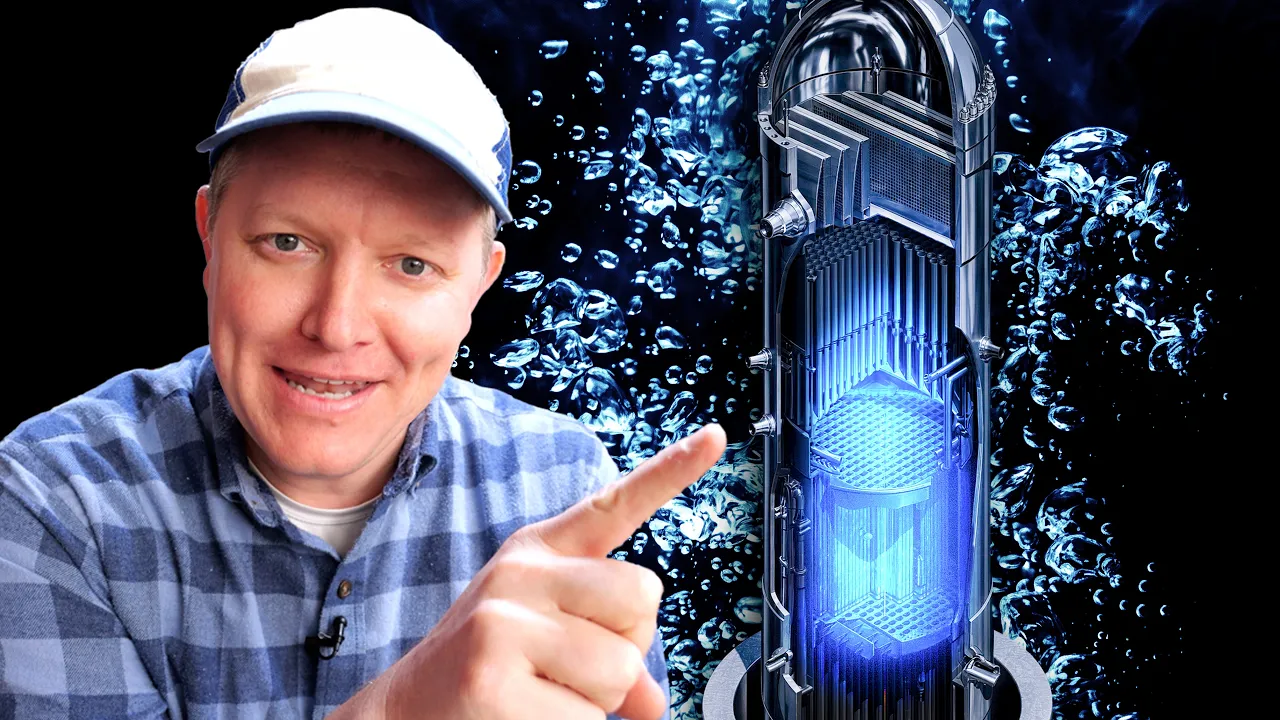
SmarterEveryDay
Commercial boiling water reactors maintain passive safety because rising coolant temperatures generate steam voids that reduce neutron moderation and automatically suppress nuclear fission.
AI-assisted summary of INSIDE a Nuclear Reactor Core - Smarter Every Day 317 — original source. Check the original for full context.
Source published:
Key ideas
- Destin tours the Browns Ferry Nuclear Plant training models to examine the mechanical internals of a Boiling Water Reactor (BWR), which circulates coolant that boils directly within the reactor pressure vessel to drive turbines. (3:08)
- The reactor core relies on an inherent negative void and temperature coefficient of reactivity: as coolant heats up and forms steam voids, reduced neutron moderation naturally drives down fission power. (20:24)
- Defense-in-depth safety is maintained through five nested physical containment barriers, spanning from the ceramic uranium oxide fuel pellet itself out to the secondary containment building. (35:01)
- A single enriched uranium oxide fuel pellet holds the energy equivalent of approximately one ton of coal, allowing the plant to operate continuously for roughly two years between refueling outages. (25:07)
Detailed notes
## Background Published on YouTube by the channel SmarterEveryDay (hosted by Destin) on September 26, 2026, this 43-minute video is an installment of the "50x50: Science Across America" national series uncovering exceptional science across all 50 states. The show notes highlight resources on the Tennessee Valley Authority's Browns Ferry Nuclear Plant, an article detailing Destin's visit to the facility, and a sponsorship from AnyDesk remote desktop software.
## TL;DR Representing Alabama for the 50x50 Science initiative, Destin visits the Browns Ferry Nuclear Plant training center to examine the inner mechanical workings of a commercial Boiling Water Reactor (BWR) alongside instrumentation and systems specialist Bill Ball. Using detailed vintage physical scale models, the two disassemble the reactor pressure vessel from the top down—exploring the containment drywell and torus, jet pumps, cyclone moisture separators, chevron steam dryers, and the core grid of 764 uranium oxide fuel bundles paired with cruciform boron control rods. They unpack the core physics of neutron thermalization and the negative temperature and void coefficients of reactivity, which naturally dampen the nuclear chain reaction as coolant water heats up and boils into steam. Finally, they trace the plant's fail-safe "Mother, May I?" SCRAM mechanisms, the five concentric physical barriers of containment, and how maintaining a coolable core geometry prevents severe accidents.
## Atmosphere & style Watching the episode feels like tagging along on an intimate, unscripted engineering field trip where complex nuclear physics are demystified in real time through tactile models and genuine curiosity. Destin's infectious enthusiasm and relatable mechanical analogies—such as comparing centrifugal moisture separation to slinging a heavy kid off a spinning merry-go-round—pair seamlessly with Bill Ball's calm, seasoned authority and dry industry precision. The mood progresses from wide-eyed appreciation for heavy industrial hardware to a deeply reassuring respect for the passive physics and multi-layered safety philosophies that keep a nuclear reactor under control.
## Bulletin - [03:08](https://www.youtube.com/watch?v=pXypQ6d_iDg&t=188s) Destin tours the Browns Ferry Nuclear Plant training models to examine the mechanical internals of a Boiling Water Reactor (BWR), which circulates coolant that boils directly within the reactor pressure vessel to drive turbines. - [20:24](https://www.youtube.com/watch?v=pXypQ6d_iDg&t=1224s) The reactor core relies on an inherent negative void and temperature coefficient of reactivity: as coolant heats up and forms steam voids, reduced neutron moderation naturally drives down fission power. - [35:01](https://www.youtube.com/watch?v=pXypQ6d_iDg&t=2101s) Defense-in-depth safety is maintained through five nested physical containment barriers, spanning from the ceramic uranium oxide fuel pellet itself out to the secondary containment building. - [25:07](https://www.youtube.com/watch?v=pXypQ6d_iDg&t=1507s) A single enriched uranium oxide fuel pellet holds the energy equivalent of approximately one ton of coal, allowing the plant to operate continuously for roughly two years between refueling outages.
## Key takeaways - [03:08](https://www.youtube.com/watch?v=pXypQ6d_iDg&t=188s) Boiling Water Reactors (BWRs) operate on a direct cycle where coolant boils inside the reactor pressure vessel, contrasting with Pressurized Water Reactors (PWRs) that use a pressurized primary loop and steam generators. - [04:37](https://www.youtube.com/watch?v=pXypQ6d_iDg&t=277s) Primary containment consists of a pear-shaped drywell and a lower torus (wetwell) suppression pool, which condenses steam during pipe ruptures and stores emergency core coolant. - [10:51](https://www.youtube.com/watch?v=pXypQ6d_iDg&t=651s) Steam drying utilizes two-stage mechanical extraction—centrifugal cyclone separators followed by chevron vane dryers—to strip moisture and prevent liquid droplets from eroding turbine blades. - [16:24](https://www.youtube.com/watch?v=pXypQ6d_iDg&t=984s) The reactor core contains 764 fuel bundles, grouped into assemblies of four that share a fuel support casting around a central bottom-inserted cruciform control rod. - [18:08](https://www.youtube.com/watch?v=pXypQ6d_iDg&t=1088s) Cruciform control rod blades are packed with neutron-absorbing boron and slide between fuel bundles to terminate fission branches by capturing thermalized neutrons. - [22:02](https://www.youtube.com/watch?v=pXypQ6d_iDg&t=1322s) Water serves as both a coolant and a neutron moderator; fast neutrons released from fission must collide with hydrogen nuclei to slow down into thermal neutrons capable of splitting Uranium-235. - [20:24](https://www.youtube.com/watch?v=pXypQ6d_iDg&t=1224s) Negative void and temperature coefficients ensure that rising coolant temperatures and steam bubble formation inherently suppress reactivity, causing the reactor to naturally bias toward shutting down. - [25:07](https://www.youtube.com/watch?v=pXypQ6d_iDg&t=1507s) Operators regulate reactor power and the axial boiling boundary using a combination of bottom-inserted control rods and variable recirculation flow driven by jet pumps. - [27:32](https://www.youtube.com/watch?v=pXypQ6d_iDg&t=1652s) Commercial nuclear power isolates all high-level waste on-site in monitored solid containers and dry storage casks, generating zero operating carbon emissions compared to open biosphere fossil fuel releases. - [32:36](https://www.youtube.com/watch?v=pXypQ6d_iDg&t=1956s) Nuclear criticality denotes a steady-state condition where exactly one neutron triggers a subsequent fission per generation (k-effective = 1.0), rather than an emergency state. - [33:39](https://www.youtube.com/watch?v=pXypQ6d_iDg&t=2019s) SCRAM systems operate on a fail-safe 'Mother, May I?' philosophy: control rods are held out of the core by pressurized air, automatically inserting under spring and hydraulic force if power or air pressure drops. - [35:01](https://www.youtube.com/watch?v=pXypQ6d_iDg&t=2101s) Five concentric containment barriers prevent radiological release: ceramic fuel pellets, Zircaloy cladding, the reactor pressure vessel, the nitrogen-inerted primary containment, and the secondary reactor building. - [37:16](https://www.youtube.com/watch?v=pXypQ6d_iDg&t=2236s) The drywell atmosphere is inerted with pure nitrogen under slight positive pressure to prevent potential hydrogen explosions and ensure net positive suction head for emergency core cooling pumps. - [38:50](https://www.youtube.com/watch?v=pXypQ6d_iDg&t=2330s) Primary containment penetrations feature diverse inboard and outboard isolation valves powered separately by AC motors and DC battery banks to avoid single-point electrical failures. - [40:55](https://www.youtube.com/watch?v=pXypQ6d_iDg&t=2455s) Preserving coolable core geometry prevents molten corium formation; Western light water designs inherently self-regulate via negative reactivity feedback, unlike the Soviet RBMK graphite-moderated configuration.
## Detailed walkthrough ### [00:00](https://www.youtube.com/watch?v=pXypQ6d_iDg&t=0s) Alabama, 50x50 Science, and the Mechanics of Nuclear Power
Destin introduces the video as part of the "50x50 Science Across America" initiative, a nationwide celebration of the country's upcoming 250th anniversary where 50 creators highlight exceptional science happening across each state. Proud to represent Alabama and the American South, he sets up under a pecan tree to outline the mission: diving deep into the inner mechanical workings of a nuclear power plant. Rather than sticking purely to theory, this episode aims to demystify what an actual commercial reactor core looks like on the inside.
```mermaid flowchart TD accTitle: Nuclear Power Series Progression accDescr: Progression from basic physics concepts to the core hardware walkthrough. A["Atomic Basics: Uranium, fast neutrons & fission"] --> B["Historical Precedent: EBR-I & nuclear safety culture"] B --> C["Plant Scale: Browns Ferry initial walkthrough"] C --> D["Deep Dive: Reactor core, fuel assemblies & internals"] ```
Reflecting on past videos in his nuclear power series, Destin pulls out props he keeps in boxes around his house—such as wooden models representing uranium and fast neutrons, which behave conceptually like spring-loaded mousetraps when triggered. While previous videos covered the fundamentals of fission, the historic EBR-I (Experimental Breeder Reactor I) in Idaho, and broader radiation safety protocols, Destin wants to get past the high-level summary of "hot rocks make steam, which spins a turbine." A viewer named Alex sent him a vintage book written by Alex's grandfather containing authentic architectural cutaways of the Browns Ferry Nuclear Plant. That diagram sets the stage for a granular inspection of the reactor pressure vessel and fuel assemblies.
[03:08](https://www.youtube.com/watch?v=pXypQ6d_iDg&t=188s) Boiling Water Reactors vs. Pressurized Water Reactors
Destin illustrates the fundamental engineering divergence between the two primary commercial nuclear reactor designs utilized across the United States: the Boiling Water Reactor (BWR) and the Pressurized Water Reactor (PWR). Both designs ultimately serve the same goal—generating high-pressure steam to spin a turbine and generate electricity—but handle coolant phase change in contrasting ways.
```mermaid flowchart LR accTitle: BWR vs PWR Architecture accDescr: Comparison of coolant loops between Boiling Water Reactors and Pressurized Water Reactors. subgraph BWR["Boiling Water Reactor (Direct Cycle)"] direction LR B_Core["Core (Water Boils)"] -->|"Steam"| B_Turb["Turbine"] B_Turb --> B_Cond["Condenser"] B_Cond -->|"Feedwater"| B_Core end subgraph PWR["Pressurized Water Reactor (Dual Cycle)"] direction LR P_Core["Core (High Pressure Water)"] -->|"Hot Water (No Boiling)"| P_SG["Steam Generator / Heat Exchanger"] P_SG -->|"Primary Return"| P_Core P_SG -->|"Secondary Steam"| P_Turb["Secondary Turbine"] P_Turb --> P_Cond["Condenser"] P_Cond -->|"Secondary Water"| P_SG end ```
In a Boiling Water Reactor, water circulates through the core and boils directly inside the reactor pressure vessel. The resulting steam routes straight out of the vessel to drive the electrical turbine before passing through a condenser and cycling back into the reactor. In contrast, a Pressurized Water Reactor maintains the primary cooling loop under extreme pressure so the water never boils inside the core. Instead, this superheated primary water routes to a separate heat exchanger (steam generator), transferring thermal energy into an isolated secondary loop to produce steam for the turbine. Browns Ferry operates as a Boiling Water Reactor.
- **Boiling Water Reactor (BWR):** Single-loop, direct-boiling cycle where coolant boils inside the pressure vessel itself. - **Pressurized Water Reactor (PWR):** Dual-loop system where high pressure prevents core boiling, relying on secondary heat exchangers. - **Browns Ferry Nuclear Plant:** Operates three large commercial BWR units side by side.
[04:37](https://www.youtube.com/watch?v=pXypQ6d_iDg&t=277s) Training Center Models: Primary Containment, Drywell, and Torus
Destin travels to the Browns Ferry training center to meet Bill Ball, an instrumentation and plant systems specialist. Instead of walking through the radioactive operational areas, the training facility houses three detailed, historic physical models originally built in the 1970s and 1980s before the era of 3D printing. The first and largest model illustrates the complete primary containment system housing the nuclear unit.
Bill shows Destin that the containment system consists of two major structural zones: the upper pear-shaped "drywell," which encloses the steel reactor pressure vessel, and the lower "torus" (or "wetwell"), a giant doughnut-shaped suppression pool circling beneath. Destin marvels at the massive physical scale depicted in archival 1970s construction photographs. Bill points out a miniature catwalk under the torus to illustrate the real-world scale and outlines the dual safety roles of the torus pool:
1. **Pressure Suppression:** If a high-energy pipe break or vessel breach occurs, expanding steam vents into the water-filled torus to immediately condense, preventing catastrophic overpressurization of the containment structure. 2. **Emergency Water Reservoir:** It provides a vast reserve volume of coolant that emergency core cooling pumps can draw from to re-inject water directly into the reactor vessel during an emergency.
[07:18](https://www.youtube.com/watch?v=pXypQ6d_iDg&t=438s) Disassembling the Reactor Vessel: Head, Steam Dryers, and Core Guide
Moving to the second mock-up, Bill and Destin examine a disassembled scale model of the reactor pressure vessel itself—a component that spans tens of feet across in real life. Bill lifts off the reactor vessel head, prompting Destin, an aerospace mechanical engineer by training, to pause and admire the heavy threaded fasteners securing the joint. Destin explains that threaded studs and nuts, which hold immense tension under extreme internal pressure, represent some of the most impressive feats of mechanical design. Close-up footage from their previous plant outage tour reveals the ring of massive studs anchored around the vessel flange.
As Bill takes the model apart from the top down, the internal moisture extraction components come into view:
```mermaid flowchart TD accTitle: Upper Reactor Vessel Components accDescr: Internal hardware stack removed during plant refueling outages. RPV_Head["Reactor Pressure Vessel Head & Bolted Stud Flange"] Dryer["Steam Dryer"] Separator["Moisture Separator"] TopGuide["Top Guide (Square grid openings)"] CorePlate["Core Plate"] Fuel["Fuel Bundles / Assemblies"]
RPV_Head --- Dryer Dryer --- Separator Separator --- TopGuide TopGuide --- Fuel Fuel --- CorePlate ```
First comes the **steam dryer**, sitting directly beneath the vessel head, followed by the **moisture separator**. Destin contrasts the miniature models with B-roll footage showing the gargantuan full-scale dryers sitting submerged in the plant's spent fuel pool, where they are parked during refueling outages. Beneath the separators lies the reactor core, framed between the lower **core plate** and the upper **top guide**. When Destin remarks that the square openings in the top guide are where operators "drop the fuel bundles down into," Bill gently corrects him with industry precision: "We prefer to *insert* them instead of drop them." Destin notes archival video of a refueling crane manipulating a fuel bundle down through the top guide before Bill shifts attention to the annular space along the outer perimeter known as the "downcomer."
[09:55](https://www.youtube.com/watch?v=pXypQ6d_iDg&t=595s) Jet Pumps, Recirculation, and Two-Phase Flow
Examining the cutaway model of the boiling water reactor (BWR), Bill explains the mechanics of moving coolant through the reactor core using jet pumps. These white components function essentially as massive venturis. Feedwater enters through nozzles into the downcomer annulus along the outer perimeter of the vessel. From there, external recirculation pumps—powered by the large variable frequency drives Destin toured earlier—draw water out of the downcomer and force driving flow into the jet pumps. The jet pumps entrain additional water and pump it downward into the lower plenum (the under-annulus region) beneath the reactor core.
Because the support structures are perforated, this fluid communicates directly into the bottom of the fuel core. The water is forced vertically upward through the fuel assemblies. As it passes through the intensely radioactive fuel matrix, the water absorbs heat and begins to boil vigorously, transforming into a high-energy two-phase mixture of liquid water and steam.
```mermaid flowchart TD accTitle: Boiling Water Reactor Internal Circulation Path accDescr: Diagram tracing the flow of water and steam through the reactor pressure vessel components. subgraph DowncomerRegion["Downcomer & Recirculation"] FW["Feedwater Injection"] --> DC["Downcomer Annulus"] RP["Recirculation Pumps"] --> JP["Jet Pumps (Venturis)"] DC --> JP end
subgraph CoreRegion["Core & Steam Generation"] JP --> LP["Lower Plenum / Under-Annulus"] LP --> Core["Fuel Bundles (Boiling)"] Core --> CS["Cyclone Moisture Separators"] end
subgraph SteamDrying["Drying & Output"] CS --> CD["Chevron Steam Dryers"] CD --> SL["Main Steam Lines (to Turbine)"] CS -.->|"Separated Liquid Drains"| DC CD -.->|"Drained Water"| DC end ```
[10:51](https://www.youtube.com/watch?v=pXypQ6d_iDg&t=651s) Cyclone Separators, Chevron Dryers, and Enthalpy
Directly above the reactor core sits a dense cluster of cyclone moisture separators. Bill explains that these separators create a deliberate "tortuous path" designed to minimize the moisture content of the rising steam. When Destin expresses confusion at the phrase "minimize the moisture of steam," Bill clarifies the critical operational difference between wet steam and dry steam. In an industrial power cycle, plant operators strictly demand dry steam. If entrained liquid water droplets escape the reactor pressure vessel and travel down the steam lines, those high-velocity droplets can act like sandblasting beads or bullets, severely pitting and destroying the delicate blades of downstream turbines.
To prevent this, the steam passes through cyclone separators that spin the mixture, condensing lower-enthalpy steam and knocking out the dense liquid droplets. Only high-quality, high-enthalpy steam continues upward into the next stage: the chevron dryers. These chevron-patterned vanes force the vapor through another maze of sharp zigzags to strip away any lingering mist. Once purified and dried, the steam exits through the heavy steam lines at the very top of the vessel, routed directly to spin the turbine generator.
- **Wet Steam vs. Dry Steam Risk:** Water droplets carried by wet steam can cause severe mechanical erosion and impact damage to steam turbine blades. - **Two-Stage Mechanical Separation:** Centrifugal cyclone separators knock out the bulk water, followed by chevron vane dryers that capture residual moisture droplets. - **Recycled Coolant:** Water extracted by the separators and dryers simply falls back down into the downcomer annulus to rejoin the recirculation loop.
[12:12](https://www.youtube.com/watch?v=pXypQ6d_iDg&t=732s) Destin's Breakdown: Enthalpy and the "Fat Kid on a Merry-Go-Round"
Destin pauses the conversation to unpack two core mechanical engineering concepts raised by Bill: enthalpy and two-phase separation. Bill's casual reference to "enthalpy" immediately signals to Destin that he is speaking with a consummate engineer. Destin defines enthalpy as the total internal energy contained within a fluid or gas at any point, dictated by its temperature, pressure, and ability to perform thermodynamic work. Steam at identical pressure but lower temperature has less enthalpy; likewise, dropping pressure at constant temperature reduces the energy available to do work on a turbine.
Destin then illustrates two-phase flow and centrifugal moisture extraction with a pair of visceral analogies. Normal breath whistling represents a pure single-phase gas, while whistling with spittle flying out represents a messy two-phase mixture of gas and liquid. To explain how cyclone separators strip that liquid out, Destin offers a playground image:
> "Imagine you're on a merry-go-round and you got a bunch of people on the merry-go-round, and then you got this big kid on the merry-go-round. He's a fat kid, I'll just say it. He's a fat kid. And you're just going to spin the merry-go-round really, really fast, and you sling that fat kid off the merry-go-round. That's what they're doing. They're using the momentum properties of fluids, and the fact that liquid is more dense than gas to make it so that that liquid gets slung off, and it hits the sidewall of the pipe, and it drips back down into the core, which I think is fascinating!"
By exploiting the greater density and inertia of the liquid water, the cyclone forces droplets to impact the outer walls and trickle back down into the reactor vessel, allowing only dry steam vapor to rise.
[14:42](https://www.youtube.com/watch?v=pXypQ6d_iDg&t=882s) The Reactor Pressure Vessel as an Industrial Pressure Cooker
Reviewing the physical stack-up on the model, Destin summarizes the core engineering of the vessel. The outer envelope functions like a massive pressure pipe designed to pump coolant strictly from the bottom up. Inside, fuel bundles are seated within a support grid. Because the interior operates under immense hydraulic pressure, the water does not boil at normal atmospheric temperatures like 212°F (100°C); instead, it reaches boiling temperatures well in excess of 500°F.
Above the core, the steam zigzags through separators and chevron dryers under this identical operating pressure. The whole system is capped by a massive dome known as the reactor vessel head. The head is held down by an array of heavy-duty closure studs and bolts designed to withstand the tremendous internal pressures of what Bill and Destin characterize as essentially a giant, ultra-rugged kitchen pressure cooker. All three operating boiling water reactor units at TVA's Browns Ferry Nuclear Plant share this exact standardized architecture.
- **Operating Regimes:** Coolant boils at temperatures exceeding 500°F due to intense vessel operating pressure. - **Pressure Retention:** The reactor vessel head and massive fastening studs contain the high-pressure steam and water inventory. - **Plant Standardization:** Units 1, 2, and 3 at Browns Ferry operate on this identical boiling water reactor blueprint.
[16:24](https://www.youtube.com/watch?v=pXypQ6d_iDg&t=984s) Anatomy of Fuel: Pellets, Rods, Bundles, and Assemblies
Moving from the vessel shell to the fuel itself, Bill walks Destin through the fuel assembly architecture using a physical training bundle. Inside the Browns Ferry reactor core, there are exactly 764 fuel bundles standing vertically in the core grid. Destin clarifies the nested terminology of the nuclear fuel structure to ensure every tier is distinct:
1. **Fuel Pellets:** Dense cylindrical pellets of enriched uranium oxide ($\text{UO}_2$). 2. **Fuel Rods:** Long metal tubes fabricated from Zircaloy cladding that encase stacks of uranium oxide pellets. 3. **Fuel Bundle:** A square grid matrix containing dozens of individual Zircaloy fuel rods. 4. **Fuel Assembly / Module:** A grouping of four individual fuel bundles that sit down into a single, shared fuel support casting.
The bottom nosepiece of each fuel bundle indexes directly into one of the four quadrants of the fuel support casting at the bottom of the reactor core. This rigid casting keeps the fuel aligned and channels the upward-rushing coolant through the bundle channels.
[18:08](https://www.youtube.com/watch?v=pXypQ6d_iDg&t=1088s) Cruciform Control Rods and Thermalizing Neutrons
Destin spots a narrow gap intersecting the fuel clusters and steps up onto the platform to peer straight down into the mock assembly. Instead of the round, cylindrical rod he originally expected, the control rod is a distinctive cruciform blade—a four-bladed cross. This cruciform blade inserts from the bottom and slides directly into the center intersection between four fuel bundles. Bill points out that this cross shape maximizes the physical absorption surface area relative to the surrounding fuel. The blades are packed with boron, an element with an enormous nuclear cross-section for absorbing free neutrons.
Bill then breaks down the physics of a light water reactor. When a uranium atom fissions, it releases a fast neutron traveling at extremely high kinetic energy. To sustain an efficient nuclear chain reaction, those fast neutrons must collide with the surrounding light water coolant. The hydrogen and oxygen atoms in the water bounce against the neutrons, slowing them down without capturing them—a process nuclear engineers call "thermalizing" the neutrons. Once thermalized, these slow neutrons have a far higher probability of interacting:
- **Option A (Fission):** The thermalized neutron strikes a uranium-235 nucleus in an adjacent uranium oxide pellet, splitting the atom, releasing fission energy to heat the water into steam, and emitting new fast neutrons. - **Option B (Control):** The thermalized neutron strikes the boron within a control rod blade, where it is absorbed entirely, rendering it completely inert and terminating that branch of the chain reaction.
Looking down from the top of the core, the entire reactor matrix resolves into this repeating geometric pattern: groups of four fuel bundles surrounding a central cruciform control rod, with high-pressure coolant driven upward through the support casting to sweep past the fuel rods.
[20:24](https://www.youtube.com/watch?v=pXypQ6d_iDg&t=1224s) Water Recirculation and Inherent Core Physics
Bill traces the fluid flow through the boiling water reactor (BWR) vessel model. Water is pulled by external recirculation pumps out of the downcomer annular region and driven into the internal jet pumps. Passing through a venturi nozzle, the flow enters the bottom head of the reactor vessel, where turbulent hydraulic force drives it upward through the core assembly.
```mermaid flowchart TD accTitle: Boiling Water Reactor Recirculation Flow accDescr: Diagram illustrating the flow of water through the downcomer, jet pumps, and core, and the negative void reactivity feedback.
subgraph Circulation ["Hydraulic Circulation Loop"] DC["Downcomer Annulus"] --> JP["Jet Pumps & Venturis"] JP --> LowerPlenum["Lower Plenum (Bottom of Core)"] LowerPlenum --> Core["Fuel Assemblies / Core"] end
subgraph PhysicsFeedback ["Negative Reactivity Feedback"] Core -->|"Water boils into steam"| Boiling["Steam Voids Form"] Boiling -->|"Lower water density"| LessMod["Reduced Neutron Moderation"] LessMod -->|"Fewer thermal neutrons"| PowerDrop["Core Power Decreases"] end ```
Bill points out a fundamental design and physics reality of this reactor: "this reactor is always trying to shut itself down." Destin is surprised and asks what he means. Bill explains that the hotter the water gets, the less reactive the core becomes. Because nuclear fission in low-enriched uranium relies on thermalizing (slowing down) neutrons using water molecules, the physical density of the water determines the reaction rate. As water heats up, it expands, spreading its molecules farther apart. With fewer hydrogen nuclei in the direct path of fast neutrons, fewer neutrons collide and thermalize, causing the fission rate and overall power to decrease naturally.
- Water drawn from downcomer annulus and forced through jet pump venturis. - Hydraulic turbulence pushes coolant upward through fuel channels. - Higher coolant temperature directly reduces neutron thermalization efficiency. - Decreased thermalization inherently dampens fission chain reactions.
[22:02](https://www.youtube.com/watch?v=pXypQ6d_iDg&t=1322s) Thermalization, Void Coefficient, and Inherent Safety
Destin steps back to work through the nuclear physics step by step. Inside the fuel rods, Uranium-235 is far more likely to capture a slow, thermalized neutron than a high-energy fast neutron produced directly by fission. Water acts as a moderator because fast neutrons collide with the hydrogen atoms in water molecules, losing kinetic energy through elastic scattering until they reach thermal equilibrium. When the water gets hot and expands, its physical density drops, effectively lowering its macroscopic cross section and reducing the likelihood of collisions.
``` +-----------------------------------------------------------------------------------+ | BOILING COLUMN GRADIENT IN A BWR FUEL CHANNEL | +-------------------+------------------------------+--------------------------------+ | Column Region | Coolant State | Neutron Moderation Effect | +-------------------+------------------------------+--------------------------------+ | Top | Pure steam / vapor phase | Minimal moderation; fast | | | | neutrons escape interaction | +-------------------+------------------------------+--------------------------------+ | Mid-Core | Two-phase mixture | Moderate thermalization; | | | (liquid and steam bubbles) | partial fission suppression | +-------------------+------------------------------+--------------------------------+ | Bottom | Subcooled liquid water | Maximum moderation; high | | | (nucleate boiling begins) | thermal neutron interaction | +-------------------+------------------------------+--------------------------------+ ```
Destin highlights a diagram from an engineering manual illustrating the boiling column along the height of the fuel assemblies. At the bottom, subcooled liquid water provides strong moderation, thermalizing neutrons and sustaining high reaction rates. As coolant moves up the bundle, bubbles nucleate into two-phase flow, and near the top, steam dominates the channel. Because steam has vastly lower molecular density than liquid water, fast neutrons traversing steam voids rarely slow down, preventing runaway fission. This design characteristic, known as the negative void coefficient of reactivity (and negative temperature coefficient of reactivity), means that boiling water creates a self-regulating negative feedback loop: more heat produces more steam voids, which in turn cuts reactor power.
- Fuel relies on Uranium-235 fission triggered predominantly by thermal neutrons. - Water moderates neutrons via repeated collisions with hydrogen nuclei. - Steam voids drastically reduce moderation efficiency compared to liquid water. - Negative temperature and void coefficients provide intrinsic passive shutdown physics.
[25:07](https://www.youtube.com/watch?v=pXypQ6d_iDg&t=1507s) Controlling the Boiling Boundary and Fuel Energy Density
Bill confirms that the phenomenon is called the "negative temperature coefficient of reactivity." Operators balance core behavior by combining two primary controls: control rods and recirculation coolant flow. Control rods, inserted from the bottom of the vessel, dictate how much fuel length is exposed to neutron flux. Meanwhile, adjusting recirculation pump flow shifts the "boiling boundary"—the axial height inside the core where latent heat of vaporization triggers boiling. Higher flow suppresses steam void formation lower in the bundle, raising reactivity, while lower flow allows steam bubbles to form sooner, dropping power. Bill clarifies that the fuel rods are never exposed to open air during operation; they are continuously submerged under liquid coolant and two-phase boiling mixtures beneath the steam dryers.
Bill displays an inert fuel mockup provided by the Nuclear Energy Institute (NEI), which helps interpret Nuclear Regulatory Commission (NRC) guidelines. Inside the fuel cladding tubes sit small ceramic uranium oxide pellets. Bill points out that a single pellet holds the energy equivalent of approximately one ton of coal. Destin observes that despite high initial capital and fuel-manufacturing costs, the immense energy density allows the plant to run continuously for roughly two years between refueling outages without continuous fuel deliveries.
- Control rods adjust physical fuel exposure to thermal neutron flux. - Recirculation pump speed raises or lowers the axial boiling boundary. - Reactor core remains permanently submerged under water and boiling steam mixtures. - A single uranium oxide pellet matches the energy content of one ton of coal. - Refueling cycles run on an approximate two-year cadence.
[27:32](https://www.youtube.com/watch?v=pXypQ6d_iDg&t=1652s) Nuclear Waste Containment vs. Fossil Fuels
Addressing public debates on nuclear power as green energy, Destin asks Bill how he weighs the environmental footprint, including the energy-intensive front-end fuel manufacturing and the back-end waste problem. Bill expresses strong support for nuclear energy, noting that operations generate zero carbon emissions. Addressing nuclear waste, Bill makes a distinction: unlike fossil-fuel plants that emit combustion byproducts directly into the open atmosphere or watershed, every gram of nuclear byproduct is completely accounted for, contained, and monitored on-site.
Bill states: "I can point to it and say, it's right over there, and we know exactly how much it is, where it is, and how we're tracking it." Destin finds this perspective compelling, observing that most power generation disperses harmful waste invisibly into the air, whereas nuclear plants store solid spent fuel locally in dedicated dry storage casks. Destin previews an upcoming segment where he will visit the facility's spent fuel cask loading operations.
- Nuclear generation produces no carbon monoxide or carbon dioxide during operation. - 100% of high-level spent fuel is tracked, solid, and held in localized containment casks. - Fossil fuel generation dispenses vast volumes of airborne waste directly into the biosphere. - Upcoming video segments explore the physical preparation and loading of fuel storage casks.
[28:54](https://www.youtube.com/watch?v=pXypQ6d_iDg&t=1734s) Engineering Simulations and AnyDesk Sponsor Segment
Destin shifts to a workflow demonstration, showcasing heavy engineering finite element analysis running on his workstation using ANSYS LS-DYNA. He displays a high-speed ballistics simulation depicting a bullet colliding head-on with another bullet, explaining that these complex models require days of compute time and multiple dedicated hard drives.
To monitor and adjust his simulations without being tied to his desk, Destin uses AnyDesk remote desktop software. He demonstrates accessing his home workstation from various remote locations, including aboard a passenger train in England, inside the New York Public Library, from his smartphone, and over in-flight Wi-Fi during commercial flights. Destin notes that AnyDesk offers a free tier for personal use alongside commercial licenses, and mentions that this workflow supported his recently published research paper in *Royal Society Open Science*.
- Heavy structural impact models rendered via ANSYS LS-DYNA simulation software. - Destin monitors long-duration physics calculations remotely using AnyDesk. - Access demonstrated across cellular, mobile, public library, and in-flight Wi-Fi networks. - Research simulations contributed to a published paper in *Royal Society Open Science*.
[30:57](https://www.youtube.com/watch?v=pXypQ6d_iDg&t=1857s) Fail-Safe Reactor Geometry and Criticality
After wrapping up a sponsor mention for AnyDesk—noting that it was a game-changer used to remotely conduct research for his scientific paper—Destin returns to discussing the physics and fail-safe design characteristics of the nuclear reactor core with TVA nuclear professional Bill. Destin asks whether it is the geometric arrangement of multiple fuel assemblies submerged together in water that allows the reactor to go critical. Bill confirms that this is true: no single fuel assembly can achieve criticality on its own.
```mermaid flowchart TD accTitle: Reactor Geometric and Safety Margins accDescr: Diagram illustrating how subcritical fuel assemblies achieve criticality only in aggregate, protected by control rods and permissive interlocks.
subgraph AssemblyGeometry["Core Geometry"] A["Single Fuel Assembly<br/>(Subcritical on its own)"] --> B["Aggregated Core Grid<br/>(Critical only when fully arranged in water)"] end
subgraph ControlSystem["Control Rod Safety Margin"] B --> C{"Individual Control Rods"} C -->|"Shutdown Margin Calculation"| D["Single Rod Ejection / Stuck Rod<br/>(Core remains fully subcritical)"] end
subgraph OperationalPermissive["Fail-Safe Philosophy"] E["Air-pressurized SCRAM pilot valves"] -->|"Loss of air or instrument trip"| F["Instant spring/hydraulic rod insertion"] F --> G["'Mother, May I?' Operation:<br/>Privilege to run, defaults to shut down"] end ```
Bill explains that plant designers perform rigorous shutdown margin calculations ensuring that even if an entire control rod were completely removed or stuck out of the aggregate core, the reactor would still remain fully shut down. Unlike systems bound to a single unified plate, the control rods are driven independently. Destin wonders if a dropped or withdrawn rod might spike local reactivity, and Bill explains that while localized reactivity does increase, the core as a whole will not latch into an uncontrolled reaction; there simply is not enough aggregate reactivity in that isolated section to trigger an uncontrolled chain reaction. Achieving a steady state requires an intricate balance of differential equations, geometry, statistics, and probability.
- No individual fuel assembly has sufficient fissile geometry to go critical on its own. - Control rods operate independently rather than off a single gang plate. - The core design guarantees subcriticality even under a "stuck rod" or deleted control rod scenario.
---
[32:36](https://www.youtube.com/watch?v=pXypQ6d_iDg&t=1956s) Demystifying "Critical": Subcritical, Critical, and Supercritical
Destin breaks down why the term "critical"—often interpreted by the general public as an emergency—is actually the desired operating state. Plotting neutron count over time on a graph, he illustrates how a nuclear chain reaction behaves depending on its neutron multiplication factor:
* **Subcritical:** For every neutron introduced into the system, less than one neutron is produced in the next generation. Over time, the reaction dissipates, decays, and eventually stops. * **Critical:** For every one neutron entering the reaction, exactly one neutron is produced ($k_{\text{eff}} = 1.0$). This represents a stable, controlled steady-state condition where the plant can generate commercial power indefinitely. * **Supercritical:** More than one neutron is produced for every neutron absorbed. While required in small, carefully managed amounts to ramp power up during startup, an uncontrolled supercritical state can quickly exceed safe limits.
Bill agrees, pointing out that "critical is a good thing." The reactor's fundamental design is inherently self-limiting; as the coolant water heats up, its density decreases, moderating fewer neutrons and naturally working to shut the reaction down.
---
[33:39](https://www.youtube.com/watch?v=pXypQ6d_iDg&t=2019s) SCRAM Mechanisms and the "Mother, May I?" Principle
Bringing a reactor up to critical is the most delicate phase of operation, largely because the physical plant is biased toward shutting itself down. The control rods are held out of the core against strong insertion mechanisms by energized scram solenoid pilot valves that maintain air pressure. If electrical power is lost, or if pneumatic air pressure drops, the pilot valves de-energize and vent, automatically porting off the air and driving the control rods rapidly into the core under spring and hydraulic pressure.
```mermaid flowchart LR accTitle: Containment and SCRAM Interlock Flow accDescr: Flowchart showing how nuclear monitoring systems trigger scram valves to fail-safe into shutdown.
subgraph MonitoringSensors["Core Monitoring Instrumentation"] M1["SRMs (Source Range)"] M2["IRMs (Intermediate Range)"] M3["APRMs (Average Power Range)"] end
subgraph LogicTrip["Safety Logic Trip"] M1 & M2 & M3 -->|"Non-conservative signal"| T["Trip Circuit Opens"] end
subgraph Actuation["Fail-Safe Insertion"] T -->|"De-energize"| V["Scram Solenoid Pilot Valves"] V -->|"Vent air pressure"| R["Rods Automatically Insert (SCRAM)"] end ```
The reactor is monitored across all power regimes by overlapping instrumentation suites: Source Range Monitors (SRMs), Intermediate Range Monitors (IRMs), and Average Power Range Monitors (APRMs). If any of these instruments detect a non-conservative parameter, the safety logic trips automatically, venting the pilot air and scramming the reactor. Destin summarizes this control philosophy as a strict "Mother, may I?" system: running is a privilege granted only while all parameters say "Yes, you may." The moment any condition becomes abnormal, permission is revoked and the reactor shuts down.
---
[35:01](https://www.youtube.com/watch?v=pXypQ6d_iDg&t=2101s) The Five Barriers of Nuclear Containment
Bill walks Destin through the multiple concentric physical boundaries engineered to isolate radioactive fission products from the outside environment:
```mermaid flowchart TD accTitle: The Five Barriers of Nuclear Containment accDescr: Five physical nested levels of containment protecting against radiological release.
B1["Barrier 1: Uranium Oxide Fuel Pellet<br/>Traps raw fission products within the ceramic matrix"] B2["Barrier 2: Zircaloy Cladding Tube<br/>Seals the pellets; low neutron absorption; monitored for swelling"] B3["Barrier 3: Reactor Pressure Vessel (RPV)<br/>Heavy-walled steel vessel rated to ~1,250 psi operating limit"] B4["Barrier 4: Primary Containment (Drywell & Torus)<br/>Nitrogen-inerted steel/concrete structure rated to ~56 psi"] B5["Barrier 5: Secondary Containment Building<br/>Reinforced outer structure with dedicated filtered ventilation"]
B1 --> B2 --> B3 --> B4 --> B5 ```
1. **The Fuel Pellet:** The dense ceramic uranium dioxide fuel pellet itself acts as the first barrier, holding the vast majority of raw fission products trapped inside its internal crystal matrix. 2. **The Cladding:** The fuel pellets are sealed inside metal cladding tubes made of a zirconium alloy (zircaloy). This material is virtually transparent to neutrons and highly resistant to corrosion. Because the fuel pellet expands and swells during irradiation, operators carefully control the power ramp rate to minimize pellet-cladding interaction (PCI). Keeping the core submerged and cool in water is the primary method of preventing the cladding from degrading. 3. **The Reactor Pressure Vessel (RPV):** A massive steel vessel secured by heavy bolted flanges. It is designed to handle pressures up to approximately 1,250 psi (operating typically around 1,000 psi, which decays quickly following a shutdown). 4. **Primary Containment (Drywell and Torus/Suppression Pool):** A combination of heavy steel and thick reinforced concrete. If the RPV were compromised, steam and water discharge into the drywell and down into the water-filled torus beneath it, forming a closed loop that provides suction for emergency core cooling pumps to recycle water back into the vessel. 5. **Secondary Containment:** The surrounding plant structure that acts as a final outer envelope before the general environment.
---
[37:16](https://www.youtube.com/watch?v=pXypQ6d_iDg&t=2236s) Shielding, Tenth-Value Thickness, and Drywell Inerting
Destin notes the exterior of the containment structure uses layers of steel and thick concrete. Bill introduces the concept of "tenth thickness" (tenth-value layer), which is the thickness of a given material required to attenuate the surrounding radiation field to one-tenth (10%) of its original intensity. By combining dense steel with mass concrete, the plant efficiently stops different types of radiation.
The drywell operates under distinct environmental controls: - **Design Pressure:** Because the primary containment encompasses a significantly larger volume than the pressure vessel, it is rated for lower pressures, with an operational limit of approximately 56 psi. - **Nitrogen Inerting:** During normal operation, the atmosphere inside the drywell is purged of oxygen and filled with pure nitrogen under a slight positive pressure (about one pound per square inch gauge). - **Explosion Prevention:** Inerting prevents combustion in the event of an accident; if zirconium-water reactions or radiolytic decomposition produce hydrogen gas, the lack of oxygen prevents any potential hydrogen explosion. - **Net Positive Suction Head (NPSH):** The slight positive nitrogen pressure exerts a downward boundary force on the suppression pool water in the torus, ensuring the emergency core cooling pumps maintain sufficient NPSH to operate without cavitating.
---
[38:50](https://www.youtube.com/watch?v=pXypQ6d_iDg&t=2330s) Primary Containment Isolation Valves and Meltdown Hazards
Destin asks what prevents radioactive coolant—what he colloquially terms "dirty water"—from escaping through the numerous operational pipes penetrating the containment boundaries. Bill explains that every containment penetration is equipped with redundant Primary Containment Isolation Valves (PCIVs) arranged in series: an inboard valve inside containment and an outboard valve on the outside.
To prevent a common-mode electrical failure from disabling both valves, they rely on diverse power supplies: - The inboard valve is driven by an **AC motor**, which produces no commutator sparks inside the inert containment. - The outboard valve is powered by a **DC motor** driven by plant battery banks, which rely on carbon brushes and commutators that do spark, but reside safely in the external atmosphere.
If isolation signals trip, both valves close, trapping all water and steam within the drywell and torus. When Destin brings up what the public fears most during a severe accident—a core meltdown—Bill explains that the primary hazard is the creation of **corium**. If cooling is lost, the fuel pellets, zircaloy cladding, and internal structural metals melt together into a superheated, highly radioactive molten mass capable of slumping to the bottom of the reactor pressure vessel and challenging the physical boundaries if it cannot be cooled.
[40:55](https://www.youtube.com/watch?v=pXypQ6d_iDg&t=2455s) Coolable Core Geometry and RBMK vs. Light Water Safety
Looking back across the fuel bundle arrangement, Bill Ball and Destin examine how water circulates between the fuel rods. Under normal operating conditions, liquid coolant flows freely across the outer surface of every fuel rod cladding tube, removing thermal energy via natural and forced convection. Bill explains that if an unmitigated overheating event were to occur and fuel components began to melt and fuse together, the reactor would lose its "coolable core geometry." Without that open channel spacing, coolant can no longer reach the fuel surfaces, precipitating severe core damage akin to historical nuclear catastrophes.
```mermaid flowchart TD accTitle: Coolable Core Geometry versus Core Degradation accDescr: Flowchart contrasting intact fuel geometry allowing convection cooling with melted degraded geometry that blocks coolant flow.
subgraph Intact["Intact Coolable Core Geometry"] A["Uniform Rod Spacing"] --> B["Unrestricted Coolant Flow"] B --> C["Continuous Convective Heat Removal"] C --> D["Stable Cladding Temperature"] end
subgraph Degraded["Loss of Geometry (Severe Accident)"] E["Fuel Overheating & Clad Melting"] --> F["Fuel Relocation & Flow Channel Blockage"] F --> G["Loss of Coolable Surface Area"] G --> H["Thermal Runaway / Core Damage"] end ```
Destin immediately brings up Chernobyl, prompting a comparison between the Tennessee Valley Authority's commercial boiling water design and the Soviet RBMK architecture. Bill points out that Chernobyl was not a light water reactor in the traditional Western sense; it was a graphite-moderated, water-cooled RBMK reactor that lacked the strongly negative temperature and void coefficients of reactivity inherent to Western commercial light water designs. While the RBMK configuration was prioritized to produce power rapidly on a massive scale, Western commercial boiling water reactors are engineered with inherent physical feedback mechanisms designed to automatically reduce reactor power as temperatures rise and steam voids form. When Destin wonders whether Browns Ferry incorporated lessons learned from the 1986 disaster, Bill clarifies the chronology: Browns Ferry was designed and constructed well before Chernobyl ever happened.
- **Coolable Core Geometry:** The physical arrangement of fuel rods and channel spacing that guarantees coolant can circulate freely around the cladding to extract heat through convection. - **Inherent Safety Dynamics:** Light water reactors rely on a negative temperature coefficient of reactivity, where increasing temperature dampens the fission chain reaction rather than accelerating it. - **Design Timeline:** Browns Ferry’s units were engineered and built in the late 1960s and 1970s, predating the April 1986 Chernobyl disaster.
---
[41:55](https://www.youtube.com/watch?v=pXypQ6d_iDg&t=2515s) The "Asker of All Questions" and What Lies Ahead
Reflecting on the tour from inside the plant, Destin shares his broader philosophy behind the *Nuclear Power Deep Dive* series. For years, he had wanted to devour every textbook and technical manual he could find on commercial nuclear power. However, he deliberately held back from studying everything in advance so that he could experience the discovery authentically alongside his viewers. Stepping onto the refueling floor and peering into the reactor vessel allowed him to ask raw, unscripted technical questions in real time: "I am not the knower of all things. I am the asker of all questions, and I hope you enjoy being right there with me, having a blast."
Destin expresses deep gratitude to Bill Ball and the team at the Tennessee Valley Authority for opening their doors and patiently explaining the plant's intricate engineering. He also thanks his Patreon community, noting that their direct financial backing is what grants him the creative freedom to travel on location and explore complex engineering systems in depth. Looking ahead, Destin previews the next installments of the series, teasing a deep dive into nuclear cross sections with an expert named Bill Williamson, as well as upcoming footage recorded on location at Idaho National Laboratory (INL). He wraps up with his signature sign-off: "I'm Destin. You're getting Smarter Every Day, have a good one. Bye."
## Notable quotes > [00:00](https://www.youtube.com/watch?v=pXypQ6d_iDg&t=0s) hot rocks make steam, which spins a turbine. — Destin
> [07:18](https://www.youtube.com/watch?v=pXypQ6d_iDg&t=438s) We prefer to insert them instead of drop them. — Bill Ball
> [12:12](https://www.youtube.com/watch?v=pXypQ6d_iDg&t=732s) Imagine you're on a merry-go-round and you got a bunch of people on the merry-go-round, and then you got this big kid on the merry-go-round. He's a fat kid, I'll just say it. He's a fat kid. And you're just going to spin the merry-go-round really, really fast, and you sling that fat kid off the merry-go-round. That's what they're doing. They're using the momentum properties of fluids, and the fact that liquid is more dense than gas to make it so that that liquid gets slung off, and it hits the sidewall of the pipe, and it drips back down into the core, which I think is fascinating! — Destin
> [20:24](https://www.youtube.com/watch?v=pXypQ6d_iDg&t=1224s) this reactor is always trying to shut itself down. — Bill Ball
> [27:32](https://www.youtube.com/watch?v=pXypQ6d_iDg&t=1652s) I can point to it and say, it's right over there, and we know exactly how much it is, where it is, and how we're tracking it. — Bill Ball
> [32:36](https://www.youtube.com/watch?v=pXypQ6d_iDg&t=1956s) critical is a good thing. — Bill Ball
> [33:39](https://www.youtube.com/watch?v=pXypQ6d_iDg&t=2019s) Mother, may I? — Destin
> [41:55](https://www.youtube.com/watch?v=pXypQ6d_iDg&t=2515s) I am not the knower of all things. I am the asker of all questions, and I hope you enjoy being right there with me, having a blast. — Destin
> [41:55](https://www.youtube.com/watch?v=pXypQ6d_iDg&t=2515s) I'm Destin. You're getting Smarter Every Day, have a good one. Bye. — Destin
## Mentioned 50x50 Science Across America, Alfred P. Sloan Foundation, ANSYS LS-DYNA, AnyDesk, Bill Ball, Bill Williamson, Browns Ferry Nuclear Plant, Destin Sandlin, EBR-I (Experimental Breeder Reactor I), Gordon McGladdery, HHMI Tangled Bank Studios, Idaho National Laboratory (INL), Independent Media Initiative, Nuclear Energy Institute (NEI), Nuclear Regulatory Commission (NRC), Patreon, Royal Society Open Science, Smarter Every Day, Tennessee Valley Authority (TVA), Winn Family Foundation
## Video description You can try AnyDesk for free. It's good. https://anydesk.com/smarter http://www.patreon.com/smartereveryday Get Email Updates: https://www.smartereveryday.com/email
Check out the 50x50 Science Across America! https://5050science.com/
50x50: Science Across America is a national series uncovering exceptional science in all 50 states. It is a production of the Independent Media Initiative in collaboration with HHMI Tangled Bank Studios, Alfred P. Sloan Foundation, and the Winn Family Foundation. See all the states at https://5050science.com/
Sticker Team!: http://www.patreon.com/smartereveryday
Click here if you're interested in subscribing: http://bit.ly/Subscribe2SED ⇊ Click below for more links! ⇊ ~~~~~~~~~~~~~~~~~~~~~~~~~~~~ GET SMARTER SECTION
Learn more about the the Browns Ferry Plant at the Tennessee Valley Authority: https://www.tva.com/energy/our-power-system/nuclear/browns-ferry-nuclear-plant https://en.wikipedia.org/wiki/Tennessee_Valley_Authority
Here's a link to an article about my visit: https://www.tva.com/the-powerhouse/stories/inside-browns-ferry
~~~~~~~~~~~~~~~~~~~~~~~~~~~~ Tweet Ideas to me at: http://twitter.com/smartereveryday
Smarter Every Day on Facebook https://www.facebook.com/SmarterEveryDay
Smarter Every Day on Patreon http://www.patreon.com/smartereveryday
Smarter Every Day On Instagram http://www.instagram.com/smartereveryday
Smarter Every Day SubReddit http://www.reddit.com/r/smartereveryday
Ambiance, audio and musicy things by: Gordon McGladdery https://www.ashellinthepit.com/ http://ashellinthepit.bandcamp.com/
If you feel like this video was worth your time and added value to your life, please SHARE THE VIDEO!
If you REALLY liked it, feel free to pitch a few dollars Smarter Every Day by becoming a Patron. http://www.patreon.com/smartereveryday
Warm Regards,
Destin
[Source](https://www.youtube.com/watch?v=pXypQ6d_iDg)