LUX-ZEPLIN Flags Lone Dark Matter Candidate as Physicists Debate Fluke
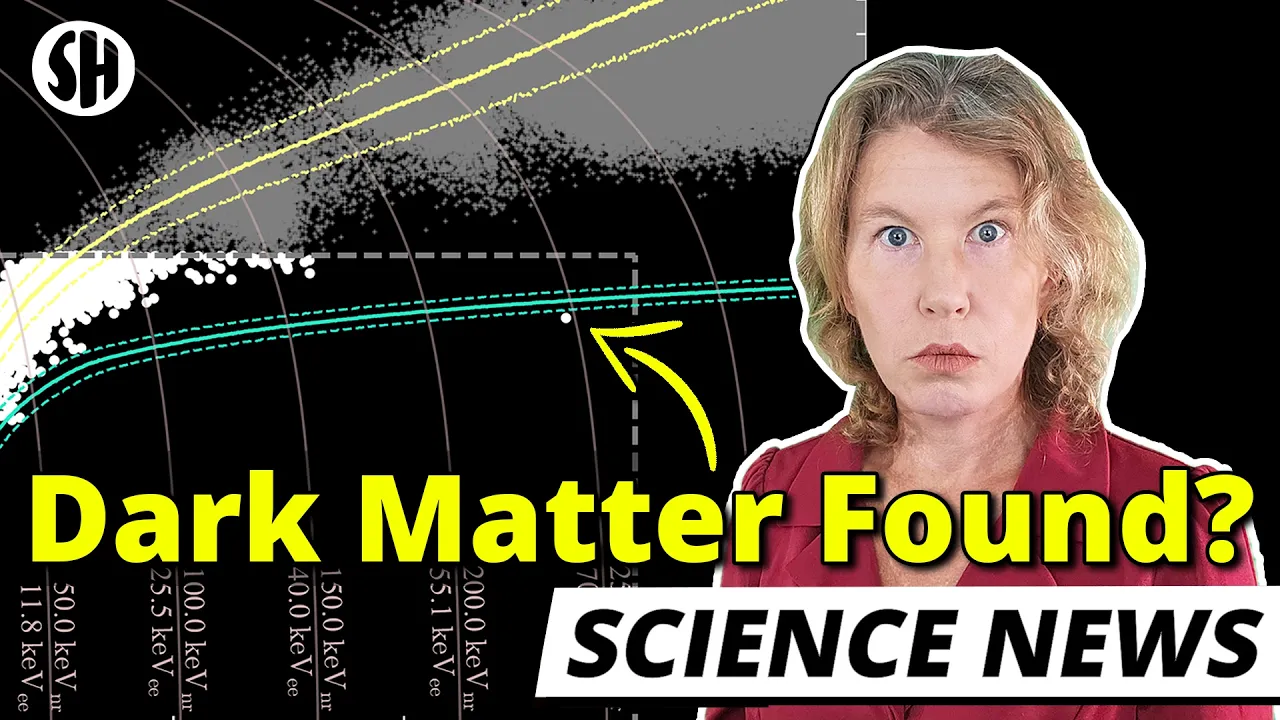
Sabine Hossenfelder
While the underground detector recorded a technically sound 400 GeV anomaly, decades of unfulfilled particle predictions mean a single event is far more likely a rare background fluke than a breakthrough ending physics stagnation.
AI-assisted summary of Dark Matter Finally Detected? — original source. Check the original for full context.
Source published:
Key ideas
- The LUX-ZEPLIN (LZ) experiment in South Dakota has recorded a single anomalous detection that may represent the first direct evidence for a dark matter particle. (0:00)
- If caused by dark matter, the candidate particle has an estimated mass of at least 400 GeV—more than triple the mass of the Higgs boson—with a statistical significance between 2.6 and 3.4 sigma. (1:10)
- Standard Model explanations for the signal require contrived fluke events, such as overlapping gamma-ray collisions near the detector wall or rare electron absorption and re-emission. (1:10)
- Despite sound experimental execution, Sabine assigns the claim a 7 out of 10 on her skepticism meter due to low Bayesian priors stemming from decades of failed dark matter particle predictions. (2:59)
Detailed notes
## Background Published by Sabine Hossenfelder on YouTube on September 2, 2026, this video examines a recent announcement from the LUX-ZEPLIN dark matter collaboration. The description notes that researchers have reported a detection that could potentially represent the first-ever physical evidence of a dark matter particle, prompting an overview of the measurement, candidate explanations, and broader implications.
## TL;DR The LUX-ZEPLIN experiment in South Dakota detected a single, highly energetic event in roughly 10 tons of liquid xenon that deviates from typical background expectations. If caused by dark matter, the candidate particle would possess a mass of at least 400 GeV, fitting models like a pseudo-Dirac Higgsino while explaining why the Large Hadron Collider had never produced it. While standard physics mimics exist but require contrived scenarios, Sabine assigns the claim a 7 out of 10 on her skepticism meter, arguing that decades of unfulfilled theoretical predictions weaken its Bayesian plausibility. Ultimately, she critiques the self-reinforcing funding cycle between theorists and experimentalists, noting that confirming the signal will inevitably prompt calls for an even larger detector.
## Atmosphere & style The video carries Sabine Hossenfelder's signature deadpan humor, sharp skepticism, and clinical precision. Watching it feels like a reality check from an experienced insider who refuses to let hype obscure statistical context, punctuating genuine scientific fascination with dry, witty assessments. The mood transitions from intrigued curiosity regarding the unusual underground datum into a weary, satirical critique of particle physics' perpetual upgrade loop.
## Bulletin - [00:00](https://www.youtube.com/watch?v=9TLMPYhstf0&t=0s) The LUX-ZEPLIN (LZ) experiment in South Dakota has recorded a single anomalous detection that may represent the first direct evidence for a dark matter particle. - [01:10](https://www.youtube.com/watch?v=9TLMPYhstf0&t=70s) If caused by dark matter, the candidate particle has an estimated mass of at least 400 GeV—more than triple the mass of the Higgs boson—with a statistical significance between 2.6 and 3.4 sigma. - [01:10](https://www.youtube.com/watch?v=9TLMPYhstf0&t=70s) Standard Model explanations for the signal require contrived fluke events, such as overlapping gamma-ray collisions near the detector wall or rare electron absorption and re-emission. - [02:59](https://www.youtube.com/watch?v=9TLMPYhstf0&t=179s) Despite sound experimental execution, Sabine assigns the claim a 7 out of 10 on her skepticism meter due to low Bayesian priors stemming from decades of failed dark matter particle predictions.
## Key takeaways - [00:00](https://www.youtube.com/watch?v=9TLMPYhstf0&t=0s) LUX-ZEPLIN observed a single isolated data point that sits outside the expected background, marking a potential candidate for a dark matter particle. - [00:00](https://www.youtube.com/watch?v=9TLMPYhstf0&t=0s) The detector uses 10 tons of liquid xenon at -99°C shielded 1.5 kilometers underground in an old South Dakota gold mine to block cosmic rays and environmental radiation. - [00:00](https://www.youtube.com/watch?v=9TLMPYhstf0&t=0s) A genuine discovery of a dark matter particle would guarantee a Nobel Prize and break decades of stagnation in fundamental physics. - [01:10](https://www.youtube.com/watch?v=9TLMPYhstf0&t=70s) The detected event corresponds to a particle mass of at least 400 GeV, far exceeding the Higgs boson mass and explaining why the Large Hadron Collider never produced it. - [01:10](https://www.youtube.com/watch?v=9TLMPYhstf0&t=70s) The energy of the event was so high that LUX-ZEPLIN initially overlooked it in earlier analyses because they were not searching in that energy regime. - [01:10](https://www.youtube.com/watch?v=9TLMPYhstf0&t=70s) The detection has a statistical significance of 2.6 to 3.4 sigma, corresponding to a 1-in-200 to 1-in-1,000 probability of being a statistical anomaly. - [01:10](https://www.youtube.com/watch?v=9TLMPYhstf0&t=70s) Standard physics alternatives—such as double nuclear scatters from gamma rays or spontaneous electron re-emission—remain mathematically possible but physically contrived. - [01:10](https://www.youtube.com/watch?v=9TLMPYhstf0&t=70s) The signal matches preexisting theoretical proposals like a pseudo-Dirac Higgsino or electroweak multiplets, though theorists have proposed enough particles that finding a match is unsurprising. - [02:59](https://www.youtube.com/watch?v=9TLMPYhstf0&t=179s) Sabine rates the detection 7 out of 10 on her skepticism meter, arguing that proper Bayesian analysis must account for decades of disproven particle predictions. - [02:59](https://www.youtube.com/watch?v=9TLMPYhstf0&t=179s) Dark matter searches since 2012 have repeated a predictable cycle: searching, finding null results, and demanding upgrades to larger and more sensitive detectors. - [02:59](https://www.youtube.com/watch?v=9TLMPYhstf0&t=179s) Experimentalists and theorists maintain a mutually reinforcing cycle where theoretical models justify detector construction and detectors justify theoretical models. - [02:59](https://www.youtube.com/watch?v=9TLMPYhstf0&t=179s) Astrophysicist Stacy McGaugh argues that direct-detection experiments have run their course and 'succeeded in failing,' questioning continued funding for the approach. - [02:59](https://www.youtube.com/watch?v=9TLMPYhstf0&t=179s) While a genuine discovery cannot be ruled out, conclusively verifying or debunking the datum will ultimately require an even larger detector.
## Detailed walkthrough ### [00:00](https://www.youtube.com/watch?v=9TLMPYhstf0&t=0s) The LUX-ZEPLIN Experiment and the Single "Datum"
An experiment has detected what could be the first-ever evidence for a dark matter particle. Because the finding consists of only a single data point—or as Sabine jokes, "maybe I should more accurately say the datum"—it is impossible to draw sweeping conclusions from it yet. However, if a genuine discovery were to happen, "then this is how it'd start," making it worth taking seriously to examine what has been measured and what it might mean.
The datum comes from the LUX-ZEPLIN (LZ) experiment, an ultra-sensitive detector situated about 1.5 kilometers underground inside an old gold mine in South Dakota. Sabine quips that "in some sense, they still dig for gold, the gold of the Nobel Prize," noting that finally identifying what dark matter is made of would unquestionably win a Nobel Prize and "end half a century of stagnation in the foundations of physics." The detector operates by closely monitoring roughly 10 tons of liquid xenon cooled to -99°C for anything that bumps into its atoms. Its extreme depth shields it from cosmic rays, while heavy shielding protects the chamber from radioactive decays and other environmental contamination, allowing dark matter to pass through all the rock and shielding and occasionally leave a trace in the xenon.
- **Experiment:** LUX-ZEPLIN (LZ) - **Location:** An old gold mine in South Dakota, ~1.5 km underground - **Target medium:** ~10 tons of liquid xenon maintained at -99°C - **Shielding purpose:** Deep rock blocks cosmic rays; heavy local shielding blocks background radiation from radioactive decays
[01:10](https://www.youtube.com/watch?v=9TLMPYhstf0&t=70s) A Heavy Candidate and Contrived Standard Physics Explanations
This single recorded event sits outside the normal expected background. If the signal was genuinely caused by a dark matter particle, calculations show it would be quite heavy, possessing a mass of at least 400 GeV—more than three times the mass of the Higgs boson. Such a high mass would naturally explain why the Large Hadron Collider (LHC) has never produced it: the collider's energy simply wasn't high enough. In fact, the LUX-ZEPLIN collaboration itself missed this very event in an earlier data analysis because its energy was so high that they weren't even looking in that regime. Depending on how the analysis is performed, the statistical significance falls between 2.6 and 3.4 sigma, corresponding roughly to a 1-in-200 to 1-in-1,000 chance of being a statistical fluke. As Sabine deadpans, "That's mediocre for particle physics, but in cosmology it would be breaking news."
Sabine admits that the signal genuinely looks like an unusual event. Standard physics processes can mimic it, but only through contrived scenarios. For instance, a radioactive decay could emit a gamma ray that happens to strike two nuclei whose signals overlap, with the second collision occurring so close to the detector wall that both signals appear to originate from a single nucleus ("Possible, but unlikely"). Alternatively, a nucleus could spontaneously absorb an electron and then spit it back out; while the energy would roughly match the observation, the spatial distribution makes this "possible, but very unlikely." Because standard explanations are strained, physicists have pointed to previously proposed theoretical particles that fit the detection, such as a pseudo-Dirac Higgsino (a type of supersymmetric particle) or electroweak multiplets. Still, Sabine wryly observes that "particle physicists have invented so many particles at this point it would be surprising if there was not at least one that fits."
| Explanation Category | Specific Mechanism / Candidate | Assessment | |:--- |:--- |:--- | | **New Dark Matter Particle** | Heavy particle ($\ge 400\text{ GeV}$, $>3\times$ Higgs boson mass) such as a **pseudo-Dirac Higgsino** (supersymmetric) or **electroweak multiplets** | High energy explains why LHC and earlier LZ analyses missed it; fits the data, though theorists have invented countless candidates | | **Standard Physics Fluke 1** | Radioactive decay produces a gamma ray hitting two nuclei with overlapping signals, the second right near the detector wall | Looks like both signals came from the same nucleus; possible, but contrived and unlikely | | **Standard Physics Fluke 2** | An electron is spontaneously absorbed by a nucleus and spat back out | Energy roughly fits the observation, but the distribution makes it possible yet very unlikely |
[02:59](https://www.youtube.com/watch?v=9TLMPYhstf0&t=179s) The Bullshit Meter, Bayesian Priors, and the Endless Upgrade Cycle
Evaluating the claim overall, Sabine gives it a "7 out of 10 on the [ __ ] meter." She stresses that the technical execution—the data collection, analysis, and interpretation—is completely fine, with no obvious red flags: it is a genuinely odd event, it could be a dark matter particle, and it sits in a mass and energy range not already ruled out by other experiments. Her major objection lies in what these statistical analyses leave out: the question of "what's your prior?" When weighing the plausibility of a rare, contrived standard physics background event against the plausibility of dark matter models, she argues that we must account for the fact that physicists have made decades of wrong predictions that never came true.
To illustrate why she is skeptical, Sabine points out that LUX-ZEPLIN is an upgrade of an earlier experiment that has been running since 2012, following a familiar pattern in dark matter searches. Experimentalists look for a particle, fail to find it, declare they need a more sensitive detector, upgrade it, fail again, and ask for yet another upgrade. Meanwhile, experimentalists justify their detectors by citing theorists' models, and theorists justify their models by claiming experiments can test them—a self-reinforcing loop where "no one dares to question this insanity because hey, you never know what they might find, right?" Echoing this frustration, astrophysicist Stacy McGaugh recently remarked: "These experiments have run their course. They've succeeded in failing. At what point do we admit that and stop throwing good money after bad?" Even so, Sabine concedes that her systemic skepticism doesn't rule out a real discovery here, concluding with a wry punchline: "I grant you permission to be excited. It's just that to settle the case, we need a bigger detector."
```mermaid flowchart TD accTitle: The Dark Matter Search Upgrade and Justification Cycle accDescr: Diagram showing the repetitive detector upgrade loop alongside the circular justification between theorists and experimentalists.
subgraph Loop["The Experimental Upgrade Loop (Since 2012)"] A["Search for dark matter particle"] --> B["Find nothing"] B --> C["Claim a more sensitive detector is needed"] C --> D["Upgrade to a bigger detector"] D --> A end
subgraph Circle["Mutual Justification"] E["Experimentalists"] -->|"Justify experiments using"| F["Theorists' models"] F -->|"Justify models claiming"| E end ```
[05:14](https://www.youtube.com/watch?v=9TLMPYhstf0&t=314s) Sponsor: Henson Shaving
Pivoting from giant underground detectors to the engineering behind everyday objects, Sabine highlights the video's sponsor, Henson Shaving. The Henson team comes from an aerospace engineering background, having previously manufactured components for the International Space Station (ISS) and the ExoMars rover. They applied that same aerospace-grade precision to razor design, determining the exact blade angle needed to slice hair cleanly without cutting the skin, and machining the blade-holding parts out of metal rather than plastic to a tolerance of one-hundredth of a millimeter. Adding that "I prefer my husband cleanly shaven and without cuts," Sabine calls it by far the best razor she has seen in action, notes that it works for women as well, and shares a promotional offer for 100 free blades when purchasing a razor through her link or code—"You've never shaved that scientifically."
## Notable quotes > [00:00](https://www.youtube.com/watch?v=9TLMPYhstf0&t=0s) maybe I should more accurately say the datum — Sabine Hossenfelder
> [00:00](https://www.youtube.com/watch?v=9TLMPYhstf0&t=0s) then this is how it'd start — Sabine Hossenfelder
> [00:00](https://www.youtube.com/watch?v=9TLMPYhstf0&t=0s) in some sense, they still dig for gold, the gold of the Nobel Prize — Sabine Hossenfelder
> [00:00](https://www.youtube.com/watch?v=9TLMPYhstf0&t=0s) end half a century of stagnation in the foundations of physics — Sabine Hossenfelder
> [01:10](https://www.youtube.com/watch?v=9TLMPYhstf0&t=70s) That's mediocre for particle physics, but in cosmology it would be breaking news. — Sabine Hossenfelder
> [01:10](https://www.youtube.com/watch?v=9TLMPYhstf0&t=70s) particle physicists have invented so many particles at this point it would be surprising if there was not at least one that fits. — Sabine Hossenfelder
> [02:59](https://www.youtube.com/watch?v=9TLMPYhstf0&t=179s) 7 out of 10 on the [ __ ] meter — Sabine Hossenfelder
> [02:59](https://www.youtube.com/watch?v=9TLMPYhstf0&t=179s) what's your prior? — Sabine Hossenfelder
> [02:59](https://www.youtube.com/watch?v=9TLMPYhstf0&t=179s) no one dares to question this insanity because hey, you never know what they might find, right? — Sabine Hossenfelder
> [02:59](https://www.youtube.com/watch?v=9TLMPYhstf0&t=179s) These experiments have run their course. They've succeeded in failing. At what point do we admit that and stop throwing good money after bad? — Stacy McGaugh
> [02:59](https://www.youtube.com/watch?v=9TLMPYhstf0&t=179s) I grant you permission to be excited. It's just that to settle the case, we need a bigger detector. — Sabine Hossenfelder
> [05:14](https://www.youtube.com/watch?v=9TLMPYhstf0&t=314s) I prefer my husband cleanly shaven and without cuts — Sabine Hossenfelder
> [05:14](https://www.youtube.com/watch?v=9TLMPYhstf0&t=314s) You've never shaved that scientifically. — Sabine Hossenfelder
## Mentioned LUX-ZEPLIN (LZ), Sabine Hossenfelder, Large Hadron Collider (LHC), Higgs boson, Stacy McGaugh, Henson Shaving, International Space Station (ISS), ExoMars rover
## Video description Upgrade Your Shaving Experience With Henson (100 Free Blades): https://hensonshaving.com/sabine
The dark matter search LUX-ZEPLIN has announced that they have made a detection that could be the first ever evidence for a dark matter particle. Just what have they measured, what could it be, and what does it mean? I have a brief summary.
#science #darkmatter #physics #particlephysics #sciencenews
👕T-shirts, mugs, posters and more: ➜ https://sabines-store.dashery.com/ 💌 Support me on Donorbox ➜ https://donorbox.org/swtg 👉 Transcript with links to references on Patreon ➜ https://www.patreon.com/Sabine 📝 Transcripts and written news on Substack ➜ https://sciencewtg.substack.com/ 📩 Free weekly science newsletter ➜ https://sabinehossenfelder.com/newsletter/ 👂 Audio only podcast ➜ https://open.spotify.com/show/0MkNfXlKnMPEUMEeKQYmYC 🔗 Join this channel to get access to perks ➜ https://www.youtube.com/channel/UC1yNl2E66ZzKApQdRuTQ4tw/join 📚 Buy my book ➜ https://amzn.to/3HSAWJW
[Source](https://www.youtube.com/watch?v=9TLMPYhstf0)