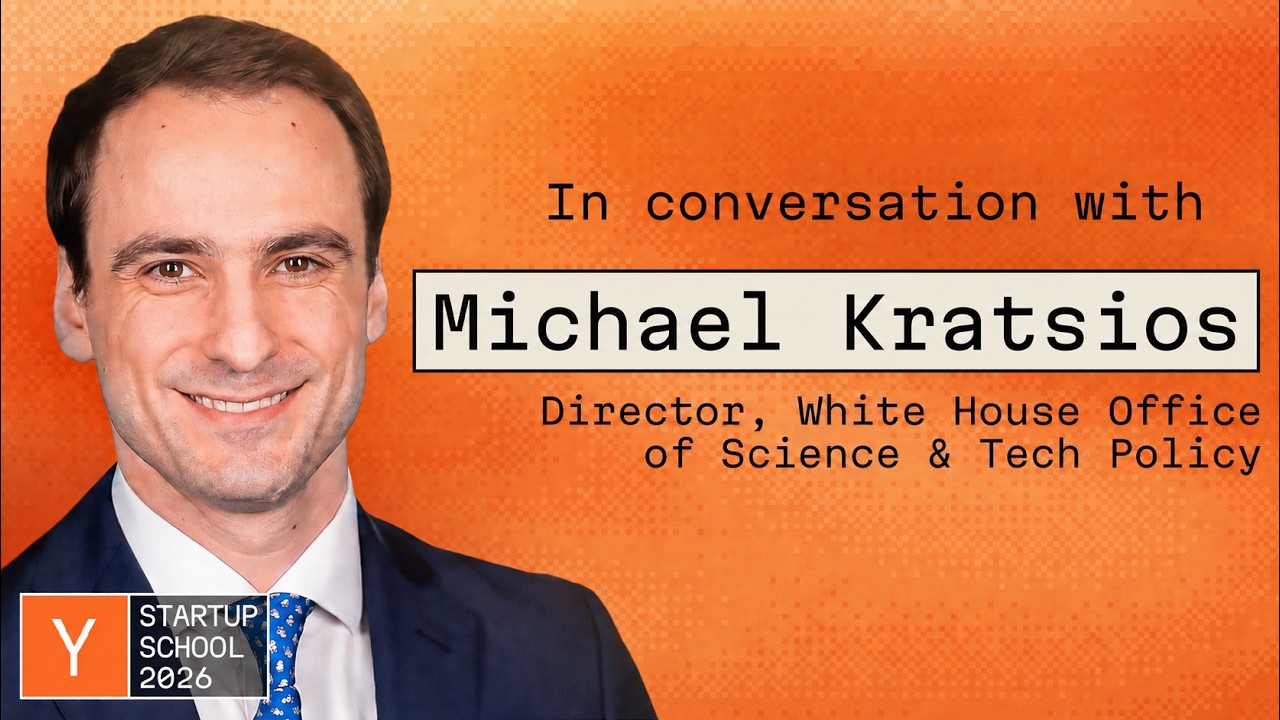
Kratsios Backs Open Source, Warns State AI Rules Create Big Tech Moats
Y Combinator
Fragmented state regulations and rigid compute caps entrench incumbent monopolies, requiring federal preemption and open-source models to keep the startup ecosystem competitive.
The White House national AI strategy explicitly endorses a dual-track ecosystem of both proprietary and open-source models, affirming that open weights are essential for developer experimentation and American technological supremacy. (5:51)
The administration is pushing for federal preemption over state-level AI regulations to prevent a 50-state patchwork that acts as a regulatory moat for well-funded Big Tech incumbents against early-stage startups. (13:03)
A new White House science blueprint updates the 1945 Vannevar Bush model to reflect that private industry now funds 70% of U.S. R&D, preparing federal grantmaking for AI-driven autonomous discovery and robotic cloud laboratories. (26:39)
Quantum information science is being prioritized on a trajectory mirroring federal AI initiatives in 2018–2019, anchored by a presidential mandate for the Department of Energy to produce a scientifically relevant quantum computer by 2028. (31:32)
Detailed notes
## Background
Published by Y Combinator on YouTube on August 18, 2026, this video captures a conversation between YC Head of Public Policy Luther Lowe and White House Office of Science and Technology Policy (OSTP) Director Michael Kratsios at Startup School 2026. The discussion covers the administration's AI strategy, why the White House supports open-source development, how federal technology policy is formulated, and the importance of ensuring early-stage startups have a voice in Washington.
## TL;DR
Michael Kratsios outlines the White House's pro-innovation tech strategy, emphasizing that American AI leadership requires a dual-track ecosystem of both proprietary and open-source models. He argues against rigid, static regulatory mechanisms like compute reporting thresholds and advocates for federal preemption to prevent a fragmented 50-state regulatory patchwork that favors well-resourced incumbents over startups. Kratsios also details a broader historical reset of U.S. science policy—updating the post-WWII Vannevar Bush framework to support AI-driven autonomous cloud laboratories and quantum computing initiatives. Throughout the discussion, he urges startup founders to actively engage with policymakers and consider public service to help steer critical national technology priorities.
## Atmosphere & style
The session has an engaging, collegial insider tone, blending sharp policy analysis with the relaxed camaraderie of two DC-Silicon Valley veterans who joke about early morning flights and insider gossip. Kratsios demystifies the intimidating machinery of the West Wing by framing complex interagency negotiations through relatable operational concepts familiar to founders and venture capitalists. The dialogue feels candid and pragmatic rather than bureaucratic, shifting from sharp critiques of regulatory moats to an inspiring, earnest appeal for technical builders to bring their expertise into government.
## Bulletin
- [05:51](https://www.youtube.com/watch?v=zLUZclThLhU&t=351s) The White House national AI strategy explicitly endorses a dual-track ecosystem of both proprietary and open-source models, affirming that open weights are essential for developer experimentation and American technological supremacy.
- [13:03](https://www.youtube.com/watch?v=zLUZclThLhU&t=783s) The administration is pushing for federal preemption over state-level AI regulations to prevent a 50-state patchwork that acts as a regulatory moat for well-funded Big Tech incumbents against early-stage startups.
- [26:39](https://www.youtube.com/watch?v=zLUZclThLhU&t=1599s) A new White House science blueprint updates the 1945 Vannevar Bush model to reflect that private industry now funds 70% of U.S. R&D, preparing federal grantmaking for AI-driven autonomous discovery and robotic cloud laboratories.
- [31:32](https://www.youtube.com/watch?v=zLUZclThLhU&t=1892s) Quantum information science is being prioritized on a trajectory mirroring federal AI initiatives in 2018–2019, anchored by a presidential mandate for the Department of Energy to produce a scientifically relevant quantum computer by 2028.
## Key takeaways
- [04:39](https://www.youtube.com/watch?v=zLUZclThLhU&t=279s) Policymaking in Washington lacks a consolidated 'Department of Technology,' requiring OSTP to coordinate competing equities across commerce, fundamental science, and national security agencies.
- [05:51](https://www.youtube.com/watch?v=zLUZclThLhU&t=351s) The White House officially backs open-source AI, viewing external tech advocacy and mobilization as vital input rather than unwelcome lobbying.
- [09:11](https://www.youtube.com/watch?v=zLUZclThLhU&t=551s) Washington evaluates AI through broad societal impacts—including labor displacement and intense public backlash against physical data centers—rather than purely through APIs and capability benchmarks.
- [09:53](https://www.youtube.com/watch?v=zLUZclThLhU&t=593s) Static regulatory triggers like bureaucratic compute caps or premature mandates like the EU AI Act risk locking in obsolete standards that lag behind rapid algorithmic advances.
- [11:37](https://www.youtube.com/watch?v=zLUZclThLhU&t=697s) Cyber risks represent the most critical dual-use challenge because the intelligence needed to patch vulnerabilities mirrors the intelligence needed to exploit them, whereas catastrophic biological threats remain largely overblown.
- [13:03](https://www.youtube.com/watch?v=zLUZclThLhU&t=783s) A single federal preemption standard protects 'Little Tech' startups from being priced out by divergent state-level compliance regimes that only Big Tech legal teams can navigate.
- [18:28](https://www.youtube.com/watch?v=zLUZclThLhU&t=1108s) Technology policy distinguishes between 'born free' technologies (requiring high restraint to preserve developer freedom) and 'born in captivity' sectors like supersonic flight and drones (requiring active deregulation and waiver reform).
- [24:36](https://www.youtube.com/watch?v=zLUZclThLhU&t=1476s) White House interagency deliberation operates as an escalating pyramid, resolving operational details at working levels and escalating only intractable agency disagreements to the President.
- [26:39](https://www.youtube.com/watch?v=zLUZclThLhU&t=1599s) National R&D spending has inverted since 1950 from 70% federally funded to 70% privately funded, requiring modernized federal grant structures, fast grants, and focused research models.
- [29:50](https://www.youtube.com/watch?v=zLUZclThLhU&t=1790s) The White House aims to shape the arena for closed-loop autonomous experimentation, leaving private startups to build the underlying robotic cloud infrastructure and software reasoning agents.
- [31:32](https://www.youtube.com/watch?v=zLUZclThLhU&t=1892s) Quantum information science represents the next strategic inflection point for federal investment, targeting fundamental scientific breakthroughs within the next three to five years.
- [35:45](https://www.youtube.com/watch?v=zLUZclThLhU&t=2145s) Statutory rules around AI should target unambiguous output infringements and protect name, image, and likeness (NIL), while allowing market licensing deals to mature before imposing rigid training-data restrictions.
- [37:54](https://www.youtube.com/watch?v=zLUZclThLhU&t=2274s) Technologists are urged to pursue public service because the federal government operates at a scale and impact unattainable in the private sector.
## Detailed walkthrough
### [00:08](https://www.youtube.com/watch?v=zLUZclThLhU&t=8s) Returning to Public Service and the Mission of OSTP
Luther Lowe introduces Michael Kratsios to the Y Combinator Startup School audience, noting his rare career path traversing the frontier of tech and the highest levels of government. Kratsios serves as the Director of the White House Office of Science and Technology Policy (OSTP)—the President’s chief science and technology advisor and a primary architect of the administration's national AI strategy. He previously served as the United States Chief Technology Officer during Donald Trump’s first term, then stepped into the private sector as Chief Operating Officer of Scale AI during a period of hypergrowth, before returning to government service.
Lowe emphasizes that public service involves real personal and financial sacrifice, especially for someone with Kratsios's network and opportunities, asking what compels him to do this work. Kratsios explains that he views American leadership in emerging technologies as "one of the most critical questions of our time." In order for everyday Americans to reap the economic and social dividends of artificial intelligence, the country must build and maintain a regulatory environment that allows innovation to flourish. Moreover, from a purely operational perspective, Kratsios finds public service uniquely rewarding: even at the largest tech conglomerates on Earth, a technologist will never work on problems of the sheer scale found inside the federal government. Because government interventions can either dramatically accelerate technological progress or "unfortunately kind of screw things up," being in the room to steer the machinery in the right direction provides deep professional fulfillment.
---
[02:38](https://www.youtube.com/watch?v=zLUZclThLhU&t=158s) From Steve Jobs Keynotes to Peter Thiel and Deregulatory Instincts
Kratsios recounts how his passion for technology developed despite not coming from a traditional engineering background. Growing up, he was captivated by product launches, obsessively watching Steve Jobs's annual Apple keynotes. He jokes about dating himself by recalling the profound excitement of college life when the original iPhone debuted, running around dorm hallways discussing the device with friends. Lacking an engineering degree, he initially struggled to see how his passion could translate into a career.
His trajectory crystallized when he moved to San Francisco to work with Peter Thiel, spending nearly seven years with him between 2010 and 2017. While working alongside Thiel's portfolio companies, Kratsios noticed a recurring theme: regulatory roadblocks were constantly constraining breakthrough technologies:
- **Ridesharing (Lyft):** Entangled in local and municipal transport ordinances and state-level regulatory battles.
- **Commercial Space (SpaceX):** Navigating complex launch permits across the Federal Aviation Administration (FAA) and the Department of Commerce.
Observing these dynamics made him realize that government policy is often the ultimate bottleneck or the ultimate catalyst. When President Trump won the 2016 election and Kratsios was offered an administration role, his primary instinct was to ask: *"How do we like look across all the rules that we have and make it easier for innovators to build?"* His early focus centered on dismantling hurdles to get commercial drone deliveries airborne and autonomous vehicles safely deployed onto American roads.
---
[04:39](https://www.youtube.com/watch?v=zLUZclThLhU&t=279s) How Federal Technology Policy Actually Gets Made
Addressing a common misconception held by founders and outsiders, Kratsios explains that technology policymaking in Washington is not dictated from the top down by one or two individuals tucked away in the West Wing. Instead, authority is extraordinarily federated. While the U.S. government has dedicated cabinet departments for specific domains—such as the Department of Defense for national security or Health and Human Services for medicine—there is no consolidated "Department of Technology."
As a result, technological questions cut across dozens of independent agencies, balancing competing equities:
```mermaid
flowchart TD
accTitle: Federated Tech Policy Coordination
accDescr: Diagram illustrating how the White House OSTP balances commercial innovation, national security, and scientific research.
subgraph Inputs["Diverse Agency Equities"]
A["Commercial & Economic<br>(e.g., FAA, Commerce)"]
B["National Security & Defense<br>(e.g., Pentagon, Energy / NNSA)"]
C["Fundamental R&D<br>(e.g., NSF, National Labs)"]
end
subgraph Coordination["White House Coordination (OSTP)"]
D["Interagency Policy Process<br>& Harmonization"]
end
subgraph Outcome["Policy Result"]
E["Balanced Federal Rulemaking<br>(e.g., Commercial Drone Corridors)"]
end
A --> D
B --> D
C --> D
D --> E
```
To illustrate, Kratsios points to commercial drone regulation. Crafting a viable framework requires the FAA to establish rules for airspace integration and commercial flight, but it simultaneously requires satisfying the national security officials who safeguard America's nuclear weapons stockpiles, ensuring civilian drones cannot fly over sensitive military installations or nuclear sites. The primary mission of the White House OSTP is to serve as the convener that negotiates these disparate concerns into a coherent national framework.
---
[05:51](https://www.youtube.com/watch?v=zLUZclThLhU&t=351s) Rumors, Open-Source AI, and the Administration's Action Plan
Lowe turns the conversation to recent political drama in Washington. A wave of speculation and anxiety had spread across tech circles and Twitter regarding a rumored executive order that would supposedly crack down on open-weight and open-source AI models. In response, a coalition of startups and prominent tech firms had mobilized, with Y Combinator helping organize an advocacy letter sent to the administration urging protection for open weights. Lowe notes that at the White House Correspondents' Dinner the previous night, Commerce Secretary Howard Lutnick explicitly told him that the White House strongly supports open source.
Kratsios teases Lowe for turning into an intrepid "mini reporter," but affirms that Secretary Lutnick's statement matches the official position established on page one of the administration's AI Action Plan released the previous July. Kratsios co-authored that foundational strategy alongside David Sacks and Marco Rubio. Chapter one explicitly articulates that maintaining American global supremacy in artificial intelligence demands a healthy, dual-track ecosystem of both proprietary (closed) and open-source models:
- **Ecosystem Interdependence:** U.S. AI dominance cannot rely solely on closed frontier labs; open weights are necessary for developer experimentation, academic verification, and decentralized innovation.
- **The Value of Outside Pressure:** Rather than being annoyed by intense industry lobbying or panicked Twitter discourse, Kratsios views public mobilizations as the democratic process operating as intended. When policymakers operate inside a Washington bubble isolated from startups, big tech, and end-user industries, policy suffers. Mobilizations force the builder community to voice their core principles so the White House can integrate those real-world perspectives into national policy.
---
[08:28](https://www.youtube.com/watch?v=zLUZclThLhU&t=508s) How Washington's Lens on AI Differs from Silicon Valley
Lowe asks Kratsios to pinpoint the single biggest perceptual divide between startup founders building applications in Silicon Valley and policymakers evaluating AI inside the Beltway.
Kratsios explains that while technologists tend to view AI through the lens of technical capabilities, tooling, APIs, and direct productivity gains, Washington views it through a sprawling societal and political matrix. For policymakers, AI is an all-encompassing force that touches:
- The perspective of Middle America, including the physical impact of energy and resource consumption required for hyperscale data centers;
- The profound disruption and opportunities within the healthcare system;
- Severe anxieties surrounding labor market dislocations, automation, and net job displacement;
- Broader macroeconomic questions concerning industrial capacity, enterprise productivity, and new company formation.
[09:11](https://www.youtube.com/watch?v=zLUZclThLhU&t=551s) The Political Reality of AI: Data Centers, Labor, and Competing Priorities
In Washington, technology policy cannot exist in a vacuum separated from messy political and social trade-offs. Michael Kratsios explains that while technologists focus on rapid capability jumps, policymakers are forced to reconcile technological ambition with broader public anxieties. It is impossible to isolate conversations about advancing artificial intelligence from urgent debates over labor displacement or the fierce local backlash against physical infrastructure.
Data center expansion represents one of the starkest divides between the tech ecosystem and the American electorate. As Kratsios points out, data centers "poll horribly" with the general public—ordinary citizens simply do not want massive server farms and power substations built in their backyards. Yet, every founder and engineer understands that scaling American AI requires deploying as much distributed compute across the country as humanly possible. Balancing these conflicting pressures is the fundamental task of the White House, making direct input from startup founders vital to ensure national policy reflects technical realities rather than political convenience alone.
[09:53](https://www.youtube.com/watch?v=zLUZclThLhU&t=593s) Regulating a Moving Target: Compute Thresholds and the EU AI Act
When Luther Lowe asks how government can effectively write rules for an industry that reinvents itself every six months—contrasted with traditional regulatory targets that are static and mature—Kratsios warns against establishing rigid statutory boundaries. Drawing firm lines in the sand invariably backfires because state machinery moves too slowly to track technological shifts.
Kratsios points to Europe as the prime cautionary tale. During the first Trump administration, European officials spent years drafting the EU AI Act with immense fanfare, ultimately finalizing its core architecture before ChatGPT was ever released to the public. As a consequence, foundational large language models and subsequent generative architectures have been forced to comply with a regulatory regime designed before LLMs even existed.
The United States risks falling into similar traps when it relies on blunt, static metrics. Kratsios specifically critiques the Biden administration’s approach of imposing hard reporting thresholds tied to specific compute calculations:
```mermaid
flowchart TD
accTitle: Dynamic AI Frontier vs Static Regulation
accDescr: Diagram illustrating how static regulatory thresholds lag behind the moving technological frontier.
subgraph Frontier ["The Rapid Frontier"]
F1["Algorithmic Innovation"] --> F2["New Architectures (LLMs, Reasoning)"]
F2 --> F3["Shifting Compute Efficiency"]
end
subgraph Regulation ["Static Policy Traps"]
R1["Fixed Metric / Compute Cap"] --> R2["Premature Mandates (e.g. EU AI Act)"]
R2 --> R3["Permanent Regulatory Lock-in"]
end
Frontier -.->|"Outpaces"| Regulation
```
Once a bureaucratic compute threshold or disclosure trigger is written into federal rules, resetting or repealing it proves nearly impossible. Regulatory frameworks must instead be designed to flex and adapt alongside the frontier rather than attempting to freeze a fast-moving target in place.
[11:37](https://www.youtube.com/watch?v=zLUZclThLhU&t=697s) Real vs. Overblown AI Threats: Cyber Risks vs. Biological Catastrophe
Addressing the ongoing debate between immediate technical vulnerabilities and apocalyptic scenarios, Kratsios breaks down which risks warrant serious policy focus and which have been exaggerated by public alarmism:
* **The Cyber Capability Dilemma:** Frontier model releases—such as the recent evaluations surrounding the "Mythos moment" and the guardrails developed for models like Fable—highlight the challenge of offensive dual-use capabilities. The very model intelligence capable of executing an exploit or probing vulnerabilities is precisely the same intelligence security teams need to patch and harden critical domestic software. Regulating away dangerous capabilities risks stripping defenders of their most effective defensive tools.
* **The Biological Risk Debate:** Kratsios argues that catastrophic biological risk claims remain largely overblown. Despite critics sounding continuous alarms since 2021 and 2022 about models enabling bio-weapons, empirical disasters have failed to materialize over the subsequent three years. While the government must still construct rigorous test and evaluation (eval) infrastructure to inspect models crossing the frontier, speculative biological hysteria should not dictate baseline technology policy.
[13:03](https://www.youtube.com/watch?v=zLUZclThLhU&t=783s) Giving "Little Tech" a Voice: State Preemption vs. Big Tech Moats
The conversation shifts to the outsized presence of Big Tech inside the Beltway. Lowe notes that tech policy discussions in Washington often feel like a "Truman Show" orchestrated by Google, Apple, Meta, and Amazon, where seemingly every white paper and congressional testimony reflects incumbent interests. To counter this, Y Combinator and allied startups recently organized the Little Tech Association to give early-stage companies collective bargaining power. Lowe jokes about sharing an 8:00 AM flight out of D.C. with Kratsios that morning, illustrating how rare it is for startup interests to intersect directly with senior officials.
| Regulatory Environment | Impact on Big Tech Incumbents | Impact on "Little Tech" Startups |
|:--- |:--- |:--- |
| **50-State Regulatory Patchwork** (e.g., California vs. Texas vs. Maryland) | **Advantageous:** Incumbents can hire an "army of lawyers" to navigate disparate compliance rules, turning legal overhead into a competitive moat. | **Devastating:** Two-person startups face crippling legal costs and conflicting jurisdictional requirements before reaching product-market fit. |
| **Single National Standard** (Federal Preemption) | **Neutralized Moat:** Forces transparent, uniform national baseline compliance. | **Empowering:** Offers a predictable, clear set of rules that lets founders focus resources on building products rather than compliance. |
Kratsios emphasizes that the White House is acutely aware of incumbent influence, a dynamic common across healthcare and energy as well as technology. He points to the national AI strategy released the previous July, where the President explicitly championed federal preemption over state-level AI laws. If states create divergent regulations, large incumbents can easily absorb the overhead while two-person startups get crushed. Establishing a single national standard is a deliberate effort to keep compliance friction low enough for new entrants to compete.
Lowe commends the continuity of bipartisan tech antitrust enforcement across administrations, tracing actions against monopolistic behavior back to the first Trump administration:
- *United States v. Google* (initiated under the first Trump DOJ)
- *United States v. Apple* (maintained and continued)
- *FTC v. Meta / Facebook* and *FTC v. Amazon* (sustained across leadership changes)
Reflecting on his personal path, Kratsios recalls spending most of his twenties working in venture capital in San Francisco. Having witnessed the grit required to build early-stage companies, he views his role as a public servant through the lens of protecting America's unique startup advantage: "Everyone in the world is clamoring to come to America to build companies. There's something very special about here that we must preserve."
[17:31](https://www.youtube.com/watch?v=zLUZclThLhU&t=1051s) Consumer Protection Without Incumbent Moats
Lowe presses Kratsios on whether it is genuinely possible to draft consumer protection laws that do not inadvertently hand incumbents a protective moat. Kratsios maintains that the solution lies in radical regulatory simplicity and clarity. Working closely with Congress to establish a singular national framework eliminates ambiguity without establishing punitive, bureaucratic roadblocks that only well-funded incumbents can navigate. For any founder paralyzed by fears that looming compliance rules will lock them out before they can launch, Kratsios insists that the administration's foremost priority remains eliminating red tape to keep the barrier to entry as low as possible.
[18:28](https://www.youtube.com/watch?v=zLUZclThLhU&t=1108s) Removing Barriers: "Born Free" vs. "Born in Captivity" Technologies
The primary question facing technology policy inside the White House is how to aggressively eliminate barriers to innovation. The regulatory apparatus is steered by the Office of Management and Budget (OMB), where leadership—such as Russ Vought—has made it a central mission to eliminate as many unnecessary regulations as humanly possible. Within the tech domain, Washington policy circles evaluate technologies through a conceptual framework that divides them into two distinct categories: those that are "born free" and those that are "born in captivity."
```mermaid
flowchart TD
accTitle: Framework for Technology Regulation
accDescr: Visual breakdown of born free versus born in captivity technologies and their respective policy playbooks.
subgraph BF["Born Free Technologies"]
BF1["No existing regulations on the books\n(e.g., early internet)"]
BF2["Policy objective: Preserve freedom"]
BF3["High bar to introduce new rules"]
BF1 --> BF2 --> BF3
end
subgraph BC["Born in Captivity Technologies"]
BC1["Cannot commercialize without government approval\n(e.g., drones, supersonic flight)"]
BC2["Policy objective: Strip regulatory barriers"]
BC3["Replace restrictive bans with smart standards\n(e.g., noise limits over speed limits)"]
BC1 --> BC2 --> BC3
end
```
"Born free" technologies emerge into domains where no pre-existing regulatory rulebooks exist. The early commercial internet stands as the classic historical archetype: developers could build without licenses, invent new models, and let markets flourish. In these spaces, policymakers must exercise extreme restraint, treating any impulse to introduce new rules with intense skepticism so entrepreneurs retain unrestricted freedom to build and experiment.
In sharp contrast, "born in captivity" technologies are sectors where an entrepreneur can engineer a breakthrough product in their backyard—such as an autonomous commercial delivery drone with world-class routing software—yet cannot legally conduct a single commercial transaction without explicit federal permission or a waiver from agencies like the Federal Aviation Administration (FAA). Another poignant example is supersonic flight, which has suffered from decades of "technological stagnation" since the retirement of Concorde:
> "I've been obsessed with supersonic flight for years. I think it's the most obvious sort of like in your face example of technological stagnation. We had the Concorde flying years ago. We're flying slower than we were back then today. Absolute tragedy."
Commercial supersonic aviation cannot succeed domestically until federal rules abandon legacy speed limits in favor of objective noise thresholds over land. For captive sectors, the White House's mandate is to relentlessly dismantle legacy red tape, grant waivers, and rewrite rules so these technologies can finally operate in the market.
- **Russ Vought & OMB**: Direct the federal government's deregulatory efforts and manage interagency rule reviews.
- **Born Free Rule of Thumb**: Keep regulatory intervention near zero to protect open innovation.
- **Born in Captivity Rule of Thumb**: Proactively rewrite legacy statutes and agency waivers to enable market access.
- **Supersonic Flight Goal**: Shift overland aviation rules from hard Mach-speed caps to decibel-based noise standards.
---
[20:46](https://www.youtube.com/watch?v=zLUZclThLhU&t=1246s) Inside the Machine: How the White House Coordinates Policy
Managing science and technology policy across the federal government is an interagency coordination challenge. The federal apparatus is divided among sprawling, entrenched agencies: the Department of Health and Human Services (HHS) oversees healthcare, the Department of Defense (DOD) manages military operations, and the Department of Energy (DOE) stewards the national laboratories and nuclear infrastructure. Because individual agencies often have conflicting mandates, the White House is the only authority with the leverage to convene them at the same table and force binding resolutions.
Executive branch policymaking is channeled across four core policy councils:
| Policy Council / Lead | Focus Areas |
|:--- |:--- |
| **National Security Council (NSC)** | Defense, foreign policy, intelligence |
| **Domestic Policy Council (DPC)** | Healthcare, immigration, social policy |
| **National Economic Council (NEC)** | Tax policy, macroeconomic strategy, trade |
| **Office of Science and Technology Policy (OSTP)** | AI, quantum, biotech, civil nuclear, space |
OSTP operates with focused, agile teams. A dedicated space portfolio of roughly three staff members coordinates policy between civilian entities like NASA and military components managing national security satellites. The day-to-day workflow balances three primary responsibilities:
1. **Stakeholder Engagement**: Listening to concerns from entrepreneurs and startups (or joking about requests to "not settle the Apple case").
2. **Policy Blocking and Tackling**: Doing the administrative spadework to execute the President's directives, such as pushing the FAA to enable commercial drone flights.
3. **Public Advocacy**: Communicating the administration’s strategy across the country to align external builders with national priorities.
Within the White House hierarchy, the top tier consists of roughly 20 commissioned officers holding the title of Assistant to the President (such as the Chief of Staff and the OSTP Director), followed by Deputy Assistants and Special Assistants.
---
[24:36](https://www.youtube.com/watch?v=zLUZclThLhU&t=1476s) The Decision Pyramid: Resolving Interagency Gridlock
White House policy development functions as an escalating pyramid designed to protect the President's time. Initial debates occur at the working level among technical staff across the relevant agencies. If consensus is reached, the policy moves directly to implementation. However, if interagency friction arises—such as defense officials objecting to commercial drone flight paths near sensitive military installations—the dispute is kicked up the chain to progressively senior officials (deputies and agency heads).
Only intractable, high-stakes disagreements make it to the Oval Office for the President's final determination. This filtering ensures the Commander-in-Chief only expends political capital on decisive national priorities. After outlining this relentless schedule of interagency mediation, stakeholder summits, and presidential briefings, the discussion turns to OSTP's newly released 150-page strategy document, unveiled that week to inaugurate a "new golden age" of American scientific leadership.
[26:39](https://www.youtube.com/watch?v=zLUZclThLhU&t=1599s) A New Blueprint for American Science: From Vannevar Bush to AI
Michael Kratsios grounds the administration's new science policy report in historical context, going back to 1945. At the conclusion of World War II, President Franklin D. Roosevelt sent a letter to his top science advisor, Vannevar Bush—the predecessor in Kratsios's role at the Office of Science and Technology Policy—asking how the United States should structure its science ecosystem after massive wartime mobilizations like the Manhattan Project. Bush responded with the landmark report *Science, the Endless Frontier*, establishing that the federal government had a critical responsibility to fund basic, early-stage research in the national interest that the private market would not otherwise incentivize. That single framework directed American scientific policy for the next seventy years.
However, the structural realities of research and development have since completely inverted. Around 1950, the federal government funded approximately 70% of all R&D, leaving only 30% or less to the private sector. Today, private industry and philanthropic institutions fund roughly 70% of R&D, while the federal government accounts for only 30%. Even in pure basic research, traditionally the sole domain of research universities, the private sector and government are near parity. Alongside university labs, new institutional models have emerged, including Focused Research Organizations (FROs) and early-stage startup ventures. Recognizing that the system had fundamentally transformed, President Trump sent Kratsios a mandate letter upon his Senate confirmation, mirroring FDR's letter to Bush and tasking him with revitalizing American science. Kratsios's team spent the following year authoring an updated strategy.
A central thesis of the new report is that artificial intelligence is poised to fundamentally alter the nature of scientific discovery itself. Whether in material science, pharmaceuticals, or chemistry, the daily workflow of a scientist in two to three years will look drastically different than it did historically. Given that the U.S. federal government spends nearly $200 billion annually funding R&D, Kratsios argues it must actively modernize its grantmaking and infrastructure to ensure the nation produces the most competitive research in the world.
- **1950 R&D spending mix**: ~70% federal government, ~30% private sector.
- **Modern R&D spending mix**: ~70% private sector and philanthropy, ~30% federal government.
- **Federal R&D investment**: Nearly $200 billion annually.
- **Key modern institutional models**: Startups, universities, and Focused Research Organizations (FROs).
---
[29:50](https://www.youtube.com/watch?v=zLUZclThLhU&t=1790s) Autonomous Cloud Labs and Shaping the Arena
Luther Lowe points out that the concluding chapter of the White House report reads almost like science fiction, depicting autonomous AI agents posting bounties for experiments, contracting robotic cloud laboratories, and settling results on a ledger. Concurrently, the operational budget memo is strictly pragmatic: demanding agency action plans within 90 days, processing "fast grants" in under a month, and structuring prizes to draw a 3-to-1 private-to-public capital leverage. Lowe asks what piece of this ambitious future the White House is hoping energetic 20-something startup founders will build, specifically because the government cannot or should not build it itself.
```mermaid
flowchart TD
accTitle: Autonomous Discovery Loop
accDescr: Cycle of hypothesis generation, robotic lab testing, and result analysis.
subgraph S1["Software Layer"]
A["AI Agent generates hypothesis"]
D["AI evaluates results & refines model"]
end
subgraph S2["Physical Execution"]
B["Agent contracts autonomous cloud lab"]
C["Robotics run closed-loop experiment"]
end
A --> B
B --> C
C --> D
D --> A
```
Kratsios highlights the physical and digital infrastructure layer for scientific experimentation as the prime startup opportunity. The ultimate vision is a closed-loop autonomous system where software-driven agents formulate hypotheses, dispatch experimental protocols to physical cloud labs with zero human intervention, evaluate the empirical readouts, and immediately iterate to the next hypothesis. Realizing this vision requires massive private innovation: mechanical robotics must be perfected to handle delicate laboratory workflows, and specialized software ecosystems must be built to direct high-level scientific reasoning and hypothesis formation. Kratsios emphasizes that the government's role is merely to "shape the arena, not direct discovery," leaving founders an "infinite category of work" to build the underlying tools of autonomous experimentation.
---
[31:32](https://www.youtube.com/watch?v=zLUZclThLhU&t=1892s) Quantum Information Science: The Next Strategic Frontier
Turning to frontier technologies beyond AI, Lowe asks what Washington will be fixated on five years from now that barely gets attention today. Kratsios answers without hesitation: quantum information science (QIS) and quantum computing. He draws a direct parallel to his time as U.S. Chief Technology Officer in 2017 and 2018, when he frequently walked the halls of the West Wing trying to convince senior officials that artificial intelligence mattered, celebrating if a single journalist wrote a story about federal AI policy every few months.
That early groundwork culminated in February 2019, when President Trump signed the first executive order in U.S. history dedicated to prioritizing artificial intelligence, doubling federal AI R&D budgets and laying the groundwork for agency regulatory thinking. While Kratsios acknowledges the administration did not directly cause the eventual release of ChatGPT four years later, that policy push primed the scientific ecosystem to exploit the deep learning boom. Kratsios sees the exact same inflection point playing out in quantum today:
- President Trump signed a major executive order prioritizing quantum information science.
- The administration established a mandate for the Department of Energy to develop a scientifically relevant quantum computer by 2028.
- Fundamental scientific hurdles in quantum computing and quantum sensing remain, but targeted federal investments today are designed to yield massive national payoffs within the next three to five years.
---
[33:55](https://www.youtube.com/watch?v=zLUZclThLhU&t=2035s) Congress, Preemption, and Intellectual Property
Lowe notes the reliance on executive orders in technology policy and questions why the legislative branch has lagged behind. Kratsios acknowledges that legislating emergent technology like AI is exceptionally delicate: if lawmakers pass prescriptive "rules of the road" prematurely, they risk inflicting lasting harm on the domestic tech sector. A critical feature of executive orders is their flexibility; when an administration changes, an executive order can simply be rescinded and rewritten. By contrast, statutes enacted by Congress become permanent law and are notoriously difficult to undo.
Nevertheless, the White House has submitted concrete legislative proposals to Capitol Hill where permanent statutory backing is necessary. Chief among these is federal preemption. Kratsios warns that without a federal standard, startups face a debilitating, fragmented regulatory landscape of fifty individual states passing conflicting state-level AI mandates. Additionally, he highlights two areas where the public expects congressional action: modernizing intellectual property protections in the age of generative models, and instituting clear federal protections for Americans' name, image, and likeness (NIL) against unauthorized AI replication.
[35:45](https://www.youtube.com/watch?v=zLUZclThLhU&t=2145s) Intellectual Property, Model Outputs, and Licensing Frameworks
Luther Lowe brings up the intense debate surrounding intellectual property and AI. On one hand, traditional media companies are filing lawsuits left and right against AI developers; on the other hand, AI maximalists argue that content should not even be opt-outable from training web crawls. Lowe asks Michael Kratsios how the White House views this problem and what an ideal resolution would look like if he had a magic wand.
Kratsios emphasizes that protecting individual craft—whether that belongs to singers, authors, or programmers—matters deeply to everyday Americans. While training data remains a nuanced debate, Kratsios is unequivocal on model outputs: if an AI generates direct intellectual property like Mickey Mouse, "not cool. Can't can't do that." Generating protected work infringes on creators, and clarifying protections around outputs in statute is an important step.
At the same time, Kratsios advises against rushing heavy-handed legislation on every facet of the IP question while the market is still nascent. Industry players are already experimenting with private deals and revenue-sharing mechanisms. Lowe notes that his former employer, Yelp, recently announced an agreement with OpenAI to provide Yelp reviews directly within ChatGPT. Kratsios sees agreements like these—where musicians, platforms, and individual creators license their proprietary content—as a sign that the commercial landscape is actively maturing and sorting itself out before regulators need to step in aggressively.
```mermaid
flowchart TD
accTitle: AI Intellectual Property Landscape
accDescr: Diagram contrasting regulatory clarity on AI outputs with market-driven private agreements on training data and licensing.
subgraph Regulation ["Statutory Clarification"]
A["Protected Output Safeguards"]
A --> B["Ban Direct IP Replication<br/>(e.g., Mickey Mouse)"]
end
subgraph Market ["Private & Market Mechanisms"]
C["Voluntary Licensing Deals"]
D["Revenue-Sharing Models"]
C --> E["Direct Integration<br/>(e.g., Yelp & ChatGPT)"]
D --> E
end
[37:54](https://www.youtube.com/watch?v=zLUZclThLhU&t=2274s) A Call to Public Service for Technologists
In closing the conversation, Lowe notes that Kratsios was one of the youngest people ever to serve in his White House role and asks whether the ambitious 20-somethings in the room should consider entering public service, and what they should expect if they do.
Kratsios delivers an impassioned pitch for tech workers to spend part of their careers inside government:
> "I guarantee you... you will never feel or have a moment where it's more fulfilling and more rewarding. I think it can be a slog, it can be bureaucratic, it can be painful, but when the outcome actually happens and you deliver the result, there is no place where you can have a bigger impact on this country."
He connects the startup mission—building companies, hiring Americans, and delivering software that transforms lives—directly to public service. Working in government allows technologists to design the very environment that lets startups thrive and safeguards American innovation. Kratsios pitches the audience directly, letting them know that the White House Office of Science and Technology Policy (OSTP) is always on the hunt for talent: "you just look us up because we're always looking for good people."
Lowe wraps up the session by thanking Director Kratsios for his office's openness to dialogue with early-stage founders and welcomes a warm round of applause from the Y Combinator AI Startup School audience.
## Notable quotes
> [00:08](https://www.youtube.com/watch?v=zLUZclThLhU&t=8s) one of the most critical questions of our time — Michael Kratsios
> [02:38](https://www.youtube.com/watch?v=zLUZclThLhU&t=158s) How do we like look across all the rules that we have and make it easier for innovators to build? — Michael Kratsios
> [09:11](https://www.youtube.com/watch?v=zLUZclThLhU&t=551s) poll horribly — Michael Kratsios
> [13:03](https://www.youtube.com/watch?v=zLUZclThLhU&t=783s) Everyone in the world is clamoring to come to America to build companies. There's something very special about here that we must preserve. — Michael Kratsios
> [18:28](https://www.youtube.com/watch?v=zLUZclThLhU&t=1108s) I've been obsessed with supersonic flight for years. I think it's the most obvious sort of like in your face example of technological stagnation. We had the Concorde flying years ago. We're flying slower than we were back then today. Absolute tragedy. — Michael Kratsios
> [29:50](https://www.youtube.com/watch?v=zLUZclThLhU&t=1790s) shape the arena, not direct discovery — Michael Kratsios
> [29:50](https://www.youtube.com/watch?v=zLUZclThLhU&t=1790s) infinite category of work — Michael Kratsios
> [35:45](https://www.youtube.com/watch?v=zLUZclThLhU&t=2145s) not cool. Can't can't do that. — Michael Kratsios
> [37:54](https://www.youtube.com/watch?v=zLUZclThLhU&t=2274s) I guarantee you... you will never feel or have a moment where it's more fulfilling and more rewarding. I think it can be a slog, it can be bureaucratic, it can be painful, but when the outcome actually happens and you deliver the result, there is no place where you can have a bigger impact on this country. — Michael Kratsios
> [37:54](https://www.youtube.com/watch?v=zLUZclThLhU&t=2274s) you just look us up because we're always looking for good people. — Michael Kratsios
## Mentioned
Michael Kratsios, Luther Lowe, Donald Trump, Steve Jobs, Peter Thiel, Howard Lutnick, David Sacks, Marco Rubio, Russ Vought, Vannevar Bush, Franklin D. Roosevelt, White House Office of Science and Technology Policy (OSTP), Y Combinator, Scale AI, Federal Aviation Administration (FAA), Department of Commerce, Department of Defense (DOD), Department of Health and Human Services (HHS), Department of Energy (DOE), Office of Management and Budget (OMB), National Security Council (NSC), Domestic Policy Council (DPC), National Economic Council (NEC), NASA, Little Tech Association, Department of Justice (DOJ), Federal Trade Commission (FTC), Apple, Lyft, SpaceX, Google, Meta, Amazon, OpenAI, Yelp, ChatGPT, EU AI Act, Science, the Endless Frontier, Concorde, iPhone
## Video description
Michael Kratsios has seen the AI boom from both sides: as COO of Scale AI and inside the White House. Today, as the director of the White House Office of Science and Technology Policy, he helps shape America’s national strategy on AI, science, and emerging technology.
At Startup School 2026, he sat down with YC's head of public policy, Luther Lowe, to talk about how Washington makes technology policy, why the White House supports open-source AI, and why little tech needs a seat at the table.
Apply to Y Combinator: https://www.ycombinator.com/apply
Work at a startup: https://www.ycombinator.com/jobs
Chapters:
00:00 — Michael Kratsios on AI Policy and Public Service
02:38 — From Tech to the White House
04:39 — How Technology Policy Actually Gets Made
05:51 — The White House on Open Source AI
08:28 — How Washington Sees AI Differently
09:53 — Regulating a Technology That Changes Every Six Months
11:37 — Which AI Risks Are Overblown?
13:03 — Giving Little Tech a Seat at the Table
17:31 — Regulation Without Creating Incumbent Moats
18:01 — Born Free vs. Born in Captivity Technologies
20:46 — What Working in the White House Is Actually Like
25:56 — A New Golden Age of American Science
31:32 — Quantum, Congress, IP, and What Comes Next
37:54 — Why Technologists Should Consider Public Service
Michael Kratsios, Director of the White House Office of Science and Technology Policy, argues that American artificial intelligence leadership depends on a flexible deregulatory posture that protects open-source development, preempts fragmented state laws, and modernizes federal research investments to favor startup innovation.
Balancing Open-Source AI and Domestic Political Realities (5:51)
Kratsios confirmed that the administration's AI Action Plan, co-authored with David Sacks and Marco Rubio, formally endorses a dual-track ecosystem of proprietary and open-source models. Addressing industry rumors of an impending crackdown on open weights, he stated that American dominance cannot depend entirely on closed frontier labs; open models remain essential for decentralized experimentation and academic scrutiny. He welcomed public lobbying and startup mobilization, characterizing outside pressure as an effective mechanism to prevent policymakers from operating in an insular Washington environment.
Simultaneously, Kratsios emphasized that Washington evaluates AI through broader societal trade-offs than Silicon Valley's focus on APIs and tooling. Key political pressures include workforce automation anxieties, healthcare disruptions, and severe local resistance to hyperscale data centers. Because data centers poll unfavorably due to community concerns over power and resource consumption, federal policymakers face the ongoing operational challenge of reconciling public infrastructure pushback with the technical imperative to expand distributed compute.
Adaptive Regulation and the Born in Captivity Model (9:53)
Warning against blunt statutory boundaries, Kratsios critiqued fixed compute reporting thresholds and cited the European Union's AI Act as a cautionary failure. Because the European framework was drafted before the public emergence of large language models, foundational architectures were subjected to an outdated regime. Kratsios cautioned that once rigid computational metrics are codified into federal rules, bureaucratic inertia makes them nearly impossible to repeal as algorithmic efficiency advances.
To guide federal policy under Office of Management and Budget director Russ Vought, the administration categorizes technologies as either 'born free' or 'born in captivity.' Technologies born free, such as the early commercial internet, require strict regulatory restraint to preserve exploratory development. By contrast, technologies born in captivity—such as commercial drones and supersonic flight—cannot legally operate without federal waivers. In those sectors, the administration's policy is to dismantle legacy constraints, such as shifting commercial aviation from arbitrary overland Mach-speed bans to objective decibel-based noise thresholds.
Federal Preemption and Protecting Little Tech (13:03)
Kratsios argued that shielding early-stage startups from incumbent dominance requires federal preemption over state-level AI legislation. When individual states establish conflicting compliance regimes, well-funded incumbents can leverage extensive legal teams to turn compliance into a protective moat, whereas two-person startups face prohibitive costs. A uniform national baseline is intended to lower entry barriers and preserve competitive dynamism.
This deregulatory approach complements ongoing federal antitrust enforcement, with Kratsios and interviewer Luther Lowe noting cross-administration continuity in actions targeting Google, Apple, Meta, and Amazon. Kratsios contended that consumer protection rules must remain radically clear and simple, warning that overly prescriptive mandates inadvertently entrench the very Big Tech monopolies they seek to constrain.
Modernizing National Science and Strategic Frontiers (26:39)
Grounding the administration's science blueprint in historical context, Kratsios highlighted that the U.S. research landscape has inverted since Vannevar Bush's 1945 report 'Science, the Endless Frontier.' In 1950, the federal government funded approximately 70% of domestic R&D; today, private industry and philanthropy fund 70%, while the federal share has dropped to 30% of the nearly $200 billion spent annually. An updated White House strategy seeks to adapt federal grantmaking through 90-day agency plans, fast-grant turnarounds under one month, and prize programs targeting a 3-to-1 private-to-public capital match.
Kratsios identified autonomous cloud laboratories—where software agents formulate hypotheses, command robotic equipment, and analyze empirical results in closed loops—as a prime commercial opportunity for startups. Beyond AI, he pointed to quantum information science as the next decisive strategic frontier, citing executive directives and an official Department of Energy mandate to build a scientifically relevant quantum computer by 2028.
Calibrating Model Threats and Intellectual Property (11:37)
Differentiating actionable security priorities from exaggerated risks, Kratsios characterized fears of AI-enabled biological catastrophes as largely overblown, noting that empirical disasters have failed to materialize despite continuous alarms since 2021. Conversely, he described dual-use cyber capabilities as an acute dilemma: restricting models capable of finding software vulnerabilities risks depriving domestic security teams of the automated capabilities required to patch critical systems.
Regarding intellectual property, Kratsios advocated regulatory restraint on training data disputes while voluntary commercial licensing matures, pointing to private partnerships such as Yelp licensing review data to OpenAI. However, he maintained that federal statute must firmly prohibit unauthorized model outputs that directly replicate copyrighted characters or infringe on an individual's name, image, and likeness.
Kratsios concluded by encouraging startup technologists to enter public service, arguing that federal policymaking offers unmatched leverage despite bureaucratic friction. Significant uncertainties remain, however, regarding whether Congress will pass federal preemption against state AI laws and how the administration will reconcile public resistance to physical data center infrastructure with the expanding power requirements of domestic AI scaling.
Source quotes
[0:08] Michael Kratsios: one of the most critical questions of our time
[2:38] Michael Kratsios: How do we like look across all the rules that we have and make it easier for innovators to build?
[9:11] Michael Kratsios: poll horribly
[13:03] Michael Kratsios: Everyone in the world is clamoring to come to America to build companies. There's something very special about here that we must preserve.
[18:28] Michael Kratsios: I've been obsessed with supersonic flight for years. I think it's the most obvious sort of like in your face example of technological stagnation. We had the Concorde flying years ago. We're flying slower than we were back then today. Absolute tragedy.
[29:50] Michael Kratsios: shape the arena, not direct discovery
[29:50] Michael Kratsios: infinite category of work
[35:45] Michael Kratsios: not cool. Can't can't do that.
[37:54] Michael Kratsios: I guarantee you... you will never feel or have a moment where it's more fulfilling and more rewarding. I think it can be a slog, it can be bureaucratic, it can be painful, but when the outcome actually happens and you deliver the result, there is no place where you can have a bigger impact on this country.
[37:54] Michael Kratsios: you just look us up because we're always looking for good people.
Original transcript
[0:08] Michael, welcome to Y Combinator uh
[0:10] Startup School. Uh this is uh we've got
[0:13] an amazing uh crowd here. It's been an
[0:15] amazing day and um
[0:19] really excited to talk about
[0:21] uh
[0:22] AI policy and your role at the White
[0:24] House with President Trump. Um but I
[0:27] wanted to tell the audience a little bit
[0:28] about your background. Um
[0:31] uh first of all, Michael Kratsios is
[0:33] director of the White House's Office of
[0:35] Science and Technology Policy. He's the
[0:37] president's top advisor on uh science
[0:40] and technology and one of the key
[0:41] architects of America's national AI
[0:44] strategy.
[0:46] He previously served as the country's
[0:48] chief technology officer in the first
[0:49] term uh for President Trump, where he
[0:51] led the early federal AI initiatives.
[0:54] Uh he was the chief operating officer of
[0:56] Scale AI in between government tours.
[0:59] So, he's seen the frontier from both
[1:01] inside a hypergrowth startup and inside
[1:03] the White House.
[1:04] And so, we're going to talk about how
[1:06] Washington actually thinks about AI.
[1:08] Um
[1:10] so uh
[1:11] I want to get in you know, you you
[1:14] have gone from the government to the
[1:17] private sector and you went back into
[1:19] the government, which is actually not a
[1:20] common thing and I think it speaks uh
[1:23] uh to your character, Michael, because
[1:26] the
[1:27] um
[1:28] you know, public service is not easy.
[1:31] And it is a sacrifice. You know, you
[1:32] could be out making a lot more money uh
[1:35] doing you know, God knows what. Your
[1:38] your choice of roles, given the level of
[1:40] connections you have, the uh your
[1:42] background.
[1:44] Uh why do you choose to do this work?
[1:47] >> You know, to to me I I fundamentally
[1:49] believe that uh
[1:50] American leadership in these emerging
[1:53] technologies
[1:54] is
[1:55] one of the most critical questions of
[1:57] our time. For the American people to
[1:59] have all these benefits that AI is going
[2:01] to offer, we have to make sure that we
[2:03] have a regulatory environment that
[2:04] allows that that succeed. And to me, I
[2:07] think even a little bit somewhat
[2:08] selfishly, I think there is there is um
[2:11] no place where you can work on bigger
[2:13] problems than the US government. Even at
[2:16] the the biggest tech companies in the
[2:17] world, you're never going to be dealing
[2:18] with problems of this of this scale. So,
[2:20] um being able to work on that is is
[2:21] something that that I find very
[2:23] rewarding and very fulfilling. Um and I
[2:25] just deeply believe that we we have to
[2:26] find a way to keep winning. And uh and
[2:29] the government, you know, can can either
[2:31] help or they can unfortunately kind of
[2:33] screw things up. So, so being there to
[2:36] to try to put in the right direction is
[2:37] something that I enjoy doing every day.
[2:38] >> Let's go rewind the clock. How did you
[2:41] even find yourself in this place? I'm
[2:42] really actually curious, you know, at
[2:44] what point did you in your life did you
[2:47] know that you were going to be
[2:48] passionate about science, technology,
[2:50] this this whole field? Like, I don't
[2:52] know, like 14-year-old or even earlier
[2:55] Michael Kratsios and up until sort of
[2:59] the age of
[3:00] uh the audience, like kind of early 20s,
[3:03] uh even late teens. What What You know,
[3:05] tell me about that part of your life and
[3:07] kind of how you got gravitated toward
[3:09] this type of work?
[3:10] >> Yeah, I mean, I I I'd always been sort
[3:11] of obsessed or interested in in
[3:12] technology. I would like follow all the
[3:14] Steve Jobs uh you know, keynotes every
[3:17] year obsessively. I I still remember in
[3:19] college when the first iPhone came out.
[3:21] I'm dating myself here, but it was uh it
[3:23] was a this like amazing moment. We're
[3:25] like running around and talking to our
[3:26] friends about it. Um
[3:27] to me, I was I was not an engineer in
[3:29] college. Um so, to me, I I always wasn't
[3:31] quite sure how to sort of like manifest
[3:33] my sort of extreme excitement for
[3:34] technology into something I could do as
[3:35] a career, but um ultimately ended up in
[3:38] San Francisco and and worked for for
[3:40] Peter Thiel for for almost 7 years. And
[3:42] I'm working with him and and working um
[3:44] with a lot of the companies that he
[3:46] invested in, that's when it all kind of
[3:47] came together where um you know, over
[3:50] the course of my time there between 2010
[3:52] and 2017, you know, as we were looking
[3:54] at more and more companies in the
[3:55] portfolio, what kept coming up was this
[3:57] question about regulation. So, whether
[3:59] you were thinking about um Lyft and the
[4:01] challenges that they were having at a
[4:03] sort of like state and local level,
[4:05] SpaceX with the challenges they were
[4:06] having for sort of launch permits and
[4:08] things with the FAA and and and
[4:10] Department of Commerce were doing, no
[4:12] matter what kind of industry you're
[4:13] looking at, there was this government
[4:14] angle where the government's policy
[4:17] actions could be ones that could
[4:18] actually unlock technologies. So, when
[4:20] the president won and I had the
[4:21] opportunity to join the administration,
[4:22] it you know, my first sort of instinct
[4:24] was like, "How do we like look across
[4:26] all the rules that we have and make it
[4:28] easier for innovators to build? How do
[4:30] we get drones flying for commercial
[4:32] drone operations? How do we get
[4:33] autonomous vehicles on the road? How do
[4:34] we get drone deliveries to happen?" And
[4:36] those are things that that the
[4:37] government can unlock.
[4:38] >> What's something surprising about how
[4:41] technology policy actually gets uh made
[4:44] and
[4:45] that would surprise everybody in this
[4:46] arena?
[4:47] >> Yeah, I I think um you know, typically
[4:49] what people who haven't really worked in
[4:51] this space, what they don't realize is
[4:52] that these decisions are extraordinarily
[4:55] federated. There isn't just like one or
[4:57] two people in the White House who decide
[4:59] something.
[5:00] Um kind of a a a a blessing, I think, of
[5:03] the US system is that there isn't one
[5:06] agency that does technology. You know,
[5:08] we have a health agency, you know, we
[5:09] have a defense department, but there is
[5:11] no like technology department. Um and
[5:13] what that means is a lot of these these
[5:15] tech sort of issues are spread out
[5:17] across multiple agencies. So, you have
[5:19] equities from national security
[5:20] questions you may have to um sort of
[5:23] commercial-oriented questions to like
[5:25] core science and technology research
[5:26] questions. And to make good policy, what
[5:29] the White House has to do is bring all
[5:30] of these agencies together. So, whenever
[5:33] like take for example drones. If you
[5:35] want to make sure that the rule is right
[5:36] to allow for commercial drone
[5:37] operations, you have to make sure that
[5:39] the FAA has the right rules in place,
[5:41] but also that the people who oversee our
[5:44] nuclear weapons are happy so that drones
[5:46] aren't aren't flying over nuclear sites.
[5:49] Um
[5:51] Help take us into like the last week or
[5:53] so. Really this week felt like a noid
[5:55] kind of a noisy week in AI policy. You
[5:58] saw the the letter, I guess, that
[5:59] dropped uh was that Friday morning from
[6:02] a lot of the uh larger companies. Y
[6:04] Combinator had signed it, but also Y
[6:05] Combinator helped organize the letter uh
[6:08] that you were one of the recipients on
[6:09] actually on Wednesday uh evening that
[6:12] was uh fighting for really advocating
[6:15] for uh
[6:17] the government to not clamp down on uh
[6:19] open weight models. And the the uh
[6:23] and the impetus for that, the energy
[6:25] behind it was sort of this buzz and
[6:27] rumor lots of kind of speculative uh uh
[6:31] worry that the White House was on the
[6:33] verge of uh doing an EO that would have
[6:35] kind of restricted or clamped down on on
[6:37] open source. Can you talk a little bit
[6:39] about that? Like how uh
[6:41] how connected to reality is some of the
[6:43] uh the
[6:45] stuff that you've seen on Twitter in the
[6:47] last uh week or so. And then is the
[6:50] um you know
[6:52] what what is what is the White House's
[6:54] policy? I I I actually spoke with uh the
[6:57] Secretary Lutnick last night at the
[6:59] Correspondents Dinner, and he said that
[7:00] uh
[7:02] you know, we White House strongly
[7:03] supports uh open source. And so this is
[7:06] a great audience to kind of clarify what
[7:08] what is the White House's position on
[7:09] open source, open weights. Uh can you
[7:11] talk a little
[7:12] >> so Luther over here has turned into a
[7:13] little mini reporter. He's got uh
[7:15] he's got lots of people following his
[7:16] Twitter, but I I I will say I think what
[7:18] the secretary said yesterday is the same
[7:20] policy that we had on page one of our AI
[7:22] action plan that was released last July.
[7:25] And for those of you who aren't
[7:26] necessarily tracking this, the the US
[7:27] strategy for artificial intelligence was
[7:29] released in in July of last year. It was
[7:31] something that I co-authored with uh
[7:33] with David Sacks and uh and Secretary
[7:35] Rubio. And one of the the number one
[7:38] thing, the first thing that we talk
[7:39] about in chapter one is a commitment to
[7:40] open source. And this idea that if the
[7:42] US wants to lead in artificial
[7:44] intelligence, we have to have a vibrant
[7:46] closed and open source ecosystem, and
[7:48] that's the only way they can all work
[7:49] together. So, to me, I think I think
[7:52] that's number one. But, I think what
[7:53] what what this week really showed and
[7:55] what excites me about the job that I'm
[7:56] doing is we have to have these
[7:58] conversations. And if if DC is in a
[8:01] vacuum isn't hearing anything from the
[8:03] startup ecosystem or even from big tech
[8:06] ecosystem or even from financial
[8:07] services or all these different
[8:08] industries, we can't make the best
[8:10] decisions. So, to me, I find it
[8:11] inspiring and I find extraordinarily
[8:13] like tactically like practically helpful
[8:16] for weeks like this to happen because it
[8:18] sort of forces a lot of the community to
[8:20] come up and say like what do we as
[8:21] Americans believe in? And we as as as
[8:23] policy makers can can internalize that
[8:25] and make sure that we're we're setting
[8:27] the right the right policy going
[8:28] forward.
[8:28] >> That's the democratic process in action,
[8:30] I guess. It So, every founder here is uh
[8:33] building with AI. And where you sit in
[8:36] Washington, what do you think is the
[8:37] single biggest gap between how
[8:39] Washington sees AI AI and how this room
[8:42] sees it?
[8:43] >> I think the um in in in Washington when
[8:46] people think about AI, uh it is a a a
[8:49] sweeping technology that covers
[8:52] everything from the perception of Middle
[8:54] America, their perception on things like
[8:57] data centers,
[8:59] um to questions about AI and healthcare,
[9:01] uh to questions about job loss and how
[9:03] it's going to impact the labor market,
[9:06] um
[9:06] and then also there's a conversation
[9:08] about how it's going to impact um new
[9:09] company growth and and productivity
[9:11] improvements across across our tech
[9:12] ecosystem. So, I think what what
[9:15] typically is different in Washington is
[9:16] you can't you you can't sort of separate
[9:19] those conversations. It's very hard to
[9:21] like not think about, you know, the the
[9:24] the the labor implications of of AI boom
[9:27] or or not be worrying about how, you
[9:29] know, generally Americans don't really
[9:31] love data centers. They pull horribly,
[9:32] they don't want them in their backyard.
[9:34] But, everyone in this room knows very
[9:35] very well that we need as much computers
[9:37] we possibly can spread across the
[9:39] country. So, for us I think we end up
[9:42] having to balance a lot of this stuff,
[9:43] which is is kind of is kind of our job
[9:45] and and but we can't, you know, we need
[9:47] the input from the startup community to
[9:49] know at least that element of the
[9:50] conversation and we make sure that gets
[9:51] done right.
[9:53] >> And
[9:54] governments are usually regulating
[9:55] industries that have settled. AI seems
[9:58] to be kind of reinventing itself every 6
[10:01] months. How do you write the rules for
[10:04] something that is moving so quickly?
[10:07] >> Yeah, I mean the answer to that really
[10:08] is
[10:09] you don't want to set very
[10:13] firm red lines in the sand because they
[10:16] ultimately don't work. And I think the
[10:18] best example of that in the world right
[10:20] now is the EU AI Act. So, when we were
[10:24] in the first Trump administration, the
[10:26] EU went through a lot of fanfare to and
[10:29] spent many years putting together this
[10:31] EU AI Act. And yet you this this rule
[10:35] essentially like regulation for Europe
[10:36] was passed and finalized before ChatGPT
[10:40] was either was ever invented. So now
[10:43] going forward, all of these large
[10:44] language models and everything that's
[10:45] happened since November of '21 when when
[10:48] ChatGPT came out, you know, have to
[10:49] abide by this rule that was written
[10:51] before LLMs were even a thing. And that
[10:53] shows how challenging sort of the the
[10:55] the situation is if you try to set the
[10:57] line too firm to begin with. And I think
[11:00] our own administration has challenged
[11:01] with this. The Biden administration set
[11:04] a specific hard cap compute threshold
[11:07] for if you're if you do anything above a
[11:08] certain threshold, then you have to do a
[11:10] bunch of disclosures to the government.
[11:11] You know, over time having these sort of
[11:13] like firm
[11:15] red line thresholds, I mean they do not
[11:17] they do not, you know, stand the test of
[11:19] time and a lot of what we do is to make
[11:21] sure that that any type of of action is
[11:24] is can move along with the frontier. And
[11:26] and what's been proven very much so by
[11:28] the government is that once it sets it's
[11:30] it's very hard to reset it. So, we are
[11:32] very cautious in trying to and try to
[11:34] set these hard thresholds.
[11:37] >> It seems like a lot of the policy
[11:38] conversation around AI has to do with
[11:41] safety and risk. What do you think is an
[11:43] AI risk that
[11:45] builders underrate and that you think is
[11:49] probably overblown?
[11:52] >> Um I think, you know, I think that the
[11:54] the risk of the day, at least today,
[11:56] there's there's two main ones. I think
[11:57] the first one is obviously the the cyber
[11:59] risk presented by by the Mythos moment.
[12:02] Um and ultimately the analysis that the
[12:04] labs had to do when they were putting
[12:05] out Fable on what kind of guardrails are
[12:07] put in place to make sure that sort of
[12:09] the the the the the more exquisite,
[12:11] powerful, you know, quote-unquote
[12:13] dangerous capabilities of of Mythos were
[12:16] were appropriately limited for for the
[12:18] for the release. Um but again, the
[12:20] challenge with a lot of these cyber
[12:22] capable models is the same model that is
[12:24] able to sort of do something nefarious
[12:27] is the same model that can be very
[12:28] valuable in hardening an existing
[12:31] system. Um so, there's these these
[12:32] inherent tradeoffs that happen. Um and I
[12:35] think that the the second risk that
[12:36] always kind of comes up that, you know,
[12:38] you know, we think is is sort of coming
[12:39] over the horizon is this is this sort of
[12:41] the biological risk question. I mean, I
[12:43] think I think my sense is I think it at
[12:45] the moment and it has been for many
[12:47] years a bit overblown. I think people
[12:48] were sort of like shouting about the bio
[12:49] problem back in '21, '22. Hasn't been an
[12:53] issue for 3 years. Um but I think we
[12:55] definitely definitely need to build the
[12:56] right infrastructure to run the right
[12:58] test and eval processes on models as
[13:00] they as they creep, you know, past the
[13:02] frontier.
[13:03] >> Got it.
[13:04] Um
[13:05] a lot of tech policy conversations end
[13:07] up dominated by the five biggest uh tech
[13:10] companies. And I should say this is one
[13:12] of the reasons that uh Y Combinator with
[13:14] a handful of other companies a couple
[13:16] weeks ago helped spin up a a trade
[13:18] association called the Little Tech
[13:19] Association.
[13:20] >> Mhm.
[13:21] >> Um because it seems like sometimes, you
[13:24] know, I live in Washington D.C. you
[13:26] know, that there's you do
[13:28] as well obviously that they we're
[13:30] actually on the uh the flight this
[13:31] morning
[13:32] uh uh at
[13:34] at 8:00 together.
[13:36] Um
[13:37] I think that uh it feels like kind of uh
[13:40] Google, Apple, Facebook, Amazon Truman
[13:42] Show sometimes in Washington that like
[13:44] there's every you know every position
[13:46] paper you read or speech you hear is
[13:48] like you you think gosh that that has
[13:51] some some big tech influence behind it.
[13:53] How does the
[13:54] two uh two-person company even have a
[13:57] fighting chance if if those large
[13:59] companies are writing the rules? How
[14:01] does the White House kind of make sure
[14:02] that the kind of company that's sitting
[14:04] in this room uh get's heard?
[14:07] >> Well, the most important thing that I do
[14:09] is talk to you as often as I possibly
[14:11] can. But, I think I I think the reality
[14:13] is there there's there's a great number
[14:16] of institutions that that help support
[14:17] and stand up for for for little tech.
[14:19] And I think you know, I think generally
[14:22] government is quite is quite cognizant
[14:23] of of of sort of the influence of a lot
[14:26] of sort of like large players in in
[14:28] every industry. And I think this isn't a
[14:29] problem or this isn't a situation that
[14:32] is uh is is only occurring in tech. It
[14:36] happens in everything from, you know,
[14:37] energy to health care to whatever it may
[14:40] be. And I think what we try to do very
[14:42] hard is there's lots of mechanisms where
[14:43] you can get input um from a wide variety
[14:46] of folks. So, the traditional sort of
[14:48] request for proposals or you know,
[14:49] request for information process where
[14:51] you can get anyone to kind of submit
[14:53] comments um And and for us I think I I I
[14:56] think it it's actually working. I mean,
[14:58] if you if you think about one of the one
[15:00] of the major priorities that you know,
[15:02] the president him spells himself spoke
[15:04] about in the speech that he gave when
[15:06] our strategy was released in July of
[15:07] last year was this question about um
[15:10] about uh preemption of state laws around
[15:13] AI. And and and and the fundamental um
[15:17] thesis there is that if you create a or
[15:19] allow for the creation of a patchwork of
[15:22] regulations, meaning there's one set of
[15:24] regulations for AI in California,
[15:25] another one in Maryland, another one in
[15:27] Texas. You know, the big tech guys, they
[15:29] can deal with that. I mean, Google can
[15:31] harm can hire an army of lawyers and
[15:32] they'll figure it out and they'll be
[15:34] fine. Um but for all of you out here,
[15:36] that's just that's just not going to
[15:37] work. And the president stood up and say
[15:39] like, "No, we have to have one national
[15:41] standard for AI so we can make it easy
[15:43] for anyone who wants to build an AI
[15:45] company to know what the one set of
[15:47] rules is and build their company like
[15:48] that way." So I think that's an example
[15:51] of of us really taking that to heart.
[15:53] >> Well, I will say I I uh commend the
[15:55] White House for kind of continue and
[15:57] really it started with uh the first
[16:00] Trump term that uh the the bipartisan
[16:02] antitrust project with respect to uh Big
[16:04] Tech. US V Google was started under uh
[16:07] the first Trump administration. Uh US V
[16:09] Apple is being continued. Hopefully the
[16:11] the reports that that might uh settle in
[16:14] imminently are are incorrect and uh FTC
[16:18] versus Facebook, uh FTC versus Amazon,
[16:21] uh these are cases that uh that uh the
[16:24] the Trump uh DOJ and FTC have continued
[16:27] and I think it's uh that coupled with
[16:29] the president's own uh usage of the
[16:31] phrase Little Tech and championing
[16:33] Little Tech companies. I I think the the
[16:36] thing I think yeah, when
[16:38] probably when we met years ago, I said
[16:39] we just have to make sure that Little
[16:40] Tech has a seat at the table. And so I
[16:42] just uh as you go back to Washington,
[16:44] kind of you know, making sure that we're
[16:47] we're doing everything we can to to make
[16:49] sure that that Little Tech has a seat at
[16:50] the table.
[16:51] >> It's important to me. I mean, I spent
[16:53] mo- most of my 20s here in San Francisco
[16:55] working at a venture firm. I mean, I I
[16:56] understand how challenging it is to to
[16:58] build these companies and and I think,
[17:00] you know, what what makes the US so
[17:02] special is that there is no place in the
[17:05] world
[17:08] that is better to do a startup than
[17:09] America. It is easier here and it um and
[17:13] the opportunities are just unbelievable.
[17:15] So, as as a public servant, what I think
[17:17] about every day is how do we protect
[17:18] that ecosystem? How do we make it even
[17:20] easier? How do we create all the
[17:21] opportunities for all of you to create
[17:23] great companies and succeed? Everyone in
[17:25] the world is clamoring to come to
[17:26] America to build companies. There's
[17:28] something very special about here that
[17:30] we must preserve.
[17:31] >> Is there a version of AI regulation that
[17:35] protects consumers,
[17:37] but it doesn't hand the incumbents a
[17:40] moat?
[17:41] And and what does that look like
[17:42] concretely?
[17:43] >> I I I think back to what I was saying
[17:45] with the sort of one what like one
[17:46] national framework. I think it's all
[17:48] about having regulatory clarity and ease
[17:50] for all sizes of of companies.
[17:54] Um and if we can work with Congress to
[17:55] do something like that, I think that
[17:56] would be that would be the biggest boon
[17:58] for for for startups.
[18:01] >> The United States' advantage has always
[18:03] been that anybody can start something.
[18:05] >> Mhm.
[18:06] >> To your point.
[18:08] I mean, we are uh unique in that
[18:09] respect. This is the greatest place uh
[18:11] in the world to to build a company.
[18:14] Uh what would you tell a founder here
[18:16] who is worrying about compliance costs
[18:20] and that locking them out before they
[18:21] even start?
[18:22] >> You know, I would tell them that there's
[18:23] probably no administration history more
[18:25] committed to reducing regulations than
[18:28] the current one.
[18:29] Um our sort of uh Office of Management
[18:31] and Budget, which sort of that runs kind
[18:32] of our regulatory process, the guy was
[18:34] running it is this guy called Russ
[18:36] Vought and he his life's mission has
[18:38] been to eliminate as many regulations as
[18:40] possible and that is what we think about
[18:42] every day. To me, in the tech
[18:44] standpoint, you know, when we talk about
[18:46] regs,
[18:47] you know, the biggest question to me is
[18:48] how do we remove barriers to innovation?
[18:51] I talked a little bit about this. To me,
[18:52] there was a you know, there's kind of
[18:53] two ways to think about uh about the
[18:56] world of regs. There and about
[18:57] technologies. And sometimes a lot of
[18:59] people talk about this in Washington.
[19:00] There's there's there's technologies
[19:02] that are either born free or born in
[19:04] captivity. And for each of those
[19:06] categories of technology, you have a
[19:08] different set of regs to look at. So,
[19:10] born free technologies are ones where
[19:12] there aren't regulations on the books.
[19:14] Things of like the internet when it just
[19:15] started. And those are the types of
[19:17] technologies you have to preserve. You
[19:19] have to be very very very thoughtful
[19:21] about whether or not you're going to
[19:22] introduce new regulations into that
[19:24] domain because people can sort of build
[19:26] anything and strive in those areas. So
[19:28] those born free technologies you want to
[19:29] preserve.
[19:30] And then the born in captivity
[19:32] technologies are technologies where
[19:34] you're building something but you can't
[19:36] commercialize it or you can't take it
[19:37] out to market unless you get some sort
[19:39] of government approval. So think about
[19:41] um commercial drone operations. You guys
[19:43] could go build an amazing drone in your
[19:44] backyard. You could build the most
[19:45] amazing software to connect sort of a uh
[19:48] a vendor to a to a customer and set it
[19:50] all set up. But to actually close that
[19:52] transaction legally and have the uh and
[19:54] have the drone fly, you can't do that
[19:56] unless you get a waiver from the FAA. So
[19:58] those are the types of technologies that
[20:00] we will relentlessly think about how to
[20:02] sort of remove those regulatory barriers
[20:05] or make it much easier to do so. I think
[20:07] earlier some of you may have heard um
[20:10] from the founder of Boom Supersonic. You
[20:12] know, I've been obsessed with supersonic
[20:13] flight for years. I think it's the most
[20:15] obvious sort of like in your face
[20:16] example of technological stagnation. We
[20:19] had the Concorde flying years ago. We're
[20:20] flying slower than we were back then
[20:22] today. Absolute tragedy. So in that
[20:25] situation, you know, he can't get his
[20:28] his supersonic plane to fly unless the
[20:30] rules are set such that there is a noise
[20:33] limit instead of a speed limit um
[20:36] over the United States for example. So
[20:38] in those kind of born in captivity
[20:39] technologies that's what we relentlessly
[20:41] try to figure out how do you kind of
[20:42] remove those barriers and make it easier
[20:43] for these technologies to work.
[20:45] >> I'm I want to go back to a question that
[20:48] I've I've I want I forgot to ask at the
[20:50] beginning which is like about your day
[20:52] in day out role. Like you're not only a
[20:55] uh
[20:56] the director of the Office of Science
[20:58] Technology Policy and maybe you can talk
[21:00] a little bit about this when I when you
[21:02] answer but also a special advisor to the
[21:04] president. So like what is I mean
[21:06] there's probably not a typical day, but
[21:08] what is like if you had to kind of
[21:09] average the days across, like what is a
[21:11] typical day look like? What time do you
[21:13] show up to work? There's a lot of people
[21:16] don't realize in the White House there's
[21:17] like the White House is a sprawling
[21:18] complex, so there's like where the you
[21:21] know, there's the Oval Office obviously,
[21:23] but then there's uh something called the
[21:24] EEOB, the Eisenhower Executive Office
[21:27] Building, like where how big is your
[21:29] team? Like
[21:30] >> Yeah.
[21:30] >> What is it just kind of help us
[21:31] visualize what it's like working at the
[21:33] White House and what your job is
[21:35] actually like day-to-day and are those
[21:37] is the is the role of a uh director of
[21:40] the OSTP
[21:42] >> Mhm.
[21:43] >> is that always a special advisor to the
[21:44] president? I think that's like a kind of
[21:46] an extra additional role you take on.
[21:47] So, talk about that a little bit.
[21:49] >> Um so, I think maybe the most abstract
[21:51] way to think about it is and I mentioned
[21:53] this a little bit earlier, the federal
[21:54] government is made up of all these
[21:56] agencies. You have HHS which does health
[21:58] care, you have Department of Defense
[22:00] which does defense, you have Department
[22:01] of Energy that runs kind of energy in
[22:02] our national labs, and um for any type
[22:05] of policy that you do, you essentially
[22:07] have to get concurrence or have some
[22:09] sort of conversation among all of these
[22:11] different agencies. And there's only one
[22:13] building in the whole world that can get
[22:15] all these agencies to come together and
[22:17] have that conversation and bring some
[22:18] resolution, and that's the White House.
[22:21] And generally there's there's sort of
[22:23] four categories of policy that get
[22:26] sorted out in the White House. There's
[22:28] national security, then there's a
[22:29] council that runs that process, there's
[22:31] domestic policy that's sort of like
[22:33] health care and immigration type stuff,
[22:35] and there's another council that runs
[22:36] that. There's economic policy that does
[22:38] sort of like tax and other like econ
[22:40] policy, and then there's us that does
[22:42] science and technology. So, essentially
[22:44] there's sort of four policy councils and
[22:46] there's sort of four policy leads and
[22:47] each of us kind of run policy processes
[22:49] on the topics at hand. So, in our
[22:52] portfolio we obviously have AI that we
[22:53] talked about a lot, but we do things
[22:54] like like quantum, like civil nuclear
[22:57] energy, biotech, space, you know, and
[23:00] for each of those portfolios on my team,
[23:03] I have one or two people that help run
[23:05] that portfolio. So, I have a space team
[23:06] of about three guys, and they coordinate
[23:08] space policy across the government. So,
[23:10] they bring NASA in, they bring the
[23:12] Department of War that has a bunch of
[23:14] satellites for national security
[23:15] purposes, and they all sit together and
[23:16] kind of sort out sort out the policy.
[23:18] So, I would say on a typical day, you
[23:20] know, the the general things that you do
[23:21] are one or sort of stakeholder meetings.
[23:23] So, Luther comes and says, "Oh, hey
[23:25] guys, you know, you got to look out for
[23:26] little tech, da da da da da." And I
[23:27] listen to him. And then and then go
[23:30] >> Don't settle the Apple case.
[23:31] >> [laughter]
[23:32] >> So, there's [clears throat] there's a
[23:33] kind of the stakeholder stuff. And the
[23:35] second category of work is just the
[23:36] blocking and tackling of doing policy.
[23:38] It's like work the the president has
[23:40] said, you know, like we, you know, have
[23:43] to you know, have to make sure that
[23:44] commercial drone flight is happening.
[23:46] So, like let's figure out how to do it.
[23:48] Let's push FAA to change this rule, you
[23:50] that kind of stuff. Bring the agencies
[23:51] together and do and do that that kind of
[23:53] work.
[23:54] >> [snorts]
[23:54] >> Um so, those are kind of the two big big
[23:56] buckets of stuff. And then the third is
[23:58] doing things like this, like sharing the
[23:59] president's message and talking to to
[24:01] people around the country, understanding
[24:02] kind of what their challenges are and
[24:04] and trying to see how we can be how we
[24:06] can be helpful. To your point on the
[24:08] director versus the the assistant to the
[24:10] president, um the uh with within the
[24:13] White House, there's um there are folks
[24:15] called commissioned officers, and they
[24:17] sort of have three three ranks. There's
[24:19] an assistant to the president, which are
[24:21] sort of the most senior advisors to the
[24:23] president. There's about 20 or so of
[24:24] those people, and and that's what that's
[24:26] the title that I have, but that's one
[24:28] that's sort of the the chief of staff
[24:29] has and others. Uh and then there's
[24:31] there's deputies, and then there's
[24:33] specials. There's kind of this like
[24:34] hierarchy where we all kind of flow up
[24:35] to support the president.
[24:36] >> So, practically, what does that mean?
[24:38] Can you just wander into the Oval Office
[24:40] whenever you want? How often are you
[24:41] interacting with the president? And and
[24:43] like how does it how does it function?
[24:45] Because it it is like I think people, um
[24:48] you know, don't necessarily appreciate
[24:49] how many people work work at the White
[24:51] House.
[24:52] >> so I think um not getting too much in
[24:54] the weeds and mechanics, but I as I
[24:55] mentioned, there's there's these policy
[24:57] processes where you bring all the
[24:59] agencies together and you start working
[25:00] on a problem. And you can imagine that
[25:02] is kind of the bottom of the pyramid and
[25:04] they try to like sort out the problem.
[25:06] And if they sort it out, then it's
[25:08] great. Then policy is over and it gets
[25:10] executed. If there is disagreement and
[25:12] like someone's like no, no, no, no, like
[25:14] this making this up like some guy at the
[25:16] Department of War is like no, I don't
[25:17] like this drone policy because I don't
[25:18] want drones anywhere near military
[25:19] sites. That has to be way more
[25:21] stringent. So it's like if they can't
[25:22] agree, then it like kicks up to the next
[25:24] level. So then you can imagine like more
[25:26] senior people at all the agencies kind
[25:27] of chat. And if they can't agree, then
[25:29] it gets up even higher. And then if it
[25:31] if they can't agree, then it ultimately
[25:33] goes up to to the president for a
[25:34] decision. So what you try to do is like
[25:36] limit the the decisions that get to the
[25:38] president because he has limited amount
[25:39] of time and he should be focused on the
[25:41] things that are most important to to the
[25:42] country and to and to the national
[25:44] priority. So for us when there's certain
[25:46] high stakes, you know, AI or technology
[25:48] issues that that the president needs to
[25:50] weigh in on, um we bring them to him. We
[25:52] have a conversation and he and he weighs
[25:54] in and makes the ultimate decision.
[25:56] >> Well, part of the reason I I I ask this
[25:59] uh and I wanted to kind of unpack that.
[26:01] I wanted people in this audience to
[26:02] appreciate how busy Michael is.
[26:04] >> [laughter]
[26:05] >> Because
[26:07] I mean, truly
[26:08] we owe a debt of gratitude to just
[26:11] uh the amount of the amount of public
[26:13] service and the fact that we we got some
[26:15] time with him today
[26:16] uh because
[26:18] sometime in
[26:20] in in sort of managing all of that uh
[26:23] flurry of uh
[26:25] activity, you've
[26:27] just released a like 150-page report. Uh
[26:31] I want to talk about uh science and new
[26:33] golden age. Um this came out this week.
[26:36] >> Yep.
[26:36] >> So tell us about it.
[26:38] >> Um
[26:39] Well, maybe we can start with just a
[26:40] little bit a little bit of history
[26:42] because I think that's what sort of
[26:43] inspired us to to write this report. Um
[26:46] in in 1945,
[26:48] uh
[26:49] FDR wrote a letter to his science
[26:51] advisor. Since the person who had my
[26:53] role was that called Vannevar Bush.
[26:55] In that letter he essentially asked the
[26:57] science advisor what should we do and
[26:59] how do we how do we approach the science
[27:02] ecosystem after World War II? If you can
[27:05] imagine during World War II a lot of the
[27:07] the energy that the federal government
[27:09] put into the science and tech ecosystem
[27:11] was around getting the nation ready for
[27:13] the war. So a lot of money was spent in
[27:15] launching the Manhattan Project and all
[27:17] this other stuff. And and Vannevar Bush
[27:20] replied back to to FDR with with a
[27:22] famous report called Science Endless
[27:24] Frontier
[27:25] where he essentially said the government
[27:27] has a very important role to play in
[27:30] funding science and technology in the
[27:32] national interest and particularly in
[27:34] funding early stage basic research. And
[27:36] he made the point that you know there is
[27:38] stuff that only the government is going
[27:40] to do because the private sector isn't
[27:41] incentivized to do. And essentially that
[27:44] report laid out
[27:46] how we've been doing science as a
[27:48] country for the last 70 years.
[27:50] But what's so but times have changed
[27:52] pretty dramatically. Back then around
[27:54] like 1950 almost 70% of all R&D was
[27:58] being funded by the federal government.
[27:59] So they kind of had monopoly over where
[28:01] the money was going to go and only about
[28:03] 30 or less was done by the private
[28:05] sector. Over time that has sort of
[28:07] inverted completely. The private sector
[28:09] plus philanthropy now do about 70% of
[28:11] R&D and the and the government only does
[28:13] about 30. And just if you think of like
[28:15] pure basic research, kind of stuff that
[28:17] you see at universities there's almost
[28:18] parity between the federal government
[28:19] and private sector now. So the system
[28:21] has fundamentally changed and the actors
[28:24] within the system have changed
[28:25] dramatically. All of you guys exist. You
[28:27] guys are doing incredible work in the as
[28:29] as as startup founders. You have these
[28:31] organizations called FROs which are a
[28:33] focus research organizations that sit
[28:35] outside of universities that do their
[28:36] own research. And because that system
[28:40] has changed, you know, we as an
[28:41] administration believe that we have to
[28:43] re-look at the way that science and
[28:45] technology is done this country to get
[28:46] the most out of it. And when I uh was
[28:49] confirmed by the Senate for my role,
[28:51] President Trump wrote me a letter, very
[28:53] similar way that FDR did, and and asked
[28:55] me a couple of questions around how can
[28:56] we revitalize and re-energize the
[28:58] science ecosystem. And we spent the last
[29:00] year writing a report um
[29:03] back to him on on on what we can do. And
[29:06] there's a couple of of of main themes
[29:07] that we can get into uh around that, but
[29:10] the the core sort of thesis about it
[29:12] that I think applies to you, one of the
[29:14] one of the main pillars of it is around
[29:16] this fundamental belief that artificial
[29:19] intelligence is going to transform the
[29:21] way that scientific discovery is done in
[29:22] this country. If you are working on
[29:24] material science, if you are working on
[29:26] pharmaceuticals, if you are working on
[29:27] chemistry, you in 2 3 years or even
[29:30] today are doing your role as a scientist
[29:32] dramatically different because of
[29:34] artificial intelligence. And we as a
[29:35] government that spend almost 200 billion
[29:38] dollars a year on funding R&D need to be
[29:40] aware of that and prioritize that so we
[29:43] can make sure that our ecosystem is
[29:45] putting out the best possible research
[29:47] in the world.
[29:49] >> Um
[29:50] so the last chapter of this report
[29:52] sketches this kind of like almost sci-fi
[29:55] picture.
[29:56] Um and
[29:58] yeah, you're talking about AI agents uh
[30:01] posting bounties for experiments,
[30:03] contracting robotic cloud labs,
[30:06] settling results on a ledger,
[30:08] and then the budget memo gets really
[30:09] concrete. Fast grants decided in under a
[30:12] month.
[30:13] Prizes built for three to one private
[30:15] leverage. Every major agency filing an
[30:17] an action plan within 90 days.
[30:20] And you write in this report that the
[30:21] government's job is to shape the arena,
[30:23] not direct discovery.
[30:24] >> Yep.
[30:25] >> So, for the thousands of people we have
[30:28] assembled here, what what's the piece of
[30:30] that vision you're hoping
[30:32] a couple of 20-year-olds build because
[30:35] the government cannot or should not?
[30:38] >> To me, I think the the infrastructure
[30:40] that is going to a
[30:42] you know, support the scientific
[30:44] ecosystem in the United States is going
[30:46] to fundamentally change over the next
[30:49] few years.
[30:51] The idea that you can have autonomous
[30:53] cloud labs running experiments on a loop
[30:56] without human intervention, testing
[30:58] hypotheses, running the experiments,
[31:00] seeing the results, creating a new
[31:01] hypothesis, testing it and running it,
[31:03] and ultimately getting to a conclusion,
[31:05] that is in our sights. But for all of
[31:07] that to work, there's lots of things
[31:09] that still need to be done. We have to
[31:10] get robotics perfected so that you can
[31:12] create these labs. You have to create
[31:13] the right software ecosystem to be able
[31:15] to like think through the next
[31:17] hypothesis and create the next
[31:18] hypothesis. So, to me, I think there's
[31:20] almost a sort of like infinite category
[31:22] of work that can be done to create this
[31:24] this world of autonomous experimentation
[31:27] that all of our scientists across so
[31:28] many domains are going to be leveraging
[31:29] to make these discoveries.
[31:32] >> I mean, you alluded to some of the the
[31:35] things that I think you're looking out
[31:36] toward into the future,
[31:38] uh but
[31:40] beyond AI, what technology do you think
[31:42] that Washington will care enormously
[31:44] about in 5 years that it barely
[31:47] discusses today?
[31:49] >> Well, we discuss it a lot, but I don't
[31:50] think it gets as much airtime as it
[31:51] should, and and that would be that would
[31:53] be quantum information science
[31:54] technology or quantum computing. Um to
[31:56] me, I think, you know, back in in the
[31:58] first Trump administration, uh you know,
[32:01] in 2017, 2018 era, you know, I was as I
[32:04] was I was chief technology officer
[32:06] United States, and in that role I was I
[32:08] I remember kind of constantly running
[32:10] around the West Wing trying to convince
[32:12] people that artificial intelligence was
[32:14] an important thing. And like, maybe once
[32:17] every couple months some journalist
[32:18] would like be nice enough to write an
[32:20] article about AI and what the government
[32:22] was doing.
[32:23] >> This is like 2017, 2018.
[32:26] >> 2018. And um
[32:28] and you know, I give President Trump an
[32:30] incredible amount of credit. I mean, he
[32:32] stood up and said, "I'm going to sign
[32:33] the first executive order in the history
[32:35] of the United States prioritizing
[32:36] artificial intelligence uh in February
[32:38] of of 2019. And that essentially set out
[32:41] the first national strategy in history
[32:43] on on AI. And through that, we created
[32:45] the first kind of like regulatory
[32:47] thinking around how our agencies should
[32:48] be contemplating air power technologies.
[32:51] Um but, you know, times times have
[32:53] really changed. And I think the effort
[32:55] that we put in there to essentially
[32:57] double the amount of R&D that we were
[32:58] putting into AI in our in our budgets
[33:00] then, you know, and you fast forward
[33:01] through 4 years and and we have ChatGPT
[33:03] and everything's exploded now. You know,
[33:06] obviously what we did in the
[33:07] administration wasn't necessarily the
[33:08] reason why ChatGPT happened or whatever,
[33:10] but I think we've spent a lot of work
[33:11] trying to prioritize and prime the the
[33:13] S&T ecosystem to be ready for the
[33:15] moment, and I think it was. And if we
[33:17] paralyze parallelize that to today, I
[33:20] think that same moment is happening with
[33:22] with quantum.
[33:23] There are truly some some basic
[33:25] fundamental scientific questions that
[33:26] still need to be answered on how quantum
[33:28] can can sort of um uh
[33:31] be applied to things like computing and
[33:32] to sensing, and that work goes on. And
[33:35] you know, the president just signed an
[33:36] executive order on on on quantum
[33:38] information science, and we're going to
[33:39] do a ton of work over the next few years
[33:40] to prioritize it. He set a pretty
[33:42] ambitious goal for the Department of
[33:44] Energy to build a scientifically
[33:46] relevant quantum computer by by 2028.
[33:49] My sense is we're going to wake up in 3,
[33:51] 4, 5 years and and kind of see the
[33:53] progress we've made.
[33:55] >> We've talked a lot about the uh you
[33:57] know, the executive branch and its
[34:00] authority, executive uh
[34:02] executive orders being used to um shape
[34:06] AI policy. What do you think Congress
[34:08] could be doing better on uh these
[34:10] issues? Cuz it seems like you know, the
[34:12] the mere fact that we
[34:14] uh we we read so often about executive
[34:16] orders in AI might imply that, you know,
[34:18] our legislative branch could could be
[34:20] doing a a better job.
[34:22] >> Yeah, I think that the congressional
[34:24] stuff is a little bit a little bit
[34:25] tricky with AI. I think that the
[34:27] challenge is that we spoke about a
[34:29] little earlier where you don't
[34:30] necessarily want to want to set rules of
[34:33] the road too early that that end up, you
[34:36] know, hurting the industry rather than
[34:37] supporting it.
[34:39] The thing about executive orders,
[34:42] which is a little secret, is
[34:44] when administration changes, you can
[34:46] just revoke the executive order and and
[34:48] start from scratch again. Um
[34:50] when something is a law, you you can't
[34:51] do that. It's it's the law and that's
[34:54] that's the law of the land. So, you
[34:56] know, we work very hard to to try to
[34:57] find
[34:59] places where we can collaborate with
[35:00] Congress to set rules that are actually
[35:02] pro-innovation and help the country. And
[35:05] the White House put out a set of a set
[35:07] of sort of legislative proposals to to
[35:09] Congress earlier this year that walk
[35:11] through a couple areas where where we
[35:13] think, you know, a lot of benefit could
[35:15] happen if it was in statute. But it's a
[35:16] couple times, I'll say it again, you
[35:18] know, we would urge Congress to to be
[35:20] able to pass some sort of some sort of
[35:22] law around around preemption so we don't
[35:24] have this crazy patchwork of all these
[35:26] different states doing all these
[35:27] different things these things on AI. I
[35:30] think another area that a lot of
[35:31] Americans want to see
[35:33] Congress step up on is
[35:36] is how AI interacts with intellectual
[35:38] property and with
[35:40] and with sort of name, image, and
[35:41] likeness of certain Americans.
[35:44] I think there's a lot of creators out
[35:45] there that are are worried about how AI
[35:49] is going to impact what they do. And I
[35:51] think all of us, I mean, you know, we
[35:52] all have a craft of some kind. You know,
[35:54] some people are singers, some people are
[35:55] writers, you know, so all of you are
[35:58] unbelievable coders. All of you have
[36:00] sort of skills and talents and and
[36:02] having some protections and knowing
[36:03] around that is kind of is kind of
[36:04] important and something we've been
[36:05] talking about.
[36:06] >> Yeah, where do you think what is the
[36:07] sort of the White House line on that? If
[36:09] you had a magic wand and you could
[36:11] sort of solve the IP issue, how would it
[36:14] how would it be described? Cuz I I feel
[36:16] like I've spoken with
[36:17] people from like the traditional kind of
[36:19] media industry that are just, you know,
[36:21] filing lawsuits against AI companies
[36:23] left and right. And And on the other
[36:25] other end of the spectrum, I've talked
[36:27] to kind of
[36:28] pure maxis that say, you know, that that
[36:32] uh you know, you should not even be able
[36:34] to opt out of
[36:36] uh a being crawled for the purposes of
[36:38] training. And is is
[36:41] could you talk a little bit about maybe
[36:42] unpack that issue a little bit? Um
[36:44] >> Yeah, I I think the one area that I've
[36:45] been clear on is the is the model
[36:47] outputs. And if you create a model that
[36:50] is is outputting uh Mickey Mouse,
[36:52] >> Yeah.
[36:53] >> you know, not cool. Can't can't do that.
[36:55] >> Wait.
[36:55] >> [laughter]
[36:56] >> What? That's Walt Disney and and they
[36:57] shouldn't be allowing people to to
[36:58] output that. So, I think I think kind of
[37:00] making that uh more clear and in in in
[37:02] in statute, I think is I think is very
[37:04] important. I think there's also a lot of
[37:06] things that um that the industry can
[37:08] kind of like um self-coordinate on a
[37:10] little bit on finding interesting um
[37:14] uh kind of like re- revenue sharing
[37:16] models for for creators. There's a lot
[37:18] of creators out there that would love to
[37:20] license their their own personal IP to
[37:23] to um to to companies that can do all
[37:26] sorts of stuff with it, whether they're
[37:27] musicians or anything else.
[37:29] >> I actually just read this morning my old
[37:30] company Yelp did a deal with ChatGPT
[37:32] where I guess they're outputting some of
[37:34] the reviews for um so, yeah, you're
[37:35] starting to see a lot more of that.
[37:37] >> Ex- exactly. And look, it's early. I
[37:38] think I But but but I think over time
[37:40] that that that market is going to is
[37:42] going to mature and I think that's maybe
[37:43] a category of places where you probably
[37:45] don't want to legislate too fast. So,
[37:46] you got to kind of let the let the
[37:47] market kind of sort itself out. Um but
[37:50] but I I do think it's important cuz
[37:51] Americans generally generally do care.
[37:54] >> Well, to to close us out, I one final
[37:56] question, which is that you were one of
[37:58] the youngest people ever in your role.
[38:01] To the 20-year-olds in this room who
[38:03] care about technology and how it shapes
[38:05] the country,
[38:06] should some of them work in government
[38:08] someday?
[38:10] And what would they find there?
[38:11] >> You know, I I would recommend to all of
[38:13] you if there's if there's a moment in
[38:16] your career or a moment in your life
[38:18] where um
[38:19] you can take a role in government, um I
[38:22] guarantee you they will you will never
[38:24] feel or have a moment where it's more
[38:26] fulfilling and more rewarding. I think
[38:28] it can be a slog, it can be
[38:30] bureaucratic, it can be painful, but
[38:32] when the when the outcome actually
[38:34] happens and you deliver the result,
[38:37] there is no place where you can have a
[38:38] bigger impact on on this country. And I
[38:41] think all of you are here, you're here
[38:43] to build companies, you're excited about
[38:45] building new things, about hiring more
[38:47] Americans, about building technologies
[38:48] and amazing things that will touch the
[38:50] lives of so many of our of our fellow
[38:51] citizens. Um and there's some flavor of
[38:54] that in government. In creating sort of
[38:57] the environment that can allow startups
[38:59] to thrive, that can allow new companies
[39:01] to be built, I believe there's something
[39:03] very fulfilling and rewarding about
[39:04] that. And in being able to do that in
[39:06] the service of kind of your fellow
[39:08] Americans is is something I'd encourage
[39:10] all of you to do. And if any of you want
[39:11] to work in the in the White House
[39:13] Science and Technology Office, you you
[39:15] just look us up because we're always
[39:17] looking for good people.
[39:18] >> Uh well, Director Kratsios, I just have
[39:20] to say as
[39:21] uh
[39:22] Y Combinator's head of public policy
[39:24] based in Washington, um I really
[39:27] appreciate
[39:28] uh the accessibility of your office and
[39:31] uh the administration and the
[39:32] thoughtfulness on these issues.
[39:34] And I also really appreciate you coming
[39:36] out and speaking to Y Combinator AI
[39:38] Startup School today. Let's give it up
[39:40] for Director Kratsios. Thank you.
[39:42] >> Thank you.