The World’s Largest Electric Aircraft Just Flew
Y Combinator
AI-assisted summary of The World’s Largest Electric Aircraft Just Flew — original source. Check the original for full context.
Source published:
Key ideas
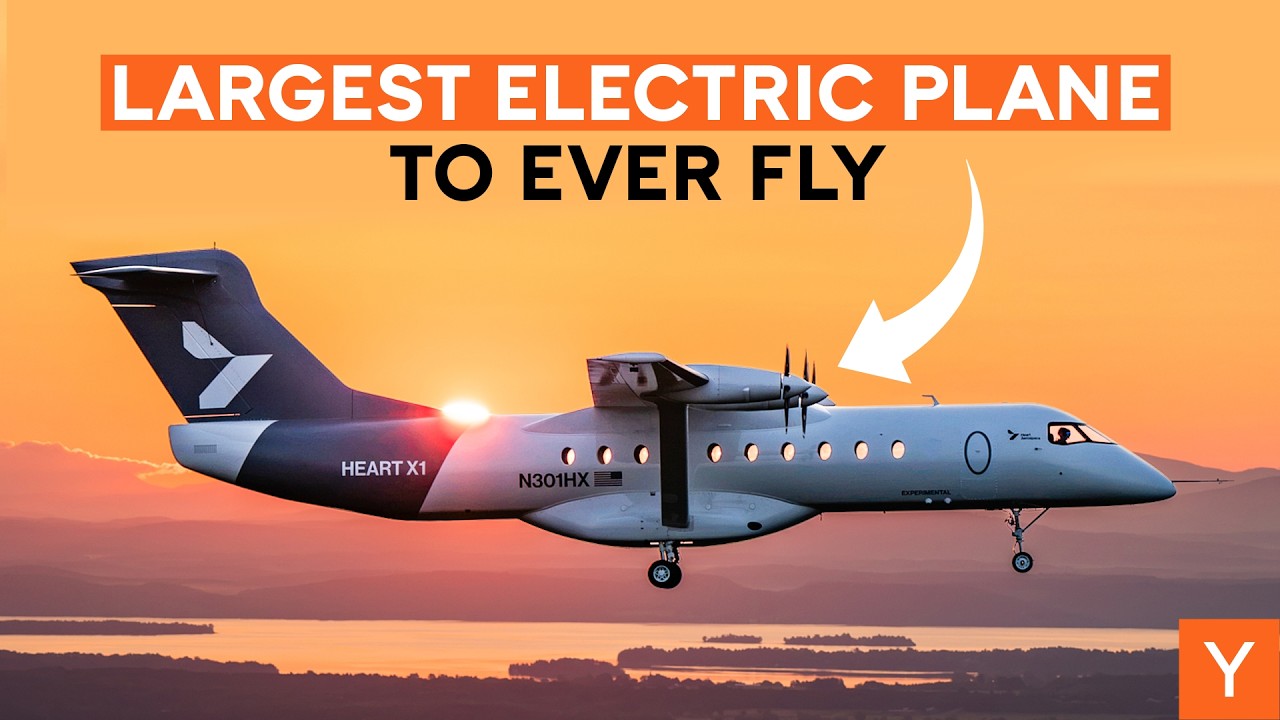
- Heart Aerospace conducted the maiden flight of the world’s largest electric aircraft in Plattsburgh, New York, featuring a 100-foot wingspan, a 25,000-pound takeoff weight, and an energy cost of just $5 to get airborne. (0:01)
- The achievement represents the first clean-sheet commercial airliner flown in the United States in 18 years, advancing from a 3D-printed Y Combinator pitch model to full-scale flight in seven years. (0:01)
- To satisfy FAA diversion and 45-minute loiter reserve rules without forfeiting two-thirds of the battery pack to dead weight, Heart implemented a hybrid turboprop backup that adds 20% to upfront aircraft cost while enabling up to 500 miles of range. (9:20)
- Targeting the 50% of global airline flights under two hours, Heart projects operating cost savings of up to 48% over legacy turboprops, with battery modularity allowing the aircraft to appreciate in performance as cell energy densities improve. (2:45)
Detailed notes
## Background Published on YouTube by Y Combinator on September 1, 2026, this episode of Hard Tech follows YC partner Gustaf Alströmer as he visits Heart Aerospace's pilot plant in Los Angeles. The video features an in-depth conversation with co-founder and CEO Anders Forslund about developing and flying the world's largest electric aircraft, transitioning from a tiny 3D-printed model to full-scale flight, and the potential of low-cost electric propulsion to revitalize regional air travel.
## TL;DR Heart Aerospace successfully conducted the maiden flight of the world's largest electric aircraft—a demonstrator with a 100-foot wingspan and 25,000-pound takeoff weight that costs only about $5 of electricity to get off the ground. CEO Anders Forslund details how the mechanical simplicity of electric powertrains radically undercuts the operating costs of traditional jet turbines, enabling viable short-haul regional flights across underutilized local airports. To overcome mandatory FAA loiter and diversion reserve penalties without carrying excessive battery dead weight, Heart developed a hybrid architecture combining pure electric flight with a small turboprop reserve engine. Inside their vertically integrated Los Angeles pilot facility, the team leverages an integrated 'iron bird' test bench and in-house component machining to iteratively develop their airliner before scaling toward the massive commercial narrowbody market.
## Atmosphere & style The episode radiates a grounded, pragmatic hard-tech optimism, trading futuristic corporate hype for candid engineering trade-offs and hands-on workshop grit. Alströmer and Forslund share an easy, collegial rapport informed by their shared history dating back to Heart's early YC batch, giving the facility tour the intimate feel of two builders reflecting on an audacious bet that paid off. The narrative builds to a quietly emotional climax when Forslund recalls the goosebump-inducing moment the aircraft finally took off down the Plattsburgh runway, validating years of grueling hardware development with tangible flight.
## Bulletin - [00:01](https://www.youtube.com/watch?v=nM86DBOqgPM&t=1s) Heart Aerospace conducted the maiden flight of the world’s largest electric aircraft in Plattsburgh, New York, featuring a 100-foot wingspan, a 25,000-pound takeoff weight, and an energy cost of just $5 to get airborne. - [00:01](https://www.youtube.com/watch?v=nM86DBOqgPM&t=1s) The achievement represents the first clean-sheet commercial airliner flown in the United States in 18 years, advancing from a 3D-printed Y Combinator pitch model to full-scale flight in seven years. - [09:20](https://www.youtube.com/watch?v=nM86DBOqgPM&t=560s) To satisfy FAA diversion and 45-minute loiter reserve rules without forfeiting two-thirds of the battery pack to dead weight, Heart implemented a hybrid turboprop backup that adds 20% to upfront aircraft cost while enabling up to 500 miles of range. - [02:45](https://www.youtube.com/watch?v=nM86DBOqgPM&t=165s) Targeting the 50% of global airline flights under two hours, Heart projects operating cost savings of up to 48% over legacy turboprops, with battery modularity allowing the aircraft to appreciate in performance as cell energy densities improve.
## Key takeaways - [00:01](https://www.youtube.com/watch?v=nM86DBOqgPM&t=1s) Heart Aerospace's prototype is the largest electric airplane ever flown—doubling previous scale records—and the first clean-sheet airliner flown in the US in 18 years. - [00:01](https://www.youtube.com/watch?v=nM86DBOqgPM&t=1s) The planned commercial ES-30 is designed for a 125-mile pure-electric range, a 500-mile hybrid range, and a rapid 30-minute recharge turnaround. - [01:14](https://www.youtube.com/watch?v=nM86DBOqgPM&t=74s) Electric aircraft propulsion replaces thousands of high-heat, high-wear jet turbine parts with a single moving part rotor, dramatically reducing mechanical wear and maintenance costs. - [01:14](https://www.youtube.com/watch?v=nM86DBOqgPM&t=74s) Constant electric motor torque enables near-silent ground taxiing at one-tenth operational RPM, eliminating the massive fuel burn seen in jet engines, which consume up to 10% of their trip fuel while idling. - [02:45](https://www.youtube.com/watch?v=nM86DBOqgPM&t=165s) Jet turbine economics undermined regional aviation because manufacturing and maintenance expenses are identical regardless of whether an engine powers a short regional hop or a long-distance flight. - [02:45](https://www.youtube.com/watch?v=nM86DBOqgPM&t=165s) Driven by rising fuel prices, Heart's operating cost advantage over incumbent 40-year-old regional turboprops has widened from 33% to 48% cheaper. - [04:03](https://www.youtube.com/watch?v=nM86DBOqgPM&t=243s) Heart adopted an iterative hardware development model where every funding round was validated with physical artifacts, progressing from a small 3D-printed model to a functional 400 kW motor. - [04:03](https://www.youtube.com/watch?v=nM86DBOqgPM&t=243s) United Airlines' initial partnership emerged from an inbound inquiry found in Heart's general spam filter, which converted after executives inspected the working 400 kW test motor. - [06:26](https://www.youtube.com/watch?v=nM86DBOqgPM&t=386s) Heart vertically integrated precision actuator manufacturing using in-house machined 6061 aluminum, avoiding 12-month aerospace vendor lead times across eight distinct airframe systems. - [07:45](https://www.youtube.com/watch?v=nM86DBOqgPM&t=465s) The pilot plant functions as a 1.6-megawatt 'iron bird' test bench designed for automated fault injection to ensure flight computers and actuators survive severe electrical disruptions. - [09:20](https://www.youtube.com/watch?v=nM86DBOqgPM&t=560s) FAA commercial flight reserve rules requiring 45 minutes of loiter and a 100-mile diversion penalty would force a pure-electric plane to carry two-thirds of its battery capacity as reserve dead weight. - [10:23](https://www.youtube.com/watch?v=nM86DBOqgPM&t=623s) Heart treats its aircraft as a software-defined computer on wings, adopting SpaceX-style risk minimization during testing and noting that modern aircraft fail due to broken logic rather than structural fractures. - [10:23](https://www.youtube.com/watch?v=nM86DBOqgPM&t=623s) By relying on conventional runway airframes, Heart leverages more than 5,000 existing underutilized US public airports instead of depending on speculative vertiport infrastructure required by eVTOLs. - [10:23](https://www.youtube.com/watch?v=nM86DBOqgPM&t=623s) Unlike depreciating fossil-fuel aircraft, electric airframes function as appreciating assets that increase in capability over their multi-decade lifespans as battery cell density improves. - [11:43](https://www.youtube.com/watch?v=nM86DBOqgPM&t=703s) Heart ultimately plans to challenge incumbent narrowbody airliners like the Boeing 737 and Airbus A320, anticipating a phased evolution toward remote ground pilots overseeing multiple aircraft.
## Detailed walkthrough ### [00:01](https://www.youtube.com/watch?v=nM86DBOqgPM&t=1s) The World's Largest Electric Aircraft Takes Flight
The aircraft featured is the largest electric airplane ever to take flight, boasting a 100-foot wingspan, a gross takeoff weight of 25,000 pounds, and an energy cost of just $5 of electricity to get airborne. Its planned commercial successor, the ES-30, is engineered to fly up to 125 miles entirely on battery power, push out to 500 miles in a hybrid configuration, and recharge in roughly 30 minutes.
Heart Aerospace CEO and co-founder Anders Forslund highlights that the aircraft surpasses the previous record for an electric plane by a factor of two. Furthermore, it marks the first clean-sheet airliner in any commercial category—electric or conventional—flown in the United States in the past 18 years. Y Combinator partner Gustaf Alströmer reflects on how surreal the timeline feels: just seven years earlier, during YC's W19 batch, Forslund had pitched the concept holding a toy-sized 3D-printed model in his hand. Now, that concept has materialized into an aircraft with a 100-foot wingspan hurtling down the runway during taxi tests.
- **Current Prototype Specs**: 100 ft wingspan, 25,000 lb takeoff weight, ~$5 electricity cost for takeoff. - **ES-30 Target Specs**: 125 mi all-electric range, 500 mi hybrid range, ~30-minute recharge turnaround. - **Historical Benchmark**: First clean-sheet airliner flown in the US in 18 years.
---
[01:14](https://www.youtube.com/watch?v=nM86DBOqgPM&t=74s) The Mechanical Simplicity of Electric Propulsion
Visiting Heart Aerospace’s pilot plant and headquarters in Los Angeles, Alströmer notes that the company has scaled from just Forslund and his co-founder Klara to a focused 40-person team taking on challenges that legacy aerospace giants like Boeing and Airbus have failed to solve. When asked to summarize Heart Aerospace in two sentences, Forslund explains: "We build hybrid electric aircraft, but our mission is to reduce the cost of air travel, and we're building the technology to support that."
At the core of this strategy is replacing the internal combustion jet turbine with high-power electric motors. Traditional jet engines are notoriously complex assemblies of thousands of precision parts operating under extreme thermal stress hot enough to melt metal, demanding intense maintenance. By contrast, an electric motor fundamentally relies on a single moving part. Scaling from a tiny, multi-gram drone motor up to a 400 kW aircraft motor introduces no fundamental architectural complexity—it avoids high heat, fluid lines, and combustion, delivering virtually zero mechanical wear.
On the ground, this simplicity transforms airport operations: while a jet engine taxiing burns copious fuel and produces deafening noise by definition, an electric motor maintains a constant torque profile. It can spin the propeller at one-tenth of normal operational speed, making ground taxiing practically silent from 100 feet away. The entire propulsion system for the current demonstrator is powered by eight battery packs arranged along the floor of the fuselage—totaling the battery capacity of only about four Tesla passenger vehicles, carrying roughly $40 worth of equivalent energy.
```mermaid flowchart TD accTitle: Jet Engine vs Electric Motor Architecture accDescr: A comparison showing the contrast between complex jet turbine mechanics and simple electric motor architecture.
subgraph JET["Jet Turbine Engine"] J1["Thousands of Moving Parts"] --> J2["Extreme Combustion Heat"] J2 --> J3["High Mechanical Wear & Noise"] J3 --> J4["Massive Maintenance Overhead"] end
subgraph ELEC["Heart Electric Powertrain"] E1["Single Moving Part Rotor"] --> E2["No Combustion / No Fluids"] E2 --> E3["Constant Torque & Low RPM Taxi"] E3 --> E4["Near-Zero Wear & Silent Operation"] end ```
---
[02:45](https://www.youtube.com/watch?v=nM86DBOqgPM&t=165s) Why the Jet Engine Broke Regional Aviation
Forslund explains that the economics of jet turbines inherently broke the short-haul market. It costs roughly the same amount to build and maintain a turbine engine for a 30-passenger plane as it does for a 70-passenger airliner, and engine wear accumulates identically whether the plane flies 100 miles or 1,000 miles. Because of this dynamic, engine economics systematically pushed the commercial aviation industry away from regional networks toward ever-larger airframes flying longer routes.
Jets are also profoundly inefficient during the early phases of short flights; on a brief regional hop, an aircraft can burn up to 10% of its entire fuel load merely idling and taxiing to the runway, with takeoff and initial climb suffering similarly low fuel efficiency. Yet the underlying demand remains massive: 50% of all airline flights worldwide are under two hours. The regional fleet servicing these short routes consists largely of aging 40-year-old turboprop designs in desperate need of replacement.
For regional travel, economic value is driven not by maximum range, but by ultra-low trip costs. Electric aircraft shine brightest on the shortest possible routes—turning a grueling 6-hour road trip around a Norwegian fjord into a 20-minute jump, or connecting the Hawaiian islands. Furthermore, as oil prices have escalated over recent years, Heart's operating cost advantage over incumbent turboprops jumped from 33% cheaper to 48% cheaper purely due to fuel cost divergence.
---
[04:03](https://www.youtube.com/watch?v=nM86DBOqgPM&t=243s) From Childhood Fighter Jets to MIT and the YC Breakthrough
Forslund’s passion for aviation began in childhood, growing up near an air force base in Sweden watching Saab 37 Viggen fighter jets roar directly over his local soccer field. He pursued an engineering PhD focused on jet engine mechanics and eventually landed at the Massachusetts Institute of Technology (MIT).
Twelve years ago at MIT, an appearance by Elon Musk sparked Forslund's path forward. Musk stated that every form of transportation would inevitably transition to electric powertrains except for space rockets, citing battery energy density targets around 400 watt-hours per kilogram (Wh/kg). Forslund took this as an explicit call to arms. He spent his days researching jet turbines and his evenings tinkering with drone components at his kitchen table. Later, backed by Swedish government research funding, he traveled across Scandinavia interviewing commercial airlines about electric aviation before Heart even existed as a legal entity, establishing crucial relationships with regional carriers like SAS and Braathens.
```mermaid flowchart LR accTitle: Heart Aerospace Founding and Traction Flow accDescr: Shows the progression from university research to airline pre-orders and prototype construction.
subgraph Phase1["Research & Idea"] A["MIT Talk by Elon Musk<br/>(400 Wh/kg Call to Arms)"] --> B["Swedish Govt Study<br/>(Nordic Airline Network)"] end
subgraph Phase2["Validation"] B --> C["YC W19 with 3D Model<br/>(LOIs: SAS & Braathens)"] C --> D["Bench Motor Built<br/>(400 kW Proof-of-Concept)"] end
subgraph Phase3["Scaling"] D --> E["Inbound Spam Email<br/>(United Airlines Deal)"] E --> F["Full-Scale Prototype<br/>(LA Pilot Plant)"] end ```
When Forslund joined Y Combinator, there was no established playbook for building an electric airliner startup. Armed with Letters of Intent (LOIs) from Nordic airlines and his small 3D-printed model on Demo Day, Heart followed an iterative hardware funding philosophy: every round of capital had to be justified by delivering a tangible, physical artifact. After the model, they built a functional 400 kW electric motor matching the size of a regional jet turbine.
That physical proof delivered commercial credibility. Heart's breakthrough deal with United Airlines originated when an inbound note arrived in their generic public `info@` email address. Co-founder Klara pulled it out of the spam filter, thinking, *"I think this might be a thing."* Heart invited United’s leadership to see the operating 400 kW motor in person, and the airline instantly grasped the potential, converting their interest into substantial commercial backing.
> "If you're a founder listening to this, the learning that you should have is every time you need more capital, it needs to be something material. Ideally something physical you can touch, that you can show that you made."
---
[06:26](https://www.youtube.com/watch?v=nM86DBOqgPM&t=386s) Inside the Pilot Plant: Pragmatic Design and In-House Actuation
Unlike other electric aviation startups that adopt aggressive, futuristic aesthetics, Heart intentionally designed their aircraft to look like a standard regional turboprop. Forslund emphasizes that they are not trying to design an exotic sports car, preferring a conventional airframe that conceals its transformative electric power under the hood like a "Superman cape."
Touring the Los Angeles pilot manufacturing plant, the engineering team showcases an iterative approach to hardware development. They examine an early structural prototype that was abandoned without physical testing once calculations showed it would fail stress loads, contrasting it with a reinforced, fully integrated version that extends completely through the bottom frame.
A key manufacturing philosophy at the facility is vertical integration around core mechanical components. Rather than relying on traditional aerospace sub-suppliers—where ordering a single actuator often takes an entire year—Heart machines components like actuator cylinder bodies in-house out of 6061 aerospace-grade aluminum. A typical actuator assembly incorporates roughly 15 precision-machined parts. Developing this in-house yields an adaptable core mechanical architecture applied across multiple flight systems: - Aileron actuation - Rudder control - Landing gear extension and retraction - Wheel braking systems - Propeller pitch management
Forslund explains the strategic logic: startups should bring hardware in-house when the component design can scale across eight distinct internal aircraft systems rather than dealing with eight separate external vendors.
---
[07:45](https://www.youtube.com/watch?v=nM86DBOqgPM&t=465s) Systems Architecture, Cockpit Design, and the Battery Cell Lab
The entire pilot plant floor is wired as an integrated "iron bird" test bench, resembling a deconstructed Picasso painting where the flight deck, passenger cabin, and empennage (tail) are laid out across the facility. The complete rig runs on up to 1.6 megawatts of power to simulate full airborne electrical loads. This layout allows engineers to conduct extensive automated fault injection testing—systematically cutting physical wires or injecting software errors to prove that safety-critical flight computers and actuators remain fully operable under catastrophic failure conditions.
Inside the flight deck, Heart mirrors modern electric vehicle architecture. Designed by an engineer who previously worked on the SpaceX Dragon space capsule, the cockpit eschews dense walls of legacy dials and switches in favor of streamlined multifunction digital displays reminiscent of a Tesla Model 3. In the passenger cabin, the layout can accommodate up to 36 passengers, but the baseline commercial configuration is planned for 30 passengers, giving travelers an estimated six inches of additional legroom over standard airline seating.
The walkthrough finishes in Heart’s dedicated battery lab, where engineers benchmark commercial cells from American, Korean, and Chinese suppliers across safety, cycle life, thermal behavior, cost, and energy density. Revisiting the 400 Wh/kg threshold Elon Musk referenced over a decade ago, the team notes that their highest-density evaluation cells on test benches currently reach approximately 370 Wh/kg, with commercial supplier cells achieving the 400 Wh/kg milestone expected in the lab within months.
[09:20](https://www.youtube.com/watch?v=nM86DBOqgPM&t=560s) The Reserve Dilemma and the Hybrid Engine Solution
A 23-day countdown timer on the wall, tracked via a Chrome extension inspired by the Y Combinator Demo Day countdown, marks the days remaining until flight testing. Yet despite the massive engineering hurdles in power electronics, Anders Forslund reveals that the hardest problem Heart Aerospace faced had nothing to do with electric motors or batteries. The core challenge stems from aviation reserve regulations: in the United States, approximately one in every 1,000 commercial flights is diverted to an alternate airport. Federal aviation rules require every commercial flight to hold 45 minutes of loiter fuel and retain enough energy to fly to an alternate destination that could be up to 100 miles away.
For a pure battery-electric aircraft, this requirement creates a brutal weight penalty. Unlike traditional kerosene-fueled airliners that burn off weight as they cruise, batteries remain exactly as heavy on landing as they were at takeoff. Complying with commercial reserve mandates meant that two-thirds of the onboard battery pack had to be reserved purely for emergency diversions and holding patterns, severely crippling commercial payload and range. Heart’s answer was to incorporate a hybrid backup system powered by a simple, cost-effective turboprop engine. While adding the turboprop increases the upfront aircraft cost by roughly 20%, it completely frees the battery system to handle standard regional missions without carrying dead-weight battery reserves.
```mermaid flowchart TD accTitle: Hybrid Electric Flight Reserve Architecture accDescr: Flowchart illustrating how Heart Aerospace divides baseline electric flight from regulatory diversion reserves using a turboprop.
subgraph Primary["Standard Flight Mission (Battery Electric)"] Takeoff["Electric Takeoff & Climb"] Cruise["All-Electric Cruise (Up to 225 Miles)"] Landing["Electric Landing at Destination"] Takeoff --> Cruise --> Landing end
subgraph Reserve["Mandatory FAA Reserve Requirements"] Loiter["45-Minute Holding Loiter"] Divert["Divert to Alternate Airport (Up to 100 Miles)"] Loiter --> Divert end
Cruise -.->|"Diversion / Emergency"| Reserve Turboprop["Small Turboprop Engine (Hybrid System)"] -->|"Supplies Energy (Up to 500 Miles Range)"| Reserve ```
- **FAA Reserve Reality**: Aircraft must carry enough energy for their trip, 45 minutes of loiter time, and flight to a diversion airport up to 100 miles away. - **Battery Penalty**: In a purely battery-powered plane, roughly two-thirds of the total battery capacity is held strictly for regulatory reserves. - **Operating Profiles**: The aircraft delivers up to 225 miles of all-electric range on battery power alone, extending up to a 500-mile operational range when utilizing the hybrid system. - **Cost Tradeoff**: The hybrid turboprop engine adds roughly 20% to the upfront purchase price of the aircraft, which Anders considers well worth the immense operational flexibility.
---
[10:23](https://www.youtube.com/watch?v=nM86DBOqgPM&t=623s) Risk Management, Software Logic, and Market Strategy
Heart’s approach to aircraft design stems directly from a risk-management philosophy Anders borrowed from SpaceX. Traditional aerospace operates on the assumption that any system failure will inevitably be catastrophic, leading incumbents to design excessively slow, risk-averse engineering cycles where "we don't know anything until we know everything." Heart instead focuses on minimizing the *impact* of failure during the design and testing phases. By isolating critical systems and lowering the downside of test failures, the engineering team can iterate rapidly and inexpensively. As Anders emphasizes, modern aircraft rarely crash from structural hardware failures like broken wings; instead, "they crash because of broken logic." Heart is treating the plane fundamentally as a software-defined vehicle—a high-reliability computer on wings.
When addressing why Heart avoided the hype around urban air mobility (eVTOL flying taxis) or hydrogen propulsion, Anders highlights commercial pragmatism. While flying taxis pursue helicopter-like urban hops with three or four passengers, Heart is going directly after the mainline regional airliner market with a 36-passenger design that takes advantage of existing infrastructure. The United States already possesses over 5,000 public airports, many of which are underutilized. Furthermore, alternative powertrains like hydrogen face massive infrastructure buildouts and cost premiums, whereas hybrid-electric aviation operates today with a significant "negative green premium." Because the fleet being targeted for replacement consists of 40-year-old regional turboprops, an electric aircraft actually becomes an appreciating asset: as battery chemistry improves over its operational lifetime, swapping in newer cells means the plane will perform better ten years down the road than on the day it was bought, much like owning a home.
- **Failure Philosophy**: Prioritize minimizing the impact of errors rather than paralyzing progress trying to bring failure probability to absolute zero. - **Infrastructure Leverage**: Bypasses the need for new vertiports by flying from the 5,000 existing airports throughout the US. - **Scale Advantage**: Targets 36 passenger seats rather than the 3–4 passenger payloads typical of eVTOL concepts. - **Appreciating Asset Model**: Upgrading battery packs over the decades-long lifespan of the airframe makes the aircraft more capable over time rather than obsolete.
---
[11:43](https://www.youtube.com/watch?v=nM86DBOqgPM&t=703s) Narrowbody Ambitions, Autonomous Flight, and the LA Aerospace Hub
A 36-seat regional airliner is only the opening chapter for Heart Aerospace. Anders notes that the ultimate prize in commercial aviation is the massive narrowbody market dominated by the Boeing 737 and Airbus A320 families, where airline backlogs stretch for years. With legacy manufacturers bogged down by production backlogs and iterative updates, bringing the rapid-iteration, vertically integrated model that SpaceX proved in rocketry to passenger airplanes is a clear historical imperative.
Looking ahead, Anders envisions operational changes to cockpit staffing to solve regional pilot shortages. Rather than leaping directly into full autonomy, the transition will mirror autonomous driving: a remote pilot on the ground will oversee multiple aircraft simultaneously, acting like remote operators monitor fleets of Waymo autonomous vehicles. Autonomous flight will likely prove itself first in cargo operations, where safety stakes are lower, before graduating into scheduled passenger aviation. For passengers, electric regional travel promises drastically reduced cabin noise, virtually no vibration, cheaper ticket prices, and the revival of convenient short-haul routes from neighborhood airports that haven't been viable since the golden age of regional air travel. Heart chose to base its pilot plant in Los Angeles to make this happen, tapping into the historic center of American aviation and the dense talent pool cultivated by SpaceX and the Southern California new-space ecosystem.
- **Market Horizon**: Ambition to tackle narrowbody airliners (competing in the 737/A320 category) where incumbent delivery backlogs are severe. - **Pilot Architecture**: A phased shift starting with remote pilots overseeing multiple aircraft simultaneously, moving through uncrewed cargo flights, and eventually entering passenger travel. - **Passenger Comfort**: Electric propulsors generate significantly less noise and vibration than gas turbines. - **Location Choice**: Los Angeles was chosen because "companies don't build planes, people do," capitalizing on Southern California's dense aerospace engineering talent.
---
[13:11](https://www.youtube.com/watch?v=nM86DBOqgPM&t=791s) Maiden Flight in Plattsburgh and Advice for Hardware Founders
Seven years of prototyping, risk-taking, and engineering culminated on Wednesday, August 12th, when Heart Aerospace conducted the first flight of the world's largest electric airplane in Plattsburgh, New York. Anders reflects on the emotional weight of watching the aircraft taxi down the runway and rotate into the air—a milestone he had envisioned continuously since the company's beginnings at Y Combinator Demo Day. He describes the visceral feeling of getting goosebumps seeing the physical machine take flight, finally stepping back to "see the forest for all the trees."
Gustaf asks Anders how an ambitious founder should get started if they were launching a hard-tech hardware startup today with all the knowledge he now possesses. Anders answers with an analogy about his own leadership style: "I'm a pretty good duck... I know a little bit how to swim, I know a little bit how to fly, and I know a little bit how to walk, and that's enough for me to know when I find somebody that's great." He emphasizes that no one should found a company simply to have the title of founder or run a business. The only reason to endure the grueling reality of building hard tech is a genuine, obsessive love for solving the underlying problem: "If we can get stuff that is lower emission, lower cost, lower pollution, just better quality of life, we should be doing it."
- **First Flight Date & Location**: Flown on Wednesday, August 12th, in Plattsburgh, New York. - **Scale Milestone**: Recognized as the largest electric airplane ever flown. - **Timeline**: 7 years from company inception at Y Combinator (W19) to full-scale maiden flight. - **Founder Advice**: Build broad, versatile generalist knowledge ("duck" skills) to recognize and recruit exceptional specialists, and never found a hardware company for status—only for the love of tackling a vital problem.
## Notable quotes > [01:14](https://www.youtube.com/watch?v=nM86DBOqgPM&t=74s) We build hybrid electric aircraft, but our mission is to reduce the cost of air travel, and we're building the technology to support that. — Anders Forslund
> [04:03](https://www.youtube.com/watch?v=nM86DBOqgPM&t=243s) I think this might be a thing. — Klara Forslund
> [04:03](https://www.youtube.com/watch?v=nM86DBOqgPM&t=243s) If you're a founder listening to this, the learning that you should have is every time you need more capital, it needs to be something material. Ideally something physical you can touch, that you can show that you made. — Anders Forslund
> [10:23](https://www.youtube.com/watch?v=nM86DBOqgPM&t=623s) we don't know anything until we know everything. — Anders Forslund
> [10:23](https://www.youtube.com/watch?v=nM86DBOqgPM&t=623s) they crash because of broken logic. — Anders Forslund
> [11:43](https://www.youtube.com/watch?v=nM86DBOqgPM&t=703s) companies don't build planes, people do — Anders Forslund
> [13:11](https://www.youtube.com/watch?v=nM86DBOqgPM&t=791s) see the forest for all the trees. — Anders Forslund
> [13:11](https://www.youtube.com/watch?v=nM86DBOqgPM&t=791s) I'm a pretty good duck... I know a little bit how to swim, I know a little bit how to fly, and I know a little bit how to walk, and that's enough for me to know when I find somebody that's great. — Anders Forslund
> [13:11](https://www.youtube.com/watch?v=nM86DBOqgPM&t=791s) If we can get stuff that is lower emission, lower cost, lower pollution, just better quality of life, we should be doing it. — Anders Forslund
## Mentioned Heart Aerospace, Y Combinator, Gustaf Alströmer, Anders Forslund, Klara Forslund, ES-30, Boeing, Airbus, Tesla, Saab 37 Viggen, Massachusetts Institute of Technology (MIT), Elon Musk, SAS, Braathens, United Airlines, SpaceX, SpaceX Dragon, Waymo, Plattsburgh, New York
## Video description Heart Aerospace (YC W19) just flew the largest electric airplane ever flown — a 100-foot wingspan, a takeoff weight of 25,000 pounds, and $5 of electricity to get it off the ground.
In this episode of Hard Tech, YC's Gustaf Alströmer visits Heart's pilot plant in LA and sits down with co-founder and CEO Anders Forslund to find out how they went from a 3D-printed model to a full-scale electric aircraft in seven years, why the jet engine has left short flights behind, and what cheap electric flight could unlock for the future of regional air travel.
https://www.heartaerospace.com
Apply to Y Combinator: https://www.ycombinator.com/apply Work at a startup: https://www.ycombinator.com/jobs
[Source](https://www.youtube.com/watch?v=nM86DBOqgPM)