Graham Says Fear of Failure Drives Top Founders More Than Wealth
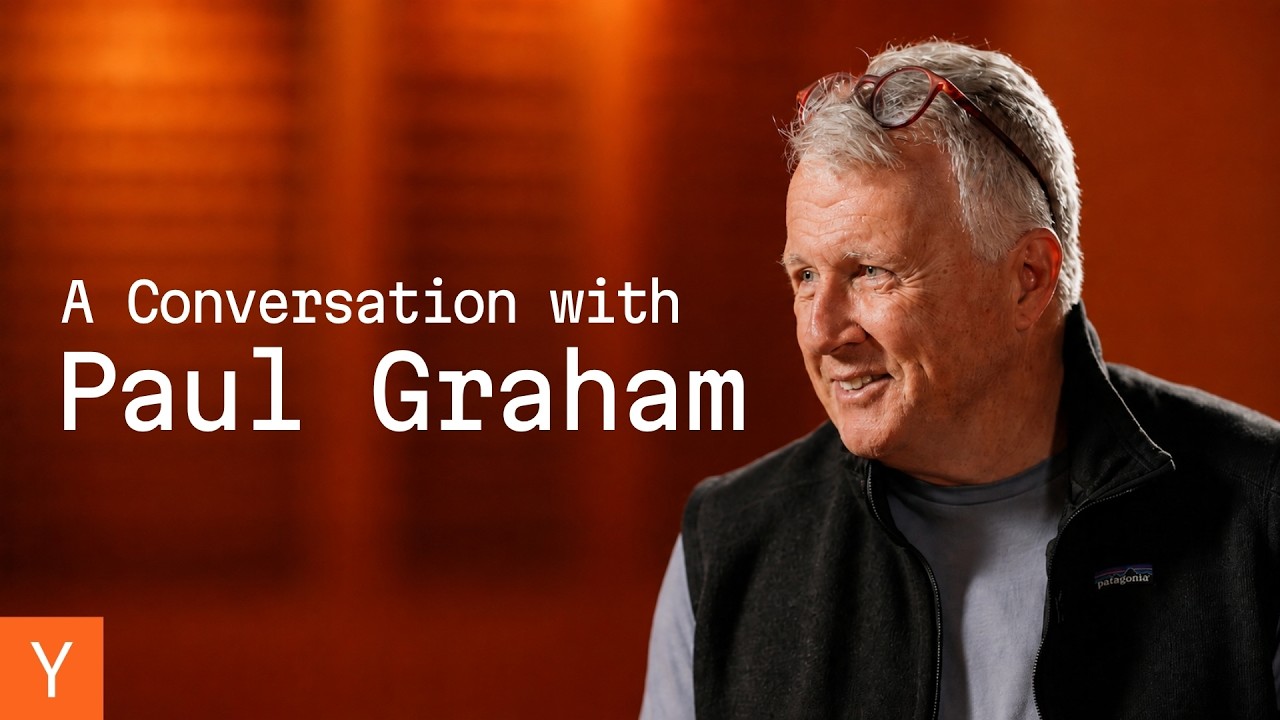
Paul Graham On Startups, Ambition, and Great Founders — Y Combinator

Y Combinator

Generational companies are built by founders driven by an innate terror of operational collapse rather than financial ambition, making startups the least efficient path for those seeking status or credentials.

AI-assisted summary of Paul Graham On Startups, Ambition, and Great Founders — original source. Check the original for full context.

Source published:

Key ideas

  • Modern startup ambition has evolved toward high-stakes technical frontiers, including cargo-delivering ICBMs and on-demand personalized cancer therapies, far exceeding the scope of early consumer web applications. (1:07)
  • Modern artificial intelligence inverted 1980s academic expectations of bottom-up biological perfection, emerging instead as a flawed human-level intellect that acts like a bluffing undergraduate with a jagged capability frontier. (12:54)
  • Artificial General Intelligence is not a razor-thin finish line but a dimensional 'smear' that civilization is already occupying, characterized by models attacking complex math while stumbling over basic local facts. (14:49)
  • While rapid product shipping remains the ultimate predictor of startup success, modern cost structures have shifted dramatically from headcount and laptops to tens of thousands of dollars per day in GPU and token bills. (16:05)

Detailed notes

## Background Published by Y Combinator on YouTube on September 3, 2026, this video features YC Visiting Partner Vivian Shen interviewing co-founder Paul Graham at the original Mountain View office. According to the description, the conversation explores startups, AI, ambition, and the fundamental qualities that define great founders across 21 years of YC history.

## TL;DR Paul Graham reflects on 47 batches of Y Combinator, arguing that while today's startups tackle far more ambitious technical problems like rocketry and cancer, the underlying human realities of entrepreneurship remain completely unchanged. He explains that great founders are not motivated by becoming billionaires or seeking resume prestige, but by a visceral fear of failure and an inborn 'formidability' to get what they want. Graham also breaks down how modern AI overturned 1980s academic predictions by delivering human-like generality before reliability, leaving humanity stranded in a dimensional 'smear' toward AGI. Ultimately, he stresses that shipping speed and founder caliber, rather than sector hype or AI coding tools, remain the true determinants of the next trillion-dollar companies.

## Atmosphere & style The conversation carries an intimate, nostalgic, yet razor-sharp fireside energy, steeped in the quiet authority of returning to YC's original Mountain View office. Graham speaks with self-deprecating wit, casual philosophical precision, and characteristic candor, effortlessly debunking Silicon Valley cliches and academic assumptions about AI. Shen acts as a knowledgeable, receptive foil, guiding the discussion across decades of startup lore and leaving the viewer with the grounded impression of a master practitioner examining permanent truths beneath technological turbulence.

## Bulletin - [01:07](https://www.youtube.com/watch?v=5bxp78i96S8&t=67s) Modern startup ambition has evolved toward high-stakes technical frontiers, including cargo-delivering ICBMs and on-demand personalized cancer therapies, far exceeding the scope of early consumer web applications. - [12:54](https://www.youtube.com/watch?v=5bxp78i96S8&t=774s) Modern artificial intelligence inverted 1980s academic expectations of bottom-up biological perfection, emerging instead as a flawed human-level intellect that acts like a bluffing undergraduate with a jagged capability frontier. - [14:49](https://www.youtube.com/watch?v=5bxp78i96S8&t=889s) Artificial General Intelligence is not a razor-thin finish line but a dimensional 'smear' that civilization is already occupying, characterized by models attacking complex math while stumbling over basic local facts. - [16:05](https://www.youtube.com/watch?v=5bxp78i96S8&t=965s) While rapid product shipping remains the ultimate predictor of startup success, modern cost structures have shifted dramatically from headcount and laptops to tens of thousands of dollars per day in GPU and token bills.

## Key takeaways - [00:00](https://www.youtube.com/watch?v=5bxp78i96S8&t=0s) The core organizational and human mechanics of launching a startup remain completely unchanged across technology waves, whether powered by microprocessors or AI. - [01:07](https://www.youtube.com/watch?v=5bxp78i96S8&t=67s) Detractors have claimed Y Combinator 'jumped the shark' since 2008, yet modern cohorts tackle vastly more serious and ambitious problems than early batches did. - [04:09](https://www.youtube.com/watch?v=5bxp78i96S8&t=249s) Dominant incumbents like Google are unseated not by direct search clones, but when fundamental paradigm shifts—such as direct AI answers—make their core mechanism obsolete. - [05:13](https://www.youtube.com/watch?v=5bxp78i96S8&t=313s) Founders are rarely driven day-to-day by visions of extreme wealth, but rather by an immediate, visceral fear of failure and an obsessive desire to keep their creation from breaking. - [05:13](https://www.youtube.com/watch?v=5bxp78i96S8&t=313s) Extreme ambition is largely inborn rather than coachable, with rare exceptions limited to talented individuals whose innate drive was suppressed by rigid backgrounds. - [09:10](https://www.youtube.com/watch?v=5bxp78i96S8&t=550s) Launching a startup is the least efficient method to acquire prestige or look cool, requiring years of brutal friction that weed out credential-seeking founders. - [09:10](https://www.youtube.com/watch?v=5bxp78i96S8&t=550s) A 'formidable' founder is operationally defined as someone who consistently gets what they want, ensuring that investor interests align with the founder's ability to bend reality. - [10:23](https://www.youtube.com/watch?v=5bxp78i96S8&t=623s) Lean startup dynamics remain viable despite high compute costs because inference prices drop exponentially—roughly 30x per year at a given performance benchmark. - [12:54](https://www.youtube.com/watch?v=5bxp78i96S8&t=774s) Early AI research incorrectly assumed intelligence would be built from narrow, perfect biological modules upward, whereas LLMs delivered flawed human-level generality first. - [14:49](https://www.youtube.com/watch?v=5bxp78i96S8&t=889s) Humanity is already existing on the 'smear' of AGI, where machines can tackle advanced mathematical conjectures but fail to parse basic restaurant operating hours. - [16:05](https://www.youtube.com/watch?v=5bxp78i96S8&t=965s) Fast shipping cadence remains the primary leading indicator of startup success because AI coding assistants cannot resolve the bottleneck of deciding what to build. - [16:05](https://www.youtube.com/watch?v=5bxp78i96S8&t=965s) Modern startup expenses have decoupled from pure payroll, with early-stage ventures facing massive initial infrastructure and token bills prior to scaling. - [17:05](https://www.youtube.com/watch?v=5bxp78i96S8&t=1025s) The synchronized batch structure serves three vital functions: curing the isolation of solo founding, providing a real-time peer debugging network, and offering an immediate internal customer base. - [18:08](https://www.youtube.com/watch?v=5bxp78i96S8&t=1088s) The YC cohort model was developed accidentally as an angel-investing experiment designed around undergraduate summer internship schedules. - [19:25](https://www.youtube.com/watch?v=5bxp78i96S8&t=1165s) YC scales its program without losing intimacy by dividing large cohorts into pods of roughly 70 companies, mirroring the size of full batches from 2012. - [20:15](https://www.youtube.com/watch?v=5bxp78i96S8&t=1215s) Future trillion-dollar companies will be determined by the immutable human quality of founder formidability rather than by specific sector theses.

## Detailed walkthrough ### [00:00](https://www.youtube.com/watch?v=5bxp78i96S8&t=0s) The 47th Batch and What Never Changes About Startups

Sitting inside the original Y Combinator offices in Mountain View, Visiting Partner Vivian Shen welcomes back co-founder Paul Graham to deliver his traditional talk to the current YC batch. Vivian notes that, by her count, this marks the 47th batch in YC’s 21-year history. PG admits he had been trying to calculate that number himself and jokes that knowing he has given the talk so many times explains why he is not particularly nervous about it. Even after dozens of batches, Graham reveals a surprising habit: he still writes the talk completely from scratch every single time. A couple of hours before he is scheduled to speak, he panics slightly, opens a blank text file, and starts typing out his thoughts—even though, as he readily admits, he probably ends up saying the exact same things over and over.

When Vivian asks if there are any brand-new lessons for this batch compared to earlier ones, Graham explains that the core mechanics of building a startup remain completely unchanged. Whether a company is built around microprocessors, the internal combustion engine, or artificial intelligence, the underlying human and organizational realities of launching a company are always identical.

---

[01:07](https://www.youtube.com/watch?v=5bxp78i96S8&t=67s) Intercontinental Ballistic Cargo and Curing Cancer: Why Modern Batches Are More Serious

Addressing a recent post by Graham asserting that modern YC startups are far more serious than those from the "supposedly good old days," Vivian asks him to elaborate. Graham explains that ever since around 2008, critics have repeatedly claimed that Y Combinator has "jumped the shark." He points out the rhetorical trick behind this perpetual criticism: detractors cannot claim YC was always terrible—they must admit it was once great so they can argue it has fallen from grace. As a result, the old days are romanticized as a golden era. Yet in those early batches, many funded companies were things like Reddit, which, however valuable and culturally significant, was hardly "intercontinental ballistic cargo."

Graham contrasts early consumer web apps with what he encounters in office hours today, citing a current startup building essentially an ICBM designed to land and drop off cargo rather than explode. Beyond rocketry, he highlights startups taking on curing cancer through distinct angles—ranging from vaccines to targeted therapies. One startup in the current batch conducts on-demand research for individual cancer patients, pursuing what Graham describes as a "death of a thousand cuts" approach against the disease. He expresses particular delight that this startup was created by the exact team that helped GitLab co-founder Sid Sijbrandij navigate and overcome his own cancer diagnosis. Sid famously went "founder mode" on his cancer, treating his treatment regimen like a de facto startup; now, those same partners are turning that service into an actual company for everyone else.

---

[04:09](https://www.youtube.com/watch?v=5bxp78i96S8&t=249s) Frighteningly Ambitious Ideas: How OpenAI Became the New Google

Vivian connects these high-stakes companies to Graham's 2012 essay, *Frighteningly Ambitious Ideas*, in which he outlined several massive, seemingly untouchable challenges for founders to tackle. Graham reflects that many of the predictions from that essay have actually materialized, chief among them the idea of replacing Google. As he predicted in 2012, defeating a giant like Google does not happen through a head-on search engine clone; it requires waiting for the broader landscape to shift so radically that the incumbent's entire paradigm becomes obsolete.

That shift arrived with OpenAI. Graham recalls realizing shortly after using early AI models that his own search behavior had permanently changed: he no longer wanted a ranked list of web pages; he simply wanted the direct answer to his question. Vivian points out that OpenAI itself was incubated at YC, to which Graham nods, calling it "one of Sam's many side projects."

```mermaid flowchart LR accTitle: The Shift from Web Search to Direct Answers accDescr: Diagram illustrating how the traditional search paradigm of querying web pages was superseded by AI models delivering direct information.

subgraph LegacySearch["The Old Paradigm"] A["User Query"] --> B["Traditional Search Engine"] B --> C["Index of Web Pages"] C --> D["Manual Web Browsing"] end

subgraph DirectAI["The Shift (OpenAI)"] E["Information Request"] --> F["AI Model / LLM"] F --> G["Direct Information & Answers"] end

LegacySearch -.->|"Paradigm Shift & Obsolescence"| DirectAI ```

---

[05:13](https://www.youtube.com/watch?v=5bxp78i96S8&t=313s) The Fear of Failure, Inborn Ambition, and the Myth of the Resume Badge

Vivian asks Graham when he first realized that successful founders need extreme ambition rather than just raw technical talent. Graham explains that he and his partners understood this prior to starting YC based on their own grueling startup experiences. Because the obstacles are so fearsome, a sense of dutifulness or technical competence is wholly insufficient to keep someone going. However, Graham clarifies what actually drives founders on a day-to-day basis: it is almost never the desire to become a billionaire.

Instead, founders are consumed by an immediate, visceral fear of failure—the terror of looking foolish or having a server crash in the middle of the night. Graham compares running an early-stage startup to tending an intricate model train set whose engine is about to roll off the edge of a table: you drop everything not because you see a ten-figure net worth in the distance, but because you cannot bear to see your creation break. Founders keep their heads down fixing the train for a decade, only looking up when someone calculates their equity after a financing round and points out that they are suddenly billionaires.

When asked whether modest founders can be coached into high ambition during a batch, Graham is skeptical, stating that the quality is largely inborn. While figures like Sam Altman were visibly formidable before they even applied, the only exception is founders who were trained by pushy parents or rigid environments to be obedient and suppress their natural drive. Finally, Graham dismisses the modern trend of viewing a startup as another resume badge to collect. A successful startup becomes a person's life work, eliminating the need for any other badges, while a failed startup carries very little prestige. He compares applying to YC just for credentialism to applying to Harvard and being forced to study theoretical physics: there are no easy majors in startups, and those seeking status have no idea what they are actually signing up for.

[09:10](https://www.youtube.com/watch?v=5bxp78i96S8&t=550s) The Least Efficient Way to Be Cool and the Meaning of "Formidable"

Starting a company simply to acquire a prestigious credential or look impressive is fundamentally misguided. There are countless easier avenues to build a pedigree, whereas founding a startup represents quite possibly "the least efficient way" imaginable to seem cool. As Paul Graham points out, the reality is defined by "years of brutal hardness" before anyone in the outside world even begins to think you are cool. The sheer friction and grueling difficulty weed out anyone whose primary motivation is surface-level status.

When Vivian Shen asks about Graham's frequent characterization of great founders as "formidable," he explains that the term originated in his and Jessica Livingston's private vocabulary long before they founded Y Combinator. In an essay, he distilled it down to a simple operational test: a formidable person is someone who "gets what they want" across any situation. That relentless ability to bend circumstances to their will makes them irresistible to investors; holding equity means investor and founder interests are entirely aligned. If the founder gets what they want, the investor inevitably gets what they want too.

[10:23](https://www.youtube.com/watch?v=5bxp78i96S8&t=623s) Debating Patrick Collison: Are Lean Startups Dead?

Shen brings up a provocative claim made by Stripe co-founder Patrick Collison at Startup School, who suggested that the lean startup model might be dead because capital is abundant and AI agents allow founders to spin up parallel workstreams instantly. Graham reacts with amused skepticism, admitting he has never actually read Eric Ries's *The Lean Startup*—quipping, "Tolkien didn't read all those other fantasy books people wrote." He notes that YC already had its own philosophy of lean funding well before the terminology entered the vernacular, and challenges the premise that starting with minimal capital in a focused niche has become obsolete.

Even though compute and AI tokens can currently feel prohibitively expensive due to the acute GPU shortage, Graham emphasizes that underlying technology invariably becomes cheaper. The price of inference at any fixed performance benchmark drops precipitously—on the order of 30x per year—meaning that dollar-for-dollar, founders receive exponentially higher quality over time. Even in brutally capital-intensive industries like aerospace, the principle of capital efficiency still applies. A founder cannot build an orbital rocket on a shoestring budget on day one, but they can produce rigorous designs, run computer simulations, and present convincing models to experts to secure the next tranche of capital. Milestone by milestone, capital unlocks further progress. Shen notes that Philip from Star Cloud raised funding largely by authoring a white paper and booking an actual launch; Graham acknowledges that booking a launch provides ironclad conviction, though he cautions that an established expert carries built-in credibility that an unproven college graduate simply cannot duplicate.

[12:54](https://www.youtube.com/watch?v=5bxp78i96S8&t=774s) What Surprised PG About AI: The "Bullshitting Undergrad"

Reflecting on his time studying artificial intelligence in the 1980s, Graham describes how fundamentally wrong the early academic consensus turned out to be regarding the path to machine intelligence. Back then, researchers envisioned a progressive biological ladder: one would first engineer a flawless artificial fly brain—capable of doing very little, but executing a fly's repertoire with complete biological perfection—before moving up step by step through mice, cats, monkeys, and finally human-level cognition. At every rung, the intelligence would be airtight and reliable within its domain.

Instead, the modern breakthrough with Large Language Models turned that paradigm on its head. Rather than starting with a perfect simple organism and scaling up, AI emerged immediately as a full-fledged human intellect that acts like an undergraduate bluffing through a term paper. The models write plausible-sounding prose and exhibit broad general abilities, yet hallucinate and stumble over basic tasks. Graham marvels at the irony that modern AI can reportedly tackle open mathematical problems while simultaneously failing to tell him basic restaurant operating hours. This phenomenon—what Shen refers to as AI's "jagged frontier"—means we began with flawed human generality and are now working our way backward toward perfection, the exact opposite of what 1980s researchers predicted.

```mermaid flowchart TD accTitle: AI Trajectory Comparison accDescr: Flowchart contrasting the 1980s academic expectation of AI progress with the actual path taken by modern LLMs.

subgraph Expected["1980s Expectation (Bottom-Up Perfection)"] E1["Perfect Fly Brain<br/>(Narrow, zero errors)"] --> E2["Mammalian Brains<br/>(Mice, cats, monkeys)"] E2 --> E3["Flawless Human Mind<br/>(Complete competence)"] end

subgraph Reality["Modern Reality (Top-Down Refinement)"] R1["Full Human Generality<br/>('Bullshitting undergrad')"] --> R2["Jagged Frontier<br/>(Open math vs. restaurant hours)"] R2 --> R3["Iterative Perfection<br/>(Taming hallucinations over time)"] end ```

[14:49](https://www.youtube.com/watch?v=5bxp78i96S8&t=889s) AGI as a Dimensioned Finish Line: "We're on the Smear"

When asked for his personal definition of Artificial General Intelligence, Graham returns to Alan Turing. For him, the Turing test remains the gold standard, noting wryly that the clearest early sign humanity was approaching AGI was the moment he found himself having to look up the exact technical criteria of the Turing test to check whether machines had already met it.

The mistake of earlier decades was imagining AGI as a razor-thin finish line drawn across the horizon that civilization would cross in a single, indisputable instant. Up close, however, the finish line possesses unexpected depth and width:

- It is not a clean boundary, but rather a dimensional "smear" across reality. - Certain high-level capabilities, such as attacking profound conjectures like the Riemann hypothesis, appear already across the line. - Mundane tasks, like reliably parsing real-world restaurant hours, remain stranded in the "bad part of the smear." - Graham's conclusion is that humanity is not waiting to cross the threshold; rather, "we're on the smear."

[16:05](https://www.youtube.com/watch?v=5bxp78i96S8&t=965s) The Metric That Hasn't Changed and the Shock of GPU Bills

Despite the transformative wave of generative AI, Graham insists that the fundamentals of building a successful startup have barely shifted. The single best predictor of an early-stage company's success remains its pace of shipping product. Even equipped with advanced AI development tools, many founders in the current batch still fail to ship quickly enough. Generating code faster does not solve the fundamental bottlenecks of coming up with compelling ideas, deciding what to build, and executing with urgency.

The only genuinely radical difference in modern startup dynamics is the sudden alteration of cost structure. Historically, a software startup's expenses were almost entirely head count:

- Past model: Capital was burned almost exclusively on salaries, cheap laptops, and rent. - Modern model: Startups suddenly face immense infrastructure bills, spending tens of thousands of dollars per day on tokens and GPU clusters before reaching scale.

[17:05](https://www.youtube.com/watch?v=5bxp78i96S8&t=1025s) The Social Architecture of a YC Batch and the Genesis of the Model

Addressing what makes the YC batch experience uniquely potent, Graham highlights three distinct structural advantages that mitigate the traditional perils of entrepreneurship:

- **Curing Isolation:** Starting a company on one's own is an intensely lonely endeavor. While founders gain complete autonomy and upside, they forfeit colleagues. A batch recreates the psychological camaraderie of an office floor, surrounding founders with peers enduring the identical struggle on their own companies. - **Rapid Peer Learning:** When a technical or operational snag arises, another company in the batch has almost certainly encountered and solved that exact hurdle days earlier, turning the cohort into a real-time debugging network. - **The "YC GDP":** The internal market of the batch provides an immediate customer base. Batchmates represent the ideal early adopter demographic: highly technical, decisive, willing to take risks on nascent tools, and structurally obligated to give peer pitches a fair hearing.

When Shen shifts the conversation to the origin story of Y Combinator itself, Graham reflects that the program's signature architecture did not arrive in a flash of insight. It unfolded "gradually," beginning without any initial intention of funding founders in synchronized batches.

[18:08](https://www.youtube.com/watch?v=5bxp78i96S8&t=1088s) The Accidental Invention of the Startup Batch

Paul Graham explains that the original concept behind Y Combinator was simply to create an "angel firm." At the time, venture capital firms only wrote giant checks for late-stage rounds, while angel investors were wealthy individuals writing checks out of their own pockets. Nobody operated as an organized firm operating at the angel level. Graham and his co-founders wanted to act like a VC firm but invest smaller amounts of money much earlier, streamlining everything with standardized legal paperwork.

Because they had never been investors before and needed to learn how to do it, they decided to fund a large group of startups all at once. They looked around at college students taking summer internships at tech giants and saw an opportunity: instead of working a standard summer job at Microsoft, undergraduates could start companies. Graham jokes about their initial rationalization: because they weren't real investors, it made sense to fund college students who weren't real founders, figuring the undergrads wouldn't mind. The summer timeline—which later proved to be the ideal duration—was entirely an accident of trying to align with student summer breaks.

```mermaid flowchart TD accTitle: The Origin of Y Combinator's Batch Model accDescr: Diagram illustrating how the original thesis of an angel firm evolved accidentally into the batch model. subgraph Gap["Market Gap in 2005"] A["Late-Stage VC Firms<br>(Giant rounds)"] B["Individual Angels<br>(Personal wealth)"] end subgraph Solution["YC's Thesis"] C["Angel Firm<br>(Early money + standardized legal paperwork)"] end subgraph Experiment["The Summer Batch Experiment"] D["Alternative to summer jobs at Microsoft"] E["Fund batch of undergrads all at once"] end subgraph Outcome["Permanent Model"] F["Founders and investors rapidly become real"] G["Batch model adopted permanently"] end

Gap --> Solution Solution --> Experiment Experiment --> Outcome ```

The experiment dramatically exceeded expectations. Over the course of that single summer, the founders turned into real founders, and the partners turned into real investors far faster than anticipated. Realizing the batch model was exceptionally effective, they decided to make it their permanent operating structure.

[19:25](https://www.youtube.com/watch?v=5bxp78i96S8&t=1165s) Scaling YC and Why It Hasn't Truly Changed

When asked how YC has evolved as it has grown, Graham argues that it has actually changed very little: it is essentially "the same thing but more of it." While the sheer number of startups is much larger, the underlying problems each founder faces remain virtually identical.

Graham addresses the perennial criticism that Y Combinator has grown too big or "jumped the shark." He points out that skeptics made the exact same claim years ago when batches reached 40 companies, nostalgically lamenting that "the old days are gone." To preserve the intimate dynamic at scale, YC divides batches into smaller pods. Graham notes that being in a pod of 70 startups today provides the exact same experience founders had back in 2012, when an entire batch was just 70 companies.

- Startup problems remain fundamentally unchanged regardless of how large the overall program becomes. - Observers have warned that batches were too large since classes were as small as 40 companies. - Modern batches are subdivided into pods (roughly 70 startups each) to recreate the tight-knit feel of earlier cohorts.

[20:15](https://www.youtube.com/watch?v=5bxp78i96S8&t=1215s) Where the Next Trillion-Dollar Company Comes From

Turning toward the future, Vivian Shen asks where the next trillion-dollar company will come from and what its founders will be like. Graham's answer is immediate and uncompromising: they will be "formidable." In his view, the origin of a massive company is not determined by a specific sector or thesis, but by the caliber of the founders themselves. While ideas matter to some extent—conceding with a smile that the next giant company is "probably not dog walking"—startup concepts are fundamentally mutable. A trillion-dollar outcome is driven by founders who possess the raw capability to navigate and reshape their ideas.

Shen asks if future founders will look fundamentally different from past founders, prompting Graham to joke, "They're going to be robots." Turning serious, he points to YC's two decades of empirical observation. Having watched founders for 20 years, Graham emphasizes that the essential traits of successful entrepreneurs look identical to what they were two decades ago—and there is no reason to believe that underlying human nature will change over the next twenty years.

## Notable quotes > [01:07](https://www.youtube.com/watch?v=5bxp78i96S8&t=67s) jumped the shark — Paul Graham

> [01:07](https://www.youtube.com/watch?v=5bxp78i96S8&t=67s) death of a thousand cuts — Paul Graham

> [01:07](https://www.youtube.com/watch?v=5bxp78i96S8&t=67s) founder mode — Vivian Shen

> [04:09](https://www.youtube.com/watch?v=5bxp78i96S8&t=249s) one of Sam's many side projects — Paul Graham

> [09:10](https://www.youtube.com/watch?v=5bxp78i96S8&t=550s) the least efficient way — Paul Graham

> [09:10](https://www.youtube.com/watch?v=5bxp78i96S8&t=550s) years of brutal hardness — Paul Graham

> [09:10](https://www.youtube.com/watch?v=5bxp78i96S8&t=550s) gets what they want — Paul Graham

> [10:23](https://www.youtube.com/watch?v=5bxp78i96S8&t=623s) Tolkien didn't read all those other fantasy books people wrote. — Paul Graham

> [12:54](https://www.youtube.com/watch?v=5bxp78i96S8&t=774s) jagged frontier — Vivian Shen

> [14:49](https://www.youtube.com/watch?v=5bxp78i96S8&t=889s) we're on the smear — Paul Graham

> [19:25](https://www.youtube.com/watch?v=5bxp78i96S8&t=1165s) the same thing but more of it — Paul Graham

> [20:15](https://www.youtube.com/watch?v=5bxp78i96S8&t=1215s) probably not dog walking — Paul Graham

> [20:15](https://www.youtube.com/watch?v=5bxp78i96S8&t=1215s) They're going to be robots. — Paul Graham

## Mentioned Alan Turing, Eric Ries, Frighteningly Ambitious Ideas, GitLab, Google, J.R.R. Tolkien, Jessica Livingston, Microsoft, OpenAI, Patrick Collison, Paul Graham, Philip, Reddit, Riemann hypothesis, Sam Altman, Sid Sijbrandij, Star Cloud, Startup School, Stripe, The Lean Startup, Vivian Shen, Y Combinator

## Video description YC Visiting Partner Vivian Shen sits down with Paul Graham at the original YC office in Mountain View to talk about startups, AI, ambition, and what makes great founders.

Apply to Y Combinator: https://www.ycombinator.com/apply Work at a startup: https://www.ycombinator.com/jobs

Chapters: 00:00 — 21 Years of YC 01:07 — Why Today’s Startups Are More Ambitious 04:09 — Frighteningly Ambitious Ideas 05:13 — What Actually Motivates Founders 09:28 — What Makes a Founder Formidable 12:54 — What Surprised PG About AI 17:58 — How YC Started and What Hasn’t Changed

[Source](https://www.youtube.com/watch?v=5bxp78i96S8)

中文简报

Paul Graham:对失败的恐惧比财富更能驱动优秀创始人 初创公司的巨大成功源于对日常灾难的内在恐惧,而非财务野心或市场论点;在人工智能时代,打造公司的根本人性机制依然未变。 回顾Y Combinator成立21年以来的47期孵化项目,Paul Graham表示,尽管如今的创始人涉足的科学与物理世界前沿探索远比早期团队更加宏大,但创办公司的核心逻辑完全未变。他剖析了创始人的心理,指出创业者在日常中其实受强烈的失败恐惧驱动,而非对财富的渴望,并将“令人敬畏”的创始人简单定义为能够达成所愿的人。在谈及人工智能时,Graham观察到现代模型颠覆了历史预期,在“参差前沿”上呈现出表达流畅却存在推理缺陷的特征,这使初创企业的成本大幅向算力倾斜,而产品交付速度以及精益、里程碑驱动的执行力依然至关重要。最后,他讲述了YC标志性的批次孵化模式最初如何作为针对大学生的暑期实验偶然诞生,并断言优秀创始人具备的永恒特质终将孕育出下一批万亿美元级企业。 Paul Graham认为,现代初创企业批次所应对的挑战规模远超早期团队——涵盖从洲际货运导弹到个性化癌症疗法的广泛领域,这反驳了孵化器质量有所下滑的说法。 (1:07) 在同等性能表现下,AI推理成本每年下降约30倍,使精益创业方法即使对于深科技项目而言也依然可行。 (10:23) 与20世纪80年代对AI自下而上逐步逼近人类智能的预期相反,LLM展现出类人的语言流畅度却在事实层面上欠缺可靠性,构成了一条“参差前沿”,使得AGI更像是一片模糊的过渡带,而非一个明确的门槛。 (12:54) 初创公司的成本结构发生了根本性转变,从以人力薪酬为主导转向巨额计算开销,早期团队通常每天在GPU token上耗费数万美元。 (16:04)

Reading summary

Paul Graham argues that while the fundamental mechanics of founding a startup and the psychological demands on founders remain unchanged across technology shifts, modern startups tackle substantially heavier technical challenges under altered cost structures and an inverted AI paradigm. Enduring Startup Mechanics and Heavier Technical Ambition (1:07) Graham maintains that whether building around microprocessors, combustion engines, or artificial intelligence, the human and organizational realities of launching a startup are identical. However, he disputes nostalgic claims that early Y Combinator cohorts were superior. While early batches produced consumer web applications like Reddit, modern cohorts pursue high-consequence ventures such as sub-orbital cargo delivery rockets, vaccine development, and bespoke clinical oncology research modeled on GitLab co-founder Sid Sijbrandij's personal treatment protocol. Graham connects these efforts to his 2012 thesis on frighteningly ambitious ideas, noting that dislodging an incumbent like Google requires waiting for an overarching paradigm shift rather than building a direct clone. He points to OpenAI, initially incubated at YC, as the realization of this shift, changing user habits from browsing ranked web pages to receiving direct answers. Formidability, Fear of Failure, and Anti-Credentialist Founders (5:13) Early startup execution is rarely sustained by dreams of becoming a billionaire. Instead, Graham explains, founders are driven by an immediate, visceral fear of failure—analogous to catching an engine on an intricate model train set before it falls off a table. He regards high ambition as largely inborn rather than coachable, with exceptions limited to individuals whose natural drive was suppressed by rigid upbringings. Graham and Jessica Livingston define elite founders as 'formidable,' meaning individuals who consistently bend circumstances to get what they want in any situation. Conversely, Graham dismisses viewing startups as credentials. Founding a company represents the least efficient way to appear cool, requiring years of brutal friction that quickly eliminate status-seeking applicants. Capital Discipline Amid Modern Infrastructure Overhead (10:23) Addressing Stripe co-founder Patrick Collison's claim that lean startup methods are obsolete in an era of abundant capital and AI agents, Graham counters that capital discipline remains vital. Even in capital-intensive sectors like aerospace, founders must demonstrate rigorous designs and simulation milestones before unlocking subsequent funding tranches. Furthermore, Graham notes that fixed-benchmark AI inference costs drop approximately 30x annually, making compute exponentially cheaper over time. Despite code-generation tools, Graham emphasizes that product shipping speed remains the single best predictor of early-stage success. The primary modern divergence is cost distribution: while early software startups spent capital almost exclusively on salaries, cheap laptops, and rent, modern teams face steep early infrastructure overhead, spending tens of thousands of dollars daily on GPU clusters and tokens. The Inverted AI Trajectory and AGI Smear (12:54) Reflecting on his AI studies in the 1980s, Graham highlights how modern large language models inverted early academic expectations. Researchers originally envisioned a bottom-up ladder of biological perfection, beginning with an error-free artificial fly brain before progressing to human cognition. Modern AI instead arrived at top-level human generality first, functioning like an undergraduate bluffing through a paper—capable of addressing complex mathematical conjectures while hallucinating basic facts like restaurant operating hours. Because of this uneven capability frontier, Graham rejects viewing Artificial General Intelligence as a sharp boundary. Rather than a distinct finish line, he characterizes AGI as a wide, dimensional 'smear' across reality, arguing that humanity is already operating inside that smear. Accidental Cohorts and Mitigating Isolation with Pods (17:05) Graham recounts that Y Combinator's batch format originated accidentally in 2005. Seeking to operate an angel investment firm with standardized paperwork, the partners funded a synchronized group of college students over a summer break to learn how to invest. The experiment proved so effective at turning participants into genuine founders and investors that it became YC's permanent architecture. To preserve intimacy as enrollment expanded, modern batches are subdivided into pods of roughly 70 companies, matching the size of entire batches from 2012. Graham notes that the cohort model succeeds by solving founder isolation through shared peer struggles, accelerating real-time technical debugging, and providing an internal early-adopter customer base. Graham concludes that the founders behind future trillion-dollar companies will not be defined by specific sectors or mutable initial ideas, but by immutable traits of formidability and rapid execution that have remained consistent across two decades of empirical observation.

Source quotes

[1:07] Paul Graham: jumped the shark [1:07] Paul Graham: death of a thousand cuts [1:07] Vivian Shen: founder mode [4:09] Paul Graham: one of Sam's many side projects [9:10] Paul Graham: the least efficient way [9:10] Paul Graham: years of brutal hardness [9:10] Paul Graham: gets what they want [10:23] Paul Graham: Tolkien didn't read all those other fantasy books people wrote. [12:54] Vivian Shen: jagged frontier [14:49] Paul Graham: we're on the smear [19:25] Paul Graham: the same thing but more of it [20:15] Paul Graham: probably not dog walking [20:15] Paul Graham: They're going to be robots.

Original transcript

[0:00] So, we're here in Mountain View today [0:02] with PG himself at the original offices [0:05] doing your talk that you do for the YC [0:07] batch. I looked it up, this is actually [0:08] the 47th YC batch. [0:10] >> You know, I've been trying to calculate [0:11] that number. I wasn't sure exactly what [0:13] it was. [0:13] >> As so [0:14] >> No wonder I'm not too worried about this [0:16] talk. [0:17] You know. [0:17] >> You've done it a [0:18] >> that many times. It changes a little [0:20] bit. [0:21] >> Yes, it's the 21st year also of YC. [0:24] >> You know, the weird thing is I make the [0:25] talk from scratch every time. [0:27] >> Really? [0:27] >> I probably say the same things over and [0:29] over. [0:30] But I always feel like I should I think [0:33] oh my god, [0:34] think a couple hours beforehand. Oops, I [0:36] better I'm just talking to YC. I better [0:38] think in advance a little bit about what [0:39] to say. And so I open up a text file and [0:41] start typing things. And that's how it [0:43] always is. [0:43] >> Any tidbits from today that are new from [0:45] winter? [0:47] >> No, most of the things most of starting [0:49] a startup here this is an actually [0:50] interesting point. Most of starting a [0:52] startup is the same. Most of starting a [0:54] startup is always the same, right? In [0:56] you know, microprocessors or AI or like [1:00] internal combustion engine, it's always [1:01] the same stuff. [1:03] >> Good. Well, in that case, let's run [1:05] through some questions. [1:06] >> Okay. [1:06] >> Um so you recently posted that the [1:09] startups YC funds now are much more [1:11] serious than they were in the supposedly [1:13] good old days. [1:13] >> Yeah. [1:14] >> What did you mean by that? [1:15] >> Well, what I meant by supposedly good [1:17] old days is people are always saying [1:19] that YC has jumped the shark. You know, [1:21] and like I remember when people started [1:23] saying this, which is in about like [1:24] 2008, right? YC is always this thing [1:27] that was great, but now it's not what it [1:29] was, right? Cuz they can't say it was [1:31] always terrible. They have to admit it [1:32] was once great. So if they want to [1:33] attack it, they have to say it's fallen, [1:36] right? It was good, but now it's not. [1:38] It's always been [1:39] It's always not good anymore, right? [1:42] Um and so that's what I meant by the [1:44] supposedly good old days because the old [1:46] days are what people claim used to be [1:47] good. But like in the old days [1:50] there was a lot of things like Reddit, [1:52] right? Which valuable as it is is not [1:56] exactly [1:57] intercontinental ballistic cargo, right? [2:00] Which I did office hours with recently. [2:02] How about that for an idea? [2:04] Like it's like an ICBM except instead of [2:06] exploding it lands. [2:08] >> It's ambitious. [2:08] >> And drop stuff off. Yeah, that's that's [2:11] serious, right? You don't get much more [2:13] serious than an than intercontinental [2:15] ballistic cargo. [2:16] >> Yeah. What What were some of the other [2:17] serious ones? [2:18] >> Well, curing cancer. [2:20] >> Yes. [snorts] [2:21] >> There is a startup in this batch. I [2:22] mean, and there's all sorts of different [2:23] approaches to curing cancer and I say [2:26] fund many of them because like anyone [2:29] working would be good. So like one way [2:30] to approach curing cancer is vaccines. [2:34] That's one end, right? The opposite end [2:37] is therapies, right? And so there's a [2:39] startup in this batch that is [2:42] basically [2:44] doing on-demand research for people with [2:48] cancer, you know? Um and what I like [2:51] about it is they're sort of inflicting [2:54] on cancer the death of a thousand cuts, [2:56] which may be the way to defeat it [2:59] because you know, it's notoriously [3:01] it's notoriously not the sort of thing [3:03] where you just like come up with a cure [3:04] for cancer. I mean, maybe you do if [3:06] these vaccines work. Maybe maybe you do, [3:09] right? But maybe or maybe the way you [3:10] fight it is the death of a thousand [3:12] cuts. [3:12] >> And they're actually really interesting [3:13] cuz they helped another YC [3:15] >> Yeah, right. It's part of the whole YC [3:18] community. In they helped Sid from [3:21] GitLab deal with his cancer, which he [3:24] has done very successfully. I mean, he [3:26] approached it like a startup, right? And [3:28] these were essentially his co-founders [3:30] in that de facto startup. And it's funny [3:32] because I remember thinking after that, [3:34] you know, [3:35] I'm all I always have this process going [3:37] of what would be a good startup idea, [3:38] right? And I remember after that saying, [3:40] you know, somebody should start a [3:41] startup to do for everyone what Sid did [3:43] for himself. And now, not only is this [3:46] startup happening, it's the people who [3:47] actually did it for Sid. So it couldn't [3:49] be better. I was so delighted when I [3:50] realized that one was happening. [3:52] >> Yeah, and I think his essay that I went [3:53] founder mode on my cancer. [3:55] >> Yeah, that's a very good way of [3:57] describing what he did. [3:58] >> Yeah, using another YC term to [4:01] attack his cancer. Um so along that vein [4:03] I was rereading the essay you wrote in [4:05] 2012 where you coined the term [4:08] frighteningly ambitious. [4:09] >> Frighteningly ambitious ideas. A lot of [4:11] those ideas have actually gotten done [4:13] since then. [4:14] >> Like which ones? [4:15] >> Well, a new Google that was one of them, [4:18] right? And it turns out look [4:20] the I I sort of predicted this, right? [4:23] That um the way you make a new Google is [4:25] not by attacking them head on. You have [4:28] to wait for things to change so much [4:31] that their model is is obsolete and [4:34] that's when you can do it. And that's [4:35] what Open AI is. Right? Like I realized [4:38] very early on like after using Open AI [4:40] like whoa, I don't use Google anymore. I [4:42] don't use searches. That what I really [4:44] wanted from searches was not web pages. [4:46] I wanted information. Why not just ask [4:48] the AI for the information, right? And [4:49] I'm sure everyone's now had this [4:51] experience. [4:52] >> And it was incubated at YC. [4:54] >> Yeah, yeah, yeah, yeah. [4:56] One of Sam's many side projects. [4:59] >> Yes. [4:59] Um and so along the same veins of around [5:02] ambitious as a term, I am curious when [5:04] you figured out why a founder needs to [5:06] be not just unusually talented in [5:09] technical ability or something else, but [5:11] they actually have to be really [5:12] ambitious as well. [5:13] >> When did I figure out that founders had [5:15] to be really ambitious? I think um I [5:18] already knew that before we started YC [5:20] because when we started YC we already [5:22] had all this experience of doing a [5:23] startup ourselves, right? And so we knew [5:27] that it was grueling. [5:30] And you need you need something to drive [5:32] you through all those obstacles and [5:34] honestly [5:36] being dutiful is not enough. [5:38] Is the obstacles are too fearsome for [5:41] mere dutifulness to do it. So there's [5:44] got to be something driving you and you [5:45] you call it ambition. [5:47] >> And part of ambition I assume is wanting [5:50] to be a billionaire someday. [5:51] >> You'd be surprised actually. [5:53] >> Tell me more. [5:54] >> You know what actually motivates [5:56] founders day-to-day? The fear of [5:57] failure. Even though they're doing this [5:59] thing that if they succeed they'll be [6:01] super rich. [6:03] Um that does motivate them but the thing [6:05] that motivates them [6:08] at the at any given moment is the fear [6:11] of like disaster or looking like a fool, [6:14] the server crashing, right? Like if [6:16] you're running some online service and [6:18] your server's crashing, you're not [6:20] thinking I got to deal with this because [6:22] if I deal with it I'll become a [6:23] billionaire. You're thinking, "Oh no, [6:25] the server's crashing. It will be a [6:27] disaster, you know, my my the engine of [6:30] my model train set is falling off the [6:32] edge of the table. I need to go and save [6:34] it, right?" That's what you're thinking [6:36] at any given time. You just don't want [6:38] your model train set to break. You put [6:40] your head down and work on the model [6:42] train set for 10 years and then you lift [6:44] your head up and like, "Holy the [6:46] like if I add up the value the value of [6:48] all my shares at the current the last [6:50] round valuation I'm a billionaire." But [6:52] it it takes people by surprise when it [6:53] happens. [6:54] >> Yeah, that's great. [6:55] >> Sometimes I'm the first to tell them. [6:57] Like I do the math I'm like, "Wait, [6:58] according to your last round you're a [7:00] billionaire." They're like, "Oh yeah, I [7:01] am." [7:02] >> That's the way we want it. Um I'm [7:04] curious, can you tell me a story about a [7:05] founder where when they started YC they [7:07] were maybe not ambitious enough and then [7:09] they became very ambitious during the [7:11] batch? [7:12] >> Those stories are rare [7:14] because most of this quality is inborn. [7:17] >> Mhm. [7:18] >> And so like, you know, [7:21] Sam Altman famously was extremely [7:23] formidable the first time I met him [7:25] before we even accepted him. [7:26] Um and that's more the rule than the [7:29] exception. So the one case where you see [7:31] founders [7:33] it's not that they lack ambition, it's [7:35] more like they've been trained not to [7:37] show it. Because when you're young [7:39] you're often in situations where you're [7:41] supposed to be obedient. You're not [7:42] supposed to like go off and do what you [7:44] want. You're supposed to do what people [7:46] tell you. Maybe you have [7:48] pushy parents [7:49] >> Mhm. [7:50] >> who tell you to do what they want, [7:51] right? And so you've never you've never [7:53] let yourself go. That's the one case, [7:56] but even then I would argue that the [7:58] person was ambitious, they just been [7:59] trained not to show it. [8:01] >> Yeah. Actually, that's a good point [8:03] because I think nowadays a lot of people [8:04] think about startups like another badge [8:06] that they should collect along the [8:08] resume. [8:09] >> Um [8:10] only if it fails. If it works, it's like [8:14] your life's work. You don't you don't [8:15] have any more badges, right? And so what [8:18] kind of badge is a failed startup? Not [8:20] much of a badge. I think if people think [8:22] that, they're not thinking it through, [8:24] right? Like honestly, we would get [8:26] It was quite early on in YC's history [8:28] when people started applying to YC for [8:32] the prestige, right? Like they would [8:35] apply to Harvard hoping they would get [8:36] in. But the thing is, if you apply to [8:38] Harvard and get in, you should do it [8:40] because no matter how stupid you are, [8:42] there's easy majors you can choose and [8:43] sort of slide through. You'll get a [8:45] Harvard degree and everybody will be [8:46] impressed with you. With startups, [8:48] there's no easy majors, so right? It's [8:50] like applying to Harvard and being [8:52] forced to study theoretical physics. [8:55] It's really rough if you're not very [8:58] very hard working and clever and [9:00] determined. And so these people trying [9:02] to get YC trying to do YC as a [9:05] credential, [9:06] they had no idea what they were asking [9:08] for. They didn't realize like this is [9:10] not this is a really really unsuitable [9:12] credential. [9:13] >> There are many easier ways to get [9:14] credentials. [9:15] >> Yeah. [9:16] >> Yeah. [9:17] >> If you want to seem cool, like starting [9:19] a startup is just about the least [9:20] efficient way to do it. [9:21] >> Yeah. [9:22] >> It's brutally hard. [9:23] >> Yep. Um [9:24] >> And you won't seem cool for years of [9:26] years of brutal hardness before anyone [9:27] will think you're cool. [9:29] >> 100% [9:29] >> When you were describing some of the [9:31] founders before you used the word [9:32] formidable, can you tell us a little bit [9:34] more about how that word came to be, [9:36] what it means to you, as well. [9:38] >> Well, um a lot of the language of Y [9:41] Combinator is is my and Jessica's [9:44] private language, right? And so, we [9:46] already had this word before we started [9:48] YC, like for a certain a certain kind of [9:50] person. And I described it in an essay. [9:53] I said I think that it's [9:55] someone who can who gets what they want. [9:57] That's That's the test, right? Do you [9:59] get what you want? Because how [10:00] formidable are you if you don't get what [10:02] you want, right? [10:04] Um so, it's someone who gets what they [10:05] want in any situation. [10:08] And so, if you invest in them and you [10:11] have stock in their company and they [10:12] have stock in this company, your [10:13] interests are aligned. If they get what [10:15] they want, you get what you want, so [10:17] that's why investors want people who are [10:18] formidable. [10:19] >> Pretty good. [10:20] >> Yeah, because they get a part of what [10:22] the founder gets. [10:23] >> So, changing tracks a little bit, at [10:25] Startup School, Patrick Collison [10:27] recently said that lean startups may be [10:30] dead. [10:30] >> Did he? [10:31] >> And part of that is because he says, you [10:33] know, it's really easy to raise money [10:35] these days. AI lets you work on many [10:37] things in parallel. You could, you know, [10:40] spin out a bunch of agents and work on a [10:41] bunch of things. Do you agree with him [10:43] or would you have a rebuttal? [10:45] >> Um I've never really been clear what [10:48] what a lean startup is. [10:50] I mean, we already had a kind of startup [10:51] that we funded in YC, and maybe it has a [10:54] lot of overlap with what was described [10:56] in this book, The Lean Startup, but I [10:57] haven't actually read it. And so, I [10:59] mean, why would I, right? Tolkien didn't [11:02] read all those other fantasy books [11:04] people wrote. Um and so, I don't exactly [11:08] know what a lean startup is. But if you [11:09] tell me what qualities you might think [11:11] might be obsolete, maybe I could answer [11:13] that. [11:13] >> Let's say starting with just a little [11:15] bit of money on a very focused area. [11:18] >> You mean it might be dead starting with [11:19] a little bit of money? [11:20] >> Mhm. [11:21] >> I don't think so. I think there's a lot [11:23] of things you can do for cheap. I mean, [11:25] tokens are very expensive at the moment, [11:27] but that's just cuz there's a shortage [11:28] of GPUs. The token prices will [11:32] certainly inference prices at any given [11:35] any given level of inference go down [11:37] dramatically like 30 x a year or [11:39] something like that. So even token [11:41] prices are somewhat misleading because [11:43] they're you're getting higher quality [11:44] tokens over time. So I think no, [11:46] everything technology always gets [11:48] cheaper. [11:50] I don't think I think you can still [11:51] start a startup on not much money. [11:53] >> Even if it's a rocket startup or any of [11:55] the [11:56] >> It's hard it's harder to start a rocket [11:58] startup on no money, but even a rocket [12:00] startup you can start on not much money [12:01] because what you do is you adjust for [12:05] how much money you've got. Like you [12:06] can't build an actual rocket. What you [12:07] can build is you can build a design for [12:09] a rocket and show that to and you can [12:12] simulate it, right? Or show it to [12:14] experts. If it's convincing enough, you [12:16] can go to investors and get a bit of [12:17] money to do the new the next stage. [12:20] You're always able to raise another [12:22] round, right? So you just do what you [12:25] can on the money you got. As long as you [12:27] can get to some kind of milestone, then [12:29] you can convince investors to give you [12:30] more. [12:31] >> Yeah, I think Philip from Star Cloud was [12:33] saying that they basically just wrote a [12:35] white paper and booked a launch and they [12:38] raised the money for Star Cloud. [12:39] >> Yeah, nothing is convincing as booking a [12:40] launch, right? It's got to happen if you [12:42] booked a launch. But he's a huge famous [12:44] expert in the stuff he works on, right? [12:47] So he comes with automatic cred. [12:49] >> Right. So you have to [12:50] >> for him to do that than some kid who [12:52] just graduated from college. [12:54] >> So let's transition to talk a little bit [12:56] about AI more broadly. [12:58] I'm curious what surprised you about AI. [13:01] >> Well, [13:02] I was studying AI back in the 1980s. A [13:06] very different kind of AI that would [13:08] never have worked. I mean it was a joke. [13:10] So I've been thinking about this a lot [13:12] and I had a lot I spent a lot of time [13:14] thinking about what AI would eventually [13:16] be like. And the way we thought it was [13:17] all going to play out was [13:19] you start out with like a perfect fly, [13:24] right? You know what? It doesn't do [13:25] much. [13:26] It's like a fly like a fly's brain, [13:28] right? It can only do what a fly does, [13:30] but it does it as well as a fly, right? [13:32] And then you work your way up from flies [13:34] to mice, you know, to cats, and [13:37] eventually you get monkeys and then then [13:40] humans, right? But at every point, [13:42] you're you're perfect. You're doing what [13:43] they do well. And instead, what we got [13:46] was basically a full-on human, but full [13:49] of right? Like the first The first [13:52] AIs, the first versions of ChatGPT were [13:54] like an undergrad trying to his [13:57] way through a paper. Something [13:58] plausible-sounding. Full human stuff, [14:01] like not even this fly stuff. Full [14:02] human, but like terrible, right? And so [14:05] you start And so instead of starting [14:07] with perfect and then working your way [14:08] up to human, you start with human and [14:10] then work your way towards perfect. So [14:12] it it's sort of the opposite The [14:14] opposite quality ended up ended up being [14:17] the one that got optimized. That nobody [14:19] expected that. Nobody expected when the [14:21] first a plausible AI turned out turned [14:24] up, it would be like a bullshitting [14:25] undergraduate, right? [14:27] >> Just a slot slot machine. [14:28] >> Yeah, and it still you can still has a [14:30] lot of that flavor, doesn't it? [14:31] >> Yes. [14:32] >> I hear all these stories about how AI's [14:34] solving famous open problems in math, [14:36] and I can't even get it to answer [14:38] questions [laughter] about when [14:39] restaurants are open. [14:40] >> That's That's what's called the jagged [14:41] frontier. [14:42] >> Yes. Yeah. They must know things I don't [14:45] know, or they have research versions. [14:47] Maybe they can find out when restaurants [14:49] are open. [14:49] >> The other thing you were you were [14:50] famously very good at taking complex [14:53] topics and making them sound very [14:55] simple. So, what is the official PG [14:59] definition of AGI? [15:01] >> Oh. [15:03] Well, honestly, I mean, could you do [15:04] better than the Turing test? The Turing [15:06] I think Turing was pretty good, right? [15:08] One of the reasons One of the ways I [15:11] knew we were getting close to AGI was I [15:13] actually had to go and look up the [15:15] definition of the Turing test. That in [15:17] itself is a piece of evidence. Like, [15:18] what was the Turing test again? Are Are [15:20] there already? I think what's happened [15:22] now is we thought back in the day that [15:26] AI would be sort of like this finish [15:28] line and we AGI would be this finish [15:30] line we cross it it would be very clear. [15:32] But when you're standing on the finish [15:33] line, you realize it has width. From [15:36] back in the 1980s it looks like it's [15:38] just a line going across the horizon. [15:40] But here you realize, okay, some bits of [15:42] AI are way across the finish line, some [15:44] bits are like maybe in the middle of it. [15:46] Who knew the line had dimension? The [15:48] finish line is actually this sort of [15:49] smear. And I think the best answer you [15:52] can give is like we're on the smear. It [15:55] turns out to be a smear and we're on it. [15:57] >> And that's why you can't get your [15:58] restaurant times. [15:59] >> Yeah, cuz they're in a bad part of the [16:01] smear. Whereas the Riemann hypothesis, [16:03] maybe we're already there. [16:04] >> Okay, changing back to talk about [16:06] startups. So, [16:08] um the other thing you've said is that [16:10] the best predictor of success for a [16:12] startup is the pace that they ship new [16:14] stuff. [16:14] >> Yeah. [16:15] >> With AI, does that change? Do you think [16:17] there's a new metric? [16:18] >> No. No, there's I mean we have all these [16:21] powerful AI tools and there's still a [16:22] lot of startups in this batch that are [16:24] not shipping fast enough. [16:27] And so obviously there's variation in [16:29] shipping speed. It's not just the rate [16:31] at which you can produce things. You [16:32] have to think of these ideas first, [16:33] right? Everyone always asks me like [16:36] with all this AI is anything still the [16:38] same? And the answer is so far almost [16:40] everything is exactly the same. The only [16:42] weird The only weird new thing is that [16:44] companies have these giant AI bills. It [16:47] used to be startups big bill big cost [16:50] with salaries. That was all that [16:52] mattered, salaries, right? Everything [16:54] else is cheap guy by comparison cuz it [16:55] was just laptops and people. And now [16:58] suddenly you got to pay for GPUs, you [17:01] know? Giant giant [17:03] I mean tens of thousands of dollars a [17:04] day in tokens. [17:05] >> I'm also curious, how does being in a [17:07] batch like YC give founders an [17:10] advantage? [17:11] >> There's a bunch of reasons. One is [17:12] starting a startup is normally a very [17:14] lonely business. What you know, you have [17:17] all this upside, you have complete [17:18] control over what you're doing. The [17:19] downside is you don't have any [17:20] colleagues. [17:21] And so, this is like working in an [17:24] office with all these colleagues, except [17:26] you're all working on your own startups. [17:27] So, there's that, you have colleagues. [17:29] You can also learn from the what the [17:31] other startups are doing at the same [17:32] time you are. So, you have some [17:33] technical problem, probably somebody in [17:35] the batch had that problem. You can just [17:37] ask them how they solved it, right? And [17:39] another advantage is what we call the YC [17:41] GDP, which is you have some sort of [17:44] product, you can sell it to the startups [17:46] in your batch, no almost no matter what [17:48] it is. You can find some. And they're [17:52] the exact kind of users you want, early [17:54] adopters who decide quickly, right? And [17:56] they sort of have to at least listen to [17:57] your pitch. [17:58] >> How did you come up with the idea for [18:00] YC? [18:01] >> Uh gradually. Um [18:04] Initially, the idea was just going to be [18:06] we were we we didn't have the batch idea [18:08] at first. I The part we had at first was [18:11] to do was to be an angel firm. Because [18:14] at that point, there were VC firms who [18:16] would do these giant late-stage round, [18:19] and there were angel investors who were [18:20] individual people investing their own [18:23] money, but there was no there were no [18:24] angel firms. That was the original idea, [18:27] to be an angel firm, like a VC firm, but [18:29] invest small amounts of money earlier, [18:31] and use standardized paperwork. And [18:34] then, having decided that, we thought, [18:36] all right, we need to learn how to be [18:38] investors since we don't know how to be [18:39] investors. We'll just fund a whole bunch [18:41] of startups all at once. And so, [18:44] we talked to ourselves, well, all these [18:46] college students get summer jobs working [18:48] at Microsoft. [18:50] Wouldn't they like to start startups [18:51] instead? We'll create this alternative [18:53] to getting a summer job. That's why the [18:54] batch takes place during the summer. [18:57] It turns out to be the perfect length, [18:58] but that was just an accident. And so, [19:00] we thought we'll fund a whole bunch of [19:01] startups, we'll replace summer jobs, [19:03] it'll be for current undergrads. They [19:05] won't we they won't mind if we don't if [19:07] we're not real investors cuz they're not [19:09] real founders, right? Just a bunch of [19:11] college students. And it turned out in [19:12] the course of that we became real [19:14] investors and they became real founders [19:16] very quickly. [19:17] And this batch thing was so great, this [19:21] thing that we just discovered by [19:22] accident, we thought, all right, we're [19:23] going to always do investing that way. [19:25] >> How has YC changed or not changed since [19:28] it's grown? [19:29] >> It's changed very little. It's basically [19:33] um like the same thing but more of it. [19:36] You know, like the problems the startups [19:37] have are pretty much the same. There's a [19:39] lot more of them. [19:41] But [19:42] uh but they you know, they live in small [19:45] groups that are just like individual [19:47] bits of YC. So, one of the things people [19:49] saying YC when people say YC has jumped [19:52] the shark, one of the things they always [19:53] say is, "Oh, it's so big now." Well, [19:55] people used to say that back when we had [19:57] 40 startups in the batch, right? They [19:59] would say, "Oh, come on. The old days [20:00] are gone. There's 40 startups in the [20:02] batch, right?" People are always saying [20:04] that. And if you if you divide the YC up [20:06] into little bits where each startup is [20:09] part of a pod of 70 startups, then it's [20:12] just like they were back in 2012 when [20:14] there were 70 startups. [20:15] >> Where do you think the next [20:16] trillion-dollar company comes from? What [20:18] are the founders of it like? [20:20] >> The founders of it are formidable. In [20:22] fact, that is the answer to your [20:24] question. The answer to your question [20:26] where the next [20:27] giant company comes from is it comes [20:30] from the right founders. [20:31] Right? It's not some particular idea. I [20:34] mean, it probably is some idea rather [20:35] than others. It's probably not dog [20:37] walking, right? Maybe. Who knows? Maybe. [20:40] I mean, startups' ideas are very [20:41] mutable, but it it comes from the next [20:44] trillion-dollar founders is where it [20:46] comes from. And they probably have good [20:48] ideas. [20:50] Right? Whatever they're working on is [20:51] probably promising. [20:52] >> Do you think the founders in the future [20:54] are going to look very different from [20:56] the ones in the past? [20:58] >> They're going to be robots. [20:59] >> [laughter] [21:00] >> I hope not. [21:00] >> No. No. No. Founders, they still I mean, [21:04] we now have 20 years of data. They still [21:06] look exactly they like they used to 20 [21:08] years ago. Why should they change 20 [21:10] years from now? [21:11] >> Great. Thank you so much. [21:13] >> Thank you. [21:14] >> [music] [21:19] [music]