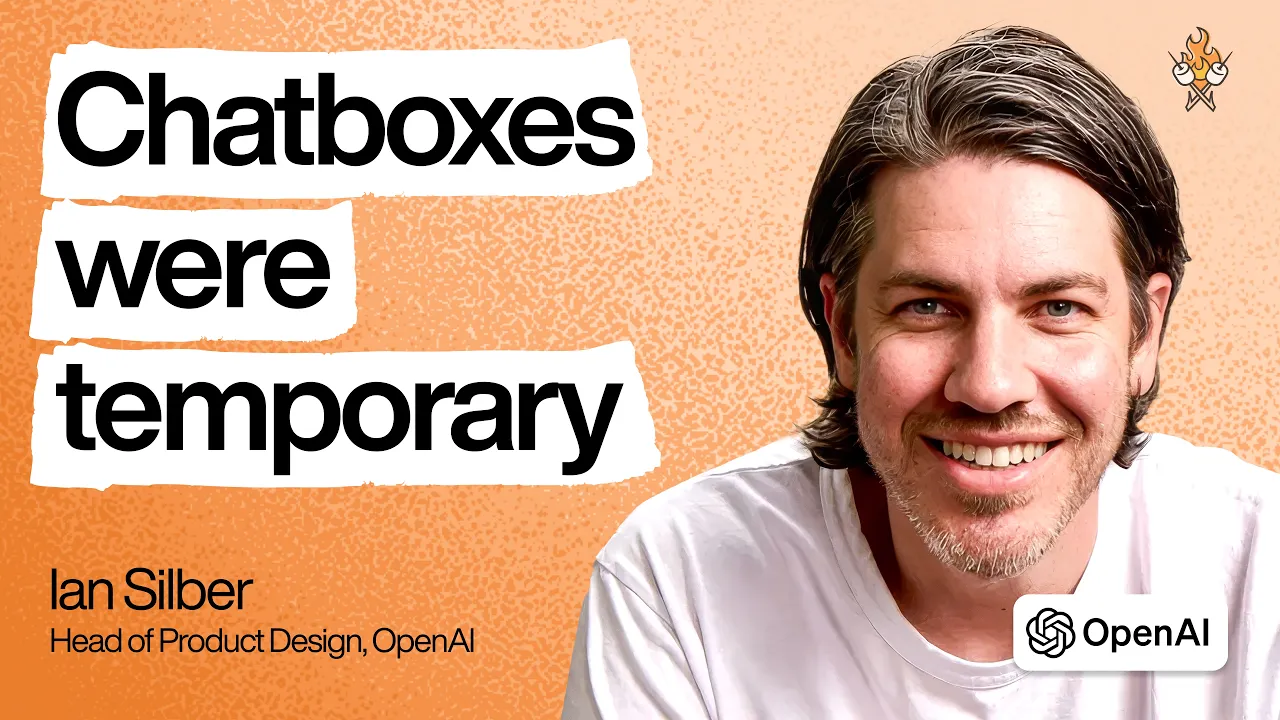
OpenAI Design Chief Says Automated Code Shifts Power to Human Taste
Lenny's Podcast
As coding agents commoditize software development, traditional engineering-heavy team ratios are collapsing in favor of designers who leverage first-principles taste and modular primitives to build simpler interfaces.
Team ratios in tech are fundamentally inverting: while engineering velocity jumped 10x to 100x with AI coding agents, the commoditization of code generation is shifting startup staffing models from 1 designer per 10–15 engineers toward ratios such as two designers to one engineer. (13:41)
OpenAI manages the 'capability overhang' across ChatGPT's 1+ billion monthly active users by keeping the default consumer interface minimal and deploying advanced capabilities into specialized surfaces like Codex, desktop apps, and ChatGPT Work. (39:21)
While AI is already a capable baseline product designer, human designers retain three durable advantages: deep qualitative user understanding, the ability to invent novel interaction paradigms without training data, and an opinionated point of view. (22:24)
ChatGPT's long-term interface vision moves beyond chat sessions toward proactive workflows and an aggressively simplified universal input that dynamically routes speed, reasoning depth, and model selection behind the scenes. (46:07)
Detailed notes
## Background
Published on YouTube by Lenny's Podcast on August 16, 2026, this episode features host Lenny Rachitsky in conversation with Ian Silber, Head of Product Design at OpenAI. The show notes highlight an in-depth exploration of how OpenAI designs ChatGPT and Codex, why current technological shifts make this the best era for product designers, and how interfaces will evolve beyond basic chat boxes.
## TL;DR
Addressing the rising anxiety among product designers facing rapid AI-driven automation, Ian Silber argues that generative tools democratize code and elevate human craft, taste, and systems thinking as the primary competitive differentiators. He explains how OpenAI designs products through modular, composable primitives, balancing four-hour experimental cycles with obsessive micro-crafting on durable surfaces like the ChatGPT composer. Looking forward, Silber outlines the transition of conversational interfaces from simple text prompts into proactive, multimodal workflows that handle intent seamlessly behind the scenes. Throughout the interview, he encourages designers to overcome imposter syndrome, reject rigid process dogma, and focus on building functional prototypes that solve genuine user problems.
## Atmosphere & style
The conversation carries a calm, pragmatic, and reassuring tone, contrasting the industry's prevailing panic with measured optimism grounded in product history. Silber speaks with candid vulnerability about his own early imposter syndrome at OpenAI and past product missteps, creating an open, peer-to-peer dynamic with Rachitsky. The dialogue moves fluidly from strategic organizational philosophy to hands-on prototyping habits, leaving listeners with an energized sense of curiosity rather than existential dread about the future of design.
## Bulletin
- [13:41](https://www.youtube.com/watch?v=BV0hy6NET-U&t=821s) Team ratios in tech are fundamentally inverting: while engineering velocity jumped 10x to 100x with AI coding agents, the commoditization of code generation is shifting startup staffing models from 1 designer per 10–15 engineers toward ratios such as two designers to one engineer.
- [39:21](https://www.youtube.com/watch?v=BV0hy6NET-U&t=2361s) OpenAI manages the 'capability overhang' across ChatGPT's 1+ billion monthly active users by keeping the default consumer interface minimal and deploying advanced capabilities into specialized surfaces like Codex, desktop apps, and ChatGPT Work.
- [22:24](https://www.youtube.com/watch?v=BV0hy6NET-U&t=1344s) While AI is already a capable baseline product designer, human designers retain three durable advantages: deep qualitative user understanding, the ability to invent novel interaction paradigms without training data, and an opinionated point of view.
- [46:07](https://www.youtube.com/watch?v=BV0hy6NET-U&t=2767s) ChatGPT's long-term interface vision moves beyond chat sessions toward proactive workflows and an aggressively simplified universal input that dynamically routes speed, reasoning depth, and model selection behind the scenes.
## Key takeaways
- [02:17](https://www.youtube.com/watch?v=BV0hy6NET-U&t=137s) The velocity divergence between software engineers and product designers occurs because code execution is largely deterministic, whereas design is a non-linear, human-centered feedback loop that cannot simply be prompted to completion.
- [13:41](https://www.youtube.com/watch?v=BV0hy6NET-U&t=821s) AI coding agents compress the development loop from an abstract idea to a working interactive prototype down to minutes, drastically lowering the cost of product experimentation.
- [19:49](https://www.youtube.com/watch?v=BV0hy6NET-U&t=1189s) Organizational boundaries between PMs, designers, and engineers are increasingly fluid, though specialized craft anchors remain essential at scale to maintain architectural stability and interaction quality.
- [25:40](https://www.youtube.com/watch?v=BV0hy6NET-U&t=1540s) Historical computing shifts like multi-touch or camera-first interfaces required designing from first principles without existing data, a dynamic that repeats today with AI voice and agentic delegation workflows.
- [27:34](https://www.youtube.com/watch?v=BV0hy6NET-U&t=1654s) OpenAI hires designers based on distinct superpowers—such as visual craft, prototyping velocity, systems thinking, or frontier exploration—rather than demanding prior AI backgrounds.
- [29:26](https://www.youtube.com/watch?v=BV0hy6NET-U&t=1766s) Systems thinking and composable, modular interaction primitives allow AI models to dynamically orchestrate interfaces without accumulating visual clutter.
- [32:08](https://www.youtube.com/watch?v=BV0hy6NET-U&t=1928s) Under the principle of 'just do less,' design teams should avoid adding custom UI where existing systems suffice, operating on dual tracks that span rapid four-hour experiments to rigorous micro-crafting.
- [35:03](https://www.youtube.com/watch?v=BV0hy6NET-U&t=2103s) Because underlying models improve continuously in reasoning and latency, designers must avoid hardcoding temporary UI widgets that upcoming model upgrades will render obsolete.
- [41:57](https://www.youtube.com/watch?v=BV0hy6NET-U&t=2517s) To solve conversational AI's blank-box dilemma, ChatGPT is integrating dedicated direct-manipulation components like writing blocks to support brainstorming without cluttering the primary chat transcript.
- [51:40](https://www.youtube.com/watch?v=BV0hy6NET-U&t=3100s) Practitioners should reject 'AI confidence theater' on social media and embrace humility, recognizing that today's model is the worst it will ever be and that failing tasks often resolve with the next model iteration.
- [53:41](https://www.youtube.com/watch?v=BV0hy6NET-U&t=3221s) Designers experiencing career anxiety should ground themselves in the end goal of shipping software users love rather than getting precious about legacy design processes.
- [01:05:52](https://www.youtube.com/watch?v=BV0hy6NET-U&t=3952s) Design leadership must align with an organization's innate founder DNA—whether comedic and brand-led like Groupon, craft-focused like Instagram, or research-driven like OpenAI—rather than forcing conflicting operating models.
- [01:08:38](https://www.youtube.com/watch?v=BV0hy6NET-U&t=4118s) Applying the mantra 'do the simple thing first' enables product teams to strip out unnecessary complexity while preserving the speed required to test experimental concepts in production.
## Detailed walkthrough
### [00:00](https://www.youtube.com/watch?v=BV0hy6NET-U&t=0s) The State of Design in the AI Era
In the opening highlights of the conversation, Lenny Rachitsky brings up findings from his tech workforce sentiment survey, pointing out an unexpected and stark reality: across every single measured dimension, product designers and user researchers are currently reporting the highest levels of unhappiness. Ian Silber, Head of Product Design at OpenAI, observes that the entire discipline is wrestling with a profound lack of clarity regarding what companies actually expect of them. Designers who were classically trained in deliberate, structured ways of working are suddenly experiencing whiplash, wondering if they must abandon everything they know overnight.
Yet, Ian pushes back against the doom-and-gloom narrative, arguing instead that this is actually the best time in history to enter or practice design. Because the industry remains in the earliest stages of the AI transition, "nobody should feel behind right now." Even if an individual were to start learning the tools today, they would instantly have an advantage over most of their peers. At the same time, Ian candidly highlights a major friction point between disciplines: while software engineers have unlocked a 10x to 100x productivity leap using coding agents, design teams have not seen a comparable acceleration. Design cannot simply be prompted into perfection; it remains a fluid, messy, and fundamentally human craft where teams must explore dozens of dead ends, gather feedback, and discard ideas before finding what works.
[01:26](https://www.youtube.com/watch?v=BV0hy6NET-U&t=86s) Introduction: Ian Silber and the Evolution of AI Interfaces
Lenny formally introduces Ian Silber, who has led product design at OpenAI for three years—a tenure Lenny notes is effectively "a lifetime in AI time." Ian's background spans significant consumer product milestones: prior to OpenAI, he designed at Artifact (the personalized news platform created by Instagram's founders Kevin Systrom and Mike Krieger), and before that, he spent eight years at Instagram working on flagship surfaces like Instagram Reels. Lenny explains that Ian brings an exceptionally grounded perspective to how interfaces will evolve beyond basic chat windows. Before diving into the interview, Lenny thanks community members Cleo and Joel Lewenstein for suggesting topics for the discussion.
[02:17](https://www.youtube.com/watch?v=BV0hy6NET-U&t=137s) Unpacking Designer Anxiety: The 10x Engineer vs. The Messy Design Loop
Turning to his industry-wide tech workforce sentiment survey, Lenny notes that designers and UX researchers registered as the most overwhelmed, anxious, worried, exhausted, and the least optimistic about the future of tech. Strikingly, they were also the least likely cohort to recommend their career path to newcomers. He asks Ian whether this matches what he sees inside the design community and what underlying forces are driving this unease.
```mermaid
flowchart TD
accTitle: Divergence of Engineering and Design Velocity with AI
accDescr: Diagram illustrating how engineering experiences binary deterministic acceleration while design remains in a messy, subjective human feedback loop.
Ian acknowledges the validity of the survey and notes that he sees a split in sentiment. While many designers he interacts with are energized, the widespread anxiety stems directly from ambiguity around role expectations. Designers constantly hear conflicting narratives: are they expected to become full-stack engineers overnight? Must they ship production code every day? This friction is exacerbated when designers look at their engineering peers:
- **The Engineering Velocity Gap:** Software engineers have experienced a dramatic 10x to 100x boost in sheer output because coding tasks with an AI agent are relatively binary—code either runs and meets specifications, or it doesn't.
- **The Non-Linear Design Process:** Product design resists instant automation because it is inherently iterative and messy. A designer tries an idea, discovers it is terrible, pivots, puts it in front of users or internal peers, absorbs criticism, and refines it again. While AI accelerates initial ideation, it does not bypass the necessary feedback loop or organizational alignment overhead.
- **Ambiguity of Expectations:** The lack of an agreed-upon industry standard for what a modern designer should produce creates persistent anxiety for those trained in traditional UX frameworks.
[06:01](https://www.youtube.com/watch?v=BV0hy6NET-U&t=361s) How OpenAI's Research Lab Culture Fosters Design Agency
Inside OpenAI, Ian explains that design culture mirrors the company's foundational roots as an exploratory research laboratory. Rather than demanding that designers discard their methods or operate strictly as engineers, OpenAI actively hires designers who do not necessarily have an AI background, looking instead for deep intellectual curiosity and an eagerness to experiment.
When leadership treats tooling as an open canvas rather than an operational mandate, pressure transforms into creative agency. Ian shares that in conversations with junior and senior designers across his team, those leaning into the tooling report a massive expansion of creative freedom. They can rapidly manifest ideas, test flawed concepts without sunk-cost bias, throw out weak directions within minutes, and iterate toward stronger thinking. By letting AI take on preliminary mechanical steps, designers are raising the craft bar and driving higher strategic impact across the organization.
[07:53](https://www.youtube.com/watch?v=BV0hy6NET-U&t=473s) The Bifurcation of Tech: Feeling Replaced vs. Feeling Amplified
Lenny mirrors Ian's observations using his survey data, pointing out that the tech industry is essentially splitting into two distinct camps: roughly half the workforce feels energized and reports having the most fun of their entire careers, while the other half feels left behind and drained. The single strongest statistical predictor separating the two groups is whether an individual feels *amplified* by AI or threatened by it. When professionals see that these tools can handle tedious labor and expand their creative ceiling—just as engineers have discovered with coding agents—their sense of leverage and career satisfaction skyrockets.
[09:46](https://www.youtube.com/watch?v=BV0hy6NET-U&t=586s) Adaptability and the "Early Innings" of AI-Assisted Design
When Lenny asks what patterns separate the designers who are genuinely thriving and having fun with AI from those having a miserable time, Ian points to constant experimentation and deep adaptability. The practitioners doing well integrate AI into every step of their workflow rather than viewing it as a separate chore. Instead of laboring over traditional steps before touching a prototype, they have an idea and immediately throw it into Codex, Claude, or another agent to bounce thoughts around and generate an interactive test. It might not end up being the exact final path, but experimenting with unconventional ways of working opens up new creative avenues.
Ian emphasizes that adaptability is crucial because the underlying technology is moving at a breakneck pace: what was completely broken yesterday suddenly works flawlessly today. He shares a personal anecdote from late 2025 when he was out on paternity leave, tinkering with side projects:
> "I was trying some coding agents and it worked, but it just kept kind of running into these hiccups. And then like a month later, Codex drops and I try it again and it's like, 'Oh my gosh, it just works.' And that, I think, changes a lot of the design process because now all of a sudden, if you do have an idea, you can like plop it in there and just try it."
The broader takeaway is that the entire industry is still in the earliest innings. No one has an established playbook or a "perfect answer" for how product design is supposed to function in this paradigm. Consequently, nobody should feel behind: anyone jumping into design right now—whether early-career, senior, or a non-designer experimenting for the first time—actually holds an advantage over those clinging to legacy workflows. Ian notes that what looks like bleeding-edge technology today will appear completely archaic within a year or even a month. He reflects on his three years at OpenAI, recalling early demos of voice mode and computer use that barely functioned at all when he joined, whereas today both tools have become standard parts of how the OpenAI design team conceptualizes and builds software.
- **Fast feedback loops:** Rather than treating AI as an end-stage tool, designers excel when they insert agents directly into the earliest brainstorming and prototyping phases.
- **Paternity leave experiments:** Ian experienced the rapid step-function change firsthand when coding agents leaped from frustrating, error-prone hiccups to near-frictionless generation in a span of weeks.
- **Zero established orthodoxies:** Because the entire craft is being rewritten in real time, early beginners and veterans alike are figuring it out simultaneously; nobody is truly late to the party.
---
[13:41](https://www.youtube.com/watch?v=BV0hy6NET-U&t=821s) Why It Is the Best Time in History to Be a Designer
Ian passionately defends his belief that the current moment is the best era in history to be a product designer. He contrasts today’s environment with his own teenage years learning how to build software, where the only path was opening a browser, hitting "View Source" on HTML pages to reverse-engineer how someone built a layout, and wrestling with tools like Dreamweaver. Back then, picking up technical craft required tedious, slow iteration. Today, the gap between having a raw mental concept and holding a working, interactive piece of software has shrunk down to minutes, unlocking unprecedented levels of personal expressiveness.
```mermaid
flowchart LR
accTitle: Evolution of Product Development Cycles
accDescr: Comparison of the legacy web development feedback loop versus the modern AI-assisted product design loop.
subgraph Legacy["Legacy Web Development"]
L1["View Source & Dreamweaver"] --> L2["Manual Syntax & Styling"]
L2 --> L3["Days / Weeks to Functional Prototype"]
end
Because anyone can technically generate functional software now, Ian argues that human design taste, deep user empathy, and craft will become the primary competitive differentiators. When code generation is commoditized, products will stand or fall based on whether they solve genuine, unmet customer needs and feel deeply delightful to use.
This technological shift is also upending traditional startup team compositions:
- **Shifting engineering-to-design ratios:** While classic tech startups historically hired at ratios of 1 designer to 10 or 15 engineers, Ian has friends founding startups who are planning for two designers and just one rock-solid engineer to guarantee architectural stability while the designers drive the creative exploration.
- **Direct empowerment:** At OpenAI, designers are fully empowered to take raw research breakthroughs or experimental model capabilities and figure out how to package them into polished consumer-facing products that users actually love.
- **The democratization of the title:** As barrier-to-entry tooling disappears, Ian anticipates far more people from outside traditional design disciplines will start thinking of themselves primarily as designers.
---
[13:41](https://www.youtube.com/watch?v=BV0hy6NET-U&t=821s) The Spider-Man Standoff and the Blurring Lines Between PM, Eng, and Design
Lenny references an observation made by Marc Andreessen on an earlier podcast episode, describing the modern product organization as a three-way standoff between Product Managers, Engineers, and Designers—akin to the viral meme of three Spider-Men pointing fingers at each other, each believing their specific discipline will survive while the other two are automated away. Lenny wonders why, if design is supposed to be the great differentiator, the market hasn't yet seen a massive hiring explosion for designers relative to engineers.
Ian acknowledges that the dynamic is subtle: while engineers may have experienced an obvious 10x explosion in direct code output, designers are also dramatically increasing their productivity and scope, even if it doesn't map directly to the same raw output metrics. Furthermore, engineers are increasingly developing a desire to become more design-literate and product-focused.
More fundamentally, Ian sees the traditional, rigid silos separating PMs, engineers, and designers as artificial corporate constructs that are dissolving rapidly:
> "I've always found that these like single-siloed role definitions don't really make sense. It's just that at big companies you have to have like a ladder to put people on so you can generally kind of like organize. But in reality, when you look at a team, you see that there are people that have various strengths and people that play different roles... Those lines have always been blurry, but they're becoming blurrier for sure."
In practice, high-performing designers have frequently leaned into either PM archetypes (driving strategy and requirements) or technical frontend archetypes (tuning polish directly in code). With AI closing the execution gap across all disciplines, the boundaries between deciding what to build, prototyping the experience, and writing production code are collapsing together, rewarding practitioners who operate across the entire spectrum.
[19:49](https://www.youtube.com/watch?v=BV0hy6NET-U&t=1189s) The Persistence of Roles: Why PMs, Designers, and Engineers Won’t Fully Merge
Addressing the pervasive industry conversation about whether AI will collapse all product functions into generic "builders," Ian offers a grounded perspective from the vantage point of scaling organizations. While the boundaries between product management, design, and engineering have undeniably become more fluid, he pushes back on the notion that dedicated roles will simply evaporate into a single Venn diagram overlap. Building great software requires wearing distinct hats, and finding an individual who can simultaneously craft top-tier design, write sound code, and execute the alignment and coordination demands of product management remains exceedingly rare.
An exceptional PM brings indispensable value by rallying disparate teams together, sharpening the problem definition, and managing resourcing. Similarly, dedicated engineers ensure that system architecture is robust and capable of laddering up to broader platform needs. Ian notes that at an early-stage startup, hiring fluid generalists who can nimbly jump across functions is often the right move—though that has arguably always been true. At scale, however, even a world-class designer often benefits immensely from a PM who can hone their thinking, operationalize their workflow, and create structure around their craft.
- **Startups vs. Scale:** Generalist builders who fluidly span boundaries make sense at day one, but larger organizations require dedicated operational and craft anchors.
- **The Core Functions:** Coordination, problem framing, architectural soundness, and interaction craft remain distinct disciplines, even when individual practitioners expand their toolsets.
[22:24](https://www.youtube.com/watch?v=BV0hy6NET-U&t=1344s) Is AI Already a Great Designer? Where Human Brains Still Win
When Lenny asks whether AI will ever become an extraordinarily good product designer—pointing out the irony that engineers once doubted AI could write code—Ian offers a provocative counter: "I think it already is an incredible product designer." It is accessible to anyone and capable of impressive outputs out of the box. However, being "great" broadly does not mean it is currently the best at nuanced visual design, complex information hierarchy, typography, or interaction design. Rather than viewing AI as a replacement, OpenAI approaches it as an empowering tool at the creator's fingertips, designed to unlock higher leverage, creativity, and output.
When pressed on where human intelligence remains irreplaceable as models advance, Ian zeroes in on three core faculties:
1. **Genuinely understanding human needs:** Observing real people struggle with software, interpreting qualitative feedback, and tuning into latent emotional friction that cannot be captured in metrics alone.
2. **Invention and novelty:** Bringing something completely unprecedented into existence rather than interpolating across existing patterns.
3. **A distinct point of view:** Software resonates when users feel that a human intentionally built it with a sharp, subjective perspective: "Somebody made this, somebody had a point of view about this." As synthetic generation becomes ubiquitous, having a distinct, opinionated perspective will be the primary way a designer stands out.
[25:40](https://www.youtube.com/watch?v=BV0hy6NET-U&t=1540s) Inventing Without Training Data: From Multi-Touch to Voice and Agents
Lenny brings up a previous conversation with the product lead for Codex, who noted that AI struggles with design because true design breakthroughs inherently defy historical training data, and AI researchers themselves are not naturally calibrated on design craft. Ian agrees, emphasizing that every major leap in computing required inventing paradigms that had no precedent:
```mermaid
flowchart TD
accTitle: Historical Interaction Paradigm Shifts
accDescr: Progression of software interaction models from mobile multi-touch to AI voice and agentic systems.
subgraph MobileEra["Mobile Paradigm Shifts"]
A["iPhone: Multi-Touch<br/>(No prior training data)"]
B["Instagram: Ubiquitous Mobile Cameras<br/>(Visual feeds)"]
C["Snapchat: Ephemeral Cameras<br/>(Inverted communication norms)"]
end
subgraph AIEra["AI Paradigm Shifts"]
D["Voice-First Interfaces<br/>(Talking directly to AI)"]
E["Agentic Workflows<br/>(Task execution & delegation)"]
end
A --> B
B --> C
C --> D
D --> E
```
When Apple introduced multi-touch on the iPhone, there was zero training data on how users should manipulate glass screens; designers had to discover those patterns from first principles. Similarly, Instagram capitalized on mobile camera ubiquity, and Snapchat turned conventional UI conventions on their head by opening straight into a camera to reimagine casual communication. Today, design teams at OpenAI face an identical blank-slate challenge: figuring out how humans should interact with an AI model via voice, or how people should monitor and direct autonomous agents executing multi-step tasks. Because there is little to no historical precedent for these interactions, humans in the loop must run experiments, evaluate subjective quality, and learn alongside users.
[27:34](https://www.youtube.com/watch?v=BV0hy6NET-U&t=1654s) Hiring Designers at OpenAI: Superpowers, Team Composition, and Curiosity
When building out the design organization at OpenAI, Ian resists looking for a single archetype or an impossible checklist of traits. Instead, he treats team composition as an exercise in assembling complementary superpowers. While generalists who can flex across the stack are essential, a resilient design team also requires deep specialists:
- **Visual craft and brand expression:** Designers who push aesthetic execution and define how the company's identity lives inside and outside the software.
- **Prototyping powerhouses:** Builders who rapidly stand up interactive, high-fidelity artifacts to test emergent model behaviors.
- **Strategic product thinkers:** Practitioners who excel at high-level roadmapping, problem framing, and systems thinking.
- **Frontier explorers:** Designers obsessed with the absolute bleeding edge of model capabilities and emerging interaction patterns.
Ian stresses to prospective candidates that OpenAI does not expect applicants to arrive with a formal background in AI, given how new the field is. What is mandatory, however, is an exceptionally high level of curiosity and a rapid aptitude for exploring what the technology can do.
[29:26](https://www.youtube.com/watch?v=BV0hy6NET-U&t=1766s) Hiring Designers: Curiosity, Prototyping, and Systems Thinking
When evaluating design talent for OpenAI, Ian Silber looks for candidates who dive straight in and actively figure out how to integrate AI tools into their creative workflows. More importantly, he looks for designers who can invent tools that enable everyone else to harness those capabilities. Deep curiosity and hands-on prototyping remain non-negotiable qualities: prototyping has become dramatically more accessible, making practical execution stand out far more than theoretical slide decks. He also looks for a sharp, strategic point of view regarding where the technology is heading and how modern software tools must evolve.
Above all, Silber emphasizes that systems thinking has become critical. At OpenAI, the team is tasked with designing interfaces for an emerging superintelligence equipped with a vast array of capabilities. Instead of crafting fragmented, one-off siloed experiences, the design organization must establish foundational, composable primitives that cleanly stack on top of one another—reminiscent of the building-block philosophy Notion pioneered in its early days. When the underlying primitives are composable, the end product remains simple and unified for the user, while the AI model can reason effectively about how to stitch those pieces together.
Lenny jokes that he needs a "bingo card for systems thinking," noting that this marks the fifth consecutive podcast episode where an executive highlighted it as an essential hiring requirement. It resonates particularly strongly in design today because engineering teams are merging thousands of pull requests a day, compressing the calendar window available for traditional, prolonged design cycles.
- **Key hiring traits:** Insatiable curiosity about AI, proactive prototyping, a strong strategic point of view, and systems-level architecture skills.
- **The composability imperative:** Designing modular primitives so the AI model can dynamically compose them without cluttering the interface into disconnected silos.
[32:08](https://www.youtube.com/watch?v=BV0hy6NET-U&t=1928s) "Just Do Less" and the Death of the Linear Waterfall
Addressing the stress and bottleneck felt by modern design teams, Silber shares his counterintuitive internal advice: "Just do less." Rather than designing a brand-new interface or custom element from scratch, designers should first ask whether an existing system, component, or pattern can be extended—or if the feature even needs to exist at all. This requires designers to pull their gaze up from their immediate feature surface and think holistically across the entire platform ecosystem.
```mermaid
flowchart TD
accTitle: Dual Track Design Workflow
accDescr: Flowchart contrasting rapid public iteration with deep craft design tracks based on surface stability.
subgraph RapidTrack["Exploratory Track: Volatile / Emerging Capabilities"]
A["Idea"] --> B["Rapid Prototyping"]
B --> C["Public Shipping in Hours / Days"]
C --> D["Instant User & Dogfood Feedback"]
end
subgraph DeepTrack["Durable Track: Core / High-Volume Surfaces"]
E["Strategic Exploration"] --> F["Extensive Figma & Prototyping"]
F --> G["Sweat Details: Test 100, Discard 99"]
G --> H["A/B Testing & Deep Dogfooding"]
H --> I["Ship Hardened Surface"]
end
```
Lenny brings up a previous conversation with Jenny Wen, the Head of Design at Claude, who pointed out that the traditional design sequence—prototyping, mocking, testing, researching, handing off to engineering, and iterating—is functionally obsolete due to engineering velocity, forcing designers into broad high-level direction and steering. Silber confirms OpenAI works this way depending on the surface and maturity stage:
* **High-velocity swings and public iteration:** On surfaces like Codex or early super-app features, the team fully embraces "building in public," shipping experiments from concept to production in as little as four hours to gather immediate feedback internally and externally.
* **Obsessive micro-crafting:** On core, high-visibility surfaces like the ChatGPT composer, the team obsesses over minute details: "We try 100 things, we throw out 99. We finally ship one."
* **Handling model evolution:** Underlying model latency profiles, reasoning powers, and tool-use behaviors shift every few weeks, meaning hardcoded UI widgets can become completely unnecessary overnight. Designers must stay nimble and resist becoming precious about transient interfaces until a interaction paradigm proves stable.
[35:03](https://www.youtube.com/watch?v=BV0hy6NET-U&t=2103s) Designing for Moving Tech and Long-Term Durability
Because foundational AI capabilities change on a month-to-month basis, interface designers face a unique challenge: UI requirements can evaporate or completely invert as latency drops or reasoning advances. Silber explains that designers cannot afford to get overly attached to an interaction design until it has "hardened." When an interaction pattern does demonstrate durability, the team commits to sweating every detail, running rigorous A/B tests, conducting qualitative user research, and cycling through dozens of iterations.
A prime example is OpenAI's initiative to integrate ChatGPT deeply into a person's everyday life. An initiative of that scale is not treated as a four-hour hack. The design team spends months exploring abstract concepts on whiteboards, building interactive prototypes in Figma, and running intensive internal dogfooding sessions long before any code reaches external users. Lenny summarizes this operating model as picking your battles by focusing intensive design craft strictly on the elements that will remain durable over time—a balance Silber admits is remarkably difficult to strike.
Lenny introduces sponsor Mercury, a banking platform built for startups and product creators, now serving over 300,000 entrepreneurs. Having banked with Mercury for over six years, Lenny highlights features that distinguish it from traditional financial institutions, including developer APIs, a terminal-native CLI, and an AI-ready MCP server.
He shares his experience using Command, Mercury's conversational financial operator interface, to manage transfers, categorize operational expenditures, inspect cash flow dynamics, and calculate specific annual sponsor revenue queries within ten seconds.
[38:05](https://www.youtube.com/watch?v=BV0hy6NET-U&t=2285s) Balancing 1 Billion Users with Rapid Invention
Lenny raises a question sourced from Joel Lewenstein, the Head of Design at Anthropic and a close personal friend of Silber: what is the hardest part of balancing the daily habits of over a billion monthly active ChatGPT users against OpenAI's urgent imperative to invent, push, and radically transform the product experience?
Silber embraces the tension as one of the most exciting parts of his role, noting that the demographic spread across ChatGPT's audience is entirely unprecedented in consumer software. Comparing it to his eight-year tenure at Instagram, he observes that while Instagram scaled to billions of users, the application's core mental model was relatively consistent—centered around feeding, posting, and specialized features for large creator accounts. By contrast, ChatGPT's user base spans diametrically opposed workflows and expectations, ranging from casual consumer ideation to deep, professional domain work.
[39:21](https://www.youtube.com/watch?v=BV0hy6NET-U&t=2361s) Designing for the Broadest Spectrum: From Haircuts to Japanese Farms
Ian explains that one of the wildest aspects of designing OpenAI's products is the sheer breadth of how people use them. On one end of the spectrum, someone is opening ChatGPT just to find a quick dinner recipe or brainstorm ideas for their next haircut; on the other end, an operator is fundamentally transforming and automating their farm in Japan. There has perhaps never been a digital product spanning such polar extremes. At OpenAI, the team conceptualizes this dynamic around the idea of a "capability overhang"—the reality that the vast majority of users are currently tapping into only a tiny sliver of the true latent value the underlying models possess. That is not inherently bad, as those mainstream users are still getting immense value, but it creates a distinct architectural and design challenge: OpenAI must maintain an exceptionally simple, streamlined baseline experience for hundreds of millions of people while simultaneously providing power users direct access to cutting-edge capabilities.
The core design tension is avoiding "overindexing" on power features and accidentally thrusting confusing, complex interfaces in front of a billion people. OpenAI typically solves this by experimenting early with highly engaged, specialized cohorts through dedicated surfaces like the desktop app, Codex, and ChatGPT Work. However, Ian emphasizes that the ultimate design goal is not to trap users in bifurcated modes or manual settings toggles. A product truly scales to billions when users never have to stop and think about switching modes. Whether someone is using the free tier for casual curiosity or paying hundreds of dollars each month for heavy enterprise workflows, the interface must gracefully absorb their intent, which requires designers to exercise extreme empathy across a massive spectrum of personas.
- **The capability overhang:** Most mainstream users touch only a fraction of what the model can do, yet they still experience immense utility.
- **Audience tiering:** OpenAI tests advanced interaction models in targeted environments like Codex and the desktop client before attempting to distill those paradigms into the universal consumer experience.
- **The ultimate design benchmark:** Removing the need for mental model switches so that a single unified interface naturally scales from casual inquiries to complex computational tasks.
[41:57](https://www.youtube.com/watch?v=BV0hy6NET-U&t=2517s) Tackling the "Blank-Box Problem" and the Myth of the Glorified Terminal
Lenny reacts to the staggering diversity of use cases, pointing out that few products in history have had to bridge the gap between diagnosing a weird rash on someone's finger and building Salesforce from scratch. This dynamic brings Ian to the infamous "blank-box problem." Critics frequently dismiss conversational AI as nothing more than a "glorified terminal," asking whether an empty text box can truly be the final frontier of human-computer interaction. Ian views this critique as an invitation to invent adaptive, shape-shifting interfaces. If a user arrives looking to generate images for fun, or to draft a slide presentation, or to execute deep technical analysis, the software should dynamically morph its affordances to match that exact context.
```mermaid
flowchart TD
accTitle: Adaptive Interface Architecture
accDescr: Flowchart illustrating how user context and intent transform a single conversational input into specialized direct manipulation workspaces.
subgraph Input ["Universal Input Layer"]
Prompt["Single Text / Voice Prompt"]
Intent["Context & Intent Recognition"]
Prompt --> Intent
end
subgraph DynamicUI ["Adaptive Interface Shifts"]
Novice["Novice Path: Guided Follow-Up Chips"]
Power["Power Path: Direct Execution & Agent Work"]
Intent --> Novice
Intent --> Power
end
subgraph Artifacts ["Rich Interactive Workspaces"]
Canvas["Writing Blocks (Direct Manipulation)"]
Media["Visual Canvas (Image Editing Tools)"]
Agent["Autonomous Task Completion (Slack / Calendar)"]
Novice --> Canvas
Power --> Canvas
Power --> Media
Power --> Agent
end
```
Lenny brings up an insight previously shared on the podcast by former Chief Product Officer Kevin Weil: when people complain about the simplicity of a chat box, they overlook that natural conversation is the single most effective interface humanity has ever discovered for spanning a wide spectrum of intelligence. Humans use the exact same verbal interface to talk to someone of modest intelligence or an absolute genius, making conversational language uniquely suited for packaging an intelligence that is scaling exponentially.
Ian agrees, noting that OpenAI focuses heavily on two design vectors:
1. **Expressing user intent without prompt engineering:** Teaching users what the model can do without forcing them to master complex prompting syntax. For example, when someone asks an open-ended question, the UI can now provide tappable follow-up suggestion chips rather than forcing them to type out elaborate clarifications.
2. **Evolving beyond the text transcript:** Moving past rigid lines of chat dialogue toward specialized, interactive components. A prime example is "writing blocks." When a user asks ChatGPT to draft an email or memo, the output is packaged into a dedicated, directly manipulable canvas block where users can type, highlight, brainstorm revisions, and copy specific sections without polluting the primary thread. Similar purpose-built tooling is being developed across image generation, data science, and creative workflows.
[46:07](https://www.youtube.com/watch?v=BV0hy6NET-U&t=2767s) The Future of ChatGPT: Proactivity, Voice, and the Super App
Looking toward the longer-term horizon for ChatGPT and Codex, Lenny asks about the concept of AI as an all-encompassing "super app" or personal assistant. Ian envisions a future where the interface becomes radically more adaptive, context-aware, and above all, proactive. Rather than purely sitting dormant and waiting for human input, the system will leverage external context—such as calendar schedules and Slack communication in ChatGPT Work—to provide intelligent, proactive suggestions before a user even prompts it.
Voice interaction represents another massive inflection point. Following recent step-change leaps in model responsiveness and conversational cadence, voice is beginning to feel fundamentally natural, opening the door to quick, off-the-cuff everyday interactions. Furthermore, the paradigm is shifting from merely asking a model questions to assigning it agentic tasks that it completes independently in the background.
Ian's north star for the "super app" is aggressive simplification:
- **A universal input surface:** A single, uncluttered entry point that inherently understands whether an answer demands an instant two-sentence reply, an expansive dialogue, or hours of autonomous background work.
- **Eliminating cognitive overhead:** Removing friction points where users currently have to manually select models, reasoning effort, or execution speeds. The system should intelligently make those routing decisions behind the scenes.
- **Durable, repeatable workflows:** Evolving beyond the ephemeral, start-from-scratch feeling of today's chat sessions so that users can construct persistent routines and reusable tools that permanently support their personal and professional lives.
[49:13](https://www.youtube.com/watch?v=BV0hy6NET-U&t=2953s) What Ian Wishes He Knew on Day One: Early Days and Imposter Syndrome
When Lenny asks what advice Ian would whisper to his "day one" self stepping into OpenAI, Ian admits he was deeply intimidated at the beginning. GPT-4 had recently launched, and despite using the technology, he felt like he did not truly understand the underlying mechanics or what all of it really meant. Looking back, he wishes someone had told him that it was completely normal not to have it all figured out, because everyone across the industry was still at the very beginning of the curve. Even today, he emphasizes that he still has an enormous amount to learn.
Beyond the technology itself, taking the role meant a massive shift in personal leadership scale. While Ian had managed teams before, he had never led an organization growing at such breakneck speed within a company that was fundamentally different from anywhere else he had worked. For a prolonged period, he wrestled with severe imposter syndrome, constantly worrying that he was simply bad at the job and had no idea what he was doing.
The turning point came when he reached out to peers and friends who had led massive design organizations or navigated similar transitions. To his relief, he discovered that every single one of them had experienced the exact same self-doubt and confronted identical organizational growing pains. Realizing his struggles were not unique brought immense clarity. Ian emphasizes that at any stage of a career, finding an impartial buddy, mentor, or outside community going through comparable hurdles is critical for keeping perspective while operating in an environment evolving at breakneck speed.
[51:40](https://www.youtube.com/watch?v=BV0hy6NET-U&t=3100s) Humility vs. "AI Confidence Theater"
Lenny brings up an essay by Elena Verna titled *"Please Stop the AI Confidence Theater,"* pointing out how social feeds are inundated with people boasting about how AI completely revolutionized their workflow and how they have everything solved, when in reality very few implementations actually work that seamlessly. Ian wholeheartedly agrees, stressing that it is vastly healthier to drop the pretenses, stay humble, and openly admit that the space is moving too fast for anyone to have final answers.
This mindset directly ties into what separates people who thrive in the current landscape: genuine curiosity and a willingness to poke at the edges. Because models evolve continuously, an approach or prompt that failed last month might suddenly work effortlessly with the next release. Lenny references an insight from former OpenAI Chief Product Officer Kevin Weil: *"the model we have today is the worst the model will ever be."*
Ian echoes that reality, comparing the current AI moment to the early days of personal computing, when physical hardware componentry was undergoing drastic step changes. Back then, engineers would slam into hard technical walls, only for a new generation of silicon to completely remove those boundaries overnight. In the AI ecosystem—where labs ship model updates on an almost weekly cadence—what was entirely broken yesterday suddenly just works.
[53:41](https://www.youtube.com/watch?v=BV0hy6NET-U&t=3221s) Advice for Overwhelmed and Anxious Designers
For designers currently feeling paralyzed, stressed, or fearful about their career prospects in an AI-dominated landscape, Ian advises first acknowledging that those feelings are entirely rational and normal. Rather than retreating into anxiety, designers should use this inflection point to play, experiment, and rethink their personal workflows—whether that means building quick functional prototypes or adopting unfamiliar tools just to see what happens.
Most importantly, Ian urges designers to anchor themselves on the ultimate outcome rather than the craft process itself:
> "At the end of the day, we're not here to build tools like processes. We're not here to like build or token max or something like that. We're here to make great software that people love or great products or whatever it is you do."
When teams focus on shipping products that resonate with real people, AI tools become powerful accelerators rather than threats, while the human designer remains indispensable as the creative force steering and directing the final product.
[55:16](https://www.youtube.com/watch?v=BV0hy6NET-U&t=3316s) AI Corner: Rapid Prototyping and Operational Augmentation
Transitioning into the podcast's recurring "AI Corner," Lenny asks Ian how he practically uses tools like ChatGPT and Codex in his daily work. Ian notes that because his role has shifted toward leadership, he spends far less time pushing pixels in Figma and instead leverages AI as a thought partner and rapid visualization engine. When an idea strikes him late at night, he will type out the concept and have the model spin up a tangible prototype within minutes, allowing him to walk into team meetings the next morning with an interactive artifact rather than an abstract concept.
```mermaid
flowchart TD
accTitle: Ian Silber's AI Workflow
accDescr: Visualizing how Ian leverages AI for both creative prototyping and operational workflows.
subgraph Ideation ["Creative Exploration"]
A["Late-night spark / broad concept"] --> B["ChatGPT Work / Codex cloud execution"]
B --> C["Functional prototype & visual artifact"]
C --> D["Team riffing & product critique"]
end
Operationally, AI handles executive context-gathering across Ian's day-to-day management responsibilities:
- **Cloud-based prototyping:** Using ChatGPT Work, which runs fully in the cloud, to generate and iterate on prototypes directly from his phone without needing a desktop setup nearby.
- **Message synthesis:** Automatically scanning and summarizing critical Slack conversations requiring follow-up.
- **Executive prep:** Surfacing concise background context prior to key recruiting calls and high-stakes strategy meetings.
[57:43](https://www.youtube.com/watch?v=BV0hy6NET-U&t=3463s) Failure Corner: Learning on the Fly at OpenAI
In the "Failure Corner," Lenny asks Ian to share a notable failure or setback to counter the common perception that high-profile tech careers are linear paths of unbroken success. Ian candidly reflects that when he first joined OpenAI, he felt like he was failing on a daily basis. He was tasked with building and hiring an elite design organization from scratch in an unprecedented domain where no established playbook existed.
Rather than executing a pristine, pre-planned strategy, Ian had to treat every mistake as immediate feedback, constantly adjusting his hiring standards and team design on the go. While acknowledging that saying *"I felt like I was failing every day"* might sound like a bit of a cop-out, he reflects that continuous course correction through trial and error has defined his entire trajectory as a designer and leader.
[59:07](https://www.youtube.com/watch?v=BV0hy6NET-U&t=3547s) Learning from Flops: From IGTV to Reels
Reflecting on product development, Ian emphasizes that no career follows a perfectly planned step-by-step path; rather, success hinges on learning rapidly from mistakes. Over the years, he has shipped plenty of things that flopped alongside the successes. A standout example from his eight years at Instagram was IGTV, which turned out to be "a huge flop." However, the team quickly moved on, digested the lessons, and applied them directly to the creation of Reels.
With IGTV, they had baked in several incorrect assumptions and clung rigidly to constraints that did not match what users actually wanted. By identifying those missteps quickly, they reset their approach, redesigned the format, and ultimately turned Reels into a massive product win. Ian notes that enduring these public flops hardened him to critique and feedback. Sometimes you simply have to put an imperfect concept out into the world, absorb real-world input, and "fix forward" by continuously iterating alongside user feedback. Lenny laughs and observes that this is a universal truth among tech leaders: when you look closely at top careers, they are mostly a string of failures along the way.
```mermaid
flowchart LR
accTitle: Pivot from IGTV to Reels
accDescr: Flowchart illustrating how Instagram moved from IGTV failure to Reels success through iteration.
subgraph IGTV_Failure["IGTV (The Flop)"]
A["Flawed Assumptions & Constraints"] --> B["Low Traction"]
end
subgraph Iteration["The Pivot"]
B --> C["Rapid Feedback & Hard Lessons"]
C --> D["Drop Rigid Constraints"]
end
subgraph Reels_Success["Reels (The Hit)"]
D --> E["Redesigned Experience"]
E --> F["Massive Global Success"]
end
```
[01:00:44](https://www.youtube.com/watch?v=BV0hy6NET-U&t=3644s) An Optimistic Call to Action for Designers
Before transitioning into the lightning round, Ian shares his high-level sentiment on the future of design. Above all, he wants designers to view this era as an extraordinarily fun time to build things. Rather than feeling threatened or overwhelmed by the shift toward AI, designers should remain fluid, adaptive, and dedicated to creating delightful, high-caliber experiences.
He acknowledges that certain legacy organizations will inevitably get left behind because they refuse to shift their operating rhythm. Nevertheless, great companies are actively hunting for talented designers and prioritizing craft more than ever. Lenny echoes the sentiment, emphasizing that he remains extremely bullish on the long-term value of design.
[01:01:34](https://www.youtube.com/watch?v=BV0hy6NET-U&t=3694s) Lightning Round: Books, Culture, and Everyday Tech
Lenny kicks off the five-question lightning round, starting with recommendations for books, entertainment, products, and philosophies:
- **Book Recommendation**: Ian admits he does not typically push a lot of design books, but he points to Don Norman's *The Design of Everyday Things* as the definitive classic. Lenny agrees that it remains mandatory reading for anyone in or around tech.
- **Theater & Film**: Visiting New York, Ian caught the Broadway musical *Maybe Happy Ending*. The production resonated strongly because it centers on humanoid robots, featuring exceptional set design, unique staging, and an inventive narrative. In addition, Ian recently saw the film *The Invite* in theaters. Lenny shares his love for both, with Ian highlighting how *The Invite* functions almost like a stage play—confining four actors to a single, beautifully designed apartment and driving the entire experience through sharp dialogue, exceptional acting, and a wild, unpredictable narrative ride.
- **Favorite Recent Product**: Ian admits feeling like a typical Silicon Valley archetype by bringing up electric vehicles, but he highlights his new Rivian. He admires how electric vehicles strip away outdated automotive paradigms; you no longer have to turn keys or switch the car on and off—you simply walk up, the vehicle unlocks, and it is ready to drive. On an even more ambitious level, Ian expresses absolute awe for Waymo autonomous rides, calling the ride-hailing experience "the most magical experience in the world" and eagerly awaiting the day it becomes broadly accessible everywhere.
- **Life Motto / Guiding "Vibe"**: Instead of a formal mantra, Ian lives by a practical vibe: "have fun with it and like just try stuff." He stresses that creators should never force themselves into a rigid box. Remaining fluid, flexible, and willing to try unproven ideas leads to both better work and a more enjoyable life—an attitude Lenny notes is reminiscent of Sam Altman’s bias for simply building.
[01:05:52](https://www.youtube.com/watch?v=BV0hy6NET-U&t=3952s) Lessons from Groupon and the Power of Company DNA
For the final question, Lenny points to Ian’s LinkedIn history, noting the stark and amusing contrast between starting out as a designer at Groupon and now leading product design for cutting-edge AI systems at OpenAI. Ian looks back fondly on the early Groupon days, pointing out how much character former CEO Andrew Mason injected into the brand.
In its first couple of years, Groupon refused to take itself too seriously. The company famously hired a dedicated writing staff made up of comedians to craft the deal emails. While customers appreciated the 50% discount, they genuinely loved opening the emails because the editorial voice was idiosyncratic, witty, and bold. It stood out purely on the strength of distinctive brand design.
Beyond branding, Ian explains that moving across companies taught him that every organization possesses its own indelible DNA:
- **Groupon** leaned into irreverent, brand-led, comedic energy.
- **Instagram** operated under Kevin Systrom’s meticulous, craft-oriented, design-centric worldview, where Systrom worked closely with the team like a fellow designer.
- **OpenAI** operates in a completely distinct fashion under Sam Altman, structured around the fast-moving, frontier-pushing rhythm of an advanced research lab.
Ian concludes that the biggest career takeaway from moving between these environments is recognizing that you cannot simply show up and force a company to change its fundamental culture—especially when that culture is deeply founder-led. Instead, the real skill lies in identifying each company's innate strengths and designing in a way that empowers and accelerates that specific DNA.
[01:08:38](https://www.youtube.com/watch?v=BV0hy6NET-U&t=4118s) Adapting Craft from Instagram to OpenAI: "Do the Simple Thing First"
Reflecting on his design philosophy across different eras, Ian contrasts his long tenure at Instagram with the hyper-accelerated environment at OpenAI. At Instagram, teams intentionally moved slower, deliberated longer, and altered the core product far less frequently—an approach that proved enormously successful for the company across most of its growth stages. However, Ian emphasizes that the exact same operational playbook would fall flat in OpenAI's current phase. The velocity of frontier AI demands a different cadence of rapid exploration and continuous evolution.
Even so, foundational habits remain influential. At Instagram, the design organization lived by the motto: "Do the simple thing first." Ian still relies heavily on that guiding principle when shaping products like ChatGPT and Codex, using it to strip away unnecessary complexity. At the same time, he recognizes that simple minimalism cannot become dogma in a nascent space: sometimes teams must push boundaries, ship rough experiments, and observe what happens in the wild. Working at OpenAI has required embracing deep flexibility—not stubbornly clinging to a single historic product-building style, but adapting and rounding out his toolkit to match the unpredictability of the AI paradigm.
- **Instagram vs. OpenAI dynamic:** Instagram prioritized deliberate pacing and infrequent changes, whereas OpenAI demands constant experimentation and rapid iteration.
- **Enduring mantra:** "Do the simple thing first" remains a core design filter Ian applies, even while remaining adaptable enough to ship speculative features.
---
[01:09:36](https://www.youtube.com/watch?v=BV0hy6NET-U&t=4176s) Sharing the Process, Where to Find Ian, and Outro
As Lenny wraps up the conversation, he marvels at Ian's front-row seat to the evolution of frontier technology and asks where listeners can connect and how they can support his work. Ian invites everyone to keep playing with ChatGPT and Codex, encouraging unfiltered feedback and reactions. He is most accessible on X (formerly Twitter), where he actively enjoys chatting with product designers at all career stages, as well as engineers and product managers.
When asked how the community can be helpful, Ian makes a passionate plea for transparency: he urges practitioners to publicly showcase how their workflows and tool stacks are transforming. As generative AI reshapes everyday product development, modern design methodologies have become increasingly opaque; sharing real-world workflows provides invaluable signal for OpenAI to build better tools and acts as a massive gift to the broader tech community. Lenny also directs listeners to Ian’s personal portfolio site (iansilber.com), poking fun at the intense color cycling reflecting off his face and pointing out the hidden Easter egg game embedded in the site, where players battle for high scores. Lenny signs off by thanking Ian and reminding listeners to subscribe, rate, and review the show across podcast platforms.
- **Community feedback:** Users are encouraged to test ChatGPT and Codex aggressively and share direct reactions with Ian on X (@iansilber).
- **Call to designers and builders:** Share your emerging workflows publicly; demystifying how teams build with AI helps toolmakers understand real-world needs.
- **Personal portfolio Easter egg:** Ian's personal website (iansilber.com) features an archive of his historical design work alongside an interactive, playable Easter egg game with an active leaderboard.
## Notable quotes
> [00:00](https://www.youtube.com/watch?v=BV0hy6NET-U&t=0s) nobody should feel behind right now. — Ian Silber
> [09:46](https://www.youtube.com/watch?v=BV0hy6NET-U&t=586s) I was trying some coding agents and it worked, but it just kept kind of running into these hiccups. And then like a month later, Codex drops and I try it again and it's like, 'Oh my gosh, it just works.' And that, I think, changes a lot of the design process because now all of a sudden, if you do have an idea, you can like plop it in there and just try it. — Ian Silber
> [13:41](https://www.youtube.com/watch?v=BV0hy6NET-U&t=821s) I've always found that these like single-siloed role definitions don't really make sense. It's just that at big companies you have to have like a ladder to put people on so you can generally kind of like organize. But in reality, when you look at a team, you see that there are people that have various strengths and people that play different roles... Those lines have always been blurry, but they're becoming blurrier for sure. — Ian Silber
> [22:24](https://www.youtube.com/watch?v=BV0hy6NET-U&t=1344s) I think it already is an incredible product designer. — Ian Silber
> [22:24](https://www.youtube.com/watch?v=BV0hy6NET-U&t=1344s) Somebody made this, somebody had a point of view about this. — Ian Silber
> [32:08](https://www.youtube.com/watch?v=BV0hy6NET-U&t=1928s) Just do less. — Ian Silber
> [32:08](https://www.youtube.com/watch?v=BV0hy6NET-U&t=1928s) We try 100 things, we throw out 99. We finally ship one. — Ian Silber
> [51:40](https://www.youtube.com/watch?v=BV0hy6NET-U&t=3100s) the model we have today is the worst the model will ever be. — Kevin Weil
> [53:41](https://www.youtube.com/watch?v=BV0hy6NET-U&t=3221s) At the end of the day, we're not here to build tools like processes. We're not here to like build or token max or something like that. We're here to make great software that people love or great products or whatever it is you do. — Ian Silber
> [57:43](https://www.youtube.com/watch?v=BV0hy6NET-U&t=3463s) I felt like I was failing every day — Ian Silber
> [01:00:44](https://www.youtube.com/watch?v=BV0hy6NET-U&t=3644s) the most magical experience in the world — Ian Silber
> [01:00:44](https://www.youtube.com/watch?v=BV0hy6NET-U&t=3644s) have fun with it and like just try stuff — Ian Silber
> [01:08:38](https://www.youtube.com/watch?v=BV0hy6NET-U&t=4118s) Do the simple thing first — Ian Silber
## Mentioned
Ian Silber, Lenny Rachitsky, Kevin Systrom, Mike Krieger, Marc Andreessen, Kevin Weil, Elena Verna, Andrew Mason, Sam Altman, Joel Lewenstein, Don Norman, OpenAI, ChatGPT, Codex, ChatGPT Work, Artifact, Instagram, Instagram Reels, IGTV, Claude, Dreamweaver, Notion, Figma, Mercury, Slack, Salesforce, Rivian, Waymo, Groupon, Apple, Snapchat, The Design of Everyday Things, Maybe Happy Ending, The Invite, Please Stop the AI Confidence Theater
## Video description
OpenAI’s Head of Design: This is the best time in history to be a designer | Ian Silber
Ian Silber is the head of product design at OpenAI, where he has led the design of ChatGPT, Codex, and all of OpenAI’s product experience for the past three years. Before OpenAI, he was at Artifact, the AI-powered news app built by the founders of Instagram. Prior to that, he spent eight years at Instagram, where he worked on products including Reels. Ian is one of the most consequential designers working in AI today, and he takes us inside how OpenAI designs ChatGPT, Codex, and the future of how we will interact with AI.
*In our in-depth conversation, we discuss:*
1. Why Ian believes this is the best time in history to be a product designer
2. Why engineers 10x’d with AI but design teams haven’t
3. What OpenAI looks for when hiring designers
4. “Just do less”: Ian’s counterintuitive advice to his designers
5. The future of ChatGPT as a super app
6. Where humans still win: user understanding, invention, and point of view
*Brought to you by:*
WorkOS—Make your app enterprise-ready, with SSO, SCIM, RBAC, and more: https://workos.com/lenny
Mercury—Radically different banking, now with Command: https://mercury.com/
*Episode transcript:* https://www.lennysnewsletter.com/p/openais-head-of-design-this-is-the
*Archive of all Lenny's Podcast transcripts:* https://www.dropbox.com/scl/fo/yxi4s2w998p1gvtpu4193/AMdNPR8AOw0lMklwtnC0TrQ?rlkey=j06x0nipoti519e0xgm23zsn9&st=ahz0fj11&dl=0
*Where to find Ian Silber:*
• X: https://x.com/iansilber
• LinkedIn: https://www.linkedin.com/in/iansilber
• Website: https://iansilber.com
*In this episode, we cover:*
(00:00) Introduction to Ian Silber
(02:14) Why designers in general feel anxious about AI
(09:01) What makes specific designers thrive in the AI era
(13:41) Why Ian says it’s the best time in history to be a designer
(17:13) How product roles are converging
(22:24) Can AI design great products?
(23:54) Where human judgment still matters
(27:34) What Ian looks for when hiring designers
(30:20) Why systems thinking matters
(32:53) Balancing speed and craft
(38:05) Designing for vastly different audiences
(41:57) Solving the blank-box problem
(43:31) How ChatGPT is evolving beyond chat
(46:07) The vision for Codex
(49:07) What Ian wishes he knew on day one
(51:40) Why humility matters in AI
(53:41) Advice for designers who are feeling overwhelmed
(55:16) AI corner
(57:43) Failure corner
(01:00:45) Lightning round and final thoughts
(01:05:52) Lessons from Groupon
*Referenced:*
• OpenAI: https://openai.com
• How tech workers are feeling in 2026: a workforce splitting in two: https://www.lennysnewsletter.com/p/how-tech-workers-are-feeling-in-2026
• Marc Andreessen: The real AI boom hasn’t even started yet: https://www.lennysnewsletter.com/p/marc-andreessen-the-real-ai-boom
• 3 Spiderman Pointing meme template: https://www.kapwing.com/explore/3-spiderman-pointing-meme-template
• OpenAI Codex lead on the new shape of product work | Andrew Ambrosino: https://www.lennysnewsletter.com/p/openai-codex-lead-on-the-new-shape
• Notion: https://www.notion.com
• The design process is dead. Here’s what’s replacing it. | Jenny Wen (head of design at Claude): https://www.lennysnewsletter.com/p/the-design-process-is-dead
• Joel Lewenstein on LinkedIn: https://www.linkedin.com/in/joel-lewenstein
• Anthropic’s CPO on what comes next | Mike Krieger (co-founder of Instagram): https://www.lennysnewsletter.com/p/anthropics-cpo-heres-what-comes-next
• ChatGPT Work: https://openai.com/chatgpt-work
• OpenAI’s CPO on how AI changes must-have skills, moats, coding, startup playbooks, more | Kevin Weil (CPO at OpenAI, ex-Instagram, Twitter): https://www.lennysnewsletter.com/p/kevin-weil-open-ai
• Please Stop the AI Confidence Theater: https://www.elenaverna.com/p/please-stop-the-ai-confidence-theater
• The new AI growth playbook for 2026: How Lovable hit $200M ARR in one year | Elena Verna (Head of Growth): https://www.lennysnewsletter.com/p/the-new-ai-growth-playbook-for-2026-elena-verna
• Maybe Happy Ending: https://www.maybehappyending.com
• The Invite: https://www.imdb.com/title/tt14173636
• Rivian: https://rivian.com
• Waymo: https://waymo.com
• Groupon: https://www.groupon.com
...References continued at: https://www.lennysnewsletter.com/p/openais-head-of-design-this-is-the
*Recommended book:*
• The Design of Everyday Things: https://www.amazon.com/dp/0465050654
_Production and marketing by https://penname.co/._
_For inquiries about sponsoring the podcast, email podcast@lennyrachitsky.com._
Lenny may be an investor in the companies discussed.
Ian Silber, Head of Product Design at OpenAI, argues that despite widespread anxiety among designers facing rapid technological change, human craft and taste remain primary differentiators as AI interfaces evolve beyond text boxes into adaptive, proactive workspaces.
The Velocity Gap and Industry Anxiety (2:17)
According to Lenny Rachitsky's industry survey, product designers and UX researchers report the highest levels of unhappiness, exhaustion, and career anxiety in tech. Silber observes that this unease stems from ambiguity around evolving expectations and an uneven productivity shift across disciplines. While software engineers have experienced an estimated 10x to 100x acceleration using coding agents on deterministic, binary programming tasks, product design cannot simply be prompted into completion.
Silber emphasizes that design remains a fluid, non-linear feedback loop requiring practitioners to explore multiple dead ends, solicit human feedback, and align cross-functional teams. While AI significantly speeds up initial ideation, it does not bypass the organizational and qualitative alignment necessary to produce high-craft software. Consequently, designers who attempt to measure their output against engineering code volume feel misplaced friction.
Why Human Taste and Specialized Roles Persist (22:24)
Silber rejects the prediction that AI will fully collapse product managers, designers, and software engineers into interchangeable generalists. While startup environments benefit from fluid generalists, scaling organizations still require specialized anchors: product managers define problems and coordinate resources, engineers guarantee system stability, and designers protect craft and systems-level cohesion. Silber notes that individuals who can execute all three disciplines at an elite level remain exceptionally rare.
Although Silber considers AI an impressive out-of-the-box design tool, he asserts that human practitioners remain irreplaceable across three core dimensions: diagnosing latent emotional and qualitative user friction, inventing novel interaction paradigms that lack historical training data (comparable to early multi-touch or camera-first interfaces), and imparting a distinct, intentional point of view. When code generation becomes commoditized, products will compete primarily on taste, empathy, and composable architectural clarity.
Dual-Track Execution for Moving Foundations (32:08)
Because underlying model latency, reasoning power, and capabilities advance on a monthly cadence, hardcoded interface designs can become obsolete overnight. To navigate this volatility, Silber encourages designers to 'just do less' by extending composable primitives—similar to Notion's early modular philosophy—rather than creating bespoke features from scratch.
OpenAI approaches product delivery through a split methodology based on surface stability. On exploratory features and developer surfaces like Codex, teams often ship functional prototypes to production within hours or days to gather direct public and internal feedback. Conversely, durable, high-volume consumer touchpoints—such as the core ChatGPT composer—undergo exhaustive scrutiny, where teams test dozens of variations and discard 99 before settling on a single hardened interaction pattern.
Evolving Interfaces Beyond the Chat Box (41:57)
Silber addresses the critique that conversational AI is merely a 'glorified terminal,' explaining that while natural conversation effectively accommodates varied user intelligence levels, text transcripts are not the terminal interface. The goal is creating adaptive software that detects user intent and automatically morphs its layout into dedicated direct-manipulation workspaces, such as modular writing blocks or visual canvas tools, rather than requiring complex prompt engineering or follow-up clarifications.
Looking forward, Silber outlines a roadmap centered on proactive assistance and voice integration. Rather than waiting idly for prompts, future systems will ingest background context—such as calendar schedules and communication channels in workspace environments—to anticipate user needs. The long-term design objective is an aggressive simplification of controls, routing complex agentic tasks and model selection in the background so users interact with a single, frictionless entry point.
Silber stresses that the technology sector remains in the earliest innings of the AI transition, leaving room for practitioners to invent workflows rather than adhere to obsolete orthodoxies. However, whether mainstream product organizations will successfully nurture craft-driven design or continue pressuring teams toward pure engineering output remains an open industry tension.
Source quotes
[0:00] Ian Silber: nobody should feel behind right now.
[9:46] Ian Silber: I was trying some coding agents and it worked, but it just kept kind of running into these hiccups. And then like a month later, Codex drops and I try it again and it's like, 'Oh my gosh, it just works.' And that, I think, changes a lot of the design process because now all of a sudden, if you do have an idea, you can like plop it in there and just try it.
[13:41] Ian Silber: I've always found that these like single-siloed role definitions don't really make sense. It's just that at big companies you have to have like a ladder to put people on so you can generally kind of like organize. But in reality, when you look at a team, you see that there are people that have various strengths and people that play different roles... Those lines have always been blurry, but they're becoming blurrier for sure.
[22:24] Ian Silber: I think it already is an incredible product designer.
[22:24] Ian Silber: Somebody made this, somebody had a point of view about this.
[32:08] Ian Silber: Just do less.
[32:08] Ian Silber: We try 100 things, we throw out 99. We finally ship one.
[51:40] Kevin Weil: the model we have today is the worst the model will ever be.
[53:41] Ian Silber: At the end of the day, we're not here to build tools like processes. We're not here to like build or token max or something like that. We're here to make great software that people love or great products or whatever it is you do.
[57:43] Ian Silber: I felt like I was failing every day
[60:44] Ian Silber: the most magical experience in the world
[60:44] Ian Silber: have fun with it and like just try stuff
[68:38] Ian Silber: Do the simple thing first
Original transcript
[0:00] I've been doing this sentiment survey of
[0:02] the tech workforce. Surprisingly,
[0:04] designers are just the most unhappy on
[0:07] every dimension.
[0:08] >> We're unclear right now what is expected
[0:10] of a designer. Someone who might be
[0:12] classically [music] trained in a certain
[0:14] way of working now feeling like, "Oh my
[0:16] gosh, I need to really change
[0:17] everything."
[0:17] >> You believe this the best time in
[0:19] history to be a designer.
[0:20] >> We're all extremely early in this
[0:22] process. There's just a huge opportunity
[0:24] for designers. Nobody should feel behind
[0:27] right now. I think that if you literally
[0:29] started today, you're going to have a
[0:31] leg up on pretty much most people.
[0:32] There's just so much opportunity [music]
[0:34] to change the way you work to make great
[0:36] things.
[0:36] >> If you look at engineering, it's just a
[0:39] completely new job versus a few years
[0:41] ago. I'm curious how that translates to
[0:42] product design.
[0:43] >> Engineers have 10 or sometimes like 100x
[0:45] their productivity, but our design team
[0:48] hasn't because the design process still
[0:50] takes time. It's still sometimes you
[0:52] have to try a bunch of things and throw
[0:54] them out. Still [music] very messy and
[0:56] fluid. We had a podcast with head of
[0:57] design cloud code Jenny when she talked
[0:59] about [music] there's been this
[1:00] traditional design process prototype
[1:02] mock test research iterate and now
[1:04] there's just no time for that.
[1:05] >> There's certain features for chatbt
[1:08] where we really obsess and we really
[1:10] spend a lot of time we try 100 things we
[1:12] throw out 99 we finally ship one and
[1:14] other things we really embrace building
[1:16] in public we take big swings and then we
[1:18] learn quickly. Do
[1:19] >> you think AI will ever be an extremely
[1:21] good product designer? I think it
[1:23] already is an incredible product
[1:24] designer.
[1:26] >> Today my guest is Ian Silber, head of
[1:28] product design at OpenAI. Ian's been in
[1:30] this role for three years now, which is
[1:33] a lifetime in AI time. Prior to OpenAI,
[1:36] he was at Artifact, the news app from
[1:38] the founders of Instagram that I
[1:39] absolutely loved. Before that, he spent
[1:41] 8 years at Instagram. The role of design
[1:44] is in such an interesting place right
[1:46] now and Ian has such a unique and
[1:48] insightful and fascinating take on the
[1:51] future of product design and what the AI
[1:53] tools that we use everyday will look
[1:55] like in the future. A huge thank you to
[1:57] Cleo and Joel Loenstein for suggesting
[1:59] topics for this conversation. Before we
[2:01] get into it, don't forget to check out
[2:02] lennisproass.com
[2:04] for a year free of the hottest and most
[2:06] beautifully crafted AI products in the
[2:08] world available exclusively to Lenny's
[2:10] newsletter subscribers. With that, I
[2:13] bring you Ian Silbert.
[2:17] Ian, thank you so much for being here.
[2:20] >> I'm so excited to be here. Thanks for
[2:22] having me.
[2:22] >> I'm even more excited. Something that
[2:24] I'm very excited to get your take on. I
[2:27] don't know if you've watched me doing
[2:29] this, but I've been doing this uh
[2:30] sentiment survey of the tech workforce
[2:33] over the past couple years. I think it's
[2:34] the biggest survey of its kind where we
[2:36] basically survey people in tech about
[2:38] how they're feeling about their careers,
[2:41] their work, their roles, especially with
[2:43] the rise of AI this last year. And kind
[2:47] of surprisingly, designers and user
[2:50] researchers are just the most unhappy on
[2:54] every dimension, like every actual
[2:56] dimension. They're the most overwhelmed,
[2:59] the most anxious, the most the least
[3:01] optimistic, the most worried, uh the
[3:03] most tired, also the least likely to
[3:06] recommend their role to people entering
[3:09] the workforce.
[3:11] I'm curious if you're seeing this
[3:13] yourself in the design community, and if
[3:16] you are, what do you think is going on?
[3:18] >> Uh, first of all, it's an incredible
[3:19] survey, and it's such great, I think,
[3:21] information to have as an industry. Um,
[3:24] and I think it's something we need to
[3:25] unpack, you know, and I see I I see a
[3:28] mix uh for sure. I think like I can
[3:30] speak most to design. Um, and I mean I
[3:35] talk to a lot of designers that are very
[3:38] optimistic and very excited. Um, and so
[3:42] I see in my world I see luckily I I'm or
[3:46] I I I see a lot of that. But I can
[3:49] totally understand why people might be
[3:52] feeling very uncertain, right? Because
[3:54] there's so much discussion about, well,
[3:57] is the role changing? Should my
[3:59] expectations be different? Um, and you
[4:03] know, well, do I need to
[4:06] do I need to do X, Y, and Z? Do I need
[4:08] to be shipping code every day? And you
[4:11] know someone who might be uh sort of
[4:13] classically trained in a certain way of
[4:14] working now feeling like oh my gosh I
[4:16] need to like really change everything
[4:18] and I think it's to me right now it
[4:20] feels like the the uncertainty of of
[4:23] that I can totally understand right
[4:24] because as an engineer I think people
[4:27] have they've already sort of gone
[4:28] through that shift like we see that
[4:30] engineers are working totally different
[4:32] and we also you know one thing I do hear
[4:35] and I this came up a lot in my own team
[4:37] when when we did we do similar surveys
[4:39] internally
[4:40] One of the big things that came up was
[4:42] you know we see that uh uh you know
[4:46] engineers have 10 or sometimes like 100x
[4:49] their productivity
[4:51] uh but our design team hasn't right
[4:54] because the design process still takes
[4:56] time. It's still sometimes you have to
[4:58] try a bunch of things and throw them out
[4:59] right versus maybe working with a coding
[5:01] agent you ask it to do something it's
[5:03] pretty binary now at this point it
[5:05] usually sort of gets it pretty well. Um,
[5:08] and but the design process is really
[5:10] still very messy and fluid and you think
[5:14] you have a great idea and you try it and
[5:15] it sucks and then you try it again and
[5:17] it sucks and then you you give it to you
[5:20] know users or internal you get internal
[5:22] feedback and it's wrong and you still
[5:23] have to go through that arduous and kind
[5:26] of messy but really fun process. Um, and
[5:30] that hasn't really comp that it's
[5:32] compressed in that you can get much more
[5:34] ideas out fast, but you still need that
[5:36] that whole sort of feedback loop.
[5:38] There's the alignment of getting many
[5:40] people uh, you know, especially in a
[5:42] bigger company like that still has a lot
[5:45] of overhead. So the point is that I
[5:48] think that it's we're unclear right now
[5:50] like what is expected of a designer and
[5:53] that lack of clarity I can see totally
[5:55] lead to you know um some some fears uh
[5:59] or some unease I guess. But on the other
[6:02] hand I've seen that I mean our designers
[6:04] what's been what's great I think about
[6:06] at OpenAI is like we're such an
[6:08] experimental company. We are driven by
[6:13] you know research and we treat our
[6:16] company as a research lab and we totally
[6:18] embrace that and that's a new thing that
[6:19] I really kind of learned and and have
[6:21] really come to love about OpenAI is that
[6:24] started as a research lab that DNA is
[6:27] like deeply embedded in everything we do
[6:30] and as designers I think that you know
[6:32] you come here we look for people that
[6:34] are not don't have a background in AI
[6:36] but are like really curious about the
[6:38] tools and how it can
[6:40] And we found that like just by
[6:44] sort of supporting that excitement to
[6:46] explore that people feel less pressure.
[6:49] Um it's not like you need to change the
[6:51] way you work but it's more about
[6:53] encouraging exploration. Um, and when
[6:56] we've done that, when I go and talk to
[6:59] um, both very senior designers and early
[7:01] career designers at our company, they're
[7:03] so excited because they I I literally
[7:05] was just asking some people before this
[7:07] cuz I wanted to get some different takes
[7:08] and they, [snorts] you know, I think the
[7:10] feeling is that like they have so much
[7:13] more ability to be creative, to express
[7:17] themselves, to try bad ideas and throw
[7:20] them out. you can just like really move
[7:22] through lots of different ideas and it
[7:23] becomes this incredible way to create
[7:26] and the things that I'm seeing from my
[7:27] team the the bar is raising um the the I
[7:32] think the thinking is getting stronger
[7:34] the more that they're using um these
[7:36] tools. So, I think for the people that
[7:38] that that are starting to embrace this,
[7:39] they're starting to feel really excited
[7:40] and realizing that they have just so
[7:42] much agency as as designers and like um
[7:47] you know, so much more ability to have
[7:49] like really high impact uh as as a as a
[7:52] designer.
[7:53] >> This episode is brought to you by our
[7:54] season's presenting sponsor, WorkOS.
[7:57] What do OpenAI, Anthropic, Cursor,
[8:00] Replet, Sierra, Clay, and hundreds of
[8:02] other winning companies all have in
[8:04] common? They are [music] all powered by
[8:06] work OS. If you're building a product
[8:08] for the enterprise, you've felt the pain
[8:10] of integrating single signon, skim,
[8:12] arback, audit logs, and other features
[8:15] required by large companies. Work OS
[8:17] turns those deal blockers into drop-in
[8:19] APIs with a modern developer platform
[8:21] built specifically for B2B SAS.
[8:24] Literally, every startup that I'm an
[8:26] investor in that starts to expand up
[8:28] market ends up working with Work OS. And
[8:30] that's because they are the best.
[8:32] Whether you are a seedstage startup
[8:33] trying to land your first enterprise
[8:35] customer or a unicorn expanding
[8:37] globally, work OS is the fastest path to
[8:39] becoming enterprise ready and unblocking
[8:42] growth. It's essentially Stripe for
[8:44] enterprise features. Visit workos.com to
[8:46] get started or just hit up their Slack
[8:48] where they have actual engineers waiting
[8:50] to answer your questions. Workos allows
[8:52] you to build faster with delightful
[8:54] APIs, comprehensive docs, and a smooth
[8:57] developer experience. Go to work os.com
[8:59] to make your app enterprise ready today.
[9:02] What I'd love to do in this conversation
[9:03] is help folks that are in that bucket of
[9:05] well this is sucks and things aren't
[9:07] going well because as you said and this
[9:09] is exactly what we found that survey is
[9:11] about half of people are having the best
[9:14] time of their career having the most fun
[9:17] the most optimistic about where things
[9:18] are going and then the half are not
[9:21] having a really hard time. And exactly
[9:23] what you said, the people that are
[9:25] having a great time report like the main
[9:27] the most the strongest correlation is
[9:29] they feel amplified by AI. It's actually
[9:32] making them better. And that's that the
[9:34] way you described engineers, they're
[9:35] they're seeing that now. They're like,
[9:36] "Holy I can do so much more." And
[9:38] so just to kind of reinforce the point
[9:40] you're making, think attributes of
[9:43] people that are doing well um feel
[9:46] amplified, very curious, have time to
[9:48] explore, feel like they can be more
[9:49] creative. Is there any more thing more
[9:51] along those lines of just like patterns
[9:53] of people that are doing really well and
[9:54] having a great time that might be
[9:56] helpful for people to hear that are not
[9:58] having a good time?
[9:59] >> What I see in in the the folks that I
[10:03] think are really embracing this, right,
[10:04] they are using it every step of the
[10:06] process to kind of help them, right? And
[10:08] it and I think it helps, you know, we
[10:10] have we have a community of course of
[10:12] designers that are all trying this
[10:13] together. So if there's any way to kind
[10:15] of uh find that and that that's
[10:17] something that uh we should think about
[10:18] more as a broader community how we kind
[10:20] of help each other but like I think that
[10:23] learning kind of different ways of
[10:24] working right and so it might be okay I
[10:27] have this idea let me just actually
[10:28] start by trying what if I just threw
[10:30] this right into codeex or cloud or
[10:33] whatever tool you use like throw it into
[10:36] uh into an agent to help you think about
[10:37] it to help you prototype it just try a
[10:40] different way of working um it doesn't
[10:42] necessarily mean that that has to be the
[10:43] exact right way. But um I don't know. I
[10:46] think we found that just people that are
[10:48] are embracing this that are adaptable. I
[10:50] think adaptability is like another term
[10:52] that I think we all hear a lot now, but
[10:54] it's like so true. It's like knowing
[10:57] that this stuff changes very quickly.
[11:00] What didn't work yesterday might work
[11:02] today. I mean literally like within
[11:06] you know
[11:08] six months this entire industry has
[11:10] shifted. I remember I was actually out
[11:12] on on paternity leave uh towards the end
[11:15] of last year and I was working on some
[11:18] side projects. I was trying some
[11:21] uh coding agents and it just like it
[11:23] worked but it just kept kind of running
[11:24] into these hiccups
[11:26] and and then like a month later like
[11:29] codeex drops and I try it again and it's
[11:30] like oh my gosh it just works. Um and
[11:33] that I think changes a lot of the design
[11:35] process because now all of a sudden if
[11:36] you do have an idea you can like plop it
[11:38] in there and just try it. Um, and so
[11:40] anyways, I think it's it's just really
[11:42] about like not being scared. I think
[11:44] another thing to think about is that
[11:48] we're so early. We're like so in early
[11:50] innings of this entire
[11:53] um evolution, right? It feels like
[11:55] things have changed a lot and it feels
[11:58] like maybe we're pretty far into this
[11:59] shift. But the good news for anybody who
[12:02] is trying to design or get into design
[12:05] whether again like if you're early
[12:07] career or late career or you never even
[12:11] like actually design anything but you've
[12:12] been thinking about it is like we're all
[12:15] figuring this out as we go. Nobody has
[12:18] like some perfect answer um about the
[12:22] how the design process should work. Um
[12:25] and it's whatever you think is working
[12:27] today will probably change again. And so
[12:29] I think what's encouraging about this is
[12:32] that nobody should feel like behind
[12:35] right now. I think that if you literally
[12:37] started today, you're going to have a
[12:39] leg up on pretty much most people. Um
[12:42] and uh just really thinking about like
[12:44] how you can just make great stuff. Um
[12:46] and uh there's just so much opportunity
[12:49] to change the way you work work or to to
[12:52] just to make great things. and [snorts]
[12:54] what we think is like really cutting
[12:56] edge today will look so archaic in you
[12:59] know a year let alone a month right and
[13:03] that's something I' I've learned you
[13:05] know I've been at open air for three
[13:06] years and I think about the stuff that
[13:08] they you know we were working on when we
[13:11] when I first joined um I mean I remember
[13:15] getting a demo of of like our our early
[13:18] voice mode that we hadn't shipped or
[13:20] computer use that like you know barely
[13:23] worked worked uh and now it's like
[13:25] become it's it literally has become part
[13:27] of the process of how we design. We use
[13:29] both of those tools to to build
[13:31] software. And so anyways, the point is
[13:34] it's like changing very quickly. We're
[13:36] all extremely early in this process and
[13:38] nobody really has like the it figured
[13:40] out.
[13:41] >> I love that you've also when we were
[13:43] chatting ahead of this year, you you
[13:44] actually told me you believe this is the
[13:46] best time in history to be a designer.
[13:48] >> Yeah, I mean I I truly believe this. Um
[13:50] I can't even imagine you know I so when
[13:53] I uh okay history lesson when I was
[13:55] getting into design I mean I was like uh
[13:59] in my teenage years right and I was like
[14:03] uh you know to learn things it was like
[14:06] you know I uh I was kind of like
[14:08] learning design and code and you could
[14:11] like view source on a HTML web page and
[14:14] kind of see how things were built and
[14:16] that was like kind of how you had to
[14:18] learn and you know um you could I don't
[14:22] know it's like Dreamweaver and you know
[14:25] like there were these really to tools
[14:28] that actually were really cool. Um but
[14:30] to compare those to today if I were just
[14:33] getting into design the fact that you
[14:34] can like learn so quickly you can kind
[14:36] of like have an idea to working version
[14:40] of it in like
[14:42] like a matter of minutes. Um
[14:46] it's just you can be so expressive and
[14:48] and you can um I think anybody can be a
[14:52] designer right um and I think that as
[14:56] more and more software is made more and
[14:59] more products are made I think that the
[15:04] I do think that the human element of
[15:06] design is going to really be
[15:11] start to become more and more important.
[15:13] It's that's always been the case that I
[15:14] think that, you know, companies with
[15:16] great design, you know, can uh of course
[15:19] stand out. I think it's going to be more
[15:21] and more important, right? I think that
[15:23] products that um fully understand their
[15:26] users and that make something delightful
[15:29] when anybody can make anything, you
[15:31] know, that's going to become one of the
[15:33] most important kind of uh like sort of
[15:36] dimensions of a product and that's how
[15:37] people are going to evaluate it. And so
[15:39] I think designers uh stand like that is
[15:42] that is our core job, right? Um you know
[15:44] and and then on top of that
[15:48] I think that designers are just much
[15:49] more empowered. Uh so you know at a um
[15:54] you know I was talking to some friends
[15:55] that are thinking about starting a
[15:57] company and talking about the uh sort of
[16:01] ratio of design to engineer and how like
[16:04] at a startup maybe that's totally
[16:05] different. It might it may have been
[16:07] like you're going to have one designer
[16:08] and uh I don't know 15 engineers or
[16:11] something like that. You know that maybe
[16:13] a startup I've seen that sort of ratio.
[16:15] Uh but they were they were talking about
[16:17] well maybe we'll have like two designers
[16:19] and one engineer. One really good
[16:21] engineer who can make sure that like
[16:23] we're really building something that's
[16:25] rock solid like from from an engineering
[16:27] standpoint. But then we want two really
[16:29] creative people that are going to be
[16:31] thinking about how we kind of build this
[16:33] product. And so thinking about that, I
[16:36] think that there's just like a huge
[16:38] opportunity for designers. I think that
[16:40] internally we see that more and more
[16:43] we're we like designers we are are
[16:46] totally completely empowered to to take
[16:49] an idea to take a early research concept
[16:52] and try to figure out how we can
[16:54] actually like package that up into
[16:55] something that people want to use or
[16:56] that um that solves some sort of uh
[16:59] unmet need for our customers. and um
[17:02] that is a designer's job. And so I think
[17:04] that maybe more and more people start to
[17:06] think of themselves as designers. Um but
[17:10] either way, I think it's like the best I
[17:11] I really do think it's the best time to
[17:12] be a designer.
[17:13] >> So along those lines, when Mark Andre
[17:16] was on the podcast, he had this
[17:17] hilarious way of describing the state of
[17:19] the of the product or right now. Uh he's
[17:22] like basically there's this three-way
[17:23] standoff. PMs, engineers, designers,
[17:26] they're all they all think the other
[17:27] roles are going to go away and they're
[17:28] the ones that are going to win in the
[17:30] end. And so there's less like Spider-Man
[17:32] meme where they're all pointing at each
[17:33] other. And I'm curious because I I can
[17:36] see a case for each role becoming the
[17:38] dominant role. And I completely agree
[17:41] with you that with all of the tools
[17:43] being shipped, like there's like a
[17:45] thousandx explosion and products being
[17:47] shipped, there's just like endless
[17:49] streams of things to pay attention to.
[17:51] You think design would be such an
[17:53] opportunity to differentiate and stand
[17:55] out. I haven't seen that yet in just
[17:58] like an acceleration of design hires and
[18:00] explosion as you said like two designers
[18:02] to one engineer. Do you think do you
[18:04] think that's coming? Why do you think
[18:06] that hasn't happened yet? Do you think
[18:07] it's as you said just early and people
[18:09] will realize oh wow we need a lot more
[18:10] designers. What do you think is going
[18:12] on?
[18:12] >> We might start to see that happen more.
[18:15] Um or if anything we might start to see
[18:18] engineers wanting to become a little bit
[18:20] more design focused. I also think that
[18:23] designers are getting more productive.
[18:26] Um it's not necessarily the same direct
[18:30] output of like engineers 10xing. Um but
[18:33] we are seeing that that designers um are
[18:36] are able to do a lot more. But no, I
[18:39] mean I think that that that is something
[18:40] we're sort of always thinking about and
[18:42] and evolving. Um the other thing I
[18:45] wanted to talk about too is like the
[18:46] difference between PM and engine and
[18:48] design and are they all blurring
[18:49] together? And my point of view is that
[18:52] they they definitely are and they
[18:54] there's always been overlap as far as
[18:56] I've seen it, right? I've seen designers
[18:59] that are like kind of really good
[19:02] product, you know, manager type
[19:04] archetype, but can design and I've seen
[19:06] designers that are like really good sort
[19:09] of polish engineer type, you know, like
[19:12] so that I think I've always found that
[19:14] these like single siloed um role
[19:18] definitions don't really make sense.
[19:20] It's just that at big companies you have
[19:22] to have like a ladder to put people on
[19:24] so you can generally kind of like
[19:26] organize.
[19:28] But in reality, you know, when you look
[19:31] at a team, you see that there are people
[19:33] that are have various strengths and
[19:36] people that play different roles. And so
[19:38] I've I've always kind of seen that. Um I
[19:41] think there's those lines have always
[19:42] been blurry, but they're becoming
[19:43] blurriier for sure. Um, but the other
[19:46] thing is I do still think that and and
[19:47] maybe this is thinking about it from
[19:49] like a slightly larger company
[19:50] perspective, but I think you do still
[19:53] need people that have certain
[19:54] responsibilities, right? Because if you
[19:57] have one person that's expected to
[20:00] design, to rally a team around
[20:02] something, you know, to align a whole
[20:05] company, uh to do all the work that like
[20:07] a PM does, for example, and also be
[20:09] designing it and also be engineering it,
[20:11] it's just maybe not you you might it
[20:13] might be hard to find one person that's
[20:15] good at all of those different skills.
[20:17] And so I still find a lot of value, for
[20:19] example, in having like an excellent PM
[20:21] that can help rally multiple teams
[20:24] together that can help um sharpen kind
[20:27] of the perspective or the problem space
[20:30] that a team is focused on um that can
[20:33] help with like resourcing, all of those
[20:35] things, right? And so I do think there
[20:37] will still be value in these um and
[20:39] people focused on different parts of
[20:41] building a project or a product. Um that
[20:45] doesn't mean that um maybe there's more
[20:47] fluidity that people can move between
[20:48] them but having somebody who is sort of
[20:50] generally responsible for these
[20:51] different things or an engineer who's
[20:53] like really making sure that the output
[20:55] is totally sound and you know is
[20:58] actually like um lading up to something
[21:00] that is going to work for the broader
[21:02] system.
[21:03] >> I completely agree. So just to make sure
[21:05] I understand what you're saying is just
[21:07] there's talk about all the roles
[21:08] blurring. is like maybe we'll all just
[21:10] be builders and we do everything and
[21:12] you're saying is like no that's not
[21:14] going to happen the like the ven di I'm
[21:16] picturing ven diagrams of product design
[21:17] engineering like converging but you're
[21:20] saying they're going to continue to stay
[21:21] their own roles there's going to be a PM
[21:23] design engineer but each can do more of
[21:25] the other roles
[21:26] >> I think that's right I I do think that
[21:28] like for and again this is not a blanket
[21:30] statement right because I think if
[21:32] you're at a startup that's like very
[21:33] different I would I would if I were
[21:35] starting a company right now I [snorts]
[21:37] would hire like the best generalist
[21:39] people I could possibly think of,
[21:41] someone who I think could kind of
[21:42] fluidly move between that. But maybe
[21:43] again that's maybe that's always kind of
[21:45] been true. Um, but at at a bigger
[21:49] company, I do think that I've seen like
[21:50] designers um that are, you know, maybe
[21:55] incredible at designing, but could
[21:57] really use a product manager who can
[21:58] help them kind of with with like hone um
[22:02] both their thinking and how and and then
[22:04] how they work and the operations of it
[22:06] all. So the point is I do just think
[22:08] that there are there are different
[22:11] it's it's almost like in t taking the
[22:13] people out of it I think that there are
[22:15] different sort of hats that you need to
[22:17] wear to build great software and I think
[22:20] that um those are continue to be
[22:23] important functions I think
[22:24] >> so this begs the question do you think
[22:26] AI will ever be an extremely good
[22:29] product designer and just to like it's
[22:31] interesting to ask you this question
[22:32] because on the one hand you're like oh
[22:35] yeah open like ChachiP is going to
[22:36] become incredible at everything. On the
[22:38] other hand, it's hard for a head of
[22:40] design to say, "Oh, no, design's going
[22:42] to be done by AI." I'm curious to get
[22:44] your your take and you know, it like
[22:45] sounds crazy, but like engineers never
[22:47] thought it would be able to write code
[22:48] the way it is now. Um, so just yeah,
[22:51] thoughts on just how good AI will get.
[22:53] >> Maybe one way to put it is I think it
[22:54] already is an incredible um product
[22:57] designer. [laughter]
[22:59] Um, it it really is actually already
[23:02] great. The cool thing about it though is
[23:04] it's accessible to every single person.
[23:06] Um, and it's a tool that anybody can
[23:08] use. I do think it's really good. Now,
[23:10] that doesn't necessarily mean that it's
[23:11] like the best visual designer or best
[23:13] at, you know, uh, information hierarchy
[23:17] or or typography or even, you know, user
[23:21] experience and interaction design. It's
[23:23] not necessarily like the best at any of
[23:25] those. It's impossible to predict where
[23:28] things are going. And like I said
[23:30] earlier, like you know, how much has
[23:32] changed in three years? Of course,
[23:33] they're going to continue to get better.
[23:35] Um, but the way we think about it and
[23:38] and I and I really do believe this is
[23:40] like we're building tools to enable
[23:42] people to be more creative, to be um to
[23:44] to do more, to build more. And so it's
[23:47] it is already a great designer, but you
[23:51] it's at your fingertips to kind of
[23:52] figure out how to use it and how to get
[23:54] the best out of it. Where do you think
[23:55] human brains will continue to be most
[23:58] valuable as AI gets better at product
[24:00] design specifically? What are kind of
[24:02] like the remaining areas for us to be
[24:04] useful?
[24:05] >> Truly understanding [snorts]
[24:07] what
[24:10] people need. um you know I mean the
[24:15] human uh feedback loop of watching
[24:18] people use something and and
[24:19] understanding that um the you know
[24:24] inventing something new um I think uh
[24:28] and then of course there's just the pure
[24:30] like
[24:33] human kind of take right like oh
[24:36] somebody made this somebody had a point
[24:37] of view about this um I just think that
[24:40] I do think that will stand out more and
[24:42] more and I think that that's like an
[24:44] important thing for a designer to like
[24:45] really hone is like what is my point of
[24:47] view? What who am I building this for
[24:48] and why? Um and I don't know I think
[24:51] like as as as AI becomes more and more
[24:55] like better and better for sure there
[24:56] will be an opportunity to always kind of
[24:59] stand out and push how can you push that
[25:00] even further.
[25:01] >> Yeah, that touches on uh a conversation
[25:04] I had with um the PM of codeex. I asked
[25:06] him just why is AI not good at design?
[25:09] It's actually gotten better since that
[25:10] conversation, which was just like a
[25:11] month or two ago. And and he had a
[25:14] number of reasons for it. One is just
[25:16] like like part of great product design
[25:18] is doing something new. And so if it's
[25:20] trained on all the most interesting
[25:22] websites today, it's just like okay, but
[25:24] that's not what that's not interesting
[25:26] anymore. And the other point he made is
[25:28] like AI researchers aren't innately
[25:30] great at design and so they may not
[25:32] understand exactly what it takes to
[25:34] train a model to be really good at this.
[25:35] Uh thoughts? What do you think? What do
[25:37] you think it'll take to get AI to be
[25:38] much much better at product design?
[25:40] >> I mean, the new thing is interesting,
[25:42] right? Because I think that
[25:45] everything we're doing is trying to
[25:47] design something that hasn't existed
[25:49] before, right? Um, you know, if you look
[25:52] at if you look at great great products
[25:54] that have come out in the last, you
[25:56] know, 10 20 years or whatever, right?
[25:59] It's like all of a sudden, you know,
[26:01] take the iPhone, we're designing for
[26:02] multi-touch. And that opened up like
[26:04] this whole new interaction paradigm. And
[26:07] there's no training data for that,
[26:08] right? You have to you're kind of really
[26:10] trying to understand this new thing,
[26:11] right? And then you had something like
[26:13] Instagram that was like really embracing
[26:16] um the sort of like the fact that
[26:19] everybody had mobile phones. And then
[26:21] Snapchat, I think, is another good
[26:22] example of great design and that it was
[26:25] kind of a maybe people thought strange
[26:27] sort of like interaction design, but it
[26:31] completely thought like flipped on its
[26:33] head the way people might want to
[26:35] communicate with each other. And to me
[26:36] that that is like great design. It's
[26:38] like truly understanding like I you know
[26:43] the people that like people have this
[26:45] problem or there's this unmet need and
[26:47] and I'm going to build it with this in
[26:49] this unique way. So yeah, I do think
[26:51] that there's that sort of like fresh new
[26:53] kind of way. And then now with AI, it's
[26:54] like we're designing like how do you
[26:56] talk to something that uh is how do you
[26:59] talk to AI with your voice, you know, or
[27:01] how do you use an agent to like carry
[27:04] out tasks for you? It's like yeah, there
[27:06] isn't a lot of precedent for this. And
[27:08] so I think that, you know, humans are
[27:10] able to kind of do a really good job
[27:13] kind of evaluating, you know, what good
[27:16] is and um, you know, or at least kind of
[27:19] like trying a bunch of things and and
[27:20] learning along the way with people. And
[27:22] so um I don't know, but again, like all
[27:25] this stuff changes really quickly. It's
[27:27] hard to say, but uh I think um I think
[27:30] there's a lot of reasons why uh having
[27:32] that human in the loop is going to be so
[27:33] important. And kind of following that
[27:35] thread of the human in the loop when
[27:37] you're hiring designers these days,
[27:39] what's kind of trending up in what you
[27:42] look for, what you think is more and
[27:43] more important in the designers that
[27:45] will be successful today, especially at
[27:46] OpenAI, what's trending down with
[27:48] anything?
[27:50] >> This might be a luxury of having a
[27:52] slightly larger team, but if you're, you
[27:54] know, at our scale, um, you know, but
[27:58] even at at a startup or a smaller
[27:59] company, I think this still be true. I
[28:01] really believe in hiring a well-rounded
[28:03] team that has many different strengths.
[28:05] So, I think it's important to have kind
[28:08] of like your handful of or or the right
[28:11] ratio of sort of generalists that can
[28:13] kind of do everything, but uh you know,
[28:16] we also hire like incredible visual
[28:18] designers or we have like like a really
[28:22] amazing sort of brand team that helps us
[28:24] with kind of like the sort of maybe
[28:27] Yeah. expression of our brand both out
[28:29] and in a in the product um or great
[28:33] prototypers or um you know um and so I
[28:37] think that rounding that out or or great
[28:40] sort of product thinkers that are a
[28:41] little bit more strategic or people that
[28:43] are like really obsess over like the
[28:46] very cutting edge of where these things
[28:48] are going and I haven't found that one
[28:51] designer necessarily checks every single
[28:52] one of those boxes. I think people just
[28:55] naturally are, you know, drawn to
[28:58] certain things and I think embracing
[29:00] that when you build a team is actually
[29:02] like um if you if you have the luxury of
[29:04] doing that is like really valuable.
[29:06] Okay. So that's like my a broad
[29:08] statement. But then as far as what we
[29:10] look for, we do definitely, you know, I
[29:13] always tell candidates, we do not expect
[29:15] you to have a background in AI because
[29:17] again, this is evolving so quickly, but
[29:19] we definitely expect high curiosity
[29:22] about it and and and a high aptitude to
[29:26] jumping in and learning how how you know
[29:29] how you're going to use this in your
[29:31] process, how it works. and not just how
[29:33] you use it in your process, but how
[29:35] especially for us like how you're going
[29:36] to create tools to enable more people to
[29:39] use it. Um, and so it's more about the
[29:43] curiosity I think um is something that
[29:46] like we really push on uh or look for.
[29:50] And then um definitely prototyping um
[29:53] prototyping is something I've always
[29:55] valued in my career. Um, but I just
[29:58] think that, you know, it's become more
[29:59] and more accessible and so that's
[30:02] something that, uh, I think really does
[30:04] stand out usually when we talk to to
[30:07] candidates. And then I do think that,
[30:10] yeah, just like having some having a
[30:12] point of view on on where where these
[30:14] things are going or or just like any of
[30:16] the tools that people have worked on and
[30:18] really thinking that strategic thinking.
[30:20] I guess last last one on this is like
[30:23] systems thinking um is becoming more and
[30:26] more important and
[30:29] um you know especially as you're I like
[30:32] in our world we're it's interesting
[30:33] because we're trying to build
[30:36] you know we're building the super
[30:38] intelligence that has uh that has all
[30:41] these different capabilities and we need
[30:44] to think more about the underlying
[30:47] primitives that we can build that can
[30:49] kind of build on top of each other,
[30:51] right? Um, you know, this is something
[30:53] that I think like notion did really well
[30:55] early on was like we're going to build
[30:57] these building blocks, right? And then
[30:58] like everything kind of is composable. I
[31:01] think that's becoming really important
[31:02] too as you think about like well we
[31:05] don't want to build all these sort of
[31:06] one-off siloed experiences. We want to
[31:08] be able to build and ship systems that
[31:12] can build on top of each other so that
[31:14] you know when someone goes and uses our
[31:16] product it feels like one cohesive
[31:18] simple thing and the model can reason
[31:20] about how it can pull all these things
[31:21] together. So that like idea of like
[31:23] really understanding the system and
[31:24] thinking about that is becoming even
[31:26] more important especially because it's
[31:28] kind of complex of all the things that
[31:30] it could possibly do. This is the fifth
[31:32] podcast in a row I've done where systems
[31:34] thinking has come up as a skill that
[31:37] people are more and more looking for and
[31:40] it's it's like so funny. I need a bingo
[31:42] card for systems thinking but it makes
[31:44] so much sense and I think it especially
[31:46] makes sense from the designer
[31:47] perspective. If we come back to just why
[31:50] my take on why designers are kind of
[31:52] frustrated and and stressed right now is
[31:53] just there's less time to do design the
[31:56] traditional design process. things are
[31:57] just moving like engineers are shipping
[31:59] 5,000 PRs a day and so to your point
[32:02] this idea of building blocks and design
[32:04] system langu and and just a platform for
[32:06] people to build on feels incredibly
[32:08] important.
[32:08] >> Totally. It's very hard but I um I I
[32:12] yeah it's like it's funny we've had
[32:15] these conversations where I'm like just
[32:17] do less [laughter]
[32:19] like my encouragement has been do less
[32:21] there like don't design it if you don't
[32:23] have to. Maybe there's already an
[32:24] existing system or component or
[32:26] something that we can build on top of or
[32:28] maybe we don't even need this feature.
[32:30] We actually just need to kind of uh uh
[32:33] like you know extend an an existing
[32:36] feature. Um I think that's an important
[32:39] thing and and part of that is like
[32:42] thinking outside of the bounds of what
[32:44] you're working on, right? and thinking
[32:46] across everything I think is becoming
[32:48] much more important and the speed for
[32:50] sure I think is is a reason why that's
[32:52] so important right now
[32:54] >> just to follow that thread because that
[32:55] feels like a pretty big change in the
[32:56] design world there used to be this we
[32:58] had a podcast with u she was head of
[33:00] design club code Jenny Wen and she
[33:02] talked about this and I think it blew a
[33:04] lot of people's minds just there's been
[33:06] this traditional design process
[33:07] prototype mock test research iterate
[33:11] okay cool ready for engineering build it
[33:13] iterate ship it and now there's just no
[33:15] time for that. And so the role in her
[33:18] eyes has just moved to big picture
[33:20] planning and just like steering people
[33:22] in a good direction. Does that resonate?
[33:25] How much is that has changed in in the
[33:27] world of a designer?
[33:28] >> I think that 100% we we do work that
[33:31] way. It it's it depends. I think for us
[33:34] it depends on like what sort of what
[33:35] stage you're at in the in the uh sort of
[33:38] process or um you know uh how uh maybe
[33:43] how far along the product is. There are
[33:45] certain features for chatbt where we
[33:48] really obsess and we really spend a lot
[33:50] of time. We try a million things and we
[33:52] throw out you know uh we try 100 things
[33:55] we throw out 99. We finally ship one. um
[33:59] you know uh the like uh the or like the
[34:04] composer is like changing every single
[34:05] day and we try many things we throw them
[34:07] out but or like and you could take that
[34:09] for many different things within chbt
[34:12] um and then there are other things like
[34:14] codecs where um you know I don't know I
[34:18] mean the super app is a good example
[34:19] where we definitely are just like trying
[34:22] stuff really quick I think that we
[34:23] really embrace building in public
[34:26] [laughter] which is a different way of
[34:28] working. But I think that like when you
[34:30] get comfortable with it is actually
[34:31] really gratifying or satisfying because
[34:34] you can try stuff and get instant
[34:36] feedback both internally and externally.
[34:39] Um but yeah, I mean it is uh moving
[34:43] really fast and I think it just depends
[34:45] right like some like like I said certain
[34:47] things we really sweat the details and
[34:49] we try um you know and and we do test we
[34:53] AB test we'll do user research um and we
[34:56] kind of iterate and evolve a lot and
[34:58] then other things we uh we take big
[35:00] swings and then we learn quickly um but
[35:03] yeah I don't know I think you have to
[35:05] like I think the biggest thing is like
[35:08] embracing that the technology might
[35:11] change in like a a month or you know and
[35:15] maybe a certain interaction or or
[35:19] setting or or whatever that you needed
[35:21] doesn't need to exist or now a new one
[35:23] does need to exist or a new capability
[35:25] is there or the latency profile has
[35:28] changed such that you can like rethink
[35:30] this or whatever all these capabilities
[35:33] are changing or the the intelligence has
[35:35] changed or and so you have to be just
[35:38] really quick on your feet and and maybe
[35:40] not be so precious about it until it's
[35:43] at the point where okay this is kind of
[35:44] hardened like we don't think that this
[35:46] is necessarily going to change tomorrow
[35:48] because of the technology so let's make
[35:50] this the best it can possibly be you
[35:52] know like we're we're thinking a lot
[35:54] about how we should evolve sort of
[35:57] really think about chatbt becoming like
[35:59] deeply embedded in a per like your
[36:02] personal life and how how should the how
[36:05] should the app feel that's something
[36:07] that we're not going necessarily design
[36:09] and ship overnight and just like put it
[36:11] out there. We're spending we're really
[36:12] thinking about that and we're trying a
[36:14] bunch of different ideas and we're
[36:16] putting it up on you know uh you know a
[36:19] whiteboard or you know we're doing some
[36:22] design in Figma. We're prototyping it.
[36:24] We're probably going to dog food a bunch
[36:25] of different ideas
[36:27] long before we ever ship something. Um
[36:30] that but that's a bigger project, right?
[36:32] And then there's other things where
[36:33] we're like idea to ship in like, you
[36:36] know, 4 hours.
[36:38] >> This all makes sense. Essentially, what
[36:39] I'm hearing is you pick your battles and
[36:41] you focus the design effort on the
[36:44] things that will be durable and not
[36:46] change.
[36:47] >> Exactly. Yeah. Yeah. And it's hard to
[36:49] know what that is. [laughter]
[36:51] >> Yeah.
[36:52] >> Yeah. This episode is brought to you by
[36:55] Mercury. Radically different banking
[36:57] loved by over 300,000 entrepreneurs. And
[37:00] now with command. I've been a customer
[37:02] of Mercury's for over six years. I have
[37:04] never once thought about leaving.
[37:06] Mercury is basically what happens when
[37:08] banking is built by product people, not
[37:11] by bankers. They make it so easy, dare I
[37:14] say fun, to send invoices, move money
[37:17] around, set up virtual cards for folks
[37:19] on my team. Does your bank have an API,
[37:21] [music]
[37:22] a terminal native CLI, or an AI ready
[37:24] MCP server? I don't think so. And just
[37:28] recently, they launched Command, a
[37:30] conversational interface built directly
[37:32] into Mercury, [music] which acts as your
[37:34] financial operator. I've been using
[37:35] Command to transfer money around, to
[37:37] figure out what categories I've been
[37:39] spending the most money in, analyze my
[37:41] cash flows, [music] and just today, I
[37:43] used it to find out how much I've made
[37:44] from a specific sponsor over the past
[37:46] year. I just [music] asked, "How much
[37:48] have I made from X over the past year?"
[37:50] 10 seconds later, I have an answer. It
[37:52] is so freaking cool. Visit mercury.com
[37:55] to learn more and apply online in
[37:57] minutes. Mercury is a fintech company,
[37:59] not an FDIC insured bank. Banking
[38:01] services provided through Choice
[38:02] Financial Group and column NA members
[38:05] FDIC. So, I asked uh a bunch of people
[38:08] that know you well what to talk to you
[38:09] about. And uh Joel uh Loenstein, who
[38:13] happens to be the head of design at
[38:14] Anthropic, is a good friend of yours,
[38:16] which I love. and he said what he
[38:18] imagines the hardest part of your job is
[38:20] is balancing the needs of the existing
[38:24] billion monthly active users of chat GPT
[38:27] with the need to innovate and push and
[38:29] iterate and invent. And so I'm just
[38:32] curious how you just think about that,
[38:33] how you find that balance knowing you
[38:35] have to cater to both sides.
[38:37] >> That's a great question and it's a
[38:39] really fun part of the way we work. Um,
[38:44] I think that we have we have vastly
[38:47] different audiences, like really really
[38:49] different. I've never worked in this
[38:51] kind of quite quite a spread. Um, you
[38:55] know, like at Instagram, uh, I I I spent
[38:59] eight years working at Instagram, we had
[39:00] a billion user or billions of users,
[39:02] maybe. I don't actually know what
[39:03] they're at now, but it was a lot of
[39:04] people. Um, but the product was pretty
[39:07] simple and it was sort of, you know, a
[39:09] couple ways you could use it. We did
[39:10] think about like creators and, you know,
[39:12] larger accounts that had special needs,
[39:14] but this is like vastly different where
[39:16] you have someone who's, you know, using
[39:19] this to help them come up with the
[39:21] recipe to eat tonight. Um, or, you know,
[39:25] brainstorm their next haircut or
[39:27] something like that. And then there's uh
[39:29] somebody who's like transforming the way
[39:31] they're doing farming for their you know
[39:35] um their like you know helping to
[39:38] automate their farm in Japan or
[39:39] something right and uh it's just like
[39:43] the broadest spectrum ever. Um generally
[39:47] what we've seen is that um
[39:52] we we believe in this idea of this sort
[39:53] of capability overhang where the the
[39:56] product um you know like vast majority
[39:59] of the people are getting a sliver of
[40:01] the the true value that they could out
[40:03] of the bottle. Um that's not necessarily
[40:05] a bad thing. Many you know they're still
[40:06] getting tons of value. Um but we found
[40:10] that like we you know make sure to focus
[40:14] on creating a extremely simple,
[40:16] streamlined experience for for many many
[40:20] people. Um, and then we put like uh all
[40:24] of the, you know, cutting edge stuff. We
[40:25] also make make sure to give that and and
[40:27] make sure that's like really accessible
[40:29] for the people that care. The challenge
[40:31] of course is like not necessarily
[40:33] overindexing and and sort of like
[40:35] putting that putting uh something that
[40:38] um people might not understand in front
[40:40] of a billion users. So, but generally
[40:42] what we've seen is we can experiment
[40:44] early with the the people that really
[40:46] care and that's where we have like our
[40:47] desktop app and we have codecs and now
[40:50] chat work is kind of stepping into a
[40:52] much broader audience which we're really
[40:54] excited about and eventually what we
[40:56] want what we what we know and we think
[40:58] about this a lot in design is like it
[41:00] will tr like things will truly become
[41:03] like for billions of users when they
[41:06] don't have to like think about a switch
[41:07] or a mode or anything like that. And so
[41:09] we know that like eventually it has to
[41:10] kind of get distilled into that main
[41:12] experience. Um but it is like a really
[41:15] fun thing to balance and um we have to
[41:18] think about like people that are using
[41:20] this for free every day to people that
[41:22] are paying us hundreds of dollars and
[41:24] lots of different needs. It's just a
[41:26] matter of sort of balancing and as a
[41:28] designer it does add a lot of complexity
[41:30] for sure to think to you really have to
[41:33] have empathy for every sort of different
[41:35] type of user. Um, but this it it makes
[41:38] it fun for sure.
[41:39] >> That is such a mind-blowing point you're
[41:40] making about the spectrum of usage of
[41:44] chat GBT and CEX. I I didn't think about
[41:46] it that way. Like is there has there
[41:47] been a product that has such a wide
[41:49] spectrum from just like what's this rash
[41:52] on my finger to building Salesforce, you
[41:56] know?
[41:56] >> Yeah. And it and it makes it really hard
[41:58] to you know because I a lot of uh it's
[42:00] so funny like one of the big challenges
[42:02] we're always thinking about is this like
[42:03] blank box problem, right? And people
[42:06] talk about this all the time. It's like
[42:08] is chat really the final frontier? It's
[42:11] a terminal bas it's you know glorified
[42:13] terminal is like some critique that that
[42:16] I think these chatbots get. And then
[42:18] it's like okay so how do you design
[42:21] something that can kind of shapeshift
[42:24] into anything? um you know it's like
[42:27] maybe someone is coming here for
[42:30] image generation for fun or you know
[42:33] they're trying to generate a PowerPoint
[42:35] or you know so having this adaptable
[42:38] interface is like a really interesting
[42:40] uh design challenge and um it's like
[42:43] sort of uncharted territory because it
[42:44] can really like shape shift into many
[42:47] different tools um and it's this like um
[42:51] incredible at so many different things
[42:53] and trying to figure out how to present
[42:55] that. And then thinking about, you know,
[42:58] we think a lot about like a novice user,
[43:01] someone who's sort of brand new to this
[43:02] experience that we want to help them
[43:05] understand how this can add value uh to
[43:08] their lives or to their sort of
[43:10] professional uh work or what whatever
[43:13] whatever capacity they're using this in.
[43:15] And then we also want to like get out of
[43:17] the way of people that, you know, use
[43:19] this every single day and they use this
[43:21] as like a real workhorse tool. And so
[43:24] designing for that spectrum is something
[43:26] we have to think about a lot. Um but
[43:28] yeah, it's all a world of spectrums I
[43:31] guess.
[43:31] >> There's a comment that Kevin Wheel, your
[43:33] former chief product officer, made on
[43:35] the podcast that has really stuck with
[43:36] me, which is uh to your point, people
[43:38] always diss this idea of just like it's
[43:40] just like a chat box. Why hasn't it ever
[43:41] changed from that? Even though it has,
[43:43] but still it's kind of this chat
[43:45] chatbot. and he made this really good
[43:47] point that what is an interface that is
[43:49] very good at uh spanning a wide spectrum
[43:51] of intelligence.
[43:53] Uh it's actually just talking. If you
[43:55] think about humans, we talk to people of
[43:57] low IQ to very high IQ. We can all just
[43:59] talk to each other and it's actually a
[44:02] really good interface for uh packaging
[44:05] something that is increasingly smarter
[44:06] and smarter and smarter.
[44:08] >> Yeah. And and I think we're seeing
[44:10] what's what's been really fun design
[44:12] space for us is you know there's two
[44:16] things we think about. One is like how
[44:17] do we how can we help you express your
[44:20] intent better, right? Like uh we don't
[44:23] want you have to think about being a
[44:25] perfect prompt engineer, but like how do
[44:27] we even one teach you that oh this is
[44:29] something that the model can help me
[44:30] with and then how do we make sure that
[44:31] we get we we sort of best understand
[44:34] what you want. And so like, you know, we
[44:36] recently shipped some features where if
[44:38] you ask sort of an open-ended question,
[44:40] it can follow up with, you know, some
[44:42] follow-up questions that you can like
[44:43] just tap through um an answer versus
[44:46] having to type everything out, right? Um
[44:48] or another good example is, you know, so
[44:51] then then once you actually ask it to do
[44:53] something, there's the chat transcript
[44:55] doesn't need to be purely text, right?
[44:57] We've seen these now evolve so far from
[44:59] what it was with when chat just
[45:02] launched. you know, it's no longer just
[45:03] a pure chatbot. It actually has many
[45:06] features within that, right? So, a good
[45:08] example is what we call writing blocks.
[45:09] You ask it to um you know, write you a
[45:13] letter or an email uh and it now
[45:17] contains that um that email in sort of a
[45:20] block that you can directly manipulate
[45:21] and you can type with it and you can
[45:22] brainstorm and you can edit little bits
[45:24] and parts of it. You can copy just that
[45:26] and that has made that interaction much
[45:29] better. And we're seeing the same thing
[45:30] with like image generation and creating
[45:32] special tools for that kind of mode. And
[45:34] I think that's where the UI is going to
[45:36] start to really continue to evolve is
[45:39] how do we make if you're if you come at
[45:41] this and you're a designer, maybe chatbt
[45:44] should actually really look differently
[45:45] uh look different or have different
[45:47] affordances.
[45:49] um or you're you know a a data scientist
[45:53] or you know you're using this for to run
[45:55] your home you know like your your
[45:57] personal life maybe it should really
[46:00] kind of work or look differently so like
[46:02] understanding the context and giving you
[46:04] different affordances based on that is
[46:06] something that you know we're thinking a
[46:07] lot about
[46:08] >> in terms of the vision and future of
[46:10] where all this goes I know this is
[46:12] always evolving but is there kind of a
[46:14] sense of what the future of chat gpt
[46:16] codeex is I know there's this idea of a
[46:18] super app. You talked about voice, this
[46:20] personal assistant idea. What's like a
[46:22] way you think about where this goes long
[46:24] term?
[46:25] >> I think that it will start to become
[46:30] more and more adaptive to,
[46:34] you know, all of the context of your
[46:37] life. Um, I think proactivity is a big
[46:42] untapped kind of part of the experience
[46:44] that we're really excited to think
[46:45] about. Um, you know, we're starting to
[46:48] see this with chatd work now where it
[46:51] actually has pretty good suggestions
[46:53] based on, you know, your calendar or
[46:55] your slack or these different sort of
[46:57] inputs and um external kind of context.
[47:02] I think that's going to become more and
[47:04] more important um or kind of shift the
[47:07] way you know you use it. I think voice
[47:09] as you know we we we just had a step
[47:11] change in the model that just feels much
[47:14] more natural and again like you know I
[47:17] can only imagine how that's going to
[47:18] feel in 2 3 years as it just gets better
[47:21] and better. I think people I I do love
[47:24] interacting with chatbt especially voice
[47:26] in like just I want to just kind of like
[47:28] really quickly say something and and
[47:31] then I think like its ability to kind of
[47:33] go sort of like not just from asking
[47:36] questions but actually doing things for
[47:37] you. Um that's all going to change and
[47:41] hopefully all of this gets simpler as we
[47:43] do it too right you know when we think
[47:45] of the super app I think eventually we
[47:48] really think of the idea of especially
[47:50] for our broad consumer base we do think
[47:53] that there should be sort of this one
[47:55] universal input that you can ask that
[47:58] knows when it needs to answer like
[47:59] really quickly or it should be chatty or
[48:02] whether it should go and like go off and
[48:04] do work for you. And so that's a big
[48:06] like excitement that we can get to is
[48:08] how can we continue to simplify the
[48:10] experience such that you shouldn't have
[48:12] to think about how this works. You
[48:14] shouldn't have to think about what model
[48:15] you're on or what sort of speed you're
[48:18] using. You know that like that's like
[48:20] goes back to the balancing the different
[48:22] kind of you know personas and user needs
[48:24] like right of course we want to expose
[48:27] that for the right people but then we
[48:29] want to make sure that we can get a
[48:30] default experience that works great for
[48:32] for most people. Um, but yeah, I think
[48:34] it's going to be really proactive. I do
[48:36] think that we're going to like get much
[48:38] uh richer sort of input through voice
[48:41] and like richer visual outputs that are
[48:44] more interactive. I think that you'll
[48:47] start to build more durable kind of
[48:50] workflows with attribut that you can
[48:52] kind of use over and over. Right now,
[48:54] you know, it a lot of times it feels
[48:55] like you're coming and starting from
[48:56] scratch each time. and we want to really
[48:59] make this kind of the tool that you can
[49:00] use to to help you uh with whatever sort
[49:03] of task you have.
[49:04] >> This all sounds wonderful. I can't wait.
[49:06] [laughter]
[49:07] >> Uh just kind of zooming out a little bit
[49:09] and then I want to talk a little bit to
[49:11] designers again, but you're in this uh
[49:13] epic role right now. I imagine there's a
[49:16] lot of surprises as you entered OpenAI
[49:18] and took on this role. What's something
[49:20] you wish you'd known? What's something
[49:21] you wish you could whisper into Ian of
[49:23] of day one and to give you some advice?
[49:26] I mean so many things.
[49:29] I think you know the first one is like
[49:32] recognizing that we're really early and
[49:34] instead like I actually was pretty
[49:36] intimidated coming to OpenAI if I'm
[49:38] being honest. Um, you know, uh, I
[49:41] remember like, okay, interviewing. Oh,
[49:43] no, I got to like, you know, G GPT4 had
[49:47] kind of recently come out and what GPT,
[49:50] like I, you know, I was like, what is
[49:52] all this stuff? Like, I I was using it
[49:54] and I was using the the stuff, but I I
[49:56] didn't feel like I had a true
[49:57] understanding of of it. And to be
[50:00] honest, I, you know, there's I still
[50:02] have so much to learn. So that idea of
[50:05] like you are early, we're we're figuring
[50:07] this out like that I think I would I
[50:10] would want to hear. And the other thing
[50:12] like that I found uh you know and for me
[50:15] this is more of like a personal thing.
[50:17] It's less about AI or anything but I
[50:19] stepped into a really different role. um
[50:22] you know most of my career I I've
[50:24] managed uh I definitely managed before
[50:26] but never like at a scale that's growing
[50:28] so fast and and then at a company that
[50:31] is like so different you know that it
[50:35] the role was just every day was
[50:37] something new uh and for a long time I
[50:40] felt like I'm kind of like bad at this
[50:42] or you know I don't know what I'm doing
[50:46] um and then I went and like talked to
[50:48] friends that had led like really large
[50:50] design teams dreams or um or or were in
[50:53] a similar transition as me and they all
[50:56] felt exactly the same or the problems
[50:58] that I had were not unique. Um and so
[51:02] you know this is I guess yeah more
[51:03] personal advice that it's like I think
[51:05] at any stage of your career there's that
[51:07] feeling of like imposttor syndrome and
[51:09] like what am I doing? I don't I don't
[51:12] know how to do this. Finding people you
[51:13] can talk to that are going through the
[51:15] similar things. you'll find that there's
[51:17] usually a lot of shared kind of uh
[51:19] challenges and struggles and having that
[51:20] like sort of whether it's a mentor or
[51:22] just like a a buddy that is like
[51:24] impartial and out of it has was really
[51:26] helpful to me. Um and you know finding
[51:29] that community I think has been has been
[51:31] helpful. Um so yeah so like that and
[51:33] then understanding that this is all so
[51:35] new and evolving really quickly.
[51:37] >> That is extremely helpful to hear. Elena
[51:41] Vera had this really great post. I don't
[51:42] know if you know her. She's how to grow
[51:44] to lovable right now. uh she had this
[51:46] great post called stop the AI confidence
[51:48] theater where she just kind of like all
[51:51] these people just keep posting all these
[51:52] things they've done with AI and all the
[51:53] ways it's changes their life and it's
[51:55] just they're killing it figured all out
[51:56] and really it's like very few people
[51:58] like very few of these things are
[51:59] actually that great and working and and
[52:02] it's just like stop stop pretending like
[52:03] this is actually you figured it all out.
[52:05] >> I think it's much better to be humble
[52:07] about it and be like wow yeah I don't
[52:09] know this is like changing quickly and
[52:10] like I'm just going to embrace it and
[52:12] see where it goes. Yeah, and that
[52:13] connects to what you said was a core
[52:15] component of people that are doing well
[52:17] right now, people that are curious and
[52:19] just kind of poking around and trying to
[52:21] trying these things and try them again
[52:22] because maybe it didn't work now. It
[52:23] didn't work before, now it works now.
[52:25] >> 100%. Yeah. It's like being
[52:29] kind of like Yeah. Every every model,
[52:31] every new every new feature, it's like
[52:33] the people that are poking around at
[52:35] those edges, I I found are just having
[52:37] such a blast doing it, you know. And
[52:39] this connects to something else Kevin
[52:40] Wheel, former CPO at OpenAI, said on the
[52:42] podcast, which has always stuck with me,
[52:44] which is the model we have today is the
[52:46] worst the model will ever be.
[52:48] >> Exactly. I mean, that that goes back to
[52:50] like when, you know,
[52:54] we we Yeah. I mean, a new model comes
[52:56] out what, every week? I don't know,
[52:59] every day. Like,
[53:01] >> uh, if you count all the labs and and
[53:03] everything, it's like it's changing so
[53:05] quickly and and everyone gets better. Um
[53:09] and I don't know it's like yeah I I
[53:12] always try to remind myself it's like
[53:15] you know you you know it must be like
[53:17] what like I don't know building or
[53:19] designing and like early days of
[53:21] computers when like componentry was like
[53:23] really evolving really quickly and there
[53:25] were these drastic step changes and um
[53:29] you know like you would hit these
[53:30] limitations and all of a sudden those
[53:32] limitations were gone. You know, I think
[53:33] it's the same, right? It's like these
[53:35] things just change and they're what was
[53:38] totally broken yesterday now actually
[53:40] just kind of works.
[53:41] >> So maybe to start to close out the
[53:42] conversation, say a designer is
[53:46] listening to this and they're in that
[53:47] bucket of overwhelmed, anxious,
[53:49] struggling, stressed, uh feeling
[53:52] uncertain about their future. What's one
[53:54] suggestion you have for them to help
[53:56] them move out of that state and into a
[53:58] better place? just recognizing that
[54:02] it's it's a it's a totally rational
[54:05] feeling
[54:07] and it's a great time to just try to
[54:09] explore and see what if I tried working
[54:12] what if I tried you know think
[54:14] rethinking about the the tooling or what
[54:16] if I just embraced like oh maybe I
[54:18] should prototype more let me try you
[54:20] know um try using these tools but again
[54:24] like recognizing that I maybe it helps
[54:27] to hear that I think that we're all
[54:29] still so early and it's and it's still
[54:31] changing and and just kind of embracing
[54:32] that like just have fun with it and and
[54:35] see where it goes. And and I think maybe
[54:38] another thing I would say is really try
[54:40] to focus on the output the outcome,
[54:43] right? At the end of the day, we're not
[54:45] here to build
[54:48] tools like processes. We're not here to
[54:50] like build uh or token max or something
[54:54] like that. we're here to make great
[54:57] software that people love or great
[54:58] products or whatever it is you do. Um,
[55:01] but that's the thing that really matters
[55:04] and if you focus on that, you know, I
[55:07] think that you'll hopefully find that,
[55:09] you know, these tools can help you do
[55:11] that, but you still have a huge role in
[55:13] that as as the person that's kind of
[55:15] steering and directing it.
[55:17] >> So, along those lines, I'm going to take
[55:18] us to a couple recurring corners of the
[55:20] podcast. The first corner is AI corner.
[55:23] The question is just what's one way that
[55:25] you have found AI to be really useful in
[55:28] your job that maybe might inspire
[55:30] someone to use say uh JGBT or Codex
[55:34] >> as like a designer designer. I mean
[55:36] nowadays I spend less time in the
[55:37] pixels. Um but I really do use it to
[55:41] kind of help me
[55:43] think through broader ideas. Um or may
[55:47] like, you know, I'll have an idea at
[55:49] night or something and then I'll just
[55:51] like quickly, you know, type it in and
[55:53] have it like prototype something and
[55:55] it'll give me like an idea that I can go
[55:56] and talk to the team about and it help
[55:58] visualize something. And so there that's
[56:00] like a part of the design process. It's
[56:02] like early ideas or we're riffing
[56:05] through something and and I can I found
[56:07] that chatbt whether it's CHP work or
[56:10] Codex can like really kind of help me
[56:12] visualize that. That's been something
[56:13] that's been really fun. And then like
[56:16] there's there's more of the operation
[56:17] side, you know, it's like I have it now
[56:20] like checking and making sure that like
[56:22] important Slack uh messages that I need
[56:24] to follow up with are summarized and
[56:26] giving me context before um sort of like
[56:30] uh you know important meetings or for
[56:32] recruiting or for all like every pro
[56:34] every part of my process I I I use this
[56:36] to kind of augment u uh the work that I
[56:39] do.
[56:40] >> It makes sense. on the prototyping
[56:41] piece, just to give someone a tip on how
[56:42] to do this. Are you opening up on your
[56:44] phone and firing off just like a codeex
[56:46] thread? What's like the mechanic of
[56:47] doing this? At
[56:48] >> CHP work has been incredible because um
[56:52] it now runs fully in the cloud, right?
[56:54] And so the idea is you can kind of just
[56:57] be anywhere and sort of like talk to
[57:00] chat and have it like really spend the
[57:05] time and and come back with like a
[57:07] really great artifact. So, I found that
[57:09] it's been really fun to just be like,
[57:11] "Hey, you know, we're working on I don't
[57:13] know whatever um this thing is like
[57:16] whether it's helped me think through it
[57:18] or um you know, yeah, sometimes I will
[57:21] just have like some ideas that I would
[57:22] love to see like quickly visualize
[57:24] before I even like take it further and
[57:26] it will just like kind of help me like
[57:28] play with it and try it and stuff." And
[57:30] so that's been really fun. The fact that
[57:32] it's so accessible, right? um like I
[57:34] might not even be near a computer or I
[57:36] can you know um I don't know just kind
[57:40] of like have that that flexibility I
[57:42] think is really fun.
[57:43] >> Awesome. Okay, I'm going to take us to
[57:45] another corner uh fail corner.
[57:47] >> Yeah.
[57:48] >> So the reason I do this a lot of people
[57:51] awesome awesome people like yourself
[57:52] come on the podcast and all people hear
[57:54] is all the amazing things they've done
[57:56] all the ways they've been really
[57:57] successful and they don't hear all the
[57:59] times things didn't work out. And I feel
[58:02] like that's very important for people to
[58:04] hear. It's not always up until the right
[58:05] and success. What's a story of a time
[58:08] you failed in your career and and what
[58:11] did you learn from that?
[58:12] >> I mean there are so many times um
[58:16] I think that
[58:19] I mean even at OpenAI it's like I I
[58:21] think that I found that I've had to
[58:24] learn every step of the way, right? Um,
[58:26] you know, when I first uh joined, I
[58:29] remember, you know, not really even like
[58:32] fully understanding like how I wanted to
[58:34] build a design team and, you know, um,
[58:38] not understanding how to hire or
[58:39] whatever. Um, I mean, just I I sort of
[58:43] felt like I was kind of failing every
[58:45] day, but just kind of like quickly
[58:48] trying to adjust and learn. Um, I think
[58:52] that that uh I I don't know. I mean,
[58:55] that's like maybe kind of a copout
[58:57] answer, but like really just feeling
[58:58] like every day I'm kind of like learning
[59:01] on the go. [laughter] I I feel that my
[59:04] whole career has sort of been that way
[59:05] and that I have never really kind of
[59:07] like planned like any any one step and
[59:09] I've in and sort of like quickly
[59:11] learning from your mistakes. I've
[59:13] shipped plenty of things that did not
[59:16] work out. Um and uh I've also shipped
[59:19] things that you know you know have
[59:22] worked out but like the most many times
[59:24] I I've shipped or you know you try
[59:26] something and it's kind of a failure and
[59:29] uh you know at Instagram we had flops
[59:32] and then we you know we'd like quickly
[59:33] move on. I mean, I worked on IGTV which
[59:35] was like a huge flop and then we shipped
[59:37] reals uh and reals was like we and and I
[59:41] mean that's a good example cuz like we
[59:43] had we we just like kind of baked in
[59:45] some wrong assumptions and we held on to
[59:47] a few constraints but then we learned
[59:49] from that quickly and we were like okay
[59:51] actually let's change that and then we
[59:54] sort of redid it and then it became a
[59:55] really successful product. Um and uh you
[59:59] know I I've seen that many cases many
[60:02] cases of like and that's helped I think
[60:04] that's helped harden me to the sort of
[60:08] critique and feedback of things because
[60:10] you know sometimes you get it wrong
[60:12] sometimes you try something and
[60:14] sometimes it is just about having to
[60:15] like put it out in the world and work
[60:17] through it and um and get the feedback
[60:20] and and iterate and I think that that's
[60:22] like the mo more importantly is not sort
[60:25] of what you shipped one time but how you
[60:27] react and how you um you know how you
[60:29] kind of like fix forward and how you
[60:31] continue to iterate and listen to listen
[60:33] to your users.
[60:34] >> This is a very common theme in this
[60:35] corner is just people's careers are like
[60:37] it's mostly failure along the way.
[60:39] [laughter]
[60:39] >> Yeah, definitely.
[60:40] >> And so I think that's helpful for people
[60:42] to hear.
[60:43] >> Yeah.
[60:44] >> Uh okay, before we get to a very
[60:46] exciting lightning round, is there
[60:47] anything else you wanted to share that
[60:48] we haven't covered? If I could distill
[60:51] it, it's like I hope that this is just
[60:53] like a really fun time to build build
[60:56] stuff. And I hope that we, you know, as
[61:00] designers can be really adaptive and
[61:04] focus on making really fun, making
[61:07] really great stuff. And I and I and that
[61:09] I think that designers are just like
[61:12] hope, you know, I think I think great
[61:14] companies are are seeking designers and
[61:17] seeking great great design. And I found
[61:19] that to be really true. There probably
[61:21] going to be a bunch of companies that
[61:22] will be left behind because they haven't
[61:23] shifted, but I think that that there's
[61:26] plenty of room for amazing, great
[61:28] design, and that's going to be more true
[61:30] than ever.
[61:30] >> I completely agree. I'm very bullish on
[61:32] design.
[61:33] >> Yes.
[61:34] >> Well, Ian, with that, we've reached our
[61:36] very exciting lightning round. I've got
[61:37] five questions for you. Are you ready?
[61:39] >> Okay. Yes.
[61:40] >> All right. Here we go. What are two or
[61:43] three books that you find yourself
[61:44] recommending most to other people?
[61:46] >> I'm not like, you know, it's funny. I'm
[61:48] not like a big big book recommener. Um
[61:52] I think like when people ask me uh I do
[61:54] get asked about like books for design
[61:56] and I'm not I haven't found that many
[61:57] that really have stuck with me like
[62:00] purely design. Although I will say I
[62:02] have I do love the design of everyday
[62:04] things. I think that's like such a
[62:06] classic.
[62:07] >> That's the one that's the one that you
[62:09] know it's not like yeah it's not a
[62:11] unique recommendation. Um, but it it is
[62:15] just kind of a classic of thinking about
[62:17] how you how we think how I think about
[62:19] design. Yeah,
[62:19] >> you have to read it if you're in tech or
[62:21] not in tech.
[62:22] >> Yeah.
[62:24] >> Awesome. Uh, anything else there or
[62:26] should we keep moving?
[62:27] >> We can keep moving. Yeah,
[62:28] >> let's do it. Favorite recent movie or TV
[62:31] show that you have really enjoyed?
[62:33] >> Okay, so I have one that actually is not
[62:35] a movie or TV show, but it's a I I'm in
[62:38] New York. I just saw a Broadway show
[62:41] >> um called Maybe Happy Ending.
[62:44] >> Yes. I've seen it. Love it so much. Yes.
[62:47] >> Oh, you saw it? Okay. Yeah. It was so
[62:50] unique, right? Um and of course it kind
[62:53] of hit home a little bit because it's
[62:55] about these like super intelligent
[62:57] humanoid uh robots and like you know um
[63:01] but um but the the production was
[63:04] incredible. the set uh design,
[63:08] everything about it I thought was like
[63:09] so unique. Um which was um I thought
[63:13] Yeah. So if you have the chance to see
[63:15] it, I thought it was really really good.
[63:17] Um I also just saw the invite which was
[63:20] I thought and [laughter] have you seen
[63:22] it?
[63:23] >> Yes. Also love it. So simple but so
[63:26] good.
[63:26] >> It that's what I loved about it is it's
[63:28] like so simple. It's like it actually is
[63:31] a like a play, you know, and it's just
[63:34] four people in one kind of beautiful
[63:37] apartment and the set design is amazing.
[63:40] Um, but like the writing, act,
[63:42] everything about it was like incredible
[63:44] and it's just kind of a wild ride
[63:47] [laughter]
[63:47] and I went in knowing nothing about it.
[63:50] I thought it was incredible.
[63:52] >> Excellent taste, sir. I love both those
[63:54] so much. Uh, and the invite just came
[63:56] out. It's in theaters right now.
[63:57] >> Yeah. Next question. Favorite product
[64:00] you've recently discovered that you
[64:01] really love. I I feel kind of like a
[64:03] typical Silicon Valley person
[64:05] recommending this one or something. But
[64:08] um I did finally switch to an EV after
[64:12] having uh many cars for a long time and
[64:15] I got a Rivian and um I don't know they
[64:19] just I do respect the design a lot of
[64:22] just kind of how they've really made it
[64:24] just
[64:26] all of the they like I think if you know
[64:28] probably Tesla's similar but like
[64:30] there's a lot of assumptions that how
[64:33] get operating a car should work have
[64:35] gone away. You just walk up to it, it
[64:37] unlocks, you know? It's like you just
[64:39] like you don't have to like turn on and
[64:42] off the car. And it's cool to see like
[64:44] that evolving. Of course, I love, you
[64:46] know, at Whimos are probably if if I
[64:48] could like own a Whimo right now that
[64:51] that is the most magical experience in
[64:53] the world. Um, and uh I I'm waiting on
[64:59] baited breath for that to to be broadly
[65:01] accessible for everybody. Do you have a
[65:03] favorite life motto you find yourself
[65:05] coming back to in work or in life?
[65:07] >> Not necessarily other than I think it
[65:09] like kind of trying to sum up like how I
[65:11] felt about all of this is like have fun
[65:14] with it and like just try stuff. Um and
[65:18] you know I think don't feel like I've
[65:22] never felt like you have to fit into a
[65:23] specific box. Um, and know that it's
[65:27] perfectly all right to be very fluid
[65:29] about the way you work or the way you
[65:31] think about things and um, I don't know,
[65:33] be flexible and adaptable. But yeah,
[65:36] it's not quite a life motto. More of a
[65:38] vibe of just trying to like have fun
[65:40] with it and and build great stuff.
[65:42] >> I I I should shift this question to
[65:44] what's just like the vibe. What's
[65:45] [laughter] the vibe that's been helpful
[65:46] to you? Because I love that. It's very a
[65:48] Sam Alman in terms of just you can just
[65:50] build stuff.
[65:50] >> Exactly. Yeah.
[65:52] >> Okay. Last question. Something I love
[65:54] about your career history. If you look
[65:56] at your LinkedIn, you were a designer at
[65:57] Groupon. I love that you are at Groupon
[65:59] and now you're heading design for
[66:01] essentially super intelligence.
[66:02] [laughter] Uh what's something you
[66:04] learned at Groupon that is is being is
[66:06] maybe helpful these days building
[66:08] >> super intelligent AI?
[66:10] >> I love that. Groupon was a really fun
[66:13] company. Um,
[66:16] Andrew Mason was like a really
[66:22] incredible CEO and just that he brought
[66:24] such character
[66:27] uh to the product, you know, it was like
[66:30] kind of a brandled product. Um, and um,
[66:35] you know, like
[66:38] we we had a there was like a a comedy
[66:40] team. Uh there was like a writer team at
[66:43] at at but they were like all comedians
[66:46] basically and the product really did not
[66:49] take itself seriously at least in its
[66:50] early early couple years. It was like it
[66:53] was it didn't take itself seriously and
[66:55] I think that the brand really stuck out,
[66:56] right? You weren't signing up for
[66:58] Groupon because NEC I mean of course the
[67:01] daily deal was great. You were getting
[67:02] like 50% off something but people loved
[67:06] that email because it was like really
[67:08] well written and it was funny and it was
[67:10] and it had character and I thought that
[67:13] like the early on the company did a
[67:15] really good job with with brand and sort
[67:17] of embracing uh that side of things. Um
[67:21] and and I think the other thing if I
[67:23] were to carry that forward is I found
[67:25] that every company that I've worked for
[67:28] has such unique DNA and the way you have
[67:31] to work kind of maybe changes a little
[67:32] bit based on that right. So I you know
[67:35] Groupon was run one way you know then I
[67:37] went to Instagram which was like this
[67:39] very design and and creativity focused
[67:42] and Kevin's you know Kevin Cyrum was you
[67:44] know really like an incredible designer
[67:47] and he he sort of saw himself or like
[67:51] worked in that way with us which was
[67:53] really cool and it just created a
[67:54] different way of working and then you
[67:56] have like Sam Alman who's like a
[67:59] completely different way of operating
[68:01] and he's like uh you know I
[68:04] you know, and then and open being a
[68:06] research lab. And so learning that
[68:08] companies have these really different
[68:10] DNAs and understanding how to sort of
[68:12] embrace them and kind of leverage that
[68:14] to your uh like or help kind of like
[68:16] empower that or like I guess lean into
[68:18] that um has been something that I've
[68:21] learned a lot um from moving around and
[68:23] getting the opportunity to work at very
[68:25] very different companies.
[68:26] >> And also just to add to that, it's also
[68:28] important to realize you're not going to
[68:29] change that. you're not gonna like come
[68:31] in and change that culture because
[68:32] that's just that's very hard especially
[68:34] if it's very founder oriented.
[68:36] >> I think it's about finding like oh wow
[68:38] like at OpenAI you know yeah sure like
[68:42] we spent more time at Instagram we
[68:44] definitely moved slower and I would say
[68:45] that we um we changed the product less
[68:50] and that actually worked really well for
[68:52] most stages uh of of Instagram.
[68:57] uh but I don't think that that would
[68:58] work in in the current stage of where
[68:59] we're at with open AI and that way of
[69:01] working. Of course, I bring a lot to
[69:03] that and I think like you know at at um
[69:07] at Instagram we have this motto like do
[69:09] the simple thing first and we always use
[69:11] that and we really embrace that. I've
[69:13] tried to carry that through to the way I
[69:15] think about building product at at
[69:17] OpenAI. Um but that's not the only way I
[69:21] think of working. You know, sometimes
[69:22] it's actually not necessarily the right
[69:24] way to think about. Sometimes we
[69:26] actually do throw some things out that
[69:28] we're still experimenting with. And so
[69:29] just being really I found that having to
[69:31] yeah be flexible and yeah, not
[69:33] necessarily trying to change it, but try
[69:34] trying to kind of like help round it
[69:36] out. Maybe.
[69:36] >> Ian, what a what an incredible uh place
[69:39] you have in the world right now. Just
[69:41] being on the inside of such cool
[69:44] technology, such cutting edge stuff
[69:46] that's happening. Uh, and I feel very
[69:49] fortunate that you found time to chat
[69:50] with us and share what you're seeing,
[69:52] where things are heading. Two final
[69:54] questions. Where do you want to point
[69:56] people? If you want to plug anything and
[69:58] how can listeners be useful to you?
[70:00] >> Where do I want to point people? I mean,
[70:01] I think that um please, you know, I
[70:05] guess use, you know, have fun with with
[70:07] the stuff we're making with JBT and
[70:09] Codex and fire away feedback and
[70:12] thoughts. I'm on Twitter. Uh I love to
[70:15] talk with designers uh at all sort of
[70:18] stages. Um or not just designers,
[70:21] engineers, PMs, whatever. Um, that's
[70:25] probably where I'm most uh sort of
[70:26] reachable and accessible. Um, and you
[70:30] know, how can you? Yeah, I think to be
[70:33] useful. Again, it's like I love when
[70:35] when people do show off the way they are
[70:37] kind of working and how that's kind of
[70:38] shifting and that's like a great way for
[70:40] us to learn how we can we can build
[70:42] better products both like internally at
[70:45] OpenAI but just as a as a design
[70:47] community like maybe showcasing a little
[70:49] bit more of our process because it is
[70:52] becoming a little bit more opaque like
[70:53] well how is it working just um I think
[70:57] sharing that is is like such a gift to
[70:59] the community so doing more of that
[71:01] >> also point people to your website which
[71:03] I have here now. And I think my face is
[71:05] probably changing colors because the
[71:06] site [laughter] has all these crazy
[71:08] colors.
[71:09] >> So, if you go to Iansber.com, you could
[71:11] see this uh insane website. That's
[71:13] [laughter] your personal website and
[71:14] there's a
[71:15] >> Yeah, that's a deep dive into all of my
[71:18] past work. You can see there. Yeah.
[71:19] [laughter]
[71:20] >> And the trick is you Yeah. You'll have
[71:22] to discover the Easter egg where there's
[71:23] a game in involved.
[71:25] >> That's right.
[71:25] >> Uh
[71:26] >> see if you can set the high score.
[71:28] >> Yeah. This high scores are out of
[71:29] control. I don't know what's happening.
[71:30] [laughter] Someone's found a cheat code.
[71:32] Uh, Ian, thank you so much for being
[71:34] here. Thank you so much for doing this.
[71:36] >> Buddy, this was awesome. Super fun.
[71:38] >> Same. Bye everyone. Thank you so much
[71:42] for listening. If you found this
[71:43] valuable, you can subscribe to the show
[71:45] on Apple Podcasts, Spotify, or your
[71:47] favorite podcast app. Also, please
[71:49] consider giving us a rating or leaving a
[71:51] review as that really helps other
[71:53] listeners find the podcast. You can find
[71:55] all past episodes or learn more about
[71:57] the show at lennispodcast.com.
[72:00] See you in the next episode.