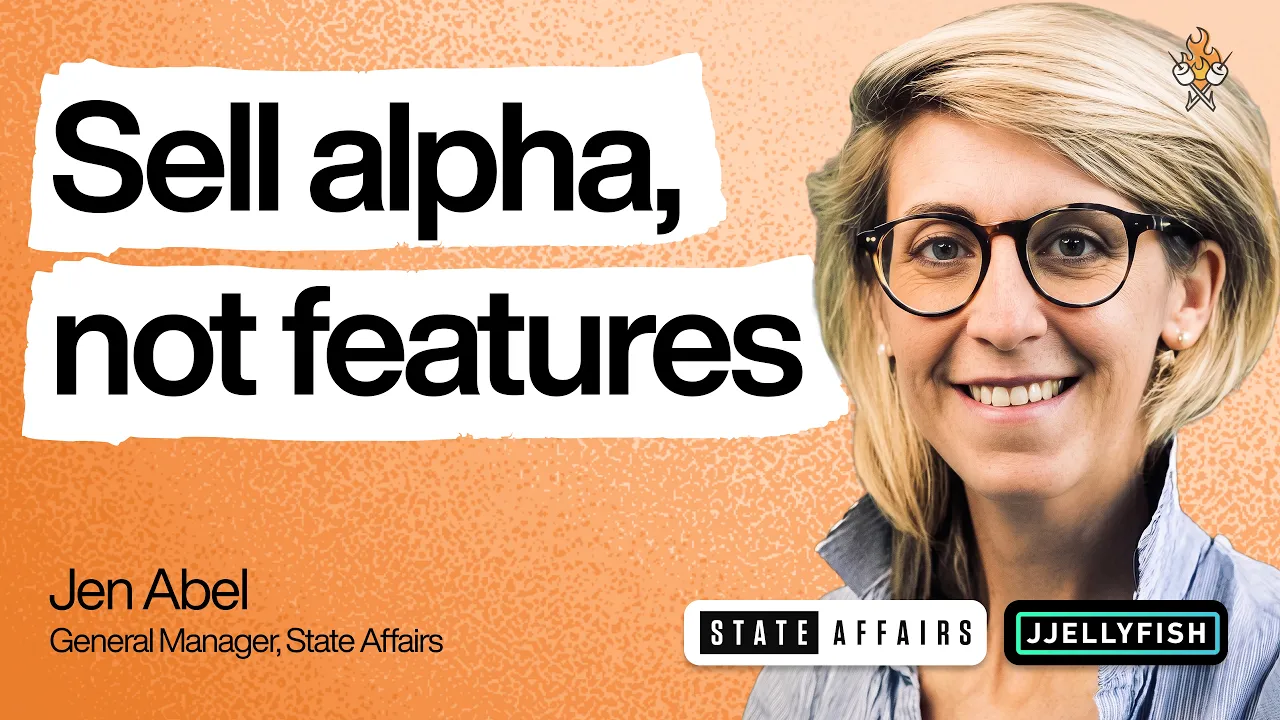
Jen Abel Replaces Five-Stage CRM Pipeline With 15-Step Sales Cycle
Lenny's Podcast
Roughly 90% of revenue teams fail at enterprise sales because they treat five-stage CRM forecasting tools as a sales process instead of slowing down across 15 distinct steps to co-design deals around executive alpha.
True enterprise sales cycles span approximately 15 distinct operational steps rather than the conventional five-stage CRM pipeline, which acts merely as an internal forecasting mechanism. (0:00)
The psychological and operational mechanics required to close a $100,000 annual contract value (ACV) deal are identical to closing a $1,000,000 contract, with $100,000 representing the necessary baseline for genuine enterprise unit economics. (2:49)
Initial enterprise outreach succeeds best using a 'pincer model,' deploying simultaneous top-down outreach from the founder to the C-suite and bottom-up engagement from an account executive to an N-1 direct report. (11:05)
First introductory calls should remain strictly conversational without slides, product demos, or AI recording bots, with sellers actively disqualifying approximately one out of four leads based on organizational maturity gaps. (18:48)
Detailed notes
## Background
Published on YouTube by Lenny's Podcast on August 23, 2026, this episode features guest Jen Abel, co-founder of JJellyfish and GM of enterprise sales at State Affairs. According to the page description, Jen deconstructs the enterprise sales lifecycle, demonstrating why the standard five-stage CRM pipeline is merely a forecasting tool and mapping out the full, rigorous 15-step process required to close $100,000 to $1,000,000+ enterprise deals.
## TL;DR
Jen Abel presents a battle-tested masterclass on enterprise sales execution, emphasizing that closing six- and seven-figure contracts requires navigating roughly 15 deliberate operational steps rather than rushing through standard five-stage CRM shortcuts. Using a hypothetical case study of selling legal tech to SpaceX, she details the 'pincer model' of simultaneous founder-to-executive and AE-to-N-1 outreach, framing the value proposition around high-stakes 'alpha' and organizational risk rather than commodity cost-cutting. The framework instructs sellers to keep introductory calls radically informal without slides or AI bots, rigorously disqualify bad fits, co-design demos with internal champions, and enforce structured, short-duration pilots with clear pre-negotiated success criteria to achieve a healthy 30% to 35% win rate.
## Atmosphere & style
The conversation carries the intensity and candor of an executive briefing, stripping away sales clichés in favor of trench-tested operational reality. Jen speaks with sharp, rapid-fire precision, blending tactical rigor with deep psychological insights into enterprise buyer dynamics, while Lenny serves as an inquisitive, grounding interlocutor. The dynamic feels like an intimate, high-stakes trade secret reveal, leaving listeners with an unvarnished look at how elite enterprise deals are genuinely engineered and won.
## Bulletin
- [00:00](https://www.youtube.com/watch?v=YS9In813jJ0&t=0s) True enterprise sales cycles span approximately 15 distinct operational steps rather than the conventional five-stage CRM pipeline, which acts merely as an internal forecasting mechanism.
- [02:49](https://www.youtube.com/watch?v=YS9In813jJ0&t=169s) The psychological and operational mechanics required to close a $100,000 annual contract value (ACV) deal are identical to closing a $1,000,000 contract, with $100,000 representing the necessary baseline for genuine enterprise unit economics.
- [11:05](https://www.youtube.com/watch?v=YS9In813jJ0&t=665s) Initial enterprise outreach succeeds best using a 'pincer model,' deploying simultaneous top-down outreach from the founder to the C-suite and bottom-up engagement from an account executive to an N-1 direct report.
- [18:48](https://www.youtube.com/watch?v=YS9In813jJ0&t=1128s) First introductory calls should remain strictly conversational without slides, product demos, or AI recording bots, with sellers actively disqualifying approximately one out of four leads based on organizational maturity gaps.
## Key takeaways
- [00:00](https://www.youtube.com/watch?v=YS9In813jJ0&t=0s) The standard five-stage CRM pipeline reflects internal revenue forecasting rather than an actual buyer journey, obscuring a real 15-step cycle.
- [02:49](https://www.youtube.com/watch?v=YS9In813jJ0&t=169s) Execution in enterprise sales is fundamentally 80% disciplined process and 20% human art, with sophisticated buyers scrutinizing the seller's sales motion as much as the product.
- [00:00](https://www.youtube.com/watch?v=YS9In813jJ0&t=0s) A healthy, repeatable enterprise sales pipeline targets a benchmark win rate between 30% and 35%.
- [09:17](https://www.youtube.com/watch?v=YS9In813jJ0&t=557s) Enterprise outreach must be restricted to two entry points: the ultimate executive sponsor or their direct report (N-1), avoiding lower tiers that distort messaging.
- [11:05](https://www.youtube.com/watch?v=YS9In813jJ0&t=665s) The 'pincer model' pairs founder-to-executive communication with AE-to-N-1 communication to create synchronized organizational alignment.
- [13:05](https://www.youtube.com/watch?v=YS9In813jJ0&t=785s) Outbound messaging must offer strategic 'alpha' in two to three sentences, highlighting board-level outcomes rather than generic software features.
- [18:48](https://www.youtube.com/watch?v=YS9In813jJ0&t=1128s) Introductory discovery calls should feel radically informal and conversational, omitting slides, demos, and automated recording bots to build psychological safety.
- [20:39](https://www.youtube.com/watch?v=YS9In813jJ0&t=1239s) Enterprise discovery requires diagnosing top-down executive mandates and distinguishing high-urgency initiatives from passive exploration.
- [28:06](https://www.youtube.com/watch?v=YS9In813jJ0&t=1686s) High annual contract values ($250k–$500k+) stem from 'risk stomping' high-stakes organizational exposure rather than peripheral cost-cutting.
- [30:00](https://www.youtube.com/watch?v=YS9In813jJ0&t=1800s) Sellers should insert an intermediate alignment call to co-design the pitch with the internal champion before presenting a formal demo to a broader committee.
- [33:37](https://www.youtube.com/watch?v=YS9In813jJ0&t=2017s) Enterprise reps should decline unvetted group demo requests to avoid being treated as a checkbox diligence vendor without strategic influence.
- [37:31](https://www.youtube.com/watch?v=YS9In813jJ0&t=2251s) The core discipline of early enterprise sales is to 'slow down to go fast,' preventing the fatal trap of closing low-value $15k point solutions with no expansion path.
- [38:48](https://www.youtube.com/watch?v=YS9In813jJ0&t=2328s) Product demonstrations must begin by resetting the narrative around the buyer's operational reality, framing the software as bespoke to their environment.
## Detailed walkthrough
### [00:00](https://www.youtube.com/watch?v=YS9In813jJ0&t=0s) Deconstructing the Enterprise Sales Lifecycle
Enterprise sales is in a "flood the zone" moment where countless founders and sales teams are racing to break upmarket, yet roughly 90% run the motion incorrectly. Most founders and revenue leaders mistakenly believe an enterprise deal takes five steps, often confusing standard CRM forecasting stages for an actual sales process. In reality, closing an enterprise contract spans closer to 15 distinct steps.
Relying on off-the-shelf sales scripts or rigid frameworks like BANT (Budget, Authority, Need, Timing) immediately commoditizes the vendor: while criteria like budget and authority should exist in the back of a seller's mind, they must never be asked outright. The most effective enterprise sellers are rarely "classically trained salespeople" reciting books; they focus on delivering differentiated insight—the "alpha"—rather than pitching features.
A healthy win rate in enterprise sales typically lands around 30% to 35%. Winning at a higher rate is not necessarily a sign of superior execution—it usually signals that the contract price is far too low. Throughout the entire front half of the cycle, the golden rule is "to slow down to go fast." That discipline begins on the first introductory call, which is the most critical touchpoint in the entire deal:
- Run it as an informal, 30-minute peer-to-peer dialogue.
- Do not show slides.
- Do not show a product demo.
- Never bring an automated AI meeting recorder, which immediately kills candor and trust.
---
[02:49](https://www.youtube.com/watch?v=YS9In813jJ0&t=169s) The Art, the Science, and Why Jen Shares Her Playbook
Jen Abel returns for her third appearance on the podcast—a rare milestone, following earlier deep dives on founder-led sales and scaling from $1M to $10M ARR. When asked why she openly gives away proprietary enterprise playbooks that others guard as trade secrets, Jen explains that execution is fundamentally 80% process and 20% human art. Because every sales conversation involves an unpredictable human variable, running a robotic script will inevitably fall flat at least one out of four times. Some buyers want lighthearted small talk and banter; others demand technical substance immediately or want to cut straight to the point.
Sharing the framework publicly also acts as an externalized diary that sharpens her own thinking. No matter how thoroughly a framework is documented, success hinges on the nuance of interpersonal connection: making the buyer feel heard, pacing the narrative, and telling an engaging story.
Crucially, the mechanics of enterprise procurement do not change between tiers:
- Closing a $100,000 deal follows the exact same operational and psychological process as closing a $1,000,000 contract.
- Large enterprise buyers are often far more sensitive to the rigor of the sales motion itself than they are to the software demonstration. If the seller’s process feels sloppy or undisciplined, the deal falls apart long before procurement begins.
---
[05:54](https://www.youtube.com/watch?v=YS9In813jJ0&t=354s) Setting Up the Case Study: Selling Legal Tech to SpaceX
To anchor the 15-step playbook in concrete reality rather than abstract sales theory, the discussion establishes a demanding real-world scenario: selling an enterprise solution to SpaceX. SpaceX represents an ideal stress test because it is a world-class, heavily targeted technical organization that receives an overwhelming volume of outbound pitches every week.
Instead of targeting engineering or rocket operations, the hypothetical deal focuses on SpaceX’s legal department with an initial contract size of $100,000:
- **Massive, resilient budgets:** Legal departments typically command the largest line items across the entire enterprise—frequently three to four times the size of other departmental budgets.
- **Evergreen spending power:** Unlike experimental tech budgets that freeze during downturns, enterprise legal spending is perpetual; there is always budget available to mitigate risk and handle mission-critical workload.
- **The AI wave:** This immense, sticky budget pool explains why venture capital and founders have heavily flooded the legal AI landscape.
- **The $100K threshold:** A minimum $100,000 annual contract value (ACV) serves as the necessary baseline for genuine enterprise unit economics, providing the margin required to support high-touch sales and onboarding.
[09:17](https://www.youtube.com/watch?v=YS9In813jJ0&t=557s) Choosing the Right Enterprise Entry Points
When selling into an enterprise account like SpaceX, figuring out how to get the very first meeting requires understanding the organizational hierarchy and picking the right entry point. At the very top sits the ultimate decision maker—the General Counsel, Head of Legal, or Chief Legal Officer. Underneath them are various leaders carrying VP or Director titles, or simply identified as lawyers on LinkedIn. Jen emphasizes that despite varying opinions in the sales community, there are only two valid entry points: the executive themselves at the very top, or an "N minus one" (the direct report one level down).
```mermaid
flowchart TD
accTitle: Enterprise Entry Points
accDescr: Diagram illustrating the two target levels for enterprise outreach and why lower tiers must be avoided.
subgraph Targets["Target Entry Points"]
Exec["Tier 1: Executive Sponsor<br/>(CLO / General Counsel)"]
NMinus1["Tier 2: N-Minus-One<br/>(VP / Director / Deputy)"]
end
subgraph Bottom["Avoid (Do Not Target)"]
Users["Tier 3: End Users / IC Lawyers<br/>(Lacks budget, creates telephone game)"]
end
Exec --- NMinus1
NMinus1 -.->|"Do not reach out to"| Users
```
Targeting anyone below N-1 introduces severe execution risk into a deal. Lower-level employees cannot properly carry a startup’s narrative upward, turning communication into a broken game of telephone. Furthermore, engaging at the end-user tier forces the sales team to gather intelligence on individual user value rather than executive-level business value. A six-figure contract ($100,000+) inherently requires an executive sponsor with the authority to sign off on and allocate the budget, making lower-level engagement a waste of time during initial outreach.
- Enterprise deals require a compressed narrative tied directly to high-level organizational objectives rather than generic corporate mandates.
- Selling simply to satisfy an "AI mandate" fails; buyers are inundated with AI tools and need to know the specific problem being solved.
- Bringing in net-new enterprise software carries significant organizational risk, meaning no executive will sponsor a product that offers only incremental value.
---
[11:05](https://www.youtube.com/watch?v=YS9In813jJ0&t=665s) The Pincer Model: Executive and N-1 Outreach
Because enterprise executives are bombarded with pitches, founders and sales teams only get a two- to three-sentence window to capture attention via email, LinkedIn, a phone call, or an industry event. C-level executives rarely respond to standard marketing campaigns; they respond to personalized, one-on-one outreach. The most effective person to reach out directly to an enterprise C-level executive is the startup founder. Even at Series B or Series C, founders should be eager to personally engage high-value executives like the Chief Legal Officer at SpaceX.
To maximize meeting conversion, Jen uses the "pincer model" (orchestrating simultaneous outreach from the top and the layer right below it):
1. **The Founder** reaches out to the executive sponsor (e.g., Chief Legal Officer).
2. **The Account Executive (AE)** simultaneously reaches out to the N-1 counterpart (e.g., VP of Legal or Deputy Counsel).
```mermaid
flowchart LR
accTitle: The Pincer Outreach Model
accDescr: Flow showing parallel outreach from founder to executive and AE to N-minus-one, converging into a joint meeting.
subgraph Vendor["Startup Sales Team"]
F["Founder"]
AE["Account Executive"]
end
subgraph Prospect["Enterprise Account (SpaceX)"]
Exec["Chief Legal Officer"]
N1["VP / N-Minus-One"]
end
F -->|"2-3 sentence alpha pitch"| Exec
AE -->|"Parallel outreach"| N1
Exec <-->|"Internal alignment"| N1
Exec & N1 ==>|"Joint intro meeting"| Meeting["Intro Call"]
```
When either contact responds, the single-degree separation makes it natural to bridge both conversations. A founder can mention looping in their AE and ask who on the prospect’s team should join, while an AE can offer to bring their founder if the N-1 invites their boss. This dynamic leverages peer-to-peer parity and brand reinforcement—often leading an executive to realize they just saw an email from the same company that their deputy is mentioning.
---
[13:05](https://www.youtube.com/watch?v=YS9In813jJ0&t=785s) Selling Alpha Over Features in Two to Three Sentences
When prospecting enterprise leaders, pitch messaging must center on giving the executive "alpha"—an unfair advantage or strategic leverage—rather than standard feature enhancements or time savings. Pitching that a tool will merely "alleviate time spent on an activity" falls flat because business unit heads view themselves as founders of their own divisions. They care about expanding their influence, securing more headcount or budget, and presenting game-changing impact to their CEO, COO, or board of directors.
To identify prospective targets, teams can spar with LLMs like OpenAI's ChatGPT or Anthropic's Claude to map out org structures (e.g., asking for the Chief Legal Officer at SpaceX and their likely deputies), followed by verification via LinkedIn and enrichment tools like Lemlist. While contact details are easy to acquire, cutting through the hundreds of inbound pitches executives receive daily requires a ruthlessly iterated value proposition.
- **Focus on Business Model Innovation:** Rather than pitching a 10x improvement on an existing task, show how the product rethinks the way the business unit operates in the age of AI.
- **The Boardroom Litmus Test:** The core hook must answer: *If this executive brought your product to a board meeting, what would they claim it allows their department to achieve?*
- **Channel Selection:** Non-technical leaders can be reached via cold calling, personalized emails, and LinkedIn messages (often prefaced by a multi-channel nudge). Technical leaders rarely respond to cold calls.
- **Continuous Iteration:** The 2–3 sentence cold outreach message must be constantly tested and refined based on response rates until it reliably commands executive attention.
[18:48](https://www.youtube.com/watch?v=YS9In813jJ0&t=1128s) Setting the Tone on the First Call
The initial intro call is single-handedly the most important conversation in the entire enterprise sales cycle. It sets the baseline for how the prospect perceives the seller, how much they respect the seller's craft, and how much guarded information they are willing to disclose. Early in an engagement, buyers are candid; as deals progress deeper into formal evaluation, they inevitably "clam up" once it begins feeling like a rigid sales process. Therefore, an enterprise seller's entire information edge is won or lost during this 30-minute block.
To maintain that edge, the call must remain radically informal. Sellers should never open slides, present decks, or launch into a product demo. Instead, the focus should be exclusively a human, one-on-one dialogue. If the prospect happens to bring an executive peer—such as a C-suite leader—the selling team must match that seniority by bringing their own founder. For standard meetings with an "N-minus-one" executive (such as a Vice President), the seller should establish immediate conversational safety by removing pressure:
> "Hey, I'm going to keep this super informal. I don't even know if we need a full 30 minutes. All I would like to do is swap intros and if it makes sense, we can always get on another call and go much, much deeper. But I just want to better understand like who you are, and I'd love to share what we are doing and why I specifically reached out to you. Would you like to go first?"
Allowing the buyer to speak first grants the seller an immediate strategic advantage. Listening to their overview prior to pitching allows the seller to frame the upcoming conversation directly around the prospect’s explicit pains, avoiding the typical dynamic where a prospect sits back passively enduring an unsolicited vendor presentation.
```mermaid
flowchart LR
accTitle: First Call Discovery Dynamics
accDescr: Diagram illustrating the informal discovery call strategy leading to tailored framing.
subgraph Discovery["Step 2: The Intro Call"]
A["Set Informal Tone<br/>(No slides, no demo)"] --> B["Let Prospect Go First<br/>(Extract priorities)"]
B --> C["Probe Top-Down Mandates<br/>(Why now? What changes?)"]
C --> D["Custom Framing Pitch<br/>(Tailored to explicit needs)"]
end
```
[20:39](https://www.youtube.com/watch?v=YS9In813jJ0&t=1239s) Probing Top-Down Mandates and Maturity
When buyers give their initial background, it is often generic and brief. Rather than jumping in with product details, the seller must probe the structural mandates pushing the organization. In a hypothetical enterprise deal with SpaceX's legal team, for instance, productive discovery revolves around top-down pressure: "Do you guys have an AI mandate going on at the organization? How are you thinking about the existing way you guys are doing work? What are you looking for going into 2027? Does anything need to change?"
Asking what needs to change taps directly into the conversations cascading down from executive leadership. If the prospect reveals an objective—such as bringing work in-house to reduce reliance on external law firms—the seller must test the maturity and urgency of that objective:
- "Is there a measurement to that right now? What does that look like internally if you've done that successfully?"
- "Why is that important now? Why not wait another year? You guys have so much going on—you just had this massive IPO—what's causing the team to want to reshape this?"
These targeted questions force the buyer to outline their intended organizational state. Once the destination is fully articulated, the seller positions their product as the direct vehicle to get them there. Furthermore, sellers must never bring automated AI recording bots to this intro call. Recording tools immediately kill vulnerability and psychological safety. Maintaining a private, off-the-record atmosphere encourages prospects to reveal internal political dynamics, individual ownership goals, and the honest priorities that drive buying decisions.
[24:07](https://www.youtube.com/watch?v=YS9In813jJ0&t=1447s) The Art of Adaptive Pitching and Rapid Disqualification
Once intelligence is extracted, the seller uses the final 10 minutes to explain what they do. However, every single conversation requires a distinct storyline tailored to the prospect’s inputs. Scripted pitches immediately ring hollow to sophisticated buyers:
> "I will confirm every single conversation I have, the storyline that I tell looks slightly different. I do not have a scripted pitch or frame for any call because it feels artificial. They feel it. It feels like you're putting them into a square box. The best thing you can do is listen actively and then feel confident enough to craft the pitch around what they just shared."
This improvisational requirement is why enterprise sales talent is remarkably difficult to hire. Highly trained traditional salespeople frequently sound unnatural because they follow rigid methodologies, whereas founders naturally excel at enterprise discovery because they are comfortable pulling on conversational threads, exploring nuances, and selling a vision.
Qualification in enterprise sales is not about forcing everyone through the funnel; roughly one out of every four calls should be actively disqualified:
- In two to three out of every four calls, an authentic, addressable problem exists.
- In approximately one out of every four calls, the seller should walk away due to organizational maturity: "Listen, based off of the maturity of where you guys are and where we are, it's too much of a gap. I'd love to revisit this in a year once you guys have a chance to solve for X, Y, or Z."
- Disqualification is a core skill for enterprise account executives; forcing an immature account forward wastes valuable time.
[26:28](https://www.youtube.com/watch?v=YS9In813jJ0&t=1588s) Vulnerability Over Commoditization
Buyers have budgeted capital set aside specifically to solve urgent organizational problems; discovery is not an adversarial trick to manipulate them, but a collaborative diagnostic process. The fastest way for a seller to commoditize their offering is to robotically fire off rigid qualification frameworks like BANT (Budget, Authority, Need, Timing). Those parameters should remain in the back of the seller's mind rather than being read off an intake checklist.
True rapport is built when vulnerability becomes two-sided. When a buyer begins asking tough questions in return—such as "What's the biggest learning your team has had this year?"—it signals that trust has been established. Admitting where a product currently falls short, acknowledging recent bugs, or discussing product trade-offs proves authenticity. Buyers recognize that no software is perfect; showing human vulnerability strips away the defensive posture typical of sales interactions and solidifies a genuine partnership.
[28:06](https://www.youtube.com/watch?v=YS9In813jJ0&t=1686s) Risk Stomping vs. Cost Cutting: The Foundation of High ACVs
In enterprise sales, pricing motions typically break down into two distinct categories. On one end is the commoditized motion: the buyer simply needs the cheapest possible way to accomplish a low-priority task because it sits near the bottom of their internal totem pole. In that scenario, the buyer does not care if the product is only 60% of the way there—nobody is getting fired over it, and the objective is merely to preserve budget. On the other end of the spectrum is the high-stakes motion where a company can command a $250,000 to $500,000 initial land. This occurs when the solution addresses severe operational exposure. In legal departments, for example, missing critical information, experiencing regulatory delays, or lacking awareness of shifting legislation introduces massive institutional vulnerability.
Different functional organizations prioritize distinct drivers: while marketing and sales teams live and die by pipeline and revenue metrics, corporate legal exists primarily to stomp out existential risk. The more a founder or account executive frames their solution around downside protection, alpha, and clear upside, the higher the price tag they can defend and the smoother the deal progression becomes. Jen emphasizes that the initial conversation remains the single most critical juncture in the sales cycle. Too many founders sabotage their leverage by spending that precious window droning on about their own company and product features, squandering the intelligence edge required to win the deal. Because early conversations feel exploratory and low-pressure, prospective buyers are naturally open and candid—resembling early-stage dating before formal commitments introduce guarded hesitation.
- **Low-priority problems:** Buyers optimize for the absolute lowest cost; 60% feature coverage is acceptable because there is zero career risk.
- **High-stakes problems:** Severe organizational exposure (such as regulatory compliance or legal risk) easily unlocks six-figure enterprise contracts ($250k–$500k lands).
- **The exploration window:** Buyers are most candid early on; once they feel pushed down a traditional buying funnel, their willingness to share candidly declines.
---
[30:00](https://www.youtube.com/watch?v=YS9In813jJ0&t=1800s) Step 3: The Follow-Up Alignment Call (Holding Back the Carrot)
The standard customer relationship management (CRM) pipeline models sales as a blunt five-stage journey: intro, demo, proposal, contracting, and closed-won or closed-lost. In reality, rushing straight from an introductory discovery call into a formal product demo is an unforced error. In enterprise deals, the demo serves as the ultimate carrot—everyone is eager to see the product you just described. If you immediately schedule a blanket demo without strategic orchestration, you forfeit your ability to rally the buying committee and risk letting the purchase look like a single person's isolated pet project. Whether selling to a director, vice president, or C-suite executive, every key stakeholder must feel genuine ownership, with their own "fingerprints on it."
```mermaid
flowchart TD
accTitle: Transition from Discovery to Demo
accDescr: Flowchart illustrating the intermediate steps between the intro call and the group demo to build internal champions.
subgraph Phase1["Discovery & Buy-in"]
A["Step 2: Intro Call<br/>(Extract Intel)"] --> B["Step 3: 15-Min Alignment Call<br/>(Co-designing the pitch)"]
end
subgraph Phase2["De-risking & Validation"]
B --> C{"Account Maturity Check"}
C -->|"Less mature / cautious"| D["Pre-Demo Call<br/>(Single additional ally)"]
C -->|"High urgency / mature"| E["Step 4: Formal Group Demo<br/>(60-minute tailored session)"]
D --> E
end
```
To bridge this gap, Step 3 inserts a tight 15-minute follow-up session with the champion before any formal group presentation occurs. The framing should be collaborative and humble: express how much you enjoyed the initial conversation, affirm the potential to support their goals, and explain that before running a formal demo, you want to guarantee the right people are in the room and the right capabilities are highlighted. By asking, *"Can you help me understand from the conversation we had earlier and as I'm walking you through now I'm walking you through the product. What do you think would resonate with the team?"*, the salesperson turns the buyer into an active co-conspirator.
The champion will frequently suggest specific questions to ask live during the upcoming session or advise tailoring the narrative to resonate with internal leadership. By co-designing the presentation alongside an internal partner, the vendor achieves an insurmountable information asymmetry over competing startups who settle for generic slide decks.
- **The five-stage pipeline fallacy:** Standard CRM stages (Intro, Demo, Proposal, Contracting, Close) do not reflect the actual human alignment necessary to close six-figure deals.
- **The demo as leverage:** Never display the product to a broad group before securing clarity on internal committee dynamics and priorities.
- **The 15-minute alignment agenda:** Walk through the product surface area 1-on-1 with the champion, solicit their advice on framing, and agree on internal questions to plant during the formal meeting.
---
[33:37](https://www.youtube.com/watch?v=YS9In813jJ0&t=2017s) Pre-Demos, Group Dynamics, and Avoiding the Diligence Checkbox Trap
During the alignment conversation, founders should outline four or five potential solution modules, identify the two that clearly map to the champion's immediate mandate, and let the champion curate the storyline. Often, the champion will insist on adding a third area to ensure the pitch feels comprehensive to upper management. Once the narrative is locked, secure a full 60-minute window on the shared calendar with key stakeholders. Before locking in that group session, gauge whether a preliminary "pre-demo" with a single peer is warranted. If an enterprise is early in their internal decision-making maturity, introducing an intermediary colleague on a quick 1-on-1 call de-risks the eventual group presentation; if their organizational mandate is urgent and mature, they are usually ready to skip straight to the broad committee.
When running a pre-demo, leverage the intelligence gathered to date immediately: spend five minutes recapping what you learned from the primary champion, then invite the new colleague to react and augment the business case. This compounding motion turns prospects into active buyers rather than passive recipients of a pitch. Jen strictly warns against agreeing to generic RFP or diligence demonstrations: if an enterprise reaches out asking for an unvetted demonstration to four or five observers with zero discovery, decline or push back. Participating in blind presentations guarantees that you are merely functioning as an evaluation checkbox or pitching completely blind without competitive intel, virtually ensuring a lost deal.
- **Gauging organizational maturity:** Immature buying processes require a preparatory pre-demo with an additional stakeholder; highly urgent initiatives can proceed straight to the group demo.
- **Avoiding the 'checkbox' trap:** Never deliver a blind demo to a committee without prior 1-on-1 discovery; doing so surrenders all strategic leverage.
- **The core enterprise reality:** "Enterprise deals are won on this feels so close to who we are. It feels like it was built specifically for me. That's the whole game."
---
[35:41](https://www.youtube.com/watch?v=YS9In813jJ0&t=2141s) Generating Information Alpha: Prompting Humans and Reading Between the Lines
Lenny observes that the recurring thread across this methodology is securing an "information edge"—both delivering proprietary alpha to the buyer and extracting internal alpha about their politics, constraints, and priorities. In enterprise procurement, an early-stage company is never competing in a vacuum; they are constantly up against the default state of organizational inertia, existing manual workflows, or established legacy incumbents. Because so many founders deliver robotic, tone-deaf pitches, bringing high energy, genuine interpersonal likability, and an informal touch creates an immediate edge.
When Lenny asks whether this process demands hidden reserves of offline preparation, Jen confirms that she invests substantial time deciphering what buyers leave unsaid. The quiet work consists of reading between the lines of raw meeting notes, identifying ambiguities, and structuring targeted clarifying prompts for subsequent conversations. She likens the back-and-forth cadence of iterative sales calls to "prompting humans"—continually testing interpretations, reflecting observations back to the buyer (*"I know you said this... did I interpret that correctly?"*), and prompting them to open up further until the shared business case is unmistakable.
- **Information edge:** The ultimate competitive differentiator is possessing contextual intelligence about the buyer's pain points that competing vendors lack.
- **The status-quo rival:** The fiercest competitor in enterprise sales is rarely another startup; it is incumbent tooling or doing nothing at all.
- **Human prompting:** Enterprise discovery requires treating human interactions like iterative prompts—reading between the lines, clarifying assumptions, and systematically drawing out deeper organizational truths.
[37:31](https://www.youtube.com/watch?v=YS9In813jJ0&t=2251s) Slowing Down to Go Fast and the $15K Trap
The governing philosophy of enterprise sales is "to slow down to go fast." While an outsider might hear about multiple discovery touchpoints and think it sounds like an exhausting amount of work, this disciplined pacing is precisely what separates the startups that win from those that do not. A company can boast a superior product and better pricing, but rushing through the motion or skipping intermediate qualification is simply shooting oneself in the foot.
The worst-case failure mode is not just losing the deal—it is selling an enterprise buyer a tiny $15,000 point solution with nowhere to grow. In true enterprise sales, "the whole game is expansion." If a contract cannot expand from an initial $100,000 or $250,000 commitment up to $350,000 or $500,000 the following year, it is not actually an enterprise motion. With steps one through three covering the initial outreach, the first intro call, and the often-neglected follow-up discovery call, the demo is kept as an earned "carrot" rather than an automatic handout.
```mermaid
flowchart LR
accTitle: Enterprise Demo Pipeline Flow
accDescr: Pipeline stages leading from initial outreach through the tailored product demo.
subgraph DemoPhase["The Main Event"]
C --> D["Step 4: Prep & Frame Demo"]
D --> E["Step 5: Run Tailored Demo"]
end
```
[38:48](https://www.youtube.com/watch?v=YS9In813jJ0&t=2328s) Step 5: Running the Enterprise Demo
When it is finally time to run the main demo, all key stakeholders must be in the room. This includes technical sponsors, members from internal groups like the AI implementation team, and executive decision-makers. Before that meeting happens, the rep should have already extracted critical intelligence from their internal champion: who each attendee is, what their individual priorities are, what landmines to steer clear of, and what the organization's ideal format looks like (e.g., a 30-minute discussion followed by 10 minutes of showing product, or 40 minutes deep in the software). At this stage, the internal champion is invested; finding an extraordinary tool that solves real company problems provides them with a "great star" to attach their name to internally.
When kicking off the session, recognize that several participants are seeing you for the first time. The presenter must take a step back and reset the narrative: state who you are, why you are building this, and frame the entire story around their specific operating reality. Because this context was gathered in previous calls, the net-new attendees immediately think, "Holy [shit], this was built for us." Rather than dominating the conversation, give these new stakeholders space to talk by asking, *"Hey, I know we haven't had a chance to speak. What do you want to get out of the demo today? I want to make sure I focus for you."*
- **The 80/20 Rule of Demoing:** 80% of product value stems from 20% of its capabilities. Only show that precise 20% slice that maps directly to their acknowledged problems.
- **Resist Feature Dumping:** Over-demonstrating unneeded features invites scrutiny. Enterprise buyers quickly think, *"We wouldn't use half of this tool, so why should we pay this much?"*
- **Rigorous Framing:** Enterprise sales requires tight project management, narrative control, and situational improvisation. Showing too much unravels weeks of deliberate groundwork.
[43:35](https://www.youtube.com/watch?v=YS9In813jJ0&t=2615s) Managing the Room and Evaluating Sales Performance
When running multi-stakeholder calls, reps rarely have to worry about senior executives derailing the conversation. Senior corporate leaders do not attain executive titles by being verbose, rambling, or unfocused; they are typically intensely dialed in. If someone does begin to meander, the rep can politely regain control by saying, *"I love this conversation. Can we park it because I actually want to spend another call just dedicated to that?"*
For founders evaluating whether an Account Executive or VP of Sales is executing this enterprise motion properly, several diagnostic signals reveal whether deals are being handled with sufficient rigor:
- **Velocity between Stages:** Track the calendar duration between the first intro call and the actual demo, as well as the number of strategic touches that occur between them.
- **Narrative Articulation:** The rep must be able to clearly state what they are showing, why they are showing it, and how they plan to open the call.
- **Zero Generic Demos:** Every single demo must look different; running the exact same pitch for every account proves the rep is treating it like a volume game rather than high-stakes enterprise sales.
Because closing a $100,000 or $1,000,000 deal requires cracking marquee logos that every competitor is pitching, reps cannot simply ram generic decks down buyers' throats. Enterprise sales is an irreducibly human discipline dependent on psychological attunement and interpersonal chemistry—qualities that AI agents cannot easily replicate. By keeping the feature set narrowly focused, buyers will naturally ask, *"Can it also do this?"* That invitation allows the rep to respond, *"It's so funny you say that—we just released this,"* making the solution feel custom-crafted and reinforcing that they are receiving true industry alpha. With the demo concluded, the process transitions to step six: the post-demo debrief.
[46:57](https://www.youtube.com/watch?v=YS9In813jJ0&t=2817s) Step 6: The Immediate Post-Demo Debrief with Your Champion
Right after the demo concludes, Jen advises immediately texting the internal contact who has guided you to this point: "How do you think that went? Can I call you in like five minutes? I just want a fresh debrief." The goal is to capture their raw reaction before they have spoken to anyone else or before opinions in the room solidify. During this quick call, you should ask where you did well, whether you lost anyone in the room, and if there is anyone specific you need to go deeper or spend more time with.
As Jen warns, "There's always someone in the organization that's going to kill a deal. There's always somebody." Your job is to protect the deal against that risk by ensuring everyone is aligned and excited, while collecting as much intelligence on the stakeholders as possible. That intelligence also serves as an insurance policy if the account goes dark for two or three weeks: you can follow up by acknowledging they are still evaluating whether the product makes sense, and offer to grab 15 or 20 minutes with a specific hesitant individual to hear their thoughts and tailor the approach to how they want to see it.
Lenny notes that this mindset means constantly scanning for ways the deal might explode, and asks what Jen calls this internal ally. Jen confirms she calls them the "champion"—defining a champion as the individual who has been there from day one and genuinely wants the project to come to life. While a C-suite executive can be a champion who shepherds the deal, they still have to make sure the people below them are fully bought in.
[48:59](https://www.youtube.com/watch?v=YS9In813jJ0&t=2939s) Step 7: Structuring the Pilot—Two-to-Three-Day Sandbox vs. Paid Integration
Moving on to Step 7—identifying the pilot and the move-forward process—Jen explains that once you have proven you have an incredible solution, you need to tightly control the pilot timeline. Rather than letting aC-level executive into the product (since they are not the actual end user), you want to put the specific hands-on users in so they can experience the magic and power of the tool.
Jen differentiates between two distinct types of pilots depending on technical complexity:
| Pilot Type | Ideal Duration | Data & Setup Requirements | Pricing Approach |
|:--- |:--- |:--- |:--- |
| **Light-lift / Sandbox Pilot** | 2 to 3 days (48–72 hours) | Uses a sandbox environment; does not require the client's own data or heavy integration to assess value. | Free (forego the money to tightly control and shorten the sales cycle by two weeks). |
| **Technical / Integrated Pilot** | 1 to 2 months | Requires heavy configuration, extensive onboarding, and integration with the client's systems to function. | Paid (usually billed as services, with the fee credited toward the final contract if they move forward). |
For a light-lift product, Jen strongly advises against a two-week trial: "I've done this enough times to say people will go in usually for half a day and get what they need out of it. Shorten your sales cycle by two weeks by doing 48 or 72 hours." Conversely, if the product requires a month or two of technical integration, you must charge for it. A prospect's willingness to pay—typically out of a services budget—is a massive buying signal, especially when your team is putting in heavy integration work. Offering to credit that fee back toward the final contract ensures you start the relationship off on the right foot.
Hearing this breakdown, Lenny laughs that talking to Jen always makes him want to go find something to sell. Jen agrees that enterprise sales is genuinely fun when you stop trying to copy generic sales books or trainings. "No one taught me this," she reflects. "I was just like, 'Okay, if I collect more intel than the competitive set, that will be my special sauce.'" Instead of trying to speed-run a rigid playbook, you build real relationships by chatting frequently with your buyers.
[52:09](https://www.youtube.com/watch?v=YS9In813jJ0&t=3129s) Steps 8 & 9: Co-Authoring Pilot Success and Onboarding Users
When Lenny asks how to convince a buyer to accept only two or three days for a pilot, Jen lays out her exact framing. You select three or four actual users to assess the value—including your N-minus-one champion (or the person closest to the C-suite) and two or three others, while keeping the C-suite executive out of the tool. Before the two-to-three-day window begins, you run individual onboarding sessions tailored to each user and assign them three specific tasks to complete.
```mermaid
flowchart LR
accTitle: Steps 7 to 9 Pilot Execution Flow
accDescr: The progression from identifying the pilot structure to prepping stakeholders and running the time-boxed pilot.
subgraph S7["Step 7: Identify Pilot"]
A["Select 3-4 end users (exclude C-suite)"] --> B["Choose 2-3 day sandbox or 1-2 month paid pilot"]
end
subgraph S8["Step 8: Prep for Pilot"]
B --> C["Discuss pricing (post-demo) & work backward from signature"]
C --> D["Co-author success metrics & onboard each user"]
end
subgraph S9["Step 9: Run Pilot"]
D --> E["Users execute 3 specific tasks (no meandering)"]
end
```
Crucially, you must co-author the definition of success with the client ahead of time, whether it is a three-day sandbox or a two-month integration. "They should not just be logging in and meandering," Jen emphasizes. "That puts the work back on them. Your job in sales is to take all the work off their plate, 99% of it, and help them discover the magic." Having a tight, three-task structure ensures a grounded, consistent experience across all test users, and if one user says they didn't like it, you can pinpoint exactly which step of the three-stage process was unclear or caused them to get lost.
[53:53](https://www.youtube.com/watch?v=YS9In813jJ0&t=3233s) Working Backwards from Signature and Timing the Pricing Discussion
Lenny pauses to clarify how these actions map to Jen's 15-step framework: Step 7 is identifying the pilot and move-forward process, Step 8 is prepping for the pilot, and Step 9 is actually running the pilot.
Adding a vital detail to Step 8 (pre-pilot prep), Jen stresses that *before* letting users into the pilot, you must work backwards from a hypothetical successful outcome to map out how the deal will actually close:
- **Target close date:** Ask, "Assuming, fingers crossed, a successful pilot—which I feel confident it is going to be—when do we want to get signatures on these papers? Do we think we can get this closed by the end of next month?"
- **Procurement:** Ask if there is a procurement lead who should be educated on the process now (even if the champion wants to wait until after the pilot, gently push them as part of project-managing the deal).
- **Security:** Ask if there is a security lead you should work with to run due diligence on the product.
- **Legal:** Ask if there is someone in legal to connect with, or if you should go ahead and draft the paper so it makes sense.
Finally, Jen clarifies the exact timing for pricing discussions: pricing should be discussed *post-demo* during the pre-pilot stage, before the pilot begins (correcting a brief slip of the tongue where she said post-pilot). You should hold off on sharing pricing until after the demo because prior to seeing the demo, stakeholders might see a price tag that is three times what they currently spend without understanding *why* it commands three times the value. Once the demo has gotten everyone in the room excited and aligned on what they are looking for, you lock in the pricing conversation during the pre-pilot phase.
[55:58](https://www.youtube.com/watch?v=YS9In813jJ0&t=3358s) Navigating Pricing Conversations and Co-Authoring with Champions
During the later stages of evaluating a deal, pricing inevitably enters the conversation. Jen Abel emphasizes reading subtle behavioral signals: if the customer were genuinely alarmed by potential pricing, they would have brought it up earlier. When they do finally press for numbers, the right approach is to provide a sensible ballpark—for instance, noting that deals often land somewhere between $150,000 and $250,000 depending on variable factors—without setting a rigid figure in stone on a mass call.
Instead of presenting numbers to a room full of stakeholders during a live demo, pricing should be worked through one-on-one with the champion. Abel advises sellers to enroll their champion directly: explain how the pricing structure is determined and ask them directly, *"Before you put this in front of anybody, how are you going to make the case? Where are you going to cut? How are you going to defend it? How can I build out a slide to defend this for you and show you the ROI?"* Giving them agency removes the guesswork because champions will openly reveal internal budget politics.
If the champion expresses hesitation and says they do not feel comfortable going to bat for that amount, sellers must avoid negotiating against themselves. Do not prematurely slash prices or throw out lower numbers. Instead, ask the champion what number they feel comfortable taking forward, and propose structural compromises—such as a discounted first year paired with a step-up to full contract value in year two on a two-year commitment. Often, a buyer might ask to shave off a modest amount like $20,000, when an anxious founder negotiating against themselves might have preemptively offered a massive 40% reduction. Co-authoring the business case secures internal alignment without devaluing the product.
```mermaid
flowchart TD
accTitle: Pricing Navigation Flow
accDescr: Step-by-step logic for navigating enterprise pricing discussions with an internal champion.
subgraph ChampionResponse ["Champion Feedback"]
C --> D{"Champion comfort level?"}
D -->|"Aligned"| E["Co-author ROI slide\nfor executive defense"]
D -->|"Hesitant to defend"| F["Do NOT discount unprompted;\nAsk what they can defend"]
end
subgraph DealStructure ["Contract Structuring"]
F --> G["Propose year-1 concession with\nyear-2 step-up (2-year deal)"]
E --> H["Advance to procurement/rollout"]
G --> H
end
```
[58:23](https://www.youtube.com/watch?v=YS9In813jJ0&t=3503s) Pilot Group Size, Extended Implementations, and Forward-Deployed Engineers
When entering the pilot stage, keeping the testing cohort small is critical. Abel recommends granting access to only three or four individuals:
- The daily power users who actually perform the core workflow.
- The primary champion who has provided the deal intelligence, ensuring they can prep the team for the post-pilot phase.
- A tight group that feels direct ownership, avoiding an unmanageable crowd of passive testers.
For products requiring significant integration, data ingestion, or onboarding labor, the sales process must reflect that complexity. While a fast two-to-three-day value demo can be done without complex setups, a 30-day proof of value requiring heavy technical setup should be treated as a paid engagement credited back against the annual subscription. Longer technical onboardings inevitably stretch the sales cycle by months, but that lengthened cycle should be reflected in contract value: a 90-day cycle makes sense for a $100,000 deal, whereas a nine-month cycle demands contract values in the $250,000 to $300,000+ range to remain economically viable.
Lenny Rachitsky and Abel also examine the role of forward-deployed engineers (FDEs). While the model originated at Palantir—where software engineers build bespoke systems embedded within client accounts and later generalize those tools—using FDEs on smaller accounts can break unit economics. Abel notes that FDEs make sense if they are deployed to remove toil from the customer and accelerate high-value expansions. However, bringing in an FDE simply because the core software is too difficult for users to operate independently is an operational red flag. Often, the industry uses "forward-deployed engineer" merely as a trendy label for what Palantir insiders jokingly refer to as "sparkling sales engineers"—or glorified account managers.
[01:01:36](https://www.youtube.com/watch?v=YS9In813jJ0&t=3696s) Timing Pilot Execution Against Organizational Rollout Readiness
Abel warns against initiating a pilot in a vacuum without securing mutual alignment on next steps. Before launching into testing, the seller must establish clear timeline commitments tied directly to pilot success: *"If this is a successful pilot, how far out are we from like a commitment from you guys?"*
If the customer admits that corporate procurement, budget release, or broad deployment is still a quarter or more away, starting the pilot immediately is a tactical mistake. Running a successful pilot prematurely depletes deal momentum; by the time the customer is ready to buy months later, internal enthusiasm has cooled and earlier steps have to be repeated. Pilots must be project-managed tightly so that reaching defined success criteria connects immediately to contracting and company-wide deployment.
[01:03:05](https://www.youtube.com/watch?v=YS9In813jJ0&t=3785s) Why the 5-Stage CRM Pipeline Fails as a Real Sales Process
Rachitsky remarks that while conventional sales wisdom depicts a simple five-stage pipeline, real enterprise sales involves a nuanced 15-step journey—with the conversation only reaching step 10 following the pilot. Abel explains the root of this industry-wide confusion: the traditional five stages found in standard CRM templates (Intro, Demo, Proposal, Contracting, Closed Won/Closed Lost) were created purely as pipeline forecasting buckets to calculate weighted probabilities (e.g., intro calls weighted at 10%, proposals at 50%, contracting at 80%).
Those forecasting buckets do not represent how enterprise sales actually works. Each CRM stage encompasses between three and five distinct, critical tactical meetings to navigate internal bureaucracy, build champion alignment, resolve technical requirements, and orchestrate approvals. Treating the CRM stage checklist as a guide for client interactions leads sellers to rush deals through superficial milestones. Abel estimates that 90% of early-stage founders and enterprise sales reps handle this incorrectly, relying on forecasting categories instead of executing a disciplined, multi-step customer buying journey.
[01:04:49](https://www.youtube.com/watch?v=YS9In813jJ0&t=3889s) Step 10: Running the Post-Pilot Session and Leveraging the Internal Champion
Enterprise sales is fundamentally about mirroring and taking control of the buyer’s internal purchasing process rather than forcing them into a rigid, seller-defined pipeline. Once the trial period concludes, Step 10 requires running a structured post-pilot debrief. Teams can gather initial data via surveys or direct one-on-one user interviews, but the most critical mechanism is equipping the internal champion to conduct an internal post-mortem. Before walking into that evaluation call, the sales team must already possess full technical telemetry on how the pilot unfolded: how much time users actually spent in the product, whether they ran into software bugs, and which specific workflows they engaged with most heavily.
```mermaid
flowchart TD
accTitle: Enterprise Funnel Drop-off and Conversion Benchmarks
accDescr: Pipeline stage conversion rates from qualified lead to signed contract based on Jen Abel's benchmarks.
subgraph Top["Upstream Qualification"]
A["Targeted Outreach"] -->|"50%–75% qualify"| B["Qualified Opportunity<br/>(Buys Alpha / Change)"]
B -->|"~50% advance"| C["Product Demo"]
end
subgraph Mid["Evaluation & Validation"]
C -->|"Half advance"| D["Formal Pilot<br/>(2–3 Day Live Test)"]
end
subgraph Bottom["Closing & Papering"]
D -->|"~80% conversion"| E["Step 11: Papering & Procurement"]
E --> F["Signed Contract<br/>(25%–35% overall win rate)"]
end
```
Entering the post-pilot review armed with technical telemetry protects the deal from misinformed internal objections. If a customer claims the product lacks a certain capability, the seller can politely counter by referencing actual usage data: "We know we gave everyone those three things, but most people only spent time on two." If an individual user logged in for 15 minutes and stalled out at step one, the seller should not confront the user directly with surveillance data; instead, they should backchannel with the champion: "Can you check in on them and make sure they’re having a good experience?" The champion has invested substantial political capital and personal time into the initiative and must be actively guided on where to focus internal energy to clear roadblocks.
Enterprise buying is inherently structured with maximum internal friction: individual detractors looking to kill initiatives, legal hurdles, procurement barricades, and the search for an executive sponsor. Because corporate employees naturally default to conflict avoidance—telling sellers that "everything's good" and "peaches" even when a deal is faltering—the sales team cannot rely on polite surface-level reactions. The truest indicator that a deal is in jeopardy is silence. When an internal champion goes completely quiet, the opportunity is stalling. A deeply engaged champion, by contrast, acts as an inside source: they will pick up the phone and candidly say, "Listen, if I'm reading the tea leaves, we should sit on this for a minute. Let's repick this back up."
- **Post-pilot telemetry prep:** Track exact time in-app, bug encounters, and feature utilization before attending the debrief call to neutralize unfounded feature complaints.
- **Champion coaching:** Discreetly direct the champion toward low-engagement pilot users to unblock adoption without revealing intrusive tracking to end users.
- **Silence as danger:** Ghosting or sudden radio silence from an internal champion is the clearest indicator of deal failure.
---
[01:07:48](https://www.youtube.com/watch?v=YS9In813jJ0&t=4068s) Enterprise Funnel Benchmarks, Pricing Power, and Healthy Win Rates
For an enterprise deal to be legitimately qualified, the buyer must be the right decision-maker, must be excited by the "alpha" (the unique forward-looking edge rather than commoditized features), and must explicitly acknowledge that internal organizational change is necessary. Focusing exclusively on generic "problems" is a trap because every competitor pitches against the exact same problems, instantly commoditizing the pitch. From that point of sales qualification through to a signed contract, a healthy enterprise win rate sits between 25% and 35%—substantially lower than the 50% threshold many founders naively assume.
A win rate significantly higher than 35% is usually a warning sign that the product is severely underpriced. High prices will naturally alienate portions of the market that lack the organizational maturity to implement the software, reflecting standard market adoption chasms. Maintaining premium pricing is vastly preferable to chasing higher conversion rates at discounted rates because corporate buyers and startup founders constantly talk to their peers in private WhatsApp groups and executive networks. Offering a sweetheart deal of $50,000 to one company while charging another $500,000 quickly leaks and destroys commercial credibility. Furthermore, a lost deal in the enterprise is rarely permanent: roughly 25% of deals that fail or stall initially will "boomerang" back twelve months later once the customer's organization matures.
Conversion benchmarks across the pipeline typically reflect predictable drop-offs when targeting and qualification are executed properly:
- **Targeted prospects to qualified lead:** 50% to 75% of targeted conversations advance to a qualified opportunity.
- **Qualified lead to demo:** Approximately 50% advance to a demo.
- **Post-demo to next stage:** Around 50% advance beyond the demo, narrowing the funnel toward bottom-of-funnel conversion.
- **Pilot to closed-won:** Roughly 80% of accounts that enter a formal pilot should convert to closed deals (a 20% drop-off).
- **Diagnosing pilot failure:** If pilot conversion falls below 80%, the issue is either a poorly run, unguided pilot or premature qualification where sales oversold a product that cannot deliver.
---
[01:11:45](https://www.youtube.com/watch?v=YS9In813jJ0&t=4305s) Step 11: Papering Preparation, Word Docs, and Procurement Timelines
Step 11 initiates the final four-step push to navigate commercial redlines and secure wired funds. Following a successful pilot, the seller must immediately formalize papering preparation and establish a binding timeline for procurement. Rather than relying on verbal agreements, the salesperson documents the exact reverse-engineered timeline in an email crafted specifically so the internal champion can forward it straight to procurement: outlining the agreed pricing, the required signature deadline, and the specific incentive or "kicker" tied to executing by that target date to preserve deal velocity.
When issuing legal terms, sellers must always provide the contract as an editable Microsoft Word document—never a PDF or a Google Doc. Most enterprise organizations operate under strict IT security protocols that block access to Google Docs, and enterprise procurement teams will inevitably redline the agreement. Sending a Word document accommodates their existing workflow. The seller should explicitly ask the customer: "Do you want to use our paper? Here’s a Word doc version, or do you want to lift from it and use your paper?" In many large enterprises, using the buyer's standard vendor paper is significantly faster because their in-house legal team does not need to review third-party contract architecture from scratch.
Even when internal end users and N-minus-one leadership love the software, procurement remains the primary graveyard where momentum stalls. Champions will not commit their teams to a pilot unless the initiative has legitimate executive backing, yet procurement departments are specifically designed to introduce friction, extract concessions, or provide a convenient institutional scapegoat for buyers looking to quietly back out of a purchase.
- **Email papering framework:** Send a forwardable email to the champion summarizing agreed pricing, timelines, and time-bound incentives for procurement review.
- **Document formatting rules:** Always transmit agreements in Microsoft Word (`.docx`); PDFs prevent necessary redlining, and Google Docs are frequently blocked by corporate firewalls.
- **Paper selection strategy:** Offer the option to execute on the buyer's standard paper if using vendor paper accelerates legal review and preserves the target timeline.
[01:13:36](https://www.youtube.com/watch?v=YS9In813jJ0&t=4416s) Step 11: Papering Preparation and Procurement Alignment
When a deal stalls, deals are frequently blamed on procurement getting lost in the pipeline, but Jen emphasizes that procurement is not designed to kill deals. Instead, procurement's job is simply to ensure the purchase aligns with corporate buying structures and is the only entity authorized to get you paid. Sellers must avoid starting any actual implementation, onboarding, or rollout work until contracts are fully executed. Step 11 involves preparing the paperwork timeline and coordinating with procurement, sometimes offering minor incentives like a free month to hit a specific closing date.
[01:14:43](https://www.youtube.com/watch?v=YS9In813jJ0&t=4483s) Steps 12 and 13: Contract Review and Joint Procurement Calls
Redlines are inevitable when dealing with enterprise clients. Rather than getting bogged down in endless email threads of back-and-forth edits, sellers should get the client's legal and procurement leads on a live call alongside their own commercial counsel.
- Focus heavily on business-critical terms and let minor items go if they do not impact operations.
- Clients often throw the "kitchen sink" into their initial redlines—such as requesting massive liability insurance limits—expecting negotiation. Sellers should push back calmly based on actual exposure.
[01:16:54](https://www.youtube.com/watch?v=YS9In813jJ0&t=4614s) Step 14: Final Signature and Immediate Pipeline Re-entry
Reaching the signature stage is an exciting milestone, but salespeople must carefully confirm who the official signatory is—such as the CFO rather than the executive sponsor—to ensure smooth routing and avoid delays. Once the contract is signed and celebrated with a brief dinner or champagne, top performers immediately return to their pipeline because a salesperson is "only as good as their pipeline."
[01:17:58](https://www.youtube.com/watch?v=YS9In813jJ0&t=4678s) Post-Close Expansion and the Rise of Services Budgets
Once a customer is signed, founders and enterprise sellers must actively think about expansion opportunities. For early-stage companies closing their first ten enterprise deals, founder involvement is crucial to identify custom product needs and determine whether to charge for professional services. Although tech companies obsess over ARR, services remain the largest line item in enterprise budgets because corporations are inherently accustomed to buying consultants, lawyers, and tailored professional services.
[01:19:18](https://www.youtube.com/watch?v=YS9In813jJ0&t=4758s) How Buyers Can Say No and Managing Enterprise Pushback
When software buyers feel a product is not a fit, they often try to drag sellers along to avoid disappointing them. Jen advises buyers to communicate timing issues or organizational immaturity as early as possible. However, seasoned enterprise sellers who know the customer desperately needs the solution will push back on weak excuses, reminding buyers of what was established in earlier calls, offering to start smaller, or navigating around temporary roadblocks like upcoming company acquisitions.
[01:21:54](https://www.youtube.com/watch?v=YS9In813jJ0&t=4914s) The Parallel Between Enterprise Sales and Product Management
Reflecting on the entire 15-step enterprise sales cycle, Lenny and Jen note how closely enterprise sales resembles product management. Both disciplines require deep empathy for human pain points, rigorous structural organization, meticulous step-by-step execution, and an innate ability to stay on top of countless moving details.
[01:22:19](https://www.youtube.com/watch?v=YS9In813jJ0&t=4939s) Wrapping Up and the Problem with AI-Generated Sales Outreach
Lenny and Jen celebrate making it through the entire end-to-end enterprise cycle. Lenny remarks that it is a refreshing rarity on tech podcasts that artificial intelligence was barely mentioned across the entire conversation. Jen agrees, noting that while many founders and reps lean on automated tools to generate client reports, visuals, or canned outreach, that kind of generic output instantly backfires. When buyers receive automated collateral, it feels hollow and overtly salesy because "anyone can do that."
The conversation circles back to Jen’s core philosophy: you must always anchor back to your true "alpha." Relying on boilerplate AI templates destroys the authentic, tailored insight required to win over executive buyers. As Jen emphasizes, written communication needs human texture: "Emails are living and breathing. I swear to God that like people can read you saying the email out loud." Both agree that taking the time to hand-craft an email or text message that sounds like an actual human being delivers far better results than any automated sequence.
[01:23:43](https://www.youtube.com/watch?v=YS9In813jJ0&t=5023s) Plugs, Hiring at State Affairs, and Outro
When Lenny asks how listeners can connect or be useful to her, Jen invites anyone with follow-up questions about complex enterprise sales to reach out directly. She also shares an open call for talent: State Affairs is actively recruiting for multiple enterprise sales positions across the organization. For reps looking to break into or master high-stakes deals, she makes a direct pitch: "We are actively hiring and I will teach you everything I know."
Lenny highlights what a rare apprenticeship opportunity it is to get paid while learning sales directly from Jen, noting that links to the job openings will be included in the show notes. Lenny thanks Jen for breaking down the complete enterprise playbook, wraps up the recording, and closes with standard subscription and review reminders for listeners across Apple Podcasts, Spotify, and lennyspodcast.com.
- **Open roles:** State Affairs is hiring across multiple enterprise sales positions, offering direct mentorship and training from Jen Abel.
- **Where to find more:** Full episodes, transcripts, and resources can be accessed at lennyspodcast.com.
## Notable quotes
> [18:48](https://www.youtube.com/watch?v=YS9In813jJ0&t=1128s) Hey, I'm going to keep this super informal. I don't even know if we need a full 30 minutes. All I would like to do is swap intros and if it makes sense, we can always get on another call and go much, much deeper. But I just want to better understand like who you are, and I'd love to share what we are doing and why I specifically reached out to you. Would you like to go first? — Jen Abel
> [24:07](https://www.youtube.com/watch?v=YS9In813jJ0&t=1447s) I will confirm every single conversation I have, the storyline that I tell looks slightly different. I do not have a scripted pitch or frame for any call because it feels artificial. They feel it. It feels like you're putting them into a square box. The best thing you can do is listen actively and then feel confident enough to craft the pitch around what they just shared. — Jen Abel
> [33:37](https://www.youtube.com/watch?v=YS9In813jJ0&t=2017s) Enterprise deals are won on this feels so close to who we are. It feels like it was built specifically for me. That's the whole game. — Jen Abel
> [01:22:27](https://www.youtube.com/watch?v=YS9In813jJ0&t=4947s) We are actively hiring and I will teach you everything I know. — Jen Abel
## Mentioned
Anthropic, Apple Podcasts, ChatGPT, Claude, Jason Lemkin, Jen Abel, JJellyfish, Lemlist, Lenny Rachitsky, Mercury, OpenAI, Palantir, SaaStr, SpaceX, Spotify, State Affairs, WorkOS
## Video description
Jen Abel is the co-founder of JJellyfish and GM of enterprise sales at State Affairs. She is widely regarded as one of the sharpest practitioners in enterprise sales, and for that reason, this is her third visit to the podcast. In our first conversation we went deep on founder-led sales; in our second we mapped the $1M–$10M playbook. This time we do something I’ve never seen on another podcast: walk step by step through the full enterprise sales cycle. Most people think it’s five steps. Jen shows it’s closer to 15.
*In our in-depth conversation, we discuss:*
1. Why the standard five-stage CRM pipeline is a forecasting tool, not a sales process, and what the real 15-step cycle looks like
2. The “pincer model” for landing the first meeting at the executive and N-minus-one level simultaneously
3. How to craft a two-to-three-sentence message around giving them “alpha”
4. How to run an intro call that extracts maximum intelligence before you ever show a demo
5. The two-to-three-day pilot structure, how to define success jointly, and when to charge for a longer pilot versus giving it away
6. Navigating pricing, procurement, redline negotiations, and the final signature without losing momentum
*Brought to you by:*
WorkOS—Make your app enterprise-ready, with SSO, SCIM, RBAC, and more: https://workos.com/lenny
Mercury—Radically different banking, now with Command: https://mercury.com/
*Episode transcript:* https://www.lennysnewsletter.com/p/how-to-close-100k-1m-deals-step-by
*Archive of all Lenny's Podcast transcripts:* https://www.dropbox.com/scl/fo/yxi4s2w998p1gvtpu4193/AMdNPR8AOw0lMklwtnC0TrQ?rlkey=j06x0nipoti519e0xgm23zsn9&st=ahz0fj11&dl=0
*Where to find Jen Abel:*
• X: https://x.com/jjen_abel
• LinkedIn: https://www.linkedin.com/in/earlystagesales
• Website: https://www.jjellyfish.com
*In this episode, we cover:*
(00:00) Introduction
(02:49) Why Jen is giving away her enterprise sales playbook
(05:54) Example: selling AI legal tech to SpaceX
(09:11) Step 1: Landing the meeting
(18:44) Step 2: Running the intro call
(30:00) Step 3: Running a follow-up call
(36:30) Step 4: Prepping the pitch/frame for demo
(38:36) Step 5: Running the demo
(46:45) Step 6: Post-demo debrief
(48:59) Step 7 through 9: Preparing for and running the pilot
(01:03:44) Why the standard five-stage CRM pipeline doesn’t work
(01:04:49) Step 10: Post-pilot session
(01:07:48) What a healthy enterprise win rate looks like
(01:11:45) Steps 11 through 14: Navigating procurement and getting the signature
(01:18:01) How to think about expansion
(01:19:18) How buyers can say no without wasting everyone’s time
(01:21:53) Why enterprise sales is a lot like product management
(01:22:27) Closing thoughts
*Referenced:*
• State Affairs: https://stateaffairs.com
• The ultimate guide to founder-led sales | Jen Abel (co-founder of JJELLYFISH): https://www.lennysnewsletter.com/p/master-founder-led-sales-jen-abel
• “Sell the alpha, not the feature”: The enterprise sales playbook for $1M to $10M ARR | Jen Abel: https://www.lennysnewsletter.com/p/the-enterprise-sales-playbook-1m-to-10m-arr
• SpaceX: https://www.spacex.com
• Lemlist: https://www.lemlist.com
• Palantir: https://www.palantir.com
• Jason Lemkin on X: https://x.com/jasonlk
• We replaced our sales team with 20 AI agents—here’s what happened | Jason Lemkin (SaaStr): https://www.lennysnewsletter.com/p/we-replaced-our-sales-team-with-20-ai-agents
• Building a world-class sales org | Jason Lemkin (SaaStr): https://www.lennysnewsletter.com/p/building-a-world-class-sales-org
• Careers at State Affairs: https://stateaffairs.com/careers
_Production and marketing by https://penname.co/._
_For inquiries about sponsoring the podcast, email podcast@lennyrachitsky.com._
Lenny may be an investor in the companies discussed.
Sales strategist Jen Abel argues that enterprise sales is an unscripted, human-driven 15-step discipline centered on delivering strategic "alpha" rather than pitching software features. She contends that revenue teams must slow down early discovery, co-author narratives and pilots alongside internal champions, and actively project-manage procurement to sustain closing velocity.
Enterprise Economics and Flawed CRM Stages (0:00)
Abel asserts that roughly 90% of founders and sales teams run enterprise motions incorrectly by confusing five standard CRM forecasting stages—intro, demo, proposal, contracting, and close—with an actual buying process. Closing an enterprise contract spans closer to 15 tactical milestones. Rushing through discovery risks trapping startups in $15,000 point solutions with no expansion potential, whereas true enterprise economics demand initial contract baselines of $100,000 or more to justify high-touch sales and onboarding.
Abel benchmarks a healthy enterprise win rate at 25% to 35%, noting that higher conversion usually signals underpriced software. Furthermore, roughly one in four discovery calls should be proactively disqualified due to organizational immaturity, though Abel observes that 25% of lost or stalled enterprise deals boomerang back within a year once buyer readiness matures.
Multi-Threaded Outreach and Strategic Alpha (9:17)
Enterprise prospecting should strictly target executive sponsors or their direct N-minus-one reports, avoiding lower-level end users to prevent broken telephone communication and low-value task framing. Abel advocates a "pincer model" where the startup founder contacts the C-suite executive while an account executive engages the N-minus-one counterpart in parallel.
Outreach must capture attention within two to three sentences by offering "alpha"—an operational edge or downside risk mitigation that division heads can champion to their board of directors. Using corporate legal departments as an example, Abel notes that business unit leaders view themselves as founders of their divisions. Pitching incremental time savings fails compared to reshaping business models or stomping out existential regulatory risk.
Unscripted Discovery and Tailored Demos (18:48)
Abel views the initial 30-minute intro call as the deal's most critical touchpoint. It must remain an informal, unscripted peer-to-peer dialogue without slide decks, product demos, or automated AI recording bots, which Abel warns suppress buyer candor. Discovery probes executive mandates and timeline urgency rather than checking off rigid BANT criteria.
Rather than jumping directly into a demo, the seller schedules a 15-minute alignment call with their internal champion to co-design the narrative. Holding back the demo treats it as an earned carrot. When presented to stakeholders, Abel applies an 80/20 rule, displaying only the 20% of product functionality that maps to the buyer's explicit priorities. Immediately post-demo, the rep contacts the champion to surface hidden internal objections before opinions harden.
Controlled Pilots and Pre-Pilot Pricing (48:59)
Pilots must be strictly structured around technical requirements. For light-lift software, Abel prescribes a free 48- to 72-hour sandbox pilot limited to three or four daily power users—excluding C-suite executives—with three predefined tasks to prevent aimless browsing. Products requiring heavy technical configuration instead warrant one- to two-month paid pilots credited toward the final contract.
Crucially, pricing and signature timelines must be established during pre-pilot preparation. Abel advises sellers to review ballpark numbers one-on-one with their champion and co-author internal ROI defense slides before sharing figures with wider committees. Running a pilot before securing alignment on post-pilot procurement milestones depletes deal momentum and leaves successful evaluations stranded.
Procurement Alignment and Contract Papering (71:45)
Step 11 begins papering and procurement, the stage where enterprise deals most often stall. Abel emphasizes that procurement exists to ensure corporate compliance and authorization, not to kill deals. After validating pilot telemetry, the seller outlines a reverse-engineered signature schedule in an email the champion can forward directly to purchasing, occasionally attaching target-date incentives to protect closing momentum.
Vendors must provide contracts as editable Microsoft Word documents rather than locked PDFs or security-restricted Google Docs, and should offer to use the buyer's standard paper to expedite review. When initial redlines arrive, commercial counsel and sales teams should resolve terms over live calls rather than slow email exchanges, resisting non-essential legal demands while protecting core operational terms.
Abel's framework presents enterprise sales as an exercise in psychological attunement and disciplined project management rather than automated pipeline volume. However, its heavy reliance on founder-led outreach, unscripted discovery, and bespoke pilot management highlights unresolved scaling hurdles for early-stage startups that lack seasoned sales personnel capable of executing nuanced commercial negotiations without rigid scripts.
Source quotes
[18:48] Jen Abel: Hey, I'm going to keep this super informal. I don't even know if we need a full 30 minutes. All I would like to do is swap intros and if it makes sense, we can always get on another call and go much, much deeper. But I just want to better understand like who you are, and I'd love to share what we are doing and why I specifically reached out to you. Would you like to go first?
[24:07] Jen Abel: I will confirm every single conversation I have, the storyline that I tell looks slightly different. I do not have a scripted pitch or frame for any call because it feels artificial. They feel it. It feels like you're putting them into a square box. The best thing you can do is listen actively and then feel confident enough to craft the pitch around what they just shared.
[33:37] Jen Abel: Enterprise deals are won on this feels so close to who we are. It feels like it was built specifically for me. That's the whole game.
[82:27] Jen Abel: We are actively hiring and I will teach you everything I know.
Original transcript
[0:00] So, we're going to do something really
[0:01] unique with this conversation.
[0:03] Basically, go through the enterprise
[0:05] sales life cycle step by step. Let's set
[0:08] this up.
[0:08] >> Let's start with how do I even get the
[0:10] first meeting? We're in this flood the
[0:12] zone moment of everyone trying to break
[0:14] into the enterprise, but like what
[0:16] exactly are you solving for them as a
[0:18] problem? That's level one, but most
[0:20] importantly, the alpha and it needs to
[0:22] be different.
[0:22] >> Step two is basically writing the intro
[0:24] call.
[0:25] >> This is the most important call out of
[0:28] all of them. This is what I like to do.
[0:30] Super informal. Don't show them a demo.
[0:32] Don't show them slides. Focus on them.
[0:34] Have a one-on-one dialogue for 30
[0:36] minutes. The whole game is to slow down
[0:40] to [music] go fast. And by the way, do
[0:42] not bring a recorder to this call.
[0:45] >> What are the benchmarks for how often
[0:47] you get through each of these stages?
[0:48] >> The win rate for enterprise is usually
[0:50] around 30 to 35%. If your win rate is
[0:53] higher than that, your price is too low.
[0:55] What are some signs that your
[0:57] salesperson is not doing a great job?
[0:59] >> The most successful sales people are not
[1:00] trained salespeople. Fastest way to
[1:02] commoditize yourself is to go into some
[1:04] sales script. Budget, authority, need,
[1:06] timing. Like that should be in the back
[1:07] of your brain. You never actually ask
[1:09] those questions.
[1:10] >> What percentage do you think are just
[1:12] doing it wrong?
[1:13] >> 90%.
[1:14] >> Wow.
[1:14] >> Like it's literally so fun. People read
[1:16] these sales books, go to these sales
[1:18] trainings, they try and take someone
[1:20] else's game and run with it. And it
[1:22] never works that way. Most people think
[1:24] the sales process is five steps and
[1:26] we're already in step 10 and we're not
[1:28] even done.
[1:29] >> The worst thing you can do in the sales
[1:31] process is
[1:34] >> today my guest is Jen Ael. This is her
[1:36] third time on the podcast. For those
[1:38] that don't know Jen, she's co-founder of
[1:40] Jellyfish, GM of enterprise sales at
[1:42] State Affairs, and most importantly is
[1:44] the person that I've learned the most
[1:45] from about the art and science of
[1:48] enterprise sales. In our first
[1:49] conversation, we went deep on founder
[1:51] sales. In our second conversation, we
[1:53] focused on the1 million to $10 million
[1:55] enterprise sales playbook. And in this
[1:58] conversation, we do something I've never
[1:59] seen anyone do on another podcast. We go
[2:02] step by step through the full enterprise
[2:04] sales cycle. Most people think this is a
[2:07] five-step process. It turns out it's
[2:09] closer to 15 steps. Most people ignore a
[2:11] bunch of these steps that you'll hear
[2:12] about. We go through everything that you
[2:14] need to know at each step to
[2:16] significantly increase the odds that you
[2:17] close your deals. This episode is
[2:19] incredibly tactical [music] and
[2:21] specific. You will learn a ton. I did
[2:24] for sure. Like I say in the episode, I
[2:26] always get so energized and just excited
[2:28] to sell something after talking to Jen.
[2:30] You will feel the same way after this
[2:32] conversation. I'm so thankful to Jen for
[2:34] sharing so much alpha with us. Before we
[2:36] get into it, don't forget to check out
[2:38] lennisproass.com
[2:40] for a free year of the hottest and most
[2:42] beautifully crafted AI products in the
[2:44] world available exclusively to Lenny's
[2:46] newsletter subscribers. With that, I
[2:48] bring you Jen Ael.
[2:53] Jen, thank you so much for being here.
[2:55] Welcome back to the podcast. A very rare
[2:58] third visit to the podcast. How does it
[3:00] feel?
[3:01] >> Round three. Super excited to be here,
[3:03] Lenny.
[3:04] >> I'm even more excited. So, we're going
[3:06] to do something really unique with this
[3:08] conversation. I've never done anything
[3:09] like this before. We're going to
[3:11] basically go through the enterprise
[3:14] sales life cycle step by step. You'll
[3:17] talk about this, but many people think
[3:19] it's like five steps. You talk about how
[3:20] it's actually something like 15 steps. A
[3:22] lot of people ignore a lot of these
[3:23] steps.
[3:24] >> And the idea is I want to create a very
[3:27] concrete and um tactical playbook for
[3:31] how to do enterprise sales.
[3:33] >> Okay,
[3:33] >> we've had conversations secrets
[3:35] >> all let's go. Just just suck them all
[3:38] out. make everybody amazing at sales.
[3:41] It'll be great.
[3:42] >> Awesome.
[3:42] >> Um, and you know, this touches on just
[3:45] like why why I think the podcast is
[3:47] really helpful to people and just the
[3:49] valley vibe even though you don't live
[3:50] in the valley. Just like there's so much
[3:53] win-winwin in helping people learn these
[3:55] things, you know, it may feel like why
[3:56] is she giving away all these things? But
[3:58] maybe actually let me ask you that just
[4:00] like why why do you share these things?
[4:02] Well, it's so interesting because
[4:04] there's so much art to this that even if
[4:06] you gave someone a 15step playbook there
[4:09] there's so much of a a feeling that you
[4:11] have to go off of. Like sales is sales
[4:14] is one-on-one, right? You're you're
[4:16] dealing with a variable, which is
[4:17] another individual. And if you ran the
[4:21] same flow every single time, it's going
[4:23] to probably not hit one out of every
[4:25] four times because everyone's different.
[4:26] Like some people like to joke, some
[4:28] people like the small talk opener,
[4:30] others want to jump right into it, some
[4:32] are technical, some are not technical,
[4:34] you know. So everybody's so different
[4:36] that even if I gave even as we go
[4:38] through all these 15 steps, while it's
[4:40] 80% of it, the other 20% is obviously
[4:43] the art of like how you make someone
[4:44] feel, do they feel heard, did you make
[4:47] it fun, did you tell a good story? I
[4:49] mean, that's also a huge part of this.
[4:51] too much to cover today. So, we'll stick
[4:52] to the we'll stick to the road map of
[4:55] like how to close these deals. But I
[4:57] think the interesting thing about
[4:58] enterprise sales is
[5:02] even if you're selling a the if you sell
[5:04] a $100,000 solution, it is the same
[5:06] exact process to sell a million-doll
[5:09] solution.
[5:10] So that's why
[5:13] it's it's an interesting process because
[5:17] the enterprise organizations are more
[5:21] sensitive to the process you take them
[5:23] through from a sales motion than they
[5:25] almost are with demoing the product.
[5:28] >> Amazing. And I'll just give a plug for
[5:30] if people want to continue learning,
[5:33] your Twitter feed is just the best.
[5:35] >> You share all this stuff constantly.
[5:36] >> Yeah. And I think you you talk about
[5:38] there's like rational reasons to share
[5:39] this stuff, but I think there's it feels
[5:40] like there's just like I just need to
[5:41] get this stuff out. People need to
[5:43] >> it's like a diary and it also helps me
[5:44] like keep it in my mind too,
[5:46] >> right?
[5:46] >> It's like my own education. Yeah,
[5:48] >> I know exactly what you mean. That's why
[5:49] I started writing. I started I was just
[5:50] like I just want to remember this stuff
[5:51] myself. I'm just going to share it and
[5:53] crystallize it.
[5:54] >> Okay. So before we get into the steps,
[5:58] let's set this up. What are some things
[5:59] people should know? What's kind of like
[6:01] the case study of what we're going to be
[6:02] using here? Let's use a company like
[6:04] SpaceX, right? Recently, you know, has
[6:08] seen massive news pressings. It, you
[6:11] know, everyone's probably targeting
[6:13] them, right? So, it's going to be a hard
[6:15] logo to go in and and win. Um, they are
[6:18] a technical organization,
[6:21] but I think what we do is target a
[6:23] non-technical team.
[6:25] So, we're going to like really get into
[6:27] like the nuance of this. So, let's do
[6:29] SpaceX. Why don't we pick legal? Let's
[6:32] have some fun with legal. The
[6:34] interesting thing about legal, it's the
[6:36] largest budget line item in the
[6:39] enterprise
[6:41] uh
[6:43] kind of budget,
[6:45] right? Sometimes three to four times
[6:47] other budgets and it's forever. There's
[6:51] always more money for legal.
[6:54] That's why there's so many legal AI
[6:56] startups. I get it now.
[6:57] >> 100%.
[6:58] >> Amazing. And I'll just add the reason
[7:00] like the reason I love to have you on
[7:02] this podcast is I I've left both of our
[7:04] previous conversations so just like
[7:06] fired up about selling. I just like I
[7:09] have nothing to sell, but I'm always
[7:11] feeling like I want to sell something
[7:12] now. I feel like I've learned all these
[7:14] things. It feels so fun.
[7:15] >> Sales.
[7:16] >> You're a master. You're actually a
[7:18] master at this. Sales is marketing.
[7:20] Marketing is sales to some extent,
[7:21] right? And
[7:22] >> All right. You do that better than a lot
[7:25] of people. I feel like you're using some
[7:26] sales technique on me to make me feel
[7:27] good about myself. Okay. Anything else
[7:29] before we get into step one of the sales
[7:31] enterprise?
[7:32] >> No, I think it's just good
[7:33] >> sales cycle.
[7:34] >> SpaceX and targeting the legal function
[7:37] >> and then like a 100K, let's say deal.
[7:40] And to your point,
[7:41] >> it's the same process whether it's 100K
[7:43] a million. And I will add a plug for a
[7:46] previous episode. You talk about why you
[7:48] want to be at least 100K something as a
[7:50] deal to be a a real enterprise company
[7:55] that will that will survive because the
[7:58] ROI and the
[7:59] >> and just the whole economics of that
[8:01] stuff, but we won't get into that.
[8:02] >> This episode is brought to you by our
[8:04] season's presenting sponsor, Work OS.
[8:07] What do OpenAI, Anthropic, Cursor,
[8:09] Replet, Sierra, Clay, and hundreds of
[8:12] other winning companies all have in
[8:13] common? They are all powered by work OS.
[8:16] If you're building a product for the
[8:18] enterprise, you've felt the pain of
[8:19] integrating single signon, skim,
[8:22] arbback, audit logs, and other features
[8:24] required by large companies. Work OS
[8:27] turns those deal blockers into drop-in
[8:29] APIs with a modern developer platform
[8:31] built specifically for B2B SAS.
[8:33] Literally every startup that I'm an
[8:35] investor in that starts to expand up
[8:37] market ends up working with Work OS.
[8:39] [music]
[8:40] And that's because they are the best.
[8:41] Whether you are seedstage startup trying
[8:43] to land your [music] first enterprise
[8:44] customer or a unicorn expanding
[8:46] globally, work OS is the fastest path to
[8:49] becoming enterprise ready and unblocking
[8:51] growth. It's essentially Stripe for
[8:53] enterprise features. Visit works.com to
[8:56] get started or just hit up their Slack
[8:58] where they have actual [music] engineers
[8:59] waiting to answer your questions. Work
[9:01] OS allows you to build faster with
[9:03] delightful APIs, comprehensive docs, and
[9:06] a smooth developer experience. Go to
[9:08] works.com [music]
[9:09] to make your app enterprise ready today.
[9:12] Okay, step one, where does where does it
[9:15] start? How do you start selling someone
[9:17] on your product?
[9:18] >> It's a great question. So, I think we'll
[9:19] start with like how do I even get the
[9:21] first meeting? How do I even engage with
[9:23] these people?
[9:25] There is so many there's so much nuance
[9:28] as you target as you know as we're using
[9:30] the case study of SpaceX today. You have
[9:34] the top of the rung, right, which is the
[9:36] the general counsel, the head of legal,
[9:39] uh the chief legal officer. They all
[9:41] kind of have slightly different titles,
[9:42] but they all carry the same weight,
[9:44] which is like who's the who's the lead
[9:45] of the team? And then underneath that,
[9:48] you have a bunch of people that carry a
[9:51] VP title, carry a director title, maybe
[9:54] just say lawyer on their LinkedIn. So
[9:56] you have to do the work to figure out
[9:59] what is my entry point. And there's only
[10:01] two entry points. Starting at the very
[10:04] very tippy top, meaning going direct to
[10:07] the decision maker, the chief legal
[10:08] officer, or finding the individual that
[10:12] would be maybe one step removed. Okay, I
[10:17] personally, other people would argue
[10:18] with this. I personally would not be
[10:19] targeting anybody else. It is the
[10:22] executive themselves or an N minus one.
[10:26] Okay, so let's talk about like why
[10:30] in order for
[10:32] an enterprise deal to move forward, you
[10:35] need to have this extremely compressed
[10:38] storyline that lands immediately to the
[10:42] objective that they want to solve for at
[10:43] the organization. It has to go beyond
[10:45] just an AI mandate. I think every
[10:47] company today has an AI mandate and I
[10:49] know everyone is an AI tool, but like
[10:51] what exactly are you solving for them as
[10:54] a problem? That's one, that's level one.
[10:56] But most importantly, the alpha, what
[10:59] does this executive uncover and unlock
[11:02] by bringing in a net new tool? Because
[11:05] bringing in a net new tool, okay, is
[11:08] risky. No one wants it. So if we're
[11:11] targeting the chief legal officer and
[11:13] the N minus one, you get two sent two
[11:16] two to three sentences max.
[11:18] Okay, that might be through an email
[11:20] LinkedIn, that might be through a phone
[11:22] call, that might be through an event, um
[11:26] or that might be through some marketing
[11:28] capability. Most most sea level
[11:30] executives don't respond to marketing.
[11:32] They might see your brand, they're not
[11:33] going to respond to a marketing
[11:34] campaign, okay? They will respond
[11:37] one-on-one. And the best individual to
[11:40] one-on-one to a corporate executive is
[11:43] the founder. Even if you're a series B,
[11:46] series C, right? It is the founder
[11:49] should be ecstatic to want to get in
[11:52] front of the chief legal officer at
[11:53] SpaceX. I think any founder that is um
[11:58] you know building something really
[11:59] meaningful knows the importance
[12:01] important role of that.
[12:03] Second is you can get your enter your um
[12:06] AE or enterprise sales lead to target
[12:09] the N minus one and you do what you call
[12:11] this I call it the the pincher model
[12:14] because you're going after two different
[12:15] people and trying to get them together.
[12:17] It's actually called the pinser model
[12:18] which is start at the very very top find
[12:21] that kind of floor and work in between
[12:24] them.
[12:25] Okay. So you're So these are the two
[12:28] types of these are the two layers you
[12:30] want to be targeting in landing that
[12:33] meeting because if you go any further
[12:35] than that
[12:37] you risk they're not going to be able to
[12:38] communicate your storyline. It's a game
[12:40] of telephone, right? And now you're
[12:42] learning from someone that is not near
[12:44] the budget or the executive discussions,
[12:48] right? Which is super risky because now
[12:50] you're learning about user value, not
[12:52] executive value. And a $100,000 deal
[12:56] needs a executive sponsor to sign off on
[12:59] it to allocate the budget. And this is
[13:02] why you need to start at these this
[13:04] these two layers only.
[13:05] >> Wow. This is there's going to be
[13:07] fractals of questions and things to dig
[13:09] into with each of these steps. Uh this
[13:11] is amazing. I love how just how specific
[13:13] and tactical you are with all of these
[13:15] things. I'm going to try to summarize a
[13:16] couple of these tips and then I have a
[13:18] follow-up question. Okay. So tip one is
[13:20] go after either the exact. So, in this
[13:22] case, it' be general counsel, head of
[13:24] legal sort of person or N minus one.
[13:27] >> Love that way of describing it. Maybe a
[13:28] VP. Uh, you want to pitch them two or
[13:31] three sentences in like a text or email
[13:33] or in a at a conference. Uh, and the key
[13:36] is to focus on the alpha, like the way
[13:38] what your product will unlock for them.
[13:42] >> Love that. Um, and it sounds like
[13:44] they're still like here's the problem we
[13:45] solve for you, but here's like really
[13:46] the alpha we unlock.
[13:48] >> Correct. Because for an executive to
[13:50] bring something in and be the sponsor
[13:52] and like share this and disseminate this
[13:54] down their down the down their command,
[13:57] they they need to stand behind something
[13:59] beyond, hey, we're going to make we're
[14:01] going to alleviate,
[14:03] you know, the the time it takes to do X
[14:06] activity. That's not big enough. They
[14:08] want like they're like a founder two of
[14:10] their own business unit. Like you got to
[14:12] sell the vision and what are these
[14:14] people going to how are they going to
[14:15] get to the next stage? um whether with
[14:17] their influence, get more budget, get
[14:19] more people um however they want to
[14:22] define that.
[14:23] >> Yeah. So it it sounds like you don't
[14:25] want to like they want to win and to win
[14:28] you need something unfair unfair
[14:30] advantage. That's exactly what you're
[14:31] >> pitching. That's exactly right. Yep.
[14:33] >> Okay. And then this Pinsir move I so the
[14:36] idea here is for the exact say chief
[14:38] legal officer general counsel foundry
[14:40] needs to reach out. Yep.
[14:41] >> And then this AE reaches out to the N
[14:44] minus one contact and you do this, you
[14:46] go from both directions.
[14:47] >> Y
[14:47] >> and I imagine the goal is one of them at
[14:49] least responds.
[14:50] >> That's correct. And then and then
[14:51] because you're only one step removed,
[14:53] they'll usually loop in that next person
[14:55] and or you can say the founder could
[14:58] say, "Hey, I'm going to loop in my so
[14:59] and so colleague. Who on your team
[15:01] should we also include?" Or the uh an
[15:04] enterprise executive could say, "Hey,
[15:05] I'm going to bring in my founder. Could
[15:08] we see if your boss might want to be a
[15:09] part of this, too? It's that parody of
[15:12] um of uh kind of rule.
[15:17] >> Yeah. Uh and they might be like, "Wait,
[15:19] I've heard of that. I think I heard that
[15:20] name before because I got this other
[15:22] email."
[15:22] >> Exactly.
[15:23] >> May not remember.
[15:23] >> Okay. Two questions. Um how do you find
[15:26] this N minus one person? Any just
[15:28] tricks? Is it just sitting on LinkedIn
[15:29] kind of figuring out? And then two is
[15:31] any channel recommendations these days?
[15:33] Like what's the best way to try to
[15:34] contact these people? So I'll use you
[15:36] can ask you can spar with open AI and
[15:39] anthropic to like let them do the quick
[15:40] scan of like hey I'm looking to target
[15:42] the chief legal officer of SpaceX and
[15:45] their deputy who are possibly people I
[15:48] should be targeting and then go off that
[15:50] and do your own gut check and search
[15:52] from there but usually they'll give you
[15:54] the the the proper names. Now here's the
[15:56] interesting thing about this. Everyone
[15:58] is probably also targeting those people.
[16:01] Okay? And this is why you need to be,
[16:04] and we talked about this in other
[16:05] episodes, it needs to feel so different
[16:07] and it needs to be about alpha. And if
[16:09] you don't have executive value, meaning
[16:12] you cannot get an executive exc excited
[16:14] by your value proposition, then you
[16:16] probably shouldn't be moving up into the
[16:18] enterprise doing a top down strategy.
[16:20] >> Got it. Okay. And then in terms of
[16:23] trying to reach out to them, any tips?
[16:24] Is it like the tools there to do to
[16:27] figure out their number, whatever?
[16:28] >> They're all so unique. Cold calling
[16:30] works.
[16:32] Again, it depends on the role. You're
[16:33] not going to cold call a highly
[16:34] technical person, but a non-technical
[16:36] person like it works. Email, LinkedIn,
[16:39] Twitter.
[16:40] >> Are there tools to find these emails and
[16:42] things? Like, is there something you
[16:43] recommend?
[16:44] >> Yeah, you can get like there's a ton of
[16:45] tools that do uh that do enrichment. Um
[16:48] I also like I'll try like LinkedIn first
[16:52] and say, "Hey, I shot you a note on on
[16:54] LinkedIn. I just want to make sure you
[16:55] got it." Like most people don't check
[16:56] that on a daily basis, but yeah. I mean
[16:59] you you have like um len list and all
[17:02] sorts of these enrichment tools that can
[17:03] give you the email but I think the
[17:05] number one thing is assume they are
[17:08] getting hit with hundreds of emails how
[17:12] are you going to message your storyline
[17:14] to stand out and that's that's not easy
[17:17] to do and that's really why I think
[17:18] having going back to our first episode
[17:20] why founder led sales is so important to
[17:22] figure that piece out. So that was my
[17:24] next question is what are some examples
[17:26] of two to three sentences if you have
[17:29] some in your head maybe even from your
[17:30] current job that that you think are good
[17:32] examples of this two to three sentence
[17:33] pitch.
[17:34] >> Yeah I think it comes down to like what
[17:36] is the differentiator to what you were
[17:38] offering not even like what do you do
[17:40] 10x better because to them it still
[17:42] sounds like a commodity. How are you
[17:44] rethinking the business model? How can
[17:47] you help them rethink the way that
[17:48] they're structuring their team? We're in
[17:50] this like
[17:52] flood the zone moment of like everyone
[17:54] trying to break into the enterprise and
[17:56] the number one thing that breaks into
[17:58] the enterprise is like oh the way I'm
[18:00] modeling my business unit here's how I
[18:03] should be thinking about it in the age
[18:04] of AI and it needs to be different it
[18:05] can't just be like oh like we'll help
[18:07] you reduce the number of resources here
[18:09] like no no no like how are they going to
[18:12] show needlemoving impact to their COO
[18:18] CEO you if they were to bring it to the
[18:20] board meeting like what would they say
[18:22] about the product this product will
[18:24] allow me to do what that's like the
[18:25] litmus test
[18:26] >> is this a pitch that you iterate on over
[18:28] time because it's pro you know you're
[18:29] probably getting some percentage of
[18:31] people responding so okay so the advice
[18:32] is like keep try to refrain this
[18:34] >> that's exactly right
[18:35] >> awesome okay anything else on the first
[18:38] reach out before we get to the next step
[18:40] >> no I think that's good
[18:41] >> okay okay let's do it I started shaking
[18:42] your head before you said it in case
[18:43] people are confused okay uh step two
[18:46] step two is basically running the intro
[18:48] call
[18:48] >> yes Okay, this is the most important
[18:52] call out of all of them. Okay, because
[18:56] you are setting the tone with how they
[18:59] think about you, how they respect you in
[19:02] your role in your craft and the
[19:04] information they will tell you on the
[19:07] first call, they will clam up moving
[19:09] forward because it starts to feel like a
[19:11] sales process. So, all of the
[19:15] information edge you can gain as a
[19:17] seller is on this first call. Okay? So,
[19:21] keep it and this is this is what I like
[19:23] to super informal. Don't show them
[19:25] anything. Don't show them a demo. Don't
[19:28] show them slides. Don't like focus on
[19:31] them. Have a one-on-one dialogue for 30
[19:33] minutes.
[19:35] Okay? Now, again, if they're bringing in
[19:36] a seuite executive, you better have your
[19:38] founder join that call as well. I don't
[19:39] know any founder that wouldn't want to
[19:41] be in the room with a Fortune 100 seuite
[19:43] executive. So, make sure you bring in
[19:45] your founder uh if if you have that
[19:47] person on, but let's say you had the N
[19:49] minus one, you had like the VP out.
[19:51] Okay, like super brief. Hey, this is how
[19:55] I typically open. Hey, I'm going to keep
[19:56] this super informal. I don't even know
[19:58] if we need a full 30 minutes. Put them
[20:00] on the back for like, oh, this person's
[20:01] not trying to take up my time. All I
[20:03] would like to do is swap intros and if
[20:05] it makes sense, we can always get on
[20:07] another call and go much much deeper.
[20:09] But I just want to better understand
[20:10] like who you are and I'd love to share
[20:12] what we are doing and why I specifically
[20:14] reached out to you. So I say would you
[20:16] like to go first? Always let them go
[20:18] first. Give yourself the edge, right?
[20:21] Because if the more information you are
[20:22] receiving before you speak, the more you
[20:24] can frame it and and tighten it to what
[20:27] they specifically care about. So
[20:29] >> and they also aren't like sitting there
[20:30] now listening to a pitcher like
[20:31] everybody.
[20:31] >> Yeah. Exactly. Now they're talking. Now
[20:32] they're conversing. Now it's like, okay,
[20:34] now it's fun. Now this person's not
[20:35] pitching me. I'm in a conversation and a
[20:37] dialogue. Okay. So now you're talking to
[20:39] them and they usually they usually do a
[20:41] very brief over and they're like, "Hey,
[20:42] um, we didn't get a chance to look up
[20:44] the chief legal officers uh at SpaceX.
[20:48] Obviously, this is just a case, but like
[20:49] whoever that person's name is, you know,
[20:51] I oversee the legal team and blah blah
[20:53] blah." Okay, okay, great. They usually
[20:55] don't give you much. So they say, "Okay,
[20:56] interesting." Like how are you thinking
[20:59] about um like do you guys have an AI
[21:02] mandate going on at the organization?
[21:04] Like how are you thinking about the
[21:05] existing way you guys are doing work?
[21:07] like what are you looking for going into
[21:10] 2027? Like does anything need to change?
[21:12] Like ask does anything need to change?
[21:15] Because again,
[21:17] what they're going to usually default to
[21:19] is what conversations have have happened
[21:22] above them and have been transcended
[21:24] down. So the change is usually dictated
[21:27] from the top, which is great. So like
[21:28] what needs to change going into 2027
[21:31] that you did in 2026 or maybe not at
[21:33] all. And that's when they start to open
[21:35] up. And again, you don't want to be too
[21:38] pointed of like anchoring them towards
[21:40] your product because again, the more
[21:42] they speak, you can start to like pull
[21:44] on the strings that matter. So they
[21:45] could say something along the lines of,
[21:48] you know, I'm making this up at this
[21:50] point, but we are really looking to
[21:52] figure out how to bring more of this
[21:55] work inhouse and rely less rely far less
[21:59] on external law firms, right? Because
[22:01] now we have more tools and capabilities.
[22:03] Okay. like is there a measurement to
[22:06] that right now? Like how are you guys
[22:07] like what does that look like internally
[22:09] in terms of um if you've done that
[22:12] successfully in 2027?
[22:14] And then they'll say you you're trying
[22:16] to understand like how mature is this
[22:17] thought, right? Okay. So now they're
[22:20] they're going in and they say they can't
[22:21] really answer that fully because okay
[22:24] like why is that important now? Like why
[22:26] didn't you why not wait another year? I
[22:28] mean you guys have so much going on. You
[22:30] just had this massive IPO. like what's
[22:31] what's causing the team to want to
[22:34] reshape this or or rework the way that
[22:36] they're um managing internally? And
[22:40] that's usually the moment of like where
[22:43] they start to really um guide you in
[22:45] terms of like how they want to structure
[22:47] their team. So now you're getting all of
[22:49] this information about where they want
[22:50] to go, right? How now when you talk
[22:54] about what you do, now you're the
[22:56] vehicle to get them there,
[22:58] right? And so the I try and spend maybe
[23:02] 10 minutes, the back 10 minutes
[23:03] explaining what we do and just keep
[23:05] asking them questions. Be like, "Oh,
[23:06] that's so interesting. Like what an
[23:08] exciting role to be in." Be like, "Okay,
[23:10] full disclosure, right?" And by the way,
[23:12] I take a step back to that. Do not bring
[23:15] a recorder to this call. Do not record
[23:18] the call. They will not be open. They
[23:20] will not be vulnerable. It might assume
[23:22] it's being recorded because I think
[23:23] everyone kind of operates under that
[23:25] assumption right now. But for the
[23:27] benefit of yourself, do not have a
[23:30] recorder present. Okay? like off the
[23:33] record between the two of us talking
[23:35] right now of what you just shared like
[23:38] what really matters
[23:40] like what what like or like what do you
[23:42] want to own
[23:45] or like what's the chronological like
[23:47] keep digging digging dig because the
[23:49] more you dig the deeper you go the more
[23:51] information they give okay now you can't
[23:53] sit there and just pepper them with
[23:54] questions this is that that art piece of
[23:56] like how open is this person some people
[23:59] are poker faces some people are not you
[24:01] will be able to go much deeper with some
[24:02] and not deeper than other. You just have
[24:04] to um improv. Okay. But after you now
[24:07] have that intel and you can now
[24:09] understand, okay, here's the frame I'm
[24:11] going to take. Now you can give them the
[24:13] pitch. Okay. I will confirm every single
[24:18] conversation I have this the storyline
[24:20] that I tell looks slightly different. I
[24:22] do not have a scripted pitch or frame
[24:25] for any call because it feels
[24:27] artificial. They feel it. It feels like
[24:29] you're putting them into a square box.
[24:31] Um, the best thing you can do is listen
[24:35] actively and then
[24:38] feel confident enough to to craft the
[24:40] pitch around what they just shared for
[24:41] you.
[24:42] >> That last part seems really hard to
[24:44] >> adjust and make up like here's what
[24:46] you're focusing on and here's how
[24:48] product is going to solve that problem
[24:49] for you. So that's kind of where that
[24:51] art and skill comes in.
[24:53] >> That's right. In enterprise sales,
[24:56] it's so so hard to hire for because the
[24:59] more someone is trained in sales,
[25:02] the less natural it feels.
[25:05] I know this is counterintuitive and we
[25:06] spoke about this on another call. The
[25:08] most successful salespeople are not
[25:10] trained salespeople. That's why founders
[25:12] are so good at this.
[25:15] Like they don't give themselves enough
[25:16] credit. What are they not good at?
[25:18] Probably following this process. What
[25:19] are they great at? pulling out
[25:21] information, pulling on strings, getting
[25:24] people excited by vision. No one can do
[25:26] that better than they can.
[25:27] >> What percentage of the time are you just
[25:28] like, "Okay, this isn't actually going
[25:30] to help you that much." So, just we'll
[25:32] share we're up to Okay, you're nodding
[25:34] that happens.
[25:34] >> One I would say two to three out of
[25:38] every four calls there's something real.
[25:41] >> One there's something real.
[25:42] >> Yeah, there's something real. One out of
[25:43] every four calls I'm like, "Listen,
[25:45] based off of the maturity of where you
[25:47] guys are and where we are, it's too much
[25:48] of a gap. Like I'd love to revisit this
[25:51] in a year like once you guys have a
[25:52] chance to like solve for X Y or Z. The
[25:56] that's such a great question about the
[25:58] qualification.
[25:59] Most people are not going to be
[26:00] qualified not because necessarily you're
[26:02] talking to the wrong person because if
[26:04] you're in an if you're an enterprise
[26:06] executive or enterprise account
[26:08] executive, your job is to know who to
[26:10] talk to. Okay. Um and your job is also
[26:13] to quickly um quickly disqualify
[26:17] someone. And it's probably one in every
[26:19] four calls.
[26:20] >> Awesome.
[26:20] >> Simply because of maturity.
[26:22] >> Cool. So you don't have to have this
[26:23] like intense pressure to nail it on
[26:25] every call and here's the here's the
[26:27] pitch. Okay. Awesome. What I also want
[26:29] to comment on is this idea of like
[26:31] getting them to share a bunch. It may
[26:33] feel tricky like you're tricking them
[26:35] into sharing all this, but really they
[26:37] have problems they want to solve and
[26:39] you're there to help them solve a
[26:40] problem. And so why would they not want
[26:43] to just like, okay, here's what we need
[26:44] help with. Here's the problem. Here's
[26:46] our priority. Their job is to their job
[26:48] is to buy solutions to these problems,
[26:49] right? That's why they have budgets,
[26:51] >> right? Um so that's why the the and the
[26:55] the fastest way to commoditize yourself
[26:58] is to go into some sales script like
[27:00] budget, authority, need, timing like
[27:01] that should be in the back of your
[27:03] brain. You never actually ask those
[27:04] questions.
[27:05] >> Cool. Okay. So the core kind of lesson
[27:08] here is focus on learning and extracting
[27:10] their priorities. And what I felt as you
[27:13] push them to get more real and and like
[27:17] really pressure test how big of a deal
[27:19] are these? Why are this why is this
[27:20] important?
[27:21] >> Because you want them to ask you those
[27:22] questions cuz that's when you know
[27:23] you're building a relationship. Like I
[27:26] like I had a client last week say to me,
[27:29] "What's the biggest learning your team
[27:30] has had this year?" Like every product
[27:32] needs to get better. Every product has a
[27:34] bug. Every product, you know, isn't able
[27:36] to do X or Y um as well as they said.
[27:40] And they're and I'm like that's a really
[27:42] good I'm like that's so funny. We just
[27:43] had a conversation about that and I she
[27:45] was like thank you for sharing that's
[27:46] they just want to know you're vulnerable
[27:48] because then it doesn't feel like it
[27:50] feels less like sales.
[27:51] >> I imagine um priorities for a lot of
[27:54] companies these days is saving token
[27:56] costs.
[27:57] >> I know classically you don't want to
[27:59] focus on lowering costs as a sales
[28:01] pitch. This is the cheaper option. Yeah.
[28:03] >> Thoughts on if that just comes up a
[28:04] bunch. We just like legal we just need
[28:06] to save costs.
[28:07] >> Yeah. So, in pricing, their job is to
[28:12] there's going to there's usually going
[28:13] to be two motions. I need the lowest
[28:16] cost way to do X because it's low on the
[28:18] totem pole and I really don't care if
[28:20] it's 60% of the way there. No one's
[28:22] getting fired over it. I'd rather just
[28:24] save budget or you're solving a problem
[28:27] that you can charge, you know, 250 500k
[28:31] land because the pro because it is a um
[28:37] uh high risk if you're dealing with
[28:39] legal, there's high risk to it, right?
[28:41] Missing information, being delayed on
[28:43] something, um uh not having people
[28:47] understand the importance of some new
[28:50] regulation or or law.
[28:53] um uh not being buttoned up. Um so I
[28:58] think for if you every organization
[29:00] looks differently right like marketing
[29:02] needs to have needs to prod you know
[29:04] marketing and sales it's very clear that
[29:06] number numbers drive them for legal it's
[29:10] probably they they need to stomp out
[29:12] risk.
[29:12] >> Awesome. So yeah basically this comes
[29:15] back to the idea of alpha and upside.
[29:17] The more you can be in that bucket the
[29:19] more you can charge the easier
[29:20] everything gets.
[29:21] >> Okay. Uh, anything else before we get to
[29:23] step three?
[29:24] >> No, I think for step one like that that
[29:26] that is the most important meeting and I
[29:28] feel like people just spend so much time
[29:31] talking about themselves and miss all
[29:33] the competitive advantage to win the
[29:34] deal.
[29:35] >> Yeah, your point about how as a buyer
[29:38] it's so like low pressure at that point.
[29:40] You're just exploring and so I could see
[29:42] why people come into it like cool, let's
[29:44] learn. Let's see if this versus you're
[29:45] in the funnel like oh I gota
[29:47] actually make a decision. I'm gonna have
[29:48] to let them down if I don't want this.
[29:50] Yeah, that's like dating.
[29:51] >> Yeah, like their openness to share more
[29:55] start to clam up a little bit more. But
[29:56] we'll talk about how to make sure that
[29:58] doesn't happen, too.
[29:58] >> Amazing. Okay, great. Great
[30:00] foreshadowing. Okay, so step three is
[30:03] writing a follow-up intro call.
[30:04] >> Yes. Okay,
[30:06] >> so usually right now the stages that
[30:09] most people have is intro, demo,
[30:12] proposal,
[30:14] contracting,
[30:16] you know, close one or close loss.
[30:17] There's five stages. They're very basic.
[30:20] People usually go from an intro call
[30:22] straight to a demo. Okay. The demo is
[30:25] your carrot in the process. Everyone
[30:27] wants to see this amazing thing you just
[30:29] spoke about. Okay. So, there's your job
[30:32] is to make sure that when you do that
[30:34] demo, the formal demo, you have the
[30:36] right people on the call because if you
[30:38] don't, one, it's you you lost your
[30:41] leverage to like organize that group and
[30:43] rally them. But more importantly, it you
[30:46] never want it to feel like one person's
[30:48] baby, right? If you're selling to that
[30:50] director or that VP, you need to make
[30:51] sure that that executive feels like
[30:53] they're part it's part of their baby and
[30:54] they're helping craft and they have
[30:55] their fingerprints on it. And vice
[30:57] versa, like you want the seuite if they
[31:00] they want they want their the actual
[31:01] users to feel like that they were bought
[31:03] in on this, too. Okay? So, you want to
[31:05] make this to be and this is the tricky
[31:08] part. You want it to you there's going
[31:10] to be someone that's going to champion
[31:11] it and get the deal done,
[31:14] but you got to make it feel like a group
[31:15] effort. Okay? So, the person that you
[31:18] had the intro call with, that's who you
[31:20] built the rapport with. That that's your
[31:22] that's your champion at this point.
[31:24] Whether it's the seauite executive or um
[31:27] one step removed. I say champion, mo
[31:29] most champions are one step removed. But
[31:31] let's just say the sea suite executive
[31:33] has delegated this now to the champion
[31:34] to to to navigate. Okay. for that demo
[31:37] call. Now with now before you do the
[31:38] demo, get on another call with them.
[31:40] Hey, I had so much fun on our first
[31:42] call. I think that there is a great
[31:45] opportunity to get to, you know, support
[31:47] you guys. This call should be 15
[31:49] minutes, by the way. Okay. I'd love to
[31:52] do a demo, but before we do the demo, I
[31:54] want to make sure we have the right
[31:55] people in the room and I'm demoing the
[31:57] right things. Can you help me understand
[32:00] from the conversation we had earlier and
[32:03] as I'm walking you through now I'm
[32:04] walking you through the product. What do
[32:06] you think would resonate with the team?
[32:07] Now you're collecting more intel.
[32:10] Okay. Now they're the now it starts to
[32:12] feel like oh great I get now they get to
[32:14] put their fingerprints on this. So it's
[32:16] like okay we when we demo to this group
[32:18] at this point I want this question to be
[32:20] asked. can you ask this question in the
[32:22] meeting because I want them to
[32:23] understand the value and they'll be like
[32:25] I'm actually going to ask this question
[32:27] because it's going to resonate more. So
[32:29] now you're building this demo alongside
[32:31] this internal executive and none of your
[32:36] competitors are doing this.
[32:39] No other startup you're competing with
[32:41] is taking these extra steps. You now
[32:43] have the alpha of the intel they are
[32:45] giving you from these conversations
[32:48] and now they feel part of this journey.
[32:50] Okay, now they trust you. So it's like,
[32:53] okay, so now you're spending 15 minutes
[32:55] trying to figure out, okay, or 30,
[32:56] right? Sometimes they won't give you
[32:58] that much more time, but ask for 30 is
[33:00] probably do 15 and say, here are the
[33:02] five different things we can we can go
[33:04] into. From our first conversation, it
[33:06] sounds like these two things matter, but
[33:08] let me show you all five. And then they
[33:10] might say, okay, I want you to do those
[33:11] two that we spoke about, but I also want
[33:13] you to show this because this is also
[33:14] part of our mandate, and this will make
[33:16] it feel holistic.
[33:18] Okay, so now you just mapped out the
[33:20] story line with an internal partner on
[33:22] their end and now you're now you have
[33:24] the names of the right people. Now
[33:25] you're going to to close that call.
[33:28] Great. Is there a time we can look at
[33:29] everyone's calendar and put this on the
[33:31] on the calendar. Make the meeting an
[33:33] hour. The demo should be an hour. Okay.
[33:37] Now, you can ask before this meeting, do
[33:40] we want to do a pre-demo to um maybe
[33:43] someone else on your team that would be
[33:45] excited by this before you race to the
[33:47] group demo? Um or should we just do the
[33:50] group demo? Like, they know their
[33:51] organization better than anyone else and
[33:53] like how pressing this need is. Now, if
[33:55] they're less mature in knowing if they
[33:58] want something like this, they probably
[33:59] want to bring in someone else before the
[34:00] big group. If they're like, "No, no, no.
[34:02] this is something we want to, you know,
[34:04] really move into. They probably are
[34:06] ready to go into a group. So, you just
[34:08] need to figure out where they are on
[34:09] that maturity arc of their decision.
[34:11] Okay. So, now you have, do we want to go
[34:14] into pre-demo? Do we want to assume they
[34:16] checked off pre-demo or do we want to do
[34:18] group demo?
[34:19] >> How often does that pre-demo happen?
[34:21] >> If you're I mean, I try and push for it
[34:22] because again, it's just more intel.
[34:24] >> Yeah. So, let's say let's assume there's
[34:26] a pre-demo.
[34:26] >> Okay. So now you have a new colleague on
[34:29] the phone and you could say, "Hey, I'm
[34:31] going to for five minutes I'm just going
[34:33] to catch you up on the the things that I
[34:35] just learned from soand so. What can you
[34:37] add to that? What do you think?" Do you
[34:40] see how you're just collecting more and
[34:42] more intel along the way? So now you're
[34:44] building the business case for them. Now
[34:46] they feel like they're buying, not being
[34:48] sold to. Okay? So now you have two or
[34:51] three people at this point already
[34:54] excited for the big group demo. The
[34:57] worst thing you can do in the sales
[34:59] process when you move into demo is just
[35:01] go into one straight demo with no
[35:03] problem. Or worse, a enterprise
[35:06] organization might reach out to you
[35:08] because they're going through a due
[35:10] diligence process to say, "Hey, we'd
[35:12] love to see what you guys have built.
[35:13] Will you present this to four or five
[35:14] people?" Don't do it. You're either a
[35:17] checkbox and you don't want you want to
[35:19] remove yourself from being a checkbox.
[35:21] Or two, you're about to demo your
[35:23] product with no competitive intel.
[35:28] Like you just lost the deal at that
[35:30] point.
[35:32] >> Enterprise deals are one on this feels
[35:35] so close to who we are. It feels like it
[35:38] was built specifically for me. That's
[35:40] the whole game.
[35:41] >> Amazing. I love how just how much alpha
[35:45] not only you're sharing with us like
[35:47] there's it's like it feels like the
[35:48] theme of this is alpha just like the
[35:49] alpha we're getting from this
[35:51] conversation. It also feels like a lot
[35:53] of this process is you getting alpha
[35:54] from the team. I don't know if alpha is
[35:56] the right word, but
[35:57] >> No, it is. It's information edge. Yeah.
[35:59] It's the information edge that whoever
[36:00] I'm up against is not getting
[36:02] >> and you have to assume in in the
[36:04] enterprise, you're always up against
[36:05] something. You're up against not doing
[36:06] anything at all or you're up against a
[36:09] competitor who who does some or an
[36:11] incumbent, right? Most likely the
[36:13] incumbent. But it's so crazy to me how
[36:16] many people just like spew out a pitch
[36:19] with like no you also have to make an
[36:22] informal and fun like you need to you
[36:25] know um people also buy from people they
[36:28] like right
[36:29] >> I love how so far at least it feels very
[36:32] doable not that difficult feels like I
[36:35] could do this uh absolutely and and it
[36:37] doesn't feel like it takes that much
[36:38] time to do any of these steps so far
[36:40] it's like a call learn some stuff think
[36:43] about Is there any like times time
[36:46] buckets that we that aren't obvious of
[36:48] like where you spend like a bunch of
[36:49] time on your own thinking about
[36:50] something?
[36:51] >> Yeah. So I will I spend so much time
[36:54] thinking about what read in between the
[36:57] lines of what they were saying and
[36:59] that's when I will follow up like those
[37:01] those kind of pre preun
[37:04] calls before a big demo like I'm ask I'm
[37:07] clarifying all those questions like hey
[37:08] I know you said this like did I
[37:11] interpret that correctly like is that is
[37:13] that the priority like and then again
[37:15] they'll go deeper like the more the more
[37:18] you infer the questions you ask It's
[37:21] almost like you just have to keep
[37:22] prompting. It's the whole It's like
[37:23] prompting humans at this point, right?
[37:25] Like go deeper and deeper and deeper and
[37:28] the answers you're going to get are just
[37:29] going to get so much more refined. The
[37:31] whole game is to slow down to go fast.
[37:36] All of this should be should be within a
[37:39] 90day sales cycle based off of their
[37:40] maturity.
[37:41] >> To some people listening, this may sound
[37:43] like a lot of work. I imagine that this
[37:47] is what separates companies and products
[37:50] that win deals versus not. You know, you
[37:52] could have a better product, you could
[37:53] have a better price, a lot of things,
[37:55] but just not executing in this way
[37:57] through the sales process is probably
[37:59] shooting yourself in the foot.
[38:00] >> Or you're stuck at you just sold the
[38:02] enterprise on a $15,000 solution, which
[38:05] goes you where do you how do you expand
[38:06] that? The whole game is expansion. If
[38:08] you're not going from 100K or 250K to
[38:13] 350 or 500 the following year, it's not
[38:16] an enterprise motion.
[38:17] >> Okay. So, just to kind of quickly
[38:18] summarize, we're at step one, landing
[38:20] the meeting.
[38:21] >> Yep.
[38:22] >> Then running the intro call. Then
[38:24] there's this follow-up intro call
[38:26] >> which you pointed out is often ignored
[38:28] and a big opportunity to improve the
[38:30] demo. I love the way you describe the
[38:32] demo. It's kind of this carrot that
[38:33] you're holding that you can use a little
[38:34] bit to kind of extract more.
[38:35] >> Yeah. And then there's step four is
[38:38] prepping the pitch and framing the demo.
[38:41] >> Yeah.
[38:41] >> Um is there more to share there?
[38:43] >> No, I think I think we're at the point
[38:44] where it's like, okay, now you're
[38:45] running a big demo, right?
[38:47] >> Cool. Yes.
[38:48] >> So now you have you now you have all of
[38:50] the people involved in the demo. You
[38:52] might have somebody that's involved from
[38:54] their AI team that's going to support
[38:56] some some roll out. You might have
[38:58] somebody like you want all of the people
[39:00] involved in this decision at that table
[39:03] for the demo.
[39:05] That's how important it is to not rush
[39:07] it. Okay, so now you're running the
[39:09] demo. Now you're before that demo on
[39:11] that on one of those calls, who are all
[39:13] these people? What do they care about?
[39:16] And what should I avoid? Like the the
[39:20] person that you've now built this
[39:21] relationship with can give you all of
[39:23] the intel.
[39:25] At this point, they want this to go
[39:26] forward. Now it's now they now this is
[39:28] like a great star for them of like, I
[39:31] found this amazing tool. It's going to
[39:33] solve our problems and now I get to put
[39:35] my name on it alongside one or two other
[39:38] people, right? So for that demo, just
[39:41] make sure you know exactly who's
[39:42] involved, what these people care about,
[39:45] and what does a successful demo look
[39:46] like for them? I just ask them be like,
[39:48] "Hey, people do demos all the time. Like
[39:50] what looks good? 30 minutes of a
[39:52] discussion, maybe 10 minutes of showing,
[39:55] 10 minutes of discussion, 40 minutes of
[39:56] in the product, like what you tell me
[39:58] like what the the organization likes.
[40:02] And on that demo, there's going to be
[40:04] people that were not a part of any of
[40:06] these calls. Okay? Your job is to take a
[40:09] step back and restart with here's who we
[40:12] are. Here's why we are doing what we are
[40:14] doing. And it's fully in their frame.
[40:16] You now have all the context to put this
[40:18] in their frame. So now for these net new
[40:20] people, they're like, "Holy this
[40:21] was built for us." Sorry for my French.
[40:24] Now they're now they're like leaning in
[40:25] being like, "Okay, all right. Somebody,
[40:28] this is very aligned with what we need."
[40:30] >> Because they have no idea. You've talked
[40:31] to all these people. No idea. Learn what
[40:34] their challenges are.
[40:35] >> They're like, they're leaning in being
[40:36] like, "This feels different." Now, this
[40:38] is also the whole part of like it's
[40:40] being different. Not only is your
[40:42] product different, not only is your
[40:43] pitch different, the way you're going
[40:45] through the sales process is different.
[40:48] She was like, "Wow, these guys are
[40:49] good." Okay. All right. These are So now
[40:52] you could, you know, let them talk. Let
[40:54] these net new people talk. Be like,
[40:55] "Hey, I know you I know we haven't had a
[40:57] chance to speak. Like, what do you want
[40:58] to get out of the demo today? I want to
[40:59] make sure I focus for you." Now you're
[41:01] leaning a little bit more into these net
[41:03] new people so they feel the love. Okay?
[41:06] And then when you demo the product, 80%
[41:09] of the value comes from 20% of the
[41:11] product.
[41:12] and you have learned on these previous
[41:14] calls what that 20% is.
[41:19] Do not demo everything unless there is
[41:22] some reason to because now all of a
[41:24] sudden this tight frame, this tight
[41:26] narrative you've just crafted and spent
[41:28] all this time with just gets thrown out
[41:30] the door cuz it's like, oh well, I
[41:32] wouldn't use that. I wouldn't use that.
[41:34] Well, everything she just shared, that's
[41:36] really only over here and you could just
[41:38] blow the whole thing up. And the amount
[41:40] of times enterprises are like, "Hey, I'm
[41:44] not I don't know if we want to spend
[41:45] this much money for half the tool that
[41:47] we wouldn't use half the tool." Now all
[41:49] of a sudden, you've just unraveled all
[41:51] the work you've just done.
[41:53] Enterprise sales is super super super
[41:56] tight project management and super super
[41:58] tight narrative and framing. Owning that
[42:01] frame, owning that frame to exactly who
[42:04] these people are.
[42:07] And that's why this role is so hard.
[42:09] Okay? Because it's a lot of improv and
[42:11] it's a lot of leaning in and it's a lot
[42:13] of reading in between the lines, but
[42:16] like
[42:18] it's it's stuff that is is doable. I
[42:21] mean, it's just psychology. This episode
[42:23] is brought to you by Mercury. Radically
[42:26] different banking loved by over 300,000
[42:28] entrepreneurs and now with command. I've
[42:31] been a customer of Mercury's for over 6
[42:33] years. I have never once thought about
[42:35] leaving. Mercury is basically what
[42:37] happens when banking is built by product
[42:39] people, not by bankers. [music] They
[42:41] make it so easy, dare I say fun, to send
[42:45] invoices, [music] move money around, set
[42:47] up virtual cards for folks on my team.
[42:49] Does your bank have an API, a terminal
[42:52] native CLI or an AI ready MCP server? I
[42:55] don't think so. [music]
[42:56] And just recently, they launched
[42:58] Command, a conversational interface
[43:00] built directly into Mercury, which acts
[43:02] as your financial operator. I've been
[43:04] using command to transfer [music] money
[43:06] around to figure out what categories
[43:08] I've been spending the most money in,
[43:09] analyze my cash flows, and just today I
[43:12] [music] used it to find out how much
[43:13] I've made from a specific sponsor over
[43:15] the past year. I just ask, "How much
[43:17] have I made from X over the past year?"
[43:20] 10 seconds later, I have an answer.
[43:21] [music] It is so freaking cool. Visit
[43:24] mercury.com to learn more and apply
[43:26] online in minutes. Mercury is a fintech
[43:28] company, not an FDIC insured bank.
[43:30] banking services provided through Choice
[43:32] Financial Group and column NA members
[43:34] FDIC. How do you deal with someone
[43:36] that's just kind of taking things off
[43:37] track or or just talking too long? I
[43:40] imagine that's just like, you know, a
[43:41] skill in an arc, but just any tips
[43:43] there.
[43:43] >> The good news is is that most senior
[43:47] people, like the people that you're
[43:48] going to that you're you're doing your
[43:49] outreach to, it's very hard to get to
[43:51] that title if you're like verbose and
[43:55] long-winded and like take things off
[43:56] track. So that's the good thing about
[43:59] being going after executives is those
[44:01] people are like really dialed in. Like
[44:03] no one takes a meeting off track at an
[44:05] executive level. Um now of course
[44:07] there's sometimes where there's people
[44:08] that meander. You could say, "I love
[44:11] this conversation. Can we park it
[44:13] because I actually want to spend another
[44:14] call just dedicated to that?" And if
[44:17] that if that if that needs to happen,
[44:19] then of course you can run with it.
[44:20] >> Awesome. So there's kind of two people
[44:22] that might be leading this. Might be the
[44:24] founder if you're still doing founder
[44:26] sales. could be the AE VP of sales that
[44:29] >> VP of sales. Yep.
[44:30] >> Okay. As say you're say you're not the
[44:33] founder and you're
[44:34] >> and you're the VP of sales or and
[44:37] leaving this as a founder, what are some
[44:39] signs that your salesperson is not doing
[44:42] a great job up to this point? What are
[44:44] just like smells of like I should
[44:46] release everything?
[44:47] >> I would say like what is the timeline
[44:50] from intro call to demo?
[44:54] How many conversations have happened
[44:56] between those two between those two
[44:58] buckets of like when people advance
[45:01] stages in the sales pipeline? Can the
[45:04] salesperson articulate exactly what they
[45:06] are going to be demoing, why they're
[45:08] going to be demoing it, and how they're
[45:10] going to open it?
[45:11] The demo looks different every single
[45:14] time. Every single time. I don't think
[45:18] I've ever run a demo and it looks the
[45:19] same. This is like when everyone comes
[45:21] back to like, okay, what's the scaled
[45:23] playbook? What's the scaled approach
[45:25] with this? When you're selling $100,000
[45:28] minimum, right? Again, it's the same
[45:30] effort is selling a million dollars. So,
[45:32] it could be selling a million dollar
[45:33] deal.
[45:35] It is it's hard. You're you're cracking
[45:38] some of the largest logos that every
[45:41] single startup goes after. You've got to
[45:44] be different. You've got to take a
[45:45] different approach. It is not cram the
[45:49] pitch down their throat and hope that
[45:50] they want to buy something.
[45:53] >> Feels like a job AI will not replace
[45:54] anytime soon from here.
[45:56] >> Yeah, I don't I do not um I'm not
[45:58] worried about AI replace because there's
[46:01] so much about it that's just human,
[46:02] right? Like do you vibe with this
[46:05] person? I mean I've I've definitely
[46:06] taken intro calls with a person probably
[46:09] did not appreciate with how I ran it and
[46:11] that's okay. It was just
[46:14] that happens. It's such an in a point
[46:16] I've never heard before. This idea of
[46:18] when you're demoing, demo kind of as
[46:20] narrow a slice of the product as you can
[46:23] that addresses their priorities and
[46:25] needs because to your point they may
[46:27] feel like why do we need all this stuff?
[46:28] We just want this one problem and that's
[46:30] shooting yourself in the foot.
[46:31] >> Or let them guide you like can it also
[46:33] do this and be like oh it's so funny you
[46:35] say that we just released this and now
[46:36] all of a sudden it feels like it's again
[46:39] built for them. They want to feel like
[46:40] it was built for them and that um it's
[46:43] different
[46:44] >> and they get alpha
[46:45] >> and get alpha.
[46:46] >> Okay. Uh so step six uh you call the
[46:49] post demo discussion.
[46:51] >> Yes.
[46:51] >> Also something you say everyone ignores.
[46:53] Yes. Talk about that.
[46:54] >> Okay. So as soon as the demo closes, you
[46:57] are texting the woman or the gentleman
[47:00] or whomever that has helped guide you to
[47:02] this point. How do you think that went?
[47:05] Can we grab can I call you in like five
[47:06] minutes? I just want to I want like a
[47:08] fresh debrief.
[47:10] They will give you and be like raw
[47:12] reaction. I know you haven't spoken to
[47:13] anyone. What do you think? How do you
[47:14] think that went? Do you think we need to
[47:16] go deeper with anyone
[47:18] before anyone like solidifies kind of
[47:20] everything that said like where where
[47:23] did do you think we lost somebody? Where
[47:25] do you think we did well? Um is there
[47:28] someone we need to spend more time with?
[47:32] There's always someone in the
[47:34] organization that's going to kill a
[47:35] deal. there's always somebody.
[47:39] You need to protect that as much as
[47:40] possible and make sure everyone is
[47:43] aligned and excited by what this is. And
[47:46] again, the more intel you collect on
[47:48] these people because again, if for some
[47:51] reason someone goes quiet for two weeks
[47:53] or 3 weeks, you can now prompt with,
[47:56] hey, I know you guys are in still in the
[47:59] process of like thinking through if this
[48:01] makes sense. Do you think it's worthy if
[48:03] I found 15 or 20 minutes with said
[48:06] individual to just like hear their
[48:08] thoughts and and maybe we can and maybe
[48:12] we can um approach this a little bit
[48:14] more closely with how they would want to
[48:16] see it.
[48:16] >> So you're just always looking for ways
[48:18] this might explode and not work and and
[48:20] this person that you're working with
[48:21] would you call them um what was the term
[48:24] you use for them?
[48:25] >> Champion the champion.
[48:26] >> Yeah. Because the champion can also be
[48:28] an executive, right?
[48:30] >> Yeah. And they may and they're like
[48:32] excited at this point in theory very
[48:34] excited for this to work out like
[48:35] they're on your on your side. They're
[48:37] not trying to
[48:38] >> and I define champion is who is the
[48:40] individual that really wants this to
[48:41] come to life that's like was there from
[48:43] day one not necessarily like the person
[48:46] that like the seuite executive could be
[48:49] the one shephering this well but they
[48:51] need to make sure that the people below
[48:52] them are brought in.
[48:53] >> Okay. Anything else around the demo or
[48:55] the post demo discussion before we move
[48:57] on to the next step?
[48:57] >> No, I think we're good.
[48:59] >> Okay. So the next step uh you call
[49:01] identifying pilot move forward process.
[49:05] The best thing you can do assuming that
[49:07] you've built an incredible solution
[49:09] right if you're if you're if you're now
[49:11] this far in right you usually have
[49:13] something that they they allow them now
[49:16] you can control the the time on hey I
[49:19] want you guys to go in for two to three
[49:21] days these specific users don't put the
[49:23] do not put your sea level executive into
[49:25] the product they're not the user okay
[49:27] who are the users of this I want them to
[49:29] experience the magic and the power of
[49:31] what this is okay run don't chart You
[49:34] could charge them for a pilot if it's an
[49:36] extended period of time, but I'd rather
[49:39] forego the money and do a 2 to three day
[49:41] pilot so that at least I can control the
[49:43] sales cycle a bit more. Okay? But again,
[49:45] if they ask for a month and there's a
[49:47] good reason for it, do charge for that.
[49:49] But I usually would I'd rather I'd
[49:51] rather go in for two to three days and
[49:53] and let them see if they can get the
[49:54] value from it if they can. Sometimes I
[49:55] understand that there needs to be some
[49:56] level of configuration and you know
[49:59] extensive onboarding that needs to
[50:00] happen but is there a sandbox where they
[50:03] can assess the value um even if it's not
[50:06] on their own data.
[50:07] >> So this isn't yet the pilot this is just
[50:09] like prepping for the actual
[50:10] >> correct. So there's two different pilots
[50:12] you can run. A pilot that does not
[50:14] require their data to be in the product
[50:16] to get the value or a pilot that you
[50:19] want to charge for because they need to
[50:21] see um some level of like integration on
[50:25] their end for the whole product to
[50:26] actually work, right? Like I understand
[50:28] that those are two very technical
[50:29] things. Um let's talk about something
[50:32] that they can get in two to three days
[50:34] and it's a pretty pretty much of a light
[50:37] lift. Time box it to two or three days.
[50:39] Don't make it two weeks. Okay, I've done
[50:41] this enough times to say people will go
[50:44] in usually for half a day and get what
[50:45] they need out of it. Okay, shorten your
[50:48] sales cycle by two weeks by doing two to
[50:50] 48 or 72 hours. Now, if you need
[50:52] something a bit more integrated and it
[50:54] and it's a a far more technical
[50:56] solution. What I'd highly recommend is
[50:59] do it for a month or two months, charge
[51:01] them for it, and then use that that fee
[51:04] that you charge them for and credit it
[51:06] back to them if they move forward. Okay?
[51:09] If they're willing to pay, that is a
[51:11] huge, huge signal. Especially if you're
[51:13] about to put in all this work, they have
[51:15] no problem paying for it. It's usually
[51:17] probably going to come out as services
[51:18] anyway because it's like a it they're
[51:21] not buying technology. They're buying
[51:22] the services to go through it. Um, and
[51:25] also make it a credit on the back end.
[51:27] Don't
[51:28] start the relationship up shift. Start
[51:31] the relationship off on a good foot.
[51:32] >> I'm definitely feeling the feeling I
[51:34] feel when we chat is like I just want to
[51:36] find something to sell. This is really
[51:38] >> It's fun. It's so fun. Like, it's
[51:40] literally so fun. People
[51:42] >> I think people read these sales books,
[51:44] go to these sales trainings and they
[51:46] they they make they try and take someone
[51:48] else's game and run with it. And it
[51:50] never works that way. Like, no one
[51:52] taught me this. I was just like, "Okay,
[51:54] if I collect more intel than the
[51:56] competitive set, that will be my special
[51:59] sauce."
[52:00] >> And it's like more fun that way. You're
[52:02] building a relationship more. You're
[52:04] chatting more often. You're not trying
[52:05] to just like
[52:06] >> Yeah. speed rock.
[52:07] >> It feels more real. Yeah. Yeah. Okay. A
[52:09] couple questions here. One is this idea
[52:10] of the two to three day pilot. How do
[52:12] you convince them you only get two to
[52:14] three days because that feels tough.
[52:16] >> So I would say here this is what we
[52:17] typically do. Who are the three or four
[52:19] people we want to put in and assess the
[52:21] assess the value from a user
[52:22] perspective. Okay. Make sure it's your
[52:25] person right assuming that it's no or or
[52:28] the person closest to the se don't put
[52:31] your seuite executive in it. They're not
[52:32] going to they're not going to go into
[52:33] the product. And then two or three other
[52:35] people. Okay. And I want you to say,
[52:38] we're going to do two or three days. I'm
[52:39] gonna onboard you each differently.
[52:40] We're going to do two or three different
[52:42] like onboard sessions before those two
[52:44] or three days. And I want you to go in
[52:46] and I want you to do these three
[52:47] specific tasks. Be very, very thoughtful
[52:52] and explicit and descriptive with what
[52:54] you want them to do.
[52:56] Okay, here's how we're going to measure
[52:58] success. Define that with them. Define
[53:01] that with co-author that. And that's no
[53:04] different than the thing that's a little
[53:06] bit longer where you require that
[53:07] integration and um and buildout.
[53:11] Co-author it with them. What does
[53:12] success look like? What are the specific
[53:14] things they should be doing? They should
[53:15] not just be logging in and meandering.
[53:19] That puts the work back on them. Your
[53:22] job in sales is to take all the work off
[53:25] their plate, 99% of it,
[53:27] >> and help them discover the magic.
[53:28] Release it.
[53:29] >> Help them discover the magic. And also
[53:31] continue to you might have one of those
[53:33] users that's like, "Oh, I didn't like
[53:34] it." Great. Of in that three-stage
[53:37] process, you just what did what didn't
[53:38] you like? What wasn't clear? What wasn't
[53:40] obvious? Where did you get lost? The
[53:43] tighter it is, less people get lost. The
[53:45] more the more um grounded it feels and
[53:49] the more consistent the experiences. You
[53:51] don't want people having different
[53:52] experiences.
[53:53] >> Okay. So, just to make it clear the
[53:55] steps involved here because we've gone
[53:57] through, I think, three kind of around
[53:58] the scene.
[53:58] >> So much. Yeah. We've gone through so
[54:00] much. So, we're kind of on step nine.
[54:02] So, there's step seven, which is
[54:04] identifying the pilot, move forward
[54:06] process. A lot of people ignore just
[54:08] like y
[54:08] >> who that person is and what the steps
[54:10] are. Then there's prep for the pilot and
[54:11] then there's run the pilot.
[54:12] >> Run the pilot. Exactly.
[54:13] >> We've kind of talked through all these
[54:14] things.
[54:14] >> Now, is there anything else? Yeah.
[54:16] >> For prep for the pilot, the one thing I
[54:18] want to say is, okay, before we put
[54:19] everyone in, let's work backwards of if
[54:22] this is successful,
[54:25] how do we get this deal through? Okay.
[54:29] >> Ahead of time. Before doing the
[54:30] >> Yes. Ahead of it. Um I should have
[54:33] clarified that this is all before before
[54:34] the before the people's pilots start.
[54:36] This is in the pre-pilot stage. Okay.
[54:38] Assuming fingers crossed a successful
[54:40] pilot, which I feel confident is going
[54:42] to be. Um one is when do we want to get
[54:46] signatures on these papers? Let's work
[54:48] backwards from there. Do we think we can
[54:49] get this closed by the end of next
[54:51] month?
[54:53] Yes, I do. Great. Who needs to be
[54:56] involved in that? like do you have a
[54:57] procurement lead that we should be
[54:59] educated in this process and they might
[55:01] say let's wait till after the p totally
[55:03] but like push them a little bit again
[55:05] you're project managing it um is there a
[55:07] security lead we should be working with
[55:08] to run due diligence on the product um
[55:11] is there someone in legal or is there a
[55:13] way for me to draft the paper to make
[55:16] this make sense now the one thing I'm
[55:18] going to take a step back on is you
[55:20] would have already gone through pricing
[55:22] discussions with them post demo
[55:25] okay try to hold out on talking about
[55:28] pricing until post demo because you
[55:31] might they might assume, oh, this is
[55:33] three times what I'm spending and not
[55:35] know why it's three times, right?
[55:37] Because there's all these other people
[55:38] that might not have been involved in
[55:39] those initial discussions. Talk through
[55:41] pricing post-pilot once everyone's
[55:43] excited.
[55:43] >> Post-pilot or post demo,
[55:45] >> right? Post demo. I apologize.
[55:46] >> Okay, cool. Yeah.
[55:47] >> So, and so you basically just kind of
[55:48] tell them, let's we'll figure out
[55:50] pricing once we understand what you're
[55:51] looking for.
[55:52] >> This is in the pre-pilot stage. Talk
[55:54] about pricing.
[55:55] >> Okay. Now, if they're this far along,
[55:58] they you like if they're really
[56:00] concerned about pricing, they would have
[56:01] brought it up by now, right? So, these
[56:03] are like the little cues like, "Okay, I
[56:04] think I could probably push them a
[56:05] little bit here, right?" Or like go a
[56:07] little bit further. Uh two is um if they
[56:11] ask and they push, give them a ballpark.
[56:13] Well, it depends, but like let's say
[56:14] it's somewhere between 150 and 250 and
[56:17] there's a lot of dependence on that,
[56:18] right? Um so, you can give them a
[56:20] ballpark, but work with your champion to
[56:23] say, "Listen, here's what the price is."
[56:25] Um, you I know you know why we price it
[56:29] this way. Where
[56:32] before you put this in front of anybody,
[56:34] h how are you going to make the case?
[56:38] Right? Like where are you going to cut?
[56:41] How are you going to defend it? How can
[56:43] I build out a slide to defend this for
[56:45] you and show you the ROI?
[56:49] Let them. They will tell you. You don't
[56:51] have to go blind into it.
[56:54] And then if they come and then say,
[56:55] "Okay," and if they push back and
[56:57] they're like, "Listen, I don't know if I
[56:58] can go to bat for this." Be like, "I
[56:59] hear you. Let's let's work on this
[57:02] together. How can what do you feel
[57:04] comfortable going to bat with? And can
[57:06] we do a step up for year two to get to
[57:08] the actual full value of what we know we
[57:10] charge?"
[57:10] >> And do you include the slide or the
[57:12] price in the demo or is that like a post
[57:14] demo conversation? they push you to do
[57:16] it, give a ballpark,
[57:18] >> but do pricing one-on-one with the
[57:20] individual you've been working with
[57:22] >> because they will help. They might say,
[57:25] "Okay, I think this is I think I think
[57:26] we're all aligned." This is what's
[57:28] usually going to happen. There's three
[57:29] answers. We're all aligned. I'm not too
[57:31] concerned about this.
[57:33] I don't know if I feel comfortable going
[57:35] to bat with this number. That's when you
[57:38] say, "Okay, I hear you. Let's take a
[57:40] step back. Let's figure out how to make
[57:41] this work."
[57:45] Don't say you're going to discount.
[57:47] Don't throw out numbers. Be like, I want
[57:49] you to I need your help to tell me how
[57:51] to make this work. Now, this is the one
[57:53] part where you want to put it on them
[57:56] because they might come back and say,
[57:57] "Is there any way we can cut 20K?" And
[57:59] you're like, "Oh, I would have gone much
[58:00] lower than that." Right? You don't want
[58:02] to negotiate with yourself.
[58:04] But work with them. You've gotten to
[58:06] this point. You've shown so many people.
[58:08] Everyone's excited.
[58:10] This is when you know you can win them
[58:12] over through the um the co-authorship.
[58:15] And remember, you can always do the full
[58:17] value in year two
[58:20] and sign a two-year deal.
[58:21] >> Awesome. The expand.
[58:23] Okay. So, in the pilot step, do you how
[58:27] many people do you give access to the
[58:29] pilot? Any advice there?
[58:30] >> Three. Three to four.
[58:32] >> Okay. So, very small.
[58:33] >> Very small. Very tight. Who are the
[58:35] power users? Who are the people that are
[58:36] going to be in on a daily level? You
[58:38] don't want everyone in there. You want
[58:39] it to feel like they're buying into it
[58:41] too, not like the same people and the
[58:42] same, but you do want your in that one
[58:45] individual that's been giving you all
[58:47] this intel to be part of the pilot
[58:48] because you want them to get you prepped
[58:51] for everything. So before we get to the
[58:53] next step which is post-pilot discussion
[58:55] and session uh I imagine many products
[58:58] especially today just take a lot of
[59:00] integration work and data ingestion and
[59:03] you know all that stuff this whole FTE
[59:06] emergence
[59:08] um thoughts there if your product is
[59:10] just like wow it's going to take us a
[59:11] month to even get you onboarded
[59:12] >> and that's that when we when we talked
[59:14] about those two different pilots there's
[59:16] like hey we can show you the value in
[59:17] two to three days or it's the hey we
[59:19] have to show you the value in 30 days
[59:21] for a 30-day value charge and credit it
[59:24] back to them, but know that your sales
[59:27] cycle is going to probably be a month
[59:29] longer because of that. But that's okay
[59:31] because you're probably charging more
[59:32] anyway.
[59:33] >> Got it. And just do the work to like
[59:34] integrate enough to make it
[59:36] >> your price should be predicated on your
[59:38] sales cycle, right? Like if you can get
[59:40] a deal done in 90 days for 100K, do that
[59:42] all the time,
[59:43] >> right? If it takes nine months to get a
[59:45] deal done, you got you probably should
[59:47] be charging 250 300K. What are your
[59:49] thoughts on uh Ford deployed engineers
[59:50] as a part of this process just as a
[59:52] role?
[59:52] >> My opinions sway back and forth like is
[59:54] a Ford deployed engineer there because
[59:56] the product's super hard to navigate
[60:00] or is it there because you're taking the
[60:02] work off their plate?
[60:05] I think people use them. I'm all about
[60:08] it if it's taking the work off their
[60:09] plate and accelerating and controlling
[60:11] the situation all day every day. But is
[60:14] it are you using um a forward deployed
[60:17] engineer because your product's so
[60:18] gnarly and hard to hard to do like they
[60:20] can't do it on their own. Um it's a bad
[60:23] sign.
[60:24] >> Yeah.
[60:24] >> Yeah. I feel like like the original idea
[60:27] of Ford to play engineer and the
[60:29] Palunteer guys talk about this like the
[60:31] original idea was they work at a comp
[60:33] inside of your company building custom
[60:35] software for you to solve your problems
[60:38] and then they figure out how to make
[60:39] that a a broad product they can sell to
[60:41] other people.
[60:42] >> Totally. And I think that an FDE is
[60:44] great for an expansion for a land on
[60:47] okay if you're talking about like a
[60:49] palunteer where it's much more complex
[60:51] to like I understand why they did that.
[60:55] Right. But they're also charging
[60:56] multi-million dollar deals.
[60:57] >> That's right.
[60:58] >> Right. So like the the the business
[61:00] model structure supports that. If you're
[61:01] selling a $100,000 deal and you're
[61:03] pulling a four deploy like your
[61:05] economics are it's going to get messy.
[61:08] just like you will not make money if you
[61:09] have a full-time engineer salesperson
[61:12] sitting there working on this
[61:13] >> and you know I I think I also know like
[61:16] there's a lot of folks in like account
[61:17] management whose job is to service and
[61:19] and up you know expand and upsell and
[61:21] they just take on the title of FDE so
[61:23] they're just another salesperson.
[61:25] >> Yeah, it's just a nice Yeah, it's a cool
[61:26] title. I think the Palunteer people
[61:28] called uh FDs at most companies
[61:30] sparkling sales engineers.
[61:32] >> That's awesome.
[61:33] >> Yeah.
[61:34] >> Okay. Uh, anything else on the pilot up
[61:36] to the pilot step before we get to the
[61:38] post session?
[61:40] >> Yeah, I think because now you've talked
[61:42] about like the timeline to if this is
[61:44] successful, what does that look like?
[61:46] Again, you want to run this before you
[61:47] put everyone in it because you might
[61:49] want to push out the pilot. If they're
[61:51] like, hey, listen, this is probably
[61:52] going to be another quarter. Well, put
[61:54] the people in the pilot now because now
[61:55] you've lost all the you need the
[61:57] momentum to continue. You need the steps
[61:59] to happen. So, use that. Hey, if this is
[62:02] successful pilot, how far out are we
[62:03] from like a commitment from you guys?
[62:05] >> Oh, I see. Commitment. So, there's like
[62:07] the commitment and also just which is
[62:09] equivalent to rolling it out to the
[62:10] company. That's exactly
[62:11] >> if they're not ready in a month to roll
[62:13] this out if this is a huge success, then
[62:14] wait on doing
[62:16] >> correct. Yeah.
[62:17] >> Awesome. Because you're saying you may
[62:19] lose that momentum and
[62:20] >> Yeah. You like you've already exhausted
[62:22] all the stages. Um, you don't want to do
[62:25] that. You want the stages to align with
[62:27] how they're thinking, but you want a
[62:28] project management as tightly as you
[62:30] can. And some it's out of your control,
[62:32] but yeah.
[62:33] >> And yeah, it's not like you can push
[62:35] them to deploy it broadly. That's like a
[62:38] thing that is probably very hard to
[62:39] >> Yeah.
[62:40] >> to shift. So, so yeah, so understanding
[62:42] that and working with that seems really
[62:44] important. Okay. So, step 10. And again,
[62:47] uh, as you pointed out at the beginning,
[62:48] most people think the sales process is
[62:51] five steps. And we're already in step
[62:53] 10, and we're not even done.
[62:55] And you made this point actually before
[62:56] we started recording that you haven't
[62:58] touched on that I think is important to
[62:59] share this idea of that these five steps
[63:01] kind of emerged out of like a CRM
[63:03] pipeline kind of check thing. Talk a bit
[63:05] about that.
[63:05] >> Yeah, so everyone knows the traditional
[63:08] five steps. Intro, demo, proposal,
[63:12] contracting, and then like closed winner
[63:15] or close loss, right? Those are like the
[63:17] the typical or maybe there's like some
[63:19] variation of that. Like that's not how
[63:22] you run the sales. Those are buckets to
[63:24] understand how to understand a weighted
[63:27] forecast,
[63:29] right? Like a proposal or something
[63:32] midfunnel might be weighted at 50% of
[63:34] the deal value for the for the um for
[63:37] the pipeline. Something in contracting
[63:39] might be weighted at 80% and something
[63:41] in intro might be weighted at 10%.
[63:43] That's what those stages are for. That's
[63:44] not the stages you take a client
[63:46] through. Like those are just the broad
[63:48] buckets.
[63:50] Um, and I think a lot of people use
[63:52] those buckets to say, okay, I'm there's
[63:54] about five different meetings that need
[63:55] to happen when it's like, no, there's
[63:58] like three meetings, maybe up to five
[64:00] meetings in each of those buckets that
[64:01] are critical um to get the deal done.
[64:04] Now, we're we're still speaking at it at
[64:06] a very macro level, like, you know,
[64:08] obviously selling a million- dollar
[64:09] deal, you want to have more of those
[64:10] upfront meetings. Um, and you want to
[64:13] make sure you know who the executive
[64:14] sponsor is and all that. You always want
[64:15] to know who the executive sponsor is,
[64:17] but like for a 100k deal, you probably
[64:18] can accelerate it a little faster.
[64:21] Again, ensuring that they're qualified.
[64:22] >> And you've worked with a lot of founders
[64:25] and salespeople over the years. What
[64:27] percentage do you think are just doing
[64:29] it wrong in that way and treating it
[64:31] like this five-step process?
[64:33] >> 90%.
[64:34] >> Wow.
[64:35] >> Yeah. Because like enterprise sales is
[64:39] it's it's it's mirroring their buying
[64:41] process. It's trying to control their
[64:44] buying process. It's not plopping these
[64:46] people into your sales process.
[64:48] >> Amazing.
[64:49] >> Yeah.
[64:49] >> Okay, let's keep going. Step 10,
[64:52] postpilot session.
[64:53] >> Yes. Um, you can send a survey. They
[64:56] might want to send a survey. Get the
[64:58] intel
[65:00] or one-on-one to each of these users and
[65:02] say, "Hey," or let your champion, I
[65:05] mean, there's a few ways you can do
[65:06] this. Or you can have your champion
[65:08] internally discuss and say, "Hey, how
[65:09] was that?" Okay, you need to make sure
[65:13] that you are mirroring their experience,
[65:15] right? From a technical perspective,
[65:17] like how much time did they spend in the
[65:19] product? Did they run into any bugs?
[65:22] What were they using the most of?
[65:24] Because you need to be prepared of like
[65:26] going into that call to say, "Hey,
[65:29] I know we gave the I know we gave
[65:30] everyone those three things, but most
[65:32] people only spent it on two." Why?
[65:35] And that might be okay, but but like you
[65:37] don't want them to be like, "Oh, well,
[65:39] you know, we wish it did this." Well,
[65:40] yeah, but no one spent time on that. We
[65:41] do do that, but no one spent time on
[65:43] that. So, you just need to control also
[65:45] that you're capturing what they did in
[65:48] those pilots
[65:51] and making sure that you're syncing up.
[65:54] Or you could go to your champion and be
[65:55] like, "Hey, I know so and so logged in
[65:58] for like 15 minutes today. They didn't
[66:00] get past step one. Don't tell them what
[66:02] they're doing. You shouldn't even be but
[66:03] like they didn't get past step one. Do
[66:06] you want to can you check in on them and
[66:07] making sure like they're having a good
[66:09] experience?" like use your champion to
[66:12] like again they've invested so much time
[66:14] into you guide them with where they
[66:17] should be focused as well because at the
[66:19] end of the day getting a deal done at
[66:21] the enterprise it is set up to have as
[66:25] much friction as possible right there's
[66:27] a people that will kill the deal then
[66:29] you got to deal with procurement then
[66:30] you got to deal with legal then you got
[66:31] to deal with finding the executive
[66:33] sponsor right which usually comes in the
[66:35] very top of the funnel but there's so
[66:37] much friction to get a deal on the
[66:40] project management and the individual on
[66:42] the inside. That's your key.
[66:44] >> So funny. So many ways it could all fall
[66:47] apart.
[66:47] >> Yeah.
[66:48] >> Um what I was going to say is it feels
[66:50] like many people would naturally like
[66:53] they don't want they want to avoid
[66:55] confrontation. They won't want to say
[66:57] this is not going to be we don't want
[66:59] this. They're going to probably be like
[67:01] it's fine. It's good. It's good. Oh
[67:02] yeah. Everything's
[67:03] >> like PCs.
[67:04] >> That's right. That's right. And so it
[67:07] feels like a lot of this process is to
[67:09] like pull out. Okay, here's the concern.
[67:11] Here's the problem.
[67:13] >> Are there any other signs of like, okay,
[67:14] they're actually not interested and like
[67:16] this is not going well and I need to
[67:18] really
[67:18] >> when you're in this is why your internal
[67:20] champion is so important. When they go
[67:21] quiet on you, that's when you know
[67:23] >> that's why this individual and listen,
[67:26] this individual is going to do you if
[67:27] they've spent enough time with you, they
[67:29] will call you and be like, "Listen, if
[67:30] I'm reading the tea leaves, we should
[67:32] sit on this for a minute. Let's repick
[67:34] this back up." That's why having someone
[67:36] on the inside is so so so critical.
[67:39] >> And yeah, the easier pro the easier
[67:41] approach is just to stop responding and
[67:43] just hope that they the salesperson
[67:45] understands or a little not excited.
[67:47] >> Oh man. Okay. What are like the
[67:50] benchmarks for like how how often do you
[67:52] get through each of these stages? You
[67:54] mentioned like a few just like Yeah.
[67:56] From demo to the stage.
[67:58] >> Usually once a once something is
[67:59] qualified, meaning you're speaking to
[68:01] the right person, they are excited by
[68:03] the alpha. that they they admit that
[68:05] there's change that needs to happen.
[68:07] Notice I didn't say problem but change.
[68:10] People get so fixated on problems which
[68:12] are important. They are important but
[68:14] like everyone speaks to the same problem
[68:16] and it commoditizes you which is why I
[68:17] don't like to like overly emphasize it.
[68:20] The win rate for enterprise a good
[68:22] healthy win rate is actually probably
[68:25] going to surprise you. It's not 50%.
[68:28] Meaning of all qu sales qualified leads
[68:31] or opportunities
[68:33] a healthy win rate is usually around 30
[68:36] to 35%.
[68:38] >> From qualified lead to
[68:39] >> qualified signed contract
[68:41] >> meaning you speak to a 100 you're
[68:45] closing anywhere between 30 to 35 maybe
[68:48] slightly less maybe 25 to 30 that seems
[68:51] high actually. Yeah 25 to somewhere
[68:53] between 25 and 35%. Why? If
[68:57] if it's if you if your win rate is
[69:00] higher than that, your price is too low.
[69:04] There's a lot of part of the market
[69:05] that's just not in a maturity
[69:07] perspective to take you on. And that's
[69:08] healthy, right? Those are all the
[69:10] chasms.
[69:12] >> And the implication here is it's better
[69:13] off keeping your price high than winning
[69:15] more often.
[69:16] >> Yes. Because the market talks too. The
[69:18] worst thing you can do is charge
[69:20] somebody's friend 50 and somebody else
[69:22] 500k.
[69:24] They talk people the market talks. You
[69:26] have to assume that.
[69:28] >> Yeah. I'm in a lot of a lot of WhatsApp
[69:29] groups with founders and they do exactly
[69:30] that. What kind of deal do you get for
[69:32] this this product?
[69:33] >> That's exactly right. So the assume the
[69:35] market talks especially at the corporate
[69:37] executive level
[69:38] >> and someone might just not be ready yet.
[69:41] And that's okay. The amount of deals
[69:43] that come that boomerang a year later of
[69:46] the ones that have lost that's probably
[69:48] another 25%.
[69:52] So it is totally normal and natural for
[69:56] uh deals to not advance right but to a
[70:01] healthy win rate in the enterprise is
[70:03] typically I would say between 25 and
[70:05] 35%. Okay, that is incredibly helpful to
[70:08] people. A I know. Uh how about like key
[70:11] stages along the way just like
[70:12] percentage drop off up and
[70:14] >> so it's usually like from qualified lead
[70:19] to like um you're coming out of demo
[70:23] it's probably
[70:25] you'd lose half and then
[70:27] >> out of demo.
[70:28] >> Out of demo. Yeah. And then
[70:29] >> post demo. Yeah.
[70:31] >> That gets you to 30%. So from demo to
[70:33] what was that step that you
[70:35] >> from demo to like the more you move down
[70:37] a little the less those numbers uh the
[70:40] less um wider those numbers. So like,
[70:42] >> okay,
[70:43] >> so like let's say if you speak to um and
[70:47] you're doing a really good job targeting
[70:49] the right people, maybe
[70:52] uh 70 50% of those people move to a
[70:55] qualified lead or 50 to 75% move to
[70:58] qualified lead. Of that then um another
[71:02] half move to demo and then from there
[71:04] another quarter advance beyond that.
[71:07] Once you're in the bottom of funnel, you
[71:08] usually don't lose too much from there.
[71:10] If you're doing good deal qualification,
[71:12] >> so say you're at the pilot stage, what
[71:14] percentage should you expect? Drop off
[71:16] and
[71:17] >> 20
[71:17] >> 80% succeed post pilot.
[71:20] >> Correct. Yeah. Okay. Amazing.
[71:21] >> I find that. Yeah.
[71:22] >> Okay. So, if you're below that,
[71:24] something's wrong with your pilot.
[71:25] >> Yeah. Or you're not qualifying clearly
[71:27] or I see. Yeah.
[71:28] >> You're almost doing too good a job
[71:30] convincing them this is the thing for
[71:31] them.
[71:31] >> Correct. And the product's not there.
[71:32] Correct. So, yeah, that that's where and
[71:35] again like smart buyers always want to
[71:37] do a pilot. So, just have it part of
[71:39] your process.
[71:40] Okay, there's four more steps to go
[71:42] before you're done before the money's
[71:44] wired. Um, okay. So, step 11, papering
[71:48] prep, setting timeline for procurement.
[71:50] >> Yes. So, you have now um spoken pre
[71:55] pilot about the timeline of what we're
[71:57] reverse engineering. Now, you're going
[71:59] to document into in an email so that
[72:01] that champion that you're working with
[72:03] can forward that to procurement to say,
[72:05] "Hey, here's what we agreed to. Here's
[72:07] the pricing that's predicated on us
[72:09] getting this signed by this date. Here's
[72:11] they give them something. Here's the um
[72:14] kicker they're going to give us if we if
[72:16] we get to this date. Um there's always
[72:18] got to be a reason to create urgency.
[72:21] And then what you want to do is say
[72:22] here's our paper. Send a word document.
[72:25] Do not send a PDF because they're going
[72:27] to always redline. Always send a word
[72:29] document of your paper and ask the
[72:31] question, do you want to use our paper?
[72:33] Here's a word doc version. or do you
[72:35] want to lift from it and do you want to
[72:38] use your paper? It might be a lot faster
[72:41] to use their paper. That's why you give
[72:43] them the option. And that's why the
[72:44] timing isn't there because they might
[72:46] say, "Well, in order for us to hit that
[72:48] time, we got to use our paper
[72:49] >> and it's not Google Docs. It's Word
[72:51] Google, like Microsoft Office,
[72:52] >> Microsoft Word." Yeah. Not most of these
[72:54] people can't access Google Docs. But
[72:56] yes,
[72:56] >> and so this says postpilot feels like
[72:59] it's gone well. Um, you're saying the
[73:02] next step is here's like the contract
[73:04] basically get that to procurement that
[73:06] early
[73:07] >> and again your internal champion is is
[73:09] you're working from N minus one from the
[73:11] exe from the executive sponsor or it's
[73:13] the executive sponsor themselves. You
[73:15] you wouldn't have made it that they're
[73:17] not going to put their team into a pilot
[73:19] if it doesn't have legs.
[73:21] >> And I an implication here is procurement
[73:24] is a way that your deal might still die
[73:26] even if people internally love your
[73:28] product.
[73:28] >> Correct. if if you get sent to procure.
[73:30] So here's here's something interesting a
[73:32] lot of people don't realize people will
[73:34] use procurement as the excuse to not
[73:36] want to give you um the the bad
[73:38] feedback. Oh, uh, I got to go talk. Oh,
[73:41] it procurement. It's it's it's lost in
[73:43] procurement orah, right? Very easy to
[73:46] blame procurement.
[73:48] Usually, procurement is like a 30-day
[73:50] process between the back and forth on
[73:53] the legal, the papering. Procurement's
[73:56] job is not to kill the deal. It's just
[73:58] to make sure that it is aligned with how
[74:01] they need to buy. That's their job.
[74:04] Procurement is the only person that can
[74:07] get you paid. Do not start any work till
[74:10] you go through procurement.
[74:12] Business unit leaders can't just pay
[74:14] you.
[74:16] That needs to come from the finance team
[74:18] who pulls from the budget. So be very
[74:21] careful like do don't start any work
[74:24] until obviously the papers are signed.
[74:26] >> Start work meaning implementing rolling
[74:27] out people on boarding. Got it. Got it.
[74:29] Got it.
[74:30] >> Okay. Amazing. Okay. So that's step 11.
[74:33] Papering prep. Setting timeline for
[74:34] procurement. kind of getting on board
[74:35] with like what is it going to take to
[74:37] sign by the state? Here's a little gift
[74:39] you'll get if you do it by this date
[74:41] free month or whatever. Okay. Uh step
[74:43] 12, papering review.
[74:45] >> Yes. The best thing you can do is
[74:49] they're going to send you back red
[74:50] lines. No question. If the red lines are
[74:53] extensive,
[74:55] okay, go ahead and accept the things
[74:57] that are easy. The red lines are
[74:59] extensive. See if you can get legal on a
[75:01] call live and just talk through them.
[75:03] That will accelerate your sales cycle
[75:05] >> versus a bunch of back and forth.
[75:07] >> A bunch of back and forth.
[75:09] Get them on a call. Be like, "Hey,
[75:11] everything we're 80% of the way there. I
[75:14] have a few questions based off of your
[75:15] red light. Can we jump on a a live call
[75:17] and just go through them?
[75:20] Focus on the things that are going to
[75:21] impact the business and push in on
[75:24] those. Let the other stuff go if it's
[75:26] not super important. Obviously, have a
[75:28] lawyer look at it from your side. You're
[75:30] dealing with a commercial lawyer, comm
[75:32] legal team, have a lawyer look at their
[75:35] red lines.
[75:36] >> I imagine most companies have a legal
[75:38] counsel.
[75:38] >> Yes, I would hope. I would hope so. Yes.
[75:41] >> Okay, cool. So, paper review. So, that's
[75:42] reviewing basically. It's interesting
[75:44] called the paper.
[75:45] >> Um, is there like a more technical term
[75:47] for that? Like the
[75:48] >> contract? I say paper. That's the That's
[75:50] like corpo language. Paper.
[75:52] >> So interesting. Okay. Papering review.
[75:54] Okay. Step 13. Papering procurement
[75:57] process.
[75:57] >> Yes. So this is where um we kind of
[76:00] talked about this. We kind of merged
[76:02] that conversation. This is when you are
[76:05] getting the procurement league and that
[76:06] legal league on a live call to work
[76:08] through the questions or the things you
[76:11] cannot accept. Now remember,
[76:13] if they give you their paper, there's
[76:16] going to be a lot in there that you're
[76:18] going to need to
[76:19] >> redline.
[76:19] >> Red line. They're expecting that.
[76:21] They're just giving you the kitchen
[76:22] sink, right? Like if they ask for $10
[76:25] million of liability insurance as a
[76:28] smaller company, you can push back and
[76:29] be like, "Listen, your exposure with
[76:31] what we're doing is not that high." Or
[76:33] maybe it might be and you need that, but
[76:36] you know, they're going to give you the
[76:37] kitchen sink. Know that it's all
[76:38] negotiable,
[76:39] >> but but pick battles. Pick your battles.
[76:42] >> Yeah. Don't be afraid like the deal will
[76:43] fall apart if you see something in
[76:44] there.
[76:45] >> At this point, the deal will not fall
[76:46] apart.
[76:47] >> Um you just need to work closely with
[76:48] them to like make sure they understand
[76:50] where you're coming from. That's more
[76:51] what it is.
[76:52] >> Okay. Okay. And the final step,
[76:54] signature. Tada.
[76:56] >> Yep.
[76:56] >> Anything special there other than
[76:58] signing?
[76:58] >> No, that's this is like the really
[77:00] exciting part, which is um just figuring
[77:03] out who the signatory is before it goes
[77:06] routed for signature so that you that
[77:08] your make sure your internal client
[77:10] knows, you know, because sometimes it's
[77:12] the CFO. It's not the executive sponsor.
[77:15] Um and you just want to make sure you
[77:17] everyone knows who that individual is
[77:18] because if there's a delay, you just
[77:20] want to make sure they get pinged. Damn,
[77:22] we did it, Jen. We did it. We got
[77:23] through all the steps. We just signed a
[77:25] massive contract. Congratulations. Let's
[77:27] go. Steak, dinner, champagne. I don't
[77:30] know what sales people do when they
[77:31] close a deal. Ding a bell. There's bells
[77:33] often.
[77:34] >> You know what we do? Okay, what's the
[77:36] next one?
[77:39] >> That's it.
[77:39] >> Because you're all you are in sales.
[77:41] You're only as good as your pipeline.
[77:45] >> Uh
[77:47] so fun. It must be the best feeling
[77:48] after all this work.
[77:49] >> It is. But then you're like, "Oh, now
[77:52] like literally the fuels is like 5
[77:54] minutes and you're like back to work."
[77:56] >> Yeah. And I imagine part of this is also
[77:58] how do we expand this deal?
[78:00] >> 100%.
[78:01] >> Is there anything there just real quick
[78:03] just like how to start thinking about
[78:05] how this where this goes once the deal
[78:06] is signed?
[78:07] >> Yeah. Um and this is where I think the
[78:10] expansion comes in. You either know the
[78:14] products that they can expand into. Like
[78:16] you've been through this journey before
[78:17] and that's pretty straightforward. But
[78:18] if you are early in the journey and
[78:20] you're closing your first 10 enterprise
[78:23] customers, you need the founder involved
[78:25] um once these people are in to
[78:26] understand like what part of the product
[78:30] is
[78:31] um custom to what these people need and
[78:33] do we want to build out you know do we
[78:35] want to charge for services again here's
[78:37] the other thing too services and I know
[78:40] every company is an ARR recurring
[78:42] revenue focus but services is still the
[78:45] largest line item in budgets
[78:47] >> and so you're saying uh it's okay to
[78:49] offer services.
[78:51] >> Yes. Yes.
[78:52] >> Yeah.
[78:53] >> Yeah. This has come up a number of times
[78:55] I think with Jason also Linen and and
[78:57] you just like the increasing like
[79:00] there's a rise in services being a part
[79:02] of
[79:03] >> software companies
[79:04] >> to buy. It's what they know how to buy.
[79:06] They're so used to it. Consultants,
[79:09] lawyers, you name it. Um
[79:12] the the the the budget there's always
[79:14] budget for services.
[79:16] >> Yeah. We talked about this last time, so
[79:17] we won't get too deep into it. Something
[79:19] else I wanted to ask you kind of at the
[79:20] end here. Say you're a buyer and you're
[79:23] say you're talking to Jen and you're
[79:24] just like not sure this is a fit. You
[79:27] don't want to disappoint. You don't want
[79:29] to drag you along. What are some things
[79:32] that people buying software products
[79:34] with working with a salesperson? How
[79:36] should they communicate? What should
[79:38] they be saying to kind of avoid
[79:40] disappointment?
[79:41] >> Yeah, I would say as soon as humanly
[79:43] possible, explain why the timing is not
[79:45] right. It usually comes down to timing
[79:47] or why they're not mature enough to be
[79:49] able to um be in a position to it's
[79:54] interesting you have to be your
[79:56] organization and the team has to be
[79:58] structured in a way to bring on the
[79:59] technology like there's a maturity you
[80:02] have to go through and I know we talked
[80:03] about this before where sometimes it's
[80:04] easier to sell the service first and
[80:06] then do the technology and counsel them
[80:07] towards the technology but like if you
[80:10] are in a if your sales maturity in the
[80:13] enterprise is further
[80:15] uh further down the road, you want to
[80:17] start with selling the technology versus
[80:19] the services.
[80:20] >> And if you talk about how it's not the
[80:21] right timing or not mature, I imagine
[80:23] the saleserson will try to prod you and
[80:25] push you to see if maybe you're not. So,
[80:27] it's okay to just tell them what you
[80:28] think it's you know what you can get.
[80:30] Like I've had one I've had clients say
[80:33] to me like, "Hey, like I don't know if
[80:36] we're in a position to do this." And
[80:38] I've straight up said to them, "You are
[80:40] a liability not closing this gap.
[80:44] And they're like sometimes they just
[80:46] need to be like again you need to know
[80:48] if you're in a position to be able to
[80:50] say that.
[80:50] >> Yeah.
[80:51] >> But like listen
[80:53] >> I know you need this.
[80:55] >> I know you need this. I'm not accepting
[80:56] no as an answer. How do we figure this
[80:58] out together? Because because again use
[81:01] the intel they've given you towards
[81:03] that.
[81:03] >> And like interestingly you're talking to
[81:05] a lot of their competitors and you would
[81:08] think you have insight into okay here's
[81:09] what everyone else is doing in this
[81:10] space. Yeah, exactly. Or like, "Hey,
[81:12] listen. On our first two calls, you you
[81:14] told me how important this is." Did that
[81:17] change? No, we're just like in a weird
[81:20] spot. I'd be like, "Okay, listen.
[81:23] Here's what we're going to do. Let's
[81:24] start it a little bit smaller. Let's get
[81:27] in. I know I You admitted that this is
[81:30] something that you guys need. I know
[81:33] that we are going to crush it for you.
[81:36] I do not I don't want X to get in the
[81:39] way of that.
[81:40] And there and then there's obviously
[81:42] they're going to be the cases where it's
[81:43] like it's just not the right time. Like
[81:44] they might be going through an
[81:45] acquisition, right? And like bringing on
[81:48] net new vendors is just like not a
[81:51] priority right now. You just have to
[81:53] respect that too.
[81:54] >> I love how this whole process a lot of
[81:57] listeners of this podcast are product
[81:59] managers, product people. It just feels
[82:00] very producty and product manager in
[82:03] terms of the organization and the step
[82:05] by step and just like or just staying on
[82:07] top of all these little things. Like
[82:08] it's so interesting how you don't think
[82:10] sales and product management are at all
[82:12] alike but
[82:14] >> but they're so similar and it's just
[82:16] like you being human like the way a PM
[82:18] tries to understand what your pain
[82:19] points are. We're here to solve them
[82:21] like
[82:22] >> yeah unexpected.
[82:24] We did it Jen. We did it. We going
[82:26] through it all. Is there anything else?
[82:28] Anything else we haven't touched on?
[82:29] Anything else you want to I don't know
[82:31] leave listeners with before we wrap up?
[82:33] >> We gave them a lot.
[82:34] >> We did it.
[82:37] which was the goal. Just the right
[82:39] amount.
[82:39] >> Yeah.
[82:40] >> Yeah.
[82:40] >> I'm excited for like uh Oh, I was gonna
[82:42] say I I love that AI. I don't think it
[82:44] came up one maybe one time in this
[82:46] conversation. Very rare these days in
[82:47] podcasts,
[82:48] >> which I love.
[82:49] >> Well, it's it's interesting like so many
[82:51] people will create like AI
[82:55] reports that they can send to their
[82:57] clients or like AI
[82:59] imagery or like I don't know, you name
[83:02] your your flavor. And it's like anyone
[83:06] can do that.
[83:09] It just feels salesy.
[83:10] >> What's your alpha? It always comes back
[83:12] to that.
[83:12] >> Exactly.
[83:13] >> And I know you talked about this last
[83:14] time, just like craft your own email and
[83:16] text. Don't
[83:17] >> don't use the boiler plate. Don't use
[83:20] your AI.
[83:20] >> Emails are living and breathing. I swear
[83:22] to God that like people can read you
[83:24] saying the email out loud.
[83:28] >> Yeah. Okay, Jen. Uh,
[83:31] >> this is awesome.
[83:33] >> This was amazing. everything I want it
[83:34] to be. This is going to be I'm excited
[83:36] for like the not to talk about but just
[83:38] like AI summary of this especially
[83:40] that's just going to be like step one
[83:42] here.
[83:42] >> Yeah.
[83:43] >> Uh final questions? Anything you want to
[83:46] plug? Anywhere you want to point people
[83:48] to and how can listeners be useful to
[83:50] you?
[83:50] >> Let me know if anyone has questions. I'm
[83:52] more than happy to go deeper into this.
[83:54] I would say um if anyone here's a plug.
[83:58] If anyone is interested in enterprise
[84:01] sales, we are actively hiring and I will
[84:05] teach you everything I know.
[84:07] >> Wow. And this is at state affairs.
[84:08] >> This at state affairs.
[84:10] >> Holy What an opportunity. Yeah. So
[84:12] there's multiple roles, not just one.
[84:14] >> Multiple roles. Yeah.
[84:15] >> Wow. Uh you'll be paid to learn from Jen
[84:18] directly.
[84:18] >> Yes. I will I will teach you everything
[84:20] I know.
[84:21] >> Whoa. Okay, cool. We'll link to the job
[84:23] descriptions uh uh in the description if
[84:26] you want to check that out.
[84:27] >> Awesome.
[84:27] >> Amazing. Um, Jen, thank you so much for
[84:29] being
[84:29] >> Penny. This was awesome.
[84:30] >> It's awesome. Bye everyone. Thank you so
[84:34] much for listening. If you found this
[84:35] valuable, you can subscribe to the show
[84:37] on Apple Podcasts, Spotify, or your
[84:40] favorite podcast app. Also, please
[84:42] consider giving us a rating [music] or
[84:43] leaving a review as that really helps
[84:45] other listeners find the podcast. You
[84:48] can find all past episodes or learn more
[84:50] about the show at lennispodcast.com.
[84:53] See you in the next episode.