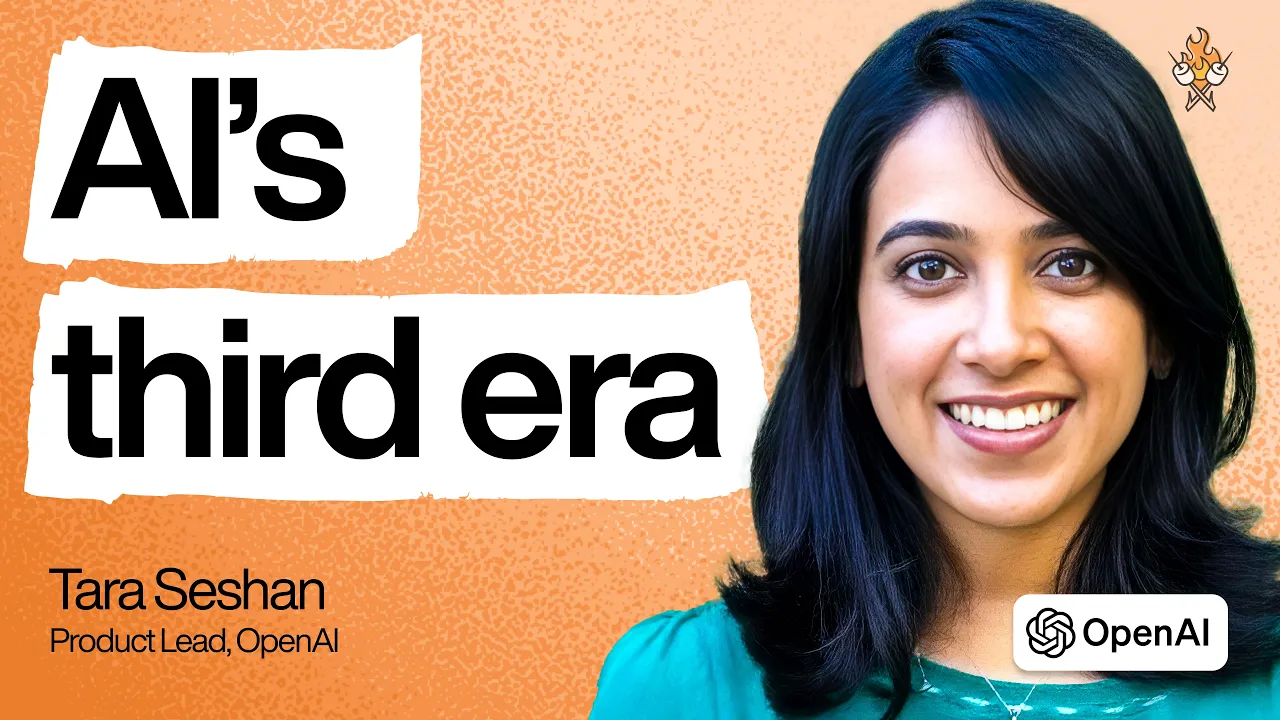
OpenAI Shifts PM Focus to Steering Autonomous AI Coworkers
Lenny's Podcast
As AI handles task execution and technical barriers drop, a knowledge worker's value shifts entirely to human judgment, accountability, and raw ambition.
AI software is transitioning through three distinct phases: initial conversational chatbots, task-executing autonomous agents, and persistent coworkers collaborating asynchronously in multiplayer environments. (0:00)
At OpenAI, product teams calibrate harnesses and features specifically for model capabilities expected two to three months out, cautioning that building for today's models or distant year-long roadmaps leads to immediate obsolescence. (26:42)
As AI models commoditize technical execution, raw ambition and opinionated human steering become the primary bottlenecks and differentiators for builders and product teams. (20:05)
Writing as thinking must be defended from generative AI tools to preserve cognitive rigor, whereas writing as reporting should be automated entirely. (52:39)
Detailed notes
## Background
Published on YouTube by Lenny's Podcast on August 30, 2026, this episode features Tara Seshan, Product Lead for ChatGPT Work and Codex at OpenAI, former early Stripe PM, and Thiel Fellow. According to the show notes, the conversation covers AI's progression toward persistent coworkers, the transition from execution ('rowing') to vision-driven orchestration ('steering'), OpenAI's rapid internal shipping velocity, and why human ambition is the new primary bottleneck in software.
## TL;DR
Tara Seshan breaks down the three eras of AI—moving from basic conversational chat and autonomous agents to persistent coworkers that collaborate asynchronously within shared team environments. She highlights how software development is shifting from manual execution ('rowing') to opinionated guidance ('steering'), where builders must operate like auteurs relying on taste, positive determinism, and elevated ambition. Seshan details OpenAI's rapid empirical experimentation culture—building interfaces strictly for model capabilities arriving two to three months out rather than over-indexing on heavy UX scaffolding—while sharing practical operating tactics, such as replacing documents with dynamic interactive sites and guarding writing as a discipline for deep thinking.
## Atmosphere & style
The conversation is intellectually electric, candid, and fast-paced, underpinned by a warm, familiar dynamic between Lenny and his former newsletter fellow. Seshan speaks with crisp, articulate momentum, seamlessly oscillating between philosophical debates on the preservation of human craft and pragmatic, behind-the-scenes accounts of OpenAI's intense internal dogfooding culture. Listening feels like sitting in on an unfiltered, high-velocity strategy sync between two seasoned product operators navigating the unpredictable frontier of technology.
## Bulletin
- [00:00](https://www.youtube.com/watch?v=zMvBMfj4cSQ&t=0s) AI software is transitioning through three distinct phases: initial conversational chatbots, task-executing autonomous agents, and persistent coworkers collaborating asynchronously in multiplayer environments.
- [26:42](https://www.youtube.com/watch?v=zMvBMfj4cSQ&t=1602s) At OpenAI, product teams calibrate harnesses and features specifically for model capabilities expected two to three months out, cautioning that building for today's models or distant year-long roadmaps leads to immediate obsolescence.
- [20:05](https://www.youtube.com/watch?v=zMvBMfj4cSQ&t=1205s) As AI models commoditize technical execution, raw ambition and opinionated human steering become the primary bottlenecks and differentiators for builders and product teams.
- [52:39](https://www.youtube.com/watch?v=zMvBMfj4cSQ&t=3159s) Writing as thinking must be defended from generative AI tools to preserve cognitive rigor, whereas writing as reporting should be automated entirely.
## Key takeaways
- [02:18](https://www.youtube.com/watch?v=zMvBMfj4cSQ&t=138s) OpenAI operates with a 'founders-led' culture where functional leaders run their products like independent startups without heavy internal strategy playbooks, testing intuitions through immediate public releases.
- [06:42](https://www.youtube.com/watch?v=zMvBMfj4cSQ&t=402s) Frontier AI product management replaces grand conceptual roadmaps with empirical hypothesis testing focused on identifying and validating the single core 'eigenquestion'.
- [10:50](https://www.youtube.com/watch?v=zMvBMfj4cSQ&t=650s) Knowledge work is fundamentally shifting from manual execution ('rowing') to guiding autonomous model workflows ('steering') across increasing levels of abstraction.
- [12:30](https://www.youtube.com/watch?v=zMvBMfj4cSQ&t=750s) Software creation increasingly behaves like filmmaking or fashion rather than real estate, where human taste, positive determinism, and auteur perspective differentiate products when everyone has access to the same underlying models.
- [18:38](https://www.youtube.com/watch?v=zMvBMfj4cSQ&t=1118s) Deploying persistent cloud coworkers requires solving unglamorous enterprise infrastructure, including data access, permissions, and deep integrations into tools like Slack and Google Docs.
- [23:57](https://www.youtube.com/watch?v=zMvBMfj4cSQ&t=1437s) Because generative AI drastically reduces execution friction, the core PM role has shifted toward elevating the ambition ceiling of teams and asking if initiatives can be 10x larger or faster.
- [27:42](https://www.youtube.com/watch?v=zMvBMfj4cSQ&t=1662s) Effective product design around frontier models requires stripping away excessive UI scaffolding and letting the raw model capability remain at the center of the user experience.
- [29:21](https://www.youtube.com/watch?v=zMvBMfj4cSQ&t=1761s) OpenAI's long-term interface goal is unifying specialized modes (like Codex and Work) into a single system that autonomously routes user intent to the proper harness without manual toggles.
- [34:01](https://www.youtube.com/watch?v=zMvBMfj4cSQ&t=2041s) Prioritizing high iteration speed and rapid user feedback over cosmetic polish enables critical learning loops necessary to lead in fast-evolving frontier AI markets.
- [39:14](https://www.youtube.com/watch?v=zMvBMfj4cSQ&t=2354s) Codex's market turnaround was driven by consistent daily craftsmanship, direct team dogfooding ('mainlining'), and solving developer friction step by step rather than a single sudden pivot.
- [42:20](https://www.youtube.com/watch?v=zMvBMfj4cSQ&t=2540s) AI adoption blurs traditional functional boundaries between PMs, designers, and engineers, while elevating the necessity of clear Directly Responsible Individuals (DRIs) who maintain human accountability for outcomes.
- [48:20](https://www.youtube.com/watch?v=zMvBMfj4cSQ&t=2900s) Malleable personal software generated on demand via AI—such as interactive single-purpose sites—is replacing traditional static documents, spreadsheets, and presentations.
- [01:05:01](https://www.youtube.com/watch?v=zMvBMfj4cSQ&t=3901s) Unlike software engineering where outputs are objectively verified by running automated tests, knowledge work assistants require inspecting the intermediate reasoning, sources, and proof of work.
- [01:00:16](https://www.youtube.com/watch?v=zMvBMfj4cSQ&t=3616s) Sutter Hill Ventures' incubation playbook prioritizes validating 'product-marketing fit' and market narrative with target enterprise customers before writing technical code.
## Detailed walkthrough
### [00:00](https://www.youtube.com/watch?v=zMvBMfj4cSQ&t=0s) Teaser and Introduction to Tara Seshan
The conversation opens with a provocative framing of artificial intelligence products evolving across three distinct eras: the initial era defined by chat interfaces, the second era centered on interacting with autonomous agents, and the looming third era where humans collaborate alongside a "persistent coworker who is able to get things done with you." Tara Seshan cautions that building in AI requires navigating a treacherous timeline window: teams fail if they build merely for where models are today, yet they fail just as completely if they attempt to design for where they predict models will be in a year. The only viable path forward is an aggressive horizon of two to three months. Operating under these constraints demands abandoning exhaustive, theoretical documentation in favor of rapid, empirical experimentation, where elevating collective ambition becomes the single most critical leverage point of the product manager.
Lenny introduces Tara, who leads product for both Codex and ChatGPT Work at OpenAI—what he characterizes as perhaps the fastest-growing and most consequential AI product surface for knowledge workers today. She partners closely with her engineering manager, Andrew Ambrosino (a previous guest on the podcast). Tara brings an exceptional pedigree to the frontier lab: she spent over six years at Stripe as one of its first five product managers, repeatedly earning recognition among the top three performers across the entire company. Following Stripe, she led product at Watershed, was a founder, earned a Thiel Fellowship, and was selected as one of the three inaugural Lenny's Newsletter Fellows.
[02:18](https://www.youtube.com/watch?v=zMvBMfj4cSQ&t=138s) Inside OpenAI: "Founders-Led" Rather Than Founder-Led
Having spent roughly a year at OpenAI—an eternity measured in frontier model development cycles—Tara reflects on the unexpected organizational reality of the company. Coming from high-intensity, hyper-scaling environments like Stripe, elements like raw urgency and top-tier talent felt instantly familiar. What took her by surprise was the structure of leadership. While every past company she had worked for was strictly founder-led, OpenAI operates as "founders-led." Rather than leaning on heavy top-down steering, individuals across distinct functional domains act effectively as autonomous founders. The distance separating the team from end users and raw market feedback is razor-thin, leaving no room to hide behind the insulating layers typical of large corporations.
The biggest mental model shift, however, concerned internal strategy. Tara entered OpenAI anticipating a hidden "treasure trove of OpenAI secret strategy"—the equivalent of an internal payments bible outlining exact master maneuvers. Instead, she discovered that "OpenAI is open." Strategic intuitions regarding the trajectory of the world, product architecture, and model behaviors are surfaced almost immediately to the public via real product features and announcements. Lenny jokes about whether there is a secret back room where AGI is running and dispensing a master plan, to which Tara laughs that if such a room exists, she certainly isn't in it. What continues to inspire her is how rapidly internal ideas transition into tangible software that users can physically interact with, cycling faster than anywhere else she has worked.
- **The "Founders-led" Dynamic:** Minimal top-down orchestration; teams operate like independent founding units directly exposed to market demands to find product-market fit.
- **The Strategy Paradox:** There is no classified playbook locked in an executive vault; OpenAI’s strategic thinking rapidly manifests directly in public releases and user-facing capabilities.
[06:42](https://www.youtube.com/watch?v=zMvBMfj4cSQ&t=402s) Moving from Grand Strategy to Empirical Experimentation
Reflecting on what changes for product leaders moving into AI, Tara highlights the dramatic shift from academic rigor to empirical speed. In more mature and predictable markets, such as traditional payments infrastructure, teams can construct elaborate "grand strategy" roadmaps from first principles, deducing how competitors will react and crafting long-range plans. In those environments, thorough theoretical deliberation is mandatory; failing to think through every subsequent action appears careless because most variables are knowable.
Frontier AI defies that paradigm because the ecosystem is intensely dynamic and tied directly to ongoing research breakthroughs. Rather than writing exhaustive, PhD thesis-like strategy documents outlining plans for quarters ahead, modern AI product management requires an empirical posture: formulating the sharpest possible hypothesis and immediately getting an artifact into users' hands to test. Invoking Shishir Mehrotra’s concept of the "eigenquestion," Tara explains that identifying the singular, foundational question to validate matters far more than concocting elaborate conceptual frameworks. The core craft of product management is stripped of its traditional bureaucratic trappings—endless status tracking, schedule policing, and decorative slide decks—and distilled down to isolating and answering that essential hypothesis.
[09:33](https://www.youtube.com/watch?v=zMvBMfj4cSQ&t=573s) The Core PM Loop and Problem Definition
Tara Seshan explains that the fundamental nature of product management has not actually changed: at its heart, the job has always been about understanding what determines whether a product succeeds or fails, designing the fastest and most effective test for that hypothesis, analyzing the results, and feeding those insights back into an iterative loop. This discipline requires weaving together three inputs: a deep understanding of users, a grasp of the market dynamics, and an understanding of the underlying technology being built. What has shifted in the current AI era is that this hypothesis-and-testing loop is no longer just the PM’s sandbox—it has become the central operating mode across entire companies. Engineering managers, software engineers, data scientists, and product designers are all focusing their energy on sharp problem definition and validation: "what are we actually doing and how do we know if it's working." As the administrative trappings and process overhead of the traditional PM job strip away, this core loop stands out as the single most critical capability to get right.
```mermaid
flowchart LR
accTitle: The Core Product Management Iteration Loop
accDescr: A loop showing user, market, and technology inputs forming a sharp hypothesis, leading to rapid testing, analysis of results, and hypothesis refinement.
subgraph Inputs ["Inputs"]
U["User Needs"]
M["Market Context"]
T["Technology Capabilities"]
end
subgraph IterationLoop ["The PM Loop"]
H["Sharp Hypothesis"]
Test["Rapid, Effective Test"]
Res["Analyze Results"]
end
Inputs --> H
H --> Test
Test --> Res
Res -->|"Feed learnings back"| H
```
[10:50](https://www.youtube.com/watch?v=zMvBMfj4cSQ&t=650s) The Shift from Rowing to Steering
Lenny Rachitsky brings up the recent industry buzz around "loops" in knowledge work—the concept where a human defines what success looks like, and an AI autonomously figures out how to build and iterate until it reaches that benchmark. In response, Tara introduces the mental model of work transitioning from "rowing" to "steering." Rather than pulling the oars on every execution task, humans will increasingly guide agents that handle the rowing, moving up successively higher layers of abstraction. Steering once lived at the micro-level of code autocompletion ("I wrote this line of code, press Tab"), moved up toward directing comprehensive tasks, and is now shifting toward goal-level orchestration.
Despite increasing agent autonomy, Tara emphasizes that setting the direction remains fundamentally human. Steering is not merely reacting to data; it requires making an opinionated, intuition-driven call about what the future should look like—a concept of "positive determinism" where a leader wills a specific product vision into existence because of how they want the world to be, rather than picking between equally viable, neutral strategies.
Lenny notes that when every company has access to the exact same underlying models and tools, the ultimate differentiator becomes human taste and judgment. Tara agrees, comparing software product creation to fashion and film rather than real estate. Just as clothing serves a functional purpose but derives value from personal expression, contrast, and identity, software resembles filmmaking—referencing a sentiment from Patrick or John Collison: you can pour immense capital into a film or a codebase, but funding alone does not guarantee quality. It requires an auteur statement, taste, and a distinct perspective. Lenny points out that this mirrors Marty Cagan’s philosophy that initial product ideas are rarely the final solution; it takes human intuition and iteration to discover what people actually want as those loops run faster and faster.
- **The abstraction ladder of steering:** Tab completion $\rightarrow$ comprehensive task prompting $\rightarrow$ goal-level orchestration $\rightarrow$ strategic direction.
- **Software as an artistic endeavor:** Unlike real estate (where capital predictably yields value), software demands auteur-like vision and opinionated taste to stand out from identical AI-generated solutions.
[15:35](https://www.youtube.com/watch?v=zMvBMfj4cSQ&t=935s) What Changes When Agents Become Coworkers
Looking at internal workflows at OpenAI, Tara outlines two major shifts in how knowledge workers will interact with AI over the coming months:
First, agents are transitioning from ephemeral chatbots into persistent coworkers. Instead of micromanaging each action, humans define high-level tasks and let the agent "cook" independently. Collaboration mirrors working with a human teammate: the agent completes substantial chunks of work, shares in-progress progress, receives human feedback and steering, and iterates across regular check-in cadences.
Second, the interaction model is evolving from single-player to multiplayer. Currently, usage is largely siloed—a single user interacts with their personal agent or sub-agents in isolation. Internally at OpenAI, this initially manifested in employees sharing screenshots of their Codex threads in Slack just to explain how they calculated a metric or solved a problem. Tara explains that this friction signals the need for collaborative interfaces where teams and their respective agents operate together in a shared workspace. Lenny envisions a scenario where his agent talks directly to Tara's agent to verify analyses against his mental model. Tara summarizes this ultimate vision as a "multiplayer game" where humans steer together while an army of persistent agents carries out the tactical rowing. Lenny reflects that this gradual expansion of trust and scope points toward a manageable "slow takeoff" rather than an abrupt, unmanageable shock to knowledge work.
[18:38](https://www.youtube.com/watch?v=zMvBMfj4cSQ&t=1118s) The Unsung Infrastructure Behind Agentic Coworkers
While public discussions about AI agents often fixate on raw machine IQ, long-running tasks, and how long a model can remain focused, the shift toward delegating higher-order abstractions actually hinges on surprisingly "meat and potatoes" tactical engineering. An agent running locally on a personal machine has trivial access to all local files and tools. Taking that same agent and making it genuinely useful in the cloud demands an immense amount of cloud infrastructure, hardened reliability, and deep integrations into third-party corporate ecosystems.
Tara Seshan compares an isolated cloud agent to hiring a brilliant new human colleague and then locking them into a windowless room with no access to Google Docs, Slack, or company databases. Without hooks into internal systems, even the highest-capability intelligence is rendered ineffective. Achieving a future where agents act as real coworkers requires equal parts advanced model reasoning and unglamorous, foundational plumbing around data access and permissions.
```mermaid
flowchart LR
accTitle: Tactical Infrastructure Required for Cloud AI Agents
accDescr: Diagram illustrating how model intelligence must combine with cloud systems and data access to produce an effective coworker agent.
subgraph Intelligence["Model Layer"]
IQ["Reasoning & IQ"]
Tasks["Long-running Execution"]
end
subgraph Plumbing["Tactical Infrastructure"]
Cloud["Cloud Architecture"]
Connectors["SaaS & DB Integrations\n(Slack, G-Docs, DBs)"]
Access["Permissions & Context"]
end
subgraph Outcome["Working AI Coworker"]
Agent["Fully Capable\nPersistent Agent"]
end
Intelligence --> Agent
Plumbing --> Agent
```
[20:05](https://www.youtube.com/watch?v=zMvBMfj4cSQ&t=1205s) Ambition as the New Bottleneck and the "Auteur" PM
As AI commoditizes rote tasks and lowers the barrier to hard technical execution, raw ambition emerges as the defining differentiator for individuals and organizations. In earlier eras of tech, the ultimate "unicorn hire" was a rare polymath: an exceptional product thinker who could also code, design, and flatten the layers of organizational translation by self-initiating prototypes. With modern AI tools, every knowledge worker suddenly has that exact leverage. A single person can spin up initial designs, build a functional software prototype, and model out complex pricing scenarios within hours.
This collapse of execution friction allows builders to act like artistic "auteurs," translating ideas from their heads into high-fidelity reality without waiting on cross-functional handoffs. Consequently, personal output is no longer bounded by narrow technical skills, but rather by the boldness of one's own vision. Seshan highlights Patrick Collison's compilation of fast projects (hosted at patrickcollison.com/fast)—a curated list of history-making endeavors pulled off on impossibly compressed timelines—observing that every single one of those feats was achieved *before* people had instantaneous access to generative tools. If extreme speed and scope were possible with legacy methods, modern builders ought to be driving an exponential increase in unreasonably ambitious, rapidly executed outcomes.
- **The historic unicorn archetype:** The rare product-engineer-designer who could ideate, build, and ship end-to-end without functional translation loss.
- **The auteur model:** Moving from delegating execution across large teams to realizing a personal vision with high craft and direct control.
- **The Patrick Collison benchmark:** Historical evidence proves that massive projects can be done in days or weeks; modern models should supercharge that baseline frequency.
[23:57](https://www.youtube.com/watch?v=zMvBMfj4cSQ&t=1437s) Elevating Possibility Ceilings and OpenAI's Internal Memes
The hardest psychological barrier with generative tools is simply remembering to deploy them—breaking old cognitive habits to test whether an agent can handle a complicated CAD model, code review, or deep text synthesis. Citing Tyler Cowen's observation that people systematically underestimate the value of asking others to think bigger, Seshan argues that the core product management mandate has evolved: PMs must elevate the ambition of everyone around them. When a teammate proposes a standard scope or conservative timeline, the product manager's job is to challenge the possibility ceiling by asking if the project can be 10x larger or executed 10x faster.
```mermaid
flowchart TD
accTitle: OpenAI's Core Product Development Memes
accDescr: The three interlocking cultural questions that guide product development speed, scope, and taste at OpenAI.
subgraph Scope["Vision & Scale"]
A["Are we being as ambitious\nas possible?"]
end
subgraph Velocity["Speed of Execution"]
B["Is this maximally accelerated?"]
end
subgraph Craft["Taste & Feedback Loops"]
C["Are you mainlining it yet?"]
end
A --> B
B --> C
C --> A
```
Inside OpenAI, this drive toward extreme velocity and high standards is crystallized in three distinct cultural memes:
- **"Is this maximally accelerated?"** Popularized internally by leaders like Nick Turley (and immortalized as a company Slack emoji), this question serves as a relentless check on organizational drag and shipping speed.
- **"Are you mainlining it yet?"** A step beyond traditional "dogfooding," this phrase, frequently used by Seshan and engineering manager Andrew Ambrosino, asks whether builders are obsessively living inside their own tools all day to hone product taste and shorten iteration loops.
- **"Are we being as ambitious as possible?"** A direct push against incrementalism, ensuring the scale of a feature matches the unprecedented leverage of modern frontier intelligence.
Beyond execution mantras, the organization is animated by the shared ethos of "feeling the AGI"—a pervasive belief in delivering safe, beneficial artificial general intelligence. When translating that overarching mission into daily product roadmaps, builders must navigate a delicate planning horizon: designing features calibrated strictly for where underlying models will land in the next two to three months. Building for present-day capabilities produces software that is instantly obsolete, while building for speculative models a full year away leads to products that fail to ship.
[27:42](https://www.youtube.com/watch?v=zMvBMfj4cSQ&t=1662s) Building 2–3 Months Ahead and the Research Feedback Loop
Designing an AI product around the capabilities of yesterday's model is a guaranteed trap. As Tara emphasizes, if your product roadmap reflects what models were doing just months ago, "you're entirely wrong." Product leaders must maintain a constant, forward-looking orientation toward where frontier models will be two to three months down the line. That requires placing raw model capability at the core of the product and systematically stripping away unnecessary user experience scaffolding: "I need to think about the model capability is the center of this product. I need to get out of the way of the model in terms of the product constructs that I create."
```mermaid
flowchart TD
accTitle: AI Product Development Horizon
accDescr: Diagram illustrating how research capabilities feed into future model states and simplify user abstractions.
When Lenny questions how anyone can accurately predict what that two-to-three-month horizon looks like—wondering whether it is pure gut instinct or direct research guidance on an exponential curve—Tara explains that frontier AI research is not an impenetrable black box. OpenAI's research teams set explicit agendas to advance specific, targeted capabilities, such as leveling up performance on intricate coding problems or refining specialized prose generation. Staying in lockstep with the research team's agenda ensures product development anticipates the next model iteration rather than lagging behind it. Lenny recalls a line from former Chief Product Officer Kevin Weil on the podcast: "this is the worst the models will ever be." While almost a cliché in tech circles now, both acknowledge how dizzying and absurd that reality remains when internalizing the rate of change.
[29:21](https://www.youtube.com/watch?v=zMvBMfj4cSQ&t=1761s) Deconstructing ChatGPT: Chat Mode, Work Mode, and Codex
Opening up the ChatGPT interface in real time, Lenny points out the proliferation of options confronting a user: a dropdown menu featuring ChatGPT alongside Codex, and a mode toggle switching between "Chat" and "Work." Tara clarifies that OpenAI's ultimate North Star is to remove every single one of those choices entirely. In that end state, a user simply types their intent into an input field—for example, asking to build a custom application that briefs podcast guests prior to an interview—and the system automatically selects the correct underlying model and execution harness without requiring the user to diagnose technical constraints.
```mermaid
flowchart LR
accTitle: North Star Interaction Model
accDescr: Flowchart contrasting the current explicit mode selection with the unified input North Star.
subgraph NorthStar["North Star Experience"]
U2["Single Goal / Prompt"] --> A1["Automatic Harness & Model Routing"]
A1 --> OUT["Tailored Output & Dynamic UI"]
end
```
In the interim, the distinct modes serve specific audiences:
- **Codex:** Geared toward developers who prefer a dedicated programming interface with full technical visibility, including features like visible work trees.
- **Chat Mode:** The familiar conversational and search surface, continuously upgraded with frontier model updates.
- **Work Mode:** Codex operating underneath the hood, stripped of developer-specific UI chrome so knowledge workers can harness agentic power without seeing technical clutter.
Under the surface, Work mode and Codex share identical capabilities. A complex financial prompt—such as drafting a dynamic corporate model to price a product or forecasting revenue six months out—will execute with the same fidelity in either mode. The only difference lies in UI exposure, specifically the chain-of-thought visibility and technical detail surfaced. Teams across OpenAI, including corporate finance, use Work mode to compress workflows that once required days of specialized, manual spreadsheet analysis into capabilities shared across the entire organization.
[34:01](https://www.youtube.com/watch?v=zMvBMfj4cSQ&t=2041s) The Three Eras of AI and Trading Polish for Urgency
Balancing a consumer product with hundreds of millions of monthly active users against rapid, experimental tools like Codex introduces significant organizational and design tension. Tara views bringing Work mode into ChatGPT's desktop and web experiences as a necessary bridge across the defining eras of modern AI software:
1. **The First Era (Chat):** Purely conversational interfaces focused on dialogue, search, and immediate Q&A.
2. **The Second Era (Agents):** Autonomous execution engines that emerged in software engineering and are now expanding across general knowledge work.
3. **The Third Era (Persistent Coworkers):** Persistent, collaborative AI coworkers operating asynchronously alongside human teams on shared objectives.
The current hurdle is introducing agentic capabilities to a massive consumer user base without forcing people to understand technical abstractions like harnesses.
Navigating that rollout has forced a fundamental shift away from conventional product management playbooks. Drawing on her previous work at high-craft product organizations like Stripe, Tara notes that in the pre-AI era, "polish was king." Teams would hold back a release until every button state, animation, and interaction reached perfection, because a delay of weeks had little bearing on the overall competitive outcome. In the frontier AI landscape, that calculus flips. When product conviction is high that a feature is fundamentally transformative, waiting for cosmetic perfection costs critical learning cycles. Moving with pure urgency to put raw, empowering capabilities into users' hands beats pixel perfection every time.
[37:10](https://www.youtube.com/watch?v=zMvBMfj4cSQ&t=2230s) Iteration Speed, Signal Listening, and Done Over Perfect
Reflecting on user reactions to new product launches, Lenny notes that when ChatGPT's newer workflows first rolled out, early feedback included confusion about how to use them. Yet what stood out was how rapidly the team absorbed that commentary and adjusted: getting the product into the wild, discovering what is broken, seeing how people actually use it, and iterating at high velocity. Tara agrees with the mantra that "done is better than perfect" and emphasizes that there is always far more work ahead.
At the same time, Tara clarifies that moving fast does not mean abandoning rigor before launch. Teams can and should gather feedback and iterate extensively pre-launch, but whether work happens before or after shipping, the critical discipline is maintaining the tightest possible iteration loops and tuning into the right signals rather than getting paralyzed by perfectionism.
Lenny briefly takes a moment to highlight Mercury Spend, noting that he migrated all his business banking to Mercury years ago because it feels designed by product thinkers rather than traditional bankers. With Spend, teams avoid the classic startup trap where everyone shares a single company card until an expense goes over, receipts vanish, and founders spend days untangling statements. Spend builds expense management directly into Mercury—letting companies issue individual team cards, set custom limits, automatically pull receipts from Gmail or SMS, and even grant AI agents their own cards with dedicated spending policies.
[39:14](https://www.youtube.com/watch?v=zMvBMfj4cSQ&t=2354s) The Codex Vibe Shift: Chop Wood, Carry Water
Lenny highlights an unmistakable "vibe shift" across tech Twitter over the preceding three to six months: whereas developers previously gravitated toward Claude Code, momentum noticeably shifted toward Codex. He asks Tara what changed internally during that window—joking whether it was simply Tara arriving to whip things into shape, or if the team solved a specific bottleneck or cut extraneous work.
```mermaid
flowchart TD
accTitle: The Codex Internal Iteration Loop
accDescr: Internal culture loop at OpenAI driving Codex development through dogfooding, founder mentality, and independent fixes.
subgraph Culture["Operating Philosophy"]
A["Core Memes:<br/>'Maximally accelerated?'<br/>'Elevating ambition?'"]
B["Mainlining & Dogfooding<br/>(Devs building for devs)"]
end
subgraph Execution["Execution Loop"]
C["Identify friction in daily dev workflow"]
D["Independently build fixes & prototypes"]
E{"Internal validation:<br/>Do colleagues use it?"}
end
subgraph Release["External Impact"]
F["Ship to external users"]
G["Market recognition &<br/>developer vibe shift"]
end
A --> B
B --> C
C --> D
D --> E
E -->|"Iterate until useful"| D
E -->|"Proven high value"| F
F --> G
```
Tara dismisses the idea of a sudden internal pivot, citing the Zen proverb: "Before enlightenment, carry water, chop wood; post-enlightenment, carry water, chop wood." The Codex team's operating cadence remained identical before and after the shift in public perception. The engineers building the Codex desktop app—including collaborators like Andrew Ambrosino and Thibaud—are developers building tools for themselves, obsessively dogfooding and "mainlining" the product all day. The internal questions never shifted:
- "Are we elevating our ambition sufficiently?"
- "Is this maximally accelerated?"
- "Are you mainlining it yet?"
The team operates with a founder mentality: when anyone spots an imperfection, they do not wait for top-down direction. They build prototypes independently, test them internally, discard or refine what fails to resonate with colleagues, and only ship once it proves genuinely useful. Lenny points out the irony that despite building frontier artificial intelligence, the real differentiator behind Codex's surge was deeply human: relentless customer obsession, craftsmanship, and team culture.
[42:20](https://www.youtube.com/watch?v=zMvBMfj4cSQ&t=2540s) Why Traditional Roles Are Beginning to Blur
Lenny touches on the growing identity crisis across tech organizations as functional boundaries dissolve: software engineers write product specs, product managers build prototypes or push to production, and designers and marketers wonder where their core responsibilities begin and end.
Tara explains that having spent most of her career at early-stage startups—and at Stripe during its formative years—she has always thrived in environments where formal boundaries do not exist:
- At early Stripe, there were virtually no hard dividing lines separating what an engineer, designer, or PM could do; anyone could pick up any work required to achieve the outcome.
- Today, modern AI capabilities finally match that fluid mentality, enabling team members of any discipline to stretch across the stack.
- Regardless of who does the tactical work, each initiative still requires a single DRI (Directly Responsible Individual) who holds fundamental accountability for whether people want the product, whether it is high quality, and whether it delivers impact.
However, Tara admits this fluidity introduces a genuine philosophical tension regarding domain craft. Thought leaders like Shreyas Doshi, Marty Cagan, and Shishir Mehrotra have articulated deep principles around the art and discipline of product management, and similar pride exists within design and engineering. When models abstract away execution—such as an engineer spending hours in a tactile flow state handwriting code—people feel a real sense of loss. While Tara loves the immense leverage these tools unlock, she acknowledges that learning how to reapply that love of craft to higher-level product steering, rather than manual execution, remains an open and emotionally complex transition for knowledge workers.
[45:59](https://www.youtube.com/watch?v=zMvBMfj4cSQ&t=2759s) Human Brains as the Anchor of Accountability
Lenny asks where human brains will continue to provide distinct, irreplaceable value over the next few years as frontier models advance. Tara answers without hesitation: human value will center squarely on ultimate accountability.
Even as autonomous AI agents evolve into highly competent coworkers or direct reports that draft plans, write software, and analyze data, an agent cannot take ownership of success or failure. The human remains the sole entity responsible for the outcome—judging whether the final artifact meets the bar of quality, deciding whether it actually solves the real problem, and answering for the final result.
[46:42](https://www.youtube.com/watch?v=zMvBMfj4cSQ&t=2802s) Where Humans Continue to Provide Unique Value
Tara reflects on the parts of work where a human presence remains indispensable, particularly in heavily regulated sectors or domains requiring direct personal care and human interfaces. Beyond that, she highlights two core realms where the human brain is unmatched: creative expression and team dynamics. Software development, she reiterates, behaves far more like making a film than developing real estate—simply pouring vast amounts of capital into a project does not guarantee a masterpiece, because the highest-budget films are rarely the greatest. Crafting software requires opinionated judgment, aesthetic sensibility, and an undeniable sense of human authorship behind what is built and how it feels to use.
Equally essential is how people relate to and care for one another. Tara notes that connecting with teammates, rallying shared excitement around an ambiguous space, learning together, and actively elevating one another's ambitions has become more critical to her role than ever before. While model capabilities will continue to evolve unpredictably, she views these emotional and relational dimensions as fundamentally, resiliently human.
[48:20](https://www.youtube.com/watch?v=zMvBMfj4cSQ&t=2900s) How Tara Uses AI: The Emergence of Dynamic "Sites"
Addressing the persistent "overhang" between what AI can do and how people actually apply it day-to-day, Lenny asks how Tara’s PM workflow has evolved and what unconventional AI tactics she relies on. Tara reveals that her single most impactful shift is building "sites" directly through AI rather than producing static documents, spreadsheets, or slide decks. Rather than writing code and manually figuring out hosting, deployment, and infrastructure, she simply prompts the model—whether through Codex, ChatGPT Work, the web, or mobile—and an interactive web application is created and hosted instantly with its own database.
Tara uses these dynamic sites for everything from professional presentations to personal projects. In one instance, she prompted Codex to spin up an interactive game of Mafia for her team. For a recent backpacking trip, she built a site that mapped the trail route, graphed elevation changes, and allowed everyone in the group to log and coordinate their food supplies. She views sites as the realization of Alan Kay's 1960s vision of "malleable personal software"—a true personal computer where users effortlessly shape software to their immediate needs. Instead of spending hours assembling Notion blocks or polishing slide decks, she generates auto-updating dashboards connected to internal data that can be kept private, shared with a team, or made public.
- **Capabilities of AI-generated sites:** Includes a native database, sharable access settings (private, team-wide, or public), auto-updating metrics dashboards, and creation across multiple surfaces (Codex, ChatGPT Work, web, mobile).
- **Pronunciation aside:** Lenny clarifies the pronunciation of Tara's surname: "Tara Seshan" is pronounced *Sash-in* (rhyming with "station").
[51:38](https://www.youtube.com/watch?v=zMvBMfj4cSQ&t=3098s) Instant Data Storytelling with `/visualize`
Another feature Tara relies on inside Codex is the `/visualize` command. By typing a prompt like `/visualize my ChatGPT usage until now`, the tool aggregates the relevant data and instantly converts it into rich, comprehensible charts. As a product manager who constantly needs to weave disparate metrics into an intuitive narrative for stakeholders, Tara finds this shortcut indispensable. Instead of wrestling with spreadsheet chart builders or design tools, `/visualize` streamlines complex data presentation into a single, delightful interaction.
[52:39](https://www.youtube.com/watch?v=zMvBMfj4cSQ&t=3159s) Writing as Thinking vs. Writing as Reporting
Prompted by a question from Brie Wolfson (who described the "Tara brief" as iconic), Tara outlines her strict separation of writing into two distinct categories:
```mermaid
flowchart TD
accTitle: Two Types of Writing in Product Work
accDescr: Flowchart illustrating the split between writing as thinking, which remains fully human, and writing as reporting, which is automated by AI models.
subgraph Thinking["Writing as Thinking (Never Automate)"]
T1["Formulate spicy takes & strategies"] --> T2["Write prose, outline, and ruthlessly cut"]
T2 --> T3["Shop doc to peers to attack ideas"]
T3 --> T4["Sharpen judgment & strategic clarity"]
end
subgraph Reporting["Writing as Reporting (Fully Automate)"]
R1["Weekly team progress updates"] --> R3["Delegate completely to AI models"]
R2["Launch & announcement plans"] --> R3
R3 --> R4["Fast, low-friction status tracking"]
end
```
Tara argues that people tend to paint AI writing with overly broad brushes—either rejecting it entirely or using it for everything. Her philosophy is to automate writing as reporting as aggressively as possible, while protecting writing as thinking from any model involvement. For Tara, the physical friction of drafting an outline, wrestling it into prose, cutting excess words, and refining arguments is the exact mechanism by which clear thinking occurs.
During her six-plus years at Stripe—a legendary writing-centric culture where briefs written by product leaders like Jeff Weinstein could go viral internally—Tara built a reputation for retreating into a "hole," producing a deep brief for an ambitious product or strategic pivot, and circulating it among peers specifically to have them aggressively attack the premises and poke holes in the logic before presenting it further. However, she notes a cultural shift at OpenAI: producing a massive, exhaustive document is no longer treated as proof of thorough thinking. Because anyone can now instruct an AI to generate a polished, 10-page brief in seconds, a long document has lost its status as a reliable signal of real intellectual effort.
[56:17](https://www.youtube.com/watch?v=zMvBMfj4cSQ&t=3377s) Mocks Over Docs and the 70% Rule
Tara reflects on a jarring personal shift in how she approaches product work across different eras. In the past, the standard playbook was to think through a problem inside a document, translate that into a presentational artifact, and treat that document as proof of deep thinking so the team could execute against it. Today, she strongly favors "mocks not docs" or "prototypes not docs." Having an interactive artifact people can actually play with—or even better, concrete data from an A/B test demonstrating real results—serves as a vastly superior communication tool compared to an essay. While she still writes hundreds of documents, she clarifies that she now writes them strictly for herself to clarify her own thoughts, rather than using them as the primary artifact to persuade others.
Lenny connects this to the broader skill of refining documents iteratively rather than trying to drop a finished masterpiece out of nowhere. Tara shares a rule of thumb passed down from a former manager: always write a document to roughly 70% completion, and then bring in the key stakeholders whose buy-in you need to take it from 70% to 100%. When an idea is presented as completely polished and airtight, other talented people cannot engage with it; their thoughts simply bounce right off. By leaving intentional "crags and rough edges," you invite collaborators into the process so everyone can polish the final outcome together.
[58:08](https://www.youtube.com/watch?v=zMvBMfj4cSQ&t=3488s) Combating AI Brain Rot: Writing as Thinking vs. Reporting
When Lenny asks how to guard against "AI brain rot"—the creeping temptation to outsource reading and writing until critical thinking atrophies—Tara points directly to her distinction between writing to think and writing to report. Routine status updates and formatting can easily be delegated to models, but any exercise where writing serves as the vehicle for thinking must remain entirely human. Tara holds herself to a rigorous standard: if she expects a group of colleagues to read a document, she forces herself to invest the collective amount of time they will spend reading it into drafting and revising it. She applies the exact same math to meetings, spending the cumulative attendee-hours on upfront preparation before stepping into the room.
```mermaid
flowchart LR
accTitle: Human Thought Process with AI Assistance
accDescr: Diagram showing human ideation at start and finish, with AI only used in the middle.
subgraph Start["1. Human Origin"]
A["Drafting raw ideas & structure"]
end
subgraph Middle["2. AI Assist"]
B["Research elements"]
C["Pull data & challenge assumptions"]
end
subgraph Finish["3. Human Delivery"]
D["Refining prose & final judgment"]
end
A --> B
B --> C
C --> D
```
Lenny summarizes this framework: start as a human, draft the plan without AI, and refuse to let the model generate the prose. Tara agrees completely, noting that while ChatGPT is great in the messy middle—surfacing background research, pulling relevant data, translating formats, or actively stress-testing and pushing back on arguments—the beginning and the conclusion of any serious piece of writing must belong to the person behind it.
- **Outsource "writing as reporting":** Summaries, format changes, and administrative reporting can be fully handed off to AI.
- **Protect "writing as thinking":** Drafting the core thesis and final prose must remain human work to prevent cognitive atrophy.
- **The collective time rule:** Never ask colleagues to read a memo or sit in a meeting unless you have invested equivalent collective preparation time upfront.
[01:00:16](https://www.youtube.com/watch?v=zMvBMfj4cSQ&t=3616s) The Playbook of Sutter Hill Ventures and Product-Marketing Fit
Lenny turns to Tara’s unconventional career pivot as an Entrepreneur-in-Residence (EIR) at Sutter Hill Ventures, the secretive firm renowned for incubating foundational enterprise companies like Snowflake. Tara describes Sutter Hill as an intentionally "illegible" firm that deliberately operates under the radar with almost nothing on its public website. While the industry frequently regards reaching product-market fit or building a multi-billion-dollar enterprise as pure luck or dark magic, Sutter Hill partner Mike Speiser has proven it can be executed systematically across multiple company generations. Behind that track record lies an exacting, repeatable playbook spanning enterprise sales org design, executive recruiting, and product positioning.
The single biggest lesson Tara took away from Sutter Hill was that founders consistently underrate "product-marketing fit" relative to product-market fit. Traditionally, product marketing is treated as glue work between engineering and sales. Speiser’s model flips this order entirely: before writing code or locking in product architecture, founders should craft the narrative, refine the positioning, and pitch it to roughly 100 enterprise prospects. Honing the story of why a product is transformative beforehand ensures that when the team finally builds, they are aiming squarely at a validated market narrative.
- **Sutter Hill's proprietary recruiting edge:** The firm uses an internal relationship-mapping tool called Reticle, which tracks everyone they interact with alongside the ten best people each of those individuals has ever worked with.
- **Product-marketing fit comes first:** Testing positioning and messaging against enterprise buyers should precede committing engineering resources to a specific product shape.
[01:04:16](https://www.youtube.com/watch?v=zMvBMfj4cSQ&t=3856s) The Live Website Demo and Knowledge Work vs. Coding
Interrupting the discussion with some levity, Lenny pulls up a live browser window to show Tara a complete personal website that ChatGPT generated in the background during their recording. The AI spun up an interactive, multi-product layout complete with quotes ("Big conviction. Small teams. Start with the buyer.") and paired it with an old Stripe badge photo from when Tara was roughly 19 years old. Tara laughs at the teenage headshot and praises the clean styling and customized framing around the portrait.
Transitioning toward the episode's lightning round, Lenny asks if there are any critical topics left on her mind. Tara highlights an emergent realization from her team's work on ChatGPT Work: contrary to the common assumption that knowledge work will simply mirror the trajectory of software engineering assistants, the underlying workflows and dynamics of general knowledge work are proving to be fundamentally different from writing code.
[01:05:20](https://www.youtube.com/watch?v=zMvBMfj4cSQ&t=3920s) How Knowledge Work Differs from Coding
Tara contrasts software engineering with general knowledge work by pointing out that coding is fundamentally output-oriented. When you assign an AI a coding task, you can immediately verify whether it succeeded by running unit tests or simply trying out the software to see if it works. Knowledge work, however, cannot be validated just by glancing at the final artifact. As Tara puts it, "I can't simply look at the deck in the end and see the numbers—oh, it's like 90% success or whatever in the deck—and actually believe that. I really need to think about the process and the inputs and the reasoning and how it went along the way."
Adapting ChatGPT for knowledge work therefore requires turning the model into a transparent collaborator that takes the user along on the journey. Users need to inspect in-progress work, inputs, and citations so that when they reach the final output, they can confidently say, "Oh wait, this thing is right, this thing is good, this thing is useful." This raises major product and UX questions for OpenAI: how much of the model's reasoning and chain of thought should be exposed, whether more intermediate citations should be surfaced as data is processed, and whether a linear chat thread—which works so well for coding—is even the right interface for knowledge work and human-AI collaboration.
Lenny immediately connects this to the dynamics of an executive review. When pitching a plan to an executive, the persuasive power comes from showing the "proof of work"—all the intermediate steps and rigor that led to the recommendation—whereas in engineering, you rarely need to inspect every minor architectural decision as long as the code passes its tests. He also notes that knowledge work depends heavily on whether the AI has access to the right context, such as emails and Notion docs, making Tara's job of unifying all this into one product "tricky, tricky."
| Dimension | Coding | Knowledge Work |
|:--- |:--- |:--- |
| **Primary Focus** | Output-oriented | Process-, input-, and reasoning-oriented |
| **Validation Method** | Running tests; trying out the working code | Inspecting the "proof of work," citations, inputs, and intermediate steps |
| **Core UX & Product Need** | Thread-based execution and test verification | Collaborative journey, exposed chain of thought, and deep context (emails, Notion docs) |
[01:07:55](https://www.youtube.com/watch?v=zMvBMfj4cSQ&t=4075s) Lightning Round: Books That Reward Re-reading and Slow Reading
Moving into the lightning round, Lenny asks for two or three books Tara recommends most often. Her first pick is *Barbarian Days* by William Finnegan, a memoir by a *New Yorker* reporter about his lifelong obsession with surfing. What moved Tara most about the book is the idea that "one can be deeply passionate and dedicated and have something be your life purpose without you being good at it." Finnegan's story of falling in love with surfing and striving for perfection while knowing he will never reach it struck her as a deeply compelling model for how to live.
Her second recommendation is Leo Tolstoy's *Anna Karenina*, which she calls "a book of layers" that mirrors how we must continually transform ourselves in the new era of AI. Tara shares how the novel changed across three different stages of her life:
- **At age 13:** She understood basically just the plot.
- **At age 17:** She grasped the European history dynamics and class warfare.
- **At age 30:** She realized, "Oh, this is like a story about a woman and humans," reminding her that personal growth allows you to look at the exact same thing through entirely new lenses over time.
Lenny shares that he also read *Anna Karenina* for the first time earlier this year after spotting it on a list of books read by the smartest people in the world. Although someone spoiled the ending for him and he found it very long, he loved it—and jokes that his current read, Robert Caro's *The Power Broker*, has set a whole new precedent for length ("I've been reading it for half my life at this point"). To tackle massive tomes like *The Power Broker*, *War and Peace*, or Hilary Mantel's *Wolf Hall*, Tara recommends Simon Haiselden's Substack (*Footnotes and Tangents*), which guides readers through slow, chapter-by-chapter reads. Lenny adds his own hot tip for *The Power Broker*: the *99% Invisible* book club podcast breakdown, a 13-episode series (one to two hours per episode) that analyzes a few chapters at a time with special guests like Pete Buttigieg, AOC, local residents, and author Robert Caro himself.
[01:11:18](https://www.youtube.com/watch?v=zMvBMfj4cSQ&t=4278s) Favorite Films: Christopher Nolan's *The Odyssey* and Kurosawa's *Rashomon*
Asked about her favorite recent movie or TV show, Tara highlights Christopher Nolan's *The Odyssey*, praising Nolan for bridging high artistry and commercial success like no other modern director. Her hot take on the film is that it is fundamentally an allegory about AI—"Christopher Nolan's view on how AI transforms society" and "the collapse of morality." Lenny groans that he slept on buying tickets and has been locked out for a month; he currently has bots, a hired helper, and a friend all scrambling to snag him a full IMAX seat at the Metreon in San Francisco. Tara laughs and mentions that Kevin Clark managed to score her group 10:00 p.m. tickets at the Metreon earlier that week, promising Lenny she can't wait to hear if he agrees with her AI theory once he finally gets in.
Tara also recently watched Akira Kurosawa's 1950 black-and-white classic *Rashomon*, which pioneered the narrative technique of recounting a single event through multiple conflicting perspectives so the audience never knows the ultimate truth. Watching what Kurosawa achieved under 1950s constraints—essentially "a guy holding the camera" producing a tasteful, innovative masterpiece—left her with a humbling realization: "I have a hundred times the power and tools that he had making that film in my iPhone. And like, what's my excuse for not elevating my ambitions and making better stuff?" Lenny laughs, noting that with Tara, "it all comes back to ambition."
[01:13:26](https://www.youtube.com/watch?v=zMvBMfj4cSQ&t=4406s) Favorite AI Products and the "Cozy Software" Movement
When Lenny asks about a favorite or interesting AI product she has recently discovered (ideally outside of OpenAI), Tara first gives a quick nod to ChatGPT and using custom sites and the `/visualize` command inside Codex. Stepping outside of OpenAI, she says her favorite AI products right now are the bespoke tools her friends build for her. She is a massive fan of the "cozy software" movement—where individuals build small, tailored software tools just for five of their friends to use together—and begins sharing an example of a friend named Sebastian who built a cool tool for their group.
[01:14:08](https://www.youtube.com/watch?v=zMvBMfj4cSQ&t=4448s) Personal Software: Custom Podcast Feeds and GATS
Continuing her point about custom-built tools, Tara describes a friend's AI app that turns any reading material into a podcast, as well as a private social network he built for their friend group called GATS. To Tara, GATS represents "exactly what I think the future should be, which is people should make software that exactly meets their and their friends' needs." When Lenny asks if "GATS" is an acronym or an inside joke, Tara admits that if it is, she doesn't know it—describing the platform as a "private Twitter" or an alternative to a WhatsApp group for a small circle of friends, where she consistently learns the most interesting things.
Turning back to the podcast app, Lenny says his ideal version of that product would act like a real podcast inside his existing feed, automatically adding new episodes made from articles he wants to read. Tara tells him that is literally what her friend's app does—it drops the generated audio directly into your Apple Podcasts feed. Lenny is immediately sold: "Amazing. I want this. It's great. Help me subscribe to this."
[01:15:05](https://www.youtube.com/watch?v=zMvBMfj4cSQ&t=4505s) Life Motto: Toni Morrison's Four Takes on Work
With two questions left in the lightning round, Lenny asks Tara for a favorite life motto she frequently returns to in work or life. She immediately points to Toni Morrison's essay, *"The Work You Do, the Person You Are,"* and pulls it up on the spot to read the four core principles aloud:
1. "Whatever the work is, do it well—not for the boss, but for yourself."
2. "You make the job; it doesn't make you."
3. "Your real life is with your family."
4. "You are not the work you do; you are the person that you are."
"I got tingles," Lenny reacts, realizing he recognizes the quote because Tara has it pinned to the top of her X (Twitter) profile. He loves the trick of pinning a personal motto to the top of a profile so that you are reminded of it every single time you open the app.
[01:16:04](https://www.youtube.com/watch?v=zMvBMfj4cSQ&t=4564s) Reflections on the Thiel Fellowship, Ari Weinstein, and Dylan Field
For his final question, Lenny brings up Tara's time as a Thiel Fellow—pausing briefly to confirm the pronunciation of "Thiel"—and marvels at the strength of the program's alumni network. He asks if she has any memorable stories, crazy moments, or favorite peers from her cohort. Tara describes the Thiel Fellowship as a true inflection point in her life, tying it directly back to their earlier theme of elevating ambition: "That was a moment where someone came to me and elevated my ambitions and said, 'No, you can do this. You don't have to take the path that you were on.'"
She highlights two fellow alumni in particular:
- **Ari Weinstein:** A fellow Thiel alumnus whom Tara gets to work with constantly today at OpenAI. Ari previously founded a company acquired by Apple, worked at Apple for a while, and later founded **Sky**, which was acquired by OpenAI. Tara calls him one of the most creative thinkers she has ever seen and "truly the expert on what are all the cool things you can do on a Mac." At OpenAI, Ari leads much of the computer use work and has shipped a number of key features, inspiring Tara with his deep love of craft and joy in what he does.
- **Dylan Field:** Co-founder of Figma, who was in Tara's exact fellowship batch. She praises him as not only an incredible talent—and the flagship name everyone thinks of when they think of the Thiel Fellowship—but also a genuinely kind person.
While Tara thinks of a funny story from her cohort, Lenny summarizes the Thiel Fellowship for listeners: Peter Thiel's program gives $100,000 to young people ("20 under 20"—20 people per year for the first four or five years) to skip or leave college and go build something ambitious instead. Tara shares that because she was in the second-ever year of the fellowship, CNBC decided to film the whole experience as a documentary. As a result, footage of a 19-year-old Tara getting up on stage to pitch her idea for the fellowship is "unfortunately live on YouTube" for anyone looking for something embarrassing.
[01:19:08](https://www.youtube.com/watch?v=zMvBMfj4cSQ&t=4748s) Final Plugs: Trying ChatGPT Work and Cloud Agents on Mobile
Wrapping up the conversation, Lenny asks Tara what she wants to plug and how listeners can be useful to her. Tara encourages everyone to download the ChatGPT desktop app or open ChatGPT on the web, find the little toggle for **Work** mode, and experiment with it intimately. She and Lenny brainstorm a few immediate starter prompts for listeners to try:
- Ask it to build a personal website about you.
- Ask it to generate a `/visualize` block analyzing your own ChatGPT usage.
- Lenny's meta-suggestion: "Ask it to build a site to tell you what you could do with Work."
Most transformatively, Tara urges people to try **ChatGPT Work on the mobile app** right before hopping on a long subway or Muni ride where they will lose cell service. Because the agents execute asynchronously in the cloud rather than locally on your device, you don't have to wander around with your laptop open—when you pop back above ground after having no reception, the task is completely finished and waiting for you. Lenny emphasizes that this cloud execution across web, desktop, and mobile is a massively powerful, underappreciated capability of the product today. After thanking Tara and reflecting briefly on her journey since being a Lenny's Newsletter Fellow, Lenny signs off.
## Notable quotes
> [00:00](https://www.youtube.com/watch?v=zMvBMfj4cSQ&t=0s) persistent coworker who is able to get things done with you — Tara Seshan
> [02:18](https://www.youtube.com/watch?v=zMvBMfj4cSQ&t=138s) OpenAI is open. — Tara Seshan
> [09:33](https://www.youtube.com/watch?v=zMvBMfj4cSQ&t=573s) what are we actually doing and how do we know if it's working. — Tara Seshan
> [23:57](https://www.youtube.com/watch?v=zMvBMfj4cSQ&t=1437s) Is this maximally accelerated? — Tara Seshan
> [23:57](https://www.youtube.com/watch?v=zMvBMfj4cSQ&t=1437s) Are you mainlining it yet? — Tara Seshan
> [27:42](https://www.youtube.com/watch?v=zMvBMfj4cSQ&t=1662s) I need to think about the model capability is the center of this product. I need to get out of the way of the model in terms of the product constructs that I create. — Tara Seshan
> [27:42](https://www.youtube.com/watch?v=zMvBMfj4cSQ&t=1662s) this is the worst the models will ever be. — Kevin Weil
> [37:10](https://www.youtube.com/watch?v=zMvBMfj4cSQ&t=2230s) done is better than perfect — Tara Seshan
> [39:14](https://www.youtube.com/watch?v=zMvBMfj4cSQ&t=2354s) Before enlightenment, carry water, chop wood; post-enlightenment, carry water, chop wood. — Tara Seshan
> [01:05:20](https://www.youtube.com/watch?v=zMvBMfj4cSQ&t=3920s) I can't simply look at the deck in the end and see the numbers—oh, it's like 90% success or whatever in the deck—and actually believe that. I really need to think about the process and the inputs and the reasoning and how it went along the way. — Tara Seshan
> [01:07:55](https://www.youtube.com/watch?v=zMvBMfj4cSQ&t=4075s) one can be deeply passionate and dedicated and have something be your life purpose without you being good at it. — Tara Seshan
> [01:12:35](https://www.youtube.com/watch?v=zMvBMfj4cSQ&t=4355s) I have a hundred times the power and tools that he had making that film in my iPhone. And like, what's my excuse for not elevating my ambitions and making better stuff? — Tara Seshan
> [01:15:26](https://www.youtube.com/watch?v=zMvBMfj4cSQ&t=4526s) You are not the work you do; you are the person that you are. — Tara Seshan
> [01:16:20](https://www.youtube.com/watch?v=zMvBMfj4cSQ&t=4580s) That was a moment where someone came to me and elevated my ambitions and said, 'No, you can do this. You don't have to take the path that you were on.' — Tara Seshan
## Mentioned
Tara Seshan, Lenny Rachitsky, Andrew Ambrosino, Patrick Collison, John Collison, Shishir Mehrotra, Marty Cagan, Tyler Cowen, Nick Turley, Kevin Weil, Shreyas Doshi, Alan Kay, Brie Wolfson, Jeff Weinstein, Mike Speiser, William Finnegan, Leo Tolstoy, Robert Caro, Simon Haiselden, Hilary Mantel, Christopher Nolan, Akira Kurosawa, Kevin Clark, Toni Morrison, Peter Thiel, Ari Weinstein, Dylan Field, OpenAI, Codex, ChatGPT, ChatGPT Work, Stripe, Watershed, Thiel Fellowship, Lenny's Newsletter Fellows, Claude Code, Mercury, Slack, Google Docs, Sutter Hill Ventures, Snowflake, Reticle, Figma, CNBC
## Video description
Tara Seshan leads product for ChatGPT Work at OpenAI (alongside previous podcast guest Andrew Ambrosino, who’s her engineering manager). Before OpenAI, Tara spent over six years at Stripe, where she joined as one of the first five product managers. She went on to lead product for Watershed, which Time magazine named one of the best inventions of 2022, and she is also a founder and Thiel Fellow. Most personally meaningful to me: Tara is one of the three inaugural Lenny’s Newsletter Fellows, a program I ran a couple of years ago to spotlight the most exciting up-and-coming product leaders.
*In our in-depth conversation, we discuss:*
1. The shift from “rowing” to “steering,” and why human judgment and ambition will become differentiators as AI takes on execution
2. How OpenAI thinks about building for model capabilities two to three months out
3. OpenAI’s best internal memes, such as “Is this maximally accelerated?” and “Are you mainlining it yet?”
4. Why ambition is the new bottleneck for companies, and why elevating others’ ambitions is now the key part of the PM job
5. Writing as thinking vs. writing as reporting
*Brought to you by:*
WorkOS—Make your app enterprise-ready, with SSO, SCIM, RBAC, and more: https://workos.com/lenny
Mercury—Radically different banking, now with Command: https://mercury.com/
*Episode transcript:* https://www.lennysnewsletter.com/p/ais-third-era-the-rise-of-persistent
*Archive of all Lenny's Podcast transcripts:* https://www.dropbox.com/scl/fo/yxi4s2w998p1gvtpu4193/AMdNPR8AOw0lMklwtnC0TrQ?rlkey=j06x0nipoti519e0xgm23zsn9&st=ahz0fj11&dl=0
*In this episode, we cover:*
(00:00) Introduction
(02:18) What makes OpenAI’s culture so different
(06:42) Why AI product strategy is all about fast experimentation
(09:02) How the PM role is changing
(10:50) The shift from rowing to steering
(15:35) What changes when agents become coworkers
(20:05) Why ambition matters more than ever
(26:39) Building products for models that do not exist yet
(29:21) How ChatGPT’s Chat and Work modes differ
(34:01) How OpenAI ships so quickly at scale
(39:14) The vibe shift happening inside Codex
(42:20) Why traditional roles are beginning to blur
(45:59) Where humans will continue to provide unique value
(48:20) How Tara uses AI in her own work
(51:38) The magic of the /visualize command
(52:39) Writing to think versus writing to report
(57:10) How to use AI without losing your ability to think
(01:00:15) Tara’s biggest lesson from Sutter Hill
(01:04:16) ChatGPT’s site output
(01:05:01) Why knowledge work is becoming more like coding
(01:07:55) Lightning round and final thoughts
*Referenced:*
• Codex: https://chatgpt.com/codex
• ChatGPT Work: https://openai.com/chatgpt-work
• Stripe: https://stripe.com
• Watershed: https://watershed.com
• Thiel Fellowship: https://thielfellowship.org
• Meet your Lenny’s Newsletter Fellows: https://www.lennysnewsletter.com/p/meet-your-lennys-newsletter-fellows
• The rituals of great teams | Shishir Mehrotra of Coda, YouTube, Microsoft: https://www.lennysnewsletter.com/p/the-rituals-of-great-teams-shishir
• The nature of product | Marty Cagan, Silicon Valley Product Group: https://www.lennysnewsletter.com/p/the-nature-of-product-marty-cagan
• Product management theater | Marty Cagan (Silicon Valley Product Group): https://www.lennysnewsletter.com/p/product-management-theater-marty
• Patrick Collison’s examples of fast projects: https://patrickcollison.com/fast
• Inside ChatGPT: The fastest-growing product in history | Nick Turley (Head of ChatGPT at OpenAI): https://www.lennysnewsletter.com/p/inside-chatgpt-nick-turley
• Andrew Ambrosino on X: https://x.com/ajambrosino
...References continued at: https://www.lennysnewsletter.com/p/ais-third-era-the-rise-of-persistent
*Recommended books:*
• Barbarian Days: A Surfing Life: https://www.amazon.com/dp/0143109391
• Anna Karenina: https://www.amazon.com/Anna-Karenina-LEO-TOLSTOY/dp/8175993421
• The Power Broker: https://www.amazon.com/dp/0394720245
• War and Peace: https://www.amazon.com/War-Peace-Leo-Tolstoy/dp/8175992832
• Wolf Hall: https://www.amazon.com/dp/0312429983
_Production and marketing by https://penname.co/._
_For inquiries about sponsoring the podcast, email podcast@lennyrachitsky.com._
Lenny may be an investor in the companies discussed.
OpenAI product lead Tara Seshan argues that artificial intelligence is evolving from transactional chat interfaces into persistent, collaborative coworkers, fundamentally transforming product development and knowledge work. In this environment, competitive advantage shifts from manual execution toward opinionated human taste, rapid empirical testing on a two-to-three-month horizon, and non-delegable accountability for outcomes.
Transitioning to Persistent, Multiplayer AI Coworkers (15:35)
Seshan outlines three successive eras of AI software: conversational chat, autonomous single-task agents, and an emerging third era defined by persistent coworkers that collaborate asynchronously with human teams. Instead of micromanaging short-lived chat prompts, knowledge workers define high-level goals and let cloud-based agents execute independently, checking in periodically with progress updates and seeking human feedback. Furthermore, workflows are shifting from single-player silos to multiplayer environments where team members and their respective agents operate within a shared context, avoiding friction like sharing chat screenshots to explain methodologies.
Realizing this persistent model depends less on raw model intelligence and more on tactical infrastructure. Seshan compares an isolated cloud agent to hiring a brilliant colleague and locking them into a windowless room without company access. To be genuinely useful, agents require cloud infrastructure, hardened reliability, and deep permission hooks into enterprise applications like Slack, Google Docs, and internal databases to run background tasks asynchronously across desktop, web, and mobile.
Empirical Iteration on a Two-to-Three-Month Horizon (27:42)
Traditional, multi-quarter strategic planning collapses in frontier AI development. Seshan explains that building strictly for current model capabilities results in immediate obsolescence upon release, while designing for speculative capabilities twelve months away leads to products that fail to ship. The only viable planning window is an aggressive two-to-three-month horizon calibrated directly against internal research agendas targeting specific capability milestones, such as advanced coding or complex prose generation.
This velocity requires replacing exhaustive strategy memos with empirical speed and rapid artifacts. Teams focus on isolating the central hypothesis—the "eigenquestion"—and testing interactive prototypes with users rather than relying on abstract documentation. At OpenAI, this culture is reinforced by internal operating mantras: continually asking whether work is "maximally accelerated," ensuring builders are "mainlining" (obsessively dogfooding) their products daily, and constantly challenging teams to elevate their possibility ceilings.
Steering, Auteur Craft, and Human Accountability (10:50)
As AI lowers the cost of technical execution, human work transitions from "rowing" (manual implementation) to "steering" (direction, judgment, and goal-level orchestration). Because competing organizations have access to identical foundational models, software development increasingly resembles filmmaking rather than real estate: financial capital and compute alone cannot ensure quality without an auteur's personal vision and opinionated taste. Seshan terms this "positive determinism"—the deliberate choice to bring a specific point of view into existence rather than neutrally optimizing between equivalent choices.
While agentic systems can draft code, design layouts, and analyze data like junior staff, Seshan stresses that ultimate accountability remains exclusively human. AI agents cannot take ownership of failure or determine whether an artifact genuinely solves the core user problem. Human judgment remains indispensable for defining the right problem, navigating complex interpersonal and organizational dynamics, and accepting responsibility for the final outcome.
Knowledge Work UX Versus Software Engineering (65:20)
Seshan notes that general knowledge work demands different user experiences than coding assistants. Software engineering is output-oriented; code execution and unit tests provide immediate validation of whether an agent's solution works. Knowledge work, conversely, is process- and reasoning-oriented. Decision-makers cannot validate a dynamic financial forecast or presentation simply by looking at the final artifact; they require transparent visibility into the model's reasoning chain, input data, and intermediate citations to establish trust.
To manage this dynamic without suffering cognitive decline, Seshan distinguishes between "writing as reporting" and "writing as thinking." Status updates, launch summaries, and administrative tracking can be aggressively automated. However, she argues that strategic framing and thesis drafting must remain strictly human to preserve critical thinking. In her daily workflow, she replaces static documents with dynamic, AI-generated interactive "sites" that include databases and visualizations to test and communicate ideas directly.
As knowledge workers navigate the shift from direct execution to agentic steering, teams face unresolved interface tensions regarding how much model reasoning to expose, how to unify fragmented corporate context, and how to manage the emotional loss of hands-on technical craft. Seshan emphasizes that navigating this rapid technological frontier requires maintaining rigorous empirical loops and personal accountability rather than relying on automated thought.
Source quotes
[0:00] Tara Seshan: persistent coworker who is able to get things done with you
[2:18] Tara Seshan: OpenAI is open.
[9:33] Tara Seshan: what are we actually doing and how do we know if it's working.
[23:57] Tara Seshan: Is this maximally accelerated?
[23:57] Tara Seshan: Are you mainlining it yet?
[27:42] Tara Seshan: I need to think about the model capability is the center of this product. I need to get out of the way of the model in terms of the product constructs that I create.
[27:42] Kevin Weil: this is the worst the models will ever be.
[37:10] Tara Seshan: done is better than perfect
[39:14] Tara Seshan: Before enlightenment, carry water, chop wood; post-enlightenment, carry water, chop wood.
[65:20] Tara Seshan: I can't simply look at the deck in the end and see the numbers—oh, it's like 90% success or whatever in the deck—and actually believe that. I really need to think about the process and the inputs and the reasoning and how it went along the way.
[67:55] Tara Seshan: one can be deeply passionate and dedicated and have something be your life purpose without you being good at it.
[72:35] Tara Seshan: I have a hundred times the power and tools that he had making that film in my iPhone. And like, what's my excuse for not elevating my ambitions and making better stuff?
[75:26] Tara Seshan: You are not the work you do; you are the person that you are.
[76:20] Tara Seshan: That was a moment where someone came to me and elevated my ambitions and said, 'No, you can do this. You don't have to take the path that you were on.'
Original transcript
[0:00] If you think about the first era of AI
[0:02] products as chat, the second era of
[0:04] these products working with [music]
[0:06] agents, that third era that might come
[0:08] soon is how do you work with a
[0:10] persistent co-worker who is able to get
[0:13] things done with you.
[0:14] >> There's this idea of the overhang of
[0:16] what AI is capable of and what we're
[0:18] actually doing with it.
[0:19] >> So hard to understand what [music] is
[0:22] going to emerge in the future. You fail
[0:24] if you build for where the models are
[0:26] now. You fail if you build for where you
[0:28] think the models will be in a year. Both
[0:30] outcomes are equally [music] wrong. Only
[0:32] way to build is 2 to 3 months.
[0:34] >> What if you had to most adapt to [music]
[0:36] and adjust in how you operate as a PM in
[0:38] this world?
[0:38] >> Being prolific and empirical is way more
[0:41] important than being academic or
[0:43] theoretical rather than writing out some
[0:45] long reasoning doc. Instead, it's like
[0:47] how do I get to something I can try out
[0:49] and test with users [music] as fast as
[0:51] possible. It feels like not only are we
[0:53] able to be more ambitious, we almost
[0:55] need to be more ambitious, which is not
[0:57] natural for a lot of people.
[0:58] >> Elevating others ambitions or reminding
[1:00] them of what's possible here is a huge
[1:02] part of the product management role.
[1:03] >> I'm curious what's most surprised you
[1:05] about what it's actually like to work at
[1:07] OpenAI.
[1:07] >> I came into the company expecting that
[1:09] there was a treasure trove of OpenAI
[1:12] secret strategy and actually OpenAI is
[1:15] open.
[1:18] >> Today my guest is Tara Sash. Tara leads
[1:20] product for both codeex and JBT work at
[1:23] OpenAI. I believe this is the fastest
[1:25] growing and arguably most important AI
[1:27] product for knowledge workers today.
[1:29] Tara works alongside Andrew Amberino who
[1:32] was a recent podcast guest. He's her
[1:34] engine manager. Prior to OpenAI, Tara
[1:36] spent six years at Stripe where she
[1:38] joined as one of the first five product
[1:40] managers and for many of those years she
[1:41] was named one of the top three stripes
[1:44] across the entire organization of
[1:45] Stripe. She also led product at
[1:47] Watershed, was a founder and a teal
[1:49] fellow, and most importantly of all,
[1:52] Tara was one of the three Lenny's
[1:53] newsletter fellows, which is a program
[1:55] that I ran a few years ago to highlight
[1:58] some of the most amazing upand cominging
[1:59] product leaders. I am so excited to see
[2:02] Tara in this new incredibly important
[2:03] and impactful role. Before we get into
[2:05] it, don't forget to check out
[2:06] lennisproduct.com
[2:08] for a free year of the hottest and most
[2:11] beautifully crafted AI products in the
[2:13] world available exclusively to Lenny's
[2:15] newsletter subscribers. With that, I
[2:17] bring you Tara Station.
[2:22] Tara, thank you so much for being here
[2:24] and welcome to the podcast.
[2:25] >> Thank you, Lenny. I'm so glad to be
[2:27] here. It's so nice to see you.
[2:28] >> I'm even more glad. So you've been at
[2:31] OpenAI for just about a year now, which
[2:34] in most places would be a very short
[2:36] amount of time. In AI time, that's like
[2:38] a lifetime.
[2:39] >> Yes.
[2:40] >> I imagine when you joined OpenAI, you
[2:42] had a sense of what it was going to be
[2:44] like to work at a Frontier Lab. I'm
[2:47] curious what's most surprised you about
[2:48] what it's actually like to work at
[2:50] OpenAI and ideally both good and bad
[2:52] stuff. So many things about working at
[2:54] OpenAI felt familiar to me because I had
[2:57] worked at other places that were, you
[2:59] know, high growth, high talent, high
[3:01] intensity, hyperscaling mode places
[3:04] before. And so some of the things like,
[3:06] oh, my colleagues are so awesome or the
[3:08] urgency is really high felt very
[3:11] familiar. The part to me that actually
[3:13] felt the most surprising is that many
[3:17] companies I've worked for, in fact all
[3:19] the companies I've worked for in the
[3:20] past, have been founder-ledd and OpenAI
[3:23] is actually founders le um which is that
[3:27] everyone inside the company especially
[3:29] in their area is in essence kind of a a
[3:33] founder to some extent. the level of
[3:35] like top- down direction at OpenAI is
[3:37] extremely
[3:39] limited relative to places I've worked
[3:42] for prior. And so I think when I first
[3:46] got to the company that was both
[3:49] delightful and that I had come from like
[3:51] a founding journey before and I was like
[3:53] yes I can continue to feel like the
[3:54] founder of this product area or this or
[3:57] this uh team and you know the the
[3:59] distance between me and the market is
[4:01] very very thin you know and sometimes at
[4:03] a larger company you feel insulated from
[4:05] what users want or feel insulated from
[4:07] like what the market demands but
[4:09] actually at OpenAI that you do not at
[4:11] all. you are doing everything it takes
[4:14] to get product market fit for your
[4:15] product akin to how a founder might. But
[4:18] the the counter to this is that or maybe
[4:21] the the the more uh surprising side of
[4:24] this is I came into the company
[4:25] expecting that there was a treasure
[4:28] trove of like open AI secret strategy
[4:31] that I would be able to understand akin
[4:33] to how you know at past companies you
[4:34] come in and you're like ah yes this is
[4:36] like the payments bible and this is how
[4:37] we think about uh payments and
[4:39] operations and actually open AAI is open
[4:42] [laughter]
[4:43] like every sort of thought that exists
[4:46] in terms of this is how like the world
[4:48] should look like or this is how product
[4:51] should be built or this is how the model
[4:52] should operate very very quickly becomes
[4:56] a part of the public product or a part
[4:58] of like the public messaging. And so
[5:00] that to me was incredibly um both
[5:05] positively surprising and just like a
[5:07] change in my operating mode for sure
[5:09] >> telling us there's not like the secret
[5:10] room with the AGI running there with the
[5:12] master plan that has all the answers
[5:14] >> or at least I'm not in that room for
[5:16] sure. But um I I think the the piece
[5:19] that is really inspiring to me is that
[5:23] so much of what OpenAI does immediately
[5:25] becomes something that users can touch
[5:28] and feel in the product and that cycle
[5:30] is faster than anywhere else I have
[5:32] seen.
[5:33] >> This episode is brought to you by our
[5:35] season's presenting sponsor, WorkOS.
[5:38] What do OpenAI, Anthropic, Cursor,
[5:40] Replet, Sierra, Clay, and hundreds of
[5:43] other winning companies all have in
[5:44] common? They are all powered by work OS.
[5:47] If you're building a product for the
[5:49] enterprise, you've felt the pain of
[5:50] integrating single signon, skim, arback,
[5:53] audit logs, and other features required
[5:55] by large companies. Work OS turns those
[5:58] deal blockers into drop-in APIs with a
[6:00] modern developer platform built
[6:02] specifically for B2B SAS. Literally,
[6:05] every startup that I'm an investor in
[6:07] that starts to expand up market ends up
[6:09] working with Work OS. And that's because
[6:11] they are the best. Whether you are a
[6:13] seedstage startup trying to land your
[6:15] first enterprise customer or a unicorn
[6:17] expanding globally, work OS is the
[6:19] fastest path to becoming enterprise
[6:21] ready and unblocking growth. It's
[6:23] essentially Stripe for enterprise
[6:25] features. Visit workos.com to get
[6:27] started or just hit up their Slack where
[6:29] they have actual engineers waiting to
[6:31] answer your questions. Workos allows you
[6:33] to build faster with delightful APIs,
[6:35] comprehensive docs, and a smooth
[6:37] developer experience. Go to works.com to
[6:40] make your app enterprise ready today.
[6:43] >> You've been a PM at a lot of different
[6:44] places, a longtime PM leader. What do
[6:47] you lose in this new world?
[6:49] >> When a market is more static or a market
[6:50] is more slowm moving, you have the
[6:52] chance to actually like do some grand
[6:55] strategyesque work because it's more
[6:58] predictable or you can at least like
[6:59] understand all the pieces. Like as an
[7:02] example, payments is a certainly a
[7:04] dynamic market to some extent, but it's
[7:05] also an established market and you're
[7:07] able to say ah yes, if like I take this
[7:09] bet, my competitor might take this other
[7:11] bet or reason from first principles very
[7:13] rigorously through what all the next
[7:16] actions might be. And in fact, um the
[7:19] nature of that market mandates that you
[7:22] do that like winners will think more
[7:24] rigorously than everybody else. And if
[7:26] you aren't thinking rigorously, it shows
[7:29] up as sort of like carelessness because
[7:30] a lot of those decisions that you made
[7:31] could have been predicted. But in this
[7:33] market, it's so hard to understand like
[7:37] what is going to emerge in the in the
[7:40] future. It's very emergent. It's very
[7:42] fast changing. It's really dynamic. And
[7:44] most importantly, it's like very very
[7:46] important to stay tied to the research.
[7:48] And so actually being prolific and being
[7:52] um more like empirical is way more
[7:55] important than being um like maybe more
[7:58] academic or theoretical. And I think
[8:01] lots of the past companies I've worked
[8:02] at have been very academic and
[8:05] theoretical places. And it was a real
[8:07] switch to go from rather than writing
[8:09] out some like long reasoning doc almost
[8:12] like a PhD thesis of what I think should
[8:15] be the plan for the next like end amount
[8:17] of time instead it's like how do I get
[8:19] to something I can try out and test with
[8:21] users as fast as possible. And so yeah
[8:23] that that switch from theoretical to
[8:25] empirical felt very jarring at first. I
[8:27] was like oh am I not doing my due
[8:29] diligence here? Am I not being
[8:31] thoughtful enough? Like shouldn't I be
[8:33] like thinking through all of this in a
[8:35] ton of rigor? But actually you got to
[8:37] you got to try stuff and learn as much
[8:38] as possible. And what that means is the
[8:41] thinking you need to do is being as
[8:42] pointed as possible about what your core
[8:45] hypothesis is. And that hypothesis
[8:47] definition is the most important thing.
[8:48] Like what is actually uh to use the um
[8:52] Shashir Rahul phrase like the iigen
[8:54] question. What is like that specific
[8:57] most important thing to test and
[8:59] everything else like any other grand
[9:01] strategy you concoct is not relevant.
[9:03] I'd love to hear more about that because
[9:04] that's really interesting as almost like
[9:06] here's the thing of the PM role that is
[9:08] not changing. So much is changing. The
[9:10] world is changing but like there's still
[9:12] this piece that is even more important.
[9:14] Speak more to that of what specifically
[9:16] that uh you think people need to focus
[9:18] more on.
[9:19] >> Yeah, there were so there are so many
[9:21] trappings around the PM role of like you
[9:23] know running um like execution on time
[9:25] and and writing all these specific docs
[9:27] and presentations etc. But the core of
[9:29] it has always been about what is like
[9:32] the most essential question you need to
[9:33] ask about your product. Like what is the
[9:36] thing that will determine whether your
[9:37] product works or doesn't work? How do
[9:39] you test that? How do you look at the
[9:41] results? And how do you feed that back
[9:43] into a loop of like refining your
[9:45] hypothesis and running it again? Like
[9:47] that that truly has always been the PM
[9:49] job. Um, and that involves of course
[9:51] like trying to understand users, trying
[9:52] to understand the market, trying to
[9:54] understand the actual technology you're
[9:55] building, pulling those three things
[9:57] together to make the most sharp
[9:59] hypothesis you can, and then making the
[10:03] test as fast and effective as possible.
[10:06] And I think that is not only not
[10:08] changed, but it's become the most
[10:11] important thing at the company to be
[10:14] able to do. Like ems are like thinking
[10:17] this way, engineers are thinking this
[10:18] way, like data scientists are thinking
[10:20] this way, designers are thinking this
[10:21] way. Like everyone is sort of moved to
[10:24] focus their efforts on this really
[10:25] really important like problem definition
[10:28] and and testing loop like what are we
[10:30] actually doing and how do we know if
[10:32] it's working thing and from a PM
[10:34] standpoint like it's great because PMs
[10:36] have always been really focused on
[10:38] trying to get that stuff right. Um, and
[10:40] that has always been the core of the job
[10:42] and actually many of the other just
[10:44] trappings of the job have like fallen
[10:46] away and that remains like the key thing
[10:49] to get right every time. you mentioned
[10:51] this idea of a loop and there's a lot of
[10:53] talk these days like loops were so hot I
[10:56] don't know a few weeks ago on Twitter
[10:57] and it feels like it continues to be a
[11:01] topic of discussion for knowledge work
[11:03] broadly and the way I understand a loop
[11:06] essentially AI here's what success looks
[11:07] like go off and build and figure it out
[11:10] until you this is what this you achieve
[11:12] success how do you think about just this
[11:14] idea of loops expanding from just
[11:17] software engineering to product
[11:19] management all knowledge work. Do you
[11:21] think that's going to be a thing?
[11:22] >> I do think that increasingly the future
[11:24] of work will look more like steering
[11:27] than rowing in the sense that there will
[11:30] be agents that you'll you'll be able to
[11:33] work with that do a lot of the rowing
[11:34] and your role increasingly becomes
[11:36] steering the ship in the right direction
[11:38] and pointing it in the right direction.
[11:40] And to that point, I think that that
[11:43] steering might grow higher and higher
[11:45] and higher level. the steering used to
[11:46] be at the level of I wrote this line of
[11:48] code press tab to oh wait now I'm
[11:51] directing something a little bit more
[11:53] comprehensive to maybe the goal level
[11:56] maybe to like an even higher level I
[11:58] think the steering will continue to um
[12:00] maybe go up layers of abstraction but
[12:02] ultimately I think it's still on a
[12:04] person to be able to find like which
[12:05] direction are we pointing this in and
[12:07] given feedback and additional data where
[12:10] do I want to take this thing next some
[12:13] of steering I think is about certainly
[12:15] like what the data tells you, but a lot
[12:17] of it is about making an opinionated
[12:20] call. I think sometimes that we
[12:22] underrate like that power of like
[12:24] intuition or even um sort of like
[12:28] positive like determinism of what we
[12:30] want the future to be like. Like like
[12:32] picturing, hey, I would like the product
[12:33] to look this way, not because the
[12:35] converse is not an equally viable
[12:37] strategy, but because I would like the
[12:39] world to look like the direction that I
[12:42] would I'm pushing it in. And that I
[12:43] think will always remain a
[12:46] a opinion at least right now that is
[12:48] like required from a person. And so I
[12:51] think that loops are awesome. Running
[12:54] like running agents in increasingly
[12:56] increasingly larger loops where they're
[12:58] doing more and more of that rowing for
[12:59] you is great, but right now like you
[13:02] really still need to to steer. And I
[13:05] think work will also look like steering
[13:08] with other people over a group of agents
[13:10] that you guys work with together.
[13:13] um bringing in other teammates into that
[13:15] like interaction between you and the
[13:16] agent where it's rowing and you're
[13:18] steering feels also incredibly valuable.
[13:20] >> That's such an interesting way of
[13:21] describing it. There's also like there's
[13:24] two thoughts here that come up. One is
[13:26] if everybody has access to the same
[13:28] tools, the thing that will separate you
[13:30] is this is the h is human the person
[13:32] basically. Otherwise, we're all just
[13:34] going to be building the same thing. You
[13:35] could use it. You could everyone could
[13:37] be asking how do we win? What do we do?
[13:39] And then the thing that almost unfair
[13:40] advantage almost is the human brain.
[13:42] Yeah, I I think it it reminds me a lot
[13:43] of fashion actually in in some ways.
[13:45] Like there are certainly functional
[13:48] clothes that everybody can wear and uh
[13:50] gets gets the job done, but so much
[13:52] about what you wear at least or how I
[13:54] think about what I wear is about what
[13:55] statement I want to make about my
[13:57] individuality or what how I want to
[14:00] reflect to the rest of the world. And a
[14:02] lot of what makes that compelling is how
[14:04] it contrasts with other people's
[14:05] expression. like the shirt I make makes
[14:08] a statement only because it is maybe
[14:10] different than what everybody else is
[14:12] doing or different than some cohort of
[14:14] people are doing or makes a statement
[14:15] about my group membership or something
[14:16] of that kind. And I think a lot of the
[14:19] products that we build feel similarly
[14:22] opinionated and artistic like Patrick
[14:24] Hollen has this really nice statement or
[14:25] maybe it's John Collin has this really
[14:27] nice statement about software which is
[14:28] that software is not like real estate.
[14:30] You don't like put money in and get
[14:32] value out. It is a little bit more like
[14:34] film making where you can put a lot of
[14:36] money into a film but that doesn't
[14:37] guarantee that the film is successful or
[14:40] good. There is some like aur statement
[14:43] or is some opinionation and artistry
[14:45] that goes along with it. And I think
[14:46] that relies on you having something
[14:50] interesting to say or your team having
[14:51] something interesting to say about your
[14:53] product. There's something um Marty
[14:55] Kagan is big on which is this idea that
[14:59] when you have an idea for a product or
[15:00] feature, rarely is that idea the thing
[15:03] that ends up being. There's this whole
[15:04] process you go through to kind of figure
[15:06] out what the hell actually it should be.
[15:08] And it feels like that's kind of what
[15:10] you're saying here is like you need to
[15:11] go through that process as a human to
[15:13] understand what it really is and what
[15:14] people actually want. It's never going
[15:16] to be like, "Okay, got it. Go build this
[15:18] thing. I got it from the beginning."
[15:19] >> Yeah. For sure. For sure. And that loop,
[15:22] those loops are moving faster and faster
[15:23] and faster. And so your ability to like
[15:25] form those intuitions, get the
[15:27] information you need to form those
[15:28] intuitions, and then use that with
[15:31] people and agents to put that into
[15:33] action is is the key.
[15:36] >> I'm curious what you think the next
[15:38] shift will be in how we work just
[15:39] broadly as knowledge workers. It feels
[15:42] like not only do you have access to the
[15:44] most advanced tools that some people
[15:46] that other people don't yet also you
[15:48] work around the most AI pill AI forward
[15:51] people in the world. How are people
[15:54] working internally that you think will
[15:56] become kind of a more normal way we all
[15:58] work using these AI tools in the next I
[16:00] don't know 3 to six months?
[16:02] >> Yeah, I think there's there's two
[16:03] aspects to this. One is
[16:06] continuing to work with agents at higher
[16:10] and higher levels of abstraction. So
[16:12] letting the agent do more and more for
[16:14] you independently coming in providing
[16:16] that steering and then letting the agent
[16:19] continue to cook like let the agent cook
[16:21] and provide details at higher order of
[16:23] orders of abstraction feels like the way
[16:26] people are increasingly thinking about
[16:27] agents that are persistent that feel
[16:29] like teammates that feel like co-workers
[16:32] where you can work with them the way I
[16:34] might work with someone on my team which
[16:35] is they do a whole bunch of work I
[16:37] provide input and then they do work
[16:39] again and we sync up at different cad es
[16:42] look at each other's in progress work
[16:44] and provide more and more feedback. It
[16:46] feels like that that co-worker model is
[16:49] the way that things are certainly going
[16:51] feels like a much more natural interface
[16:53] for us to be able to work with agents
[16:55] and we already see a lot of that
[16:56] internally as well. The second is that a
[17:00] lot of my work with agents thus far has
[17:03] been one-on-one that I work with my
[17:06] agent. Maybe it's spawned some sub aents
[17:08] to get some tasks done, but it's me and
[17:10] my agent together. And that is
[17:12] potentially divorced from what my
[17:14] colleagues are doing with their agents.
[17:16] And so there was a time where everyone
[17:18] internally was just like sending their
[17:21] codeex threads, screenshots of their
[17:23] codeex threads to each other on Slack.
[17:25] We're like, okay, well, I wanted to
[17:27] share with you how I got to this number.
[17:28] Here's how I got to this number. Here's
[17:30] a screenshot of of what I did. But
[17:32] that's also not quite the most natural
[17:34] way for someone to collaborate together.
[17:37] And so as more and more work gets done
[17:40] with our agents, shouldn't we be able to
[17:42] get work done with our agents together?
[17:45] Um, and what is the most natural
[17:46] interface to make that happen? And those
[17:48] are some of the things that we're we're
[17:50] thinking about.
[17:50] >> Chat is what I'm picturing. Uh, that
[17:52] makes so much sense. It's like, okay,
[17:54] here's Tara's agent. Here's my agent.
[17:56] She did some work on some analysis. I'd
[17:57] be, hey, my agent, Lenny's agent, go
[17:59] check make sure this is legit and
[18:02] connects to the way I think about the
[18:03] world.
[18:03] >> Ideally, work feels like a multiplayer
[18:05] game where all of us together are
[18:08] getting stuff done, steering our agents
[18:09] as our agents continue to take care of
[18:11] more and more of those like rowing
[18:13] tactical tasks.
[18:14] >> It's interesting how it's just been this
[18:16] like slow progression of trust and um
[18:20] just like awareness that this can be how
[18:22] we work. Just this like, okay, go work
[18:24] for longer, you can take on more. It's
[18:26] just like it feel there's been this talk
[18:28] of like the slow takeoff, the fast
[18:29] takeoff scenarios and everyone's afraid
[18:31] of this fast AI takeoff where it's like
[18:33] way too smart and now we're in big
[18:34] trouble. It feels very much like we're
[18:36] on the slow takeoff scenario which is
[18:38] good where it's just like slowly
[18:40] iterating. doesn't feel that slow, but
[18:42] in a sense, you know, we're not like
[18:44] some 300 IQ AI like, you know,
[18:47] >> I mean, the models are the models are
[18:48] incredibly smart, but I think a lot of
[18:50] the things that have enabled us to then
[18:52] work with our agents together or have
[18:54] the agents take care of higher and
[18:56] higher order abstraction things
[18:58] certainly are about the intelligence,
[19:00] their ability to perform longunning
[19:01] tasks and how long they can stay on
[19:03] tasks, but also actually there are very
[19:05] meat and potatoes tactical things that
[19:07] make this possible like
[19:09] agents working locally are really
[19:11] convenient because they have access to
[19:12] all the data that's on your machine. To
[19:14] make an agent successful in the cloud,
[19:16] there is a ton of cloud infrastructure
[19:18] that you have to build to make that
[19:19] possible. And just like access to your
[19:21] systems like how can agents talk to all
[19:23] these thirdparty systems that have all
[19:24] of your data just like a colleague who
[19:27] you hire who you like lock into a room
[19:29] never give them access to like Google
[19:30] Docs and Slack and I don't know the
[19:32] company database would not be that
[19:33] useful to you. Similarly, like a cloud
[19:36] agent that is similarly isolated will
[19:38] will not be that effective. And so a
[19:40] huge part of making these agents useful
[19:43] and achieving some of these futures are
[19:45] are on the intelligence side certainly,
[19:47] but a lot of it is also just really
[19:49] tactical like data access like cloud
[19:53] infrastructure and reliability pieces
[19:56] that feel um yeah, they feel much more
[19:59] prosaic than some of the the broader
[20:01] intelligence questions, but matter in
[20:02] some ways just as much for end
[20:04] effectiveness.
[20:05] >> This touches on something else that has
[20:07] been coming up a bunch on this podcast.
[20:08] this word ambition.
[20:11] I know you think a lot about this too.
[20:13] It feels like not only are we able to be
[20:17] more ambitious because of these AI
[20:19] tools, we almost need to be more
[20:20] ambitious, which is not natural for a
[20:22] lot of people because everybody can now
[20:25] do all these easy things really easily.
[20:27] Like the easy stuff is super easy. The
[20:29] hard stuff is easy. And the thing that
[20:31] separates people now and companies now
[20:33] is just how ambitious they can be. talk
[20:36] about what comes up when I talk about
[20:37] the the need and the kind of the
[20:39] emergence of this need for ambition.
[20:42] >> Yeah, I think the people that we see who
[20:43] are most effective at using AI tools
[20:46] don't simply use it to automate wrote
[20:48] tasks but use it to expand the set of
[20:50] things that they are capable of doing.
[20:52] Like back in the day, you know, before
[20:54] before all this uh before all this AI
[20:57] stuff, the like unicorn person was
[20:59] someone who was a really thoughtful
[21:01] Product sense person who also happened
[21:04] to be an engineer who may also have been
[21:06] a designer. That person was always the
[21:08] like unicorn hireer because they were
[21:11] able to really flatten the layers of
[21:13] translation needed between all these
[21:15] functions and were able to like build
[21:17] something or ideulate something really
[21:18] quickly and easily themselves and get it
[21:21] up and running and then were able to
[21:23] like work with a team and collaborate
[21:24] with the team on it. And I think the
[21:28] most compelling thing I found that
[21:30] certainly I try to be able to do with
[21:32] these tools and I've seen some of my
[21:34] like most successful like colleagues be
[21:36] able to do with these tools is really
[21:37] expand the set of things that are quote
[21:39] unquote within their range of
[21:41] possibilities so that they can start
[21:44] realizing more and more of what's in
[21:45] their head into the reality the way that
[21:48] someone who was previously like jack of
[21:50] all trades was able to do. We kind of
[21:52] all have that superpower now that I can
[21:54] like spin up a set of designs on
[21:56] something and I can like go build an
[21:57] initial prototype of it and I can you
[22:00] know figure out the right pricing model
[22:01] for it and model out all the scenarios.
[22:03] like really the set of possibilities
[22:05] have widened dramatically. And actually
[22:08] what that means in so many ways is that
[22:10] I have the ability to like be a to that
[22:12] point earlier about film like be more of
[22:14] an aur as I try to get something done
[22:17] and like realize my vision maybe to
[22:19] higher fidelity. And that to me is part
[22:23] of what can elevate your ambitions while
[22:25] pursuing new ideas and new products.
[22:28] that because all of these things are now
[22:30] within reach because this new set of
[22:32] capabilities is now within your reach to
[22:34] be able to try and access. You're not
[22:36] really limited. Your ambitions are no
[22:38] longer limited by like what you're
[22:39] capable of executing yourself, what
[22:42] you're capable of communicating. It can
[22:44] be so much so much wider. I think the
[22:47] hardest part about doing this is simply
[22:49] just expanding your thinking. Actually,
[22:51] the capabilities have expanded so
[22:52] dramatically. is is really expanding
[22:55] your thinking of what's possible in an
[22:56] unreasonably short time frame. And to
[22:58] me, the best way of trying to do that is
[23:01] um Patrick Hollen has like on his
[23:03] website, patrickzen.com/fast,
[23:06] I think, which is all of these projects
[23:07] that were unreasonably ambitious that
[23:09] were executed in a really really short
[23:10] time period. And what for me is now
[23:12] remarkable about that list of projects
[23:14] is that they all existed before these
[23:16] tools made it possible for you to learn
[23:18] how to build something almost instantly
[23:20] or ask it with one question. and hey,
[23:22] can you summarize this very complicated
[23:24] text or this very complicated book for
[23:25] me um immediately? Or can I try to do
[23:28] all of these things that were previously
[23:30] impossible to me, but now I'm able to
[23:31] do? Like, can I spin up a can you make
[23:33] for me like a CAD model of this idea
[23:36] that I might have? Like really
[23:38] capabilities that were truly beyond my
[23:39] reach are now in my reach. And so if
[23:43] those fast projects were possible before
[23:46] with the capabilities we used to have,
[23:48] shouldn't we just see an exponential
[23:50] increase of the number of those types of
[23:52] unreasonably quickly and effectively
[23:54] executed things um with what AI has
[23:56] given us?
[23:57] >> To your point, the hardest part is just
[23:59] remembering to even to try just to be
[24:02] like, "Oh yeah, well let me see if Codex
[24:03] can do this for me." It's just like a
[24:05] new habit, a new like thing we have to
[24:07] build in our brain. Tyler Cowan has this
[24:09] statement on his site which is that you
[24:12] most people underrate the impact of
[24:14] going to someone else and saying hey
[24:16] couldn't you what is like the more
[24:18] ambitious version of what you're doing
[24:19] or couldn't you try this faster or
[24:21] couldn't you try this at a 10x bigger
[24:23] scale and in some ways again when I
[24:25] think of like what what do PMs do that
[24:27] is incredibly effective now or what can
[24:28] they do that is incredibly effective now
[24:30] I think elevating others ambitions or
[24:32] reminding them of what's possible here
[24:34] is a huge part of the product management
[24:36] role like when folks say, "Hey, I I
[24:38] think we can get this done in this way,
[24:40] or we can get this done by this
[24:41] timeline, or maybe this is the first
[24:43] version of it." Um, part of your job now
[24:45] is to elevate everyone's ambitions and
[24:47] say, "Actually, isn't the possibility
[24:50] ceiling meaningfully higher?" Like,
[24:51] shouldn't we be more ambitious about
[24:53] what we're attempting here? Or like,
[24:54] couldn't we try this faster? And I think
[24:57] that's a yeah, it's a it's a great place
[25:00] to be. It's a great place to be in terms
[25:01] of what you can build, what's possible,
[25:04] and in terms of um yeah, how exciting
[25:07] the job becomes.
[25:08] >> That is so interesting. I remember Nick
[25:11] Turley was on the podcast who was maybe
[25:13] had the role before you. Uh I think he's
[25:15] working on enterprise stuff now. He had
[25:17] this uh meme internally, is this
[25:18] maximally accelerated?
[25:20] >> Yes,
[25:20] >> there's like an emoji I think inside the
[25:22] Slack. Is this maximally accelerated?
[25:24] >> Is this maximally accelerated? Is
[25:26] totally a OpenAI meme. The other OpenAI
[25:29] meme that uh Andrew Embraino and I love
[25:31] to ask the team is like are you
[25:34] mainlining it yet which is like are you
[25:36] using this product all day every day to
[25:38] get your thing done and I think that in
[25:41] combination with are we being as
[25:44] ambitious as possible which is about
[25:46] like the scope and the scale of what
[25:48] you're trying to do. Are are is this
[25:50] maximally accelerated? Are we moving as
[25:52] fast as possible on it? And then are you
[25:54] mainlining it yet? Are you using it? and
[25:56] are you bringing all your tastes to bear
[25:57] on whether this thing works and is
[25:59] something that people really want and
[26:00] tightening that feedback loop as much as
[26:01] possible. Those to me are like the three
[26:03] memes of product development uh that we
[26:06] we just have to spread as much as
[26:07] possible now.
[26:08] >> I love that. That's like the new dog
[26:10] fooding instead of dog fooding. You got
[26:13] to mainline it.
[26:14] >> Yeah, exactly. And that shows so deeply
[26:17] in the the tweets. This is mostly how I
[26:20] see your team communicate of just like
[26:22] how obsessed they are with the product
[26:24] and are just constantly asking what can
[26:26] we do better? What's bugging you now?
[26:28] Here's the thing we're building. It's
[26:29] like it's very clear how to your point
[26:31] earlier that everyone is just the
[26:33] founder of their product and it it's
[26:35] very clear how they act as an external
[26:38] observer. Are there any other memes
[26:40] internally? Those are so interesting.
[26:42] any other uh I don't know.
[26:44] >> Yeah, I'm trying to think if there's
[26:45] other good cultural means.
[26:48] Certainly a a really important one is
[26:50] like feeling the AGI or just being
[26:53] conscious of of AGI coming. Um there are
[26:56] so many outcomes for for what it could
[27:00] look like or how one thinks about it.
[27:02] But a huge part of what puts most people
[27:06] at this company is believing in that
[27:08] mission of AGI being beneficial and
[27:10] trying to do whatever it takes to make
[27:12] that possible. Both realization of AGI
[27:14] and ensuring that it is beneficial for
[27:17] for humanity. And in building products,
[27:19] another just constant refrain I have to
[27:21] keep in the back of my mind is are we
[27:24] building for where the models are going
[27:25] to be in two to three months? You fail
[27:28] if you build for where the models are
[27:30] now. You fail if you build for where you
[27:32] think the models will be in a year. Like
[27:34] both outcomes are equally wrong. And I'm
[27:35] sure many people have have talked about
[27:37] this, but both outcomes are really
[27:38] equally wrong. If you're too early,
[27:41] you're wrong. If you build something
[27:42] that was overly focused on a past
[27:44] model's capabilities, you're entirely
[27:46] wrong. The only way to build is two to
[27:49] three months and having this beam of
[27:52] like models are going to get way better.
[27:54] I need to think about the model
[27:55] capability is the center of this
[27:57] product. I need to get out of the way of
[27:58] the model in terms of the product
[28:00] constructs that I create. How do I
[28:02] ensure that this is right for the model
[28:03] in two to three months time?
[28:05] >> How do you know what two or three months
[28:06] is like? It's like a challenging
[28:09] understanding uh especially while when
[28:11] we're on this in exponential. Is it like
[28:14] just a gut feeling? Is there anything
[28:15] the researchers give you a sense? How
[28:16] does that work?
[28:17] >> Yeah, certainly communicating really
[28:18] tightly with research on where they
[28:21] think things are going is incredibly
[28:23] important. Um, like these things aren't
[28:26] entirely a like a black box in that you
[28:29] kind of know, hey, we're focused on
[28:31] these particular things like we would
[28:32] like models to be better at at coding in
[28:34] these specific ways or better at writing
[28:36] in these specific ways. Um, so we we
[28:39] certainly have focused efforts on making
[28:40] the model better at specific
[28:42] capabilities. And so knowing where that
[28:45] is and ensuring that product development
[28:47] is as tied as possible to what research
[28:51] has as its agenda and its roadmap is is
[28:53] really important.
[28:54] >> A quote that I'll never forget is when
[28:56] Kevin Wheel was on the podcast. He was
[28:58] chief product officer at that time. Uh
[29:00] he said that this is the worst the
[29:02] models will ever be.
[29:04] And it sounds so simple, but it's just
[29:06] like it's hard to just like wrap your
[29:08] head around that that this is the worst
[29:11] there will ever be. Like it's such a
[29:13] cliche almost now to say that, but it's
[29:14] it's true. It's absurd. This is like
[29:17] >> Yeah, it's it's absurd. It's absolutely
[29:18] absurd.
[29:21] >> Oh man. Okay. Um I want to talk about
[29:24] Chad GBT the app briefly. Uh okay. So I
[29:27] have it open right now.
[29:28] >> Yes.
[29:28] >> Uh okay. So here's what I see in it.
[29:31] chat GPT and then there's a drop down
[29:33] and there's chat GPT and codeex and then
[29:36] there's this toggle chat and work tara
[29:39] what is going on what are all these
[29:41] things help us understand what each of
[29:43] these things are for and where does this
[29:45] where do you think this goes is it going
[29:46] to stay like this is there like a next
[29:48] step that you're imagining already
[29:50] >> our north star here is that users do not
[29:52] need to make decisions between picking
[29:54] between all these different options I
[29:56] there is no there's no toggle here that
[29:59] you go to the box you type in your task
[30:02] like I would like to build a really
[30:03] awesome app that um I don't know helps
[30:07] my podcast guests like do research
[30:09] before episodes or something and it will
[30:12] >> it it will just pick the right harness.
[30:15] It'll pick the right model for you to be
[30:16] able to get that thing done. Ideally the
[30:19] the choice here is like not on our users
[30:21] to have to pick between all these
[30:23] different concepts and understand not
[30:25] only what are they trying to do but
[30:26] understand the limitations and
[30:28] capabilities of our products. So that is
[30:30] certainly where we want to go in the in
[30:33] the near term. Picking between chat, GPT
[30:35] and codecs is really a choice for
[30:39] are you a do you want to stay in sort of
[30:42] like more development oriented UI or do
[30:44] you want to have the same power and
[30:46] capabilities in the chat GBT mode? And
[30:49] so if you're a Codeex user, keep using
[30:51] codeex. You're not missing out on
[30:52] anything. Like continue using it as much
[30:54] as possible. But if you're a chat GBT
[30:56] user who is like what are these new
[30:58] agent capabilities you should probably
[31:00] be in chat GBT mode. And then when
[31:02] you're in chat GPT if you want to have
[31:04] conversations if you want to search
[31:06] that's where chat mode is the right
[31:07] thing. It's the you know same chat mode
[31:09] you know and love with better and better
[31:11] models and newer and newer capabilities
[31:13] every time. But in work mode that's
[31:15] where under the covers this is codeex.
[31:18] We've removed some of like the coding UI
[31:21] like you don't you're not going to see a
[31:22] work tree pop up all of a sudden in in
[31:24] work mode but it is the same power to
[31:27] get things done to um for example
[31:30] generate like a really complex financial
[31:32] model that's all possible in work mode
[31:36] and we see people especially I mentioned
[31:38] our corporate finance team um use
[31:42] work mode to do incredible incredible
[31:45] things that were previously either
[31:47] manual or required deep expertise from
[31:49] one person on the team become things
[31:51] that the whole team can be able to
[31:52] execute or just elevate the ambitions of
[31:54] everyone on the team in terms of
[31:55] timeline or capabilities or frontier of
[31:57] what they can get done.
[31:58] >> Okay, that's really helpful. So there's
[32:00] kind of like these three modes
[32:01] currently. There's like the engineering
[32:02] mode, the chat mode, and then the do
[32:05] knowledge work mode. And the knowledge
[32:07] work mode is actually Codex doing all
[32:09] that work, but people may not know what
[32:10] codeex is. May not may may be afraid of
[32:13] it. Is there anything in that work mode
[32:15] that's not just Codex? Because that's
[32:16] actually really interesting. Is it like
[32:18] is there like additional harness tweaks
[32:19] to make it feel a little different or is
[32:21] it just the same thing with a little
[32:22] different UI?
[32:23] >> It's it's really at the UI level. Um so
[32:26] work mode and codeex mode. If you go to
[32:28] Codex and ask it to generate a amazing
[32:30] financial model to price your product or
[32:33] something like that or like tell me
[32:35] predict my revenue for the next six
[32:36] months or something like that, Codex
[32:38] will do as good a job as work mode. It's
[32:40] like really about whilst it's doing so,
[32:42] what kind of UI do you want to see in
[32:44] the chain of thought? what kind of
[32:45] technical detail do you want exposed to
[32:46] you? The it's like incredibly it's
[32:49] similarly powerful and so CEX users
[32:51] aren't missing out on anything by not
[32:52] switching modes. In fact, we do not want
[32:54] them to like stay in codeex and do all
[32:56] the stuff you want to do in codeex and
[32:57] we will show you the appropriate UI
[32:59] based on the things you asked for.
[33:01] Truly, our northstar is to like merge
[33:03] all these things so that users don't
[33:05] have to make any of these decisions. The
[33:07] separation is really more about how can
[33:10] we meet people where they are as much as
[33:12] possible in terms of the products that
[33:14] they use, in terms of their familiarity
[33:16] with concepts and make sure that we are
[33:20] enabling everyone to take advantage of
[33:22] working with agents which has
[33:24] transformed entirely the way every
[33:26] single developer works. We should do the
[33:27] same thing with knowledge work.
[33:29] >> It makes sense. Uh there's just like
[33:32] because things move so fast like it
[33:34] would I imagine somebody's like let's
[33:36] try codeex this is going to be awesome
[33:38] and then it takes off and there's 10
[33:39] million monthly active users and then
[33:41] they're like wait what are we doing here
[33:42] we got chatpt we got codeex how do we so
[33:45] it makes sense why these things you know
[33:46] like it's not going to feel obvious and
[33:49] perfect for a while because you have to
[33:50] kind of adjust as things work and things
[33:52] don't work and there's these kind of
[33:54] transition periods of like okay cool now
[33:56] let's get people moving towards this
[33:57] vision of the super app let's Okay. Um,
[34:01] okay. I imagine one of the hardest parts
[34:04] of your job is balancing this 100
[34:08] billion MAU product chat GBT maybe the
[34:12] most successful consumer product in
[34:14] history with codeex which is this new
[34:17] thing and other new things that you guys
[34:18] want to try.
[34:20] How do you think about that? just I
[34:22] don't know just balancing these very
[34:24] innovative fastmoving teams and products
[34:26] with this like okay there's a billion
[34:28] people using this we can change this
[34:29] dramatically. Yeah, I think one of the
[34:32] most interesting things here is that we
[34:35] we one of the goals of launching work in
[34:38] chat GBT web and launching it in the
[34:41] desktop app and bringing these things
[34:42] together was to look at those billion
[34:45] people who are using chat GBT and bring
[34:48] them more and more of the agents power.
[34:51] Like if you think about the first era of
[34:54] AI products as chat, the second era of
[34:57] these products is clearly working with
[35:01] agents and you know primarily has been
[35:04] coding agents. We'd like to bring it to
[35:05] more more domains certainly like
[35:08] knowledge work and that is part of the
[35:10] goal of giving all these billion chat
[35:12] users the power of work. Certainly the
[35:14] product challenge that it that's on us
[35:16] is how do we not only bring it to them
[35:19] but make it natural and easy to adopt.
[35:21] Make it not a decision they have to
[35:23] explicitly make. We can just help them
[35:24] do the right thing. How do we take
[35:26] decomplexify it so they don't need to
[35:28] think about things like harnesses which
[35:30] feel like crazy concepts for a billion
[35:32] consumers to understand. So that that is
[35:34] primarily the the challenge. And then of
[35:37] course like that third era that that
[35:39] might come soon is how do you work with
[35:41] a like persistent co-worker who is able
[35:45] to get things done with you maybe
[35:47] collaboratively with other people. And
[35:50] so part of this challenge in the near
[35:52] term is we're introducing agents to a
[35:56] billion people who may not have
[35:57] experienced them yet. How do we do so in
[36:00] the easiest, most natural and most
[36:02] usable way possible? Certainly, there's
[36:04] a lot more for us to do to to make that
[36:07] happen. But part of this is also a
[36:10] lesson I've had maybe contrasting like
[36:13] preAI era or past product experience
[36:15] with this one, which is at previous
[36:18] companies like polish was king. uh
[36:21] getting every UI interaction or getting
[36:23] every little thing completely right was
[36:26] way more important than shipping
[36:28] something early because time didn't make
[36:31] as much of a difference in terms of the
[36:33] outcome. And so as such like if every
[36:36] corner wasn't like perfectly polished
[36:38] and everything was wasn't exactly
[36:40] correct, you might as well not ship it.
[36:43] But I think what's been really
[36:45] compelling and interesting about this
[36:48] era and this product experience has been
[36:50] getting the product in the hands of
[36:52] users when you have so much conviction
[36:53] that hey it's transformative like is way
[36:56] better than perfect and that urgency and
[36:59] that uh introduction of that product is
[37:02] is so important. So we have a lot to do
[37:04] to make it more usable and easier for
[37:06] chat users certainly especially for
[37:09] folks who are not maybe even using it
[37:10] for productivity but using it for like
[37:12] consumer tasks but um yeah done is
[37:16] better than perfect and we have so much
[37:19] more to do. Yeah, I remember when uh
[37:21] this app first launched, there was a lot
[37:22] of uh comments about the confusion and
[37:25] seeing how quickly the team iterated and
[37:27] respond to the feedback is exactly what
[37:28] what I'm hearing here is get it out,
[37:30] figure out what the hell's what what's
[37:32] not working, how people are using it,
[37:33] iterate quickly. Feels like that's the
[37:34] the model now.
[37:36] >> And of course, there are things that you
[37:37] can continue to iterate and get that
[37:39] feedback prior to launching. And there's
[37:41] a lot that we can and should always do
[37:43] better. But um iterating as quickly as
[37:46] possible and listening to the right
[37:48] signals is regardless of whether that's
[37:51] pre-launch, post-launch, ideally
[37:52] pre-launch um is is the is the key
[37:55] thing.
[37:55] >> This episode is brought to you by
[37:57] Mercury. Radically different banking now
[37:59] with spend. I've been a Mercury customer
[38:02] for so many years now. I switched all my
[38:04] business banking to Mercury and
[38:05] honestly, I could not be happier. It's
[38:08] what online banking feels like when it's
[38:10] built by product people, not by bankers.
[38:13] And now with Spend, you can give your
[38:14] team individual cards, set spending
[38:17] limits per person or per team, [music]
[38:19] and have expense receipts automatically
[38:21] pulled in from Gmail or over text. You
[38:24] can even give your AI agents their own
[38:26] cards with their own limits and
[38:27] policies. Most founders start out the
[38:29] same way. One card used by everybody at
[38:31] the company. It works until it stops
[38:34] working. Someone goes over, a receipt
[38:36] disappears. You spend two days trying to
[38:38] figure out who spent what and why. Spend
[38:40] is expense management built directly
[38:43] into Mercury. All your team's cards,
[38:45] budgets, and reimbursements. All live in
[38:47] the same place as your business
[38:49] thinking. No chasing, no manual reviews,
[38:51] no end of month scramble. The result is
[38:53] a team that can move fast and a founder
[38:55] who is no longer the bottleneck. Learn
[38:58] more and get signed up at mercury.com.
[39:01] Mercury is a fintech company, not an
[39:02] FDICured bank. banking services provided
[39:05] to Choice Financial Group in column NA
[39:06] members FDIC. The IO card is issued by
[39:09] Patriot Bank NA member FDIC pursuant to
[39:11] a license for Mastercard International
[39:13] Incorporated. Something I've noticed on
[39:15] Twitter is there's definitely been this
[39:17] vibe shift from Claude Code to Codeex in
[39:21] the past few months. It used to be
[39:23] everyone was cla.
[39:26] More recently, it just feels like people
[39:27] are leaning now towards Codeex, at least
[39:30] on Twitter, which is a bubble, but it's
[39:32] where a lot of tech people are. I'm
[39:34] curious what's shifted internally in the
[39:36] past, I don't know, 3 to six months,
[39:38] other than Tara joining and shaping up
[39:40] the ship. Uh, is there anything that you
[39:42] can share that's just like, okay, we
[39:44] figured this thing out, we shifted this,
[39:45] we cut this thing, what what helped
[39:48] shift the vibes and uh, help Codex
[39:51] become as successful as it as is
[39:53] becoming? You know, I think there's like
[39:54] this phrase which is uh before
[39:57] enlightenment uh carry wood or carry
[40:00] water chop wood post enlightenment uh
[40:03] carry water chop wood sort of thing. And
[40:05] actually with the CEX app um the team
[40:08] who initially got it up and running and
[40:10] were working on it uh were super again
[40:14] user focused tight iteration loop really
[40:16] dog fooded the thing like mainlined the
[40:19] app as much as possible to get get
[40:21] everything right. folks started to
[40:23] realize that was happening on externally
[40:26] and on Twitter and users started to
[40:27] really notice but the team was always
[40:31] really focused on users really focused
[40:34] on that iteration and it was merely the
[40:37] and to some extent like the market
[40:38] catching up that was the change and that
[40:42] process has not changed internally
[40:44] everyone still constantly uses the app
[40:47] everyone in the who's building it
[40:49] obviously is a developer using it for
[40:51] development and is constantly fixing not
[40:54] only their own problems but trying to
[40:56] listen to other people in the company's
[40:57] problems and user problems. Actually
[41:00] what's sort of remarkable is that the
[41:01] mode of operating hasn't changed. It's
[41:03] always been the same thing I had
[41:05] mentioned earlier like are we like are
[41:07] we elevating our mission sufficiently?
[41:09] Are we maximally accelerating progress
[41:11] and are we mainlining it as much as
[41:12] possible? And I think it's great that uh
[41:18] users and folks on Twitter have noticed,
[41:20] but that that operation like the full
[41:22] credit to the team like that hasn't
[41:24] changed.
[41:24] >> What's really interesting about this
[41:26] answer is it's the very human part of
[41:28] it. It's you, it's Andrew, it's Tibo,
[41:31] it's the team just like being obsessed
[41:34] with the the customer, the product. And
[41:36] it's not like it's not like AI was the
[41:37] answer. It's the humans that made the
[41:39] difference.
[41:39] >> Yeah, I'll I'll give the the team
[41:40] deserves like full full credit here. the
[41:43] everyone on the team is incredibly
[41:46] thoughtful and independent and to the
[41:49] point of like there are you know many
[41:51] founders at OpenAI like almost everyone
[41:53] on that team like the desktop team
[41:55] especially like asks like founders and
[41:58] cares about every piece and every detail
[42:00] and when they notice an area that should
[42:02] be better they go build it very
[42:05] independently and and get the thing up
[42:07] and running and if it doesn't test well
[42:09] internally like people aren't using it
[42:10] if people don't find it useful they'll
[42:12] iterate on and then finally like ship it
[42:14] externally. But that loop is full credit
[42:17] to like people on the team and and
[42:19] individuals for making that happen.
[42:20] Something you touched on is this idea of
[42:22] roles overlapping this idea of like you
[42:25] know engineers are doing a PME work
[42:26] you're doing probably shipping
[42:28] prototypes and building maybe shipping
[42:30] to production I don't know just it feels
[42:32] like that also creates a lot of
[42:33] challenges I hear from a lot of people
[42:35] like what is my job now as a as a
[42:36] designer what am I what am I responsible
[42:38] for what am I not responsible for as a
[42:40] marketer what am I what am I doing is
[42:42] that something you notice is that
[42:43] something that you're dealing with um
[42:46] just any thoughts along those lines
[42:48] >> I think the thing I've always liked the
[42:50] most about working at startups and
[42:53] sometimes I've started at a startup that
[42:55] accidentally grew into a large company
[42:57] but largely primarily working at
[42:58] startups is that there are very few
[43:00] boundaries around your role that like
[43:02] everything and nothing is your
[43:03] responsibility ultimately you're
[43:05] accountable for success actually like
[43:07] stripe was very very much this way where
[43:09] there are no boundaries around what a
[43:12] engineer could do versus a product
[43:14] manager could do versus a designer could
[43:15] do everyone could do anything and so
[43:18] actually it kind of feels Like I've
[43:20] always really loved that mentality and
[43:22] now finally capability is catching up to
[43:25] that. But the thing I really care about
[43:28] is that someone needs to look after the
[43:32] or have core accountability for is this
[43:35] product being used by users? Is it
[43:38] something that people want? Is it uh
[43:41] high quality? Is it effective? And
[43:43] whether that person is like an engineer
[43:45] or a designer or a PM or whomever, like
[43:47] someone is the DRRi and then whatever
[43:50] work needs to be done to make that
[43:52] possible, you know, certainly people can
[43:54] pick it up based on their affinity,
[43:55] based on their capability, but I like a
[43:58] team that doesn't really mind what the
[44:01] boundaries are between individual roles,
[44:03] but everyone's just sort of focused on
[44:04] making the outcome happen. The converse
[44:07] of this is I also really love like the
[44:09] craft aspects of like being a PM. Like
[44:12] there are so many aspects to PM craft
[44:14] that I know folks like Shreas or maybe
[44:17] Marie Kagan or Shashir like all these
[44:20] people have really espoused that I think
[44:22] are are wonderful. And sometimes um
[44:25] maybe some of these questions are come
[44:27] from wait I I so love the craft of my
[44:30] domain by taking this more fluid
[44:32] approach to teamwork and collaboration
[44:35] to get something done. Do I lose out on
[44:37] getting better and polishing my craft?
[44:40] And I truly don't have an answer for
[44:41] that question. I think it's like
[44:42] something we're all experiencing
[44:43] together, which is some pieces of our
[44:46] craft are actually getting abstracted by
[44:49] models being able to do it really
[44:50] effectively, maybe better than than
[44:53] individuals can. And your craft moves
[44:55] from, you know, being able to do that
[44:57] very specific task you did in the past
[44:59] to now applying it to some other part of
[45:02] the product or the discipline. But yeah,
[45:04] that that is still a question I'm
[45:06] thinking about, which is how do I
[45:08] balance my desire to be part of a team
[45:11] and use these tools and feel so um
[45:14] compelled by how effective one can be
[45:17] now with all these products with my love
[45:19] of like the Yeah, it's it's really fun
[45:23] handwriting code for an engineer all the
[45:26] time and one doesn't really do that
[45:27] anymore.
[45:28] >> Yeah, that's where I was going to go.
[45:29] It's just like unbelievable how
[45:32] different the engineering role is now.
[45:34] >> Yeah.
[45:35] >> It's like you used to write code all
[45:37] day. That was your job and that is no
[45:38] longer your job.
[45:39] >> Yeah.
[45:39] >> And that happens so quickly
[45:41] >> like people mourn like the flow state of
[45:44] writing code.
[45:44] >> Yeah.
[45:45] >> Manually yourself versus now what what
[45:47] one does.
[45:49] >> But I think it is a um Yeah. It's a it's
[45:53] a it's a tough transition.
[45:54] >> Yeah. And you know some people love it,
[45:57] some people don't. And that's a whole
[45:59] other topic. Kind of along those lines,
[46:01] something I'd like to ask people at the
[46:02] frontier of AI is where do you think
[46:04] human brains will continue to be
[46:06] valuable in the future? It's impossible
[46:09] to predict long term. Will we need
[46:11] humans? Hopefully, but I'd say in the I
[46:14] don't know, next couple years just like
[46:15] where do you think human brains will
[46:16] continue to be most valuable?
[46:18] >> I think humans will continue to be most
[46:20] valuable as a certainly as a um like an
[46:25] entity of accountability. So, who
[46:27] ultimately owns the outcome here? In
[46:30] some ways, you can think of your agent
[46:32] that you're working with as like your
[46:34] your report. Um, ultimately, who owns
[46:37] like what's what was the end product?
[46:38] Was it high quality? Was it the thing
[46:40] that you wanted it to do and say like
[46:42] that that will certainly remain a person
[46:45] at least at least for now. And
[46:46] especially in industries and places that
[46:49] are um highly regulated or require like
[46:52] a direct human interface like that that
[46:54] makes a ton of sense to me. I think the
[46:56] human brain is also really valuable for
[46:59] expression. I'd mentioned earlier that
[47:01] analogy of uh software is not like real
[47:04] estate. It is more like a film where you
[47:07] could put money and a great film does
[47:09] not come out. Like the greatest films
[47:11] are not the ones with the biggest
[47:12] budgets. And given that there's a
[47:14] certain there's a certain artistry and
[47:16] opinionation and expression in building
[47:19] software where you feel like there is
[47:21] some authorship by a by a person or a
[47:23] group of people. And that part remains
[47:25] to me so human like what you choose to
[47:28] build and how it feels feels like such a
[47:31] such a human question. Um I also think
[47:34] the human brain continues to be valuable
[47:36] in like how we care for each other and
[47:39] relate to one another. Um that piece of
[47:42] my work has remained so human and
[47:45] remained actually has actually become
[47:46] more important than ever. the part where
[47:48] you talk to other people on your team
[47:50] and collectively figure out how you can
[47:52] be enthusiastic about a area, how you
[47:56] learn and work together, how you elevate
[47:59] each other's ambitions. All of that
[48:01] feels and remains such a human thing to
[48:04] do. Yeah, I think the human brain will
[48:07] will continue to be so valuable in that
[48:09] regard. That said, I, you know, can't
[48:11] predict what'll happen with the models,
[48:14] but those pieces feel to me to be
[48:16] incredibly incredibly human.
[48:18] >> I love that answer. There's this idea
[48:21] that you talked about this idea of the
[48:23] this overhang of what AI is capable of
[48:25] and what we're actually uh doing with
[48:27] it. People are always like, it feels
[48:29] like one of the biggest gaps is like,
[48:30] okay, what should I do with it? I'm
[48:32] curious, what are some ways that you use
[48:36] AI in your work that may inspire people
[48:38] like oh wow I didn't think about using
[48:40] it that like there's kind of two buckets
[48:42] here. One is just like what's like the
[48:43] most how your PM job has changed most
[48:46] thanks to AI that you're just like okay
[48:48] now I use AI for this stuff and then
[48:50] what's like is there any like super
[48:51] interesting creative uses of AI recently
[48:53] that you're like oh yeah I should try
[48:54] this. One of the most exciting ways that
[48:58] I use AI in work is um I actually build
[49:01] sites all the time now. I don't know if
[49:03] you've tried building sites in
[49:05] >> I haven't. Talk about sites.
[49:06] >> Sites is a really fun amazing product.
[49:10] Um you can basically build a site
[49:12] certainly in work as a presentational
[49:13] artifact, but I also build sites for
[49:16] literally anything. I built a site um
[49:19] for the team as like a as a game uh
[49:21] where we all played a game together
[49:23] using a site because sites have a
[49:24] database. Uh you can build site I
[49:26] actually built a site because I went on
[49:27] a backpacking trip recently. I built a
[49:29] site of the route that like tracked the
[49:31] elevation of everywhere we were going.
[49:33] Everyone on our our trip like inputed
[49:35] all their food. Um it was like super
[49:37] fast and effective. sites kind of
[49:39] realized the dream of like malleable
[49:41] personal software that Alan K, you know,
[49:43] flagged in the in the 60s of like the
[49:45] true personal computer is one that has
[49:47] personal software. In some ways, sites
[49:49] are like the tangible way to make that
[49:51] possible. We had all once dreamed of
[49:54] like making personal software and
[49:55] certainly people with tools like notion
[49:57] etc. try with all these blocks to
[49:59] configure what that could be. But with a
[50:01] site, it is literally a prompt. I
[50:03] literally with a prompt say like build
[50:05] me this exact tool that I need to get
[50:07] this thing done and it just does it. Um
[50:11] they're sharable. Uh they can use they
[50:14] can auto update. You can use like
[50:16] internal data to build like a dashboard
[50:18] for example with lots of metrics. And
[50:21] rather than like painstakingly laboring
[50:23] over some sort of like slide deck, a
[50:25] site is just a way more dynamic surface
[50:28] for presentation.
[50:30] >> How do you use a site? Do you have to do
[50:31] anything special or you tell it make
[50:32] create a site
[50:33] >> in codeex be like create a site that um
[50:36] is a I don't know is a mafia game for my
[50:38] team and it will just do it
[50:40] >> and like like I'm thinking capital S
[50:42] site but doesn't matter I imagine
[50:44] >> it just knows what sites are
[50:46] >> so it's yeah because it used to be
[50:47] here's a here's some source code go
[50:49] figure out where to deploy it yeah
[50:50] >> and what you're saying here is it just
[50:52] host it for you and
[50:53] >> host you can choose whether it's public
[50:56] you can choose whether it's with your
[50:56] team or choose whether it's private to
[50:58] you
[50:59] >> um they're great they've The easy reach
[51:02] of building a site all the time has
[51:04] changed what my day-to-day looks like
[51:07] which often in in previous worlds used
[51:09] to look like creating lots of artifacts
[51:11] like docs and sheets and whatever it
[51:13] might be. Now I just make sites all the
[51:15] time.
[51:16] >> And you could do that through I imagine
[51:17] work or can you do it through through
[51:19] all the services codeex work?
[51:21] >> You can do it through work. You can do
[51:22] it through codeex. You can do it in the
[51:24] web. You can do it on mobile. [laughter]
[51:26] You can do it anywhere.
[51:27] >> Okay. I just kicked off a create a site
[51:28] about Terra Sean.
[51:30] >> Great.
[51:31] >> Is that how you pronounce your last name
[51:32] by the way? I haven't asked.
[51:33] >> Uh Tara Sash like station
[51:36] >> s. Okay cool. Okay cool. Um sites. Okay.
[51:40] Any other quick tips uh while we're on
[51:43] this topic for PE? Like that was a great
[51:44] tip because I don't think a lot of
[51:45] people know about sites. That's um very
[51:47] useful.
[51:47] >> Yeah, sites are awesome. Um the other
[51:49] thing I really love is using visualize
[51:51] in codeex. Have you used slash
[51:52] visualize?
[51:53] >> No.
[51:54] >> Oh, slash visualize is incredibly
[51:56] exciting. Ask you can just do
[51:58] slashvvisualize. Visualize my chatbt
[52:00] usage until now or something like that
[52:02] and it will pull in like all the things
[52:04] that you've done and create like an
[52:06] amazing visualization for it. the number
[52:08] of times that I've been thinking about
[52:10] how do I not only pull in a bunch of
[52:12] charts and data but present them in a
[52:14] way that is understandable and useful
[52:16] for the story I'm trying to tell has
[52:18] been infinite and visualize makes that
[52:21] incredibly simple. It is like
[52:22] surprisingly delightful to use
[52:24] visualize.
[52:25] >> It's just like it's just these are such
[52:27] good examples of there's so much power
[52:28] here we don't even know about or
[52:30] understand and that's the challenge you
[52:32] have here. Help us for sure
[52:34] >> help us know all these things. That's
[52:35] why podcasts like this are also useful.
[52:37] Can't put it all in the product. Uh, I'm
[52:39] going to go in a totally different
[52:40] direction. I want to talk about writing.
[52:42] I asked uh Brie Wolson, who knows you
[52:45] well, what to ask you. Uh, funny enough,
[52:47] she suggested questions for the previous
[52:49] podcast uh conversation I did with Adam
[52:52] Ward from Ger. Uh, so she said, "Okay,
[52:54] you should ask her about writing
[52:56] slashthinking. A Terra brief is iconic.
[53:00] help us understand just uh what makes
[53:03] your writing your briefs iconic and any
[53:07] tips that might be helpful for people
[53:08] that are maybe trying to get better at
[53:10] writing and writing documents.
[53:13] >> I really strongly believe that I do two
[53:15] types of writing at work. One is writing
[53:17] as thinking and the other is writing as
[53:19] reporting. Writing is thinking is me
[53:21] writing a like a brief about why we
[53:23] should build a certain product or why we
[53:25] should take a certain strategy or why
[53:27] like maybe a spicy take. Um but writing
[53:30] is reporting is things like oh I'm
[53:32] summarizing the status of what our team
[53:34] has been up to this week and I'm sending
[53:36] over a report about it or this is our
[53:38] plan for this particular launch or
[53:40] announcement or something like that.
[53:42] Writing is reporting I happily automate
[53:44] or I use I use the models all the time
[53:47] to make that as as simple as it can be.
[53:50] But writing is thinking is something I
[53:52] never will automate. I really strongly
[53:55] believe that the at least for me the act
[53:58] of going through and outlining
[54:00] something, turning it into some level of
[54:03] pros, cutting it and editing it,
[54:06] continuing to iterate on it is one of
[54:08] the most important steps for me to get
[54:10] my ideas in line. I think most people
[54:14] actually uh will paint with a really
[54:17] broad brush like I will never use them
[54:19] use the models for writing or I always
[54:21] use the models for writing and actually
[54:23] to me like that both those broad brushes
[54:24] are wrong. I think you should use the
[54:26] models as much as possible for writing
[54:28] as reporting and in as much as you think
[54:31] with writing as I really do and I think
[54:33] a lot of people do you should not use it
[54:36] you shouldn't replace your thinking with
[54:37] it but my briefs in the past um because
[54:40] I write so much um as a way of thinking
[54:43] uh is that I will write a I will like go
[54:46] into a hole write a brief for a new idea
[54:50] or a or a product spend a ton of time
[54:52] refining that particular idea
[54:55] shop it around with people and have them
[54:57] attack the ideas in it as much as
[54:59] possible and poke holes, make it
[55:01] stronger, and then take it to the next
[55:03] person and do the same thing. And so at
[55:05] Stripe, this is something I did many,
[55:08] many, many, many times over, whether
[55:10] that was like to kick off a new product
[55:11] area or to suggest a big change in
[55:14] direction or to analyze like a problem
[55:17] and suggest like a path forward. And
[55:20] Stripe is incredibly oriented as a
[55:22] writing culture. And there are many
[55:25] people like Jeff Weinstein who are also
[55:28] very into writing and sharing briefs at
[55:30] Stripe. SH is one of the few places
[55:32] where like a brief will go viral um
[55:34] inside the company. And so writing is
[55:36] thinking there is really prized and
[55:38] that's where I did like the majority of
[55:40] of that writing work. Um, at OpenAI, I
[55:46] think I I still write as thinking all
[55:49] the time. Um, but the sharable artifact
[55:53] here is not really a long dock or a sort
[55:58] of proof of work in that way. Um,
[56:01] partially because times have changed and
[56:04] a long dock is not a signal that you
[56:06] thought through something because you
[56:07] can easily produce a long dock that
[56:10] indicates that you haven't. And so
[56:12] actually the the point maybe one of the
[56:14] biggest changes I've experienced
[56:15] personally in my day-to-day which has
[56:17] been a big maybe jarring change is that
[56:20] I used to think in a document and then
[56:24] do some translation of that into a
[56:26] presentational artifact and that would
[56:27] be my indication that I thought through
[56:29] a problem and this is what we're going
[56:30] to do and the team moves in that
[56:31] direction and now I am way more on mocks
[56:34] not docs or prototypes not docs and if I
[56:38] have something that people can try and
[56:39] interact with or even better. I have
[56:41] like results where we tried this, we ran
[56:44] an AB, here's like the results. This is
[56:45] why I think we should like go in this
[56:47] direction. That is a way better
[56:49] communication tool than like the the doc
[56:52] itself. And so I still write hundreds of
[56:54] docs all the time, but I do it for me.
[56:58] Um, and I no longer do it for other
[57:00] people really. Like that no longer is
[57:02] the best way to to talk and communicate.
[57:04] That is probably the biggest change I've
[57:06] experienced personally in u this era
[57:09] versus the previous era. That is so
[57:11] interesting. I really liked your tip of
[57:14] getting tons of feedback on a doc. Like,
[57:16] you know, it sounds obvious, but you
[57:18] know, you can get to an iconic doc,
[57:20] brief by just cheating almost and
[57:22] getting lots of feedback on it as you're
[57:24] iterating. Yes. to make it stronger and
[57:26] stronger and stronger versus like cool
[57:27] here it is first time and it's rarely
[57:30] >> I previously had a manager who told me
[57:31] that the right thing to always do is
[57:33] write a doc to 70% completion and then
[57:36] take it to the people that you need
[57:37] buyin from and get it from 70% to 100%.
[57:40] And that still is like a thing that I I
[57:43] do all the time because very few great
[57:46] people want to interact with like a
[57:48] perfectly polished finished idea. Like a
[57:50] perfectly polished idea, their new ideas
[57:52] just like bounce off of it versus
[57:53] something that has more crags and more
[57:56] um rough edges that they too can polish
[57:59] with you together. And I think that um
[58:01] like bringing people into the process
[58:03] that way where like a doc is like an
[58:04] underlying artifact for that is one of
[58:06] the best ways to collaborate that I
[58:08] found.
[58:08] >> How do you think about uh AI brain rot
[58:11] and starting to over rely on AI. This
[58:14] just a challenge everybody's gonna have.
[58:16] Why not use this magic to help look at
[58:19] something and then we start to lose our
[58:21] ability to write read long documents. Is
[58:24] there anything you do that you are
[58:26] trying to avoid that?
[58:28] >> Yeah, I think this writing is thinking
[58:29] discipline is one of the main pieces
[58:32] that I employ in my day-to-day to make
[58:33] sure I'm not overly atrophying my my
[58:38] thinking abilities. I think I will again
[58:40] outsource all writing is reporting as
[58:42] much as possible to the model but
[58:44] writing is thinking I have to do myself
[58:46] and I have this like personal um belief
[58:50] that if I'm going to make someone read
[58:52] my document I have to at least read it
[58:55] first that number of times. Um or I
[58:58] think about this in meetings too that if
[59:00] I'm going to call a meeting with with a
[59:01] set of people I need to have prepped the
[59:04] collective amount of time that people
[59:05] are going to spend in that meeting
[59:07] before the meeting. And so when it comes
[59:09] to like keeping my thinking sharp, like
[59:11] I do that writing for the document
[59:13] myself first and make sure I've invested
[59:16] like the collective amount of time I
[59:18] expect people to read it at least in
[59:19] writing it and producing it. And I don't
[59:21] really rely on the model either for
[59:24] polishing my pros, which I don't think
[59:25] it it really it really does, or um
[59:29] especially not in like generating the
[59:31] the first version. But I do I do of
[59:33] course have the model help me a lot when
[59:35] it's like summarization or like
[59:37] translation of content from one format
[59:40] to the other all the time.
[59:42] >> So what I'm hearing is uh write the
[59:45] idea, the brief, the plan yourself as a
[59:48] human. Write it yourself. Don't start
[59:50] with AI. Don't and and even don't use it
[59:53] to improve on the writing. Just keep
[59:55] that all human.
[59:56] >> Yeah. At least at least for me, I start
[59:59] myself and I end myself. I might use AI
[60:02] in the middle to research specific
[60:04] elements or drop in some data or go pull
[60:06] some data or help
[60:07] >> push back on some ideas.
[60:09] >> Yeah, push back on some ideas, but start
[60:11] yourself and yourself with a piece of
[60:13] writing and that doesn't deteriorate
[60:15] your thinking.
[60:16] >> Okay, one last uh question I want to ask
[60:18] about Setter Hill. You had this very
[60:20] unusual career step. You went to your
[60:22] PMP founder person and then just like
[60:25] okay eir at Sutter Hill Ventures which
[60:27] is a iconic VC. Uh I'll people can look
[60:30] it up. A lot of amazing companies came
[60:32] out of Setter Hill. It was it has a very
[60:34] unique way of approaching founding where
[60:36] basically they incubate companies.
[60:38] Snowflake as an example. Um what was
[60:42] that? What was that about? What did you
[60:43] learn from that experience?
[60:45] >> Sutter Hill is an iconic firm and is
[60:47] intentionally a very illegible firm.
[60:49] Like if you go to the Sutter Hill
[60:51] website, you will see nothing on the
[60:52] website. It is a a firm that doesn't
[60:55] operate loudly. It tries to operate as
[60:58] under the radar as possible as modestly
[61:00] as possible yet is somehow responsible
[61:03] for some of the most iconic successes
[61:05] that Silicon Valley has seen. And they
[61:07] have this very unusual incubation model
[61:10] which Mike Spiser who is the like one of
[61:13] the amazing partners there started and
[61:16] um has rolled out success after success.
[61:20] I think the thing that was most iconic
[61:21] to me about Setter Hill is that people
[61:23] look at finding product market fit as a
[61:25] dark art or building like a tens of
[61:28] billion dollar company as a dark art
[61:30] like oh it's luck oh it's chance oh it's
[61:32] all these like things that must come
[61:34] together yet Mike Spiser has done it
[61:37] multiple times and so there is there's
[61:40] like clearly a way to do it there's
[61:42] clearly a roadmap for making that
[61:44] possible there's like a set of things
[61:46] one can do to get this repeatably it's
[61:48] not just luck it's not just a dark art.
[61:50] There is a there is a playbook as it
[61:53] were and that playbook lives inside of
[61:55] the firm Sutter Hill and they have
[61:58] figured out how to be right a lot in
[62:00] terms of like calling shots and making
[62:02] bets and they've learned how to be right
[62:04] a lot in terms of the like daily
[62:07] compounding things that one does to
[62:09] create a successful company whether
[62:11] that's how you set up your enterprise
[62:12] sales team, how you like position your
[62:15] product, how you like build the initial
[62:18] founding team, the recruit Recruiting at
[62:19] Sutter Hill is like an unparalleled
[62:22] excellent thing. They have a secret tool
[62:24] called Reticle where they have a map of,
[62:27] you know, everyone in uh that they've
[62:29] interacted with and the 10 best people
[62:31] that those people have interacted with.
[62:32] Um that helps them be so so effective at
[62:35] this. Um, so I went to Sutter Hill
[62:37] because in some way my career has been
[62:39] about how do I try to find product
[62:41] market fit as many times as possible,
[62:43] whether that was as a founder or in
[62:45] starting new products at Stripe or in
[62:47] like joining a startup like Watershed.
[62:50] And so Sutter Hill is a place where
[62:51] they've figured out how to find product
[62:53] market fit on B2B products. And I wanted
[62:55] to learn what I could from them.
[62:56] >> What'd you learn? What's one thing you
[62:58] took away from that experience other
[62:59] than they know how to do it?
[63:00] >> They they definitely know how to do it.
[63:02] I think um one thing that was very
[63:05] surprising to me that I learned there is
[63:06] that product market fit is sure
[63:08] important but actually I really
[63:10] underrated product marketing fit. The
[63:13] idea that the way you talk about the
[63:14] product and the way you market it can
[63:17] precede actually even building the
[63:18] product. It should probably come from
[63:21] some sort of bringing together of
[63:23] understanding the technology deeply and
[63:25] then understanding like the enterprise
[63:27] sales process and then that product
[63:29] marketing fit that narrative that
[63:30] positioning is actually even before you
[63:32] build a product experience the right
[63:34] thing to test. So you should go like
[63:36] pitch 100 people figure out how to
[63:38] refine that pitch as much as possible.
[63:41] get the marketing narrative of why this
[63:42] thing is transformative right and then
[63:44] and only then go commit the okay this is
[63:48] exactly the product shape and Mike
[63:50] Spiser is like unbeatable at this art
[63:53] previously I'd always kind of underrated
[63:55] PMM work I was like it's whatever like
[63:58] it's the glue between these functions
[63:59] it's fine and then I realized how
[64:01] transformative
[64:03] that work done excellently is to a
[64:07] company's outcome and in fact can be the
[64:09] element that makes a company successful.
[64:12] >> Amazing. Uh I so agree with that
[64:13] positioning. We talk a lot about that on
[64:15] this podcast.
[64:16] >> Mhm.
[64:16] >> Okay, I'm going to show you what uh
[64:18] sites got created real quick. It was
[64:20] running while we were talking. Check
[64:21] this out. Look at this.
[64:22] >> Oh man.
[64:23] >> As like as like make it more awesome and
[64:25] it made it more awesome.
[64:27] >> Multiroduct.
[64:29] Beautiful. Look at this. This is like
[64:31] legit design.
[64:32] >> Look at you got quotes. Big conviction.
[64:34] Small teams. Start with the buyer.
[64:37] >> How do you feel about this being your
[64:38] website? your new website.
[64:40] >> I do think that the picture of me at
[64:42] maybe 19 years old at the top is really
[64:44] funny. But yeah, otherwise I love love
[64:48] the site.
[64:49] >> Okay, good job.
[64:49] >> Looking good.
[64:51] >> I think that was that's my that was my
[64:52] badge photo from Stripe.
[64:54] >> Oh wow. Amazing. I love that it built I
[64:56] already unshared it, but I love that it
[64:57] built a whole like little thing around
[64:59] your head. So cute. Uh Tara, is there
[65:03] anything else that you wanted to share?
[65:04] Anything else you want to uh touch on
[65:06] before we get to our very exciting
[65:07] lightning round? Yeah, one thing that
[65:09] we've been thinking about a lot in
[65:11] product building, especially with
[65:12] ChachiBT work in this new era, is how
[65:14] knowledge work and coding are actually
[65:16] fundamentally different. And one of the
[65:18] surprising things we learned as a part
[65:20] of that is that coding is so output
[65:22] oriented that when you um ask it to do a
[65:26] coding task, you can verify whether it
[65:29] did the task correctly or well via
[65:30] tests. You can try it out and see if it
[65:33] works. Like there is a way to validate
[65:35] it based on the output. But knowledge
[65:38] work is different in that I can't simply
[65:41] look at the deck in the end and see the
[65:43] numbers. Oh, it's like 90% success or
[65:45] whatever in the deck and actually
[65:46] believe that. I really need to think
[65:48] about the process and the inputs and the
[65:50] reasoning and how it went along the way.
[65:53] And so in terms of how that looks in the
[65:55] product, like a lot of work that we have
[65:58] done and have to continue to do is
[66:01] continue to adapt the product to
[66:02] knowledge work, which means way more
[66:04] focus on making chat GBT your
[66:07] collaborator, allowing you to see all
[66:09] the inrogress work, see its citations
[66:12] and inputs, help you go on the journey
[66:15] with the model to get to that end output
[66:18] such that you know in the end that oh
[66:20] wait, this thing is right, this thing is
[66:21] good, this thing is useful.
[66:23] And that shows up certainly in the UX of
[66:25] the product quite a bit, but also should
[66:27] show up in things like the reasoning and
[66:29] the chain of thought like should I
[66:30] should you see more citations along the
[66:32] way for example of how it got to that
[66:34] end state in that data? Um is the
[66:36] surface of a thread which is so suited
[66:39] to coding the right place for you to see
[66:41] all of that for knowledge work as well.
[66:43] There's so many big important product
[66:46] questions. And so as we think of um
[66:49] maybe bringing in human collaborators
[66:51] into your work, we also need to think
[66:53] about how we can make the model more of
[66:54] a collaborator with you as you get
[66:56] things done together.
[66:58] >> That is such a good point. I'm imagining
[67:00] an exec meeting where you're trying to
[67:02] pitch the exec on here's what the plan
[67:05] is. Here's the here's what I think we
[67:07] should be doing. So much of that is
[67:09] helping them see here's the work I did
[67:11] to get there. here's all the steps and
[67:15] and so it makes sense that you need the
[67:17] AI to show you that same sort of uh work
[67:21] that it did the proof of work
[67:22] essentially versus engineering where
[67:24] like okay I don't need to know all of
[67:26] the little architectural decisions you
[67:27] made just what does it look like is it
[67:29] passing all the tests that we have so
[67:31] that is a really good point just how
[67:32] different those two models are um and
[67:34] also there's like the context does it
[67:36] have the context it needs to do the
[67:38] thing that you want it to do does it
[67:40] know does it can it see your email can
[67:41] it see all your and Ocean Docs.
[67:43] >> Mhm.
[67:43] >> Uh, such a good point. So, I see the
[67:46] challenge in your job. I think all this
[67:47] work is one product. Tricky, tricky. Uh,
[67:51] amazing. Anything else before we get to
[67:52] our very exciting lightning round?
[67:54] >> Yeah. Let's jump into it.
[67:55] >> With that, we've reached our very
[67:57] exciting lightning round. I've got five
[67:59] questions for you. Are you ready?
[68:00] >> Yes.
[68:02] >> What are two or three books that you
[68:03] find yourself recommending most to other
[68:05] people?
[68:06] >> One book I really recommend to people is
[68:08] Barbarian Days by William Finnegan. I
[68:10] don't know if you've read it. It's about
[68:12] a life of a man who is a New Yorker
[68:14] reporter, but how he fell in love with
[68:16] surfing as his passion. The thing I took
[68:18] away from the book is that uh one can be
[68:21] deeply passionate and dedicated and have
[68:23] something be your life purpose without
[68:25] you being good at it. And it is about
[68:27] the art of like falling in love with
[68:29] surfing and his striving for excellence
[68:32] and perfection whilst knowing that he
[68:33] will like never reach it. It is such a
[68:36] compelling and transformative story for
[68:40] for how I think one should continue to
[68:43] to live our lives. I I I really really
[68:46] love that book. Um, another book that I
[68:50] might recommend as a as like a book that
[68:52] people should read. Um,
[68:56] I really love uh Anacarina. I've been
[68:58] rereading the classics lately and I love
[69:01] Anacredina because it's like a book of
[69:03] layers and I think that
[69:06] a huge part of what we're going to have
[69:07] to do in this new era is like transform
[69:10] ourselves or like take ourselves on a
[69:11] journey to do different things than what
[69:13] we were used to. And when I think about
[69:16] that book, I think about when I was 13
[69:18] and I read it, I understood basically
[69:21] the plot. When I read it at like 17, I
[69:24] understood the European history dynamics
[69:25] and like the class warfare. And then
[69:27] when I read it at 30, I was like, "Oh,
[69:29] this is like a story about like a woman
[69:30] and uh humans." And it just reminds me
[69:33] of like growth and that it is possible
[69:37] to look at the same thing through
[69:38] multiple different lenses as you
[69:40] continue to grow. Um which I think is
[69:42] kind of the challenge that's ahead all
[69:43] of us ahead for all of us as we consider
[69:45] our careers as well.
[69:47] >> It's interesting on both these like I
[69:48] could connect to AI in the time we're
[69:50] living in now too. Uh I also read
[69:52] recently read an
[69:54] >> what did you think
[69:55] >> earlier this year. Amazing. I've never
[69:56] read it before. I saw it on a book list
[69:58] of like here's what the smartest people
[70:00] in the world have read and it's like a
[70:02] whole list of books and that was one
[70:03] that I hadn't read. So I'm like I got to
[70:04] read that. Yeah. Uh it was amazing. Uh
[70:07] someone gave away the ending which kind
[70:09] of made it less like surprising. I don't
[70:11] want to give anything away. No spoilers.
[70:13] Uh and I also felt like it was very long
[70:15] and but now I'm reading the Power Broker
[70:17] which is like set the set the new
[70:18] president for a long been reading it for
[70:21] half my life at this point.
[70:23] >> I love the I love the Power Broker.
[70:24] Another thing I highly recommend to
[70:25] people is if if anyone follows the
[70:27] substack um like Simon Hazel's Substack
[70:30] where he does a slow read of important
[70:33] books. So he did one of War and Peace
[70:35] and he's doing one of Wolf Hall I think
[70:37] or he did one of Wolf Hall which is a
[70:38] Hillary Mantel book like take it chapter
[70:40] by chapter. That's like the only way to
[70:42] read something like the Power Broker or
[70:44] War of Peace or even an like chapter by
[70:46] chapter. Speaking of that, there's a
[70:48] someone I forget who told me this,
[70:50] there's a 99 press invisible book club
[70:54] breakdown of the power broker where it's
[70:57] 13 episodes, an hour or two each, and
[70:59] they go through a couple chapters of the
[71:01] book one at a time and talk about it and
[71:03] they have special guests like Petage and
[71:05] AOC and folks that lived in that area
[71:07] and they talk about every, you know, the
[71:09] story and it was so it's so fun to read
[71:11] and listen to their analysis of it and
[71:13] then they have Robert Carroll come on a
[71:16] couple times on the That's amazing.
[71:18] >> Yeah. Hot tip. Okay, we'll keep going
[71:20] with our very lightning round. Uh,
[71:22] favorite recent movie or TV show you've
[71:24] really enjoyed if you've had time to
[71:25] watch anything.
[71:26] >> Of course, I watched The Odyssey. I
[71:28] found it to be an incredible incredible
[71:31] film. It is about AI as or my hot take
[71:35] is that it's about AI. Um, or
[71:37] Christopher Nolan's view on how AI
[71:38] transforms society. Um, which I I loved
[71:42] and I highly recommend watching the
[71:43] Odyssey. He is like the he's just an
[71:46] incredible director and has bridged
[71:49] artistry and commercial success in a way
[71:50] that I think no other modern director
[71:53] has like done. I also recently watched
[71:56] the film Rashimon which is the Akira
[71:58] Kurasawa film um that did for the first
[72:02] time did that technique of telling a
[72:04] story through multiple people's
[72:05] perspectives where you never know what
[72:07] was true in the end like that technique
[72:09] in film was pioneered by Kurasawa and it
[72:12] reminds me what one can do under
[72:14] constraints that film was made in like
[72:17] the 50s it was black and white that like
[72:19] you can you know there's a guy holding
[72:20] the camera and yet it is so perfect and
[72:23] it
[72:24] such a tasteful,
[72:27] innovative, amazing example of
[72:30] creativity. And what I'm reminded of
[72:33] watching that film is like I have a
[72:34] hundred times the power and tools that
[72:36] he had making that film in my iPhone.
[72:39] And like what's my excuse for not
[72:40] elevating my ambitions and making better
[72:42] stuff?
[72:42] >> All comes back ambition.
[72:44] Uh on the Odyssey, I'm still trying to
[72:47] get tickets. It's so hard. I slept on it
[72:49] and now it's like impossible for like a
[72:52] month. There's no seats anywhere.
[72:53] >> Kevin Clark got us tickets at 10 PM at
[72:56] the Metreion earlier this week. It was
[72:58] so good.
[72:58] >> Next time, call me. I'm in.
[73:02] >> Oh man, I have like bots running on it.
[73:03] I have a person working on it. I have a
[73:05] friend. We're try We're all trying to
[73:07] find a
[73:07] >> It's amazing. You're going to love it
[73:08] and I can't wait to hear what you think
[73:10] after you see it. If you agree with me
[73:11] that it is about AI and the collapse of
[73:13] morality.
[73:14] >> Okay, no spoilers. Uh hopefully by the
[73:17] time this comes out, I have seen it. But
[73:18] if not, if anyone has hookups, please
[73:20] tell me. And I'm trying to do like the
[73:22] IMAX full power matron sort of thing.
[73:25] Yeah. Okay. Next question. Uh favorite
[73:28] or interesting AI product that you've
[73:30] recently discovered if ideally not
[73:32] OpenAI product but you know you can also
[73:35] go there if you want. Oo. Um, I mean, of
[73:38] course, my favorite AI product is JGBT
[73:41] and using cool sites and visualize stuff
[73:44] in in codecs, which is amazing. But
[73:46] outside of OpenAI products, um, my
[73:49] favorite AI products are are products
[73:51] that my friends make for me because now
[73:52] actually people can do that. I think
[73:54] that's so cool. I'm such a huge fan of
[73:56] like the cozy software movement where
[73:57] you like make software tools for like
[73:59] five of your friends and you guys use it
[74:00] together. And so I have a friend named
[74:02] Sebastian who um made a really cool uh
[74:08] AI app that turns anything into a
[74:09] podcast and puts it in your like a
[74:11] little podcast app for you. And he also
[74:13] made a really great private social
[74:15] network for our friends and it's called
[74:18] GATS. It is exactly what I think the
[74:21] future should be which is people should
[74:23] make software that exactly meets their
[74:25] and their friends needs.
[74:26] >> What does GAT stand for? Is that some
[74:27] inside joke? It is not. Or at least if
[74:31] it is an inside joke, I don't know it,
[74:34] but it is the place that I It's It's
[74:36] like private Twitter maybe for like a a
[74:38] group of a small group of friends. And I
[74:40] I learn the most interesting things on
[74:41] that product.
[74:42] >> It's like a WhatsApp, but not
[74:44] >> Yes. Exactly. Exactly.
[74:46] >> Uh the podcast app is interesting, but I
[74:48] like I feel like the version that I
[74:49] would love is it's actual like podcast
[74:51] in your feed of podcasts and then just
[74:54] new episodes get added of things you
[74:55] want to read or whatever. Yeah, that's
[74:57] what it does.
[74:58] >> It's a It drops it in your Apple podcast
[75:00] feeder. You watch.
[75:01] >> Amazing. I want this. It's great. How do
[75:03] I help me? Help me subscribe to this.
[75:05] >> For sure.
[75:05] >> Okay. Amazing. Okay. Two more questions.
[75:08] Do you have a favorite life motto that
[75:10] you find yourself coming back to often
[75:11] in work or in life?
[75:13] >> My life motto that I come back to all
[75:15] the time in work is actually Tony
[75:16] Morrison's three takes on work. Let me
[75:18] like pull it up really quickly.
[75:20] >> Amazing.
[75:21] >> Um, okay. It's four things. It's from
[75:24] her essay, the work you do, the person
[75:25] you are. The first one is whatever the
[75:29] work is, do it well. Not for the boss
[75:31] but for yourself. The second is you make
[75:34] the job. It doesn't make you. The third
[75:37] is your real life is with your family.
[75:40] And the fourth is you are not the work
[75:42] you do, you are the person that you are.
[75:45] >> I got tingles.
[75:48] >> Wow. So good. And I think that's what
[75:50] you have pinned to your um your Twitter
[75:52] profile. Yes. because I I remember
[75:53] seeing that.
[75:54] >> So cool. Okay. Uh maybe we'll show that
[75:56] on the screen as you're talking about
[75:57] that. I love that.
[75:58] >> Uh I love that's a great way to remember
[76:00] something. Just stick it to the top of
[76:01] your Twitter because it every time I go
[76:02] to Twitter. Oh, there it is again.
[76:04] >> Mhm.
[76:04] >> Uh okay. Final question. Uh you were a
[76:07] Theel fellow back in the day. Teal
[76:09] fellow. Teal or Theel? Teal. Teal. Yeah.
[76:12] >> What an alumni group. Holy moly. Just
[76:14] like so. It's such a great idea and
[76:17] program. uh any story from that time
[76:19] that might be fun to share something
[76:21] that's like oh wow that was crazy
[76:23] >> I don't know any other teal fellow that
[76:25] you're proud of any other what was the
[76:27] interview like I don't know anything
[76:28] along those lines
[76:30] >> yeah I the teal fellowship was an
[76:33] inflection point in my life I wouldn't
[76:35] be where I am without it maybe to the
[76:38] point of like there are key moments
[76:39] where you can tell people to elevate
[76:40] their ambitions and they do and that
[76:42] changes them like that was a moment
[76:43] where someone came to me and elevated my
[76:45] ambitions and said no you can do this
[76:47] you don't have to, you know, take the
[76:48] path that you were on. And truly, I'm
[76:51] eternally grateful for for them being
[76:53] able to do that. One of the teal fellows
[76:55] that I get to work with all the time now
[76:57] is Ari Weinstein, who uh founded a
[77:01] company called Sky that was acquired by
[77:03] OpenAI. Um, and prior to this, he
[77:05] founded um and worked at Apple for a
[77:07] while because they acquired his previous
[77:09] company. Ari is just one of the most
[77:11] creative thinkers I've ever seen and is
[77:15] truly
[77:17] the expert on what are all the cool
[77:19] things you can do on a Mac. Um, and so
[77:21] Ari leads a lot of our computer use
[77:23] stuff at OpenAI and he's like shipped a
[77:26] whole bunch of great things for for
[77:28] computer use. But yeah, his his
[77:30] creativity and his like joy in what he
[77:32] does and his love of his craft really
[77:34] inspires me and like Ari's a cool guy.
[77:38] Um, but I'm trying to think what it's
[77:40] like a good story from that time that
[77:42] feels uh
[77:44] >> as you think about it, I'll explain the
[77:45] Teal Fellowship for people that don't
[77:47] know this and correct me if I'm wrong.
[77:49] Basically, Peter Teal is like, "Hey,
[77:52] people shouldn't go to college. Instead,
[77:54] they should just try building something
[77:56] that they want and and you get $100,000
[77:59] to not do college and instead just go
[78:01] follow your ambition." Is that roughly
[78:03] correct?
[78:04] >> Yeah, that is that is exactly right. Um,
[78:06] and you're with 19 other people at the
[78:08] time. It was like 20 people every year
[78:09] because it's 20 under 20.
[78:11] >> And
[78:11] >> how many years did it go on for? Is it
[78:13] still
[78:13] >> I think it's still going, but I think it
[78:15] was like that constrained at the 20
[78:17] number for like the first four or five
[78:19] years or something like that.
[78:20] >> Um, yeah. I think a really crazy thing
[78:23] that happened my year is that I was the
[78:25] second every year of the fellowship.
[78:27] They decided to make it all a
[78:28] documentary on CNBC. And so our whole uh
[78:32] my pitch for the fellowship uh getting
[78:35] up on stage and presenting the idea I
[78:37] was going to do, all of that is
[78:38] unfortunately live on YouTube. So if you
[78:40] really want to see me as a 19-year-old
[78:44] doing something embarrassing, it's
[78:45] there. Um, of course, one of the most
[78:48] amazing and successful people who came
[78:50] out of that batch of the fellowship is
[78:51] Dylan Field, who is not only a
[78:54] incredible talent, but also like a very
[78:56] kind person. Um, and yeah, feel very
[78:59] lucky to to be able to work with those
[79:02] folks.
[79:03] >> Amazing. Yeah, it's interesting that
[79:04] Dylan's like the guy I think everyone
[79:06] thinks of when they think of Teal
[79:07] Fillers.
[79:08] >> Yeah. Yeah.
[79:08] >> What a what a brand. Okay, Tara, this
[79:12] was incredible. Uh, is there anything
[79:14] you want to plug? Anything you want to
[79:15] point people to? And how can listeners
[79:16] be useful to you?
[79:18] >> Anything I want to plug and point people
[79:19] to? Maybe they should use the chatbt
[79:21] desktop app. Um, they should use chatbt
[79:24] in the web and try work. It's like
[79:25] unfortunately a little toggle. Um they
[79:27] can toggle over to it and try out work.
[79:30] Ask it to do some cool thing. Ask it to
[79:32] build a site about you. Um maybe to
[79:34] start or ask it to make a little
[79:36] visualize uh block of your chat GBT
[79:39] usage. It's a really cool way to start
[79:43] like experiencing the power of this
[79:45] stuff very intimately. And the list of
[79:48] use cases they can do from that, you
[79:51] know, are infinite. And I'm happy.
[79:53] >> Here's a better idea. Here's a better
[79:54] idea. Ask Ask it to build a site to tell
[79:56] you what you could do with work.
[79:58] >> Great.
[80:00] >> That will that will work.
[80:02] >> Solve all the problems. Okay. I
[80:04] interrupted you. I apologize. Uh what
[80:06] else were you gonna add or say?
[80:08] >> Yeah, my main plug is yeah, go download
[80:10] the THB app. Go use it on web. Even more
[80:13] transformatively, go try it on mobile.
[80:15] Then take like a long subway ride or
[80:17] something like that or a MUN ride. And
[80:19] when you pop out after having no
[80:20] service, the thing is done for you.
[80:23] That's the part that feels super duper
[80:24] magical. You're not like wandering
[80:26] around with your laptop open the entire
[80:27] time. You've finally got these things
[80:29] running in the cloud doing real work.
[80:31] >> Yeah, that last piece I was going to
[80:33] bring up, but that's I think a really
[80:35] underappreciated element of the product
[80:38] today on mobile and it's most that's
[80:41] just a mobile only feature. The cloud
[80:42] piece.
[80:42] >> No, it's everywhere.
[80:43] >> It's everywhere. Okay. So amazing. So on
[80:46] your mobile app, you can go to JBT,
[80:48] toggle work, ask it to do some work, and
[80:50] you don't need to actually have the it's
[80:52] not running locally. It's running in the
[80:53] cloud. It'll go keep doing work until
[80:56] it's done, and then you could chat to
[80:57] it. So like that feels like really
[80:59] simple, but that's a massively powerful
[81:01] thing.
[81:03] Okay. Uh anything else, Tara, before we
[81:06] let you go?
[81:07] >> No, that's it.
[81:08] >> Okay. Thanks,
[81:09] >> this was awesome. Thank you so much for
[81:10] doing this.
[81:11] >> Such a pleasure.
[81:11] >> Uh what a journey since the fellowship
[81:14] back in back in the day. I'll talk about
[81:15] that more in the intro.
[81:16] >> Yeah.
[81:16] >> Uh, all right. Well, thanks for being
[81:18] here.
[81:18] >> Thank you.
[81:19] >> Bye, everyone. Thank you so much for
[81:22] listening. If you found this valuable,
[81:24] you can subscribe to the show on Apple
[81:25] Podcasts, Spotify, or your favorite
[81:28] podcast app. Also, please consider
[81:30] giving us a rating or leaving a review
[81:32] as that really helps other listeners
[81:34] find the podcast. [music]
[81:35] You can find all past episodes or learn
[81:37] more about the show at
[81:38] lennispodcast.com.
[81:40] See you in the next episode.