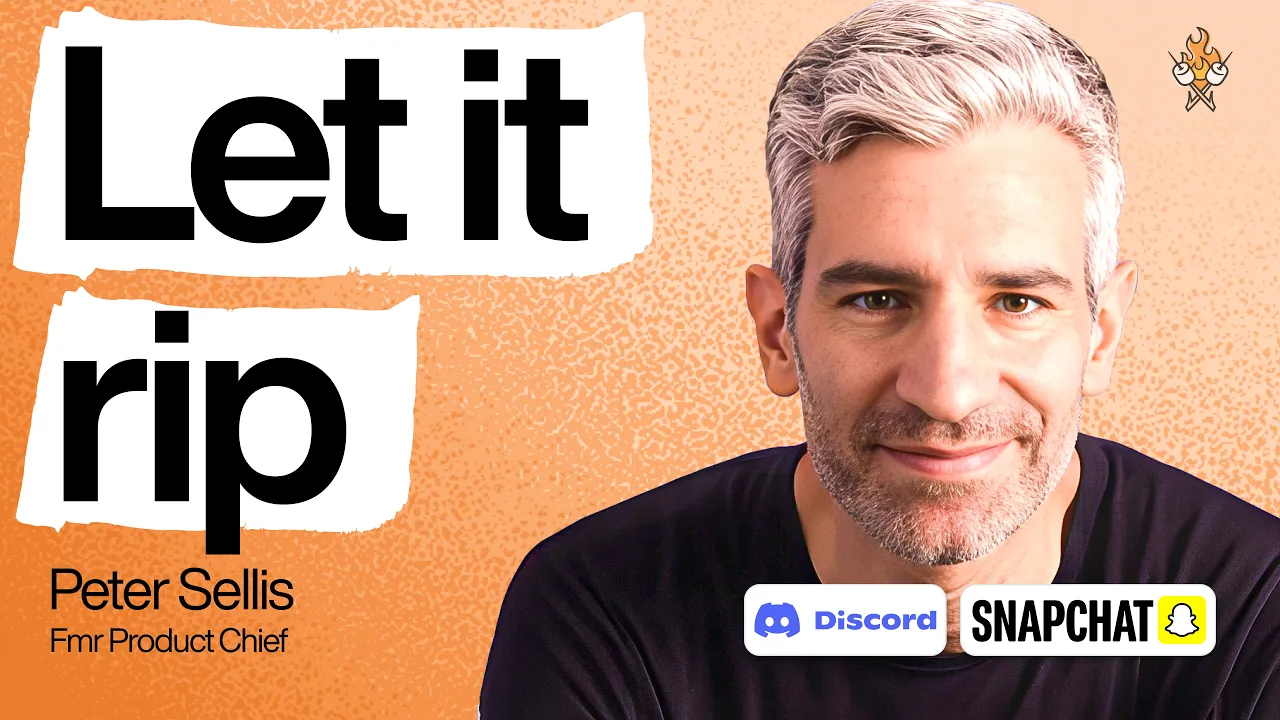
Ex-Discord Product Chief Sellis Models Teams on Insurgent Cells
Lenny's Podcast
Consumer apps compound growth by removing friction in the core product loop with small, ideologically aligned cells rather than chasing consensus collaboration or adjacent verticals.
Snap reached $4 billion in advertising revenue faster than Twitter, Reddit, and Pinterest despite operating with severe structural monetization headwinds, including opening directly to a camera rather than an ad feed and generating low revenue per minute spent on messaging. (25:03)
Durable consumer app growth compounds primarily through removing friction and latency in the core daily loop; Discord drove its fastest post-pandemic expansion in 2024 by optimizing core voice and gaming performance rather than relying on viral adjacent integrations like Midjourney. (50:50)
Product taste in the generative AI era requires aggressive curatorial restraint to delete features and resist additions, counteracting AI models and engineering workflows that default to lowering the cost of code and introducing feature bloat. (36:37)
High-velocity product organizations operate with higher operational leverage when structured like decentralized insurgent cells rather than consensus-driven teams, relying on deep ideological alignment and autonomous decision rights that match founder intuition. (5:45)
Detailed notes
## Background
Published on YouTube on September 20, 2026, by Lenny's Podcast, this episode features host Lenny Rachitsky in an in-depth conversation with Peter Sellis, the first product manager at Snapchat and former Head of Product at Discord. According to the show description, Sellis provides unfiltered product leadership advice free from corporate PR constraints, covering controversial organizational structures modeled after decentralized cells, managing spiky talent like Nikita Bier, Snap's monetization bottlenecks, and core product growth frameworks.
## TL;DR
Peter Sellis argues that elite consumer product organizations thrive on decentralized, ideologically aligned autonomous cells and heavy investment in spiky top performers rather than consensus-driven collaboration. Drawing from his time at Snap and Discord, he explains why foundational product choices—such as camera-first architecture, low latency, and messaging utilities—dictate monetization limits and compounding retention far more than vanity metrics or speculative expansions. He asserts that sustainable growth lives almost entirely within perfecting the core product loop for primary users, requiring product leaders to exercise curatorial restraint by aggressively killing good ideas to protect focus. Sellis concludes by outlining the defining oxymorons of top-tier PMs, who must simultaneously balance radical humility with arrogant conviction, operational rigor with rule-breaking demand avoidance, and long-term systems thinking with relentless daily urgency.
## Atmosphere & style
The conversation carries a blunt, behind-closed-doors intensity, trading sanitized tech platitudes for refreshingly sharp, irreverent pragmatism. Unconstrained by current corporate affiliations, Sellis speaks with punchy candor and provocative metaphors—comparing team mechanics to insurgent networks and talent wrangling to sports coaching—while Lenny serves as an inquisitive anchor who continually presses for the rigorous mechanics behind each contrarian take. The resulting dialogue feels like an intimate, high-velocity masterclass: intellectually uncompromising, mathematically grounded, and unapologetically direct.
## Bulletin
- [25:03](https://www.youtube.com/watch?v=97LRJUUPy_w&t=1503s) Snap reached $4 billion in advertising revenue faster than Twitter, Reddit, and Pinterest despite operating with severe structural monetization headwinds, including opening directly to a camera rather than an ad feed and generating low revenue per minute spent on messaging.
- [50:50](https://www.youtube.com/watch?v=97LRJUUPy_w&t=3050s) Durable consumer app growth compounds primarily through removing friction and latency in the core daily loop; Discord drove its fastest post-pandemic expansion in 2024 by optimizing core voice and gaming performance rather than relying on viral adjacent integrations like Midjourney.
- [36:37](https://www.youtube.com/watch?v=97LRJUUPy_w&t=2197s) Product taste in the generative AI era requires aggressive curatorial restraint to delete features and resist additions, counteracting AI models and engineering workflows that default to lowering the cost of code and introducing feature bloat.
- [05:45](https://www.youtube.com/watch?v=97LRJUUPy_w&t=345s) High-velocity product organizations operate with higher operational leverage when structured like decentralized insurgent cells rather than consensus-driven teams, relying on deep ideological alignment and autonomous decision rights that match founder intuition.
## Key takeaways
- [05:45](https://www.youtube.com/watch?v=97LRJUUPy_w&t=345s) High-velocity product teams function best when organized into decentralized, autonomous cells bound by strict ideological alignment and unambiguous decision rights rather than cross-functional consensus building.
- [11:19](https://www.youtube.com/watch?v=97LRJUUPy_w&t=679s) Managing anomalous, spiky talent requires bespoke organizational design modeled after sports coaches like Phil Jackson, absorbing the friction of non-standard behaviors to secure game-winning creative output.
- [15:16](https://www.youtube.com/watch?v=97LRJUUPy_w&t=916s) The median product manager is net-negative because compensation during the zero-interest-rate policy era attracted low-conviction talent, while top PMs systematically exit to become founders and executives.
- [18:18](https://www.youtube.com/watch?v=97LRJUUPy_w&t=1098s) Complaints regarding PM utility come almost entirely from middle-tier engineers; top engineers bend PMs to their will or refuse to work with bad ones, while low performers use PMs as blame shields.
- [20:49](https://www.youtube.com/watch?v=97LRJUUPy_w&t=1249s) Snap's advertising business faced three structural bottlenecks: strict age-based regulatory targeting cliffs, an interface that opens directly to the camera rather than a monetizable feed, and the low revenue-per-minute nature of messaging utilities.
- [30:04](https://www.youtube.com/watch?v=97LRJUUPy_w&t=1804s) Genuine systems thinking requires quantitative mathematical modeling of stocks, flows, and feedback loops as pioneered by Jay Wright Forrester, rather than relying on superficial MBA heuristics like the Five Whys.
- [35:27](https://www.youtube.com/watch?v=97LRJUUPy_w&t=2127s) Elite product taste functions like museum curation, requiring teams to build a large inventory of viable prototypes while maintaining the restraint to kill ideas that are individually better than most startups' best launches.
- [40:05](https://www.youtube.com/watch?v=97LRJUUPy_w&t=2405s) Monetizing conversational AI via advertising requires modified Vickrey-Clarke-Groves auctions that penalize low relevance and explicitly factor in the depreciation of user trust caused by sponsored answers.
- [46:32](https://www.youtube.com/watch?v=97LRJUUPy_w&t=2792s) Maximizing organizational Value Over Replacement Player requires heavily loading top performers with scope and defending them publicly, rather than investing managerial resources into rehabilitating underperformers.
- [50:50](https://www.youtube.com/watch?v=97LRJUUPy_w&t=3050s) True consumer growth compounds by shaving latency and eliminating friction for existing high-frequency daily users rather than chasing top-of-funnel acquisition or speculative adjacent verticals.
- [01:01:43](https://www.youtube.com/watch?v=97LRJUUPy_w&t=3703s) Avoiding catastrophic platform obsolescence requires actively self-disrupting legacy cash cows, illustrated by SpaceX phasing out the highly profitable Falcon 9 to force internal and external adoption of Starship.
- [01:07:01](https://www.youtube.com/watch?v=97LRJUUPy_w&t=4021s) As generative AI lowers the technical floor for software execution, extreme ambition and challenging teams to produce orders-of-magnitude improvements have become the primary differentiators in product leadership.
- [01:10:26](https://www.youtube.com/watch?v=97LRJUUPy_w&t=4226s) Ad platforms must adopt a 'long-term greedy' philosophy: artificially inflating prices or crowding feeds with ad load creates temporary revenue spikes at the direct expense of advertiser ROI, advertiser retention, and long-term enterprise value.
- [01:13:20](https://www.youtube.com/watch?v=97LRJUUPy_w&t=4400s) A product team must be anchored by a single, tightly defined Core Product Value statement that specifies both conceptually and quantitatively why users choose the product daily over every alternative.
- [01:16:33](https://www.youtube.com/watch?v=97LRJUUPy_w&t=4593s) Great PMs embody three paradoxical traits: intense conviction paired with humility, rigorous process paired with pathological demand avoidance toward arbitrary bureaucracy, and long-term systems thinking paired with relentless daily urgency.
- [01:23:34](https://www.youtube.com/watch?v=97LRJUUPy_w&t=5014s) Building breakout consumer products for distinct demographics often relies on inalienable, unteachable lived traits such as age, gender, and cultural background rather than standardized corporate hiring frameworks.
## Detailed walkthrough
### [00:00](https://www.youtube.com/watch?v=97LRJUUPy_w&t=0s) Teaser and Unfiltered Product Lessons
Lenny Rachitsky introduces the episode by highlighting Peter Sellis's contrarian perspectives on startup orthodoxy. Free from corporate communications oversight, Peter is ready to "let it rip." The conversation previews several provocative themes:
- Designing product organizations like "terrorist organizations"—anchored in deep ideological alignment paired with hyper-clear decision rights.
- A counterintuitive management philosophy: rather than rescuing struggling employees, double down on high performers and "ride your best people into the ground."
- Why the median product manager is net negative to a company, leading top talent to exit the discipline to become founders or executives.
- The high baseline required for PMs at companies like Snap, where operating without any PM was the starting assumption, requiring new hires to provide undeniable value over zero.
- The art of product taste and restraint, comparing product leadership to museum curation—evidencing Evan Spiegel's ability to discard ideas far better than most startups' best launches.
Lenny notes that Peter was the first product manager at Snapchat, spending seven years shaping the product before becoming Head of Product at Discord during a phase of massive user expansion. Acknowledging topic ideas from Jack Brody and Sriram Krishnan, Lenny tees up an unvarnished deep dive.
---
[02:53](https://www.youtube.com/watch?v=97LRJUUPy_w&t=173s) Why Peter Avoided Podcasts Until Now
Lenny welcomes Peter Sellis to the show, remarking that despite knowing each other for years, Peter had never previously appeared on a podcast. Peter jokes that he was simply avoiding Lenny, but then turns serious about why he historically stayed away from public appearances.
In Peter's view, many tech leaders appear on high-profile podcasts like Lenny's primarily for self-serving reasons:
> "A lot of times when I saw... somebody going on Lenny's podcast, I was like, 'Oh, that person's probably about to get fired and they're going on and they're pimping themselves out for their next role.' Why aren't they just grinding?"
Beyond that skepticism, Peter explains that his natural leadership style is direct and unvarnished. He brings an unfiltered authenticity to the workplace, with ideas and expressions usually better suited "behind closed doors." Now that he is between roles—free of PR or comms constraints, with no book to promote or startup to pitch—he feels comfortable offering candid, unvarnished insight.
---
[05:45](https://www.youtube.com/watch?v=97LRJUUPy_w&t=345s) Designing Teams Like Terrorist Organizations
Lenny probes Peter's provocative organizational design principle: structuring teams like a "terrorist organization." Peter laughs, admitting that the phrasing could use workshopping, and recounts how Discord's Chief People Officer was "simultaneously horrified and intrigued" when he first introduced the concept.
```mermaid
flowchart TD
accTitle: Terrorist Organization Team Model
accDescr: Two pillars of organizational velocity without excessive collaboration
subgraph Culture["Pillar 1: Ideological Alignment"]
A["Absorb Founder Vision"] --> B["Coin Sticky Mantras"]
B --> C["Religious Strategy Adoption"]
end
subgraph Execution["Pillar 2: Extreme Autonomy"]
D["Clear Decision Ownership (DRIs)"]
E["Decentralized Cell Execution"]
D --> E
end
Culture --> F["Zero-Coordination Velocity"]
Execution --> F
```
The underlying theory rests on two foundational beliefs:
1. **The hidden cost of collaboration:** Company leadership rarely tells teams to "stop collaborating," yet collaboration introduces severe coordination overhead. A team's speed is throttled by the slowest node in the network.
2. **Founder-level decentralized decision-making:** In high-growth environments, product managers must make the very decisions founders themselves would have made six to twenty-four months prior.
Stripped of the violent connotations, Peter points out that effective cell-based insurgent organizations succeed because of two core attributes:
- **An ideological culture:** Every single operative possesses a deep, quasi-religious understanding of why they are doing what they are doing.
- **A crisp decision architecture:** An unambiguous structure identifying exactly who is trusted with which decision—whether framed as directly responsible individuals (DRIs), single-threaded owners, or the single "throat to choke."
When strategy functions like an internal religion and decision rights are crystal clear, teams can bypass endless meetings and over-collaboration while delivering the exact outcomes intended by leadership. Peter views the Head of Product in a founder-led company as a direct vessel for founder vision, responsible for translating that overarching intuition into memorable, repeatable mantras that decentralized teams can execute autonomously.
[09:14](https://www.youtube.com/watch?v=97LRJUUPy_w&t=554s) Cults vs. Terrorist Organizations as Team Models
Peter Sellis reflects on how he structures teams, noting that he often relies on what are almost shortcuts or syntheses of an entire organizational strategy. Labeling his approach as "designing teams like terrorist organizations" serves as deliberate branding that immediately grabs people's attention, even if he jokes that he might need to workshop the phrasing. Lenny summarizes the two core operational pillars to extract from that provocative model:
1. Decentralized autonomy: trusting operators down the chain so the organization continues executing seamlessly if leaders are out of communication or unavailable.
2. Ideological clarity: aligning everyone around a clear, non-negotiable mission so decisions happen fast without endless bureaucratic checks.
Sellis points out that he never set out deliberately trying to build an organization modeled on terrorism. Instead, he worked backward from the structural properties he wanted: high autonomy, resilient small cells, and deep mission-driven execution. Looking around at real-world analogs that actually function that way under extreme pressure, he observed that terrorist networks matched the blueprint. He jokes that this led to an unusual, borderline "banned book reading list" for product management.
When Lenny compares this to building a company "cult," Sellis agrees that the two share significant DNA—quipping that "you can't spell culture without cult." However, he makes a critical distinction: cults are almost always organized around the ego and charisma of an individual person leading them, whereas terrorist networks are sustained by a devotion to a higher power, religion, or abstract ideology. Because ideologies outlast individuals, he prefers the latter framing. He jokingly adds that product leaders could study how cults operate right up to the "penultimate moment" before they cross the line into infamy, noting that there is a ton of operational "alpha" hidden in those dynamics.
[11:19](https://www.youtube.com/watch?v=97LRJUUPy_w&t=679s) Managing Nikita Bier and the Liam Neeson Analogy
The conversation turns to Nikita Bier, the viral app creator (TBH, Gas) and former Head of Product at X, who was acquired by Discord while Sellis was Head of Product there. Sellis remarks that using the word "manage" to describe working with Bier is quite a loose application of the term: "You don't manage Nikita, you only like seek to control him or like direct him."
```mermaid
flowchart LR
accTitle: The Nikita Bier Talent Framework
accDescr: Diagram illustrating when spiky talent excels versus when it struggles.
subgraph CoreDomain["Specialized Skill Set"]
A["Viral mechanics & loops"] --> B["High-impact execution"]
end
subgraph NonCoreDomain["Standard Operations"]
C["Routine maintenance"] --> D["Disruption & friction"]
end
```
Sellis compares Bier to Liam Neeson's character in the *Taken* franchise:
- **When to deploy him:** "If your daughter gets kidnapped, like he has a very special set of skills and he's going to employ those skills... and those skills are very hard to come by and very useful in certain situations."
- **Where the model breaks:** "When you like need him to like raise the daughter or like... buy some groceries... all he knows how to do is just like kill everybody in the grocery store."
When placed on the exact consumer problems where his intuition and viral loops shine, Sellis considers Bier a true "one of one" operator and an incredible collaborator, alongside the talented engineers who joined Discord with him.
[12:56](https://www.youtube.com/watch?v=97LRJUUPy_w&t=776s) Handling Spiky Talent and the Phil Jackson Philosophy
Lenny asks whether product organizations should deliberately make room for anomalous, difficult-to-categorize individuals. Sellis argues that being unable to accommodate "spiky talent" is an outright failure of organizational design. Great teams cannot simply be composed of uniform, conventional nine-to-five operators.
To illustrate how extreme this dynamic was with Bier, Sellis shares an anecdote from their time at Discord:
- Bier was actively consulting on the platform Intro while technically reporting up through Sellis at Discord.
- Sellis could not get Bier to respond to scheduled one-on-ones, ultimately having to message him across four separate chat apps.
- Frustrated, Sellis finally DM'd him: "Dude, if you don't fucking answer my DMs, I'm going to go on Intro and book you so I can just have a one-on-one with you right now." Bier finally answered before Sellis had to pay for the consultation.
Sellis models his leadership philosophy on legendary NBA coach Phil Jackson, who won eleven championships coaching the Chicago Bulls and Los Angeles Lakers:
- Jackson successfully meshed radically conflicting personalities (such as Michael Jordan, Dennis Rodman, Shaquille O'Neal, and Kobe Bryant) who often hated each other off the court.
- He synthesized Eastern and Western philosophies into a coherent operating culture.
- He won at the highest level both as an NBA player and across two separate coaching dynasties, making him one of the most significant leadership figures of the last half-century.
Sellis compares consumer product leaders who rely on creative taste to rock bands putting out studio albums. A brilliant band will occasionally drop a complete "dud album." True fans do not immediately abandon the artist over a single misfire; they recognize creative output is inherently variable. As an executive, if you believe in a spiky PM's core artistic taste, you ride out the bad releases knowing the hits will be extraordinary.
[15:16](https://www.youtube.com/watch?v=97LRJUUPy_w&t=916s) Why the Median PM Is Net-Negative
Lenny brings up Bier's tongue-in-cheek comment on an earlier podcast appearance that he "doesn't believe product management is real," alongside Whatnot CPO Tom Verrilli's critique of the craft. This prompts Sellis to explain his conviction that the median product manager is not only ineffective, but often net-negative to their company. Sellis jokes that high-earning leaders have become "a bunch of self-hating PMs who've like made a bunch of money being PMs are now like, 'Oh, PMs are bad.'" Yet behind the joke lies a rigorous statistical reality.
Sellis breaks down the mathematical mechanics behind the PM talent pool:
| Phase of Talent Distribution | Dynamics at Play | Impact on PM Talent Pool |
|:--- |:--- |:--- |
| **Normal Distribution Cutoff** | The innate ability for great product management is distributed across the broad population, but tech hires exclusively from the far right tail. | Once you lop off the general population and look only at practicing PMs, the profession functions as a steep power-law distribution where the median falls far below the mean. |
| **The Inflow Incentive (ZIRP era)** | PM became the single most lucrative non-technical career track in tech, paying on par with high-end engineering salary bands. | The ambiguity of the job description lured in massive waves of people who fought fiercely to stay inside the track purely for the compensation, skewing the median downward. |
| **The Outflow Drain (Top Tail Exits)** | The exact skills that make someone a world-class product manager—vision, taste, cross-functional leverage, execution—translate directly into executive leadership and entrepreneurship. | The best performers consistently exit the PM pool to become startup founders, CEOs, and C-suite executives, draining the top end of the distribution while low performers cling to the role. |
The combination of top-tier talent continually graduating out of the craft and median-to-low performers clinging tightly to lucrative compensation created a heavily distorted, bottom-heavy distribution across the tech industry—especially during the zero-interest-rate policy (ZIRP) era.
[18:18](https://www.youtube.com/watch?v=97LRJUUPy_w&t=1098s) The Midwit Curve of Product Management and the Post-ZIRP Reckoning
Lenny observes that the widespread sentiment that "PMs suck" or are entirely useless stems from the fact that most people have simply never worked with an exceptional one, leaving the median practitioner looking mediocre. Peter agrees, noting that much of modern tech discourse mirrors the classic "midwit meme." This dynamic is a direct second-order effect of the profession's talent distribution, though Peter believes the discipline is finally improving as the industry leaves behind the zero-interest-rate policy (ZIRP) era. When capital was free and interest rates hovered near zero, perceived opportunity costs plummeted, encouraging companies to casually hire extra heads without calculating the hidden friction and drag that mediocre talent introduces into an organization.
Peter has spent considerable time designing frameworks to evaluate product managers not in a vacuum, but in tandem with their specific operating environment to ensure they are genuinely net-positive to the team. In practice, high-performing engineers rarely complain about product managers: elite engineers either know how to bend PMs to their will to extract the exact utility they need, or they simply refuse to work with bad ones. In an ironic parallel to the midwit curve or horseshoe theory, the lowest-performing engineers also do not complain, because they can easily hide behind a PM’s poor decisions and directives. The complaints almost exclusively originate from the engineers stuck in the middle.
- **The ZIRP hiring hangover:** Artificially low interest rates masked the real opportunity costs of hiring superfluous and mediocre PMs, introducing organizational drag that was rarely internalized.
- **The engineering horseshoe:**
- *Top tier:* Directs PMs toward high-leverage execution and refuses to tolerate subpar partners.
- *Bottom tier:* Appreciates PMs as convenient shields to hide behind when projects fail.
- *Middle tier:* Suffers the friction and accounts for the vast majority of PM complaints.
---
[20:49](https://www.youtube.com/watch?v=97LRJUUPy_w&t=1249s) The Three Structural Hurdles of Snap's Ads Monetization
Turning to Snap, Lenny asks why the company seemed to fall short of early expectations that it would become the next Meta, wondering whether targeting a notoriously difficult-to-monetize demographic was the core bottleneck. Peter prefaces his answer by admitting to a personal chip on his shoulder—having dedicated seven years of his life to building the platform—while striving to remain strictly analytical. While subscriptions like Snapchat+ have performed well, digital advertising remains the ultimate mathematical engine for consumer internet monetization. Peter outlines three structural headwinds that made scaling an ads business at Snap uniquely grueling:
```mermaid
flowchart TD
accTitle: Snap Ads Monetization Bottlenecks
accDescr: Three structural constraints that hindered Snap advertising compared to traditional social feeds.
subgraph Constraints["Core Structural Constraints"]
A["Audience Demographics<br/>(Severe CPM cliff under 18/21;<br/>strict privacy & tracking rules)"]
B["Camera-First Interface<br/>(Opens to creation, not consumption;<br/>no natural display ad insertion)"]
C["Messaging Core Utility<br/>(High utility, low dollar-per-minute spent;<br/>hostile ad environment)"]
end
subgraph Impact["Monetization Outcome"]
D["Lower Relative ROI & Ad Load"]
E["Steep Uphill Battle for Multi-Billion Dollar Scale"]
end
A --> D
B --> D
C --> D
D --> E
```
First, Snap’s user base was intensely skewed toward Gen Z and Gen Alpha. In digital advertising, there is a dramatic discontinuity—a steep CPM cliff—between users under 17 versus those who are 18 and 21. Regulatory restrictions legitimately and strictly guard how teenagers can be tracked, targeted, and measured. Because it is nearly impossible to run tight performance tracking on minors, driving and proving ROI for advertisers is radically harder than it is on platforms like Instagram, Pinterest, or Twitter.
Second, virtually every successful display ads business opens directly onto a content consumption feed, maximizing ad impressions from the first millisecond of user attention. Snapchat intentionally opens to the camera to optimize for being the fastest way to capture and share moments with friends. While this makes for brilliant visual communication product design, the core loop of taking a photo and sending it offers no logical slot to insert an advertisement. Peter candidly characterizes his inability to crack camera monetization as one of the biggest failures of his career.
Third, Snapchat is fundamentally a messaging utility rather than an entertainment feed. Messaging apps worldwide—even prominent Asian chat platforms—generate remarkably low revenue per unit of time spent compared to passive media feeds. Trying to build a multi-billion-dollar ads empire on a utilitarian, privacy-sensitive messaging engine meant running uphill against the fundamental economics of the medium.
---
[25:03](https://www.youtube.com/watch?v=97LRJUUPy_w&t=1503s) A "Gen Z Berkshire Hathaway" and the Underrated Ads Scale
Despite those inherent constraints, Peter emphasizes that Snap’s underlying consumer product footprint is historically extraordinary. He describes the company as a veritable "Gen Z Berkshire Hathaway," bundling category leaders that dominate teen attention across nearly every Western market:
| Core Service Category | Product Footprint & Teen Market Position |
|:--- |:--- |
| **Direct Messaging** | #1 messaging platform among teens in most Western nations (70%–100% penetration under 21). |
| **Geospatial & Mapping** | Default map (Snap Map) used more frequently by teens than Google Maps or Apple Maps. |
| **Camera & Capture** | The default, most widely used camera interface for mobile generation cohorts. |
| **Lifestyle & Utility** | The leading astrology service and core social identity utility for youth culture. |
Peter gives full credit for this run to Snap's early design team, which produced an unprecedented string of consumer hits. His frustration with the public narrative stems from the fact that Snap launched well after Twitter, Reddit, and Pinterest, yet went public before Reddit and Pinterest and reached $4 billion in advertising revenue faster than any of them. While Twitter served as the global town square for high-net-worth individuals and Pinterest functioned as a high-intent virtual shopping wishlist, Snapchat was initially written off as a toy for sending disappearing photos. Scaling a multi-billion-dollar ads business under those structural disadvantages remains an exceptional operational achievement, making Snap one of the few true 100-million-plus DAU consumer platforms built in the United States that genuinely deserves deep study.
[27:28](https://www.youtube.com/watch?v=97LRJUUPy_w&t=1648s) Subscription Math and What If Snap Had Launched Snapchat+ Earlier
Lenny notes that during his podcast conversation with Evan Spiegel, he pointed out that Snapchat was essentially the last massive, successful consumer social product to launch twelve years prior—discounting TikTok, which functions far more as an algorithmic media and entertainment feed than a peer social network. Peter caveats that Discord technically launched in 2015, though he characterizes Discord as an entirely different vibe occupying "the world's biggest niche," which is gaming.
Lenny then poses a contrarian hypothesis: given Snapchat’s historically lean product management bench, could an argument be made that having *more* PMs would have actually helped the company? While Snap designed one of the most beloved, delightful, and addictive consumer experiences in modern tech, its core business and monetization engine remained an uphill battle—an area where commercial PMs typically shine. Peter examines this through the lens of Snapchat+, Snap’s subscription offering. He explains that subscription mechanics are inherently unforgiving because time acts as a brutal adversary:
> "Subscription products are tough because the math around them is pretty brutal. Essentially, time is your enemy with subscription products... Anything you do takes a lot of time to matriculate in terms of impact."
With utility-driven messaging networks like Snapchat or Discord (with Discord Nitro)—unlike pure content libraries such as Spotify or Netflix—users do not open the app on day one ready to spend $5 or $20 a month. Instead, they first acclimate to the daily utility and form deep social habits; only then does the marginal value of a subscription become legible. Consequently, subscriber penetration builds slowly and linearly cohort over cohort. Peter wonders whether launching Snapchat+ four years earlier might have altered Snap’s entire corporate trajectory: steady subscription revenue would have alleviated the immense pressure on the ad business to scale aggressively, giving the product team far more creative license on the content consumption side to take on TikTok directly.
```mermaid
flowchart TD
accTitle: Messaging Utility Subscription Dynamic
accDescr: Diagram illustrating how daily messaging utility slowly feeds subscription revenue and relieves pressure on advertising monetization.
subgraph Monetization["Monetization Tradeoffs"]
B -->|"Slow, linear cohort maturity"| C["Subscription Revenue (Snapchat+)"]
C -->|"Reduces revenue urgency"| D["Lower Pressure on Ads Business"]
D -->|"Preserves user experience"| E["Freedom to Innovate on Content & Video"]
E -.->|"Competes directly with"| F["TikTok & Competitors"]
end
```
- **Messaging utility vs. content subscriptions**: Unlike Netflix or Spotify, where immediate catalog access drives instant sign-ups, messaging utilities require extensive usage runway before users perceive value in paying a recurring fee.
- **Strategic ripple effects**: Earlier subscription adoption could have decoupled content design decisions from immediate ad load requirements.
---
[30:04](https://www.youtube.com/watch?v=97LRJUUPy_w&t=1804s) Systems Thinking: Moving Beyond the "Slinky Book" and Five Whys
Lenny laughs that "systems thinking" has now surfaced on seven consecutive podcast episodes—most prominently during his discussion with Netflix CPTO Elizabeth Stone. Peter jokes about how Silicon Valley professionals casually pick up Donella Meadows’s *Thinking in Systems* (the famous book with the slinky on the cover), read a chapter, and suddenly declare themselves systems thinkers.
In Peter’s view, the most critical yet neglected foundation of true systems thinking is a mathematical background capable of describing systems in precise, quantitative terms. Rather than relying on fuzzy qualitative frameworks, an actual systems thinker maps out stocks, flows, and the underlying statistical distributions of inputs and outputs—distinguishing between bimodal phenomena and normal distributions. Peter pokes fun at corporate management trends like the Toyota "5 Whys":
> "It's this famous method—it's a very like MBA-ish type thing, but ironically it kind of works... It’s apparently just asking 'why' five times, and like, then you get to the bottom of things. That’s how the majority of people, when they say it’s systems thinking, I think they’re basically just saying, 'I asked why five times and I got to the first principle.'"
Instead of settling for pop-business heuristics, Peter advocates returning to Jay Wright Forrester’s system dynamics work from 1970s industrial manufacturing. Lenny points out that building a simple spreadsheet model—identifying every variable, input, output, and probability lever—forces a practitioner to see the holistic machine clearly. Peter agrees: even if that spreadsheet never leaves a personal Google Drive folder, the rigorous act of modeling is profoundly clarifying for any product leader.
- **Stocks and flows**: True system modeling requires tracking accumulating reservoirs (stocks) and the rates at which they fill or drain (flows).
- **Distribution literacy**: Understanding whether user behaviors or conversion levers follow a normal Gaussian curve or a bimodal distribution is essential for predicting outcomes.
- **Foundational reading**: Peter points back to Jay Wright Forrester’s pioneering system dynamics over superficial business-school shorthand.
---
[32:19](https://www.youtube.com/watch?v=97LRJUUPy_w&t=1939s) Instagram's Copycat Playbook: When Meta Cloned Even the Broken Features
Lenny points out the humor in Instagram launching its own paid subscription efforts soon after Snapchat+, calling it another classic chapter in Meta's long-running habit of cloning Snap’s product footprint. Peter recalls how surreal it was inside Snap during the peak era of Meta's replication efforts. Instagram monitored Snap so obsessively that they copied features that were outright failing internally:
> "There was early on, I remember at Snap, it was like so funny to see how aggressively Instagram was copying that they were actually copying some of our worst features—ones that weren't working—just because I think they just like assumed everything that we were touching was turning to gold."
While certain cloned concepts never mapped cleanly onto Instagram’s social graph—such as their attempts to replicate the geographic intimacy of Snap Map—Peter readily acknowledges that Instagram’s execution of Stories became world-class. He admits that you would be hard-pressed to argue against Instagram’s implementation ultimately surpassing Snap’s original format. Backed by elite human-computer interaction (HCI) designers and guided by Adam Mosseri’s refined design taste, Instagram re-architected Stories from first principles to fit the lifestyle aesthetics and browsing ergonomics of their specific platform.
- **Blind feature copying**: Meta copied several underperforming Snapchat features on the assumption that every experiment Evan Spiegel’s team shipped had underlying consumer traction.
- **Architectural divergence**: While location-based utilities like Snap Map faltered on Instagram, Instagram Stories succeeded because it was rebuilt around Instagram's specific visual culture and feed ergonomics.
---
[33:32](https://www.youtube.com/watch?v=97LRJUUPy_w&t=2012s) Software Moats, Hardware Bets, and the Museum Curator Theory of Taste
Lenny references his earlier interview with Evan Spiegel, where Evan argued that pure software UI is no longer a durable moat against fast followers. Because interface paradigms are instantly cloned, Evan shifted Snap’s long-term enterprise value toward hardware (such as AR Spectacles), proprietary hardware-software ecosystems, and defensible network effects. Peter expresses deep admiration for Spiegel, arguing that Evan was essentially right about nearly every consumer trend—just years ahead of the broader market. Snap was deploying on-device machine learning for augmented reality lenses and expressive avatars long before the generative AI wave took hold:
> "I have tremendous respect for Evan and I think he's essentially been right on almost everything—just early on some stuff. Maybe early on everything, actually... All of the on-device AR that we were doing was at the time more just called machine learning, but employed some form of machine intelligence that was super avant-garde at the time."
However, Peter observes that Snap's financial profile has struggled to bankroll the exorbitant capital expenditures demanded by frontier hardware development. Compounding this is the unresolved monetization ceiling, for which Peter candidly takes personal responsibility as Snap's former ad product leader. Because the public markets have been unwilling to grant Evan the runway to see his long-range hardware thesis through, Evan often carries the aura of a misunderstood, "rejected artist" operating on the outskirts of mainstream tech.
```mermaid
flowchart LR
accTitle: The Museum Curator Model of Product Taste
accDescr: Diagram contrasting high-taste restraint (curation) against low-taste execution where every idea is shipped.
subgraph ideation["Ideation & Prototyping"]
A["Vast Collection of High-Quality Ideas"]
B["Working Prototypes"]
end
subgraph curation["The Curatorial Filter (Restraint)"]
C{"Taste Filter:\nIs society/product ready?"}
end
subgraph output["Shipped Product"]
D["Small, Deliberate Slice Exposed to World"]
E["High-Quality Prototypes Kept on the Shelf"]
end
A --> B --> C
C -->|"Selected for this cultural moment"| D
C -->|"Saying 'No' with restraint"| E
```
This dynamic leads Peter to define the elusive concept of "product taste." At Snap, Peter witnessed Evan personally reject concepts that were substantially better than the headline features most consumer startups ever launch. Peter came to see his own mission as a product leader as helping high-growth founders operate like the world's greatest museum curators:
* **The Curatorial Reserve**: At any given time, the live consumer product should represent only a tiny, carefully selected slice of the organization’s overall vault of ideas.
* **Societal Timing**: Great curators only pull a piece from the archives when the cultural moment, hardware capability, and user psychology align.
* **The "Shelf" Interview Question**: To test a candidate’s taste, Peter skips asking about features that failed in A/B tests. Instead, he asks candidates to describe brilliant prototypes they held in their hands, loved, and deliberately decided *not* to ship because they recognized the world—or the product—simply wasn't ready.
[36:37](https://www.youtube.com/watch?v=97LRJUUPy_w&t=2197s) Taste, Museum Curators, and the Art of Saying "No" in the AI Era
Peter Sellis returns to his core metaphor for product taste: the museum curator. If a museum hangs every single piece of its collection up on the walls, the curator has failed entirely at their job. Taste is fundamentally about what you choose *not* to display, and Peter notes that Evan Spiegel is probably the best in the industry at exercising this exact restraint.
Lenny connects this directly to modern AI-assisted product development. AI models are notoriously bad at cutting or subtracting elements—they constantly suggest additions rather than advising teams to delete unnecessary cruft. As AI becomes deeply embedded in design and coding workflows, the quintessential human taste will lie in knowing what to strip away. Peter agrees, noting that while generative tools will democratize creation across code, design, photo, video, and eventually physical goods, lowering the barrier to entry floods the world with output. That shift will place immense pressure on building things that actually deserve scarce human attention.
For product managers, this creates an essential new operating muscle: pushing back against the torrent of AI-generated suggestions and enthusiastic engineers asking to bolt on new features. As Lenny jokes about the recurring theme of the podcast, maybe the world simply needs more PMs to serve as the barrier against feature bloat.
Lenny shares his experience with Mercury for business banking, specifically highlighting Mercury Spend for expense management. He notes that running a company on a single credit card inevitably breaks down as teams scale, leading to missing receipts, policy violations, and administrative bottlenecks. Mercury integrates cards, limits, automated receipt capture from Gmail and SMS, and reimbursement workflows directly into the core banking dashboard—even allowing teams to issue dedicated spend cards with tailored policies for AI agents.
[40:05](https://www.youtube.com/watch?v=97LRJUUPy_w&t=2405s) OpenAI, Ads, and the Trust Auction Mechanism
Turning to monetization, Lenny asks about the connection between Snapchat's ad platform trajectory and OpenAI's exploration of advertising inside ChatGPT. Peter affirms his belief in the thesis popularized by analyst Eric Seufert: advertising remains the ultimate, natural product-market fit for the consumer internet, largely due to mathematical realities that make subscription models overrated by comparison for consumer-scale products.
Peter argues that OpenAI possesses a distinct "last-mover advantage." Meta essentially solved modern digital advertising infrastructure between 2010 and 2020, meaning OpenAI can speedrun building a state-of-the-art auction marketplace rather than reinventing the wheel. Meta's true breakthrough was moving beyond simple highest-bidder mechanics by implementing a modified Vickrey-Clarke-Groves (VCG) auction. In that system, the organic quality and relevance of an ad are factored into the clearing price, forcing an advertiser to pay significantly more if their creative is annoying or irrelevant to an individual user. This allows a platform to multiplex organic content and ads within a single unified auction using dollars as the common denominator.
```mermaid
flowchart TD
accTitle: VCG Trust-Adjusted Auction Mechanism for Chat
accDescr: Diagram illustrating how user intent, advertiser bids, and trust penalties combine in a modified VCG auction to select the optimal chat response.
subgraph Inputs ["Auction Inputs"]
U["User Prompt: 'What mic should I buy?'"]
A["Advertiser Bids & Relevance"]
end
subgraph Output ["User Experience"]
R["Optimized Recommendation<br/>(Objective value balanced against ad revenue)"]
end
U --> M
A --> M
M --> T
T --> R
```
Applying this model to conversational AI, Peter explains that the variable replacing "organic feed value" must be **trust**. When a user asks ChatGPT, "What microphone should I buy?", the system has to weigh providing an objective answer against accommodating paid advertiser influence:
- **Trust trade-off as a pricing parameter:** The auction must mathematically calculate how much user trust is being compromised by surfacing a sponsored recommendation, pricing that depreciation directly into the ad slot.
- **The Amazon cautionary tale:** Amazon search demonstrates what happens when the auction leans too aggressively toward monetization. While Amazon's core value (selection and delivery speed) keeps users around, encountering 16 sponsored listings before reaching an organic result subtly erodes trust in the underlying interface.
- **The next design frontier:** Peter considers the design of ad formats within AI chat or voice interfaces to be a societal-level product role, though he expresses disappointment that OpenAI immediately partitioned paying tier users into an ad-free silo. Rather than lopping off the most valuable user segment, well-designed ads could theoretically be additive across standard conversational contexts outside of pure coding or deep work.
The segment wraps with light banter as Lenny teases Peter for sipping from what looks like a vodka bottle during an ad systems breakdown. Peter counters that it is merely "really fancy douchy water"—though he jokes that if the podcast runs long enough, he might actually need to swap it out for vodka. Lenny jokes that the deep breakdown serves as Peter's unofficial job interview for OpenAI's ad lead role, which Peter playfully acknowledges as a free agent.
[46:32](https://www.youtube.com/watch?v=97LRJUUPy_w&t=2792s) Riding Your Best People into the Ground
Lenny introduces a set of four counterintuitive lessons from Peter Sellis’s career that directly contradict conventional startup and leadership dogma. The first of these is Peter’s unapologetic habit of riding his top performers into the ground rather than spending time trying to elevate average performers. Lenny jokes that pairing this with Peter’s earlier philosophy about structuring teams like decentralized cells creates a wild picture: "He’s building terrorist organizations and all he does is ride his best people into the ground," joking that there must be an active Discord therapy group for product managers who have worked under him. Peter laughs and agrees, connecting this approach directly to the concept of VORP (Value Over Replacement Player) and the classic adage: if you want something done quickly, give it to the busiest person in the room.
Peter admits that his philosophy runs directly counter to empathetic human nature. When you see someone drowning, the instinct is to jump in and save them; Peter does the complete opposite. Bringing up the concepts of "nominative determinism"—joking that with a last name like Sellis he should have been in sales—and the "Peter principle," where people are promoted to the level of their incompetence, Peter explains that he deliberately pushes high performers to find their ceiling. When someone is crushing it, he keeps handing them more rope and loading them with harder responsibilities until they reach the point of breaking. His side of the contract is absolute public loyalty: he will fiercely defend his team in front of executives and never criticize them publicly. If an operator consistently makes sound decisions, he expands their mandate until they begin making mistakes, capitalizing on the self-fulfilling momentum of confidence. Conversely, Peter admits he has little patience or effective machinery for rehabilitating struggling employees; he lets them fail on their own, acknowledging this can be painful and frustrating for those on the receiving end.
```mermaid
flowchart TD
accTitle: Talent Allocation Strategy
accDescr: Peter Sellis's management model contrasting top-tier operators against struggling performers.
subgraph HighPerformers["Top Performers (Racehorses)"]
A["High Competence & Taste"] --> B["Heap on Scope & Decisions"]
B --> C["Defend Unconditionally in Public"]
C --> D["Push to the Breaking Point"]
end
subgraph LowPerformers["Underperformers"]
E["Struggling Execution"] --> F["No Rehabilitation Pipeline"]
F --> G["Let Them Fail on Their Own"]
end
```
- **Defending in public**: Peter adheres strictly to a rule where team members are backed unconditionally in executive settings, keeping critique entirely private.
- **The nuance of hands-off leadership**: Peter cautions that when running this playbook, leaders must make sure employees understand that being left alone does not mean they are failing—trusted, repeat collaborators are simply given the space to execute without interference.
- **Operating maxim**: "Spend time with your winners, ride your racehorses, give a busy person something to do if you want it done quick."
---
[50:13](https://www.youtube.com/watch?v=97LRJUUPy_w&t=3013s) The Problem with Consensus and Overrated Collaboration
Lenny moves to the second counterintuitive principle: Peter’s conviction that traditional workplace collaboration is often a massive waste of time. Peter points out that when organizations sit down to define their core team values, principles, or operating tenets, they frequently produce anodyne statements that no reasonable person could ever disagree with.
In Peter’s view, if a stated principle cannot be credibly argued against, it is completely meaningless as an operational guidepost. Corporate enthusiasm for blanket "collaboration" frequently falls into this trap, acting as a cover for slow consensus-building, diluted conviction, and endless meetings where accountability disappears. Real leadership requires embracing tenets that actively challenge default organizational behavior, even if that means rejecting collaboration in favor of autonomous, high-conviction decision-making.
---
[50:50](https://www.youtube.com/watch?v=97LRJUUPy_w&t=3050s) Why Real Growth Lives in the Core Product: Lessons from Snap and Discord
The third counterintuitive insight is that meaningful growth almost always comes from optimizing the core product rather than expanding into speculative adjacent verticals or new market segments. Peter explains that network-effect-driven businesses have an organic, implicit desire to expand on their own. Driving growth is therefore not about reinventing the wheel, but rather taking the people who already use—or want to use—the product for its primary purpose and removing every trace of latency and friction. He argues that consumer tech must obsess over daily active use (DAU) because daily habits map to biological circadian rhythms. Weeks and months are largely arbitrary or reserved for transactional tasks like paying bills, meaning consumer products rely fundamentally on their daily active to monthly active user (DAU/MAU) ratio. Moving that ratio by just a few basis points yields dramatically higher compounding value than acquiring transient monthly users, because a daily user is worth thirty once-a-month visitors.
Peter illustrates this with two major operational turnarounds at Snap and Discord:
1. **Snap’s 2018 Performance Renaissance**: Following the disastrous 2018 app redesign—the only quarter in Snap’s history where overall DAU flattened out sequentially—the product team stopped chasing distractions and focused ruthlessly on technical performance, specifically re-architecting the Android app for existing users. Making the core experience lightning fast triggered a growth renaissance that compounded for years.
2. **Discord’s 2024 Gaming Refocus**: During the boom of generative AI, Midjourney built its entire interface on Discord, creating a massive wave of outside hype. Pundits assumed Midjourney was driving a historic inflection for Discord, but Peter notes that looking at Discord’s actual metric charts, you cannot even pinpoint when Midjourney launched. Discord’s existential use case was and remains connecting friends before, during, and after playing multiplayer games. In 2024, Peter redirected the team entirely back to making Discord the premier home for intentional multiplayer gaming. Despite widespread assumptions that Discord already had 100% penetration among PC gamers, thousands of marginal frictions caused players to drop into in-game chat or FaceTime instead. By eliminating those core voice and gameplay frictions, Discord unlocked its fastest growth since the pandemic.
```mermaid
flowchart LR
accTitle: Core Product Growth Engine
accDescr: The cycle showing how eliminating friction in core habits drives DAU and retention over top-of-funnel expansion.
subgraph CoreLoop["Core Habit Optimization"]
A["Existing Core Users"] --> B["Remove Performance Friction"]
B --> C["Higher Intentional Frequency"]
C --> D["Higher DAU/MAU Ratio"]
D --> A
end
subgraph ExpansionTrap["The New Market Distraction"]
E["Speculative Segments / Hype"] --> F["Transient MAU Spikes"]
F --> G["Low Retention Decay"]
end
```
- **The math of DAU vs. MAU**: Because thirty monthly users are mathematically required to equal the activity of a single daily active user, consumer apps should focus on day-over-day retention rather than raw top-of-funnel acquisition.
- **The Midjourney reality check**: Despite tremendous mainstream press and technical brilliance, third-party platform phenomena like Midjourney did not visibly move Discord's baseline active user curves compared to the core multiplayer gaming network loop.
- **The PC gaming penetration myth**: Even when a platform seems to possess total market share within a vertical, subtle edge-case frictions (such as choosing in-game audio over Discord voice) represent massive untapped usage ready to be unlocked through performance gains.
[55:34](https://www.youtube.com/watch?v=97LRJUUPy_w&t=3334s) "There's Always Money in the Banana Stand": Growing Through Core Users and Gamers
While many distinct domains mimic the dynamics of multiplayer gaming—such as crypto with its time-sensitive coordination costs, or even collaborative software development—Discord achieved massive scale by ruthlessly prioritizing people playing games with their friends. Peter Sellis explains that unlocking meaningful expansion often comes down to moving core user engagement upward: taking someone who uses the product 10 days out of 30 and shifting them to 11, 12, or 13 days. Borrowing the concept of "L-ness" (such as L7/7 engagement) from Meta's growth playbook, focusing on the core consumer base consistently yielded compounding returns at both Snap and Discord.
Lenny summarizes this dynamic with the classic *Arrested Development* adage: "There's always money in the banana stand." Peter wholeheartedly agrees, noting that if you could enshrine that phrase into a strategy document, it perfectly captures the value of returning to your core users to make the product flawless for them. At Discord, this intense focus produced massive positive externalities because video gamers represent "the most vocal, critical, honestly like intelligent or like high-IQ user base in the world."
When Discord took the posture of going into Reddit bug threads and telling gamers, *"Show us what's messing up. We don't care how small it is, how big it is. We will fix it,"* it established an unmatched brand position. Having engineers in the office dedicated to perfecting the platform for friend groups playing games created a product that remains essentially without peer in its niche.
```mermaid
flowchart TD
accTitle: Discord Core Engagement Flywheel
accDescr: Flowchart illustrating how fixing bugs for core gamers drives L-ness and organic growth.
subgraph CoreLoop["The Banana Stand Loop"]
A["Focus on Core Gamers"] --> B["Tackle Hyper-Critical Feedback<br>(Reddit bug threads)"]
B --> C["Deliver Flawless Voice & Usability"]
C --> D["Drive Up 'L-ness'<br>(e.g., 10/30 days to 13/30 days)"]
D --> A
end
```
- **Multiplayer dynamics in other verticals:** Crypto coordination and software engineering share high coordination costs with multiplayer gaming, but Discord resisted premature dilution to stay gamer-first.
- **The power of "L-ness":** Shifting core users from 10 active days per month to 11–13 days produces monster compounding growth compared to acquiring low-intent new users.
- **Serving high-IQ user bases:** Gamers are uniquely sensitive to latency, bugs, and UI quirks; solving their grievances creates ironclad product loyalty.
---
[57:50](https://www.youtube.com/watch?v=97LRJUUPy_w&t=3470s) Expanding Beyond the Core: Concentric Circles and Backcasting
When Lenny asks how consumer product leaders should decide when to place bets outside their proven core product-market fit, Peter outlines two incremental methods and one radical, first-principles method:
1. **The MBA 2x2 Matrix:** Break down your product's core superpower (such as the camera for Snapchat or voice infrastructure for Discord) and evaluate adjacent cohorts or niches that desperately need that specific primitive.
2. **Concentric Circles (User Pull):** Pay close attention when users jump through extra hoops to use your product for an unintended purpose. At Discord, users began bending voice channels and servers to build massive online communities rather than small, 20-person gaming friend groups. Because users are "voting with their feet," product teams can simply pave the cowpaths and make those workarounds native.
3. **Backcasting (The Snapchat Approach):** Rather than moving incrementally from the present, teams envision an unconstrained future based on the company's core philosophy. For instance, sharing a real-world moment by pulling out a smartphone, opening an app, and pointing a lens is deeply constrained by current hardware limits; backcasting asks what the ideal sharing experience looks like in the future, naturally pointing toward hardware like smart glasses (Spectacles).
Peter observes that very few product leaders possess genuine "blank-sheet creativity" unencumbered by existing paradigms. Instead of inventing fundamentally new futures, most creative people merely remix the present—quipping that nowadays, product managers "go on like an ayahuasca journey or travel to Japan or something and then come back and they're like, 'I've solved it.'" Lenny reinforces this humility using Airbnb: despite years of experimentation, virtually nothing outside Airbnb's core home-sharing engine (driving liquidity across supply and demand) ever moved the company's growth needle in a transformative way.
---
[01:01:43](https://www.youtube.com/watch?v=97LRJUUPy_w&t=3703s) The Thanksgiving Turkey Problem and SpaceX's "Burn the Ships" Strategy
Relying entirely on refining the core comes with a severe structural risk, which Peter compares to Nassim Taleb's parable of the Thanksgiving turkey: for 1,000 days, life gets incrementally better and safer, until day 1,001 arrives and an external event takes you to zero overnight. While guarding against such black-swan disruptions is notoriously difficult, Peter points to SpaceX as an extraordinary operational example of an incumbent actively disrupting itself.
With his wife working as a SpaceX engineer, Peter holds a close vantage point on the company's execution, calling SpaceX "the greatest American company right now" and the greatest in the world. He highlights their bold decision to sunset the Falcon 9 launch vehicle in favor of Starship. The Falcon 9 is objectively the most successful, reusable, and cost-effective rocket in human history—a machine whose launch economics every nation on Earth would gladly trade GDP to acquire.
Yet, SpaceX is deliberately telegraphing that Falcon 9 rides will phase out because achieving their ultimate interplanetary vision requires a super-heavy-lift platform. Peter describes this as a "Cortés-level burn the ships upon arriving" moment:
- **Forcing the future:** Retiring the undisputed global standard in rocketry forces both customers and internal engineering teams onto Starship.
- **Reverse Innovator's Dilemma:** By voluntarily cannibalizing their own cash cow before a competitor can even approach parity, Elon Musk built a culture that would make the late Clayton Christensen "shed a tear over how happy it would make him."
[01:04:31](https://www.youtube.com/watch?v=97LRJUUPy_w&t=3871s) Avoiding the Innovator's Dilemma: SpaceX and Burning the Ships
Reflecting on SpaceX’s strategy of obsoleting its own successful rockets, Peter Sellis highlights how rare it is for an organization to sidestep the classic innovator's dilemma. Most dominant companies protect their prize assets, but SpaceX is "completely willing to build the thing that will compete against ourselves and make the thing that we built irrelevant." Top to bottom throughout the organization, employees share an unshakeable conviction that this cannibalization is simply what must happen. While outsiders might see it as organizational madness—or a cult—Peter considers their willingness to essentially "burn the ships" to pursue what is next to be one of SpaceX's most underrated strengths.
Lenny ties this back to Peter’s earlier framework of running teams like mission-driven insurgencies. When a company rallies around an all-consuming North Star—like making humanity multi-planetary and reaching Mars—every roadmap decision clarifies itself. If getting to Mars demands a vastly larger spacecraft like Starship, pouring endless capital into yesterday’s rocket stops making sense.
Peter points out another defining trait of Elon Musk's major ventures, SpaceX and Tesla: their willingness to publish literal decade-long master plans directly on their websites. The original Tesla roadmap transparently detailed building an expensive sports car (the Roadster) to fund the Model S, which in turn funded the Model 3. SpaceX followed a similarly brazen, publicized trajectory. For a product executive, Peter views this as the ultimate form of organizational swagger:
> "As a product leader, like I aspire to that level of swag where it's just like, 'Yo, we're going to do something that's so aggressive and so ambitious that we can just tell you exactly what [we're] going to do because if you think you can do it better than us, like you're welcome to try.'"
Not only did Tesla lay out its entire long-term plan in advance, but it went so far as to open-source all of its electric vehicle patents to invite competitors to catch up if they could.
[01:07:01](https://www.youtube.com/watch?v=97LRJUUPy_w&t=4021s) Ambition as an Unnatural, Trainable Muscle
Lenny observes a recurring theme from recent podcast conversations: alongside systems thinking, ambition has become the critical differentiator for modern builders. Because generative AI tools allow engineers and founders to manifest software with simple prompts, the floor of execution has collapsed, forcing the baseline level of human ambition to rise dramatically. Yet humans are not naturally wired for extreme ambition; evolutionary survival favors the safe and predictable over the seemingly impossible.
Peter agrees that fighting the status quo requires intentional, uncomfortable effort. Whether analyzed through local versus global optima or basic opportunity cost, overcoming inertia demands deliberate courage:
- **Overcoming static friction:** The default state of the world resists change, and moving beyond where you are requires a powerful counteracting force.
- **Velocity vs. Acceleration:** It is never enough to look at current position or even existing velocity; you need acceleration, which requires applied force and impulse—a figurative "third derivative."
- **Institutional resistance:** Leaders who can systematically push organizations to achieve step-function shifts without causing chaotic internal friction remain exceptionally rare.
Lenny references a recent appearance by Tara Seshan, Head of Product for ChatGPT Work at OpenAI, who argued that modern product managers must see their primary role as elevating team ambition—constantly challenging the room to imagine what a "1,000x version" of an idea would look like.
Peter jokes that this skill requires deep credibility, noting that anyone can stumble into an engineering review with gray hair, fancy credentials, and ask, "Have you thought about doing this quicker?" In reality, pressing teams that hard without real substance just makes people want to punch you in the face. When Peter quips that his own nose was shaped by having gotten the daylights beaten out of him a few times for running his mouth, Lenny tries to dig into the backstory, but Peter laughs it off as "ancient history."
[01:10:26](https://www.youtube.com/watch?v=97LRJUUPy_w&t=4226s) "Sellicisms" and Being Long-Term Greedy in Ads
Turning to the core tenets and personal aphorisms Peter has coined or relied on throughout his career—what Lenny calls "Sellicisms"—Peter points to a foundational rule he used to steer ad monetization across Snap, Discord, and advisory roles: **"long-term greedy."**
Digital advertising product management is an intensely transactional, hand-to-hand combat discipline with relentless quarterly revenue targets, making teams uniquely vulnerable to short-term optimizations. To counteract this myopic pull, Peter anchored his teams in a mathematical reality: tomorrow's ad revenue is causally determined by the return on investment (ROI) delivered to advertisers today.
```mermaid
flowchart LR
accTitle: The Compounding Flywheel of Long-Term Greedy Monetization
accDescr: Demonstrating how prioritizing advertiser ROI today drives retention and budget growth tomorrow.
subgraph Inputs["Short-Term Execution"]
A["Focus on Advertiser ROI"]
B["Resist Artificially Inflating Prices"]
end
subgraph Outputs["Long-Term Health"]
E["Sustainable Revenue Compounding"]
end
A --> C
B --> A
C --> D
D --> E
```
True enterprise value compounds when advertisers see tangible returns, prompting them to retain their accounts and expand their budgets over time—mirroring the net revenue retention (NRR) dynamics of premier SaaS platforms. The trap is that raising ad prices or cramming inventory might goose earnings for an immediate quarter, but it degrades advertiser performance and ruins the long-term system. Operating as "long-term greedy" provided Peter's teams with an ideological shield:
- It gave product teams explicit permission to protect advertiser ROI over temporary revenue spikes.
- It maintained product discipline during moments of immense corporate stress, such as missing earnings forecasts as a public company or navigating potential layoffs.
- It established that durable business growth stems from making the platform economically indispensable to buyers, rather than milking short-term inventory.
[01:13:20](https://www.youtube.com/watch?v=97LRJUUPy_w&t=4400s) The Core Product Value (CPV) Framework at Snap and Discord
Concluding his thoughts on monetization, Peter Sellis clarifies what it really means to be "long-term greedy": companies are not charities giving things away just to make people smile, but rather giving value away today because they know customers will return tomorrow even bigger. This philosophy bridges directly into a foundational framework Peter helped build at both Snap and Discord: Core Product Value (CPV). Rooted in daily active usage dynamics, CPV demands that a company define—conceptually and through hard metrics—precisely why a user chooses to come back to the product every single day over savage competitors.
At Snap, the defining phrase was: *"Snap is the fastest way to share a moment with the people you care about."* This was not an empty marketing slogan; every single clause decomposed into product pillars and engineering requirements. "Fastest" translated directly into camera load latency and app performance. "Share a moment" dictated opening instantly into the camera viewfinder. "People you care about" anchored the product experience around best friends rather than broad public follower counts. If an engineer or PM pitched a roadmap item with only a tenuous connection to those words, it was easily rejected. Similarly, at Discord, the CPV was defined as: *"the best way to talk and hang out with your friends before, during, and after playing games."*
```mermaid
flowchart TD
accTitle: Core Product Value Framework
accDescr: Decomposition of Snap and Discord CPV statements into actionable product and metric levers.
subgraph Snap["Snap CPV: Fastest Way to Share a Moment"]
S1["'Fastest'"] --> M1["Camera load latency & speed"]
S2["'Share a moment'"] --> M2["Open-to-camera capture flow"]
S3["'People you care about'"] --> M3["Best-friend graph & messaging"]
end
subgraph Discord["Discord CPV: Talk & Hang Out Around Games"]
D1["'Talk & hang out'"] --> MD1["Voice channel uptime & low-latency audio"]
D2["'Friends'"] --> MD2["Tight-knit servers & invite graphs"]
D3["'Before, during, & after games'"] --> MD3["Rich presence, screen share, persistent chat"]
end
```
These definitions were tied directly to causal metrics demonstrating user retention and fed straight into internal growth experimentation playbooks. Lenny observes that this framework elegantly marries an inspiring mission statement with the fundamental levers of business growth, noting that both examples follow a crisp "rule of threes." Peter underscores that words alone are meaningless if data scientists and engineers cannot action them daily, while raw metrics alone fail to rally people emotionally. To cement this ideology at Snap, Peter personally delivered an onboarding presentation on Core Product Value to every incoming hire every single week (and later every other week) for seven straight years.
- **Snap CPV definition:** "Fastest way to share a moment with the people you care about."
- **Discord CPV definition:** "The best way to talk and hang out with your friends before, during, and after playing games."
- **Operationalizing CPV:** The qualitative phrase must link directly to proprietary retention metrics used in internal experiment evaluation and onboarding.
---
[01:16:33](https://www.youtube.com/watch?v=97LRJUUPy_w&t=4593s) The Three Oxymorons of Great Product Managers
When asked why elite product managers are so exceptionally rare, Peter explains that great PMs embody deep internal contradictions—what he describes as having "two wolves inside of the PM three times." Most candidates over-index heavily on one side of a spectrum, whereas the rarest operators balance two diametrically opposed traits simultaneously. Lenny connects this to product leader Nikhil Singhal's teachings on knowing the "shadow" side of one's superpower.
```mermaid
flowchart LR
accTitle: The Three Oxymorons of a Great Product Manager
accDescr: The three contradictory pairings of traits that define elite PMs.
subgraph Pair2["Oxymoron 2: Execution"]
P2A["Rigorous Organization & Process"] <--> P2B["Comfort with Ambiguity & Anti-Authority"]
end
subgraph Pair3["Oxymoron 3: Horizon"]
P3A["Long-Term Vision & Patience"] <--> P3B["Urgent Daily Bias for Action"]
end
```
The three pairs of traits Peter identifies are:
1. **Extreme Confidence vs. Radical Humility:** Great PMs must hold conviction that borders on arrogance regarding their path forward, yet possess the deep humility to distribute all credit. Because product managers inherently receive an outsized share of praise when things go well, an exceptional PM goes out of their way to spotlight the designer who made a clutch eleventh-hour adjustment or the engineer who pulled an all-nighter before a major partner launch.
2. **Process Rigor vs. Ambiguity Tolerance (and Anti-Authoritarianism):** Top PMs understand the power of clean organization and checklists, yet they exhibit a borderline "pathological demand avoidance" when it comes to arbitrary authority. They are completely comfortable throwing out the entire roadmap or process whenever ambiguity demands it, avoiding both bureaucratic rigidity and chaotic anti-process posturing.
3. **Long-Term Systems Thinking vs. Borderline Annoying Daily Urgency:** Elite product leaders hold a patient, multi-year blueprint of how the system must look six months, a year, or two years out. At the same time, their day-to-day bias for action is relentless. As Peter puts it, when they wake up in the morning, the entire team, org, and company wake up with them, driven by a pace-setting urgency.
---
[01:20:29](https://www.youtube.com/watch?v=97LRJUUPy_w&t=4829s) Contrarian Corner: The Most Important Career Decision
Transitioning into Lenny's signature "Contrarian Corner," Peter jokes that being contrarian has become so fashionable that perhaps the truly rebellious path is to become a conformist. To tackle the prompt, he proposes dividing his contrarian viewpoints into three spice levels: "light spicy, medium spicy, and heavy spicy."
Starting with the "light spicy" take, Peter argues that for a product manager—and ambitious professionals in general—the single most pivotal career decision you will ever make has nothing to do with which company you join, which frameworks you apply, or what strategy you execute: it is who you choose as your life partner and marry. He stresses that the compounding growth effects, emotional stability, and knock-on benefits of having a supportive, grounding partner who pushes you to grow are impossible to quantify. In Peter's words, "there's no amount of Lenny podcasts you can listen to and internalize" that can match the career and life impact of choosing the right partner.
[01:21:44](https://www.youtube.com/watch?v=97LRJUUPy_w&t=4904s) Contrarian Corner: Taste Means Knowing When to Stop
Picking up from his lighter takes on product work, Peter Sellis moves into "medium spicy" territory, tying back to his earlier metaphor of product managers acting like museum curators. Living in Los Angeles, he thinks constantly about art, design, and culture, and he points out a sharp contrast between wealthy individuals with genuine taste and those who come across as gauche.
The core distinction, Sellis argues, is that people with genuine taste know how to "stop one step before everybody else does." While others cling to a trend until it jumps the shark, someone with real aesthetic intuition recognizes the exact moment an idea is peaking and abruptly walks away to seek something new. Lenny Rachitsky suggests the tipping point is simply "when it gets cringe," which Sellis agrees captures the sentiment: great taste is about possessing the restraint to abandon an obsession the moment it curdles. In software, this manifests in what a team chooses *not* to release:
> "What you haven't shipped—what you've built and tried and held in your hands, loved, but haven't brought to the world—I think is a test for that."
[01:23:34](https://www.youtube.com/watch?v=97LRJUUPy_w&t=5014s) The "Super Spicy" Take: Inalienable Traits in Consumer PMs
Sellis then introduces his "spiciest" take of the entire conversation—the very reason he hesitated to come on podcasts while employed at major companies, despite being close friends and group-chat peers with Lenny for years. He acknowledges up front that society is deeply uncomfortable discussing the idea, but insists that building truly exceptional consumer products for distinct user demographics demands specific, unteachable human attributes.
Sellis argues that certain inalienable traits—such as gender, race, ethnicity, upbringing, and socioeconomic background—cannot be taught, studied, or acquired through professional training, yet remain foundational to crafting breakout consumer experiences. He clarifies that this is not a simplistic corporate checklist (e.g., "if you want to create a product for young Black men, you need to hire young Black men"). Rather, because breakthrough consumer apps hit deep, primal layers of Maslow’s hierarchy of needs (a concept often discussed by Nikita Bier), the PMs who succeed at fulfilling those needs possess lived biological and cultural instincts that align with them.
Sellis concedes that this reality is messy and frustrating because it offers no clean, actionable hiring framework: you cannot simply screen for these traits on paper, nor should companies judge candidates superficially. Lenny jokes that the fully unfiltered version of this take would be publishing a matrix mapping specific human traits directly to product categories, but agrees it is best left without explicit examples before drawing controversy.
[01:26:00](https://www.youtube.com/watch?v=97LRJUUPy_w&t=5160s) Lightning Round: Books, Games, and AI Tools
Lenny transitions into the podcast's signature lightning round, reassuring Sellis that coming unprepared is the exact spirit of the segment.
Sellis offers three distinct book recommendations:
- *How to Get Filthy Rich in Rising Asia* by Mohsin Hamid.
- *When Genius Failed: The Rise and Fall of Long-Term Capital Management* by Roger Lowenstein, which details how the hedge fund's 1998 collapse brought Wall Street to the brink of catastrophe.
- *Einstein's Dreams* by MIT physicist Alan Lightman, a poetic exploration of theoretical worlds with different conceptions of time, which Sellis routinely hands out to consumer product managers.
When asked for a favorite recent movie or television show, Sellis reveals that he does not watch TV and rarely watches films anymore. Instead, he redirects to his core passion: video games. He urges anyone—even non-gamers—to play *Clair Obscur: Expedition 33*, an indie title crafted by a French studio. He describes its fusion of narrative, music, and sound design as "Louvre-level beauty," serving as proof that interactive media is an art form mainstream culture still fails to appreciate fully. He recommends playing it on desktop rather than console for the optimal experience.
On AI, Sellis notes that while most consumer AI products feel like arbitrary experiments throwing spaghetti at the wall, Hex completely transformed his day-to-day workflow. Discord co-founder Stanislav Vishnevskiy and Sellis would sit together in meetings, collaborating live inside a shared Hex thread to query data and get immediate answers in real time during strategic debates. Despite modern latency constraints, Hex stood out as one of the rare multiplayer AI workflows that genuinely made him feel like a "superhuman."
[01:29:48](https://www.youtube.com/watch?v=97LRJUUPy_w&t=5388s) The Passage of Time and John Steinbeck
For his life motto, Sellis reflects on his deep obsession with how humans experience the passage of time. Looking back at his closest personal and professional relationships, the individuals he found most intoxicating were those who seemed to perceive and move through time differently than ordinary people.
He paraphrases a passage from John Steinbeck's *East of Eden*:
> "Time has no signposts upon which to drape duration. From nothing to nothing is no time at all."
The philosophical takeaway for Sellis is that an eventful life—even one marked by difficulty or tragedy—is the only way to anchor duration and prevent life from slipping away unnoticed into nothingness. The best antidote to time rushing past is simply throwing oneself into the world: taking risks, meeting people, trying ambitious projects, and being radically generous with one's time.
[01:31:28](https://www.youtube.com/watch?v=97LRJUUPy_w&t=5488s) Making Time Count and the Early Days at Ustream
Peter wraps up his reflection on the passage of time, explaining how it directly shapes how he lives his life: he focuses on how he spends time with people and tries to do the things he wants to do as soon as possible because "you just never know." To him, the periods of life that seem to pass slowly in a positive way are the ones packed with rich experiences. The realization that passing "from nothing to nothing is no time at all" serves as a deeply scary yet intensely motivating driving force. Lenny remarks on how unique and memorable that perspective is, noting that no guest has ever shared that quote before.
Lenny turns to Peter's LinkedIn profile for one final question, pointing out with amusement that Peter seemingly started his career immediately as a Head of Product at an early live streaming company called Ustream. Peter clarifies that he was actually an individual PM for a short period before taking on leadership. Lenny highlights Peter’s profile description citing him as the product leader behind the viral "Shiba Inu puppy cam" and asks for the story behind it.
Peter recalls that era around 2008–2009 as a golden age of live streaming, made possible by newly expanded internet bandwidth. Alongside competitors like Livestream and Justin Kan’s Justin.tv, Ustream was pioneering real-time web video. In retrospect, Peter views Ustream as essentially a strategic failure because they failed to focus on gaming, whereas Justin.tv pivoted hard to video games and ultimately became Twitch. Despite that missed opportunity, Ustream provided an extraordinary learning ground:
- Josh Elman served as Ustream’s primary product advisor around 2009, giving Peter an incredible mentor seventeen years ago as he came up in the craft.
- Matt Schlicht was Ustream's first product manager, having dropped out of high school around 2008–2009 to build the platform. Peter praises Matt as one of the original social hackers, noting that Matt eventually went on to build and sell Octane AI / Botlist (and later founded platforms in the AI agent space).
[01:33:38](https://www.youtube.com/watch?v=97LRJUUPy_w&t=5618s) The Shiba Inu Puppy Cam Phenomenon and Live Streaming Lessons
Peter explains that Ustream’s breakout viral sensation was the Shiba Inu puppy cam, which started when someone pointed a Logitech webcam at a fresh litter of Shiba Inu puppies and streamed them playing, sleeping, and growing up 24/7. At the time, three continuous 24/7 streams dominated the internet culture:
- The Shiba Inu puppy cam
- The Decorah Eagle Cam, broadcasting nesting baby eagles in Decorah, Iowa
- Jason Calacanis running a continuous 24/7 broadcast of *This Week in Startups*, being one of the few individuals who could afford dedicated broadcasting equipment at the time
Lenny jokes that this list consists of "two beautiful things and one hideous thing." Peter reflects on the deeper consumer psychology they uncovered through the puppy cam. Millions of people left the audio and video running constantly in the background while working at their desks, using the soothing sounds of snoozing and tumbling puppies to calm their anxiety. The company was inundated with heartfelt user emails claiming the puppy stream had literally saved their lives during dark times.
Peter observes that even today, live streaming remains a largely uncracked, technically demanding, and capital-intensive product category, but managing that project provided him with foundational intuition about consumer behavior, passive consumption, and emotional resonance.
[01:34:46](https://www.youtube.com/watch?v=97LRJUUPy_w&t=5686s) Wrapping Up: Feedback, Community, and Disagreements
Lenny mentions that Peter’s resume also features an incubation lab that birthed massive breakout consumer brands like Dollar Shave Club and Liquid Death (Science Inc.), though they leave that story for another day. Lenny expresses deep gratitude for Peter’s generosity with his time, noting that this candid discussion ended up being one of the longest episodes in the show's history due to the sheer density of Peter's stories and frameworks.
Peter expresses his appreciation for the platform, noting that he had avoided doing podcasts and talking publicly about these product lessons for years. He credits Lenny’s podcast, newsletter, and audience for actively raising the bar and shaping the standards of modern product management across the entire tech ecosystem.
When Lenny asks how listeners can be most useful to Peter, Peter invites honest pushback rather than blind praise. Given that his viewpoints diverge significantly from the standard Silicon Valley product orthodoxy, he welcomes listeners to reach out across his social profiles (X and LinkedIn) with their reactions:
- Whether specific ideas deeply resonated with their own operational experience
- Sharp disagreements, corrections, or professional "beef" with his takes
- Curiosity or follow-up debates around system dynamics, product moats, or team structure
Lenny promises to link to Peter’s socials so listeners can debate him directly, thanks him once more for his honesty, and closes out the episode with podcast subscription details.
## Notable quotes
> [02:53](https://www.youtube.com/watch?v=97LRJUUPy_w&t=173s) Oh, that person's probably about to get fired and they're going on and they're pimping themselves out for their next role. — Peter Sellis
> [11:19](https://www.youtube.com/watch?v=97LRJUUPy_w&t=679s) You don't manage Nikita, you only like seek to control him or like direct him. — Peter Sellis
> [11:19](https://www.youtube.com/watch?v=97LRJUUPy_w&t=679s) If your daughter gets kidnapped, like he has a very special set of skills and he's going to employ those skills... and those skills are very hard to come by and very useful in certain situations. — Peter Sellis
> [11:19](https://www.youtube.com/watch?v=97LRJUUPy_w&t=679s) When you like need him to like raise the daughter or like... buy some groceries... all he knows how to do is just like kill everybody in the grocery store. — Peter Sellis
> [12:56](https://www.youtube.com/watch?v=97LRJUUPy_w&t=776s) Dude, if you don't fucking answer my DMs, I'm going to go on Intro and book you so I can just have a one-on-one with you right now. — Peter Sellis
> [27:28](https://www.youtube.com/watch?v=97LRJUUPy_w&t=1648s) Subscription products are tough because the math around them is pretty brutal. Essentially, time is your enemy with subscription products... Anything you do takes a lot of time to matriculate in terms of impact. — Peter Sellis
> [32:19](https://www.youtube.com/watch?v=97LRJUUPy_w&t=1939s) There was early on, I remember at Snap, it was like so funny to see how aggressively Instagram was copying that they were actually copying some of our worst features—ones that weren't working—just because I think they just like assumed everything that we were touching was turning to gold. — Peter Sellis
> [33:32](https://www.youtube.com/watch?v=97LRJUUPy_w&t=2012s) I have tremendous respect for Evan and I think he's essentially been right on almost everything—just early on some stuff. Maybe early on everything, actually... All of the on-device AR that we were doing was at the time more just called machine learning, but employed some form of machine intelligence that was super avant-garde at the time. — Peter Sellis
> [46:32](https://www.youtube.com/watch?v=97LRJUUPy_w&t=2792s) Spend time with your winners, ride your racehorses, give a busy person something to do if you want it done quick. — Peter Sellis
> [55:34](https://www.youtube.com/watch?v=97LRJUUPy_w&t=3334s) Show us what's messing up. We don't care how small it is, how big it is. We will fix it. — Peter Sellis
> [01:04:31](https://www.youtube.com/watch?v=97LRJUUPy_w&t=3871s) As a product leader, like I aspire to that level of swag where it's just like, 'Yo, we're going to do something that's so aggressive and so ambitious that we can just tell you exactly what [we're] going to do because if you think you can do it better than us, like you're welcome to try.' — Peter Sellis
> [01:13:20](https://www.youtube.com/watch?v=97LRJUUPy_w&t=4400s) Snap is the fastest way to share a moment with the people you care about. — Peter Sellis
> [01:13:20](https://www.youtube.com/watch?v=97LRJUUPy_w&t=4400s) the best way to talk and hang out with your friends before, during, and after playing games. — Peter Sellis
> [01:21:44](https://www.youtube.com/watch?v=97LRJUUPy_w&t=4904s) What you haven't shipped—what you've built and tried and held in your hands, loved, but haven't brought to the world—I think is a test for that. — Peter Sellis
> [01:29:48](https://www.youtube.com/watch?v=97LRJUUPy_w&t=5388s) Time has no signposts upon which to drape duration. From nothing to nothing is no time at all. — Peter Sellis
## Mentioned
Adam Mosseri, Airbnb, Alan Lightman, Amazon, Apple Maps, Botlist, ChatGPT, Chicago Bulls, Clair Obscur: Expedition 33, Clayton Christensen, Decorah Eagle Cam, Dennis Rodman, Discord, Discord Nitro, Dollar Shave Club, Donella Meadows, East of Eden, Einstein's Dreams, Elizabeth Stone, Elon Musk, Eric Seufert, Evan Spiegel, FaceTime, Falcon 9, Gas, Google Maps, Hernán Cortés, Hex, How to Get Filthy Rich in Rising Asia, Instagram, Intro, Jack Brody, Jason Calacanis, Jay Wright Forrester, John Steinbeck, Josh Elman, Justin Kan, Justin.tv, Kobe Bryant, Lenny Rachitsky, Liam Neeson, Liquid Death, Los Angeles Lakers, Matt Schlicht, Mercury, Mercury Spend, Meta, Michael Jordan, Midjourney, Mohsin Hamid, Nassim Taleb, Netflix, Nikita Bier, Nikhil Singhal, Octane AI, OpenAI, Peter Sellis, Phil Jackson, Pinterest, Reddit, Roger Lowenstein, Science Inc., Shaquille O'Neal, Snap, Snap Map, Snapchat, Snapchat+, Spectacles, Spotify, Sriram Krishnan, Stanislav Vishnevskiy, Starship, TBH, Taken, Tara Seshan, Tesla, Tesla Model 3, Tesla Model S, Tesla Roadster, Thinking in Systems, This Week in Startups, TikTok, Tom Verrilli, Twitch, Twitter, Ustream, Vickrey-Clarke-Groves (VCG), Whatnot, When Genius Failed, X
## Video description
Peter Sellis was the first product manager at Snapchat, where he spent seven years building one of the most beloved consumer products in history. He went on to serve as Head of Product at Discord, where he helped drive some of the fastest user growth the platform had seen. Having left his role at Discord, he gets to be especially real and unfiltered — nothing to promote, no PR, no comms team.
*In our in-depth conversation, we discuss:*
1. Why Peter designs teams like . . . terrorist organizations
2. What it was really like to manage Nikita Bier
3. Why the median PM is so bad
4. Why Snapchat’s ads business never reached its potential
5. Why growth almost always comes from the core product
6. Peter’s three “oxymorons” of great product management
*Brought to you by:*
WorkOS—Make your app enterprise-ready, with SSO, SCIM, RBAC, and more: https://workos.com/lenny
Mercury—Radically different banking, now with Command: https://mercury.com/
*Episode transcript:* https://www.lennysnewsletter.com/p/90-minutes-of-unfiltered-product
*Archive of all Lenny's Podcast transcripts:* https://www.dropbox.com/scl/fo/yxi4s2w998p1gvtpu4193/AMdNPR8AOw0lMklwtnC0TrQ?rlkey=j06x0nipoti519e0xgm23zsn9&st=ahz0fj11&dl=0
*Highlights:* https://lennyspodcast.com/mostreplayedmoments
*Where to find Peter Sellis:*
• X: https://x.com/petersellis
• LinkedIn: https://www.linkedin.com/in/disgruntled
• Website: https://pjs.lol
*In this episode, we cover:*
(00:00) Introduction
(02:48) Why Peter avoided podcasts until now
(05:44) Designing teams like terrorist organizations
(10:35) Cult versus terrorist org: the key distinction
(11:19) Managing Nikita Bier
(12:56) Building orgs that handle spiky talent
(15:16) Why the median PM is probably bad
(18:28) Is the PM profession getting better?
(20:49) Snap’s three ads monetization challenges
(25:03) Snap’s underrated product track record
(27:57) Systems thinking
(32:19) Instagram copying Snapchat’s worst features
(33:32) Software moats
(35:27) Taste, museum curators, and the art of saying no
(40:05) OpenAI, ads, and the trust auction mechanism
(46:25) Counterintuitive lesson: ride your best people hard
(50:13) Why collaboration is often overrated
(50:50) Growth lives in the core product
(57:50) When to bet on something genuinely new
(01:02:18) SpaceX and sunsetting the Falcon 9
(01:07:01) Ambition as a learnable muscle
(01:10:26) Long-term greedy: the ads philosophy
(01:13:36) The Core Product Value framework
(01:16:33) The three oxymorons of a great PM
(01:20:29) Contrarian corner
(01:26:00) Lightning round and final thoughts
*Referenced:*
• Discord: https://discord.com
• Snap: https://www.snap.com
• Nikita Bier on X: https://x.com/nikitabier
• How to consistently go viral: Nikita Bier’s playbook for winning at consumer apps (co-founder of TBH, Gas, advisor, investor): https://www.lennysnewsletter.com/p/how-to-consistently-go-viral-nikita-bier
• Liam Neeson: https://en.wikipedia.org/wiki/Liam_Neeson
• Phil Jackson: https://en.wikipedia.org/wiki/Phil_Jackson
• This CPO regrets that product management exists | Tom Verrilli (CPO of Whatnot): https://www.lennysnewsletter.com/p/this-cpo-regrets-that-product-management
• Why Netflix is betting on systems thinkers—not specialists—in the AI era | Elizabeth Stone (CPTO): https://www.lennysnewsletter.com/p/netflix-cpto-on-ai-and-the-future
• Five whys: https://en.wikipedia.org/wiki/Five_whys
• Jay Wright Forrester: https://en.wikipedia.org/wiki/Jay_Wright_Forrester
• System dynamics: https://en.wikipedia.org/wiki/System_dynamics
• Adam Mosseri: AI is a tailwind for authenticity: https://www.lennysnewsletter.com/p/adam-mosseri-ai-is-a-tailwind-for
• Eric Seufert on X: https://x.com/eric_seufert
• Vickrey–Clarke–Groves mechanism: https://en.wikipedia.org/wiki/Vickrey%E2%80%93Clarke%E2%80%93Groves_mechanism
• Peter principle: https://en.wikipedia.org/wiki/Peter_principle
• Midjourney: https://www.midjourney.com
• SpaceX: https://www.spacex.com
...References continued at:
*Recommended books:*
• Thinking in Systems: A Primer: https://www.amazon.com/Thinking-Systems-Primer-New/dp/B0161N8KQA
• The Innovator’s Dilemma: The Revolutionary Book That Will Change the Way You Do Business: https://www.amazon.com/dp/0062060244
• How to Get Filthy Rich in Rising Asia: https://www.amazon.com/dp/1594632332
• When Genius Failed: The Rise and Fall of Long-Term Capital Management: https://www.amazon.com/When-Genius-Failed-Long-Term-Management/dp/0375758259
• Einstein’s Dreams: https://www.amazon.com/Einsteins-Dreams-Alan-Lightman/dp/140007780X
_Production and marketing by https://penname.co/._
_For inquiries about sponsoring the podcast, email podcast@lennyrachitsky.com._
Lenny may be an investor in the companies discussed.
Former Snap and Discord product executive Peter Sellis argues that exceptional product outcomes require rejecting conventional corporate consensus in favor of ideologically aligned autonomous teams, ruthless focus on core product value, and high-taste restraint.
Autonomous Team Cells and Managing Anomalous Talent (5:45)
Sellis advocates structuring high-growth product organizations around decentralized cells characterized by deep ideological alignment and unambiguous individual decision rights, a model he provocatively compares to insurgent networks. In his view, standard cross-functional collaboration often introduces crippling coordination drag that slows an organization to its least decisive node. High execution velocity depends on operators possessing a shared mental model of founder intent so decisions occur without bureaucratic oversight.
Applying this philosophy to management, Sellis models his approach on NBA coach Phil Jackson, accommodating highly unconventional, "spiky" talent like viral builder Nikita Bier. Sellis contends that organizations fail when they force specialized operators into uniform roles. Rather than spending management cycles trying to rescue underperforming staff, Sellis counterintuitively pushes high performers to their breaking points by continually loading them with higher-order responsibilities while defending them publicly.
The PM Talent Distribution and Curatorial Restraint (15:16)
Sellis asserts that the median product manager is net-negative to organizational output. He attributes this to a skewed talent distribution created during the zero-interest-rate policy (ZIRP) era: high compensation attracted non-technical talent into ambiguous roles, while the highest-performing product practitioners frequently exited the craft to found companies or assume executive roles. The resulting mediocrity leads mid-tier engineering teams to treat product management as friction, whereas top-tier engineers either direct PMs effectively or refuse to work with weak ones.
To counter this baseline, Sellis defines top-tier PM talent by the ability to balance three opposing paradoxes: extreme conviction paired with radical humility in giving away credit, procedural rigor mixed with ease in ambiguity, and patient long-term vision paired with daily urgency. Furthermore, as generative AI democratizes software production and floods workflows with additive feature proposals, Sellis compares product leadership to museum curation. True product taste is defined by restraint—knowing what to cut or withhold from release rather than displaying every artifact produced.
Ad Monetization Mechanics and Long-Term Value (20:49)
Reflecting on his seven years leading monetization at Snap, Sellis details three structural hurdles that made scaling digital advertising uniquely difficult compared to traditional social feeds: a severe CPM cliff for audiences under 18 and 21 due to privacy and tracking constraints, a camera-first interface that opens directly to creation rather than passive content consumption, and a core utility rooted in private messaging, which offers lower ad-load tolerance per minute. Despite these constraints, Snap scaled to $4 billion in advertising revenue faster than Twitter, Pinterest, or Reddit.
Across ad platforms, Sellis anchors product strategy on being "long-term greedy." Because digital ad revenue is causally determined by historical advertiser return on investment (ROI), extracting revenue by artificially inflating clearing prices or cramming inventory degrades long-term net revenue retention. Sellis highlights Meta's modified Vickrey-Clarke-Groves (VCG) auction as the architectural gold standard—balancing user engagement, organic ad quality, and advertiser bids into a unified marketplace that incoming platforms like OpenAI can adopt rather than reinventing highest-bidder mechanics.
Compounding Core Product Value and Active Cannibalization (50:50)
Sellis maintains that sustainable growth comes from optimizing core engagement loops rather than expanding into speculative vertical adjacencies. At both Snap and Discord, growth was driven by formalizing a Core Product Value (CPV)—a precise definition of the daily utility that brings users back. Snap's CPV anchored engineering on latency and camera speed as the fastest way to communicate with close friends, leading to its post-2018 Android rebuild; Discord scaled by prioritizing voice latency and bug fixes specifically for gaming groups on Reddit.
However, focusing solely on the core exposes organizations to Nassim Taleb's Thanksgiving turkey problem, where incremental safety ends in sudden disruption. To prevent this, Sellis points to SpaceX's strategy of obsoleting its reliable, profitable Falcon 9 rocket in favor of Starship. By voluntarily cannibalizing their own category-defining product to fulfill an unconstrained long-term mission, high-conviction companies bypass the innovator's dilemma through deliberate institutional self-disruption.
Sellis acknowledges that his operating model creates significant friction within traditional corporate governance: public capital markets often penalize capital-intensive long-term R&D, and identifying the lived, demographic instincts needed for consumer product breakthroughs lacks a neat, standardized hiring framework.
Source quotes
[2:53] Peter Sellis: Oh, that person's probably about to get fired and they're going on and they're pimping themselves out for their next role.
[11:19] Peter Sellis: You don't manage Nikita, you only like seek to control him or like direct him.
[11:19] Peter Sellis: If your daughter gets kidnapped, like he has a very special set of skills and he's going to employ those skills... and those skills are very hard to come by and very useful in certain situations.
[11:19] Peter Sellis: When you like need him to like raise the daughter or like... buy some groceries... all he knows how to do is just like kill everybody in the grocery store.
[12:56] Peter Sellis: Dude, if you don't fucking answer my DMs, I'm going to go on Intro and book you so I can just have a one-on-one with you right now.
[27:28] Peter Sellis: Subscription products are tough because the math around them is pretty brutal. Essentially, time is your enemy with subscription products... Anything you do takes a lot of time to matriculate in terms of impact.
[32:19] Peter Sellis: There was early on, I remember at Snap, it was like so funny to see how aggressively Instagram was copying that they were actually copying some of our worst features—ones that weren't working—just because I think they just like assumed everything that we were touching was turning to gold.
[33:32] Peter Sellis: I have tremendous respect for Evan and I think he's essentially been right on almost everything—just early on some stuff. Maybe early on everything, actually... All of the on-device AR that we were doing was at the time more just called machine learning, but employed some form of machine intelligence that was super avant-garde at the time.
[46:32] Peter Sellis: Spend time with your winners, ride your racehorses, give a busy person something to do if you want it done quick.
[55:34] Peter Sellis: Show us what's messing up. We don't care how small it is, how big it is. We will fix it.
[64:31] Peter Sellis: As a product leader, like I aspire to that level of swag where it's just like, 'Yo, we're going to do something that's so aggressive and so ambitious that we can just tell you exactly what [we're] going to do because if you think you can do it better than us, like you're welcome to try.'
[73:20] Peter Sellis: Snap is the fastest way to share a moment with the people you care about.
[73:20] Peter Sellis: the best way to talk and hang out with your friends before, during, and after playing games.
[81:44] Peter Sellis: What you haven't shipped—what you've built and tried and held in your hands, loved, but haven't brought to the world—I think is a test for that.
[89:48] Peter Sellis: Time has no signposts upon which to drape duration. From nothing to nothing is no time at all.
Original transcript
[0:00] I asked you, what are some
[0:01] counterintuitive lessons that you've
[0:03] learned that go against common startup
[0:05] wisdom?
[0:05] >> I'm no longer beholden to any corporate
[0:07] comms team right now, so I can let it
[0:09] rip a little bit.
[0:10] >> You like to design teams like a
[0:12] terrorist organization. A good terrorist
[0:14] organization essentially has two things.
[0:16] One is it [music] has this ideological
[0:18] culture that everyone understands why
[0:21] they are doing what they're doing. And
[0:23] then it has a very very clear
[0:25] organizational structure of who can be
[0:28] trusted with which decision.
[0:29] >> You like to spend time writing your best
[0:31] people into the ground versus improving
[0:34] the average people.
[0:34] >> If you see somebody drowning, you want
[0:36] to save them. I did the absolute
[0:38] opposite. If somebody is strong and
[0:39] crushing it, I'm just handing them more
[0:41] and more rope to hang themselves with.
[0:43] something that I know you believe. Most
[0:45] product managers are bad [music] and are
[0:48] often net negative to the company.
[0:50] >> The great product managers are exiting
[0:51] the system. They're becoming founders.
[0:53] They're becoming executives. It's kind
[0:54] of set up to be this profession where
[0:58] the median product manager is actually
[0:59] probably pretty bad.
[1:00] >> Snap is quite famous for not hiring PMs
[1:03] for a long time.
[1:03] >> The baseline is we should just be able
[1:05] to operate this product without any
[1:07] product manager. So, this person has to
[1:09] provide value over nobody. Feels like an
[1:11] interesting new skill for PMs is pushing
[1:13] back on things AI adding to your
[1:14] products.
[1:14] >> I think I [music] saw Evan personally
[1:16] say no to better ideas than I've seen
[1:19] almost any other consumer startup
[1:21] launch. Exercising that kind of muscle
[1:23] of saying no of restraint is probably
[1:25] one of the few muscles of taste you can
[1:27] exercise. If a museum has all of their
[1:29] collection on the walls then the curator
[1:31] hasn't done anything.
[1:33] Today my guest is Peter Cis. Peter is a
[1:36] legend in the PM community. He was the
[1:38] first PM at Snapchat where he spent
[1:39] seven years building one of the most
[1:41] delightful and popular consumer products
[1:43] in history. More recently, he was head
[1:45] of product at Discord, which he helped
[1:47] grow significantly. And now he's between
[1:49] gigs, which means he was finally able to
[1:51] come on the podcast without a comps
[1:53] team, without a PR team, which means
[1:55] that he's able to be especially honest
[1:57] and real about everything that he's seen
[1:59] and learned and has [music] been excited
[2:01] to share. We cover so much ground from
[2:03] how the best teams are organized like
[2:06] terrorist organizations, what it's like
[2:08] to manage Nikita Beer, why most PMs are
[2:11] really bad, why Snapchat [music] has
[2:14] struggled to build a truly massive
[2:16] business in spite of having a billion
[2:18] monthly active users [music]
[2:19] and it's not what you think and so much
[2:21] more. This episode is full of so much
[2:24] gold and that's why it went so long. I
[2:26] couldn't stop digging into stuff that
[2:27] Peter kept bringing up. A huge thank you
[2:29] to Jack Brody and Shiram Krishnan for
[2:31] suggesting topics and questions for this
[2:33] conversation. Before we get into it,
[2:35] don't forget to check out
[2:36] lennisproduct.com
[2:38] for a free year of the hottest and most
[2:40] beautifully crafted AI and nonAI
[2:43] products in the world available
[2:45] exclusively to Lenny's newsletter
[2:46] subscribers. With that, I bring you
[2:48] Peter Cis.
[2:53] Peter, thank you so much for being here
[2:55] and welcome to the podcast.
[2:57] >> Thank you, Lenny. It's uh it feels like
[2:59] it's been a long time coming uh that you
[3:01] and I have known each other, but I'm I'm
[3:02] um yeah, I'm really excited to be here.
[3:04] >> Uh you've never done a podcast before.
[3:06] You've been in product. You've been out
[3:08] there for so long. I'm very honored you
[3:10] chose to do this. Why have you avoided
[3:12] podcasts? Why have you decided to
[3:13] finally do this podcast?
[3:15] >> You know, it's not it's not avoiding
[3:16] podcasts. I've really just been avoiding
[3:18] you. No, I'm kidding. Uh it's been um
[3:21] you know, I always I I think there are
[3:23] two things to be totally frank with you.
[3:25] A lot of times when I saw especially
[3:26] early on um because you have such
[3:28] wonderful distribution among so many
[3:30] influential people and teens uh when I
[3:32] saw somebody going on Lenny's podcast I
[3:34] was like a that person's probably about
[3:35] to get fired and they're they're going
[3:36] on and they're they're pimping
[3:37] themselves out for like their next role.
[3:40] Um which was like maybe one view of it.
[3:42] I was like why aren't they just
[3:43] grinding? Um, now I think I I think uh
[3:46] when I when I kind of take a step back,
[3:48] um, you know, a lot of the people I've
[3:50] worked with and a lot of teams I've had
[3:51] kind of the opportunity to lead, I think
[3:53] one of the things that I I generally do
[3:55] is show up uh pretty authentically every
[3:58] every day uh at work. There's you can
[4:00] call it no filter, you call it whatever
[4:01] you want. And a lot of the stuff that I
[4:03] I say and do, I think it's probably
[4:05] better suited for for behind closed
[4:07] doors. But uh as as as you and I have
[4:10] have chatted about now, I'm uh uh
[4:12] between different roles. Uh so I'm I'm
[4:14] no longer beholden to any uh any
[4:16] corporate comms team right now. So uh
[4:18] yeah, I can I guess I can I can let it
[4:19] rip a little bit.
[4:20] >> Okay. Amazing. These are the these are
[4:22] the best conversations. No PR people
[4:24] involved. No coms people.
[4:25] >> Yeah. Nothing to promote either. I have
[4:26] no book coming, no other podcast, no
[4:29] collaboration. Yeah.
[4:30] >> Wow. Just pure pure alpha.
[4:32] >> Just pure Yes. About to drop some pure
[4:34] alpha, baby. This episode is brought to
[4:36] you by our season's presenting sponsor,
[4:39] Work OS. What do OpenAI, Anthropic,
[4:42] Cursor, Replet, Sierra, Clay, and
[4:45] hundreds of other winning companies all
[4:46] have in common? They are [music] all
[4:48] powered by Work OS. If you're building a
[4:50] product for the enterprise, you've felt
[4:52] the pain of integrating single sign on,
[4:54] SKIM, Arbback, audit logs, and other
[4:57] features required by large companies.
[4:59] work OS turns those deal blockers into
[5:01] drop-in APIs with a modern developer
[5:04] platform built specifically for B2B SAS.
[5:07] Literally every startup that I'm an
[5:09] investor in that starts to expand
[5:10] [music] up market ends up working with
[5:12] Work OS. And that's because they are the
[5:14] best. Whether you are a seedstage
[5:16] startup trying to land your first
[5:17] enterprise customer or a unicorn
[5:19] expanding globally, work OS is the
[5:21] fastest path to becoming enterprise
[5:23] ready and unblocking growth. It's
[5:25] essentially Stripe for enterprise
[5:27] features. Visit works.com to get started
[5:30] or just hit up their Slack where they
[5:31] have actual engineers waiting to answer
[5:33] your questions. Work OS allows you to
[5:36] build faster with delightful APIs,
[5:38] comprehensive docs, and a smooth
[5:39] developer experience. Go to works.com to
[5:42] make your app enterprise ready today.
[5:45] The first thing I want to talk about,
[5:46] something that stood out in our jamming
[5:49] on what to talk about is uh the way you
[5:51] think about designing teams. The way you
[5:53] described it to me is you like to design
[5:55] teams like a terrorist organization.
[5:58] >> Yeah. Yeah. I should probably workshop
[6:00] this one a little bit. Like this is
[6:01] probably an example of the one that's
[6:03] better for behind closed doors, but um
[6:05] yeah, when I actually talked to the
[6:07] chief people officer at uh at Discord
[6:09] about this and uh I think she was like
[6:11] simultaneously
[6:13] horrified and intrigued uh in a way uh
[6:16] which credit to her for for not judging
[6:18] me, you know, right off right off the
[6:19] bat. Yeah, I think I think it it comes
[6:22] from essentially like two um two primary
[6:26] beliefs uh from me. Well, one is that
[6:30] the there's actually like a a hidden
[6:32] cost to collaborating that no one really
[6:37] internalizes uh extremely well. Meaning
[6:40] like you'll never hear really any
[6:43] executive at any company be like stop
[6:45] collaborating. Um, and to me that's kind
[6:48] of like a like a warning sign. Um,
[6:50] collaboration comes with incredible
[6:52] coordination costs. And coordination
[6:53] costs essentially assure that you're
[6:56] moving as slow as the slowest node um in
[6:59] the system. And so I try and like
[7:02] aggressively uh uh internalize the cost
[7:05] of collaboration uh sometimes. And then
[7:08] I think the second thing separately from
[7:10] this is that at high growth companies
[7:12] especially and so many of the people
[7:13] that you know listen to your podcast I
[7:15] think aspire to be at these types of
[7:16] companies product managers should be in
[7:18] a position where they're making
[7:20] decisions that the founders would have
[7:21] made like sometimes like six months ago
[7:24] definitely like a year or two ago these
[7:26] are decisions that the founders
[7:27] themselves would have made and so like
[7:30] uh set aside violence for a moment like
[7:32] I'm not saying that you know I designed
[7:34] my teams for for violence uh but a a A
[7:37] good like terrorist organization
[7:39] [laughter]
[7:40] essentially has two things. One is it
[7:43] has this like uh ideological culture
[7:46] that everyone understands why they are
[7:49] doing what they're doing. Uh and then it
[7:52] has a very very clear organizational
[7:55] structure of who can be trusted with
[7:59] which decision. And I think like
[8:02] creating a culture where there's a very
[8:04] clear like ideological almost like
[8:06] religious level goal essentially that
[8:08] the strategy is almost like a religion
[8:11] to the entire team and an organizational
[8:14] structure where people understand who
[8:16] are the directly responsible individuals
[8:17] who's singlethreaded on something who's
[8:19] the throat to choke use whatever MBA
[8:22] blah blah blah ism you want I think the
[8:24] combination of those two things can be
[8:26] leveraged uh in a way uh such that you
[8:29] don't need to over collaborate and you
[8:32] can be assured of achieving the results
[8:34] that you wanted as if you had
[8:36] collaborated. And so like I think the
[8:39] components of what is this uh kind of
[8:42] like great ideological setup. A lot of
[8:45] things I focus on for example um because
[8:48] I think often times the head of product
[8:50] at um high growth companies where the
[8:52] founders are still uh the in in charge.
[8:56] The head of product is really kind of
[8:57] like a vessel for their vision. And both
[9:00] with with Snap and at Discord where I
[9:01] had the the privilege of working with
[9:03] the founders in both cases, I tried to
[9:05] take and absorb and internalize their
[9:07] vision and then create like small
[9:10] phrases and language that could be used
[9:12] and repeated that were essentially
[9:14] shortcuts or almost like synctices of um
[9:16] like the whole strategy. And so yeah, I
[9:19] could go more into that, but that that's
[9:20] kind of how I think of it. And obviously
[9:22] giving it like branding that, you know,
[9:24] I'm designing it like a terrorist
[9:25] organization uh at least gets people's
[9:27] attention. Um but maybe I need to
[9:29] workshop that a little bit.
[9:31] >> No, you don't. This is perfect. Uh I
[9:33] this is exactly what I was hoping this
[9:34] conversation would be. Uh so just to be
[9:36] very clear about the elements of the
[9:38] terrorist organization that we want to
[9:40] keep. Uh one is this idea of autonomy
[9:43] essentially kind of trusting people
[9:45] further down in case the leaders get
[9:48] caught or are incomun communicative. So
[9:51] basically giving more autonomy to folks
[9:53] further down the chain. And then two is
[9:55] having a very clear mission ideology,
[9:57] you might say, so that everyone's very
[9:59] aligned and decisions are quick and that
[10:01] kind of thing.
[10:02] >> Yeah. Yeah. And to be clear, I didn't I
[10:03] didn't like start with I'm going to
[10:05] build a terrorist organization. Um that
[10:09] I may
[10:09] >> bet you built a great one by the way.
[10:11] >> That would be a great one. Uh but uh
[10:14] when I when I thought about the elements
[10:16] of of what I wanted uh from from kind of
[10:19] the organizations I was building, I
[10:20] couldn't help but notice that there were
[10:22] organizations out there operating like
[10:23] this. and they just so happen to be
[10:25] terrorist organizations. Um, so yeah,
[10:27] that led to a lot of uh interesting
[10:28] reading lists. I think the the Peter
[10:30] Salis product reading list is like a
[10:32] almost like a banned booked list at this
[10:33] point.
[10:34] >> It's interesting because I've heard many
[10:35] people describe you want to build a cult
[10:37] and this is not that different because
[10:39] you know cults are very effective at
[10:41] getting stuff done.
[10:43] >> It is not Yeah, you can't spell culture
[10:45] without cult. And so I think yeah, it is
[10:48] not very different from that. Um I think
[10:50] there are elements of a cult that are
[10:54] more about the person leading the cult
[10:57] whereas uh terrorist organizations are
[10:59] more about a higher power or like kind
[11:01] of like religion or ideology. Uh so so
[11:04] that's why I tended more towards that.
[11:06] But um yeah, I think uh I think you
[11:08] could you could read up on a couple of
[11:09] cults and then just take it all the way
[11:11] to the the penultimate moment like
[11:13] before they do the thing that makes them
[11:14] well known as a cult. Uh and you
[11:16] probably could learn a lot. Uh,
[11:18] honestly, there's there's a lot of alpha
[11:19] in that.
[11:20] >> Speaking of um a higher power, uh, a fun
[11:23] fact about you is you managed Nikita
[11:26] Beer,
[11:27] who uh came on the podcast, one of the
[11:29] most popular episodes of the podcast,
[11:31] quite a character. Uh, was head of
[11:33] product for X recently for I think a
[11:35] year. Uh, very few people have worked
[11:37] with Nikita. I'm curious what it was
[11:39] like to actually manage Nikita, work
[11:40] with Nikita.
[11:41] >> Yeah, Nikita was on on my team at
[11:43] Discord. Uh, we acquired uh his startup.
[11:46] Um and he was uh on the team discord for
[11:48] almost or over a year um with some
[11:50] phenomenal engineers that came came
[11:52] along with him. Um I think managing
[11:55] Nikita that's a very loose term of uh
[11:57] use of the word manage. Um I think much
[12:00] like yeah you don't manage Nikita you
[12:02] only like seek to control him or like
[12:05] direct him. Um I liken it a lot to like
[12:09] I mean Nikita is an awesome uh
[12:11] personality and just actual operator in
[12:14] the product space. like pretty much one
[12:15] of one. Um, and I have a ton of respect
[12:18] for a lot of the stuff that he does. I
[12:20] think of him a lot like Liam Niss in
[12:21] like the Taken movie series. Like like
[12:25] yeah, if your daughter gets kidnapped,
[12:26] like he has a very special set of skills
[12:29] and he's going to employ those skills
[12:31] and um and those skills are very hard to
[12:33] come by and very useful in certain
[12:35] situations. Uh but then when you like
[12:37] need him to like raise the daughter or
[12:39] like uh you know buy some groceries or
[12:40] stuff like that, all he knows how to do
[12:42] is just like kill everybody in the
[12:43] grocery store or something like that. Um
[12:45] and so no, he's like a yeah, incredible
[12:48] person to work with when you have him on
[12:50] uh kind of like the areas that he is an
[12:52] expert in and um truly like one of uh
[12:55] for that from that perspective.
[12:57] >> How do you feel about having folks like
[12:58] that in your team? Um, you know, a lot
[12:59] of people talk about having very
[13:01] distinct, you know, person, I don't
[13:03] know, roles for different different
[13:05] people for different roles and sometimes
[13:06] you need someone like that just
[13:08] >> I think it's like essential to be able
[13:09] to create an organization that can adopt
[13:11] that type of talent. I I I wouldn't I I
[13:13] view it as like a failure state if you
[13:15] have kind of like product orgs that
[13:16] can't um essentially handle really spiky
[13:19] talent. I mean, Nikita took it to
[13:21] extremes. like you remember when he was
[13:22] on intro um you know doing that thing at
[13:24] one point I like was trying to get a
[13:26] one-on-one with him who by the way he
[13:27] reported up into me and I couldn't get
[13:29] him so I was like dude if you don't
[13:30] [ __ ] answer my DMs I'm going to go on
[13:32] intro and book you so I can just have a
[13:34] one-on-one with you right now
[13:36] >> um luckily we we didn't get to that uh
[13:38] he he he answered uh I think I hit him
[13:40] up on like four different messaging apps
[13:41] before I I got a hold of him but um yeah
[13:43] I think this ability um to handle
[13:46] spikiness uh to to build teams that that
[13:49] can essentially adopt the type of talent
[13:51] that isn't necessarily like the perfect
[13:54] nineto-five employee from a product
[13:55] perspective is, you know, I look up a
[13:59] lot from like a management style to um
[14:02] to Phil Jackson, the the coach of the
[14:04] Bulls uh the Lakers. Um like I I think
[14:09] his ability to mesh talent of very
[14:12] different types uh that literally does
[14:14] not get along otherwise uh to create
[14:17] these winning teams to have done it both
[14:19] as a player uh and as a coach in two
[14:21] different places to use philosophies
[14:23] from different from eastern philosophies
[14:25] western philosophies to combine all this
[14:27] stuff like um I I I I think he's like
[14:29] one of the most meaningful leaders uh
[14:32] from a leadership styles perspective of
[14:34] the last half century um and I think
[14:36] Like the thing about product like
[14:39] especially when it comes to consumer and
[14:41] anything that involves more creativity
[14:43] and taste is I think of a lot of product
[14:45] leaders more like bands putting out
[14:48] albums and like you can like love a band
[14:52] but sometimes they have a dud album and
[14:56] what you do with the band as a fan
[14:59] during that time like do you stay a fan?
[15:01] Do you still listen to the album? Like
[15:02] do you ride it through? Do you do you
[15:04] just listen to the old stuff?
[15:06] That's kind of how I think of a lot of
[15:08] the spikier product managers that I've
[15:10] worked with, which is like, man,
[15:12] sometimes they whiff on an album, but if
[15:13] I still believe in them as an artist,
[15:15] like I'll stick with them.
[15:17] >> Something that kind of coming back to
[15:18] Nikita, but going in a different
[15:20] direction when he came on the podcast,
[15:22] he had this line that he's like, I'm
[15:23] honored to be on a podcast about product
[15:25] management uh as someone that doesn't
[15:26] believe product management is real. Uh,
[15:29] and it's funny that he went on to be
[15:30] head of product at XEX, but this
[15:32] connects to something that I know you
[15:34] believe, which is that most product
[15:36] managers are bad and are often net
[15:40] negative to the company. Talk about that
[15:43] and just like why you think the kind of
[15:45] the median PM is is not actually good. I
[15:48] feel like this might have been
[15:51] a contrarian take during like the Zerp
[15:53] era, but now it's like kind of I think
[15:55] it's kind of bleeding into the
[15:56] mainstream of like holding a higher bar
[15:58] >> for a product management. And it is
[16:00] funny like you you you have this like
[16:02] kind of because you had Tom Tom the CPO
[16:04] of um whatnot as well
[16:07] >> um say something similar and I think I I
[16:09] agreed with a lot of the stuff he said
[16:10] and I think by the way I think some of
[16:12] his most senior PMs are actually former
[16:14] uh SNAP PMs from from my team at Snap
[16:15] which is great uh because it kind of
[16:17] like I think uh verifies a lot of this
[16:20] but
[16:20] >> yeah now we're a bunch of self-hating
[16:22] PMs who've like uh made a bunch of money
[16:25] being PMs are now like oh PMs are bad.
[16:27] Um but no, I think there's there's
[16:29] actually like kind of a mathematical
[16:31] explanation for for this. Um first of
[16:34] all, I think any any craft that is uh
[16:38] essentially when you're at the top end
[16:39] of any like uh kind of skill that is
[16:42] normally distributed, you're at the tail
[16:44] end uh of the distribution. And so for
[16:47] product management, if product
[16:48] management is normally the skill of
[16:49] product management is normally
[16:50] distributed across a population, the
[16:51] ones who are actually product managers
[16:52] are all the way on the right hand side
[16:53] of the distribution. So you lop that off
[16:55] and it becomes a power distribution. And
[16:57] for for any for any power distribution,
[16:59] the median is going to be far below the
[17:01] average. Most people are on the left
[17:03] side of it. And I think this actually
[17:04] gets excessively emphasized within
[17:08] product management for for two reasons.
[17:10] One, um especially during the ZERP era,
[17:13] it became essentially the most lucrative
[17:16] career in tech for nontechnical people.
[17:19] So once it it has a very subjective
[17:22] definition, right, which is part of the
[17:23] reason why your your podcast has been so
[17:25] valuable to people over the years
[17:26] because they're like, "What do I need to
[17:28] do to be one?" Um, and so once you're in
[17:31] it, you're being compensated essentially
[17:33] as if you're you're on a technical
[17:35] ladder. Um, so you have kind of a very
[17:37] high incentive to remain part of it. If
[17:40] you're very good at it, the skills you
[17:42] develop as a product leader are are
[17:45] almost perfect for either other
[17:48] executive roles just like overall
[17:50] leadership roles or starting your own
[17:52] company. So you're on the right hand
[17:55] side of the distribution like the great
[17:56] product managers are exiting the system.
[17:59] Um they're becoming founders, they're
[18:00] becoming executives etc. And on the
[18:03] other side of the distribution anybody
[18:05] who's in is doing anything possible to
[18:07] stay in. So the distribution is be it
[18:09] just becomes more weighted weighted
[18:10] weighted like this and I think during
[18:12] Zer like this you saw this and there
[18:14] were memes about it and stuff like that
[18:15] and maybe there's been some correction.
[18:18] Um but yeah I think mathematically
[18:21] uh it's kind of like set up to be this
[18:24] profession where the the median product
[18:26] manager is actually probably pretty bad.
[18:29] Do you feel like it's getting better?
[18:32] And do you think there's something I
[18:35] think about a lot that um a lot of
[18:38] people say that like PM suck, they're
[18:40] useless. And I find that that's usually
[18:43] the case because they've just not worked
[18:44] with a great PM
[18:47] and a lot of people haven't worked with
[18:48] great PMs. Um and so it kind of like
[18:50] makes the whole profession feel look bad
[18:52] and sound bad when a lot of people have
[18:54] like as you describe are working with
[18:55] these kind of mediocre PMs. um thoughts
[18:58] there.
[18:59] >> Yeah, I think you're you're exactly
[19:01] you're exactly right. I I've also like
[19:03] kind of noticed this. I feel like so
[19:05] much in in the world right now is
[19:06] explained by like some form of of like
[19:09] the midwip meme um uh in some way or
[19:12] another. But yeah, I think you're
[19:13] exactly right. Like that is a that is a
[19:16] second order effect of of this kind of
[19:18] distribution that I think governs the
[19:20] the whole profession. Um, I do think
[19:23] it's getting better. Uh, because uh I I
[19:27] I think again like um when
[19:31] a lot of people reference like the ZERP
[19:34] era, but I truly feel like when when
[19:36] interest rates go down, that means
[19:37] opportunity costs are lower. And so when
[19:39] opportunity costs are lower, uh people
[19:41] are doing things like just hiring that
[19:43] extra person, like doing stuff like
[19:44] that. But these opportunity costs I
[19:46] think are are are higher than are
[19:48] internalized because of some of the
[19:49] stuff we started talking about that a
[19:50] lot of these costs are not are not
[19:53] internalized. And so like I've been and
[19:56] and we can talk about this but like I
[19:57] I've been really focused on developing a
[19:59] system for evaluating product managers
[20:02] not just the person but the person and
[20:04] the place that they are at that time to
[20:07] make sure uh that the team is actually
[20:09] just like net positive. And in in my
[20:12] experience, and we can talk about what
[20:13] some of those methods are, but like in
[20:14] my experience, like the way this kind of
[20:16] ends up is that I really don't hear
[20:19] great engineers complain about product
[20:21] managers that much because great
[20:23] engineers a they know how to bend
[20:25] product managers to their will. They get
[20:27] the the the use out of them that they
[20:28] want and b they just like don't put up
[20:30] with bad ones. So they're they they like
[20:32] they don't get assigned or they don't
[20:33] get to work with bad product managers. I
[20:35] think ironically in in kind of the midw
[20:38] wee or the horseshoe theory of of things
[20:40] really bad engineers also don't complain
[20:41] about product managers because they know
[20:43] they can just like hide behind their
[20:44] decisions and stuff like that. Um so
[20:46] it's really just the ones in the middle
[20:48] uh [laughter]
[20:49] that are complaining.
[20:50] >> I do want to ask about Snap. I feel like
[20:52] it's a company that hadn't doesn't feel
[20:56] like it lived up to the potential of
[20:58] what I think Evan and everyone imagined
[21:00] it could be. I imagine the main reason
[21:03] from and I had Evan on the podcast is
[21:05] just the users that it's going after
[21:07] just hard to monetize. Is that kind of
[21:09] the core of what has kept Snap from
[21:11] becoming a bigger success or is there
[21:13] more to it?
[21:14] >> I I'll try and be as objective as
[21:16] possible, Lenny, because like this is
[21:17] like a little bit of my life's work and
[21:19] maybe I do have some some level of like
[21:21] chip on my shoulder or or Yeah, I'll try
[21:24] and be as objective as possible. So,
[21:26] I'll say I'll say two things, maybe
[21:30] three things about Snap from a
[21:33] monetization perspective, at least an
[21:35] ads monetization perspective, and then
[21:36] we could talk about like they've had a
[21:38] lot of success with Snapchat Plus and
[21:40] subscription products in general are
[21:41] doing well, but ads are truly the
[21:43] magical kind of like product market fit
[21:45] of consumer monetization on the
[21:46] internet. And there's a lot of
[21:47] mathematical reasons why that's true.
[21:49] And there are three things that hold
[21:50] back Snap from an ads perspective that I
[21:53] think the company like we we still kind
[21:56] of talk about is we deserve a little bit
[21:58] more credit maybe than we get but I
[22:00] understand why we we don't. Um the first
[22:02] is yes the the user base is is extremely
[22:04] young like Snap appear appealed to Gen Z
[22:07] at an excessive rate uh early on now
[22:10] even I think Gen Alpha as they like kind
[22:11] of graduate from like Roblox and stuff
[22:13] like that. Um, and there is a a step
[22:16] change, like literally a suspicious
[22:17] discontinuity in advertising CPN's
[22:20] between 17 and 18 and between 18 and 21
[22:23] in the United States and abroad. Um, if
[22:26] if you're under 17, the rules around how
[22:29] you can track and measure uh and target
[22:31] ads are extremely uh extremely
[22:34] constraining and justifiably so. Um,
[22:36] right to protect teenagers. Um, that
[22:39] means that it's essentially much harder
[22:41] to drive ROI uh from from this group of
[22:43] people versus an 18-year-old, versus a
[22:45] 21-year-old and 24 year old. And you can
[22:47] say all you want about like, oh, that,
[22:48] you know, teenagers influence their
[22:49] parents, blah, blah, blah. The key thing
[22:51] to think about is like those are just
[22:52] harder to measure and it's harder to
[22:54] build performance products around things
[22:55] that are hard to measure. And so, um,
[22:58] yeah, that that Snap's audience is
[23:00] definitively like less valuable, um,
[23:02] from that perspective versus like a
[23:04] Pinterest or an Instagram, uh, or or a
[23:07] Twitter. The second thing is almost
[23:10] every ads business you'll ever every
[23:13] every ad product you'll see that isn't
[23:15] search based, um, every display ad
[23:18] product opens to the screen where you
[23:20] put the ads. There's a lot of studies
[23:22] around attention and just mathematically
[23:25] where you're going to get the
[23:26] impressions where you need to kind of
[23:28] like maximize that for advertising and
[23:31] Snap opens the camera. Um, and that
[23:34] makes it awesome as a product, right?
[23:35] Like in terms of its ability to be the
[23:37] fastest way to capture a moment and
[23:38] share it with your friends, but in no
[23:40] part of that flow, the core flow of
[23:41] taking a snap and sending it to your
[23:42] friends is there like a logical place
[23:44] for an advertisement. It is just not a
[23:46] feedbased product and it is not a
[23:49] consumptionoriented product. It is a
[23:51] creationoriented product, a visual
[23:52] creationoriented product. Uh, and there
[23:55] don't really exist uh a lot of
[23:57] advertising kind of formats that um that
[24:00] go after this. And we experimented with
[24:01] this a lot at Snap. And probably one of
[24:03] my biggest failures was the ability to
[24:05] drive camera monetization. It was it was
[24:07] just too hard. Like we I I couldn't
[24:09] figure it out or I couldn't greenlight
[24:10] the teams that could figure it out. And
[24:12] um yeah, so it's a very hostile
[24:15] environment for for advertising from
[24:16] like that initial thing. And then at its
[24:18] core, it's a messaging app. And like
[24:21] there aren't really great ad products
[24:23] for messaging apps right now. I think
[24:26] even the the monetization of certain
[24:27] messaging apps via subscription or via
[24:29] business accounts. And people will
[24:31] always cite like some of the Asian chat
[24:33] apps as examples. You peel it back and
[24:35] from a like dollars per time spent
[24:37] perspective, none of these are doing
[24:38] that well. Like none of these are like
[24:40] exceptionally great at monetizing. Uh
[24:42] message apps are incredible utilities
[24:43] are incredible to have as part of a
[24:45] portfolio. But Snap was trying to build
[24:47] a multi-billion dollar ads business very
[24:50] quickly uh on uh a lower value um
[24:55] audience, a very tough format uh for ads
[24:59] and and a service that was more
[25:01] utilitarian than uh consumptionoriented.
[25:03] >> Wow, that was fascinating. Uh like I
[25:06] think it's important to note Snap is
[25:07] doing it's like a many multi-billion
[25:10] dollar business. I think a billion
[25:13] monthly active users you know like all
[25:15] the teens use it's like
[25:17] >> like in the scheme of things it's very
[25:19] successful. It's more just everyone
[25:21] thought it was gonna be much much bigger
[25:22] like the next Facebook
[25:24] >> and and I think it yeah it really if you
[25:26] were to peel apart Snap as a product
[25:30] it's it's uh again some of my
[25:32] information is dated and I I haven't
[25:34] really like looked at but like it's the
[25:36] number one messaging app among teenagers
[25:38] in almost every western country like 70
[25:41] to 100% penetration of you know people
[25:43] under 21. Uh it's their it's their
[25:46] default map. gets used more than Apple
[25:48] or Google Maps by by the this group. Uh
[25:51] I think it's their the most popular
[25:53] astrology app for for most of these.
[25:56] It's definitely the most common camera.
[25:57] So like imagine if you're like hey
[25:58] there's a holding company. There's a
[26:00] there's a a a Jenzie Bergkshire Hathaway
[26:02] that has the number one camera app, the
[26:04] number one messaging app, the number one
[26:05] maps app, the number one astrology app,
[26:07] the number one content because like I
[26:09] guess Tik Tok would be the number one
[26:10] content consumption one, which is part
[26:11] of the problem with the ad stuff, but
[26:13] you peel it apart and you're like,
[26:15] that's an insane consumer product track
[26:18] record. And and none of this credit goes
[26:19] to like me at all, right? This is like
[26:22] the that OG design team that cranked out
[26:24] some of the biggest hits of like our
[26:26] generation. But I think from an ads
[26:28] product like maybe yeah the chip on my
[26:30] shoulder is like Snap started after
[26:32] Twitter, after Reddit, after Pinterest.
[26:34] Uh it went public before all of them
[26:37] except for Twitter. It it was quicker to
[26:40] four billion I think in ads revenue than
[26:43] all of them uh despite starting later.
[26:46] Uh and like what is SN like Twitter is a
[26:49] global town hall. Like all the most
[26:51] valuable people on the planet are
[26:52] talking on Twitter. Pinterest is
[26:54] literally a place where you tell it what
[26:55] you want to buy, right? Like these are
[26:57] really great places for for ads. What
[27:00] was Snap known for at the time? I I
[27:02] don't know. Like I don't want to make
[27:03] your podcast brand unsafe, but you know,
[27:05] we can we can talk we can talk about
[27:07] what Snapchat was known for at the time.
[27:09] >> Disappearing [laughter] photos on
[27:11] screen.
[27:11] >> It was still able to scale this ads
[27:13] business, which I think is like Yeah,
[27:15] it's pretty fascinating. But yeah, it's
[27:17] a fascinating company. And I think just
[27:18] given the der of like 100 million DAO
[27:20] consumer products that have been started
[27:22] in the United States uh since then um it
[27:25] still kind of like deserves to be
[27:27] studied.
[27:28] >> Yeah. When when Evan when Evan was on
[27:30] the podcast I pointed out that I think
[27:32] it was the last big successful social
[27:36] consumer product to launch which was 12
[27:38] years ago I think other than Tik Tok
[27:40] which is not like social really. It's
[27:42] more of a like content media sort of
[27:43] thing.
[27:44] >> Yeah. Discord. Discord technically
[27:46] started in 2015.
[27:47] >> Okay.
[27:48] >> Uh
[27:49] >> but uh very very very like a a niche
[27:53] product, right? Like the world's biggest
[27:54] niche is gaming. Um but yeah, quite a
[27:56] quite a different vibe.
[27:58] >> Just like maybe a final thought here.
[27:59] I'm curious to get your take. You could
[28:01] almost argue that this is a example of
[28:04] more PMs would have been helpful because
[28:08] uh it's such an incredibly beautifully
[28:11] designed product and experience and so
[28:13] delightful and people love it and are
[28:15] hooked on it, but it's just the
[28:17] monetization and the business basically
[28:19] was not solved. And you would think
[28:21] that's where PMs would come in and so I
[28:24] wonder if that was uh a hindrance is the
[28:27] low number of PMs involved. I think that
[28:30] Snapchat plus the subscription product
[28:32] if it had launched subscription product
[28:35] are tough because the math around them
[28:36] is pretty brutal. Like essentially like
[28:40] time is is your your enemy with
[28:43] subscription products like
[28:44] >> turn.
[28:45] >> Yeah. Anything you do takes a lot of
[28:47] time to to metriculate in terms of
[28:49] impact. So it I think Snapchat Plus has
[28:53] actually been quite successful and
[28:54] there's a lot of how it's been executed
[28:57] that's really really really great but I
[29:00] I sometimes wonder if it had been
[29:02] launched four years earlier um like
[29:04] where it would be um just because like
[29:07] with with messaging utilities and you
[29:09] see this with with Discord and Nitro uh
[29:12] as well much different than content
[29:14] products like Spotify or or Netflix um
[29:17] you first kind of like become acclimated
[29:19] to using the product daily and getting a
[29:20] lot value out of it and that's when you
[29:21] see the value of the subscription
[29:23] product. Um, not like right when you
[29:26] start, right? You're not like you don't
[29:27] open Snapchat the first time. You're
[29:28] like, "Oh, I definitely need to pay, you
[29:29] know, 20 bucks a month or five bucks a
[29:31] month for something." Um, and so time is
[29:33] like kind of like the cohorts
[29:36] essentially penetration grows slowly
[29:38] over time, but um, you know, grows grows
[29:40] quite linearly usually. And so yeah, if
[29:43] Snap had had this product out four years
[29:45] ago, there might have been less pressure
[29:46] on the ads business to scale as quickly
[29:47] as it does. less pressure on the ads
[29:48] business to scale as quickly as it does
[29:50] allows for more freedom on the content
[29:51] consumption side of things and they
[29:53] experience and allows them maybe to
[29:54] compete more with Tik Tok. I don't know.
[29:56] It's a Yeah, it's a it's a big brain uh
[29:59] system thinking uh like okay snap needs
[30:02] more PM but uh yeah interesting
[30:04] >> man systems thinking that's like I think
[30:05] the seventh time in a row that term has
[30:07] been used in this podcast
[30:08] >> one of the um was it was it the Netflix
[30:11] >> Yeah about this
[30:13] >> that was a big one
[30:14] >> yeah sometimes you people say systems
[30:17] thinking then they go out and buy that
[30:18] book uh
[30:19] >> yeah with the with the slinky
[30:20] >> yeah it's like I'm a systems thinker now
[30:23] uh like uh yeah I think it Actually the
[30:25] most underrated aspect like of of
[30:28] systems thinking is is is having a
[30:32] mathematical background to be able to
[30:34] describe the the system in mathematical
[30:37] terms. um like to actually map it out in
[30:40] terms of like stocks and flows and and
[30:42] you know different probability like is
[30:43] this biodal or is this normally
[30:45] distributed and just being able to
[30:46] understand like to be able to
[30:48] mathematically communicate how a system
[30:50] works because otherwise like I think
[30:51] it's this famous method it's a very like
[30:53] MBAish type [ __ ] thing but
[30:55] ironically it kind of works I think it
[30:56] came out of like Toyota or something
[30:58] like the five W's and you're like oh
[31:00] what's the five W's must be this super
[31:01] amazing system syncing method it's
[31:03] apparently just asking why five times
[31:05] [laughter] and like then you get to the
[31:06] bottom of things And I'm like, that's
[31:08] like that's how the majority of people
[31:10] when they say it's systems thinking, I
[31:11] think they're basically just saying like
[31:12] I asked why five times and I got to the
[31:13] first principle.
[31:14] >> That is awesome. I I was gonna ask you
[31:17] to help people understand what is
[31:19] systems thinking because it's this broad
[31:21] term that is hard to really know. And so
[31:23] I love this answer. So you're finding
[31:25] basically just ask why is that is
[31:26] actually a really effective way to uh
[31:28] develop systems thinking to actually
[31:30] think about the bigger picture.
[31:31] >> Yeah. But I would I would love it if
[31:33] like maybe rather than reading the
[31:35] Slinky book, there was more like Jay
[31:37] Forester system dynamics, you know, from
[31:39] the like manufacturing uh kind of stuff
[31:41] from the 1970s and then I think just
[31:43] like a mathematical like understanding
[31:46] of of how the system works like if you
[31:48] had to model it. Um
[31:49] >> yeah, I was going to ask basically
[31:51] >> just create like a spreadsheet model of
[31:53] how
[31:53] >> exactly. Yeah. Yeah. I think could be
[31:56] very clarifying from a
[31:57] >> that is actually okay. So that's a
[31:58] really good way to understand systems
[32:00] thinking. Model it out. put in a
[32:01] spreadsheet what are all the variables
[32:03] what what comes in what comes out what
[32:04] can what are the levers
[32:05] >> yeah yeah what are the levers
[32:07] >> what are the distributions behind those
[32:08] levers um
[32:10] >> yeah I think it can it can be very
[32:12] clarifying even if you even if the
[32:13] spreadsheet goes nowhere other than you
[32:15] know your your shared drive like it can
[32:17] be very clarifying
[32:18] >> feed your agent um I was going to say
[32:20] real quick on Snapchat plus the my
[32:22] favorite part of the story is that
[32:24] Instagram launched Instagram plus it's
[32:26] just like another [laughter]
[32:28] classic Snapchat story
[32:30] >> yeah I the there was early on I remember
[32:33] a snap it was like so so funny to see
[32:37] how aggressively Instagram was was
[32:39] copying that they were actually copying
[32:41] like some of our worst features like
[32:42] ones that weren't working just because I
[32:44] think they just like assumed everything
[32:45] that we were touching was turning to
[32:46] gold
[32:48] >> yeah and then there are some features
[32:49] that on Instagram just don't make as
[32:51] much like the map and things like that
[32:52] that will take time but when it comes to
[32:53] stories which was obviously extremely
[32:56] effective from a copying perspective
[32:57] you'd be hardressed to to say anything
[32:59] but the version of it on Instagram is
[33:01] now much better. Um like what Instagram
[33:04] has done with that format like it really
[33:06] suits the product super well. Um and
[33:09] that team is powered by a bunch of great
[33:13] designers and uh when they start
[33:15] thinking from from first principles and
[33:17] and with the taste that Adam who was
[33:19] also on the pod has uh like it's a that
[33:24] product is well architected from a human
[33:27] computer interaction standpoint in a way
[33:28] that I think is actually like really
[33:30] admirable on many levels. I I keep
[33:32] trying to move away from Snapchat, but I
[33:33] have so many I have new questions come
[33:35] up as you share more. Uh something that
[33:38] came up in my chat with Evan about this
[33:39] is like seeing everybody copying
[33:42] Snapchat for 15 years or however long
[33:44] it's been. His takeaway basically is
[33:46] software is no longer remote. You have
[33:48] to focus on other things. Uh he
[33:51] described that's why he's spending so
[33:52] much time on hardware. It was his answer
[33:54] and also just like the ecosystem and the
[33:56] network effects of a product. Thoughts
[33:58] on that? Uh, I have tremendous respect
[34:00] for Evan and I think he's essentially
[34:02] been right on almost everything just
[34:04] early on some stuff. Um, maybe early on
[34:07] everything actually too. Um, even even
[34:09] stuff like avatars like u um AI like
[34:13] essentially all of the like ondevice AR
[34:16] that we were doing was at the time it
[34:18] was more just called machine learning
[34:19] but like employed some form of machine
[34:21] intelligence that was like super out on
[34:23] guard at the time. So, I think when he
[34:25] says something like this, there there's
[34:27] probably some truth to it. I think a lot
[34:29] of people are are are frustrated with
[34:32] Snap because it doesn't have the
[34:34] financial profile to be able to support
[34:36] the type of hardware development that he
[34:39] wants to do, it seems. Um, and that like
[34:42] there still isn't like a great answer on
[34:44] the monetization front for which like
[34:46] obviously like I bear like a lot of
[34:49] responsibility. But from that kind of
[34:51] like moat perspective, like what he
[34:53] said, I I watched the pod. Um,
[34:56] yeah, I I I kind of think like he's
[34:59] right, but that the like maybe investors
[35:01] or the the the world doesn't want to
[35:03] give him the space to to be right in
[35:06] some ways. Um, which has
[35:09] >> Yeah. Yeah. It has like uh like artist
[35:12] vibes, you know, like rejected artist
[35:13] vibes uh or or um on the outskirts
[35:16] artist vibes, which like I think there
[35:18] there's still so many things like it it
[35:20] actually reminds me like there's so much
[35:22] talk these days about taste and and
[35:25] things like that and
[35:27] so hard to describe things like but one
[35:29] of the things that I learned at Snap is
[35:32] um like I I think I saw Evan personally
[35:35] uh say no to better ideas than I've seen
[35:39] almost any other consumer startup
[35:42] launch. And it kind of made me think of
[35:44] like this like my goal as like a product
[35:46] leader for for founders like at these
[35:49] high growth companies was always to like
[35:51] turn them into almost like the best
[35:53] museum, the the richest museum curators
[35:55] in the world where like whatever is in
[35:57] the product at any one time is just a
[35:59] small slice of the overall collection.
[36:01] It's whatever that curator thinks is
[36:04] right for this time and and place in
[36:06] society. And I think if like one way you
[36:10] can kind of like get at somebody's taste
[36:11] is uh when you're interviewing them is
[36:13] just ask them about some of the things
[36:15] they built that they never shipped. Um
[36:17] not that they tested and got bad results
[36:18] for but like that literally they they
[36:20] held it in their hands the prototype and
[36:22] they're like the world's not ready for
[36:23] this or like this thing is not ready.
[36:26] And if they have a lot of high quality
[36:27] ideas that are on the shelf, exercising
[36:29] that kind of muscle of like saying no uh
[36:32] of restraint is probably one of the
[36:35] easiest like one of the few like muscles
[36:37] of taste you can exercise. If if a
[36:40] museum has all of their collection on
[36:42] the walls, then the curator hasn't done
[36:43] anything. And so uh yeah, I think about
[36:46] this a lot um because Evan is yeah,
[36:49] probably the best at it. That is such an
[36:51] interesting insight, especially these
[36:53] days because AI is very bad at removing
[36:57] things from designs and from products.
[37:00] It always adds it doesn't say, "Hey,
[37:02] maybe we should cut this piece." And so
[37:05] it's so interesting how this connects
[37:06] now to the there's like the we talk
[37:08] about taste all the time with AI and
[37:10] this is like an interesting element of
[37:12] that of get being good at understanding
[37:14] what to remove as AI becomes a bigger
[37:17] part of the building process and
[37:19] designing process. Yes. Yeah. This will
[37:22] be
[37:24] this will be hard I think to this is a
[37:27] hard skill for for AI to replicate. I I
[37:30] think like in general
[37:32] it it seems like at right now it's
[37:34] obviously at the code level. It's
[37:36] getting to the design level. It's it's
[37:38] in some cases at the video and the the
[37:39] the photo level. Um it'll eventually
[37:43] maybe even get to physical level as
[37:44] well. But uh it's really going to
[37:46] empower anybody to to be a creator. Uh
[37:49] and we we've seen this in the past,
[37:51] right? Like lowering the threshold for
[37:52] creativity not just um kind of like
[37:55] enables the existing creators to do more
[37:57] uh but enables people who were otherwise
[37:59] uh kind of like um bounded out or or
[38:03] restricted from entering the the arena
[38:05] uh to enter it. Um but uh this will put
[38:09] a lot of pressure on essentially
[38:12] creating stuff that deserves human
[38:14] attention. Um in a way that I I wonder
[38:18] if there are some analoges to this in
[38:19] the past. We we'll have to think about
[38:21] it.
[38:21] >> And it just feels like an interesting
[38:23] new skill for PMs is pushing back on
[38:25] things AI adding to your products.
[38:27] Engineers are like what if we had this
[38:28] whatever. So it's like it's not even on
[38:30] AI right now. It's on the on the product
[38:31] teams basically to to cut stuff. Anyway.
[38:34] >> Yeah. Yeah. Maybe the con
[38:38] it'd be pretty funny if the conclusion
[38:39] of every every lending podcast is
[38:41] basically, yeah, the world might just
[38:42] need more PMS. [laughter]
[38:45] Crazy.
[38:47] >> Oh man.
[38:48] >> This episode is brought to you by
[38:49] Mercury. Radically different banking now
[38:51] with spend. I've been a Mercury customer
[38:54] for so many years now. I switched all my
[38:56] business banking to Mercury. And
[38:58] honestly, I could not be happier. It's
[39:00] what online banking feels like when it's
[39:02] built by product people, not by bankers.
[39:05] And now with spend, you can give your
[39:07] team individual cards, set spending
[39:09] limits per person or per team, and have
[39:12] expense receipts automatically pulled in
[39:14] from Gmail or over text. You can even
[39:16] give your AI agents their [music] own
[39:18] cards with their own limits and
[39:19] policies. Most founders start out the
[39:21] same way, one card used by everybody at
[39:24] the company. It works until it stops
[39:26] working. Someone goes over, a receipt
[39:28] disappears, you spend two days trying to
[39:30] figure out who spent what and why. Spend
[39:33] is expense management built directly
[39:35] into Mercury. All your team's cards,
[39:37] budgets, and reimbursements. All live in
[39:39] the same place as your business banking.
[39:41] No chasing, no manual reviews, no end of
[39:44] month scramble. The result is a team
[39:46] that can move fast and a founder who is
[39:48] no longer the bottleneck. Learn more and
[39:50] get signed up at mercury.com.
[39:53] Mercury is a fintech company, not an
[39:55] FDIC insured bank. Banking services
[39:57] provided to Choice Financial Group in
[39:58] column A members FDIC. The IO card is
[40:01] issued by Patriot Bank and a member FDIC
[40:03] pursuant to a license for Mastercard
[40:04] International Incorporated. There's a
[40:06] couple elements here that I think
[40:07] connect Snapchat and AI. Uh having seen
[40:11] the ads experience of Snap and where
[40:13] that has gone and not become as big as
[40:16] people may have thought. Uh Chad GBT in
[40:19] particular is exploring ads. I imagine
[40:21] other AI tools will. Thoughts on that
[40:23] opportunity? Do you think that's
[40:25] actually a massive business opportunity
[40:26] for these companies or do you think
[40:27] they're not understanding the actual
[40:29] business there?
[40:30] >> I I I I still I subscribe to like the
[40:35] the kind of like Eric Syfort
[40:38] uh side of the world of like ads are ads
[40:42] are the product market fit for the
[40:44] internet. And I still think that uh from
[40:47] a monetization standpoint um there
[40:50] there's there's a number of reasons
[40:51] again mathematical for for why that is
[40:53] true and why I think like um like
[40:56] subscription products and things like
[40:57] that are kind of overrated versus ads
[41:00] from a consumer side of things. When I
[41:02] look at what OpenAI is doing from an
[41:05] advertising perspective, they are they
[41:07] are speedrunning all of the like ads
[41:12] infra that it is exactly what you would
[41:16] want and do at Discord. I I call this
[41:19] like last mover advantage. Uh because
[41:21] like we've we've learned so much and
[41:24] we're at like a certain place with
[41:25] online advertising. Um, and really Meta
[41:28] and the team there from like 2010
[41:30] through 2020 really deserves I think
[41:31] most of the credit for this. Like uh
[41:34] like what drives a modern ads
[41:36] marketplace and auction is essentially
[41:39] like a solved problem and and OpenAI is
[41:41] speedrunning all of the components of
[41:42] that. And I do think that the the
[41:46] mechanism the mathematical mechanism
[41:47] which is essentially like a modified uh
[41:50] VCG I think Vicky Clark's Grove uh kind
[41:54] of like auction mechanism. this
[41:56] mathematical mechanism is the correct
[41:59] way to build an ads auction in uh even
[42:03] like a chat environment in chat GPT. And
[42:05] what I mean by that is I think where the
[42:07] innovation came from from meta was not
[42:09] just that like the highest bidder and
[42:11] I'm oversimplifying like crazy but like
[42:13] not just that the highest bidder wins uh
[42:15] but that the organic value of an
[42:17] advertisement and an advertiser to that
[42:19] user should be factored into their bid
[42:21] such that you essentially have to uh pay
[42:24] more as an advertiser to reach people
[42:26] who who may not want to be reached or or
[42:28] may be harder to reach or may not
[42:30] necessarily be as relevant uh to you.
[42:33] And this also is great because it allows
[42:35] you to mox uh both uh content, organic
[42:39] content and advertising content on a
[42:40] similar um in a unified auction uh with
[42:43] dollars as essentially the ultimate
[42:45] denominator. And the reason that I say
[42:48] that this is good for chat is not
[42:50] necessarily that organic value is what's
[42:52] important here, like how much you like
[42:54] an ad or not in a content feed, but in
[42:56] chat it probably feels like this could
[42:59] be replaced or augmented with
[43:00] essentially trust. Like if you boil this
[43:03] down to something very simple uh it's
[43:05] just like hey what X should I buy? What
[43:07] what mic should I buy? And in that
[43:10] moment uh we have to decide uh like
[43:14] should I give you the objective answer?
[43:15] Should I give you a set of answers? And
[43:17] how influenced should I be by a set of
[43:18] advertisers that want to get in front of
[43:20] you? And I think the mechanism by which
[43:22] how influenced I should be should
[43:24] essentially be how much trust I'm
[43:26] trading off. And you kind of see us
[43:29] failing at this a little bit probably
[43:32] and I don't want to I don't like I
[43:33] really don't want to pick on anybody
[43:34] because I I know how hard it is to to
[43:36] build these types of things but like a
[43:38] little bit on Amazon search um in terms
[43:41] of like the ads the sponsored experience
[43:43] there. Um it's not like it's not it's
[43:46] not threatening the product. Amazon is
[43:47] such a great product but what is the
[43:48] great product of Amazon? It's like the
[43:49] selection and the next day shipping or
[43:51] whatever. Like it is getting a little
[43:53] crazy when you search for something and
[43:54] you have 16 ads before you get to the
[43:56] first uh thing and you're like, "Oh
[43:58] shoot, is that like subtly influencing
[44:01] my my trust in the system?" And so
[44:04] that's why I actually think like OpenAI
[44:06] is speedrunning all the right stuff. And
[44:09] where the the push is going to come to
[44:11] shove is uh how they instantiate it
[44:15] mathematically in their auction
[44:16] mechanism to maximize trust over the
[44:18] long term. Um because trust maximization
[44:21] will probably be correlated with user
[44:23] retention um if not causal and with uh
[44:28] advertiser value. And then on the other
[44:30] side of it, it's probably a format
[44:31] question um like what does this format
[44:34] look like in in chat? Are we still going
[44:37] to be what if what if it's voice? Like
[44:38] we don't know. So I I think like one of
[44:40] the coolest jobs right now for a PM uh
[44:43] and designer would probably be like add
[44:45] formats at OpenAI. Um, that'd be a that
[44:49] that's like a that's like a societal
[44:51] level job in advertising right now. Um,
[44:55] and so, uh, yeah, I think I think it'll
[44:57] be really interesting to see how they
[44:58] how they work on that. Um,
[45:01] yeah, maybe one thing one other thing
[45:03] I'll say is like I was kind of
[45:04] disappointed that they jumped right to
[45:07] an adree experience for the top tier.
[45:10] Um, I feel like ads could actually be
[45:13] really additive to every part of the the
[45:16] OpenAI, you know, not like coding and
[45:18] things like that, but like actual chat,
[45:19] like um, let's set aside work and
[45:21] coding. Um, and like lpping off your
[45:25] most valuable users so early. Um, I was
[45:28] I was a little disappointed, but I
[45:30] understand why people do that.
[45:32] >> It is so fun to listen to you talk about
[45:34] this as you take a swig of your vodka
[45:36] right there. I don't know if people
[45:37] [laughter]
[45:38] >> It's actually really really fancy douchy
[45:40] water. So, uh
[45:41] >> Okay. Yeah. That you replace with vodka
[45:44] so nobody can tell. This is the key.
[45:46] >> That's right. If you keep me on for
[45:47] another 30 or so so minutes, it'll
[45:49] really get
[45:50] >> Yeah.
[45:51] >> Uh so, what I was saying, it's so it's
[45:53] so fun to hear you talk about the ads
[45:56] ecosystem and it it shows how much you
[46:00] know and how deep this goes. Like I feel
[46:02] like we could do a whole episode on
[46:03] this. Probably don't need to do that
[46:04] right now. Uh, but it's amazing. Uh,
[46:07] clearly, you've spent a lot of time
[46:10] thinking about ads. Uh, what I'm also
[46:12] feeling now is OpenAI needs to hire you
[46:13] immediately to help them with this.
[46:16] >> Yeah. Yeah. Yeah. I guess free agent, so
[46:18] you know, this is maybe that's my my
[46:20] ulterior motive of the pot. You know,
[46:22] >> this is the interview. Well, I think
[46:24] you've passed. Okay. Um, I want to go to
[46:26] something else. I so we were talking
[46:28] chatting about what to spend time on and
[46:31] uh I asked you what are some
[46:32] counterintuitive lessons that you've
[46:34] learned over the course of your career
[46:36] that
[46:37] >> go against kind of common startup wisdom
[46:39] common leadership wisdom and there's
[46:41] four you shared and I want to just go
[46:43] through them and get your take because
[46:45] they're awesome. Okay. So, the first is
[46:48] uh you like to spend time writing your
[46:51] best people into the ground versus
[46:54] improving the average people.
[46:57] Sure.
[46:59] [laughter]
[46:59] >> I'm realizing you write this out. It's
[47:01] like uh you he's building terrorist
[47:04] organizations and all he does is ride
[47:05] his best people into the ground.
[47:06] >> Going to be the head the title of the
[47:08] episode.
[47:08] >> Yeah. Yeah. You're going to need to like
[47:10] there's going to be like a like a
[47:12] recovery group like a therapy group of
[47:14] PMs that worked for for Peter Cis. Um,
[47:17] >> no, you're both probably worried about
[47:19] that. [laughter]
[47:21] >> They're all sitting in Discord chatting.
[47:23] >> Yeah. Oh, god forbid it's a Discord
[47:25] group. Oh, Jesus. Uh, yeah. The um Yeah,
[47:28] I think I think this this actually kind
[47:31] of flows from the the the whole um the
[47:34] kind of like VORP thing. Um is that like
[47:37] once you have somebody in a a position
[47:39] and there there are a lot of tropes
[47:40] around this too, right? Like if you want
[47:41] something done quickly, give it to the
[47:43] busiest person uh kind of thing. Um, but
[47:46] I think it's it's very it's not
[47:48] necessarily counterintuitive.
[47:50] It's counter to like human nature,
[47:52] right? Like if you see somebody
[47:53] drowning, um, you you like you want to
[47:56] save them. And, uh, like I I I did the
[47:58] opposite, absolutely opposite. I I just
[48:00] like kind of, um, and and maybe it's,
[48:03] you know, we were right before we
[48:04] started we started the podcast, we I was
[48:06] talking about nominative terminalism
[48:07] where like your name kind of like
[48:08] creates who you are and like joking that
[48:10] maybe I need to be a salesperson because
[48:11] of my last name is Celis. But there's
[48:13] also like a this uh you know MBA Peter
[48:15] principle where you're like people are
[48:17] promoted to the level of their
[48:18] incompetence which definitely could
[48:20] describe my career. But like that's like
[48:22] kind of what I seek to do. It's like if
[48:24] somebody is is strong and and and
[48:26] crushing it, I'm just like I'm just like
[48:28] handing them more and more rope to hang
[48:31] themselves with. Um and I'm I'm I'm
[48:34] pushing them as hard as possible. Um you
[48:38] know, like to the to the point of of of
[48:40] breaking. Um because like at the end of
[48:43] the day like one of the biggest
[48:45] leadership like principles for me is
[48:47] that like I I will the people on my team
[48:49] I will always defend in in public like
[48:52] in front of exacts and stuff like that.
[48:53] I never never criticize them in front of
[48:56] others. And so like people who are
[48:58] making consistently good decisions I
[48:59] just want to load them up with more
[49:00] decisions till I start to see them make
[49:01] bad ones. Um, I think like there's so
[49:04] much kind of like self
[49:06] self-reinforcement or or self-fulfilling
[49:08] prophecy of like when you have
[49:09] confidence and when things are going
[49:10] well, like you're able to do more. And
[49:13] so, um, yeah, I think I like try and
[49:15] really show that I believe in people.
[49:17] Um, and when I don't, um, yeah, maybe
[49:20] this is just a personal thing. I just
[49:22] don't have a really good mechanism for
[49:23] for helping people improve. So, I I I I
[49:26] essentially like let them fail on their
[49:28] own. um which could be I think probably
[49:30] pretty frustrating uh for me as a leader
[49:32] to work for. Um and and some somewhat
[49:35] sad. Um I think the thing you need to
[49:37] control for when you adopt this type of
[49:39] management philosophy is that not paying
[49:41] attention to somebody doesn't mean
[49:42] they're failing. Um like there there are
[49:44] a lot of people that I've hired over the
[49:46] years, especially if I've worked with
[49:47] them multiple times, where I'm like, I
[49:49] know you're you I know you know what to
[49:51] do, so go do it. And I I just like let
[49:54] them execute. But um yeah, it's uh you
[49:57] know, spend time with your winners, ride
[49:59] your raceh horses, give a busy person
[50:00] something to do if you want it done
[50:01] quick, whatever the whatever the stupid
[50:03] trope is. Um yeah, I try to pursue it
[50:06] pretty aggressively.
[50:07] >> Makes sense to me. And uh there's many
[50:09] ways to say it. The one some are some
[50:12] are kinder than others. Uh another uh
[50:15] contrary take you have is that
[50:16] collaboration is a pretty bad use of
[50:18] time a lot of times. You talked about
[50:19] this earlier, but is there anything more
[50:20] to add there? I I think when you're
[50:23] building a team and you talk about like
[50:26] the team's principles or tenants or
[50:28] whatever, if if you find yourself saying
[50:31] things that like no one can disagree
[50:33] with, either those aren't good
[50:35] principles or tenants or maybe they need
[50:38] to be challenged. Um and um and yeah, I
[50:41] think collaboration like kind of falls
[50:42] under under this uh this umbrella a lot
[50:45] of the time. But yeah, I think I think
[50:47] we talked about kind of my reasoning
[50:49] there.
[50:50] >> Okay. Uh, another contrarian take you
[50:52] have is that growth typically comes from
[50:54] the core of the business.
[50:56] >> Yeah, I mean this one was learned like a
[50:59] couple times uh both both at at at Snap
[51:02] and at Discord. And this isn't to say
[51:05] that like there aren't these like
[51:06] wonderful growth strategies about
[51:07] expansion into new markets or um things
[51:11] like that. But I think the the nature of
[51:13] like network effect oriented businesses
[51:15] is that they they want to grow
[51:17] implicitly. And so what you can do to to
[51:21] to drive growth much more effectively is
[51:24] focus on people who are like essentially
[51:27] already using or wanting to use the
[51:28] product for what it's for uh or some
[51:31] kind of derivative like nearby of that
[51:33] and just making it much easier, much
[51:35] more performant, much more relevant,
[51:36] etc. I think the way you could think
[51:38] about this like we're using very like
[51:40] you know eighth grade math where like if
[51:42] you want to like I think almost every
[51:44] consumer product maybe it's also a
[51:47] controversial take like needs to be
[51:49] optimizing for daily active use uh like
[51:51] there are very few things in in
[51:54] eventually you need to tie everything to
[51:57] people's natural lives and cycles and
[51:59] like days are real right weeks they can
[52:02] be real but they're not necessarily we
[52:03] real for like like you don't think about
[52:06] there aren't a lot of things you do on a
[52:07] weekly regimen regularly really really
[52:10] effectively but like you wake up you
[52:12] know like there there the circadian
[52:14] rhythm is real very few things are done
[52:15] on a monthly basis like a lot of B2B
[52:17] stuff like paying bills etc. I guess we
[52:20] could there's some biological things
[52:21] that happen monthly. We could get into
[52:22] that. But like there's there's something
[52:24] about like the daily active use or even
[52:26] hourly active use that I think is is is
[52:28] essential for almost every consumer
[52:30] product. And the idea like if you're
[52:33] thinking about like a daily active user,
[52:36] uh if you're going for somebody who uses
[52:37] the product once a month, uh you know,
[52:39] you're going to need 30 of those to
[52:41] equal somebody who uses it daily. Um
[52:43] that's like very very very very basic
[52:45] math. And so that's why I think a lot of
[52:47] the most effective consumer products
[52:48] have extremely high DAU MAU ratios. Um,
[52:51] and so a lot of growth can come uh from
[52:55] essentially moving that ratio just a few
[52:56] basis points versus uh trying to go
[53:00] acquire uh a bunch of new monthly active
[53:02] users and seeing if they if they retain.
[53:04] And and by the way, like DA MAU is just
[53:06] a form of retention. Like retention can
[53:08] be any any period. It's just the next
[53:11] day. Like given you use it today, what's
[53:13] the probability you're going to use it
[53:14] tomorrow? And so at at Snap, the lesson
[53:18] there came from that disastrous redesign
[53:21] in 2018, which was the only time I think
[53:23] that Snap's overall DAU actually
[53:25] flattened out um quarter over quarter.
[53:28] And what we like laser focused on after
[53:30] that was performance, particularly on
[53:32] Android. Existing people who are already
[53:33] using the app, just making it much much
[53:35] faster and more performant for them. And
[53:36] that led to almost like a growth
[53:38] renaissance that, you know, went on for
[53:39] multiple years. At Discord, I think it
[53:41] was even more controversial because at
[53:44] the time, Discord has Discord has been
[53:46] something for a lot of people during the
[53:48] pandemic, during crypto, during AI, etc.
[53:50] So, at the time, you had Midjourney
[53:52] being built on Discord and Midney was
[53:53] phenomenal, just like such a cool
[53:55] company product, everything. And a lot
[53:57] of people on the outside were just like,
[53:58] "Wow, this is a moment." Midjourney must
[54:00] be huge for Discord. From a from a user
[54:03] perspective or daily active use, like a
[54:05] metric perspective, if I were to show
[54:07] you like a you know, you can even look
[54:08] at this online, right? like Discord's
[54:10] use over time, you wouldn't be able to
[54:12] pick out midjourney. Like the the people
[54:14] the reason people use Discord is to
[54:16] connect with their friends while playing
[54:18] before, during, and after playing games.
[54:20] And what we did in 2024 was completely
[54:24] focus the team around this idea of how
[54:28] can we be the best place uh for you and
[54:31] your friends to play intentional
[54:33] multiplayer games together. And it turns
[54:35] out like even though Discord is a
[54:37] technically it's a that technical team
[54:38] is phenomenal and b it's it's it's like
[54:41] near perfect in some ways when it comes
[54:42] to like voice and things like that there
[54:45] were still things we could do to make it
[54:46] better before and after playing games
[54:48] with your friends and when we focused on
[54:52] gaming which at the time everybody was
[54:54] like everybody who plays multiplayer
[54:55] games especially on PC they already have
[54:57] Discord right they already use it it's
[54:59] lally 100% penetration right no there
[55:02] were a lot of reasons that you were just
[55:04] on the edge and you decided not to join
[55:06] voice, you decided to use the in-game
[55:08] voice, you decided to call your friend
[55:09] on FaceTime instead, whatever it was. As
[55:12] we made Discord better, as we focused on
[55:14] performance, we were actually able to
[55:16] drive some of the fastest, I think, if
[55:17] not the fastest growth. Um, and I'm not
[55:19] sharing anything that's not public, like
[55:21] since the pandemic, obviously, Discord
[55:22] exploded during the pandemic. And this
[55:24] was by focusing on the thing that
[55:26] everybody already said we had 100%
[55:28] penetration of, which was like
[55:29] intentional multiplayer gamers. Now from
[55:31] there you have a you have a lot of
[55:33] options right there are a lot of things
[55:34] that look like multiplayer gaming crypto
[55:36] looks like multiplayer gaming right
[55:38] intense coordination costs you know
[55:40] timesensitive etc honestly software
[55:42] development looks like multiplayer
[55:43] gaming like there are a lot of things
[55:45] that you could build off of that core
[55:47] but by focusing on people who play games
[55:50] with their friends we were actually able
[55:52] to like identify a lot of things that
[55:54] brought somebody from using Discord you
[55:56] know 20 or let's say 10 days out of the
[55:58] 30 to 11 to 12 to 13. That's actually
[56:02] monster growth when you think about
[56:04] those pockets and moving up people's
[56:05] illness like last seven out of seven
[56:08] days. I think I stole that from Meta um
[56:10] who once again wrote like a great
[56:11] playbook on growth. And so focusing on
[56:14] that illness of the core consumer base
[56:17] um I think it just like ended up being
[56:18] so so positive um in both the the Snap
[56:22] and Discord um examples.
[56:24] >> Uh this is a really important lesson for
[56:27] people trying to grow a product. Uh the
[56:29] TLDDR to me is there's always money in
[56:31] the banana stand.
[56:33] >> Like we were talking earlier about
[56:34] building a a a terrorist organization.
[56:37] Like that's a great example of a phrase
[56:40] that if you could ascribe in a in a
[56:42] strategy document you could scribe value
[56:43] like there's always money in the banana
[56:44] stand, right? Return to your core users
[56:46] make sure it's perfect for them like
[56:50] one there was always money in the banana
[56:52] stand. I think at Discord it had
[56:54] exceptionally positive externalities
[56:56] because the most vocal critical
[57:01] honestly like intelligent or like high
[57:02] IQ user base in the world are are gamers
[57:07] honestly like you you think you've built
[57:09] for people who are are critical about
[57:11] your product who are detail oriented
[57:14] unless you've built for gamers you
[57:15] haven't and to be able to turn around
[57:18] and say we are focused like here's a bug
[57:21] thread on Reddit show us what's messing
[57:23] up. We don't care how small it is, how
[57:25] big it is. We will fix it. It had this
[57:28] like unbelievable positionality of like
[57:29] we are delivering for this community.
[57:31] And I honestly think this is why like
[57:34] Discord is is so so great and so without
[57:37] peer in this specific niche is because
[57:39] it's so laser focused on like if you
[57:41] play games with your friends and you
[57:42] care about it like this product is going
[57:44] to like there are people who sit in that
[57:47] office who will make it perfect for you
[57:49] uh forever. So, this begs the question,
[57:52] when does it make sense to bet on
[57:53] something new and try new things
[57:54] because, you know, it doesn't always
[57:57] make sense to just continue refining and
[57:59] refining the the one piece of product
[58:01] market fit that's worked. Uh, any
[58:03] guidance to folks, and this is for
[58:05] consumer in particular, any guidance for
[58:06] when it makes sense to still make bets
[58:08] outside that core?
[58:09] >> Yeah, I think there there there are
[58:10] there are two really like incremental
[58:13] ways to um to think about it. Uh, one is
[58:17] if you boil down the the the core things
[58:20] about your product that are really
[58:22] really great that people come to it for.
[58:24] So for for Snap, maybe it's the camera.
[58:26] For Discord, it's voice. And then you
[58:28] look to other um niches, other cohorts
[58:32] for which that could be useful. Uh,
[58:36] that's like a it's a very like MBA style
[58:38] like you know 2 by 2 type of thing. Um
[58:41] that that's I think one method to do
[58:43] that and you should honestly always be
[58:44] assessing that because uh you know
[58:46] that's a that's an easy one. And then I
[58:48] think the second thing is like one of
[58:49] the greatest gifts is when people use
[58:52] your product in a way that you didn't
[58:54] expect or like didn't you know like uh
[58:57] you know didn't ordain because they're
[59:00] going through extra hoops to do what
[59:02] they want to do with the product. So
[59:03] whatever you're offering is so good that
[59:05] they're going through hoops to do that.
[59:07] And like for like for Discord for
[59:08] example, a lot of it centered around
[59:10] communities and like how people were
[59:11] using it to organize like larger and
[59:13] larger communities as opposed to the 20
[59:14] person gaming friend group. And when
[59:16] people are doing that, they're they're
[59:17] essentially voting with their feet.
[59:19] They're telling you like, I want to use
[59:20] this product for this. What can you do
[59:22] to make it a little bit easier for me?
[59:23] So it kind of is a version of that, but
[59:25] it's like expanding to the next thing.
[59:27] And that that's more like thinking about
[59:29] concentric circles. It's like, okay, we
[59:31] got it at the core. How do we expand
[59:33] expand? I feel like I'm doing something
[59:34] with my hands here that's going to be
[59:35] me'd, but uh work. [laughter]
[59:38] >> We got it. Sorry. Okay, I'll stop. Um
[59:41] but the uh I think then the other the
[59:43] the the kind of like more the more
[59:47] Snapchat like the more innovative way to
[59:50] think about it is like more to look at
[59:53] your company's philosophy around like
[59:55] why it was built and then think about
[59:57] the future totally unencumbered by the
[59:58] present like no incrementality from the
[60:00] present more like um future casting like
[60:02] like backcasting instead of forecasting
[60:04] and be like okay right now like the best
[60:07] way to share a moment is to pull out
[60:09] your phone and aim the camera at it and
[60:11] record. Uh like that's very constrained
[60:15] by the existing technology. If we were
[60:17] to envision a future of like what's the
[60:18] future look like to be the best way like
[60:20] something just happened or my child just
[60:21] took its first steps I'm at a concert I
[60:24] just saw something really funny on the
[60:25] street like what's the best way to share
[60:26] that moment with my friends like I think
[60:28] that's what leads to you to something
[60:29] like oh probably glasses or you know
[60:32] things like that. So this like
[60:34] backcasting method I think is what
[60:37] everybody wants to do. In in my
[60:39] experience there are very few people
[60:42] that have this type of like blank sheet
[60:44] creativity to think about the future
[60:46] totally unencumbered from the present.
[60:48] Most people like to like even really
[60:50] creative people like remix versions of
[60:52] the present or like I think these days
[60:55] most product managers like go on like an
[60:57] Iawaska journey or travel to Japan or
[60:59] something and then come back and they're
[61:00] like I've solved it. But like very few
[61:02] people I think are very good at this uh
[61:04] version of it.
[61:05] >> And and I think a big part of this is
[61:07] you found product market fit,
[61:08] something's working. You almost take for
[61:10] granted how lucky you are that you found
[61:12] something that works. And it may be easy
[61:15] to think, oh, we'll find the next thing
[61:16] now. And very few people do. Airbnb is
[61:19] actually a really good example of this.
[61:21] Like nothing beyond the original idea
[61:24] has has worked in a big way. It's still
[61:26] basically the same core idea. And you
[61:29] know, I've worked there for a long time
[61:30] and nothing has significantly impacted
[61:32] the growth trajectory other than just
[61:34] exactly what you just described,
[61:36] continuing to make the core experience
[61:38] better, more supply, more demand.
[61:39] >> So, I think this is a really profound
[61:41] point for people to to take in.
[61:43] >> It's also like you can keep teams leaner
[61:46] this way, things like that. Um the
[61:48] biggest risk is it's kind of like that
[61:50] um I think it's a Nasim Talib meme of
[61:53] like a thousand1 days in the life of a
[61:54] Thanksgiving turkey where it's just like
[61:56] yeah everything's getting better and
[61:57] better and better until something comes
[61:58] along that's literally 10x better than
[62:00] what you're doing and it takes you to
[62:02] zero o overnight.
[62:04] >> Um
[62:05] >> and guarding against that I don't I
[62:06] don't have any if I knew how to guard
[62:08] against black swan events like that. Um
[62:10] yeah I think
[62:11] >> you'd be in finance. [laughter]
[62:13] >> Yeah definitely be in finance. I
[62:14] actually think like this, you know, we
[62:16] were talking a little bit like SpaceX is
[62:18] probably a good example actually of a
[62:21] company that like guards itself against
[62:23] this um in some ways.
[62:25] >> Okay. Say more. I know your wife works
[62:26] at SpaceX, so you have a really uh
[62:28] unique insight into the into what how
[62:31] SpaceX works and what has worked there.
[62:33] >> Yeah. Yeah. No, no, no like uh no inside
[62:36] information. I'm like a second party,
[62:37] you I'm not first party, but um you
[62:40] know, yeah, I I I sleep next to a SpaceX
[62:42] engineer every night, so that that
[62:44] helps. Um yeah, that's all you have to
[62:46] do. Uh but no, I think like SpaceX is a
[62:51] SpaceX is the greatest American company
[62:53] right now. Greatest company in the
[62:54] world. Uh like truly phenomenal on every
[62:58] single level. And I'm talking more about
[62:59] SpaceX like XAI and all also doing
[63:02] insane stuff, but like just that. And I
[63:04] think the best example what I mean by
[63:06] like guarding against us the future I I
[63:09] don't think any company does anything
[63:11] close to what SpaceX does here and
[63:13] there's a recent example literally I
[63:14] think in the last week of this perfectly
[63:16] where they essentially announced some
[63:18] version of um they are taking the Falcon
[63:21] 9 which is their primary launch system
[63:24] the greatest launch system in the world
[63:26] ever by far uh reusable most cost
[63:29] effective kilograms to lower earth orbit
[63:31] to to geostationary orbit that um every
[63:35] country on the planet would would give
[63:37] up their GDP to have this technology to
[63:40] be able to launch and reuse rockets and
[63:42] they're sunsetting the Falcon 9 and this
[63:46] is like Cortez level burn the ships upon
[63:49] arriving because they're essentially
[63:51] saying like in order to reach our vision
[63:53] in the future we need uh like a heavier
[63:56] lift launch vehicle that is Starship uh
[63:59] so you know starting in a few years cuz
[64:01] you know they have customers and things
[64:02] like that uh you'll no longer be able to
[64:04] buy rides on the Falcon 9. I don't think
[64:06] this is for everything, but you know,
[64:07] they're gradually basically telegraphing
[64:09] that like the Falcon 9 is the past. By
[64:11] the way, the Falcon 9 would be the
[64:13] future for literally every other country
[64:14] nation state on the planet. It's the
[64:16] it's the it's it's incredible machine.
[64:19] And yeah, I think this is the like Elon
[64:22] has built this culture that like, you
[64:25] know, Clayton Christensen is dead, but
[64:27] like he probably would would shed a tear
[64:29] over how happy it would make him about
[64:31] avoiding the innovator's dilemma where
[64:33] it's just like just because we have the
[64:34] thing that is the best, we're completely
[64:36] willing to build the the thing that will
[64:38] compete against ourselves and make the
[64:40] thing that we built irrelevant. And I
[64:43] wish I had more insight into what drives
[64:46] that beyond maybe just Elon or or that
[64:49] whole organization, but like what what
[64:52] I've witnessed top to bottom is like
[64:54] everybody you talk to there is like,
[64:56] "Yeah, it's going to be awesome." Like,
[64:58] "Yeah, we're going to do this." Um like
[65:01] it's uh it's definitely part of the
[65:02] culture. U maybe the cult um that that
[65:05] they can do this even though on paper
[65:08] and now as a public company it like kind
[65:10] of looks insane. Um, and so yeah, I
[65:13] think that's like actually a really
[65:14] underrated part about SpaceX is their
[65:16] ability to essentially burn the ships
[65:17] and and focus on ne what's next. This to
[65:20] me comes well back to the original
[65:24] beginning of this conversation building
[65:25] an or like a terrorist organization. Uh
[65:28] in particular the mission like clearly
[65:30] the mission of SpaceX make uh humanity
[65:33] multi-planetary get to Mars and with
[65:37] that mission I can totally see how they
[65:40] may be working backwards from in order
[65:42] to do this we need this larger rocket it
[65:45] makes no sense to keep investing here.
[65:47] So to me it feels very clear how they go
[65:49] about making these decisions.
[65:51] >> Yeah. I think there's another thing
[65:52] about both of Elon's like major like
[65:54] SpaceX and Tesla. I know less about like
[65:56] um Neuralink Boring Company, etc. But
[65:58] like you look and like on the website, I
[66:01] mean now I don't know where it is, but
[66:03] like they publish essentially like
[66:04] 10-year plans. Like nothing SpaceX is
[66:07] doing is is not something that they
[66:10] didn't talk about 10 years ago. Um, like
[66:12] Tesla talked about exactly what they
[66:14] wanted to do with the with the initial
[66:16] roadster to fund the S to fund the three
[66:18] like the in some ways like the product
[66:21] roadmap is is published, right? And
[66:24] that's like as a product leader like I
[66:27] aspire to that level of swag where it's
[66:29] just like yo, we're going to do
[66:30] something that's so aggressive and so
[66:34] ambitious that we can just tell you
[66:36] exactly what you're going to do because
[66:37] if you think you can do it better than
[66:39] us, like you're welcome to try. But like
[66:43] this um yeah that that's like uh yeah
[66:46] that that's a mission right that you can
[66:47] publish and and turn into a product
[66:49] roadmap say you're going to do it do
[66:50] what you're going to say and then say
[66:51] like yeah copy us and in the Tesla case
[66:53] like oh here the patents too [laughter]
[66:55] >> right I was just going to say they
[66:56] released their yeah all the patents for
[66:58] the Tesla electric stuff
[67:00] >> yeah so next level
[67:02] >> it's so interesting so one meme across
[67:04] this podcast over the past couple months
[67:06] has been systems thinking the other has
[67:08] actually been ambition and how much that
[67:11] matters now with companies and startups
[67:13] because AI is making it so much easier
[67:15] to build. You just tell it build this
[67:17] thing, it does it. Uh, and what that
[67:20] means is the level of ambition has to
[67:21] keep going up. And that's like a new
[67:23] habit people have to build because we're
[67:25] not naturally that ambitious. We haven't
[67:28] evolved to try things that seem
[67:29] impossible. And it feels like we need to
[67:31] learn that skill now as builders.
[67:34] >> Yeah. I think there's like the status
[67:36] quo is the status quo for a reason. like
[67:38] the like whatever again whatever
[67:41] framework you're using local versus
[67:43] local optima versus you know global
[67:45] optima like you know uh opportunity cost
[67:48] like it's all basically just trying to
[67:51] build a muscle to help you gain the
[67:53] courage to just like make tomorrow not
[67:55] look like today. And that's actually
[67:58] just not natural for most human beings.
[68:01] And there are a lot of systems in the
[68:03] world uh designed to to stop you from
[68:06] doing that like like the world doesn't
[68:09] necessarily just like want to change.
[68:11] And so yeah, it takes like an a powerful
[68:14] nudge to beat that uh kind of like
[68:16] static friction of of where you are uh
[68:18] today. And it's not it's not just it's
[68:20] not like it's not just the position,
[68:22] it's the vector, right? Like like again
[68:24] the Falcon 9 is is up and to the right
[68:26] like this. Um, but it's like, okay, I
[68:29] don't want the I don't want the actual
[68:32] position. I don't even want the speed. I
[68:33] don't want the velocity. I want the
[68:35] acceleration. And like, in order to get
[68:37] that acceleration, I need impulse,
[68:38] right? I need the third derivative, I
[68:40] guess. Like, I need to push it. And uh,
[68:42] yeah, this is just not natural. And
[68:44] people who can do that regularly and
[68:46] repeatedly, but not just like
[68:48] disruptively all the time, like, you
[68:50] know, just always asking for more, blah,
[68:51] blah, blah. I think it became very
[68:53] trendy as like Steve Steve Jobs's kind
[68:55] of like um ethos grew but like yeah the
[68:58] types of people who can do that within
[69:00] an organization especially a large
[69:01] organization are pretty rare. I just had
[69:03] Tara s on the podcast. She's had a
[69:06] product for chat GBT work although
[69:08] they're always shifting people around. I
[69:09] don't know what her role is these days.
[69:11] Uh and she pointed out the job of PMs
[69:13] now actually more and more is to elevate
[69:15] the ambition of the team to remind them
[69:19] we could go bigger. What would it take
[69:20] to think bigger? What would a thousandx
[69:22] of this idea be?
[69:24] >> Yeah. Yeah. I mean it's again like if
[69:27] you can do that credibly repeatedly,
[69:29] >> you know, not not just by like showing
[69:30] up to meetings and be like, "What if we
[69:32] did more [laughter] like
[69:33] >> what if we did it faster?"
[69:35] >> Yeah. Exactly. Like no, I got Yeah. I
[69:36] have
[69:38] got white male, gray hair, uh, you know,
[69:41] fancy degrees. I can just come in any
[69:43] meeting and be like, "Have you thought
[69:45] about doing this quicker?" Like, okay.
[69:48] Like, why do I [laughter] just Have you
[69:49] thought about punching yourself in the
[69:50] face? Like, yeah, maybe.
[69:54] Oh man. So that's the skill is saying
[69:56] that but in a way that doesn't get you
[69:58] punched in the face.
[69:59] >> Yeah. Yeah. To be fair, I've been
[70:01] punched in the face a couple of times.
[70:02] You don't you don't get a nose like this
[70:04] naturally. You get you get punched in
[70:05] the face a couple times.
[70:06] >> Is this for real? Is that a real thing
[70:07] that you got punched in the face?
[70:08] >> I have gotten the [ __ ] kicked out of me
[70:10] a couple of times because I run my mouth
[70:11] non-stop. But uh is there is there a
[70:14] story there you can share?
[70:15] >> Or is that off?
[70:18] >> That's that's more ancient history. We
[70:20] like to move past these things, Lenny.
[70:22] Come on.
[70:22] >> I feel there's trauma there. We need to
[70:23] get in. we need to uncover. Okay. Um,
[70:27] final topic. You when we were starting
[70:30] this podcast, you told me there's some
[70:32] celicisms uh out there. Things that you
[70:36] how do you what's the word you use?
[70:37] What's the phrase? Cellisms.
[70:40] >> Celicisms. Things that you often share
[70:43] with folks that kind of become a thing
[70:45] that people that work with you know. Uh,
[70:48] are there any that we haven't covered?
[70:49] things that you think are kind of
[70:51] recurring pieces of advice or frameworks
[70:53] or even lessons you've learned that you
[70:54] think are important for people to to
[70:56] hear that might be helpful.
[70:57] >> I don't I don't think there's like too
[70:59] too many. I mean, I think a few of them
[71:00] came up. I think when we were talking
[71:01] about ads, um, like one that I and I
[71:05] think I I might have, uh, like I don't
[71:07] know if I deserve original credit for
[71:08] this, but I've I've used it quite a bit
[71:11] is like this idea that, um, ads is such
[71:15] a such a cutthroat like hand-to-hand
[71:18] combat, very revenue goal- driven
[71:21] product area that it's it's very easy to
[71:23] become very short-term oriented. And one
[71:26] of the things and this hearkens back to
[71:28] kind of like the ideological stuff from
[71:30] you know building the type of
[71:30] organization you want that we really
[71:32] focused on um over the years both Snap
[71:34] Discord and even some of the companies
[71:36] I've advised on the ad stuff is like
[71:38] with ads you really want to be long-term
[71:40] greedy and that was a phrase we used and
[71:43] long-term greedy is a is a is a is a
[71:45] funny phrase but it was actually backed
[71:47] by essentially the the kind of like
[71:49] mathematical realization that um which
[71:52] again is not it's not rocket science but
[71:53] like uh long revenue tomorrow for
[71:58] advertising is essentially causally
[72:01] related to the ROI you drive for
[72:04] advertisers today. So you need to focus
[72:07] your your focus should be on driving
[72:09] advertiser ROI. The the issue is that
[72:12] the the easiest way to drive ROI is
[72:15] actually to to to decrease the
[72:17] denominator the the I so you can you you
[72:20] could lower prices. right now in modern
[72:22] auctions price is an output not an
[72:23] input. But the the kind of like powerful
[72:26] learning there is that like the way I
[72:28] will grow this business longterm, the
[72:30] way I will hit my goals long term, the
[72:31] way I see compounding growth because of
[72:33] retention and increasing budgets um like
[72:36] net revenue retention for for some of
[72:38] these like SAS products is essentially
[72:40] by delivering ROI for people today even
[72:43] at the cost of potentially short-term
[72:45] revenue. And so this type of think, this
[72:48] type of phrase allowed for gave space
[72:50] for a type of thinking that was
[72:51] otherwise like can get pretty tough. And
[72:53] people say like, "Oh yeah, it's thinking
[72:55] long term." Again, I'll take it back to
[72:57] like there there you're going to
[72:59] encounter times in your career where
[73:01] thinking long term is actually like
[73:02] really really [ __ ] tough. And a lot
[73:04] of this time will be when you are a
[73:06] public company, like when you are
[73:08] missing numbers, when like you may have
[73:10] to do a layoff if certain things don't
[73:12] happen. and to be able to have an
[73:15] ideological setup uh for which you can
[73:18] like use it as cover to think long term.
[73:20] And that was that was what long-term
[73:21] greedy was is like we're not a charity
[73:24] like we're not giving this stuff away
[73:25] because we want to make people happy.
[73:27] We're giving this we're giving this
[73:29] away. We're making this happen today
[73:30] because we know they'll come back
[73:31] tomorrow even bigger. And um yeah, that
[73:34] one was was was really really really
[73:36] effective. I think the other thing was
[73:38] like at both Snap and Discord, we
[73:40] created this concept of core product
[73:41] value and this was and this is related
[73:44] to my my DAO comment was like you need
[73:47] to define both from a theoretical or
[73:49] like a conceptual conceptual uh level as
[73:53] well as a a metrics level like what it
[73:56] means for somebody to come back to your
[73:58] product every single day. And so like
[74:00] Snap I think at the time was like Snap
[74:02] is the fastest way to share a moment
[74:04] with the people you care about. So it's
[74:05] like fast share a moment people you care
[74:08] about and you could actually like break
[74:09] down what does fast mean like time to
[74:10] load what does share mean it's like okay
[74:12] you're opening to the camera with
[74:13] sharing quickly what does uh people you
[74:15] care about mean focus on best friends
[74:16] like you could you could actually break
[74:17] this thing down and so you had fastest
[74:19] way to share moment with your best
[74:20] friends like so you're if you're
[74:21] building a product roadmap on the
[74:22] consumer side and you're like oh should
[74:24] we work on this is like well does it
[74:25] help us be the fastest way to share a
[74:26] moment with your best friends kind of
[74:29] tenuous link to that like maybe that's
[74:30] not what we should prioritize I think
[74:32] Discord was like uh the best way to talk
[74:34] and hang out with your friends before,
[74:35] during, and after playing games. So,
[74:37] it's like, you know, talk, hang out,
[74:39] games before, during, after. Like, you
[74:41] can break this thing down. And we
[74:42] actually had metrics definitions, which
[74:43] I think are like kind of proprietary
[74:44] internal, but like we had metrics
[74:46] definitions that we were looking for.
[74:47] Those metrics definitions made their way
[74:49] into the growth books into the
[74:50] different, you know, into the hacks like
[74:52] like, okay, does did this impact CPV?
[74:55] And this whole like ideological like
[74:57] language that everybody shared you could
[74:59] onboard new data scientists to um I
[75:01] think got just got people on the program
[75:04] really really fast. These are awesome.
[75:06] This idea of core product value is such
[75:08] a nice way to frame it's like combines
[75:12] mission with like the levers essentially
[75:15] of the business. And basically the idea
[75:20] here is come up with just like a phrase
[75:21] that describes the mission that happens
[75:24] to also connect with how we grow this
[75:27] business. And it feels like three
[75:28] components is a consistent pattern here.
[75:31] >> Yeah. Three minute three minute. Yeah.
[75:32] Maybe it's just like a rule of threes.
[75:34] Yeah. Yeah. That's but the way you
[75:35] characterize it is exactly right. And
[75:36] like you can't overly rely on one or the
[75:38] other, right? Like if it's just metrics,
[75:40] it's kind of meaningless to people. If
[75:41] it's just a phrase, it doesn't get
[75:43] actioned day-to-day by data scientists,
[75:45] product managers, and engineers. So
[75:47] having both and building a story around
[75:49] that um and telling that story
[75:50] repeatedly like for for for core product
[75:53] value at Snap um we actually had an
[75:56] onboarding presentation which I
[75:57] delivered to every single new hire for
[75:59] seven years straight every week or every
[76:00] other week later uh that was about this
[76:03] because like that was part of the cult
[76:05] right like this is how we deliver core
[76:07] product value. This is why people choose
[76:08] Snapchat every single day in the face of
[76:11] tons of alternatives and a bunch of
[76:12] savage competitors. Um, and I think the
[76:15] same same goes for Discord.
[76:16] >> And the the work is coming up with that
[76:18] phrase that actually is clear, simple,
[76:20] connects to all these things. Not not
[76:22] easy, I imagine.
[76:22] >> And the and the metrics that are like
[76:24] causally demonstrated with with
[76:25] retention. [laughter]
[76:26] >> Those that's tough, too. That I think I
[76:28] think no data scientist likes working
[76:30] with me because I'm like, "Hey guys, we
[76:31] got to figure this out."
[76:32] >> Interesting. Okay. One other take that I
[76:34] uh you mentioned when we were chatting
[76:36] ahead of this is this idea of how a
[76:37] great PM is an oxymoron.
[76:39] >> Yeah. I can't I can't help but think
[76:41] like this is maybe why it's so hard to
[76:43] like come by some of them because like
[76:46] you see an overexpre like there's
[76:47] basically these three and yeah I would
[76:50] love I bet you could actually come up
[76:52] with this from like a synthesis of so
[76:54] many of the amazing product leaders
[76:55] you've had on here but there are these
[76:57] three kind of like oxymorons I think
[76:59] like there there are two wolves inside
[77:01] of the PM three times uh one is like I
[77:05] think to be a really good really good PM
[77:08] you kind of have to be like really
[77:10] confident and that borders on arrogance
[77:15] a lot of the time. Um especially at
[77:18] certain levels. And so that has to be
[77:20] balanced with like some form of humility
[77:23] like really serious humility where you
[77:25] kind of again are so confident that
[77:29] what we're doing is the right thing to
[77:31] do and that we have conviction on this
[77:32] path and also personally that I will be
[77:35] recognized for my contribution.
[77:38] I can go out there and give credit to
[77:40] exactly who deserves it. The the
[77:42] designer who made that last second
[77:44] change that made a huge difference. The
[77:45] engineer that stayed up all night to to
[77:47] get out the the thing on time for the
[77:49] partner event. Like I think that this
[77:51] also ties to being a great leader. But
[77:52] like having the humility and the
[77:55] attention to detail to know who to give
[77:57] credit to actually comes from this sense
[78:00] of confidence that like you kind of know
[78:02] that PMs are going to get too much
[78:03] credit no matter what. And so like I
[78:05] think that's the first one. The second
[78:07] one which I like really like and really
[78:10] try and test for in interviews and I'm
[78:12] not I'm not the best interviewer um is
[78:14] like you want these people who are like
[78:17] extremely organized and very like
[78:20] process driven like they understand the
[78:23] value of good process and not too much
[78:25] not too little etc. and then are just
[78:27] like super comfortable with ambiguity
[78:31] almost to the point of like despising
[78:34] authority like like like almost like
[78:36] pathological demand avoidance. Uh and so
[78:39] it's just like I have a checklist for
[78:41] everything, but I'm also comfortable if
[78:42] I have to throw it out and redo it all
[78:44] the time or something like that. And I
[78:45] think like these two wolves are like if
[78:48] you can demonstrate that through some
[78:49] stories or or through some um kind of
[78:52] like examples that's like so attractive
[78:54] to me uh in a candidate. It's like,
[78:56] yeah, I'm I'm really comfortable with
[78:57] ambiguity, but that doesn't mean I just
[78:59] like am not organized or like I I hate
[79:01] process. Another one of those things
[79:02] where like every it's really trendy to
[79:04] just say like, oh, process is useless,
[79:05] but it's like I I like somebody who has
[79:07] both those walls. Um, and then I think
[79:10] this the last one is a little more
[79:12] obvious, but like you really a lot of
[79:15] the great PMs that I've worked with
[79:17] really just always have some form of
[79:19] long-term thinking in their mind. like
[79:22] they just they just know how they want
[79:25] the world to look 6 months, a year, two
[79:28] years from now. And they're patient and
[79:31] they they they know what building blocks
[79:33] need to come into place for the system
[79:34] to work. But yet on a day-to-day basis,
[79:37] they're their bias for action is just
[79:40] like um borderline annoying, you know?
[79:44] Uh you know, they're just like they're
[79:46] just such good people at setting the
[79:48] pace of the entire company. like you
[79:50] know when they wake up in the morning
[79:52] like the company wakes up uh the group
[79:54] wakes up the team wakes up whatever it
[79:56] is and um yeah I think that combination
[79:58] of like urgency and and bias for action
[80:01] with long-term thinking um yeah those
[80:03] are my three my three oxymorons the
[80:05] three three pairs of wolves inside every
[80:07] great PM
[80:08] >> amazing description of what makes a
[80:10] great PM such a cool way to think about
[80:12] it uh Nquille Singal was on the podcast
[80:14] a couple times and he talks about the
[80:17] it's like a different way of thinking
[80:18] about it but he talks about the shadow.
[80:20] You have a superpower, but then there's
[80:21] the shadow. Know what the downside of
[80:22] that is. It's a different thing, but but
[80:24] I love this. It's just like a really
[80:26] interesting way to just think about what
[80:27] is a great PM. Okay, one one final uh
[80:31] thing before we get to a very exciting
[80:32] lightning round. I want to take us to
[80:34] Contrarian Corner, which is a recurring
[80:37] podcast uh segment where uh I feel like
[80:41] you're going to have some good stuff
[80:42] here. Uh the question is just what's
[80:44] something you believe that most other
[80:45] people don't?
[80:46] >> Being contrarian is tough these days.
[80:47] very trendy to be contrarian, which is
[80:49] ironic. Uh, so maybe I should just be
[80:51] conformist. Uh, the Can I Can I break
[80:54] this into like a like a light spicy,
[80:56] medium spicy, heavy spicy? Love that.
[80:59] Let's do it.
[81:00] >> Okay. Okay. Uh, so my light spicy, I
[81:03] don't think everyone would disagree with
[81:04] this, but some I think as a product
[81:07] manager in particular, I I don't think
[81:10] we have time to go into everything, but
[81:11] like I think the most important career
[81:14] decision you make is is who your partner
[81:17] is, like who you marry, uh, who you
[81:19] spend your time with personally. Um, I
[81:22] think this like has both growth and just
[81:25] like knock-on effects that are really
[81:27] hard to quantify. And um yeah, you'd be
[81:31] there's no there's no amount of Lenny
[81:33] podcasts you can listen to and
[81:35] internalize that will match um you know,
[81:38] finding a great partner uh who will like
[81:40] help you support you and and help you
[81:42] grow. Um and be like kind of like
[81:44] intellectually a sounding board for you.
[81:47] Um so I think that that's probably my
[81:50] light take because I think a lot of
[81:51] people would kind of like agree to that
[81:54] in some degree. I know my I know my
[81:57] super spicy one. So that one I don't
[81:58] think of on the medium spicy like
[82:03] this is kind of related to the my my
[82:04] museum curator comment. Um I think a lot
[82:07] of people who I look up to in terms of
[82:12] taste and like I maybe it's just being
[82:15] in Los Angeles but like I care a lot
[82:17] about like stuff like art like art
[82:20] behind me stuff like that. um is I've
[82:23] noticed that that uh you know like the
[82:28] difference especially in wealthy people
[82:30] between those who have like taste and
[82:31] those who are seen as like um gouch or
[82:34] something like that is uh the ones with
[82:36] taste like kind of like stop one step
[82:38] before everybody else does. um like like
[82:43] you know maybe they're collecting like
[82:45] art in a certain trend uh but then like
[82:47] they they realize like when things are
[82:50] whatever the the old phrase is jumping
[82:51] the shark or like when things are like
[82:53] hitting a certain level where it's like
[82:54] okay now like now is the time to kind of
[82:56] like stop and look for something new and
[82:59] I think that like what you haven't
[83:02] shipped what you've built and tried and
[83:04] held in your hands like and and loved
[83:06] but haven't brought to the world I think
[83:09] is like kind of a like a test for that
[83:11] in in some ways. Um, and so yeah, I
[83:15] don't know if that's Yeah, that that's
[83:16] like a super contrarian, but I think you
[83:19] can measure a lot is like people with
[83:21] great taste seem just like know when to
[83:23] take something and get passionate about
[83:24] something and then kind of like
[83:26] >> when it gets cringe.
[83:27] >> Yeah. Yeah. Let it Yeah. Maybe cringe is
[83:29] it? Yeah. Let it go. My spiciest one
[83:34] and like this is like this we'll bring
[83:37] it back here to the start of the
[83:38] podcast. like why why am I doing this
[83:40] podcast now? Like you know you and I
[83:42] have known each other, been in group
[83:43] chats, chatted all the time for a long
[83:45] time. This one's probably a take where I
[83:47] don't even know if I'd be super
[83:48] comfortable saying it depending on my
[83:50] employer. Um I think that
[83:55] to truly create
[83:58] great consumer products for certain
[84:02] cohorts of of humans
[84:05] of of users.
[84:07] um
[84:09] the product managers
[84:12] and designers that you put on some of
[84:14] those products. Um there are certain
[84:19] uh inalienable traits about those
[84:22] product managers that cannot be learned
[84:24] uh cannot be acquired that are
[84:28] that are essential to creating truly
[84:30] great consumer products. And by that I
[84:31] mean literally gender, um, race, uh,
[84:36] ethnicity,
[84:38] uh, socioeconomic background. Um, and
[84:42] what I mean by this is not like, oh, if
[84:44] you want to create a product for, um,
[84:47] you know, young black men, you need to
[84:49] hire young black men. Like, I don't mean
[84:51] stuff like that. I just mean um and I
[84:55] don't think I don't know how comfortable
[84:55] I am giving like examples but I do think
[84:59] that we are not comfortable as a society
[85:00] admitting this but there are certain
[85:02] things about um how people are brought
[85:04] up uh who they are biologically uh
[85:07] things like that that uh suit them to to
[85:09] better working on certain consumer
[85:11] products because at their core like most
[85:15] consumer products are and and Nikita
[85:17] talks about this too are like hitting
[85:18] against certain like parts of Maslaw's
[85:21] hierarchy of needs and um in order to
[85:25] like understand those needs really well.
[85:27] I think there are certain people with
[85:29] with you know backgrounds, upbringings,
[85:31] etc. that make them better at that. Um
[85:35] that doesn't mean you can hire for it.
[85:37] Uh that doesn't mean you you can judge a
[85:39] book by its cover, things like that. And
[85:41] that that's why it's such a spicy take
[85:42] is like it's not necessarily even
[85:44] actionable in in many situations. But um
[85:49] yeah, maybe I'll leave it at that before
[85:50] I give myself.
[85:51] >> Yeah, like the the real spicy version
[85:52] would be like that grid of here's the
[85:55] here's who you need for this type of
[85:57] product, but we're not going to go
[85:58] there. Uh before we get to our very
[86:02] exciting lightning round, is there
[86:05] anything else that we haven't touched
[86:07] on? Anything else you wanted to share?
[86:08] Anything you want to double down on
[86:10] before we get to exciting lightning
[86:13] round? We covered a lot of ground, so
[86:14] there might not
[86:15] >> No, I think I think we Yeah, we covered
[86:17] a ton of ground. Um, it's it's really
[86:20] great.
[86:21] >> Well, Peter, with that, we reached our
[86:23] very exciting lightning round. I've got
[86:24] five questions for you. Are you ready?
[86:27] >> All right. Um, I will I will admit to
[86:30] our our viewers and listeners that I
[86:32] have not prepared for these, which I
[86:34] guess was the point of the lightning
[86:36] round.
[86:36] >> That is the point except they're the
[86:38] same questions to everybody except the
[86:39] last one.
[86:40] >> Okay, cool. So there's no uh it's not
[86:42] too much of a surprise.
[86:43] >> Okay. Then then I love these questions.
[86:45] All right.
[86:45] >> Okay. And I love it when people aren't
[86:47] prepared. Uh okay. Two or three books
[86:48] that you find yourself recommending most
[86:50] to other people.
[86:50] >> I'm going to butcher the title a bit. Uh
[86:52] how to get filthy rich in rising Asia
[86:57] and
[86:59] when genius failed.
[87:02] >> Oh, haven't heard of these? Uh amazing.
[87:05] >> And then the third one uh so how to get
[87:08] filthy risk rising Asia. When Jesus
[87:09] failed is about the fall and the rise
[87:11] and fall of long-term capital management
[87:12] in late 1998 caused like one of the
[87:14] crashes or nearly averted crashes. And
[87:16] then my third one which I actually give
[87:18] to a lot of consumer PMs is um
[87:20] Einstein's Dreams by Alan Lightiteman
[87:23] the physicist from MIT.
[87:25] >> Very uh unique pick. I haven't heard
[87:26] these on the podcast before. Favorite
[87:29] recent movie or TV show you've really
[87:30] enjoyed.
[87:31] >> So I do not consume uh TV uh and I
[87:36] rarely I have I haven't watched as many
[87:38] movies I used to. I used to be a big
[87:39] movie buff. So, if I could flip this um
[87:42] the to something that was closer to my
[87:44] heart, gaming, I think if you haven't if
[87:48] you if you don't play games, video
[87:50] games, um you should uh give last year's
[87:55] game of the year, um Clare Obscure
[87:58] Expedition 33, uh a shot. um just a
[88:02] wonderful indie studio out of France
[88:04] that constructed a story with music and
[88:07] and sound that is just like um like like
[88:11] Louve level like beauty and really
[88:15] reminds you that games are a form of art
[88:18] that maybe we still as a society haven't
[88:20] yet like realized how to appreciate. Um
[88:23] and I I think the people behind it are
[88:25] phenomenal and I think what they produce
[88:26] is amazing.
[88:27] >> Wow. Uh, I want to watch a Twitch stream
[88:29] of you playing it. How fun would that
[88:31] be? That could be our follow-up.
[88:33] [laughter]
[88:34] Is that um is that on desktop or is that
[88:36] like a console thing?
[88:37] >> Uh, it's it's available on console as
[88:39] well, but I think best probably best
[88:40] experience on desktop. I think it works
[88:42] on Mac and and PC.
[88:43] >> So cool. I think that's the first game
[88:44] recommended. I like how uh different
[88:46] this round is than most. Favorite
[88:50] interesting AI product right now.
[88:51] >> In general, a lot of the AI products
[88:53] still feel like we're throwing spaghetti
[88:54] at the wall. Um, I'll take a more and
[88:57] I've heard a couple people actually
[88:58] mention reference this on the pod. The
[89:00] one that I found that changed my
[89:02] workflow the most in at work
[89:07] um was Hex. Um, it was the first time
[89:11] that I just like marketkedly found
[89:14] myself doing something differently
[89:15] immediately. And it was it was one of
[89:17] the only multiplayer AI experiences that
[89:20] that worked. like literally me and and
[89:22] the co-founder of of Discord, Stan, like
[89:24] in a meeting in a hex thread interacting
[89:26] with Hex as we were having discussions
[89:28] in the meeting and getting data back and
[89:31] things like that. Obviously like latency
[89:32] and inference time and stuff like that
[89:34] is still an issue, but um I find that
[89:37] product to to be like um really really
[89:40] great um and really changed like really
[89:42] just enabled me to feel like a super
[89:44] super human.
[89:44] >> I love how every one of these answers I
[89:46] don't think anyone's ever said. Two
[89:48] final questions. Uh, do you have a
[89:49] favorite life motto that you often find
[89:52] useful in work or in life?
[89:54] >> There's this quote that I'm going to
[89:55] butcher because I don't have it in front
[89:56] of me. Um, that
[90:00] that is from John Steinback in um, East
[90:02] of Eden, I think, about the passage of
[90:05] time. And I'm just like generally
[90:07] obsessed with the passage of time
[90:08] because the people in my life, whether
[90:10] it's been like personal or or
[90:12] professional, who I've just always been
[90:14] literally like infatuated by, like like
[90:16] I've just wanted to spend more time.
[90:17] Like I've I've like fallen in love with
[90:18] these people. They oftenimes like seem
[90:21] to float through time and perceive time
[90:23] very differently than than normal
[90:26] people. And this quote from Steinbeck um
[90:32] uh it's uh it's about like how time
[90:35] passes differently when you experience
[90:38] more or less. And essentially uh the the
[90:41] quote is that like duration has no
[90:45] signposts uh sorry time has no signposts
[90:49] upon which to drape duration. Um from
[90:52] nothing to nothing is no time at all.
[90:55] Uh, and I really I really want to get
[90:57] the full full quote for you. Uh, but um
[91:00] because it's like literally one of those
[91:01] things where you're like, "How could a
[91:02] human write this? It's so beautiful."
[91:05] Um, but yeah, from nothing to nothing is
[91:07] no time at all. And so like a time a
[91:09] life that is even scarred with tragedy
[91:11] or like essentially just do it, right?
[91:14] Like just just get out there, meet new
[91:16] people, experience things because um the
[91:18] best way to to slow the passage of time
[91:21] uh is essentially to to do something
[91:22] with it. Um, and so I'm like I'm pretty
[91:25] generous I think with my time uh and
[91:28] like you know how I spend it with people
[91:30] and just like trying to to do things
[91:32] that I want to do as soon as possible
[91:34] because um yeah, you just you just never
[91:37] know. And um yeah, those time periods
[91:39] that really seem to pass slowly in a
[91:41] good way are the ones where um you've
[91:43] just experienced a lot. And so yeah,
[91:45] this idea that from like from nothing to
[91:47] nothing is no time at all uh like is is
[91:50] so scary and motivating to me. That is
[91:53] beautiful. Again, uh a quote nobody has
[91:56] shared before. Final question. Okay. So,
[92:00] I was looking at your LinkedIn, looking
[92:01] at your career history. Uh funny enough,
[92:03] you were head of product immediately.
[92:04] That was your first product role at a
[92:06] company called
[92:06] >> I was a product manager for a little
[92:08] bit, but
[92:08] >> Okay. Okay. You've overlooked that in
[92:10] your LinkedIn. Uh so, it was a company
[92:13] called Ustream, and you described your
[92:15] role as product leader for the Sheba Enu
[92:17] puppy cam. We need to hear more.
[92:20] >> Yeah. Yeah. Ustustream. Ustream is a
[92:22] funny funny company. It was like the
[92:24] first live streaming uh it was one of
[92:26] the first live streaming companies
[92:27] alongside live stream the company
[92:29] actually called live stream and Justin
[92:30] TV with Justin Khan and and him like
[92:33] kind of a golden age of of live
[92:34] streaming that was first enabled by
[92:36] essentially like higher bandwidth and
[92:37] things like that. Um sometimes we talk
[92:40] about failures like Ustream was
[92:42] essentially a failure because we we we
[92:44] should have focused on gaming. Justin TV
[92:45] focused on gaming became Twitch etc. But
[92:48] um one thing about Ustream uh or I'll
[92:51] tell you really quick I know it's
[92:52] lightning round uh the number one
[92:54] product adviser to Ustream this is 2009
[92:56] was Josh Elman uh which like that was
[93:00] like my come up in in product was 17
[93:02] years ago like having a mentor who was
[93:04] Josh Elman uh which was really really
[93:06] phenomenal to to learn product and then
[93:08] the actual first product manager at
[93:10] Ustream uh was this guy Matt Schlick uh
[93:13] who had dropped out of high school I
[93:15] think to work on the product uh 2008
[93:18] 2009. Uh Matt just sold uh Moltbook to
[93:23] uh to Meta uh the kind of the social
[93:25] network for for agents. Uh and so he is
[93:28] like one of the OG uh social hackers. Uh
[93:31] so it was really really awesome to see
[93:33] him realize that. But um yeah uh Ustream
[93:38] became really popular uh from the Sheba
[93:41] Inu puppy cam which was somebody taking
[93:43] a Logitech camera and aiming it at a
[93:45] litter of new Sheba Inu puppies and 247
[93:49] just streaming these puppies growing up
[93:50] acting crazy etc. And we we should have
[93:54] learned there were there actually three
[93:55] 247 cams at the time. I think there was
[93:57] um there was uh the Sheba puppy cam.
[94:00] Then there was the Eagle cam that showed
[94:02] the birth of baby eagles in Dora, Iowa.
[94:05] And then there was uh Jason Calcanis uh
[94:08] on uh just like 24/7 broadcast. He was
[94:10] the only person who could afford like a
[94:12] broadcasting his this weekend startups.
[94:14] >> So two beautiful things and one hideous
[94:16] thing. No, I'm just kidding. Uh but uh
[94:18] yeah, the Shiba Union puppet cam I I
[94:20] there was a lot to learn about that. H
[94:22] people use this as their background. Uh
[94:24] just to have it in the background while
[94:25] they worked on their on their headphones
[94:27] just listening to these puppies was very
[94:29] soothing. And we got so many emails and
[94:31] people being like this saved my life
[94:33] like blah blah blah. So um
[94:35] >> yeah. Yeah, it was uh it was really fun.
[94:37] Live streaming is still kind of like an
[94:38] uncracked product category. Um still
[94:41] technically challenging, quite
[94:42] expensive, etc. But I I learned a lot
[94:44] from like a consumer standpoint from
[94:46] that.
[94:46] >> Incredible. There's also a on your
[94:49] LinkedIn you worked at a company that
[94:50] incubated Dollar Shave Club and Liquid
[94:52] Death. We're not going to get into that.
[94:54] Uh Peter, you mentioned briefly a second
[94:56] ago how generous you are with your time.
[94:59] Uh I really appreciate you making time
[95:01] to be here. Uh we got through so much.
[95:03] Uh and this is one of the longer
[95:05] episodes I've done, which says a lot
[95:07] about just how much there is to talk
[95:08] about and how much you have to share.
[95:09] So, thank you for being here.
[95:10] >> Yeah, I I um it's so great to to talk
[95:13] about some of this stuff. And um you
[95:15] know I haven't uh expressed it uh
[95:18] externally in a lot of ways and um
[95:21] really I think it says a lot about like
[95:23] you and your your uh your podcast and
[95:26] your your your readership and
[95:27] viewership. Um it's I think you like
[95:30] probably have done more than any person
[95:31] to really shape uh what this career
[95:34] looks like and how it's improved over
[95:36] over the years. Um so I'm really
[95:38] grateful for the time. I'm grateful for
[95:39] everybody who listened.
[95:41] >> Uh final question. How can listeners be
[95:42] useful to you? I I think like people if
[95:46] they listen through this podcast, they
[95:48] probably got an idea of like not
[95:49] necessarily like the contrarian takes,
[95:51] but just some of the aspects of like how
[95:52] I think about um product that are maybe
[95:55] just like a little bit different than
[95:57] the typical product leader that came up
[95:59] in Silicon Valley or something like
[96:00] that. And um yeah, if they feel if they
[96:02] feel like something resonates to them or
[96:04] that they disagree with something and
[96:06] want to correct it or or they'd have
[96:08] beef with it or they just like something
[96:10] fascinated them about it, um I would
[96:12] love to hear about it. I'm not uh yeah,
[96:15] I would I would just love to hear um I I
[96:17] just love I love hearing when I love
[96:18] disagreeing with stuff. I love hearing
[96:19] about stuff like that.
[96:20] >> Sweet. And we'll point your to your
[96:22] socials if folks want to disagree with
[96:23] you. Peter, thank you so much for being
[96:25] here.
[96:26] >> Thank you for having me, Lenny. Really
[96:27] appreciate it. Bye everyone. Thank you
[96:30] so much for listening. If you found this
[96:32] valuable, you can subscribe to the show
[96:33] on Apple Podcasts, Spotify, or your
[96:36] favorite podcast app. Also, please
[96:38] consider giving us a rating or leaving a
[96:40] review as that really helps other
[96:42] listeners find the podcast. You can find
[96:44] all past episodes or learn more about
[96:46] the show at lennispodcast.com.
[96:49] See you in the next episode.