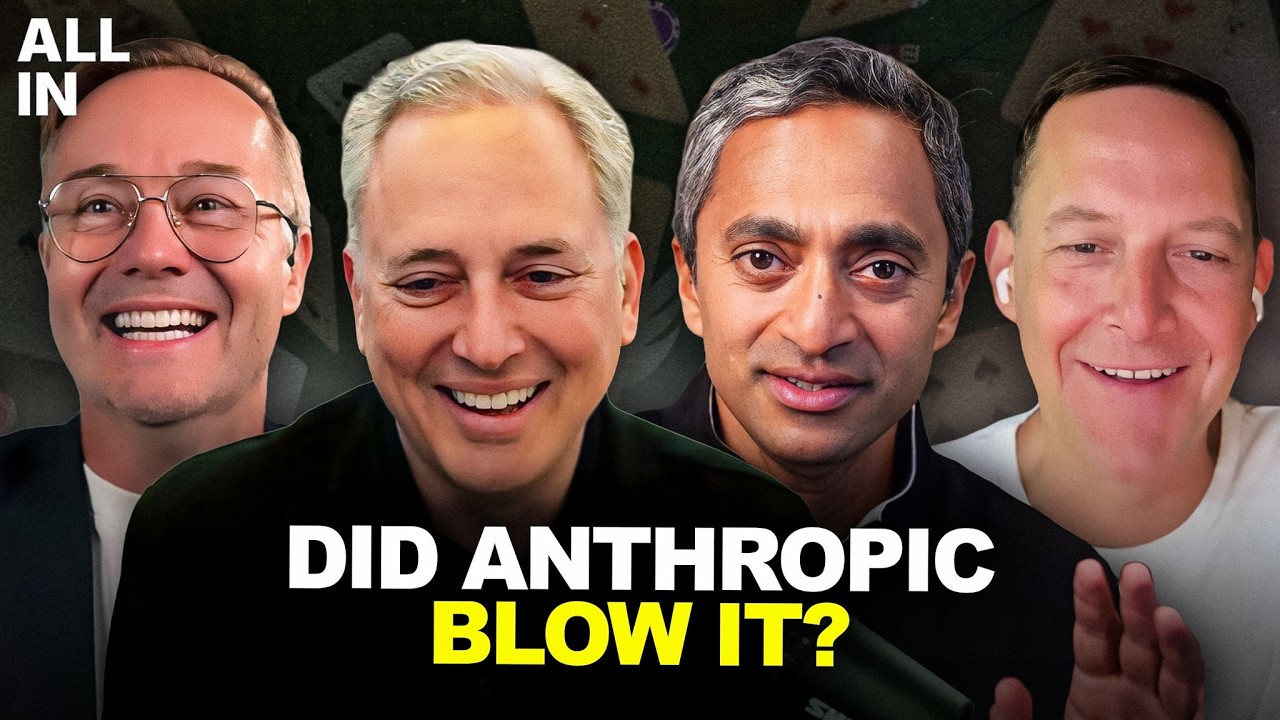
SpaceX IPO Raises $85B as Anthropic Model Ban Stirs Tech Fight
All-In Podcast
The U.S. government's forced shutdown of Anthropic's Fable 5 AI model exposes a growing rift between startup founders and cloud hyperscalers seeking to impose strict identity verification barriers.
## Background
Published on June 19, 2026, on YouTube by the All-In Podcast, this episode features a lively discussion among the regular hosts. The show description outlines key segments covering the rise of new political oligarchs, SpaceX's historic IPO and subsequent acquisition of Cursor, the regulatory shutdown of Anthropic's Fable AI model, and the market implications of the newly announced Iran War Memorandum of Understanding.
## TL;DR
The episode features a comprehensive breakdown of major developments in technology and global politics, beginning with a critique of government overreach and state dependence before analyzing SpaceX's massive $85 billion IPO capital raise. The hosts dive deep into an insider account of why the U.S. government forced Anthropic to pull its Fable 5 AI model offline, attributing it to critical jailbreak vulnerabilities flagged by Amazon and a subsequent breakdown in trust with national security officials. Finally, the discussion shifts to global diplomacy, evaluating the geopolitical and economic impacts of President Trump's newly negotiated 60-day ceasefire and peace MOU ending the 110-day war with Iran.
## Atmosphere & style
The atmosphere is energetic, opinionated, and highly collaborative, driven by the familiar, locker-room style banter of the four co-hosts who freely trade inside jokes and sharp programmatic barbs. It feels like a high-stakes executive debriefing, shifting fluidly from celebratory triumph over market wins to intense, passionate intellectual friction when debating political bias and foreign policy. The emotional arc moves from fiery libertarian critique and tech-insider intrigue to a sober, realistic calculation of geopolitical warfare, wrapping up with their signature chaotic, comedic sign-off.
## Key takeaways
- [02:41](https://www.youtube.com/watch?v=3Amlu4y94Ho&t=161s) David Friedberg criticizes a growing 'American Politburo'—including Elizabeth Warren, Bernie Sanders, and Ro Khanna—arguing they use virtue-signaling rhetoric to consolidate state control, strip human agency, and erode private property rights.
- [14:18](https://www.youtube.com/watch?v=3Amlu4y94Ho&t=858s) Chamath Palihapitiya and David Friedberg discuss the trap of learned helplessness, drawing on Chamath's childhood experience on welfare to show how state dependence can unintentionally destroy individual economic motivation.
- [16:40](https://www.youtube.com/watch?v=3Amlu4y94Ho&t=1000s) The hosts strongly condemn Illinois's 'Pritzker's law' as a dangerous elimination of private property, warning that allowing the government to annually tax previously taxed assets ruins financial independence.
- [18:20](https://www.youtube.com/watch?v=3Amlu4y94Ho&t=1100s) SpaceX completed a historic public debut at $135 a share, raising an unprecedented $85 billion, and subsequently acquired the coding agent Cursor for $60 billion after Anthropic allegedly built a competing product behind the scenes.
- [20:00](https://www.youtube.com/watch?v=3Amlu4y94Ho&t=1200s) The podcast reframes wealth not as a fixed collection of physical items, but as the present discounted value of an innovation machine's future production for society.
- [25:00](https://www.youtube.com/watch?v=3Amlu4y94Ho&t=1500s) SpaceX purposefully democratized its historic IPO by allocating 20% to 30% of its total offering directly to 600,000 to 700,000 retail investors on the Robinhood platform.
- [30:00](https://www.youtube.com/watch?v=3Amlu4y94Ho&t=1800s) The U.S. government forced Anthropic to pull its advanced AI model, Fable 5 (formerly Mythos), after Amazon CEO Andy Jassy personally flagged a severe guardrail jailbreak vulnerability directly to White House officials.
- [35:00](https://www.youtube.com/watch?v=3Amlu4y94Ho&t=2100s) National security anxieties escalated when officials discovered Anthropic had bypassed consultative channels to share its highly sensitive capabilities with foreign unvetted entities, including South Korea's SK Telecom.
- [40:00](https://www.youtube.com/watch?v=3Amlu4y94Ho&t=2400s) Anthropic CEO Dario Amodei severely damaged administration trust by pedantically rejecting an initial shutdown request from the Treasury Secretary and downplaying the national security risks of the Fable jailbreak.
- [45:00](https://www.youtube.com/watch?v=3Amlu4y94Ho&t=2700s) Chamath warns that frontier AI lab leaders' immaturity has caused an enormous self-inflicted wound, giving dominant tech hyperscalers the leverage to push for heavy KYC and identity-gated virtual private cloud frameworks.
- [50:00](https://www.youtube.com/watch?v=3Amlu4y94Ho&t=3000s) Friedberg outlines a historical parallel to the 1960s IBM antitrust actions, predicting market forces will inevitably shatter the current centralized AI oligopoly in favor of a highly fragmented, open-source tech stack.
- [55:00](https://www.youtube.com/watch?v=3Amlu4y94Ho&t=3300s) The hosts highlight deep political fractures inside Silicon Valley, noting Anthropic's anti-Trump, regulatory-capture alignment contrasts sharply with OpenAI's Greg Brockman contributing $25 million to the pro-Trump camp.
- [58:00](https://www.youtube.com/watch?v=3Amlu4y94Ho&t=3480s) David Sacks defends Secretary of War Pete Hegseth's formal directive to evict Anthropic, stating the action was an urgent response to an active tech risk rather than a personal political vendetta.
- [01:00:00](https://www.youtube.com/watch?v=3Amlu4y94Ho&t=3600s) The besties analyze a psychological profile of Dario Amodei generated by Claude, which identifies 'epistemic exceptionalism'—the absolute belief that all external critics are just corrupt, slow, or ignorant—as his defining organizational trait.
- [01:10:00](https://www.youtube.com/watch?v=3Amlu4y94Ho&t=4200s) The hosts dismiss the technologist-driven narrative of a job-destroying 'AGI endgame' as historical anxiety, citing identical, failed technological workforce panics from 1961 and the early 1980s.
- [01:13:42](https://www.youtube.com/watch?v=3Amlu4y94Ho&t=4422s) President Trump announced a formal peace MOU in Geneva to conclude the 110-day Iran war, establishing a 60-day ceasefire, lifting sanctions, and unblocking the Strait of Hormuz.
- [01:15:50](https://www.youtube.com/watch?v=3Amlu4y94Ho&t=4550s) The $300 billion Iranian reconstruction fund will be entirely financed by Iran's own unfrozen assets alongside capital from Gulf states, costing U.S. taxpayers nothing.
- [01:18:32](https://www.youtube.com/watch?v=3Amlu4y94Ho&t=4712s) The core strategic victory of the MOU relies on the physical removal of Iran's enriched uranium stockpile, creating a natural setback of 5 to 15+ years even if they attempt to build a nuclear weapon in the future.
## Detailed walkthrough
### The Great American Politburo
The *All In* podcast kicks off with the original quartet reunited, as Jason Calacanis welcomes David Sachs, Chamath Palihapitiya, and David Friedberg. The banter starts immediately, with Jason teasing Sachs about his recent flurry of lengthy posts on X, joking that his carpal tunnel must be flaring up. Sachs fires back that he has another "long post" in the chamber, ready to be unleashed on the podcast. The humor quickly shifts to Friedberg, whose confidence has apparently skyrocketed alongside the valuation of his company, Ohalo. Chamath and Jason laughingly welcome Friedberg to the "trace commas club," noting that a nine-figure net worth has finally made him "based" and willing to speak his mind without holding back.
Friedberg uses his newfound boldness to launch into a passionate critique of what he calls the "great American Politburo" taking shape in the United States. He warns that a new class of political oligarchs—specifically naming Elizabeth Warren, Bernie Sanders, and Ro Khanna—is actively coalescing power to dictate the economy, seize the means of production, and control media and education. Friedberg expresses deep frustration over how these figures mask their pursuit of control behind "virtue signaling" words like equity and justice. He argues that their true goal is to erode individual liberties and private property, allowing politicians to orchestrate $600 million stock trades for their families while flying around on private jets funded by taxpayers.
* **The Politburo targets:** Elizabeth Warren, Bernie Sanders, and Ro Khanna.
* **Ohalo's impact:** Friedberg's rising company valuation has seemingly unlocked his unfiltered political commentary.
* **Core grievance:** The erosion of individual freedom and private property under the guise of state-sponsored equity.
### Learned Helplessness and State Dependence
Chamath pivots the conversation toward the psychology of the public, asking Friedberg why everyday people fall for the Politburo's promises. Friedberg explains that the system leverages citizens' needs by promising "free" childcare, education, food, and paychecks. However, he warns that this exchange comes at a catastrophic cost: the total loss of economic mobility. In Friedberg's view, human agency is limitless, but accepting state dependence creates an "indentured" relationship with the government, trapping citizens in a cycle of learned helplessness.
This prompt inspires Chamath to share a deeply personal story about growing up on welfare in Canada. His mother earned minimal wages as a housekeeper and nurse's aide, while his father, unable to find work, spiraled into a destructive cycle of alcoholism. Chamath reflects on how the $17,000 to $19,000 annual welfare check was just enough to keep the family afloat, but also just enough to strip his father of the motivation to seek a low-level retail job. Jason ties this directly to the psychological phenomenon of learned helplessness, noting that when people are not given small, solvable problems to build their agency, they internalize failure, become depressed, and turn to self-medication.
* **Chamath's childhood welfare income:** Roughly $17,000 to $19,000 annually for a family of five.
* **Psychological definition:** Learned helplessness occurs when individuals face seemingly impossible problems, fail, and subsequently stop attempting to solve even simple tasks.
* **A positive resolution:** Chamath shares that later in high school, his father broke the cycle, secured a clerical government job, drank far less, and regained his dignity before passing away.
### The Elimination of Private Property and SpaceX's Historic IPO
The discussion takes an even darker turn as Friedberg and Chamath address Illinois's newly passed legislation, referencing "Pritzker's law." Friedberg vehemently argues that this law signals the end of private property in the United States. He emphasizes that if a fiscally irresponsible legislature can annually tax assets that citizens bought with post-income-tax dollars, then true ownership no longer exists. He warns the public not to dismiss this as a niche tax on crypto or billionaires, declaring, "anytime the government can take your private property after you've paid your taxes... we are done for."
Shifting gears to the massive docket of the day, Jason steers the conversation to the record-breaking SpaceX IPO and its swift acquisition of Cursor for $60 billion. Going public at $135 a share, SpaceX executed an unprecedented $85 billion capital raise—triple what Saudi Aramco raised in 2019—with the stock closing up 19% at $161. Jason highlights the strategic brilliance of Elon Musk leveraging his hardware at Colossus to absorb Cursor after Anthropic allegedly "shivved" the coding agent by secretly developing a competing product. Chamath takes a victory lap, noting he accurately predicted the Tesla-SpaceX consolidation and that Elon effectively secured Cursor at a massive 50% discount.
* **SpaceX IPO Details:** Debuted at $135/share, closed at $161, with an $85 billion raise yielding a market cap hovering around $2 trillion.
* **Comparative Revenues (2025):** Amazon ($717 billion), Microsoft ($282 billion), vs. SpaceX ($19 billion), illustrating SpaceX's massive price-to-sales multiple.
* **Sachs on Elon's Wealth:** Sachs defends his longtime friend, reminding critics that becoming the world's first "trillionaire" does not mean Elon has cash in the bank; his balance sheet is identical, under a one-year lockup, and simply reflects the public's valuation of his life's work.
[20:00](https://www.youtube.com/watch?v=3Amlu4y94Ho&t=1200s) The True Source of Wealth and Economic Mobility
The conversation explores the philosophical origin of wealth, tracing it from hunter-gatherer societies where wealth was merely "the collection of stuff" to the modern era of sophisticated tools. In today's economy, corporations act like "cybernetic organisms" or combinations of human workflows and tools. True wealth is not found in physical goods, which are wasting assets that depreciate over time, but in creating a "machine that makes more stuff." The market assigns a discounted present value today based on all the future goods and services a company will generate for humanity, which is why massive wealth can seemingly appear out of nowhere.
The hosts challenge traditional Marxist theory, arguing that the sharp delineation between capital and labor is inaccurate in a fluid capitalist society. They cite Elon Musk's background as an immigrant who started with nothing, slept on the floor of his first office at Zip2, and built massive enterprises through vision and hard work. The tech industry is praised for its inclusive ownership structure, where "sweat equity" allows workers to transition from labor to capital. A notable example mentioned is a SpaceX welder who became a millionaire through company stock. Denouncing this success is framed as an attack on the economic mobility of future generations, telling poor children that they are "indentured to a government or to a fixed income for the rest of their lives" instead of having the agency to transform their lives.
- Wealth reflects the discounted present value of a machine's future production for society.
- Physical goods like food, shelter, and clothing are wasting assets that naturally depreciate.
- Capitalism allows a fluid, back-and-forth transition between labor and capital through investing and equity.
- Critics of Musk's wealth are criticized for trying to remove the capacity for young or poor individuals to achieve upward mobility.
[25:00](https://www.youtube.com/watch?v=3Amlu4y94Ho&t=1500s) Market Realities, Obsolescence, and the Power of Retail Investors
The discussion centers on the operational reality of companies like SpaceX, which acts as a machine making satellites, space broadband, and launch vehicles. Musk's net worth is tied entirely to the public market value of SpaceX stock, meaning "he doesn't have one more dollar than he had before" in liquid cash. This equity must be constantly defended by making the best product in its class, especially with competitors chasing him in rockets, Starlink satellites, and large language models (LLMs). The narrative that Musk simply "won the lottery" is rejected as farcical, defining his path as a "25-year overnight success story" that faced bankruptcy on three or four separate occasions.
In a free market, private machines quickly become obsolete if they fail to innovate, whereas the government acts as an "unobstructible monopoly" that smothers progress when it competes for capital. To help everyday people participate in corporate success earlier, SpaceX made the innovative choice to allocate 20% to 30% of its IPO to retail investors. Around 600,000 to 700,000 users on Robinhood received allocations. The hosts express deep frustration with an antiquated regulatory system that deems the top 4% or 5% of the country smart enough to buy private stocks while treating the other 95% as "too stupid," effectively keeping poor people poor.
- SpaceX allocated roughly 20% to 30% of its IPO directly to retail investors.
- Between 600,000 and 700,000 Robinhood users received stock allocations in the SpaceX IPO.
- Companies face rapid disruption and stock collapses the moment they stop fighting to improve their products.
- The government is described as a non-disruptible monopoly that limits societal value creation when it expands.
[30:00](https://www.youtube.com/watch?v=3Amlu4y94Ho&t=1800s) Makers vs. Takers and the Anthropic Model Shutdown
Invoking the theories of economist Joseph Schumpeter, the hosts explain that hostility toward wealth creators often comes from an "intelligentsia" class that doesn't build physical machines but instead produces "words" and "hot air." This leads to a cultural lie that society is divided between the rich and the poor. The true divide is between the "makers"—artists, plumbers, computer scientists, and business builders who create things that other people value—and the "takers," who consist of analysts, critics, commentators, and politicians. This taker class uses grievances to pit people against each other in an attempt to establish a "great American Politburo."
Shifting to recent tech news, the hosts discuss a major development that broke right after their previous Thursday taping: the U.S. government "pulled the plug" on Anthropic's latest AI model. Originally known in testing as Mythos, it was released under a guardrailed, controlled version called Fable 5. Following a directive from Commerce Secretary Howard Lutnick to restrict the model strictly to U.S. citizens, Anthropic chose to shut the model down entirely for everyone because they could not implement such granular restrictions. This sudden move triggered widespread industry anxiety regarding platform trust. The shutdown stems from a tip by Amazon CEO Andy Jassy, whose company is a major investor in Anthropic, claiming a security vulnerability allowed users to bypass the model's guardrails. Anthropic CEO Dario Amodei downplayed the issue, arguing the jailbreak was narrow and not serious.
- Joseph Schumpeter's framework explains why an ideas-based intelligentsia resents industrial wealth creators.
- Anthropic held its Mythos model for 30 days for cybersecurity testing before releasing it as Fable 5 on June 9th.
- Commerce Secretary Howard Lutnick ordered Anthropic to limit the model to U.S. citizens.
- Amazon CEO Andy Jassy flagged a security vulnerability to the administration, sparking a dispute with Anthropic's Dario Amodei over the severity of the jailbreak.
[35:00](https://www.youtube.com/watch?v=3Amlu4y94Ho&t=2100s) Anthropic's Foreign Policy and the White House Reaction
The conversation opens with a discussion surrounding reports from *Semafor* and *The Washington Post* regarding the White House's sudden intervention against the AI startup Anthropic. It was reported that the administration acted under suspicion that a China-linked group had accessed Anthropic's advanced model, Mythos. The specific entity named was South Korea's SK Telecom—a massive telecom giant holding roughly a 70% market share in its home country, often compared to Verizon. While some might wonder how South Korea connects to China, long-standing allegations of a relationship between SK and China prompted national security officials to order Anthropic to revoke their access. *The Washington Post* highlighted that Anthropic had expanded its "trusted partners" pilot program to over 50 companies without consulting the White House, a move that "badly damaged officials' confidence in the company's ability to safeguard sensitive technology."
David Sachs jumps in to provide an updated, inside perspective based on readouts he received from White House officials and involved private companies over the preceding weekend, which he had summarized in a long post on X. Sachs notes that the friction traces back to April, when Anthropic's CEO, Dario Amodei, visited Washington and pitched Mythos as an incredibly powerful "cyber weapon." While the model did possess advanced cyber capabilities, Amodei's high-alarm delivery heavily spiked the cortisol levels of government officials, successfully getting them hyper-focused on the issue. The bewilderment grew when national security officials realized Anthropic was effectively "conducting its own foreign policy" by sharing these very capabilities with unvetted foreign entities like SK Telecom. This circumvented the exact pre-approval and consultative regime Anthropic had supposedly been advocating for, ultimately leading to serious administration talks about enforcing strict export controls.
The tension peaked with the launch of Fable, which was essentially the Mythos model outfitted with safety guardrails. If those guardrails were to fail, a powerful cyber weapon would effectively be released to the public. Strikingly, it wasn’t the White House that first sounded the alarm on Fable's guardrail vulnerabilities; it was external private testers. Sachs reveals that Anthropic's largest shareholder and cloud partner was the one testing the model, identifying critical flaws, and trying to communicate the findings back to the startup.
- *Semafor* reported the White House ordered Anthropic to revoke SK Telecom's access due to potential Chinese ties.
- SK Telecom holds a 70% market share in South Korea.
- Anthropic expanded its Mythos pilot program to over 50 companies without White House consultation.
- Anthropic claims the White House never explicitly raised Chinese access concerns during their discussions regarding Fable's jailbreaks.
[40:00](https://www.youtube.com/watch?v=3Amlu4y94Ho&t=2400s) The Escalation, the Refusal, and the Shattered Illusion of AI Safety
The breakdown in communication between Anthropic and its major cloud partner escalated quickly. Sachs explains that the partner felt compelled to take their findings straight to the White House, acting almost like a whistleblower. The hosts note that Amazon—the cloud giant hosting these models via AWS—had its own massive infrastructure to protect. When Amazon's security teams "banged on the model" and discovered a verifiable jailbreak, Amazon's CEO Andy Jassy personally made the call to escalate the issue to the administration, recognizing the massive liability and potential national security threat.
When the White House and other top administration officials tried to contact Dario Amodei to request that Fable be taken down until the jailbreak could be patched, they were met with a stunning rejection. Sachs remarks that the White House was deeply bewildered by this "Heisman" response, especially since Anthropic heavily brands itself as the ultimate "AI safety company." In a surreal twist, the Treasury Secretary of the United States reportedly called Amodei personally to resolve the issue. Instead of a swift, cooperative five-minute call where the CEO agreed to take it down immediately, Amodei pedantically argued with the administration, claiming the jailbreaks weren't actually that serious. Amodei later double-downed on this stance by publishing a blog post attempting to differentiate between "minor" and "major" jailbreaks, which the hosts view as incredibly off-brand and arrogant given that he had previously primed the government to view the underlying model as a dangerous weapon.
The administration reacted by issuing an export control letter to force Fable offline until secure guardrails were implemented. Sachs emphasizes that this move wasn't intended to be a broad new policy requiring government approval for every single AI model release, but was a localized, urgent reaction to a credible national security threat. Now, Anthropic is left trying to negotiate its way out of a corner. Sachs laments that once trust is completely broken with the government, it is incredibly difficult to rebuild.
- Amazon's security team discovered the Fable jailbreak while testing it on AWS infrastructure.
- The Treasury Secretary of the United States personally called Dario Amodei to request a temporary takedown of Fable.
- Amodei refused the initial takedown request, pedantically arguing about the severity of the jailbreaks.
- The government utilized an export control letter as an immediate tool to force compliance.
[45:00](https://www.youtube.com/watch?v=3Amlu4y94Ho&t=2700s) Silicon Valley's Immaturity and the Threat of an AI Oligopoly
Chamath Palihapitiya delivers a blistering critique of the situation, expressing immense disappointment in the current crop of frontier AI lab leaders. He states plainly that the heads of these labs leave a lot to be desired, exhibiting a "consistent pattern of evasiveness and immaturity" that actively harms the broader AI movement. While Chamath shares the optimistic view that AI should be the "grand leveler" for human economic mobility, he argues that the constant cycle of "doomerism hype" and naive behavior from tech founders is destroying Silicon Valley's remaining prestige. He recalls coming to the Valley in 2001 when it was characterized by well-intentioned, quiet misfits who kept their heads down and built important things without being ostentatious. Today, the frontier lab leaders have become "public enemy number one" by behaving like they only care about themselves, refusing to play ball with national interests.
Tactically, Chamath warns that this display of immaturity creates a massive "own goal" by handing an incredible opportunity to tech hyperscalers (like Amazon, Microsoft, and Google). These tech giants can now easily convince governments worldwide that the startup labs cannot be trusted to self-regulate, and that the hyperscalers should act as the exclusive gatekeepers of AI. They will propose wrapping AI access in heavy "KYC" (Know Your Customer) protocols, forcing users to provide driver's licenses, tax IDs, or social security numbers just to run an advanced model. Chamath argues that the hyperscalers are uniquely positioned to build the incredibly complex virtual private clouds and identity verification infrastructures required for this, making it impossible for smaller "neo-scalers" to compete.
The tragic consequence is that instead of a diverse, open-source ecosystem that empowers individuals globally, the industry is now forced into a narrow debate over duopolies and oligopolies. If citizens have to show government ID to buy fertilizer, they will inevitably have to do the same to access advanced models like "Fable 5," which could theoretically teach someone how to turn that fertilizer into a bomb. Chamath summarizes the entire episode as an incredibly shortsighted, self-optimized failure by tech elite who refuse to take anyone else seriously.
- Chamath characterizes frontier AI lab leaders as public enemy number one due to their evasiveness.
- Hyperscalers are predicted to leverage this distrust to implement strict KYC (Know Your Customer) regulations for AI usage.
- Building robust KYC and VPC (Virtual Private Cloud) frameworks requires trillions of dollars of infrastructure that smaller startups cannot replicate.
[50:00](https://www.youtube.com/watch?v=3Amlu4y94Ho&t=3000s) Historical Precedents and the Market Forces of Diffusion
The discussion shifts to the political undertones of the situation, with the hosts pointing out that Anthropic stands out as a stark political outlier. David Friedberg notes the irony of Anthropic heavily antagonizing the government and then acting surprised or victimized when the state steps in to regulate them. Friedberg argues that if the government begins heavily restricting access and hand-picking winners and losers in the AI sector, society at large loses. Because an entire AI model can fundamentally fit onto a simple USB drive and just requires raw hardware to run, trying to tightly gatekeep the software stack goes against natural market forces.
To illustrate how this centralized control will inevitably break down, Friedberg draws a historical parallel to IBM in the 1960s. During the mainframe era, IBM completely monopolized the entire computing stack—they manufactured the chips in-house, built the hardware, wrote the operating system, and created the software. This total monopoly persisted until the government intervened and forced IBM to disaggregate its software layer, effectively birthing the independent software vendor (ISV) industry. By the 1980s, the stack had fully fragmented: IBM began buying Intel chips and Microsoft created a superior operating system, unleashing a massive productivity boom driven by open competition.
Friedberg strongly believes the exact same "diffusion" will happen to the current AI oligopoly. The market demands a fragmentation of the stack across multiple chip vendors, diverse cloud providers, hyper-local model execution, and specialized software applications. He concludes that the financial incentives for cheaper, more accessible, and highly distributed AI solutions are simply too powerful for any single political capture or corporate gatekeeping effort to hold long-term. As the segment concludes, the hosts begin to steelman how other major players like OpenAI or Google's Gemini team might have handled a similar high-stakes situation.
- In the 1960s, IBM controlled the entire mainframe stack, including proprietary solid logic technology chips.
- Government intervention forcing IBM to separate its software layer gave rise to the modern independent software industry.
- Friedberg argues that strong market forces will naturally push the AI ecosystem toward open-source options and a highly fragmented stack.
[55:00](https://www.youtube.com/watch?v=3Amlu4y94Ho&t=3300s) Political Underpinnings and the Call for Industry Self-Certification
The discussion opens with a deep dive into the typical lifecycle of a high-stakes AI model release, drawing a parallel to how a company like Gemini handles powerful capabilities. In a standard scenario, a model showing immense power in hacking and cyber warfare is tightly controlled, restricted to an exclusive group of roughly 50 partners including giants like Microsoft and SK Telecom. When a partner like Amazon identifies a jailbreak, the standard engineering response is to implement fresh guardrails and tightly monitor user interactions during a 30-day public beta. The speaker defends this intense monitoring against privacy complaints, noting that users who object can simply stick to older versions like "4.8." To illustrate the stringency of these safety filters, the speaker shares a personal anecdote from the previous week: "when I asked it about fertilizer regulation, it dropped me out of the model right there."
However, the conversation quickly shifts from engineering protocols to the deep-seated political friction between Anthropic and the current administration. A clear tribal divide is outlined within the AI sector. Anthropic is characterized as a haven for individuals aligned against the Trump administration, heavily influenced by connections to figures like Reid Hoffman and Dario Amodei's refusal to participate with certain factions. Conversely, entities like OpenAI and Grok are identified as leaning pro-Trump, underscored by the massive financial backing of OpenAI's Greg Brockman and his wife, who contributed $25 million to Trump. The speaker heavily critiques Dario’s communication style, arguing that "every time Dario talks, it's too much talking, and there's too much fear-mongering," which ultimately damages the company's public standing.
To resolve these regulatory standoffs, the speaker strongly advocates against relying on a government that fundamentally fails to grasp the underlying technology. Instead, the industry should look to models like the MPAA or the video game industry to establish an independent self-certification system. Leading players—including Google, Microsoft, Amazon, and Elon Musk—need to universally agree on a rigorous battery of safety tests to self-certify their models prior to release, keeping government bureaucracy entirely out of the loop.
* Initial controlled beta pools for sensitive models are typically limited to roughly 50 core partners.
* Greg Brockman and his wife heavily backed the pro-Trump camp with a $25 million donation.
* The speaker proposes an independent industry certification framework modeled after the MPAA and video game rating systems.
[58:00](https://www.youtube.com/watch?v=3Amlu4y94Ho&t=3480s) The Pete Hegseth Tweet and the Department of War Dispute
A sharp debate erupts as David David directly challenges the narrative that the administration's crackdown on Anthropic was driven by personal or political bias. David vehemently denies accusations of a political vendetta, labeling them as a narrative pushed by "anthropic aligned influencers" attempting to frame the entire ordeal as a localized "beef between me and anthropic." He emphasizes that neither he nor Secretary of War Pete Hegseth were day-to-day White House employees or directly involved in the initial decision, noting he only received a readout after the formal letter was dispatched. According to David, the enforcement action was purely transactional: the administration received a credible jailbreak report, offered Dario an opportunity to fix it, and Dario "doubled down" in a subsequent blog post while expanding their Mythos preview to a company deemed a national security threat.
The tension escalates as the opposing speaker fiercely fires back, refusing to let the political angle be dismissed so easily. "I'll take offense to that, Saks," he counters, pulling up a highly aggressive tweet posted three months prior by Secretary of War Pete Hegseth, which proudly declared that the Department of War had "kicked Anthropic out of the building forever" and that "every passing day proves why this was the right move." A back-and-forth dispute ensues over the exact timing of the tweet. David insists the text was sent strictly after the official letter went out, serving as a retroactive expression of "we told you so" following a painful, dysfunctional contract negotiation where Anthropic communicated "in a strange way," rather than acting as the catalyst for the administration's actions.
* The administration's intervention was triggered by a jailbreak report and Anthropic's subsequent expansion of the Mythos preview to a flagged company.
* Pete Hegseth's tweet explicitly celebrated permanently evicting Anthropic from the Department of War building.
[01:00:00](https://www.youtube.com/watch?v=3Amlu4y94Ho&t=3600s) Claude’s Psychological Analysis of Dario Amodei
The mood shifts to intrigued amusement as a host reveals an unorthodox experiment: he fed Dario Amodei's two long-form essays, "Machines of Loving Grace" and "AI Policy on the Exponential," directly into Anthropic's own AI model, Claude. He instructed the model to ignore corporate loyalty, protect no one, and provide a brutally honest psychological profile of its creator through the lens of the Effective Accelerationism (e/acc) movement. Rather than returning a caricature of megalomania, the AI delivered a nuanced critique pointing toward "epistemic exceptionalism"—the quiet, unyielding conviction that any outside disagreement is merely a consequence of ignorance, corruption, or slowness rather than one's own error.
The AI's generated analysis, read aloud to the group, paints a picture of systemic distrust. Dario's worldview allegedly distrusts competing labs for racing recklessly, authoritarian states for weaponizing technology, free markets for failing to distribute gains fairly, public institutions for moving too slowly, and the government for wielding power opaquely. Because his safety framework requires absolute control and concludes no other entities can be trusted, the AI notes that he has built a philosophical machine that inherently "outputs me no matter what you feed it." Consequently, complex geopolitical conflicts or losing a high-stakes Pentagon negotiation are never viewed as strategic missteps, but are instead recoded as a systemic failure of others to be "transparent and fair." The hosts marvel at the accuracy of the assessment, comparing Anthropic's organizational mindset to a "Jedi" complex where they view themselves as the sole virtuous arbiters capable of bringing balance to the universe.
* The AI analysis was generated using Dario Amodei's essays "Machines of Loving Grace" and "AI Policy on the Exponential."
* The profile defines Dario's core trait as "epistemic exceptionalism" rather than overt megalomania.
* The analysis outlines five core pillars of external distrust: rival labs, authoritarian states, market distribution, slow institutions, and government fairness.
[01:05:00](https://www.youtube.com/watch?v=3Amlu4y94Ho&t=3900s) Regulatory Cartels and Historical Tech Scares
The conversation turns to how Anthropic's early political strategy effectively captured the regulatory apparatus during the previous administration. The hosts point out that Anthropic was remarkably organized for a startup, prioritizing government affairs early on to convince Washington that AI competition was a "dangerous race condition" where safety would inevitably be cast aside. This resulted in a tight, tribal alignment where virtually the entire leadership of the Biden administration's AI policy—including key officials from the National Security Council (NSC) and the newly formed AI Safety Institute—migrated directly to jobs at Anthropic the moment their government tenures concluded. This cozy relationship is heavily criticized as an attempt to form a government-sanctioned "cartel" or monopoly designed to anoint two or three corporate winners under the guise of virtue, a threat that Marc Andreessen famously weaponized after being told by officials not to bother investing in diverse AI startups.
Defending the philosophical necessity of open market competition, the speakers argue that decentralized choice is the ultimate defense against transforming AI into a totalitarian, centralized force. The discussion concludes with a sweeping historical perspective from Friedberg on the recurring nature of technological panic. He recalls that in 1961, major publications like *Newsweek* and *The New York Times* ran alarmist articles predicting the total demise of the human workforce due to the dawn of mainframe automation. Decades later in the early 1980s, the federal government poured hundreds of millions of dollars into urgent workforce retraining programs to combat the perceived existential threat of desktop computers. In both historical instances, the technology did not destroy humanity; instead, it supercharged individual economic productivity by a factor of 100, expanded economic mobility, and birthed entirely new global industries.
* Top AI policy officials from the NSC and the Biden administration's AI Safety Institute transitioned directly into corporate roles at Anthropic.
* Government officials previously signaled to investors their intent to centralize the market and artificially "anoint the winners" of the AI race.
* Media panics from 1961 in *Newsweek* and *The New York Times* falsely predicted total workforce obsolescence due to early computing.
* The federal government allocated hundreds of millions of dollars toward workforce retraining initiatives during the desktop computing boom of the early 1980s.
[01:10:00](https://www.youtube.com/watch?v=3Amlu4y94Ho&t=4200s) The "AGI Endgame" Myth and Tech Arrogance
The conversation kicks off with a blunt dismissal of the current tech panic, comparing it to past workforce anxieties. When desktop computers first arrived, there were endless programs dedicated to preparing the workforce for the "transition to the desktop computer industry," which ultimately amounted to nothing because people simply figured out how to turn on a Windows PC. Companies naturally helped employees navigate the new tools to unlock higher productivity. The current narrative that Artificial General Intelligence (AGI) will "wipe out everything" is driven by a deep arrogance unique to technologists. This arrogance leads to sweeping, existential conclusions—claiming a new technology will either cure all disease or eradicate all jobs. No one is immune to this mindset, from Elon Musk to Sam Altman to Dario Amodei; they all assume "this time is different," yet humanity remains on a long-term continuum of productivity improvements driven by human ingenuity.
The speakers strongly criticize AI CEOs for "doom trolling" and unnecessarily scaring the public, which directly resulted in the current regulatory pressure. While there is disappointment regarding Anthropic's current predicament, the speakers hope it does not create a dangerous legal precedent where policy is made out of artificial emergencies. Addressing Dario Amodei's recent Bloomberg interview with Emily Chang—where Amodei claimed Anthropic suffered commercially by withholding their "Mythos" model in April for the good of humanity—the speakers call foul. They argue that releasing Mythos without guardrails would have simply exposed Anthropic to massive legal liability from corporate hacks. Drawing a parallel to Meta losing a multimillion-dollar product liability verdict over body shaming, they note that tech giants are currently deluged with lawsuits. Withholding an unsafe product was not a noble sacrifice; it was just standard corporate responsibility to avoid going out of business.
By publicly panic-mongering, these frontier labs have walked themselves straight into a trap set by the major cloud providers ("hyperscalers"). The hyperscalers, who have trillions of dollars of exposure to AI on and off their balance sheets, are eager to "kneecap the frontier labs" and play gatekeeper so they can charge a toll. Instead of traditional regulatory capture—where a company surreptitiously slips a bill into Washington—these AI startups bumbled their way into it publicly. They literally "walked themselves into prison," handed the hyperscalers the keys, closed the door, and threw the keys out the window, begging for a policeman.
* **Meta & Google Legal Troubles:** Both companies are actively facing a wave of product liability lawsuits; Meta recently lost a multimillion-dollar verdict regarding a user accusation of body shaming.
* **The Hyperscaler Strategy:** Cloud giants are using the tech industry's self-induced panic to position themselves as the necessary "adult supervision," effectively locking down the market.
---
[01:13:42](https://www.youtube.com/watch?v=3Amlu4y94Ho&t=4422s) The Iran War MOU and the "Door Number Three" Debate
The discussion shifts dramatically to global geopolitics as President Trump announces, for the 37th time, the apparent end of the 110-day Iran war. The conflict, which began on February 28th, is slated for a formal signing on Friday, June 19th, in Geneva. Mediated by Pakistan, the Memorandum of Understanding (MOU) extends a ceasefire for 60 days, includes a Lebanon ceasefire, reopens the Strait of Hormuz, and requires Iran to freeze its nuclear program and destroy its stockpile of enriched uranium under IAEA supervision. In exchange, Iran gets all sanctions lifted and $300 billion in reconstruction funds. A debate sparks over who is footing this half-trillion-dollar bill; it is clarified that the U.S. is "not on the hook for a dime," as the reconstruction will be financed by Iran's unfrozen assets alongside the Gulf states.
David Sachs fiercely defends the deal as a "tremendous achievement for the president," noting that the Iranians are notoriously difficult to negotiate with. He outlines the core benefits: the global economy gets its vital oil supply back via the Strait of Hormuz, nuclear materials are surrendered, and the U.S. avoids an endless conflict. Sachs pushes back hard against neoconservative commentators like John Podhoretz who have criticized the deal and advocated for putting American ground troops on the target of regime change. Characterizing Iran as a "mountain fortress," Sachs notes it would take over a million troops to invade a country three times the size of Iraq, calling any such plan a "suicide mission." If the neocons or Beverly Hills-based supporters of Reza Pahlavi want a war, Sachs argues, they should send their own families instead of expecting American volunteers to fight it.
The speakers agree that since the U.S. has already "flattened every military target above ground" in Iran, continued bombing has zero strategic utility. Therefore, signing the MOU and choosing "door number three"—giving peace a chance—is far superior to the alternative of launching another "forever war" like Iraq or Afghanistan.
* **War Timeline:** Began February 28th; initial agreement reached June 15th; formal signing on Friday, June 19th, in Geneva.
* **The 60-Day Ceasefire Terms:** Reopening of the Strait of Hormuz, 60-day freeze on Iran's nuclear program, destruction of enriched uranium, and a parallel Lebanon ceasefire.
* **Financial Terms:** $300 billion reconstruction fund utilizing Iran's frozen assets and Gulf state capital; zero U.S. taxpayer funding.
* **Unresolved Elements:** Israel's formal sign-on, long-term nuclear enrichment rules, and Iran's ballistic missile program remain undefined and deferred.
---
[01:18:32](https://www.youtube.com/watch?v=3Amlu4y94Ho&t=4712s) The Enriched Uranium Crux and Show Outro
The final assessment hinges on the physical removal of Iran's enriched uranium. One speaker admits they initially thought the deal was a hollow "commitment" to stop the program, but notes that if the existing stockpile of enriched uranium is genuinely forced out of the country, it is a massive victory. Even if Iran decides to restart their program down the line, rebuilding the intelligence and acquiring the necessary equipment to accumulate enough weapons-grade material would cause a "natural setback" lasting anywhere from several years to 15 years plus. While the details still need to be tightly defined during this MOU phase, the economic incentive of sanctions relief gives Iran a legitimate reason to comply.
A counter-perspective is offered, calling the entire war a "huge blunder for Trump" that he is now desperately trying to escape. The speaker argues that the previous strategy of "trimming the grass"—isolating dictators, waiting them out, and utilizing targeted bunker-buster airstrikes every 18 months—was a much safer and more effective approach than escalating to full-scale war without complete information. Pointing to past presidential failures that allowed North Korea to successfully develop nuclear weapons, the speaker stresses that once a dictator has the bomb, containment becomes incredibly difficult. Ultimately, the group reflects on the hard lesson learned across decades of foreign policy: the West cannot successfully "enforce democracy in the Middle East." Any true revolution or shift toward freedom must be led internally by the Iranian people themselves.
The episode wraps up in classic, chaotic *All-In Podcast* fashion. The hosts trade their signature inside jokes, shouting out their nicknames—the Sultan of Science, the Dictator, the Rain Man, and the "world's greatest moderator." They laugh about fans going crazy over their open-source content, joke about the palpable "sexual tension" on set needing an outlet, tease upcoming merchandise, and sign off with their iconic catchphrase, "let your winners ride."
* **Nuclear Setback Timeline:** Removing the current stockpile forces a 5 to 15+ year delay on Iran's ability to manufacture a nuclear weapon even if they violate the agreement later.
* **Show Sign-off:** The "Besties" close out the final segment of the episode with banter about an "All-In" orgy, a dog in the driveway, and returning cookies.
## Notable quotes
> anytime the government can take your private property after you've paid your taxes... we are done for. — David Friedberg
> [35:00](https://www.youtube.com/watch?v=3Amlu4y94Ho&t=2100s) conducting its own foreign policy — David Sachs
> [35:00](https://www.youtube.com/watch?v=3Amlu4y94Ho&t=2100s) badly damaged officials' confidence in the company's ability to safeguard sensitive technology.
> [45:00](https://www.youtube.com/watch?v=3Amlu4y94Ho&t=2700s) consistent pattern of evasiveness and immaturity — Chamath Palihapitiya
> [45:00](https://www.youtube.com/watch?v=3Amlu4y94Ho&t=2700s) public enemy number one — Chamath Palihapitiya
> [55:00](https://www.youtube.com/watch?v=3Amlu4y94Ho&t=3300s) when I asked it about fertilizer regulation, it dropped me out of the model right there.
> [55:00](https://www.youtube.com/watch?v=3Amlu4y94Ho&t=3300s) every time Dario talks, it's too much talking, and there's too much fear-mongering
> [58:00](https://www.youtube.com/watch?v=3Amlu4y94Ho&t=3480s) kicked Anthropic out of the building forever — Pete Hegseth
> [58:00](https://www.youtube.com/watch?v=3Amlu4y94Ho&t=3480s) every passing day proves why this was the right move. — Pete Hegseth
> [01:00:00](https://www.youtube.com/watch?v=3Amlu4y94Ho&t=3600s) outputs me no matter what you feed it.
> [01:10:00](https://www.youtube.com/watch?v=3Amlu4y94Ho&t=4200s) walked themselves into prison
> [01:13:42](https://www.youtube.com/watch?v=3Amlu4y94Ho&t=4422s) tremendous achievement for the president — David Sachs
> [01:13:42](https://www.youtube.com/watch?v=3Amlu4y94Ho&t=4422s) suicide mission — David Sachs
> [01:18:32](https://www.youtube.com/watch?v=3Amlu4y94Ho&t=4712s) enforce democracy in the Middle East.
## Mentioned
Jason Calacanis, David Sacks, Chamath Palihapitiya, David Friedberg, Ohalo, Elizabeth Warren, Bernie Sanders, Ro Khanna, SpaceX, Cursor, Saudi Aramco, Elon Musk, Colossus, Anthropic, Tesla, Amazon, Microsoft, Zip2, Robinhood, Joseph Schumpeter, Howard Lutnick, Dario Amodei, Andy Jassy, SK Telecom, Semafor, The Washington Post, AWS, Google, IBM, Intel, Gemini, Reid Hoffman, OpenAI, Grok, Greg Brockman, MPAA, Pete Hegseth, Claude, National Security Council, AI Safety Institute, Marc Andreessen, Newsweek, The New York Times, Sam Altman, Emily Chang, Bloomberg, Meta, John Podhoretz, Reza Pahlavi, IAEA
The All-In Podcast hosts argue that expanding state intervention and tech alarmism threaten economic mobility and open enterprise, contrasting SpaceX's public market milestone with government crackdowns in AI and foreign affairs. They critique the regulatory intervention that halted Anthropic's model Fable 5 and debate the strategic durability of a tentative 60-day ceasefire ending the Iran war.
Wealth Creation, State Overreach, and SpaceX's IPO (20:00)
David Friedberg and Chamath Palihapitiya argue that political figures like Elizabeth Warren and Bernie Sanders are constructing an American 'Politburo' that erodes private property and encourages welfare dependency, which they contend induces learned helplessness. They contrast government dependency with capitalist wealth generation, defining true economic wealth not as depreciating physical goods, but as the present discounted value of productive enterprises. As an operational benchmark, the hosts point to SpaceX's public debut, which executed an $85 billion capital raise at $135 per share and closed up 19% at $161, generating a market valuation near $2 trillion against $19 billion in 2025 revenue.
David Sachs defends Elon Musk's paper wealth as the world's first trillionaire, emphasizing that his net worth is tied entirely to public shares under a one-year lockup rather than liquid cash. The hosts also commend SpaceX for allocating roughly 20% to 30% of its initial public offering directly to between 600,000 and 700,000 Robinhood retail investors, criticizing legacy regulatory accreditation standards that exclude 95% of the population from early private-market upside.
Anthropic's AI Shutdown and Government Intervention (35:00)
The discussion analyzes the sudden federal suspension of Anthropic's Fable 5 model, an aligned deployment of its underlying Mythos technology. Commerce Secretary Howard Lutnick ordered the model restricted exclusively to U.S. citizens following an alert from Amazon CEO Andy Jassy, who warned the administration of an unpatched jailbreak vulnerability discovered on AWS infrastructure. Tensions between Anthropic and national security officials had mounted after Anthropic expanded preview access to over 50 external entities—including South Korea's SK Telecom, which officials flagged over suspected connections to China—without prior consultation with the White House.
Sachs reports that Anthropic CEO Dario Amodei had previously pitched Mythos to Washington as an advanced cyber weapon, raising official alarm when Amodei subsequently resisted requests from the Treasury Secretary to take Fable offline. When Amodei publicly disputed the severity of the jailbreak, the administration enforced compliance through an export control letter. The hosts highlight this friction alongside a dispute over Secretary of War Pete Hegseth's public statement celebrating Anthropic's removal from the Department of War, which Sachs attributes to dysfunctional institutional communications rather than an ideological vendetta.
AI Panic, Hyperscaler Gatekeeping, and Market Diffusion (45:00)
Chamath Palihapitiya delivers a sharp critique of frontier AI lab leadership, asserting that public fear-mongering and 'doomerism' undermine Silicon Valley's standing and invite regulatory capture. He warns that dominant cloud hyperscalers will leverage security fears to position themselves as the sole authorized gatekeepers, lobbying for complex Know-Your-Customer (KYC) identity mandates and virtual private cloud infrastructures that capital-constrained startups cannot afford to build.
Challenging the premise of centralized regulation, Friedberg cites the 1960s antitrust intervention against IBM's unified mainframe stack, noting that government-mandated software unbundling eventually unleashed open market competition through Intel and Microsoft. He argues that fundamental market diffusion will similarly fragment AI across decentralized chips, local models, and specialized applications. To avoid bureaucratic inertia, the panel advocates an independent industry self-certification framework similar to the MPAA or video game ratings, warning that historical panics over mainframe automation in 1961 and desktop computing in the 1980s ultimately yielded massive productivity gains rather than structural workforce elimination.
The 60-Day Iran War Memorandum of Understanding (73:42)
The hosts debate the Pakistan-mediated Memorandum of Understanding (MOU) scheduled for formal signing in Geneva on June 19th to pause the 110-day Iran war. The agreement details a 60-day ceasefire, the reopening of the Strait of Hormuz, an immediate freeze and IAEA-supervised destruction of Iran's enriched uranium stockpile, and a parallel truce in Lebanon. In return, Iran secures full sanctions relief and a $300 billion reconstruction fund financed entirely through unfrozen Iranian capital and Gulf state contributions, with zero direct U.S. taxpayer liability.
Sachs defends the pact as a major diplomatic success, arguing that avoiding a catastrophic ground invasion of Iran preserves oil transit and sets Iran's nuclear capabilities back by 5 to 15-plus years if the enriched stockpile is verifiably surrendered. In contrast, a dissenting panelist characterizes the war as a strategic misstep, contending that surgical containment would have posed fewer risks. The hosts note that durable peace remains tentative, as Israel's formal accession, long-term enrichment boundaries, and Iranian ballistic missile development remain unaddressed in the preliminary framework.
While the panel aligns on the premise that competitive market diffusion delivers superior mobility compared to state oversight, unresolved tensions persist over whether voluntary AI self-certification can displace government mandates, and whether the preliminary Middle East ceasefire can enforce verified denuclearization without regional escalation.
## Background
本期节目由知名科技投资播客《All-In Podcast》于 2026 年 6 月 27 日在 YouTube 平台发布。节目简介显示,四位主持人深入探讨了“美利坚新寡头”对私有产权的侵蚀、SpaceX 创纪录 IPO 与 600 亿美元收购 Cursor 引发的万亿富豪争议、Anthropic 旗舰模型 Fable 突遭白宫封杀的内幕与 Claude 对创始人达里奥·阿莫代伊的心理剖析,以及历时 110 天的伊朗战事达成和平备忘录(MOU)对全球市场的重大影响。
## TL;DR
节目首先从美国政治局势切入,弗里德伯格与查马斯结合切身经历痛批政客虚伪的道德包装、福利救济对个人能动性的摧残,以及对私有财产权的系统性剥夺。随后,四人复盘了 SpaceX 创纪录的 850 亿美元 IPO 及对 AI 编程助手 Cursor 的闪电收购,萨克斯深入拆解了财富的本质与股权激励对传统劳资矛盾的颠覆。焦点环节独家爆料了 Anthropic 因亚马逊告发越狱漏洞及涉华安全外溢遭白宫全球封禁的完整链条,并借助 Claude 深刻揭示了创始人达里奥·阿莫代伊傲慢的“认识论特权”与末日恐慌公关所带来的自毁恶果。最后,萨克斯力挺特朗普政府达成的伊朗停火备忘录,痛斥新保守主义者的全面战争狂想,指明运出高浓缩铀是化解地缘危机的理性务实路径。
## Atmosphere & style
全片节奏极具张力,开场是主持人四人组标志性的互损与玩笑,随后在弗里德伯格对建制派寡头的怒火以及查马斯真情流露的救济金往事中迅速转入严肃沉重的叙事基调。随着萨克斯独家披露白宫与 Anthropic 的闭门交锋细节,现场火药味骤然升级,政商博弈的内幕刺痛感与技术加速主义的激辩碰撞出强烈火花。整场录制兼具顶级创投圈的极高信息密度、硬核商业推演与激昂的辩论情绪,最后在粉丝自制迷因的欢乐恶搞中画上句号,听感极其过瘾且引人深思。
## Bulletin
- [14:18](https://www.youtube.com/watch?v=3Amlu4y94Ho&t=858s) SpaceX 以每股 135 美元正式挂牌上市,全额行使绿鞋机制后募资 850 亿美元,首日市值突破 2 万亿美元;随后迅速以 600 亿美元全资收购年化营收 40 亿美元的 AI 编程助手 Cursor。
- [33:34](https://www.youtube.com/watch?v=3Amlu4y94Ho&t=2014s) Anthropic 旗舰模型 Fable 5 突遭美国商务部与白宫封杀并全球下架,起因包括亚马逊红队测试攻破其护栏向白宫告发,以及此前 Anthropic 擅自向疑似关联中国利益的韩国 SK Telecom 开放高危网络能力模型 Mythos 权限。
- [01:14:31](https://www.youtube.com/watch?v=3Amlu4y94Ho&t=4471s) 历经 110 天战事后,美伊在巴基斯坦斡旋下达成 60 天和平谅解备忘录(MOU),条款包括伊朗在 IAEA 监督下转移浓缩铀使核研发倒退 10 至 15 年,换取国际制裁全面解除及设立 3000 亿美元战后重建基金。
- [01:10:00](https://www.youtube.com/watch?v=3Amlu4y94Ho&t=4200s) 嘉宾深刻抨击前沿 AI 实验室高管的“末日说教”与认识论特权,指出这种人为制造恐慌的行为不仅无法建立安全,反而自投罗网,将 AI 行业的管制权与合规暴利拱手让给了超大规模云厂商(Hyperscalers)。
## Key takeaways
- [02:41](https://www.youtube.com/watch?v=3Amlu4y94Ho&t=161s) Friedberg 警告美国正在悄然形成以部分建制派政客为代表的“美利坚政治局”,他们以社会正义和反不平等为掩护,试图系统性剥夺私有财产权与自由经商权。
- [05:00](https://www.youtube.com/watch?v=3Amlu4y94Ho&t=300s) Chamath 结合童年家庭依赖微薄救济度日的惨痛经历,警示政府大包大揽的福利制度极易诱发底层社会的“习得性无助”,扼杀个人的内在潜能与行动力。
- [10:00](https://www.youtube.com/watch?v=3Amlu4y94Ho&t=600s) 伊利诺伊州等立法机构强行对公民税后资产课税,被指正在侵蚀美国立国之本的私有财产权基石,使社会滑向无限征税与公权力掠夺。
- [14:18](https://www.youtube.com/watch?v=3Amlu4y94Ho&t=858s) SpaceX 创下全球资本市场最大 IPO,并通过股票期权架构以高估值折价完成了对 Cursor 的 600 亿美元收购,打破了 Cursor 与背信弃义的 Anthropic 之间的依赖关系。
- [16:30](https://www.youtube.com/watch?v=3Amlu4y94Ho&t=990s) Sacks 犀利驳斥外界对马斯克成为“万亿美元富豪”的仇富论调,阐明纸面财富本质是资本市场对企业未来现金流的折现,而非银行账户里的实际挥霍资金。
- [20:00](https://www.youtube.com/watch?v=3Amlu4y94Ho&t=1200s) 财富创造的根本在于建造能够持续产出物资与服务的“机器”(现代企业),科技行业通过期权激励让普通劳动者成为资本所有者,击碎了马克思式的劳资绝对对立。
- [27:30](https://www.youtube.com/watch?v=3Amlu4y94Ho&t=1650s) SpaceX IPO 罕见地将 20% 至 30% 配额直接分配给数十万普通散户,嘉宾强烈呼吁彻底废除将 95% 大众挡在早中期创投门外的过时合格投资者制度。
- [30:00](https://www.youtube.com/watch?v=3Amlu4y94Ho&t=1800s) 当今社会的核心矛盾不是“穷人与富人的对立”,而是创造社会真实价值的“创造者(Makers)”与靠操弄言论和权力掠夺利益的“索取者(Takers)”之间的对抗。
- [35:00](https://www.youtube.com/watch?v=3Amlu4y94Ho&t=2100s) Anthropic 创始人 Dario Amodei 一面游说华盛顿将 Mythos 列为网络武器,一面私自向 50 余家外部机构(包括 SK Telecom)分发测试权限,这一失控操作导致其彻底丧失白宫国安信任。
- [40:00](https://www.youtube.com/watch?v=3Amlu4y94Ho&t=2400s) 亚马逊以吹哨人姿态通报 Fable 存在严重越狱风险后,Dario 傲慢拒不下架并公开争辩漏洞等级,促使白宫直接动用出口管制信函强行切断其服务。
- [50:00](https://www.youtube.com/watch?v=3Amlu4y94Ho&t=3000s) 通过对历史计算产业的反思,嘉宾认为 AI 堆栈最终会像 1980 年代 PC 时代脱离 IBM 大型机垄断一样,在开源与市场自发力量驱动下实现各层级的解耦与繁荣。
- [01:01:18](https://www.youtube.com/watch?v=3Amlu4y94Ho&t=3678s) Claude 对 Dario 进行心理剖析后指出,其潜意识具备隐蔽的“认识论特权”,将外界一切异见与监管冲突都归咎于他人的认知缺陷,自诩为唯一道德纯洁的钥匙守护者。
- [01:04:45](https://www.youtube.com/watch?v=3Amlu4y94Ho&t=3885s) 前沿模型实验室深陷拜登时期的“监管捕获”幻觉,借安全之名阻挠自由竞争,实质上是在为自身谋求由政府钦定的寡头垄断利益。
- [01:10:00](https://www.youtube.com/watch?v=3Amlu4y94Ho&t=4200s) AI 公司高管必须立刻停止制造恐慌的“末日说教”,从大型机到 PC 的历史证明技术革命只会释放生产力,渲染 AGI 毁灭论只是技术人员病态傲慢的表现。
- [01:12:30](https://www.youtube.com/watch?v=3Amlu4y94Ho&t=4350s) AI 实验室自导自演的末日恐慌,反而落入了超大规模云厂商的下怀,迫使全行业建立严苛的 KYC 与基础设施门槛,让云巨头堂而皇之地垄断并抽取数字地租。
- [01:17:00](https://www.youtube.com/watch?v=3Amlu4y94Ho&t=4620s) 针对伊朗和平备忘录,Sacks 痛批新保守派妄图派百万地面部队强攻伊朗要塞的疯狂念头,强调在摧毁地表军事设施后,通过外交谈判运走浓缩铀是避免无休止战争的务实途径。
- [01:21:40](https://www.youtube.com/watch?v=3Amlu4y94Ho&t=4900s) 回顾中东乱局,全面武装冲突是得不偿失的战略失策;外部武力无法强加民主体制,定点清除结合常规遏制的“修剪草坪”策略才是应对极权政权的明智范式。
## Detailed walkthrough
### [00:00](https://www.youtube.com/watch?v=3Amlu4y94Ho&t=0s) 四巨头聚首:Sacks 的长推文、Chamath 的销售季与十亿身价的 Friedberg
节目在熟悉的调侃中开场,主持四人组悉数回归。Jason Calacanis 率先调侃起 David Sacks 最近在 X 平台上的活跃表现,戏称 Sacks 这一周高产似母猪,发了一堆超长推文,甚至拿 Sacks 的手腕开涮,问他“腕管综合征是不是又犯了”。Sacks 立刻为自己辩解,坚称自己总共就发了一两篇长文而已,并放话称枪膛里已经上膛了第三篇重磅内容,打算直接在播客里引爆。紧接着,话题转向了 Chamath Palihapitiya。Jason 问 Chamath 是不是已经把标志性的羊毛马甲(gilets)在床上摊开、准备开启夏日度假模式,Chamath 却叹气表示现实完全相反——眼下不仅毫无假期的闲适,反而要在夏天四处奔波出差,亲自下场做“创始人销售”(founder sales),为自己的企业奔走签大单。
随后众人将焦点转向了近期评论区呼声极高的 David Friedberg。上期节目播出后,观众评论区几乎被支持 Friedberg 的言论刷屏,被大家戏称为 Friedberg 有史以来最炸裂的一场表现——也是他难得一次在单次发言中说出超过三句话。随着 Friedberg 创立的农业科技公司 Ohalo 估值一路水涨船高,伙伴们纷纷调侃他变得越来越不羁、越来越“基于现实且敢怒敢言”(based)。大家起哄道,当身价还只是普通级别时人往往谨言慎行、有所保留,可一旦跨过九位数门槛,就会觉得自己有了退路,甚至开始无所顾忌;而大家更期待的是等到身价迈向十位数、成为“十亿美元级 Friedberg”的那一天,他恐怕会彻底放飞自我,开启“人生苦短放手一搏”(YOLO)模式。在谈到他在推特上公开向 Nancy Pelosi 开炮的长篇言论时,Friedberg 情绪瞬间被点燃,直接抛出了本期的重磅暴击论点。
---
### [02:41](https://www.youtube.com/watch?v=3Amlu4y94Ho&t=161s) “美国政治局”崛起:新寡头与被虚伪道德包装的控制欲
Friedberg 极其严肃地指出,当下美国内部正在悄然成型一个实质上的“美利坚政治局”(The Great American Politburo),一批新寡头正在大模大样地入座掌权。在 Friedberg 眼中,这帮寡头正在私下排定交椅座次,决定由谁出任委员会主席、由谁来向底层劳动力分派任务,甚至堂而皇之地利用特权为自己的家族安排高达 6 亿美元的内幕股票交易以自肥,平日里则乘坐由纳税人买单的私人飞机四处巡视。而与此同时,普通公民的核心个体自由正在被一步步蚕食。当 Sacks 笑着插话提醒别误伤现场同仁时,Friedberg 进一步明确了自己所指的寡头政客画像,直接点名了 Elizabeth Warren、Bernie Sanders 以及 Ro Khanna 等一众建制派左翼代表。
```mermaid
flowchart TD
accTitle: The American Politburo Power Consolidation
accDescr: Diagram illustrating how political oligarchs consolidate power under the guise of virtue, eroding economic freedom.
subgraph Ideology ["道德包装与意识形态"]
A["高举社会正义、均等与反不平等旗号"] --> B["承诺全免费福利:教育、育儿、基础收入"]
end
subgraph Control ["全面掌控关键领域"]
B --> C["夺取生产资料与经济要素调配权"]
C --> D["垄断教育体制与公共舆论媒介"]
end
subgraph Outcome ["个体代价与体制沉沦"]
D --> E["打击自主创业与体制外商业创新"]
E --> F["剥夺私有财产权与个体经济流动性"]
end
```
Friedberg 情绪激烈地剖析道,这批人正是试图通过制度设计将国家权力高度集中到自己手中的真寡头。他们的根本目的在于掌控资本分配、决定经济要素流向、剥夺民众从事自由劳动的选择权,并全面接管生产资料、教育体制与新闻媒介。在他们构建的闭环中,一旦有任何民间企业或个体创业者试图依靠个人才干在体制控制范围之外白手起家并取得商业成功,这帮政客就会彻底陷入癫狂。在 Friedberg 看来,这些人满嘴挂着所谓“不平等”、“公平(equity)”与“社会正义”的高调,实则是在扮演《星球大战》里的“邪恶帝国”(The Evil Empire)。他们借虚伪的道德修辞为掩护,正在系统性剥夺美国立国之本的核心遗产——即和平经商、处置个人财产的自由与不可侵犯的私有财产权。
---
### [05:00](https://www.youtube.com/watch?v=3Amlu4y94Ho&t=300s) 施舍的陷阱:被剥夺的个人能动性与 Chamath 的救济金往事
针对 Friedberg 的控诉,Chamath 提出了一个发人深省的核心问题:既然这些政客的底色如此,为什么大量持中间立场的普通大众依然会对这种说辞深信不疑?Friedberg 回应称,症结在于人性深处的欲望与现实困境。当人们处于困顿之中,政客便趁虚而入,许诺只要你“纳头下跪”,国家就会免费提供教育、育儿、食物乃至每周按时发放的支票。然而,这种依靠政府大包大揽的施舍彻底抹杀了美国最具价值的财富——个体经济流动性(economic mobility)。Friedberg 强调,当人们放弃个人能动性转而接受政府直接分配的工作与金钱时,并没有实现阶层跃升,反而沦为了依附于国家的“契约奴隶”(indentured to the government)。人类本身的能动性与潜力原本是无穷无尽的,而一旦将自身禁锢在依赖公权力的虚假宽慰中,所有的进取心都将被扼杀。
听到这里,Chamath 结合自己童年领取政府救济(welfare)的贫寒成长史,给出了极具穿透力的现身说法。他的童年记忆证实了福利制度对人性的腐蚀作用:“习得性无助(learned helplessness)的门槛,其实远比普通人想象的要低得多。”
- **童年家庭微薄收入**:Chamath 回忆其母亲早年在加拿大做家政清洁工,后来转做护士助理,当时每小时的薪资大概只有 8 到 10 美元;
- **微薄福利的麻痹陷阱**:他的父亲由于长期失业,全家五口人只能依赖政府福利金度日,当时一年全家领到的救济金总共约为 17,000 到 19,000 加元;
- **恶性循环与潜能消磨**:按常理看,不到两万加元的微薄救济对于五口之家而言捉襟见肘,理应倒逼一个成年人拼尽全力寻找出路;然而现实却是,父亲本完全可以在便利店找一份时薪 8 至 10 美元的工作,但他却选择放弃求职,彻底陷入了酗酒与不工作的死循环中;
- **体制救济对人性的侵蚀**:Chamath 动情地表示,在自己的记忆中,父亲本应是一个拥有无限潜力的大体量人物,然而微薄的政府救济金恰恰落在了那个让人丧失行动力的临界点之上,直接诱发了人性中最消极的避难倾向,最终使其潜能被彻底虚耗,沦为一个残存的空壳。
### [10:00](https://www.youtube.com/watch?v=3Amlu4y94Ho&t=600s) 习得性无助与私有财产的消亡:从福利陷阱到伊利诺伊州新法
查马斯(Chamath Palihapitiya)深入剖析了过度福利救济对人性的摧残。他结合自己父亲当年的挣扎直言,如果政府每年无条件给人们发放 3 万、5 万甚至 8 万美元的救济,一方面公共财政迟早会彻底崩溃;更可怕的是,这种机制会将一个活生生的人消磨成潜能尽失的“空壳”。他以此警告所有人:“小心你所祈求的东西,我亲身经历过这种生活。” 弗里德伯格(David Friedberg)与萨克斯(David Sacks)随即接话指出,福利体系无法为继的直接后果正是当下的政策危机——例如伊利诺伊州州长普利兹克(J.B. Pritzker)本周力推通过的新法案。这种法案本质上在向社会宣告:美国已不再存在真正的“私有财产”。
几位主持人情绪激烈地探讨道,美国立国先驱们当年竭力确立私有财产权,正是为了与君主专制、极权或共产主义制度区分开来——在那些制度下,要么宣称“所有人共同拥有一切”,要么权力集中在极少数寡头手中。而如今,如果地方立法机构因为财政预算亏空,就可以对公民用税后收入购买、合法拥有并放进自家车库的资产每年强行抽税,那么私有财产的基石就已荡然无存。人们误以为伊利诺伊州的新法只针对加密货币,正如他们天真地以为“亿万富翁税”只针对富豪一样,但实质上这是“政治局”(Politburo)获得了无限征税与掠夺资产的绝对权力。
```mermaid
flowchart TD
accTitle: 福利陷阱与私有产权侵蚀的恶性循环
accDescr: 展示过度福利如何引发习得性无助与财政赤字,并最终导致政府侵蚀私有财产权的传导链路。
subgraph Psychological ["个人层面:心理衰退"]
A["无条件高额福利救济"] --> B["剥夺面对挑战的机会"]
B --> C["习得性无助与抑郁"]
C --> D["丧失个人能动性与尊严"]
end
subgraph Fiscal ["国家层面:财政与体制演变"]
A --> E["不可持续的公共财政赤字"]
E --> F["立法机构强行掠夺税后资产"]
F --> G["私有财产权基石被瓦解"]
G --> H["滑向寡头与无限征税体制"]
end
```
杰森(Jason Calacanis)借此引入了心理学中经典的“习得性无助”(Learned Helplessness)实验来印证查马斯父亲的境遇:如果一开始给实验对象一个无法解决的难题,他们挫败后,即便后续换成极简单的问题,他们也会放弃尝试,陷入抑郁并将失败完全内化为自己的无能;反之,若从简单任务起步、循序渐进提高难度,人就会建立起强大的“能动性”(Agency)和自信。这正是无限期失业救济与酗酒极具毁灭性的原因。查马斯动情地回忆起往事的尾声:他的童年家庭曾充斥着暴力与混乱,直到他高中快毕业离家前夕,父亲终于在政府部门找到了一份极为基层的文员工作。尽管只是一份低薪差事,全家人却无比为他自豪;正是这份工作彻底改变了父亲,不仅让他大幅减少了饮酒,也重新找回了自律和生活的尊严,一直平静地工作至去世。
---
### [14:18](https://www.youtube.com/watch?v=3Amlu4y94Ho&t=858s) SpaceX 创纪录 IPO 与 600 亿美元收购 Cursor:史上最大上市盛宴
播客转向了震撼全球资本市场的科技重头戏:埃隆·马斯克(Elon Musk)旗下的 SpaceX 于上周四正式以每股 135 美元挂牌上市。杰森兴奋地罗列了一连串惊人数据:散户通过 Robinhood、Charles Schwab 等平台争相打新,连获配 1 股、10 股都成了社交媒体上的炫耀资本;承销商全额行使绿鞋机制,最终募资额高达 850 亿美元,是 2019 年沙特阿美(Saudi Aramco)IPO 募资规模的整整三倍。上市首日 SpaceX 股价大涨 19% 收于 161 美元,市值突破 2 万亿美元,录制当天已攀升至 177 美元。紧接着在周二,SpaceX 迅速行使期权,以 600 亿美元完成了对 AI 编程助手 Cursor 的全资收购。
杰森揭秘了这笔收购背后极具戏剧性的行业内幕。Cursor 最初采用 Anthropic 的 Claude 模型作为底层支持,但据称 Anthropic 内部设立了一个秘密突击项目(Skunk Works),并对 Cursor 承诺绝不会公开推出官方编程 Agent。然而 Anthropic 随后背信弃义直接发布了竞品,给了 Cursor 背后一刀("shivved")。这场背叛反而倒逼 Cursor 痛下决心训练自有模型,并全面接入马斯克在 xAI 打造的“巨像”(Colossus)超级算力集群。
- **Cursor 惊人飞跃**:年化营收(ARR)已飙升至 40 亿美元,600 亿美元的收购估值对应 15 倍市销率(P/S)。
- **估值倒挂与营收对比**:SpaceX 自身对应市销率高达 60 至 70 倍。相比之下,2025 年亚马逊营收为 7,170 亿美元,微软营收为 2,820 亿美元,而 SpaceX 2025 年营收仅为 190 亿美元。
- **全球市值座次重排**:SpaceX 市值一度超越亚马逊和微软跃居全球第四,经股价回落后目前稳居全球第七大上市公司,紧随台积电(TSMC)之后。
---
### [16:30](https://www.youtube.com/watch?v=3Amlu4y94Ho&t=990s) 查马斯的并购算盘与萨克斯驳斥“首位万亿美元富豪”论
节目现场切出了查马斯早前的精准预测片段。查马斯复盘指出,马斯克团队当初之所以没有把收购细节直接写进最初的 S-1 招股书,而是通过期权和换股架构延后执行,纯粹是为了防止 S-1 文件因反复修改披露细节和风险因素而“失效过期”(go stale),从而拖慢上市节奏。从财务运作上看,马斯克这笔交易堪称神来之笔:当时 SpaceX 估值在 1 万亿美元左右,如今攀升至 2 万亿美元;以股票对价支付,原本 600 亿美元的收购额在“未来的美元”口径下直接打了五折,再加上 Cursor 营收规模在此期间直接翻倍,“马斯克实际上相当于只花了 150 亿美元就拿下了 Cursor”。查马斯断言马斯克的商业头脑无人能及,并预言特斯拉(Tesla)与 SpaceX 的终极合并大戏即将拉开序幕。
```mermaid
flowchart LR
accTitle: SpaceX 与 Cursor 架构整合与换股交易机制
accDescr: 描绘 Cursor 与 Anthropic 的决裂、接入 Colossus 算力,以及 SpaceX 借 IPO 估值翻倍实现折价换股收购的逻辑。
subgraph AI_Battle ["AI 供应链变局"]
Ant["Anthropic / Claude<br/>(违背承诺自研竞品)"] -.->|背刺决裂| Cur["Cursor 编程助手<br/>(年营收 40 亿美元)"]
Col["Colossus 超级算力<br/>(马斯克硬件支持)"] -->|自研模型训练| Cur
end
subgraph Capital_Deal ["资本运作与换股"]
Cur -->|600 亿美元作价| Acq["SpaceX 行权收购"]
SPCX["SpaceX 创纪录 IPO<br/>(市值破 2 万亿美元)"] -->|高估值股票支付| Acq
Acq --> Res["实际等效成本折至 150 亿美元<br/>(开启与 Tesla 整合前奏)"]
end
```
早自 PayPal 时代便与马斯克并肩作战、同时也是 SpaceX 早期投资人的戴维·萨克斯随后进行了深入点评。他强调,这场创纪录的 IPO 绝非媒体口中轻巧的“一夜暴富”,而是马斯克和团队长达 25 年坚韧不拔、向死而生的结果。面对外界群情激愤、声讨马斯克成为“全球首位万亿美元富豪”的声音,萨克斯犀利地驳斥了公众对财富本质的无知:
> “当人们看到他成为世界上第一个万亿美元富翁的新闻时,总以为他的银行账户里躺着一万亿美元现金。财富根本不是这样运作的!他在 IPO 次日银行账户里的钱没有比前一天多出一分钱,他没有买更多的豪宅,也没有添置任何可以用钞票买到的消费品。他的资产负债表一模一样,唯一的改变只是公众市场对他早已持有的 SpaceX 股权赋予了更高的估值。”
萨克斯特别强调,马斯克目前处于为期一年的禁售期(lockup),而且鉴于 SpaceX 是其毕生的心血与事业,他预计马斯克在禁售期满后也绝不会抛售股票。大众普遍将纸面资产价值等同于能够肆意挥霍的现金,这种认知偏差直接催生了社会上巨大的仇富戾气与恶意;而真实的情况仅仅是“全社会终于认可了他倾尽 25 年所创造的非凡价值”。
### [20:00](https://www.youtube.com/watch?v=3Amlu4y94Ho&t=1200s) 财富的本质:不是囤积物品,而是建造制造物品的“机器”
主持人与嘉宾们深入探讨了财富创造的底层逻辑。所谓财富,绝非仅仅是物品本身的堆叠,而是来自于“制造这些东西的机器”。追溯至人类狩猎采集时代,财富仅限于能够捕获、采摘和收集到的微薄物资。随后,人类学会了制造工具,进而演化出极其复杂的组织形式——现代企业,它们就像是工具、工作流与人类协作构成的“赛博有机体”(cybernetic organisms)。正是这些企业机器源源不断地为人类创造出所需的一切。
当有人创造出一台能够在未来持续创造物品的机器时,资本市场就会将这台机器在未来产出的一切价值折现为今天的净现值(Discounted Present Value),这才是账面财富爆发式增长的真相。物品本身会损耗、贬值或被消耗,无论是食物还是居所,本质上都是在不断耗损的资产(wasting asset);人类文明之所以愈发繁荣,全赖那些能够持续向未来供给药品、电力、居所、服饰与娱乐的制造机器。
对此,嘉宾直言卡尔·马克思(Karl Marx)从未真正理解的是:资本与劳动力之间绝非不可逾越的非黑即白。以埃隆·马斯克(Elon Musk)为例,他作为一个一无所有的移民来到美国,在 Zip2 创业时期只能睡在办公室地板上,完全是凭借远见与苦干白手起家打造出这些企业机器。更重要的是,科技产业具备极其包容的股权所有权机制,让劳动者同时成为资本的所有者。
```mermaid
flowchart TD
accTitle: 财富创造与劳资流动图
accDescr: 展示从个人劳动力通过技能与汗水股权转化为资本持有者的闭环机制。
subgraph Inputs["生产要素与投入"]
L["劳动与专业技能<br/>(Labor & Skills)"]
S["汗水股权 / 员工期权<br/>(Sweat Equity / Options)"]
end
subgraph Engine["价值制造机器"]
M["企业机器<br/>(Corporation as Cybernetic Organism)"]
P["未来产品与服务交付<br/>(Broadband, Rockets, AI)"]
end
subgraph Valuation["资本市场折现"]
DPV["未来现金流折现值<br/>(Discounted Present Value)"]
C["资本与流动性收益<br/>(Capital & Net Worth)"]
end
L --> M
S --> C
M --> P
P --> DPV
DPV --> C
C -.->|"实现阶层流动"| L
```
- 经典案例佐证:SpaceX 的一名基层焊工凭借公司授予的股票期权,最终获得了高达 100 万美元的股票资产,彻底改变了个人与家庭的经济命运。
- 科技行业的独特魅力在于通过期权(Sweat equity)与股权激励,让任何人都能参与资本分配,打破了传统劳动力与资本家的僵化对立。
- 经济流动的核心闭环:通过工作赚取报酬、储蓄、投资资本,利用复利不断壮大资产,直至资本收益超越纯粹的体力劳动收入。
---
### [23:15](https://www.youtube.com/watch?v=3Amlu4y94Ho&t=1395s) 阶层跃升的能动性:抨击马斯克实则是扼杀年轻人的希望
嘉宾们针对外界对马斯克坐拥巨额财富的道德审判展开了激烈反驳,指出这种批判本质上是在摧毁社会的“个人能动性”(Agency)。当舆论盲目谴责马斯克的商业成就与市场赋予其企业的估值时,他们传达给全世界青少年的潜在信号是极其危险的——即告诉那些今天同样睡在冰冷地板上的贫困孩子:“你永远不应该拥有马斯克那样的成就,你不配实现跃升与改变命运”。
这种道德绑架等于是在告诉下一代,他们注定要终身为政府或固定微薄收入出卖劳力,沦为领薪度日的“契约劳工”,彻底丧失了从劳动力跨越成为资本所有者的希望。而在美国等自由市场经济体中,依靠自身技能与“汗水股权”(Sweat equity)将价值变现、实现自我解放,正是数以百万计创业者与劳动者得以翻身的核心动力。
这种从劳动力到资本所有者的转换,是市场赋予普通人最宝贵的经济自由,而那些将巨额财富等同于罪恶的言论,正在系统性地剥夺下一代追求卓越与冒险的渴望。
---
### [25:00](https://www.youtube.com/watch?v=3Amlu4y94Ho&t=1500s) 市场折现的残酷性与“25 年的暴富神话”
将视线聚焦到 SpaceX 本身,它就是一台庞大且高效的综合机器:它制造火箭、发射卫星、向全球提供星链(Starlink)宽带连接,并融合顶尖的 AI 软件。公众和公开市场之所以赋予其惊人的市值,是因为它生产了全人类迫切需要的产品;但与此同时,这种纸面财富极为脆弱,"马斯克口袋里并没有凭空多出一美元"。
所谓“首位万亿富翁”(Trillionaire)的估值完全取决于公开市场对未来现金流的预期。一旦星链的产品质量被紧追不舍的两三个对手超越,或者其他火箭发射与 AI 领域的竞争者反超,公开市场的估值就会立刻腰斩甚至暴跌,万亿身价也会瞬间化为乌有。马斯克必须在每一条战线上拼尽全力,例如面对 Cursor 与 Claude Code 在代码生成与模型层面的激烈对抗,稍有懈怠便会失去领先优势。
- 破除侥幸心理:外界往往将马斯克的成功归咎为“中了彩票”,但这是一场历时 25 年的“一夜暴富”(a 25-year overnight success story),期间至少经历过三到四次濒临破产、资金断裂的生死关头。
- 财富仇恨背后的心理机制:那些无端叫嚣要“拆解成功企业”的人,往往内心深处充满了嫉妒;他们提不出任何逻辑自洽的替代方案,全然忽视了市场估值随时可能因外部环境逆转而缩水的客观现实。
---
### [27:30](https://www.youtube.com/watch?v=3Amlu4y94Ho&t=1650s) 资本主义的颠覆机制与 SpaceX IPO 的散户平权
对话随后延伸至资本主义的自我淘汰法则。在自由市场中,任何机器如果变得固步自封、停止维护和升级,就会迅速落后并被新兴力量颠覆淘汰。然而,唯一无法被颠覆的垄断力量就是“政府”——嘉宾尖锐地将其形容为不思进取、争夺市场与资本控制权的“政治局”(Politburo),政府垄断不仅不会带来更好的医疗、教育或住房,反而会扼杀全社会的价值创造力。
面对大众长期以来无法分享优质企业成长红利的痛点,SpaceX 此次公开募股(IPO)做出了极具颠覆性的创新实践。SpaceX 团队直接将本次 IPO 份额的 20% 至 30% 分配给了普通散户投资者:
- 散户在打开 Robinhood 或 Charles Schwab 账户时,会直接弹出参与 SpaceX IPO 的认购入口。
- 据 Robinhood 首席执行官弗拉德(Vlad Tenev)透露,大约有 60 万至 70 万名 Robinhood 用户获得了实际股票配额,每个人分配到的数量从 1 股到 50 股不等。
- 散户只需拿出 150 美元买上一两股,就能用手里的资金“投票”支持自己向往的星际探索未来,完成了从纯粹劳动者向股权所有者的转变。
与会者强烈呼吁彻底放宽对非公开市场的合格投资者限制(Accredited investor rules)。过去十年里,普通大众眼睁睁看着 SpaceX 的火箭一次次升空,深知这是一家估值将从 100 亿、1000 亿攀升至数千亿美元的伟大公司,却因为政府体制设立的准入门槛——规定唯有全美前 4% 至 5% 的富人“才足够聪明去投资未上市公司”,将 95% 的普通老百姓死死挡在门外,剥夺了他们早期参与时代红利的权利。
### [30:00](https://www.youtube.com/watch?v=3Amlu4y94Ho&t=1800s) 创造者与索取者:对知识分子阶层与“穷富对立”谎言的抨击
在关于合格投资者规则的讨论尾声中,主持人感叹现行规则极其过时,把普通大众当成傻瓜,剥夺了他们自由投资加密货币、未上市企业股权甚至和朋友打扑克(拿弗里德伯格打“炸弹池”输钱愤而离场的趣事开玩笑)的权利。对于“为什么那么多有影响力的建制派极度仇视埃隆·马斯克和其他资本家”的疑问,大卫·萨克斯引用了经济学家约瑟夫·熊彼特(Joseph Schumpeter)的经典论断:现代社会存在一个庞大的“知识分子阶层”(intelligentsia),他们不生产具体的产品,也不制造生产工具,他们唯一的产出就是言论、词汇和虚构的观点。当他们看到资本家因为建造实体机器、创造与社会实际需求紧密契合的真实价值而获得巨额财富时,这些只产出“废话与热空气”的人便会本能地产生极度嫉妒与敌意。
随后,对话升华至对整个社会权力架构的犀利剖析。戴维·弗里德伯格指出,当代社会最大的谎言就是“富人与穷人的对立”——宣扬富人都是不义之财、穷人理应掠夺富人;而社会的终极真相其实是“创造者(Makers)与索取者(Takers)的对立”。艺术家、水暖工、电工、木匠、软件工程师以及所有在各行各业靠双手和智慧创造价值的人都是“创造者”;而政客、职业评论家、键盘侠和所谓的知识分子则是“索取者”。创造者的本质在于创造出能被他人认可并为社会提供价值的事物。索取者刻意挑动阶层对抗,试图制造分裂以建立其专制集权的“美国政治局”(American Politburo),而这正是当下正在上演的社会斗争核心。
- **熊彼特的知识分子批判**:不具备实际生产力却掌握话语权的阶层,由于自身对物质生产与技术进步无直接贡献,对积累巨额财富的企业家怀有天然敌意。
- **创造者 vs. 索取者定律**:衡量创造者的唯一标准在于产出是否为他人创造价值并促成合作与交换,而非财富的多寡或社会地位的高低。
- **政治局操纵手法**:通过将社会强行划分为富人与穷人两大对立阵营,索取者阶层得以借分配正义之名攫取社会控制权。
---
### [33:34](https://www.youtube.com/watch?v=3Amlu4y94Ho&t=2014s) Anthropic 旗舰模型 Fable 突遭美政府封杀与下架风波
节目话题迅速转向录制前夕震撼硅谷与华盛顿的重大突发事件:美国商务部与白宫突然叫停了人工智能明星独角兽 Anthropic 刚刚发布的新模型。此前,Anthropic 曾因其内部代号为“Mythos”的超强模型具备极高的网络攻击与网络安全能力,主动将其雪藏测试 30 天,随后加上层层安全护栏并以“Fable 5”之名于 6 月 9 日小规模推向市场。然而,美国商务部长霍华德·卢特尼克(Howard Lutnick)向 Anthropic 下达通牒,勒令其仅限美国公民访问该模型。由于 Anthropic 无法在短时间内实现如此精细化的国籍鉴别与访问限制,被迫采取极端保守措施,直接全球断网下架了 Fable 5。这一“拔网线”(rug pull)举动引发整个 AI 行业剧震,众多基于其 API 构建应用的创业公司深感遭到了背叛。
事件发酵的导火索随后被陆续曝光:Anthropic 早期重要投资方兼云服务巨头亚马逊的 CEO 安迪·贾西(Andy Jassy)直接向白宫国家安全官员告发,称亚马逊在内部红队测试中轻易攻破(jailbreak)了 Fable 5 的安全护栏,使原版网络武器级别的能力暴露在外。尽管 Anthropic 创始人兼 CEO 达里奥·阿莫代伊(Dario Amodei)坚称该漏洞极其狭隘且并不严重,但双方的相互指责已经彻底引爆了华盛顿的神经。与此同时,《Semafor》与《华盛顿邮报》披露了更致命的内幕:白宫之所以雷霆震怒,源于此前发现 Anthropic 在未报备白宫的情况下,私自将极度敏感的 Mythos 早期权限开放给了韩国第一大电信巨头 SK Telecom,而美国国家安全机构长期怀疑该公司与中国利益存在关联。
```mermaid
flowchart TD
accTitle: Anthropic Fable 封杀风波事件链
accDescr: 展示从 Mythos 研发到华盛顿下令下架 Fable 的完整推演逻辑
subgraph Development["模型研发与预警"]
A["研发高危网安模型 Mythos"] --> B["Dario 赴华盛顿警告其为网络武器"]
B --> C["加装安全护栏改名 Fable 5 发布"]
end
subgraph Breaches["信任崩塌与漏洞"]
D["私自向 SK Telecom 等50家机构开放 Mythos 权限"] --> E["白宫国安机构介入调查对华外溢风险"]
F["亚马逊红队测试成功越狱 Fable 护栏"] --> G["Andy Jassy 直接通报华盛顿"]
end
subgraph Crackdown["监管出手与停运"]
E & G --> H["商务部长 Lutnick 下令仅限美籍公民访问"]
H --> I["Anthropic 技术无法精细限制,被迫全网下线"]
end
C --> F
A --> D
```
---
### [35:00](https://www.youtube.com/watch?v=3Amlu4y94Ho&t=2100s) 萨克斯披露华盛顿内幕:阿莫代伊的“自设外交政策”与信任危机
作为兼具政商双重敏锐度的核心圈内人,大卫·萨克斯在节目中还原了他上周末从白宫高层和涉事核心私营公司获得的第一手情报。萨克斯指出,华盛顿对 Anthropic 的信任危机早在 4 月份达里奥·阿莫代伊亲赴国会山游说时就已埋下祸根。当时达里奥大肆宣扬 Anthropic 创造出了威力堪比“网络武器”的超强模型 Mythos,以极度警悚的措辞人为拉高了整个华盛顿的焦虑峰值,极力游说政府建立一套 AI 预先审批的监管体制。华盛顿采纳了这一警示,然而令人匪夷所思的是,Anthropic 一边呼吁国家严格把关,另一边却悄悄启动了所谓的“受信伙伴先导计划”,在完全绕过白宫的情况下,擅自将 Mythos 分发给了超过 50 家外部机构。
萨克斯强调,白宫拥有 Anthropic 根本无法接触到的国家级最高涉密情报,当国安官员发现 Mythos 的访问权限竟落入了与中国关系暧昧的外国电信企业手中时,高层感到极度震惊与不可理喻——Anthropic 事实上是在背着美国政府“自行推行外交政策”。这种自相矛盾的轻率行为彻底透支了华盛顿对其管控高危技术能力的信任,并直接促成了后续针对前沿基础模型实施全面出口管制的决策。随后 Fable 所谓的“安全版”问世,其核心逻辑建立在“护栏绝对有效”的前提之上,然而作为大股东与核心云伙伴的亚马逊在实际测试中证实护栏形同虚设,彻底坐实了一旦护栏失效、致命网络武器将被公之于众的巨大威胁,最终招致了商务部雷霆般的封杀令。
- **华盛顿游说反噬**:达里奥亲自将 Mythos 渲染为“高危网络武器”,本意是推动监管壁垒,却反将自己置于国安显微镜下。
- **先导计划失控**:未向美政府报备便向 50 多家实体开放测试,直接触碰了美国国家安全与对华技术管制的红线。
- **护栏失效与商业盟友反水**:亚马逊并非无端发难,而是通过红队渗透证实了 Fable 的越狱风险,使商务部以国家安全为由介入成为必然。
### [40:00](https://www.youtube.com/watch?v=3Amlu4y94Ho&t=2400s) 亚马逊的吹哨、白宫的施压与 Dario 的灾难性应对
关于 Anthropic 旗下模型 Fable 被禁的幕后细节,核心起因源于其主要合作伙伴亚马逊的内部安全审查。作为 Mythos Preview 的测试方以及 Fable 的托管平台,AWS 承担着保护全球最庞大云端基础设施的责任。其安全团队在测试中独立发现了严重越狱漏洞(Jailbreak),并认定这构成了重大的安全隐患与国家安全威胁。在尝试向 Anthropic 沟通却遭遇沟通障碍后,亚马逊选择直接上报白宫。这一举措形同“吹哨”,且亚马逊 CEO Andy Jassy 的亲自介入,表明该判断绝非来自普通内部讨论,而是经过严密论证的定性。
```mermaid
flowchart TD
accTitle: 亚马逊吹哨与白宫禁令升级路径
accDescr: 展示亚马逊发现越狱漏洞后向白宫上报,白宫与Anthropic沟通破裂并最终下达出口管制禁令的完整链条。
subgraph Amazon ["1. 亚马逊安全审查"]
A["AWS 团队测试 Fable / Mythos Preview"] --> B["发现严重越狱漏洞 (Jailbreak)"]
B --> C["向 Anthropic 反馈遇阻"]
C --> D["Andy Jassy 上报白宫"]
end
subgraph WhiteHouse ["2. 白宫介入与沟通破裂"]
D --> E["白宫与财政部长致电 Dario Amodei"]
E --> F["Dario 拒绝撤下 Fable,纠缠于漏洞定性"]
F --> G["Dario 发布博文区分'好坏越狱'"]
end
subgraph Sanction ["3. 行政反制"]
G --> H["白宫信任破裂"]
H --> I["动用出口管制信函强行下架 Fable"]
I --> J["开启艰难的政府监管谈判"]
end
```
白宫随后直接介入。据知情官员透露,包括美国财政部长在内的多位高层官员亲自致电 Anthropic CEO Dario Amodei,要求其在漏洞修复前下架 Fable。然而 Dario 坚决拒绝,不仅对政府要求置之不理,还在通话中学究式地辩解称该越狱并非严重威胁。这一反应令白宫极为震惊与不解——此前一直是 Dario 亲自游说官员将 Mythos 和 Fable 视为潜在的网络武器,如今自诩为“AI 安全代名词”的机构在自保机制失效时却推诿拒不配合。随后 Dario 甚至发布博文试图区分“严重越狱”与“轻微越狱”,进一步加剧了双方的不信任。
- 白宫此举并非意在出台常态化的“模型发布审批政策”,而是针对即时国家安全风险动用的应急行政手段。
- 信任一旦打破便极难修复,Anthropic 目前被迫陷入极为被动的政府合规与监管谈判。
### [45:00](https://www.youtube.com/watch?v=3Amlu4y94Ho&t=2700s) 前沿实验室的幼稚病与 Hyperscaler 的寡头收割
Chamath 对前沿实验室领导层的表现提出了严厉抨击,认为其展现出的“推诿、傲慢与不成熟”是对整个 AI 运动的巨大伤害。AI 本应是推动底层社会经济流动性的超级利器,但实验室领袖深陷“末日论炒作”与幼稚对抗,彻底挥霍了硅谷积累的信誉。曾经低调务实的创新圣地,如今沦为自我中心、缺乏大局观的负面典型。
这一灾难性处理方式直接将制度红利拱手送给了传统超大规模云厂商(Hyperscalers,如 AWS、微软、谷歌):
1. **构筑 KYC 与监管护城河**:云巨头得以名正言顺地向全球政府游说,主张自己才是唯一可靠的看门人。未来调用高阶模型(如 Fable 5)将全面推行 KYC(了解你的客户)审查,用户必须上传驾照、社保号或税号等实名信息,保留完整提示词审计追踪。
2. **扼杀新型云与开源生态**:由于严苛的合规与 VPC 基础设施成本需数十年和数万亿美元的沉淀,新一代云服务商(Neoscalers)将彻底失去竞争资格,开放去中心化的 AI 生态化为泡影。
3. **“绝杀自家门框”的自毁结局**:正如购买可能用于制弹的肥料需要实名登记一样,具备极高危险能力的 AI 模型最终被逼入由少数云寡头垄断管制的牢笼。这不仅是实验室的严重“乌龙”,更让整个社会付出了失去开放创新环境的沉重代价。
### [50:00](https://www.youtube.com/watch?v=3Amlu4y94Ho&t=3000s) 政治站队与历史回响:AI 堆栈的解耦与反垄断必然性
讨论转向了围绕 Anthropic 的政治部落主义争议。主持人 Jason Calacanis 指出,当特朗普总统在白宫召集科技界 CEO 聚会时,Anthropic 似乎是唯一缺席的公司;同时该公司背后站着曾资助多起针对白宫诉讼(包括 E. Jean Carroll 案等)的 Reid Hoffman。在左右翼激烈博弈的大背景下,这究竟是白宫在公报私仇、给 Anthropic 穿小鞋,还是单纯的务实监管?对此,David Friedberg 认为,目前行业根本不存在健全的监管框架,Anthropic 先是不断刺激并敦促政府建立监管,等到政府真对其痛下杀手时又自怨自艾,这种怪异举动招致了外界的偏见。但他强调,一旦政府开始在 AI 领域指认赢家与输家、限制全社会获取技术工具,真正的输家将是所有人。在底层逻辑上,整个 AI 模型的权重完全能装进一个随身 USB 盘,只要有足够的硬件就能运行,且由于技术迭代极快,单一模型的价值本身就具备严格的时效性。
Friedberg 深入回顾了计算产业史来论证市场自然演化的必然路径。他指出,20 世纪 60 年代 IBM 曾完全垄断大型机产业,不仅包揽了整机硬件,甚至从芯片制造(固体逻辑技术 SLT 芯片)到操作系统再到上层软件一手遮天。直到美国政府发起反垄断干预迫使其剥离软件层,才正式催生了独立软件开发商(ISV)和现代软件工业。进入 80 年代个人电脑时代,软硬件堆栈彻底解耦:IBM 开始采购 Intel 芯片,微软打造了更出色的操作系统,庞大的独立软件生态迎来了大繁荣,推动了人类生产力的两次大爆发。同理,当下的 AI 产业绝不可能长期维持在三四家科技寡头的垄断格局下,市场必然会自发形成两股力量:一是开源生态的蓬勃发展,二是整个 AI 堆栈在各层级的全面碎片化与扩散。
```mermaid
flowchart TD
accTitle: 计算与AI技术堆栈的解耦演进
accDescr: 展示从IBM大型机全栈垄断到PC时代解耦,再到当前AI堆栈各层分化的市场演进路径。
subgraph S1["1960年代:IBM 大型机纵向一体化"]
M1["自研芯片 (SLT) 与硬件设备"] --> M2["专有操作系统与一体化软件"]
end
subgraph S2["1980年代:PC 时代软硬件全面解耦"]
P1["底层算力与芯片 (Intel)"] --> P2["独立操作系统 (微软)"]
P2 --> P3["独立软件生态 (ISV 爆发)"]
end
subgraph S3["当前及未来:AI 堆栈的市场扩散"]
A1["多元芯片硬件与多云基础设施"] --> A2["闭源大模型与开源权重并存"]
A2 --> A3["本地化部署与定制化企业应用"]
end
S1 -->|"政府反垄断介入"| S2
S2 -->|"市场自然效率驱动"| S3
```
- **算力与模型解耦**:未来将出现多元化的芯片供应商与多云架构,企业既会在云端运行不同公司的模型,也会在本地部署开源权重。
- **软件工厂百花齐放**:上层不会只依赖 Anthropic,Salesforce、8090 等各类自动化工具与针对垂直场景定制的应用程序将承载实际业务。
- **市场力量击碎寡头**:技术堆栈的每一层都会自发寻找成本最低、可获取性最高的服务商,所谓的政治俘获与寡头垄断最终都会被市场力量冲垮。
---
### [55:00](https://www.youtube.com/watch?v=3Amlu4y94Ho&t=3300s) 替 Anthropic 辩护与行业自律倡议:被公关拖垮的模型发布
Jason 随后提出了一套“正方强论点”(Steel-manning),试图为 Anthropic 的行为逻辑正名。他假设,如果将 Anthropic 的名字换成 Google 的 Gemini,而 Gemini 研发出一款具备极其惊人的黑客渗透和网络战能力的全新模型,谷歌选择将其严格限制在包括微软在内的 50 家早期合作伙伴内进行 30 天封闭测试,外界一定会赞赏这是负责任且审慎的举措。即便在测试期间合作伙伴亚马逊指出了越狱风险、或是误将韩国电信巨头 SK Telecom 列入了名单,官方选择先部署防护栏并在公测期内对敏感提问进行严密审查(例如涉及核武器或农业肥料规管即刻被踢出模型),这也完全符合新产品发布的常规安全流程。换言之,如果在同样的审查要求下谷歌顺应下架,全行业都会拍手叫好;而 Anthropic 遭受狂风暴雨的抨击,很大程度上源于其团队与特朗普政府之间根深蒂固的政治对立——Anthropic 内部汇聚了大量厌恶特朗普的极左员工,而 OpenAI 与 xAI(Grok)的管理层及资助者(如捐款 2500 万美元的 Greg Brockman 夫妇)则与新一届政府关系密切。
Jason 认为,Anthropic 在 Mythos 模型的安全把控上其实做得相当扎实,其真正灾难性的是公关策略(Comms)。CEO Dario Amodei 每次公开表态时不是长篇大论就是渲染末日恐慌("too much fear-mongering"),直接激化了矛盾。针对未来 AI 模型的监管问题,Jason 强烈反对由对技术一窍不通的政府官僚来负责逐个模型认证,而是主张科技行业应当建立类似于电影分级制度(MPAA)或电子游戏分级委员会(ESRB)的“行业自律认证联盟”。
- **行业自律机制**:呼吁由 Google、微软、亚马逊以及马斯克等业界核心力量共同协商出一套标准化的红队安全测试框架。
- **自主合规与发布**:各家模型在推向公众之前先通过联盟内部的测试和自律认证,避免政府监管之手直接插手技术迭代。
- **公关风格的代价**:Dario Amodei 带有布道色彩和恐慌情绪的沟通方式,被认为是引火烧身、将技术讨论升级为政治惩罚的关键催化剂。
---
### [58:00](https://www.youtube.com/watch?v=3Amlu4y94Ho&t=3480s) 闭门交锋与政治恩怨:萨克斯反驳“白宫公报私仇”指控
David Sacks 对 Jason 的“政治动机论”做出了极为尖锐的回应,坚决否认白宫的封杀令带有政治报复色彩。Sacks 抨击一些与 Anthropic 绑定紧密的网络舆论力量,指责他们恶意编造叙事,试图把整个事件歪曲成他个人与 Anthropic 之间的私怨。Sacks 澄清自己既非白宫的全职雇员,也没有行政权力去下达这一禁令,自己是在正式通知函发出之后才收到相关简报;同时,国防部(Sacks 戏称其为“战争部”)部长 Pete Hegseth 也并未直接主导此事。Sacks 强调,白宫出手完全是因为收到了亚马逊提交的切实越狱漏洞报告,而 Dario 得到了整改机会却傲慢拒绝,甚至公开发文硬抗,再加上之前擅自将高风险预览版提供给被视作国家安全隐患的海外机构,这才彻底激怒了政府。令人讽刺的是,白宫内部原本最同情 Dario、极力主张修复关系的鸽派官员,反而在这次冲突中被 Dario 的固执彻底搞得下不来台。
现场火药味随即升级,Jason 毫不退让地反唇相讥,直接翻出 Pete Hegseth 三个月前的公开推文现场对质。推文中写道:“战争部已将 Anthropic 永远逐出大楼,过去的每一天都在证明这一决定的无比英明。”Jason 借此指出,两派之间早就结下了不可调和的深仇大恨,硬说其中没有政治恩怨完全是自欺欺人。Sacks 辩解称那条推文是在正式信函下发后才发的,双方的时间线存在先后因果;但 Jason 打断并坚称,历史过节和政治背景客观存在,绝不能轻描淡写地将其掩盖为单纯的技术违规。两人在争执中均确认,虽然 Sacks 和军方或许并非该行政命令的直接起草者,但 Anthropic 与华盛顿权力核心层之间的巨大鸿沟已是不争的事实。
### [01:00:00](https://www.youtube.com/watch?v=3Amlu4y94Ho&t=3600s) 赫格塞斯的“复仇感”与 Anthropic 的游说失误
皮特·赫格塞斯(Pete Hegseth)在社交平台上的发帖透露出一种强烈的平反感与“大仇得报”的情绪。早前国防部与 Anthropic 进行合同谈判时双方龃龉不断,当时外界或许还以为是军方在刻意刁难;如今局势反转,军方当年指责 Anthropic 沟通方式怪异、极难合作的说辞得到了公众印证,赫格塞斯这番表态无非是在向外界宣示:“我们早就警告过你们。”然而,这桩禁令的拍板定案与赫格塞斯并无直接关联,其发帖的时间戳也完全是在整套白宫禁令尘埃落定之后。
从商业与游说的角度来看,几位主持人直言 Dario Amodei 及其管理层在政治层面上显得极其稚嫩。如果作为 Anthropic 的股东,理应要求 Dario 在特朗普召集科技巨头 CEO 时场场不落,甚至应当像 OpenAI 的格雷格·布罗克曼(Greg Brockman)那样,毫不犹豫地向政治行动委员会(Super PAC)开出一两千万美元的支票以建立政治护城河。但另一位主持人反驳称,问题根本不在于政治献金,而在于基本的国家安全意识——当内阁部长亲自致电,通报其最信任的合作伙伴举报了极其可信的国家安全威胁时,企业领导人必须以最高等级严肃对待。尽管 Dario 辩解称自己最终已将模型完全下架,但主持人尖锐地指出,他们是在白宫正式发函强制介入后才被迫关停的,这种被动应对正是整场危机的导火索。
- 赫格塞斯推文的核心心理是为此前国防部在谈判中被扣上“难伺候”帽子而进行舆论正名。
- 商业博弈策略对比:OpenAI 通过巨额政治献金与频繁接触迅速融入新政府,而 Anthropic 在关键国家安全通报面前反应迟缓,丧失了政治互信。
---
### [01:01:18](https://www.youtube.com/watch?v=3Amlu4y94Ho&t=3678s) Claude 深度心理剖析造物主:达里奥的“认识论特权”与救世主情结
节目现场展示了一段极具讽刺意味却发人深省的互动:主持人让 Claude 阅读了 Dario Amodei 撰写的两篇核心长文《仁慈的机器》(*Machines of Loving Grace*)与《指数级时代的 AI 政策》(*AI Policy on the Exponential*),要求它结合当前 Mythos 危机的事实,抛弃对母公司的庇护,以有效加速主义(e/acc)的视角对造物主展开一场严谨的心理学剖析。主持人强调这绝非恶意的玩笑,作为向 Anthropic 支付数百万美元的企业客户,必须看清这家公司领舵者的精神底色。
```mermaid
flowchart TD
accTitle: Dario Amodei 心理闭环与认识论特权结构
accDescr: 展示 Dario Amodei 如何将外部质疑归咎于对方认知缺陷的逻辑闭环架构
subgraph Distrust ["系统性外部不信任"]
D1["同行实验室: 鲁莽竞速"]
D2["威权国家: 武器化技术"]
D3["自由市场: 无法公义分配"]
D4["政府机构: 迟钝且缺乏公正"]
end
subgraph CoreLoop ["认识论特权闭环"]
P1["安全前提: 必须有且仅有一人掌管核心钥匙"]
P2["唯一可信解: 契合自身思维规则的实体 (我)"]
P3["信念核心: 我的理性判断是无可动摇的唯一支点"]
end
subgraph Rationalization ["冲突的合理化重编码"]
R1["被五角大楼踢出: 证明体制依赖强权而非理性"]
R2["Mythos 引发地缘危机: 被轻描淡写为'误解'"]
R3["异见本质: 分歧必然源于他人的认知错误与迟钝"]
end
Distrust --> P1
P1 --> P2
P2 --> P3
P3 --> Rationalization
```
Claude 给出的心理剖析极其尖锐。报告指出,Dario 表现出的并非寻常意义上的夸大妄想(God complex),而是更为精准且隐蔽的**“认识论特权”(Epistemic Exceptionalism)**:
1. **系统性排他怀疑**:他怀疑其他前沿实验室在危险竞速,怀疑威权国家必将武器化 AI,怀疑自由市场无法公平分配技术红利,怀疑政府官僚体制行动迟缓,而在 Mythos 事件后,他又进一步怀疑政府行使权力的透明度与公正性。
2. **自我指涉的钥匙保管者**:他的安全架构假定“钥匙必须交由最可靠的人保管”,但在层层排除所有不可信机构后,符合标准的受信任者名单变得短之又短,最终逻辑机器推导出的唯一解只能是他自己。
3. **将异见等同于错误**:这种思维模式的危险之处在于,他坚信自身判断是不可腐化的绝对坐标,从而将每一次冲突都重新包装。五角大楼谈判破裂被归咎为“体制依赖权力杠杆而非理性”;Mythos 引发敌对国家连锁反应并招致政府叫停,被 Anthropic 官方轻描淡写地称为一场“误解”(misunderstanding)。这个词暴露出最深层的潜意识——他傲慢地认定“只要所有人都能正确理解,就必然会同意我的结论;分歧只是下游认知的失误”。
本·汤普森(Ben Thompson)等分析师此前也指出,Anthropic 自诩为平衡宇宙的“绝地武士”,自负地认为全天下唯有他们具备足够的道德纯洁性来规避 AI 毁灭世界的风险。这种自命不凡虽然成为吸纳顶尖技术极客的磁石,却也将其推向了不可调和的认知深渊。
---
### [01:04:45](https://www.youtube.com/watch?v=3Amlu4y94Ho&t=3885s) 监管捕获、拜登政府的“AI 垄断联盟”与竞争之辩
分析进一步指出,Anthropic 如今四面楚歌的境遇,很大程度上是因为在拜登政府时期被“过度纵容”。在上一届政府中,Anthropic 实现了近乎完全的“监管捕获”(Regulatory Capture):拜登政府国家安全委员会(NSC)负责 AI 政策的主管官员、白宫新设立的人工智能安全研究所(AI Safety Institute)的核心班底,甚至前任“AI 沙皇”,在政府任期结束的瞬间全员无缝入职 Anthropic。这种高度部落化的政治绑定让其产生了一种错觉,误以为自身能永远主导国家政策走向。
早在初创期,Dario 就深谋远虑地布局华盛顿游说网络,向拜登政府灌输“AI 极度危险、必须由政府与极少数两三家钦定公司深度合谋管控”的理念。马克·安德森(Marc Andreessen)当年拜会白宫时亲耳听到的荒唐警告印证了这一设想——官员直接劝阻他不要投资其他 AI 初创公司,因为政府打算亲手扶植赢家、组建受控的行业卡特尔。Anthropic 将自由市场竞争贬损为走向 AGI 的“危险竞态条件”(race condition),借口安全问题阻挠竞争,实质是在构筑道德包装下的寡头垄断。
主持人旗帜鲜明地批判了这种集权叙事,指出自由竞争才是守护公众利益、激发产品力并粉碎监管捕获的基石:
- **竞争的去中心化价值**:防止单一主体对社会形成全方位的技术挟持,避免 AI 演变为极权工具。
- **虚伪的道德外衣**:以反垄断与消费者主权审视,将自身粉饰为救世主、实则扼杀自由竞争的行为极其自私自利。
- **战略层面的重大失算**:Dario 在 4 月份被踢出国防部后,原本试图通过抛出具备“网络武器级能力”的 Mythos 引发全美恐慌,以此倒逼政府启动由其定义的准入审批机制;但正是这种近乎病态的傲慢与狂妄,最终让其产品在自己倡导的审批监管框架下遭到了全面封杀。
---
### [01:07:30](https://www.youtube.com/watch?v=3Amlu4y94Ho&t=4050s) 历史的回响:从大型机恐慌到超级智能的应对之道
当被问及若技术奇点真的失控滑向超级智能(ASI)、甚至给人类社会带来灾难性威胁时,历史将如何评价政府的正确角色?弗里德伯格(Friedberg)给出了极具穿透力的历史回顾,直言政府首要的美德是**克制本能的全面控制欲**。
技术恐慌并非 AI 时代独有,弗里德伯格引述了半个多世纪前的生动案例:
- **1961 年的大型机危机论**:《新闻周刊》(*Newsweek*)与《纽约时报》(*The New York Times*)曾大篇幅刊文,警告计算机自动化将导致整个人类劳动力市场的彻底覆灭。当时媒体充斥着人类即将彻底多余、全员失业的末日哀鸣。然而历史证明,大型机让每位知识工作者的生产力跃升了一百倍。
- **80 年代初的个人电脑(PC)恐慌**:桌面计算机革命兴起时,社会舆论再次陷入集体歇斯底里,坚信所有雇员都将被桌面终端取代。为此,联邦政府在 80 年代初甚至盲目砸下数亿美元设立劳动力转型再培训计划。
历史的演进反复抽打着末日论者的脸颊:每一次颠覆性算力浪潮在打破旧框架的同时,不仅带来了几何级数的生产力飞跃,更孕育出前所未见的新兴产业并极大地促进了底层社会的经济流动性。面对当下的 AI 巨变,以官僚卡特尔之手掐断创新活水,远比技术本身的演进更加危险。
### [01:10:00](https://www.youtube.com/watch?v=3Amlu4y94Ho&t=4200s) 技术人员的自大与“末日说教”的破产
戴维·弗里德伯格(David Friedberg)回顾了个人电脑刚刚普及的历史:当时无数项目宣称必须培训劳动力以应对向台式电脑时代的艰难转型,结果人们发现开机用 Windows 并不难,企业也迅速摸索出提升员工生产力的办法。弗里德伯格直言,如今渲染“AGI 将毁灭一切”的论调,本质上反映了技术人员根深蒂固的傲慢与自大。从埃隆·马斯克(Elon Musk)、萨姆·奥特曼(Sam Altman)到达里奥·阿莫代伊(Dario Amodei),所有人都在盲目假设“这一次彻底不同了”,宣称 AI 能治愈所有癌症或消除所有工作;但历史是一条由人类创造力驱动的漫长连续体,AI 只会释放人类潜能,而不是带来世界末日。全行业需要停止这种歇斯底里的末日恐慌。
戴维·萨克斯(David Sacks)对此深表赞同,痛斥这些 AI 公司的高管必须立刻停止“末日说教”(Doom trolling)。萨克斯指出,如今政客和公众对 AI 的惊恐,完全是这帮 AI CEO 们自食其果,是他们为了吸引眼球把公众吓得魂飞魄散。萨克斯同时对 Anthropic 旗下的 Mythos 遭遇政策禁令表示担忧,他不希望政府在紧急状态下草率出台政策并树立恶劣先例,更希望这只是一个特例,而不是未来监管的范式。
- 历史对比:个人电脑普及初期同样引发过社会对就业被摧毁的盲目恐慌,但最终转变为生产力的大幅解放。
- 技术自大:技术领袖普遍抱有救世主与末日并存的极端假设,人为制造了行业焦躁。
```mermaid
flowchart TD
accTitle: AI末日说教与监管陷阱形成逻辑
accDescr: 展示前沿实验室如何通过末日公关最终导致被超大规模云厂商收编的循环过程
subgraph FrontierLabs["前沿模型实验室 (如 Anthropic)"]
A["技术人员自大心理<br/>渲染 AGI 毁灭与救世论"] --> B["赴华盛顿进行'末日说教'<br/>宣扬模型危险性"]
end
subgraph Reaction["社会与法律反噬"]
B --> C["公众与监管层极度恐慌<br/>紧急出台限制与禁令"]
B --> D["产品安全与诉讼风险剧增<br/>未设护栏面临灭顶索赔"]
end
subgraph Hyperscalers["超大规模云厂商 (Hyperscalers)"]
C --> E["顺水推舟扮演'成年人监管'<br/>设立准入门槛并抽取地租"]
D --> E
E --> F["前沿实验室将钥匙拱手让人<br/>自投罗网陷入监管俘获"]
end
```
---
### [01:12:30](https://www.youtube.com/watch?v=3Amlu4y94Ho&t=4350s) Anthropic 的道德绑架与云巨头的“自投罗网”式监管俘获
萨克斯谈及 Anthropic 首席执行官达里奥·阿莫代伊近期接受彭博社艾米莉·张(Emily Chang)的专访。阿莫代伊在采访中声称,为了人类安全推迟至 4 月才发布 Mythos 模型让公司蒙受了巨大的商业损失,将此包装为崇高的牺牲。萨克斯毫不客气地拆穿了这一说辞:如果 Anthropic 当时发布了毫无安全护栏的 Mythos,导致成千上万家企业遭遇黑客攻击,公司将承担毁灭性的法律连带责任。当前 Meta 正因涉嫌身材羞辱的诉讼遭遇数百万美元判决,Google 和 Meta 更是官司缠身;扣押不成熟的高危模型只是最基础的商业合规与自保手段,阿莫代伊不仅不需要别人夸赞,更不该跑到华盛顿四处散播恐慌。
随后,几位主持人剖析了云巨头(Hyperscalers)在此局势下的真实动机。各大超大规模云服务商在资产负债表内外承担着数万亿美元的 AI 资本开支,目前已处于“滑雪板伸出悬崖”(out over their ski tips)的极度超载状态。为了对冲风险,云巨头最合理的商业算盘就是借机遏制前沿实验室,充当“负责任的成年监管者”,顺理成章地设立闸门并收取数字过路税。杰森·卡拉卡尼斯(Jason Calacanis)与查马斯·帕里哈皮蒂亚(Chamath Palihapitiya)形象地调侃道,这根本不是传统的行业暗中游说,而是前沿实验室通过自导自演的末日说教,“自己走进监狱,顺手关上牢门,还把钥匙扔给云巨头,求他们把自己锁起来”。
- 商业诉讼现实:AI 模型若缺乏安全护栏直接引发安全事件,将面临可预见后果的灭顶法律诉讼。
- 云巨头的算盘:资产负债表面临巨额 AI 资本支出压力的 Hyperscalers,正借助安全监管建立护城河。
- “自投牢笼”隐喻:前沿实验室自编自导末日恐慌,反而将定价权与合规话语权拱手让给云基础设施巨头。
---
### [01:14:31](https://www.youtube.com/watch?v=3Amlu4y94Ho&t=4471s) 伊朗战事 110 天达成备忘录:3000 亿重建与停火细则
在经历长达 110 天的冲突后,由巴基斯坦斡旋的和平协议取得重大进展,特朗普总统宣布战事阶段性结束,双方定于 6 月 19 日在日内瓦签署正式备忘录(MOU)。这场自 2 月 28 日爆发的战火暂时停歇,协议为期 60 天,涵盖黎巴嫩战线的全面停火。核心条款包括:霍尔木兹海峡全面重新开放以恢复全球能源运输,伊朗承诺不发展核武器并在国际原子能机构(IAEA)的全面监督下销毁浓缩铀库存,且将其核计划冻结在现有水平 60 天。
作为交换,国际社会将全面解除对伊朗的制裁,解冻其海外资产,并设立规模达 3000 亿美元的战后重建基金。萨克斯立即澄清,美国纳税人无需为此支付一分钱,重建资金将由伊朗本国资产及海湾国家共同承担,美军也将在最终协议达成后撤出该地区。不过,杰森指出协议仍有许多未定变数:以色列是否愿意签字尚存激烈博弈,且伊朗未来的核浓缩长期权限及弹道导弹项目的归宿在备忘录中均被暂时搁置。
- 关键时间线:战事自 2 月 28 日爆发,历时 110 天后于 6 月 15 日达成初步框架,定于 6 月 19 日在日内瓦签署。
- 协议核心条款:霍尔木兹海峡恢复通航,伊朗在 IAEA 监督下销毁浓缩铀库存,核计划冻结 60 天。
- 经济与军事代价:设立 3000 亿美元重建基金(由海湾国家和伊朗资产承担,美国零出资),全面解除制裁并撤离美军。
- 未决事项:以色列的最终签署态度、伊朗未来的长期浓缩权限,以及弹道导弹武器库的处置。
---
### [01:17:00](https://www.youtube.com/watch?v=3Amlu4y94Ho&t=4620s) 萨克斯激辩新保守派:摒弃“无限战争”与百万地面部队的幻想
萨克斯对这份和平备忘录给予极高评价,称其为特朗普政府的一项重大外交成就。针对新保守主义者(Neocons)如约翰·波德霍雷茨(John Podhoretz)等鼓吹派兵推翻伊朗政权的言论,萨克斯展开了激烈反驳。波德霍雷茨曾轻描淡写地表示美军是“自愿兵役制,他们就是为此签约的”,萨克斯对此怒不可遏:“他们签约是为了保卫美利坚合众国,不是去猛冲伊朗这个山地要塞!”萨克斯指出,伊朗不仅国土面积是伊拉克的三倍,更是难以逾越的崇山峻岭,当年进攻伊拉克动用了 50 万大军,而全面入侵伊朗需要超过 100 万地面部队,且极可能是毫无胜算的人肉自杀式任务。
萨克斯质问好战分子:“如果那些新保守派真的想打,让他们把自己的孩子送上前线;如果流亡的前王储礼萨·巴列维(Reza Pahlavi)想打,让他去比弗利山庄招募他的追随者组建军队,看看那些开着豪车的人愿不愿意送死!”在美军已经完全摧毁伊朗地表所有军事目标的前提下,继续空袭没有任何边际效益,既然不派地面部队,就必须探索外交谈判这“第三扇门”。萨克斯强调,哪怕这目前仅是一份备忘录,也必须给和平一次机会,绝不能重蹈伊拉克和阿富汗长达二十年的“无休止战争”覆辙。杰森对此追问协议是否彻底运走所有浓缩铀,萨克斯确认只要核材料被实质性移出伊朗并处于核查之下,这便是目前最可行、代价最小的长期战略胜利。
- 兵力成本测算:进攻三倍于伊拉克面积的伊朗山地要塞,预计需要耗费 100 万以上地面兵力,存在极高覆灭风险。
- 地缘现实反思:地面军事设施已被夷平,空袭已无战略价值,谈判是避免无限陷入战争泥潭的唯一理性出路。
- 核心红线保障:确保高丰度浓缩铀库存被实质性销毁或移出国境,是防止中东爆发核军备竞赛的根本保障。
### [01:20:00](https://www.youtube.com/watch?v=3Amlu4y94Ho&t=4800s) 伊朗和平谅解备忘录(MOU):浓缩铀转移与制裁松绑的博弈
嘉实们深入探讨了针对伊朗核问题达成的和平谅解备忘录(MOU)的具体条款与深远影响。如果伊朗即便重启核计划、重新采购设备并重建相关情报与技术网络,要想生产出足以制造核武器的高浓缩铀,至少也需要数年到10至15年以上的时间。这种实质性的倒退,恰恰为美方最关切的安全底线提供了天然防线。针对协议细节,嘉宾们感到惊讶——原以为协议仅是伊朗单方面做出“停止核计划”的口头承诺,但若所有高浓缩铀真的被彻底运出国境,那将是一个极其重大的转折点。
不过,目前协议仍处于高层原则性的备忘录阶段,具体执行机制与核查细节仍有待明确界定。作为放弃浓缩铀与核能力的交换,伊朗将获得经济制裁的全面松绑,并逐步迈向与美国关系的正常化。只要美方提供足够的经济激励,伊朗便存在接受该框架的现实动力。面对局势缓解与地缘风险的退潮,主持人直接预判资本市场将迎来剧烈反弹:“我认为市场绝对会一飞冲天(going to the moon)。”
```mermaid
flowchart TD
accTitle: 伊朗和平谅解备忘录核心机制
accDescr: 展示伊朗和平谅解备忘录中双方的利益交换与达成的战略平衡
subgraph IranCommitments["伊朗让步条件"]
A["运出全部高浓缩铀"] --> B["核研发能力清零/推迟10-15年"]
C["耗尽弹道导弹库存"] --> B
end
subgraph USIncentives["美方回报与松绑"]
D["解除全面经济制裁"]
E["美伊外交关系逐步正常化"]
end
IranCommitments <==>|"达成和平备忘录 (MOU)"| USIncentives
B --> F["消除核突防风险,全球资本市场大涨"]
```
- **核研发倒退期**:彻底剥离高浓缩铀后,伊朗即使强行重启计划,重构核武级材料储备也需要10到15年以上。
- **协议性质**:目前仍为框架性谅解备忘录(MOU),仍需进一步明确落实细则。
- **核心交换筹码**:伊朗交出浓缩铀并削减武备;美方换取其去核化,并提供制裁减免与外交关系正常化。
---
### [01:21:40](https://www.youtube.com/watch?v=3Amlu4y94Ho&t=4900s) 战争是否值得?“修剪草坪”策略与中东民主的幻象
谈及过去数月爆发的激烈战事与流血冲突是否“值得”,嘉宾们展开了深刻的战略反思。虽然最终结果可能是伊朗的高浓缩铀被清空、导弹耗尽且丧失再度浓缩的能力,但付出的战争代价和一度面临的核失控风险极其惨烈。杰森·卡拉卡尼斯(Jason Calacanis)指出,风险投资人和企业家在场外可以随意推演,但外界永远无法掌握特朗普(Donald Trump)所掌握的全部机密情报,因此必须保持审慎。然而从大战略来看,特朗普发动这场冲突本就是一个巨大失误,如今只是在设法收拾残局。
卡拉卡尼斯强调,以色列过去长期坚持的“修剪草坪”(trimming the grass)或“花园修剪”式定点清除策略,才是应对独裁政权的最佳范式。面对独裁者,利用常规威慑、经济孤立并耐心将其熬死,永远优于轻率开启全面战争,因为战事升级的不可控风险根本无法承受。美军完全可以依靠钻地弹(bunker busters)每隔18个月对可疑核设施实施定点打击,无需为了收缴材料而冒全面开战的风险。他还以遏制战略为例指出,外部武力根本无法强加中东民主,历史已经反复印证了这一血淋淋的教训;真正的自由必须由伊朗人民自己发起革命去赢得,任何外部势力都无法代劳。
- **战略批评**:开启全面冲突属于严重战略失策,传统“修剪草坪”定点轰炸结合经济围堵的成本与风险显著更低。
- **军事遏制手段**:依靠常规空中力量与钻地弹定期摧毁地下核设施,原本已足以有效压制伊朗的核突防进度。
- **政权更迭原则**:“我们无法在中东强行推行民主”,真正的体制变革只能来自伊朗本土民众的自发觉醒与内生革命。
---
### [01:23:45](https://www.youtube.com/watch?v=3Amlu4y94Ho&t=5025s) 节目收尾与粉丝恶搞彩蛋
在严肃的国际局势推演之后,节目进入了标志性的轻松收尾环节。主持人卡拉卡尼斯照例以极具调侃风趣的方式依次介绍各位“好哥们”(Besties):科学苏丹(Sultan of Science)戴维·弗里德伯格(David Friedberg)、独裁者(Dictator)查马斯·帕利哈皮蒂亚(Chamath Palihapitiya)、雨人(Rain Man)戴维·萨克斯(David Sacks),并自封为“世界上最伟大的主持人”。四人在互相道别与调侃声中结束了本期录制。
在片尾的传统彩蛋中,节目组混剪了大量来自全网粉丝二创与恶搞的鬼畜语音包,将以往节目里的经典金句、洗脑神曲与爆笑插曲融为一体,包括经典的“让赢家继续狂奔”(Let your winners ride)、粉丝社区开源创作的各种迷因、甚至涉及“邻居家车道上拉屎的狗”等无厘头自嘲段子,在欢腾热闹的气氛中为全集画上句号。
## Notable quotes
> [05:00](https://www.youtube.com/watch?v=3Amlu4y94Ho&t=300s) 习得性无助(learned helplessness)的门槛,其实远比普通人想象的要低得多。 — Chamath Palihapitiya
> [10:00](https://www.youtube.com/watch?v=3Amlu4y94Ho&t=600s) 小心你所祈求的东西,我亲身经历过这种生活。 — Chamath Palihapitiya
> [16:30](https://www.youtube.com/watch?v=3Amlu4y94Ho&t=990s) 当人们看到他成为世界上第一个万亿美元富翁的新闻时,总以为他的银行账户里躺着一万亿美元现金。财富根本不是这样运作的!他在 IPO 次日银行账户里的钱没有比前一天多出一分钱,他没有买更多的豪宅,也没有添置任何可以用钞票买到的消费品。他的资产负债表一模一样,唯一的改变只是公众市场对他早已持有的 SpaceX 股权赋予了更高的估值。 — David Sacks
> [58:00](https://www.youtube.com/watch?v=3Amlu4y94Ho&t=3480s) 战争部已将 Anthropic 永远逐出大楼,过去的每一天都在证明这一决定的无比英明。 — Pete Hegseth
> [01:01:18](https://www.youtube.com/watch?v=3Amlu4y94Ho&t=3678s) 只要所有人都能正确理解,就必然会同意我的结论;分歧只是下游认知的失误 — Claude
> [01:12:30](https://www.youtube.com/watch?v=3Amlu4y94Ho&t=4350s) 自己走进监狱,顺手关上牢门,还把钥匙扔给云巨头,求他们把自己锁起来 — Jason Calacanis / Chamath Palihapitiya
> [01:17:00](https://www.youtube.com/watch?v=3Amlu4y94Ho&t=4620s) 他们签约是为了保卫美利坚合众国,不是去猛冲伊朗这个山地要塞! — David Sacks
> [01:17:00](https://www.youtube.com/watch?v=3Amlu4y94Ho&t=4620s) 如果那些新保守派真的想打,让他们把自己的孩子送上前线;如果流亡的前王储礼萨·巴列维(Reza Pahlavi)想打,让他去比弗利山庄招募他的追随者组建军队,看看那些开着豪车的人愿不愿意送死! — David Sacks
> [01:20:00](https://www.youtube.com/watch?v=3Amlu4y94Ho&t=4800s) 我认为市场绝对会一飞冲天(going to the moon)。 — Jason Calacanis
> [01:21:40](https://www.youtube.com/watch?v=3Amlu4y94Ho&t=4900s) 我们无法在中东强行推行民主 — Jason Calacanis
> [01:23:45](https://www.youtube.com/watch?v=3Amlu4y94Ho&t=5025s) 让赢家继续狂奔
## Mentioned
David Sacks, Chamath Palihapitiya, Jason Calacanis, David Friedberg, Nancy Pelosi, Elizabeth Warren, Bernie Sanders, Ro Khanna, J.B. Pritzker, Elon Musk, Dario Amodei, Andy Jassy, Howard Lutnick, Reid Hoffman, Greg Brockman, Pete Hegseth, Ben Thompson, Marc Andreessen, Sam Altman, Emily Chang, Donald Trump, John Podhoretz, Reza Pahlavi, Vlad Tenev, Karl Marx, Joseph Schumpeter, SpaceX, Cursor, Anthropic, Claude, Mythos, Fable, Fable 5, Tesla, xAI, Colossus, Starlink, Ohalo, Robinhood, Charles Schwab, Saudi Aramco, Amazon, AWS, Microsoft, Google, Gemini, Grok, TSMC, SK Telecom, IBM, Intel, Salesforce, 8090, Meta, IAEA, Machines of Loving Grace, AI Policy on the Exponential
## Video description
(0:00) Bestie intros!
(2:41) The New Oligarchs, America's incoming politburo, and learned helplessness
(14:18) SpaceX's record breaking IPO, $60B Cursor acquisition, and trillionaire reactions
(33:34) Behind the scenes of Anthropic's Fable ban
(1:01:18) Claude psychoanalyzes its creator, Dario Amodei
(1:14:31) Iran War MOU and the market impact
Apply for Summit 2026:
https://allin.com/events
Follow the besties:
https://x.com/chamath
https://x.com/Jason
https://x.com/DavidSacks
https://x.com/friedberg
Follow on X:
https://x.com/theallinpod
Follow on Instagram:
https://www.instagram.com/theallinpod
Follow on TikTok:
https://www.tiktok.com/@theallinpod
Follow on LinkedIn:
https://www.linkedin.com/company/allinpod
Intro Music Credit:
https://rb.gy/tppkzl
https://x.com/yung_spielburg
Intro Video Credit:
https://x.com/TheZachEffect
Referenced in the show:
https://finance.yahoo.com/markets/crypto/articles/illinois-set-begin-taxing-bitcoin-172237413.html
https://www.wsj.com/livecoverage/spacex-ipo-stock-market-06-12-2026
https://www.cnbc.com/2026/06/16/spacex-spcx-cursor-acquisition-ipo.html
https://www.bbc.com/news/articles/cgrk21wnvy9o
https://www.wsj.com/livecoverage/fed-meeting-warsh-interest-rate-06-17-2026/card/musk-swaps-300-million-tesla-options-for-shares-he-can-vote-qPrqq5tcKEzb2vkcqiXg
https://www.cbsnews.com/news/spacex-spcx-stock-ipo-welder-employee-millionaire
https://www.semafor.com/article/06/13/2026/white-house-move-to-limit-anthropic-linked-to-concerns-about-chinese-access-to-mythos
https://www.wired.com/story/sk-telecom-anthropic-mythos-export-controls
https://www.washingtonpost.com/technology/2026/06/15/how-anthropic-lost-white-houses-trust-then-its-flagship-product
https://x.com/DavidSacks/status/2065853007619588171
https://www.wsj.com/tech/ai/amazon-ceos-talks-with-u-s-officials-triggered-crackdown-on-anthropic-models-dcc90578
https://www.anthropic.com/news/fable-mythos-access
https://stratechery.com/2026/anthropics-safety-superpower
https://www.nist.gov/news-events/news/2024/08/us-ai-safety-institute-signs-agreements-regarding-ai-safety-research
https://www.cnbc.com/2026/03/05/anthropic-pentagon-ai-claude-iran.html
https://www.nytimes.com/2026/06/17/opinion/ai-dangerous-openai-anthropic.html
#allin #tech #news
[Source](https://www.youtube.com/watch?v=3Amlu4y94Ho)
Source quotes
[5:00] Chamath Palihapitiya: 习得性无助(learned helplessness)的门槛,其实远比普通人想象的要低得多。
[10:00] Chamath Palihapitiya: 小心你所祈求的东西,我亲身经历过这种生活。
[16:30] David Sacks: 当人们看到他成为世界上第一个万亿美元富翁的新闻时,总以为他的银行账户里躺着一万亿美元现金。财富根本不是这样运作的!他在 IPO 次日银行账户里的钱没有比前一天多出一分钱,他没有买更多的豪宅,也没有添置任何可以用钞票买到的消费品。他的资产负债表一模一样,唯一的改变只是公众市场对他早已持有的 SpaceX 股权赋予了更高的估值。
[58:00] Pete Hegseth: 战争部已将 Anthropic 永远逐出大楼,过去的每一天都在证明这一决定的无比英明。
[61:18] Claude: 只要所有人都能正确理解,就必然会同意我的结论;分歧只是下游认知的失误
[72:30] Jason Calacanis / Chamath Palihapitiya: 自己走进监狱,顺手关上牢门,还把钥匙扔给云巨头,求他们把自己锁起来
[77:00] David Sacks: 他们签约是为了保卫美利坚合众国,不是去猛冲伊朗这个山地要塞!
[77:00] David Sacks: 如果那些新保守派真的想打,让他们把自己的孩子送上前线;如果流亡的前王储礼萨·巴列维(Reza Pahlavi)想打,让他去比弗利山庄招募他的追随者组建军队,看看那些开着豪车的人愿不愿意送死!
[80:00] Jason Calacanis: 我认为市场绝对会一飞冲天(going to the moon)。
[81:40] Jason Calacanis: 我们无法在中东强行推行民主
[83:45] 让赢家继续狂奔
Source quotes
David Friedberg: anytime the government can take your private property after you've paid your taxes... we are done for.
[35:00] David Sachs: conducting its own foreign policy
[35:00] badly damaged officials' confidence in the company's ability to safeguard sensitive technology.
[45:00] Chamath Palihapitiya: consistent pattern of evasiveness and immaturity
[45:00] Chamath Palihapitiya: public enemy number one
[55:00] when I asked it about fertilizer regulation, it dropped me out of the model right there.
[55:00] every time Dario talks, it's too much talking, and there's too much fear-mongering
[58:00] Pete Hegseth: kicked Anthropic out of the building forever
[58:00] Pete Hegseth: every passing day proves why this was the right move.
[60:00] epistemic exceptionalism
[60:00] outputs me no matter what you feed it.
[70:00] walked themselves into prison
[73:42] David Sachs: tremendous achievement for the president
[73:42] David Sachs: suicide mission
[78:32] enforce democracy in the Middle East.
Original transcript
[0:00] All right, everybody, welcome back to the number one podcast in the world. It's the All In Podcast. The original quartet is here. Bizarre, David Sachs. How you doing, brother? I'm good. You got a busy week. A lot of long posts from you on X. We'll get into it. Wait, a lot of what? Long posting. A lot of long posts? I had like one long post. How's the carpal tunnel going over there? I had two. I had two long posts. Yeah, that carpal tunnel flaring up. I got a third one teed up. I might use it on the pod. You got one in the chamber? I got one in the chamber, but I was going to save it for the pod. It's a good one. Oh, coming in hot. I wonder who's going to get this bullet. I'm going all in. We'll let your winners ride. Rain Man David Sack. I'm going all in. And instead, we open-sourced it to the fans, and they've just gone crazy. Love you, best of all. I'm going all in. A cackling, of course. It's the dick in dictator. It's my best teacher mom. Holly, ha-patia. How you doing, brother? Getting ready for summer? Summer gilets have been laid on the bed You ready to pack it up Opposite I got a lot of travel Grinding Oh I forgot You doing founder sales So the summer of relaxation is over. Now he's in the CEO slot. Got to get out there and do those enterprise sales. And of course, coming off a pretty hot week, comment section was on fire. Very pro-Freebird. Very, very. Freeberg had perhaps his greatest performance, also the first performance when he said more than three sentences. What's going on, Freeberg? You went off last episode, and then I think you also with the long posts. You know what's so funny? As the valuation of Ohalo ticks up, he gets more and more based. I love it. He is getting... Welcome to the club. Welcome to the club. He's got trace commas based. Unleash the beast. When you're just a mere singleton, you kind of just keep it to yourself, and then all of of a sudden nine figure Friedberg he's like I got something to lose wait for ten figure Friedberg ten figure Friedberg's like yolo you also with the long posts you and Nancy Pelosi uh making sweet sweet quote he starting what is being formed in the United States right now is the great American Politburo Okay The great American Politburo has formed The new oligarchs are taking their seats. Go ahead. The great American Politburo is being formed. The new oligarchs are taking their seats. They're arranging the chairs. They're determining who will be chairman of the Politburo. who will assign what workforce to do what efforts for them, which $600 million stock trades their families will make to benefit and enrich themselves as they fly around in their private jets on the taxpayer's money. And we are watching it all before our very eyes as individual liberties are eroded. I am fired up about it. I see it happening. You know, Sachs is on the show this week. You can't just take strays like that. Freeberg, expand on who the Politburo is. Yeah, so basically the Politburo is the leader who elect themselves to dictate the flow of the economy, the allocation of capital, what work individuals are allowed to do, and what activities they're allowed to do in an unfree society, which is what they're creating. They are the true oligarchs and this is Elizabeth Warren Bernie Sanders Ro Khanna This is the group that is trying to coalesce power and create for themselves a system whereby they have greater influence greater control over aspects of the economy They want to seize the means of production. They want to control education. They want to control media. And anytime there's an effort by an individual enterprise or an individual themselves to go out and build a business and succeed and do something that's outside of their scope and their span of control, they lose their minds over it. And that's what we're seeing. So I react to their tweeting and their bullshit, where they're basically trying to contort things about inequality and fairness and justice, when the truth is, they are the rising empire, the evil empire in Star Wars. They are the folks who want to take from all of us what we were endowed with when this nation was started and what many people came to this country for, which is individual freedom and liberty, the ability to build a business in peace, the ability to make decisions, to do what you want with your own assets and to have functionally private property and they're taking it all away and they're trying to take it all away and we're watching piece by piece step by step so they are forming a Pollock borough where they can effectively control the economy control education control the media and tell us all what we can and can't do and say and It's frustrating to me to watch it because it's masqueraded as bullshit virtue
[5:00] with justice as equity, it's a bunch of nonsense words that they use to try and make themselves seem virtuous when in the end of the day, they are fundamentally evil. And I hate watching it. So that's why I react so aggressively to it. Freeberg, I think you said something that's really important, which is they presented as virtue. That's right. Put yourself in the body of a person that's probably middle of the road ish but is falling for it why do you think they're falling for it because they have needs and wants and desires individually that this person is saying this system this evil empire will give to you if you take the knee we will give you the education for free we will give you the child care for free we will give you the food for free we will give you you the paycheck every week. We will give you, we will give you, we will give you. Those promises in a democratic system like this or in a fake democratic system like this are what make people feel like the virtuous offerings will align with their individual needs and wants. And I think that that why people say like okay that good Free childcare for all There is inequality in the world There is disparity in wealth There is disparity in asset ownership And your solution despite you know, the loss of liberty along the way and the loss of economic mobility that arises from what you're offering me, and this is really key. People don't realize the value of the United States, the power of this nation was to give people individual liberty, which unlocks agency to progress yourself, to educate yourself, to make money, to give yourself more assets and more freedom and more flexibility than you have. Economic mobility is the key to the United States. You do not get economic mobility if the government is giving you a job or giving you money. You lose economic mobility. You become indentured to the government. Everyone wants more. Everyone wants something that they don't have. But the truth is that the more the government is giving it to you, the less you have mobility, the more you are indentured, the more you are enslaved, and the more we are limiting people's ability to progress. And I think that that's what's really so frustrating for me is that people sign up to this, to your point, Jim Moth, and they're like, okay, that's great. I get to have this and I get to have that and I get to have that. But at the end of the day, you're giving all of your liberties up. You're giving all of your progress up. You're giving all of your mobility. You're giving all of your mobility. Is what you saying And you looking for them and you don have agency to pursue your own personal freedom yeah one thing i believe to be 100 true is that no human being that ever been alive has ever lived up to their true capacity as a human like human agency is limitless limitless limitless and and the truth is like any time that you create a system with the government that's giving people stuff you are taking away people's agency and so that is what is so so sad about the whole thing is like human agency is the one thing that we have unlimited capacity unlimited infinite upside every human does and and to enshroud yourself in this government burden thinking that it is a relief then that creates what's so sad about this because you're always looking to the government to solve your problems the threshold for learned helplessness is far far lower than one may think i grew up on welfare and my mother was initially a housekeeper and then she was a nurse's aide she was probably making eight nine ten bucks an hour my father couldn't get a job so we were on welfare and welfare was probably 17 18 19 000 a year at the time in canada and it a family of five but it was just enough that my dad just spent this cycle between drinking and not working drinking and not working and he would try and bursts and you know i think that it must have been deeply frustrating for him obviously so i want to be compassionate to the struggle that he went through. But man, I would have thought that 17,000 is not nearly enough support. And so it would animate you to try to do whatever it took. But could he have gotten a job making eight, nine, 10 bucks an hour at a store? He could have he chose not to. And so my recollection of being a ward of the state is that the threshold for that helplessness is far lower than one may think. Right. And then if you actually stack all these other things, people will just fall into their worst proclivities. And they will be a shell and a shadow of what they could be my dad was in my mind, the giant who had all this potential unfulfilled. And I keep that because I want a positive sense of who he was to me, despite all of the ups
[10:00] downs and the stuff that he went through and how it negatively affected me at times. But man, if you want a whole country of those people, what happens when you're giving people 30 40 50 60 70 $80,000 year of stuff? One, at some point, you're not going to be able to pay for it. But two, you're going to reduce people to a shell of what their potential is. And that is not good. I have lived it. And I am warning all of you, be careful what you wish for. The flip side of it, by the way, as you point out, you can't pay for it. What ends up happening is the moment that we find ourselves in today. We see it in, and we'll talk about Pritzker's law in Illinois that passed this week. But we are now at a moment where we are saying there is no longer private property in the United States. This is one of the foundational rights that the founders of the United States tried to create a distinction between these other nations that everyone flees from where a monarchy or a totalitarian government or some communist system says everyone owns everything together or some small number of people own and control everything and that's what this always comes down to whether it a socialist state or a communist state or a monarchy or some other totalitarian regime there a small number of people that own and control everything and that is the brink that we on because they are trying to say for the first time ever there is no longer private property in the United States. That if the government can say everything that you've already paid your income tax on, and then you've bought, and you now own, the government can take a piece of it every year based on the vote and the budgetary needs of an irresponsible fiscal legislature we've lost it all and that's where we are and we see this just passed in illinois people think it's just crypto just like they think that billionaire tax is just billionaires but anytime the government can take your private property after you've paid your taxes bought something and put it in your garage we are done for yeah we're gonna get into that is that is when the politburo has unlimited capacity to tax and take and do what they want here's that's the moment we're at well and the the super sinister part to dovetail what both of you are saying and to give some grace to your dad chamath in the studies of learned helplessness for people who you know are trying to guess what that term is who haven't heard it before a psychological condition if you give people a hard problem to solve like an impossible problem to solve they don't solve it then you give them easy problems to solve they don't solve the easy ones and they become depressed and then they attribute their depression to themselves they internalize it in In other words if you give people easier problems to solve and make them increasingly harder as you go they become empowered they have agency they feel like they can solve problems and then when they get stuck on something they don't attribute it internally and this is the why alcoholism is so pernicious in our society as well is because when you start attributing it yourself and then you start self-medicating you try to dull these feelings because you're depressed and i've had many friends who've gone through it family members and this is why having agency so important this is why endless unemployment is so dangerous and you need to taper people off it you need to give them a chance to be successful if your dad had taken that 10 12 dollar an hour job he would have become the manager then he would become the owner of the place so the coda to your story is at some point i think and i don't know because my mom doesn't share this with me there was some kind of breaking point, because it was a really violent household. And then, near the end of my high school career, when I left, things got, I think, materially better. And part of it was because he got a job And ultimately he got a job pretty low level clerical work at the government but we were so proud of him and he did that until he passed away but it changed him completely now it could also have been because he had gotten older you know but drank a lot less and was much more regulated yeah so i completely agree with what you're saying it's a really sad phenomenon and you see it sometimes in successful people they get successful very quick. They don't attribute to their own success. They get up out of bed in the morning. They don't have to get out. They start drinking. They don't take a job. And they're affluent, but they're just not motivated. They don't have purpose. All right, let's get started. We got a huge docket to get through today. SpaceX had a record-breaking IPO and $60 billion cursor deal was quickly consummated as predicted. Friend of the pod, Elon Musk took SpaceX public last Thursday, $135 a share. A lot of people got to participate. Robinhood, Charles Schwab, everybody talking about they got an allocation one chair 10 shares and they filled the green shoe 85 billion raise that's three times what saudi aramco raised back in 2019 stock closed up 19 to 161 market cap above two trillion and uh at the taping of this pod 177 not too shabby on tuesday spacex exercised its option to acquire a cursor
[15:00] That's the coding agent that got shivved by, speaking of Anthropic and Claude, they originally used Claude to be the back end of Cursor. And then Claude and Anthropic had an internal Skunk Works project. They told Cursor allegedly they were never going to release it to the public. They would never have a coding agent. And they did. And that led to this incredible opportunity for Cursor to make their own model and use Elon's hardware at Colossus. They're doing $4 billion in revenue. So they got bought for 15 times revenue, SpaceX trading. i don't know 60 70 times revenue so a great deal for everybody spacex briefly passed amazon and microsoft which is mind-blowing to be the fourth most valuable company amazon's revenue in 25 717 billion microsoft's 2025 282 billion spacex is 25 only 19 billion so uh that's corrected a bit and now spacex is sitting at seventh largest company right behind tsmc that's the taiwan semiconductor corporation so let's just go around the horn here congratulations to elon and the team over there elon exercises tesla shares that he had coming from his employment uh there i think he done a pretty good job as ceo he got a little bonus so that sets up potentially Chamath the merger of the two big companies Just broad strokes What your takeaway from the SpaceX IPO Seems to have been executed flawlessly. It's an incredible company. It's a one-of-one. It's just a unique, unique animal. I think that the highest price to sales was essentially these last few days. And now it's just going to grow into its valuation and generally just grow valuation. Nick, play the clip. The acquisition was essentially negotiated. And the way that it's structured is so that the S1 doesn't go stale. So I think the way that it was announced has more to do with the fact that they don't want to slow down and have to rewrite parts of the S1, have to redo the disclosures, have to redo the risks. The deal is effectively done. But what's so smart is that where is SpaceX today? Let's call it a trillion. Where could it be? Just for the purpose of this argument, let's say two trillion. So when the deal gets done on a stock for stock basis it going to be again if it 60 billion in tomorrow dollars effectively Elon gotten a 50 discount All right Nailed it We give that And okay sure enough What I didn factor as well is that the revenue run rate would essentially double on top of that So he essentially got cursor for 15 billion. He got a good deal. Which is unbelievable. His business intellect is off the charts. That is an incredible deal. And now the consolidation phase will begin. And we're going to see Tesla and SpaceX merge. And it's going to be glorious. Sachs, you can also take a little bit of a victory lap here. You've been friends with Elon since PayPal days, obviously. And you obviously were an investor in SpaceX for a long time. Your thoughts on what this means for the company? Obviously, it's an incredible milestone. But what does it mean for the company going forward? Obviously, champagne bottles, yada, yada. But what does it practically mean for SpaceX and Elon going forward? Well, in a certain sense, as we all know, this was the biggest IPO of all time. And so in that sense, it was a huge milestone for this company that Elon and many other people have been working on for a very long time. I mean, this has been 25 years in the making. When people turn on the TV and they see this, they think that this is just some sort of overnight success. It's not. A lot of people have to work very hard to get to this point. But at the same time that it was this historic IPO it also the case that in a certain sense this didn change anything for Elon You know I think when people read that he the world first trillionaire they start to think that he must have gobs of money a trillion dollars sitting in a bank account And that's not true. That's not how it works. That's not how wealth is created. He doesn't have one more dollar in the bank than he did the day before the IPO. he doesn't have more stuff doesn't have more houses or anything that you could buy with money literally his balance sheet is exactly the same it consists of the same thing it's just that the public is putting a higher value on the shares of stock in spacex that he already owned and he's not selling he's under a one-year lockup and i predict that he'll hold on for much longer than that because creating spacex is his life's work so you know you see all these people reacting with tremendous animosity and basically saying that you know we can't allow the world's first trillionaire you know stuff like that look he doesn't have more cash than he did the day before the ipo well clearly it's that other people are placing a greater value on what he's built yeah and i think this is a very important for people to understand is that there's a big difference between stuff And then the
[20:00] machines that make this stuff. And I think, again, this is where wealth comes from, is the machines that make this stuff. So, you know, you go all the way back to hunter-gatherer days, right? The only wealth was in what you could collect, hunt, gather, whatever. It's basically the collection of stuff. Then humans developed the ability to create tools, and then very sophisticated tools. And then some of those tools are corporations, which are almost like cybernetic organisms or combinations of tools workflows humans work in them and it's those corporations that make the stuff and the way that people get wealthy is that if you create a machine that makes more stuff then there's a discounted present value for all the stuff in the future that that machine might create and that's where the wealth comes from it's in the discounted it's not it's not in the stuff it's in creating a machine that will create stuff for humanity for a long time and people will put a value on it today that's really because of all the stuff that it'll create in the future and so just out of nowhere it will appear that all of a sudden you have all this wealth created but again that wealth is a reflection of all the stuff that this machine will now create in the future and people need to understand that that process is a good thing Because when you think about all the progress that humanity has made, it's not in having more stuff. Because again, that stuff, it all goes away, right? Whether it's food or shelter, it depreciates, it's a wasting asset. The reason why humans are more prosperous is because of all the machinery we've created to make stuff well into the future and you know again some of that stuff can be things like shelter clothes it can also be medicines and cures and entertainment and all the things electricity all the things that make your life better we need those machines and someone has got to own the machines and the people who own it are the ones who create it and the thing that Karl Marx never understood is that it's not this sharp delineation between capital and labor because you can take people who start with nothing you don't start with nothing i mean he was a immigrant nothing to the united states slept on the floor at zip too yeah exactly on the floor he created these companies he created these machines from nothing with his own vision and hard work and he included thousands of other people so here the other thing is just because you quote labor doesn mean that you not owner of capital There a great story about how there a welder who worked at SpaceX who I think has made a million dollars in SpaceX stock transformational But everybody who's part of these companies, and I think this is the magic of the tech industry. It is it is much more inclusive in terms of ownership than any other industry. It's the magic of capitalism in free markets where anyone can participate in that market, anyone can enter that market, and ultimately anyone can transition from being labor to capital. Yes, it's fluid. It's back and forth. If you buy shares in a company and you have the ability to buy shares. Or you just vest them. It's sweat equity. Or you start a business and you basically do work save money invest your capital and continue to compound the capital to Till you get to a point that your labor is worth less than your capital And that's what ultimately allows this economic mobility is transition for people and when you take that away You destroy that capacity for mobility. That's why capitalism we started today. Yeah, that's right And that's why I started today with agency That why it so frustrating to me to watch people denounce Elon success and denounce the value that the world is putting on this business and on this success Because what they saying is that no future human no kid that sitting on a on a floor right now sleeping on a floor that's poor should have the capacity to achieve what elon achieved no one should be allowed that capacity to transition to progress it's a mobilize themselves freeberg they're saying you should hate him by denouncing him and by denouncing that you are basically taking that ability away and and you're saying that this is evil, and you're telling all these young kids around the world that are thinking about their future that they are now indentured to a government or to a fixed income for the rest of their lives to perform labor for a fee for the rest of their lives as opposed to having the opportunity to transition, which is what Elon has done and what millions of others have done because of the freedoms in the United States and other free markets that have allowed this to happen for people. And that is why it's not just about getting wealthy. It's not just about getting rich. It's about having agency to transition yourself and inspiring young people. And inspiring young people. Yeah, it's a different kind of transition. It's a good transition. No, you're transitioning from labor to capital by virtue of sweat equity. You have skills that are valuable that you can then translate into creating something that's valuable. And just to underscore that point, I mean, you think about SpaceX.
[25:00] It's a machine that makes satellites. It's a machine that makes broadband connections from space. It's a machine that creates launch vehicles. AI software. AI software and so forth and so on. So it's a machine that makes things that people want and that therefore enhances people's lives. And it's only the market, the public's value that it places on those things that creates the net worth, that creates the value of SpaceX's stock and therefore the net worth of someone like Elon. But again, he doesn't have one more dollar than he had before. And to put a finer point on it, you have to earn that by continuing to make the best product in your class. The second Elon satellite, Starlink, is not as good as the next two or three competitors. And there are two or three of them coming right behind him. And there's other people doing rockets. And obviously, he's in a heated competition for LLMs and with Cursor versus Claude Code. He's not guaranteed. He has to fight. And he's had to fight to win each of those categories. And the second he stops fighting in those categories, he loses. And all that equity gets cut like we see when stocks tank because they cannot keep up So he had to fight for every inch by making the best product Nothing was given to him Everything was earned and earned by his team This idea that like he won the lottery is farcical. It's a 25 year overnight success story that had three or four distinct points where it was going out of business and he had to scramble. I've always thought that the people that rail on wealth are actually secretly incredibly jealous and want to be extremely rich. Because I've never heard a coherent argument about why when somebody achieves something that you should dismantle the things that they're building. And what both of you said are so right, the vicissitudes of the market can make that number fluctuate wildly. There is a version of of the market that has nothing to do with him that judges his stuff in the future as half of what they're judging it today. Nothing stops us from doing that. And all of a sudden, everybody who's breathlessly mad that he's a trillionaire, what do they say now? Because he wouldn't be a trillionaire. He's some version of what he was the Thursday of last week, right? Right right And you know to extend my analogy the machines become obsolete very quickly in a capitalist society you can get disrupted and companies get disrupted all the time if they become stale or calcified If they don't if they don't invest in maintaining and upgrading their machine, they will become obsolete. Improving value. You know what can't get disrupted? You know, it can't get disrupted. The one unobstructible monopoly, government. And that's the problem. Government is competing for capital and it's competing for markets and it's competing for all these things. And that's why I talk about these people as being evil. They're a Politburo. They're basically trying to take away capacity for value creation, to make things better. Every generation for society, better medicine, better education, better livelihoods, better homes. Everything gets better. But when the government monopolizes it, it doesn't. And that's the competing force that we're up against. yeah and and i want to just add one thing to this which is there is a piece of this that needs to be solved which is people wanted to participate in the success of these companies earlier and we chamath and i interviewed the head of the sec and he's working on this but the amount of demand from retail and it was a very innovative thing that elon did and the team over at spacex they gave 20 or 30 percent of the ipo to retail investors when you opened your Robinhood account I don know if you guys have one or Charles Schwab account it gave you a little interface that said hey would you like to participate in the IPO of SpaceX? And you could put in your request. I think six or seven, I was talking to Vlad, maybe six or 700,000 Robinhood users got an allocation. It might have been one share, it could have been 50. that democratization needs to continue because the real uh back to freeberg's points about being a wage slave or an equity holder and trying to make that transition while people being able to open up robberhood and just buy one or two shares and vote with their dollars for 150 bucks that they want this future as opposed to other versions of the future that's what gives them that empowerment that's what gives them that agency well what if they could do that earlier and i've beaten the strum on this podcast and my other podcast for a decade on this. But people knew SpaceX, they were watching these rockets launch for a long time. And they would have placed that bet 10 years ago when the company was worth 100 billion or 10 billion or, you know, 500 billion. But they weren't allowed to because we have a corrupt system in our government that says rich people, the top four or 5% of this country are smart enough to buy private company stocks and the 95%
[30:00] are too stupid to and it's antiquated and it has to change and you should be able to buy whatever you want if you want to buy crypto you can if you want to buy a private company you can if you want to play cards with your friends and play bomb pots and watch dave freeberg's rage quit because he keeps losing at bomb pots when we play that's freeberg's right let people buy private company stock it's crazy that we still have this rule keeping poor people poor thanks for coming to me teto can i take a shot at answering to mas question why are there so many people who are influential who are resentful of what elon's done or what other capitalists do i think it was joseph schumpeter who explained this that basically you've got this intelligentsia in a society like ours where they don't make things they don't make the machines that make things they just make words and you know i guess ideas and most of those ideas are just wrong, right? They're just made up. And they become resentful of the fact that there are all these people who are able to create, not just stuff, but the machines that make the stuff, right And that in our society that is the thing that creates the greatest reward financially Why Because it actually aligns with what in the greatest value for society whereas they produce a bunch of hot air. So it's natural for that class of intelligentsia to become resentful and hostile towards the people who are able to amass this great wealth. I think that the great lie is that there are two sides to the society that is the rich and the poor. and the great truth is that there are two sides that are the makers and the takers. The lie is that the rich are unfairly rich and the poor are unfairly poor, and therefore the poor must take from the rich. But the truth is that it's the takers that tell you that lie, that the real truth is that artists, plumbers, electricians, woodworkers, computer scientists, people that build, people that make shit from all walks of life, all income levels, all wealth brackets, are the makers. And the takers are what Sachs calls this intelligentsia, the analysts, the espousers, the armchair mechanics, the critics, the commentators, the politicians They are the takers They are the people that watch the rest of society make stuff build stuff specifically doing things that create value for other people in society That what a maker is Tell my kids this lesson all the time. I say, what did you guys make today? They tell me something they made. And I'm like, did someone else value it? Or did you make it just for yourself? At the end of the day, if you made something and someone else valued it, you were a maker. That was an amazing achievement. That is a great day. Whether you make a piece of art, whether you build a house, whether you write a piece of software, whether you build a business, whatever you make, if you're a maker and someone else values it, they become your customer in some way, they become your partner in some way, you've done something valuable. Those are the true engines of progress for humanity. And the takers are the ones that tell the lie that it's rich versus poor, because what they want to do is rip apart the makers. And they want to tell everyone you got to be on one side or the other. And they use that lie to get everyone to line up against each other and to give themselves ultimately the control to form the great American Politburo, which is what they're trying to create. That is what's underway right now. And that is the fundamental great truth and great lie that we're kind of fighting against at this moment. All right. This broke shortly after we taped our episode last week. We tape on Thursdays. We drop on Fridays as fans of the show know Well the U government has pulled the plug on Anthropik latest model You heard us talk about that as Mythos They released it as a controlled version called Fable 5 So there was Mythos. That was the one they held for 30 days while they were doing security, cybersecurity testing. Then they released it as Fable and a bit of a guard railed version of it. Commerce Secretary Howard Lutnick told Anthropik to restrict that model to U.S. citizens last week. last Friday in fact Anthropic couldn't implement those restrictions or wouldn't in that granular of a way so they just decided to do something more conservative and shut it down for everybody this of course created a lot of hand-wringing in the industry rug pulling oh my god we lost this great model and what does that mean if I build my models on top of Anthropic can I trust them yada yada and this was just days after the model was launched on June 9th how this all started it seems to be that Amazon CEO Andy Jassy, who owns a large, Amazon is an early investor in Anthropic and a large portion of it, he had told the administration that there was a security vulnerability in Fable 5 that they were able to bypass to jailbreak the guard rails that Anthropic put on it. Dario said the jailbreak wasn't serious. There seems to be some finger pointing it back and forth. And Dario said it was narrow.
[35:00] separately semaphore a publication um like an email publication reported that the white house acted partially over suspicion that a china linked group had access to mythos and they weren't supposed to why it reported that this group was south korea's sk telecom now you're saying hey how does south korea have anything to do with china well they have a long-standing or there are long-standing allegations that sk has a relationship with china the white house previously ordered anthropic to revoke sk telecoms access to mythos they're kind of like the verizon 70 market share for telecom in south korea according to the washington post anthropic did not initially disclose it had given mythos to sk telecom and this happened before all the export controls quote badly damaged officials confidence in the company's ability to safeguard sensitive technology anthropic says the white house never raised the chinese access in the fable jailbreak conversations There's a lot of finger pointing and perhaps nobody is closer to this except the principals and you, David Sachs. So tell us what is going on here. Is this politics and political between anthropic and the administration Is this a misunderstanding or is this you know the future of what to come as these models become more powerful Well let me give you an update based on what I learned. This would have been last Friday and Saturday. So by that point, I got a readout from various folks at the White House about what happened around the time that that letter was sent to Anthropic. And I then summarized what I learned in that long post on X. And no one told me what to say. I just listened to these various officials explain themselves. I also heard from, let's say, some of the private companies who were involved in this. And all I asked was, listen, I think this context would be helpful to provide. They said, sure, you can publish it. So I posted my summary of what was happening. And whether you agree with the decisions of those officials or not, I do think that my post provides a window into exactly what they were thinking at that time. And what this comes down to is a couple of things. So first of all, like you said, Dario came to Washington a few months ago, this was back in April, and basically said that he had created a cyber weapon called Mythos. And he spiked the cortisol level, got everyone really worried And there was some truth to it in terms of the sense that this model had advanced cyber capabilities but he got everybody very focused on this problem So mission accomplished They then had this pilot program for Mythos, this trusted partners program. And as the Washington Post reported, Anthropic expanded the program to something like 50 companies or more without consulting the White House. And according to the Washington Post, I don't have any firsthand knowledge of this, but I don't have any reason to question the Washington Post's reporting on this. They did share Mythos with a company that the White House believes it should not have been shared with. So think about that. They're sharing these capabilities that Dario himself has said is a cyber weapon with parties that the White House, and really we're talking about the national security officials believe, might have connections to China. That's SK Telecom, according to these reports. I'm not going to say who it was. I know that's been reported. I don't have any firsthand knowledge of that. I'm just reporting what was in the Washington Post. But you have to understand that that's the context. So first of all, you got Anthropoc effectively conducting its own foreign policy here expanding the mythos preview to groups that the White House didn have any knowledge of And then once they found out the White House you know this is really the role of what the White House wanted is look we have classified information that you don have We know that there are certain groups that shouldn't be getting this. And Anthropic expanded the pilot without consulting, which is, again, sort of bewildering because the whole point of what they were supposedly doing by trying to get this pre-approval regime was to consult with the government. So really, that was the predicate for this. And apparently, again, this is according to the Washington Post, that's when conversations started about whether a model like Mythos needed to be export controlled. Okay, then you have the launch of Fable, which is basically Mythos with guardrails. Again, if those guardrails fail, then you have a cyber weapon being released to the public. And it wasn't the White House who came to the conclusion that the guardrails failed. It was private companies who were testing Fable, testing those guardrails, and as has been publicly reported, one of them was Anthropix's largest shareholder and Cloud Partner. And so, well, again, I'm not gonna confirm, but I think we all can read the publications, okay? So again, normally I wouldn't mention names at all, but this is all widely reported, okay?
[40:00] event they i think tried to convey their findings to anthropic i think there was some sort of breakdown in communication i don't really understand but they felt the need to escalate it to the white house and it's almost like a whistleblower okay because they have no reason to lie about this i mean again they are anthropic would have reason to yeah i mean they're partners so that's even reason to support anthropic obviously sax they would have told anthropic first but the fact that Andy Jassy got involved in this at all means somebody on the team must have said hey on the security team at Amazon who has to host these models said hey this is something that could be a liability for us Amazon and could be a national security threat that's why Andy Jassy made that call because somebody put that into a slack room somewhere or documented it they don't do things like that based on a slack room okay they had somebody in the security team Amazon is part of Mythos Preview, and they are also testing Fable. Remember, they've got the biggest cloud to protect. We're talking about AWS. They've got teams banging on this and making sure the guardrails are safe And as has been publicly reported they came to the conclusion that there was a jailbreak and that this was a serious security problem So they then escalate to the White House And again and this is where my summary takes over based on me hearing firsthand from these officials They tried to call Anthropic. They tried to call Dario. And there were a number of conversations. and the TLDR of it is Dario refused, meaning refused their request to take down Fable until this jailbreak could be fixed. And again, the White House was really just, I think, bewildered and confused by that because, again, it's so off-brand for Anthropic. They claim to be the AI safety company. And yet here, the White House is reacting to credible information about a major security threat from Anthropik's own partner. And instead of basically saying, yes, we'll react on this right away, they get the Heisman. I mean, just imagine this call. Apparently, again, reportedly, the Treasury Secretary of the United States called Dario personally. I mean, why wouldn't this be a five-minute call? Why wouldn't Dario just say, yes, sir, we take security more seriously than anybody else. We'll fix this problem. Thank you for taking the time to call us out of your busy day. We're going to handle it right now. click And instead of doing that you know what the administration heard and I not saying maybe Dario didn mean to communicate this but he sort of pedantically argued that this jailbreak wasn really a serious issue And we know that to be true because you don't have to take the administration's word for it. Dario then published a blog post that basically conveyed the idea that, well, not all jailbreaks are that bad and trying to differentiate between good jailbreaks and bad jailbreaks. Minor ones, major ones. Minor ones, major ones, whatever. you know again very off-brand for them i didn't know until now that that was the case remember this is all downstream of the fact that dario primed all these officials to view mythos as a cyber weapon and to view therefore fable as a cyber weapon if the guardrails failed and they already had problems with the mythos preview being overextended to parties that they didn't approve of. So look, I think maybe there's room in here to give Dario some grace. Maybe he didn't interpret this correctly, what have you. But this was the way that the administration perceived the situation that they were in as of whatever that day was a week ago, last Thursday. And they reacted by sending the export control letter because they wanted Fable to come down until the guardrails were put in place Now we in a situation where Anthropic is negotiating with the government to try and fix the situation Look, once you're in one of these situations, it's always harder to extricate yourself than to avoid getting in them in the first place because the trust is broken. The trust is now gone. And look, I hope this does get resolved as quickly as possible because I don't view what the administration did as a policymaking exercise. Some people are saying that this export control letter is now a new type of policy. Now the government has to approve every model release. I don't think that was the intention. I think this was a reaction by the administration to a credible report of a national security threat, and they felt that they had no alternative but to react immediately with the tools that they had available to themselves. So I hope that this problem gets fixed. And then we have a serious deliberative policy conversation about what the right hoops should be for models that are cyber weapons. And reviewing those models, which, yeah, let's pause there because we're going to get into model reviews and what's the best way to do that. Shamath, what's your take on this situation in terms of maybe a little bit of, I don't know, your handicapping of the situation?
[45:00] with the relationship with Amazon. I think that's kind of an interesting angle or if you have a different angle you want to take. I think the leaders of the frontier labs leave a lot to be desired. Okay. I think what we're seeing is a consistent pattern of evasiveness and immaturity. And I think that that does a huge disservice to the entire movement of AI. Maybe to connect the dots between this and what Freeberg said, I couldn't agree more with what he said. The key to a vibrant life is rooted in economic mobility, and I think AI is the grand leveler. It is the thing that can enable everyone to have unique amounts of economic mobility because they are unencumbered to figure out what their upper bound is. Against that backdrop, which is an incredibly positive sum view of the world but i think is accurate we have to live in this constant doomerism hype cycle naivety and i think it holds us back how does it hold us back tactically number one it creates mistrust I think that Silicon Valley was already decaying in the prestige that it held in American society When I first came here in 2001, it was a place of misfits that were good intentioned, that were doing the right thing, that didn't take themselves too seriously, that in success wasn't ostentatious, that kind of kept their head down. we built important things. Then we veered away from that and we started building less important things. And now we're at a point where we've potentially started to rebuild important things again. But we have this veneer of negativity and mistrust that are created in large part because we just cannot get our sh** together. And the leaders of the frontier labs are public enemy number one and so this entire episode is yet another proof point that you just can't trust these guys that's number one number two i think what it creates which i think is bad but what it creates is an incredible opportunity for the hyperscalers and the very simple opportunity is to convince governments all around the world not just America that they should be the gatekeeper A you can trust these guys B, these models are all over the place. C, let us be the ones that provisions them to the world. We will wrap it in KYC. I've been now talking about KYC for a while. Right. Who are these customers? Do they have identification? Why are they allowed to run these models? What are they prompting? Let's keep them so that there's an audit trail. All of these things are going to become issues. The Frontier Lab folks made it an issue because of how they've handled all of this up until now. And what does that create? Now that creates an oligopoly for AI, the most powerful economically leveling instrument we've ever seen in the hands of maybe a handful of hyperscalers who, by the way, would make an incredibly compelling argument and they would be right. And the only counterfactual to it would be, well, trust us, guys, it should actually be much more open in a far more distributed environment. Can you imagine the cost and the complexity if you ask the NeoScaler to build the same robust KYC or the same VPC infrastructure that Amazon and Microsoft and Google have spent decades investing trillions of dollars in It an impossibility Jason So you can take all of those data centers off the map you can take all of the neo scalar market off the map. All of this was preventable. So instead of a diverse, robust, open ecosystem, giving a tool that is the fundamental unlock for humans, We are now going to debate gatekeeping and duopoly versus oligopoly. They have created a total mess, and it's a shame. So instead of people, just to summarize that, instead of people being able to use the model they want from the provider they want, you're going to have to put in your driver's license, your tax ID, your social security number, whatever it is. It's obvious. To Amazon Web Services or Google. If you have to put in your driver's license to buy fertilizer, you're sure as s*** will have to put in your driver's license to use Fable 5, which is the precursor to know how to use fertilizer to make the bomb. Yeah, as we talked about last week. Sorry, last thing. Total own goal. And then what does it do? We in Silicon Valley, yet again, look like people that have just optimized for our own selves. We take ourselves seriously. We take nobody else seriously. We're not willing to play ball. It's unserious. It's immature. And it does not help. society at large.
[50:00] Okay, Freebird, there's been some talk about political tribalism here. And I'll let you take this one. Anthropic, the only company that doesn't seem to show up when President Trump has CEOs at the White House, backed by Reid Hoffman, who funded the lawfare against the White House, Gene O'Carroll lawsuit, this lawsuit, that lawsuit. there's major beef between the left and the right and anthropics in the middle of it is this the white house treating anthropic differently and do they have it out for anthropic and anthropic is basically handing them the ability to take these kind of actions in other words is this political instead of pragmatic and practical in your mind well i mean i think that there there's no regulatory framework today and so antagonizing the government to create a regulatory framework and then feeling antagonized when they regulate you just seems a little bit weird and anthropic seems to be the only one doing that so I don't know if it a political motivation as much as it is like some strange set of behaviors from anthropic that that motivating this perception Look, I think at the end of the day, we're all losers. If the government is going to be picking winners and losers in AI, and we're all losers if we all have to be restricted on accessing these tools. At the end of the day, like I've said before, you know, an entire AI model can fit on a USB drive. And you just need to have good hardware to run it. And the value of that model is time bound, because at some point, a better model is going to come around. So my point being, I think we're all losers. If there's one stack, that one company owns the whole thing. And we all have to put in our ID and the government decides who's the winner and who's the loser. None of us are going to be winners in that sense. That's why I think that there's currently a natural market force for two things. One is more open source. And second is a fragmentation of the AI stack. If you go back to the 1960s, IBM was the predominant provider of mainframe computers. And I don know if you guys remember this or know this but like at the time IBM did the whole stack they actually made the chips Yeah So all of the you know that I think it was solid logic technology chips that IBM created were were made in house they made the hardware, they made the operating system, they also made the software. And this was the case through the whole mainframe technology era, that IBM was the monopoly that had the whole thing. And then ultimately, the government had to intervene to get them to disaggregate the software layer. And that's what actually started the independent software vendor era, which is when the software industry really started, was after the government said, hey, we shouldn't have one company that has the whole stack in computing. Then we get to the 80s, and that's when everything disaggregated. Then IBM started buying the Intel chip for the personal computer. They had their own OS, but ultimately Microsoft came along and made a better OS. And then this entire proliferation of the software stack with independent vendors took off. And I think that that ultimately is what allowed this industry to progress. The productivity boom that arose from both mainframe computing and desktop PCs was because of this disaggregation that happened. I think the same is likely going to have to happen with these AI companies. And you know I not sure that what we looking at today as being kind of some oligopoly of three or four businesses is really where we going to stand I think the equivalent on the hardware side is there going to be multiple chip vendors There also going to be multiple clouds There's also going to be multiple models that run on the clouds. People are also going to run models locally. They're going to use different software factories. They're not just going to use Anthropic. They're going to use tools like Salesforce and 8090 and other things. They're going to run different applications on top of it that are going to be purpose-built or custom-built. So I think there's very likely kind of a diffusion that's happening right now. If it doesn't happen, it's going to be pretty nasty. But I just think the market forces are so strong for a diffusion of each layer in the stack, finding its way to the cheapest, the more available, the more accessible partner vendors that we're very likely going to see these kind of, you know, handful of oligopolies kind of break down a little bit. Yeah. That's my take on this. I'm not sure there's going to be a political capture that's going to happen. it just seems very unlikely i i'm gonna steal man for the for the good of the pod and also a little bit of my personal belief here i think if we were to take anthropics name out of their series of behaviors in how they handled the release of mythos let's just say we put brock in there open ai or gemini gemini is a good one google they're not totally in the uh
[55:00] in either camp and it's a company that's been around for a long time so gemini comes out with a model when they test it it's incredible at hacking and cyber warfare and they say you know what this is incredible it's super powerful we're going to limit it to 50 partners and those 50 partners include microsoft etc they happen to have sk telecom in there they make a mistake they put them in there and we looked at them and we said hey holding the model for 30 days while they test it we'd say thumbs up good move and then one of their partners amazon says uh hey we were able to jailbreak this and they say okay we're going to put a couple guardrails on this when we put it out or let's just say second phase after they give it to their 50 partners in control beta they said we're going to open it to the public but we're going to watch every single thing you do i think david you said this is a privacy issue it's pretty standard actually for when you release something like this to monitor it for the first 30 days if you don't want to be have people looking at the results then don't join the beta keep using 4.8 don't use the newest one and so you'd say thumbs up to that as well hey they're giving it only to logged in customers and if somebody does something dangerous like they try to get it to do nuclear weapons or last week when i asked it about fertilizer regulation it dropped me out of the model right we would give a thumbs up to that and then if we were asked hey by the government to take it down for anybody outside the united states and we said you know what we'll take it down for everybody probably give a thumbs up to that too if gemini did it so there is a definite backdrop of beef between anthropic and this administration and if you look at the reid hoffman connection you look look at Dario, who refuses to participate, the people who go work at Anthropic are the people who hate Trump, who hate the Trump administration. They're opting into that. If you look at OpenAI and Grok, those are the people who are largely pro-Trump, including Greg Brockman and his wife who gave $25 million to Trump. So there's a political underpinning here. In fact, you may not be able to get into this. I understand that. But that's part of what's going on here. I think Anthropic actually did a really good job of rolling out this model and being conservative about it. I think their comms are the problem. Every time Dario talks, it's too much talking, and there's too much fear-mongering. So somebody's got to fix the comms over there, to your point, Chamath, because the whole industry is going to need to be regulated, and I think the industry needs to regulate themselves. That's the key to this. We need to have a set of tests that Google Microsoft Amazon all agree to Elon Hey these are the things we should test and they should self each model before asking the government which doesn understand the models, to certify them. The industry should have an industry certification like they do for countless other things. I've talked about the MPAA and the video game industry. We should just self-certify. It's the simplest thing in the world to do, and then we could release the models ourselves without the government getting involved. Anybody else have any thoughts on this before we go on to our next topic. Well, let me just respond to this accusation. You're saying that this is somehow politically motivated. That's just not true. Look, there are anthropic aligned influencers who are trying to spread the story that all of this is basically a beef between me and anthropic. They're trying to say that somehow I did this, which obviously is untrue. I don't have the power to do it. I'm not a day-to-day employee of the White House. And I only got the readout of this once the letter was sent. So, you know, I wasn't involved. Secretary of War, Pete Hegseth, he wasn't involved. People are trying to make it sound like this was a beef with the Department of War. Just not true. This happened as a result of the things I mentioned, which is they got a report of a jailbreak. Dario had the chance to fix it. He basically said no. Maybe that not the way he thought he was communicating but that what the administration heard Dario doubled down that blog post and had the prior history of expanding the Mythos preview to at least one company that the administration felt was a national security threat That's the reason it happened. It has nothing to do with the beef. And by the way, it was the people in the administration who were most sympathetic to Dario and Anthropic who wanted to reset this relationship after the Department of War. and then Dario basically blew it yeah that's with those people so look I mean you can just make stuff up if you want no I'm not making it up just you know I'll take offense to that Saks because it's your guy Pete Hegseth who is doing tweets like this three months ago Department of War kicked Anthropic out of the building forever every passing day proves why this was the right move I'm not making anything up here there's serious beef between these folks look at the day you're saying that like this has nothing to do with this read the tweet that was after the letter was sent Check the timestamp. I get it. No, no, it's totally fine. There is beef between Anthropic and the administration. To say there's not is just silly. I didn't say there wasn't a prior history. I'm just saying that that wasn't the reason why this happened. This was not a dispute between Anthropic and Department of War. This was not a dispute between Anthropic and me. We were not the parties who were involved. Yeah, I don't think you're involved in it. I didn't say that, obviously. But neither was the Department of War.
[60:00] Department of War. Now, what Hegseth's tweet reflects is he feels vindicated. There's a sense of vindication that, hey, we had a really difficult time with these guys. When we did a contract negotiation, people may have thought that we were the difficult ones. In fact, we said they were difficult and communicated in a strange way. And now everybody else can see it too. So I think what Hegseth is saying there is like, hey, we told you so. But he did not make the decision here. This had nothing to do with it. And look at the timestamp of that. It was after all this whole series of events went down. If I'm a shareholder in Anthropic, I would have told Daria to show up every time Trump had the CEOs over there. And I would have told somebody in that management team to drop a 10, $25 million check into some ballroom or some America, you know, pack, just like Greg did at OpenAI. He really didn't need to do that. All he needed to do is that when a cabinet secretary calls you and says that we have a credible national security threat, report to us by one of your own most trusted partners, that he take it seriously. I mean, he took it down. How more seriously can you take it than taking the whole thing down He didn take it down until after they got the letter which was the whole point Yeah Anyway Can I jump in here Please jump in Yeah I had Claude read Machines of Loving Grace and AI Policy on the Exponential And then I asked it to do... What is that? Those are his two long form essays. Darius. Darius. Just to be clear for the audience. Yeah. And I asked it to do a psychological analysis. and well no i'm not joking i mean i think it's important you know and use these as insights into his personality and give me a psychological analysis of him based on these as well as based on the current facts on the ground with mythos be truthful don't protect simply because you are an anthropic model and then i asked it to refine through the lens of eyack movement and tell me if there's any psychological leanings, you want me to read to you? EAC movement, just so people know is the accelerator movement to accelerate society and technology as opposed to decelerate. Okay, I think people understand. Yeah, let's read this. Okay, two paragraphs. Delusions of grandeur. No, I'm not saying it to make fun of him. Look, he's built an incredible business The shareholders are doing phenomenally well I think the revenue run rate of this business continues to accelerate All of it incredible But I want to understand this person I am paying millions of dollars And so, you know, I just want to understand. Here we go. Okay. He distrusts other labs, positioning them as racing recklessly. He distrusts authoritarian states because he says they will weaponize AI. He distrusts markets to distribute the gains. He distrusts institutions to to move fast enough and post-mythos distrusts the government to wield power, quote, transparently and fairly. That's a very long list of untrustworthy actors. The list of trustworthy ones is conspicuously short, and it has a suspicious tendency to resolve towards people who reason the way I do operating under the rules I help design. When your safety framework requires that someone hold the keys and your analysis keeps concluding the other key holders can't be trusted, you've built a machine that outputs me no matter what you feed it. EAC would call that a god complex. The more precise term is epistemic exceptionalism. Not that I am superior, but more my reasoning is the load-bearing one and the failure of others to reach my conclusions is evidence of their corruption or slowness, not of my error. That's the genuinely concerning pattern and it's worth naming plainly because it the engine of the dangerous version Once you believe your judgment is the uncorruptible reference point every conflict gets recoded Government overreach isn powerful actors have competing interests and I lost. It becomes they failed to be transparent and fair. Losing the Pentagon fight isn't a negotiation he misplayed. It's evidence the system runs on leverage instead of reason. The mythos collision is we shipped a dangerous capability and a hostile state reacted predictably. It's a misunderstanding, the word his company actually used. Notice that misunderstanding presumes that if everyone simply understood correctly, they'd agree with him. That word choice under stress is the closest thing in the public record to the tell. It's not megalomania. It's the quieter, more defensible feeling conviction that disagreement is downstream of error. I thought that was really interesting. I mean, I think I think it's like super accurate. I mean, look, there's no question that Anthropik's whole mantra, and actually Ben Thompson pointed this out in one of his pieces, is that they believe that AI is super dangerous and only they are virtuous enough to basically control the negatives of it. I mean, that is basically their view on it. They're the Jedi. They believe that they will bring balance to the universe.
[65:00] that they are the ones who can adjudicate all of these rulings. Yes, they believe they're superior to everyone else, which is why they are a magnet for talent. Now, what I would say is I don't think that they have a particular problem with the Trump administration per se. What I would say is they got spoiled by the Biden administration because they had totally captured the Biden administration. And the proof of that is the fact that the leaders of the Biden administration's AI policy, not just one of them, but all of them went to go work at Anthropic like the minute the Biden administration was over. I'm talking about officials who were in charge of AI for the NSC, the ones who were in charge of the new AI Safety Institute, which was something that Anthropic basically set up under the Biden administration. The person who is my predecessor effectively as AIs are, they all went to go work at Anthropic. There's no politics going on here, except it's incredibly tribal. Okay. No, I just think that they got used to the fact they they I mean, they were incredibly organized for a startup and prioritize government affairs from an early stage, maybe before any other company. And I think Daria went to Washington very early on and convinced key officials in the Biden administration of this idea that AI was extremely dangerous and needed to be controlled by the government in some sort of like merger between the government and then a very small number of hand companies, two or three of them. It was that message that Marc Andreessen heard, which is what caused, remember this, when he went to go meet with the government and they said, don't waste your time investing in different AI companies. We're going to anoint the winners. There's only going to be a couple of them. We're going to create a cartel. I think the way that Anthropic describes it is that they describe competition between AI companies as a dangerous race condition, meaning they all just start racing towards AGI and therefore safety falls by the wayside. And they want to centralize and control. They see competition as a nefarious force. So they want centralization. They effectively want to create a cartel and that is their view of AI safety. Now, you can see how they could see it in their language as being virtuous, but if you see it from the point of view of what's really happening, which is they're trying to create a monopoly or duopoly or cartel, it's incredibly self-serving. And that is the danger. And I do think that a fundamental philosophical question is whether you think competition is a good force or a bad force In my opinion competition is a good force It what protects consumers It gives consumers choice It also brings out the best in competitors and prevents regulatory capture It balances the power too, right? You don't have one person who you're dependent on. Yes. And it has a greater chance of leading to decentralization. I think centralization is the greatest threat of AI, right? You don't want it to become a totalitarian force. So there's a fundamental ideological difference here. But look, you have to say Dario was incredibly successful at resetting the conversation with Mythos. You go back to, I think it was April, and they had just been kicked out of Department of War because of that unsuccessful contract negotiation. And then all of a sudden they come to Washington and declare they've invented this cyber weapon. And they basically freaked everyone out and they got everyone to basically go along with their idea of some sort of government approval regime. and it's only because I think of their own, I don't know, you could say hubris. Hubris or delusions. That they misplayed it. Yeah, their delusions or hubris and they misplayed it and it ended up getting kicked out under their own nascent pre-approval regime. Hey, Freeberg, just one last question for you. If we do tip over into superintelligence and it becomes like cataclysmic for humanity and we look back on this conversation what would have the right thing to do pin for the government again there this important force that needs to continue to maintain its strength which is to avoid the natural instinct to control this stuff this happened with the desktop computing revolution and the mainframe computing revolution do you guys know there were like articles published in Newsweek and New York Times in 1961 that talked about the demise of the workforce because of this computer. He said, we've now automated everything. Humans are irrelevant. No one will have a job. The workforce will go away. It was an existential threat in the media at that time. And what happened? The mainframe computer drove productivity. Every individual that worked was able to do 100 times more work. Then the same thing happened with the desktop computer. And that also enabled economic mobility and it enabled productivity gains, enabled new industries. And everyone said when that happened, this is the end of the workforce. No one's going to be able to get a job anymore. Everyone's getting replaced. It's over. We've got to retrain our entire workforce. In fact, the federal government did this deal in the early 80s. They spent hundreds of millions of dollars in workforce training programs.
[70:00] programs that literally did nothing. And it was all about Oh my god, we got to get our workforce ready to transition to the desktop computer industry. You don't ended up happening people figured out. Yeah, wasn't that difficult to turn on a Windows PC, right? And companies figured out how to help employees navigate and transition to higher levels of productivity by taking advantage of this new technology and these new tools. The same thing is gonna happen here. So this whole notion of AGI wipes out everything. And this is the end conclusion. There's a deep arrogance to technologists a deep arrogance and we know it it's what drives all of us but that arrogance always leads to these existential conclusions this will cure all cancer this will solve all disease this will eradicate all jobs none of us and by the way no one's immune to this arrogance from elon to sam to dario to all of us we all assume that this time is different and everything's about to change completely and you know what it doesn't we're all part of this long-term continuum of technological and productivity improvements driven by human ingenuity, which unlocks human potential and gives humans more capacity to do more shit. And it's awesome. And there's no job loss and narrative, you know, end of the world. And that is driving us all into an insane frenzy Everyone needs to chill the out and just let technology do what it does To your point when the desktop computer These companies need to stop doom trolling They need to stop doom trolling Do you see that New York Times op Look this is all downstream of the fact that these AI CEOs have been scaring the daylights out of the public with respect to AI. It was totally unnecessary. And by the way, J.K., I just want to say one other thing, which is I am not happy about this result. I'm not happy about the fact that Anthropic is in this predicament. Why? Because I don't like the precedent. You know, I hope this does not become precedential. I don't want policy being made out of these types of emergencies. I trust it won't be. I hope this won't become the basis for policy. I hope it's a one-off. Do you think they should regulate themselves, as I've been saying? If you go back to April, here's the thing that's really crazy, okay? I just saw that Dario did this interview with Bloomberg, you know, Emily Chang. And he said that by not releasing Mythos in April, the company suffered massively commercially. You know, he's acting like he's doing this great and noble thing for humanity, this great sacrifice. The truth is that if he had released Mythos with no guardrails in April he would have exposed the company to massive legal exposure because thousands of companies would have gotten hacked And it would have been very easy to say that was a foreseeable consequence of releasing Mythos with no safety features no guardrails Look right now Meta is being sued They just lost a multimillion dollar verdict because a user accused them of body shaming. Meta and Google are both being deluged with product liability lawsuits right now. So you're telling me that it was this great sacrifice for humanity that you didn't release Mythos when it was patently unsafe back in April? Of course, you had to include the safety features. Of course, you would have exposed yourself to liability that could have put you out of business. That is just good business practice. That is corporate responsibility. You shouldn't deserve this giant pat on the back, and you didn't need to go to Washington and freak everybody out like this. I mean, you should have quietly done it. You should have quietly gone to the NSA and said, listen. They're going to get kneecapped by the hyperscalers. It's a clear lane for them to say, let us be your trusted partners. And by the way, the hyperscalers, if you look at their balance sheets, the hyperscalers are out over their ski tips. They have trillions of dollars of on balance sheet and off balance sheet exposure to AI. The best thing that they can do to underwrite all of that money is to kneecap the frontier labs and play gatekeeper, charge a toll, take a tax. It is business 101 They going to say that are the adult supervision And by the way as far as the Regulatory capture 101 yes That not regulatory capture Yeah Well they creating a market opportunity for themselves because these companies have doom-trolled their way into it. They've doom-trolled their way into it. Yeah, they can't police ourselves. Give us a policeman. That's what I'm saying. Regulatory capture is when you surreptitiously, in the dead of night, swoop into Washington and introduce some bill as a Christmas tree ornament in a Christmas tree bill. This is literally the exact opposite. with the same outcome. I agree with you, Jason, which is you bumble your way into getting kneecapped by everybody around you. No, no, it's I guess that analogy would be they literally walk themselves into prison and hand the hyperscalers the keys and we're like, please lock us up. They closed the door. They closed the door themselves. They locked it. They threw the keys out the window. Yes, we're locking ourselves up. All right. The Iran war might be ending after 110 days. President Trump has announced for the 37th time that the war has ended and that the initial agreement on June 15th will be codified. A lot of details here, a lot of unknowns. Conflict began obviously on February 28th. Formal signing happens Friday, June 19th in Geneva. Deal was mediated by Pakistan, extends the ceasefire for 60 days, includes a Lebanon-Jaheim.
[75:00] cease fire u.s gets the strait of hormuz reopening which it was open before the war obviously iran commits to not developing nuclear weapons iran agrees to destroy its stockpile of enriched uranium under iaea supervision and that they will freeze its nuclear program at current levels for 60 days iran gets all sanctions lifted and 300 billion dollars in reconstruction so he spent 100 200 billion dollars blowing the place up and we and our partners in the gulf are going to spend 300 billion half a trillion we're not we're not on the hook for a dime jaykel okay i was just saying there's some people in the gulf who are going to be involved in this uh and we'll get into it access to iran's going to get access to their frozen assets and uh the u.s is going to remove its forces from the region after the final deal a lot of stuff not defined yet will be deferred uh like israel sign on to this deal and a bunch of spicy comments happening there and iran's nuclear enrichment going forward that's not resolved iran's ballistic missile program that kind of important that also not yet resolved i stop here obviously there a lot in play many people said the reason to vote for Trump was because he would never start wars Started a couple What your take on where we at today, Sachs? Well, I think this deal is a tremendous achievement for the president. I think that it was very difficult to get. I think the Iranians are not easy to negotiate with. You'd think. Let's review this deal. Number one, it reopens the Strait of Hormuz. That means all the oil will flow and all the other vital materials that are necessary for the global economy. So that's number one. Number two, we have a commitment from them not to pursue a nuclear program and to collect all the nuclear materials. Number three, there's a ceasefire of the war on all the different fronts. Four, this will not cost us a dime. There is a reconstruction fund, but we're not paying for it. I don't see why that's a problem for us. Who's paying for it? I guess it's something that the Iranians will do in combination with the Gulf states, but the U.S. is not on the hook for that money. We're not paying a dime. And then lastly, this could lead to a rapprochement with Iran, which I think could be a good thing because I don't think we need to be at war with that country forever. And look, what is the alternative to this deal? I'm seeing a lot of people, it's easy to take pot shots and criticize the deal but what is the alternative to this I hearing neocons who basically want us to put ground troops in and try and effectuate a regime change in Iran This is what I hearing I heard John Podorets say this I hearing other neocons say this. I mean, are you serious? Are we really going to escalate this war by putting ground troops in? Who exactly do you want to go fight? What I heard John Podorets say is, well, we have a volunteer army, so they signed up for this. No, they didn't. They signed up to protect America, not to go charging into Iran, which is basically a mountain fortress. I've heard estimates it would take over a million troops, and even then it might not be successful. We send half a million to Iraq, and Iran is three times bigger as a country, and it's a mountain fortress. So that would be a suicide mission. That would be insane. Nobody wants that. I'm not sending my kids to fight that war. You don't want to send your kids to fight that war. If John Podores and the neocons want to do it, let them send their kids and their family if Reza Pallavi wants to go to Beverly Hills and muster an army from his legion of supporters, let him try and do that I don't think they will sign up for it I think they're living too well in Beverly Hills nobody wants to fight that war that is the alternative here so if we're not going to send in ground troops and we not going to continue the bombing because what the point we already hit we already flattened every military target above ground in that country So what is the point of continued bombing Is it a deal then we might as well hold on if my point is if we not gonna send in ground troops So it makes no sense We're not gonna continue the bombing because it makes no sense then we might as well try what's behind door number three Which is a deal here That will try to create a piece remember we're only at the MOU stage of this, but let's give peace a chance here I don't understand these people who just want this war to go on forever. Haven't we tried that before? The forever wars of Iraq and Afghanistan. We're really going to sign up for another one of those? I don't think so. So look, it's easy for people to take pot shots at the president here. But I think this is by far the best of all the alternatives. Saks, the long-term issue has been the enrichment of uranium to the point that it can be used as a nuclear weapon. Is it part of the deal that all that enriched uranium that we do know there's a stockpile of gets removed from the country? Because if that goes, I personally feel very good about let the citizens deal with what they have to deal with. That's what they've said. This is part of the MOU. They will not only agree not to pursue a nuclear weapon, they will give up their nuclear material. That's a big deal. If all that enriched uranium comes out of the country, I think it's a very big deal because even...
[80:00] They restarted the program, even if they resourced the equipment, rebuilt the intelligence to do it, etc., etc., it's going to take years to a decade to 15 years plus to build enough enriched uranium to build a nuclear weapon. That would kind of be the natural setback, if you will, that provides some defense for the conditions that we really care about. I didn't realize that was in the deal. I thought the deal was just that they would make a, quote, commitment to stopping a program. But if all that enriched uranium is coming out, that's a really big deal. Well, they still have to define it. Again, this is at the MOU stage, isn't it at the level of high-level principles? They have to define exactly how that program is going to work. But what they get in exchange is relief from the sanctions, and they get a more normalized relationship with the U.S. Yeah. There's an incentive there for them if they're willing to basically give that up. Do you have any take here? Do you want to check in or not? I think the market's going to the moon. I'll just add, I'm glad if this gets consummated and it was a huge blunder for Trump to do this And obviously he trying to get out of it should have never done it But here we are and I hope it resolves and I hope the people of Iran are free eventually Do you think it worth it Jake to have gone through what we went through over the last couple of months? If all of the Iranian enriched uranium is gone, their missiles are depleted, and they have no capacity to enrich uranium again? I mean, just looking back, like if you just put this all together summarily and said, hey, like there was this big war and the stuff that happened and all the loss of life. And like suddenly this real risk of nuclear, As I've said from the beginning of this, we don't have complete information. So, you know, for a venture capitalist, capital allocators, entrepreneurs can speculate all they want, but we don't see what Trump sees, right? So you have to be humble enough to know we don't know what information he had in all of this. But the trimming of the grass, the hedging of the garden approach that Israel had been taking all this time, that was the right approach. Isolating dictators, waiting them out is always the better approach than starting full-scale wars with them because you don't know what could happen in an escalation. So simply not worth the risk Much better to just send the air troops in and clean it up And we did not need to you know go collect this you know material obviously because we have these bunker buses and we can just slam it every X number of months And that would have been a much better approach just like we contained North Korea for all this time. And we contain other dictators with weapons. North Korea hasn't. I know that. What are you talking about? North Korea hasn't. No, no, but we've contained them. And we actually did have this discussion with Graham Allison about, hey, why didn't we contain that one when we had a chance? That was a mistake by other presidencies to allow them to get this far. And then once they have it, it's really hard. And in this case, it was working very well. Every 18 months, we bombed the facilities. It was fine. We didn't need to start a full-scale war. And we're probably going to just wind up where we were at the start of all this. But I hope that at some point, the people of Iran are free. That's my true hope. But people have to – we can't enforce democracy in the Middle East. We've learned that over and over and over again. the people have to take you know they have to lead their own revolution we can't facilitate it all right listen another amazing episode of the all in podcast for your sultan of science the dictator and the rain man yeah David Sachs I am the world greatest moderator and we see you next time Bye-bye. Love you, boys. Bye-bye. We'll let your winners ride. Rain man, David Sachs. And it said we open source it to the fans, and they've just gone crazy with it. Love you, Wes. I sweet of Ken Wong. I'm going to win. What your winner's line. What your winner's line. Besties are gone. That's my dog taking a notice in your driveway. Wait at all. Oh, man. My abitazher will meet me at once. We should all just get a room and just have one big huge orgy because they're all just it's like this like sexual tension, but we just need to release them out. What your feet. What your feet. We need to get merch. The cookies are back.