Every's Shipper Urges Software Makers to Split Core Teams from AI Labs
Lenny's Podcast
Isolating internal early adopters into two-person research units prevents frontier model shifts from derailing product roadmaps while incubating the tools that will replace them.
AI-assisted summary of How to run your product team like a research lab | Dan Shipper (Every) — original source. Check the original for full context.
Source published:
Key ideas
- Product organizations face severe paralysis when trying to force core teams to simultaneously execute stable roadmaps and track the fast-shifting AI frontier, creating a structural conflict between exploration and exploitation. (2:05)
- Modern AI labs do not need large head counts: a nimble 'two-slice team' of one or two people pairing a prototyping 'pirate' with a systems-focused 'architect' can rapidly map frontier capabilities. (7:31)
- Discarding 90% of lab prototypes can yield net-positive ROI when organizations publish transparent postmortems as readership content, run early-adopter VIP programs, and educate core engineering roadmaps. (8:51)
- OpenAI's small Codex team demonstrated the upside of isolated self-disruption by testing coding form factors until their February 2026 desktop app grew into the foundation of ChatGPT for 800 million daily active users. (17:28)
Detailed notes
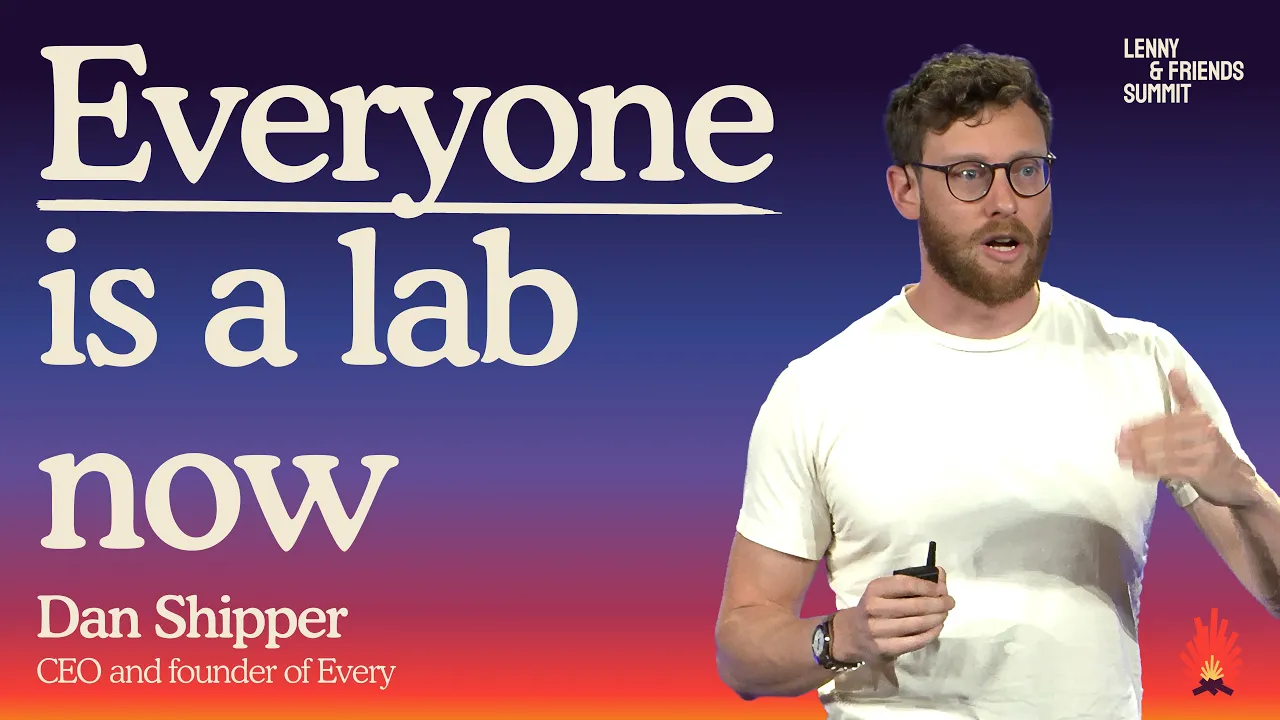
## Background Published on YouTube by Lenny's Podcast on September 24, 2026, this keynote features Dan Shipper, co-founder and CEO of Every, speaking live at the Lenny and Friends Summit. The presentation outlines how organizations can build a small research lab to rapidly test frontier AI capabilities in real workflows while the primary product team continues scaling what already works.
## TL;DR Dan Shipper addresses the organizational tension between divergent frontier exploration and convergent roadmap execution in the rapidly shifting AI era. Rather than forcing an entire team to do both, companies should spin up nimble 'two-slice' labs teams—ideally pairing an exploratory 'pirate' with a systems-minded 'architect'—to run disposable prototypes through extreme internal dogfooding. By establishing a structured research pipeline governed by internal adoption, a 10x value filter, and unit-economic viability, organizations can safely discard 90% of experiments while graduating clear winners into the core roadmap. Ultimately, this approach enables deliberate self-disruption without derailment, exemplified by how OpenAI's isolated Codex team eventually reshaped the main ChatGPT application.
## Atmosphere & style Shipper delivers a punchy, energetic conference keynote that balances candid founder humor with actionable operational frameworks. His tone is irreverent and self-aware, drawing genuine laughs with relatable observations about chaotic early adopters and the dizzying disorientation of constant frontier model releases. The presentation follows an emotional arc that moves from technological overwhelm to reassuring clarity, leaving builders with an empowering playbook to welcome future model drops with excitement rather than dread.
## Bulletin - [02:05](https://www.youtube.com/watch?v=DqF08Dz3nok&t=125s) Product organizations face severe paralysis when trying to force core teams to simultaneously execute stable roadmaps and track the fast-shifting AI frontier, creating a structural conflict between exploration and exploitation. - [07:31](https://www.youtube.com/watch?v=DqF08Dz3nok&t=451s) Modern AI labs do not need large head counts: a nimble 'two-slice team' of one or two people pairing a prototyping 'pirate' with a systems-focused 'architect' can rapidly map frontier capabilities. - [08:51](https://www.youtube.com/watch?v=DqF08Dz3nok&t=531s) Discarding 90% of lab prototypes can yield net-positive ROI when organizations publish transparent postmortems as readership content, run early-adopter VIP programs, and educate core engineering roadmaps. - [17:28](https://www.youtube.com/watch?v=DqF08Dz3nok&t=1048s) OpenAI's small Codex team demonstrated the upside of isolated self-disruption by testing coding form factors until their February 2026 desktop app grew into the foundation of ChatGPT for 800 million daily active users.
## Key takeaways - [00:06](https://www.youtube.com/watch?v=DqF08Dz3nok&t=6s) Technological leaps in frontier models cause organizational disorientation, necessitating a rule to avoid major roadmap pivots within 30 days of encountering new AI capabilities. - [02:05](https://www.youtube.com/watch?v=DqF08Dz3nok&t=125s) Exploration (divergent, highly experimental, throwing out ~90% of work) and execution (convergent, reliable roadmap delivery) represent incompatible cognitive postures that should not be forced on the same team. - [03:13](https://www.youtube.com/watch?v=DqF08Dz3nok&t=193s) Internal early adopters can derail roadmap execution with speculative ideas unless their tinkering is isolated and channeled into a dedicated labs initiative. - [03:13](https://www.youtube.com/watch?v=DqF08Dz3nok&t=193s) AI engineering leverage allows companies to start a functioning research lab with a team of one, mirroring how Anthropic Labs created Claude Code, MCP, and Skills from small experiments. - [07:31](https://www.youtube.com/watch?v=DqF08Dz3nok&t=451s) The optimal lab team is a 'two-slice team' of two people: a 'pirate' who generates high-volume, vibe-coded prototypes and an 'architect' who refines promising hacks into coherent software. - [07:31](https://www.youtube.com/watch?v=DqF08Dz3nok&t=451s) The core operational metric of an AI lab is shortening feedback loops, which is achieved most effectively through extreme internal dogfooding on real, substantive problems rather than synthetic sandboxes. - [08:51](https://www.youtube.com/watch?v=DqF08Dz3nok&t=531s) Running parallel, competing bets aimed at the exact same objective helps organizations chart an unpredictable AI frontier faster than enforcing false top-down coherence. - [11:00](https://www.youtube.com/watch?v=DqF08Dz3nok&t=660s) A structured research pipeline progresses initiatives from scrappy lab experiments to internal workflow adoption, trusted customer testing, and formal product roadmap integration. - [12:18](https://www.youtube.com/watch?v=DqF08Dz3nok&t=738s) Every's 'Kate bench' experiment automated editorial taste using three years of editing history, cutting the editor-in-chief's post-agent workload by 12% once an architect established production evaluation pipelines. - [15:17](https://www.youtube.com/watch?v=DqF08Dz3nok&t=917s) Graduating experiments from lab to product requires strict gating criteria: sustained organic internal retention, a 10x workflow improvement past initial novelty, and viable inference unit economics at scale. - [15:17](https://www.youtube.com/watch?v=DqF08Dz3nok&t=917s) Weekly cross-functional reviews of experimental pipelines ensure the broader engineering and product org can prepare for upcoming shifts without losing focus to speculative R&D. - [17:28](https://www.youtube.com/watch?v=DqF08Dz3nok&t=1048s) The true test of a working research lab model is that product organizations greet sudden frontier model releases with excitement rather than dread.
## Detailed walkthrough ### [00:06](https://www.youtube.com/watch?v=DqF08Dz3nok&t=6s) The Moving Frontier and Rule Number One
Building products during an ongoing technological revolution means dealing with what Dan Shipper terms "the unreasonableness of business as usual." The frontier is constantly shifting under product teams' feet: just the week before, cutting-edge models like Fable 5.1 and Astra 6 arrived, unlocking previously unthinkable capabilities overnight. Shipper demonstrates this with wild personal examples: using a single prompt, he generated an accurate 3D historical recreation of the Battle of Waterloo after letting the model churn for four hours. A teammate took an academic paper on agent simulations and, with a few prompts, had a thousand interacting agents simulated and visually rendered locally. Astra has even advanced enough to open Adobe Premiere directly and edit video, and it created the slide animations and substantial parts of Shipper's own summit deck without him ever clicking the "animate" tab.
This pace puts product leaders in an excruciating bind. Sticking strictly to a planned roadmap might work briefly, but the ground is moving beneath them. Asking customers what features they want rarely helps because customers are not familiar with the frontier and look to builders for guidance. Pivoting blindly—such as turning a standard B2B SaaS tool into a 3D multiplayer strategy game—is chaotic. Faced with this disorientation, Shipper establishes rule number one for navigating technology revolutions: "never make any major life decisions within 30 days of a meditation retreat, a psychedelic experience, or your first encounter with a frontier model."
[02:05](https://www.youtube.com/watch?v=DqF08Dz3nok&t=125s) The Structural Dilemma: Exploration vs. Exploitation
The fundamental tension inside modern product organizations stems from conflicting expectations. Companies expect everyone on the product team to simultaneously execute the roadmap at a high level and stay on the cutting edge of the frontier. These two modes represent opposing cognitive and operational postures:
- **Exploration (Divergent):** Trying dozens of new models, spinning up messy demos, testing wild ideas, and accepting that most of the output will be thrown in the trash. - **Exploitation / Execution (Convergent):** Saying "no" to distractions, narrowing focus, optimizing reliability, and delivering predictably against a structured roadmap.
```mermaid flowchart TD accTitle: The Tension Between Exploration and Execution accDescr: Divergent lab exploration pulls opposite to convergent product roadmap execution.
subgraph OrgMode ["Organizational Conflict"] direction LR Explore["Exploration (Divergent)<br/>• Test frontier models<br/>• Rapid prototypes<br/>• Discard ~90%"] Exploit["Execution (Convergent)<br/>• Deliver roadmap<br/>• Reliability & scaling<br/>• Adopt ~10%"] end
Explore <-->|"Fundamental Friction"| Exploit ```
Pulling an entire product team in both directions paralyzes delivery. Shipper proposes that instead of forcing everyone to do both, product organizations should incorporate elements of a dedicated research lab. By splitting responsibilities, companies can preserve focus on their core product while systematically discovering what comes next.
[03:13](https://www.youtube.com/watch?v=DqF08Dz3nok&t=193s) Why Form a Labs Team: Harnessing Early Adopters
In any organization, everyone is nominally juggling execution and exploration, but a handful of individuals naturally spend far more time playing on the frontier. These internal early adopters spend their weekends tinkering with new models, building side projects, and imagining alternate futures. Because they live in the future, they often spot where the industry and the product are heading well before anyone else does.
The dark side of early adopters is that left unchecked, "we can be a massive fucking distraction." They derail roadmap delivery by pitching speculative ideas to engineers trying to ship core work. The answer is to isolate and channel that energy by standing up a specialized **Labs team**. Crucially, in the age of AI, a labs team does not require a massive budget or head count; an organization can start with a "labs team of one." Because AI tooling provides individual engineers with massive leverage, a single person can test fresh model releases, run experiments, and report back on what actually matters without disrupting the core team.
| Dimension | Labs Team | Core Product Team | |:--- |:--- |:--- | | **Primary Mission** | Explore new capabilities & model drops | Improve, scale, and stabilize the core product | | **Operational Cadence** | Parallel experiments and quick proofs of concept | Predictable roadmap execution and customer delivery | | **Retention Expectation** | Expect to **dispose of ~90%** of what is built | Expect to **adopt ~10%** of what labs produces |
Shipper points to Anthropic Labs as a prime example of this model working at scale. High-impact tools like Claude Code, Model Context Protocol (MCP), Skills, and Claude Design originated from small internal experiments run by a focused team, while hundreds of other tests were discarded before the company committed heavy engineering resources to the winners.
[07:31](https://www.youtube.com/watch?v=DqF08Dz3nok&t=451s) Running a Lab: Two-Slice Teams, Pirates, and Architects
To run an internal lab effectively, Shipper recommends abandoning older management conventions like Jeff Bezos's "two-pizza team" (eight to ten people). In the AI era, coordination overhead kills exploratory momentum, so the optimal unit is a **"two-slice team"** consisting of one or two people at most. Two people operating with AI leverage move faster and with far clearer shared vision than a mid-sized group.
Shipper outlines a complementary two-person team dynamic that has proven successful at Every:
- **The Pirate:** An obsessive "slop cannon" hunting for raw value. The pirate rapidly hacks together messy, fully vibe-coded prototypes, throws out what fails, and discovers hidden utility through sheer experimentation volume. - **The Architect:** A structured builder who inspects the chaotic, vibe-coded system created by the pirate and refines it into something cohesive, extensible, and genuinely valuable.
Pairing a pirate with an architect grounds chaotic experimentation in solid architecture. Beneath team structure lies the core principle of lab velocity: extreme dogfooding. The most important metric for a labs team is shortening the feedback loop between creating a prototype and knowing whether it is actually good. The fastest possible feedback loop occurs when builders create tools to solve their own immediate problems.
[08:51](https://www.youtube.com/watch?v=DqF08Dz3nok&t=531s) Running Competing Experiments and Generating Net-Positive ROI
When testing experimental tooling, the most critical safeguard is using prototypes for actual, substantive work rather than contrived sandboxes. Dan emphasizes that this is the only reliable way to answer an essential question: "is this useful or is it just new?" When internal dogsfooding is impossible, teams must immediately partner with a handful of early adopter customers who can provide rapid, closed-loop feedback. Furthermore, running an AI lab demands a counterintuitive management philosophy: encouraging multiple parallel, competing bets aimed at the exact same objective. While having different people build competing solutions to a single problem may look like a chaotic lack of organizational coherence, moving model capabilities make the frontier fundamentally uncharted. Exploring identical challenges from diverse perspectives helps map that shifting frontier much faster.
Because a true exploratory lab inevitably throws away 90% of what it builds, leadership must actively design mechanisms to ensure that high failure rate is still net-positive in terms of ROI:
- **Publishing "failed" work as content:** Every frequently turns internal experiments—what was built, what succeeded, and what fell flat—into public essays. Audiences love transparent postmortems, and the resulting readership reliably funnels in new subscribers and product users. - **Powering an early adopter VIP program:** Enthusiastic customers who crave proximity to innovation can be invited into an experimental cohort, turning rough prototypes into a high-touch retention and relationship-building channel. - **Educating the core product team:** At minimum, lab members act as scouts who continuously brief product managers and engineers on newly unlocked capabilities, preventing the primary product organization from getting distracted by speculative R&D.
---
[11:00](https://www.youtube.com/watch?v=DqF08Dz3nok&t=660s) Structuring the Research Pipeline
To bridge the gap between speculative prototypes and dependable software, teams need a defined research pipeline where ideas journey progressively from left to right. On the far left, initiatives are strictly confined to the lab, existing as dozens of small, scrappy experiments. Most die quickly, but the few that show genuine promise are pushed into real daily workflows across the company to see if teammates willingly adopt them.
Once an internal team demonstrates organic reliance on a tool, the project is mature enough to show to trusted outside customers and begin formal handoff discussions with product managers. At that juncture, the product team determines roadmap fit, scalability, and long-term viability before any code is officially integrated into customer-facing releases.
```mermaid flowchart LR accTitle: Research Pipeline Flow accDescr: Progression of ideas from early lab experiments to scaled product release.
subgraph Lab ["Lab Exploration"] E1["Experiment A"] E2["Experiment B"] E3["Experiment C"] end
subgraph Validation ["Internal Validation"] IW["Real Internal Work\n(Team Adoption)"] end
subgraph Handoff ["Product Integration"] EA["Early Customers"] PM["Roadmap Planning"] Prod["Scaled Product Release"] end
Lab -->|"Promising signal"| IW IW -->|"Organic usage"| EA EA --> PM PM --> Prod ```
---
[12:18](https://www.youtube.com/watch?v=DqF08Dz3nok&t=738s) Case Study: "Kate Bench" and Automating Taste
To illustrate the pipeline in action, Dan shares the story of attempting to "very lovingly" automate Every’s editor-in-chief, Kate, over a three-year span. Kate possesses exceptional taste for copy editing, but as the company grew to around 30 people, she became a severe operational bottleneck, frequently handling edits late into the night. Hiring another editor of comparable editorial sensibility was prohibitively difficult to recruit and train. For years, Dan experimented with feeding historical editing data into various language models, often sending late-night messages like: *"Not important, but I downloaded every single one of your copy edits over the last 3 years and had Fable try to do a copy edit on the latest piece."*
For a long time, the model outputs fell short, but recent advances in underlying capabilities finally crossed the quality threshold. The internal benchmark—dubbed "Kate bench"—advanced into active internal use powered by the company’s internal assistant infrastructure (`agents@every.to`). Kate can now invoke the agent by asking it to *"do a Kate pass of this draft."* The tool directly inserts suggested changes mimicking her stylistic preferences, freeing her from baseline mechanical edits.
``` +-------------------------------------------------------------------+ | KATE BENCH PIPELINE | +-------------------------------------------------------------------+ | 1. Ingestion: 3 years of Kate's historical copy edit decisions | | 2. Agent Pass: Model suggests tracked inline edits on new drafts | | 3. Architecture: Production dashboard built by Jannik (systems) | | 4. Impact Metric: Accepted suggestions & Kate did 12% less work | +-------------------------------------------------------------------+ ```
Once Kate and the broader editorial staff adopted the hacky prototype, Dan brought in a dedicated systems architect named Jannik to transform the fragile script into an enterprise-grade compounding engine. Jannik constructed an evaluation dashboard tracking how many suggested edits authors accepted and measuring the residual manual editing Kate performed afterward. Within a month, the system reduced Kate's post-agent editing workload by 12% month-over-month. With solid proof of internal value, the team began evaluating how to abstract the workflow for early design partners across non-editorial domains.
---
[15:17](https://www.youtube.com/watch?v=DqF08Dz3nok&t=917s) Pipeline Governance, Decision Criteria, and Self-Disruption
To keep experiments flowing smoothly without drifting into disconnected science projects, organizations must enforce disciplined operational hygiene:
- **Weekly cross-functional pipeline reviews:** Every tracks all initiatives on an internal Notion board and reviews their movement during weekly company-wide all-hands meetings. This guarantees the core product team sees upcoming breakthroughs well in advance and can anticipate architectural implications without conducting redundant investigations. - **Rigorous graduation criteria:** Moving an initiative from one stage to the next must be treated as a major milestone gated by hard requirements: - *Sustained retention:* Are internal users returning to the tool repeatedly of their own volition? - *The 10x filter:* Does the tool provide a ten-fold improvement over existing workflows after the initial novelty wears off a month later? - *Unit economics at scale:* Even if an experimental model interaction looks dazzling, can the company realistically afford the inference costs when serving thousands of paying customers?
The overarching objective of this R&D structure is deliberate self-disruption: merging clear winners back into the core offering before competitors do. While self-disruption has historically been difficult for incumbents, the sheer velocity of AI development makes it uniquely feasible today. Dan points to OpenAI's Codex as a prime model: an isolated, nimble strike team operated completely outside the flagship ChatGPT application, competing directly alongside several parallel internal teams who were simultaneously exploring alternative visions for the future of AI-assisted software development.
[17:28](https://www.youtube.com/watch?v=DqF08Dz3nok&t=1048s) How the Codex Team's Experiments Reshaped ChatGPT, and the Ultimate Payoff of a Research Lab
Dan Shipper recounts how the small Codex team ran numerous iterations across different form factors to figure out what the future of coding would look like—testing whether it belonged inside an IDE, a CLI, or something else entirely. Ultimately, in February 2026, they launched a desktop app that Shipper calls "fantastic." That desktop app grew at such a blistering pace that it was eventually merged directly into ChatGPT, becoming the very foundation of the main product. Because of their success with this rapid way of experimenting, that "small little Codex team" essentially ended up taking over an application with 800 million daily active users.
```mermaid flowchart LR accTitle: Codex Lab Experimentation to ChatGPT Core subgraph Lab["Small Codex Team"] A["Form factor iterations (IDE, CLI)"] --> B["Desktop app launch (Feb 2026)"] end subgraph Main["Core Product Integration"] B -->|"Rapid growth"| C["Merged as foundation of ChatGPT"] C --> D["Leads 800M DAU app"] end ```
For Shipper, this story captures the ultimate promise of running a research lab alongside your core product team: "you can actually build the next version of your product while scaling the one that you already have. And you can do it without going crazy." He leaves the audience with a simple litmus test for how to tell when this organizational model is truly working: "you will welcome moments when new models drop and be excited about them instead of dreading them." Wrapping up to applause, Shipper reintroduces himself as the co-founder and CEO of Every, pitching it as "the only subscription you need to stay at the edge of AI."
- **Form factors explored by the Codex team:** IDE integrations, CLIs, and ultimately a desktop application. - **Desktop app launch date:** February 2026. - **Scale of impact:** The small Codex team's experiment became the foundation of ChatGPT, taking over an 800 million daily active user (DAU) app.
## Notable quotes > [00:06](https://www.youtube.com/watch?v=DqF08Dz3nok&t=6s) never make any major life decisions within 30 days of a meditation retreat, a psychedelic experience, or your first encounter with a frontier model. — Dan Shipper
> [03:13](https://www.youtube.com/watch?v=DqF08Dz3nok&t=193s) we can be a massive fucking distraction. — Dan Shipper
> [08:51](https://www.youtube.com/watch?v=DqF08Dz3nok&t=531s) is this useful or is it just new? — Dan Shipper
> [12:18](https://www.youtube.com/watch?v=DqF08Dz3nok&t=738s) Not important, but I downloaded every single one of your copy edits over the last 3 years and had Fable try to do a copy edit on the latest piece. — Dan Shipper
> [12:18](https://www.youtube.com/watch?v=DqF08Dz3nok&t=738s) do a Kate pass of this draft. — Dan Shipper
> [17:28](https://www.youtube.com/watch?v=DqF08Dz3nok&t=1048s) you can actually build the next version of your product while scaling the one that you already have. And you can do it without going crazy. — Dan Shipper
> [17:28](https://www.youtube.com/watch?v=DqF08Dz3nok&t=1048s) you will welcome moments when new models drop and be excited about them instead of dreading them. — Dan Shipper
> [17:28](https://www.youtube.com/watch?v=DqF08Dz3nok&t=1048s) the only subscription you need to stay at the edge of AI. — Dan Shipper
## Mentioned Dan Shipper, Every, Lenny and Friends Summit, Fable 5.1, Astra 6, Adobe Premiere, Anthropic Labs, Claude Code, Model Context Protocol (MCP), Skills, Claude Design, Jeff Bezos, Kate, Kate bench, Jannik, Notion, OpenAI, Codex, ChatGPT
## Video description How do you keep building a product when AI capabilities change so quickly? At the Lenny and Friends Summit, Every co-founder and CEO Dan Shipper makes the case for a small research lab that can explore new ideas while the product team improves what already works. He explains how to run fast experiments, test them in real work, and bring the most promising results into the main product.
Recorded live at Lenny and Friends Summit on September 10, 2026, in San Francisco.
[Source](https://www.youtube.com/watch?v=DqF08Dz3nok)