Ramp Automates 75% of Code as AI Pushes Development Bottlenecks to PMs
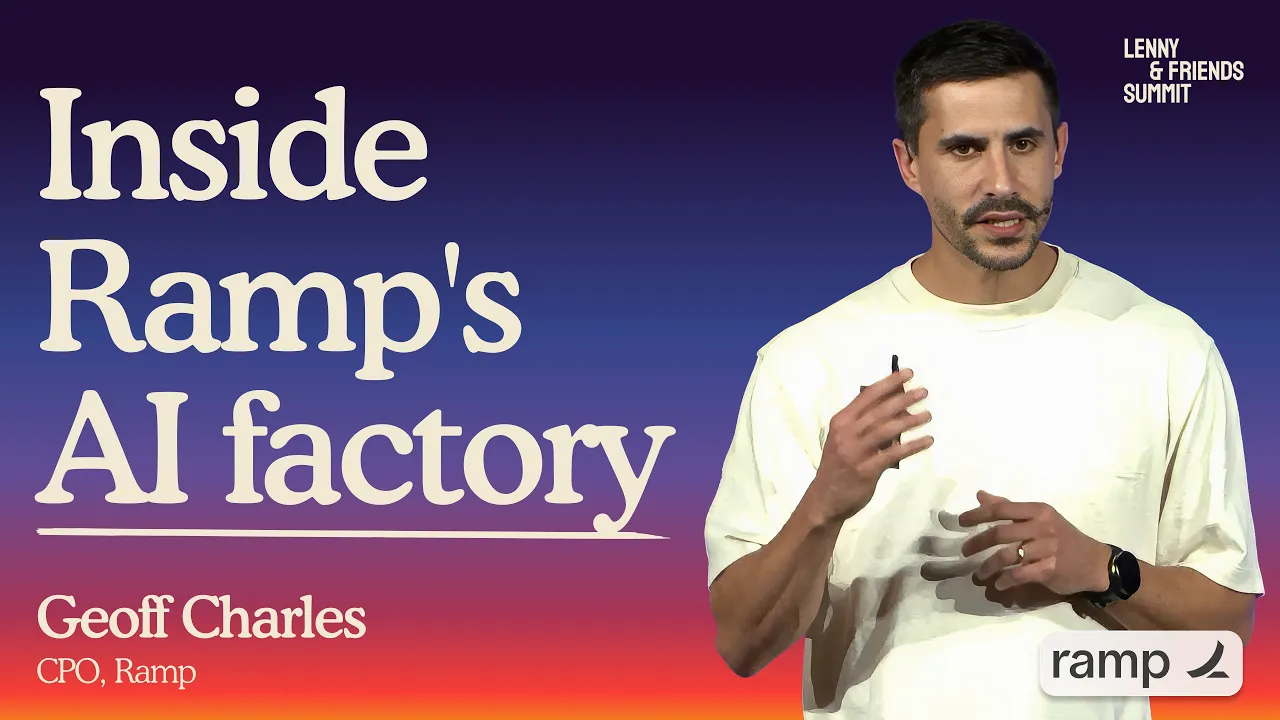
Lenny's Podcast
Automating code generation merely moves development bottlenecks downstream to problem definition and team coordination, requiring companies to re-engineer their internal software factory rather than manage individual features.
AI-assisted summary of What product looks like when coding is solved | Geoff Charles (Ramp CPO) — original source. Check the original for full context.
Source published:
Key ideas
- Ramp's in-house Slack coding agent Inspect powers 75% of all pull requests and enabled non-engineers to submit over 1,000 PRs in a single month, while its Review Buddy agent autonomously processes 93% of code reviews. (7:58)
- Testo, an autonomous browser QA agent navigating app flows via plain-English prompts, caught 425 bugs across 30 days prior to production release. (10:30)
- By treating organizational coordination as an API connected to Notion, Linear, and Slack, Ramp's internal agent Gadget resolves 85% of product questions autonomously. (11:31)
- Automating micro-loops from bug ingestion to testing and release resolves 60% of reported UX issues within 24 hours, keeping human PMs in the loop only for lightweight Slack approvals. (13:16)
Detailed notes
## Background Published on YouTube by Lenny's Podcast on September 25, 2026, this session features Ramp CPO Geoff Charles speaking live at the Lenny and Friends Summit in San Francisco. The talk explores how building faster with AI requires systematically identifying and eliminating bottlenecks across the entire product development lifecycle, while demonstrating how Ramp deploys autonomous agents across problem discovery, scoping, testing, and coordination to fundamentally reshape the role of product managers.
## TL;DR Drawing parallels to Formula 1 engineering and endurance motorsport, Geoff Charles argues that software velocity depends on system-wide flow rather than isolated coding speed, because automating one phase merely pushes the bottleneck downstream. He details Ramp's internal agentic toolchain—including Glass for defining specs, Inspect for rapid code generation, Review Buddy for auditing PRs, Testo for autonomous browser QA, and Gadget for organizational coordination—which resolves 85% of internal inquiries and fixes 60% of reported UX issues within 24 hours. Charles contends that automating these micro-loops liberates product managers from reactive busywork, dividing the future PM discipline into three distinct archetypes: Technical PMs who build the internal factory, Tastemakers who set subjective quality standards, and General Managers who orchestrate end-to-end business outcomes. Product organizations must ultimately stop obsessing over individual features and focus on re-engineering the software factory that produces them.
## Atmosphere & style The presentation is fast-paced, pragmatic, and high-energy, opening with self-deprecating humor about Charles totaling a $500 car in the 24 Hours of Lemons before shifting into a rigorous operational breakdown. Blending motorsport case studies from Ferrari and Audi with real-world architecture diagrams and live company metrics, the talk carries a tone of technical precision and executive urgency. It feels like an authentic, insider dispatch from the frontier of agentic engineering, balancing warnings about organizational coordination fatigue with an inspiring rally cry for teams to raise their ambitions.
## Bulletin - [07:58](https://www.youtube.com/watch?v=ZG8Mf3P9xzI&t=478s) Ramp's in-house Slack coding agent Inspect powers 75% of all pull requests and enabled non-engineers to submit over 1,000 PRs in a single month, while its Review Buddy agent autonomously processes 93% of code reviews. - [10:30](https://www.youtube.com/watch?v=ZG8Mf3P9xzI&t=630s) Testo, an autonomous browser QA agent navigating app flows via plain-English prompts, caught 425 bugs across 30 days prior to production release. - [11:31](https://www.youtube.com/watch?v=ZG8Mf3P9xzI&t=691s) By treating organizational coordination as an API connected to Notion, Linear, and Slack, Ramp's internal agent Gadget resolves 85% of product questions autonomously. - [13:16](https://www.youtube.com/watch?v=ZG8Mf3P9xzI&t=796s) Automating micro-loops from bug ingestion to testing and release resolves 60% of reported UX issues within 24 hours, keeping human PMs in the loop only for lightweight Slack approvals.
## Key takeaways - [00:06](https://www.youtube.com/watch?v=ZG8Mf3P9xzI&t=6s) In professional auto racing, the driver dictates only ~15% of performance; real speed comes from the car and pit crew eliminating bottlenecks across the broader system. - [00:06](https://www.youtube.com/watch?v=ZG8Mf3P9xzI&t=6s) Formula 1 pit stops shrank from 67 seconds in the 1950s to 1.8 seconds today through process redesign and tooling rather than demanding mechanics work harder. - [03:06](https://www.youtube.com/watch?v=ZG8Mf3P9xzI&t=186s) AI does not permanently remove product bottlenecks; it merely shifts them downstream from code generation directly onto product managers. - [03:06](https://www.youtube.com/watch?v=ZG8Mf3P9xzI&t=186s) To synthesize fragmented customer feedback across Gong, Zendesk, and telemetry, Ramp built an ETL and vector-search insight pipeline alongside an automated daily AI 'hate podcast'. - [04:01](https://www.youtube.com/watch?v=ZG8Mf3P9xzI&t=241s) Generic AI chat interfaces fail without context; Ramp's Project Glass agent acts as an AI tech lead by integrating directly with Snowflake, PRDs, and the codebase to generate validated requirements and design system prototypes. - [07:58](https://www.youtube.com/watch?v=ZG8Mf3P9xzI&t=478s) Inspect deploys functional preview environments in under five seconds via Slack, enabling PMs to iterate quickly and generating three-quarters of Ramp's code. - [07:58](https://www.youtube.com/watch?v=ZG8Mf3P9xzI&t=478s) Review Buddy mitigates PR review fatigue by evaluating security, code standards, and the author's prompt history, autonomously approving 93% of PRs so engineers focus only on the riskiest 7%. - [10:30](https://www.youtube.com/watch?v=ZG8Mf3P9xzI&t=630s) Testo automates end-to-end QA by running headless browser tests across ~100 state permutations from plain-language instructions, catching 425 bugs in 30 days. - [10:30](https://www.youtube.com/watch?v=ZG8Mf3P9xzI&t=630s) When code generation and QA are solved, human attention and organizational coordination emerge as the primary constraint on velocity. - [11:31](https://www.youtube.com/watch?v=ZG8Mf3P9xzI&t=691s) Under the thesis that 'every question is an API,' Ramp's Gadget agent answers roadmaps, pricing, and launch inquiries directly from internal systems of record. - [13:16](https://www.youtube.com/watch?v=ZG8Mf3P9xzI&t=796s) Automating small, low-level feedback loops prevents PMs from chasing easy dopamine hits and resolves 60% of UX issues in under 24 hours, freeing teams to pursue ambitious bets. - [14:32](https://www.youtube.com/watch?v=ZG8Mf3P9xzI&t=872s) Product velocity cannot be captured by a single metric; leaders should hire intuitive 'drivers' with an uncompromising bar for speed and empower them to challenge leadership. - [14:32](https://www.youtube.com/watch?v=ZG8Mf3P9xzI&t=872s) Resource-constrained teams can outperform incumbents by picking a specific dimension of excellence and engineering around it, mirroring Audi's Le Mans wins through diesel efficiency. - [16:25](https://www.youtube.com/watch?v=ZG8Mf3P9xzI&t=985s) The PM role is diverging into three future archetypes: Technical PMs who build internal factories, Tastemakers who guide aesthetic and intuitive design, and General Managers who drive end-to-end business outcomes. - [17:55](https://www.youtube.com/watch?v=ZG8Mf3P9xzI&t=1075s) Product leaders must shift their focus from inspecting individual features to continually architecting and upgrading the software factory that builds them.
## Detailed walkthrough ### [00:06](https://www.youtube.com/watch?v=ZG8Mf3P9xzI&t=6s) The 24 Hours of Lemons and System-Level Velocity
Geoff Charles opens by praising the earlier speakers and joking that he has rewritten his presentation three times after being inspired to incorporate storytelling. To illustrate the concept of velocity, he shares a personal anecdote about his love of speed. He once signed up to race—not at the prestigious 24 Hours of Le Mans, but at the 24 Hours of Lemons, an endurance race where participants enter beat-up $500 cars and try to survive a full day on the track. His race ended abruptly when he suffered a severe crash. While he emerged uninjured, the car was totaled.
Reflecting on the wreck, Charles notes that while driver error caused his crash, in professional motorsport the driver accounts for only about 15% of the overall race outcome. The real performance advantage lies in the interplay between the driver and the car, and between the car and the pit crew. "Winning isn’t just about driving faster," Charles explains; even world-class drivers are constrained by the capabilities of the broader system. Winning requires systematically eliminating the bottlenecks surrounding the driving itself.
To show how dramatic systemic improvements can be, Charles highlights Formula 1 pit stops: in the 1950s, changing tires took 67 seconds; today, top teams execute pit stops in 1.8 seconds. This 37-fold improvement did not happen by ordering mechanics to work 37 times harder, but by dissecting the process, introducing specialized roles, upgrading equipment, and practicing relentlessly. Furthermore, F1 innovation is continuous—90% of a car's 16,000 components are redesigned every year, with only 10% carrying over to the next season. Charles challenges the audience of product leaders to consider what their organizations would look like if 90% of their codebase turned over annually. In software, the race clock starts the moment a customer experiences pain and only stops once a working solution is in their hands. AI does not permanently eliminate bottlenecks; it merely shifts them downstream. The winning product teams will be those that identify the newly formed bottleneck fastest and re-engineer their factory around it.
- In professional auto racing, the driver dictates only ~15% of the race outcome; system integration accounts for the remaining 85%. - F1 pit stops dropped from 67 seconds in the 1950s to 1.8 seconds today through process and tooling redesign. - Only 10% of the 16,000 components on an F1 car carry over from one season to the next.
---
[03:06](https://www.youtube.com/watch?v=ZG8Mf3P9xzI&t=186s) Shifting the Bottleneck to PMs and Step 1: Identifying Customer Pain
In the standard product development lifecycle—identify, define, build, and improve—software engineers have aggressively automated their own work with AI tools, making code generation dramatically easier. Charles jokes that product managers should "be as lazy as engineers" and automate their own overhead, because the primary bottleneck in product organizations has now shifted directly onto PMs. Product managers suddenly face an overwhelming demand to define more problems, facilitate collaboration, coordinate launches, and test more deliverables.
```mermaid flowchart TD accTitle: Ramp Customer Insight Pipeline accDescr: Customer pain data flows from siloed sources into an ETL pipeline and vector search, feeding an insight agent that surfaces findings via Slack, dashboards, and audio digests.
subgraph Inputs ["Fragmented Feedback Sources"] G["Gong Calls"] Z["Zendesk Tickets"] L["LogRocket Sessions"] E["Exec Escalations"] end
subgraph Processing ["Customer Insight Engine"] ETL["ETL & Data Pipelines"] VS["Vector Search & Clustering"] PR["Product & Feature Mapping"] end
subgraph Interfaces ["Distribution Layer"] SA["Slack Query Agent"] DB["HTML Insights Dashboard"] PC["AI Audio Hate Podcast"] end
Inputs --> ETL ETL --> VS VS --> PR PR --> Interfaces ```
The first stage of this loop is identification. Customer pain signals are scattered across disparate silos: Gong call recordings, Zendesk tickets, LogRocket telemetry, surveys, and angry escalations sent to executives. Sifting through this volume manually is impossible. Even modern LLMs with 1-million-token context windows can ingest less than 0.5% of Ramp's Gong transcripts alone. Ramp initially set up a lightweight internal Slack channel dubbed the "hate channel" that automatically broadcast raw customer gripes. While entertaining, it quickly became an unmanageable flood of noise.
To solve this systematically, Ramp built a dedicated customer insight agent powered by traditional ETL pipelines, vector search, and clustering algorithms. The agent is grounded in Ramp's org chart, product hierarchy, and active feature sets, allowing it to aggregate related feedback and make it traceable back to specific accounts. To distribute these insights across the company, the team built a queryable Slack interface, an HTML dashboard, and even an automated "hate podcast" where team members can listen to an AI-generated morning audio digest of customer complaints. Charles emphasizes that synthesizing data this way does not replace talking to customers; rather, it directs PMs to the exact users they need to interview.
---
[04:01](https://www.youtube.com/watch?v=ZG8Mf3P9xzI&t=241s) Step 2: Defining Products with AI (Project Glass)
Once a problem is identified, the next hurdle is defining the solution—moving from a raw concept to an actionable, fully scoped specification. Charles points out that standard AI chat interfaces are frustratingly unhelpful when they greet the user with a blank prompt: "What do you want to build?" Asking a product manager what they want without prior context renders an intelligent model far less useful. To create actionable output, AI must be wired directly into enterprise systems.
Ramp tackled this by creating an internal agent named Glass. Glass integrates with Snowflake data warehouses and user research repositories to articulate precise "jobs to be done" supported by both qualitative customer verbatims and quantitative behavioral metrics. Because Glass is indexed on Ramp’s codebase, product strategy documents, and PRD guidelines, it effectively functions as an AI tech lead. Instead of product managers interrupting senior engineers to ask whether a technical path is feasible or might break an existing dependency, they validate requirements directly with Glass.
Finally, Glass bridges the gap between spec and execution by generating functional prototypes mapped to Ramp's actual design system and frontend components. Charles observes that engineers rarely want to read bloated, abstract specifications, nor do they want unconstrained mockups that cannot be implemented. What engineers need is the complete package: solid qualitative and quantitative evidence proving the problem exists, crisp technical requirements ready to feed into automated coding agents, and an interactive prototype demonstrating the desired experience.
---
[07:58](https://www.youtube.com/watch?v=ZG8Mf3P9xzI&t=478s) Step 3: Building at Scale with Inspect, Review Buddy, and Testo
With definitions automated, the execution bottleneck moves into the build phase. Charles outlines how Ramp systematically addressed each sequential constraint across coding, code review, and QA testing:
```mermaid flowchart LR accTitle: Ramp Automated Engineering Pipeline accDescr: Software delivery flow showing Inspect generating code, Review Buddy reviewing PRs, and Testo running headless browser validation.
subgraph CodeGen ["Code Generation"] PM["PM / Non-Eng Input"] --> INS["Inspect (Slack Agent)"] INS --> PRV["Deployed Preview (<5s)"] end
subgraph Review ["Verification"] PRV --> RB["Review Buddy (93% Auto-Approved)"] RB -->|"7% High Risk"| ENG["Senior Human Review"] end
subgraph Testing ["QA Validation"] RB --> TST["Testo (Browser QA Agent)"] ENG --> TST TST --> REL["Production Release"] end ```
The first obstacle was raw implementation speed, which Ramp solved by developing Inspect, an in-house coding agent. Rather than using generic coding tools, Ramp built Inspect to deeply understand their specific repository architecture and coding standards. Running directly through Slack, Inspect can generate functional code and deploy an interactive preview environment in under five seconds, allowing product managers to test working software almost instantly. Inspect has facilitated over one million sessions, writes 75% of Ramp's pull requests, and enabled non-engineers to submit over 1,000 PRs in a single month.
The massive influx of code created an immediate secondary bottleneck: PR review fatigue. Engineers found themselves buried under an avalanche of pull requests. In response, Ramp introduced Review Buddy, an agent that audits incoming PRs for security standards, code quality, and style conventions. Review Buddy can even inspect the prompt chains used to create the code, evaluating the author's intent and prompt hygiene. The agent automatically reviews and processes 93% of all Ramp pull requests, freeing senior engineers to focus exclusively on the remaining 7% of high-risk, architectural PRs.
The final bottleneck shifted to quality assurance. Traditionally, product managers spend hours configuring staging environments, seeding test fixtures, and clicking through user journeys to verify implementation details. Ramp automated this with Testo, an autonomous browser-based QA agent. Testo accesses production-like test fixtures, spins up the application across 100 different parameter combinations, and navigates the UI like a real user. PMs give Testo plain-language instructions—such as "pay an invoice, but amortize it"—and the agent executes the flow, identifying functional blockers and interface issues before release.
- **Inspect**: Ramp's custom Slack-based coding agent; powers 75% of all PRs, has run over 1,000,000 sessions, and enabled non-engineers to merge 1,000+ PRs in a single month. - **Review Buddy**: Automated code review agent that audits prompt history, security, and quality, autonomously handling 93% of Ramp pull requests while routing only the 7% riskiest PRs to human staff. - **Testo**: Autonomous browser agent that runs headless QA sessions across ~100 realistic state permutations using plain-English prompts.
[10:30](https://www.youtube.com/watch?v=ZG8Mf3P9xzI&t=630s) Catching Bugs with Testo and the Shift to Coordination
Geoff Charles details how Ramp’s automated testing agent, Testo, catches issues, blockers, and confusing UI elements that violate their design system or design language before they ever hit production. Rather than letting customers discover these defects, Testo feeds thoughtful quality and design critiques right back into the product development loop. In just the last 30 days alone, Testo caught 425 bugs internally.
```mermaid flowchart TD accTitle: Ramp Automated QA and Feedback Loop accDescr: Testo scans code for bugs and design issues, routes feedback back to builders, and prepares releases for coordination. subgraph Testing["Testo Agent"] A["Code & UI Artifacts"] --> B["Testo Automated Review"] B --> C{"Quality Checks"} C -->|"425 bugs caught (30 days)"| D["Feed back to builders to fix"] end subgraph Bottleneck["Next Bottleneck"] C -->|"Passed checks"| E["Shipping rapidly"] E --> F["Human Attention Bottleneck"] end ```
Once code generation and testing are solved, you begin shipping massive amounts of product at high velocity. That immediately exposes the next systemic bottleneck: human attention and coordination. Product managers become completely inundated with pings, status inquiries, and cross-functional questions. Striking the balance between too much process (which slows builders down) and too little process (which leaves everyone confused) requires treating coordination fundamentally differently.
- Testo caught 425 bugs in the last 30 days before customer release. - When development speed surges, human attention and organizational coordination replace coding as the primary constraint.
---
[11:31](https://www.youtube.com/watch?v=ZG8Mf3P9xzI&t=691s) Treating Questions as APIs: Gadget and Autonomous Coordination
Ramp approaches human coordination with a core technical thesis: "Every question is an API." To execute on this, they built an internal tool named Gadget. Gadget understands the intent behind inbound inquiries and connects them to the company's formal systems of record: roadmap documents and specs in Notion, customer call notes, Linear tickets, and Slack conversations. For AI agents to function effectively, the entire company's operational context must be legible to machines.
```mermaid flowchart LR accTitle: Gadget Organizational Knowledge Architecture accDescr: How Gadget connects team questions to internal systems of record and handles status and launch artifacts. subgraph Input["Queries & Roles"] Q1["Status & Roadmaps"] Q2["Sales & GTM Inquiries"] Q3["Launches"] end subgraph GadgetAgent["Gadget Engine"] G["Gadget API Parser"] end subgraph Sources["Legible Context"] N["Notion Specs & Roadmap"] L["Linear Tickets"] S["Slack Discussions"] end subgraph Outputs["Autonomous Actions"] O1["Auto-updates Notion & alerts owners"] O2["Answers pricing / geos (85% solved)"] O3["Writes Help Docs, Emails, Blog Posts"] end
Q1 --> G Q2 --> G Q3 --> G G <--> N G <--> L G <--> S G --> O1 G --> O2 G --> O3 ```
When someone asks if a project is on track or who owns the next milestone, Gadget provides an evidence-backed answer, pings owners who are overdue on deliverables, and directly updates the roadmap in Notion. For the sales team asking about feature availability in Brazil, pricing tiers, or specific use cases, Gadget resolves the request or routes it to the exact owner. Furthermore, Gadget handles launch operations by analyzing the finished feature to draft help center documentation, marketing blog posts, and customer announcement emails.
- **85% of questions** previously directed to product managers are now resolved completely autonomously by AI. - Unanswered queries are routed to the proper human, and the resulting answers are ingested to train the system for future inquiries.
---
[13:16](https://www.youtube.com/watch?v=ZG8Mf3P9xzI&t=796s) Automating Micro-Loops to Reclaim Ambition
Product managers naturally succumb to quick dopamine hits by picking off small, visible, reactive tasks with high certainty. Citing Claire Vo's summit talk on ambition, Charles warns that spending energy on tiny items prevents teams from being truly ambitious. The antidote is automating oneself out of small feedback loops entirely.
At Ramp, an autonomous AI pipeline manages these low-level cycles: it ingests issues, deduplicates and ranks them against the Linear backlog, generates a plan, writes the code, pushes it through CI/CD and testing, and updates the knowledge base upon launch. The human PM or engineer is kept in the loop merely via lightweight Slack approvals (e.g., verifying "ready to code"). By having thousands of small loops running unattended in the background, 60% of UX issues identified by customers, sales reps, or internal staff are resolved within 24 hours, freeing PMs to tackle larger structural bets.
---
[14:32](https://www.youtube.com/watch?v=ZG8Mf3P9xzI&t=872s) Racing Lessons: Velocity, Resource Constraints, and Drivers
Charles addresses the three most frequent questions teams face when operating this way:
1. **How do you measure product velocity and maintain quality?** Velocity cannot be reduced to a clean single metric like a lap time. Charles references Niki Lauda joining Ferrari in 1974, testing the car, bluntly telling Enzo Ferrari it handled and braked terribly, and immediately sitting down with the engineers to rebuild it. To know if you are moving fast enough, hire "drivers" who possess an intuitive, uncompromising understanding of true speed, grant them authority, and let them challenge leadership.
2. **How do you compete with constrained resources or token limits against massive incumbents?** In 2006, Audi entered endurance racing with an inherently slower car. Instead of attempting to outrun rivals on pure top speed, they focused on diesel fuel efficiency, minimizing pit stops and maximizing track time to capture three consecutive 24 Hours of Le Mans victories. Organizations must embrace their constraints, pick a distinct dimension to achieve world-class excellence, and systematically attack their single biggest bottleneck.
---
[16:25](https://www.youtube.com/watch?v=ZG8Mf3P9xzI&t=985s) The Three Future Paths for Product Managers
Addressing the fear that autonomous agent loops will automate away the PM role, Charles counters that offloading execution work to engineering-led agentic systems is liberating rather than threatening. He outlines three emerging archetypes for product managers:
| PM Archetype | Primary Focus & Domain | Core Responsibility | |:--- |:--- |:--- | | **The Technical PM (The Factory Builder)** | Internal tooling, development pipelines, and organizational architecture | Removing drag, diagnosing bottlenecks, and shipping the internal software that enables AI agents and humans to build customer products faster. | | **The Tastemaker (The Driver)** | Product aesthetics, customer intuition, and design language | Acting as the driver holding the steering wheel, setting an exacting quality standard, and delivering subjective judgment that AI cannot emulate. | | **The General Manager (The GM)** | Cross-functional business outcomes across GTM, Ops, and Product | Expanding past classic product boundaries to direct product, marketing, sales, and operations toward unified business metrics. |
---
[17:55](https://www.youtube.com/watch?v=ZG8Mf3P9xzI&t=1075s) Final Takeaways: Invest in the Software Factory
Charles summarizes three guiding principles for the modern product organization: 1. **Speed is about flow, not just typing code:** True speed comes from locating and systematically eliminating your core development bottleneck—every team has one. 2. **Bottlenecks constantly shift:** Solving one constraint immediately exposes the next; great teams continually cycle forward to address the new impediment. 3. **Focus on the factory:** Product leaders must spend less time scrutinizing isolated features and significantly more time architecting the engine that manufactures software.
He concludes by acknowledging that everything Ramp built is already iterative and bound to be surpassed, invoking Enzo Ferrari’s classic maxim: "The best Ferrari ever built is the next one." In the same way, the best product you will ever launch is your next one, which relies entirely on the quality of the software factory you assemble today.
## Notable quotes > [00:06](https://www.youtube.com/watch?v=ZG8Mf3P9xzI&t=6s) Winning isn’t just about driving faster — Geoff Charles
> [03:06](https://www.youtube.com/watch?v=ZG8Mf3P9xzI&t=186s) be as lazy as engineers — Geoff Charles
> [04:01](https://www.youtube.com/watch?v=ZG8Mf3P9xzI&t=241s) What do you want to build? — Geoff Charles
> [11:31](https://www.youtube.com/watch?v=ZG8Mf3P9xzI&t=691s) Every question is an API. — Geoff Charles
> [16:25](https://www.youtube.com/watch?v=ZG8Mf3P9xzI&t=985s) The Technical PM (The Factory Builder) — Geoff Charles
> [16:25](https://www.youtube.com/watch?v=ZG8Mf3P9xzI&t=985s) The Tastemaker (The Driver) — Geoff Charles
> [16:25](https://www.youtube.com/watch?v=ZG8Mf3P9xzI&t=985s) The General Manager (The GM) — Geoff Charles
> [17:55](https://www.youtube.com/watch?v=ZG8Mf3P9xzI&t=1075s) The best Ferrari ever built is the next one. — Enzo Ferrari
## Mentioned Geoff Charles, Ramp, Lenny's Podcast, Lenny and Friends Summit, 24 Hours of Lemons, 24 Hours of Le Mans, Formula 1, Gong, Zendesk, LogRocket, Slack, Project Glass, Snowflake, Inspect, Review Buddy, Testo, Gadget, Notion, Linear, Claire Vo, Niki Lauda, Ferrari, Enzo Ferrari, Audi
## Video description At Lenny and Friends Summit, Ramp's CPO Geoff Charles explains why building faster with AI means finding bottlenecks across the entire product development process. He shows how Ramp uses AI agents to uncover customer problems, shape ideas, review and test code, coordinate launches, and fix UX issues. As each bottleneck shifts, he argues that product leaders need to keep improving the system they use to build and rethink the PM's role within it.
Recorded live at Lenny and Friends Summit on September 10, 2026, in San Francisco.
[Source](https://www.youtube.com/watch?v=ZG8Mf3P9xzI)