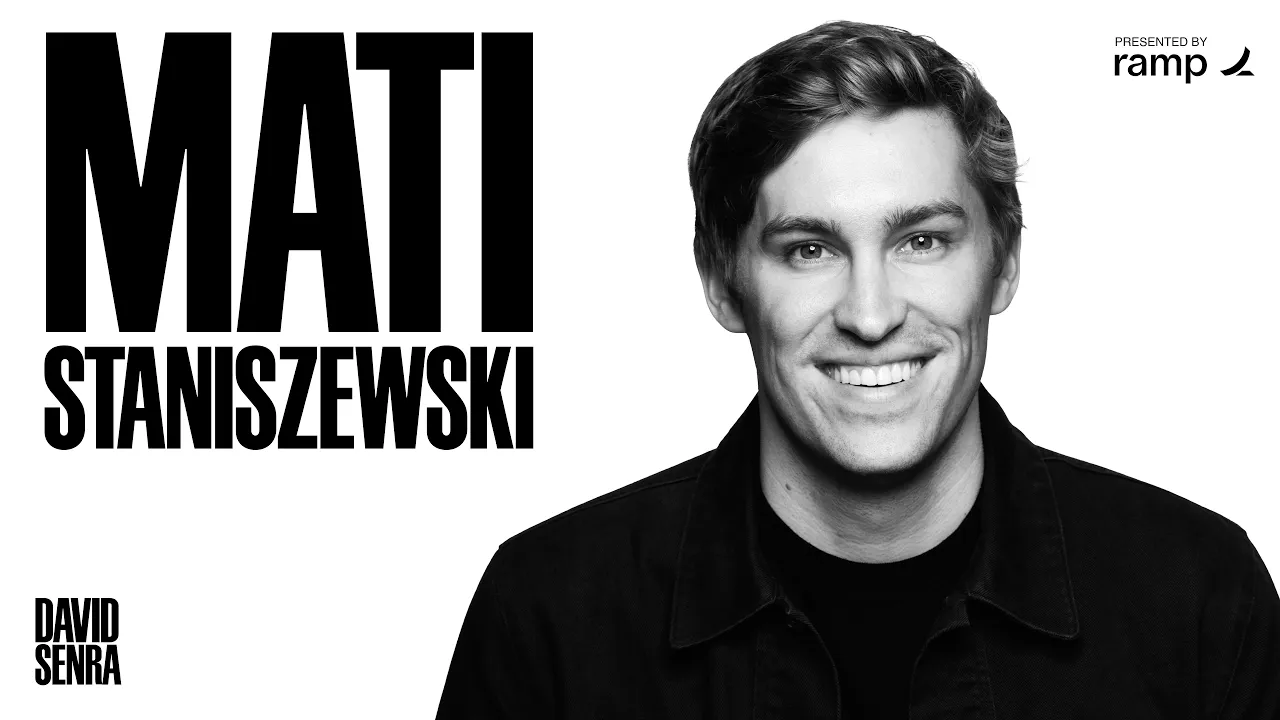
ElevenLabs Rebuffs Takeover Bids to Build Voice-First AI Platform
David Senra
Co-founder Mati Staniszewski rejected multiple acquisition offers to keep the startup independent, betting computing interfaces will permanently shift from keyboards to voice as models adopt intentional human imperfections.
ElevenLabs has rejected multiple acquisition offers to preserve founder independence, prioritizing a long-term vision of turning voice into the primary human-computer computing interface. (56:39)
Adopting a Honda-inspired operating structure, ElevenLabs unifies in-house frontier audio research with small, autonomous product pods of fewer than ten people rather than wrapping third-party APIs. (11:36)
Borrowing from Palantir, ElevenLabs deploys Forward Deployed Engineers directly into enterprise customer workflows, reporting directly to Product to abstract client solutions into scalable platform features. (27:36)
ElevenLabs found that technically flawless synthetic speech triggers user unease, discovering that intentional imperfections such as pauses, hesitations, and filler words are essential for natural adoption. (52:46)
Detailed notes
## Background
Published by David Senra on YouTube on September 9, 2026, this episode features an in-depth interview with ElevenLabs co-founder Mati Staniszewski. The show notes describe the discussion as covering how frustration with Polish dubbing led Staniszewski and Piotr Dąbkowski to launch their AI audio research company in 2022, their adoption of Palantir-inspired operating models like forward-deployed engineers and flat teams, the application of synthetic voice to amplify human capability, and their commitment to remaining independent despite multiple acquisition bids.
## TL;DR
Mati Staniszewski details the evolution of ElevenLabs from an idea sparked by the Polish lektor tradition into a frontier AI speech company combining pure audio research with applied product deployment. He explains why the company embraces an engine-first approach modeled after Honda R&D and Palantir's forward-deployed engineering structure, choosing to focus exclusively on voice rather than spreading resources into video avatars or general LLMs. Staniszewski explores the company's fastest-growing enterprise use cases in fintech, telecom, and accessibility, highlighting how deliberate vocal imperfections and emotional nuance foster human connection. Emphasizing a philosophy of amplifying human potential rather than replacing it, he concludes with his long-term vision of voice replacing keyboards as the dominant interface for computing, explaining why he and his co-founder turned down repeated buyout offers to maintain full independence.
## Atmosphere & style
The conversation carries the focused intensity of an intellectual workshop, propelled by David Senra's rapid-fire historical analogies to industrial icons like Soichiro Honda, Edwin Land, and Alexander Graham Bell. Staniszewski serves as a calm, measured counterbalance, speaking with quiet, disciplined conviction and an unpretentious European engineering mindset. The dialogue transitions organically from pragmatic operational tactics—such as embedding coders in non-technical workflows and ditching the conference circuit—to emotionally resonant moments about restoring voices to ALS patients. The overall tone feels grounded, serious, and deeply motivated by craft, completely eschewing typical Silicon Valley hype in favor of first-principles substance.
## Bulletin
- [56:39](https://www.youtube.com/watch?v=RFccAuyPPOg&t=3399s) ElevenLabs has rejected multiple acquisition offers to preserve founder independence, prioritizing a long-term vision of turning voice into the primary human-computer computing interface.
- [11:36](https://www.youtube.com/watch?v=RFccAuyPPOg&t=696s) Adopting a Honda-inspired operating structure, ElevenLabs unifies in-house frontier audio research with small, autonomous product pods of fewer than ten people rather than wrapping third-party APIs.
- [27:36](https://www.youtube.com/watch?v=RFccAuyPPOg&t=1656s) Borrowing from Palantir, ElevenLabs deploys Forward Deployed Engineers directly into enterprise customer workflows, reporting directly to Product to abstract client solutions into scalable platform features.
- [52:46](https://www.youtube.com/watch?v=RFccAuyPPOg&t=3166s) ElevenLabs found that technically flawless synthetic speech triggers user unease, discovering that intentional imperfections such as pauses, hesitations, and filler words are essential for natural adoption.
## Key takeaways
- [02:59](https://www.youtube.com/watch?v=RFccAuyPPOg&t=179s) Mati Staniszewski and Piotr Dąbkowski founded ElevenLabs in 2022 before ChatGPT launched, inspired by childhood frustration with Poland's monotone 'lektor' dubbing and a desire to build a universal Babel fish translator.
- [05:54](https://www.youtube.com/watch?v=RFccAuyPPOg&t=354s) Direct creator feedback convinced the founders to pivot from automated dubbing to pure speech synthesis after identifying that unnatural, robotic text-to-speech was the core technical bottleneck.
- [16:15](https://www.youtube.com/watch?v=RFccAuyPPOg&t=975s) Following Soichiro Honda's engine-centric philosophy, ElevenLabs enforces strict product discipline, refusing to build features—like video avatars—where proprietary audio models do not confer an unfair advantage.
- [18:20](https://www.youtube.com/watch?v=RFccAuyPPOg&t=1100s) To construct an economic moat beyond research advances, ElevenLabs built a creator voice marketplace featuring over 20,000 authenticated voices that earn recurring royalties.
- [24:09](https://www.youtube.com/watch?v=RFccAuyPPOg&t=1449s) Deutsche Telekom expanded its partnership with ElevenLabs from marketing audio into mission-critical operations, including CRM-integrated call center agents and real-time network call translation.
- [27:36](https://www.youtube.com/watch?v=RFccAuyPPOg&t=1656s) ElevenLabs stations Forward Deployed Engineers on-site with large enterprise clients, deliberately aligning them under Product rather than Sales to prevent the company from degenerating into a services consultancy.
- [33:41](https://www.youtube.com/watch?v=RFccAuyPPOg&t=2021s) The organization maintains a flat hierarchy capped at approximately five organizational layers, using AI telemetry and internal meeting syntheses to eliminate traditional middle-management overhead.
- [39:08](https://www.youtube.com/watch?v=RFccAuyPPOg&t=2348s) Software engineers are embedded into non-technical departments like Legal and RevOps, including replacing standard web contact forms with conversational AI voice SDR agents.
- [42:59](https://www.youtube.com/watch?v=RFccAuyPPOg&t=2579s) Conversational voice agents and creative production tools represent ElevenLabs' fastest-growing business segments, led by rapid adoption across fintech, healthcare, and telecommunications.
- [44:38](https://www.youtube.com/watch?v=RFccAuyPPOg&t=2678s) Speech synthesis relies heavily on subjective human taste and artistic judgment, leading ElevenLabs to pair forward-deployed engineers with forward-deployed creative talent.
- [49:09](https://www.youtube.com/watch?v=RFccAuyPPOg&t=2949s) Through accessibility partnerships with hundreds of medical organizations, more than 10,000 individuals with conditions like ALS and throat cancer have restored their vocal identities using ElevenLabs.
- [52:46](https://www.youtube.com/watch?v=RFccAuyPPOg&t=3166s) Synthetic voice models gained wider acceptance once engineers injected natural human flaws, such as pauses, cadence shifts, and filler words, rather than striving for clinical acoustic perfection.
- [56:39](https://www.youtube.com/watch?v=RFccAuyPPOg&t=3399s) The co-founders turned down multiple multi-million-dollar buyout offers, choosing independence over financial liquidity to avoid spending their careers regretting selling their highest-conviction venture.
- [01:04:01](https://www.youtube.com/watch?v=RFccAuyPPOg&t=3841s) Voice interfaces will replace keyboards and code as the dominant computing medium, shifting computing history from humans adapting to machines to technology adapting directly to natural human conversation.
## Detailed walkthrough
### [00:02](https://www.youtube.com/watch?v=RFccAuyPPOg&t=2s) Building an AI-Native Company Before ChatGPT
David Senra opens the conversation recalling a recent encounter with Michael Dell at an event, where Mati Staniszewski had asked Dell about how building a company today differs from the past. Dell, drawing on more than forty years of experience dominating technology, insisted to David in a subsequent thirty-minute chat that despite historical cycles usually repeating themselves, "this time is different." When asked how he approaches building an AI-native organization from day one, Mati points out that he and his co-founder, Piotr Dąbkowski—his best friend of fifteen years—are first-time founders, making ElevenLabs their very first venture.
They launched ElevenLabs in 2022, notably before the public debut of ChatGPT. At the time, the mainstream tech world was almost completely preoccupied with crypto and the metaverse. For Mati and Piotr, that lack of general AI hype proved to be an ideal distraction screen, giving them the quiet runway needed to concentrate deeply on frontier AI development without the noise that arrived shortly after.
Prior to starting ElevenLabs, both founders brought complementary technical disciplines:
- **Mati Staniszewski:** Studied mathematics; worked at BlackRock developing risk models; subsequently worked at Palantir building and deploying enterprise optimization models directly into production for clients like the UK's National Health Service (NHS) during the COVID-19 vaccine rollout and the oil and gas industry optimizing energy production.
- **Piotr Dąbkowski:** Conducted academic research on image visual models before joining Google, where he worked on foundational text models powering the Google Knowledge Graph. Mati describes Piotr as "the smartest person I know" for driving research breakthroughs.
[02:19](https://www.youtube.com/watch?v=RFccAuyPPOg&t=139s) Combining Frontier Research and Product Deployment
From day one, the foundational thesis behind ElevenLabs was to merge cutting-edge research with direct product deployment under a single roof. Instead of operating as a detached research lab or a thin wrapper on third-party APIs, ElevenLabs set out to build its own audio research models from scratch, starting with text-to-speech in 2022. That initial model was designed to cross the boundary into human-like audio fidelity, and over time expanded into a broader audio stack comprising transcription, localization, and real-time orchestration for voice agents. The product objective was clear: consolidate these models into a unified platform empowering creators and enterprises to fundamentally transform how they communicate.
```mermaid
flowchart TD
accTitle: ElevenLabs Full-Stack Audio Approach
accDescr: Diagram illustrating how foundational audio research directly powers the customer-facing deployment platform.
subgraph Research["In-House Research Stack"]
TTS["Text-to-Speech (Human-Like Quality)"]
ASR["Transcription Models"]
LOC["Localization & Dubbing Models"]
ORCH["Voice Agent Orchestration"]
end
[02:59](https://www.youtube.com/watch?v=RFccAuyPPOg&t=179s) The Polish Dubbing Problem and the "Babel Fish" Vision
When David asks why they started specifically with audio, Mati explains that the spark originated from a peculiar frustration rooted in their native Poland: the "lektor" tradition. In Polish television and film, foreign movies are traditionally dubbed not by an ensemble cast matching the actors, but by a single narrator speaking over the original audio track in a monotone voice, flattening all female and male dialogue and stripping out the raw emotional intonation.
In 2021, Mati and Piotr re-experienced this archaic setup and were stunned to find it still active in mainstream content because it was cheaper and quicker than full localization. That irritation became their catalyst. They envisioned a world where foreign content could retain the actor's original voice, emotion, and cadence across any language—a milestone ElevenLabs approached with a major model release just a week before the recording. More broadly, Mati links this to Douglas Adams's *The Hitchhiker's Guide to the Galaxy* and the concept of the "Babel fish," a universal translator inserted into the ear:
> "In *The Hitchhiker's Guide to the Galaxy*, there's this idea of a Babel fish that you put it next to the ear, and you can understand everything around you regardless of the language they speak. So, we knew that we will get there."
While they knew the long-term future involved interactive, multimodal cross-language dialogue, they initially tackled the more concrete challenge of dubbing existing static content.
[05:54](https://www.youtube.com/watch?v=RFccAuyPPOg&t=354s) Deconstructing Dubbing and Pivoting to Pure Speech Generation
Although dubbing static media sounded like a niche target to outsiders, Mati and Piotr recognized that unlocking all streaming platforms, films, TV, and conversations into local languages represented a massive market. However, breaking down the mechanics of automated dubbing revealed three distinct technical hurdles:
1. **Transcription:** Transcribing the source speech accurately.
2. **Translation:** Translating the text into the target language with proper nuance.
3. **Regeneration:** Synthesizing the translated dialogue in the original speaker's voice with matching emotional performance.
In 2022, state-of-the-art tools across all three pillars were severely lacking. NVIDIA had produced respectable open-source speech-to-text models, and translation engines like DeepL and Google Translate were adequate, but speech synthesis was universally robotic, unstable, slow, and unable to escape the "uncanny valley."
When the founders took their early dubbing concept to content creators, they were met with immediate customer feedback that shifted their short-term roadmap. Creators told them:
- Dubbing was desirable in the long run, but their immediate everyday bottleneck was post-production—fixing an improperly recorded line without re-recording the entire scene.
- They needed a fast way to narrate scripts upfront to hear pacing before recording video.
- Many preferred to generate a high-quality AI voiceover directly over footage rather than speaking it themselves.
Listening to this demand, Mati and Piotr paused the language translation piece of the puzzle and focused all their energy on solving the core research and product challenge first: generating realistic, high-fidelity speech that sounded completely natural.
[08:07](https://www.youtube.com/watch?v=RFccAuyPPOg&t=487s) Cost Control and Global Talent Architecture
David touches on how top-tier founders manage efficiency and scale by introducing episode sponsors:
- **Ramp:** Emphasizes that high-growth companies—like SpaceX—religiously attack and question costs to unlock capital for massive opportunities. Data shows the median company running on Ramp decreases expenses by 5% while growing revenue by 16%, creating a compounding operational advantage.
- **Deel:** Highlights how world-class founders operate by viewing the entire globe as their hiring pool to access elite technical and operational talent without geographic constraints.
[09:20](https://www.youtube.com/watch?v=RFccAuyPPOg&t=560s) Global Hiring Infrastructure and Creator Outreach Challenges
Top-tier technology companies such as Ramp, Shopify, Uber, DoorDash, and ElevenLabs rely on Deel to build global hiring infrastructure, allowing them to recruit, compensate, and manage high-performing talent anywhere across the globe. As Mati Staniszewski articulates, ElevenLabs was founded with the explicit mission to break down language and communication barriers, and having the operational capability to hire exceptional talent worldwide directly accelerates their ability to ship innovations and bring diverse voices and stories to the world.
Transitioning back to the inception of ElevenLabs, David Senra clarifies the early go-to-market dynamic. The initial thesis seemed straightforward: approach English-speaking creators commanding audiences of millions and offer to translate and dub their existing libraries into Polish, Spanish, and other major languages. However, the feedback from creators revealed unexpected friction. While creator dubbing was appealing in theory, creators were preoccupied with far more pressing, immediate operational headaches and repeatedly asked whether ElevenLabs could solve different, urgent production issues instead.
At the same time, this customer realization coincided with an internal technical epiphany on the research side. Delivering high-fidelity dubbing requires solving three distinct computational stages, and the off-the-shelf tools available across the entire ecosystem were inadequate. Piotr Dąbkowski recognized that ElevenLabs had to build the core research team to solve that bottleneck from first principles. David notes how this mirrors the strategy of MrBeast, the largest creator on YouTube, who famously avoided rudimentary automated translations by setting up distinct international channels and hiring country-specific, culturally iconic voice actors to dub Japanese versions of his videos. Mati notes that the power of high-quality localization is universal, encouraging David to consider dubbing his own podcast so valuable entrepreneurial knowledge can cross borders into markets like Japan.
---
[11:36](https://www.youtube.com/watch?v=RFccAuyPPOg&t=696s) The Honda Analogy: Organizing as an Audio Research Lab
David draws a striking parallel between ElevenLabs and the founding philosophy of Soichiro Honda. While researching an episode on Honda for his podcast *Founders*, David observed that although the company became legendary for mass-producing the Honda Super Cub—the most successful motor vehicle in human history—Soichiro Honda fundamentally rejected the idea that he was merely a car or motorcycle manufacturer. Instead, Honda viewed his enterprise strictly as "a research lab for engines," constantly obsessed with thermodynamic and mechanical breakthroughs. To protect that purity, Honda legally separated Honda R&D into an autonomous corporate entity funded by a dedicated percentage of commercial sales, tasked solely with continuous experimentation before handing innovations off to manufacturing.
```mermaid
flowchart TD
accTitle: ElevenLabs Operating Architecture
accDescr: Diagram illustrating the research lab feeding autonomous product pods and customer deployments.
subgraph ResearchLab["Frontier Audio Research"]
R1["Audio Model Architecture"]
R2["TTS, STT & Orchestration"]
end
subgraph ProductPods["Small Product Teams (<10 people)"]
P1["Marketing & Creative Storytelling"]
P2["Enterprise Voice Support & Agents"]
P3["Healthcare & Public Sector Operations"]
end
subgraph Deployment["Global Deployment & Customers"]
C1["Ramp Super Bowl Ad"]
C2["Deutsche Telekom Call Centers"]
C3["Polish Government Healthcare Reminders"]
end
Mati enthusiastically confirms that this engine-first philosophy directly mirrors ElevenLabs' operational design:
- **Dedicated Frontier Research:** A specialized research lab exclusively dedicated to frontier audio modeling and foundational architecture.
- **Research Engineering Hand-off:** Rapid translation of raw model breakthroughs into practical product layers.
- **Autonomous Product Pods:** A constellation of agile, multidisciplinary teams—typically capped at fewer than ten people—granted broad autonomy to solve concrete customer workflows.
- **Direct Deployment:** Specialized go-to-market and deployment engineering feeding real-world usage back into the core research loop.
---
[13:14](https://www.youtube.com/watch?v=RFccAuyPPOg&t=794s) Core Philosophy: Frontier Audio Research Meets Real-World Deployment
When asked how he introduces ElevenLabs to someone encountering the company for the first time, Mati frames the business as the union of frontier research and applied product deployment. The research arm is hyper-focused on foundational audio models: state-of-the-art text-to-speech (TTS), speech-to-text (STT), and voice orchestration. The product side takes those models and packages them into an integrated enterprise platform designed to fundamentally transform how institutions communicate with the outside world.
Mati outlines several live enterprise applications demonstrating the breath of this deployment:
- **Creative Storytelling & Marketing:** Powering high-stakes brand creative, such as Ramp utilizing ElevenLabs voice technology to produce their Super Bowl commercial.
- **Enterprise Customer Support:** Partnering with telecommunications giants like Deutsche Telekom to deploy human-grade, automated voice agents across high-volume call centers.
- **Inbound Sales Pipeline:** Accelerating inbound lead qualification via low-latency interactive voice agents that screen and route prospects in real time.
- **Public Sector & Clinical Healthcare:** Teaming up with the government of Poland to build an intelligent voice agent capable of booking patient appointments, running follow-up reminder calls, and checking on patient well-being post-treatment.
On the research side, ElevenLabs stays solely focused on audio. On the product side, the company pairs its proprietary voice models with external large language models (LLMs), institutional knowledge bases, and complex enterprise integrations to deliver end-to-end communication workflows.
---
[14:46](https://www.youtube.com/watch?v=RFccAuyPPOg&t=886s) The Power of Focus: Art, Science, and Audio Architecture
David presses on why ElevenLabs remains rigorously disciplined about confining its research exclusively to audio rather than expanding into broader multimodal foundation models. Mati explains that building world-class voice models is an intricate blend of science and art. Unlike objective benchmarks in text or numerical data, the perception of voice quality is deeply human and subjective. Achieving true fidelity requires nuanced craftsmanship that cannot be resolved simply by throwing generic compute at the problem.
Mati explains the core requirements of artificial intelligence:
- **Data, Compute, and Architecture:** Every AI model relies on this triumvirate, but in frontier audio, the defining bottleneck is not simply scale—it is novel neural architecture design.
- **Architectural Breakthroughs:** ElevenLabs concentrates its world-class audio researchers on solving bespoke architectural challenges that unlock unprecedented audio realism.
- **Defensible Differentiation:** Mati affirms with absolute confidence that ElevenLabs possesses underlying audio capabilities that no other team or lab in the world can replicate.
David notes that Soichiro Honda maintained the exact same obsessive focus. When board members and advisors repeatedly pushed Honda to diversify into related product lines, his litmus test was unwavering: "Does that product have an engine?" If the answer was no, Honda outright refused to build it, confident that his competitive moat lay solely in possessing the world's most advanced engine technology.
---
[16:15](https://www.youtube.com/watch?v=RFccAuyPPOg&t=975s) Disciplined Restraint: Why ElevenLabs Paused Video Avatars
Internally, ElevenLabs applies a strict filter whenever evaluating new product initiatives: "Do we think we have a unique advantage by applying our audio models in that product experience?" If an emerging product category's primary bottleneck is not voice or audio communication, ElevenLabs deliberately chooses not to enter it.
To illustrate this discipline, Mati shares an example from two years earlier when the team investigated lip-dubbing and digital video avatars for marketing campaigns. At the time, creating dynamic video avatars where mouth movements matched translated narration seemed like a logical extension:
- **Diagnosing the True Bottleneck:** The team discovered that existing video generation models were crude, unnatural, and visually poor.
- **Refusing to Defocus:** The core problem limiting avatar quality was video rendering, not speech. Even if ElevenLabs layered the world's most expressive audio over the footage, the overall end-user experience remained compromised by the substandard visuals.
- **Making the Cut:** Rather than diverting valuable researchers to solve foundational computer vision problems, ElevenLabs completely paused all avatar initiatives.
Fast forward to the present: open-source video and image generation models have matured significantly. This external maturation allows ElevenLabs to revisit video-audio combinations—such as powering international advertising localization engines—by leveraging partner ecosystem models without diluting internal focus by building video models from scratch.
[18:20](https://www.youtube.com/watch?v=RFccAuyPPOg&t=1100s) Audio as a Competitive Moat and the Voice Marketplace
Mati explains that ElevenLabs focuses strictly on the intersection where audio confers a distinct and defensible advantage—situations where an asset already exists and modifying it by injecting an audio layer completes the experience. When David asks whether this relentless focus serves as defense against larger foundational labs, Mati agrees without hesitation. Internally, the company recognizes that while ElevenLabs currently holds a technical lead on pure audio research, that edge might narrow over the long term. Consequently, pure research cannot stand alone; it must be reinforced by an ecosystem and a robust product layer.
To build that ecosystem, ElevenLabs developed a marketplace model centered on authentication, sharing, and revenue generation. Individuals can generate an AI model of their own voice, which ElevenLabs authenticates before publishing it to the marketplace. As other users utilize that voice, the original creator passively earns compensation. Today, the platform hosts over 20,000 authenticated voices spanning diverse accents, languages, styles, genders, and ages. While third-party creators populate the majority of the catalog, ElevenLabs actively identifies missing pockets in demographic or stylistic coverage and recruits talent to create voices that fill those gaps.
- The marketplace hosts more than 20,000 authenticated voices.
- Voice creators receive passive royalties every time their voice is selected and used.
- ElevenLabs proactively identifies missing vocal styles, accents, or demographics and commissions creators directly to ensure wide coverage.
[20:22](https://www.youtube.com/watch?v=RFccAuyPPOg&t=1222s) ElevenReader, Voice Actors, and the Architecture of Voice
David ribs Mati about public awareness of their mobile consumer app, ElevenReader, joking, "No one knows about ElevenReader. You have to do a better job." David recounts listening to Mati's conversation with Stripe co-founder John Collison, noting that Collison kept lamenting that an app to read documents aloud didn't exist—completely unaware that Mati had already built it. David explains that he uses ElevenReader constantly to convert research dossiers on upcoming podcast guests into audio so he can listen while his eyes are occupied; ironically, he prepared for this interview by listening to a dossier about Mati read aloud by "George," an ElevenLabs voice. Mati confirms that George is voiced by an actual voice actor who has partnered with the company for a long time and receives compensation whenever his voice is streamed.
```mermaid
flowchart TD
accTitle: ElevenLabs Three-Tier Architecture
accDescr: Diagram illustrating how foundational audio research powers a communications platform, which in turn delivers customer-facing applications and integrations.
subgraph Tier1["1. Audio Research"]
R1["Proprietary Speech & Audio Models"]
end
David admits that ElevenLabs can seem confusing from the outside because it operates across cutting-edge research, a developer platform, and end-user applications. Mati clarifies that across AI companies, models naturally evolve into platforms and applications. For ElevenLabs, the singular unifying thread across all these layers is communication:
> "We think how you communicate as a company, how you think about content communicates, all of that is changing, and we want to be at the intersection of that. We build the best models to help you do that, and then build a platform that effectively delivers that content, delivers the knowledge, delivers the conversation in a completely new way."
Mati emphasizes that ElevenLabs deliberately avoids general intelligence, reasoning models, and coding assistants, describing that arena as a "very vicious battle" best left to other players. Instead, ElevenLabs aspires to be the primary platform that powers all audio and voice interactions across the entire customer lifecycle—from top-of-funnel marketing storytelling to real-time sales and customer support.
[24:09](https://www.youtube.com/watch?v=RFccAuyPPOg&t=1449s) Enterprise Expansion in Practice: Deutsche Telekom
To illustrate how an enterprise deeply integrates ElevenLabs across its business, Mati walks through the implementation at Deutsche Telekom. Rather than using just a single API endpoint, Deutsche Telekom deploys the technology throughout multiple touchpoints:
1. **Content and Marketing (ElevenCreative):** Within their Magenta mobile application, Deutsche Telekom uses ElevenLabs voices to generate automated daily podcasts that read news updates and company material, as well as producing dynamic ad creative distributed directly to customers.
2. **Customer Care (ElevenAgents):** Within the call center, incoming support calls connect to voice agents grounded in Deutsche Telekom’s proprietary knowledge bases. The agents resolve inquiries instantly, from explaining plan features to processing refund requests and handling recent billing issues.
3. **In-Network Assistance:** Integrated directly into the T-Mobile network infrastructure, subscribers can summon an AI agent mid-call to assist with tasks such as scheduling a booking or providing real-time, low-latency translation and dubbing between two speakers speaking different languages.
When David asks how ElevenLabs expanded Deutsche Telekom from an initial contract into an enterprise-wide deployment, Mati explains their land-and-expand playbook. Deutsche Telekom began working with ElevenLabs two years earlier—at a time when voice agents were still slow and unreliable—by deploying synthetic voices solely for marketing and automated podcast creation. Once ElevenLabs proved measurable business value in marketing, the partnership expanded into customer support. Moving into mission-critical support required far more than basic speech synthesis: it demanded integrating ElevenLabs into Deutsche Telekom's core CRM backends and bridging the agent software directly into telecommunications infrastructure through SIP trunking and Twilio pipelines.
[27:36](https://www.youtube.com/watch?v=RFccAuyPPOg&t=1656s) Deploying Voice Agents and the FDE Philosophy
Integrating an enterprise voice agent requires enormous care to guarantee that the logic is strictly respected and the agent behaves properly when answering incoming calls. At ElevenLabs, Forward Deployed Engineers (FDEs) partner directly with the client's team—such as traveling to Bonn, Germany, to work side-by-side with Deutsche Telekom. They verify that the agent follows the intended conversation flows and possesses the necessary domain knowledge. The hardest part of voice agent work is testing the live deployment: ElevenLabs first simulates interactions, audits the calls, runs small-scale pilot trials, and only then deploys and scales.
Crucially, the deployment process does not stop on day one. Engineers must continuously evaluate, monitor, and refine the voice model's behavior over time across every use case. Mati explains that he resists using the word "customers" because he views them as true partners tackling the same problem side-by-side in their offices. This collaborative philosophy stems directly from his prior experience at Palantir, where front-line immersion was central to how engineers operated.
```mermaid
flowchart TD
accTitle: Voice Agent Integration and Feedback Architecture
accDescr: A diagram illustrating how FDEs partner with enterprise clients on-site and feed learnings back into the core product.
subgraph ClientDeployment["On-Site Deployment Flow"]
Logic["Define Flow & Integrate Logic"] --> Sim["Simulate Calls & Verify Knowledge"]
Sim --> Pilot["Small-Scale Pilot Run"]
Pilot --> Scale["Production Deployment & Scaling"]
end
[28:29](https://www.youtube.com/watch?v=RFccAuyPPOg&t=1709s) Front-Line Immersion: From BlackRock to Palantir
Before Palantir, Mati worked at BlackRock, an environment strictly governed by compliance and security protocols. During an employee's first month or two at BlackRock, every external email had to be reviewed, trained on, and verified by the team before it could be sent out, leaving almost zero opportunity for direct client interaction.
Joining Palantir brought an immediate culture shock. Within weeks of completing onboarding, Mati was told he needed to understand the client deeply and was flown straight to Aberdeen in the North Sea to work alongside oil and gas operators on the front line. That experience instilled an obsession with standing shoulder-to-shoulder with the customer, diagnosing what problems are actually fixable, and resolving them immediately. ElevenLabs adopted this exact posture across both its FDE and go-to-market teams. Palantir also operated with a strict "best idea wins" ethos inside small deployment squads of about five people—a team size considered large at Palantir and similarly treated as relatively large at ElevenLabs—giving engineers full autonomy to execute on what they discovered in the field.
[31:16](https://www.youtube.com/watch?v=RFccAuyPPOg&t=1876s) Why FDEs Belong in Product, Not Go-to-Market
While many modern tech companies now hire FDEs, Mati emphasizes a critical structural distinction at ElevenLabs: FDEs report to the product team rather than the go-to-market organization. They are deeply embedded in the product roadmap with a two-fold mission:
1. Solve the customer's immediate technical problem and stretch the boundaries of the platform.
2. Abstract the operational learnings and feed them directly back into the core product so that subsequent customers benefit automatically.
Mati warns that if a company only performs the first step, it is simply running a professional services consultancy. When David observes that ElevenLabs is essentially using its customer base as an accelerated form of R&D, Mati agrees. While individual enterprises retain their proprietary domain expertise, the software infrastructure required to operationalize that expertise can be generalized into reusable product features—such as standardized integrations or sector-specific workflows in healthcare.
- **FDE reporting structure:** Kept inside the Product organization rather than Go-to-Market to prevent services drift.
- **R&D flywheel:** Enterprise client challenges are rarely unique; abstracting solutions across clients accelerates core platform R&D for thousands of subsequent users.
[33:41](https://www.youtube.com/watch?v=RFccAuyPPOg&t=2021s) Flat Organizations, Transparency, and AI-Native Management
Mati carried over Palantir's "no-title" philosophy to ElevenLabs to reinforce the idea that the best idea wins regardless of hierarchy. The company keeps an exceptionally flat organizational structure. At Palantir, Mati had only three or four reporting steps between himself and the C-suite. At ElevenLabs, organizational depth is capped at roughly five layers, with an explicit goal to reduce layers over time rather than add them. During this discussion, Mati catches himself inadvertently mirroring David's body language in his chair; David jokes that he noticed it too, adding, "We're leaving that part in."
Mati outlines how an AI-native operational model allows an organization to remain flat:
- **Direct ground-level signal:** Traditional management relies on intermediate managers summarizing what an engineer is coding or what an enterprise client is saying. AI synthesis tools allow leaders to bypass middle management layers and consume high-granularity updates directly from the front line.
- **Wide spans of control:** Managers at ElevenLabs maintain wide spans of control, averaging roughly ten direct reports each, which keeps teams lean and autonomous.
- **Proactive intervention:** Rather than waiting for managers to escalate problems reactively, leaders use AI-generated telemetry and meeting syntheses across company workflows to detect anomalies and proactively step in where things are stalling.
- **Radical transparency:** ElevenLabs deliberately grants virtually all employees access to company documentation and internal data, creating a centralized knowledge graph that both humans and internal AI agents can tap into across teams.
[37:19](https://www.youtube.com/watch?v=RFccAuyPPOg&t=2239s) Infusing Engineering Talent Across Small, Autonomous Teams
Mati explains that organizing around small, nimble teams is not merely an organizational preference; it will likely become the standard blueprint across future tech companies. This structure radically accelerates AI adoption because it avoids the friction of heavy-handed, top-down mandates where leadership dictates specific tools and forces rollout schedules. Instead, independent groups discover what works best bottoms-up and implement tools immediately without waiting for clearance.
ElevenLabs pushes this philosophy a step further by deliberately embedding software engineers into traditionally non-technical departments. Whether inside talent acquisition, legal, or operations, dedicated engineers work alongside operational staff to automate repetitive grunt work and elevate how everyone leverages AI. Mati anticipates that the smartest companies of the next era will systematically infuse every operational discipline with engineering resources so the entire organization continually gets smarter.
David Senra connects this approach to a conversation he had with Luca Ferrari, the CEO of Bending Spoons. Luca considers the broader tech industry’s dismissal of HR absurd and runs a centralized human resources department staffed by approximately fifty software engineers. Because Bending Spoons owns multiple portfolio companies, those fifty HR engineers build centralized platforms and tooling that every disparate business and structure across the organization can plug into.
[39:08](https://www.youtube.com/watch?v=RFccAuyPPOg&t=2348s) Centralized Functions and Voice-Driven Revenue Engineering
While product execution is distributed, Mati clarifies that certain core competencies at ElevenLabs must remain centralized. Legal operates centrally to protect the company and assist go-to-market teams in navigating customer engagements, ensuring that sales pitches for a diverse catalog of products remain precise rather than confusing. Much like Luca Ferrari's approach, ElevenLabs keeps these central departments small by pairing them with dedicated engineers who build scalable infrastructure rather than expanding headcount across international offices.
A major focus of this technical operational leverage is revenue engineering, or RevOps. Engineers build internal tooling to transcribe conversations, capture unstructured customer context, and automatically populate database fields so reps do not waste hours on manual administrative tasks. Increasingly, ElevenLabs dogfoods its own conversational audio tech by building internal AI agents. For example, rather than forcing enterprise prospects into a static dropdown menu on the website, ElevenLabs deploys an AI SDR powered by an interactive voice agent.
```mermaid
flowchart LR
accTitle: AI SDR Pipeline
accDescr: Visual flowchart comparing traditional web dropdown forms to ElevenLabs' conversational AI voice agent and its central-to-local RevOps pipeline.
subgraph INTAKE["Customer Inbound"]
A["Website Visitor"] -->|"Static Dropdown"| B["Basic Form Fields"]
A -->|"Conversational Voice"| C["AI SDR Agent"]
end
subgraph REVOPS["Revenue Engineering"]
C -->|"Captures nuance & wider scope"| D["Central RevOps Engine"]
B -->|"Minimal metadata"| D
end
subgraph DEPLOY["Global Execution"]
D --> E["Local Regional Teams"]
E -->|"Tune local nuance"| C
end
```
The conversational intake loop yields two striking results: users enjoy the seamless interface far more than filling out forms, and they voluntarily disclose significantly more detail about their operational challenges and potential use cases. Because people speak far more naturally and expressively than they type, the sales team receives a richer picture of customer needs. ElevenLabs develops this conversational AI SDR engine centrally, then distributes it to regional offices worldwide so local teams can tailor its conversational nuances to their specific markets.
- Centralizing functions like Legal and Revenue Engineering ensures uniform compliance and messaging while keeping headcount lean.
- Speech-to-text tools and automated meeting scrapers eliminate manual CRM data entry for sales reps.
- Dogfooded AI voice agents replace dropdown forms on the website, dramatically increasing both inbound customer satisfaction and the volume of context captured.
[41:48](https://www.youtube.com/watch?v=RFccAuyPPOg&t=2508s) AppLovin: First Principles Advertising
David Senra introduces an excerpt from Peter Thiel's book *Zero to One*, citing one of his all-time favorite business insights: "The single most powerful pattern I have noticed is that successful people find value in unexpected places. And they do this by thinking about business from first principles instead of formulas." He illustrates this principle through AppLovin, which rethought mobile user acquisition from first principles by matching advertisers with an audience of over one billion potential customers embedded directly inside mobile gaming ecosystems.
Instead of fighting for fractional visibility in crowded digital feeds, AppLovin commands undivided attention through non-skippable, full-screen video ads watched for an average duration of 35 seconds—a retention metric that outpaces competing digital ad channels. The self-serve platform eliminates technical friction, requiring no specialized ad-tech expertise to configure. Businesses can set high-level performance targets and scale campaigns into hundreds of thousands of dollars in daily spend while generating millions in top-line revenue before their competitors catch on.
[42:59](https://www.youtube.com/watch?v=RFccAuyPPOg&t=2579s) Product Architecture and Enterprise Growth Verticals
Returning to the ElevenLabs portfolio, David asks how many distinct products the business actually operates. Mati outlines that ElevenLabs maintains three core established product lines, alongside three emerging, experimental bets. Within those six overarching pillars exist 20 to 30 distinct applications and features, ranging from the ElevenReader mobile application for consuming long-form text as high-fidelity audio to ElevenProductions, which incorporates human-in-the-loop workflows to edit, refine, and localize media into foreign languages.
```mermaid
flowchart TD
accTitle: ElevenLabs Growth Engines
accDescr: Breakdown of ElevenLabs' revenue pillars and enterprise adoption verticals.
subgraph PILLARS["Core Revenue Engines"]
P1["Conversational Agents"]
P2["Creatives & Media Production"]
end
When David inquires where the bulk of revenue originates, Mati identifies conversational AI agents and the creative production suite as the two massive engines driving the business. Deployment of conversational agents is skyrocketing across global enterprises, led predominantly by the financial technology sector. Neobanks and modern payment rails—including Revolut, Klarna, PagBank, and Customers Bank in the United States—are integrating conversational voice agents at breakneck speed. Healthcare systems and telecommunications providers represent the second tier of adoption, while retail and e-commerce brands have recently initiated their own massive wave of deployment throughout the current year.
[44:38](https://www.youtube.com/watch?v=RFccAuyPPOg&t=2678s) Blending Art, Science, and Taste: The Palantir "Artist Colony" Legacy
David asks Mati if there are any lingering lessons from his tenure at Palantir that remain overlooked. Mati reflects on a cultural philosophy inside Palantir that he initially failed to appreciate: the belief that engineers and technical operators must cultivate an understanding of art to excel at their crafts. Inside Palantir, teams sometimes referred to the company culture as an "artist colony," advocating that employees behave like artists even when building enterprise data architecture.
That intuition has proven vital at ElevenLabs, which sits directly at the volatile intersection of synthetic media research and human emotion. Crafting audio models is not merely an exercise in computational scale; voice perception is intensely subjective. A particular voice persona—such as the default narrator "George" inside ElevenReader—will elicit radically different emotional reactions from different listeners. Delivering a compelling product requires understanding brand identity, aesthetic restraint, and user preference just as much as low-latency infrastructure.
Mati highlights that this blend of art and science guides their operational decisions, from curating the Voice Marketplace to deploying "forward-deployed creatives" alongside forward-deployed engineers. While tech culture has turned "taste" into a ubiquitous buzzword, Mati maintains that taste is the true differentiator in an AI-saturated market. When generative tools allow anyone to build basic functional software or audio instantaneously, consumer preference hinges entirely on execution, design language, and aesthetic taste.
David affirms this insight by recounting the history of Edwin Land, the visionary founder of Polaroid and Steve Jobs's personal hero. Land pioneered the concept later popularized by Apple—positioning great enterprises at the direct intersection of technology and the liberal arts. David recalls Land's warning about building differentiated products: "Taste is as rare as a unicorn." Both agree that genuine taste remains the ultimate scarce resource in an era of automated abundance.
[47:14](https://www.youtube.com/watch?v=RFccAuyPPOg&t=2834s) AI to Amplify Humanity, Not Replace It
David Senra contrasts his view of technology with what he observes among many tech founders today, explaining why he chooses not to live in San Francisco despite frequently visiting to record episodes and see founder friends. He argues that many in the newer crop of Silicon Valley founders seem to "lack humanity," pointing back to historical figures like Steve Jobs, Edwin Land, and Soichiro Honda, who consistently framed their work around inventing technology to elevate the human experience rather than render people obsolete. David connects this to Palantir CEO Alex Karp, who has publicly criticized frontier lab leaders for parading on television and boasting that they are building "nuclear weapons-grade technology" destined to eliminate everyone's jobs. Senra recalls Karp warning during a conference appearance that such posturing will inevitably lead to governments nationalizing their technology.
Mati addresses the geopolitical and philosophical implications of this rhetoric, noting the recent scrutiny surrounding companies like Anthropic. Because ElevenLabs houses most of its engineering and research team in Europe, Mati explains that leadership spends considerable time consulting with European governments on the strategic importance of building technological sovereignty. While bypassing an assessment of whether frontier models will face direct state seizure, Mati agrees with the core philosophical distinction: artificial intelligence must be designed to serve individuals and "amplify human potential rather than replace it." He emphasizes that ElevenLabs is actively orienting its product philosophy around that principle and hopes other major labs begin emphasizing constructive human empowerment over apocalyptic job-displacement narratives.
[49:09](https://www.youtube.com/watch?v=RFccAuyPPOg&t=2949s) Restoring Identity: Voice Accessibility and Tim Green’s Emmy
David recalls a dinner conversation with Scott Wu, the founder of Cognition, highlighting how both Wu and Mati emphasize tangible, uplifting human outcomes over theoretical doom. He recounts a poignant case where a bride who had lost her vocal cords prior to her wedding collaborated with ElevenLabs to recreate her biological voice, allowing her to recite her wedding vows in her own speech. Mati reflects on how voice functions as an essential pillar of personal identity, calling ElevenLabs' accessibility initiatives their proudest work. Beyond isolated experiments, ElevenLabs has now worked with more than 10,000 individuals who lost their voices to conditions such as ALS and throat cancer, rebuilding their synthetic vocal profiles while simultaneously engineering safeguards to prevent misuse.
```mermaid
flowchart TD
accTitle: Voice Restoration and Impact Workflow
accDescr: Flowchart illustrating how voice recreation restores identity across medical, cultural, and civic applications.
subgraph Input["Voice Loss Challenge"]
A["Severe Vocal Impairment<br>(ALS, throat cancer)"]
end
subgraph Engine["ElevenLabs Synthesis"]
B["Voice Reconstruction & Safeguarding"]
C["Authenticity Layer<br>(Emotion, pauses, intonation)"]
B --> C
end
subgraph Impact["Restored Human Agency"]
D["Personal Milestones<br>(Wedding vows)"]
E["Civic Leadership<br>(US Congress address)"]
F["Live Performance<br>(UK touring musician)"]
G["Media & Broadcasting<br>(Tim Green Emmy podcast)"]
end
A --> B
C --> D
C --> E
C --> F
C --> G
```
Mati illustrates this reach across multiple high-profile use cases. A musician who had lost his ability to sing used an ElevenLabs model to perform live alongside his former band and subsequently launched a concert tour across the United Kingdom. In the political arena, a sitting congresswoman who lost her voice leveraged ElevenLabs to deliver remarks on the floor of the United States Congress. Mati highlights the story of Tim Green, the former NFL player and bestselling author who, after being diagnosed with ALS, chose the demanding medium of podcasting. Green used ElevenLabs to generate his podcast narration, booked prominent guests like Howard Lutnick and fellow NFL athletes, and ultimately won an Emmy Award for his production. David jokingly remarks that he might have to "chase him down" and "destroy him" in the podcast charts, before joining Mati in marveling at how Green's achievement inspired thousands of people with vocal disabilities to reach out to ElevenLabs seeking their own voices back.
- **Vocal restorations:** Over 10,000 individuals have had their voices recreated by ElevenLabs after suffering vocal loss from ALS or throat cancer.
- **Institutional partnerships:** ElevenLabs collaborates with roughly 800 partner organizations spanning accessibility, healthcare, education, and wider cultural preservation.
- **High-profile milestones:** A UK musician completed a full concert tour using an AI model of his former singing voice, a congresswoman delivered remarks in Congress, and former NFL player Tim Green received an Emmy for an AI-voiced podcast.
[52:46](https://www.youtube.com/watch?v=RFccAuyPPOg&t=3166s) The Intimacy of Voice, Authenticity, and Imperfection
The discussion turns to the psychological resonance of the human voice compared to written text. David points out that while he is an obsessive reader with roughly a thousand books across his library, his emotional bond with prose authors—even favorites like Cormac McCarthy—pales in comparison to the parasocial connection felt by podcast listeners. Mati agrees, noting that while text forces the reader to supply imagination and interpretation, the human voice natively conveys emotional dimensions, cadence, pacing, and subconscious human flaws that foster instant intimacy and recognition.
David underscores that audiences crave authenticity far more than sterile perfection, admitting that he deliberately refuses to scrub verbal tics, slurred words, or filler phrases from his recordings because over-sanitized audio sounds synthetic. Mati reveals that ElevenLabs encountered this exact phenomenon when building its conversational AI voice agents. Initial attempts focused on engineering technically flawless speech with zero hesitations; however, users found the resulting agents off-putting and distinctly unhuman. The moment ElevenLabs intentionally injected natural imperfections—hesitations, subtle pauses, and conversational "ums" and "uhs"—user performance and conversational comfort skyrocketed. Mati emphasizes that this multi-dimensional complexity makes speech synthesis a uniquely difficult research problem compared to text LLMs: because every human voice sounds fundamentally different to every listener, establishing standard objective benchmarks for text-to-speech remains notoriously elusive.
[55:19](https://www.youtube.com/watch?v=RFccAuyPPOg&t=3319s) From Poland to Palantir: The Path to Entrepreneurship
David asks Mati whether he grew up knowing he wanted to be an entrepreneur. Mati admits that for most of his youth in Poland, entrepreneurship was not viewed as a viable or conventional path. He credits his family with giving him the opportunity to study abroad, an experience that broadened his perspective and allowed him to enter top-tier technology companies. Joining Palantir proved to be a decisive turning point: working directly on high-stakes customer deployments and taking hands-on operational risks demystified company building, showing him that navigating real-world commercial uncertainty was a skill that could be learned rather than an unattainable barrier.
That realization set the stage for ElevenLabs. While Mati was working at Palantir and his longtime friend and co-founder Piotr Dąbkowski was an engineer at Google, the two spent years spending their weekends hacking together on experimental technical projects. Long before ElevenLabs was officially formed, these collaborative hack weekends allowed them to explore frontier technologies, test their working dynamic, and lay the foundation for eventually leaving their corporate jobs to start a company together.
[56:39](https://www.youtube.com/watch?v=RFccAuyPPOg&t=3399s) Turning Down Acquisition Offers & The Independence of Founders
When David Senra asks how many acquisition offers ElevenLabs has received, Mati Staniszewski answers without hesitation: they have had three or four concrete offers, the most recent arriving in June of the prior year. Asked point-blank if he is going to sell, Mati gives a flat "No." For him, artificial intelligence is reshaping the entire world, and ElevenLabs sits directly at the frontier of that transformation, meaning the only rational move is to go all in. Senra immediately urges him to tune out venture capitalists whose incentives rarely align with a founder's long-term vision. Senra explains that he looks at founders through product obsession and "soul in the game" rather than market capitalization—drawing a direct line between Mati and Evan Spiegel, whom Senra interviewed despite criticism about Snap's stock price.
Senra draws a parallel to Scott Wu, the founder of Cognition (creator of Devin), who faces relentless acquisition pressure from tech giants trying to purchase his startup or acqui-hire his team. Senra hopes founders like Wu and Mati hold out rather than chasing "a big bag of money," citing Travis Kalanick, who made billions from Uber only to realize that vast wealth did not bring happiness without an obsession to work on. Mati agrees wholeheartedly, praising Wu's genius and noting that Cognition has the rare potential to become one of the "hyper clouds" of the future. Both founders believe the wider technological shift represents an unprecedented opening where the rules have not yet been written. Senra adds that founder media has become distorted because so much of it is produced by VCs with self-serving incentives, leading founders to sell prematurely only to discover that large checks come with loss of autonomy. He points to figures throughout business biography history, such as Ted Turner, who lamented selling their companies and would gladly trade the billions back just to have their life's work back.
- Concrete buyout offers received by ElevenLabs: 3 to 4, with the latest in June of the previous year.
- Travis Kalanick's reflection post-Uber: Billions of dollars did not bring fulfillment without a meaningful problem to solve every day.
- Historical founder regret: Common trend among biographical subjects (like Ted Turner) regretting corporate buyouts that stripped away independence.
---
[01:00:08](https://www.youtube.com/watch?v=RFccAuyPPOg&t=3608s) The Best Idea of a Lifetime & Piotr Dąbkowski's Conviction
Senra emphasizes that at 31 years old, ElevenLabs is almost certainly the best idea Mati will ever have in his entire life. With four or five decades of work ahead, selling out would relegate him to spending the rest of his career on his second-, third-, or fourth-best ideas. Mati laughs that Senra is preaching to the choir, though Senra points out that nearly every founder claims they will never sell until someone dangles tens of billions in front of them. To Senra, true love for a craft goes beyond doing it for free: "If you love what you do, they couldn't pay you to stop." He invokes Steve Jobs, noting that offering Jobs two trillion dollars on the condition that he walk away from Apple would have yielded an emphatic refusal. Mati agrees, acknowledging that while previous buyout offers would have made life comfortable, taking the easy way out is simply not an attractive proposition when weighed against the once-in-a-generation timing of the AI platform shift.
Senra references an essay Scott Wu wrote for Patrick O'Shaughnessy's *Colossus*, where Wu reflected on having the exact right skills at the right moment to teach computers how to code. Wu wrote that while failing is an acceptable outcome, the one thing that felt truly intolerable was not trying at all. Mati identifies deeply with this mentality, echoing that the biggest risk is taking no risk. He reveals that his co-founder, Piotr Dąbkowski, shares the exact same conviction. While Piotr dislikes public appearances and avoids podcasts, Mati describes him as an exceptional researcher who fully grasps business strategy and is deeply driven by the realization of AGI. Both co-founders recognize the extraordinary fortune of building ElevenLabs to its current scale just four and a half years in.
- Mati Staniszewski's age: 31 years old.
- Steve Jobs analogy: No sum of money could have convinced him to step down from building Apple because the work was an intrinsic obsession.
- Piotr Dąbkowski's mindset: Avoids public spotlights and media appearances, but operates with intense conviction around frontier AI research, AGI timelines, and product execution.
---
[01:04:01](https://www.youtube.com/watch?v=RFccAuyPPOg&t=3841s) Voice as the Primary Interface for AI
Looking at the future of human-computer interaction, Senra notes that Mati views voice—rather than a new physical hardware device or form factor—as the primary medium through which humans will communicate with artificial intelligence. Mati agrees completely, explaining that as raw intelligence continues to advance, the defining bottleneck will shift from computing capacity to accessibility: how humans actually express intent, collaborate, and exchange ideas with that intelligence. ElevenLabs is focused entirely on breaking that bottleneck.
When asked how interacting with AI will look just twelve months into the future, Mati explains that voice interfaces will integrate both IQ and EQ. Rather than functioning as flat, transactional voice assistants, the technology will emotionally register how a user feels, adapt its cadence, pause to think, and naturally interject back into the dialogue. For decades, humans have spent their lives adapting to machine constraints—learning keyboards, screens, and programming syntaxes just to operate computers. Mati argues that frontier speech reverses that dynamic entirely: it returns human-machine communication to our most primal instinct—spoken conversation—forcing technology to meet humans entirely on human terms.
```mermaid
flowchart TD
accTitle: Evolution of Human-Computer Interaction
accDescr: Diagram showing the transition from machines dictating terms via keyboards to machines adapting to natural human speech.
subgraph Legacy["Historical Computing Model (Last Decades)"]
A["Human Intent"] -->|"Forced to adapt"| B["Machine Languages & Interfaces<br/>(Keyboards, Screens, Code)"]
B --> C["Computer Execution"]
end
subgraph Frontier["Frontier Voice Model (Next 12 Months)"]
D["Human Intent"] -->|"Natural expression (Primal)"| E["Spoken Voice Interface<br/>(Combines IQ + EQ)"]
E -->|"Pauses, feels emotion, adapts"| F["AI Intelligence"]
end
```
[01:05:30](https://www.youtube.com/watch?v=RFccAuyPPOg&t=3930s) Voice as the Natural Interface: Alexander Graham Bell and the Babel Fish
If AI can hold real-time, nuanced conversations matching human cadence, the overall market and user base for artificial intelligence will expand drastically. David draws a historical parallel to Alexander Graham Bell distinguishing the telegraph from the telephone: while the telegraph allowed long-distance communication, users had to learn Morse code and master an artificial language to operate it, whereas with the telephone, "you just pick up and do exactly what you do already." Mati agrees completely, adding that looking around any room, countless everyday devices will soon be able to adapt to human interaction on human terms. The ultimate goal is that screens and mobile phones can stay tucked away in back pockets rather than demanding constant visual attention.
Addressing the literary inspiration behind ElevenLabs, David brings up *The Hitchhiker's Guide to the Galaxy* and asks whether the co-founders' original ambition was to build a real-world Babel Fish. Mati explains that in their very first presentation decks, the Babel Fish was indeed a defining North Star. However, rather than manufacturing a physical device or earpiece themselves, ElevenLabs set out to build the underlying voice infrastructure so that everyone can embed real-time translation and voice synthesis into their existing hardware, presence, and daily work.
```mermaid
flowchart LR
accTitle: Evolution of Communications Interfaces
accDescr: Historical progression from high friction telegraphy to natural voice interfaces and pervasive AI.
subgraph Hist ["Historical Precedents"]
T["Telegraph<br/>(Requires Morse code & technical training)"]
P["Telephone<br/>(Natural speech: pick up and talk)"]
end
subgraph Modern ["Modern Computing"]
S["Screen / App UIs<br/>(Tied to displays & manual inputs)"]
V["Babel Fish / AI Voice<br/>(Ambient, device-agnostic, spoken interaction)"]
end
T -->|"Reduced friction"| P
P -.->|"Inspirational leap"| V
S -->|"Decoupled from screens"| V
```
[01:06:49](https://www.youtube.com/watch?v=RFccAuyPPOg&t=4009s) Turning Conferences Into a Business Tool: Avoiding "The Circus"
David presses Mati on why he appears on so many conference stages, bringing up advice from his close friend Daniel Ek, the founder of Spotify. Ek frequently reminds David that podcasting is one of the most elegant business models imaginable—all he has to do is sit in a room, record episodes, and opportunities come to him naturally—advising him strictly to "stay away from the circus." David notes that he limits his appearances exclusively to close partners like Ramp and Michael Dell, avoiding typical conference circuits because attendees are often just distracting themselves rather than doing real work. Yet whenever invitations arrive in David's inbox, Mati's face seems to be on every lineup.
Mati clarifies that he limits himself to only two or three conference events per quarter and approaches them with rigorous discipline. Because ElevenLabs operates horizontally—particularly with conversational agents that reshape customer journeys across entire enterprises—conferences act as an efficient forcing function to assemble major partners, prospective clients, and current accounts in a single location to close deals or expand existing contracts from two figures to five. Mati admits that early in his entrepreneurial career, he made the mistake of attending conferences aimlessly:
> "I got the first invite for one of those conferences, and it's like, 'Oh, this is super cool, super fun.' And then, you go. I'm European, so I drank alcohol at the time as well. And then I felt tired. I didn't think I did anything, and it seemed fun, but it wasn't very productive... You go there, you have the sessions and some of them are, of course, good, but most of them are not relevant to you or your business, or they are the circus part that you mentioned, that, like, you feel you are doing something important. It's completely unimportant."
After avoiding events entirely for a stretch, Mati re-engineered his approach. He now treats conferences as structured deal hubs rather than social outings:
- **Strict pre-scheduling:** Every conference requires extensive preparation, pre-arranging back-to-back one-on-one meetings before ever arriving on site.
- **Audience qualification:** He avoids repeating circuits where the same crowd rotates through, and ensures external participants share the same explicit intent to do business rather than pitching prospects who are simply there to unwind.
- **Stage appearances as leverage:** While he frequently delivers keynotes, the speaking slot is merely an entry pass; the real priority is the concentrated schedule of bilateral partner sessions.
- **Sobriety on the road:** Mati stopped drinking socially at tech events, reserving alcohol only for rare occasions like weddings.
Closing out the conversation, David jokes about wanting to drink more whenever he returns from Europe, and the two shake hands on catching up for a drink at their next rare joint appearance before David directs listeners to his historical deep dives on the *Founders* podcast.
## Notable quotes
> [00:02](https://www.youtube.com/watch?v=RFccAuyPPOg&t=2s) this time is different. — Michael Dell
> [02:59](https://www.youtube.com/watch?v=RFccAuyPPOg&t=179s) In The Hitchhiker's Guide to the Galaxy, there's this idea of a Babel fish that you put it next to the ear, and you can understand everything around you regardless of the language they speak. So, we knew that we will get there. — Mati Staniszewski
> [11:36](https://www.youtube.com/watch?v=RFccAuyPPOg&t=696s) a research lab for engines — David Senra
> [14:46](https://www.youtube.com/watch?v=RFccAuyPPOg&t=886s) Does that product have an engine? — David Senra
> [16:15](https://www.youtube.com/watch?v=RFccAuyPPOg&t=975s) Do we think we have a unique advantage by applying our audio models in that product experience? — Mati Staniszewski
> [20:22](https://www.youtube.com/watch?v=RFccAuyPPOg&t=1222s) No one knows about ElevenReader. You have to do a better job. — David Senra
> [20:22](https://www.youtube.com/watch?v=RFccAuyPPOg&t=1222s) We think how you communicate as a company, how you think about content communicates, all of that is changing, and we want to be at the intersection of that. We build the best models to help you do that, and then build a platform that effectively delivers that content, delivers the knowledge, delivers the conversation in a completely new way. — Mati Staniszewski
> [41:48](https://www.youtube.com/watch?v=RFccAuyPPOg&t=2508s) The single most powerful pattern I have noticed is that successful people find value in unexpected places. And they do this by thinking about business from first principles instead of formulas. — David Senra
> [44:38](https://www.youtube.com/watch?v=RFccAuyPPOg&t=2678s) Taste is as rare as a unicorn. — David Senra
> [47:14](https://www.youtube.com/watch?v=RFccAuyPPOg&t=2834s) amplify human potential rather than replace it. — Mati Staniszewski
> [01:00:08](https://www.youtube.com/watch?v=RFccAuyPPOg&t=3608s) If you love what you do, they couldn't pay you to stop. — David Senra
> [01:06:49](https://www.youtube.com/watch?v=RFccAuyPPOg&t=4009s) stay away from the circus. — David Senra
> [01:06:49](https://www.youtube.com/watch?v=RFccAuyPPOg&t=4009s) I got the first invite for one of those conferences, and it's like, 'Oh, this is super cool, super fun.' And then, you go. I'm European, so I drank alcohol at the time as well. And then I felt tired. I didn't think I did anything, and it seemed fun, but it wasn't very productive... You go there, you have the sessions and some of them are, of course, good, but most of them are not relevant to you or your business, or they are the circus part that you mentioned, that, like, you feel you are doing something important. It's completely unimportant. — Mati Staniszewski
## Mentioned
Alexander Graham Bell, Alex Karp, Anthropic, AppLovin, Bending Spoons, BlackRock, ChatGPT, Cognition, Colossus, Cormac McCarthy, Customers Bank, Daniel Ek, David Senra, Deel, DeepL, Deutsche Telekom, DoorDash, Douglas Adams, Edwin Land, ElevenAgents, ElevenCreative, ElevenLabs, ElevenProductions, ElevenReader, Evan Spiegel, Founders podcast, Google, Google Knowledge Graph, Google Translate, Honda R&D, Honda Super Cub, Howard Lutnick, John Collison, Klarna, Luca Ferrari, Mati Staniszewski, Michael Dell, MrBeast, NHS, NVIDIA, PagBank, Palantir, Patrick O'Shaughnessy, Peter Thiel, Piotr Dąbkowski, Polaroid, Ramp, Revolut, Scott Wu, Shopify, Snap, Soichiro Honda, Spotify, Steve Jobs, T-Mobile, Ted Turner, The Hitchhiker's Guide to the Galaxy, Tim Green, Travis Kalanick, Twilio, Uber, Zero to One
## Video description
Mati Staniszewski is the co-founder of ElevenLabs, an AI audio company he started in 2022 with his longtime friend Piotr Dąbkowski. He explains how a frustration with poorly dubbed content in Poland led them to build frontier speech technology, why ElevenLabs combines audio research with product deployment and how its focus on voice shapes where the company chooses to compete. Mati also describes the Palantir-inspired operating model behind ElevenLabs: small autonomous teams, a flat organization and forward deployed engineers who work directly with customers and feed what they learn back into the product. He discusses using AI to amplify human potential, helping people who have lost their voices speak again, why imperfections can make AI voices feel more human and his belief that voice will become one of the primary ways people interact with AI. After turning down multiple acquisition offers, Mati says he and Piotr are committed to building ElevenLabs independently and pursuing what they see as a rare opportunity to reshape how humans communicate with technology.
Show notes: https://www.davidenra.com/mati-staniszewski
Made possible by
Ramp: https://ramp.com
Deel: https://deel.com/senra
AppLovin: https://applovin.com/senra
David Senra
Website: https://www.davidsenra.com
X: https://x.com/davidsenra
Instagram: https://www.instagram.com/davidsenra
LinkedIn: https://www.linkedin.com/in/davidsenra
Facebook: https://www.linkedin.com/company/senrashow
Threads: https://www.threads.com/@davidsenra
Spotify: https://spti.fi/TVrr557
Apple Podcasts: https://apple.co/4msoZtb
Mati Staniszewski
ElevenLabs: https://elevenlabs.io/blog/authors/mati-staniszewski
X: https://x.com/mati
LinkedIn: https://www.linkedin.com/in/matiii
Chapters
00:00:00 Building an AI-Native Company Before ChatGPT
00:02:59 Why ElevenLabs Started With Audio & Dubbing
00:12:37 Research + Product Deployment: How ElevenLabs Is Built
00:16:15 Focus as a Competitive Advantage
00:18:47 Building an Ecosystem Around Voice
00:22:25 The Communication Platform & Deutsche Telekom
00:28:29 Forward Deployed Engineers & Lessons From Palantir
00:33:41 Flat Organizations, Transparency & AI-Native Management
00:37:19 Small Teams & Putting Engineers Everywhere
00:43:00 Where ElevenLabs Is Growing Fastest
00:44:38 Taste, Art & Science in AI
00:48:23 Using AI to Amplify Human Potential
00:55:19 Becoming an Entrepreneur & Building With Piotr
00:56:49 Why Mati Won’t Sell ElevenLabs
01:04:01 Voice as the Interface for AI
01:06:49 Turning Conferences Into a Business Tool
ElevenLabs 拒绝收购要约,打造语音优先的 AI 平台
联合创始人 Mati Staniszewski 拒绝了多份收购要约以保持这家初创公司的独立性,他押注随着模型引入刻意的人类瑕疵,计算界面将永久性地从键盘转向语音。
Mati Staniszewski 详细阐述了 ElevenLabs 的演变历程:从受波兰旁白配音(lektor)传统启发的一个想法,发展成为一家将纯粹的音频研究与应用产品部署相结合的前沿 AI 语音公司。他解释了为何公司效仿 Honda R&D 模式和 Palantir 的前线部署工程架构,采取“引擎优先”的策略,选择完全专注于语音领域,而非将资源分散至视频虚拟形象或通用 LLM。Staniszewski 探讨了公司在金融科技、电信和无障碍领域增长最快的企业级用例,并重点介绍了刻意的声音瑕疵与细腻的情感表达如何增进人类联结。他强调了放大人类潜能而非将其取代的理念,最后分享了让语音取代键盘成为主导计算界面的长期愿景,并解释了他与联合创始人为何多次拒绝收购要约以维持完全独立。
ElevenLabs 拒绝了多份收购要约以保持创始人的独立性,优先推进将语音转变为主要人机计算界面的长期愿景。 (56:39)
ElevenLabs 采用了受 Honda 启发的运营架构,将内部前沿音频研究与不到十人的小型自主产品小组相结合,而不是简单封装第三方 API。 (11:36)
借鉴 Palantir 的做法,ElevenLabs 将前线部署工程师直接派驻到企业客户的工作流中,并直接向产品部门汇报,以便将客户解决方案提炼为可扩展的平台功能。 (27:36)
ElevenLabs 发现,技术上完美无瑕的合成语音会引发用户的不安,而停顿、犹豫和语气词等刻意的不完美之处对于用户自然地接受这项技术至关重要。 (52:46)
Reading summary
ElevenLabs co-founder Mati Staniszewski argues that natural voice will replace keyboards and screens as the primary interface for artificial intelligence, requiring a specialized operating model that unites frontier audio research with direct enterprise deployment.
Audio Specialization and the Engine-First Philosophy (11:36)
Drawing a direct parallel to Soichiro Honda treating his enterprise strictly as an engine laboratory rather than a conventional automaker, Staniszewski explains that ElevenLabs confines its research exclusively to proprietary audio models rather than building general-purpose foundation models or coding assistants. The company tests prospective initiatives against a strict internal filter: whether proprietary audio grants an unfair, defensible advantage. For example, when evaluating digital video avatars, ElevenLabs paused the project after recognizing that video rendering—not speech synthesis—was the core bottleneck limiting quality.
Staniszewski maintains that high-fidelity speech synthesis relies heavily on novel neural architecture design rather than raw compute scaling alone. By concentrating researchers solely on audio, transcription, and real-time voice orchestration, ElevenLabs aims to build an enduring moat in human-level vocal expression while relying on external partners for complementary components like large language models and video generation.
Evolving from Media Localization to Enterprise Infrastructure (2:59)
The company's initial catalyst was Staniszewski and co-founder Piotr Dąbkowski's frustration with Poland's traditional "lektor" broadcast style, where a single monotone male voice reads over foreign dialogue. While the founders originally set out to solve automated media dubbing—inspired by the universal "Babel fish" translator from The Hitchhiker's Guide to the Galaxy—direct creator feedback forced an immediate pivot. Creators explained that everyday post-production tasks, pre-narration pacing, and clean voiceovers were far more urgent bottlenecks than cross-language translation.
ElevenLabs paused the translation component to concentrate on generating natural speech, which subsequently expanded into consumer applications, a marketplace of over 20,000 authenticated voices, and enterprise communication infrastructure. Conversational AI agents and creative production now generate the bulk of corporate revenue, led by rapid adoption across fintech, healthcare, and telecommunications. In one deployment, Deutsche Telekom expanded an initial marketing audio trial into call center voice support and in-network telecommunications features integrated via CRM and telephony pipelines.
Product-Embedded Deployment and Autonomous Pods (31:16)
Drawing from Staniszewski's background at Palantir, ElevenLabs places Forward Deployed Engineers (FDEs) inside the product organization rather than the go-to-market division. While these engineers deploy on-site to customize agent logic, simulate workflows, and audit client systems, their core objective is abstracting operational discoveries back into generalized platform features. Staniszewski notes that without this feedback loop, enterprise deployments quickly degenerate into low-margin professional services consultancies.
Internally, the organization limits structural hierarchy to roughly five reporting layers, maintains broad managerial spans of control, and organizes around autonomous pods capped at fewer than ten people. Software engineers are embedded across operational departments—including legal and revenue operations—to automate repetitive administration. For instance, internal revenue engineers replaced conventional web registration forms with interactive conversational voice agents, which dramatically increased prospective client satisfaction while capturing richer unstructured sales data.
Natural Voice Dynamics and Human Accessibility (49:09)
Staniszewski views voice as artificial intelligence's ultimate interface, arguing that future conversational systems will blend cognitive processing with emotional intelligence by adapting cadence, listening, and interjecting naturally. In developing conversational agents, ElevenLabs discovered that synthetically perfect speech unnerved listeners; intentionally injecting human flaws, such as pauses, hesitations, and conversational filler sounds, significantly raised user comfort and engagement.
Beyond commercial automation, ElevenLabs treats voice as an essential component of personal identity. The company collaborates with approximately 800 partner organizations to restore synthetic vocal models for more than 10,000 individuals suffering from conditions such as ALS and throat cancer. These restored voices have supported diverse public milestones, from brides reciting wedding vows to an address on the floor of the United States Congress and an Emmy-winning podcast hosted by former NFL player Tim Green.
Staniszewski affirms that ElevenLabs has turned down three or four formal acquisition offers to remain independent, believing the current platform transition offers an unprecedented opportunity to redefine human-machine communication. However, the company faces the long-term challenge of defending its specialized audio lead as frontier foundation model labs continue to invest in multimodal capabilities.
Source quotes
[0:02] Michael Dell: this time is different.
[2:59] Mati Staniszewski: In The Hitchhiker's Guide to the Galaxy, there's this idea of a Babel fish that you put it next to the ear, and you can understand everything around you regardless of the language they speak. So, we knew that we will get there.
[11:36] David Senra: a research lab for engines
[14:46] David Senra: Does that product have an engine?
[16:15] Mati Staniszewski: Do we think we have a unique advantage by applying our audio models in that product experience?
[20:22] David Senra: No one knows about ElevenReader. You have to do a better job.
[20:22] Mati Staniszewski: We think how you communicate as a company, how you think about content communicates, all of that is changing, and we want to be at the intersection of that. We build the best models to help you do that, and then build a platform that effectively delivers that content, delivers the knowledge, delivers the conversation in a completely new way.
[41:48] David Senra: The single most powerful pattern I have noticed is that successful people find value in unexpected places. And they do this by thinking about business from first principles instead of formulas.
[44:38] David Senra: Taste is as rare as a unicorn.
[47:14] Mati Staniszewski: amplify human potential rather than replace it.
[60:08] David Senra: If you love what you do, they couldn't pay you to stop.
[66:49] David Senra: stay away from the circus.
[66:49] Mati Staniszewski: I got the first invite for one of those conferences, and it's like, 'Oh, this is super cool, super fun.' And then, you go. I'm European, so I drank alcohol at the time as well. And then I felt tired. I didn't think I did anything, and it seemed fun, but it wasn't very productive... You go there, you have the sessions and some of them are, of course, good, but most of them are not relevant to you or your business, or they are the circus part that you mentioned, that, like, you feel you are doing something important. It's completely unimportant.
Original transcript
[0:02] - We ran into each other at Michael Dell's
event a few months ago, and you're like
[0:06] "Oh, I'm very curious
how building a company today is different
[0:10] from building one in the past."
[0:12] And Michael has 40-plus
years of experience;
[0:14] - Yeah.
- he's been dominating for decades.
[0:15] And when I saw him, we had a
30-minute conversation about this.
[0:19] You read all these biographies of
history's greatest entrepreneurs,
[0:21] and you just see this over and over again.
[0:23] It's like, "Oh, this time is different."
[0:24] Turns out no, this time is not different.
[0:26] And Michael's like, "No, no,
I actually think this time is different."
[0:29] So, I want to start with
how you think about building
[0:32] your company AI native from today.
[0:36] - Yeah, Michael is a legend.
[0:37] He must have so many
interesting perspectives, especially like
[0:40] he's still running the company.
[0:41] So, it will be interesting whether
[0:43] he applies some of the difference
to the current running of the show.
[0:48] But for us, in some ways, given we are
first-time founders, me and Piotr,
[0:53] my co-founder and
my best friend of 15 years.
[0:56] ElevenLabs is the
first venture we started.
[0:59] - That's insane. You started in 2022.
[1:02] You launched before the
first version of ChatGPT, right?
[1:06] - We did.
- Okay.
[1:06] - It was still a year when the topics of
the day were crypto and metaverse.
[1:11] So 2022 was still a year where
everybody was obsessed about those two.
[1:15] So it was a perfect time because
[1:16] we could actually focus
and build a lot on the AI side.
[1:20] - What were you doing before
you founded this company?
[1:23] - I was at Palantir, so
I was helping build optimization models
[1:26] and bring optimization
models to the customers.
[1:27] So, NHS during the COVID response on
[1:30] how you distribute vaccines across the UK,
or working with oil and gas industry
[1:36] and figuring out how to
optimize their energy work.
[1:40] So, a lot of optimization models,
[1:42] and then working with
customers on actually figuring out
[1:45] how you bring that into their production.
[1:48] And my co-founder was at Google,
[1:49] and he did a lot of
the text models for knowledge graph.
[1:54] Before that, did research at
university around image visual models.
[1:59] So, incredible brains.
[2:01] The smartest person I know for
developing a lot of the research work,
[2:04] and I was happily on that
intersection of building the product
[2:08] and bringing that to the customers.
[2:09] So that was before Palantir's
BlackRock, building risk models,
[2:12] bringing that to customers,
and, by background, study mathematics.
[2:15] So, good intersection
of the things I liked.
[2:16] And now at ElevenLabs,
that's also what I do.
[2:19] And that's also, from the company lens,
[2:22] when we started,
that was the whole goal of:
[2:23] can we combine research
and product deployment under one hood?
[2:27] On the research side,
built all the audio models,
[2:30] starting with model to produce
speech, text-to-speech model.
[2:34] And that was 2022, the first model
[2:36] that could finally cross
that human-like quality.
[2:39] And then over time,
now it's entirety of audio models:
[2:42] transcription models, localization models,
[2:44] orchestration for voice
conversations with agents.
[2:47] And then on the product side,
can we unify that as one platform
[2:51] that helps people, businesses transform
[2:54] how they would communicate
with their audience?
[2:55] - Wait, so the first idea,
you started with audio.
[2:58] - We started with audio.
- Why?
[2:59] - The actual trigger point comes from
where you're from, from Poland.
[3:02] Very peculiar thing.
[3:03] If you watch a movie
in Polish, all the voices,
[3:07] whether it's a male voice
or whether it's a female voice,
[3:10] get narrated with one single character.
[3:12] So you have one voice
narrating the whole movie.
[3:16] All the emotional intonation disappears.
[3:19] So we grew up with this.
Everybody in Poland grows up with it.
[3:22] It's like one person dubbing.
[3:24] And then in 2021,
we retested or re-experienced
[3:30] this still happening in that content.
[3:32] And then second thing
happened, which was...
[3:34] - Wait. It was still happening
in movies in 2021 that
[3:36] - Yes.
- you'd watch in Poland?
[3:37] - Yes.
[3:38] - Same thing that was happening
when you were a kid.
[3:39] - Exactly.
- Okay.
[3:40] - And it's crazy because, of course, it's
cheaper, easier to do, quicker timeline,
[3:44] but the quality is poor.
[3:48] As you can imagine,
it's a pretty terrible experience.
[3:51] And that was like a trigger point.
[3:52] In the future, that experience
will be completely different.
[3:56] You will have original voice,
original emotions, original intonation,
[4:01] and actually be able to
experience that in that incredible way.
[4:04] Which is very timely
because just a week ago,
[4:07] we released finally a model
that is able to do that
[4:10] extremely well and finally bring the
content from one language to another.
[4:13] But maybe more broadly,
[4:15] that was also our eye-opening of
how we interact with technology,
[4:18] how you can interact through
technology will change,
[4:21] and that will apply the language
barrier that will break.
[4:23] But also just the general conversations
with devices with digital world
[4:27] will happen differently across different
modalities, across different channels.
[4:31] And we wanted to solve it.
[4:32] - This is what you thought back in 2022,
or what you think today?
[4:34] - In 2022, we knew that
you will need to unlock the stories,
[4:38] the content across
the modalities and channels.
[4:40] We didn't yet know how quickly
the kind of the shift from static
[4:44] to interactive will happen.
[4:45] We hope this will happen,
but we didn't know how quickly.
[4:48] - So the first idea was
- First idea was dubbing.
[4:51] - dub static content that
- Exactly.
[4:53] - I was watching.
I'm watching a movie in Poland.
[4:55] I want this to actually feel like
I'm watching in my native language.
[4:58] - Exactly.
[4:59] - That had to be appear like a tiny
business, though, right, at the time?
[5:02] Like, if that's your initial idea,
you weren't going into it thinking,
[5:07] "This is going to be a giant business,"
[5:08] like you're one of the
fastest-growing startups today.
[5:11] - We actually thought it was a huge
business at the time, too.
[5:13] Because what we thought is like,
if we think about all the content,
[5:16] all the stories out there,
[5:18] how incredible if they
were available in audio,
[5:20] and whether it's some of
the biggest streaming companies,
[5:23] whether that's TV, whether
that's the conversations,
[5:26] all of those could be actually
delivered in the local language.
[5:30] So we thought it's actually huge,
- Okay.
[5:32] - and we still think it's huge.
[5:33] And then, if you shift this to even the
conversation we are having now, could
[5:36] this be, in the future, this version
[5:38] where I speak Polish, and
you understand me in English,
[5:40] or I speak English and you understand me
in any language that you want?
[5:43] In "The Hitchhiker's Guide to the
Galaxy," there's this idea of a Babel fish
[5:46] that you put it next to the ear, and
you can understand everything
[5:48] around you regardless of
the language they speak.
[5:50] So, we knew that we will get there.
But initially, it was like dubbing.
[5:54] So I'll give you like a full way of
how kind of it progressed.
[5:58] Initially, it was dubbing, and then, as
we started diving into what we need to do
[6:02] to solve dubbing, realized there are
three steps in dubbing process.
[6:05] There is transcription step, then
it's translation step to another language,
[6:09] and then you need to regenerate
that in another language.
[6:14] But the research that existed at the time
for each of those steps wasn't very good.
[6:18] - Which companies were
doing that, the research?
[6:21] - There were some good NVIDIA
models, open-source models.
[6:24] - But wait, it's just an
independent researcher.
[6:25] It's not any of the big companies?
[6:26] - No. I mean, everything was poor.
Everything was robotic.
[6:29] - Okay.
- Everything was pretty robotic.
[6:30] It was still like you could
immediately tell it was a robotic voice.
[6:38] And nothing really crossed
that uncanny valley yet.
[6:42] There was one good open-source paper, an
open-source repo that I'm trying to recall
[6:47] that was pretty good, but very unstable
and still took so much time to generate.
[6:51] That was the best, and NVIDIA
had some good research on some of
[6:54] those components, especially
on the speech-to-text side.
[6:57] Translation was okay-ish.
[6:59] I mean, DeepL at the time
was doing incredibly well,
[7:04] and then you had the kind of
Google Translate version of that.
[7:07] But all of the components to do
dub were not good enough yet.
[7:12] So that's part one:
the research wasn't there.
[7:15] And part two:
[7:15] when we started testing the dubbing
idea with a lot of initially creators,
[7:20] the message we are getting
back from the creators is like,
[7:23] "Great, I would love
to get dubbing one day,
[7:25] but today I have different problems.
[7:26] My problems are:
[7:27] I want to post-produce and change the line
that was recorded in the wrong way."
[7:30] Or, "Before I record my video,
I want to be able to narrate the script
[7:36] and see how it sounds."
[7:37] Or, "Instead of me speaking over a video,
could I just have AI speak over that?
[7:41] So before I even think about
dubbing, can you give me that?"
[7:44] And that for us, it was like, okay,
before we can solve dubbing,
[7:48] let's solve the research
component to generate speech
[7:51] and make it sound great.
[7:53] And on the product side,
[7:54] let's actually deliver for people to
be able to just narrate content.
[7:57] So let's pin down and ignore
for a second the language shift.
[8:02] Let's just help bringing content
alive with audio, with a high quality.
[8:07] - I want to tell you about the presenting
sponsor of this podcast, ramp.
[8:09] I have been reading a lot
about SpaceX lately.
[8:13] SpaceX is one of the most
valuable businesses in the world,
[8:15] and one of the main
themes in the history of
[8:16] SpaceX is constantly attacking
and questioning your cost.
[8:20] ramp helps many of the most innovative
businesses in the world do exactly that.
[8:24] The median company running on ramp cuts
their expenses by 5%, and one thing
[8:29] SpaceX has demonstrated is that a
religious dedication to controlling costs
[8:33] can help actually increase revenue,
because you can pursue opportunities
[8:37] you couldn't otherwise.
And we see that in the ramp data too.
[8:41] The median company running on ramp
also grows their revenue by 16%.
[8:46] So when you're running
your business on ramp,
[8:48] and your competitors are not,
you have a massive competitive advantage
[8:51] that compounds over time.
[8:53] ramp is the only platform designed to
make your finance team faster and happier.
[8:57] Many of the top founders and CEOs
I know run their business on ramp.
[9:01] I run my business on ramp,
and you should too.
[9:03] Go to ramp.com to learn
how they can help your business save time,
[9:07] save money, and grow revenue.
[9:09] That is ramp.com.
[9:11] Deel is how the best founders turn
the world into their talent pool.
[9:15] I've been studying how history's greatest
founders operate for a decade,
[9:18] and one thing they all have
in common is they understand
[9:20] that recruiting and hiring the very best
talent is your most important priority.
[9:24] A players recognize other A players,
which is why top companies like
[9:28] Ramp, Shopify, ElevenLabs, Uber,
and DoorDash all use Deel.
[9:32] Many of the top founders I know
have personally invested in
[9:35] Deel after using their product.
[9:37] And what they discovered is that
[9:38] Deel is the best company in the world at
building infrastructure for global hiring.
[9:41] Deel will help your business hire, pay,
and manage any worker anywhere in
[9:45] the world so you can retain
the best talent anywhere,
[9:48] and spend the rest of your time
focusing on what you do best:
[9:51] delivering value to your customers.
[9:53] The founder of ElevenLabs
has a great description of
[9:55] the value Deel can give your company.
[9:57] He said,
[9:58] "We built ElevenLabs to break down
language and communication barriers.
[10:01] With Deel enabling us to hire
and support exceptional talent anywhere,
[10:06] we can accelerate our innovation
and bring more voices, stories,
[10:09] and ideas to every corner of the world."
[10:12] Deel is trusted by over 40,000 businesses.
[10:15] Learn how they can help your business
today by going to deel.com/senra.
[10:20] That is deel.com/senra.
[10:23] - Let me make sure
I'm understanding this correctly.
[10:25] You're like, "We're going to dub.
[10:26] We're going to reach
out to creators first.
[10:28] So I'm reaching a couple
million people in English.
[10:30] Let me see if I can get this guy to say,
'Hey, can I translate it?
[10:33] Can we dub this for Polish or in Spanish,"
and all these other things.
[10:36] And then the feedback you're getting is,
[10:39] "Yeah, it's kind of nice,
but I have many more immediate concerns,
[10:42] and can you help me with XYZ"?
[10:43] - Exactly. And it kind of was two
things at the same time were great,
[10:45] because that was also
true on the research side,
[10:48] where you have these three steps
you need to solve in dubbing.
[10:50] Nothing in their space is good.
[10:52] We need to solve one of
those steps ourselves.
[10:54] That's where Piotr comes in
and is able to create and assemble
[10:57] the best research team to solve it,
[10:59] and he himself is an incredible researcher
to actually bring that to life.
[11:02] - Yeah, because I'm friends with MrBeast,
and I remember talking to him about
[11:06] this a few years ago,
[11:07] where he was the largest
creator in the world,
[11:10] and he used to run separate
YouTube channels.
[11:12] - Yeah.
- And he told me, he's just like,
[11:13] "Yeah, well, for the Japanese
versions of my videos,"
[11:17] he doesn't just dub them.
[11:19] He'll hire a voice actor that's like
the voice is famous in that country.
[11:23] - Yeah. One day you should, whether
with us or any other company,
[11:26] think you should dub your podcast.
[11:27] It's so much knowledge
that could be brought
[11:29] into so many different
entrepreneurs worldwide,
[11:32] like in Japan, if those
conversations were there.
[11:36] - It's funny you said Japan,
because I was thinking...
[11:38] I knew we were going to talk today,
[11:40] and I've been thinking about
you the last few days,
[11:42] and I'm working on this episode
with the founder of Honda
[11:45] - Mm-hmm.
- for my other podcast, Founders.
[11:47] And what's surprising about that is
it's not Honda the cars at this point,
[11:53] when this guy's alive.
[11:54] He created the most successful
mass-produced motor vehicle in history,
[11:58] which is the Honda Super Cub.
[12:00] And the way they describe
their company, he's like,
[12:03] "We're just a research lab for engines."
[12:05] Literally. That's what he's like,
"All I do is think about engines all day."
[12:09] He actually separated out and made
the Honda R&D a separate company
[12:13] because he thought it was so important,
[12:14] and then they were just funded
by a percentage of sales,
[12:16] but then they turned over all the
research to the manufacturing division.
[12:19] And he's just like,
[12:19] "If you just have a research division,
and you only tell them to experiment,
[12:23] and you have staff with
engineers and researchers," he's like,
[12:25] "They're going to constantly
invent new things,
[12:27] and then if you're a manufacturer,
[12:29] - Mm-hmm.
[12:29] - you can figure out
how to apply those to products."
[12:31] - Hmm.
- I would never think...
[12:33] You would think,
"Oh, they're a car manufacturer."
[12:34] He says, "No, this is a research team."
[12:36] - To be honest, and you started with this
question, this is not too dissimilar from
[12:40] how I think about how
we run ElevenLabs today.
[12:42] - I know. That's why I'm telling you this.
[12:44] - It's very much like
there is a focused research lab;
[12:48] there's research engineering, and bringing
[12:50] that to the product work,
and then we have a lot of
[12:53] small teams running after specific
product problems that we can solve,
[12:57] and then, of course,
the way to go to market
[12:59] and deployment of how you bring
that to the customers worldwide.
[13:02] But the general philosophy
is like a lot of small teams,
[13:05] usually less than 10 people, having
flexibility, autonomy to just run ahead
[13:10] and apply their best judgment in
what we can solve for the customer.
[13:14] - Okay, you need to say more
about this, though,
[13:15] because this is where
I'm still a little confused by this.
[13:19] Somebody doesn't know who you are;
they just met you for the first time.
[13:22] They don't know what ElevenLabs is.
[13:24] Describe to that person
how you view your own company.
[13:27] It's like a research lab.
[13:28] Is that the word you're going to use?
How would you describe this?
[13:30] - I would introduce consistently the
company as a combination of research
[13:35] and product deployment.
[13:37] Research is frontier audio models,
[13:40] text-to-speech,
speech-to-text, orchestration.
[13:42] Product is one platform
that helps companies transform
[13:46] how they communicate with
the world around them,
[13:48] and that can be marketing
with helping them tell a story,
[13:51] like Ramp creating their Super Bowl ad.
[13:55] It can be support, working with Deutsche
Telekom on creating voice agents
[13:59] for their call center, or it can be sales,
helping on inbound sales qualification
[14:03] to make sure that streams through.
[14:06] Or even wider operations and working
with the government of Poland
[14:09] to help create an agent
that can take a healthcare appointment,
[14:12] follow up with a patient to
remind them about the appointment,
[14:15] ask how they are feeling.
[14:16] And kind of one combination between
those is building the research,
[14:20] building the frontier of
all voice, of all audio,
[14:23] and on the product,
doing the part of applying
[14:26] that audio, combining that with knowledge,
[14:28] combining that with the creative
work to then allow companies
[14:33] and people to change how they communicate.
[14:34] - And you are solely focused on audio?
[14:37] - On the research side,
solely focused on audio.
[14:39] Product: we combine the best of
audio with integrations, knowledge,
[14:43] LLMs to help deliver for us all.
[14:46] - Explain why you think it's so important
[14:48] to be solely focused on audio
on the research side.
[14:51] - We think we have incredible talent
to be able to go after that.
[14:55] The focus is so important
and effectively building
[14:58] the best architecture
for those audio models.
[15:01] We think audio...
[15:02] There is a good combination
of not only science,
[15:04] but also the art that you need to solve.
[15:06] It's a little bit subjective.
[15:08] The voices that
you produce will be subjective.
[15:10] So you really need to get it right.
[15:11] But ultimately, as
you think about AI models,
[15:14] there's data, compute,
architecture that you need.
[15:18] On audio, we think a lot of the problems
[15:20] that still exist are on
the architecture side.
[15:23] We want to be solely focused on
solving those architecture problems,
[15:27] so you can actually get
the best quality out there.
[15:30] A lot of the team, a lot of
the people that work on our side are
[15:33] the best audio researchers in the world.
[15:36] They're also excited by the premise of
being able to continue deploying
[15:40] the best frontier audio models.
[15:42] - And you feel you have technology on
[15:44] the audio side that no
one else in the world has?
[15:46] - We think so, yes.
[15:47] - This is a weird analogy.
[15:49] I'm so glad I'm reading this book
at the same time we're talking,
[15:50] because, like for Honda,
they kept trying to get him to diversify.
[15:54] He's got other products.
[15:55] Obviously, he builds a
bunch of things with engines,
[15:58] but he's like,
"Does that product have an engine"?
[16:00] And they're like, "No."
[16:00] He's like,
"Then I'm not building that product."
[16:02] He's like, "I focus on engines,
[16:05] and sometimes it's on two wheels
and four wheels and everything else,"
[16:07] but he's like, "Just engines."
[16:08] It's very similar to what
you're saying about audio.
[16:10] And he also said that he felt he had
the best engine technology in the world
[16:12] and no one else could
replicate what they did.
[16:15] - There is a common question as we think
internally of, like, it's 100% true of,
[16:20] well, how you describe it now, too.
[16:22] And when we think about a new product,
the big question is:
[16:25] do we think we have a unique advantage by
[16:27] applying our audio models
in that product experience?
[16:30] If the product experience doesn't
have a big bottleneck in that audio
[16:35] and the voice communication side,
then it's not our forte.
[16:39] - Explain a situation
where you realized that
[16:42] you shouldn't go after that opportunity.
[16:43] Could you give me an example of
what you're describing?
[16:46] - The example that I'll give you,
two slightly different spaces.
[16:51] One is, for a long time,
[16:57] and I think it's still true,
[16:59] the ideal version in the audio space,
[17:02] if you've created a marketing campaign, is
how that combines with a lot of the image
[17:06] and video work to deliver
a better content.
[17:08] Two years ago, we would have first tried
to see whether we can help people create
[17:12] effectively lip-dubbing
or avatars for their content.
[17:17] So, let's say you switch from
one image to another;
[17:19] you need to move the lips, or
let's say you want to narrate something;
[17:22] you create an avatar.
[17:23] That was roughly two years ago.
[17:26] A lot of the models that existed on
that site just weren't good enough,
[17:30] and deploying a product in
this space would be such a defocus
[17:33] and such a shift for the company that
it didn't have the audio as a superpower.
[17:38] It still had a bottleneck of the quality
of avatars, quality of a lot of the...
[17:42] - Because the problem to
solve there is video, not audio.
[17:44] - Exactly.
[17:44] - Okay.
- So this was still poor.
[17:47] So even if you had the best
audio applied into that work,
[17:50] still the experience
wouldn't be very good.
[17:52] So we decided to effectively
pause any of that effort.
[17:57] Fast forward, today is,
of course, shifting now.
[17:59] I think there's a good set of
open-source models now that exist in
[18:01] that space where the
combination of audio, image,
[18:04] and video can actually
deliver that result.
[18:06] So we are revisiting that today, and the
recent London ads engine of bringing
[18:10] and bringing that internationally
[18:12] and shifting things in the video,
perfect use case of that.
[18:15] But still, a conscious decision
[18:17] we are taking is not
creating the model from scratch,
[18:20] so like true text-to-video or
VO-free type models that exist.
[18:25] We want to be at that intersection
[18:26] where we know the audio can give
you the unique advantage,
[18:29] which is usually you already
have an existing asset,
[18:31] you need to modify that asset, add that
audio component, and bring it home.
[18:36] - Do you feel this intense focus or
relentless focus on audio is
[18:41] kind of like defense
against the larger labs?
[18:45] - For sure.
- Do you talk about this in the company?
[18:47] - We do. The big part is, our focus is
audio on the research side, and that's
[18:51] where we want to win.
[18:53] I think that we also talk about this:
in the long, long term,
[18:57] that advantage that we have today
will hopefully still be there,
[19:01] but it might not be as big
on just the pure research.
[19:04] That's why the other components
that's why the product is so important,
[19:07] and that's why the ecosystem
[19:08] is so important that
we build around that product.
[19:11] And maybe just to explain
what I mean by the ecosystem:
[19:13] of course, there's the brand
and trust that you built,
[19:16] but there are also other
parts that you can build.
[19:18] And in our case, this was investing into
effectively, a marketplace model
[19:22] where people can create an asset, we
authenticate it, and then you can share it
[19:26] and earn compensation as a result.
[19:28] So, like trying to create a completely
different model for how that works.
[19:32] - Give me details about that
because I don't know what this is.
[19:34] - Yeah.
- Like an example is voices.
[19:36] - Okay.
[19:36] - So we did it with voices where people
can create their voice; we authenticate it
[19:40] then you can share your voice, your AI
voice, and passively, as your voice is
[19:44] being used, you earn compensation.
[19:46] We have 20,000 voices
today on the marketplace.
[19:50] And new people that come in
now have a selection of
[19:53] different accents, different styles,
different languages, of course,
[19:58] different age, gender that you can pick.
[20:01] Every time you use it,
that other person gets paid.
[20:04] - Do you, as a company, make these voices,
[20:06] any of these voices,
or is it just third parties?
[20:08] We, of course, created a system
for people to do that.
[20:11] And some of them,
when we see pockets that are missing,
[20:14] we'll ourselves try to go after
[20:16] and find people to fill
those pockets that are missing
[20:19] and create those voices for
the wider ecosystem to benefit.
[20:22] - No one knows about ElevenReader.
[20:24] You have to do a better job.
[20:25] I was listening to your episode
with John Collison,
[20:27] who I love, and I don't
think he even knew.
[20:30] He kept saying, he's like,
"Why doesn't this exist"?
[20:32] - Yeah.
[20:32] - "There's an app."
[20:33] And then the follow-up,
I still talk to him and I was like,
[20:35] "No, dude, I use that app.
[20:36] What you're asking for,
John, he already has it."
[20:39] You need to show it to him on your phone
[20:40] when you're recording
the podcast with him.
[20:42] So I use George; that's the voice I...
[20:45] In fact, we do all these research reports
for the people that come on.
[20:48] - Thanks for being a user. That's amazing.
[20:49] - No, of course.
[20:50] - It's a fantastic product,
and it turns every document into
[20:54] essentially a podcast that
I can listen to when my eyes are busy.
[20:57] But the funny thing is,
[20:59] we do these research dossiers
about everybody that comes on,
[21:01] and so I put the one about
you into ElevenReader,
[21:04] so I'm listening to you about
you in your own product.
[21:08] But in George's case, is
that coming from you guys?
[21:12] Is somebody else getting paid when I'm
[21:14] - Yeah.
- listening to George?
[21:15] Somebody else is getting paid.
- Okay.
[21:16] - It's a great voice actor that
worked with us now for a long time,
[21:20] and every time you listen, he gets paid.
[21:23] - Do you understand?
[21:24] When you sat down, I was like, one,
I keep running into you everywhere,
[21:29] and so that's why I was like,
[21:30] "Dude, we got to just
do a podcast together."
[21:31] But you're so confusing to me,
in a great way.
[21:32] This is not like a negative thing,
because I was like,
[21:36] I don't even know
how to describe your company.
[21:38] You're doing all this research,
[21:39] but then you have all
these other different products.
[21:41] This is very unusual, especially for
somebody that's so super focused.
[21:44] - But it is very fair, and I think we are
seeing that everywhere across AI
[21:49] companies of like the model becomes a
platform, becomes application.
[21:53] But for us, the unifying
theme across all of them
[21:55] is that angle of communication.
[21:57] We think how you communicate as a company,
how you think about content communicates,
[22:02] all of that is changing, and
we want to be at the intersection of that.
[22:05] We build the best models
to help you do that,
[22:07] and then build a platform
that effectively delivers that content,
[22:10] delivers the knowledge, delivers
the conversation in a completely new way.
[22:13] Of course, there's
just so many different applications.
[22:15] There's ElevenReader that lets
you enjoy content a completely new way.
[22:19] - So, research, platform,
application's on that platform.
[22:22] - Exactly.
- Okay.
[22:24] - And we explicitly
are not planning to touch
[22:28] any of the intelligence
or knowledge work or coding.
[22:31] Not our strength, not our domain.
[22:33] But we are...
- That's a vicious battle, too.
[22:36] - A very vicious battle.
[22:37] Lots of great companies in there.
[22:39] But what we would love to be, is if
you think about the next three years,
[22:43] or however many years,
there will be probably three platforms
[22:46] that you set all the
interactions on those platforms.
[22:49] We want to be the leading
platform for those interactions,
[22:52] for that communication.
[22:53] - Wait, explain that.
[22:54] - The whole way...
[22:56] And that kind of builds on that theme.
[22:57] How you engage with content,
[22:59] how you engage with
the company, will change.
[23:01] We want to help people,
companies have one place, one platform
[23:08] where you can set it up,
you can set up your integrations,
[23:10] you can bring your knowledge,
you can bring your brand,
[23:12] you can bring your assets from the company
[23:16] and then deploy that for
the entirety of customer journey.
[23:18] Whether that's in the marketing example,
where you tell that story through content,
[23:23] capture that knowledge back
about the user; whether that's in sales,
[23:26] when you try to engage and bring
your product to the customers;
[23:30] whether you are supporting
that across the customer journey.
[23:33] Or maybe in a simpler way:
[23:34] as you are trying to understand
the customer journey,
[23:38] every on-brand interaction that
that journey has, we would love to be
[23:42] able to capture and help
you make that better
[23:44] - Okay.
- for the customer.
[23:45] - So let's make this concrete because
[23:46] I still want to be able
to wrap my head around this.
[23:49] Let's take your most deeply
integrated customer,
[23:53] - Yes.
- right?
[23:54] And say it's Goldman Sachs;
[23:55] I'm making this up,
and this is how they use
[23:58] this product, all the
different products they use.
[24:00] Who is the company,
or one of the companies,
[24:02] that is most deeply
integrated with your company,
[24:04] and explain how all the
different suite of products that
[24:06] they're using are powered
by your technology.
[24:09] - Deutsche Telekom is a great example.
[24:11] They will use a lot of the audio work
[24:14] to create a podcast in
their app, in the Magenta.
[24:16] They will do that for the ads,
[24:17] so they can create ads
and distribute that to their audience.
[24:21] They will use a lot of our
ElevenCreative work to be able to do that.
[24:25] Then they will use our
ElevenAgents work for in-call center,
[24:31] where you call in, you want the help,
you get that help through the voice agent
[24:35] integrated with the knowledge
from Deutsche Telekom.
[24:38] So you can make sure that if somebody's
calling in to learn about the product,
[24:42] they get that information very quickly.
[24:44] If they are calling to get support on
[24:46] how to get a refund or the recent billing
request, they can get that help.
[24:51] And then, more recently,
[24:53] they even deployed
an agent inside of the network.
[24:55] So, if you are a T-Mobile subscriber,
[24:58] if you call, you can ask an agent
to join the call and help you out,
[25:01] schedule a booking or real-time translate
your conversation to the other person.
[25:05] And they'll use our effectively
combination of agents' work and bringing
[25:11] that real-time dubbing to be able
to communicate in another language.
[25:15] And across all of that, all of that
information is captured back,
[25:18] so you understand
how customers engage,
[25:21] in this case, with the full
spectrum of the journey, marketing,
[25:27] the support, and then
the wider operations, even sales,
[25:31] and we help them do all of that.
[25:32] - Okay. So, in a situation like that,
because I think you mentioned,
[25:36] obviously a huge increase in your revenue.
[25:38] It's growing really fast.
[25:40] It's like you're targeting
bigger companies, right?
[25:42] What was the first product
Deutsche Bank used from you?
[25:45] - Deutsche Telekom.
- Deutsche Telekom, sorry.
[25:47] - Yeah. The first was marketing.
[25:49] So it was two years ago.
[25:56] Two years ago, still most of
the agents weren't really very good.
[25:59] They weren't very reliable;
they weren't very quick.
[26:02] So marketing was the most obvious one.
[26:04] So they started with that.
They deployed that.
[26:06] The quality of the content was great.
[26:11] So people could engage with the podcast.
[26:12] Effectively, the use case
that you mentioned of, like,
[26:15] bringing your notes and then
being able to read them out loud.
[26:21] - Mm-hmm.
[26:21] - They were just creating
that daily for all the customers,
[26:23] so they could read about
[26:24] what's happening in the world through
the podcast with ElevenLabs' voices.
[26:28] So that was the first use case.
[26:30] Then, of course,
[26:31] support is a combination of
voice but also the integrations.
[26:34] - Let's talk about how you expanded them
from one product to the next.
[26:38] Like, how do you actually do that?
[26:39] - In that case, the main...
[26:42] Are you asking mostly like,
[26:43] how do we partner with them
to help them bring that product alive or?
[26:46] - Yeah, they start with one,
[26:47] but you have 10 different
products you could sell them.
[26:50] - Yeah.
[26:51] - So how do you go from one to two, and
then two to five, and so on and so forth?
[26:53] - Got it.
Yeah, I think the main thing is one,
[26:59] you, of course, deploy the first one.
[27:01] You make sure that there
is value behind that.
[27:03] So across any customer engagement,
[27:06] you try to make sure that
we not only prove concepts,
[27:08] we prove the impact, prove the value,
[27:10] and only after that we try to get
the companies working with us
[27:12] at the broader scale.
[27:14] So, we proved the impact
on the marketing side.
[27:16] To get the support going,
[27:18] what you actually need to
do is not only the audio;
[27:21] you need to build the integrations.
[27:22] So you need to connect it
with all the CRM systems
[27:26] that Deutsche Telekom works with.
[27:28] You need to work on
integrations with the output.
[27:31] So how do you connect
it to the phone system,
[27:33] whether it's SIP trunking or Twilio?
[27:34] How do you make sure that
that connection exists?
[27:36] So you would spend a lot
of time on integrations,
[27:38] making sure that
their logic is respected on
[27:40] how, when you do pick up the phone call,
[27:43] the agent behaves
the way you want it to behave.
[27:45] So here, our forward deployed engineers
would partner with the team,
[27:48] spend the time, and born in
this case in Germany,
[27:52] working through side by
side together on the integration,
[27:55] on just being able, making
sure that the agent follows
[27:58] the flow that you want, has
the knowledge that it should have.
[28:01] And then,
[28:02] in that step, the hardest thing in any
voice agent work is actual deployment of
[28:08] how you actually test that it works.
[28:09] So then you need to trial that with...
[28:12] We initially simulated that.
[28:15] You verify the calls,
then you do it at a smaller scale.
[28:18] - And you're doing this with FDEs?
[28:19] - Yes. We do all that with FDEs.
[28:22] Then we deploy, and then of course,
we scale over time.
[28:24] - When did you realize that a
huge path to greatly increasing
[28:28] your revenue was doing FDEs?
[28:29] - And before I answer this, and of course,
the last part is, as you deploy,
[28:33] the job isn't done.
[28:34] You still want to
continue, evaluate, monitor,
[28:36] and refine the behavior over time.
[28:39] And that applies across
all of the use cases.
[28:42] And FDEs for that are great too.
[28:44] So, I used to be at Palantir,
so it always felt like a big thing of
[28:49] how we want to work with customers.
[28:51] And it's like, almost I don't like the
word customers because, in many ways,
[28:54] I feel like all of them are partners,
[28:56] where you are working together on
the same problem and trying to solve that.
[29:00] So a lot of the philosophy of
the FDEs was there from the start,
[29:04] to make it specific: working
with the partners side by side
[29:08] on their problem in their office.
[29:09] - Hold on.
This is actually really interesting.
[29:11] So, tell me what you observed
that was working at Palantir,
[29:14] where you're like,
"Ooh, if I start my company,
[29:17] I want to do that too," and why.
[29:19] - I think the most
incredible thing was that
[29:22] you were meant to be on
the same side of the customer,
[29:26] obsessed with their problem,
and try to understand them
[29:30] deeply from the beginning.
[29:32] So, I used to work at
BlackRock before Palantir.
[29:35] In BlackRock, when I joined,
given the compliance security,
[29:39] the first month or two,
[29:41] when you send an email,
it gets verified by your team.
[29:45] It gets trained before
you send it externally.
[29:48] So it's like a pretty detailed flow
of making sure that it's good.
[29:53] In Palantir, when I joined, after the
onboarding in the first month,
[29:57] I'm like, "Okay, you now need to work
and understand the customer.
[30:00] You're flying to Aberdeen, to North Sea,
to work side by side with them,
[30:05] understand what's happening,
and then bring it back."
[30:07] And that was a complete shock for me,
[30:09] and the kind of the approach
and culture of like,
[30:11] I have never almost interacted with a
customer on the BlackRock side.
[30:15] And now here I am in the first weeks.
[30:17] I'm meant to go there and be
next to them, which was crazy.
[30:21] I thought it was great.
[30:21] I thought it was that mentality,
and every time, kind of,
[30:26] you are going to be there on
the, I'll call it front line,
[30:29] loosely on the front line, to work with
them and bring that knowledge back,
[30:35] understand what is actually the problem,
[30:36] what's a fixable problem,
and then actually fix it.
[30:40] And that mentality is so true now at
ElevenLabs too, where all of our FDEs,
[30:45] our go-to-market team too,
is going to obsess over
[30:47] how can I actually be
there with the customer,
[30:51] understand the problem,
and work with that.
[30:53] There were other companies
that I think were great.
[30:54] The small teams, they had usually
small deployment teams that
[30:57] worked on a lot of that.
[30:59] The best idea wins concept was very true,
where in that small team,
[31:03] you very quickly assembled
the best knowledge of
[31:06] what you think should be
done for that customer,
[31:08] and you had power to then
actually enact on it.
[31:10] - Define small.
[31:10] - About five people was
considered in Palantir big,
[31:14] and in ElevenLabs
it's going to be also relatively big.
[31:16] I'll tell you something more, though,
on the FDE side, because,
[31:20] of course, now you probably see
every company doing FDEs.
[31:25] And in our case, FDEs are
part of the product team.
[31:27] They are not part of the
go-to-market team;
[31:29] they are part of the product team.
[31:31] They are deeply embedded on understanding
what's the roadmap of the product.
[31:34] But there's a second reason, which is:
[31:36] one, you want all the FDEs to actually
[31:39] solve the customer problem and stretch
your product in that direction.
[31:42] But the second thing
you want them to do is
[31:44] bring any of that knowledge
back to the product,
[31:47] so the product becomes better
for the next generation of companies
[31:51] building on top of it.
[31:53] And I feel like the second
part is frequently missed,
[31:58] where it's like, first, okay,
FDEs are doing effectively
[32:02] a lot of the hard integration
work to solve the problem.
[32:06] But if you don't do the second step of
[32:08] how you actually learn the expertise
and bring it back to the product,
[32:11] then it's effectively
just services, or just a...
[32:14] - Wait, say more about that second part.
[32:16] So you're gleaning information
through trial and error,
[32:20] working closely with them.
[32:21] Then you can take that back and spread
[32:23] that knowledge across the other tens of
thousands of customers that you have?
[32:26] - Yes.
- Is that what you're talking about?
[32:27] - Exactly.
- Okay.
[32:28] - Exactly. And it's a product knowledge of
how you operate with...
[32:31] You know, there are simple things.
[32:32] Let's say you build an integration.
[32:34] How do I now have that
integration available to everyone?
[32:37] That's a simpler version of that.
[32:39] But let's say you are
working in healthcare space.
[32:42] In healthcare space,
if you deploy the work,
[32:46] then you want to optimize the
product experience for the right...
[32:53] If you are now starting
as a second customer,
[32:55] you want to make sure that you have...
[32:57] - So wait a minute.
[32:58] You're using your customer
base as almost like R&D,
[33:01] another form of R&D.
[33:03] - You are definitely accelerating your R&D
through understanding the domain that
[33:07] you're working with.
[33:08] And it's kind of...
- Because their problems are not...
[33:10] Very rarely a company's problems
are unique to that company.
[33:13] - That's right.
[33:14] And the beauty of that is like,
kind of everybody benefits, because
[33:17] you work with one customer, you learn,
[33:19] you bring that into the
product experience.
[33:20] You learn with another one, you learn,
[33:22] you bring it back to
the product experience.
[33:24] Both of those customers
benefited from having
[33:26] the product optimized for the better work.
[33:29] The domain expertise
they have is still theirs.
[33:31] They can win based on
the domain expertise.
[33:33] But the product experience of
[33:34] how you build based
on that domain expertise
[33:37] can be abstracted, can be reusable.
[33:39] - What else did you learn
working at Palantir?
[33:41] - They also were very much a
no-title organization,
[33:46] which we carry over at ElevenLabs,
[33:48] which does help in that
best idea wins approach,
[33:52] where people do feel...
[33:53] I feel like I'm mimicking
you on that chair.
[33:56] - I thought the same thing.
[33:57] I was like,
"You don't have to, if you don't want to."
[33:59] - No, it's a complete coincidence.
[34:02] - We're leaving that part in.
[34:05] - No titles, relatively flat
organization, very few layers.
[34:08] There's like, between me and the C-suite,
[34:13] I worked there before the DPO,
it was four, five steps or less.
[34:18] So you always felt
like a proximity between...
[34:21] Yeah, I think it was like
four or three, actually.
[34:22] So it was a good proximity of
being able to work together.
[34:26] At ElevenLabs, we have a couple
five today, maximum depth of
[34:33] how many layers there should be.
[34:35] And hopefully, over time, actually,
there will be fewer, not more layers,
[34:39] if AI helps you run the organization
the way we would like to run.
[34:42] - Well, say more about that.
[34:43] What can you not do today in the way
you run your organization
[34:47] that you hope AI can change in the future?
[34:50] - I think there is, like,
always you want the information from
[34:57] the kind of person working
as closely to the problem.
[34:59] So, let's say you are
developing a product.
[35:02] You want to speak with the engineer
who actually develops that product
[35:04] rather than their manager.
[35:06] If it's a client conversation,
similarly, you want to understand
[35:09] what the client is saying
from the person on the ground
[35:12] rather than a manager summarizing that
information and giving that to you.
[35:16] And I think that information flow
will change with AI,
[35:18] where you will have access to
everything that's happening
[35:22] in a better granularity
than you could ever have before,
[35:25] because it summarizes
that back and forth.
[35:27] Second, I think, in general,
roughly at ElevenLabs,
[35:32] most people will have
close to ten direct reports.
[35:36] So pretty wide-set, which helps us build
that small team approach that we have.
[35:42] And that, too, only works if you can
amplify a lot of what's happening
[35:47] across all the teams,
all the people that you work with,
[35:53] to summarize information about
what's happening in their teams,
[35:55] how this is performing,
and what are some of the gaps.
[35:57] That definitely helps and helps shift it
from reactive to proactive, I think, too.
[36:01] What I mean by this is that,
frequently in the past, I think you would
[36:05] rely on specific individuals
surfacing the information to you.
[36:09] Now, as we think about
ElevenLabs and how we run,
[36:12] it's like you can summarize
all that's happening,
[36:15] all the data of what's working,
what's not, and get that signal.
[36:18] I get that signal, and I can proactively
engage where I think it's not working,
[36:22] which helps.
It helps, of course,
[36:24] everybody across the company, because you
have that same ability wherever you are.
[36:28] I think that maybe the last part,
which is very related to those two,
[36:31] is why it is even possible today.
[36:34] We took a choice to be
extremely transparent
[36:36] with a lot of the data that we have,
[36:40] and a lot of the docs that we write.
[36:41] So, everybody has almost access to
all the docs that are in the company,
[36:46] which ultimately helps you create a system
[36:48] where you can actually
tap into that knowledge.
[36:51] - Okay, so I want you to say
more about this because I think...
[36:53] This is one of the things
I want to talk to you about,
[36:54] because you're relatively young.
[36:56] This is your first company.
[36:58] Your first company you built,
you got into AI right away,
[37:01] and then you were perfectly
positioned for this huge explosion.
[37:04] Obviously, people have been talking
about AI for 80 years, whatever,
[37:06] but you're at the right place, right time
with,I think, the right set of skills
[37:10] based on what the company
has built so far.
[37:11] So, how different do you think,
in the future,
[37:16] the way you run your organization can be
than what it is today?
[37:19] - I think the small-team approach
will definitely be there
[37:22] across many of the companies that
I believe will be created in the future.
[37:27] It also helps with a very different piece,
which is like,
[37:29] if you just think about
adopting AI technology.
[37:32] In our case, it doesn't have to be
a top-down mandate of, like,
[37:35] you need to use
this technology to get better,
[37:38] and then the teams enable others.
[37:40] Given it's relatively small
and independent, people bottoms up,
[37:45] adopt what they think is best, and
are enabled to run with it straight away.
[37:49] So, that helped a lot in that sense.
[37:52] I'll give it to others,
which we believe strongly on one.
[37:54] In a lot of the small teams that we have,
[37:58] even non-technical teams, we bring
engineering talent to those teams.
[38:02] So, our talent team, our ops team,
our legal team,
[38:05] all of that will have engineers
who help both
[38:08] automate some of the work but also elevate
everybody else in how they are using AI.
[38:14] I think that will be a bigger pattern in
the future across the companies, too,
[38:18] where I think increasingly some of
the biggest and smartest companies
[38:21] will try to infuse all teams with
engineering resources
[38:25] so they can get smarter.
[38:27] - Is there any function that is
centralized at ElevenLabs
[38:30] that all these small individual teams
can then access?
[38:35] - Yes.
- I spent some time with Luca Ferrari
[38:36] of Bending Spoons.
- Yeah.
[38:37] - And he had this wild idea,
wild idea to me, where he's just like,
[38:41] well, HR is actually really important.
[38:43] He thinks like the fact that tech people
are dismissive of it is ridiculous.
[38:47] And he's like, "But my HR is 50 people,
and they're all engineers."
[38:51] It's like one centralized HR
that every single other...
[38:55] because he owns I don't know
how many companies, they all utilize it.
[38:58] But it's just like 50,
I think, 50 engineers in HR,
[39:02] and then all the different structures,
teams, and companies he has
[39:05] tap into that for that resource.
[39:08] - Of course, there are
centralized functions.
[39:10] Legal is a good example, of course,
of how we are running,
[39:13] that needs to be a very central enablement
of how we help people
[39:18] across go-to-market and other teams,
[39:19] how they are kind of learning the craft of
how to sell ElevenLabs.
[39:23] And as you said, there are
so many different products.
[39:26] You need to be very particular about how
you deliver that to the specific customer.
[39:31] So, it's not confusing the customer,
[39:34] and what we are offering or what we do.
[39:36] So, yes. So, there's a good amount
of those functions.
[39:40] But they all too,
similar to Luca's approach,
[39:43] all of them will have a good amount of
engineering in them
[39:46] and figuring out
how you scale that operation
[39:48] so it's not becoming hundreds of people
in all locations,
[39:52] but how you can use the few people
that you have,
[39:54] and really bring
that knowledge everywhere.
[39:55] One of the biggest ones for us is probably
around RevOps, like how you...
[40:00] Or like the revenue engineering
effectively function.
[40:03] We have so many tools
that help you get the knowledge,
[40:08] whether it's code during the
conversations, transcribe, bring it back,
[40:13] make it easier for you
to fill on a field,
[40:16] so you capture that knowledge, and then
don't have to spend manual time.
[40:19] And then of course, increasingly
we dogfood a lot of our own work.
[40:22] So, trying to figure out
how we can create AI agents
[40:24] to help replace part of that work,
[40:26] but still operate within the team.
[40:28] So, a good example is AI SDR.
[40:30] People going on the website today,
on ElevenLabs,
[40:33] you can fill in the dropdown form,
[40:35] and leave information about your company.
[40:37] But you can also speak with a voice agent
[40:39] and leave that in
a quicker and different way.
[40:43] So, we've seen a lot of people
go through that flow.
[40:45] And then, interestingly,
two things happen.
[40:47] One, people are making
the experience easier;
[40:51] they enjoy it more,
[40:52] but two, they leave
a lot more information
[40:54] than they ever would
for the dropdown form.
[40:55] They tell us so much about the problems,
about the wider set of use cases,
[40:59] so we can connect them better.
[41:00] - That's really interesting.
[41:01] So, because they're speaking and
not typing, you get more information.
[41:04] - 100%.
[41:06] I mean, it's, of course,
a quicker way of doing it but also
[41:09] people just feel more at ease instead of
going through this manual dropdown form.
[41:13] I feel it's just like a better way
on leaving the information.
[41:19] But now, because we think it's
going to be such a big part where
[41:23] everybody, every company will have
their revenue engineering function,
[41:27] but in our case, we want that kind of
AI SDR function to be part of the company.
[41:32] We want it to help everybody
across wherever you are.
[41:36] We are a global company,
so it's central,
[41:39] and then deployed to each local team,
[41:42] so each local team can refine it
for the local nuance,
[41:46] but develop, of course, centrally.
[41:48] - I found one of my
all-time favorite quotes
[41:50] when I was reading the book "Zero to One."
[41:51] The quote says: "The single most
powerful pattern I have noticed
[41:55] is that successful people find value
in unexpected places.
[41:58] And they do this by thinking about
business from first principles
[42:02] instead of formulas."
[42:03] That is exactly what AppLovin has done
with their advertising platform.
[42:07] AppLovin connects you with over
a billion potential new customers
[42:11] inside mobile games.
[42:12] AppLovin allows you to capture
undivided attention.
[42:16] AppLovin ads are full-screen video ads
[42:18] that are watched for
an average of 35 seconds.
[42:21] That is retention that blows
other ad platforms out of the water,
[42:25] and you can launch on AppLovin in minutes.
[42:28] You set the goal,
and AppLovin achieves it.
[42:30] There's no complex setup,
no expertise needed,
[42:33] and AppLovin scales quickly.
[42:36] They can put your ads in front of
over a billion potential customers.
[42:40] Other businesses have seen
immediate results,
[42:43] have scaled to hundreds of
thousands of dollars of spend per day,
[42:46] and increased their revenue by millions.
[42:49] So, you want to get started quickly before
all of your competitors are on AppLovin,
[42:53] and you can do that by going to
applovin.com.
[42:56] That's applovin.com.
[42:59] Do you still think of ElevenLabs as a
single company just with...
[43:02] How many different products
do you guys have right now?
[43:05] - We have three kinds of
core product lines,
[43:09] and then we have an additional
three that are developing bets.
[43:14] - But how many different applications?
[43:17] - Well, within each of those we'll have,
I'd say...
[43:19] No, but let's say six are the kind of core
and then within that, you can do,
[43:22] of course, maybe like
20, 30 different things.
[43:26] - Yeah, it seems like you have a ton.
[43:27] - Yes.
[43:28] - Like, ElevenReader, for example.
[43:30] - Yes, but it's like ElevenReader,
or we have ElevenProductions,
[43:33] which helps you with the human loop aspect
to correct the content and localize
[43:37] that to another language.
- But where's all the revenue coming from?
[43:39] - The biggest lines are on the
Agents' side and the Creatives' side.
[43:43] So, the number of use cases that deploy
conversational agents
[43:47] is just skyrocketing today for us.
[43:50] - And are you seeing a specific industry
that's adopting them faster or no?
[43:55] - I think the quickest today for us
is fintech.
[43:58] Super quick.
[43:59] - Like Revolut?
- Revolut, exactly. Klarna, PagBank,
[44:03] like all of those companies,
are just moving at another speed,
[44:07] or Customers Bank in the US here.
[44:10] Then the healthcare, retail e-commerce,
and telcos are four of the biggest ones.
[44:18] Fintech is moving the quickest.
Of course, it's slightly different
[44:21] because of the regulatory aspects.
[44:23] But then I think the healthcare,
telcos are kind of the second,
[44:26] and retail e-commerce has just
started this year, going through the wave.
[44:30] - I want to ask you one more time.
[44:31] I just want to go back to this
in case we missed anything.
[44:33] Is there anything else
that you learned working at Palantir
[44:36] that we didn't talk about
that you think is valuable?
[44:38] - Well, this is a stretch, and I'm biased,
[44:41] but in Palantir, frequently,
there was this concept of
[44:46] how you need a little bit of understanding
[44:52] of the art to do your job well,
[44:54] or people need to effectively
try to be artists,
[45:00] even if we aren't.
[45:03] One of the phrases that was used
was "artist colony,"
[45:05] and if that was ever publicly said.
[45:07] I never fully appreciated
the strength of that,
[45:10] but I do feel a lot more about this now,
[45:13] as we kind of intersect that AI
and creative space in many ways.
[45:17] Whether it's building
the audio research models,
[45:19] there's a lot of nuance
in how that's delivered.
[45:21] Like, every voice that is delivered,
like, George and ElevenReader.
[45:27] Everybody will have their own preference,
[45:29] and how you make sure you
capture those voices,
[45:32] how you deliver those preferences,
is a tricky challenge.
[45:34] And then two, as you work with some
of the brands that are trying to define
[45:38] how they communicate with the world,
that too requires a lot of the art in that
[45:43] and we're trying to bring, of course,
a lot of the people to combine that.
[45:46] But blending that art and science,
Palantir definitely tried to do.
[45:51] I think I will let others judge to do it
successfully, but we also will try to do,
[45:57] and hopefully are doing
good steps in that direction,
[45:59] whether it's the voice marketplace
that we talked about,
[46:02] whether it's having a lot of creatives
in the company,
[46:04] building projects with us,
or around us,
[46:07] or the kind of for-the-point new engineers
or for-the-point creatives
[46:10] almost to work with the customers.
[46:12] I think that blend will be
increasingly important.
[46:14] And everybody talks about taste now,
how taste will be defining front of AI,
[46:19] and behind the buzzword, I think
there is a lot of truth to that, where,
[46:23] yes, increasingly, everybody will be
able to create everything,
[46:26] and what defines above good product
experience, good deployment experience
[46:31] will depend on how
the design language sounds,
[46:36] how tasteful it is,
how you bring that across.
[46:38] So, I think Palantir tried to do it.
We are trying to do it too.
[46:41] - Yeah, I think what you're getting at
is there's this guy named Edwin Land,
[46:44] he's the founder of Polaroid.
[46:45] I discovered him because
he was Steve Jobs' hero,
[46:48] and Steve Jobs was talking about...
- Oh, yes. Yeah, I remember it. Yeah.
[46:51] - I've talked to him about it
on Founder's episodes
[46:52] over and over again.
- Yeah.
[46:53] - I should get a framed picture
of Edwin Land
[46:55] and put him in the studio or something.
[46:56] But he was the one who invented
the idea that Steve Jobs used,
[47:01] where he's like, "I want to build
a company at the intersection
[47:02] of technology and liberal arts."
[47:04] And the reason he just came to mind
is when you brought up taste.
[47:06] He has this great quote where he says,
"Taste is as rare as a unicorn."
[47:10] And so, it's like people talk about it
all the time,
[47:12] but it is definitely a limiting factor,
[47:14] and I think it will always be
a limiting factor.
[47:17] But I love this idea.
[47:18] I think this is my issue with a lot of
why I don't live in San Francisco.
[47:22] Like, I drop in there,
we do a bunch of recordings,
[47:24] obviously have a bunch of friends
who are tech founders,
[47:26] but it's just like, I feel the new crop of
tech founders is like, they lack humanity.
[47:33] Where, one thing I liked about Steve Jobs
or Edwin Land or the founder of Honda,
[47:37] they would say over and over again,
it's like, "I'm just inventing technology
[47:40] to enhance humanity."
- Yeah.
[47:42] - Where I think some of these people
are just like,
[47:43] "I'm inventing technology to replace it."
[47:45] So, this leads me to another
thing that I wanted to ask you about,
[47:47] since you worked at Palantir.
[47:48] You've seen Alex Karp be
one of the only people,
[47:52] and he's done it for a year and a half,
and now it's really, like...
[47:54] I think his perspective has caught on,
where he's just like,
[47:57] "If you're running these labs and
you keep going on TV or giving interviews
[48:00] talking about 'I'm building
nuclear weapons-grade technology,
[48:04] and it's going to take
everybody's job...'"
[48:06] I see you at too many conferences,
which I want to ask you about.
[48:09] - No, I haven't been there.
[48:10] - Okay. So, I was just there,
I was only there for a few hours,
[48:12] and Karp was the one who spoke first,
[48:15] and he's just like,
"What do you think is going to happen?"
[48:17] He's like, "Your technology's
going to get nationalized."
[48:20] Do you have any opinion on
his perspective on this?
[48:23] - Not directly.
[48:25] So, of course, we've seen what happened
with the Anthropic case recently,
[48:28] given that we, and most of
our team is in Europe,
[48:32] spent a lot of time with
the European teams and governments
[48:34] on how we think about building sovereignty
and how important this will be.
[48:39] So, no direct answer to your question.
[48:41] I do agree so much of the
other part of what you said, which is
[48:44] that AI really needs to
work for the people.
[48:46] It needs to amplify human potential
rather than replace it.
[48:52] And I hope we will do a lot of the work,
[48:55] and we are doing a lot of the work
in that space.
[48:57] But I hope in some of the
interviews that you mentioned,
[49:00] and some of the conversations
from other companies,
[49:04] that this will be an increasing theme of
how they can bring that to reality, too.
[49:09] - The reason I asked you
that question is because...
[49:13] I think me and you were
at a dinner with Scott Wu,
[49:15] founder of Cognition.
[49:16] I just recorded an episode with him.
[49:17] I've spent a bunch of time with
Scott over the last few years,
[49:19] even before they launched Devin.
I met him.
[49:22] And what I think he does well,
and what you do well,
[49:25] is that you guys are always talking about
the positive benefits
[49:27] that your products
are creating for people.
[49:31] Like, I think he told the story of
a woman who had lost her voice
[49:35] before she got married,
[49:36] and then she worked with you guys
to recreate,
[49:39] and so therefore she could essentially
redo her vows in her own voice.
[49:44] It's like a perfect example of that.
[49:46] - Voice is such an incredible identity
that, like, probably...
[49:50] And the case that you mentioned
is some of our proudest work.
[49:53] Where we can work with people
who lost their voices to ALS,
[49:56] due to throat cancer,
and work with them on bringing it back.
[50:00] That is one example.
[50:01] Recently, we worked with a musician
who lost his voice,
[50:06] and he wanted to still perform,
[50:10] so we worked on recreating that voice.
[50:13] We set out a concert,
[50:14] and he did a concert with his
old band together with an AI voice.
[50:18] And now he's touring,
[50:20] and in the UK he's going across places
and touring across.
[50:26] Or a congresswoman last year
lost her voice
[50:28] and still wanted to inspire others
to do the work,
[50:31] and was in Congress
for the first time with an AI voice,
[50:35] trying to bring that to life.
[50:38] I mean, the common theme is that the
voice carries such an additional element
[50:43] of emotional impact and recognition.
[50:46] The moment you hear someone's voice,
you recognize it if you know someone.
[50:50] Of course, that has a second part,
which is how we safeguard,
[50:53] and how you think about safety across
that future where voice can be created.
[50:57] But yeah, that's the work
across there.
[51:03] Today, it's over 10,000 people where we
worked on bringing their voices back, and
[51:07] we hope to continue that.
[51:10] And outside of the accessibility space,
[51:12] of course, what happens in
education, wider culture.
[51:16] We partnered today
with 800 organizations
[51:19] to help bring the technology
to the people out there.
[51:22] Actually, that's a crazy story, recently.
[51:25] Sorry to interrupt you.
- No, go.
[51:26] - There was...
[51:29] First of all, a legend,
a guy called Tim Green.
[51:31] He used to be a bestselling author,
[51:35] one of the top NFL players,
[51:37] and then, unfortunately, he got ALS
and couldn't do a lot of that work.
[51:43] And from all the things
you could imagine him doing,
[51:45] he decided to go to the complete extreme,
and he did a podcast.
[51:48] So, he started a podcast.
[51:50] - I'm going to have to find this guy
and chase him down.
[51:51] No, I'm kidding.
[51:52] - Yeah, well, you should have
an interview with him.
[51:54] And he was...
- That's not what I meant.
[51:56] That's not what I meant, Mati.
[51:57] - Okay, okay.
That's it. Fair.
[51:59] - Man, I will destroy him.
No, I'm kidding.
[52:02] - But he does extremely well.
[52:06] He has great guests.
[52:07] Had Howard Lutnick recently on his podcast
some of the NFL players.
[52:11] And this year,
he won an Emmy for his work.
[52:15] So it's like, wow.
So, he's incredible.
[52:18] - Wait, so you made that voice, though?
[52:20] - Yes, we do his AI voice, yeah.
- That's incredible.
[52:23] - So, that was one of our proud
small brick contributions to his work.
[52:29] But it's just so crazy...
[52:30] Like, it's the most extreme thing
you can do, and he does it.
[52:36] He inspires... I don't know how many
people got inspired,
[52:39] but we had hundreds to
thousands of people reach out,
[52:42] thanks to him, like, "how can we get
our voice back, too, in the same way?"
[52:46] - Well, I think you hit on something
which is one of the reasons,
[52:49] and I discovered this accidentally
[52:51] is, like, what makes podcasting
so powerful is the voice.
[52:53] Where it's like, you know,
obviously I love to read.
[52:56] I mean, there are books just
scattered around the house everywhere.
[52:59] Obviously have, like, I don't know...
[53:00] - Oh, you have quite a big pack there.
- Yeah, I have like a thousand books
[53:02] in my other library,
like probably 600 unread.
[53:06] And there are some authors where I
literally just fall in love with what they do
[53:09] and read every single thing
they've ever written.
[53:12] But if you would ask, like, my
emotional attachment to
[53:14] my favorite authors
or my favorite writers,
[53:16] like Cormac McCarthy, for example,
- Mm-hmm.
[53:17] - in fiction, compared to
my favorite podcasters,
[53:19] it's just not at all comparable.
[53:22] It's like, I feel like I know
because of the voice and
[53:24] the human-like element of that,
[53:26] I just feel like I know them
in a way that I could never know,
[53:29] like my favorite writer.
[53:31] - For sure. I mean, you also...
[53:33] You're in the conversation now,
and it's like you...
[53:36] The voice carries so many
other dimensions than text.
[53:39] Like text, of course, you imagine,
you interpret,
[53:40] but it doesn't have the emotion,
it doesn't have the intonation,
[53:43] it doesn't have the imperfections,
it doesn't have the pauses.
[53:45] - The imperfection is really important
[53:47] because we have some guests that
come on here, and they're like,
[53:50] "Okay, I said 'like' too much."
It's like, that's how you speak.
[53:52] It's like, yeah, we can edit it out
if you want, but like I slur my words,
[53:56] - Mm.
- I say, "Uh,"
[53:57] I make all these kinds of weird things.
[53:58] But that is just how I am.
I don't ever want to appear on a podcast,
[54:02] and if you meet me in person, it's just,
"This guy doesn't even sound the same."
[54:04] Like, the imperfections.
[54:06] People admire imperfection,
or excuse me, authenticity
[54:11] way more than they do perfection.
[54:12] - That's true.
[54:14] You know, it's actually finally...
It even applies in a non-human way,
[54:17] in a voice agent's way, too.
[54:20] Initially, we are trying to create
a perfect voice agent
[54:22] that doesn't do any imperfections.
- It doesn't sound human.
[54:25] - It didn't sound human.
And then of course the obvious thing,
[54:28] and that was the clearest,
it's like the "Ums," the "Uhs," the pauses
[54:33] and suddenly, the performance of
working with that voice agent skyrocket.
[54:36] Everybody was like,
"Whoa, this is so human.
[54:38] This is good.
I am happy to speak with that."
[54:40] So yeah, it's making it imperfect.
[54:42] It's almost now the element of that.
[54:44] But voice does carry that information.
[54:48] It kind of connects you
in a completely different way,
[54:50] and why I think also
it's such a hard research challenge,
[54:53] because here, you know, in text, you
don't have that many of those dimensions.
[54:59] You need a lot of data, of course,
to create a good language model,
[55:01] but you don't have the dimensions of
every voice being different,
[55:05] every voice sounding different
to every person.
[55:09] So, even doing benchmarks for
text-to-speech is extremely hard,
[55:13] because usually different models
will have different voices.
[55:17] That already makes them uncomparable.
[55:19] - Did you know, when you were younger,
that you wanted to be an entrepreneur?
[55:23] - I would say I didn't know
this was a path
[55:25] for a while.
- You did or did not?
[55:26] - Didn't. I was, you know, I...
[55:28] - Because you're European.
[55:30] - In Poland it was...
[55:31] Yeah, no, for sure,
a little bit of that though.
[55:33] I know you're joking,
but I think it's true.
[55:34] - No, I'm being serious.
[55:36] - Taking the risk of starting something,
[55:42] it wasn't like a common conversation
ever happening.
[55:46] I mean, I had the luck of
having an incredible family
[55:48] that kind of gave me the opportunity
to study abroad,
[55:51] and then that kind of opened your eyes,
[55:52] like, okay, now you can work with
some of the great companies,
[55:55] and then when you work with
those great companies,
[55:56] then you realize you can
actually do things.
[55:59] Like, Palantir was great
for that for sure,
[56:01] where it's like you can actually
go and work with a customer,
[56:04] try to figure out the problem.
You can take...
[56:05] That seemed very risky to me,
but you can do that.
[56:08] So kind of step-by-step that opened the
eyes of like, okay, maybe this is a path.
[56:12] Maybe it is possible to start
your own thing and...
[56:15] - From the time you had that realization
to the time you started ElevenLabs,
[56:17] what was the...
[56:18] - So then, as you kind of this...
- Was it a year, two years you were...
[56:21] Like, what was it?
[56:22] - So, over my time at Palantir
and my co-founder's time at Google,
[56:27] we would start doing
hack weekend projects together.
[56:30] So, through the years, we tried to explore
new technology and build together.
[56:34] I think a few years prior, we knew that we
would love to work on something together,
[56:39] but you want to work on something about
which you think it's a true problem,
[56:43] and you're obsessed about.
[56:44] And that came to us in 2021,
so a few years.
[56:47] Two years.
Two to three years.
[56:49] - How many acquisition offers
have you had?
[56:50] - Like, concrete ones,
three or four.
[56:53] - When was the last one?
[56:55] - Last one was last year.
Like, June last year.
[56:58] - You going to sell?
[56:59] - No.
[57:00] - The reason I ask you...
[57:01] - AI is changing the world.
[57:02] We can build at the frontier
of that change.
[57:06] We are going all in.
This is, I mean...
[57:09] - Then don't pay attention to VCs, dude.
[57:11] Their incentives are different than yours.
[57:13] The reason I ask you is that
there are two reasons this came to mind,
[57:15] and some of this is like all intuition.
You can't even describe this.
[57:18] But Evan Spiegel sat in that exact
same chair that you're in.
[57:21] You know, people gave me shit.
[57:23] They're like, "Why you want to
interview Evan?
[57:26] Look at his market cap."
[57:26] I was like, I don't give a shit
about his market cap.
[57:28] I don't look at companies that way.
[57:29] - Yeah, that's it.
- I'm obsessed with products.
[57:31] And like, that dude has soul in the game,
and I hope he wins.
[57:33] I have no idea, like,
I don't know anything about, you know,
[57:38] I don't use Snapchat, Specs, anything,
whatever the case.
[57:41] It's just that he is differentiated.
[57:43] There's just something
about him that I like,
[57:45] that I just want him to
work out well, right?
[57:48] And I'm getting the same exact vibe.
[57:51] I was like, man, I want Mati to win.
I want him to succeed.
[57:53] There's just something very likeable
- Thank you.
[57:55] - about you.
[57:55] And then, the second reason is because,
obviously, Scott Wu,
[57:58] he's come on the show like every few
months because I really like Scott a lot.
[58:02] - It's because he's a genius.
He's so good as well.
[58:03] - Well, yeah, but he's articulate
and brilliant and optimistic,
[58:09] but everybody is
running at that dude right now.
[58:11] Everybody.
[58:12] The amount of people
who want to buy his company,
[58:15] and this is something we talked about.
[58:16] And I hope he holds out, because I would
like to see a lot more people
[58:20] just be like, "No, I'm in this forever.
It's not just to get a big bag of money."
[58:25] You know, go listen to Travis from Uber.
[58:29] You know, he made billions and
billions of dollars from Uber,
[58:31] and he's just like,
"That did not make me happy.
[58:34] I need something to work on."
[58:36] And see, that's why I asked you the
question because I asked Scott that too,
[58:39] and it's just like, well...
[58:40] There are obviously a ton of people
[58:41] trying to either get him or his entire
company and all his talent,
[58:46] and he's just so far said,
"No, I'm not selling."
[58:49] - Love Scott. I think they should build
an independent company too.
[58:52] I think they have an opportunity to be
one of the hyper AIs of the future,
[58:56] or however you call
the hyper clouds of the future.
[59:00] So, I think he can do it.
[59:04] They have an incredible team,
and I think we can do it too.
[59:07] I think it's...
[59:08] I really mean it.
I think the opportunity that
[59:12] currently exists for entrepreneurs
with the wider shift,
[59:17] the things haven't been written,
and it's like it's such a good time
[59:21] to build something special, and...
[59:23] - I think shows like this are really
important, because most of the podcasts
[59:26] are made by VCs, right?
[59:27] It's just like the content
[59:28] that entrepreneurs...
- Yeah.
[59:30] - The content that entrepreneurs are...
[59:31] - It's a little self-serving
in many ways, I feel.
[59:32] - Well, the content entrepreneurs are
consuming are created by VCs.
[59:35] It's a weird thing to me.
- Yeah. Yeah.
[59:37] - And what I would say is it's like
the amount of f****** founders
[59:39] that I've talked to that have
sold their company are like,
[59:41] "Shit, I had something.
It was going really well.
[59:45] They gave me a bunch of money.
Now they tell me what to do."
[59:47] I was like,
"What did you think the money was for?"
[59:49] Like, no one's just going to give you
a bunch of money,
[59:51] and then you still retain the independence
to do whatever you want.
[59:53] And then it's in all these freaking
biographies from Ted Turner to,
[59:56] like, there's just a million people
that talk about it after the fact.
[59:59] And they got huge bags,
billions and billions of bags.
[60:02] They're like, "I'd give the billions back
if I could just have my company back."
[60:04] And listen, man,
I think you're smart and driven,
[60:06] but highly likely,
[60:08] ElevenLabs is probably the best idea
you will ever have in your life.
[60:12] And you're how old?
- Oh, for sure.
[60:13] Thirty-one.
[60:14] - Okay. So, you're going to sell
your best idea at 31?
[60:17] You got four decades ahead of you,
[60:19] maybe five.
- Yeah, but it's...
[60:20] - Hold on.
And you're going to work on your
[60:21] second, third, fourth, fifth best idea?
[60:23] Dude, the money's not worth it.
[60:25] It's not worth it.
You're going to get the money anyways.
[60:27] - Well, you're convincing me something
I'm already convinced of,
[60:29] so that's easy.
- I know. But they all say this shit.
[60:31] The founders all say this, and
it's really hard when they're just like,
[60:34] "Dude, I'm going to drop
50 billion on you."
[60:36] It's just, the numbers are getting crazy.
- No, I...
[60:38] - So, I understand why people do it.
I'm not knocking them.
[60:40] I'm just saying I would like...
[60:42] I'm very interested in entrepreneurs,
because there's no price.
[60:45] Like, again, I've repeated this
over and over again.
[60:47] It's super important to understand.
[60:48] Everybody's like, "Oh, if you
love what you do, you do it for free."
[60:51] No, there's another level.
[60:52] If you love what you do,
they couldn't pay you to stop.
[60:54] How much money would you have to
give Steve Jobs and say,
[60:57] "I'll give you two trillion, Steve,
but you can't work on Apple"?
[61:00] He'd say, "Go f*** yourself."
[61:02] There's not a dollar amount in the world
that could stop him from doing that,
[61:05] and the world is better
because he didn't stop doing it.
[61:07] - I'm with you there.
[61:11] I agree.
Many people, I think, will say it.
[61:13] In our case,
we had a lack of acquisition offers,
[61:17] which we turned down,
and that was not an option.
[61:20] And any of those acquisitions would...
[61:22] You know, it's not two trillion, but
they would have made life easy, of course.
[61:31] I think that in itself should
never be an interesting proposition.
[61:34] And like you said, it's like,
[61:36] we do appreciate this is
likely the best idea,
[61:40] the best timing to have the kind of
lack of when it's all happened
[61:44] is such an incredible coincidence,
[61:47] and I don't know how the world
will look like in five to ten years,
[61:51] how will the universal high-income peace
and conversation come in?
[61:54] How will the wider society
adopt the technology?
[61:56] How will you actually provide a...
[61:57] Like, all of those questions are out there
and I think they will be a big part.
[62:00] So, of course, the best thing,
the thing we can do for the world
[62:04] and for us is just to continue building.
[62:06] - Did you read Scott Wu's piece in
"Colossus," the "Colossus" magazine?
[62:11] - No.
- That's done by my friend Patrick.
[62:12] - Yes.
[62:13] - I'll text it to you
right when we're done.
[62:14] You can put in Eleven.
[62:16] - Yeah, I'll listen to it on the way.
[62:18] - Yeah, put it in ElevenReader
and listen to it.
[62:20] What I loved was his perspective
at the end, he's like, "Listen..."
[62:23] You know, he thinks the same thing:
[62:25] Right person,
right set of skills, right time.
[62:26] He thinks just teaching AI how to code,
[62:30] teaching computers how to code
[62:32] is one of the most interesting problems
he could think of.
[62:35] And he's like, "Listen, I could
accept that if I try and fail,"
[62:39] but what he felt was intolerable,
I forgot the word he used,
[62:41] but it's something like intolerable,
is like, "I didn't even try."
[62:44] - Yeah. Yeah.
[62:45] - He's like, "I just want to give this
one opportunity,
[62:48] the best opportunity in my lifetime,"
which he understands.
[62:51] I think he's around your age, too.
- Yeah.
[62:52] - He's like, "I'm just going to
give it everything I have,
[62:54] and see what happens."
- Yeah.
[62:56] It's like some version of the
biggest risk is not taking any risks,
[63:02] and some version of...
Like, you should just go after it.
[63:06] - Does your co-founder think
about this the same way?
[63:08] - Yeah. He's also all in.
[63:10] He doesn't like public presence,
as in interviews and podcasts,
[63:14] but he truly is a genius.
[63:17] I hope one day
he comes on the podcast, too.
[63:18] - Anytime he wants.
[63:19] - He is, of course, a great researcher,
but beyond the researcher,
[63:21] he also can bring a lot of those ideas
in business and other parts of the space
[63:25] and kind of understands
what's happening and how it happens.
[63:28] But on the research side,
[63:32] the kind of only AGI pill,
[63:35] and how the world will change,
is very deeply in his mind.
[63:38] And he knows that he can be...
[63:41] He and now the wider research team
are all part of that change,
[63:44] so it's a unique opportunity.
[63:47] I think all of us realize that
how unique the timing is,
[63:51] and what we can do with that timing,
and what we can do for the world.
[63:53] I think that's like, that we are
four and a half years in as a company,
[63:59] and that scale, it's crazy.
[64:01] - Because your opinion is that
the next form factor isn't a device.
[64:04] It's actually just the way you're going to
interact with AI is just your voice.
[64:08] - 100% will be one of the biggest ways.
[64:10] Like, in general,
intelligence keeps developing.
[64:14] The next bottleneck of how you
actually get access to that intelligence
[64:18] will be how you communicate
with that intelligence,
[64:19] how you collaborate with that intelligence
and we can solve that.
[64:22] We can solve that for everyone out there.
[64:25] - Twelve months from now,
[64:25] how do you think the way you
communicate with AI
[64:28] is different than it is today, then?
[64:30] - Voice is definitely part of it,
but it kind of understands you.
[64:34] It's able to connect the
IQ plus the EQ part of it.
[64:38] Emotionally understand
and know how you're feeling,
[64:41] can adjust based on that,
can pause, can think,
[64:44] can reinsert itself into the conversation.
[64:46] Like, in some crazy way,
for decades,
[64:49] we learn how technology around works
and learn the language of that technology,
[64:55] the keyboard, the screen,
the coding languages, even.
[65:00] You need to learn how the technology works
so you can control it.
[65:05] And now, what I think we can solve is flip
it back to how we want to communicate,
[65:10] how the most primal way
is voice conversation,
[65:13] and you can bring technology on our terms.
[65:16] So, I think 12 months from now, what
will happen is similar as we are speaking.
[65:20] I think the technology will be able to
understand us in an incredibly better way,
[65:25] both our knowledge, both
the emotional part of that conversation,
[65:30] and deliver similar conversations
we are having now.
[65:33] - Yeah, and if that's the case, then
the market for this and even the use case,
[65:37] the amount of people using AI
will drastically explode.
[65:39] I think there's actually
a historical equivalent
[65:41] that just popped to mind
when you were speaking,
[65:42] where it's like Alexander Graham Bell
was talking about the difference between
[65:45] the telegraph and the telephone.
[65:47] And the telegraph could send messages
over long distances,
[65:50] but you had to learn
how to program it and use it,
[65:53] and you had to
learn this language to send it.
[65:56] And he's like, "The phone, you just pickup
and do exactly what you do already."
[65:59] - Yeah. 100%.
[66:03] I think, even I'm looking around the room,
[66:06] I feel like, it will be
so many devices as well
[66:07] that will just be able to
work on your terms.
[66:09] Hopefully, the screen, the phone will kind
of be able to be back in the back pocket
[66:13] if you won't need it in the same way
as you do now.
[66:15] So, it'll be cool.
[66:16] - When you first started the company,
you mentioned this from
[66:21] "The Hitchhiker's Guide to Galaxy."
[66:22] So, was you and your co-founder's ideal
version of your product, the Babel Fish?
[66:27] - It was one of the slides that we
thought that, yes, Babel Fish will exist,
[66:31] and we'll hopefully make it happen,
[66:32] but less so that we'll create
Babel Fish itself,
[66:35] but we will enable everyone out there to
have Babel Fish in their existing devices,
[66:40] existing presence, existing work.
[66:42] That was definitely one of the kind of
North Stars that we are thinking about.
[66:49] - Okay, another question I have for you.
[66:51] Why do you always pop up
at all these conferences?
[66:55] - I don't do that many, I think.
[66:56] - I get these emails, so Daniel Ek,
[66:58] obviously a close friend of mine.
- Yeah.
[67:00] - He hounds me on this, and he's right.
[67:02] He's like, "Dude, you have one of the most
elegant businesses in the world."
[67:05] He's like, "All you have to do is
sit inside a room and make podcasts,
[67:07] and every single thing that you
want in life will come to you."
[67:10] And his line for this is like,
"Stay away from the circus."
[67:13] - Yeah. Yeah.
[67:14] - And so, the only ones I do, obviously,
do events for my partners, like ramp,
[67:17] where I saw you at the ramp dinner.
[67:18] And I obviously love Michael Dell,
so I do his too, and I do nothing else.
[67:24] And because of Daniel's advice,
just like staying away from the circus.
[67:27] Like, the people who show up at
these things, they aren't doing any work.
[67:29] They're just there to distract.
Like, you don't have to do it.
[67:31] And so, then, I get all these emails and
invitations, like, "Come to this thing,"
[67:34] and I open it up,
and I see your face everywhere.
[67:38] What are you doing?
[67:39] - No, I usually try to do two to three
per quarter, usually conference events.
[67:47] But in our case,
it's a little bit different because
[67:49] for a lot of the people that are
usually on the conferences,
[67:51] they are partners or
prospecting partners or clients.
[67:55] So, it is usually a great way of
forcing function, of having them
[67:59] in one place and trying to figure out
how we build together.
[68:02] That's the benefit of the breadth
of the work we do, that a lot of...
[68:05] Especially on the
conversational agents work,
[68:08] that applies to most of the businesses
of how they think about communicating
[68:11] with their customers, how they are
thinking about changing customer journey.
[68:14] So, a lot of the events
are a great way for us
[68:19] to catch time with a lot of
the people that we work with.
[68:21] - And then turn them into customers.
[68:23] - And turn them into customers.
[68:24] - All right. So, you are working.
- Or expand the one to two or five,
[68:26] whatever it is.
You know, the common trope of...
[68:29] And I remember thinking back in the day,
when we started.
[68:32] I got the first invite for
one of those conferences, and it's like,
[68:35] "Oh, this is super cool, super fun."
And then, you go.
[68:39] I'm European,
so I drank alcohol at the time as well.
[68:44] And then I felt tired.
I didn't think I did anything,
[68:47] and it seemed fun,
but it wasn't very productive.
[68:51] And then, I had the period
was like not...
[68:55] - Did you have nothing to sell
at the time?
[68:56] - At the time, I didn't.
[68:57] I didn't know what the purpose
of the conference was.
[69:00] I think it was the lack of preparedness
on my side,
[69:02] where I was going into the conference
and just flowing through it.
[69:05] And I feel it was
a kind of terrible thing.
[69:08] You go there, you have the sessions
and some of them are, of course, good,
[69:12] but most of them are not relevant
to you or your business,
[69:14] or they are the circus part
that you mentioned, that, like,
[69:16] you feel you are
doing something important.
[69:18] It's completely unimportant.
[69:20] And that's kind of...
[69:22] Then I didn't do any events,
and then I realized that it's actually...
[69:26] You can do them well.
You do need to prepare.
[69:28] You need to prearrange a lot of
the one-on-ones
[69:31] you want to do during the conference.
[69:32] Everybody is there at that time.
[69:34] You don't want to do too many of them
because a lot of the...
[69:37] There's like some repeating crowd
across those events,
[69:39] so you want to do the ones
that are kind of different.
[69:43] And of course, you want to be
pretty explicit to the other side too,
[69:45] that they know what they are...
Like, you know that you are not...
[69:47] You're pitching them
and they are relaxing.
[69:49] That's like a bad recipe for disaster.
[69:52] But many people want that too.
[69:53] They are there to do
exactly the same thing:
[69:55] Do business and figure it out.
[69:57] So now it works really well for me.
Like, I do good prep.
[70:00] We prearrange a lot of time.
[70:01] I never go and try to be there for
[70:04] just the sessions
or just the content or when...
[70:06] Of course, I speak frequently
on those conferences,
[70:08] but the main thing is trying to
grab time with the people that are there,
[70:13] and that has been working really well.
[70:15] - Are you still drinking?
[70:16] - No. On the weddings,
but apart from that, it's...
[70:19] - Every time I go to Europe,
I have the same thought when I get back.
[70:22] I should drink more.
[70:24] So much fun.
[70:26] It's like they just know how to have fun.
[70:28] - There are social circumstances
where I would drink.
[70:31] They are just so infrequent now
that I wouldn't do it.
[70:35] - Okay, next time we are at
one of these rare conferences together,
[70:38] let's make sure we have a drink.
[70:39] All right. Deal?
- Yep, deal.
[70:41] Let's do it.
- All right, man. Thanks for doing this.
[70:42] Appreciate it, always.
[70:44] - I hope you enjoyed this episode.
[70:45] Please remember to subscribe wherever
you're listening and leave a review,
[70:48] and make sure you listen
to my other podcast, Founders.
[70:50] For almost a decade,
[70:51] I've obsessively read over 400 biographies
of history's greatest entrepreneurs,
[70:56] searching for ideas
that you can use in your work.
[70:58] Most of the guests you hear on this show
first found me through Founders.