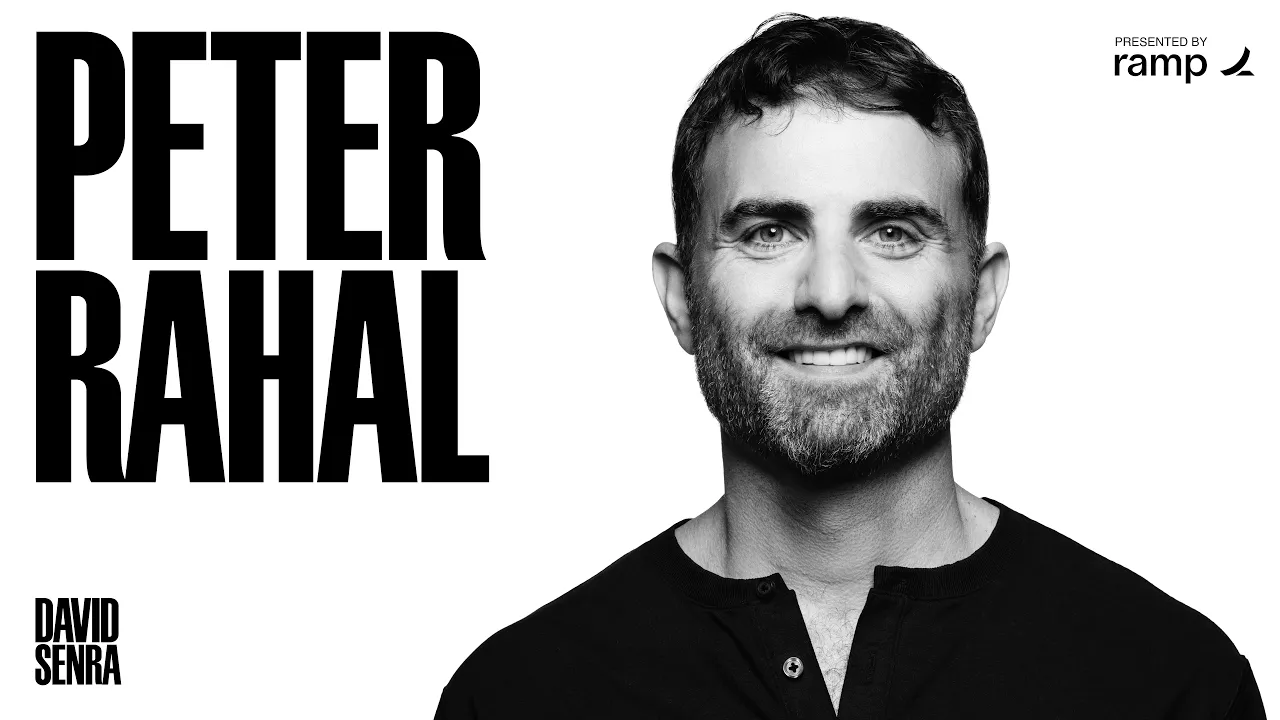
RXBAR Creator Peter Rahal Buys Supplier Epogee to Scale David Protein
David Senra
If a company leader has to pick up the phone to fix the product, the business is already in trouble, so Peter Rahal maintains hands-on technical mastery and bought single-source fat-replacer supplier Epogee for $85 million to cut off rivals without long-term contracts.
After selling RXBAR to Kellogg for $600 million, Peter Rahal found private investing miserable because of five-year feedback loops and feeling like a handcuffed passenger. Returning to food, he scaled David Protein to a $400 million+ run rate (projecting $300 million in revenue this year) within two years. (27:20)
Six months into building David Protein, Rahal acquired single-source plant-fat supplier Epogee for $85 million after consuming up to 150% of its output. He subsequently cut off competing brands that had failed to negotiate long-term supply agreements, surviving a three-time-dismissed antitrust lawsuit. (40:57)
To finance the Epogee buyout without wasting management time on an auction, Rahal awarded an $85 million round co-led by Greenoaks Capital and Valor Equity Partners. Greenoaks won the allocation after covertly paying ~20 former RXBAR employees up to $1,000 each for off-the-record diligence on Rahal's leadership. (51:47)
Structured like the Florentine Medici family, Medici Brands operates as a holding company providing centralized capital allocation, legal, and talent services to semi-autonomous units like David Protein and Hall Pass. Rahal manages ~25 direct reports without middle management layers and rejects the 'founder' title internally as anti-meritocratic. (63:00)
Detailed notes
## Background
Published on YouTube by David Senra on September 20, 2026, the video features an in-depth conversation with Peter Rahal, co-founder of RXBAR, David Protein, and Medici Brands. The page description outlines Rahal's transition from selling RXBAR for $600 million and briefly dabbling in private investing back to operating CPG companies, detailing his approach to product mastery, supply chain ownership, decentralized organization, and building a 21st-century food giant.
## TL;DR
Peter Rahal discusses the psychological misery of private investing compared to the rapid feedback loops of operating, detailing how he returned to CPG to build David Protein and Medici Brands as a decentralized alternative to traditional conglomerates. He explains his operational philosophies, including treating the organization as a product, hiring former founders, maintaining a flat organizational structure with 25 direct reports, and vertically integrating by acquiring ingredient supplier Epogee. Rahal emphasizes a high pain tolerance, first-principles thinking, speed over fundraising valuation, and channeling personal resentment and divine discontent into ruthless company building.
## Atmosphere & style
The discussion carries an intense, unfiltered, and high-stakes atmosphere driven by Peter Rahal's relentless ambition and disdain for corporate complacency. Host David Senra frames the conversation around historical entrepreneurial grit, creating a tense yet inspiring tone that feels like a masterclass in wartime business execution. Rahal speaks with raw candor, emotional urgency, and intellectual rigor, projecting an aura of calculated aggression and fierce independence.
## Bulletin
- [27:20](https://www.youtube.com/watch?v=QtjLireBMI8&t=1640s) After selling RXBAR to Kellogg for $600 million, Peter Rahal found private investing miserable because of five-year feedback loops and feeling like a handcuffed passenger. Returning to food, he scaled David Protein to a $400 million+ run rate (projecting $300 million in revenue this year) within two years.
- [40:57](https://www.youtube.com/watch?v=QtjLireBMI8&t=2457s) Six months into building David Protein, Rahal acquired single-source plant-fat supplier Epogee for $85 million after consuming up to 150% of its output. He subsequently cut off competing brands that had failed to negotiate long-term supply agreements, surviving a three-time-dismissed antitrust lawsuit.
- [51:47](https://www.youtube.com/watch?v=QtjLireBMI8&t=3107s) To finance the Epogee buyout without wasting management time on an auction, Rahal awarded an $85 million round co-led by Greenoaks Capital and Valor Equity Partners. Greenoaks won the allocation after covertly paying ~20 former RXBAR employees up to $1,000 each for off-the-record diligence on Rahal's leadership.
- [01:03:00](https://www.youtube.com/watch?v=QtjLireBMI8&t=3780s) Structured like the Florentine Medici family, Medici Brands operates as a holding company providing centralized capital allocation, legal, and talent services to semi-autonomous units like David Protein and Hall Pass. Rahal manages ~25 direct reports without middle management layers and rejects the 'founder' title internally as anti-meritocratic.
## Key takeaways
- [02:30](https://www.youtube.com/watch?v=QtjLireBMI8&t=150s) After netting roughly $250 million from the $600 million sale of RXBAR to Kellogg, Rahal realized within 12 to 18 months that venture investing drained his energy because chasing allocations and enduring five-year feedback loops felt like being handcuffed in the backseat while someone else drove.
- [10:40](https://www.youtube.com/watch?v=QtjLireBMI8&t=640s) True product mastery requires founders to understand the technical mechanics of their product deeply enough to diagnose and fix flaws firsthand; if a leader has to pick up the phone to fix the product, the company is in trouble.
- [11:48](https://www.youtube.com/watch?v=QtjLireBMI8&t=708s) David Protein uses protein bars as an operational wedge to build infrastructure and R&D, with the ultimate goal of competing against global giants like Nestlé and PepsiCo to become the most important food company of the 21st century.
- [13:49](https://www.youtube.com/watch?v=QtjLireBMI8&t=829s) Inspired by Michelangelo's David, the brand is built like a human personality anchored in intelligence, beauty, and discipline, replacing the tacky 1990s diet aesthetic of Atkins and Weight Watchers with a refined European design.
- [22:43](https://www.youtube.com/watch?v=QtjLireBMI8&t=1363s) Growing up with severe dyslexia—where school administrators labeled him disabled and forced him to work ten times harder than his peers—forged Rahal's high pain threshold, anti-authority resentment, and capacity to endure the emotional suffering of company building.
- [27:20](https://www.youtube.com/watch?v=QtjLireBMI8&t=1640s) In just two years, David Protein compressed a decade of growth into a run rate exceeding $400 million and projected annual revenue of $300 million, while using stunts like selling $55 frozen boiled cod online as 'product as marketing' to highlight protein-to-calorie efficiency.
- [32:51](https://www.youtube.com/watch?v=QtjLireBMI8&t=1971s) Rahal treats the organization itself as a product governed by four processes—selection, onboarding, promotion, and termination—and actively eliminates performative 'Cover Your Ass' (CYA) corporate habits in favor of truth-seeking and intellectual humility.
- [36:34](https://www.youtube.com/watch?v=QtjLireBMI8&t=2194s) Medici actively recruits former founders and high-agency 'maniacs' with chips on their shoulders because they think from first principles and have not been ruined by school or corporate playbooks.
- [40:57](https://www.youtube.com/watch?v=QtjLireBMI8&t=2457s) Recognizing a fatal bottleneck in Epogee—the patented single-source manufacturer of EPG zero-calorie fat—Rahal acquired the supplier for $85 million (half cash, half equity) and cut off competing brands that had neglected to sign long-term supply contracts.
- [45:59](https://www.youtube.com/watch?v=QtjLireBMI8&t=2759s) While Rahal has zero sympathy for competitors who failed to secure supply agreements, he admits his main mistake in the Epogee fallout was public relations, noting he should have personally called the affected entrepreneurs instead of sending a cold legal notice.
- [51:47](https://www.youtube.com/watch?v=QtjLireBMI8&t=3107s) Greenoaks Capital earned its spot co-leading Medici's $85 million round after Neil Mehta's team independently paid roughly 20 former RXBAR employees up to $1,000 apiece to rigorously vet Rahal's leadership style.
- [55:47](https://www.youtube.com/watch?v=QtjLireBMI8&t=3347s) To stay 'aerodynamic' during fundraising, Rahal refuses to run competitive auctions and intentionally leaves roughly $100 million in valuation (~2% dilution) on the table to close fast with aligned partners while investing his own personal capital to maintain total control.
- [01:00:31](https://www.youtube.com/watch?v=QtjLireBMI8&t=3631s) Operating a business like a river, Rahal ignores what is flowing smoothly to obsess entirely over bottlenecks, outsourcing company celebrations to his team because he naturally moves straight to the next problem.
- [01:03:00](https://www.youtube.com/watch?v=QtjLireBMI8&t=3780s) Medici Brands centralizes only capital allocation, legal, regulatory, and talent functions across its business units while duplicating roles like sales to prioritize operational speed over payroll efficiency and prevent corporate bureaucracy.
- [01:12:16](https://www.youtube.com/watch?v=QtjLireBMI8&t=4336s) Inspired by leaders like NVIDIA's Jensen Huang, Rahal manages roughly 25 direct reports in a flat structure, eliminating middle-management distortion and forcing unit leaders to operate with extreme autonomy.
- [01:13:44](https://www.youtube.com/watch?v=QtjLireBMI8&t=4424s) Rahal bans the titles 'founder' and 'co-founder' inside the company—using 'Chief Executive' instead—because founder labels are detached from actual job responsibilities and create anti-meritocratic privilege.
- [01:16:08](https://www.youtube.com/watch?v=QtjLireBMI8&t=4568s) Through 'reactionary leadership support,' Rahal balances five permanent CEO responsibilities with rapid frontline intervention, jumping directly into acute operational fires to solve root causes before immediately stepping back out of the way.
## Detailed walkthrough
### [00:02](https://www.youtube.com/watch?v=QtjLireBMI8&t=2s) The Mirage of Early Retirement and Private Investing
After selling RXBAR to Kellogg for $600 million—a company where Peter Rahal and his co-founder owned 90%—Rahal found himself in his early thirties with roughly a quarter of a billion dollars in liquid cash. The immediate, conventional path for an entrepreneur coming off a nine-figure exit was to pivot directly into investing. From the outside, allocator life appears to be the ultimate intellectual endeavor paired with an effortless lifestyle: there are no supply chain crises, no employees to manage, and virtually no daily organizational burdens. Intrigued by the prospect, Rahal set out to study the craft methodically, reading the best investing literature, learning asset classes, and analyzing how to build portfolios and underwrite deals.
He focused his efforts where he held the sharpest competitive advantage: early-stage private markets and consumer packaged goods (CPG), remaining stage-agnostic from seed through growth rounds. Yet he quickly discovered that venture investing rewarded an entirely different skill set than company building. Success in early-stage investing often boiled down to sheer charisma and "whale hunting"—identifying an obviously breakout deal and aggressively chasing the founders for an allocation. Rahal despised this dynamic, summarizing it bluntly: "Chasing men for allocations is something I didn't want to do." In his operating life, his posture had always been to sit down, engineer a great product, and let the product itself do the heavy lifting in the market.
Beyond the social gamesmanship of allocations, Rahal struggled profoundly with the lack of agency and the sluggish pace of feedback. As an operator, decisions around hiring, product formulation, and marketing generate rapid, visible feedback loops. In venture investing, an allocator constructs a thesis, underwrites a founder, wires the capital, and then waits five or more years to discover whether the bet was correct. For someone addicted to fast-paced knife fights in the commercial arena, writing checks felt uncomfortably passive, distant, and unsatisfying.
- **RXBAR Exit**: Acquired for $600 million, with 90% equity split between Peter Rahal and his co-founder.
- **Investing Edge**: Focused on private seed-to-growth CPG startups where he possessed domain mastery.
- **Core Friction**: Loathed relying on personal charisma to win allocations over letting product quality speak for itself.
- **The Feedback Loop Dilemma**: Operating delivers instant cause-and-effect data on decisions; private investing imposes an agonizing five-year feedback cycle.
---
[02:30](https://www.youtube.com/watch?v=QtjLireBMI8&t=150s) Hubris, Miami, and the "Handcuffed Passenger" Problem
Following the RXBAR sale, Rahal felt an urgent need to break away from Chicago. The brand had become indistinguishable from his personal identity, and he had just gone through a rapid divorce. He attributes the marriage's dissolution entirely to personal hubris and "success bias": having succeeded at everything professionally, he assumed building a family would be just as straightforward and attempted to speedrun the process. In his own words, he managed to meet, marry, and divorce all within roughly nine months, joking, "I beat Kim Kardashian." Seeking a clean geographic and mental break, he relocated to Miami before the pandemic wave, intending to reset, establish a formal family office, and eventually figure out his next chapter.
The venture into backing other founders, however, proved to be an agonizing mismatch with his psychology. Rahal had projected his own relentless nature onto the founders he funded, assuming anyone starting a business would share his willingness to die before letting it fail and sacrifice every shred of personal comfort to win. Instead, he found himself repeatedly playing an unnatural role. In his eyes, a CEO must be the most ruthless and self-critical voice in the room; if an investor is the one pointing out that the engine is smoking, the business is already in trouble:
> "I'm probably actually a miserable investor because I'm like I'm handcuffed sitting in the back seat while someone else is driving and they don't know where they're going. And that's like a torturous position to someone who knows where to go."
Senra points out that exceptional operators are vanishingly rare, recalling a conversation with Patrick O'Shaughnessy and AppLovin co-founder Adam Foroughi—an operator known for running a massive cash-generating engine with minimal headcount while ignoring vanity metrics—where they concluded that in nearly any industry, only two or three individuals are genuinely world-class. Rahal realized that expecting ordinary founders to match his fanatical intensity was a recipe for constant frustration. Within twelve to eighteen months of managing capital, his internal monologue made the reality unmistakable: he was far too young to sit on the sidelines, allocator life was draining his energy, and he needed to get back into the arena as an operator.
---
[07:29](https://www.youtube.com/watch?v=QtjLireBMI8&t=449s) False Starts and the Terror of Going "All In"
Accepting that he had to run a business again did not lead to an immediate launch. While reviewing deal flow and talking with innovators gave him a valuable window into emerging problems, Rahal spent months exploring ideas that never materialized. He investigated a broad spectrum of industries, looking closely at waste management and garbage recycling, synthetic biology, and various consumer packaged goods plays. In each instance, he began taking preliminary operational steps, only to pull the plug before formally launching.
These false starts stemmed from Rahal’s acute self-awareness regarding his psychological commitment. He is incapable of operating in moderation or running an experiment with one foot out the door. His leadership style requires burning every bridge behind him and adopting a total wartime posture:
> "If I go in, I'm like fucking all in, and that's like a really scary thing actually, cuz then like my friends go away, like my health goes, all this stuff happens to me... So what I commit to is like very serious."
Knowing the immense personal toll that total commitment demands—the isolation, the erosion of personal life, and the physical strain—Rahal refused to pull the trigger on synthetic biology or recycling simply to keep busy. He understood that once he crossed the threshold into a new venture, he would accept nothing less than complete immersion, making the choice of what to build a weighty, deliberate decision.
[08:50](https://www.youtube.com/watch?v=QtjLireBMI8&t=530s) The Hiatus, Finding a Wife, and Accepting the "Protein Bar Guy" Identity
Following the sale of RXBAR, Peter Rahal deliberately stepped back from founding companies to sort out his personal life. Knowing his own obsessive nature, he realized that if he jumped straight into another business venture, he would throw himself completely into work, alienate his friends, wreck his physical health, and end up "50 and single"—a future he was determined to avoid. He spent his hiatus prioritizing finding a partner and starting a family. Joking that Miami Beach was hardly the ideal venue to search for a wife, he bought a place in New York City and relocated.
Once his personal life was established and he married, his thoughts inevitably circled back to food. Settling on starting another food business required overcoming internal ego and wrestling with the "Elon Musk influence"—a nagging feeling that he needed to venture into deep tech, hardware, or biology to prove his intelligence. He spent nearly three years debating this inner monologue before embracing the humility to accept his true domain. He realized he had been immersed in the food industry since he was 12 years old and possessed deep, intrinsic knowledge of it. If his gravestone ended up reading "protein bar guy," he decided he was entirely comfortable with that.
- **Non-compete expiration**: October 6, 2022.
- **Ages**: Peter co-founded RXBAR at age 24 and was 34 when preparing to launch his next venture.
- **The internal debate**: It took roughly three years to shed the urge to pursue unrelated categories and commit to the craft where he possessed world-class mastery.
---
[10:40](https://www.youtube.com/watch?v=QtjLireBMI8&t=640s) Product Mastery: Why Founders Must Know How to Fix the Product Themselves
Peter's decision to return to food was anchored in a core operating philosophy he developed both as an angel investor and as an operator: "the leader of the company, if they have to pick up the phone to fix the product, they're fucked." In Peter's view, an effective founder must intimately comprehend the technical mechanics of their offering so they can diagnose and resolve flaws firsthand.
Reflecting on his false starts in other industries during his investing years, he realized he had consistently relied on third parties or lacked the time to acquire the deep expertise required to execute product-level changes. In the food sector, by contrast, he possessed complete operational command. Having secured his marriage and family foundation, he knew he could channel his all-in intensity into company building without destroying his personal life.
---
[11:48](https://www.youtube.com/watch?v=QtjLireBMI8&t=708s) The Wedge Strategy and Ambitions of a 21st-Century Nestlé
While David launched with protein bars, Peter emphasizes that the company is designed as a broad consumer packaged goods (CPG) platform rather than a single-product business. He strongly critiques the conventional health food playbook, which relies on demonizing ingredients and pushing pseudoscience by telling consumers what *not* to eat. David’s counter-strategy is a quiet, formulation-driven approach: making existing favorite foods "smarter," more nutritionally efficient, and objectively superior.
The protein bar serves purely as the operational wedge to achieve scale, build organizational infrastructure, establish routes to market, and fund research and development. Once that foundation is secured, the brand can expand into adjacent grocery categories. When David Senra asks about the ultimate ambition, Peter makes no effort to downplay the scale: David is built to compete with legacy conglomerates like Nestlé (with over $100 billion in revenue) and PepsiCo, with the explicit goal of becoming the most important food company of the 21st century. While legacy conglomerates grow primarily through mergers and acquisitions, Peter plans to rely on internal brand creation for the next four to five years before considering acquisitions.
```mermaid
flowchart LR
accTitle: David Platform Strategy
accDescr: Flowchart illustrating the transition from a single product wedge to a broad CPG conglomerate.
subgraph Wedge ["Phase 1: The Wedge"]
A["Protein Bar"] --> B["Scale & R&D Platform"]
end
subgraph Expansion ["Phase 2: Platform Expansion"]
B --> C["Smarter Everyday Foods"]
C --> D["Multi-Category CPG Portfolio"]
end
subgraph Vision ["Long-Term Vision"]
D --> E["21st-Century Food Giant<br>(Competing with Nestlé & PepsiCo)"]
end
```
- **Target competitive set**: Global CPG titans like Nestlé ($100B+ annual revenue) and PepsiCo.
- **Expansion playbook**: Perfect the core technology in a proven high-velocity category (bars) to establish distribution channels, then proliferate into new supermarket categories over a 4-to-5-year horizon.
---
[13:49](https://www.youtube.com/watch?v=QtjLireBMI8&t=829s) Brand as a Human Being: The Chisel, Intelligence, and Discipline
Peter articulates his mental model for branding by comparing a brand directly to a human being. A brand has parents (the founders, who pass down their core DNA), a distinct name, moral values, a long-term vision, a tone of voice, visual aesthetic "clothes," and a specific circle of friends. Who a brand associates with signals its identity just as powerfully as its packaging. For instance, David Protein partnered with neurobiologist Andrew Huberman because of a shared emphasis on science, discipline, and performance, whereas partnering with an entertainer like Ms. Rachel—despite her popularity—would dilute that identity.
For David, the identity centers on three pillars: intelligence, beauty, and discipline. These values are derived directly from Michelangelo’s marble sculpture of *David* and the physical tool used to sculpt it: the chisel. A chisel is merely a crude piece of steel, but applied with relentless intelligence and discipline, it yields a timeless masterpiece. Peter notes that once a founder achieves total clarity on a brand's parental DNA, values, and positioning, execution becomes straightforward: the job is simply to hammer those core truths over and over again through exceptional product quality and time.
- **The three core brand pillars**: Intelligence, Beauty, and Discipline.
- **The chisel metaphor**: A crude, basic tool that produces fine art when paired with disciplined execution.
- **The compounding factor**: Brand equity cannot be rushed; it demands persistent, unwavering consistency of voice, partnerships, and product quality over years.
---
[15:56](https://www.youtube.com/watch?v=QtjLireBMI8&t=956s) Sponsor Messages: Ramp and Deel
David Senra steps in to highlight the episode's presenting sponsors, Ramp and Deel, drawing parallels between corporate operational discipline and the habits of legendary founders:
- **Ramp**: Senra points to SpaceX’s religious obsession with attacking and interrogating input costs, which directly enabled the company to unlock capital for massive growth bets. Ramp provides the financial infrastructure to give companies that same edge: median businesses operating on Ramp reduce their expenses by 5% while accelerating their top-line revenue growth by 16%.
- **Deel**: Senra emphasizes that elite founders prioritize hiring the absolute best talent regardless of geography. Global tech companies such as Ramp, Shopify, ElevenLabs, Uber, and DoorDash rely on Deel's all-in-one platform to hire, pay, compliant-manage, and retain international teams across borders.
[18:13](https://www.youtube.com/watch?v=QtjLireBMI8&t=1093s) The Fragility of Brands and the Ogilvy Principle of Relentless Consistency
Peter Rahal spent roughly six months deliberately shaping the brand identity for David Protein. The overarching strategy is not to continually reinvent the company, but to define a crystal-clear identity and hammer it relentlessly for decades. When asked how he learned the necessity of maintaining unwavering consistency over long horizons, Peter explains that it comes from studying the world's most enduring businesses. The best brands are universally old, meaning time and consistency are the ultimate arbiters of brand equity. However, this creates a profound asymmetry: while building a legendary brand takes decades of disciplined repetition, brands are extraordinarily fragile. If a company compromises on product quality or wavers in its commitments, decades of trust can evaporate almost instantly.
David Senra immediately connects Peter’s philosophy to advertising icon David Ogilvy, noting that Peter sounds identical to the core tenets in *Ogilvy on Advertising* and Ogilvy's autobiography. Ogilvy constantly preached that marketers jump around far too frequently, changing campaigns and identities before they ever have the chance to compound. The greatest agencies and brands succeed by identifying a singular identity and driving it home decade after decade without getting distracted or bored.
```mermaid
flowchart LR
accTitle: Brand Compounding and Fragility Loop
accDescr: Diagram showing how consistent brand identity builds compounding equity over decades while quality failures trigger rapid destruction.
subgraph Engine["Long-Term Brand Building"]
A["Core Brand Identity"] -->|"Decades of Consistent Repetition"| B["Compounding Brand Equity"]
end
subgraph Threat["Fragility Risk"]
B -.->|"Compromised Quality or Values"| C["Rapid Brand Destruction"]
end
```
[19:22](https://www.youtube.com/watch?v=QtjLireBMI8&t=1162s) Intelligence, Beauty, and Discipline: A European Antidote to '90s Diet Culture
The foundation of the David brand rests on three specific pillars: intelligence, beauty, and discipline. Peter selected these traits because they reflect his personal obsessions, admitting, "I love beauty. I love intelligence and I love suffering and discipline to a negative point of view almost." This philosophy aligns directly with the raw utility of protein bars. People do not eat protein bars as an indulgent treat; they consume them for strictly functional body composition goals—to build muscle or lose fat. The entire category is naturally anchored around physical transformation and self-control.
Peter set out to build a modern body composition company that deliberately avoids the aesthetic traps of the past. He points back to the dominant weight loss brands of the 1990s—such as Atkins, Weight Watchers, and Jenny Craig—characterizing them as culturally tacky and visually unappealing, even though millions turned to them for body management. Peter wanted to transform that same underlying need into something refined, sophisticated, and distinctly European in its taste and aesthetic. This mission also stemmed from an observation he made after turning 35: looking around at his peers, he realized that nearly everyone struggles with weight and wants more muscle, whether they are open about it or hiding it. David is engineered to address this universal human struggle with dignity and elevated design.
- **David's Core Pillars:** Intelligence, beauty, and discipline.
- **The Category Truth:** Consumers buy protein bars for functional body composition (shedding fat, gaining muscle), not for snacking pleasure.
- **Cultural Predecessors:** 1990s weight-loss staples like Atkins, Weight Watchers, and Jenny Craig proved massive demand existed, but possessed tacky branding that lacked refinement.
- **Universal Problem:** Adult weight management and muscle gain are concerns shared by virtually everyone across demographics, whether openly acknowledged or kept private.
[21:07](https://www.youtube.com/watch?v=QtjLireBMI8&t=1267s) Embracing Suffering: Physical Hardship, Emotional Grit, and the Kalanick Standard
Peter reveals an instinctual compulsion to always choose the more difficult path in every facet of his life. During workouts, he intentionally selects the most painful movements. When taking his young son outside, he refuses to bring a stroller, opting instead to carry him the entire distance simply to force himself to endure the physical load. For Peter, pushing through physical discomfort carries an almost spiritual gratification. Yet he recognizes that physical suffering is relatively straightforward—one simply gets hot, cold, or exhausted.
The far more demanding challenge is the emotional suffering inherent in building a company:
> "Physical suffering is easy cuz like you just get really hot, get really cold... but what's nice about building a company is it's like emotional suffering. It's like a lot of tough conversations. What I've learned early on is like if you face those things, there's growth on the end of it."
This dynamic fuels Peter’s belief that higher pain tolerance directly correlates with personal and organizational growth. Senra highlights a previous podcast conversation with Uber co-founder Travis Kalanick, who described the core ethos of an entrepreneur as: "The lifestyle of an entrepreneur is I can take more pain than this guy and I'll prove it to you." Peter enthusiastically agrees with Kalanick's framing, confirming that outlasting others through raw pain tolerance is an integral, exhilarating part of how he operates.
[22:43](https://www.youtube.com/watch?v=QtjLireBMI8&t=1363s) Dyslexia, Childhood Resentment, and the Sidelines of Investing
Examining the source of his intense drive, Peter candidly admits that his capacity for pain is fueled by a reservoir of deep-seated anger and resentment. While he credits his parents with providing a warm and beautiful upbringing, his psychological trauma originated in the school system, where severe dyslexia led teachers and administrators to label him disabled. Peter recalls the agonizing experience of overhearing educators speak to his parents, openly questioning whether he was "stupid" because he could not read properly. That experience fractured his sense of self and sparked a ferocious intrinsic motivation to prove everyone wrong.
To protect his self-esteem as a child, Peter developed an aggressively contrarian and anti-authority survival strategy: concluding that the teachers were wrong, the entire educational establishment was broken, and telling the system to "fuck off." Surviving school required him to exert ten times the effort of his peers just to scrape by with Cs and Ds, which permanently forged his high threshold for pain. Even after exploring therapy and psychedelics, Peter notes that this chip on his shoulder remains permanently "tattooed" into his psyche.
This deep drive to channel rage into concrete results explained why his period as an investor following the sale of RXBAR made him so miserable. Sitting on the sidelines, "fake working" as an investor and reviewing portfolio reports felt like acting as a cheerleader rather than a combatant. He needed the arena of company building and competitive warfare to direct his spite into tangible, productive victories.
```mermaid
flowchart TD
accTitle: Psychological Roots of Peter Rahal's Competitive Drive
accDescr: Flowchart tracing the origins of Rahal's drive from childhood dyslexia and school skepticism through coping mechanisms into productive entrepreneurial aggression.
subgraph Origin["Childhood Adversity"]
D1["Dyslexia Diagnosis"] --> D2["Labeled 'Disabled' & Questioned as 'Stupid'"]
D2 --> D3["Required 10x Effort to Earn C/D Grades"]
end
subgraph Psychology["Internal Coping & Identity"]
D3 --> P1["Contrarian & Anti-Authority Mindset"]
P1 --> P2["Deep Reservoir of Spite & Resentment"]
end
subgraph Expression["Productive Outlets"]
P2 --> E1["Extreme Pain Tolerance & Physical Exertion"]
P2 --> E2["Company Building & Direct Competitive Warfare"]
P2 -.->|"Miserable Failure as Outlet"| E3["Passive Investing / Sideline Cheerleading"]
end
```
[25:40](https://www.youtube.com/watch?v=QtjLireBMI8&t=1540s) Proximity to Talent and Izzy Sharp's Capacity to Take Pain
Reflecting on Peter's discomfort with passive investing, Senra shares a personal rule he recently passed along to a younger friend: individuals should remain as close as possible to true talent. Founders possess rare creative talent, whereas the surrounding layers of agents, investment bankers, and peripheral financiers often operate as political operators incentivized to cajole, persuade, and act against the creator’s long-term interests. Senra argues that an entrepreneur needs only a tiny circle of genuine allies while tuning out corporate fakers playing zero-sum political games.
Senra draws a parallel between Peter's mindset and Isadore "Izzy" Sharp, the founder of Four Seasons Hotels and Resorts. Sharp set out with an audacious, almost embarrassing ambition to build the world’s preeminent luxury hotel brand despite having never constructed or managed a single hotel in his life. In his autobiography, Sharp coined what Senra considers one of the greatest maxims in business history: "Excellence is the capacity to take pain." Much like Peter, Sharp turned friction, self-doubt, and external skepticism into fuel, proving that enduring emotional and operational agony is the fundamental prerequisite for achieving greatness.
[27:20](https://www.youtube.com/watch?v=QtjLireBMI8&t=1640s) Channeling Pain and Scaling from Zero to $300 Million in Two Years
David Senra connects Peter Rahal's mindset to a recurring pattern across the biographies and founders he studies, bringing up Adam Foroughi (co-founder of AppLovin). Early on, Foroughi tried to raise money and was willing to sell 25% of his company—which would eventually become worth $100 to $200 billion—for just $1 million. When venture capitalists turned him down and funded his competitors instead, Foroughi made it a core company principle to put those competitors out of business. Senra also quotes investor Josh Wolfe's line: "chips on shoulders puts chips in pockets." Using early pain as fuel to drive achievement is powerful, and Rahal agrees, warning that if you have that inner pain and don't focus and channel it, it becomes destructive. By channeling it through the art of company building, it becomes productive.
Asked how he is channeling that energy into his current venture, Rahal points to the sheer output of the company—driven by "a lot of hours, butts in chairs in the office, just dedication." Though the company is only two years old, their relationship with time is so warped by their intensity that it feels like five years. In just two years, they are on a run rate of over $400 million and will do $300 million in revenue this year, compressing what would normally take ten years into two. Rahal states flatly that they are the fastest-growing food company in history, expanding rapidly across multiple product lines while continually improving product quality.
- **Current product categories and pipeline:** Protein bars, the frozen category, ready-to-drink (RTD) beverages, a confection line in three different formats, and another brand launching in November.
- **Why scaling is so difficult:** Unlike digital businesses, physical food is a world of atoms, not bits—a framing Rahal credits to Travis Kalanick. Growing 300% to 400% a year (or even every six months) puts immense strain on the supply chain because you have to buy raw materials with long lead times—such as navigating a super tight dairy market—and convert them into finished inventory. Matching supply and demand has been so challenging that the company has constantly run out of stock.
[29:59](https://www.youtube.com/watch?v=QtjLireBMI8&t=1799s) Why Peter Started Selling Frozen Cod ("Product as Marketing")
Senra mentions that after hearing about the David bar from his friend Rob and others, he suddenly saw an ad where David Protein was selling cod, and asks if that was a reaction to running out of bar inventory. Laughing, Rahal explains that the cod campaign was actually independent of their stockouts, though it happened to launch around the same time. The idea originated while building a nutritional comparison table for the David website centered on their most important metric: how many calories come from protein. On the initial chart, David's gold bar ranked number one across the board. Drawing on his investor background, Rahal knew that any chart where a company claims to be number one in everything looks like "bullshit."
To make the chart credible, the team searched for a food with a better protein-to-calorie ratio than their gold product, and the only thing they found was boiled cod. They placed boiled cod at number one and David at number two as a dorky comparison. The juxtaposition worked brilliantly because comparing a protein bar to plain fish immediately signals convenience and value, especially since boiled cod is so unappetizing. Halfway through their first year, however, Rahal felt a sense of déjà vu from his RXBAR days—launching yet another flavor felt "super boring," and he wanted to do something bold. They decided to seriously enter the frozen fish business and sell actual cod online, not just as a fake stunt.
```mermaid
flowchart LR
accTitle: The Evolution of the Boiled Cod Campaign
accDescr: How a website comparison chart turned into a $55 frozen cod product used as a marketing tool.
subgraph Origin["1. The Website Chart"]
A["David bar ranks #1 on all metrics"] --> B["Looks fake to an investor's eye"]
B --> C["Add Boiled Cod at #1 and David at #2"]
end
subgraph Execution["2. Product as Marketing"]
C --> D["Fight year-one boredom with a bold move"]
D --> E["Sell real frozen cod online for $55"]
E --> F["Riddle that centers protein-to-calorie ratio"]
end
```
The campaign was a hilarious headache because it meant actually operating in the frozen supply chain, selling frozen cod online for $55. Nobody really wanted to buy $55 fish online, so it had zero product-market fit, yet it functioned as an intelligent communication tool—a concept Rahal calls "product as marketing." Instead of being right on the nose, the cod acted like a riddle that centered the public conversation around the protein-to-calorie ratio. Despite Senra's laughing skepticism that cod will ever find product-market fit, Rahal jokes that he isn't giving up on it. He loves looking at the website and seeing bronze and gold protein bars, frozen ice cream pints, RTDs, and then "fucking fish." Because the food industry is so boring, with every company saying and doing the exact same things, Rahal is determined as a second-time founder to have fun with it.
[32:51](https://www.youtube.com/watch?v=QtjLireBMI8&t=1971s) Treating the Organization as a Product
Returning to an earlier thread about pain and building a masterpiece, Rahal explains that the ethos of the David brand—"finish your masterpiece" and tapping into inner excellence—requires immense discipline and intelligence applied over time. When applying that philosophy to company building, Rahal strips a business down to two fundamental pillars: people and product mastery. He views brand and product as the exact same thing, where the product is the raw substance and the brand is the exterior clothing it wears. More importantly, he treats the organization itself as a product.
Because a company is simply a group of people aligned toward a mission, mastering the organization comes down to four critical processes governed by a shared value system:
```mermaid
flowchart TD
accTitle: The Four Processes of Organizational Mastery
accDescr: The four core people processes aligned around company values, humility, truth-seeking, and entrepreneurship.
subgraph Values["Core Value System"]
V1["Truth Seeking (No Biases)"]
V2["Humility (No CYA / Fake Work)"]
V3["Entrepreneurship (No Fear of Failure)"]
end
subgraph Processes["4 Organizational Processes"]
P1["1. Selection & Hiring"] --> P2["2. Training & Onboarding ('Baptism')"]
P2 --> P3["3. Promotion & Reward"]
P3 --> P4["4. Termination"]
end
Values --> Processes
```
- **The four core processes:** Who you select into the organization, how you train and onboard them, how you select who gets promoted and rewarded, and how you terminate those who shouldn't be there.
- **Truth-seeking and intellectual humility:** Rahal looks for people with the courage to seek truth without bias. The foundation of this is humility—which he defines as "the freedom of pride and arrogance." Intellectually, humility means having the security to say, "I don't know what I'm doing, I need help."
- **Eliminating "Cover Your Ass" (CYA) culture:** Rahal despises the performative "fake work" that people bring over from big corporate America, where employees generate endless surveys and data just to justify an experiment or protect their jobs if an experiment fails. Fearing failure and doing performative work to cover your ass is the exact opposite of entrepreneurship.
- **"Baptizing" industry hires:** Because most legacy food companies haven't been founder-led in half a century or more, recruits from those environments often carry self-protective corporate habits. David still hires from other food companies for their domain experience, but Rahal says they have to "baptize them" during onboarding—teaching them entirely new beliefs so they shed their corporate conditioning.
### [36:34](https://www.youtube.com/watch?v=QtjLireBMI8&t=2194s) Why Former Founders Make the Best Hires
Peter explains that when you bring new people into a company, simply dropping them in means they will default to what they already know. To prevent this, Medici employs a very thoughtful onboarding process where new hires learn the company values, study entrepreneurship, pack boxes to learn humility, and grasp the core fundamentals. When David Senra asks if the most talented people in the company are those with zero experience, Peter counters that their most talented people are actually former founders. Convincing a founder to pause their own venture to join a greater company serves as a strong signal of the opportunity ahead. Peter positions Medici to them as a platform where they can execute their vision backed by amazing technology and resources, freeing them from the constant friction of raising money and dealing with stakeholder bureaucracy. He points out that a similar dynamic happens in AI, where massive amounts of founder talent flock to major platforms. When asked if he specifically targets founders, Peter confirms he does because they possess agency, courage, and humility, and importantly, they have not been "ruined by corporate America or school." School trains people to follow procedures, think inside the box, and rely on playbooks, whereas entrepreneurship has no playbook—it requires thinking from first principles, understanding the fundamentals, and just moving forward.
- Medici's onboarding requires new hires to pack boxes to learn humility and master company values.
- Peter actively targets former founders because they have high agency, courage, humility, and lack corporate conditioning.
### [38:16](https://www.youtube.com/watch?v=QtjLireBMI8&t=2296s) Escaping Conventional Playbooks and Relying on First Principles
The conversation shifts to a parallel example from Luca Ferrari, founder of Bending Spoons in Milan, who values being isolated from traditional startup hubs because it keeps him immune to standard startup mantras. Luca prefers young graduates or even non-graduates over experienced hires because he wants to avoid bringing in bad habits and conventional biases. Peter builds on this, noting that experience has a natural downside: people tend to reason through analogy and past experience rather than asking fundamental, "dumb" questions or thinking from first principles. Because Peter started RXBAR with virtually no experience, he believes direct prior industry experience is less important than strong reasoning skills and the capacity to learn.
- Peter highlights that experience can cause leaders to rely on analogy rather than first principles.
- Leaders like Luca Ferrari optimize for raw intelligence and high agency, then indoctrinate fresh talent into their unique operating systems.
### [39:18](https://www.youtube.com/watch?v=QtjLireBMI8&t=2358s) Hiring "Maniacs" with a Chip on Their Shoulder
Refining his talent philosophy, Peter notes that the ideal mix combines some inexperience with individuals carrying deep-seated drive and a "chip on their shoulder." He describes certain team members who are unstoppable: "They're not giving up. They have something to prove and like those are the most powerful people to get do you want to organize around." When David asks about them, Peter laughs that it stems from childhood adversity, sharing an anecdote about a team member who "is going to die before he fails" because he comes from an uncomfortable background where succeeding at Medici represents a completely different life trajectory. While you want a balance of crazy, high-agency maniacs driving the core of the company alongside rational, pragmatic, and conservative team members for structural stability, those intense, driven individuals are the ones who truly push the business forward.
### [40:57](https://www.youtube.com/watch?v=QtjLireBMI8&t=2457s) The Epogee Acquisition and Vertical Integration
The discussion transitions to one of the most famous stories circulating among founders regarding Peter's acquisition of their critical ingredient supplier, Epogee (referred to in the transcript as EPG). When David jokingly calls one of Epogee's former customers a "victim" of the acquisition, Peter explains how it happened. Epogee manufactures EPG—esterified propoxylated glycerol—which is a modified triglyceride. Normal triglycerides, such as olive oil, have three fatty acids attached to a glycerol backbone that the body digests once lipase enzymes clip the fatty acids off. Epogee figured out how to lock those fatty acids in place so lipase cannot break them down, yielding the exact taste and mouthfeel of fat without the caloric and metabolic impact. Because fat accounts for the vast majority of calories in food—roughly twice as much as protein or carbohydrates—this innovation is massive, comparable to high-intensity sweeteners like stevia and monk fruit.
- Epogee (EPG) produces esterified propoxylated glycerol, a modified triglyceride that provides fat's taste and mouthfeel without calories.
- David was using EPG for David Protein, quickly consuming 90% and eventually 150% of the supplier's available output.
### [43:05](https://www.youtube.com/watch?v=QtjLireBMI8&t=2585s) Eliminating Nasty Dependencies Through Vertical Integration
Peter details the high-stakes situation surrounding their supply chain. Operating as a patented technology, Epogee was their single source of supply. Because David was consuming 90% (and later 150%) of the company's output while other brands struggled to use the difficult-to-formulate ingredient, Peter recognized a dangerous dependency. The company was run by older gentlemen and lawyers rather than operators, and Peter knew the situation would inevitably lead to litigation or extortion unless he bought them out. Six months into building David, in February, the supplier approached them to take over operations. Peter negotiated a deal—paying half in equity and half in cash—achieving vital vertical integration. He emphasizes that food ingredient suppliers trying to sell to major food companies face an endless hell of mismatched supply and demand, redundancy demands, and intellectual property hurdles. By acquiring Epogee, Medici secured its supply chain, leaving competitors without supply agreements out in the cold.
[45:59](https://www.youtube.com/watch?v=QtjLireBMI8&t=2759s) Locking Down Epogee and the Supply Agreement Fallout
Before Peter Rahal ever acquired Epogee, he secured his position through contract terms. As soon as work on David Protein began, Rahal negotiated an ironclad commercial agreement covering change-of-control provisions alongside "most favored nation" status on both pricing and inventory allocation. Under that contract, every ounce of available inventory belonged to David first. When Senra asks how he knew to structure it so aggressively, Rahal explains that when an enterprise has an existential dependency on a single-source supplier, protecting the supply is table stakes: even if an outright buyout never materialized, David was already the "elephant in the room" customer that controlled the spigot.
```mermaid
flowchart TD
accTitle: Epogee Supply Agreement and Acquisition Strategy
accDescr: Sequence showing how Peter Rahal locked up the single-source ingredient Epogee through contracts before acquiring it outright.
subgraph Defense ["Phase 1: Commercial Protection"]
A["Negotiate Supply Agreement"] --> B["Change of Control Clause"]
A --> C["MFN on Pricing"]
A --> D["MFN on Inventory Access"]
end
subgraph Acquisition ["Phase 2: Consolidation"]
B & C & D --> E["Acquire Epogee for $85M"]
E --> F["Shut Off Competitors Without Contracts"]
F --> G["Antitrust Lawsuits Dismissed 3 Times"]
end
```
The fallout in the industry was immediate and contentious. The media narrative and competitor chatter framed Rahal as a ruthless operator who cornered a patented, critical ingredient, bought the manufacturer, cut off competitors, and then poached talent from those exact same rivals. Rahal acknowledges this sparked an antitrust lawsuit, but points out it was dismissed three separate times because ruling against David would have completely upended standard intellectual property law.
Looking back, Rahal admits his chief failure was public relations and communications. He reflects on communications strategist Lulu Cheng Meservey, noting that had he worked with someone of her caliber, the messaging would have been handled far better. Instead, David allowed Epogee to manage part of the communications and issued a cold, bureaucratic notice informing customers that anyone without an existing supply agreement would receive no product. Rahal concedes he could have delivered the news with more compassion—by picking up the phone personally to speak to the affected entrepreneurs—though Senra playfully interrupts to ask whether compassion is actually in Peter's nature.
---
[48:06](https://www.youtube.com/watch?v=QtjLireBMI8&t=2886s) Incompetence, Compassion, and First Principles
When pressed by Senra on where his supposed compassion is hiding, Rahal clarifies his worldview: he believes empathy is a requirement for great leadership, but he draws a hard line against helplessness. "I just don't have sympathy for stupidity. I don't have sympathy for incompetence, really." To Rahal, building a business dependent on a patented, single-source ingredient without securing an underlying supply agreement violates basic operational hygiene.
Senra points out that what seems obvious to Rahal is exceedingly rare among typical founders. He recalls Rahal’s post-RXBAR plan to retire, find a wife, have children, and passively invest, only to discover that the founders he backed were operating without urgency or baseline commercial rigor. Around three or four competing brands were sourcing from Epogee at the time, and when cut off, their bewildered response was simply that they never realized locking in long-term supply contracts was an option. Rahal was dumbfounded by that passivity: "What the fuck? What are you doing all day? Like, honestly."
---
[50:02](https://www.youtube.com/watch?v=QtjLireBMI8&t=3002s) Capital Strategy: From Bootstrapping to Institutional Capital
Rahal's approach to funding David stands in stark contrast to conventional venture playbook formulas. When building RXBAR, he and his co-founder avoided institutional venture capital entirely, relying instead on a line of credit personally guaranteed by his father and his partner's mother. For David Protein, Rahal seeded the business out of pocket with $2 million of his own money, which carried the company all the way to its official product launch.
At launch, Rahal raised $8 million purely for working capital to support operational inventory and buffer customer demand. When Senra asks why he took outside checks when he easily could have self-funded the $8 million, Rahal explains that he wanted to bring in trusted, battle-tested partners who had treated him well in the past—specifically Antonio Gracias and Jon Shulkin of Valor Equity Partners. Outside of Valor and a few close friends taking minor allocations, Rahal refused to take typical venture money and intended to close the door on all future fundraising.
His core philosophy is that consumer packaged goods (CPG) companies should rarely raise venture capital. Unlike speculative software platforms, a physical goods brand must demonstrate sound unit economics and profitable sales almost immediately. Capital efficiency should be forced into the P&L from day one. Rahal had no desire to waste time pitching venture capitalists when he could be running the company—until David discovered explosive, off-the-charts product-market fit and the opportunity to vertically integrate Epogee forced a major strategic pivot.
---
[51:47](https://www.youtube.com/watch?v=QtjLireBMI8&t=3107s) Raising $85 Million and How Greenoaks Won over Peter Rahal
Financing the acquisition of Epogee required deep balance-sheet strength, leading Rahal to raise an $85 million round co-led by Greenoaks Capital alongside Valor Equity Partners. Bringing in Neil Mehta of Greenoaks was an uphill battle because Rahal harbors a deep skepticism of the traditional "investor class," viewing venture capitalists as entitled individuals who act as though founders owe them time:
> "The investor class believes they're very, very high status, and they always reach out with an entitlement to like take my time. And so I've always viewed it as like, I'm not giving you my time. We're not—I will be respectful, but like, I don't just take investor calls. I just don't do it. I think it's a bad use of time. And plus, I have my own capital, so I was like, I'll finance it. Fuck it."
The connection only happened because Rahal's close friend, Chad Byers of Susa Ventures, reached out on Mehta's behalf. Rahal initially passed, telling Byers he was not taking investor meetings. Two weeks later, Byers followed up and urged him to take a introductory phone call as a personal favor. Rahal agreed, but treated the initial conversation with total bluntness. He told Mehta straight out: David is not a tech startup, the company grows through profitable unit sales and lines of credit, and he had zero interest in chasing valuation hype. Greenoaks simply replied that if an exceptional opportunity ever presented itself, they wanted to be considered.
Following that call, Rahal went right back to building, entirely unaware of what Greenoaks was doing behind the scenes. Weeks later, Rahal began receiving messages from roughly 20 former RXBAR employees—many of whom he had not spoken to in five years. Third-party research firms were aggressively soliciting them, offering to pay upwards of $1,000 for off-the-record background interviews assessing Peter's leadership style, operational discipline, and character. Still wrapped up in competitor litigation at the time, Rahal originally assumed opposing counsel was running opposition research to dig up dirt on him, telling his former employees, "Yeah, take the call. Take their money." It was only when Epogee's chairman approached Rahal about selling the business that the massive, quiet diligence Greenoaks had conducted became clear, setting up the partnership to fund the $85 million transaction.
[54:40](https://www.youtube.com/watch?v=QtjLireBMI8&t=3280s) Why Greenoaks Won the Deal Without an Auction
Once the decision was made to figure out a deal to acquire their supplier, Peter reached back out to Neil Mehta at Greenoaks to ask if they wanted to take a look, while also contacting Valor to let them know they would probably need capital for the acquisition. Peter explains that his deep respect for Greenoaks stems from how they handled his earlier brush-off: even though he had been somewhat rude to them and explicitly told them there wouldn't be a deal, Greenoaks had quietly committed resources to doing diligence on him anyway. More importantly, they did it in the best way possible—by diligencing his leadership, which Peter believes is the most fundamental variable for the investment to work: "You got to make sure is Peter the right type of leader."
When Peter discovered that Greenoaks was the firm behind those background reference checks, he was blown away: "Oh wow, these guys are like, they're good." Instead of running a competitive fundraising auction, Peter chose to keep the round tight with friends he knew and awarded the deal to Greenoaks purely out of respect for their approach and because he wanted the right people on the cap table. Valor ended up having a conflict of interest because they were already in the deal on the other side and couldn't finance the M&A of the other company, so Greenoaks led the round. Peter expresses how grateful he is that Chad connected them.
[55:47](https://www.youtube.com/watch?v=QtjLireBMI8&t=3347s) Being Aerodynamic: Why Peter Refuses to Maximize Valuation
Picking up on Peter's passing comment that he didn't run an auction, David asks why avoiding an auction is so important when fundraising. Peter explains that, first, they didn't need a massive amount of capital—if they had needed a huge sum, it would have been different, but they only needed one or two players. Second, the business was growing like crazy, and he refused to consume company resources in a way that would harm day-to-day operations. Running an auction requires endless management meetings and constantly answering diligence questions, which drains an enormous amount of time.
David points out that throughout their entire conversation, Peter has subtly expressed this same core trait half a dozen ways: he is completely obsessed with time and intolerant of wasting any of it. Peter agrees, comparing his philosophy to aerodynamics: "I want to be super aerodynamic through things." Having sat on the other side of the table as an investor himself, he also holds a contrarian view on valuation. If he wanted to ruthlessly maximize value, he would run an auction, but his actual goal is to make sure his investors make money and feel comfortable with the underwriting. He aims to walk right up to the line where a valuation is "rich, but not too rich"—a price that he himself could easily underwrite if he were on the other side.
The downside of this approach is that he might have left an extra $100 million in valuation on the table, which equates to roughly 2% dilution, a margin he dismisses completely: "What's like 2%? It doesn't matter. It just doesn't matter." While he cares about money, he doesn't care about *that* type of money; he cares that the team and investors feel excited and aligned. Having watched early-stage founders obsess over maximizing enterprise value from the investor side of the table, Peter calls the behavior "fucking gross." At this stage, building a company is about getting the right people and focusing on a mission—and if you are actually good, you will wind up with the money anyway. He never wants an investor begrudgingly agreeing to a deal while secretly disagreeing with the price.
```mermaid
flowchart LR
accTitle: Peter Rahal's Fundraising Philosophy vs. Traditional Auctions
subgraph Auction["Traditional Auction Approach"]
A1["Run endless management meetings & diligence"] --> A2["Maximize early enterprise value (+$100M / ~2%)"]
A2 --> A3["Distract operations & leave investors strained"]
end
subgraph Aerodynamic["Peter's 'Aerodynamic' Approach"]
B1["Deal directly with pre-vetted partners (Greenoaks)"] --> B2["Price 'rich, but not too rich' (fairly underwritable)"]
B2 --> B3["Preserve founder time & align all stakeholders"]
end
```
[58:17](https://www.youtube.com/watch?v=QtjLireBMI8&t=3497s) Wearing Two Hats: Investing Personal Capital and Maintaining Control
Because Peter participates in every funding round with his own personal capital, he has to mentally bifurcate his roles: he operates both as the CEO and as an investor underwriting the deal. When David asks why putting more of his own money into the company would be a conflict of interest, Peter points out that as a buyer of shares, he would theoretically have an incentive to lower the valuation to get a better price for himself—so he has to consciously make sure he is doing what is best for the company rather than being self-serving.
This reminds David of reading Michael Bloomberg's autobiography five years ago. Bloomberg built one of the most profitable private companies in the world and is rumored to be orders of magnitude richer than publicly reported. Early on, around 1979, Bloomberg raised $30 million from Merrill Lynch for 30% of the company. About ten years later, he bought back the first 10% tranche for roughly $200 million, and in 2008 he bought back the remaining 20% for around $4.5 billion. While Merrill Lynch made $4.7 billion on a $30 million investment, buying back his own shares to own 90% to 100% of the business turned out to be one of the greatest investments Bloomberg ever made.
Knowing how obsessed Peter is with quality and control, David asks if he could see himself buying back his investors' shares down the road. Peter says that if the opportunity presented itself, he would "for sure" consider it, though there is no pressing need right now because the company's governance is already structured so that he holds total control. "And I'm good with power, so I don't abuse it," he adds. He only plans to raise more outside capital if a specific need arises, and when David confirms that Peter puts more of his own money into every single round, Peter laughs: "Oh, yeah... The fuck else am I going to do?"
- **Dilution Trade-off:** Leaving ~$100 million in valuation on the table equated to roughly 2% equity, which Peter gladly traded for speed and investor alignment.
- **Michael Bloomberg's Buyback Analogy:** Raised $30M for 30% from Merrill Lynch (~1979) $\rightarrow$ Bought back 10% for ~$200M (~10 years later) $\rightarrow$ Bought back remaining 20% for ~$4.5B (2008).
[01:00:31](https://www.youtube.com/watch?v=QtjLireBMI8&t=3631s) Running a Business Like a River and Obsessing Over Bottlenecks
David shares the story Neil Mehta told him on the phone about why Peter is one of his favorite founders. Like many great entrepreneurs throughout history, Peter wakes up every day ignoring what is going well and zeroing in entirely on the flaws in the business so he can attack them and make the company stronger. Neil had recounted visiting Peter's office with a colleague and sitting in on a product taste test with the team. When Peter asked the room what they thought of the samples, the visitors said, "This is awesome." Peter immediately shot back: "Wrong. This is shit," and proceeded to rattle off every single deficiency that needed to be fixed.
Peter explains his mindset with an analogy: "Running a business is like, it's like a river. As long as it's flowing, great. But if there's something blocking that flow, you need to fucking fix it." Whenever an obstacle blocks that flow, he ruminates on the problem so intensely that it nags at him and keeps him awake at night; he *has* to fix it just so he can sleep. He candidly admits that this creates a genuine flaw in his leadership style: he is so preoccupied with what is wrong that he fails to acknowledge wins or successes. While he is trying to work on it, his practical solution has been to outsource celebrations to people internally. For instance, with the company's birthday coming up the very next day, Peter—who admits, "I fucking hate birthdays"—explicitly asked his team to organize something so the milestone would be properly acknowledged.
David notes that this relentless fixation on problems is nearly identical to how Elon Musk operates. He brings up a recent podcast conversation with Zach Dell, who shared how board member Antonio Gracias (a longtime Musk ally and investor) ran every single conversation with him for the first two years—and still does to this day. Whenever they spoke, Gracias would ask, "Hey Zach, how's it going? Good? What's your bottleneck?" He refused to talk about anything else, spending the entire conversation dissecting whatever was blocking the critical path, and the moment that issue was resolved, immediately asking, "Okay, what's the next bottleneck?" Peter completely resonates with that framework, summarizing his own role as CEO: "My job is to scan the holistic picture of the business and react to the problems."
[01:03:00](https://www.youtube.com/watch?v=QtjLireBMI8&t=3780s) Confronting Problems, Moving to the Next Fight, and the Medici Philosophy
David Senra and Peter Rahal discuss how elite operators share an identical obsession: constantly confronting problems and demanding bad news upfront. David points out that Warren Buffett and Charlie Munger ran Berkshire Hathaway's subsidiaries on the exact rule of "just tell us the bad news, because the good news takes care of itself." Peter agrees instantly, likening smooth operations to a river flowing naturally without needing constant applause. David brings up Tony Xu of DoorDash, describing how Xu gives off intense "young Jeff Bezos vibes." When DoorDash hits a major milestone or revenue target, Xu rarely celebrates—at most, he might go out to dinner, but usually he does not even do that, immediately moving on to the next objective the following morning. Peter relates completely, noting that after closing the $600 million sale of RXBAR, he did absolutely nothing to celebrate and simply went right back to work the next day. David jokes that Peter eventually bought a house in Miami and looked for a wife, though Peter laughs and clarifies that only happened a year and a half later.
Turning to his current ambition, Peter explains how he restructured his company into a hybrid organization consisting of semi-autonomous business units supported by shared services. Currently, they operate two units—David Protein and Hall Pass—with a third business unit preparing to launch. When David asks why the holding entity is named Medici, Peter explains his passion for history and how the Florentine Medici family perfectly models their operating philosophy. The Medici family did not sculpt statues or paint masterpieces themselves; rather, they created the political and financial conditions that allowed the Renaissance to flourish, funding and protecting giants like Michelangelo, Donatello, and Galileo. In Peter's model, the holding company acts as the Medici patrons, managing brand-agnostic necessities like capital allocation, legal, and regulatory compliance. The business unit leaders and operators are the artists and scientists doing the actual building on the front lines.
```mermaid
flowchart TD
accTitle: Medici Brands Organizational Model
accDescr: Medici shared services provide capital and legal support to semi-autonomous business units running their own P&Ls.
subgraph Medici["Medici (Shared Services / The Patrons)"]
direction TB
M1["Capital & Cash Allocation"]
M2["Legal & Regulatory"]
M3["People & Talent"]
M4["Product Philosophy"]
end
subgraph BUs["Semi-Autonomous Business Units (The Artists & Scientists)"]
direction TB
B1["David Protein"]
B2["Hall Pass"]
B3["Business Unit 3 (Upcoming)"]
end
Medici -->|"Creates Conditions & Resources"| BUs
BUs -->|"Cash Flow & P&L Accountability"| Medici
```
---
[01:05:34](https://www.youtube.com/watch?v=QtjLireBMI8&t=3934s) Decentralization, Designing for Speed, and the War on Bureaucracy
Peter deliberately chose a decentralized operational structure over the heavily centralized model favored by traditional consumer packaged goods (CPG) conglomerates. While large CPG firms centralize functions to strip out redundant payroll, Peter accepts higher overhead—such as carrying distinct sales teams for each business unit—because his overriding design constraint is speed. In a market dominated by incumbents with massive scale, an emerging brand's primary competitive edge is the agility to bring new products to market rapidly. Peter stresses that if the organization ever sacrifices its entrepreneurial spirit and values, he would walk away: "If we lose our values and the way we operate, our culture, I'm fucking leaving." When David asks why he visibly gritted his teeth, Peter explains with raw frustration: "Because it makes me angry. I hate big fat stupid things and... I don't want to be a big fat stupid company."
David counters that creeping bureaucracy is not an iron law of scale if leadership remains disciplined. He cites industrialist Henry Singleton, who built Teledyne into one of the most profitable conglomerates in history—a key influence on Warren Buffett and Charlie Munger. By the 1970s, Singleton oversaw approximately 130 subsidiaries, 129 of which were consistently profitable, running with almost complete operational autonomy under the rule that "performance equals freedom." Singleton only centralized two core levers: executive compensation and capital allocation. David also cites Luca Ferrari of Bending Spoons, who buys bloated software companies and radically trims headcount—in one instance slashing an unprofitable 400-person firm down to 20 people and turning it into a cash-printing machine. Peter acknowledges that while bureaucracy can be defeated, human nature inherently pulls growing organizations toward extra layers and complexity, making the fight against bloat a relentless daily job.
- **Speed Over Efficiency**: Medici deliberately duplicates certain departmental roles across business units, prioritizing execution speed over short-term payroll optimization.
- **The Teledyne Model**: Henry Singleton ran ~130 companies with 129 profitable, centralizing only capital allocation and executive compensation while leaving daily operations completely autonomous.
- **Bending Spoons Lean Rule**: At Bending Spoons, anyone proposing an added bureaucratic layer or process must personally defend and justify it before the entire company.
---
[01:08:45](https://www.youtube.com/watch?v=QtjLireBMI8&t=4125s) The Anatomy of a Business Unit and the Referee of Supply and Demand
Within Medici, each business unit leader wields substantial executive authority. Peter reveals that he intentionally hires former founders or proven product leaders to helm these units. A non-negotiable credential is that the leader must be fundamentally "product-first"—someone who personally inspects and fixes defects rather than passing complaints down a bureaucratic chain. Medici's central hub provides shared support across product formulation guidance, cash management, people operations, legal counsel, and regulatory affairs, while leaving day-to-day commercial execution entirely to the units. Although distinct, the teams share a single collaborative office to maintain tight cross-pollination.
Inside each business unit, operations are structured around a cross-functional balance between demand and supply, with finance acting as the impartial arbiter:
- **Demand Side**: Divided between sales (managing retail broker relationships and retail partners) and marketing (running direct-to-consumer e-commerce, digital advertising, and social media campaigns).
- **Supply Side**: Oversees end-to-end supply chain execution, spanning raw material procurement, manufacturing, warehousing, and logistics fulfillment.
- **Finance as "The Referee"**: Peter views finance as the arbiter that establishes the rules of engagement, sets pricing architecture, dictates budgets, and manages the unit P&L.
Peter explains that a natural, healthy tension always exists between supply and demand. Demand teams are inherently charismatic, driven to accelerate top-line revenue as fast as possible, which often makes them less concerned with precise forecasting. Conversely, supply chain operators are disciplined by accuracy, working capital constraints, and manufacturing efficiencies. Finance steps in to prevent demand from overpromising and to ensure supply operations remain aligned with the company's real financial boundaries.
[01:11:16](https://www.youtube.com/watch?v=QtjLireBMI8&t=4276s) Personality Types in Supply Chain vs. Sales and Building an Aerodynamic Organization
David Senra and Peter Rahal begin by contrasting the fundamental personality archetypes that populate different departments in an operating business. Supply chain professionals are driven by concrete operational certainty; their natural instinct is to ask, "What do we have? Where is it? When do we need it? How much do we have?" Salespeople, by contrast, possess an aggressive hunter mentality focused purely on winning deals. In their drive to win, sales reps routinely "outkick their coverage," creating logistical promises or sudden volume spikes that backfire into supply crunches, leaving supply chain teams to scramble and clean up the mess. When David asks how many business units Medici currently operates, Peter counts four, prompting David to revisit Peter’s guiding personal philosophy: the absolute necessity of being "aerodynamic" in everything he builds.
Peter explains that his instinct for being aerodynamic is rooted in an innate love of efficiency and simplicity. To him, the highest form of design is always the simplest design. When David pushes on how that simplicity can possibly manifest inside a business as sprawling and intricate as Medici, Peter concedes that while the underlying operations are complex, the structural architecture of the company is kept aggressively flat. Rather than layering defensive buffers of middle management between executive leadership and ground-level reality, Peter maintains an unusually broad span of control, managing roughly twenty-five direct reports himself.
---
[01:12:16](https://www.youtube.com/watch?v=QtjLireBMI8&t=4336s) Flat Structure and Why Peter Has 25 Direct Reports
Peter points to Jensen Huang, the co-founder and CEO of NVIDIA, who famously manages around sixty direct reports. When biographical profiles and interviews publicized Jensen’s management span, conventional corporate critics scoffed, insisting that such a structure was unworkable. Peter notes the absurdity of the critique: Jensen is running the most valuable company in the world, so the approach clearly functions at the highest level of capitalism. Peter admits that earlier in his career, he adhered to standard business school dogma, assuming a manager could handle at most seven or eight direct reports if they wanted to develop leaders effectively.
His operating philosophy has since evolved completely. A wide span of direct reports strips out organizational padding, keeps Peter directly tethered to operating friction, and forces a radical level of autonomy among his team. He explicitly sets the ground rules with anyone reporting to him: he will work alongside them to define strategic priorities, but he will never micromanage their day-to-day to-do list. Instead, he expects them to own their domains and proactively bring problems to him so they can solve them together. This setup naturally filters out passive managers who need hand-holding. In a conventional company with seven or eight reports, layered hierarchies distort information and delay decisions; Peter's flat structure ensures that raw ground truth reaches him unvarnished.
```mermaid
flowchart TD
accTitle: Organizational Span of Control Comparison
accDescr: Traditional stacked hierarchy versus Peter Rahal's flat direct-report model.
subgraph Traditional["Conventional Stacked Hierarchy"]
direction TB
T_CEO["CEO"] --> T_M1["VP / Director (7-8 Reports)"]
T_M1 --> T_M2["Middle Management"]
T_M2 --> T_Front["Frontline Reality"]
style Traditional fill:#fbfbfb,stroke:#d0d0d0
end
subgraph Flat["Medici Flat Architecture"]
direction TB
P_CEO["Peter Rahal (Chief Executive)"]
P_Directs["25 Autonomous Direct Reports"]
P_CEO ---|"Priorities & Truth-Seeking"| P_Directs
P_Directs ---|"Proactive Escalation of Problems"| P_CEO
style Flat fill:#f3f7fa,stroke:#7da0b8
end
```
---
[01:13:44](https://www.youtube.com/watch?v=QtjLireBMI8&t=4424s) The Reality of Founding Teams and Rejecting the "Founder" Title
David asks Peter about his David Protein co-founder and whether they are still working together. Peter reveals that his co-founder is no longer with the company. While he was instrumental during the company's infancy, Peter observes a cold reality of entrepreneurship: founding teams almost never make it together all the way to "the promised land." One of the most brutal truths of leadership is that the specific group of people required to get an enterprise off the ground is rarely the team capable of scaling it through subsequent life cycles. David agrees, pointing out that while many startups begin with two, three, or four co-founders on paper, in reality there is usually only one true driving force, and time simply reveals who that singular individual is.
This dynamic echoes a recent discussion David had with Adam Foroughi, the co-founder and CEO of AppLovin, who runs his business as a strict, ruthless meritocracy. Foroughi had to have hard, candid conversations with early technical co-founders who simply could not scale into enterprise-grade leadership, framing the transition around a singular question: do you want what is best for the enterprise, or do you want an ego battle? Peter operates the exact same way and reveals that he detests the very titles "founder" and "co-founder." He considers them fundamentally anti-meritocratic because "founder" is not an actual operating job description. No company writes a job listing for a founder. Because the title is detached from current performance, it often becomes an excuse for unearned privilege and an abuse of executive authority. David notes that Luca Ferrari of Bending Spoons shares the identical ethos: despite having four original founders, no one uses the title, and everyone understands their sole job is to do whatever serves the company. Peter's email signature contains only one title: Chief Executive.
- Founding teams rarely endure across all stages; the skill set required to start a venture diverges sharply from the skills required to scale it.
- Peter views the title of "founder" as a vanity label that invites unearned privilege and undermines pure meritocracy.
- Neither Peter Rahal nor operators like Luca Ferrari use "founder" in internal ranks or email signatures; performance is tied strictly to current execution.
---
[01:16:08](https://www.youtube.com/watch?v=QtjLireBMI8&t=4568s) The CEO Job Description and "Reactionary Leadership Support"
Peter outlines his permanent, five-part job description as Chief Executive, which never changes regardless of the company's stage:
1. **Management Team Performance:** Ensuring the leadership bench is executing at an elite level.
2. **Product-Market Fit:** Relentlessly securing and re-securing product-market fit as conditions evolve.
3. **Organizational Health and Culture:** Monitoring morale, psychological safety, creative freedom, and verifying that the company's core values are actively lived rather than treated as hollow slogans.
4. **Strategic Alignment:** Making certain the entire organization understands where they are going, why they are going there, and that compensation and operational incentives are completely aligned with that destination.
5. **Capital and Fundraising:** Managing the balance sheet and ensuring the business never runs out of cash.
Beyond these five structural pillars, Peter practices what he terms "reactionary leadership support"—his personal version of what Silicon Valley calls "founder mode." While business culture often treats being "reactionary" as a management flaw, Peter embraces it literally: when fires or acute operational breakdowns emerge, his job is to react immediately. He will drop his planned schedule, reprioritize resources, dive straight into the trenches to assess the problem, shine a flashlight on the root cause, fix it directly or indirectly, and then "get the fuck out of the way." He expects every senior leader across Medici to exhibit that exact same rapid-response capability.
```mermaid
flowchart TD
accTitle: Peter Rahal Chief Executive Framework
accDescr: The five forever responsibilities of Peter Rahal alongside Reactionary Leadership Support.
subgraph Core["5 Forever CEO Responsibilities"]
direction TB
C1["1. Management Team Performance"]
C2["2. Continuous Product-Market Fit"]
C3["3. Organizational Health & Culture"]
C4["4. Strategic Alignment & Incentives"]
C5["5. Cash & Capital Allocation"]
end
subgraph Reactionary["Reactionary Leadership Support ('Founder Mode')"]
direction TB
R1["Identify Operational Fire / Bottleneck"]
R2["Drop Schedule & Reprioritize"]
R3["Shine Flashlight & Solve Problem"]
R4["Step Back & Let Autonomous Team Run"]
R1 --> R2 --> R3 --> R4
end
Core -.->|"Operating Baseline"| Reactionary
```
---
[01:17:45](https://www.youtube.com/watch?v=QtjLireBMI8&t=4665s) Divine Discontent, Pain Tolerance, and Travis Kalanick's Warning
David shifts the discussion to what he views as one of Peter's defining psychological traits: an intense, unyielding "divine discontent." Peter wakes up every day with a ferocious competitive fire and an acute sensitivity to anything inside the business that is imperfect. David recalls a conversation with Uber co-founder Travis Kalanick, who shared a cautionary warning about long-term company building. Kalanick observed that entrepreneurship is nothing more than dealing with non-stop problems, and when an entrepreneurial warrior fights in the arena for decades, they risk developing an unnatural "zen" state—becoming emotionally numb to adversity. When a founder becomes numb, they lose the visceral irritation that drives decisive action.
Peter, who is forty years old, reflects candidly on that tension. He acknowledges that he carries a deep emotional sensitivity and can easily get angry when standards slip, but he deliberately channels that rage into building the company. "I love the fight, so I seek it," he explains. At the same time, Peter stresses that developing a massive pain tolerance is non-negotiable for entrepreneurial longevity. If a founder is so raw and thin-skinned that every daily setback ruins their sleep and destabilizes their mood, they will eventually break under the pressure. The ideal executive state is having the stoic toughness to take a hard punch directly to the stomach without flinching, while fiercely protecting the emotional sensitivity that makes you refuse to tolerate mediocre work. He acknowledges that while everyday crises no longer rattle him the way they did during RXBAR's early days, he remains vigilant never to become so calloused that he stops caring.
[01:20:05](https://www.youtube.com/watch?v=QtjLireBMI8&t=4805s) Loving the Fight and Healthy Conflict
Reflecting on the psychological drive that compels founders to return to the arena even after massive liquidity events, David points out that Peter's ultimate fuel is remarkably straightforward: he simply likes to fight. Peter doesn't hesitate to agree, embracing the inherent friction of company building with open arms. "Yeah. Yeah. I love conflict," Peter admits, making sure to qualify that he thrives on "healthy conflict"—the rigorous testing of ideas, people, and operational boundaries that pushes a venture toward excellence. With the core thesis of Peter's relentless drive laid bare, David brings the sit-down to a close, thanking him warmly for his candor and time after a wide-ranging, intense conversation.
[01:20:19](https://www.youtube.com/watch?v=QtjLireBMI8&t=4819s) Outro: The Power of Founders Biographies
David transitions to his closing sign-off to the audience, urging listeners to subscribe to the channel wherever they get their podcasts and to leave a review. He directs listeners toward his flagship project, *Founders*, detailing the immense body of research behind his craft: for nearly a decade, he has obsessively read through more than 400 biographies of history's most iconic and impactful entrepreneurs. The goal of that relentless reading routine is singular—mining the past for concrete, high-leverage mental models and operational ideas that founders can apply directly to their daily work. David highlights that this shared obsession with company-building history serves as a natural magnet for top-tier operators, noting that most of the world-class founders and executives appearing on the show initially reached out and connected with him after becoming devoted listeners of *Founders*.
- Over nearly a decade, David Senra has read and analyzed more than 400 biographies of history's greatest entrepreneurs.
- The vast majority of podcast guests on his show initially discovered his work through their shared connection to the *Founders* catalog.
## Notable quotes
> [00:02](https://www.youtube.com/watch?v=QtjLireBMI8&t=2s) Chasing men for allocations is something I didn't want to do. — Peter Rahal
> [02:30](https://www.youtube.com/watch?v=QtjLireBMI8&t=150s) I'm probably actually a miserable investor because I'm like I'm handcuffed sitting in the back seat while someone else is driving and they don't know where they're going. And that's like a torturous position to someone who knows where to go. — Peter Rahal
> [07:29](https://www.youtube.com/watch?v=QtjLireBMI8&t=449s) If I go in, I'm like fucking all in, and that's like a really scary thing actually, cuz then like my friends go away, like my health goes, all this stuff happens to me... So what I commit to is like very serious. — Peter Rahal
> [10:40](https://www.youtube.com/watch?v=QtjLireBMI8&t=640s) the leader of the company, if they have to pick up the phone to fix the product, they're fucked. — Peter Rahal
> [19:22](https://www.youtube.com/watch?v=QtjLireBMI8&t=1162s) I love beauty. I love intelligence and I love suffering and discipline to a negative point of view almost. — Peter Rahal
> [21:07](https://www.youtube.com/watch?v=QtjLireBMI8&t=1267s) Physical suffering is easy cuz like you just get really hot, get really cold... but what's nice about building a company is it's like emotional suffering. It's like a lot of tough conversations. What I've learned early on is like if you face those things, there's growth on the end of it. — Peter Rahal
> [21:07](https://www.youtube.com/watch?v=QtjLireBMI8&t=1267s) The lifestyle of an entrepreneur is I can take more pain than this guy and I'll prove it to you. — Travis Kalanick
> [25:40](https://www.youtube.com/watch?v=QtjLireBMI8&t=1540s) Excellence is the capacity to take pain. — Isadore 'Izzy' Sharp
> [39:18](https://www.youtube.com/watch?v=QtjLireBMI8&t=2358s) They're not giving up. They have something to prove and like those are the most powerful people to get do you want to organize around. — Peter Rahal
> [48:06](https://www.youtube.com/watch?v=QtjLireBMI8&t=2886s) I just don't have sympathy for stupidity. I don't have sympathy for incompetence, really. — Peter Rahal
> [51:47](https://www.youtube.com/watch?v=QtjLireBMI8&t=3107s) The investor class believes they're very, very high status, and they always reach out with an entitlement to like take my time. And so I've always viewed it as like, I'm not giving you my time. We're not—I will be respectful, but like, I don't just take investor calls. I just don't do it. I think it's a bad use of time. And plus, I have my own capital, so I was like, I'll finance it. Fuck it. — Peter Rahal
> [01:00:31](https://www.youtube.com/watch?v=QtjLireBMI8&t=3631s) Running a business is like, it's like a river. As long as it's flowing, great. But if there's something blocking that flow, you need to fucking fix it. — Peter Rahal
> [01:05:34](https://www.youtube.com/watch?v=QtjLireBMI8&t=3934s) Because it makes me angry. I hate big fat stupid things and... I don't want to be a big fat stupid company. — Peter Rahal
> [01:17:45](https://www.youtube.com/watch?v=QtjLireBMI8&t=4665s) I love the fight, so I seek it, — Peter Rahal
## Mentioned
Peter Rahal, David Senra, RXBAR, David Protein, Medici Brands, Kellogg, Kim Kardashian, Patrick O'Shaughnessy, Adam Foroughi, AppLovin, Nestlé, PepsiCo, Andrew Huberman, Ms. Rachel, Michelangelo, Ramp, Deel, SpaceX, Shopify, ElevenLabs, Uber, DoorDash, David Ogilvy, Atkins, Weight Watchers, Jenny Craig, Travis Kalanick, Isadore 'Izzy' Sharp, Four Seasons Hotels and Resorts, Josh Wolfe, Greenoaks Capital, Neil Mehta, Epogee, EPG, Hall Pass, Luca Ferrari, Bending Spoons, Lulu Cheng Meservey, Antonio Gracias, Jon Shulkin, Valor Equity Partners, Chad Byers, Susa Ventures, Michael Bloomberg, Merrill Lynch, Elon Musk, Zach Dell, Warren Buffett, Charlie Munger, Berkshire Hathaway, Tony Xu, Jeff Bezos, Medici family, Donatello, Galileo, Henry Singleton, Teledyne, Jensen Huang, NVIDIA, Founders
## Video description
Peter Rahal is the co-founder of RXBAR, David Protein, and Medici Brands. After selling RXBAR for $600 million, he tried investing and quickly discovered he was miserable watching other people run companies. He explains why he returned to protein bars, why founders must deeply understand their products and how he plans to build the most important food company of the 21st century. Peter describes the intelligence, beauty and discipline behind David's brand, how growing up with dyslexia shaped his competitive drive and why he channels anger and resentment into company building. He also details his approach to hiring former founders, building a culture of truth seeking and humility and treating the organization itself as a product. Peter walks through the acquisition of his critical ingredient supplier, Epogee, the supply agreements that protected his business and what he would change about communicating the decision to other entrepreneurs. He shares why he chose Greenoaks as an investor, why speed matters more than maximizing a fundraising valuation and how he is building a decentralized organization where leaders master their products, confront problems and earn their autonomy.
Show notes: https://www.davidsenra.com/episode/peter-rahal
Made possible by
Ramp: https://ramp.com
AppLovin: https://applovin.com/senra
Deel: https://deel.com/senra
David Senra
Website: https://www.davidsenra.com
X: https://x.com/davidsenra
Instagram: https://www.instagram.com/davidsenra
LinkedIn: https://www.linkedin.com/in/davidsenra
Facebook: https://www.linkedin.com/company/senrashow
Threads: https://www.threads.com/@davidsenra
Spotify: https://spti.fi/TVrr557
Apple Podcasts: https://apple.co/4msoZtb
Peter Rahal
Medici: https://www.medicibrands.com
X: https://x.com/PeterRahal
Instagram: https://www.instagram.com/peterrahal
LinkedIn: https://www.linkedin.com/in/peter-rahal-037bba43
Chapters
00:00:00 Life after selling RXBAR for $600 million
00:07:29 Going all in and burning the boats
00:11:48 Building the most important food company of the 21st century
00:13:49 How a brand is like a human being
00:21:07 Why Peter always chooses the hard path
00:28:17 From zero to $300 million in two years
00:29:59 Why Peter started selling frozen cod
00:32:51 The organization is the product
00:36:56 Why he recruits former founders
00:41:15 Buying his supplier and victimizing his competitors
00:51:56 How Neil Mehta and Greenoaks earned a spot on the cap table
00:55:47 How Peter fundraises
01:00:31 Running a business is like a river
01:04:16 Why the company is named Medici
01:06:28 Bureaucracy is not inevitable
01:11:48 Why Peter has 25 direct reports
01:16:06 Peter's principle of reactionary leadership support
01:17:45 On divine discontent and loving the fight
Peter Rahal argues that building an enduring enterprise demands direct technical product mastery, exceptional pain tolerance, and radical operational simplicity over passive capital allocation. Reflecting on his $600 million sale of RXBAR, Rahal outlines how he channeled personal friction into building David Protein and the Medici platform to challenge legacy food conglomerates.
Channeling Adversity and the Operating Drive (0:02)
Following the sale of RXBAR to Kellogg, Rahal found that passive private investing clashed with his psychological wiring. Disliking the venture dynamic of courting founders for allocations and feeling like a "handcuffed passenger" watching others make operational errors, he realized his drive required direct company building. Diagnosed with severe dyslexia in childhood, Rahal developed a fierce anti-authority motivation after hearing teachers question his intelligence, instilling a permanent chip on his shoulder and a habit of enduring friction.
Rahal and host David Senra highlight that an entrepreneur's pain threshold—paralleling Uber co-founder Travis Kalanick's framing that founding is about outlasting others through sheer suffering—becomes destructive unless actively channeled into building. For Rahal, that fuel translates into extreme work hours and a relentless focus on deficiencies rather than milestones, viewing dissatisfaction as an essential mechanism against organizational decay.
Product Mastery and Vertical Supply Integration (10:40)
A cornerstone of Rahal's operating philosophy is that founders must understand the technical mechanics of their products intimately enough to resolve defects without third-party assistance. While using protein bars as an initial wedge against legacy conglomerates like Nestlé, Rahal anchored David Protein's core formula around Epogee (EPG), an ingredient using esterified propoxylated glycerol to replicate fat's texture without caloric absorption.
Recognizing the existential vulnerability of relying on a single, patented supplier, Rahal initially negotiated strict commercial protections, including change-of-control provisions and most-favored-nation status on pricing and volume. When David began consuming up to 150% of the supplier's available output, he vertically integrated by acquiring Epogee for $85 million in cash and equity. This consolidation secured Medici's supply chain while shutting out uncontracted competitors, withstanding three dismissed antitrust lawsuits.
Aerodynamic Capital and Valuation Discipline (50:02)
Rahal contends that consumer packaged goods companies should rarely rely on traditional venture capital playbooks, arguing that physical goods businesses must prove unit economics and profitability from day one rather than burning capital on speculative growth. Having bootstrapped RXBAR with personal credit guarantees, Rahal seeded David with $2 million of his own money and initially raised only an $8 million working capital buffer from trusted partners at Valor Equity Partners.
To fund the Epogee acquisition, Rahal raised an $85 million round co-led by Greenoaks Capital and Valor without running a competitive auction. Rahal explains that avoiding auctions keeps the company "aerodynamic" by protecting leadership focus from administrative diligence marathons. Furthermore, he deliberately avoids maximizing headline valuation, preferring prices that leave room for investor returns under rigorous underwriting, while personally co-investing his own capital in every round.
Decentralized Structure and Founder Talent (65:34)
To build a modern conglomerate without bureaucratic inertia, Rahal structured Medici into semi-autonomous business units—such as David Protein and Hall Pass—supported by centralized legal, formulation, and finance hubs. While this model incurs redundant sales overhead compared to traditional corporate centralization, Rahal prioritizes operational speed above cost-cutting, stating he would leave the business if corporate bureaucracy overran the culture.
Medici deliberately recruits former founders to lead its units, seeking individuals with high agency, first-principles reasoning, and adversity-driven motivation over traditional corporate credentials. Emulating NVIDIA CEO Jensen Huang's management span, Rahal maintains roughly 25 direct reports. This deliberately flat hierarchy eliminates protective middle-management layers, forces executive autonomy, and ensures unvarnished operating friction reaches executive attention immediately.
Rahal reports that David reached a $400 million run rate within two years, but his high-speed, decentralized model relies heavily on hardline operational maneuvers—such as monopolizing supplier inventory—and an extreme personal tolerance for conflict that may prove difficult to scale indefinitely across expanding business units.
Source quotes
[0:02] Peter Rahal: Chasing men for allocations is something I didn't want to do.
[2:30] Peter Rahal: I'm probably actually a miserable investor because I'm like I'm handcuffed sitting in the back seat while someone else is driving and they don't know where they're going. And that's like a torturous position to someone who knows where to go.
[7:29] Peter Rahal: If I go in, I'm like fucking all in, and that's like a really scary thing actually, cuz then like my friends go away, like my health goes, all this stuff happens to me... So what I commit to is like very serious.
[10:40] Peter Rahal: the leader of the company, if they have to pick up the phone to fix the product, they're fucked.
[19:22] Peter Rahal: I love beauty. I love intelligence and I love suffering and discipline to a negative point of view almost.
[21:07] Peter Rahal: Physical suffering is easy cuz like you just get really hot, get really cold... but what's nice about building a company is it's like emotional suffering. It's like a lot of tough conversations. What I've learned early on is like if you face those things, there's growth on the end of it.
[21:07] Travis Kalanick: The lifestyle of an entrepreneur is I can take more pain than this guy and I'll prove it to you.
[25:40] Isadore 'Izzy' Sharp: Excellence is the capacity to take pain.
[39:18] Peter Rahal: They're not giving up. They have something to prove and like those are the most powerful people to get do you want to organize around.
[48:06] Peter Rahal: I just don't have sympathy for stupidity. I don't have sympathy for incompetence, really.
[51:47] Peter Rahal: The investor class believes they're very, very high status, and they always reach out with an entitlement to like take my time. And so I've always viewed it as like, I'm not giving you my time. We're not—I will be respectful, but like, I don't just take investor calls. I just don't do it. I think it's a bad use of time. And plus, I have my own capital, so I was like, I'll finance it. Fuck it.
[60:31] Peter Rahal: Running a business is like, it's like a river. As long as it's flowing, great. But if there's something blocking that flow, you need to fucking fix it.
[65:34] Peter Rahal: Because it makes me angry. I hate big fat stupid things and... I don't want to be a big fat stupid company.
[77:45] Peter Rahal: I love the fight, so I seek it,
Original transcript
[0:02] Okay, I want to start with the fact you
[0:04] sold your previous company for 600
[0:05] million. You and your co-founder own 90%
[0:07] of it. You find yourself as a very young
[0:09] man with about a quart billion dollars
[0:10] in cash. What happens next?
[0:14] >> The natural thing is to get into
[0:16] investing. Outside looking at investing
[0:18] is like very appealing. It's like one
[0:21] you think it's an intellectual exercise.
[0:24] The second real thing is like it gives
[0:26] you a great lifestyle cuz you're not
[0:27] operating. So you can kind of you no
[0:29] organizational responsibility. I started
[0:32] studying investing and getting into it.
[0:34] >> How did you study investing?
[0:35] >> Figuring out asset classes, how to build
[0:37] a portfolio, grow capital,
[0:40] >> underwriting deals.
[0:41] >> Are you having conversations? You
[0:42] reading like
[0:43] >> reading conversations,
[0:45] best books on it. And then where my time
[0:48] was spent was on where I had the the
[0:51] best advantage, which is in consumer
[0:52] package good investing or or or just
[0:55] privates. So early startups and stage
[0:58] agnostic seed to growth didn't matter
[1:01] and started doing that and quickly
[1:02] realized that the most important skill
[1:04] sets like is charisma or like with whale
[1:09] hunting it's like finding the deal that
[1:11] is quite obvious and then trying to get
[1:13] an allocation. That's really like the
[1:15] game and that's quite quite gay.
[1:19] [laughter]
[1:22] Chasing men for allocations is something
[1:26] I didn't want to do. My previous
[1:27] experience was like, I'm gonna sit back,
[1:31] I'm gonna spend my time building a
[1:33] product, and my product's going to do
[1:34] the talking. Like, my product's going to
[1:36] do the work. Where investing, you're
[1:38] you're you're taking capital, and then
[1:40] you're trying to allocate it into the
[1:41] into the thing that's going to grow,
[1:43] behind the leader that's going to you're
[1:44] going to bet behind. And that's just too
[1:47] hands-off for me. Like I'm I'm used to
[1:49] like fighting being in knife fights and
[1:52] it's just too passive. So investing is
[1:55] very tempting because you can like make
[1:56] a decision not and not have to do
[1:59] anything and it works like it grows. The
[2:02] big problem I had with it is the
[2:03] feedback loop's super long. Like in in
[2:05] building and operating a business you
[2:07] make a decision whether it's a hire,
[2:09] whether it's a product decision,
[2:10] marketing and you get the feedback right
[2:12] away. Like the feedback loops it's like
[2:15] immediate. where in investing it's like
[2:17] are you can
[2:18] >> develop a thesis, develop this
[2:20] underwrite this founder as really great
[2:23] and then you like
[2:25] >> make the decision and like all right 5
[2:27] years go by did it work or not.
[2:30] >> So you're living where when you sell RX
[2:32] Bar
[2:32] >> Chicago okay you have this huge
[2:34] acquisition you have a bunch of cash
[2:35] this is when you moved to Miami you
[2:37] moved to Miami before
[2:38] >> no after.
[2:39] >> Okay after. So now you have the money
[2:40] and now you're like, "Okay, I'm going to
[2:41] I have a bunch of money." You start You
[2:43] had this ridiculous idea. This is your
[2:45] own words cuz when we were hanging out a
[2:47] few weeks ago, you said, "I had the
[2:48] ridiculous idea of starting a family
[2:50] office."
[2:50] >> Yes.
[2:51] >> So you moved to Miami like I'm going to
[2:52] start a family office.
[2:53] >> Yes.
[2:53] >> Okay. Explain that part.
[2:55] >> So I was in Chicago and I just needed a
[2:57] change. I needed to like change
[2:58] environment. RX was my identity. I just
[3:00] got divorced. So I looked at the United
[3:02] States and I was like, where's the best
[3:04] place to go?
[3:05] >> Wait, wait. The divorce part.
[3:06] >> The divorce happened after the
[3:08] acquisition. Yeah. Was it anything
[3:09] related there where like you're under a
[3:10] lot of stress like
[3:11] >> No, just hubus.
[3:13] >> Say more about that.
[3:14] >> I had success bias where everything I
[3:16] done has been successful and so there's
[3:18] blurred lines between your personal and
[3:20] professional and I just moved too fast.
[3:22] Thought it was going to be easy. Yeah.
[3:24] Cuz my goal is to have a family so
[3:26] career success accomplished. Next thing
[3:28] is family and you try to speedrun.
[3:30] >> Yeah. Go went too way too fast and
[3:33] thinking I'm really good. So, [laughter]
[3:36] so this is if I if I remember correctly,
[3:38] me, marry, divorce, all in like nine
[3:41] months. Yeah.
[3:42] >> Okay. I beat Kim Kardashian. [laughter]
[3:47] >> Okay. So, you moved to Miami. I'm going
[3:48] to invest. And then what I really want
[3:50] to get into is the fact that you are
[3:52] uniquely unsuited to invest. Like I all
[3:54] the other founders I know that I ask
[3:56] about you is like this guy is just like
[3:57] a relentless animal operator. like the
[4:00] idea that he could think that he could
[4:01] sit and be like the guy behind the guy.
[4:04] Why do you think you made that mistake?
[4:05] This is very interesting to me because
[4:06] you did what you did to start scale
[4:09] sell, right? Which is very uh like uh
[4:11] celebrated, but I talked to a bunch of
[4:13] founders that did that and then they're
[4:15] [ __ ] miserable. You're one of them.
[4:17] So like I really want to hone in on like
[4:18] what you were feeling and why you were
[4:20] so miserable in this situation. My plan
[4:22] was to get out of Chicago, change
[4:24] environments, and then I just looked at
[4:25] a map like, "All right, where's the best
[4:27] place to go to reset a bit and invest,
[4:30] build my family office, get get that
[4:33] right, and then ultim ultimate goal was
[4:36] to relocate where is in the best
[4:37] interest to start my next thing." So,
[4:39] chose Miami as a place to like reset and
[4:41] invest. And this is before co got there,
[4:44] started like formalizing a family
[4:46] office. And then I I think like what I
[4:48] underestimated with investing in in
[4:51] different entrepreneurs particularly in
[4:52] food and beverage is that like I just
[4:54] assumed they all had the same tenacity
[4:57] as me. Like I I just thought like that's
[5:00] what you did. And I didn't really know
[5:02] anyone else who were founders at the
[5:04] time. And then I quickly realized like
[5:07] I'm probably actually a miserable
[5:08] investor because I'm I'm like I'm
[5:11] handcuffed sitting in the back seat
[5:13] while someone else is driving and they
[5:14] don't know where they're going. And
[5:16] that's like a torturous position to
[5:18] someone who knows where to go.
[5:19] >> So you didn't know how rare you were.
[5:21] >> Yes.
[5:22] >> Okay.
[5:22] >> As as not humble that as that is, but
[5:25] yeah.
[5:26] >> I was just sitting upstairs right before
[5:27] this and I was with my friend Patrick
[5:29] who does the invest like the best um
[5:31] podcast. He's one of my closest friends
[5:33] and we just happen to run into Adam
[5:34] Fugui from Apploven
[5:36] >> which again there's a lot of like
[5:37] overlap between you and uh uh you and
[5:40] Adam and we were talking about
[5:42] essentially you know Adam's running this
[5:44] very this this cash printing machine
[5:46] with like very few employees like he
[5:48] actually he hates entrepreneurs
[5:50] optimized for vanity metrics where he
[5:51] said you should just focus on cash
[5:52] generation it's like very
[5:53] straightforward to him it's like obvious
[5:54] to him
[5:55] >> and we were talking about the different
[5:56] like different hires he had and
[5:57] different other founders he knows and
[5:59] then through a story that he was telling
[6:01] Patrick had a great line. He goes, "Man,
[6:03] it's crazy. Like in any domain, there's
[6:05] only like two or three guys that are
[6:06] actually good."
[6:07] >> Yeah. Just pick any categories. Like
[6:09] there's like a sea of [ __ ] and like two
[6:11] or three maybe four people that are
[6:13] actually excellent.
[6:14] >> Yeah. And like what I I just like assume
[6:16] that anyone who's getting into
[6:17] entrepreneurship, they're like willing
[6:18] to die before their company fails. They
[6:21] are willing to sacrifice comfort to win.
[6:24] They want to win. And I realized like no
[6:26] some people like that's not that's
[6:29] actually not what people a lot of people
[6:30] do or prioritize.
[6:32] >> When you run into other entrepreneurs
[6:33] like this that you made the mistake of
[6:34] investing in because they weren't like
[6:36] you. When you have conversations with
[6:37] them like what is their response to your
[6:39] extreme approach?
[6:41] >> If I'm the one giving criticisms to the
[6:44] company like that's a problem. Like the
[6:47] CEO should be the most critical. I
[6:48] shouldn't be like hey man the car is on
[6:50] fire. that relationship if I'm the one
[6:52] spotting out problems or saying go
[6:54] faster or saying like that's usually not
[6:57] a good sign. Um, and I kept falling into
[6:59] that pattern and I don't want to be in a
[7:00] position to be like it's like your
[7:02] company at the end of the day. I don't
[7:03] want to be I'm not an adviser. I'm just
[7:05] here to try to facilitate stuff. But
[7:08] what I'm really trying to get at is like
[7:09] what is going on inside of you? Like
[7:10] what is your inner monologue? You're
[7:11] like, "Oh, I [ __ ] up." Like what is
[7:13] actually happening?
[7:15] >> This is frustrating.
[7:18] Uh, I need to get back in the game.
[7:20] like this sucks.
[7:21] >> How long did it take for you to figure
[7:23] this out?
[7:24] >> Probably a year. Yeah. 20 on the age of
[7:28] 21.
[7:29] >> Okay. So then what's the next step after
[7:31] that? You're like, "Okay, this sucks. I
[7:32] don't want to be an investor. I need to
[7:33] be an operator. I want to own my own
[7:34] company.
[7:35] >> I'm way too young to be retired, by the
[7:37] way."
[7:38] >> Yeah, for sure. So I I started One of
[7:40] the good things about investing is
[7:41] you're talking you're getting through
[7:42] the deal for process. You're you're
[7:44] ideating. you're talking to other movers
[7:46] and shakers and that that's a helpful
[7:48] process of like, all right, is that
[7:49] something interesting? Is that a problem
[7:50] I want to solve, but basically I I had
[7:54] several false starts. I looked at
[7:57] recycling garbage. I looked at synthetic
[7:59] biology. I looked at other consumer
[8:02] package stuff. And I like started and
[8:04] then I basically pulled out um
[8:07] committing to stuff. And the the reason
[8:09] is like if I go in I'm like [ __ ] all
[8:13] in and that's like a really scary thing
[8:17] actually cuz then I like my friends go
[8:19] away like my health goes all this stuff
[8:21] happens to me. So
[8:23] >> we can't we can't go on from that. Okay.
[8:25] Then you need to describe what allin
[8:27] means. See what you just said. It's
[8:28] scary. My friends go away my health goes
[8:30] away.
[8:31] >> So this is just the only way you can
[8:32] operate. Explain this to me.
[8:33] >> Yeah. my like my leadership style is
[8:34] like it's just like all in um burn the
[8:38] bridges, burn so I can't go into
[8:40] something like halfass ever. So what I
[8:43] commit to is like very serious. And so
[8:45] all my false starts were like uh I'm not
[8:48] like moving in the direction of starting
[8:50] it and then just pull back moving in
[8:51] this direction of starting pull back.
[8:53] The other thing that there was like I
[8:55] needed to start a family. So, my order
[8:58] of like during my hiatus of investing, I
[9:00] was like, I need to find a wife to go
[9:02] start a family. I don't know if Miami is
[9:04] the place, Miami Beach in particular is
[9:06] the place you should be searching for a
[9:07] wife.
[9:08] >> I agree.
[9:09] And then I bought a place in New York
[9:11] and moved to New York. But in general,
[9:13] it's like, all right, so if I find
[9:14] something and and fall for it, there's a
[9:17] really high chance that I'm going to go
[9:20] all in. I won't see my friends lose my
[9:23] health and I'll be 50 and single. And
[9:26] that's a version of my the future I
[9:27] didn't I didn't really want. So I
[9:28] ultimately found my wife and then all
[9:31] roads led back to like protein bars.
[9:35] It required some humility of being like,
[9:36] you know, that's like my stick. Like if
[9:38] I die on my gravestone, it might say
[9:40] like protein bar guy. Like I'm and I'm
[9:42] comfortable with that. Uh cuz first I
[9:44] had some like influence of Elon like,
[9:46] oh, I need to go into like I'm not the
[9:48] food guy. I'm going over there. I'm not
[9:50] this. I need to like prove something.
[9:51] But then I realized like I've been I've
[9:54] been in the food business since I was
[9:55] like 12. I like have an in deep
[9:58] intrinsic knowledge of it and and
[10:01] basically once once my non-compete was
[10:03] like a year away, it just like naturally
[10:05] happened of like oh started connecting
[10:08] the dots like this is what I should do.
[10:10] >> So wait, you're in the food business
[10:11] since you were 12. How old are you at
[10:13] this point where you're like I'm going
[10:14] to be I'm going to start another protein
[10:16] gore.
[10:16] >> 34.
[10:17] >> Okay.
[10:17] >> Yeah. So
[10:18] >> 34. Yes. Yeah. So, my not compete was 22
[10:20] October 6th, 22.
[10:22] >> How long that getting over that
[10:24] dialogue, that inner monologue where
[10:26] it's like, oh, like, you know, I need to
[10:28] do something more impactful or I have to
[10:29] do biology or create hardware or
[10:31] something and just like, no, I'm going
[10:32] to actually stick to what I actually
[10:34] know and maybe the best in the world at
[10:35] it was 3 years. You had to convince
[10:37] yourself this.
[10:38] >> Wow. Okay.
[10:39] >> Yeah. and a little bit of like because I
[10:41] always think with a this is both as with
[10:43] as an investor when I looked at
[10:45] companies and then a philosophy um for
[10:48] myself is like the leader of the company
[10:51] if they have to pick up the phone to fix
[10:53] the product they're [ __ ]
[10:56] meaning like the the leader has to be
[10:58] able to really deeply understand the
[11:00] product and be able to fix it and then
[11:01] all those false starts were like I kind
[11:03] of depended on something else or I
[11:05] didn't have the time to learn the the
[11:08] get the deep enough understanding of the
[11:10] product to make that change. And so with
[11:13] food, I like deeply I like know exactly
[11:15] what to do. So it just became really
[11:16] obvious and um got my wife and then
[11:20] started what is today David
[11:22] >> when we talked the other why why just
[11:25] like that was my it was a very clear
[11:26] process like all right check your
[11:28] personal life before you so you don't
[11:30] like ruin your personal life again
[11:33] because you're going to like go all in
[11:34] on something and then like once that's
[11:37] done and then it happens you got the
[11:39] family the non-compete expires and now
[11:41] you're back at this but your maybe your
[11:43] ambition when you were younger cuz you
[11:44] started RX bar when you were held early
[11:46] 20s something like Todd
[11:47] >> 24
[11:48] >> 24 but now the scope of your ambition is
[11:50] like David is not a bar company that's
[11:52] like the first of the products but how
[11:54] do you describe what you're working on
[11:55] now
[11:56] >> we don't want to tell people what not to
[11:59] eat I think that's like a lot of the
[12:00] food business like don't eat this it's
[12:02] like demonization and it's pseudocience
[12:04] we want to make your favorite foods
[12:07] smarter and so it's a really quiet
[12:10] approach like they're there and they're
[12:11] more intelligent they're more effective
[12:12] they're objectively better so we're
[12:14] going to do that across Ross multiple
[12:15] categories. Protein bar is the wedge. I
[12:18] know it. That's what we use to get to
[12:20] scale. Um, and once you get to scale,
[12:22] you can build the platform for there.
[12:24] You have the organization, you have the
[12:25] route to market, you have the R&D
[12:27] capabilities. So, the protein bar got us
[12:29] our platform and now we're proliferating
[12:31] into categories that just make sense for
[12:34] us and our our technology.
[12:36] >> When you started, David, you knew that
[12:38] you were not going to stay, that you
[12:39] wanted to build a food company, not a
[12:40] protein bar company. I'm going to just
[12:42] answer the qu my my question that I
[12:44] asked you the way you said it to me
[12:46] before which I think was excellent where
[12:47] you're like I have to be the best in the
[12:49] world at what I do in my category and I
[12:52] was like what's your category and you're
[12:53] like CPG I go what does that mean you go
[12:55] anything that you can buy in a store
[12:58] >> that's the size and scope of your
[12:59] ambition
[13:00] >> yeah like we're competing with Nestle
[13:02] like I want to build the most important
[13:04] food company in the 21st century and how
[13:07] big what's the scale of some of these
[13:09] food companies Nestle's is 100 plus
[13:11] billion in revenue. Um they're real real
[13:14] global as well. Um Pepsi is probably
[13:17] right around there. Real scale.
[13:19] >> So a couple hundred billion dollar
[13:20] companies. Uh how many different
[13:22] products?
[13:23] >> Well, they have these enormous portfolio
[13:25] of brands. Yeah.
[13:26] >> And then you know hundreds of brands and
[13:28] then those brands are different by
[13:30] cultures or geographies.
[13:32] >> They grow by acquisition or no?
[13:33] >> Yeah, mostly.
[13:34] >> Okay. Are you going to do that too?
[13:36] >> Probably. It's on the table. But our
[13:38] core competency is the ability to build
[13:40] brands. So like I know how to create an
[13:42] identity and build a brand. So for the
[13:44] next four years, 5 years, we'll probably
[13:46] just create brands, but I wouldn't rule
[13:48] it out later on.
[13:49] >> Okay. So tell me what you know about
[13:50] building brands and identities. This
[13:52] could be interesting.
[13:53] >> The analogy I think of as a brand, it's
[13:56] simply just a human being. So a brand
[13:59] has a name. It has mommy and daddy. It's
[14:02] the founders, its parents. Those parents
[14:04] have DNA. This [snorts] brand, this
[14:06] individual has values. It has a vision
[14:10] where it's going. It has um other
[14:13] traits, tone of voice, uh has friends.
[14:17] Who do you associate with?
[14:19] >> Hold on. Explain that part to me. Who do
[14:20] you associate with?
[14:21] >> So, who who are you going to do
[14:22] partnerships with? Like, so David, for
[14:24] example, David Protein has a partnership
[14:28] with Huberman. Like, that's an
[14:29] alignment. Like we wouldn't do a
[14:30] partnership with
[14:33] I don't know Miss Rachel doesn't make
[14:34] sense although she's great but like
[14:36] >> just like a human the social circle
[14:38] matters and so
[14:40] >> in creating a brand that identity both
[14:44] from tone of voice visual what clothes
[14:46] it wears who is its friends its values
[14:49] vision you define that clearly and that
[14:52] there's like a north star to it. The
[14:54] most important factor in building brand
[14:55] is it just takes time. So if you keep
[14:58] this identity, it can be dynamic in
[15:00] nature as it grows, but you are
[15:03] consistently doing that over time and
[15:05] with really great quality product and
[15:07] service. The time piece is critical.
[15:09] Like you just have to be doing that over
[15:12] time. David's values are around
[15:14] intelligence, beauty, and um discipline.
[15:18] And that's rooted in the story of
[15:20] Michelangelo's masterpiece, the
[15:21] sculpture of David. Those values are
[15:23] rooted in that the symbolism of of that
[15:26] masterpiece and then the tool the chisel
[15:28] which is like this crude nail but the
[15:32] meaning of a chisel is intelligence
[15:34] discipline and if you apply those things
[15:36] you get a masterpiece something
[15:38] beautiful. So so that's the logic for
[15:40] David's uh brand and brand identity. So
[15:43] so so if you have a crystal clear
[15:46] identity for a brand and and its product
[15:48] offering and its position the marketing
[15:51] actually becomes really easy. You just
[15:52] constantly hammer those points over and
[15:55] over over again.
[15:56] >> I want to tell you about the presenting
[15:57] sponsor of this podcast, RAMP. I have
[16:00] been reading a lot about SpaceX lately.
[16:02] SpaceX is one of the most valuable
[16:03] businesses in the world, and one of the
[16:05] main themes in the history of SpaceX is
[16:07] constantly attacking and questioning
[16:09] your cost. Ramp helps many of the most
[16:11] innovative businesses in the world do
[16:12] exactly that. The median company running
[16:15] on ramp cuts their expenses by 5%. And
[16:18] one thing SpaceX has demonstrated is
[16:20] that a religious dedication to
[16:21] controlling costs can help actually
[16:23] increase revenue because you can pursue
[16:26] opportunities you couldn't otherwise.
[16:28] And we see that in the RAMP data, too.
[16:30] The median company running on RAMP also
[16:32] grows their revenue by 16%. So when
[16:36] you're running your business on RAMP and
[16:37] your competitors are not, you have a
[16:39] massive competitive advantage that
[16:41] compounds over time. Ramp is the only
[16:43] platform designed to make your finance
[16:45] team faster and happier. Many of the top
[16:47] founders and CEOs I know run their
[16:49] business on RAMP. I run my business on
[16:51] ramp and you should too. Go to ramp.com
[16:54] to learn how they can help your business
[16:55] save time, save money, and grow revenue.
[16:58] That is ramp.com.
[17:00] Deal is how the best founders turn the
[17:02] world into their talent pool. I've been
[17:04] studying how history's greatest founders
[17:06] operate for a decade. And one thing they
[17:08] all have in common is they understand
[17:09] that recruiting and hiring the very best
[17:11] talent is your most important priority.
[17:13] A players recognize other A players
[17:15] which is why top companies like Ramp,
[17:17] Shopify, 11 Labs, Uber, and Door Dash
[17:20] all use Deal. Many of the top founders I
[17:22] know have personally invested in Deal
[17:24] after using their product. And what they
[17:26] discovered is that Deal is the best
[17:27] company in the world at building
[17:29] infrastructure for global hiring. Deal
[17:30] will help your business hire, pay, and
[17:32] manage any worker anywhere in the world.
[17:34] So you can retain the best talent
[17:36] anywhere and spend the rest of your time
[17:38] focusing on what you do best, delivering
[17:40] value to your customers. The founder of
[17:42] 11 Labs has a great description of the
[17:44] value deal can give your company. He
[17:46] said, "We built 11 Labs to break down
[17:49] language and communication barriers.
[17:50] With deal enabling us to hire and
[17:52] support exceptional talent anywhere, we
[17:55] can accelerate our innovation and bring
[17:57] more voices, stories, and ideas to every
[18:00] corner of the world. Deal is trusted by
[18:02] over 40,000 companies and growing fast.
[18:05] Learn how they can help your business by
[18:06] going to deal.com/enra.
[18:09] That is deal.comra.
[18:13] >> How much time did you put into planning
[18:15] this brand identity for David?
[18:17] >> Six months maybe.
[18:18] >> Okay. So then once you have this clearly
[18:20] defined set of qualities for the brand
[18:22] and then you're saying okay then we just
[18:23] extend this over you know decades is the
[18:25] plan.
[18:26] >> Yes. You just hammer it like
[18:28] >> keep going.
[18:29] >> How did you learn the importance of
[18:31] maintaining the same brand identity over
[18:33] a long period of time?
[18:35] >> Uh just studying like in like just
[18:37] studying brands. Like if you look at the
[18:38] best brands, they're all old and so time
[18:40] is a factor that's really really
[18:41] important and the consistency of that.
[18:44] Um, and the thing is there's an
[18:45] asymmetry where like those brands are
[18:47] super fragile. So if you like [ __ ]
[18:50] around on quality or or something else
[18:53] like it's over really quickly. The
[18:56] reason I asked that is because uh I was
[18:58] obsessed with this guy named David Olg
[19:00] and I've read every single one of his
[19:01] books. He built one of the greatest
[19:02] advertising agencies of all time and he
[19:04] would hammer exactly what you did. you
[19:06] sounded exactly like him. If you read
[19:08] his autobiography, if you read Ogo on
[19:09] advertising and his whole thing was just
[19:11] like people jump around too much, like
[19:12] you pick one brand identity and you do
[19:15] it over and over and over again for
[19:16] decades. He came to the exact same
[19:18] conclusion. It's like the best brands
[19:19] are the best brands because they did
[19:20] this for decades after decades.
[19:22] >> And it's fundamentally about the values
[19:23] of the brand. Like for David, it's about
[19:26] intelligence,
[19:27] >> beauty, and discipline.
[19:29] >> Why did you pick those three traits,
[19:31] though?
[19:31] >> They're close to me. I love beauty. I
[19:34] love intelligence and I love suffering
[19:37] and discipline to a negative point of
[19:40] view almost. Protein bars are our start.
[19:42] So what do people come to protein bars
[19:43] for? They come to it for body
[19:46] composition. Like no one really eats
[19:48] protein bars is like, oh, I'm just like
[19:49] going to enjoy this treat. It's like
[19:51] very very functional. Like I'm going to
[19:52] I need to transform my body either
[19:54] increase muscle or decrease fat. So the
[19:58] category in protein in general is very
[20:00] oriented around those values as well.
[20:03] And so
[20:05] with David, one of the things I wanted
[20:07] was like a a weight loss company or a
[20:09] body composition company without being
[20:12] one. So if you look at the great,
[20:14] they're not really great, but the '9s um
[20:17] brands in weight loss like Atkins, um
[20:21] [snorts]
[20:22] Weight Watchers, Jenny Craig, like
[20:23] they're super tacky, but they're people
[20:26] went to them for body composition stuff.
[20:28] So the question was like all right well
[20:30] how do I make that more refined really
[20:32] more European like higher better taste
[20:35] and so did that um and then the other
[20:39] side like I don't know but when I turned
[20:41] 35 and just looked around my friends I
[20:43] just realized like everyone I knew had
[20:46] some issue with weight like everyone had
[20:49] struggled with weight loss as you get
[20:51] older um everyone wanted more muscle
[20:56] like everyone I've ever talked to and
[20:57] it's whether it's a issue they're honest
[20:59] about or they're in the closet about it.
[21:01] Like so it's like a ubiquitous problem.
[21:03] So idea is like how do you create a
[21:04] brand that really embodies that in a
[21:06] refined way?
[21:07] >> I'm going to get back to the masterpiece
[21:08] in a minute so don't let me forget that
[21:09] part. But you said that I'm you're
[21:11] almost like attracted to suffering in
[21:13] like almost like an extreme ridiculous
[21:14] way. What the hell does that mean?
[21:16] >> I always choose the hard path. Like
[21:20] I like even when I exercise, I choose
[21:22] the most painful exercises.
[21:25] When I take my son out, I refuse to take
[21:27] a stroller.
[21:29] I just always carry him. I just like
[21:32] being strong and doing hard things. And
[21:34] I think there's something spiritual
[21:36] about like suffering that I find very
[21:39] gratifying once you get through it. And
[21:41] I think physical suffering is easy cuz
[21:43] like you just get really hot, get really
[21:45] cold. It's like but that what's nice
[21:47] about building a company is it's like
[21:48] emotional suffering. It's it's like a
[21:51] lot of tough conversations. Um, and so I
[21:54] just I I think what I've learned early
[21:56] on is like if you face those things,
[21:58] there's growth on the end of it. And so
[22:00] I found this relationship, the more you
[22:01] suffer,
[22:03] the stronger and the more growth you
[22:05] experience.
[22:06] And so when I see it and I feel it, I
[22:09] like lean into it. Travis Kalanick, the
[22:12] founder of Ruber, was on this podcast
[22:13] and he said something that resonated
[22:14] with a lot of people and he's like, "The
[22:15] lifestyle of an entrepreneur is I can
[22:17] take more pain than this guy and I'll
[22:18] prove it to you." Yeah.
[22:19] >> Do you agree with this? Yeah, it's fun.
[22:23] >> Yeah, I love it. Pain tolerance.
[22:26] >> Yeah,
[22:26] >> I want everything that's in your head
[22:28] about pain tolerance and suffering.
[22:29] Let's just put it out here because I
[22:30] think this is very interesting. Look at
[22:31] the look in your eyes. I don't know if
[22:33] we can get this on camera or not.
[22:35] >> I don't know. I I I just feels good and
[22:38] I I like I don't know where I don't know
[22:40] where it's from necessarily.
[22:43] I think it's rooted in competitive
[22:45] nature, but I think it makes you a
[22:48] better man.
[22:50] I think there's well there's nuance like
[22:52] suffering for like no benefit is not
[22:54] good but I think this is actually it I
[22:58] have a lot of resentment and anger in my
[22:59] life
[23:01] and if I do not harness that in a
[23:03] certain way it has become I it starts to
[23:06] I become a bad person or I I start to
[23:09] not be happy and so physical exertion
[23:14] exercise company building stuff is a way
[23:16] for me to channel
[23:18] all this spite and anger in a way that's
[23:21] really productive.
[23:22] >> What's the source of the resentment and
[23:24] anger in your life that you feel you
[23:26] have to channel? So like trauma is
[23:28] relative but for me um when I I grew up
[23:31] very beautiful parents like I so I don't
[23:34] want to sound like I suffered that much
[23:35] but um when I was a child I was just
[23:38] labeled disabled because of my dyslexia
[23:41] um and that I remember hearing
[23:44] conversations of teachers saying like oh
[23:45] is Peter stupid like I couldn't read
[23:48] well and I remember that like I
[23:51] overheard those conversations with my
[23:52] parents and that just I think broke me
[23:56] in a way that it's like my in deep
[23:59] intrinsic motivation to prove that
[24:01] wrong. And it's actually why I am so
[24:04] disagreeable with any sort of authority
[24:06] or disagree like or contrarian by nature
[24:09] cuz like my survival strategy as a child
[24:11] was to say to have self-esteem really is
[24:14] like all you teachers are wrong. This
[24:17] whole system is broken.
[24:20] [ __ ] off. So
[24:23] I think deep in my personality is that
[24:25] like proving that all wrong. Um and then
[24:29] even to survive in school I had it was
[24:32] like took me it's like 10x the effort to
[24:35] get like a C D. So I think a lot of my
[24:39] pain tolerance came from some of that.
[24:42] Um but my resentment and anger is
[24:44] certainly rooted in that.
[24:46] >> You still feel this when you wake up
[24:47] today?
[24:48] >> Yeah. Yeah. No I think it's like
[24:49] tattooed. I've I I psychedelics therapy.
[24:52] It's like tattooed in me at this point.
[24:54] I I
[24:55] >> You've tried to get rid of it and you
[24:56] can't.
[24:56] >> Yeah.
[24:56] >> And so you feel the outlet is crushing
[24:59] your competitors like
[25:00] >> Yeah. Yeah. It's like it's Yeah. It's
[25:03] winning. It's like
[25:05] it's And it's like I'm not really proud.
[25:07] It's like it's I I'm just like it is
[25:10] what it is. I didn't really choose it,
[25:12] but it's like to prove that I'm not that
[25:16] fundamentally.
[25:18] But I thought when I was in when I was
[25:20] uh fake working as an investor, I um I
[25:24] was deeply unhappy because I wasn't able
[25:27] to channel I was like I'm the sideline.
[25:30] I'm not I'm not a [ __ ] cheerleader.
[25:31] Like I'm on the sideline and I need to
[25:33] like channel all this anger and like
[25:35] thing towards a result and I like
[25:38] >> you know reporting on a portfolio is not
[25:40] doing that. I have a younger friend that
[25:43] um feel like I can kind of share like
[25:47] the some of the experience I get to have
[25:48] with this person. And I was just like as
[25:51] a general rule, the further you get away
[25:54] from the person that actually has
[25:55] talent, the more cautious you have to
[25:57] be. So it's like the founder obviously
[25:59] has talent. You obviously have talent.
[26:00] You you created something from nothing
[26:02] and you've done it over and over again
[26:03] and now building this. But like you have
[26:05] to be careful of these agents. You have
[26:07] to be careful these bankers. You have to
[26:08] be careful with these investors. the
[26:10] further you get away from the person
[26:12] with talent, the it's it they they they
[26:15] just are incentivized to kind of like
[26:19] persuade, cajol, you know, act in many
[26:22] cases like against your interests. And I
[26:24] was like, just stay close to the people
[26:25] that actually have talent. And if you're
[26:27] you don't need many friends in life, you
[26:28] can have five.
[26:29] >> And like those are the kind of friend
[26:31] group that you should have where like
[26:32] you have all these other fakers out here
[26:34] that are playing politics. You can get
[26:35] ahead that way, which is like completely
[26:37] different than like how the entrepreneur
[26:38] thinks. Yeah, I agree with that.
[26:41] >> Yeah,
[26:42] >> there's another thing that you were
[26:44] saying um because I I'm not going to
[26:46] leave this alone. Like I want to hear
[26:47] more about like your resentment and this
[26:48] this like attraction that you have to
[26:50] pain. So the founder of the Four
[26:51] Seasons, this guy named Izzy Sharp, he
[26:53] has this great line where you know he
[26:54] started he he's like kind of like
[26:57] embarrassingly uh ambitious and I mean
[26:59] that in a great way where he's like I'm
[27:00] going to build the world's greatest
[27:02] high-end uh luxury hotel chain. He
[27:04] didn't know anything about he never
[27:05] built a single hotel before he had that
[27:07] goal. And so his autobiography is
[27:09] excellent and in there he says one of my
[27:11] favorite maxis entrepreneurship he says
[27:12] that excellence is the capacity to take
[27:13] pain
[27:14] >> and this same thing he had this very
[27:17] complex relationship with his father he
[27:18] had a lot of people doubting him this
[27:20] idea like what you just said to me makes
[27:21] perfect sense because it's just in these
[27:22] biographies over and over again a lot of
[27:24] people that have come on the show I just
[27:26] mentioned Adam Fugi like one thing that
[27:27] he drove drove himself is like I try to
[27:30] give raise money I was giving willing to
[27:32] sell 25% of my company for a million
[27:34] dollars right this is the company that's
[27:36] going to wind up being worth1200 billion
[27:38] dollars. They turned me down. The these
[27:40] VCs turned me down and and then they uh
[27:42] funded some of the of my competitors.
[27:44] So, we made it a company principle to
[27:46] put those competitors out of business.
[27:47] So, when I hear you, I hear this guy
[27:49] Josh Wolf has this great line where he
[27:50] says chips on shoulders puts chips in
[27:53] pockets.
[27:54] >> It's like using that pain that you had
[27:56] when you were younger as channeling to
[27:59] drive an achievement.
[28:00] >> Yeah. Yeah, I think that's the key is
[28:02] like you if you have that if you don't
[28:04] channel it and focus it I think it's
[28:06] destructive.
[28:08] So like for me it all gets channeled
[28:11] through the art through the company
[28:13] building process and then it's
[28:14] productive because it can be destructive
[28:16] if you don't channel it.
[28:17] >> Okay. So how are you channeling it into
[28:19] what you're building now then?
[28:21] >> The company's output is really
[28:23] impressive. Just a lot of hours butts
[28:26] and chairs in the office just
[28:28] dedication. Yeah. What do you think is
[28:29] impressive about the output that you're
[28:30] doing right now?
[28:32] >> What does that mean?
[28:32] >> We're only 2 years old and it feels like
[28:35] 5 years. So, our relationship with time
[28:37] is really bizarre. But in 2 years, I
[28:39] mean, we're runing over 400 million this
[28:42] year. We'll do 300 million this year.
[28:44] We're in the frozen category. We're
[28:47] obviously in protein bars. We have an
[28:48] RTD. We've launched a confection with
[28:51] three different formats. Um, we're
[28:54] launching another brand in November.
[28:57] Um I you just don't in my field you
[29:00] don't see that sort of output and it
[29:02] keeps getting better like all our
[29:03] products keep getting better but I mean
[29:05] we're the fastest growing food company I
[29:07] think no I know in history so it's
[29:10] really hard to scale it and um the pace
[29:12] in which we're doing it like I think
[29:14] this would take normally 10 years and
[29:16] we've done it in two explain to me why
[29:18] it's so hard to scale
[29:20] >> why it's hard to scale is because it's
[29:21] inventory so like you need to go buy the
[29:23] raw materials convert it into finished
[29:25] product and some the raw materials take
[29:27] a long time and like for example the
[29:28] dairy market was super tight. So if you
[29:30] don't like growing 300% 400% a year is
[29:33] really really uh or even closer every 6
[29:36] months is really demanding on the supply
[29:38] chain
[29:40] to take Travis like this is all Adams
[29:42] like it's no we're not a digital
[29:44] business at all. So um
[29:48] yeah the inventory part is really really
[29:50] challenging so matching supply and
[29:51] demand has just been a very difficult
[29:54] and
[29:54] >> so you've had times in the company where
[29:56] you ran out of supply correct?
[29:58] >> Oh constantly. Yeah. Is this when you
[29:59] started I saw like you know Rob and
[30:02] everybody's been telling me about David
[30:03] Bar and then I saw like an ad and you
[30:05] were like selling like cod or something.
[30:07] >> Yeah.
[30:07] >> Is that as a result of the fact that you
[30:09] ran out of supply? What happened there?
[30:11] >> The story of COD was
[30:15] we're creating our website and we're
[30:16] doing a comparison table
[30:19] and the one metric we think is really
[30:21] important is how many of your calories
[30:23] are coming from protein.
[30:26] And on this chart, we were number one.
[30:28] And we were number one on everything.
[30:29] And and like for me, my investor
[30:32] influence, anything where I see a chart
[30:33] where it's all number one, I'm like,
[30:35] it's [ __ ] So we were like, all
[30:36] right, well, we need to find something
[30:38] that's number one. What has a better
[30:40] protein to calorie ratio than our gold
[30:42] product? And the only thing we found was
[30:44] boiled cod. And so in our comparison
[30:48] chart, we put boiled cod number one and
[30:50] David number two and just left it there
[30:52] as like a dorky sort of comparison. Um,
[30:55] and why it worked is like the
[30:56] justosition between a our bar and a cod
[30:58] is like signals convenience. It signals
[31:01] value and like cod's pretty
[31:03] unappetizing. And then we're halfway
[31:05] through the our first year and I was
[31:06] like, you know, it's like it's like deja
[31:08] dja vu for me. I'm like, this is super
[31:11] boring. Like another another flavor,
[31:13] another I'm like, we need to do
[31:15] something bold. And so we're like, let's
[31:17] actually sell cod and not like a stunt,
[31:19] like actually seriously sell fish. And
[31:22] so we did this foiled cod campaign and
[31:25] everyone's like and it was funny because
[31:27] it was like pain let me yeah [laughter]
[31:29] it was like got in the frozen business
[31:30] and it's like back to our brand values
[31:32] like it was actually a very intelligent
[31:35] thing because it had centered the
[31:37] conversation around protein to calorie
[31:39] ratio. So but did it in a way that
[31:41] wasn't sort of like pro like like right
[31:44] on the nose. It was like a little bit of
[31:45] a riddle and it's like $55 frozen cod
[31:48] online like no one really wants that. So
[31:49] we didn't have product market fit, but
[31:52] it functioned as a really great
[31:53] communication tool.
[31:55] >> So creating a product for marketing
[31:56] benefits.
[31:57] >> Yeah, we call it product as market.
[32:00] I'm not giving up on it. Like we're
[32:01] going to keep we're going to keep going.
[32:03] We're going to keep going on COD until
[32:05] we get product market fit.
[32:07] >> I don't think [laughter] I don't think
[32:09] you will, man.
[32:10] >> I It's funny cuz if you look at our
[32:11] website, it's like protein bars, bronze
[32:14] and gold, pints, frozen ice cream, and
[32:16] then there's like RTDs and there's like
[32:18] [ __ ] fish [laughter]
[32:21] and it's like it's weird. It's it's
[32:25] weird, but like the whole food space is
[32:27] so [ __ ] boring to be honest. It's
[32:29] like they all say the same [ __ ] They
[32:30] all do the same things. And so
[32:34] being a second time, I just like we got
[32:36] to have some fun with it. Okay. So, that
[32:38] was not in response to to supply issues
[32:42] because there was no demand for this
[32:43] frozen cod so far.
[32:44] >> Yeah. Yeah. No, it was it happened to
[32:47] work at the same time we were out of
[32:48] stock on some things, but no, it was
[32:51] independent.
[32:51] >> Okay. So, let's go back to when I
[32:53] interrupted you because you started
[32:54] talking about pain. You said talk about
[32:56] building a masterpiece. What were you
[32:58] going to say there?
[33:00] Oh, it requires
[33:02] tons of discipline and intelligence and
[33:04] it's done over time and that's really
[33:06] what the brand Dave is about is like
[33:07] finish your masterpiece and everyone tap
[33:10] into everyone's inner inner excellence.
[33:11] >> But how do you apply it to building your
[33:13] company though?
[33:14] >> Well, I think I start with like the [ __ ]
[33:15] where what is a company? So our strategy
[33:18] there's like two fundamental things in a
[33:20] company.
[33:21] People
[33:23] it's all about people as cliche as it
[33:25] is. And and I think about the
[33:27] organization as a product. So my focus
[33:29] is all about that. And then the second
[33:32] piece is product and mastery of the
[33:34] product. And when I think of product, I
[33:35] think of brand and product is the same
[33:37] thing. Like the product is just the raw
[33:40] thing and then [snorts] the brand is
[33:42] like what it wears like the exterior
[33:43] piece. But if you try to look at the
[33:46] organization as a product, a company is
[33:48] just a group of people aligned towards
[33:50] the mission. So if that's the most
[33:51] important thing, like what actions does
[33:52] a company do to like make sure that it's
[33:55] done? So for for us when I think of
[33:58] mastery is like we have four processes
[34:00] in the company that ensure our
[34:02] organization is is is done right um and
[34:05] and culture is lived. So if people are
[34:08] everything
[34:10] who you select is the most important
[34:12] thing who you select into the
[34:13] organization how do you train and
[34:15] onboard them three how do you select the
[34:18] ones to get promoted and and and and
[34:22] rewarded and then how do you get the
[34:25] terminate the ones that shouldn't be
[34:26] there. So those four processes are
[34:29] really critical to building the
[34:31] organization and scaling it. And so we
[34:34] spend a lot of our time refining our
[34:36] hiring process. Training and onboarding
[34:38] is mission critical and then promotion
[34:41] as well, rewarding the right behaviors
[34:43] and then firing. And then those are all
[34:45] organized around our value system which
[34:47] is the best way to align a group of
[34:50] people to make sure the right behaviors
[34:51] are matching what we want.
[34:52] >> What are the behaviors that you want?
[34:54] You want truth seekers,
[34:56] people who are have courage to seek
[34:58] truth. That's mission critical. You
[35:00] don't want biases in place. [snorts]
[35:04] Foundational would be humility, which is
[35:06] I define as the freedom of pride and
[35:08] arrogance. So humility is really
[35:11] foundational. And and it shows up like
[35:13] intellectually be like, I don't know
[35:14] what I'm doing. I need help. Like I
[35:17] don't want to cover your ass culture
[35:18] where people are like, I have this data,
[35:20] therefore my decision's good. like
[35:22] that's not really productive. Say more
[35:24] about that. You'll get people from big
[35:26] corporate America come in and then they
[35:29] will generate a bunch of data
[35:32] surveys or whatever to prove their
[35:36] experiment or um cover their ass if the
[35:39] experiment goes wrong. It's like fake
[35:41] work.
[35:41] >> It's performative in a way like I'm just
[35:43] doing this to cover my ass versus
[35:46] focusing on the experiment and and not
[35:48] worrying about covering your ass.
[35:50] Entrepreneurship is a very important
[35:52] value of the company as well and that's
[35:53] like so anti- entrep like to any
[35:55] activity to like any performative
[35:57] activity and fearing of failure is like
[35:59] the opposite of entrepreneurship.
[36:02] You just can't have that as a company
[36:04] scales and so you get a lot of people
[36:06] coming from different corporate
[36:08] environments that have that like just
[36:10] like protect their job. Are you able to
[36:13] recruit from other food companies
[36:14] because like you're so different?
[36:17] Most of these these companies haven't
[36:19] been founder led in I don't know a half
[36:20] century if not longer.
[36:22] >> Yeah. Um we can and we do there's a lot
[36:24] of good experience they have. You just
[36:26] sort of have to baptize them when they
[36:27] come in. So that's where the onboarding
[36:29] process is really critical.
[36:30] >> You baptize them. Yeah.
[36:31] >> What does that mean?
[36:33] >> You just have to teach them new beliefs,
[36:34] new values. Um if you just sort of throw
[36:37] them in, they're just going to take what
[36:38] they know and apply it. Um and so you
[36:41] really want to
[36:44] have them assimilate to the culture in a
[36:45] way and so a very thoughtful onboarding
[36:47] process where you learn the values of
[36:49] the company. You learn entrepreneurship.
[36:51] You know we pack boxes. You learn
[36:52] humility. You learn all these things. Um
[36:54] is really critical.
[36:56] >> Are the most talented people in your
[36:57] company the ones with no experience
[37:00] though?
[37:00] >> The most talented people in our company
[37:02] are former founders.
[37:04] Say more about this. convincing a
[37:07] founder to like not do their thing to
[37:08] join
[37:10] um a greater company is a really strong
[37:14] signal of the opportunity we have ahead.
[37:17] Basically, I would position it as like
[37:19] this is a platform for you to go do your
[37:21] thing. You can do your thing with
[37:22] amazing technology. You can do your
[37:24] thing with resources and you don't have
[37:26] to deal with the [ __ ] of
[37:28] raising money, all the bureaucracy that
[37:31] comes with the different stakeholders.
[37:33] And I think you see this in AI where all
[37:35] the like a lot of founder talent goes to
[37:37] those platforms convincing them to join
[37:40] a founder companies um how without
[37:44] bureaucracy and and and for them to be
[37:46] able to fulfill their their vision is
[37:48] >> Did you specifically target founders?
[37:50] >> Yeah, for sure. Because they have
[37:52] agency, they have courage, they have
[37:54] humility.
[37:57] Yeah. And they're not ruined by
[37:59] corporate America or school. School
[38:02] ruins you too.
[38:05] You have to follow procedures. You're
[38:06] not thinking it's out of the box. You're
[38:08] following a playbook. Like there's no
[38:09] playbook in entrepreneurship. You have
[38:11] to like think from first principles.
[38:13] Understand the fundamentals and [ __ ]
[38:15] just go.
[38:16] >> Yeah. We just had Luca Ferrari on this
[38:18] and you know he started this crazy
[38:20] company called Bending Spoons. He's
[38:21] doing it from Milan. Not exactly like a
[38:23] startup hub. And he's talking about
[38:24] being isolated was super um valuable to
[38:26] him because he just did not he can't
[38:28] even copy the startup mantras because he
[38:30] doesn't know them. he's like immune to
[38:31] them.
[38:32] >> And his uh point was just like he
[38:34] doesn't he prefers young graduates or
[38:37] even people that didn't graduate to
[38:39] overexperience. He's just like, I don't
[38:41] want your bad experience. Like I know
[38:42] what we're doing. Let's just take
[38:44] >> high agency young smart people that want
[38:46] it really badly. And I think he said he
[38:48] got something like 800,000 applications
[38:50] last year for like 350 positions cuz
[38:52] he's in markets where there's there's a
[38:53] lot of there's smart people everywhere.
[38:55] There's no great jobs for them. Their
[38:56] economy is terrible.
[38:58] >> Yeah.
[38:58] >> And he's just like, I'm just optimizing
[38:59] for this. And then I'll come in and
[39:01] indoctrinate them into how we're running
[39:02] the business, which is completely
[39:03] different than school or a bad or a
[39:04] company that's like a mediocre company.
[39:06] >> Yeah. Yeah. Because the thing with
[39:07] experience is like really valuable, but
[39:09] there's a consequence to it where you'll
[39:12] you'll naturally reason through your
[39:14] through analogy or reason through your
[39:16] experience, which can be the right call,
[39:19] but you're not going to ask the dumb
[39:22] question or naturally think through
[39:24] first principles because you've already
[39:26] done it. So you're just going to move
[39:28] faster through through through through
[39:30] leaning on your experience. And like for
[39:32] me personally, I started a company with
[39:35] no experience really. You know, I funly
[39:38] don't think it's that important if
[39:39] you're have good reasoning skills and
[39:41] have the right ability to learn. Um so
[39:45] the best is like some inexperience I
[39:48] find and then like some damage like some
[39:52] chip on shoulder. Like there are
[39:54] individuals in our company that you
[39:56] can't compete with them. They're not
[39:59] giving up. They have something to prove
[40:01] and like those are the most powerful
[40:02] people to get do you want to organize
[40:05] around. Tell me more about them.
[40:08] They just got like it's all child [ __ ]
[40:10] up in their childhood.
[40:12] You can't you know what I mean? Like I
[40:14] there's some you know there's one kid in
[40:16] our team like I can't compete. I get I
[40:18] he just he's going to die before he
[40:20] fails.
[40:21] and uh he didn't have a comfortable life
[40:24] and it's like a really really like this
[40:27] is this is different for him. So you
[40:30] want many of those people but like too
[40:31] many probably break things. So you're
[40:33] like in general you want like a balance
[40:34] of like those crazy chip on shoulder you
[40:39] know some some people to balance out the
[40:41] team that are very rational and
[40:42] pragmatic and more conservative. Like
[40:44] you want a good team design, but the
[40:46] people driving the company are usually
[40:48] those maniacs that have a chip on their
[40:49] shoulder, high agency, and more
[40:52] entrepreneurial.
[40:53] >> Was this person happen to be a former
[40:54] founder?
[40:55] >> Yeah. Mhm.
[40:57] >> How long did it take you to recruit
[40:58] them?
[40:59] >> Well, when we bought EBG, he was a a
[41:02] victim of us acquiring that. Um,
[41:05] >> a victim?
[41:06] >> Yeah, because we bought up all the
[41:07] supply. So, he was a customer of the the
[41:10] the Apogee business. So recruited him to
[41:14] join us and do it here.
[41:15] >> Victim, I love that you just said that.
[41:17] Okay, so let's let's get let's get into
[41:19] this because this is one of the um again
[41:20] I've been hearing stories about you for
[41:21] a long time and then this is the story
[41:24] that other founders repeat so much
[41:25] that's very like Rockefelleresque.
[41:28] Explain what that is. You what e what is
[41:30] it?
[41:31] >> Apogee.
[41:31] >> Okay.
[41:32] >> So in um March of 20
[41:36] >> Don't go to the acquisition yet. Talk
[41:38] about the fact what what this thing
[41:39] does, why it was important to your
[41:40] business. And then we're going to go to
[41:43] the fact that you victimized everybody
[41:44] else.
[41:46] >> Epig makes EPG
[41:48] um sterified peroxilated glycerol.
[41:52] Uh it basically it's a modified
[41:55] triglyceride. So olive oil is a
[41:57] triglyceride. So triglyceride has three
[42:00] fatty acids attached to a glycerol
[42:03] backbone. Your body can't digest this
[42:05] unless lipase comes and clips these free
[42:08] these uh fatty acids off. What the
[42:11] company did is they figured if they can
[42:13] lock these fatty acids in
[42:16] lipase can't break it down. And um so
[42:20] what that means is you can have the
[42:22] taste and mouth feel of fat without the
[42:25] caloric the metabolic impact. Why that's
[42:28] a huge innovation is because most of the
[42:30] calories in food are coming from fat.
[42:32] It's they're twice as much as protein
[42:33] and carbohydrate. technology was
[42:36] naturally misunderstood like most food
[42:37] technology and so it was sitting there
[42:39] and it's like this it's it's really
[42:40] amazing you can like have your your cake
[42:43] and and and and not have the caloric
[42:45] consequences so think of it as like
[42:47] highintensity sweeteners like stevia
[42:49] monk fruit that sort of level of
[42:51] innovation so anyway we were using it
[42:53] for David and then we were buying we
[42:55] were like 90% of the company's um sales
[42:59] and then
[43:01] like all paths led to like litigation
[43:05] So [clears throat] you were
[43:06] >> this is a patented technology, correct?
[43:08] So you had one source where you could
[43:10] buy it from.
[43:11] >> Yes.
[43:11] >> You just said you were 90% of this
[43:13] company's overall sales, but there's a
[43:15] handful of other companies that saw that
[43:17] same opportunity when you use this into
[43:18] their product.
[43:19] >> Okay.
[43:20] >> Yeah. So there we started like and the
[43:22] company was struggling like a bunch of
[43:24] >> their company not. Yeah. Like a bunch of
[43:27] cats and dogs trying to like make it
[43:28] work and it's hard to work with. It's
[43:29] not like it's it takes requires good
[43:31] product development skills. But we were
[43:34] 90% of the of their available supply and
[43:38] >> and you'd be in a bad position if for
[43:40] whatever reason that company went under
[43:42] or they that cut you off.
[43:44] >> We'd be dead.
[43:44] >> Okay.
[43:45] >> And then eventually we became like 150%
[43:47] of their supply, meaning like they
[43:48] couldn't supply our needs. So anyway, as
[43:50] soon as I started the company and we
[43:52] were using the ingredient, my whole just
[43:55] like this is a nasty dependency. And on
[43:58] top of it, it was run by like older
[44:01] gentlemen, mostly lawyers. So, you know
[44:03] how that is. Like lawyers running
[44:05] companies is not good. I'm sitting there
[44:08] like, "All right, either they're going
[44:09] to kill us, this is going to end in
[44:11] litigation, extortion, or we're going to
[44:14] buy them." But I was like, all my
[44:17] attention was like making sure either we
[44:20] buy them or something. And then in
[44:22] February, basically 6 months into the
[44:24] company, they came to us like, "Hey, you
[44:27] guys are killing it. How about you take
[44:29] it over?" And of course, I'm like, "Let
[44:31] me think about it for a second."
[44:33] [laughter]
[44:36] But um so negotiated and it was an
[44:39] obvious deal. Like these food companies
[44:40] need to be vertically integrated. Like
[44:41] if you're out there making a food
[44:43] ingredient and you're trying to sell to
[44:46] a big food company, it's this hell. Like
[44:49] because the food company like well you
[44:51] don't have enough supply to meet our
[44:52] demand and then you're like well I don't
[44:54] have enough demand to generate supply
[44:56] and then it's too expensive and on top
[44:58] of it you're going to like well I need
[45:01] redundancy I need two suppliers. Well I
[45:02] have the IP I can't do that. So vert
[45:05] vertical integration like is makes the
[45:08] most sense. So we
[45:09] >> and they could not vertically integrate.
[45:10] >> They didn't have a route to market.
[45:11] Yeah.
[45:11] >> So they essentially just bought this
[45:12] patent as a way to make money. This is
[45:14] not actually real.
[45:15] >> Well they developed it. Yeah. They
[45:16] developed the process. um and invested
[45:19] in it and the entrepre the founder is
[45:20] amazing. It just it required so much
[45:22] cash that it just eventually got diluted
[45:24] for the lawyer's takeover. And it just
[45:27] made sense for both parties to like
[45:28] merge and acquire. And so we did a half
[45:30] a deal where we bought half the company
[45:33] and then uh or we bought the whole
[45:35] company but half equity, half cash. Um
[45:37] and then we got in a situation where
[45:38] it's like, "All right, David's growing
[45:39] well above our forecast." And then so we
[45:43] were 150% of their supply
[45:46] and at the end of the day there's all
[45:48] these like customers that had no supply
[45:51] agreement. Honestly, their businesses
[45:53] weren't like going anywhere. And so if
[45:56] you didn't have a supply agreement,
[45:57] you're just not going to get supply. And
[45:59] by the way, me with David, the first
[46:02] thing I did when we started was
[46:04] negotiating a supply agreement with
[46:05] them. Prior to the acquisition, we had a
[46:07] supply agreement that was good around
[46:09] change of control, that most favored
[46:11] nations on price, most favored nation on
[46:13] inventory. So any inventory that was
[46:15] available was ours. How did you know to
[46:17] do that? When you have a dependency like
[46:18] that, you just got to make sure you're
[46:20] covered. Even if the deal didn't go
[46:22] through, you'd have all the supply
[46:23] anyway. Like we're we're the elephant in
[46:26] the room with the customer. If you
[46:28] didn't have a supply agreement, you're
[46:29] out of luck. So the way it was reported
[46:33] or talked about was there's this very
[46:36] important patentable ingredient he
[46:38] needed. He was using most of it. There
[46:41] was these other companies that also used
[46:43] it that he was technically competing
[46:44] with. He buys the company and shuts off
[46:47] their supply.
[46:48] >> Yeah.
[46:49] >> But I didn't hear the second half of the
[46:50] story that then I also recruited from
[46:52] the people that I just copied.
[46:54] >> Yeah.
[46:54] >> You got a lawsuit or something over
[46:56] this, right?
[46:56] >> You got an antitrust claim and lawsuit.
[46:58] Yeah. Is that still ongoing?
[47:00] >> Was dismissed three times cuz like for
[47:02] that lawsuit for that lawsuit to
[47:04] function or like for them to actually
[47:05] have any merit would mean like it would
[47:08] be like a landmark case in intellectual
[47:10] property. The big lesson which I think
[47:12] you've had Lulu on which if I had Lulu
[47:15] in my pocket we would have managed the
[47:16] comms differently. Like we didn't we
[47:19] just like one we let Apogee manage the
[47:22] comms a little bit and we just did a
[47:24] terrible job communicating. Did you
[47:26] communicate at all? there was a a notice
[47:28] standing out of the acquisition and that
[47:30] if you don't have a supply agreement
[47:32] you're there will be no
[47:34] um supply but like that comms I could
[47:37] have done better like I could have I
[47:38] could have done it with more compassion
[47:39] and like called the entrepreneurs or
[47:43] could have done it differently
[47:44] >> in what way though compassion doesn't
[47:46] seem to be one of your personal traits
[47:47] >> I think it is I think compassion is
[47:49] important um
[47:50] >> do you have it
[47:51] >> yeah yeah yeah
[47:53] to be a good leader
[47:54] >> show it to me
[47:56] >> hiding where are you hiding I just like
[47:58] I I I just don't have sympathy for like
[48:00] I don't have sympathy for stupidity. I
[48:02] don't have sympathy for
[48:04] incompetence really. Like
[48:07] it was so obvious that if you're going
[48:09] to get into it, if you're going to use
[48:11] an ingredient that has a single source,
[48:14] you better make sure you have a supply
[48:16] agreement. It's like fundamental.
[48:18] This goes back to something that was
[48:20] like second nature to you that you don't
[48:21] even feel special. Like remember at the
[48:23] beginning of conversation, you're like,
[48:24] "Okay, well yeah, I'm going to I got all
[48:25] this money. I'm going to chill. I'm
[48:26] going to find a wife, have some babies,
[48:28] and then I'll invest in the side.
[48:30] Obviously, you're an entrepreneur, so
[48:31] it's like life and death for you. You'll
[48:32] take it very seriously. You start
[48:34] cutting checks into this company's like,
[48:35] "What is this guy doing?"
[48:36] >> Yeah.
[48:37] >> You didn't know how rare you were.
[48:39] >> Yeah. I know. Totally.
[48:40] >> So, same situation here. How many other
[48:42] companies are involved where buying the
[48:44] same ingredient?
[48:44] >> Three. Four. So, it's like Yeah. And
[48:46] their response was like, "Well, I didn't
[48:48] know I couldn't I didn't know I that was
[48:50] an option." It's like, "What the [ __ ]
[48:51] [laughter]
[48:52] What are you doing all day?" Like
[48:55] honestly,
[48:56] I found one of my all-time favorite
[48:58] quotes when I was reading the book 0ero
[48:59] to1. The quote says, "The single most
[49:01] powerful pattern I have noticed is that
[49:03] successful people find value in
[49:05] unexpected places." And they do this by
[49:08] thinking about business from first
[49:10] principles instead of formulas. That is
[49:12] exactly what Apploven has done with
[49:14] their advertising platform. Apploven
[49:16] connects you with over a billion
[49:17] potential new customers in mobile games.
[49:19] Apploven allows you to capture undivided
[49:22] attention. Apploving ads are full screen
[49:24] videos that are watched for an average
[49:26] of 35 seconds. That is retention that
[49:28] blows other ad platforms out of the
[49:31] water. And you can launch on Apploven in
[49:33] minutes. You set the goal and Apploven
[49:35] achieves it. No complex setup, no
[49:37] expertise needed. And Apploven scales
[49:40] quickly. They can put your ads in front
[49:42] of over a billion potential customers.
[49:44] Other businesses have seen immediate
[49:46] results scale to hundreds of thousands
[49:48] of dollars of spend per day and increase
[49:50] their revenue by millions. So you want
[49:52] to get started quickly before all of
[49:54] your competitors are on Apploven. And
[49:56] you can do that by going to
[49:57] apploven.com. That's apploven.com.
[50:02] >> Is this why you had to raise money?
[50:04] Because
[50:04] >> Yeah. Yeah.
[50:04] >> So your first company you did like a RX
[50:08] was like a friends and family loan. What
[50:09] was the
[50:10] >> My dad and my partner's mom
[50:13] guaranteed a line of credit.
[50:14] >> A line of credit. But no typical venture
[50:16] capital. Okay. What did you start Dave
[50:18] with? Did you raise money right away?
[50:20] Did you put your own money in? What did
[50:21] you do?
[50:21] >> Yeah, I put 2 million of my own in as
[50:23] like whatever preede
[50:25] and then that was enough to get us to
[50:27] launch and then launch we raise uh eight
[50:32] for working capital just to survive. Why
[50:35] not just put up the yourself since you
[50:36] already got it in your pocket?
[50:37] >> Yeah, because I wanted to bring in um
[50:40] some people have been very good to me.
[50:42] So, Valor Equity Partners uh Antonio and
[50:45] John have just been really supportive
[50:48] and I I like how they operate like their
[50:50] name is Valor. to take you like they're
[50:51] pretty intense
[50:52] >> outside of Valor. It wasn't like typical
[50:54] investors.
[50:54] >> No. No.
[50:55] >> Okay. So, friends and and things like
[50:56] that.
[50:57] >> Some small friends.
[50:58] >> Yeah.
[50:58] >> And then
[50:59] >> and then I was like, we're done.
[51:02] >> All right. Like we don't
[51:03] >> Why was that your initial reaction?
[51:05] >> Because I don't want to spend time
[51:07] talking to investors or fundraising. I
[51:09] think in C in consumer packaged goods,
[51:11] the P&L should work pretty quickly. Unit
[51:13] economics should make sense. So, you
[51:15] should be really capital efficient. you
[51:16] should not be raising a lot of money
[51:18] until unless you're going to acquire a
[51:20] company or like do what we're doing. So
[51:22] that wasn't like on the table in the
[51:23] beginning. So I'm just focused on the
[51:26] business, not thinking about raising
[51:28] more money. So I I thought that was like
[51:30] that's it. That's the only capital in
[51:33] and then we had product market fit like
[51:34] crazy and it got bigger and then I need
[51:37] to raise money to find out how to sell
[51:38] fish online.
[51:39] >> Yeah, exactly. Well, that was funny.
[51:41] Like, so so we eventually raised around
[51:43] to finance the acquisition and we we
[51:45] turned out we did need more money on the
[51:47] balance sheet.
[51:47] >> Okay, hold on before we get there. You
[51:50] raised how much money to do the
[51:51] acquisition?
[51:53] >> We raised 85.
[51:54] >> And who'd you raise it from?
[51:55] >> Green Oaks and Valor.
[51:56] >> Okay, we need to talk about So Neil made
[51:58] a I'm friends with Neil. I talked to him
[52:01] on the phone all the time. I talked to
[52:02] him about you like I don't know like two
[52:03] weeks ago and he's got hilarious stories
[52:05] about you that I'm going to bring up on
[52:06] the podcast too. But you need to explain
[52:09] I like why did you choose him?
[52:12] >> Because you said I'm not going to put
[52:13] any more money in. You're a second time
[52:15] founder. You made a boatload of money
[52:16] before. You have all these other
[52:17] investors chasing you. You don't even
[52:19] like talking to them. You were kind of
[52:20] like and this is my own characterization
[52:23] kind of like not even rude. You're just
[52:24] like, "Leave me the [ __ ] alone. I'm
[52:26] building my company. Go away."
[52:28] >> Yeah.
[52:28] >> But Neil's been and Green Oaks was
[52:29] chasing you. Right. So explain how you
[52:32] wind up selecting Neil and Green Oaks.
[52:33] the investor class
[52:36] believes the very very high status
[52:38] and they always reach out with an
[52:40] entitlement to like take my time. And so
[52:44] I I I've always viewed it as like I'm
[52:47] not giving you my time. We're not I will
[52:49] be respectful but like I don't just take
[52:51] investor calls. I just don't do it. I
[52:53] think it's a bad use of time. And plus I
[52:55] have my own capital so I was like I'll
[52:57] finance it. [ __ ] it. That's a great
[52:59] position to be in by the way and have I
[53:00] love it, right? Like I don't need it
[53:01] anything. So anyway, my friend Chad
[53:03] Buyers was like, "Hey, my buddy Neil
[53:06] wants to reach out to you." I'm like,
[53:08] "For what?" And he's like, [laughter]
[53:11] he's like, "Oh, he's an investor." And
[53:13] I'm like, and I'm like, "Cool. I'm not
[53:16] I'm not taking investor calls right
[53:18] now." With all due respect, so I passed.
[53:21] And then two weeks later, Chad says,
[53:24] "Hey,
[53:25] I think you should take their time." I'm
[53:27] like, "All right, for you, Chad, I'll do
[53:28] that." And then I got on the phone and I
[53:30] was like,
[53:32] I'm just like really focused. So I'm
[53:33] like, "Hey, listen. Like this is not a
[53:36] tech company. Like the math should work
[53:38] really quickly. Like we should be like
[53:41] have profitable sales. Like that's how
[53:42] we're going to grow. It's profitable
[53:43] sales." And I'm like line of credit. And
[53:46] they're like, "Great. Well, if there's
[53:47] any opportunity that comes along, let us
[53:50] know." I'm like, "Great. We'll do." So
[53:53] then time goes on, we're just heads
[53:55] down. And then I start getting messages
[53:59] from former RXR employees where a firm
[54:03] was soliciting them for like offering
[54:06] them to pay them for reviewing or
[54:08] reviewing me. And it's not just one,
[54:10] it's like 20 people I haven't talked to
[54:12] in like 5 years be like, "Hey, Peter,
[54:13] should I take the call?" And I'm like,
[54:15] "Yeah, take the call."
[54:16] >> So, basically what they're saying is,
[54:17] "We'll pay you $1,000 if you get on the
[54:19] phone and tell us about your
[54:20] experience."
[54:21] >> Yes. With Peter. Like, what kind of
[54:22] leader was he? And I'm like, "Yeah, take
[54:23] their money." I had no idea. Um, and I
[54:26] thought I was going through like the
[54:27] litigation, so I was like, "Oh, they're
[54:28] just like trying to [ __ ] find dirt."
[54:30] So, I had no idea it was an investor.
[54:32] And then I'm like, "All right." Um, and
[54:34] then the Apogee deal happens, meaning I
[54:38] the chairman of Epo comes to me and we
[54:40] we say, "Hey, let's figure out a deal."
[54:42] So then I reach back out to Neil. I'm
[54:44] like, "Hey, this is happening. You guys
[54:46] want to take a look?" And of course
[54:48] reach out to Valor like, "Hey, this is
[54:49] happening. We're going to need probably
[54:51] some money for this." Well, this is why
[54:52] I respect Kino so much is like even me
[54:55] kind of being rude to them. They had
[54:57] like put resources to do diligence on me
[54:59] and in the best way possible which is
[55:01] like diligenting my leadership which is
[55:03] actually the I think the most
[55:05] fundamental thing for this investment to
[55:07] work. It's like you got to make sure is
[55:08] Peter the right right type of leader.
[55:10] They already done that when there was no
[55:12] deal on the table. Not only there was no
[55:14] deal on the table, you already told them
[55:15] there won't be a deal.
[55:15] >> When I found out it was them, I was
[55:16] like, "Oh wow, these guys are like
[55:18] they're good." And I didn't do an
[55:20] auction. I I I want the right people on
[55:24] the cap table. Um so it was and Green
[55:27] Oaks won just out of my respect for
[55:29] their approach. Kept it like with just
[55:31] friends I know. Um and then Valor had a
[55:35] conflict of interest because they're in
[55:36] the deal so they couldn't do M&A cuz the
[55:38] deal was to finance the other company.
[55:40] So uh Green Oaks led it and um yeah
[55:43] they're they're amazing. Um very lucky
[55:45] that Chad connected us. So before I tell
[55:48] you the story that he told me about you,
[55:50] you just said I didn't do an auction.
[55:52] Why is it that important to not do an
[55:53] auction when you're fundraising?
[55:55] >> The reason why I didn't want to do an
[55:56] auction is one, we didn't need a lot of
[55:59] money. So it's very important. If we
[56:02] needed a lot a lot of money, I think
[56:04] it's different. But we only needed like
[56:07] one or two players. We were growing like
[56:09] crazy and I did not want to consume the
[56:11] company's resources
[56:13] in a way that would harm our our
[56:15] operating our business. So, I'm very
[56:17] sensitive to the resources an auction
[56:19] would take.
[56:20] >> What are the resources an auction would
[56:21] take?
[56:22] >> Well, you got to like run tons of
[56:23] management meetings. You have to
[56:25] constantly answer diligence questions.
[56:27] Like, it's a lot of time. So,
[56:28] >> your your whole thing keeps going back
[56:29] to like you're you're you're intolerant
[56:31] of wasting any time.
[56:32] >> Yeah. You've said this thing in like
[56:35] half a dozen ways, like in subtle ways
[56:38] since we've had this conversation. Yeah.
[56:39] You're obsessed with time.
[56:40] >> Yeah. So, if you think of it as like the
[56:41] analogy is like aerodynamic. I want to
[56:43] be super aerodynamic through things. Um,
[56:46] and then like my goal is and like also
[56:48] as like being on the other side as an
[56:50] investor, like I want to maximize value,
[56:53] but not really. Like if you want to if I
[56:56] want to maximize value, I would run an
[56:57] auction and I wouldn't care, but I I
[56:59] don't really want I want to make sure my
[57:01] the investors make money and they're
[57:02] they're good with the underwriting. So
[57:04] like you want to walk to the line where
[57:06] it's like rich but not too rich, right?
[57:09] Like you can you can actually if I'm on
[57:10] the other side, I can underwrite it
[57:12] pretty pretty easily. I want to make
[57:14] sure all my stakeholders make money and
[57:16] that's my approach. So the con of that
[57:19] is like maybe we could have gotten an
[57:20] extra 100 million valuation. I don't
[57:22] know. But I don't really care. Like I
[57:23] want to make sure that everyone feels
[57:25] good. And then
[57:26] >> why do you not really care? And I agree
[57:27] with this. I'm just I want you I want to
[57:29] get your thinking out.
[57:29] >> What's like 2%?
[57:32] I it doesn't matter. It just doesn't
[57:34] matter.
[57:36] >> And like I care about money, but I don't
[57:37] really care about that type of money. I
[57:39] really I care about how the people on
[57:40] the team feel and are excited and and
[57:42] aligned. And I've seen I I've seen on
[57:46] the other side of the table and founders
[57:49] just prioritize enterprise value that
[57:51] early and it's just [ __ ] gross. Why
[57:54] is it gross? Cuz it's not about that.
[57:56] Like it's about in this stage it's it's
[58:00] about the right people and it's focusing
[58:02] on a mission.
[58:04] It's not about maximizing enterprise
[58:06] value at this stage. And if you're good,
[58:08] you're gonna wind up with the money
[58:09] anyways. It's just gonna take over.
[58:10] >> And like we got a good valuation. We got
[58:12] fair and but I I I don't want an
[58:14] investor feeling like fine, we'll do it,
[58:16] but I disagree.
[58:17] >> So you said if you're on the other side,
[58:19] you could underwrite it. So essentially,
[58:20] you want to do a deal where like if you
[58:21] were Neil, you would take the like
[58:23] that's a good deal. You should make that
[58:24] investment.
[58:24] >> Yeah. And that's like Exactly. And
[58:26] that's how I underwrite it. cuz I'm I'm
[58:27] I'm operating as a CEO and then I'm
[58:29] operating as an investor too
[58:31] >> cuz I'm participating in all this stuff
[58:33] as well,
[58:34] >> which is a conflict, but I'm generally
[58:36] trying to like bifrocate like all right,
[58:37] Peter's the CEO, but he's also an
[58:39] investor.
[58:39] >> You mean you're putting more of your own
[58:40] personal money into the company? Why
[58:42] would that be a conflict?
[58:43] >> Well, because if
[58:44] >> I could like lower the valuation for me
[58:46] like
[58:47] >> Okay. Yeah.
[58:48] >> You would self-s serve. You're trying to
[58:49] do what's best for the company, not just
[58:51] Yeah. I read Michael Bloomberg's
[58:52] autobiography for the first time like 5
[58:54] years ago and then I knew he has one of
[58:56] the most profitable private companies in
[58:58] the world. Yeah. And I've heard crazy
[58:59] rumors uh that we don't even have to get
[59:01] into which is like way richer than even
[59:03] everybody knows he's really rich but I
[59:04] heard he's like orders of magnitude
[59:06] richer than you've has been reported.
[59:08] And he raised I think it was Mel Lynch
[59:10] if I remember correctly
[59:12] >> 30 million for 30% of the company. Then
[59:14] he winds up buying that first like 10%
[59:18] slug back to them from from them like 10
[59:20] years later and whatever it was like 200
[59:22] million he paid for that right and then
[59:24] he bought the other 20% I think in 2008
[59:26] for like 4.5 billion so if you look at
[59:28] it like one of the best investments he
[59:30] ever made was buying back his shares
[59:32] right and essentially now being owning
[59:35] all of his company I think he owns all
[59:36] of it or like 90% something like that
[59:38] and Marilyn Lynch's point was like well
[59:40] we paid you know 30 million in like 1979
[59:42] and by 2008 we made 4.7 seven billion on
[59:44] it or whatever the case is. Could you
[59:46] see an example a future because I do
[59:48] think you are kind of like uh obsessed
[59:51] with control. Anybody's obsessed with
[59:53] like quality and control and everything
[59:54] else is like tends to I could see you
[59:57] wanting to like buy back the shares at
[60:00] one point. The opportunity presented
[60:03] itself for sure.
[60:06] The governance is set up in a way where
[60:07] I have that. So as long as that's there
[60:09] but yeah like I I don't
[60:11] >> governance is set up that you have
[60:12] control.
[60:12] >> Yeah. Yeah. And and I'm good with power,
[60:15] so I don't abuse it.
[60:17] >> Are you going to continue to raise
[60:18] money?
[60:18] >> I mean, if we have a need, but right now
[60:20] we don't.
[60:20] >> But in every round, you put in more
[60:21] money of your own. Is that what you
[60:23] >> I should. Yeah.
[60:23] >> Okay.
[60:24] >> Oh, yeah.
[60:25] >> SW a little. Yeah. You got to
[60:27] >> The [ __ ] else am I going to do?
[60:29] [laughter]
[60:31] >> All right. So, I get on the u I'm on the
[60:33] phone with Neil and uh he was like
[60:36] Peter's like one of my favorite kind of
[60:37] founders, like the founders he likes to
[60:39] dive, which is you you you um I kind of
[60:41] like hinted at earlier. It's just like
[60:43] nothing's that you wake up and it's like
[60:44] you don't focus on what's good. It's
[60:45] like everything is just not good enough
[60:47] and all you see are the kind of the
[60:48] flaws in your business. You kind of
[60:49] attack those flaws trying to make your
[60:50] business stronger over time. Again, very
[60:52] common in history entrepreneurship. So,
[60:53] I guess he like came to visit you and it
[60:56] was him and somebody else and it was you
[60:58] and a bunch of people that work with you
[60:59] and you were doing like taste tests or
[61:01] whatever of maybe new products or
[61:03] existing products and like what do you
[61:04] guys think? Like this is awesome. And
[61:06] you go wrong. This is [ __ ] And then he
[61:09] goes, he said, "Now you said it was
[61:10] wrong, that everything was shit." And
[61:12] then he listed all the deficiencies and
[61:14] the things that he wanted to to to fix.
[61:17] Running a business is like it's like a
[61:20] river. As long as it's flowing, great.
[61:23] But if there's something blocking that
[61:25] flow, you need to [ __ ] fix it. Like
[61:28] if something's in the way, I ruminate on
[61:30] it to the point where I can't sleep that
[61:34] I have to fix it so I can sleep. I
[61:37] ruminate on the problems.
[61:40] So they just like nag at me. This is a
[61:42] actually a problem I have. A flaw flaw
[61:45] of my leadership tile is I don't
[61:47] acknowledge the wins or success. I'm
[61:49] only preoccupied about what's wrong.
[61:53] So I'm working on that. But I actually
[61:54] outsource that to people internally to
[61:56] like, hey, make sure we're like saying,
[61:58] you know, like our birthday is tomorrow.
[61:59] I [ __ ] hate birthdays. But
[62:02] our birthday's tomorrow. So I'm like,
[62:04] "Please do something so we can
[62:05] acknowledge our birthday." But like I
[62:08] don't do that. So I outsource it a bit
[62:10] internally. But yeah, it's cuz if you
[62:12] just fix that, I don't know. The
[62:14] approach makes sense.
[62:15] >> Yeah. It's almost like what Elon does.
[62:18] So we just had Zack Dell on the podcast
[62:20] and Antonio's on his board and he says
[62:22] the first I think it's still to this day
[62:24] like the first two years every
[62:26] conversation that Zack Dell had with
[62:28] Antonio is it gracias?
[62:30] >> Yeah. uh Antonio Gracias is hey Zach
[62:33] how's it going good what's your
[62:34] bottleneck
[62:35] >> he wouldn't he refused to talk about
[62:37] anything and he's like what is the
[62:38] bottleneck what is the in way of a
[62:40] critical path and then we're just going
[62:41] to talk about this the entire
[62:43] conversation is this and then the next
[62:45] thing
[62:45] >> that as result okay what's the next
[62:47] bottleneck and it's just over and over
[62:48] and over again just relentless focus on
[62:50] the bottleneck
[62:51] >> yeah yeah I think it's like all right my
[62:53] job is to scan the holistic picture of
[62:57] the business and react to the problems s
[63:00] and then go fix them and then get the
[63:03] [ __ ] out of the way. Just like constant
[63:05] confronting the problems. I I think this
[63:07] is like almost all the elite
[63:09] entrepreneurs have this exact same
[63:10] mentality where it's like you can even
[63:12] go to like Buffett and Mer were talking
[63:14] about this when they were talking about
[63:14] people operating all the subsidiaries of
[63:16] Birkshshire. It's just like just tell us
[63:18] the bad news cuz the good news
[63:19] >> Exactly. That's like the river running.
[63:21] I don't good.
[63:22] >> Tell me the bad news.
[63:23] >> Exactly. um Tony Shu from Door Dash who
[63:26] like I want to get him back on the show
[63:28] as soon as possible because I can't
[63:29] explain why but like you talk to him I
[63:30] think he's like 4142 and you just sit
[63:32] there and you know if you actually look
[63:34] it's not he's like he's not just a
[63:36] delivery business if that's not what
[63:37] this guy's doing. He's like gives you
[63:39] like young Jeff Bezos vibes and like
[63:41] he's chasing after something much larger
[63:43] that you can't he sees but you can't
[63:45] really see at the moment
[63:46] >> and he he has he said he has this
[63:48] problem too where it's like you know
[63:49] they hit a milestone they do some kind
[63:52] of revenue or whatever the case is and
[63:53] he's like I might go out to dinner but
[63:55] in many cases I don't even do that and
[63:57] it's like okay what's I'm on to the next
[63:58] thing the very next day. Yeah, to say
[64:01] that like our export, I didn't do
[64:02] anything. That deal happened. I just the
[64:04] next day.
[64:06] >> You bought a house in Miami, looked for
[64:07] a wife, though.
[64:07] >> That was a year and a half later.
[64:09] [laughter]
[64:10] >> Yeah, I did do that at some point.
[64:13] >> So, what is the thing that you're trying
[64:14] to unlock right now that you see
[64:16] blocking you? So we've reorganized the
[64:18] group to be a hybrid organization where
[64:21] we have David as a business unit which
[64:24] has its sales, marketing, supply,
[64:28] finance and we have hall pass another
[64:30] BU. So we have two we're two BU and
[64:33] we're about to have a third business
[64:35] unit all operating semi-autonomously and
[64:38] then we have at the Medici level sort of
[64:42] shared services. Why
[64:43] >> why name the company Medici?
[64:45] >> I love history. And it reflects how we
[64:48] operate organizationally. So the Medici
[64:52] they created the conditions for the
[64:55] renaissance to happen. They weren't the
[64:57] necessarily the doers. So they created
[65:00] the conditions. They identified
[65:01] Michelangelo, Donatello, Galileo.
[65:04] And it's a little bit of the analogy of
[65:06] what our the people that work at Medici
[65:09] at the company. They create the
[65:10] conditions for the business units to
[65:11] thrive and flourish. And they're the
[65:13] artists and scientists. So at Medici is
[65:16] like it's like the money the law like
[65:19] the things that are agnostic live at
[65:20] there and then the artists and
[65:22] scientists the people actually doing the
[65:24] work are at the business unit level. So
[65:25] the name suited how we operate. Medici
[65:28] in our company creates the conditions
[65:29] for the business unit leaders and all
[65:31] the operators to go execute what they
[65:33] need to
[65:34] >> say more about the structure. So you
[65:35] have all these business you just said
[65:36] they operate semi-autonomously. Yeah, 75
[65:38] tells me I mean there are some
[65:39] centralized services but they more or
[65:41] less are their own business unit that
[65:42] have agency and autonomy run their own
[65:45] P&L and go do versus like a large CPG
[65:48] are typically centralized. So we're it's
[65:51] a decentralized approach because speed
[65:53] and agility is the main objective
[65:56] because you look at it and be like all
[65:57] right on the your payroll is too high
[65:59] like it's quite inefficient on a P&L
[66:01] basis because you have more you're like
[66:03] double you have double sales people
[66:05] >> duplication of efforts
[66:06] >> but to me that's the main design
[66:08] objective is speed and so if speed
[66:11] you're designing for speed you're going
[66:12] to pay extra people to do that.
[66:14] >> Me and Rob had this exact same
[66:16] conversation yesterday. Yeah, speed's
[66:18] important. Like, it's always been
[66:19] important and it's really important,
[66:20] especially in our market we're in where
[66:22] we're dealing with people with mega mega
[66:24] scale. Our ability to bring product to
[66:26] market fast is is I don't want to lose
[66:29] that. And honestly, if we lose that, I'm
[66:31] like, [snorts]
[66:32] I'm done.
[66:33] >> What do you mean you're done?
[66:34] >> Like, if we lose our entrepreneurial and
[66:36] I say this to the company, like if we
[66:37] lose our values and the way we operate,
[66:39] our culture, I'm [ __ ] leaving.
[66:41] >> Why did you just grit your teeth?
[66:43] >> Grit my teeth? You just
[66:44] >> cuz it makes me angry cuz [laughter]
[66:46] like cuz it makes me angry. I hate big
[66:49] fat stupid [ __ ]
[66:51] >> I hate big fat stupid things and that I
[66:52] don't want to be a big fat stupid
[66:53] company. The problem is it's actually
[66:55] inevitable as you get bigger like the
[66:57] bure like my my job is to fight
[66:59] bureaucracy fight the [ __ ]
[67:01] >> It doesn't have to be. I mean you even
[67:02] kind of stumbled upon or maybe not
[67:04] stumbled upon you were uh probably very
[67:06] intentional about the way you operated
[67:07] this. I just did this episode of my
[67:08] other podcast founders about Henry
[67:10] Singleton and he read he he led one of
[67:12] the most successful conglomerates of all
[67:13] time. In many cases a lot of the ideas
[67:15] that we ascribed to Buffett and Munger
[67:17] were actually things they learned from
[67:18] him and his whole thing is I think at
[67:20] the time the 70s he owned like 130
[67:23] businesses 129 of them were profitable
[67:25] and essentially like they same thing
[67:27] they just ran they ran their own
[67:29] operations. The only thing he
[67:29] centralized was um compensation and and
[67:32] uh capital allocation. So
[67:34] >> you're on your own you're making cash.
[67:35] I'm going to leave you alone.
[67:36] Performance equals freedom.
[67:37] >> Yeah, exactly. And then you just send
[67:38] your cash and then I make the capital
[67:40] allocation decisions for us.
[67:41] >> So I don't think And he didn't have a
[67:43] big fat stupid ugly
[67:45] >> uh company. So like it doesn't have to
[67:47] be that kind.
[67:48] >> No, no, I know. But like the nature of
[67:49] these organiz the more people they want
[67:53] like nature pulls it in together. Like
[67:56] the more people the more like it almost
[67:58] wants to be that a group of people. I
[68:00] mean, Luca Ferrari just said the exact
[68:01] same thing because and
[68:02] >> you know he he buys these he acquires
[68:04] these companies and in some cases they
[68:05] have like hundreds of these are software
[68:07] companies so he's like how do they like
[68:09] how are you unprofitable margin business
[68:12] there is
[68:12] >> and it's like what are these 400 people
[68:14] doing and in one case he bought a
[68:15] company that had 400 people he got it
[68:17] down to 20 and now went from losing
[68:18] money to it's a cash printing machine
[68:20] he's almost making every year in profit
[68:22] what the acquisition cost was originally
[68:25] >> but that was his whole thing he's like
[68:26] it's in human nature to add layers and
[68:29] complex
[68:30] And I think he said the company value of
[68:31] his
[68:33] company can raise their hand
[68:36] on the person. He's like you don't you
[68:39] can just raise your hand. You don't have
[68:39] to say anything else but the person who
[68:41] wants to add this has to be the one in
[68:42] the company to justify it.
[68:43] >> Yep. So you got to fight it.
[68:45] >> Okay. So you have the Medici level. You
[68:47] have all these semi-autonomous business
[68:48] units. How much power does the person
[68:52] running the individual business unit
[68:53] have?
[68:54] >> Quite a bit. These are typically former
[68:56] founders.
[68:57] >> Yeah. Okay. for either former founders
[68:59] or they have to be product leaders.
[69:02] That's like a credential meaning they
[69:04] have to back to my like they have to
[69:06] pick up the phone to fix the product.
[69:07] They're the wrong guy. So they have to
[69:10] be product first. Ideally a founder or
[69:12] someone who has that those that
[69:15] experience but not necessarily
[69:17] um but product leaders.
[69:19] >> Okay. Tell me more about the
[69:20] organization now. So at Medici's
[69:23] product, cash people
[69:27] uh law
[69:30] regulatory. So like that sits there. Um
[69:33] I sit there and we serve the BUS, right?
[69:37] And then there's a lot of collaboration
[69:38] in general. We're all in the same
[69:39] office. There's a cross functional team
[69:42] at each BU. So it's a supply and demand.
[69:43] So, so demand is sales and marketing.
[69:46] Demand is finance and um supply and and
[69:50] CPG it's very crossunctional. So the or
[69:54] the typical business units are organized
[69:56] around sales which is working with
[69:58] retailers, marketing and that's really
[70:02] demand right? They generate demand.
[70:03] Marketing can be mostly e-commerce but
[70:06] it's also all social digital and then
[70:08] there's the supply side which is supply
[70:11] chain which is end to end. So raw
[70:13] materials to fulfillment and warehousing
[70:15] and then finance which is forecasting
[70:17] pricing and sort of finance is the
[70:19] referee. So that that that makes that
[70:21] cross functional team runs the business.
[70:23] >> Wait, what do you mean finances the
[70:24] referee?
[70:25] >> Meaning they define the framework for
[70:26] pricing. They define the budget. They're
[70:29] they're sort of the ones because there's
[70:31] inherently tension between supply and
[70:32] demand, right? Like there's always a a
[70:35] healthy tension there. the the finances
[70:38] referee in terms of they define the
[70:39] rules of the game and they ultimately
[70:41] run the P&L in my view.
[70:44] >> Explain the tension between supply and
[70:45] demand.
[70:46] >> Supply
[70:48] people are really driven by accuracy and
[70:51] efficiency.
[70:53] Sales and marketing people are really
[70:55] more charismatic and want to generate
[70:58] demand and maybe that requires less
[71:00] accuracy.
[71:01] So they have a conflict of interest
[71:03] sometimes because one just wants to grow
[71:05] as fast as possible. The other one wants
[71:07] to make sure the supply is there
[71:08] appropriately and accurately.
[71:12] >> I'm still not understanding though. Say
[71:13] more about the accuracy. You're using
[71:15] the term accuracy.
[71:16] >> Why would someone be interested in
[71:17] supply chain? Generally like to know
[71:19] what what you need. Where is
[71:20] >> you're talking about the personality
[71:21] types.
[71:21] >> Personality types. Yes. Okay.
[71:23] >> And their function is like to make sure
[71:25] what do we have? Where is it? When do we
[71:27] need it? How much do we have? like and
[71:29] then sales is like I want to go win and
[71:32] often
[71:34] they will I'll kick their coverage or
[71:36] there will be issues and ultimately
[71:38] supply has to go fix those problems.
[71:40] >> Okay. So how many business units do you
[71:42] currently have in DG?
[71:44] >> Uh 1 2 3 4. You said something earlier
[71:48] uh that like I wanted you to expand on
[71:50] too. You said it's very important for me
[71:52] to be aerodynamic as I go through
[71:54] things.
[71:55] >> Yeah. I just like efficiency and
[71:56] simplicity like
[71:59] um I think the best design is the
[72:00] simplest design and just my my I think
[72:03] my nature.
[72:05] So how does that manifest your nature
[72:07] manifest in the way you're building this
[72:08] business because it looks super
[72:09] complicated.
[72:10] >> Um it is complicated but
[72:16] well one it's a very flat organization
[72:19] so there's not a lot of depth like I
[72:20] have like 25 direct reports. What's
[72:23] interesting is I read this book on
[72:24] Jensen and Jensen has uh famously like
[72:27] 60 direct reports and a lot of people
[72:28] when that came out in the book and I
[72:30] think he's talked about this some
[72:31] interviews too they're like that's way
[72:32] too many like how could he do it like
[72:33] well this guy's running the most
[72:34] valuable company in the world seems to
[72:35] be working for him how many direct
[72:37] reports is too many
[72:38] >> well I used to think that like seven or
[72:40] eight was the most you could have to
[72:44] really like develop and like give the
[72:46] right attention to like develop the best
[72:47] leaders possible.
[72:49] Now, I think the value of having
[72:52] somebody write reports is that it allows
[72:54] you to see a lot and it keeps the
[72:57] organization um it keeps me closer to
[73:00] the problems.
[73:02] And what I tell people when my if they
[73:05] if they're reporting to me is like I I'm
[73:07] not going to manage or tell you what to
[73:08] do. We're going to work together to set
[73:09] priorities, but like I'm going to expect
[73:12] you to like bring things to me. I'm
[73:14] going to you need to bring the problems
[73:15] to me and we're going to figure out
[73:17] together. But like I'm not going to be
[73:18] like managing your to-do list. Like
[73:20] that's So it takes a certain type of
[73:22] leader like report to me. Like I'm not
[73:24] going to manage them, but I'm going to
[73:25] lead them. Yeah. So it requires like
[73:28] this leaders to have just better agency
[73:30] and autonomy if they're working with me
[73:32] versus a conventional organization which
[73:34] is like oh I only have eight direct
[73:35] reports. Then you just get this very
[73:36] very stacked thing that like
[73:40] the hier the hierarchy gets too stacked
[73:42] and information doesn't flow as well. Do
[73:44] you have a co-founder?
[73:46] >> Yeah.
[73:47] Are you still working together?
[73:48] >> No, he's no longer at the company.
[73:52] >> What happened?
[73:53] >> He was really helpful in the beginning,
[73:55] but most founding teams never really
[73:59] scale
[74:00] to the to the promised land. Like it's
[74:03] always pretty like the hardest thing in
[74:05] leadership is that the team that gets
[74:07] you started in the different life cycles
[74:09] usually is not the same group of people.
[74:13] Um, so that's that's a true observation
[74:16] I've had.
[74:16] >> The observation you had is the founding
[74:18] team, let's say there's two, three, four
[74:20] co-founders. Usually there's actually
[74:21] one.
[74:22] >> Yeah.
[74:23] >> It just takes time to reveal who the one
[74:25] is.
[74:25] >> Yeah.
[74:27] >> It's the same exact thing.
[74:28] >> Yeah. Yeah.
[74:28] >> We I talked about Adam Fugi earlier in
[74:30] Apple and I think he even said this on
[74:32] the podcast, you know, he wants to run a
[74:34] very strict and ruthless meritocracy.
[74:37] >> Yeah. Same way.
[74:38] >> Yeah. And his whole thing was like,
[74:39] well, the co-founder that maybe had the
[74:41] skills to be the CTO at the beginning
[74:43] couldn't hang. So, we had to literally
[74:45] like, and in many cases, they had a
[74:47] conversation. Adam was the one driving
[74:48] it, but he was like, you see what's
[74:50] going on. So, like, do you want what's
[74:51] best for the company or do you want to
[74:53] have like this fight? And in many cases,
[74:54] if you just frame it like this is
[74:55] obviously best for the company, you see
[74:56] what's going on. And like
[74:58] >> it's somewhat amicable.
[75:00] >> Mhm. Yeah. And I don't like I don't like
[75:01] the co I don't like the founder
[75:03] co-founder titles because it implies
[75:06] some privilege. Um it's inherently anti-
[75:09] u meocratic. What do you mean you don't
[75:12] like the founder co the co-founder? I
[75:14] just don't like what like a thought
[75:16] isn't a role. It's not a job. You never
[75:19] hire it. So it doesn't have a role in
[75:21] the company. So
[75:24] I think it's actually people abuse its
[75:26] power and I don't think it it should get
[75:28] special treatment. So like I don't use
[75:32] it. I think it's an abuse of power.
[75:35] Everyone has a role. Everyone has duties
[75:36] and either you do them well or you
[75:38] don't. This is what's getting more and
[75:40] more interesting about me having more of
[75:42] these conversations is to start seeing
[75:44] the same similarities between the people
[75:45] because I mentioned Luca Ferrari
[75:47] earlier. Uh Adam Fugi I mentioned a few
[75:49] times they both said the same thing like
[75:51] Luka Ferrari like we don't even like the
[75:53] the term founder in the company and
[75:55] there's like four founders of Benny like
[75:57] we all have the same job and that job is
[75:59] to do whatever is best for the company.
[76:01] >> They don't use the title at all.
[76:02] >> Yeah. I don't It's not on my It's on my
[76:04] signature.
[76:05] >> So, you define your role as what?
[76:08] >> Chief executive.
[76:10] >> And how do you think about that in like
[76:11] terms? You wake up every day.
[76:13] >> Yeah. My kind of forever job description
[76:16] is the management team making sure
[76:18] they're performing, make [snorts] sure
[76:20] we get product market fit and
[76:23] continually get product market fit.
[76:25] Organizational health. So, just like how
[76:27] is the culture? Is are people scared?
[76:30] Are people like free and creative?
[76:32] Are we living the values? Can people
[76:34] recite the values? So culture. And then
[76:38] four would be alignment of like strategy
[76:41] like are are we organizationally
[76:44] aligned? Not on decisions but like does
[76:46] everyone understand where we're going,
[76:47] why we're going, and is everyone
[76:48] incentivized to go there? Is the group
[76:50] of people moving in the right direction?
[76:52] And then fifth would be cash or
[76:54] fundraising.
[76:55] So those are like my forever. And then
[76:59] I have one the what I like to call this
[77:01] is like founder mode but what I've
[77:02] always done is like I call it my main
[77:05] job is like reactionary leadership
[77:07] support.
[77:08] So reactionary in the sense I literally
[77:11] react to it. So fires or problems I get
[77:14] information it's very reactionary which
[77:16] is generally viewed as negative but like
[77:17] my job is to react to the problems. So
[77:19] reactionary leadership support. So
[77:23] the leadership is that I either have to
[77:25] drop what I'm doing or prioritize or
[77:27] reshuffle and then go in and assess,
[77:30] figure out, fix it, whether that's
[77:32] directly, indirectly or whatever.
[77:34] Provide resources to shine a flashlight
[77:36] on it and then get the [ __ ] out of the
[77:38] way. And I expect that on all leaders in
[77:40] the company
[77:42] like I call it reactionary leadership
[77:43] support. I want to go back to this. I
[77:46] think one of the most fascinating things
[77:47] about you is this uh like divine
[77:50] discontent. This you wake up with this
[77:52] fierce competitive drive, but also I'm
[77:55] not going to call it unhappiness cuz I
[77:57] don't think that's the right word, but
[77:58] like this discontent of where you are
[78:00] and this constant desire to improve
[78:02] things every day. When Travis from Uber
[78:05] came on, uh he he had like a warning
[78:07] because how old are you?
[78:09] >> 40.
[78:09] >> Okay. So he's about 10 years older,
[78:11] right? And he's like, "What you have to
[78:14] worry worry about is that you get so
[78:16] he's like the the act of entrepreneuring
[78:18] is just dealing with problems
[78:20] constantly."
[78:21] >> And he's like, he says something like
[78:23] when a warrior fights too long, he might
[78:24] be too zen. So he's like kind of like
[78:26] zen on the outside, but he's like so
[78:28] used to adversity and and like it
[78:30] doesn't bother him anymore, right? And
[78:32] he's like worried that
[78:34] >> Yeah. He's numb.
[78:35] >> Exactly. Numb is a great way to put it.
[78:38] And the the point that he's making is
[78:40] like you want to wake up being bothered
[78:43] and not being used to adversity, not
[78:45] being not doesn't prevent you from
[78:47] acting, but you want to essentially
[78:49] react to it. This is what your
[78:50] reactionary leadership what you just
[78:52] said there made me think of this. So,
[78:54] how do you think about like what's
[78:55] actually going on inside of you
[78:57] >> emotionally? Yeah,
[79:00] I do have a sensitivity
[79:04] um and get angry, but I harness it in
[79:06] the work, which is good. I love the It's
[79:09] like a It's not a fair analogy, but I
[79:11] love like the I love the fight, so I
[79:14] seek it. Um
[79:17] but I don't think I'm good at tapping
[79:19] into my emotions on the spot. I think
[79:22] the building the pain tolerance is very
[79:24] good though to be able to handle it over
[79:26] long periods of time because if it if
[79:28] you are too sensitive and you react to
[79:31] it it in an affection in your sleep then
[79:34] you will break. So I do think it's
[79:37] important to be able to like have that
[79:38] zen be the ability like get punched in
[79:41] the stomach and you're just chill with
[79:43] it. But you yeah, you definitely can't
[79:46] lose the emotional response. Like things
[79:49] don't bother me like they used to. I'm
[79:51] getting better at it, but I still have
[79:52] that response if things aren't right.
[79:55] But I imagine with Uber, he just got
[79:58] really really
[80:00] thick skinned about it to the point
[80:02] where
[80:04] everything was I don't know. I don't
[80:05] know his experience, but I could see how
[80:06] that happened.
[80:08] >> So what keeps you in it is you like to
[80:09] fight.
[80:10] >> Yeah. Yeah. I love conflict.
[80:14] healthy conflict. But
[80:16] >> thanks for taking the time. This was
[80:17] awesome, man. Appreciate it.
[80:19] >> I hope you enjoyed this episode. Please
[80:20] remember to subscribe wherever you're
[80:22] listening and leave a review. And make
[80:24] sure you listen to my other podcast,
[80:25] Founders, for almost a decade. I've
[80:27] obsessively read over 400 biographies of
[80:29] history's greatest entrepreneurs,
[80:31] searching for ideas that you can use in
[80:33] your work. Most of the guests you hear
[80:35] on this show first found me through
[80:37] founders.