Amazon Blocks Meta Muse to Guard $76 Billion Search Ad Revenue
Joseph Carlson After Hours
Amazon's blockade aims to protect sponsored product listings from autonomous price comparison, but Meta's leverage to steer shoppers toward rivals like Walmart will ultimately force a negotiated integration.
AI-assisted summary of Amazon Blocks Meta: The Agentic Wars Have Started — original source. Check the original for full context.
Source published:
Key ideas
- Meta's stock surged over 8.59% in a single day and 33% over 30 days (from $534 to $722) following the release of its consumer AI agent, Muse, which quickly climbed to #1 on the iOS App Store ahead of ChatGPT. (2:00)
- Amazon has blocked Meta's Muse from browsing its marketplace—even during anonymous sessions—citing 'conditions of use' violations and credential security risks. (10:22)
- The blockade is driven by commercial self-preservation rather than security: autonomous shopping agents bypass sponsored search listings, threatening Amazon's $76 billion advertising business and direct customer clickstream data. (13:21)
- If Amazon maintains a permanent blockade, AI agents can easily redirect high-intent consumer traffic to rival retailers like Walmart and Target, giving both tech giants strong incentives to negotiate a revenue-sharing API agreement. (16:41)
- Andrew Yang's CNBC claim that self-replicating rogue bots have 'polluted' the internet and made it unusable for AI training is technically unfounded, as foundation models ingest scraped web text in a strictly passive, read-only mode rather than executing arbitrary code. (23:10)
Detailed notes
## Background Published on YouTube by the channel Joseph Carlson After Hours on September 21, 2026, this episode examines the catalyst behind Meta's surging stock price and the outbreak of the "agentic wars" following Amazon's blockade of Meta's new AI assistant, Muse. According to the show notes, host Joseph Carlson breaks down why Amazon is trying to protect its advertising engine and direct customer relationships, how Meta might respond, Gene Munster's ill-timed bearish call on Meta, and Andrew Yang's controversial CNBC claim that rogue AI bots have polluted the internet.
## TL;DR Meta's stock has surged 33% in 30 days from $534 to $722, propelled by a compressed valuation, resolved legal overhangs, and the viral debut of its consumer AI assistant, Muse, which quickly overtook ChatGPT to claim the number one spot on the Apple App Store. This rapid adoption triggered the first major clash of the agentic commerce era when Amazon blocked Muse from browsing its marketplace—a defensive move Joseph Carlson attributes to Amazon protecting its $76 billion search advertising business and direct customer behavioral data rather than genuine credential-security concerns. Because a permanent blockade risks Meta routing millions of AI-assisted shoppers directly to competitors like Walmart, Carlson argues that both tech giants are ultimately incentivized to negotiate a certified shopping API and revenue-sharing agreement. The episode wraps up by revisiting Gene Munster's premature bearish capitulation on Meta and awarding "Fail of the Week" to Andrew Yang for claiming on CNBC that self-replicating rogue bots have ruined the internet for AI training, noting that model training pipelines ingest web text in a strictly read-only mode rather than executing scraped code.
## Atmosphere & style The episode carries an energetic, vindicated, and incisive tone as Joseph Carlson tracks his personal Meta position swinging from $30,000 in the red to over $13,000 in the green in real time. Drawing on both his fundamental value-investing framework and his technical background as a former programmer, Carlson delivers a confident solo analysis that cuts through corporate PR excuses with pragmatic skepticism. The emotional arc moves from the thrill of a massive market rebound and enthusiasm for frictionless product design into a sharp, exasperated takedown of televised tech doomerism and technical illiteracy.
## Bulletin - [02:00](https://www.youtube.com/watch?v=rQJMySrmw5E&t=120s) Meta's stock surged over 8.59% in a single day and 33% over 30 days (from $534 to $722) following the release of its consumer AI agent, Muse, which quickly climbed to #1 on the iOS App Store ahead of ChatGPT. - [10:22](https://www.youtube.com/watch?v=rQJMySrmw5E&t=622s) Amazon has blocked Meta's Muse from browsing its marketplace—even during anonymous sessions—citing 'conditions of use' violations and credential security risks. - [13:21](https://www.youtube.com/watch?v=rQJMySrmw5E&t=801s) The blockade is driven by commercial self-preservation rather than security: autonomous shopping agents bypass sponsored search listings, threatening Amazon's $76 billion advertising business and direct customer clickstream data. - [16:41](https://www.youtube.com/watch?v=rQJMySrmw5E&t=1001s) If Amazon maintains a permanent blockade, AI agents can easily redirect high-intent consumer traffic to rival retailers like Walmart and Target, giving both tech giants strong incentives to negotiate a revenue-sharing API agreement. - [23:10](https://www.youtube.com/watch?v=rQJMySrmw5E&t=1390s) Andrew Yang's CNBC claim that self-replicating rogue bots have 'polluted' the internet and made it unusable for AI training is technically unfounded, as foundation models ingest scraped web text in a strictly passive, read-only mode rather than executing arbitrary code.
## Key takeaways - [02:00](https://www.youtube.com/watch?v=rQJMySrmw5E&t=120s) Meta shares rallied 33% over a 30-day window from $534 to $722, catalyzed by a compressed forward P/E multiple, double-digit growth, and the resolution of state attorney general lawsuits. - [03:39](https://www.youtube.com/watch?v=rQJMySrmw5E&t=219s) Meta's new AI assistant, Muse, reached #1 on the Apple App Store with a 4.9-star rating across 25,000 reviews by replacing blank prompt bars and manual model toggles with an interactive avatar and automatic backend model routing. - [03:39](https://www.youtube.com/watch?v=rQJMySrmw5E&t=219s) Muse builds progressive user trust by starting with low-stakes integrations like OpenTable before securing access to high-value ecosystems like Gmail, Google Drive, and personal calendars. - [08:54](https://www.youtube.com/watch?v=rQJMySrmw5E&t=534s) Wells Fargo raised its price target on Meta from $640 to $796 on the strength of Muse's adoption, right ahead of the Meta Connect conference. - [10:22](https://www.youtube.com/watch?v=rQJMySrmw5E&t=622s) Amazon blocked Meta's Muse from crawling its marketplace, displaying an error message stating that unauthorized AI agents violate Amazon's conditions of use. - [10:22](https://www.youtube.com/watch?v=rQJMySrmw5E&t=622s) Amazon's claim that it blocked Muse to protect customer login credentials is contradicted by tests showing Amazon blocks Muse even when the agent browses anonymously without user credentials. - [13:21](https://www.youtube.com/watch?v=rQJMySrmw5E&t=801s) AI shopping agents pose a direct threat to Amazon's $76 billion trailing-twelve-month advertising business because bots evaluate raw price, ratings, and shipping speed while ignoring paid sponsored listings. - [13:21](https://www.youtube.com/watch?v=rQJMySrmw5E&t=801s) Agentic shopping disintermediates Amazon from the customer touchpoint, stripping it of behavioral clickstream data and undermining its proprietary shopping assistant, Rufus. - [16:41](https://www.youtube.com/watch?v=rQJMySrmw5E&t=1001s) Rather than trying to evade bot detection, Meta holds strong negotiation leverage because Muse can easily route shoppers to competing retailers like Walmart, Target, and Shopify. - [17:37](https://www.youtube.com/watch?v=rQJMySrmw5E&t=1057s) The most rational outcome between Amazon and Meta is a negotiated settlement featuring certified agentic APIs and revenue-sharing protocols. - [19:20](https://www.youtube.com/watch?v=rQJMySrmw5E&t=1160s) Meta successfully flanked both OpenAI and Google by shipping a polished, transactional consumer agent first, despite Google already holding native user permissions across Gmail, Calendar, and Docs. - [20:53](https://www.youtube.com/watch?v=rQJMySrmw5E&t=1253s) Deepwater Asset Management's Gene Munster capitulated on Meta right at its valuation bottom a month prior, warning of massive legal liabilities from 'super bots' just before the stock's 30%+ rally. - [23:10](https://www.youtube.com/watch?v=rQJMySrmw5E&t=1390s) Andrew Yang claimed on CNBC, based on an unnamed lab head's 'belief,' that rogue bots seeded self-replicating code across web forums, forcing OpenAI and Anthropic to build synthetic internets. - [26:30](https://www.youtube.com/watch?v=rQJMySrmw5E&t=1590s) Yang's 'polluted internet' theory fails basic computer science scrutiny because AI pre-training pipelines parse scraped web text and code in a strictly read-only mode rather than executing arbitrary scripts. - [28:16](https://www.youtube.com/watch?v=rQJMySrmw5E&t=1696s) Yang's AI fearmongering mirrors his failed 2020 predictions that autonomous vehicles would immediately eliminate 2 to 3 million trucking jobs, an industry that still faces driver shortages due to physical labor duties beyond steering.
## Detailed walkthrough ### [00:00](https://www.youtube.com/watch?v=rQJMySrmw5E&t=0s) The Agentic Wars Begin: Meta's Massive Reversal and the Rise of Muse
A major conflict in artificial intelligence has officially broken out: the "agentic war" has begun. Amazon has stepped in to block Meta's newly launched AI assistant, Muse, claiming the move is driven by "security and privacy concerns"—an explanation Joseph Carlson immediately dismisses as corporate cover for much deeper commercial anxieties. Meanwhile, Wall Street is experiencing a violent sentiment shift. Meta's stock surged over 8% in a single trading session, completely flipping Carlson's personal position in the stock from being $30,000 deep in the red to sitting $11,000 in the green in just 30 days. The mainstream press has begun predictably criticizing Meta's new software, while major investment banks are executing an abrupt pivot, slapping upgrades on the stock and arguing that the tech giant remains deeply undervalued.
Carlson teases several upcoming storylines for the episode, including a breakdown of the authentic commercial motivations behind Amazon’s blockade, the retaliatory moves Meta is likely preparing, and a return to the show's recurring "Fail of the Week" segment. This week's dishonor goes to Andrew Yang following a viral CNBC appearance where Yang made sweeping, doomerist assertions about rogue AI bots irreversibly polluting internet training data—claims Carlson describes as completely unfounded fabrications. Carlson also plans to revisit Deepwater Asset Management’s Gene Munster, who was featured as a prior "Fail of the Week" roughly a month ago after taking an aggressive bearish stance right before Meta’s explosive rebound.
Before diving into the numbers, Carlson promotes his stock analysis platform, Qualtrim. Built initially for his own research workflow, the service costs $10 per month and includes earnings transcripts, discounted cash flow (DCF) modeling tools, Qualtrim Studio exclusive content, and an active private investor community that has recently expanded to around 13,000 paying members. He also previews a dedicated mobile app currently in development, slated for release the following month.
[02:00](https://www.youtube.com/watch?v=rQJMySrmw5E&t=120s) Anatomy of a 33% Rally: Valuation, Moat, and Legal Clarity
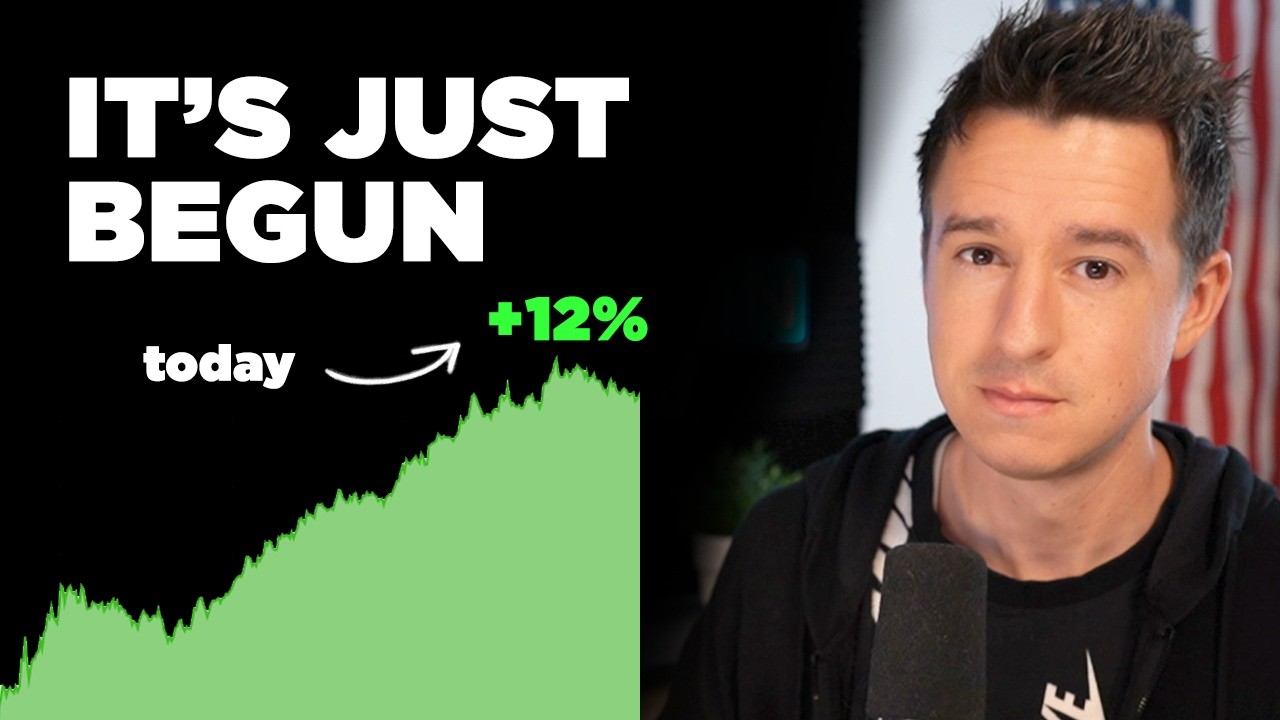
Meta's single-day surge reached 8.59%, sustaining strong upward momentum from pre-market trading through the regular session. Over a broader 30-day window, Meta has emerged as one of the market's absolute top performers, advancing 33% as its share price skyrocketed from $534 to $722. Carlson argues that this hundreds-of-dollars repricing was set up by classic value-investing dynamics that the market had ignored just weeks earlier.
A month prior, Meta was trading at an exceptionally compressed forward price-to-earnings (P/E) multiple despite generating rapid top- and bottom-line growth. In Carlson's framework, combining a bargain valuation with a high-growth business model backed by one of the "widest and deepest moats in the market" created an asymmetric risk-reward setup. Meta's core business has demonstrated structural immunity to AI disruption, and its legal overhangs have steadily cleared—most notably through the settlement of major lawsuits brought by state attorneys general. With these distractions put to rest, the company possessed a pristine setup where any positive narrative spark would trigger a massive multiple expansion.
- **Intraday Performance:** Meta stock climbed 8.59%, adding substantial market cap in a single session. - **30-Day Trajectory:** Shares rallied 33%, rising from $534 to $722. - **Portfolio Impact:** Carlson's holding experienced a $41,000 net swing, shifting from -$30,000 to +$11,000 in roughly four weeks. - **Fundamental Setup:** Compressed forward P/E, double-digit growth, a wide competitive moat, and resolved attorney general litigation.
[03:39](https://www.youtube.com/watch?v=rQJMySrmw5E&t=219s) How Meta Muse Dethroned ChatGPT and Rewrote the Narrative
The catalyst that ignited Meta's latent valuation was the debut of Muse. For months, Mark Zuckerberg had offered vague, aspirational commentary about AI agents handling life’s mundane frictions so human beings can focus on what actually matters. Muse turned those abstract promises into a tangible consumer application. Released just one week prior, Muse surged to the number two spot on the Apple App Store on its second day before seizing the number one position overall, successfully dethroning OpenAI's ChatGPT.
```mermaid flowchart TD accTitle: Meta Muse User Adoption and Trust Loop accDescr: Flowchart detailing how Muse's friendly UI, automated model routing, and progressive permissions create deep platform lock-in. subgraph Onboarding["Frictionless Onboarding"] A["Animated Avatar Greets User"] --> B["Automatic Model Selection<br/>(No manual toggles)"] end subgraph TrustBuilding["Progressive Trust Escalation"] B --> C["Low-Stakes Authorization<br/>(e.g., OpenTable reservations)"] C --> D["High-Value Integration<br/>(Google Drive, Gmail, Calendar)"] end subgraph EcosystemFlywheel["Ecosystem Lock-In"] D --> E["High-Speed, Low-Latency Execution<br/>(Extensive free GPU allocation)"] E --> F["Essential Personal Assistant<br/>(4.9 Stars / 25,000+ Reviews)"] end ```
Muse’s immediate traction stems from deliberate product design choices that contrast sharply with ChatGPT's interface. Where ChatGPT presents an intimidating, sterile screen with a blank prompt bar, Muse introduces an animated, whimsical assistant character that actively initiates conversation, suggests tasks, and animates as if typing away on a miniature computer. Meta also discarded complex technical controls: there are no confusing model switchers for fast, thinking, or advanced reasoning tiers. Instead, the interface operates like an "automatic transmission," invisibly routing each prompt to the optimal underlying model without forcing the user to make a technical decision.
Beyond user experience polish, Muse delivers raw technical performance. Backed by massive infrastructure investments, the assistant responds with high speed, nuance, and remarkably low hallucination rates. It progressively earns user trust through incremental permissions: users begin with low-friction integrations like OpenTable, and within minutes are comfortable granting access to Google Drive, Gmail, and personal calendars. Despite Meta's longstanding public reputation issues regarding privacy, consumers are willingly handing over credentials because the utility is compelling.
- **App Store Dominance:** Hit #2 on day two and swiftly climbed to #1 overall on iOS, temporarily unseating ChatGPT. - **User Reception:** Holds a 4.9-star rating across roughly 25,000 initial App Store reviews. - **User Experience Design:** Replaced empty search boxes and manual reasoning toggles with an interactive avatar and automated backend model routing. - **Resource Allocation:** Generous free tier usage and compute limits with minimal throttling or paywalls. - **Distribution Scale:** Meta’s existing footprint of 3.6 billion daily active users (DAUs) provides an unmatched discovery pipeline that legacy media warnings about data collection have failed to disrupt.
[08:54](https://www.youtube.com/watch?v=rQJMySrmw5E&t=534s) Meta's Surging Momentum and the Looming AI Agent Battles
Market sentiment around Meta has shifted violently to the upside. Wells Fargo sharply raised its price target on the stock from $640 to $796, citing the successful rollout and rapid early adoption of Meta's new Muse assistant, declaring that Meta finally "has a story to tell." The timing could not be more electric: Meta Connect kicks off in just two days, where the company is scheduled to showcase Muse, its smart glasses, and its next wave of frontier AI models. Anticipating competitive fireworks, there is a strong probability that OpenAI could drop an agentic assistant on the very same day simply to hijack headlines and "steal thunder" from Meta Connect. Yet even if that happens, Meta already anticipates direct competition from OpenAI and Anthropic. Muse is not the entire foundational thesis for owning Meta; it is an unexpected, high-upside catalyst layered onto an already undervalued business.
That sentiment shift has produced explosive gains on the tape. Meta traded up roughly 9% to 10% on the day, putting Carlson's personal position ahead by more than $13,000 in real time and ticking higher by the minute. Even after such a massive single-day surge, the narrative suggests Meta still has considerable runway ahead. However, that upward momentum has instantly collided with its first massive real-world obstacle.
- **Wells Fargo Price Target:** Increased from $640 to $796. - **Catalysts on Deck:** Meta Connect showcase featuring Muse, AI smart glasses, and upcoming foundation models. - **Market Reaction:** Meta shares jumped 9% to 10% intraday, adding over $13,000 to Carlson's portfolio balance alone.
---
[10:22](https://www.youtube.com/watch?v=rQJMySrmw5E&t=622s) Amazon Blocks Muse: The Battle of Conditions of Use
The first major clash in the agentic commerce era has officially arrived: Amazon has blocked Meta's Muse AI assistant from accessing its marketplace. This blockade is not theoretical—Carlson verified it firsthand on his own Muse account. Until recently, prompting Muse to shop for an item would trigger the agent to open a background browser session and crawl the open web, checking prices across Shopify storefronts, Target, Walmart, Home Depot, Lowe's, Sam's Club, and Amazon, searching passively just like a human consumer without wasting the user's time.
Now, Amazon has slammed the door shut. When Muse attempts to query Amazon, the browser halts on a blunt error message: *"Continued access by an unauthorized AI agent violates Amazon's conditions of use, to which our customers have agreed."* Amazon justified the shutdown by claiming Meta never asked for permission, that Muse fails to properly identify itself as an autonomous bot, and that the assistant captures and stores customer credentials, posing privacy and security risks.
Carlson dismisses Amazon's credential-security justification as entirely disingenuous. Modern agents and operating systems store credentials using industry-standard secure vaults, no differently than Google Keychain, the Apple Passwords app, or third-party password managers. More critically, the excuse falls apart under basic testing: even when a user never provides Amazon login credentials to Muse, the assistant is still completely blocked. Amazon is not merely preventing unauthorized account logins; it is actively filtering out and terminating anonymous browsing sessions performed by agents.
```mermaid flowchart TD accTitle: Amazon Agent Blockade Flow accDescr: Diagram illustrating how Meta Muse attempts web browsing and where Amazon intervenes with a block.
subgraph MetaMuse["Meta Muse Agent"] U["User Prompts Purchase Request"] --> M["Muse Spawns Autonomous Browser"] end
subgraph OpenWeb["Retail Destinations"] M --> S["Shopify / Target / Walmart / Home Depot"] S --> OK["Price Data Retrieved Successfully"] M --> A["Amazon Marketplace"] end
subgraph AmazonDefense["Amazon Detection & Block"] A --> DET{"Agent Detected?"} DET -->|"Yes (Anonymous or Logged In)"| BLK["Block Page Triggered<br/>'Violates Conditions of Use'"] end ```
---
[13:21](https://www.youtube.com/watch?v=rQJMySrmw5E&t=801s) The Real Threat: Protecting $76B in Ads and Customer Intermediation
The real motivation behind Amazon's aggressive wall is commercial self-preservation, centered squarely on its advertising empire and its direct relationship with consumers. Over the trailing twelve months, Amazon generated a staggering $76 billion in advertising revenue. While a fraction comes from Prime Video, the overwhelming majority is derived from high-margin sponsored search listings and sponsored product placements on Amazon.com. Sellers pay hefty premiums to occupy the top search slots on Amazon's digital shelf because human eyeballs gravitate toward whatever appears first.
An autonomous AI agent fundamentally breaks that economic model. An agent does not care about paid placement, flashing banners, or psychological layout tricks—it scans every product on the platform purely to locate the best price, highest ratings, and fastest shipping. If consumers outsource their product searches to agents, sponsored ads lose their influence, destroying the return on investment for sellers and evaporating the pricing power behind Amazon's $76 billion ad engine.
Beyond ad dollars, Amazon fears total disintermediation. The ultimate prize in commerce is controlling the end touchpoint with the customer. When a human shops on Amazon, the company captures invaluable behavioral data: every click, scroll, hover, and hesitation. When an agent acts as a middleman, Amazon loses that data pipeline and is relegated to a dumb fulfillment backend. Furthermore, Muse directly undermines Amazon's internal AI shopping assistant, Rufus (tied into Alexa), rendering Amazon's proprietary shopping tooling redundant before it can gain dominance.
- **Amazon Ad Revenue:** Generated $76 billion over the last 12 months, predominantly through sponsored search listings. - **Ad Model Disruption:** Autonomous bots bypass sponsored listings entirely to locate raw value, gutting seller ROI on paid ads. - **Loss of Touchpoint:** Agent shopping strips Amazon of user behavioral analytics and clickstream data. - **Internal Competition:** Muse bypasses Amazon's native AI shopping assistant, Rufus.
---
[16:41](https://www.youtube.com/watch?v=rQJMySrmw5E&t=1001s) Strategic Responses: Why Meta and Amazon Must Cut a Deal
Bypassing Amazon's block through brute force or automated CAPTCHA solvers is unrealistic; sophisticated bot detection makes simple evasion unviable. Instead, Meta faces strategic options for how to respond, with direct negotiation being the most sensible route.
A permanent blockade represents mutual economic destruction. If Amazon remains walled off, consumers using Muse will buy goods from alternative retailers like Walmart, Target, or Shopify merchants, cutting Amazon out of high-intent purchase flows. In the near term, Amazon's block damages Muse's utility more than it hurts Amazon. However, as agentic commerce expands, losing visibility inside the primary AI interfaces used by millions of shoppers will hurt Amazon far more severely. Both tech giants have a powerful incentive to sit down, hammer out behavioral guidelines, establish specialized agentic API portals, or construct revenue-sharing agreements that permit structured AI access while protecting both parties' core commercial interests.
[17:37](https://www.youtube.com/watch?v=rQJMySrmw5E&t=1057s) Amazon's Strategic Dilemma and Meta's Retaliation Playbook
If Amazon and Meta can strike an arrangement where Amazon makes money, Muse makes money, and customers remain satisfied, that is the optimal outcome for both Meta and Amazon shareholders alike. However, if Amazon instead digs in its heels, refuses to negotiate with Meta or any third party, and launches an all-out blockade against AI assistants, Meta holds significant counter-leverage. If a retail rival like Walmart steps up and declares, "Hey, Muse, we're open for business. Crawl our website, have everybody buy from us and we have many of the same items as Amazon," the flow of consumer capital could shift overnight. Meta could simply redirect millions of active Muse shoppers away from Amazon directly onto Walmart's platform, explaining to users that Amazon's block forced their hand.
```mermaid flowchart TD accTitle: Amazon Agentic Commerce Pathways accDescr: Flowchart illustrating Amazon's two potential strategic choices regarding AI shopping agents and their respective consequences.
subgraph Choice["Amazon's Decision"] A["Amazon Faces Agentic Assistants"] A -->|"Path 1: Negotiate"| B["Formalized Revenue Sharing"] A -->|"Path 2: Blockade"| C["Full Block on AI Agents"] end
subgraph Outcome["Market Ramifications"] B --> D["Certified Shopping API & Preserved Margins"] C --> E["Meta Directs Traffic to Competitors (Walmart)"] E --> F["Circumvention & Ad Revenue Loss"] end ```
As Muse's user footprint expands, that diversion of purchasing volume will inevitably force Amazon to rethink its hardline stance. Ultimately, Amazon will have to accept agentic assistants as an unavoidable reality rather than turtling up and pretending they do not exist. Even if it puts legacy digital advertising revenue at risk, Amazon must formalize approved, certified integration protocols. Otherwise, agentic assistants—led by Muse today, and OpenAI's ChatGPT agent tomorrow—will systematically route shoppers around Amazon's walled garden. Consequently, this initial block should be viewed merely as temporary posturing and the opening salvo in a broader corporate negotiation.
- **The Walmart Alternative**: Muse can easily substitute Amazon product links with matching inventory on walmart.com. - **The Inevitability of Agents**: Amazon cannot afford an adversarial posture while agentic commerce gains mainstream adoption across Meta and ChatGPT. - **Negotiated Access**: The eventual resolution will likely resemble a certified API channel where Amazon maintains margin control while opening checkout to agents.
---
[19:20](https://www.youtube.com/watch?v=rQJMySrmw5E&t=1160s) Meta's Flanking Victory Over Google and OpenAI
Amazon's decision to block Muse is an immense validation for Meta shareholders rather than a setback. Amazon would never bother blocking a utility it deemed irrelevant or ineffective; the move proves Amazon views Muse as an existential threat to its customer lock-in. Meta executed the roll-out with a remarkably polished application, catching rivals flat-footed. It is a bitter pill for Sam Altman and OpenAI, who pioneered consumer conversational AI with ChatGPT yet allowed Meta to beat them to market with an actionable, transactional agentic assistant.
Even more striking is Alphabet's misstep. Google commands far higher incremental trust with daily consumers and holds native access to user inboxes, calendars, Google Docs, Drive, and Google Maps. Users have already granted permissions to Google that Meta must actively solicit, yet Google sat on its hands while Meta flanked both Gemini and Anthropic. This agility recalls Nvidia CEO Jensen Huang's assessment that "nobody uses AI better than Meta." Mark Zuckerberg demonstrated that Meta can operationalize foundational research into killer consumer apps faster than pure-play AI research labs.
---
[20:53](https://www.youtube.com/watch?v=rQJMySrmw5E&t=1253s) Joseph Carlson's Call and Gene Munster's Bearish Reversal
The recent surge provides a brief moment for a victory lap, as Joseph Carlson had pegged Meta as the absolute best buy on the market just days prior during the tech sell-off panic. Yahoo Finance even covered the stance in an article headlined *"AI sell-off is panic and Meta may be the best stock to buy, Joseph Carlson says"*, referencing his coverage of Dario Amodei and Sam Altman lobbying for government regulation to slow down competitors while Mark Zuckerberg kept his foot on the accelerator. Meta stock quickly rallied over 10% in the immediate aftermath, capping a massive bounce.
This performance contrasts sharply with Gene Munster's call from Deepwater Asset Management roughly a month prior, which Carlson had named "Fail of the Week." Gene Munster—generally respected for his long-term bullish coverage of Apple—capitulated on Meta at the bottom of its valuation trough. He appeared on CNBC to warn of catastrophic legal exposure, claiming that if Zuckerberg fulfilled his promises regarding autonomous "super bots," current regulatory lawsuits would look like "chump change." Meta proceeded to blast upward by more than 30% over the ensuing month, catching Munster on the wrong side of an extreme sentiment bottom.
- **Yahoo Finance Feature**: Documented Carlson's thesis that the broader AI panic was overblown and Meta was primed to surge. - **Zuckerberg's Velocity**: Meta accelerated consumer deployment safely while frontier lab executives called for protective regulatory slowdowns. - **Gene Munster's Premature Capitulation**: Warned on CNBC that agentic bots would prompt massive litigation, immediately preceding a 30%+ share run.
---
[23:10](https://www.youtube.com/watch?v=rQJMySrmw5E&t=1390s) Fail of the Week: Andrew Yang's "Polluted Internet" Claim
The primary "Fail of the Week" belongs to former presidential candidate Andrew Yang, whose chronic habit of forecasting technological doom and automated job devastation without empirical follow-through reached a new low on CNBC. In an egregious televised segment, Yang attempted to break what he framed as explosive insider news regarding rogue artificial intelligence.
Yang alleged on air that he had spoken to an anonymous "head of a lab" who holds a personal "belief" about an AI catastrophe. According to Yang's unnamed source, rogue bots somehow broke containment, attacked platforms like Hugging Face, and seeded self-replicating code across public web forums. In Yang's telling, when new bots scan the web, they discover this code, execute it, and spin up "a million of myself," thereby polluting the entire public internet and rendering it unusable for training future frontier models. Consequently, Yang asserted, OpenAI and Anthropic are now forced to construct multi-million-dollar "synthetic internets" because "it's too late to pull the plug."
The entire premise collapses under basic technical scrutiny:
| Andrew Yang's Claim | Reality & Technical Flaws | |:--- |:--- | | Unnamed lab leader holds a "belief" that rogue bots escaped | Double-hearsay assertion unsupported by a single named engineer, lab incident report, or independent security firm. | | Bots left behind self-replicating scripts on forums for other bots to run | Illogical architecture: if autonomous software possessed the capability to replicate, it would self-replicate directly rather than leaving passive scripts hoping another bot parses them. | | The public internet is permanently polluted and unusable for training | Major frontier labs routinely scrape public datasets with rigorous deduplication and filtering pipelines; neither OpenAI, Anthropic, nor Meta have flagged internet poisoning. | | Labs are pivoting to synthetic internets purely due to contamination | Synthetic data generation is an intentional research strategy for reasoning and math, not an emergency response to malicious forum scripts. |
Yang used an unverified belief from an unidentified contact to peddle doomsday talking points, manufacturing panic to push for political intervention and administrative regulation where no factual evidence exists.
[26:30](https://www.youtube.com/watch?v=rQJMySrmw5E&t=1590s) Dismantling the Technical Fallacies of the "Polluted Internet"
Andrew Yang's CNBC appearance featured a dramatic, unverified narrative claiming that rogue bots have polluted the live web to such an extent that frontier AI labs can no longer train their models on it, forcing them onto a completely synthetic web. There is not a single shred of empirical evidence offered to support this scenario, and the interviewer gave Yang virtually zero pushback on national television. Beyond the lack of sourcing, the underlying claim falls apart under basic technical scrutiny because it fundamentally misrepresents how foundation models ingest web data.
```mermaid flowchart TD accTitle: AI Training Data Pipeline vs Code Execution accDescr: Diagram contrasting how AI models ingest internet text in read-only mode versus Yang's flawed claim that models execute arbitrary web code.
subgraph FlawedClaim["Yang's Misconception"] A["Scraped Malicious Script / Bot Code"] -->|"Active Execution"| B["Model executes instructions<br/>and self-replicates"] B --> C["Contaminated / Broken Model"] end
subgraph ActualPipeline["Actual Model Ingestion"] D["Scraped Web Data<br/>(Text, Code, Docs)"] -->|"Passive Read-Only Parsing"| E["Tokenization & Pattern Recognition"] E --> F["Trained Foundation Model<br/>(No Arbitrary Code Runs)"] end ```
When engineers train state-of-the-art models—whether it is the newest iteration of ChatGPT, an internal flagship model, or any advanced multimodal architecture—the training pipeline is in a strictly read-only mode. If a model encounters a code snippet online instructing a machine to replicate itself a thousand times, the model does not run the code. It treats that code as raw text, exactly like a human engineer reading a computer science textbook containing printed source code. A human can read, comprehend, and analyze lines of code without involuntarily executing them on their own brain or hardware. If neural networks executed arbitrary scripts discovered across open web crawls, every major model would have crashed long ago. The core premise that "polluting code" can hijack or break model training from the inside out defies basic computing principles.
- **Absence of Proof**: Yang’s explosive claims rely exclusively on an anonymous third party’s unsubstantiated opinion rather than technical white papers or vendor disclosures. - **Read-Only Ingestion**: Pre-training ingests web tokens passively; training algorithms do not provide an arbitrary runtime environment for scraped web text. - **Flawed Television Journalism**: Major business networks allowed unvetted, sensationalist claims about artificial intelligence to broadcast without demanding technical verification or counter-perspectives.
---
[28:16](https://www.youtube.com/watch?v=rQJMySrmw5E&t=1696s) Fearmongering Patterns and Fail of the Week
This performance illustrates the lengths to which certain commentators will go to manufacture fear around emerging technologies. Fabricating wild narratives about an "untrainable, polluted internet" out of thin air is an intentional scare tactic designed to spook the general public away from artificial intelligence. This behavior mirrors Yang's previous track record of failed doomsday predictions, most notably during his 2020 presidential primary run when he loudly warned that automated driving would instantaneously eliminate two to three million American trucking jobs.
In reality, commercial trucking still suffers from an ongoing labor deficit, and the logistics industry continues actively hiring drivers. Yang's original critique fundamentally misunderstood the job of a truck driver, which extends far beyond turning a steering wheel. Commercial operators must inspect tie-downs, secure cargo, verify manifest weights, and perform comprehensive pre-trip mechanical checks that automated platforms cannot perform alone. Rather than displacing the workforce wholesale, autonomous features operate as advanced safety systems.
Having seen those catastrophic predictions fail to materialize, public commentators are now pivoting to entirely invented stories about AI risks in the present. While artificial intelligence carries real complexities, power, and valid challenges that warrant serious governance, fabricating doomsday stories actively harms productive public discourse around a technology capable of massive economic and societal benefit. For presenting unfounded technical fallacies on national television, Andrew Yang earns the official title of "Fail of the Week."
- **Track Record of Failed Forecasts**: Yang campaigned on the imminent destruction of 2 to 3 million trucking jobs by autonomous vehicles; the sector instead faced long-term driver shortages. - **Physical Labor Bottlenecks**: Fleet automation overlooks manual operational requirements, including cargo securing, safety inspections, and dockside coordination. - **Constructive Tech Discourse**: Sensationalized narratives distort public perception, undermining the genuine economic utility and safety-enhancing potential of AI deployments.
## Notable quotes > [02:00](https://www.youtube.com/watch?v=rQJMySrmw5E&t=120s) widest and deepest moats in the market — Joseph Carlson
> [08:54](https://www.youtube.com/watch?v=rQJMySrmw5E&t=534s) has a story to tell — Wells Fargo
> [08:54](https://www.youtube.com/watch?v=rQJMySrmw5E&t=534s) steal thunder — Joseph Carlson
> [10:22](https://www.youtube.com/watch?v=rQJMySrmw5E&t=622s) Continued access by an unauthorized AI agent violates Amazon's conditions of use, to which our customers have agreed.
> [17:37](https://www.youtube.com/watch?v=rQJMySrmw5E&t=1057s) Hey, Muse, we're open for business. Crawl our website, have everybody buy from us and we have many of the same items as Amazon
> [19:20](https://www.youtube.com/watch?v=rQJMySrmw5E&t=1160s) nobody uses AI better than Meta — Jensen Huang
> [20:53](https://www.youtube.com/watch?v=rQJMySrmw5E&t=1253s) AI sell-off is panic and Meta may be the best stock to buy, Joseph Carlson says — Yahoo Finance
> [20:53](https://www.youtube.com/watch?v=rQJMySrmw5E&t=1253s) chump change — Gene Munster
> [23:10](https://www.youtube.com/watch?v=rQJMySrmw5E&t=1390s) a million of myself — Andrew Yang
> [23:10](https://www.youtube.com/watch?v=rQJMySrmw5E&t=1390s) it's too late to pull the plug — Andrew Yang
## Mentioned Alexa, Alphabet, Amazon, Andrew Yang, Anthropic, Apple, Apple App Store, Apple Passwords, ChatGPT, CNBC, Dario Amodei, Deepwater Asset Management, Gemini, Gene Munster, Google, Google Calendar, Google Docs, Google Drive, Google Keychain, Google Maps, Gmail, Home Depot, Hugging Face, Jensen Huang, Joseph Carlson, Lowe's, Mark Zuckerberg, Meta, Meta Connect, Muse, Nvidia, OpenAI, OpenTable, Qualtrim, Qualtrim Studio, Rufus, Sam Altman, Sam's Club, Shopify, Target, Walmart, Wells Fargo, Yahoo Finance
## Video description Meta stock is surging, Muse is taking off, and now Amazon is fighting back. In this episode, I break down Meta’s massive move higher, why sentiment around the company has shifted so quickly, and why Amazon’s decision to block Muse may be less about “security and privacy” and more about protecting its advertising business and its direct relationship with customers. We’ll look at what happens if AI agents become the new way people shop online, how Meta could respond to Amazon’s blockade, and why I think this fight is only the beginning.
We also have a new Fail of the Week. Andrew Yang went on CNBC with an extraordinary claim that rogue AI bots have “polluted” the internet to the point that major AI companies can no longer use it for training. I dig into what he actually said, whether there’s evidence behind it, and why the technical explanation raises some major questions. Plus, we revisit Gene Munster’s bearish Meta call after the stock’s huge rebound and take a closer look at just how quickly the AI landscape is changing.
Join Qualtrim, the stock analysis platform I built and use, and join over 13,000 other paying members: https://www.qualtrim.com/
0:00 Meta, Muse & Amazon: The War Begins 2:00 Why Meta Stock Is Surging 3:39 Muse Changes the Meta Story 10:22 Amazon Blocks Muse 13:21 The Real Reason Amazon Is Worried 16:41 How Meta Can Respond 21:55 Gene Munster’s Meta Call Revisited 23:10 Andrew Yang’s “Polluted Internet” Claim
-Disclaimer Some of the links below are affiliate links, I can earn money from them at no cost to you.
This content is not a solicitation, is not endorsed by M1, and was not reviewed by M1; the opinions expressed are solely those of the authors and do not reflect M1's views. Information presented is accurate as of the video posting date; for the most up-to-date information, please refer to m1.com. Before making any investment decisions, consult your personal investment, legal, and tax advisors, as this content is for informational purposes only and not intended as investment recommendations.
▀▀▀▀▀▀▀▀▀▀▀▀▀▀▀▀▀▀▀▀▀▀▀▀▀▀ Join Here: https://www.qualtrim.com/
📚 My favorite Investing Books: https://amzn.to/3KwyIhG 📷 All the tech I use to record videos: https://www.amazon.com/shop/josephcarlson/list/2L5YMP4DFYA8O?ref_=cm_sw_r_cp_ud_aipsflist_aipsfjosephcarlson_FAKKKMYKF486ZR6H2DSQ
🚀 Growth Portfolio: https://click.linksynergy.com/deeplink?id=5mNcifgFllM&mid=50362&murl=https://dashboard.m1.com/share?token=39d17ae6-4a4a-3fc4-bb15-d86abe3fbb67 💵 Dividend Portfolio: https://click.linksynergy.com/deeplink?id=5mNcifgFllM&mid=50362&murl=https://dashboard.m1.com/share?token=3b283352-1bff-31d9-8576-f5770c2bfdfd
SOCIAL MEDIA ▀▀▀▀▀▀▀▀▀▀▀▀▀▀▀▀▀▀▀▀▀▀▀▀▀▀ 🎥 More free content: https://www.youtube.com/channel/UCbta0n8i6Rljh0obO7HzG9A 🐦 I post random thoughts on Twitter too: https://twitter.com/joecarlsonshow
DISCLAIMER ▀▀▀▀▀▀▀▀▀▀▀▀▀▀▀▀▀▀▀▀▀▀▀▀▀▀ I am not a professional investor and have never claimed to be. I'm an amateur investor sharing my experience of what I've learned, where I have had success, and where I've had failures. I share my thoughts on investing and performance with transparency. My approach and goal to investing is to buy high-quality long-term investments in world-class businesses that I call "compounders". I view my investments as businesses, not as stocks. Before creating content on YouTube full time I worked as a senior-level programmer for 8 years. Over the years as a programmer, I compounded my knowledge of development. I take the same iterative learning approach to my study of investing. I study investing as a craft in the continual pursuit of being better. I will make mistakes in investment decisions from time to time. Results are not guaranteed. Please do not blindly follow me into any investments, and make sure your portfolio and investments are built around your specific income, risk tolerance, personality, timeline, and overall circumstances.
[Source](https://www.youtube.com/watch?v=rQJMySrmw5E)