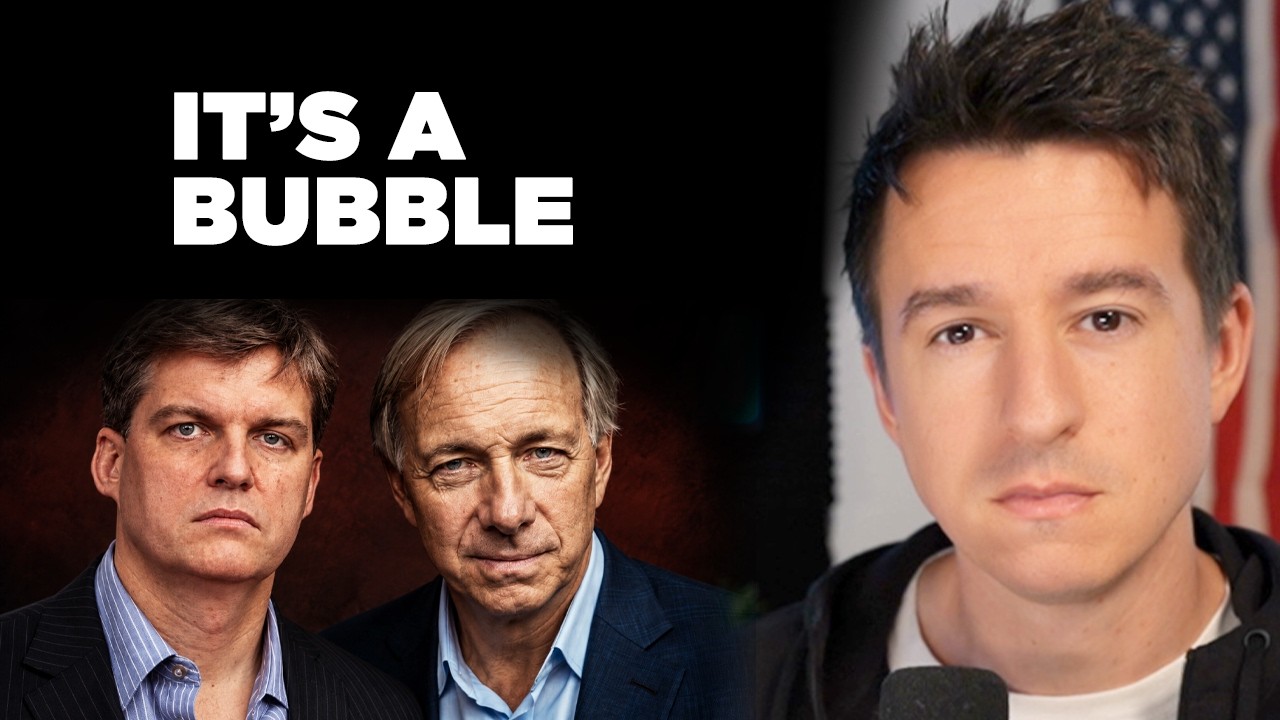
Burry, Dalio Predict AI Crash as 15-Year Track Record Punishes Bears
Joseph Carlson After Hours
Investors who heed crash warnings from Michael Burry and Ray Dalio risk missing sustained market compounding, as tech giants funding AI boast robust cash flows and modest valuations that defy dot-com bubble comparisons.
AI-assisted summary of The AI Bubble Is Popping — original source. Check the original for full context.
Source published:
Key ideas
- Michael Burry and Ray Dalio issued simultaneous market crash warnings, with Burry projecting a 2000- or 2008-scale downturn within 6 to 9 months and Dalio warning that rising interest rates and heavy AI capital inflows will force the AI bubble to pop. (0:00)
- A 15-year historical review shows that acting on Dalio's and Burry's post-2008 macro warnings would have severely damaged portfolio returns—causing investors to miss a 32% S&P 500 surge in 2013, a 31.49% rally in 2019, and a 27% rebound in 2023. (10:31)
- Over the 19 calendar years from 2007 to 2025, the US stock market finished negative in only 3 years and closed positive in 16, heavily favoring Warren Buffett's strategy of consistent S&P 500 dollar-cost averaging over macro market timing. (12:01)
- Unlike the unprofitable companies of the 2000 dot-com bubble that traded at 50 to 80 forward P/E multiples, today's AI capex leaders are highly profitable cash machines trading at grounded valuations—including Alphabet (~24 P/E), Meta (~22 P/E), Amazon (~25 forward P/E), and Microsoft (~25 forward P/E). (16:25)
Detailed notes
## Background Published on YouTube on October 8, 2026, by the channel Joseph Carlson After Hours, this video is hosted by Joseph Carlson, a former senior-level programmer turned full-time content creator and amateur investor. In the video description, Carlson promotes his stock analysis platform, Qualtrim, shares links to his growth and dividend portfolios, and outlines his philosophy of transparently investing in high-quality, long-term "compounder" businesses.
## TL;DR Prompted by simultaneous warnings of an impending market crash and AI bubble burst from famed 2008 bears Michael Burry and Ray Dalio, Joseph Carlson conducts a 15-year audit of both investors' public track records from 2007 to 2026. By mapping their recurring bearish calls against actual S&P 500 performance, he shows that heeding their warnings would have caused investors to miss massive market rallies—including a 32% surge in 2013, a 31.49% gain in 2019, and a 27% recovery in 2023—while also noting painful losses in several of Burry's individual stock and short positions. Drawing on principles from Warren Buffett and Peter Lynch, Carlson argues against market timing and points out that today's AI spending is driven by cash-generative mega-cap leaders—Alphabet, Amazon, Meta, and Microsoft—trading at grounded P/E multiples between 22 and 25 rather than dot-com bubble valuations. He concludes the episode by recounting his recent 45-minute guest appearance on Steve Eisman's Substack show, *The Steve Eisman Playbook*, where he defended his bullish tech and agentic commerce thesis in front of a deeply AI-skeptical audience.
## Atmosphere & style The episode carries a calm, analytical, and reassuringly pragmatic tone, leavened with dry humor as Carlson demystifies the aura surrounding billionaire macro gurus. The narrative arc moves from acknowledging the natural anxiety long-term investors feel when confronted with high-profile doom calls to methodically dismantling that fear through a sober, year-by-year review of historical data. Watching the video feels like sitting down with a level-headed peer who cuts through financial media panic with empirical discipline, before shifting into an energized, full-circle moment of pride as he reflects on debating *Big Short* legend Steve Eisman in the "lion's den."
## Bulletin - [00:00](https://www.youtube.com/watch?v=_Yt7NuD-nbk&t=0s) Michael Burry and Ray Dalio issued simultaneous market crash warnings, with Burry projecting a 2000- or 2008-scale downturn within 6 to 9 months and Dalio warning that rising interest rates and heavy AI capital inflows will force the AI bubble to pop. - [10:31](https://www.youtube.com/watch?v=_Yt7NuD-nbk&t=631s) A 15-year historical review shows that acting on Dalio's and Burry's post-2008 macro warnings would have severely damaged portfolio returns—causing investors to miss a 32% S&P 500 surge in 2013, a 31.49% rally in 2019, and a 27% rebound in 2023. - [12:01](https://www.youtube.com/watch?v=_Yt7NuD-nbk&t=721s) Over the 19 calendar years from 2007 to 2025, the US stock market finished negative in only 3 years and closed positive in 16, heavily favoring Warren Buffett's strategy of consistent S&P 500 dollar-cost averaging over macro market timing. - [16:25](https://www.youtube.com/watch?v=_Yt7NuD-nbk&t=985s) Unlike the unprofitable companies of the 2000 dot-com bubble that traded at 50 to 80 forward P/E multiples, today's AI capex leaders are highly profitable cash machines trading at grounded valuations—including Alphabet (~24 P/E), Meta (~22 P/E), Amazon (~25 forward P/E), and Microsoft (~25 forward P/E).
## Key takeaways - [00:00](https://www.youtube.com/watch?v=_Yt7NuD-nbk&t=0s) Michael Burry (posting on X as Cassandra) warned that the stock market is in the first stage of grief and denial, predicting a collapse on the scale of 2000 and 2008 within 6 to 9 months. - [00:00](https://www.youtube.com/watch?v=_Yt7NuD-nbk&t=0s) In the same week, Bridgewater founder Ray Dalio warned that the AI bubble is nearing a bursting point as rising interest rates collide with massive capital inflows into AI companies. - [06:09](https://www.youtube.com/watch?v=_Yt7NuD-nbk&t=369s) While Ray Dalio and Bridgewater accurately predicted the 2007–2008 financial crisis and made a strong bullish call in 2011, Dalio made a major error in 2013 by forecasting ~4% annual equity returns over the next decade—underestimating actual returns by roughly fourfold. - [09:19](https://www.youtube.com/watch?v=_Yt7NuD-nbk&t=559s) Michael Burry's public warnings since 2019—including claims of a passive index investing bubble in 2019, a COVID selling stampede in 2020, and his infamous 'Sell' post in January 2023—have maintained a chronically bearish posture through major market rallies. - [10:31](https://www.youtube.com/watch?v=_Yt7NuD-nbk&t=631s) Investors who followed Dalio's bearish warnings in 2013, 2015, and 2016 or Burry's warnings in 2019 and early 2023 missed out on massive single-year S&P 500 gains, including +32% in 2013, +31.49% in 2019, and +27% in 2023. - [10:31](https://www.youtube.com/watch?v=_Yt7NuD-nbk&t=631s) Although both Dalio and Burry accurately flagged speculative froth in 2021 ahead of the 18% market drawdown in 2022, both remained overly pessimistic at the bottom and missed the subsequent 2023 recovery. - [12:01](https://www.youtube.com/watch?v=_Yt7NuD-nbk&t=721s) Between 2007 and 2025, the US stock market finished negative in only 3 out of 19 calendar years, illustrating why persistent optimists and simple S&P 500 index investors outperform macro market timers. - [12:01](https://www.youtube.com/watch?v=_Yt7NuD-nbk&t=721s) As Peter Lynch observed, far more money has been lost by investors attempting to anticipate and protect against market corrections than has been lost in the corrections themselves. - [14:04](https://www.youtube.com/watch?v=_Yt7NuD-nbk&t=844s) Examining Michael Burry's individual public stock positions reveals an erratic track record, including heavy losses on Lululemon (down ~61%), an Nvidia short (down ~45%), and a Palantir short, alongside a modest ~17% gain on Adobe. - [16:25](https://www.youtube.com/watch?v=_Yt7NuD-nbk&t=985s) Today's mega-cap AI spenders—Alphabet, Meta, Microsoft, and Amazon—generate billions in daily free cash flow and trade at reasonable P/E multiples of 22 to 25, bearing no resemblance to the unprofitable 50–80x P/E companies of the 2000 dot-com bubble. - [16:25](https://www.youtube.com/watch?v=_Yt7NuD-nbk&t=985s) Long-term investors with a horizon beyond five years should treat standard 20% to 30% market drawdowns—which occur naturally every five to seven years—as buying opportunities rather than reasons to exit equities. - [18:27](https://www.youtube.com/watch?v=_Yt7NuD-nbk&t=1107s) Joseph Carlson appeared on Steve Eisman's Substack show, 'The Steve Eisman Playbook,' where he defended a bullish long-term tech thesis on Apple-Google partnerships and agentic commerce to an AI-skeptical audience.
## Detailed walkthrough ### [00:00](https://www.youtube.com/watch?v=_Yt7NuD-nbk&t=0s) Michael Burry and Ray Dalio Issue Simultaneous Crash Warnings
Michael Burry and Ray Dalio are two of the most famous investors of our era, largely because both correctly predicted the 2008 market crash and have commanded massive media attention ever since. Dalio runs Bridgewater, one of the largest—if not the very largest—hedge funds in the world, has authored best-selling books like *Principles*, and regularly appears on CNBC and writes posts that reach millions. Burry built an enduring aura of mystique after shorting the housing market in 2008 and being portrayed by "Batman himself" (Christian Bale) in *The Big Short*. Avoiding TV appearances like CNBC, Burry communicates strictly online—posting under the screen name "Cassandra" on X and writing a $50-per-month Substack that has become the second most popular finance Substack in the world, trailing only Citrini.
While both figures have been generally skeptical of the market over recent years, they just issued remarkably definitive, simultaneous warnings of an impending crash. On the 5th of the month, Burry posted on X under the name Cassandra: "The stock market is quite obviously in its first stage of grief and denial. Per 2000 and 2008, this stage will last 6 to 9 months." In short, Burry is predicting a market collapse on the exact scale of the 2000 dot-com bubble and the 2008 financial crisis. In the very same week, Ray Dalio warned that the AI bubble is nearing a bursting point, arguing that rising interest rates colliding with massive capital inflows into AI companies will force the bubble to pop sooner rather than later—aligning closely with Burry's 6-to-9-month timeline.
```mermaid flowchart LR accTitle: Simultaneous Market Crash Warnings from Burry and Dalio subgraph Investors["High-Profile Bears"] MB["Michael Burry (Cassandra)"] RD["Ray Dalio (Bridgewater)"] end subgraph Theses["Current Warning Signals"] MBT["Market in stage 1 of grief & denial"] RDT["Rising interest rates + heavy AI capital inflows"] end subgraph Outcome["Predicted Outcome"] C["2000 / 2008 scale crash or AI bubble burst in 6-9 months"] end MB --> MBT RD --> RDT MBT --> C RDT --> C ```
[02:23](https://www.youtube.com/watch?v=_Yt7NuD-nbk&t=143s) Reviewing 15 Years of Credibility and Upcoming Episode Topics
Faced with two giant figures sounding the alarm at the exact same moment, Joseph decides to conduct an exhaustive, 15-year review of both investors' track records since the 2008 crash. Similar to a well-received retrospective he previously did on Ed Zitron's history, this analysis examines every major call and sentiment shift from Dalio and Burry to see when they were right, when they were wrong, and whether everyday investors should actually sell their stocks or prepare based on these signals.
Before diving into the timeline, Joseph notes a couple of other items on the agenda: - **Steve Eisman Interview:** Earlier in the week, Joseph was invited onto *The Steve Eisman Playbook* (Eisman's Substack show) for a full interview, and he plans to share the background story and his thoughts on how the conversation went later in the episode. - **Qualtrim Platform:** He briefly reminds viewers about `qualtrim.com` (available on iOS and Android), where members get access to the Qualtrim analysis suite, exclusive deep-dive videos, and a Discord community of thousands of investors where Joseph frequently chats about stocks.
[04:04](https://www.youtube.com/watch?v=_Yt7NuD-nbk&t=244s) The Long-Term Investor's Dilemma Against Billionaire Bears
Joseph frames the psychological tension of managing a portfolio for the next 10 to 20 years. On one hand, he is buying and holding world-class businesses like Google, Meta, ASML, S&P Global, and Netflix with a positive view that they will compound and make money over the next decade. On the other hand, someone like Ray Dalio steps up and warns that the market is going down and those exact AI-linked companies are in big trouble.
It is natural to feel nervous when confronted by these resumes. Dalio is a sharp dresser worth billions who runs a massive hedge fund and writes bestsellers—"he's smarter than all of us," Joseph jokes, so it feels like he must know something ordinary investors don't. Likewise, while trying to invest in growing, profitable companies, hearing Michael Burry—one of the very few people to pull off a dramatic, wildly successful short of the 2008 housing market—claim we are 6 to 9 months away from a 2000- or 2008-level crash forces any sensible investor to pause and ask whether they should genuinely be worried. To answer that fairly and without bias, Joseph maps out what would have happened if an investor had actually followed their historical claims year by year.
[06:09](https://www.youtube.com/watch?v=_Yt7NuD-nbk&t=369s) Ray Dalio's Historical Track Record (2007–2026)
Looking at the US market timeline starting in 2007, Joseph gives Dalio and Bridgewater full credit for their pre-crisis foresight. Ahead of the 2008 crash, Bridgewater correctly identified dangerous credit and asset price imbalances, positioned themselves very bearishly, and delivered phenomenal performance as the banking and credit deterioration unfolded in 2007 and 2008. Dalio remained bearish in 2009 (expecting an extended deleveraging), had insufficient public data in 2010 and 2012, and made another strong, well-timed call in 2011 by turning bullish and calling US equities comparatively cheap and well-supported by currency and capital flows.
However, in 2013, Dalio made one of his biggest errors of the past 15 years: turning bearish and forecasting disappointing equity returns of roughly 4% annually over the following decade—underestimating the actual market returns by a factor of around four ("Terrible, terrible call"). From there, Dalio's US market stance fluctuated frequently, leaning heavily toward macro warnings over the subsequent decade before arriving at his current 2026 warning on tightening AI funding conditions:
| Year | Ray Dalio / Bridgewater Stance | Key Reasoning & Market Calls (US Markets) | |:--- |:--- |:--- | | **2007–2008** | Bearish | Spot-on identification of dangerous credit and asset price imbalances; expected continued banking and credit deterioration. | | **2009** | Bearish | Expected an extended deleveraging following the crash. | | **2010** | No Data | Insufficient public data on stance. | | **2011** | Bullish | Good positioning; called US equities comparatively cheap and supported by currency and capital flows. | | **2012** | No Data | Insufficient public data on stance. | | **2013** | Bearish | Major error: forecasted ~4% annual equity returns over the next decade (underestimated actual returns by ~4x). | | **2014** | Positive / Bullish | Shifted sentiment to be slightly more positive. | | **2015** | Bearish | Warned that premature Fed tightening could trigger a 1937-style contraction. | | **2016** | Bearish | Warned of monetary policy limits and an unattractive risk-reward backdrop for US assets. | | **2017** | Bullish | Viewed near-term outlook as favorable despite serious longer-term structural risks. | | **2018–2019** | Mixed | Mixed macro commentary across both years. | | **2021** | Bearish | Flagged high-valuation bubble behavior in pockets of the market. | | **2023** | Bearish | Warned of higher interest rates and preferred cash amid a debt crisis and macro headwinds. | | **2024** | Neutral to Bullish | Unlike the six surrounding years, stated the US stock market did not look overly bubbly. | | **2025–2026** | Bearish | Returned to a bearish stance; warning of market corrections as AI funding conditions tighten. |
Turning to Michael Burry's timeline at the end of the segment, Joseph begins in 2007—Burry's best call by far—when he was a strong bear maintaining a powerful wager against subprime credit that anticipated wider financial damage.
[09:19](https://www.youtube.com/watch?v=_Yt7NuD-nbk&t=559s) The Mystique and Warning Track Record of Michael Burry
Michael Burry established his legendary reputation and aura of mystique from his famous bet against the mid-2000s subprime mortgage crisis, cementing his status as the investor who predicted the Great Financial Crisis. Around 2019, Burry became far more vocal publicly, taking to X (formerly Twitter) to share his macroeconomic views. He kicked off this phase by arguing that passive index investing had formed bubble-like structural vulnerabilities that could dramatically intensify selling pressure during a downturn. By 2020, as the COVID-19 crash unfolded, he reiterated these warnings, predicting a catastrophic selling stampede driven by the mechanical unwinding of passive index funds.
```mermaid flowchart TD accTitle: Investor Approaches Comparison accDescr: Flowchart contrasting macro market timing with dollar-cost averaging into index funds. subgraph Timing["Macro Market Timing"] A["Heed Perma-Bear Calls"] --> B["Exit Equities / Buy Shorts"] B --> C["Miss +20% to +30% Up Years"] C --> D["Net Underperformance"] end subgraph Compounding["Long-Term Compounding"] E["Dollar-Cost Average S&P 500"] --> F["Ignore Macro Noise"] F --> G["Absorb 5-7 Yr Drawdowns"] G --> H["Capture US Economic Growth"] end ```
Burry turned even more aggressively pessimistic heading into 2021, labeling the retail speculation across equities and cryptocurrencies as outright extreme and warning of catastrophic downside risk. While that particular warning proved prophetic—the speculative frenzy unraveled in 2022, driving an 18% drawdown in the broader market—Burry remained stubbornly bearish even after the bubble had popped. Throughout 2022 and into 2023, he repeatedly argued that equities had much further to fall, mapping out severe potential drops for the S&P 500. He punctuated this view in January 2023 with his infamous one-word post, "Sell," only to publicly retract it a couple of months later. That skepticism persisted unabated straight into 2025 and 2026. Across the board, Burry has maintained a consistently darker, more persistent bearish posture than even Ray Dalio.
- **2019 Warning**: Claimed passive index investing harbored bubble vulnerabilities that would amplify sell-offs. - **2020 Call**: Predicted a mechanical "selling stampede" during the COVID market crash. - **2021 Call**: Accurately called extreme equity and crypto speculation before the 2022 pop. - **January 2023 Call**: Posted "Sell" on X right before the market launched into a massive 27% rally, retracting the call months later. - **2025–2026**: Maintained a chronic bearish outlook despite strong ongoing equity performance.
---
[10:31](https://www.youtube.com/watch?v=_Yt7NuD-nbk&t=631s) The Staggering Cost of Being Bearish in a Secular Bull Market
Placing the public pronouncements of Ray Dalio and Michael Burry alongside actual historical market performance reveals the sheer danger of acting on macro doom calls. Between 2010 and 2017, every single bearish call proved detrimental to an investor's wealth, as the United States market engaged in an unrelenting bull run. When Ray Dalio issued warnings in 2013, 2015, and 2016, following his lead would have inflicted severe financial harm. An investor who liquidated their portfolio because of Dalio's caution in 2013 walked away right before a 32% market explosion, followed sequentially by compounding gains of 13%, 1.3%, 12%, and 21%.
| Year | Bearish Commentary / Call | Actual S&P 500 Outcome | Consequence of Following | |:--- |:--- |:--- |:--- | | **2013** | Ray Dalio turns bearish / cautions on risk | **+32%** | Missed one of the best single-year rallies of the decade | | **2014–2017** | Periodic warnings from Dalio (2015, 2016) | **+13%, +1.3%, +12%, +21%** | Substantial compounding lost on the sidelines | | **2019** | Michael Burry warns of passive fund bubble | **+31.49%** | Exited during the absolute worst year to be short or out | | **2021** | Dalio & Burry warn of extreme speculation | **Market peaks**, then drops **-18%** in 2022 | Accurately called the froth, but stayed bearish at the bottom | | **2023** | Burry posts "Sell" in January; remains bearish | **+27%** | Missed the violent recovery off the 2022 lows | | **2024** | Dalio turns positive for one year | Strong market continuation | Temporary alignment after years of negative positioning |
As the bull run progressed, the timing of these warnings became even more punishing. Burry's bearish sounding of the alarm in 2019 arrived in a year when the S&P 500 surged by 31.49%—the absolute worst possible time to sit on the sidelines. While both investors correctly anticipated froth entering 2021 ahead of the 2022 decline of 18%, both remained deeply pessimistic at the trough. Consequently, they missed the dramatic 2023 surge of 27%. Outside of a brief window where Dalio turned constructive in 2024, their television commentary, X posts, and Substack writings have reliably broadcast extreme skepticism at precisely the wrong stages of the market cycle.
---
[12:01](https://www.youtube.com/watch?v=_Yt7NuD-nbk&t=721s) American Exceptionalism, Peter Lynch, and the Futility of Market Timing
Describing the track record of prominent macro doomsayers as "mixed" is the most charitable possible framing; the blunter truth is that following their guidance leaves you with significantly less wealth than adhering to Warren Buffett's foundational advice. An everyday investor who simply bought an S&P 500 index fund, dollar-cost averaged into it paycheck after paycheck, closed their eyes, and tuned out macro gurus ended up far wealthier than anyone attempting to navigate credit cycles, liquidity mechanics, and bubble calls. While bears occasionally nail a crash to burnish their predictive credentials, those isolated wins are completely overshadowed by the 20% to 30% up-years they sit out.
This structural failure stems from betting against the relentless dynamism of the American economy. As Buffett has repeatedly emphasized, the United States possesses an exceptional environment where world-class businesses are founded, scale rapidly, and generate unprecedented profit margins. Rather than attempting to outsmart this engine through market timing, Buffett advises investors to "just get on the ride, get on board, invest in the US economy, buy a slice of it, and then you can be an owner of it as well."
The arithmetic decisively favors the bulls. Over the 19 calendar years spanning from 2007 to 2025, the US stock market finished in negative territory in only three years, closing positive in the other 16. That structural reality explains why persistent optimists like Tom Lee are so regularly proven right: the market simply goes up far more often than it goes down. As legendary Magellan fund manager Peter Lynch observed throughout his career, far more money has been lost by investors attempting to anticipate and protect against market corrections than has been lost in the actual corrections themselves.
---
[14:04](https://www.youtube.com/watch?v=_Yt7NuD-nbk&t=844s) Burry's Real-World Portfolio: Shorts and Missed Bets
While volatility and cyclical bear markets of 20% to 30% are an unavoidable reality of investing, attempting to preemptively trade around them remains a fool's errand. Buffett avoids market timing entirely because he recognizes he has no unique ability to forecast broad market direction; instead, he evaluates individual businesses, trusts the country's forward momentum, and lets Berkshire Hathaway's transparent, audited returns speak for themselves. In contrast, while Michael Burry does not provide full, audited visibility into his overall fund returns, examining his individual public positions exposes an erratic, often punishing track record:
- **Lululemon**: Down approximately 61% from the level where he initially discussed the position. - **Nvidia Short**: Down roughly 45% as the semiconductor juggernaut powered through his thesis to fresh highs. - **Palantir Short**: Turned sharply against him as the stock mounted a massive upward run. - **Adobe**: Generated a modest gain of about 17%. - **Broad Track Record**: Certain long picks have yielded gains around 30%, but others are saddled with losses exceeding 66%.
Claiming Burry is always wrong would be an unfair exaggeration, as he has undeniably nailed specific, high-profile market calls. However, he is frequently wrong, having misjudged several prominent positions and sold out of losing trades after the market moved violently against him. Investors should view commentators like Ray Dalio and Michael Burry with appropriate perspective: getting a famous call right in the past does not grant anyone permanent clairvoyance over future market cycles.
---
[16:25](https://www.youtube.com/watch?v=_Yt7NuD-nbk&t=985s) The AI Bubble Argument vs. Mega-Cap Balance Sheets and Valuations
Even if the current warnings about an artificial intelligence bubble popping prove correct, a long-term investor's rational reaction should be: "So what?" A standard bear market drawdown of 20% or 30% is completely irrelevant to anyone whose retirement horizon extends beyond the next five years. The companies underwriting the vast majority of AI capital expenditures—Alphabet (Google), Meta, Microsoft, and Amazon—are not speculative, cash-burning ventures liable to go bankrupt; they are the most profitable, cash-generative corporate machines in history, spitting off billions of dollars in free cash flow daily.
Furthermore, their equity valuations share virtually no resemblance to the true dot-com bubble of 1999–2000, when unviable companies traded at infinite multiples or forward P/E ratios of 50 to 80 without a dime of underlying profit. Today's mega-cap technology leaders trade at historically moderate, reasonable earnings multiples relative to their dominant balance sheets and competitive moats:
- **Alphabet (Google)**: Trades at a P/E ratio around 24, making severe valuation multiple compression toward 15 or 18 look overly pessimistic for a business of its caliber. - **Amazon**: Trades around a 25 forward P/E ratio, historically modest compared to its long-term ranges. - **Meta**: Trades at roughly 22 times earnings, representing a relatively low multiple given its margins and growth. - **Microsoft**: Trades at a forward P/E of roughly 25, which is historically conservative for its premier enterprise software and cloud dominance.
These are wide-moat, resilient companies already sitting at grounded valuations. Market drawdowns of 20% to 30% occur naturally every five to seven years. As Peter Lynch taught, investors should simply "pencil in" that regular volatility as the baseline cost of admission to the market, recognizing that cyclical panic reliably delivers wonderful long-term buying opportunities rather than a reason to flee.
[18:27](https://www.youtube.com/watch?v=_Yt7NuD-nbk&t=1107s) An Invitation to "The Steve Eisman Playbook"
Moving on from market preparations, Carlson turns his attention to another prominent investor who famously foresaw the 2008 financial crisis and was immortalized in *The Big Short*: Steve Eisman. For years, dating back to the earliest days of Carlson's YouTube channel when his audience was still tiny, he regularly reviewed and reacted to Eisman’s frequent appearances on CNBC. Creating those reaction videos—weighing in whether he agreed or disagreed with Eisman's market calls—had always been an enjoyable staple of the channel. That history made it a surreal and exciting full-circle moment when an opportunity arose to speak with Eisman directly.
Carlson appeared as a guest on Eisman’s exclusive, paywalled Substack video show, *The Steve Eisman Playbook*. Clarifying how the arrangement came together, Carlson explains that he never pitched himself or sought out the spotlight. He historically avoids guest spots and rarely grants interviews because he generally feels that traveling or going onto other platforms pulls him away from sharing his thoughts directly with his own community. However, when Eisman personally reached out via email expressing interest in a conversation, Carlson considered it an honor and an opportunity too significant to pass up, acknowledging that Eisman is someone "above that level where I'm going to go on a show and talk to him."
- Steve Eisman was famously chronicled in *The Big Short* for his bets against the subprime housing bubble and is a frequent contributor on CNBC. - The interview is hosted exclusively behind the paywall on Eisman's Substack publication, *The Steve Eisman Playbook*. - Carlson noted his standard policy of turning down outside interview requests, making an exception specifically due to Eisman's caliber and direct outreach.
[19:44](https://www.youtube.com/watch?v=_Yt7NuD-nbk&t=1184s) Defending the Bullish AI Thesis in the "Lion's Den"
The interview lasted roughly 45 minutes and moved at a relentless, jam-packed pace across a wide range of market topics. Carlson admits that stepping onto the show felt a bit like being thrown directly into the "lion's den" due to the sharp contrast in market outlooks. Eisman and his core following are notoriously skeptical of the ongoing artificial intelligence boom, and the platform typically features voices echoing that doubt. Carlson entered the discussion from the opposite camp, advocating a distinctly bullish perspective, explaining why he maintains aggressive allocations in leading tech names, and outlining his long-term investment logic.
```mermaid flowchart TD accTitle: Steve Eisman Interview Discussion Framework accDescr: Breakdown of Joseph Carlson's bullish counter-perspective against Steve Eisman's skeptical environment and the primary topics debated. subgraph Dynamic ["Interview Dynamic"] A["Steve Eisman & Substack Audience<br/>(Deep AI Skepticism)"] B["Joseph Carlson<br/>(Bullish Tech Thesis & Capital Allocation)"] A <-->|"45-Minute Rapid-Fire Debate"| B end
subgraph Agenda ["Core Discussion Topics"] C["Apple's Strategy in Conjunction with Google"] D["Agentic Commerce Dynamics"] E["Enterprise Disruption & Corporate Risk"] end
B --> Agenda ```
Despite the ideological friction, Carlson found the fast-paced exchange enjoyable and productive upon listening back to the recording. The conversation dug deep into several themes Carlson frequently analyzes on his own channel, including Apple's partnership strategy in conjunction with Google, developments in agentic commerce, and the structural risks emerging autonomous AI agents pose to established corporate business models. Carlson wraps up the episode by noting it was a great experience to exchange ideas directly with Eisman before signing off until the next broadcast.
- **Interview Duration:** Approximately 45 minutes of fast-paced, dense discussion. - **Audience Dynamic:** Carlson served as a bullish counterweight to Eisman's largely AI-skeptical subscriber base. - **Core Topics Covered:** - Apple’s AI integration strategy alongside Alphabet/Google. - Agentic commerce and shifting consumer interfaces. - Identification of legacy companies most vulnerable to disruption by agent-driven workflows.
## Notable quotes > [00:00](https://www.youtube.com/watch?v=_Yt7NuD-nbk&t=0s) The stock market is quite obviously in its first stage of grief and denial. Per 2000 and 2008, this stage will last 6 to 9 months. — Michael Burry
> [04:04](https://www.youtube.com/watch?v=_Yt7NuD-nbk&t=244s) he's smarter than all of us — Joseph Carlson
> [06:09](https://www.youtube.com/watch?v=_Yt7NuD-nbk&t=369s) Terrible, terrible call — Joseph Carlson
> [09:19](https://www.youtube.com/watch?v=_Yt7NuD-nbk&t=559s) Sell — Michael Burry
> [12:01](https://www.youtube.com/watch?v=_Yt7NuD-nbk&t=721s) just get on the ride, get on board, invest in the US economy, buy a slice of it, and then you can be an owner of it as well. — Warren Buffett
> [16:25](https://www.youtube.com/watch?v=_Yt7NuD-nbk&t=985s) So what? — Joseph Carlson
> [16:25](https://www.youtube.com/watch?v=_Yt7NuD-nbk&t=985s) pencil in — Peter Lynch
> [18:27](https://www.youtube.com/watch?v=_Yt7NuD-nbk&t=1107s) above that level where I'm going to go on a show and talk to him. — Joseph Carlson
> [19:44](https://www.youtube.com/watch?v=_Yt7NuD-nbk&t=1184s) lion's den — Joseph Carlson
## Mentioned Michael Burry, Ray Dalio, Bridgewater Associates, Principles, CNBC, Cassandra, X, Substack, Citrini, Christian Bale, The Big Short, Steve Eisman, The Steve Eisman Playbook, Qualtrim, Ed Zitron, Alphabet, Google, Meta, ASML, S&P Global, Netflix, Federal Reserve, S&P 500, Warren Buffett, Berkshire Hathaway, Tom Lee, Peter Lynch, Magellan Fund, Lululemon, Nvidia, Palantir, Adobe, Microsoft, Amazon, Apple
## Video description Join Qualtrim, the stock analysis platform I built and use, and join over 13,000 other paying members: https://www.qualtrim.com/
-Disclaimer Some of the links below are affiliate links, I can earn money from them at no cost to you.
This content is not a solicitation, is not endorsed by M1, and was not reviewed by M1; the opinions expressed are solely those of the authors and do not reflect M1's views. Information presented is accurate as of the video posting date; for the most up-to-date information, please refer to m1.com. Before making any investment decisions, consult your personal investment, legal, and tax advisors, as this content is for informational purposes only and not intended as investment recommendations.
▀▀▀▀▀▀▀▀▀▀▀▀▀▀▀▀▀▀▀▀▀▀▀▀▀▀ Join Here: https://www.qualtrim.com/
📚 My favorite Investing Books: https://amzn.to/3KwyIhG 📷 All the tech I use to record videos: https://www.amazon.com/shop/josephcarlson/list/2L5YMP4DFYA8O?ref_=cm_sw_r_cp_ud_aipsflist_aipsfjosephcarlson_FAKKKMYKF486ZR6H2DSQ
🚀 Growth Portfolio: https://click.linksynergy.com/deeplink?id=5mNcifgFllM&mid=50362&murl=https://dashboard.m1.com/share?token=39d17ae6-4a4a-3fc4-bb15-d86abe3fbb67 💵 Dividend Portfolio: https://click.linksynergy.com/deeplink?id=5mNcifgFllM&mid=50362&murl=https://dashboard.m1.com/share?token=3b283352-1bff-31d9-8576-f5770c2bfdfd
SOCIAL MEDIA ▀▀▀▀▀▀▀▀▀▀▀▀▀▀▀▀▀▀▀▀▀▀▀▀▀▀ 🎥 More free content: https://www.youtube.com/channel/UCbta0n8i6Rljh0obO7HzG9A 🐦 I post random thoughts on Twitter too: https://twitter.com/joecarlsonshow
DISCLAIMER ▀▀▀▀▀▀▀▀▀▀▀▀▀▀▀▀▀▀▀▀▀▀▀▀▀▀ I am not a professional investor and have never claimed to be. I'm an amateur investor sharing my experience of what I've learned, where I have had success, and where I've had failures. I share my thoughts on investing and performance with transparency. My approach and goal to investing is to buy high-quality long-term investments in world-class businesses that I call "compounders". I view my investments as businesses, not as stocks. Before creating content on YouTube full time I worked as a senior-level programmer for 8 years. Over the years as a programmer, I compounded my knowledge of development. I take the same iterative learning approach to my study of investing. I study investing as a craft in the continual pursuit of being better. I will make mistakes in investment decisions from time to time. Results are not guaranteed. Please do not blindly follow me into any investments, and make sure your portfolio and investments are built around your specific income, risk tolerance, personality, timeline, and overall circumstances.
[Source](https://www.youtube.com/watch?v=_Yt7NuD-nbk)