Frontier AI Models Upend Robotics as Startups Bypass Hardware Training
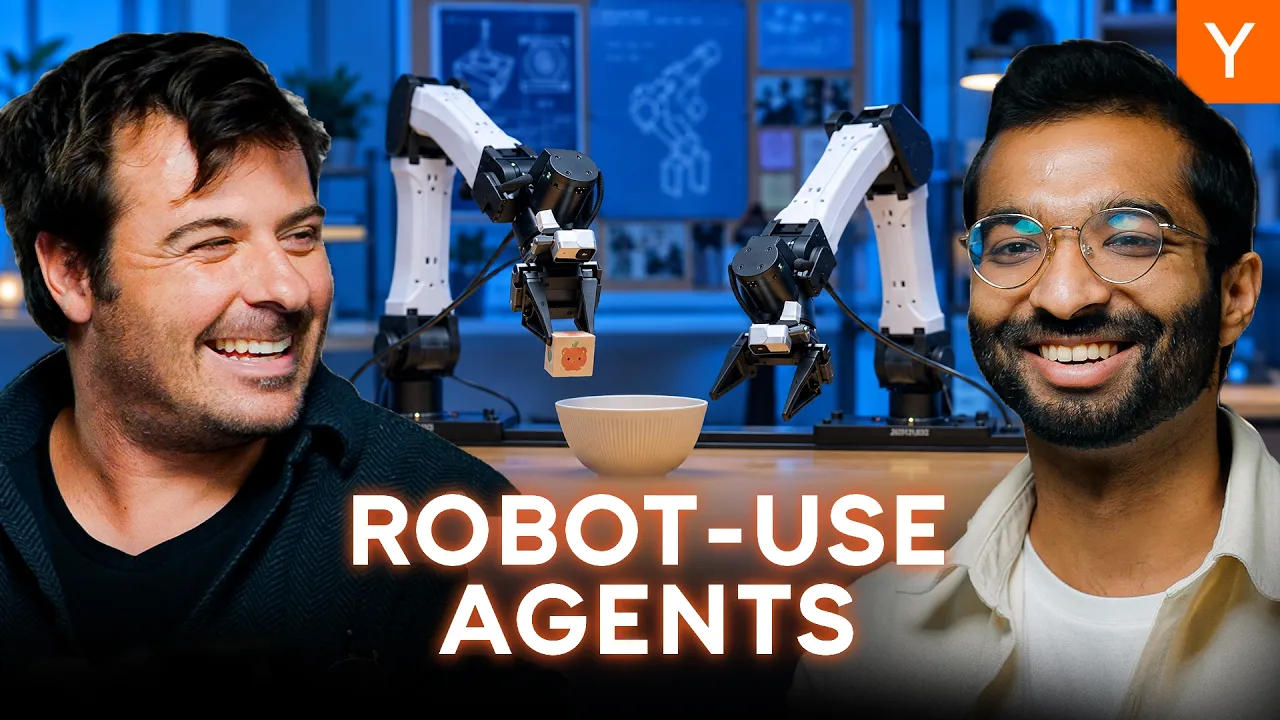
Y Combinator
General-purpose foundation models will achieve human-level robotic manipulation within two years because internet-scale coding and computer-use data build physical world models far faster than costly teleoperation.
AI-assisted summary of Robot-Use Agents: Why General-Purpose Models May Win in Robotics — original source. Check the original for full context.
Source published:
Key ideas
- General-purpose coding agents are bypassing the physical teleoperation data bottleneck by controlling hardware via code generation and tool calling, enabling zero-shot physical manipulation without bespoke robotic fine-tuning. (4:07)
- Frontier LLM inference latency is halving roughly every month, bringing real-time, closed-loop visual control of physical actuators within practical engineering reach. (17:31)
- Recent step-function improvements in robotic 3D spatial reasoning stem from computer-use and CAD pre-training mixtures, where models absorb coordinate frames and spatial transformations from software like Blender and SolidWorks. (23:37)
- Frontier robotics researchers project a 'ChatGPT moment' for physical AI within two years, defining general-purpose autonomy as executing arbitrary natural-language manipulation tasks achievable by a competent teenager. (25:58)
- To bypass the economic and latency limits of running large foundation models per motor tick, emerging architectures utilize offline 'sleep' phases inspired by DreamCoder and DAgger to distill interaction traces into fast local policies. (27:06)
Detailed notes
## Background Published by Y Combinator on YouTube on September 26, 2026, this episode of *Decoded* examines the rise of "robot-use agents"—a concept highlighted in a recent essay by MIT professor Phillip Isola on how general-purpose coding models can control diverse robots and learn physical tasks with minimal robot-specific training. The hosts are joined by the founders of Waddle Labs and RoboCurve, two startups whose viral demos helped spark this movement, to unpack the evolution from vision-language-action models and code-as-policies to the real-world harnesses and evaluation benchmarks powering physical AI.
## TL;DR General-purpose coding LLMs are rapidly emerging as powerful robot controllers because outputting parameterized code and structured tool calls provides a low-complexity reasoning scratchpad that bypasses the severe data bottlenecks of traditional Vision-Language-Action (VLA) models. The founders of Waddle Labs and RoboCurve explain how modern agentic harnesses overcome the limits of in-context learning and high inference latency by allowing a frontier model like Project Astra to explore tasks via live camera feeds, then distilling those successful trajectories into fast, reusable software skills. They trace recent step-function leaps in 3D spatial intelligence to pre-training on computer-use and CAD workflows, which aligns with the Platonic Representation Hypothesis that scaled multimodal models naturally converge on a shared internal model of physical reality. Ultimately, the panel predicts a "ChatGPT moment" for general-purpose robotics within two years, unlocked by wake-sleep consolidation cycles that compress slow, deliberative cloud reasoning into high-throughput local motor weights.
## Atmosphere & style The conversation feels like an energetic, high-bandwidth roundtable among deeply technical insiders, blending rigorous machine learning theory with pragmatic startup engineering. The hosts and founders move fluidly between citing foundational academic frameworks—from Rich Sutton's Bitter Lesson and François Chollet's program induction to hippocampal memory consolidation—and dissecting the practical realities of live dual-arm robot demos. As the discussion progresses from early milestones to the sudden emergence of spatial reasoning in frontier models, the mood builds into a palpable sense of momentum and urgency, leaving the listener with the distinct impression that a massive technological inflection point is unfolding just out of public view.
## Bulletin - [04:07](https://www.youtube.com/watch?v=Jv5B5CEaPJI&t=247s) General-purpose coding agents are bypassing the physical teleoperation data bottleneck by controlling hardware via code generation and tool calling, enabling zero-shot physical manipulation without bespoke robotic fine-tuning. - [17:31](https://www.youtube.com/watch?v=Jv5B5CEaPJI&t=1051s) Frontier LLM inference latency is halving roughly every month, bringing real-time, closed-loop visual control of physical actuators within practical engineering reach. - [23:37](https://www.youtube.com/watch?v=Jv5B5CEaPJI&t=1417s) Recent step-function improvements in robotic 3D spatial reasoning stem from computer-use and CAD pre-training mixtures, where models absorb coordinate frames and spatial transformations from software like Blender and SolidWorks. - [25:58](https://www.youtube.com/watch?v=Jv5B5CEaPJI&t=1558s) Frontier robotics researchers project a 'ChatGPT moment' for physical AI within two years, defining general-purpose autonomy as executing arbitrary natural-language manipulation tasks achievable by a competent teenager. - [27:06](https://www.youtube.com/watch?v=Jv5B5CEaPJI&t=1626s) To bypass the economic and latency limits of running large foundation models per motor tick, emerging architectures utilize offline 'sleep' phases inspired by DreamCoder and DAgger to distill interaction traces into fast local policies.
## Key takeaways - [01:50](https://www.youtube.com/watch?v=Jv5B5CEaPJI&t=110s) Classical vision-language-action models like RT-2 directly output motor coordinates without intermediate inference, denying the model test-time compute scratchpads analogous to Chain-of-Thought reasoning. - [01:50](https://www.youtube.com/watch?v=Jv5B5CEaPJI&t=110s) Formulating robot trajectories as parameterized code represents a dramatically lower Kolmogorov complexity representation of motion compared to verbose joint-by-joint telemetry streams. - [04:07](https://www.youtube.com/watch?v=Jv5B5CEaPJI&t=247s) The Bitter Lesson applies to physical AI: scaling general models over abundant web, code, and computer interaction data systematically outpaces collecting scarce real-world robot demonstrations. - [07:40](https://www.youtube.com/watch?v=Jv5B5CEaPJI&t=460s) Massive capital expenditure dedicated to building software engineering agents unintentionally supplied the precise programmatic logic and tool-synthesis primitives required to orchestrate physical machines. - [10:41](https://www.youtube.com/watch?v=Jv5B5CEaPJI&t=641s) Pure in-context learning plateaus after 20 to 40 demonstrations and degrades beyond long context thresholds, necessitating structured retrieval or symbolic distillation for lifelong robot learning. - [14:22](https://www.youtube.com/watch?v=Jv5B5CEaPJI&t=862s) Robot execution harnesses act as a domain-specialization layer where large reasoning models synthesize, debug, and compile modular programmatic tools for smaller, faster models to run locally. - [16:14](https://www.youtube.com/watch?v=Jv5B5CEaPJI&t=974s) Direct multimodal model tool-calling provides superior adaptability in unfamiliar scenes, but compiled skill libraries are essential for low-latency, deterministic physical routines. - [19:13](https://www.youtube.com/watch?v=Jv5B5CEaPJI&t=1153s) The transition from transduction to program induction represents neurosymbolic AI in practice: neural networks supply intuitive world priors that emit explicit symbolic code to execute tasks. - [20:56](https://www.youtube.com/watch?v=Jv5B5CEaPJI&t=1256s) The Platonic Representation Hypothesis posits that scaling disparate multimodal models forces convergence toward a shared physical world model, making scaled frontier LLMs natural robotic foundation models. - [23:37](https://www.youtube.com/watch?v=Jv5B5CEaPJI&t=1417s) In a historical reversal, graphical user interfaces originally designed to emulate real-world physical metaphors now serve as digital training curriculums teaching models how to interact with the real world. - [25:58](https://www.youtube.com/watch?v=Jv5B5CEaPJI&t=1558s) Consensus across frontier labs sets the horizon for human-level teenage manipulation and out-of-distribution physical generalization within two years. - [27:06](https://www.youtube.com/watch?v=Jv5B5CEaPJI&t=1626s) Robots require a biological-style sleep consolidation cycle using DAgger-style aggregation to compress daytime runtime interaction traces into lightweight local parametric weights. - [28:36](https://www.youtube.com/watch?v=Jv5B5CEaPJI&t=1716s) Adapting the DreamCoder paradigm to neural robotics requires continuously refactoring, pruning, and managing swelling libraries of generated code-as-policies tools.
## Detailed walkthrough ### [00:00](https://www.youtube.com/watch?v=Jv5B5CEaPJI&t=0s) Intro & The Rise of Robot-Use Agents
Over the past few years, one of the most unexpected developments in artificial intelligence has been the sheer extent to which coding agents generalize far beyond pure software engineering. Frontier researchers are now demonstrating that these general-purpose models can be leveraged directly to control physical robots. This shift was recently crystallized by MIT Professor Phillip Isola in a viral essay proposing that robotics is entering the era of "robot-use agents"—paradigms where general-purpose models operate across disparate robot hardware, formulate control policies, and master novel physical tasks with negligible robot-specific fine-tuning. To unpack this breakthrough, the hosts bring together the founders of Waddle Labs and RoboCurve, two startups operating at the bleeding edge of controlling physical hardware with LLMs.
The founders explain their respective wedges in the physical AI landscape: - **Jaime and Vincent (Waddle Labs):** Focused on building LLMs that control robots directly. Their core technical loop involves engineering an operational harness that empowers models to act effectively, collecting rich interaction data from those deployments, and utilizing that data to train even more capable foundation models. - **Jay (RoboCurve):** Focused on evaluation and benchmarking for physical AI. RoboCurve measures performance across virtually any hardware and model paradigm—spanning standard LLM agents, vision-language-action models (VLAs), and world-action models—across varied form factors including hands, parallel-jaw grippers, robotic arms, humanoids, and quadrupeds.
Recently, demonstrations from both Waddle Labs and RoboCurve garnered significant viral attention on social media and were cited directly in Isola's essay. These demos showcased LLMs solving contact-rich and coordinated physical challenges that historically required bespoke robotics engineering—such as unscrewing bottle caps, coordinating multi-robot communications, and uncapping pens.
---
[01:50](https://www.youtube.com/watch?v=Jv5B5CEaPJI&t=110s) The Evolution from RT-2 to Code Chain-of-Thought
To understand how modern models control hardware, the discussion tracks back to the foundation laid by Google's RT-2 (Robotic Transformer 2) paper, which introduced the vision-language-action (VLA) approach. RT-2 adapted web-scale vision-language models pre-trained on diverse internet text and images, fine-tuning them to output physical control commands directly. Instead of generating English tokens, the model was conditioned to predict an end-effector pose—cartesian spatial coordinates that downstream inverse kinematics controllers convert into raw robot joint commands. While RT-2 proved that internet-scale pre-training dramatically outperforms models trained purely from scratch on robot data, it locked the model into an immediate, token-level action output.
One of the hosts contrasts this early architecture with the historical inflection point in natural language reasoning: the emergence of Chain of Thought (CoT). In benchmark problems like GSM8K (e.g., "Susie had $8. She spent five. How much does she have now?"), early architectures were forced to emit an immediate answer token (e.g., delimiter hash marks and the final digit `3`) followed by an end-of-sequence token (`EOS`), completely devoid of intermediate inference steps. Once models were allowed to output scratchpad reasoning (`8 - 5 = 3`) before committing to the final answer, performance exploded. Classical VLAs and RT-2 suffer from that exact same restriction: they are compelled to map raw perception straight into an immediate action vector with no computational leeway to deliberate over complex physics or allocate test-time compute. By shifting the output space from raw coordinate tokens to expressive code, models gain an execution scratchpad. Expressing movement as compact, parameterized code also represents a drastically lower Kolmogorov complexity representation of motion compared to verbose joint-by-joint telemetry trajectories.
```mermaid flowchart TD accTitle: Evolution of Robot Control Paradigms accDescr: Comparison between early VLA end-effector prediction and modern Code Chain-of-Thought execution.
subgraph ClassicalVLA ["Classical VLA (e.g., RT-2)"] A["Image & Text Prompt"] --> B["Pre-Trained VLM"] B -->|"Direct Fine-Tuned Output"| C["End-Effector Pose Coordinates"] C --> D["Joint Motor Commands"] end
subgraph CodeAsPolicy ["Modern Robot-Use Agent"] E["Visual & Scene Context"] --> F["General-Purpose LLM"] F -->|"CoT Scratchpad & Reasoning"| G["Parametric Code / Python Script"] G -->|"Harness Execution"| H["Hardware Control & Tools"] end ```
---
[04:07](https://www.youtube.com/watch?v=Jv5B5CEaPJI&t=247s) The Bitter Lesson for Robotics
The conversation moves to Rich Sutton's foundational thesis, "The Bitter Lesson"—the principle that general methods leveraging search and compute relentlessly outpace human-crafted domain heuristics. While VLAs are fundamentally built upon underlying language model architectures and theoretically possess the latent capability to reason, they run headlong into a massive robotics data bottleneck. Collecting high-quality teleoperated real-world demonstration data has progressed at an agonizingly slow pace for years. The insight behind robot-use agents is to bypass this physical data scarcity altogether by leveraging a modality where data is already abundant and "blessed": code, web text, and computer interaction.
Instead of hand-designing robotic foundation models that require trillions of expensive physical tokens, teams are recognizing that frontier LLMs already absorb spatial, logical, and tool-use priors from diverse modalities. Pre-training on massive codebases and general web data teaches models how to dynamically inspect unfamiliar environments, leverage available tooling, and construct robust control policies on the fly through in-context learning. Rather than spending astronomical capital building a narrow foundation model tied strictly to proprietary robot embodiments, developers are "bitter lesson pilled": they rely on general-purpose frontier models and design the abstraction layer so the robot appears to the model like any other software environment.
---
[07:40](https://www.youtube.com/watch?v=Jv5B5CEaPJI&t=460s) From Voyager to On-the-Fly Tool Creation
Tracing the genealogy of coding agents controlling environments, the discussion looks back at projects like *Voyager* in Minecraft as the precursor to modern Code as Policies. A capable coding agent cannot survive merely on a fixed, static set of predefined functions; it requires proficient tool use and, crucially, autonomous, on-the-fly tool *creation*. In a standard execution environment, a language model begins with elementary Python built-ins—basic logic constructs like loops, conditionals, and primitives. By interacting with the world, the model chains those primitives together into reusable modular scripts (such as creating an autonomous function, humorously dubbed `francois.py`), which compresses complex problem-solving into a repeatable asset stored in its library for later invocation.
This capability drove major AI labs to channel enormous compute, research focus, and capital throughout 2024 into turning LLMs into world-class software engineers. The driving ambition was to automate the machine learning engineer itself to unlock a self-improving recursive research flywheel. Yet, as the speakers emphasize, this intense focus on software coding had an unintended, powerful side effect: in building models that excel at structuring programmatic logic, synthesizing tools, and navigating unknown codebases, the industry inadvertently created models that possess the exact primitives required to orchestrate physical machines.
[08:56](https://www.youtube.com/watch?v=Jv5B5CEaPJI&t=536s) From Early Coding Agents to Code as Policies
The conversation begins with a reflection on how unanticipated it was that scaling language models on broad coding datasets would suddenly yield agents capable of writing low-level robot policies or generating complex JavaScript artwork. Looking back at early milestones such as Google DeepMind's "Code as Policies" paper—released in late 2022 alongside the public launch of ChatGPT—the breakthrough centered on exposing basic robot primitives directly to a coding model as Python functions, such as picking up an object, lifting, or moving to a specific 6D pose.
Rather than training bespoke models on large corpuses of robot teleoperation data, the language model acted as an executive planner. It synthesized multi-step Python scripts that chained these primitives together to complete complex manipulation tasks, such as moving a colored block into a target bowl. What astonished researchers was the model's out-of-the-box, one-shot capability: the agent had absorbed enough structural reasoning, temporal order, and commonsense physical logic from software code alone to orchestrate physical movements without needing robot-specific fine-tuning. This zero-shot in-context exploration provided the foundation that spurred the current wave of robot-use agent architectures.
```mermaid flowchart LR accTitle: Code as Policies Architecture accDescr: High-level overview showing how an LLM transforms primitives into physical robot actions. subgraph LanguageModel["General-Purpose Model"] LLM["Coding Agent"] end subgraph ExecutionHarness["Harness & Primitives"] API["Python Primitives<br/>(pick, lift, move_to_pose)"] Code["Generated Policy Script"] end subgraph Hardware["Real World"] Robot["Robot Arm / End-Effector"] end
API -->|"Expose function signatures"| LLM LLM -->|"Synthesize programmatic logic"| Code Code -->|"Command execution"| Robot ```
[10:41](https://www.youtube.com/watch?v=Jv5B5CEaPJI&t=641s) The Limits of In-Context Learning vs. Weight Updates
The discussion shifts to a fundamental question: what is the most sample-efficient mechanism to incorporate a learning signal—a state-action-reward tuple—back into a policy? The group analyzes the spectrum of adaptation methods, contrasting purely prompt-driven in-context learning (ICL) with weight-space updates:
``` Fast / Zero Flops Slow / Data-Intensive In-Context Learning (ICL) ───► RAG / Active Memory ───► LoRA (r=1 to 100) ───► Full SFT / RL ```
While appending correction steps into an ongoing prompt context allows an agent to iterate rapidly without stochastic gradient descent (SGD) or extra compute flops, experiments show clear ceilings to this approach: - **Non-monotonic learning:** As more multi-turn examples are added to the prompt, performance often fluctuates erratically, dropping and rebounding rather than improving steadily. - **Rapid saturation:** When tested on holdout benchmark tasks like GSM8K, performance gains plateau after roughly 20 to 40 demonstrations; beyond that, feeding additional examples yields negligible improvement. - **Context length degradation:** A model trained on a 100k context window effectively begins losing attention and degrading past 50k tokens, rendering long unstructured histories counterproductive. - **The data-scale dichotomy:** In massive-scale industrial domains like autonomous driving (e.g., Tesla) or full-body humanoid control (e.g., Figure), relying purely on prompt-level ICL would be completely ill-suited compared to end-to-end reinforcement learning and supervised fine-tuning. However, in low-data regimes, ICL remains uniquely potent if raw experience can be consolidated into reusable tools.
An effective intermediate mechanism is active retrieval (RAG) within an agentic harness. Much like a student consulting a reference textbook during an exam rather than relying strictly on memorization, an agent that dynamically retrieves relevant past interaction traces into working memory scales significantly better than one using a static context window.
[14:22](https://www.youtube.com/watch?v=Jv5B5CEaPJI&t=862s) Harnesses as Distillation and Domain Specialization
To bridge the gap between volatile context windows and rigid weight updates, the harness functions as a domain-specialization and meta-learning layer. When a robot is introduced to a new environment—such as a wet lab tasked with manipulating test tubes—it initially relies on in-context exploration. Once a task is executed successfully, the harness packages and distills those learned state-action trajectories into modular, parameterized programs or tools.
Writing out these persistent routines and memories serves as symbolic distillation: past operational experience is compiled into reusable software primitives that future agents can invoke instantly. This creates a two-tier hierarchy echoing classical meta-learning literature: - A larger, highly capable reasoning model designs, debugs, and specializes the operational harness. - A smaller, faster model runs bounded inside that specialized harness to execute high-frequency physical tasks.
Because theoretical research increasingly shows that transformer forward passes during in-context learning can mathematically approximate gradient descent steps, the boundary between updates in "weight space" and programs in "symbolic space" becomes blurred. Distilling context into callable code acts as a tangible form of weightless policy consolidation.
[16:14](https://www.youtube.com/watch?v=Jv5B5CEaPJI&t=974s) Live System Demo: Direct Tool Calling vs. Compiled Skills
The panel reviews a live video demonstration of Project Astra directly controlling dual robot arms to grasp a physical block from a table and deposit it into a bowl. In this setup, Astra continuously ingests multiple real-time camera streams of the workstation. Rather than outputting raw Python source code for each motor tick, Astra issues structured tool calls that transmit operational pose targets down to the robot's inverse kinematics and joint controllers.
While direct end-to-end multi-modal model control is feasible, it exposes a critical trade-off between flexible reasoning and operational latency:
| Control Mode | Strengths | Weaknesses | Best Used For | |:--- |:--- |:--- |:--- | | **Direct Model Tool-Calling** (e.g., Astra in the loop) | High adaptivity; zero-shot reasoning; handles unexpected visual scenes. | Severely bottlenecked by inference latency; high compute cost per move. | Novel visual environments, exploratory steps, initial task discovery. | | **Compiled Skills Harness** (e.g., Waddle Labs Harness) | Low latency; deterministic, high-speed execution; robust handling of edge cases. | Less flexible to sudden structural shifts outside parameterized bounds. | Repetitive tasks, pick-and-place loops, validated manipulation skills. |
In the demo, the physical execution appears cautious and visibly paced because every incremental action step awaits a forward inference pass from Astra. The ideal production architecture therefore does not keep a heavyweight model in the low-level loop indefinitely; once Astra determines the geometric trajectory, the harness compiles that behavior into a high-frequency skill to execute the movement smoothly and rapidly.
[17:31](https://www.youtube.com/watch?v=Jv5B5CEaPJI&t=1051s) Latency Scaling and the Anatomy of Robot Tool Calling
The discussion opens with an observation about the dramatic reduction in latency for foundational AI systems. Across frontier class LLMs, inference latency has been cutting in half roughly every month—a blistering rate of progress. If this trajectory holds, developers expect full real-time closed-loop control to become viable by the end of the year.
To illustrate what this looks like in practice, the speakers break down how a system like Astra completes a physical manipulation task from start to finish. Rather than synthesizing an entire monolithic script upfront via classic "code as policies," the agent interacts across successive conversational turns. Astra consumes multi-camera image streams from the robot workspace and outputs target end-effector poses for the arm via structured tool calls. The mechanics of the workflow split into two regimes: deterministic execution and reactive fallback. Baseline trajectories—such as homing in on an object, reaching, and basic pick-and-place routines—become highly repeatable once executed a few times and can be automated straight through code. The real engineering leverage lies in handling variation within the policy graph.
```mermaid flowchart TD accTitle: Robot Tool Calling and Policy Graph Architecture accDescr: Diagram illustrating how camera inputs feed into the agent to execute deterministic motions while using VLM calls for variations and recovery.
subgraph Perception["Perception & Supervision"] CAM["Multi-Camera Images"] --> VLM["VLM Reasoning / Tool Call"] end
subgraph PolicyExecution["Policy Graph Execution"] VLM --> DET["Deterministic Motion (Reaching, Gripping)"] DET --> CHECK{"Failure Detected?"} CHECK -- "No" --> NEXT["Next Sequential Step"] CHECK -- "Yes" --> VLM end
subgraph PhysicalWorld["Robot Hardware"] DET --> POSE["End-Effector Pose Target"] POSE --> ROBOT["Robot Arm Execution"] ROBOT -.-> CAM end ```
By embedding a vision-language model (VLM) directly into the harness, the system handles points of variance dynamically. The VLM acts as an evaluator and decision engine: verifying whether an object has been acquired, recognizing unexpected slippage or misalignments, and triggering alternative branches in the policy graph when an initial attempt fails.
- Frontier LLM latency is halving at approximately 2x per month, bringing real-time robotic control within reach. - Astra operates via iterative tool calls, outputting 6-DoF end-effector poses directly based on live camera feeds. - Deterministic steps (approaching, grasping) are encoded into standard execution paths, while edge-case recovery and semantic object verification are routed through the VLM.
---
[19:13](https://www.youtube.com/watch?v=Jv5B5CEaPJI&t=1153s) Program Induction vs Transduction: The Neurosymbolic Shift
Reflecting on what makes this paradigm viable, the conversation shifts to fundamental machine learning theory, citing François Chollet's influential essay *On the Measure of Intelligence*. Historically, machine learning has relied heavily on transduction: attempting to train a static parameter set $\theta$ that directly maps inputs $x$ to outputs $y$. The group notes why transduction fundamentally struggles with general physical dexterity—it is information-inefficient and requires massive datasets of paired trajectories for every conceivable scenario. Without an immense inductive bias, pure transduction simply fails to generalize.
Program induction flips this dynamic on its head. Instead of learning the mapping directly, the system uses an intelligent generator to produce an explicit program $f$ that performs the transformation:
$$\theta(\{x_i, y_i\}_{i=1}^n) \to f \quad \text{such that} \quad f(x) = y$$
This is identical to how a software engineer approaches a technical interview on a whiteboard: given three or four example input-output pairs, the candidate does not memorize the raw values, but writes a clean function $f(x)$ that resolves the underlying logic. While classical program synthesis struggled for decades because hand-crafting the necessary inductive biases into domain-specific languages was nearly impossible, modern models like Astra bypass this hurdle entirely. Astra acts as a pretrained universal prior that writes symbolic code directly. The speakers emphasize that this is the true realization of neurosymbolic AI: neural networks providing the deep intuitive priors, which then emit symbolic code that reliably executes the downstream task.
---
[20:56](https://www.youtube.com/watch?v=Jv5B5CEaPJI&t=1256s) The Platonic Representation Hypothesis and Robotics
The conversation connects program induction to the "Platonic Representation Hypothesis," a framework articulated by MIT professor Phillip Isola. Named after Plato's Allegory of the Cave, the hypothesis posits that neural networks trained on radically different tasks, modalities, and objectives converge toward a shared, consistent latent model of the physical reality casting those sensory shadows. As models scale up on vast, multimodal corpora, their internal geometry aligns into an overlapping statistical representation of the world.
This convergence has profound ramifications for physical autonomy. If the Platonic Representation Hypothesis holds, an exceptionally capable general-purpose language model will naturally possess an internal world model that mirrors that of an ideal robotics-specific policy. Consequently, a sufficiently advanced frontier LLM is inherently an advanced robotic foundation model. The founders argue this serves as the ultimate manifestation of Rich Sutton's Bitter Lesson: rather than designing bespoke architectures or collecting narrow, expensive teleoperation datasets for every single robotic form factor, a single general-purpose foundation model operating at massive scale outperforms fragmented, domain-specific models.
- The Platonic Representation Hypothesis asserts that scaling distinct modalities forces convergence toward a shared representation of physical reality. - Specialized robotic models risk being eclipsed by scaled multimodal agents that share this unified spatial model. - The Bitter Lesson implies that general-purpose scale systematically outcompetes bespoke robotic priors.
---
[23:37](https://www.youtube.com/watch?v=Jv5B5CEaPJI&t=1417s) Computer-Use Data, CAD, and Emergent Spatial Intelligence
The discussion digs into why frontier models—and Astra in particular—have experienced sudden, step-function improvements in spatial intelligence and 3D reasoning over previous iterations. Six months prior, state-of-the-art models excelled at competitive mathematics and coding benchmarks, yet consistently failed at basic spatial reasoning. The critical breakthrough appears to be the aggressive inclusion of computer-use and Computer-Aided Design (CAD) workflows in pre-training and post-training mixtures.
Operating a computer desktop requires an agent to manipulate cursors, interact with spatial viewports, and navigate 2D and 3D canvases. When a model trains on workflows where an operator manipulates SolidWorks, navigates Autodesk suites, or orbits a 3D mesh inside Blender, it absorbs core physical and geometric primitives: perspective transforms, top-down versus profile projections, spatial boundaries, and coordinate systems. While teleoperation and egocentric video capture real human actions, they represent only a slice of visual understanding. Training on computer interaction turns interactive software interfaces into a massive spatial curriculum for physical robotics.
The speakers highlight the delicious historical irony of this dynamic: in the 1970s and 1980s, computer scientists at Xerox PARC deliberately invented the Graphical User Interface (GUI) to mimic physical metaphors—desktops, files, folders, and manipulable spatial objects—so humans could intuitively navigate digital computing. Decades later, because gathering physical robot data remains slow and constrained, developers feed those very same human-oriented virtual environments back into frontier models, effectively using digital interfaces to teach AI how to reach back out into the physical world. Emerging literature from Princeton and projects around clip-based robotics validate that when robot control harnesses are engineered to resemble computer-use interfaces, general models adapt to physical actuators with surprising ease.
[25:58](https://www.youtube.com/watch?v=Jv5B5CEaPJI&t=1558s) The Timeline for General-Purpose Robotics
The discussion shifts toward the near future of general-purpose models in physical manipulation, prompted by the observation that even having an agent drag a cursor on screen to direct where a robot arm moves significantly boosts the LLM's performance on real-world manipulation tasks. Looking at the speed of progress—where Twitter demos that would have seemed impossible just six months earlier are already routine—the panel considers what capabilities will become trivial over the coming months as foundational models, harness engineering, and evaluation benchmarks evolve in tandem.
There is a growing consensus across frontier AI research labs and robotics foundation companies that society is on the cusp of true general-purpose robots within the next two years, if not sooner. This shift is described as an impending "ChatGPT moment" for robotics—a massive qualitative leap that society at large is currently neither anticipating nor prepared for. Operationally, the panel defines a general-purpose robot not by narrow factory metrics, but by human-scale autonomy: the ability to receive arbitrary natural language instructions and carry out whatever a competent teenager could achieve using their hands, generalizing seamlessly across entirely unseen environments and novel physical tasks.
- Consensus timeline: General-purpose robots within two years or earlier across frontier labs. - Definition of general-purpose: Capable of performing any manipulation task a competent teenager could do with their hands given natural language instructions, generalizing to out-of-distribution tasks and novel environments.
[27:06](https://www.youtube.com/watch?v=Jv5B5CEaPJI&t=1626s) Latency Bottlenecks and the "Sleep" Phase for Skill Consolidation
For the founders at Waddle Labs, bridging the gap to that two-year horizon requires solving urgent, visible engineering bottlenecks. The most pressing hurdle discussed by the robotics community online is system latency. Relying on an upstream foundation model like Project Astra to think through every single step in an active control loop is far too sluggish and economically unviable for real-world deployments. The key technical challenge is learning how to distill or consolidate that slow, deliberative in-context reasoning pass into a lean, lightning-fast execution policy or motor skill that can run locally at massive throughput.
This dynamic closely mirrors human biological cognition. Putting new state-action-reward $(s, a, r)$ tuples back into working context is fast, but real intelligence requires an offline "sleep" phase where memory consolidation occurs. Biological systems rely on hippocampal sharp-wave ripples projecting out to neocortical lobes, compressing the day's experiences to permanently update synaptic weights. The panel suggests that modern robotics will adopt a similar loop inspired by classic imitation and reinforcement learning algorithms like DAgger (Dataset Aggregation): the agent spends its waking cycle collecting interaction trajectories, engages in reflective synthesis, and distills those raw multi-step experiences into an updated local weight file that runs independently of expensive cloud models.
```mermaid flowchart TD accTitle: Wake-Sleep Skill Consolidation Cycle accDescr: Diagram illustrating how daytime runtime actions are collected and compressed into fast local weights during an offline sleep phase.
subgraph WakeCycle ["Wake Phase: High-Latency Reasoning & Execution"] LLM["Foundation Model / In-Context Reasoner"] -->|"High-latency deliberation"| Actions["Robot Task Execution"] Actions -->|"Record transitions"| Buffer["Experience Buffer (s, a, r traces)"] end
subgraph SleepCycle ["Sleep Phase: Offline Consolidation & Distillation"] Buffer -->|"Hippocampal-style replay"| Reflection["Refactoring & Data Aggregation (DAgger)"] Reflection -->|"Weight distillation"| FastPolicy["Pruned, High-Throughput Motor Policy"] end
FastPolicy -.->|"Deploys back to"| WakeCycle ```
- Latency bottleneck: An upstream reasoning model like Astra in the feedback loop at every frame is too slow and economically prohibitive for production tasks. - Sleep analogy: "Tell me an intelligent system that doesn't sleep in some way." Offline compression turns transient experiential traces into permanent parametric weights. - Algorithmic bridge: DAgger-style aggregation frameworks allow the robot to gather trajectory data during operation, reflect and distill the data offline, and output a compact local model.
[28:36](https://www.youtube.com/watch?v=Jv5B5CEaPJI&t=1716s) The DreamCoder Paradigm and the Future of Skill Libraries
The panel connects this architecture to the principles of Kevin Ellis et al.'s *DreamCoder* system, which alternated between wakeful problem-solving and an offline sleep phase that refactored discovered programs into reusable, highly compressed subroutines. While DreamCoder applied this concept strictly to symbolic domain-specific languages and program synthesis, the modern robotics equivalent operates across flexible neural spaces: refactoring raw interaction traces, pruning obsolete behaviors, and synthesizing modular skills.
Current "code-as-policies" robotics architectures naturally generate an ever-expanding ladder of tool abstractions and procedural subroutines. As robots encounter increasingly varied real-world scenarios, managing this continuously swelling library—deciding which execution traces to keep, how to prune redundancies, and how to structure long-term deployment data—becomes the central operational hurdle. Closing out the conversation, the host emphasizes that society is largely unprepared for the velocity of this shift, thanking Vincent, Hanmin, and Jay for providing a clear view into how general-purpose foundation models are rapidly redefining physical robotics.
- *DreamCoder* parallel: Translating symbolic sleep-phase refactoring into modern neural trace refactoring and skill abstraction. - Library growth: Code-as-policies setups generate growing ladders of skills that require systematic pruning, organization, and context-window management over prolonged deployments.
## Notable quotes > [00:00](https://www.youtube.com/watch?v=Jv5B5CEaPJI&t=0s) robot-use agents: general-purpose models that can control different robots, write policies, and learn new physical tasks with little or no robot-specific training.
> [04:07](https://www.youtube.com/watch?v=Jv5B5CEaPJI&t=247s) The Bitter Lesson for Robotics
> [07:40](https://www.youtube.com/watch?v=Jv5B5CEaPJI&t=460s) From Voyager to On-the-Fly Tool Creation
> [08:56](https://www.youtube.com/watch?v=Jv5B5CEaPJI&t=536s) Code as Policies
> [10:41](https://www.youtube.com/watch?v=Jv5B5CEaPJI&t=641s) The Limits of In-Context Learning vs. Weight Updates
> [14:22](https://www.youtube.com/watch?v=Jv5B5CEaPJI&t=862s) Harnesses as Distillation and Domain Specialization
> [19:13](https://www.youtube.com/watch?v=Jv5B5CEaPJI&t=1153s) Program induction flips this dynamic on its head. Instead of learning the mapping directly, the system uses an intelligent generator to produce an explicit program f that performs the transformation
> [20:56](https://www.youtube.com/watch?v=Jv5B5CEaPJI&t=1256s) The Platonic Representation Hypothesis and Robotics
> [20:56](https://www.youtube.com/watch?v=Jv5B5CEaPJI&t=1256s) The Bitter Lesson implies that general-purpose scale systematically outcompetes bespoke robotic priors.
> [27:06](https://www.youtube.com/watch?v=Jv5B5CEaPJI&t=1626s) Tell me an intelligent system that doesn't sleep in some way.
> [28:36](https://www.youtube.com/watch?v=Jv5B5CEaPJI&t=1716s) The DreamCoder Paradigm and the Future of Skill Libraries
## Mentioned Waddle Labs, RoboCurve, Philip Isola, Jaime, Vincent, Jay, Google DeepMind, RT-2, GSM8K, Rich Sutton, Voyager, Tesla, Figure, Project Astra, François Chollet, On the Measure of Intelligence, Plato, SolidWorks, Autodesk, Blender, Xerox PARC, Princeton University, ChatGPT, DAgger, Kevin Ellis, DreamCoder, Hanmin
## Video description One of the biggest surprises in AI over the last few years has been how well coding agents generalize beyond software. In a recent essay, MIT professor Philip Isola argued that we may be entering the era of robot-use agents: general-purpose models that can control different robots, write policies, and learn new physical tasks with little or no robot-specific training.
In this episode of Decoded, we're joined by the founders of Waddle Labs and RoboCurve, two of the startups whose work helped drive this realization. They're working at the frontier of using general-purpose models to control robots, and their recent demos helped inspire the growing conversation around robot-use agents.
Together, we dig into the research behind that idea, from code-as-policies and vision-language-action models to the harnesses and evals needed to make these systems work in the real world.
Chapters:
00:00 — Intro + The Rise Of Robot Use Agents 04:07 — The Bitter Lesson for Robotics 07:40 — From Coding Agents to Robot Policies 10:41 — In-Context Learning vs Model Training 14:22 — Building a Harness for Robot Control 17:50 — Turning Robot Actions Into Reusable Skills 20:55 — How AI Models Learn the Physical World 26:05 — How Close Are We To General Purpose Robots?
https://www.waddlelabs.ai/ https://robocurve.org/
Apply to Y Combinator: https://www.ycombinator.com/apply Work at a startup: https://www.ycombinator.com/jobs
[Source](https://www.youtube.com/watch?v=Jv5B5CEaPJI)