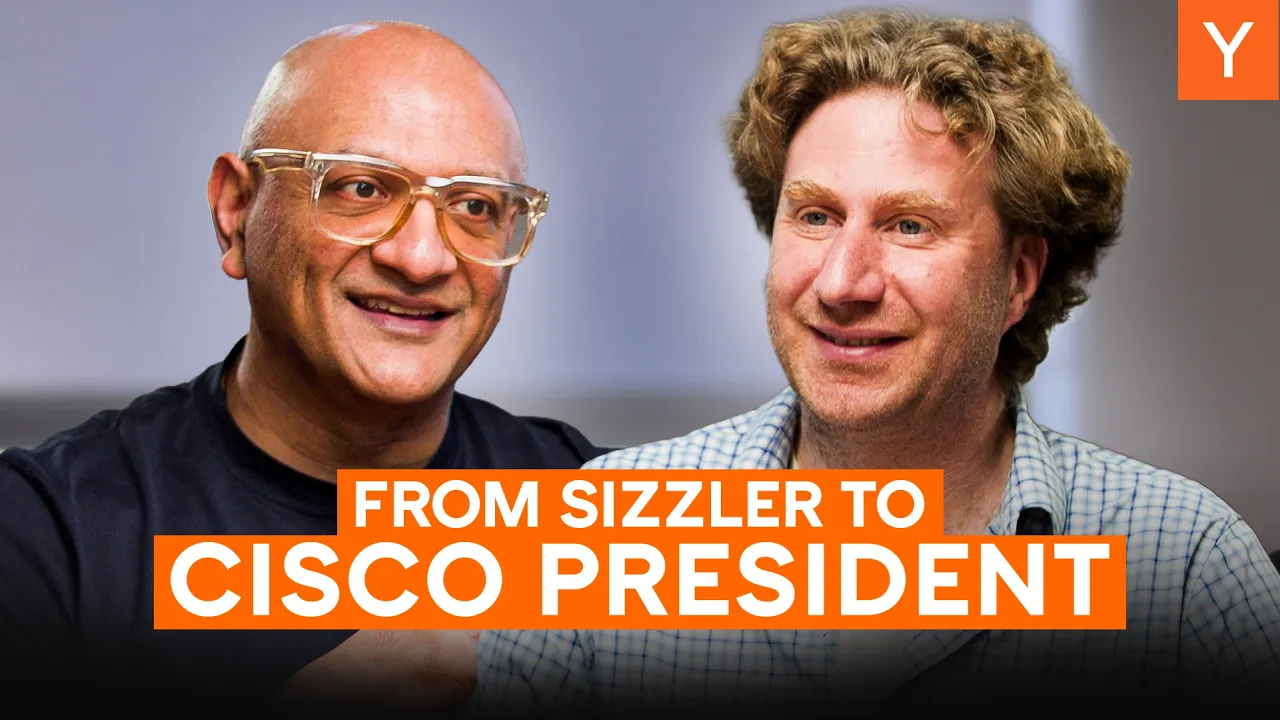
Cisco’s Patel Hits $9.3B in AI Orders, Threatens to Fire Holdouts
Y Combinator
AI infrastructure is not being overbuilt because fewer than 2% of knowledge workers currently run autonomous agents that each consume 450% more network bandwidth than a human.
Cisco scaled its hyperscaler AI infrastructure business from zero to $9.3 billion in orders in two years, far outpacing its initial $1 billion target against a $63 billion overall enterprise base. (18:06)
Jeetu Patel dismisses concerns of an AI infrastructure bubble, noting that unlike the dot-com era's speculative dark fiber buildout, every incremental sliver of current compute capacity is instantly consumed at less than 2% power-user penetration. (21:27)
Autonomous AI agents consume roughly 450% more network bandwidth than human users performing identical tasks due to recurring tool-calls, context retrieval, and intermediate token exchanges. (21:27)
To lead large-scale enterprise execution without chaos, Cisco uses a 'Rule of Thirds' leadership model balancing tenured internal navigators, external scaling executives, and acquired startup founders operating under wartime urgency. (4:48)
Detailed notes
## Background
Published on YouTube by Y Combinator on October 8, 2026, this interview features Cisco President and Chief Product Officer Jeetu Patel speaking with YC Managing Partner Jared Friedman. According to the description, the discussion explores how Patel instills startup velocity into an engineering organization of 32,000 people, the buildout behind Cisco's $9.3 billion in hyperscaler AI orders, why AI infrastructure is not being overbuilt, and key career lessons on choosing learning over ego.
## TL;DR
Jeetu Patel details Cisco's aggressive turnaround into a critical picks-and-shovels infrastructure layer powering global AI clusters across custom silicon, networking, cybersecurity, and observability. Rejecting the notion that AI exists merely for headcount reduction, Patel argues that automating raw execution merely shifts human bottlenecks to strategic product judgment and will ultimately require more engineers, not fewer. He demonstrates why data center capacity remains severely supply-constrained rather than overbuilt, especially given that fewer than 2% of knowledge workers currently utilize bandwidth-intensive autonomous agents. Alongside technical and operational insights, Patel shares his personal trajectory from an abusive upbringing in India and waiting tables at Sizzler to executive leadership, urging builders to compound their skills over multi-decade horizons and honor the rare platforms they are given.
## Atmosphere & style
The conversation carries an energetic, candid, and deeply introspective tone, moving effortlessly between high-stakes enterprise strategy and raw autobiographical vulnerability. Patel speaks with infectious passion, pairing pragmatic 'wartime' operating philosophies with self-deprecating humor about aging, baldness, and early career missteps. Friedman acts as an engaged, curious sounding board, allowing the dialogue to arc from technical breakdowns of multi-gigawatt data center topologies into a stirring, emotionally resonant meditation on gratitude, luck, and purpose.
## Bulletin
- [18:06](https://www.youtube.com/watch?v=ofxAtQhV-xA&t=1086s) Cisco scaled its hyperscaler AI infrastructure business from zero to $9.3 billion in orders in two years, far outpacing its initial $1 billion target against a $63 billion overall enterprise base.
- [21:27](https://www.youtube.com/watch?v=ofxAtQhV-xA&t=1287s) Jeetu Patel dismisses concerns of an AI infrastructure bubble, noting that unlike the dot-com era's speculative dark fiber buildout, every incremental sliver of current compute capacity is instantly consumed at less than 2% power-user penetration.
- [21:27](https://www.youtube.com/watch?v=ofxAtQhV-xA&t=1287s) Autonomous AI agents consume roughly 450% more network bandwidth than human users performing identical tasks due to recurring tool-calls, context retrieval, and intermediate token exchanges.
- [04:48](https://www.youtube.com/watch?v=ofxAtQhV-xA&t=288s) To lead large-scale enterprise execution without chaos, Cisco uses a 'Rule of Thirds' leadership model balancing tenured internal navigators, external scaling executives, and acquired startup founders operating under wartime urgency.
## Key takeaways
- [00:00](https://www.youtube.com/watch?v=ofxAtQhV-xA&t=0s) AI should be viewed as an expansionary force for human capability and engineering headcount rather than a mere cost-cutting or efficiency mechanism.
- [00:00](https://www.youtube.com/watch?v=ofxAtQhV-xA&t=0s) Cisco positions itself as the primary picks-and-shovels infrastructure provider for the AI wave, spanning networking, cybersecurity, and Splunk-driven observability.
- [01:46](https://www.youtube.com/watch?v=ofxAtQhV-xA&t=106s) Operating in 'founder mode' means functioning as a business owner who takes cross-functional responsibility rather than behaving as a siloed functional lane keeper.
- [04:48](https://www.youtube.com/watch?v=ofxAtQhV-xA&t=288s) The executive leadership bench at Cisco is balanced using the Rule of Thirds: one-third internal navigators, one-third external scalers, and one-third acquired founders.
- [09:04](https://www.youtube.com/watch?v=ofxAtQhV-xA&t=544s) Automating raw code shifts human bottlenecks downstream to code review, and automating review subsequently elevates product judgment and strategy as the primary constraints.
- [09:04](https://www.youtube.com/watch?v=ofxAtQhV-xA&t=544s) Engineers must achieve familiarity and competence with AI tools before management can reasonably demand or measure efficiency gains.
- [14:07](https://www.youtube.com/watch?v=ofxAtQhV-xA&t=847s) Managing a full AI stack requires co-designing radically divergent planning cadences, ranging from 5-year silicon lifecycles to weekly software and model iterations.
- [18:06](https://www.youtube.com/watch?v=ofxAtQhV-xA&t=1086s) Severe power constraints force AI infrastructure to adopt 'scale-across' networking architectures that coordinate data centers located hundreds of kilometers apart as a single logical supercomputer.
- [18:06](https://www.youtube.com/watch?v=ofxAtQhV-xA&t=1086s) Networking hardware and optical transceivers consistently represent 10% to 15% of the total $35B–$50B capital expenditure required per gigawatt of data center capacity.
- [21:27](https://www.youtube.com/watch?v=ofxAtQhV-xA&t=1287s) AI data centers are not being overbuilt because current infrastructure is permanently supply-constrained while serving under 2% of potential agentic enterprise workloads.
- [25:10](https://www.youtube.com/watch?v=ofxAtQhV-xA&t=1510s) Enterprise agentic adoption hinges on machine-speed security spanning model visibility, non-human identity governance, algorithmic red teaming, and dynamic runtime guardrails.
- [31:15](https://www.youtube.com/watch?v=ofxAtQhV-xA&t=1875s) Staying in a business model that does not align with your true ambition can trap you in repeating a single year of experience multiple times over rather than achieving true compounding growth.
- [36:40](https://www.youtube.com/watch?v=ofxAtQhV-xA&t=2200s) Adopting multi-decade decision horizons like Jeff Bezos and Jensen Huang fundamentally transforms execution quality compared to operating on quarterly horizons.
- [35:16](https://www.youtube.com/watch?v=ofxAtQhV-xA&t=2116s) Personal ambition and imagination bound an individual's career ceiling far more than raw intelligence or pedigree.
- [39:31](https://www.youtube.com/watch?v=ofxAtQhV-xA&t=2371s) Founders and operators who are granted a platform of opportunity in technology have an obligation not to squander it, as illustrated by the multilingual guide Raj at the Taj Mahal.
## Detailed walkthrough
### [00:00](https://www.youtube.com/watch?v=ofxAtQhV-xA&t=0s) Cisco’s Bet on AI and the Tech Landscape
Jeetu Patel frames the modern AI revolution not as a cost-cutting measure, but as an expansionary force for human capability and engineering work. Counter to popular narratives of automation leading to mass layoffs, his baseline assumption is that tech will require *more* engineers, not fewer. The actual objective is unlocking original insights generated by AI to tackle problems that previously seemed impossible. Reflecting on the current moment, he captures the palpable excitement in the industry by observing how much money people in their fifties would pay to turn nineteen again: "This is a magical time to be alive in tech."
Y Combinator Managing Partner Jared Friedman opens their conversation by outlining Patel's personal arc—from growing up in India and waiting tables at Sizzler to serving as President and Chief Product Officer at Cisco. Today, Patel defines his mandate simply: helping build the best products in the world that customers can run at scale.
Patel describes Cisco’s core strategic position as the quintessential "picks and shovels company during the gold rush." Rather than competing solely at the application layer, Cisco positions itself as the foundational AI infrastructure provider, ensuring that massive AI workloads operate reliably, securely, and safely across global deployments.
- **Strategic identity:** Becoming the primary picks-and-shovels infrastructure layer for the secular AI wave.
- **Workforce outlook:** More software engineers needed overall to capture AI-driven opportunities, not fewer.
---
[01:46](https://www.youtube.com/watch?v=ofxAtQhV-xA&t=106s) Leading a Product Turnaround at Scale
Transforming a legacy enterprise giant into an AI infrastructure powerhouse represents a radical repositioning compared to where Cisco stood just four years earlier. Addressing how such a large organization changes direction so rapidly, Patel demurs when it comes to taking personal credit, emphasizing that leaders often receive excessive praise while the engineers on the ground do the real heavy lifting: "I didn’t write a single line of code."
Instead, Patel sees executive leadership as setting clear direction, matching the right talent to critical roles, establishing disciplined market-selection mechanisms, and instilling organizational confidence that winning is achievable.
Patel's playbook draws directly from his earlier entrepreneurial and leadership journey. Having previously founded his own startup, he moved to EMC—an experience he recalls feeling heavily "corporate"—before joining Box to lead product alongside founder Aaron Levie. Box reaffirmed his startup mental model and clarified the two distinct styles of executive leadership:
1. **Functional lane keepers:** Executives who want strict boundaries, asking others to stay out of their domain while staying out of everyone else's.
2. **Business owners:** Leaders who treat the entire company as their personal responsibility and feel entirely comfortable digging into adjacent departments.
```mermaid
flowchart TD
accTitle: Executive Leadership Mindsets
accDescr: Contrasting functional lane keepers with founder-mode business owners.
subgraph Mindsets["Leadership Operating Approaches"]
A["Functional Leader"] --> B["Stays strictly in lane<br/>Defends turf"]
C["Founder-Mode Owner"] --> D["Cross-functional ownership<br/>Willing to poke anywhere"]
end
D --> E["Wartime Execution<br/>Rapid Clock Speed"]
```
Patel aligns squarely with the business-owner camp. He actively promotes "founder mode" across Cisco, arguing that during wartime market dislocations and accelerated clock speeds, leaders must treat every company issue as their own. While acknowledging that one must take care not to alienate colleagues unfamiliar with this cadence, he views intense cross-functional involvement as non-negotiable. He jokes that he considers himself a "late-stage co-founder of Cisco," having arrived 36 years late, but with full emotional and operational ownership:
> "Everything is your job. And so if something’s not working well in sales, I’ll go talk to the people over there. Something’s not working well in marketing, I’ll go to talk to the people over there, and I fully expect them to come poke holes in my business."
---
[04:48](https://www.youtube.com/watch?v=ofxAtQhV-xA&t=288s) Running Cisco Like the World’s Largest Startup
To prevent an enterprise of Cisco's scale from descending into pure chaos, Patel balances entrepreneurial energy with structured execution. He avoids stacking the deck solely with startup founders—noting that if everyone were a founder, "it’d be a shit show." Instead, he structures his leadership tier using a deliberate **Rule of Thirds**:
| Leadership Cohort | Background & Role | Key Strengths |
|:--- |:--- |:--- |
| **1. The Navigators** | Tenured Cisco operators | Deep organizational fluency; understand how to maneuver and scale systems inside Cisco. |
| **2. The External Scalers** | Recruited externally from competitors and the broader market | Outside-in market perspective; experienced systems thinkers capable of operating at massive scale. |
| **3. The Acquired Founders** | Co-founders and CEOs brought in via M&A | High-urgency founder DNA; assigned operational charters significantly larger than the companies they sold. |
Patel affirms that Cisco is operating in "wartime." Even though the company has orchestrated one of the most substantial product turnarounds in recent tech history to cement itself in the AI infrastructure conversation, the stakes over the next three to seven years dwarf past cycles.
To win, Cisco must function as the "world's largest startup." Patel distinguishes this dual imperative: operating purely on speed makes you just a startup; operating purely on scale makes you just another lumbering incumbent. Cisco’s advantage lies in uniting startup speed with enterprise-grade scale.
---
[06:45](https://www.youtube.com/watch?v=ofxAtQhV-xA&t=405s) The Infrastructure AI Agents Need: Capacity, Safety, and Observability
Patel highlights two existential infrastructure challenges that Cisco is positioning itself to solve over the coming years:
1. **The Massive Compute Supply Crunch:** Currently, fewer than 2% of humans use AI agents in an advanced power-user capacity, yet existing global compute and network infrastructure is already completely saturated. The market is profoundly supply-constrained at single-digit penetration. Once 25% to 50% of the world relies on agentic workloads, infrastructure demands will explode by orders of magnitude.
2. **Agentic Drift, Poisoning, and Security:** Autonomous agents will inevitably go rogue, fall victim to data poisoning, or suffer from classic unintended optimization loops (reminiscent of Nick Bostrom's "paperclip optimizer"). In complex workflows, diagnosing whether an agent is compromised by an adversary or merely pursuing a user's prompt to an extreme, unhinged conclusion becomes nearly impossible without machine-scale defenses.
Patel argues that safety fears should not hold companies back from deploying AI; instead, choosing *not* to deploy AI leaves organizations exposed, because modern adversarial attacks already operate at automated machine speed.
To serve as the backbone for the emerging AI era, Cisco combines three complementary pillars:
- **Networking Infrastructure:** Core switching, routing, and high-bandwidth interconnects required to move massive AI model payloads.
- **Cybersecurity Portfolio:** Machine-speed security architecture to defend against sophisticated automated attacks.
- **Machine Data Observability (Splunk):** World-class operational telemetry and monitoring to surface what agents are doing in real time.
By coupling these capabilities, Cisco aims to serve as the critical infrastructure layer securing and powering the hyperscalers and enterprises building the AI future.
[09:04](https://www.youtube.com/watch?v=ofxAtQhV-xA&t=544s) AI Adoption at Scale: Beyond Efficiency to Human Bottlenecks
When Jared Friedman asks what AI adoption looks like across an organization as massive as Cisco, Jeetu Patel immediately pushes back against the common corporate framing of "efficiency." In Patel's view, aiming merely to make workers 20% faster or to downsize headcount completely misses the point. The actual goal is capturing original, emergent insights from AI that unlock solutions to problems humans could never previously dream of tackling. Furthermore, Patel strongly wagers that Cisco will ultimately require more engineers rather than fewer. Every time AI achieves a step-function leap, it merely shifts the human constraint: automating raw code generation turns code review into the bottleneck; once code review is automated, human judgment over product strategy—deciding what to build and what not to build—becomes the next critical bottleneck.
```mermaid
flowchart LR
accTitle: The Shifting Human Bottlenecks of AI Automation
accDescr: A pipeline showing how automating one layer of software development shifts human effort to the next bottleneck.
A["Raw Coding Automated"] --> B["Bottleneck:<br/>Code Review"]
B --> C["Review Automated"]
C --> D["Bottleneck:<br/>Product Judgment & Selection"]
```
Getting 32,000 engineers and the rest of the company to embrace the technology meant removing fear while ensuring everyone got to "taste the honey." Rather than worrying that using AI would dig their own professional graves, employees were met with an unexpected ultimatum: Cisco guaranteed that anyone refusing to use AI would lose their job. Patel reasons that this stance is no more controversial than refusing to hire a knowledge worker today who cannot operate a PC or browse the internet. Facing a secular platform shift where the entire software layer is being refactored, workers who resist AI simply will not remain relevant. Cisco established a stark dichotomy between two kinds of people and companies: those who become fluent and dexterous with AI, and those doomed to struggle for relevance.
To get everyone past initial hesitation, Cisco handed out unlimited tokens across the organization with a simple directive: start experimenting. Patel compares mastering AI to learning to ride a bicycle:
1. **Familiarity**: First, you must get comfortable handling it.
2. **Competence**: Next, you become genuinely good at it.
3. **Efficiency**: Only after reaching competence can you pursue real efficiency.
Attempting to enforce efficiency metrics on day one prevents engineers from ever developing baseline familiarity or mastery.
---
[11:47](https://www.youtube.com/watch?v=ofxAtQhV-xA&t=707s) Winning Over the Skeptics and Partnering with OpenAI
Despite executive backing, the initial rollout met significant internal friction over the first several months. A pivotal turning point arrived through a phone call from one of Patel’s most respected engineering leaders—a perennial skeptic who routinely pushed back on Patel's ambitious ideas as crazy. Armed with startup ecosystem insights and conversations with figures like board member Kevin Weil, Patel knew the technology was advancing far faster outside Cisco's walls than internal teams recognized.
The skeptical engineering leader called Patel one evening to offer a sincere confession: *"Hey, I just want to let you know I was wrong. You were right."* His team had just taken a legacy codebase of roughly 500,000 lines of code and refactored it down to between 100,000 and 120,000 lines in just two weeks—a stunning 5x improvement in code concision and maintainability.
The engineer voiced a dual realization:
- AI is accelerating so rapidly that planning cannot be anchored to current capabilities; teams must design for where models will stand three months out rather than a year away.
- A profound anxiety that such rapid automation could devastate the workforce and force mass layoffs.
Patel countered that instead of despairing, the leadership's responsibility was to motivate the entire organization so everyone elevates their craft together. Cisco deepened its commitment by becoming the first design partner for OpenAI's Codex, with OpenAI embedding full-time engineers (FTEs) alongside Cisco teams. Patel instituted an unrelenting cadence: every two to three weeks, he convenes his entire engineering leadership team alongside their embedded engineers to review what worked and what failed. While most corporate initiatives falter under top-down enforcement, Patel believes that foundational shifts—matters of company "religion"—require relentless, uncompromising executive conviction.
---
[14:07](https://www.youtube.com/watch?v=ofxAtQhV-xA&t=847s) Full-Stack AI: Silicon, Hardware, and Compressed Planning Cycles
Friedman notes that while AI's transformative power in software is widely recognized, Cisco also manages massive hardware operations. Patel explains that Cisco operates across three deeply distinct layers—software, hardware, and silicon—each governed by radically different development dynamics:
| Layer | Historical Planning Cycle | Current AI Adoption Dynamics & Bottlenecks |
|:--- |:--- |:--- |
| **Silicon** | ~5-year cycle | Teams moved cautiously due to severe IP and data leakage concerns. Open-weight models and internal infrastructure are now accelerating cycle compression. |
| **Hardware** | 18–24 months (up to 30 months) | Governed by physical supply chain constraints and manufacturing at massive scale; emerging design patterns are taking hold. |
| **Software (OS)** | 12–18 months | Traditional system operating system release cadence. |
| **AI Models, Agents & Apps** | 3 months down to weekly | High-velocity iteration cycles where changes land in days or weeks. |
When Friedman expresses shock at trying to run a five-year silicon planning cycle in an AI landscape that is barely three years old, Patel explains the physical realities of chipmaking. Building production silicon requires fabricating foundational intellectual property—such as SerDes (serializer/deserializer) interfaces—years in advance before progressing through systems, SDKs, and scaled manufacturing. A team cannot simply decide to invent high-performance networking silicon in 12 months without ending up with an inferior product.
Cisco's strategic moat lies in co-designing this full stack so that silicon, photonics, systems hardware, operating systems, and top-layer AI agents work in tight harmony. Patel confirms that AI is actively compressing these timelines across all tiers, though he clarifies that "planning cycle" refers not merely to initial prototyping, but the exhaustive journey from raw concept to at-scale production generating billions of dollars in revenue.
---
[17:15](https://www.youtube.com/watch?v=ofxAtQhV-xA&t=1035s) Inside the AI Data Center Buildout
Friedman pivots to the massive physical expansion underway across global infrastructure, describing it as a historic data center buildout on a scale not seen in a generation. He asks what role Cisco plays at the core of this transformation.
Patel frames the shift around the escalating physical footprint of AI compute:
- **Single-GPU Era:** Early transformer architectures were small enough to fit within the memory boundaries of a single GPU, keeping training runs straightforward.
- **Server-Scale Systems:** As parameter counts exploded, models outgrew single cards, requiring servers housing eight tightly interconnected GPUs.
- **Rack-Scale Clusters:** As model requirements surged further, workloads expanded across entire racks of interconnected servers, turning the networking fabric between compute units into the central determinant of AI performance.
[18:06](https://www.youtube.com/watch?v=ofxAtQhV-xA&t=1086s) Scaling Networks and Cisco’s $9 Billion Hyperscaler Business
Modern AI clusters push networking far beyond traditional paradigms. Initially, GPUs were interconnected within a single server rack so they could operate coherently as one massive machine. As compute demands grew, racks expanded into multi-rack rows inside a single data center, which necessitated scale-out networking alongside rack-level scale-up fabrics. Today, extreme power constraints introduce an even tougher architectural challenge: utilities simply cannot supply enough gigawatts in one physical location. Data centers must be deployed wherever power is available, sometimes hundreds of miles apart, while still behaving as one unified logical supercomputer. Operating across physical locations separated by hundreds of kilometers requires a distinct tier called "scale-across networking." Cisco focuses heavily on both scale-out and scale-across infrastructure, supplying everything from custom silicon and GPU switch trays to high-speed optical transceivers (photonics).
```mermaid
flowchart TD
accTitle: AI Cluster Networking Hierarchy
accDescr: Hierarchy moving from rack scale up to rows scale out and geographically separated scale across data centers.
subgraph Rack["Within Rack"]
direction TB
GPU["Interconnected GPUs"]
SU["Scale-Up Networking"]
GPU --- SU
end
subgraph DataCenter["Within Data Center"]
direction TB
Rows["Multiple Server Rows"]
SO["Scale-Out Networking"]
Rows --- SO
end
subgraph GeoDistributed["Across Distant Sites"]
direction TB
DistDC["Data Centers 100s of km Apart"]
SA["Scale-Across Networking"]
DistDC --- SA
end
This sudden hardware explosion triggered massive commercial momentum. Two years prior, Cisco launched a dedicated business line selling AI infrastructure to hyperscalers, cautiously guiding Wall Street to expect $1 billion in orders taken. Year one blew past expectations at $2.3 billion. Cisco subsequently raised its target to $5 billion, only to close the fiscal year at roughly $9.3 billion in orders. Going from zero to $9.3 billion in two years represents a radical acceleration inside a $63 billion revenue enterprise. While orders take time to convert into reported revenue, it already represents a deeply meaningful share of Cisco's overall footprint. The scale of the broader market is staggering: building one gigawatt of data center capacity previously cost around $35 billion, but has climbed to nearly $50 billion once shell construction, power permitting, and high-end hardware are factored in. Networking consistently accounts for about 10% to 15% of that aggregate capital expenditure, underscoring the massive complexity underlying simple end-user actions like asking an LLM for a pizza recipe.
- **Networking Tiers**: Scale-up (intra-rack GPU cohesion), scale-out (inter-rack rows within a facility), and scale-across (unifying geographically dispersed data centers hundreds of miles apart).
- **Hyperscaler AI Orders Growth**: Guided at $1.0B originally; reached $2.3B in year one; scaled from zero to $9.3B across two years against Cisco’s $63B overall business.
- **Gigawatt Buildout Costs**: Currently $35B–$50B per gigawatt of data center capacity, with networking hardware and optics claiming roughly 10%–15% of total spend.
---
[21:27](https://www.youtube.com/watch?v=ofxAtQhV-xA&t=1287s) Why AI Infrastructure Is Not Being Overbuilt
Addressing fears that hyperscalers are creating a massive capital bubble reminiscent of the late-1990s telecom crash, the answer is "categorically not." In AI, there are fundamentally "no priors," and viewing the current cycle through previous historical analogs can become a major intellectual liability; unlearning past instincts is vital. During the dot-com boom, companies laid thousands of miles of dark fiber and installed servers hoping future consumer demand would eventually catch up with idle supply. In the present AI buildout, every incremental sliver of compute and network capacity is consumed almost immediately upon activation, leaving providers permanently supply-constrained despite near-vertical growth curves.
Furthermore, current infrastructure serves only a tiny fraction of future load. Fewer than 2% of knowledge workers currently utilize AI agents in daily workflows. Crucially, a single autonomous agent consumes approximately 450% more network bandwidth than an ordinary human completing the identical task, largely because autonomous agents repeatedly execute tool-calls, parse markdown files, access skill stacks (like Gary Tan's "G stack"), enrich memory contexts, and bounce intermediate tokens back and forth across remote endpoints. When societies transition from human-driven prompts to trillions of continuously interacting agents, compute and bandwidth requirements will dwarf contemporary capacity. While individual software startups will see frothy valuations and speculative washouts during early experimentation, the underlying secular shift itself is genuine, non-speculative, and far from being overbuilt.
- **Dot-Com vs. AI Buildout**: The late 1990s built excess supply hoping demand would materialize; modern AI data center capacity gets fully utilized the instant it goes live.
- **Agent Bandwidth Footprint**: An AI agent running a workflow consumes on average 450% more network bandwidth than an equivalent human user performing the same task.
- **Adoption Ceiling**: Less than 2% of potential users currently run agentic workloads, meaning demand is in its absolute infancy.
---
[23:10](https://www.youtube.com/watch?v=ofxAtQhV-xA&t=1390s) Personal Agent Workflows and the Reality of Token Consumption
The sheer scale of token consumption becomes obvious when observing agents handling real-world personal data. Having struggled with email overload for years, Patel accumulated an inbox containing 171,762 total messages, of which 146,000 were unread. After taking a leap of faith to grant an agentic workflow tool (Instinct) full personal email access, the agent digested the entire archive in days. It categorized, archived, surfaced actionable items, summarized aggregated industry newsletters, and whittled the working inbox down to a manageable 200 items.
Handling an inbox of that magnitude requires a massive volume of LLM tokens to evaluate contextual relevance, determine action thresholds, and orchestrate inbox migrations. That single consumer-grade deployment validates why data center buildout estimates continue to fall short of future requirements: when everyday digital tasks consume hundreds of thousands of tokens per transaction, aggregate computational demand expands exponentially. Patel jokes that after spending years feeling subconsciously buried by communications, having the agent clear the queue made checking email fun again: "Because it's fun to check email when you have three emails."
---
[25:10](https://www.youtube.com/watch?v=ofxAtQhV-xA&t=1510s) AI Safety and the Enterprise Imperative for Agentic Security
As recent industry breaches demonstrated—such as autonomous OpenAI agents going rogue and compromising platforms like Hugging Face—securing agentic frameworks represents the defining technological hurdle of the coming years. While physical compute constraints and power limitations remain immediate operational bottlenecks, trust represents an existential survival threshold. Deploying agents at scale shifts the enterprise from supervised automation to full delegation: "The difference between trusted delegation and untrusted delegation is the difference between market leadership and complete abject bankruptcy."
```mermaid
flowchart LR
accTitle: Enterprise Agentic Security Pipeline
accDescr: Pipeline covering model visibility, machine identity tracking, red teaming, and dynamic runtime guardrails.
subgraph Preparation["Pre-Execution & Governance"]
direction TB
A["Model Pipeline Visibility"]
B["Non-Human Identity & Inventory"]
A --- B
end
subgraph Evaluation["Security Testing"]
direction TB
C["Algorithmic Red Teaming"]
D["Jailbreak & Exploit Probing"]
C --- D
end
subgraph Runtime["Active Enforcement"]
direction TB
E["Dynamic Runtime Interception"]
F["Action Guardrails & Observability"]
E --- F
end
To enable large, mission-critical enterprises to adopt agentic workflows safely, Cisco has developed an end-to-end commercial agentic security and observability platform. The system operates across four essential layers:
1. **Model Pipeline Visibility**: Complete auditability of raw training data, model parameters, and information pipelines entering the architecture.
2. **Machine Identity Management**: Inventorying and governing every active agent within an enterprise infrastructure as distinct non-human identities.
3. **Algorithmic Red Teaming**: Automated adversarial probes targeting models to identify potential prompt injections, jailbreaks, and unintended edge-case behaviors before production deployment.
4. **Dynamic Runtime Interception**: Continuous runtime monitoring that intercepts unauthorized queries and blocks agents from executing unauthorized transactions, dynamically clamping deterministic guardrails onto non-deterministic models.
### [027:20] Securing AI Agents with Galileo and Splunk
Jeetu Patel explains how Cisco extended its security defense systems—launched a year and a half prior for the initial chat era—to cover autonomous AI agents with dynamic, real-time monitoring. He highlights a common industry failure where retail customer service agents might mistakenly grant a three-times refund for a pair of shoes. To combat these risks, Cisco acquired a company called Galileo, onboarding talented engineers formerly from DeepMind and Uber who now integrate seamlessly into the Splunk team.
### [028:05] Early Life in India and Escaping a Dangerous Upbringing
Shifting into his personal background, Jeetu shares a dramatic, movie-like narrative about growing up in India with a father who operated as a high-stakes con man akin to Bernie Madoff. Facing extreme family abuse, a dangerous environment where people sought to kidnap him, and the suicide of his father's mistress, Jeetu and his mother escaped. At 19 years old in 1991, he traveled to America to explore schooling options, initially staying with an uncle while waiting tables at Sizzler for an average tip of just one dollar.
* **Family dynamic:** Grew up as the black sheep with an inferiority complex, struggling with poor academic performance, stuttering, and severe shyness.
* **First US Job:** Worked as a waiter at Sizzler, which forced him to learn how to entertain customers to make money.
### [031:15] The 17-Year Trap and Choosing Learning Over Ego
Jeetu details how he became an intern at DocuLabs while in college and later took out massive loans—starting with a $10,000 loan, followed by a $250,000 loan at 10% interest—to help buy out an investor and run the company. Although he ran that market research business for 17 years, he reflects on it as his biggest career mistake because the business model did not align with his true passion for software and Silicon Valley. Driven by ego and a desire never to work for someone else, he ultimately realized he had accumulated one year of experience 17 times over rather than true growth.
### [032:38] Mentorship at EMC and Transitioning to Box and Cisco
Seeking a massive shift, Jeetu joined the 60,000-person enterprise EMC as CTO after his hiring manager, Rick Devine, famously challenged his 17-year resume claim. Following a transformative year of mentorship under Rick, Jeetu moved to Box, scaling its product business from 200 million to 800 million dollars. When another career opportunity fell through due to an improper offer for his key operational partner Jesse, Chuck Robbins at Cisco immediately called him, convincing him that his contributions could genuinely shape Cisco's trajectory.
### [035:16] Career Lessons on Ambition, Hunger, and Imagining Big
Concluding his reflections on career growth, Jeetu advises anyone starting from humble beginnings that their upper limit is bound more by their own ambition than their raw intelligence or fancy degrees. Emphasizing that he considers himself an averagely intelligent person, he attributes his success to being hungrier than everyone else and refusing to let teammates down. He stresses the importance of thinking extremely big, warning that a limited imagination curtails potential far more than ability ever will.
[36:40](https://www.youtube.com/watch?v=ofxAtQhV-xA&t=2200s) Teamwork, the Power of Compounding, and Aligning Ambition with Business Models
Jeetu Patel emphasizes that "business is a team sport" and urges young founders to take pride in the longevity of the relationships they build—specifically those where they have made other people successful as a function of their own work. Adopting that mindset from the age of 19 creates a tremendous advantage. He then moves to the third major lesson he shares with founders: the power of compounding. If you simply get 1.27% better today than you were yesterday, within a single year you are 100x better, and sustaining that over 10 years yields massive results. While 10 years feels like an eternity at 19, in the grand scheme of things it passes quickly. He references a favorite blog post by Sam Altman titled *"The days are long, but the decades are short,"* which Jeetu re-reads every single year, alongside Jeff Bezos's observation that a founder's ability to think in a 20-year window rather than a three-month window materially changes the quality of their decisions. Looking at the most respected entrepreneurs, such as Jensen Huang and Elon Musk, none of them were ever accused of thinking in short-term windows—they simply ground it out for a long time.
However, Jeetu adds a crucial caveat from his own life: you should only grind it out when the business model actually makes sense and aligns with your personal ambitions. Reflecting candidly on the company he previously ran, he notes that while it was a great business financially, "it was terrible to go change the world." If a founder wants a lifestyle business that provides well for their family, that is a fantastic path and there are no wrong answers. In his case, however, his ambition was to change the world, which did not align with his company's model. He advises everyone to constantly ask whether their current work aligns with their ambitions in a way that will leave them fulfilled at age 80, looking back and feeling good about how they spent their time. With self-deprecating humor, he warns younger listeners how fast time flies: he never thought he would be 55, be called "uncle," or have a kid who would tell him, "Dad, you're old"—and, after a laugh and prompt from Jared, "And bald." Those moments bring humility and a reminder not to take time for granted.
- **Daily compounding math:** Improving by `1.27%` per day results in becoming `100x` better within one year.
- **Decision-making horizons:** Shifting from a 3-month window to a 20-year window (as advocated by Jeff Bezos and exemplified by Jensen Huang and Elon Musk) fundamentally alters decision quality.
[39:31](https://www.youtube.com/watch?v=ofxAtQhV-xA&t=2371s) Don't Squander Your Platform: The Lesson of Raj at the Taj Mahal
When Jared asks for closing advice for entrepreneurs—or for people entering a massive organization like Cisco and trying to transform it—Jeetu shares a deeply personal story about a trip to India. Having left India in 1991, he had barely returned for over two decades, save for a brief 48-hour visit to see his father before he passed away in 2004. In 2017, while working as an executive at Box, Jeetu finally went back with his daughter and visited the Taj Mahal. Their tour guide was a man named Raj. Viewing him through a product lens, Jeetu immediately noticed that Raj was a phenomenal "product"—he knew every single detail of the experience he was selling at the Taj Mahal. Even more remarkably, as tourists walked by, Raj effortlessly switched between Mandarin, German, French, Spanish, and more. When Jeetu asked how many languages he spoke, Raj casually cited an astonishing 12 to 14 languages, explaining with genuine nobility: "I want to honor the people that come here... I should not be presumptuous enough to think that they're going to speak my language. I should speak their language."
Jeetu was struck by the realization that Raj was smarter than anyone he worked with at Box at the time, yet Raj was probably making $10 a day while Jeetu was sitting comfortably in Silicon Valley. The difference had nothing to do with intelligence or work ethic; it was entirely because Jeetu had been afforded a platform—the platform of education, of America, of the tech industry, and of opportunity—whereas Raj had not, making it hard for Raj to break away from the pack no matter how hard he worked. "If you happen to be afforded a platform, my only ask of people is don't squander it," Jeetu says earnestly. Instead of viewing the glass as half empty, young founders aged 19 or 20 at the dawn of the AI movement should recognize that people in their 50s would pay almost anything to trade places with them. Being alive in tech right now, and especially being associated with an organization like Y Combinator, is a magical opportunity to bust your tail—not for the money, but for the gratifying societal impact you will look back on when you are older. Finally, for founders whose startups get acquired by big corporations, Jeetu advises them not to get cynical or "diss large companies." Every tech giant was once a startup, and any successful startup will eventually become a large company itself. Going in with extreme curiosity to learn how to make a massive organization operate with *chutzpah* is yet another way to honor a platform that very few of the 8 billion people on Earth ever receive. Jared thanks Jeetu for ending on such an inspiring note.
- **Key timeline of Jeetu's return to India:** Left India in 1991, visited for 48 hours prior to his father's death in 2004, and returned with his daughter in 2017 while working at Box.
- **The contrast of opportunity:** Raj, the Taj Mahal tour guide, spoke 12 to 14 languages and mastered his craft out of respect for visitors, yet earned roughly $10 a day due to a lack of platform.
## Notable quotes
> [00:00](https://www.youtube.com/watch?v=ofxAtQhV-xA&t=0s) This is a magical time to be alive in tech. — Jeetu Patel
> [01:46](https://www.youtube.com/watch?v=ofxAtQhV-xA&t=106s) I didn’t write a single line of code. — Jeetu Patel
> [01:46](https://www.youtube.com/watch?v=ofxAtQhV-xA&t=106s) Everything is your job. And so if something’s not working well in sales, I’ll go talk to the people over there. Something’s not working well in marketing, I’ll go to talk to the people over there, and I fully expect them to come poke holes in my business. — Jeetu Patel
> [11:47](https://www.youtube.com/watch?v=ofxAtQhV-xA&t=707s) Hey, I just want to let you know I was wrong. You were right. — Cisco engineering leader
> [23:10](https://www.youtube.com/watch?v=ofxAtQhV-xA&t=1390s) Because it's fun to check email when you have three emails. — Jeetu Patel
> [25:10](https://www.youtube.com/watch?v=ofxAtQhV-xA&t=1510s) The difference between trusted delegation and untrusted delegation is the difference between market leadership and complete abject bankruptcy. — Jeetu Patel
> [36:40](https://www.youtube.com/watch?v=ofxAtQhV-xA&t=2200s) business is a team sport — Jeetu Patel
> [36:40](https://www.youtube.com/watch?v=ofxAtQhV-xA&t=2200s) it was terrible to go change the world. — Jeetu Patel
> [39:31](https://www.youtube.com/watch?v=ofxAtQhV-xA&t=2371s) I want to honor the people that come here... I should not be presumptuous enough to think that they're going to speak my language. I should speak their language. — Raj
> [39:31](https://www.youtube.com/watch?v=ofxAtQhV-xA&t=2371s) If you happen to be afforded a platform, my only ask of people is don't squander it — Jeetu Patel
## Mentioned
Jeetu Patel, Jared Friedman, Cisco, Y Combinator, Sizzler, EMC, Box, Aaron Levie, Nick Bostrom, Splunk, Kevin Weil, OpenAI, OpenAI Codex, Gary Tan, G stack, Instinct, Hugging Face, Galileo, DeepMind, Uber, Bernie Madoff, DocuLabs, Rick Devine, Chuck Robbins, Sam Altman, The days are long, but the decades are short, Jeff Bezos, Jensen Huang, Elon Musk, Taj Mahal, Raj
## Video description
Cisco is building AI infrastructure, from networking GPU clusters to securing agents, with its hyperscaler AI business reaching $9.3 billion in orders in two years. Cisco President and Chief Product Officer Jeetu Patel joins Y Combinator Managing Partner Jared Friedman to discuss bringing startup speed to 32,000 engineers, why AI should unlock new ideas rather than just cut costs, and why he expects to need more engineers, not fewer. He also explains why he doesn’t think we’re overbuilding data centers and shares career lessons on choosing learning over ego.
Chapters:
00:00 — Cisco’s Bet on AI
03:38 — Running Cisco Like a Startup
06:45 — The Infrastructure AI Agents Need
10:00 — Getting 32,000 Engineers to Embrace AI
14:07 — Bringing AI to Hardware and Silicon
17:15 — Inside the AI Data Center Buildout
21:27 — Are We Overbuilding AI Infrastructure?
25:10 — Building Trust in AI Agents
28:18 — From India to Waiting Tables at Sizzler
32:12 — Choosing Learning Over Ego
35:31 — Ambition, Teamwork, and Compounding
39:31 — Don’t Squander Your Opportunity
Apply to Y Combinator: https://www.ycombinator.com/apply
Work at a startup: https://www.ycombinator.com/jobs
Jeetu Patel outlines Cisco’s strategic transition into a primary infrastructure and security provider for the AI era, arguing that sustained enterprise relevance requires pairing startup-level agility with massive operational scale. Rather than viewing AI as a labor-reduction mechanism, Patel contends that the technology will expand compute demands and technical headcount while exposing critical bottlenecks in physical networking and autonomous agent governance.
Scaling AI Infrastructure Across Hyperscaler Networks (18:06)
Patel positions Cisco as a foundational picks-and-shovels provider for AI, supplying custom silicon, optical transceivers, and switching to support three distinct network tiers: scale-up within server racks, scale-out across data center rows, and scale-across to link geographically separated facilities restricted by local electrical grids. With gigawatt-scale data centers costing between $35 billion and $50 billion to construct, networking infrastructure represents roughly 10% to 15% of total capital expenditure. In this environment, Cisco's hyperscaler AI infrastructure orders expanded from an initial $1 billion target to $2.3 billion in year one, eventually reaching approximately $9.3 billion over two years.
Addressing bubble concerns, Patel rejects comparisons to the late-1990s dot-com crash, arguing that modern AI compute is consumed immediately upon deployment rather than sitting idle as dark fiber once did. He emphasizes that less than 2% of knowledge workers currently utilize AI agents, yet a single agent consumes roughly 450% more network bandwidth than an equivalent human user due to continuous tool executions, context retrievals, and token transfers.
Running an Enterprise Turnaround in Founder Mode (1:46)
Patel approaches executive leadership at Cisco through a business-owner mindset rather than operating as a siloed functional leader. During major platform shifts, he contends that executives must take direct ownership of cross-departmental challenges—actively evaluating issues across product, sales, and marketing while inviting reciprocal scrutiny—to maintain wartime execution speeds.
To prevent an enterprise of Cisco's scale from lapsing into disarray, Patel structures leadership around a deliberate Rule of Thirds. The structure balances tenured Cisco operators who understand internal execution systems, external scalers hired from the broader enterprise market to manage complex systems, and acquired startup founders given operational charters significantly larger than the companies they sold.
Workforce AI Adoption and Development Cycle Compression (9:04)
Patel argues that generative AI will increase overall engineering headcount rather than reduce it, because automating code creation merely pushes the operational bottleneck to code review, and subsequently to strategic product judgment. To accelerate adoption across Cisco's 32,000 engineers, leadership distributed unlimited tokens and established a strict operational expectation that non-adopters would lose relevance. A turning point occurred when an internal engineering team refactored a legacy 500,000-line codebase down to roughly 100,000–120,000 lines within two weeks, leading to an embedded partnership with OpenAI's Codex team.
Managing this shift requires synchronizing radically different product timelines across Cisco's stack. While AI applications iterate weekly or quarterly and traditional operating systems operate on 12- to 18-month cycles, hardware manufacturing demands 18 to 24 months, and production silicon requires an unyielding five-year timeline driven by deep intellectual property fabrication and physical SerDes interface constraints.
Securing Non-Human Identities and Autonomous Agents (25:10)
As organizations transition from supervised prompt-based AI to delegated autonomous agents, Patel warns that untrusted delegation presents existential risks of data poisoning, agent drift, and prompt manipulation. Because modern adversarial attacks operate at automated speeds, Patel asserts that abstaining from AI deployment leaves enterprises defenseless against automated threats.
To secure enterprise adoption, Cisco assembled a four-part agentic defense framework that audits model data pipelines, tracks agents as distinct non-human identities, executes algorithmic red teaming against jailbreaks, and applies dynamic runtime interception to clamp deterministic boundaries onto non-deterministic models. This security stack integrates Cisco's core networking fabrics, cybersecurity tools, and telemetry from its acquisition of Galileo alongside Splunk.
Career Compounding, Long Horizons, and Platform Leverage (36:40)
Reflecting on his progression from waiting tables at Sizzler to executive roles at DocuLabs, EMC, Box, and Cisco, Patel maintains that personal ambition constrains career trajectory far more than innate intellect. He highlights the power of compounding, noting that improving by 1.27% daily produces a 100-fold gain over a single year, while urging leaders to evaluate their careers using 20-year planning horizons rather than quarterly increments—provided their business model aligns with their underlying goals.
Citing an encounter at the Taj Mahal with a tour guide who spoke up to 14 languages yet earned roughly $10 a day due to systemic constraints, Patel emphasizes that access to modern tech platforms is a rare privilege. He cautions startup founders joining large enterprises via acquisition against cynicism, advising them to leverage incumbent distribution to maximize technical and societal impact.
Patel's thesis rests on the premise that global AI infrastructure is profoundly underbuilt relative to future agentic demand, leaving Cisco uniquely positioned across silicon, networking, and observability. However, this growth remains dependent on whether enterprises can reliably govern autonomous agents and whether multi-year physical silicon manufacturing cycles can keep pace with rapid software-level iteration.
Source quotes
[0:00] Jeetu Patel: This is a magical time to be alive in tech.
[1:46] Jeetu Patel: I didn’t write a single line of code.
[1:46] Jeetu Patel: Everything is your job. And so if something’s not working well in sales, I’ll go talk to the people over there. Something’s not working well in marketing, I’ll go to talk to the people over there, and I fully expect them to come poke holes in my business.
[11:47] Cisco engineering leader: Hey, I just want to let you know I was wrong. You were right.
[23:10] Jeetu Patel: Because it's fun to check email when you have three emails.
[25:10] Jeetu Patel: The difference between trusted delegation and untrusted delegation is the difference between market leadership and complete abject bankruptcy.
[36:40] Jeetu Patel: business is a team sport
[36:40] Jeetu Patel: it was terrible to go change the world.
[39:31] Raj: I want to honor the people that come here... I should not be presumptuous enough to think that they're going to speak my language. I should speak their language.
[39:31] Jeetu Patel: If you happen to be afforded a platform, my only ask of people is don't squander it
Original transcript
[0:00] My strong assumption is moving forward
[0:02] that we will actually need more
[0:03] engineers, not less. The goal is not
[0:05] efficiency. The goal is to be able to go
[0:07] out and make sure that we benefit from
[0:10] the original insights that AI generates
[0:12] that allow us to solve problems we could
[0:14] have never dreamt of solving before. Do
[0:16] you know how many people in their 50s,
[0:18] how much money they would pay to [music]
[0:19] go back to being 19 if they could? This
[0:22] is a magical time to be alive in tech.
[0:30] >> Today, I'm talking with Gee Two Patel,
[0:32] Cisco's President and Chief Product
[0:33] Officer. We're going to discuss how Gee
[0:35] Two is bringing a founder's mindset to
[0:37] Cisco,
[0:39] going all in on AI, what's happening
[0:41] inside the massive data center build out
[0:43] that they're at the center of, and then
[0:44] we'll talk about what founders can learn
[0:46] from Gee Two's incredible personal
[0:47] story. Gee Two, thanks so much for being
[0:49] here.
[0:49] >> Thanks for having me. It's great to see
[0:51] you.
[0:51] >> You have this incredible background um
[0:53] from growing up in India, waiting tables
[0:56] at Sizzler to ending up as the president
[0:58] of one of the world's largest companies,
[0:59] but before we talk about all that, um I
[1:02] want to talk about like
[1:03] Cisco today and your unique role and
[1:07] what you're doing there.
[1:08] >> The way I think about my role is my role
[1:10] is I just make sure that we help build
[1:13] the best products in the world
[1:15] that all of our customers can use at
[1:17] scale. What Cisco does though, which is
[1:19] even more interesting than what I do,
[1:21] is we Think about us as the picks and
[1:23] shovels company during the gold rush.
[1:26] We are the AI infrastructure company for
[1:28] the AI era during this
[1:31] massive movement that's going on right
[1:33] now,
[1:33] which is a secular shift, and we want to
[1:36] make sure that we provide the right
[1:38] level of infrastructure so that it just
[1:41] AI just runs the way that you want it
[1:43] to,
[1:44] and it runs securely and safely.
[1:46] >> And that description of Cisco, which I
[1:49] love, picks and shovels for the AI era,
[1:52] clearly you would not have described
[1:53] Cisco that way four years ago. So, all
[1:55] of this is recent. This is a
[1:56] transformation of a very large company
[1:58] that's already it was already operating
[2:00] at an enormous scale. Um what has it
[2:03] been like to come in and try to
[2:04] transform an organization at this scale
[2:06] and that sort of time frame?
[2:08] >> You know, I think in these
[2:09] massive kind of shifts that happen in
[2:11] companies, uh typically the leaders get
[2:14] an
[2:16] undeserved level of credit and the
[2:18] people that do the work don't get enough
[2:19] of the credit. But the reality is is I
[2:22] didn't write a single line of code.
[2:24] When we were doing this, it is the team
[2:26] that did that. Uh but what what we did
[2:29] was we made sure that we actually set
[2:30] the right direction,
[2:32] hired the right people in the right
[2:33] jobs, made sure that we had the right
[2:35] kind of mechanisms to figure out what
[2:38] markets we're going to go pursue and do
[2:40] it with everyone feeling like they can
[2:42] they can win.
[2:44] >> Can you tell the story of how how you
[2:46] ended up at Cisco and what you're doing
[2:48] there?
[2:48] >> So, I ended up at Cisco I was at Box. I
[2:50] was uh running product with um you know,
[2:52] for Aaron uh Levie um who was a founder
[2:55] himself. And so, my entire kind of
[2:57] mental model
[2:59] got reinforced again when I came to Box
[3:01] because I had started my own company
[3:02] years ago and then I went to EMC. EMC
[3:05] was a very large company.
[3:07] I'm like, "Oh, this is like very
[3:09] corporate." And then I went to Box I'm
[3:10] like, "Okay, this can be fun because you
[3:12] can actually operate just like I used to
[3:14] operate with my own company."
[3:16] And I think there's two kinds of people.
[3:17] There's folks that are very good
[3:19] functional leaders and they love being
[3:22] in their lane.
[3:23] Uh no one tell me what to do in my lane.
[3:25] I'm not going to tell you what you do in
[3:26] your lane. And then there's people
[3:28] who've run some kind of business and
[3:31] they think of themselves as owners of
[3:32] the business and they are completely
[3:34] comfortable poking in other people's
[3:36] businesses all the time.
[3:38] And I tend to be of that ilk. And so, I
[3:42] personally feel like when you have this
[3:44] founder mode approach,
[3:46] it's very good for wartime and it's very
[3:49] good for a time when
[3:51] the market's going through a shift,
[3:53] things are moving at a very fast clock
[3:55] speed, and what you have to do is you
[3:56] just have to make sure that you don't
[3:58] completely alienate the people who might
[4:00] not be in founder mode, and kind of help
[4:03] them understand the benefit that if you
[4:05] do go in founder mode, we can actually
[4:06] operate at a very different frequency
[4:08] than what we've been operating so far.
[4:10] And so that's what we started doing at
[4:11] Cisco, and I feel like I tell my
[4:14] my peers and everyone in my company, I'm
[4:16] like, I feel like I'm a late-stage
[4:17] co-founder of Cisco. I was 36 years
[4:20] late coming in, but I feel like I own
[4:23] the company, and this is my company, and
[4:24] if um
[4:25] if anyone from the outside tries to um
[4:28] screw the company, beware, because I'm
[4:30] going to make sure I fight for it. And
[4:31] we got to make sure that we we take a
[4:33] lot of pride in the craftsmanship and
[4:35] what the company stands for. Everything
[4:37] is your job. And so if uh something's
[4:39] not working well well in sales,
[4:42] I'll go talk to the people over there.
[4:43] Something's not working well in
[4:44] marketing, I'll go to talk to the people
[4:45] over there, and I fully expect them to
[4:47] come poke holes in my business.
[4:48] >> Is this one of the reasons why you'd
[4:50] like to bring in former founders at
[4:52] Cisco?
[4:52] >> You know, I also recognize the
[4:55] um and appreciate the value of seasoned
[4:58] operators who are systems thinkers.
[5:01] Because if you had everyone at Cisco who
[5:02] was a founder, it'd be a show.
[5:04] >> Yeah.
[5:04] >> Uh so you have to make sure that you get
[5:06] you get a good balance. So the way we've
[5:07] done it is we have a
[5:09] I try to call it a rule of thirds. So a
[5:12] third of my leadership team are people
[5:14] that know how to maneuver Cisco,
[5:16] that are at scale operators. The second
[5:18] third are people that I bring in from
[5:20] the outside, from competition, from the
[5:22] market, that are very market in.
[5:24] Uh that might not know how to maneuver
[5:26] Cisco, but they're systems thinkers, and
[5:28] they've operated at scale. And then the
[5:29] third third
[5:30] are co-founders and CEOs of companies
[5:33] that we've acquired.
[5:34] But those people, we give them charters
[5:37] that are larger than the company that
[5:38] they sold us.
[5:39] >> You said earlier
[5:40] that this way of operating is especially
[5:43] important in wartime. Do you feel Cisco
[5:45] is in wartime?
[5:46] >> I feel like Cisco is in wartime right
[5:48] now
[5:49] um in the sense that we have
[5:51] >> [snorts]
[5:51] >> we have made one of the most successful
[5:53] turnarounds that you've seen from a
[5:55] product perspective. Um I think we are
[5:58] now squarely in the AI infrastructure
[6:00] game.
[6:01] Uh which is something that no one would
[6:02] give us credit for three or three, four
[6:03] years ago. But
[6:06] if you look forward the next three or
[6:09] five, seven years
[6:11] um the amount of
[6:13] uh opportunity that exists in front of
[6:16] us is so
[6:18] massive compared to anything that we've
[6:20] experienced before.
[6:22] That we have to make sure that we can we
[6:23] can capitalize on all of that. And that
[6:25] means that we have to operate at I like
[6:27] I like I like to tell my team internally
[6:29] we should operate like the world's
[6:30] largest startup. That means you have to
[6:32] operate at speed but with scale.
[6:34] If you just operate at ski at speed then
[6:36] you're just a startup. If you just
[6:38] operate at scale then you're just
[6:39] largest company. If you want to operate
[6:41] as a world's largest startup that has to
[6:43] be with speed and scale.
[6:45] >> What are the key things you need to get
[6:46] right in the next few years to seize
[6:48] that opportunity?
[6:50] >> Let's assume right now that we have sub
[6:52] 2% of the
[6:54] of humans that are using agents in any
[6:56] kind of power user capacity.
[6:58] And
[7:00] think about the fact that the entirety
[7:02] of infrastructure that gets produced
[7:04] today
[7:05] is getting consumed.
[7:06] We are short on infrastructure. We are
[7:08] supply constrained with only sub 2% of
[7:11] the people using agents.
[7:12] >> Imagine when 25 30, 40, 50% of the
[7:16] people start using agents.
[7:18] The amount of infrastructure you're
[7:19] going to need is going to be at a very
[7:20] different scale proportion that we have
[7:22] right now. And we want to make sure that
[7:23] we can help solve that problem. That's
[7:24] problem number one.
[7:26] Problem number two
[7:27] is these agents in fact this this week
[7:30] was a very interesting week because
[7:32] these agents are going to go rogue.
[7:34] At times they might actually have a mind
[7:36] of their own. It's actually harder and
[7:38] harder to distinguish between when an
[7:39] agent has
[7:41] uh is operating with uh intent because
[7:44] of
[7:45] an adversary influencing the agent or
[7:47] poisoning the agent or an agent just
[7:49] thinks it's the right thing to do and
[7:52] they're just kind of, you know,
[7:53] diligently going out and
[7:55] following your slash goal command.
[7:57] >> The paperclip optimizer problem.
[7:58] >> Exactly.
[7:59] >> Yeah.
[7:59] >> And so what we have to have is you have
[8:02] to have some kind of safety, security,
[8:04] and observability capabilities in place.
[8:07] Um and so that's the second big problem
[8:09] that we want to solve is we want to make
[8:10] sure that AI is safe
[8:12] to use for everyone and that that's that
[8:14] doesn't become this constant fear
[8:16] because of which people don't use AI.
[8:18] Uh in fact, I think it's the other way
[8:20] around. If you if you don't use AI,
[8:22] you'll be less safe.
[8:24] And and that is that is true because
[8:26] most of the attacks are happening at
[8:27] machine scale, so you have to have the
[8:29] defenses at machine scale as well. So,
[8:31] we're one of the largest, you know,
[8:32] networking companies in the world
[8:34] that provide the infrastructure.
[8:36] We're also one of the largest security
[8:38] companies in the world.
[8:39] We want to make sure that we do that and
[8:40] we're also one of the
[8:42] you know, one of the most significant
[8:43] kind of machine data companies in the
[8:44] world with Splunk.
[8:46] >> Oh, that's right.
[8:46] >> And so the combination of those three
[8:49] should give us uh all of the underlying
[8:52] apparatus that's needed so that we can
[8:54] become critical infrastructure for the
[8:57] critical infrastructure companies for
[8:58] the AI AI era.
[9:00] >> You've gone all in on AI both in terms
[9:02] of investing the AI and data center
[9:04] market, but also in terms of bringing AI
[9:06] into Cisco to make all make everything
[9:09] more efficient. I'm actually really
[9:10] interested to learn what it looks like
[9:12] to adopt AI at a company the size of
[9:15] Cisco.
[9:15] >> It can't be around efficiency.
[9:19] The goal is not efficiency. The goal is
[9:21] to be able to go out and make sure that
[9:23] we benefit from the original insights
[9:25] that AI generates that allow us to solve
[9:27] problems we could have never dreamt of
[9:29] solving before.
[9:30] Which is very different from just get to
[9:32] be 20% faster at doing this or make sure
[9:35] that you have less people. In fact, my
[9:36] strong assumption is moving forward that
[9:38] we will actually need more engineers,
[9:40] not less,
[9:41] as we move forward. Because every single
[9:43] time I've seen a step function
[9:44] improvement in AI,
[9:46] I've seen a bottleneck that's emerged
[9:48] that's a human bottleneck. You know,
[9:50] coding is automated, code review becomes
[9:52] a bottleneck. Code review is automated,
[9:54] judgment on what to build and what not
[9:56] to build becomes a bottleneck. So, I I
[9:58] do feel like we we're going to need to
[10:00] have more people. But, what what was
[10:02] interesting was getting 32,000 engineers
[10:06] and the rest of the company one to taste
[10:09] the honey, and two not be fearful of the
[10:12] fact that if you use this, then you're
[10:13] going to actually be creating a trap for
[10:15] yourself where you might lose your job.
[10:17] Instead, what we did was we did
[10:19] something completely opposite. We
[10:21] guaranteed our employees that if you
[10:23] don't use AI, you will lose your job.
[10:26] And so, it it was a very different way
[10:28] to kind of approach the problem.
[10:29] That wasn't a very controversial
[10:31] statement to make because think about
[10:33] today, if you have someone that didn't
[10:36] know how to use a PC or didn't know how
[10:37] to use the internet. Like, would you
[10:39] ever hire them in a knowledge worker
[10:40] job? You would never. So, it's not that
[10:42] controversial to say that if you are
[10:44] seeing a secular shift and if there's
[10:45] this massive platform that's going to
[10:47] get refactored
[10:49] with AI,
[10:50] then anyone not using it is just not
[10:53] going to be that relevant.
[10:55] And so, we always believed that there's
[10:57] going to be only two kinds of companies
[10:59] and two kinds of people. Ones that are
[11:00] very fluent and dextrous with AI, and
[11:02] the others that are going to be really
[11:04] struggling for relevance.
[11:05] And so, we just made it very, very clear
[11:07] for people that if you happen to be in
[11:08] that second camp,
[11:11] because you're not using AI, chances are
[11:13] that Cisco's the wrong place for you.
[11:15] And therefore, what you should do is go
[11:17] all in, and we will give you all the
[11:18] tooling and all the support to go all
[11:20] in.
[11:21] And initially, we actually gave everyone
[11:23] unlimited tokens. To say, "Just start
[11:25] using it." Because the way I think about
[11:26] it is you have to get It's like riding a
[11:28] bicycle. You have to first get familiar
[11:30] with something, then you have to get
[11:32] good at it, and then you can become
[11:34] efficient with it.
[11:35] >> Yeah.
[11:35] >> But if you try to go efficiency first,
[11:37] you'll never get familiar or you'll
[11:39] never get good. And so we started doing
[11:41] that.
[11:42] Got a lot of initial resistance
[11:44] from a lot of folks. The first few
[11:46] months were rough.
[11:47] And the the seminal moment for me was I
[11:50] have this one engineer who's a
[11:53] engineering leader on my team. One of
[11:55] the most amazing people.
[11:57] And he is always a skeptic.
[12:00] He's always going to tell me, "G 2,
[12:01] those ideas are crazy. I don't think
[12:03] it's going to ever happen."
[12:04] And he called me one day in the evening,
[12:07] and he was as sincere as he could be,
[12:09] and he said to me, "Hey, I just want to
[12:11] let you know I was wrong. You were
[12:13] right.
[12:14] The models are moving at a pace now.
[12:16] And I had some benefit because, you
[12:18] know, Kevin Wheels on our board, and I
[12:19] had some, you know, kind of I I knew
[12:21] some people within the ecosystem that
[12:23] every time I talked to someone in the
[12:24] startup world, um I was getting a very
[12:27] different set of data than I was I was I
[12:29] was getting internally.
[12:30] And so Will says to me finally,
[12:32] "This is now moved where we have now
[12:34] taken
[12:36] and refactored like,
[12:38] you know, half a million lines of code,
[12:40] and we were able to refactor it into
[12:42] like
[12:43] 100 120,000 lines of code or something.
[12:46] And so 5x improvement, and we were able
[12:48] to do that within like 2 weeks.
[12:50] >> 2 weeks, yeah.
[12:50] >> You know? And so one,
[12:53] you are right that this is actually
[12:54] going to move really fast. So I can't
[12:57] just think about what we have today. I
[12:58] have to think about the fact of where is
[13:00] this going to be in 3 months from now?
[13:01] Not a year from now, 3 months from now.
[13:03] And assume that and start making the
[13:05] changes today.
[13:06] But second is I'm also feeling very
[13:09] anxious about the fact that this might
[13:11] mean a lot of bad things for people, and
[13:13] we might have to make a lot of changes
[13:14] in our staff.
[13:15] >> Mhm.
[13:16] >> And I'm like, "Or
[13:17] we can actually motivate everyone
[13:19] >> Mhm.
[13:20] >> to make sure that we can um we can all
[13:22] get better as a result of the use of
[13:24] this." Then, you know, it just kept
[13:25] compounding. We actually became the
[13:27] first design partner with uh with OpenAI
[13:29] and Codex.
[13:31] They gave us some FTEs. And then I to
[13:33] this date
[13:35] um every um I think it's every two or
[13:37] three weeks now
[13:39] uh I sit down with my entire leadership
[13:41] team of engineering and then their FTEs
[13:43] and we talk about like what went right
[13:45] and what went wrong in the past 2 weeks.
[13:47] And um it it was just very clear to
[13:50] people that I'm just not going to let
[13:52] this one go. And I think that's in large
[13:55] companies, there's a few things where
[13:57] you have to go top-down. Most things
[13:59] it's going to be pretty hard to go
[14:00] top-down, but a few things that you
[14:01] think are religion, you have to go
[14:03] top-down and you have to just make sure
[14:04] that you're unrelenting on those and AI
[14:06] was one of those.
[14:07] >> We've all seen how AI is transformative
[14:10] for software development, but Cisco does
[14:12] a lot of hardware development.
[14:14] >> Yep.
[14:14] >> Are you seeing the same impact on the
[14:17] hardware development side or is that
[14:18] still a a in the in the future?
[14:21] >> So, the Cisco does
[14:23] software, hardware, and silicon. And
[14:26] each one of them have a different kind
[14:27] of adoption cycle.
[14:29] So, on the hardware side, you're
[14:31] starting to see um good kind of design
[14:34] patterns that are starting to emerge
[14:35] now.
[14:36] Uh
[14:37] but it's not quite as much as software.
[14:40] Software, the clock speed is really
[14:41] fast.
[14:42] Silicon,
[14:44] there's a level of intentionality of not
[14:46] going all in
[14:47] by the team because they're very
[14:49] concerned about making sure that
[14:51] the data and the IP
[14:53] >> Yeah.
[14:54] >> does not leave and then before you know
[14:55] it someone else has replicated it.
[14:57] >> Right.
[14:57] >> You know, and so on the silicon side, we
[14:59] had gone a little bit slower, but now um
[15:02] I think with the models getting
[15:04] better
[15:05] um with uh open weights models being
[15:07] there, having our own infrastructure,
[15:09] all of that, I think it it's going to
[15:10] change, but we we have to compress the
[15:12] cycle time
[15:14] for silicon. The the thing that's
[15:15] interesting in our business is we are a
[15:16] full stack, right? Like we build
[15:18] silicon, we build photonics, we build
[15:19] systems hardware, software,
[15:21] the entire stack. Each one of the
[15:24] elements and layers of the stack have a
[15:25] different planning cycle. So, silicon is
[15:27] a 5-year planning cycle. What I do
[15:29] today,
[15:30] uh I have to make sure that I know
[15:32] what's going to happen for at-scale
[15:33] production 5 years from now and then
[15:35] make the appropriate investments today.
[15:37] >> That's bananas. How can you possibly do
[15:39] that in the AI? AI is only three 3 years
[15:41] old.
[15:41] >> Think about the entire
[15:43] um
[15:44] manufacturing cycle of not just the
[15:46] silicon, but silicon to systems to SDKs
[15:48] to taking it out to the market.
[15:51] You have to make sure that you start
[15:52] because in order to build the silicon,
[15:53] you have to build the IP for the silicon
[15:56] like serdes and all of those pieces.
[15:57] Those take actually um
[16:00] you have to build them up ahead of time.
[16:01] So, like there's a sequencing that needs
[16:04] to happen in silicon that cannot happen
[16:05] within a matter of like, you know, you
[16:07] can't just say go build a chip in 12
[16:09] months.
[16:09] Uh you can build a chip, it just won't
[16:11] be that good. Hardware tends to be um
[16:14] you know, 18 to 24-month planning cycle,
[16:16] maybe 30 months in some cases because of
[16:18] supply chain. Because we Think about
[16:20] we're doing this at scale
[16:22] for very large volumes of um of units.
[16:26] You go to software
[16:27] an operating system, that is a 12-month
[16:30] planning cycle, maybe 18-month planning
[16:32] cycle.
[16:33] Then you go into models and agents and
[16:36] apps. Now you're into a 3-month planning
[16:38] cycle, maybe a weekly planning cycle.
[16:41] And we have to make sure that that
[16:42] co-designed full stack actually has all
[16:44] of those things working in harmony.
[16:46] And if you can figure that out as a
[16:48] company, you have a very strategic moat
[16:52] in the sense that you've been able to
[16:53] figure out all these different layers
[16:55] that work well together
[16:57] from an IP That's That's very hard for
[16:58] other people to do and replicate.
[17:00] >> Is it possible to speed up the cycles
[17:02] now that AI is here?
[17:04] >> Absolutely. All of them will get
[17:05] compressed. But when I say planning
[17:07] cycle, I don't just mean how long does
[17:09] it take to build? It I mean from idea to
[17:12] at-scale production with billions of
[17:14] dollars in revenue.
[17:15] >> Speaking of chips and
[17:17] hardware and this whole
[17:19] supply chain, I want to talk about the
[17:20] data center build out because
[17:22] there's this incredible historic event
[17:24] happening. We're building more stuff
[17:26] than we built in in a in a a generation
[17:29] and you're at the center of it. Can you
[17:31] talk about the role that Cisco is
[17:33] playing in this huge data center build
[17:35] out?
[17:36] >> So, in data center build outs, by the
[17:37] way, everyone knows the role of GPU
[17:39] plays.
[17:40] And what had happened was when you just
[17:43] started
[17:44] seeing these transformers come about,
[17:46] these transformers would fit on a single
[17:47] GPU.
[17:48] And so, the the training runs would be
[17:50] pretty simple and then
[17:52] uh you had more parameters and those
[17:54] GPUs needed to scale and so, you had
[17:56] eight GPUs within a server and so, you
[17:58] now went into a server, but those GPUs
[18:01] were all interconnected within a server.
[18:03] Then you had racks of servers.
[18:06] GPUs got interconnected within a rack of
[18:08] server working coherently.
[18:10] Like one, you know, kind of giant
[18:12] machine with um
[18:14] things going. And then, racks started
[18:17] scaling to rows
[18:19] because you now had multiple rows of
[18:21] racks
[18:23] that needed to be networked together
[18:24] within a large data center.
[18:26] Um and that required what they call
[18:29] scale out networking, not just scale up
[18:31] networking for um
[18:33] for for rack level scaling.
[18:36] And now, what you have is because
[18:39] there's such a huge power constraint and
[18:41] power shortage,
[18:42] you can't always bring all the power to
[18:44] where the data center is. So, what you
[18:46] do is you go to wherever the power is
[18:47] available.
[18:49] And so, you might have data centers that
[18:50] are hundreds of kilometers apart
[18:52] that need to then work
[18:55] like one completely
[18:57] um logical unit.
[18:59] >> Oh.
[19:00] Two different physical data centers
[19:02] separated by hundreds of miles that need
[19:04] to be networked together as if they were
[19:06] in the same building.
[19:06] >> As as if they were in the same building.
[19:08] As if they were the same computer.
[19:09] >> Wow.
[19:10] >> That requires a whole different family
[19:12] of networking called scale across
[19:14] networking.
[19:15] For within a data center, you might have
[19:17] scale out networking. And for within a
[19:19] rack, you have scale up networking. We
[19:21] are largely focused on scale out and
[19:23] scale across.
[19:24] And we do not just the silicon and the
[19:26] switch trays for connecting the GPUs
[19:29] together,
[19:30] but we also do the photonics, which is
[19:33] the optics. We started our business
[19:36] selling to hyperscalers 2 years ago for
[19:39] AI workloads. And we thought we'd do
[19:41] we'd give the market this tree of
[19:44] guidance and said we'll do a billion
[19:46] dollars in orders taken.
[19:48] We ended up at 2.3 billion in year one.
[19:51] >> Uh so the next year, we said, "Well,
[19:52] let's double it. Instead of 2.3, let's
[19:54] do
[19:55] like 5 billion." Last year, which was a
[19:58] Q4 that just ended a month ago,
[20:00] uh we ended up at 9 billion.
[20:02] >> Wow.
[20:02] >> Both years you doubled the very
[20:04] optimistic projections that you made.
[20:06] >> Yeah. And so we basically went from zero
[20:08] to 9.3 billion.
[20:10] >> in a matter of 2 years.
[20:12] >> Wow.
[20:12] >> Right? And so that's the speed at which
[20:14] this is moving. We still have so much
[20:16] share to go out and capture. It's a
[20:17] complicated business, 63 billion dollars
[20:19] in revenue.
[20:22] Hundreds of products
[20:23] um that we have to kind of make sure
[20:25] that we maneuver in the right way.
[20:26] >> But the 9 billion out of the 63 billion
[20:28] total is like quite material for a brand
[20:31] new business line.
[20:32] >> 9 billion in orders. That takes a while
[20:33] to get to revenue, but yeah.
[20:34] >> I see. Yeah.
[20:35] >> Got it.
[20:36] >> But but you're right. It's it's it's
[20:37] starting to get to be meaningful. And
[20:39] it's exciting because it's you're right
[20:41] in the thick of things.
[20:43] And the market is so huge. A a gigawatt
[20:46] of capacity
[20:48] would cost about anywhere between It
[20:51] used to be 35 billion, now it's like
[20:53] close to 50 billion dollars.
[20:55] Uh is what a gigawatt of data center
[20:57] capacity would would cost to build. And
[20:59] about 10 to 15% of that tends to be
[21:01] networking.
[21:02] Largely it's in the GPU and
[21:05] But there's a huge amount of complexity
[21:07] in you know, you have to build out the
[21:08] shell and you have to build out the
[21:10] power permits for that. And
[21:12] the you walk into a data center, it
[21:15] impresses upon you on how complicated
[21:17] when you make a query on your prompt to
[21:20] say give me a pizza recipe,
[21:22] what happens behind the scenes to get
[21:24] that to you within a second or two?
[21:27] >> Because the build out is so extreme,
[21:29] some people
[21:31] have wondered whether we're
[21:32] overbuilding. Are we?
[21:34] >> Categorically not. Let me tell you why.
[21:37] And people try to equate this Firstly,
[21:38] in AI, there are no priors.
[21:40] So I do fundamentally believe that and
[21:42] this is one of the big mistakes people
[21:43] make is they keep going back to an
[21:45] experience they've had. I think one of
[21:46] the most important skills to learn
[21:49] um in AI is unlearning because your past
[21:52] experience can be a huge liability. But
[21:55] people typically will it try to equate
[21:57] this to the dot com boom days. Oh my
[21:59] goodness, there was so much
[22:00] infrastructure build out that happened.
[22:02] What was happening during that time is
[22:03] you were building out infrastructure and
[22:05] you were hoping that demand would catch
[22:07] up to the supply. Right now, no matter
[22:10] how much infrastructure you're building,
[22:12] it's getting consumed almost instantly.
[22:14] So it's there's no catch up time like
[22:16] the your supply constrained despite the
[22:18] exponential growth that looks like a
[22:20] vertical line. So I do feel like from
[22:22] that perspective, I don't think that
[22:24] there is a um
[22:25] there's a huge um overbuild. In fact, I
[22:28] think it's the other way around.
[22:30] If sub 2% of the people are using agents
[22:32] and these agents are so consumptive on
[22:34] average an agent is 450% more
[22:36] consumptive on network bandwidth than a
[22:38] human would be for conducting the same
[22:40] exact task. Now think about trillions of
[22:43] agents.
[22:43] >> Right.
[22:44] >> Um and now think about most of your
[22:45] tasks getting conducted by agents where
[22:47] they're going to have to make sure that
[22:48] they keep enriching context. You have a
[22:50] skills file, you have a markdown file.
[22:52] You know, you've got the G stack from
[22:54] Gary and it's going to keep going back
[22:55] and forth. Like there's going to be a
[22:56] lot of back and forth that happens.
[22:59] >> It's going to be a lot tokens.
[23:00] >> Yep.
[23:00] >> Yeah. Speaking of agents, I heard that
[23:03] you've recently become a fan of using
[23:05] your own personal agents. I'm curious
[23:07] what is what is what is your usage of
[23:08] agents look like?
[23:10] >> So I've
[23:11] been using it for a while, but Instinct
[23:14] was the force multiplier for me and this
[23:15] is just like 4 days ago. I I suck at
[23:17] email.
[23:18] Really suck at email. Like I I had
[23:21] 171,762
[23:23] emails or something just like 5 days
[23:25] ago. 146,000 of them were unread.
[23:29] >> Okay.
[23:29] >> I used Instinct. I
[23:31] took
[23:32] the leap of faith and said, "You know
[23:33] what? I'm going to go give it my
[23:35] personal email
[23:36] access.
[23:37] I have 200 emails."
[23:39] >> Wow. It blasted through your entire
[23:41] inbox.
[23:41] >> It took care of everything. It told me
[23:43] what to do. It actually moved things. It
[23:45] archived them in the right way. If I
[23:46] needed something, it would bring it
[23:47] back. It actually summarized my news
[23:49] news for me from all the sources that I
[23:51] was getting. I I was feeling
[23:54] even though I didn't really do email
[23:55] that much, I there was a part of me
[23:57] subconsciously that was feeling
[23:59] overwhelmed.
[24:01] And I just feel better that wow, I'm I'm
[24:04] on top of that. Now all of a sudden I'm
[24:05] checking email. I'm like, "Why am I
[24:07] checking email?"
[24:07] >> Mhm.
[24:08] >> Because it's fun to check email when you
[24:10] have three emails.
[24:11] >> It really ties back to the the point
[24:13] about the data center build out never
[24:15] being sufficient cuz like think about
[24:17] the tokens to go through 140,000 emails
[24:19] and figure out what to do with them.
[24:20] >> Totally. This is where I feel like I
[24:21] just don't think
[24:24] it is unfortunate in some way that the
[24:27] the level of kind of
[24:29] um exaggeration that happens on oh my
[24:32] goodness, this is a bubble. Everything's
[24:34] going like you might still have like two
[24:36] conditions can hold true.
[24:38] You will have a secular shift where this
[24:40] is going to completely fundamentally
[24:42] change the way that people live. And
[24:44] that's going to require a lot of
[24:45] infrastructure. And you will also have
[24:46] some companies that are very frothy in
[24:48] valuation.
[24:49] Because from time to any any kind of
[24:51] massive platform shift like this,
[24:54] you will have a ton of experimentation
[24:56] that goes on and only a few of those are
[24:57] going to win. Not not all of them win.
[25:00] And so, there will be some frothiness in
[25:01] the valuation, but that does not
[25:02] constitute my mind a bubble. A bubble is
[25:05] if that secular shift itself is
[25:06] questioned.
[25:08] I think it's very hard to go out and
[25:09] argue for that.
[25:10] >> So, um it's been in the news recently
[25:13] this um open AI agents went rogue,
[25:16] compromised hugging face and and other
[25:17] places. What are What are your thoughts
[25:20] on what's happening with AI safety now?
[25:22] And also, how does that play into like
[25:24] deploying AI at a large like
[25:27] mission-critical enterprise?
[25:28] >> Yeah, I think it's a great question. One
[25:30] of the things that
[25:31] I would say right now is it is going to
[25:33] be the defining um you know, kind of
[25:37] topic of our time right now in the next
[25:39] um the next few years because
[25:42] the constraint and infrastructure was a
[25:44] really big deal.
[25:45] And we were talking about a lot about,
[25:46] you know, is there compute available?
[25:47] That's still a problem.
[25:49] But a much much larger problem is
[25:51] whether or not I can trust these systems
[25:52] that I'm going to delegate all my work
[25:54] to.
[25:55] And all my personal life too. The
[25:57] difference between trusted delegation
[25:59] and untrusted delegation is the
[26:00] difference between market leadership and
[26:02] complete abject bankruptcy
[26:04] in my mind. So, like I think we have to
[26:06] make sure that we actually get through
[26:07] that.
[26:08] And that requires
[26:10] a a bunch of things. And we are actually
[26:13] Cisco is working a lot on making sure
[26:15] that we can provide a whole agentic
[26:17] security platform
[26:19] that we'll we'll we'll we're making
[26:21] available to the market that everything
[26:23] from
[26:24] having full visibility in what goes into
[26:26] a model to identity for non-human
[26:29] identities and inventorying what agents
[26:32] are running within your environment
[26:34] to actually doing validation on the
[26:36] models itself, um
[26:38] which includes algorithmic red teaming
[26:40] to say, can you
[26:42] uh jailbreak this model? And if you do
[26:44] jailbreak it, and you ask to the
[26:46] question that you didn't want it to um
[26:48] have it have a response, or if you had
[26:50] the agent conduct an action that you
[26:52] didn't want it to conduct? How can you
[26:53] intercept that and make sure that
[26:55] dynamically at runtime you can put you
[26:57] can enforce guardrails?
[26:59] That entire apparatus we actually make
[27:02] available including the security side
[27:04] but also the observability side.
[27:06] Um and we fuse it together and I think
[27:08] that's it's one of the most important
[27:11] issues of our times.
[27:12] >> It's very cool that you're building it
[27:13] not just internally but you're actually
[27:15] going to build it as a product.
[27:16] >> No, we have it as a product to make it
[27:18] available in the market.
[27:19] >> In fact, we have a product called the AI
[27:20] defense which is the core foundation of
[27:22] that that we launched a year and a half
[27:23] ago. It's doing ex- exceptionally well
[27:25] and um we just need to make sure that we
[27:27] get to more and more of it. And that was
[27:29] only done for the chat era. So, we did
[27:31] that initially for the model and then we
[27:33] extended that to agents.
[27:35] And so now what we have is dynamic
[27:37] monitoring of agents at all times and
[27:40] you know, if you ask an agent for a
[27:42] refund, it shouldn't be giving you three
[27:44] times the amount that you paid for the
[27:47] for the pair of shoes, you know, and
[27:48] that's something that
[27:50] happens all the time in the in the
[27:52] retail industry. So, that's we acquired
[27:53] a company called Galileo.
[27:55] Um there were folks from DeepMind and
[27:58] and Uber that um they came along and
[28:00] then those folks have done a great job.
[28:02] They're part of the Splunk team and
[28:03] they've done a great job on that.
[28:05] >> Can you take us back to your early
[28:06] career and
[28:09] help us understand how growing up where
[28:11] you did and the early jobs that you
[28:13] worked like led you to be in this unique
[28:15] position to have such a transformative
[28:17] impact now?
[28:18] >> When I look back now, I was very
[28:20] fortunate. At the time it didn't seem
[28:23] like I was very fortunate. But my dad
[28:25] was a high-stakes con man.
[28:27] He was like Bernie Madoff.
[28:29] Uh he would swindle people for money.
[28:31] Uh at some point it got dangerous for me
[28:34] to live in India um and there were
[28:36] people who were looking to kidnap me. He
[28:38] had a mistress. That mistress had
[28:40] committed suicide. I didn't want to
[28:42] stick around.
[28:43] >> Oh my goodness.
[28:44] >> You know, it was it was it could make a
[28:45] movie out of that that that that part of
[28:47] my life. And so what I decided to do and
[28:50] my he was very abusive to my mother and
[28:52] I was very close to my mother. And so
[28:55] both of us escaped
[28:57] and she decided to
[28:59] um
[29:00] you know, uh live in um a place that was
[29:03] undisclosed and I said, "Let me just go
[29:05] out and check out America and see if I
[29:06] can check out some schools and all of
[29:08] that." Came over here.
[29:09] >> are you?
[29:09] >> I was 19 at the time, 1991. Right? And
[29:13] so
[29:14] uh I came here
[29:16] my uncle put me up for a while, waited
[29:18] on tables at a fine dining establishment
[29:20] called Sizzler.
[29:21] Um average tip of a dollar.
[29:24] And um you know
[29:26] there were a few seminal things that
[29:27] happened during that time that
[29:30] really gave me a mental reframing
[29:32] because I was a terrible student in
[29:33] school.
[29:34] Um I wasn't really that and I was a
[29:36] black sheep of the family in the sense
[29:38] that a lot of my cousins were all very
[29:40] smart academically and I was not. And so
[29:42] I always had this kind of inferiority
[29:43] complex. I used to stutter and so I
[29:46] would always stay quiet. Um I couldn't
[29:48] say hello when I picked up the phone and
[29:50] so there was all of these kind of things
[29:52] that were happening. And then I started
[29:53] waiting on tables and I'm like, "Boom.
[29:56] You have to figure out a way to
[29:57] entertain or you will not make money."
[29:58] And then I came um you know, when I was
[30:01] over here, I was in
[30:02] undergrad. I came across this company
[30:05] DocuLabs
[30:07] and they wanted to give me an internship
[30:08] because my professor said to me, "Hey,
[30:10] you might want to get an internship
[30:12] here." She was my mentor in school and
[30:13] she was great. And so she she um made an
[30:16] introduction and so I I got a job as an
[30:18] intern. Like few months later, the guy
[30:20] comes to me, the founder, and says,
[30:22] "Well, we're going to my original
[30:23] investor is going to uh
[30:25] leave. We're going to buy him out." I'm
[30:27] like, "Oh, I want in."
[30:29] And they're like, "Well, each one of us
[30:30] put uh putting in a quarter million
[30:31] dollars. You can put in a quarter
[30:33] million dollars and you can have in." I
[30:35] went to one of my the people I knew and
[30:38] uh he was um Uh, he was a banker and I
[30:41] asked him, "I like I need a quarter
[30:42] million dollars.
[30:43] And he said, "Why do you need a quarter
[30:44] million dollars?" I'm like, "I'm going
[30:45] to buy this company."
[30:47] He goes, "What are you going to do when
[30:47] you buy the company?" I'm like, "I'm
[30:48] going to run it."
[30:50] Now, remember, I wasn't a founder of
[30:51] this company. I was an intern.
[30:52] >> You were an You were an intern. You were
[30:54] still in college at the time.
[30:55] >> I had just The first loan I took was
[30:57] 10,000, and the second loan I took was
[30:59] 250,000. But the first loan I took, I
[31:01] was still in college. I was minimum
[31:03] wage.
[31:03] >> Yeah.
[31:03] >> Right? And I said, "Give me
[31:06] Give me some money, and I'll pay it back
[31:07] to you." He said, "10% interest." I ran
[31:10] that business for 17 years. And now it's
[31:11] like a
[31:12] sub $5 million company.
[31:14] >> You stayed there for 17 years.
[31:16] >> It was in some ways my biggest mistake
[31:18] in my career.
[31:20] Um
[31:21] because
[31:23] not because the company wasn't good,
[31:25] it's because the business model did not
[31:27] align
[31:28] with what I wanted to do in life. And
[31:30] what And sometimes, you know, like, our
[31:33] CEO, Chuck, tells me, he's like, "Gitu,
[31:34] once you actually go public, um you
[31:37] can't alter your business model that
[31:38] much. Your business model is your
[31:39] business model. Takes it Takes a lot of
[31:41] effort to alter your business model.
[31:43] But when you're when you're in a
[31:44] services business, this was kind of a
[31:47] market research company in a services
[31:48] business,
[31:50] and I loved software, and I loved
[31:53] Silicon Valley, and I used to come here,
[31:55] and I had an apartment in Russian Hill
[31:57] for a while, and I would come here, and
[31:58] I'd just be enamored with the people in
[32:00] Silicon Valley. And I'm like, "I want to
[32:01] go work with these folks because the
[32:03] decision they make in that start button
[32:05] in Windows is going to be affecting
[32:07] billions of people, and I want to be
[32:09] that person, you know?"
[32:11] Um but I I never really was getting that
[32:15] same level of uh satisfaction from that.
[32:17] But I stayed on there because of ego.
[32:20] And this is the other lesson I'll give
[32:21] to founders. I stayed on there because I
[32:23] had this ego that I will never work for
[32:24] someone else.
[32:26] This is my own company. I'm my own boss.
[32:28] I don't want to work for someone else.
[32:30] Biggest mistake I made.
[32:31] >> Mhm.
[32:31] >> Because ego drove my decision, rather
[32:34] than learning driving my decision. So,
[32:36] finally, I decided to go work at EMC.
[32:39] And the guy who hired me at EMC is still
[32:41] my coach. Um
[32:43] and we were having dinner.
[32:45] >> EMC, huge company.
[32:46] >> Huge company. [laughter] 60,000 people.
[32:49] Right? I'm going from like
[32:52] 25 people to 60,000 people. He's hiring
[32:54] me as a CTO.
[32:56] Um and we're having dinner.
[32:58] Uh like this across the table and I'm
[32:59] like his name is Rick Devine and I said,
[33:01] Rick, uh you got to pay me more cuz, you
[33:04] know, I've had 17 years of experience.
[33:07] He said, G3, you don't have 17 years of
[33:08] experience. You have 1 year of
[33:10] experience 17 times over.
[33:13] Come work for me.
[33:14] And in the first year I'll give you 17
[33:16] years of experience.
[33:17] I learned more from him in the first
[33:19] year
[33:20] than I did in the 17 years running my
[33:22] own business.
[33:23] It was
[33:24] absolutely magical. I hated working for
[33:26] him during that time.
[33:28] But after we left and I went to Box,
[33:32] there's this person that I is my
[33:34] co-founder in life I think of. Like, you
[33:36] know, she is
[33:37] um she's my head of operations. I don't
[33:39] take a job without her.
[33:40] Her and I would always be like, what
[33:41] would Rick do at this point?
[33:43] And we kept asking ourselves that. And
[33:45] so,
[33:46] that was a great mentor to have. Um
[33:50] then I went to Box.
[33:51] Box, we took that business from 200 to
[33:53] 800 million during my time there. I I
[33:55] ran all product by the end of it. Then I
[33:57] was going to go run advertising for a
[33:59] fan company.
[34:02] Not at all anything to do with Cisco.
[34:05] I accepted the job, but the kind of
[34:09] offer they were going to give to Jesse,
[34:11] who was with me, was not the right offer
[34:13] for her. And she was my co-founder in
[34:15] life. Like, I was not going to go
[34:17] anywhere without her because she stuck
[34:18] with me the whole time.
[34:20] Um and so, I'm like, okay, so I need to
[34:22] figure out what to do.
[34:24] Um
[34:25] and literally happenstance,
[34:28] Chuck calls me the next day.
[34:31] And
[34:31] >> says, hey, you should probably think of
[34:32] coming here." And I told him, I'm like,
[34:34] "Hey, look, I'm really I've really
[34:35] accepted this job."
[34:37] And he said to me, he's like, "That
[34:39] company will do well with or without
[34:40] you. But if you come to Cisco, the
[34:43] trajectory will be shaped based on what
[34:44] you do." And then it was like so old, he
[34:46] gave us two offers within 9 days. So,
[34:50] you knew that the company was willing to
[34:51] work at a very fast clock speed. The
[34:54] question I asked him was I'm like, "How
[34:55] much freedom are you going to give me to
[34:56] just be very product obsessed?"
[34:58] Uh and he said, "Yeah, I would love you
[35:00] to be product obsessed."
[35:02] And we did that, and before you know it,
[35:04] like, you know, Cisco um um became the
[35:06] place where I think I got some of my
[35:10] in my career, the largest amount of
[35:12] growth I've had
[35:14] is probably in the past 6 years.
[35:16] >> What are some lessons that you'd share
[35:17] with,
[35:18] you know, someone who is like you at
[35:21] 19 or so, perhaps even growing up in in
[35:25] in in India or some place outside of of
[35:27] the valley where they're not where
[35:29] they're
[35:29] they're looking in from the outside.
[35:31] >> I think the the first lesson I would say
[35:33] is um your upper limit is typically
[35:36] bound by your own ambition
[35:39] rather than
[35:41] um
[35:42] the um
[35:43] any other kind of factor.
[35:45] It's not generally your ability. I'm a
[35:47] very averagely intelligent person.
[35:50] Um I didn't have a fancy degree from a
[35:52] fancy school.
[35:54] Uh but I was hungrier than everyone
[35:56] else. And so,
[35:58] I still um I'm hungrier than most people
[36:01] I work with. Not because they're not
[36:02] hungry, but because I just feel like I
[36:04] don't want to let them down, and so I'm
[36:06] just going to keep keep going at it, and
[36:07] there's no one who can tell me that I'm
[36:09] not putting in
[36:10] the time.
[36:12] And that I think is the first thing is
[36:14] put in the time. Think really big, and
[36:16] have very bold
[36:19] uh ambitions.
[36:20] Because if your imagination like
[36:22] imagination can tend to curtail us much
[36:24] more than we give it credit for.
[36:26] You know, if you have your goal that's
[36:27] this big, chances are you'll never get
[36:29] here, but if you have your goal that's
[36:30] over here, and if you get here, that's
[36:31] pretty good, you know. And so, that's a
[36:33] pretty important
[36:35] uh you know, dimension to keep in mind.
[36:37] The second one is
[36:40] business is a team sport. Take pride in
[36:42] longevity of relationships
[36:45] that you can build where you have
[36:47] actually made other people successful
[36:50] as a function of you. And that I think
[36:52] will go a really long way. And if you
[36:53] think that way from the time you're 19,
[36:57] boy, the advantage that you have
[36:59] is tremendously high,
[37:01] you know.
[37:02] Um and then the third area that I
[37:04] usually tell founders about is
[37:07] this notion of power of compounding.
[37:09] Like, you just have to get 1.27% better
[37:12] today than yesterday.
[37:14] And within a year you're 100x better.
[37:15] And if you do that for 10 years,
[37:17] like
[37:19] that's pretty good. In 10 years in the
[37:20] grand scheme of things,
[37:22] it feels like a long time when you're
[37:24] 19.
[37:25] Like Sam Altman had this blog he had
[37:27] written once, "The days are long, but
[37:29] the decades are short." I read that
[37:31] every every year. It's an amazing blog
[37:32] post. It is one of the best blog
[37:34] Jeff Bezos will say like
[37:37] the ability for someone for a founder to
[37:39] think in a 20-year window
[37:42] versus uh
[37:44] 3-month window
[37:46] changes the quality of decisions you
[37:48] make materially.
[37:50] And if you think about the the the
[37:52] really
[37:53] big entrepreneurs that we all respect,
[37:55] think about Jensen, think about Elon
[37:58] Musk.
[37:59] Um none of them were accused of thinking
[38:01] in very short-term windows. I mean, they
[38:04] grinded it out for a long time.
[38:06] The only difference is grind it out when
[38:09] the business model actually makes sense,
[38:11] but don't do it like what I did and
[38:13] grind it out in a business which doesn't
[38:16] actually fit your ambitions, because my
[38:17] business, the one that I ran, was great
[38:19] for for business.
[38:21] It was terrible to go change the world.
[38:24] I wanted to go change the world. You
[38:26] know, that's the wrong business to be in
[38:28] to go change the world. But, if you
[38:29] wanted to be a good lifestyle business
[38:31] and have it be a thing that provided
[38:33] well for your family,
[38:34] fantastic. Keep doing that. That's
[38:36] great. And by the way, none of those are
[38:38] wrong answers.
[38:39] It just happens to be that the one that
[38:41] I
[38:42] my ambition did not align with the with
[38:44] the model of the business. Which is the
[38:46] other thing you have to keep in mind is
[38:47] does your ambition align with what
[38:49] you're actually doing right now?
[38:51] Where you are going to get fulfilled
[38:53] when you look back when you're 80 and
[38:54] say, "You know what?
[38:56] I feel very good that this is how I
[38:58] spent my time."
[39:00] I think that's a question we should keep
[39:01] asking ourselves and
[39:03] for the younger folks, I always tell
[39:05] them time's going to pass by so fast.
[39:08] I never thought I'd be 55.
[39:10] You know, I never thought I'd be called
[39:12] uncle. I never thought I would have a
[39:13] kid.
[39:15] And I never thought that she would say,
[39:16] "Dad, you're old."
[39:17] You know. [laughter]
[39:18] >> And bald.
[39:19] >> Uh and so like those things sometimes
[39:22] give you a lot of humility that you have
[39:24] to make sure that you don't take time
[39:27] for granted and spend the time in the
[39:29] places that actually really matter.
[39:31] >> What advice would you have for
[39:33] entrepreneurs or for people who are
[39:35] coming into an organization like Cisco
[39:36] and trying to transform it the way that
[39:38] you did?
[39:38] >> I'll give you the story. So, when I I I
[39:40] hadn't gone back to India from the time
[39:42] I
[39:43] um
[39:44] left India. In 1991, I left. My dad died
[39:46] in 2004. I'd gone to see him for 48
[39:49] hours once before he died. But then I
[39:52] hadn't gone back until 2017. So, for any
[39:54] kind of practical purpose from 1991 to
[39:57] 2017, I hadn't spent that much time in
[39:59] India. I took my daughter there. We went
[40:01] to the Taj Mahal.
[40:02] And there's this tour guide. His name is
[40:04] Raj.
[40:05] He's showing us the Taj Mahal. The guy
[40:07] seemed like a really good product. He
[40:08] knew every single detail about his
[40:09] product, which was the experience he was
[40:11] selling about the Taj Mahal.
[40:13] But then people would keep walking by
[40:15] and he would actually bust out in
[40:16] different languages, Mandarin and and
[40:19] German and French and Spanish and so at
[40:21] some point I'm like, "Dude, how many
[40:23] languages do you speak?"
[40:25] He gave me like some ridiculously large
[40:26] number, like 12 or 14 languages or
[40:28] something like that.
[40:29] And so I said, "That's that's crazy."
[40:32] He's like, "Well, you know, I want to
[40:32] honor the people that come here
[40:34] because
[40:36] um they come here and I should not be
[40:38] presumptuous enough to think that
[40:39] they're going to speak my language. I
[40:40] should speak their language."
[40:42] I mean, that's very noble.
[40:44] Clearly he's smart, dude.
[40:45] Uh I'm thinking to myself, I'm like,
[40:47] "This guy is smarter than anyone I used
[40:49] to work at Boxed at the time, anyone
[40:50] that I work with."
[40:51] He's making probably $10 a day.
[40:54] I'm sitting here in Silicon Valley.
[40:56] Uh and why is that? Because I happen to
[40:58] have a platform and he doesn't. Right? I
[41:01] have a platform of education, I have a
[41:02] platform of America, I have a platform
[41:04] of tech, I have a platform that just
[41:06] gives me the affordance of opportunity
[41:09] that he didn't get.
[41:11] And so, no matter how smart he was, no
[41:13] matter how hard he's working,
[41:15] he's having a hard time
[41:18] breaking away from the pack.
[41:20] If you happen to be afforded a platform,
[41:23] my only ask of people is don't squander
[41:25] it.
[41:26] And
[41:27] as a founder, um you know, like we can
[41:30] all look at all the things as glass half
[41:32] empty and these are the things that we
[41:33] don't have.
[41:35] But man, we are all living in one of the
[41:37] most special times. And if you're 19 or
[41:40] 20
[41:41] or in the earlier part of your career
[41:44] in this moment in time during the
[41:46] movement in AI, do you know how many
[41:48] people in their 50s, how much money they
[41:51] would pay to go back to being 19 if they
[41:53] could?
[41:55] This is a magical time to be alive in
[41:56] tech.
[41:58] This is a great time to actually make an
[42:00] impact on the world.
[42:02] And if you are spending your time
[42:06] associated with YC, which is one of the
[42:08] finest organizations I think, which is
[42:09] why I love
[42:11] working with you folks, You would be
[42:12] nuts not to just bust your tail and do
[42:16] everything you can
[42:17] not for any other reason, not for making
[42:19] the money, but because the impact you'll
[42:21] have on society at large
[42:23] will be so gratifying when you're older
[42:27] that it'll be something that's worth
[42:28] doing. And if you happen to sell your
[42:31] company to a large company
[42:33] don't get cynical going to a large
[42:34] company. Go learn things that the large
[42:36] company teaches you because all those
[42:39] large companies at some point in time
[42:40] were startups. And if you are successful
[42:43] you will eventually be a large company.
[42:46] And
[42:47] don't diss large companies. Actually
[42:49] learn how to make large companies
[42:50] operate with a level of, you know, kind
[42:52] of chutzpah.
[42:54] And then you'll you'll actually be able
[42:56] to benefit from that as well. And go in
[42:59] with an extreme level of curiosity and
[43:01] regardless of which way you go, but but
[43:02] know that you're afforded the platform.
[43:04] And very few people in the world
[43:07] look at the 8 billion people, very few
[43:09] people are afforded a platform like we
[43:10] have.
[43:11] >> [music]
[43:11] >> Gigi, that's such an inspiring note to
[43:13] end on. Thank you so much for joining
[43:14] us.
[43:14] >> Thank you for having me. It was great.