Stripe Urges Builders to Banish AI Slop With Strict Standards
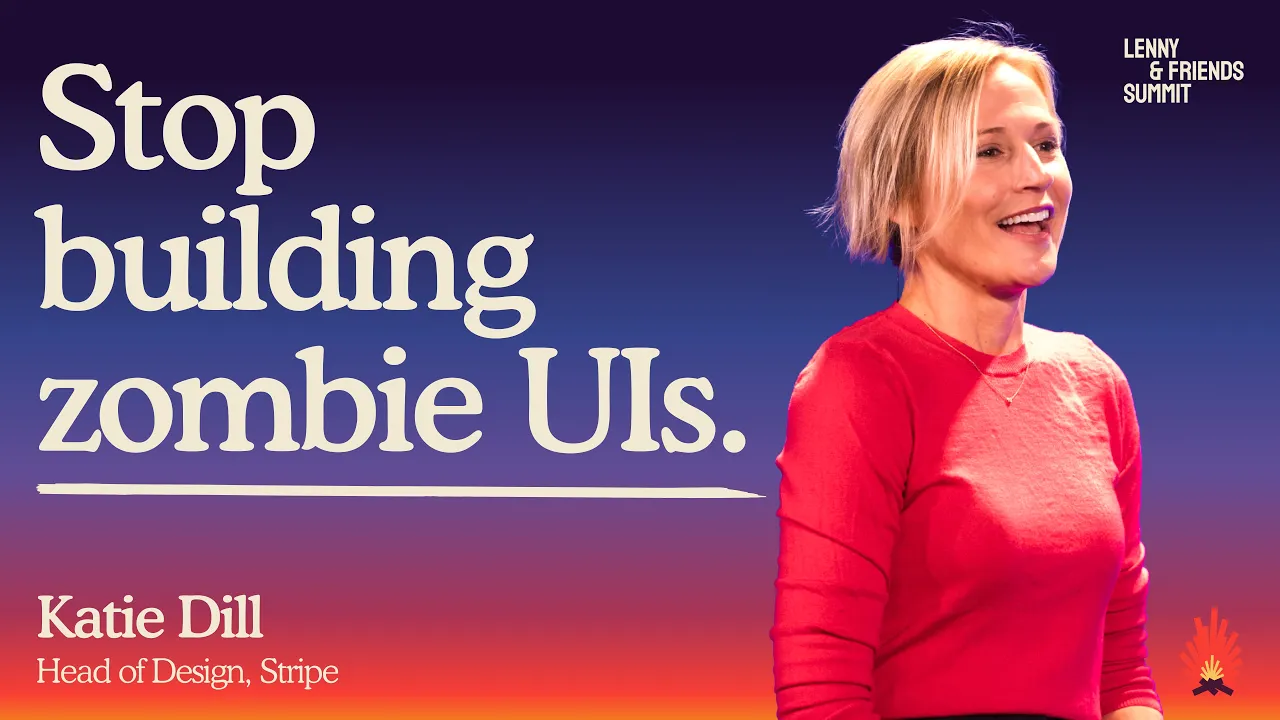
Lenny's Podcast
Generative AI produces generic zombie UI unless product teams encode strict brand points of view, build custom design harnesses, and iterate relentlessly beyond the first draft.
AI-assisted summary of How to scale intent, quality, and artistry with Al | Katie Dill (Stripe) — original source. Check the original for full context.
Source published:
Key ideas
- The generative AI building boom mirrors post-WWII construction, where hyper-efficient production stripped of architectural intent risks flooding digital ecosystems with generic, monotonous 'zombie UI.' (0:06)
- Static design documentation proved ineffective for steering AI models at Stripe, prompting the team to build an opinionated CLI harness that injects full templates, flows, and contextual brand standards directly into agentic workflows via Model Context Protocol. (11:14)
- Because instant prototyping removes upstream resource constraints, organizational quality filtering has shifted post-build, forcing teams to actively resist the 'microwave burrito effect'—the trap of mistaking visually polished initial drafts for shippable software. (12:25)
- Elevating AI-assisted assets into true craft requires relentless human editing; for instance, Stripe designer Stefan iterated an opening summit animation 56 times to transform an unnatural initial AI draft into a lifelike composition. (14:15)
Detailed notes
## Background Published on YouTube by Lenny's Podcast on September 25, 2026, this keynote features Stripe head of design Katie Dill speaking live at the Lenny and Friends Summit in San Francisco. The talk explores how product creators can prevent generative AI from flooding the world with generic "zombie UI" by anchoring their work in clear points of view, system-encoded standards, and rigorous editorial care.
## TL;DR Drawing a historical parallel between the post-WWII construction boom that spawned soulless "zombie buildings" and the current generative AI surge, Katie Dill warns against falling for the "temptation of done" and shipping vacant, homogeneous software. She argues that because LLMs default to probabilistic averages, teams must cultivate a distinct point of view and practice "Pepsi bubbling"—sweating micro-details well beneath conscious user perception. To operationalize craft at machine speed, Stripe transitioned from static design documentation to an opinionated CLI harness that injects dynamic context and multi-step behavioral templates straight into development workflows. Rather than treating AI as an excuse to settle for cheap, convenient first drafts, builders must act as rigorous editors who iterate relentlessly, invent new interaction paradigms, and preserve the visible care of the maker's hand.
## Atmosphere & style Dill delivers an articulate and visually compelling presentation that bridges grand historical analogies—spanning Bauhaus modernism, Gutenberg's typography, and John Ruskin's appreciation of Gothic architecture—with tactical, frontline engineering realities. Her delivery balances self-deprecating humor, such as confessing her reliance on frozen microwave burritos, with an uncompromising, high-standards philosophy around design critique. The experience feels both cautionary and deeply energizing, shifting from an analytical diagnosis of algorithmic mediocrity into an inspiring manifesto that urges modern software makers to embrace creative courage and protect the strange.
## Bulletin - [00:06](https://www.youtube.com/watch?v=GLvFTMtw4Jk&t=6s) The generative AI building boom mirrors post-WWII construction, where hyper-efficient production stripped of architectural intent risks flooding digital ecosystems with generic, monotonous 'zombie UI.' - [11:14](https://www.youtube.com/watch?v=GLvFTMtw4Jk&t=674s) Static design documentation proved ineffective for steering AI models at Stripe, prompting the team to build an opinionated CLI harness that injects full templates, flows, and contextual brand standards directly into agentic workflows via Model Context Protocol. - [12:25](https://www.youtube.com/watch?v=GLvFTMtw4Jk&t=745s) Because instant prototyping removes upstream resource constraints, organizational quality filtering has shifted post-build, forcing teams to actively resist the 'microwave burrito effect'—the trap of mistaking visually polished initial drafts for shippable software. - [14:15](https://www.youtube.com/watch?v=GLvFTMtw4Jk&t=855s) Elevating AI-assisted assets into true craft requires relentless human editing; for instance, Stripe designer Stefan iterated an opening summit animation 56 times to transform an unnatural initial AI draft into a lifelike composition.
## Key takeaways - [00:06](https://www.youtube.com/watch?v=GLvFTMtw4Jk&t=6s) The rapid expansion of AI software development parallels post-war modernist construction, where speed and superficial imitation replaced original architectural rationale with sterile 'zombie buildings.' - [02:08](https://www.youtube.com/watch?v=GLvFTMtw4Jk&t=128s) LLMs operate probabilistically, inherently biasing generated software toward past conventions and historical averages rather than brand-tailored, context-specific solutions. - [02:08](https://www.youtube.com/watch?v=GLvFTMtw4Jk&t=128s) The 'microwave burrito effect' creates a false sense of completion, seducing product teams into shipping flawed products because AI renders rounded corners and polished layouts in seconds. - [02:08](https://www.youtube.com/watch?v=GLvFTMtw4Jk&t=128s) Zero-friction software generation fosters perceived disposability, leading teams to abdicate long-term architectural maintenance and design ownership. - [04:42](https://www.youtube.com/watch?v=GLvFTMtw4Jk&t=282s) Genuine product soul is communicated through builder empathy and micro-details, such as dynamically updating calendar dates on browser tab icons or context-aware agent checkout flows. - [06:05](https://www.youtube.com/watch?v=GLvFTMtw4Jk&t=365s) Product teams must actively cultivate an explicit human point of view, or AI tools will default to a bland, backward-looking consensus. - [06:05](https://www.youtube.com/watch?v=GLvFTMtw4Jk&t=365s) Customers never grade software on a curve based on whether it was prompted or hand-coded; the end artifact must stand entirely on its own quality. - [06:05](https://www.youtube.com/watch?v=GLvFTMtw4Jk&t=365s) Stripe enforces 'Pepsi bubbling'—an internal standard of sweating execution details one level deeper than what customers will consciously perceive. - [09:00](https://www.youtube.com/watch?v=GLvFTMtw4Jk&t=540s) Following Johannes Gutenberg’s manufacture of 290 custom typographic sorts to eliminate irregular whitespace, modern design systems must shift from maintaining static consistency to scaling human intent. - [09:00](https://www.youtube.com/watch?v=GLvFTMtw4Jk&t=540s) Because autonomous agents write code without designers present, the primary deliverable of design has shifted from static screen mockups to opinionated, underlying generative systems. - [11:14](https://www.youtube.com/watch?v=GLvFTMtw4Jk&t=674s) Stripe replaced static design documentation with a custom CLI harness that injects end-to-end templates and interactive flows contextually at build time to prevent 'context rot.' - [12:25](https://www.youtube.com/watch?v=GLvFTMtw4Jk&t=745s) The democratization of prototyping shifts quality control from upstream headcount gates to post-build editorial judgment, requiring leaders to determine whether assembled screens form a coherent user journey. - [14:15](https://www.youtube.com/watch?v=GLvFTMtw4Jk&t=855s) Generic 'AI slop' is characterized by arbitrary decisions where details lack conceptual purpose, requiring vigilant human editors to take accountability for every pixel. - [16:32](https://www.youtube.com/watch?v=GLvFTMtw4Jk&t=992s) Current AI interface idioms like chat windows and command lines represent crude, early adaptations; designers must invent entirely novel interaction aesthetics akin to the emergence of multi-touch or audio synthesizers. - [18:38](https://www.youtube.com/watch?v=GLvFTMtw4Jk&t=1118s) Teams can turn AI into an authentic creative collaborator by prompting with rich brand philosophy, stress-testing concepts with adversarial critic agents, and culturally 'protecting the strange.' - [20:19](https://www.youtube.com/watch?v=GLvFTMtw4Jk&t=1219s) Echoing John Ruskin's appreciation for the unique maker's hand in Gothic architecture, builders should reinvest AI productivity dividends into distinctive, human-centered craftsmanship rather than generic digital sprawl.
## Detailed walkthrough ### [00:06](https://www.youtube.com/watch?v=GLvFTMtw4Jk&t=6s) The Post-War Modernist Trap and the AI Building Boom
Right after World War II, the United States experienced the largest building boom in human history. Soldiers were returning home from the war, cities were expanding, and brand-new construction technologies and materials made it possible to throw up structures "like gangbusters." To meet this overwhelming urgency, mid-century builders looked back to 1920s modernism for inspiration—a movement defined by bare surfaces, crisp geometric lines, monochromatic palettes, and a total absence of decorative adornment. But while the original pioneers of modernism possessed deep intentionality—evident in the philosophies behind Le Corbusier’s Villa Savoye or the foundational principles of the Bauhaus—post-war builders stripped that philosophy away. Facing intense pressure to ship quickly, they copied the aesthetic over and over again without the accompanying rationale.
The consequence was a rapid thinning of design thinking. Traditional banks, once constructed out of heavy stone to broadcast institutional permanence, trust, and physical security, were replaced by generic glass-and-steel boxes that could be mistaken for any office park anywhere. Across decades, this uncritical replication littered landscapes worldwide with what can only be described as "zombie buildings"—vacant, repetitive structures that reflect zero care for their inhabitants, zero regard for brand identity, and zero understanding of local context.
History is now repeating itself in digital space. Software creation has entered its own post-war moment: the AI building boom. Today, anyone can build software, and lean teams of three engineers can easily match the output previously requiring thirty. Yet this explosion in raw productivity carries unmistakable echoes of post-war sprawl, serving as an urgent warning for modern product teams.
```mermaid flowchart TD accTitle: The Post-War and AI Parallel Trajectory accDescr: Diagram illustrating how architectural and technological booms degrade into generic outputs when stripped of intentionality.
subgraph ArchitecturalHistory["Post-WWII Construction Boom"] A["1920s Modernism<br/>(Bauhaus & Villa Savoye)"] -->|"Urgency to build & new tech"| B["Copying without intent"] B --> C["'Zombie Buildings'<br/>(Generic, context-blind)"] end
subgraph DigitalPresent["The Current AI Building Boom"] D["Software Craft & Principles"] -->|"Generative speed & LLMs"| E["Temptation of premature 'done'"] E --> F["'Zombie UI'<br/>(Monotonous, disposable)"] end ```
- **Historical Modernist Foundations**: Emphasized clean bare surfaces, simple geometries, and monochromatic palettes, originally grounded in clear philosophical manifestos (e.g., Bauhaus, Villa Savoye). - **The Post-War Failure Mode**: Urgency and novel construction methods replaced deep architectural intent with superficial replication. - **The Modern Parallel**: Generative AI enables small teams of 3 to output the volume previously expected from teams of 30, risking widespread aesthetic and functional stagnation.
---
[02:08](https://www.youtube.com/watch?v=GLvFTMtw4Jk&t=128s) Three Watch Points: The Korean BBQ Test, Microwave Burritos, and Zombie UI
The current wave of generative tooling introduces three critical watch points that mirror the post-war degradation. The first stems from the probabilistic nature of Large Language Models. Because LLMs are trained to calculate and generate the most statistically probable answer, they excel at replicating historical trends, established best practices, and past styles. However, they struggle to produce anything original or tailored to a specific company’s unique user context. To illustrate this, Dill displays a sleek, ultra-clean web interface that looks identical to a modern B2B SaaS platform—only to reveal that it is actually the website for a Korean barbecue restaurant. The site works technically, but it lacks all character, aroma, and human context.
The second danger is what Dill calls "the temptation of done"—the illusion of completeness that AI offers long before a product is truly ready. Dill shares a self-deprecating confession: her frequent lunch habit of heating up frozen microwave burritos. Taking a rock-solid cylinder from the freezer and nuking it for 90 seconds gets her from starved to eating almost instantly. Even though the burrito is "nearly inedible," the intoxicating speed of execution makes her willing to overlook glaring culinary defects. Software builders fall into the exact same trap: a single prompt instantly renders an interface complete with rounded corners, subtle drop shadows, and clean margins. The product looks polished and ready to ship, but its veneer disguises whether it actually solves the user's problem or differentiates the business.
The third watch point is the feeling of disposability. Because AI-generated interfaces are effortless to produce, teams treat them casually and shirk long-term architectural responsibility. Decisions are made without asking who will maintain the codebase or how the design will age. Left unchecked, these three factors produce digital equivalents of turkey's infamous abandoned Burj Al Babas development—monotonous, eerie tracts of identical mock-castles. In software, this yields "zombie UI": monotonous, vacant interfaces stripped of soul, shipped into an environment where humans already spend half their waking hours staring at screens.
- **Watch Point 1: Probabilistic Homogenization**: LLMs default to what has worked historically rather than what is uniquely appropriate for a brand's specific context. - **Watch Point 2: The Microwave Burrito Effect**: High-velocity generation blinds builders to serious underlying flaws because the first draft looks deceptively finished. - **Watch Point 3: Perceived Disposability**: The friction-free creation of software leads teams to abdicate maintenance and long-term ownership. - **Physical Analogue**: Turkey’s ghost towns of identical tract castles demonstrate what happens when rapid building methods operate completely detached from local context and genuine human utility.
---
[04:42](https://www.youtube.com/watch?v=GLvFTMtw4Jk&t=282s) Building with Soul: Why Small Details Signal Genuine Care
Users do not crave more generic software; they crave tools that feel intentionally cared for by human hands. That soul manifests in unexpected touches of personality, micro-interactions, and proactive friction removal. It can be as playful as the animated character within the Groq bot that infuses energy into an otherwise utilitarian interaction, or as tiny as a calendar browser tab that dynamically updates with the current day's numerical date. While millions of users click past that calendar tab without consciously noticing it, its presence is a quiet transmission of builder empathy: someone sweated the small stuff so the user wouldn't have to.
Care also surfaces through an intimate grasp of context, as seen in Stripe’s Link agent wallet. Instead of treating an autonomous agent as an abstract API call, the system anticipates the exact edge cases and failures an AI agent might encounter when attempting to make an autonomous online purchase, baking diagnostic and troubleshooting workflows straight into the product experience.
When builders embed this degree of craft, software transcends utilitarian utility. It projects the distinct character of the brand and establishes trust. Using AI does not preclude this level of craftsmanship; rather, builders can harness AI to build products with genuine soul if they follow four core operating recommendations.
- **Dynamic Browser Tab Icons**: Simple touches—like rendering the live calendar date on a browser tab—silently reassure users that the software is actively tended to. - **Autonomous Agent Context**: Designing agentic purchasing flows requires anticipating the unique edge cases software agents face when navigating checkout screens. - **Personality in Utility**: Expressive UI elements, such as animated status indicators, prevent interfaces from feeling cold or purely mechanical.
---
[06:05](https://www.youtube.com/watch?v=GLvFTMtw4Jk&t=365s) Recommendation 1: Cultivate a Point of View and Practice "Pepsi Bubbling"
The first recommendation for avoiding zombie UI is non-negotiable: "You have to have a point of view. If you don't, AI will give it for you." Letting the machine supply the viewpoint guarantees a bland, backward-looking consensus. Teams must explicitly define who they are, who they want to be to their users, and what their users genuinely value. In an era where building is increasingly distributed and traditional ownership boundaries are diffuse, maintaining a rigorous internal standard is the only defense against thoughtlessly delegating decisions to AI. At Stripe, this point of view centers on deliberate optimism—a value translated into the company's color palettes, editorial voice, documentation themes, and products designed to back ambitious entrepreneurs.
Dill recounts a design critique at Stripe evaluating an ad that featured the brand’s signature parallelogram alongside user-submitted visuals. A cross-functional partner in the room, feeling the urgent pressure to hit launch timelines, posed an provocative question: "What's the quality standard for something made with AI?" To Dill, the premise of the question was fundamentally flawed. End users never inspect a product and grade it on a curve based on the toolchain used to assemble it; they only care whether the final artifact is good. The critique concluded with a punch list of 17 meticulous refinements: softening edges, tuning the frosted glass treatment, and shrinking individual carbonation bubbles. That critique gave birth to an enduring Stripe verb: "Pepsi bubbling"—the discipline of sweating details one level deeper than what customers will consciously see.
Developing that standard cannot happen in a vacuum. It requires builders to train their powers of observation in the wild. Teams must learn to notice the unspoken needs of their customers, differentiate between work that is merely passable versus truly great, and draw inspiration from analogous disciplines across fine art, architecture, and physical science to inform their taste.
- **The Danger of Viewpoint Abdication**: Without an active human point of view, AI defaults to an algorithmic average of past internet conventions. - **The Customer Reality**: Quality standards cannot shift based on whether an asset was hand-coded or prompted; users evaluate only the quality of the final output. - **"Pepsi Bubbling"**: Internal Stripe shorthand for meticulous craft—scrutinizing details (like glass frosting or bubble sizes) one level below conscious user perception. - **Taste Cultivation**: Sharpening product sense requires looking beyond competitive software benchmarks to absorb principles from art, physical architecture, and everyday design.
---
[09:00](https://www.youtube.com/watch?v=GLvFTMtw4Jk&t=540s) Recommendation 2: Encode Standards into the System (The Gutenberg Lesson)
Cultivating taste and establishing a point of view is only half the battle; the second recommendation is to encode those standards directly into software systems. While an ideal organization might rely on shared human intuition, the sheer speed of development means human designers will not be present for every micro-decision. Companies are already witnessing production code deployed without a designer ever opening Figma, autonomous agents identifying and shipping bug fixes overnight, and generative interfaces synthesizing on the fly based on individual user prompts. Consequently, the design system must evolve. In prior decades, design systems could remain incomplete because a staff designer was always in the room to fill in the blanks. In an agentic world, "the object of design is no longer the screen. It is the system itself."
To anchor this transition, Dill draws on Johannes Gutenberg’s creation of the movable-type printing press. While popular history credits Gutenberg with manufacturing 26 uppercase and 26 lowercase metal letters, his true breakthrough lay in the typographic system surrounding them. Gutenberg cast over 290 distinct characters, incorporating varied letter widths, custom ligatures, and specialized abbreviations. He did this because justified text columns routinely created distracting, irregular gaps of negative space—what typographers call "rivers and lakes of white space"—that shattered the visual elegance of the printed page. By making his mechanical system deeply opinionated yet highly extensible, Gutenberg ensured machine-printed Bibles looked every bit as beautiful as illuminated manuscripts hand-lettered by monastic scribes.
Modern product teams must follow Gutenberg's playbook: traditional design systems merely scaled visual consistency, whereas modern systems must scale human intent. At Stripe, the team is actively wrestling with this transformation, aiming to allow internal builders to move seamlessly from a plain-text prompt to production-ready software nearly instantaneously by baking brand standards directly into a Model Context Protocol (MCP) server.
```mermaid flowchart LR accTitle: The Evolution of Design Systems accDescr: Comparison of traditional screen-focused design systems versus modern agentic intent-scaling systems.
subgraph LegacyModel["Past: Scaling Consistency"] L1["Designer in the Room"] --> L2["Loose Guidelines & Tokens"] L2 --> L3["Manual Screen Mockups"] L3 --> L4["Human Polish on Edge Cases"] end
subgraph ModernModel["Present: Scaling Intent"] M1["Encoded Taste & Intent"] --> M2["Opinionated System Rules"] M2 --> M3["Agentic / Generative UI"] M3 --> M4["Prompt to Production<br/>(via MCP)"] end ```
- **The Gutenberg Precedent**: Gutenberg manufactured 290 unique typographical sorts—not just 52 standard letters—to eliminate awkward typographic "rivers and lakes" and match the artistry of handmade calligraphy. - **Shift in Design Scope**: Product designers are moving away from treating static screen layouts as their primary deliverable, turning their focus toward crafting the underlying generative rules. - **Scaling Intent vs. Consistency**: Yesterday's design tokens guaranteed that colors and padding matched across buttons; tomorrow's systems must ensure autonomous agents make taste-aligned trade-offs when synthesizing new features. - **Stripe’s Tooling Direction**: Transitioning internal workflows to Model Context Protocol (MCP) integrations that inject Stripe's brand rules and craft expectations straight into automated coding workflows.
[11:14](https://www.youtube.com/watch?v=GLvFTMtw4Jk&t=674s) Embedding Opinionated Standards: From Static Docs to a Design CLI
Relying solely on written design documentation to guide generative AI quickly proved inadequate at Stripe. The initial experiments yielded lackluster, inconsistent results because documentation alone lacked specificity and failed to reliably direct the models. When three different team members inputted the exact same prompt, they would receive three completely divergent designs. To solve this, Stripe moved beyond static guidelines and engineered a custom command-line interface (CLI) built directly on top of their design system. Acting as a dedicated harness, this CLI keeps AI generation tightly aligned with company standards by meeting builders directly in their development environments and injecting relevant documentation just-in-time, effectively eliminating the hazard of "context rot."
```mermaid flowchart TD accTitle: Evolution of Design Systems for AI accDescr: Comparison between legacy static design systems and Stripe's active AI-harnessed CLI system.
subgraph Legacy["Legacy Static Approach"] Doc["Design Documentation & Atomic Parts"] -->|"Prompting without context"| Inconsistent["Inconsistent Outputs / 'Context Rot'"] end
subgraph Modern["Stripe's Opinionated CLI"] CLI["CLI Design Harness"] --> FullTemplates["Full Templates & Behavioral Flows"] FullTemplates -->|"Context injected at build time"| Coherent["Coherent, Opinionated Product UI"] end ```
The fundamental leap between this modern harness and conventional design systems is scope: rather than merely providing isolated atomic components, buttons, and tokens, the CLI supplies full templates and end-to-end interactive flows. Because the system understands how Stripe products should behave as a cohesive whole, it operates in a far more opinionated manner than past frameworks ever could. Yet embedding these standards into the core means of production provides only a baseline foundation. Katie quotes architectural theorist Christopher Alexander to capture the inherent limits of pure systematization: "A system can satisfy every rule and still be dead."
- Static documentation allowed three identical prompts to generate three conflicting design results. - The new CLI harness feeds documentation contextually to AI models at the exact point of execution to prevent context degradation. - The harness encodes full templates and multi-step flows rather than isolated atoms, enforcing behavioral consistency across the product suite.
[12:25](https://www.youtube.com/watch?v=GLvFTMtw4Jk&t=745s) The Editorial Mandate: Refusing to Confuse "Done" with "Good"
With the introduction of AI, the historical filter that once guarded product quality has vanished. In traditional software development, strict quality filters were embedded at every single checkpoint out of sheer necessity: when a team generated twenty product ideas, staffing constraints meant leadership could only greenlight one. Projects were poked, prodded, and pruned across months of methodical refinement. Today, a team can effortlessly spin up twenty functional prototypes in a single week. While this velocity liberates teams from endless theoretical debates about hypothetical features and lets them react to tangible software immediately, it pushes the entire burden of filtering to the end of the lifecycle. Saying "no" becomes drastically harder once a product is already built and working in your hands.
This structural shift elevates the internal role of the editor. Organizations must explicitly identify who is evaluating the holistic product experience and determining whether discrete screens assemble into a coherent whole. Teams must unlearn the subconscious assumption that "built means done and that done means good." Editorial mastery requires experiencing the product through the eyes of an actual customer: asking whether it truly solves the underlying problem, aligns with user mental models, and holds together across the entire customer journey rather than merely dazzling on a standalone mockup. Editing is not a simple binary approval process; it is about recognizing whether a concept is fully formed and pushing it past the finish line so that the rush to call a task "done" does not undermine genuine excellence.
- Quality control used to be enforced organically upstream due to tight resource and staffing constraints. - Rapid prototyping removes hypothetical meetings, replacing speculative roadmapping with immediate, tangible software. - The critical evaluation phase has shifted post-build, demanding proactive editors who scrutinize end-to-end coherence rather than isolated interfaces.
[14:15](https://www.youtube.com/watch?v=GLvFTMtw4Jk&t=855s) Craft, AI Slop, and the 56 Iterations of Stefan’s Animation
To define the essence of true craft, Katie draws upon an essay by Nabil Qureshi exploring what elevates great art above the ordinary. Qureshi argues that artistic greatness lies in unexpected details, subtle thematic continuity, and the deeper conceptual meaning lingering just beneath the surface—precisely the qualities where generative AI struggles the most. As Qureshi observed, what makes generic "AI slop" so profoundly off-putting is the lingering sense that choices are arbitrary and that details do not matter: "The cup is green but may as well have been blue." A true editor, by contrast, takes rigorous accountability for every pixel and every decision.
```mermaid flowchart LR accTitle: Stefan's Editorial Refinement Loop accDescr: The 56-iteration cycle turning an initial AI-assisted 3D scene into a polished summit animation.
Scene["3D Base Scene"] --> AI_Anim["AI Animation Pass"] AI_Anim --> Scrutinize{"Pixel-by-Pixel Editorial Review"} Scrutinize -->|"56 Iterations of Refinement"| AI_Anim Scrutinize -->|"Lifelike realism & care"| Final["Final Summit Opening Animation"] ```
Katie highlights this editorial discipline through the opening animation created for the summit itself by Stefan, a designer on her team. Stefan began with a custom 3D model and used AI to animate the environmental motion. While the first generated output was visually intriguing, close inspection revealed that the movement felt jilted, unnatural, and disconnected from the camera's spatial intent. Rather than settling for the initial draft, Stefan iterated and adjusted the piece fifty-six times. By the fifty-sixth iteration, the piece radiated lifelike realism and unmistakable care. Had he worked without AI, Stefan likely would not have had the bandwidth to construct such a complex scene or experiment with so many camera viewpoints; AI vastly expanded his creative possibility space, but only because he paired it with unwavering scrutiny.
- Nabil Qureshi identifies great art by its unexpected touches, thematic continuity, and intentionality—qualities AI lacks out of the box. - "AI slop" reveals itself when design choices appear interchangeable, like a cup that happens to be green but could just as easily be blue. - Stefan produced 56 distinct iterations of the summit's opening animation to push past a functional but "jilted" initial draft into a fluid, lifelike composition.
[16:32](https://www.youtube.com/watch?v=GLvFTMtw4Jk&t=992s) Beyond Monotony: Inventing New Interfaces and Aesthetics
While artificial intelligence can easily be weaponized to manufacture monotony, Katie champions it as the most powerful creative catalyst the design discipline has ever encountered. In an era where anyone can build software with minimal effort, distinctive visual and functional differentiation becomes paramount. Modern interfaces remain trapped in narrow idioms—chat windows, analytics charts, and command-line prompts—which Katie insists are far from the pinnacle of interaction design in the contemporary era. With the ability to communicate directly with computers, designers must invent completely new aesthetics and interaction paradigms that feel truly responsive, dynamic, and alive. Just as the invention of multi-touch unlocked unexpected gestures and the synthesizer birthed entirely new musical genres, AI provides the substrate for a fresh creative era where best practices have yet to be written.
This philosophy already shapes work inside and outside Stripe. Katie notes that community creators are surprising Stripe's internal team with inventive data visualizations, local restaurants are launching websites brimming with character, and independent artists are using generative tooling to invent novel visual styles. At Stripe, AI is deployed to amplify, rather than replace, human craftsmanship. When designing the cover for Stripe’s publication *Built to Grow*, the team collaborated with a traditional human marbler who hand-crafted physical marbling textures. The design team then utilized AI to fine-tune the resulting patterns, adjusting individual lines and color balances to match the publication's exacting layout requirements. The project demonstrated how AI can scale the taste and judgment of skilled human artisans into a striking finished piece.
- Prevailing interaction paradigms like conversational chats, dashboards, and CLIs do not represent the ultimate zenith of AI-era software design. - Generative tools represent a technological leap analogous to multi-touch displays or audio synthesizers, opening territory for entirely new interaction paradigms. - The cover of Stripe’s *Built to Grow* combined physical paper marbling by a human artist with AI post-processing to refine colors and line work with precision.
[18:38](https://www.youtube.com/watch?v=GLvFTMtw4Jk&t=1118s) Tactics for Creative Partnership and Cultural Courage
To turn AI into an authentic creative collaborator, Katie outlines concrete technical tactics paired with a necessary cultural shift. On the input side, designers must provide rich, opinionated direction rather than lazy, generic prompts. Instead of simply asking for "a website for my Korean barbecue," prompts must articulate the brand's core ethos, standards of excellence, and underlying philosophy, backed by distinct source material that forces the model out of well-worn clichés. On the output side, builders must resist the "burrito dilemma"—the urge to prematurely devour the very first passable result that emerges. Designers should deploy adversarial AI agents to critique, stress-test, and find flaws in generated concepts, while personally pushing every asset through multiple rounds of rigorous refinement.
Yet tactical improvements mean little without cultural bravery. Defaulting to safe, cookie-cutter templates is comforting, but true design leadership requires creating room to explore and intentionally "protecting the strange." Because AI drastically reduces the baseline cost of software creation, organizations should reinvest those operational savings into pursuing distinctive craft and ambition. Using AI merely to produce existing designs faster squanders its transformative potential; teams must use it to raise the ceiling of what is possible, rather than simply elevating the baseline floor.
- Effective inputs demand brand philosophy and source material rather than surface-level procedural prompts. - Output rigor requires avoiding the "burrito dilemma" and deploying adversarial agents to aggressively critique initial drafts. - Design leaders must "protect the strange" by spending AI efficiency dividends on risky, distinctive creative exploration instead of faster sameness.
[20:19](https://www.youtube.com/watch?v=GLvFTMtw4Jk&t=1219s) The Maker’s Hand: Choosing a Renaissance Over Zombie Buildings
Katie anchors her final reflections in an architectural parallel, contrasting the sterile, repetitive modernism of the post-war building boom with the enduring vitality of Gothic architecture. In 1850, art critic John Ruskin wrote extensively about the essence of craftsmanship, elevating Gothic architecture as the pinnacle of human creation. Ruskin observed that within a Gothic cathedral, no two structures—and indeed no two individual stone columns—were ever identical. Every carved capital and sculpted detail bore the distinct hand and mind of its individual maker, imbuing the stone with an unmistakable aura of personal care.
Software users crave that exact sense of human investment. Customers are not inherently amazed when an engineer uses Three.js and Blender to whip up a 3D animation in thirty minutes; they are moved when a product genuinely resolves their pain points and delights them with thoughtful, anticipatory touches that reflect real brand character. Amid the current tech boom, builders face an architectural choice: they can churn out the digital equivalent of hollow "zombie buildings," or they can lead an authentic creative renaissance. Katie concludes by challenging the audience to reject generic output, assert their own ambition and taste, and build powerful digital products that proudly display the care, intentionality, and hand of the maker.
- John Ruskin's 1850 writings celebrated Gothic architecture because no two columns were identical, each reflecting the personal care of the craftsperson. - Users are indifferent to rapid technical feats like quick Three.js and Blender scenes if they lack utility, emotional resonance, and thoughtful detail. - Modern software builders hold the collective choice between proliferating generic "zombie buildings" or cultivating a human-centered digital renaissance.
## Notable quotes > [06:05](https://www.youtube.com/watch?v=GLvFTMtw4Jk&t=365s) You have to have a point of view. If you don't, AI will give it for you. — Katie Dill
> [06:05](https://www.youtube.com/watch?v=GLvFTMtw4Jk&t=365s) What's the quality standard for something made with AI?
> [09:00](https://www.youtube.com/watch?v=GLvFTMtw4Jk&t=540s) the object of design is no longer the screen. It is the system itself. — Katie Dill
> [11:14](https://www.youtube.com/watch?v=GLvFTMtw4Jk&t=674s) A system can satisfy every rule and still be dead. — Christopher Alexander
> [12:25](https://www.youtube.com/watch?v=GLvFTMtw4Jk&t=745s) built means done and that done means good. — Katie Dill
> [14:15](https://www.youtube.com/watch?v=GLvFTMtw4Jk&t=855s) The cup is green but may as well have been blue. — Nabil Qureshi
> [18:38](https://www.youtube.com/watch?v=GLvFTMtw4Jk&t=1118s) a website for my Korean barbecue — Katie Dill
> [18:38](https://www.youtube.com/watch?v=GLvFTMtw4Jk&t=1118s) protecting the strange — Katie Dill
## Mentioned Katie Dill, Stripe, Lenny's Podcast, Lenny and Friends Summit, Le Corbusier, Villa Savoye, Bauhaus, Burj Al Babas, Groq, Link, Pepsi, Figma, Johannes Gutenberg, Model Context Protocol (MCP), Christopher Alexander, Nabil Qureshi, Stefan, Built to Grow, John Ruskin, Three.js, Blender
## Video description As AI makes it easier to build, how do we keep products from becoming generic “zombie UI”? At the Lenny and Friends Summit, Stripe’s Katie Dill explains why great design still depends on a clear point of view, an understanding of users, and care in the details. She shares how to build those standards into AI tools, edit beyond the first draft, and use AI to create more original products.
Recorded live at Lenny and Friends Summit on September 10, 2026, in San Francisco.
[Source](https://www.youtube.com/watch?v=GLvFTMtw4Jk)