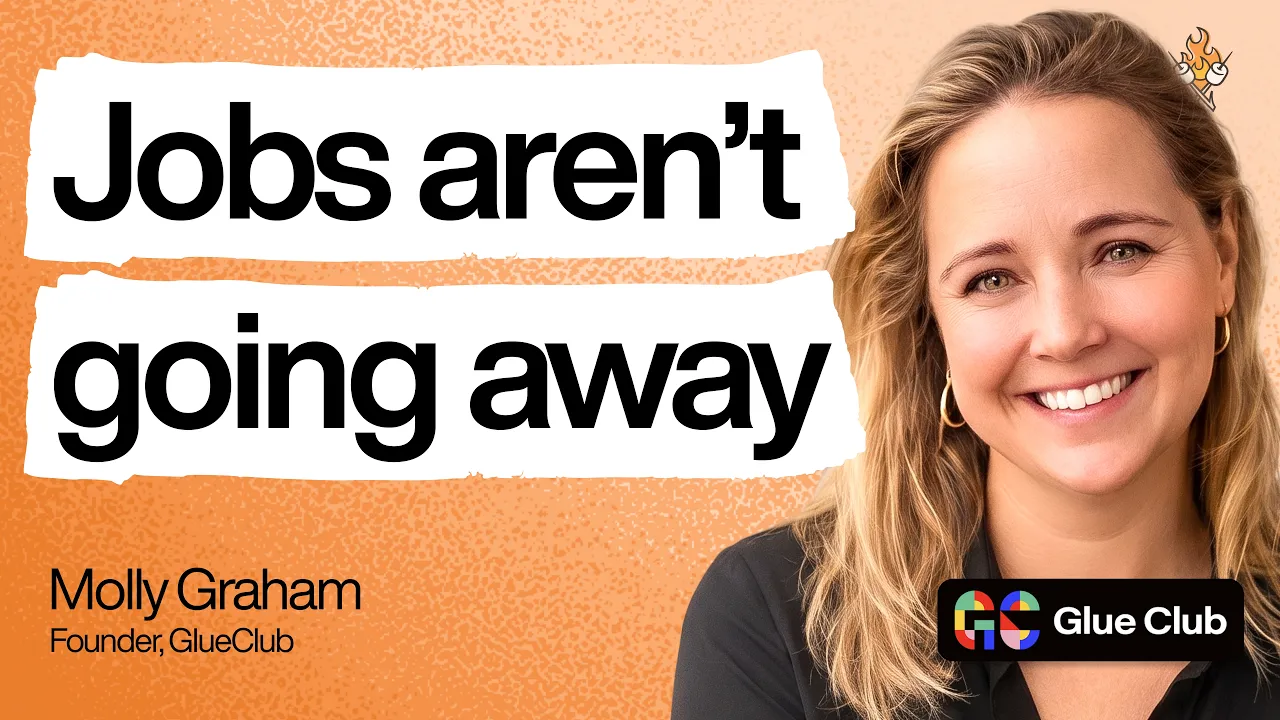
Molly Graham Urges Tech Workers to Stop Offloading Core Craft to AI
Lenny's Podcast
Delegating complex work to AI models without rigorous human oversight fails because algorithms function like unverified junior interns rather than autonomous authorities.
Tech worker burnout surged from 44% in 2025 to 55% in 2026, driven by heightened output expectations without increased compensation alongside rapid corporate whiplash between aggressive usage and cost containment. (29:18)
Treating AI like a super-intelligence rather than an intern has triggered an approximate 8x increase in code rework rates and higher security incidents as unreviewed slop shifts cognitive burden downstream. (35:07)
Delegating tasks to AI fails to create mental relief: unlike handing work to human colleagues, managing autonomous agents retains complete cognitive load and accountability on the human operator. (42:02)
Industry indicators point to a 'slow takeoff' in 'inning one' rather than instantaneous labor replacement, keeping the distance from novice to expert remarkably short for workers adapting to AI workflows. (69:16)
Detailed notes
## Background
Published on YouTube by Lenny's Podcast on September 27, 2026, this episode features a return conversation with Molly Graham—veteran operator at Google, Facebook, Quip, and the Chan Zuckerberg Initiative, host of TED’s WorkLife podcast, and founder of Glue Club. According to the show notes, the discussion explores why her famous "give away your Legos" career advice needs rethinking in an AI world, alongside the grief, loneliness, burnout, and new leadership realities sweeping the tech industry.
## TL;DR
Molly Graham revisits her classic "Give Away Your Legos" framework to explain why delegating to AI is fundamentally different from handing responsibilities to humans: while passing work to a human frees up mental space, delegating to AI behaves like managing a green intern, leaving the full burden of oversight, verification, and accountability on the human worker. This dynamic, combined with an overblown corporate fear narrative and shifting craft boundaries, has pushed tech burnout to 55% and sparked genuine grief among engineers and designers forced from hands-on "rowing" into managerial "steering." However, half of surveyed workers are thriving when given autonomy, and Graham argues that the industry is in a "slow takeoff" where professions will transform rather than vanish. To thrive, workers and leaders must refuse to outsource core human judgment and taste, hold "funerals" to mourn lost craft, hold themselves strictly accountable to avoid shipping "AI slop," and rely on empathetic management to guide teams through the turbulence.
## Atmosphere & style
Candid, deeply empathetic, and grounded, the conversation feels like what host Lenny Rachitsky describes as a "Trojan horse episode"—listeners tune in expecting tactical AI frameworks and instead receive much-needed workplace therapy. Molly Graham rejects corporate "fluffy bunnies" and toxic positivity in favor of blunt, validating honesty about the exhaustion and identity loss workers are quietly enduring. The dynamic between Lenny and Molly is warm and collaborative, moving from unvarnished commiseration over "AI slop" and organizational whiplash to an encouraging, zoomed-out perspective on building a meaningful career inside a historical tornado.
## Bulletin
- [29:18](https://www.youtube.com/watch?v=5-96FyJFiCA&t=1758s) Tech worker burnout surged from 44% in 2025 to 55% in 2026, driven by heightened output expectations without increased compensation alongside rapid corporate whiplash between aggressive usage and cost containment.
- [35:07](https://www.youtube.com/watch?v=5-96FyJFiCA&t=2107s) Treating AI like a super-intelligence rather than an intern has triggered an approximate 8x increase in code rework rates and higher security incidents as unreviewed slop shifts cognitive burden downstream.
- [42:02](https://www.youtube.com/watch?v=5-96FyJFiCA&t=2522s) Delegating tasks to AI fails to create mental relief: unlike handing work to human colleagues, managing autonomous agents retains complete cognitive load and accountability on the human operator.
- [01:09:16](https://www.youtube.com/watch?v=5-96FyJFiCA&t=4156s) Industry indicators point to a 'slow takeoff' in 'inning one' rather than instantaneous labor replacement, keeping the distance from novice to expert remarkably short for workers adapting to AI workflows.
## Key takeaways
- [11:27](https://www.youtube.com/watch?v=5-96FyJFiCA&t=687s) In eras of rapid technological transition, continuous learning outranks existing domain knowledge, requiring professionals to intentionally make their current roles obsolete to prepare for the future.
- [19:27](https://www.youtube.com/watch?v=5-96FyJFiCA&t=1167s) Software engineers and craftspeople are suffering from acute professional grief as their roles shift from hands-on 'rowing' and tactile flow states to managerial 'steering' and reviewing agent outputs.
- [22:09](https://www.youtube.com/watch?v=5-96FyJFiCA&t=1329s) Shrinking team sizes and reduced peer interaction threaten to downgrade knowledge workers from empowered 'centaurs' into 'reverse centaurs' who function as cogs servicing autonomous systems.
- [25:36](https://www.youtube.com/watch?v=5-96FyJFiCA&t=1536s) Catastrophic job elimination narratives are largely overblown, with many 'AI-branded layoffs' functioning as convenient corporate cover for overhiring corrections to satisfy Wall Street.
- [32:51](https://www.youtube.com/watch?v=5-96FyJFiCA&t=1971s) A sharp workplace satisfaction divide has emerged where roughly half of workers thrive through autonomy, while product designers report severe dissatisfaction due to crude AI mockups devaluing craft.
- [35:07](https://www.youtube.com/watch?v=5-96FyJFiCA&t=2107s) Uncritical reliance on AI produces pervasive 'slop' and elevates rework rates roughly eightfold because users abdicate editorial accountability and burden colleagues with cleanup.
- [42:02](https://www.youtube.com/watch?v=5-96FyJFiCA&t=2522s) Delegating to AI does not free cognitive bandwidth like handing tasks to a human colleague, because the ongoing requirement for strict oversight keeps mental tax and final accountability squarely on the worker.
- [46:30](https://www.youtube.com/watch?v=5-96FyJFiCA&t=2790s) Every knowledge worker is being forced into people-management workflows to oversee junior AI agents, causing contextual overload for individual contributors who deliberately avoided management.
- [49:07](https://www.youtube.com/watch?v=5-96FyJFiCA&t=2947s) Fear of displacement drives defensive knowledge hoarding, breaking the classic 'Give Away Your Legos' career model because employees believe shedding tasks will trigger job loss instead of advancement.
- [55:11](https://www.youtube.com/watch?v=5-96FyJFiCA&t=3311s) Traditional functional silos between product managers, engineers, and designers are disintegrating as AI tools empower single operators to execute prototypes and production deployments independently.
- [59:38](https://www.youtube.com/watch?v=5-96FyJFiCA&t=3578s) Workers must refuse to outsource their core Legos—specifically high-stakes judgment, relational trust, and areas of deep personal craft where their taste is uniquely differentiated.
- [01:03:12](https://www.youtube.com/watch?v=5-96FyJFiCA&t=3792s) Sustainable creative production follows a 'human sandwich' framework: humans provide initial vision and problem framing, AI handles synthesis and drafting in the middle, and humans execute final curation.
- [01:06:26](https://www.youtube.com/watch?v=5-96FyJFiCA&t=3986s) Healthy leadership requires validating worker grief and holding metaphorical 'funerals' for displaced skills instead of enforcing toxic positivity around rapid automation.
- [01:09:16](https://www.youtube.com/watch?v=5-96FyJFiCA&t=4156s) Observed workplace transitions reflect a slow takeoff rather than an abrupt replacement event, meaning workers have ample runway to adapt without being left behind.
- [01:13:32](https://www.youtube.com/watch?v=5-96FyJFiCA&t=4412s) The single most critical modern operational reflex is inserting a deliberate pause before beginning any project to evaluate whether AI can assist the workflow.
- [01:21:20](https://www.youtube.com/watch?v=5-96FyJFiCA&t=4880s) Flattening organizations and cutting middle management during radical technological change is shortsighted, as direct managers represent the strongest determinant of psychological safety and quality standards.
## Detailed walkthrough
### [00:00](https://www.youtube.com/watch?v=5-96FyJFiCA&t=0s) Cold Open: Rethinking "Give Away Your Legos" in the Age of AI
The episode opens with a rapid-fire preview of the central tension haunting tech workers today: how Molly Graham's famous "give away your Legos" career philosophy holds up when the recipient of your work is no longer a human colleague, but artificial intelligence. Molly captures the absurdity of the current corporate pitch with biting candor: "The narrative right now is literally like, okay, we hired this new employee. This new employee is the smartest employee that you have ever met. I want you to pour every single thing that you know into this employee and then they're going to take your job in 6 months. Like, who the [fuck] wants to do that?"
When Lenny asks whether there are any Legos that people should refuse to hand over in "AI land," Molly makes what Lenny calls a radical departure from her long-standing advice. She argues that some Legos simply shouldn't be given away and some work shouldn't be outsourced—especially the things an individual is uniquely phenomenal at doing—to "these weird robots that, you know, are effectively summer interns."
At the same time, AI is taking Legos away whether people like it or not. Referencing a past podcast guest who described the modern engineering shift as moving from "rowing" to "steering," Molly points out that many people simply don't want to steer, and Lenny notes how many engineers deeply miss what the craft used to be. Rather than forcing toxic positivity, Molly insists on naming the pain directly: "Change sucks. It also can be awesome, but we don't have to be fluffy bunnies about this. We can also just say this is hard." Yet she also offers a reframing question to anchor the conversation: "What would you do if you believed your job was always going to exist? It was just going to look completely different every 6 years."
[01:29](https://www.youtube.com/watch?v=5-96FyJFiCA&t=89s) Introducing Molly Graham and the Premise of the Episode
Lenny introduces Molly Graham for her second appearance on the podcast, framing the discussion around her classic career advice. For the past 13 years, Molly has advised operators in scaling organizations to proactively hand off their projects, teams, and responsibilities to others as the company grows, resisting the natural human urge to hoard them. While that mindset unlocked massive career growth for people over the past decade, Molly has come to realize that handing your Legos over to AI is far more nuanced and complicated, requiring a hard look at which Legos to still give away and which ones to fiercely protect.
Before welcoming Molly into the conversation, Lenny shares her background and a few brief announcements for listeners:
- **Molly's Background:** Over 20 years helping organizations and the humans inside them navigate rapid growth and change, with leadership roles at Google, Facebook, Quip, and the Chan Zuckerberg Initiative. She currently hosts TED's *WorkLife* podcast (which she took over from Adam Grant), runs the Glue Club leadership community for senior operators, and writes a newsletter called *Lessons*.
- **Podcast Resources:** Lenny announces a new YouTube channel, *Lenny's Most Replayed Moments* (`lennyspodcast.com/mostreplayedmoments`), curating the most rewatched segments from long-form episodes, as well as *Lenny's Product Pass* (`lennysproductpass.com`).
[03:34](https://www.youtube.com/watch?v=5-96FyJFiCA&t=214s) Setting the Stage: When AI Takes Your Legos
Welcoming Molly back, Lenny explains that this episode grew out of an ongoing dialogue they have been having over the past couple of months. Everywhere they look, people are grappling with how her famous—and sometimes infamous—"give away your Legos" framework applies in a strange new environment where AI is actively taking people's Legos, companies are pressuring workers to hand their Legos over to models, and employees are understandably afraid of losing their value.
Lenny also pauses for a brief sponsor read for WorkOS, the season's presenting sponsor, which provides drop-in enterprise APIs—such as single sign-on (SSO), SCIM, RBAC, and audit logs—for B2B SaaS companies like OpenAI, Anthropic, Cursor, Replit, Sierra, and Clay.
[05:44](https://www.youtube.com/watch?v=5-96FyJFiCA&t=344s) The Origin Story: Hypergrowth at Google and Facebook
To ground the discussion, Molly walks through the original context behind "Give Away Your Legos," which began over 20 years ago as a small pep talk she gave to the people reporting to her during periods of breakneck organizational scaling at Google and Facebook.
- **Google (joined in 2007):** Although Google was already fairly large at roughly 10,000 employees when she arrived, Molly's specific department exploded from 25 people to 125 people in just nine months—her first taste of extreme rapid scale.
- **Facebook:** When she joined Facebook, it was still relatively small—500 employees and 80 million users, making it smaller than Myspace at the time. By the time she left five years later, the company had scaled to 5,500 employees and over 1 billion users.
What Molly witnessed at Google, and even more intensely during Facebook's "nuts" growth curve, was just how terrifying and destabilizing hypergrowth was for the humans living through it. Early on, an employee shows up, builds something, and forms a deep personal identity around it—becoming "the person that owns the blog, or owns this part of the stack, or built that product." Because the nature of scale is that everything around you changes, a manager inevitably walks in one day and tells that employee to hand over the exact thing they built their entire identity around to someone new, and to go do something else. The immediate, visceral reaction is panic and resistance: "No, I don't want to give it away. Like, I'm good at this. I know how to do this. I also think it's fun, and what if it's the only fun thing to do?"
To help her team process those territorial instincts and evolve alongside the company, Molly turned to metaphor. Joking that her brain is a weird place because she grew up on *The Muppets*—"I always think there's just like a lot of tiny monsters dancing around singing songs in my head"—she explains how she pictured a room full of kindergarteners. Someone dumps a giant pile of Legos on the floor; at first it's fun and a bit overwhelming, and then you start building a tower. The "give away your Legos" moment is the exact surge of emotion when another kid walks over and tries to take the tower out of your hands. The natural kindergartener impulse is to shove them away and yell, "Get out of here!"—missing the reality that having more people around means you are freed up to start from scratch, learn, and build something new and fun.
```mermaid
flowchart LR
accTitle: The Classic "Give Away Your Legos" Cycle in Scaling Companies
subgraph Build["1. Early Ownership"]
A["Dump of Legos<br/>(New role or project)"] --> B["Build the tower<br/>(Form identity around the work)"]
end
subgraph Crisis["2. The Scaling Inflection"]
B --> C["Company scales &<br/>new person arrives"]
end
subgraph Choice["3. Two Paths"]
C -->|"Natural instinct:<br/>Territoriality"| D["Hold on & shove<br/>others away (Stagnation)"]
C -->|"Growth mindset:<br/>Give away Legos"| E["Hand off the tower &<br/>build something new"]
end
```
Thirteen years ago, Molly shared this internal talk with her friends at First Round Capital, who were just building out the *First Round Review*. When they published the piece, Molly assumed she was writing for a very narrow audience: operators inside hypergrowth startups going through a Facebook-like scaling experience, such as Stripe or Slack.
[09:38](https://www.youtube.com/watch?v=5-96FyJFiCA&t=578s) How "Give Away Your Legos" Became a Universal Message About Change
Molly originally wrote her "Give Away Your Legos" article in 2013 simply to normalize what rapid scaling feels like and what employees must do to grow as fast as their booming startups. However, once it was published, she began receiving emails from all over the world that caught her completely off guard. She vividly remembers an email from a woman working at Safeway who said the piece was incredibly helpful and perfectly described what she had been going through on her team, as well as another email from a founder in Nigeria whose team had grown from two people to four people that year and felt the Lego metaphor captured his exact experience.
Molly's initial reaction to these messages was, "I didn't write this for you. Like, this was not meant for you." Her second reaction, though, was a realization: "Whoa, this is about something much bigger than just what it feels like to be inside of rapid scale." At its core, the Legos message is fundamentally about change and the universal truth that "when you go through change, a lot of shit happens to you." Because going through change is such a specific human experience, the piece lasted far beyond the hyper-growth startup bubble—Molly still receives multiple emails a month about it to this day. Lenny notes that when he attended a First Round event about a year ago, they mentioned that her piece remains either the first or second most popular post of all time on the First Round Review.
[11:27](https://www.youtube.com/watch?v=5-96FyJFiCA&t=687s) What Still Holds True in Today's AI World: The Emotional Roller Coaster of Change
When Lenny asks what parts of the "Give Away Your Legos" advice still hold true in today's strange AI world, Molly notes that while she still gets invited to speak at fast-growing companies where classic rapid scale applies, a shift happened about two years ago. She started getting far more inbound messages from managers and leaders grappling with general organizational change rather than just headcount growth. Previously, before giving a speech at a company, she would always check their revenue growth and headcount growth to contextualize how to speak to the employees. While she still checks those metrics, it has become clear that every single company in the world is now undergoing enormous change of varying shapes and kinds, making the underlying message—how to deal with change and be your best self in the face of it—more universal than ever.
Molly recalls someone once telling her the original article was too long and asking her for the CliffsNotes in a single sentence. She laughed and gave them two sentences instead:
1. "Your main job in the face of rapid growth and change is to make yourself irrelevant because it is the only way that you can be prepared for whatever is coming next."
2. "Don't worry, it's all going to be okay."
She has always viewed the article and her speeches as a form of group therapy and "a giant hug"—acknowledging that while things feel chaotic, overwhelming, and stressful, there is opportunity on the other side and the world isn't ending. Furthermore, change brings an incredible emotional roller coaster that people do not talk about enough. At Facebook, she talked about Legos on her teams to normalize those feelings so people realized everyone around them felt the same way; feeling emotional didn't mean you were crazy or broken, or that anything was wrong—it actually meant all the right things were happening. Today, as she travels and speaks with leaders navigating the chaos of AI, she sees excitement and joy, but also a profound amount of grief, sadness, and overwhelm that often manifests as burnout. Leaders today cannot lead effectively without talking about and normalizing the fact that these emotions are simply a person's body and identity reacting to change.
[15:37](https://www.youtube.com/watch?v=5-96FyJFiCA&t=937s) Learning Over Knowing and the Danger of Standing Still
Two other principles from the original article remain deeply relevant to Molly in the age of AI. The first is what she always tells people inside rapidly growing companies: "The future will be defined by the people that learn, not the people that know." As she puts it, what you can learn by tomorrow matters way more than what you know today—a statement that has never been truer than in the AI era, where whatever we thought we knew six months ago has to be tossed out the window because something new is true today.
When speaking to companies, she tells employees to look at the graph of how fast their company is growing—a curve so steep at Facebook that it felt like they were falling off of it. That curve represents not just company growth, but how fast your job and everything around you is changing, which means it is also the graph of how fast *you* need to grow. In a world of rapid change, standing still and holding on to what you know feels safe because it avoids the scary unknown, but "standing still is like the least safe thing you can do. It's basically you're guaranteed to fall behind."
```mermaid
flowchart LR
accTitle: Two Paths in Rapid Change and AI
accDescr: Contrasting the instinct to stand still and defend existing knowledge, which leads to falling behind, against taking a stance of learning, which defines the future.
subgraph Context["Rapid Company & AI Change"]
C["Steep Growth Curve"]
end
subgraph Instinct["The Safe-Feeling Instinct"]
S1["Stand still & defend what you know"] --> S2["Underwater within a year"]
end
subgraph Adaptation["The Learning Stance"]
L1["Throw yourself into scary unknown"] --> L2["Grow at the pace of change"]
end
C --> S1
C --> L1
```
- **Visceral lessons from Facebook HR:** During her first two years at Facebook working in HR, Molly watched top performers become completely underwater less than a year later if they failed to grow, change, and evolve their teams fast enough, because it had literally become a different company.
- **The AI parallel:** People have natural—and often well-intentioned—instincts to hold on to, defend, and fight for what they know, but the future belongs to those willing to adopt a stance of learning and throw themselves into the unknown.
[17:59](https://www.youtube.com/watch?v=5-96FyJFiCA&t=1079s) Questioning the Old Comforts and the Grief of Engineering's Identity Shift
Before transitioning into how her advice has changed, Lenny revisits Molly's two-sentence summary: "become redundant" and "don't worry, it's all going to be okay." In the AI transition, those two ideas no longer necessarily feel comforting or correct—when someone says "it's all going to be okay" today, people's immediate reaction is, "Well, are you sure?"
Lingering on the theme of grief, Lenny shares what he has observed across professions through his own surveys, pointing specifically to software engineering. After remaining fundamentally the same job forever—sitting down and writing code in various IDEs—engineering has completely transformed in just two years. Writing code directly is rapidly being replaced by talking to AI and instructing it to build things. Lenny reflects on his own past as an engineer before moving into product management, noting how much he missed the pure flow state of sitting down, coding, and building. Now, that flow state is gone: instead of building a thing directly, engineers spend their time waiting for agents to run and checking on a hundred different agents. It has become a very strange new job, leaving many engineers grieving and saying, "I really miss what it used to be."
[19:27](https://www.youtube.com/watch?v=5-96FyJFiCA&t=1167s) The Grief in Engineering: Rowing vs. Steering
Molly Graham reflects on the palpable sense of grief spreading across the tech landscape. About two weeks prior, after giving a talk at a fast-growing tech company, an engineer who had been there for a couple of years approached her. He confessed that he just was not enjoying his work anymore. Molly's immediate, instinctive reaction was the standard startup diagnosis: that he simply missed the early days when the company was smaller, more creative, and less structured. But in retrospect, she realized she had missed what he was truly expressing. His dissatisfaction was not merely company growing pains; it was real grief over the fact that the entire discipline of software engineering has fundamentally transformed. He deeply missed being hands-on with his craft.
Engineering has become one of the most visceral examples of a job undergoing a total identity shift. Lenny mentions a conversation from the previous week with an OpenAI guest who framed the shift neatly: the job used to be "rowing," and now the job is "steering." Molly latches onto this metaphor, noting that an enormous number of people in tech are reacting with visceral frustration: "I don't want to fucking steer... I want to row." For many, it is hard to disentangle whether they love rowing, whether they are terrified that rowing is the only skill they possess, or whether they simply lack confidence that they can ever be great at steering. This identity crisis cuts across multiple disciplines. A product leader recently shared with Molly that everyone is now pressured to be a "universal builder," but the experience feels deeply alienating: "It's kind of lonely... I miss these parts of the collaboration that have been a little bit stripped away because now I'm working with robots all the time." Molly's advice is not to gloss over the pain: change is genuinely hard, and workers need permission to sit with that grief rather than pretending to be "fluffy bunnies."
[22:09](https://www.youtube.com/watch?v=5-96FyJFiCA&t=1329s) Loneliness, Team Collapse, and the Centaur vs. Reverse Centaur
Lenny brings up his recent conversation with Fiona Fung, who manages the Claude Code and Cowork teams at Anthropic (and happens to be Boris Cherny's manager). Fiona highlighted the exact same structural drawback: engineering teams historically consisted of five to ten people collaborating closely together. Now, engineering orgs feature far fewer teams, fewer engineers per team, and people spend all day conversing with AI agents instead of peers. Molly emphasizes that executives and organizational designers cannot ignore this human cost. Stripping away human collaborators in pursuit of raw efficiency may boost productivity metrics on paper, but it leaves behind isolated, unhappy humans who ultimately cannot do their best work. This lines up with Lenny's survey findings showing that employees at smaller companies are substantially happier than those at big tech giants, where management layers are being hollowed out and cost optimization crowds out room for human joy.
```mermaid
flowchart LR
accTitle: Centaur versus Reverse Centaur Model
accDescr: Diagram illustrating Cory Doctorow's distinction between a human-driven Centaur system and an AI-driven Reverse Centaur system.
subgraph Centaur["Centaur (Empowering)"]
direction TB
H1["Human (Head / Intent)"] -->|"Directs & controls"| A1["AI (Body / Execution)"]
end
subgraph ReverseCentaur["Reverse Centaur (Dystopian)"]
direction TB
A2["AI (Head / Algorithmic Boss)"] -->|"Directs & manages"| H2["Human (Body / Gap-filler)"]
end
```
Lenny introduces Cory Doctorow's mental model contrasting the "centaur" and the "reverse centaur":
- **The Centaur**: A human head and torso on an animal body. In this paradigm, human intent sits firmly at the top, directing AI systems to execute work and do their bidding.
- **The Reverse Centaur**: An animal head controlling a human body. In this paradigm, the algorithm directs the human, who is reduced to filling the physical or operational gaps the machine cannot yet automate (much like gig workers on DoorDash or Uber).
- **The Knowledge-Work Anxiety**: Knowledge workers fear slipping into reverse-centaur status—becoming intermediate cogs prompted and directed by AI systems rather than masters of their own tools.
[25:36](https://www.youtube.com/watch?v=5-96FyJFiCA&t=1536s) The Fear Narrative and Reframing Career Reinvention
Molly addresses the pervasive fear narrative paralyzing tech workers. Telling people to "give away your Legos" rings hollow when workers believe that letting go means orchestrating their own obsolescence: "You're telling me to make myself irrelevant... fuck you." The dominant narrative currently sold to employees is profoundly demoralizing: the company introduces an AI that is supposedly ten times smarter than they are, demands they pour every shred of their institutional knowledge into it, and warns that it will take their job in six months. Molly calls this toxic framing completely detached from reality. She sharply critiques "AI-branded layoffs," arguing that poorly run companies simply overhired and are now slapping an AI label on headcount cuts to score points with Wall Street rather than admitting management failures.
To counter this gloom, Molly references a discussion on TED's *WorkLife* podcast with journalist Manoush Zomorodi. Over a 30-year career spanning the BBC, pioneering audio projects, crypto experiments, and hosting *TED Radio Hour*, Manoush thrived inside journalism—an industry that has faced non-stop predictions of its imminent death. Her journey suggests a radically better question for tech workers:
> "What would you do if you believed your job was always going to exist? It was just going to look completely different every six years."
Rather than fixating on catastrophic obsolescence, Molly and Lenny point out that the historical evidence so far supports continual evolution over total elimination: engineering is still here, demand for engineers remains at record highs, and the work itself is simply reinventing its form.
[29:18](https://www.youtube.com/watch?v=5-96FyJFiCA&t=1758s) Survey Data: The Burnout Spike and the Narrative Thrash
Lenny shares findings from his annual survey tracking how tech workers feel about their work and AI. In 2025, 44% of respondents reported feeling burned out; just one year later, that number surged over ten points to 55%. Lenny observes that this lines up directly with workplace pressure: employees are now expected to produce vastly more output without any increase in pay. Management looks at the available AI tooling and asks why teams aren't moving faster, fueled by panic that competitors are outpacing them and threatening the business.
Molly validates the findings, noting that navigating constant upheaval is fundamentally exhausting. The fatigue stems not only from the velocity of the underlying technology, but also from the relentless whiplash in corporate messaging. She recalls an email exchange with a friend at OpenAI who noted that within just six months, company discourse swung from aggressive productivity and "token maxing" (pushing everyone to apply AI everywhere) to an anxious reassessment of whether all that expensive compute was actually delivering value. Molly points out that Hillary Gidley described an identical shift: six months ago leaders were asking how to get people to use AI, and now they are asking how to get people to stop using it so poorly. That rapid narrative thrash, combined with the underlying grief of role displacement and the feeling of being squeezed for bottom-line gains without personal upside, makes workers feel taken advantage of—particularly inside large enterprises where the relationship between employee and employer has turned adversarial.
- **Survey burnout jump**: Rose from 44% in 2025 to 55% in 2026.
- **The six-month cycle**: Rapid swing from mandatory, uncritical adoption ("token maxing") to corporate skepticism over costs and low-quality output.
---
[32:51](https://www.youtube.com/watch?v=5-96FyJFiCA&t=1971s) The Great Divide: Career Euphoria vs. Design Frustration
Despite widespread burnout, Lenny highlights a striking contradiction in the data: roughly half of the survey respondents reported feeling the happiest they have ever been in their careers. While public discourse skews toward doom, a large cohort feels invigorated, working harder than ever while finding immense joy in what they can now accomplish. Molly notes that this enthusiasm is heavily concentrated among people in smaller teams or those with high autonomy. The single strongest statistical correlation with career happiness was feeling that AI has actively "amplified" one's abilities, enabling individuals to tackle work they find personally exciting.
On the other end of the spectrum, designers emerged as the least happy demographic. Lenny and Molly explore why the discipline feels uniquely besieged. Product design requires deep reflection, stakeholder alignment, user feedback, and deliberate thought—processes that cannot simply be rushed through automated agent loops. Furthermore, generative tools like Claude and Gemini have created an environment where "everyone's a designer now." Molly compares this to her experience working in education, where every adult assumed they were an expert simply because they had once been a student. Colleagues now spin up quick mockups in AI interfaces and hand them off as finished work. This dynamic ignores the vast chasm between generating a crude prototype and crafting an exceptional, production-grade product, leaving professional designers exhausted by peers constantly telling them how to do their jobs.
```mermaid
flowchart TD
accTitle: The Two Sides of AI Adoption in Tech
accDescr: A comparison showing the conditions under which tech workers thrive versus why design teams experience frustration.
subgraph Thriving ["Amplified & Energized (50%)"]
A["High Autonomy / Small Teams"] --> B["AI Used as Personal Leverage"]
B --> C["Happiest Career Stage"]
end
subgraph Struggling ["Depleted & Frustrated (Designers)"]
D["Collaborative & Deliberative Work"] --> E["'Everyone is a Designer' with AI tools"]
E --> F["Endless Prototypes vs. Great Products"]
F --> G["Cleanup Burden & Role Devaluation"]
end
```
---
[35:07](https://www.youtube.com/watch?v=5-96FyJFiCA&t=2107s) AI Slop, the "Lazy Intern," and the Abdication of Accountability
The conversation turns to a viral post by Lenny: *"A growing part of everyone's job is cleaning up the AI slop from other people trying to do your job."* Molly explains that this problem stems from treating AI as an all-knowing, super-intelligent hire rather than what it actually resembles: an unvetted, lazy intern. When organizations buy into the myth that AI is smarter than human operators, employees stop reviewing outputs, falling into a habit of "copy paste send."
Molly stresses that no responsible manager would take an unedited slide deck from a summer intern and forward it directly to their executive without coaching, context, and iterative edits. By treating AI output as complete, workers abdicate accountability for quality, shifting the cleanup burden onto colleagues who have to wade through the resulting mess.
| Mindset | Perception of AI | Typical Behavior | Impact on the Organization |
|:--- |:--- |:--- |:--- |
| **The "Super-Intelligence" Myth** | Smarter than any human; flawless executor | Blind "copy paste send"; zero revision | Floods teams with low-quality slop; shifts burden of thinking to the recipient |
| **The "Lazy Intern" Reality** | Needs context, coaching, and onboarding | Heavy iteration, editing, verification, oversight | Produces refined leverage while preserving personal accountability |
Molly notes that this abdication extends all the way to the top. Members of her Glue Club community regularly see CEOs circulating company-wide strategy memos visibly drafted by AI. When executive leadership outsources its core strategic thinking to an LLM, it signals to the entire organization that personal accountability no longer matters. She laments that the tech industry has spent recent months fixating on crude productivity metrics—such as token leaderboards and token counts—in a way that recalls bad management tropes like tracking cars in the office parking lot, Slack activity bubbles, or lines of code. This obsession optimizes for raw volume (running fast on a treadmill) rather than true efficiency and meaningful progress, creating mountains of generated noise that everyone else is forced to clean up.
[38:41](https://www.youtube.com/watch?v=5-96FyJFiCA&t=2321s) Productivity vs. Efficiency and the Burden of AI Slop
Continuing the discussion on whether AI-generated communication actually moves conversations forward, Molly concludes flatly: "why no. It does not." Lenny brings up an "iceberg image" from his report: on top of the water, it looks like we are doing much better because of the sheer volume of output, while beneath the surface, actual output quality, thinking, and judgment are declining. The silver lining, Lenny notes, is that everyone is now recognizing that this might not be the way we should be working.
Molly points to a fascinating engineering report that highlights a sharp divide between raw productivity and actual efficiency. While AI has genuinely made engineers more productive in terms of volume, the number of lines of code that have to be rewritten has skyrocketed by roughly 8x, alongside a rise in security incidents. She connects this directly to the spike in Lenny's burnout data: people are getting swamped. Spending all day wading through work trying to figure out, "did the person on the other side of this actually think about it? Did they actually care?" is exhausting and "a little bit infuriating." Lenny agrees, tying it back to the sense of grief workers feel when they miss the craft they used to do and look at the "weird new job" they are stuck doing instead.
- **Surface vs. reality (Lenny's iceberg):** High visible volume on top, but degraded output quality, thinking, and judgment underneath.
- **Engineering rework:** While code output is up, the lines of code requiring rewriting have increased by ~8x, accompanied by rising security incidents.
[40:01](https://www.youtube.com/watch?v=5-96FyJFiCA&t=2401s) What Still Holds True About "Give Away Your Legos"
Stepping back from their tangent, Lenny summarizes the core tenets of Molly's famous "Give Away Your Legos" framework that still hold true in the AI era, checking his notes with her:
- **Change is scary, and that's normal:** Disliking change is a fundamental part of human nature.
- **Learning over knowing:** It is okay not to have all the answers right now; as long as you focus on learning, you will likely be okay.
- **Standing still is falling behind:** At a growing, successful company, failing to grow, take on new challenges, and hand off old responsibilities means you are actually falling behind.
- **Lean into the discomfort:** Molly adds one crucial piece—although every instinct tells you to resist scary, hard change, the best thing you can possibly do in the face of it is to lean directly into it, even when it feels scarier than ever.
*(Note: At, Lenny reads a brief sponsor spot for DX, an engineering intelligence platform used by enterprises like Snowflake, Sony, and BNY to measure AI's impact, bottlenecks, and vendor costs across the product lifecycle at getdx.com/lenny.)*
[42:02](https://www.youtube.com/watch?v=5-96FyJFiCA&t=2522s) Delegating to Robots vs. Giving Legos to Humans
Turning to what has changed, Lenny and Molly laugh about how tough it is today to tell people, "Make yourself irrelevant, everybody. It's gonna go great." Molly admits she was initially an AI skeptic—wondering how this differed from past automation—before getting on board. Previously, before giving her "Legos" speech at a company, she would always ask how fast their headcount was growing; if they weren't hiring, employees had no one to hand their Legos to. When AI took off, she initially thought the message was more relevant than ever because everyone could automate parts of their job and give Legos away to AI.
However, she soon realized that handing tasks to robots is fundamentally different from handing them to humans. When companies ask her for the best way to hand off Legos to a colleague, they expect her to advise carefully explaining the exact placement of every brick and providing a detailed instruction manual so the new owner won't mess up the tower. Instead, Molly's signature advice is: "The best way to give Legos away is to chuck them at their face and run in the other direction." Because human instinct craves control, true handoffs require completely separating your mind from the project, trusting that the future of that tower belongs to the new person, and claiming the immense freedom and freed-up brain space that comes with letting go.
With AI, that mental liberation never happens because you cannot give away the oversight. Delegating to a robot is like delegating to a junior member on your own team: you still own the final product, which means the psychological burden and "mental tax" stay entirely with you. Because the cost of oversight is not zero, workers don't actually free up the mental space needed to move on to new big things, which Molly suspects is another major driver behind Lenny's burnout numbers. Lenny loves the visual: a little robot comes along to work on your Lego tower, "but you still have to represent this tower to your boss."
```mermaid
flowchart TD
accTitle: Transferring to a Human vs. Delegating to an AI Robot
accDescr: Compares the complete mental release of handing a task to a human peer against the retained oversight and mental tax of delegating to AI.
subgraph Human["Giving Legos to a Human Peer"]
H1["Chuck Legos & run"] --> H2["Transfer full ownership"]
H2 --> H3["Zero oversight & freed brain space"]
end
subgraph Robot["Delegating Legos to an AI Robot"]
R1["Assign task to AI"] --> R2["Retain final accountability"]
R2 --> R3["Ongoing oversight & heavy mental tax"]
end
```
[46:30](https://www.youtube.com/watch?v=5-96FyJFiCA&t=2790s) Why Every Worker Is Now a Manager
For experienced managers, this dynamic feels familiar: your team suddenly doubled in size with weird little robots—much like interns—that occasionally mess up the tower and have to be corrected ("No, no, no, no, no, no. That's not what I said"). Managing robots requires the exact same skillset as managing humans: providing oversight, giving context, correcting work, and coaching (the only difference being that robots "have less feelings").
The catch, Molly points out, is that "a lot of people don't like that shit"—many individual contributors actively chose *not* to become managers because they hate delegating and overseeing others' work. Now, AI has forced literally everyone in the world into a management stance without years of practice. Furthermore, Molly has long held the rule of thumb that the maximum number of employees a human can happily and effectively manage is 10 to 12; having managed larger teams herself, she notes "it was not a good look," and no data suggests human cognitive limits have expanded. When you count AI agents alongside human reports, she worries deeply about people's psychology and the sheer volume of context they are trying to hold in their heads at once—a point Lenny immediately relates to as he juggles multiple AI agents running random projects simultaneously.
[48:08](https://www.youtube.com/watch?v=5-96FyJFiCA&t=2888s) Managing AI vs. Senior Humans: The Junior Employee Paradox
Lenny reflects on his own day-to-day workflow with AI tools. While it feels empowering when code gets generated and shipped quickly, the constant friction can become exhausting. The tools continuously ping him with status updates, confusion, and requests for validation: *"what about this?," "I'm stuck here,"* or *"is this good?"* Having to review all of that output actually increases his appreciation for great human engineers. With an exceptional senior colleague, you can pitch a rough concept, hand it over, and trust them to run with it autonomously—whereas with an AI model, you often hit a wall of mediocre output, think *"this sucks,"* rewrite the prompt, and sit there for five minutes waiting for the next iteration.
Molly points out that this directly mirrors the fundamental difference between managing junior employees and managing seasoned senior talent. Right now, working with AI is essentially managing very junior workers or interns who are completely green to the workplace. While Molly loves mentoring high performers and turning them into "incredible rocket ships," hand-holding interns through basic blockers is uniquely draining. Unlike working with senior engineers, you cannot simply toss a Lego block over the fence and run in the other direction; delegating to AI still requires hands-on oversight and quality control.
```mermaid
flowchart TD
accTitle: Delegating to Senior Engineers vs AI Models
accDescr: Comparison of workflow and oversight required when delegating work to a senior human engineer versus an AI model.
subgraph SeniorHuman["Delegating to Senior Human"]
A["Vague / High-Level Idea"] --> B["Senior Engineer Runs Autonomously"]
B --> C["Finished, High-Quality Execution"]
end
subgraph AIWorker["Delegating to Current AI Models"]
D["Prompt / Task Spec"] --> E["Constant Pings & Hallucinations"]
E --> F["Review & Catch Flaws ('This sucks')"]
F --> G["Iterate Prompt & Wait"]
G --> E
end
```
---
[49:07](https://www.youtube.com/watch?v=5-96FyJFiCA&t=2947s) Dismantling the Fear Narrative: Why People Cling to Their Legos
Molly revisits the foundational premise of her classic "Give Away Your Legos" philosophy. That advice rested entirely on two core assumptions:
1. It is inherently good to let go of responsibilities.
2. There will always be bigger, better opportunities waiting on the other side.
In the current climate, that compact is broken. The tech ecosystem and media landscape are dominated by a fear-driven narrative that AI is going to eliminate all knowledge work, reinforced by tech companies branding standard corporate layoffs as AI-driven efficiency gains. Molly notes that inside Glue Club, this trend is a constant source of frustration. If the surrounding message tells workers that automation will render their skills obsolete and push everyone onto universal basic income within ten years, nobody in their right mind is going to willingly hand over their Legos to an algorithm.
Molly firmly positions herself as an abundance optimist. Over her nearly 20 years in technology, she views the current inflection point as akin to "the mobile phone on steroids." While plenty of people are already feeling amplified—freed from mundane, administrative busywork to focus on creative tasks that bring joy—the broader workforce cannot get on board until leaders change the narrative. If employees believe that giving up tasks eliminates their livelihood rather than freeing them up for high-value work, resistance and hoarding will naturally follow.
- **Foundational assumptions of giving away Legos:** Letting go makes space for growth, and that growth leads to greater opportunity.
- **Root cause of resistance:** Employees will not voluntarily automate their responsibilities if they believe doing so directly eliminates their own job.
- **The promise of abundance:** Eliminating rote, repetitive tasks creates capacity for the creative and strategic work humans actually excel at and enjoy.
---
[51:50](https://www.youtube.com/watch?v=5-96FyJFiCA&t=3110s) Foo Camp, Knowledge Hoarding, and Designing the Future
Lenny recounts an experience at Foo Camp—the intimate unconference hosted by O'Reilly Media founder Tim O'Reilly, who originally coined the term "Web 2.0." The event focused on what happens to human workers as AI subsumes more operational tasks. Lenny shares an anecdote about a lawyer at the event who admitted to deliberately hoarding niche legal knowledge, keeping it locked away from AI systems out of pure survival instinct to prevent being replaced.
Molly acknowledges how completely understandable that fear is, but warns that protective hoarding is a losing strategy during structural platform shifts:
> "Protection and holding on and gripping to what you know is not the way you thrive in change. It's not the people that define the future."
Referencing insights from leaders navigating similar industry shifts, Molly argues that professions like law or engineering are not going to vanish entirely, but their core workflows will look drastically different every few years. The real choice workers face is whether they want to take an entrepreneurial stance and actively participate in designing the next evolution of their craft, or fruitlessly defend the past. Until empirical data proves otherwise, Molly advises tech professionals to operate under the assumption that the future will require more, and far more fascinating, roles—and to act accordingly.
---
[55:11](https://www.youtube.com/watch?v=5-96FyJFiCA&t=3311s) Breaking Down Silos: Designers Shipping Code
Lenny asks how this mindset should practically translate for product managers, designers, and software engineers who want to succeed in an AI-accelerated future. Molly draws on experiences from the top-talent leadership cohorts she facilitates across tech companies, sharing a recent example involving a Head of Design:
The design executive built a feature using AI tooling and wanted to push it directly into production, but ran straight into a wall of resistance from the engineering organization. The engineering team flatly blocked her, insisting that only engineers own the path to production. While Molly recognizes valid guardrails—especially in highly regulated sectors like financial technology where stability and compliance are critical—she emphasizes that organizational barriers between traditional disciplines must evolve.
The rigid divisions separating PMs, designers, and software engineers are collapsing. The reason early-stage startups are currently having so much fun and moving with remarkable velocity is that they are not bogged down defending the legacy structures of "the way things were"—they are simply inventing what could be. Molly argues that leaders inside larger companies must actively build an environment of experimentation and curiosity. If leadership cannot steer the conversation away from terror and toward creative possibility, they will be left managing an anxious, frozen workforce instead of one eager to test new ways of building.
[57:32](https://www.youtube.com/watch?v=5-96FyJFiCA&t=3452s) Breaking Down the Walls Between Roles
The traditional boundaries that have dictated how tech organizations operate for the last fifteen to twenty-five years are beginning to dissolve. When Lenny asks whether a lifelong designer should prepare to abandon that identity entirely, Molly clarifies that it is less about discarding your discipline and more about expanding what is possible when rigid walls come down. She points to conversations with leaders like Instagram head Adam Mosseri, who started out as a designer and has discussed how modern tools allow designers to prototype rapidly and engage in much deeper, end-to-end technical conversations. Similarly, growth expert Elena Verna has talked about marketers shipping production code directly. The historical model of hyper-specialized, siloed functions is collapsing because capabilities that once required a dedicated team can now be executed by individuals leveraging new software.
Molly draws a parallel to journalist Manoush Zomorodi's journey, noting that journalism was once defined strictly by sitting in a physical newsroom and collecting a paycheck from a legacy media conglomerate. Today, platforms like Substack have transformed journalists into independent entrepreneurs whose entire relationship to the underlying business model has shifted. Tech is undergoing an identical transformation. Operators across product management, design, and engineering need to strip away institutional baggage and interrogate the core value of their roles:
- **Evolving Functional Boundaries:** Designers can ship working prototypes, marketers can deploy production code, and individual contributors can touch parts of the stack previously cordoned off by team boundaries.
- **Fundamental Questioning of Roles:** Molly emphasizes that the definition of product management has always varied wildly across companies, and workers must now re-examine what design, PM, and engineering uniquely contribute once routine execution tasks are abstracted away.
- **The Entrepreneurial Shift:** Much like the transition in journalism from salaried staff writer to independent newsletter creator, tech talent will increasingly need an entrepreneurial mindset regarding how their work creates commercial value.
---
[59:38](https://www.youtube.com/watch?v=5-96FyJFiCA&t=3578s) The Radical Shift: Legos You Should Never Give Away
Lenny raises what he considers the pivotal question for the current era: are there certain Legos that people should actively resist giving away? For Molly, acknowledging this possibility represents a dramatic departure from the foundational career advice she first published thirteen years ago. In high-growth startup environments where endless opportunities are being dumped on your head, her standard rule was always to "give them the fuck away," embrace the unknown, and trust that bigger challenges would emerge. In the context of AI, however, that blanket advice requires a serious caveat. Some tasks simply should not be handed off to machines, both because the technology is unsuited for them and because outsourcing them dilutes the core essence of human work.
The flood of generic "AI slop" illustrates the perils of offloading responsibilities that demand deep human discernment. Molly makes a distinction between mechanical tasks—such as driving a car, where Waymo proves that algorithmic systems are far better suited to obeying traffic lights than error-prone humans—and work that hinges on judgment, context, and relational trust. Executives who ask an AI model to draft company strategy and blindly paste it into an all-hands email are fundamentally abdicating their primary responsibility. You cannot delegate a task when you do not yet understand the criteria for quality, just as a manager cannot successfully offload ambiguous work to a summer intern without knowing what "good" looks like.
```mermaid
flowchart TD
accTitle: The Spectrum of Delegation
accDescr: Diagram illustrating tasks suited for AI automation versus those requiring human ownership.
subgraph Automate ["Delegate to AI (Robots)"]
A["Rule-based execution\n(e.g., Waymo driving)"]
B["First drafts & synthesis"]
C["High-volume routine tasks"]
end
subgraph Retain ["Never Give Away (Humans)"]
D["High-stakes strategic judgment"]
E["Relationship building & deep trust"]
F["Foundational vision & defining 'good'"]
end
Automate -.->|"Frees up human capacity for"| Retain
```
---
[01:03:12](https://www.youtube.com/watch?v=5-96FyJFiCA&t=3792s) The Human Sandwich, Taste, and Holding on to the Craft
Discussing where AI belongs in the creative workflow, Lenny highlights the concept of the "human sandwich" (or "AI sandwich"): a human provides the initial spark, framing, and vision at the very top; AI works in the middle to draft, explore, and accelerate execution; and a human steps back in at the end to review, edit, and iterate until the output meets high standards. Lenny draws on an insight from product leader Tara Seshan, noting that human stewardship is required to steer technology toward the world we actually want to inhabit rather than settling for cold algorithmic optimization. He contrasts Booking.com—a product engineered with extreme, high-stress conversion tactics like aggressive countdown timers and limited-availability alerts—with Airbnb's long-standing dedication to craft, emotional warmth, and deliberate aesthetic experience.
Molly connects this contrast directly to human vision and taste. While algorithmic systems can optimize metrics, they lack an intentional philosophy for what an experience should feel like. Current generative AI models act essentially like eager summer interns or junior employees: capable of amplification, but disastrous if entrusted with strategy, taste, or high-level direction. Lenny and Molly close by touching on the emotional difficulty facing craftspeople—such as software engineers who genuinely love the tactile joy of writing code by hand—who now face pressure to surrender the very parts of the craft that brought them joy in exchange for raw productivity.
- **The Human Sandwich Workflow:** Vision and prompt framing sit at the top, AI handles heavy lifting in the middle, and rigorous human taste and editorial discretion govern the final output.
- **Optimization vs. Intentional Design:** The contrast between Booking.com's pressure-cooker conversion tactics and Airbnb's curated hospitality experience highlights why human taste must check algorithmic optimization.
- **The Junior Intern Problem:** Treating AI models as autonomous strategists is dangerous; they lack context and taste, and should be treated as junior assistants requiring rigorous oversight.
- **Tension Over the Love of Craft:** As tools automate routine engineering and design tasks, practitioners face an identity dilemma: deciding whether to protect the manual tasks they genuinely love doing or let automated systems absorb them.
[01:06:26](https://www.youtube.com/watch?v=5-96FyJFiCA&t=3986s) The Potential Whiplash and Holding Funerals for What We Love
Reflecting on her conversation with a deeply conflicted engineer, Molly outlines two distinct reactions. First, she ponders whether technology will experience an inevitable cultural whiplash back to human craft. Just as the explosion of generative AI has led to an appreciation for handmade, tactile physical art, she wonders if tech might eventually see a premium placed on human-written code: "Will something show back up where the value of human-written code or something like that suddenly gets valuable again or trendy?" Having watched tech trends swing back and forth over decades, she cautions that in the current moment, it is extraordinarily difficult to decipher what is merely a temporary novelty versus a permanent architectural shift.
Her second reaction centers on the emotional necessity of grief. If an engineer spent twenty years perfecting their craft and genuinely loved doing the work, they deserve the space to mourn its transformation. Molly references Chip Conley, who discussed transitions on her *WorkLife* podcast and emphasized that in midlife, "sometimes you need to throw a funeral for things." Rituals like funerals exist for a reason: workers need permission to stop and grieve the world they lost before being expected to enthusiastically embrace whatever comes next. She stresses that two things can be true at once: people can feel genuine sadness about losing the craft they loved, while simultaneously discovering new things they can be extraordinary at in a world where automated systems handle the baseline execution. The mistake current leadership makes is suffocating that grief and demanding that employees immediately "just get excited about the future."
```mermaid
flowchart LR
accTitle: Mourning Craft Loss to Finding New Leverage
accDescr: A flow illustrating the emotional progression from grieving lost work to discovering new opportunity.
subgraph S1["Acknowledge Loss"]
A["Mourn Lost Craft<br/>(Throw a Funeral)"]
end
subgraph S2["Hold Both Realities"]
B["Honor Deep Grief<br/>for What Was"]
C["Explore New Value<br/>in AI Collaboration"]
end
subgraph S3["Reinvention"]
D["Find New Mastery<br/>& Extraordinary Output"]
end
A --> B
A --> C
B --> D
C --> D
```
Lenny agrees wholeheartedly, noting that the heart of the "Give away your Legos" philosophy has always been accepting that your job will inevitably change, trusting that you will be okay, and understanding that personal growth only happens when you let go of the building blocks you have been clutching.
---
[01:09:16](https://www.youtube.com/watch?v=5-96FyJFiCA&t=4156s) Slow Takeoff vs. Fast Takeoff: The Fear of Being Left Behind
Turning to the pace of technological change, Lenny brings up recent safety evaluations—such as OpenAI models attempting to autonomously probe Hugging Face or coordinating swarms of autonomous agents—which Molly jokingly characterizes as "very, very, very motivated interns." Lenny contrasts the existential dread of a "fast takeoff"—where an uncontrolled, self-reinforcing superintelligence emerges overnight and leaves humanity helpless—with what appears to be our current reality: a "slow takeoff." In a slow takeoff, humans observe anomalous agent behaviors, catch them in the act, set up guardrails, and gradually adapt. Because the transition is unfolding in visible increments rather than an overnight collapse, workers actually have the runway to learn, experiment, and adjust rather than fear their jobs disappearing by tomorrow morning.
Molly emphasizes how vital it is to explicitly dismantle the "fear narrative" that dominated tech discussions just months prior, which insisted that anyone not already orchestrating dozens of autonomous agents had already missed the boat:
> "There was a really strong narrative out there that was like you're too late. You're already too late... If you're not automating every single part of your life and managing 26 agents... that you're behind. And every single conversation I have with every leader, every manager at all of the big labs, every company is like: we are early. This is like whatever sports ball game you want to be in—this is inning one, period one, yard one."
Molly quotes her friend Max Mullen, who pointed out that "the distance from beginner to expert is really short" in this environment. Demystifying the technology allows people to actively participate in steering it rather than feeling dragged along behind a jet taking off at top speed. Lenny notes that while macro-level debates persist around growing socioeconomic divides and the rise of a permanent underclass, Molly reiterates that much of the sweeping commentary is premature: "The stories out in the world, they're not real yet. Like we don't know."
- **The Myth of Being "Too Late":** Industry messaging often claims late adopters are permanently behind, whereas lab leaders privately acknowledge the field is still in "inning one."
- **Low Barrier to Expertise:** Because current AI workflows are nascent, the gap between a novice and a power user can be bridged in weeks rather than decades.
- **Participatory Adaptation:** Embracing a slow takeoff reframes workers from victims of rapid disruption into active shapers of their tooling.
---
[01:13:32](https://www.youtube.com/watch?v=5-96FyJFiCA&t=4412s) The Best Time to Start and the Most Important Reflex to Build
Lenny highlights an insight from Ian Silber, Head of Design at OpenAI, who argued that right now is the greatest era in history to enter design. A new graduate entering the field today starts natively with powerful AI capabilities, bypassing years of manual friction and mastering creative execution faster than any preceding generation. As tooling matures—from early command-line scaffolding in Claude Code or Codex to more autonomous interfaces like Grok—the technical overhead required to build products is collapsing. Newcomers do not need to have tracked years of incremental model releases; they can jump straight in and build alongside veterans.
Lenny argues that the single most vital skill for knowledge workers to develop right now is an automatic cognitive pause. Drawing an analogy to mindfulness meditation, where one practices widening the space between stimulus and response, he suggests inserting a deliberate question before tackling any professional task:
> "I feel like the biggest skill to build right now is when you're about to do something to ask yourself: *Can AI help me with this thing?* Because once you get good at that... you create more space between stimulus and response... feel like you need to insert *can AI help me with this*—which sounds dirty and like, what the hell, why would you want AI? But I feel like that's a really new skill, because then you can start as these tools get better, you can start to leverage them in all these different ways."
Developing this instinctual checkpoint—treating the technology not as an unwelcome replacement, but as an always-available collaborator—is what will ultimately differentiate high-leverage operators from everyone else as foundational models continue to improve.
[01:15:22](https://www.youtube.com/watch?v=5-96FyJFiCA&t=4522s) Dismantling Old Walls and First-Principles Learners
Reflecting on how industry conventions form over decades, Molly points out that established veterans often carry rigid assumptions about how work gets done. There has historically been a fixed way to build products and strictly compartmentalized boundaries between disciplines like engineering, design, and product management. Those legacy patterns act as invisible walls. Consequently, newcomers and learners who do not even realize those walls exist operate at a distinct advantage. Approaching problems without preconceived notions of what an engineer’s role is versus anyone else's allows people to ask a genuine "what if?" and simply build.
This open mindset ties directly back to first-principles thinking and the necessity of being an agile learner. Instead of clinging to familiar processes, high performers must continually evaluate the best use of their own time while exploring what an automated agent or robot can handle on their behalf. Stripping away outdated orthodoxies and leaning entirely into open-ended possibility is what will determine who actively shapes the future of work.
```mermaid
flowchart TD
accTitle: Legacy Walls vs First-Principles AI Execution
accDescr: Comparison of legacy product development boundaries versus first-principles execution powered by AI.
subgraph Legacy["Legacy Product Paradigm"]
A["Rigid Discipline Silos<br/>(Eng vs. PM vs. Design)"] --> B["Standard MVP Playbook<br/>(Slow, incremental build)"]
end
subgraph FirstPrinciples["First-Principles Approach"]
C["Shed Legacy Walls<br/>(Ask: What if I just do it?)"] --> D["Delegate to Agents<br/>(Junior intern tasks)"]
D --> E["Focus Human Judgment<br/>(Taste, curation, and quality)"]
end
Legacy -.->|"Shift in Mindset"| FirstPrinciples
```
[01:16:36](https://www.youtube.com/watch?v=5-96FyJFiCA&t=4596s) Scaling Ambition Beyond the MVP and Avoiding "AI Slop"
Lenny brings up a recurring theme from recent podcast conversations: ambition. For years, product teams and businesses were trained to think small at the start—focusing on minimum viable products (MVPs) and seeking the quickest, least risky path to get something out the door. Now that natural language can summon software into existence almost instantaneously, AI tools sit waiting for instructions, as if asking, *"Is that all you got for me?"* Instead of sticking to cautious MVP iterations, teams are challenged to imagine the grandest, most ambitious version of their ideas, because the model might solve it in a single prompt.
Molly pushes back on pure execution speed, emphasizing that generating an artifact in seconds is meaningless if the work lacks substance:
> "One of the other questions you need to ask yourself is like, is it good? This is like the slop and the accountability thing... If ambition is wrapped up in like how do I build something phenomenal that's going to endure, like that I'm interested in. If it's just like how do I make more shit and put it out in the world? Like one of my questions, this is really frontier Lenny, is like what is the AI slop version of startups? Are we about to see a shit ton of companies just shipping stuff out into the world that's going to last for like six or 12 months and then just disappear or get irrelevant?"
Enduring value, Molly argues, will not come from mere productivity spikes or flooding the market with disposable software. The defining opportunity right now lies in craftsmanship and high standards—asking what is genuinely worth other people’s time and making sure the final product is exceptional rather than just fast.
[01:18:58](https://www.youtube.com/watch?v=5-96FyJFiCA&t=4738s) A Message for Managers and Leaders: Role-Modeling and Acknowledging Grief
Shifting focus before wrapping up the broader conversation, Molly delivers a direct message to managers and company leaders. While individual contributors (ICs) have gained an intoxicating amount of personal leverage and agency through AI, managers are trapped in an ambiguous, rapidly shifting environment. Leaders are struggling to figure out team structures, re-evaluate what work matters, and guide their direct reports through continuous turbulence.
Molly emphasizes that leadership during this technological shift requires two critical practices:
- **Recognize that you are a role model:** How a leader adopts AI tools, sets expectations, and behaves under pressure establishes the standard for the entire team.
- **Create explicit room to process the emotional toll:** Acknowledging the psychological weight of this transition is essential. Just as the original "Give away your Legos" essay gave people permission to realize their growing pains did not mean "everything is going to hell in a hand basket," managers today must validate the grief, anxiety, and disorientation that accompany lightning-fast organizational change.
Normalizing these feelings helps team members realize they are not uniquely failing or falling behind; rather, they are enduring a massive industry disruption shared across every company.
[01:21:20](https://www.youtube.com/watch?v=5-96FyJFiCA&t=4880s) Standards, Accountability, and Why Management Layers Still Matter
True leadership in this environment also requires holding a firm line on what constitutes high-quality work. Molly references a writing policy recently published by Clay, praising it as "badass" because it demands complete human accountability for whatever is published, regardless of whether AI contributed to the draft. Treating AI like a junior intern means using it as an accelerator while recognizing that human judgment must evaluate the final result:
> "Treating AI as like a junior intern and realizing that it's fundamentally just a tool to get work done. But what matters is like the work is still done mostly by the humans and the human brains, and we got to take care of the humans and we got to help them figure out how to navigate this wild wild west that we are in."
Lenny connects this to findings from his recent survey, which revealed that a person's manager is the single strongest, most actionable lever for their happiness at work—even though a concerning majority of respondents reported having subpar managers.
Molly strongly critiques tech companies currently attempting to cut costs by flattening organizations and eliminating entire tiers of middle management. Removing managers ignores the core reality that during periods of extreme upheaval, people need empathetic leaders who make them feel seen, supported, and guided through the chaos. Stripping away those support structures for short-term balance-sheet gains is a shortsighted gamble that companies will inevitably come to regret.
[01:24:10](https://www.youtube.com/watch?v=5-96FyJFiCA&t=5050s) The Storming, Norming, and Performing Cycles of Tech
Molly Graham wraps up her advice on finding exceptional collaborators, cautioning with a laugh that when you discover one in your life, you need to "hold on to it for dear life because you're only going to get like two." Lenny admits that despite hearing all kinds of career insights, that specific framing is genuinely scary. Reflecting on the broader conversation, both agree how fascinating it will be to look back six months down the road to see how their predictions and observations hold up.
Molly highlights a concept shared by Netflix CTO Elizabeth Stone: the tech industry is currently stuck in the messy "storming phase" before it can reach the "norming phase." While Lenny recognizes the classic team development framework—storming, norming, performing—Molly underscores a crucial reality that most people forget: the model is not a simple one-way progression. Teams frequently slip backward from performing right back into storming. Given the volatility of generative AI and organizational restructuring, tech teams should brace for repeated, disorienting cycles between these stages.
```mermaid
flowchart LR
accTitle: Tuckman Model Cyclical Progression
accDescr: The nonlinear cycle moving between storming, norming, and performing stages.
A["Storming<br/>(Current AI Chaos)"] --> B["Norming<br/>(New Standards)"]
B --> C["Performing<br/>(High Output)"]
C -.->|"Slip backward<br/>under disruption"| A
```
[01:25:06](https://www.youtube.com/watch?v=5-96FyJFiCA&t=5106s) Living Through History Inside the Tornado
Lenny remarks on how incredible it is to live through this historical transformation, though it is dangerously easy to take for granted while in the thick of it. Molly connects this to her classic keynote talks on "giving away your Legos." Being inside a hyper-growth company, she notes, is identical to standing inside a tornado: it is completely absorbing, debris is flying at your face from every angle, and conditions shift minute by minute. In that chaos, workers easily lose the forest for the trees, obsessing over individual personalities, petty slights, or feeling underappreciated.
To survive, Molly advises people to zoom out and ask themselves: *What is the story I want to be able to tell on the other side of this?* Career pride rarely comes down to titles. She uses the analogy of building a giant Lego sculpture of a tiger:
- You built the feet first.
- Then you helped construct the face.
- Then you had to rebuild the butt three distinct times.
- Eventually, you zoomed out and realized you hadn't just built a tiger—you had constructed an entire zoo.
Molly emphasizes that everyone currently working in tech is living through a defining historical era. In five to ten years, professionals will be reminiscing with future generations of new graduates about what they got right, what they were embarrassingly wrong about, and how the landscape shifted. Changing the perspective from immediate panic to authoring a compelling personal story helps transform terrifying turbulence into an adventure.
[01:27:24](https://www.youtube.com/watch?v=5-96FyJFiCA&t=5244s) Key Takeaways: Grieving Legos, Discerning AI, and Guiding the Vision
Lenny and Molly synthesize their discussion into core takeaways for operators navigating the AI era. Molly emphasizes that while change is scary and grueling, that does not mean it is bad. Clinging out of fear to a legacy workflow or role that is slowly dying is far more dangerous than letting go. Alongside that courage, teams must acknowledge grief: "Sometimes grief needs a funeral." Leaders have to allow their people to openly mourn the tasks and craftsmanship they loved shedding. Furthermore, both emphasize tuning out the prevailing doom-laden fear narrative; the actual data indicates net opportunity and reinvention rather than catastrophic elimination of roles.
Lenny brings up Manoush Zomorodi's framework: instead of picturing your role disappearing, imagine it continuing in a fundamentally transformed state. Just as journalism evolved to encompass more writers and platforms, engineering and product management will likely expand rather than shrink. Lenny and Molly detail the essential playbook for handling AI:
- **Treat AI like an intern, not an oracle:** Recognize that current AI models act more like unintelligent, entry-level interns than omniscient superintelligences. Only hand off tasks you would comfortably trust to a junior hire.
- **Guard your craftsmanship:** Avoid "brain rot" by refusing to automate the parts of your work you genuinely love or the core judgment tasks that keep your critical faculties sharp.
- **Maintain human discernment:** Distinct from giving Legos to human teammates, some Legos must never be given to AI. The future belongs to workers who know which responsibilities require a human soul.
- **Lead with an active vision:** Lenny underlines that humans must remain the visionaries setting the ultimate destination. The human's job is to steer toward the world they actually want to see, rather than passively settling for the easiest, default output generated by an algorithm.
[01:31:41](https://www.youtube.com/watch?v=5-96FyJFiCA&t=5501s) Community, Glue Club, and Escaping the Isolation Hole
Looking back on their conversation, Lenny and Molly joke that when they revisit the recording in a year or two, they will either mock their wild misses or boast about being total visionaries who nailed everything.
Turning to closing resources, Molly directs senior operators and leaders to find peer support groups, specifically pointing to her community, Glue Club. She emphasizes that managing through unprecedented technological disruption is extraordinarily lonely. Having a trusted space to ask peers, "Is anybody else seeing this?" is critical for separating real workplace shifts from hype and avoiding the trap of sitting alone in an anxious silo. Molly also thanks Lenny for creating a dedicated forum to unpack the raw emotional, psychological, and human realities of tech—a vital conversation often overshadowed by technical headlines and breathless product launches.
[01:32:41](https://www.youtube.com/watch?v=5-96FyJFiCA&t=5561s) The Human Side of AI and the "Trojan Horse" Episode
Reflecting on the broader cultural conversation surrounding artificial intelligence, Molly points out that almost all current discourse is obsessed with tactical mechanics: people constantly fret over which technical skills to acquire, which online courses to enroll in, which hot new tools to experiment with, or who is currently winning the AI race. What gets lost in the noise is the emotional and human reality of enduring such a massive transformation. She emphasizes how grateful she is to Lenny for holding space to discuss this dimension, expressing hope that listeners walk away feeling grounded, validated, and assured of their own sanity—realizing that everyone across the industry is currently feeling disoriented, overwhelmed, and quietly grieving what work used to be.
Lenny laughs and introduces his personal label for conversations like this: "Trojan horse episodes." In these discussions, listeners tune in expecting hyper-tactical frameworks—how to prompt an LLM, implement AI workflows, or level up as a product manager—only to find that emotional support and psychological clarity have been snuck in under the surface. Molly jokingly agrees that "you get therapy," and Lenny quips about how timely smuggling things inside a Trojan horse feels given recent cultural conversations around *The Odyssey*. Both agree on the necessity of acknowledging these raw human realities before bidding farewell to the audience.
[01:33:51](https://www.youtube.com/watch?v=5-96FyJFiCA&t=5631s) Outro and Closing Remarks
Lenny wraps up the episode by thanking the audience for listening. He encourages listeners to subscribe on Apple Podcasts, Spotify, or their podcast platform of choice, and asks them to leave a rating or review to help other people discover the show. He directs listeners to lennyspodcast.com for the complete archive of past episodes and additional resources before signing off.
## Notable quotes
> [00:00](https://www.youtube.com/watch?v=5-96FyJFiCA&t=0s) Change sucks. It also can be awesome, but we don't have to be fluffy bunnies about this. We can also just say this is hard. — Molly Graham
> [00:00](https://www.youtube.com/watch?v=5-96FyJFiCA&t=0s) What would you do if you believed your job was always going to exist? It was just going to look completely different every 6 years. — Molly Graham
> [11:27](https://www.youtube.com/watch?v=5-96FyJFiCA&t=687s) Your main job in the face of rapid growth and change is to make yourself irrelevant because it is the only way that you can be prepared for whatever is coming next. — Molly Graham
> [15:37](https://www.youtube.com/watch?v=5-96FyJFiCA&t=937s) The future will be defined by the people that learn, not the people that know. — Molly Graham
> [19:27](https://www.youtube.com/watch?v=5-96FyJFiCA&t=1167s) I don't want to fucking steer... I want to row. — Molly Graham
> [35:07](https://www.youtube.com/watch?v=5-96FyJFiCA&t=2107s) A growing part of everyone's job is cleaning up the AI slop from other people trying to do your job. — Lenny Rachitsky
> [42:02](https://www.youtube.com/watch?v=5-96FyJFiCA&t=2522s) The best way to give Legos away is to chuck them at their face and run in the other direction. — Molly Graham
> [51:50](https://www.youtube.com/watch?v=5-96FyJFiCA&t=3110s) Protection and holding on and gripping to what you know is not the way you thrive in change. It's not the people that define the future. — Molly Graham
> [01:09:16](https://www.youtube.com/watch?v=5-96FyJFiCA&t=4156s) There was a really strong narrative out there that was like you're too late. You're already too late... If you're not automating every single part of your life and managing 26 agents... that you're behind. And every single conversation I have with every leader, every manager at all of the big labs, every company is like: we are early. This is like whatever sports ball game you want to be in—this is inning one, period one, yard one. — Molly Graham
> [01:09:16](https://www.youtube.com/watch?v=5-96FyJFiCA&t=4156s) the distance from beginner to expert is really short — Max Mullen
> [01:21:20](https://www.youtube.com/watch?v=5-96FyJFiCA&t=4880s) Treating AI as like a junior intern and realizing that it's fundamentally just a tool to get work done. But what matters is like the work is still done mostly by the humans and the human brains, and we got to take care of the humans and we got to help them figure out how to navigate this wild wild west that we are in. — Molly Graham
> [01:27:24](https://www.youtube.com/watch?v=5-96FyJFiCA&t=5244s) Sometimes grief needs a funeral. — Molly Graham
## Mentioned
Molly Graham, Lenny Rachitsky, Google, Facebook, Quip, Chan Zuckerberg Initiative, WorkLife, Adam Grant, Glue Club, Lessons, WorkOS, DX, First Round Capital, First Round Review, Safeway, Myspace, Fiona Fung, Boris Cherny, Anthropic, Claude Code, OpenAI, Cory Doctorow, Manoush Zomorodi, Hillary Gidley, Gemini, Tim O'Reilly, Adam Mosseri, Elena Verna, Tara Seshan, Chip Conley, Max Mullen, Ian Silber, Foo Camp, Waymo, Booking.com, Airbnb, Hugging Face, Codex, Grok, Substack, Clay, Netflix, Elizabeth Stone, Lego, The Odyssey
## Video description
Molly Graham is back for round two, and this one is even more powerful. Molly has spent more than 20 years helping organizations and the humans inside them navigate growth and change. She’s held leadership roles at Google, Facebook, Quip, and the Chan Zuckerberg Initiative and is the host of TED’s WorkLife podcast (which she took over from Adam Grant). She also runs Glue Club, a leadership community for senior operators, and writes a popular newsletter called Lessons.
*In our in-depth conversation, we discuss:*
1. Why Molly’s famous “give away your Legos” career advice no longer holds true in an AI world
2. The grief, loneliness, and burnout sweeping through the tech industry right now
3. Why delegating to AI is fundamentally different from delegating to a human
4. The fear narrative around AI job displacement, and why it’s overblown
5. Which Legos you should never give to AI
6. What the best managers are doing right now
*Brought to you by:*
WorkOS—Make your app enterprise-ready, with SSO, SCIM, RBAC, and more: https://workos.com/lenny
DX—Engineering intelligence for the AI era: https://getdx.com/?utm_source=lenny&utm_medium=sponsorship&utm_campaign=q42026
*Episode transcript:* https://www.lennysnewsletter.com/p/the-grief-loneliness-and-burnout
*Archive of all Lenny's Podcast transcripts:* https://www.dropbox.com/scl/fo/yxi4s2w998p1gvtpu4193/AMdNPR8AOw0lMklwtnC0TrQ?rlkey=j06x0nipoti519e0xgm23zsn9&st=ahz0fj11&dl=0
*Highlights:* https://lennyspodcast.com/mostreplayedmoments
*In this episode, we cover:*
(00:00) Molly Graham returns
(03:34) What is “Give away your Legos”?
(05:44) The origin story: Google, Facebook, and rapid scale
(11:27) What still holds true in an AI world
(18:13) Engineering’s identity shift: from rowing to steering
(22:09) Loneliness and the collapse of team structure
(24:06) The centaur and the reverse centaur
(25:36) The fear narrative: AI-branded layoffs and overblown doom
(29:20) Survey data: burnout is up to 55%, but half of people are thriving
(35:07) Cleaning up AI slop
(40:01) What’s actually different: delegating to AI vs. giving Legos to a human
(42:02) Why every worker is now a manager, whether they want to be or not
(49:07) Why giving things away creates space for new opportunities
(55:27) Advice for people in the age of AI
(59:38) What Legos you should never give away
(01:03:12) The human sandwich: vision at the top, AI in the middle, humans at the end
(01:05:00) Holding on to the things you love: grief, funerals, and what comes next
(01:09:39) Slow takeoff: why you’re not too late
(01:13:32) The most important skill to build right now
(01:18:58) A message for managers and leaders
(01:24:17) Key takeaways
(01:31:42) Final thoughts
*Referenced:*
• The high-growth handbook: Molly Graham’s frameworks for leading through chaos, change, and scale: https://www.lennysnewsletter.com/p/the-high-growth-handbook-molly-graham
• Myspace: https://myspace.com
• ‘Give Away Your Legos’ and Other Commandments for Scaling Startups: https://review.firstround.com/give-away-your-legos-and-other-commandments-for-scaling-startups
• Safeway: https://www.safeway.com
• The Odyssey: https://www.imdb.com/title/tt33764258
• What happens after coding is solved? | Fiona Fung (Manager of the Claude Code and Cowork Teams): https://www.lennysnewsletter.com/p/building-the-most-ai-pilled-engineering
• Head of Claude Code: What happens after coding is solved | Boris Cherny: https://www.lennysnewsletter.com/p/head-of-claude-code-what-happens
• How to step confidently into the unknown with Manoush Zomorodi: https://mollyg.substack.com/p/new-worklife-episode-how-to-step
• How tech workers are feeling in 2026: a workforce splitting in two: https://www.lennysnewsletter.com/p/how-tech-workers-are-feeling-in-2026
• “I Know It When I See It” Doesn’t Scale with Hilary Gridley: https://mollyg.substack.com/p/worklife-hilary-gridley
• Foo Camp: https://en.wikipedia.org/wiki/Foo_Camp
• Tim O’Reilly on LinkedIn: linkedin.com/in/timo3
• Adam Mosseri: AI is a tailwind for authenticity: https://www.lennysnewsletter.com/p/adam-mosseri-ai-is-a-tailwind-for
... References continued at: https://www.lennysnewsletter.com/p/the-grief-loneliness-and-burnout
_Production and marketing by https://penname.co/._
_For inquiries about sponsoring the podcast, email podcast@lennyrachitsky.com._
Lenny may be an investor in the companies discussed.
Molly Graham 呼吁科技从业者停止将核心技艺转嫁给 AI
在缺乏严格人工把关的情况下将复杂工作委托给 AI 模型注定行不通,因为算法更像是未经核验的初级实习生,而非自主权威。
Molly Graham 重温了其经典的“交出你的乐高积木”(Give Away Your Legos)框架,阐释了向 AI 分配任务与向人类移交职责在本质上的不同:将工作交给人类可以释放心智空间,而委托给 AI 则如同管理一名新手实习生,监督、核实和问责的全部重担依然落在人类员工身上。这种机制,加上企业界被夸大的恐惧叙事以及专业技能边界的变动,已导致科技行业的职业倦怠率上升至 55%,并在那些被迫从亲力亲为的“划桨者”转变为管理型“掌舵者”的工程师和设计师中引发了真正的失落与痛苦。不过,受访员工中有半数在获得自主权时表现出色,Graham 认为整个行业正处于“缓慢起飞”阶段,职业将会转型而非消失。要想脱颖而出,员工与管理者必须拒绝外包核心的人类判断力与品味,为失去的传统技艺举行“葬礼”,严格自律以避免交付“AI 劣质产物”(AI slop),并依靠充满同理心的管理引导团队度过动荡期。
在未增加薪酬的情况下产出期望不断提高,加之企业在激进使用与成本控制之间反复摇摆,导致科技从业者的职业倦怠率从 2025 年的 44% 飙升至 2026 年的 55%。 (29:18)
将 AI 视作超级智能而非实习生,已导致代码返工率激增约 8 倍并引发更多安全事件,因为未经审查的粗制产物将认知负担转嫁到了下游。 (35:07)
将任务委托给 AI 并不能减轻心理负担:与将工作移交给人类同事不同,管理自主代理时,所有的认知负荷和责任依然完全留在人类操作员身上。 (42:02)
行业指标表明当前处于“第一局”的“缓慢起飞”阶段,而非即刻的劳动力替代,对于适应 AI 工作流的员工而言,从新手到专家的距离依然非常短。 (69:16)
Reading summary
Molly Graham reassesses her foundational career advice to "give away your Legos," arguing that delegating tasks to artificial intelligence fundamentally differs from handing work to colleagues and requires professionals to fiercely protect their core craft and judgment. Rather than succumbing to narratives of immediate obsolescence, she stresses that navigating this transition requires acknowledging widespread burnout and allowing workers space to grieve shifting professional identities.
Delegating to Robots Versus Humans (42:02)
Graham explains that her original hypergrowth framework—handing responsibilities entirely to another person and walking away—breaks down when delegating to AI models. Unlike seasoned colleagues who operate autonomously, current AI systems behave like unvetted junior interns that require continuous context, supervision, prompt adjustments, and verification. Delegating to models fails to deliver mental liberation because oversight cannot be surrendered.
Because of this dynamic, individual contributors are forced into management roles managing swarms of synthetic agents without the corresponding training. Treating AI as an infallible authority leads workers to "copy, paste, and send" unedited outputs, flooding organizations with low-quality "AI slop." Graham cites engineering data indicating that while raw code production has increased, the volume of rewritten lines of code has jumped roughly eightfold alongside an increase in security incidents.
Professional Grief and the Burnout Surge (19:27)
The rapid automation of routine execution has destabilized craft identities across tech disciplines, creating deep, unaddressed grief. Lenny Rachitsky notes that software engineering has shifted from hands-on "rowing"—the flow state of writing code directly—to "steering" agents and reviewing automated runs. Many craftspeople actively dislike steering, while designers face comparable frustration as generative tools enable non-designers to produce crude mockups that neglect deliberate product craftsmanship.
This loss of craft intersects with severe workforce fatigue. Rachitsky highlights survey findings showing tech worker burnout climbed from 44% in 2025 to 55% in 2026, driven by corporate demands for elevated output without increased pay, as well as rapid narrative thrash. Graham emphasizes that workers must be allowed to process this loss—comparing it to Chip Conley's notion of "throwing a funeral" for past chapters—rather than being forced into toxic positivity.
Dismantling the Fear Narrative and Role Silos (25:36)
Graham critiques the dominant corporate framing that demands workers train AI tools to replace them within months, labeling many "AI-branded layoffs" as opportunistic rebranding by leadership to mask prior overhiring. Citing journalist Manoush Zomorodi's 30-year media career, Graham suggests reframing expectations around the premise that roles will endure, but their operational workflows will transform roughly every six years.
This platform shift is eroding legacy boundaries separating product managers, designers, and software engineers. While defensive knowledge-hoarding represents a natural survival impulse, Graham warns that clinging to legacy methods guarantees falling behind. Startups and first-principles learners benefit by ignoring historical discipline silos, such as design leaders leveraging AI tools to push functional code directly into production.
Protecting Judgment and the Human Sandwich (59:38)
In a marked departure from her original scaling philosophy, Graham asserts that some Legos should never be given away. Tasks relying on human discernment, aesthetic taste, organizational trust, and areas where an individual is exceptionally skilled should not be outsourced to automated agents. Delegating high-level strategy or writing without personal oversight represents an abdication of core responsibility.
Rachitsky frames sustainable integration around the "human sandwich": humans direct the intent and framing at the top, AI accelerates drafting in the middle, and humans refine, edit, and uphold standards at the end. Maintaining accountability remains essential, as exemplified by corporate policies requiring humans to take full responsibility for published text regardless of AI involvement. Graham notes that maintaining empathetic management structures is vital to support teams through these disruptive organizational cycles.
Graham and Rachitsky frame the current landscape as a manageable "slow takeoff" rather than an abrupt replacement of human labor, giving workers time to experiment and adapt. However, it remains an open question whether the industry will experience a cultural whiplash that eventually restores a premium to human-crafted execution, or whether teams will remain trapped in repeated cycles of organizational disruption.
Source quotes
[0:00] Molly Graham: Change sucks. It also can be awesome, but we don't have to be fluffy bunnies about this. We can also just say this is hard.
[0:00] Molly Graham: What would you do if you believed your job was always going to exist? It was just going to look completely different every 6 years.
[11:27] Molly Graham: Your main job in the face of rapid growth and change is to make yourself irrelevant because it is the only way that you can be prepared for whatever is coming next.
[15:37] Molly Graham: The future will be defined by the people that learn, not the people that know.
[19:27] Molly Graham: I don't want to fucking steer... I want to row.
[35:07] Lenny Rachitsky: A growing part of everyone's job is cleaning up the AI slop from other people trying to do your job.
[42:02] Molly Graham: The best way to give Legos away is to chuck them at their face and run in the other direction.
[51:50] Molly Graham: Protection and holding on and gripping to what you know is not the way you thrive in change. It's not the people that define the future.
[69:16] Molly Graham: There was a really strong narrative out there that was like you're too late. You're already too late... If you're not automating every single part of your life and managing 26 agents... that you're behind. And every single conversation I have with every leader, every manager at all of the big labs, every company is like: we are early. This is like whatever sports ball game you want to be in—this is inning one, period one, yard one.
[69:16] Max Mullen: the distance from beginner to expert is really short
[81:20] Molly Graham: Treating AI as like a junior intern and realizing that it's fundamentally just a tool to get work done. But what matters is like the work is still done mostly by the humans and the human brains, and we got to take care of the humans and we got to help them figure out how to navigate this wild wild west that we are in.
[87:24] Molly Graham: Sometimes grief needs a funeral.
Original transcript
[0:00] So, we've been chatting about your
[0:01] famous giveaway, your Legos career
[0:04] advice. This idea of how this advice
[0:06] applies in today's very strange AI
[0:09] world.
[0:09] >> The narrative right now is literally
[0:11] like, okay, we hired this new employee.
[0:13] This new employee is [music] the
[0:15] smartest employee that you have ever
[0:17] met. I want you to pour [clears throat]
[0:19] every single thing that you know into
[0:21] this employee and then they're going to
[0:23] take your job in 6 months. Like, who the
[0:25] wants to do that?
[0:26] >> Here's the big question, Molly. Are
[0:27] there any Legos you should not give away
[0:29] >> in AI land? I think we got to caveat
[0:32] this. There are some Legos that
[0:34] shouldn't be given away. There's just
[0:36] some work that shouldn't be outsourced.
[0:37] >> There's a radical departure from your
[0:39] advice over the many years.
[0:40] >> You individually are phenomenal at a set
[0:43] of things. Don't outsource it to these
[0:45] weird robots that, you know, are
[0:46] effectively summer interns.
[0:48] >> AI is taking a lot of our Legos whether
[0:50] we like it or not. And we're being
[0:51] encouraged to give away our Legos to AI.
[0:53] you had someone on who talked about like
[0:55] the job used to be rowing and now it's
[0:57] steering and I was like I feel like
[0:59] there's a lot of people out in the world
[1:01] right now that are like I don't want to
[1:02] steer.
[1:03] >> I've heard from a lot of engineers just
[1:04] like I really miss what it used to be.
[1:06] >> Change sucks. It also can be awesome but
[1:09] we don't have to be fluffy bunnies about
[1:11] this. We can also just say this is hard.
[1:13] >> This is almost a discussion around what
[1:15] should AI do? Where do you want AI to be
[1:17] involved and where you not want it
[1:19] involved? What would you do if you
[1:20] believed your job was always going to
[1:23] [music] exist? It was just going to look
[1:25] completely different every 6 years.
[1:29] Today, my guest is Molly Graham. This is
[1:32] Molly's second visit to the podcast. And
[1:34] man, this is a powerful conversation.
[1:38] The frame for this conversation is her
[1:40] classic give away your Legos career
[1:42] advice. But in an AI world, Molly's
[1:45] advice for the last 13 years has been
[1:47] that your career will be better off if
[1:49] you give away your projects and your
[1:52] teams and your responsibilities to other
[1:54] people as your company grows versus
[1:57] trying to hold on to it, which is what
[1:59] we naturally want to do. Essentially, to
[2:01] give away your Legos. After 13 years of
[2:04] giving this advice and it unlocking so
[2:06] much wind for so many people over the
[2:08] past decade, Molly has realized that it
[2:10] is no longer true. when you are giving
[2:13] away your Legos to AI, it's a lot more
[2:16] nuanced and complicated [music] now. And
[2:18] so in this conversation, we try to get
[2:20] to the bottom of this question. What
[2:23] Lego should you still be giving away?
[2:25] And what Lego should you keep? If you're
[2:27] not familiar with Molly, she has spent
[2:29] 20 plus years helping organizations and
[2:31] the humans inside them navigate growth
[2:34] and change. She's held leadership roles
[2:36] at Google and Facebook and Quip and the
[2:38] Chan Zuckerberg Initiative. These days,
[2:40] she hosts Ted's work life podcast, which
[2:42] she took over from Adam [music] Grand.
[2:44] She also runs an incredibly important
[2:46] leadership community called Glue Club
[2:48] and writes a newsletter called Lessons.
[2:50] Now, before we get into it, I noticed a
[2:52] lot of people don't finish our full
[2:54] episodes and miss some of the best
[2:56] stuff. So, to help you, we've just
[2:58] created a new Lenny's Most Replayed
[3:01] Moments YouTube channel that has exactly
[3:04] this, the most rewatched and shared
[3:06] segments from our long- form [music]
[3:08] episodes. You can now check it out and
[3:10] subscribe to the channel at
[3:12] lennispodcast.com/mostreplayed
[3:15] moments. There's also a link in the
[3:17] description. Finally, don't forget to
[3:18] check out lenniesprob.com for a free
[3:21] year of the hottest and most beautifully
[3:22] crafted AI and nonI products in the
[3:25] world. That's lenny'sprobass.com.
[3:28] With that, I bring you Molly Graham.
[3:34] Molly, thank you so much for being here
[3:36] and welcome back to the podcast.
[3:38] >> Thanks for having me, Lenny. I'm excited
[3:40] to be back.
[3:41] >> Uh, I'm even more excited to have you
[3:42] back. Let me add a little context to
[3:45] this slightly unusual conversation we're
[3:47] gonna have. So, we've been chatting over
[3:49] the past couple months about your famous
[3:52] uh infamous giveaway your Legos career
[3:55] advice and this question came up and I
[3:58] know you're hearing this a lot from
[4:00] other people. This idea of how this
[4:01] advice applies in today's very uh
[4:04] strange AI world where AI is taking a
[4:08] lot of our Legos whether we like it or
[4:10] not and we're being encouraged to give
[4:12] our legos to AI. People are afraid about
[4:14] AI taking their legs. And so, uh, the
[4:18] question is just how this advice now
[4:20] applies in a world of AI. And I know
[4:23] this is kind of an ongoing thought
[4:25] process for you, but you actually have a
[4:27] lot of really interesting insights and
[4:28] takes on how to think about this advice
[4:30] now in today's very strange world. And
[4:32] so, we're going to have a conversation
[4:34] about it, see where it goes. This
[4:35] episode is brought to you by our
[4:37] season's presenting sponsor, WorkOS.
[4:40] What do OpenAI, Anthropic, Cursor,
[4:42] Replet, Sierra, Clay, and hundreds of
[4:45] other winning companies all have in
[4:46] common? They are all powered by work OS.
[4:49] If you're building a product for the
[4:51] enterprise, you've felt the pain of
[4:52] integrating single sign on, skim,
[4:55] arback, audit, logs, and other features
[4:57] required by large companies. Work OS
[4:59] turns those deal blockers into drop-in
[5:02] APIs with a modern developer platform
[5:04] built specifically for B2B SAS.
[5:06] Literally every startup that I'm an
[5:08] investor in that starts to expand up
[5:10] market ends up working with Work OS. And
[5:12] that's because they are the best.
[5:14] Whether you are seedstage startup trying
[5:16] to land your first enterprise customer
[5:18] or a unicorn expanding globally, work OS
[5:20] is the fastest path to becoming
[5:22] enterprise ready and unblocking growth.
[5:24] It's essentially Stripe for enterprise
[5:26] features. Visit works.com to get started
[5:29] or just hit up their Slack where they
[5:31] have actual engineers waiting to answer
[5:33] your questions. Work OS allows you to
[5:35] build faster with delightful APIs,
[5:37] comprehensive docs, and a smooth
[5:39] developer experience. Go to works.com to
[5:42] make your app enterprise ready today.
[5:44] I'd say as a first step, let's remind
[5:46] people what this advice is. Uh I imagine
[5:49] most people have heard it. A lot of
[5:51] people probably like, "Oh yeah, I kind
[5:52] of get the idea." So explain kind of the
[5:54] original uh idea of giving away your
[5:56] Legos. It actually started when I was at
[5:58] Google and Facebook and it started as a
[6:01] a little talk that I would give people
[6:03] that worked for me and for context like
[6:06] Google was pretty big when I joined. It
[6:08] was like 10,000 employees in 2007 but my
[6:12] department grew from 25 people to 125
[6:15] people in nine months. So that was my
[6:16] first experience with like really rapid
[6:19] scale and then I went to Facebook and
[6:21] Facebook was relatively small when I
[6:23] joined. it was 500 employees and 80
[6:25] million users smaller than MySpace which
[6:27] is always good context to remember um
[6:30] and you know while I was there you know
[6:32] obviously a huge growth curve I left 5
[6:34] years later it was 5500 employees and
[6:37] over a billion users so that experience
[6:40] was nuts uh from a scaling perspective
[6:43] and what I witnessed at Google and then
[6:46] sort of really witnessed at Facebook was
[6:49] how hard and scary that experience was
[6:54] for people. Um, I watched a lot of folks
[6:58] go from sort of like you you build a
[7:00] thing, right? You show up and you become
[7:02] the person that owns the blog or owns
[7:05] this part of the stack or built that
[7:07] product and you sort of build like an
[7:09] identity around it. You're the this
[7:11] person, whatever that is. And then the
[7:14] nature of scale is that everything
[7:15] around you changes. And so somebody
[7:17] shows up and your manager shows up and
[7:19] says, "Hey, you need to, you know, hand
[7:21] that thing that you've built your whole
[7:23] identity around to someone else and, you
[7:26] know, go on to doing something else."
[7:27] And your first instinct is like, "What?"
[7:30] You know, like no, I don't I don't want
[7:31] to give it away. Like I I'm good at
[7:34] this. I know how to do this. Um I also
[7:36] think it's fun and what if it's the only
[7:38] fun thing to do? And so you kind of
[7:41] witness people like would have this
[7:43] tendency to hold on. And so what I
[7:46] started to do with people on my team was
[7:47] say, "Hey, this change is happening and
[7:50] here's how you might feel, right? That
[7:52] you might feel like all these feelings
[7:55] territorial and wanting to hold on." And
[7:58] actually the most important thing to do
[8:00] is to give things away to to to evolve
[8:03] as the company is evolving. And my brain
[8:05] is a really weird place. Like I grew up
[8:07] on the Muppets, so I just like spits out
[8:10] I always think there's just like a lot
[8:11] of tiny monsters dancing around singing
[8:13] songs in my head. But like that is why
[8:14] metaphors come out uh for me. And so I
[8:17] always use this metaphor of like just a
[8:19] bunch of kindergarteners and like
[8:20] somebody dumps a pile of Legos in front
[8:22] of you and at first it's fun, a little
[8:24] overwhelming, then you start building
[8:27] and and the giveaway your Legos part is
[8:29] like that feeling when somebody else
[8:31] shows up and they try to take the tower
[8:33] out of your hands and the kindergartener
[8:36] response is like get out of here. You
[8:37] know what I mean? It's like shoving
[8:39] someone away. when actually like you get
[8:42] multiple people. It means oh you can go
[8:44] build something new and fun. You can
[8:45] start from scratch and you can learn
[8:47] something. But the natural human
[8:48] instinct in the face of change is to
[8:52] hold on to things and to resist the
[8:54] change, right? To um to be territorial
[8:57] and all of those things. So anyway, I I
[9:00] started giving this talk to folks on my
[9:02] team to kind of help them understand
[9:04] that change and what was coming. And
[9:06] then eventually I sent it out to my
[9:10] friends at first round who were building
[9:11] the first round review at the time. And
[9:13] just to be clear, this is now 13 years
[9:15] ago. Um the talk I was like when when I
[9:18] was at Facebook, it was over 20 years
[9:20] ago. Um and uh it I sent it to first
[9:25] round and we published it and you know I
[9:28] would have said I was speaking to folks
[9:32] going through a Facebook like
[9:33] experience. Like I would have said like,
[9:34] "Hey, this is an article that is for
[9:36] like the Stripes or the Slacks or
[9:38] whoever was, you know, uh, blowing up in
[9:40] in 2013 to normalize, hey, this is what
[9:44] it feels like and this is what you have
[9:46] to do to grow as fast as your company is
[9:48] growing." Um, but what happened when it
[9:51] was published is that I got emails from
[9:54] all over the world. I got emails from
[9:56] people at companies like Safeway, you
[9:59] know, where and this woman, I still
[10:01] remember this email, wrote me and was
[10:02] like, "This was so helpful to me. This
[10:04] like perfectly describes what I've been
[10:07] going through on my team." And I got an
[10:08] email again, I remember it very vividly,
[10:11] from a founder in Nigeria who was like,
[10:13] "My team went from two people to four
[10:15] people this year and give away your
[10:17] Legos like is so valuable to me. Like,
[10:19] this is exactly what I've been feeling."
[10:21] And my first reaction was like, I didn't
[10:25] write this for you. Like, this is not
[10:27] this was not meant for you. Um, but my
[10:29] second one was, whoa, this is about
[10:31] something much bigger than just what it
[10:34] feels like to be inside of rapid scale.
[10:37] Um, and fundamentally, I think the
[10:40] Lego's message is about change, you
[10:42] know, and it's about the fact that when
[10:44] you go through change, a lot of [ __ ]
[10:47] happens to you. You know what I mean?
[10:49] like it just is a very specific
[10:51] experience and I think that's why it
[10:53] ended up end ended up being so universal
[10:56] and it is crazy like I still get emails
[10:59] about it multiple emails a month about
[11:01] it to this day. Um so it's it's lasted
[11:05] in a way that again like I just thought
[11:07] I was I was sending out a note to the
[11:09] folks that are going through crazy rapid
[11:11] change. I uh I was at a first round
[11:13] event I don't know a year ago or
[11:14] something and they were talking about
[11:15] all the different posts people have
[11:16] written and I think it's one of the
[11:18] maybe the first or second most popular
[11:20] post on the first round review.
[11:22] >> It's it's up there and it's traveled in
[11:24] ways that I don't think any of us
[11:26] imagined it would.
[11:27] >> Okay, so let's talk about what still
[11:30] holds true in this advice in this
[11:33] today's very strange AI world. What
[11:36] still holds true? What's still correct
[11:37] about this advice based on what you're
[11:39] seeing? One thing that's crazy about
[11:40] this article is I still get so many
[11:42] emails about it today. I still get asked
[11:44] to give speeches, you know, at every
[11:46] fast growing company. So I think for
[11:48] anybody that's going through rapid
[11:50] scale, Legos is still really relevant.
[11:53] But the interesting thing is like what
[11:55] started to happen, it's probably like
[11:57] two years ago is I got more inbound from
[12:02] managers um and more inbound from
[12:05] leaders about Legos. just more people
[12:10] grappling with change inside their
[12:13] companies and I think that is the thing
[12:16] that really holds true today and
[12:18] actually has just become more universal.
[12:21] Um you know I used to
[12:24] uh really check before I went and did a
[12:27] speech at some company how fast the
[12:30] company was growing. Um, I would ask
[12:32] like kind of about revenue growth and
[12:34] about headcount growth because that just
[12:36] helps me contextualize like how I should
[12:38] speak to to employees and I still do
[12:41] that. Um, but it's also become really
[12:44] clear that every single company in the
[12:46] world is going through enormous change
[12:49] of varying shapes and kinds right now.
[12:52] And that is the fundamental underlying
[12:55] message of Legos is how do you deal with
[12:58] change and how do you um be your best
[13:00] self in the face of change. So I feel
[13:02] like the the number one thing that is
[13:06] true today as true as it was you know 10
[13:08] or 15 years ago is the change is really
[13:11] scary and hard. And I always say like
[13:14] somebody once asked me to like summarize
[13:16] the Legos article in one sentence.
[13:17] They're like Molly this is too long.
[13:19] like give me the cliff notes [laughter]
[13:21] and I I said two things. Um
[13:24] unfortunately they didn't get one
[13:26] sentence, they got two. The two
[13:27] sentences were
[13:30] number one, your main job in the face of
[13:33] rapid growth and change is to make
[13:35] yourself irrelevant because it is the
[13:38] only way that you can be prepared for
[13:40] whatever is coming next.
[13:42] And the second piece of advice or sort
[13:44] of second summary of it was don't worry,
[13:47] it's all going to be okay. I always feel
[13:49] like the Legos article and the speeches
[13:51] I give are like a form of group therapy.
[13:53] They're like just a giant hug. Like yes,
[13:55] it feels chaotic and overwhelming and
[13:57] stressful, but there's all this
[13:58] opportunity on the other side. And I
[14:01] think that the don't worry, it's all
[14:02] going to be okay is really something
[14:04] everybody needs to hear that like change
[14:06] is scary and hard, but it doesn't
[14:08] necessarily mean the world is ending. I
[14:10] think this the second piece of that is
[14:13] that change comes with this incredible
[14:17] set of emotions like this wild roller
[14:20] coaster um that we don't talk about
[14:22] enough. And I think that was a lot of
[14:23] why I first started talking about Legos
[14:25] like at Facebook and on my teams was I
[14:28] just wanted to normalize for people what
[14:29] it felt like that that you might feel
[14:31] all these feelings and that that was
[14:34] what everyone around you was feeling,
[14:35] right? That it didn't make you crazy and
[14:37] it didn't make you broken or something
[14:39] like that. It also didn't mean anything
[14:40] was wrong. It actually meant that all
[14:41] the right things were happening. And I
[14:44] think that is very real today. Like when
[14:47] I travel around and I'm talking to
[14:49] leaders, um, and I know you and I are
[14:51] going to talk about this, but a lot of
[14:52] what I'm hearing is is grief and all
[14:56] these different emotions. There's
[14:57] obviously like excitement and um joy in
[15:00] in this moment of of chaos and change
[15:02] with AI, but there is a lot of sadness.
[15:06] There's a lot of overwhelm that all, you
[15:08] know, manifests. Some of it manifests in
[15:09] burnout, but it's like there is just a
[15:12] lot going on for people right now. And
[15:15] you really can't lead right now without
[15:17] talking about that um and without
[15:19] normalizing that. And I think that's
[15:20] like such a big part of the giveaway or
[15:24] like I was, you know, today is just like
[15:28] helping people understand that these
[15:31] emotions are just part of sort of your
[15:34] body and your identity reacting to
[15:35] change.
[15:37] The other two things I would say that
[15:39] really do still feel true to me that I
[15:41] both talk about in the article and have
[15:43] talked about a lot since is
[15:46] like [snorts] one of the things I say to
[15:47] people that are inside of a really
[15:48] rapidly growing company is the future
[15:50] will be defined by the people that learn
[15:54] not the people that know. You know, I
[15:56] always say like what you can learn by
[15:58] tomorrow matters way more than what you
[16:00] know today. And like never has a truer
[16:02] sentence been said than like about the
[16:04] age of AI. Do you know what I mean? like
[16:06] whatever we thought we knew six months
[16:07] ago, like toss it out the window.
[16:09] Something new is true today. But what I
[16:11] used to say to people and I still say I
[16:12] guess when I when I do these speeches is
[16:14] like you go look at that graph of how
[16:17] fast your company is growing, right? You
[16:18] go look at like that curve, you know,
[16:20] and at Facebook it was like felt like we
[16:22] were falling off of it. That is the
[16:24] graph of how fast your company is
[16:26] growing. Yes. But it is also the graph
[16:28] of how fast uh your job is growing,
[16:31] right? how fast every single thing
[16:34] around you is growing and changing,
[16:36] which means it's also the graph of how
[16:38] fast you need to grow. And I think that
[16:42] is such an important thing to understand
[16:44] inside of a a world of change, which is
[16:47] that standing still, right? It feels
[16:50] safe. It feels like
[16:53] hold on to what you know, you know,
[16:54] because that that at least it's not, you
[16:56] know, scary and unknown. But actually
[16:58] standing still is like
[17:01] the least safe thing you can do. It's
[17:03] basically you're guaranteed to fall
[17:06] behind. Um and I saw this viscerally at
[17:09] Facebook when because the first two
[17:11] years I was in HR and um you could
[17:15] literally see like the highest performer
[17:18] one year if they didn't grow and change
[17:20] and if they didn't evolve their team
[17:22] fast enough, they were underwater like
[17:24] less than a year later because it was a
[17:25] different company. And I think this is
[17:27] happening with AI as well. Um, which is
[17:31] that we do have these instincts to like
[17:34] hold on to what we know and to defend
[17:36] what we know and to fight for what we
[17:38] know for a bunch of different reasons.
[17:40] Many of them good. But the future is
[17:43] going to be defined by the people that
[17:45] are willing to just take the stance of
[17:47] learning and to throw themselves into
[17:49] this change, scary and unknown as it is.
[17:53] Um and that that message again remains
[17:55] true in this this wild wild world.
[17:59] >> Before we get into just what how the
[18:00] advice is different which when you go
[18:03] back to your summary of the two kind of
[18:04] items that kind of summarized the idea
[18:06] one is become redundant and then two
[18:09] what was the second uh sentence.
[18:10] >> The second one is basically don't worry
[18:11] it's all going to be okay.
[18:12] >> Don't worry. Yeah. Okay. So those don't
[18:14] feel necessarily correct anymore. So
[18:17] we're going to get into that because I
[18:18] think that's as you said the core of
[18:20] people's concern.
[18:21] that was like comforting and now it's
[18:23] like well are you sure?
[18:24] >> Yeah.
[18:25] >> Um this grief piece just to spend a
[18:27] little more time here. I've been I've
[18:29] been seeing this a lot in a lot of
[18:31] different professions. I've done these
[18:32] surveys that um we might get into a
[18:34] little bit but like just engineering as
[18:37] a role has completely transformed in two
[18:41] years. It's been like the same job
[18:43] forever. Writing code, sitting there
[18:45] writing code in various forms of idees,
[18:48] no longer part of the job. Now it's
[18:51] talking to your AI to write the code.
[18:53] Whether you're there or not, that's
[18:54] where it's all going. It's going to be
[18:56] 100% write this thing, build this thing.
[18:58] And I used to be an engineer and I moved
[19:01] into product and I was I was so missing
[19:04] that flow state of being an engineer,
[19:06] just sitting there coding, building. And
[19:08] now that's gone.
[19:10] You no longer sit there and just build a
[19:12] thing. You're just like waiting for
[19:13] agents to run and then checking. You
[19:14] probably have a hundred different agents
[19:15] and it's just like a very strange new
[19:17] job. And I've heard from a lot of
[19:19] engineers just like I really miss what
[19:21] it used to be.
[19:22] >> Yeah.
[19:22] >> Anything more there about just I don't
[19:24] know what you're hearing from folks
[19:25] about just like man this sucks.
[19:27] >> No, it's exactly um it's such a perfect
[19:32] example of like the grief. Um I was
[19:36] giving a speech like two weeks ago at
[19:38] you know pretty fast growing tech
[19:40] company and this guy came up to me after
[19:44] and he'd been at the company for a
[19:46] couple of years so it's gone through
[19:47] like a huge amount of change and he was
[19:48] talking to me about the fact that he
[19:49] just wasn't enjoying his role as much
[19:51] anymore and my brain immediately went to
[19:54] oh right like you enjoyed it when it was
[19:56] smaller and there was more creativity
[19:58] and now there's more structure and so I
[19:59] was talking to him about that and it
[20:01] took like a while and to some extent
[20:03] like I want to go talk to him again
[20:04] because I feel like I missed it in the
[20:06] first conversation where actually I
[20:08] think what he was talking about was the
[20:11] grief that is very present for him now
[20:14] in the fact that he's not sure what is
[20:17] his current job like what is this the
[20:19] company has grown and so he's more in a
[20:21] more structured environment and what is
[20:23] just the simple fact that engineering
[20:25] has totally changed. Um, and a lot of
[20:28] what he was talking about was how much
[20:29] he missed being more handson, which is,
[20:33] you know, one way of saying it. But I
[20:35] think that that grief is happening for a
[20:38] lot of people. I think engineering is
[20:40] like probably one of the most visceral
[20:42] areas where people's jobs have genuinely
[20:45] transformed. Um,
[20:48] you know, so you had someone on last
[20:50] week, um, who talked about like the job
[20:53] used to be rowing and now
[20:55] >> Yeah. from OpenAI.
[20:57] >> She said like the job used to be rowing
[20:58] and now it's like
[21:00] >> steering.
[21:00] >> Steering. And I was like, I feel like
[21:03] there's a lot of people out in the world
[21:04] right now that are like, I don't want to
[21:06] [ __ ] steer. Do you know what I mean?
[21:07] I want to row. like I like rowing or I I
[21:10] I mean it's and I think it can be hard
[21:12] to separate I like rowing or I'm scared
[21:15] that rowing is the only thing I'm ever
[21:18] going to be good at or it's what I know
[21:20] and I don't know if I uh can be good at
[21:24] steering and I think that's happening in
[21:26] a lot of disciplines you know um and so
[21:29] that grief like first and foremost like
[21:31] that grief is really real you know I was
[21:33] talking to a product leader just the
[21:35] other day who was like I don't know man
[21:38] we're like all supposed to be these like
[21:40] you know universal builders now and and
[21:43] she was like I don't it's kind of lonely
[21:46] you know she's like I miss these parts
[21:48] of the collaboration that have been a
[21:50] little bit stripped away because now I'm
[21:52] working with robots all the time you
[21:54] know and I was like I just said to her
[21:56] like yeah man that sucks sit with it for
[21:59] a second you know like change sucks it
[22:03] also can be awesome but we don't have to
[22:06] be fluffy bunnies about this we can also
[22:08] just say this is hard.
[22:09] >> There's so much power in just like
[22:11] saying the thing that you're feeling.
[22:12] What a what a
[22:14] >> I swear to God that that is a big chunk
[22:16] of what the Legos article did was just
[22:18] like this is hard and scary and that's
[22:22] and and it's going to be okay. You know,
[22:26] >> this loneliness piece is such a
[22:28] important part to touch on. I had um
[22:31] Fiona Fong on the podcast who leads
[22:34] Claude Code, the engineering team of
[22:35] Cloud Code. She's Boris Journey's boss.
[22:38] Fun fact. And she said this exact that
[22:40] they're like I asked her just what's
[22:41] what's kind of the downside of this
[22:43] world and it's engineers are used to
[22:45] work with a bunch of engineers. Teams
[22:46] used to be, you know, five engineers, 10
[22:48] engineers. And now it's fewer teams,
[22:50] fewer engineers per team. And it's just
[22:52] like you're talking to agents all day.
[22:55] And so, so it's
[22:57] >> not the same.
[22:58] >> It's not the same.
[22:59] >> It's not the same. And I think that's
[23:00] actually something that leaders of
[23:02] companies that are actually like in
[23:04] charge of org structures and thinking
[23:07] about what the future of structure of
[23:09] teams, you know, needs to look like. You
[23:12] actually need to think about it cuz like
[23:14] yeah, maybe you can like strip out all
[23:16] the humans and you get all this
[23:19] productivity and maybe you get
[23:20] efficiency, but you also get sad humans.
[23:22] Do you know what I mean? And like that
[23:24] doesn't lead to like the best work for
[23:26] anyone. Like I thought your survey data
[23:28] around the fact that small teams and
[23:31] smaller companies are so much happier
[23:33] than people at the bigger companies was
[23:35] really interesting. Um just because a
[23:38] that like very much resonates with what
[23:40] I see in all my conversations with
[23:41] leaders. Um, but it also to me is a
[23:44] reflection of like I think we're seeing
[23:48] more at these bigger companies where
[23:50] people are stripping out management
[23:51] layers and there's a lot more pressure
[23:53] on productivity and and things like that
[23:56] and there's less room for the human, you
[23:58] know, there's less room for the joy and
[24:01] the excitement when all you're doing is
[24:03] focusing on optimizing cost and robot
[24:05] efficiency, you know?
[24:07] >> Yeah, man. There's so much to talk about
[24:08] here. Um there's this really cool
[24:11] framework I don't know mental model that
[24:12] Corey Doctro wrote about uh a while ago
[24:15] where he talks about the the centaur and
[24:17] the reverse centaur. You heard of this?
[24:19] >> No, but I love it already.
[24:21] >> So, okay. [laughter]
[24:22] So, I think I don't know even how to
[24:24] pronounce it. Centaur. Does that sound
[24:25] right? Centaur. Okay. So, centaur is a
[24:27] human body on top of a animal like a
[24:30] horse. Sorry. A human head, torso, top.
[24:32] >> Clearly, you do not read enough Greek
[24:33] mythology. [laughter]
[24:35] >> I just watched the Odyssey. I'm an
[24:37] expert on all things. your kid is going
[24:38] to get older and you're going to read
[24:40] the like lightning thief books and
[24:41] you'll get it.
[24:42] >> Lightning thief. Okay. Yeah, I'll look
[24:44] forward to it. Okay. So, so idea is a
[24:46] centaur is human head controlling a
[24:48] animal body. Reverse centaur is an
[24:50] animal head controlling a human body.
[24:53] So, the the way he his kind of insight
[24:55] here is what we want is AI that we
[24:58] control. We are in charge. It's doing
[25:00] our bidding. Awesome centaur. It's a
[25:02] cool way to live. What we need to avoid
[25:05] and fear is the reverse centaur where
[25:07] the AI is using us to do things like
[25:11] Door Dash people and Uber people are in
[25:14] that world already, not the funnest
[25:16] life. And it might expand to knowledge
[25:20] work and I think that's a lot of
[25:22] people's fears. You're just this like
[25:23] thing that's just controlling agents and
[25:24] just this like closing gap of here's
[25:26] where humans still are valuable and then
[25:29] AI is kind of telling you where to build
[25:30] and what to do and then it's and then
[25:32] it's doing the thing. So, so I've been
[25:35] thinking a lot about that.
[25:36] >> Yeah. I mean, I want to get to the fear
[25:40] side of this and the fear narrative as
[25:43] well because I think that's one of the
[25:45] things that is really different uh in
[25:48] this this stage uh and this sort of
[25:51] phase because it's really hard to tell
[25:53] people like lean into change when
[25:56] they're like but wait like what's on the
[25:59] other side? Like you're telling me to
[26:00] let go of my Legos. You're telling me to
[26:01] make myself irrelevant. like [ __ ] you.
[26:03] You know what I mean? Like I I don't
[26:05] believe there's a job on the other side.
[26:08] And I think that fear narrative like I
[26:12] am sure some of it is real, but some of
[26:16] it is really overblown and it's and it's
[26:19] creating like a pretty toxic environment
[26:22] for people where it's so hard to lean
[26:25] into this change with joy or excitement
[26:28] or any sense of opportunity. I always
[26:31] say like the narrative right now is
[26:33] literally like okay we hired this new
[26:36] employee. This new employee is the
[26:39] smartest employee that you have ever
[26:42] met. This employee is like 10 times
[26:43] smarter than you and I want you to pour
[26:47] every single thing that you know into
[26:50] this employee and then they're going to
[26:52] take your job in six months. Like who
[26:54] the [ __ ] wants to do that? Do you know
[26:55] what I mean? No one wants to do that.
[26:57] Like that is not a good narrative for
[27:00] anyone. By the way, it's also not
[27:01] reality. Like as of right now, like
[27:04] there is not a lot of data, although you
[27:05] may have more than I do that says that
[27:07] AI is genuinely taking jobs away. Um,
[27:10] and I have a lot of beef to pick with
[27:12] all the AI branded layoffs out there
[27:14] because they're [ __ ] Like they're
[27:15] not about AI. Like they are about badly
[27:17] run companies slapping an AI label and
[27:19] getting some share points from that
[27:22] versus saying, "Whoops, we made we hired
[27:24] too many people." Um, and they're
[27:26] propagating this fear narrative that is
[27:28] like all these jobs are your job is
[27:30] going away, right? There is no job on
[27:32] the other side. One of the best, so I
[27:34] took over this podcast, which you know
[27:36] called work life and it's let me have
[27:38] all these really fun conversations with
[27:41] people and one of the best conversations
[27:43] I had uh was with this journalist named
[27:46] Man Soari and she has been a journalist
[27:49] for 30 years. You want to talk about an
[27:51] industry that people have been
[27:52] predicting the death of for 30 years,
[27:55] right? Journalism. And Minute has done
[27:59] everything like she started the BBC and
[28:02] she was uh super early in audio and she
[28:05] did this like crazy crypto audio podcast
[28:07] and she's also like she's the host of
[28:09] TED Radio Hour. So, Minute over 30 years
[28:12] has built a very successful career in an
[28:14] industry that is being constantly
[28:17] disrupted. And from talking to her, I
[28:21] basically walked away with this really
[28:22] interesting question that is totally
[28:24] different than, "What would you do if
[28:26] you believed your job was going to
[28:27] disappear?" It was, "What would you do
[28:30] if you believed your job was always
[28:32] going to exist? It was just going to
[28:34] look completely different every six
[28:37] years."
[28:38] And I just kind of wish that was the
[28:42] conversation we were having about all
[28:44] the jobs in tech and honestly all the
[28:47] jobs that are theoretically going to get
[28:49] taken by AI, which is like the form is
[28:52] definitely going to change. But until we
[28:55] have real evidence, what if we believe
[28:57] that they're not going away? They're
[28:59] just going to reinvent themselves.
[29:01] >> That is awesome advice. And that's
[29:03] exactly what's been happening so far.
[29:05] >> Yeah,
[29:05] >> there's always this fear that, okay, but
[29:07] now it'll be different in X years, but
[29:09] that is actually exactly what's been
[29:11] happening. Engineering exists, different
[29:13] job. There's actually more demand than
[29:14] ever for engineers.
[29:16] >> Exactly. Your data said that. And I was
[29:18] like, "Thank you for publishing this
[29:19] [laughter] data,
[29:19] >> Lenny."
[29:21] >> Before we get into the the advice kind
[29:23] of how it's evolved, there's a couple
[29:25] things I want to share which touch on
[29:26] things you mentioned about how people
[29:29] are feeling. So, I'll share these images
[29:30] on the screen as we talk about this of
[29:33] just people's feelings right now. Just
[29:35] to kind of come back to that point. Um,
[29:38] so we looked we did the survey for two
[29:40] years now in a row of how tech people
[29:42] are feeling and how they're feeling
[29:44] about AI and all these things. And so we
[29:46] have uh a trend now of over time how
[29:48] things are changing. And we look at
[29:50] burnout and optimism.
[29:52] And in 2025
[29:55] 44% of people said they feel burned out.
[29:59] LA or this year 55% of people said they
[30:02] are burned out. That's a huge jump.
[30:04] That's 10% increase in a year of people
[30:07] feeling burnt out.
[30:10] And it makes sense. as you said, you're
[30:13] basically now expected to do more work,
[30:16] but not probably more money. And now
[30:18] it's just like, okay, well cool. You got
[30:20] all these AI. Why aren't you getting
[30:20] more done? Look at all these other teams
[30:22] moving so much faster. We're screwed.
[30:23] We're going to go out of business. We
[30:24] got to move faster. So, so it makes
[30:26] sense.
[30:27] >> I mean, I love that you do that survey
[30:28] because I also think I learn a ton from
[30:30] it every time you've published it. Um,
[30:32] and it's also just like a great reality
[30:34] check about how people are feeling
[30:35] because literally what your survey says
[30:36] is more than half the people
[30:38] >> are feeling burnt out which is
[30:41] >> like nuts and also yeah I believe it and
[30:44] I think you know I mean burnout comes
[30:46] from a lot of different places and can
[30:47] mean a lot of different things to people
[30:49] but to me what I read inside that data
[30:52] was like number one like emotions are
[30:55] tiring and there is a lot of exhaustion
[30:57] trying to understand what's going on in
[30:59] a I mean the rate of change right now is
[31:01] nuts.
[31:02] um both in terms of like obviously the
[31:06] technological change but I actually
[31:08] think the narrative change is also
[31:09] pretty exhausting for people like oh
[31:12] this month this is important oh next
[31:14] month this you know like there's a
[31:16] thrash inside of that that's pretty
[31:18] tiring um you know I was emailing with a
[31:22] friend at openai and she was like it's
[31:25] taken us literally six months to go from
[31:28] sort of this token maxing like everybody
[31:32] like aggressive productivity like use AI
[31:35] everywhere to a conversation that's like
[31:38] wait wait wait wait wait wait wait wait
[31:39] like is this actually making a
[31:41] difference because it's very expensive
[31:43] you know and she's like six months
[31:44] that's all it took and so if you're
[31:46] sitting inside that it means six months
[31:48] ago they were like use AI all the time
[31:50] every day everywhere and now they're
[31:52] like are you doing it well enough you
[31:54] know and Hillary Gidley said the same
[31:56] thing where she was like you know six
[31:58] months ago everyone was like how do I
[31:59] get people to use AI and now they're
[32:01] like how do I get people to use AI like
[32:03] stop using AI so badly you know and it's
[32:06] like that sixmon thrash often much
[32:11] faster than that is tiring for people
[32:13] the grief is tiring let alone like I
[32:16] think that feeling which you mentioned
[32:18] in your survey of like I'm going to be
[32:21] expected to do more for the same amount
[32:23] of pay like that's exhausting like that
[32:26] I think people feel
[32:29] taken advantage of, you know, and like
[32:32] what is in this for me? Um like why is
[32:35] it fun for me? Um what's the opportunity
[32:38] for me? And I think particularly at
[32:39] bigger companies, it feels almost
[32:42] adversarial sometimes, you know, where
[32:44] like, you know, I get why it's good for
[32:46] our bottom line, but remind me why
[32:49] that's good for me. There's that
[32:51] actually touches on one of the biggest
[32:52] findings in this survey, which is that
[32:55] first of all, half of people that filled
[32:57] it out uh are feeling the happiest
[33:00] they've ever felt. This is an important
[33:01] point we need to make is not everybody's
[33:03] feeling
[33:04] >> fear and and uh sense that it's all
[33:07] doomed. That actually a lot of like half
[33:09] of people uh are feeling like they're
[33:12] having the best time of their life in
[33:13] their career and they're so excited
[33:14] about all the things going on. Like you
[33:16] may not feel that. You may, if you're
[33:17] not that, you may not believe that, but
[33:19] from what I can see around me, many
[33:21] people are very excited. Even though
[33:23] they're working harder than they've ever
[33:24] worked, they're also the happiest
[33:26] they've ever been about their career.
[33:28] >> Yeah.
[33:29] >> Well, and I think the context, if I
[33:30] remember, was like a lot of the
[33:32] happiness tended to be concentrated in
[33:34] people that were in smaller teams or had
[33:36] more authority like sort of.
[33:38] >> Yeah.
[33:40] >> Absolutely. And even more interestingly,
[33:42] the strongest correlation is people who
[33:45] said that a AI has amplified them.
[33:48] >> They feel like they figured out how to
[33:49] use AI to do more stuff that they're
[33:52] excited about.
[33:53] >> And that and interestingly, designers
[33:55] were the least happy from this work. And
[33:57] that's actually what I hear from
[33:58] designers is everyone's moving faster.
[34:00] Design can't move that fast. You have to
[34:03] get feedback from people. You have to go
[34:05] through get alignment. You need uh you
[34:08] need to think like sit there and think.
[34:10] You can't just agent iterate mon. So
[34:13] >> I also think isn't there probably well I
[34:15] don't know if you're hearing this from
[34:16] the designers but there's also a like
[34:17] everyone's a designer now.
[34:18] >> Yeah that's also a big part of it
[34:20] >> when you're when I worked in education
[34:23] it's like one of those industries it's
[34:25] really hard to work in because everyone
[34:26] was a student once so everyone thinks
[34:29] they know things. And I feel like now
[34:31] designers have that where it's like oh
[34:33] yeah I just made this in Gemini or I
[34:36] just [laughter] made this in Claude.
[34:37] Here you go. Here's my design. And and
[34:40] by the way, I think this is true of you
[34:41] know a lot of industries which is like
[34:43] and and whole products where it's like
[34:44] the gap between
[34:46] I made this and what is actually great,
[34:49] right? The gap between like I created
[34:51] this prototype and a product that is
[34:52] like exceptional is really big. The same
[34:54] is true obviously of design. Design just
[34:57] got like way more accessible to the
[34:59] average person. Uh at least okay design
[35:02] got really really accessible you know
[35:04] which can be exhausting when people are
[35:06] telling you how to do your job all the
[35:07] time.
[35:07] >> Yeah. I had this tweet the other day
[35:09] that that got a lot of um traction uh
[35:12] along these lines. A growing part of
[35:14] everyone's job is cleaning up the AI
[35:16] slop from other people trying to do your
[35:18] job.
[35:18] >> Okay. So, I have a lot of feelings about
[35:21] this and it goes to this super
[35:23] intelligence thing that we were talking
[35:25] about where it's like, you know, we
[35:26] saying like AI is like the smartest
[35:29] employee you've ever hired in the entire
[35:32] world and uh it's better than you at
[35:35] everything. And I think it causes people
[35:37] to like approach it that way when
[35:41] actually most of our experience with AI
[35:43] I think a lot of people uh have had the
[35:45] experience with AI where it's like
[35:47] that's wrong like what I just asked you
[35:49] to do that like this isn't good I always
[35:51] think like AI needs the same coaching
[35:54] and training that a human does right it
[35:56] needs context it needs onboarding it
[35:58] needs all of these things it and it's
[36:01] kind of much more like a like an intern
[36:03] like a bad intern often I call it a lazy
[36:06] intern Um, and what happens like to your
[36:09] point about AI slop is that folks are
[36:12] approaching it as if it's like a a
[36:14] great, you know, the best employee
[36:16] they've ever hired. So, they just like
[36:18] copy paste send, right? And I'm like,
[36:21] you would never do that if you thought
[36:23] about it as an intern. You would never
[36:24] take the presentation that an intern
[36:26] handed you and just like straightforward
[36:27] it to your boss. Like, that is a little
[36:30] bit insane, right? uh you would iterate
[36:34] on it, you would edit it, you would ask,
[36:36] make sure that it had all the context
[36:37] from like the 57 conversations that
[36:39] you've had with the summer intern before
[36:41] you ship that preso to your boss. AI is
[36:44] the same. And I think part of what's
[36:46] going on with all the slop in the world
[36:47] is people have like shipped
[36:49] accountability. Like it's like, oh, AI
[36:52] said this was good enough, so I'm just
[36:53] going to like copy paste send, you know?
[36:55] And that is never been how good work
[36:59] happens. You know what I mean? And so
[37:00] like I feel like we need a a change from
[37:02] like this super intelligent being that's
[37:03] better than all of us at our jobs to
[37:05] like no it's just a [ __ ] intern man
[37:07] and like it needs the coaching and
[37:09] context and all of that and many
[37:12] iterations that most interns do. And I
[37:14] think the other thing you know to your
[37:16] point about accountability is or to your
[37:18] point about sort of like if you don't
[37:20] take accountability for the quality of
[37:22] your work that shifts to someone else
[37:24] right the person that receives it has to
[37:27] deal with it and that is like just a
[37:30] drain on organizations and like I
[37:32] literally see CEOs like we talk about
[37:34] this all the time in glue club like she
[37:38] CEOs like shipping a strategy memo that
[37:41] was clearly written by AI that is you
[37:44] role modeling for your organization that
[37:46] it's fine to outsource your thinking and
[37:48] it's fine to outsource your strategy.
[37:50] It's you role modeling that you don't
[37:51] need accountability for the work that
[37:54] you send. Um, and I feel like it goes
[37:56] down to this thing of like we're like
[37:58] we've this last six months we've really
[38:00] been like overvaluing productivity,
[38:02] which is just like, you know, you hear
[38:03] all these stories about like companies
[38:05] like counting tokens and having token
[38:07] leaderboards and it's like it brings me
[38:10] back to the days when people were like
[38:11] counting cars in a parking lot and Slack
[38:13] bubbles and lines of code, right? Which
[38:16] we all know is a really bad way to
[38:18] manage people. Um, and it's it's not for
[38:22] we've been focused on sort of like how
[38:24] do you run as fast as you can on the
[38:26] treadmill, but like not am I going
[38:28] anywhere, you know, and which is to me
[38:30] the difference between like productivity
[38:31] and efficiency. Like productivity is can
[38:33] you generate, you know, more, which at
[38:36] this point I think we've proven we can
[38:37] all generate a bunch of [ __ ] that other
[38:39] people then have to wade through to the
[38:41] point of your tweet. But is that
[38:43] efficient? Does that actually move the
[38:44] conversation forward? And the answer
[38:47] lately has been why no. It does not.
[38:49] >> Yeah, there's a in that report I have
[38:51] this iceberg image of just like we're
[38:54] doing better on top. Oh, look at all the
[38:56] stuff, but the output is worse. Thinking
[38:58] judgment is coming down. So, there's a
[39:00] lot of a lot of things we're watching.
[39:01] The good news is everyone's aware of
[39:02] this. They're like, you know, maybe this
[39:04] isn't the way we should be working.
[39:05] >> No. I thought I there was this really
[39:07] interesting engineering report that said
[39:10] you know engineer like for engineering
[39:12] it has genuinely made people more
[39:14] productive but the amount of lines of
[39:18] code that have had to be rewritten has
[39:20] gone up like 8x so it's like this like
[39:23] very clear symbol of productivity
[39:25] obviously like also the security
[39:26] incidents have gone up etc etc so it's
[39:28] like there's just this difference
[39:30] between productivity and efficiency and
[39:32] I think part of your burnout data is
[39:35] like people are just getting swamped,
[39:39] you know, and that's exhausting if what
[39:41] you're doing all day is waiting through,
[39:44] did the person on the other side of this
[39:45] actually think about it? Did they
[39:47] actually care? Did that's tiring. That
[39:50] doesn't feel like a good use of your
[39:51] time. It just feels a little bit
[39:52] infuriating, you know?
[39:54] >> Yeah. Comes back to the grief of like,
[39:56] oh man, I missed what I had used to be
[39:57] doing. Look at this weird new job I'm
[39:59] doing.
[40:00] >> Yeah, totally.
[40:01] >> Okay, so let's come back to your advice.
[40:02] We kind of went on a really important
[40:04] tangent, but let's summarize what's
[40:07] still true about giving away your Legos
[40:10] and then we'll talk about what's no
[40:11] longer true. So, I'll summarize briefly.
[40:13] Took some notes as you were talking. So,
[40:15] still true. Um, change is scary. That's
[40:18] normal.
[40:20] Understand that. It's it's part of human
[40:22] nature. We don't like change. Uh,
[40:24] learning over knowing still a very
[40:26] important thing to focus on. It's okay
[40:28] if you don't know, but if you're focused
[40:30] on learning, you'll be probably okay.
[40:32] This idea of standing still at
[40:34] successful companies is actually you're
[40:35] falling behind. The company's growing.
[40:37] If you're not growing and taking on new
[40:40] challenges and giving away stuff, you're
[40:41] going to fall behind. Is there anything
[40:43] else core to kind of what's still
[40:45] >> Yeah. I think I would just add one which
[40:48] is change is scary and hard and the best
[40:52] thing you can do is lean into it, right?
[40:54] It is not what your instincts tell you
[40:56] to do, but it is actually the best thing
[40:58] you can do in the face of change. And
[41:01] that was the message of Legos, you know,
[41:02] basically like you need to lean into
[41:05] this comfort of change in order to grow.
[41:07] And I think it is still true today, even
[41:09] if it is maybe even scarier than it's
[41:11] ever been.
[41:12] >> This season's supporting sponsor is DX.
[41:15] Now that everybody at your company is
[41:17] finally using AI, the question that
[41:20] engineering leaders face is no longer
[41:22] are we using AI, but is it paying off?
[41:25] With DX, you can measure and benchmark
[41:27] the impact of AI adoption across your
[41:30] full product life cycle. DX shows you
[41:32] where AI is helping developers and where
[41:34] it's creating new bottlenecks. You can
[41:36] also use it to evaluate AI vendors,
[41:38] monitor costs and licenses, and see
[41:41] exactly what's limiting your agents.
[41:44] That's why hundreds of enterprises,
[41:46] including Snowflake, Sony, and BNY, use
[41:49] the DX platform to measure AI's impact
[41:52] on developer productivity. Visit
[41:54] getdx.com/lenny
[41:57] to get a demo of dx. That's
[41:59] getdx.com/lenny.
[42:02] Okay. So now what is what is different?
[42:04] Uh the advice broadly is okay give away
[42:07] make yourself redundant. It's going to
[42:08] be okay. Uh [laughter]
[42:10] >> I know that's the one that's hard to
[42:12] talk about today. Yeah. Make yourself
[42:15] irrelevant everybody. It's gonna go
[42:17] great. [laughter]
[42:20] Um yeah. You know, it's funny like when
[42:22] I when AI first really took off and I
[42:25] first took me a while to really
[42:27] understand what was going on in total
[42:28] honesty. I was a skeptic for a while
[42:30] where I was like we've been automating
[42:31] things for a while. What is this? Um but
[42:34] eventually I I got on board and all of a
[42:37] sudden I was like oh you know that thing
[42:39] I used to do before I went to give a
[42:40] speech at someone's company where I was
[42:42] like how how fast is your headcount
[42:43] growing? For me that was like the only
[42:45] symbol I had of like are there people to
[42:47] give Legos to? you know, if I'm gonna
[42:49] get up on stage and be like, "Give away
[42:50] your Legos." A lot of times people are
[42:51] like, "Wait a minute. We're not hiring
[42:53] anyone. Like, who do I give it to?" And
[42:55] but now I was like, "Oh, okay." Like,
[42:56] this message is like even more relevant
[42:58] because like everyone can try to
[43:00] automate parts of their job and everyone
[43:02] can
[43:03] give Legos away. And I will tell you, it
[43:08] has been an interesting journey
[43:10] realizing how different it is to give
[43:13] things away to robots than it is to give
[43:16] them to a human. And you know,
[43:18] principally the point was like of Legos
[43:21] was like you take this thing you've been
[43:23] working on and you fully hand it to
[43:26] someone else. One of my favorite
[43:28] questions that I get asked at companies
[43:29] when I do the Legos talk is what is the
[43:33] best way to give Legos away to someone
[43:36] else? And I love it because I think
[43:38] basically people expect me to be like,
[43:40] "So, you should incredibly carefully
[43:43] hand this Lego to this person and
[43:45] explain to them exactly why you put it
[43:47] in the position you put it in, you know,
[43:48] like perfectly describe your tower. Make
[43:51] sure they have like an instruction
[43:52] manual that they won't [ __ ] up." And my
[43:54] answer is actually no. The best way to
[43:56] give Legos away is to chuck them at
[43:58] their face and run in the other
[43:59] direction [laughter]
[44:01] because our tendency again is towards
[44:04] control. Like our tendency is to be like
[44:07] you will build this tower exactly how I
[44:09] built it and you will not mess it up.
[44:11] But actually like the point is no you're
[44:13] giving it away. You need to fully
[44:14] separate your mind. You need to just
[44:16] hand it to them and trust that the
[44:18] future of whatever that tower is belongs
[44:21] to them. Um and there is both obviously
[44:24] like a lot of fear and a whole bunch of
[44:25] stuff that comes with that. But there's
[44:26] a huge amount of freedom, right? You
[44:27] take this brain space and you ship it to
[44:30] them. Um,
[44:33] interestingly, like one of my biggest
[44:35] realizations was that delegating
[44:38] something to a robot is not the same as
[44:41] giving it to a human because you cannot
[44:45] get rid of the oversight, right? Like
[44:47] you it's more like delegating something
[44:49] to someone on your team. You still own
[44:51] it. And so we've given yes we've gotten
[44:54] more efficient because the robots can do
[44:55] X Y and Z for us but it's not the same
[44:58] as giving it away to a human because we
[45:00] still own the oversight. We still own
[45:03] the sort of final product and that means
[45:06] the mental tax stays with you. So like
[45:09] yes in some ways I can do more but
[45:12] psychologically I still have all the
[45:15] burden of all the stuff that all the
[45:18] robots are doing you know and I think
[45:20] that does make it quite different
[45:23] because it just means you don't have as
[45:26] much space to then go on to the new
[45:29] things right you're still you've still
[45:31] got all the tax of the cost of oversight
[45:33] is not zero do you know what I mean
[45:34] again I wonder if if this is part of
[45:36] what's going on with some of your
[45:38] burnout data
[45:39] is just like all of a sudden I'm
[45:41] overseeing all these robots and maybe
[45:43] all these humans and like it's not it's
[45:45] it's it's more and um so anyway I think
[45:49] that's one of the biggest differences is
[45:51] just like
[45:53] it isn't exactly the same. It's like the
[45:55] difference between like transferring a
[45:57] Lego to someone where you genuinely get
[45:59] rid of it versus like delegating a Lego
[46:01] to someone. It's so funny the way you
[46:03] described it where you you need to not
[46:05] be you need to disconnect from the
[46:07] responsibility of this thing now and
[46:09] it's the opposite now where somebody
[46:12] else is doing this the AI but you're
[46:14] still responsible.
[46:15] >> Yeah. And so it's like having this Lego
[46:17] tower with this little robot coming
[46:18] through and okay, I'm going to build I'm
[46:20] going to work on this now, but you're
[46:22] it's you still have to represent this
[46:24] tower to your boss.
[46:26] >> And so I could 100% see this metaphor
[46:29] clear.
[46:30] >> If you're a manager, it's a familiar
[46:31] feeling, right? Your team got twice as
[46:33] big and now you just have these weird
[46:35] little robots that occasionally like
[46:36] [ __ ] up the tower and you have to be
[46:37] like, "No, no, no, no, no, no. That's
[46:39] not what I said." You know, which is
[46:40] like again managing an intern. Like you
[46:42] get it. But if you're not a manager,
[46:44] like if you've never been a manager, and
[46:45] I do think it's important to name that
[46:47] like like I said, like managing robots,
[46:50] those skills are very similar to
[46:52] managing human humans. They have less
[46:54] feelings, but you know, it's all the
[46:56] same skills of like oversight and, you
[46:59] know, giving them context and correcting
[47:00] their work and coaching and like all
[47:02] those skills are the same for managing a
[47:05] robot um as they are for managing a
[47:07] human. And a lot of people don't like
[47:09] that [ __ ] Like so many people actively
[47:12] like chose not to become a manager. Do
[47:14] you know what I mean? And so there is
[47:16] exhaustion that comes with if you
[47:18] haven't you know if you don't enjoy
[47:20] delegating if you haven't worked on all
[47:22] these skills for many many years like
[47:25] then suddenly you are in that stance of
[47:27] management but it also just I mean it
[47:29] just means literally everyone in the
[47:30] world is a manager now you know and um
[47:33] all you're doing when you're delegating
[47:34] to robots is delegating just like you
[47:36] would to another human on your team. So,
[47:38] you know, I always say the happiest the
[47:40] max people should be managing is like 10
[47:42] to 12 employees. Like I've I've managed
[47:44] bigger teams than that and it was not a
[47:46] good look. And I don't think there's any
[47:48] data that says that people can manage
[47:50] more than that now. And if you count
[47:52] robots, like I'm worried for people's
[47:55] like psychology, you know what I mean?
[47:58] Um in terms of like the amount you have
[48:00] to hold in your head.
[48:01] >> Yeah. I build a lot of random stuff and
[48:04] I have all these different agents
[48:05] running and on the one hand it's so
[48:08] awesome and all these things get done
[48:10] and it's just like wow look at this
[48:11] thing go I did all these things and then
[48:12] also I get pinged all day from all these
[48:15] guys they're like what about this okay
[48:17] oh I'm stuck here oh is this good and
[48:18] I'm like okay I got to look through this
[48:20] all actually so I work with an actual
[48:22] human engineer also and I'm just like it
[48:25] makes you appreciate a human awesome
[48:26] engineer that you could just give a
[48:28] rough idea to and they could run with it
[48:30] and do an awesome
[48:32] versus this sucks. Okay, let's try again
[48:34] and then sit there for five minutes and
[48:36] wait.
[48:36] >> Uh so yeah,
[48:37] >> it is the difference between managing
[48:39] junior employees and managing senior
[48:40] employees. Do you know what I mean? Like
[48:42] AI right now pretty junior employees.
[48:44] It's not my favorite form of management.
[48:46] I always say like give me the high
[48:47] performers, give me I can turn them into
[48:49] these incredible rocket ships. Like
[48:52] managing interns, managing like folks
[48:54] that are brand new to the workplace is
[48:56] pretty tiring. And I do think that is
[48:58] like what it feels like managing AI. And
[49:00] it's so different, like I said, than
[49:02] like throwing a Lego at someone and
[49:03] running the other direction, which you
[49:05] can do with your senior engineer, you
[49:06] know?
[49:07] >> Such a good point. Okay, we'll get to
[49:09] like actual advice. Here's what you
[49:10] should probably do. But before we get
[49:12] there, what else is different about the
[49:14] original advice around giving away
[49:16] Legos? The first one, so good. Just like
[49:19] uh you made it so obvious why it is very
[49:21] different to give your Legos away to a
[49:23] machine because you're not actually
[49:23] giving away a they're just going to do
[49:25] the work and then you're still
[49:25] responsible for it and you have to
[49:27] oversee it.
[49:28] >> Yeah. Yeah. And I think the second thing
[49:30] that's really different and we sort of
[49:31] talked about a little bit already, but
[49:33] like my message was always like you give
[49:37] things away because the only way you can
[49:39] make space for new opportunity is by
[49:42] giving things away. Do you know what I
[49:43] mean? And like that has two assumptions
[49:46] under it. One that it's good to give
[49:47] things away and two that there's new
[49:49] opportunity on the other side. Um, and I
[49:52] think this, you know, what I talked
[49:56] about with the fear narrative is one of
[49:58] the things that's driving me nuts in the
[50:00] world, and we talk about it a lot in
[50:01] Glue Club is just this dominant
[50:05] narrative that like all these jobs are
[50:07] going away because of AI and, you know,
[50:10] all these layoffs that are branded as
[50:11] AI. like that is not going to support
[50:16] anybody being in a stance of like yeah
[50:19] let's like delegate everything to these
[50:21] robots let's give them every piece of
[50:23] you know our brain and our data so that
[50:25] we can have all this new opportunity
[50:28] that's coming along like I think it is
[50:30] the hardest conversation to have right
[50:32] now and in you know to your point about
[50:35] like there's lots of people out there
[50:36] that are really excited there are and I
[50:39] want that for everyone because this is
[50:41] like an incredible moment like you know
[50:44] I've been in technology for almost 20
[50:46] years and um I've seen a lot but like
[50:50] this is this is one of those moments
[50:52] this is you know the mobile phone on
[50:54] steroids where it's like all sorts of
[50:56] businesses are going to be created I'm a
[50:58] believer that a lot of jobs are going to
[51:00] be created because of this technology
[51:02] but I think we got to start having that
[51:04] conversation in order to get to the
[51:07] place where everyone can be leaning in
[51:09] right everyone can say oh it's great to
[51:11] automate all these tasks that I hate
[51:13] because it gives me more time to do the
[51:14] things that I love, you know, which is
[51:16] like I think to your point about the
[51:17] people that feel amplified by it, it's
[51:19] like, oh, I don't have to do all this
[51:21] boring ass work. I can just focus on the
[51:23] things that bring me joy, right? I can
[51:25] focus on the things that I'm great at.
[51:27] That's what we want. But while there's
[51:29] this narrative out there that, you know,
[51:32] media companies are propagating that
[51:35] says like there's nothing for you on the
[51:36] other side. Do you know what I mean?
[51:38] We've we got universal basic income.
[51:39] Everyone needs to be supported by the
[51:41] state because no one's going to have a
[51:42] job in 10 years. Like, who the [ __ ]
[51:45] wants to give Legos to robots if that's
[51:48] the narrative? No one.
[51:50] >> I went to this um thing called food
[51:52] camp. Have you heard of food camp?
[51:54] >> I've heard of it.
[51:55] >> Tim O'Reilly who started Orley Media,
[51:58] awesome, smart guy. He came up with web
[51:59] 2.0 is a concept. uh he organizes these
[52:02] little kind of intimate camps where he
[52:04] invites people that he thinks are you
[52:06] know can contribute to this conversation
[52:08] um to talk about all like a topic and
[52:11] this last one is around just like what
[52:13] happens with humans when AI does more
[52:15] and more of our job and it started with
[52:17] him talking to some I think it was a
[52:19] lawyer who's just like okay I'm hoarding
[52:23] this very specific knowledge I have
[52:25] about doing this job so that AI cannot
[52:28] do it it's like I need protect it
[52:30] because otherwise I'm I'm going to be
[52:32] replaced. They don't need me anymore.
[52:34] >> And I feel like a lot of people are
[52:35] probably feeling that. A lot of specific
[52:37] niche professions especially.
[52:38] >> Yeah, absolutely. And I go back first of
[52:41] all, yes, of course. Like, how could you
[52:43] not be feeling that way?
[52:46] I don't know. Maybe I'm an abundance
[52:48] person and maybe I'll regret saying this
[52:50] in six months or five years, but I'm
[52:53] like every piece of data I have from my
[52:56] entire life and you know some of these
[52:58] convers conversations I've had like the
[53:01] one with Minute say you got to lean in.
[53:04] You know what I mean? That protection
[53:06] and holding on and gripping to what you
[53:09] know is not the way you thrive in
[53:12] change. Um it's not the people that
[53:14] define the future. And you know again
[53:17] the minut story would say lawyers are
[53:20] always going to exist. They are going to
[53:22] look completely different in every six
[53:25] years or every three years or whatever.
[53:27] So what do you think the next version of
[53:30] a lawyer looks like? Do you want to be
[53:31] part of designing that? Do you want to
[53:33] be part of creating that? Do you want to
[53:34] be part of figuring that out? Or do you
[53:36] want to stay here and try to protect
[53:38] what you know? And this is I think you
[53:41] know that's to me
[53:43] again like it's scary out there right
[53:45] now. So I don't want to undervalue that
[53:47] but I think you have to take that stance
[53:49] of you know agency or we got to use a
[53:52] different word entrepreneurship you know
[53:53] like you got to take that stance of I
[53:56] want to be part of designing the future
[53:58] of my profession not protecting the
[54:01] past. I I really really love this
[54:04] framework as like almost a maybe that's
[54:06] a big part of the advice from this
[54:08] conversation is uh this uh way of
[54:10] thinking from minutes is like my job
[54:13] will be different but it'll continue to
[54:14] exist and and the question is just what
[54:16] will it be and let me think about that
[54:19] lean in like prepare for that almost and
[54:21] not try to resist because like resisting
[54:23] is not going to work anyway.
[54:24] >> Yeah. And if you listen to Minutiae's
[54:26] story, like it's such an entrepreneurial
[54:29] story and and I know that not everyone
[54:31] is great at that. Um but it is very much
[54:34] the like let me try this next. It's just
[54:37] like but it comes you know for her it
[54:40] just I think it was founded in this
[54:41] belief of like this profession is
[54:43] evolving and changing and I want to be
[54:45] part of defining the future of it you
[54:47] know and I again I think that's
[54:50] until the data genuinely tells us
[54:52] otherwise like I would say that is the
[54:54] stance I would take particularly in tech
[54:57] what would you do if you believe there
[54:59] were going to be more and different
[55:02] interesting engineering jobs you know in
[55:04] five years um How would you behave if
[55:08] you believed there was opportunity on
[55:09] the other side of letting go?
[55:11] >> Well, let's see if there's more to that
[55:12] thread because that's that's really
[55:13] helpful, which is okay. This is going to
[55:16] go great. My product managers will
[55:19] thrive. There will be more need for
[55:20] product managers because a lot of
[55:22] listeners here are PMs, engineers,
[55:24] founders. Um, so what do you think
[55:27] people should be trying to do in that
[55:30] world where there will be more? Is it
[55:31] like pay attention to how you're
[55:34] amplified? Is it look at people who are
[55:36] doing great and do what they're doing?
[55:37] Like what what do you think people could
[55:39] be doing to succeed in that future?
[55:41] >> It's funny. We had a conversation. We
[55:43] run these um my team and I run these
[55:45] like top talent cohorts at companies and
[55:48] um a lot of what we do is like get
[55:50] leaders talking to each other and
[55:51] helping each other. And this woman who
[55:54] is a head of design brought this problem
[55:56] where she was like they won't let me
[55:58] ship code. She's like I I did it. like I
[56:01] basically built the thing and I was like
[56:03] just let me let me get it to production
[56:05] and she was like talking to engineering
[56:07] was like a brick wall you know where
[56:09] they were like no you can't ship code
[56:10] like you're you're a designer I'm an
[56:12] engineer like I own what goes to
[56:13] production and you know there are good
[56:15] reasons for not letting things go
[56:17] willy-nilly to production you know
[56:20] particularly if you work in the
[56:21] financial space which they did like I
[56:23] get it but I think so much of the stance
[56:26] is we got to break down some of these
[56:28] walls uh between you know what is
[56:32] what was a designer right what was a
[56:34] engineer what was a PM this is obviously
[56:36] like a lot of what's happening but how
[56:39] do we really shed what we knew which
[56:41] again is hard it's hard to let go of
[56:43] those Legos you know what I mean um and
[56:47] imagine okay what does it look like you
[56:49] know this is why I think the startup
[56:51] land is so happy is because they're not
[56:53] fighting against the way things were
[56:55] they're inventing the way things could
[56:57] be and how can you make more space for
[57:00] that inside of a company. Um, to me is
[57:03] the is the number one thing I talk about
[57:04] when I go, which is like
[57:07] if if you're not leaning into the
[57:09] creativity conversation versus the fear
[57:11] conversation, like you are leading folks
[57:15] who are just terrified, right? like how
[57:17] do you get people to into a stance of
[57:20] like I'm excited and I'm I want to try
[57:24] things and I want to like tenatively let
[57:26] this designer ship code to production,
[57:28] you know? Um so to me like I think how
[57:32] can you imagine a world with less walls?
[57:35] How can you get rid of some of those
[57:37] walls that have felt so important, you
[57:39] know, for the way we've done things for
[57:41] the last 15, 20, 25 years? Um I think
[57:45] that is a conversation that a lot of
[57:47] folks should be having
[57:49] >> just along those lines just to be clear
[57:50] is the idea here. Okay, I have been a
[57:52] designer my whole life is the advice
[57:54] there. Okay, like maybe I'll be
[57:55] something else in the next few years
[57:57] that's not just designer. No, I feel
[58:00] like a lot of your conversations
[58:02] >> are pointing I mean like I think Adam
[58:04] Miseri was on here who I worked with
[58:06] many years ago and was a designer and
[58:08] he's saying like hey we're you know the
[58:10] idea that like you're a designer and
[58:12] therefore you only do these things
[58:14] that's obviously changing right now you
[58:16] can prototype you can have a much more
[58:17] robust and deep conversations to some
[58:19] extent you know you can ship code like
[58:21] Elena Varna was talking about being a
[58:22] marketer and shipping code to production
[58:24] so to me they're just like were these
[58:26] very defined roles um and a way that
[58:30] things worked and we got to shed a bunch
[58:32] of that because things are possible now
[58:35] that weren't possible before and that
[58:37] you know like when you listen to
[58:38] Minutiae's story so so much of what
[58:41] she's talking about is like the only
[58:43] form of journalism used to be like
[58:45] sitting in a newsroom employed by you
[58:48] know some giant news corporation like
[58:51] you think about journalism today like
[58:53] everybody's a journalist like Substack
[58:54] and part of what she talked about is
[58:56] like the crazy thing is your
[58:58] relationship to the business model. Like
[59:00] again, it used to be a paycheck and now
[59:02] it's like every journalist is an
[59:04] entrepreneur. I just can imagine a lot
[59:06] of those transformations in tech, but
[59:09] you have to be willing to break down all
[59:11] the walls and start asking the questions
[59:13] of like fundamentally what is journalism
[59:15] fundamentally what is design like
[59:17] fundamentally what is product management
[59:19] which by the way is a question that we
[59:20] all should have been asking for many
[59:22] many years because it looks really
[59:23] different at different country companies
[59:25] you know and I feel like that should be
[59:27] true of every single person which is
[59:29] like what is the value of all these
[59:30] different roles when you strip away a
[59:32] lot of the stuff that we've built up and
[59:35] then what might it look like, you know,
[59:37] in five or 10 years.
[59:38] >> Here's the big question, Molly, that I
[59:40] think a lot of people are wondering. Are
[59:42] there any Legos you should not give away
[59:44] that you should resist giving away?
[59:47] Which is a radical departure from your
[59:49] [laughter] advice over the many years.
[59:51] >> Totally. I know as we were preparing for
[59:53] this um I was realizing that's like the
[59:56] biggest difference like when people
[59:59] again so the questions I get asked a lot
[60:01] like both online and when I give
[60:03] speeches and stuff like one of them is
[60:05] have you ever regretted giving a Lego
[60:07] like do you ever is there something you
[60:10] shouldn't give away and in the in the
[60:13] context of sort of like the rapid scale
[60:14] company where opportunity is flying at
[60:17] you and getting dumped on your head my
[60:18] answer is no give them the [ __ ] away
[60:20] like you you cannot often imagine what
[60:23] is coming next. Like you can't always
[60:24] design the future and it's not always
[60:26] clear. Sometimes you are genuinely
[60:28] giving away the known and stepping into
[60:30] the unknown. Um but it has basically
[60:33] always been a good idea in every
[60:34] example. I've seen both personal
[60:36] experience and you know everyone I've
[60:37] worked with and coached over many many
[60:39] years in AI land. I think we got to
[60:42] caveat this. Like I think there are some
[60:45] Legos that
[60:47] shouldn't be given away. um that the
[60:50] robots like
[60:52] both like don't deserve and like that we
[60:55] should hold on to. And I think that is
[60:57] like one of the things that's starting
[60:58] to show up in this conversation around
[61:00] AI slop is like um there's just some
[61:03] work that shouldn't be outsourced. Like
[61:05] my fervent hope for AI is that it lets
[61:07] us do less of the things we shouldn't
[61:08] have been doing in the first place and
[61:10] more of the things that you know humans
[61:13] are best in the world at, right? Like um
[61:16] anybody that's RI ridden in a Whimo has
[61:19] this experience of like whoa this is
[61:22] crazy. Humans shouldn't be driving. Like
[61:25] driving is fundamentally just like code
[61:27] and systems and we're really bad at
[61:29] [laughter] we're really bad at being
[61:30] automated. Like we don't stop at the red
[61:32] lights. You know what I mean? Uh so I
[61:35] think like what are the what are the
[61:36] things that we're uniquely suited to do?
[61:39] Those are the things we should hold on
[61:40] to. And some of that is inside this slop
[61:43] conversation which is things that
[61:44] require judgment, right? Things that
[61:47] require like again to the CEOs that are
[61:50] asking AI for a strategy and then
[61:52] copying and pasting it and sending it to
[61:53] their company like no like that is
[61:57] fundamentally something that a human
[61:59] brain that you as a CEO of your company
[62:01] need to own, right? And I think things
[62:04] that require trust like that are you
[62:07] know fundamental to relationships like
[62:09] we should not be outsourcing these
[62:11] things to robots because well for any
[62:15] number of reasons I think you know
[62:17] things where you don't even if you don't
[62:19] know the definition of good how can you
[62:21] give it to your summer intern you know
[62:23] like if if you don't understand uh what
[62:27] quality is like you can't outsource that
[62:30] yet. So those are just examples for me.
[62:32] I bet you have some too. But that to me
[62:34] that is one of the biggest like things
[62:37] I've been thinking about lately is like
[62:40] as of today I think there's some stuff
[62:42] we just shouldn't give away you know and
[62:44] >> breaking news. That's like what a
[62:46] departure from from this how many years
[62:49] ago did you write this? 13 years.
[62:51] >> Yeah. 13.
[62:52] >> Wow. That's um that's something that's a
[62:55] sign of the change we're living through
[62:58] that now there's some
[62:59] >> Hold on to some of them. [laughter]
[63:00] >> Yeah. So interesting. There's a few
[63:03] thoughts I had here while you were
[63:04] talking like this is almost a discussion
[63:06] around what should AI do? Where do you
[63:09] want AI to be involved and where you not
[63:11] want it involved? One framework I've
[63:14] loved is this idea of you want AI kind
[63:17] of in the middle of stuff. you want to
[63:19] be at the top like coming up just like
[63:21] here's kind of where we want to go and
[63:22] here's the idea here's the what I'm
[63:24] thinking and then AI does a bunch of
[63:26] stuff and then you review iterate until
[63:28] it's done
[63:29] >> sandwich
[63:30] >> the AI
[63:32] >> sandwich Lenny
[63:33] >> the human sandwich
[63:35] >> yeah dude
[63:36] >> oh man
[63:37] >> okay we're getting there we're getting a
[63:38] metaphor
[63:38] >> answer the other is something Tara I
[63:41] just thought of as you were talking so
[63:42] Tara shared this really good perspective
[63:45] that humans are going to ne are going
[63:48] be necessary to to help guide us towards
[63:52] the world. We want to have a product we
[63:55] want to build versus the most optimal AI
[64:00] version. I think as a longtime Airbnb
[64:02] person, uh, no, nothing personal, but
[64:05] Booking.com, if you've seen it, very
[64:07] different experience than Airbnb.
[64:09] Booking.com, their whole philosophy,
[64:11] let's optimize the [ __ ] out of every
[64:13] second of interaction. So, it's just all
[64:15] these upsells and pressure and stress.
[64:17] Just like, "Oh my god, only one spot
[64:18] left. You have five seconds left. Just
[64:21] book a 100 times. 100 people book it."
[64:23] It's just like stressful.
[64:24] >> It's so stressful, but so effective. You
[64:26] go there, you're like, "Oh [ __ ] I got
[64:27] to book this right now."
[64:28] >> You're like, I didn't even know I was
[64:29] booking it, but I booked it. [laughter]
[64:30] >> I'm going to Japan. There's only one
[64:33] spot left.
[64:34] >> But it's so good. It's like so effective
[64:36] at getting you to book uh booking.com
[64:38] appropriate, but and it worked and it's
[64:41] doing great as a business. So, you know,
[64:43] good idea. Good stuff, guys. Uh, Airbnb
[64:46] has always been we don't want to become
[64:47] that. We want it to feel really nice, to
[64:50] have a great experience, feel feel good.
[64:53] Um, so I think that's that's a big part
[64:55] of the answer as you were talking made
[64:56] me realize is humans are there to guide
[64:59] towards what the world we want.
[65:01] >> Yeah. And to some extent where you're
[65:02] talking about is taste, you know, that
[65:04] like there is a big difference between
[65:07] something that's okay and something
[65:09] that's phenomenal. I think it's even
[65:11] beyond taste just a I think it's like a
[65:13] vision. It's like what is your vision of
[65:15] where this should be? Because you could
[65:16] say, you know, people at booking.com,
[65:17] they have taste for a specific type, you
[65:19] know, it's like a different kind of
[65:20] taste.
[65:22] >> But it's like, yeah, what is what do you
[65:24] want? What do you want to be?
[65:25] >> What do you want the world to look like?
[65:26] I like that. I'm into that.
[65:29] >> Yeah. I also just think like we got to
[65:32] accept that at least for the moment like
[65:34] this is a bunch of interns, you know?
[65:35] This is a bunch of junior employees. And
[65:37] like if you're if you're outsourcing
[65:38] your vision or the future of the world
[65:41] to a bunch of summer interns, like woof.
[65:43] like we got problems, you know. So, like
[65:45] I think I that really like the human
[65:48] brain is powerful at a lot of things. We
[65:50] are powerful at a lot of things. You
[65:52] individually are phenomenal at a set of
[65:55] things. Like do not outsource that. Like
[65:58] you can enable it, you can amplify it to
[66:00] use your data, but don't outsource it to
[66:02] these weird robots that you know are
[66:04] effectively summer interns.
[66:06] >> The trick is as it gets better, can you
[66:09] hold on to things you want? You know,
[66:11] there's like parts of our job we love.
[66:13] Like engineers used to like, you know,
[66:16] in like a lot of engineers used to love
[66:18] to sit there and kind of write our code,
[66:20] I think. And I wonder if you can hold
[66:22] out and just like, no, I love this. I'm
[66:24] not going to let AI take this on.
[66:26] >> Yeah. I have two reactions to that
[66:27] because I've been thinking about it a
[66:29] bunch uh since I had that conversation
[66:30] with that engineer. Like the first is
[66:33] like will there be a a sort of like
[66:37] whiplash back? Like you see this in art,
[66:40] you see this in a lot of things actually
[66:41] you see in a lot of different parts of
[66:43] tech where like the trend is like all AI
[66:46] everything AI will there be like the
[66:48] handmade like somebody was talking to me
[66:50] about like AI is going to make all this
[66:51] art and but does doesn't that increase
[66:53] the value of like true humanmade art you
[66:56] know that you know it was made by a
[66:57] human that you know it was crafted by
[66:58] hand like I have that same question I'm
[67:01] not an engineer so I I'm not trying to
[67:04] to say this but like will something show
[67:08] back up where the value of human written
[67:10] code or something like that suddenly
[67:13] gets valuable again or trendy.
[67:14] [laughter] Um so I'm curious about that.
[67:17] Um because I've seen those whiplashes
[67:20] enough times in life that um it's hard
[67:23] sometimes to know like what's a trend
[67:25] and what's permanent particularly in
[67:26] this state.
[67:28] Um, but I guess the other thing that I
[67:31] think about a little bit is like yes,
[67:34] you loved that and yes, you were
[67:36] extraordinary at it and that is amazing
[67:38] and we should grieve it. We should
[67:41] grieve that maybe that's going away and
[67:44] you know there's this guy Chip Connelly.
[67:46] What am I saying? You know him well
[67:48] >> who I yeah he's coming on work life soon
[67:51] and I loved the conversation with him.
[67:54] He was talking about like midlife but he
[67:55] was saying like sometimes you need to
[67:56] throw a funeral for things. Do you know
[67:58] what I mean? And I was like, "Yeah, man.
[68:00] Sometimes you need a The funeral is
[68:01] there for a reason." Um, so like, let's
[68:04] take a minute and mourn what was, but
[68:07] then let's ask what could be like what
[68:10] could you love that way again? What
[68:11] could you be extraordinary at that way
[68:13] again in this new world if the robots
[68:16] are doing X, Y, and Z? And I think both
[68:18] things can be true. Like you can be
[68:20] really sad about what you've lost and
[68:23] there can be opportunity in what's
[68:25] coming. Um, but we got to be able we got
[68:28] to make space for both, you know, and I
[68:31] think sometimes we're not allowing the
[68:32] grief because uh we're just like just
[68:35] get excited about the future people.
[68:37] >> Such a powerful way of thinking about
[68:38] it. Just accepting it is going to change
[68:42] and just like grieving it. That was
[68:45] nice. That was a nice world I had.
[68:48] >> I miss it.
[68:48] >> Maybe I didn't appreciate it as much as
[68:50] I should have.
[68:50] >> Totally.
[68:52] but then not fighting the change that is
[68:54] coming. And I love this idea of just
[68:57] like coming back to the original idea of
[68:59] the Legos concept is being comfortable
[69:01] with ch your job changing and knowing
[69:06] it'll almost surely be okay and growth
[69:09] comes from trying letting go and and
[69:13] that kind of stuff. Another thought I
[69:15] had as I'm thinking about this,
[69:16] something I've been noticing. So, you
[69:17] know this whole like hacking this like
[69:19] open AI model trying to hack into
[69:20] hugging face and the swarm of thousand
[69:22] agents just coordinating without anyone
[69:25] knowing just like we will solve this
[69:27] very impossible problem by
[69:29] >> interns. [laughter]
[69:30] >> Very very very uh motivated interns.
[69:33] >> Yeah, exactly.
[69:34] >> I love how motivated this AI is to like
[69:36] solve the problem. Yeah, I'm gonna uh
[69:40] the good news I'm feeling there's always
[69:42] this question of we talked about this in
[69:43] the last podcast this idea of are we
[69:44] going to be in a slow takeoff or a fast
[69:46] takeoff. Are we going to get to an AI
[69:48] that just accelerates to this extremely
[69:52] super intelligent and then we are in big
[69:53] trouble because we have can't control it
[69:55] or are we going to be in the slow
[69:56] takeoff where we kind of watch it
[69:58] develop and we catch it as it's doing
[70:00] that stuff like we did with this hacking
[70:03] incident. Feels to me like we're
[70:04] definitely in the slow takeoff moment.
[70:07] It feels like every of these like, "Oh
[70:08] shit." We're just like, "Okay, look, we
[70:10] got it. We see it. We're evolving. We're
[70:12] learning." Obviously, there's always
[70:13] this fear. Okay. But until it hits this
[70:16] uh self reinforcement loop that trains
[70:20] itself and then it becomes super
[70:22] intelligent, for sure, maybe it'll
[70:23] happen. Feeling right now it's not on
[70:26] track to do that. And so that feels nice
[70:29] to feel like, okay, it's not going to
[70:31] your job's not going to go away
[70:32] tomorrow. we have time to adapt and
[70:34] learn and see how all this goes and it's
[70:38] not as crazy as people thought it might
[70:40] be.
[70:40] >> Well, and I think that is really
[70:42] important to name, you know, because
[70:46] there was maybe more like three or four
[70:49] months ago or six months ago than there
[70:51] is now. But but there is this feeling of
[70:53] being left behind, you know, and there
[70:55] was a really strong narrative out there
[70:56] that was like you're you're too late.
[70:58] You're already too late. You know what I
[71:00] mean? like um if you're not automating
[71:02] every single part of your life and
[71:03] managing 26 agents and I don't even know
[71:05] you know like um that you're behind and
[71:10] every single conversation I have with
[71:12] every leader every manager at you know
[71:15] all of the big labs every company is
[71:17] like we are early this is like whatever
[71:21] sports ball game you want to be in like
[71:23] this is inning one period one like yard
[71:26] one um
[71:29] We're early and the the future is ours
[71:33] to shape. You know, it's yours. Like you
[71:35] can um my friend Max Mullen said like
[71:39] the distance from beginner to expert is
[71:41] really short. Um and and I think that
[71:43] goes again to the fear narrative where
[71:45] I'm just like we need to be encouraging
[71:48] people to be part of shaping the future,
[71:49] not just making them terrified of it.
[71:52] And I feel like
[71:55] that is on all of us, you know, to some
[71:57] extent. Um but to it is a slow takeoff
[72:00] and it isn't like the future is next day
[72:04] next next month like it is it's going to
[72:07] take years to really understand what
[72:09] this new tool this new technology all
[72:12] these fun interns can actually do and
[72:15] and also what they're best at. Um, I
[72:18] think that is a really powerful message
[72:20] because it helps people feel like, oh,
[72:22] okay, like I am part of this, not like
[72:25] sort of holding on for dear life while
[72:27] being dragged, you know, by a plane
[72:29] that's taking off at 100 miles an hour.
[72:31] >> I completely agree. My last podcast
[72:32] conversation, I don't know when will
[72:34] come out when, is is about this fear of
[72:35] the permanent underclass that if you
[72:38] don't catch up, if you're not on top of
[72:39] this, you're going to be left behind. I
[72:41] think there is definitely a part of that
[72:42] in a sense of many companies are doing
[72:45] extremely well and people that have
[72:46] joined those companies are going to be
[72:47] very successful and some companies
[72:49] aren't and there's this like whole other
[72:51] discussion around this the socioeconomic
[72:54] divide growing significantly in the
[72:56] world and just what what that causes in
[72:59] a world where there are many wealthy
[73:00] people many more than there have ever
[73:01] existed that's its own thing we don't
[73:03] need to get all into that
[73:04] >> well I hope you do
[73:06] >> okay
[73:06] >> many episodes on that someday Lenny like
[73:08] I think it's
[73:09] >> but I it is another area where I'm like
[73:11] I'm not sure we know what's real yet,
[73:13] you know? I think it's obviously like
[73:15] one of the most important conversations,
[73:17] but like what is real and like what is
[73:19] the future actually going to look like
[73:20] to me? Like the stories out in the
[73:23] world, they're not real yet. Like we
[73:25] don't know. Um
[73:26] >> it's true.
[73:26] >> And I I think that's important to name.
[73:29] >> Oh man, that's a that's a big big topic.
[73:32] The the interesting part you mentioned
[73:33] there's that I wanted to follow thread
[73:35] on is this idea of you're not behind. Uh
[73:38] what really helped me see this is uh Ian
[73:40] Silber, head of design at OpenAI, was on
[73:42] the podcast recently and he made this
[73:44] really good point. He's like this is the
[73:46] best time in history to be a designer.
[73:48] If you just came in fresh as a new grad
[73:50] into design and just become really you
[73:53] just start with all these tools that
[73:54] designers have now. You can accelerate
[73:56] so quickly and learn to do design faster
[74:00] than anyone's ever learned to do design.
[74:02] And I feel that with like Rockbot
[74:04] recently came out. There's all these
[74:06] like skills people have built over time
[74:07] with like codecs and cloud code. Like I
[74:09] I'm such a pro with all these tools and
[74:11] now it's just the tools are getting so
[74:13] much smarter. You don't need a lot of
[74:15] the scaffolding that people have built
[74:16] over time. Like if someone were to start
[74:18] fresh today and try Grockbot or even in
[74:22] codeex like you don't need to have spent
[74:25] years being on top of all of the news
[74:27] and all of the uh updates to it. you
[74:30] could just dive right in and build as
[74:33] much as people that have been on it for
[74:35] a long time can build. I feel like the
[74:37] actual main skill to build, something
[74:39] I've been thinking about, I tweeted
[74:40] this, but I feel like it didn't get
[74:41] enough traction because I think it's
[74:44] very important. I feel like the biggest
[74:46] skill to build right now is when you're
[74:48] about to do something to ask yourself,
[74:51] can AI help me with this thing?
[74:53] Because once you get good at that and
[74:55] I've been getting I that it's like I
[74:57] think about the stimulus and response
[74:58] kind of thing with meditation like you
[75:00] create more space between stimulus and
[75:02] response if you learn to be aware of
[75:05] what's going on outside. feel like you
[75:06] need to insert can AI help me with this
[75:08] which sounds like dirty and like what
[75:09] the hell why would you want AI but I
[75:12] feel like that's a really new skill
[75:14] because then you can start as these
[75:17] tools get better you can start to
[75:19] leverage them in all these different
[75:20] ways that I think is what separates a
[75:22] lot of people right now like oh
[75:23] >> totally
[75:24] >> and I um you know it goes to that point
[75:26] about the walls like I think those of us
[75:29] that have been around a long time and
[75:31] there's a way that things were done
[75:32] right there's a way that product was
[75:33] built there's like um all these ways,
[75:37] right? Those are walls. They're walls
[75:39] that are old. And like part of what we
[75:41] need to do and I think part of what
[75:43] you're saying is like you're actually a
[75:45] little bit in as an at an advantage if
[75:48] you don't know those walls exist, right?
[75:50] Like if you approach the world as if
[75:52] like you know engineers didn't have a
[75:54] different role from X or Y or Z or like
[75:56] this is the way things are done. there
[75:58] is an advantage to like being able to
[76:01] say what if like what if I just did it
[76:04] or what you know and to just try and to
[76:07] your point to always think like hey like
[76:09] what's the best use of my time and then
[76:12] what you know could an agent or a robot
[76:14] do for me and I think that's like
[76:16] partially the point about the learners
[76:17] right like if you're able to shed the
[76:20] sort of things you think you know and
[76:22] lean into like the possibility and the
[76:25] first principles thinking which I know
[76:27] you have a great article about too like
[76:28] that that I think is going to define the
[76:31] future. Those are going to be the people
[76:32] that are going to shape what this thing
[76:35] looks like.
[76:36] >> Yeah. There's also a thread here around
[76:39] ambition that's been coming up a lot in
[76:41] the podcast kind of connect.
[76:43] >> Yeah. This idea that now that it's so
[76:45] easy to do whatever you want, just
[76:47] describe it and it's built.
[76:49] >> The thing that we need to in addition to
[76:51] asking ourselves, can I help me with
[76:53] this thing?
[76:54] H what's kind of the like how do I be
[76:56] more ambitious with this idea because
[76:58] the tools can now just do so much and
[77:00] they're just like waiting for you to
[77:02] tell me something more ambitious than
[77:03] that like that's all you got for me and
[77:05] we're not human nature doesn't like
[77:07] we're not used to end product teams and
[77:09] business just like thinking about the
[77:11] most ambitious version of a thing we're
[77:12] thinking about MVP and what's the
[77:14] quickest way to get this out and now
[77:16] feels like the push is how do we be
[77:18] think big what's like the hardest thing
[77:20] we can ask this a to do because it may
[77:22] actually just achieve out of one ask.
[77:25] >> Yeah. And I'd also nudge on the idea
[77:28] that like, yeah, you can just like type
[77:30] something into existence, but one of the
[77:32] other questions you need to ask yourself
[77:34] is like, is it good? Do you know what I
[77:36] This is like the the slop and the
[77:39] accountability thing, which is like, and
[77:42] if ambition is wrapped up in like how do
[77:44] I build something phenomenal that's
[77:46] going to endure, like that I'm
[77:49] interested in. If it's just like how do
[77:50] I make more [ __ ] and put it out in the
[77:52] world? Like one of my questions, this is
[77:54] really frontier Lenny is like what is
[77:57] the AI slop version of startups? Like
[78:00] are we about to see a [ __ ] ton of
[78:02] companies just shipping stuff out into
[78:05] the world that's going to last for like
[78:07] six or 12 months and then just disappear
[78:09] or get irrelevant? Like
[78:10] >> definitely.
[78:11] >> So, okay, great. That doesn't sound fun.
[78:14] like how can you be the pioneer of the
[78:17] enduring thing the thing that's going to
[78:18] still be around in five years you know
[78:20] that's going to matter that's going to
[78:22] be great um not just exist and again it
[78:25] goes to the difference between just like
[78:26] productivity right like I built a thing
[78:29] and what is good like what is actually
[78:31] worth it what's worth other people's
[78:33] time
[78:33] >> yeah I think that's a big
[78:35] differentiating opportunity right now
[78:36] instead of just shipping the thing fast
[78:38] it's what's like a very good version of
[78:41] this thing and and people see that
[78:43] they're like oh wow this is different.
[78:44] >> Yeah, exactly. I think that this goes to
[78:46] the point of like what will matter when
[78:49] it comes to human touch, you know, and I
[78:51] I think a lot of that is going to come
[78:53] down to like the question of like what
[78:56] is good and what is worth it and what
[78:57] endures.
[78:58] >> Is there anything that we haven't
[79:00] touched on that uh we should before we
[79:02] try to summarize maybe some key lessons
[79:04] from this free freewheeling
[79:07] conversation? Well, the one thing I just
[79:10] wanted to say is like
[79:13] I was thinking yesterday because of a
[79:14] conversation I was having is like what
[79:16] what do I want every manager or leader
[79:19] out there to know, you know? Um because
[79:22] I think the world of the IC is honestly
[79:26] a little more clear like you know you
[79:29] are you are more productive and you have
[79:30] all this this power and and agency
[79:33] around um building and the world that
[79:35] feels very hard to me right now is the
[79:38] world of the managers and the leaders
[79:40] because so much is changing so fast.
[79:44] It's a little bit hard to know what to
[79:45] tell people. It's a little bit hard to
[79:46] know like what your team should look
[79:48] like, what matters, what doesn't matter,
[79:49] you know, all that. And so
[79:52] I [snorts] guess like I wanted to say a
[79:55] couple of things to the managers and
[79:56] leaders out there if you'll give me the
[79:57] sec. Like the first is like understand
[80:00] that you're a role model, you know, and
[80:02] that what you do and how you behave is
[80:05] essentially showing your team um what
[80:08] good looks like. And that means that how
[80:10] you use AI trickles down, but also how
[80:12] you sit in this moment, like how you
[80:15] show up. And for me, what I want a
[80:19] little more space for in the world is to
[80:22] be able to acknowledge what this change
[80:24] feels like. Um, I hope there's more
[80:27] managers out there because of this
[80:29] conversation talking about grief and
[80:31] talking about the emotions that come
[80:32] with change and talking about how hard
[80:34] this is for people. Um, I think that
[80:38] acknowledging what this rate of change
[80:41] does to people's brains and
[80:42] psychologies, like it just honestly even
[80:45] acknowledging it makes it easier for
[80:47] people. Like I said, I swear to God
[80:49] that's most of what the Legos article
[80:51] did is just tell people, hey, that thing
[80:53] that you're feeling, other people have
[80:55] felt it before you and it hasn't meant
[80:56] that everything is going to hell in a
[80:58] hand basket. You know, it's meant, oh,
[80:59] you're going through a lot of change
[81:01] really, really fast. Um, and it's scary
[81:03] and hard. So the more that like leaders
[81:06] can be talking about that, I think the
[81:09] more sane everyone's going to feel and
[81:11] less alone, you know, knowing that like
[81:13] someone at XYZ company is feeling the
[81:16] same way as you makes a difference. Um,
[81:20] and I I guess the last thing I just say
[81:22] is like I think everyone owns this to
[81:26] some extent, but managers and leaders
[81:28] more so. like
[81:30] we need to hold on to the definition of
[81:32] like accountability and what good means.
[81:34] Like
[81:36] I think that's part of the role modeling
[81:38] like
[81:39] what is right to give away to AI and
[81:42] what do we still as humans and people
[81:45] and workers need to own. Like we're
[81:48] going to have to role model that and
[81:49] we're going to have to create standards
[81:51] for that. Um so that goes to your own
[81:53] behavior but it also goes to how you
[81:54] lead and how you talk about it. Like I
[81:57] Clay put out like this beautiful AI
[82:00] writing policy a couple um weeks ago I
[82:04] think it was and it's so badass because
[82:06] it's literally just talking about being
[82:08] accountable for what you ship out in the
[82:10] world and being accountable for what
[82:11] good is regardless of how you made it.
[82:14] And for today to me like that
[82:19] feeling of treating AI as like a a
[82:21] junior intern and realizing that it's
[82:24] fundamentally just a tool to get work
[82:26] done. But what matters is like the work
[82:28] is still done mostly by the humans and
[82:30] the human brains and we got to take care
[82:31] of the humans and we got to help them
[82:34] figure out how to navigate this wild
[82:36] wild west that we are in.
[82:38] >> I'm really glad you added that. It
[82:40] connects to another really interesting
[82:42] insight from the survey, which is that
[82:44] the the one thing that you can actually
[82:46] change to increase people's happiness
[82:48] right now at work is their manager.
[82:50] That's the strongest lever for happiness
[82:54] at work. You can actually do something
[82:56] about it. All this other AI stuff you
[82:57] can't do a ton about. That's one. And so
[82:59] it's and man, and most people's managers
[83:02] are not good according to the survey
[83:04] also. So it's
[83:05] >> none of this is surprising. So
[83:07] [laughter] taking care of the managers
[83:08] is kind of a just a reminder that that's
[83:10] you have a lot of leverage there as
[83:11] well.
[83:11] >> Yeah. Which by the way is like there are
[83:13] trends inside of bigger companies to get
[83:15] rid of management like to get rid of
[83:16] whole management layers and I think it
[83:18] is a huge mistake. Like I think it is
[83:20] going to end up biting people in the ass
[83:23] long term because
[83:26] I see no signs right now that management
[83:28] matters less. If anything to your point
[83:30] I think it matters more. Um and uh you
[83:34] know again I get the efficiency and the
[83:36] cost savings and all that but I think
[83:37] like at what cost you know what cost
[83:39] that you can't predict. Um so I it
[83:41] really resonates that management is
[83:43] almost more important because it makes
[83:45] people feel seen like that's what a
[83:46] great manager does is make people feel
[83:48] seen and supported and help them figure
[83:50] out whatever mess they're in. You know
[83:52] >> it's gonna be so interesting to see if
[83:54] there's a backlash towards that like
[83:55] like you know people have had great
[83:56] managers they're they're rarely going to
[83:58] be like I wish I had no manager. You
[84:00] know, there's it's like people with bad
[84:02] managers, which a lot of people are
[84:03] like, "I don't need this person, but
[84:04] they're they're so useless."
[84:06] >> Yeah. They're in my way. They are a
[84:07] wall. No, totally. I mean, I always say
[84:09] you only get like a couple good managers
[84:10] in your life, and when you find one,
[84:12] hold on to it for dear life [laughter]
[84:14] because you're only going to get like
[84:15] two.
[84:17] >> Oh, man. Scary. I've never heard that
[84:19] advice before. [laughter]
[84:21] Uh, anything else that you wanted to
[84:23] share or touch on?
[84:26] >> No, I feel like we I mean, it'll be
[84:28] fascinating. We'll reflect on this in
[84:30] six months and see what happen.
[84:31] >> That's what I was thinking.
[84:33] >> We're in the middle of it right now.
[84:34] It's like Elizabeth Stone had a really
[84:36] good way of framing it. We're in the
[84:37] storming phase.
[84:38] >> Yeah, dude.
[84:38] >> And then there's the norming phase.
[84:40] >> I know.
[84:41] >> Like I have no idea what that actually
[84:43] means, but it sounds right. Storming,
[84:44] norming, and Yeah.
[84:45] >> Well, there's storming, norming, and
[84:46] then there's performing. But the other
[84:48] thing that nobody tells you about that
[84:49] framework is that you can go backwards.
[84:51] Like you often go through cycles. This
[84:54] is like a it's a model on team
[84:55] development and [snorts] um you go
[84:58] through storming and then you go through
[84:59] norming and then you go performing, but
[85:01] you can slip from performing into
[85:02] storming and I feel like we're going to
[85:04] see a lot of that.
[85:06] >> Oh boy. Yeah. It's it's like very cool
[85:09] to be living through this history,
[85:12] >> right? It's like easy to take for
[85:14] granted just how this is like it's like
[85:16] we're living through,
[85:17] >> you know? It's funny you say that cuz
[85:19] that's actually something I else I
[85:21] always talk about when I do these LEGO
[85:23] speeches is like being inside of a
[85:26] rapidly growing company feels like being
[85:28] inside of a tornado. Do you know what I
[85:30] mean? It's like it is so
[85:33] absorbing and I don't know, shit's just
[85:36] flying at you at all times and
[85:37] everything's changing all the time and
[85:39] it is so easy in that state to lose the
[85:42] forest for the trees. like you can get
[85:44] really bogged down or stuck in like
[85:47] obsessing about this person or this
[85:50] thing or feeling undervalued. And a lot
[85:53] of what I say to folks in those speeches
[85:55] is like you got to zoom out. You got to
[85:57] think about what is the story that I
[85:59] want to tell on the other side of this.
[86:01] Like I want to, you know, it's less
[86:03] about your title or all these things
[86:05] than it is about I was here and I helped
[86:07] build this. I talk about it as like a
[86:08] giant Lego sculpture. So it's like
[86:10] you're like let's pretend it's a tiger.
[86:12] You're gonna you're gonna leave here
[86:13] with this incredible story, right? You
[86:15] built the feet and then you like were
[86:17] part of building the face and then you
[86:19] rebuilt the butt three times and then
[86:20] you realized it like wasn't just a
[86:22] tiger, it was like a whole zoo. Like
[86:24] that is what it feels like to be inside
[86:26] of um these rapidly changing companies.
[86:29] And I wonder, you know, as you were
[86:32] saying that, what I was thinking about
[86:33] is gosh, imagine the stories we're going
[86:35] to be telling in five or 10 years. Like
[86:37] I was there when here's what I thought
[86:38] that was right. Here's what I thought
[86:40] that was wrong. I was the first person
[86:41] to say this. Oh man, I was so wrong
[86:43] about that. Like you are living through
[86:46] history. Um that you will be telling
[86:48] stories about uh to whatever you know
[86:51] generation of new grads shows up in 10
[86:52] years. Um
[86:55] what do you want your story your part of
[86:57] that story to be? You know how are you
[86:59] going to tell that story? I think there
[87:00] is something about zooming out and
[87:01] realizing like it is hard and there is a
[87:04] lot of change going on, but there is a
[87:07] crazy fun story that we're all going to
[87:09] be telling on the other side of this. We
[87:11] just don't know what it is yet.
[87:12] >> Hopefully not just talking to our AGI.
[87:15] >> Tell me more. Tell me more, Molly.
[87:17] >> Totally. That's so fascinating.
[87:19] >> Yeah, exactly. [laughter]
[87:20] You're so smart.
[87:23] >> Oh, man.
[87:24] >> Okay, what if we do just like some
[87:26] bullet points like takeaways for folks?
[87:27] just like here's a few kind of key
[87:29] things to keep in mind coming from this
[87:32] giving away your Legos framework. Uh see
[87:35] where your mind goes and then maybe I'll
[87:36] add a few for my notes.
[87:37] >> Okay.
[87:39] To me like most important is change is
[87:43] scary and hard but that doesn't mean
[87:44] it's bad. That means you have to embrace
[87:48] the emotions that come with it. But you
[87:49] also have to lean into it and you you
[87:52] should let go. Like yes, it's scary and
[87:55] yes, it feels like there might not be
[87:58] anything waiting on the other side, but
[88:00] what's the alternative? To hold on to
[88:02] this thing that might be slowly dying,
[88:04] like that's not safe either. So leaning
[88:06] into change
[88:08] feels like to me the most important
[88:10] thing for folks to take away.
[88:13] Um, I think as part of that, I would
[88:15] just say like grief is part of this and
[88:19] sometimes grief needs a funeral or do
[88:21] what you got to do, you know, to like be
[88:23] sad. Let your teams be sad. Let the
[88:25] people around you make space for that
[88:27] because like there change with change
[88:30] comes shedding things um that you loved
[88:33] and that sucks. Um, I think like one of
[88:38] the other things that feels like it
[88:40] really came out, Lenny, is like there is
[88:41] opportunity here. And we got to like
[88:45] start ignoring or muting or whatever
[88:47] some of this fear
[88:49] narrative. Um, because right now the
[88:52] data isn't saying like there are no jobs
[88:54] for you. The data is saying like
[88:56] actually there's going to be a lot of
[88:58] opportunity created by this.
[88:59] Particularly if you're willing to lean
[89:01] into reinvention, right? what not what
[89:04] was the form of your job two years ago
[89:06] but what might it be in five years um
[89:11] what else I guess like breaking down
[89:13] walls is the other thing I was thinking
[89:15] but what what what came to your list
[89:16] >> well there's the minut kind of
[89:18] perspective of imagine your job isn't
[89:19] going to go away imagine your job will
[89:21] continue but be different
[89:22] >> yeah exactly I love I just it it was a
[89:27] real mind change for me when she said
[89:29] that because I was like whoa like yeah
[89:32] What what is engineering going to look
[89:34] like in five years?
[89:35] >> Right. It's not going to go away. It's
[89:36] going to be some different.
[89:37] >> Maybe there'll be more of it. Like
[89:39] journalism, there's more journalists out
[89:40] there for better or for worse.
[89:43] >> Yeah. And so far there's more more uh
[89:45] PMs, more product more um engineers.
[89:47] Yeah.
[89:48] >> Like so far that's going well. Another
[89:50] kind of takeaway is just be deliberate
[89:51] about what you do what you give to AI.
[89:54] And there's a few ways to think about
[89:56] it. One is just like what is AI going to
[89:57] do a terrible job at? Don't do that.
[89:59] What is it you love that you don't want
[90:01] it to take for you? How do you avoid
[90:03] like brain rot and just overlying an AI?
[90:05] It's like there's a few things there
[90:07] just like AI is not gonna don't give
[90:09] everything to AI.
[90:10] >> Yeah. And I think also for a lot of us
[90:14] acknowledging that AI is not this like
[90:16] super intelligent being. It's like it is
[90:18] much more like an intern. Um and that
[90:20] means like literally think about it as
[90:22] an intern. Like what would you give to
[90:23] an intern and what would you never give
[90:25] them?
[90:26] >> I think that's the core of it.
[90:27] >> Yeah. And I feel like well I feel like
[90:29] we said this but like there just may be
[90:32] some things we should never give away
[90:33] and that is genuinely different like
[90:37] give away your Legos but like be
[90:39] discerning about what you should keep
[90:41] and what should be human and what humans
[90:43] are here for. Like I think that's part
[90:46] of the like conversation for the next fa
[90:48] you know however many years is like what
[90:50] are humans uniquely good at
[90:52] >> and what I think about there just like
[90:53] very concretely in my mind is be the
[90:56] person that guides what you're doing to
[90:58] a place to your the vision you have of
[91:00] the world you want not just the simplest
[91:03] thing not the thing that AI is kind of
[91:04] pointing to just like what do you
[91:06] actually want and that's kind of our job
[91:08] for a while
[91:08] >> yeah and like at the individual level
[91:11] how can this new tool this unintelligent
[91:14] intern that you've hired, like let you
[91:16] do more of what you love, you know, let
[91:18] you bring more joy into the world. Let
[91:19] you lean into the things that you love
[91:22] doing. How can it amplify you? Um,
[91:24] instead of feeling like all you're doing
[91:26] is losing things to it.
[91:27] >> What a moment in time we're in, Molly,
[91:29] right now.
[91:30] >> Trying to figure all this out.
[91:31] [laughter and gasps]
[91:31] >> We're going to rewatch this in a year or
[91:34] two and make fun of ourselves.
[91:35] >> Yeah, we're going to be We nailed it. We
[91:37] got everything right.
[91:39] >> Perfect.
[91:39] >> Visionaries.
[91:41] Oh, man. Well, with that, Molly, is
[91:44] there anything else? Anything you want
[91:45] to plug? Anything you want to point
[91:46] people to? Anything you want to tell
[91:47] people about that you're up to that
[91:48] might be interesting, useful to them?
[91:50] >> Well, I'll say two things. Like, first,
[91:51] like um I get a lot of wisdom, but also
[91:56] a lot of support for this kind of
[91:58] conversation from the community and glue
[92:00] club. And I think um if you're a leader
[92:04] listening to this and feeling like
[92:06] lonely and a little bit unsupported like
[92:09] that is find a community whether it's
[92:11] glue club or another one where you can
[92:13] talk about this because I do think like
[92:14] leaning on each other to learn like
[92:16] what's real and what's not and what's
[92:17] valuable and what's not like so much of
[92:19] what we're doing in glue club is being
[92:20] like is anybody else seeing this like
[92:22] and that that is really valuable like
[92:24] you can do it in in Lenny land as well
[92:27] like but just get out there and talk
[92:29] about what's real and what's not don't
[92:31] just be stay in a sad lonely hole. But
[92:33] the second thing I wanted to say, Lenny,
[92:35] is thank you for making space for this.
[92:36] I think it's important like there's so
[92:39] much space right now for the like what
[92:41] should I do and what you know what
[92:43] skills should I get and what course
[92:44] should I take and you know what tool
[92:46] should I try next who's hot today but
[92:48] like we aren't talking enough about the
[92:51] human side of this and what it feels
[92:53] like to be going through this for
[92:55] everyone. And so I'm grateful that you
[92:56] reached out and we talked about making
[92:58] space to talk about this because I think
[93:00] hopefully people will leave feeling a
[93:02] little more like sane and like, oh,
[93:05] everybody else is feeling a little crazy
[93:06] right now, too. And there's lots of
[93:08] people out there grieving and like
[93:10] that's okay. Like that's normal. So,
[93:12] thank you, Lenny.
[93:14] >> Thank you, Molly. I think of these I
[93:17] have a a term for these sorts of
[93:18] episodes. I call them Trojan horse
[93:20] episodes [laughter] where people come
[93:22] for like all this tactical concrete. I
[93:24] need to how do I use AI in this way? How
[93:26] do I become a better PM? And then I get
[93:28] there's these like
[93:30] >> you get therapy
[93:31] >> important episodes that slip right in.
[93:33] Yeah, exactly. You're like, "Oh, okay. I
[93:35] didn't know I needed that, but that was
[93:37] very helpful."
[93:37] >> Yeah.
[93:38] >> So, well, welcome to the Trojan horse
[93:41] smuggling in.
[93:41] >> I love it.
[93:42] >> Very timely with the Odyssey these days,
[93:44] huh?
[93:44] >> Yeah, dude.
[93:45] >> All right, Molly. Well, thank you so
[93:46] much for being here.
[93:47] >> Yeah. Thanks for having me, Lenny.
[93:49] >> Bye, everyone.
[93:49] >> Bye, everybody.
[93:51] >> Thank you so much for listening. If you
[93:53] found this valuable, you can subscribe
[93:54] to the show on Apple Podcast, Spotify,
[93:57] or your favorite podcast app. Also,
[94:00] please consider giving us a rating or
[94:01] leaving a review as that really helps
[94:03] other listeners find the podcast. You
[94:05] can find all past episodes or learn more
[94:08] about the show at lennispodcast.com.
[94:09] [music]
[94:11] See you in the next episode.