Lovable Growth Executive Elena Verna Rejects Management for Solo AI Work
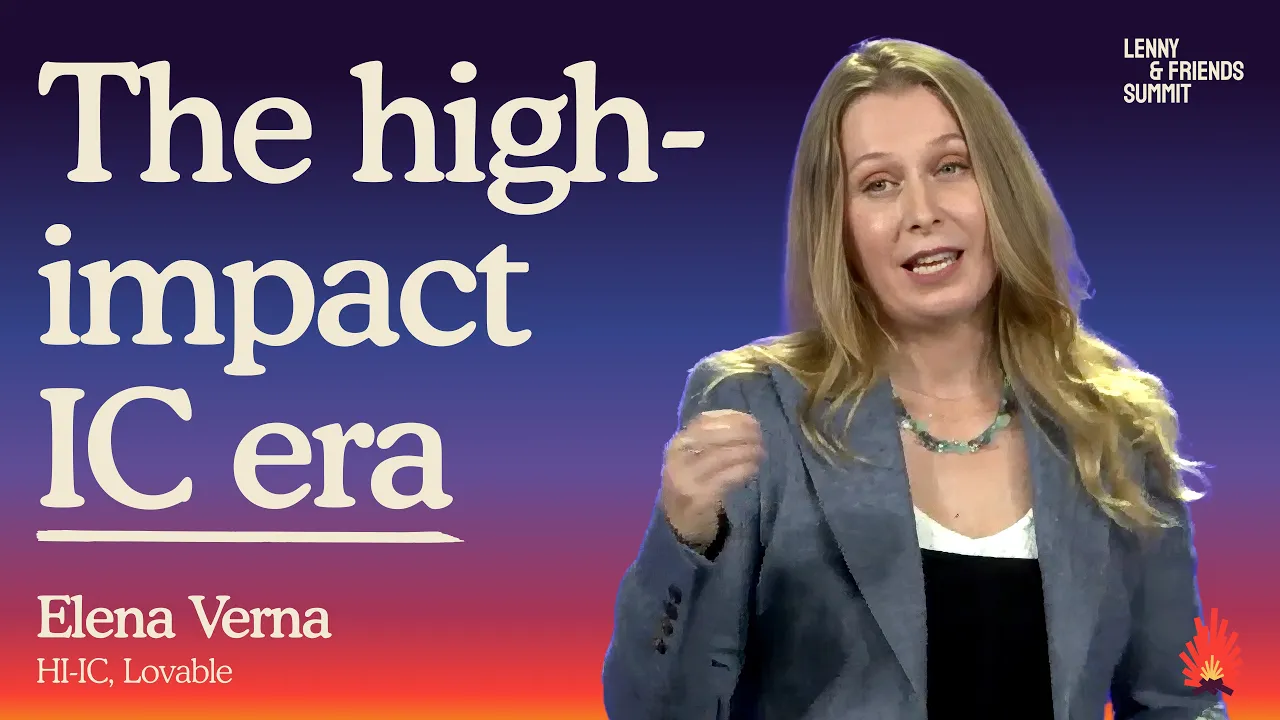
The rise of HI-ICs | Elena Verna (Lovable) — Lenny's Podcast

Lenny's Podcast

When the cost of building falls below the cost of coordinating, companies must decouple pay from headcount and let experienced builders operate as solo high-impact individual contributors.

AI-assisted summary of The rise of HI-ICs | Elena Verna (Lovable) — original source. Check the original for full context.

Source published:

Key ideas

  • The traditional correlation between headcount and business impact is breaking down, giving rise to the High-Impact IC (HI-IC)—an operator who uses AI to autonomously find problems, execute across functions, and ship solutions directly to production. (2:15)
  • As AI dramatically lowers the cost of building below the cost of coordination, companies must redesign their organizational structures to replace protracted alignment meetings with rapid, solo execution. (4:21)
  • A survey of 51 active people managers revealed that 42 would privately prefer returning to an individual contributor role if compensation and career prestige remained intact. (14:55)
  • To enable high-leverage ICs, organizations must decouple pay from team size and ungate information, granting individual builders autonomous decision-making authority and leadership-level compensation. (12:14)

Detailed notes

## Background Published on YouTube by Lenny's Podcast on September 28, 2026, and recorded live at the Lenny and Friends Summit in San Francisco, this talk features Elena Verna reflecting on her transition from growth leader to individual contributor at Lovable. The talk explores how AI enables experienced builders to take projects from problem to launch independently, arguing that companies must grant builders information, decision-making authority, and competitive compensation so management becomes a deliberate career choice rather than the default promotion.

## TL;DR Elena Verna introduces the rise of the High-Impact IC (HI-IC)—experienced professionals who leverage AI as 'Average Intelligence' to independently identify problems, execute cross-functionally, and ship directly to production. Drawing on her own transition from managing large teams to working as a solo operator at Lovable, she demonstrates that the cost of building has dropped well below the cost of cross-functional coordination. To make this model succeed, companies must overhaul their organizational operating systems by dismantling information gatekeeping, granting true authority to fail, and decoupling executive-level compensation from headcount. Ultimately, she advocates restructuring tech careers so talented craftspeople no longer feel pressured into administrative management just to gain status and pay.

## Atmosphere & style The presentation is candid, irreverent, and energetic, balancing sharp organizational analysis with self-effacing vulnerability about mourning the status of managerial titles. Verna moves seamlessly from punchy humor—such as rebranding AI as 'Average Intelligence' and comparing IC work to the instant gratification of power washing—to an earnest reckoning with corporate identity crises. The atmosphere feels like a refreshing, cathartic wake-up call for burnt-out leaders, blending practical operating playbooks with an empowering invitation to return to the joy of building.

## Bulletin - [02:15](https://www.youtube.com/watch?v=fn8wnmpVqeI&t=135s) The traditional correlation between headcount and business impact is breaking down, giving rise to the High-Impact IC (HI-IC)—an operator who uses AI to autonomously find problems, execute across functions, and ship solutions directly to production. - [04:21](https://www.youtube.com/watch?v=fn8wnmpVqeI&t=261s) As AI dramatically lowers the cost of building below the cost of coordination, companies must redesign their organizational structures to replace protracted alignment meetings with rapid, solo execution. - [14:55](https://www.youtube.com/watch?v=fn8wnmpVqeI&t=895s) A survey of 51 active people managers revealed that 42 would privately prefer returning to an individual contributor role if compensation and career prestige remained intact. - [12:14](https://www.youtube.com/watch?v=fn8wnmpVqeI&t=734s) To enable high-leverage ICs, organizations must decouple pay from team size and ungate information, granting individual builders autonomous decision-making authority and leadership-level compensation.

## Key takeaways - [02:15](https://www.youtube.com/watch?v=fn8wnmpVqeI&t=135s) The legacy corporate ladder relied on headcount as the primary metric of career progression, forcing top craftspeople into management simply to advance their careers. - [02:15](https://www.youtube.com/watch?v=fn8wnmpVqeI&t=135s) A High-Impact IC (HI-IC) differs from a traditional staff engineer by taking broad, cross-functional ownership of an entire team's charter, from ideation through deployment and outcome iteration. - [04:21](https://www.youtube.com/watch?v=fn8wnmpVqeI&t=261s) Current AI functions as 'Average Intelligence,' giving solo operators baseline design, analysis, marketing, and engineering capabilities so they only need deep expertise in one or two domains. - [04:21](https://www.youtube.com/watch?v=fn8wnmpVqeI&t=261s) When the cost of building falls below the cost of coordinating, organizations must redesign their hierarchy and workflows rather than layering AI tools onto legacy processes. - [06:38](https://www.youtube.com/watch?v=fn8wnmpVqeI&t=398s) Transitioning back from leadership to an IC role often triggers an identity crisis because industry status and professional worth have historically been tied to title and team size. - [10:22](https://www.youtube.com/watch?v=fn8wnmpVqeI&t=622s) Operating as an HI-IC offers direct, immediate gratification akin to power washing, shifting daily time from endless alignment meetings to roughly 90% active building. - [12:14](https://www.youtube.com/watch?v=fn8wnmpVqeI&t=734s) For high-leverage ICs to succeed, companies must dismantle gatekept information layers, using tools like context-trained Slack agents to let builders self-serve knowledge instantly. - [12:14](https://www.youtube.com/watch?v=fn8wnmpVqeI&t=734s) HI-ICs require executive-level decision-making authority, including the psychological safety to run multi-million-dollar failed experiments if the resulting learnings benefit the business. - [12:14](https://www.youtube.com/watch?v=fn8wnmpVqeI&t=734s) When building and experimenting become cheap with AI, protracted approval chains become the most expensive bottleneck in the company. - [14:55](https://www.youtube.com/watch?v=fn8wnmpVqeI&t=895s) Compensation must be decoupled from headcount, ensuring elite ICs receive leadership-grade pay so employees do not default into people management purely for financial advancement. - [14:55](https://www.youtube.com/watch?v=fn8wnmpVqeI&t=895s) Hybrid roles that attempt to split attention between people management and hands-on building create severe context-switching overhead and should be avoided. - [17:17](https://www.youtube.com/watch?v=fn8wnmpVqeI&t=1037s) Management should be treated as an intentional, specialized career track rather than the mandatory default promotion for skilled craftspeople.

## Detailed walkthrough ### [00:06](https://www.youtube.com/watch?v=fn8wnmpVqeI&t=6s) From Leading Hundreds to Individual Contributor at Lovable

Elena Verna opens by noting that while she usually speaks about product-led growth, product-led sales, and how to grow a company, today she wants to talk about how to grow your career. Eight months ago, her own career took a sharp turn, and two months ago she "nearly got canceled" for writing a post predicting how jobs will change over the next 12 months. Having previously led large teams—sometimes hundreds of people—she is now an individual contributor (IC) at Lovable, which she calls "the best career journey that I've ever taken."

Verna jokes that she has "survived at the company for almost a year and a half," surpassing her original goal of making it to one year, so it is "clear sailing at this point." She initially built the growth function at Lovable, then "got fired out of leading that growth function" and became an IC while the company experimented with the decentralized growth model that "every company has to try." Now, Lovable is rebuilding a dedicated growth function right alongside her, yet Verna is choosing to stay an IC. Instead of spending her days in meetings and "cross-functional collaboration hell," she spends her time actually building—a refreshing, if turbulent, return to craft for someone who, like many leaders, was only pushed into people management because it was the default way to graduate to the next career level.

[02:15](https://www.youtube.com/watch?v=fn8wnmpVqeI&t=135s) The Broken Career Ladder and the Rise of the HI-IC

Historically, the corporate career ladder was built on an old constraint: the more impact you wanted to have, the more people you needed underneath you. The standard progression—IC to manager, director, and VP—operated on a single currency: headcount. Verna recalls interviewing at Netflix about 15 years ago and getting rejected solely because of how many people she had managed in the past. Even as a lifelong Netflix subscriber, she admits, "I'm still resentful to this moment," because she has never believed impact should be judged by team size. Today, that old equation is finally breaking; impact is now defined by how much you can ship.

This shift has given rise to what Verna calls the **High-Impact IC (HI-IC)**. She emphasizes that an HI-IC is *not* merely a senior employee without direct reports, nor is it the traditional engineering "staff IC" focused on narrow technical architecture. Instead, an HI-IC combines deep expertise with broad cross-functional execution and business accountability—taking on what would have been an entire team's charter five or ten years ago.

- **What defines a High-Impact IC:** - Finds the problem independently. - Makes the decision on how to solve it. - Executes on their own across all required functions. - Ships the solution to production. - Owns the outcome and iterates based on results.

[04:21](https://www.youtube.com/watch?v=fn8wnmpVqeI&t=261s) AI as "Average Intelligence" and When Building Beats Coordinating

What makes the HI-IC suddenly possible is AI—which Verna jokingly defines on her slide as **"Average Intelligence."** While AGI may arrive someday, she argues that having an average marketer, average engineer, average analyst, and average designer at your fingertips right now is already superpower enough ("sometimes better than some of the other teams that I had," she quips). An individual only needs exceptional craft in one or two areas and can rely on AI for "good enough everywhere else" to get a product to the point of learning from real customer feedback and reactions.

```mermaid flowchart TD accTitle: Old Coordination Process vs. New AI-Enabled Flow subgraph Old["Traditional Process (3+ Months)"] direction LR O1["Idea Meeting & PM"] --> O2["Designer & Meeting"] --> O3["Engineer & Review"] --> O4["Approval & Ship"] end subgraph New["HI-IC Process with AI"] direction LR N1["Have an Idea"] --> N2["Build It"] --> N3["Learn from Customers"] end Old -.->|"Replaced by"| New ```

Previously, shipping required an idea meeting, a PM, a designer, another meeting, an engineer, a review, an approval, and a hundred hidden steps taking three months if you were lucky. Now, Verna lives in Lovable all day long—using it to ship to production, build her presentation deck, ideate, and manage her calendar and email (though she admits email is her worst skill). She delivers a central thesis for leaders: **"When the cost of building falls below the cost of coordinating, the org chart should change."** Becoming "AI native" is only the tooling half of the equation; companies that fail to redesign their organizations underneath those tools are missing the biggest systemic shift happening today.

[06:38](https://www.youtube.com/watch?v=fn8wnmpVqeI&t=398s) Mourning the Management Title and Rebuilding as a Solo Operator

Verna candidly admits she did not proactively craft this transition: "In reality, I got fired out of my job. I didn't get fired out of the company. I got fired out of the responsibilities that I was doing before." At Lovable, where reorgs happen every couple of weeks and everyone's job shifts every three to four months, her own role has already changed three times in a year and three months. Likening the AI wave to the Industrial Revolution, she argues that constant adaptation is mandatory. Even so, losing her management role was emotionally jarring because, over two decades in the industry, her identity had inadvertently become attached to her title and team size.

For the first couple of weeks as an IC, she wrestled with an identity crisis: "Did I just get promoted and get the best of both worlds, or did I just lose my status? Did I just lose additional opportunities in the future that I'll have coming towards me?" Having no team initially felt like being less important, until she saw the continuous impact she could still drive. She urges leaders to shake up their attachment to job titles—especially since everyone's day-to-day work will change over the next year—and to allow themselves time to "mourn that ladder that you were climbing that you thought was the end goal." For those who rose to leadership because they were great at their craft rather than because they loved managing large teams, the HI-IC path offers a way to keep influence, status, and even greater impact.

- **Elena's current solo scope (Pricing and Packaging at Lovable):** - Builds and updates the pricing page directly. - Builds prototypes and deploys changes to production herself. - Conducts her own user research, data analysis, and optimizations. - Collaborates with engineers only on larger pricing-model changes that require deeper architectural work.

[10:22](https://www.youtube.com/watch?v=fn8wnmpVqeI&t=622s) Returning to the Craft: The Power Washing Analogy and the HI-IC Reality

Transitioning back to being an individual contributor brings a visceral, immediate satisfaction that is almost entirely absent in traditional tech management. Elena compares the feeling to her favorite pastime: power washing. In tech, professionals are accustomed to chasing long-horizon outcomes that can take quarters or years to materialize, whereas power washing offers that oddly satisfying instant gratification of blasting away grime to reveal a completely clean slate. Operating as a High-Impact IC (HI-IC) delivers that exact sensation: features and ideas go directly into customers' hands the moment they are pushed, completely bypassing the endless cross-functional dependencies, alignment meetings, and roadmapping delays that plague management life.

```mermaid flowchart LR accTitle: The HI-IC Feedback Loop accDescr: Flow diagram showing how HI-ICs focus 90 percent of their time on building and shipping directly to customers compared to management overhead. subgraph HI_IC["HI-IC Workflow (90% Build Time)"] A["Idea & Craft Roots"] --> B["Build & Iterate"] B --> C["Ship Direct to Customer"] C --> D["Immediate Feedback"] end subgraph Traditional["Old Management Loop"] E["Meeting Calendar"] --> F["Cross-Team Alignment"] F --> G["Gated Approvals"] end ```

Ninety percent of Elena's working time is now spent actively building or strategizing what to build next, anchoring her back to her craft roots. While leading large organizations had its own thrill, the reality was days consumed by meeting calendars that stole time away from doing what was actually right for the business and the customer. However, companies cannot simply declare people to be ICs overnight. Becoming an impactful HI-IC requires treating the IC track not as a mere job title, but as an entirely different organizational operating system governed by five essential conditions.

---

[12:14](https://www.youtube.com/watch?v=fn8wnmpVqeI&t=734s) Ungating Information and Distributing Authority

The foremost requirement for an HI-IC to succeed is complete, frictionless access to information. Standard corporate organizational design is intentionally built to gate information behind management tiers, with successive layers filtering and sanitizing context before it ever trickles down to individual builders. For high-leverage ICs to make correct decisions quickly, those gates must be dismantled in favor of radical transparency and fewer management layers. At Lovable, conventional hierarchies have been stripped down: there are no managers, directors, or VPs whose titles dictate who wins an argument or who commands the room; there are only individual contributors, leads, and department heads. To keep information flowing seamlessly across teams without endless sync meetings, Lovable deploys dedicated Slack agents trained by designated team "parents" so anyone can query another team’s context or documentation instantly.

Equally critical is ensuring that authority travels hand-in-hand with accountability. An experienced builder cannot function if every decision must be shuttled five levels up and down an approval chain. Elena sits directly on the executive team despite being an IC, possessing the autonomous authority to decide, ship, and fail. Meaningful failure is accepted as the price of speed; Elena openly acknowledges running failed experiments at Lovable that cost millions of dollars in potential revenue, yet were celebrated because the resulting insights unlocked critical future growth.

- **Information flow over hierarchy:** Eliminating the "highest paid person's opinion" (HiPPO) dynamic by putting builders directly in touch with data and context. - **AI-driven internal transparency:** Teams use Slack agents trained on their specific documentation so cross-team inquiries can be handled immediately by an agent rather than via scheduled meetings. - **Authority to fail:** High-leverage ICs require the runway to make multi-million-dollar mistakes without organizational panic, so long as the learnings propagate across the company. - **Flexible scope across functional boundaries:** Work cannot be pigeonholed into a single domain; an IC might tackle core product engineering, bounce over to growth product, or dive into marketing depending on where leverage lies. - **Cheap experiments vs. expensive approvals:** "When experiments are cheap, approval chains are the expensive part." If testing an idea is cheaper than debating it, default to shipping.

---

[14:55](https://www.youtube.com/watch?v=fn8wnmpVqeI&t=895s) Decoupling Compensation and Headcount: Management as a Choice

The traditional corporate ladder forces high performers into management solely because pay and prestige remain stubbornly tied to headcount. If companies genuinely believe in the productivity multiplication promised by AI, ICs should arguably earn more than traditional managers because individual builders can now generate far greater direct business outcomes. In her own transition, Elena retained her executive compensation tier, underscoring that companies must be willing to pay leadership-level salaries if they expect leadership-level results from ICs. Without this parity, employees rationally migrate into management, inevitably creating an ecosystem littered with ineffective managers who never actually wanted to lead people in the first place.

```mermaid flowchart TD accTitle: Decoupling Impact from Headcount accDescr: Diagram illustrating the shift from traditional headcount-driven promotions to craft-driven high-impact compensation paths. subgraph OldModel["Legacy Corporate Ladder"] M1["Craft Excellence"] --> M2["Pushed to Management"] M2 --> M3["Larger Headcount"] M3 --> M4["Higher Status & Pay"] end subgraph NewModel["HI-IC Operating Model"] I1["Craft Excellence + AI"] --> I2["Direct Business Impact"] I2 --> I3["Leadership-Level Pay"] I2 --> I4["Autonomous Authority"] end ```

Elena highlights a survey she conducted revealing that 42 out of 51 active people managers privately wished they could return to an individual contributor role. Furthermore, because day-to-day IC work looks radically different today than it did five or ten years ago, stepping back into the craft is the only way future leaders can understand what a single person is capable of producing with modern AI tooling. Trying to straddle both roles simultaneously is an exhausting trap; switching between managing a team and executing as an IC carries massive context-switching overhead that few can sustain. Organizations must let people choose whether to scale through teams or scale through themselves.

- **Survey findings:** 42 out of 51 people managers surveyed preferred returning to an IC role if given the opportunity. - **Equal pay and status:** Leadership-grade salaries must be awarded to ICs to break the financial incentive that creates reluctant, poor-performing managers. - **Avoid hybrid split roles:** Attempting to run a team while simultaneously writing code or building creates paralyzing context shifts; individuals must commit to either people management or pure execution.

---

[17:17](https://www.youtube.com/watch?v=fn8wnmpVqeI&t=1037s) Separating Impact from Headcount

The most transformative consequence of AI on organizations is not the sensationalized fear of wiping out human jobs, but the profound decoupling of business impact from headcount. Historically, corporations systematically pulled their most talented craftspeople away from what made them extraordinary, forcing them up administrative management ladders. AI provides the leverage that allows these veterans to apply their hard-earned strategic leadership, domain expertise, and taste directly to the craft itself, driving company-defining outcomes as solo operators.

Elena closes with an urgent challenge for workers to audit their daily energy. If running teams, managing calendars, and steering headcount brings genuine fulfillment, leaders should stay the course. But for the vast numbers of managers who feel depleted, trapped in endless meetings, and disconnected from the joy of building, the rise of AI presents a rare historical window to reclaim their craft. Ultimately, the corporate paradigm must permanently shift so that "management needs to be a career path, not a promotion."

## Notable quotes > [04:21](https://www.youtube.com/watch?v=fn8wnmpVqeI&t=261s) When the cost of building falls below the cost of coordinating, the org chart should change. — Elena Verna

> [06:38](https://www.youtube.com/watch?v=fn8wnmpVqeI&t=398s) In reality, I got fired out of my job. I didn't get fired out of the company. I got fired out of the responsibilities that I was doing before. — Elena Verna

> [06:38](https://www.youtube.com/watch?v=fn8wnmpVqeI&t=398s) Did I just get promoted and get the best of both worlds, or did I just lose my status? Did I just lose additional opportunities in the future that I'll have coming towards me? — Elena Verna

> [12:14](https://www.youtube.com/watch?v=fn8wnmpVqeI&t=734s) When experiments are cheap, approval chains are the expensive part. — Elena Verna

> [17:17](https://www.youtube.com/watch?v=fn8wnmpVqeI&t=1037s) management needs to be a career path, not a promotion. — Elena Verna

> [00:06](https://www.youtube.com/watch?v=fn8wnmpVqeI&t=6s) the best career journey that I've ever taken. — Elena Verna

> [00:06](https://www.youtube.com/watch?v=fn8wnmpVqeI&t=6s) survived at the company for almost a year and a half — Elena Verna

> [06:38](https://www.youtube.com/watch?v=fn8wnmpVqeI&t=398s) mourn that ladder that you were climbing that you thought was the end goal. — Elena Verna

## Mentioned Elena Verna, Lovable, Lenny's Podcast, Netflix, Slack

## Video description What if growing your career no longer meant managing a larger team? At the Lenny and Friends Summit, Elena Verna shares how her move from leading growth at Lovable to working as an individual contributor brought her back to building, with AI helping her take ideas from problem to launch. She argues that companies need to give experienced builders access to information, authority to make decisions, and pay that reflects their impact—so management can be a career choice rather than the default promotion.

Recorded live at Lenny and Friends Summit on September 10, 2026, in San Francisco.

[Source](https://www.youtube.com/watch?v=fn8wnmpVqeI)

中文简报

Lovable增长高管Elena Verna放弃管理转向独立AI工作 当构建成本低于协调成本时,企业必须将薪酬与团队规模脱钩,允许经验丰富的构建者作为高影响力独立贡献者单打独斗。 Elena Verna提出了“高影响力独立贡献者”(HI-IC)的兴起——这类经验丰富的专业人士将AI作为“平均智能”加以利用,独立发现问题、跨职能执行并直接向生产环境交付成果。结合自己从管理庞大团队转向在Lovable担任独立操作者的经历,她指出构建成本已远低于跨职能协调的成本。为了让这种模式取得成功,企业必须彻底革新其组织操作系统,打破信息壁垒,赋予真正的试错权,并将高管级别的薪酬与团队人数脱钩。最终,她主张重构科技行业的职业路径,让有才华的专业人才不再仅仅为了获得地位和薪酬而被迫转向行政管理工作。 团队人数与业务影响力之间的传统关联正在瓦解,这催生了高影响力独立贡献者(HI-IC)——一种利用AI自主发现问题、跨职能执行并将解决方案直接交付至生产环境的操作者。 (2:15) 随着AI将构建成本大幅降至协调成本以下,企业必须重新设计组织架构,以快速的个人独立执行取代旷日持久的协调拉齐会议。 (4:21) 对51名现任人员管理者的调查显示,如果有保障薪酬和职业声誉不变,其中42人私下更愿意重返独立贡献者角色。 (14:55) 为赋能高杠杆的独立贡献者,组织必须将薪酬与团队规模脱钩并开放信息流动,赋予一线构建者自主决策权以及领导力级别的薪酬待遇。 (12:14)

Reading summary

Elena Verna argues that the rise of AI tools is breaking the corporate convention that equates business impact with headcount, enabling senior operators to drive company-level outcomes as 'High-Impact Individual Contributors' (HI-ICs). To capitalize on this shift, she contends that companies must fundamentally redesign organizational structures, ungate information, and offer leadership-level compensation to solo builders. Redefining Impact Away from Headcount (2:15) Historically, corporate hierarchies treated people management as the default mechanism for career advancement, evaluating a leader's organizational clout by the number of direct reports they oversaw. Verna recalls being rejected during a Netflix interview roughly 15 years ago solely for lacking sufficient past headcount, exemplifying a system that incentivized craftspeople to pursue administrative management rather than execution. In contrast, modern tooling allows impact to be measured by shipping velocity and direct business outcomes rather than team size. This dynamic enables the High-Impact Individual Contributor (HI-IC), a role distinct from traditional engineering staff ICs who concentrate narrowly on technical architecture. Verna defines an HI-IC as an autonomous operator who independently identifies problems, determines solutions, executes across multiple functional domains, deploys directly to production, and remains accountable for the ultimate business metric. AI as Leverage Over Cross-Functional Coordination (4:21) Verna posits that organizational design must adapt when the cost of building falls below the cost of coordinating across teams. Traditional development cycles routinely required three or more months to navigate iterative planning meetings, product managers, designers, engineering reviews, and multi-tier approval chains. By viewing current AI models as 'average intelligence'—providing competent, baseline capabilities across design, copywriting, data analysis, and basic coding—a solo operator with deep expertise in one or two domains can independently advance work to the point of customer validation. In her current role managing pricing and packaging at Lovable, Verna operates without direct reports, spending roughly 90 percent of her working time building or planning upcoming work. Rather than coordinating across functional silos, she directly creates and tests pricing page prototypes, conducts user research, executes quantitative analyses, and deploys updates to production, reserving engineering collaboration primarily for structural architectural changes. Organizational Prerequisites: Transparency and Distributed Authority (12:14) For high-leverage ICs to succeed, organizations cannot simply alter job titles; they must dismantle the structural gates that traditionally control information flow through middle management. Lovable operates without standard manager, director, or VP titles, relying instead on individual contributors, leads, and department heads. To preserve context without relying on recurring sync meetings, teams train custom Slack agents on internal documentation, enabling builders to query cross-team information on demand. Equally critical is pairing individual execution with genuine executive authority. Verna notes that while she operates as an IC, she maintains a seat on the executive team with the autonomy to ship without consensus committees. She points out that when experimentation becomes inexpensive, approval chains become the primary bottleneck. Under this model, failure is accepted as a cost of speed; Verna acknowledges launching failed experiments at Lovable that cost millions in potential revenue, yet were deemed worthwhile because the resulting data informed strategic growth. Decoupling Compensation to Make Management a Choice (14:55) Because executive pay and prestige have historically been pegged to headcounts, high-performing craftspeople often feel financially coerced into people management. Verna argues that companies must pay top ICs compensation equivalent to executive tiers to end this misaligned incentive. In an informal survey conducted by Verna, 42 out of 51 active people managers privately reported that they would prefer to return to an individual contributor role if given the opportunity. Verna warns against attempting hybrid roles that combine team management with direct building, arguing that the context-switching overhead inevitably compromises execution quality. Instead, companies must recognize management as a dedicated, specialized career path rather than the standard reward for craft excellence, allowing individuals to decide whether they prefer scaling impact through organizational administration or through individual execution. Verna frames the transition to high-impact individual contribution as an unresolved cultural and emotional adjustment for leaders whose identities remain tethered to corporate ladders and team sizes. While AI tooling reduces the technical barriers to solo execution, companies still face the operational challenge of establishing transparent governance and equitable compensation paths that prevent solo builders from burning out or retreating into conventional management structures.

Source quotes

[4:21] Elena Verna: When the cost of building falls below the cost of coordinating, the org chart should change. [6:38] Elena Verna: In reality, I got fired out of my job. I didn't get fired out of the company. I got fired out of the responsibilities that I was doing before. [6:38] Elena Verna: Did I just get promoted and get the best of both worlds, or did I just lose my status? Did I just lose additional opportunities in the future that I'll have coming towards me? [12:14] Elena Verna: When experiments are cheap, approval chains are the expensive part. [17:17] Elena Verna: management needs to be a career path, not a promotion. [0:06] Elena Verna: the best career journey that I've ever taken. [0:06] Elena Verna: survived at the company for almost a year and a half [6:38] Elena Verna: mourn that ladder that you were climbing that you thought was the end goal.

Original transcript

[0:06] I'm going to be talking today about [0:07] something different. Usually I talk [0:09] about product led growth, product led [0:11] sales, and how to grow your company. [0:14] Today I'd like to talk to you about how [0:16] to grow your career. You're all [0:18] incredible leaders already in this [0:19] place, but my career has taken a turn [0:23] for something different about 8 months [0:25] ago. [0:26] And I've been writing about it more and [0:28] more. And 2 months ago I nearly got [0:31] canceled for writing a post about how [0:34] our jobs are going to change in the next [0:37] 12 months. And I wanted to speak a [0:41] little bit more about how that journey [0:42] has been for me. I've been a leader at [0:45] many teams that were mentioned before. [0:48] I've led hundreds of peoples in some of [0:50] those teams. And now I'm an individual [0:52] contributor at Lovable. And it has been [0:55] the best career journey that I've ever [0:57] taken. I want to tell you about why I [1:00] decided to do it. I want to tell you [1:02] what needs to be true in organization to [1:04] do it. And I want to challenge you to [1:06] think about whether this is a right [1:08] position for you. So, as I said, my name [1:10] is Elena Verna. I lead growth at [1:12] Lovable. I've survived at the company [1:14] for almost a year and a half. It's been [1:16] amazing. My goal was to make it a year. [1:18] So, I'm like clear sailing at this [1:20] point. But I built a growth function at [1:22] Lovable. Then I got fired out of leading [1:25] that growth function, where I became an [1:27] IC. And we tried the decentral ized [1:30] model that every company has to try with [1:32] growth. And now we're rebuilding the [1:34] function, but I'm staying as an IC. So, [1:37] that is being built separately next to [1:38] me on the side. And most of my time now [1:41] is not spent in those meetings, [1:45] cross-functional collaboration hell. And [1:48] it's actually spent building. And [1:51] there's something really special about [1:53] that. Especially with so many of us that [1:55] got to a leadership levels because we [1:58] were so good at our craft, yet the path [2:02] to graduate to the next level has meant [2:04] people management. At least that has [2:06] meant for me, and I've been conditioned [2:08] so much about it that going back to it [2:11] has been um really turbulent journey, [2:13] but very refreshing as well. But let's [2:15] talk about how our careers have been [2:17] built in the past and what is changing [2:19] right now. The ladder was built with an [2:21] old constraint that more impact that you [2:24] can have equals more people underneath [2:26] you. [2:27] Does anybody feel that that was true? [2:30] Yeah. [2:31] So, we were all shooting to become a [2:34] manager. Managing people was important. [2:36] I still remember I was uh doing an [2:39] interview with Netflix maybe 15 years [2:43] ago, and I got rejected out of the [2:45] process because of how many people I [2:48] managed in the past. And that one I love [2:51] Netflix. I'm a life lifelong subscriber, [2:54] but it's that's dearly um [2:56] I'm still resentful to this moment [2:58] because [2:59] I don't think and I've never felt that [3:01] it impact should be judged by how many [3:04] people you manage, and especially now [3:06] that equation is breaking. Because we [3:08] used to think about it more reports [3:10] equals more impact, so you think about [3:12] IC manager director VP is a career [3:14] ladder that you had to commit to, but [3:17] there's only one currency in it is how [3:19] many reports do you have. However, right [3:21] now things are changing in how much you [3:23] ship or how much you can ship, that's [3:25] how much impact you can drive. So, [3:27] equation is breaking, which is what I [3:29] and use the term of high impact IC, [3:33] which is high impact individual [3:35] contributor, but it's not a senior [3:37] person with no direct reports. I want to [3:38] be very clear on that. It is the person [3:41] that is able to find problem, make a [3:44] decision, execute. This is important. [3:47] Execute on their own across all of the [3:49] different functions that require to get [3:51] to that outcome, ship it, and own the [3:54] outcome in iterating out of that. That's [3:56] a whole team's charter. If you think [3:59] about 5 10 years ago, now an individual [4:02] can do it all. Because we used to think [4:05] that the deep expertise and the staff IC [4:08] role meant a narrow functional focus, [4:11] and engineers have always had staff ICs, [4:14] and that was like usually an [4:15] architecture-driven, [4:16] but now high C it's a deep expertise [4:19] with broad execution of service and [4:21] business accountability. So, why is this [4:23] suddenly possible? Some people don't [4:25] like the next slide. I apologize in [4:27] advance, but I actually think of AI as [4:30] average intelligence. I'm sure you will [4:32] get into AGI world someday, but for now, [4:36] it's still super powerful to have at [4:38] your fingertips an average marketer, an [4:40] average engineer, an average analyst, an [4:43] average designer. Honestly, I don't know [4:45] how about you, but sometimes better than [4:47] some of the other teams that I had, but [4:49] it's incredible to like really get to [4:52] the point where I know what I needs to [4:54] get done, and I have this average [4:56] intelligence at my fingertips of all of [4:58] the specialties in that I need to have [5:00] it done. So, only one or two areas of [5:02] exceptional craft are needed, and then [5:04] the good enough everywhere else to get [5:06] it to the point where you can learn. [5:08] Because remember, everything that we're [5:09] doing is not because we know what to do, [5:12] and not because we know how good or [5:14] correct looks like, it's because we need [5:17] to learn, and we need to see our [5:19] customer feedback, and we need to see [5:20] their reaction in order to understand [5:22] what the next step is. So, before we had [5:25] an idea meeting, a PM, a designer, a [5:27] meeting, an engineer, a review, an [5:28] approval, and a ship, and this is a very [5:30] shortened process of what it used to be [5:32] before, because let's face it, there are [5:34] probably a hundred more steps along that [5:37] line with a 3-months, if you're lucky, [5:40] period of where you can accomplish it, [5:42] versus now you can just have an idea, [5:44] you can build it, and you can learn. I [5:46] live in lovable all day long with ship [5:48] to production through Lovable. I create [5:50] this deck. With Lovable, I do all of my [5:53] ideation. With Lovable, I do my [5:55] calendar, my email, everything [5:57] management with Lovable. Email is [5:59] probably my worst, but it's okay. When [6:01] the cost of building [6:03] falls below the cost of coordinating, [6:08] the org chart [6:09] should change. [6:11] So, my question to you is as we're all [6:13] talking about this being AI piled. We're [6:15] talking about being AI native. That's [6:18] only tooling portion of it. Are you [6:20] changing your organizational design [6:22] underneath you in order to take [6:24] advantage of all of those skills? In [6:26] order to take advantage of the people [6:28] utilizing those tools? Because if you [6:31] don't, you're actually not taking [6:33] advantage of the biggest change that is [6:36] happening in our system right now. And [6:38] let me tell you how I became one. As I [6:40] said, I would love to say that it was [6:43] very well crafted and I asked for it. In [6:45] reality, I got fired out of my job. I [6:48] didn't get fired out of the company. I [6:50] got fired out of the responsibilities [6:52] that I was doing before. And at Lovable, [6:55] my job has already changed three times [6:58] in the last year and three months. And I [7:00] know it's going to change again. And [7:02] that's okay because every single time I [7:05] do what's best contributes to the [7:07] business and to our customers. And I'm [7:09] staying flexible and everybody's job is [7:11] changing every three to four months. At [7:13] Lovable, we have reworks that are every [7:15] couple weeks. The only constant is [7:19] change. Because we're living through the [7:21] era that some categorize as a similar to [7:24] industrial revolution. [7:26] Well, if you're going through that type [7:28] of change with AI revolution, whatever [7:31] you want to call it, then you have to [7:33] adjust to it. Because if you're not [7:35] changing, that means you're not taking [7:36] advantage of it or you're not going [7:38] along with the time. So, I got fired out [7:41] of my [7:42] the management position. I became an IC, [7:45] and let me tell you just first hand, [7:48] that was not an easy [7:51] path because so much of my identity was [7:54] tied to that title and knowing that I'm [7:57] managing my team. I didn't want it to be [8:00] related to it, but inadvertently over [8:03] the last two decades that I've been in [8:05] the field, it became attached to it. So, [8:09] at the beginning for about a couple of [8:11] weeks, I thought, well, did I just get [8:14] promoted and get the best of both [8:16] worlds, or did I just lose my status? [8:19] Did I just lose additional opportunities [8:21] in the future that I'll have coming [8:23] towards me? So, no team felt like almost [8:27] like less important until I saw the [8:30] continuous impact that I can continue [8:32] doing in the organization, but the [8:33] decades of conditioning are hard to [8:35] shake off. I want to acknowledge it [8:38] because so many of our identities are [8:40] wrapped up in our titles at work because [8:44] we spend so much time at work compared [8:48] to doing anything else in our lives that [8:51] it's actually kind of good to shake it [8:52] up sometimes. So, you don't have such a [8:55] strong connection to what you're doing, [8:57] especially in the next year or so when [9:00] all of our jobs are going to change. [9:02] You're not going to lose a position in [9:03] your company, but what you're doing is [9:05] going to change. I don't know how about [9:07] you, but everything that I'm doing today [9:09] day today is completely different from [9:11] versus what I do in the say 5 years ago [9:14] or 10 years ago. And I welcome that [9:16] change. Honestly, I think it's [9:17] interesting again, and it's exciting, [9:20] but it is hard on your identity, and it [9:23] does take some time to mourn that ladder [9:26] that you were climbing that you thought [9:28] was the end goal, but if you realize [9:31] that at the top of that ladder is not [9:33] something that is riveting to you, that [9:36] is not something that you're really [9:37] really good at managing large teams and [9:39] cross-functional collaboration because [9:42] you were good at your craft, then maybe [9:44] this is a better path and AI can help [9:47] you continue keeping the influence and [9:50] the status and even get more impact and [9:53] potentially you had when you were [9:54] leading teams. So, I used to need a PM, [9:57] designers, engineers, and a lot of [9:59] calendar time in order to get things [10:00] done. Now, I build things myself. And [10:03] I'm responsible for pricing and [10:05] packaging in our company. So, I build [10:07] and change pricing page, I build [10:09] prototypes, I deploy to production [10:11] myself, I do the user research, I do the [10:14] analysis, I do all of the optimizations, [10:16] and then I collaborate with our [10:17] engineers in some of the bigger model [10:19] changes that require deeper uh deeper [10:22] engineering work, but I'm kind of [10:24] responsible for it all myself. And [10:26] there's something so exciting about it. [10:29] I don't know how about you all. We're [10:30] all working tech and we all have these [10:32] really long outcomes that we're going [10:35] after. I like, for example, in my spare [10:37] time, I love power washing. It is so [10:40] satisfactory. Like, oddly satisfactory [10:43] to just like see that clean slate. And [10:45] to me, this is becoming an IC also so [10:48] satisfactory because I can see what I'm [10:50] doing back into customers' hands almost [10:53] immediately when I'm ready to put to [10:55] push it. There's no this [10:57] cross-functional dependency that is [10:58] happening. And 90% of my time is either [11:02] building or thinking about what to build [11:04] next. That is so exciting. I'm back to [11:06] my craft roots. And yes, it was exciting [11:09] to run a team, but being stuck in the [11:11] meetings all day long and waiting on [11:13] some team's prioritization in order to [11:15] get it done is no more in my day. And by [11:18] the way, it's so easy to also just fall [11:20] into the rhythm of being having your [11:22] time being stolen away by the meetings [11:25] that are placed on your calendar versus [11:27] actually taking time to do what's right [11:29] for the business and to be do what's [11:30] right for the customer. But, you can't [11:32] just declare people to be ICs. [11:35] When I transitioned, I really quickly [11:38] realized that there are constraints in [11:40] the system that had to be true in order [11:41] for me to still feel satisfied in my [11:44] role and in order for me to still be as [11:45] impactful as I wanted to be. So, IC is [11:48] not just a job title, it is an [11:50] organizational operating system. And you [11:52] need to be careful with that because [11:53] there's five things that I believe that [11:55] needs to be true on your team in order [11:58] for you to be able to either transition [12:00] yourself into an individual contributor [12:02] role and love it, or in order for you to [12:06] hire other VPs or chiefs, whatever it is [12:09] of the titles that people had as an ICs [12:12] in your team. So, I really urge you to [12:14] look at these. So, number one, and this [12:17] is the most important one. The only way [12:19] that I can still be impactful is if I [12:21] have all of the information at my [12:23] fingertips in order to make the right [12:25] decision. However, our organizational [12:27] designs currently gate information by [12:31] design. You have all of these layers of [12:33] people filtering information down to [12:35] individual contributors. Well, that can [12:37] be no more. You have to trust your [12:40] people. You have to trust your employees [12:42] and you have to flow that information [12:43] through. Now, obviously, [12:46] that requires fewer management layers. [12:49] So, at Lovable, we don't have titles. We [12:51] just have individual contributors, we [12:53] have leads, and then we have heads of [12:55] the department. But, there's no [12:56] managers, there's no directors, there's [12:58] no such thing as a VP walking into the [13:00] room and everybody has to listen. Or the [13:03] highest paid or opinion that it wins. [13:06] There's no such thing. Everybody is on [13:07] the same level with just a higher just a [13:10] really high level of who is if there's [13:12] an issue should it ladder up to. In [13:15] order to scale it, we have agents that [13:16] live in Slack and each team has their [13:19] own agent, and each agent has a mom or a [13:22] dad or parents that are training that [13:25] agent. And if you have any questions [13:27] about that teams, [13:29] what they're doing, or any documentation [13:31] that you need, you can just just discuss [13:32] it with an agent. So, there's very [13:34] important path here of accessibility to [13:36] information as well. Then, the authority [13:38] has to travel with accountability. If [13:41] I'm going to be a high C, I'm not going [13:43] to be okay if I have to travel a [13:45] decision five times up and down in order [13:47] to get anything done. So, team has to [13:50] trust me. Executive team has to trust [13:52] me. I actually still sit on the [13:54] executive team, even though I'm an [13:56] individual contributor. But, I have an [13:58] ability to decide, to ship, and most [14:00] importantly, to fail. And guess what? I [14:02] failed many times at Lovable. From the [14:05] outside, it might look up up and to the [14:07] right, but I've cost Lovable many [14:08] millions of dollars in my failed [14:10] experiments, but we've learned such an [14:12] important information out of them that [14:14] it helped us unlock more growth as a [14:15] result. But, we allow everybody to have [14:18] meaningful failures that yes, do impact [14:20] revenue, and nobody freaks out about it [14:23] as long as there's learning that can be [14:24] propagated through. And then, the scope [14:26] isn't defined by function. So, I'm not [14:28] just doing growth. Sometimes, I show I [14:30] ship core features. Sometimes, I get [14:33] involved in marketing. Sometimes, I go [14:35] do back my growth product stuff. So, [14:37] it's kind of all of it. But, remember, [14:41] one does not simply own it, and it needs [14:43] exec's approval. So, if it's cheaper to [14:45] try than to debate, make sure that when [14:48] experiments are cheap, approval chains [14:50] are the expensive part. So, really think [14:53] about organizing your team this way, as [14:55] well as decoupling pay and status from [14:57] headcount. This one is important. It is [14:59] so ingrained in us that if we want to [15:01] get more pay, we have to get promoted to [15:03] manager, to director, to VP. When I [15:05] moved into my high C, I did not have a [15:07] change in my pay grade. In fact, I [15:11] believe that if we truly believe into [15:13] this AI change that is happening in all [15:15] of our lives, then ICs should get paid [15:18] more than managers, because as an IC, [15:21] you can drive more outcome and impact [15:24] than a manager in the old system. So, [15:26] otherwise everybody rationally becomes [15:28] manager and there's managers everywhere [15:30] and most importantly there's lots of [15:31] terrible managers everywhere cuz um all [15:34] of us had one through our career. [15:37] Uh we're not going to name any names, [15:39] but a lot of those people never wanted [15:41] to be a manager either. They were pushed [15:44] into that ladder and maybe for once we [15:46] don't have to do that anymore. And most [15:49] importantly, I actually ran a survey and [15:51] we saw I saw that 42 out of 51 people [15:54] managers actually wanted to go back into [15:56] IC role. I actually think that I don't [15:59] know how I can be an effective manager [16:01] if I don't know how IC work looks [16:03] anymore. And IC work now looks so [16:06] different versus what it looked like 5 [16:07] to 10 years ago. I feel like I need to [16:10] experience it in order to be an [16:12] effective manager in the future. So, I [16:14] love to take this opportunity to [16:16] actually learn what one person could do. [16:19] So, if I am going to lead team in the [16:21] future, I can direct them appropriately. [16:23] But money and status has to be equal and [16:27] that's important because that's why most [16:28] of us go into the manager because we [16:30] still want to get paid. Let's not forget [16:32] we're in a capitalism world and we're [16:34] not doing this for free. And if you want [16:37] to attract those people, be expected to [16:40] actually pay them those leadership level [16:42] salaries. But do expect a leadership [16:45] level outcomes out of them as well. [16:46] Don't ask people to do both. [16:49] Uh we actually I've tried to do both and [16:51] I see and a lot of people say, "Oh, I [16:53] love getting back to my IC roots while [16:55] I'm still running a team." That's a huge [16:56] context shift that is really difficult [16:58] to manage. So, some people can do it and [17:01] I applaud you if you're one of those [17:03] people. Overall, it's very difficult. [17:05] You're either a manager or you [17:06] individual contributor and you can do a [17:08] lot of context changes in your [17:10] individual role and then you can do a [17:11] lot of context changes in your manager [17:13] role, but switching between the two is [17:15] just becomes nearly impossible. So, you [17:17] have to pick a path. And um [17:20] really think about scaling through [17:22] yourself as opposed to scaling through [17:24] people because it's it's a change in [17:26] mentality of how we do things. And um we [17:29] have to rewire our brains a little bit. [17:31] But, this has been a never more great [17:34] opportunity in time for you to go back [17:38] to your craft if craft is what you were [17:41] great at. If craft was the reason that [17:44] you got promoted to where you are right [17:46] now. Because how silly is it that we [17:50] take people out of the roles that [17:52] they're really good at [17:54] in order to move up the ladder in [17:55] corporation. And now you can go back and [17:58] you can still exercise all of the [18:00] leadership qualities that you've learned [18:02] and you hard earned, but doing it as an [18:04] individual contributor. So, I think the [18:06] AI's most interesting effect on [18:08] organization is not replacing job, no [18:12] matter how sensational those headlines [18:14] are and how many impressions um they [18:16] drive for people who [18:19] just want to make waves. I think it's [18:21] separating impact from head count. And I [18:25] urge you all to think about that for [18:27] yourself because right now is the [18:29] opportunity in time for you to [18:31] potentially to go back, for you to [18:34] continue having the impact, for you to [18:37] love what you do every single day. So, [18:40] take a hard look at your job. [18:42] Do you really love it? Do you really [18:44] love how you're spending your [18:45] day-to-day? Does that give you energy? [18:47] If yes, keep going. This presentation is [18:50] not for you. But, I've talked to too [18:53] many people that feel the drain, that [18:56] don't feel the energy, that don't love [18:58] where they are. And AI is presenting an [19:01] incredible opportunity for us to find a [19:03] career yet again that gives us that [19:06] energy. [19:08] So, [19:09] management [19:11] needs to be a career path, [19:13] not a promotion. [19:17] Thank you all. [19:18] >> [applause]