Atlassian Pushes PMs Into Code as AI Agents Triple Delivery Speeds
Lenny's Podcast
Artificial intelligence will expand rather than replace product management roles because automated context engines eliminate administrative drudgery, freeing PMs to either write code directly or steer engineering pipelines.
AI-assisted summary of Roles aren't converging—they're expanding | Tamar Yehoshua (Atlassian CPO) — original source. Check the original for full context.
Source published:
Key ideas
- Product roles are expanding rather than converging: AI tools grant PMs, designers, and engineers broader functional reach, while leaving the core PM responsibility of discovering product-market fit and customer value unchanged. (2:04)
- Atlassian balances PM technical involvement using a 'rowing vs. steering' framework, allowing non-coding PMs to check in frontend PRs in safe environments while stepping back to steer when engineering bandwidth is staffed. (5:24)
- Jira accelerated development throughput threefold and shipped 22 features in 10 weeks across its 20-year legacy codebase by pairing Loom specs, cloud-managed coding agents, and agentic customer feedback triage. (12:24)
- Instead of replacing staff with AI-native hires, Atlassian upskills its product organization through a 5-level AI Fluency Index and quarterly AI Builder Weeks, engaging over 1,000 employees to build 120+ internal workflows. (17:00)
Detailed notes
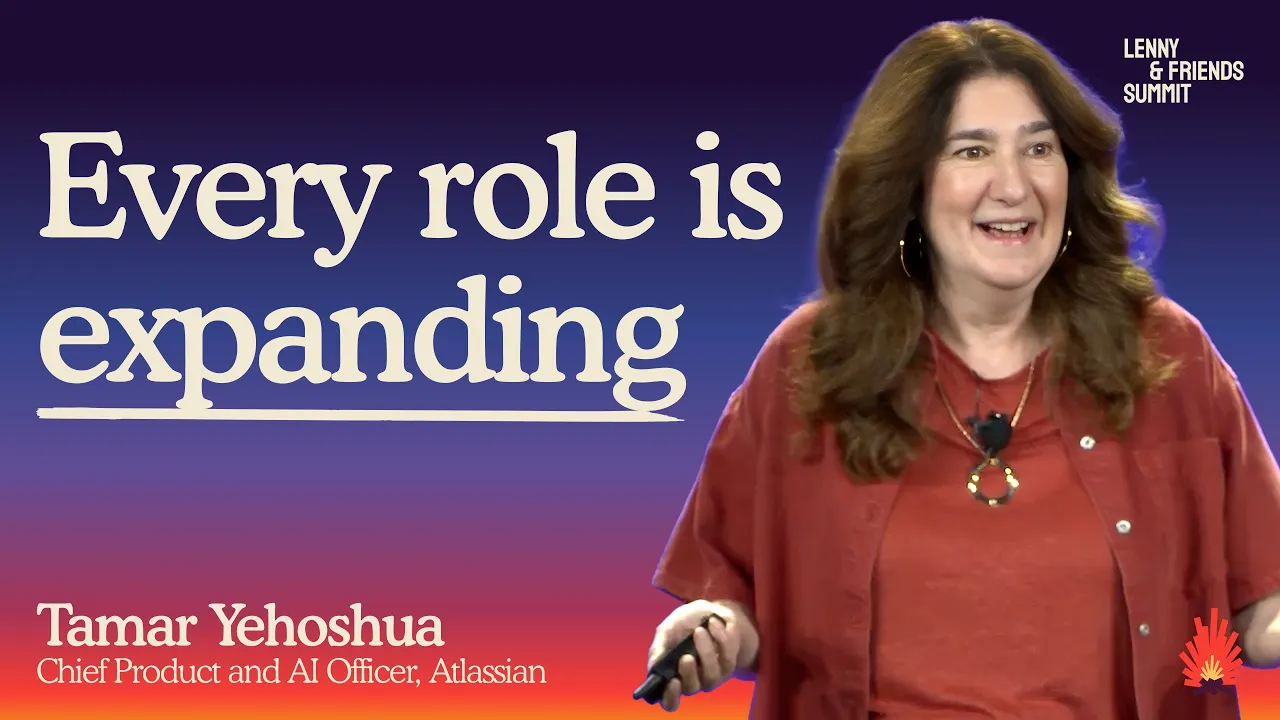
## Background Published on YouTube by Lenny's Podcast on September 28, 2026, this keynote features Atlassian Chief Product Officer Tamar Yehoshua speaking live at the Lenny and Friends Summit. The presentation explores what the "AI builder" era looks like for product managers within large enterprises, drawing on case studies from Confluence, Jira, and new greenfield initiatives to illustrate when PMs should write code or prototypes versus when they should focus on steering the team.
## TL;DR Yehoshua argues that rather than collapsing or replacing specialized roles, AI is expanding the reach and leverage of product managers while leaving their core mission—finding product-market fit and delivering customer value—intact. Using case studies from Confluence, the 0-to-1 project Rovoclaw, and Jira's legacy codebase, she illustrates the dynamic balance between "rowing" (hands-on prototyping and code commits) and "steering" (unblocking engineers, synthesizing user feedback, and setting priorities). She details how Atlassian equips enterprise teams with organizational context via the Teamwork Graph and upskills PMs through an AI Fluency Index and hands-on Builder Weeks. Ultimately, she offers an optimistic outlook, declaring that AI makes this the most exciting era in history to be a product manager.
## Atmosphere & style The presentation carries a pragmatic, energetic, and candid keynote tone, trading early industry panic over AI job displacement for real-world, in-the-trenches execution. Yehoshua speaks directly and humorously with the audience of product leaders, sharing unvarnished anecdotes about CEO DMs, messy vibe-coding experiments, and the unsolved complexities of measuring developer productivity. The talk feels reassuring and grounded, transforming abstract hype around autonomous agents into actionable operational wisdom for modern enterprise builders.
## Bulletin - [02:04](https://www.youtube.com/watch?v=BtK4kFI1LNo&t=124s) Product roles are expanding rather than converging: AI tools grant PMs, designers, and engineers broader functional reach, while leaving the core PM responsibility of discovering product-market fit and customer value unchanged. - [05:24](https://www.youtube.com/watch?v=BtK4kFI1LNo&t=324s) Atlassian balances PM technical involvement using a 'rowing vs. steering' framework, allowing non-coding PMs to check in frontend PRs in safe environments while stepping back to steer when engineering bandwidth is staffed. - [12:24](https://www.youtube.com/watch?v=BtK4kFI1LNo&t=744s) Jira accelerated development throughput threefold and shipped 22 features in 10 weeks across its 20-year legacy codebase by pairing Loom specs, cloud-managed coding agents, and agentic customer feedback triage. - [17:00](https://www.youtube.com/watch?v=BtK4kFI1LNo&t=1020s) Instead of replacing staff with AI-native hires, Atlassian upskills its product organization through a 5-level AI Fluency Index and quarterly AI Builder Weeks, engaging over 1,000 employees to build 120+ internal workflows.
## Key takeaways - [00:06](https://www.youtube.com/watch?v=BtK4kFI1LNo&t=6s) Reciprocal panic regarding AI replacing engineers, designers, or product managers has transitioned into the era of the multi-disciplinary 'AI builder'. - [02:04](https://www.youtube.com/watch?v=BtK4kFI1LNo&t=124s) The fundamental mission of product management—validating product-market fit, delighting users, and creating commercially viable software—remains completely unchanged in the AI era. - [02:04](https://www.youtube.com/watch?v=BtK4kFI1LNo&t=124s) PMs should filter out widespread social media hype and anchor their adoption of AI tooling strictly to demonstrable customer outcomes. - [02:04](https://www.youtube.com/watch?v=BtK4kFI1LNo&t=124s) Organizational context graphs and internal AI tools like Rovo eliminate manual PM administrative overhead by automating status queries and cross-functional updates. - [02:04](https://www.youtube.com/watch?v=BtK4kFI1LNo&t=124s) The critical operational decision for a modern PM is knowing when to 'row' by directly building artifacts versus when to 'steer' by clarifying direction and unblocking the team. - [05:24](https://www.youtube.com/watch?v=BtK4kFI1LNo&t=324s) In Confluence, a non-technical PM shipped 26 production pull requests in a month within a sandboxed frontend harness, resolving UI polish and compressing delivery from six months to six weeks. - [05:24](https://www.youtube.com/watch?v=BtK4kFI1LNo&t=324s) Systematic evaluations (evals) and prompt regression monitoring have become essential operational responsibilities owned jointly by PMs and engineers. - [10:10](https://www.youtube.com/watch?v=BtK4kFI1LNo&t=610s) In 0-to-1 greenfield products like Rovoclaw, PMs can bootstrap functional prototypes alongside designers, but must actively disengage from coding once dedicated engineers join to avoid misalignment. - [12:24](https://www.youtube.com/watch?v=BtK4kFI1LNo&t=744s) Legacy, compliance-heavy enterprise codebases require guardrails against PM production commits, shifting focus instead toward cloud-managed agents that scaffold design-compliant prototypes. - [12:24](https://www.youtube.com/watch?v=BtK4kFI1LNo&t=744s) Agentic workflows can automate feedback loops by categorizing internal bug reports from Slack and synthesizing qualitative customer research across hundreds of video interviews. - [16:18](https://www.youtube.com/watch?v=BtK4kFI1LNo&t=978s) Manual management drudgery such as drafting weekly status updates, building presentation slides, and transcribing research is being replaced by autonomous agents. - [17:00](https://www.youtube.com/watch?v=BtK4kFI1LNo&t=1020s) Atlassian's AI Fluency Index maps six core technical proficiencies across five competency tiers as an educational skill-acquisition guide rather than a performance evaluation ladder. - [17:00](https://www.youtube.com/watch?v=BtK4kFI1LNo&t=1020s) Quarterly AI Builder Weeks combine industry keynotes, peer workshops, and applied capstones to upskill cross-functional teams in prototyping, evals, and agent design. - [17:00](https://www.youtube.com/watch?v=BtK4kFI1LNo&t=1020s) Measuring AI impact requires moving away from vanity metrics like lines of code toward production deployment rates, end-to-end cycle times, and overarching OKRs. - [20:30](https://www.youtube.com/watch?v=BtK4kFI1LNo&t=1230s) Evaluating productivity requires tracking both micro-level team velocity and macro-level organizational throughput through continuous quarterly experimentation. - [20:30](https://www.youtube.com/watch?v=BtK4kFI1LNo&t=1230s) Product management roles are expanding rather than disappearing, positioning current practitioners for higher leverage and long-term durability over the coming decade.
## Detailed walkthrough ### [00:06](https://www.youtube.com/watch?v=BtK4kFI1LNo&t=6s) From Job Replacement Paranoia to the Era of the AI Builder
Addressing a packed room at the Lenny and Friends Summit, Tamar Yehoshua opened by marveling at the sheer density of product leaders gathered in one space—noting that with many in the audience, she had spent the past year or two in continuous debate over the evolving definition of product management. Looking back just twelve to twenty-four months, the tech landscape was gripped by reciprocal panic. Engineers, designers, and PMs were all nervously pointing fingers at each other's crafts and declaring, "Your job is going to go away." Thankfully, that apocalyptic anxiety has subsided, giving way to a much more constructive reality: disciplines are overlapping, and the era of the "AI builder" has taken center stage.
In startups, on X, and across tech podcasts, this builder archetype has become a tangible job title. Early-stage startups are increasingly skipping dedicated PM or designer hires in favor of multi-faceted builders who wear every hat—a dynamic that, as Yehoshua pointed out, has always been the natural state of early founders. But while this agile, boundaryless dynamic works seamlessly in a five- or ten-person startup, product leaders inside enterprise environments often scratch their heads wondering how the model translates when your company employs more than 10,000 people. Inside Atlassian, where engineering teams are already heavily augmented with coding agents and automated refactoring, the fundamental question centers on what this transformation means for product management.
[02:04](https://www.youtube.com/watch?v=BtK4kFI1LNo&t=124s) Acceleration, Context, and the "Rowing vs. Steering" Dilemma
Yehoshua emphasized that roles are not merely converging—they are expanding. When empowered by modern tooling, individuals across every function can accomplish vastly more than before. Yet, the foundational purpose of a product manager remains entirely untouched: discovering product-market fit, building software users genuinely love, and creating a viable business that customers are willing to pay for. What has changed is purely *how* that work gets executed. To PMs overwhelmed by the relentless wave of new AI releases, her practical advice was blunt: you cannot keep up with everything, so "everything that you read on X, don't believe." Instead, filter out the noise by anchoring strictly to what delivers demonstrable value to customers.
```mermaid flowchart LR accTitle: The Acceleration Equation accDescr: Visual representation of how model intelligence combines with organizational context to accelerate team velocity, framed by the PM choice of rowing versus steering.
subgraph Inputs["The Velocity Inputs"] A["Model Intelligence<br/>(LLMs & Coding Agents)"] B["Teamwork Graph<br/>(Organizational Context)"] end
subgraph Core["Acceleration Engine"] C["Combined Context & AI"] D{"PM Focus:<br/>Rowing or Steering?"} end
subgraph Outcome["Outcome"] E["Faster Delivery to Destination"] end
A --> C B --> C C --> D D --> E ```
At the same time, organizational context has become an enterprise superpower. With Atlassian's "Teamwork Graph", internal tools now surface institutional context that previously lived in scattered documents or human memory. This eliminates traditional PM operational overhead like chasing status updates, manually recording meeting notes, or relaying launch dates to go-to-market teams. To illustrate the shift, Yehoshua shared a recent anecdote involving Atlassian co-founder and co-CEO Mike Cannon-Brookes:
> "The other day, last week, Mike, our CEO, DM'd me and one of the product leads and says, 'When is some feature launching?' Five minutes later, he sent a screenshot of Rovo, which is Atlassian's AI product, and said, 'This is what Rovo said. Is it right?' We're like, 'Yeah.' And he said, 'Sorry, I wasted your time.'"
Freeing PMs from information gatekeeping allows them to focus on team acceleration. Atlassian frames this through a nautical metaphor: your product team is a ship trying to reach its destination faster through the pairing of model intelligence and organizational context. The critical operational question for every PM is: **Are you rowing, or are you steering?** Through internal experimentation, Atlassian discovered that the answer is not dogmatic; it depends entirely on the product type and lifecycle stage.
- **Core PM Mission:** Discovering product-market fit, delighting customers, and ensuring monetization remain identical to previous eras. - **Enterprise Context:** Tools like Rovo and the Teamwork Graph automate cross-functional status tracking, removing PM administrative friction. - **Acceleration Metric:** Speed gains stem from combining raw model intelligence with deep organizational context.
[05:24](https://www.youtube.com/watch?v=BtK4kFI1LNo&t=324s) Case Study 1: Confluence, Code Commits, and Automated Design Fixes
The first concrete operational archetype is adding new AI capabilities into an existing codebase, exemplified by Confluence's recent launches: **Remix with Rovo** (allowing users to highlight text and instantly transform it into alternative formats) and **Confluence Slides** (converting standard Confluence pages into finished presentation decks with a single click). Rather than treating these as standard feature tickets, the Confluence team treated them as an experiment in radical workflow transformation within a mature, compliant enterprise environment.
The most striking shift occurred when the feature's product manager, Ya, began directly checking in production code. Despite having zero prior coding experience and having never opened a terminal, she partnered with an engineering lead who set up a sandboxed frontend harness for her. Ya ended up shipping 26 pull requests in a single month—exceeding the output of most software engineers on the team. When Yehoshua asked why she took this on, Ya explained that the user interface had countless minor polish items that engineering lacked the bandwidth to address; by jumping into the frontend herself, she freed the engineers to concentrate on deeper technical architecture.
Beyond PM-driven PRs, the team overhauled multiple operational bottlenecks: - **Systematic Evaluations (Evals):** Evals became a core PM responsibility. The PMs partnered closely with engineering to codify target output quality, doubling eval throughput (a 2x increase). They also leveraged the Arize platform for observability and debugging, diagnosing prompt regressions directly before routing fixes to engineers. - **Automated Design Bug Resolution:** The team integrated Figma MCP (Model Context Protocol) to map design tokens directly to the codebase, pairing it with an autonomous coding agent to reconcile design discrepancies. This system resolved approximately 14 visual bugs per hour without manual design-engineering back-and-forth. - **Automated Test Generation:** Engineering leveraged AI tooling to slash the time required to write a test suite from half a day down to just 10 minutes. - **Cycle Time Reduction:** While enterprise compliance and security usually mandate extensive cycles, Remix launched in 6 weeks and Confluence Slides launched in 8 weeks—work that historically required roughly 6 months—while supporting far tighter customer beta feedback loops.
In this scenario, the PM actively chose to **row**. Supported by an engineering manager who isolated her work in a safe repository branch, the team deliberately blurred craft boundaries from day one to maximize velocity.
[10:10](https://www.youtube.com/watch?v=BtK4kFI1LNo&t=610s) Shifting from Rowing to Steering: The 0-to-1 Journey of Rovoclaw
Tamar Yehoshua highlights a greenfield project called Rovoclaw to illustrate how the product manager's role evolves across different phases of development. Unlike an existing feature built inside Atlassian's AI product, Rovo, Rovoclaw was conceived as a true "zero-to-one project from the ground up." It began with just two people: a product manager named Josh and a designer named Kevin. The duo essentially "vibe coded the whole thing" from soup to nuts, hacking together a working alpha that internal customers at Atlassian immediately began using. Once they validated that they were genuinely onto something, engineers were officially staffed onto the project. At first, the dynamic stayed scrappy—Josh and Kevin continued checking in code right alongside the newly assigned engineering team.
Before long, Josh noticed a concerning friction: because he was so buried in writing code himself, the engineers were beginning to veer off track. He had to stop and ask himself: "Wait a minute, should I be spending my time coding? Is this actually the highest leverage activity that I could be doing?" Josh made the conscious decision to pull back from the codebase and return to foundational PM work: setting direction, establishing priorities, and clearing road-blocks. As soon as he stepped back into steering, the entire project accelerated. The time Josh had spent in the trenches writing code paid massive dividends—he had direct empathy for the codebase, intimately understood the team's technical blockers, and could guide the product with far higher precision.
At the same time, Josh leaned heavily on AI to eliminate routine managerial overhead. Yehoshua quips to the audience: "I hope most of you are not writing weekly reports by hand anymore. And if you are, you probably don't want to admit it, but please go and build an agent to do it." Taking that advice to heart, Josh built an agent directly inside Rovoclaw that wrote weekly status reports about itself, which Yehoshua notes were "super amusing." In this 0-to-1 scenario, the PM started out "rowing" by slinging code to bootstrap the product, but deliberately transitioned to "steering" once leverage shifted toward unblocking engineers.
- **Initial builders**: Josh (PM) and Kevin (Designer), who vibe coded an internal alpha from scratch before adding dedicated engineers. - **Strategic pivot**: Moving from active code contributions to high-leverage steering (unblocking, prioritizing, and aligning the engineering team). - **Self-reporting agent**: Josh configured an agent within Rovoclaw that automated weekly project status updates on its own progress.
---
[12:24](https://www.youtube.com/watch?v=BtK4kFI1LNo&t=744s) Modernizing Jira: Accelerating a 20-Year Legacy Codebase with AI
Bringing AI into a mature enterprise application is an entirely different operational beast. Jira has been around for over two decades, spanning a massive, intricate codebase that transitioned from on-premise Data Center to the cloud, while supporting isolated cloud instances, FedRAMP compliance, and extensive bespoke customizations for hundreds of thousands of enterprises. In a critical environment where breaking production is unacceptable, having PMs check code into production is "kind of dangerous," so Atlassian prohibited it. Instead, the challenge was transforming Jira into an "AI-first" experience—reinventing the software development lifecycle so users can seamlessly assign work to autonomous agents and interact with AI across every Jira workflow.
Despite the structural constraints of a legacy codebase, the Jira team achieved dramatic velocity gains. From "in progress" to "shipped," their development throughput increased roughly 3x, successfully shipping 22 user-facing features in just 10 weeks. They achieved this by overhauling prototyping and automated triage:
```mermaid flowchart TD accTitle: Jira AI-Driven Prototyping and Feedback Workflow accDescr: Flowchart illustrating how Loom recordings, cloud coding agents, and Slack or JSM triage loops accelerate delivery in Jira.
subgraph Prototyping ["1. Spec to Reusable Prototype"] A["PM records Loom video<br/>(UI idea, Figma, voiceover)"] --> B["Loom auto-generates<br/>Jira work items"] B --> C["Move item to 'In Progress'"] C --> D["Cloud-managed coding agent<br/>generates frontend code"] D --> E["Accessible, design-compliant<br/>prototype in shared repo"] end
subgraph InternalTriage ["2. Internal Feedback Loop"] F["Bugs & feedback submitted<br/>in internal Slack channels"] --> G["Jira Slack Agent triages<br/>and categorizes issues"] G --> H["Dispatched to coding agent<br/>for automated fixes"] end
subgraph ExternalInsights ["3. External Customer Feedback"] I["900+ user study videos<br/>ingested via Jira Service Management"] --> J["Rovo Agent triages & extracts<br/>actionable feature insights"] J --> K["Engineers unblocked<br/>with clean requirements"] end
E --> K H --> K ```
Prototyping became far more rigorous than throwaway mockups. A PM records a Loom video capturing proposed UI changes, walking through Figma screens with a spoken track, or brainstorming concepts. Loom automatically extracts work items and populates them into Jira. When the PM moves an item to "In Progress," it immediately triggers a managed coding agent running in the cloud. The agent writes code directly into the actual front-end repository—sparing PMs the headache of maintaining complex local development environments—while adhering strictly to Atlassian design system components and accessibility standards. Because the prototype lives in the real repository, handoffs to production engineers require virtually zero rework.
Handling the flood of internal and external feedback was streamlined through similar agentic pipelines. Internally, when Atlassian employees test Jira changes, feedback and bug reports funneling through Slack are automatically categorized by a Jira Slack agent and routed straight to coding agents for automated patching. Externally, during user research, the team used Jira Service Management and a Rovo agent to ingest and analyze customer video sessions across more than 900 discrete pieces of feedback. The agentic categorization proved surprisingly high quality, allowing PMs to focus entirely on steering the ship, synthesizing user needs, and feeding clean, actionable context to engineers without writing production code.
- **Scale and compliance constraints**: 20+ year-old codebase supporting cloud, Data Center, FedRAMP, and isolated enterprise tenants. - **Velocity metrics**: 3x improvement in throughput from in-progress to shipped, delivering 22 customer-facing features within 10 weeks. - **Managed cloud agents**: Coding agents scaffold UI prototypes in the real front-end repository, pre-configured with Atlassian's design language and accessibility guardrails. - **Multi-channel triage**: Jira Slack agent routed bugs directly to coding agents; Rovo agents synthesized over 900 user-testing feedback items in Jira Service Management.
---
[16:18](https://www.youtube.com/watch?v=BtK4kFI1LNo&t=978s) What PMs Do (and Don't Do) in the AI Era
Reflecting on these operating shifts, Yehoshua outlines how the product management discipline is structurally transforming. Rather than roles collapsing or homogenizing, PM responsibilities are expanding into areas that make teams move faster, supported by foundational infrastructure like the Atlassian Teamwork Graph, which provides AI models with the underlying organizational context of teams, projects, and goals.
PMs are actively taking on new tasks: - **Prototyping and testing**: Rapidly generating functional prototypes and validating them before engineering commits cycles. - **Writing evals**: Designing evaluation benchmarks to systematically grade model outputs and prompt efficacy. - **Deep customer feedback analysis**: Consuming and synthesizing qualitative customer insights at volumes previously impossible to parse manually. - **Accelerated context ingestion**: Digesting massive streams of cross-functional documentation and research in fraction of the time.
Conversely, manual operational drudgery has fallen away. PMs are no longer writing status updates by hand, manually compiling raw research findings, or building slide presentations from scratch. Yehoshua candidly adds with a smile: "I would love to say that there are no synchronous meetings, but that would be an exaggeration... but there are, I believe, fewer synchronous meetings."
---
[17:00](https://www.youtube.com/watch?v=BtK4kFI1LNo&t=1020s) The AI Fluency Index and AI Builder Weeks
While venture-backed startups often advise large companies to simply "hire people that are AI native," Yehoshua rejects that playbook for established organizations. Atlassian already employs exceptional PMs; the strategic imperative is upskilling them to become AI native. To give the team clear developmental milestones, Atlassian created the **AI Fluency Index**.
The index tracks six core capabilities, ranging from understanding tool stacks and authoring model evals to automating data insights, rapid prototyping, and general technical literacy. Fluency is scored across a five-point scale:
| Level | Designation | Description | |:--- |:--- |:--- | | **Level 1** | **Curious** | Exploring tools and experimenting with foundational AI capabilities. | | **Level 3** | **Capable** | Baseline competency expected of all PMs across all six capabilities over time. | | **Level 5** | **Pioneering** | Advanced mastery; PMs spike here based on specific team needs and project leverage. |
Yehoshua emphasizes that the Fluency Index is explicitly **not** a performance ladder: "The ladder is about outcomes and what you produce for your customer. This is helping PMs understand the skills that they should be attaining."
To turn that framework into practice, Atlassian established quarterly **AI Builder Weeks**. During these dedicated sprints, PMs and product designers step away from their day-to-day roadmaps to focus exclusively on technical skill acquisition. Each week follows a structured rhythm: 1. **External inspiration**: Keynotes from industry practitioners (including a shout-out to guest speaker Claire). 2. **Peer-led coaching**: Advanced internal PMs who have already mastered a specific workflow teach workshops to upskill colleagues. 3. **Hands-on capstone projects**: Participants team up to build functioning tools, workflows, or automations using newly acquired techniques.
The program has scaled across the company with major impact: over 1,000 employees have participated, producing more than 120 production workflows that teams continue to use daily. Each edition zeroes in on a single thematic discipline: the first focused on prototyping, the second on writing evals, the third on building agents, and the most recent on checking in code. Atlassian has open-sourced this curriculum as an "AI Builder Week in a Box" on its website for external teams.
When asked by enterprise customers how Atlassian measures the ultimate impact of these AI initiatives, Yehoshua admits candidly: "I'll be honest, we haven't figured it out. I don't think anyone has figured it out." Measuring AI productivity runs into the age-old dilemma of measuring engineering velocity. Instead of tracking superficial outputs like pull requests written, Atlassian looks at PRs deployed to production, cycle times from initial concept to customer delivery, feature usage, overall team throughput, and meeting top-line OKRs.
[20:30](https://www.youtube.com/watch?v=BtK4kFI1LNo&t=1230s) Measuring Speed, Expanding Roles, and the Future of Product Management
Tracking performance and acceleration during this AI shift requires looking at productivity through multiple lenses. It is often far easier to gauge the throughput of an individual team than it is to track the velocity of an entire organization, but leaders need to monitor both: ensuring individual teams are moving faster day to day while verifying that the broader organization is accelerating as a cohesive whole. At Atlassian, this process is treated as an ongoing, active initiative. Every single quarter, teams run structured experiments across varying workflows, with leadership evaluating what concrete outcomes can be captured and measured. Rather than claiming to have solved the measurement puzzle outright, Yehoshua leaves an open door to the audience, inviting anyone with proven methods for measuring organizational throughput to share their insights.
Synthesizing the broader transformation, Yehoshua returns to her central thesis: roles across tech are not collapsing or converging into a single undifferentiated title, but rather "each role is expanding." Product managers are now empowered to reach further, doing more to execute their core responsibilities faster, more effectively, and with higher quality, all while delivering dramatically more value directly to end customers. Addressing the pervasive anxiety surrounding AI displacing knowledge workers, Yehoshua strikes an unapologetically optimistic note about the discipline's longevity. Declaring that "this is the best time in the world to be a PM," she reassures the room that PMs will still very much be here a decade from now, closing her talk by reminding the audience how fortunate they are to build products in this transformative era.
- **Dual-level measurement**: Organizations must measure productivity at both the granular team level and the macro organizational level to ensure localized speed translates into real systemic gains. - **Quarterly experimentation**: Teams continually run internal workflow experiments every quarter to test new methods and benchmark measurable outcomes. - **Role expansion over convergence**: AI does not eliminate specialized functions; instead, it expands the scope and leverage of PMs, enabling them to ship faster and elevate customer impact. - **Optimism for the discipline**: Dismissing predictions of the demise of product management, Yehoshua emphasizes that PMs will endure well over the next decade and calls the current moment the most exciting time in history to enter the craft.
## Notable quotes > [00:06](https://www.youtube.com/watch?v=BtK4kFI1LNo&t=6s) Your job is going to go away.
> [02:04](https://www.youtube.com/watch?v=BtK4kFI1LNo&t=124s) everything that you read on X, don't believe. — Tamar Yehoshua
> [02:04](https://www.youtube.com/watch?v=BtK4kFI1LNo&t=124s) The other day, last week, Mike, our CEO, DM'd me and one of the product leads and says, 'When is some feature launching?' Five minutes later, he sent a screenshot of Rovo, which is Atlassian's AI product, and said, 'This is what Rovo said. Is it right?' We're like, 'Yeah.' And he said, 'Sorry, I wasted your time.' — Tamar Yehoshua
> [10:10](https://www.youtube.com/watch?v=BtK4kFI1LNo&t=610s) Wait a minute, should I be spending my time coding? Is this actually the highest leverage activity that I could be doing? — Josh
> [10:10](https://www.youtube.com/watch?v=BtK4kFI1LNo&t=610s) I hope most of you are not writing weekly reports by hand anymore. And if you are, you probably don't want to admit it, but please go and build an agent to do it. — Tamar Yehoshua
> [16:18](https://www.youtube.com/watch?v=BtK4kFI1LNo&t=978s) I would love to say that there are no synchronous meetings, but that would be an exaggeration... but there are, I believe, fewer synchronous meetings. — Tamar Yehoshua
> [17:00](https://www.youtube.com/watch?v=BtK4kFI1LNo&t=1020s) hire people that are AI native
> [17:00](https://www.youtube.com/watch?v=BtK4kFI1LNo&t=1020s) The ladder is about outcomes and what you produce for your customer. This is helping PMs understand the skills that they should be attaining. — Tamar Yehoshua
> [17:00](https://www.youtube.com/watch?v=BtK4kFI1LNo&t=1020s) I'll be honest, we haven't figured it out. I don't think anyone has figured it out. — Tamar Yehoshua
> [20:30](https://www.youtube.com/watch?v=BtK4kFI1LNo&t=1230s) each role is expanding. — Tamar Yehoshua
> [20:30](https://www.youtube.com/watch?v=BtK4kFI1LNo&t=1230s) this is the best time in the world to be a PM — Tamar Yehoshua
## Mentioned Tamar Yehoshua, Mike Cannon-Brookes, Atlassian, Lenny and Friends Summit, Rovo, Confluence, Remix with Rovo, Confluence Slides, Rovoclaw, Jira, Jira Service Management, Teamwork Graph, AI Fluency Index, AI Builder Weeks, Arize, Figma, Loom, Slack, X, FedRAMP
## Video description What does the “AI builder” era look like for product managers inside a large company? At the Lenny and Friends Summit, Atlassian’s Tamar Yehoshua shares examples from Confluence, a new product, and Jira to show how PMs can help teams move faster. She explains when it makes sense for PMs to write code and prototypes, when they should focus on steering the team, and how Atlassian is helping them build new AI skills.
Recorded live at Lenny and Friends Summit on September 10, 2026, in San Francisco.
[Source](https://www.youtube.com/watch?v=BtK4kFI1LNo)