OpenAI Ships Imperfect Agent Harnesses to Fuel 90-Day Horizon
Lenny's Podcast
OpenAI abandons multi-year roadmaps for a 90-day model horizon and ships imperfect agent features because empirical user feedback and voice interfaces outpace traditional enterprise planning.
OpenAI product teams abandon multi-year roadmaps in favor of a 60-to-90-day planning horizon, designing specifically for where AI models will be in two to three months rather than present-day constraints. (19:25)
To rapidly gather empirical user feedback across ChatGPT's billion-plus users, OpenAI ships imperfect UI stopgaps like "the toggle" as an immediate agentic harness, accepting high code deprecation rates along the way. (0:06)
Because human psychology struggles to track dozens of independent threads, users managing swarms of specialized micro-agents inevitably place a single "chief of staff" coordinator agent on top. (7:35)
ChatGPT uses a tiered capability stack that pairs structured third-party integrations with raw Computer Use and Codex fallbacks, ensuring tasks complete the "last mile" even when APIs or plugins are missing. (12:47)
Collaborating with AI research requires PMs to become "DMable" to source granular session traces and author rigorous evaluations (evals) that prove how capabilities can be post-trained directly into base models. (18:11)
Detailed notes
## Background
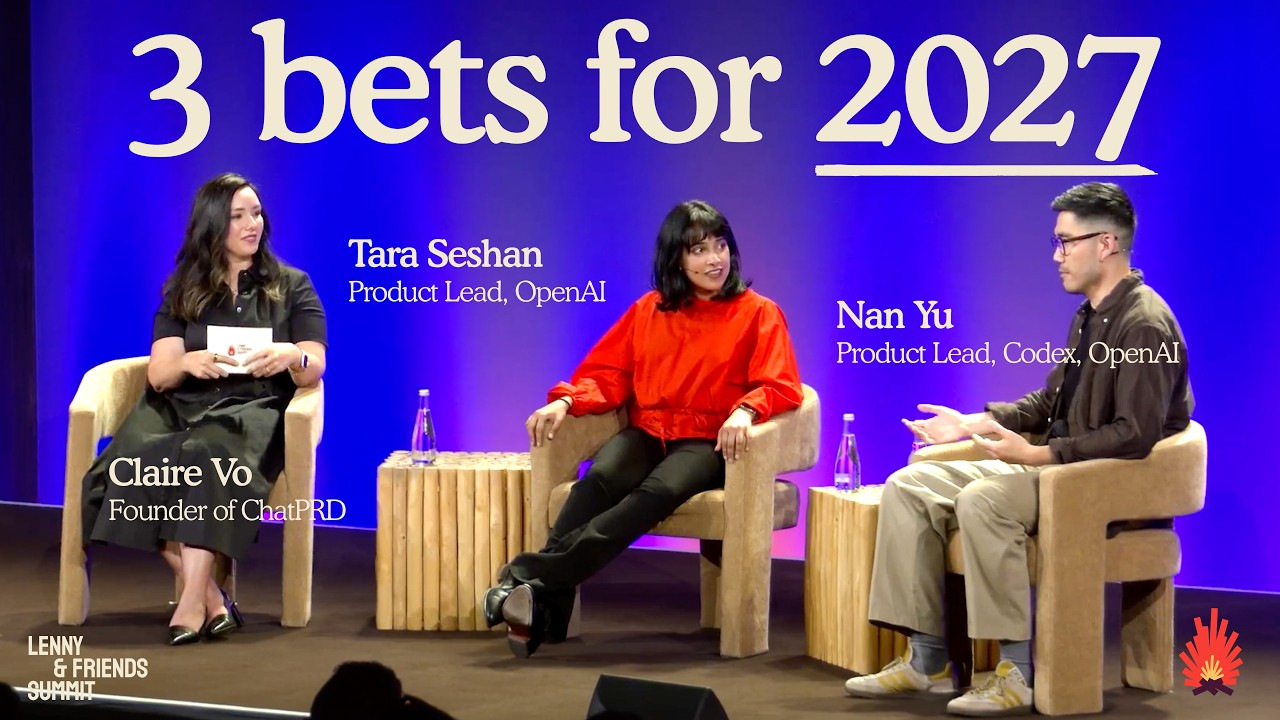
Published on YouTube by Lenny's Podcast on September 29, 2026, this panel was recorded live at the Lenny and Friends Summit in San Francisco. Moderated by Claire Vo, OpenAI product leaders Tara Seshan and Nan Yu discuss how their teams build products under rapid technological change by shipping imperfect features, setting 60-to-90-day planning horizons, and designing agents that solve the last mile for users.
## TL;DR
OpenAI product leaders Tara Seshan and Nan Yu argue against multi-year roadmaps, explaining that frontier AI teams must operate on 60-to-90-day horizons aligned with imminent model capabilities. To stay ahead of enterprise inertia and capability overhang, OpenAI ships imperfect interface harnesses like toggles and leverages layered fallbacks—from structured APIs down to Computer Use—to guarantee task completion. The speakers advocate for centralized coordinator agents matched to human cognitive bandwidth, backed by highly accessible PMs who craft rigorous evaluations from direct user failure traces. Looking forward to 2027, they predict conversational voice and proactive, self-driving software experiences will displace traditional blank input prompts and manual workflows.
## Atmosphere & style
The panel is fast-paced, unpretentious, and brimming with the witty, collegiate camaraderie of a live tech summit. Claire Vo drives the conversation with playful skepticism and sharp banter about constant app updates and desk companions, while Seshan and Yu provide grounded, humorous admissions about shipping imperfect software and adjusting to research-driven lab cultures. The exchange feels less like polished corporate PR and more like an authentic, high-speed debrief among seasoned builders wrestling with the messy daily friction of frontier technology.
## Bulletin
- [19:25](https://www.youtube.com/watch?v=-ciSTkEVy30&t=1165s) OpenAI product teams abandon multi-year roadmaps in favor of a 60-to-90-day planning horizon, designing specifically for where AI models will be in two to three months rather than present-day constraints.
- [00:06](https://www.youtube.com/watch?v=-ciSTkEVy30&t=6s) To rapidly gather empirical user feedback across ChatGPT's billion-plus users, OpenAI ships imperfect UI stopgaps like "the toggle" as an immediate agentic harness, accepting high code deprecation rates along the way.
- [07:35](https://www.youtube.com/watch?v=-ciSTkEVy30&t=455s) Because human psychology struggles to track dozens of independent threads, users managing swarms of specialized micro-agents inevitably place a single "chief of staff" coordinator agent on top.
- [12:47](https://www.youtube.com/watch?v=-ciSTkEVy30&t=767s) ChatGPT uses a tiered capability stack that pairs structured third-party integrations with raw Computer Use and Codex fallbacks, ensuring tasks complete the "last mile" even when APIs or plugins are missing.
- [18:11](https://www.youtube.com/watch?v=-ciSTkEVy30&t=1091s) Collaborating with AI research requires PMs to become "DMable" to source granular session traces and author rigorous evaluations (evals) that prove how capabilities can be post-trained directly into base models.
## Key takeaways
- [00:06](https://www.youtube.com/watch?v=-ciSTkEVy30&t=6s) Shipping imperfect stopgaps like "the toggle" allows OpenAI to deliver an immediate agentic harness to over a billion users, prioritizing empirical feedback over initial interface purity.
- [02:43](https://www.youtube.com/watch?v=-ciSTkEVy30&t=163s) OpenAI maintains product quality during rapid iteration through three filters: additive utility, internal dogfooding retention, and targeting model capabilities 60 to 90 days ahead.
- [02:43](https://www.youtube.com/watch?v=-ciSTkEVy30&t=163s) The biggest bottleneck in AI adoption is human absorption rather than technical capability, as models often suffer from massive "capability overhang" that users do not yet know how to integrate into daily routines.
- [05:45](https://www.youtube.com/watch?v=-ciSTkEVy30&t=345s) Waiting for enterprise clients to gradually digest basic chat before rolling out agentic workflows risks getting leapfrogged; frontier builders must push past traditional corporate change-management cadences.
- [07:35](https://www.youtube.com/watch?v=-ciSTkEVy30&t=455s) Agent interfaces must align with human cognitive limits by bundling fragmented sub-tasks under a unified coordinator or "chief of staff" agent rather than forcing users to dispatch dozens of discrete bots.
- [09:29](https://www.youtube.com/watch?v=-ciSTkEVy30&t=569s) Building enterprise agents requires resolving thorny architectural edge cases around credential handoffs and memory boundaries—deciding when context should be unified versus strictly partitioned across channels.
- [11:33](https://www.youtube.com/watch?v=-ciSTkEVy30&t=693s) Modern AI product management combines classic user empathy and systems thinking with raw relentlessness—a willingness to ship, absorb pain, and iterate at an accelerated clock speed.
- [12:47](https://www.youtube.com/watch?v=-ciSTkEVy30&t=767s) To prevent unrecoverable dead ends in an incomplete integration ecosystem, OpenAI layers structured plugins and APIs over a fallback safety net of direct Computer Use and Codex execution.
- [15:01](https://www.youtube.com/watch?v=-ciSTkEVy30&t=901s) Solving the "last mile" is critical in agentic workflows because an AI that completes 99% of a complex task only to fail on the final action generates far deeper user resentment than an immediate failure.
- [18:11](https://www.youtube.com/watch?v=-ciSTkEVy30&t=1091s) Product managers add value to AI research teams not by writing traditional specs, but by dissecting user failure traces and authoring rigorous evals that guide model post-training.
- [19:25](https://www.youtube.com/watch?v=-ciSTkEVy30&t=1165s) While multi-year planning is rational in established markets like payments, frontier AI shifts too rapidly for multi-year forecasts, requiring teams to operate on a 60-to-90-day horizon.
- [21:46](https://www.youtube.com/watch?v=-ciSTkEVy30&t=1306s) Product onboarding and predictable mental models have become critical table stakes to bridge capability overhang and help users anticipate what semi-autonomous agents will do on their behalf.
- [24:14](https://www.youtube.com/watch?v=-ciSTkEVy30&t=1454s) Consumer AI PMs must operate like developer-tool PMs by remaining directly "DMable" to users, investigating specific conversation contexts and trace UUIDs to diagnose subtle agent failures.
- [26:08](https://www.youtube.com/watch?v=-ciSTkEVy30&t=1568s) Low-latency conversational voice is emerging as a primary computing primitive because it leverages natural human speech habits, drastically reducing technical friction and user hesitation.
- [27:47](https://www.youtube.com/watch?v=-ciSTkEVy30&t=1667s) To overcome the "empty input box" dilemma, intelligent software will increasingly become "self-driving," proactively initiating actions and demonstrating how to use itself rather than demanding a steep learning curve.
## Detailed walkthrough
### [00:06](https://www.youtube.com/watch?v=-ciSTkEVy30&t=6s) Shipping Imperfect Features and "The Toggle"
Claire Vo opens the panel by teasing that she warned Tara Seshan and Nan Yu backstage about where they would begin. Despite the audience's appetite for broad questions about OpenAI and the future of product management, Claire zeroes in on a very specific, contentious design pattern: "the toggle." She observes that almost every modern AI product currently presents two faces—a left toggle and a right toggle—and asks how the team thinks about shipping imperfect things into the wild when trying to discover the right long-term product.
Tara responds with personal and professional context. As the daughter of Asian parents, she jokes, she was never raised to do imperfect things—the expectation was always absolute perfection on the first output. That conditioning was reinforced by spending roughly seven years at Stripe, an organization legendary for deep polish, exhaustive consideration, and deliberating a hundred times over the exact naming of an enum. But shipping in the frontier AI era has forced a major psychological shift:
> "Urgency really matters in terms of getting the functionality out there... there's a lot of theorizing that one can do before you ship something, but nothing compares to the actual empirical evidence of seeing users try it, use it, and then iterating from there."
Addressing the toggle directly, Tara admits it is an imperfect stopgap rather than an ideal long-term UX. However, OpenAI needed an immediate "agentic harness"—a way to deliver agent-driven execution into the hands of ChatGPT's massive user base (over a billion users) without fracturing existing developer workflows. Sacrificing immediate interface purity for speed provided the empirical feedback needed to build the future version.
[02:43](https://www.youtube.com/watch?v=-ciSTkEVy30&t=163s) Deprecation, Product Constraints, and the 90-Day Model Horizon
Nan Yu reflects on how product teams must get comfortable building and discarding code. The toggle is simply step A on an obvious trajectory toward step B—a world with "no toggle." He argues that users will tolerate turbulence and high deprecation rates as long as the team takes them along on the journey with a coherent narrative and transparency about what is happening under the hood.
When Claire asks what constraints OpenAI holds tightly to preserve a high quality bar amidst this blistering speed, Tara outlines three primary filters:
1. **Additive utility:** Does the feature genuinely unlock novel value and new use cases, or is it just noise?
2. **Internal dogfooding signal:** New features are deployed across OpenAI internally. While there is no rigid quantitative cutoff, the team watches closely for retention, organic enthusiasm, and whether internal colleagues find the tool "surprisingly great" or delightful.
3. **The 90-day model target:** Product builders must design for where AI models will be in two to three months, rather than over-indexing on present-day limitations or drifting into distant, unusable sci-fi fantasies. The bar is staying "sufficiently AGI-pilled" while getting out of the model's way.
Nan adds that the single biggest bottleneck is not technical capability, but human absorption. Even when AI models experience massive "capability overhang"—possessing vast latent power that users have not yet tapped—products fail if users cannot comprehend or integrate those abilities into their day-to-day routines.
```mermaid
flowchart TD
accTitle: OpenAI Fast-Paced Product Validation Loop
accDescr: Flowchart showing internal dogfooding, the 90-day model capability target, and empirical user feedback.
subgraph Development ["Development Constraints"]
A["Target Capabilities 2–3 Months Ahead"] --> B["Internal Dogfooding & Retention Bar"]
end
subgraph Deployment ["Release & Iteration"]
B --> C["Ship Imperfect Harness (e.g., The Toggle)"]
C --> D["Gather Empirical Evidence from Users"]
D --> E["Deprecate Stopgaps & Remove Friction"]
end
```
[05:45](https://www.youtube.com/watch?v=-ciSTkEVy30&t=345s) Enterprise Adoption vs. the Breakneck Pace of AI
Claire pushes on the enterprise dilemma, noting that conventional B2B wisdom claims corporate customers cannot absorb rapid change—a sentiment echoed endlessly by sales and customer success teams. Given that business customers depend heavily on OpenAI tools like Codex and enterprise workspaces to run their operations, she asks whether the classic assumption that enterprise cannot handle constant churn is fundamentally broken.
Tara acknowledges that for most enterprises, the current barrage of AI advancements feels like a chaotic "Lollapalooza of features" that borders on overwhelming. However, she argues that traditional enterprise change management cannot dictate the roadmap when foundational technology is shifting underfoot:
> "If you're not shipping the latest and the frontier to these enterprises, you'll end up getting leapfrogged."
She cites their shift from basic chat to agentic workflows as a prime example. Most enterprise clients were comfortable simply prompting a chatbot for answers. Had OpenAI waited for enterprises to comfortably digest chat before introducing agents, those clients would have been left behind or migrated to competitors. The team had to break existing client processes and violate corporate expectations about gradual software rollouts to deliver what businesses actually needed, proving the classic product adage: build what your users need, not merely what they say they can handle.
[07:35](https://www.youtube.com/watch?v=-ciSTkEVy30&t=455s) Agent Design: Single Identity vs. Multi-Identity Agents
Claire transitions the discussion to agent architecture, posing a central debate facing product builders: single-identity agents versus multi-identity agents. She contrasts having a single, beloved primary companion docked on a computer (like Codex) with running dozens of specialized, artisanal bots load-bearing across distinct business functions, where builders meticulously craft distinct system prompts and personality specs (such as `SOUL.md` files).
Nan responds that agent architecture must align with human evolutionary psychology:
- **Cognitive limits:** Humans are naturally ill-equipped to track forty simultaneous direct threads. Outside of extreme outliers—Nan jokes that maybe Nvidia CEO Jensen Huang manages forty direct reports—most humans cannot juggle that many independent relationships at once.
- **The "Chief of Staff" emergence:** In practice, power users who claim to manage swarms of specialized micro-agents inevitably cheat human bandwidth limits by placing a single coordinator agent on top:
> "Usually what you'll hear is like, 'Well, first I have this chief of staff agent that manages all the other ones for me.' It's like, okay, well, you've just cheated, right? You're not managing seven; you're managing one that's running your team."
- **Bundling activity:** Successful agent interfaces must group fragmented sub-tasks into cohesive, human-legible bundles rather than forcing users to act as operational dispatchers for an army of discrete bots.
[09:29](https://www.youtube.com/watch?v=-ciSTkEVy30&t=569s) The Tactical Realities of Agents: Permissions, Memory, and the "Severance" Problem
Moving past the philosophical debate over whether AI should manifest as a single unified entity or a network of specialized agents, the conversation pivots to the messy, tactical realities of building products. The true challenge lies not in grand theories, but in thorny questions of architecture, data access, and user transparency. When an agent acts on someone's behalf, does it authenticate using an enterprise service account or the user’s personal credentials? How is that boundary communicated without overwhelming the user?
Memory architecture introduces even stranger edge cases, particularly in collaborative work environments. If an agent operates across an organization, does it carry a single unified memory, or is its context strictly compartmentalized? As the speakers joke, if an assistant enters a private Slack channel, is its awareness completely partitioned—severed from the rest of the workspace like an employee in the TV show *Severance*? Resolving these architecture questions cannot happen in the abstract; it demands anchoring decisions directly to the specific use case, mapping out every credential handoff and memory boundary.
Claire Vo frames this tension as the dual craft of modern product management and design:
- **The "Inception" side:** Diving deep into the human psyche to understand mental models, emotional friction, and how people naturally interface with the world.
- **The systems and architectural side:** Rigorous platform thinking required to engineer permissions, APIs, platform components, and failure modes so the product can actually function reliably.
---
[11:33](https://www.youtube.com/watch?v=-ciSTkEVy30&t=693s) Product Skills for the AI Era: Systems Thinking, Empathy, and Relentless Iteration
Addressing whether this dual skill set suffices for building modern agentic software, Nan Yu notes that systems thinking and user empathy are simply the classic tenets of product management dressed up for a new paradigm. While software was applied to an entirely different technological universe in "the before times," the fundamental principles remain the same. However, practitioners must now return to first principles to deduce what shape these non-deterministic products actually want to take.
```mermaid
flowchart TD
accTitle: Core Skills for Agentic Product Development
accDescr: A diagram displaying the triad of skills required to build agentic products: User Empathy, Systems Thinking, and Relentless Iteration.
subgraph ModernRequirement["AI Acceleration"]
C["Relentless Iteration<br/>(Absorbing Pain & High Clock Speed)"]
end
A --> D["Agentic Product Delivery"]
B --> D
C --> D
```
Tara Seshan adds a third, non-negotiable trait: raw relentlessness. Coming from an academic family and a culture like Stripe's where abstract conceptual thinking was prized, she emphasizes that theoretical elegance alone will not solve agent design. Builders must possess a relentless willingness to ship, fail, take an enormous amount of pain, and continuously tweak implementations against reality. Claire Vo and the panel joke about the reality of this rapid cycle: product teams are essentially throwing endless spaghetti at the wall to see what sticks—or letting their "chief of staff agent" order every sub-agent to fling spaghetti at an exponentially accelerated clock speed.
---
[12:47](https://www.youtube.com/watch?v=-ciSTkEVy30&t=767s) Platform vs. Ecosystem: Layered Fallbacks from Plugins to Computer Use
Claire Vo raises the platform question, sharing her personal enthusiasm for Computer Use: *"Don't even give me an MCP. I want to point computer use at your UI. And then, you know, I don't care about the tokens—congratulations on selling me tokens."* She asks how OpenAI thinks about native platform functionality inside ChatGPT versus enabling a broader third-party ecosystem of tools and meeting assistants.
```mermaid
flowchart TD
accTitle: Tiered Capability Architecture
accDescr: A fallback architecture showing structured integrations first, falling back to computer use to guarantee task completion.
subgraph FallbackEngine["Resilient Execution"]
L2 -->|"Direct Computer Use / Codex"| Done
end
```
OpenAI views ChatGPT not as an isolated walled garden or an all-or-nothing platform, but as a multi-layered capability stack designed to guarantee completion:
- **First-party and ecosystem hooks:** The platform provides hooks and composable interfaces so third-party applications (such as calendar and meeting tools) or specialized plugins can ingest data and coordinate next steps.
- **The fallback safety net:** Rather than forcing every interaction into rigid integrations, the platform layers capabilities. If an API or plugin does not exist or fails to interface cleanly, the agent drops down into raw Computer Use or code execution via Codex.
By designing composable hooks with robust fallback layers, the platform guarantees that users never hit an unrecoverable dead end just because an integration ecosystem is incomplete.
---
[15:01](https://www.youtube.com/watch?v=-ciSTkEVy30&t=901s) The Curse of the Last Mile and Designing for the "Guest in Your Home"
Building a coherent, beloved brand experience on top of a non-deterministic model running across third-party tools that OpenAI does not control presents a massive product challenge. Nan Yu argues that success boils down to solving the brutal problem of the "last mile." In product experiences, a task that fails right at the start is merely a non-starter; the user can shrug, take over manually, or find an alternative route. However, an AI that performs 99% of a complex workflow only to "barf" on the final action produces deep resentment—a broken promise that feels far worse than outright inability.
This dynamic explains why Computer Use feels compelling despite being slower and token-intensive: it reliably gets all the way across the finish line. Even while waiting for ecosystem protocols like Model Context Protocol (MCP) to mature, direct UI interaction guarantees the job gets completed. Nan references the classic Charles Eames design philosophy: an application should treat the user like a guest in a well-run home, where every comfort and need has been quietly anticipated and graciously provided for.
Claire Vo quickly turns the metaphor into banter, remarking: *"Well, I have to tell you, every time I go into your home, it tells me it's time to update... It's like I walk in, it's like, 'You want a reno? I got a reno for you.'"*
---
[17:22](https://www.youtube.com/watch?v=-ciSTkEVy30&t=1042s) Bridging Product and Research: A "Connecticut Yankee" at OpenAI
Claire shifts the discussion to the distinct operational realities of working at a frontier AI lab: the relationship between product managers and deep research teams. For most traditional tech PMs, collaborating directly with foundational research scientists is unchartered territory.
Tara Seshan acknowledges that moving from traditional tech companies to OpenAI meant encountering an entirely unfamiliar organizational culture. Describing her perspective modestly as that of a novice—referencing Mark Twain's *A Connecticut Yankee in King Arthur's Court*—she begins breaking down what it takes for product builders to find their footing in an environment where the underlying technology is being discovered at the research bench simultaneously with product development.
[18:11](https://www.youtube.com/watch?v=-ciSTkEVy30&t=1091s) Collaborating with AI Research: Evals, Post-Training, and User Traces
Coming into OpenAI, Tara Seshan quickly realized that working alongside research scientists is fundamentally different from working with traditional software engineers. To add value to research teams, product managers cannot simply hand over conventional specs; they must arrive with concrete use cases, clear user goals, and detailed session traces from sample readings. A PM needs to dissect precisely what occurred in an interaction, identifying why the model failed to fulfill the user's intent.
The highest-leverage skill a PM can develop in this environment is learning to author rigorous evaluations (evals). If a PM can prove that a specific combination of prompt engineering and tool skills reliably produces the intended outcome, they can bring that evidence directly to the post-training team. That artifact serves as proof for how to post-train that capability directly into the base model. Cultivating that research iteration loop requires earning trust by bringing high-fidelity user data and mastering eval design.
```mermaid
flowchart LR
accTitle: Research and Product Iteration Loop
accDescr: Flowchart showing how PM session traces and evals feed into model post-training capabilities.
subgraph PM["Product Manager"]
A["Inspect User Sessions & Failures"]
B["Write Evals & Craft Prompts"]
end
subgraph Research["Research & Post-Training"]
C["Validate Capability on Benchmark"]
D["Post-Train Native Behavior into Model"]
end
A --> B
B --> C
C --> D
```
[19:25](https://www.youtube.com/watch?v=-ciSTkEVy30&t=1165s) The 90-Day Planning Horizon vs. Multi-Year Roadmaps
When Claire Vo asks how far into the future product leaders should anchor themselves—whether fixing immediate bugs, anticipating the next model cycle, or looking years ahead—Tara Seshan answers emphatically: "I live in the now." While product leaders must look ahead, Seshan advocates for an operating horizon of just two to three months (60 to 90 days). Multi-year predictions are almost always wrong; Seshan even maintains a personal document tracking her own incorrect predictions to check the impulse to project years out. Building exclusively for today leaves a team behind, but projecting too far out produces wasted work.
Claire Vo polls the summit audience, asking who is actively working on 2027 annual planning versus who has embraced a 60-to-90-day cycle, exposing the tension facing contemporary tech organizations. Seshan clarifies that planning cadences depend on market velocity:
- **Established markets (e.g., Stripe):** Payment mechanics and market levers are well understood, making bull-, bear-, and base-case multi-year planning rational.
- **Frontier AI (e.g., OpenAI):** The trajectory of the underlying technology shifts so rapidly that forecasting multi-year dynamics is practically impossible (quipping that perhaps OpenAI CFO Sarah Friar can model it, but typical PMs cannot).
- **The takeaway for enterprise PMs:** Stripe PMs still have to complete their long-range annual planning, while frontier AI teams must calibrate their cadences to the rapid pace of the underlying models.
[21:46](https://www.youtube.com/watch?v=-ciSTkEVy30&t=1306s) Classic PM Craft vs. Table Stakes in the Agentic Era
Reflecting on what parts of the traditional product craft endure versus what has become newly essential, Nan Yu highlights onboarding as an area of dramatically elevated importance. Historically, software onboarding was often treated as unglamorous surface work that engineers disliked touching. However, because of "capability overhang"—the gap between what advanced models can do and what users understand they can do—the onboarding experience is essential to helping users grasp and internalize what an agentic product offers.
For Seshan, user trust, data privacy, and predictable mental models are now critical:
- In traditional deterministic software, confusing edge cases could be tucked into a settings menu or addressed with an unexpected modal popup.
- When semi-autonomous agents execute actions on behalf of the user, the interface must set clear norms so users can accurately anticipate what a feature or primitive will do.
- Classical product fundamentals still apply—holding both high-level strategy and low-level execution simultaneously, obsessing over design, and knowing the product deeply—but the cadence of empirical testing and shipping to real users must be drastically faster.
[24:14](https://www.youtube.com/watch?v=-ciSTkEVy30&t=1454s) The Rise of the "DMable PM"
Claire Vo notes that OpenAI's product and engineering teams are unusually accessible, active, and "DMable" across external Slack channels, with users frequently sending raw feedback and trace UUIDs directly to staff (such as reporting that ChatGPT voice persona Astra had an unprompted "attitude"). Seshan explains that coming from developer tools and enterprise software, being directly accessible via DM feels natural. However, applying that degree of intimate user engagement to a massive consumer product is rare. Direct user contact is the primary mechanism through which product managers source the granular failure cases needed by research teams.
Nan Yu agrees, noting that building agentic products with natural language interfaces mirrors developer tooling:
- In dev tools, engineers provide nuanced, detail-oriented feedback that requires two or three follow-up questions to diagnose the core issue.
- When an agent gives attitude or goes off the rails, the failure is subtle and contextual.
- PMs must investigate the exact prompt, the prior conversation context, and whether the user provoked the model to figure out why it responded that way.
- High-touch, direct relationships with active users yield far more useful insights for agent design than detached aggregate metrics.
[26:08](https://www.youtube.com/watch?v=-ciSTkEVy30&t=1568s) The Interface of 2027: Voice as the Primary Primitive
Looking ahead toward what product form factors will dominate by 2027, Claire Vo and the panel discuss how interaction models are changing beyond site buttons and traditional graphical interfaces. When asked what hardware or software interaction will define the coming years, Tara Seshan immediately identifies voice. Pointing to the recent rollout of Advanced Voice Mode (GPT-4o), Seshan emphasizes that natural, conversational audio fundamentally shifts how people interact with computers. Joking about being natural "yappers" who simply want to speak their thoughts aloud rather than type into a box, Seshan argues that continuous conversational speech makes computing significantly more natural and completely transforms everyday workflow.
[27:02](https://www.youtube.com/watch?v=-ciSTkEVy30&t=1622s) Why Voice Is the Most Intuitive Interface
Reflecting on how AI interfaces are evolving, Tara Seshan highlights voice as an absolute game changer. Asking the audience how many of them have acted as unpaid tech support for their parents, she explains that the advent of conversational voice has drastically cut down the amount of troubleshooting she has to do for her own family. The impact is just as visible internally: while onboarding OpenAI's own People team onto a new product, introducing voice completely transformed the experience.
Tara connects this back to an earlier observation made by Nan Yu about working with human nature rather than against it. Humans have evolved over millennia to communicate through spoken language, making speech inherently frictionless compared to typing into software. With models finally achieving low latency and high quality, voice is shedding its historical limitations. Because speaking feels effortless and immediate, Tara emphasizes that she is extraordinarily bullish on voice becoming the primary mode of engagement.
- Voice eliminates user hesitation and technical friction, drastically cutting down basic support requests both for non-technical family members and internal enterprise teams.
- Because speech leverages millennia of human evolutionary habit, it acts as a far more natural and accessible medium than traditional text-based interfaces as model speeds improve.
[27:47](https://www.youtube.com/watch?v=-ciSTkEVy30&t=1667s) "Self-Driving" Software and the Empty Input Box
When asked for his outlook on the most critical shifts in the coming year, Nan Yu points toward software that effectively operates like "self-driving" technology. Across the entire industry—whether dealing with a general-purpose assistant like ChatGPT or specialized enterprise software—users constantly confront the dreaded "empty input box" dilemma. Upon opening a fresh application, users inevitably face the hurdle of figuring out what to type, what to ask, and how to operate the tool.
Nan argues that because contemporary AI systems are genuinely intelligent, software should proactively demonstrate how to use itself. Instead of expecting users to climb a steep learning curve, products will soon provide an ultra-gentle on-ramp by taking the wheel and initiating actions to assist the user. He predicts that within a few years, self-driving workflows will become such standard operating procedure that people will look back in bewilderment and ask why software didn't always work that way from the start.
```mermaid
flowchart TD
accTitle: Evolution of Product Onboarding
accDescr: Flow showing the shift from traditional blank-slate software onboarding to AI self-driving guidance.
subgraph Legacy["Traditional UI"]
A["Empty Input Box"] --> B["Steep Learning Curve"]
B --> C["User Friction & Drop-off"]
end
subgraph Modern["Self-Driving AI"]
D["Contextual Intelligence"] --> E["Software Guides Itself"]
E --> F["Gentle On-Ramp & High Adoption"]
end
```
[28:31](https://www.youtube.com/watch?v=-ciSTkEVy30&t=1711s) Predictions for 2027 and Closing Remarks
Moderator Claire Vo calls on audience members taking notes to serve as their official "accountability buddy" for the panel's future predictions. Summarizing the group's bets, she tallies Tara's vote for voice and Nan's vote for self-driving software, before throwing her own prediction into the ring: purpose-built hardware designed to eliminate the awkward habit of carrying an open laptop around.
Claire jokes that she envisions having a dedicated companion—"a little baby bot over here, a little Codex in a box"—so users no longer have to wander around glued to a screen and keyboard. Looking ahead to see which forecast will emerge as the defining product paradigm of 2027, Claire closes the session by prompting the summit audience to give a warm round of applause to Tara Seshan and Nan Yu for sharing their insights.
## Notable quotes
> [00:06](https://www.youtube.com/watch?v=-ciSTkEVy30&t=6s) Urgency really matters in terms of getting the functionality out there... there's a lot of theorizing that one can do before you ship something, but nothing compares to the actual empirical evidence of seeing users try it, use it, and then iterating from there. — Tara Seshan
> [05:45](https://www.youtube.com/watch?v=-ciSTkEVy30&t=345s) Lollapalooza of features — Tara Seshan
> [05:45](https://www.youtube.com/watch?v=-ciSTkEVy30&t=345s) If you're not shipping the latest and the frontier to these enterprises, you'll end up getting leapfrogged. — Tara Seshan
> [07:35](https://www.youtube.com/watch?v=-ciSTkEVy30&t=455s) Usually what you'll hear is like, 'Well, first I have this chief of staff agent that manages all the other ones for me.' It's like, okay, well, you've just cheated, right? You're not managing seven; you're managing one that's running your team. — Nan Yu
> [12:47](https://www.youtube.com/watch?v=-ciSTkEVy30&t=767s) Don't even give me an MCP. I want to point computer use at your UI. And then, you know, I don't care about the tokens—congratulations on selling me tokens. — Claire Vo
> [15:01](https://www.youtube.com/watch?v=-ciSTkEVy30&t=901s) Well, I have to tell you, every time I go into your home, it tells me it's time to update... It's like I walk in, it's like, 'You want a reno? I got a reno for you.' — Claire Vo
> [19:25](https://www.youtube.com/watch?v=-ciSTkEVy30&t=1165s) I live in the now. — Tara Seshan
> [28:31](https://www.youtube.com/watch?v=-ciSTkEVy30&t=1711s) a little baby bot over here, a little Codex in a box — Claire Vo
## Mentioned
Tara Seshan, Nan Yu, Claire Vo, OpenAI, Stripe, ChatGPT, Codex, Jensen Huang, Nvidia, Severance, Computer Use, Model Context Protocol (MCP), Charles Eames, Mark Twain, A Connecticut Yankee in King Arthur's Court, Sarah Friar, Astra, Advanced Voice Mode (GPT-4o), Slack, Lenny and Friends Summit, Lenny's Podcast
## Video description
How do you build AI products when the technology and users’ expectations are changing so quickly? At the Lenny and Friends Summit, OpenAI’s Tara Seshan and Nan Yu join Claire Vo to discuss shipping imperfect features, designing agents people can understand, and deciding how those agents should work with other tools. They explain why rapid testing, direct conversations with users, and completing the last mile of a task matter more than ever.
Recorded live at Lenny and Friends Summit on September 10, 2026, in San Francisco.
OpenAI product leaders Tara Seshan and Nan Yu argue that the rapid pace of frontier AI development makes multi-year roadmaps obsolete, requiring product teams to plan in 60-to-90-day horizons and deploy imperfect interface scaffolding to harvest empirical user data.
Navigating Velocity with Short Horizons and Scaffolding (2:43)
Seshan contrasts the exhaustive design polish standard at companies like Stripe with the speed required in frontier AI, stating that empirical feedback from live deployments disproves abstract theorizing. To deliver agent capabilities to over a billion users without breaking developer workflows, OpenAI deployed temporary interface stopgaps—such as "the toggle"—sacrificing interface purity to gather the usage data needed for future iterations. Yu asserts that users accept product churn and deprecations as long as teams maintain transparency regarding underlying shifts.
Because underlying model capabilities evolve so quickly, Seshan targets a planning horizon of only two to three months (60 to 90 days). Multi-year predictions are prone to error in frontier markets, whereas established domains like payments can rely on multi-year scenario modeling. Product teams must balance designing for upcoming model capabilities against the risk of over-indexing on present-day limitations or speculative long-term fantasies.
Cognitive Bottlenecks and Multi-Layered Agent Execution (7:35)
Addressing debates over single-identity versus multi-identity agent ecosystems, Yu argues that human evolutionary limits prevent people from tracking dozens of distinct conversational threads. Power users who claim to manage swarms of specialized micro-agents inevitably place a single "chief of staff" coordinator agent on top. Effective interfaces must therefore bundle fragmented tasks into cohesive, human-legible workflows rather than forcing users to act as operational dispatchers managing discrete agents, permissions, and partitioned memory contexts.
To ensure completion across third-party tools, OpenAI structures its platform with layered execution fallbacks. When structured tool integrations or plugins are unavailable or fail, the platform falls back to direct Computer Use or code execution via Codex. Yu notes that an agent failing on the final step of a complex task creates deep user frustration, making resilient fallback mechanisms essential for solving the "last mile."
Grounding Research in Evals and Granular User Traces (18:11)
Collaborating with deep research scientists requires product managers to replace traditional feature specifications with concrete session traces, failure analysis, and rigorous evaluations (evals). Seshan explains that when a product manager proves a specific prompt engineering and tooling configuration reliably achieves an outcome, that evaluation benchmark serves as direct evidence for post-training teams to bake the capability natively into future base models.
Sourcing these nuanced edge cases requires high-touch user relationships. Both speakers explain that because conversational and agentic breakdowns are subtle and context-dependent—such as an assistant giving unexpected attitude—product managers frequently use direct messaging with users to examine raw transcripts and prompt context. This granular investigation provides far more actionable diagnostic signal for research teams than aggregated usage metrics.
Resolving Capability Overhang Through Proactive Interfaces (27:47)
Yu highlights an ongoing "capability overhang," in which models possess latent intelligence that users fail to leverage because standard software forces them to confront a blank input box. To lower adoption friction, Yu predicts that software will evolve into "self-driving" applications that proactively guide users and initiate tasks, eliminating traditional onboarding learning curves.
Looking toward interface paradigms for 2027, Seshan identifies conversational voice as the dominant primitive, pointing to rollouts like Advanced Voice Mode. Because speech aligns with evolutionary human habits, low-latency voice removes psychological hesitation and technical troubleshooting friction across both non-technical consumers and internal business teams.
While core product disciplines like systems thinking and user empathy remain foundational, the speakers conclude that frontier AI demands relentless experimentation and a high tolerance for deprecating code. Significant architectural challenges remain unresolved around how enterprise permissions and partitioned memory should operate, and how business change management will keep pace with continuous model churn.
Source quotes
[0:06] Tara Seshan: Urgency really matters in terms of getting the functionality out there... there's a lot of theorizing that one can do before you ship something, but nothing compares to the actual empirical evidence of seeing users try it, use it, and then iterating from there.
[2:43] Tara Seshan: sufficiently AGI-pilled
[5:45] Tara Seshan: Lollapalooza of features
[5:45] Tara Seshan: If you're not shipping the latest and the frontier to these enterprises, you'll end up getting leapfrogged.
[7:35] Nan Yu: Usually what you'll hear is like, 'Well, first I have this chief of staff agent that manages all the other ones for me.' It's like, okay, well, you've just cheated, right? You're not managing seven; you're managing one that's running your team.
[12:47] Claire Vo: Don't even give me an MCP. I want to point computer use at your UI. And then, you know, I don't care about the tokens—congratulations on selling me tokens.
[15:01] Claire Vo: Well, I have to tell you, every time I go into your home, it tells me it's time to update... It's like I walk in, it's like, 'You want a reno? I got a reno for you.'
[19:25] Tara Seshan: I live in the now.
[28:31] Claire Vo: a little baby bot over here, a little Codex in a box
Original transcript
[0:06] All right, we're here. And I warned them
[0:09] backstage what we were going to start
[0:10] this talk about because I know there's a
[0:13] lot of questions about OpenAI. There's a
[0:15] lot of questions about the future of
[0:17] product development. But what I want to
[0:19] talk about is
[0:21] >> what do you want to talk about, Claire?
[0:22] >> The toggle. M I want to talk about the
[0:25] fact that every AI product has two
[0:30] faces. It has left toggle and right
[0:33] toggle. And there's been a lot of
[0:34] conversation today about iterative
[0:36] product development and shipping things
[0:37] that are imperfect and getting things
[0:39] into the wild. And so Tara, I just want
[0:42] you to talk to me about shipping
[0:43] imperfect things instead of a toggle and
[0:46] how do you make these decisions about
[0:48] putting things in the wild that you know
[0:50] may not be the perfect thing right now
[0:52] but are the right thing ultimately to
[0:54] build the right product.
[0:55] >> For sure. I will say this to start like
[0:57] you know I'm the daughter of Asian
[0:59] parents. I'm not used to doing imperfect
[1:01] things. You know you have to output
[1:03] something perfect every time. I also
[1:05] worked at Stripe for like seven some odd
[1:07] years and everything at Stripe is like
[1:10] deeply polished and deeply considered
[1:11] and did you think through it 100 times
[1:13] and did you name this enum the exact
[1:15] correct thing and I think what has been
[1:17] a big change about shipping things in
[1:19] this era is actually urgency really
[1:22] matters in terms of being get getting
[1:24] the functionality out there and also
[1:27] there's a lot of like theorizing that
[1:29] one can do before you ship something but
[1:31] nothing compares to like the actual
[1:33] empirical evidence
[1:34] of seeing users try it, use it, and then
[1:37] iterating from there. So, I've really
[1:39] had to shift my mindset from how do you
[1:42] get it perfect a priori versus how do
[1:46] you ship something and iterate on it as
[1:48] quickly and effectively as possible. So,
[1:50] with the toggle like is it the perfect
[1:53] solution? No, it is an imperfect
[1:55] solution. It is certainly not like the
[1:57] ideal thing to ship. But what was really
[2:00] important was getting this agentic
[2:03] harness or like the ability to use an
[2:05] agent to get things done in the hands of
[2:07] like the over billion users that use
[2:09] chat GBT. And so we needed to ship
[2:12] something that allowed us to do that
[2:13] without disrupting developers workflows
[2:16] >> as such an imperfect solution. And you
[2:19] know what I do believe that in a year
[2:23] maybe we won't be having the same
[2:24] conversation about the struggle and non
[2:27] we've had this we've had this chat
[2:28] before where we've talked about right
[2:29] now you have to build and throw away a
[2:32] lot of stuff whether it's code or
[2:35] product and I'm curious how you think
[2:37] about deciding what to deprecate and
[2:41] what to keep around and keep alive. You
[2:43] know, the toggle is a good example of
[2:45] this where it I think there's an obvious
[2:48] sort of next step which is like no
[2:49] toggle, right? Like there's a there's a
[2:51] story that evolves from step A to step
[2:53] B. And if you can take users on the
[2:56] journey with you, then they're a lot
[2:58] more accepting of like the change and
[3:00] the turn and the the the product
[3:02] evolution. Um, especially if they
[3:04] appreciate that, you know, they can they
[3:06] can have an understanding and some
[3:07] transparency over like what's, you know,
[3:09] what's actually going on behind the
[3:10] scenes. So, uh, I think as long as you
[3:12] have a coherent story that users can
[3:13] follow along with and, you know, with
[3:15] the amount of attention that they're
[3:16] paying, uh, you know, like there's a
[3:18] there's actually a lot that you can do
[3:19] and not, uh, you know, and not not
[3:21] really burn any kind of bridges with
[3:22] them.
[3:23] >> Yeah. And I'm I'm curious, you know,
[3:25] that the toggle is maybe imperfect and
[3:28] we may build a lot of stuff that we have
[3:30] to throw away, but you you do exercise
[3:35] good judgment and you do exercise
[3:37] caution and reason inside the products
[3:39] that you've worked on or are about to
[3:41] work on. What constraints do you hold
[3:44] really strongly when building product
[3:47] that's moving so fast? What what what
[3:49] keeps that quality bar high for you? I
[3:51] think there's a few different elements
[3:52] of it. One is certainly are we doing
[3:55] something additive for users? Like are
[3:57] we unlocking additional value? Is there
[3:59] something genuinely
[4:01] useful in this product? Um I think the
[4:04] second is that we have this internal bar
[4:07] of taking a product shipping it
[4:09] internally trying it out having everyone
[4:11] use it and if there isn't enough uptake
[4:15] internally and that's not a specific you
[4:17] know number or exact bar but there is is
[4:20] it retaining well do people find
[4:22] something delightful about it or
[4:23] something surprisingly great about it is
[4:26] it unlocking a new use case of the
[4:27] models like is it you know doing
[4:29] something novel I think that is that
[4:32] like sense for this is adding to their
[4:35] experience. This is something that is um
[4:39] unlocking a new set of functionality.
[4:41] And then probably most importantly in
[4:43] this era is this aiming for 2 to 3
[4:45] months of like where the models will be
[4:48] rather than being overly anchored in the
[4:50] present or being overly like futuristic
[4:52] and unusable. Is this like at that
[4:54] perfect zone of being I don't know
[4:57] sufficiently AGI pill that I think is
[4:59] like the bar here. So is it valuable? Is
[5:01] it do users care about it? Is it
[5:04] surprisingly great for users? And is it
[5:06] like in line with model capabilities?
[5:08] And is it getting out of the way of the
[5:09] model of doing a great job?
[5:10] >> Nan, what about you? What constraints do
[5:12] you think help you build great product?
[5:15] >> The the biggest constraint uh is
[5:18] honestly like people's understanding and
[5:21] ability to sort of absorb what you're
[5:22] what you're giving them, right? We talk
[5:24] a lot about uh like capability overhang
[5:26] but like but mods can do so much and
[5:28] just like you know people aren't
[5:29] necessarily taking advantage of all
[5:30] those abilities. I think that's where
[5:32] that's where the gap is right. So it
[5:34] doesn't matter what you put into it, uh
[5:36] if the if the ability for people to
[5:38] absorb those changes and absorb that uh
[5:40] capability isn't there, then that's the
[5:42] that's the real kind of bounding uh like
[5:44] kind of process that you're dealing
[5:45] with,
[5:45] >> you know, and we're talking right now,
[5:47] you two are working on codecs and work
[5:49] and there's a lot of business users
[5:52] including myself that have built
[5:53] businesses around relying on this tool
[5:55] and I think you know I spent a minute
[5:58] and a half in enterprise and a lot of
[6:00] people say that B2B customers cannot not
[6:03] absorb change. They I I mean like
[6:06] customer success people tell me they
[6:08] can't absorb change. Sales people tell
[6:09] me sales people can't absorb change.
[6:11] Like we cannot absorb the rate of
[6:13] change. Do you feel like that still
[6:14] stands true in the AI era or do you feel
[6:17] like that statement is is broken right
[6:19] now? Some of it is certainly true in
[6:22] that I think the current pace probably
[6:24] to most enterprises feels beyond
[6:27] breakneck like something beyond
[6:28] breakneck like a la palooa of [laughter]
[6:31] features and advancements like it
[6:33] certainly feels maybe to some
[6:35] overwhelming but at the same time like
[6:38] if you're not shipping the latest and
[6:40] the frontier to these enterprises you'll
[6:43] end up getting leaprogged. So a great
[6:46] example of this is that most of our
[6:48] enterprises were using chat. So they
[6:51] were merely you know asking questions
[6:53] and getting answers and whilst that was
[6:55] happening like the agent revolution was
[6:57] going on and we needed to get agents to
[7:01] these enterprises as fast as possible
[7:02] otherwise they might consider
[7:04] alternative products. And so while they
[7:06] have their own maybe in the day-to-day
[7:08] pace of absorbing changes, we needed to
[7:10] ship this giant revolutionary change
[7:12] that broke all of their processes and
[7:14] broke all of their, you know,
[7:16] conceptions about how enterprises should
[7:18] receive new updates so that they could
[7:21] actually unlock more value. And so it's
[7:23] one of those things, I mean, it's like a
[7:25] truism of building product, which is
[7:26] like, you know, do what your users need,
[7:28] not what your users say they need. And I
[7:31] think that applies here almost more than
[7:33] it ever has before. I want to talk about
[7:35] agents since you brought them up because
[7:37] I do think we're in the age of agents
[7:40] and I have certainly um been in the age
[7:43] of agents for a little bit and I want to
[7:46] have a debate with you.
[7:47] >> Oh gosh.
[7:47] >> Which is or I want your opinion. Maybe
[7:49] we won't have a debate. Maybe we'll
[7:50] agree single identity agents versus
[7:54] multi-identity agents. my beloved codecs
[7:58] docked on my computer that I talk to all
[8:01] day versus my 40 Grock bots that are
[8:05] loadbearing across different parts of my
[8:07] business. I do think as product builders
[8:10] um people who are building agents, we're
[8:11] seeing this divergence of do we
[8:14] centralize on a central kind of generic
[8:16] agent identity that can do anything, let
[8:18] the models get, you know, get out of the
[8:19] way of the models or do we like
[8:21] artisally craft sole MDs and have little
[8:24] like micro agents for the job? But I'm
[8:26] just curious, you know, coming in fresh
[8:28] eyes, where do you land if anywhere on
[8:31] that spectrum from a design principles
[8:33] perspective?
[8:34] >> I I I think when designing this like the
[8:36] the most successful um efforts have
[8:40] really tried to map on to human nature,
[8:42] right? And like we have millions of
[8:44] years of evolution that like help us
[8:46] understand how to hold different things
[8:47] in our heads. And uh you know 40 agents
[8:50] is quite a lot, right? And like if you
[8:51] asked anybody like would you manage 40
[8:53] direct employees like some you know
[8:54] Jensen Huang might do it, right? But
[8:55] like like a lot of people would kind of
[8:58] look at that and be like I don't know I
[8:59] don't know if I could actually keep up
[9:01] with that many threads ongoing. Um so I
[9:03] I I think there there's there's
[9:05] something in there where we need to
[9:06] group these things into sort of bundles
[9:08] of activity right like if you look at
[9:10] like the u you know you ask people hey
[9:12] like how do you manage your your agents?
[9:14] Usually what you'll hear is like well
[9:16] first I have this chief of staff agent
[9:17] that manages all the other ones for me.
[9:18] It's like okay well like you you've just
[9:20] cheated right you're not managing seven
[9:21] you're managing one that's like you know
[9:23] kind of running your team. So, so I I
[9:25] think that that that kind of dynamic
[9:26] kind of immediately uh kind of uh you
[9:29] know comes comes to the front right as
[9:31] soon as you let people do this kind of
[9:32] stuff.
[9:32] >> What about you? What do you think? You
[9:34] know, my mind with this like certainly
[9:35] there's a philosophical element to it of
[9:37] like you know do you have this one
[9:38] unified entity? Do you have these like
[9:40] smaller entities? But actually there's a
[9:42] lot of really tactical questions that go
[9:43] into it like how do you think about data
[9:45] access and permissions? Like if you have
[9:47] one entity is it like switching between
[9:48] using like a service account or your
[9:50] account? like how do you manifest that
[9:52] to the user in an easy way to understand
[9:54] if you have a single agent like does it
[9:57] have segmented memory like every times
[9:58] it joins a private slack channel is it
[10:00] almost a different agent is it like
[10:02] severed in the slack channel in like the
[10:05] severance sense and so actually to me
[10:08] answering this question goes back to
[10:10] really specifically the use case and
[10:12] probably thinking through all of those
[10:13] edge cases of like how should the memory
[10:15] behave how should it like how should it
[10:18] talk to each person should it be using
[10:20] their credentials or should it be using
[10:21] a universal set of credentials? It's
[10:23] actually like there there are
[10:24] philosophical things one could have and
[10:26] opine on in this topic but to me there
[10:28] are just so many practical product
[10:30] considerations like the use case matters
[10:32] so much in deciding this. What I love
[10:34] about these two answers is I think for
[10:37] product folks everybody in the audience
[10:39] plus designers there are these two sides
[10:41] of the craft that we do. There's this
[10:43] very human side where you're trying to
[10:45] like in there's inception and severance
[10:47] I guess. there's like the inception of
[10:49] like how do I get in the mind of a user
[10:51] and what are their mental models and how
[10:53] do they interface with the world and
[10:55] what is the most natural way for our
[10:57] products to touch their problems and and
[10:59] solve them and then there is like
[11:01] systems and architect thinking which is
[11:05] in order to make this like manifest this
[11:07] into the world in a realistic way I need
[11:09] to think through all these systems all
[11:12] these platform components all these edge
[11:15] cases to make sure that comprehensive
[11:17] we've can even deliver this to the user
[11:20] in a sensible way. Do you think those
[11:21] are the two kind of like skill sets you
[11:24] need to design and build great agents in
[11:26] this moment? Are there other hard skills
[11:27] you feel like you're relying on now more
[11:30] than ever as you design or think about
[11:32] agentic experiences
[11:33] >> you're describing you sort of like
[11:35] systems thinking plus you know user
[11:37] empathy. These are very classic kind of
[11:39] product management types of ideas right
[11:42] that you know we we apply to you know a
[11:45] different you know universe of
[11:46] technology in the before times. Uh but
[11:48] now you know we have to kind of start
[11:50] from scratch and and you know from those
[11:52] principles kind of rethink what does uh
[11:54] you know how do these products want to
[11:56] be shaped right so I I I think those are
[11:58] very important but ultimately they're
[11:59] just the old principles in disguise. I
[12:01] would maybe add a thing to that which is
[12:04] again I mentioned like I used to work at
[12:06] stripe which is very academic company
[12:08] and my parents are very academic and I
[12:10] love thinking about those things in
[12:11] abstract but I'd say the third thing
[12:13] that you just really need in addition to
[12:14] user empathy and systems thinking is
[12:16] like a relentlessness to like try it out
[12:18] and keep iterating and you're going to
[12:20] take a lot of pain while you do that and
[12:22] there's just an element of like
[12:24] relentlessly trying and trying and
[12:26] trying and trying and trying to see what
[12:28] works y
[12:29] >> that and the ability to learn maybe from
[12:31] those feedback loops that certainly has
[12:33] always been necessary, but just the
[12:34] clock speed has gone way.
[12:36] >> Yeah, you're throwing a lot of spaghetti
[12:38] against a lot of walls all the time.
[12:41] Actually, your chief of staff agent is
[12:43] telling all the other agents to fling
[12:45] spaghetti at the walls.
[12:47] >> You know, talking about systems thinking
[12:49] and platform, I am really curious
[12:51] because all of us are looking to tools,
[12:53] certainly ones that you build for
[12:55] productivity and efficiency. And I was
[12:59] telling somebody backstage, I just love
[13:02] computer use now. Like don't even give
[13:03] me an MCP. I want to point computer use
[13:06] at your UI. And then, you know, I don't
[13:08] care the the token. Congratulations on
[13:10] me selling me tokens. Um, but you know,
[13:13] I think about what is the intersection
[13:15] between the tools we had and the tools
[13:17] we have now, what you build, what you
[13:20] platform for. I'm curious how you just
[13:22] think about the broader ecosystem as
[13:24] you're trying to enable productivity for
[13:25] people at work. So I think I think we
[13:27] think a lot about platforms and chat GBT
[13:29] as a platform and what is the
[13:31] functionality that like natively goes
[13:33] into the platform. What is functionality
[13:35] that like we might allow folks to build
[13:37] in whether that's like first party or
[13:39] third party as as plugins or like
[13:41] additional interfaces on top of it and
[13:43] that's kind of how that relates to the
[13:44] ecosystem. So in that platform what are
[13:47] the hooks that we need to expose to a
[13:49] third-party like meetings app so that it
[13:51] can be most effective for you use in
[13:53] codecs using codecs using computer use
[13:55] like using all the these tools um but I
[13:58] don't think it's so binary as like what
[14:00] should be in our platform or in our
[14:03] productivity system versus in one of
[14:05] these apps. I think we should offer an
[14:07] array of different tools like for
[14:10] perhaps like a plugin to be able to like
[14:12] get all your meetings data and
[14:13] understand you know what you need to do
[14:15] next. But if that doesn't work and those
[14:17] systems don't uh interface well then
[14:20] there's always computer use as like a
[14:22] next layer or as like a fallback to be
[14:24] like well if the user wants to get this
[14:25] task done and you know the pre-built
[14:28] tools or like ecosystem tools aren't
[14:29] available for it then there's like
[14:31] always something else that they can fall
[14:33] back on. And so I think it's more about
[14:35] structuring these capabilities in the
[14:37] platform in terms of layers, exposing
[14:39] them as like a set of hooks that
[14:40] third-party developers and first-party
[14:42] developers can like hook into and build
[14:44] cohesive experiences, having the right
[14:46] system for those experiences to be
[14:48] composable with one another. And then
[14:50] ultimately all of this is just serving
[14:52] the user's goals of as they try to get
[14:53] their task done, if like the first layer
[14:56] doesn't work, there's like a second
[14:58] layer for them to be able to accomplish
[14:59] their task as you like traverse all
[15:01] those capabilities. What do you think
[15:02] about kind of like integrated
[15:04] experiences like do it all in one
[15:06] platform, let's live in our house versus
[15:10] kind of expanding into this ecosystem
[15:11] and how do you build I mean the thing
[15:13] that I was thinking as you were talking
[15:14] is like you have a non-deterministic
[15:16] model on top of a like natural language
[15:20] interface functionally with a computer
[15:23] that can click and do anything with
[15:25] third party tools and integrations you
[15:27] don't control and you're still trying to
[15:29] build like [snorts] a comprehensive of
[15:31] highquality
[15:33] good branded beloved experience like how
[15:37] do you even climb that mountain as a
[15:39] product leader? Do you have any what's
[15:41] what genius are you going to bring in to
[15:42] help us here?
[15:44] >> Uh look I I I don't I don't know if this
[15:46] is a the a new or unique idea but there
[15:49] is a a huge difference between getting
[15:52] um like all of the job done versus
[15:54] getting everything except for the last
[15:56] mile. And the the last mile honestly
[15:59] feels sometimes worse than just like
[16:00] it's a non-starter. If it's a
[16:01] non-starter, you can just like look, I'm
[16:02] just going to do it myself or I'll try
[16:04] another route or whatever it is. But if
[16:05] it gets like 99% there and then it just
[16:07] like barfs, then you you're like, well,
[16:08] this this is this is actually a worse
[16:10] sort of like unfulfilled promise. And I
[16:12] think what feels great about computer
[16:14] use a lot of times is that it will
[16:16] always work, right? It might be a little
[16:18] bit like slow or like, you know, it
[16:20] might cost a lot of tokens like you were
[16:21] talking about, but like it will going to
[16:22] get the job done all the way. And you
[16:24] know, if as the ecosystem kind of, you
[16:27] know, we wait for it to catch up, right,
[16:28] and to provide the right hooks and the
[16:30] right MCPs and all that kind of stuff,
[16:31] it will 100% do the job for you. And I I
[16:33] think that ultimately that's that's what
[16:35] makes it feel super great. I think the
[16:37] right experience amidst all those
[16:39] complexities and changing things, the
[16:40] ecosystem, the interface, the model
[16:43] itself, the like tools like computer
[16:45] use, the unpredictability of all of it
[16:46] is that like the user should almost feel
[16:49] like uh you know like the Charles Emmes
[16:51] quote that your that your user should
[16:53] almost feel like a guest in your home
[16:55] like you've anticipated all the things
[16:57] that they want to do and you've like
[16:58] provided for them gently. Like so should
[17:01] you know our user in our app feel like
[17:04] we've anticipated their needs. And in
[17:05] some ways it's like the model
[17:06] increasingly doing that.
[17:08] >> Well, I have to tell you, every time I
[17:09] go into your home, it tells me it's time
[17:11] to update.
[17:12] >> Yeah. Yeah. [laughter] Yeah. Yeah. Get
[17:13] get the latest get the latest build.
[17:15] That is the welcome, Matt, that I get.
[17:17] It's like I walk in, it's like, you want
[17:19] a Renault? I got a Renault for you.
[17:21] [laughter]
[17:22] Well, I I'm curious. You know, you're
[17:24] you're designing this product while it's
[17:27] flying off the shelf. You know, a lot of
[17:29] the things, Nan, as you said, are are
[17:31] old things. user empathy, systems
[17:32] thinking, but there are some new things,
[17:35] right? There are some new skills and t
[17:38] I'm curious about working with research
[17:41] because this is something I don't think
[17:42] a lot of folks in the audience have done
[17:45] in their careers because I think it's
[17:46] very new for product people or product
[17:48] leaders. What have you learned from
[17:51] going into this new role where you
[17:52] really have to collaborate with
[17:53] research? Yeah, I will say for me
[17:56] working with research was entirely new
[17:59] coming to OpenAI. So I'm certainly not
[18:00] the like expert on this topic. I will
[18:03] give you like the you know novices's
[18:05] view like Connecticut Yankee and King
[18:07] Arthur's Court sort of view of this. Um
[18:11] my take coming in working with research
[18:13] was oh working with research is
[18:14] different than working with engineering.
[18:15] Like that might be obvious to everyone
[18:17] here but I was like oh this you know
[18:18] it's it is quite different. Um, in as
[18:21] much as like I can add add something to
[18:25] uh working with research, it is for me
[18:27] to come with very very specific use
[18:29] cases, a really clear idea of what like
[18:32] users want to do and their goals to have
[18:34] done like sample readings. So understand
[18:36] like literally what was the like session
[18:39] and what did it look like and why did
[18:40] the model not do what it needed to do.
[18:43] If I can write evals that is like I'm
[18:46] there like learning how to write good
[18:47] evals and writing evals as much as
[18:49] possible is like the most important
[18:50] thing and in as much as I can say with
[18:53] this prompt and these skills I was able
[18:55] to achieve the outcome with the model
[18:57] that is like the ideal thing I can take
[18:59] to post- training and be like look now
[19:02] how can we postrain this capability into
[19:03] the model from the beginning but I think
[19:06] it starts with first understanding that
[19:08] this is like a wholly different way of
[19:09] working that I really didn't know how to
[19:11] do before and then getting to the point
[19:14] where you're good enough at like
[19:16] bringing these the specific user data
[19:19] and then if they trust you sufficiently
[19:21] you can then write the eval to like get
[19:23] that iteration loop going. How far in
[19:25] the future do you feel like you live as
[19:28] a product leader? Like are you you know
[19:30] because I I do think there's this time
[19:32] horizon of like I could fix what's right
[19:34] in front of my face and there's stuff to
[19:36] fix. There's I know what's coming next
[19:39] and I can anticipate where the product's
[19:41] going and then there's like the models
[19:43] next year are going to be out here.
[19:45] Where do you feel like you have to live
[19:48] as a leader building on top of that
[19:50] foundation that's moving? You know, as
[19:51] soon as you said that like do you live
[19:52] in the future? I was like I live in the
[19:54] now. Like I don't live in the future. I
[19:56] live in the now. Um no, I do. I think I
[19:58] have to live a little bit in the future.
[20:00] To me it's like the ideal is two to
[20:01] three months. can't be too bigrained and
[20:03] be like this is the future in years
[20:06] because I think that inevitably our
[20:08] predictions of that are almost always
[20:10] wrong. Like I have a personal dock of in
[20:14] incorrectly predicted things that I
[20:16] thought were going to happen and didn't
[20:17] happen. Um just to remind myself of like
[20:20] my inability to predict the future years
[20:22] out and then at the same time if you
[20:24] build exactly for today you're going to
[20:26] get left behind. So it's like I
[20:28] constantly repeat this but it's like two
[20:29] to three months out. I I do want to just
[20:31] let's pull the audience again. It's the
[20:32] end of the day. Let's get interactive.
[20:34] Who right now is doing 2027 annual
[20:37] planning.
[20:39] And who just heard her say you can't go
[20:41] out more than 60 or 90 days? I think
[20:44] this is the fundamental tension. We're
[20:46] all It's like so hard to even guess. But
[20:49] but it's not the same for every
[20:50] business. Y
[20:51] >> like again just to use an example I'm
[20:53] familiar with like Stripe's business is
[20:55] very different than OpenAI's business.
[20:57] The dynamics of the payments market look
[20:59] largely similar to how they looked
[21:01] before. certainly accelerated in other
[21:03] ways, but you like know the forces and
[21:04] you can kind of model like, oh, here's
[21:06] the bull case, barecase, base case in a
[21:08] way that for Open AI's business, you
[21:10] just like cannot do. Well, maybe Sarah
[21:12] Frier can and she's the expert and I'm
[21:14] not as good as her for sure. But like I
[21:16] it's hard for me to predict OpenAI's
[21:18] business the way I I can feel like oh I
[21:20] understand the levers and in stripes and
[21:22] so maybe it is appropriate to plan you
[21:25] know many many months out but I think it
[21:27] involves understanding like the pace of
[21:28] the market you're in and understanding
[21:31] given the pace and the dynamics of that
[21:33] market at what you know cadence should I
[21:36] be thinking and planning in the future.
[21:38] So, so what you're hearing is Stripe
[21:39] Stripe PM still have to do their annual
[21:41] planning.
[21:42] >> Oh, for sure. Good luck to you all.
[21:44] Like, yeah, for sure. [laughter]
[21:46] >> All right, let's talk a little bit.
[21:47] Let's close out with then and now. Um,
[21:49] so I want, you know, we've all been in
[21:52] product for a minute and a half as fresh
[21:54] 26-year-olds. What What still matters
[21:57] from a classic PM craft? And what do you
[22:00] think is like newly table stakes? you
[22:03] know, I I I think the the emphasis uh
[22:06] like kind of changes, right? Like for a
[22:09] lot of reasons, but you know, we talked
[22:10] about, you know, just like absorption
[22:12] like rate and like capability overhang.
[22:14] So I I I think something that probably
[22:16] matters way more now than it's done
[22:18] before is is onboarding. I think we've
[22:19] like talked about, you know, people
[22:20] people have like talked about on board
[22:22] is an important thing, but it's also
[22:23] something where it's a little bit
[22:25] specific and like a lot of engineers
[22:26] don't love working on it and things like
[22:28] that, but I I think really to to kind of
[22:30] get a lot of success like thinking about
[22:31] like what is the initial experience? How
[22:33] do you get people to really understand
[22:35] what your offering is like constantly is
[22:38] is probably something that matters way
[22:40] more now than it does before.
[22:41] >> Tara, what do you think?
[22:42] >> Yeah, I think I think users
[22:44] understanding like privacy, their data,
[22:45] how that's used is like way more
[22:47] important than it always has been. like
[22:49] users understanding norms of your
[22:51] product. Like before any sort of
[22:53] unpredictable behavior you could get
[22:55] away with because there was some like
[22:56] settings menu or some popup that could
[22:58] appear. But now if the you know agent is
[23:00] doing things semi-autonomously like you
[23:02] actually really need to make sure that
[23:04] at any given point a user can like
[23:06] predict what is probably going to happen
[23:07] with a feature or a primitive that
[23:09] you're introducing. And in terms of like
[23:12] just product thinking or getting up and
[23:14] running as like a PM in some ways it's
[23:17] going to sound like a really boring
[23:19] answer but like all the usual stuff
[23:20] still applies except the importance of
[23:23] testing things empirically and moving
[23:24] faster has only increased. So it's like
[23:26] yeah do all the other stuff you used to
[23:28] do which is like get in the details have
[23:30] the high level and the low level at the
[23:31] same time like really understand the
[23:33] design really understand the product but
[23:35] also do it all faster and and test with
[23:37] users has just become way way more
[23:39] important. I have one more that um naan
[23:42] is going to become a victim of when you
[23:44] are in the open slack which is the open
[23:47] AAI product and engineering team is
[23:49] highly DMable highly accessible highly
[23:53] visible. I mean, they're getting like
[23:56] feedback UYU IDs from me on the regular
[23:58] like I didn't like what Astra said. I
[24:01] had an attitude like and so I'm curious,
[24:04] you know, certainly I have tried to do
[24:06] this in my own life, but do you feel
[24:08] like direct user relationships right now
[24:12] are becoming table stakes for product
[24:14] leaders? Like this idea of the DMable PM
[24:17] I think is one that I see a lot out of
[24:19] OpenAI and I'm curious like staying
[24:21] close to the ground if you feel like
[24:23] that's becoming more and more important.
[24:25] My background is in like developers and
[24:28] enterprise. So I've always been a DMable
[24:31] PM in the sense that people could always
[24:33] message me and ask for features. Um, but
[24:36] I think what kind of feels new is that
[24:38] for like a large consumer product or a
[24:40] product that everybody uses to do the
[24:42] same level accessibility. Um, so in some
[24:44] ways like this it doesn't feel normal to
[24:47] me like of course you should be in
[24:48] direct contact with your users. And as I
[24:50] mentioned earlier like your value to
[24:52] research is like knowing specifically
[24:54] what the users want and what their use
[24:56] cases are. And so the more you can be a
[24:58] DMable PM or engineer the better. like
[25:01] if you didn't like Astra's output. I was
[25:02] actually thinking like hm Claire should
[25:03] send me those outputs. Like [laughter]
[25:05] it would be really interesting to like
[25:07] know what's happening there. Like that
[25:09] that stuff is like the important thing
[25:10] in part that's like how you add value.
[25:12] But I'm curious Rene's take.
[25:14] >> Yeah. I I I think you know you worked in
[25:18] like dev tools, right? And you know
[25:20] engineers are extremely picky. They're
[25:21] extremely detail oriented. Often you're
[25:24] not going to get good feedback until the
[25:25] second or third follow-up question. And
[25:27] I think that's like what a lot of uh PMs
[25:29] are feeling like a change about, right?
[25:31] Because if you're designing an agentic
[25:33] experience with like natural language
[25:34] interfaces, the problems that people
[25:36] encounter like Astro Game is attitude
[25:38] like they're pretty subtle, right? That
[25:39] that is that that bears some explaining
[25:41] like what exactly, you know, did it say?
[25:43] What was the context? Did you make it
[25:44] mad? Like like all sorts of, you know,
[25:46] kind of follow-up questions that you
[25:48] need to have. So I think the the having
[25:50] a a more kind of direct uh deeper
[25:52] relationship bears a lot of fruit there,
[25:54] right? that that maybe you wouldn't have
[25:56] been able to to take advantage of
[25:58] before.
[25:58] >> You neither of you have gotten my DMs.
[26:00] So, I'm very excited for the next 90
[26:03] days for you all. We'll put us in a
[26:06] group chat. It'll be really fun. Okay,
[26:08] last question. So, when Dan was up here
[26:10] with the anthropic team, he asked like,
[26:12] you know, what in a year about the
[26:14] product craft, about the role will be
[26:15] different. I want to I want to talk
[26:17] about the stuff. So, like what do you
[26:19] feel is going to be different about
[26:20] products like the what we touch? what
[26:24] the buttons on the site, the
[26:25] experiences, like where do you feel like
[26:27] this is all going? Because I feel like
[26:30] every week, every month, we come up with
[26:32] a new form factor, a new thing that
[26:34] matters. It's curious as product
[26:36] thinkers. What do you think is going to
[26:37] be big in 2027? I have an answer for you
[26:39] and it's voice.
[26:41] >> Voice.
[26:41] >> I love voice. You try out GPT live. I
[26:45] love voice. Like we're yappers.
[26:48] >> Yappers. Hillary Fidley. The yappers API
[26:51] genius. Like voice is a like has changed
[26:54] the way I work. Like I just want to talk
[26:56] to computer. Like I do not like it's so
[26:59] much better. It feels so much more
[27:00] natural in some ways. Like I'm sure all
[27:02] of you have been tech support for your
[27:04] parents. Like the existence of voice has
[27:07] reduced the amount of like tech support
[27:09] I've had to do for my family to like an
[27:11] incredible degree. Like I was onboarding
[27:14] our own people team at OpenAI onto a new
[27:16] product and the existence of voice like
[27:20] changed the game like it is such an
[27:22] intuitive interface for so many people.
[27:24] It's like the natural way they interact
[27:26] to the thing Nan said earlier about like
[27:28] you kind of have to think about human
[27:29] nature and the way we are used to like
[27:32] the way we've evolved over you know
[27:34] millennia to interact with others like
[27:37] speaking feels so natural like voice is
[27:40] the models are finally getting good at
[27:41] it. It is getting faster. Voice I'm like
[27:45] so bullish on voice. Voice. What about
[27:47] you? Um I I think I think probably like
[27:51] something that looks a lot like
[27:52] self-driving is probably going to be the
[27:54] the thing that really you know becomes
[27:56] much more important and prominent in the
[27:58] next year. You know, I think a big
[28:00] problem people have is like, you know,
[28:01] empty input box problems, right? And and
[28:04] it doesn't really matter if you're using
[28:06] uh a, you know, general tool like
[28:07] ChatGpt or something like more industry
[28:09] specific like you you have the same it's
[28:11] like, okay, I have the product. Now
[28:12] what? Well, now you got to learn how to
[28:13] use it, right? And then so having these
[28:15] products are smart now. They're like
[28:16] literally intelligent. So having them uh
[28:19] you know kind of use themselves and sort
[28:20] of to help you out and and make that a
[28:22] really really gentle on-ramp I think is
[28:25] probably gonna going to be a very normal
[28:27] thing that we're going to look back on
[28:28] be like why why didn't it always work
[28:30] that way? [laughter]
[28:31] >> Okay we need the notetakers to be our
[28:33] accountability buddy. So we got voice,
[28:36] we got self-driving. I'm going to say
[28:38] hardware that replaces carrying around
[28:40] our laptop open. Um so hardware.
[28:45] Yeah. Like I want I want like a little
[28:47] baby baby bot over here. A little codeex
[28:49] in a box where I don't have to do She's
[28:51] nodding where I don't have to do this.
[28:53] That's my prediction. So whoever took
[28:55] notes, we're going to see which of us
[28:56] were right on what 2027 hot product of
[28:59] the year. Everybody thank these lovely
[29:02] leaders from OpenAI for coming.
[29:06] Claire, thank you. [applause]