Anthropic’s Krieger, Vora Say Faster AI Coding Makes PMs More Vital
Lenny's Podcast
Because frontier models change every two months and make building software cheap, product managers must abandon upfront UI debates to serve as the human convener and decision-maker across parallel bets.
AI-assisted summary of Why Claude can’t be your PM (yet) | Anthropic CPO Panel — original source. Check the original for full context.
Source published:
Key ideas
- While foundational technology shifts used to occur every 5 to 10 years, AI capabilities now shift roughly every 2 months, making the human PM's role as an operational "convener" and decision-maker more vital than ever as engineering accelerates. (0:06)
- Because building software is now fast and cheap, Anthropic PMs skip upfront theoretical debates over button placement to build and test multiple versions directly, while software architecture evolves from chat sidebars toward "agent-native" parity and agent-generated malleable UIs. (6:49)
- After finding that Claude Chat and Claude Cowork used separate memory, MCP, and file-storage systems, Anthropic centralized these primitives under a Foundations team so parallel bets share context, while underperforming bets like early Computer Use are "parked" in automated eval harnesses until newer models like Claude 3.7 make them viable. (19:54)
- Guided by the "power law of tabs"—where Instagram's main feed drove roughly 80% of usage—Anthropic leaders stress saying no to sidebar clutter and rolling proven experiments into a single core experience to close the gap between frontier model capabilities and everyday usage. (26:17)
Detailed notes
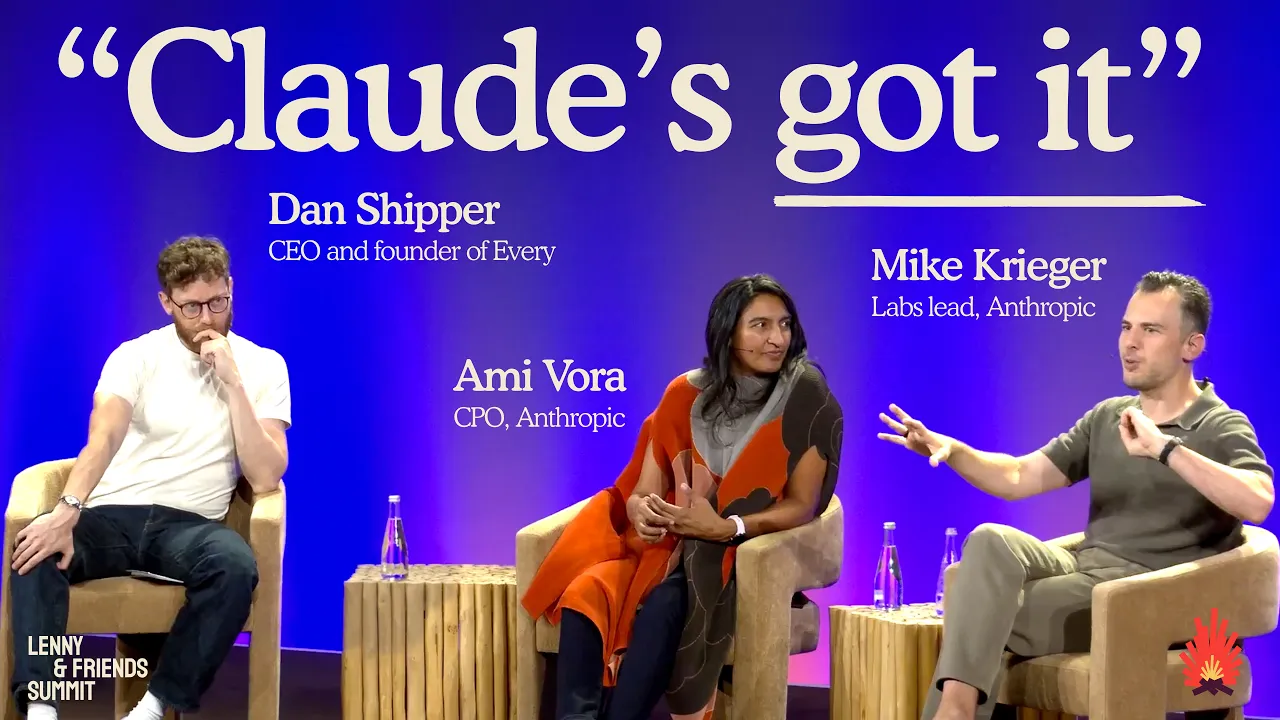
## Background Published by Lenny's Podcast on YouTube on September 29, 2026, this panel was recorded live at the Lenny and Friends Summit in San Francisco. Moderated by Dan Shipper, Anthropic product leaders Ami Vora and Mike Krieger discuss how the PM role is evolving alongside rapid AI development, examining agent-native and malleable software, running parallel experiments, and shipping ideas that users can actually adopt.
## TL;DR Rather than eliminating product managers, rapid AI advancement elevates their importance as human 'conveners' who exercise judgment, coordinate cross-functional teams, and anchor products to enduring human problems. As building becomes cheap, upfront interface debates give way to rapid prototyping, agent-native architectures, and malleable software dynamically maintained by models. To navigate this fluidity, Anthropic structures exploration around autonomous 'bet leads,' unifies shared primitives like memory across surfaces, and parks promising concepts into evaluation harnesses until model capabilities catch up. Ultimately, successful product discipline requires resisting interface clutter, honoring the power law of core entry points, and bridging the widening gap between raw model power and everyday user enablement.
## Atmosphere & style The panel carries an energetic, collegial, and candid tone marked by audience laughter, playful banter, and self-deprecating humor about the chaotic pace of AI development. Dan Shipper balances deadpan wit with sharp industry observations, while Ami Vora and Mike Krieger share candid reflections on unlearning decades of hard-won product habits and navigating the vulnerability of feeling lost together. Watching the discussion feels like sitting in on an intimate, intellectually grounded debrief between seasoned operators who are simultaneously humbled and energized by the dizzying frontier they are building.
## Bulletin - [00:06](https://www.youtube.com/watch?v=sEXdyK6woKU&t=6s) While foundational technology shifts used to occur every 5 to 10 years, AI capabilities now shift roughly every 2 months, making the human PM's role as an operational "convener" and decision-maker more vital than ever as engineering accelerates. - [06:49](https://www.youtube.com/watch?v=sEXdyK6woKU&t=409s) Because building software is now fast and cheap, Anthropic PMs skip upfront theoretical debates over button placement to build and test multiple versions directly, while software architecture evolves from chat sidebars toward "agent-native" parity and agent-generated malleable UIs. - [19:54](https://www.youtube.com/watch?v=sEXdyK6woKU&t=1194s) After finding that Claude Chat and Claude Cowork used separate memory, MCP, and file-storage systems, Anthropic centralized these primitives under a Foundations team so parallel bets share context, while underperforming bets like early Computer Use are "parked" in automated eval harnesses until newer models like Claude 3.7 make them viable. - [26:17](https://www.youtube.com/watch?v=sEXdyK6woKU&t=1577s) Guided by the "power law of tabs"—where Instagram's main feed drove roughly 80% of usage—Anthropic leaders stress saying no to sidebar clutter and rolling proven experiments into a single core experience to close the gap between frontier model capabilities and everyday usage.
## Key takeaways - [00:06](https://www.youtube.com/watch?v=sEXdyK6woKU&t=6s) Foundational technology cycles have compressed from 5–10 years to roughly 2 months, requiring PMs to stay anchored on unchanging human problems while repeatedly discarding outdated technical solutions. - [02:40](https://www.youtube.com/watch?v=sEXdyK6woKU&t=160s) Faster AI-assisted building increases the need for operationally excellent PMs to provide cross-functional "glue"—aligning prosumer and enterprise needs, customer success, and safeguards so builders can stay heads-down. - [04:38](https://www.youtube.com/watch?v=sEXdyK6woKU&t=278s) While Claude helps surface organizational context via Slack search, AI cannot yet replace the human "convener" who brings people and agents together and exercises judgment across rapidly multiplying product paths. - [06:49](https://www.youtube.com/watch?v=sEXdyK6woKU&t=409s) Because building software is no longer slow and expensive, PMs have unlearned decades of upfront theoretical debate over granular UI placement in favor of rapidly building and testing multiple working versions. - [08:38](https://www.youtube.com/watch?v=sEXdyK6woKU&t=518s) Navigating frontier AI creates a "personal innovator's dilemma," requiring leaders to abandon legacy strengths, raise their ceiling on tolerance for change, and "frame the chaos" into a safe container for experimentation rather than enforcing rigid roadmaps. - [11:23](https://www.youtube.com/watch?v=sEXdyK6woKU&t=683s) To balance open exploration with disciplined execution, Anthropic Labs structures initiatives around single Directly Responsible Individuals (DRIs) or "bet leads" empowered to allocate resources, double down, or wind down projects. - [12:09](https://www.youtube.com/watch?v=sEXdyK6woKU&t=729s) AI software is progressing through three distinct eras: from bolted-on chat sidebars, to "agent-native" architectures where agents have full parity with human actions, to "malleable software" where agents dynamically generate and maintain custom UIs on the fly. - [15:34](https://www.youtube.com/watch?v=sEXdyK6woKU&t=934s) Legacy and scaled SaaS companies that cannot overhaul their user interfaces overnight should focus on unified infrastructural plumbing so human UI actions and programmatic agent endpoints flow through the exact same underlying primitives. - [16:42](https://www.youtube.com/watch?v=sEXdyK6woKU&t=1002s) Rather than over-constraining products upfront based on theoretical assumptions, Ami Vora encourages teams to take multiple overlapping "shots on goal" and consolidate winners into a cohesive product once market fit is proven. - [19:54](https://www.youtube.com/watch?v=sEXdyK6woKU&t=1194s) Running parallel product bets successfully requires authentic team conviction and a dedicated Foundations team that unifies shared primitives—memory, Model Context Protocol (MCP), and file storage—across surfaces like Claude Chat, Claude Cowork, and Labs. - [22:19](https://www.youtube.com/watch?v=sEXdyK6woKU&t=1339s) When an ambitious concept like Computer Use fails because current models are too clumsy, Anthropic "parks" the project in an automated evaluation harness and tests it against subsequent releases until a checkpoint like Claude 3.7 crosses the viability threshold. - [22:19](https://www.youtube.com/watch?v=sEXdyK6woKU&t=1339s) Builders must guard against "capability blindness"—writing off a problem space after a single failed test—because new model checkpoints every three to six months routinely overcome prior limitations. - [24:37](https://www.youtube.com/watch?v=sEXdyK6woKU&t=1477s) A central unsolved challenge in AI product development is folding validated parallel experiments back into a single coherent product without offloading cognitive load onto users via fragmented apps or cluttered tabs. - [26:17](https://www.youtube.com/watch?v=sEXdyK6woKU&t=1577s) Because interface usage follows a strong power law—illustrated by Instagram's main feed driving roughly 80% of activity—half of product leadership is saying no to extra tabs and sidebars and integrating proven workflows back into the core entry point. - [27:04](https://www.youtube.com/watch?v=sEXdyK6woKU&t=1624s) Over the coming year, Anthropic's product leaders aim to empower solo builders and bridge the widening gap between frontier model capabilities and everyday users so non-engineers can orchestrate long-horizon, parallel work.
## Detailed walkthrough ### [00:06](https://www.youtube.com/watch?v=sEXdyK6woKU&t=6s) Is the Product Manager Role Going Away or Evolving?
Taking the stage to warm cheers and "good vibes" at the Lenny and Friends Summit, moderator Dan Shipper opens the panel with the question on everyone's mind. Just a year ago, the prevailing narrative was that AI might make product managers obsolete—provoking laughter from the audience—whereas today, the consensus has flipped to the idea that *everyone* needs to become a PM. Because Ami Vora and Mike Krieger work directly with frontier models at Anthropic, Shipper asks them to share where job roles are heading: what does a great PM at Anthropic look like today, and is the role disappearing or transforming?
Ami Vora argues that the fundamental job of product management has always been to act as "a bridge between the real problems that people have in the world and the technology that you can use to solve it." What makes the current moment feel so strange and difficult for humans to process is the sheer speed of technological turnover. Previously, foundational technology changed roughly every five to ten years; now, it feels like it shifts every two months. Despite that dizzying pace, Vora points out that the human side of the equation does not change nearly as fast—people still have the same core problems. Her approach is to remain obsessed with solving those enduring human problems while staying "super fresh-eyed about how the technology works," deliberately throwing away most of what she used to know about how to solve a problem so she can tackle it anew with the latest capabilities.
In many ways, Vora feels the industry is "rewinding the clock" to the early days of product management—"back when the dinosaurs were on the earth"—when strict role definitions did not exist. Back then, a PM was simply a general problem solver who walked around trying to fix things until running into a wall, at which point they would ask someone for help or figure a way around it. Today's environment allows teams to return to that fluid state where traditional roles blur: you push forward to figure out what works, and when you hit a wall, you now have rich new forms of scaffolding to help you through.
- **Old technology cycle:** Major shifts occurred every 5 to 10 years. - **Current AI technology cycle:** Capabilities shift roughly every 2 months. - **Core PM mindset:** Retain deep knowledge of unchanging human problems while repeatedly discarding outdated technical solutions.
[02:40](https://www.youtube.com/watch?v=sEXdyK6woKU&t=160s) Mike Krieger’s Realization: Why Builders Still Need a PM
Mike Krieger shares a personal realization from earlier in the year after he transitioned into an individual contributor (IC) role focused mostly on hands-on building. As his team got close to shipping an exciting project, Cat—one of the PM leads who works with Ami—pulled him aside and told him, "Mike, I know you love to build. This project's going well. Like, it's looking really exciting. Like, we really need a PM on this project." Deep in builder mode, Krieger initially pushed back, wondering if a PM was even necessary: "I don't know. Like, do we need a PM? Like, Claude's got it. Like, we've got a lot going on." Cat stood firm that they truly needed one.
Once a PM actually joined the project, the before-and-after contrast was an eye-opening reminder for Krieger. Watching the PM step in revealed all the "glue and all of the connective tissue" required to ship successfully—and all the critical details that were about to get dropped had they continued without one. The difference was so stark that just one week later, Krieger pinged Cat to tell her, "Cat, you were 100% right—and thank you."
Krieger breaks down everything that connective role encompassed for a company like Anthropic, which serves a massive spectrum of users ranging from individual prosumers all the way up to large enterprises. Even with powerful AI tools, no individual has infinite capacity. Having someone dedicated to operational excellence allows the builders who are heads-down in "full-on Claude mode" to stay focused without constantly popping out of flow to coordinate cross-functional launch readiness. Rather than fading away, the PM hat has become even more vital when recruiting for a team: because engineering moves so much faster now, the person wearing the PM hat must be more operationally excellent than ever before.
- **Audience alignment:** Ensuring the entire customer contingency—from prosumers to large enterprises—is brought along. - **Customer Success enablement:** Preparing customer-facing teams to talk about product changes and answer questions in real time. - **Safeguards and coordination:** Looping in safety and safeguards teams early and keeping all moving parts on track so builders can stay heads-down.
[04:38](https://www.youtube.com/watch?v=sEXdyK6woKU&t=278s) Why AI Agents Cannot Replace the Human "Convener" Yet
Shipper jumps in with a deadpan "serious question," joking askance about why Krieger didn't just have an AI agent—"Fable," or some unannounced "Fable 7" that Anthropic has internal access to—do the PM's job instead. Krieger acknowledges that Anthropic naturally runs heavily on Claude and already benefits from AI-provided connective tissue; for example, Claude routinely surfaces relevant work happening in other parts of the organization via Slack search so teams know what colleagues are doing.
However, Krieger explains that "I don't think Claude is a convener yet." Referencing a talk he gave a couple of weeks prior on the role of humans in a post-super-powerful AI age, he highlights one essential human archetype: **the convener**. Someone still has to bring both the "Claudes and the people together" to actually get the work done. Right now, Claude lacks organizational pull and autonomous scheduling authority. Krieger jokes that it will be quite a moment when a mysterious calendar invite appears and he asks who scheduled the meeting, only to find out Claude decided, "I thought you two should chat." While that hasn't happened yet—perhaps only because they haven't flipped that setting on, prompting a laugh and a "stay tuned" from Ami—convening remains firmly human territory.
```mermaid flowchart TD accTitle: Human PMs and AI in Anthropic's Workflow accDescr: How Claude assists with context discovery while the human PM acts as convener, decision-maker, and operational glue across teams.
subgraph AI["Claude's Current Role"] A["Accelerates heads-down building"] B["Finds cross-org context via Slack search"] end
subgraph HumanPM["The Human PM Role"] C["Acts as 'Convener' across people & Claudes"] D["Exercises judgment across forking paths"] E["Coordinates safeguards, CS & enterprise needs"] end
subgraph Outcome["Product Delivery"] F["Relentless execution tuned to human problems"] end
AI --> HumanPM HumanPM --> Outcome ```
Expanding on why human PMs remain indispensable, Vora notes that because today's tools allow teams to build so many things so quickly, the universe of what is *possible* to build has expanded dramatically. With everything moving fast and information often limited, teams face countless "forking paths." That abundance of options demands even sharper human judgment about *what* to build, paired with relentless execution to make sure it actually happens. A great PM combines a tight feedback loop with end users, a deep grasp of the human problem, and the relentlessness to say, "I'm just going to go for it" in the face of ambiguity.
[06:49](https://www.youtube.com/watch?v=sEXdyK6woKU&t=409s) Unlearning Old Product Habits When Building Is Cheap
Shipper agrees, comparing each new model release to looking out across an ocean wondering what lies beyond the horizon; when you fast-forward past that horizon, you don't find a finished utopia or a disaster, just a vast new landscape to navigate. Recalling their prep conversation for the summit, Shipper brings up an observation Vora made about her own multi-decade career prior to Anthropic: she spent decades learning how to answer specific product questions that she no longer needs to answer at all. He asks which hard-won skills have lost their utility, what she leans on instead, and how that changes her expectations when hiring.
Vora reflects on how much of her career was spent trying to project herself into the mindset of a user upfront—predicting exactly how a feature would fit into their daily life and what to build—Strictly because software used to be so expensive and slow to build and ship. In traditional product reviews, teams would spend significant time debating granular interface questions before writing code:
- *"Ami, where should we put this button?"* - What should the exact interaction pattern look like? - Where will a user's finger naturally reach on their phone screen? - What physical situation is the user in when they pull their phone out of their pocket, and what do they want in that moment?
Having worked hard for years to master that intersection of product and design intuition, Vora admits candidly: "I don't think anyone's ever going to ask me that question again." As Shipper jokes that those questions belong to "Fable" now, Vora explains that upfront theoretical debate is in the past—today, "it's actually faster to just build three versions and try them out and be like, 'Oh yeah, this works for this one.'"
[08:38](https://www.youtube.com/watch?v=sEXdyK6woKU&t=518s) Personal Innovator's Dilemma and Framing the Chaos
Navigating frontier AI requires confronting a deeply uncomfortable psychological hurdle: realizing that the core skills one spent years mastering may no longer be relevant. The speaker draws a direct parallel between Clayton Christensen’s innovator's dilemma for companies and its manifestation at an individual level. Just as successful businesses fail by doubling down on their historic strengths instead of exploring emerging disruptions, professionals fall into the trap of clinging to what they already do well. In an environment where the foundational technology radically shifts every two months, product leaders must be willing to abandon their established identities and dive into areas where they have zero preexisting expertise: "All right, well, let's try this other thing and see if I can figure it out."
When asked what traits allow someone to succeed under those conditions, the answer centers on expanding one's "ceiling on tolerance for change," raw adaptability, sound judgment, and relentlessness. Crucially, leaders must openly discuss these stresses across their teams; otherwise, individuals assume they are the only ones struggling to keep pace, which creates an isolating, exhausting burden.
A vital countermeasure is learning how to "frame the chaos." In moments of deep uncertainty, people instinctively attempt to regain control by charting rigid roadmaps—mapping out precisely what products will be built and how careers will unfold. That instinct locks teams out of discovering breakthrough opportunities. Leadership's job is not to eliminate uncertainty, but to structure it into an emotionally safe, plausible container where teams can experiment freely, tap into the productivity upside of the unknown, and actively participate in building the future.
[11:23](https://www.youtube.com/watch?v=sEXdyK6woKU&t=683s) Bet Leads and Clear DRI Ownership in Rapidly Shifting Environments
Balancing open exploration with operational execution requires a deliberate leadership architecture. While teams need the freedom to explore ambiguous frontiers, the organization cannot devolve into aimless wandering. There must be unmistakable Directly Responsible Individuals (DRIs) who hold decision-making authority over specific domains.
Within the Anthropic Labs environment, these initiatives are organized as discrete "bets," each steered by a dedicated "bet lead": - **Single Point of Decision-Making:** Even when the entire team feels "lost together," the bet lead holds the pen on deciding the next most critical action to derisk, learn, or push forward. - **Resource Allocation Authority:** The lead serves as the ultimate DRI empowered to double down on an initiative, wind it down, or dynamically shift headcount depending on early signal. - **Velocity Driver:** Because frontier technology changes so rapidly, having clear DRI ownership prevents consensus paralysis and keeps exploration disciplined.
[12:09](https://www.youtube.com/watch?v=sEXdyK6woKU&t=729s) The Evolution Toward Agent-Native and Malleable Software
```mermaid flowchart TD accTitle: Evolution Toward Agent-Native Software accDescr: Three progressive eras of AI software integration from sidebars to fully malleable interfaces.
subgraph Era1["Era 1: Disconnected Add-on"] A["Chat Sidebar / Mini Window"] --> B["Customer Support & Q&A"] end
subgraph Era2["Era 2: Agent-Native Architecture"] C["Shared Plumbing / APIs"] --> D["Parity: Agent Can Do Everything a Human Does"] D --> E["Emergent Workflows & Proactive Assistance"] end
subgraph Era3["Era 3: Malleable Interfaces"] F["Agent-Generated Dynamic UIs"] --> G["Personalized, Project-Specific Views"] G --> H["Continuous Maintenance & Iteration by Model"] end
Era1 --> Era2 Era2 --> Era3 ```
The conversation shifts from leadership psychology to the architectural nature of what is being built. Mike Krieger outlines the progression of software design as products transition from human-only interfaces to collaborative environments shared with autonomous agents.
The first era merely bolted AI onto existing workflows as a detached sidebar or mini-window handling Q&A and basic customer support. That model quickly gave way to integrating AI directly into discrete features, and is now advancing toward truly "agent-native" design. Citing the framework popularized by Dan Shipper's publication *Every*—which Krieger notes he turned into an AI prompt skill during his own architectural research—the core premise is simple: "everything a human could do an agent should be able to do as well." While very few products achieve this standard today, unlocking full parity allows emergent behavior to surface, enabling models to connect fragmented systems and proactively suggest workflows.
The frontier beyond parity is "malleable software," where user interfaces are no longer static designs hard-coded by front-end engineers, but fluid surfaces dynamically generated and modified by the agent itself: - **Internal Anthropics Case Study:** For a complex project involving four independent organizational workstreams, Anthropic had Claude monitor real-time cross-team progress and write a bespoke tracking UI for the Technical Program Manager (TPM) and the team. - **Customizability on Demand:** Rather than waiting on internal tools teams or third-party SaaS roadmaps, team members can instruct Claude to alter layout, metrics, and workflows on the fly. - **Living Software:** A significant portion of internal tooling at Anthropic is now built, iterated on, and maintained directly by Claude in continuous response to organizational shifts. - **New Challenges in Governance:** Dynamic software introduces unsolved questions around data provenance and access rights—specifically, reconciling updates made by humans clicking through a UI with background write operations executed by autonomous agents.
[15:34](https://www.youtube.com/watch?v=sEXdyK6woKU&t=934s) Architectural Primitives for Legacy and Scaled SaaS
For traditional SaaS companies that cannot blow up their existing user experiences overnight, Krieger advises focusing on foundational plumbing rather than cosmetic features. When evaluating modern software, it becomes immediately apparent whether a product was engineered so that human-facing actions flow through the exact same underlying primitives as its programmatic endpoints.
While bolting universal agent accessibility onto a twenty-year-old enterprise application is an immense engineering challenge, establishing unified infrastructural plumbing allows companies to evolve at a sustainable pace. Teams can comfortably keep existing sidebar surfaces intact while incrementally experimenting with generative, adaptive UI components underneath.
[16:42](https://www.youtube.com/watch?v=sEXdyK6woKU&t=1002s) Pushing the Frontier vs. Meeting Users Where They Are
Dan Shipper turns the discussion to Ami Vora, noting that while the panel has been exploring the ambitious horizon of agent-native, malleable software built on unified primitives, Anthropic simultaneously serves a broad spectrum of users. Some customers simply want a reliable chat interface to get basic tasks done, while massive enterprise contracts mean Anthropic cannot abruptly overturn core interfaces overnight under the banner of malleability. Dan asks how product leaders balance pushing the technological frontier while preserving a predictable, comprehensible experience that brings along everyday users who are not inclined to adopt experimental workflows on day one.
Ami admits that this tension is an exceptionally difficult product challenge. Anthropic’s core philosophy is simply trying to "meet everyone where they are," especially given how early the industry still is in understanding what interfaces actually succeed. Rather than operating in a stable landscape where teams can design the single "right answer" upfront, the models and user behaviors are shifting every few months, forcing product teams to constantly update their assumptions. Coming from a product background rooted in predictability, simplicity, and reliability—principles designed to foster user muscle memory and intuition—Ami has had to adjust her instincts. In this frontier environment, she encourages teams to "take a lot of shots on goal," even if projects initially look overlapping or duplicative:
> "The fail state is you decide from the beginning like based on a theory of exactly what needs to happen and you like over constrain a product. And I would much rather have like five overlapping products that all work in different ways than like one overly constrained one that we never even gave a chance to actually like meet the market."
- **The shifting landscape:** Model updates and user interaction patterns evolve simultaneously every couple of months, meaning no product architecture is completely settled. - **Exploration vs. consolidation:** Teams must feel comfortable freely exploring unmapped territory, with the explicit mandate to fold successful experiments back into a cohesive, stable product experience once product-market fit is established.
---
[19:54](https://www.youtube.com/watch?v=sEXdyK6woKU&t=1194s) Managing Parallel Bets and Shared Primitives
Dan notes that running multiple parallel experiments is becoming common across AI organizations, but it carries the risk of internal confusion, incoherence, and demotivating teams who feel assigned to a redundant or inferior track. Mike Krieger explains how Anthropic navigates this dilemma internally. First, parallel bets must stem from authentic developer excitement rather than top-down assignments; manufacturing a synthetic alternative track and forcing an unenthusiastic team to build it inevitably results in a subpar product. Second, parallel innovation requires solid architectural foundations. Months earlier, Anthropic conducted an internal inventory and discovered that Claude Chat and Claude Cowork were using completely separate memory architectures, distinct Model Context Protocol (MCP) implementations, and divergent file-storage systems. Any third experimental team building a product was doomed to feel disadvantaged because it lacked shared memory:
```mermaid flowchart TD accTitle: Unified Foundations for Product Experimentation accDescr: Diagram showing how Anthropic's central Foundations team provides shared primitives like memory and MCP to support diverse product bets.
subgraph Core["Foundations Layer"] M["Unified Memory System"] MCP["Model Context Protocol (MCP)"] FS["File Storage Primitives"] end
subgraph Products["Frontier Exploration Tracks"] Chat["Claude Chat Surface"] Cowork["Claude Cowork Surface"] Lab["New Frontier Bets & Labs"] end
M --> Chat M --> Cowork M --> Lab MCP --> Chat MCP --> Cowork MCP --> Lab FS --> Chat FS --> Cowork FS --> Lab ```
By delegating these common primitives to a dedicated Foundations team, experimental teams across Labs and product tracks can pursue overlapping bets while building on a cohesive infrastructure where user context travels seamlessly across surfaces. Ami adds that leaders must simply be candid with their teams about the ambiguity: "We don't know the answer. We don't think anyone knows the answer. We're all going to discover it. And we're all fundamentally on the same team." Naming the friction openly reassures engineers and PMs that parallel bets are an organizational necessity rather than a vote of no confidence.
- **Organic conviction over assigned bets:** Teams only pursue alternative directions if they possess genuine passion and high conviction for that thesis. - **Foundations vs. frontier teams:** Decoupling infrastructure (memory, storage, tool integration) from user-facing exploration ensures experimental features do not end up completely isolated from the rest of the ecosystem. - **Signals of success:** Ami emphasizes that judging experimental wins still relies on traditional product fundamentals: user retention, recurring value, organic word-of-mouth, and whether the tool solves a real problem simply and reliably.
---
[22:19](https://www.youtube.com/watch?v=sEXdyK6woKU&t=1339s) Parking Projects, Computer Use Evals, and Capability Blindness
Dan raises the dilemma of timing: an experiment might fail purely because the underlying model is not quite capable enough, raising the question of when to abandon an idea versus keeping it warm for future model checkpoints. Mike shares how Anthropic Labs handles this by "parking" projects inside an evaluation harness. When Anthropic first experimented with Computer Use internally in 2024, the models were simply incapable of executing the vision. The team initially hypothesized that even if the model struggled with end-to-end automation, it might succeed at educational guidance—such as walking a user through complex tasks in Adobe Photoshop. In practice, the early agentic loop was clumsy and painful: it would try an action, fail, close windows, and after twenty tedious minutes finally complete a step, leaving the user with neither automation nor education:
```mermaid flowchart LR accTitle: The Project Parking and Eval Lifecycle accDescr: Flowchart illustrating how Anthropic parks underperforming product concepts into an eval harness until next-generation models unlock their viability.
A["Prototype Concept<br/>(e.g., Computer Use 2024)"] -->|"Model underperforms"| B["Park Project &<br/>Codify into Eval Harness"] B -->|"Benchmark against new models"| C{"Eval Success Spike?<br/>(e.g., Claude 3.7)"} C -->|"No"| B C -->|"Yes: Success > Failure"| D["Revive into Active Product<br/>Development Track"] ```
Rather than discarding the work, the team converted the project into an automated eval harness and tested it against every subsequent model release. When Claude 3.7 arrived, the eval scores suddenly jumped; reviewing the transcripts confirmed that the model was finally succeeding more often than it failed, signaling that the product track was ready to be reactivated. Mike highlights that proving a model is not yet ready is still a victory if the team externalizes the failure into an evaluation harness that guides researchers.
Dan validates this strategy, warning against what he calls "capability blindness"—a mindset where builders test a capability once, watch it fail, and prematurely write off the entire problem space. A new model release three to six months later can shatter those initial limitations. Dan polls the live summit audience to see who has tested cutting-edge agentic tools, asking for a show of hands for Fable (which garners a strong show of hands) and Astra (which sees fewer adopters). Dan observes that builders frequently tell him a specific workflow is impossible, only to admit they have not tested it against the latest Claude frontier models.
[24:37](https://www.youtube.com/watch?v=sEXdyK6woKU&t=1477s) Integrating Parallel Experiments Without Offloading Cognitive Load
Continuing the thought on adaptability, Dan Shipper emphasizes how important it is to be willing to "throw away everything"—even when it is painful—because otherwise you fall into the trap of assuming that "the last thing that happened is going to be true forever." From there, he raises a thorny structural problem he sees Anthropic grappling with from afar, one that is also happening at OpenAI and that his own team runs into as well: when an organization runs numerous parallel experiments and one of them really starts to work, how do you push that successful experiment back into the core product?
As Dan points out, there are several ways teams try to handle this, and none of them feel like a solved playbook yet. You can add a new tab for every successful experiment, "but then you have a bunch of different tabs and there's all the things that only work in slightly different ways, and that's kind of ugly." Alternatively, you can spin the experiment out as a separate app and never merge them at all. Turning parallel experiments into a single, coherent product remains a critical unsolved challenge across the AI industry.
Ami Vora deadpans, "I don't know what you're talking about," drawing a wave of laughter from the audience before admitting, "You're right. I don't think we've fully figured it out." Returning to an earlier theme from Mike Krieger, she explains that the answer lies in building the right underlying primitives so that products naturally feel the way users expect them to feel. When someone walks up to a product, they want to use it without having to think about it too much. Right now, it is far too easy for AI product teams to transfer a massive amount of cognitive load onto the user by essentially saying, "Here's some tools, why don't you choose?" Instead, Anthropic is iterating on foundational primitives—building a system that genuinely knows the user and presents an accessible UI at all times—by closely observing how people react in practice.
[26:17](https://www.youtube.com/watch?v=sEXdyK6woKU&t=1577s) The Power Law of Tabs and the Art of Saying No
Mike Krieger weighs in with a durable lesson from his years co-founding and scaling Instagram: across every single product, there is a "very strong power law in tab usage." At Instagram, the main feed accounted for roughly 80% of all usage. Even if the team worked hard to make the Explore tab better, its share might only climb from 10% to 15%, because the main feed remained where users landed and represented the heart of the experience.
For AI products today, the fundamental journey is figuring out what that "main tab" experience actually is, making it great, and letting it serve as a natural entry point into a wide variety of downstream experiences. Because of that power law, Krieger notes that "half of the job is saying no to another thing in the sidebar or another tab or another thing." The true art of product development when technology is moving this quickly is giving a parallel experiment enough breathing room to prove itself out—not killing it too early—while ultimately rolling it back into the main experience rather than cluttering the interface.
```mermaid flowchart LR accTitle: From Parallel Experiments to a Coherent Product accDescr: Contrasts fragmented feature bolting with integrating proven experiments into a single core entry point backed by shared primitives.
subgraph Discovery["1. Experimentation"] Exp["Parallel experiments"] Proven["Proven workflow"] Exp --> Proven end
subgraph Fragmented["2a. Fragmented Trap"] Tabs["Extra tabs & sidebar clutter"] Load["High user cognitive load"] Tabs --> Load end
subgraph Coherent["2b. Coherent Product"] Prim["Shared system primitives"] Main["Main tab (80% usage entry point)"] Prim --> Main end
Proven -->|"Bolt on UI"| Tabs Proven -->|"Roll in after validation"| Prim ```
- **The Instagram benchmark:** Roughly 80% of activity happened in the main feed, while secondary tabs like Explore moved between 10% and 15% even after dedicated improvements. - **The product discipline:** Protecting the core entry point by saying no to extra sidebar items and tabs, while resisting the urge to kill promising experiments before they are validated.
[27:04](https://www.youtube.com/watch?v=sEXdyK6woKU&t=1624s) Looking Ahead: Solo Empowerment and Closing the Capability Gap
With time for one final question, Dan asks both guests to imagine being invited back to the Lenny and Friends stage a year from now—joking, "I don't know if he'll invite me back, I've been cursing too much, but he'll invite you two back"—and to share what they expect will be different and how the PM role will have evolved.
Ami hopes that a year from now, people will simply feel like they can do vastly more on their own: building in whatever way they want, getting answers whenever they need them, and starting new businesses. She envisions a wave of small teams and solo empowerment that creates a broad societal uplift. As she puts it, "builders magnify impact for a bunch more people who will never use the tools directly, but who can benefit from people who do build things." Making the act of building dramatically easier is how those benefits reach everyone else.
For Mike, the biggest priority over the coming year is closing the widening gap between what frontier models are capable of and what most people actually use them for. He is emphatic that this gap is not the fault of users: "It's on us. Like we got to build the products to make that possible." That translation challenge was already hard in 2024, became even harder last year, and is harder still today as model capabilities accelerate. Closing that gap is deeply democratizing because it ensures advanced AI isn't reserved only for "your most Claude-pilled software engineer that has this fully working multi-agentic setup." Instead, it brings along the person running parallel research or managing a business—helping them understand the moving parts, check in at the right moments, and execute long-horizon work in a way that feels empowering rather than disempowering.
- **Ami Vora's 1-year vision:** Lowering the barrier to creation so solo builders and small teams can start businesses and build tools that indirectly benefit non-technical users. - **Mike Krieger's 1-year vision:** Bridging the model capability-to-usage gap so everyday researchers and business owners—not just "Claude-pilled" engineers—can orchestrate parallel, long-horizon agentic work.
## Notable quotes > [00:06](https://www.youtube.com/watch?v=sEXdyK6woKU&t=6s) a bridge between the real problems that people have in the world and the technology that you can use to solve it. — Ami Vora
> [02:40](https://www.youtube.com/watch?v=sEXdyK6woKU&t=160s) I don't know. Like, do we need a PM? Like, Claude's got it. Like, we've got a lot going on. — Mike Krieger
> [04:38](https://www.youtube.com/watch?v=sEXdyK6woKU&t=278s) I don't think Claude is a convener yet. — Mike Krieger
> [06:49](https://www.youtube.com/watch?v=sEXdyK6woKU&t=409s) it's actually faster to just build three versions and try them out and be like, 'Oh yeah, this works for this one.' — Ami Vora
> [12:09](https://www.youtube.com/watch?v=sEXdyK6woKU&t=729s) everything a human could do an agent should be able to do as well. — Mike Krieger
> [16:42](https://www.youtube.com/watch?v=sEXdyK6woKU&t=1002s) The fail state is you decide from the beginning like based on a theory of exactly what needs to happen and you like over constrain a product. And I would much rather have like five overlapping products that all work in different ways than like one overly constrained one that we never even gave a chance to actually like meet the market. — Ami Vora
> [19:54](https://www.youtube.com/watch?v=sEXdyK6woKU&t=1194s) We don't know the answer. We don't think anyone knows the answer. We're all going to discover it. And we're all fundamentally on the same team. — Ami Vora
> [26:17](https://www.youtube.com/watch?v=sEXdyK6woKU&t=1577s) half of the job is saying no to another thing in the sidebar or another tab or another thing. — Mike Krieger
> [27:04](https://www.youtube.com/watch?v=sEXdyK6woKU&t=1624s) builders magnify impact for a bunch more people who will never use the tools directly, but who can benefit from people who do build things. — Ami Vora
> [27:04](https://www.youtube.com/watch?v=sEXdyK6woKU&t=1624s) It's on us. Like we got to build the products to make that possible. — Mike Krieger
## Mentioned Lenny and Friends Summit, Anthropic, Ami Vora, Mike Krieger, Dan Shipper, Claude, Slack, Fable, Clayton Christensen, Anthropic Labs, Every, Claude Chat, Claude Cowork, Model Context Protocol (MCP), Computer Use, Adobe Photoshop, Claude 3.7, Astra, OpenAI, Instagram
## Video description What does product management look like when AI changes what teams can build every few months? At the Lenny and Friends Summit, Anthropic’s Ami Vora and Mike Krieger join Dan Shipper to discuss why understanding users, making good decisions, and adapting quickly remain essential to the PM role. They also explore software designed for agents, running experiments in parallel, and bringing the ideas that work into a product people can use.
Recorded live at Lenny and Friends Summit on September 10, 2026, in San Francisco.
[Source](https://www.youtube.com/watch?v=sEXdyK6woKU)