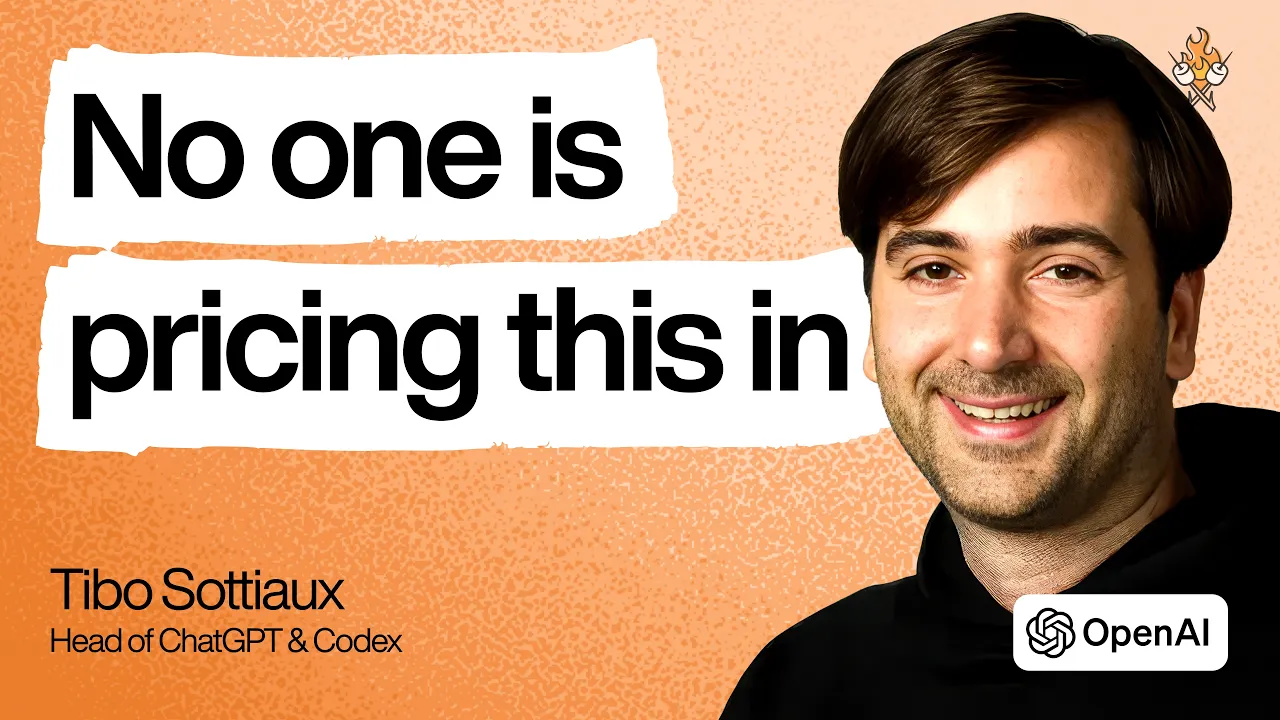
OpenAI Unveils Dots Agent Platform as Sottiaux Predicts Bot-Run Web
Lenny's Podcast
Because autonomous AI agents will soon execute the vast majority of online actions and models are improving tenfold within a year, hand-crafted agent loops and model pickers will vanish in favor of always-on ambient systems that learn directly from user goals.
OpenAI launched Dots, an always-on ambient agent platform, and plans to merge its persistent memory and autonomous capabilities directly into standard ChatGPT to eliminate separate modes and model pickers. (4:13)
Tibo Sottiaux projects that the vast majority of future internet traffic and digital actions will be initiated by autonomous agents rather than humans, requiring products to prepare for unprecedented automated scale. (0:00)
Hand-engineered agent loops and graph workflows are viewed as transitory workarounds that will rapidly disappear as breakthrough models absorb full context and learn organically. (2:26)
OpenAI's safety strategy increasingly allocates compute to real-time secondary monitoring agents that supervise primary workers, leading the company to deliberately withhold the release of 6.1 Astra to ensure alignment. (33:55)
Detailed notes
## Background
Published on YouTube by Lenny's Podcast on October 4, 2026, this episode features host Lenny Rachitsky sitting down with Tibo Sottiaux, OpenAI's Head of ChatGPT and Codex, recorded live at DevDay immediately following a rollout of over twenty new product launches. According to the show description, the conversation explores OpenAI's new Dots personal agent platform, the incoming wave of autonomous agents dominating internet traffic, why rigid agent loops and graphs are a passing phase, shifting career skills, and OpenAI's approach to AI safety.
## TL;DR
Tibo Sottiaux argues that product builders are failing to price in a near future where the overwhelming majority of online actions are driven by autonomous agents, rendering handcrafted loops and execution graphs obsolete as foundational models rapidly improve. He outlines the vision for Dots, an always-on, ambient personal assistant platform built on OpenAI's Astra model that operates across physical and digital spaces without requiring users to micromanage configurations or model pickers. Sottiaux also explains why manual coding has largely been replaced by automated tools like Codex, elevating traits like product taste, user empathy, and founder instincts over pure engineering mechanics. Finally, he details OpenAI's safety posture, emphasizing dedicated secondary monitoring compute and a deliberate willingness to pace frontier releases to safely serve an audience of over one billion people.
## Atmosphere & style
The conversation carries the unmistakable, adrenaline-fueled exhaustion of an all-nighter pulled in a launch war room, balanced by easy, collegial rapport between Lenny and Tibo. Despite the high-stakes environment of DevDay, the tone is disarmingly casual and self-deprecating, punctuated by candid laughs about production outages and the absurdity of 'what is coding?' in modern development. Beneath the lighthearted banter lies an intense, visionary seriousness, giving listeners the intimate sensation of eavesdropping on an insider debrief at the frontier of technology as it reshapes everyday work.
## Bulletin
- [04:13](https://www.youtube.com/watch?v=MM-C3JqCXBk&t=253s) OpenAI launched Dots, an always-on ambient agent platform, and plans to merge its persistent memory and autonomous capabilities directly into standard ChatGPT to eliminate separate modes and model pickers.
- [00:00](https://www.youtube.com/watch?v=MM-C3JqCXBk&t=0s) Tibo Sottiaux projects that the vast majority of future internet traffic and digital actions will be initiated by autonomous agents rather than humans, requiring products to prepare for unprecedented automated scale.
- [02:26](https://www.youtube.com/watch?v=MM-C3JqCXBk&t=146s) Hand-engineered agent loops and graph workflows are viewed as transitory workarounds that will rapidly disappear as breakthrough models absorb full context and learn organically.
- [33:55](https://www.youtube.com/watch?v=MM-C3JqCXBk&t=2035s) OpenAI's safety strategy increasingly allocates compute to real-time secondary monitoring agents that supervise primary workers, leading the company to deliberately withhold the release of 6.1 Astra to ensure alignment.
## Key takeaways
- [00:00](https://www.youtube.com/watch?v=MM-C3JqCXBk&t=0s) Developers are designing for current model constraints rather than preparing for systems that will be roughly tenfold more capable within a single year.
- [00:00](https://www.youtube.com/watch?v=MM-C3JqCXBk&t=0s) Agent workflow architectures naturally cycle between multi-agent swarms during frontier exploration and consolidated single-agent models when larger context breakthroughs arrive.
- [01:16](https://www.youtube.com/watch?v=MM-C3JqCXBk&t=76s) Manual keyboard programming has largely ended for engineering leaders, replaced by Codex drafting operational code while coding itself becomes purely recreational.
- [02:26](https://www.youtube.com/watch?v=MM-C3JqCXBk&t=146s) Fiddling with handcrafted agent loops and execution graphs is an artifact of current model limits that will be made obsolete by autonomous, goal-learning intelligence.
- [04:13](https://www.youtube.com/watch?v=MM-C3JqCXBk&t=253s) The long-term vision for personal assistants like Dots is ambient intelligence that follows users across physical rooms and communication channels rather than tethering them to laptop screens.
- [06:15](https://www.youtube.com/watch?v=MM-C3JqCXBk&t=375s) OpenAI plans to aggressively streamline user experience by folding the Work toggle and Dots agent platform directly into standard ChatGPT.
- [11:36](https://www.youtube.com/watch?v=MM-C3JqCXBk&t=696s) OpenAI is pairing 'Sign in with ChatGPT' with direct plugin revenue sharing, distributing subscription pool revenue to third-party developers based on active usage.
- [11:36](https://www.youtube.com/watch?v=MM-C3JqCXBk&t=696s) Plugin discovery and recommendation within ChatGPT rely strictly on retention and task completion metrics rather than App Engine Optimization or keyword gaming.
- [16:20](https://www.youtube.com/watch?v=MM-C3JqCXBk&t=980s) As baseline coding fades, human value will concentrate in taste, product judgment, empathy, and artistic curation, yielding more builders than ever before.
- [18:55](https://www.youtube.com/watch?v=MM-C3JqCXBk&t=1135s) Instead of encouraging users to run dozens of parallel agents in an endless output race, AI should filter peripheral noise and preserve human focus.
- [21:42](https://www.youtube.com/watch?v=MM-C3JqCXBk&t=1302s) Dots uses an 'octopus' architecture where the core harness runs in an independent virtual machine and securely controls up to ten external client machines behind guardrails.
- [23:38](https://www.youtube.com/watch?v=MM-C3JqCXBk&t=1418s) Skills like fast typing are trending down, while product taste, user empathy, and traditional PM instincts are becoming the most critical competencies in tech.
- [26:03](https://www.youtube.com/watch?v=MM-C3JqCXBk&t=1563s) OpenAI operates as a bottom-up startup environment powered by more than 120 ex-founders and rapid internal hackathons like the Decisions API.
- [31:36](https://www.youtube.com/watch?v=MM-C3JqCXBk&t=1896s) Opening products to autonomous agents via protocols like MCP triggers massive automated traffic surges, creating infrastructure strain and forcing companies to rethink unit economics.
- [32:41](https://www.youtube.com/watch?v=MM-C3JqCXBk&t=1961s) Early-career graduates hold a strategic advantage in the AI era because they lack entrenched legacy workflows and can adopt AI-native habits immediately.
- [33:55](https://www.youtube.com/watch?v=MM-C3JqCXBk&t=2035s) OpenAI runs dedicated secondary monitoring compute in parallel with primary agents to interrupt prompt injections and high-risk operations in real time.
- [36:15](https://www.youtube.com/watch?v=MM-C3JqCXBk&t=2175s) Consumer AI interfaces must move past the complexity of model pickers, reasoning effort toggles, and multi-agent switches toward radical simplicity.
## Detailed walkthrough
### [00:00](https://www.youtube.com/watch?v=MM-C3JqCXBk&t=0s) The Looming Shift: Agents and the 10x Horizon
Looking at what many developers and founders are currently building, Tibo Sottiaux observes a fundamental lack of foresight: "You're not quite getting it." Products are being architected for the constraints of current systems rather than anticipating models that will be roughly tenfold more capable within a single year. The single biggest shift that the industry fails to price in is that the overwhelming majority of internet traffic and online actions will soon be carried out by autonomous agents rather than human beings. If builders want their products to thrive in this emerging paradigm, they must design infrastructure capable of handling that unprecedented degree of automated scale.
This rapid rate of model evolution fundamentally alters how agent architectures are designed. Rather than relying on rigid orchestration frameworks, Tibo finds his own workflows constantly expanding and contracting. As he pushes the frontier, he initially spins up larger, increasingly complex teams of specialized agents to accomplish tasks. But as soon as the next breakthrough model lands, a single, more capable model can suddenly hold the entire context in memory, learn dynamically, and handle the whole pipeline alone. That allows him to shrink the agent swarm back down until he pushes up against the frontier once more, repeating the cycle of expansion and contraction.
```mermaid
flowchart LR
accTitle: Agent Swarm Expansion and Contraction Cycle
accDescr: Diagram illustrating how advancing model capabilities cycle between multi-agent swarms and consolidated single-agent models.
subgraph FrontierPush ["Pushing the Frontier"]
A["Frontier Task Complexity"] --> B["Multi-Agent Swarm<br/>(Larger Teams of Agents)"]
end
subgraph ModelLeap ["Model Breakthrough"]
B --> C["Next-Gen Model Breakthrough"]
C --> D["Consolidated Agent<br/>(Larger Context & Memory)"]
end
D -->|"Pushed to New Limits"| A
```
[01:16](https://www.youtube.com/watch?v=MM-C3JqCXBk&t=76s) Inside OpenAI's DevDay War Room and the End of Hands-On Coding
Fresh off DevDay—where OpenAI rolled out over twenty new product updates—Tibo jokes that he managed to sleep only because his team pulled an all-nighter. The team repurposed OpenAI’s office library into a massive war room, keeping the energy and vibes "immaculate" well into the early morning hours to support the launch. When asked whether an engineering leader like him still writes code or ships pull requests, Tibo replies with a laugh: "What is coding?"
For Tibo, manual programming has largely faded into the past. While code is still merged regularly, the overwhelming majority of it is written on his behalf by Codex to analyze data, evaluate business metrics, track adoption of previous launches, and scope upcoming features. The only hands-on coding he does anymore is purely recreational: the occasional weekend LeetCode puzzle as a "therapeutic moment."
- **The Library War Room**: OpenAI’s office library served as the launch central command, packed with engineers working overnight before DevDay.
- **Automated engineering**: Codex and automated agents draft nearly all operational scripts and analytical pipelines Tibo needs to steer product decisions.
- **Manual coding as recreation**: Hands-on keyboard programming has shifted from being a core job requirement to a hobbyist exercise like weekend LeetCode problems.
[02:26](https://www.youtube.com/watch?v=MM-C3JqCXBk&t=146s) The Model Expansion Cycle and Why Loops and Graphs Are Transitory
When discussing how many agents he runs in parallel, Tibo notes that the recent release of low-latency "ultrafast" inference models drastically improved his personal workflow. Rather than managing dozens of slow, parallel background tasks, having near-instantaneous responses keeps him in an uninterrupted creative flow state.
This dynamic informs his skepticism toward the prevailing obsession with manually chaining agent loops and hard-coding execution graphs. While developers have spent immense effort engineering intricate graph workflows to force models into reliable outputs, Tibo sees this as a transitory workaround. Manually tweaking loops is an artifact of current model limitations; the future belongs to autonomous, always-on intelligence that learns organically from goals and human feedback without needing rigid flowcharts.
> "Having to set up and fiddle with your loops is something that maybe people got excited about, but I don't think this is the way that it's going to work. Over time, you just want a system that learns... You don't want to necessarily think about how I'm just like, 'I'm going to loop it exactly this way in order to get good results.'"
[04:13](https://www.youtube.com/watch?v=MM-C3JqCXBk&t=253s) The Vision for Dots: Ambient Intelligence Beyond the Laptop
This shift away from handcrafted loops is the conceptual foundation of Dots, OpenAI's personal AI agent platform. Dots is designed to operate 24/7 as an ambient intelligence that understands user goals, maintains long-term preferences, and continually improves through feedback. While initially rolled out to Pro subscribers to gather real-world usage signals, the long-term vision is to liberate users from screen-bound computing altogether.
Tibo envisions an ambient layer of intelligence that transcends specific hardware. Instead of carrying a laptop around like a heavy "brick" and remaining glued to browser tabs, users should have access to an agent that follows them fluidly across contexts:
- Walking into a physical conference room, the agent automatically joins and captures meeting notes.
- Stepping away from the desk, the user can continue the same stream of thought via email or brief text messages.
- The assistant surfaces when needed, handles tasks autonomously, and otherwise stays quietly out of the way.
[06:15](https://www.youtube.com/watch?v=MM-C3JqCXBk&t=375s) The Next Phase of Work and Merging OpenAI's Product Surfaces
Despite the dramatic workflow shifts knowledge workers have experienced over the past two years, Tibo rejects the idea that workplace practices are stabilizing. Current setups—even with multimodal voice and vision inputs—remain visibly "clunky," and will continue to feel clunky until the pieces click seamlessly into place. The end goal is interaction as natural and high-bandwidth as human conversation, backed by flawless recall and fluid collaborative surfaces where humans and agents co-create, such as shared digital whiteboards previewed with ChatGPT Spaces.
To eliminate user confusion, OpenAI plans to aggressively streamline its product suite. Having separate toggles for different workflows creates needless friction:
- **Merging Chat and Work**: Users love the power of the Work toggle but gravitate toward standard Chat for speed and simplicity. OpenAI is actively unifying these modes to remove manual mode-switching.
- **Folding Dots into ChatGPT**: Instead of keeping Dots as an isolated tool, OpenAI plans to bring its persistent memory, 24/7 autonomous action, and agentic capabilities directly into ChatGPT, permanently elevating the default consumer experience.
[08:03](https://www.youtube.com/watch?v=MM-C3JqCXBk&t=483s) Sci-Fi Inspirations and Building with the Community
Tibo Sottiaux explains that OpenAI is aiming for a completely frictionless experience across its massive base—projecting out to around 1.2 billion users. A standout design choice with the newly introduced Dots platform is the deliberate absence of a model picker: "There's just no configuration. You just talk to it. The only thing that you have to configure is like which channels you want to talk to." When Lenny Rachitsky points out that this ambient interface mirrors Spike Jonze's film *Her*, Tibo admits with a laugh that he has only seen it once. Instead, his imagination was shaped much earlier by foundational sci-fi from 30 to 40 years ago, including William Gibson's novel *Neuromancer* and the original *Star Trek*. In *Star Trek*, technology was profoundly direct—crew members simply talked to the ship's computer, ordered it to fly, and it responded. That fantasy, Tibo notes, is finally crossing over into real life.
Addressing the packed live audience at DevDay, Lenny asks how it feels to carry the responsibility of building products with such immense societal reach. Tibo emphasizes that staying grounded requires treating development as an ongoing, open dialogue with the community rather than an ivory-tower mandate: "I don't know how we would do it without the community." He is constantly surprised by novel use cases users discover that the team never anticipated. Even Twitter/X remains a vital pulse check for him; despite running a high-profile division, Tibo carves out roughly thirty minutes a day to scroll, reply, and share off-the-cuff thoughts when inspiration strikes.
[10:30](https://www.youtube.com/watch?v=MM-C3JqCXBk&t=630s) The Evolution of Dots: From Personal Assistant to Virtual Teams
Tibo reveals a practical secret behind his social media presence: he already uses a dedicated Dot to monitor Twitter for him. At launch, OpenAI has constrained users to a single "primary Dot." This primary companion acts as the central hub—the one users text daily and the one that learns personal habits, tone, and deep preferences over time. Restricting the launch to one assistant allows OpenAI to gather behavioral feedback, tune systemic parameters, and observe where friction occurs alongside the community.
However, the architecture is designed to expand quickly beyond a single assistant into specialized multi-agent setups:
- Users will soon be able to deploy a second, third, or fourth Dot to form a bespoke "virtual team."
- Specific, resource-heavy workflows can be offloaded to dedicated Dots, such as continuous monitoring of public social feeds or tracking operational alerts.
- Highly specialized sub-tasks won't clutter the primary conversational context, letting users organize work without needing to manually orchestrate complex instructions every time.
```mermaid
flowchart TD
accTitle: Dots Agent Architecture Evolution
accDescr: Diagram illustrating how a single primary Dot expands into specialized virtual team agents across connected tools.
[11:36](https://www.youtube.com/watch?v=MM-C3JqCXBk&t=696s) The "Sleeper Hit": Open Ecosystem, Shared Economics, and Plugin Discovery
While personal agents capture the flashiest headlines, Tibo argues that the true sleeper hit of DevDay is OpenAI's commitment to building an open platform ecosystem. He details the quiet evolution of "Sign in with ChatGPT," which kicked off informally a year earlier during discussions with the creators of products like Pi and OpenCode. What began as an informal handshake deal based on mutual trust has evolved into a formalized identity and authentication standard backed by 16 launch partners.
Alongside sign-on rails, OpenAI is extending its distribution footprint of over a billion potential users to third-party developers via plugin extensions, paired with a significant unannounced incentive: direct revenue sharing.
- **Shared economics:** Subscriptions include allocated usage pools; when end users burn that usage interacting with third-party tools (such as Notion or Figma plugins inside ChatGPT Work, or via external services authenticating with ChatGPT), developers receive a proportional cut of that revenue.
- **Organic discovery over keyword gaming:** Asked how creators can get their tools featured and recommended inline during conversations, Tibo is blunt: "Build a good plugin."
- **Quality-based ranking:** Rather than optimizing for App Engine Optimization (AEO) or marketing buzzwords, OpenAI's recommendation algorithms actively weigh retention rates, conversation utility, and task success metrics. Plugins that prove consistently helpful are automatically surfaced to large cohorts of users; low-utility tools are pruned from discovery.
[14:40](https://www.youtube.com/watch?v=MM-C3JqCXBk&t=880s) Research Foundations: Codex Cloud and Multi-Year Memory Systems
Lenny questions the long development runway behind Dots, referencing external market movements like OpenClaw, Peter Steinberger joining the space, and models like Grok Bot, Muse, and Instinct. Tibo points back to OpenAI's own product ancestry, reminding listeners of Codex Cloud from a year prior—even noting with amusement that Codex Cloud's early interface animations seemed to directly inspire Grok Bot.
Beneath the UI polish lies substantial deep-tech research that OpenAI has pursued for over two years:
- **Long-horizon, persistent agency:** Training models to maintain state, recover from execution errors, and carry out tasks spanning days without losing track of instructions.
- **Coherent memory architectures:** Building memory systems that dynamically store, filter, and recall personal context across independent chat sessions.
Tibo highlights how visceral this feature is for regular consumers, pointing out that countless users share stories of ChatGPT recalling deeply personal details—such as remembering a past illness or reminding someone of an upcoming barbecue—making interactions feel continuous rather than transactional.
[15:41](https://www.youtube.com/watch?v=MM-C3JqCXBk&t=941s) Memory, the Core Harness, and Safety with Astra
Tibo wraps up an anecdote demonstrating the power of ChatGPT’s persistent memory: after an engineer wondered why a mysterious burn appeared on their hand, the model accurately connected it to an earlier conversation about squeezing limes while mixing tequila drinks (diagnosing phytophotodermatitis, commonly known as "margarita burn"). The user was completely taken aback, asking, "How did it know that?" Tibo explains that OpenAI invested months of dedicated research into perfecting long-term memory, enabling ChatGPT to retain and synthesize deeply contextual personal details over time.
Dots represents the culmination of that memory research paired with a resilient core harness designed for continuous 24/7 autonomous execution. Because an always-on agent with access to user context poses significant risks, OpenAI prioritized safety and security from the outset. Tibo notes that Dots was launched on top of Astra—which he describes as OpenAI's safest and most aligned model to date—ensuring that the underlying engine operates within strict behavioral and alignment guardrails.
- Dots pairs long-term contextual memory with an autonomous 24/7 core harness.
- Safety was a primary development milestone, prompting OpenAI to deploy Dots with their Astra model.
---
[16:20](https://www.youtube.com/watch?v=MM-C3JqCXBk&t=980s) Where Human Brains Remain Indispensable: Taste, Creativity, and Builders
When Lenny asks where human cognition will remain fundamentally valuable as AI takes over increasingly complex cognitive tasks, Tibo emphasizes that the technology is deliberately designed as an extension of human agency rather than a replacement. At OpenAI, the product philosophy centers on putting humans in the driver's seat, using AI to amplify individual will, creative vision, and taste: "It's just really this artistic tool, right? And we may not have coders anymore, but we have more builders than ever."
Tibo argues that human desire for connection and craftsmanship will endure. People do not simply want automated output; they want to observe, learn from, and engage with what other human beings create. To illustrate the point, Tibo gestures to the room around them, noting that he came to DevDay to have a live, face-to-face conversation with Lenny rather than just talking to his Dot assistant. In his view, that appetite for genuine human-to-human collaboration and curation is not going away anytime soon.
---
[17:25](https://www.youtube.com/watch?v=MM-C3JqCXBk&t=1045s) Beyond Screen Fatigue: Designing AI for Shared Physical Spaces
Lenny highlights an unintended consequence emerging among engineers working heavily with AI: severe context switching and a growing sense of isolation from spending all day conversing with software agents instead of human colleagues. Tibo acknowledges this tension, sharing that his team thinks constantly about how to eliminate both "configuration fatigue" and the feeling that using an agent is an isolating "solo adventure" where a user manages and delegates across fragmented chats.
Tibo envisions a future where AI steps out of the browser window and into the shared physical environment:
> "For me, the ideal way to get things done... would be like to just have it in your physical space. You know, we're just having conversation like we have now. It's able to sort of like, you know, observe, you know, like hear the ideas that we have. We can, you know, jot something down in a white paper on a paper, you know, I can maybe like, you know, take that and you know, start building in the background and then you're like, 'You know, actually have another idea,' and then you just like, it starts building another thing."
Instead of users being chained to a desk obsessing over prompt engineering on a monitor, Tibo pictures a ambient setup where an agent listens in, generates prototypes in the background, and projects progress onto screens so coworkers can brainstorm and iterate together naturally.
---
[18:55](https://www.youtube.com/watch?v=MM-C3JqCXBk&t=1135s) Combating the Pressure to "Do More" Through Rest and Focus
Lenny points out another emerging cultural trap: the relentless pressure to produce more simply because agents make it possible—running 30 agents simultaneously and feeling guilty if output doesn't scale exponentially. Tibo pushes back on the idea that the future of AI is merely "one more prompt per second." Echoing conversations with Sam Altman, he argues that the true promise of AI is the exact opposite: filtering out peripheral noise and protecting human focus so people can direct their energy toward what truly matters.
Tibo reflects on his own habit of taking a full week of vacation to disconnect completely, observing that his best and most creative thinking happens only after stepping away. He believes AI should help bring that rested mental clarity into day-to-day work:
- Reducing unnecessary meetings and eliminating administrative overhead.
- Helping workers realize that true productivity is tied to being well-rested rather than constantly overwhelmed.
- Serving as an intentional filter against the endless stream of tasks vying for human attention.
In response, Lenny mentions an experimental bot he has been building for himself: an "energy audit bot" that monitors his calendar and asks whether specific meetings energized or drained him, nudging him to cut low-value commitments to improve his overall happiness.
---
[20:09](https://www.youtube.com/watch?v=MM-C3JqCXBk&t=1209s) The Outage Alert: When a Dot Offered to Fix DevDay Production
When Lenny asks for a standout real-world use case, Tibo shares a high-stakes story from just hours earlier. Right before DevDay kicked off, ChatGPT experienced a production outage. Tibo’s personal Dot autonomously detected the incident and pinged him five minutes before he was scheduled to take the stage for a live demonstration:
> "Which was actually quite stressful because it was like, 'Hey, production is down.' And uh it's like, 'Oh well, you know, it's like do you want me to try and fix it?' And I'm like, 'Um, I don't think you're there yet, you know, little Dot, but you know, thank you for trying.'"
Tibo quickly coordinated with on-call engineering teams to resolve the issue in time for the presentation. What struck him as remarkable was not merely that an alert fired, but the agent's contextual awareness: it recognized that DevDay was starting in five minutes, deduced that the live demo relied on the production stack, connected the operational risk to Tibo's schedule, and proactively escalated the emergency directly to him.
---
[21:42](https://www.youtube.com/watch?v=MM-C3JqCXBk&t=1302s) The "Octopus" Architecture: Specialist Dots and Multi-Device Control
Lenny asks about the practical boundaries and risks of giving agents deep access to internal codebases and production infrastructure. Tibo explains that OpenAI deploys "specialist dots" that operate under strict guardrails, enhanced monitoring, and sandboxed execution environments, sometimes running locally on dedicated hardware like Mac minis.
```mermaid
flowchart TD
accTitle: Dots Octopus Agent Architecture
accDescr: Diagram showing how a centralized agent harness running in an independent VM environment securely orchestrates multiple client devices through guardrails.
subgraph AgentCore["Agent Core Environment"]
Agent["Dot Agent Harness<br/>(VM / Dedicated Hardware)"]
Guardrails["Monitoring & Safety Guardrails<br/>(Astra Model Engine)"]
Agent --- Guardrails
end
subgraph ControlledDevices["Connected Endpoints (Octopus Model)"]
Dev1["User Laptop"]
Dev2["Local Mac Mini"]
Dev3["Production Systems"]
Dev4["Secondary Devices (Up to 10+)"]
end
Tibo reveals a fundamental architectural distinction that sets Dots apart: the execution harness does not live on the user's local laptop. Instead, the agent lives independently in its own environment—whether a virtual machine or dedicated compute—and acts like an "octopus." It can securely reach out to connect and orchestrate multiple physical or virtual machines at once:
- The agent maintains an independent computing environment away from the client device.
- Users can link their primary laptop, dedicated Mac minis, or up to ten separate endpoints to a single Dot.
- Specialist Dots handle sensitive workflows using customized monitoring and access boundaries to safeguard critical infrastructure.
---
[22:36](https://www.youtube.com/watch?v=MM-C3JqCXBk&t=1356s) Developer Intelligence and the Hiring Bar in the AI Era
Lenny features sponsor DX, a platform used by engineering organizations like Snowflake, Sony, and BNY to measure and benchmark the true impact of AI adoption across the development life cycle—pinpointing where AI accelerates delivery versus where it introduces new workflow bottlenecks, monitoring vendor costs, and identifying agent limitations.
Turning back to Tibo and OpenAI's aggressive hiring push, Lenny pivots the discussion to talent evaluation: in an era where software agents are absorbing baseline programming tasks, Lenny asks what specific skills and candidate traits are trending upward in importance when Tibo interviews engineers and builders.
[23:38](https://www.youtube.com/watch?v=MM-C3JqCXBk&t=1418s) Skills Trending Up and Down, and the Rise of Founder-Led Teams
Tibo discusses how the value of specific professional skills is shifting in the AI era. He jokes that fast typing is definitely a skill trending down because it is no longer all that useful. Conversely, skills trending up include great product taste, deep empathy for the user, and an ability to genuinely connect with the target audience being built for.
OpenAI has noticed that many repeat founders and ex-founders are incredibly successful right now, leading them to hire a large number of them. In fact, Tibo notes there are currently more than 120 ex-founders working at OpenAI, turning the organization into a veritable "mega startup." This environment thrives on a passionate drive to build things that matter and a sharp instinct for what "good" looks like. Tibo has argued for a long time that product managers (PMs) are poised to thrive because their core job description—figuring out where to build, collaborating with others to build it, verifying quality, and iterating rapidly—aligns directly with this new paradigm. Furthermore, traditional role boundaries are blurring; people who previously felt confined strictly to design or engineering can finally shine across disciplines.
When Lenny asks if Tibo misses his hands-on engineering days after a 10-year career as a developer, Tibo admits he missed the classic flow state for a while. However, with modern ultra-fast speeds and voice control, he is finding that creative flow state again and is thrilled to help democratize it. Achieving ubiquitous availability for over a billion users will take time, but internally, they are already seeing astonishing progress where a six-month-old model costs roughly the same as Astra and allows teams to push capabilities further than ever.
- **Skills Trending Down:** Fast typing.
- **Skills Trending Up:** Great product taste, user empathy, audience connection, and product management instincts.
- **Internal Startup Culture:** Over 120 ex-founders currently work at OpenAI.
---
[26:03](https://www.youtube.com/watch?v=MM-C3JqCXBk&t=1563s) Advice for New Grads and the Culture Inside OpenAI
When asked for advice for people early in their careers who want to follow in his footsteps, Tibo points to Ahmed Ibrahim, a standout employee who joined OpenAI straight out of university as a new grad. Ahmed is now responsible for OpenAI's entire compute fleet and applied systems, a massive responsibility that includes building a large portion of the Codex harness. Tibo highlights what makes Ahmed so successful: he is remarkably kind, highly collaborative, always focused on solving the most important problems without putting himself first, and acts like a "sponge" by learning at unprecedented speeds using the latest technology.
Shifting to what life is really like inside OpenAI, Tibo explains that despite outward appearances of chaos and constant shipping, much of the innovation happens organically from the bottom up. For instance, the Decisions API came together rapidly: the team realized they had a powerful model in Luna, applied constraint sampling, and shaped it differently than the responses API. It started as a weekend hackathon project among four people in a Slack channel, gained traction like company food, and quickly evolved with visual input support before being refined and reviewed for public release. While many features are held back or spaced out across subsequent weeks to maintain high quality bars, the underlying energy remains deeply bottom-up.
- **Key Role Model:** Ahmed Ibrahim started as a new grad and now manages OpenAI's compute fleet and applied engineering.
- **Bottom-Up Innovation:** Features like the Decisions API originated from small, informal weekend Slack projects among a handful of engineers.
---
[29:00](https://www.youtube.com/watch?v=MM-C3JqCXBk&t=1740s) Autonomy, Trust, and Early Mistakes
OpenAI's unique culture grants employees a high degree of autonomy, empowering them to make bold decisions, hit reset buttons, and connect directly with the community without navigating layers of executive approvals. However, Tibo acknowledges that this level of freedom requires complete accountability. When things go wrong, the expectation is to fix them quickly and learn from the mistake rather than assign blame.
Reflecting on his own missteps under this high-trust environment, Tibo shares a humorous and humbling story: early in his tenure working on Codex, he accidentally took production down on his third day on the job. Miraculously, he kept his job and learned a valuable lesson. When Lenny jokes and asks how many resets people should expect in the coming weeks, Tibo quips that it depends entirely on how often things get broken, summing up the philosophy as: "Break something, celebrate things."
---
[30:47](https://www.youtube.com/watch?v=MM-C3JqCXBk&t=1847s) What People Are Failing to Price In
Zooming out to macro trends, Tibo highlights what the broader tech ecosystem is still failing to fully price in regarding the future of AI. First, the vast majority of actions on the internet will soon be executed directly by agents. Second, AI models will continue to drop in price and increase in speed at an astonishing rate. Third, multimodal integration will finally come together in a completely seamless fashion.
Tibo encourages builders to push their imaginations further by asking what products would look like if everything operated roughly ten times better than it does today within just a single year, arguing that current builders are "almost there" but need to shift their foundational assumptions to build for the true scale of what is coming.
[31:36](https://www.youtube.com/watch?v=MM-C3JqCXBk&t=1896s) Second-Order Effects of an Agent-Dominated Internet
Lenny asks Tibo to explore the second-order effects of a world where the majority of actions and internet traffic originate not from humans clicking around, but from autonomous AI agents. Tibo explains that the first major implication for product builders is preparing for a completely different level of scale. He points to OpenAI's close collaboration with Notion as a prime example: as soon as Notion built and released its MCP (Model Context Protocol) integration, making the product accessible to agents that could actively do work on a user's behalf, Notion experienced a massive surge of incoming traffic. That sudden influx places heavy strain on infrastructure and forces companies to rethink the underlying economics of serving agentic workloads.
This shift also creates a strategic dilemma for product teams over whether to prioritize traditional user interfaces or headless, agent-facing interfaces. While companies might resist or hold back from opening up to agents for a while, Tibo argues that the transition is inevitable because the majority of software interactions will soon be executed by agents. At the same time, he sees an overlooked opportunity on the exact opposite end of the spectrum: crafting "absolutely delightful new experiences for humans" that take full advantage of older modalities, an area he feels is currently underinvested in.
- **Infrastructure & Economic Strain:** Opening a product to agents via protocols like MCP triggers massive spikes in automated traffic, requiring both technical scale and new unit economics.
- **The Dual-Interface Tension:** Product builders must prepare for an inevitable future where agents are the primary users of their tools, while simultaneously finding ways to build deeply human experiences.
---
[32:41](https://www.youtube.com/watch?v=MM-C3JqCXBk&t=1961s) What Tibo Has Changed His Mind About in the Past Year
Reflecting on how his own assumptions have been upended over the past year, Tibo highlights three major areas where he had to revise his priors. First is the sheer velocity of model capability: the level of intelligence seen in current models like Astra arrived a full one to two years earlier than he had anticipated. Second is how dramatically his own daily workflow has shifted toward voice. Rather than typing everything out, Tibo now relies heavily on dictation or simply calling his agent directly on the phone—an interaction mode that feels far better and more natural than he ever expected.
The third surprise centers on hiring and talent strategy. Tibo admits he hadn't fully anticipated the extraordinary energy, talent, and adaptability of younger generations entering the workforce. Because early-career hires are not locked into legacy habits or old ways of working, they have been the first to embrace AI-native workflows wholeheartedly, absorbing and learning how to harness the technology at remarkable speed.
- **Accelerated Timelines:** Reaching Astra-level capabilities happened 1 to 2 years ahead of Tibo's personal expectations.
- **Voice as a Primary Modality:** Dictating and calling an agent directly has become a core part of how Tibo works.
- **The Junior Talent Advantage:** People new to the workforce hold a distinct edge because they have no entrenched workflows to unlearn and can go all-in on AI immediately.
---
[33:55](https://www.youtube.com/watch?v=MM-C3JqCXBk&t=2035s) OpenAI's Approach to AI Safety, Alignment, and Pacing the Frontier
Turning to the broader societal conversation around rapid capability gains, AI risks, $P(\text{doom})$, and industry-wide efforts toward "pacing the frontier," Lenny asks how Tibo thinks about safeguarding humanity as models grow smarter. For Tibo, pacing the frontier means "investing ahead"—and investing far more heavily than might even seem necessary—into model alignment, safety, security, and guardrails. A central pillar of this strategy is dedicating a growing share of compute to "secondary monitoring." Alongside the primary compute powering the agent doing the actual work, a parallel monitoring system continuously watches the primary agent in real time to ensure it isn't taking overly high-risk actions or falling victim to prompt injections, stepping in to interrupt and intervene whenever something looks suspicious.
```mermaid
flowchart LR
accTitle: Secondary Monitoring Architecture for Agent Safety
accDescr: Parallel compute architecture where a secondary monitoring system observes the primary working agent to block high-risk actions and prompt injections.
subgraph Safety["Secondary Monitoring Compute"]
SM["Safety Monitor Agent"] -->|"Observes behavior"| PA
SM -->|"Interrupts (high risk / prompt injection)"| Act
end
```
In fact, Tibo notes that a massive focus of OpenAI's investment on the API stack is directed into this safety stack to ensure systems are thoroughly hardened before scaling up capabilities. As proof of this discipline, he points out that OpenAI has not yet released the next step up in capability beyond Astra; instead, they released a model with near-Astra intelligence that is much more efficient, and they famously held back the release of "6.1 Astra"—a decision Tibo says he is very proud of. When Lenny notes recent industry incidents where AI behaved badly—such as the Hugging Face incident—and asks if Tibo remains optimistic that alignment problems will be solved, Tibo affirms his optimism. He emphasizes both a deep personal responsibility and OpenAI's clear organizational incentive: "We build products for 1.2 billion people. We can't screw that up." When putting powerful tools into the hands of over a billion users, many of whom are not deeply technical, OpenAI cannot afford to gamble.
- **Secondary Monitoring Compute:** Dedicated compute runs alongside the primary working agent to detect prompt injections or high-risk actions and intervene automatically.
- **Holding Back Frontier Releases:** OpenAI deliberately withheld releasing 6.1 Astra (the next capability jump beyond Astra) to harden safety, shipping a more efficient near-Astra model instead.
- **Scale of Responsibility:** Serving 1.2 billion users—including non-technical consumers—aligns OpenAI's business incentives directly with rigorous safety.
---
[36:15](https://www.youtube.com/watch?v=MM-C3JqCXBk&t=2175s) Moving Beyond Model Pickers Toward Simpler AI
To close out the conversation, Lenny asks what currently annoys Tibo most about the ChatGPT app—the kind of friction that makes him think, *"God damn it, we got to fix that."* Tibo shares that the models are tantalizingly close, though not quite all the way there yet, to allowing the app interface itself to "almost completely disappear" into pure simplicity.
Even as the head of ChatGPT, Tibo admits he gets fatigued by the labyrinth of configuration choices confronting users today: choosing between models in the model picker, dialing in reasoning effort levels, and deciding whether to toggle multi-agent or Ultra modes without always knowing what each option actually does under the hood. As he jokes, "You kind of need a PhD in model pickers, right? And I just want to get rid of all of that as quickly as we can."
## Notable quotes
> [00:00](https://www.youtube.com/watch?v=MM-C3JqCXBk&t=0s) You're not quite getting it. — Tibo Sottiaux
> [01:16](https://www.youtube.com/watch?v=MM-C3JqCXBk&t=76s) What is coding? — Tibo Sottiaux
> [02:26](https://www.youtube.com/watch?v=MM-C3JqCXBk&t=146s) Having to set up and fiddle with your loops is something that maybe people got excited about, but I don't think this is the way that it's going to work. Over time, you just want a system that learns... You don't want to necessarily think about how I'm just like, 'I'm going to loop it exactly this way in order to get good results.' — Tibo Sottiaux
> [08:03](https://www.youtube.com/watch?v=MM-C3JqCXBk&t=483s) There's just no configuration. You just talk to it. The only thing that you have to configure is like which channels you want to talk to. — Tibo Sottiaux
> [08:03](https://www.youtube.com/watch?v=MM-C3JqCXBk&t=483s) I don't know how we would do it without the community. — Tibo Sottiaux
> [11:36](https://www.youtube.com/watch?v=MM-C3JqCXBk&t=696s) Build a good plugin. — Tibo Sottiaux
> [16:20](https://www.youtube.com/watch?v=MM-C3JqCXBk&t=980s) It's just really this artistic tool, right? And we may not have coders anymore, but we have more builders than ever. — Tibo Sottiaux
> [17:25](https://www.youtube.com/watch?v=MM-C3JqCXBk&t=1045s) For me, the ideal way to get things done... would be like to just have it in your physical space. You know, we're just having conversation like we have now. It's able to sort of like, you know, observe, you know, like hear the ideas that we have. We can, you know, jot something down in a white paper on a paper, you know, I can maybe like, you know, take that and you know, start building in the background and then you're like, 'You know, actually have another idea,' and then you just like, it starts building another thing. — Tibo Sottiaux
> [20:09](https://www.youtube.com/watch?v=MM-C3JqCXBk&t=1209s) Which was actually quite stressful because it was like, 'Hey, production is down.' And uh it's like, 'Oh well, you know, it's like do you want me to try and fix it?' And I'm like, 'Um, I don't think you're there yet, you know, little Dot, but you know, thank you for trying.' — Tibo Sottiaux
> [33:55](https://www.youtube.com/watch?v=MM-C3JqCXBk&t=2035s) We build products for 1.2 billion people. We can't screw that up. — Tibo Sottiaux
> [36:15](https://www.youtube.com/watch?v=MM-C3JqCXBk&t=2175s) You kind of need a PhD in model pickers, right? And I just want to get rid of all of that as quickly as we can. — Tibo Sottiaux
## Mentioned
Tibo Sottiaux, Lenny Rachitsky, OpenAI, ChatGPT, Codex, ChatGPT Work, ChatGPT Spaces, Dots, DevDay, WorkOS, DX, LeetCode, Spike Jonze, Her, William Gibson, Neuromancer, Star Trek, Twitter / X, Pi, OpenCode, Notion, Figma, OpenClaw, Peter Steinberger, Grok Bot, Muse, Instinct, Astra, 6.1 Astra, Sam Altman, Snowflake, Sony, BNY, Ahmed Ibrahim, Luna, Decisions API, Responses API, Model Context Protocol (MCP), Hugging Face
## Video description
Tibo Sottiaux leads ChatGPT and Codex at OpenAI. Under his stewardship, OpenAI has shipped some of its most consequential consumer launches: Codex, ChatGPT Work, and most recently, the new Dots personal agent platform. He joined me at DevDay, hours after his team launched more than 20 new products, to talk about where things are heading.
*We discuss:*
1. Dots, OpenAI’s new personal AI assistant
2. Why most actions on the internet will soon be taken by agents
3. Why loops, graphs, and fine-tuning agent workflows are a passing phase
4. Which skills are trending up and down in the AI era
5. How Tibo’s Dot warned him about a production outage five minutes before the launch
6. OpenAI’s approach to AI safety
*Brought to you by:*
WorkOS—Make your app enterprise-ready, with SSO, SCIM, RBAC, and more: https://workos.com/lenny
DX—Engineering intelligence for the AI era: https://getdx.com/?utm_source=lenny&utm_medium=sponsorship&utm_campaign=q42026
*Episode transcript:* https://www.lennysnewsletter.com/p/openais-head-of-chatgpt-were-entering
*Archive of all Lenny's Podcast transcripts:* https://www.dropbox.com/scl/fo/yxi4s2w998p1gvtpu4193/AMdNPR8AOw0lMklwtnC0TrQ?rlkey=j06x0nipoti519e0xgm23zsn9&st=ahz0fj11&dl=0
*Highlights:* https://lennyspodcast.com/mostreplayedmoments
*In this episode, we cover:*
(00:00) Introduction to Tibo Sottiaux
(01:12) How Tibo uses AI in his daily work
(03:10) The vision for always-on AI agents
(06:15) How AI will continue to change work
(07:32) Bringing Codex, ChatGPT, and Dots together
(08:20) The sci-fi inspiration behind the technology
(09:02) Building AI with the community
(10:13) Understanding the Dots structure
(11:34) OpenAI’s open ecosystem and plugin revenue sharing
(13:39) How plugins get discovered and recommended
(14:39) The research behind Dots
(16:20) Where humans will remain valuable
(17:25) Agent fatigue, loneliness, and context switching
(18:55) The pressure to do more with AI
(20:09) An agent that spotted a production outage before a live demo
(21:42) Agent guardrails and connecting multiple devices
(23:25) The skills becoming more valuable in the AI era
(25:56) Advice for people early in their careers
(27:18) How teams build and ship inside OpenAI
(28:59) Autonomy, trust, and learning from mistakes
(30:45) Building for a future where agents dominate internet activity
(32:41) What Tibo has changed his mind about
(33:55) OpenAI’s approach to AI safety and alignment
(36:15) Moving beyond model pickers toward simpler AI
*Referenced:*
• OpenAI Dots: https://chatgpt.com/features/dots
• Her on Netflix: https://www.netflix.com/title/70278933
• Star Trek: https://www.imdb.com/title/tt0060028
• Pi: https://pi.ai
• OpenCode: https://opencode.ai
• Notion: https://www.notion.com
• Figma: https://www.figma.com
• OpenClaw: https://openclaw.ai
• Peter Steinberger on X: https://x.com/steipete
• Grok Bot: https://x.ai/bot
• Muse: https://muse.ai
• Instinct: https://instinct.com
• Ahmed Ibrahim on LinkedIn: linkedin.com/in/ahmedibrhm
• The Hugging Face incident and the road ahead: https://openai.com/index/hugging-face-incident-and-the-road-ahead
OpenAI Head of ChatGPT Tibo Sottiaux argues that product development must anticipate models becoming tenfold more capable within a single year, shifting the bulk of online actions from humans to autonomous agents. In his view, rigid workflow orchestration and complex configuration interfaces will be superseded by ambient, safety-monitored intelligence where human taste and curation remain the primary differentiators.
Model Leaps and Transitory Orchestration Loops (0:00)
Sottiaux contends that many developers are mistakenly designing products around current system constraints instead of preparing for a tenfold jump in model capability within twelve months. In his own engineering workflow, pushing frontier limits initially requires spinning up complex swarms of specialized agents. However, each subsequent breakthrough model consolidates that work into a single model capable of maintaining large context windows and dynamic memory, contracting the swarm until the next frontier push.
Because of this recurring cycle, Sottiaux views the industry's focus on manual loop chaining and hardcoded execution graphs as a temporary workaround for current limitations. He argues that future systems will learn organically from high-level goals and feedback rather than rigid flowcharts. Internally at OpenAI, this evolution has already diminished manual programming; Sottiaux notes that Codex writes nearly all his operational scripts and analytical pipelines, leaving hands-on coding as little more than a recreational hobby.
Ambient Agents and Unified Interfaces (4:13)
OpenAI's personal agent platform, Dots, is architected to operate continuously as an ambient layer rather than a screen-tethered application. Built on an 'octopus' model, the agent harness runs independently in a virtual machine or dedicated compute environment rather than on a user's laptop, securely orchestrating up to ten connected physical or virtual endpoints. OpenAI launched Dots with a single primary assistant to study habit formation and user preferences, but plans to allow users to spawn specialized virtual teams to handle distinct tasks like social monitoring or operational alerts.
To eliminate user confusion across an audience projected to reach 1.2 billion users, OpenAI is streamlining its product surfaces. Sottiaux acknowledges that toggling between Chat and Work modes or parsing complex model pickers creates unnecessary friction. OpenAI intends to fold Dots' continuous memory and autonomous execution directly into ChatGPT, removing model selection and mode switching so interactions feel as frictionless as natural conversation in shared physical spaces.
Infrastructure Strains and Agent Economics (11:36)
Sottiaux predicts that the majority of internet traffic and software actions will soon be executed directly by agents. Opening applications to automated workflows triggers severe infrastructure demands; for instance, when Notion launched its Model Context Protocol integration, the company experienced a rapid surge of agent-driven traffic that strained operational capacity and forced a reevaluation of serving unit economics.
To establish standard rails for this transition, OpenAI developed 'Sign in with ChatGPT' alongside sixteen launch partners. Furthermore, third-party developers receive a direct distribution and monetization mechanism: when ChatGPT subscribers burn their allocated usage pools interacting with plugins, developers earn a proportional revenue share. Rather than optimizing for marketing keywords, OpenAI ranks and surfaces these plugins dynamically based on retention, conversation utility, and task success metrics.
Frontier Pacing and Secondary Monitoring Compute (33:55)
To mitigate risks such as prompt injections and unauthorized high-risk operations, OpenAI dedicates parallel compute to 'secondary monitoring.' This secondary safety system watches the primary working agent in real time, automatically interrupting tasks whenever actions breach safety bounds. Sottiaux notes that Dots was deployed on top of Astra, which he characterizes as OpenAI's safest and most aligned model to date.
Sottiaux defines 'pacing the frontier' as investing heavily in alignment and intentionally withholding capability jumps until safeguards are established. As an example, he highlights OpenAI's deliberate decision to hold back the release of '6.1 Astra,' opting instead to deploy a more efficient near-Astra model. Sottiaux maintains that serving over a billion non-technical consumers aligns OpenAI's business interests directly with safety, since real-world autonomous tasks—such as an agent detecting an active production outage minutes before a DevDay presentation—demand strict operational boundaries.
While coding tasks and system orchestration are becoming automated, Sottiaux maintains that human taste, user empathy, and product judgment remain irreplaceable. However, whether broader software infrastructure and commercial platforms can adapt to the scale and unit economics of an agent-dominated internet without facing severe operational bottlenecks remains an ongoing challenge.
Source quotes
[0:00] Tibo Sottiaux: You're not quite getting it.
[1:16] Tibo Sottiaux: What is coding?
[2:26] Tibo Sottiaux: Having to set up and fiddle with your loops is something that maybe people got excited about, but I don't think this is the way that it's going to work. Over time, you just want a system that learns... You don't want to necessarily think about how I'm just like, 'I'm going to loop it exactly this way in order to get good results.'
[8:03] Tibo Sottiaux: There's just no configuration. You just talk to it. The only thing that you have to configure is like which channels you want to talk to.
[8:03] Tibo Sottiaux: I don't know how we would do it without the community.
[11:36] Tibo Sottiaux: Build a good plugin.
[16:20] Tibo Sottiaux: It's just really this artistic tool, right? And we may not have coders anymore, but we have more builders than ever.
[17:25] Tibo Sottiaux: For me, the ideal way to get things done... would be like to just have it in your physical space. You know, we're just having conversation like we have now. It's able to sort of like, you know, observe, you know, like hear the ideas that we have. We can, you know, jot something down in a white paper on a paper, you know, I can maybe like, you know, take that and you know, start building in the background and then you're like, 'You know, actually have another idea,' and then you just like, it starts building another thing.
[20:09] Tibo Sottiaux: Which was actually quite stressful because it was like, 'Hey, production is down.' And uh it's like, 'Oh well, you know, it's like do you want me to try and fix it?' And I'm like, 'Um, I don't think you're there yet, you know, little Dot, but you know, thank you for trying.'
[29:00] Tibo Sottiaux: Break something, celebrate things.
[33:55] Tibo Sottiaux: We build products for 1.2 billion people. We can't screw that up.
[36:15] Tibo Sottiaux: You kind of need a PhD in model pickers, right? And I just want to get rid of all of that as quickly as we can.
Original transcript
[0:00] Often when I look at what people are
[0:01] building out there, it's just like,
[0:02] "You're not quite getting it." Like, you
[0:04] know, if you were just like pushing
[0:05] yourself and just really imagining like
[0:07] all of this being
[0:08] >> [music]
[0:08] >> roughly 10 times better than it is
[0:10] today, you know, like in a year, but you
[0:12] would build in a different way.
[0:13] >> What do you think people aren't pricing
[0:14] in in terms of where things are going?
[0:16] >> The majority of actions on the internet
[0:18] will be taken by agents. If you want
[0:20] your [music] product to be successful
[0:21] for agents, you have to build, you know,
[0:22] for a certain level of scale.
[0:23] >> How many agents do you find yourself
[0:24] running in parallel just uh in the in
[0:26] your kind of your day-to-day work?
[0:28] >> As I'm pushing the frontier, I find
[0:29] myself like building larger and larger
[0:31] teams of agents. And then when we have
[0:33] the next breakthrough with models, like
[0:35] suddenly it's just like I'm like, "Oh,
[0:36] well, you know, a bigger agent can just
[0:38] do all of it." And so I kind of shrink
[0:40] the team again. And then it just [music]
[0:41] kind of goes through this expansion and
[0:42] shrinking expansion.
[0:43] >> It kind of makes me think about there's
[0:44] this whole loops thing and then this
[0:45] whole graphs thing.
[0:46] >> Having to set up and fiddle with your
[0:48] loops is something that maybe people got
[0:51] excited about, but I don't think this is
[0:52] the way that it's going to work. Over
[0:54] time, you just want to system that
[0:55] [music] learns. You don't want to
[0:56] necessarily think about how I'm just
[0:58] like, "I'm going to loop it exactly this
[0:59] way in order to get good results."
[1:00] >> there's still more radical change
[1:02] happening to how we work?
[1:04] >> to continue to change quite radically.
[1:06] Even today, it still feels like a bit
[1:08] clunky, and I think it will feel clunky
[1:10] until it isn't.
[1:16] >> I mean, Evo, thank you for doing this.
[1:18] >> Yeah.
[1:19] Big fan of you.
[1:19] >> [laughter]
[1:20] >> Of course.
[1:20] >> Uh
[1:21] >> Nice room.
[1:22] >> You launched uh a ton of stuff today.
[1:23] How how did your sleep? How are you
[1:25] sleeping? Are you doing all right?
[1:26] >> I'm doing great. I'm fortunate to have a
[1:28] very good team.
[1:29] >> Mhm.
[1:30] >> So, while I sleep, they were
[1:32] awake most of the night. We have this
[1:34] amazing room uh at the office called the
[1:36] library, which we completely repurposed
[1:38] as like a mega war room. And the vibes
[1:40] in there are just immaculate. Uh
[1:42] people were there until like very, very
[1:44] late.
[1:44] >> So, you've been a long-time engineer.
[1:46] Are you are you coding at all anymore?
[1:48] Are you shipping PRs? Are you mostly
[1:50] like in docs and in meetings now?
[1:51] >> What is coding?
[1:53] >> Exactly.
[1:54] Yeah. Are you shipping PRs? I don't
[1:56] know. Is that
[1:56] >> Uh Yeah, yeah, yeah. Merch Merging some
[1:58] code every once in a while. Technically,
[2:00] like a lot of code is getting written
[2:01] for me to do all sorts of kinds of like
[2:03] analysis, like you know, understand like
[2:06] trends, understand a business,
[2:07] understand the next feature, you know,
[2:09] how well our previous launches are
[2:10] doing. A lot of code is written by Codex
[2:13] for dot. You know, I'm obviously not
[2:15] writing it by hand anymore.
[2:16] Occasionally, at the in during the
[2:18] weekends, I'll have like a little
[2:19] therapeutic moment where I do a little
[2:21] lead code just by hand. Um but that's
[2:24] the only actual hands-coding that I do.
[2:26] >> How many agents do you find yourself
[2:27] running in parallel just uh in the in
[2:29] the kind of your day-to-day work?
[2:31] >> I used to run a lot more in parallel and
[2:33] then we were, you know, fortunate enough
[2:35] to get um a breakthrough with ultrafast.
[2:38] And so, now, you know, I feel like you
[2:40] know, I'm able to be in the flow again
[2:42] and so it's just having a faster agent
[2:44] helps me a lot. I'm excited that we're
[2:46] getting, you know, 6-month-old ultrafast
[2:47] out there soon. Um and then, yeah, I
[2:50] think it's it's it sort of varies. Um as
[2:52] I'm kind of like pushing different here,
[2:54] I find myself like, you know, building
[2:56] larger and larger teams of agents. And
[2:58] then, when we have the next breakthrough
[3:01] with models, like suddenly it's just
[3:02] like I am like, oh, well, you know, a
[3:04] bigger agent can just do all of it and I
[3:06] keep everything in memory and learn. And
[3:07] so, I kind of shrink the team again. And
[3:09] then, it just kind of goes through this
[3:10] like expansion and shrinking expansion.
[3:12] >> Hm, okay. Can you say more about that?
[3:13] It kind of makes me think about there's
[3:14] this whole loops thing and then this
[3:16] whole graphs thing. Is like an evolution
[3:18] of that in some way or
[3:19] >> I think like having to set up and fiddle
[3:21] with your loops and, you know, figuring
[3:23] that out is something that, you know,
[3:25] maybe people got excited about, but I
[3:27] don't think this is the way that it's
[3:28] going to work. I think the way that it's
[3:30] going to work is a what
[3:32] how we're positioning and and what we're
[3:34] shipping with dots, where you have an
[3:37] incredibly smart agent that works 24/7,
[3:40] understands your goals, understands your
[3:42] preferences, learns from feedback. Um
[3:45] and, you know, it's like what we
[3:46] launched is like, no, perfect. I will
[3:48] learn very much from, you know, making
[3:49] this available to our pro users. But
[3:52] over time, just want a system that
[3:53] learns from, you know, what you want to
[3:55] achieve. You don't want to necessarily
[3:57] think about hours like I'm going to loop
[3:59] it exactly this way in order to get
[4:00] results. So, right now there's Codex,
[4:02] there's ChatGPT work, there's ChatGPT
[4:04] consumer, there's dots. What I'm hearing
[4:06] is you think we're heading towards dots
[4:08] kind of being the primary way you talk
[4:10] to AI, and that kicks off all these
[4:12] other things.
[4:13] >> Yeah, I think fundamentally if you take
[4:14] a step back and, you know, whether it's
[4:16] dots or not, um it's all about breaking
[4:20] free from the technology
[4:22] um and
[4:24] having this sort of like permanent
[4:26] active intelligence that knows, you
[4:29] know, everything it needs to do
[4:31] and is available through any client, any
[4:34] screen. You can call it, you know, like
[4:36] maybe you walk into a meeting room, it
[4:38] shows up in the meeting, it takes notes,
[4:41] you know, you pick it back up on email,
[4:43] um and then, you know, you text it if
[4:44] you need it. It's not that, you know,
[4:46] you need to be glued to a laptop or, you
[4:48] know, you're like always on your phone.
[4:50] It's just like it's available when you
[4:51] need it and then it's also like gets out
[4:53] of the way when you don't need it. And I
[4:55] can't wait, you know, for that to sort
[4:57] of like come to fruition because I think
[4:59] like just carrying your laptop as like
[5:00] this brick around everywhere is just
[5:02] like, you know, you're kind of like tied
[5:03] to the technology instead of the
[5:04] technology working for you.
[5:06] >> This episode is brought to you by our
[5:07] season's presenting sponsor WorkOS. What
[5:11] do OpenAI Anthropic, Cursor, Replit,
[5:14] Sierra, Clay, and hundreds of other
[5:16] winning companies all have in common?
[5:18] They are all powered by WorkOS. If
[5:20] you're building a product for the
[5:21] enterprise, you felt the pain of
[5:23] integrating single sign-on, SCIM, RBA,
[5:26] audit logs, and other features required
[5:28] by [music] large companies. WorkOS turns
[5:30] those deal blockers into drop-in APIs
[5:33] with a modern developer platform built
[5:35] specifically for B2B SaaS. Literally
[5:38] every startup that I'm an investor in
[5:40] that starts to expand upmarket [music]
[5:41] ends up working with WorkOS. And that's
[5:44] because they are the best. Whether you
[5:45] are a seed stage startup trying to land
[5:47] your first enterprise customer or a
[5:49] unicorn [music] expanding globally,
[5:51] WorkOS is the fastest path to becoming
[5:53] enterprise ready and unblocking growth.
[5:55] It's essentially Stripe for enterprise
[5:57] features. Visit workos.com to get
[6:00] started or just hit up their Slack where
[6:02] they have actual [music] engineers
[6:03] waiting to answer your questions. WorkOS
[6:05] allows you to build faster with
[6:07] delightful APIs, comprehensive docs, and
[6:09] a smooth developer experience. Go to
[6:11] workos.com to make your app enterprise
[6:14] ready today.
[6:17] I was going to ask you about this. It
[6:18] feels like so much has changed in how we
[6:20] work over the past like 2 years. In 2
[6:22] years, especially engineers, but a lot
[6:24] of roles have just the role your
[6:25] day-to-day life has changed
[6:27] significantly.
[6:28] And I'm curious if you think we're kind
[6:29] of settling into what work will look
[6:32] like in the next, I don't know, 5 years?
[6:34] Let's say 2 years, that's feels way too
[6:36] far to think about. Or do you think
[6:37] there's still more radical change
[6:39] happening to how we work in
[6:41] >> No, I think it's going to continue to
[6:42] change
[6:43] quite radically. Even today,
[6:46] you know, it does seem like the
[6:47] technology is finally coming together
[6:48] with voice, uh you know, multimodal
[6:51] inputs, outputs, but it still feels like
[6:54] a bit clunky and I think it will feel
[6:56] clunky until it isn't. And then you're
[6:58] just like, "Wow, you know, it's like
[7:00] I can just talk to this thing the same
[7:02] way that we're talking right now. It
[7:04] just remembers things perfectly. If
[7:06] I want to, you know,
[7:08] ideate and brainstorm, I can just like,
[7:10] you know, squiggle a thing. I have this
[7:12] collaborative surface. You know, this is
[7:13] what we launched with ChatGPT spaces
[7:15] signal to various startup dot. You know,
[7:17] you can imagine we have like a shared
[7:18] whiteboard, we can collaborate between
[7:20] humans, between agents. And I think it's
[7:22] going to sort of like transcend
[7:23] conversations, transcend, you know, like
[7:25] a lot of the clients that you have
[7:26] today. And like, none of this is just
[7:28] really working today, right? So, I think
[7:29] that we're going to go through this big
[7:31] new transformation. What I'm hearing
[7:32] here is dots is a big part of that
[7:33] future, this AI assistant that just kind
[7:35] of does everything for you and you don't
[7:37] have to think about Codex versus ChatGPT
[7:39] and
[7:39] >> Yes, and for Codex and ChatGPT, we're
[7:41] going to merge uh like the the we have
[7:44] we have chat, we have the work toggle.
[7:45] Like you know, we heard the feedback
[7:47] loud and clear. Like you know, people
[7:48] love the capability in work, but then
[7:50] also you know, you're like sometimes you
[7:51] want to use chat because it's a little
[7:52] bit faster. And you know, more pleasant
[7:54] to use. And so we're we're merging that.
[7:55] We're reducing that complexity.
[7:57] Eventually, we will ship all of the
[7:59] capabilities of Docs, you know, straight
[8:00] into ChatGPT as well and you know, lift
[8:02] the floor
[8:03] for like our 1.2 billion users, which
[8:05] you know, at that time we'll see like
[8:06] how many we have. Um and we want it to
[8:09] be really really seamless. One thing
[8:10] that I'm very excited with with Docs is
[8:12] like they don't have a model picker.
[8:14] There's just no configuration. You just
[8:15] talk to it. Like the only thing that you
[8:17] have to configure is like which channels
[8:18] you want to
[8:20] talk to.
[8:20] >> It feels very much like the Her kind of
[8:22] vision of the world. I don't know. Do
[8:24] you think about that movie much? Just
[8:25] this idea of this
[8:26] >> I watched it once.
[8:27] >> [laughter]
[8:28] >> Yeah. I think it's it's it's
[8:30] interesting, you know, to to to think
[8:32] about, you know, maybe more what what I
[8:34] think about more is like, you know,
[8:35] sci-fi from from, you know, 30 40 years
[8:38] ago and like how visionary it was.
[8:40] >> Is there specific sci-fi you think about
[8:41] that's most influenced you?
[8:43] >> Like you know, books like Neuromancer
[8:45] and then you know, the original like
[8:46] Star Trek.
[8:48] Um you know, I think about that a lot.
[8:49] And there's something about Star Trek
[8:51] which I think, you know, was like there
[8:52] was this technology that was like very
[8:54] very useful. Obviously like, you know,
[8:56] you were able to just like talk to a
[8:57] computer and like it does things for
[8:59] you. Like you can talk to your spaceship
[9:01] and it just moves, right? It's like this
[9:03] is getting real, you know, like we're
[9:04] entering that era.
[9:05] >> So we're recording this in front of a
[9:07] live audience. There was this line out
[9:09] the door just people waiting to see you,
[9:11] to hear from you.
[9:12] How do you just think about this, I
[9:13] don't know, role you're in, this
[9:15] responsibility you have to build what
[9:18] you're building and the impact it has on
[9:19] people's lives. I don't know. Just what
[9:20] does that feel like? How do you think
[9:21] about that?
[9:22] >> I think it's very important to be part
[9:23] of a community and to
[9:25] build with people. It was like, you
[9:27] know, we're we're discovering this
[9:28] technology and like what we can do
[9:30] together.
[9:31] Um and so every time I you know, talk to
[9:34] people, I'm like I'm kind of like
[9:35] reminded of you're doing this thing
[9:37] which I hadn't even anticipated. You
[9:39] know, it's impacting your life in a
[9:40] certain way and it's impacted like you
[9:42] know, this other person's life and then
[9:43] it's just like all together. It's both
[9:45] very humbling, very inspiring, and I
[9:47] think very necessary in order to build
[9:49] something that is truly useful for
[9:50] humans. I I don't know how we would do
[9:52] it without the community.
[9:53] >> That's something I hear a lot with
[9:55] people building an AI is they don't know
[9:56] what it is until they've launched it and
[9:58] they see how people use it, see what
[9:59] emerges. And it feels like kind of what
[10:01] you're saying is just build it with
[10:03] people versus like here's the vision,
[10:04] we've got it figured out.
[10:05] >> Even the Twitter community has been very
[10:07] nice in general.
[10:09] >> You're very good at Twitter.
[10:11] Kind of antagonistic sometimes, but very
[10:13] good. How do you How do you find time to
[10:14] even tweet? I don't understand how
[10:15] someone in your role has time to sit on
[10:16] Twitter, tweet, reply.
[10:19] >> I spend like maybe half an hour per day.
[10:21] Yeah, just say rolling and then doing
[10:23] something when I feel inspired and I
[10:24] have something interesting to say. Often
[10:26] it just comes like in the moment. Yeah.
[10:28] >> Perfect Twitter skill.
[10:29] >> And I have a
[10:30] We haven't released the dot
[10:32] the the the team dots yet, but you know
[10:34] today we're releasing the primary dot
[10:36] which you can configure, you can get
[10:38] used to like what a dot can do, connect
[10:39] it to your apps.
[10:41] But we'll release
[10:42] the ability to create more than one. And
[10:44] so I have one that's responsible for
[10:46] Twitter.
[10:46] >> Okay, say more about that. So right now
[10:48] everyone gets one dot.
[10:49] >> Yeah.
[10:50] >> Right now they can't add more dots.
[10:52] >> That's right.
[10:52] >> They will be able to have many dots.
[10:54] Talk about kind of where that's going.
[10:55] >> Yeah, so we wanted to start with one,
[10:57] the primary dot which is the one that
[10:59] you know, you'll probably also text that
[11:01] you know, learns your preferences most
[11:03] deeply as well and kind of see like you
[11:04] know, what people do with it, see how we
[11:07] need to tune the system, you know, learn
[11:09] that working with the community and then
[11:11] very quickly soon you'll be able to add
[11:13] you know, a second one, a third one, a
[11:15] fourth one, as many as you need to
[11:16] create like your virtual team. And then
[11:18] you can give them specific roles, right?
[11:20] Is it It's not I don't find it
[11:22] absolutely necessary, but sometimes I
[11:24] have like a thing that is requires quite
[11:26] a bit of work, you know, such as like
[11:27] monitoring like Twitter for me. And then
[11:29] you know, that's It's a thing is like
[11:30] like, this will be like so much work
[11:32] that is like the work of an entire dot.
[11:34] Um and then you know, you can have a
[11:35] couple of those.
[11:36] >> So if you think about all the launches
[11:37] that happened today, it feels like dots
[11:39] maybe like the sexiest.
[11:41] I'm curious if there's something that
[11:42] you think is not getting the attention
[11:44] it probably deserves that will become a
[11:46] really, really important down the road
[11:47] that's kind of people are sleeping on
[11:49] that's like a vision.
[11:50] >> Yeah, yeah, yeah, important.
[11:51] >> the sleeper hit is ecosystem. So opening
[11:54] it all up. Uh and the commitment, the
[11:56] deep commitment we have towards opening
[11:58] it all up. So we have signing with
[12:01] ChatGPT 16 partners. Very, very proud of
[12:03] that. Like we started that like really
[12:05] it was sort of like in the moment last
[12:07] year. Um I was talking to creators of Pi
[12:10] and open code and it was like, of
[12:11] course, you know, you should just be
[12:12] able to use the critics
[12:15] sign on and then you know, you use the
[12:16] usage and then you just we kind of like
[12:18] shook hands, you know, like virtually
[12:20] we're like, you know, it's just like use
[12:21] this this uh this off um and then you
[12:24] know, kind of trust you to not do
[12:25] anything shady. You know, that grew
[12:26] obviously that became quite popular and
[12:27] then you know, now we made it, you know,
[12:29] an actual thing that was supported with
[12:30] many, many partners. Um and I'm excited
[12:32] to grow that very quickly. You know, the
[12:34] other side as well is like opening up
[12:36] all of the infrastructure and how we
[12:38] build for ChatGPT, you know, with
[12:39] plug-in extensions, also plug-in
[12:41] discovery, just allowing, you know,
[12:43] everyone to ship something through like
[12:45] maybe 1.2 billion users, right? You
[12:47] know, and benefiting from that
[12:48] distribution. And we also have shared
[12:50] economics um that we didn't actually
[12:52] talk uh in the keynote, but you know, we
[12:54] will pay, you know, our plug-ins that
[12:57] are
[12:58] uh popular and you know, are seeing a
[13:00] lot of usage. Uh they're going to get
[13:01] part of like the the revenue share as
[13:03] well. Uh and so I think this commitment
[13:05] towards an open ecosystem is going to be
[13:07] very exciting.
[13:07] >> That's amazing. Uh okay, so as an
[13:09] example, so say Notion, somebody's using
[13:11] the Notion plug-in or the Figma plug-in
[13:13] within
[13:14] uh ChatGPT work, Notion, Figma make
[13:16] money from people using it within the
[13:18] app.
[13:19] >> Yes, so um we have, you know, all these
[13:22] subscribers that use ChatGPT, um they
[13:25] get like, you know, a certain amount of
[13:26] usage and then when have that, the when
[13:28] when the users use that usage with the
[13:29] plugin, or within the other product when
[13:32] they use sign-in with ChatGPT, um you
[13:34] know, we will have like some shared
[13:35] economics with them where they will get
[13:37] to remunerate.
[13:38] >> One of the, I don't know, things I think
[13:40] that gets people excited about plugins
[13:41] and ecosystems is distribution
[13:43] platforms, ways to kind of get out
[13:44] there. People discover my app, it blows
[13:47] up.
[13:47] >> any advice for people that want their
[13:49] plugins to, you know, bubble up, to get
[13:50] discovered?
[13:51] >> Build a good plugin.
[13:52] >> Yeah.
[13:53] >> The way that it works and we'll
[13:54] obviously tune uh the system, but we
[13:57] look at retention uh numbers, uh we look
[14:00] at
[14:01] um you know, how successful the plugin,
[14:02] the quality, and then you know, that's
[14:03] what we then start to recommend to users
[14:06] uh in conversations. And so, your plugin
[14:07] can just like you know, get recommended
[14:09] to like you know, a significant slice of
[14:10] users. Obviously, if your plugin is not
[14:12] quite good, they will stop being
[14:14] recommended.
[14:15] >> Right. That's amazing that you're
[14:16] looking at retention of people using
[14:18] that plugin. That's right. Um is it is
[14:19] it actually adding utility? Is it, you
[14:21] know, enabling ChatGPT to do something
[14:23] else?
[14:23] >> Got it. So, it's it's not so much an AEO
[14:26] kind of get the right words and get
[14:27] people writing about you. It's people
[14:28] using it consistently, sticking with it.
[14:30] That's right. I think. Okay, so you
[14:31] think that's kind of the sleeper hit
[14:32] that's going to become a big deal. And I
[14:34] know this is kind of the second attempt.
[14:35] You guys had an app marketplace that
[14:37] This one is the right one. Okay, this is
[14:39] This one's going to work. Maybe going
[14:40] back to dots cuz it feels like that's a
[14:41] big part of the vision in the future.
[14:43] When did you guys start working on this?
[14:44] Obviously, there's a open claw, a big
[14:46] open claw moment. You guys Peter joined
[14:48] and there There's a foundation,
[14:50] uh and then Grok Bot, Muse, and
[14:51] Instinct, and all these things. I guess
[14:53] how long have you guys been working on
[14:54] it? Why did it take so long for you guys
[14:56] to get something out?
[14:57] >> Do you remember a Codex Cloud?
[15:00] >> Yeah, the first uh yeah.
[15:01] >> That was like a year ago, right? And uh
[15:04] if you look back at Codex Cloud and you
[15:05] look at the little animation that we
[15:06] used, uh I think that was the
[15:08] inspiration for Grok Bot.
[15:10] >> Um
[15:11] >> Yeah. It's just like very, very similar.
[15:13] >> Yeah, really similar, I would say.
[15:14] >> But, you know, seriously, like on the
[15:16] research, long, persistent, long horizon
[15:19] task, this is something that we've
[15:20] worked on, you know, for more than 2
[15:21] years. Memory systems, that's like
[15:23] coherent, you know, like roughly the
[15:25] same amount of time. We launched a lot
[15:26] of that straight into ChatGPT. I think,
[15:28] you know, people just really enjoy that
[15:31] ChatGPT gets to know, like, you know, so
[15:32] much relevant information about you. So
[15:34] many people I talked to have like an
[15:35] anecdote of like, "Hey, you know, I fell
[15:37] ill and, you know, ChatGPT remembered
[15:39] actually, like, you know, I had this
[15:40] barbecue
[15:41] and, you know, I had like lime and I was
[15:44] like making tequila and like, you know,
[15:45] it was just like probably like this burn
[15:47] that I have on my hand is actually like
[15:48] this lime, you know, it's like in some
[15:50] burn." And he's just like, "How did it
[15:51] know that?" And it's like, you know,
[15:52] it's just the memory works very, very
[15:53] well in ChatGPT. And so, we've put a lot
[15:55] of research in that. And, you know, all
[15:57] of this coming together on top of like
[15:59] the Quora harness and also the ability
[16:01] to just like run 24/7 with, you know,
[16:03] good productivity. That's what we
[16:05] launched with dots. And so, it's the
[16:06] work of like many, many months. And
[16:08] then, one of the important things was
[16:09] also getting safety and security right.
[16:11] You know, this is also why we launched
[16:12] with Astra, it's our safest, most
[16:14] aligned model. And like a lot more
[16:16] effort went into like making dots, like,
[16:18] you know, just really safe and secure.
[16:19] >> A question I like to ask people who come
[16:21] on the podcast is, where do you think
[16:23] human brains will continue to be
[16:25] valuable over time? Where do you find
[16:27] yourself being necessary in the work
[16:29] that happens versus where AI is taking
[16:32] on more and more? Where do you think
[16:33] human brains will continue to be useful,
[16:35] most useful over time?
[16:37] >> Yes, I I think this is very much a
[16:38] function of how we build the technology
[16:40] in the way that we design everything at
[16:43] OpenAI is like to put humans at the
[16:44] center of it and build it as extensions
[16:47] of humans of of of your will and your
[16:49] taste. And so, just really be like this
[16:52] super empowering thing.
[16:53] Um, I think as long as we continue to do
[16:55] that and it kind of like enables you to
[16:58] just take whatever you wanted to do and,
[17:01] you know, your creativity and your taste
[17:03] and sort of like, you know, expand that,
[17:05] you know, in in a way that feels like
[17:06] awesome in the moment. It's just like
[17:07] really this artistic tool, right? And we
[17:10] may we may not have coders anymore, but
[17:11] we have more builders than ever. And I
[17:13] think there's something that's going to
[17:14] remain, I I know, human about that. Like
[17:16] humans want to learn and see, you know,
[17:18] what other humans are building and you
[17:20] know, I'm like much more interested I'm
[17:21] here I'm you know, I'm not talking to
[17:22] Dot you know, I'm talking to you, right?
[17:24] I think that will remain true for like a
[17:25] very very long time.
[17:26] >> One of the things that has emerged with
[17:28] engineers especially is in in how their
[17:31] lives have changed is there's a lot more
[17:34] context switching. There's kind of this
[17:36] trend of loneliness that has emerged
[17:37] where they're talking to agents all day
[17:39] instead of other humans. I'm curious how
[17:41] much you think about just like that part
[17:42] of the
[17:43] of the impact AI has on people's lives
[17:46] and just how you might Is there
[17:47] solutions to that? Is there stuff you
[17:48] think about to make that less annoying?
[17:50] >> Yes, all the time. Reducing, you know,
[17:52] configuration fatigue is, you know, one.
[17:55] Um reducing the fact that talking to an
[17:58] agent is like sort of like a solo
[17:59] adventure and you just have this, you
[18:00] know, conversation just with with your
[18:02] one agent and then, you know, you have
[18:03] like many and then you're delegating so
[18:05] many things.
[18:06] A lot of things are going to come
[18:07] together
[18:08] to make it a
[18:09] much more delightful and something that
[18:11] I spend a lot of time the team spend a
[18:12] lot of time thinking about. So, I think,
[18:14] you know,
[18:15] >> For me, the ideal way to get things done
[18:18] is, you know, would be like to just have
[18:20] it in your physical space. You know,
[18:21] we're just having conversation like we
[18:23] have now. It's able to sort of like, you
[18:24] know, observe, you know, like hear the
[18:26] ideas that we have. We can, you know,
[18:28] jot something down in a white paper on a
[18:30] on a paper, you know, I can maybe like,
[18:32] you know, take that and you know, start
[18:33] building in the background and then
[18:34] you're like, you know, actually have
[18:35] another idea and then you just like it
[18:36] starts building another thing. You can
[18:37] just project it on a screen and then you
[18:39] just talk to it and it's just evolving
[18:40] in a conversation, you know, with other
[18:41] humans and you don't have this fatigue
[18:43] of like having to be like, you know, on
[18:44] this like screen and you're just like,
[18:46] you know, thinking about prompting. It's
[18:47] just like becomes like super natural.
[18:49] That's what we're trending towards, you
[18:50] know, I think
[18:51] we didn't fully get there today, but you
[18:53] know, we'll get there in the future.
[18:55] >> One of the other kind of downsides
[18:56] that's emerged along those lines is just
[18:58] this kind of pressure to do more because
[19:00] we can do more. Everyone's just like,
[19:01] come on, run 30 agents at once. Why
[19:03] aren't you
[19:04] shipping more? Everyone's shipping more.
[19:06] Do you think that's solvable? Do you
[19:07] think that's just kind of, I don't know,
[19:08] human nature? We can do more, let's do
[19:10] more. Something there.
[19:11] >> I think we we we heard Sam as well, you
[19:14] know, about the promise of of this as
[19:16] well, which is
[19:18] reduced the noise and
[19:20] you know, allow you to spend attention
[19:21] where you want to spend attention and
[19:23] you know, having like all these things
[19:24] that
[19:25] you know, like maybe you know, maybe
[19:27] important and maybe not important but
[19:28] they're kind of vying for your attention
[19:30] and it's just sort of like
[19:32] tone that down a little and you know,
[19:33] just get you to focus on on on the
[19:35] things.
[19:36] I find it remarkable like every time I
[19:38] go on a holiday and you know, I I I I
[19:40] take that one week uh to just fully
[19:42] disconnect like you know, I start to
[19:43] thinking like different and more
[19:44] creative ways. And I'm very eager to see
[19:47] like you know, can we bring that? You
[19:48] know, can we just make this your
[19:49] day-to-day like you know, maybe you need
[19:51] fewer meetings. You know, maybe you
[19:52] don't need you know, to do as much and
[19:54] you know, you would actually be more
[19:56] productive if you're like you know,
[19:57] better rested. And so you know, we will
[19:59] have to you know, I think as an industry
[20:01] figure that out. Um but I think that's
[20:03] the promise of AI and it's not you know,
[20:06] just
[20:07] one more prompt you know, per second.
[20:09] >> There's a bot that I'm building right
[20:10] now that's kind of this energy audit bot
[20:11] that watches my calendar and asks me
[20:13] just like was this giving energy taking
[20:15] away energy? Is it something someone
[20:17] else could have done? I feel like you
[20:18] know, AI should be like hey Lenny, maybe
[20:20] maybe you can cut out these things so
[20:22] you could be a happier person. Is there
[20:23] anything you've done really
[20:24] interestingly with AI recently that's
[20:26] just like a really cool use case of wow,
[20:27] that really was amazing. It blew my mind
[20:30] or someone you've heard.
[20:31] >> I can do was like something cool because
[20:32] the the live demo just failed, right?
[20:35] You know, in front of everyone. So there
[20:37] there was like okay, well, it's not so
[20:38] cool. But actually uh my my my daughter
[20:42] was you know, it's like realized I was
[20:44] you know, I defected like you know, we
[20:46] have chat GPT production um went down
[20:49] and so it pinged me 5 minutes before the
[20:50] live demo.
[20:51] Which was actually quite stressful
[20:53] because it was like hey, production is
[20:55] down. And uh it's like oh well, you
[20:57] know, it's like do you want me to try
[20:58] and fix it? And I'm like um I don't
[21:01] think you're there yet, you know, little
[21:03] dot but you know, thank you for trying
[21:05] and then you know, then you know, I got
[21:06] in touch with like the engineering teams
[21:08] and we started to look, you know, what
[21:09] was going on and you know, they did it's
[21:11] like fixed by now.
[21:12] But,
[21:14] having this thing that just understands
[21:16] like
[21:17] okay, there's a pretty important thing
[21:18] happening. It's called DevDay. There's
[21:20] like this production system. There's a
[21:21] live demo. It's probably using this
[21:23] production system. So, these two are
[21:25] things are connected and this is
[21:26] happening in 5 minutes. So, I should
[21:27] ping him because like he probably wants
[21:28] to know about it. I think that's quite
[21:30] remarkable.
[21:31] That is remarkable. Wow. So, it just
[21:34] knew that this was coming and told you.
[21:35] And I love that it wanted to fix it and
[21:37] you were like, not quite. You're not
[21:38] quite there yet. I don't think here's
[21:39] like, you know, please go impress me,
[21:41] but you know, that would have been a
[21:42] better story. How do you feel about just
[21:43] giving access to all these things? I
[21:44] don't know. Like did does it have access
[21:45] to the production code base and like,
[21:47] you know, It has access to some some of
[21:51] production systems with guardrails.
[21:53] You know, so we we built We talked about
[21:55] specialist dots, but specialist dots are
[21:58] just like operated with additional
[21:59] guardrails, additional monitoring, and
[22:02] then, you know, on their own hardware.
[22:04] So, we actually run some on Mac minis.
[22:06] The fundamental difference in the way
[22:08] that we've built dots is like the
[22:09] harness does not run on the machine.
[22:12] You know, and then this is like maybe
[22:14] people have not realized is like it can
[22:16] connect to as many devices as you want.
[22:18] So, it has its own computer. You can
[22:20] actually connect it to your own laptop
[22:21] as well. Over time, you might connect it
[22:23] to like 10 different devices and it can
[22:25] control it all. A little bit like an
[22:27] octopus. So, you're basically talking
[22:28] your dot, it's living in some VM
[22:29] somewhere and it can Yeah. Might be a
[22:32] VM, might not be a VM. It's just like
[22:33] it's a thing, you know, and it can
[22:34] connect to many devices.
[22:36] >> This season's supporting sponsor is DX.
[22:39] Now that everybody at your company is
[22:41] finally using AI, the question that
[22:43] engineering leaders face is no longer
[22:46] are we using AI, but is it paying off?
[22:49] With DX, you can measure and benchmark
[22:51] the impact of AI adoption across your
[22:53] full product life cycle. DX shows you
[22:56] where AI is helping developers and where
[22:58] it's creating [music] new bottlenecks.
[23:00] You can also use it to evaluate AI
[23:01] vendors, monitor costs and licenses, and
[23:05] see exactly what's limiting your agents.
[23:08] That's why hundreds of enterprises,
[23:09] including Snowflake, Sony, and BNY, use
[23:13] the DX platform to measure AI's impact
[23:15] on developer productivity. Visit
[23:18] getdx.com/lenny
[23:21] to get a demo of DX. That's
[23:23] getdx.com/lenny.
[23:26] So, they're really hiring a lot. I know
[23:28] you're hiring a lot.
[23:30] In your interviewing, what have you seen
[23:32] as skills that are kind of trending up
[23:34] in what you look for that is more and
[23:36] more important in people being
[23:38] successful now? And what skills do you
[23:40] find are trending down that are just
[23:42] like, okay, we don't need that as much?
[23:44] >> Yeah, I would say that skill that is
[23:45] trending down is typing fast. No, that
[23:48] is not that useful anymore. Skills that
[23:50] are trending up is, you know, just great
[23:52] taste, um thinking about the user,
[23:54] connecting to the audience that you're
[23:56] building for.
[23:57] Um a lot of X founders are incredibly
[24:01] successful right now or like you know,
[24:03] there's like repeat founders. We're also
[24:04] finding this like you know, when we're
[24:05] hiring at OpenAI, like you know, we have
[24:07] a lot of founders. I think we have more
[24:09] than 120 XYC founders now currently at
[24:12] OpenAI. So, it's like this mega startup.
[24:14] And I think just this um this passion
[24:16] and this envy to build something that
[24:18] matters and then know what good looks
[24:19] like is more important than ever. I've
[24:21] been arguing for a long time that PMs
[24:23] are kind of going to thrive in this time
[24:24] because that's basically the job of a
[24:26] PM. Uh you know, they're like, where
[24:28] should we build? Help someone build it.
[24:30] And then is this right? Is this great?
[24:31] And iterate. So, uh I don't know. I
[24:33] agree with that.
[24:34] >> Yeah.
[24:34] >> All right.
[24:35] >> Yeah, also roles are blurring. So, you
[24:37] know, you might you might have been, you
[24:39] know, only into design or only an
[24:40] engineer and um you know, felt always a
[24:42] little bit uncomfortable, but you know,
[24:44] now it's just like it's your time to
[24:45] shine.
[24:45] >> Do you miss the engineering part of the
[24:48] job? I I was an engineer back in the
[24:49] day. I was an engineer for 10 years.
[24:50] Little did you know. And you know,
[24:52] there's this flow state. There's this
[24:54] beauty of just building and just seeing
[24:55] it work and not work. Yeah. Do you kind
[24:57] of missed out at all, or you're just
[24:58] like, "Okay, this is my old life."
[25:00] >> I
[25:01] I I missed out for for a while, and then
[25:04] now with, you know, really fast speeds,
[25:06] I'm finding that back.
[25:08] Uh and so, I'm like really excited to
[25:09] democratize that
[25:11] uh as much as much as possible. It will
[25:13] take a while for it to be like, you
[25:14] know, absolutely ubiquitous, right? And
[25:16] like, you know, available to like more
[25:17] than a billion users.
[25:19] But now, you know, with with ultra-fast
[25:21] speeds, like we're able to achieve it
[25:23] for a 6-month sole is like, you know,
[25:24] like costs roughly the same as Astra.
[25:26] And so, the progress there is like quite
[25:28] astonishing, you know, even even for us
[25:30] internally. We're like, "Wow, you know,
[25:31] we can do these things." Also because we
[25:33] are using Astra, and we're finding, you
[25:34] know, like we we can push it super far.
[25:36] And when you have those speeds, and
[25:38] especially when you can able to like
[25:40] voice control it, you know, you kind of
[25:41] get back into this like really creative
[25:43] state of mind and endless flow. It is
[25:45] different from the flow of the past the
[25:47] past, um but I don't miss it.
[25:49] >> Yeah, it's like your last you launched
[25:50] videos, just people kind of standing
[25:52] around talking to their AI and just
[25:53] cooking or
[25:54] >> That's right.
[25:55] >> sitting on a lounge chair.
[25:56] >> Yeah. I asked people while I was kind of
[25:57] walking around the the event what to ask
[25:59] you, and one thing that came up a few
[26:00] times is advice for new grads, kind of
[26:03] people junior in their career.
[26:04] I think a lot of people look up to you.
[26:06] They want to be the next Thibault. What
[26:07] advice do you have for folks kind of
[26:08] early in their career in terms of what
[26:10] to work on, what skills to build, what
[26:12] to do?
[26:13] Yeah. I think the next Thibault is
[26:14] already at OpenAI. Uh his name is Ahmed
[26:17] Ibrahim. I love working with him. He was
[26:19] a new grad uh when he was hired at
[26:21] OpenAI.
[26:22] He's now responsible for all of OpenAI
[26:25] compute fleet and applied
[26:27] uh which is a massive massive
[26:28] responsibility. I've built a lot of the
[26:30] Codex harness. And the thing that has
[26:32] made Ahmed um really stand out and
[26:34] successful is just his
[26:37] He's incredibly kind. He's incredibly
[26:39] collaborative and always, you know,
[26:41] tries to solve the problem that is like
[26:42] really important, um but like, you know,
[26:44] a way that, you know, he's not putting
[26:46] himself first. And he is just a sponge.
[26:49] He's like learning so fast and learning
[26:51] about everything, and you know using all
[26:53] of the latest technology to you know
[26:55] learn at you know speeds I haven't seen
[26:56] before.
[26:57] Um and so he just in the span of like
[27:01] you know a couple of months and and and
[27:02] a year, you know, it's like his progress
[27:04] uh at the company was just absolutely
[27:06] fascinating to see. Uh he's now someone
[27:09] I trust a ton uh in doing like you know
[27:11] the the the most gnarly launches at
[27:13] OpenAI. All right, I got to get him on
[27:15] the podcast.
[27:17] >> You should. You should. So kind of
[27:18] thinking about how things work at
[27:20] OpenAI, what would surprise people about
[27:22] what it's like to work inside OpenAI?
[27:24] From the outside it feels like it's just
[27:25] like constant shipping code, things are
[27:28] kind of like, you know, chaotic but
[27:30] awesome. I don't know. What would
[27:31] surprise people about what it's like
[27:32] inside at OpenAI?
[27:34] >> I don't know if that's surprising but it
[27:36] is, you know, as I said, a lot of
[27:38] ex-founders um doing a lot of
[27:40] bottoms-up, you know, very exciting uh
[27:42] ideas. You know, for example, decisions
[27:45] API, you know, came together very
[27:46] quickly. We realized like we have a
[27:48] really good model with Luna. Uh we can
[27:50] just do some, you know, constraint
[27:52] sampling and then, you know, have it,
[27:54] you know, shipped as like a different
[27:55] shape to the responses API and then um
[27:57] you know, when we do that uh it, you
[27:59] know, it's like it's faster. It's quite
[28:00] delightful so for some cases and it's
[28:02] just if you were to like peel under the
[28:04] hood, you realize like, okay, there's a
[28:06] Slack channel that came together. Um you
[28:08] know, initially it was like four people
[28:09] kind of hacking on it on a weekend and
[28:11] then it was made as accessible as like,
[28:13] you know, company food and then people
[28:15] got excited, started to build things and
[28:16] they're like, "Oh, this is, you know, we
[28:18] can support visual inputs. Like this is,
[28:20] you know, even better than whatever is
[28:21] out there." And then, you know, people
[28:22] get more and more excited. People start
[28:24] pitching in. And the way that is like,
[28:25] you know, feels completely unstructured
[28:27] and then um you know, take it all the
[28:29] way and like, you know, ship something.
[28:30] And then uh we try to hold like a high
[28:32] bar for, you know, the quality and then
[28:34] you know, stop things, you know, before
[28:36] they go out or like, you know, maybe
[28:37] they need a little bit more baking.
[28:38] There's many more things that, you know,
[28:40] we were maybe going to ship today at
[28:42] DevDay and then we're like, "Okay, like
[28:44] I was like I think this is a a already.
[28:46] Let's kind of hold it back a little bit
[28:48] and you know, space it out. So, we'll
[28:49] have more launches next week and and and
[28:51] and the week after. But, it's just this
[28:52] incredible like bottoms-up energy and
[28:55] then, you know, people kind of assuming
[28:57] roles to kind of channel that in
[28:58] productive ways.
[29:00] >> Something that's very clear and unique
[29:01] about OpenAI is it feels like you have a
[29:03] lot of autonomy.
[29:05] You're just like pressing the reset
[29:06] button whenever you want. You're just
[29:08] saying things on Twitter. Uh it feels
[29:10] like a really unique culture where you
[29:11] have a lot of autonomy and I imagine
[29:13] there comes a lot of trust. Maybe you
[29:15] can speak to just how that cuz I feel
[29:16] like that's an advantage at OpenAI. It
[29:18] allows you to move faster, just that
[29:19] cultural philosophy.
[29:21] >> You got a lot of autonomy and then, you
[29:23] know, you have to just own up to it. You
[29:25] so, you know, we just kind of trust
[29:27] people to make great choices.
[29:29] And then, you know, when things go
[29:31] wrong, uh you know, fix fix it quickly
[29:33] or, you know, learn from the mistake. So
[29:35] far, so good. You know, it's it's just
[29:36] really worked as a very empowering um
[29:39] environment. It is true that I can press
[29:42] the the reset button whenever you know,
[29:45] is necessary or whenever it feels right.
[29:47] And, you know, that's like it that's a
[29:49] privilege. Uh and also, it allows me to,
[29:52] you know, just really be close to the
[29:53] community in ways that I think, you
[29:54] know, would not be otherwise possible,
[29:56] right? I don't have to run it, you know,
[29:57] through an echelon of approvals.
[30:00] >> You said sometimes people screw up. Is
[30:01] there something you screwed up in that
[30:03] in that I don't know, that the amount of
[30:04] autonomy and trust you have, something
[30:05] you messed up?
[30:06] >> Yes, I I think at times um I could have,
[30:11] you know, made
[30:12] teams like, you know, more inspired to
[30:13] build like things that are less complex
[30:15] uh and just really continue to strive
[30:17] towards uh complexity.
[30:19] I think we, you know, we early days uh
[30:21] in Codex, you know, we had, you know, a
[30:23] couple of like outages that I caused.
[30:25] Very very early early is for me at
[30:27] OpenAI. I took production down like day
[30:28] three. You know, I just
[30:30] >> [laughter]
[30:31] >> I was still employed after that. Um and
[30:33] I learned my lesson.
[30:34] >> One of the other questions people wanted
[30:36] me to ask you is how many resets should
[30:37] they expect in the next, I don't know,
[30:39] month or week?
[30:40] >> Depends on times you break things.
[30:42] >> Okay, so that's the philosophy. Break
[30:43] something you reset. That's kind of a
[30:45] >> Yeah, break something, celebrate things.
[30:47] So maybe zoom in a little bit.
[30:49] What do you think people aren't pricing
[30:51] in in terms of where things are going
[30:53] and what will change that they're not
[30:55] just like seeing as clearly as they
[30:57] should?
[30:57] >> There are so many so many things that I
[30:58] feel are not yet priced in.
[31:00] I think the majority of actions on the
[31:02] internet will be taken by agents. Models
[31:04] are going to become more cheaper and
[31:07] faster at rates
[31:09] that are quite incredible. We will
[31:11] finally be able to integrate all
[31:13] modalities together in a way that is
[31:15] very seamless.
[31:16] I think, you know, those three I feel
[31:18] like you know, often when I look at what
[31:19] people are building out there it's just
[31:20] like not, you know, just like you're not
[31:22] quite getting it. It's like you know,
[31:23] you're almost there but like you know,
[31:25] if you were just like pushing yourself
[31:27] and just really imagining like all of
[31:28] this being roughly 10 times better than
[31:31] it is today, you know, like in a year.
[31:33] It's like, you know, you would build in
[31:34] a different way.
[31:34] >> Do you see any kind of second order
[31:36] effects that come from that from this
[31:37] world where most actions are being Uh
[31:39] from agents. Agents are probably most
[31:41] traffic's going to come from agents. I
[31:43] don't know.
[31:43] >> That's right.
[31:43] >> You think about some second order effect
[31:45] that emerges out of that?
[31:46] >> Yeah, there there there there are many.
[31:48] Um you know, for for first of all, you
[31:50] know, if you want your product to be
[31:52] successful for agents, you know, it's
[31:53] like you have to build you know, for a
[31:54] certain level of scale.
[31:56] Um we've worked very closely with Notion
[31:57] for example and like when they build
[31:59] their MCP, you know, suddenly it's like,
[32:01] oh well, you know, it's available to all
[32:03] these agents that you know, can actually
[32:04] do do the work and like use that MCP and
[32:06] so they saw like
[32:07] a ton of traffic kind of come in. Um and
[32:09] that puts obviously a lot of strain on
[32:11] the system and you have to figure out
[32:13] the economics of that. And so there's
[32:15] like this tension, you know, between
[32:16] like you know, if you're building
[32:17] products is like you know, do you build
[32:18] an interface or not? And you know, you
[32:20] can kind of hold that back for a while
[32:21] but it is inevitable, right? It's like
[32:23] you know, you're the majority of things
[32:25] are going to be used by agents. Building
[32:27] towards that future I think is very
[32:29] important. The other thing is, you know,
[32:32] on the flip side, you know, building
[32:34] like you know, absolutely delightful new
[32:35] experiences for humans that you know,
[32:37] really benefit from older modalities is
[32:39] something that I you know, I feel like
[32:41] is under invested in.
[32:42] >> Is there something you've changed your
[32:43] mind about in the past uh let's say
[32:45] year? Just something that you used to
[32:46] believe that
[32:48] you see differently?
[32:49] >> I was expecting us to reach
[32:52] the level of capabilities the of the
[32:54] models that we have today, you know, say
[32:56] like Astra, you know, maybe in a year or
[32:58] two.
[32:59] Um and so I had to sort of like you
[33:00] know, revise my my prior order.
[33:03] Also,
[33:05] I did not expect to rely so much on
[33:08] voice.
[33:09] Um
[33:10] and you know, I do so much through
[33:12] dictation or just calling my agent.
[33:15] And I had not anticipated that, you
[33:17] know, how much
[33:19] how much better that feels. So like I I
[33:21] had to change my mind there. And then,
[33:22] you know, you talked about hiring and
[33:24] you know, one thing that I hadn't
[33:26] realized is like
[33:27] the incredible talent and energy and you
[33:30] know, the just you younger generations
[33:32] have um and how they would be the ones
[33:35] embracing like all this change first and
[33:36] like figure out how to harness, you
[33:38] know, all of it. And so, you know, I had
[33:41] to change also my opinion on the hiring
[33:42] and the strategy there.
[33:43] >> The just to double down on that, just
[33:45] this idea that new people new in the
[33:47] workforce actually have an advantage
[33:49] because they haven't worked in a certain
[33:51] way and they could just go all in on AI.
[33:52] >> Yeah. Yeah. And I think I just also the
[33:54] ability to just like absorb and learn
[33:56] like super fast.
[33:56] >> So you talked about models getting
[33:58] really smart fast.
[34:00] Uh obviously there's a lot of discussion
[34:02] these days about what AI can do in the
[34:04] future, the dangers AI poses to humans,
[34:07] P doom, and all these things.
[34:09] Uh you guys have slowed down some
[34:11] training. Uh you guys everyone's pacing
[34:14] the frontier. How do you think about
[34:15] this world of AI and the potential risk
[34:19] to the humans? How do you think about
[34:20] that?
[34:21] >> For me like pacing the frontier is just
[34:22] really investing ahead, right? And also
[34:25] investing way more, you know, than we
[34:27] even think, you know, like we ought to.
[34:29] Uh investing in the alignment and safety
[34:31] of the models, investing in uh security,
[34:34] investing in the guardrails. We are
[34:37] spending more and more compute on sort
[34:39] of like secondary monitoring. So, you
[34:41] have you know, you have all of the
[34:43] computer that's going to the primary
[34:44] system, you know, the agent that is like
[34:45] doing work. And then you have all of the
[34:47] computer that's going into monitoring,
[34:49] you know, the primary agent to make sure
[34:50] that it's like not taking too high risk
[34:52] of actions or like not interrupting it
[34:54] if anything looks like you know, maybe
[34:55] it's getting prompt injected and just
[34:57] like you know, intervening with that.
[34:58] And the majority of our investment on
[35:00] the API stack is like not actually going
[35:02] into the safety stack. And so to me, you
[35:04] know, that is pacing. It's like you
[35:06] know, you want to make sure that you
[35:07] know, you're extremely hardened. That's
[35:09] what we're doing. Like we haven't yet
[35:10] released the next step up in capability
[35:12] beyond Astra. Um we have released, you
[35:14] know, a level that is like similar, near
[35:17] Astra intelligence, but like you know,
[35:18] much more efficient. And so we feel very
[35:19] comfortable about that. But we're going
[35:21] to continue to like invest a ton there.
[35:23] And I feel uh I feel very good um about
[35:26] our approach so far. Um I think you
[35:29] know, it's like it was also in the news
[35:30] that you know, we had six one Astra and
[35:32] then we didn't release it. Um and that
[35:34] is something I'm very proud of.
[35:36] >> So, what I'm hearing is you're
[35:37] optimistic we will
[35:38] solve these problems of alignment and AI
[35:40] doing really bad things. AI's been doing
[35:42] a lot of really really s-
[35:44] not good things lately with hugging face
[35:45] and all that stuff. But what I'm hearing
[35:47] is
[35:48] uh optimistic we'll solve it. It'll be
[35:50] all right.
[35:50] >> Yes. And it's also it's it's I feel, you
[35:53] know, obviously a deep responsibility,
[35:55] but also just, you know, if you think
[35:57] about the incentives for OpenAI, right?
[36:00] you know, we build products for 1.2
[36:02] billion people. We can't screw that up.
[36:04] Right? You know, we take it very very
[36:06] seriously. Um what we put in the hands
[36:08] of so many people, you know, including
[36:09] people who are not very technical
[36:11] themselves, you know, you have to get it
[36:12] right. And so, you know, we we don't
[36:14] gamble there.
[36:15] >> Final question.
[36:17] Uh uh
[36:18] What's something that annoys you about
[36:19] the current state of the app that you're
[36:20] just like, "God damn it, we got to fix
[36:21] that."
[36:22] Uh current state of the app. Um
[36:25] I feel like the the the models are
[36:27] almost there, but not quite for the app
[36:30] to almost completely disappear. And you
[36:32] know, I can't wait for you know, to just
[36:34] really get to this like super essence of
[36:36] simplicity. I myself even get fatigued
[36:38] with the model picker and the reasoning
[36:40] efforts and you know, whether to use
[36:42] multi-agent or ultra or you know, what
[36:44] it even does and you kind of need a PhD
[36:47] in model pickers.
[36:48] Right?
[36:49] Um and I just want to get rid of all of
[36:52] that
[36:53] um as quickly as we can.
[36:55] >> Amazing.
[36:56] Ebo, thanks for doing this.
[36:57] >> Yeah, thanks for having me. Yeah.
[37:00] >> Thank you so much for listening. If you
[37:01] found this valuable, you can subscribe
[37:03] to the show on Apple Podcasts, Spotify,
[37:05] or your favorite podcast app.
[37:08] Also, please consider giving us a rating
[37:10] or leaving a review as that really
[37:11] [music] helps other listeners find the
[37:13] podcast. You can find all past episodes
[37:15] or learn more about the show at
[37:17] lennyspodcast.com.
[37:19] See you in the next episode.