Scala Creator Martin Odersky Warns Software Engineers Overuse Rust
Ryan Peterman
Martin Odersky argues that writing non-garbage-collected code in memory-abundant application layers is an unnecessary intellectual exercise rather than a practical engineering choice.
AI-assisted summary of Creator of Scala: Rust, Zig, Python vs Scala | Martin Odersky — original source. Check the original for full context.
Source published:
Key ideas
- Martin Odersky argues that Rust is increasingly overused higher up the application stack, where garbage collection would simplify development with negligible latency impact if memory is available. (0:00)
- Scala research is exploring static reference tracking within its type system to allow safe manual memory allocators akin to Zig without runtime garbage collection. (0:00)
- Odersky favors Zig's compile-time system over Rust's macro system, comparing Zig's metaprogramming to Scala 3's guaranteed inlining model that prevents post-expansion type errors. (3:15)
- While mainstream languages like Python converge toward functional features like pattern matching, Python's optional typing remains distinct from Scala's always-on, foundational type guarantees. (6:17)
Detailed notes
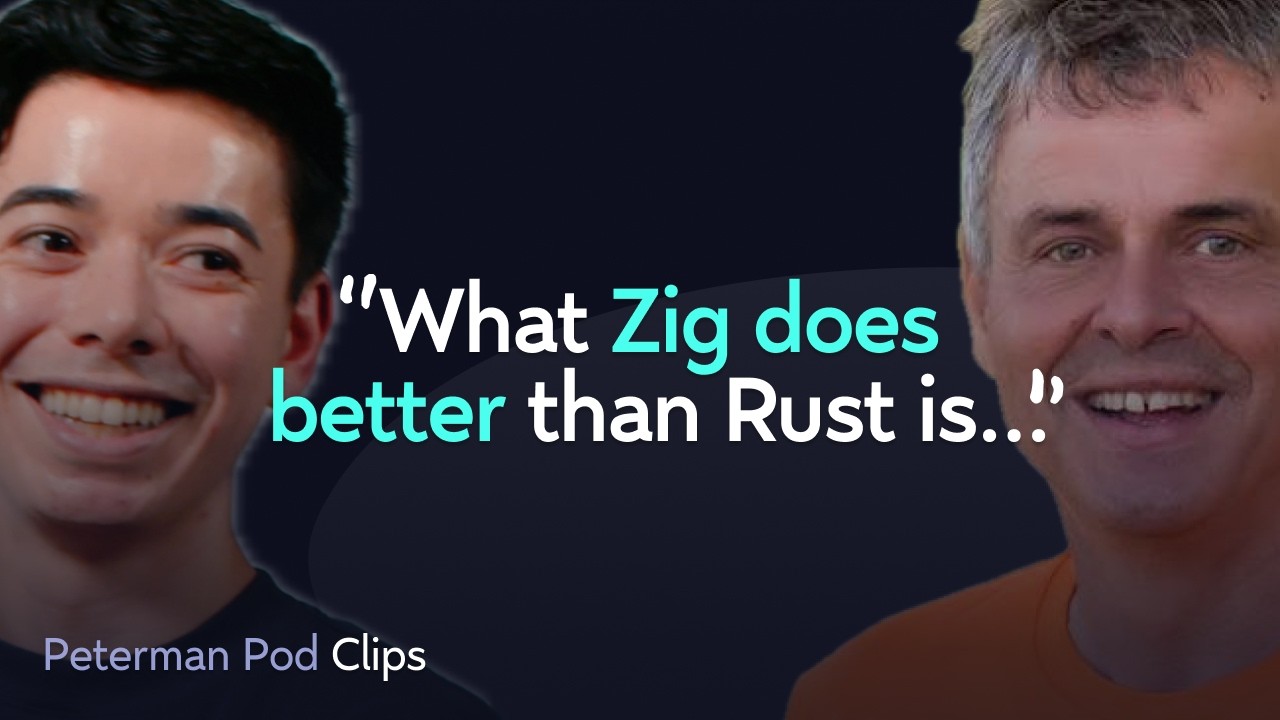
## Background Published on YouTube by Ryan Peterman on September 19, 2026, this video features an interview clip with Martin Odersky, the creator of Scala. The conversation focuses on comparing Scala to other major programming languages, specifically Rust, Zig, Go, and Python.
## TL;DR Martin Odersky evaluates the practical trade-offs of modern programming languages, arguing that while Rust excels in low-memory environments, it is often overused in application layers where modern garbage collectors simplify engineering. He contrasts the expressive power and compile-time inlining models of Zig and Scala 3 against Rust's macros, while also discussing ongoing Scala research into statically verified manual memory allocation. Finally, Odersky examines dynamic languages like Python and Scheme, highlighting industry-wide convergence toward functional paradigms while emphasizing Python's dominance as a glue language against Scala's foundational, always-on static type safety.
## Atmosphere & style The discussion carries a measured, deeply analytical, and reflective tone grounded in decades of compiler engineering experience. Rather than defending dogma, Odersky offers candid, nuanced critiques—such as calling non-GC usage in high-memory environments an intellectual flex—while maintaining genuine admiration for the distinct design philosophies of systems languages like Zig and Rust. Listening feels like an insightful technical masterclass where practical engineering realities are weighed carefully against theoretical purity.
## Bulletin - [00:00](https://www.youtube.com/watch?v=SyltKRA8ErU&t=0s) Martin Odersky argues that Rust is increasingly overused higher up the application stack, where garbage collection would simplify development with negligible latency impact if memory is available. - [00:00](https://www.youtube.com/watch?v=SyltKRA8ErU&t=0s) Scala research is exploring static reference tracking within its type system to allow safe manual memory allocators akin to Zig without runtime garbage collection. - [03:15](https://www.youtube.com/watch?v=SyltKRA8ErU&t=195s) Odersky favors Zig's compile-time system over Rust's macro system, comparing Zig's metaprogramming to Scala 3's guaranteed inlining model that prevents post-expansion type errors. - [06:17](https://www.youtube.com/watch?v=SyltKRA8ErU&t=377s) While mainstream languages like Python converge toward functional features like pattern matching, Python's optional typing remains distinct from Scala's always-on, foundational type guarantees.
## Key takeaways - [00:00](https://www.youtube.com/watch?v=SyltKRA8ErU&t=0s) Rust delivers superior low-level performance guarantees and operates with a minimal memory footprint, making it ideal for embedded and systems programming. - [00:00](https://www.youtube.com/watch?v=SyltKRA8ErU&t=0s) Modern garbage collectors reduce pause times to negligible amounts, but achieving high GC performance inherently requires a substantial allocation of memory. - [00:00](https://www.youtube.com/watch?v=SyltKRA8ErU&t=0s) Writing non-GC code in high-level application layers with abundant memory often acts as an intellectual exercise rather than a sensible engineering decision. - [00:00](https://www.youtube.com/watch?v=SyltKRA8ErU&t=0s) Go deliberately constrained language features and delayed generics, creating an exceptionally uniform coding style that makes reading unfamiliar codebases easy. - [00:00](https://www.youtube.com/watch?v=SyltKRA8ErU&t=0s) Scala cannot disable its garbage collector in production today, but active research focuses on type-level reference tracking to safely enable custom manual memory allocators. - [03:15](https://www.youtube.com/watch?v=SyltKRA8ErU&t=195s) Zig's `comptime` metaprogramming and smart inlining provide a cleaner and more expressive alternative to Rust's macro system. - [03:15](https://www.youtube.com/watch?v=SyltKRA8ErU&t=195s) Unlike C++ template expansion which frequently causes deep post-expansion type errors, Scala 3 verifies type correctness prior to inline rewriting. - [03:15](https://www.youtube.com/watch?v=SyltKRA8ErU&t=195s) Scala's `inline` modifier is mandatory rather than discretionary, assuring developers that function call overhead will be completely eliminated at compile time. - [03:15](https://www.youtube.com/watch?v=SyltKRA8ErU&t=195s) Inlining in Scala operates directly on typed abstract syntax trees, enabling optimizations like unrolling known lambda literals to remove allocation costs. - [06:17](https://www.youtube.com/watch?v=SyltKRA8ErU&t=377s) Among dynamically typed languages, Python stands out for ubiquity and readability, whereas Scheme represents theoretical elegance rooted in lambda calculus. - [06:17](https://www.youtube.com/watch?v=SyltKRA8ErU&t=377s) Modern programming languages across ecosystems are converging toward functional features, including pattern matching, closures, and polymorphism. - [06:17](https://www.youtube.com/watch?v=SyltKRA8ErU&t=377s) Scala maintains an 'always-on' foundational type system, contrasting with Python's optional type annotations evaluated by external tools like Mypy or Pyright. - [06:17](https://www.youtube.com/watch?v=SyltKRA8ErU&t=377s) Scala 3 adopted indentation-based syntax, bringing its visual readability close to Python while preserving strong static typing. - [06:17](https://www.youtube.com/watch?v=SyltKRA8ErU&t=377s) Python's enduring superpower is acting as an effective glue language that bridges high-level developer scripts with high-performance C and C++ backends.
## Detailed walkthrough ### [00:00](https://www.youtube.com/watch?v=SyltKRA8ErU&t=0s) Comparing Rust, Go, and Scala: Memory Management and Language Constraints
When evaluating Rust against Scala, Martin Odersky points out that Rust operates much closer to the metal and provides superior performance guarantees. Scala relies on garbage collection; while modern garbage collectors are "brilliant" and reduce pause times to negligible lengths, running GC fast fundamentally requires a substantial chunk of memory. Rust, by contrast, can operate within a minimal memory footprint, making it far better suited for embedded systems and low-level environments.
However, Odersky argues that Rust is currently overused across the industry. Developers frequently push Rust higher up the software stack into domains where a garbage collector would perform perfectly well. To him, writing non-GC code in application layers where ample memory exists feels like an intellectual flex—"an exercise in... just intellectual that I can do it"—rather than a practical engineering choice. If memory overhead is tolerable, using a garbage collector simplifies development considerably.
Turning to Go, Odersky characterizes it as a language that intentionally lags behind modern language evolution. Designed around the conventions and standards of the 1990s, Go remained deliberately minimal for years. While the eventual addition of generics represented a major step forward, the language remains constrained in what developers can express. That limitation brings a distinct cultural and practical benefit: it forces an exceptionally uniform coding style. Because developers have few stylistic ways to solve a problem, jumping into an unfamiliar codebase and reading someone else's code is straightforward.
When asked whether developers can disable Scala’s garbage collector, Odersky explains that this is not possible in production today. Research initiatives in Scala explore custom memory allocators akin to Zig's manual allocation model. The classic peril of manual allocators is leaking references into memory that has already been reclaimed, causing dangling pointers to access undefined memory. Scala's advanced type system can now track references statically to prevent such safety violations at compile time while allowing custom allocators, though this work has not yet shipped for production use.
- **Rust's Core Advantage:** Minimal memory footprint, no GC pauses, ideal for embedded and systems programming. - **The Rust Misuse Case:** Forcing borrow-checker semantics higher up the stack when heap memory is abundant. - **Go's Trade-off:** Feature minimalism and historical delay in adopting features like generics, offset by code readability and cross-team consistency. - **Scala Non-GC Research:** Exploring static reference tracking within the type system to allow safe, custom manual allocators without runtime GC panics.
---
[03:15](https://www.youtube.com/watch?v=SyltKRA8ErU&t=195s) Zig vs Rust: Compile-Time Inlining and Metaprogramming
Examining the community debates between Zig and Rust, Odersky highlights Zig's compile-time system (`comptime`) and its smart inlining as clean, expressive, and powerful. By contrast, he views Rust's macro system as noticeably more "clunky."
Scala 3 implements a metaprogramming model that closely parallels Zig's philosophy, relying on explicit inlining and compiler optimizations rather than opaque text/token expansions. However, Scala adds a crucial safety restriction: inlining cannot introduce new type errors. In systems like C++ templates, template expansion frequently triggers deeply nested, terrifying type errors after expansion, making debugging miserable. Scala guarantees that expanded inline code remains type-correct by validating types beforehand.
To clarify what "inlining" means in this context, Odersky explains that placing the `inline` modifier in front of a Scala function instructs the compiler to rewrite call sites before generating bytecode or machine code. Working directly on typed syntax trees:
1. The compiler locates calls to the `inline` function. 2. It replaces the call site directly with the function's body. 3. It performs contextual simplifications—such as recognizing when an argument is a known lambda literal and forwarding the call directly to avoid lambda allocation overhead.
Crucially, unlike standard compiler optimizers that exercise arbitrary discretion over whether a function call gets inlined, an `inline` construct in Scala (like `comptime` in Zig or `constexpr` in C++) is mandatory. Developers can architect code relying on the guarantee that the abstraction overhead will be completely eliminated.
```mermaid flowchart TD accTitle: Inline Expansion Pipeline accDescr: Diagram showing how an inline function call is transformed by the compiler into an optimized function body.
subgraph CompileTime ["Compile-Time Typing Phase"] Call["Function Call Site"] --> Inspect["Compiler Inspects Typed AST"] Inspect --> Replace["Replace Call with Function Body"] end
subgraph Optimization ["Compiler Optimization Pass"] Replace --> Unroll["Unroll / Forward Known Lambdas"] Unroll --> OptBody["Optimized Direct Execution (Zero Overhead)"] end ```
---
[06:17](https://www.youtube.com/watch?v=SyltKRA8ErU&t=377s) Dynamically Typed Languages: Python, Scheme, and the Convergence with Scala
Among dynamically typed languages, Odersky single out two standouts: Python, due to its ubiquity and clean, highly readable syntax, and Scheme, for its rigorous foundations in computer science theory and lambda calculus. Although Scheme represents theoretical purity, Python is "100 times more popular."
When comparing Scala to Python, Odersky observes that programming languages across the industry are increasingly converging toward a shared feature set predominantly borrowed from functional programming:
- Pattern matching (recently introduced to modern Python) - Strong type system constructs and optional type syntax - Generics and polymorphism - First-class closures and lambdas
Despite this convergence, a fundamental divide remains between the two languages. Scala's type system is strong, foundational, and "always on," providing rigorous static guarantees that entire categories of invalid states cannot occur. Python's typing system consists of optional type annotations evaluated by external type checkers (such as Mypy or Pyright), embedded in an ecosystem and community culture that historically does not rely on or enforce types as strictly.
Syntactically, Scala 3 has moved remarkably close to Python with its indentation-based, optional-brace syntax, making Scala feel like a strongly typed sibling running on enterprise-grade virtual machines. At the same time, Odersky acknowledges Python's undisputed superpower: acting as the ultimate "glue language," seamlessly and efficiently binding high-level application scripts to optimized, high-performance C and C++ backends such as NumPy and pandas.
## Notable quotes > [00:00](https://www.youtube.com/watch?v=SyltKRA8ErU&t=0s) an exercise in... just intellectual that I can do it — Martin Odersky
> [00:00](https://www.youtube.com/watch?v=SyltKRA8ErU&t=0s) brilliant — Martin Odersky
> [03:15](https://www.youtube.com/watch?v=SyltKRA8ErU&t=195s) clunky — Martin Odersky
> [03:15](https://www.youtube.com/watch?v=SyltKRA8ErU&t=195s) comptime — Martin Odersky
> [03:15](https://www.youtube.com/watch?v=SyltKRA8ErU&t=195s) inline — Martin Odersky
> [06:17](https://www.youtube.com/watch?v=SyltKRA8ErU&t=377s) 100 times more popular — Martin Odersky
> [06:17](https://www.youtube.com/watch?v=SyltKRA8ErU&t=377s) always on — Martin Odersky
> [06:17](https://www.youtube.com/watch?v=SyltKRA8ErU&t=377s) glue language — Martin Odersky
## Mentioned Martin Odersky, Ryan Peterman, Scala, Scala 3, Rust, Zig, Go, Python, Scheme, C++, C, Mypy, Pyright, NumPy, pandas
## Video description This is a clip from the longer conversation when you can find here where I interviewed Martin Odersky who is the creator of Scala: https://www.youtube.com/watch?v=LdN4sPWM-WY
[Source](https://www.youtube.com/watch?v=SyltKRA8ErU)