Scala Creator Odersky Pitches Capability Types to Contain AI Code
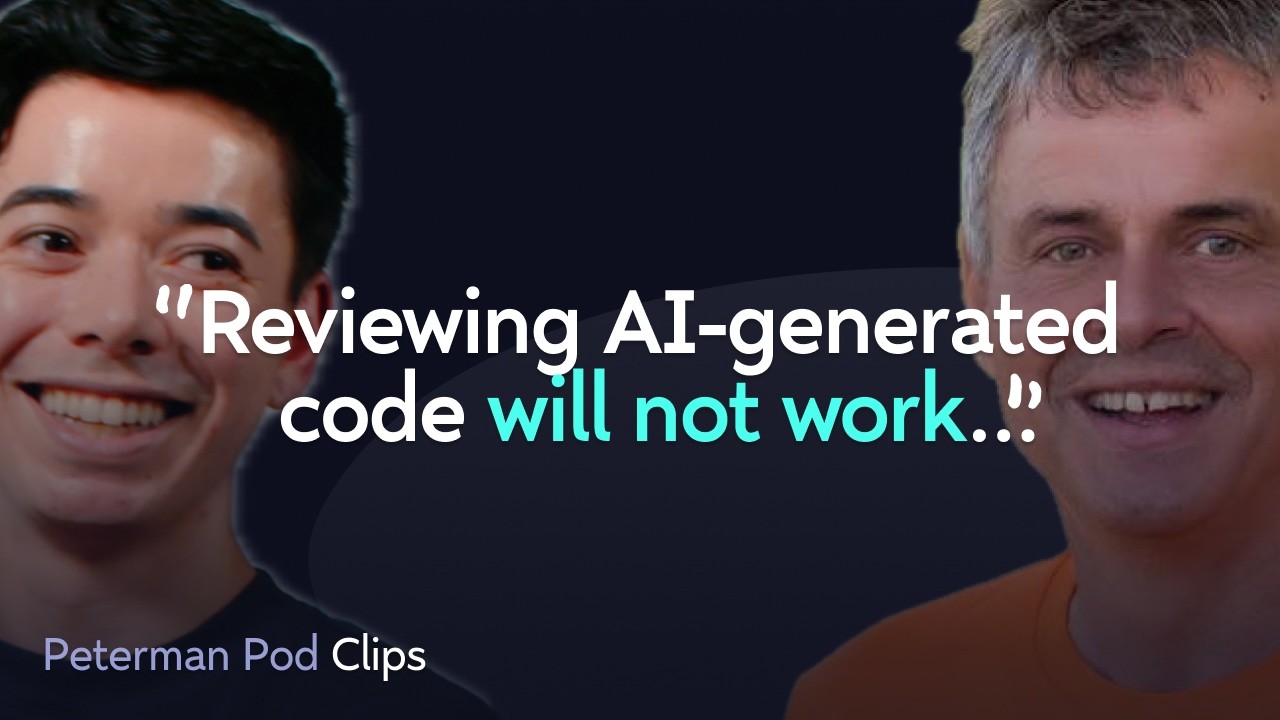
Ryan Peterman
Because humans cannot manually review mountains of AI-generated code, programming languages must replace leaky type systems with airtight capability contracts that mathematically restrict what autonomous agents can access.
AI-assisted summary of Creator of Scala: How AI Will Impact Programming Languages | Martin Odersky — original source. Check the original for full context.
Source published:
Key ideas
- Martin Odersky warns that software engineering faces an existential crisis because humans cannot realistically review the staggering volume of AI-generated code while AI simultaneously accelerates vulnerability discovery. (0:00)
- Human engineering must transition away from reviewing raw implementation code toward crafting precise, airtight type signatures that function as verifiable contracts with generative models. (1:13)
- Memory safety is only a baseline; languages must adopt capability-based systems to strictly limit what autonomous AI agents can read, write, or access. (2:52)
- Experimental work in Scala uses capture checking on scoped capabilities to mathematically prevent leaked references across resource lifetimes, memory arenas, and restricted system boundaries. (5:12)
Detailed notes
## Background Published on YouTube by Ryan Peterman on September 23, 2026, this clip features an interview with Scala creator Martin Odersky examining the impact of AI on programming languages. The video description notes that it stems from a broader conversation comparing language designs across Rust, Zig, Python, and Scala while exploring how developer workflows must adapt to machine-generated code.
## TL;DR Martin Odersky warns that massive AI code output combined with rapid automated vulnerability discovery has created an existential crisis, rendering manual human code review impossible. To maintain oversight, developers must elevate types and interfaces into airtight, mathematically sound contracts that compilers can enforce over AI implementations. While baseline memory safety in languages like Rust is essential, real-world agent safety requires capability-based security embedded directly in language semantics. Scala is exploring this via capture checking, using the type system to mathematically verify that capabilities, secret keys, and resource lifetimes cannot leak beyond their intended scopes.
## Atmosphere & style The conversation carries a measured, deeply intellectual atmosphere marked by Odersky’s candid framing of an industry-wide crisis. Peterman acts as an attentive, focused interlocutor, giving Odersky ample runway to articulate language theory through practical systems-level analogies. Listening feels like attending an advanced computer science seminar that confronts real-world, high-stakes engineering dilemmas with calm academic rigor.
## Bulletin - [00:00](https://www.youtube.com/watch?v=_l2qD0rJlFo&t=0s) Martin Odersky warns that software engineering faces an existential crisis because humans cannot realistically review the staggering volume of AI-generated code while AI simultaneously accelerates vulnerability discovery. - [01:13](https://www.youtube.com/watch?v=_l2qD0rJlFo&t=73s) Human engineering must transition away from reviewing raw implementation code toward crafting precise, airtight type signatures that function as verifiable contracts with generative models. - [02:52](https://www.youtube.com/watch?v=_l2qD0rJlFo&t=172s) Memory safety is only a baseline; languages must adopt capability-based systems to strictly limit what autonomous AI agents can read, write, or access. - [05:12](https://www.youtube.com/watch?v=_l2qD0rJlFo&t=312s) Experimental work in Scala uses capture checking on scoped capabilities to mathematically prevent leaked references across resource lifetimes, memory arenas, and restricted system boundaries.
## Key takeaways - [00:00](https://www.youtube.com/watch?v=_l2qD0rJlFo&t=0s) AI code generation creates an existential bottleneck because manual human code review cannot scale to inspect the generated output. - [00:25](https://www.youtube.com/watch?v=_l2qD0rJlFo&t=25s) AI is increasingly capable of autonomously discovering and exploiting software vulnerabilities, raising the stakes of unvetted code. - [00:55](https://www.youtube.com/watch?v=_l2qD0rJlFo&t=55s) Adapting programming language design is a crucial path for human engineers to retain oversight and control over autonomous software systems. - [01:13](https://www.youtube.com/watch?v=_l2qD0rJlFo&t=73s) Human developers must elevate their focus from raw implementation logic to expressive, high-level types and interfaces. - [01:35](https://www.youtube.com/watch?v=_l2qD0rJlFo&t=95s) Type signatures serve as human-readable, verifiable contracts that compilers enforce against AI-generated implementations. - [02:05](https://www.youtube.com/watch?v=_l2qD0rJlFo&t=125s) Most mainstream type systems act merely as suggestions because type casts and dirty memory operations leave exploitable loopholes. - [02:30](https://www.youtube.com/watch?v=_l2qD0rJlFo&t=150s) Language designers must construct hole-free, sound type systems to prevent AI or adversaries from finding loopholes. - [02:52](https://www.youtube.com/watch?v=_l2qD0rJlFo&t=172s) Capability-based security models from operating systems must be integrated directly into programming language semantics to control AI agents. - [03:28](https://www.youtube.com/watch?v=_l2qD0rJlFo&t=208s) While memory safety in languages like Rust is a vital prerequisite, it is insufficient on its own to enforce permissions, secrets access, and resource lifecycles. - [04:30](https://www.youtube.com/watch?v=_l2qD0rJlFo&t=270s) AI models' proficiency in rewriting and migrating legacy software makes modernizing codebases to sound target languages feasible. - [05:12](https://www.youtube.com/watch?v=_l2qD0rJlFo&t=312s) In conventional languages, routines can secretly retain handles to temporary resources via closures, global state, or background threads beyond their intended lifetime. - [06:05](https://www.youtube.com/watch?v=_l2qD0rJlFo&t=365s) Scala's experimental capability model uses capture checking to mandate that any returned value retaining a capability must declare it explicitly in its type signature. - [06:55](https://www.youtube.com/watch?v=_l2qD0rJlFo&t=415s) Capture checking unifies the management of diverse resources, including file handles, memory arena allocations, and sensitive API credentials.
## Detailed walkthrough ### [00:00](https://www.youtube.com/watch?v=_l2qD0rJlFo&t=0s) The Existential Crisis of AI-Generated Code
Ryan Peterman opens by asking Martin Odersky how he envisions the future of programming languages as AI models generate an increasingly large share of software. Odersky responds bluntly: the industry is currently undergoing an "existential crisis." On one side, AI models output staggering volumes of source code. On the other side, human engineers are saddled with an impossible demand: manually reviewing and verifying these towering mountains of code—a workflow that simply "will never work."
Compounding the problem, AI has simultaneously become remarkably adept at finding and exploiting software vulnerabilities. Tools like modern vulnerability scanners and autonomous fuzzers demonstrate how hazardous unvetted code can be; if systems are left open, AI agents will inevitably discover and exploit those weaknesses. This dynamic threatens to strip humans of meaningful oversight and control over their software systems. While programming language design is not a single silver bullet, Odersky argues that languages are a crucial mechanism for humans to regain control.
```mermaid flowchart TD accTitle: AI Code Generation Crisis and Solution accDescr: The cycle showing how AI code overload creates an existential crisis that stronger type systems and capabilities resolve.
subgraph Problem["The Current Dilemma"] A["AI generates vast volumes of code"] --> B["Human review bottleneck (impossible task)"] B --> C["AI rapidly exploits hidden vulnerabilities"] end
subgraph Solution["Language-Level Defense"] D["Shift focus to types & interfaces"] E["Define strict human-AI contracts"] F["Enforce capability systems & scoped lifetimes"] end
C -.->|"Requires structural fix"| D D --> E E --> F ```
- Humans cannot realistically scale manual code reviews to keep up with high-throughput AI code generation. - Rapid vulnerability discovery makes insecure, unverified code significantly more perilous than in past software eras. - Programming languages must adapt so humans can control AI output without reading every raw line of code.
---
[01:13](https://www.youtube.com/watch?v=_l2qD0rJlFo&t=73s) Stronger Types as Contracts Between Humans and AI
Because raw implementation code will increasingly be generated by machines, Odersky argues that human engineering attention must shift entirely to interfaces and type systems. High-level types must become drastically more expressive, rigorous, and precise. A type signature is fundamentally a concise, human-readable handle that doubles as a verifiable contract between the human operator and the generative AI. Humans review and dictate the high-level specification, while the compiler guarantees that the AI's generated implementation strictly adheres to the contract.
To accomplish this, programming language designers must significantly raise their standards. Odersky points out that in the vast majority of current mainstream programming languages, type systems act merely as "recommendations" rather than hard guarantees. Through type casts, unsafe pointer arithmetic, or untracked dirty memory operations, systems can be subverted from beneath the type checker. Because an AI or malicious actor will aggressively locate and exploit any crack in a language's soundness, language designers must build hole-free, airtight type systems from the ground up.
- Specifications and types become the primary artifacts written and inspected by human programmers. - Current type systems fail to provide true guarantees due to runtime casting escapes and dirty memory workarounds. - Sound type contracts enable developers to let AI generate implementations with genuine confidence.
---
[02:52](https://www.youtube.com/watch?v=_l2qD0rJlFo&t=172s) Extending Safety Beyond Memory: Capabilities and Agents
To construct robust boundaries for AI agents, Odersky points toward an operating-system concept whose time has come in language design: capability-based security. While capabilities traditionally governed fine-grained user and process permissions in operating systems, they translate directly to agentic AI. As autonomous agents execute tasks, engineers must constrain them with exact, fine-grained capabilities to guarantee what they *cannot* do—such as exfiltrating private API keys, leaking emails, or accessing unpermitted network endpoints.
Odersky notes that basic memory safety is only the initial baseline. Languages like Rust have gained major traction—even earning formal recommendations from the US government—because eliminating memory-corruption bugs is an essential prerequisite. If an attacker or agent can touch arbitrary memory, all higher-level invariants collapse. However, Rust focuses almost entirely on memory. Real-world application safety requires governing read permissions, write permissions, secrets access, and arbitrary resource lifetimes. While skeptics might argue that millions of legacy lines of C and C++ make this vision unrealistic, Odersky counters that AI models excel at translating and rewriting software; if language designers provide a sound target language, AI can assist in the migration.
- Basic memory safety is necessary, but strictly insufficient on its own for agentic safety. - Permissions like network access, secret handling, and resource manipulation must be tracked directly in the language semantics. - Scala is actively exploring these capability systems experimentally in the lab to push beyond standard safety guarantees.
---
[05:12](https://www.youtube.com/watch?v=_l2qD0rJlFo&t=312s) How Capability Tracking Works in Practice: The Scala Model
Asked to illustrate what these experimental safety and capability mechanisms look like in Scala, Odersky provides the concrete scenario of resource lifetimes and file management. Consider a scenario where a caller hands a sensitive file handle (such as a log file) to a routine for a limited scope, after which the runtime closes it. In conventional languages, the callee can trivially retain a hidden reference to that file—stashing it in a global variable, capturing it inside a closure or stream, or holding it in a background thread—and attempt to access it after the runtime has closed or reclaimed it.
In Scala's experimental capability system, the file is tagged as a scoped capability. The type system enforces capture checking: any value that captures or retains the capability—such as a returned lambda or an open stream—must explicitly declare that capability in its type signature. The capability cannot remain a secret. If the enclosing context requires a pure return type that forbids retaining that capability, the compiler rejects the program. Odersky highlights that this exact mechanism mirrors memory arenas: once an arena region is deallocated, the type system must mathematically guarantee that no surviving pointers or closures reference memory inside that arena. By preventing capabilities from escaping their lexical lifetimes, the type system reliably enforces security boundaries around secrets, memory, and sensitive system operations.
- Capabilities prevent code from secretly retaining references to temporary resources across boundaries. - Returned values, streams, or lambdas that hold capabilities must expose them explicitly in their types. - Capture checking unifies multiple resource problems under one model: file handles, arena memory management, and restricted secrets access.
## Notable quotes > [00:00](https://www.youtube.com/watch?v=_l2qD0rJlFo&t=0s) existential crisis — Martin Odersky
> [00:00](https://www.youtube.com/watch?v=_l2qD0rJlFo&t=0s) will never work — Martin Odersky
> [01:13](https://www.youtube.com/watch?v=_l2qD0rJlFo&t=73s) recommendations — Martin Odersky
## Mentioned Martin Odersky, Ryan Peterman, Scala, Rust, Zig, Python, C, C++
## Video description Martin Odersky is the creator of Scala and I interviewed him to compare different languages designs (Rust vs Zig vs Python vs Scala) and how AI will impact programming languages.
Watch the full conversation: https://www.youtube.com/watch?v=LdN4sPWM-WY
[Source](https://www.youtube.com/watch?v=_l2qD0rJlFo)