Casey Muratori Says AI Coding Must Outpace Corporate FOMO to Save Code
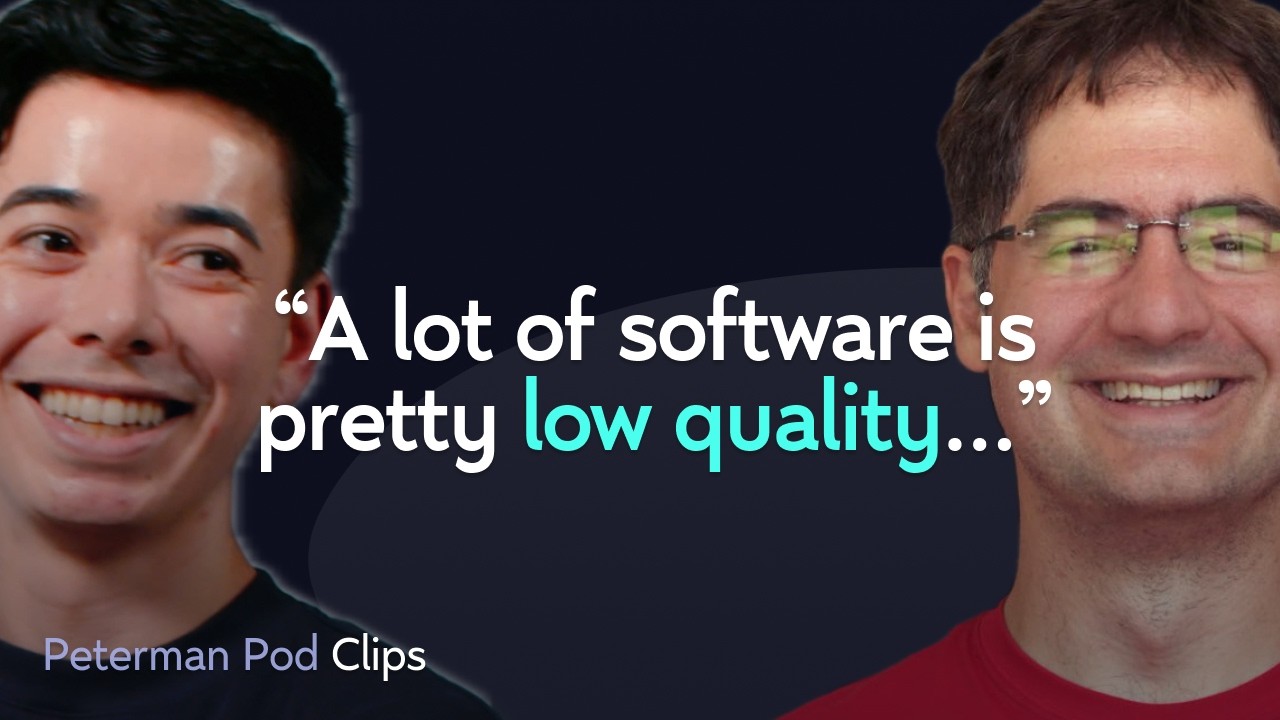
Ryan Peterman
Widespread executive mandates and unreviewed AI prompting have locked the tech industry in a race where models must improve faster than naive adoption or software quality will collapse.
AI-assisted summary of Is "Vibecoding" Bad for the Industry | Casey Muratori — original source. Check the original for full context.
Source published:
Key ideas
- Casey Muratori clarifies his warning on 'vibecoding', arguing that catastrophic software quality declines stem from non-engineers shipping unchecked, AI-generated code directly to production. (0:00)
- Software reliability now hinges on an existential foot race: AI autonomous reasoning must improve faster than the rate at which organizations unthinkingly adopt and ship unverified code. (0:00)
- Executive fear of missing out (FOMO) is driving irrational company-wide AI mandates, exemplified by Muratori's 'Slopify' criticism of Shopify's internal directives. (4:10)
- Muratori rejects the narrative that AI ruined engineering standards, pointing out that baseline software quality was already remarkably poor before generative tools arrived. (4:10)
Detailed notes
## Background Published on YouTube by Ryan Peterman on October 2, 2026, the video features a conversation with video game developer and programming creator Casey Muratori. The page description states that the discussion covers surprising parts found while digging through computer history, where bad code comes from, and Muratori's career story.
## TL;DR In this discussion, Casey Muratori and Ryan Peterman examine the phenomenon of 'vibecoding' and the rapid, uncritical adoption of AI tools in software development. Muratori argues that while experienced engineers with computer science backgrounds can effectively leverage AI, shipping unchecked code written by non-engineers straight to production threatens industry-wide software quality. He also critiques corporate FOMO and executive AI mandates—dubbed 'Slopify'—while noting that software quality was already low long before the rise of large language models.
## Atmosphere & style The atmosphere is candid, pragmatic, and conversational, featuring a sharp critique of current tech industry trends delivered with wry humor and straightforward realism. The dialogue moves between blunt warnings about software degradation and lighthearted banter over puns like 'Slopify,' creating an engaged and critical tone about the realities of modern engineering.
## Bulletin - [00:00](https://www.youtube.com/watch?v=KNuBSNffSUo&t=0s) Casey Muratori clarifies his warning on 'vibecoding', arguing that catastrophic software quality declines stem from non-engineers shipping unchecked, AI-generated code directly to production. - [00:00](https://www.youtube.com/watch?v=KNuBSNffSUo&t=0s) Software reliability now hinges on an existential foot race: AI autonomous reasoning must improve faster than the rate at which organizations unthinkingly adopt and ship unverified code. - [04:10](https://www.youtube.com/watch?v=KNuBSNffSUo&t=250s) Executive fear of missing out (FOMO) is driving irrational company-wide AI mandates, exemplified by Muratori's 'Slopify' criticism of Shopify's internal directives. - [04:10](https://www.youtube.com/watch?v=KNuBSNffSUo&t=250s) Muratori rejects the narrative that AI ruined engineering standards, pointing out that baseline software quality was already remarkably poor before generative tools arrived.
## Key takeaways - [00:00](https://www.youtube.com/watch?v=KNuBSNffSUo&t=0s) The premise behind Muratori's warning that software quality would degrade was people with zero computer science knowledge typing prompts and shipping results straight to production without review. - [00:00](https://www.youtube.com/watch?v=KNuBSNffSUo&t=0s) A strong computer science background creates a massive divide in AI output quality; experienced engineers direct and validate AI effectively, whereas non-technical users merely hope for the best. - [00:00](https://www.youtube.com/watch?v=KNuBSNffSUo&t=0s) The industry faces a foot race between the speed of autonomous AI capability growth and the unchecked adoption rate by individuals lacking technical evaluation skills. - [00:00](https://www.youtube.com/watch?v=KNuBSNffSUo&t=0s) If AI capabilities were to plateau at current levels, pervasive uncritical adoption would leave the tech landscape facing severe software instability. - [00:00](https://www.youtube.com/watch?v=KNuBSNffSUo&t=0s) Even AI skeptics must now hope for rapid, substantial model improvements because the technology is already too deeply embedded in widespread workflows to roll back. - [04:10](https://www.youtube.com/watch?v=KNuBSNffSUo&t=250s) Executive FOMO pushes enterprises to mandate company-wide AI usage before tools have proven they can reliably address real production demands. - [04:10](https://www.youtube.com/watch?v=KNuBSNffSUo&t=250s) Rational engineering organizations evaluate new technologies through controlled, measured experiments rather than top-down universal mandates. - [04:10](https://www.youtube.com/watch?v=KNuBSNffSUo&t=250s) High-risk, highly autonomous agent workflows are appropriate for isolated R&D experimentation, not blanket operational deployment across an entire workforce. - [04:10](https://www.youtube.com/watch?v=KNuBSNffSUo&t=250s) The tech industry was never operating at 'five-nines' reliability prior to LLMs, making claims that AI single-handedly ruined previously excellent software baseless.
## Detailed walkthrough ### [00:00](https://www.youtube.com/watch?v=KNuBSNffSUo&t=0s) Vibecoding and the Foot Race Between AI Capability and Adoption
The conversation opens with Ryan Peterman revisiting Andrej Karpathy's famous February 2025 tweet that originally coined the term "vibecoding." At the time, Casey Muratori offered a blunt warning in response: "if you thought software was bad today, buckle up because it's about to get a whole lot worse." Asked whether that grim prediction has played out roughly a year and a half later, Casey clarifies the premise behind his warning. The impending collapse in quality was always predicated on an operating model where people simply "type some stuff in the computer and ship it to prod"—asking an AI to generate a feature and immediately pushing it live without verification, particularly when driven by individuals with zero computer science background. Muratori stresses that he does not want to be overly dismissive of AI's utility, noting that the disparity between users is night and day: an engineer well-versed in computer science leveraging AI can produce substantially better code than someone with no technical foundation who merely prompts a model and hopes for the best.
```mermaid flowchart TD accTitle: The Software Quality Foot Race accDescr: Diagram illustrating the competition between AI capability growth and unchecked adoption without domain expertise.
subgraph Adoption ["Adoption Dynamics"] A["Non-CS Users & Vibe Coders"] --> B["Ship Directly to Production Without Review"] C["Trained Engineers"] --> D["Validate & Direct AI Output"] end
subgraph Capability ["The AI Trajectory"] E["AI Model Autonomy & Reasoning"] end
B -->|"Drives quality down"| Outcome{"Net Software Quality"} D -->|"Preserves quality"| Outcome E -->|"Must outpace naive usage"| Outcome ```
The real danger, Muratori explains, emerges when organizations skip human code review entirely. In the worst-case scenario, "some random person in marketing somewhere who has no idea what programming is just types some stuff in and crosses their fingers." What results is an existential foot race between two competing curves: the rate at which AI autonomously improves versus the rate and capability level of the people adopting it. If model intelligence rises fast enough to consistently match or exceed the tasks delegated by end-users, software quality will not plummet. However, if uncritical adoption outstrips the model's actual reasoning capabilities, the tech landscape is "in for a world of hurt." Muratori notes that the industry currently teeters on a knife's edge between these two trajectories. While he admits he is personally "no fan of AI" and understands why skeptics actively root for its failure, the reality of widespread deployment means everyone must now root for AI to get dramatically better:
> "At the end of the day, if you're talking about something that tons of people are using, you're going to kind of want it to be good... if you want software to not be terrible, you have to kind of still be hoping that 6 months from now the AIs are again significantly better than they were, right? Like that is the only way out of the current situation as I see it."
- **The Human Competence Divide**: A computer science background acts as a critical filter; experienced developers using AI tools produce dramatically higher-quality code than beginners or non-engineers relying solely on conversational prompting. - **The Knife's-Edge Race**: Software stability depends on AI autonomous decision-making improving faster than the speed at which unchecked, review-free code is pushed to production. - **The Stagnation Risk**: Given current adoption levels, Muratori argues that if AI capabilities were to plateau at their current level—or where they were six months prior—the net outcome for industry software quality would be disastrous.
---
[04:10](https://www.youtube.com/watch?v=KNuBSNffSUo&t=250s) "Slopify," Corporate FOMO, and the Reality of Software Quality
Peterman turns to another viral exchange where Casey responded to an internal Shopify executive memo mandating AI adoption with a single-word jab: "Slopify." Muratori laughs, admitting he liked the pun, but uses it to highlight what he sees as one of the most destructive trends in tech: executive fear of missing out (FOMO). Instead of waiting until tools prove they can reliably handle production demands, leadership teams panic, convinced that failing to dive in immediately spells disaster for their enterprise. They force broad adoption before anyone even knows if the outcomes are viable or beneficial.
Muratori contrasts this top-down corporate frenzy with how any rational engineering organization should introduce new technology. A sane adoption model involves running controlled experiments: measuring tool capabilities, verifying whether they resolve concrete engineering bottlenecks faster than existing workflows, and integrating them into production pipelines only when they demonstrate a clear net positive. Having an internal R&D team explore the bleeding edge—"out there yolo swagging it" with 3,000 autonomous agents communicating across a cluster—is entirely appropriate. Mandating that every employee across the entire organization burn vast sums of tokens on daily tasks, however, is not.
Yet Muratori is careful not to pin the blame for bad software entirely on generative AI. He tempers his critique by reminding listeners that developer standards were already abysmal before large language models arrived on the scene:
> "I would temper that statement with just the obvious fact that like we were not exactly a five-nines industry to start out with. Like software quality was really pretty low rolling into the AI era... it's not like software was amazing and the AI showed up and ruined everything. That is a completely ridiculous narrative that that is not true at all."
- **The Corporate Adoption Anti-Pattern**: Companies rush deployments out of panic that waiting for mature tools will leave them behind, reversing the standard engineering practice of validating efficacy before scaling workflow changes. - **Targeted R&D vs. Company-Wide Mandates**: Exploring high-agent clusters and automated workflows belongs with dedicated experimental teams rather than being enforced blanket-style across non-technical departments. - **Historical Software Baseline**: While AI-generated code introduces distinct failure modes, pre-AI software engineering was already plagued by low reliability and poor performance rather than running at "five-nines" quality.
## Notable quotes > [00:00](https://www.youtube.com/watch?v=KNuBSNffSUo&t=0s) if you thought software was bad today, buckle up because it's about to get a whole lot worse. — Casey Muratori
> [00:00](https://www.youtube.com/watch?v=KNuBSNffSUo&t=0s) type some stuff in the computer and ship it to prod — Casey Muratori
> [00:00](https://www.youtube.com/watch?v=KNuBSNffSUo&t=0s) some random person in marketing somewhere who has no idea what programming is just types some stuff in and crosses their fingers. — Casey Muratori
> [00:00](https://www.youtube.com/watch?v=KNuBSNffSUo&t=0s) in for a world of hurt. — Casey Muratori
> [00:00](https://www.youtube.com/watch?v=KNuBSNffSUo&t=0s) At the end of the day, if you're talking about something that tons of people are using, you're going to kind of want it to be good... if you want software to not be terrible, you have to kind of still be hoping that 6 months from now the AIs are again significantly better than they were, right? Like that is the only way out of the current situation as I see it. — Casey Muratori
> [04:10](https://www.youtube.com/watch?v=KNuBSNffSUo&t=250s) Slopify. — Casey Muratori
> [04:10](https://www.youtube.com/watch?v=KNuBSNffSUo&t=250s) out there yolo swagging it — Casey Muratori
> [04:10](https://www.youtube.com/watch?v=KNuBSNffSUo&t=250s) I would temper that statement with just the obvious fact that like we were not exactly a five-nines industry to start out with. Like software quality was really pretty low rolling into the AI era... it's not like software was amazing and the AI showed up and ruined everything. That is a completely ridiculous narrative that that is not true at all. — Casey Muratori
## Mentioned Andrej Karpathy, Casey Muratori, Ryan Peterman, Shopify
## Video description Casey Muratori is a video game developer and programming creator also known for his talks about the history of software and computing. We talked about surprising parts he found while digging through computer history, where bad code comes from, and his career story.
Watch the full conversation: https://www.youtube.com/watch?v=jHLbL1Eg4gM
[Source](https://www.youtube.com/watch?v=KNuBSNffSUo)