Dr. Dray Rejects Anua Serum Scam Claims Over Azelaic Acid pH
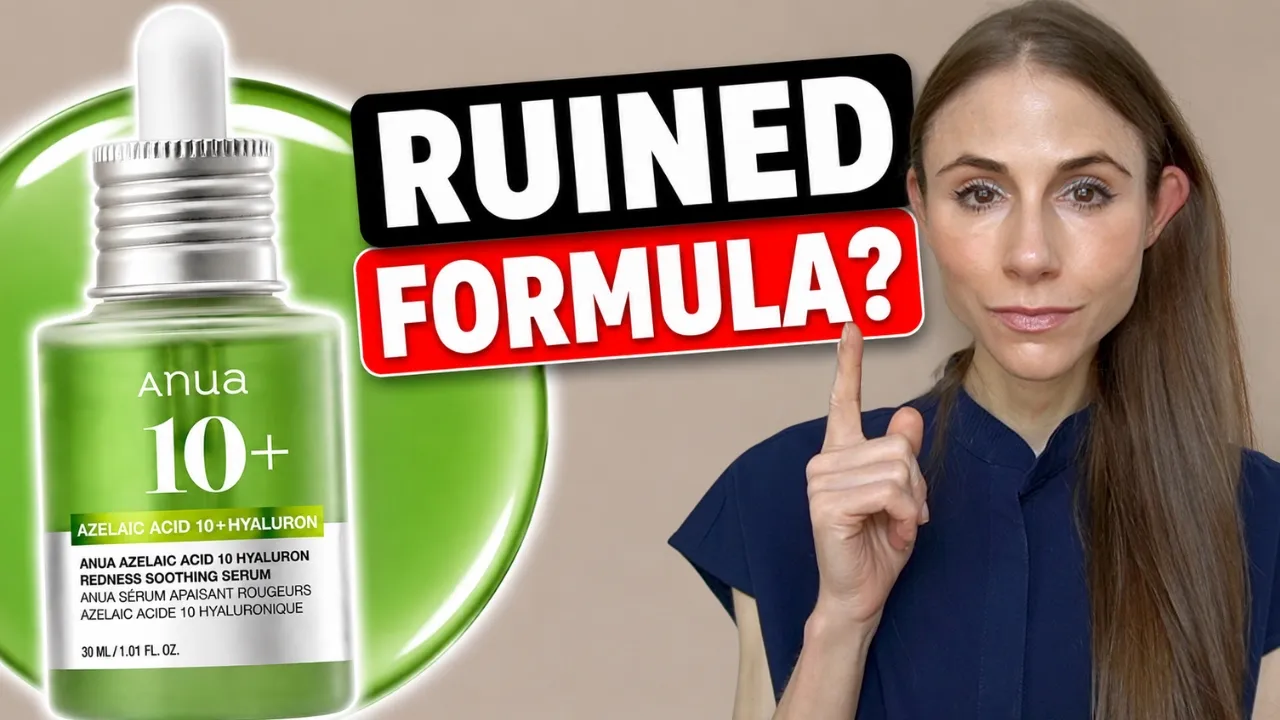
Anua Azelaic Acid REFORMULATED? Controversy Explained | Derm Q&A — Dr Dray

Dr Dray

Dermatologist Dr. Dray rejects viral claims that Anua's reformulated azelaic acid serum is ineffective, arguing that the active ingredient works on the skin's surface without needing the strict pH-driven penetration required by chemical peels.

AI-assisted summary of Anua Azelaic Acid REFORMULATED? Controversy Explained | Derm Q&A — original source. Check the original for full context.

Source published:

Key ideas

  • Dr. Dray refutes claims that Anua's reformulated azelaic acid is ineffective due to pH shifts, explaining that azelaic acid works primarily on the skin surface as an anti-inflammatory and antimicrobial agent rather than relying on deep transdermal penetration governed by free acid values. (5:39)
  • While layering a different sunscreen during midday reapplication or applying makeup over sunscreen is clinically safe, physically premixing sunscreens with other products in the hand destroys vehicle film-forming agents and impairs UV protection. (13:24)
  • Adapalene clears acne on a 4-to-12-week timeline, but visible fine line improvement via dermal collagen remodeling requires 3 to 6 months, reaching maximum benefits after roughly a full year of consistent use. (2:20)
  • Potassium azeloyl diglycinate (PAD) is increasingly utilized in over-the-counter serums as a gentler, hydrating azelaic acid derivative, but it lacks the robust clinical evidence supporting authentic azelaic acid for redness and inflammation. (9:30)

Detailed notes

## Background This Q&A video was published on YouTube by dermatologist Dr Dray on August 22, 2026. According to the page description, Dr Dray addresses viewer questions covering hair loss treatments, retinoid timelines, the online controversy surrounding Anua's azelaic acid reformulation, collagen-stimulating skincare for cellulite, sunscreen reapplication rules, and the photostability of tretinoin under indoor light.

## TL;DR Dr Dray evaluates the viability of minoxidil for receding hairlines, clarifying that it requires living follicles and continuous use to sustain regrowth. She outlines realistic timelines for adapalene in treating acne versus inducing collagen synthesis for fine lines, while advocating for broader over-the-counter access to higher retinoid strengths and azelaic acid. Addressing cosmetic controversies, she dispels claims that Anua's azelaic acid reformulation is a scam due to pH shifts, assesses the derivative potassium azeloyl diglycinate, and explains why layering different sunscreens is safe whereas premixing them degrades protective films. Finally, she dismisses worries regarding faint appliance lights degrading tretinoin, explaining that ambient indoor exposure poses negligible risk to modern formulations.

## Atmosphere & style The session carries Dr Dray's trademark no-nonsense, pragmatic clinical demeanor, blending academic dermatology with relatable consumer advocacy. Her delivery is rapid, grounded, and reassuring, often cutting through viral social media hysteria and overcomplicated chemistry claims with practical skepticism. Watching the video feels like an unvarnished, direct consultation where listener anxiety around micro-level skincare details is dismantled with humor and robust scientific context.

## Bulletin - [05:39](https://www.youtube.com/watch?v=1b7nGYAIktw&t=339s) Dr. Dray refutes claims that Anua's reformulated azelaic acid is ineffective due to pH shifts, explaining that azelaic acid works primarily on the skin surface as an anti-inflammatory and antimicrobial agent rather than relying on deep transdermal penetration governed by free acid values. - [13:24](https://www.youtube.com/watch?v=1b7nGYAIktw&t=804s) While layering a different sunscreen during midday reapplication or applying makeup over sunscreen is clinically safe, physically premixing sunscreens with other products in the hand destroys vehicle film-forming agents and impairs UV protection. - [02:20](https://www.youtube.com/watch?v=1b7nGYAIktw&t=140s) Adapalene clears acne on a 4-to-12-week timeline, but visible fine line improvement via dermal collagen remodeling requires 3 to 6 months, reaching maximum benefits after roughly a full year of consistent use. - [09:30](https://www.youtube.com/watch?v=1b7nGYAIktw&t=570s) Potassium azeloyl diglycinate (PAD) is increasingly utilized in over-the-counter serums as a gentler, hydrating azelaic acid derivative, but it lacks the robust clinical evidence supporting authentic azelaic acid for redness and inflammation.

## Key takeaways - [00:19](https://www.youtube.com/watch?v=1b7nGYAIktw&t=19s) Minoxidil can thicken and regrow a receding hairline in androgenetic alopecia by keeping follicles in the growth phase, but it requires continuous use because discontinuation causes hairs to shed via telogen effluvium. - [00:19](https://www.youtube.com/watch?v=1b7nGYAIktw&t=19s) Scarring conditions affecting the hairline, such as frontal fibrosing alopecia or advanced traction alopecia, replace hair follicles with fibrotic scar tissue that minoxidil cannot revive. - [02:20](https://www.youtube.com/watch?v=1b7nGYAIktw&t=140s) Adapalene operates on two distinct timelines: initial acne clearance occurs within 4 to 12 weeks, whereas dermal collagen production for fine lines takes between 3 to 12 months. - [02:20](https://www.youtube.com/watch?v=1b7nGYAIktw&t=140s) Taking periodic progress photos is recommended when starting retinoids, as subtle collagen remodeling over 6 to 12 months often goes unnoticed without baseline comparisons. - [03:48](https://www.youtube.com/watch?v=1b7nGYAIktw&t=228s) Although 0.3% adapalene causes less irritation than 10% benzoyl peroxide sold OTC for decades, the FDA currently has no formal plans to transition 0.3% adapalene to over-the-counter status. - [03:48](https://www.youtube.com/watch?v=1b7nGYAIktw&t=228s) New over-the-counter combination gels pairing 0.1% adapalene with 2.5% benzoyl peroxide simplify routines by eliminating the need to layer two separate products. - [05:39](https://www.youtube.com/watch?v=1b7nGYAIktw&t=339s) Accusations that Anua's azelaic acid serum is an ineffective scam misapply alpha-hydroxy acid chemical peel free-acid formulas to an active that functions on the skin surface. - [05:39](https://www.youtube.com/watch?v=1b7nGYAIktw&t=339s) Skincare brands do not have a financial incentive to purposefully formulate ineffective products, as reformulating does not meaningfully lower production costs. - [09:30](https://www.youtube.com/watch?v=1b7nGYAIktw&t=570s) Potassium azeloyl diglycinate (PAD) is chemically distinct from azelaic acid and offers improved hydration, but its evidence base for reducing inflammation and redness is far more limited. - [09:30](https://www.youtube.com/watch?v=1b7nGYAIktw&t=570s) Prescription azelaic acid formulations utilize vehicles clinically validated to treat medical dermatologic conditions, whereas OTC serums are cosmetic products formulated for surface redness and texture. - [11:50](https://www.youtube.com/watch?v=1b7nGYAIktw&t=710s) Topical retinoids and vitamin C may provide modest textural smoothing for cellulite, but they cannot resolve the underlying vertical fibrous septae or subcutaneous fat herniation. - [13:24](https://www.youtube.com/watch?v=1b7nGYAIktw&t=804s) Reapplying sun protection with a different sunscreen formula or applying makeup over sunscreen does not destabilize UV filters in practical cosmetic use. - [13:24](https://www.youtube.com/watch?v=1b7nGYAIktw&t=804s) Premixing sunscreen with moisturizers, foundations, or other sunscreens breaks the emulsion and disrupts film-forming agents necessary for uniform coverage. - [15:54](https://www.youtube.com/watch?v=1b7nGYAIktw&t=954s) Faint indoor light sources, such as air conditioner indicator LEDs, do not emit the UV radiation required to photodegrade topical tretinoin. - [15:54](https://www.youtube.com/watch?v=1b7nGYAIktw&t=954s) Worrying about tretinoin photodegradation creates unnecessary anxiety, especially given modern photostable vehicles like micronized tretinoin lotion and encapsulated microspheres.

## Detailed walkthrough ### [00:00](https://www.youtube.com/watch?v=1b7nGYAIktw&t=0s) Can Minoxidil Help a Receding Hairline?

Dr. Dray begins her Saturday Q&A session by jumping directly into audience questions. The first inquiry asks whether minoxidil can effectively treat a receding hairline. She explains that it can help, though success depends entirely on the underlying cause. For men, the vast majority of receding hairlines stem from androgenetic alopecia, which is the most frequent form of hair loss. In this condition, minoxidil helps push miniaturized follicles back into their active growing phase, improving hair thickness, density, and overall regrowth to fill in the hairline. However, she emphasizes that minoxidil does not cure the underlying condition. Continuous application is required; once a patient stops, the follicles miniaturize again, the growing hairs shed via telogen effluvium, and hair returns to the baseline state it would have reached had minoxidil never been used.

Minoxidil requires intact, viable follicles to function, which is why it works in androgenetic alopecia—a non-scarring condition. However, other hair disorders directly target the frontal hairline, such as frontal fibrosing alopecia (FFA). FFA is a primary scarring alopecia; once scar tissue replaces the hair follicle, hair will never regrow, leaving surgical transplantation as the only restorative option. While FFA is far less common in men than women, it does occur and can destroy the frontal hairline, often presenting alongside eyebrow thinning and loss of body or beard hair.

She also touches upon traction alopecia, which arises when persistent tension is applied to hair strands. While hair can recover naturally once mechanical tension is eliminated, minoxidil can hasten regrowth. However, if traction continues unchecked, chronically strained follicles will eventually fibrose and scar over, rendering minoxidil useless. In men, traction alopecia is seen less frequently, though tight bands, headwear, and hats that pull tightly on hair shafts can trigger it.

```mermaid flowchart TD accTitle: Hair Loss Types and Minoxidil Efficacy accDescr: Flowchart illustrating how different types of alopecia at the hairline respond to minoxidil treatment based on follicle viability.

subgraph HairlineCauses["Hairline Recession Causes"] AGA["Androgenetic Alopecia<br/>(Non-scarring)"] TA["Traction Alopecia<br/>(Mechanical strain)"] FFA["Frontal Fibrosing Alopecia<br/>(Scarring)"] end

subgraph Outcomes["Follicle State & Minoxidil Outcome"] AGA -->|"Follicles intact"| AGA_Resp["Responsive:<br/>Pushes miniaturized follicles to growth phase; requires indefinite use"] TA -->|"Early stage / Tension removed"| TA_Resp["Responsive:<br/>Hastens regrowth"] TA -->|"Unchecked prolonged tension"| Scarred["Fibrosed / Scarred Follicle"] FFA -->|"Inflammatory destruction"| Scarred Scarred --> NonResp["Unresponsive:<br/>Permanent loss; only transplants work"] end ```

[02:20](https://www.youtube.com/watch?v=1b7nGYAIktw&t=140s) How Long Does Differin (Adapalene) Take to Work?

The next question comes from a viewer using Differin gel (adapalene) for forehead pimples and fine lines, wondering what timeline to expect after six weeks of use. Addressing acne first, Dr. Dray notes that early reductions in active blemishes often appear within 4 to 6 weeks. However, reaching substantial, noticeable clearance typically takes up to 12 weeks of consistent application.

When treating fine lines and wrinkles, the timeline extends significantly because visible results rely on dermal collagen induction: - **3 to 6 months:** Users generally begin to notice subtle improvements in fine line depth and overall skin smoothing. - **12 months (1 year):** Maximum collagen-building benefits are reached with topical retinoids. - **Cosmetic retinoids (retinol, retinaldehyde):** While these cosmetic counter-parts also stimulate collagen production, they are not regulated or formulated to treat acne, work more slowly, and demonstrate less predictable timelines than pharmaceutical retinoids like adapalene.

Dr. Dray advises patients to document their skin journey with periodic photographs. Because collagen remodeling creates subtle, incremental textural changes over 6 to 12 months, users frequently assume a retinoid is doing nothing until objective comparisons reveal clear progress.

[03:48](https://www.youtube.com/watch?v=1b7nGYAIktw&t=228s) Will 0.3% Adapalene Ever Become Available Over the Counter?

Addressing whether prescription-strength adapalene 0.3% might follow the path of benzoyl peroxide and transition to over-the-counter (OTC) status alongside adapalene 0.1%, Dr. Dray clarifies that the FDA currently has no official plans for an OTC switch. The primary regulatory hesitation likely centers on tolerability: 0.3% adapalene carries higher rates of dryness, peeling, and skin irritation, prompting regulators to prefer physician oversight.

Despite that rationale, Dr. Dray argues that 0.3% adapalene is far less drying and irritating than 10% benzoyl peroxide, which has been sold OTC on store shelves for decades without physician monitoring. She believes expanding OTC access to 0.3% adapalene would offer consumers a valuable acne-fighting tool. She highlights recent regulatory progress, specifically the OTC availability of Epiduo dupes and combination formulations (adapalene 0.1% combined with benzoyl peroxide 2.5% in a single vehicle). Previously, acne patients had to purchase separate tubes of 0.1% Differin gel and a leave-on benzoyl peroxide product, guessing how to layer the two. Having them combined into one stable product simplifies routines.

She expresses equal frustration that azelaic acid remains largely restricted to prescriptions in the United States, pointing out that in many other countries it is sold OTC. From a safety and tolerability standpoint, she views azelaic acid as an "even more of a no-brainer than adapalene" for deregulation.

[05:39](https://www.youtube.com/watch?v=1b7nGYAIktw&t=339s) The Anua Azelaic Acid Controversy and Derivative Ingredients

Dr. Dray addresses viewer questions regarding azelaic acid derivatives and the social media controversy surrounding the Anua Azelaic Acid 10 Serum alongside other Korean formulations. The controversy gained traction after an online cosmetic chemist posted a TikTok analyzing a formulation change in Anua's product. The creator claimed that a shift in product pH lowered the "free acid value" of the azelaic acid, rendering the formulation ineffective or functionally useless, sparking accusations that the product was a "scam."

Dr. Dray pushes back against these assumptions: - **Surface mechanism of action:** The critique assumes that maximizing transdermal penetration via free acid value is essential. However, azelaic acid functions primarily at the surface of the stratum corneum as an antimicrobial and anti-inflammatory agent with mild keratolytic exfoliation. Deep dermal penetration is not required for it to carry out its primary functions. - **pH and ingredient behavior:** Not every active follows the strict pH-dependent efficacy curves seen in alpha hydroxy acids. For instance, salicylic acid remains biologically active across varying pH levels, even without the narrow free acid window many assume is mandatory. - **Free acid value relevance:** Free acid value is critically relevant in clinical alpha-hydroxy acid chemical peels—specifically glycolic acid—where altering pH shifts the concentration of non-ionized acid, drastically modifying penetration, potency, and burn potential. An 8% glycolic acid formula from one brand may perform entirely differently from an 8% product from another purely due to free acid differences. Azelaic acid does not operate under these same rules.

She directs viewers to an explanatory video by cosmetic chemist Dr. Michelle Wong (Lab Muffin Beauty Science), which breaks down the chemistry behind the Anua formulation adjustment. Dr. Dray concludes that brands have no commercial incentive to redesign a product into an ineffective formula, noting that manufacturing adjustments do not make the serum vastly cheaper to produce. While individual users might notice a personal difference in skin tolerability or performance following any product reformulation, she cautions that labeling the serum an outright "scam" based purely on a pH shift is scientifically inaccurate.

[09:30](https://www.youtube.com/watch?v=1b7nGYAIktw&t=570s) Azelaic Acid Derivatives and Cosmetic Formulations

Addressing the idea that brands have intentionally sabotaged their products by adjusting pH levels or changing formulations, Dr. Dray dismisses the conspiracy, noting that "we don't really need to go there." Regarding the question of azelaic acid derivatives flooding the skincare market, she points out that she is primarily aware of one derivative, which is far from new: potassium azeloyl diglycinate (PAD). This ingredient frequently appears in over-the-counter azelaic acid serums. PAD is a modified version of azelaic acid bonded with glycine, designed to be less drying and more hydrating than pure azelaic acid. However, it is fundamentally not the exact same compound as straight azelaic acid, and clinical data remains limited on whether it reproduces all of azelaic acid's specific benefits.

Dr. Dray observes that cosmetic brands often give these products vague names to make consumers believe they are purchasing a standard azelaic acid serum, only for buyers to discover potassium azeloyl diglycinate on the ingredient label. While PAD is safe to use, she is far less confident in its ability to calm inflammation, reduce redness, and improve uneven skin tone compared to authentic azelaic acid. She emphasizes the distinction between cosmetic formulations and prescription therapies: prescription azelaic acid features higher concentrations, vehicle delivery systems thoroughly tested for clinical consistency, and FDA approval to treat medical conditions. Conversely, cosmetic serums target cosmetic concerns such as texture, redness, and tone. Reflecting on the specific azelaic acid serum in question (the Anua formula), Dr. Dray notes she has promoted it widely, gone through multiple bottles, and recently purchased new stock without noticing any drop in performance, concluding that she still finds it effective and continues to recommend it.

- **Potassium azeloyl diglycinate (PAD)**: Modified azelaic acid paired with glycine; more hydrating and less irritating, but lacks the robust evidence base of pure azelaic acid. - **Cosmetics vs. Prescriptions**: Over-the-counter serums target superficial skin texture and redness, whereas FDA-approved prescription azelaic acid products use validated vehicles designed to treat medical skin diseases reliably.

---

[11:50](https://www.youtube.com/watch?v=1b7nGYAIktw&t=710s) Collagen-Boosting Ingredients and Cellulite

Responding to whether collagen-stimulating ingredients—such as active vitamin A derivatives (retinoids) or ascorbic acid (vitamin C)—can diminish cellulite on the body, Dr. Dray explains that while robust clinical trials are lacking, some evidence supports modest improvement. A few peer-reviewed clinical trials investigating cosmetic formulations containing topical retinol or tretinoin show subtle improvements in the superficial dimpled and bumpy texture of cellulite. However, these studies lack long-term follow-up.

Cellulite is rooted in deep structural anatomy: it is driven by the vertical orientation of fibrous septae and the herniation of subcutaneous fat into the dermis. Strengthening and thickening the overlying dermis with collagen-stimulating actives can offer a slight surface benefit, but meaningful improvement requires extensive remodeling of connective tissue and fat. No specific clinical data exists for topical ascorbic acid on cellulite, though it theoretically makes biological sense. Dr. Dray also touches on the common suggestion that vigorous massage improves cellulite, expressing skepticism while noting that "it doesn't hurt."

```mermaid flowchart TD accTitle: Structural Causes of Cellulite vs Topical Retinoid Impact accDescr: Diagram illustrating how retinoids provide minor surface smoothing compared to deep structural causes of cellulite.

subgraph Causes["Anatomical Root Causes"] A["Fibrous Septae Architecture"] B["Subcutaneous Fat Herniation"] end

subgraph Topicals["Topical Actives (Retinol / Tretinoin)"] C["Dermal Thickening & Collagen Support"] end

Causes -->|"Produces"| D["Visible Dimpled Skin Surface"] Topicals -->|"Subtle Surface Smoothing"| D ```

---

[13:24](https://www.youtube.com/watch?v=1b7nGYAIktw&t=804s) Sunscreen Rules: Layering vs. Mixing

Dr. Dray clarifies her standard warning against mixing sunscreens, answering whether using a different sunscreen for midday reapplication violates that rule. Reapplying with a completely different sunscreen over the initial morning application is entirely safe. She references recent research demonstrating that applying foundation or makeup on top of sunscreen can actually enhance photoprotection rather than disrupting it. While makeup is not a substitute for proper sun protection, the finding confirms that layering products over sunscreen does not inherently compromise UV defense.

Applying a different sunscreen product later in the day is similarly fine clinically; concerns that differing chemical or mineral filters degrade one another stem from laboratory zebrafish assays rather than real-world cosmetic formulations. However, Dr. Dray draws a strict distinction between *layering* products sequentially and *mixing* them together in the hand before application. Adding even a single drop of foundation, moisturizer, or another sunscreen directly into a sunscreen disrupts its formulation chemistry and destroys its film-forming agents. Because uniform film formation is essential for even UV filter distribution across the skin, premixing products can render the sunscreen ineffective.

| Practice | Safety / Efficacy | Mechanism & Clinical Advice | |:--- |:--- |:--- | | **Layering (Reapplication)** | Recommended & Safe | Applying a different sunscreen or makeup over an existing layer does not compromise filters and may enhance protection. | | **Premixing (Direct Blending)** | Dangerous (Avoid) | Adding drops of foundation, lotion, or another sunscreen breaks the vehicle emulsion and disrupts film-forming agents, leaving patchy UV coverage. |

---

[15:54](https://www.youtube.com/watch?v=1b7nGYAIktw&t=954s) Tretinoin Photostability and Indoor Lighting

Addressing a viewer's concern about whether the faint status light on an air conditioner unit can degrade topical tretinoin, Dr. Dray laughs off the fear: "No." She explains that while older formulations of tretinoin are photosensitive, the primary driver of photolysis is UVA radiation from sunlight. Fluorescent indoor bulbs can emit trace amounts of UVA and intense visible light, which could theoretically affect stability if someone works directly under bright warehouse lighting. However, a tiny indicator LED on an appliance does not emit meaningful UV radiation. She compares the worry to asking if dropping a single grain of salt into a swimming pool will turn it into the ocean.

More broadly, Dr. Dray advises against obsessing over tretinoin photodegradation. While applying tretinoin at night remains standard dermatologic guidance, real-world clinical data has never proved that daylight exposure entirely negates tretinoin's therapeutic benefits. Furthermore, modern prescription formulations—such as Retin-A Micro (encapsulated microsphere tretinoin) and Altreno lotion—are specifically formulated to be photostable. She considers photolysis "one of those things that I think most people would be better off not knowing exists," because it produces needless consumer anxiety without changing practical outcomes. She signs off by encouraging viewers to check out her Q&A playlist, leave a thumbs up, remember their sunscreen, and return for the next video.

## Notable quotes > [03:48](https://www.youtube.com/watch?v=1b7nGYAIktw&t=228s) even more of a no-brainer than adapalene — Dr Dray

> [05:39](https://www.youtube.com/watch?v=1b7nGYAIktw&t=339s) scam — Dr Dray

> [09:30](https://www.youtube.com/watch?v=1b7nGYAIktw&t=570s) we don't really need to go there — Dr Dray

> [11:50](https://www.youtube.com/watch?v=1b7nGYAIktw&t=710s) it doesn't hurt — Dr Dray

> [15:54](https://www.youtube.com/watch?v=1b7nGYAIktw&t=954s) No. — Dr Dray

> [15:54](https://www.youtube.com/watch?v=1b7nGYAIktw&t=954s) one of those things that I think most people would be better off not knowing exists — Dr Dray

## Mentioned Altreno, Anua, Anua Azelaic Acid 10 Serum, Differin, Dr Dray, Dr. Michelle Wong, Epiduo, FDA, Lab Muffin Beauty Science, Retin-A Micro, TikTok

## Video description In this skincare Q&A, dermatologist Dr. Dray answers audience questions about hair loss, retinoids, azelaic acid, cellulite, sunscreen, and tretinoin stability. She discusses when minoxidil can help a receding hairline, how long Differin (adapalene) takes to improve acne and fine lines, and whether 0.3% adapalene could ever become available over the counter.

Dr. Dray also addresses the recent controversy surrounding Anua azelaic acid, explains what is known about azelaic acid derivatives, and discusses whether retinoids and vitamin C could improve the appearance of cellulite. She also clarifies whether it is safe to switch sunscreens when reapplying and whether indoor light can degrade tretinoin.

Topics covered:

0:00 Intro 0:19 Can minoxidil help a receding hairline? 2:20 How long does Differin (adapalene) take to work? 3:48 Will 0.3% adapalene ever become OTC? 5:39 Anua azelaic acid controversy and azelaic acid derivatives 11:50 Can collagen-boosting skincare improve cellulite? 13:24 Can a different sunscreen be used when reapplying? 15:54 Can indoor light or AC light degrade tretinoin? 17:58 Outro

Dr. Dray discusses androgenetic alopecia, traction alopecia, frontal fibrosing alopecia, minoxidil, adapalene, Differin, topical retinoids, tretinoin, azelaic acid, azelaic acid derivatives, sunscreen reapplication, cellulite, collagen production, vitamin C, and tretinoin photostability.

For more dermatologist skincare advice, acne treatment information, anti-aging skincare tips, hair loss treatment guidance, and evidence-based product recommendations, subscribe to Dr. Dray's channel.

FTC: This video is not sponsored. Links are commissionable, meaning I may earn commission from purchases made through links.

💜Shop my Amazon store https://o.bttn.io/0BwiPWFIZLG 💜Follow me on liketoknowit https://www.liketoknow.it/drdrayzday 💜Social media Instagram @drdrayzday Pinterest https://www.pinterest.com/drdrayzday/ Facebook @DrDrayzDay Twitter: @drdrayzday Tiktok: @drdrayzday

Disclaimer: This video is not intended to provide diagnosis, treatment or medical advice. Content provided on this Youtube channel is for informational purposes only. Please consult with a physician or other healthcare professional regarding any medical or health related diagnosis or treatment options. Information on this Youtube channel should not be considered as a substitute for advice from a healthcare professional. The statements made about specific products throughout this video are not to diagnose, treat, cure or prevent disease.

[Source](https://www.youtube.com/watch?v=1b7nGYAIktw)

中文简报

Dr. Dray驳斥因壬二酸pH值称Anua精华是骗局的说法 皮肤科医生Dr. Dray驳斥了网络上称Anua改版壬二酸精华无效的说法,指出该活性成分作用于皮肤表面,无需像化学剥脱剂那样依赖严格由pH值驱动的渗透。 Dr. Dray评估了米诺地尔治疗发际线后移的可行性,澄清其需要活毛囊且必须持续使用才能维持再生。她概述了阿达帕林用于治疗痤疮与诱导胶原蛋白合成以改善细纹的现实见效周期,同时呼吁扩大非处方途径获取更高浓度维A酸类药物和壬二酸的范围。针对化妆品争议,她驳斥了因pH值改变而认为Anua改版壬二酸精华是骗局的说法,评估了衍生物壬二酰二甘氨酸钾,并解释了为何叠加不同防晒霜是安全的,但在手中预先混合则会破坏成膜防护。最后,她打消了微弱家电光线会降解维A酸的担忧,解释称室内环境光暴露对现代配方的风险微乎其微。 Dr. Dray反驳了因pH值改变导致Anua改版壬二酸无效的说法,解释称壬二酸主要在皮肤表面发挥抗炎和抗菌作用,而非依赖由游离酸值决定的深层经皮渗透。 (5:39) 虽然在日间补涂时叠加不同防晒霜或在防晒霜上化妆在临床上是安全的,但在手中将防晒霜与其他产品物理预混会破坏基质成膜剂并削弱紫外线防护。 (13:24) 阿达帕林改善痤疮的周期为4至12周,但通过真皮胶原重塑带来肉眼可见的细纹改善则需要3至6个月,在坚持使用大约整整一年后达到最大益处。 (2:20) 壬二酰二甘氨酸钾(PAD)作为一种更温和、具保湿性的壬二酸衍生物正越来越多地应用于非处方精华中,但它缺乏证实正统壬二酸可改善泛红与炎症的强有力临床证据。 (9:30)

Reading summary

In her dermatologic Q&A, Dr. Dray addresses common skincare controversies and clinical misconceptions, explaining how vehicle formulation, product chemistry, and anatomical limitations dictate the efficacy of topical treatments. Anua Azelaic Acid Reformulation and Derivative Claims (5:39) Addressing online controversy regarding the Anua Azelaic Acid 10 Serum, Dr. Dray disputes claims that a pH change reduced the 'free acid value' enough to render the product an ineffective scam. She explains that azelaic acid functions primarily at the stratum corneum surface as an antimicrobial, anti-inflammatory, and mild keratolytic agent, meaning it does not rely on deep dermal penetration or the strict pH-dependent ionization curves required by alpha-hydroxy acids like glycolic acid. Citing cosmetic chemist Dr. Michelle Wong, Dr. Dray notes that manufacturing changes do not signify intentional product sabotage, and she personally observes no loss of efficacy in recent batches. Dr. Dray also clarifies the difference between true azelaic acid and its derivative potassium azeloyl diglycinate (PAD). While PAD bonds azelaic acid with glycine to increase hydration and reduce irritation, it lacks the robust evidence base of authentic azelaic acid for soothing inflammation, reducing redness, and improving uneven skin tone. Furthermore, she distinguishes over-the-counter cosmetic serums targeting surface texture from FDA-approved prescription therapies, noting that the latter feature higher concentrations and rigorously tested delivery vehicles. Hairline Regrowth Depends on Follicle Viability (0:00) Whether topical minoxidil can restore a receding hairline depends strictly on the underlying diagnosis. Dr. Dray states that minoxidil is effective for androgenetic alopecia—the non-scarring condition responsible for most male hairline loss—because it stimulates miniaturized but intact follicles back into their active growth phase. However, minoxidil does not cure the condition; discontinuing use triggers telogen effluvium, causing regrown hairs to shed and the hairline to return to baseline. Conversely, minoxidil cannot regenerate hair in scarring disorders like frontal fibrosing alopecia (FFA), where inflammatory fibrosis irreversibly destroys follicles, leaving surgical transplantation as the only corrective option. In traction alopecia, minoxidil may accelerate recovery if mechanical tension is removed early, but persistent strain will eventually cause permanent scarring that renders topical therapy ineffective. Realistic Timelines and Indications for Topical Retinoids (2:20) For acne patients using Differin gel (adapalene 0.1%), Dr. Dray notes that active blemishes generally begin decreasing within 4 to 6 weeks, with substantial clearance requiring up to 12 weeks of consistent application. When treating fine lines, visible results take much longer because they depend on dermal collagen remodeling, showing initial subtle improvements between 3 and 6 months and peaking at around 12 months. She advocates for taking progress photos to track these incremental changes objectively. While prescription adapalene 0.3% remains restricted to physician oversight due to potential peeling and irritation, Dr. Dray argues it causes less irritation than over-the-counter 10% benzoyl peroxide. Regarding body concerns, she explains that while topical retinol or tretinoin may slightly improve the surface texture of cellulite by thickening the dermis, topicals cannot address the underlying anatomical causes—namely, vertical fibrous septae and herniated subcutaneous fat. Practical Application: Sunscreen Integrity and Tretinoin Stability (13:24) Dr. Dray warns against directly premixing sunscreens with foundations, moisturizers, or other sunscreens in the hand, as doing so destroys emulsion chemistry and film-forming agents necessary for uniform UV coverage. In contrast, layering products sequentially—such as applying makeup over sunscreen or reapplying with an entirely different sunscreen later in the day—is safe and does not compromise photoprotection. Addressing fears of retinoid degradation from indoor light, Dr. Dray explains that minor appliance status lights emit no meaningful ultraviolet radiation capable of destabilizing tretinoin. Photolysis is primarily driven by sunlight's UVA rays rather than faint ambient LEDs. Furthermore, modern prescription retinoid formulations, such as Retin-A Micro and Altreno, are engineered to remain photostable, making light-related anxiety largely unnecessary for patients. Across multiple skincare categories, Dr. Dray emphasizes that theoretical laboratory concerns—such as minor pH shifts, theoretical filter interactions, or faint indoor photolysis—rarely translate to real-world product failure, urging consumers to focus on consistent use and clinically validated formulations.

Source quotes

[3:48] Dr Dray: even more of a no-brainer than adapalene [5:39] Dr Dray: scam [9:30] Dr Dray: we don't really need to go there [11:50] Dr Dray: it doesn't hurt [15:54] Dr Dray: No. [15:54] Dr Dray: one of those things that I think most people would be better off not knowing exists

Original transcript

[0:00] Hey guys, happy Saturday. Welcome back [0:02] to the Q&A. I am going to get right into [0:04] it. These videos are all saved in the [0:07] Q&A playlist if you want to go back and [0:09] watch ones from prior weekends. And of [0:11] course, the videos are timestamped so [0:13] you can find the question that you are [0:15] most interested in or see if I answered [0:17] your question in today's video. Does [0:19] Minoxidil help with receding hairline? [0:21] It can depending on the cause. For men, [0:24] for the most part, that's going to be [0:25] androgenetic alopecia, the most common [0:27] type of hair loss. And in which case, [0:29] minoxidil certainly can help get the [0:32] miniaturized follicles back into the [0:34] growing phase, ultimately resulting in [0:36] an improvement in thickness, density, [0:38] and regrowth and filling in, so to [0:40] speak, of the hairline. Doesn't cure the [0:42] disease process, however. You have to [0:44] continue using it in order to sustain [0:46] those benefits. Once you stop, the hair [0:48] follicles will miniaturaturize and the [0:50] hairs in the growing phase will shed. [0:52] you'll get a tilogen of flu vam and [0:53] you'll be back to where you would have [0:55] been had you never used it before. Now [0:58] the only way that minoxidil is going to [1:00] work is well if they're intact hair [1:02] follicles with androgenetic alopecia [1:04] that is the beauty of it. It's a [1:06] non-scarring alopecia. However, there [1:08] are other types of hair loss disorders [1:09] that do affect the hairline. Namely [1:11] frontal fibrosin alopecia. Those are [1:13] scarring alipcas. Once a scar is formed [1:15] in the follicle, it's not going to grow [1:17] hair ever again. The only way to get [1:19] hair there is to transplant it. And [1:21] frontal fibrosis alopecia while uncommon [1:23] in men definitely does happen and it can [1:26] certainly affect the frontal hairline. [1:28] Hence the name frontal fibrosing [1:30] alopecia. Typically it's accompanied by [1:32] loss of the brows and hair loss and [1:34] other body sites including the beard in [1:37] some cases. Now traction alopecia is [1:39] another type of hair loss that can [1:40] happen on the frontal hairline depending [1:42] on how the traction is being placed and [1:44] where it's coming from. And while those [1:47] hairs will grow back once the traction [1:49] is removed, minoxidil can hasten the [1:52] regrowth. So it can be helpful for sure [1:54] in traction alopecia. However, if [1:57] traction is left unchecked and you never [1:59] relieve the traction over time that [2:02] strained follicle can fibros and scar [2:04] down at which point minoxidil will not [2:07] work. Men can get traction alipcia [2:10] depending on what kind of hats you wear. [2:12] tight bands can definitely put a lot of [2:14] undue traction on the hair strands as [2:16] well. And so it's not as common to see [2:18] traction alopecia in men, but it [2:20] certainly can happen. I've been using [2:21] different gel for fine lines and some [2:23] pimples on my forehead and I've been [2:25] using it for about 6 weeks. How long [2:27] does it take to see results with regards [2:30] to acne? Uh you usually can see some [2:33] improvement or reduction in acne spots. [2:35] Four 6 weeks is pretty typical. However, [2:39] it can take 12 weeks to really see [2:41] noticeable improvement in pimples, acne [2:44] spots specifically. With regards to [2:46] wrinkles, that takes a bit more time [2:48] because you're going to be waiting on [2:50] collagen induction. Generally speaking, [2:52] people do start to notice subtle [2:54] improvements in wrinkles, fine lines. [2:57] Takes about 3 to 6 months of consistent [2:59] use to really notice much of an [3:01] improvement in fine lines. And then [3:02] you'll get maximum collagen building, [3:04] usually after a year of consistent use. [3:07] That's with any topical retinoid. Now, [3:09] the cosmetic retinol, retinaldahhide, [3:11] remember those are cosmetics. They're [3:12] not intended to treat acne. However, [3:14] they can likewise improve collagen and [3:16] reduce wrinkle depth, they take a bit [3:18] longer to work and it's a bit more [3:20] unpredictable how long. But generally [3:21] speaking, if you've been using one of [3:23] these topicals for a year, you should [3:24] start to see a subtle softening of fine [3:27] lines and improvement in texture. 6 [3:29] months in to a year. And a lot of times [3:32] it's going to be subtle and it depends [3:33] on where you're starting from. It's [3:35] always a good idea to document your [3:37] progress with photographs and compare [3:39] because you may think, "Oh, I've not [3:41] seen any difference." But then if you go [3:42] back and objectively look at [3:44] photographs, you're like, "Oh, okay. I [3:45] do see I do see some change." Can be [3:47] really subtle, though. Do you think that [3:49] the 0.3% adapylene will ever be made [3:53] available over the counter like the [3:55] different strengths of benzol peroxide? [3:57] So, there are no official plans from the [3:59] FDA to make 0.3% adapylene over the [4:02] counter like 0.1% is. I don't see why [4:05] not other than 0.3% [4:08] can be a bit more drying, a bit more [4:09] irritating. So, they may feel as though [4:12] it's best left under doctor's [4:13] supervision. That being said, 0.3% [4:16] adapene is nowhere near as likely to [4:18] cause the extent of dryness and [4:20] irritation that 10% benzol peroxide [4:23] certainly can cause which is widely [4:25] available over the counter without the [4:27] need for doctor supervision. So I think [4:29] it would be fantastic if that were the [4:32] case just to give people some more [4:34] options and hey it's not um completely [4:37] unreasonable to think that it could [4:38] potentially happen. We now have the [4:40] adapylene 0.1% plus benzole peroxide [4:44] 2.5% in one combined gel marketed as [4:47] epidu, right? And that's a great [4:49] addition to the over-the-counter [4:51] available armamentarium for patients [4:53] with acne because for a while you would [4:55] have to go pursuing the epiduo dupe, [4:58] okay? where you'd buy over-the-counter [5:00] differing gel, aka 0.1% adapylene, and [5:03] then you'd go and find a benzol peroxide [5:06] leaveon product, and you'd be like, "Oh, [5:08] how do I layer these?" So, now it's [5:10] great. You have it in one one thing you [5:11] have to buy, one thing you have to [5:13] apply, and you don't have to be sitting [5:14] there wondering like, do I put this on? [5:16] I hope one day we'll get azelleic acid [5:19] as well. I would have assumed I mean, [5:21] these things are never logical, right? [5:23] But I would have assumed and if I were [5:25] in charge, I', you know, aelic acid is [5:28] even more of a no-brainer than [5:29] adapylene. Uh, from a reason to make it [5:33] available over over the counter. I see [5:35] no reason for it to be prescription [5:37] only. It's over the counter in other [5:38] countries. Speaking of which, uh, I got [5:40] a question. Can you comment on the aelic [5:42] acid derivatives flooding the market and [5:45] also the Anua controversy? Okay, so [5:47] there was some controversy stemming [5:49] around the Anua azelleic acid 10 serum [5:52] as well as some other um azelleic acid [5:55] products from different Korean brands [5:56] based off of a Tik Tok video that a um [5:59] chemist I believe the individual is uh [6:02] created expressing concerns noting a [6:05] recent formulation change that affected [6:07] the pH and the individual pointed out [6:09] that this uh is impacting the overall [6:12] free acid value of azelleic acid. In [6:14] other words, they felt as though it [6:16] [clears throat] meant that the product [6:17] was likely not containing anything of um [6:21] [snorts] use, not ineffective. And I [6:23] don't know that I necessarily agree with [6:25] that fully because it operates on a few [6:27] assumptions. First of all, the main [6:29] assumption is that the free acid value [6:31] of azelleic acid is relevant. I think [6:34] they were under the impression that it [6:35] would impact penetration for sure, the [6:37] amount able to actually penetrate into [6:39] the skin. But mechanistically speaking, [6:41] azelleic acid works primarily at the [6:44] surface of the skin. It's an [6:45] antimicrobial. It's an [6:46] anti-inflammatory. So yes, it does have [6:49] some mild gentle exfoliating properties, [6:52] but it's not as though that pH value and [6:55] free acid value is really really like a [6:58] triedand-rue established factor that [7:01] ultimately rules the day as far as [7:03] efficacy at all. And there's nothing to [7:06] say that the pH change that they that [7:08] has been made leads to an ineffective [7:10] product at all. But not all ingredients [7:13] really do you need to fixate so much on [7:15] this free acid value and the pH. PH [7:18] matters from a formulation standpoint, [7:20] from a penetration standpoint, from a [7:22] tolerability standpoint, it matters. But [7:24] to say that changing the pH means it [7:26] doesn't work definitely can't make that [7:28] claim because again mostly works at the [7:30] surface of the skin and also there are [7:32] other ingredients that penetrate into [7:34] the skin a little bit more deeply. They [7:36] get all the way down into the pore where [7:37] they work namely salicylic acid which a [7:40] lot of people are likewise under the [7:41] impression it needs to be at a specific [7:43] pH in order to have a free acid value. [7:46] And we know that's not true that [7:47] salicylic acid can still be effective [7:50] different phes where it tends to matter [7:52] especially namely you know where we [7:54] think about it really being of relevance [7:56] is in office peels is with glycolic [7:59] acid. The free acid value there [8:00] definitely matters in the sense that [8:03] changing the pH changes the free acid [8:05] value changes the amount of ionized form [8:08] of of glycolic acid and ultimately can [8:11] really impact the efficacy of the [8:13] formula from a like potency standpoint. [8:15] a powerfulness standpoint. 8% glycolic [8:18] acid toner from one brand, don't expect [8:20] it to be identical in performance to an [8:23] 8% glycolic acid uh product from another [8:26] brand because they could be totally [8:28] different as far as glycolic acid [8:30] penetration. And don't assume that [8:31] you've got to have like this robust [8:32] penetration in order for these [8:34] ingredients to necessarily work. I [8:36] wouldn't worry about that. And I'm [8:38] actually going to link you guys an [8:40] Instagram reel that uh m Dr. Michelle [8:43] Wong, chemist, uh, put out, otherwise [8:45] known as lab muffin beauty science, [8:47] explaining more the technicalities of [8:50] the chemistry behind the change and why [8:54] it's not something that you need to [8:56] insist is a scam product because of [8:59] these changes because the pH is [9:00] different. It's not as though the [9:02] product is like wildly cheaper for them [9:04] to make. There's no benefit from the [9:06] brand's perspective per se in changing [9:09] the formulation to one that is not [9:11] effective. Like that makes no sense. [9:14] Now, if you buy the product and you've [9:15] used it before and you find that the [9:18] change has resulted in a difference for [9:20] you, that's that's worth knowing about, [9:22] I guess. Yeah, the formula changed and [9:24] maybe it no longer works well for you. [9:26] But to say that the product is a scam [9:28] and can't work and doesn't work and [9:30] they've like somehow sabotaged their [9:31] product on purpose by doing this, we [9:33] don't really need to to go there. Now, [9:35] you also mentioned the aelic acid [9:37] derivatives flooding the market. I don't [9:39] know if you meant specifically the fact [9:41] that some other brands have changed [9:43] their formula to the different pH now or [9:45] if you're specifically asking about um [9:47] azelleic acid derivatives. I'm aware of [9:50] one and it's not new. It's been around [9:52] for a while. potassium azoil diglycinate [9:54] [clears throat] [9:55] or pad. And this is an ingredient an [9:57] ingredient in a lot of cosmetic azelleic [9:59] acid serums and things like that [10:01] products. It has a it's a modified [10:04] version of azelic acid that allegedly is [10:07] going to be less likely to be drying [10:09] because of the the glycine modification [10:11] makes it more of a hydrating compound, [10:13] but it's not the same thing per se as [10:16] straight aid. In other words, it's [10:18] unclear if it does the exact same things [10:20] as regular azelleic acid without those [10:22] modifications. So, in other words, [10:24] there's not as much data on that, but it [10:26] is something that you will encounter in [10:28] different products that are marketed as [10:31] aic serums. They usually use some kind [10:34] of vague name that's not it's makes it [10:36] sound like, oh yeah, this is an azelleic [10:38] acid serum. Then you're like, what is [10:40] this potassium azoal diglycinate? Um, [10:43] it's fine to use, but I wouldn't I [10:45] wouldn't feel as confident about that [10:47] ingredient as aelic acid for the anti- [10:49] redness, the skin calming, the [10:51] anti-inflammatory, the overall skin tone [10:54] improving things. And remember, these [10:55] are cosmetics. They're not the same as a [10:57] prescription azelleic acid medication [10:59] where you have um not only do you have a [11:02] higher percentage, but you have a [11:03] vehicle and a system that has like FDA [11:06] approval for specifically treating [11:08] diseases. So there the formulas are a [11:11] lot more consistent and and you can go [11:13] into those knowing that they confident [11:15] that knowing confidently that they can [11:17] make a meaningful difference in your [11:19] skin disease. But the cosmetics can make [11:22] meaningful improvements in cosmetic [11:24] concerns like uneven skin tone, redness, [11:27] discoloration, [11:28] skin texture, smoothness. And that serum [11:31] in particular, you know, I've widely [11:33] promoted across all my social media [11:35] platforms for a while now. I've used [11:37] multiple bottles of it, uh, including I [11:39] recently got some and I didn't notice [11:42] any difference personally. So, I I think [11:45] it's still just as good and I've always [11:47] found it to be very effective and I I [11:50] continue to recommend it. In theory, [11:51] could ingredients that promote collagen [11:53] like active forms of vitamin A, ascorbic [11:55] acid, etc. used in the area of the body [11:58] with visible cellulite decrease the [12:00] appearance of cellulite? Um, while there [12:02] aren't any good robust clinical trials [12:04] on this, there is some evidence that [12:06] topical retinol or trenan may improve [12:10] subtly the appearance of cellulite, the [12:13] bumpiness, the sort of dimply appearance [12:16] of it. There have been a couple of [12:17] peer-reviewed clinical trials on [12:20] different retinol, the cosmetic [12:22] formulations for improving the [12:23] appearance of cellulite, suggesting some [12:26] improvements in the surface appearance, [12:28] but there's not really good long-term [12:30] followup or anything of that sort. And [12:32] suffice it to say, when it comes to [12:33] cellulite, cellulite at its very root, [12:36] part of why, you know, the the main [12:38] thing going on is has to do with [12:40] orientation of the fibers and herniation [12:43] of fat. So yes, thickening the um dermis [12:46] a bit, strengthening it can in fact [12:48] likely help a little bit, but really in [12:51] order to impart meaningful changes to [12:53] the appearance of cellulite, it's going [12:55] to involve things that do more extensive [12:58] fat collagen remodeling and have more of [13:00] an impact on that connective tissue, [13:02] that fibrous septe and their orientation [13:04] in order to really smooth that out and [13:06] make it less obvious. But to a certain [13:08] extent, yeah, retinol probably can. [13:10] Nothing on ascorbic acid per se, but [13:13] that makes sense that it might help, but [13:15] we just don't have a lot of research. [13:16] There's also some idea that simply the [13:18] act of massaging cellulite might help, [13:20] but I tend to be a little bit skeptical [13:23] of that. Um, I mean, it doesn't hurt, [13:25] right? You have said don't mix [13:26] sunscreens. Does this apply to when [13:28] reapplying sunscreen during the day? No. [13:31] So, it's fine to apply different [13:33] products over sunscreen. In fact, I came [13:35] across a recent study that bolstered my [13:38] confidence in this that showed that [13:39] applying foundation or makeup over [13:42] sunscreen actually could enhance the [13:44] overall sun protection. Not saying, [13:47] however, that it's a replacement for [13:48] sunscreen or anything like that, right? [13:50] But it basically suggests that not only [13:52] does it not compromise the overall [13:54] protection to layer makeup on over [13:57] sunscreen, but it may enhance some of [13:59] the photo protection, which is [14:01] fantastic. Okay, the question is, well, [14:03] what about not not layering makeup on [14:06] over, but layering on another sunscreen [14:09] different from the one you initially [14:10] applied? That seems to be more than [14:13] fine. Uh there's really no actual [14:15] concern clinically that the filters [14:18] degrade each other. You know, you'll [14:20] come across some zebra fish studies that [14:22] hint that that might happen, but in [14:24] reality, the way sunscreens are [14:26] formulated, it's not anything that is of [14:28] concern. It's fine to do and by all [14:31] means reapply sunscreen and reapply with [14:33] whichever one you want. What you never [14:35] ever want to do is mix anything into [14:38] your sunscreen prior to applying it. [14:41] Doesn't matter if it's another [14:42] sunscreen. Doesn't matter if it's a [14:44] little bit of foundation to tint it. If [14:46] it's a little bit of moisturizer to make [14:48] it more You don't want to mix anything [14:50] into a sunscreen. As soon as you add a [14:53] drop a drop of any other product or [14:56] liquid or whatever, it completely [14:59] changes the overall balance and formula [15:02] and effects or can really seriously [15:05] negatively affect the film forming [15:07] agents. All of the chemistry that goes [15:09] into ensuring that you get a even [15:12] distribution on the surface of the skin [15:14] of the sun protective ingredients. In [15:17] other words, you very easily can render [15:20] a sunscreen ineffective as far as the UV [15:23] protection by adding stuff directly to [15:26] it. It seems to be fine and some cases [15:28] perhaps some data suggests better to uh [15:31] for the overall protection to layer [15:34] things on over. That's fine. You don't [15:36] want to mix it in. Okay? Because again, [15:38] it's got to form that film on your skin. [15:41] Consistent coverage is key. And if you [15:43] mix stuff in, can do that. So, you don't [15:46] want to do that. Does the faint light [15:47] from an AC affect tininoan's potency? [15:51] No. [laughter] [15:52] Older formulations of tininoan are [15:55] photosensitive. UVA is the main player [15:59] in degradation of tininoan. UVA comes [16:03] from the sun. You also can get small [16:05] amounts of UVA from fluorescent indoor [16:08] lighting. And most people don't even [16:10] really use fluorescent indoor lighting, [16:12] but maybe you do. Or maybe you work, you [16:13] know, night shifts somewhere in a [16:15] warehouse where they're fluorescent [16:16] bulbs. They emit they can emit uh UV. [16:20] Some to a certain extent visible light [16:22] from these bright bulbs might also [16:24] compromise treo and stability. It's not [16:27] just the presence or absence of those [16:29] wavelengths. It's the overall strength [16:32] and you know ability to actually reach [16:34] your skin coming from the little light [16:36] on your air conditioning. That's like [16:38] saying, I don't know, will a grain of [16:40] salt in my swimming pool turn it into [16:44] the ocean, right? No. Uh, not enough [16:47] salinity, not enough salt to to get it [16:49] to the saltiness of ocean water. Just [16:52] one grain of salt, right? I mean, same [16:54] thing with the dose of UV coming from [16:57] that AC light is probably doesn't even [16:59] have UV probably. Um, so no, you don't [17:01] need to worry about that. But honestly, [17:03] I don't worry that much about [17:04] photogradation of tininoan at all. Even [17:07] using older forms which I've used, it's [17:10] fine. Put it on, you know, generally [17:12] speaking, it's recommended to put it on [17:13] at night because of this issue. [17:15] Truthfully, we've never gotten any clear [17:18] clinical sense of if it actually [17:20] matters. Like our patients not able to [17:23] to to garner benefits or maximum [17:26] benefits if they put it on and then I [17:29] don't know go outside in broad daylight [17:31] shortly after. or does it all just [17:33] evaporate, you know, degrade and and on [17:34] their face? We really don't have [17:36] evidence. It's just not clear. The newer [17:38] versions of tininoan like retina micro, [17:42] um, alrino lotion, those are all [17:43] photostable. So, don't over overthink [17:46] this degradation thing at all. In fact, [17:49] it's one of those things that I think [17:50] most people would be better off not [17:52] knowing exists, frankly, because it [17:54] doesn't help people. They get confused [17:55] and some people overfixate on it and it [17:58] doesn't seem to make a difference. Okay, [18:00] well guys, that about wraps it up for [18:01] today. Come back tomorrow and I will [18:03] answer more of your questions. I hope [18:05] you enjoyed today's Q&A. It will be in [18:08] the skincare Q&A playlist. And of [18:10] course, it is timestamped if you missed [18:12] that explanation at the beginning of the [18:13] video. Thank you so much for your [18:15] questions. I hope today's was [18:17] informative. If so, give it a thumbs up, [18:19] share it with your friends, and as [18:20] always, don't forget sunscreen and [18:22] subscribe. I'll talk to you guys [18:23] tomorrow. Bye. [music] [18:41] Heat. Heat. [music]