Dermatologist Dray Rejects Claims Spironolactone Ages Facial Skin
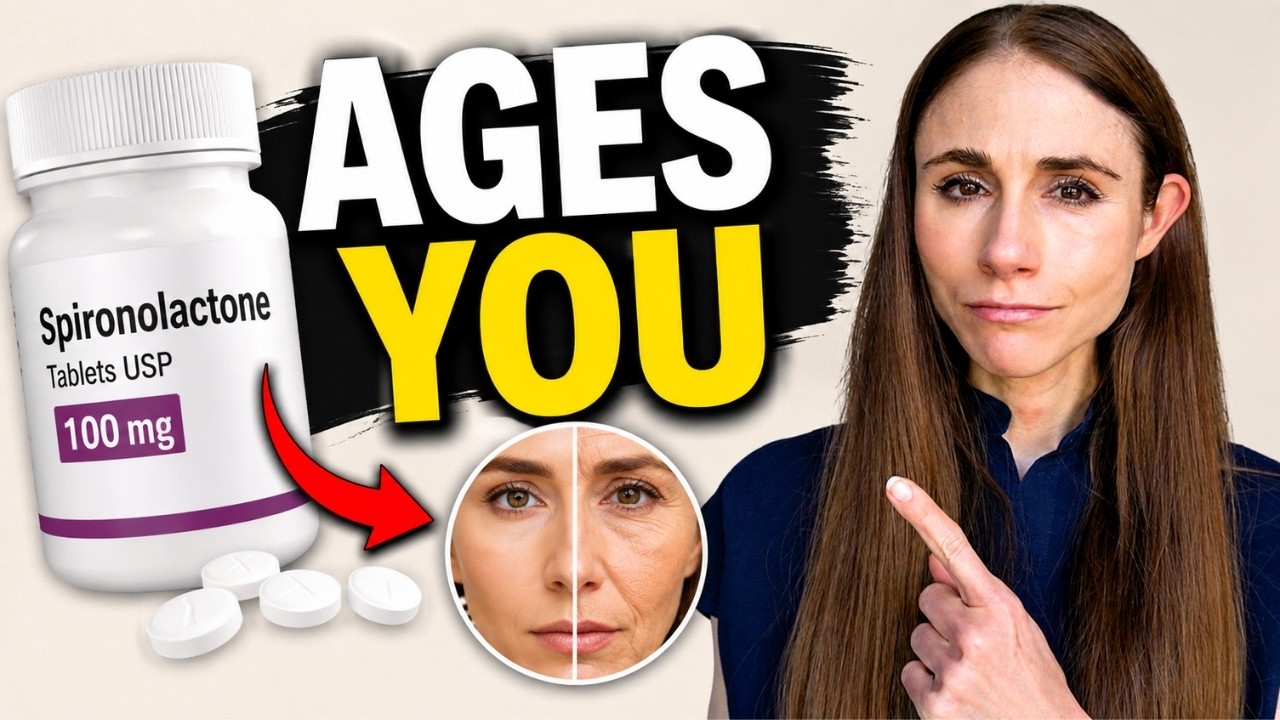
Does Spironolactone Age Your Skin? The Truth About Collagen — Dr Dray

Dr Dray

Online claims that spironolactone and minoxidil degrade skin elasticity conflate research on preventing abnormal scar fibrosis with healthy dermal collagen, which remains entirely unaffected.

AI-assisted summary of Does Spironolactone Age Your Skin? The Truth About Collagen — original source. Check the original for full context.

Source published:

Key ideas

  • Internet rumors claiming spironolactone and minoxidil cause facial skin aging misinterpret medical literature on fibrosis, conflating the prevention of pathological cardiac and follicular scar tissue with the degradation of healthy dermal collagen. (8:07)
  • Mixing different sunscreen shades prior to application compromises emulsion stability and prevents the uniform film formation required for full UV protection, making layered application the only safe alternative. (3:23)
  • Topical growth factors, exosomes, and PDRN remain scientifically unproven for meaningful clinical rejuvenation due to large molecular sizes that impede skin penetration and an absence of controlled in vivo data. (4:49)
  • Daily shampooing does not trigger rebound oil production on an oily scalp, as sebum output is dictated by genetics and hormones rather than wash frequency. (9:37)

Detailed notes

## Background This skincare Q&A was published by dermatologist Dr. Dray on YouTube on August 30, 2026. According to the video description, she answers viewer questions regarding photosensitivity flare-ups, the risks of mixing sunscreen shades, topical growth factors, spironolactone's purported impact on collagen, oily scalp management, product expiration tracking, and benzoyl peroxide fabric staining.

## TL;DR In this installment of her weekend Q&A series, Dr. Dray addresses a variety of common dermatological concerns and viral skincare rumors. She details clinical approaches to managing photosensitivity such as polymorphous light eruption and firmly advises against mixing different sunscreen shades due to emulsion instability. Dr. Dray debunks online myths claiming that spironolactone or minoxidil cause facial aging or collagen loss, explaining that anti-fibrotic activity is distinct from structural skin collagen. Additionally, she offers practical advice for managing an oily scalp through daily washing, outlines her minimalist approach to tracking cosmetic expiration dates, and addresses fabric staining risks from benzoyl peroxide washes.

## Atmosphere & style The video carries Dr. Dray's signature no-nonsense, pragmatic, and educational tone. Speaking directly to the camera with clinical authority, she cuts through internet skincare myths and marketing hype with straightforward science and common sense. The atmosphere feels like an accessible, candid consultation with a trusted dermatologist who does not hesitate to call out misconceptions as 'BS' while offering sensible, uncluttered lifestyle habits.

## Bulletin - [08:07](https://www.youtube.com/watch?v=q9Vvl_SJVNA&t=487s) Internet rumors claiming spironolactone and minoxidil cause facial skin aging misinterpret medical literature on fibrosis, conflating the prevention of pathological cardiac and follicular scar tissue with the degradation of healthy dermal collagen. - [03:23](https://www.youtube.com/watch?v=q9Vvl_SJVNA&t=203s) Mixing different sunscreen shades prior to application compromises emulsion stability and prevents the uniform film formation required for full UV protection, making layered application the only safe alternative. - [04:49](https://www.youtube.com/watch?v=q9Vvl_SJVNA&t=289s) Topical growth factors, exosomes, and PDRN remain scientifically unproven for meaningful clinical rejuvenation due to large molecular sizes that impede skin penetration and an absence of controlled in vivo data. - [09:37](https://www.youtube.com/watch?v=q9Vvl_SJVNA&t=577s) Daily shampooing does not trigger rebound oil production on an oily scalp, as sebum output is dictated by genetics and hormones rather than wash frequency.

## Key takeaways - [00:25](https://www.youtube.com/watch?v=q9Vvl_SJVNA&t=25s) Diagnosing the precise underlying cause of photosensitivity—whether polymorphous light eruption, drug-induced reactions, or chronic photodermatoses—is essential before selecting a treatment pathway. - [00:25](https://www.youtube.com/watch?v=q9Vvl_SJVNA&t=25s) Polymorphous light eruption can be treated with aggressive photoprotection, clinical phototherapy to harden skin tolerance, oral hydroxychloroquine, and adjunctive Polypodium leucotomos extract. - [03:23](https://www.youtube.com/watch?v=q9Vvl_SJVNA&t=203s) Mixing different sunscreen shades or formulas together disrupts the pigment and filter suspension, jeopardizing the even film required to block UV radiation. - [03:23](https://www.youtube.com/watch?v=q9Vvl_SJVNA&t=203s) To safely adjust tone when using multiple sunscreens, apply one formula evenly, let it set into a dry film, and apply the second product over top. - [04:49](https://www.youtube.com/watch?v=q9Vvl_SJVNA&t=289s) Growth factor, exosome, and PDRN serums are predominantly marketed without solid evidence of clinical efficacy beyond simple moisturization. - [04:49](https://www.youtube.com/watch?v=q9Vvl_SJVNA&t=289s) Intact growth factor proteins cannot reliably penetrate the stratum corneum, and in vitro cellular behavior does not accurately reflect how complex living skin will respond. - [06:23](https://www.youtube.com/watch?v=q9Vvl_SJVNA&t=383s) High-end luxury cleanser reformulations rarely warrant dermatological analysis, as simple cleansers do not justify luxury pricing and minor surfactant adjustments belong to cosmetic compounding rather than clinical dermatology. - [08:07](https://www.youtube.com/watch?v=q9Vvl_SJVNA&t=487s) Spironolactone does not induce facial skin aging or collagen loss; cardiovascular studies noting reduced fibrosis refer to stiff cardiac scar collagen rather than structural dermal collagen. - [09:04](https://www.youtube.com/watch?v=q9Vvl_SJVNA&t=544s) Minoxidil's observed anti-fibrotic activity suppresses abnormal scar formation rather than degrading the youthful type I and III collagen responsible for skin elasticity. - [09:37](https://www.youtube.com/watch?v=q9Vvl_SJVNA&t=577s) Scalps that become greasy rapidly should be washed daily, as allowing oxidized sebum to sit fuels Malassezia yeast proliferation and inflammatory scalp conditions. - [09:37](https://www.youtube.com/watch?v=q9Vvl_SJVNA&t=577s) Salicylic acid shampoos exfoliate dead skin and calm scalp inflammation but do not decrease the biological volume of sebum produced by sebaceous glands. - [09:37](https://www.youtube.com/watch?v=q9Vvl_SJVNA&t=577s) In-office neuromodulator injections and emerging topical anti-androgens such as clascoterone represent clinical interventions capable of directly curbing sebaceous gland oil output. - [12:01](https://www.youtube.com/watch?v=q9Vvl_SJVNA&t=721s) Skincare product expiration is best controlled through physical space limits, using products to completion, repurposing facial products on the body, and auditing incoming items every three months. - [15:15](https://www.youtube.com/watch?v=q9Vvl_SJVNA&t=915s) Short-contact benzoyl peroxide washes rinse away quickly enough to minimize fabric bleaching compared to leave-on treatments, though white bath towels should still be used to avoid staining from damp residue.

## Detailed walkthrough ### [00:00](https://www.youtube.com/watch?v=q9Vvl_SJVNA&t=0s) Introduction and Managing Photosensitivity Flare-ups

Dr. Dray welcomes viewers back for part two of her weekend skincare Q&A, reminding everyone that all sessions are archived in the skincare Q&A playlist with timestamps so viewers can jump directly to specific topics. The opening question asks what measures—whether topical treatments or dietary adjustments—can prevent photosensitivity flare-ups. Dr. Dray emphasizes that, much like evaluating hair loss, the critical first step must always be establishing an accurate diagnosis. Photosensitivity is not a single monolith; it can stem from an underlying autoimmune condition, arise as a drug-induced reaction to oral medications, or trace back to distinct photodermatoses.

A frequent culprit is polymorphous light eruption (PMLE), an itchy, inflammatory condition that characteristically flares in the spring, worsens in the summer sun, spontaneously dies down over the winter months, and returns the following year. It is termed "polymorphous" because the rash varies widely in morphology from person to person. Managing PMLE requires strict, aggressive photoprotection via broad-spectrum sunscreen and ultraviolet-protective clothing. Beyond basic sun avoidance, dermatologists utilize specialized interventions:

* **Phototherapy:** Administering carefully controlled micro-doses of UV radiation in a clinical setting serves to "harden" the skin's immune response against pathological light reactions. Dr. Dray compares this directly to desensitization therapy: "Phototherapy for polymorphous light eruption is kind of sort of like the allergy shot of a photosensitive disease in a sense." * **Hydroxychloroquine (Plaquenil):** Originally developed as an antimalarial and widely prescribed for lupus erythematosus, this systemic oral medication is commonly repurposed in dermatology to calm polymorphous light eruption. It is generally well-tolerated, though patients require routine ophthalmologic monitoring to screen for potential retinal toxicity. * **Polypodium leucotomos Extract (Heliocare / Fernblock):** An oral fern extract supplement taken prior to sun exposure that confers systemic photoprotective and antioxidant properties. Dr. Dray clarifies that while beneficial as an adjunct, it is by no means an outright replacement for topical sunscreen. * **Other Photodermatoses:** Conditions such as chronic actinic dermatitis—where chronic topical exposure to photosensitizing substances leads to lichenified, thickened, leathery skin—or solar urticaria (sun-induced hives), which responds to antihistamines, demand entirely different therapeutic approaches depending on the diagnosis.

```mermaid flowchart TD accTitle: Approaches to Photosensitivity Management accDescr: Flowchart outlining diagnostic considerations and treatment pathways for common photosensitive skin conditions.

Diag["Clinical Diagnosis"] --> PMLE["Polymorphous Light Eruption (PMLE)"] Diag --> CAD["Chronic Actinic Dermatitis"] Diag --> SU["Solar Urticaria"]

subgraph PMLE_Tx["PMLE Treatment Strategy"] PMLE --> SunDef["Aggressive Sun Protection<br/>(Sunscreen & UPF Clothing)"] PMLE --> PhotoRx["Phototherapy<br/>('Hardening' the immune response)"] PMLE --> MedRx["Oral Hydroxychloroquine<br/>(Plaquenil; requires eye monitoring)"] PMLE --> SuppRx["Polypodium leucotomos<br/>(Heliocare oral antioxidant)"] end

CAD --> BarrierCare["Avoid photosensitizers & address lichenification"] SU --> HistamineRx["Systemic Antihistamines"] ```

[03:23](https://www.youtube.com/watch?v=q9Vvl_SJVNA&t=203s) Why You Should Not Mix Sunscreen Shades

A viewer inquires whether it is acceptable to dispense two different tint shades of the same sunscreen—specifically Colorescience Sunforgettable Total Protection Face Shield Flex—onto different fingers and blend them together before applying to match their skin tone. Dr. Dray advises against this practice. She explains that blending anything into a sunscreen formula prior to application jeopardizes its stability and compromises the uniform film required to shield skin from UV radiation.

Even when combining products from the very same brand, altering the pigment suspension is risky. Cosmetic chemists carefully engineer sunscreens to ensure that active filters and film formers disperse evenly upon drying. Tinted formulations rely on varying concentrations and proportions of iron oxides to yield different shades. Changing those ratios by hand mixing can interfere with the product's emulsion stability and impede optimal film formation. As Dr. Dray notes, cosmetic chemists who specialize exclusively in sunscreens consistently say, "Don't mix anything in." For those needing to use two different products or tones, the safe method is layered application: apply one sunscreen layer evenly, allow it to dry and set completely into a continuous film, and then apply the second product over top.

[04:49](https://www.youtube.com/watch?v=q9Vvl_SJVNA&t=289s) The Reality of Topical Growth Factors, Exosomes, and PDRN

Addressing an inquiry regarding whether topical growth factors, exosomes, or polydeoxyribonucleotide (PDRN) serums justify their hefty price tags, Dr. Dray expresses strong skepticism. While these ingredients are frequently promoted across luxury and "medical-grade" cosmetic lines—such as popular TNS serums—she views them as having little substantiated clinical benefit beyond standard skin moisturization.

The core scientific hurdle is molecular size and biological complexity. Intact growth factors are large proteins that struggle to penetrate an intact stratum corneum to reach viable target cells in the dermis. Furthermore, in vitro cell behavior does not directly translate into controlled in vivo outcomes in living tissue. Dr. Dray critiques the naive assumption "that we can put things on our skin and the skin will react exactly like this one cell type in a dish did." Human skin comprises multiple interacting cell types that could respond unpredictably or negatively to bioactive signals. Because evidence of targeted efficacy without off-target effects is lacking, she advises consumers against spending large sums of money on growth factor serums.

[06:23](https://www.youtube.com/watch?v=q9Vvl_SJVNA&t=383s) Reformulations and the La Mer Cleansing Foam

When asked to break down a recent reformulation of the La Mer cleanser, Dr. Dray admits she has no insight into the change because she neither uses nor recommends La Mer products. She explains that deep chemical shifts—such as subtle adjustments to buffering agents or surfactant ratios—are best explained by cosmetic chemists rather than clinical dermatologists, as tiny compounding modifications do not necessarily reflect broader dermatological concerns.

Dr. Dray clarifies that she selectively highlights reformulations only when a known contact allergen or popular active is introduced, or when a product she frequently uses undergoes a noticeable change in texture. For instance, she has previously analyzed Korean moisturizers that added ingredients like niacinamide to alert sensitive consumers to potential tolerability issues. However, reviewing high-end luxury cleansers like La Mer holds little appeal for her channel:

* She has no interest in tracking luxury reformulations because doing so would become repetitive, boiling down to: "This is like really expensive stuff. No." * The performance of a basic cleanser rarely justifies luxury price points from an objective dermatological standpoint. * Technical buffering and surfactant modifications are fundamentally the domain of cosmetic formulation science rather than clinical dermatology.

[08:07](https://www.youtube.com/watch?v=q9Vvl_SJVNA&t=487s) Spironolactone and Skin Aging: Debunking the Collagen Myth

The final question tackles an online rumor that spironolactone—an anti-androgenic medication often prescribed off-label for female pattern hair loss and hormonal acne—causes facial aging and suppresses collagen production. Dr. Dray dismisses this worry as an internet misconception, stating firmly that spironolactone does not trigger facial collagen loss or skin atrophy.

She traces the origin of this myth to the cardiovascular literature. Spironolactone was originally developed as an aldosterone antagonist and potassium-sparing diuretic for hypertension and heart failure. In cardiac tissue, spironolactone inhibits pathologic myocardial fibrosis—the deposition of stiff, abnormal scar collagen following cardiac strain or injury. Online forum users misread these anti-fibrotic cardiac findings and assumed the medication broadly halts collagen synthesis throughout the entire body. Dr. Dray explains that abnormal fibrotic scar collagen in cardiac tissue is biologically distinct from the structural collagen matrix (such as type I and type III collagen) that maintains healthy, youthful dermal support.

[09:04](https://www.youtube.com/watch?v=q9Vvl_SJVNA&t=544s) Debunking the Myth: Minoxidil, Fibrosis, and Facial Aging

Addressing persistent internet claims about hair-loss treatments accelerating facial aging, Dr. Dray clarifies that people are conflating two completely different biological processes. Laboratory research suggests that minoxidil can help inhibit fibrosis, which is the formation of scar tissue. Online commentators seized on those laboratory findings to claim that minoxidil destroys collagen and triggers rapid facial aging.

Dr. Dray firmly dismisses this theory, explaining that pathological fibrosis and scarring are entirely distinct from the healthy, structural collagen that provides skin elasticity and resists wrinkle formation. Preventing fibrotic scarring around hair follicles does not degrade youthful facial collagen, and there is zero clinical evidence showing that patients experience premature facial aging while using these treatments. "People are misunderstanding the difference between fibrosis, scarring, which we're trying to prevent, the healthy collagen in your skin for elasticity and not having wrinkles basically. But they're not the same thing."

[09:37](https://www.youtube.com/watch?v=q9Vvl_SJVNA&t=577s) How to Manage an Oily Scalp

In response to a viewer whose hair becomes greasy just one day after washing, Dr. Dray gives straightforward advice: wash it every single day. She strongly rejects popular internet claims that daily washing triggers rebound oil production, calling that narrative complete "BS." Sebum production is dictated by internal genetics and circulating hormones, not by how frequently someone lathers up. Letting excess sebum sit on the scalp is counterproductive: oxidized sebum fuels inflammation, feeds the yeast *Malassezia*, and actively harms hair growth rather than moisturizing the hair shaft.

While commenters suggested using salicylic acid shampoos, Dr. Dray notes that while beta-hydroxy acids effectively exfoliate the scalp and soothe inflammation, they do not reduce the volume of oil the sebaceous glands generate. For targeted intervention, she outlines emerging and clinical alternatives:

- **Daily Scalp Cleansing:** Direct shampoo lather straight to the scalp every day to lift oxidizable lipids and prevent *Malassezia* overgrowth. - **Salicylic Acid Shampoo:** Excellent for chemical exfoliation and clearing inflammatory buildup, though baseline sebum output remains unchanged. - **Neuromodulator (Botox) Injections:** Neurotoxin injections can disrupt local neurotransmitter signaling at the sebaceous gland level, significantly decreasing oil output and shine. While established for facial skin and scalp hyperhidrosis (excessive sweating), it requires a notable financial investment and involves discomfort. - **Topical Clascoterone:** Currently approved as Winlevi for facial acne, clascoterone targets androgen receptors to suppress sebum. Because it is actively undergoing clinical trials for androgenetic alopecia, Dr. Dray anticipates eventual regulatory approval under a new brand name for hair loss, which may provide documented scalp sebum reduction. She cautions against off-label experimentation without strict physician oversight.

[12:01](https://www.youtube.com/watch?v=q9Vvl_SJVNA&t=721s) Tracking Product Expiration and Managing Skincare Clutter

A viewer asks whether Dr. Dray relies on spreadsheets, open-date Post-it notes, or logs to track expiration dates across skincare, makeup, and hair care. While she validates the practice of monitoring the Period After Opening (PAO)—marked on containers by a jar icon with a number and the letter "M" denoting usable months—she admits she keeps zero logs herself. Instead, she prevents expired hoard piles purely through an intense personal aversion to clutter and a disciplined "use-it-up" routine.

Her minimalist workflow relies on tight physical limits and repurposing: - **Daily Makeup Simplicity:** She uses standard makeup essentials consistently until the products are physically empty before purchasing replacements. - **Bathroom Cupboard Boundary:** Active skincare must fit within a designated bathroom cupboard organizer. If a product does not fit, it cannot enter rotation. - **Body Repurposing:** When testing facial formulas for channel reviews that turn out to be mediocre, she refuses to let them sit idle. "I'll end up just using it on my body just to get through it for the sake of getting through it so I can move on." - **The Three-Month PR Rule:** Incoming PR and review items are either opened immediately or placed into a dedicated small holding box in her closet. Every three months, she conducts an audit; items that remain unreached after a full quarter are donated or gifted rather than hoarded, since products can always be repurchased if audience interest demands a review later.

[15:15](https://www.youtube.com/watch?v=q9Vvl_SJVNA&t=915s) Benzoyl Peroxide Body Wash and Fabric Staining

A viewer asks whether using a benzoyl peroxide wash in the underarm shower routine will leave behind residue that bleaches clothing, or whether the active ingredient rinses away cleanly. Dr. Dray explains that benzoyl peroxide operates by reducing odor-causing bacteria that break down perspiration into foul-smelling byproducts. Because short-contact wash formulas are rinsed off down the drain, the risk of bleaching clothing is substantially lower compared to leave-on acne creams and gels.

Even so, Dr. Dray notes that complete immunity from bleaching is not guaranteed. While she personally has not ruined garments with wash formulas, viewers regularly report bleached bath towels from drying off post-shower. Residual active ingredient can occasionally cling to damp skin, making white or bleach-safe towels the safest companion when washing with benzoyl peroxide.

[16:03](https://www.youtube.com/watch?v=q9Vvl_SJVNA&t=963s) Outro and Wrap-Up

Dr. Dray closes the weekend Q&A by thanking her audience for submitting questions. She signs off with her customary channel reminders: inviting viewers to like and share the video, prompting them to subscribe for daily dermatology content, and delivering her signature parting advice: "don't forget sunscreen."

## Notable quotes > [00:25](https://www.youtube.com/watch?v=q9Vvl_SJVNA&t=25s) Phototherapy for polymorphous light eruption is kind of sort of like the allergy shot of a photosensitive disease in a sense. — Dr. Dray

> [03:23](https://www.youtube.com/watch?v=q9Vvl_SJVNA&t=203s) Don't mix anything in. — Dr. Dray

> [04:49](https://www.youtube.com/watch?v=q9Vvl_SJVNA&t=289s) that we can put things on our skin and the skin will react exactly like this one cell type in a dish did. — Dr. Dray

> [06:23](https://www.youtube.com/watch?v=q9Vvl_SJVNA&t=383s) This is like really expensive stuff. No. — Dr. Dray

> [09:04](https://www.youtube.com/watch?v=q9Vvl_SJVNA&t=544s) People are misunderstanding the difference between fibrosis, scarring, which we're trying to prevent, the healthy collagen in your skin for elasticity and not having wrinkles basically. But they're not the same thing. — Dr. Dray

> [09:37](https://www.youtube.com/watch?v=q9Vvl_SJVNA&t=577s) BS — Dr. Dray

> [12:01](https://www.youtube.com/watch?v=q9Vvl_SJVNA&t=721s) I'll end up just using it on my body just to get through it for the sake of getting through it so I can move on. — Dr. Dray

> [16:03](https://www.youtube.com/watch?v=q9Vvl_SJVNA&t=963s) don't forget sunscreen. — Dr. Dray

## Mentioned Dr. Dray, Colorescience Sunforgettable Total Protection Face Shield Flex, La Mer, La Mer Cleansing Foam, Heliocare, Fernblock, Polypodium leucotomos, Plaquenil, Hydroxychloroquine, TNS, Spironolactone, Minoxidil, Malassezia, Botox, Clascoterone, Winlevi, Benzoyl Peroxide

## Video description In this skincare Q&A, dermatologist Dr. Dray answers questions from followers about photosensitivity, sunscreen, growth factors, spironolactone, oily scalp, product expiration, and benzoyl peroxide.

She discusses common causes of photosensitivity, including polymorphous light eruption (PMLE), and treatment options that may be considered depending on the diagnosis. She also explains why she does not recommend mixing different sunscreen shades, even when they come from the same brand.

Other topics include whether topical growth factors provide meaningful benefits for the skin, questions about La Mer cleanser reformulations, and whether spironolactone can cause skin aging or reduce collagen. Dr. Dray also shares practical advice for managing an oily scalp, including how often to shampoo and emerging treatment options.

The Q&A also covers how Dr. Dray handles skincare and makeup expiration, whether benzoyl peroxide used in the shower can still stain clothing, and practical ways to minimize the risk of fabric discoloration.

In this video:

0:00 Intro 0:25 Photosensitivity: How can you prevent flare-ups? 3:23 Can you mix different shades of sunscreen? 4:49 Do topical growth factors actually work? 6:23 La Mer cleanser reformulation 8:07 Does spironolactone cause skin aging or reduce collagen? 9:37 How to manage an oily scalp 12:01 How to keep track of skincare expiration dates 15:15 Does benzoyl peroxide under the arms stain clothing? 16:03 Outro

Dr. Dray's answers are intended for general educational purposes and are not a substitute for individualized medical advice from a qualified healthcare professional.

Dr. Dray's graphic tee https://amzlink.to/az0FReeRstTL5

#skincare #dermatologist #skincaretips #photosensitivity #sunscreen #growthfactors #spironolactone #hairloss #oilyscalp #benzoylperoxide #skincareqanda #dermatology FTC: This video is not sponsored. Links are commissionable, meaning I may earn commission from purchases made through links.

💜Shop my Amazon store https://o.bttn.io/0BwiPWFIZLG 💜Follow me on liketoknowit https://www.liketoknow.it/drdrayzday 💜Social media Instagram @drdrayzday Pinterest https://www.pinterest.com/drdrayzday/ Facebook @DrDrayzDay Twitter: @drdrayzday Tiktok: @drdrayzday

Disclaimer: This video is not intended to provide diagnosis, treatment or medical advice. Content provided on this Youtube channel is for informational purposes only. Please consult with a physician or other healthcare professional regarding any medical or health related diagnosis or treatment options. Information on this Youtube channel should not be considered as a substitute for advice from a healthcare professional. The statements made about specific products throughout this video are not to diagnose, treat, cure or prevent disease.

[Source](https://www.youtube.com/watch?v=q9Vvl_SJVNA)

中文简报

皮肤科医生Dray驳斥螺内酯导致面部皮肤衰老的说法 网络上关于螺内酯和米诺地尔会破坏皮肤弹性的传言,混淆了预防异常瘢痕纤维化的研究与健康真皮胶原蛋白的概念,后者完全不受影响。 在周末问答系列的本期内容中,Dray医生解答了多项常见皮肤科疑虑和网络护肤传闻。她详细介绍了应对多形性日光疹等光敏性问题的临床方法,并因乳化体系不稳定而坚决反对将不同色号的防晒霜混合使用。Dray医生驳斥了声称螺内酯或米诺地尔会导致面部衰老或胶原蛋白流失的网络谣言,解释称抗纤维化作用与皮肤结构性胶原蛋白并不相同。此外,她还提出了通过每日洗头来护理油性头皮的实用建议,概述了她追踪化妆品保质期的极简方式,并谈及了过氧化苯甲酰洗剂漂白衣物的风险。 声称螺内酯和米诺地尔会导致面部皮肤衰老的网络谣言误读了有关纤维化的医学文献,将预防病理性心脏和毛囊瘢痕组织与降解健康真皮胶原蛋白混为一谈。 (8:07) 在使用前混合不同色号的防晒霜会破坏乳化稳定性,阻碍提供全面紫外线防护所需的均匀成膜,因此分层叠加涂抹是唯一安全的替代方法。 (3:23) 由于分子量过大阻碍皮肤渗透,且缺乏对照体内研究数据,外用生长因子、外泌体和PDRN在实现有意义的临床抗衰老方面仍缺乏科学证实。 (4:49) 油性头皮每日洗发并不会引发反跳性油脂分泌,因为皮脂分泌是由基因和激素决定的,而非洗头频率。 (9:37)

Reading summary

Dr. Dray addresses common dermatological misconceptions, explaining that medications like spironolactone and minoxidil do not induce facial collagen loss, while providing clinical guidance on photoprotection, formulation stability, and sebum regulation. Separating Cardiac Anti-Fibrosis from Dermal Collagen Loss (8:07) Spironolactone and minoxidil are frequently rumored on online forums to cause facial aging and degrade skin collagen. Dr. Dray dismisses these concerns as misunderstandings of cardiovascular and laboratory research. In cardiac medicine, spironolactone functions as an aldosterone antagonist that prevents pathologic myocardial fibrosis—the accumulation of stiff, abnormal scar tissue following cardiac strain. Similarly, laboratory findings show that minoxidil can inhibit fibrotic scarring. Online discussions conflate this anti-fibrotic effect with the destruction of healthy structural collagen matrices, such as types I and III, which maintain youthful dermal elasticity. Dr. Dray affirms that preventing abnormal scar tissue formation does not degrade healthy facial collagen or cause skin atrophy. There is no clinical evidence demonstrating premature facial aging among patients undergoing these therapies, and she emphasizes that fibrotic scarring and youthful structural collagen represent biologically distinct processes. Clinical Approaches to Photosensitivity and Light Eruptions (0:00) Managing photosensitivity requires an accurate medical diagnosis, as light reactions can stem from underlying autoimmune diseases, systemic drug reactions, or distinct photodermatoses. For polymorphous light eruption (PMLE)—a seasonal, inflammatory condition that characteristically flares in spring and summer—management extends beyond basic photoprotection such as broad-spectrum sunscreen and ultraviolet-protective clothing. Dermatologists utilize specialized clinical interventions to manage PMLE. These include phototherapy, which uses controlled micro-doses of UV radiation to desensitize and harden the skin's immune response, and oral hydroxychloroquine (Plaquenil), an antimalarial medication that calms light-induced inflammation but requires periodic ophthalmologic monitoring for retinal toxicity. The oral fern extract Polypodium leucotomos offers systemic antioxidant support as an adjunct, though Dr. Dray clarifies it cannot replace topical sunscreen. Other photodermatoses, such as chronic actinic dermatitis or solar urticaria, require distinct protocols like barrier care or systemic antihistamines. Sunscreen Stability, Luxury Marketing, and Bioactive Penetration (3:23) Dr. Dray advises against mixing different shades of sunscreen before application, noting that altering iron oxide ratios and blending formulas disrupts emulsion stability and impairs the continuous, uniform film needed for UV protection. For individuals needing multiple shades, she recommends applying one layer, allowing it to set completely, and layering the second on top. She also expresses skepticism regarding expensive topical growth factors, exosomes, and polydeoxyribonucleotide (PDRN) serums. Large protein molecules struggle to penetrate the intact stratum corneum, and in vitro cellular behavior in a dish cannot predict complex in vivo tissue responses. Similarly, Dr. Dray does not track luxury cleanser reformulations such as La Mer, noting that subtle adjustments in surfactants or buffering agents are cosmetic chemistry concerns that rarely justify premium prices from a clinical perspective. Regarding hygiene routines, she notes that benzoyl peroxide body washes carry a lower clothing-bleaching risk than leave-on products because they rinse off, though residual active on damp skin can still discolor towels. Biological Realities of Scalp Sebum and Practical Storage (9:37) Dr. Dray rejects the claim that daily hair washing causes rebound oil production, noting that sebaceous gland activity is governed by internal genetics and circulating hormones rather than wash frequency. Allowing sebum to accumulate oxidizes surface lipids, promotes inflammation, and feeds the yeast Malassezia, which can compromise hair growth. While salicylic acid shampoos provide chemical exfoliation and soothe inflammation, they do not lower baseline sebum production. For meaningful oil reduction, Dr. Dray points to clinical options such as neuromodulator (Botox) injections to inhibit local glandular signaling. She also forecasts that topical clascoterone (Winlevi)—currently an acne therapy under clinical trials for androgenetic alopecia—may eventually offer approved scalp sebum suppression under physician oversight. To prevent product accumulation and expired items, Dr. Dray relies on strict physical boundaries, using open products until empty, repurposing unsuitable facial formulas onto the body, and conducting quarterly audits of unopened review items. Dr. Dray underscores that navigating skincare requires distinguishing between physiological mechanisms and misapplied laboratory data, though novel topical interventions targeting hormonal scalp sebum pathways continue to await expanded regulatory approval.

Source quotes

[0:25] Dr. Dray: Phototherapy for polymorphous light eruption is kind of sort of like the allergy shot of a photosensitive disease in a sense. [3:23] Dr. Dray: Don't mix anything in. [4:49] Dr. Dray: that we can put things on our skin and the skin will react exactly like this one cell type in a dish did. [6:23] Dr. Dray: This is like really expensive stuff. No. [9:04] Dr. Dray: People are misunderstanding the difference between fibrosis, scarring, which we're trying to prevent, the healthy collagen in your skin for elasticity and not having wrinkles basically. But they're not the same thing. [9:37] Dr. Dray: BS [12:01] Dr. Dray: I'll end up just using it on my body just to get through it for the sake of getting through it so I can move on. [16:03] Dr. Dray: don't forget sunscreen.

Original transcript

[0:00] Hey guys, we are back. Happy Sunday with [0:03] part two of the weekend Q&A. We are [0:06] picking up where we left off yesterday [0:08] and of course this video along with [0:10] yesterday's videos and all the Q&A's are [0:12] saved in the skincare Q&A playlist. The [0:15] videos are timestamped. So if you're [0:17] like, I just clicked in based on the [0:18] thumbnail, when are you going to talk [0:20] about that? Check the timestamp. So if [0:22] you don't have time to watch the whole [0:23] video, you know where to go. [0:25] Photosensitivity, what exactly can I do, [0:28] whether it be topical or food, etc. etc. [0:30] to give myself a better chance of [0:31] preventing attack. Well, as with hair [0:33] loss, the first question should be [0:35] what's the diagnosis? Cuz there are [0:37] actually, you know, like hair loss, [0:39] there are tons of different types of [0:40] photosensitivity and it really all [0:42] depends on what type of photosensitivity [0:45] it is that you have. Is it related to an [0:47] autoimmune disease? Is it secondary to a [0:50] medication that you're taking? Since I [0:52] don't know, I can't really, you know, [0:54] guide you otherwise. I would say a very [0:55] common photosensitive condition that a [0:58] lot of people deal with is called [0:59] polymorphous light eruption. It tends to [1:02] pop up in the spring and get a little, [1:04] you know, aggravated in the summer and [1:06] then it starts to just kind of [1:08] spontaneously improve and then it dies [1:11] down, of course, throughout the winter [1:13] months and then the following year it [1:14] comes right back. And it's called [1:15] polymorphous cuz the rash kind of just [1:17] can look like pretty much anything. It [1:20] doesn't always look the same in [1:21] different people. It can be very itchy. [1:23] And the way that that is typically [1:25] managed is aggressive sun protection, [1:27] okay? Um sunscreen, sun protective [1:30] clothing. Also, phototherapy. [1:33] Phototherapy with careful doses of UV [1:37] can actually help harden the skin [1:39] against that abnormal inflammatory [1:41] response, you know, that abnormal [1:43] response of the skin disease. It's kind [1:45] of like the equivalent of, if this makes [1:47] sense to you, you've heard of people who [1:48] have allergies getting allergy shots. [1:50] Phototherapy for polymorphous light [1:52] eruption is kind of sort of like the [1:54] allergy shot of a photosensitive disease [1:56] in a sense. It's kind of like giving [1:58] tiny little doses and hardening your [2:01] immune system to the UV, so you don't um [2:04] react so aggressively. Also, [2:06] hydroxychloroquine is a medication that [2:08] we give to patients with lupus, brand [2:10] name Plaquenil. It's actually an [2:12] antimalarial, but we use it for all [2:14] sorts of stuff in dermatology. It can be [2:17] particularly helpful for polymorphous [2:18] light eruption. There are some things [2:20] with the eye that, you know, need to be [2:21] monitored as far as toxicity can occur, [2:24] but it is otherwise pretty safe and [2:26] pretty easy to tolerate. And then the [2:27] dietary supplement Polypodium, check out [2:30] my video on that. It's sold under the [2:31] brand name of Heliocare. That can [2:33] actually be very useful for polymorphous [2:36] light eruption. It is uh you know, fern [2:38] block. Uh it's it can be pretty helpful [2:41] for when taken before sun exposure. Of [2:44] course, it's not a replacement for [2:45] sunscreen or anything of that sort. But [2:47] like I said, it all really boils down to [2:49] what your diagnosis is. Like some people [2:51] have photosensitive diseases that are [2:53] related to uh you know, certain [2:56] hereditary conditions. Um there's like [2:58] this chronic actinic photodermatitis [3:00] that people can get from It's thought to [3:02] be related to like chronic topical [3:04] exposure to things that sensitize the [3:06] skin to certain wavelengths of light, [3:08] and then over time the skin gets like [3:10] very um lichenified, as it's called, [3:12] thickened and leathery. There's also [3:13] solar urticaria, that's hives triggered [3:16] triggered by sun exposure. So [3:17] antihistamines can actually be pretty [3:19] helpful there. Yeah, it really all boils [3:21] down to what exactly the diagnosis is. [3:23] Regarding the sunscreen mixing thing, I [3:25] have two shades of Colorscience Flex, [3:28] and I tend to put one color on each [3:30] finger before putting on, I think is [3:32] what you meant. Since it's the same [3:33] brand, does that make it okay? Uh no, I [3:35] wouldn't do that um because like I was [3:38] getting at last week, anything that is [3:40] mixed into a sunscreen will completely [3:42] alter the formula, and you jeopardize [3:45] the success likelihood of it forming the [3:48] film it needs to in order for it to [3:50] actually protect your skin. And it [3:51] doesn't matter what you mix in, that can [3:53] screw it up. Even sunscreens from the [3:55] same brand. Now, it would be [3:57] interesting, I don't know, but I'm [3:59] hesitant to say oh, it's okay because I [4:01] don't know, okay? Um and I'd rather err [4:03] on the side of caution, but I don't know [4:05] if like if it's just the the different [4:07] shades, if mixing them together [4:10] compromises it. I would think it would [4:12] because a lot of the differences in [4:13] shades have to do with relative [4:15] differences in the abundance of given [4:18] iron oxides and concentrations of them. [4:20] And so, now you're mixing them in and [4:22] that a different So, that could, you [4:24] know, mess up the film forming in some [4:26] way. There are cosmetic chemists who [4:28] solely specialize in sunscreen [4:30] formulation and they're like, yeah, [4:31] don't mix anything in. Don't mix [4:33] anything in. And so, I I think it's [4:35] prudent to not do that. The best way to [4:38] use different sunscreens is to apply [4:40] one, let it dry, apply another one. Um [4:43] that you can safely do, but the mixing [4:45] before application becomes risky because [4:47] of the film forming thing. I was having [4:49] a conversation with a friend about [4:51] growth factors and she's going to get [4:53] them, but I told her that the molecule [4:54] is probably too big to penetrate the [4:56] skin. Could you please talk about growth [4:58] factors on your videos? I would [4:59] appreciate that. I don't I've talked [5:01] about growth factors in a couple of [5:02] videos, but I couldn't find one that's [5:04] in fairly recent that's like [5:06] specifically says growth factors in it. [5:08] But I know I've talked about them. It's [5:09] one of those ingredients like PDRN, I [5:12] don't think do anything above and beyond [5:13] maybe moisturizing the skin. Or [5:15] exosomes, like that's another one. Just [5:17] cuz the science of that likely having [5:19] any meaningful effect is very just very [5:21] unlikely, okay? And so, I I don't think [5:24] they're worth spending a lot of money. I [5:26] know, what is it? TNS TNS TNF alpha [5:29] serum? Whatever was so popular from I [5:31] forget. One one of those medical grade [5:34] doohickey doos. I know that was really [5:35] popular and they were always They had a [5:37] lot of derms who were sold on on that [5:39] that that that stuff was legit. And I [5:40] was like, you guys, no. There's no way [5:43] this is working. And growth factors put [5:45] on the skin are not going to do [5:47] anything. Uh it's one of those things I [5:49] personally don't recommend people spend [5:51] a lot of money on. It's fine if it's in [5:52] there. I've used stuff with growth [5:53] factors before, cool, like jazzy, but I [5:56] I'm not convinced they do anything. That [5:58] they get in and and do precisely what [6:00] you want and no off-target effects. Like [6:02] this idea that people seem to just agree [6:05] to that we can put things on our skin [6:08] and the skin will react exactly like [6:10] this one cell type in a dish did. It [6:13] makes no sense. When we have all of [6:14] these different cell types that can [6:16] react to something and they can react in [6:18] negative ways. And I just don't think [6:19] that there's the likelihood that they [6:21] actually get in and do anything. Can you [6:23] talk about the La Mer cleanser [6:24] reformulation? I know nothing about La [6:27] Mer's cleanser reformulation. Uh I don't [6:30] keep up with La Mer. I don't use their [6:32] products. And so I I have no idea what [6:34] that is. And honestly, I would say when [6:36] it comes to these brands randomly [6:38] reformulating their products, those are [6:40] questions better left for the cosmetic [6:42] chemists because I'm not really able to [6:45] address how a given like tweak in the [6:47] buffering system now is suddenly going [6:49] to change the whole performance of the [6:51] thing. Um that's kind of not really my [6:54] area of expertise. I will comment when [6:57] there is a formulation change. If, for [6:58] example, they add an ingredient that is [7:01] something that is a common allergen, [7:03] I'll point that out. Or I will comment [7:05] on my subjective experience using the [7:08] product as somebody who has typically [7:10] has used it in the past and like what I [7:12] think, you know, for example, I compared [7:14] the old formula of I'm already [7:17] forgetting. Uh [7:18] one of the Korean moisturizers I like so [7:20] much. Jeez. They changed the formula and [7:23] I compared the textures. They changed up [7:25] like some of the ingredients. They [7:27] included niacinamide and stuff like [7:28] that. So in that, you know, I made a [7:30] video on that to say, "Hey, you know, [7:31] they've added niacinamide now. This is [7:33] what niacinamide can do. Some of you [7:35] guys are sensitive to it, so heads up, [7:37] you know. It's changed and this is how [7:39] the texture seems different to me." That [7:41] kind of thing I can comment on, but I'm [7:43] not going to be able to do that for [7:44] every single formulation change of every [7:46] single product out there of stuff that I [7:48] don't care to personally use. And that [7:50] routinely because especially with La [7:52] Mer, like it doesn't make sense for me [7:54] to use La Mer. I never would. I don't [7:56] recommend it. And I don't intend to do [7:58] videos on La Mer because it just become [8:00] very repetitive in me being like, "This [8:02] is like really expensive stuff." No. [8:06] Yeah, I can't comment on that basically. [8:08] To spironolactone aging, I'm on it for [8:11] female hair loss, but I'm so worried [8:12] about the stories I keep hearing about [8:14] it slowing collagen production. No. I [8:17] think some people who have come across [8:19] this are confused maybe online one of [8:21] those forums, but spironolactone does [8:23] not lead to facial collagen loss or [8:27] collagen loss in your skin. Where I [8:29] think this is coming from is [8:30] spironolactone, remember it's it's [8:32] originally used as as a blood pressure [8:35] medication. It has been shown to through [8:37] effects on collagen to uh reduce [8:40] fibrosis, scarring in the heart, which [8:43] is great. And so I think a lot of people [8:45] have taken that and run with it to [8:47] assume, "Oh, it inhibits collagen [8:48] production. We're going to get collagen [8:50] loss from this. It's going to cause And [8:52] it's it's not the same collagen." I [8:54] mean, this is abnormal collagen of [8:56] scarring, of fibrosis versus skin [8:59] collagen. Like there are so many [9:01] different collagens in your body that um [9:04] the collagen in your skin we're talking [9:05] about something entirely different. So [9:07] no. And you know, there's some evidence [9:09] that minoxidil um can help with the [9:11] fibrosis piece of things like based on [9:13] some laboratory studies. And a lot of [9:15] people online have taken that and run [9:17] with it and said, "Oh, minoxidil is [9:18] going to cause facial aging." No. People [9:20] are misunderstanding the difference [9:22] between fibrosis, scarring, which we're [9:24] trying to prevent, the healthy collagen [9:26] in your skin for elasticity and not [9:29] having wrinkles basically. But they're [9:30] not the same thing. There's no clinical [9:32] evidence that people have facial aging [9:35] with this stuff. I mean, it's not [9:36] something that happens. Is there [9:38] anything I can do about my oily scalp? [9:40] It makes my hair super greasy even after [9:42] 1 day. Shampoo your scalp daily. Uh, [9:45] don't fall for this, "Oh, only shampoo [9:47] your hair every other week because [9:48] shampooing more frequently causes it to [9:50] produce more." No, that's BS. Oil [9:53] production has to do with hormones, [9:54] genetics, not uh, how frequently you [9:58] shampoo your hair. And oil the sebum, [10:00] the oil, it's not moisturizing really. I [10:03] mean, a little bit, but not really. And [10:05] it's not good for your hair growth. It [10:06] oxidizes, causes inflammation, dries [10:09] more Malassezia. It's bad for hair. It's [10:11] bad for hair growth. So, I suggest [10:13] shampooing the scalp daily. Target the [10:14] shampoo lather to the scalp. Uh, you [10:17] know, I saw some people respond to your [10:18] comment with salicylic acid shampoo. [10:21] That can definitely help calm down any [10:23] inflammation that you might be getting [10:24] and exfoliate the scalp, but it won't [10:26] necessarily target sebum production per [10:29] se, so you'll still make the same amount [10:30] of oil. But, that's one that a lot of [10:32] people with oily scalps tend to [10:35] appreciate. Uh, neuromodulator injection [10:37] can um, interestingly enough, help with [10:40] excessive sebum production and is [10:42] thought to be related to um, the [10:44] neurotransmitter release at the level of [10:47] the sebaceous gland that leads to [10:49] release of sebum. And it can definitely [10:51] cut down on oiliness and shine. Like, a [10:53] lot of people who get Botox facially [10:55] notice that they have a reduction in [10:56] oiliness and shine. So, it definitely [10:58] can and it for the scalp, it's often [11:00] used there for excessively sweaty scalp. [11:03] So, that might be something, you know, [11:05] you might want to invest in if you're [11:06] really, really bothered by it. [11:07] Admittedly, an upfront investment and [11:09] not the most comfortable thing to go [11:10] through. Stay tuned. Maybe we'll have [11:12] better um, a better understanding of [11:15] topical clascoterone, aka Winlevi as [11:18] it's sold for acne. Um, they're looking [11:20] at that right now um, in clinical [11:23] studies for androgenetic alopecia and I [11:25] suspect that we'll get approval for a [11:27] topical clascoterone for androgenetic [11:29] alopecia. Um, it'll go by a different [11:31] name. They won't call it Winlevi or [11:33] maybe they'll call it Winlevi for your [11:35] head. I don't know. I suspect, you know, [11:36] imagine that if that does get approval [11:39] and we start using it on label for [11:41] androgenetic alopecia, well, maybe [11:42] somebody will, you know, really track [11:44] sebum production objectively in patients [11:47] on it and and we'll have some sense [11:48] there as to what you could expect there. [11:51] But clascoterone does reduce oiliness as [11:54] well. But I wouldn't at this point [11:56] recommend like trying to get a [11:57] prescription and rubbing it in your head [11:59] without it. Definitely not without [12:01] doctor supervision, okay? Person asks, I [12:03] would love to see your methods for [12:04] staying on top of when products expire. [12:06] Do you keep a spreadsheet of what you [12:09] open when you open the product? Do you [12:11] put a post-it note on it? Um, for [12:13] makeup, skin care, hair care. I don't do [12:16] any of that, but I do recommend staying [12:18] on top of that kind of thing. Like, uh, [12:20] for example, products have a PAO, um, [12:23] period after opening. So, I do think [12:25] it's a good idea to write down the date [12:27] that you opened a product. Um, and then [12:29] get rid of it if it's surpassed the PAO. [12:32] So, the PAO is like a number with the [12:34] letter M and then like a little triangle [12:36] around it, I think. So, that number [12:38] before the M is the number of months. [12:40] So, I would, you know, I think that [12:42] makes a lot of sense. Do I do that? No. [12:43] I don't keep track of any of that [12:45] because I'm really, um, I'm really [12:47] vigilant, I would say, about using stuff [12:50] up. I hate clutter. I don't like having [12:53] hordes of things messing, you know, I [12:55] would much rather have an empty closet [12:57] than a closet overflowing with stuff I [12:59] don't use. Peace of mind for some [13:00] reason, but a closet overflowing with [13:02] stuff that I don't use is like, [13:04] we got to get rid of that. I cannot, I I [13:07] don't know, it's something in my [13:07] personality. So, when it comes to all [13:09] this skin care, cuz keep in mind I buy a [13:11] lot to try and review here and I also [13:15] have the my own things that I like [13:17] using. Makeup, I have my own products [13:19] that I like using. And the makeup that I [13:20] wear, I put on pretty much every day and [13:22] then it's like it's physically over, [13:24] okay? And then I get a new one. As far [13:26] as skin care, what I do is I I'm real [13:30] diligent. Like, I have this little thing [13:32] that um I have in the cupboard in my [13:34] bathroom to hold skin care. And if it [13:37] doesn't fit in there, then um you know, [13:40] we got to figure something out. So, I I [13:41] try and only have skin care going that [13:44] fits in there. And I'm real like, "Okay, [13:46] we got to go through this. We got to go [13:47] through this." And if it's a product [13:49] that I'm not really enjoying using on my [13:51] face so much, but I'll be like, "Well, [13:53] you know, I don't want to waste it." [13:55] I'll end up starting to use it on I'll [13:56] end up just using it on my body just to [13:58] get through it for the sake of getting [14:00] through it so I can move on because that [14:02] happens sometimes with products for me [14:04] that I've been testing out for you guys. [14:06] I like them, or maybe I don't really [14:08] like them that much. You know, sometimes [14:09] my reviews aren't Not all of my reviews [14:11] are obviously positive. So, what do I do [14:13] with the stuff that I'm like, "Uh this [14:14] wasn't a win for me." I usually end up [14:16] just smearing it all over my body once [14:18] I've, you know, done the review video. A [14:20] lot of times, that's what I'll do. And [14:22] then, I'll I'll be done with it. So, [14:24] that up going away. But, basically, I I [14:27] don't hoard skin care. You know, I don't [14:29] have big stashes. When I get PR, I open [14:32] it and I I go through it right away. [14:34] Anything that I'm interested in testing [14:36] out, I either open up and get to using [14:39] right that day, or I have a small box in [14:42] this closet of stuff to use in the next [14:44] 3 months. So, like every 3 months or so, [14:47] I'm going in there and checking that [14:48] kind of randomly. And if it's getting [14:50] overflowing or whatever, I go through [14:52] and I'm like, "Okay, it's been 3 [14:53] months." And then, I'll donate things or [14:55] get rid of them. You know, give them [14:56] away or things like [14:58] And so, if I if it's been longer than 3 [15:00] months and I'm like, "I haven't gotten [15:01] to this. I don't see myself getting to [15:03] it anytime soon." I donate it, give it [15:05] away because I can always buy the stuff [15:08] if it becomes a kind of a thing where [15:09] all of a sudden, people really want to [15:11] review of this and I need to get on it [15:13] and try it out. I don't keep stuff like [15:15] hanging around. If I use the benzoyl [15:18] peroxide underarm wash, will it rinse [15:21] off and not stain my clothes afterwards [15:24] or does it remain on the skin even after [15:26] washing? So, the benzoyl peroxide will [15:28] get on the skin to have an effect um to [15:31] reduce bacteria that would otherwise [15:33] break down your sweat and make you [15:34] stink, but the likelihood of it [15:36] bleaching your fabrics when you're using [15:38] it in a wash and rinsing it off is [15:40] significantly lower than if it's like a [15:41] leave-on product. That being said, some [15:44] people who use the wash forms still [15:45] experience bleaching of like their [15:47] towels especially. I have seen people [15:50] comment on that and I I've I've I've [15:52] heard that from people. So, I've never [15:53] experienced bleaching of fabrics from [15:55] the wash forms, but I have heard people [15:57] say that they have. So, it's not [15:58] impossible, but it's a lot less likely. [16:01] But yeah, it does still get on your skin [16:02] and have an effect. All right, guys, [16:04] that about wraps up this weekend Q&A. [16:07] Thank you so much for all of your great [16:09] questions. I hope you are having a [16:11] fantastic weekend, but if you enjoyed [16:13] today's video, give it a thumbs up, [16:15] share it with your friends, and as [16:16] always, don't forget sunscreen and [16:18] subscribe. I'll talk to you guys [16:19] tomorrow. Bye. [16:27] >> [music] [16:38] [music]