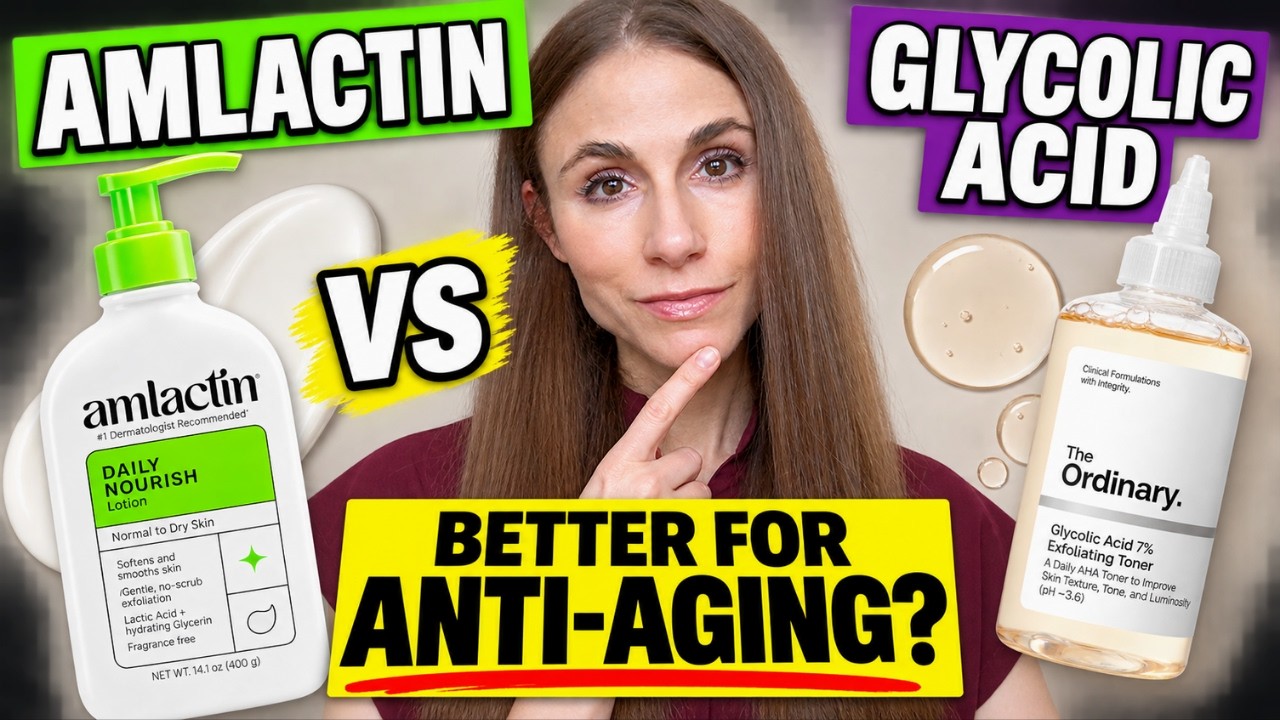
AmLactin Tops At-Home Glycolic Acid in Dermal Trials, Dray Says
Dr Dray
Retail glycolic acid only acts on the surface due to safety buffering, while clinical trials show 12% ammonium lactate thickens both the epidermis and the dermis.
AI-assisted summary of Amlactin vs. Glycolic Acid: Which Is Better for Anti-Aging? — original source. Check the original for full context.
Source published:
Key ideas
- In-office glycolic acid peels (20%–70%) reach the dermis to trigger collagen remodeling, but retail over-the-counter glycolic products are buffered to higher pH levels for safety, confining their activity primarily to superficial epidermal exfoliation. (1:33)
- Human clinical biopsy data reveals that twice-daily application of 12% lactic acid over 16 weeks significantly increases both epidermal and dermal thickness, whereas a 5% concentration only thickens the epidermis. (5:51)
- A human clinical trial demonstrated that co-applying buffered 12% ammonium lactate alongside clobetasol successfully prevented corticosteroid-induced dermal and epidermal atrophy without diminishing the steroid's anti-inflammatory efficacy. (9:34)
- While 12% ammonium lactate possesses stronger clinical support for at-home dermal thickening than over-the-counter glycolic acid, broad-spectrum sun protection remains the overriding medical requirement for preventing ultraviolet-driven collagen breakdown. (19:01)
Detailed notes
## Background Published on YouTube by dermatologist Dr Dray on August 31, 2026, this video examines whether AmLactin (12% ammonium lactate) or glycolic acid is better suited for anti-aging. The video breakdown contrasts the clinical research regarding epidermal and dermal thickness, exfoliation, and collagen remodeling across professional in-office chemical peels and over-the-counter topical skincare.
## TL;DR Dr Dray compares glycolic acid and 12% ammonium lactate, demonstrating that outcomes depend heavily on formulation, pH, and whether a product is applied at home or administered clinically. While professional in-office glycolic acid peels (20%–70%) reach the dermis to stimulate collagen remodeling, retail over-the-counter glycolic products are buffered and largely limited to superficial epidermal exfoliation. In contrast, human biopsy studies show that at-home 12% ammonium lactate can increase both epidermal and dermal thickness and help counteract corticosteroid-induced atrophy. Dr Dray emphasizes that while 12% ammonium lactate has stronger clinical evidence for home dermal support than store-bought glycolic acid, broad-spectrum sun protection remains the foundational, medically necessary defense against photoaging.
## Atmosphere & style The presentation feels educational, clinical, and reassuringly grounded, driven by Dr Dray's trademark analytical skepticism toward skincare marketing hype. Her delivery is calm and methodic, breaking down complex histopathological concepts and clinical trial data into digestible practical guidance without dramatic overstatements. Rather than promoting an exhaustive routine or pitting actives against each other in an imaginary competition, the discussion maintains an empowering, evidence-based tone that manages expectations and prioritizes individual skin tolerance and foundational sun defense.
## Bulletin - [01:33](https://www.youtube.com/watch?v=pnlFKtIQSNE&t=93s) In-office glycolic acid peels (20%–70%) reach the dermis to trigger collagen remodeling, but retail over-the-counter glycolic products are buffered to higher pH levels for safety, confining their activity primarily to superficial epidermal exfoliation. - [05:51](https://www.youtube.com/watch?v=pnlFKtIQSNE&t=351s) Human clinical biopsy data reveals that twice-daily application of 12% lactic acid over 16 weeks significantly increases both epidermal and dermal thickness, whereas a 5% concentration only thickens the epidermis. - [09:34](https://www.youtube.com/watch?v=pnlFKtIQSNE&t=574s) A human clinical trial demonstrated that co-applying buffered 12% ammonium lactate alongside clobetasol successfully prevented corticosteroid-induced dermal and epidermal atrophy without diminishing the steroid's anti-inflammatory efficacy. - [19:01](https://www.youtube.com/watch?v=pnlFKtIQSNE&t=1141s) While 12% ammonium lactate possesses stronger clinical support for at-home dermal thickening than over-the-counter glycolic acid, broad-spectrum sun protection remains the overriding medical requirement for preventing ultraviolet-driven collagen breakdown.
## Key takeaways - [00:00](https://www.youtube.com/watch?v=pnlFKtIQSNE&t=0s) AmLactin Daily 12% Lotion utilizes buffered ammonium lactate, an alpha hydroxy acid naturally present in skin that functions as both a gentle chemical exfoliant and an effective humectant. - [01:33](https://www.youtube.com/watch?v=pnlFKtIQSNE&t=93s) Glycolic acid's small molecular structure enables rapid cutaneous penetration, establishing high concentrations (20%–70%) at low pH as the clinical standard for in-office collagen remodeling chemical peels. - [04:08](https://www.youtube.com/watch?v=pnlFKtIQSNE&t=248s) Over-the-counter glycolic acid products cannot replicate professional chemical peels because consumer formulas are neutralized or buffered to higher pH levels to prevent chemical burns and post-inflammatory hyperpigmentation. - [05:51](https://www.youtube.com/watch?v=pnlFKtIQSNE&t=351s) In a 16-week human trial, twice-daily application of 12% lactic acid significantly increased both epidermal and dermal thickness, while a 5% formulation only produced epidermal thickening. - [08:28](https://www.youtube.com/watch?v=pnlFKtIQSNE&t=508s) Topical stimulation of dermal thickness provides critical therapeutic utility for fragile, atrophic skin prone to spontaneous tears and bruising, such as on the sun-damaged dorsal hands of older adults. - [09:34](https://www.youtube.com/watch?v=pnlFKtIQSNE&t=574s) Histopathological biopsy data demonstrated that concurrent use of 12% buffered ammonium lactate prevented clobetasol-induced cutaneous atrophy while preserving the steroid's full anti-inflammatory action. - [12:04](https://www.youtube.com/watch?v=pnlFKtIQSNE&t=724s) Between at-home retail products, 12% ammonium lactate is clinically favored over OTC glycolic acid for anti-aging because it reliably demonstrates measurable improvements to dermal thickness. - [14:40](https://www.youtube.com/watch?v=pnlFKtIQSNE&t=880s) Over-the-counter glycolic acid remains a valuable superficial intervention for smoothing skin texture, binding moisture, reducing comedones, and hastening the clearance of epidermal hyperpigmentation. - [14:40](https://www.youtube.com/watch?v=pnlFKtIQSNE&t=880s) Higher concentrations such as AmLactin 15% should not automatically be assumed to be superior to 12%, as variations often stem from vehicle or buffering differences rather than proven clinical gains. - [16:33](https://www.youtube.com/watch?v=pnlFKtIQSNE&t=993s) Very few topicals possess clinical evidence of altering the dermis; proven at-home agents are limited to retinoids (tretinoin, adapalene, retinol, retinaldehyde) and stabilized pure L-ascorbic acid. - [16:33](https://www.youtube.com/watch?v=pnlFKtIQSNE&t=993s) Layering multiple harsh anti-aging actives lacks evidence for enhanced dermal remodeling and frequently triggers barrier irritation and reactive post-inflammatory hyperpigmentation. - [19:01](https://www.youtube.com/watch?v=pnlFKtIQSNE&t=1141s) Ultraviolet radiation penetrates into the dermis to upregulate collagen-degrading enzymes and suppress cutaneous immune repair, making daily sun protection the foundational defense against photoaging. - [20:00](https://www.youtube.com/watch?v=pnlFKtIQSNE&t=1200s) Skincare ingredients do not exist on a competitive hierarchy ('gold, silver, and bronze'), as wide biological variation among individuals means product choice must be guided by personal skin tolerability. - [21:18](https://www.youtube.com/watch?v=pnlFKtIQSNE&t=1278s) AmLactin lotion can be applied to facial skin if tolerated and may be paired alongside topical retinoids to target dermal aging through complementary mechanisms.
## Detailed walkthrough ### [00:00](https://www.youtube.com/watch?v=pnlFKtIQSNE&t=0s) Introduction: AmLactin vs. Glycolic Acid for Anti-Aging
A frequent question in dermatology is whether AmLactin or glycolic acid is better for anti-aging. Both ingredients belong to the alpha hydroxy acid (AHA) class, which is widely recognized for smoothing the skin's surface, chemical exfoliation, refining rough texture, and fading hyperpigmentation. However, when evaluating them specifically for anti-aging outcomes, crucial nuances emerge. The answer fundamentally hinges on ingredient concentration, product formulation, and setting—specifically, whether a product is applied at home or administered in a clinical office setting.
Dr. Dray clarifies terminology from the outset: AmLactin is an over-the-counter skincare brand offering multiple moisturizers, not a single standalone active ingredient. The focal point of this comparison is 12% ammonium lactate—found in AmLactin Daily 12% Lotion—evaluated against glycolic acid. Ammonium lactate represents a buffered form of lactic acid, an AHA naturally found in human skin that functions both as a gentle exfoliant and as an effective humectant to enhance moisture retention.
- Both lactic acid and glycolic acid function as exfoliating and humectant AHAs. - AmLactin Daily 12% utilizes buffered ammonium lactate rather than raw, unbuffered lactic acid. - Outcome comparisons depend strictly on concentration, vehicle, pH, and the environment of application.
[01:33](https://www.youtube.com/watch?v=pnlFKtIQSNE&t=93s) Molecular Size and In-Office Glycolic Acid Peels
The primary chemical distinction between glycolic acid and lactic acid is molecular structure. Glycolic acid possesses a smaller molecular size than lactic acid, allowing it to penetrate skin layers far more rapidly and readily. This rapid penetration makes glycolic acid an exceptional active ingredient when high, biologically meaningful concentrations need to reach deep cutaneous targets. Consequently, dermatologists routinely use glycolic acid as the standard agent for in-office chemical peels designed to treat photodamage and visible aging.
```mermaid flowchart TD accTitle: Glycolic Acid In-Office vs At-Home Skincare accDescr: Flowchart contrasting the delivery, concentration, depth of action, and clinical effects of professional in-office peels versus at-home formulations.
subgraph Office["In-Office Dermatologist Peels"] A["Glycolic Acid (20%–70%)"] --> B["Low pH / Unbuffered Vehicle"] B --> C["Deep Penetration into Dermis"] C --> D["Collagen Remodeling & Wrinkle Reduction"] end
subgraph Home["At-Home Retail Skincare"] E["Glycolic Acid (OTC)"] --> F["Higher pH / Partially Buffered"] F --> G["Action Limited to Epidermis"] G --> H["Surface Smoothing & Hydration"] end ```
In-office peel formulations differ drastically from anything sold on retail shelves. Dermatologists utilize concentrated glycolic acid solutions ranging from 20% up to 70%, formulated at a very low pH with specialized delivery vehicles that facilitate aggressive penetration. This creates an intentional therapeutic window that carries a real risk of chemical burning if not carefully administered. When performed properly, extensive clinical and histologic (biopsy-proven) evidence demonstrates that high-strength glycolic peels induce true dermal remodeling, stimulate new collagen production, improve skin firmness and elasticity, and visibly diminish wrinkles. Between lactic acid and glycolic acid for an in-office peel, "without a doubt, it's going to be glycolic acid."
- High-strength in-office glycolic acid peels range from 20% to 70% concentration. - Peel efficacy depends on the percentage, low pH, vehicle formulation, and carefully controlled contact time. - Histologically verified benefits of professional peels include dermal collagen remodeling and structural tightening.
[04:08](https://www.youtube.com/watch?v=pnlFKtIQSNE&t=248s) The Reality of At-Home Glycolic Acid Skincare
The clinical evidence supporting high-potency professional peels cannot simply be extrapolated to consumer products bought in stores. Over-the-counter glycolic acid serums and creams represent an entirely different biological exposure. Because high concentrations and low pH levels present major risks of severe skin irritation, chemical burns, and post-inflammatory hyperpigmentation—particularly in deeper skin tones—consumer formulations are intentionally partially neutralized or buffered to a higher, safer pH.
While buffering ensures safety for unsupervised daily use, it fundamentally limits the depth of penetration. Consequently, retail glycolic acid products work almost exclusively at the superficial epidermal level. They deliver noticeable benefits: smoothing rough surface texture, boosting hydration, providing a subtle plumping and firming look, and accelerating the clearance of epidermal pigmentation. However, retail-grade glycolic acid does not reach the dermis to trigger the deep structural collagen remodeling achieved by in-office chemical procedures.
- Over-the-counter glycolic products are buffered or neutralized to higher pH levels for home safety. - Low pH coupled with high AHA strength poses severe risks of burns and pigmentary complications in darker skin phenotypes. - Consumer glycolic formulations excel at epidermal exfoliation and hydration, but do not reproduce clinical dermal remodeling.
[05:51](https://www.youtube.com/watch?v=pnlFKtIQSNE&t=351s) Clinical Evidence for 12% Ammonium Lactate and Dermal Thickness
Because over-the-counter glycolic acid remains primarily superficial, 12% ammonium lactate (AmLactin 12% Lotion) stands out due to clinical trial data assessing at-home, user-applied regimens. In a highlighted clinical study, researchers compared the effects of 5% versus 12% lactic acid formulations applied to the face twice daily over 16 weeks (specifically avoiding the sensitive eyelid area, where AHAs cause dryness and irritation), evaluating subjects at intervals of 4, 8, 12, and 16 weeks.
| Formulation Tested | Application Regimen | Evaluated Intervals | Histologic / Biopsy Finding | |:--- |:--- |:--- |:--- | | **5% Lactic Acid** | Facial application twice daily (excluding eyelids) | 4, 8, 12, 16 weeks | Increased epidermal thickness | | **12% Lactic Acid** | Facial application twice daily (excluding eyelids) | 4, 8, 12, 16 weeks | Increased thickness in both the epidermis and the dermis |
The trial's skin biopsy analyses revealed a critical divergence between the two concentrations. The 5% formulation increased the thickness of the epidermis, which counteracts the epidermal thinning typical of intrinsic aging and photoaging. The 12% concentration, however, significantly increased the thickness of both the epidermis and the dermis. This finding is notable for a safe, accessible topical product, demonstrating that 12% ammonium lactate can influence deeper dermal architecture—the layer composed of collagen, elastin, and glycosaminoglycans that degrades over time.
[08:28](https://www.youtube.com/watch?v=pnlFKtIQSNE&t=508s) Beyond Cosmetics: Treating Fragile, Atrophic Skin
The ability to build dermal thickness carries medical implications that extend far beyond cosmetic wrinkle reduction. Chronic sun exposure and intrinsic aging cause progressive skin atrophy. On vulnerable, highly sun-exposed areas like the dorsal hands, this dermal and epidermal thinning leaves the tissue frail, paper-thin, prone to spontaneous skin tears, easily bruised (senile purpura), and impaired in its wound-healing capacity.
An accessible, cost-effective formulation capable of stimulating both epidermal and dermal thickening offers therapeutic utility for older adults facing severe skin fragility. Nonetheless, Dr. Dray emphasizes the importance of managing expectations: while biopsy data proves tangible structural changes, consumers must be realistic. Applying 12% ammonium lactate will not cause someone to "wake up looking 30 years younger" or entirely erase deep wrinkles, but it offers documented, modest improvements from a safe at-home moisturizer.
- Dermal structural integrity relies on collagen, elastin, and glycosaminoglycans. - Sun-damaged skin on the backs of the hands suffers from thinning, frequent tearing, ecchymosis, and poor healing. - 12% ammonium lactate serves as an affordable, non-prescription intervention to strengthen fragile, atrophic cutaneous tissue.
[09:34](https://www.youtube.com/watch?v=pnlFKtIQSNE&t=574s) AmLactin and Steroid-Induced Skin Atrophy
Dr. Dray highlights a compelling human clinical study examining buffered 12% ammonium lactate lotion and its ability to counteract a common dermatological problem: long-term corticosteroid-induced dermal atrophy. Potent topical steroids, such as clobetasol, are considered clinical game-changers for managing inflammatory skin conditions, but prolonged use carries the notorious adverse risk of causing dermal and epidermal thinning, often leading to irreversible stretch marks in the treated areas. In this trial, researchers investigated whether co-applying 12% ammonium lactate lotion alongside clobetasol could mitigate or prevent that structural thinning.
```mermaid flowchart TD accTitle: Co-Application of Ammonium Lactate and Clobetasol accDescr: Diagram illustrating how 12 percent ammonium lactate counters clobetasol side effects without blunting anti-inflammatory efficacy.
subgraph Treatment["Concurrent Topical Regimen"] A["Potent Steroid: Clobetasol"] B["12% Buffered Ammonium Lactate"] end
subgraph Effects["Clinical and Histological Outcomes"] C["Anti-inflammatory Efficacy Maintained"] D["Epidermal & Dermal Thinning Prevented"] end
A --> C A -.->|"Risk of Atrophy"| D B ==>|"Offsets Dermal/Epidermal Thinning"| D ```
The histopathological findings—backed by physical biopsies demonstrating objective tissue changes—showed that the concurrent use of 12% buffered ammonium lactate successfully spared both the epidermis and the dermis from atrophy. Crucially, researchers addressed a frequent patient worry about whether combining actives might cancel one another out: tests evaluating anti-inflammatory markers confirmed the steroid remained fully active. The ammonium lactate offset the structural side effects without interfering with the medication's therapeutic mechanism of action. While Dr. Dray clarifies that this study is not an explicit mandate that everyone must use 12% ammonium lactate as an anti-aging remedy, it provides robust human tissue evidence that the formula triggers measurable structural changes extending well into the dermis.
[12:04](https://www.youtube.com/watch?v=pnlFKtIQSNE&t=724s) Is AmLactin 12% Better Than Glycolic Acid?
When addressing the central question—is AmLactin 12% better than glycolic acid?—Dr. Dray insists the verdict depends entirely on the context. If comparing products designed for safe, over-the-counter home use, the scientific evidence favors 12% ammonium lactate over at-home glycolic acid, because 12% ammonium lactate reliably improves both epidermal and dermal thickness. Commercial at-home glycolic acid formulations are simply not engineered to yield the profound dermal collagen remodeling observed in high-strength, in-office chemical peels. However, Dr. Dray emphasizes that at-home 12% ammonium lactate is by no means stronger or more potent than a professional, dermatologist-administered glycolic peel.
This distinction highlights a broader lesson in analyzing skincare claims. Consumers frequently search for a simple "what's better, this or that," but that framing is an oversimplification. Evaluating an active requires assessing its concentration, delivery system, buffering, vehicle pH, and whether it is an unsupervised home product or a clinical intervention. If consumers read a dermatology textbook describing glycolic acid’s small molecular size and potent collagen-stimulating capacity, they often fall into the trap of falsely concluding that their store-bought glycolic acid toner will outshine AmLactin for deep wrinkle reduction.
[14:40](https://www.youtube.com/watch?v=pnlFKtIQSNE&t=880s) The Realistic Value of At-Home Glycolic Acid
Choosing 12% ammonium lactate for dermal effects does not make an at-home glycolic acid serum or toner a waste of time. At-home glycolic acid remains a stellar superficial exfoliant that delivers genuine surface-level perks:
- **Surface Smoothing & Enhanced Penetration:** By sloughing away dead surface cells, it refines texture and can facilitate the penetration of subsequent skincare steps. - **Humectant Hydration:** Glycolic acid naturally binds water to boost epidermal moisture, which supports healthy cellular turnover. - **Accelerated Pigment Clearance:** Hastened epidermal turnover helps shed localized, unwanted hyperpigmentation. - **Comedone Reduction:** Enhancing keratinocyte maturation and clearing out cohesive follicular debris cuts down on pore-clogging comedo formation in acne-prone skin.
Dr. Dray cautions consumers against conflating these superficial exfoliation benefits with the deep dermal remodeling produced by in-office chemical peels. Even when home formulas feature numbers as high as 20%, they are heavily buffered for consumer safety, meaning their activity stays predominantly confined to the skin's surface.
Addressing related formulations, Dr. Dray briefly mentions AmLactin’s 15% lotion. She cautions against assuming 15% is automatically superior to 12%; the higher stated percentage likely reflects vehicle or buffering differences rather than a clinically proven boost in dermal remodeling, especially since the two strengths have not gone head-to-head in trials. The key takeaway remains that 12% ammonium lactate possesses distinct, human-proven dermal benefits that ordinary store-bought glycolic acid cannot match.
[16:33](https://www.youtube.com/watch?v=pnlFKtIQSNE&t=993s) The Short List of Proven At-Home Dermal Actives
Putting both acids in perspective, Dr. Dray notes that neither ingredient is the solitary cure for aging skin, largely because very few over-the-counter topicals can meaningfully alter the dermis. The short roster of scientifically backed ingredients capable of operating below the surface includes:
- **The Vitamin A Family (Retinoids):** Cosmetic over-the-counter options like retinol and retinaldehyde are converted by skin enzymes into active retinoic acid. Although that enzymatic conversion takes time, long-term use improves collagen production and softens wrinkles. Prescription tretinoin is the gold standard and holds formal FDA approval for treating photodamage. - **Targeted Acne Retinoids:** Adapalene 0.1% gel (available over the counter in the United States) as well as prescription strengths (adapalene 0.3%) and alternative topical retinoids like tazarotene and trifarotene all possess clinical evidence demonstrating collagen stimulation. - **L-Ascorbic Acid (Pure Vitamin C):** Ascorbic acid can reach the dermis to influence dermal thickness and collagen, but cosmetic derivatives do not share this evidence and remain largely superficial. Pure ascorbic acid remains notoriously tricky to formulate because it is difficult to keep stable and challenging to transport across the skin barrier.
Dr. Dray pushes back against the trend of stacking multiple harsh anti-aging actives together in a single routine. Layering numerous products has never been objectively proven to yield superior dermal remodeling, but it frequently triggers irritation and barrier impairment, ultimately sparking reactive hyperpigmentation. Given the limited number of ingredients that truly work beneath the skin's surface, a focused routine built around proven actives is far more dependable than chasing unverified combinations.
[19:01](https://www.youtube.com/watch?v=pnlFKtIQSNE&t=1141s) The Foundational Role of Sun Protection in Preventing Dermal Thinning
Dr. Dray emphasizes that overriding every topical active ingredient discussed is rigorous sun protection. Applying a broad-spectrum sunscreen, wearing sun-protective clothing, and actively adjusting everyday behaviors around sun exposure make a massive difference that reaches far deeper than the superficial stratum corneum. Ultraviolet rays penetrate deep into the dermis, where they upregulate destructive enzymes that break down and degrade structural collagen. At the same time, UV radiation suppresses the cutaneous immune system's intrinsic ability to step in and repair tissue damage.
This deep damage directly accelerates age-related dermal atrophy, a process made significantly worse over time through cumulative, chronic ultraviolet exposure. A prime example of this vulnerability is the backs of the hands—an area of naturally delicate, thin skin that is continually exposed to the elements and prone to severe thinning and wrinkling. Protecting sun-exposed territories and strictly avoiding intentional tanning behaviors is non-negotiable for anyone serious about preserving dermal structural integrity.
- Broad-spectrum sunscreen and UV-protective clothing guard against deep dermal penetration. - Ultraviolet radiation triggers enzymatic degradation of structural collagen while suppressing immune-mediated repair mechanisms. - The backs of the hands represent a particularly high-risk zone for accelerated photoaging and dermal atrophy due to their naturally delicate skin and frequent, unshielded sun exposure.
```mermaid flowchart TD accTitle: UV Radiation and Dermal Atrophy accDescr: Flowchart illustrating how ultraviolet radiation causes dermal collagen degradation and atrophy. subgraph UV_Impact["Ultraviolet Radiation Damage"] A["Deep UV Penetration"] --> B["Upregulates Collagen-Degrading Enzymes"] A --> C["Suppresses Cutaneous Immune Repair"] end subgraph Outcome["Clinical Consequence"] B --> D["Accelerated Dermal Atrophy"] C --> D D --> E["Severe Thinning (e.g., Backs of the Hands)"] end ```
[20:00](https://www.youtube.com/watch?v=pnlFKtIQSNE&t=1200s) The Bottom Line: Realistic Expectations and Individual Tolerability
When summarizing at-home options specifically aimed at improving dermal thickness, Dr. Dray states that AmLactin 12% lotion offers genuine confidence, holding "a fighting chance of doing something above and beyond just improving the surface of the skin." However, surface improvements are nothing to dismiss; increasing epidermal thickness and refining superficial texture remain valuable dermatological goals in their own right. At the same time, practical tolerability dictates success: individuals with highly reactive or sensitive skin may struggle to tolerate 12% ammonium lactate or strong topical retinoids, meaning those options simply will not suit every routine.
Dr. Dray cautions viewers against falling into the trap of product hierarchy, reminding everyone that "skincare ingredients are not in some sort of Olympics. There's not a gold, silver, and bronze for anti-aging." While consumers naturally gravitate toward whatever appears most potent, robust, or clinically supported, human skin exhibits immense biological heterogeneity. People vary widely in how their skin responds to specific actives, and aside from daily sun protection—which is medically necessary for long-term health and disease prevention—anti-aging skincare choices remain purely personal. For those wanting evidence-backed routines, the scientific support primarily points toward 12% ammonium lactate for home use or in-office professional glycolic acid peels.
- 12% ammonium lactate demonstrates verifiable potential for both dermal and epidermal thickening, but personal tolerability must dictate its use. - Skincare ingredients should not be treated as a competitive hierarchy ("gold, silver, and bronze") because patient skin types and tolerances vary widely. - Sun protection remains the only medically mandatory step for long-term skin health, making all other anti-aging interventions optional personal choices.
[21:18](https://www.youtube.com/watch?v=pnlFKtIQSNE&t=1278s) Practical Application Tips and Video Wrap-Up
Concluding the discussion, Dr. Dray clarifies a common point of confusion: AmLactin lotion can indeed be applied to the facial skin, provided that an individual's skin tolerates the formulation without excessive irritation. She directs viewers to an end-screen video detailing exact application techniques for AmLactin, including step-by-step guidance on how to safely pair 12% ammonium lactate alongside topical retinoids for those looking to combine two complementary, dermis-targeting anti-aging powerhouses.
She wraps up by thanking viewers for tuning in, encouraging them to like and share the video with friends, and delivers her signature sign-off reminding everyone not to forget their sunscreen before saying goodbye until tomorrow.
## Notable quotes > [01:33](https://www.youtube.com/watch?v=pnlFKtIQSNE&t=93s) without a doubt, it's going to be glycolic acid. — Dr. Dray
> [08:28](https://www.youtube.com/watch?v=pnlFKtIQSNE&t=508s) wake up looking 30 years younger — Dr. Dray
> [12:04](https://www.youtube.com/watch?v=pnlFKtIQSNE&t=724s) what's better, this or that — Dr. Dray
> [20:00](https://www.youtube.com/watch?v=pnlFKtIQSNE&t=1200s) a fighting chance of doing something above and beyond just improving the surface of the skin. — Dr. Dray
> [20:00](https://www.youtube.com/watch?v=pnlFKtIQSNE&t=1200s) skincare ingredients are not in some sort of Olympics. There's not a gold, silver, and bronze for anti-aging. — Dr. Dray
## Mentioned Dr. Dray, AmLactin, AmLactin Daily 12% Lotion, AmLactin 15% Lotion, Glycolic acid, Ammonium lactate, Lactic acid, Clobetasol, Retinol, Retinaldehyde, Tretinoin, Adapalene, Tazarotene, Trifarotene, L-Ascorbic acid, Vitamin C
## Video description Is AmLactin or glycolic acid better for anti-aging? Dermatologist Dr. Dray breaks down the science behind these two popular alpha hydroxy acids and explains why the answer depends on the concentration, formulation, pH, and whether the product is being used at home or as an in-office chemical peel.
In this video, Dr. Dray compares 12% ammonium lactate, such as AmLactin Daily 12% Lotion, with glycolic acid specifically for anti-aging. She explains what the clinical research shows about epidermal and dermal thickness, collagen-related changes, exfoliation, skin texture, and the important differences between professional glycolic acid peels and over-the-counter glycolic acid skincare products.
She also discusses human clinical studies suggesting that 12% ammonium lactate may provide benefits beyond superficial exfoliation, including effects on both the epidermis and dermis. Dr. Dray explains why this makes 12% ammonium lactate an interesting option for an at-home anti-aging skincare routine.
In this video:
00:00 Introduction 00:59 What are AmLactin and glycolic acid? 03:13 Why glycolic acid is popular for chemical peels 05:51 What about 12% ammonium lactate at home? 07:50 Why does dermal thickness matter? 09:36 AmLactin and steroid-induced skin atrophy 12:04 Is AmLactin better than glycolic acid? 12:54 The problem with comparing skincare ingredients 14:40 What about glycolic acid at home? 16:33 Other anti-aging ingredients to consider 19:59 The bottom line
AmLactin vs. Glycolic Acid for Anti-Aging
Glycolic acid has a smaller molecular size than lactic acid and can penetrate the skin efficiently. At high concentrations used in professional chemical peels, glycolic acid can produce significant exfoliation and dermal remodeling.
However, those high-strength glycolic acid peels should not be confused with typical over-the-counter glycolic acid serums and lotions. Concentration, pH, formulation, and contact time all influence how an AHA behaves in the skin.
For at-home skincare, 12% ammonium lactate has particularly interesting human clinical evidence. Research has demonstrated changes in epidermal and dermal thickness with 12% lactic acid, while another human study found that 12% ammonium lactate helped spare against corticosteroid-induced atrophy in both the epidermis and dermis.
That does not mean AmLactin is equivalent to a professional glycolic acid peel, or that it will dramatically reverse wrinkles. However, the research suggests that 12% ammonium lactate may have effects that extend beyond simple surface exfoliation.
Dr. Dray also discusses other evidence-based anti-aging ingredients, including retinoids, tretinoin, retinaldehyde, retinol, adapalene, and topical vitamin C, as well as the importance of daily sun protection for preventing photoaging.
Products Mentioned
Amlactin Daily 12% Lotion https://amzlink.to/az0r9ArzAFr9W Glycolic acid products I recommend: https://amzlink.to/az09Ts3KSZ2YV
This video is for educational purposes and does not replace individualized medical advice from a dermatologist or other qualified healthcare professional.
#AmLactin #GlycolicAcid #AntiAgingSkincare #LacticAcid #Skincare #Dermatologist #AHA #Photoaging #SkincareRoutine #AntiAging
FTC: This video is not sponsored. Links are commissionable, meaning I may earn commission from purchases made through links.
💜Shop my Amazon store https://o.bttn.io/0BwiPWFIZLG 💜Follow me on liketoknowit https://www.liketoknow.it/drdrayzday 💜Social media Instagram @drdrayzday Pinterest https://www.pinterest.com/drdrayzday/ Facebook @DrDrayzDay Twitter: @drdrayzday Tiktok: @drdrayzday
Disclaimer: This video is not intended to provide diagnosis, treatment or medical advice. Content provided on this Youtube channel is for informational purposes only. Please consult with a physician or other healthcare professional regarding any medical or health related diagnosis or treatment options. Information on this Youtube channel should not be considered as a substitute for advice from a healthcare professional. The statements made about specific products throughout this video are not to diagnose, treat, cure or prevent disease.
[Source](https://www.youtube.com/watch?v=pnlFKtIQSNE)