UMich Study Finds Shrinking Families Break US Elder Care Safety Net
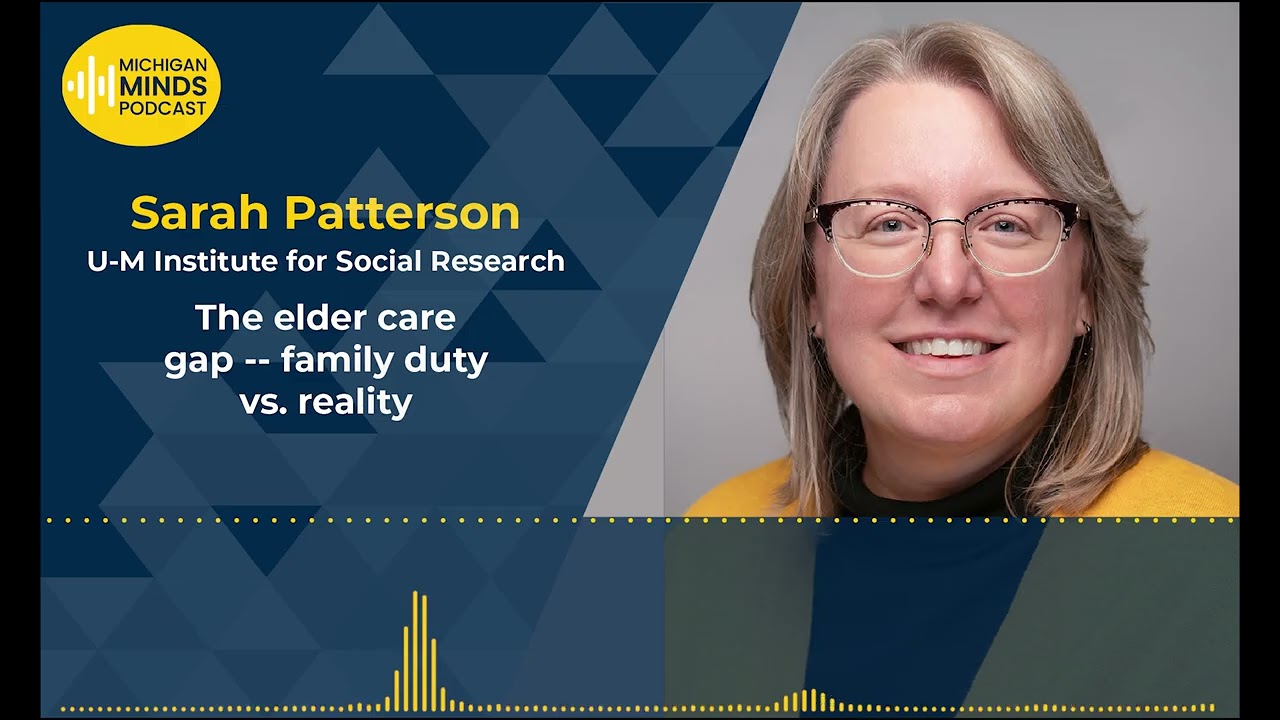
The elder care gap -- family duty vs. reality — University of Michigan

University of Michigan

Universal cultural expectations that families must care for aging parents are collapsing under rising gray divorce, smaller household sizes, and monthly care costs that exceed ordinary budgets.

AI-assisted summary of The elder care gap -- family duty vs. reality — original source. Check the original for full context.

Source published:

Key ideas

  • A University of Michigan survey of 2,000 Americans found that while public expectations overwhelmingly hold families responsible for elder care, demographic realities like gray divorce, smaller households, and estrangement make this model unsustainable. (0:00)
  • Elder care imposes severe financial strains on households, with AARP reporting family caregivers spend an average of $7,000 out-of-pocket annually, while professional memory care can exceed $12,000 per month. (10:25)
  • Roughly one-third of extended American families now include an adult aged 65 or older experiencing dementia or cognitive impairment, shifting elder care into a broad public health concern. (3:20)
  • A global comparison across approximately 190 countries revealed that family leave and caregiving policies remain strictly tied to narrow, biological definitions of family, creating administrative barriers for solo agers relying on chosen family networks. (16:05)

Detailed notes

## Background Published on YouTube by the University of Michigan on September 11, 2026, this episode of the Michigan Minds podcast features sociologist and demographer Sarah Patterson from the Institute for Social Research. The discussion examines how enduring universal moral obligations for families to care for aging relatives have collided with demographic shifts—including smaller families, gray divorce, and estrangement—turning elder care into an unsustainable "math problem."

## TL;DR Demographer Sarah Patterson explores the mounting elder care gap in the United States, where deep-seated societal expectations of family responsibility clash with the reality of shrinking family structures and geographic separation. The conversation highlights the steep financial and physical toll on caregivers, who often become "second patients" by default after sudden health crises rather than through deliberate planning. Patterson details the hidden subtleties of dementia, the structural barriers faced by solo agers and chosen families under rigid policies, and the urgent need for families to initiate transparent, proactive conversations before emergencies arise.

## Atmosphere & style The discussion is candid, empathetic, and grounded in academic research, striking a thoughtful balance between sociological data and raw emotional honesty. Host Fernanda Pires and Patterson weave personal family vignettes—such as long-distance sibling coordination and frank conversations with aging mothers—into broader statistical trends, creating an intimate, relatable dialogue. Listening feels like an eye-opening, supportive intervention, guiding audiences from the overwhelming panic of domestic caregiving crises toward pragmatic communication and shared community solutions.

## Bulletin - [00:00](https://www.youtube.com/watch?v=GuKMqb0xNtw&t=0s) A University of Michigan survey of 2,000 Americans found that while public expectations overwhelmingly hold families responsible for elder care, demographic realities like gray divorce, smaller households, and estrangement make this model unsustainable. - [10:25](https://www.youtube.com/watch?v=GuKMqb0xNtw&t=625s) Elder care imposes severe financial strains on households, with AARP reporting family caregivers spend an average of $7,000 out-of-pocket annually, while professional memory care can exceed $12,000 per month. - [03:20](https://www.youtube.com/watch?v=GuKMqb0xNtw&t=200s) Roughly one-third of extended American families now include an adult aged 65 or older experiencing dementia or cognitive impairment, shifting elder care into a broad public health concern. - [16:05](https://www.youtube.com/watch?v=GuKMqb0xNtw&t=965s) A global comparison across approximately 190 countries revealed that family leave and caregiving policies remain strictly tied to narrow, biological definitions of family, creating administrative barriers for solo agers relying on chosen family networks.

## Key takeaways - [00:00](https://www.youtube.com/watch?v=GuKMqb0xNtw&t=0s) Universal moral beliefs placing primary caregiving responsibility on families are colliding with demographic realities such as rising 'gray divorce,' shrinking family trees, and widespread family estrangement. - [00:00](https://www.youtube.com/watch?v=GuKMqb0xNtw&t=0s) Public perceptions of family responsibility remain equally rigid regardless of whether an older adult suffers from physical limitations or severe cognitive decline like dementia. - [03:20](https://www.youtube.com/watch?v=GuKMqb0xNtw&t=200s) Treating caregiving as a private family duty kept behind closed doors conceals its systemic fallout on public health, hospitals, and Social Security. - [05:30](https://www.youtube.com/watch?v=GuKMqb0xNtw&t=330s) Geographic proximity dictates caregiving roles, with nearby relatives managing daily physical activities while long-distance caregivers coordinate healthcare, manage finances, and provide emotional support. - [05:30](https://www.youtube.com/watch?v=GuKMqb0xNtw&t=330s) Many individuals managing prescriptions, bills, and medical logistics for aging relatives do not identify as 'caregivers' until asked about specific operational tasks. - [08:50](https://www.youtube.com/watch?v=GuKMqb0xNtw&t=530s) Primary caregivers frequently face physical and emotional deterioration, becoming the 'second patient' when caregiving is conducted in isolation without a collaborative support network. - [10:25](https://www.youtube.com/watch?v=GuKMqb0xNtw&t=625s) The steep cost of professional elder care—from $5,000–$7,000 monthly for assisted living transitions to upwards of $12,000 for specialized dementia care—leaves families vulnerable to financial ruin. - [11:43](https://www.youtube.com/watch?v=GuKMqb0xNtw&t=703s) Most family members become caregivers by default following an acute emergency rather than through planned, deliberate discussions. - [13:52](https://www.youtube.com/watch?v=GuKMqb0xNtw&t=832s) Early signs of dementia frequently present as subtle behavioral and linguistic shifts, such as flattened language and reduced expression, rather than sudden, dramatic memory loss. - [16:05](https://www.youtube.com/watch?v=GuKMqb0xNtw&t=965s) Solo agers lacking spouses or adult children often depend on friends and community members, but these chosen caregivers frequently face legal and institutional barriers in medical settings. - [18:22](https://www.youtube.com/watch?v=GuKMqb0xNtw&t=1102s) Proactive conversations structured around asking parents what they want their later life to look like can prevent reactive crises and unpack fears of becoming a burden. - [21:23](https://www.youtube.com/watch?v=GuKMqb0xNtw&t=1283s) Late-life despair and resistance to care often stem from underlying unmet basic needs, physical confinement, and profound social isolation, which carries public health harms comparable to smoking. - [23:14](https://www.youtube.com/watch?v=GuKMqb0xNtw&t=1394s) Mitigating elder isolation requires institutional and civic solutions, such as pedestrian-accessible sidewalks and public transit, rather than relying solely on individual household labor.

## Detailed walkthrough ### [00:00](https://www.youtube.com/watch?v=GuKMqb0xNtw&t=0s) The Looming National Question: Who Is Responsible for Care?

The conversation opens with a scenario familiar to millions of families: an unexpected, panicked phone call that an aging parent has suffered a fall, or the subtle realization that their memory is beginning to slip in alarming ways. Instinctively, adult children scramble with the sudden weight of the moment: *"What do I need to do? Can I handle this? Who else will help?"* Host Fernanda Pires points out that this is no longer an isolated domestic shock, but rather a simultaneous national reality driven by an aging demographic, shrinking family sizes, and climbing rates of dementia.

Welcoming Sarah Patterson, a demographer and sociologist at the University of Michigan’s Institute for Social Research, Pires frames the overarching puzzle: Is the deep-seated belief that families should take care of their own elders an enduring, timeless moral code, or has it become a demographic "math problem" that simply no longer adds up? Patterson explains that across societies and nations, the moral expectation that families should provide elder care remains nearly universal. However, modern demographic shifts are fundamentally breaking the underlying math. Families today look radically different due to rising rates of "gray divorce" (divorce later in life), smaller family trees, and rising family estrangement—a topic now widely discussed in public forums and popular media, including by Oprah Winfrey.

Despite these seismic changes in family structures, public attitudes have barely budged. In a recent study surveying 2,000 Americans, Patterson and her team found that the vast majority of respondents still place the primary responsibility for care square on the shoulders of the family unit. Crucially, this belief holds firm regardless of the type or severity of the elder's condition, applying equally whether the parent suffers from severe cognitive decline like dementia or physical limitations such as difficulty walking. Yet Patterson questions how long these traditional expectations can realistically survive as demographic pressure intensifies on ever-smaller American households.

```mermaid flowchart TD accTitle: The Elder Care Gap accDescr: Diagram showing the clash between universal moral expectations and modern demographic constraints.

subgraph Beliefs ["Universal Moral Norms"] E["Expectation of Family Care"] R["Reciprocity: Repaying Parental Care"] end

subgraph Realities ["Demographic & Structural Shifts"] D["Gray Divorce & Estrangement"] S["Smaller Family Sizes"] G["Geographic Distance"] end

Beliefs --> M{"The 'Math Problem' Gap"} Realities --> M M --> O["Caregiver Strain & Unmet Care Needs"] ```

---

[03:20](https://www.youtube.com/watch?v=GuKMqb0xNtw&t=200s) A Private Family Burden as an Urgent Public Health Crisis

When asked whether elder care has officially become a nationwide public health crisis, Patterson stresses that our cultural insistence on treating caregiving as an intensely private, behind-closed-doors matter obscures its massive societal fallout. Because caregiving unfolds inside the living room and bedroom, society treats it as a private domestic duty rather than an institutional health concern. Yet its ripple effects touch nearly every public system in the United States, including hospital networks and the Social Security framework, while directly compromising the health of both the older adults and the family members caring for them.

This privacy often borders on silence and shame. In focus groups conducted with family caregivers, Patterson heard recurring themes of secrecy. One participant recounted: *"My mom would be mortified if I talked to the neighbors about her health issues."* Pires asks whether this challenge is concentrated in specific states or communities, but Patterson notes that it cuts across every geographic scale, from individual neighborhoods to the entire country.

- About one-third of extended American families (spanning grandparents, cousins, and siblings) currently include an adult aged 65 or older living with dementia or memory impairment. - Patterson illustrates this pervasiveness inside the recording studio: with just three people gathered in the room, statistically at least one of them has an older relative dealing with dementia.

---

[05:30](https://www.youtube.com/watch?v=GuKMqb0xNtw&t=330s) Who Can Actually Provide Care: Reciprocity, Distance, and Family Dynamics

Within the literature on caregiving, expectations are not distributed evenly across the family tree; they fall first on spouses or partners, followed immediately by adult children. Patterson explains that this rests on the deeply ingrained cultural norm of reciprocity—the intuitive moral contract that because parents raised and nurtured their children, adult children owe a debt to "return that favor" in their parents' later years.

However, intense friction arises between the moral obligation to care and the real-world capacity to deliver it. A critical obstacle is geographic proximity. While co-residing or living down the street allows for direct, daily physical intervention, living hundreds of miles or even countries away forces caregiving into completely different forms:

- **Broadening the definition of care:** Caregivers living at a distance often coordinate healthcare appointments, handle financial accounts, pay bills, and provide social and emotional support, whereas co-residential caregivers carry the burden of physical activities of daily living (such as bathing, feeding, and grocery shopping). - **The caregiver label disconnect:** Many adults do not self-identify as "caregivers" when directly asked. Only when researchers inquire about specific duties—like managing an aging mother's bank accounts, prescriptions, and medical decisions—do they realize they meet the definition. - **Unequal family burdens:** Focus groups revealed that siblings without a spouse or children of their own, or those who are currently unemployed, face immense family pressure to absorb the care workload under the assumption that they have fewer time constraints and more flexible availability. - **Relational capacity:** Sibling friction frequently surfaces around whether someone is emotionally fit to care. Patterson noted focus group examples where a sibling was professionally trained—such as being a nurse—yet family members agreed that a fraught, painful emotional history with the parent meant she lacked the interpersonal "capacity to care."

---

[08:50](https://www.youtube.com/watch?v=GuKMqb0xNtw&t=530s) The Caregiver as "Second Patient" and Building a Care Squad

Turning to the physical and psychological toll on the caregiver, Pires notes that primary caregivers frequently deteriorate into becoming the "second patient" in the home. Patterson agrees, emphasizing that while caregiving has historically been shrouded in secrecy, modern public figures and social media advocates are beginning to shatter the stigma. She cites Emma Heming Willis—wife of actor Bruce Willis, who was diagnosed with frontotemporal dementia—as a prominent example of someone using their platform to speak candidly and uncomfortably about the exhausting emotional reality of caregiving.

Patterson argues that because caregiving can be an isolating, crushing experience, constructing a broader "care squad" is essential for survival. Veteran caregivers consistently offer the same vital advice to newcomers: you must ask for help and communicate openly about what is happening rather than suffering in silence. When caregivers network and delegate, they safeguard their own physical, emotional, and mental health. Patterson points to grassroots caregiver communities and digital outreach as crucial steps toward dragging the elder care dilemma out of domestic isolation and into the center of public discourse.

[10:25](https://www.youtube.com/watch?v=GuKMqb0xNtw&t=625s) The Staggering Financial Burden of Caregiving

When aging parents require hands-on support, families frequently discover that the cost of outside help is astronomically high, leaving those who cannot afford caregiving services in an impossible bind. Sarah Patterson highlights that out-of-pocket expenses take an enormous toll on ordinary households. Drawing from national data, she points out that AARP estimates family caregivers spend an average of roughly $7,000 per year directly from their own pockets to support aging relatives.

```mermaid flowchart TD accTitle: Caregiving Financial Spectrum accDescr: Progression of caregiving costs from out-of-pocket expenses to specialized dementia memory care. A["Family Out-of-Pocket Support<br>~$7,000 / year (AARP)"] --> B["Senior Living & Assisted Living<br>$5,000 - $7,000 / month"] B --> C["Specialized Memory Care<br>Starting at $12,000 / month"] ```

When institutional care becomes necessary, the numbers escalate dramatically into figures few American families can withstand. Patterson shares that looking into local facilities in Michigan reveals that memory care units for dementia patients start at a staggering $12,000 per month. Even basic senior housing transitions carry exorbitant price tags; Patterson recounts her own mother shopping around for senior living communities, only to find baseline rates running between $5,000 and $7,000 a month just to secure an apartment with the option to later transition into assisted living. Because these sums are completely out of reach for most people, the financial strain of eldercare has rapidly shifted from a private worry into a critical public issue.

- **$7,000 / year**: Average out-of-pocket cost spent by family caregivers, according to AARP estimates. - **$5,000–$7,000 / month**: Baseline pricing encountered for independent senior housing transitioning into assisted living. - **$12,000+ / month**: Starting cost for dementia-specific memory care units locally in Michigan.

---

[11:43](https://www.youtube.com/watch?v=GuKMqb0xNtw&t=703s) Becoming a Caregiver by Default: The Urgent Need for Planning

Patterson’s research and focus group findings reveal a troubling trend: the vast majority of people do not deliberately choose caregiving roles through organized, proactive family discussions. Instead, they become caregivers by default following an acute crisis. An older adult gets lost while driving or suffers a serious car accident, and overnight, an adult child is thrust into managing complex care without any prior roadmap. Because caregiving arrives as an emergency rather than an agreed-upon plan, families are left scrambling under intense emotional distress.

To counter this, Patterson advocates for proactive, even if uncomfortable, conversations long before a medical crisis hits. During the recent holidays, she sat her own mother down to discuss what she envisions for her future—not merely end-of-life directives, but how she wants her "later life care" structured day-to-day. At the same time, Patterson cautions that even meticulous planning can be derailed by systemic shocks. She recalls a widely shared story from Michigan involving an older military veteran working at Meijer who had to be rescued by an online crowdfunding campaign; despite having planned responsibly for retirement, he lost his pension, and the crushing costs of caring for his ailing wife ultimately bankrupted him, forcing him back into minimum-wage retail work late in life.

- **Accidental caregiving**: Most focus group participants reported stepping into caregiving due to an acute event (such as a vehicular crash or cognitive wandering) rather than planned agreement. - **Unforeseen financial collapse**: The example of the Michigan Meijer veteran illustrates how pension loss and catastrophic illness can wipe out lifelong retirement preparations.

---

[13:52](https://www.youtube.com/watch?v=GuKMqb0xNtw&t=832s) Navigating Dementia: Subtleties, Symptoms, and Family Expectations

Both societal expectations and actual behaviors shift sharply when an older adult develops dementia. Patterson notes that families tend to rally and mobilize more extensively around cognitive decline than physical ailments, largely because the functional dependency of dementia requires far more constant, multi-faceted supervision. However, unlike a sudden stroke or a fall, dementia typically creeps in slowly and progressively, making early detection difficult for loved ones.

Early warnings often manifest in subtle behavioral shifts rather than dramatic memory loss. Patterson highlights that an individual's "language flattens"—their vocabulary narrows, and they become noticeably less talkative and expressive than they once were. Families often mistake these gradual changes for normal aging. Patterson stresses that while cognitive decline is more common in old age, dementia is never a normal part of the aging process; it indicates that something has fundamentally gone wrong in the brain. Because formal clinical diagnoses rely heavily on family observations, Patterson urges relatives to trust their gut feelings and keep detailed written logs of strange behaviors to present to doctors, especially since the older adult may lack the insight or ability to articulate their own symptoms.

- **Flattened language**: Subtle linguistic decline—such as shrinking vocabulary and reduced conversational engagement—frequently precedes obvious memory failure. - **Documenting behaviors**: Family history logs are often the primary clinical diagnostic tool, making early documentation vital.

---

[16:05](https://www.youtube.com/watch?v=GuKMqb0xNtw&t=965s) Solo Aging and the Role of Chosen Family in a Rigid System

With marriage rates dropping and family sizes shrinking, a growing segment of the population is facing "solo aging"—navigating old age without a spouse, partner, or adult children, who historically serve as society's primary safety net. When traditional kin are absent, community networks often step into the breach. In Patterson’s focus groups, participants described scenarios such as church members and neighborhood acquaintances stepping up to form coordinated support networks around solo agers once an unmet care need became obvious.

```mermaid flowchart LR accTitle: Structural Barriers for Non-Traditional Caregivers accDescr: Shows how friends and chosen family step in for solo agers but encounter legal and institutional policy barriers. A["Solo Ager<br>(Unpartnered / Childless)"] --> B["Chosen Family & Community<br>(Friends, Church Members, Neighbors)"] B --> C{"Institutional Policy Barrier<br>(Narrow Legal Definitions of Family)"} C -.->|"Denied Bedside Access"| D["Hospital ICU / Rooms"] C -.->|"Excluded from Decisions"| E["Medical Decision-Making"] ```

However, non-traditional caregivers and chosen family encounter stubborn structural roadblocks. Patterson cites an international study examining paid family leave policies across roughly 190 countries, which found that state, federal, and institutional guidelines almost universally adhere to rigid, narrow definitions of nuclear family (spouses and biological children). When friends or extended relatives attempt to help, they frequently collide with hospital gatekeeping—being barred from patient rooms or blocked from conferring with medical staff, even when designated as the patient's primary surrogate. To address this mismatch, researchers at the University of Michigan Medical School are actively studying strategies to reform medical policy and formally integrate non-traditional and chosen-family caregivers into clinical workflows.

- **190-country study**: Global policy comparisons show caregiving leave laws remain anchored to narrow, biological definitions of family. - **Institutional exclusion**: Friends and chosen caregivers frequently encounter hospital rules preventing bedside visitation and treatment consultations.

---

[18:22](https://www.youtube.com/watch?v=GuKMqb0xNtw&t=1102s) Starting the Conversation and Confronting the "Burden" Dilemma

When asked what single question adult children should ask their parents before an emergency strikes, Patterson emphasizes a deceptively simple opener: *"What would you like for your later life to look like?"* Asking parents what they actually want often reveals significant disconnects between an adult child’s assumptions and the parent’s true desires. An open discussion allows families to explore concrete thresholds, such as determining at what point, if ever, a parent would be willing to move into assisted living.

A major barrier to these vital conversations is the universal fear among aging parents of becoming a burden to their children, which causes many to suffer in silence rather than ask for help. Patterson pushes back against this impulse, recounting a direct conversation with her own mother where she told her: *"Well, that's my decision to make when it becomes a burden."* She urges families to create an atmosphere of transparency where neither side makes protective assumptions, allowing older adults to voice their needs honestly and giving children the autonomy to establish healthy care boundaries.

[20:29](https://www.youtube.com/watch?v=GuKMqb0xNtw&t=1229s) Navigating Sibling Dynamics and Long-Distance Caregiving

The host shares a personal reflection on the geographic realities of caregiving, explaining that she is originally from Brazil, where her aging parents and sister still live. Because her sister is physically present, she bears the bulk of the hands-on day-to-day caregiving duties, whereas the host shoulders more of the "emotional responsibility" from afar. She asks how siblings should approach these sensitive conversations, emphasizing how critical communication between brothers and sisters becomes when balancing care from different distances.

Sarah Patterson notes that this tension appears repeatedly in their surveys and focus groups. Sibling dynamics—such as whether someone is the older or younger sibling—inevitably shape expectations, unspoken resentments, and divisions of labor. The key to managing these relationships is cultivating open, honest dialogue long before an emergency occurs, rather than waiting for an acute crisis to force an emotionally charged confrontation.

[21:23](https://www.youtube.com/watch?v=GuKMqb0xNtw&t=1283s) Resistance to Care and Addressing Late-Life Depression

The host raises another common dilemma: how adult children can help parents who are "old-fashioned," set in their ways, and resistant to change, even when their decline is obvious. Adult children often struggle to balance stepping in with maintaining respect for their parents' autonomy. Patterson acknowledges how difficult it is for anyone to admit that they are aging and losing independence. In focus group sessions, participants constantly described older relatives who felt uncomfortable accepting assistance, with the word "stubborn" frequently thrown around. Patterson reiterates that proactive planning and early, gentle conversations remain the most effective tool to diminish that friction before resistance hardens into a crisis.

The conversation turns to the emotional weight of late-life depression, where aging parents may express feelings of despair, asking painful questions like, *"I want to die. Why am I still here?"* When asked how caregivers can handle such moments and remain positive, Patterson validates that this is a painful, lived reality for many families. She advises looking beneath the surface of these statements to see what unmet needs might be driving them: - Evaluating whether the parent feels completely isolated or lonely. - Checking basic daily living needs, such as reliable access to nutritious food or the ability to safely bathe, which heavily impact physical comfort and dignity. - Addressing confinement to the home, as simply being unable to get outside severely damages mental health and self-worth.

[23:14](https://www.youtube.com/watch?v=GuKMqb0xNtw&t=1394s) Social Isolation, Community Accessibility, and Closing

Expanding on mental well-being, the host highlights the essential role that hobbies and friendships play for aging adults. Patterson strongly agrees, pointing out that public health research often equates the health harms of severe social isolation directly to smoking. When older adults lose social ties, the toll on their physical and cognitive health is severe.

To combat this epidemic of isolation, Patterson stresses that the responsibility cannot rest entirely on individual households; communities must be intentionally built for inclusion. Making neighborhoods truly accessible—from well-maintained sidewalks to reliable public transportation—ensures that older adults and individuals with disabilities can remain active participants in public life rather than being trapped in their homes.

The episode concludes with the host thanking Patterson for her insights, and the Michigan Minds closing announcement credits Michigan News, a division of the University of Michigan's Office of the Vice President for Communications.

## Notable quotes > [00:00](https://www.youtube.com/watch?v=GuKMqb0xNtw&t=0s) What do I need to do? Can I handle this? Who else will help?

> [00:00](https://www.youtube.com/watch?v=GuKMqb0xNtw&t=0s) So I would say that our expectations for family is pretty universal. This is a widely held belief among many people, many nations, that families should help older adults with their care. — Sarah Patterson

> [00:00](https://www.youtube.com/watch?v=GuKMqb0xNtw&t=0s) it's becoming sort of a math problem because older adults' families are changing. — Sarah Patterson

> [00:00](https://www.youtube.com/watch?v=GuKMqb0xNtw&t=0s) There is a question about whether these sorts of values will persist into the future as there's more pressure on smaller families to take care of older adults in the U.S. — Sarah Patterson

> [03:20](https://www.youtube.com/watch?v=GuKMqb0xNtw&t=200s) My mom would be mortified if I talked to the neighbors about her health issues. — Focus group participant

> [18:22](https://www.youtube.com/watch?v=GuKMqb0xNtw&t=1102s) What would you like for your later life to look like? — Sarah Patterson

> [18:22](https://www.youtube.com/watch?v=GuKMqb0xNtw&t=1102s) Well, that's my decision to make when it becomes a burden. — Sarah Patterson

> [21:23](https://www.youtube.com/watch?v=GuKMqb0xNtw&t=1283s) I want to die. Why am I still here?

## Mentioned University of Michigan, Sarah Patterson, Fernanda Pires, Institute for Social Research, Michigan Minds, Greta Guest, Jeremy Marble, Hans Anderson, Oprah Winfrey, Emma Heming Willis, Bruce Willis, AARP, Meijer, University of Michigan Medical School, Social Security

## Video description It begins with a single, panicked phone call about a fallen parent or a flickering memory, but it is quickly becoming the defining white noise of a nation. As the American population ages and family structures splinter, a quiet domestic struggle has escalated into a pressing national inquiry: Who is actually responsible for our elders?

New insights from the University of Michigan suggest that while the American heart remains committed to the ideal of family-led care, the American household is running out of resources to provide it.

Sarah Patterson, a sociologist and demographer at the Institute for Social Research, joined the Michigan Minds podcast to talk about a high-stakes collision between universal moral values and a "math problem" that no longer adds up.

Q: Is the traditional family safety net fraying under the weight of several modern demographic shifts.

So I would say that our expectations for family is pretty universal. This is a widely held belief among many people, many nations, that families should help older adults with their care. But as you said, it's becoming sort of a math problem because older adults' families are changing. So we have higher rates of what's known as gray divorce or getting divorced later in life. Family estrangement has become a big topic. For instance, Oprah has been talking about it, so it's a big topic in the public. And there's these sort of family changes that are happening for older adults that call into question what our expectations might be in this changing sort of demographic environment.

My research is concerned with how we think about these expectations for families when families are changing… There is a question about whether these sorts of values will persist into the future as there's more pressure on smaller families to take care of older adults in the U.S.

Michigan Minds is produced by Greta Guest and hosted by Michigan News staff. Jeremy Marble is the audio engineer and Hans Anderson provides social media animations. Listen to all episodes of the podcast.

[Source](https://www.youtube.com/watch?v=GuKMqb0xNtw)

中文简报

密歇根大学研究:家庭规模萎缩冲垮美国养老安全网 在老年离婚率上升、家庭规模缩小以及月度照护费用超出常规预算的冲击下,家庭必须照料年迈父母这一普遍的文化期望正在瓦解。 人口学家Sarah Patterson探讨了美国日益扩大的养老缺口。在这个问题上,根深蒂固的家庭责任社会期望与家庭结构萎缩及地理区隔的现实产生了激烈冲突。对话强调了照料者所承受的沉重经济与身体负担;这些人往往是在突发健康危机之后,而非经过深思熟虑的规划,被迫成为被动的“第二患者”。Patterson详细分析了认知障碍症隐蔽的细微特征、独居老人与选择性家庭在死板政策下面临的制度性障碍,以及各家庭在紧急情况发生前开展坦诚、前瞻性沟通的迫切需求。 密歇根大学对2,000名美国人进行的一项调查发现,尽管公众压倒性地认为家庭应承担养老责任,但老年离婚、家庭规模缩小和亲属疏离等人口学现实使得该模式难以为继。 (0:00) 老年照料给家庭带来了沉重的经济负担,AARP报告显示家庭照料者平均每年自掏腰包约7,000美元,而专业的失智照护每月费用可超过12,000美元。 (10:25) 大约三分之一的美国大家庭中如今包含一位患有认知障碍症或认知损伤的65岁及以上老年人,使得养老照护转变成一个广泛的公共卫生议题。 (3:20) 一项针对约190个国家的全球对比显示,探亲假和照料政策仍然严格绑定在狭隘的生理血缘家庭定义上,给依赖选择性家庭网络的独居老人制造了行政障碍。 (16:05)

Reading summary

According to University of Michigan demographer and sociologist Sarah Patterson, deep-rooted cultural expectations that families must care for aging relatives have collided with demographic realities, creating an unsustainable care gap and an unacknowledged public health crisis. While public attitudes continue to view elder care as a private domestic obligation, shrinking family sizes, rising divorce, and steep financial costs are overwhelming family capacity. Demographic Shifts Clash with Enduring Care Norms (0:00) Patterson explains that while the moral expectation of family care remains near-universal—grounded in norms of reciprocity where adult children feel obligated to return parental support—modern family structures are breaking this dynamic. Trends including "gray divorce," rising family estrangement, and smaller family networks mean fewer relatives exist to absorb care duties. In a survey of 2,000 Americans conducted by Patterson's team, the vast majority still placed primary caregiving responsibility on the family unit, regardless of whether an aging parent experiences physical disability or cognitive impairment like dementia. Simultaneously, elder care remains largely concealed as a private domestic matter rather than an institutional health concern, often generating silence and shame. Patterson notes that roughly one-third of extended American families currently include an adult aged 65 or older living with dementia or memory impairment. This strain ripples across public systems, including hospital networks and Social Security, while compromising the health of both older adults and their relatives. Escalating Financial Burdens and Caregiver Strain (10:25) When families require external support, costs frequently prove insurmountable for ordinary households. Patterson cites AARP estimates showing family caregivers spend an average of roughly $7,000 annually out of pocket. Professional institutional care escalates dramatically: baseline senior housing transitioning into assisted living typically costs between $5,000 and $7,000 per month, while specialized dementia memory care units in Michigan start around $12,000 monthly. Patterson notes that such expenses can quickly exhaust retirement savings, citing an example of an older veteran bankrupted by the care costs of his ailing wife. This continuous burden often turns primary caregivers into a "second patient" in the home. Caregivers living nearby face physical demands like bathing and feeding, while long-distance caregivers handle complex logistical and financial management, often failing to recognize themselves as caregivers. To prevent isolation and severe physical deterioration, Patterson advocates building a broader "care squad" to delegate tasks and communicate needs openly instead of carrying the responsibilities in secrecy. Institutional Barriers for Non-Traditional Caregivers (16:05) A growing segment of the aging population faces "solo aging," navigating later life without a spouse or adult children. In these instances, chosen family and community networks—such as church members and neighbors—frequently step in to provide necessary assistance. However, non-traditional caregivers encounter rigid structural roadblocks. An international study examining paid family leave policies across roughly 190 countries revealed that statutory frameworks almost universally adhere to narrow, biological, or marital definitions of the nuclear family. These restrictive definitions extend directly into healthcare settings, where hospitals often bar chosen family members from patient rooms or exclude them from medical consultations, even when designated as the primary surrogate. To address this mismatch, researchers at the University of Michigan Medical School are studying strategies to reform medical policy and formally integrate chosen-family caregivers into clinical workflows. Replacing Reactive Emergencies with Proactive Planning (11:43) Patterson’s research indicates that most people become caregivers by default following an acute crisis, such as a vehicle crash or cognitive wandering, rather than through deliberate family planning. In conditions like dementia, functional decline is often gradual; early indicators include "flattened language"—such as a narrowing vocabulary and reduced conversational engagement—which families frequently mistake for normal aging. Because dementia is never a normal part of aging, Patterson urges relatives to maintain detailed written logs of behavioral anomalies to assist clinicians with diagnosis. To diminish resistance and address late-life depression, Patterson recommends that families initiate proactive discussions before emergencies occur by asking aging parents what they want their later life to look like. These conversations help families navigate parental fears of becoming a burden, clarify sibling divisions of labor, and assess unmet social and physical needs. Furthermore, Patterson emphasizes that combating severe social isolation—which public health research equates to the health harms of smoking—requires communities to build accessible physical infrastructure, such as well-maintained sidewalks and reliable public transit. Patterson concludes that bridging the care gap requires shifting elder care from an isolated domestic burden into an open public issue. However, whether legal frameworks, healthcare systems, and urban environments can adapt quickly enough to support smaller family networks and growing numbers of solo agers remains an open question.

Source quotes

[0:00] What do I need to do? Can I handle this? Who else will help? [0:00] Sarah Patterson: So I would say that our expectations for family is pretty universal. This is a widely held belief among many people, many nations, that families should help older adults with their care. [0:00] Sarah Patterson: it's becoming sort of a math problem because older adults' families are changing. [0:00] Sarah Patterson: There is a question about whether these sorts of values will persist into the future as there's more pressure on smaller families to take care of older adults in the U.S. [3:20] Focus group participant: My mom would be mortified if I talked to the neighbors about her health issues. [18:22] Sarah Patterson: What would you like for your later life to look like? [18:22] Sarah Patterson: Well, that's my decision to make when it becomes a burden. [21:23] I want to die. Why am I still here?

Original transcript

[0:00] Imagine [music] [0:05] you get a call that your parent has [0:07] [music] fallen. Or maybe their memory is [0:10] starting to sleep in ways that worry you [0:14] almost immediately you think, "What do I [0:17] need to do? Can I handle this? Who else [0:21] will help?" Now [music] imagine an [0:25] entire country having that same [0:27] conversation at [music] the same time [0:30] because we are with an aging population, [0:33] smaller families and raising dementia [0:36] rates. A [music] quiet question is [0:38] becoming a national one. Who is [0:41] responsible for care? [0:44] Welcome to the Michigan Minds podcast [0:47] where we explore the wealth of knowledge [0:50] from faculty experts [music] at the [0:52] University of Michigan. I am Fernanda [0:55] Pis, a lead public relations for the [0:58] Michigan News Office. We are speaking [1:00] [music] with Sarah Patterson, a [1:03] researcher who has been mapping the [1:05] [music] gap between our core beliefs [1:08] about family duty and our shrinking [1:10] capacity to meet them. Sarah is a [1:14] demographer and sociologist at the [1:16] University of Michigan's Institute for [1:19] Social Research. Hey Sarah, welcome to [1:22] the show. We started the podcast with a [1:25] big picture question. Who is responsible [1:28] for care? Is the belief that family [1:31] takes care of family a timeless moral [1:34] value or a math problem that no longer [1:39] adds up? [1:40] >> Great. Thank you so much for having me [1:42] to the podcast. So this is a good [1:44] question. So I would say that our [1:48] expectations for family is pretty [1:49] universal. This is a widely held belief [1:54] among many people, many nations. Um that [1:58] families should help older adults with [2:00] their care. Um but as you said, it's [2:02] becoming sort of a math problem because [2:04] older adults families are changing. So, [2:06] we have higher rates of what's known as [2:08] gray divorce or getting divorced later [2:10] in life. Um, family estrangement has [2:12] become a big uh topic. For instance, you [2:15] know, Oprah's been talking about it. So, [2:17] it's a big topic in the public. Um, and [2:19] there's these sort of family changes [2:21] that are happening for older adults that [2:23] call into question what our expectations [2:26] might be in this changing sort of [2:28] demographic environment. So my research [2:31] is concerned with how do we think about [2:35] these expectations for families when [2:37] families are changing. Um and currently [2:40] in the current research I've that I've [2:42] looked at most people still believe that [2:45] families are responsible. So we did a [2:47] study recently where we asked 2,000 [2:49] Americans about their thoughts and you [2:53] know most people said that the family as [2:55] a unit has most of the responsibility to [2:57] care for an older adult whether or not [2:59] they have sort of a more severe [3:01] impairment like dementia or just [3:03] physical limitations like difficulty [3:04] walking. And so what we found is people [3:06] still feel this way um even though [3:08] families are changing. Um, but there is [3:11] a question about whether these sort of [3:13] values will persist into the future as [3:15] there's more pressure on smaller [3:17] families to take care of older adults in [3:19] the US. [3:20] >> So, it is time to officially call it a [3:23] public health crisis and how big of a [3:27] problem is this and why? [3:30] >> I think we tend to think about families [3:33] caregiving for older adults as a very [3:35] private endeavor, right? So, this is [3:37] something that happens in your home. um [3:39] it's not very public um but it is a [3:43] public health issue because of the [3:45] effect on so many different people. So [3:47] you have the older adults themselves who [3:49] are struggling with health issues um and [3:52] then you have the family members who are [3:53] taking care of the older adults who it [3:55] may impact their health as well. So it [3:57] is sort of a public issue even though we [4:00] treat it very privately and there's lots [4:02] of reasons why we treat it privately [4:03] right family matters some people really [4:05] don't want to talk about this came up a [4:07] lot in our focus groups that we did with [4:09] caregivers of older adults it's sort of [4:11] like you know I remember one person said [4:14] you know my mom would be mortified if I [4:16] talk to the neighbors about her health [4:17] issues um it's seen as very private but [4:21] it does affect public systems it affects [4:23] the hospitals um the social security um [4:26] system. It affects the public in [4:28] different ways um through various family [4:30] members who are providing that care as [4:32] well as the older adults themselves. [4:35] >> Okay. So you guys have a clue how big [4:38] this is nationally or no like this is [4:41] like the whole US is having is facing [4:44] this problem or it is something more [4:47] like local some states. [4:49] >> I think it goes from your neighborhood [4:51] up into the whole US. So we did a study [4:54] where we looked at how prevalent it is [4:57] to have an older adult in your family [4:59] who has dementia and we found that about [5:02] onethird of extended families, so that [5:04] would include your cousins, your [5:05] grandparents, you know, sort of this [5:07] more extended family system, about a [5:09] third of families have an old or adult [5:11] who is 65 and older and has dementia or [5:14] some sort of memory impairment. Um, so [5:16] it's pretty pervasive, right? So here in [5:19] the room, we've got three people. one of [5:21] us has a family member who's an older [5:23] adult with with dementia. So, it is [5:25] pretty pervasive and it's a part of [5:27] people's everyday lives, which again [5:28] ties back to that public health issue. [5:30] In my research about who should the [5:33] public again um continues to see the [5:36] family is really responsible. They see [5:37] the family unit as a whole, especially [5:40] partners or spouses of older adults um [5:42] and then adult children. And so there's [5:44] a huge body of literature. Actually, [5:46] most of our literature and understanding [5:48] of these attitudes is on adult children [5:50] because it's such an ingrained idea that [5:53] people's adult children should provide [5:55] care for them later in life. This like [5:56] idea of reciprocity, right? Your parents [5:59] gave to you and brought you up, so later [6:01] in life you should return that favor and [6:03] take care of them. So that's really [6:05] built into um a lot of people's personal [6:08] values and just their social values. Um [6:11] but but there is sort of this tension um [6:14] that happens between like who can um and [6:17] and there's lots of different aspects [6:19] that go into the sort of like who can [6:21] there's distance right if your parent [6:24] lives in your home or nearby that [6:26] facilitates caregiving in a way that if [6:29] your country is away which we've talked [6:31] about that you know it just changes the [6:34] dynamics and I think something that's [6:36] interesting about that though is it kind [6:38] of relates to the definition of care. [6:40] Um, so we did some focus groups with [6:42] caregivers and people have pretty broad [6:45] definitions of caregiving because just [6:48] cuz you're far away doesn't mean you [6:51] aren't balancing their finances, keeping [6:53] them emotionally healthy, socially [6:55] engaged. Um, you know, it might just [6:57] look different than the person who's [6:59] co-residential with the older adult and [7:01] perhaps like helping them shower or [7:03] helping them eat or doing their grocery [7:04] shopping. So, I think that's something [7:06] to keep in mind is that when you ask [7:08] people if they're a caregiver, they [7:10] might say, "No." Uh, but then if you ask [7:13] them, you know, what are they doing? [7:14] They're like, "Oh, well, I do all of my [7:16] mom's bills. I do all of her healthcare [7:18] decisions." Things like that. So, they [7:19] are a caregiver by our definition as [7:21] researchers. Um, but yeah, so there's [7:24] sort of this distance um issue, people's [7:27] own families. So in our focus groups, we [7:29] found that people who didn't have sort [7:32] of their own nuclear family, so they [7:35] maybe weren't partnered or had children, [7:36] their families really expected them to [7:38] sort of pitch in, right? This idea that [7:40] you have more time availability because [7:42] you don't have your own sort of time [7:44] constraints or people who were uh not [7:46] working at the time, more time, less [7:49] time constraints for those people made [7:51] other people feel that they should um [7:54] provide care. Um, and then you also just [7:57] have this sort of um, you know, what [8:00] what we could call like capacity to [8:02] care. Again, in our focus groups, some [8:05] people just said, you know, my sister's [8:07] a nurse, but I just don't think given [8:09] her history with my mom that I that she [8:12] has the kind of capacity to to provide [8:15] good care for her. Um, so family members [8:18] often have these um, judgments of one [8:20] another and what what they can and can't [8:22] do and of themselves. Some people say, [8:24] you know, my relationship with my parent [8:27] was so much this way, it's difficult for [8:29] me to think about doing that for them [8:31] later. Um, even if they want to. Um, so, [8:34] so these situations bring up a lot of [8:37] family dynamics and feelings, I would [8:39] say, that maybe aren't captured as much [8:41] when we talk about sort of the numbers [8:44] behind caregiving, right? These sort of [8:45] nuances that happen in people's everyday [8:47] lives when they're making these [8:49] decisions. [8:50] Let's explore the topic that caregivers [8:54] they become a second patient. So instead [8:58] of one person job, how do we build a [9:01] care squad? Caregiving does affect the [9:04] caregiver. And I think that there has [9:06] been a lot more um highlighting of this [9:09] issue with social media or even public [9:11] figures who've become caregivers. So I [9:13] think of like Emma Willis, Bruce [9:15] Willis's wife. he has frontal temporal [9:17] dementia and she's been very outspoken [9:20] about um the providing providing care [9:24] and and so she's kind of shown you know [9:26] she's been very honest about how it's [9:28] affected her um and I think that's sort [9:31] of an uncomfortable space to be because [9:32] tying back to what I was saying about [9:34] this is a very private thing for people [9:37] um it's hard to say this is difficult I [9:39] need help but to your point about a care [9:41] squad that's what's really important I [9:44] think what you see far and wide from [9:46] caregivers themselves is that they give [9:49] the advice to one another that you have [9:51] to ask for help. You have to tell people [9:53] what's going on because otherwise it is [9:55] an incredibly isolating experience. Um [9:59] and kind of communicating with other [10:01] people can be really impactful in [10:03] helping them maintain their own health [10:05] and well-being in multiple ways. Their [10:07] physical health, their mental health, [10:09] emotional health. Um, so I look to the [10:11] caregivers in the community who are [10:13] doing this sort of social media outreach [10:16] um to other caregivers but also just the [10:17] public to sort of make this issue um [10:20] kind of front and center because it is [10:22] and does affect so many people in the [10:25] US. I'm here thinking about people that [10:28] they do take care of their aging parents [10:31] and they need help but they cannot [10:34] afford help. [10:35] >> So it's it gets pricey. So what it's [10:39] ideal in those situations? [10:42] >> Yeah, I the financial impact of [10:44] caregiving is another really important [10:46] aspect. So um AARP has this estimate [10:49] that families tend to spend about $7,000 [10:52] out of their own pocket every year to [10:54] help older adults. Um and so it does it [10:59] has a huge impact. And then if you start [11:00] to look into nursing home care, I know [11:02] locally here uh putting an older adult [11:05] into a memory care unit if they have [11:06] dementia costs just starting at $12,000 [11:10] um a month. So it does have a huge [11:13] impact on people, right? Or my my own [11:15] mother, I tell the story that she called [11:17] around for sort of um you know senior [11:20] housing and a lot of places were [11:22] starting at $5 to $7,000 a month with [11:25] the idea that she would then go into [11:26] assisted living there. So these are [11:28] costs that not a lot of people um can [11:30] withstand. So I think financial the [11:33] financial impact of caregiving is [11:35] becoming a much um more discussed topic [11:38] um and one that we need to discuss [11:40] because it does have an impact on on [11:42] people's lives. [11:43] >> So this discussion has to start early. [11:46] >> Yes. Yeah. So this is it's really [11:49] interesting. So I sort of started [11:51] looking at the care of older adults [11:53] through the lens of thinking about [11:55] families changing. Um and then I've [11:57] always been interested in these sort of [11:59] social norms or expectations. So my [12:01] research shifted into that. But even [12:03] more recently after doing focus groups [12:05] and talking to a lot of caregivers, [12:07] planning becomes just so important. So [12:09] actually in our focus groups that I've [12:11] talked about here, um that was actually [12:14] one of the main findings is that a lot [12:15] of people became caregivers due to a [12:18] lack of planning. It wasn't like they [12:20] made this decision like I'm going to do [12:22] this care, you're going to do this type [12:24] of care and this is how we're going to [12:25] do this. It's mostly like one day their [12:28] parent got lost or had a car accident or [12:31] something like that and that's the day [12:33] they became a caregiver. Um and so that [12:35] is that is a huge takeaway that I'm [12:37] finding is that plan plan, right? Um [12:40] again to give an example from my own [12:42] life um at the holidays this year I sat [12:45] down my you know my mom and just said [12:46] like we have to talk about this. I know [12:48] it's uncomfortable to talk about aging [12:51] um and end of life care, but not just [12:53] end of life care, but just later life [12:55] care, right? Like what do you want your [12:57] life to look at look like? Um but I do [13:00] think planning is such an important [13:02] piece. And I will say because I think, [13:04] you know, if anybody's listening to [13:05] this, they might think, well, I did make [13:07] plans, you know, and it still went [13:09] haywire. I think of the local story here [13:11] in Michigan of an older adult and an [13:13] older man who was a veteran and he had [13:16] been caregiving for his wife. I think he [13:17] was working at like Meyer, right? Um, [13:19] and some social media person like found [13:21] him and they raised money for him [13:23] because what happened was he lost his [13:25] pension and then he had to care for his [13:28] wife which basically bankrupted him. And [13:30] so later in life he had to go back to [13:32] work in order to sort of financially [13:34] recover from that. And so he did plan, [13:36] right? He had built into a retirement. [13:38] They had made plans but even the best [13:41] laid plans can go ary. Um and so it's [13:43] important to make those plans but also [13:46] sort of um prepare for the unknown as [13:48] well as much as you can. Let's dive in a [13:52] little deeper on dementia. Your research [13:55] shows we expect even more from families [13:59] when dementia is involved. But dementia [14:02] patients often they don't know that they [14:05] are struggling. [14:06] >> What can we do to not miss the signals [14:10] here? [14:11] >> Yeah. So we do find both our [14:13] expectations for families when an older [14:15] adult has dementia as well as the actual [14:18] behavior of families is that um more [14:21] people sort of rally when an older adult [14:23] has dementia. And part of that could be [14:25] due to the fact that um older adults who [14:27] have sort of this cognitive impairment [14:29] do require more help, right? There are [14:31] more things that they might need um in [14:34] that way. Dementia is sort of an [14:36] interesting um impairment in that it can [14:40] come on really slowly, right? It's it's [14:43] not like an accident or something that [14:44] like one day totally changes things. It [14:46] can be really really um slow and [14:49] progressive. You know, people sort of [14:52] their language flattens, which means [14:54] that they don't use as wide of a [14:56] vocabulary. They're not as talkative as [14:58] they maybe once were. So things that [15:00] maybe just look like they're slowing [15:02] down or getting older um could be early [15:05] signs of it. Um but at the same time um [15:08] getting a dementia diagnosis can be [15:10] really difficult. Um so I think it's [15:13] important for people to you know if you [15:15] get that gut feeling what what I've [15:17] found is in talking to people usually [15:19] they had a gut feeling like you know [15:21] something just wasn't right that was [15:23] just wasn't usual for my parent. Um, and [15:27] I think just understanding that even [15:30] though dementia is much more common as [15:31] people get older, it is not a normal [15:33] part of aging. So, it does signal [15:36] something in the system has gone wrong. [15:39] So, I think it's important for people to [15:40] kind of notice those small signs um and [15:43] keep track of them. So, one of the [15:45] things that happens when people get [15:47] dementia diagnoses is that sometimes [15:49] they use the family reports. So, it's [15:51] important to document um and kind of [15:53] keep that history. So if you go to the [15:55] doctor with your parent or an older [15:57] adult in your life that you can [15:59] articulate those stories and what [16:01] exactly was happening because the older [16:03] adult might not be able to at that [16:04] point. [16:05] >> Let's talk about solo aging for [16:08] listeners aging without children. What [16:12] is their plan B? Um so solar aers tend [16:16] to be people who are unpartnered um or [16:19] maybe don't have adult children who are [16:21] you know partners and adult children are [16:23] the most common caregivers for older [16:25] adults. Um but what we found is a lot of [16:27] people um they have larger communities [16:31] um that they call on. For instance in [16:34] our focus groups that we did there was [16:36] an older woman who she was just a member [16:38] of the person's church right and she [16:40] went and took care of her. and this [16:42] woman had like a whole network of people [16:43] in her community. So just because [16:45] someone is a solar solo aager, they can [16:48] really have a community around them um [16:50] that kind of steps up and that's that's [16:52] really what we find is that the [16:54] community steps up for people um when [16:56] they notice that there is a gap in their [16:58] care. [17:00] >> Your study also points to friends and [17:04] chosen family as crucial caregivers. How [17:08] do our policies and hospitals need to [17:10] catch up to include them? [17:11] >> Yeah, this is a great question. There [17:13] was a study that looked at like 190 [17:16] countries and their policies towards [17:18] paid leave to help an older uh aging [17:21] family member. And really one of the [17:23] takeaways from that study was that [17:25] policies either at the local level, like [17:27] you said, in a hospital or even state um [17:29] and federal policies tend to focus on a [17:32] very narrow definition of families. Um, [17:35] so you know, partners, children, um, you [17:38] know, but then the reality of people's [17:41] care networks is that they're much [17:42] larger than that. So this was an issue [17:44] again that came up in our focus groups [17:46] in terms of people were saying if they [17:48] were a friend or sort of a more distant [17:50] extended family member, they often [17:52] bumped up against these rules that that [17:55] you may not notice as an adult child, [17:57] right? if you're caregiving for your [17:58] parent that you know they might not [18:00] necessarily be let into the room in the [18:02] hospital or able to help make decisions [18:04] even if they're the sort of decision [18:06] maker for the older adult. So I think [18:08] it's important and I know there's a lot [18:10] of work coming out of Michigan medical [18:12] school actually from scholars looking at [18:14] how to integrate these sort of [18:16] non-traditional caregivers into the [18:18] medical system to sort of overcome those [18:20] barriers that you're talking about. What [18:22] is one question every adult child should [18:26] ask their parents about aging before [18:29] emergencies or emotions are involved? [18:33] Yeah. [18:35] So, this is a a question that I wish [18:38] everyone would ask their parent and it's [18:40] a pretty broad question, but just what [18:42] would you like for your later life to [18:45] look like? I think it's important to [18:47] know what your parent wants um and what [18:51] they for sort of foresee because it [18:53] might be what we find is it's much [18:54] different than maybe what the adult [18:56] children think would be right for them. [18:58] So I think it's really important to have [19:00] these open and honest conversations [19:01] where you ask okay at what point would [19:04] you be willing to transition into [19:06] assisted living? You know the answer for [19:08] some people might be never. I don't ever [19:10] want to, but I think it's important to [19:12] have these conversations and just get [19:14] the conversation started with what do [19:17] you want your later life to look like. [19:19] Sometimes parents, they don't complain [19:22] because they don't want to be a burden. [19:23] >> Yes. [clears throat] [19:24] >> But it's important to have those [19:26] conversation and it's really important [19:29] that they talk to us and they say what [19:33] they need. [19:34] >> So what's the balance here? Yeah, you [19:38] definitely see a universal theme of [19:40] parents saying and just older adults [19:43] saying that they don't want to be a [19:45] burden to the people who are caregiving [19:46] for them. But to your point, I think [19:49] it's about having an open and honest [19:51] conversation and understanding. I mean, [19:54] this is something I said to my own mom [19:55] when she said, "I don't want to be a [19:57] burden." I said, "Well, that's my [19:58] decision to make when it becomes a [20:01] burden." And I will tell you, right, I [20:03] have a very open um attitude towards [20:05] that. But it's like I think, you know, [20:08] people might kind of prohibit what they [20:11] ask people or talk to people about [20:13] because they're worried about that. Um, [20:15] and not to diminish that feeling in any [20:17] way, but you don't know what the other [20:19] person is thinking. So, I think it's [20:21] just really important to have that open [20:22] conversation. Um, and let other people [20:25] sort of give you the feedback about [20:28] whether they do or don't want to help [20:29] and not just assume that maybe they [20:31] don't. and thinking about my reality. I [20:35] am from Brazil. [20:36] >> My aging parents are there and I have a [20:40] sister there. [20:41] >> So [20:43] for my sister, she's physically there [20:46] and she will have more responsibility [20:48] and I have more emotional emotional [20:50] responsibility. How do I talk to my [20:53] sister about it? Because it's talking to [20:56] your siblings is very important as well, [21:00] right? [21:01] >> Yeah. No, that's a great question and I [21:03] think again this keeps coming up in the [21:06] focus groups we've had, the surveys we [21:07] have. Family dynamics play a part, [21:09] right? Um you might be the little sister [21:11] or the older sister and that creates [21:13] certain dynamics. But again, it's being [21:15] open and honest and being open and [21:17] honest before there's a crisis that can [21:20] help facilitate those situations later. [21:23] Sometimes parents [21:26] they are old-fashioned [21:29] >> and they don't want to change [21:30] [clears throat] [21:31] >> and we can see that they need to change [21:33] and they need help [21:35] >> so how do we navigate those challenges [21:39] without disrespecting our parents [21:42] >> but we know that they need help. [21:44] >> Yeah. Again, I think having open and [21:47] honest conversations can really help, [21:49] but realizing that some people that's [21:51] difficult to um acknowledge that you're [21:54] aging or need help. Again, in our focus [21:56] groups, we found that people just [21:58] constantly talked about um older adults [22:01] who were uncomfortable. The word [22:03] stubborn was thrown around a few times [22:05] by our participants. Um the people did [22:08] really have a hard time getting over [22:10] that. And I think that's where planning [22:12] and and having conversations can really [22:14] help kind of diminish um those issues [22:17] later on. [22:18] >> I saw that a lot of people when they age [22:23] they get depression. [22:25] >> Some might say, "I want to die. Why I'm [22:28] still here?" [22:29] >> How to handle those situations and try [22:32] to be positive around them? Yeah, that's [22:34] a really difficult issue and one that I [22:37] want to acknowledge is, you know, [22:38] people's lived reality, but I think [22:41] again kind of understanding what's at [22:43] the heart of that conversation like are [22:45] they, you know, they're saying that [22:47] they, you know, don't feel well? Is that [22:50] because they feel isolated? Do they not [22:52] have the right um access to food or the [22:56] ability to bathe that might make them [22:57] feel better? You know, are there basic [22:59] needs being met? So thinking about what [23:02] might be missing for them um do they [23:04] need to get out of the house can really [23:05] create a negative effect on your mental [23:08] health. So just understanding what might [23:09] be missing um that makes them feel more [23:12] whole. I think [23:14] >> we are expanding a little bit but it's [23:17] really important for aging people to [23:20] have hobbies and friends. [23:23] [clears throat] [23:23] >> Yeah. Social connections, you know, they [23:26] liken it to basically smoking, right? if [23:28] you don't have social connections, it [23:29] can be just as unhealthy for you. So, it [23:31] is I think it's important um to help [23:34] older adults um and to help folks with [23:36] disabilities in the community be able to [23:38] participate fully. And that's a you know [23:41] a topic of accessibility, making the [23:43] sidewalks accessible, making [23:44] transportation accessible, um and making [23:47] sure that people don't become isolated [23:49] and that they can can participate in the [23:51] community. [23:53] >> Thank you so much for talking to us, [23:55] Sarah. It's always a pleasure learning [23:57] from you. [23:58] >> Yeah, thank you so much for having me. I [24:00] really appreciate it. [music] [24:05] >> Thank you for listening to this episode [24:07] of Michigan Mind produced by Michigan [24:10] News, a division of the university's [24:12] office of the [music] vice president for [24:14] communications.