Friese Warns Graduate Loan Caps Threaten Nursing Pipeline
University of Michigan
Proposed federal borrowing limits on graduate degrees will deter nurses from pursuing advanced education and faculty roles, exacerbating critical shortages in patient care.
AI-assisted summary of When nurses cannot afford to advance — original source. Check the original for full context.
Source published:
Key ideas
- Proposed federal regulations capping graduate borrowing at $20,500 annually and $100,000 aggregate threaten to deter registered nurses from advancing into specialized clinical and faculty roles. (8:17)
- Data from the Michigan Nurses Study reveals that roughly one-third of registered nurses already carry significant debt, and one-third of indebted advanced practice nurses hold balances exceeding the proposed $50,000 graduate threshold. (8:17)
- Educational debt directly drives nurse turnover, making indebted clinicians far more likely to leave positions or seek new employment over compensation concerns and household financial stress. (10:46)
- A bipartisan group of 100 federal lawmakers has urged the Department of Education to classify nursing as a professional degree, while states and health systems explore localized loan repayment models to alleviate debt burdens. (20:18)
Detailed notes
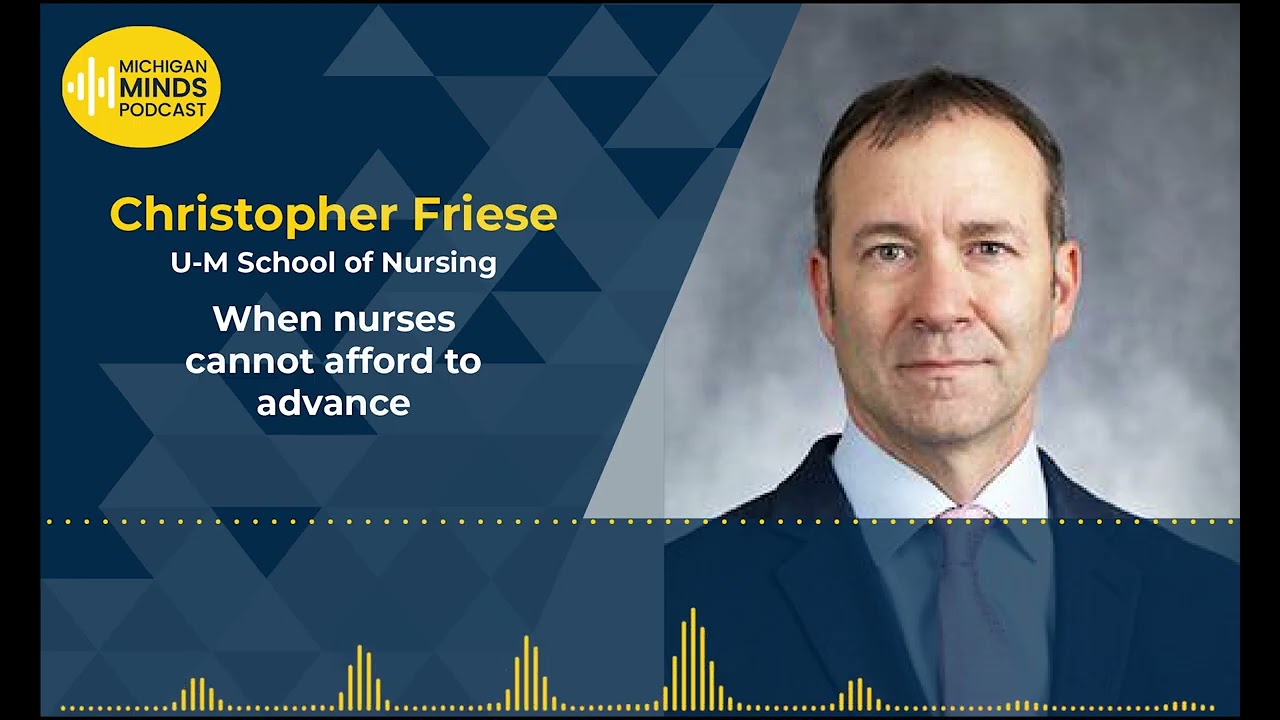
## Background Published on YouTube by the University of Michigan on September 11, 2026, this episode of the Michigan Minds podcast features Christopher Friese, a professor of nursing and of health management and policy. According to the show description, Friese draws on findings from the Michigan Nurses Study to explain how proposed federal caps on graduate student loans could deter nurses from pursuing advanced degrees, highlight the financial strain of high student debt on the nursing workforce, and jeopardize patient care as well as the future supply of nurse practitioners, midwives, anesthetists, and nursing faculty.
## TL;DR Dr. Christopher Friese reframes the U.S. nursing crisis not as a raw shortage of licensed personnel, but as a 'leaky bucket' retention problem driven by unsafe clinical environments, inadequate leadership support, and heavy student debt that pushes nurses to switch employers for higher pay. He warns that proposed Department of Education rules capping graduate nursing loans at $20,500 annually ($100,000 lifetime) rest on flawed assumptions, pointing to his team's rapid 57-day re-analysis of the Michigan Nurses Study which proved that one-third of nurses carry substantial debt and one-third of indebted advanced practice nurses borrowed over $50,000 for graduate school. Because mandated low student-to-faculty ratios and a chronic shortage of educators—who earn significantly more in clinical practice than in academia—prevent universities from simply lowering tuition or safely shortening programs, these borrowing limits threaten to cut off the pipeline of advanced clinicians and future faculty. Rather than restricting access to education, Friese advocates for hospital sponsorships, state and philanthropic loan repayment initiatives, and active constituent outreach to federal lawmakers.
## Atmosphere & style The episode pairs urgent, data-driven policy analysis with a warm, conversational rapport between host Juan Ochoa and Dr. Friese. Although the subject matter is weighty—spanning workplace violence, household financial strain, and higher education hiring freezes—the discussion feels grounded and relatable, punctuated by Ochoa sharing his family member's struggle to find a clinical teaching post and Friese recounting his own six-month stretch of unemployment after graduating in 1997. The emotional arc moves from clear-eyed concern over short-sighted regulatory barriers to a reassuring sense of long-term resilience, ending on Friese's steady optimism that the nursing profession, like a cat, will ultimately land on its feet.
## Bulletin - [08:17](https://www.youtube.com/watch?v=ligHrH084hA&t=497s) Proposed federal regulations capping graduate borrowing at $20,500 annually and $100,000 aggregate threaten to deter registered nurses from advancing into specialized clinical and faculty roles. - [08:17](https://www.youtube.com/watch?v=ligHrH084hA&t=497s) Data from the Michigan Nurses Study reveals that roughly one-third of registered nurses already carry significant debt, and one-third of indebted advanced practice nurses hold balances exceeding the proposed $50,000 graduate threshold. - [10:46](https://www.youtube.com/watch?v=ligHrH084hA&t=646s) Educational debt directly drives nurse turnover, making indebted clinicians far more likely to leave positions or seek new employment over compensation concerns and household financial stress. - [20:18](https://www.youtube.com/watch?v=ligHrH084hA&t=1218s) A bipartisan group of 100 federal lawmakers has urged the Department of Education to classify nursing as a professional degree, while states and health systems explore localized loan repayment models to alleviate debt burdens.
## Key takeaways - [00:00](https://www.youtube.com/watch?v=ligHrH084hA&t=0s) The U.S. nursing crisis is primarily a retention breakdown driven by unsupportive management and workplace violence rather than an absolute shortage of licensed RNs. - [00:00](https://www.youtube.com/watch?v=ligHrH084hA&t=0s) Pouring new graduates into unsupportive clinical environments creates a 'leaky bucket' dynamic, where newly licensed nurses exit active practice the quickest. - [03:43](https://www.youtube.com/watch?v=ligHrH084hA&t=223s) Proposed federal graduate student loan caps risk choking off the educational pipeline for nurse practitioners, certified nurse-midwives, CRNAs, and academic faculty. - [06:22](https://www.youtube.com/watch?v=ligHrH084hA&t=382s) Clinical nursing programs cannot easily lower tuition because accreditation standards mandate low student-to-faculty ratios and highly qualified instructors. - [06:22](https://www.youtube.com/watch?v=ligHrH084hA&t=382s) Innovative financing models, including federal loan repayment programs and hospital-sponsored tuition agreements with retention commitments, are essential to offset training costs. - [08:17](https://www.youtube.com/watch?v=ligHrH084hA&t=497s) Michigan Nurses Study findings refuted federal assumptions by demonstrating that heavy borrowing is already a standard reality for a large share of advanced practice nurses. - [10:46](https://www.youtube.com/watch?v=ligHrH084hA&t=646s) Educational debt directly correlates with job turnover, prompting nurses to switch employers primarily to seek better pay and benefits to stabilize household finances. - [12:21](https://www.youtube.com/watch?v=ligHrH084hA&t=741s) Departing nurses follow three main pathways: moving laterally to another nursing employer for higher pay, permanently leaving the profession, or stepping away temporarily for family caregiving before returning. - [12:21](https://www.youtube.com/watch?v=ligHrH084hA&t=741s) High nurse mobility creates an economic conundrum for health systems, which invest heavily in clinical onboarding and on-the-job training that cannot be recouped when staff depart. - [14:19](https://www.youtube.com/watch?v=ligHrH084hA&t=859s) A persistent shortage of nursing faculty is driven by a stark pay gap between academic salaries and higher-reimbursed clinical practice as advanced practice registered nurses. - [14:19](https://www.youtube.com/watch?v=ligHrH084hA&t=859s) Friese proposes creating targeted incentives that allow advanced practice clinicians to allocate part of their time toward academic teaching without taking a punitive pay cut. - [16:07](https://www.youtube.com/watch?v=ligHrH084hA&t=967s) Current hiring freezes and faculty placement difficulties reflect broader higher education instability in 2026, though long-term career resilience in nursing remains robust. - [18:21](https://www.youtube.com/watch?v=ligHrH084hA&t=1101s) Proposals to shorten nursing degree curricula to rush graduates into hospitals risk undermining clinical competence and patient safety without solving the underlying retention leak. - [20:18](https://www.youtube.com/watch?v=ligHrH084hA&t=1218s) Advocacy against Department of Education loan caps includes protests outside the White House and a bipartisan letter signed by 100 lawmakers pushing for nursing's professional degree designation. - [21:29](https://www.youtube.com/watch?v=ligHrH084hA&t=1289s) State-level loan repayment programs, hospital-sponsored debt relief, and targeted philanthropic donations are emerging as vital localized buffers against federal borrowing limits.
## Detailed walkthrough ### [00:00](https://www.youtube.com/watch?v=ligHrH084hA&t=0s) Re-evaluating the "Shortage": A Leaky Bucket in the Nursing Workforce
Host Juan Ochoa introduces Christopher Friese, professor of nursing and health management and policy at the University of Michigan School of Public Health, framing nursing as one of the country's most trusted professions yet facing a growing mismatch between supply and demand. Friese challenges the conventional framing of a nationwide nurse shortage. Looking at national data, the United States has an ample number of individuals who hold an RN license relative to the population—unlike many other nations. Rather than a pure numbers deficiency, Friese argues the primary crisis is a lack of supportive work environments that retain practitioners.
Surveys and studies reveal that registered nurses leave active practice or cut back hours due to feeling unsupported by leadership and management, as well as an alarming, increasingly frequent sense that their workplace is unsafe due to unaddressed workplace violence. When challenged by Ochoa on why an exodus shouldn’t simply be labeled a shortage, Friese points out that the newest entrants into the profession are departing the quickest. Pouring more graduates into clinical settings without fixing the underlying culture and safety issues creates a classic "leaky bucket" dilemma: the priority must be plugging the hole rather than endlessly replenishing lost personnel, even while acknowledging the system still needs built-in "slack" to absorb shocks like COVID-19.
```mermaid flowchart LR accTitle: The Leaky Bucket Dynamic in Nursing Retention accDescr: Diagram illustrating how incoming registered nurses enter practice but exit rapidly due to adverse workplace conditions rather than a true initial supply deficit. subgraph Supply["Workforce Inflow"] A["New RN Graduates & Licensed Nurses"] end subgraph Retention["Practice Environment"] B["Clinical Practice Environment"] C["Workplace Violence & Safety Risks"] D["Lack of Management Support"] end subgraph Outflow["Attrition (The Leak)"] E["Reduced Hours"] F["Complete Departure from Nursing"] end
A --> B B -.-> C B -.-> D C --> E C --> F D --> E D --> F ```
[03:43](https://www.youtube.com/watch?v=ligHrH084hA&t=223s) The Risk of Proposed Graduate Loan Caps
The discussion shifts toward the Department of Education's proposed regulations designed to place federal borrowing caps on graduate students across medicine, dentistry, social work, occupational therapy, and nursing. While ostensibly aimed at curbing tuition inflation and student debt burdens, Friese explains why applying these constraints indiscriminately to graduate nursing degrees poses a unique danger. Data from the Michigan Nurses Study reveals that roughly one-third of registered nurses carry significant debt from their undergraduate or pre-licensure training alone. Confronting an even steeper debt load to advance their education presents an insurmountable psychological and financial hurdle.
Unlike high-earning professions such as corporate law, specialized medicine, or dentistry, the post-graduation return on investment in nursing takes significantly longer to materialize. Friese warns that the borrowing caps will stop potential candidates from even exploring graduate degree options—deterring them before they ever submit an application, consult a university financial aid office, or investigate employer assistance programs. This threatens to choke off the training pipeline for roles critical to clinical care delivery and institutional training:
- Nurse practitioners delivering primary and specialized care - Certified nurse-midwives providing maternal and reproductive care - Certified registered nurse anesthetists (CRNAs) - Future nursing faculty required to educate and train the next generation of nurses
[06:22](https://www.youtube.com/watch?v=ligHrH084hA&t=382s) Specialized Costs and Alternative Financing in Nursing Academics
When asked why universities cannot simply lower graduate nursing tuition to balance the new loan limits, Friese explains the rigid structural realities of clinical nursing education. Because of the direct clinical responsibilities and high-stakes nature of the work, training advanced practice nurses demands low student-to-faculty ratios and legally mandated instructor qualifications. These faculty positions cannot simply be replaced by non-clinical instructors or cheaper alternatives, leaving almost no room for aggressive cost containment without compromising safety or accreditation standards.
Instead of expecting schools to dramatically slash tuition rates, Friese advocates for innovative, collaborative financing structures that directly alleviate student out-of-pocket expenses. Potential mechanisms include federal loan repayment initiatives and health system sponsorships, where hospitals commit to subsidizing tuition for registered nurses who agree to continue working during school and commit to a retention agreement post-graduation. Without expanding these models, the proposed borrowing restrictions will place prospective applicants into a deep financial squeeze.
[08:17](https://www.youtube.com/watch?v=ligHrH084hA&t=497s) Michigan Study Findings on Debt Limits and Nurse Career Decisions
Friese outlines the specific regulatory mechanics: the Department of Education's rulemaking—introduced in late winter and advancing in early 2026—proposes removing graduate nurses from access to the highest-tier federal loan brackets, capping them instead at $20,500 annually and a $100,000 aggregate lifetime limit. Seeking to test assumptions by proponents who claimed the caps would affect only a negligible fraction of students, Friese's research team mobilized an urgent re-analysis of the Michigan Nurses Study data, completing the project from research design to publication in an unprecedented 57 days between late November and late January.
The empirical data directly refuted the policy's underlying assumptions. Examining self-reported debt levels gathered in 2022 among both RNs and advanced practice nurses, the study established that: - Approximately one-third of the overall nursing cohort carried significant educational debt. - Among practicing advanced practice registered nurses who carried debt, roughly one-third held loan balances exceeding the proposed $50,000 threshold for graduate studies, demonstrating that large borrowing burdens were already a standard reality of advanced nursing credentials.
[10:46](https://www.youtube.com/watch?v=ligHrH084hA&t=646s) How Student Debt Fuels Nursing Turnover and Household Financial Stress
Continuing his analysis of the Michigan Nurses Study, Christopher Friese explains how student loan burdens directly shape job retention and career mobility. When researchers examined whether nurses had recently left a position or were actively looking for another job, they discovered that nurses carrying student debt were far more likely to have recently departed their roles or to be searching for new employment specifically because of pay and benefits. High levels of debt push nurses to make different career decisions, directly feeding into what Friese describes as the profession's "leaky bucket"—a cycle where health systems invest heavily to prepare a nurse who is already working in their clinical setting, only for that nurse to leave in search of better compensation elsewhere to stabilize their personal finances.
Beyond workplace turnover, the personal weight of this debt is substantial. Survey respondents holding student debt were far more likely to report that household finances were a top concern for their families. While the general public often assumes that nurses are well-compensated—which Friese acknowledges is true relative to average wages across the entire United States—the reality on the ground is much more strained. Nursing is demanding, exhausting work, and those carrying heavy educational debt feel that financial pressure acutely at home. For Friese, these findings underscore a clear policy takeaway: "this is not the time to put caps on what nurses can borrow if they want to pursue graduate education, if they want to advance in their profession. And in fact, the opposite is true. We want to open opportunities. We don't want to cut people off."
[12:21](https://www.youtube.com/watch?v=ligHrH084hA&t=741s) Where Departing Nurses Go and the Economic Conundrum of Turnover
When the host asks where nurses actually go when they leave their positions, Friese breaks the departures down into three distinct pathways, drawing on findings from a recent study published in 2026:
```mermaid flowchart TD accTitle: Pathways of Departing Nurses and Employer Impact accDescr: Diagram showing how indebted or departing nurses split into three career pathways, creating an economic conundrum for health systems that lose their training investments.
subgraph Origin["Workforce Departure"] A["Experienced Nurse Leaves Role"] end
subgraph Pathways["Three Departure Pathways"] B["Moves to Another Nursing Employer<br/>(Driven by debt & better pay)"] C["Leaves Nursing Profession Entirely<br/>(Permanent exit)"] D["Steps Out for Family Caregiving<br/>(Re-enters & retrains later)"] end
subgraph Impact["Health System Conundrum"] E["Lost On-the-Job Training Investment<br/>& High Replacement Costs"] end
A --> B A --> C A --> D B --> E C --> E D --> E ```
The most common trajectory is lateral movement within the field: nurses leave their current employer to take a job with another nursing employer, seeking better economic opportunities. The 2026 study demonstrated that nurses holding debt are significantly more likely to belong to this mobile group. A second group leaves the nursing profession altogether and never returns. A third group—which is not well studied in the academic literature but is observed year after year in practice—consists of nurses who step away from the workforce temporarily to raise a family or attend to caregiving responsibilities, only to re-enter the profession later once their children are older or in school and caregiving demands have eased.
Friese views this third pathway as "one of our secret weapons": the inherent flexibility of a nursing career allows professionals to work in one clinical area, step out for a period, return, retrain, and re-enter either in their original specialty or a completely new one. However, while that mobility is great news for individual nurses, it puts hospitals and health systems in a severe bind. As Friese notes, it creates "a bit of a conundrum for the economists in the room": while labor markets function best when employees can move freely as they wish, healthcare employers pour substantial financial investments into on-the-job preparation and training that they cannot recoup when a nurse departs, making it very expensive to replace an experienced clinician.
[14:19](https://www.youtube.com/watch?v=ligHrH084hA&t=859s) The Chronic Shortage of Nursing Faculty and Misaligned Incentives
The conversation turns to a bottleneck that much of the public overlooks: the persistent shortage of nursing educators, compounded by state regulations that strictly cap how many students a single instructor can supervise during clinical rotations. Friese explains that because of the complexity of modern patient care, the nursing profession has established best practices requiring expert nurses—typically those holding a master's degree or higher—to lead classroom instruction and clinical supervision. Research consistently proves that higher investment in nursing education is a "win-win," yielding both better health outcomes for patients and superior educational outcomes for students.
However, maintaining that standard comes at a steep cost, and nursing schools have been chronically short of credentialed faculty for years. "We've been really strapping this together," Friese admits, noting that most nursing programs are actively recruiting faculty almost every single year. The core issue is a structural misalignment of financial incentives:
- **Credential overlap:** Most nurses who hold the advanced degrees required to teach in a nursing school are also qualified to practice clinically as advanced practice registered nurses (APRNs), such as nurse practitioners and nurse midwives. - **Compensation gap:** Clinical practice as an advanced practice nurse is reimbursed at a much higher rate, offering a substantially better salary than academic teaching roles. - **Policy proposal:** To bridge this gap without forcing clinicians into a full-time pay cut, Friese and his colleagues have proposed creating targeted incentives for advanced practice nurses to spend at least a portion of their time teaching.
[16:07](https://www.youtube.com/watch?v=ligHrH084hA&t=967s) Navigating Higher Education Instability and Career Flexibility in 2026
Bringing the issue down to a personal level, the host shares that a family member who previously taught nursing clinicals has been unemployed for about two months and is struggling to find a new teaching position despite wanting to be in the classroom. Friese empathizes, pointing out that this frustrating paradox reflects the acute instability and mismatch currently gripping higher education in 2026. Schools of nursing, along with universities more broadly, are navigating a turbulent environment. Faced with high uncertainty about where the landscape is heading, administrators become cautious: they freeze or reduce new job postings, rely on existing staff to cover needs, and wait to see if conditions stabilize.
To encourage educators and clinicians caught in this hiring freeze, Friese points to the adaptability that has defined his own career. Having served as a professor at the University of Michigan School of Nursing for 18 years, he also maintained an active clinical practice for nearly that entire span until very recently, allowing him to pivot and apply his knowledge across different settings. He also shares a personal anecdote he frequently tells his students to put temporary market downturns into perspective:
- **1997 market freeze:** When Friese graduated with his Bachelor of Science in Nursing (BSN)—the entry-level professional degree—in 1997, he could not find a job as a staff nurse for six months. - **Long-term resilience:** Even though everyone assumes healthcare is perpetually booming, the industry periodically experiences pockets of acute uncertainty. Despite the anxiety of the current moment in 2026, Friese insists that nursing remains a strong long-term investment: "In the long run, like a cat, we will land on our feet."
[18:21](https://www.youtube.com/watch?v=ligHrH084hA&t=1101s) Why Shortening Nursing Programs Won't Fix the "Leaky Bucket"
When asked what happens to the future healthcare workforce if high educational costs lock nurses out of becoming faculty, Friese says that very scenario—alongside a broader underinvestment in professional nursing—is what worries him most. He views the proposed federal cap on graduate student loans as a structural policy barrier that deliberately makes career advancement harder at the exact moment cuando expertise is needed most.
At the same time, he warns against a dangerous counter-trend emerging from colliding pressures in the healthcare sector. Because demand for healthcare services is rising and hospitals need to hire nurses quickly, there is a growing movement to shorten nursing degree programs and push students through the pipeline faster by cutting educational requirements. Friese urges extreme caution against taking such shortcuts:
> "Again, we're pouring more folks in the bucket. We haven't stopped the leak, right? We've got to make sure that not only are we supporting nurses in their workforce, but the people that we're bringing in are competent, qualified, and prepared to work in those settings. And that doesn't come with shortcuts."
He emphasizes that nursing education programs in the United States serve as an international model for other countries, and making hasty cuts to speed up graduation times risks inflicting long-term damage on the quality of nursing education and patient safety.
[20:18](https://www.youtube.com/watch?v=ligHrH084hA&t=1218s) Grassroots Advocacy and Legislative Pushback Against Department of Education Rules
The host notes that opposition to the proposed Department of Education (DOE) loan rules has already sparked visible action: nurses have protested outside the White House, and a bipartisan coalition of 100 federal lawmakers sent a signed letter to the Department of Education urging that nursing be included in the department's definition of a "professional degree." Asked how everyday citizens and nurses can register their opposition now that the formal public comment period has closed, Friese outlines practical steps for civic engagement:
- **Contact federal lawmakers:** Constituents should reach out directly to their elected representatives to ensure lawmakers hear firsthand that nursing workforce issues matter to voters. - **Thank existing allies:** Rather than focusing exclusively on persuading undecided legislators, advocates should make a point of thanking the 100 lawmakers who already signed the bipartisan letter—letting them know, "we saw that you supported provision X. So we thank you for that."
As the nursing community waits to see how the Department of Education ultimately rules, Friese notes that the current policy environment is fluid, characterized by numerous federal proposals being issued and subsequently revisited.
[21:29](https://www.youtube.com/watch?v=ligHrH084hA&t=1289s) Legislative Advocacy and Emerging State and Hospital Debt-Relief Strategies
Continuing his thoughts on how current policies might eventually be retracted or changed after this current period, Dr. Christopher Friese emphasizes the importance of civic engagement, encouraging listeners to let legislators know that these matters are of concern to them. Beyond federal policy, he points out that alternative, localized strategies are beginning to emerge to help alleviate the financial pressure on nurses. States are increasingly exploring whether they can reduce the debt burden through their own state-level loan repayment programs, and individual hospitals are beginning to follow suit.
To illustrate how healthcare institutions and private philanthropy are stepping in, Dr. Friese highlights a recent real-world example from the news: just a few weeks prior, *The Philadelphia Inquirer* ran a story about a donor who contributed funds directly to a hospital specifically to pay off the student loan debt of its nurses. He notes that these developments make for "an interesting time" and that observers will have to watch closely to see how these varied approaches play out.
- **Legislative outreach:** Contacting lawmakers to voice concern and push for policy changes or retractions after the current period. - **State-level initiatives:** States developing their own loan repayment programs to reduce nurses' debt burdens. - **Hospital and philanthropic programs:** Healthcare systems and donors directly funding debt relief, such as the recent case reported in *The Philadelphia Inquirer* where a donor paid off student loan debt for a hospital's nursing staff.
[22:04](https://www.youtube.com/watch?v=ligHrH084hA&t=1324s) Closing Reflections and Optimism for the Nursing Profession
As the podcast reaches its conclusion, the host invites Dr. Friese to share any final thoughts. Acknowledging that their conversation covered some "tough issues," Dr. Friese strikes a hopeful and encouraging tone for the future. "What I would say is despite these tough issues, I'm optimistic for nursing in the long run," he shares, describing nursing as a "great profession." He expresses confidence that these financial and policy challenges will ultimately get resolved, adding, "I always count on nurses to do the right thing and be in the right position for patients."
The host warmly agrees, expressing hope that things will change as well and candidly remarking, "I feel like I trust nurses more than I do doctors at times." After the host thanks him for joining the show and Dr. Friese replies that it was a pleasure, the episode wraps up with a closing credit thanking listeners for tuning in to *Michigan Minds*, produced by Michigan News, a division of the University of Michigan's Office of the Vice President for Communications.
## Notable quotes > [10:46](https://www.youtube.com/watch?v=ligHrH084hA&t=646s) this is not the time to put caps on what nurses can borrow if they want to pursue graduate education, if they want to advance in their profession. And in fact, the opposite is true. We want to open opportunities. We don't want to cut people off. — Christopher Friese
> [12:21](https://www.youtube.com/watch?v=ligHrH084hA&t=741s) one of our secret weapons — Christopher Friese
> [12:21](https://www.youtube.com/watch?v=ligHrH084hA&t=741s) a bit of a conundrum for the economists in the room — Christopher Friese
> [14:19](https://www.youtube.com/watch?v=ligHrH084hA&t=859s) We've been really strapping this together — Christopher Friese
> [16:07](https://www.youtube.com/watch?v=ligHrH084hA&t=967s) In the long run, like a cat, we will land on our feet. — Christopher Friese
> [18:21](https://www.youtube.com/watch?v=ligHrH084hA&t=1101s) Again, we're pouring more folks in the bucket. We haven't stopped the leak, right? We've got to make sure that not only are we supporting nurses in their workforce, but the people that we're bringing in are competent, qualified, and prepared to work in those settings. And that doesn't come with shortcuts. — Christopher Friese
> [20:18](https://www.youtube.com/watch?v=ligHrH084hA&t=1218s) we saw that you supported provision X. So we thank you for that. — Christopher Friese
> [22:04](https://www.youtube.com/watch?v=ligHrH084hA&t=1324s) What I would say is despite these tough issues, I'm optimistic for nursing in the long run — Christopher Friese
> [22:04](https://www.youtube.com/watch?v=ligHrH084hA&t=1324s) I always count on nurses to do the right thing and be in the right position for patients. — Christopher Friese
> [22:04](https://www.youtube.com/watch?v=ligHrH084hA&t=1324s) I feel like I trust nurses more than I do doctors at times. — Juan Ochoa
## Mentioned Christopher Friese, Juan Ochoa, Greta Guest, Jeremy Marble, Hans Anderson, University of Michigan, University of Michigan School of Nursing, University of Michigan School of Public Health, Michigan Minds, Michigan News, Michigan Nurses Study, U.S. Department of Education, The Philadelphia Inquirer, White House
## Video description Christopher Friese, a University of Michigan professor of nursing and of health management and policy, is a national authority on health care quality, nursing work environments and workforce policy.
Friese joins the Michigan Minds podcast to explain how proposed federal caps on graduate student loans could shape nurses’ education and career decisions, what high student debt is revealing about the nursing workforce, and why these policies may have ripple effects for patient care and the future supply of nurse practitioners, midwives, anesthetists and nursing faculty.
What makes loan caps on borrowing for graduate nursing degrees different?
We are worried about caps on loans for graduate nurses for a couple of reasons. Our study, the Michigan Nurses Study, identified that about a third of registered nurses have substantial levels of debt to begin with. If you already are carrying a lot of debt, imagine trying to advance your career in nursing—that usually means you have to go back for a graduate degree—and then you’re facing an even higher bill.
What we are worried about is that these proposed caps will deter people from even thinking about graduate school. They will just decide, 'I'm not going to pursue graduate school.' And that is bad for the country, because advanced practice nurses and the future faculty that train nursing students do a tremendous amount for our health care system. If we cut off this supply route for graduate nurses, we are worried about health care outcomes and the future of nursing education.
Michigan Minds is produced by Greta Guest and hosted by Michigan News staff. Jeremy Marble is the audio engineer and Hans Anderson provides social media animations.
[Source](https://www.youtube.com/watch?v=ligHrH084hA)