Suzy Welch Cites Public Firing in Urging Stern MBAs to Risk Failure
NYU Stern
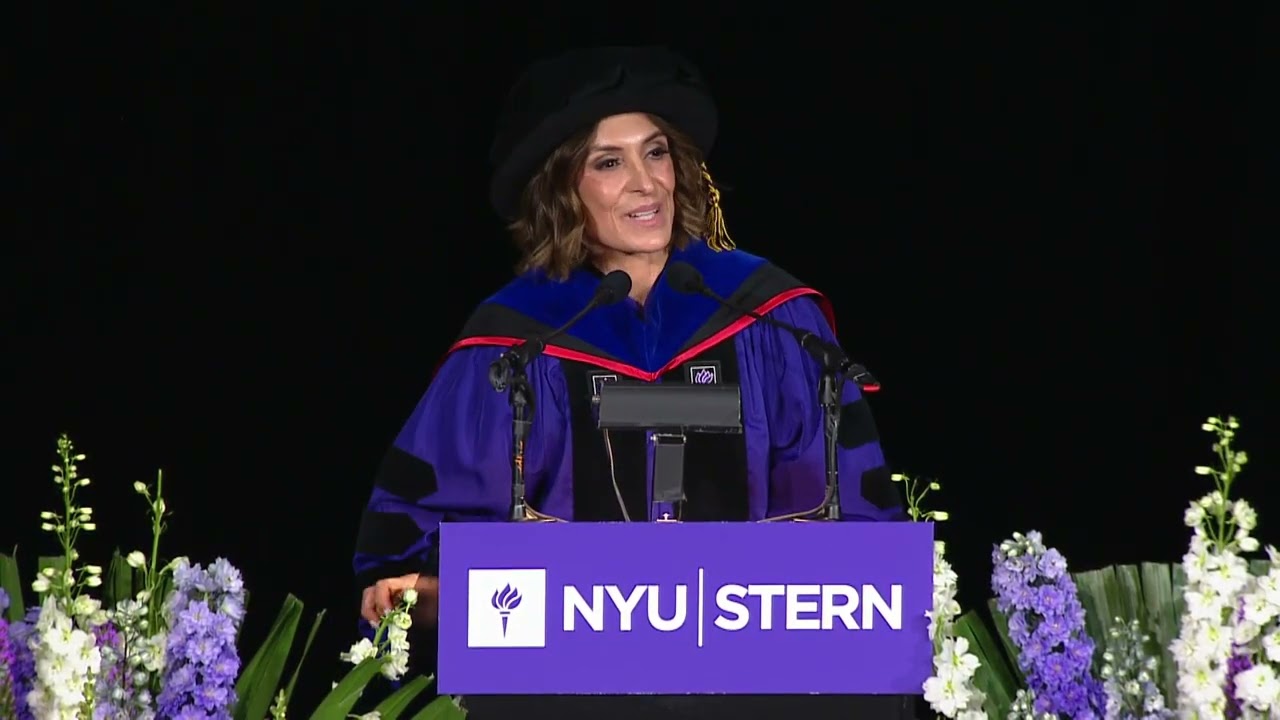
Catastrophic career setbacks are an essential gateway to building resilience and living fully, Welch argues, warning graduates that playing it safe only guarantees regret.
AI-assisted summary of Featured Speaker: Suzy Welch | NYU Stern Graduate Convocation, Class of 2026 — original source. Check the original for full context.
Source published:
Key ideas
- Suzy Welch addressed the NYU Stern Graduate Class of 2026, delivering an unconventional convocation address centered on why experiencing and surviving catastrophic failure is essential for a meaningful life. (0:07)
- Reflecting on her public firing from the Harvard Business Review at age 39, Welch recounted how the loss of her career and identity dismantled decades of unbroken high achievement. (3:07)
- A pivotal encounter with civil rights icon Vernon Jordan reframed professional collapse not as a permanent ruin, but as an induction into the 'Society of Interesting People.' (7:11)
- Welch challenged the graduates to avoid playing it safe, urging them to embrace inevitable setbacks, risk bold undertakings, and fear regret rather than failure. (11:36)
Detailed notes
## Background Published on YouTube by NYU Stern on September 22, 2026, this video captures the convocation address delivered by Suzy Welch, Professor of Management Practice and Director of the Initiative on Purpose and Flourishing. According to the description, Welch addresses Stern's Graduate Class of 2026 during their commencement ceremony on May 15, 2026.
## TL;DR Addressing the graduating class, Professor Suzy Welch recounts her journey from a seemingly flawless, high-achieving career to a humiliating public firing at age 39 splashed across the front page of The Wall Street Journal. She shares how a pivotal private conversation with civil rights leader and financier Vernon Jordan transformed her shame by reframing failure as an induction into the 'Society of Interesting People.' Drawing from her own rebirth and subsequent career at NYU Stern, Welch challenges graduates not to tiptoe safely through life. Instead, she urges them to embrace inevitable knockdowns, overcome the fear of failure, and write bold, resilient stories of their own.
## Atmosphere & style The address carries an intimate, self-deprecating, and emotionally candid tone, blending warm humor with disarming vulnerability as Welch addresses the graduates as 'my beloveds.' The emotional arc moves from lighthearted graduation commentary to the visceral sting of public disgrace and existential panic, before culminating in a stirring, high-energy redemption. Listening to the speech feels cathartic and urgent, turning what could be a standard commencement ceremony into a resonant masterclass on resilience and humanity.
## Bulletin - [00:07](https://www.youtube.com/watch?v=_pe_S5535zA&t=7s) Suzy Welch addressed the NYU Stern Graduate Class of 2026, delivering an unconventional convocation address centered on why experiencing and surviving catastrophic failure is essential for a meaningful life. - [03:07](https://www.youtube.com/watch?v=_pe_S5535zA&t=187s) Reflecting on her public firing from the Harvard Business Review at age 39, Welch recounted how the loss of her career and identity dismantled decades of unbroken high achievement. - [07:11](https://www.youtube.com/watch?v=_pe_S5535zA&t=431s) A pivotal encounter with civil rights icon Vernon Jordan reframed professional collapse not as a permanent ruin, but as an induction into the 'Society of Interesting People.' - [11:36](https://www.youtube.com/watch?v=_pe_S5535zA&t=696s) Welch challenged the graduates to avoid playing it safe, urging them to embrace inevitable setbacks, risk bold undertakings, and fear regret rather than failure.
## Key takeaways - [00:07](https://www.youtube.com/watch?v=_pe_S5535zA&t=7s) Until age 39, Welch lived an unbroken streak of outward perfection, pairing degrees from Harvard and Harvard Business School with top editorial roles, marathon running, and family life. - [03:07](https://www.youtube.com/watch?v=_pe_S5535zA&t=187s) Welch's career halted abruptly when her relationship with General Electric CEO Jack Welch triggered front-page media scrutiny, leading to her dismissal from the Harvard Business Review. - [03:07](https://www.youtube.com/watch?v=_pe_S5535zA&t=187s) The public firing caused an acute existential crisis for Welch, stripping away her core identity as an obedient high achiever and leaving her questioning who she was without her job. - [05:05](https://www.youtube.com/watch?v=_pe_S5535zA&t=305s) Attending a high-profile Washington gathering hosted by Vernon Jordan, Welch was consumed by shame, feeling alienated among world leaders and cultural luminaries. - [07:11](https://www.youtube.com/watch?v=_pe_S5535zA&t=431s) Vernon Jordan pulled Welch aside and confronted her despair, observing that every accomplished person in the room had also taken massive risks, crashed, and had to start over. - [07:11](https://www.youtube.com/watch?v=_pe_S5535zA&t=431s) Jordan introduced the concept of the 'Society of Interesting People,' reframing public failure as an entrance into being fully human rather than an ending. - [07:11](https://www.youtube.com/watch?v=_pe_S5535zA&t=431s) Enduring public humiliation expanded Welch's empathy, psychological resilience, and willingness to take career risks later in life. - [07:11](https://www.youtube.com/watch?v=_pe_S5535zA&t=431s) The tolerance for risk forged by her past failure directly enabled Welch to propose and lead her experiential course, 'Becoming You,' at NYU Stern in 2021. - [07:11](https://www.youtube.com/watch?v=_pe_S5535zA&t=431s) True human stature belongs not to those with unblemished track records, but to individuals willing to push to the outer edges of experience and endure the fall. - [11:36](https://www.youtube.com/watch?v=_pe_S5535zA&t=696s) Graduates possess elite credentials, grit, and strong support networks, but face a defining dilemma: whether to tiptoe safely through the coming decades or embrace hard, scary challenges. - [11:36](https://www.youtube.com/watch?v=_pe_S5535zA&t=696s) Welch emphasized that being knocked down in life is a certainty, but repeatedly getting back up is the exact mechanism that makes a person capable, vibrant, and interesting. - [11:36](https://www.youtube.com/watch?v=_pe_S5535zA&t=696s) Graduates were urged to fear regret and inaction over failure itself, moving quickly to write a distinct life story and claim their place in the Society of Interesting People.
## Detailed walkthrough ### [00:07](https://www.youtube.com/watch?v=_pe_S5535zA&t=7s) A Tale of Woe and the Shiny Life Before the Fall
Dean Bharat Anand introduces Professor Suzy Welch to the graduating class. Taking the podium with warm affection—addressing the graduates as "my friends" and "my beloveds"—Welch celebrates the Class of 2026 and congratulates their supporting "squads" in the audience. She notes that just two days prior, she was seated at Radio City Music Hall watching her own daughter graduate from NYU Steinhardt, weeping throughout the ceremony. Setting expectations with self-deprecating humor, Welch announces that her goal for the day is to make everyone cry again, framing that as the true mandate of any graduation speech. She promises to deliver this emotional beat through a personal "sad, sad tale of woe"—a catastrophic experience that upended her life, and one she paradoxically wishes upon every graduate in the room, sooner rather than later.
Setting the stage for her story, Welch explains that until she turned 39, her life had been an unbroken streak of "unmitigated, clean, and shiny success." She had excelled in high school, earned her undergraduate degree at Harvard, hit her marks at Harvard Business School, and secured a high-profile editorial position at a prestigious publication (*Harvard Business Review*). Along the way, she seemed to embody every standard of relentless overachievement: raising four children, teaching Sunday school, running marathons, and even sewing lined, tasseled curtains for her home. When her husband left her during that period, she treated divorce as just another challenge to master, refusing to let it slow her down. To the outside world, she appeared utterly invulnerable—until the entire facade collapsed overnight.
- **Age at turning point**: 39 years old. - **Academic and career track**: Harvard University, Harvard Business School, top leadership role at a prestigious publication. - **Personal accomplishments**: Mother of four children, marathon runner, Sunday school teacher, custom home decorator.
---
[03:07](https://www.youtube.com/watch?v=_pe_S5535zA&t=187s) Getting Fired on the Front Page and Spiraling Out
Welch's era of clean perfection came to an abrupt, public halt when she was fired. This was not a discreet, quiet departure chalked up to "spending more time with her children," but a full-blown media scandal splashed across the front page of *The Wall Street Journal*. Summarizing the controversy succinctly, Welch recounts falling in love with a man named Jack (General Electric CEO Jack Welch). At the time, she was divorced and he was separated. Borrowing a line from Cher, Welch explains that both believed in "life after love" and decided to pursue the relationship. However, the media uproar led her employers to decide that the headlines compromised her credibility, abruptly ending her editorial career.
The sudden termination shattered Welch’s self-image. Having spent her entire life as an obedient, rule-following "goody two-shoes," she found herself labeled a public failure and cast out of the professional community she loved. Deprived of her career, she spiraled into an existential crisis, plagued by the question: "Who am I without work? What is my identity?" When she broke down in tears and told Jack that she felt like a loser, his initial response was bemused—reminding her, "wait a minute, you got me." But for Welch, having love was not enough to fill the void of lost purpose and public humiliation. Living in an era before social media, the relentless barrage of newspaper coverage still made her feel universally judged and despised.
---
[05:05](https://www.youtube.com/watch?v=_pe_S5535zA&t=305s) The Washington Party and Vernon Jordan’s Intervention
In the depths of her despair and self-loathing, Welch accompanied Jack to a high-society party in Washington, D.C., hosted at the home of civil rights icon and investment banker Vernon Jordan. Described by Welch as perhaps the only figure in American history simultaneously revered as a legendary civil rights leader and an elite financier, Jordan had filled his residence with heads of state, movie stars, sports legends, and world-renowned authors. Welch felt thoroughly out of place, describing the gathering as feeling like a "Met Gala for perfect people except for me." Overwhelmed by shame, she huddled in a corner, clutching Jack's hand and keeping her eyes on the floor.
Her self-pity was interrupted when Jordan, an imposing figure standing six-foot-five with a deep Southern cadence, approached and asked if he could show her a painting in the adjoining room. Welch immediately deduced why he knew she liked art: reporters had repeatedly dredged up her undergraduate fine arts major as the lone colorful trivia point in their otherwise dry coverage of her career. Bracing herself for another layer of humiliation, Welch followed him into the room, only to be faced with what she considered an atrocious piece of artwork. Before she could muster a polite lie, Jordan broke the tension by bluntly acknowledging the painting's flaws—and then turned to address the real reason he had pulled her away from the crowd.
```mermaid flowchart TD accTitle: Vernon Jordan Reframing Failure accDescr: Flowchart illustrating Suzy Welch's mindset shift from shame to resilience after speaking with Vernon Jordan.
subgraph Crash["The Crisis of Identity"] A["Public Firing & Media Scrutiny"] --> B["Loss of Career & Status"] B --> C["Deep Self-Loathing & Shame"] end
subgraph Encounter["The Intervention"] C --> D["Party at Vernon Jordan's House"] D --> E["Private Talk in Side Room"] E --> F["Jordan's Diagnosis: 'You're broken, scared, a mess'"] end
subgraph Reframing["The Transformation"] F --> G["Perspective: Everyone in that room has crashed"] G --> H["Mandate: 'Get up and start again'"] H --> I["Induction: The Society of Interesting People"] end ```
---
[07:11](https://www.youtube.com/watch?v=_pe_S5535zA&t=431s) The Society of Interesting People and the Return to NYU Stern
Looking directly into Welch's eyes, Jordan told her plainly, "I'm crying inside looking at you. You're broken. You're scared. You're a mess." Rendered breathless by his candor, Welch listened as Jordan pointed back toward the parlor of dignitaries and luminaries. He explained that every single high achiever in that room had suffered identical falls: they had swung big, achieved triumphs, suffered massive misses, and crashed, but they had refused to let fear dictate their lives. He then challenged her: "Suzy, it is time for you to get up and start again. Will you do that?" When Welch whispered her assent, Jordan bestowed upon her the defining phrase of the day: "In that case, Suzy, welcome to the Society of Interesting People."
Jordan's words permanently reframed failure for Welch, turning public collapse from an ending into "an entrance to being fully human." Stepping back into the party, she realized that navigating humiliation and surviving a catastrophic setback had made her more empathetic, complicated, and savvy. This new tolerance for risk directly paved the way for the happiest chapter of her professional life. In 2021, Welch gathered the courage to approach the dean of NYU Stern to propose teaching an experiential course titled *Becoming You*. Had she stayed trapped within the fragile perfection of her early career, she would never have taken the gamble that led her to Stern.
Speaking directly to the Class of 2026, Welch looks out at the historic hall—a venue where she has seen icons like Lady Gaga, Florence and the Machine, Elton John, and Harry Styles perform. She argues that talent alone does not define greatness; rather, true stature belongs to those who live at the outer edges of experience, crash, and repeatedly get back up. Acknowledging that the graduates are entering an unpredictable world with a "fuzzy" future, she urges them to shed the fear of failure, embrace their own resilience, and earn their place in the Society of Interesting People.
- **Vernon Jordan's core insight**: Every celebrated leader in the room had lived to the edges of life, failed, and gotten back up without fear. - **The definition of failure**: "Failure is not an ending, it's an entrance... an entrance to being fully human." - **Academic turning point**: Pitching the *Becoming You* course at NYU Stern in 2021. - **Cultural figures referenced**: Cher, Lady Gaga, Florence and the Machine, Elton John, and Harry Styles.
[11:36](https://www.youtube.com/watch?v=_pe_S5535zA&t=696s) The Choice to Live an Interesting Life
Suzy Welch directly addresses the graduating class, taking inventory of the profound foundation and advantages they possess as they prepare to enter the world. She reminds the graduates that they have their brains and their grit—strengths she notes she has witnessed firsthand—along with the devoted support of the family and friends sitting in the audience. They carry the immense credential and preparation of their NYU Stern education, as well as the unwavering belief of the faculty, deans, and leaders seated on stage beside her. Armed with these advantages, Welch presents the graduates with an existential fork in the road: they can take all of that privilege and preparation and simply "tiptoe into the fray" to play it safe for the next few decades, or they can choose the bolder alternative and do the "hard, scary, interesting things."
Welch acknowledges that choosing the ambitious path guarantees hardship. She catches herself mid-sentence to correct her own phrasing: while she starts to say they "may get knocked down a few times," she immediately clarifies to "forget the word may—you *will* get knocked down a few times." However, the consequence of rising after each setback is that they will get progressively better at navigating life, learn to live far more fully, and ultimately become far more interesting human beings. With urgent warmth and humor, she presses the audience to get moving: "So hurry up, would you? Hurry up and write the story of your life that only you can write." Urging them to live deliberately and boldly, she advises them to fear regret and inaction rather than fear itself, concluding with an invitation to join the wider world: "The society of interesting people is waiting for you."
- **The Graduates' Foundation:** Their intelligence, proven grit, NYU Stern education, and the lifelong support network of family, friends, and faculty who champion their success. - **The Core Dilemma:** Spending the coming decades tiptoeing and playing it safe versus embracing the difficult, frightening, and meaningful challenges that define an authentic career and life. - **The Value of Resilience:** Accepting inevitable failure and setbacks as the primary vehicle for becoming more capable, vibrant, and interesting individuals.
## Notable quotes > [00:07](https://www.youtube.com/watch?v=_pe_S5535zA&t=7s) unmitigated, clean, and shiny success — Suzy Welch
> [03:07](https://www.youtube.com/watch?v=_pe_S5535zA&t=187s) Who am I without work? What is my identity? — Suzy Welch
> [03:07](https://www.youtube.com/watch?v=_pe_S5535zA&t=187s) wait a minute, you got me — Jack Welch
> [05:05](https://www.youtube.com/watch?v=_pe_S5535zA&t=305s) Met Gala for perfect people except for me — Suzy Welch
> [07:11](https://www.youtube.com/watch?v=_pe_S5535zA&t=431s) I'm crying inside looking at you. You're broken. You're scared. You're a mess. — Vernon Jordan
> [07:11](https://www.youtube.com/watch?v=_pe_S5535zA&t=431s) Suzy, it is time for you to get up and start again. Will you do that? — Vernon Jordan
> [07:11](https://www.youtube.com/watch?v=_pe_S5535zA&t=431s) In that case, Suzy, welcome to the Society of Interesting People. — Vernon Jordan
> [07:11](https://www.youtube.com/watch?v=_pe_S5535zA&t=431s) Failure is not an ending, it's an entrance... an entrance to being fully human. — Suzy Welch
> [11:36](https://www.youtube.com/watch?v=_pe_S5535zA&t=696s) forget the word may—you will get knocked down a few times — Suzy Welch
> [11:36](https://www.youtube.com/watch?v=_pe_S5535zA&t=696s) So hurry up, would you? Hurry up and write the story of your life that only you can write. — Suzy Welch
> [11:36](https://www.youtube.com/watch?v=_pe_S5535zA&t=696s) The society of interesting people is waiting for you. — Suzy Welch
## Mentioned Suzy Welch, Bharat Anand, NYU Stern School of Business, NYU Steinhardt, Radio City Music Hall, Harvard University, Harvard Business School, Harvard Business Review, The Wall Street Journal, Jack Welch, General Electric, Cher, Vernon Jordan, Becoming You, Lady Gaga, Florence and the Machine, Elton John, Harry Styles
## Video description Suzy Welch, Professor of Management Practice and Director, Initiative on Purpose and Flourishing, addresses Stern's Graduate Class of 2026 on Friday, May 15, 2026.
[Source](https://www.youtube.com/watch?v=_pe_S5535zA)