Stern’s Whelan Cites Costco and Esusu to Challenge Cost-Cutting Model
NYU Stern
Investing in workforce compensation and ecosystem sustainability drives superior commercial productivity and growth over short-term value extraction.
AI-assisted summary of Professor Tensie Whelan (NYU 1980) | NYU Stern MBA and PhD Convocation, Class of 2025 — original source. Check the original for full context.
Source published:
Key ideas
- Empirical research from the NYU Stern Center for Sustainable Business shows that sustainably marketed consumer packaged goods grow at twice the rate of conventional goods and capture a 28% price premium. (0:06)
- Costco demonstrates long-term value creation by paying an average wage of $32 per hour, driving a 93% employee retention rate and generating 180% more revenue per employee than Walmart. (0:06)
- NYU Stern alumnus Samir Goel scaled fintech unicorn Esusu to a $1 billion valuation by reporting on-time rent payments to unlock $50 billion in credit capacity for over 200,000 previously uncredited individuals. (3:16)
- Professor Tensie Whelan outlines four critical leadership disciplines for navigating volatility: systems thinking, alignment with societal goals, enduring value creation, and disciplined execution. (0:06)
Detailed notes
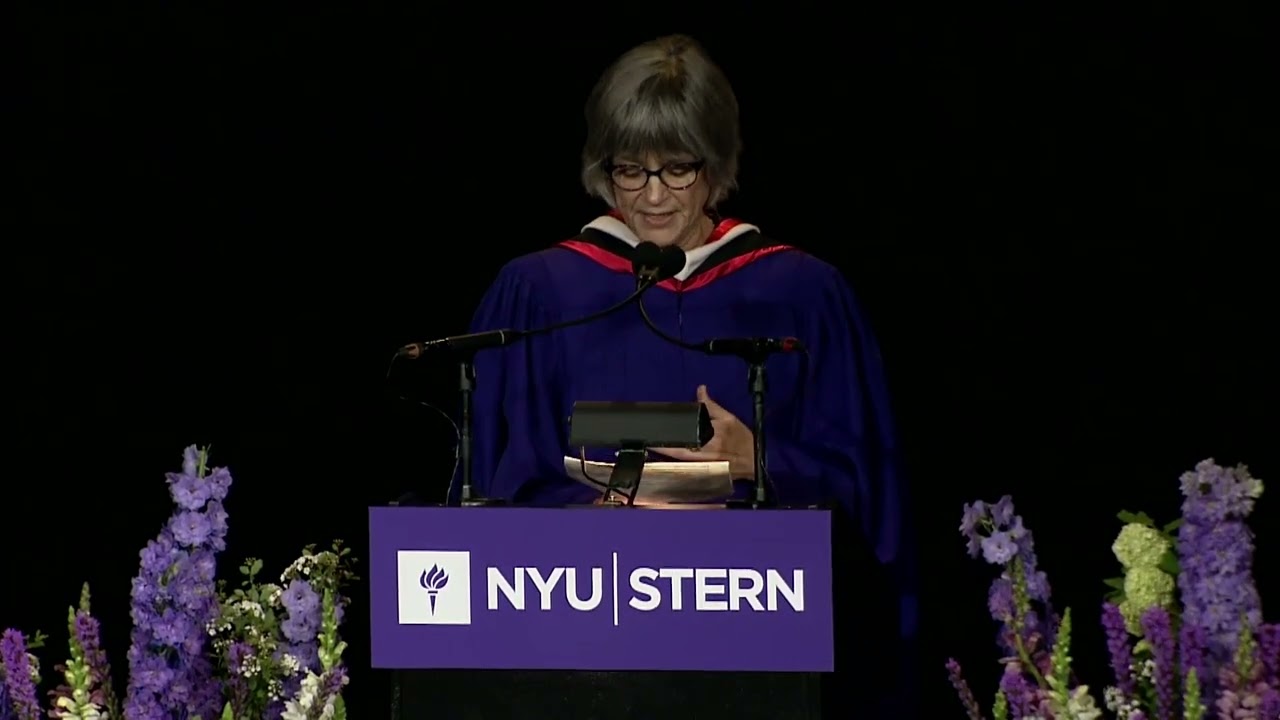
## Background Published on YouTube by the NYU Stern channel on September 22, 2026, this video features Professor Tensie Whelan delivering a convocation address to Stern's MBA and PhD Class of 2025 on May 16, 2025. Whelan, a 1980 NYU graduate, serves as Distinguished Professor of Practice in Business and Society and Founding Director of the NYU Stern Center for Sustainable Business.
## TL;DR Addressing a graduating class facing rapid disruption and complexity, Professor Tensie Whelan outlines four critical leadership lessons: adopting systems thinking, aligning corporate vision with societal purpose, prioritizing enduring value creation over short-term extraction, and executing with managerial discipline. She validates these principles through commercial benchmarks, citing supply chain resilience at Nespresso, sustainable market premiums at Unilever, and employee productivity gains at Costco. Whelan synthesizes these concepts through the success of Esusu, a fintech unicorn co-founded by NYU Stern alumnus Samir Goel that expands credit access for underserved renters while generating mutual utility across landlords, lenders, and government agencies. She closes by challenging graduates to channel their expertise toward solving pressing global issues.
## Atmosphere & style The address blends celebratory academic ceremony with crisp, high-impact business rhetoric. Whelan opens with charming wit regarding the strict five-minute speaking limit, immediately establishing an engaging, brisk cadence that respects the graduates' milestone. Her delivery shifts seamlessly from rigorous data-driven corporate insights to an empowering, purposeful call to leadership that leaves the audience inspired rather than intimidated by global volatility.
## Bulletin - [00:06](https://www.youtube.com/watch?v=wBHlucFcbJ4&t=6s) Empirical research from the NYU Stern Center for Sustainable Business shows that sustainably marketed consumer packaged goods grow at twice the rate of conventional goods and capture a 28% price premium. - [00:06](https://www.youtube.com/watch?v=wBHlucFcbJ4&t=6s) Costco demonstrates long-term value creation by paying an average wage of $32 per hour, driving a 93% employee retention rate and generating 180% more revenue per employee than Walmart. - [03:16](https://www.youtube.com/watch?v=wBHlucFcbJ4&t=196s) NYU Stern alumnus Samir Goel scaled fintech unicorn Esusu to a $1 billion valuation by reporting on-time rent payments to unlock $50 billion in credit capacity for over 200,000 previously uncredited individuals. - [00:06](https://www.youtube.com/watch?v=wBHlucFcbJ4&t=6s) Professor Tensie Whelan outlines four critical leadership disciplines for navigating volatility: systems thinking, alignment with societal goals, enduring value creation, and disciplined execution.
## Key takeaways - [00:06](https://www.youtube.com/watch?v=wBHlucFcbJ4&t=6s) Modern leaders operate in a volatile, highly disrupted world that requires systems thinking rather than insular corporate management. - [00:06](https://www.youtube.com/watch?v=wBHlucFcbJ4&t=6s) Nespresso safeguards its core supply chain by investing in the climate resilience and financial security of 150,000 smallholder coffee farmers. - [00:06](https://www.youtube.com/watch?v=wBHlucFcbJ4&t=6s) Aligning corporate strategy with broad societal goals drives market differentiation and sustained revenue growth rather than mere altruism. - [00:06](https://www.youtube.com/watch?v=wBHlucFcbJ4&t=6s) Sustainably marketed consumer products outperform conventional alternatives by growing at double the pace while securing a 28% price premium. - [00:06](https://www.youtube.com/watch?v=wBHlucFcbJ4&t=6s) Extracting short-term value by slashing worker wages ultimately damages organizational health and inflates turnover replacement costs. - [00:06](https://www.youtube.com/watch?v=wBHlucFcbJ4&t=6s) Costco maintains a 93% retention rate against an industry average of 40% by offering competitive pay and strong benefits. - [00:06](https://www.youtube.com/watch?v=wBHlucFcbJ4&t=6s) Investing in front-line workers yields superior commercial returns, evidenced by Costco employees generating 180% more revenue than Walmart workers. - [03:16](https://www.youtube.com/watch?v=wBHlucFcbJ4&t=196s) A transformative corporate vision fails unless paired with rigorous, disciplined operational execution. - [03:16](https://www.youtube.com/watch?v=wBHlucFcbJ4&t=196s) Samir Goel addressed systemic barriers to wealth creation by building financial reporting infrastructure for historically excluded communities. - [03:16](https://www.youtube.com/watch?v=wBHlucFcbJ4&t=196s) Esusu aligns the economic incentives of renters, property owners, credit bureaus, and mortgage agencies into a mutually reinforcing ecosystem. - [03:16](https://www.youtube.com/watch?v=wBHlucFcbJ4&t=196s) Reporting on-time rental payments has unlocked $50 billion in credit capacity and provided over 200,000 people with their first credit scores. - [03:16](https://www.youtube.com/watch?v=wBHlucFcbJ4&t=196s) Graduating business leaders must reject retreat from complex global problems and proactively direct their expertise toward sustainable innovation.
## Detailed walkthrough ### [00:06](https://www.youtube.com/watch?v=wBHlucFcbJ4&t=6s) Leading Through Complexity: Systems Thinking, Societal Purpose, and Value Creation
Introduced to the lectern by Interim Dean JP Eggers, Professor Tensie Whelan opens her convocation address with a lighthearted acknowledgment of the time constraint: while as a professor she typically enjoys an hour to articulate a thesis, the graduating class is "lucky" because she has only five minutes. She frames the reality awaiting the graduates as a world that is *"everything, everywhere, all at once"*—an environment characterized by rapid disruption, volatility, and deep complexity across every sector of human endeavor. Drawing from her career as both a practitioner and academic collaborating with visionary business and nonprofit executives, Whelan synthesizes four essential leadership lessons through the practices of real-world chief executives.
The first lesson centers on the necessity of systems thinking. To navigate intense complexity and rapid change, leaders must look beyond narrow organizational boundaries to understand the broader ecosystem in which their business operates. Whelan illustrates this with Nespresso, pointing out that its CEO can consistently deliver premium coffee to consumers only by ensuring the resilience of its agricultural supply chain. Specifically, the enterprise must actively support its 150,000 smallholder farmer partners in mitigating the adverse impacts of climate change on crop yield and bean quality, while guaranteeing they earn enough income to sustain their households and retire comfortably.
Whelan’s second lesson posits that corporate vision must directly align with broader societal goals and shared purpose. In an era marked by climate disruption and inequality, sustainable business models are no longer purely altruistic—they drive tangible commercial outperformance. Under former CEO Paul Polman, Unilever made *"making sustainable living commonplace"* its core corporate purpose, unlocking substantial revenue growth and market differentiation. Whelan notes that empirical research conducted by the NYU Stern Center for Sustainable Business corroborates this advantage: across consumer packaged goods categories, sustainably marketed products are expanding at twice the pace of conventional alternatives while commanding a 28% price premium.
Her third lesson warns against the extractive trap: leaders must create enduring value rather than extract short-term value. While many corporations slash compensation to artificially inflate profit margins, Whelan argues that this approach destroys underlying enterprise value. She contrasts this with Costco's workforce strategy:
- **Competitive Compensation:** Costco pays store clerks an average of $32 per hour alongside industry-leading benefits. - **Superior Retention:** Costco achieves a 93% employee retention rate, compared to an industry average of 40%. - **Turnover Cost Avoidance:** Replacing a retail associate costs at least $5,000 per departure. - **Productivity Differential:** A Costco employee generates 180% more revenue than an equivalent employee at Walmart, illustrating how investing in labor delivers superior commercial productivity.
---
[03:16](https://www.youtube.com/watch?v=wBHlucFcbJ4&t=196s) Systemic Execution: The Story of Samir Goel and Esusu
```mermaid flowchart TD accTitle: Esusu Systemic Value Creation Model accDescr: A flow diagram showing how Esusu connects renters, landlords, credit agencies, mortgage issuers, and government into a self-reinforcing value loop.
subgraph CorePlatform ["Esusu Platform"] E["Esusu Data Platform<br/>(Captures On-Time Rent Payments)"] end
subgraph Beneficiaries ["Stakeholders & Value Created"] R["Renters<br/>(Credit History & Wealth Building)"] L["Landlords<br/>(Higher Quality, Stable Tenants)"] C["Credit Bureaus<br/>(New Customer Pool)"] M["Fannie Mae & Freddie Mac<br/>(Lower Mortgage Default Risk)"] G["Federal Government<br/>(Expanded Economic Opportunity)"] end
R -->|"Pays rent on time"| E E -->|"Reports payment data"| C E -->|"Reports reporting data"| L E -->|"Shares credit data"| M M --> G C --> R ```
Whelan's fourth principle addresses managerial execution: a transformative vision is meaningless without disciplined operational management. To demonstrate all four lessons unified in practice, she shares the journey of Samir Goel, a recent NYU Stern alumnus and the co-founder and CEO of financial technology company Esusu. Growing up as the child of immigrants who were locked out of traditional credit and therefore struggled to build generational wealth, Goel diagnosed the structural flaws of the financial system and engineered a new business model around social purpose.
Goel designed a data reporting infrastructure that records on-time residential rent payments and feeds that verification directly to credit bureaus, property owners, and housing finance entities such as Fannie Mae and Freddie Mac. Rather than attempting piecemeal reform, Goel engineered a multi-stakeholder model where every participant derives tangible economic utility: - **Renters** build verifiable credit profiles that unlock paths to capital. - **Landlords** attract more reliable, higher-quality tenants who consistently pay on time. - **Credit Agencies** expand their serviceable consumer base. - **Mortgage Issuers** reduce underwriting and default risk. - **The Federal Government** achieves broader public-policy goals around economic inclusion.
Because value is distributed across the entire ecosystem, every player is incentivized to support the transition. Within a few short years, Esusu has unlocked $50 billion in credit capacity for mortgages, automobile financing, and higher education, while helping more than 200,000 individuals establish their first official credit score. Today, Esusu is a $1 billion unicorn backed by premier global investors, including SoftBank.
Concluding her remarks, Whelan urges the Class of 2025 not to retreat from the daunting global challenges ahead. Instead, she charges them to identify where their skills can make a focused impact and to embrace the responsibility of leading the next frontier of sustainable innovation.
## Notable quotes > [00:06](https://www.youtube.com/watch?v=wBHlucFcbJ4&t=6s) lucky — Tensie Whelan
> [00:06](https://www.youtube.com/watch?v=wBHlucFcbJ4&t=6s) everything, everywhere, all at once — Tensie Whelan
> [00:06](https://www.youtube.com/watch?v=wBHlucFcbJ4&t=6s) making sustainable living commonplace — Paul Polman
## Mentioned Tensie Whelan, JP Eggers, NYU Stern Center for Sustainable Business, Nespresso, Paul Polman, Unilever, Costco, Walmart, Samir Goel, Esusu, Fannie Mae, Freddie Mac, SoftBank
## Video description Tensie Whelan (NYU 1980), Distinguished Professor of Practice, Business and Society, and Founding Director, NYU Stern Center for Sustainable Business, addresses Stern's MBA and PhD Class of 2025 on Friday, May 16, 2025.
[Source](https://www.youtube.com/watch?v=wBHlucFcbJ4)