Becker Urges NYU Stern Graduates to Prioritize Humility and Connection
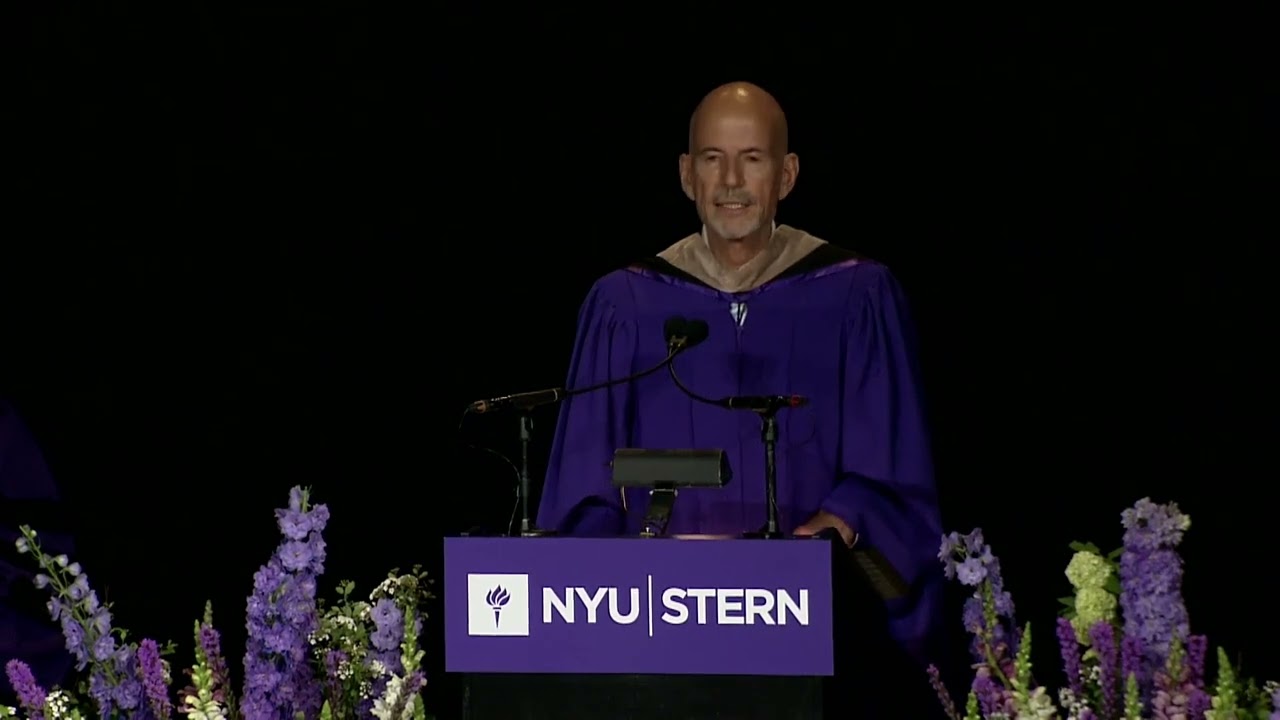
NYU Stern
Long-term professional success and personal resilience depend on practicing gratitude, building a personal board of directors, and embracing vulnerability rather than projecting unyielding strength.
AI-assisted summary of Keynote Speaker: Dietrich Becker (MBA ’91) | NYU Stern MBA and PhD Convocation, Class of 2025 — original source. Check the original for full context.
Source published:
Key ideas
- Dietrich Becker addresses the NYU Stern Class of 2025 exactly 34 years after his own 1991 MBA graduation, distilling three decades of M&A advisory experience into six life lessons. (0:00)
- Becker highlights humility and gratitude as essential counterweights to professional pride, citing long-time partner and Wall Street veteran Joe Perella as a primary exemplar of modest leadership. (2:15)
- Graduates are advised to assemble a deliberate personal 'board of directors' consisting of five to six mentors and role models to evaluate major professional and personal junctures. (6:20)
- Warning against burnout driven by extreme work hours and sleep deprivation, Becker urges graduates to actively protect health, relationships, and well-being alongside career ambitions. (7:52)
Detailed notes
## Background Published on YouTube by NYU Stern on September 22, 2026, this video features the convocation address delivered to the MBA and PhD Class of 2025 on Friday, May 16, 2025. The address is delivered by Dietrich Becker (MBA ’91), Founding Partner and President of Perella Weinberg Partners and Chair of the NYU Stern Executive Board.
## TL;DR Reflecting on 34 years since his own graduation, investment banker Dietrich Becker distills his career and personal insights into six core lessons for the graduating class. He advises graduates to prioritize daily gratitude, lead with humility, and embrace vulnerability to foster genuine connections rather than transactional networking. Becker also urges the audience to assemble a personal board of directors for key decisions, courageously embrace technological and geopolitical disruption, and rigorously protect their physical and mental health against burnout.
## Atmosphere & style The address carries a warm, candid, and self-effacing tone, combining dry humor about banking stereotypes with genuine paternal affection. Becker's narrative style is reflective and disarming, openly unpacking his past struggles with imposter syndrome in aggressive corporate environments rather than presenting an idealized success story. The speech builds an uplifting emotional arc, culminating in an energizing, optimistic rallying cry that leaves the audience inspired to lead with humanity.
## Bulletin - [00:00](https://www.youtube.com/watch?v=rbJdLAYwsag&t=0s) Dietrich Becker addresses the NYU Stern Class of 2025 exactly 34 years after his own 1991 MBA graduation, distilling three decades of M&A advisory experience into six life lessons. - [02:15](https://www.youtube.com/watch?v=rbJdLAYwsag&t=135s) Becker highlights humility and gratitude as essential counterweights to professional pride, citing long-time partner and Wall Street veteran Joe Perella as a primary exemplar of modest leadership. - [06:20](https://www.youtube.com/watch?v=rbJdLAYwsag&t=380s) Graduates are advised to assemble a deliberate personal 'board of directors' consisting of five to six mentors and role models to evaluate major professional and personal junctures. - [07:52](https://www.youtube.com/watch?v=rbJdLAYwsag&t=472s) Warning against burnout driven by extreme work hours and sleep deprivation, Becker urges graduates to actively protect health, relationships, and well-being alongside career ambitions.
## Key takeaways - [00:00](https://www.youtube.com/watch?v=rbJdLAYwsag&t=0s) Dietrich Becker returns to NYU Stern 34 years after his 1991 graduation to offer advice aimed at preventing poor choices in career and life. - [02:15](https://www.youtube.com/watch?v=rbJdLAYwsag&t=135s) Gratitude should take precedence over pride, serving as a daily practice that removes stress, builds resilience, and keeps professionals grounded. - [02:15](https://www.youtube.com/watch?v=rbJdLAYwsag&t=135s) Humility remains the most appealing and effective leadership quality, elevating professional success rather than diminishing it. - [02:15](https://www.youtube.com/watch?v=rbJdLAYwsag&t=135s) Joe Perella exemplifies how world-class dealmakers achieve monumental corporate success while remaining profoundly humble. - [04:38](https://www.youtube.com/watch?v=rbJdLAYwsag&t=278s) Early-career imposter syndrome and feelings of inadequacy are universal, even within high-pressure environments dominated by alpha personalities. - [04:38](https://www.youtube.com/watch?v=rbJdLAYwsag&t=278s) Embracing vulnerability fosters authenticity and trust, transforming transactional networking into meaningful personal connections. - [06:20](https://www.youtube.com/watch?v=rbJdLAYwsag&t=380s) Major life and career turning points typically trace back to a small circle of five or six influential mentors and role models. - [06:20](https://www.youtube.com/watch?v=rbJdLAYwsag&t=380s) Professionals should intentionally assemble a personal 'board of directors' to seek guidance on key decisions like job changes, starting businesses, and personal partnerships. - [07:52](https://www.youtube.com/watch?v=rbJdLAYwsag&t=472s) Stern graduates possess the agency, resources, and training needed to actively shape change rather than fear disruptions from AI or geopolitics. - [07:52](https://www.youtube.com/watch?v=rbJdLAYwsag&t=472s) Extraordinary career success demands hard work, but identity should never be defined solely by job titles, wealth, or accolades. - [07:52](https://www.youtube.com/watch?v=rbJdLAYwsag&t=472s) Neglecting sleep, exercise, and proper nutrition risks burnout and can derail even the most talented professionals.
## Detailed walkthrough ### [00:00](https://www.youtube.com/watch?v=rbJdLAYwsag&t=0s) Opening and Context: 34 Years Since Stern
JP Eggers opens the convocation by introducing Dietrich Becker, who takes the podium to address the graduating Class of 2025. Becker begins with warm congratulations from the bottom of his heart, humorously acknowledging that the graduates are now ready to head into the workforce and "show us old people how it's done." Reflecting on the setting, he notes that it has been 34 years since his own NYU Stern MBA graduation in May 1991, which took place about 20 blocks away from Madison Square Garden rather than within its current grandeur. Standing before them is an enormous honor, and he frames his remarks around a single guiding question: what insights would he have wanted to know back in 1991 that might have prevented poor decisions and eased difficult moments in both his professional and personal life?
To ensure his advice remained relevant to today's generation, Becker sense-checked his thoughts with his four children. His eldest daughter, Alessia, had sat in the very same seats just one year earlier upon completing her own Stern MBA, and Becker jokes that she was present in the audience to celebrate the class and "roll her eyes at her old man." Looking back over 34 years in mergers and acquisitions, Becker admits that the profound insights he accumulated are few enough to fit comfortably into a ten-minute talk. He adds dryly that some lessons might seem surprising coming from an investment banker, given that bankers "are rumored not to actually have" a heart.
[02:15](https://www.youtube.com/watch?v=rbJdLAYwsag&t=135s) Lesson 1 & 2: Practicing Gratitude and Staying Humble
Becker presents his first lesson: practice gratitude. While earning a graduate degree from Stern is an impressive achievement that justifies immense pride, he emphasizes that graduates are also exceptionally lucky and possess a great deal to be thankful for. Being part of an elite community equips them thoroughly for the world's challenges, but he urges them to prioritize gratitude over sheer pride. Admitting that gratitude was a sentiment he embraced far too late in his own life, he now celebrates it daily as the predominant emotion that grounds him, removes stress from the system, and builds resilience and perspective.
Moving to his second point, Becker counsels the graduates to stay humble. After repeatedly outperforming the competition and earning credentials from one of the premier business schools on the planet, it would be natural for them to feel "a little bit full of yourself right now." Yet across decades of advising corporate leaders, founders, entrepreneurs, academics, and politicians, Becker has found humility to be the single most appealing and effective attribute. He highlights his nearly 30-year working relationship with Wall Street legend Joe Perella, an architect of the modern M&A advisory business who led some of corporate history's most transformational transactions. Despite his stature, Perella remains the humblest leader Becker has ever known, continually reminding colleagues that humility does not diminish success, but rather elevates it into true leadership.
[04:38](https://www.youtube.com/watch?v=rbJdLAYwsag&t=278s) Lesson 3: Embracing Vulnerability and Real Connection
The third principle Becker shares is to embrace vulnerability. Entering Merrill Lynch in New York directly after business school with high ambition, Becker found himself thrust into a cutthroat environment dominated by "extreme alpha personalities." Feeling obliged to project unwavering strength and confidence, he silently grappled with intense self-doubt, feelings of inadequacy, and severe imposter syndrome—especially during phases when his career was visibly thriving.
Only much later did Becker discover that vulnerability is not a liability. Because everyone secretly shares those anxieties regardless of how smart or assertive they seem, opening up and showing vulnerability did not undermine his career; instead, it established genuine authenticity and built deep trust. This realization fundamentally changed his view of professional relationships. The transactional exercise of traditional "networking"—which he describes as trying to impress important individuals—was replaced by forging authentic personal bonds. Waiting until his late 40s to realize that vulnerability sparks connection, and that connection drives long-term personal and professional success, is one of Becker's greatest retrospective regrets.
[06:20](https://www.youtube.com/watch?v=rbJdLAYwsag&t=380s) Lesson 4: Finding Your VIPs and Building a Personal Board
Becker's fourth piece of guidance is to actively find your "VIPs." Looking back at the turning points, crucial career choices, and breakthroughs in his life, he traces nearly all of them back to a tight circle of five or six individuals who served as role models, mentors, and influencers. Becker acknowledges that discovering and keeping these people in his life was largely fortuitous—joking that "one of them I liked so much, I married her."
If he were starting over today, Becker explains, he would approach this process far more deliberately. He shares a framework borrowed from a fellow Perella Weinberg board member who teaches at Harvard: assemble a personal "board of directors."
```mermaid flowchart TD accTitle: Personal Board of Directors Framework accDescr: A diagram illustrating the selection and role of personal advisors during key life transitions. subgraph Selection["Assembling Your Board"] A["Identify Mentors & Role Models"] --> B["Select for Knowledge, Humanity, & Experience"] end subgraph Execution["Key Life Junctures"] B --> C["Seek Counsel on Critical Decisions"] C --> D["Career Moves: Taking or Leaving a Job"] C --> E["Entrepreneurship: Starting a Company"] C --> F["Personal Milestones: Marriage & Life Choices"] end ```
He advises students to deliberately choose people they admire for their wisdom, humanity, and experience, and to consult them directly whenever facing major life forks—whether deciding to take a job, leave a position, launch a company, or choose a life partner. Senior leaders and mentors genuinely love being asked for guidance, Becker stresses, urging the audience not to delay building this sounding board.
[07:52](https://www.youtube.com/watch?v=rbJdLAYwsag&t=472s) Lesson 5 & 6: Embracing Change and Looking After Your Health
Turning to his fifth principle, Becker tells the audience to embrace change. While human nature is divided between those seeking to alter the world and those clinging to the familiar, Stern graduates are uniquely equipped with the education, perspective, and drive to act as agents of change. Acknowledging that change is accelerating across technology, culture, and geopolitics, he touches directly on contemporary anxieties—such as whether artificial intelligence will take their jobs or run the world, or whether geopolitical instability will disrupt their plans. Rather than succumbing to the discomfort of uncertainty, Becker reminds graduates that their daily choices, careers, votes, and financial resources give them immense leverage to shape outcomes during an unprecedented era.
Finally, Becker delivers a crucial warning: look after yourselves. While acknowledging that extraordinary career success demands intense hard work with zero shortcuts, he observes that the most compelling and impactful leaders are never defined solely by titles, wealth, or accolades. Instead, they protect time for physical fitness, good nutrition, emotional awareness, family, friends, and creative outlets. Having witnessed immensely gifted peers derail their careers through burnout, poor diet, and sleep deprivation, Becker urges the graduates never to use lack of time as an excuse to neglect their well-being: - Exceptional work ethic is required, but ambition alone should not define personal identity. - Common habits leading to burnout include neglecting exercise, skipping healthy food ("to eat vegetables, whatever"), and chronic sleep loss. - Physical and mental health are irreplaceable assets that must take precedence over career pressures.
Becker closes his address with an enthusiastic rallying cry to the Class of 2025, urging them to step forward as optimistic leaders who will change the world, keep it safe, and maintain lifelong connections with one another.
## Notable quotes > [00:00](https://www.youtube.com/watch?v=rbJdLAYwsag&t=0s) show us old people how it's done — Dietrich Becker
> [00:00](https://www.youtube.com/watch?v=rbJdLAYwsag&t=0s) roll her eyes at her old man — Dietrich Becker
> [00:00](https://www.youtube.com/watch?v=rbJdLAYwsag&t=0s) are rumored not to actually have — Dietrich Becker
> [02:15](https://www.youtube.com/watch?v=rbJdLAYwsag&t=135s) a little bit full of yourself right now — Dietrich Becker
> [04:38](https://www.youtube.com/watch?v=rbJdLAYwsag&t=278s) extreme alpha personalities — Dietrich Becker
> [06:20](https://www.youtube.com/watch?v=rbJdLAYwsag&t=380s) one of them I liked so much, I married her — Dietrich Becker
> [06:20](https://www.youtube.com/watch?v=rbJdLAYwsag&t=380s) board of directors — Dietrich Becker
> [07:52](https://www.youtube.com/watch?v=rbJdLAYwsag&t=472s) to eat vegetables, whatever — Dietrich Becker
## Mentioned JP Eggers, Dietrich Becker, NYU Stern, Madison Square Garden, Alessia Becker, Perella Weinberg Partners, Joe Perella, Merrill Lynch, Harvard
## Video description Dietrich Becker (MBA ’91), Founding Partner and President of Perella Weinberg Partners and Chair of the NYU Stern Executive Board, addresses Stern's MBA and PhD Class of 2025 on Friday, May 16, 2025.
[Source](https://www.youtube.com/watch?v=rbJdLAYwsag)